EP1134818A1 - Safety device for sealed battery and sealed battery using it - Google Patents
Safety device for sealed battery and sealed battery using it Download PDFInfo
- Publication number
- EP1134818A1 EP1134818A1 EP99972790A EP99972790A EP1134818A1 EP 1134818 A1 EP1134818 A1 EP 1134818A1 EP 99972790 A EP99972790 A EP 99972790A EP 99972790 A EP99972790 A EP 99972790A EP 1134818 A1 EP1134818 A1 EP 1134818A1
- Authority
- EP
- European Patent Office
- Prior art keywords
- plate
- lid
- pressure
- shield plate
- positive electrode
- Prior art date
- Legal status (The legal status is an assumption and is not a legal conclusion. Google has not performed a legal analysis and makes no representation as to the accuracy of the status listed.)
- Granted
Links
- 239000011888 foil Substances 0.000 claims abstract description 17
- 238000007789 sealing Methods 0.000 claims abstract description 15
- 238000002955 isolation Methods 0.000 claims description 16
- 238000004891 communication Methods 0.000 claims description 14
- 229910052751 metal Inorganic materials 0.000 abstract description 6
- 239000002184 metal Substances 0.000 abstract description 6
- 239000012528 membrane Substances 0.000 abstract 1
- 238000012856 packing Methods 0.000 abstract 1
- 238000004880 explosion Methods 0.000 description 5
- 238000005253 cladding Methods 0.000 description 4
- 239000008151 electrolyte solution Substances 0.000 description 4
- 238000000034 method Methods 0.000 description 4
- XLYOFNOQVPJJNP-UHFFFAOYSA-N water Substances O XLYOFNOQVPJJNP-UHFFFAOYSA-N 0.000 description 4
- 238000003466 welding Methods 0.000 description 4
- 238000006243 chemical reaction Methods 0.000 description 3
- 238000007599 discharging Methods 0.000 description 3
- 239000000758 substrate Substances 0.000 description 3
- WHXSMMKQMYFTQS-UHFFFAOYSA-N Lithium Chemical compound [Li] WHXSMMKQMYFTQS-UHFFFAOYSA-N 0.000 description 2
- 229910052744 lithium Inorganic materials 0.000 description 2
- RYGMFSIKBFXOCR-UHFFFAOYSA-N Copper Chemical compound [Cu] RYGMFSIKBFXOCR-UHFFFAOYSA-N 0.000 description 1
- HBBGRARXTFLTSG-UHFFFAOYSA-N Lithium ion Chemical compound [Li+] HBBGRARXTFLTSG-UHFFFAOYSA-N 0.000 description 1
- XAGFODPZIPBFFR-UHFFFAOYSA-N aluminium Chemical compound [Al] XAGFODPZIPBFFR-UHFFFAOYSA-N 0.000 description 1
- 239000011889 copper foil Substances 0.000 description 1
- 239000012212 insulator Substances 0.000 description 1
- 229910001416 lithium ion Inorganic materials 0.000 description 1
- 230000000149 penetrating effect Effects 0.000 description 1
- 230000000630 rising effect Effects 0.000 description 1
- 238000000992 sputter etching Methods 0.000 description 1
Images





Classifications
-
- H—ELECTRICITY
- H01—ELECTRIC ELEMENTS
- H01M—PROCESSES OR MEANS, e.g. BATTERIES, FOR THE DIRECT CONVERSION OF CHEMICAL ENERGY INTO ELECTRICAL ENERGY
- H01M50/00—Constructional details or processes of manufacture of the non-active parts of electrochemical cells other than fuel cells, e.g. hybrid cells
- H01M50/50—Current conducting connections for cells or batteries
- H01M50/572—Means for preventing undesired use or discharge
-
- H—ELECTRICITY
- H01—ELECTRIC ELEMENTS
- H01M—PROCESSES OR MEANS, e.g. BATTERIES, FOR THE DIRECT CONVERSION OF CHEMICAL ENERGY INTO ELECTRICAL ENERGY
- H01M50/00—Constructional details or processes of manufacture of the non-active parts of electrochemical cells other than fuel cells, e.g. hybrid cells
- H01M50/30—Arrangements for facilitating escape of gases
- H01M50/342—Non-re-sealable arrangements
- H01M50/3425—Non-re-sealable arrangements in the form of rupturable membranes or weakened parts, e.g. pierced with the aid of a sharp member
-
- H—ELECTRICITY
- H01—ELECTRIC ELEMENTS
- H01M—PROCESSES OR MEANS, e.g. BATTERIES, FOR THE DIRECT CONVERSION OF CHEMICAL ENERGY INTO ELECTRICAL ENERGY
- H01M10/00—Secondary cells; Manufacture thereof
- H01M10/05—Accumulators with non-aqueous electrolyte
- H01M10/052—Li-accumulators
-
- H—ELECTRICITY
- H01—ELECTRIC ELEMENTS
- H01M—PROCESSES OR MEANS, e.g. BATTERIES, FOR THE DIRECT CONVERSION OF CHEMICAL ENERGY INTO ELECTRICAL ENERGY
- H01M2200/00—Safety devices for primary or secondary batteries
- H01M2200/10—Temperature sensitive devices
- H01M2200/106—PTC
-
- H—ELECTRICITY
- H01—ELECTRIC ELEMENTS
- H01M—PROCESSES OR MEANS, e.g. BATTERIES, FOR THE DIRECT CONVERSION OF CHEMICAL ENERGY INTO ELECTRICAL ENERGY
- H01M2200/00—Safety devices for primary or secondary batteries
- H01M2200/20—Pressure-sensitive devices
-
- Y—GENERAL TAGGING OF NEW TECHNOLOGICAL DEVELOPMENTS; GENERAL TAGGING OF CROSS-SECTIONAL TECHNOLOGIES SPANNING OVER SEVERAL SECTIONS OF THE IPC; TECHNICAL SUBJECTS COVERED BY FORMER USPC CROSS-REFERENCE ART COLLECTIONS [XRACs] AND DIGESTS
- Y02—TECHNOLOGIES OR APPLICATIONS FOR MITIGATION OR ADAPTATION AGAINST CLIMATE CHANGE
- Y02E—REDUCTION OF GREENHOUSE GAS [GHG] EMISSIONS, RELATED TO ENERGY GENERATION, TRANSMISSION OR DISTRIBUTION
- Y02E60/00—Enabling technologies; Technologies with a potential or indirect contribution to GHG emissions mitigation
- Y02E60/10—Energy storage using batteries
Definitions
- the present invention relates to a safety device with explosion-proof of a closed battery and a closed battery with the safety device.
- the secondary battery has a high electro motive force
- the secondary battery would be exploded in case of increasing an inner pressure caused by chemical reaction in an electrode member with a positive electrode and a negative electrode installed in an outer container.
- a non-water electrolytic solution battery such as a lithium secondary battery is in an overcharge condition or a large amount of electric current is flown into the battery in a short circuit condition caused by a wrong operation
- non-water electrolytic solution is solved in the electrode member and gas is produced.
- the gas is continuously produced in the outer container and an inner pressure of the outer container is increased, the battery would be exploded in final.
- a positive electrode lid provided at an edge of an outer container comprises a metallic porous plate affected as the inner most lid and connected to a positive electrode of an electrode member through a positive electrode lead, a metallic explosion-proof valve affected as an intermediate lid electrically connected to the metallic porous plate through a central adhered portion and a metallic cap terminal electrically connected to the metallic explosion-proof valve.
- the metallic porous plate and the metallic explosion-proof plate are electrically isolated by breaking the central adhered portion and gas produced in the inside of the battery is discharged by breaking a part of the metallic explosion-proof valve so as to avoid an explosion of the battery.
- a purpose of the present invention is to provide a safety device of a closed battery in which a pressure plate and a shield plate can be isolated certainly and a safety of the closed battery can be maintained sufficiently even if an inner pressure of the battery exceeds a predetermined level and a closed battery with the safety device.
- a safety device of a closed battery as claimed in claim 1 comprises a positive electrode lid attached at one end of an outer container, said positive electrode lid including a pressure plate effected as the innermost lid and electrically connected to a positive electrode of an electrode member through a positive electrode lead, a shield plate effected as an intermediate lid and electrically connected to said pressure plate through a central contacting portion, and a sealing plate affected as the outermost lid and electrically connected to said shield lid wherein at least one gas flow hole is provided at said pressure plate so as to communicate an internal space of said outer container with a contacting space between said pressure plate and said shield plate a central contacting portion includes a protrusion protruded from a central portion of said pressure plate toward said shield plate and having a first flat contacting surface and a second contacting surface provided at a central portion of said shield plate and contacting with said first flat contacting surface of said protrusion, and said pressure plate and said shield plate are isolated when the inner pressure level of said outer container exceeds a predetermined electric current
- a safety device as claimed in claim 2 comprises a positive electrode lid attached at one end of an outer container, said positive electrode lid including a pressure plate effected as the innermost lid and electrically connected to a positive electrode of an electrode member through a positive electrode lead, a shield plate effected as an intermediate lid and electrically connected to said pressure plate through a central contacting portion, and a sealing plate affected as the outermost lid and electrically connected to said shield lid, wherein at lest one gas flow hole is provided at said pressure plate so as to communicate an internal portion of said outer container with a contacting space between said pressure plate and said shield plate, a plurality of circular grooves are formed at a substantially central portion of said shield plate except connecting tab portions coaxially notched and alternatively arranged with an angle of 180 ° so as to oppose the adjacent grooves each other; a diameter of said grooves is gradually increasing from an inner side to an outer side and said pressure plate and said shield plate are isolated when an inner pressure level of said outer container exceeds a predetermined electric current isolation pressure.
- a safety device as claimed in claim 3 comprises a positive electrode lid attached at one end of an outer container, said positive electrode lid including a pressure plate effected as the innermost lid and electrically connected to a positive electrode of a electrode member through a positive electrode lead, a shield plate effected as an intermediate lid and electrically connected to said pressure plate through a central contacting portion, and a sealing plate affected as the outermost lid and electrically connected to said shield lid, wherein at lest one gas flow hole is provided at said pressure plate so as to communicate an internal space of said outer container with a contacting space between said pressure plate and said shield plate, said central contacting portion includes a protrusion protruded from a central portion of said pressure plate toward said shield plate and having a first flat contacting surface and a second contacting surface provided at a central portion of said shield plate and contacting with said first flat contacting surface of said protrusion, a plurality of circular grooves at a portion surrounding with said second flat contacting surface of said shield plate except connecting tab portions coaxially notched and
- a circular shaped PTC thermister element is provided between the shield plate and the sealing plate.
- a closed battery as claimed in claim 6 comprises the above described safety device.
- an electric communication between the pressure plate and the shield plate in a closed space is certainly maintained by contacting the first flat contacting surface provided on the protrusion of the pressure plate and the second flat contacting surface of the shield plate.
- the shield plate, particularly the second flat contacting surface of the shield plate is released from the fist flat contacting surface by producing cracked gas so as to isolate the electric communication between the pressure plate and the shield plate.
- the cracked gas can be prevented from producing further and being discharged to an exterior of the battery.
- the second flat contacting surface is provided at a central portion of a plurality of circular grooves coaxially and alternatively arranged with an angle of 180, so that the second flat contacting surface can be released from the first contacting surface quickly.
- the electric communication between the pressure plate and the shield plate can be quickly isolated by providing the predetermined electric current isolation pressure.
- the second flat contacting surface is plastically deformed so that the second flat contacting surface is avoided to contact with the first flat contacting surface again. If even numbers of circular grooves are formed, the second flat contacting surface can be removed from the first flat contacting surface while the both surfaces are maintained in a parallel relation.
- cracked gas can be discharged to an exterior of the battery through at least one gas flow hole formed at the pressure plate, the contacting space, at least one circular groove (valve layer) and at least one gas discharging hole by breaking the circular groove (valve layer) formed at the shield plate.
- the predetermined electric current isolation pressure is preferably 4 to 5 kg/cm 2 and the predetermined layer breaking pressure is preferably 20 kg/cm 2 .
- a shield plate and a metallic foil piece may be made of a cladding metal plate for cladding the both.
- a valve layer may be formed by a portion of the metallic foil piece for covering with an inner circular groove and an outer circular groove.
- a thickness of the metal plate is preferably about 50 ⁇ m and a thickness of the metallic foil piece is preferably 10 ⁇ m.
- such a clad metal plate is manufactured by a glow discharge method in which a grounded metallic substrate having a contacting surface and a grounded metallic foil piece are effected as one electrode A and the other electrode B supported by an insulator are applied with alternative current 1 to 50 MHz in inactive gas under extreme low pressure of 1 x 10 -1 to 1 x 10 -4 Torr.
- An area of the electrode A exposed with plasma caused by the glow discharge is one third less than an area of the electrode B and etched by a sputter etching method.
- a circular shaped PTC thermister element is provided between a shield plate and a sealing plate.
- the PTC thermister element controls to reduce electric current while a temperature of a closed battery is increasing so as to avoid for exploding caused by excess current.
- Fig. 1 shows a structure of one embodiment of a safety device of a closed battery according to the present invention in a normal operation condition.
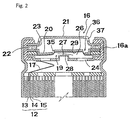
- Fig. 2 shows a structure of the embodiment of the safety device of the closed battery according to the present invention in a condition in which a pressure plate and a shield plate is shut down in an electric communication.
- Fig. 3 shows a structure of the embodiment of the safety device of the closed battery according to the present invention in a condition in which a valve layer is broken.
- Fig. 4 shows a perspective view taken along a line B-B in Fig. 1.
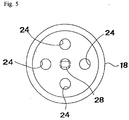
- Fig. 5 shows a perspective view taken along a line A-A in Fig. 1.
- Fig. 1 shows a structure of one embodiment of a safety device of a closed battery according to the present invention in a normal operation condition.
- Fig. 2 shows a structure of the embodiment of the safety device of the closed battery according to the present invention in a condition in which a pressure plate and a shield plate is shut down in an electric communication.
- FIG. 6 shows a mechanism in which a first central contact portion of the pressure plate is released from a second central contacting portion of the shield plate in a parallel relation.
- Fig. 7 shows a structure of another embodiment of a safety device of a closed battery according to the present invention in which a pressure plate and a shield plate is electrically isolated.
- Fig. 8 shows a structure of another embodiment of the safety device of the closed battery according to the present invention in which a valve layer is broken.
- FIG. 1 A structure of one embodiment of a safety device of a closed battery according to the present invention is explained with reference to Fig. 1 to Fig. 3.
- an electrode member 12 is installed in an outer container 11 used as a negative terminal.
- a positive electrode, a separator 14 and a negative electrode 15 are laminated as the electrode and drawn into a whirlpool.
- a safety device of a closed battery used both as an explosion-proof and a terminal is provided at an upper opening portion of the outer container 11.
- the safety device is actually constituted by a positive electrode lid 16 caulked at the upper opening portion of the outer container 11 through an isolate gasket 16a.
- the positive electrode lid 16 comprises a pressure plate 18 actually effected as the innermost lid and connected to the positive electrode 13 of the electrode member 12 through a positive electrode lid 17, a shield plate 20 effected as an intermediate lid and electrically connected to the pressure plate 18 through a central contact portion 19 and a sealing plate 21 effected as an outermost lid and electrically connected to the shield plate 20.
- the positive electrode lid 16 comprises a circular isolating plate 22 sandwiched between the pressure plate 18 and the shield plate 20 and a circular PTC thermister element 23 sandwiched between the shield plate 20 and the sealing plate 21.
- the pressure plate 18 has a plurality of gas flow holes 24.
- An internal chamber 25 of the outer container is connected to a contacting space 26 located between the pressure plate 18 and the shield plate 20 through the gas flow holes 24.
- the central contact portion 19 for electrically connecting with the pressure plate 18 and the shield plate 20 is constituted by a protrusion 28 having a first flat contact surface 27 and protruded from a central portion toward the shield plate 20 and a second flat contact surface 29 located at the central portion of the shield plate 20 and contacting with the first flat surface of the protrusion 28.
- an inner circular groove 31 having a horse shoe shaped is formed except a portion for a first connecting tab portion 30.
- an outer circular groove 33 having a horse shoe shape of which a diameter is larger than that of the inner circular groove 31 is formed except a portion of a second connecting tab 32 opposing at 180 ° with respect to the first connecting tab 30.
- an angle of circumference ⁇ 1 of the inner circular groove 31 is smaller than an angle of circumference ⁇ 2 of the outer circular groove 33.
- the angle ⁇ 1 is preferably larger than an angle of the first connecting tab 30.
- the horseshoe shaped inner circular groove 31 and outer circular groove 33 may be formed along a circle line, an oval line, the other undefined circles and an outline of polygons.
- valve layers 35 and 36 is formed at the inner circular groove 31 and the outer circular groove 32 covered with the metallic foil 34, respectively.
- a thickness of the valve layers 35 and 36 is designed to be broken when pressure more than predetermined rupture pressure (for example, 20 kg/cm 2 ) is applied to the valve layers 35 and 36.
- a copper foil piece having a thickness of 10 ⁇ m may be used as the metallic foil 34.
- valve films for covering the inner circular groove and the outer circular groove with a metallic foil piece by adhering the metallic foil piece 34 on the surface of the shield plate 20 confronting with the plate pressure as described above are not essential.
- a notching having a V-shaped cross section may be formed at a part of the shield plate 20 by score processing along a thickness direction. When such a score is formed, adhering a metallic foil piece is unnecessary at a side of the shield plate 20 confronting with the pressure plate, since a groove having a thinner wall is provided.
- the shield plate 20 When pressure of cracked gas becomes a predetermined electric isolation pressure, the shield plate 20 can be released from the pressure plate 18 by providing the inner and outer circle grooves 31 and 33 and the second flat contacting surface 29 is released in parallel with respect to the first contacting surface 27. Even if a central portion of the shield plate 20 is slightly risen, the shield plate 20 is completely released from the pressure plate 20. Thus, an electric communication between the pressure plate 18 and the shield plate 20 can be isolated quickly.
- Fig. 2 and Fig. 3 shows a condition in which the electric communication is isolated by releasing the second flat contacting surface 29 and the first flat contacting surface 27, respectively.
- a side surface of the protrusion 28 is torn so as to be broken as shown in Figs. 7 and 8.
- a wall thickness of the side surface of the protrusion 28 may be partly thinner so that the thinner wall thickness portion can be easily torn by rising the shield plate 20 so as to isolate the electric communication.
- the closed battery In the closed battery, if a large amount of electric current is flown in an overcharge condition, high corrosive cracked gas is produced in the outer container 11 by flowing a large amount of the electric current and pressure in the outer container 11 is increased. While the condition is maintained, the closed battery would be exploded. However, in the embodiment, when the pressure of the cracked gas in the outer container 11 exceeds the predetermined electric isolation pressure, the cracked gas is introduced into the contacting space 26 and then the second flat contacting surface 29 of the shield plate 20 is quickly released from the first flat contacting surface 27 formed on the protrusion 28 of the pressure plate 20 so as to isolate the electric communication between the pressure plate 18 and the shield plate 20.
- the cracked gas is prevented from producing further so that an explosion of the outer container 11 caused by increasing the inner pressure of the outer container 11 can be avoided certainly.
- the valve layer 35 and 36 have not been broken so that harmful crack gas against a human body can be prevented from flowing to the exterior of the battery and an environment can be prevented from contaminating.
- the safety device of the closed battery accomplishes the electric isolation and discharging cracked gas to the exterior of the battery so as to avoid for exploding the closed battery certainly.
- the cracked gas is discharged to the exterior in an emergent case.
- a baneful influence to a human body and an environment can be controlled as less as possible.
- the PTC thermister element 23 in a circular plate shape is provided between the shield plate 20 and the sealing plate 21 so that the thermister element 23 can control to lower electric current when a temperature of the safety device of the closed battery is increased by producing cracked gas. Thus, an explosion caused by excess current can be prevented.
- number of the grooves may be three and more (without regard to even number or odd number).
- a closed battery when normal electric current is flown, a closed battery can be operated normally by contacting a pressure plate and a shield plate in a sealed space in a pressure-tight condition.
- a second flat contacting surface formed at a central portion of a plurality of circular grooves coaxially arranged is quickly released from a first flat contacting surface formed on a protrusion at a central portion of a pressure plate by utilizing pressured produced by cracked gas so as to isolate an electric communication between the pressure plate and a shield plate rapidly.
- a valve layer is quickly broken so as to discharge the cracked gas.
- an electric isolation and discharging cracked gas to an exterior of the battery can be operated certainly in order to avoid for exploding the closed battery. Baneful influence against a human body and an environment can be controlled as less as possible since a discharge of cracked gas to the exterior of the battery is in an emergent case.
- cladding a metallic foil piece on a metallic substrate on which inner- and outer- circular grooves are formed is provided so that a shield plate with a valve layer certainly actuated by the predetermined layer break pressure can be manufactured economically.
- a safety device for a closed battery By providing a safety device for a closed battery according to the present invention, a high safety closed battery with high performance can be manufactured economically.
Landscapes
- Chemical & Material Sciences (AREA)
- Chemical Kinetics & Catalysis (AREA)
- Electrochemistry (AREA)
- General Chemical & Material Sciences (AREA)
- Engineering & Computer Science (AREA)
- Manufacturing & Machinery (AREA)
- Gas Exhaust Devices For Batteries (AREA)
- Connection Of Batteries Or Terminals (AREA)
- Sealing Battery Cases Or Jackets (AREA)
Abstract
Description
- The present invention relates to a safety device with explosion-proof of a closed battery and a closed battery with the safety device.
- Recently, a lithium battery with non-water electrolytic solution and a secondary batter with non-water electrolytic solution for a lithium ion battery have been broadly employed for pocket electronic tools.
- Although the secondary battery has a high electro motive force, the secondary battery would be exploded in case of increasing an inner pressure caused by chemical reaction in an electrode member with a positive electrode and a negative electrode installed in an outer container. For example, when a non-water electrolytic solution battery such as a lithium secondary battery is in an overcharge condition or a large amount of electric current is flown into the battery in a short circuit condition caused by a wrong operation, non-water electrolytic solution is solved in the electrode member and gas is produced. When the gas is continuously produced in the outer container and an inner pressure of the outer container is increased, the battery would be exploded in final.
- In order to avoid such an explosion, a closed battery for pocket electronic tools was developed as shown in Japanese Patent Laid-Open Publication No. 6-338305.
- In the conventional art, a positive electrode lid provided at an edge of an outer container comprises a metallic porous plate affected as the inner most lid and connected to a positive electrode of an electrode member through a positive electrode lead, a metallic explosion-proof valve affected as an intermediate lid electrically connected to the metallic porous plate through a central adhered portion and a metallic cap terminal electrically connected to the metallic explosion-proof valve.
- Under the structure as described above, when the inner pressure of the battery is increased, the metallic porous plate and the metallic explosion-proof plate are electrically isolated by breaking the central adhered portion and gas produced in the inside of the battery is discharged by breaking a part of the metallic explosion-proof valve so as to avoid an explosion of the battery.
- However, in a conventional closed battery, some drawbacks to be solved are remained. Although a central adhered portion is formed by welding a central portion of a metallic porous plate and a metallic explosion-proof valve in accordance with a spot welding method, it is difficult to weld all the portions uniformly by the spot welding method and a welding strength of each closed battery is not constant. As the result, an inner pressure of a battery for isolating a communication between the metallic porous plate and the metallic explosion-proof plate is not constant. In case of the closed battery, although the inner pressure of the battery is risen to a predetermined isolation pressure, a communication between the metallic porous plate and the metallic explosion-proof can not be isolated. Thus, a reliability of a closed battery is damaged in view of safety.
- In order to resolve the above subjects, a purpose of the present invention is to provide a safety device of a closed battery in which a pressure plate and a shield plate can be isolated certainly and a safety of the closed battery can be maintained sufficiently even if an inner pressure of the battery exceeds a predetermined level and a closed battery with the safety device.
- To accomplish the above purpose, a safety device of a closed battery as claimed in claim 1 comprises a positive electrode lid attached at one end of an outer container, said positive electrode lid including a pressure plate effected as the innermost lid and electrically connected to a positive electrode of an electrode member through a positive electrode lead, a shield plate effected as an intermediate lid and electrically connected to said pressure plate through a central contacting portion, and a sealing plate affected as the outermost lid and electrically connected to said shield lid wherein at least one gas flow hole is provided at said pressure plate so as to communicate an internal space of said outer container with a contacting space between said pressure plate and said shield plate a central contacting portion includes a protrusion protruded from a central portion of said pressure plate toward said shield plate and having a first flat contacting surface and a second contacting surface provided at a central portion of said shield plate and contacting with said first flat contacting surface of said protrusion, and said pressure plate and said shield plate are isolated when the inner pressure level of said outer container exceeds a predetermined electric current isolation pressure.
- A safety device as claimed in claim 2 comprises a positive electrode lid attached at one end of an outer container, said positive electrode lid including a pressure plate effected as the innermost lid and electrically connected to a positive electrode of an electrode member through a positive electrode lead, a shield plate effected as an intermediate lid and electrically connected to said pressure plate through a central contacting portion, and a sealing plate affected as the outermost lid and electrically connected to said shield lid, wherein at lest one gas flow hole is provided at said pressure plate so as to communicate an internal portion of said outer container with a contacting space between said pressure plate and said shield plate, a plurality of circular grooves are formed at a substantially central portion of said shield plate except connecting tab portions coaxially notched and alternatively arranged with an angle of 180 ° so as to oppose the adjacent grooves each other; a diameter of said grooves is gradually increasing from an inner side to an outer side and said pressure plate and said shield plate are isolated when an inner pressure level of said outer container exceeds a predetermined electric current isolation pressure.
- A safety device as claimed in claim 3 comprises a positive electrode lid attached at one end of an outer container, said positive electrode lid including a pressure plate effected as the innermost lid and electrically connected to a positive electrode of a electrode member through a positive electrode lead, a shield plate effected as an intermediate lid and electrically connected to said pressure plate through a central contacting portion, and a sealing plate affected as the outermost lid and electrically connected to said shield lid, wherein at lest one gas flow hole is provided at said pressure plate so as to communicate an internal space of said outer container with a contacting space between said pressure plate and said shield plate, said central contacting portion includes a protrusion protruded from a central portion of said pressure plate toward said shield plate and having a first flat contacting surface and a second contacting surface provided at a central portion of said shield plate and contacting with said first flat contacting surface of said protrusion, a plurality of circular grooves at a portion surrounding with said second flat contacting surface of said shield plate except connecting tab portions coaxially notched and arranged alternatively with an angle of 180 ° so as to oppose the adjacent grooves each other, a diameter of said grooves is gradually increasing from an inner side to an outer side, and a valve layer is formed at each said circular groove by adhering a metallic foil piece on a side surface of said shield plate confronting with said pressure plate and, when an inner pressure level of said outer container exceeds a predetermined electric isolation pressure, said second flat contacting surface of said shield plate is released from said first flat contacting surface of said pressure plate so as to isolate an electric communication between said pressure plate and said shield plate and, when said pressure level of said outer container exceeds a predetermined layer break pressure, each said valve layer is broken. It is preferable that the shield plate and the metallic foil piece are made of a clad metal plate.
- In the safety device, it is preferable that a circular shaped PTC thermister element is provided between the shield plate and the sealing plate.
- A closed battery as claimed in claim 6 comprises the above described safety device.
- Accordingly, in a normal condition, an electric communication between the pressure plate and the shield plate in a closed space is certainly maintained by contacting the first flat contacting surface provided on the protrusion of the pressure plate and the second flat contacting surface of the shield plate. On the other hand, when the inner pressure of the battery rises rapidly and exceeds a predetermined electric current isolation pressure, the shield plate, particularly the second flat contacting surface of the shield plate is released from the fist flat contacting surface by producing cracked gas so as to isolate the electric communication between the pressure plate and the shield plate. Thus, the cracked gas can be prevented from producing further and being discharged to an exterior of the battery. In such a case, the second flat contacting surface is provided at a central portion of a plurality of circular grooves coaxially and alternatively arranged with an angle of 180, so that the second flat contacting surface can be released from the first contacting surface quickly. Thus, the electric communication between the pressure plate and the shield plate can be quickly isolated by providing the predetermined electric current isolation pressure. In such a case, the second flat contacting surface is plastically deformed so that the second flat contacting surface is avoided to contact with the first flat contacting surface again. If even numbers of circular grooves are formed, the second flat contacting surface can be removed from the first flat contacting surface while the both surfaces are maintained in a parallel relation.
- Although the electric isolation as described above is operated, if chemical reaction in the outer container is proceeds and cracked gas is produced and the inner pressure is further risen and exceeds a predetermined layer break pressure, cracked gas can be discharged to an exterior of the battery through at least one gas flow hole formed at the pressure plate, the contacting space, at least one circular groove (valve layer) and at least one gas discharging hole by breaking the circular groove (valve layer) formed at the shield plate.
- In such a case, the predetermined electric current isolation pressure is preferably 4 to 5 kg/cm2 and the predetermined layer breaking pressure is preferably 20 kg/cm2.
- The above described closed battery has the following characteristics:
1 ○ A shield plate and a metallic foil piece may be made of a cladding metal plate for cladding the both. A valve layer may be formed by a portion of the metallic foil piece for covering with an inner circular groove and an outer circular groove. A thickness of the metal plate is preferably about 50 µ m and a thickness of the metallic foil piece is preferably 10 µ m. - For example, as disclosed in Japanese Patent Laid-Open Publication No. 1-224184 filed by the present inventors, such a clad metal plate is manufactured by a glow discharge method in which a grounded metallic substrate having a contacting surface and a grounded metallic foil piece are effected as one electrode A and the other electrode B supported by an insulator are applied with alternative current 1 to 50 MHz in inactive gas under extreme low pressure of 1 x 10⁻¹ to 1 x 10⁻⁴ Torr. An area of the electrode A exposed with plasma caused by the glow discharge is one third less than an area of the electrode B and etched by a sputter etching method.
- 2 ○ It is preferable that a circular shaped PTC thermister element is provided between a shield plate and a sealing plate. The PTC thermister element controls to reduce electric current while a temperature of a closed battery is increasing so as to avoid for exploding caused by excess current.
- Fig. 1 shows a structure of one embodiment of a safety device of a closed battery according to the present invention in a normal operation condition. Fig. 2 shows a structure of the embodiment of the safety device of the closed battery according to the present invention in a condition in which a pressure plate and a shield plate is shut down in an electric communication. Fig. 3 shows a structure of the embodiment of the safety device of the closed battery according to the present invention in a condition in which a valve layer is broken. Fig. 4 shows a perspective view taken along a line B-B in Fig. 1. Fig. 5 shows a perspective view taken along a line A-A in Fig. 1. Fig. 6 shows a mechanism in which a first central contact portion of the pressure plate is released from a second central contacting portion of the shield plate in a parallel relation. Fig. 7 shows a structure of another embodiment of a safety device of a closed battery according to the present invention in which a pressure plate and a shield plate is electrically isolated. Fig. 8 shows a structure of another embodiment of the safety device of the closed battery according to the present invention in which a valve layer is broken.
- Embodiments according to the present invention will be described in detail with reference to accompanying drawings.
- A structure of one embodiment of a safety device of a closed battery according to the present invention is explained with reference to Fig. 1 to Fig. 3.
- As shown in Fig. 1 to Fig. 3, an
electrode member 12 is installed in anouter container 11 used as a negative terminal. A positive electrode, aseparator 14 and anegative electrode 15 are laminated as the electrode and drawn into a whirlpool. A safety device of a closed battery used both as an explosion-proof and a terminal is provided at an upper opening portion of theouter container 11. The safety device is actually constituted by apositive electrode lid 16 caulked at the upper opening portion of theouter container 11 through anisolate gasket 16a. - As shown in Fig. 1 to Fig. 3, the
positive electrode lid 16 comprises apressure plate 18 actually effected as the innermost lid and connected to thepositive electrode 13 of theelectrode member 12 through apositive electrode lid 17, ashield plate 20 effected as an intermediate lid and electrically connected to thepressure plate 18 through acentral contact portion 19 and asealing plate 21 effected as an outermost lid and electrically connected to theshield plate 20. Thepositive electrode lid 16 comprises acircular isolating plate 22 sandwiched between thepressure plate 18 and theshield plate 20 and a circularPTC thermister element 23 sandwiched between theshield plate 20 and thesealing plate 21. - A structure of the
positive electrode lid 16 as described above is explained. - As shown in Fig. 1 to Fig. 3 and Fig. 5, the
pressure plate 18 has a plurality ofgas flow holes 24. Aninternal chamber 25 of the outer container is connected to a contactingspace 26 located between thepressure plate 18 and theshield plate 20 through thegas flow holes 24. - As shown in Fig. 1 to Fig. 3, the
central contact portion 19 for electrically connecting with thepressure plate 18 and theshield plate 20 is constituted by aprotrusion 28 having a firstflat contact surface 27 and protruded from a central portion toward theshield plate 20 and a secondflat contact surface 29 located at the central portion of theshield plate 20 and contacting with the first flat surface of theprotrusion 28. - As shown in Fig. 1 to Fig. 4, at a portion surrounding with the second
flat contact surface 29 of theshield plate 20, an innercircular groove 31 having a horse shoe shaped is formed except a portion for a first connectingtab portion 30. On the other hand, at a portion surrounding portion with the innercircular groove 31, an outercircular groove 33 having a horse shoe shape of which a diameter is larger than that of the innercircular groove 31 is formed except a portion of a second connectingtab 32 opposing at 180 ° with respect to the first connectingtab 30. Therein, it is preferable that an angle of circumference 1 of the innercircular groove 31 is smaller than an angle of circumference 2 of the outercircular groove 33. The angle 1 is preferably larger than an angle of the first connectingtab 30. - The horseshoe shaped inner
circular groove 31 and outercircular groove 33 may be formed along a circle line, an oval line, the other undefined circles and an outline of polygons. - In the embodiment according to the present invention, as shown in Fig. 1 to Fig. 3, a
metallic foil piece 34 is attached on a surface of theshield plate 20 at a side confronting with thepressure plate 20. Valve layers 35 and 36 is formed at the innercircular groove 31 and the outercircular groove 32 covered with themetallic foil 34, respectively. A thickness of the valve layers 35 and 36 is designed to be broken when pressure more than predetermined rupture pressure (for example, 20 kg/cm2) is applied to the valve layers 35 and 36. When a clad metal plate is formed by cladding ametallic foil piece 34 on theshield plate 20 made of an aluminum metal substrate with a thickness (i.e., 50 µ m), a copper foil piece having a thickness of 10 µ m may be used as themetallic foil 34. - In the present invention, the valve films for covering the inner circular groove and the outer circular groove with a metallic foil piece by adhering the
metallic foil piece 34 on the surface of theshield plate 20 confronting with the plate pressure as described above are not essential. Instead of the innercircular groove 31 and the outercircular groove 32 penetrating into theshield plate 20, a notching having a V-shaped cross section may be formed at a part of theshield plate 20 by score processing along a thickness direction. When such a score is formed, adhering a metallic foil piece is unnecessary at a side of theshield plate 20 confronting with the pressure plate, since a groove having a thinner wall is provided. - In a relation between the central contacting
portion 19 and theshield plate 20 as described above, when inner pressure is increased in the outer container 1 and exceeds a predetermined electric isolation pressure, while thevalve film 36 is plastically deformed as shown in Fig. 3 and Fig. 6, a portion of theshield plate 20 inside of the outercircular groove 33 is wholly inclined along one direction so as to form an inclined surface a, on the other hand the secondflat surface 29 makes thevalve layer 35 deformed by inclined along an opposite direction with respect to the inclined surface a simultaneously. As the result, the secondflat contact surface 29 is released in parallel with respect to the first flat contactingsurface 27 formed on theprotrusion 28 of thepressure plate 18. When pressure of cracked gas becomes a predetermined electric isolation pressure, theshield plate 20 can be released from thepressure plate 18 by providing the inner andouter circle grooves surface 29 is released in parallel with respect to the first contactingsurface 27. Even if a central portion of theshield plate 20 is slightly risen, theshield plate 20 is completely released from thepressure plate 20. Thus, an electric communication between thepressure plate 18 and theshield plate 20 can be isolated quickly. - Fig. 2 and Fig. 3 shows a condition in which the electric communication is isolated by releasing the second flat contacting
surface 29 and the first flat contactingsurface 27, respectively. When the second flat contactingsurface 29 and the first flat contactingsurface 27 are adhered (for example, welded), a side surface of theprotrusion 28 is torn so as to be broken as shown in Figs. 7 and 8. In order to break the side surface of theprotrusion 28, a wall thickness of the side surface of theprotrusion 28 may be partly thinner so that the thinner wall thickness portion can be easily torn by rising theshield plate 20 so as to isolate the electric communication. - In the next, an operation of the safety device of the closed battery as described above is described with reference to Fig. 1 to Fig. 3.
- In the closed battery, if a large amount of electric current is flown in an overcharge condition, high corrosive cracked gas is produced in the
outer container 11 by flowing a large amount of the electric current and pressure in theouter container 11 is increased. While the condition is maintained, the closed battery would be exploded. However, in the embodiment, when the pressure of the cracked gas in theouter container 11 exceeds the predetermined electric isolation pressure, the cracked gas is introduced into the contactingspace 26 and then the second flat contactingsurface 29 of theshield plate 20 is quickly released from the first flat contactingsurface 27 formed on theprotrusion 28 of thepressure plate 20 so as to isolate the electric communication between thepressure plate 18 and theshield plate 20. Accordingly, the cracked gas is prevented from producing further so that an explosion of theouter container 11 caused by increasing the inner pressure of theouter container 11 can be avoided certainly. In addition, thevalve layer - Even if chemical reaction is still proceeded in the
outer container 11, the inner pressure exceeds the predetermined layer breaking pressure by producing the cracked gas although the electric communication is isolated, one or both of the valve layers 35 and 26 would be broken as shown in Fig. 3 so that the cracked gas can be quickly discharged to the exterior from the contactingspace 26 through a space between theshield plate 20 and the sealingplate 21 and the gas flow holes 37 so as to avoid for exploding the closed battery certainly. - As described above, the safety device of the closed battery according to the present invention accomplishes the electric isolation and discharging cracked gas to the exterior of the battery so as to avoid for exploding the closed battery certainly. The cracked gas is discharged to the exterior in an emergent case. Thus, a baneful influence to a human body and an environment can be controlled as less as possible.
- As shown in Fig. 1 to Fig. 3, in the embodiment according to the present invention, the
PTC thermister element 23 in a circular plate shape is provided between theshield plate 20 and the sealingplate 21 so that thethermister element 23 can control to lower electric current when a temperature of the safety device of the closed battery is increased by producing cracked gas. Thus, an explosion caused by excess current can be prevented. - In the embodiment according to the present invention as described above, although two
circular grooves surface 29, number of the grooves may be three and more (without regard to even number or odd number). - As described above, in the safety device of the closed battery according to the present invention, when normal electric current is flown, a closed battery can be operated normally by contacting a pressure plate and a shield plate in a sealed space in a pressure-tight condition. When an excess current is flown, a second flat contacting surface formed at a central portion of a plurality of circular grooves coaxially arranged is quickly released from a first flat contacting surface formed on a protrusion at a central portion of a pressure plate by utilizing pressured produced by cracked gas so as to isolate an electric communication between the pressure plate and a shield plate rapidly. In addition, when the cracked gas is increased further, a valve layer is quickly broken so as to discharge the cracked gas. Thus, an electric isolation and discharging cracked gas to an exterior of the battery can be operated certainly in order to avoid for exploding the closed battery. Baneful influence against a human body and an environment can be controlled as less as possible since a discharge of cracked gas to the exterior of the battery is in an emergent case.
- In the safety device of a closed battery according to the present invention, cladding a metallic foil piece on a metallic substrate on which inner- and outer- circular grooves are formed is provided so that a shield plate with a valve layer certainly actuated by the predetermined layer break pressure can be manufactured economically.
- In addition, by providing a PTC thermister element in a circular shape between a shield plate and a sealing plate, the electric current is controlled to be reduced. Thereby, an explosion caused by an excess current can be also prevented.
- By providing a safety device for a closed battery according to the present invention, a high safety closed battery with high performance can be manufactured economically.
Claims (6)
- A safety device of a closed battery comprising:a positive electrode lid attached at one end of an outer container, said positive electrode lid includinga pressure plate effected as the innermost lid and electrically connected to a positive electrode of an electrode member through a positive electrode lead;a shield plate effected as an intermediate lid and electrically connected to said pressure plate through a central contacting portion; anda sealing plate affected as the outermost lid and electrically connected to said shield lid;wherein at least one gas flow hole is provided at said pressure plate so as to communicate an internal space of said outer container with a contacting space between said pressure plate and said shield plate,said central contacting portion includes a protrusion protruded from a central portion of said pressure plate toward said shield plate and having a first flat contacting surface and a second contacting surface provided at a central portion of said shield plate and contacting with said first flat contacting surface of said protrusion, andsaid pressure plate and said shield plate are isolated when an inner pressure level of said outer container exceeds a predetermined electric current isolation pressure.
- A safety device of a closed battery comprising:a positive electrode lid attached at one end of an outer container, said positive electrode lid includinga pressure plate effected as the innermost lid and electrically connected to a positive electrode of an electrode member through a positive electrode lead;a shield plate effected as an intermediate lid and electrically connected to said pressure plate through a central contacting portion; anda sealing plate affected as the outermost lid and electrically connected to said shield lid;wherein at lest one gas flow hole is provided at said pressure plate so as to communicate an internal portion of said outer container with a contacting space between said pressure plate and said shield plate;a plurality of circular grooves are formed at a substantially central portion of said shield plate except connecting tab portions coaxially notched and alternatively arranged with an angle of 180° so as to oppose the adjacent grooves each other; a diameter of said grooves is gradually increasing from an inner side to an outer side andsaid pressure plate and said shield plate are isolated when an inner pressure level of said outer container exceeds a predetermined electric current isolation pressure.
- A safety device of a closed battery comprising:a positive electrode lid attached at one end of an outer container, said positive electrode lid includinga pressure plate effected as the innermost lid and electrically connected to a positive electrode of a electrode member through a positive electrode lead;a shield plate effected as an intermediate lid and electrically connected to said pressure plate through a central contacting portion; anda sealing plate affected as the outermost lid and electrically connected to said shield lid;wherein at lest one gas flow hole is provided at said pressure plate so as to communicate an internal space of said outer container with a contacting space between said pressure plate and said shield plate;said central contacting portion includes a protrusion protruded from a central portion of said pressure plate toward said shield plate and having a first flat contacting surface and a second contacting surface provided at a central portion of said shield plate and contacting with said first flat contacting surface of said protrusion,a plurality of circular grooves at a portion surrounding with said second flat contacting surface of said shield plate except connecting tab portions coaxially notched and arranged alternatively with an angle of 180° so as to oppose the adjacent grooves each other, a diameter of said grooves is gradually increasing from an inner side to an outer side, and a valve layer is formed at each said circular groove by adhering a metallic foil piece on a side surface of said shield plate confronting with said pressure plate; andwhen an inner pressure level of said outer container exceeds a predetermined electric isolation pressure, said second flat contacting surface of said shield plate is released from said first flat contacting surface of said pressure plate so as to isolate an electric communication between said pressure plate and said shield plate and,when said pressure level of said outer container exceeds a predetermined layer break pressure, each said valve layer is broken.
- A safety device of the closed battery as claimed in claim 3, wherein said shield plate and said metallic foil piece are formed by clad metallic plates, respectively.
- A safety device of the closed battery as claimed in one of claims 1 to 4, wherein a PTC thermister element in a circular shape is provided between said shield plate and said sealing plate.
- A closed battery comprising a safety device recited in one of claims 1 to 5.
Applications Claiming Priority (3)
| Application Number | Priority Date | Filing Date | Title |
|---|---|---|---|
| JP32907198 | 1998-11-19 | ||
| JP32907198 | 1998-11-19 | ||
| PCT/JP1999/006495 WO2000031810A1 (en) | 1998-11-19 | 1999-11-19 | Safety device for sealed battery and sealed battery using it |
Publications (3)
| Publication Number | Publication Date |
|---|---|
| EP1134818A1 true EP1134818A1 (en) | 2001-09-19 |
| EP1134818A4 EP1134818A4 (en) | 2004-09-08 |
| EP1134818B1 EP1134818B1 (en) | 2007-01-17 |
Family
ID=18217301
Family Applications (1)
| Application Number | Title | Priority Date | Filing Date |
|---|---|---|---|
| EP99972790A Expired - Lifetime EP1134818B1 (en) | 1998-11-19 | 1999-11-19 | Safety device for sealed battery and sealed battery using it |
Country Status (9)
| Country | Link |
|---|---|
| US (1) | US6632559B1 (en) |
| EP (1) | EP1134818B1 (en) |
| KR (1) | KR100636589B1 (en) |
| CN (1) | CN1187847C (en) |
| AU (1) | AU1185200A (en) |
| DE (1) | DE69934904T2 (en) |
| MY (1) | MY123287A (en) |
| TW (1) | TW472411B (en) |
| WO (1) | WO2000031810A1 (en) |
Cited By (1)
| Publication number | Priority date | Publication date | Assignee | Title |
|---|---|---|---|---|
| EP4564540A1 (en) * | 2023-12-01 | 2025-06-04 | Automotive Cells Company SE | Energy storage cell comprising a precut venting membrane |
Families Citing this family (24)
| Publication number | Priority date | Publication date | Assignee | Title |
|---|---|---|---|---|
| JP4608719B2 (en) * | 2000-01-14 | 2011-01-12 | ソニー株式会社 | Non-aqueous electrolyte secondary battery |
| JP2004247059A (en) * | 2003-02-10 | 2004-09-02 | Toyota Motor Corp | Lithium ion secondary battery |
| JP4590856B2 (en) * | 2003-11-14 | 2010-12-01 | 新神戸電機株式会社 | Sealed battery |
| KR100578805B1 (en) * | 2004-03-24 | 2006-05-11 | 삼성에스디아이 주식회사 | Cap assembly and secondary battery having the same |
| CN101176220A (en) * | 2005-05-16 | 2008-05-07 | 泰科电子雷伊化学株式会社 | Sealing body and battery pack using the sealing body |
| JP2007012803A (en) * | 2005-06-29 | 2007-01-18 | Sanyo Electric Co Ltd | Electrochemical element |
| KR20080072443A (en) * | 2007-02-02 | 2008-08-06 | 삼성에스디아이 주식회사 | Welding fixing cap and battery module having same |
| US7851077B2 (en) * | 2007-03-13 | 2010-12-14 | Dell Products L.P. | System and method for enhanced information handling system battery safety |
| KR100882916B1 (en) | 2007-08-27 | 2009-02-10 | 삼성에스디아이 주식회사 | Secondary battery |
| KR100922351B1 (en) * | 2007-10-02 | 2009-10-21 | 삼성에스디아이 주식회사 | Secondary battery |
| US8486546B2 (en) | 2008-12-01 | 2013-07-16 | Samsung Sdi Co., Ltd. | Cap assembly and secondary battery using the same with notched vent member |
| KR20100065670A (en) | 2008-12-08 | 2010-06-17 | 삼성에스디아이 주식회사 | Rechargeable battery |
| KR101086359B1 (en) | 2008-12-10 | 2011-11-23 | 삼성에스디아이 주식회사 | Cap assembly for secondary battery and secondary battery using same |
| KR101050535B1 (en) | 2008-12-18 | 2011-07-20 | 삼성에스디아이 주식회사 | Cap assembly and secondary battery having the same |
| US8241772B2 (en) | 2009-06-12 | 2012-08-14 | Tesla Motors, Inc. | Integrated battery pressure relief and terminal isolation system |
| KR102190851B1 (en) * | 2013-04-16 | 2020-12-14 | 가부시키가이샤 소오데 나가노 | Cell case |
| KR101826879B1 (en) | 2013-11-04 | 2018-02-07 | 주식회사 엘지화학 | Current interrupting device and Secondary battery using the same |
| JP5910624B2 (en) * | 2013-12-26 | 2016-04-27 | 株式会社豊田自動織機 | Battery pack |
| CN205141056U (en) * | 2015-08-17 | 2016-04-06 | 汕头市毅和电源科技有限公司 | Explosion -proof equipment of lithium cell |
| KR200493141Y1 (en) * | 2016-04-11 | 2021-02-05 | 비메드 테크니크 알레틀러 사나이 베 티카렛 에이.에스. | Pressure balancing apparatus |
| US20210203047A1 (en) * | 2017-10-23 | 2021-07-01 | Sanyo Electric Co., Ltd. | Cylindrical batteries |
| CN112952303B (en) * | 2018-04-23 | 2023-07-11 | 比亚迪股份有限公司 | Battery cover assembly, battery, battery module, power battery and electric vehicle |
| DE102020131594A1 (en) * | 2020-11-30 | 2022-06-02 | Mann+Hummel Gmbh | Pressure equalization device and method for pressure equalization |
| CN113241499B (en) * | 2021-05-10 | 2023-09-19 | 宁德新能源科技有限公司 | Electrochemical devices and electronic equipment |
Family Cites Families (8)
| Publication number | Priority date | Publication date | Assignee | Title |
|---|---|---|---|---|
| JP3233679B2 (en) * | 1992-05-14 | 2001-11-26 | 旭化成株式会社 | Manufacturing method of battery safety valve device |
| JPH06333548A (en) * | 1993-05-19 | 1994-12-02 | Matsushita Electric Ind Co Ltd | Explosion-proof battery |
| EP1458038B1 (en) * | 1995-10-31 | 2005-10-05 | Matsushita Electric Industrial Co., Ltd. | Explosion-proof seal plate for sealed type cell and production method thereof |
| JPH09199105A (en) * | 1996-01-19 | 1997-07-31 | Matsushita Electric Ind Co Ltd | Explosion-proof sealing plate for secondary battery |
| KR100386394B1 (en) * | 1996-02-16 | 2003-08-14 | 후지 덴키 가가쿠 가부시키가이샤 | Battery with explosion-proof function |
| KR100357843B1 (en) * | 1996-07-09 | 2002-12-26 | 마쯔시다덴기산교 가부시키가이샤 | Secondary cell and assembly sealing plate for secondary cell |
| MY124164A (en) * | 1997-05-09 | 2006-06-30 | Fukuda Metal Foil Powder | Closed battery and closing member |
| KR100277655B1 (en) * | 1998-09-22 | 2001-02-01 | 김순택 | Cap assembly of secondary battery and method for making the same |
-
1999
- 1999-11-18 TW TW088120191A patent/TW472411B/en not_active IP Right Cessation
- 1999-11-18 MY MYPI99005043A patent/MY123287A/en unknown
- 1999-11-19 DE DE69934904T patent/DE69934904T2/en not_active Expired - Fee Related
- 1999-11-19 KR KR1020017006323A patent/KR100636589B1/en not_active Expired - Fee Related
- 1999-11-19 EP EP99972790A patent/EP1134818B1/en not_active Expired - Lifetime
- 1999-11-19 CN CNB998134333A patent/CN1187847C/en not_active Expired - Fee Related
- 1999-11-19 US US09/856,047 patent/US6632559B1/en not_active Expired - Fee Related
- 1999-11-19 WO PCT/JP1999/006495 patent/WO2000031810A1/en not_active Ceased
- 1999-11-19 AU AU11852/00A patent/AU1185200A/en not_active Abandoned
Non-Patent Citations (2)
| Title |
|---|
| No further relevant documents disclosed * |
| See also references of WO0031810A1 * |
Cited By (1)
| Publication number | Priority date | Publication date | Assignee | Title |
|---|---|---|---|---|
| EP4564540A1 (en) * | 2023-12-01 | 2025-06-04 | Automotive Cells Company SE | Energy storage cell comprising a precut venting membrane |
Also Published As
| Publication number | Publication date |
|---|---|
| DE69934904T2 (en) | 2007-05-31 |
| US6632559B1 (en) | 2003-10-14 |
| WO2000031810A1 (en) | 2000-06-02 |
| EP1134818B1 (en) | 2007-01-17 |
| EP1134818A4 (en) | 2004-09-08 |
| MY123287A (en) | 2006-05-31 |
| DE69934904D1 (en) | 2007-03-08 |
| TW472411B (en) | 2002-01-11 |
| KR100636589B1 (en) | 2006-10-19 |
| CN1348612A (en) | 2002-05-08 |
| AU1185200A (en) | 2000-06-13 |
| KR20010101035A (en) | 2001-11-14 |
| CN1187847C (en) | 2005-02-02 |
Similar Documents
| Publication | Publication Date | Title |
|---|---|---|
| EP1134818B1 (en) | Safety device for sealed battery and sealed battery using it | |
| EP2284932B1 (en) | Rechargeable battery | |
| KR100324863B1 (en) | Explosion-proof seal plate for enclosed type cell and production method thereof | |
| EP0266541B1 (en) | Explosion-proof arrangement for a non-aqueous electrochemical cell, and method for the production thereof | |
| US7927727B2 (en) | Secondary battery, cap assembly thereof and method of mounting safety valve therefor | |
| US7935440B2 (en) | Secondary battery having anode tab of pin type | |
| JP2010238672A (en) | Secondary battery | |
| US20040228061A1 (en) | Protector and lithium secondary battery having the same | |
| JPH08315798A (en) | Sealed battery | |
| JP2009224319A (en) | Cap assembly and secondary battery equipped with the same | |
| EP4254579A1 (en) | Secondary battery | |
| JP2000082457A (en) | Electric/electronic equipment and part safeguard, sealed battery safeguard using it and sealed battery using it | |
| EP2384519A1 (en) | Modular cid assembly for a lithium ion battery | |
| CN100372164C (en) | Secondary battery, its cap assembly and method of installing safety valve therefor | |
| JPH08171898A (en) | Rectangular electrochemical device with explosion-proof safety device and method of manufacturing the same | |
| US6287718B1 (en) | Protection device and battery cell using this protection device | |
| KR20040110156A (en) | Pouch type secondary battery with safty vent | |
| US7459232B2 (en) | Secondary battery having safety valve and method of manufacturing same | |
| JP3983050B2 (en) | Sealed battery safety device and sealed battery using the same | |
| KR100238937B1 (en) | Thin type battery | |
| KR20010045030A (en) | Sealed battery | |
| KR100440937B1 (en) | Cap assembly with safety valve and rectangular- type secondary battery therewith | |
| WO2000062357A1 (en) | Safety device for enclosed cell and enclosed cell comprising the same | |
| JPWO2001011701A1 (en) | Safety device for sealed battery and sealed battery using the same | |
| KR100378020B1 (en) | Li-ION BATTERY USING SAFETY VENT OF POLYOLEFIN RESIN |
Legal Events
| Date | Code | Title | Description |
|---|---|---|---|
| PUAI | Public reference made under article 153(3) epc to a published international application that has entered the european phase |
Free format text: ORIGINAL CODE: 0009012 |
|
| 17P | Request for examination filed |
Effective date: 20010601 |
|
| AK | Designated contracting states |
Kind code of ref document: A1 Designated state(s): AT BE CH CY DE DK ES FI FR GB GR IE IT LI LU MC NL PT SE |
|
| AX | Request for extension of the european patent |
Free format text: AL;LT;LV;MK;RO;SI |
|
| RBV | Designated contracting states (corrected) |
Designated state(s): BE DE FR GB IT NL |
|
| A4 | Supplementary search report drawn up and despatched |
Effective date: 20040727 |
|
| 17Q | First examination report despatched |
Effective date: 20041214 |
|
| GRAP | Despatch of communication of intention to grant a patent |
Free format text: ORIGINAL CODE: EPIDOSNIGR1 |
|
| GRAS | Grant fee paid |
Free format text: ORIGINAL CODE: EPIDOSNIGR3 |
|
| GRAA | (expected) grant |
Free format text: ORIGINAL CODE: 0009210 |
|
| AK | Designated contracting states |
Kind code of ref document: B1 Designated state(s): BE DE FR GB IT NL |
|
| REG | Reference to a national code |
Ref country code: GB Ref legal event code: FG4D |
|
| REF | Corresponds to: |
Ref document number: 69934904 Country of ref document: DE Date of ref document: 20070308 Kind code of ref document: P |
|
| ET | Fr: translation filed | ||
| PLBE | No opposition filed within time limit |
Free format text: ORIGINAL CODE: 0009261 |
|
| STAA | Information on the status of an ep patent application or granted ep patent |
Free format text: STATUS: NO OPPOSITION FILED WITHIN TIME LIMIT |
|
| 26N | No opposition filed |
Effective date: 20071018 |
|
| PGFP | Annual fee paid to national office [announced via postgrant information from national office to epo] |
Ref country code: NL Payment date: 20071128 Year of fee payment: 9 |
|
| PGFP | Annual fee paid to national office [announced via postgrant information from national office to epo] |
Ref country code: IT Payment date: 20071121 Year of fee payment: 9 |
|
| PGFP | Annual fee paid to national office [announced via postgrant information from national office to epo] |
Ref country code: BE Payment date: 20071127 Year of fee payment: 9 |
|
| PGFP | Annual fee paid to national office [announced via postgrant information from national office to epo] |
Ref country code: GB Payment date: 20071122 Year of fee payment: 9 Ref country code: FR Payment date: 20071116 Year of fee payment: 9 |
|
| PGFP | Annual fee paid to national office [announced via postgrant information from national office to epo] |
Ref country code: DE Payment date: 20071228 Year of fee payment: 9 |
|
| BERE | Be: lapsed |
Owner name: TOYO KOHAN CO., LTD. Effective date: 20081130 |
|
| GBPC | Gb: european patent ceased through non-payment of renewal fee |
Effective date: 20081119 |
|
| PG25 | Lapsed in a contracting state [announced via postgrant information from national office to epo] |
Ref country code: NL Free format text: LAPSE BECAUSE OF NON-PAYMENT OF DUE FEES Effective date: 20090601 |
|
| NLV4 | Nl: lapsed or anulled due to non-payment of the annual fee |
Effective date: 20090601 |
|
| PG25 | Lapsed in a contracting state [announced via postgrant information from national office to epo] |
Ref country code: IT Free format text: LAPSE BECAUSE OF NON-PAYMENT OF DUE FEES Effective date: 20081119 |
|
| REG | Reference to a national code |
Ref country code: FR Ref legal event code: ST Effective date: 20090731 |
|
| PG25 | Lapsed in a contracting state [announced via postgrant information from national office to epo] |
Ref country code: BE Free format text: LAPSE BECAUSE OF NON-PAYMENT OF DUE FEES Effective date: 20081130 |
|
| PG25 | Lapsed in a contracting state [announced via postgrant information from national office to epo] |
Ref country code: DE Free format text: LAPSE BECAUSE OF NON-PAYMENT OF DUE FEES Effective date: 20090603 |
|
| PG25 | Lapsed in a contracting state [announced via postgrant information from national office to epo] |
Ref country code: GB Free format text: LAPSE BECAUSE OF NON-PAYMENT OF DUE FEES Effective date: 20081119 |
|
| PG25 | Lapsed in a contracting state [announced via postgrant information from national office to epo] |
Ref country code: FR Free format text: LAPSE BECAUSE OF NON-PAYMENT OF DUE FEES Effective date: 20081130 |