EP1134737A2 - Optical information reproducing and recording apparatus - Google Patents
Optical information reproducing and recording apparatus Download PDFInfo
- Publication number
- EP1134737A2 EP1134737A2 EP01105443A EP01105443A EP1134737A2 EP 1134737 A2 EP1134737 A2 EP 1134737A2 EP 01105443 A EP01105443 A EP 01105443A EP 01105443 A EP01105443 A EP 01105443A EP 1134737 A2 EP1134737 A2 EP 1134737A2
- Authority
- EP
- European Patent Office
- Prior art keywords
- information
- writing
- temperature
- setting range
- signal
- Prior art date
- Legal status (The legal status is an assumption and is not a legal conclusion. Google has not performed a legal analysis and makes no representation as to the accuracy of the status listed.)
- Withdrawn
Links
Images


Classifications
-
- G—PHYSICS
- G11—INFORMATION STORAGE
- G11B—INFORMATION STORAGE BASED ON RELATIVE MOVEMENT BETWEEN RECORD CARRIER AND TRANSDUCER
- G11B7/00—Recording or reproducing by optical means, e.g. recording using a thermal beam of optical radiation by modifying optical properties or the physical structure, reproducing using an optical beam at lower power by sensing optical properties; Record carriers therefor
- G11B7/12—Heads, e.g. forming of the optical beam spot or modulation of the optical beam
- G11B7/125—Optical beam sources therefor, e.g. laser control circuitry specially adapted for optical storage devices; Modulators, e.g. means for controlling the size or intensity of optical spots or optical traces
- G11B7/126—Circuits, methods or arrangements for laser control or stabilisation
-
- G—PHYSICS
- G11—INFORMATION STORAGE
- G11B—INFORMATION STORAGE BASED ON RELATIVE MOVEMENT BETWEEN RECORD CARRIER AND TRANSDUCER
- G11B11/00—Recording on or reproducing from the same record carrier wherein for these two operations the methods are covered by different main groups of groups G11B3/00 - G11B7/00 or by different subgroups of group G11B9/00; Record carriers therefor
- G11B11/10—Recording on or reproducing from the same record carrier wherein for these two operations the methods are covered by different main groups of groups G11B3/00 - G11B7/00 or by different subgroups of group G11B9/00; Record carriers therefor using recording by magnetic means or other means for magnetisation or demagnetisation of a record carrier, e.g. light induced spin magnetisation; Demagnetisation by thermal or stress means in the presence or not of an orienting magnetic field
- G11B11/105—Recording on or reproducing from the same record carrier wherein for these two operations the methods are covered by different main groups of groups G11B3/00 - G11B7/00 or by different subgroups of group G11B9/00; Record carriers therefor using recording by magnetic means or other means for magnetisation or demagnetisation of a record carrier, e.g. light induced spin magnetisation; Demagnetisation by thermal or stress means in the presence or not of an orienting magnetic field using a beam of light or a magnetic field for recording by change of magnetisation and a beam of light for reproducing, i.e. magneto-optical, e.g. light-induced thermomagnetic recording, spin magnetisation recording, Kerr or Faraday effect reproducing
- G11B11/10595—Control of operating function
-
- G—PHYSICS
- G11—INFORMATION STORAGE
- G11B—INFORMATION STORAGE BASED ON RELATIVE MOVEMENT BETWEEN RECORD CARRIER AND TRANSDUCER
- G11B19/00—Driving, starting, stopping record carriers not specifically of filamentary or web form, or of supports therefor; Control thereof; Control of operating function ; Driving both disc and head
- G11B19/02—Control of operating function, e.g. switching from recording to reproducing
- G11B19/04—Arrangements for preventing, inhibiting, or warning against double recording on the same blank or against other recording or reproducing malfunctions
Definitions
- the present invention relates to an optical information reproducing and recording apparatus such as a CD player, an MD player mounted on a vehicle such as an automobile.
- An optical information reproducing and recording apparatus such as a CD player, an MD player mounted on a vehicle such as an automobile is exposed to a thermal environment which intensely changes by seasons or the weather . Accordingly, in general, a temperature sensor is mounted in the inside of the apparatus and when the temperature in the inside of the apparatus is abnormally elevated or lowered, the temperature sensor detects this phenomenon and automatically stops the operation of the apparatus thus preventing breakage and deterioration of quality of devices inside the apparatus due to the abnormal temperature.
- optical reading means including a light source such as a laser diode which optically reads the recorded information and extracts modulated components contained in the reflected light so as to reproduce the recorded information.
- the laser diode which constitutes a light source is a semiconductor , there has been a problem that the laser diode breaks in a short time, when the laser diode is operated under a high temperature.
- a conventional optical information reproducing apparatus adapts a constitution in which the temperature of the optical reading means is monitored and when the temperature exceeds a given temperature, the operation of the optical reading means is stopped. Under such a constitution, when the operation of the optical reading means is stopped and the temperature is lowered to a value below a given temperature, the operation will start again. However, due to a coupled effect of the heat generated by the re-operation and the preheat remaining in the apparatus, the temperature of the optical reading means exceeds the given temperature immediately after the operation so that the operation must be stopped again. Such starting and stopping operations are cumbersome.
- an optical information reproducing and recording apparatus such as an MD player performs not only the reproduction of the information but also the recording of the information and hence, it is necessary to drive a laser diode with a larger electric power at the time of recording compared with the electric power at the time of reproducing.
- the generation of heat of the optical reading means including the light source such as the laser diode largely differs between the time of recording and the time of reproducing. Accordingly, when an optical information reproducing and recording apparatus such as the MD player is mounted on a vehicle, in view of the severe change of environmental temperature derived from mounting of the apparatus on the vehicle and hence, a delicate temperature monitoring which considers the difference of heat generation between the time of recording information and the time of reproducing information becomes necessary.
- An optical information reproducing and recording apparatus such as the MD player heats a magnetic film on the surface of a disc, which constitutes a recording medium, at a given temperature by the irradiation of laser beams from the laser diode and simultaneously writes information in the disc by applying a magnetic modulation to the above-mentioned magnetic film by means of an information recording magnetic head disposed adjacent to the disc.
- the conventional vehicle-mounting-type information reproducing and recording apparatus detects the temperature of the apparatus, particularly the temperature in the vicinity of the laser diode and automatically stops the irradiation of laser beams, that is, the writing of the information when the temperature exceeds a given temperature range.
- an optical reproducing and recording apparatus such as the MD player
- information signal such as music
- a signal(hereinafter called "administration signal") which administrates the recording conditions such as playing time of the recorded music, the recording order in the disc, the recording area and address in the disc is recorded together with administration signal area on the disc.
- the information reproducing and recording apparatus After recording the information signals, the information reproducing and recording apparatus performs the reproducing and the editing of the music recorded in the disc based on such administration signals. Accordingly, when the administration signals are not written due to some reasons, even when the information signals on the music are wholly accurately written, the reproducing and editing of the music recorded in the disc becomes impossible.
- the writing operation is instantly stopped and the disc is ejected from the apparatus housing so as to prevent the deterioration of the laser diode. Accordingly, the writing of the administration signals can not be performed so that the information signals recorded in the disc when the writing is stopped are wasted whereby the availability of the information recording and reproducing apparatus in operation is remarkably reduced.
- an optical information reproducing and recording apparatus which records information to a optical information recording medium and reproduces the recorded information includes first signal processing part which processes a input signal and generates a writing signal to the information recording medium, information writing part which writes the writing signal into the information recording medium, information reading part which reads information recorded in the information recording medium and generates a reading signal, second signal processing part which performs signal processing of the reading signal and generates an information reproducing signal, temperature detecting part which detects the temperature of the information writing part and the information reading part, control part which controls operations of the information writing part and the information reading part based on a detected value from the temperature detecting part, wherein the control part performs a control such that the control part allows the operation of the information writing part and the information reading part only when the detected value falls within a first temperature setting range, the control part stops the operation of the information writing part and information reading part when the detected value exceeds a second temperature setting range, and the control part allows the restarting of the operations of information writing part and the information reading part when the detected value falls
- an optical information reproducing and recording apparatus which records an information signal in an optical information recording medium together with a administration signal and reproduces the signals includes information writing and reading part which writes the information signal and the administration signal into the information recording medium or reads the written signals by irradiating optical beams to the information recording medium, temperature detecting part for detecting a temperature of the information writing and reading part, control part which controls the writing operation or the reading operation of the information writing and reading part in response to a writing or reading command and based on a detected value from the temperature detecting part, wherein the control part performs a control such that provided that the writing command is supplied to the control part, when the detected value is out of a given set temperature range, the control part stops the writing operation of the information signal and shifts the writing operation to only the writing operation of the administration signal.
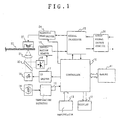
- Fig. 1 is a bloc diagram showing a magnet-optic disc information reproducing and recording apparatus according to an embodiment of the present invention.
- Fig. 2 is a flow chart showing an operation of the apparatus shown in Fig. 1 in an information reproducing mode.
- Fig. 3 is a flow chart showing an operation of the apparatus shown in Fig. 1 in an information recording mode.
- Fig. 4 is a flow chart showing an operation of the apparatus shown in Fig. 1 in an information signal and administration signal writing mode.
- Fig. 5 is a graph showing the relationship among an operation reference setting temperature range, a failure rate of a laser diode and a using environmental temperature in the apparatus shown in Fig. 1.
- Fig. 1 shows a magnet-optic disc player according to an embodiment of the present invention.
- a controller 10 is mainly constituted by a microcomputer and is provided for controlling an operation of a whole apparatus .
- the controller 10 executes a main program (not explained here) stored in a memory 11 step by step in synchronous with a built-in clock.
- a main program not explained here
- a memory 11 step by step in synchronous with a built-in clock.
- ROM Read Only Memory
- respective values of operation reference temperature ranges T1, T2, T3, T1', T2', T3' which will be explained later are set.
- a display 12 and a manipulator 13 are mounted on a console panel which is served for allowing the handling of the apparatus by a user.
- the display 12 is comprised of a liquid crystal panel and light emitting diodes which display the state of the apparatus, and the manipulator 13 is constituted by a keyboard or a group of switches for inputting commands of operation modes such as an information reproducing mode and an information recording mode.
- a temperature sensor 14 is constituted by a temperature detection semiconductor such as a thermistor or a diode and, detects a temperature of optical reading part (not shown in the drawing) constituted by a laser diode 16 and a photodetector 18, particularly a temperature in the vicinity of the laser diode 16. Further, a temperature detector 15 detects the change of a resistance value or a voltage/current value of the temperature sensor 14 which brings about the temperature change and converts this to a temperature detected value made of a digital value and supplies this temperature detected value to the controller 10.
- a temperature detection semiconductor such as a thermistor or a diode
- the laser diode 16 is excited by an output current of a laser diode driver (hereinafter described "LD driver")17 and irradiates laser beams. After passing through a beam splitter 20, the laser beams are converged by a focusing lens 21 and forms a beam spot on a surface of a magnet-optic disc 22. Further, a reflection light from the disc surface is reflected on the beam splitter 20 and is incident on the light receiving part constituted by a light receiving element such as a photo transistor, a photo diode and is converted into a electric signal as reproducing signal of information recorded in a disc.
- a light receiving element such as a photo transistor, a photo diode
- an audio input signal from the outside is supplied to the signal processor 25 through the audio signal in/out circuit 26.
- the signal processor 25 performs a processing such as an analog/digital conversion, a coding and the like to the audio inputting signal and a formatting of the audio inputting signal into recording signal to the disc and supplies this recording signal to a magnetic head driver 24.
- the magnetic head driver 24 generates a magnetic head drive current in response to the supplied recording signal. By exciting a recording magnetic head 23 with such a magnetic head drive current, a magnetic film of the magnet-optic disc 22 is magnetized so that the information is recorded in the disc 22.
- the controller 10 starts the operation of the LD driver 17 so as to excite the laser diode 16 at a high output and makes a recording spot on the surface of the magnet-optic disc 22 have a high temperature not less than the Curie point.
- the controller 10 executes sub routine of the information reproducing mode shown in Fig. 2, for example, interrupting into a main routine which is always executed in synchronous with a built-in clock, at a given interval.
- the controller 10 always monitors whether a reproducing start command is delivered from the manipulator 13 or not (step 10).
- the reproducing start command is supplied from the manipulator 13.
- the controller 10 takes in a temperature detected value of the optical reading means (not shown in the drawing) including the laser diode 16 from the temperature detector 15 and judges whether the value falls within a range of the reproducing start temperature range T1 which is preset in the ROM table of the memory 11 or not (step 11).
- the controller 10 starts the reproducing operation (step 12). That is, the controller 10 drives the magnet-optic disc 22 and the optical reading means (not shown in the drawing) including the laser diode 16 by means of a spindle motor and a servo mechanism (not shown in the drawing) and irradiates laser beams from the laser diode 16 to the information recording surface of the disc 22. Upon reflection of the laser beams on the magnetic film of the information recording surface, the laser beam receives a polarization corresponding to the magnetizing direction of the magnetic film due to a so-called "Kerr effect". By detecting the polarization of the reflection beams and performing the demodulation processing at the photodetector 18 and the information reader 19, the demodulation and reproducing of the information recorded in the disc 22 is performed.
- the controller 10 periodically monitors an output of the temperature detector 15 and judges whether the temperature detected value falls within the reproducing tolerance temperature range T2 set in the ROM table of the memory 11 or not (step 13). If the temperature detected value falls within the range T2, the controller 10 monitors whether the controller 10 has received a reproducing stop command from the manipulator 13 or not (step 14). If the controller 10 has not received the stop command, the controller 10 returns to step 13 and repeats the above-mentioned monitoring procedure. If the controller 10 has received the stop command, the controller 10 stops the reproducing operation of the information recorded in the disc 22 and ejects the disc 22 (step 16).
- the controller 10 performs an alarm display at the display 12 that the thermal environment of the apparatus is abnormal and hence, the reproducing operation is impossible and then automatically stops the reproducing operation (step 15). After stopping the reproducing operation, the controller 10 monitors whether the controller 10 has received the reproducing stop command from the manipulator 13 or not (step 17). If the controller 10 has received the stop command, the controller 10 resets the above-mentioned alarm display and advances the processing to step 16 and stops the reproducing operation and ejects the disc 22.
- the temperature detected value is again inputted to the controller 10 from the temperature detector 15 and the controller 10 judges whether the value falls within the reproducing restart temperature range T3 which is preset at the ROM table or not (step 18). If the temperature detected value does not fall within the reproducing restart temperature range T3, the controller 10 returns the processing to step 17 and repeats above-mentioned monitoring procedure and if the detected value falls within the reproducing restart temperature range T3, the controller 10 resets the above-mentioned alarm display and returns the procedure to step 12 and restarts the reproducing operation.
- the relationship among respective temperature ranges that is, the relationship among the reproducing start temperature range T1, the reproducing tolerance temperature range T2, and the reproducing restart temperature range T3 is determined such that the temperature range T3 is included in the temperature range T1 and the temperature range T1 is included in the temperature range T2.
- the controller 10 makes a processing sub routine of the information recording mode shown in Fig. 3 interrupt the main routine executed in synchronous with the built-in clock and executes the sub routine at a given interval.
- the controller 10 always monitors whether the controller 10 has received a recording start command from the manipulator 13 or not (step 20).
- the recording start command is supplied from the manipulator 13.
- the controller 10 takes in the temperature detected value of the optical reading means (not shown in the drawing) including the laser diode 16 from the temperature detector 15. Then, the controller 10 judges whether this value falls within a recording start temperature range T1' preset in the ROM table of the memory 11 or not (step 21).
- the controller 10 starts the recording operation (step 22). That is, the controller 10 drives the magnet-optic disc 22 and the optical reading means (not shown in the drawing) including the laser diode 16 by means of the spindle motor and the servo mechanism (not shown in the drawing) disposed in the inside of the apparatus. Further, the controller 10 excites the laser diode 16 through the LD driver 17 so as to irradiate laser beams of a high output to a recording surface of the disc 22. The magnetic film on the disc recording surface is heated by laser beams at a high temperature not less than the Curie point and is demagnetized and thereafter is magnetized again by a magnetic field of the magnetic head 23 excited by information recording signals from the magnetic head driver 24. Accordingly, the information to be recorded is recorded on the magnetic film of the disc 22.
- the controller 10 periodically monitors the output of the temperature detector 15 and judges whether the temperature detected value falls within the recording tolerance temperature range T2' set in the ROM table of the memory 11 or not (step 23). If the temperature detected value falls within the range T2', the controller 10 monitors whether the controller 10 has received the recording stop command from the manipulator 13 or not (step 24). If the controller 10 has not received the stop command, the controller 10 returns to step 23 and repeats the above-mentioned monitoring procedure. If the system control part has received the stop command, the controller 10 stops the recording operation of the information to the disc 22 and ejects the disc 22 (step 26).
- the controller 10 When the temperature detected value exceeds the recording start temperature range T1' at step 21 and exceeds the recording tolerance temperature range T2' at step 23, the controller 10 performs an alarm display at the display 12 that the thermal environment of the apparatus is abnormal and hence, the recording operation is impossible and automatically stops the recording operation (step 25). After stopping the recording operation, the controller 10 monitors whether the controller 10 has received the recording stop command from the manipulator 13 or not (Step 27). If the controller 10 has received the stop command, the controller 10 resets the above-mentioned alarm display and advances the processing to step 26 and stops the recording operation and ejects the disc 22.
- the controller 10 again inputs the temperature detected value from the temperature detector 15 and judges whether the value falls within the recording restarting temperature range T3' preset in the ROM table or not (step 28). If the temperature detected value does not fall within the range T3', the controller 10 returns the processing to step 27 and repeats the above-mentioned monitoring procedure. If the temperature detected value falls within the range T3', the controller 10 resets the above-mentioned alarm display and advances the processing to step 29 and makes the processing stand by for a fixed time in a so-called pose state and thereafter returns the processing to step 20 which is a starting point of the information recording mode.
- the relationship among respective temperature range is determined such that the temperature range T3' is included in the temperature range T1' and the temperature range T1' is included in the temperature range T2'.
- respective temperature ranges are determined taking into account that the manner of temperature elevation of the optical reading means including the laser diode differs depending on the difference of excitation electric power of the laser diode between the information reproducing mode and the information recording mode.
- the relationship among the temperature ranges is determined such that the recording start temperature range T1' is included in the reproducing start temperature range T1, the recording tolerance temperature range T2' is included in the reproducing tolerance temperature range T2 and the recording restart temperature range T3' is included in the reproducing restart temperature range T3.
- the second embodiment is directed to a writing processing of an information signal and a administration signal which takes into account the environment temperature of the apparatus in the information recording mode.
- the second embodiment can be also realized by an apparatus constitution similar to the apparatus constitution shown in the block diagram of Fig. 1. However, it is assumed that an operation program relating to the second embodiment is stored in the memory 11 shown in Fig. 1. It is also assumed that respective values of operation reference temperature ranges T4 and T5 which will be explained later are preset in the ROM table of the memory 11.
- a laser diode 16 is excited at a high output using an output current of a laser diode drive part (hereinafter described as "LD drive part") 17 and irradiates laser beams onto a recording surface of a magnet-optic disc 22.
- the laser beams are converged by a focusing lens 21 and forms a beam spot on a magnetic film on the recording surface of the disc 22 and heats the spot at a temperature not less than the Curie point. Accordingly, the magnetization of the spot portion is dissipated and hence, the demagnetization ready for a new writing of information is completed.
- an audio input signal such as music is supplied to a signal processor 25 through an audio signal in/out circuit 26 which controls the interface with external apparatuses and the adjustment of input signal levels.
- the signal processor 25 performs a processing such as an analog/digital conversion, a coding and the like to an output of the audio signal in/out circuit 26 and a formatting of such an output into writing signals to the magnet-optic disc and supplies these writing signals to a magnetic head driver 24.
- the magnetic head driver 24 generates a magnetic head drive current in response to the supplied writing signals and a coil of a recording magnetic head 23 is excited with such a magnetic head drive current. That is, a magnetic field generated by the magnetic head 23 receives the modulation due to the audio input signal. Due to such a magnetic field, the spot on the magnetic film where the above-mentioned demagnetization is completed is magnetized again, and the audio input signal such as music is written in the disc 22 as the information signal.
- the controller 10 upon completion of the writing of the information signal such as music, prepares a administration signal indicative of writing conditions such as a recording time of information signal, a recording area address on the disc and the like, formats the administration signal into writing signal to the disc and supplies the writing signal to the head drive part 24.
- the controller 10 drives the disc 22, optical writing means including the laser diode 16 and the magnetic head portion 23 so as to write the above-mentioned administration signal to an administration signal area of the disc 22.
- the controller 10 makes a processing sub routine of an information writing mode shown in Fig. 4 interrupt a main routine which is executed in synchronous with a built-in clock, then the controller 10 executes the sub routine at a given interval.
- the controller 10 always monitors whether the controller 10 has received a writing start command from a manipulator 13 or not (step 30).
- the writing start command is supplied to the controller 10 from the manipulator 13 and the controller 10 starts the writing processing of information in response to the writing start command (step 31). That is, the controller 10 drives the magnet-optic disc 22 and the optical writing means (not shown in the drawing) including the laser diode 16 by the spindle motor and the servo mechanism (not shown in the drawing) inside the apparatus. Further, the controller 10 excites the laser diode 16 through the LD driver 17 so as to irradiate laser beams of a high output to the recording surface of the disc 22.
- the magnetic film on the disc recording surface is heated by laser beams at a high temperature not less than the Curie point and is demagnetized and thereafter is magnetized again by the magnetic field of the magnetic head 23 excited by information signal writing signals from the magnetic head driver 24. Accordingly, the input audio signal such as music is recorded on the magnetic film of the disc 22 as information signal.
- the controller 10 After the apparatus has started the writing processing, the controller 10 always monitors whether the controller 10 has received a writing stop command from the manipulator 13 or not (step 32) and if the controller 10 has not received the writing stop command, the processing is advanced to step 33.
- the controller 10 takes in an output of the temperature detector 15 in step 33 and judges whether the temperature detected value falls within an information signal writing allowable temperature range T4 preset in the ROM table of the memory 11 or not. If the temperature detected value falls within the temperature range T4, the controller 10 returns the processing to the step 32 and repeats the above-mentioned monitoring procedure.
- step 34 the controller 10 stops the writing operation (step 34). If the writing operation is stopped in step 33, the controller 10 performs an alarm display in a display 12 to inform the user that the thermal environment of the apparatus is abnormal and hence, the writing is impossible.
- the controller 10 after stopping the writing operation in step 34, monitors whether the controller 10 has received an ejection command indicative of discharging the disc from the inside of the apparatus from the manipulator 13 or not (step 35). If the controller 10 has not received the ejection command, the controller 10 returns the processing to the initial step (step 30) of the writing operation sub routine. If the controller 10 has received the ejection command of the disc in step 35, the controller 10 again takes in an output of the temperature detector 15 and judges whether the temperature detected value falls within an administration signal writing allowable temperature range T5 preset in the ROM table of the memory 11 or not (step 36).
- the controller 10 prepares an administration signal indicative of writing conditions such as an address on the disc in which information signal which is written in the disc 22 before the writing operation is stopped in the above-mentioned step 34 are recorded. Then, after performing a formatting of the administration signal, the controller 10 supplies the administration signal to the head drive part 21. In accordance with a procedure similar to the procedure at the time of writing the above-mentioned information signal, the controller 10 writes the above-mentioned administration signal into an administration signal recording area of the disc 22 (step 37).
- the administration signal are generated and are written in the administration signal area on the disc in the similar manner as the case in which the writing operation is normally finished. Accordingly, even after the apparatus is restored to a normal state, the information signal recorded before the operation is stopped effectively remains and hence, the reproducing and the editing of the information signal become possible.
- the controller 10 after writing the above-mentioned administration signal to the disc, ejects the disc 22 from the inside of the apparatus housing and completes the writing operation by resetting all alarm outputs (step 38).
- the controller 10 performs an alarm display on the display 12 to alarm a user that the temperature in the inside of the apparatus is too abnormal to allow the writing of even the above-mentioned administration signal. Further, the controller 10 drives an alarm sound generating apparatus (not shown in the drawing) to call for the attention of the user (step 39).
- the controller 10 judges whether a forcible ejection command indicative of the prompt discharging of the disc from the inside of the apparatus housing is outputted from the manipulator 13 or not (step 40). If the forcible ejection command is outputted, the controller 10 allows the processing to advance to step 38 and performs the ejection of the disc from the apparatus housing and completes the writing operation after resetting the alarm output. Further, if the forcible ejection command is not outputted, the controller 10 does not perform the ejection of the disc and returns the processing to step 35 and repeats the monitoring processing whether the controller 10 has received the ejection command or not.
- the values of the information signal writing allowable temperature range T4 and the administration signal writing allowable temperature range T5 are determined as shown in Fig. 5. That is, even when the ambient temperature of the optical writing means including the laser diode 16 exceeds the temperature range T4, so long as the ambient temperature falls within the temperature range T5, there is no fear that the quality of the laser diode is rapidly deteriorated. According to the present invention, before the ambient temperature exceeds the temperature range T5, the administration signal related with the information signal written in the disc by that time is rapidly written in the administration signal area of the disc.
- an information quantity of the administration signal is extremely small compared with the information signal, time necessary for performing the writing processing of the information is extremely short. Even when the laser diode operation is performed under such a thermal environment, no problem arises provided that the operation time is short.
Landscapes
- Physics & Mathematics (AREA)
- Optics & Photonics (AREA)
- Optical Recording Or Reproduction (AREA)
- Optical Head (AREA)
Abstract
Description
Claims (9)
- An optical information reproducing apparatus which reproduces information recorded in an optical information recording medium comprisingan information reading part which reads the information recorded in said information recording medium and generates a reading signal,a signal processing part which performs signal processing of said reading signals and generates an information reproducing signal,a temperature detecting part which detects a temperature of said information reading part, anda control part which controls an information reading operation of said information reading part in response to a detected value from said temperature detecting part,wherein said control part performs a control so that said control part allows the reading operation of said information reading part only when said detected value falls within a first temperature setting range, said control part stops the reading operation of said information reading part when said detected value exceeds a second temperature setting range, and said control part allows a restarting of the reading operation of said information reading part when said detected value falls within a third temperature setting range.
- An optical information reproducing apparatus according to claim 1, wherein said first temperature setting range is wider than said third temperature setting range and includes said third temperature setting range therein, and said second temperature setting range is wider than said first temperature setting range and includes said first temperature setting range therein.
- An optical information recording apparatus which records information in an optical information recording medium comprisinga signal processing part which performs signal processing of a input signal and generates a writing signal to said recording medium,an information writing part which writes said writing signals to said information recording medium,a temperature detecting part which detects a temperature of said information writing part, anda control part which controls information writing operation of said information writing part in response to a detected value from said temperature detecting part,wherein said control part performs a control such that said control part allows the writing operation of said information writing part only when said detected value falls within a first temperature setting range, said control part stops the writing operation of said information writing part when said detected value exceeds a second temperature setting range, and said control part allows a restarting of the writing operation of said information writing part when said detected value falls within a third temperature setting range.
- An optical information recording apparatus according to claim 3, wherein said first temperature setting range is wider than said third temperature setting range and includes said third temperature setting range therein, and said second temperature setting range is wider than said first temperature setting range and includes said first temperature setting range therein.
- An optical information reproducing and recording apparatus which records information to an optical information recording medium and reproduces the recorded information comprisinga first signal processing part which processes a input signal and generates a writing signal to said information recording medium,an information writing part which writes said writing signals into said information recording medium,an information reading part which reads information recorded in said information recording medium and generates a reading signal,a second signal processing part which performs signal processing of said reading signal and generates an information reproducing signal,a temperature detecting part which detects a temperature of said information writing part and said information reading part, anda control part which controls operations of said information writing part and said information reading part based on a detected value from said temperature detecting part,wherein said control part performs a control such that said control part allows the operation of said information writing part and said information reading part only when said detected value falls within a first temperature setting range, said control part stops the operation of said information writing part and said information reading part when said detected value exceeds a second temperature setting range, and said control part allows a restarting of the operations of said information writing part and said information reading part when said detected value falls within a third temperature setting range.
- An optical information reproducing and recording apparatus according to claim 5, wherein said first temperature setting range is wider than said third temperature setting range and includes said third temperature setting range therein, and said second temperature setting range is wider than said first temperature setting range and includes said first temperature setting range therein.
- An optical information reproducing and recording apparatus according to claim 6, wherein with respect to said first to third temperature ranges, an information writing operation and an information reading operation are respectively capable of individually setting said temperature ranges.
- An optical information reproducing and recording apparatus which records an information signal in an optical information recording medium together with a administration signal and reproduces said signal comprisingan information writing and reading part which writes said information signal and said administration signal into said information recording medium or reads written signals by irradiating optical beams to said information recording medium,a temperature detecting part for detecting a temperature of said information writing and reading part,a control part which controls the writing operation or the reading operation of said information writing and reading part in response to a writing or reading command and based on a detected value from said temperature detecting part,wherein, said control part performs a control such that provided that said writing command is supplied to said control part, when said detected value is out of a given set temperature range, said control part stops the writing operation of said information signal and shifts the writing operation to only the writing operation of said administration signal.
- An optical information reproducing and recording apparatus according to claim 8, wherein said control part performs a control such that, when said detected value exceeds a second setting temperature range which is wider than said setting range, the writing operation of said administration signal is also stopped.
Applications Claiming Priority (4)
| Application Number | Priority Date | Filing Date | Title |
|---|---|---|---|
| JP2000072581 | 2000-03-15 | ||
| JP2000072581A JP2001256714A (en) | 2000-03-15 | 2000-03-15 | Information reproducing and recording device |
| JP2000072580A JP2001256713A (en) | 2000-03-15 | 2000-03-15 | Optical information recording and reproducing device |
| JP2000072580 | 2000-03-15 |
Publications (2)
| Publication Number | Publication Date |
|---|---|
| EP1134737A2 true EP1134737A2 (en) | 2001-09-19 |
| EP1134737A3 EP1134737A3 (en) | 2001-10-17 |
Family
ID=26587594
Family Applications (1)
| Application Number | Title | Priority Date | Filing Date |
|---|---|---|---|
| EP01105443A Withdrawn EP1134737A3 (en) | 2000-03-15 | 2001-03-13 | Optical information reproducing and recording apparatus |
Country Status (2)
| Country | Link |
|---|---|
| US (1) | US6738330B2 (en) |
| EP (1) | EP1134737A3 (en) |
Cited By (2)
| Publication number | Priority date | Publication date | Assignee | Title |
|---|---|---|---|---|
| EP1396846A3 (en) * | 2002-09-04 | 2006-04-26 | Samsung Electronics Co. Ltd. | Method and apparatus for controlling hard disc drive |
| EP1455346A3 (en) * | 2003-03-07 | 2006-10-25 | Pioneer Corporation | Information recording apparatus, information recording method, and information recording medium on which information recording processing program is recorded |
Families Citing this family (12)
| Publication number | Priority date | Publication date | Assignee | Title |
|---|---|---|---|---|
| US7099251B2 (en) * | 2001-10-15 | 2006-08-29 | Shinano Kenshi Kabushiki Kaisha | Method of controlling laser power and optical disk player |
| JP3745291B2 (en) * | 2001-10-16 | 2006-02-15 | シナノケンシ株式会社 | Optical disc recording / reproducing apparatus |
| JP2004086940A (en) * | 2002-08-23 | 2004-03-18 | Ricoh Co Ltd | Recording condition correction method, program, recording medium, and information recording device |
| JP3964282B2 (en) * | 2002-08-23 | 2007-08-22 | 株式会社リコー | Recording condition setting method, program, recording medium, and information recording apparatus |
| JP2004206795A (en) * | 2002-12-25 | 2004-07-22 | Toshiba Corp | Disk storage device and write control method |
| JP4287712B2 (en) * | 2003-08-08 | 2009-07-01 | 株式会社日立エルジーデータストレージ | Optical disc apparatus and data writing method therefor |
| JP2005322278A (en) * | 2004-05-06 | 2005-11-17 | Victor Co Of Japan Ltd | Disk loading device |
| KR20070055500A (en) * | 2004-07-19 | 2007-05-30 | 코닌클리케 필립스 일렉트로닉스 엔.브이. | Thermal management method and system in optical storage system |
| US8218411B2 (en) * | 2005-02-11 | 2012-07-10 | Delphi Technologies, Inc. | Compact disc player and method for controlling ejection of a compact disc from the compact disc player |
| EP2120189B1 (en) * | 2007-01-30 | 2013-01-16 | Panasonic Corporation | Nonvolatile storage device, nonvolatile storage system, and access device |
| JP4797004B2 (en) * | 2007-09-03 | 2011-10-19 | 株式会社日立製作所 | Laser diode control method, laser diode control device, and information recording / reproducing device |
| JP2013077367A (en) * | 2011-09-30 | 2013-04-25 | Sharp Corp | Information recorder, method for controlling information recorder, computer, and video recorder |
Family Cites Families (13)
| Publication number | Priority date | Publication date | Assignee | Title |
|---|---|---|---|---|
| JPS61105734A (en) * | 1984-10-29 | 1986-05-23 | Mazda Motor Corp | Audio set of automobile |
| EP0443535A3 (en) * | 1990-02-21 | 1992-10-28 | Tokyo Electric Co., Ltd. | Electrophotographic printing apparatus |
| JP2955416B2 (en) * | 1991-12-10 | 1999-10-04 | 富士通テン株式会社 | Optical disc player |
| JPH05217236A (en) * | 1992-02-05 | 1993-08-27 | Sony Corp | Magneto-optical recording method |
| US5461603A (en) * | 1993-04-22 | 1995-10-24 | Sony Corporation | Disc recording/reproducing apparatus having temperature control of the recording/reproducing processes |
| JPH07130080A (en) * | 1993-11-02 | 1995-05-19 | Olympus Optical Co Ltd | Information recorder |
| US5638687A (en) * | 1994-11-21 | 1997-06-17 | Dainippon Screen Mfg. Co., Ltd. | Substrate cooling method and apparatus |
| JPH08273285A (en) * | 1995-03-31 | 1996-10-18 | Fujitsu Ten Ltd | Optical disk reproducing device |
| US5594748A (en) * | 1995-08-10 | 1997-01-14 | Telephone Information Systems, Inc. | Method and apparatus for predicting semiconductor laser failure |
| JP3126639B2 (en) * | 1995-09-12 | 2001-01-22 | シャープ株式会社 | Magneto-optical recording medium and reproducing method thereof |
| JP3345544B2 (en) * | 1996-02-09 | 2002-11-18 | アルパイン株式会社 | Automatic adjustment device and adjustment method for pickup servo system |
| JPH09330519A (en) * | 1996-06-10 | 1997-12-22 | Hitachi Ltd | Optical disk recording and playback device |
| US6414806B1 (en) * | 2000-10-02 | 2002-07-02 | International Business Machines Corporation | Method for thermal asperity detection and compensation in disk drive channels |
-
2001
- 2001-03-13 EP EP01105443A patent/EP1134737A3/en not_active Withdrawn
- 2001-03-15 US US09/808,031 patent/US6738330B2/en not_active Expired - Fee Related
Cited By (2)
| Publication number | Priority date | Publication date | Assignee | Title |
|---|---|---|---|---|
| EP1396846A3 (en) * | 2002-09-04 | 2006-04-26 | Samsung Electronics Co. Ltd. | Method and apparatus for controlling hard disc drive |
| EP1455346A3 (en) * | 2003-03-07 | 2006-10-25 | Pioneer Corporation | Information recording apparatus, information recording method, and information recording medium on which information recording processing program is recorded |
Also Published As
| Publication number | Publication date |
|---|---|
| EP1134737A3 (en) | 2001-10-17 |
| US20010038587A1 (en) | 2001-11-08 |
| US6738330B2 (en) | 2004-05-18 |
Similar Documents
| Publication | Publication Date | Title |
|---|---|---|
| US6738330B2 (en) | Optical information reproducing and recording apparatus utilizing varying temperature setting ranges | |
| US20090003160A1 (en) | Information Recording Apparatus and Information Recording Method | |
| JP3724377B2 (en) | Laser driving method and apparatus, and recording / reproducing apparatus and method | |
| US7116620B2 (en) | System and method for controlling recording state transitions in an information recording apparatus | |
| KR100787647B1 (en) | Playback apparatus and method, and recording medium | |
| EP0364213B1 (en) | Method and apparatus for driving light source by stored current value and for processing information | |
| EP0432863B1 (en) | Information processing apparatus with recording medium discharging mechanism for preventing change or loss of information of recording medium by temperature increase of the apparatus | |
| EP0318897A2 (en) | An apparatus for focusing a light beam onto an information memory medium | |
| JP2003051127A (en) | Disk device and start-up method of focusing servo | |
| KR101142958B1 (en) | optical record apparatus and method to find out record power thereof | |
| JP2003196834A (en) | Optical disk recording and reproducing device | |
| JP2001256714A (en) | Information reproducing and recording device | |
| JP2003257022A (en) | Optical disk device, control program, and storage medium | |
| KR100696758B1 (en) | Recording method of optical record player | |
| KR20070105329A (en) | Laser saturation prevention method and apparatus | |
| US20050237885A1 (en) | Laser power control method of optical recording/reproducing apparatus | |
| JP2834254B2 (en) | Semiconductor laser failure detector | |
| WO2003005351A1 (en) | Optical disc reproduction method and optical disc reproduction apparatus | |
| JP2005056461A (en) | Optical information recording device | |
| KR200146059Y1 (en) | Device for changing power providing laser of optical disc player | |
| JP4070380B2 (en) | Laser output control circuit for optical disc recording / reproducing apparatus | |
| JP3842985B2 (en) | Semiconductor laser degradation detector in optical recording equipment | |
| JP2001256713A (en) | Optical information recording and reproducing device | |
| JP2009015929A (en) | Optical disk device and its control method and program | |
| JP2005251334A (en) | Optical disk recording device and program |
Legal Events
| Date | Code | Title | Description |
|---|---|---|---|
| PUAI | Public reference made under article 153(3) epc to a published international application that has entered the european phase |
Free format text: ORIGINAL CODE: 0009012 |
|
| PUAL | Search report despatched |
Free format text: ORIGINAL CODE: 0009013 |
|
| AK | Designated contracting states |
Kind code of ref document: A2 Designated state(s): AT BE CH CY DE DK ES FI FR GB GR IE IT LI LU MC NL PT SE TR Kind code of ref document: A2 Designated state(s): DE FR GB |
|
| AX | Request for extension of the european patent |
Free format text: AL;LT;LV;MK;RO;SI |
|
| AK | Designated contracting states |
Kind code of ref document: A3 Designated state(s): AT BE CH CY DE DK ES FI FR GB GR IE IT LI LU MC NL PT SE TR |
|
| AX | Request for extension of the european patent |
Free format text: AL;LT;LV;MK;RO;SI |
|
| RIC1 | Information provided on ipc code assigned before grant |
Free format text: 7G 11B 19/04 A, 7G 11B 7/125 B |
|
| 17P | Request for examination filed |
Effective date: 20011025 |
|
| AKX | Designation fees paid |
Free format text: DE FR GB |
|
| STAA | Information on the status of an ep patent application or granted ep patent |
Free format text: STATUS: THE APPLICATION HAS BEEN WITHDRAWN |
|
| 18W | Application withdrawn |
Effective date: 20061130 |