EP1134597A2 - Broadband liquid crystal pigments - Google Patents
Broadband liquid crystal pigments Download PDFInfo
- Publication number
- EP1134597A2 EP1134597A2 EP01101126A EP01101126A EP1134597A2 EP 1134597 A2 EP1134597 A2 EP 1134597A2 EP 01101126 A EP01101126 A EP 01101126A EP 01101126 A EP01101126 A EP 01101126A EP 1134597 A2 EP1134597 A2 EP 1134597A2
- Authority
- EP
- European Patent Office
- Prior art keywords
- liquid crystal
- pigments
- polymerizable
- chiral
- layer
- Prior art date
- Legal status (The legal status is an assumption and is not a legal conclusion. Google has not performed a legal analysis and makes no representation as to the accuracy of the status listed.)
- Withdrawn
Links
- 239000000049 pigment Substances 0.000 title claims abstract description 101
- 239000004973 liquid crystal related substance Substances 0.000 title claims abstract description 40
- 238000000576 coating method Methods 0.000 claims abstract description 34
- 239000002861 polymer material Substances 0.000 claims abstract description 13
- 229920000106 Liquid crystal polymer Polymers 0.000 claims abstract description 10
- 230000003287 optical effect Effects 0.000 claims abstract description 9
- 239000002537 cosmetic Substances 0.000 claims abstract description 8
- 239000008194 pharmaceutical composition Substances 0.000 claims abstract description 5
- 239000011248 coating agent Substances 0.000 claims description 26
- 239000011230 binding agent Substances 0.000 claims description 10
- 238000001429 visible spectrum Methods 0.000 claims description 6
- 238000000034 method Methods 0.000 abstract description 28
- 238000002360 preparation method Methods 0.000 abstract description 12
- 239000000463 material Substances 0.000 description 87
- 150000001875 compounds Chemical class 0.000 description 82
- 239000004986 Cholesteric liquid crystals (ChLC) Substances 0.000 description 70
- 239000010408 film Substances 0.000 description 51
- -1 alkyl radical Chemical class 0.000 description 44
- 239000000203 mixture Substances 0.000 description 36
- 239000010410 layer Substances 0.000 description 34
- 239000000758 substrate Substances 0.000 description 33
- 230000003098 cholesteric effect Effects 0.000 description 27
- 229920000642 polymer Polymers 0.000 description 27
- 238000006116 polymerization reaction Methods 0.000 description 25
- 125000004432 carbon atom Chemical group C* 0.000 description 23
- 229920006254 polymer film Polymers 0.000 description 21
- 239000000975 dye Substances 0.000 description 16
- 239000004990 Smectic liquid crystal Substances 0.000 description 14
- 125000000217 alkyl group Chemical group 0.000 description 14
- 125000003545 alkoxy group Chemical group 0.000 description 13
- 230000005855 radiation Effects 0.000 description 11
- 239000004094 surface-active agent Substances 0.000 description 11
- 239000000976 ink Substances 0.000 description 9
- 239000007788 liquid Substances 0.000 description 8
- 239000002245 particle Substances 0.000 description 8
- 239000002904 solvent Substances 0.000 description 8
- 239000003431 cross linking reagent Substances 0.000 description 7
- 239000002019 doping agent Substances 0.000 description 7
- 125000000524 functional group Chemical group 0.000 description 7
- 229910052736 halogen Inorganic materials 0.000 description 7
- 239000003505 polymerization initiator Substances 0.000 description 7
- 125000006850 spacer group Chemical group 0.000 description 7
- 238000009281 ultraviolet germicidal irradiation Methods 0.000 description 7
- JCXJVPUVTGWSNB-UHFFFAOYSA-N Nitrogen dioxide Chemical compound O=[N]=O JCXJVPUVTGWSNB-UHFFFAOYSA-N 0.000 description 6
- 239000003795 chemical substances by application Substances 0.000 description 6
- 230000000694 effects Effects 0.000 description 6
- PCHJSUWPFVWCPO-UHFFFAOYSA-N gold Chemical compound [Au] PCHJSUWPFVWCPO-UHFFFAOYSA-N 0.000 description 6
- 229910052737 gold Inorganic materials 0.000 description 6
- 239000010931 gold Substances 0.000 description 6
- 239000004922 lacquer Substances 0.000 description 6
- 125000000956 methoxy group Chemical group [H]C([H])([H])O* 0.000 description 6
- 239000000178 monomer Substances 0.000 description 6
- 239000003973 paint Substances 0.000 description 6
- 125000001140 1,4-phenylene group Chemical group [H]C1=C([H])C([*:2])=C([H])C([H])=C1[*:1] 0.000 description 5
- BQCADISMDOOEFD-UHFFFAOYSA-N Silver Chemical compound [Ag] BQCADISMDOOEFD-UHFFFAOYSA-N 0.000 description 5
- 239000012986 chain transfer agent Substances 0.000 description 5
- 238000004132 cross linking Methods 0.000 description 5
- VFHVQBAGLAREND-UHFFFAOYSA-N diphenylphosphoryl-(2,4,6-trimethylphenyl)methanone Chemical compound CC1=CC(C)=CC(C)=C1C(=O)P(=O)(C=1C=CC=CC=1)C1=CC=CC=C1 VFHVQBAGLAREND-UHFFFAOYSA-N 0.000 description 5
- 239000004744 fabric Substances 0.000 description 5
- 238000000227 grinding Methods 0.000 description 5
- 238000004519 manufacturing process Methods 0.000 description 5
- 125000002496 methyl group Chemical group [H]C([H])([H])* 0.000 description 5
- 239000004570 mortar (masonry) Substances 0.000 description 5
- 229910052709 silver Inorganic materials 0.000 description 5
- 239000004332 silver Substances 0.000 description 5
- 235000000346 sugar Nutrition 0.000 description 5
- CURLTUGMZLYLDI-UHFFFAOYSA-N Carbon dioxide Chemical compound O=C=O CURLTUGMZLYLDI-UHFFFAOYSA-N 0.000 description 4
- 230000009102 absorption Effects 0.000 description 4
- 238000010521 absorption reaction Methods 0.000 description 4
- 125000005529 alkyleneoxy group Chemical group 0.000 description 4
- 238000001816 cooling Methods 0.000 description 4
- 230000001419 dependent effect Effects 0.000 description 4
- 238000009826 distribution Methods 0.000 description 4
- 238000003801 milling Methods 0.000 description 4
- 125000004430 oxygen atom Chemical group O* 0.000 description 4
- 239000004033 plastic Substances 0.000 description 4
- 229920003023 plastic Polymers 0.000 description 4
- 229920000728 polyester Polymers 0.000 description 4
- 230000000379 polymerizing effect Effects 0.000 description 4
- 239000000843 powder Substances 0.000 description 4
- 150000003254 radicals Chemical class 0.000 description 4
- 239000003381 stabilizer Substances 0.000 description 4
- 125000000876 trifluoromethoxy group Chemical group FC(F)(F)O* 0.000 description 4
- 125000004955 1,4-cyclohexylene group Chemical group [H]C1([H])C([H])([H])C([H])([*:1])C([H])([H])C([H])([H])C1([H])[*:2] 0.000 description 3
- 229920002284 Cellulose triacetate Polymers 0.000 description 3
- 239000004904 UV filter Substances 0.000 description 3
- NNLVGZFZQQXQNW-ADJNRHBOSA-N [(2r,3r,4s,5r,6s)-4,5-diacetyloxy-3-[(2s,3r,4s,5r,6r)-3,4,5-triacetyloxy-6-(acetyloxymethyl)oxan-2-yl]oxy-6-[(2r,3r,4s,5r,6s)-4,5,6-triacetyloxy-2-(acetyloxymethyl)oxan-3-yl]oxyoxan-2-yl]methyl acetate Chemical compound O([C@@H]1O[C@@H]([C@H]([C@H](OC(C)=O)[C@H]1OC(C)=O)O[C@H]1[C@@H]([C@@H](OC(C)=O)[C@H](OC(C)=O)[C@@H](COC(C)=O)O1)OC(C)=O)COC(=O)C)[C@@H]1[C@@H](COC(C)=O)O[C@@H](OC(C)=O)[C@H](OC(C)=O)[C@H]1OC(C)=O NNLVGZFZQQXQNW-ADJNRHBOSA-N 0.000 description 3
- NIXOWILDQLNWCW-UHFFFAOYSA-M acrylate group Chemical group C(C=C)(=O)[O-] NIXOWILDQLNWCW-UHFFFAOYSA-M 0.000 description 3
- 125000002252 acyl group Chemical group 0.000 description 3
- 125000002947 alkylene group Chemical group 0.000 description 3
- 239000006229 carbon black Substances 0.000 description 3
- 239000003086 colorant Substances 0.000 description 3
- 230000003247 decreasing effect Effects 0.000 description 3
- 125000003700 epoxy group Chemical group 0.000 description 3
- QUPDWYMUPZLYJZ-UHFFFAOYSA-N ethyl Chemical compound C[CH2] QUPDWYMUPZLYJZ-UHFFFAOYSA-N 0.000 description 3
- 125000005843 halogen group Chemical group 0.000 description 3
- 150000002367 halogens Chemical class 0.000 description 3
- 150000002500 ions Chemical class 0.000 description 3
- CERQOIWHTDAKMF-UHFFFAOYSA-M methacrylate group Chemical group C(C(=C)C)(=O)[O-] CERQOIWHTDAKMF-UHFFFAOYSA-M 0.000 description 3
- 239000012299 nitrogen atmosphere Substances 0.000 description 3
- 239000012788 optical film Substances 0.000 description 3
- 239000002985 plastic film Substances 0.000 description 3
- 229920000139 polyethylene terephthalate Polymers 0.000 description 3
- 239000005020 polyethylene terephthalate Substances 0.000 description 3
- 238000007639 printing Methods 0.000 description 3
- 238000010008 shearing Methods 0.000 description 3
- 238000001228 spectrum Methods 0.000 description 3
- 125000000391 vinyl group Chemical group [H]C([*])=C([H])[H] 0.000 description 3
- 229920002554 vinyl polymer Polymers 0.000 description 3
- MYWOJODOMFBVCB-UHFFFAOYSA-N 1,2,6-trimethylphenanthrene Chemical compound CC1=CC=C2C3=CC(C)=CC=C3C=CC2=C1C MYWOJODOMFBVCB-UHFFFAOYSA-N 0.000 description 2
- 125000004493 2-methylbut-1-yl group Chemical group CC(C*)CC 0.000 description 2
- LKVFCSWBKOVHAH-UHFFFAOYSA-N 4-Ethoxyphenol Chemical compound CCOC1=CC=C(O)C=C1 LKVFCSWBKOVHAH-UHFFFAOYSA-N 0.000 description 2
- IJGRMHOSHXDMSA-UHFFFAOYSA-N Atomic nitrogen Chemical compound N#N IJGRMHOSHXDMSA-UHFFFAOYSA-N 0.000 description 2
- 229920002799 BoPET Polymers 0.000 description 2
- 239000004322 Butylated hydroxytoluene Substances 0.000 description 2
- NLZUEZXRPGMBCV-UHFFFAOYSA-N Butylhydroxytoluene Chemical compound CC1=CC(C(C)(C)C)=C(O)C(C(C)(C)C)=C1 NLZUEZXRPGMBCV-UHFFFAOYSA-N 0.000 description 2
- OKTJSMMVPCPJKN-UHFFFAOYSA-N Carbon Chemical compound [C] OKTJSMMVPCPJKN-UHFFFAOYSA-N 0.000 description 2
- OWYWGLHRNBIFJP-UHFFFAOYSA-N Ipazine Chemical compound CCN(CC)C1=NC(Cl)=NC(NC(C)C)=N1 OWYWGLHRNBIFJP-UHFFFAOYSA-N 0.000 description 2
- XEEYBQQBJWHFJM-UHFFFAOYSA-N Iron Chemical compound [Fe] XEEYBQQBJWHFJM-UHFFFAOYSA-N 0.000 description 2
- UQSXHKLRYXJYBZ-UHFFFAOYSA-N Iron oxide Chemical compound [Fe]=O UQSXHKLRYXJYBZ-UHFFFAOYSA-N 0.000 description 2
- KLDXJTOLSGUMSJ-JGWLITMVSA-N Isosorbide Chemical compound O[C@@H]1CO[C@@H]2[C@@H](O)CO[C@@H]21 KLDXJTOLSGUMSJ-JGWLITMVSA-N 0.000 description 2
- 239000004372 Polyvinyl alcohol Substances 0.000 description 2
- GWEVSGVZZGPLCZ-UHFFFAOYSA-N Titan oxide Chemical compound O=[Ti]=O GWEVSGVZZGPLCZ-UHFFFAOYSA-N 0.000 description 2
- 239000004411 aluminium Substances 0.000 description 2
- 229910052782 aluminium Inorganic materials 0.000 description 2
- XAGFODPZIPBFFR-UHFFFAOYSA-N aluminium Chemical compound [Al] XAGFODPZIPBFFR-UHFFFAOYSA-N 0.000 description 2
- 230000015572 biosynthetic process Effects 0.000 description 2
- 229940095259 butylated hydroxytoluene Drugs 0.000 description 2
- 235000010354 butylated hydroxytoluene Nutrition 0.000 description 2
- 235000011089 carbon dioxide Nutrition 0.000 description 2
- HVYWMOMLDIMFJA-DPAQBDIFSA-N cholesterol group Chemical group [C@@H]1(CC[C@H]2[C@@H]3CC=C4C[C@@H](O)CC[C@]4(C)[C@H]3CC[C@]12C)[C@H](C)CCCC(C)C HVYWMOMLDIMFJA-DPAQBDIFSA-N 0.000 description 2
- 125000004786 difluoromethoxy group Chemical group [H]C(F)(F)O* 0.000 description 2
- 230000001747 exhibiting effect Effects 0.000 description 2
- 239000011521 glass Substances 0.000 description 2
- 239000008187 granular material Substances 0.000 description 2
- 238000007646 gravure printing Methods 0.000 description 2
- 229910052739 hydrogen Inorganic materials 0.000 description 2
- 125000001972 isopentyl group Chemical group [H]C([H])([H])C([H])(C([H])([H])[H])C([H])([H])C([H])([H])* 0.000 description 2
- 238000010030 laminating Methods 0.000 description 2
- 229910052757 nitrogen Inorganic materials 0.000 description 2
- 239000003960 organic solvent Substances 0.000 description 2
- 229920006255 plastic film Polymers 0.000 description 2
- 230000010287 polarization Effects 0.000 description 2
- 229920002635 polyurethane Polymers 0.000 description 2
- 239000004814 polyurethane Substances 0.000 description 2
- 229920002451 polyvinyl alcohol Polymers 0.000 description 2
- 235000019422 polyvinyl alcohol Nutrition 0.000 description 2
- 230000008569 process Effects 0.000 description 2
- 239000000047 product Substances 0.000 description 2
- 125000002914 sec-butyl group Chemical group [H]C([H])([H])C([H])([H])C([H])(*)C([H])([H])[H] 0.000 description 2
- 238000005204 segregation Methods 0.000 description 2
- 239000002356 single layer Substances 0.000 description 2
- 239000007787 solid Substances 0.000 description 2
- 238000005507 spraying Methods 0.000 description 2
- 239000000126 substance Substances 0.000 description 2
- 238000003786 synthesis reaction Methods 0.000 description 2
- 230000007704 transition Effects 0.000 description 2
- 125000002023 trifluoromethyl group Chemical group FC(F)(F)* 0.000 description 2
- QNODIIQQMGDSEF-UHFFFAOYSA-N (1-hydroxycyclohexyl)-phenylmethanone Chemical compound C=1C=CC=CC=1C(=O)C1(O)CCCCC1 QNODIIQQMGDSEF-UHFFFAOYSA-N 0.000 description 1
- KAEZRSFWWCTVNP-UHFFFAOYSA-N (4-methoxyphenyl)-(4-methoxyphenyl)imino-oxidoazanium Chemical compound C1=CC(OC)=CC=C1N=[N+]([O-])C1=CC=C(OC)C=C1 KAEZRSFWWCTVNP-UHFFFAOYSA-N 0.000 description 1
- IHPDTPWNFBQHEB-ZIAGYGMSSA-N (R,R)-hydrobenzoin Chemical group C1([C@@H](O)[C@H](O)C=2C=CC=CC=2)=CC=CC=C1 IHPDTPWNFBQHEB-ZIAGYGMSSA-N 0.000 description 1
- ZKJNETINGMOHJG-GGWOSOGESA-N (e)-1-[(e)-prop-1-enoxy]prop-1-ene Chemical group C\C=C\O\C=C\C ZKJNETINGMOHJG-GGWOSOGESA-N 0.000 description 1
- KWKAKUADMBZCLK-UHFFFAOYSA-N 1-octene Chemical group CCCCCCC=C KWKAKUADMBZCLK-UHFFFAOYSA-N 0.000 description 1
- KWVGIHKZDCUPEU-UHFFFAOYSA-N 2,2-dimethoxy-2-phenylacetophenone Chemical compound C=1C=CC=CC=1C(OC)(OC)C(=O)C1=CC=CC=C1 KWVGIHKZDCUPEU-UHFFFAOYSA-N 0.000 description 1
- MDXAIQLNVHGXMG-UHFFFAOYSA-N 2,2-dimethylbutane 3-sulfanylpropanoic acid Chemical compound CCC(C)(C)C.OC(=O)CCS.OC(=O)CCS.OC(=O)CCS MDXAIQLNVHGXMG-UHFFFAOYSA-N 0.000 description 1
- XMLYCEVDHLAQEL-UHFFFAOYSA-N 2-hydroxy-2-methyl-1-phenylpropan-1-one Chemical compound CC(C)(O)C(=O)C1=CC=CC=C1 XMLYCEVDHLAQEL-UHFFFAOYSA-N 0.000 description 1
- 125000004200 2-methoxyethyl group Chemical group [H]C([H])([H])OC([H])([H])C([H])([H])* 0.000 description 1
- 125000005916 2-methylpentyl group Chemical group 0.000 description 1
- 125000001331 3-methylbutoxy group Chemical group [H]C([H])([H])C([H])(C([H])([H])[H])C([H])([H])C([H])([H])O* 0.000 description 1
- 125000005917 3-methylpentyl group Chemical group 0.000 description 1
- CSCPPACGZOOCGX-UHFFFAOYSA-N Acetone Chemical compound CC(C)=O CSCPPACGZOOCGX-UHFFFAOYSA-N 0.000 description 1
- 0 Cc1c(*c2ccc(**)cc2)ccc(*c2ccc(*)cc2)c1 Chemical compound Cc1c(*c2ccc(**)cc2)ccc(*c2ccc(*)cc2)c1 0.000 description 1
- RYGMFSIKBFXOCR-UHFFFAOYSA-N Copper Chemical compound [Cu] RYGMFSIKBFXOCR-UHFFFAOYSA-N 0.000 description 1
- 239000004971 Cross linker Substances 0.000 description 1
- SNRUBQQJIBEYMU-UHFFFAOYSA-N Dodecane Natural products CCCCCCCCCCCC SNRUBQQJIBEYMU-UHFFFAOYSA-N 0.000 description 1
- 241000854350 Enicospilus group Species 0.000 description 1
- 229910016850 F2n+1SO2 Inorganic materials 0.000 description 1
- 239000004642 Polyimide Substances 0.000 description 1
- VYPSYNLAJGMNEJ-UHFFFAOYSA-N Silicium dioxide Chemical compound O=[Si]=O VYPSYNLAJGMNEJ-UHFFFAOYSA-N 0.000 description 1
- WGLPBDUCMAPZCE-UHFFFAOYSA-N Trioxochromium Chemical compound O=[Cr](=O)=O WGLPBDUCMAPZCE-UHFFFAOYSA-N 0.000 description 1
- 239000000654 additive Substances 0.000 description 1
- 238000005054 agglomeration Methods 0.000 description 1
- 230000002776 aggregation Effects 0.000 description 1
- 229920000180 alkyd Polymers 0.000 description 1
- 125000005250 alkyl acrylate group Chemical group 0.000 description 1
- 238000000137 annealing Methods 0.000 description 1
- 239000002216 antistatic agent Substances 0.000 description 1
- 239000012298 atmosphere Substances 0.000 description 1
- 125000000751 azo group Chemical group [*]N=N[*] 0.000 description 1
- 238000007664 blowing Methods 0.000 description 1
- 230000001680 brushing effect Effects 0.000 description 1
- 125000005569 butenylene group Chemical group 0.000 description 1
- 125000000484 butyl group Chemical group [H]C([*])([H])C([H])([H])C([H])([H])C([H])([H])[H] 0.000 description 1
- 229910052799 carbon Inorganic materials 0.000 description 1
- 229910002092 carbon dioxide Inorganic materials 0.000 description 1
- 239000001569 carbon dioxide Substances 0.000 description 1
- 125000002915 carbonyl group Chemical group [*:2]C([*:1])=O 0.000 description 1
- 239000003054 catalyst Substances 0.000 description 1
- 239000012952 cationic photoinitiator Substances 0.000 description 1
- 238000012663 cationic photopolymerization Methods 0.000 description 1
- 229920002678 cellulose Polymers 0.000 description 1
- 229910000423 chromium oxide Inorganic materials 0.000 description 1
- 150000004696 coordination complex Chemical class 0.000 description 1
- 229920001577 copolymer Polymers 0.000 description 1
- 229910052802 copper Inorganic materials 0.000 description 1
- 239000010949 copper Substances 0.000 description 1
- 229920006037 cross link polymer Polymers 0.000 description 1
- 238000002425 crystallisation Methods 0.000 description 1
- 230000008025 crystallization Effects 0.000 description 1
- 125000001651 cyanato group Chemical group [*]OC#N 0.000 description 1
- 125000004093 cyano group Chemical group *C#N 0.000 description 1
- JHAYEQICABJSTP-UHFFFAOYSA-N decoquinate Chemical group N1C=C(C(=O)OCC)C(=O)C2=C1C=C(OCC)C(OCCCCCCCCCC)=C2 JHAYEQICABJSTP-UHFFFAOYSA-N 0.000 description 1
- 125000002704 decyl group Chemical group [H]C([H])([H])C([H])([H])C([H])([H])C([H])([H])C([H])([H])C([H])([H])C([H])([H])C([H])([H])C([H])([H])C([H])([H])* 0.000 description 1
- 238000009792 diffusion process Methods 0.000 description 1
- 239000002270 dispersing agent Substances 0.000 description 1
- 125000003438 dodecyl group Chemical group [H]C([H])([H])C([H])([H])C([H])([H])C([H])([H])C([H])([H])C([H])([H])C([H])([H])C([H])([H])C([H])([H])C([H])([H])C([H])([H])C([H])([H])* 0.000 description 1
- 239000000839 emulsion Substances 0.000 description 1
- 125000005678 ethenylene group Chemical group [H]C([*:1])=C([H])[*:2] 0.000 description 1
- 125000005745 ethoxymethyl group Chemical group [H]C([H])([H])C([H])([H])OC([H])([H])* 0.000 description 1
- 125000001495 ethyl group Chemical group [H]C([H])([H])C([H])([H])* 0.000 description 1
- 238000001704 evaporation Methods 0.000 description 1
- 230000008020 evaporation Effects 0.000 description 1
- 239000000945 filler Substances 0.000 description 1
- 239000012530 fluid Substances 0.000 description 1
- 239000006260 foam Substances 0.000 description 1
- 239000012634 fragment Substances 0.000 description 1
- 150000002243 furanoses Chemical group 0.000 description 1
- 239000007789 gas Substances 0.000 description 1
- 230000009477 glass transition Effects 0.000 description 1
- 239000010439 graphite Substances 0.000 description 1
- 229910002804 graphite Inorganic materials 0.000 description 1
- 238000010438 heat treatment Methods 0.000 description 1
- 125000003187 heptyl group Chemical group [H]C([*])([H])C([H])([H])C([H])([H])C([H])([H])C([H])([H])C([H])([H])C([H])([H])[H] 0.000 description 1
- 125000004051 hexyl group Chemical group [H]C([H])([H])C([H])([H])C([H])([H])C([H])([H])C([H])([H])C([H])([H])* 0.000 description 1
- 125000004435 hydrogen atom Chemical group [H]* 0.000 description 1
- 238000007373 indentation Methods 0.000 description 1
- 239000011261 inert gas Substances 0.000 description 1
- 239000003999 initiator Substances 0.000 description 1
- 239000001023 inorganic pigment Substances 0.000 description 1
- 230000003993 interaction Effects 0.000 description 1
- 229910052742 iron Inorganic materials 0.000 description 1
- LIKBJVNGSGBSGK-UHFFFAOYSA-N iron(3+);oxygen(2-) Chemical compound [O-2].[O-2].[O-2].[Fe+3].[Fe+3] LIKBJVNGSGBSGK-UHFFFAOYSA-N 0.000 description 1
- JEIPFZHSYJVQDO-UHFFFAOYSA-N iron(III) oxide Inorganic materials O=[Fe]O[Fe]=O JEIPFZHSYJVQDO-UHFFFAOYSA-N 0.000 description 1
- 125000000959 isobutyl group Chemical group [H]C([H])([H])C([H])(C([H])([H])[H])C([H])([H])* 0.000 description 1
- 125000001449 isopropyl group Chemical group [H]C([H])([H])C([H])(*)C([H])([H])[H] 0.000 description 1
- 238000003475 lamination Methods 0.000 description 1
- 239000002932 luster Substances 0.000 description 1
- 229910052751 metal Inorganic materials 0.000 description 1
- 239000002184 metal Substances 0.000 description 1
- 229910044991 metal oxide Inorganic materials 0.000 description 1
- 150000004706 metal oxides Chemical class 0.000 description 1
- 125000004184 methoxymethyl group Chemical group [H]C([H])([H])OC([H])([H])* 0.000 description 1
- 239000010445 mica Substances 0.000 description 1
- 229910052618 mica group Inorganic materials 0.000 description 1
- 238000002156 mixing Methods 0.000 description 1
- 125000002950 monocyclic group Chemical group 0.000 description 1
- 125000001421 myristyl group Chemical group [H]C([*])([H])C([H])([H])C([H])([H])C([H])([H])C([H])([H])C([H])([H])C([H])([H])C([H])([H])C([H])([H])C([H])([H])C([H])([H])C([H])([H])C([H])([H])C([H])([H])[H] 0.000 description 1
- 239000002736 nonionic surfactant Substances 0.000 description 1
- 125000001400 nonyl group Chemical group [H]C([*])([H])C([H])([H])C([H])([H])C([H])([H])C([H])([H])C([H])([H])C([H])([H])C([H])([H])C([H])([H])[H] 0.000 description 1
- 125000002347 octyl group Chemical group [H]C([*])([H])C([H])([H])C([H])([H])C([H])([H])C([H])([H])C([H])([H])C([H])([H])C([H])([H])[H] 0.000 description 1
- 229910052760 oxygen Inorganic materials 0.000 description 1
- 239000011049 pearl Substances 0.000 description 1
- 125000002958 pentadecyl group Chemical group [H]C([*])([H])C([H])([H])C([H])([H])C([H])([H])C([H])([H])C([H])([H])C([H])([H])C([H])([H])C([H])([H])C([H])([H])C([H])([H])C([H])([H])C([H])([H])C([H])([H])C([H])([H])[H] 0.000 description 1
- 125000001147 pentyl group Chemical group C(CCCC)* 0.000 description 1
- 125000005004 perfluoroethyl group Chemical group FC(F)(F)C(F)(F)* 0.000 description 1
- 125000002080 perylenyl group Chemical group C1(=CC=C2C=CC=C3C4=CC=CC5=CC=CC(C1=C23)=C45)* 0.000 description 1
- CSHWQDPOILHKBI-UHFFFAOYSA-N peryrene Natural products C1=CC(C2=CC=CC=3C2=C2C=CC=3)=C3C2=CC=CC3=C1 CSHWQDPOILHKBI-UHFFFAOYSA-N 0.000 description 1
- IEQIEDJGQAUEQZ-UHFFFAOYSA-N phthalocyanine Chemical compound N1C(N=C2C3=CC=CC=C3C(N=C3C4=CC=CC=C4C(=N4)N3)=N2)=C(C=CC=C2)C2=C1N=C1C2=CC=CC=C2C4=N1 IEQIEDJGQAUEQZ-UHFFFAOYSA-N 0.000 description 1
- 229920000515 polycarbonate Polymers 0.000 description 1
- 239000004417 polycarbonate Substances 0.000 description 1
- 125000003367 polycyclic group Chemical group 0.000 description 1
- 229920001721 polyimide Polymers 0.000 description 1
- 239000012704 polymeric precursor Substances 0.000 description 1
- 229920000193 polymethacrylate Polymers 0.000 description 1
- 230000001376 precipitating effect Effects 0.000 description 1
- 125000006410 propenylene group Chemical group 0.000 description 1
- 125000001436 propyl group Chemical group [H]C([*])([H])C([H])([H])C([H])([H])[H] 0.000 description 1
- 150000003214 pyranose derivatives Chemical class 0.000 description 1
- RQGPLDBZHMVWCH-UHFFFAOYSA-N pyrrolo[3,2-b]pyrrole Chemical compound C1=NC2=CC=NC2=C1 RQGPLDBZHMVWCH-UHFFFAOYSA-N 0.000 description 1
- 238000010526 radical polymerization reaction Methods 0.000 description 1
- 230000009257 reactivity Effects 0.000 description 1
- 230000009467 reduction Effects 0.000 description 1
- 229920005989 resin Polymers 0.000 description 1
- 239000011347 resin Substances 0.000 description 1
- 238000007790 scraping Methods 0.000 description 1
- 229910052814 silicon oxide Inorganic materials 0.000 description 1
- 238000004528 spin coating Methods 0.000 description 1
- 238000009987 spinning Methods 0.000 description 1
- 230000002269 spontaneous effect Effects 0.000 description 1
- 239000007921 spray Substances 0.000 description 1
- 239000007858 starting material Substances 0.000 description 1
- 238000003860 storage Methods 0.000 description 1
- 125000003011 styrenyl group Chemical group [H]\C(*)=C(/[H])C1=C([H])C([H])=C([H])C([H])=C1[H] 0.000 description 1
- 150000008163 sugars Chemical class 0.000 description 1
- 229910052717 sulfur Inorganic materials 0.000 description 1
- 239000013589 supplement Substances 0.000 description 1
- ZMZDMBWJUHKJPS-UHFFFAOYSA-N thiocyanic acid Chemical compound SC#N ZMZDMBWJUHKJPS-UHFFFAOYSA-N 0.000 description 1
- 239000004408 titanium dioxide Substances 0.000 description 1
- 125000005407 trans-1,4-cyclohexylene group Chemical group [H]C1([H])C([H])([H])[C@]([H])([*:2])C([H])([H])C([H])([H])[C@@]1([H])[*:1] 0.000 description 1
- 125000002889 tridecyl group Chemical group [H]C([*])([H])C([H])([H])C([H])([H])C([H])([H])C([H])([H])C([H])([H])C([H])([H])C([H])([H])C([H])([H])C([H])([H])C([H])([H])C([H])([H])C([H])([H])[H] 0.000 description 1
- AAAQKTZKLRYKHR-UHFFFAOYSA-N triphenylmethane Chemical compound C1=CC=CC=C1C(C=1C=CC=CC=1)C1=CC=CC=C1 AAAQKTZKLRYKHR-UHFFFAOYSA-N 0.000 description 1
- 125000002948 undecyl group Chemical group [H]C([*])([H])C([H])([H])C([H])([H])C([H])([H])C([H])([H])C([H])([H])C([H])([H])C([H])([H])C([H])([H])C([H])([H])C([H])([H])[H] 0.000 description 1
- 239000003232 water-soluble binding agent Substances 0.000 description 1
- 229920003169 water-soluble polymer Polymers 0.000 description 1
Images

Classifications
-
- C—CHEMISTRY; METALLURGY
- C09—DYES; PAINTS; POLISHES; NATURAL RESINS; ADHESIVES; COMPOSITIONS NOT OTHERWISE PROVIDED FOR; APPLICATIONS OF MATERIALS NOT OTHERWISE PROVIDED FOR
- C09K—MATERIALS FOR MISCELLANEOUS APPLICATIONS, NOT PROVIDED FOR ELSEWHERE
- C09K19/00—Liquid crystal materials
-
- C—CHEMISTRY; METALLURGY
- C09—DYES; PAINTS; POLISHES; NATURAL RESINS; ADHESIVES; COMPOSITIONS NOT OTHERWISE PROVIDED FOR; APPLICATIONS OF MATERIALS NOT OTHERWISE PROVIDED FOR
- C09B—ORGANIC DYES OR CLOSELY-RELATED COMPOUNDS FOR PRODUCING DYES, e.g. PIGMENTS; MORDANTS; LAKES
- C09B67/00—Influencing the physical, e.g. the dyeing or printing properties of dyestuffs without chemical reactions, e.g. by treating with solvents grinding or grinding assistants, coating of pigments or dyes; Process features in the making of dyestuff preparations; Dyestuff preparations of a special physical nature, e.g. tablets, films
- C09B67/006—Preparation of organic pigments
- C09B67/0061—Preparation of organic pigments by grinding a dyed resin
-
- G—PHYSICS
- G02—OPTICS
- G02B—OPTICAL ELEMENTS, SYSTEMS OR APPARATUS
- G02B5/00—Optical elements other than lenses
- G02B5/30—Polarising elements
- G02B5/3016—Polarising elements involving passive liquid crystal elements
Definitions
- the invention relates to liquid crystal pigments, to methods of their preparation and to their use in reflective films or coatings, for decorative purposes, cosmetic and pharmaceutical compositions, optical elements and security applications.
- platelet shaped liquid crystal pigments which comprise a layer of prealigned polymerized cholesteric liquid crystal (CLC) material, wherein the cholesteric helix is oriented perpendicular to the plane of the layer.
- CLC cholesteric liquid crystal
- These pigments show selective reflection of visible light that is circularly polarized, caused by interaction of incident light with the helically twisted structure of the CLC material.
- the effective helical pitch of the CLC layer that interacts with incident light, and thereby the wavelength of the reflected light are varying depending on the viewing angle. This results in a colour flop of the reflection colour of the pigment when being viewed at different angles. This angle dependent colour effect is exploited in many applications, such as decorative uses like inks or lacquers e.g. for car bodies, or security uses like non-forgeable security markings for documents of value.
- Platelet shaped CLC pigments are typically produced by coating a thin layer of a polymerizable or crosslinkable CLC material onto a substrate, aligning the CLC material to achieve uniform orientation of the helical axis perpendicular to the plane of the layer, and curing the CLC material for example by UV irradiation. The cured film is then ground to yield small platelet shaped flakes.
- the CLC pigments are usually dispersed in a light transmissive binder.
- the inks or lacquers can then be used at room temperature without the need of further alignment.
- Platetet shaped CLC pigments with viewing angle dependent colour as described above are disclosed for example in EP 0 601 483 and WO 97/27252.
- LC pigments that directly show mixed or white colour characteristics. This can be achieved by providing LC pigments with a broadened bandwidth of the reflected wavelength band, which is covering a substantial part of the visible spectrum or, in case of white colour, even covering the entire visible spectrum.
- WO 99/02340 discloses cholesteric pigment flakes with a broadened bandwidth of the reflected waveband. These pigments comprise a bilayer of polymerized CLC material. Each layer exhibits a non-linear pitch distribution throughout its thickness direction, and as a result shows reflection of a broad wavelength band with asymmetrical reflection characteristics.
- the pitch gradient is achieved by mixing together a cholesteric polymerizable or crosslinkable liquid crystal material and a nematic non-polymerizable liquid crystal material, coating the mixture onto a substrate, annealing the mixture to achieve planar alignment and curing the mixture e.g. by UV irradiation.
- phase segregation of the non-polymerizable nematic material and the polymerized cholesteric material occurs, leading to a pitch distribution, including regions with high pitch and regions with low pitch, within the material.
- the pigments according to WO 99/02340 are obtained by laminating together two similar single layers of CLC material with non-linear pitch distribution and asymmetrical reflection characteristics in such a manner that the resulting bilayer has symmetrical reflection characteristics. This is achieved by laminating the two single layers together such that their surfaces with similar reflection characteristics are facing each other.
- the pigments according to WO 99/02340 have several drawbacks.
- the preparation of the single CLC layers with non-linear pitch distribution is complicated and time consuming, since it relies on a phase segregation process which involves material diffusion within the CLC layer during polymerization.
- due to the bilayer structure of the CLC pigments their manufacture is complicated because an extra lamination step is needed.
- the resulting pigments have a high thickness, which is disadvantageous for many applications where thin pigments or coatings are required.
- liquid crystal or mesogenic material' or 'liquid crystal or mesogenic compound' should denote materials or compounds comprising one or more rod-shaped, board-shaped or disk-shaped mesogenic groups, i.e. groups with the ability to induce liquid crystal phase behaviour.
- the compounds or materials comprising mesogenic groups do not necessarily have to exhibit a liquid crystal phase themselves. It is also possible that they show liquid crystal phase behaviour only in mixtures with other compounds, or when the mesogenic compounds or materials, or the mixtures thereof, are polymerized.
- liquid crystal material' is used hereinafter for both liquid crystal materials and mesogenic materials
- 'mesogen' is used for the mesogenic groups of the material.
- a chiral nematic phase or a chiral smectic C phase are preferred.
- Particularly preferred are materials exhibiting a cholesteric phase.
- the definition of the helix axis to be 'oriented substantially perpendicular to the film/layer plane' also includes orientations where the helix axis is tilted at an angle of up to 2 ° relative to the direction perpendicular to the film/layer plane.
- film' includes self-supporting, i.e. free-standing, films that show more or less pronounced mechanical stability and flexibility, as well as coatings or layers on a supporting substrate or between two substrates.
- the term 'pigments' as used in the present invention comprises small size particles with dimensions of 1 ⁇ m to 2 mm. These particles can be granules of a symmetric or unsymmetric shape as well as platelets having average lateral dimensions several times larger than the thickness, or mixtures of both platelets and granules. Platelet shaped flakes typically show a high dependence of the reflection wavelength on the viewing angle, whereas in granular or spherical flakes usually the viewing angle dependence of the reflection wavelength is lower.
- liquid crystal pigments comprising at least one layer of anisotropic or liquid crystalline polymer material with a helically twisted molecular structure wherein the helical axis is oriented substantially normal to the layer and showing reflection of circularly polarized light, characterized in that the bandwidth of the reflected wavelength band is at least 100 nm.
- Another object of the present invention is the use of liquid crystal pigments according to the present invention in reflective films or coatings, for decorative purposes, optical elements and security applications.
- Another object of the present invention is the use of liquid crystal pigments according to the present invention as effect pigments in paints, printing inks, spray paints, cosmetic products or coloured plastics, and for active and passive optical elements and security applications.
- Another object of the present invention is a reflective film or coating comprising at least one liquid crystal pigment according to the present invention in a transmissive binder.
- Another object of the present invention is a security marking or device comprising at least one pigment, reflective film or coating according to the present invention.
- Preferred embodiments of the present invention relate to broadband liquid crystal pigments wherein
- broadband LC pigments having a silver or gold appearance.
- Broadband LC pigments according to the present invention that cover a substantial part of the visible spectrum or the entire visible spectrum of light are characterized in that they do not show, or do only show to a minor extent, a colour flop like the narrowband LC pigments of prior art. However, they still have cholesteric properties such as the reflection of circularly polarized light.
- inventive LC pigments are therefore particularly useful for use in films or coatings as false-proof security marking e.g. on documents of value or other security devices, when a colour effect is not desired.
- a preferred embodiment of the present invention relates to a reflective film or coating comprising inventive LC pigments that reflect a broad waveband of circularly polarized light of a single handedness and are dispersed in an optically isotropic light transmissive binder.
- inventive silver or gold pigments reflecting either right-handed or left-handed circularly polarized light can be dispersed into a light transmissive binder and coated onto a substrate, e.g. a document or security device that is preferably covered with a black layer.
- a substrate e.g. a document or security device that is preferably covered with a black layer.
- the black layer is not necessarily required.
- the coated pigments When observed under unpolarized light, the coated pigments will have a silver or gold appearance.
- the pigments When observed under the two different handednesses of circularly polarized light, the pigments will appear bright under one handedness and dark under the other handedness. Thereby, authentification of the document or identification of a hidden pattern, formed by regions with different handedness, can be achieved.
- Pigments reflecting either of the two handednesses of circularly polarized light can be prepared by using a polymerizable CLC starting material with enantiomerically pure chiral compounds.
- the reflective film or coating comprising the inventive LC pigments can be covered with a quarter wave retardation film or layer (QWF).
- QWF quarter wave retardation film or layer
- a layer of gold pigments coated on a black substrate and covered with a QWF if viewed through a rotating linear polarizer, would appear gold in a first polarization direction and black in a polarization direction perpendicular to the first direction.
- mixtures of flakes with different reflection maxima it is preferable to use mixtures of flakes with different reflection maxima.
- an image can be created on a substrate by a combination of flakes with different reflection characteristics.
- a particularly preferred embodiment of the present invention relates to a reflective film or coating comprising least two different inventive pigments that reflect circularly polarized light of substantially the same waveband but of opposite handednesses.
- a pattern or image can be created that is invisible when observed under unpolarized light, but visible when observed under circularly polarized light, or, if covered with a QWF, when observed under linear polarized light.
- Another preferred embodiment of the present invention relates to pigments that reflect wavelengths in the UV range, preferably from 200 to 440 nm.
- Such pigments are useful for example for the preparation of optical films like reflective UV polarizers or compensators.
- optical films of anisotropic polymer material reflecting UV light have been reported to show optical negative C symmetry, as described in US 5,619,352, and can therefore be used as negative C compensators for viewing angle compensation in liquid crystal displays.
- UV-reflecting Inventive liquid crystal pigments are also suitable for use in cosmetic and pharmaceutical compositions, for example for coloured make-up as described in EP 815 826, or as UV-filters for the protection of human skin or hair, in particular protection against UV-A and UV-B-radiation, as described for example in DE 196 29 761 or EP 1 038 941. Since the inventive pgiemtns have a broad reflection bandwidth, they can be used as broadband UV-filters e.g. reflecting at the same time UV-A and UV-B or UV-B and UV-C rays.
- a broadband liquid crystal pigment comprising a chiral compound of formula I and reflecting UV light, in particular of a wavelength of 200 to 400 nm, is another object of the invention.
- Another object is a cosmetic composition, in particular a cosmetic or pharmaceutical composition for protection of human skin or hair, comprising as UV-filter one or more broadband liquid crystal pigments reflecting UV light, in particular in a wavelength range of 200-440 nm, especially 280-400 nm or 200-330 nm (UV-B).
- the inventive pigments can be prepared from a broadband reflective CLC polymer film with a broad reflection waveband, which is then ground to small pigment flakes of the desired dimensions.
- broadband reflective CLC polymer film The preparation of a broadband reflective CLC polymer film is known in prior art, where these films are used as broadband reflective polarizers, or broadband circular polarizers, and is described in EP 0 606 940, WO 96/02016, WO 97/35219 and the non-prepublished EP99115172, the entire disclosure of which is incorporated into this application by way of reference.
- the pigments according to the present invention are preferably prepared by the following method
- a mixture comprising an achiral and a chiral mesogenic polymerizable compound can be used.
- a chiral nematic and an achiral nematic polymerizable compound are used.
- the chiral nematic compound brings about the helically twisted cholesteric phase structure.
- the pitch of the cholesteric helix is dependent on the chemical constitution and the concentration of the chiral compound, the wavelength of the reflection maximum and therewith the colour properties of the flakes can be controlled directly in the production process just by varying the type and the ratio of the chiral mesogenic compound.
- tailor-made pigment flakes with the desired colours can be prepared.
- HTP helical twisting power
- the polymerizable CLC mixture comprises at least one polymerizable mesogenic compound having two or more polymerizable functional groups (di- or multireactive or di- or multifunctional compound).
- a three-dimensional polymer network is formed.
- a polymer film made of such a network is self-supporting and shows a high mechanical and thermal stability and a low temperature dependence of its liquid crystal properties. In the ideal case the liquid crystal properties of the polymer film are temperature independent.
- the concentration of the multifunctional mesogenic or non mesogenic compounds By varying the concentration of the multifunctional mesogenic or non mesogenic compounds, the crosslink density of the resulting polymer film and thereby its physical and chemical properties such as the glass transition temperature, which is also important for the temperature dependence of the optical properties of the film, the thermal and mechanical stability or the solvent resistance can be tuned easily.
- films of a higher brittleness can be made by increasing the amount of multifunctional component.
- a higher brittleness is desirable in particular when the polymer film is subsequently ground to small flakes.
- a high brittleness can also be achieved by using compounds with more than two polymerisable groups which may be mesogenic or non mesogenic.
- Typical examples for non mesogenic monomers with more than two polymerisable groups are trimethylpropanetrimethacrylate or pentaerythritoltetraacrylate.
- the chiral polymerizable mesogenic material comprises at least one polymerizable mesogenic compound having one polymerizable functional group and at least one polymerizable mesogenic compound having two or more polymerizable functional groups.
- the chiral polymerizable mesogenic material comprises at least one chiral polymerizable mesogenic compound and at least one achiral polymerizable mesogenic compound.
- the polymerizable mixture may contain both polymerizable components with one (monofunctional) and with two or more polymerizable groups (multifunctional), polymerization and crosslinking are carried out in the same process.
- the polymerizable CLC mixture comprises 5 to 100 %, in particular 25 to 80 %, very preferably 45 to 70 %, by weight of multireactive mesogenic compounds. Direactive mesogenic compounds are particularly preferred.
- the polymerizable components of the CLC material according to the present invention are preferably selected of formula I P-(Sp-X) n -MG-R wherein
- Phe in these groups is 1,4-phenylene
- PheL is a 1,4-phenylene group which is substituted by 1 to 4 groups L, with L being F, Cl, OH, CN, NO 2 or an optionally fluorinated alkyl, alkoxy or alkanoyl group with 1 to 7 C atoms
- Cyc is 1,4-cyclohexylene.
- Z is -COO-, - OCO-, -CH 2 CH 2 -, -C ⁇ C- or a single bond.
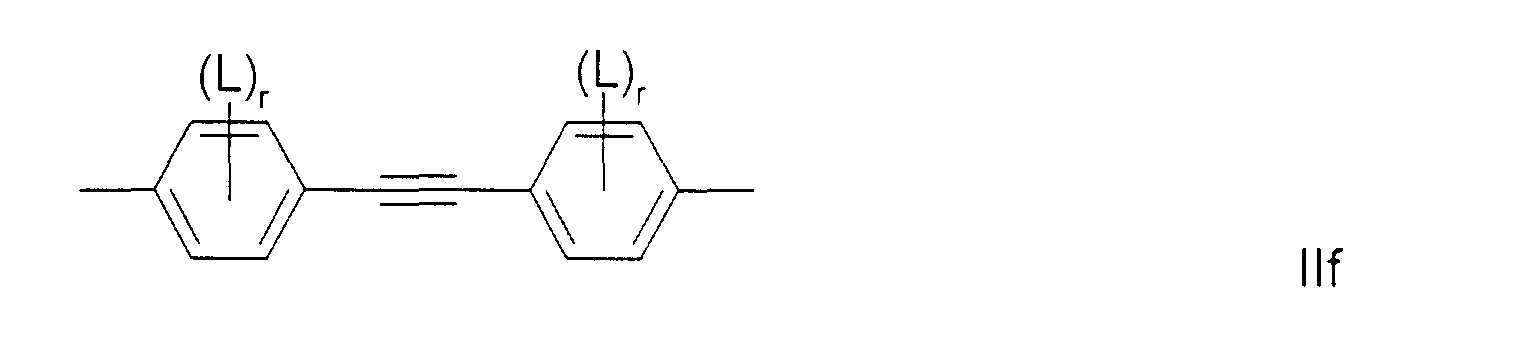
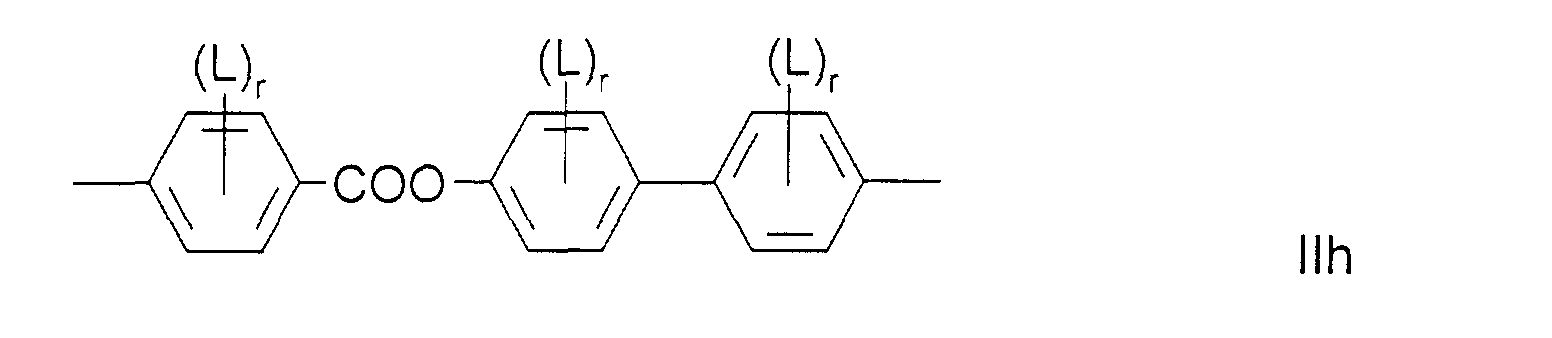
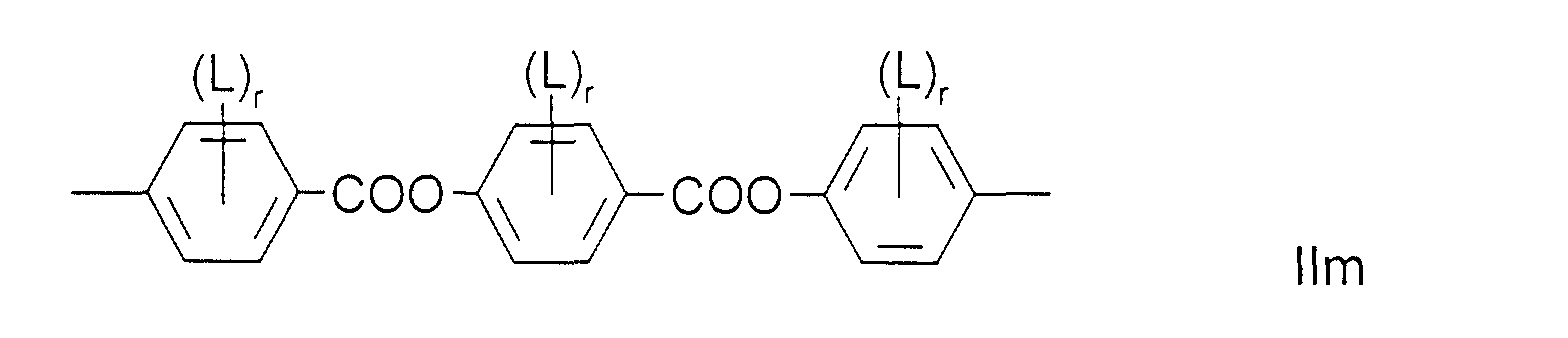
- the mesogenic group MG is selected from the following formulae and their mirror images wherein L has the meaning given above and r is 0, 1 or 2.
- subformulae lid IIg, IIh, IIi, Ilk and IIo, in particular the subformulae lid and Ilk.
- L is preferably F, Cl, CN, OH, NO 2 , CH 3 , C 2 H 5 , OCH 3 , OC 2 H 5 , COCH 3 , COC 2 H 5 , COOCH 3 , COOC 2 H 5 , CF 3 , OCF 3 , OCHF 2 , OC 2 F 5 , in particular F, Cl, CN, CH 3 , C 2 H 5 , OCH 3 , COCH 3 and OCF 3 , most preferably F, Cl, CH 3 , OCH 3 and COCH 3 .
- the polymerizable mixture comprises at least one chiral polymerizable compound of formula I comprising a group MG having at least one center of chirality.
- MG is preferably selected according to the following formulae -(A 1 -Z 1 ) a -G 1 - -(A 1 -Z 1 ) a -G 2 -(Z 1 -A 2 ) b - wherein
- a 1 , A 2 and Z 1 have the meaning given in formula II, a and b are independently of each other 0, 1 or 2,
- a terminal chiral group such as for example a cholesteryl group, a terpenoid radical, like e.g. disclosed in the WO 96/17901, particularly preferably a menthyl group, or a terminal chiral sugar derivative comprising a mono- or dicyclic radical with pyranose or furanose rings like, for example, a terminal group derived from the chiral sugars or sugar derivatives as disclosed e.g.
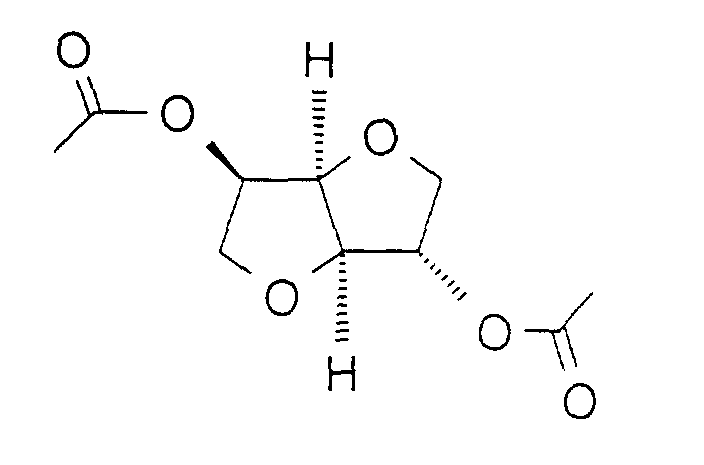
- G 2 in formula II * -2 is a bivalent chiral group, like for example a (S,S)- or (R,R)-hydrobenzoin group or a bivalent chiral sugar, sugar derivative or another bivalent chiral radical, as disclosed e.g. in the international application WO 95/16007, especially preferably a group based on 1,4:3,6-Dianhydro-D-sorbitol:
- R in formula I is an alkyl or alkoxy radical, i.e. where the terminal CH 2 group is replaced by -O-, this may be straight-chain or branched. It is preferably straight-chain, has 2, 3, 4, 5, 6, 7 or 8 carbon atoms and accordingly is preferably ethyl, propyl, butyl, pentyl, hexyl, heptyl, octyl, ethoxy, propoxy, butoxy, pentoxy, hexoxy, heptoxy, or octoxy, furthermore methyl, nonyl, decyl, undecyl, dodecyl, tridecyl, tetradecyl, pentadecyl, nonoxy, decoxy, undecoxy, dodecoxy, tridecoxy or tetradecoxy, for example.
- Halogen is preferably F or Cl.
- R in formula I can be a polar or an unpolar group.
- R is selected from CN, NO 2 , halogen, OCH 3 , OCN, SCN, COR 1 , COOR 1 or a mono- oligo- or polyfluorinated alkyl or alkoxy group with 1 to 4 C atoms.
- R 1 is optionally fluorinated alkyl with 1 to 4, preferably 1 to 3 C atoms.
- polar groups R are selected of F, Cl, CN, NO 2 , OCH 3 , COCH 3 , COC 2 H 5 , COOCH 3 , COOC 2 H 5 , CF 3 , C 2 F 5 , OCF 3 , OCHF 2 , and OC 2 F 5 , in particular of F, Cl, CN, OCH 3 and OCF 3 .
- R is preferably alkyl with up to 15 C atoms or alkoxy with 2 to 15 C atoms.
- R in formula I can be an achiral or a chiral group.
- a chiral group it is preferably selected according to the following formula III: wherein
- the O atom is preferably adjacent to the chiral C atom.
- achiral branched groups of this type generally do not contain more than one chain branch.
- Another preferred embodiment of the present invention relates to compounds of formula I wherein R is denoting P-(Sp-X) n -.
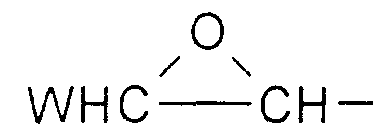
- P in formula I is preferably an acrylate group, a methacrylate group, a vinyl or vinyloxy group, an epoxy group, a styrene group or a propenyl ether group, in particular an acrylate, methacrylate, vinyl or epoxy group.
- the spacer group Sp in formula I all groups can be used that are known for this purpose to the skilled in the art.
- Typical spacer groups are for example -(CH 2 ) o -, -(CH 2 CH 2 O) p -CH 2 CH 2 -, -CH 2 CH 2 -S-CH 2 CH 2 - or -CH 2 CH 2 -NH-CH 2 CH 2 -,with o being an integer from 2 to 12 and p being an integer from 1 to 3.
- Preferred spacer groups are ethylene, propylene, butylene, pentylene, hexylene, heptylene, octylene, nonylene, decylene, undecylene, dodecylene, octadecylene, ethyleneoxyethylene, methyleneoxybutylene, ethylene-thioethylene, ethylene-N-methyl-iminoethylene, 1-methylalkylene, ethenylene, propenylene and butenylene for example.
- Sp is denoting an alkyl or alkoxy group with 2 to 8 C atoms.
- Straight-chain alkyl or alkoxy groups are especially preferred.
- the chiral compounds of formula I comprise at least one spacer group Sp that is a chiral group of the formula IV: wherein
- Q 4 is an alkylene or alkylene-oxy group with 1 to 10 C atoms or a single bond, being different from Q 1 .
- the O atom is preferably adjacent to the chiral C atom.
- the two spacer groups Sp in the compounds of formula I may be identical or different.
- the compounds of formula I can be synthesized according to or in analogy to methods which are known per se and which are described in standard works of organic chemistry such as, for example, Houben-Weyl, Methoden der organischen Chemie, Thieme-Verlag, Stuttgart. Some specific methods of preparation can be taken from the examples.
- polymerizable mesogenic compounds that can be used as components of the polymerizable CLC material, are disclosed for example in WO 93/22397; EP 0,261,712; DE 195,04,224; WO 95/22586 and WO 97/00600.
- the compounds disclosed in these documents, however, are to be regarded merely as examples that shall not limit the scope of this invention.
- the polymerizable CLC mixture comprises at least one polymerizable mesogenic compound having one polymerizable functional group and at least one polymerizable mesogenic compound having two or more polymerizable functional groups.
- Examples of especially useful monoreactive chiral and achiral polymerizable mesogenic compounds are shown in the following list of compounds, which should, however, be taken only as illustrative and is in no way intended to restrict, but instead to explain the present invention: wherein, P has one of the meanings of formula I and its preferred meanings as mentioned above, x is an integer from 1 to 12 , A is 1,4-phenylene or 1,4-cyclohexylene, v is 0 or 1, Y is a polar group as defined above, R 0 is an unpolar alkyl or alkoxy group, Ter is a terpenoid radical like e.g.
- L 1 and L 2 are each independently H, F, Cl, CN, OH, NO 2 or an optionally halogenated alkyl, alkoxy or carbonyl group with 1 to 7 C atoms.
- unpolar group in this connection preferably denotes an alkyl group with 1 or more, preferably 1 to 15 C atoms or an alkoxy group with 2 or more, preferably 2 to 15 C atoms.
- a polymerizable CLC material according to the first preferred embodiment as described above comprises one or more chiral dopants which themselves do not necessarily have to show a liquid crystalline phase and give good planar alignment themselves, in particular non-polymerizable chiral dopants.
- chiral dopants with a high helical twisting power in particular those disclosed in WO 98/00428.
- chiral dopants are e.g. the commercially available S 1011, R 811 or CB 15 (from Merck KGaA, Darmstadt, Germany).
- chiral non-polymerizable dopants selected from the following formulae including the (R,S), (S,R), (R,R) and (S,S) enantiomers not shown, wherein E and F are each independently 1,4-phenylene or trans-1,4-cyclohexylene, v is 0 or 1, Z° is -COO-, -OCO-, -CH 2 CH 2 - or a single bond, and R is alkyl, alkoxy or alkanoyl with 1 to 12 C atoms.
- the polymerizable CLC material comprises one or more chiral mesogenic compounds that spontaneously exhibit planar aligment when coated onto a substrate, in particular polymerizable chiral compounds of this type.
- these compounds are selected of formula I, wherein Sp and/or R are comprising a chiral moiety.
- Particularly preferred are chiral compounds selected of the formula Va to Vm above.
- polymerizable CLC material comprising a surface active component comprising one or more surfactans.
- Suitable surfactants are described for example in J. Cognard, Mol.Cryst.Liq.Cryst. 78 , Supplement 1, 1-77 (1981). Particularly preferred are non-ionic surfactants, such as mixtures of non-ionic fluoroalkylalkoxylate surfactants selected from the following formulae C n F 2n+1 SO 2 N(C 2 H 5 )(CH 2 CH 2 O) x CH 3 C n F 2n+1 (CH 2 CH 2 O) x H wherein n is an integer from 4 to 12 and x is an integer from 5 to 15.
- these surfactants it is possible to produce polymerized films with a low tilt angle in the range from 0 to 1 degrees, in particular 0 to 0.5 degrees. In the best case the tilt angle is approximately 0 degrees.
- the surfactants of formula IX are commercially available under the trade name Fluorad 171 (from 3M Co.), the surfactants of formula X under the trade name Zonyl FSN (from DuPont).
- the CLC material contains preferably from 500 to 2500 ppm, in particular from 1000 to 2500 ppm, very preferably from 1500 to 2500 ppm of surfactants. Further preferred materials contain 0.01 to 5 %, in particular 0.1 to 3 %, very preferably 0.2 to 2 % by weight of surfactants.
- a particularly preferred polymerizable CLC mixture according to the first preferred embodiment comprises
- the compounds of component A) are preferably selected from the above formulae Va and Vb.
- the compounds of component B) are preferably selected from the above formulae VIa and VIb.
- the chiral dopants of component C) are preferably selected from the above formulae VII and VIII.
- the surfactants of component E) are preferably selected from the above formulae IX and X.
- the polymerizable CLC material is coated onto a substrate and aligned into a uniform orientation. It can then be subsequently polymerized or crosslinked to permanently fix the orientation of the cholesteric material.
- a substrate for example a glass or quarz sheet or a plastic film or sheet can be used.
- the substrates can be removed after polymerization or not.
- an isotropic substrate is used.
- the substrate is a plastic substrate such as for example a film of polyester such as polyethyleneterephthalate (PET), of polyvinylalcohol (PVA), polycarbonate (PC) or triacetylcellulose (TAC), especially preferably a PET film or a TAC film.
- PET polyethyleneterephthalate
- PVA polyvinylalcohol
- PC polycarbonate
- TAC triacetylcellulose
- PET films are commercially available from ICI Corp. under the trade name Melinex.
- the CLC material can also be dissolved in a solvent, preferably in an organic solvent.
- the solution is then coated onto the substrate, for example by spin-coating or other known techniques, and the solvent is evaporated off. In most cases it is suitable to heat the mixture in order to facilitate the evaporation of the solvent.
- planar alignment in the coated layer of the CLC material can further be enhanced by shearing the material, e.g. by means of a doctor blade. It is also possible to apply an alignment layer, for example a layer of rubbed polyimide or sputtered SiO x , on top of the substrate, or alternatively to directly rub the substrate, i.e. without applying an additional alignment layer.
- an alignment layer for example a layer of rubbed polyimide or sputtered SiO x , on top of the substrate, or alternatively to directly rub the substrate, i.e. without applying an additional alignment layer.
- rubbing can be achieved by means of a rubbing cloth, such as a velvet cloth, or with a flat bar coated with a rubbing cloth.
- rubbing is achieved by means of at least one rubbing roller, like e.g. a fast spinning roller that is brushing across the substrate, or by putting the substrate between at least two rollers, wherein in each case at least one of the rollers is optionally covered with a rubbing cloth.
- rubbing is achieved by wrapping the substrate at least partially at a defined angle around a roller that is preferably coated with a rubbing cloth.
- Polymerization of the polymerizable CLC material takes place by exposing it to heat or actinic radiation.
- Actinic radiation means irradiation with light, like UV light, IR light or visible light, irradiation with X-rays or gamma rays or irradiation with high energy particles, such as ions or electrons.
- Preferably polymerization is carried out by UV irradiation.
- a source for actinic radiation for example a single UV lamp or a set of UV lamps can be used. When using a high lamp power the curing time can be reduced.
- a laser like e.g. a UV laser, an IR laser or a visible laser.
- the polymerization is carried out in the presence of an initiator absorbing at the wavelength of the actinic radiation.
- an initiator absorbing at the wavelength of the actinic radiation.
- a photoinitiator can be used that decomposes under UV irradiation to produce free radicals or ions that start the polymerization reaction.
- a radical photoinitiator is used
- curing polymerizable mesogens vinyl and epoxide groups preferably a cationic photoinitiator is used.
- a photoinitiator for radical polymerization for example the commercially available Irgacure 651, Irgacure 184, Darocure 1173 or Darocure 4205 (all from Ciba Geigy AG) can be used, whereas in case of cationic photopolymerization the commercially available UVI 6974 (Union Carbide) can be used.
- the polymerizable CLC mixture preferably comprises 0.01 to 10 %, very preferably 0.05 to 5 %, in particular 0.1 to 3 % of a polymerization initiator.
- UV photoinitiators are preferred, in particular radicalic UV photoinitiators.
- the curing time is dependent, inter alia, on the reactivity of the polymerizable mesogenic material, the thickness of the coated layer, the type of polymerization initiator and the power of the UV lamp.
- the curing time according to the invention is preferably not longer than 10 minutes, particularly preferably not longer than 5 minutes and very particularly preferably shorter than 2 minutes. For mass production short curing times of 3 minutes or less, very preferably of 1 minute or less, in particular of 30 seconds or less, are preferred.
- the polymerizable material may also comprise one or more other suitable components such as, for example, catalysts, stabilizers, chain-transfer agents, co-reacting monomers or surface-active compounds.
- suitable components such as, for example, catalysts, stabilizers, chain-transfer agents, co-reacting monomers or surface-active compounds.
- stabilizers is preferred in order to prevent undesired spontaneous polymerization of the polymerizable material for example during storage.
- stabilizers in principal all compounds can be used that are known to the skilled in the art for this purpose. These compounds are commercially available in a broad variety. Typical examples for stabilizers are 4-ethoxyphenol or butylated hydroxytoluene (BHT).
- Typical examples for difunctional non mesogenic monomers are alkyldiacrylates or alkyldimethacrylates with alkyl groups of 1 to 20 C atoms.
- Typical examples for non mesogenic monomers with more than two polymerizable groups are trimethylpropanetrimethacrylate or pentaerythritoltetraacrylate.
- the polymerizable CLC mixture comprises up to 70%, preferably 3 to 50 % of a non mesogenic compound with one polymerizable functional group.
- Typical examples for monofunctional non mesogenic monomers are alkylacrylates or alkylmethacrylates.
- the polymerization of the polymerizable CLC mixture is carried out under an atmosphere of inert gas, preferably under a nitrogen atmosphere.
- suitable polymerization temperatures depends mainly on the clearing point of the polymerizable material and inter alia on the softening point of the substrate.
- the polymerization temperature is at least 30 degrees below the clearing temperature of the polymerizable mesogenic mixture.
- the pigment flakes are prepared from a broadband CLC film wherein the pitch varies symmetrically in a direction perpendicular to the film plane.
- the preparation of such a film is disclosed in WO 97/35219.
- platelet shaped pigments with a symmetrical variation of the pitch and reflection wavelength, e.g. blue - red - blue, throughout their thickness can be obtained.
- the CLC pigment flakes are prepared from a broadband CLC film wherein the pitch varies asymmetrically in a direction perpendicular to the film plane.
- the preparation of such a film is disclosed in EP 0 606 940 and WO 96/02016.
- platelet shaped pigments with an asymmetrical variation of the pitch and reflection wavelength, e.g. blue - red, throughout their thickness can be obtained.
- Pigments with asymmetrical pitch variation can be made thinner compared to pigments with the same bandwidth and symmetrical pitch variation, because the former exhibit only one complete pitch gradient (e.g. blue - red) within the film thickness, whereas the latter exhibit two gradients (e.g. blue - red - blue).
- a symmetric CLC polymer film with approximately the same bandwidth would have a thickness of 15 to 20 microns.
- pigments with an asymmetric pitch gradient are used. These pigments are also cheaper as they need less material.
- a broadband reflective CLC polymer film with asymmetrically varying pitch is prepared by polymerizing a polymerizable CLC material comprising
- the polymerizable CLC material used in this method has a cholesteric phase and an additional smectic phase, preferably a smectic A phase, at temperatures below the cholesteric phase.
- the pitch of the cholesteric helix will unwind in the forming polymer as the smectic phase will be approached.
- the mesogens in the CLC material do not have enough time to relax to give the thermodynamically stable, more highly ordered smectic phase of the polymer, but instead the orientation that the polymerizable CLC material had before curing becomes fixed and remains frozen in for extended periods.
- the viscosity of the polymer will also be reduced. This allows some unwinding of the helix before polymerization is complete, and therefore leads to an increase of the pitch and thus to a shift of the reflection wavelength to higher wavelengths. As explained above, unwinding can also be enhanced if polymerization occurs slowly.
- the molecular weight of the forming polymer and the degree and speed of polymerization, and thereby the shift of pitch and reflection wavelength in the reflective polymer film are controlled by varying the amount and type of photoiniator c), and/or crosslinking component d), and/or chain transfer or chain termination agent e) in the polymerizable CLC material.
- Suitable compounds for components a), b), c) and d) are described above.
- the compounds of component a), b) and optionally d) are selected such that the polymerizable CLC material has a cholesteric phase at a temperature where the resulting CLC polymer has a thermodynamically stable smectic phase.
- the length of the free polymer chains and/or the length of the polymer chains between two crosslinks in the forming CLC polymer film can be controlled.
- the amount of the chain transfer agent is increased, the polymer chain length and thus the molecular weight of the forming polymer are decreased. This reduces the viscosity of the forming polymer, and thus leads to faster relaxation of the polymeric precursor during polymerization and thereby to an unwinding of the cholesteric helix.
- the wavelength of the reflection band increases with increased concentration of the chain transfer agent. This holds at least for small concentrations of the chain transfer agents of typically 0 to 10 %.
- the polymerizable CLC material comprises 0.01 to 15 %, in particular 0.1 to 10 %, very preferably 0.5 to 5 % of a chain transfer agent.
- thiol compounds are used as chain terminator, for example monofunctional thiol compounds like e.g. dodecane thiol CH 3 (CH 2 ) 11 SH or multifunctional thiol compounds like e.g. trimethylpropane tri(3-mercaptopropionate).
- liquid crystalline or at least mesogenic thiol compounds are used due to their better solubility in liquid crystal hosts.
- Suitable chain transfer agents for the instant invention are amongst others especially those disclosed in WO 96/12209 and WO 96/25470, the entire disclosure of which is incorporated into this application by way of reference.
- liquid crystalline thiol compounds of formula XI and XII are especially preferred.
- a crosslinking agent d) added to the polymerizable CLC mixture the molecular weight and the degree of crosslinking of the polymer are increased, which also leads to a faster increase of the viscosity of the polymer. This suppresses the unwinding of the molecular helix and leads to a reflective film with a smaller reflection wavelength.
- a decrease of the reflection wavelength in the reflective film is achieved.
- the amount of crosslinking agent d) should not be too high, because high amounts of crosslinker lock the structure of the forming polymer too quickly and thus reduce the bandwidth of the reflective film.
- crosslinked films are also advantageous for use in pigments as they are solid, self supporting films.
- crosslinking agents d) are compounds of formula VIa and VIb above.
- the concentration of the crosslinking agent component d) in the polymerizable CLC material is preferably from 0 to 35 %, in particular from 2 to 25 %, very preferably from 15 to 25 %.
- the pitch variation in the reflective CLC polymer film can be controlled by adding a dye component f) to the polymerizable material.
- a dye component f that absorbs actinic radiation used for polymerization
- the mixture at the surface of the film facing away from the radiation source will polymerize differently compared to the mixture at the surface of the film facing the radiation source, thus producing a pitch gradient very quickly, ideally within a minute or faster.
- broadband reflective CLC polymer films both with a controlled gradient of the helical pitch (leading to a controlled bandwidth) and with a controlled central wavelength of the reflection band are accessible.
- the polymerizable CLC mixture contains 0 to 20 %, preferably 0.1 to 10 %, in particular 0.5 to 5 % by weight of a dye component f) having an absorption maximum adjusted to the wavelength of the actinic radiation used for polymerization.
- the dye should preferably have its maximum absorption in the same wavelength range as the polymerization initiator.
- a dye is used whose absorption maximum lies outside the reflection wavelength range of the reflective film in order to exclude undesired absorptions during the use of the film.
- a suitable dye 4,4'-azoxy anisole of the formula or the commercially available Merck Phase 5 (from Merck KGaA, Darmstadt, Germany) can be used.
- commercially available UV dyes such as Tinuvin (from Ciba Geigy, Switzerland) can be used.
- the polymerizable CLC mixture contains no dye.
- the reflection bandwidth and the central reflection wavelength are controlled by variation of the irradiation power of the actinic radiation used for polymerization.
- the curing power is inversely proportional to the wavelength of the reflected light for the inventive method. For example, curing with high power leads to films reflecting blue light, whereas with decreasing power the colour of the reflected light can be shifted through green, yellow and red. Thus, the central wavelength of the reflected waveband can be altered by varying the curing power.
- Flakes can be formed by grinding the cured polymer film, for example by means of a pestle and mortar or by using a mechanised grinder or mill. By additional cooling to temperatures below 0 °C the polymer brittleness is increased and grinding is made easier. The resulting powder is then sieved to give pigment flakes of the desired size.
- a preferred method to produce flakes of spherical shape with dimensions smaller than 100 ⁇ m is grinding with a pestle and mortar by hand or in a mechanised mortar mill.
- Another method to produce more or less spherical flakes is by milling the polymer film in a ball mill. Depending on the size and the weight of the balls, particles with average dimensions of less than 100 ⁇ m, in particular of 5 to 10 ⁇ m can be obtained.
- Another preferred method is milling the polymer film under cooling in a blade mill. This produces a powder of platelet shaped flakes with lateral dimensions from several hundreds of microns to 1 to 2 mm. These flakes can subsequently be ground further in a mortar to give platelets with lateral dimensions smaller than 100 ⁇ m.
- Cooling of the sample during grinding or milling can be achieved for example by using a carbon dioxide / aceton bath.
- Another preferred method of cooling is the addition of dry ice powder or liquid nitrogen to the sample.
- an antistatic agent when milling the polymer material to avoid agglomeration of the particles.
- the flakes obtained by the above mentioned methods have dimensions from 1 to 100 ⁇ m. It is also possible, however, to chose the process parameters so that flakes with dimensions larger than 100 ⁇ m, preferably from 0.5 mm to 1.5 mm, are obtained. These flakes show particularly striking colour effects and are preferred in certain applications.
- Platelet shaped pigment flakes are preferred, wherein the aspect ratio, which describes the ratio of lateral dimensions to thickness, is larger than 3:1, in particular from 3:1 to 20:1, very preferably from 5:1 to 10:1.
- the thickness is preferably 1 to 50 ⁇ m, in particular 1 to 25 ⁇ m, very preferably 1 to 10 ⁇ m.
- the diameter of these pigments is preferably from 1 to 50 ⁇ m.
- pigments with a granular shape wherein the aspect ratio is less than 10:1, particularly less than 3:1, especially preferably wherein thickness, length and width are approximately the same.
- the diameter is preferably from 1 to 50 ⁇ m.
- the cholesteric pigment flakes can be dispersed in a transparent binder or fluid, or incorporated into plastics, depending on the application.
- the inks and paints in addition to the inventive pigments may also comprise one or more binders, additional pigments or dyes, curing agents, dispersing agents, fillers and further conventional additives, all of which are known from the state of the art.
- the inks, paints and lacquers may also comprise one or more dyes or pigments which are not chemically bound to the liquid crystalline polymer material.
- dyes or pigments can be selected of conventional inorganic pigments, such as titanium dioxide, iron (III) oxide, iron oxide yellow, chromium oxide, iron blue, carbon black, or organic dyes or pigments like azo, metal complex and polycyclic dyes or pigments based e.g. on phthalocyanine, perylene, pyrrolopyrrol, polymethine or triphenylmethane.
- additional pigments can be selected from platetet shaped effect pigments like metal pigments e.g. of copper or aluminium, pearl luster or interference pigments of coated mica, aluminium or carbon black, metal oxide pigments or coated glass flakes.
- Suitable binder systems are e.g. polyesters, alkyd resins, polyurethanes, (meth)acrylate copolymers and resins based on cellulose esters, which may also be dissolved or dispersed in an organic solvent.
- water soluble binders may also be used, like e.g. water soluble polymer selected from polyesters, poly(meth)acrylates and polyurethanes.
- the coating comprising the inventive pigments and the transparent binder may also be covered by a second coating as clearcoating. Suitable methods and components are disclosed in WO 97/27252.
- the cholesteric polymer flakes can be be used as effect pigments in spraying or printing inks or paints or coloured plastics for decorative applications or cosmetic products.
- Other important fields of application are the automotive use, active or passive optical elements, like e.g. optical films such as polarizers or compensators, and security applications, for example in false-proof security labels, markings or patterns for documents of value, such as ID cards, credit cards, tickets etc..
- K crystalline
- N nematic
- S smectic
- Ch cholesteric
- I isotropic.
- the numbers between the symbols indicate the phase transition temperatures in ° C.
- Compound (1) is described in DE 195 04 224.
- Compound (2) can be prepared in analogy to the methods described in WO 93/22397.
- Compound (3) is described in WO 98/00428.
- TPO 2,4,6-trimethylbenzoyl-diphenylphosphine oxide, Trademark Lucirin® TPO from BASF
- Irgacure 1076 ® (Ciba Geigy) are commercially available photoinitiators.
- the mixture was coated as a film of 20 ⁇ m thickness between two PET substrates and polymerized by irradiation with UV light of 0.06 mW/cm 2 to give a polymer film having silver appearance and reflecting circular polarized light of a waveband from 450-740 nm.
- the reflection spectrum of the film is shown in Figure 1.
- the mixture was coated and polymerized as described in example 1 to give a polymer film having gold appearance and reflecting circular polarized light of a waveband from 500-800 nm.
- the reflection spectrum of the film is shown in Figure 2.
- the film of example 1 was mixed with dry ice powder and ground in a mortar mill to give flakes with a diameter from 5 to 60 ⁇ m. 1.8 g of the flakes were dispersed in 55.3 g NC lacquer and coated onto black and white cards. When observed under unpolarized light, the coating appears as a coating of normal silver pigments. When observed under two different handednesses of circularly polarized light, the coating appears bright under one handedness and dark under the other handedness.
Landscapes
- Chemical & Material Sciences (AREA)
- Organic Chemistry (AREA)
- Crystallography & Structural Chemistry (AREA)
- Physics & Mathematics (AREA)
- General Physics & Mathematics (AREA)
- Chemical Kinetics & Catalysis (AREA)
- Optics & Photonics (AREA)
- Engineering & Computer Science (AREA)
- Materials Engineering (AREA)
- Cosmetics (AREA)
- Developing Agents For Electrophotography (AREA)
- Liquid Crystal Substances (AREA)
- Polarising Elements (AREA)
Abstract
Description
- the pigments reflect circularly polarized light of a single handedness,
- the bandwidth of the reflected waveband is larger than 220 nm, particularly preferably larger than 320 nm, very particularly preferably larger than 420 nm,
- the reflected waveband covers the spectrum of wavelengths from 450 to 750 nm,
- the reflected waveband covers the visible spectrum of light,
- the reflection characteristics, in particular the reflected colours, are substantially independent from the viewing angle,
- the helical pitch within the layer of liquid crystalline polymer material varies asymmetrically in a direction perpendicular to the layer,
- the helical pitch within the layer of liquid crystalline polymer material varies from a minimum value at one surface of the layer to a maximum value at the opposite surface of the layer,
- the helical pitch within the layer of liquid crystalline polymer material varies symmetrically in a direction perpendicular to the layer,
- the helical pitch within the layer of liquid crystalline polymer material varies from a maximum value in the central region of the layer to minimum values at each of the surfaces of the layer,
- the liquid crystalline polymer material forms a three-dimensional network,
- the thickness is from 0.1 to 100 µm and the lateral dimensions are from 1 to 1000 µm,
- P
- is CH2=CW-COO-, WCH=CH-O-,
or CH2=CH- Phenyl-(O)k- with W being H, CH3 or Cl and k being 0 or 1,
- Sp
- is a spacer group having 1 to 25 C atoms,
- X
- is -O-, -S-, -CO-, -COO-, -OCO-, -CO-NH-, -NH-CO-, -CH2CH2-, -OCH2-, -CH2O-, -SCH2-, -CH2S-, -CH=CH-, -CH=CH-COO-, -OCO-CH=CH-, -C≡C-, or a single bond,
- n
- is 0 or 1,
- MG
- is a mesogenic group, and
- R
- is H, CN, halogen or a straight-chain or branched alkyl radical with up to 25 C atoms which may be unsubstituted, mono- or polysubstituted by halogen or CN, it being also possible for one or more non-adjacent CH2 groups to be replaced, in each case independently from one another, by -O-, -S-, -NH-, -N(CH3)-, - CO-, -COO-, -OCO-, -OCO-O-, -S-CO-, -CO-S- or -C≡C- in such a manner that oxygen atoms are not linked directly to one another, or alternatively R is denoting P-(Sp-X)n-.
- MG
- in formula I is preferably selected of formula II
- Z1 and Z2
- are each independently -COO-, -OCO-, -CH2CH2-, -OCH2-, -CH2O-, -CH=CH-, -CH=CH-COO-, -OCO-CH=CH-, -C≡C-, or a single bond,
- A1, A2 and A3
- are each independently 1,4-phenylene in which, in addition, one or more CH groups may be replaced by N, 1,4-cyclohexylene in which, in addition, one or two non-adjacent CH2 groups may be replaced by O and/or S, 1,4-cyclohexenylene, 1,4-bicyclo(2,2,2)octylene, piperidine-1,4-diyl, naphthalene-2,6-diyl, decahydronaphthalene-2,6-diyl, or 1,2,3,4-tetrahydro-naphthalene-2,6-diyl, it being possible for all these groups to be unsubstituted, mono- or polysubstituted with F,Cl, OH, CN or NO2 or alkyl, alkoxy or alkanoyl groups having 1 to 7 C atoms wherein one or more H atoms may be substituted by F or Cl, and
- m
- is 0, 1 or 2.







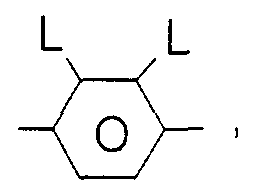
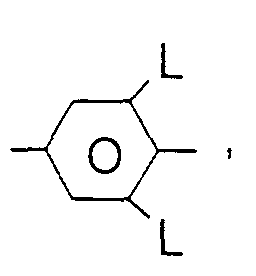
a and b are independently of each other 0, 1 or 2,

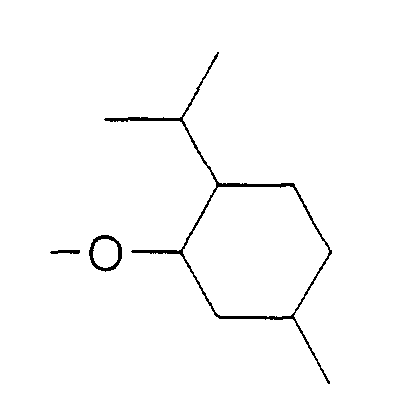
and G2 in formula II*-2 is a bivalent chiral group, like for example a (S,S)- or (R,R)-hydrobenzoin group


- X1
- is -O-, -S-, -CO-, -COO-, -OCO-, -OCOO- or a single bond,
- Q1
- is an alkylene or alkylene-oxy group with 1 to 10 C atoms or a single bond,
- Q2
- is an alkyl or alkoxy group with 1 to 10 C atoms which may be unsubstituted, mono- or polysubstituted by halogen or CN, it being also possible for one or more non-adjacent CH2 groups to be replaced, in each case independently from one another, by -C≡C-, -O-, -S-, -NH-, -N(CH3)-, -CO-, -COO-, -OCO-, -OCO-O-, -S-CO- or -CO-S- in such a manner that oxygen atoms are not linked directly to one another,
- Q3
- is halogen, a cyano group or an alkyl or alkoxy group with 1 to 4 C atoms different from Q2.
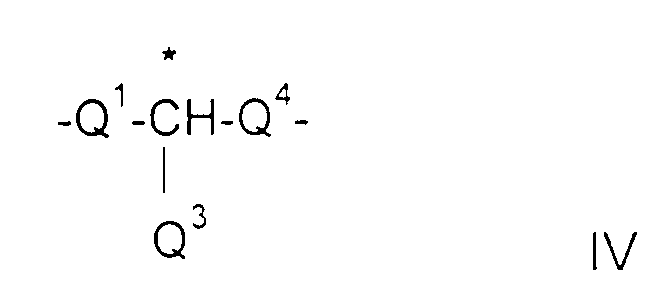










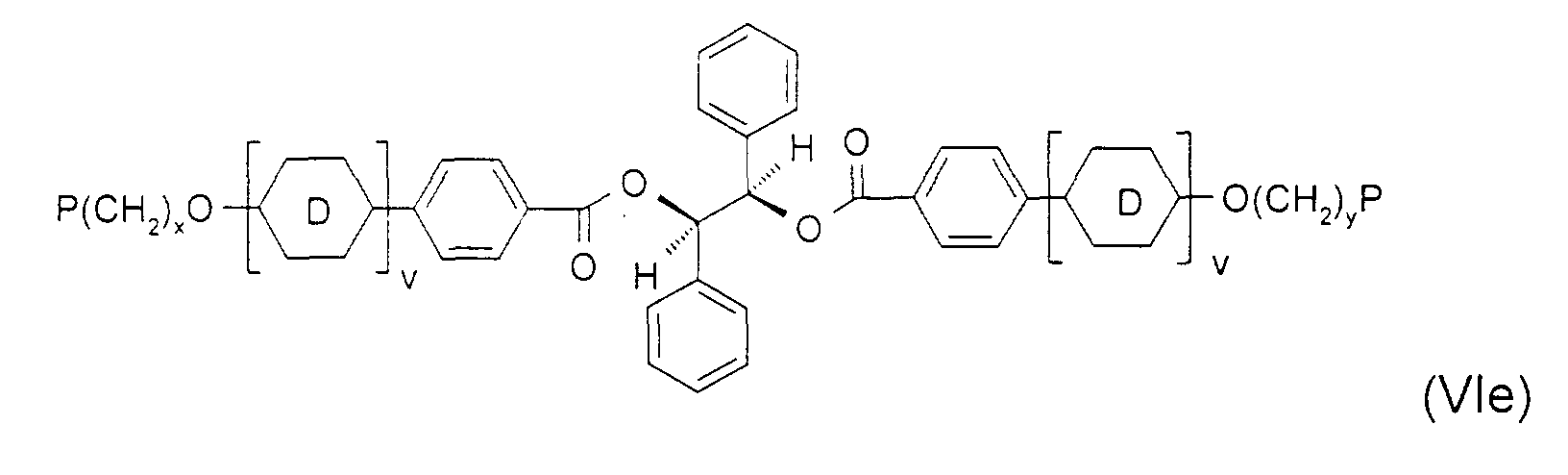

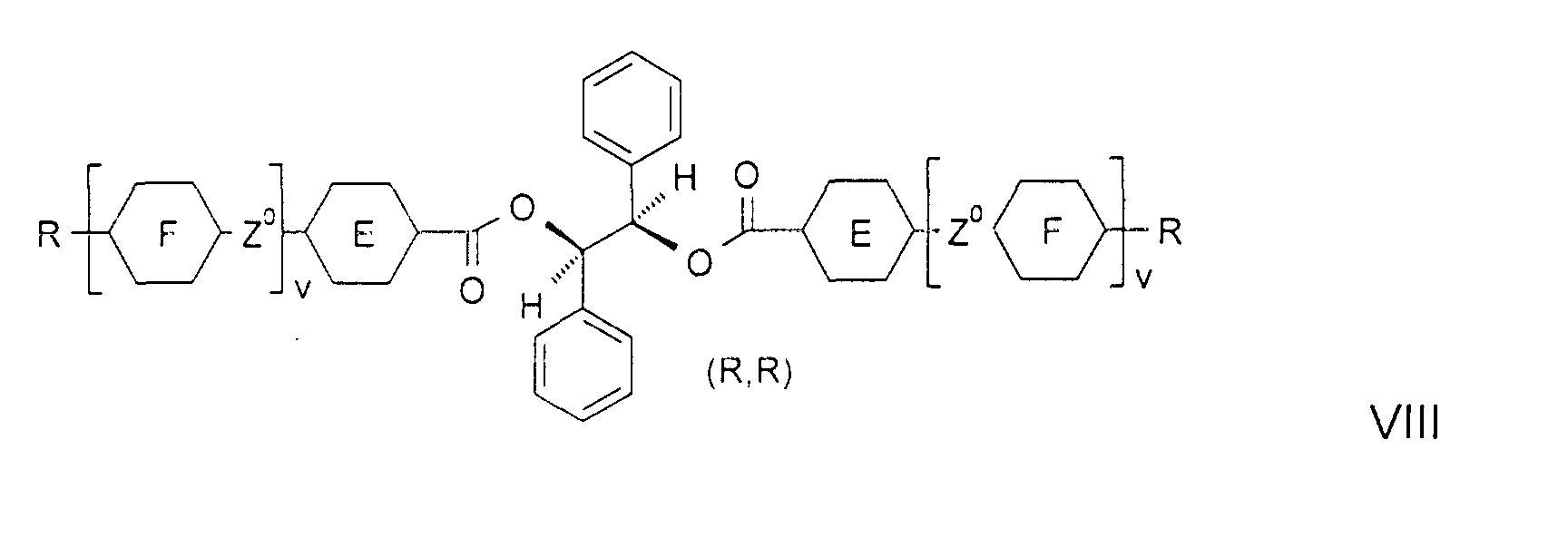
wherein E and F are each independently 1,4-phenylene or trans-1,4-cyclohexylene, v is 0 or 1, Z° is -COO-, -OCO-, -CH2CH2- or a single bond, and R is alkyl, alkoxy or alkanoyl with 1 to 12 C atoms.
wherein polymerization is carried out at a temperature where the polymerizable CLC material has a cholesteric phase and the resulting CLC polymer has a thermodynamically stable smectic phase.
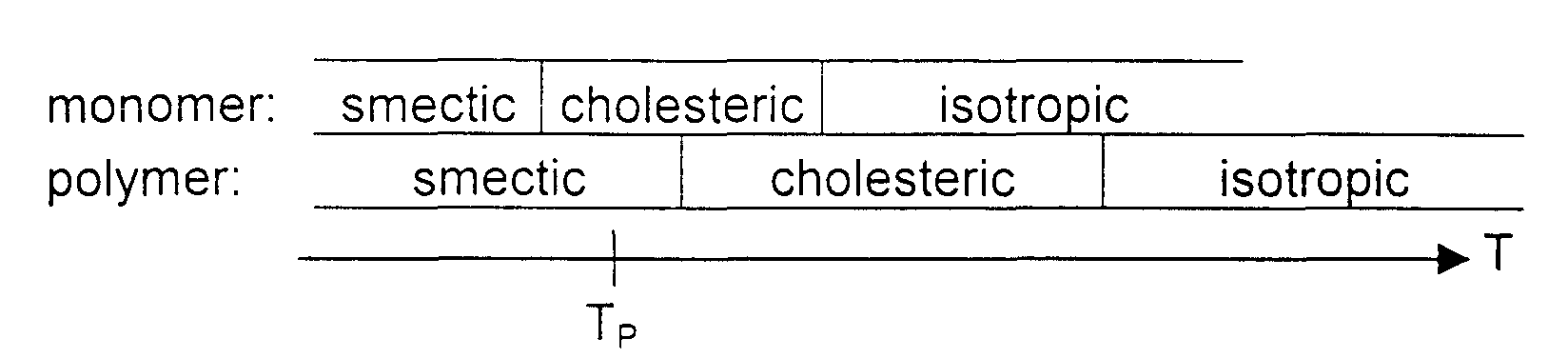


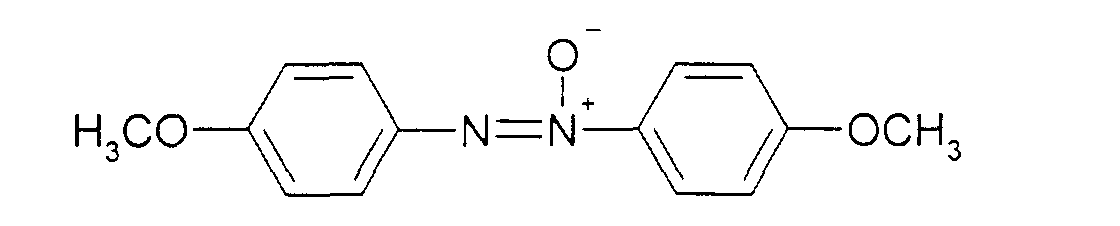
- Coating the chiral polymerizable mesogenic material onto a substrate which contains shallow indentations with a diameter of 10 to 100 µm, preferably 20 to 50 µm and a depth of 3 to 20 µm, preferably 4 to 10 µm. In this case the act of coating causes sufficient shear to give uniform alignment. In order to increase the quality of the alignment the material may additionally be sheared for example by means of a doctor's blade or by applying a second substrate on top of the coated material as described above.
- Gravure printing the chiral polymerizable mesogenic material in the shape of small droplets onto a substrate, for example a polyester web, using a gravure printing plate to leave droplets with a thickness of e.g. 3 to 20 µm, preferably 4 to 10 µm and a diameter of e.g. 10 to 100 µm, preferably 20 to 50 µm. The act of printing causes sufficient shear to give uniform alignment, however, here also the material may be additionally aligned by shearing with for example a doctors blade or by applying a second substrate on top of the droplets.
- Spraying of the chiral polymerizable mesogenic material into an N2 atmosphere to give small droplets with a diameter of 10 to 100 µm, which are cured by irradiation with strong UV light. The cured droplets may subsequently be ground to make smaller flakes.
- Coating the chiral polymerizable mesogenic material onto a rotating drum, aligning by a knife edge, curing by irradiation with UV light and scraping off the cured polymer to yield small flakes.
- Coating the chiral polymerizable mesogenic material onto a rotating drum containing dimples with a depth of e.g. 2 to 20 µm, preferably 3 to 10 µm and a diameter of e.g. 10 to 100 µm, preferably 20 to 50 µm, curing by UV irradiation and peeling off the drum.
- Coating the chiral polymerizable mesogenic material onto a rotating drum containing stripes that are e.g. 2 to 20 µm, preferably 3 to 10 µm deep and e.g. 10 to 100 µm, preferably 20 to 50 µm across, aligning and curing as described above. After this the stripes are ground into fragments of the desired size.
- Making an emulsion of the chiral polymerizable mesogenic material in an immiscible liquid and polymerising the droplets by heating or UV irradiation.
- Adding a surfactant to the chiral polymerizable mesogenic material and blowing N2 gas in to make a foam which is polymerized, scraped off and ground.
- Extruding the chiral polymerizable mesogenic material under pressure through one or more slots with a width of e.g. 2 to 20 µm, preferably 3 to 10 µm, whereby the shearing produces good uniform alignment. The film is cured in an N2 atmosphere.
- Another preferred method uses a solid particle, preferably carbon black or graphite dipersed in a solution of the chiral polymerizable mesogenic material and two solvents. Solvent 1 does not dissolve the chiral polymerizable mesogenic material but solvent 2 does. Solvent 2 is boiled off and the precipitating chiral polymerizable mesogenic material forms a coating over the carbon particle which is then polymerised. This method produces particularly bright flakes.
| Compound (1) | 65.0% |
| Compound (2) | 18.34 % |
| Compound (3) | 15.0 % |
| Compound (4) | 1.2 % |
| TPO | 0.4 % |
| Irgacure 1076 ® | 0.06 % |



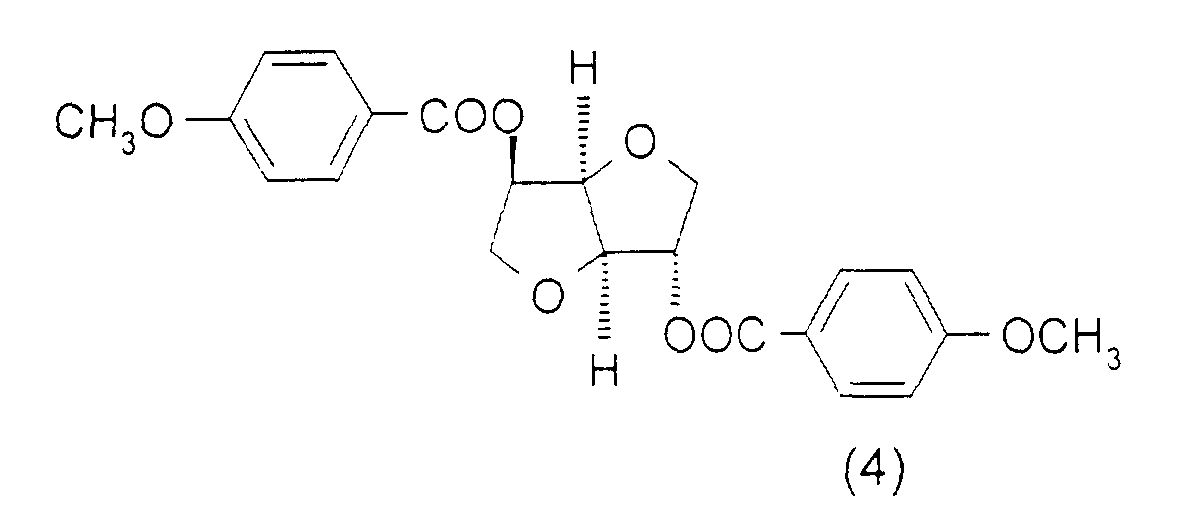
| Compound (1) | 65.0 % |
| Compound (2) | 19.04 % |
| Compound (3) | 15.0 % |
| Compound (4) | 0.5 % |
| TPO | 0.4 % |
| Irgacure 1076 | 0.06 % |
Claims (10)
- Liquid crystal pigments comprising at least one layer of anisotropic polymer material with a helically twisted molecular structure wherein the helical axis is oriented substantially perpendicular to the plane of the layer and showing reflection of circularly polarized light, characterized in that the bandwidth of the reflected wavelength band is at least 100 nm.
- Liquid crystal pigments according to claim 1, wherein the bandwidth of the reflected waveband is at least 210 nm.
- Liquid crystal pigments according to at least one of claims 1 to 2, wherein the reflected waveband is covering the visible spectrum of light.
- Liquid crystal pigments according to at least one of claims 1 to 3, wherein the helical pitch within the layer of liquid crystalline polymer material varies asymmetrically in the direction normal to the layer.
- Liquid crystal pigments according to at least one of claims 1 to 4, wherein the liquid crystalline polymer material forms a three-dimensional network.
- Use of liquid crystal pigments according to at least one of claims 1 to 5 in reflective films or coatings for decorative applications, cosmetic and pharmaceutical compositions, optical elements and security applications.
- Reflective film or coating comprising at least one liquid crystal pigment according to at least one of claims 1 to 5 in a transmissive binder.
- Reflective film or coating according to claim 7, comprising at least two different pigments according to at least one of claims 1 to 5.
- Reflective film or coating according to claim 8, wherein said at least two different pigments reflect circularly polarized light of different handedness.
- Security marking or device comprising at least one pigment or reflective film or coating according to at least one of claims 1 to 9.
Priority Applications (1)
| Application Number | Priority Date | Filing Date | Title |
|---|---|---|---|
| EP01101126A EP1134597A3 (en) | 2000-03-16 | 2001-01-19 | Broadband liquid crystal pigments |
Applications Claiming Priority (3)
| Application Number | Priority Date | Filing Date | Title |
|---|---|---|---|
| EP00105618 | 2000-03-16 | ||
| EP00105618 | 2000-03-16 | ||
| EP01101126A EP1134597A3 (en) | 2000-03-16 | 2001-01-19 | Broadband liquid crystal pigments |
Publications (2)
| Publication Number | Publication Date |
|---|---|
| EP1134597A2 true EP1134597A2 (en) | 2001-09-19 |
| EP1134597A3 EP1134597A3 (en) | 2004-01-21 |
Family
ID=26070681
Family Applications (1)
| Application Number | Title | Priority Date | Filing Date |
|---|---|---|---|
| EP01101126A Withdrawn EP1134597A3 (en) | 2000-03-16 | 2001-01-19 | Broadband liquid crystal pigments |
Country Status (1)
| Country | Link |
|---|---|
| EP (1) | EP1134597A3 (en) |
Cited By (1)
| Publication number | Priority date | Publication date | Assignee | Title |
|---|---|---|---|---|
| EP1201726A3 (en) * | 2000-09-19 | 2002-12-04 | MERCK PATENT GmbH | Polymer beads |
Family Cites Families (3)
| Publication number | Priority date | Publication date | Assignee | Title |
|---|---|---|---|---|
| JP2001518131A (en) * | 1997-03-21 | 2001-10-09 | メルク パテント ゲゼルシャフト ミット ベシュレンクテル ハフトング | Pigment flake |
| WO1999002340A1 (en) * | 1997-07-09 | 1999-01-21 | Reveo, Inc. | Coloring media having improved brightness and color characteristics |
| EP0982605A1 (en) * | 1998-08-26 | 2000-03-01 | MERCK PATENT GmbH | Reflective film |
-
2001
- 2001-01-19 EP EP01101126A patent/EP1134597A3/en not_active Withdrawn
Cited By (1)
| Publication number | Priority date | Publication date | Assignee | Title |
|---|---|---|---|---|
| EP1201726A3 (en) * | 2000-09-19 | 2002-12-04 | MERCK PATENT GmbH | Polymer beads |
Also Published As
| Publication number | Publication date |
|---|---|
| EP1134597A3 (en) | 2004-01-21 |
Similar Documents
| Publication | Publication Date | Title |
|---|---|---|
| US6667793B2 (en) | Broadband liquid crystal pigments | |
| US6677042B2 (en) | Polymer beads | |
| US6207770B1 (en) | Cholesteric flakes | |
| EP0968255B1 (en) | Pigment flakes | |
| US6217948B1 (en) | Polymer film | |
| US6417902B1 (en) | Process of preparing a multilayer cholesteric film I | |
| US6421107B1 (en) | Process of preparing a multilayer cholesteric film II | |
| US7029728B2 (en) | Polymerizable liquid crystal material | |
| US7534474B2 (en) | Multireactive polymerizable mesogenic compounds | |
| US6316066B1 (en) | Thermochromic polymerizable mesogenic composition | |
| US6099758A (en) | Broadband reflective polarizer | |
| US6466297B1 (en) | Method of preparing a broadband reflective polarizer | |
| EP1256617B1 (en) | Polymerizable liquid crystal material | |
| EP1201726A2 (en) | Polymer beads | |
| GB2355720A (en) | Process of preparing a CLC reflective film comprising a photodegradable chiral compound |
Legal Events
| Date | Code | Title | Description |
|---|---|---|---|
| PUAI | Public reference made under article 153(3) epc to a published international application that has entered the european phase |
Free format text: ORIGINAL CODE: 0009012 |
|
| AK | Designated contracting states |
Kind code of ref document: A2 Designated state(s): AT BE CH CY DE DK ES FI FR GB GR IE IT LI LU MC NL PT SE TR |
|
| AX | Request for extension of the european patent |
Free format text: AL;LT;LV;MK;RO;SI |
|
| PUAL | Search report despatched |
Free format text: ORIGINAL CODE: 0009013 |
|
| AK | Designated contracting states |
Kind code of ref document: A3 Designated state(s): AT BE CH CY DE DK ES FI FR GB GR IE IT LI LU MC NL PT SE TR |
|
| AX | Request for extension of the european patent |
Extension state: AL LT LV MK RO SI |
|
| 17P | Request for examination filed |
Effective date: 20040211 |
|
| 17Q | First examination report despatched |
Effective date: 20040511 |
|
| AKX | Designation fees paid |
Designated state(s): DE ES FI FR GB IT |
|
| STAA | Information on the status of an ep patent application or granted ep patent |
Free format text: STATUS: THE APPLICATION IS DEEMED TO BE WITHDRAWN |
|
| 18D | Application deemed to be withdrawn |
Effective date: 20050524 |