EP1134292A2 - Oligonucleotides for detection of vibrio parahaemolyticus and detection method for vibrio parahaemolyticus using the same oligonucleotides - Google Patents
Oligonucleotides for detection of vibrio parahaemolyticus and detection method for vibrio parahaemolyticus using the same oligonucleotides Download PDFInfo
- Publication number
- EP1134292A2 EP1134292A2 EP01106364A EP01106364A EP1134292A2 EP 1134292 A2 EP1134292 A2 EP 1134292A2 EP 01106364 A EP01106364 A EP 01106364A EP 01106364 A EP01106364 A EP 01106364A EP 1134292 A2 EP1134292 A2 EP 1134292A2
- Authority
- EP
- European Patent Office
- Prior art keywords
- rna
- oligonucleotide
- seq
- sequence
- primer
- Prior art date
- Legal status (The legal status is an assumption and is not a legal conclusion. Google has not performed a legal analysis and makes no representation as to the accuracy of the status listed.)
- Granted
Links
Images




Classifications
-
- C—CHEMISTRY; METALLURGY
- C12—BIOCHEMISTRY; BEER; SPIRITS; WINE; VINEGAR; MICROBIOLOGY; ENZYMOLOGY; MUTATION OR GENETIC ENGINEERING
- C12Q—MEASURING OR TESTING PROCESSES INVOLVING ENZYMES, NUCLEIC ACIDS OR MICROORGANISMS; COMPOSITIONS OR TEST PAPERS THEREFOR; PROCESSES OF PREPARING SUCH COMPOSITIONS; CONDITION-RESPONSIVE CONTROL IN MICROBIOLOGICAL OR ENZYMOLOGICAL PROCESSES
- C12Q1/00—Measuring or testing processes involving enzymes, nucleic acids or microorganisms; Compositions therefor; Processes of preparing such compositions
- C12Q1/68—Measuring or testing processes involving enzymes, nucleic acids or microorganisms; Compositions therefor; Processes of preparing such compositions involving nucleic acids
- C12Q1/6876—Nucleic acid products used in the analysis of nucleic acids, e.g. primers or probes
- C12Q1/6888—Nucleic acid products used in the analysis of nucleic acids, e.g. primers or probes for detection or identification of organisms
- C12Q1/689—Nucleic acid products used in the analysis of nucleic acids, e.g. primers or probes for detection or identification of organisms for bacteria
-
- C—CHEMISTRY; METALLURGY
- C12—BIOCHEMISTRY; BEER; SPIRITS; WINE; VINEGAR; MICROBIOLOGY; ENZYMOLOGY; MUTATION OR GENETIC ENGINEERING
- C12Q—MEASURING OR TESTING PROCESSES INVOLVING ENZYMES, NUCLEIC ACIDS OR MICROORGANISMS; COMPOSITIONS OR TEST PAPERS THEREFOR; PROCESSES OF PREPARING SUCH COMPOSITIONS; CONDITION-RESPONSIVE CONTROL IN MICROBIOLOGICAL OR ENZYMOLOGICAL PROCESSES
- C12Q1/00—Measuring or testing processes involving enzymes, nucleic acids or microorganisms; Compositions therefor; Processes of preparing such compositions
- C12Q1/68—Measuring or testing processes involving enzymes, nucleic acids or microorganisms; Compositions therefor; Processes of preparing such compositions involving nucleic acids
- C12Q1/6844—Nucleic acid amplification reactions
- C12Q1/6865—Promoter-based amplification, e.g. nucleic acid sequence amplification [NASBA], self-sustained sequence replication [3SR] or transcription-based amplification system [TAS]
-
- Y—GENERAL TAGGING OF NEW TECHNOLOGICAL DEVELOPMENTS; GENERAL TAGGING OF CROSS-SECTIONAL TECHNOLOGIES SPANNING OVER SEVERAL SECTIONS OF THE IPC; TECHNICAL SUBJECTS COVERED BY FORMER USPC CROSS-REFERENCE ART COLLECTIONS [XRACs] AND DIGESTS
- Y02—TECHNOLOGIES OR APPLICATIONS FOR MITIGATION OR ADAPTATION AGAINST CLIMATE CHANGE
- Y02A—TECHNOLOGIES FOR ADAPTATION TO CLIMATE CHANGE
- Y02A50/00—TECHNOLOGIES FOR ADAPTATION TO CLIMATE CHANGE in human health protection, e.g. against extreme weather
- Y02A50/30—Against vector-borne diseases, e.g. mosquito-borne, fly-borne, tick-borne or waterborne diseases whose impact is exacerbated by climate change
Definitions
- the present invention relates to oligonucleotides for detection of Vibrio parahaemolyticus for clinical examination, public hygiene, food evaluation or food poisoning evaluation, and to detection methods for Vibrio parahaemolyticus.
- Vibrio parahaemolyticus is known as a common infectious food poisoning bacteria. Over 95% of Vibrio parahaemolyticus isolated from gastroenteritis patients are Kanagawa phenomenon-positive bacteria exhibiting hemolytic activity in Wagatsuma agar medium, whereas 99% of these bacteria isolated from fish and water are Kanagawa phenomenon-negative bacteria. This had suggested a strong relationship between pathogenic Vibrio parahaemolyticus and the Kanagawa phenomenon, and later investigation revealed that the Kanagawa phenomenon is a phenomenon that occurs due to extracellular release of Vibrio parahaemolyticus thermostable direct hemolysin (TDH). As a result, TDH has come to notice as a pathogenic factor of Vibrio parahaemolyticus.
- TDH thermostable direct hemolysin
- TDH-related hemolysin TDH
- Vibrio parahaemolyticus has hitherto been complicated and time-consuming as it involves enrichment culturing and isolation culturing followed by determination of the Kanagawa phenomenon. Recently, detection and identification of Vibrio parahaemolyticus has been accomplished by the hybridization method using genetic probes specific to sequences in the TDH or TRH genes, but it has been difficult to obtain sufficient detection sensitivity for food evaluation and the like.
- target nucleic acid For highly sensitive detection, it is preferable to perform the detection after amplifying a specific sequence in the gene to be detected or identified, or in RNA derived from the gene (hereafter, these genes will collectively be referred to as "target nucleic acid").
- PCR Polymerase chain reaction
- This method accomplishes amplification of a specific sequence in the target DNA by repetition of a cycle of heat denaturation, primer annealing and extension reaction in the presence of a pair of primers homologous and complementary to both ends of the specific sequence, as well as a thermostable DNA polymerase.
- the PCR method requires a complicated procedure involving repetition of rapidly increasing and decreasing the temperature, which prevents its automatization.
- amplification of a specific sequence by the PCR method requires oligonucleotides highly specific to the specific sequence, and oligonucleotides with high specificity to the target DNA are also required for highly sensitive detection and identification.
- RNA polymerase As amplification methods in cases where the target nucleic acid is RNA, there are known the NASBA method and 3SR method, whereby the specific sequence is amplified by the concerted action of reverse transcriptase and RNA polymerase. These methods involve a chain reaction, wherein a promoter sequence-containing primer for a specific sequence in the target RNA, reverse transcriptase, and Ribonuclease H are used to synthesize double-stranded DNA containing the promoter sequence, and this double-stranded DNA is used as a template for RNA polymerase-catalyzed synthesis of RNA containing the specific sequence, while the RNA in turn becomes a template for synthesis of double-stranded DNA containing the promoter sequence.
- a promoter sequence-containing primer for a specific sequence in the target RNA, reverse transcriptase, and Ribonuclease H are used to synthesize double-stranded DNA containing the promoter sequence, and this double-stranded DNA
- the NASBA method and 3SR method can accomplish nucleic acid amplification at a constant temperature, and are therefore considered to be methods suitable for automation.
- these amplification methods involve reaction at relatively low temperature (for example, 41°C)
- the target RNA forms an intramolecular structure which inhibits binding of the primer, and may reduce the reaction efficiency. Consequently, a procedure of heat denaturation of the target RNA prior to the amplification reaction was required to break down the intramolecular structure of the target RNA, thereby to improve the primer binding efficiency.
- amplification of the specific sequence by the NASBA method requires an oligonucleotide with high specificity for the specific sequence, and an oligonucleotide with high specificity to the target RNA is also required for highly sensitive detection and identification. Even for RNA detection at low temperature, it is necessary to use an oligonucleotide that can bind to RNA that has formed the aforementioned intramolecular structure.
- the first object of the present invention is to provide an oligonucleotide that is useful for specific amplification of Vibrio parahaemolyticus thermostable direct hemolysin-related hemolysin genes (trh1 and trh2) or RNA derived from the genes, as well as for their highly sensitive detection and identification.
- the second object of the present invention is to provide an oligonucleotide that is useful for specific amplification of Vibrio parahaemolyticus thermostable direct hemolysin gene (tdh2) or RNA derived from this gene, as well as for its highly sensitive detection and identification.
- tdh2 Vibrio parahaemolyticus thermostable direct hemolysin gene
- the third object of the present invention to provide a suitable combination of oligonucleotides useful for specific amplification of RNA derived from a Vibrio parahaemolyticus thermostable direct hemolysin-related hemolysin gene (trh1) at relatively low temperature (for example, 41°C), as well as for highly sensitive detection and identification thereof.
- the fourth object of the present invention to provide a suitable combination of oligonucleotides useful for specific amplification of RNA derived from a Vibrio parahaemolyticus thermostable direct hemolysin-related hemolysin gene (trh2) at relatively low temperature (for example, 41°C), as well as for highly sensitive detection and identification thereof.
- the fifth object of the present invention to provide a suitable combination of oligonucleotides useful for specific amplification of RNA derived from a Vibrio parahaemolyticus thermostable direct hemolysin gene (tdh2) at relatively low temperature (for example, 41°C), as well as for highly sensitive detection and identification thereof.
- tdh2 Vibrio parahaemolyticus thermostable direct hemolysin gene
- the invention of claim 1 which has been accomplished to achieve the first object, relates to an oligonucleotide for detection or amplification of Vibrio parahaemolyticus thermostable direct hemolysin-related hemolysin genes (trh1 and trh2) or RNA derived from these genes, which oligonucleotide is capable of binding specifically to trh1 and trh2 or RNA derived therefrom, and comprises at least 10 contiguous bases of any of the sequences listed as SEQ. ID. Nos. 1 to 11, or an oligonucleotide complementary to said oligonucleotide.
- Vibrio parahaemolyticus thermostable direct hemolysin-related hemolysin genes trh1 and trh2
- RNA derived from these genes which oligonucleotide is capable of binding specifically to trh1 and trh2 or RNA derived therefrom, and comprises at least 10 contiguous bases of
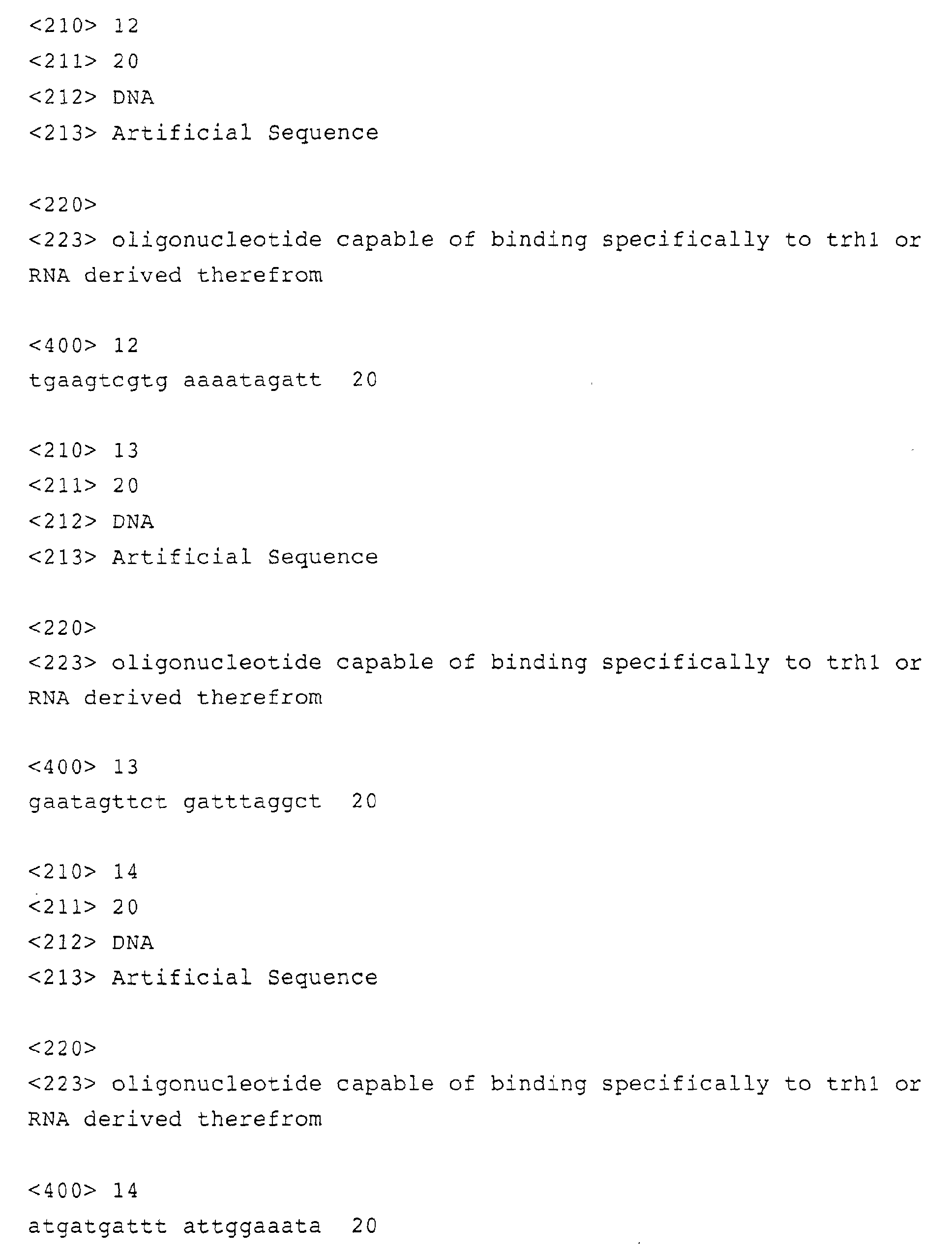
- the invention of claim 2 which has also been accomplished to achieve the aforementioned object, relates to an oligonucleotide for detection or amplification of a Vibrio parahaemolyticus thermostable direct hemolysin-related hemolysin gene (trh1) or RNA derived from said gene, which oligonucleotide is capable of binding specifically to trh1 or RNA derived therefrom, and comprises at least 10 contiguous bases of any of the sequences listed as SEQ. ID. Nos. 12 to 14, or an oligonucleotide complementary to said oligonucleotide.
- trh1 Vibrio parahaemolyticus thermostable direct hemolysin-related hemolysin gene
- the invention of claim 3 which has also been accomplished to achieve the aforementioned object, relates to an oligonucleotide for detection or amplification of a Vibrio parahaemolyticus thermostable direct hemolysin-related hemolysin gene (trh2) or RNA derived from said gene, which oligonucleotide is capable of binding specifically to trh2 or RNA derived therefrom, and comprises at least 10 contiguous bases of any of the sequences listed as SEQ. ID. Nos. 15 to 17, or an oligonucleotide complementary to said oligonucleotide.
- trh2 Vibrio parahaemolyticus thermostable direct hemolysin-related hemolysin gene
- RNA derived from said gene which oligonucleotide is capable of binding specifically to trh2 or RNA derived therefrom, and comprises at least 10 contiguous bases of any of the sequences listed as SEQ. ID. Nos. 15 to 17, or
- the invention of claim 4 relates to an oligonucleotide primer for DNA extension reaction, comprising an oligonucleotide according to any of claims 1 to 3.
- the invention of claim 5 relates to an oligonucleotide probe which is an oligonucleotide according to any of claims 1 to 3 a portion of which is modified or labeled with a detectable marker.
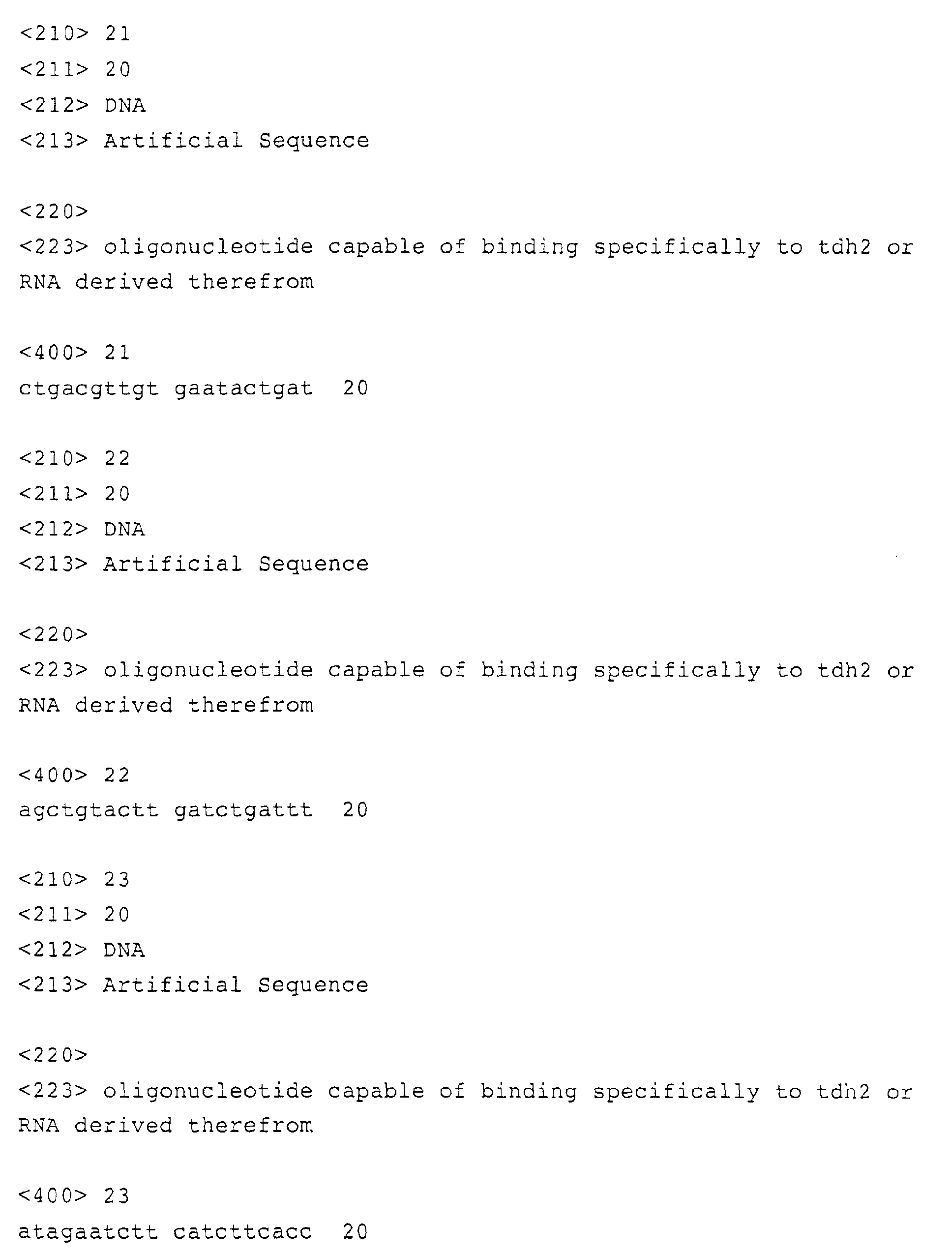
- the invention of claim 6, which has been accomplished to achieve the second aforementioned object, relates to an oligonucleotide for detection or amplification of Vibrio parahaemolyticus thermostable direct hemolysin gene (tdh2) or RNA derived from said gene, which oligonucleotide is capable of binding specifically to tdh2 or RNA derived from said gene, and comprises at least 10 contiguous bases of any of the sequences listed as SEQ. ID. Nos. 18 to 24, or an oligonucleotide complementary to said oligonucleotide.
- tdh2 Vibrio parahaemolyticus thermostable direct hemolysin gene
- RNA derived from said gene which oligonucleotide is capable of binding specifically to tdh2 or RNA derived from said gene, and comprises at least 10 contiguous bases of any of the sequences listed as SEQ. ID. Nos. 18 to 24, or an oligonucleotide complementary to said
- the invention of claim 7, which has also been accomplished to achieve the aforementioned object, relates to an oligonucleotide primer for DNA extension reaction, comprising an oligonucleotide according to claim 6, and the invention of claim 8, relates to an oligonucleotide probe which is an oligonucleotide according claim 6, a portion of which is modified or labeled with a detectable marker.
- the oligonucleotides of the invention which have been accomplished to achieve the first and second aforementioned objects, respectively, are oligonucleotides that complementarily bind in a specific manner to intramolecular structure-free regions of the target RNA in the aforementioned RNA amplification, and they are capable of binding specifically to the target RNA without the heat denaturation described above.
- the invention provides oligonucleotides for specific amplification and detection of trh1 and trh2, oligonucleotides for specific amplification and detection of trh1 alone, oligonucleotides for specific amplification and detection of trh2 alone, or oligonucleotides for specific amplification and detection of tdh2.
- the invention encompasses oligonucleotide primers for amplification of target DNA by the PCR method, oligonucleotide primers for amplification of target RNA by the NASBA method, etc., and oligonucleotide probes for detection of target nucleic acid without or after amplification.
- oligonucleotides of the invention a simple, rapid and highly sensitive detection method is provided for food evaluation and food poisoning evaluation.
- SEQ. ID. Nos. 1 to 11 represent oligonucleotides for detection or amplification of trh1 and trh2, or RNA derived from these genes.
- RNA derived from these genes used herein includes RNA produced by using these genes as templates.
- the oligonucleotides may be oligonucleotides comprising at least 10 contiguous bases of any of the listed base sequences, or oligonucleotides complementary thereto.
- SEQ. ID. Nos. 12 to 14 represent oligonucleotides for detection of trh1 or RNA derived from this gene, and they are useful for amplification or detection of trh1 as distinct from trh2.
- These oligonucleotides may be oligonucleotides comprising at least 10 contiguous bases of any of the listed base sequences, or oligonucleotides complementary thereto.
- SEQ. ID. Nos. 15 to 17 represent oligonucleotides for detection of trh2 or RNA derived from this gene, and they are useful for amplification or detection of trh2 as distinct from trh1.
- These oligonucleotides may be oligonucleotides comprising at least 10 contiguous bases of any of the listed base sequences, or oligonucleotides complementary thereto.
- SEQ. ID. Nos. 18 to 24 represent oligonucleotides for detection or amplification of tdh2, or RNA derived from this gene.
- RNA derived from this genes used herein includes RNA produced by using this gene as a template.
- the oligonucleotides may be oligonucleotides comprising at least 10 contiguous bases of any of the listed base sequences, or oligonucleotides complementary thereto.
- One mode of each of the present inventions is an amplification primer comprising any of the aforementioned oligonucleotides.
- a nucleic acid amplification reaction carried out using an aforementioned oligonucleotide as the primer allows amplification of the target nucleic acid alone.
- the amplification method can be PCR method, NASBA method, 3SR method, etc., however, an isothermal nucleic acid amplification method such as NASBA or 3SR method is preferred. Detection of the amplification product by various methods allows detection of Vibrio parahaemolyticus.
- one of the aforementioned oligonucleotides other than the oligonucleotide used for amplification may be used as the probe, and fragments of the amplified specific sequence may be confirmed by electrophoresis or the like.
- a probe which is any of the aforementioned oligonucleotides a portion of which is modified or labeled with a detectable marker.
- the oligonucleotide labeled with the detectable marker may be hybridized with the single-stranded target nucleic acid, and the hybridized probe can be detected via the marker.
- the marker detection may be carried out by a method suitable for the particular marker and, for example, when using an intercalator fluorescent dye for labeling the oligonucleotide, a dye with the property of exhibiting increased fluorescent intensity by intercalation in the double-stranded nucleic acid comprising the target nucleic acid and the oligonucleotide probe may be used in order to allow easy detection of only the hybridized probe without removal of the probe that has not hybridized to the target nucleic acid.
- the marker may be detected after removal of the probe that has not hybridized to the target nucleic acid.
- the target nucleic acid in the sample is preferably amplified to a detectable amount by a nucleic acid amplification method such as PCR, NASBA or 3SR method, among which isothermal nucleic acid amplification methods such as the NASBA and 3SR methods are most preferable.
- a nucleic acid amplification method such as PCR, NASBA or 3SR method, among which isothermal nucleic acid amplification methods such as the NASBA and 3SR methods are most preferable.
- it is especially preferable to modify the probe by, for example, adding glycolic acid to the 3'-end so that the probe will not function as a nucleotide primer.
- RNA amplification process which comprises the steps of: forming a cDNA with a RNA-dependent DNA polymerase using a specific sequence of a RNA derived from trh1, trh2 or tdh2 present in a sample as a template, with a first primer having a sequence complementary to said specific sequence and a second primer having a sequence homologous to said specific sequence, wherein either the first or second primer has a sequence having the RNA polymerase promoter sequence added at its 5'-region, thereby producing a RNA-DNA double-strand; digesting the RNA of said RNA-DNA double-strand with Ribonuclease H to form a single-stranded DNA; and then forming a double-stranded DNA that includes a promoter sequence allowing transcription of said RNA sequence or a RNA comprising a sequence complementary to
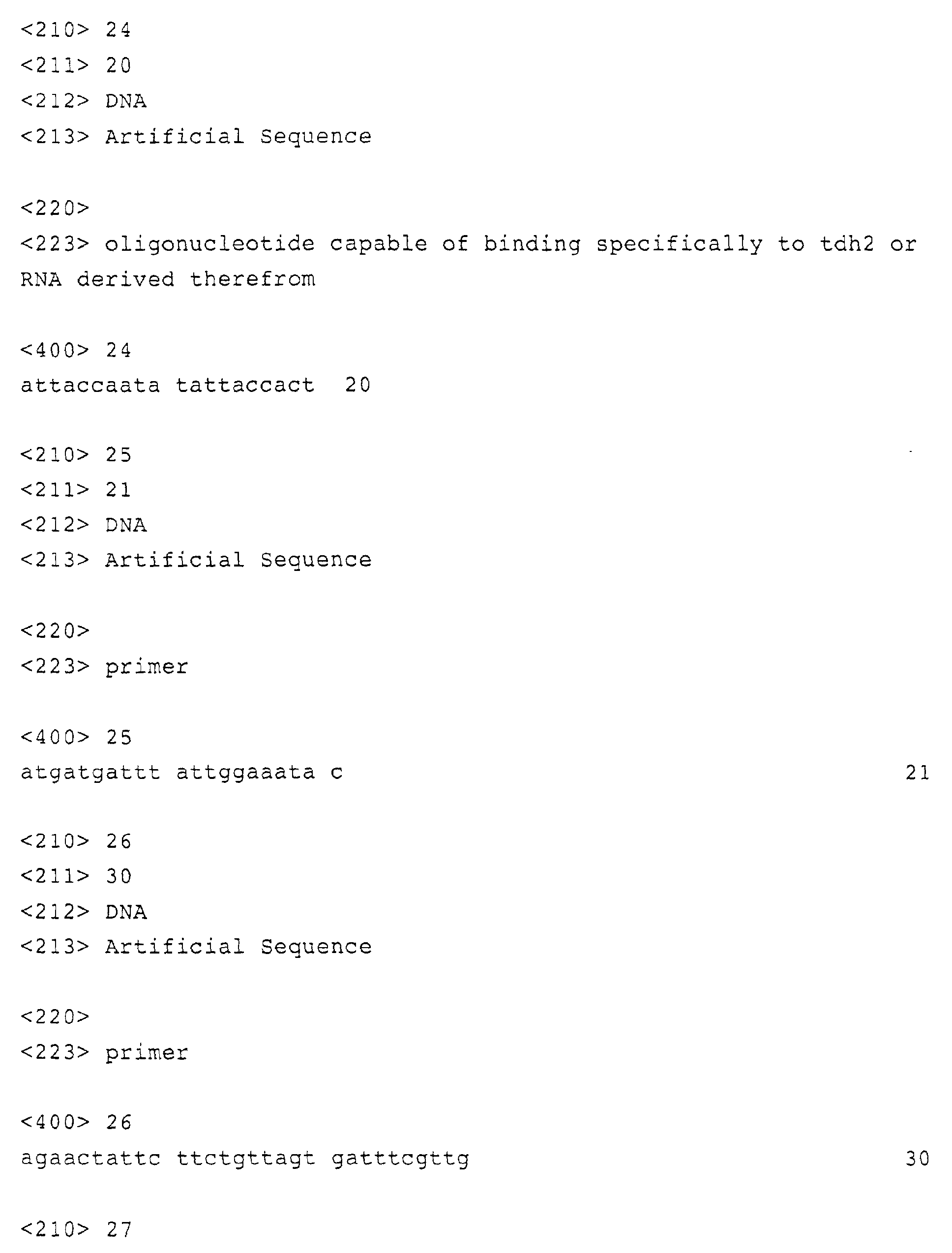
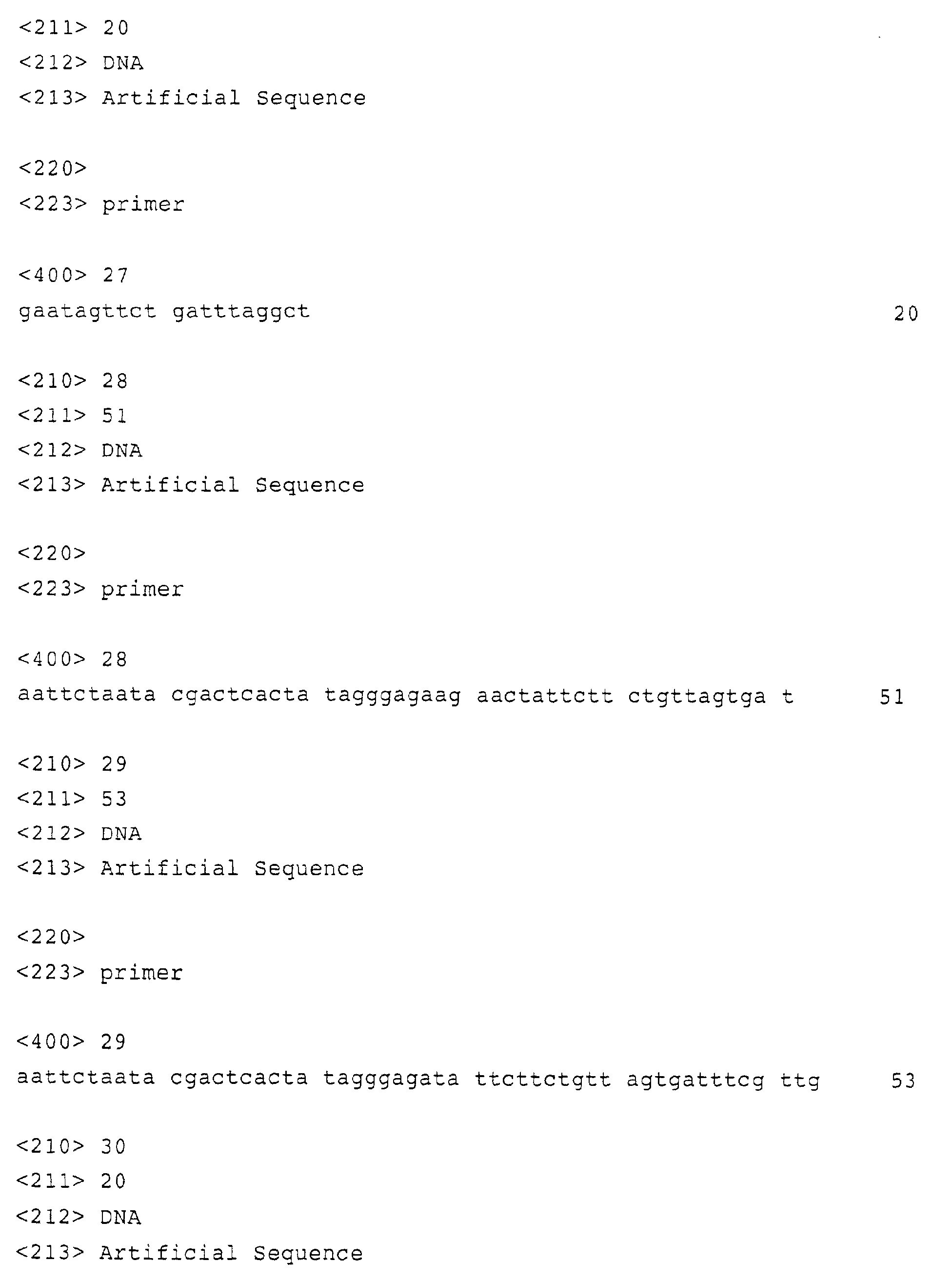
- the oligonucleotide of SEQ. ID. No.25 is used as the first primer and the oligonucleotide of SEQ. ID. No.26 is used as the second primer, as for trh2, the oligonucleotide of SEQ. ID. No.33 is used as the first primer and the oligonucleotide of SEQ. ID. No.34 is used as the second primer, as for tdh2, the oligonucleotide of SEQ. ID. No.39 is used as the first primer and the oligonucleotide of SEQ. ID. No.40 is used as the second primer, or the oligonucleotide of SEQ. ID. No.39 is used as the first primer and the oligonucleotide of SEQ. ID. No.41 is used as the second primer, or the oligonucleotide of SEQ. ID. No.42 is used as the first primer and the oligonucleotide of SEQ.
- the invention of claim 10 which has been accomplished to achieve the third aforementioned object, relates to the invention of claim 9 and is characterized in that the first primer is an oligonucleotide comprising at least 10 contiguous bases of the sequence of SEQ. ID. No.25.
- the invention of claim 11 relates to the invention of claim 9 and is characterized in that the second primer is an oligonucleotide comprising at least 10 contiguous bases of the sequence of SEQ. ID. No.26.
- the invention of claim 12 relates to the invention of claim 9 and is a detection method for a Vibrio parahaemolyticus thermostable direct hemolysin-related hemolysin gene, which comprises the steps of: conducting said RNA amplification process in the presence of an oligonucleotide probe labeled with an intercalator fluorescent dye, wherein the sequence of said probe is complementary to at least a portion of said RNA transcription product, and complementary binding of said probe to said RNA transcription product results in a change of the fluorescent property relative to that of a situation where a complex formation is absent; and then measuring the fluorescence intensity of the reaction solution.
- the invention of claim 14, which has been accomplished to achieve the fourth aforementioned object, relates to the invention of claim 13 and is characterized in that the first primer is an oligonucleotide comprising at least 10 contiguous bases of the sequence of SEQ. ID. No.33.
- the invention of claim 15 relates to the invention of claim 13 and is characterized in that the second primer is an oligonucleotide comprising at least 10 contiguous bases of the sequence of SEQ. ID. No.34.
- the invention of claim 16 relates to the invention of claim 13 and is a detection method for a Vibrio parahaemolyticus hemolysin gene, which comprises the steps of: conducting said RNA amplification process in the presence of an oligonucleotide probe labeled with an intercalator fluorescent dye, wherein the sequence of said probe is complementary to at least a portion of said RNA transcription product, and complementary binding of said probe to said RNA transcription product results in a change of the fluorescent property relative to that of a situation where a complex formation is absent; and then measuring the fluorescence intensity of the reaction solution.
- the invention of claim 18, which has been accomplished to achieve the fifth aforementioned object, relates to the invention of claim 17 and is characterized in that the first primer is an oligonucleotide comprising at least 10 contiguous bases of the sequence of SEQ. ID. No.39 or SEQ. ID. No.42.
- the invention of claim 19 relates to the invention of claim 17 and is characterized in that the second primer is an oligonucleotide comprising at least 10 contiguous bases of the sequence of SEQ. ID. No.40 or SEQ. ID. No.41.
- the invention of claim 20 relates to the invention of claim 17 and is a detection method which comprises the steps of: conducting said RNA amplification process in the presence of an oligonucleotide probe labeled with an intercalator fluorescent dye, wherein the sequence of said probe is complementary to at least a portion of said RNA transcription product, and complementary binding of said probe to said RNA transcription product results in a change of the fluorescent property relative to that of a situation where a complex formation is absent; and then measuring the fluorescence intensity of the reaction solution.
- the inventions which has been accomplished to achieve the third, fourth and fifth objects, respectively, provide a detection method and detection kit for simple, rapid and highly sensitive detection of the Vibrio parahaemolyticus thermostable direct hemolysin-related hemolysin gene (trh1 or trh2) or Vibrio parahaemolyticus thermostable direct hemolysin gene (tdh2), for food evaluation and food poisoning evaluation.
- the first primer (a sequence complementary to the 3'-end region of a specific sequence of the target RNA) complementarily binds to a specific sequence of RNA derived from the Vibrio parahaemolyticus thermostable direct hemolysin-related hemolysin gene (trh1 or trh2) or the Vibrio parahaemolyticus thermostable direct hemolysin gene (tdh2) in a sample as the template, and cDNA is produced by extension reaction with RNA-dependent DNA polymerase to form a RNA-DNA double-strand, after which the RNA of the RNA-DNA double-strand is digested with Ribonuclease H to produce a single-stranded DNA.
- a second primer (a sequence homologous to the 5'-end region of the target RNA, and includes the RNA polymerase promoter sequence added at its 5'-end) complementarily binds to the single-stranded DNA, to produce a double-stranded DNA having a promoter sequence allowing transcription of RNA comprising a sequence homologous to the target RNA sequence, using DNA-dependent DNA polymerase.
- the double-stranded DNA is then used for amplification of the RNA transcription product comprising the sequence homologous to the target RNA sequence in the presence of RNA polymerase.
- the present invention is characterized in that, as for trh1, the oligonucleotide of SEQ. ID.
- No.25 is used as the first primer and the oligonucleotide of SEQ. ID. No.26 is used as the second primer, as for trh2, the oligonucleotide of SEQ. ID. No.33 is used as the first primer and the oligonucleotide of SEQ. ID. No.34 is used as the second primer, as for tdh2, the oligonucleotide of SEQ. ID. No.39 is used as the first primer and the oligonucleotide of SEQ. ID. No.40 is used as the second primer, or the oligonucleotide of SEQ. ID. No.39 is used as the first primer and the oligonucleotide of SEQ. ID.
- No.41 is used as the second primer, or the oligonucleotide of SEQ. ID. No.42 is used as the first primer and the oligonucleotide of SEQ. ID. No.41 is used as the second primer.
- tdh2 it is particularly preferable to use the oligonucleotide of SEQ. ID. No.42 as the first primer and the oligonucleotide of SEQ. ID. No.41 as the second primer.
- the first and second primers may be the full-length base sequences of SEQ. ID. Nos.25, 33, 39, 42 and SEQ. ID. Nos.26, 34, 40, 41, respectively, however, combinations of oligonucleotides comprising at least 10 contiguous bases of these sequences may also be used.
- the target RNA must be cleaved at the 5'-end of the specific sequence.
- the method of cleaving the target RNA is preferably a method in which an oligonucleotide (cleaving oligonucleotide) with a sequence complementary to a region overlapping and adjacent to the 5'-end of the specific sequence is added, thereby cleaving the target RNA with Ribonuclease H or the like.
- the 3'-end of the cleaving oligonucleotide is preferably treated by amination, for example, to prevent it from functioning as an oligonucleotide primer.
- the amplification process is preferably carried out in the presence of an oligonucleotide probe labeled with an intercalator fluorescent dye having a sequence complementary to at least a portion of the RNA transcription product.
- Complementary binding of the probe to the RNA transcription product results in a change of the fluorescent property compared to a situation where the complex formation is absent, so that the fluorescence intensity of the reaction solution may be measured.
- a labeled oligonucleotide probe is incorporated during the amplification process, it is particularly preferable to modify the probe by, for example, addition of glycolic acid to the 3'-end, to prevent it from functioning as a primer in the extension reaction.
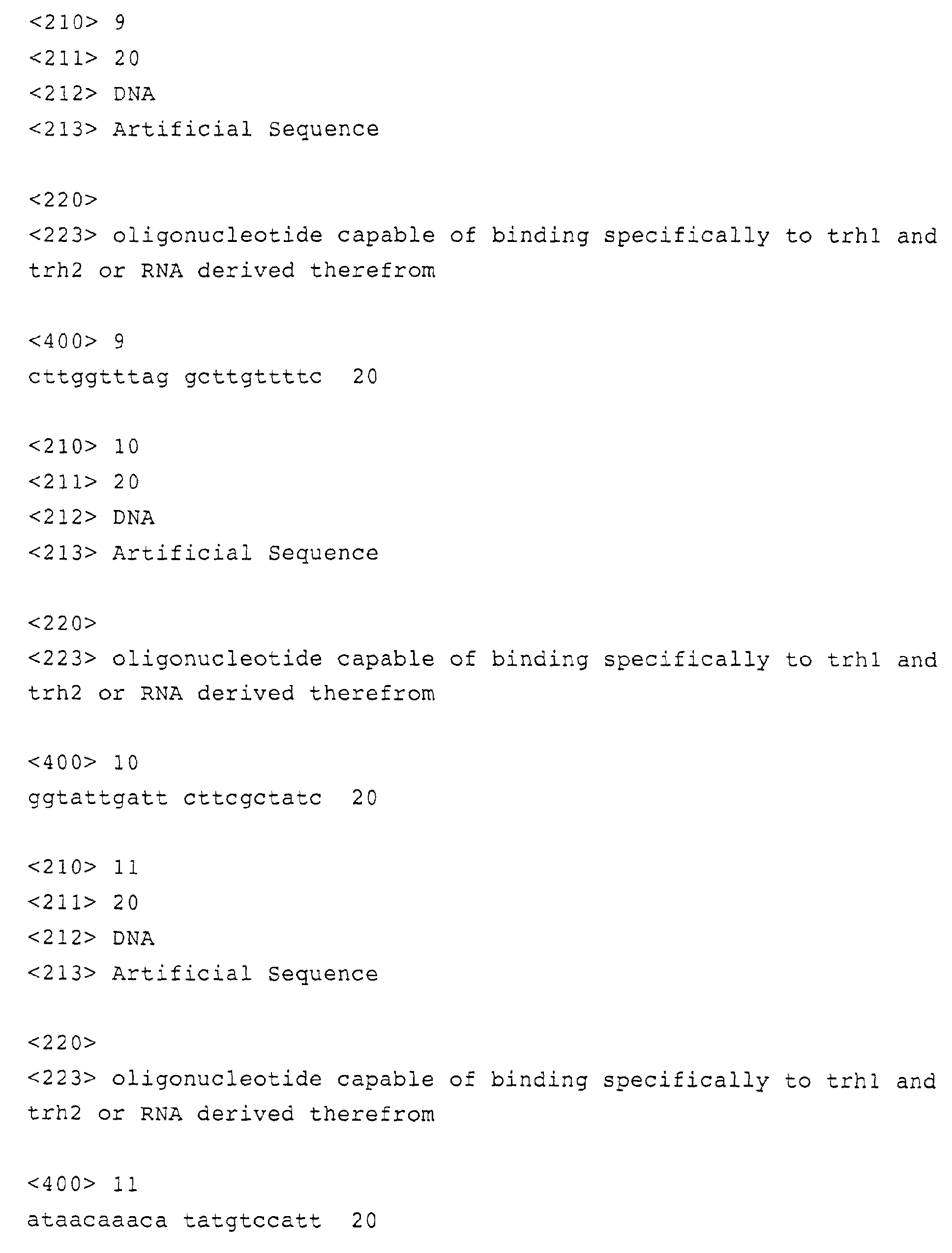
- the oligonucleotide probe used may be an oligonucleotide comprising at least 10 contiguous bases of the sequences listed as SEQ. ID. Nos.30 to 32.
- the oligonucleotide probe used may be an oligonucleotide comprising at least 10 contiguous bases of the sequences listed as SEQ. ID. No.38.
- the oligonucleotide probe used may be an oligonucleotide comprising at least 10 contiguous bases of SEQ. ID. No.39, when a combination of oligonucleotides comprising at least 10 contiguous bases of SEQ. ID. No.41 and SEQ. ID. No.42 are used for the RNA amplification process.
- the first primer (a sequence complementary to the target RNA, and including the RNA polymerase promoter sequence added at the 5'-region) complementarily binds to a specific sequence of RNA derived from trh1, trh2 or tdh2 in a sample as the template, and cDNA is produced by extension reaction with RNA-dependent DNA polymerase to form a RNA-DNA double-strand, after which the RNA of the RNA-DNA double-strand is digested with Ribonuclease H to produce single-stranded DNA.
- the second primer (a sequence homologous to the target RNA) complementarily binds to the single-stranded DNA, to produce double-stranded DNA having a promoter allowing transcription of RNA comprising a sequence complementary to the target RNA sequence, using DNA-dependent DNA polymerase.
- the double-stranded DNA is then used to produce a RNA transcription product comprising a sequence complementary to the target RNA, in the presence of RNA polymerase.
- the second primer complementarily binds to this RNA transcription product (the sequence complementary to the target RNA), and cDNA is produced with RNA-dependent DNA polymerase to form a double-strand of RNA-DNA.
- the RNA of the RNA-DNA double-strand is digested with Ribonuclease H to produce single-stranded DNA, and the first primer complementarily binds to this single-stranded DNA to produce double-stranded DNA having a promoter allowing transcription of RNA comprising a sequence complementary to the target RNA sequence, using DNA-dependent DNA polymerase.
- the double-stranded DNA is then used for amplification of the RNA transcription product comprising a sequence complementary to the target RNA sequence in the presence of RNA polymerase.
- the present invention is characterized in that, as for trh1, the oligonucleotide of SEQ. ID. No.25 is used as the first primer and the oligonucleotide of SEQ.
- the oligonucleotide of SEQ. ID. No.33 is used as the first primer and the oligonucleotide of SEQ. ID. No.34 is used as the second primer, as for tdh2, the oligonucleotide of SEQ. ID. No.39 is used as the first primer and the oligonucleotide of SEQ. ID. No.40 is used as the second primer, or the oligonucleotide of SEQ. ID. No.39 is used as the first primer and the oligonucleotide of SEQ. ID. No.41 is used as the second primer, or the oligonucleotide of SEQ.
- oligonucleotide of SEQ. ID. No.41 is used as the second primer.
- oligonucleotide of SEQ. ID. No.41 is particularly preferable to use the oligonucleotide of SEQ. ID. No.42 as the first primer and the oligonucleotide of SEQ. ID. No.41 as the second primer.
- the first and second primers may be the full-length base sequences of SEQ. ID. Nos.25, 33, 39, 42 and SEQ. ID. Nos.26, 34, 40, 41, respectively, however, combinations of oligonucleotides comprising at least 10 contiguous bases of these sequences may also be used.
- the amplification process is preferably carried out in the presence of an oligonucleotide probe labeled with an intercalator fluorescent dye having a sequence complementary to at least a portion of the RNA transcription product.
- Complementary binding of the probe to the RNA transcription product produces a change in the fluorescent property relative to that of a situation where the complex formation is absent, so that the fluorescence intensity of the reaction solution may be measured.
- a labeled oligonucleotide probe is incorporated during the amplification process, it is particularly preferable to modify the probe by, for example, addition of glycolic acid to the 3'-end, to prevent it from functioning as a primer in the extension reaction.
- the oligonucleotide probe used may be a sequence complementary to an oligonucleotide comprising at least 10 contiguous bases of the sequences listed as SEQ. ID. Nos.30 to 32.
- the oligonucleotide probe used may be a sequence complementary to an oligonucleotide comprising at least 10 contiguous bases of the sequences listed as SEQ. ID. No.38.
- the oligonucleotide probe used may be a sequence complementary to an oligonucleotide comprising at least 10 contiguous bases of SEQ. ID. No.39, when a combination of oligonucleotides comprising at least 10 contiguous bases of SEQ. ID. No.41 and SEQ. ID. No.42 are used for the RNA amplification process.
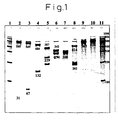
- Fig. 1 illustrates an electrophoresis image of 6% PAGE for a sample after performing a binding test to trh1-RNA at 41°C, using oligonucleotides designed for an intramolecular structure-free region of trh1-RNA.
- lanes 1 and 11 are the RNA marker (0.1 to 1.0 K)
- lanes 2 to 9 relate to oligonucleotide solutions of SEQ. ID. No.1, 2, 3, 4, 12, 5, 13 and 14, respectively
- lane 10 is a standard sample of trh1-RNA (616mer).
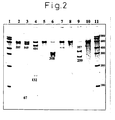
- Fig. 2 illustrates an electrophoresis image of 6% PAGE for a sample after performing a binding test to trh2-RNA at 41°C, using oligonucleotides designed for an intramolecular structure-free region of trh1-RNA.
- lanes 1 and 11 are the RNA marker (0.1 to 1.0 K)
- lanes 2 to 9 relate to oligonucleotide solutions of SEQ. ID. No.1, 2, 3, 12, 5, 13, 14 and 8 respectively
- lane 10 is a standard sample of trh2-RNA (616mer).
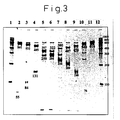
- Fig. 3 illustrates an electrophoresis image of 6% PAGE for a sample after performing a binding test to trh2-RNA at 41°C, using oligonucleotides designed for an intramolecular structure-free region of trh2-RNA.
- lanes 1 and 12 are the RNA marker (0.1 to 1.0 K)
- lanes 2 to 10 relate to oligonucleotide solutions of SEQ. ID. No.6, 15, 7, 8, 16, 17, 9, 10 and 11, respectively
- lane 11 is a standard sample of trh2-RNA (616mer).
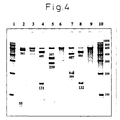
- Fig. 4 illustrates an electrophoresis image of 6% PAGE for a sample after performing a binding test with trh1-RNA at 41°C, using oligonucleotides designed for an intramolecular structure-free region of trh2-RNA.
- lanes 1 and 10 are the RNA marker (0.1 to 1.0 K)
- lanes 2 to 8 relate to oligonucleotide solutions of SEQ. ID. No.6, 15, 7, 8, 16, 9 and 3, respectively
- lane 9 is a standard sample of trh1-RNA (616mer).
- Fig. 5 illustrates an electrophoresis image of 6% PAGE for a sample after performing a binding test to trh1-RNA at 41°C, using oligonucleotides designed for an intramolecular structure-free region of trh2-RNA, and for a sample after performing a binding test to trh2-RNA at 41°C, using oligonucleotides designed for an intramolecular structure-free region of trh1-RNA.
- lanes 1 and 8 are the RNA marker (0.1 to 1.0 K)
- lanes 2 to 4 relate to oligonucleotide solutions of SEQ. ID.
- Lane 5 is a standard sample of trh1-RNA (616mer).
- Lane 6 relates to an oligonucleotide solution of SEQ. ID. No.4, and lane 7 is a standard sample of trh2-RNA (616mer).
- Fig. 6 illustrates an electrophoresis image of 6% PAGE for a sample after performing a binding test to tdh2-RNA at 41°C, using oligonucleotides designed for an intramolecular structure-free region of tdh2-RNA.
- lane 1 is the RNA marker (0.1 to 1.0 K)
- lanes 2 to 8 relate to oligonucleotide solutions of SEQ. ID. No.18 to 24, respectively
- lane 9 is a standard sample of tdh2-RNA (616mer).
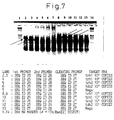
- Fig. 7 illustrates the results of the RNA amplification reaction of Example 7, carried out with different primer combinations at an initial RNA amount of 10 4 copies/30 ⁇ l and 10 3 copies/30 ⁇ l. "Nega" represents a sample using the diluent alone instead of a RNA sample.
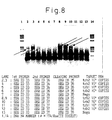
- Fig. 8 illustrates the results of the RNA amplification reaction of Example 8, carried out with different primer combinations at an initial RNA amount of 10 4 copies/30 ⁇ l and 10 3 copies/30 ⁇ l. "Nega" represents a sample using the diluent alone instead of a RNA sample.
- Fig. 9 illustrates the results of the RNA amplification reaction of Example 9, carried out with different primer combinations at an initial RNA amount of 10 5 copies/30 ⁇ l. "Nega" represents a sample using the diluent alone instead of a RNA sample.
- Fig. 10 shows the chemical structures of the intercalator fluorescent dye portions of the oligonucleotides labeled with the intercalator fluorescent dye used in Examples 10 and 11.
- B 1 -B 3 represent nucleic acid bases.
- Fig. 11 illustrates the result of Example 10, showing the increase of fluorescence rate with the reaction time and the RNA production, at an initial RNA amount of 10 5 copies/30 ⁇ l to 10 2 copies/30 ⁇ l. "Nega" represents the results using the diluent alone instead of a RNA sample.
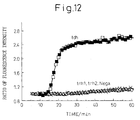
- Fig. 12 illustrates a graph of the reaction time and fluorescence rate increase obtained by using tdh2-RNA, trh1-RNA and trh2-RNA as the target RNA in Example 11.
- "Nega" represents the results using the diluent alone instead of a RNA sample.
- Oligonucleotide which complementarily binds to RNA derived from trh1 and/or trh2
- trh1-RNA is a synthesized and purified RNA obtained by in vitro transcription using double-stranded DNA containing the trh1 base sequence as the template.
- RNA base sequence numbering is in accordance with Nishibuchi et al. "Appl. Environ. Microbiol., 1992, 58, pp.2449-2457"
- RNA base sequence numbering is in accordance with Nishibuchi et al. "Appl. Environ. Microbiol., 1992, 58, pp.2449-2457”
- a sample of a standard RNA (616mer) comprising base Nos. 1 to 610 of Vibrio parahaemolyticus trh1-RNA (the RNA base sequence numbering is in accordance with Nishibuchi et al. "Appl. Environ. Microbiol., 1992, 58, pp.2449-2457"
- RNA diluent 10 mM Tris-HCl (pH 8.0), 0.1 mM EDTA, 0.5 U/ ⁇ l RNase Inhibitor
- the oligonucleotide solution of SEQ. ID. No.1 As the oligonucleotide primer solutions, the oligonucleotide solution of SEQ. ID. No.1, the oligonucleotide solution of SEQ. ID. No.2, the oligonucleotide solution of SEQ. ID. No.3, the oligonucleotide solution of SEQ. ID. No.4, the oligonucleotide solution of SEQ. ID. No.12, the oligonucleotide solution of SEQ. ID. No.13, the oligonucleotide solution of SEQ. ID. No.5 and the oligonucleotide solution of SEQ. ID. No.14 were used.
- No.1 is complementary to the 20mer sequence from Nos. 31 to 50 of trh1-RNA
- the oligonucleotide of SEQ. ID. No.2 is complementary to the 20mer sequence from Nos. 67 to 86 of trh1-RNA
- the oligonucleotide of SEQ. ID. No.3 is complementary to the 20mer sequence from Nos. 132 to 151 of trh1-RNA
- the oligonucleotide of SEQ. ID. No.4 is complementary to the 20mer sequence from Nos. 229 to 248 of trh1-RNA
- the oligonucleotide of SEQ. ID. No.12 is complementary to the 20mer sequence from Nos.
- the oligonucleotide of SEQ. ID. No.5 is complementary to the 20mer sequence from Nos. 308 to 327 of trh1-RNA
- the oligonucleotide of SEQ. ID. No.13 is complementary to the 20mer sequence from Nos. 414 to 433 of trh1-RNA
- the oligonucleotide of SEQ. ID. No.14 is complementary to the 20mer sequence from Nos. 563 to 582 of trh1-RNA.
- RNase H is an enzyme that cleaves the RNA of DNA/RNA double strands
- PCR tube was incubated at 41°C for 15 minutes.
- Polyacrylamide gel (acrylamide concentration: 6%, urea: 7 M) electrophoresis was conducted to confirm the cleaved fragments after the reaction. Dyeing after electrophoresis was carried out with SYBR Green II (Takara Shuzo Co., Ltd.). Upon binding of the oligonucleotide to the specific site of the target RNA, the RNA of the DNA/RNA double strands is cleaved by RNase H and characteristic bands are observed.
- Fig. 1 is a photograph showing the state of the oligonucleotides (black and white inverted)).
- the sizes of the newly appeared characteristic bands were as shown in Fig. 1.
- the sizes of the bands obtained by cleaving from the 31st base from the 5'-end of trh1-RNA, i.e. a 31mer and a 585mer are shown.
- trh2-RNA is a synthesized and purified RNA obtained by in vitro transcription using double-stranded DNA containing the trh2 base sequence as the template.
- RNA base sequence numbering is in accordance with Nishibuchi et al. "Appl. Environ. Microbiol., 1992, 58, pp.2449-2457"
- RNA diluent 10 mM Tris-HCl (pH 8.0), 0.1 mM EDTA, 0.5 U/ ⁇ l RNase Inhibitor
- the oligonucleotide solution of SEQ. ID. No.1 the oligonucleotide solution of SEQ. ID. No.2
- the oligonucleotide solution of SEQ. ID. No.3 the oligonucleotide solution of SEQ. ID. No.12
- the oligonucleotide solution of SEQ. ID. No.5 the oligonucleotide solution of SEQ. ID. No.13, the oligonucleotide solution of SEQ. ID. No.14 and the oligonucleotide solution of SEQ. ID. No.8 were used.
- No.1 is complementary to the 20mer sequence from Nos. 31 to 50 of trh1-RNA
- the oligonucleotide of SEQ. ID. No.2 is complementary to the 20mer sequence from Nos. 67 to 86 of trh1-RNA
- the oligonucleotide of SEQ. ID. No.3 is complementary to the 20mer sequence from Nos. 132 to 151 of trh1-RNA
- the oligonucleotide of SEQ. ID. No.12 is complementary to the 20mer sequence from Nos. 274 to 293 of trh1-RNA
- the oligonucleotide of SEQ. ID. No.5 is complementary to the 20mer sequence from Nos.
- the oligonucleotide of SEQ. ID. No.13 is complementary to the 20mer sequence from Nos. 414 to 433 of trh1-RNA
- the oligonucleotide of SEQ. ID. No.14 is complementary to the 20mer sequence from Nos. 563 to 582 of trh1-RNA
- the oligonucleotide of SEQ. ID. No.8 is complementary to the 20mer sequence from Nos. 259 to 278 of trh2-RNA.
- RNase H is an enzyme that cleaves the RNA of DNA/RNA double strands
- PCR tube was incubated at 41°C for 15 minutes.
- Polyacrylamide gel (acrylamide concentration: 6%, urea: 7 M) electrophoresis was conducted to confirm the cleaved fragments after the reaction. Dyeing after electrophoresis was carried out with SYBR Green II (Takara Shuzo Co., Ltd.). Upon binding of the oligonucleotide to the specific site of the target RNA, the RNA of the DNA/RNA double strands is cleaved by RNase H and characteristic bands are observed.
- Fig. 2 is a photograph showing the state of the oligonucleotides (black and white inverted)).
- the sizes of the newly appeared characteristic bands were as shown in Fig. 2.
- the sizes of the bands obtained by cleaving from the 67th base from the 5'-end of trh1-RNA, i.e. a 67mer and a 549mer are shown.
- No.8 was used as a control sequence that binds strongly to trh2-RNA at 41°C.
- the oligonucleotides of SEQ. ID. No.1, SEQ. ID. No.2, SEQ. ID. No.3 and SEQ. ID. No.5 bind strongly to both trh1-RNA and trh2-RNA at 41°C.
- the oligonucleotides of SEQ. ID. No.12, SEQ. ID. No.13 and SEQ. ID. No.14 bind strongly only to trh1-RNA at 41°C.
- RNA diluent 10 mM Tris-HCl (pH 8.0), 0.1 mM EDTA, 0.5 U/ ⁇ l RNase Inhibitor
- the oligonucleotide solution of SEQ. ID. No.6 As the oligonucleotide primer solutions, the oligonucleotide solution of SEQ. ID. No.6, the oligonucleotide solution of SEQ. ID. No.15, the oligonucleotide solution of SEQ. ID. No.7, the oligonucleotide solution of SEQ. ID. No.8, the oligonucleotide solution of SEQ. ID. No.16, the oligonucleotide solution of SEQ. ID. No.17, the oligonucleotide solution of SEQ. ID. No.9, the oligonucleotide solution of SEQ. ID. No.10 and the oligonucleotide solution of SEQ. ID.
- the oligonucleotide of SEQ. ID. No.6 is complementary to the 20mer sequence from Nos. 55 to 74 of trh2-RNA
- the oligonucleotide of SEQ. ID. No.15 is complementary to the 20mer sequence from Nos. 84 to 103 of trh2-RNA
- the oligonucleotide of SEQ. ID. No.7 is complementary to the 20mer sequence from Nos. 131 to 150 of trh2-RNA
- the oligonucleotide of SEQ. ID. No.8 is complementary to the 20mer sequence from Nos. 259 to 278 of trh2-RNA
- No.16 is complementary to the 20mer sequence from Nos. 322 to 341 of trh2-RNA
- the oligonucleotide of SEQ. ID. No.17 is complementary to the 20mer sequence from Nos. 380 to 399 of trh2-RNA
- the oligonucleotide of SEQ. ID. No.9 is complementary to the 20mer sequence from Nos. 407 to 426 of trh2-RNA
- the oligonucleotide of SEQ. ID. No.10 is complementary to the 20mer sequence from Nos. 456 to 475 of trh2-RNA
- the oligonucleotide of SEQ. ID. No.11 is complementary to the 20mer sequence from Nos. 540 to 459 of trh2-RNA.
- RNase H is an enzyme that cleaves the RNA of DNA/RNA double strands
- PCR tube was incubated at 41°C for 15 minutes.
- Polyacrylamide gel (acrylamide concentration: 6%, urea: 7 M) electrophoresis was conducted to confirm the cleaved fragments after the reaction. Dyeing after electrophoresis was carried out with SYBR Green II (Takara Shuzo Co., Ltd.). Upon binding of the oligonucleotide to the specific site of the target RNA, the RNA of the DNA/RNA double strands is cleaved by RNase H and characteristic bands are observed.
- Fig. 3 is a photograph showing the state of the oligonucleotides (black and white inverted)).
- the sizes of the newly appeared characteristic bands were as shown in Fig. 3.
- the sizes of the bands obtained by cleaving from the 55th base from the 5'-end of trh2-RNA, i.e. a 55mer and a 561mer are shown.
- RNA diluent 10 mM Tris-HCl (pH 8.0), 0.1 mM EDTA, 0.5 U/ ⁇ l RNase Inhibitor
- the oligonucleotide solution of SEQ. ID. No.6 As the oligonucleotide primer solutions, the oligonucleotide solution of SEQ. ID. No.6, the oligonucleotide solution of SEQ. ID. No.15, the oligonucleotide solution of SEQ. ID. No.7, the oligonucleotide solution of SEQ. ID. No.8, the oligonucleotide solution of SEQ. ID. No.16, the oligonucleotide solution of SEQ. ID. No.9 and the oligonucleotide solution of SEQ. ID. No.3 were used.
- RNase H is an enzyme that cleaves the RNA of DNA/RNA double strands
- PCR tube was incubated at 41°C for 15 minutes.
- Polyacrylamide gel (acrylamide concentration: 6%, urea: 7 M) electrophoresis was conducted to confirm the cleaved fragments after the reaction. Dyeing after electrophoresis was carried out with SYBR Green II (Takara Shuzo Co., Ltd.). Upon binding of the oligonucleotide to the specific site of the target RNA, the RNA of the DNA/RNA double strands is cleaved by RNase H and characteristic bands are observed.
- Fig. 4 is a photograph showing the state of the oligonucleotides (black and white inverted)).
- the sizes of the newly appeared characteristic bands were as shown in Fig. 4.
- the sizes of the bands obtained by cleaving from the 55th base from the 5'-end of trh2-RNA, i.e. a 55mer and a 561mer are shown.
- Example 3 In light of the results of Example 3, it was demonstrated that the oligonucleotides of SEQ. ID. No.6, SEQ. ID. No.7, SEQ. ID. No.8 and SEQ. ID. No.9 bind strongly to both trh1-RNA and trh2-RNA at 41°C. On the other hand, it was demonstrated that the oligonucleotides of SEQ. ID. No.15 and SEQ. ID. No.16 bind strongly only to trh2-RNA at 41°C.
- RNA diluent 10 mM Tris-HCl (pH 8.0), 0.1 mM EDTA, 0.5 U/ ⁇ l RNase Inhibitor
- the oligonucleotide solution of SEQ. ID. No.17, the oligonucleotide solution of SEQ. ID. No.10, the oligonucleotide solution of SEQ. ID. No.11 and the oligonucleotide solution of SEQ. ID. No.4 were used.
- RNase H is an enzyme that cleaves the RNA of DNA/RNA double strands
- PCR tube was incubated at 41°C for 15 minutes.
- Polyacrylamide gel (acrylamide concentration: 6%, urea: 7 M) electrophoresis was conducted to confirm the cleaved fragments after the reaction. Dyeing after electrophoresis was carried out with SYBR Green II (Takara Shuzo Co., Ltd.). Upon binding of the oligonucleotide to the specific site of the target RNA, the RNA of the DNA/RNA double strands is cleaved by RNase H and characteristic bands are observed.
- Fig. 5 is a photograph showing the state of the oligonucleotides (black and white inverted)).
- the sizes of the newly appeared characteristic bands were as shown in Fig. 5.
- the sizes of the bands obtained by cleaving from the 456th base from the 5'-end of trh2-RNA, i.e. a 456mer and a 160mer are shown.
- the oligonucleotide of SEQ. ID. No.17 binds strongly only to trh2-RNA at 41°C. Since a characteristic band was confirmed in the experiment using the oligonucleotide of SEQ. ID. No.4, it was demonstrated that the oligonucleotide of SEQ. ID. No.4 binds strongly to Vibrio parahaemolyticus trh2-RNA at 41°C. In light of the results of Example 1, it was demonstrated that the oligonucleotide of SEQ. ID. No.4 binds strongly to both trh1-RNA and trh2-RNA at 41°C.
- the oligonucleotides of the present invention are oligonucleotides that complementarily bind to RNA derived from Vibrio parahaemolyticus trh1 and/or trh2, even under conditions of relatively low and constant temperature (35-50°C, preferably 41°C), which tend to produce an intramolecular structure in RNA and prevent binding of primers and probes thereto. Specific binding of the oligonucleotides is therefore possible without heat denaturation of the target RNA.
- oligonucleotides of the invention are thus useful as oligonucleotides for amplification or detection of RNA derived from the Vibrio parahaemolyticus thermostable direct hemolysin-related hemolysin genes (trh1 or trh2), i.e. as oligonucleotide primers or oligonucleotide probes to be used in RNA amplification methods.
- trh1 or trh2 Vibrio parahaemolyticus thermostable direct hemolysin-related hemolysin genes
- oligonucleotides of the invention are also clearly useful for amplification and detection of trh1 and trh2.
- Oligonucleotides complementary to the above-mentioned oligonucleotides are also useful for amplification of double-stranded DNA by the PCR method, or for detection of cDNA obtained by reverse transcription of RNA.
- oligonucleotides of the invention are not limited to the specifically listed 20mers, and they also include oligonucleotides comprising at least 10 or more contiguous bases within those sequences. This is obvious from the fact that 10mer base sequences are sufficient to ensure adequate specificity of primers or probes to target nucleic acids.
- Oligonucleotide which complementarily binds to RNA derived from tdh2
- tdh2-RNA is a synthesized and purified RNA obtained by in vitro transcription using double-stranded DNA containing the tdh2 base sequence as the template.
- RNA base sequence numbering is in accordance with Nishibuchi et al. "Appl. Environ. Microbiol., 1992, 58, pp.2449-2457"
- RNA base sequence numbering is in accordance with Nishibuchi et al. "Appl. Environ. Microbiol., 1992, 58, pp.2449-2457”
- a sample of a standard RNA (616mer) comprising base Nos. 1 to 610 of Vibrio parahaemolyticus tdh2-RNA (the RNA base sequence numbering is in accordance with Nishibuchi et al. "Appl. Environ. Microbiol., 1992, 58, pp.2449-2457"
- RNA diluent 10 mM Tris-HCl (pH 8.0), 0.1 mM EDTA, 0.5 U/ ⁇ l RNase Inhibitor
- oligonucleotide solutions of SEQ. ID. Nos.18 to 24 were used.
- the oligonucleotide of SEQ. ID. No.18 is complementary to the 20mer sequence from Nos. 66 to 85 of tdh2-RNA
- the oligonucleotide of SEQ. ID. No.19 is complementary to the 20mer sequence from Nos. 162 to 181 of tdh2-RNA
- the oligonucleotide of SEQ. ID. No.20 is complementary to the 20mer sequence from Nos. 241 to 260 of tdh2-RNA
- No.21 is complementary to the 20mer sequence from Nos. 275 to 294 of tdh2-RNA
- the oligonucleotide of SEQ. ID. No.22 is complementary to the 20mer sequence from Nos. 399 to 418 of tdh2-RNA
- the oligonucleotide of SEQ. ID. No.23 is complementary to the 20mer sequence from Nos. 453 to 472 of tdh2-RNA
- the oligonucleotide of SEQ. ID. No.24 is complementary to the 20mer sequence from Nos. 540 to 559 of tdh2-RNA.
- RNase H is an enzyme that cleaves the RNA of DNA/RNA double strands
- PCR tube was incubated at 41°C for 15 minutes.
- Polyacrylamide gel (acrylamide concentration: 6%, urea: 7 M) electrophoresis was conducted to confirm the cleaved fragments after the reaction. Dyeing after electrophoresis was carried out with SYBR Green II (Takara Shuzo Co., Ltd.). Upon binding of the oligonucleotide to the specific site of the target RNA, the RNA of the DNA/RNA double strands is cleaved by RNase H and characteristic bands are observed.
- Fig. 6 is a photograph showing the state of the oligonucleotides (black and white inverted)).
- the sizes of the newly appeared characteristic bands were as shown in Fig. 6.
- the sizes of the bands obtained by cleaving from the 66th base from the 5'-end of tdh2-RNA, i.e. a 66mer and a 550mer are shown.
- the oligonucleotides of the present invention are oligonucleotides that complementarily bind to RNA derived from Vibrio parahaemolyticus tdh2, even under conditions of relatively low and constant temperature (35-50°C, preferably 41°C), which tend to produce an intramolecular structure in RNA and prevent binding of primers and probes thereto. Specific binding of the oligonucleotides is therefore possible without heat denaturation of the target RNA.
- the oligonucleotides of the invention are thus useful as oligonucleotides for amplification or detection of RNA derived from the Vibrio parahaemolyticus thermostable direct hemolysin gene (tdh2), i.e. as oligonucleotide primers or oligonucleotide probes to be used in RNA amplification methods.
- oligonucleotides of the invention are also clearly useful for amplification and detection of tdh2.
- Oligonucleotides complementary to the above-mentioned specific oligonucleotides are also useful for amplification of double-stranded DNA by the PCR method, or for detection of cDNA obtained by reverse transcription of RNA.
- oligonucleotides of the invention are not limited to the specifically listed 20mers, and they also include oligonucleotides comprising at least 10 or more contiguous bases within those sequences. This is obvious from the fact that about 10mer base sequences are sufficient to ensure adequate specificity of primers or probes to target nucleic acids.
- trh1-RNA is a synthesized and purified RNA obtained by in vitro transcription using double-stranded DNA containing the trh1 base sequence as the template.
- trh2-RNA and tdh2-RNA were prepared by in vitro transcription.
- RNA diluent 10 mM Tris-HCl (pH 8.0), 0.1 mM EDTA, 0.5 U/ ⁇ l RNase Inhibitor, 5.0 mM DDT
- the diluent alone was used as a control test group (Nega).
- composition of reaction solution (Final concentrations in reaction system after enzyme solution addition)
- cleaving oligonucleotide primer SEQ. ID. No.27; an oligonucleotide which cleaves the target RNA at the site where the second primer may bind; 3'-end thereof had been aminated
- composition of enzyme solution (final concentrations at time of reaction)
- RNA amplification products are shown in Fig. 7 (black and white inverted). Both of the combinations resulted specific RNA amplification products in trh1-RNA-added systems (arrow-indicated sections of Fig. 7). No amplification product was obtained, however, in tdh2-RNA and trh2-RNA-added systems. This indicated that these oligonucleotide primer combinations are useful for the amplification and detection of RNA derived from the Vibrio parahaemolyticus thermostable direct hemolysin-related hemolysin gene (trh1).
- the present invention provides combinations of oligonucleotide primers and oligonucleotide probes which bind specifically to RNA derived from a Vibrio parahaemolyticus thermostable direct hemolysin-related hemolysin gene (trh1) even under conditions of relatively low and constant temperature (35-50°C, preferably 41°C), which tend to cause RNA in samples to form an intramolecular structure and prevent binding of primers and probes thereto, and they are therefore useful for rapid amplification and detection of target RNA.
- trh1 Vibrio parahaemolyticus thermostable direct hemolysin-related hemolysin gene
- oligonucleotide combinations of the invention are not limited to thrl-RNA, since the complementary sequences of these oligonucleotides are useful for detection of cDNA obtained by reverse transcription of the RNA.
- the base lengths of the oligonucleotides in the combinations of the invention are not limited to the listed lengths, and they also include oligonucleotides comprising at least 10 or more contiguous bases within those sequences. This is obvious from the fact that base sequences comprising about 10 bases are sufficient to ensure adequate specificity of primers or probes to target nucleic acids.
- trh2-RNA is a synthesized and purified RNA obtained by in vitro transcription using double-stranded DNA containing the trh2 base sequence as the template.
- trh1-RNA and tdh2-RNA were prepared by in vitro transcription.
- RNA diluent 10 mM Tris-HCl (pH 8.0), 0.1 mM EDTA, 0.5 U/ ⁇ l RNase Inhibitor, 5.0 mM DDT
- the diluent alone was used as a control test group (Nega).
- composition of reaction solution (final concentrations in reaction system after enzyme solution addition)
- cleaving oligonucleotide primer SEQ. ID. No.35; an oligonucleotide which cleaves the target RNA at the site where the second primer may bind; 3'-end thereof had been aminated
- reaction solution was incubated at 41°C for 5 minutes, and then 4.2 ⁇ l of enzyme solution preincubated at 41°C for 2 minutes was added thereto.
- composition of enzyme solution (final concentrations at time of reaction)
- the present invention provides combinations of oligonucleotide primers and oligonucleotide probes which bind specifically to RNA derived from a Vibrio parahaemolyticus thermostable direct hemolysin-related hemolysin gene (trh2) even under conditions of relatively low and constant temperature (35-50°C, preferably 41°C), which tend to cause RNA in samples to form an intramolecular structure and prevent binding of primers and probes thereto, and they are therefore useful for rapid amplification and detection of target RNA.
- trh2 Vibrio parahaemolyticus thermostable direct hemolysin-related hemolysin gene
- oligonucleotide combinations of the invention are not limited to thr2-RNA, since the complementary sequences of these oligonucleotides are useful for detection of cDNA obtained by reverse transcription of the RNA.
- the base lengths of the oligonucleotides in the combinations of the invention are not limited to the listed lengths, and they also include oligonucleotides comprising at least 10 or more contiguous bases within those sequences. This is obvious from the fact that base sequences comprising about 10 bases are sufficient to ensure adequate specificity of primers or probes to target nucleic acids.
- Tdh2-RNA is a synthesized and purified RNA obtained by in vitro transcription using double-stranded DNA containing the tdh2 base sequence as the template.
- RNA diluent 10 mM Tris-HCl (pH 8.0), 0.1 mM EDTA, 0.5 U/ ⁇ l RNase Inhibitor, 5.0 mM DDT
- the diluent alone was used as a control test group (Nega).
- composition of reaction solution (Final concentrations in reaction system after enzyme solution addition)
- cleaving oligonucleotide primer an oligonucleotide which cleaves the target RNA at the site where the second primer may bind; 3'-end thereof had been aminated
- reaction solution was incubated at 41°C for 5 minutes, and then 4.2 ⁇ l of enzyme solution preincubated at 41°C for 2 minutes was added thereto.
- composition of enzyme solution (final concentrations at time of reaction)
- RNA amplification results are shown in Fig. 9 (black and white inverted). Both of the combinations resulted specific RNA amplification products(arrow-indicated sections of Fig. 9). This indicated that these oligonucleotide primer combinations are useful for the amplification and detection of RNA derived from tdh2.
- a combination of oligonucleotide primers according to the invention was used for specific detection of different initial copy numbers of target tdh2-RNA.
- RNA diluent 10 mM Tris-HCl (pH 8.0), 0.1 mM EDTA, 0.5 U/ ⁇ l RNase Inhibitor, 5.0 mM DDT
- the diluent alone was used as a control test group (Nega).
- composition of reaction solution (Final concentrations in reaction system after enzyme solution addition)
- cleaving oligonucleotide primer SEQ. ID. No.47; an oligonucleotide which cleaves the target RNA at the site where the second primer may bind; 3'-end thereof had been aminated
- oligonucleotide probe labeled with intercalator fluorescent dye (Fig. 10) (TDH-YO) (The oligonucleotide sequence is SEQ. ID. No.39 modified with glycolic acid at the 3'-end).
- reaction solution was incubated at 41°C for 5 minutes, and then 4.2 ⁇ l of enzyme solution preincubated at 41°C for 2 minutes was added thereto.
- composition of enzyme solution (final concentrations at time of reaction)
- RNA sample concentrations were from 10 2 copies/30 ⁇ l to 10 5 copies/30 ⁇ l.
- a combination of oligonucleotide primers according to the invention was used to confirm the possibility of specific detection of tdh2-RNA as target RNA.
- RNA diluent 10 mM Tris-HCl (pH 8.0), 0.1 mM EDTA, 0.5 U/ ⁇ l RNase Inhibitor, 5.0 mM DDT
- RNA derived from the thermostable direct hemolysin-related hemolysin genes (trh1 and trh2) were also prepared as target RNA in the same manner as the tdh2-RNA.
- the diluent alone was used as a control test group (Nega).
- composition of reaction solution (final concentrations in reaction system after enzyme solution addition)
- cleaving oligonucleotide primer SEQ. ID. No.47; an oligonucleotide which cleaves the target RNA at the site where the second primer may bind; 3'-end thereof had been aminated
- reaction solution was incubated at 41°C for 5 minutes, and then 4.2 ⁇ l of enzyme solution preincubated at 41°C for 2 minutes was added thereto.
- composition of enzyme solution (final concentrations at time of reaction)
- RNA sample concentration was 10 5 copies/30 ⁇ l.
- the present invention provides oligonucleotide primer and oligonucleotide probe combinations which bind specifically to RNA derived from a Vibrio parahaemolyticus tdh even under conditions of relatively low and constant temperature (35-50°C, preferably 41°C), which tend to cause RNA in samples to form an intramolecular structure and prevent binding of primers and probes, and they are therefore useful for rapid amplification and detection of target RNA.
- relatively low and constant temperature 35-50°C, preferably 41°C
- oligonucleotide combinations of the invention are not limited to tdh-RNA, since the complementary sequences of these oligonucleotides are useful for detection of cDNA obtained by reverse transcription of the RNA.
- the base lengths of the oligonucleotides in the combinations of the invention are not limited to the listed lengths, and they also include oligonucleotides comprising at least 10 or more contiguous bases within those sequences. This is obvious from the fact that base sequences comprising about 10 bases are sufficient to ensure adequate specificity of primers or probes to target nucleic acids.
Landscapes
- Chemical & Material Sciences (AREA)
- Life Sciences & Earth Sciences (AREA)
- Organic Chemistry (AREA)
- Proteomics, Peptides & Aminoacids (AREA)
- Zoology (AREA)
- Wood Science & Technology (AREA)
- Analytical Chemistry (AREA)
- Health & Medical Sciences (AREA)
- Engineering & Computer Science (AREA)
- Biophysics (AREA)
- Immunology (AREA)
- Microbiology (AREA)
- Molecular Biology (AREA)
- Biotechnology (AREA)
- Physics & Mathematics (AREA)
- Biochemistry (AREA)
- Bioinformatics & Cheminformatics (AREA)
- General Engineering & Computer Science (AREA)
- General Health & Medical Sciences (AREA)
- Genetics & Genomics (AREA)
- Chemical Kinetics & Catalysis (AREA)
- Measuring Or Testing Involving Enzymes Or Micro-Organisms (AREA)
Abstract
Description
the oligonucleotide of SEQ. ID. No.18 is complementary to the 20mer sequence from Nos. 66 to 85 of tdh2-RNA, the oligonucleotide of SEQ. ID. No.19 is complementary to the 20mer sequence from Nos. 162 to 181 of tdh2-RNA, the oligonucleotide of SEQ. ID. No.20 is complementary to the 20mer sequence from Nos. 241 to 260 of tdh2-RNA, the oligonucleotide of SEQ. ID. No.21 is complementary to the 20mer sequence from Nos. 275 to 294 of tdh2-RNA, the oligonucleotide of SEQ. ID. No.22 is complementary to the 20mer sequence from Nos. 399 to 418 of tdh2-RNA, the oligonucleotide of SEQ. ID. No.23 is complementary to the 20mer sequence from Nos. 453 to 472 of tdh2-RNA, and the oligonucleotide of SEQ. ID. No.24 is complementary to the 20mer sequence from Nos. 540 to 559 of tdh2-RNA.
| Combination | First primer | Second primer | Cleaving primer |
| [1] | SEQ.ID.No.25 | SEQ.ID.No.28 | SEQ.ID.No.27 |
| [2] | SEQ.ID.No.25 | SEQ.ID.No.29 | SEQ.ID.No.27 |
| Combination | First primer | Second primer | Cleaving primer |
| [1] | SEQ.ID.No.33 | SEQ.ID.No.36 | SEQ.ID.No.35 |
| [2] | SEQ.ID.No.33 | SEQ.ID.No.37 | SEQ.ID.No.35 |
| Combination | First primer | Second primer | Cleaving primer |
| [1] | SEQ.ID.No.39 | SEQ.ID.No.43 | SEQ.ID.No.44 |
| [2] | SEQ.ID.No.39 | SEQ.ID.No.45 | SEQ.ID.No.44 |
| [3] | SEQ.ID.No.39 | SEQ.ID.No.46 | SEQ.ID.No.47 |
| [4] | SEQ.ID.No.39 | SEQ.ID.No.48 | SEQ.ID.No.47 |
| [5] | SEQ.ID.No.42 | SEQ.ID.No.46 | SEQ.ID.No.47 |
| [6] | SEQ.ID.No.42 | SEQ.ID.No.48 | SEQ.ID.No.47 |





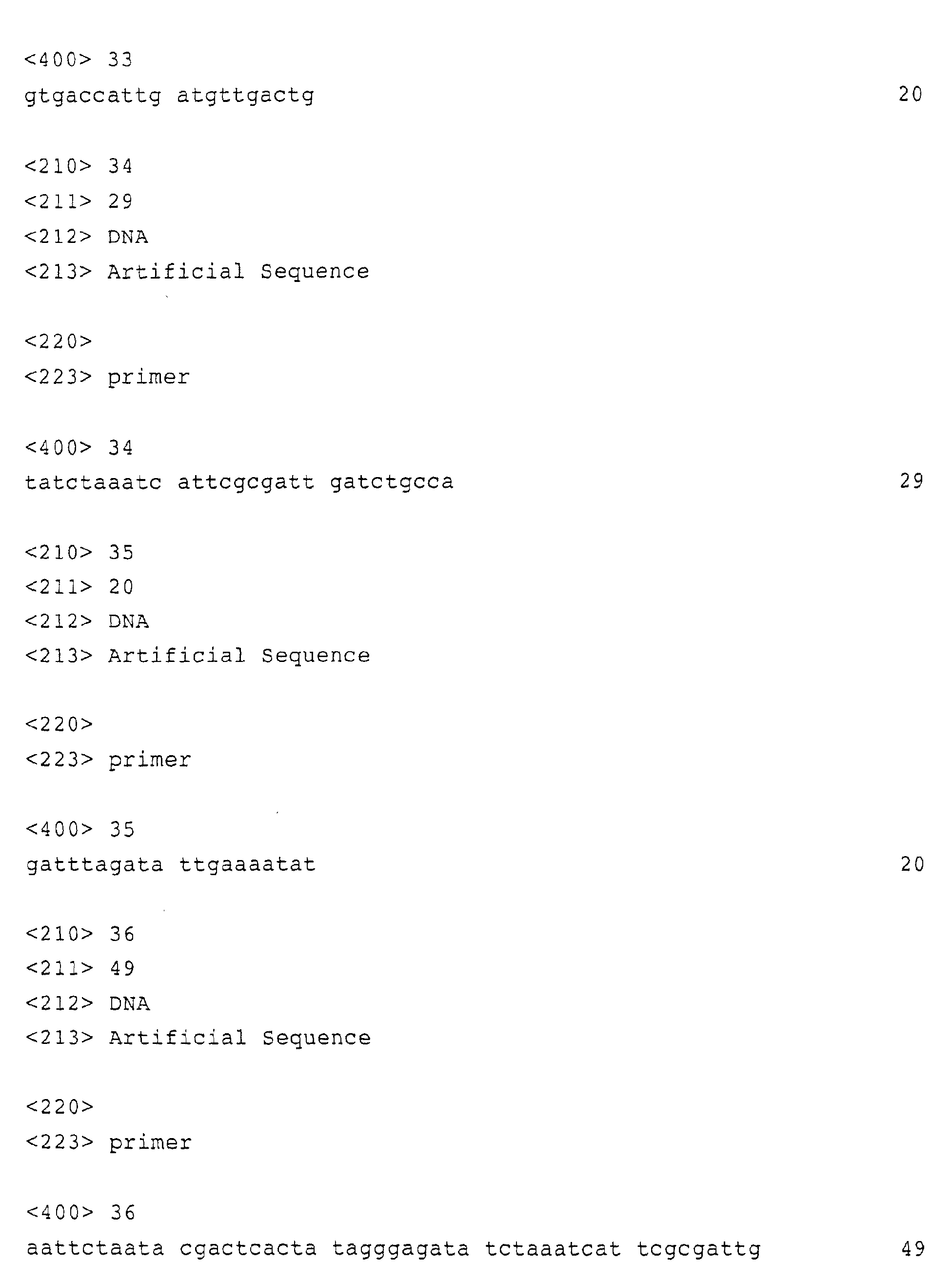

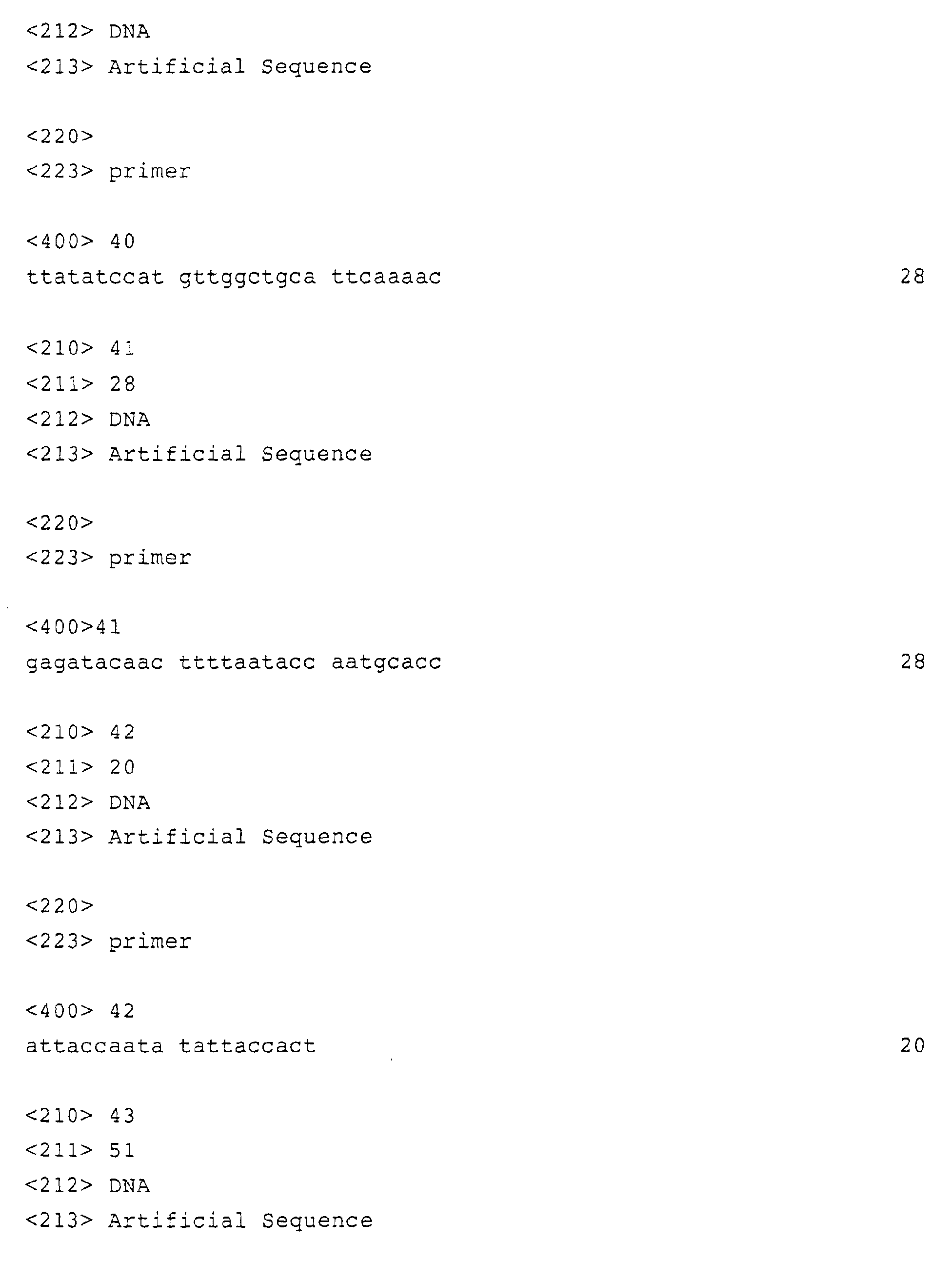

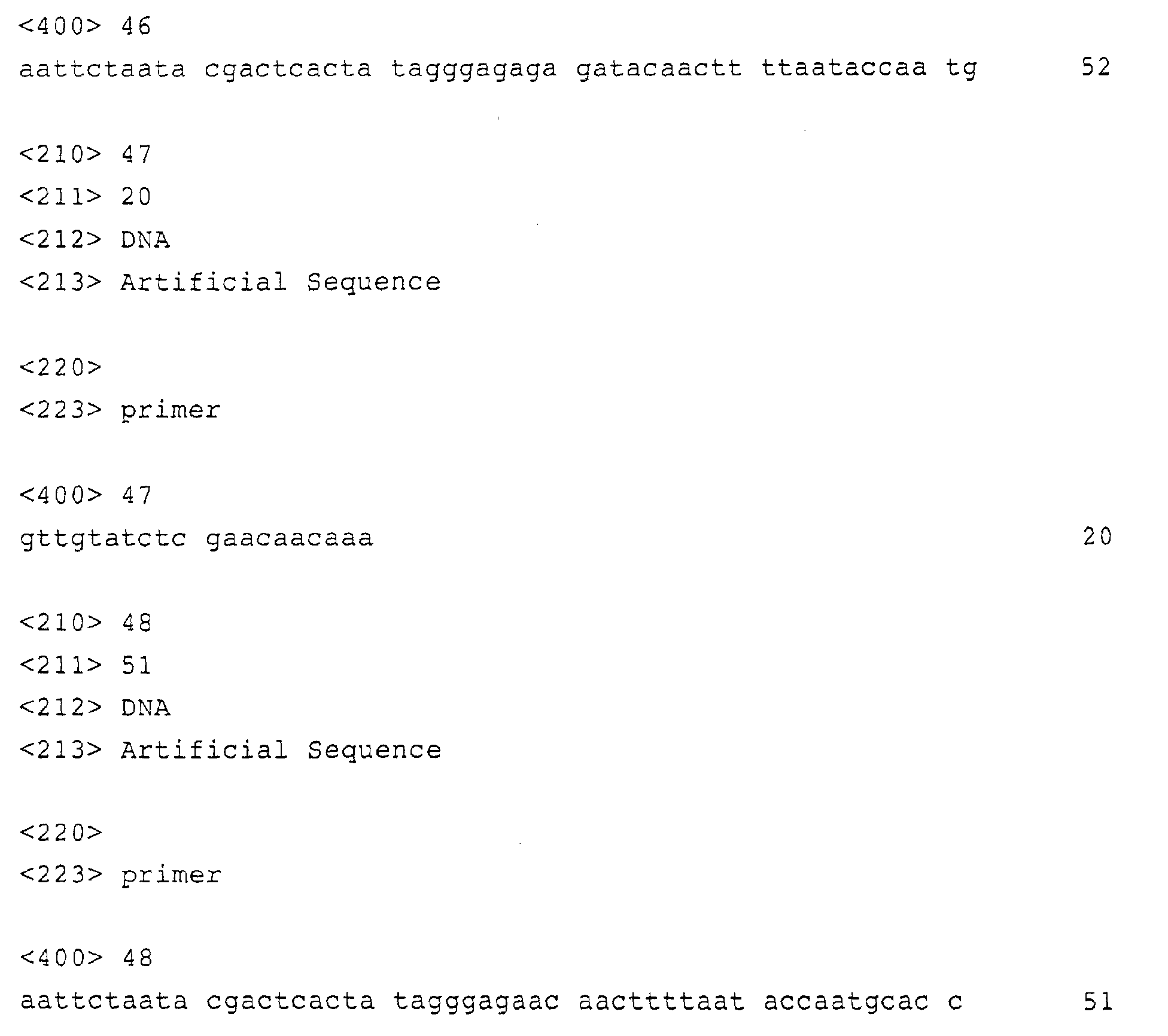
Claims (20)
- An oligonucleotide for detection or amplification of Vibrio parahaemolyticus thermostable direct hemolysin-related hemolysin genes (trh1 and trh2) or RNA derived from these genes, which oligonucleotide is capable of binding specifically to trh1 and trh2 or RNA derived therefrom, and comprises at least 10 contiguous bases of any of the sequences listed as SEQ. ID. Nos. 1 to 11, or an oligonucleotide complementary to said oligonucleotide.
- An oligonucleotide for detection or amplification of a Vibrio parahaemolyticus thermostable direct hemolysin-related hemolysin gene (trh1) or RNA derived from said gene, which oligonucleotide is capable of binding specifically to trh1 or RNA derived therefrom, and comprises at least 10 contiguous bases of any of the sequences listed as SEQ. ID. Nos. 12 to 14, or an oligonucleotide complementary to said oligonucleotide.
- An oligonucleotide for detection or amplification of a Vibrio parahaemolyticus thermostable direct hemolysin-related hemolysin gene (trh2) or RNA derived from said gene, which oligonucleotide is capable of binding specifically to trh2 or RNA derived therefrom, and comprises at least 10 contiguous bases of any of the sequences listed as SEQ. ID. Nos. 15 to 17, or an oligonucleotide complementary to said oligonucleotide.
- An oligonucleotide primer for DNA extension reaction, comprising an oligonucleotide according to any of claims 1 to 3.
- An oligonucleotide probe which is an oligonucleotide according to any of claims 1 to 3 a portion of which is modified or labeled with a detectable marker.
- An oligonucleotide for detection or amplification of Vibrio parahaemolyticus thermostable direct hemolysin gene (tdh2) or RNA derived from said gene, which oligonucleotide is capable of binding specifically to tdh2 or RNA derived from said gene, and comprises at least 10 contiguous bases of any of the sequences listed as SEQ. ID. Nos. 18 to 24, or an oligonucleotide complementary to said oligonucleotide.
- An oligonucleotide primer for DNA extension reaction, comprising an oligonucleotide according to claim 6.
- An oligonucleotide probe which is an oligonucleotide according claim 6 a portion of which is modified or labeled with a detectable marker.
- A detection method employing a RNA amplification process, which comprises the steps of: forming a cDNA with a RNA-dependent DNA polymerase using a specific sequence of a RNA derived from a Vibrio parahaemolyticus thermostable direct hemolysin-related hemolysin gene (trh1) present in a sample as a template, with a first primer having a sequence complementary to said specific sequence and a second primer having a sequence homologous to said specific sequence, wherein either the first or second primer has a sequence having the RNA polymerase promoter sequence added at its 5'-region, thereby producing a RNA-DNA double-strand; digesting the RNA of said RNA-DNA double-strand with Ribonuclease H to form a single-stranded DNA; and then forming a double-stranded DNA that includes a promoter sequence allowing transcription of said RNA sequence or a RNA comprising a sequence complementary to said RNA sequence with a DNA-dependent DNA polymerase using said single-stranded DNA as a template, said double-stranded DNA produces a RNA transcription product in the presence of a RNA polymerase, and said RNA transcription product is subsequently used as the template for the single-stranded DNA production with said RNA-dependent DNA polymerase; characterized in that the oligonucleotide of SEQ. ID. No.25 is used as the first primer and the oligonucleotide of SEQ. ID. No.26 is used as the second primer.
- The detection method of claim 9, characterized in that said first primer is an oligonucleotide comprising at least 10 contiguous bases of the sequence of SEQ. ID. No.25.
- The detection method of claim 9, characterized in that said second primer is an oligonucleotide comprising at least 10 contiguous bases of the sequence of SEQ. ID. No.26.
- A detection method for a Vibrio parahaemolyticus thermostable direct hemolysin-related hemolysin gene, which comprises the steps of: conducting the RNA amplification process according to claim 9 in the presence of an oligonucleotide probe labeled with an intercalator fluorescent dye, wherein the sequence of said probe is complementary to at least a portion of said RNA transcription product, and complementary binding of said probe to said RNA transcription product results in a change of the fluorescent property relative to that of a situation where a complex formation is absent; and then measuring the fluorescence intensity of the reaction solution.
- A detection method employing a RNA amplification process, which comprises the steps of: forming a cDNA with a RNA-dependent DNA polymerase using a specific sequence of a RNA derived from a Vibrio parahaemolyticus thermostable direct hemolysin-related hemolysin gene (trh2) present in a sample as a template, with a first primer having a sequence complementary to said specific sequence and a second primer having a sequence homologous to said specific sequence, wherein either the first or second primer has a sequence having the RNA polymerase promoter sequence added at its 5'-region, thereby producing a RNA-DNA double-strand; digesting the RNA of said RNA-DNA double-strand with Ribonuclease H to form a single-stranded DNA; and then forming a double-stranded DNA that includes a promoter sequence allowing transcription of said RNA sequence or a RNA comprising a sequence complementary to said RNA sequence with a DNA-dependent DNA polymerase using said single-stranded DNA as a template, said double-stranded DNA produces a RNA transcription product in the presence of a RNA polymerase, and said RNA transcription product is subsequently used as the template for the single-stranded DNA production with said RNA-dependent DNA polymerase; characterized in that the oligonucleotide of SEQ. ID. No.33 is used as the first primer and the oligonucleotide of SEQ. ID. No.34 is used as the second primer.
- The detection method of claim 13, characterized in that said first primer is an oligonucleotide comprising at least 10 contiguous bases of the sequence of SEQ. ID. No.33.
- The detection method of claim 13, characterized in that said second primer is an oligonucleotide comprising at least 10 contiguous bases of the sequence of SEQ. ID. No.34.
- A detection method for a Vibrio parahaemolyticus thermostable direct hemolysin-related hemolysin gene, which comprises the steps of: conducting the RNA amplification process according to claim 13 in the presence of an oligonucleotide probe labeled with an intercalator fluorescent dye, wherein the sequence of said probe is complementary to at least a portion of said RNA transcription product, and complementary binding of said probe to said RNA transcription product results in a change of the fluorescent property relative to that of a situation where a complex formation is absent; and then measuring the fluorescence intensity of the reaction solution.
- A detection method employing a RNA amplification process, which comprises the steps of: forming a cDNA with a RNA-dependent DNA polymerase using a specific sequence of a RNA derived from a Vibrio parahaemolyticus thermostable direct hemolysin gene (tdh) present in a sample as a template, with a first primer having a sequence complementary to said specific sequence and a second primer having a sequence homologous to said specific sequence, wherein either the first or second primer has a sequence having the RNA polymerase promoter sequence added at its 5'-region, thereby producing a RNA-DNA double-strand; digesting the RNA of said RNA-DNA double-strand with Ribonuclease H to form a single-stranded DNA; and then forming a double-stranded DNA that includes a promoter sequence allowing transcription of said RNA sequence or a RNA comprising a sequence complementary to said RNA sequence with a DNA-dependent DNA polymerase using said single-stranded DNA as a template, said double-stranded DNA produces a RNA transcription product in the presence of a RNA polymerase, and said RNA transcription product is subsequently used as the template for the single-stranded DNA production with said RNA-dependent DNA polymerase; characterized in that the oligonucleotide of SEQ. ID. No.39 is used as the first primer and the oligonucleotide of SEQ. ID. No.40 is used as the second primer, or the oligonucleotide of SEQ. ID. No.39 is used as the first primer and the oligonucleotide of SEQ. ID. No.41 is used as the second primer, or the oligonucleotide of SEQ. ID. No.42 is used as the first primer and the oligonucleotide of SEQ. ID. No.41 is used as the second primer.
- The detection method of claim 17 characterized in that said first primer is an oligonucleotide comprising at least 10 contiguous bases of the sequence of SEQ. ID. No.39 or of SEQ. ID. No.42.
- The detection method of claim 17, characterized in that said second primer is an oligonucleotide comprising at least 10 contiguous bases of the sequence of SEQ. ID. No.40 or SEQ. ID. No.41.
- A detection method for a Vibrio parahaemolyticus, which comprises the steps of: conducting the RNA amplification process according to claim 17 in the presence of an oligonucleotide probe labeled with an intercalator fluorescent dye, wherein the sequence of said probe is complementary to at least a portion of said RNA transcription product, and complementary binding of said probe with the RNA transcription product results in a change of the fluorescent property relative to that of a situation where a complex formation is absent, and then measuring the fluorescence intensity of the reaction solution.
Applications Claiming Priority (10)
| Application Number | Priority Date | Filing Date | Title |
|---|---|---|---|
| JP2000081805 | 2000-03-17 | ||
| JP2000081806A JP2001258570A (en) | 2000-03-17 | 2000-03-17 | Oligonucleotides for detection of Vibrio parahaemolyticus |
| JP2000081805A JP2001258569A (en) | 2000-03-17 | 2000-03-17 | Oligonucleotides for detection of Vibrio parahaemolyticus |
| JP2000081806 | 2000-03-17 | ||
| JP2000166505 | 2000-05-31 | ||
| JP2000166505A JP2001340088A (en) | 2000-05-31 | 2000-05-31 | Detection of toxin gene of Vibrio parahaemolyticus |
| JP2000166503 | 2000-05-31 | ||
| JP2000166503A JP2001340086A (en) | 2000-05-31 | 2000-05-31 | Detection of thermostable hemotoxin gene of Vibrio parahaemolyticus |
| JP2000166504A JP2001340087A (en) | 2000-05-31 | 2000-05-31 | Detection of thermostable hemotoxin-like hemotoxin gene of Vibrio parahaemolyticus |
| JP2000166504 | 2000-05-31 |
Publications (3)
| Publication Number | Publication Date |
|---|---|
| EP1134292A2 true EP1134292A2 (en) | 2001-09-19 |
| EP1134292A3 EP1134292A3 (en) | 2003-12-10 |
| EP1134292B1 EP1134292B1 (en) | 2006-08-09 |
Family
ID=27531458
Family Applications (1)
| Application Number | Title | Priority Date | Filing Date |
|---|---|---|---|
| EP01106364A Expired - Lifetime EP1134292B1 (en) | 2000-03-17 | 2001-03-16 | Oligonucleotides for detection of 'Vibrio parahaemolyticus' and detection method for 'Vibrio parahaemolyticus' using the same oligonucleotides |
Country Status (3)
| Country | Link |
|---|---|
| US (2) | US6562955B2 (en) |
| EP (1) | EP1134292B1 (en) |
| DE (1) | DE60122043T2 (en) |
Cited By (4)
| Publication number | Priority date | Publication date | Assignee | Title |
|---|---|---|---|---|
| EP1512753A1 (en) * | 2003-09-05 | 2005-03-09 | Tosoh Corporation | Detection reagent for thermostable direct hemolysin-related hemolysin gene of Vibrio parahaemolyticus |
| EP1512754A1 (en) * | 2003-09-05 | 2005-03-09 | Tosoh Corporation | Detection reagent for thermostable direct hemolysin gene of vibrio parahaemolyticus |
| CN100585394C (en) * | 2006-08-26 | 2010-01-27 | 福建出入境检验检疫局检验检疫技术中心 | PCR detection method of Vibrio cholerae, Vibrio parahaemolyticus and Vibrio mimicus in food |
| CN101434999B (en) * | 2008-12-10 | 2011-08-10 | 中国水产科学研究院黄海水产研究所 | PCR-ELISA detection method of vibrio parahaemolyticus in aquatic product |
Families Citing this family (8)
| Publication number | Priority date | Publication date | Assignee | Title |
|---|---|---|---|---|
| US6893847B2 (en) * | 2001-01-17 | 2005-05-17 | Tosoh Corporation | Oligonucleotide for detecting Salmonella and method of detecting Salmonella |
| US20070264882A1 (en) * | 2006-05-10 | 2007-11-15 | K.S. Terminals Inc. | Battery terminal connector and conductive elements thereof |
| US20090226895A1 (en) * | 2007-06-15 | 2009-09-10 | The Hong Kong Polytechnic University | Method of detecting vibrio parahaemolyticus via real-time PCR-hybridization |
| CN101178363B (en) * | 2007-10-19 | 2010-10-27 | 华南理工大学 | Vibrio parahaemolyticus constant temperature gene amplification detection kit and method |
| EP2421137B1 (en) | 2009-04-14 | 2019-05-08 | Murata Manufacturing Co., Ltd. | Switching power supply unit |
| JP5447506B2 (en) | 2009-04-14 | 2014-03-19 | 株式会社村田製作所 | Switching power supply |
| US11248269B2 (en) * | 2015-03-05 | 2022-02-15 | University Of New Hampshire | Methods and compositions for identifying pathogenic vibrio parahaemolyticus |
| CN114280295B (en) * | 2021-12-28 | 2024-01-26 | 军事科学院军事医学研究院环境医学与作业医学研究所 | Method and kit for rapidly detecting vibrio parahaemolyticus of food-borne pathogenic bacteria on site and application of kit |
Family Cites Families (15)
| Publication number | Priority date | Publication date | Assignee | Title |
|---|---|---|---|---|
| EP0695352A4 (en) * | 1993-04-07 | 2000-12-06 | Univ Georgetown Med Center | DNA CODING COBRA C3, CVF1, AND CVF2 |
| US5386021A (en) * | 1993-04-16 | 1995-01-31 | The United States Of America, As Represented By The Department Of Health & Human Services | Mammalian guanine nucleotide binding protein with an ADP-rybosylation factor domain |
| US5512452A (en) * | 1993-05-06 | 1996-04-30 | President And Fellows Of Harvard College | Selection of bacterial genes induced in host tissues |
| US6562596B1 (en) * | 1993-10-06 | 2003-05-13 | Amgen Inc. | Tissue inhibitor of metalloproteinase type three (TIMP-3) composition and methods |
| US5643727A (en) * | 1995-02-16 | 1997-07-01 | La Jolla Cancer Research Foundation | BCL-2 gene inhibitory element binding factor |
| AU6848396A (en) * | 1995-10-17 | 1997-05-07 | Hybridon, Inc. | Oligonucleotides with anti-respiratory syncytial virus activity |
| US5994132A (en) * | 1996-10-23 | 1999-11-30 | University Of Michigan | Adenovirus vectors |
| JPH10191985A (en) * | 1997-01-17 | 1998-07-28 | Kirin Brewery Co Ltd | Modified protein of Rho-targeted protein kinase p160 |
| US5786195A (en) * | 1997-03-12 | 1998-07-28 | New England Biolabs, Inc. | Method for cloning and producing the bssHII restriction endonuclease in E. coli |
| AU6590898A (en) * | 1997-03-28 | 1998-10-22 | Genetics Institute Inc. | Secreted proteins and polynucleotides encoding them |
| US5922595A (en) * | 1997-12-09 | 1999-07-13 | Incyte Pharmaceuticals, Inc. | Cyclic GMP phosphodiesterase |
| WO1999032644A2 (en) * | 1997-12-22 | 1999-07-01 | Genset | Prostate cancer gene |
| EP1071817A2 (en) * | 1998-04-21 | 2001-01-31 | Genset | Biallelic markers for use in constructing a high density disequilibrium map of the human genome |
| WO1999063077A2 (en) * | 1998-06-04 | 1999-12-09 | Tm Technologies, Inc. | Compositions of nucleic acid which alter ligand-binding characteristics and related methods and products |
| JPH11318480A (en) * | 1999-04-14 | 1999-11-24 | Toyobo Co Ltd | Oligonucleotide for detecting enteritis vibrio and detection of the same vibrio |
-
2001
- 2001-03-15 US US09/808,358 patent/US6562955B2/en not_active Expired - Fee Related
- 2001-03-16 EP EP01106364A patent/EP1134292B1/en not_active Expired - Lifetime
- 2001-03-16 DE DE60122043T patent/DE60122043T2/en not_active Expired - Lifetime
-
2003
- 2003-04-07 US US10/407,461 patent/US20030176687A1/en not_active Abandoned
Cited By (6)
| Publication number | Priority date | Publication date | Assignee | Title |
|---|---|---|---|---|
| EP1512753A1 (en) * | 2003-09-05 | 2005-03-09 | Tosoh Corporation | Detection reagent for thermostable direct hemolysin-related hemolysin gene of Vibrio parahaemolyticus |
| EP1512754A1 (en) * | 2003-09-05 | 2005-03-09 | Tosoh Corporation | Detection reagent for thermostable direct hemolysin gene of vibrio parahaemolyticus |
| US7495094B2 (en) | 2003-09-05 | 2009-02-24 | Tosoh Corporation | Detection reagent for thermostable direct hemolysin-related hemolysin gene of Vibrio parahaemolyticus |
| CN1637153B (en) * | 2003-09-05 | 2010-06-09 | 东曹株式会社 | Detection reagent for detecting thermostable hemolysin gene of Vibrio parahaemolyticus |
| CN100585394C (en) * | 2006-08-26 | 2010-01-27 | 福建出入境检验检疫局检验检疫技术中心 | PCR detection method of Vibrio cholerae, Vibrio parahaemolyticus and Vibrio mimicus in food |
| CN101434999B (en) * | 2008-12-10 | 2011-08-10 | 中国水产科学研究院黄海水产研究所 | PCR-ELISA detection method of vibrio parahaemolyticus in aquatic product |
Also Published As
| Publication number | Publication date |
|---|---|
| DE60122043D1 (en) | 2006-09-21 |
| US20030176687A1 (en) | 2003-09-18 |
| DE60122043T2 (en) | 2007-03-15 |
| EP1134292B1 (en) | 2006-08-09 |
| US20010031471A1 (en) | 2001-10-18 |
| EP1134292A3 (en) | 2003-12-10 |
| US6562955B2 (en) | 2003-05-13 |
Similar Documents
| Publication | Publication Date | Title |
|---|---|---|
| EP1134292B1 (en) | Oligonucleotides for detection of 'Vibrio parahaemolyticus' and detection method for 'Vibrio parahaemolyticus' using the same oligonucleotides | |
| US7297517B2 (en) | Oligonucleotides and method for detection of meca gene of methicillin-resistant Staphylococcus aureus | |
| US7495094B2 (en) | Detection reagent for thermostable direct hemolysin-related hemolysin gene of Vibrio parahaemolyticus | |
| EP1103624A1 (en) | Potentiated nucleic acid amplification method | |
| US6893847B2 (en) | Oligonucleotide for detecting Salmonella and method of detecting Salmonella | |
| US7105319B2 (en) | Oligonucleotides for detecting tubercle bacillus and method therefor | |
| EP1170383A2 (en) | Oligonucleotides and method for detection of small round structured virus (SRSV) RNA | |
| US7049067B2 (en) | Oligonucleotide for detection of HIV-1 and detection method | |
| US7339041B2 (en) | Oligonucleotides and method for characterizing and detecting Genogroup II type small round structured virus | |
| EP1512754A1 (en) | Detection reagent for thermostable direct hemolysin gene of vibrio parahaemolyticus | |
| US6756198B2 (en) | Oligonucleotide for highly sensitive detection of hepatitis C virus and method for detection thereof | |
| JP2003284565A (en) | Oligonucleotides and detection method for detection of atypical mycobacterium Mycobacterimintracellulare | |
| EP1352974A1 (en) | Oligonucleotide for detection of atypical mycobacteria mycobacterium avium and detection method | |
| JP2001258569A (en) | Oligonucleotides for detection of Vibrio parahaemolyticus | |
| JP2001353000A (en) | Method for detecting mecA gene of mesicillin-resistant Staphylococcus aureus | |
| JP2001340086A (en) | Detection of thermostable hemotoxin gene of Vibrio parahaemolyticus | |
| JP2001346589A (en) | Polynucleotide specific to hads-degrading microorganism and method for detecting and quantitatively determining hads-degrading microorganism using the polynucleotide | |
| JP2003033182A (en) | Oligonucleotides for Mycobacterium tuberculosis detection | |
| JP2001340088A (en) | Detection of toxin gene of Vibrio parahaemolyticus | |
| JP2002281972A (en) | Oligonucleotides and detection methods for Salmonella detection |
Legal Events
| Date | Code | Title | Description |
|---|---|---|---|
| PUAI | Public reference made under article 153(3) epc to a published international application that has entered the european phase |
Free format text: ORIGINAL CODE: 0009012 |
|
| AK | Designated contracting states |
Kind code of ref document: A2 Designated state(s): AT BE CH CY DE DK ES FI FR GB GR IE IT LI LU MC NL PT SE TR |
|
| AX | Request for extension of the european patent |
Free format text: AL;LT;LV;MK;RO;SI |
|
| PUAL | Search report despatched |
Free format text: ORIGINAL CODE: 0009013 |
|
| AK | Designated contracting states |
Kind code of ref document: A3 Designated state(s): AT BE CH CY DE DK ES FI FR GB GR IE IT LI LU MC NL PT SE TR |
|
| AX | Request for extension of the european patent |
Extension state: AL LT LV MK RO SI |
|
| 17P | Request for examination filed |
Effective date: 20040429 |
|
| 17Q | First examination report despatched |
Effective date: 20040615 |
|
| AKX | Designation fees paid |
Designated state(s): DE FR GB IT NL |
|
| GRAP | Despatch of communication of intention to grant a patent |
Free format text: ORIGINAL CODE: EPIDOSNIGR1 |
|
| GRAS | Grant fee paid |
Free format text: ORIGINAL CODE: EPIDOSNIGR3 |
|
| RTI1 | Title (correction) |
Free format text: OLIGONUCLEOTIDES FOR DETECTION OF 'VIBRIO PARAHAEMOLYTICUS' AND DETECTION METHOD FOR 'VIBRIO PARAHAEMOLYTICUS' USING THE SAME OLIGONUCLEOTIDES |
|
| GRAA | (expected) grant |
Free format text: ORIGINAL CODE: 0009210 |
|
| AK | Designated contracting states |
Kind code of ref document: B1 Designated state(s): DE FR GB IT NL |
|
| PG25 | Lapsed in a contracting state [announced via postgrant information from national office to epo] |
Ref country code: IT Free format text: LAPSE BECAUSE OF FAILURE TO SUBMIT A TRANSLATION OF THE DESCRIPTION OR TO PAY THE FEE WITHIN THE PRESCRIBED TIME-LIMIT;WARNING: LAPSES OF ITALIAN PATENTS WITH EFFECTIVE DATE BEFORE 2007 MAY HAVE OCCURRED AT ANY TIME BEFORE 2007. THE CORRECT EFFECTIVE DATE MAY BE DIFFERENT FROM THE ONE RECORDED. Effective date: 20060809 |
|
| REG | Reference to a national code |
Ref country code: GB Ref legal event code: FG4D |
|
| REF | Corresponds to: |
Ref document number: 60122043 Country of ref document: DE Date of ref document: 20060921 Kind code of ref document: P |
|
| ET | Fr: translation filed | ||
| PLBE | No opposition filed within time limit |
Free format text: ORIGINAL CODE: 0009261 |
|
| STAA | Information on the status of an ep patent application or granted ep patent |
Free format text: STATUS: NO OPPOSITION FILED WITHIN TIME LIMIT |
|
| 26N | No opposition filed |
Effective date: 20070510 |
|
| PGFP | Annual fee paid to national office [announced via postgrant information from national office to epo] |
Ref country code: IT Payment date: 20100318 Year of fee payment: 10 Ref country code: FR Payment date: 20100324 Year of fee payment: 10 |
|
| PGFP | Annual fee paid to national office [announced via postgrant information from national office to epo] |
Ref country code: GB Payment date: 20100310 Year of fee payment: 10 |
|
| PGFP | Annual fee paid to national office [announced via postgrant information from national office to epo] |
Ref country code: NL Payment date: 20100316 Year of fee payment: 10 Ref country code: DE Payment date: 20100422 Year of fee payment: 10 |
|
| REG | Reference to a national code |
Ref country code: NL Ref legal event code: V1 Effective date: 20111001 |
|
| GBPC | Gb: european patent ceased through non-payment of renewal fee |
Effective date: 20110316 |
|
| REG | Reference to a national code |
Ref country code: FR Ref legal event code: ST Effective date: 20111130 |
|
| PG25 | Lapsed in a contracting state [announced via postgrant information from national office to epo] |
Ref country code: NL Free format text: LAPSE BECAUSE OF NON-PAYMENT OF DUE FEES Effective date: 20111001 Ref country code: DE Free format text: LAPSE BECAUSE OF NON-PAYMENT OF DUE FEES Effective date: 20111001 Ref country code: FR Free format text: LAPSE BECAUSE OF NON-PAYMENT OF DUE FEES Effective date: 20110331 |
|
| REG | Reference to a national code |
Ref country code: DE Ref legal event code: R119 Ref document number: 60122043 Country of ref document: DE Effective date: 20111001 |
|
| PG25 | Lapsed in a contracting state [announced via postgrant information from national office to epo] |
Ref country code: GB Free format text: LAPSE BECAUSE OF NON-PAYMENT OF DUE FEES Effective date: 20110316 Ref country code: IT Free format text: LAPSE BECAUSE OF NON-PAYMENT OF DUE FEES Effective date: 20110316 |