EP1134270A1 - Polymerizable liquid crystal compound having amido bond between two cyclic groups - Google Patents
Polymerizable liquid crystal compound having amido bond between two cyclic groups Download PDFInfo
- Publication number
- EP1134270A1 EP1134270A1 EP01105440A EP01105440A EP1134270A1 EP 1134270 A1 EP1134270 A1 EP 1134270A1 EP 01105440 A EP01105440 A EP 01105440A EP 01105440 A EP01105440 A EP 01105440A EP 1134270 A1 EP1134270 A1 EP 1134270A1
- Authority
- EP
- European Patent Office
- Prior art keywords
- group
- liquid crystal
- independently
- crystal compound
- polymerizable liquid
- Prior art date
- Legal status (The legal status is an assumption and is not a legal conclusion. Google has not performed a legal analysis and makes no representation as to the accuracy of the status listed.)
- Granted
Links
- 0 C*(c(cc1)ccc1I)=C1N=C1 Chemical compound C*(c(cc1)ccc1I)=C1N=C1 0.000 description 3
Classifications
-
- C—CHEMISTRY; METALLURGY
- C07—ORGANIC CHEMISTRY
- C07C—ACYCLIC OR CARBOCYCLIC COMPOUNDS
- C07C233/00—Carboxylic acid amides
- C07C233/01—Carboxylic acid amides having carbon atoms of carboxamide groups bound to hydrogen atoms or to acyclic carbon atoms
- C07C233/02—Carboxylic acid amides having carbon atoms of carboxamide groups bound to hydrogen atoms or to acyclic carbon atoms having nitrogen atoms of carboxamide groups bound to hydrogen atoms or to carbon atoms of unsubstituted hydrocarbon radicals
- C07C233/04—Carboxylic acid amides having carbon atoms of carboxamide groups bound to hydrogen atoms or to acyclic carbon atoms having nitrogen atoms of carboxamide groups bound to hydrogen atoms or to carbon atoms of unsubstituted hydrocarbon radicals with carbon atoms of carboxamide groups bound to acyclic carbon atoms of an acyclic saturated carbon skeleton
- C07C233/07—Carboxylic acid amides having carbon atoms of carboxamide groups bound to hydrogen atoms or to acyclic carbon atoms having nitrogen atoms of carboxamide groups bound to hydrogen atoms or to carbon atoms of unsubstituted hydrocarbon radicals with carbon atoms of carboxamide groups bound to acyclic carbon atoms of an acyclic saturated carbon skeleton having the nitrogen atom of at least one of the carboxamide groups bound to a carbon atom of a six-membered aromatic ring
-
- C—CHEMISTRY; METALLURGY
- C07—ORGANIC CHEMISTRY
- C07C—ACYCLIC OR CARBOCYCLIC COMPOUNDS
- C07C235/00—Carboxylic acid amides, the carbon skeleton of the acid part being further substituted by oxygen atoms
- C07C235/42—Carboxylic acid amides, the carbon skeleton of the acid part being further substituted by oxygen atoms having carbon atoms of carboxamide groups bound to carbon atoms of six-membered aromatic rings and singly-bound oxygen atoms bound to the same carbon skeleton
- C07C235/44—Carboxylic acid amides, the carbon skeleton of the acid part being further substituted by oxygen atoms having carbon atoms of carboxamide groups bound to carbon atoms of six-membered aromatic rings and singly-bound oxygen atoms bound to the same carbon skeleton with carbon atoms of carboxamide groups and singly-bound oxygen atoms bound to carbon atoms of the same non-condensed six-membered aromatic ring
- C07C235/56—Carboxylic acid amides, the carbon skeleton of the acid part being further substituted by oxygen atoms having carbon atoms of carboxamide groups bound to carbon atoms of six-membered aromatic rings and singly-bound oxygen atoms bound to the same carbon skeleton with carbon atoms of carboxamide groups and singly-bound oxygen atoms bound to carbon atoms of the same non-condensed six-membered aromatic ring having the nitrogen atom of at least one of the carboxamide groups bound to a carbon atom of a six-membered aromatic ring
-
- C—CHEMISTRY; METALLURGY
- C09—DYES; PAINTS; POLISHES; NATURAL RESINS; ADHESIVES; COMPOSITIONS NOT OTHERWISE PROVIDED FOR; APPLICATIONS OF MATERIALS NOT OTHERWISE PROVIDED FOR
- C09K—MATERIALS FOR MISCELLANEOUS APPLICATIONS, NOT PROVIDED FOR ELSEWHERE
- C09K19/00—Liquid crystal materials
- C09K19/04—Liquid crystal materials characterised by the chemical structure of the liquid crystal components, e.g. by a specific unit
- C09K19/06—Non-steroidal liquid crystal compounds
- C09K19/08—Non-steroidal liquid crystal compounds containing at least two non-condensed rings
- C09K19/10—Non-steroidal liquid crystal compounds containing at least two non-condensed rings containing at least two benzene rings
- C09K19/22—Non-steroidal liquid crystal compounds containing at least two non-condensed rings containing at least two benzene rings linked by a chain containing carbon and nitrogen atoms as chain links, e.g. Schiff bases
-
- C—CHEMISTRY; METALLURGY
- C09—DYES; PAINTS; POLISHES; NATURAL RESINS; ADHESIVES; COMPOSITIONS NOT OTHERWISE PROVIDED FOR; APPLICATIONS OF MATERIALS NOT OTHERWISE PROVIDED FOR
- C09K—MATERIALS FOR MISCELLANEOUS APPLICATIONS, NOT PROVIDED FOR ELSEWHERE
- C09K19/00—Liquid crystal materials
- C09K19/04—Liquid crystal materials characterised by the chemical structure of the liquid crystal components, e.g. by a specific unit
- C09K19/06—Non-steroidal liquid crystal compounds
- C09K19/08—Non-steroidal liquid crystal compounds containing at least two non-condensed rings
- C09K19/30—Non-steroidal liquid crystal compounds containing at least two non-condensed rings containing saturated or unsaturated non-aromatic rings, e.g. cyclohexane rings
- C09K19/3001—Cyclohexane rings
- C09K19/3086—Cyclohexane rings in which at least two rings are linked by a chain containing nitrogen atoms
Definitions
- the present invention relates to a polymerizable liquid crystal compound having an amido bond between two cyclic groups.
- the invention also relates to an optically anisotropic element prepared from the compound.
- Alignment of molecules of a polymerizable liquid crystal compound can be fixed by polymerization after the molecules are aligned.
- the polymerizable liquid crystal compounds are described in U.S. Patent Nos. 4,683,327, 4,983,479, 5,622,648 and 5,770,107; and W.O. Patent Nos. 95/22586 and 97/00600.
- An optically anisotropic polymer prepared by the polymerization can be used as an optically anisotropic element.
- a polarizing prism made of the optically anisotropic polymer is described in European Patent No. 428213.
- an optical compensatory sheet (for liquid crystal display of STN mode) made of the optically anisotropic polymer is described in European Patent No. 428881.
- a cholesteric polarizer made of the optically anisotropic polymer is described in European Patent No. 606940.
- the present inventors have studied polymerizable liquid crystal compounds, and have found that the known compounds have disadvantages in phase transition temperature and optical characteristics. For example, the known compounds often change into isotropic liquid at low temperatures or exhibit liquid phase within narrow temperature ranges. Further, known polymerizable liquid crystal compounds sometimes have small birefringent indexes to be used in an optically anisotropic material (such as an optically anisotropic element).
- An object of the present invention is to provide a polymerizable liquid crystal compound having an appropriate phase transition temperature.
- Another object of the invention is to provide a polymerizable liquid crystal compound having a large birefringent index.
- a further object of the invention is to provide an optically anisotropic element having optical anisotropy, which can be easily produced.
- the invention also provides an optical anistropic element comprising a transparent support and a liquid crystal layer formed by polymerization of a polymerizable liquid crystal compound, wherein the polymerizable liquid crystal compound is represented by the formula (I).
- the polymerizable liquid crystal compound represented by the formula (I) changes into isotropic liquid at a high temperature and exhibits liquid phase within a wide temperature range. Further, the compound has a large birefringent index.
- the compound of the formula (I) has a specific mesogen structure, in which an amide bond (-CO-NR-) is present between two cyclic groups (Cy 1 and Cy 2 ), each of which further links to a polymerizable group (Q) through a linking group (L). Because of the specific mesogen structure, the compound can exhibit liquid phase within a wide temperature range and has a large birefringent index.
- an optically anisotropic element can be easily prepared by polymerization reaction of the polymerizable liquid crystal compound represented by the formula (I).
- the polymerizable liquid crystal compound of the invention is represented by the formula (I).
- Q 1 -L 1 -Cy 1 -(CH CH) n -CO-NR 1 -Cy 2 -L 2 -Q 2 .
- each of Q 1 and Q 2 independently is a polymerizable group.
- the polymerizable group is preferably polymerized by addition (including ring-opening) or condensation polymerization reaction.
- the polymerizable group is preferably a functional group which can be subjected to addition or condensation polymerization reaction.
- the polymerizable group (Q 1 or Q 2 ) preferably is an unsaturated polymerizable group (Q-1 to Q-7), an epoxy group (Q-8) or an aziridinyl group (Q-9), more preferably is an unsaturated polymerizable group, and most preferably is an ethylenically unsaturated group (Q-1 to Q-6).
- each of L 1 and L 2 independently is a divalent linking group.
- the divalent linking group is preferably selected from the group consisting of -O-, -S-, -CO-, -NR 2 -, a divalent chain group, a divalent cyclic group and a combination thereof.
- R 2 is hydrogen or an alkyl group having 1 to 7 carbon atoms.
- Examples of the combined divalent linking group are shown below.
- the left side is attached to Q (Q 1 or Q 2 ), and the right side is attached to Cy (Cy 1 or Cy 2 ).
- CH means a divalent chain group
- CY means a divalent cyclic group.
- the divalent chain groups (CH) include an alkylene group, a substituted alkylene group, an alkenylene group, a substituted alkenylene group, an alkynylene group or a substituted alkynylene group.
- An alkylene group, a substituted alkylene group, an alkenylene group and a substituted alkenylene group are preferred, and an alkylene group and an alkenylene group are more preferred.
- the alkylene group may have a branched structure.
- the alkylene group preferably has 1 to 12 carbon atoms, more preferably has 2 to 10 carbon atoms, and most preferably has 3 to 8 carbon atoms.
- the alkylene moiety of the substituted alkylene group is the same as the above-described alkylene group.
- substituent groups of the substituted alkylene groups include a halogen atom.
- the alkenylene group may have a branched structure.
- the alkenylene group preferably has 2 to 12 carbon atoms, more preferably has 2 to 8 carbon atoms, and most preferably has 2 to 4 carbon atoms.
- the alkenylene moiety of the substituted alkenylene group is the same as the above-described alkenylene group.
- substituent groups of the substituted alkylene groups include a halogen atom.
- the alkynylene group may have a branched structure.
- the alkynylene group preferably has 2 to 12 carbon atoms, more preferably has 2 to 8 carbon atoms, and most preferably has 2 to 4 carbon atoms.
- the alkynylene moiety of the substituted alkynylene group is the same as the above described alkynylene group.
- substituent groups of the substituted alkylene groups include a halogen atom.
- CY divalent cyclic groups
- R 2 preferably is hydrogen or an alkyl group having 1 to 4 carbon atoms, more preferably is hydrogen or an alkyl group having 1 or 2 carbon atoms, and most preferably is hydrogen.
- m is preferably 0 rather than 1.
- divalent cyclic group The definition and the examples of the divalent cyclic group are the same as those for Cy 1 and Cy 2 described below.
- L 3 preferably is a divalent linking group selected from the group consisting of -O-, -S-, -CO-, -NR 2 -, a divalent chain group and a combination thereof.
- R 2 is hydrogen or an alkyl group having 1 to 7 carbon atoms.
- R 2 preferably is hydrogen or an alkyl group having 1 to 4 carbon atoms, more preferably is hydrogen or an alkyl group having 1 or 2 carbon atoms, and most preferably is hydrogen.
- L 3 most preferably is -O-CH-O-CO-, in which CH is a divalent chain group.
- the polymerizable liquid crystal compound represented by the formula (I) preferably have three divalent cyclic groups (Cy 1 , Cy 2 and Cy 3 ).
- each of Cy 1 and Cy 2 independently is a divalent cyclic group.
- the ring in the cyclic group preferably is a five-membered, six-membered or seven membered ring, more preferably is a five-membered or six-membered ring, and most preferably is a six-membered ring.
- the ring can be condensed with another ring.
- a monocyclic ring is preferred to a condensed ring.
- the ring in the cyclic group can be an aromatic ring, an aliphatic ring or a heterocyclic ring.
- Examples of the aromatic rings include benzene ring and naphthalene ring.
- Examples of the aliphatic ring include cyclohexane ring.
- Examples of the heterocyclic ring include pyridine ring and pyrimidine ring.
- a preferred cyclic group having a benzene ring is 1,4-phenylene.
- Preferred cyclic groups having a naphthalene ring include naphthalene-1,5-diyl and naphthalene-2,6-diyl.
- a preferred cyclic group having a cyclohexane ring is 1,4-cyclohexylene.
- a preferred cyclic group having a pyridine ring is pyridine-2,5-diyl.
- a preferred cyclic group having a pyrimidine ring is pyrimidine-2,5-diyl.
- the cyclic group most preferably is 1,4-phenylene or 1,4-cyclohexylene.
- the cyclic group can have a substituent group.
- substituent group include a halogen atom, cyano, nitro, an alkyl group having 1 to 5 carbon atoms, a halogen-substituted alkyl group having 1 to 5 carbon atoms, an alkoxy group having 1 to 5 carbon atoms, an alkylthio group having 1 to 5 carbon atoms, an acyl group having 1 to 5 carbon atoms, an acyloxy group having 2 to 6 carbon atoms, an alkoxycarbonyl group having 2 to 6 carbon atoms, carbamoyl, an alkyl carbamoyl group having 2 to 6 carbon atoms and an amido group having 2 to 6 carbon atoms.
- R 1 is hydrogen or an alkyl group having 1 to 7 carbon atoms.
- R 1 preferably is hydrogen or an alkyl group having 1 to 4 carbon atoms, more preferably is hydrogen or an alkyl group having 1 to 2 carbon atoms, and most preferably is hydrogen.
- n is an integer of 0 or 1.
- n is 0 rather than 1.
- the polymerizable liquid crystal compound is preferably represented by the formula (IIa) or (IIb).
- the compound of the formula (IIa) is more preferred.
- each of Q 1 and Q 2 independently is a polymerizable group.
- the definition and the examples of the polymerizable group are the same as those described for the formula (I).
- each of L 1 and L 3 independently is a divalent linking group.
- the divalent linking group is preferably selected from the group consisting of -O-, -S-, -CO-, -NR 2 -, a divalent chain group and a combination thereof.
- R 2 is hydrogen or an alkyl group having 1 to 7 carbon atoms.
- R 2 preferably is hydrogen or an alkyl group having 1 to 4 carbon atoms, more preferably is hydrogen or an alkyl group having 1 or 2 carbon atoms, and most preferably is hydrogen.
- L 1 preferably is -CO-O-CH-O-, in which CH is a divalent chain group.
- L 3 preferably is -O-CH-O-CO-, in which CH is a divalent chain group.
- each of Cy 1 , Cy 2 and Cy 3 independently is a divalent cyclic group.
- R 1 is hydrogen or an alkyl group having 1 to 7 carbon atoms.
- R 1 preferably is hydrogen or an alkyl group having 1 to 4 carbon atoms, more preferably is hydrogen or an alkyl group having 1 or 2 carbon atoms, and most preferably is hydrogen.
- each of m and n is independently an integer of 0 or 1.
- each of m and n is 0 rather than 1.
- the polymerizable liquid crystal compound is further preferably represented by the formula (IIIa) or (IIIb).
- the compound of the formula (IIIa) is furthermore preferred.
- each of Q 1 and Q 2 independently is a polymerizable group.
- the definition and the examples of the polymerizable group are the same as those described for the formula (I).
- each of L 1 and L 3 independently is a divalent linking group.
- the divalent linking group is preferably selected from the group consisting of -O-, -S-, -CO-, -NR 2 -, a divalent chain group and a combination thereof.
- R 2 is hydrogen or an alkyl group having 1 to 7 carbon atoms.
- R 2 preferably is hydrogen or an alkyl group having 1 to 4 carbon atoms, more preferably is hydrogen or an alkyl group having 1 or 2 carbon atoms, and most preferably is hydrogen.
- L 1 preferably is -CO-O-CH-O-, in which CH is a divalent chain group.
- L 3 preferably is -O-CH-O-CO-, in which CH is a divalent chain group.
- each of m and n is independently an integer of 0 or 1.
- each of m and n is 0 rather than 1.
- the benzene rings A and B can have substituent groups.
- substituent group are the same as those of the divalent cyclic group in the formula (I).
- the polymerizable liquid crystal compound represented by the formula (I) can be synthesized by referring known methods (for example, described in Methoden der Organischen Chemie [Houben-Weyl], Some Specific Methods [Thieme-Verlag, Stuttgart], Jikken Kagaku Koza and Shin-Jikken Kagaku Koza).
- the compounds can also be synthesized by referring to the descriptions of U.S. Patent Publication Nos. 4,683,327, 4,983,479, 5,622,648 and 5,770,107; W.O. Patent Nos. 95/22586, 97/00600 and 98/47979; and British Patent No. 2297549.
- An optically anisotropic element can be prepared by coating an orientation layer with a liquid crystal composition (coating solution) comprising the polymerizable liquid crystal compound represented by the formula (I) and then polymerizing the molecules of the liquid crystal compound to form a liquid crystal layer.
- the composition can be applied according to a conventional coating method such as an extrusion coating method, a direct gravure coating method, a reverse gravure coating method, a die coating method or a bar coating method.
- a conventional coating method such as an extrusion coating method, a direct gravure coating method, a reverse gravure coating method, a die coating method or a bar coating method.
- the liquid crystal molecules are fixed with the alignment maintained.
- the liquid crystal molecules are fixed by a polymerization reaction of the polymerizable groups (Q) in the molecules.
- the polymerization reaction can be classified into a thermal reaction using a thermal polymerization initiator and a photo reaction using a photo polymerization initiator. A photo polymerization reaction is preferred.
- photo polymerization initiators examples include ⁇ -carbonyl compounds (described in US Patent Nos. 2,367,661, 2,367,670), acyloin ethers (described in US Patent No. 2,448,828), ⁇ -hydrocarbon substituted acyloin compounds (described in US Patent No. 2,722,512), polycyclic quinone compounds (described in US Patent Nos. 2,951,758, 3,046,127), combinations of triarylimidazoles and p-aminophenyl ketones (described in US Patent No. 3,549,367), acridine or phenazine compounds (described in Japanese Patent Provisional Publication No. 60(1985)-105667 and US Patent No. 4,239,850) and oxadiazole compounds (described in US Patent No. 4,212,970).
- ⁇ -carbonyl compounds described in US Patent Nos. 2,367,661, 2,367,670
- acyloin ethers described in US Patent No
- the amount of the photo polymerization initiator is preferably in the range of 0.01 to 20 wt.%, and more preferably in the range of 0.5 to 5 wt.% based on the solid content of the coating solution.
- the light irradiation for the photo polymerization may be conducted with an ultraviolet ray.
- the exposure energy is preferably in the range of 20 to 50,000 mJ/cm 2 , and more preferably in the range of 100 to 800 mJ/cm 2 .
- the light irradiation can be conducted with the layer heated to accelerate the photo polymerization reaction.
- the liquid crystal layer has a thickness preferably in the range of 0.1 to 50 ⁇ m, more preferably 1 to 30 ⁇ m, and most preferably in the range of 5 to 20 ⁇ m.
- the orientation layer can be formed by rubbing treatment of an organic compound (preferably a polymer), oblique evaporation of an inorganic compound, formation of a micro groove layer, or stimulation of an organic compound (e.g., ⁇ -tricosanoic acid, dioctadecylmethylammonium chloride, methyl stearate) according to a Langmuir-Blodgett method.
- an organic compound e.g., ⁇ -tricosanoic acid, dioctadecylmethylammonium chloride, methyl stearate
- the aligning function of the orientation layer can be activated by applying an electric or magnetic field to the layer or irradiating the layer with light.
- the orientation layer is preferably formed by rubbing a polymer.
- the rubbing treatment can be conducted by rubbing a layer containing the aforementioned polymer with paper or cloth several times along a certain direction.
- the polymer used for the orientation layer is selected according to aimed alignment (particularly, aimed average inclined angle) of the liquid crystal molecules.
- a polymer that does not reduce the surface energy of the orientation layer i.e., a polymer usually used for an orientation layer.
- a polymer that reduces the surface energy of the orientation layer is used. That polymer preferably has a hydrocarbon group of 10 to 100 carbon atoms at the side chain.
- the orientation layer has a thickness of preferably 0.01 to 5 ⁇ m, more preferably 0.05 to 1 ⁇ m.
- the liquid crystal layer can be transferred onto the transparent support.
- the aligned and fixed liquid crystal molecules can keep the alignment without the orientation layer.
- a transparent support is a glass plate or a polymer film, preferably a polymer film.
- the term "transparent” here means that light transmittance is not less than 80%.
- the transparent support has a thickness preferably in the range of 10 to 500 ⁇ m, and more preferably in the range of 50 to 200 ⁇ m.
- the transparent support can be subjected to a surface treatment (e.g., glow discharge-treatment, corona discharge treatment, ultraviolet (UV) treatment, flame treatment) to improve adhesion to a layer formed on the support (e.g., adhesive layer, orientation layer, liquid crystal layer).
- a surface treatment e.g., glow discharge-treatment, corona discharge treatment, ultraviolet (UV) treatment, flame treatment
- UV treatment ultraviolet
- flame treatment to improve adhesion to a layer formed on the support (e.g., adhesive layer, orientation layer, liquid crystal layer).
- An ultraviolet absorber may be incorporated in the transparent support.
- An adhesive layer (undercoating layer) can be provided on the transparent support.
- Japanese Patent Provisional Publication 7(1995)-333433 describes the adhesive layer.
- the thickness of the adhesive layer is in the range of preferably 0.1 to 2 ⁇ m, more preferably 0.2 to 1 ⁇ m.
- the optically anisotropic element of the invention can be used as an optical compensatory sheet for liquid crystal displays of various modes.
- the display modes include TN (twisted nematic) mode, IPS (in-plane switching) mode, FLC (ferroelectric liquid crystal) mode, OCB (optically compensatory bend) mode, STN (super twisted nematic) mode, VA (vertically aligned) mode, GH (guest-host) mode and HAN (hybrid aligned nematic) mode.
- optically anisotropic element can be also used as a polarizing prism (described in European Patent No. 428213).
- the element can be used as a cholesteric polarizer (described in European Patent No. 606940).
- the polymerizable liquid crystal compound (I-1) was synthesized according to the following scheme.
- the compounds (a) to (d) can be synthesized according to a known method by referring to the above-described references.
- the formed crude product was recrystallized from ethyl acetate and n-hexane to obtain 2.3 g of the polymerizable liquid crystal compound (I-1).
- the structure of the obtained compound was confirmed by 1 H-NMR and mass spectrometry.
- the polymerizable liquid crystal compound (I-1) exhibited monotropic phases.
- the phase transition temperatures were (crystal phase ⁇ ) 127°C ( ⁇ isotropic liquid), (isotropic liquid ⁇ ) 124°C ( ⁇ nematic phase ⁇ ) and 105°C ( ⁇ crystal phase).
- the formed crude product was recrystallized from ethyl acetate and n-hexane to obtain 2.7 g of the polymerizable liquid crystal compound (1-24).
- the structure of the obtained compound was confirmed by 1 H-NMR and mass spectrometry.
- the polymerizable liquid crystal compound (I-24) exhibited enantiotropic phase.
- the phase transition temperatures were (crystal phase ⁇ ) 82°C ( ⁇ nematic phase ⁇ ) and 137°C ( ⁇ isotropic liquid).
- the polymerizable liquid crystal compounds (I-2), (I-3), (I-5), (I-11), (I-12), (I-13), (I-15), (I-21) and (I-23) were prepared In the same manner as Example 1 or 2.
- the birefringence was measured by using an Abbe's refractometer according to a known method (described in Makromol. Chem., vol.190, pp.2255). The birefringence was measured at the temperature of 10°C lower than the phase transition temperature of isotropic liquid.
- An optically anisotropic element was prepared in the following manner according to Advanced Material, vol. 5, no. 2, pp. 107.
- a glass substrate was coated with polyimide (SE-150, Nissan Chemical Co., Ltd.), and subjected to rubbing treatment to form an orientation layer.
- polyimide SE-150, Nissan Chemical Co., Ltd.
- the aligned molecules were then exposed to ultraviolet light from a high pressure mercury lamp under nitrogen gas atmosphere, to polymerize the molecules.
- the thus-prepared optically anisotropic element was observed with a polarizing microscope, to find that the alignment had no defect such as domain border or inversion wall.
Landscapes
- Chemical & Material Sciences (AREA)
- Organic Chemistry (AREA)
- Crystallography & Structural Chemistry (AREA)
- Engineering & Computer Science (AREA)
- Materials Engineering (AREA)
- Polarising Elements (AREA)
- Liquid Crystal (AREA)
- Addition Polymer Or Copolymer, Post-Treatments, Or Chemical Modifications (AREA)
- Organic Low-Molecular-Weight Compounds And Preparation Thereof (AREA)
- Liquid Crystal Substances (AREA)
Abstract
Description
- The present invention relates to a polymerizable liquid crystal compound having an amido bond between two cyclic groups. The invention also relates to an optically anisotropic element prepared from the compound.
- Alignment of molecules of a polymerizable liquid crystal compound can be fixed by polymerization after the molecules are aligned. The polymerizable liquid crystal compounds are described in U.S. Patent Nos. 4,683,327, 4,983,479, 5,622,648 and 5,770,107; and W.O. Patent Nos. 95/22586 and 97/00600.
- An optically anisotropic polymer prepared by the polymerization can be used as an optically anisotropic element. For example, a polarizing prism made of the optically anisotropic polymer is described in European Patent No. 428213. Further, an optical compensatory sheet (for liquid crystal display of STN mode) made of the optically anisotropic polymer is described in European Patent No. 428881. Furthermore, a cholesteric polarizer made of the optically anisotropic polymer is described in European Patent No. 606940.
- The present inventors have studied polymerizable liquid crystal compounds, and have found that the known compounds have disadvantages in phase transition temperature and optical characteristics. For example, the known compounds often change into isotropic liquid at low temperatures or exhibit liquid phase within narrow temperature ranges. Further, known polymerizable liquid crystal compounds sometimes have small birefringent indexes to be used in an optically anisotropic material (such as an optically anisotropic element).
- An object of the present invention is to provide a polymerizable liquid crystal compound having an appropriate phase transition temperature.
- Another object of the invention is to provide a polymerizable liquid crystal compound having a large birefringent index.
- A further object of the invention is to provide an optically anisotropic element having optical anisotropy, which can be easily produced.
- The present invention provides a polymerizable liquid crystal compound represented by the formula (I):
- The invention also provides an optical anistropic element comprising a transparent support and a liquid crystal layer formed by polymerization of a polymerizable liquid crystal compound, wherein the polymerizable liquid crystal compound is represented by the formula (I).
- The present inventors have found that the polymerizable liquid crystal compound represented by the formula (I) changes into isotropic liquid at a high temperature and exhibits liquid phase within a wide temperature range. Further, the compound has a large birefringent index. The compound of the formula (I) has a specific mesogen structure, in which an amide bond (-CO-NR-) is present between two cyclic groups (Cy1 and Cy2), each of which further links to a polymerizable group (Q) through a linking group (L). Because of the specific mesogen structure, the compound can exhibit liquid phase within a wide temperature range and has a large birefringent index.
- Since the polymerizable liquid crystal compound gives liquid phase within a wide temperature range, alignment of the liquid crystal molecules can be easily maintained during polymerization reaction. Accordingly, an optically anisotropic element can be easily prepared by polymerization reaction of the polymerizable liquid crystal compound represented by the formula (I).
- Since the compound of the formula (I) has a large birefringent index, an optically anisotropic element having high anisotropy can be obtained.
- The polymerizable liquid crystal compound of the invention is represented by the formula (I).
- In the formula (I), each of Q1 and Q2 independently is a polymerizable group. The polymerizable group is preferably polymerized by addition (including ring-opening) or condensation polymerization reaction. In other words, the polymerizable group is preferably a functional group which can be subjected to addition or condensation polymerization reaction.
- Examples of the polymerizable groups (Q) are shown below.


- The polymerizable group (Q1 or Q2) preferably is an unsaturated polymerizable group (Q-1 to Q-7), an epoxy group (Q-8) or an aziridinyl group (Q-9), more preferably is an unsaturated polymerizable group, and most preferably is an ethylenically unsaturated group (Q-1 to Q-6).
- In the formula (I), each of L1 and L2 independently is a divalent linking group. The divalent linking group is preferably selected from the group consisting of -O-, -S-, -CO-, -NR2-, a divalent chain group, a divalent cyclic group and a combination thereof. R2 is hydrogen or an alkyl group having 1 to 7 carbon atoms.
- Examples of the combined divalent linking group are shown below. In the examples, the left side is attached to Q (Q1 or Q2), and the right side is attached to Cy (Cy1 or Cy2). CH means a divalent chain group, and CY means a divalent cyclic group.
- L1: -CO-O-CH-O-
- L2: -CO-O-CH-O-CY-CO-O-
- L3: -CO-O-CH-O-CY-O-CO-
- L4: -CO-O-CH-O-CY-CH-
- L5: -CO-O-CH-O-CY-
- L6: -CO-O-CH-O-CY-CH-CO-O-
- L7: -CO-O-CH-O-CY-O-CO-CH-
-
- The divalent chain groups (CH) include an alkylene group, a substituted alkylene group, an alkenylene group, a substituted alkenylene group, an alkynylene group or a substituted alkynylene group. An alkylene group, a substituted alkylene group, an alkenylene group and a substituted alkenylene group are preferred, and an alkylene group and an alkenylene group are more preferred.
- The alkylene group may have a branched structure. The alkylene group preferably has 1 to 12 carbon atoms, more preferably has 2 to 10 carbon atoms, and most preferably has 3 to 8 carbon atoms.
- The alkylene moiety of the substituted alkylene group is the same as the above-described alkylene group.
Examples of the substituent groups of the substituted alkylene groups include a halogen atom. - The alkenylene group may have a branched structure. The alkenylene group preferably has 2 to 12 carbon atoms, more preferably has 2 to 8 carbon atoms, and most preferably has 2 to 4 carbon atoms.
- The alkenylene moiety of the substituted alkenylene group is the same as the above-described alkenylene group. Examples of the substituent groups of the substituted alkylene groups include a halogen atom.
- The alkynylene group may have a branched structure. The alkynylene group preferably has 2 to 12 carbon atoms, more preferably has 2 to 8 carbon atoms, and most preferably has 2 to 4 carbon atoms.
- The alkynylene moiety of the substituted alkynylene group is the same as the above described alkynylene group. Examples of the substituent groups of the substituted alkylene groups include a halogen atom.
- The definition and the examples of the divalent cyclic groups (CY) are the same as those for Cy1 and Cy2 described below.
- R2 preferably is hydrogen or an alkyl group having 1 to 4 carbon atoms, more preferably is hydrogen or an alkyl group having 1 or 2 carbon atoms, and most preferably is hydrogen.
- L2 is preferably -O-CO-(CH=CH)m-Cy3-L3 - or -(CH=CH)m-CO-O-Cy3-L3-, in which m is 0 or 3, Cy3 is a divalent cyclic group and L3 is a divalent linking group.
- The above m is preferably 0 rather than 1.
- The definition and the examples of the divalent cyclic group are the same as those for Cy1 and Cy2 described below.
- L3 preferably is a divalent linking group selected from the group consisting of -O-, -S-, -CO-, -NR2-, a divalent chain group and a combination thereof. R2 is hydrogen or an alkyl group having 1 to 7 carbon atoms. R2 preferably is hydrogen or an alkyl group having 1 to 4 carbon atoms, more preferably is hydrogen or an alkyl group having 1 or 2 carbon atoms, and most preferably is hydrogen.
- L3 most preferably is -O-CH-O-CO-, in which CH is a divalent chain group.
- The polymerizable liquid crystal compound represented by the formula (I) preferably have three divalent cyclic groups (Cy1, Cy2 and Cy3).
- In the formula (I), each of Cy1 and Cy2 independently is a divalent cyclic group.
- The ring in the cyclic group preferably is a five-membered, six-membered or seven membered ring, more preferably is a five-membered or six-membered ring, and most preferably is a six-membered ring.
- The ring can be condensed with another ring. However, a monocyclic ring is preferred to a condensed ring.
- The ring in the cyclic group can be an aromatic ring, an aliphatic ring or a heterocyclic ring.
- Examples of the aromatic rings include benzene ring and naphthalene ring. Examples of the aliphatic ring include cyclohexane ring. Examples of the heterocyclic ring include pyridine ring and pyrimidine ring.
- A preferred cyclic group having a benzene ring is 1,4-phenylene. Preferred cyclic groups having a naphthalene ring include naphthalene-1,5-diyl and naphthalene-2,6-diyl. A preferred cyclic group having a cyclohexane ring is 1,4-cyclohexylene. A preferred cyclic group having a pyridine ring is pyridine-2,5-diyl. A preferred cyclic group having a pyrimidine ring is pyrimidine-2,5-diyl.
- The cyclic group most preferably is 1,4-phenylene or 1,4-cyclohexylene.
- The cyclic group can have a substituent group. Examples of the substituent group include a halogen atom, cyano, nitro, an alkyl group having 1 to 5 carbon atoms, a halogen-substituted alkyl group having 1 to 5 carbon atoms, an alkoxy group having 1 to 5 carbon atoms, an alkylthio group having 1 to 5 carbon atoms, an acyl group having 1 to 5 carbon atoms, an acyloxy group having 2 to 6 carbon atoms, an alkoxycarbonyl group having 2 to 6 carbon atoms, carbamoyl, an alkyl carbamoyl group having 2 to 6 carbon atoms and an amido group having 2 to 6 carbon atoms.
- In the formula (I), R1 is hydrogen or an alkyl group having 1 to 7 carbon atoms. R1 preferably is hydrogen or an alkyl group having 1 to 4 carbon atoms, more preferably is hydrogen or an alkyl group having 1 to 2 carbon atoms, and most preferably is hydrogen.
- In the formula (I), n is an integer of 0 or 1. Preferably, n is 0 rather than 1.
- The polymerizable liquid crystal compound is preferably represented by the formula (IIa) or (IIb). The compound of the formula (IIa) is more preferred.
- In the formulas (IIa) and (IIb), each of Q1 and Q2 independently is a polymerizable group. The definition and the examples of the polymerizable group are the same as those described for the formula (I).
- In the formulas (IIa) and (IIb), each of L1 and L3 independently is a divalent linking group. The divalent linking group is preferably selected from the group consisting of -O-, -S-, -CO-, -NR2-, a divalent chain group and a combination thereof. R2 is hydrogen or an alkyl group having 1 to 7 carbon atoms. R2 preferably is hydrogen or an alkyl group having 1 to 4 carbon atoms, more preferably is hydrogen or an alkyl group having 1 or 2 carbon atoms, and most preferably is hydrogen.
- L1 preferably is -CO-O-CH-O-, in which CH is a divalent chain group. L3 preferably is -O-CH-O-CO-, in which CH is a divalent chain group.
- The definition and the examples of the divalent chain group (CH) are the same as those described for the formula (I).
- In the formulas (IIa) and (IIb), each of Cy1, Cy2 and Cy3 independently is a divalent cyclic group.
- The definition and the examples of the divalent cyclic group are the same as those described for the formula (I).
- In the formulas (IIa) and (IIb), R1 is hydrogen or an alkyl group having 1 to 7 carbon atoms. R1 preferably is hydrogen or an alkyl group having 1 to 4 carbon atoms, more preferably is hydrogen or an alkyl group having 1 or 2 carbon atoms, and most preferably is hydrogen.
- In the formulas (IIa) and (IIb), each of m and n is independently an integer of 0 or 1. Preferably, each of m and n is 0 rather than 1.
- The polymerizable liquid crystal compound is further preferably represented by the formula (IIIa) or (IIIb). The compound of the formula (IIIa) is furthermore preferred.
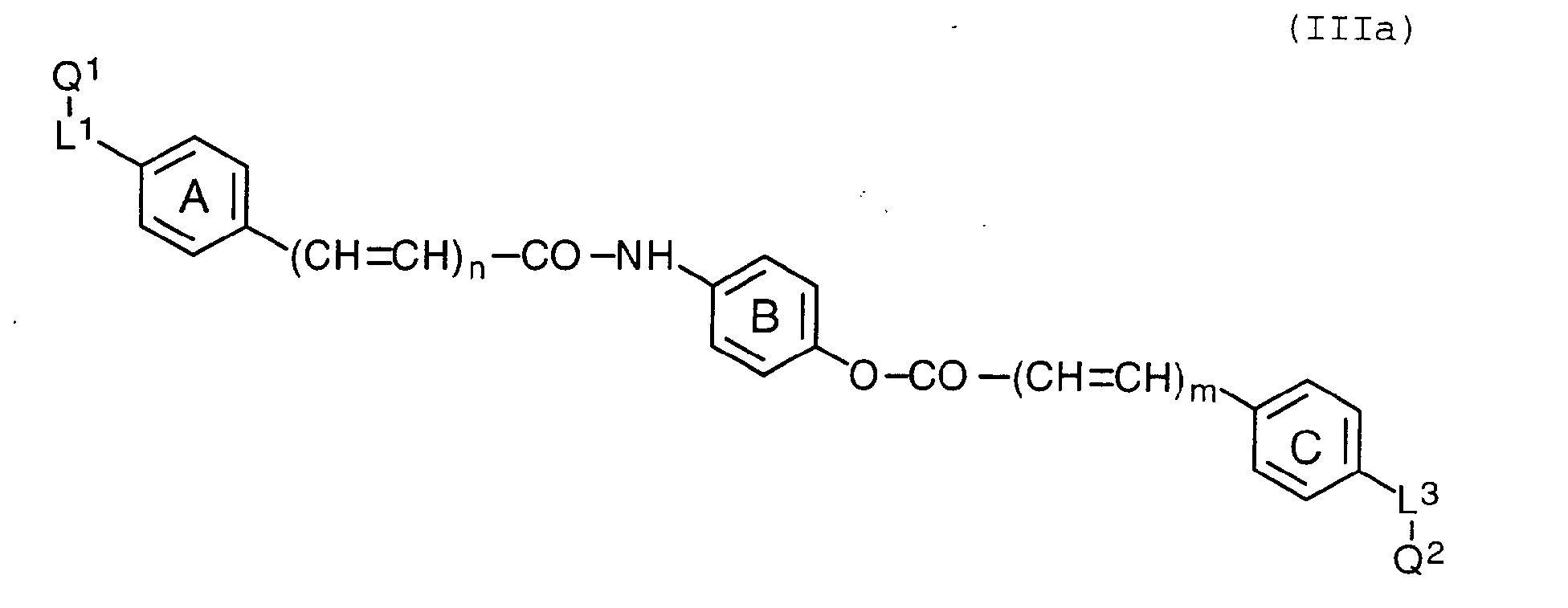
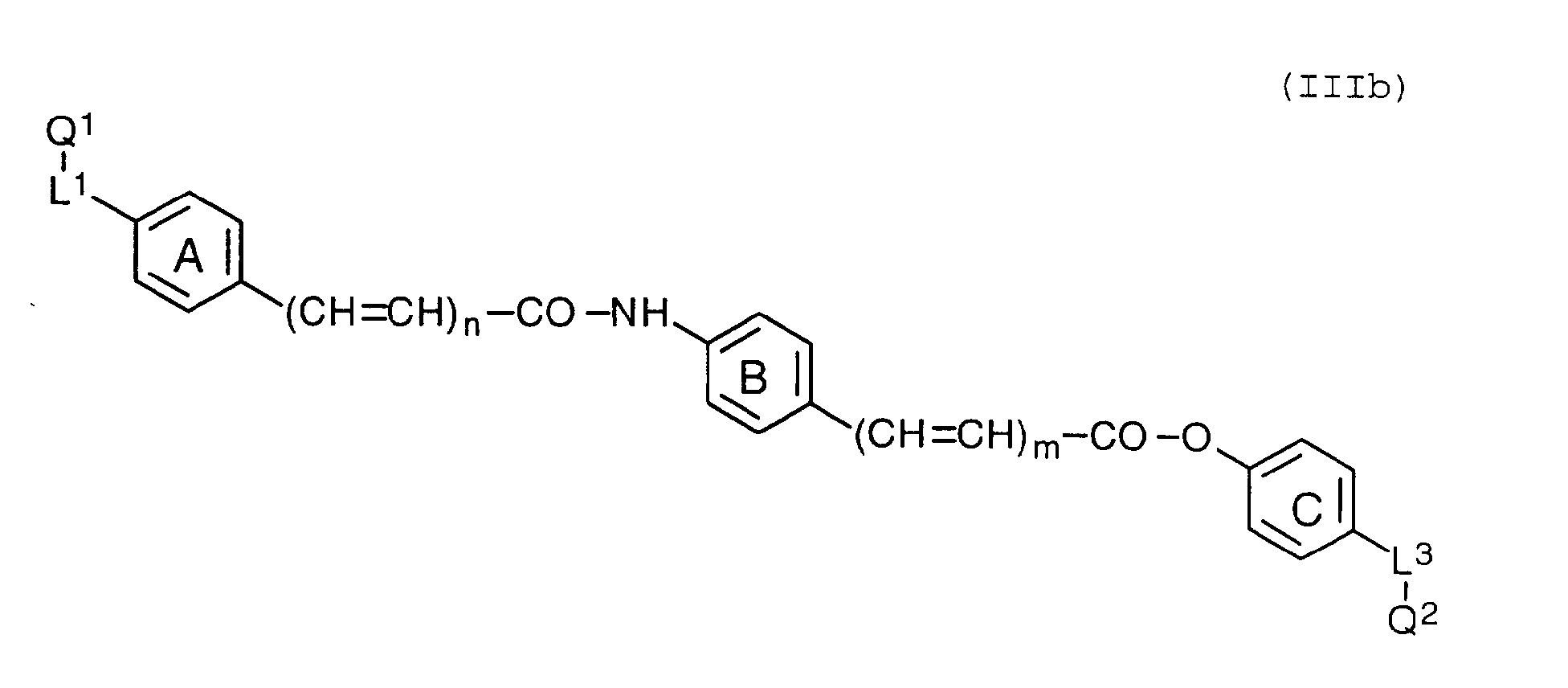
- In the formulas (IIIa) and (IIIb), each of Q1 and Q2 independently is a polymerizable group. The definition and the examples of the polymerizable group are the same as those described for the formula (I).
- In the formulas (IIIa) and (IIIb), each of L1 and L3 independently is a divalent linking group. The divalent linking group is preferably selected from the group consisting of -O-, -S-, -CO-, -NR2-, a divalent chain group and a combination thereof. R2 is hydrogen or an alkyl group having 1 to 7 carbon atoms. R2 preferably is hydrogen or an alkyl group having 1 to 4 carbon atoms, more preferably is hydrogen or an alkyl group having 1 or 2 carbon atoms, and most preferably is hydrogen.
- L1 preferably is -CO-O-CH-O-, in which CH is a divalent chain group. L3 preferably is -O-CH-O-CO-, in which CH is a divalent chain group.
- The definition and the examples of the divalent chain group (CH) are the same as those described for the formula (I).
- In the formulas (IIIa) and (IIIb), each of m and n is independently an integer of 0 or 1. Preferably, each of m and n is 0 rather than 1.
- In the formulas (IIIa) and (IIIb), the benzene rings A and B can have substituent groups. Examples of the substituent group are the same as those of the divalent cyclic group in the formula (I).
- Examples of the polymerizable liquid crystal compounds represented by the formula (I) are shown below.
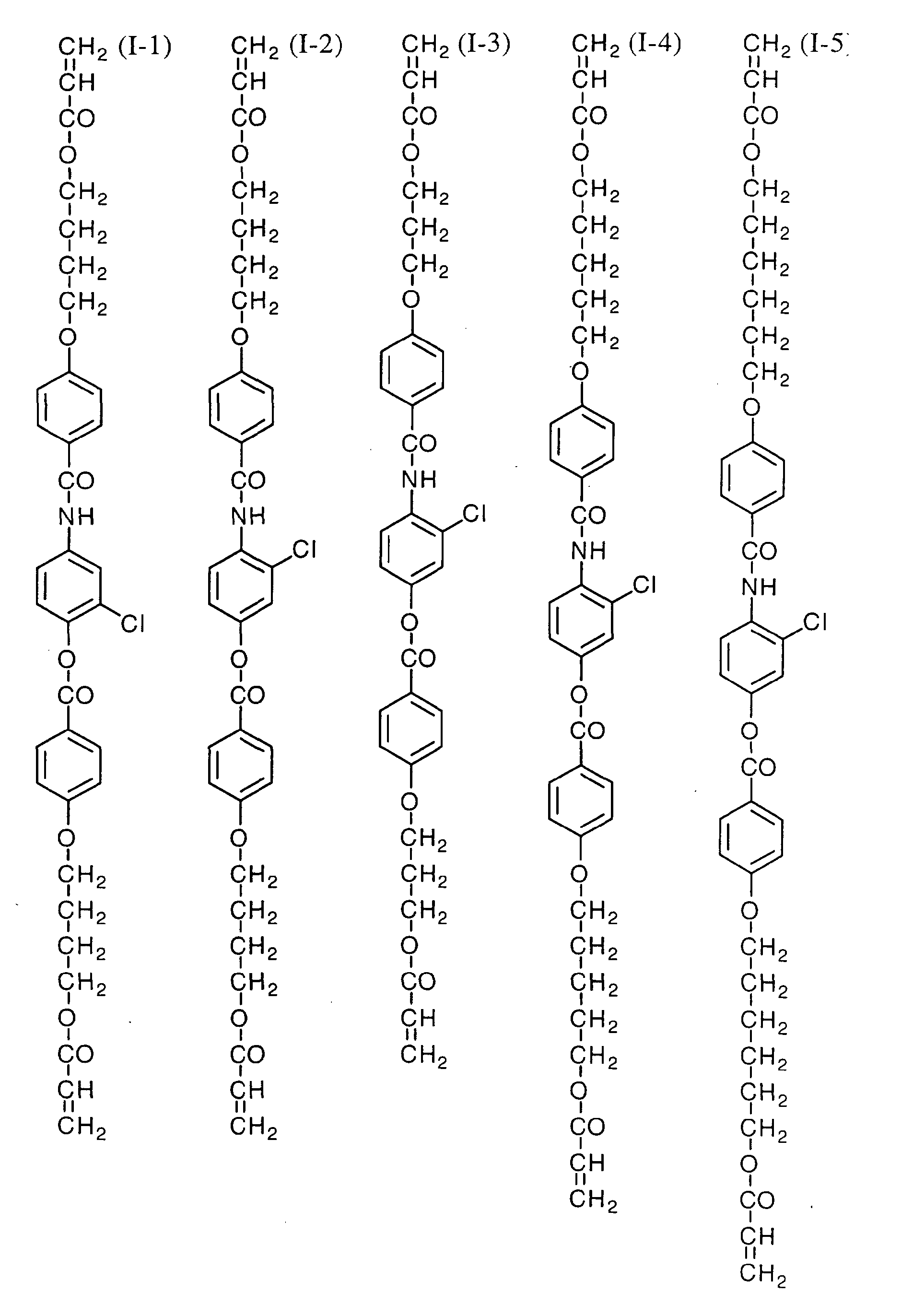

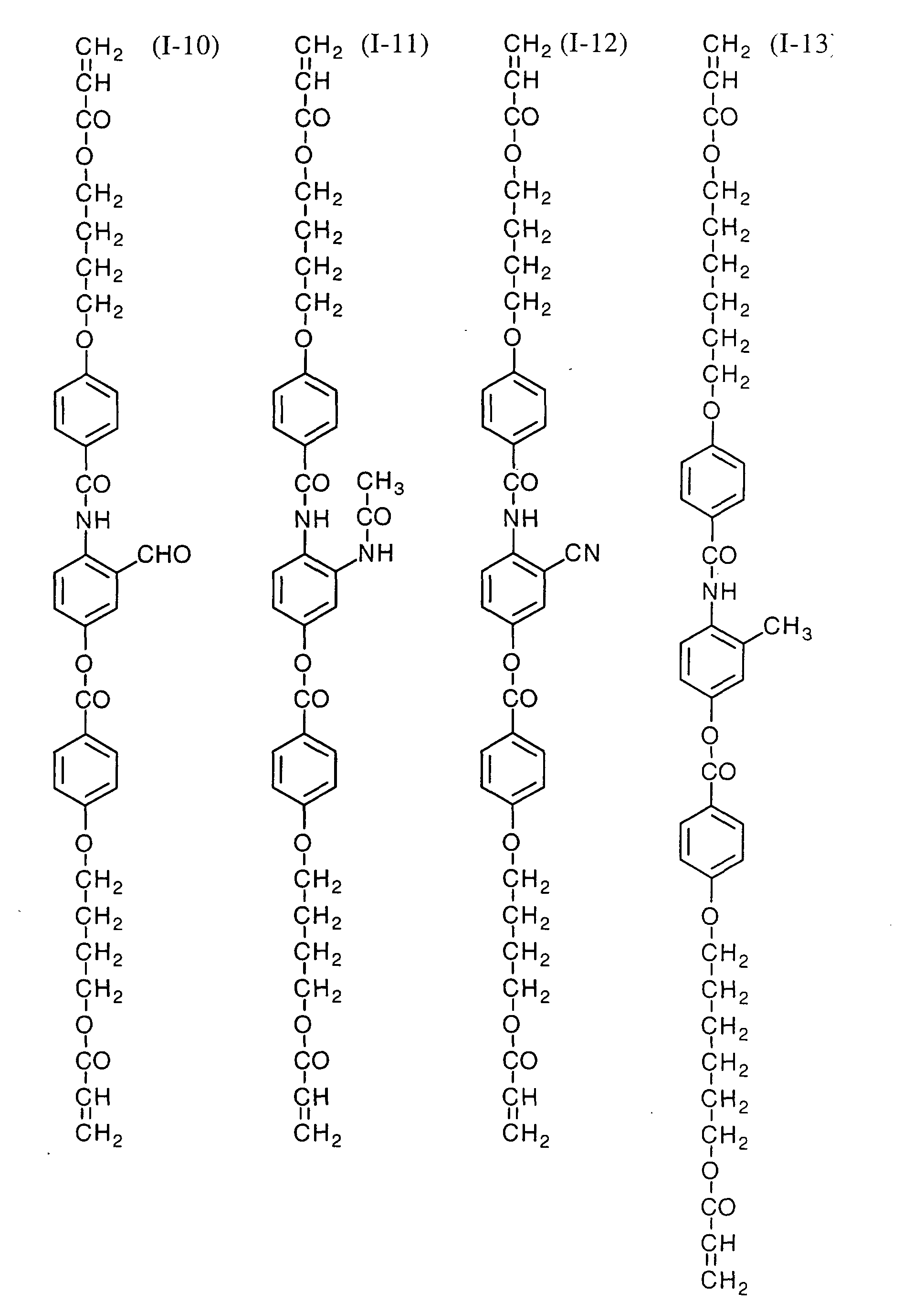


- The polymerizable liquid crystal compound represented by the formula (I) can be synthesized by referring known methods (for example, described in Methoden der Organischen Chemie [Houben-Weyl], Some Specific Methods [Thieme-Verlag, Stuttgart], Jikken Kagaku Koza and Shin-Jikken Kagaku Koza). The compounds can also be synthesized by referring to the descriptions of U.S. Patent Publication Nos. 4,683,327, 4,983,479, 5,622,648 and 5,770,107; W.O. Patent Nos. 95/22586, 97/00600 and 98/47979; and British Patent No. 2297549.
- An optically anisotropic element can be prepared by coating an orientation layer with a liquid crystal composition (coating solution) comprising the polymerizable liquid crystal compound represented by the formula (I) and then polymerizing the molecules of the liquid crystal compound to form a liquid crystal layer.
- The composition can be applied according to a conventional coating method such as an extrusion coating method, a direct gravure coating method, a reverse gravure coating method, a die coating method or a bar coating method.
- The liquid crystal molecules are fixed with the alignment maintained. The liquid crystal molecules are fixed by a polymerization reaction of the polymerizable groups (Q) in the molecules. The polymerization reaction can be classified into a thermal reaction using a thermal polymerization initiator and a photo reaction using a photo polymerization initiator. A photo polymerization reaction is preferred.
- Examples of the photo polymerization initiators include α-carbonyl compounds (described in US Patent Nos. 2,367,661, 2,367,670), acyloin ethers (described in US Patent No. 2,448,828), α-hydrocarbon substituted acyloin compounds (described in US Patent No. 2,722,512), polycyclic quinone compounds (described in US Patent Nos. 2,951,758, 3,046,127), combinations of triarylimidazoles and p-aminophenyl ketones (described in US Patent No. 3,549,367), acridine or phenazine compounds (described in Japanese Patent Provisional Publication No. 60(1985)-105667 and US Patent No. 4,239,850) and oxadiazole compounds (described in US Patent No. 4,212,970).
- The amount of the photo polymerization initiator is preferably in the range of 0.01 to 20 wt.%, and more preferably in the range of 0.5 to 5 wt.% based on the solid content of the coating solution.
- The light irradiation for the photo polymerization may be conducted with an ultraviolet ray.
- The exposure energy is preferably in the range of 20 to 50,000 mJ/cm2, and more preferably in the range of 100 to 800 mJ/cm2. The light irradiation can be conducted with the layer heated to accelerate the photo polymerization reaction.
- The liquid crystal layer has a thickness preferably in the range of 0.1 to 50 µm, more preferably 1 to 30 µm, and most preferably in the range of 5 to 20 µm.
- The orientation layer can be formed by rubbing treatment of an organic compound (preferably a polymer), oblique evaporation of an inorganic compound, formation of a micro groove layer, or stimulation of an organic compound (e.g., ω-tricosanoic acid, dioctadecylmethylammonium chloride, methyl stearate) according to a Langmuir-Blodgett method. Further, the aligning function of the orientation layer can be activated by applying an electric or magnetic field to the layer or irradiating the layer with light. The orientation layer is preferably formed by rubbing a polymer. The rubbing treatment can be conducted by rubbing a layer containing the aforementioned polymer with paper or cloth several times along a certain direction.
- The polymer used for the orientation layer is selected according to aimed alignment (particularly, aimed average inclined angle) of the liquid crystal molecules.
- For horizontally aligning the liquid crystal molecules (at an average inclined angle of 0 to 50°), a polymer that does not reduce the surface energy of the orientation layer (i.e., a polymer usually used for an orientation layer) is used.
- In contrast, for vertically aligning the liquid crystal molecules (at an average inclined angle of 50 to 90°), a polymer that reduces the surface energy of the orientation layer is used. That polymer preferably has a hydrocarbon group of 10 to 100 carbon atoms at the side chain.
- Concrete examples of the polymer are described in various publications concerning liquid crystal cells or optical compensatory sheets.
- The orientation layer has a thickness of preferably 0.01 to 5 µm, more preferably 0.05 to 1 µm.
- After the liquid crystal molecules are aligned with the orientation layer, the liquid crystal layer can be transferred onto the transparent support. The aligned and fixed liquid crystal molecules can keep the alignment without the orientation layer.
- For aligning the molecules at an average inclined angle less than 5°, neither rubbing treatment nor the orientation layer is needed. However, an orientation layer (described in Japanese Patent Provisional Publication No. 9(1997)-152509) that forms chemical bonding at the interface between the liquid crystal molecules and the layer may be provided to improve the adhesion. In that case, rubbing treatment is unnecessary.
- A transparent support is a glass plate or a polymer film, preferably a polymer film. The term "transparent" here means that light transmittance is not less than 80%.
- The transparent support has a thickness preferably in the range of 10 to 500 µm, and more preferably in the range of 50 to 200 µm.
- The transparent support can be subjected to a surface treatment (e.g., glow discharge-treatment, corona discharge treatment, ultraviolet (UV) treatment, flame treatment) to improve adhesion to a layer formed on the support (e.g., adhesive layer, orientation layer, liquid crystal layer).
- An ultraviolet absorber may be incorporated in the transparent support.
- An adhesive layer (undercoating layer) can be provided on the transparent support. Japanese Patent Provisional Publication 7(1995)-333433 describes the adhesive layer. The thickness of the adhesive layer is in the range of preferably 0.1 to 2 µm, more preferably 0.2 to 1 µm.
- The optically anisotropic element of the invention can be used as an optical compensatory sheet for liquid crystal displays of various modes. Examples of the display modes include TN (twisted nematic) mode, IPS (in-plane switching) mode, FLC (ferroelectric liquid crystal) mode, OCB (optically compensatory bend) mode, STN (super twisted nematic) mode, VA (vertically aligned) mode, GH (guest-host) mode and HAN (hybrid aligned nematic) mode.
- The optically anisotropic element can be also used as a polarizing prism (described in European Patent No. 428213).
- Further, the element can be used as a cholesteric polarizer (described in European Patent No. 606940).
- The polymerizable liquid crystal compound (I-1) was synthesized according to the following scheme. The compounds (a) to (d) can be synthesized according to a known method by referring to the above-described references.

- In 20 ml of tetrahydrofuran, 1.54 ml of methane sulfonylchloride was dissolved and cooled to -10°C. To the solution, a solution in which 5.5 g of the compound (d) and 3.75 ml of N-ethyldiisopropylamine were dissolved in 20 ml of tetrahydrofuran was dropwise added with the liquid temperature kept below 5°C. The mixture was stirred at room temperature for 30 minutes, and cooled again. After 3.75 ml of N-ethyldiisopropylamine and 0.3 g of 4-N,N-dimethylaminopyridine were added, a solution in which 1.43 g of 4-amino-2-chlorophenol was dissolved in 10 ml of tetrahydrofuran was dropwise added with the liquid temperature kept below 5°C. The mixture was stirred at room temperature for 3 hours, and poured into 300 ml of water. The reaction mixture was extracted with 200 ml of ethyl acetate, and the organic phase was collected and washed twice with water. After drying with sodium sulfate, the liquid was concentrated under reduced pressure. The formed crude product was recrystallized from ethyl acetate and n-hexane to obtain 2.3 g of the polymerizable liquid crystal compound (I-1). The structure of the obtained compound was confirmed by 1H-NMR and mass spectrometry. The polymerizable liquid crystal compound (I-1) exhibited monotropic phases. The phase transition temperatures were (crystal phase →) 127°C (→ isotropic liquid), (isotropic liquid →) 124°C (→ nematic phase →) and 105°C (→ crystal phase).
- In 20 ml of tetrahydrofuran, 1.54 ml of methane sulfonylchloride was dissolved and cooled to -10°C. To the solution, a solution in which 5.5 g of the compound (d) used in Example 1 and 3.75 ml of N-ethyldiisopropylamine were dissolved in 20 ml of tetrahydrofuran was dropwise added with the liquid temperature kept below 5°C. The mixture was stirred at room temperature for 30 minutes, and cooled again. After 3.75 ml of N-ethyldiisopropylamine and 0.3 g of 4-N,N-dimethylaminopyridine were added, a solution in which 1.63 g of 4-amino-3-bromophenol was dissolved in 10 ml of tetrahydrofuran was dropwise added with the liquid temperature kept below 5°C. The mixture was stirred at room temperature for 3 hours, and poured into 300 ml of water. The reaction mixture was extracted with 200 ml of ethyl acetate, and the organic phase was collected and washed twice with water. After drying with sodium sulfate, the liquid was concentrated under reduced pressure. The formed crude product was recrystallized from ethyl acetate and n-hexane to obtain 2.7 g of the polymerizable liquid crystal compound (1-24). The structure of the obtained compound was confirmed by 1H-NMR and mass spectrometry. The polymerizable liquid crystal compound (I-24) exhibited enantiotropic phase. The phase transition temperatures were (crystal phase →) 82°C (→ nematic phase →) and 137°C (→ isotropic liquid).
- The polymerizable liquid crystal compounds (I-2), (I-3), (I-5), (I-11), (I-12), (I-13), (I-15), (I-21) and (I-23) were prepared In the same manner as Example 1 or 2.
- The compounds (I-1), (I-2), (I-3), (I-5), (I-11), (I-12), (I-13), (I-15), (I-21), (I-23) and (I-24) were measured with respect to phase transition temperatures and birefringent indexes.
- Known polymerizable liquid crystal compounds (Ref-1, described in Advanced Materials, vol. 5, no. 2, pp. 108) and (Ref-2, described in U.S. Patent No. 5,770,107) were also measured with respect to phase transition temperatures and the birefringent indexes.
- The birefringence was measured by using an Abbe's refractometer according to a known method (described in Makromol. Chem., vol.190, pp.2255). The birefringence was measured at the temperature of 10°C lower than the phase transition temperature of isotropic liquid.
- The results are set forth in Table 1.
Polymerizable liquid crystal compound Phase transition temperature Crystal phase → nematic phase Nematic phase → isotropic liquid Birefringence (Δn) I-1 105°C 124°C 0.128 I-2 89°C 152°C 0.126 I-3 89°C 136°C 0.123 I-5 80°C 155°C 0.129 I-11 --- 130°C 0.122 I-12 127°C 141°C 0.121 I-13 88°C 148°C 0.125 I-15 92°C 106°C 0.123 I-21 110°C 166°C 0.209 I-23 93°C 123°C 0.122 I-24 82°C 137°C 0.125 Ref-1 100°C 109°C 0.131 Ref-2 97°C 176°C 0.207 
- An optically anisotropic element was prepared in the following manner according to Advanced Material, vol. 5, no. 2, pp. 107.
- A glass substrate was coated with polyimide (SE-150, Nissan Chemical Co., Ltd.), and subjected to rubbing treatment to form an orientation layer.
- In 700 µl of N-methylpyrrolidone, 300 mg of the compound (I-2) and 50 mg of ω,ω-dimethoxy-ω-phenylacetophenone were dissolved. After the prepared solution was dropped on the orientation layer, spin-coating was conducted at 1,000 rpm. The solvent was evaporated by heating at 100°C for 30 minutes. The surface of the thus-treated glass substrate was observed with a polarizing microscope, to find that the polymerizable liquid crystal molecules were aligned almost parallel to the rubbing direction.
- The aligned molecules were then exposed to ultraviolet light from a high pressure mercury lamp under nitrogen gas atmosphere, to polymerize the molecules.
- The thus-prepared optically anisotropic element was observed with a polarizing microscope, to find that the alignment had no defect such as domain border or inversion wall.
- Two polarizers were arranged in cross-Nicol position, and the optically anisotropic element was placed between them. With the thus-placed element rotated, it was observed whether light passed through the element and the polarizers. As a result, the element alternately gave brightness and darkness every 45 degree.
Claims (14)
- A polymerizable liquid crystal compound represented by the formula (I):
- The polymerizable liquid crystal compound as defined in claim 1, wherein each of Q1 and Q2 in the formula (I) independently is a polymerizable group selected from the group consisting of (Q-1) to (Q-17).


- The polymerizable liquid crystal compound as defined in claim 1 or 2, wherein each of Q1 and Q2 in the formula (I) independently is an ethylenically unsaturated polymerizable group.
- The polymerizable liquid crystal compound as defined in any one of claims 1 to 3, wherein each of L1 and L2 in the formula (I) independently is a divalent linking group selected from the group consisting of -O-, -S-, -CO-, -NR2-, a divalent chain group, a divalent cyclic group and a combination thereof in which R2 is hydrogen or an alkyl group having 1 to 7 carbon atoms.
- The polymerizable liquid crystal compound as defined in claim 4, wherein the divalent chain group is an alkylene group, an alkenylene group or an alkynylene group.
- The polymerizable liquid crystal compound as defined in claim 4, wherein the divalent cyclic group has a five-membered, six-membered or seven-membered divalent aromatic, aliphatic or heterocyclic ring, which can be condensed with another ring.
- The polymerizable liquid crystal compound as defined in any one of claims 1 to 6, wherein L2 in the formula (I) is -O-CO-(CH=CH)m-Cy3-L3- or -(CH=CH)m-CO-O-Cy3-L3- in which m is an integer of 0 or 1, Cy3 is a divalent cyclic group and L3 is a divalent linking group.
- The polymerizable liquid crystal compound as defined in claim 7, wherein L3 is a divalent linking group selected from the group consisting of -O-, -S-, -CO-, -NR2, a divalent chain group and a combination thereof.
- The polymerizable liquid crystal compound as defined in claim 8, wherein L3 is -O-CH-O-CO-, in which CH is a divalent chain group.
- The polymerizable liquid crystal compound as defined in any one of claims 1 to 9, wherein each of Cy1 and Cy2 in the formula (I) independently is 1,4-phenylene or 1,4-cyclohexylene.
- The polymerizable liquid crystal compound as defined in any one of claims 1 to-10, wherein R1 in the formula (I) is hydrogen.
- The polymerizable liquid crystal compound as defined in claim 1, wherein the compound is represented by the formula (IIa) or (IIb):
- The polymerizable liquid crystal compound as defined in claim 1, wherein the compound is represented by the formula (IIIa) or (IIIb):
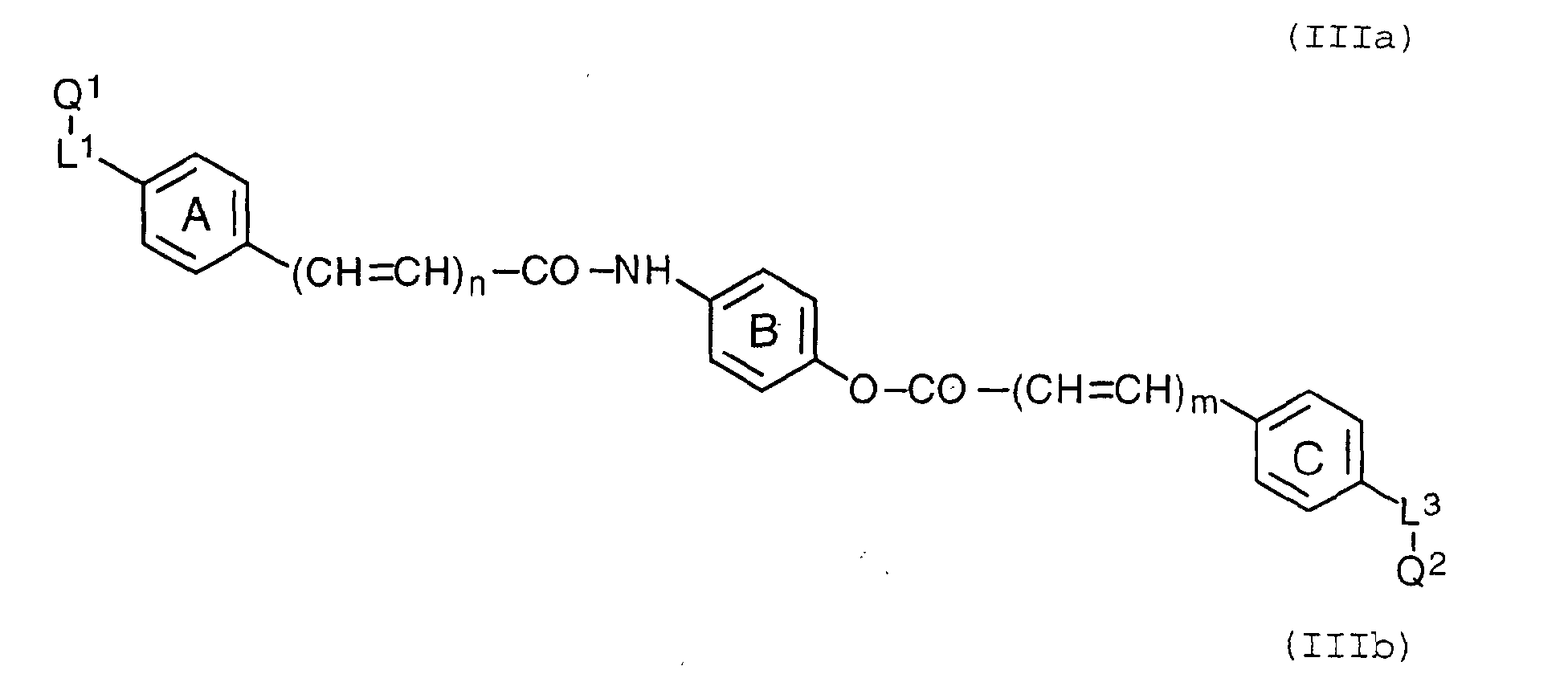 in which each of Q1 and Q2 independently is a polymerizable group; each of L1 and L3 independently is a divalent linking group; each of n and m independently is 0 or 1; and each of the benzene rings A, B and C can have a substituent group.
- An optically anisotropic element comprising a transparent support and a liquid crystal layer formed by polymerization of a polymerizable liquid crystal compound, wherein the polymerizable liquid crystal compound is represented by the formula (I):
Applications Claiming Priority (2)
| Application Number | Priority Date | Filing Date | Title |
|---|---|---|---|
| JP2000068479 | 2000-03-13 | ||
| JP2000068479 | 2000-03-13 |
Publications (2)
| Publication Number | Publication Date |
|---|---|
| EP1134270A1 true EP1134270A1 (en) | 2001-09-19 |
| EP1134270B1 EP1134270B1 (en) | 2003-07-23 |
Family
ID=18587532
Family Applications (1)
| Application Number | Title | Priority Date | Filing Date |
|---|---|---|---|
| EP01105440A Expired - Lifetime EP1134270B1 (en) | 2000-03-13 | 2001-03-13 | Polymerizable liquid crystal compound having amido bond between two cyclic groups |
Country Status (4)
| Country | Link |
|---|---|
| US (1) | US6613246B2 (en) |
| EP (1) | EP1134270B1 (en) |
| AT (1) | ATE245686T1 (en) |
| DE (1) | DE60100483T2 (en) |
Cited By (3)
| Publication number | Priority date | Publication date | Assignee | Title |
|---|---|---|---|---|
| WO2007029885A1 (en) * | 2005-09-08 | 2007-03-15 | Fujifilm Corporation | Transfer material, process for producing a color filter using the same, a color filter and liquid crystal display device |
| US7264749B2 (en) | 2002-04-29 | 2007-09-04 | Basf Aktiengesellschaft | Alkyne compounds |
| US8608977B2 (en) | 2008-06-17 | 2013-12-17 | Basf Se | Polymerizable chiral compounds comprising 2,6-naphthyl and isomannitol units, and use thereof as chiral dopants |
Families Citing this family (7)
| Publication number | Priority date | Publication date | Assignee | Title |
|---|---|---|---|---|
| ATE470166T1 (en) | 2002-02-13 | 2010-06-15 | Merck Patent Gmbh | METHOD FOR PRODUCING AN ANISOTROPIC POLYMER FILM ON A SUBSTRATE HAVING A STRUCTURED SURFACE |
| EP2159611B1 (en) * | 2003-11-06 | 2018-01-03 | Sumitomo Chemical Company, Limited | Polymerizable liquid crystal and oriented polymer film |
| US7390540B2 (en) * | 2004-07-21 | 2008-06-24 | Hewlett-Packard Development Company, L.P. | Method for preparation of anisotropic materials |
| JP5411771B2 (en) * | 2010-03-29 | 2014-02-12 | 富士フイルム株式会社 | Compound, polymerizable composition, polymer, and film |
| US11680207B2 (en) * | 2015-03-03 | 2023-06-20 | The Trustees Of The University Of Pennsylvania | Direct mapping of local director field of nematic liquid crystals at the nanoscale |
| CN110325507B (en) * | 2017-03-14 | 2022-08-16 | 捷恩智株式会社 | Polymerizable compound, polymerizable composition, liquid crystal composite, optically anisotropic body, and liquid crystal display element |
| KR102889627B1 (en) | 2019-03-28 | 2025-11-21 | 니폰 가야꾸 가부시끼가이샤 | Optical Films and Eyewear |
Citations (2)
| Publication number | Priority date | Publication date | Assignee | Title |
|---|---|---|---|---|
| EP0617110A1 (en) * | 1993-03-26 | 1994-09-28 | Nippon Paint Co., Ltd. | Liquid crystal monomer compound and polymer obtained therefrom |
| US5770107A (en) * | 1995-10-05 | 1998-06-23 | Merck Patent Gesellschaft Mit Beschrankter Haftung | Reactive liquid crystalline compound |
Family Cites Families (2)
| Publication number | Priority date | Publication date | Assignee | Title |
|---|---|---|---|---|
| EP0563403B1 (en) * | 1991-10-22 | 2001-05-30 | Seiko Epson Corporation | Display element and its manufacturing method |
| JPH08278488A (en) * | 1995-04-04 | 1996-10-22 | Sharp Corp | Liquid crystal display device and manufacturing method thereof |
-
2001
- 2001-03-12 US US09/803,020 patent/US6613246B2/en not_active Expired - Lifetime
- 2001-03-13 EP EP01105440A patent/EP1134270B1/en not_active Expired - Lifetime
- 2001-03-13 AT AT01105440T patent/ATE245686T1/en not_active IP Right Cessation
- 2001-03-13 DE DE60100483T patent/DE60100483T2/en not_active Expired - Lifetime
Patent Citations (2)
| Publication number | Priority date | Publication date | Assignee | Title |
|---|---|---|---|---|
| EP0617110A1 (en) * | 1993-03-26 | 1994-09-28 | Nippon Paint Co., Ltd. | Liquid crystal monomer compound and polymer obtained therefrom |
| US5770107A (en) * | 1995-10-05 | 1998-06-23 | Merck Patent Gesellschaft Mit Beschrankter Haftung | Reactive liquid crystalline compound |
Non-Patent Citations (2)
| Title |
|---|
| A.S. GRIFFIN , T.R. BRITT: "MESOGENIC POLYMERS ,THERMOTROPIC LIQUID CRYSTALS AND ANALOGOUS SMALL MOLECULE DIAMIDES", MOLECULAR CRYSTAL LIQUID CRYSTAL (LETTERS), GORDON & BREACH SCIENCE PUBLISHERS ,USA, vol. 82, 1982, pages 145 - 150, XP002172282 * |
| S.M. AHARONI: "HYDROGEN-BONDED HIGHLY REGULAR STRICTLY ALTERMNATING ALIPHATIC-AROMATIC LIQUID-CRYSTALLINE POLY(ESTER AMIDES)", MACROMOLECULES (AMERICAN CHEMICAL SOCIETY) EASTON ,USA, vol. 21, 1988, pages 1941 - 1961, XP002172281 * |
Cited By (4)
| Publication number | Priority date | Publication date | Assignee | Title |
|---|---|---|---|---|
| US7264749B2 (en) | 2002-04-29 | 2007-09-04 | Basf Aktiengesellschaft | Alkyne compounds |
| WO2007029885A1 (en) * | 2005-09-08 | 2007-03-15 | Fujifilm Corporation | Transfer material, process for producing a color filter using the same, a color filter and liquid crystal display device |
| US8189138B2 (en) | 2005-09-08 | 2012-05-29 | Fujifilm Corporation | Transfer material, process for producing a color filter using the same, a color filter and liquid crystal display device |
| US8608977B2 (en) | 2008-06-17 | 2013-12-17 | Basf Se | Polymerizable chiral compounds comprising 2,6-naphthyl and isomannitol units, and use thereof as chiral dopants |
Also Published As
| Publication number | Publication date |
|---|---|
| US6613246B2 (en) | 2003-09-02 |
| US20010035520A1 (en) | 2001-11-01 |
| EP1134270B1 (en) | 2003-07-23 |
| DE60100483T2 (en) | 2004-04-15 |
| DE60100483D1 (en) | 2003-08-28 |
| ATE245686T1 (en) | 2003-08-15 |
Similar Documents
| Publication | Publication Date | Title |
|---|---|---|
| JP4309072B2 (en) | Polymerizable liquid crystal compound and optically anisotropic element | |
| US6338808B1 (en) | Liquid crystal composition comprising liquid crystal molecules and alignment promoter | |
| JP4592225B2 (en) | Liquid crystal composition and optically anisotropic element | |
| EP1170353B1 (en) | Liquid crystal composition comprising liquid crystal molecules and aligment promoter | |
| CN100451693C (en) | Dichroic guest-host polarizers comprising oriented polymer films | |
| KR101183855B1 (en) | Liquid crystal compound comprising two condensed and substituted rings | |
| JP2692035B2 (en) | Thin film manufacturing method | |
| CN105518035B (en) | Compounds, polymers, liquid crystal alignment films, liquid crystal display elements, and optically anisotropic bodies | |
| JP2002145830A (en) | Polymerizable liquid crystal compound, polymerizable liquid crystal composition containing the compound, and polymer thereof | |
| US20040151846A1 (en) | Optical compensatory sheet comprising transparent support and optically anisotropic layer | |
| KR20170040291A (en) | Liquid crystalline media having homeotropic alignment | |
| JP5816232B2 (en) | Liquid crystal composition, method for producing the same, and film | |
| TW201346408A (en) | Liquid crystal display element | |
| EP1134270B1 (en) | Polymerizable liquid crystal compound having amido bond between two cyclic groups | |
| US7396486B2 (en) | Polymerizable mixtures | |
| JP2000345164A (en) | Liquid crystal orientation promoting agent, liquid crystal composition and optically anisotropic element | |
| JP2003055661A (en) | Polymerizable liquid crystal composition and optically anisotropic body using the same | |
| JP6358400B2 (en) | Polymer for photo-alignment film, polymer solution, photo-alignment film, optical anisotropic body, and liquid crystal display element | |
| CN109072078A (en) | Bimesogenic compound and mesogenic media | |
| JP3955366B2 (en) | Triphenylene derivative, composition containing the same, and optically anisotropic material containing the same | |
| JP2000034251A (en) | Optical compensator sheet, liquid crystal display element, discotic compound, and liquid crystal composition | |
| JP2005128503A (en) | Phase difference plate, its production method, polarizing plate using it and image display device | |
| JP2002012870A (en) | Phenylacetylene polymer, optically anisotropic element and optical or liquid crystal element | |
| JP2006259212A (en) | Retardation plate, its manufacturing method, polarizing plate and image display apparatus using the same | |
| JP2003147020A (en) | Liquid crystal gel polymerized polymer, optically anisotropic substance, liquid crystal or optical element |
Legal Events
| Date | Code | Title | Description |
|---|---|---|---|
| PUAI | Public reference made under article 153(3) epc to a published international application that has entered the european phase |
Free format text: ORIGINAL CODE: 0009012 |
|
| AK | Designated contracting states |
Kind code of ref document: A1 Designated state(s): AT BE CH CY DE DK ES FI FR GB GR IE IT LI LU MC NL PT SE TR |
|
| AX | Request for extension of the european patent |
Free format text: AL;LT;LV;MK;RO;SI |
|
| 17P | Request for examination filed |
Effective date: 20020222 |
|
| AKX | Designation fees paid |
Free format text: AT BE CH CY DE DK ES FI FR GB GR IE IT LI LU MC NL PT SE TR |
|
| GRAH | Despatch of communication of intention to grant a patent |
Free format text: ORIGINAL CODE: EPIDOS IGRA |
|
| GRAH | Despatch of communication of intention to grant a patent |
Free format text: ORIGINAL CODE: EPIDOS IGRA |
|
| GRAA | (expected) grant |
Free format text: ORIGINAL CODE: 0009210 |
|
| AK | Designated contracting states |
Designated state(s): AT BE CH CY DE DK ES FI FR GB GR IE IT LI LU MC NL PT SE TR |
|
| PG25 | Lapsed in a contracting state [announced via postgrant information from national office to epo] |
Ref country code: AT Free format text: LAPSE BECAUSE OF FAILURE TO SUBMIT A TRANSLATION OF THE DESCRIPTION OR TO PAY THE FEE WITHIN THE PRESCRIBED TIME-LIMIT Effective date: 20030723 Ref country code: CY Free format text: LAPSE BECAUSE OF FAILURE TO SUBMIT A TRANSLATION OF THE DESCRIPTION OR TO PAY THE FEE WITHIN THE PRESCRIBED TIME-LIMIT Effective date: 20030723 Ref country code: IT Free format text: LAPSE BECAUSE OF FAILURE TO SUBMIT A TRANSLATION OF THE DESCRIPTION OR TO PAY THE FEE WITHIN THE PRESCRIBED TIME-LIMIT;WARNING: LAPSES OF ITALIAN PATENTS WITH EFFECTIVE DATE BEFORE 2007 MAY HAVE OCCURRED AT ANY TIME BEFORE 2007. THE CORRECT EFFECTIVE DATE MAY BE DIFFERENT FROM THE ONE RECORDED. Effective date: 20030723 Ref country code: TR Free format text: LAPSE BECAUSE OF FAILURE TO SUBMIT A TRANSLATION OF THE DESCRIPTION OR TO PAY THE FEE WITHIN THE PRESCRIBED TIME-LIMIT Effective date: 20030723 Ref country code: FR Free format text: LAPSE BECAUSE OF FAILURE TO SUBMIT A TRANSLATION OF THE DESCRIPTION OR TO PAY THE FEE WITHIN THE PRESCRIBED TIME-LIMIT Effective date: 20030723 Ref country code: NL Free format text: LAPSE BECAUSE OF FAILURE TO SUBMIT A TRANSLATION OF THE DESCRIPTION OR TO PAY THE FEE WITHIN THE PRESCRIBED TIME-LIMIT Effective date: 20030723 Ref country code: FI Free format text: LAPSE BECAUSE OF FAILURE TO SUBMIT A TRANSLATION OF THE DESCRIPTION OR TO PAY THE FEE WITHIN THE PRESCRIBED TIME-LIMIT Effective date: 20030723 Ref country code: BE Free format text: LAPSE BECAUSE OF FAILURE TO SUBMIT A TRANSLATION OF THE DESCRIPTION OR TO PAY THE FEE WITHIN THE PRESCRIBED TIME-LIMIT Effective date: 20030723 |
|
| REG | Reference to a national code |
Ref country code: GB Ref legal event code: FG4D |
|
| REG | Reference to a national code |
Ref country code: CH Ref legal event code: EP |
|
| REG | Reference to a national code |
Ref country code: IE Ref legal event code: FG4D |
|
| REF | Corresponds to: |
Ref document number: 60100483 Country of ref document: DE Date of ref document: 20030828 Kind code of ref document: P |
|
| REG | Reference to a national code |
Ref country code: CH Ref legal event code: NV Representative=s name: BOVARD AG PATENTANWAELTE |
|
| PG25 | Lapsed in a contracting state [announced via postgrant information from national office to epo] |
Ref country code: GR Free format text: LAPSE BECAUSE OF FAILURE TO SUBMIT A TRANSLATION OF THE DESCRIPTION OR TO PAY THE FEE WITHIN THE PRESCRIBED TIME-LIMIT Effective date: 20031023 Ref country code: DK Free format text: LAPSE BECAUSE OF FAILURE TO SUBMIT A TRANSLATION OF THE DESCRIPTION OR TO PAY THE FEE WITHIN THE PRESCRIBED TIME-LIMIT Effective date: 20031023 Ref country code: SE Free format text: LAPSE BECAUSE OF FAILURE TO SUBMIT A TRANSLATION OF THE DESCRIPTION OR TO PAY THE FEE WITHIN THE PRESCRIBED TIME-LIMIT Effective date: 20031023 |
|
| PG25 | Lapsed in a contracting state [announced via postgrant information from national office to epo] |
Ref country code: ES Free format text: LAPSE BECAUSE OF FAILURE TO SUBMIT A TRANSLATION OF THE DESCRIPTION OR TO PAY THE FEE WITHIN THE PRESCRIBED TIME-LIMIT Effective date: 20031103 |
|
| NLV1 | Nl: lapsed or annulled due to failure to fulfill the requirements of art. 29p and 29m of the patents act | ||
| PG25 | Lapsed in a contracting state [announced via postgrant information from national office to epo] |
Ref country code: PT Free format text: LAPSE BECAUSE OF FAILURE TO SUBMIT A TRANSLATION OF THE DESCRIPTION OR TO PAY THE FEE WITHIN THE PRESCRIBED TIME-LIMIT Effective date: 20031223 |
|
| PG25 | Lapsed in a contracting state [announced via postgrant information from national office to epo] |
Ref country code: LU Free format text: LAPSE BECAUSE OF NON-PAYMENT OF DUE FEES Effective date: 20040313 |
|
| PG25 | Lapsed in a contracting state [announced via postgrant information from national office to epo] |
Ref country code: IE Free format text: LAPSE BECAUSE OF NON-PAYMENT OF DUE FEES Effective date: 20040315 |
|
| PG25 | Lapsed in a contracting state [announced via postgrant information from national office to epo] |
Ref country code: MC Free format text: LAPSE BECAUSE OF NON-PAYMENT OF DUE FEES Effective date: 20040331 |
|
| PLBE | No opposition filed within time limit |
Free format text: ORIGINAL CODE: 0009261 |
|
| STAA | Information on the status of an ep patent application or granted ep patent |
Free format text: STATUS: NO OPPOSITION FILED WITHIN TIME LIMIT |
|
| 26N | No opposition filed |
Effective date: 20040426 |
|
| EN | Fr: translation not filed | ||
| REG | Reference to a national code |
Ref country code: IE Ref legal event code: MM4A |
|
| REG | Reference to a national code |
Ref country code: GB Ref legal event code: 732E |
|
| REG | Reference to a national code |
Ref country code: CH Ref legal event code: PFA Owner name: FUJI PHOTO FILM CO., LTD. Free format text: FUJI PHOTO FILM CO., LTD.#210 NAKANUMA, MINAMI-ASHIGARA-SHI#KANAGAWA 250-0123 (JP) -TRANSFER TO- FUJI PHOTO FILM CO., LTD.#210 NAKANUMA, MINAMI-ASHIGARA-SHI#KANAGAWA 250-0123 (JP) |
|
| PGFP | Annual fee paid to national office [announced via postgrant information from national office to epo] |
Ref country code: CH Payment date: 20170314 Year of fee payment: 17 Ref country code: DE Payment date: 20170307 Year of fee payment: 17 |
|
| PGFP | Annual fee paid to national office [announced via postgrant information from national office to epo] |
Ref country code: GB Payment date: 20170308 Year of fee payment: 17 |
|
| REG | Reference to a national code |
Ref country code: DE Ref legal event code: R119 Ref document number: 60100483 Country of ref document: DE |
|
| REG | Reference to a national code |
Ref country code: CH Ref legal event code: PL |
|
| GBPC | Gb: european patent ceased through non-payment of renewal fee |
Effective date: 20180313 |
|
| PG25 | Lapsed in a contracting state [announced via postgrant information from national office to epo] |
Ref country code: DE Free format text: LAPSE BECAUSE OF NON-PAYMENT OF DUE FEES Effective date: 20181002 |
|
| PG25 | Lapsed in a contracting state [announced via postgrant information from national office to epo] |
Ref country code: LI Free format text: LAPSE BECAUSE OF NON-PAYMENT OF DUE FEES Effective date: 20180331 Ref country code: CH Free format text: LAPSE BECAUSE OF NON-PAYMENT OF DUE FEES Effective date: 20180331 Ref country code: GB Free format text: LAPSE BECAUSE OF NON-PAYMENT OF DUE FEES Effective date: 20180313 |