EP1134235A1 - Group 8, 9 or 10 olefin copolymerization catalyst - Google Patents
Group 8, 9 or 10 olefin copolymerization catalyst Download PDFInfo
- Publication number
- EP1134235A1 EP1134235A1 EP00302214A EP00302214A EP1134235A1 EP 1134235 A1 EP1134235 A1 EP 1134235A1 EP 00302214 A EP00302214 A EP 00302214A EP 00302214 A EP00302214 A EP 00302214A EP 1134235 A1 EP1134235 A1 EP 1134235A1
- Authority
- EP
- European Patent Office
- Prior art keywords
- group
- radical
- process according
- alkyl
- independently selected
- Prior art date
- Legal status (The legal status is an assumption and is not a legal conclusion. Google has not performed a legal analysis and makes no representation as to the accuracy of the status listed.)
- Granted
Links
- 239000003054 catalyst Substances 0.000 title claims description 33
- 150000001336 alkenes Chemical class 0.000 title claims description 9
- 238000007334 copolymerization reaction Methods 0.000 title description 5
- JRZJOMJEPLMPRA-UHFFFAOYSA-N olefin Natural products CCCCCCCC=C JRZJOMJEPLMPRA-UHFFFAOYSA-N 0.000 title description 5
- 229910052751 metal Inorganic materials 0.000 claims abstract description 29
- 239000002184 metal Substances 0.000 claims abstract description 28
- -1 alkyl silyl radicals Chemical class 0.000 claims description 102
- 239000012190 activator Substances 0.000 claims description 53
- 238000000034 method Methods 0.000 claims description 47
- 238000006116 polymerization reaction Methods 0.000 claims description 35
- ZOXJGFHDIHLPTG-UHFFFAOYSA-N Boron Chemical compound [B] ZOXJGFHDIHLPTG-UHFFFAOYSA-N 0.000 claims description 33
- 229910052796 boron Inorganic materials 0.000 claims description 33
- 239000003446 ligand Substances 0.000 claims description 31
- 150000001875 compounds Chemical class 0.000 claims description 25
- BTBUEUYNUDRHOZ-UHFFFAOYSA-N Borate Chemical compound [O-]B([O-])[O-] BTBUEUYNUDRHOZ-UHFFFAOYSA-N 0.000 claims description 24
- WYURNTSHIVDZCO-UHFFFAOYSA-N Tetrahydrofuran Chemical compound C1CCOC1 WYURNTSHIVDZCO-UHFFFAOYSA-N 0.000 claims description 24
- 229910052757 nitrogen Inorganic materials 0.000 claims description 21
- 239000002516 radical scavenger Substances 0.000 claims description 18
- 125000004435 hydrogen atom Chemical group [H]* 0.000 claims description 16
- 229910052782 aluminium Inorganic materials 0.000 claims description 15
- 125000000524 functional group Chemical group 0.000 claims description 15
- KWKAKUADMBZCLK-UHFFFAOYSA-N 1-octene Chemical compound CCCCCCC=C KWKAKUADMBZCLK-UHFFFAOYSA-N 0.000 claims description 14
- OLFPYUPGPBITMH-UHFFFAOYSA-N tritylium Chemical compound C1=CC=CC=C1[C+](C=1C=CC=CC=1)C1=CC=CC=C1 OLFPYUPGPBITMH-UHFFFAOYSA-N 0.000 claims description 14
- 239000004711 α-olefin Substances 0.000 claims description 14
- YLQBMQCUIZJEEH-UHFFFAOYSA-N tetrahydrofuran Natural products C=1C=COC=1 YLQBMQCUIZJEEH-UHFFFAOYSA-N 0.000 claims description 12
- 125000005843 halogen group Chemical group 0.000 claims description 11
- 239000000178 monomer Substances 0.000 claims description 11
- 125000004432 carbon atom Chemical group C* 0.000 claims description 9
- 125000001424 substituent group Chemical group 0.000 claims description 9
- 229910001868 water Inorganic materials 0.000 claims description 9
- 239000000203 mixture Substances 0.000 claims description 7
- 229910052759 nickel Inorganic materials 0.000 claims description 7
- LIKMAJRDDDTEIG-UHFFFAOYSA-N 1-hexene Chemical compound CCCCC=C LIKMAJRDDDTEIG-UHFFFAOYSA-N 0.000 claims description 6
- 239000002168 alkylating agent Substances 0.000 claims description 6
- 229940100198 alkylating agent Drugs 0.000 claims description 6
- XAGFODPZIPBFFR-UHFFFAOYSA-N aluminium Chemical compound [Al] XAGFODPZIPBFFR-UHFFFAOYSA-N 0.000 claims description 6
- 229910052731 fluorine Inorganic materials 0.000 claims description 6
- 125000001153 fluoro group Chemical group F* 0.000 claims description 6
- 125000000008 (C1-C10) alkyl group Chemical group 0.000 claims description 5
- 125000004178 (C1-C4) alkyl group Chemical group 0.000 claims description 5
- 150000005840 aryl radicals Chemical class 0.000 claims description 5
- XLYOFNOQVPJJNP-UHFFFAOYSA-N water Substances O XLYOFNOQVPJJNP-UHFFFAOYSA-N 0.000 claims description 5
- CIUQDSCDWFSTQR-UHFFFAOYSA-N [C]1=CC=CC=C1 Chemical compound [C]1=CC=CC=C1 CIUQDSCDWFSTQR-UHFFFAOYSA-N 0.000 claims description 4
- 229910052799 carbon Inorganic materials 0.000 claims description 4
- 239000003153 chemical reaction reagent Substances 0.000 claims description 4
- 229910052742 iron Inorganic materials 0.000 claims description 4
- 230000007935 neutral effect Effects 0.000 claims description 4
- OLRJXMHANKMLTD-UHFFFAOYSA-N silyl Chemical compound [SiH3] OLRJXMHANKMLTD-UHFFFAOYSA-N 0.000 claims description 4
- 125000005234 alkyl aluminium group Chemical group 0.000 claims description 3
- 230000003647 oxidation Effects 0.000 claims description 3
- 238000007254 oxidation reaction Methods 0.000 claims description 3
- 229910052763 palladium Inorganic materials 0.000 claims description 3
- LMBFAGIMSUYTBN-MPZNNTNKSA-N teixobactin Chemical compound C([C@H](C(=O)N[C@@H]([C@@H](C)CC)C(=O)N[C@@H](CO)C(=O)N[C@H](CCC(N)=O)C(=O)N[C@H]([C@@H](C)CC)C(=O)N[C@@H]([C@@H](C)CC)C(=O)N[C@@H](CO)C(=O)N[C@H]1C(N[C@@H](C)C(=O)N[C@@H](C[C@@H]2NC(=N)NC2)C(=O)N[C@H](C(=O)O[C@H]1C)[C@@H](C)CC)=O)NC)C1=CC=CC=C1 LMBFAGIMSUYTBN-MPZNNTNKSA-N 0.000 claims description 3
- 125000000999 tert-butyl group Chemical group [H]C([H])([H])C(*)(C([H])([H])[H])C([H])([H])[H] 0.000 claims description 3
- 125000004665 trialkylsilyl group Chemical group 0.000 claims description 3
- 239000003795 chemical substances by application Substances 0.000 claims description 2
- WCYWZMWISLQXQU-UHFFFAOYSA-N methyl Chemical compound [CH3] WCYWZMWISLQXQU-UHFFFAOYSA-N 0.000 claims 3
- DCERHCFNWRGHLK-UHFFFAOYSA-N C[Si](C)C Chemical compound C[Si](C)C DCERHCFNWRGHLK-UHFFFAOYSA-N 0.000 claims 2
- 150000001450 anions Chemical class 0.000 claims 2
- 239000007818 Grignard reagent Substances 0.000 claims 1
- 150000004795 grignard reagents Chemical class 0.000 claims 1
- 229920000098 polyolefin Polymers 0.000 claims 1
- 239000002243 precursor Substances 0.000 claims 1
- 229920001519 homopolymer Polymers 0.000 abstract description 3
- 229920000089 Cyclic olefin copolymer Polymers 0.000 abstract description 2
- 125000004076 pyridyl group Chemical group 0.000 abstract description 2
- YXFVVABEGXRONW-UHFFFAOYSA-N Toluene Chemical compound CC1=CC=CC=C1 YXFVVABEGXRONW-UHFFFAOYSA-N 0.000 description 123
- OKKJLVBELUTLKV-UHFFFAOYSA-N Methanol Chemical compound OC OKKJLVBELUTLKV-UHFFFAOYSA-N 0.000 description 45
- 238000006243 chemical reaction Methods 0.000 description 33
- VGGSQFUCUMXWEO-UHFFFAOYSA-N Ethene Chemical compound C=C VGGSQFUCUMXWEO-UHFFFAOYSA-N 0.000 description 25
- 239000005977 Ethylene Substances 0.000 description 25
- 239000000243 solution Substances 0.000 description 25
- SEDZOYHHAIAQIW-UHFFFAOYSA-N trimethylsilyl azide Chemical compound C[Si](C)(C)N=[N+]=[N-] SEDZOYHHAIAQIW-UHFFFAOYSA-N 0.000 description 21
- 229920000642 polymer Polymers 0.000 description 20
- 230000015572 biosynthetic process Effects 0.000 description 19
- IJGRMHOSHXDMSA-UHFFFAOYSA-N Atomic nitrogen Chemical compound N#N IJGRMHOSHXDMSA-UHFFFAOYSA-N 0.000 description 18
- UHOVQNZJYSORNB-UHFFFAOYSA-N Benzene Chemical compound C1=CC=CC=C1 UHOVQNZJYSORNB-UHFFFAOYSA-N 0.000 description 18
- 150000004698 iron complex Chemical class 0.000 description 15
- IMNFDUFMRHMDMM-UHFFFAOYSA-N N-Heptane Chemical compound CCCCCCC IMNFDUFMRHMDMM-UHFFFAOYSA-N 0.000 description 14
- 150000004696 coordination complex Chemical class 0.000 description 14
- 230000000694 effects Effects 0.000 description 14
- 239000002904 solvent Substances 0.000 description 14
- 230000004913 activation Effects 0.000 description 13
- VLKZOEOYAKHREP-UHFFFAOYSA-N n-Hexane Chemical compound CCCCCC VLKZOEOYAKHREP-UHFFFAOYSA-N 0.000 description 12
- 229920006395 saturated elastomer Polymers 0.000 description 12
- 239000007787 solid Substances 0.000 description 12
- 238000005160 1H NMR spectroscopy Methods 0.000 description 11
- NFHFRUOZVGFOOS-UHFFFAOYSA-N palladium;triphenylphosphane Chemical compound [Pd].C1=CC=CC=C1P(C=1C=CC=CC=1)C1=CC=CC=C1.C1=CC=CC=C1P(C=1C=CC=CC=1)C1=CC=CC=C1.C1=CC=CC=C1P(C=1C=CC=CC=1)C1=CC=CC=C1.C1=CC=CC=C1P(C=1C=CC=CC=1)C1=CC=CC=C1 NFHFRUOZVGFOOS-UHFFFAOYSA-N 0.000 description 11
- 239000000047 product Substances 0.000 description 11
- 239000011541 reaction mixture Substances 0.000 description 11
- YMWUJEATGCHHMB-UHFFFAOYSA-N Dichloromethane Chemical compound ClCCl YMWUJEATGCHHMB-UHFFFAOYSA-N 0.000 description 10
- JUJWROOIHBZHMG-UHFFFAOYSA-N Pyridine Chemical compound C1=CC=NC=C1 JUJWROOIHBZHMG-UHFFFAOYSA-N 0.000 description 10
- 229920006158 high molecular weight polymer Polymers 0.000 description 9
- PXHVJJICTQNCMI-UHFFFAOYSA-N Nickel Chemical compound [Ni] PXHVJJICTQNCMI-UHFFFAOYSA-N 0.000 description 8
- 125000001183 hydrocarbyl group Chemical group 0.000 description 8
- 238000003786 synthesis reaction Methods 0.000 description 8
- 229910052736 halogen Inorganic materials 0.000 description 7
- TVMXDCGIABBOFY-UHFFFAOYSA-N octane Chemical compound CCCCCCCC TVMXDCGIABBOFY-UHFFFAOYSA-N 0.000 description 7
- MZRVEZGGRBJDDB-UHFFFAOYSA-N N-Butyllithium Chemical compound [Li]CCCC MZRVEZGGRBJDDB-UHFFFAOYSA-N 0.000 description 6
- 239000012954 diazonium Substances 0.000 description 6
- IJGRMHOSHXDMSA-UHFFFAOYSA-O diazynium Chemical compound [NH+]#N IJGRMHOSHXDMSA-UHFFFAOYSA-O 0.000 description 6
- XEEYBQQBJWHFJM-UHFFFAOYSA-N Iron Chemical compound [Fe] XEEYBQQBJWHFJM-UHFFFAOYSA-N 0.000 description 5
- 229910021577 Iron(II) chloride Inorganic materials 0.000 description 5
- 238000010528 free radical solution polymerization reaction Methods 0.000 description 5
- NMCUIPGRVMDVDB-UHFFFAOYSA-L iron dichloride Chemical compound Cl[Fe]Cl NMCUIPGRVMDVDB-UHFFFAOYSA-L 0.000 description 5
- WYURNTSHIVDZCO-SVYQBANQSA-N oxolane-d8 Chemical compound [2H]C1([2H])OC([2H])([2H])C([2H])([2H])C1([2H])[2H] WYURNTSHIVDZCO-SVYQBANQSA-N 0.000 description 5
- 150000003254 radicals Chemical class 0.000 description 5
- 239000000126 substance Substances 0.000 description 5
- YXFVVABEGXRONW-JGUCLWPXSA-N toluene-d8 Chemical compound [2H]C1=C([2H])C([2H])=C(C([2H])([2H])[2H])C([2H])=C1[2H] YXFVVABEGXRONW-JGUCLWPXSA-N 0.000 description 5
- VXNZUUAINFGPBY-UHFFFAOYSA-N 1-Butene Chemical compound CCC=C VXNZUUAINFGPBY-UHFFFAOYSA-N 0.000 description 4
- XKRFYHLGVUSROY-UHFFFAOYSA-N Argon Chemical compound [Ar] XKRFYHLGVUSROY-UHFFFAOYSA-N 0.000 description 4
- VTLYFUHAOXGGBS-UHFFFAOYSA-N Fe3+ Chemical compound [Fe+3] VTLYFUHAOXGGBS-UHFFFAOYSA-N 0.000 description 4
- 229910021576 Iron(III) bromide Inorganic materials 0.000 description 4
- 229910021585 Nickel(II) bromide Inorganic materials 0.000 description 4
- 239000004698 Polyethylene Substances 0.000 description 4
- 230000002152 alkylating effect Effects 0.000 description 4
- WXNOJTUTEXAZLD-UHFFFAOYSA-L benzonitrile;dichloropalladium Chemical compound Cl[Pd]Cl.N#CC1=CC=CC=C1.N#CC1=CC=CC=C1 WXNOJTUTEXAZLD-UHFFFAOYSA-L 0.000 description 4
- 150000004700 cobalt complex Chemical class 0.000 description 4
- GVPFVAHMJGGAJG-UHFFFAOYSA-L cobalt dichloride Chemical compound [Cl-].[Cl-].[Co+2] GVPFVAHMJGGAJG-UHFFFAOYSA-L 0.000 description 4
- 238000002474 experimental method Methods 0.000 description 4
- 239000007789 gas Substances 0.000 description 4
- 239000012535 impurity Substances 0.000 description 4
- 239000000463 material Substances 0.000 description 4
- IPLJNQFXJUCRNH-UHFFFAOYSA-L nickel(2+);dibromide Chemical compound [Ni+2].[Br-].[Br-] IPLJNQFXJUCRNH-UHFFFAOYSA-L 0.000 description 4
- 125000004433 nitrogen atom Chemical group N* 0.000 description 4
- 229920000573 polyethylene Polymers 0.000 description 4
- 239000002002 slurry Substances 0.000 description 4
- FEONEKOZSGPOFN-UHFFFAOYSA-K tribromoiron Chemical compound Br[Fe](Br)Br FEONEKOZSGPOFN-UHFFFAOYSA-K 0.000 description 4
- OJJVPGJEBAZOIF-UHFFFAOYSA-N (2,3,4,5-tetrafluorophenoxy)boronic acid Chemical compound OB(O)OC1=CC(F)=C(F)C(F)=C1F OJJVPGJEBAZOIF-UHFFFAOYSA-N 0.000 description 3
- FWUHUNUOUDQTFG-UHFFFAOYSA-N (3,4,5-trifluorophenoxy)boronic acid Chemical compound OB(O)OC1=CC(F)=C(F)C(F)=C1 FWUHUNUOUDQTFG-UHFFFAOYSA-N 0.000 description 3
- BNUHTPCULLFDEA-UHFFFAOYSA-N 1,2,2-trifluoroethenoxyboronic acid Chemical compound OB(O)OC(F)=C(F)F BNUHTPCULLFDEA-UHFFFAOYSA-N 0.000 description 3
- PBKONEOXTCPAFI-UHFFFAOYSA-N 1,2,4-trichlorobenzene Chemical compound ClC1=CC=C(Cl)C(Cl)=C1 PBKONEOXTCPAFI-UHFFFAOYSA-N 0.000 description 3
- FEYDZHNIIMENOB-UHFFFAOYSA-N 2,6-dibromopyridine Chemical compound BrC1=CC=CC(Br)=N1 FEYDZHNIIMENOB-UHFFFAOYSA-N 0.000 description 3
- XDTMQSROBMDMFD-UHFFFAOYSA-N Cyclohexane Chemical compound C1CCCCC1 XDTMQSROBMDMFD-UHFFFAOYSA-N 0.000 description 3
- CWYNVVGOOAEACU-UHFFFAOYSA-N Fe2+ Chemical compound [Fe+2] CWYNVVGOOAEACU-UHFFFAOYSA-N 0.000 description 3
- 238000005804 alkylation reaction Methods 0.000 description 3
- 125000003118 aryl group Chemical group 0.000 description 3
- QVGXLLKOCUKJST-UHFFFAOYSA-N atomic oxygen Chemical compound [O] QVGXLLKOCUKJST-UHFFFAOYSA-N 0.000 description 3
- VZZJVOCVAZHETD-UHFFFAOYSA-N diethylphosphane Chemical compound CCPCC VZZJVOCVAZHETD-UHFFFAOYSA-N 0.000 description 3
- 238000005227 gel permeation chromatography Methods 0.000 description 3
- 150000004820 halides Chemical class 0.000 description 3
- 150000002367 halogens Chemical class 0.000 description 3
- WSSMOXHYUFMBLS-UHFFFAOYSA-L iron dichloride tetrahydrate Chemical class O.O.O.O.[Cl-].[Cl-].[Fe+2] WSSMOXHYUFMBLS-UHFFFAOYSA-L 0.000 description 3
- NQXWGWZJXJUMQB-UHFFFAOYSA-K iron trichloride hexahydrate Chemical compound O.O.O.O.O.O.[Cl-].Cl[Fe+]Cl NQXWGWZJXJUMQB-UHFFFAOYSA-K 0.000 description 3
- 238000002156 mixing Methods 0.000 description 3
- 239000002808 molecular sieve Substances 0.000 description 3
- 239000001301 oxygen Substances 0.000 description 3
- 229910052760 oxygen Inorganic materials 0.000 description 3
- 229910052698 phosphorus Inorganic materials 0.000 description 3
- 238000002360 preparation method Methods 0.000 description 3
- 238000000746 purification Methods 0.000 description 3
- 230000035484 reaction time Effects 0.000 description 3
- URGAHOPLAPQHLN-UHFFFAOYSA-N sodium aluminosilicate Chemical compound [Na+].[Al+3].[O-][Si]([O-])=O.[O-][Si]([O-])=O URGAHOPLAPQHLN-UHFFFAOYSA-N 0.000 description 3
- OUHOZBRDLAZZLQ-UHFFFAOYSA-N (2,3,5,6-tetrafluorophenoxy)boronic acid Chemical compound OB(O)OC1=C(F)C(F)=CC(F)=C1F OUHOZBRDLAZZLQ-UHFFFAOYSA-N 0.000 description 2
- UNCDYUGALDQNLL-UHFFFAOYSA-N (6-diphenylphosphanylpyridin-2-yl)-diphenylphosphane Chemical compound C1=CC=CC=C1P(C=1N=C(C=CC=1)P(C=1C=CC=CC=1)C=1C=CC=CC=1)C1=CC=CC=C1 UNCDYUGALDQNLL-UHFFFAOYSA-N 0.000 description 2
- AFFLGGQVNFXPEV-UHFFFAOYSA-N 1-decene Chemical compound CCCCCCCCC=C AFFLGGQVNFXPEV-UHFFFAOYSA-N 0.000 description 2
- CPELXLSAUQHCOX-UHFFFAOYSA-M Bromide Chemical compound [Br-] CPELXLSAUQHCOX-UHFFFAOYSA-M 0.000 description 2
- 239000004215 Carbon black (E152) Substances 0.000 description 2
- VEXZGXHMUGYJMC-UHFFFAOYSA-M Chloride anion Chemical compound [Cl-] VEXZGXHMUGYJMC-UHFFFAOYSA-M 0.000 description 2
- LFQSCWFLJHTTHZ-UHFFFAOYSA-N Ethanol Chemical compound CCO LFQSCWFLJHTTHZ-UHFFFAOYSA-N 0.000 description 2
- 238000005481 NMR spectroscopy Methods 0.000 description 2
- KDLHZDBZIXYQEI-UHFFFAOYSA-N Palladium Chemical compound [Pd] KDLHZDBZIXYQEI-UHFFFAOYSA-N 0.000 description 2
- OFBQJSOFQDEBGM-UHFFFAOYSA-N Pentane Chemical compound CCCCC OFBQJSOFQDEBGM-UHFFFAOYSA-N 0.000 description 2
- 230000029936 alkylation Effects 0.000 description 2
- PNEYBMLMFCGWSK-UHFFFAOYSA-N aluminium oxide Inorganic materials [O-2].[O-2].[O-2].[Al+3].[Al+3] PNEYBMLMFCGWSK-UHFFFAOYSA-N 0.000 description 2
- 229910052786 argon Inorganic materials 0.000 description 2
- UORVGPXVDQYIDP-UHFFFAOYSA-N borane Chemical compound B UORVGPXVDQYIDP-UHFFFAOYSA-N 0.000 description 2
- 239000007795 chemical reaction product Substances 0.000 description 2
- 239000007810 chemical reaction solvent Substances 0.000 description 2
- 125000004122 cyclic group Chemical group 0.000 description 2
- 150000001993 dienes Chemical class 0.000 description 2
- YNLAOSYQHBDIKW-UHFFFAOYSA-M diethylaluminium chloride Chemical compound CC[Al](Cl)CC YNLAOSYQHBDIKW-UHFFFAOYSA-M 0.000 description 2
- 229930195733 hydrocarbon Natural products 0.000 description 2
- 150000002430 hydrocarbons Chemical class 0.000 description 2
- 239000001257 hydrogen Substances 0.000 description 2
- 229910052739 hydrogen Inorganic materials 0.000 description 2
- 238000002347 injection Methods 0.000 description 2
- 239000007924 injection Substances 0.000 description 2
- RBTARNINKXHZNM-UHFFFAOYSA-K iron trichloride Chemical compound Cl[Fe](Cl)Cl RBTARNINKXHZNM-UHFFFAOYSA-K 0.000 description 2
- AMXOYNBUYSYVKV-UHFFFAOYSA-M lithium bromide Chemical compound [Li+].[Br-] AMXOYNBUYSYVKV-UHFFFAOYSA-M 0.000 description 2
- UAEPNZWRGJTJPN-UHFFFAOYSA-N methylcyclohexane Chemical compound CC1CCCCC1 UAEPNZWRGJTJPN-UHFFFAOYSA-N 0.000 description 2
- YWAKXRMUMFPDSH-UHFFFAOYSA-N pentene Chemical compound CCCC=C YWAKXRMUMFPDSH-UHFFFAOYSA-N 0.000 description 2
- 125000004437 phosphorous atom Chemical group 0.000 description 2
- 150000003839 salts Chemical class 0.000 description 2
- IMFACGCPASFAPR-UHFFFAOYSA-N tributylamine Chemical compound CCCCN(CCCC)CCCC IMFACGCPASFAPR-UHFFFAOYSA-N 0.000 description 2
- IMFACGCPASFAPR-UHFFFAOYSA-O tributylazanium Chemical compound CCCC[NH+](CCCC)CCCC IMFACGCPASFAPR-UHFFFAOYSA-O 0.000 description 2
- VOITXYVAKOUIBA-UHFFFAOYSA-N triethylaluminium Chemical compound CC[Al](CC)CC VOITXYVAKOUIBA-UHFFFAOYSA-N 0.000 description 2
- GETQZCLCWQTVFV-UHFFFAOYSA-N trimethylamine Chemical compound CN(C)C GETQZCLCWQTVFV-UHFFFAOYSA-N 0.000 description 2
- OBAJXDYVZBHCGT-UHFFFAOYSA-N tris(pentafluorophenyl)borane Chemical compound FC1=C(F)C(F)=C(F)C(F)=C1B(C=1C(=C(F)C(F)=C(F)C=1F)F)C1=C(F)C(F)=C(F)C(F)=C1F OBAJXDYVZBHCGT-UHFFFAOYSA-N 0.000 description 2
- RRKODOZNUZCUBN-CCAGOZQPSA-N (1z,3z)-cycloocta-1,3-diene Chemical compound C1CC\C=C/C=C\C1 RRKODOZNUZCUBN-CCAGOZQPSA-N 0.000 description 1
- 125000004169 (C1-C6) alkyl group Chemical group 0.000 description 1
- 238000004009 13C{1H}-NMR spectroscopy Methods 0.000 description 1
- 125000000172 C5-C10 aryl group Chemical group 0.000 description 1
- 125000000041 C6-C10 aryl group Chemical group 0.000 description 1
- 238000005033 Fourier transform infrared spectroscopy Methods 0.000 description 1
- UFHFLCQGNIYNRP-UHFFFAOYSA-N Hydrogen Chemical compound [H][H] UFHFLCQGNIYNRP-UHFFFAOYSA-N 0.000 description 1
- 229910021578 Iron(III) chloride Inorganic materials 0.000 description 1
- VEJCZWPPVBSIIR-UHFFFAOYSA-N N=[PH2]C[PH2]=N Chemical compound N=[PH2]C[PH2]=N VEJCZWPPVBSIIR-UHFFFAOYSA-N 0.000 description 1
- 229910002651 NO3 Inorganic materials 0.000 description 1
- NHNBFGGVMKEFGY-UHFFFAOYSA-N Nitrate Chemical compound [O-][N+]([O-])=O NHNBFGGVMKEFGY-UHFFFAOYSA-N 0.000 description 1
- OAICVXFJPJFONN-UHFFFAOYSA-N Phosphorus Chemical compound [P] OAICVXFJPJFONN-UHFFFAOYSA-N 0.000 description 1
- 238000004639 Schlenk technique Methods 0.000 description 1
- QAOWNCQODCNURD-UHFFFAOYSA-L Sulfate Chemical compound [O-]S([O-])(=O)=O QAOWNCQODCNURD-UHFFFAOYSA-L 0.000 description 1
- NINIDFKCEFEMDL-UHFFFAOYSA-N Sulfur Chemical compound [S] NINIDFKCEFEMDL-UHFFFAOYSA-N 0.000 description 1
- 240000004922 Vigna radiata Species 0.000 description 1
- YACGPHWARKLDHJ-UHFFFAOYSA-N [B+2]C(CCC(C1=CC=CC=C1)(C1=CC=CC=C1)C1=CC=CC=C1)C1=CC=CC=C1.CCN(CC)C1=CC=CC=C1 Chemical compound [B+2]C(CCC(C1=CC=CC=C1)(C1=CC=CC=C1)C1=CC=CC=C1)C1=CC=CC=C1.CCN(CC)C1=CC=CC=C1 YACGPHWARKLDHJ-UHFFFAOYSA-N 0.000 description 1
- 238000010521 absorption reaction Methods 0.000 description 1
- 230000002411 adverse Effects 0.000 description 1
- 125000001931 aliphatic group Chemical group 0.000 description 1
- 150000004703 alkoxides Chemical class 0.000 description 1
- 125000003545 alkoxy group Chemical group 0.000 description 1
- 125000000217 alkyl group Chemical group 0.000 description 1
- WYTGDNHDOZPMIW-RCBQFDQVSA-N alstonine Natural products C1=CC2=C3C=CC=CC3=NC2=C2N1C[C@H]1[C@H](C)OC=C(C(=O)OC)[C@H]1C2 WYTGDNHDOZPMIW-RCBQFDQVSA-N 0.000 description 1
- MDFFNEOEWAXZRQ-UHFFFAOYSA-N aminyl Chemical compound [NH2] MDFFNEOEWAXZRQ-UHFFFAOYSA-N 0.000 description 1
- 239000012298 atmosphere Substances 0.000 description 1
- 229910000085 borane Inorganic materials 0.000 description 1
- 239000012018 catalyst precursor Substances 0.000 description 1
- 230000003197 catalytic effect Effects 0.000 description 1
- 150000001768 cations Chemical class 0.000 description 1
- 239000000460 chlorine Substances 0.000 description 1
- 229910052801 chlorine Inorganic materials 0.000 description 1
- 150000001805 chlorine compounds Chemical class 0.000 description 1
- 125000001309 chloro group Chemical group Cl* 0.000 description 1
- 229910017052 cobalt Inorganic materials 0.000 description 1
- 239000010941 cobalt Substances 0.000 description 1
- GUTLYIVDDKVIGB-UHFFFAOYSA-N cobalt atom Chemical compound [Co] GUTLYIVDDKVIGB-UHFFFAOYSA-N 0.000 description 1
- XLJKHNWPARRRJB-UHFFFAOYSA-N cobalt(2+) Chemical compound [Co+2] XLJKHNWPARRRJB-UHFFFAOYSA-N 0.000 description 1
- 230000000052 comparative effect Effects 0.000 description 1
- 229920001577 copolymer Polymers 0.000 description 1
- 230000003247 decreasing effect Effects 0.000 description 1
- RAABOESOVLLHRU-UHFFFAOYSA-N diazene Chemical compound N=N RAABOESOVLLHRU-UHFFFAOYSA-N 0.000 description 1
- 229910000071 diazene Inorganic materials 0.000 description 1
- XBPCUCUWBYBCDP-UHFFFAOYSA-O dicyclohexylazanium Chemical compound C1CCCCC1[NH2+]C1CCCCC1 XBPCUCUWBYBCDP-UHFFFAOYSA-O 0.000 description 1
- GGSUCNLOZRCGPQ-UHFFFAOYSA-O diethyl(phenyl)azanium Chemical compound CC[NH+](CC)C1=CC=CC=C1 GGSUCNLOZRCGPQ-UHFFFAOYSA-O 0.000 description 1
- 238000000113 differential scanning calorimetry Methods 0.000 description 1
- UAOMVDZJSHZZME-UHFFFAOYSA-N diisopropylamine Chemical compound CC(C)NC(C)C UAOMVDZJSHZZME-UHFFFAOYSA-N 0.000 description 1
- JLTDJTHDQAWBAV-UHFFFAOYSA-O dimethyl(phenyl)azanium Chemical compound C[NH+](C)C1=CC=CC=C1 JLTDJTHDQAWBAV-UHFFFAOYSA-O 0.000 description 1
- GPAYUJZHTULNBE-UHFFFAOYSA-N diphenylphosphine Chemical compound C=1C=CC=CC=1PC1=CC=CC=C1 GPAYUJZHTULNBE-UHFFFAOYSA-N 0.000 description 1
- 238000009826 distribution Methods 0.000 description 1
- DOWCWUCBOQRQJE-UHFFFAOYSA-N ditert-butylphosphane;hydrochloride Chemical compound Cl.CC(C)(C)PC(C)(C)C DOWCWUCBOQRQJE-UHFFFAOYSA-N 0.000 description 1
- 230000008030 elimination Effects 0.000 description 1
- 238000003379 elimination reaction Methods 0.000 description 1
- 238000001704 evaporation Methods 0.000 description 1
- 230000008020 evaporation Effects 0.000 description 1
- 238000001914 filtration Methods 0.000 description 1
- 238000002290 gas chromatography-mass spectrometry Methods 0.000 description 1
- 238000010438 heat treatment Methods 0.000 description 1
- QLNAVQRIWDRPHA-UHFFFAOYSA-N iminophosphane Chemical group P=N QLNAVQRIWDRPHA-UHFFFAOYSA-N 0.000 description 1
- 238000010952 in-situ formation Methods 0.000 description 1
- 238000011065 in-situ storage Methods 0.000 description 1
- DLEDOFVPSDKWEF-UHFFFAOYSA-N lithium butane Chemical compound [Li+].CCC[CH2-] DLEDOFVPSDKWEF-UHFFFAOYSA-N 0.000 description 1
- 239000011777 magnesium Substances 0.000 description 1
- KJJBSBKRXUVBMX-UHFFFAOYSA-N magnesium;butane Chemical compound [Mg+2].CCC[CH2-].CCC[CH2-] KJJBSBKRXUVBMX-UHFFFAOYSA-N 0.000 description 1
- YHNWUQFTJNJVNU-UHFFFAOYSA-N magnesium;butane;ethane Chemical compound [Mg+2].[CH2-]C.CCC[CH2-] YHNWUQFTJNJVNU-UHFFFAOYSA-N 0.000 description 1
- 238000003760 magnetic stirring Methods 0.000 description 1
- 238000005259 measurement Methods 0.000 description 1
- 229910001507 metal halide Inorganic materials 0.000 description 1
- 150000005309 metal halides Chemical class 0.000 description 1
- 229910052752 metalloid Inorganic materials 0.000 description 1
- 150000002738 metalloids Chemical class 0.000 description 1
- 150000002739 metals Chemical class 0.000 description 1
- 125000002496 methyl group Chemical group [H]C([H])([H])* 0.000 description 1
- CPOFMOWDMVWCLF-UHFFFAOYSA-N methyl(oxo)alumane Chemical compound C[Al]=O CPOFMOWDMVWCLF-UHFFFAOYSA-N 0.000 description 1
- GYNNXHKOJHMOHS-UHFFFAOYSA-N methyl-cycloheptane Natural products CC1CCCCCC1 GYNNXHKOJHMOHS-UHFFFAOYSA-N 0.000 description 1
- 125000001570 methylene group Chemical group [H]C([H])([*:1])[*:2] 0.000 description 1
- 150000005673 monoalkenes Chemical class 0.000 description 1
- 150000002815 nickel Chemical group 0.000 description 1
- 150000002825 nitriles Chemical class 0.000 description 1
- 238000000655 nuclear magnetic resonance spectrum Methods 0.000 description 1
- 238000006384 oligomerization reaction Methods 0.000 description 1
- 125000001979 organolithium group Chemical group 0.000 description 1
- 125000002524 organometallic group Chemical group 0.000 description 1
- WXHIJDCHNDBCNY-UHFFFAOYSA-N palladium dihydride Chemical compound [PdH2] WXHIJDCHNDBCNY-UHFFFAOYSA-N 0.000 description 1
- 239000011574 phosphorus Substances 0.000 description 1
- 239000002574 poison Substances 0.000 description 1
- 231100000614 poison Toxicity 0.000 description 1
- 230000037048 polymerization activity Effects 0.000 description 1
- 238000004886 process control Methods 0.000 description 1
- QQONPFPTGQHPMA-UHFFFAOYSA-N propylene Natural products CC=C QQONPFPTGQHPMA-UHFFFAOYSA-N 0.000 description 1
- 125000004805 propylene group Chemical group [H]C([H])([H])C([H])([*:1])C([H])([H])[*:2] 0.000 description 1
- 239000000376 reactant Substances 0.000 description 1
- 230000009257 reactivity Effects 0.000 description 1
- 230000002000 scavenging effect Effects 0.000 description 1
- 238000000926 separation method Methods 0.000 description 1
- 238000000526 short-path distillation Methods 0.000 description 1
- 241000894007 species Species 0.000 description 1
- 238000003756 stirring Methods 0.000 description 1
- 239000011593 sulfur Substances 0.000 description 1
- 229910052717 sulfur Inorganic materials 0.000 description 1
- CZDYPVPMEAXLPK-UHFFFAOYSA-N tetramethylsilane Chemical compound C[Si](C)(C)C CZDYPVPMEAXLPK-UHFFFAOYSA-N 0.000 description 1
- 229910052723 transition metal Inorganic materials 0.000 description 1
- 150000003624 transition metals Chemical class 0.000 description 1
- ZMANZCXQSJIPKH-UHFFFAOYSA-O triethylammonium ion Chemical compound CC[NH+](CC)CC ZMANZCXQSJIPKH-UHFFFAOYSA-O 0.000 description 1
- 125000000026 trimethylsilyl group Chemical group [H]C([H])([H])[Si]([*])(C([H])([H])[H])C([H])([H])[H] 0.000 description 1
- RIOQSEWOXXDEQQ-UHFFFAOYSA-O triphenylphosphanium Chemical compound C1=CC=CC=C1[PH+](C=1C=CC=CC=1)C1=CC=CC=C1 RIOQSEWOXXDEQQ-UHFFFAOYSA-O 0.000 description 1
- YFTHZRPMJXBUME-UHFFFAOYSA-N tripropylamine Chemical compound CCCN(CCC)CCC YFTHZRPMJXBUME-UHFFFAOYSA-N 0.000 description 1
- GIIXTFIYICRGMZ-UHFFFAOYSA-N tris(2,3-dimethylphenyl)phosphane Chemical compound CC1=CC=CC(P(C=2C(=C(C)C=CC=2)C)C=2C(=C(C)C=CC=2)C)=C1C GIIXTFIYICRGMZ-UHFFFAOYSA-N 0.000 description 1
- COIOYMYWGDAQPM-UHFFFAOYSA-N tris(2-methylphenyl)phosphane Chemical compound CC1=CC=CC=C1P(C=1C(=CC=CC=1)C)C1=CC=CC=C1C COIOYMYWGDAQPM-UHFFFAOYSA-N 0.000 description 1
- 125000002221 trityl group Chemical group [H]C1=C([H])C([H])=C([H])C([H])=C1C([*])(C1=C(C(=C(C(=C1[H])[H])[H])[H])[H])C1=C([H])C([H])=C([H])C([H])=C1[H] 0.000 description 1
- 238000005292 vacuum distillation Methods 0.000 description 1
- 239000003039 volatile agent Substances 0.000 description 1
- 239000003643 water by type Substances 0.000 description 1
Classifications
-
- C—CHEMISTRY; METALLURGY
- C08—ORGANIC MACROMOLECULAR COMPOUNDS; THEIR PREPARATION OR CHEMICAL WORKING-UP; COMPOSITIONS BASED THEREON
- C08F—MACROMOLECULAR COMPOUNDS OBTAINED BY REACTIONS ONLY INVOLVING CARBON-TO-CARBON UNSATURATED BONDS
- C08F10/00—Homopolymers and copolymers of unsaturated aliphatic hydrocarbons having only one carbon-to-carbon double bond
-
- C—CHEMISTRY; METALLURGY
- C08—ORGANIC MACROMOLECULAR COMPOUNDS; THEIR PREPARATION OR CHEMICAL WORKING-UP; COMPOSITIONS BASED THEREON
- C08F—MACROMOLECULAR COMPOUNDS OBTAINED BY REACTIONS ONLY INVOLVING CARBON-TO-CARBON UNSATURATED BONDS
- C08F110/00—Homopolymers of unsaturated aliphatic hydrocarbons having only one carbon-to-carbon double bond
- C08F110/02—Ethene
-
- C—CHEMISTRY; METALLURGY
- C08—ORGANIC MACROMOLECULAR COMPOUNDS; THEIR PREPARATION OR CHEMICAL WORKING-UP; COMPOSITIONS BASED THEREON
- C08F—MACROMOLECULAR COMPOUNDS OBTAINED BY REACTIONS ONLY INVOLVING CARBON-TO-CARBON UNSATURATED BONDS
- C08F210/00—Copolymers of unsaturated aliphatic hydrocarbons having only one carbon-to-carbon double bond
- C08F210/16—Copolymers of ethene with alpha-alkenes, e.g. EP rubbers
Definitions
- the present invention relates to late transition metal complexes, a process for their preparation and their use in the polymerization of olefins.
- the products contain alkyl bridges between the phosphinimine groups and the references do not disclose the pyridyl bridged compounds of the present invention. Further, none of the references teach or suggest the use of such compounds for the polymerization of alpha olefins.
- WO 98/30609 patent application published July 16, 1998 assigned to E.I. du Pont de Nemours teaches the use of various complexes of nickel to polymerize alpha olefins.
- the most structurally similar complex in the disclosure is compound XXXXI at the middle of page 9 and the associated description of the various substituents.
- the compound does not contain a pyridyl bridge. Rather, the nickel atom completes the cyclic structure in the middle of the compound.
- the reference does not contemplate or disclose compounds of the present invention which have a pyridyl bridge between the bisphosphinimine functionality. The reference fails to disclose the subject matter of the present invention.
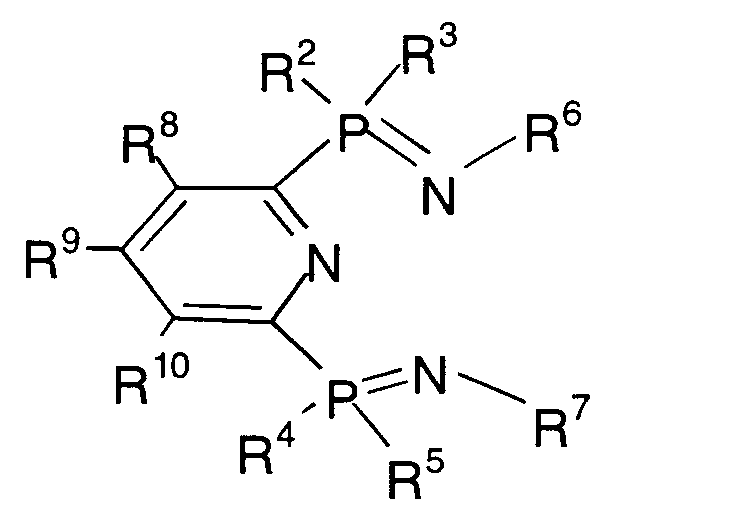
- the present invention provides a process for the polymerization of one or more C 2-12 alpha olefins in the presence of an activatable complex of a Group 8, 9 or 10 metal and ligand of formula I: wherein R 2 , R 3 , R 4 and R 5 are independently selected from the group consisting of a hydrocarbyl radical which is unsubstituted, further substituted or an inert functional group; R 6 and R 7 are independently selected from the group consisting of a hydrocarbyl radical which is unsubstituted or further substituted, trialkyl silyl radical and an inert functional group; and R 8 , R 9 and R 10 are independently selected from the group consisting of a hydrogen atom, a hydrocarbyl radical which is unsubstituted or further substituted and an inert functional group.
- a further aspect of the present invention provides a process for the polymerization of one or more C 2-12 alpha olefins in the presence of:
- the present invention provides a process for reacting one or more C 2-12 alpha olefins in the presence of a catalyst of formula III: wherein R 2 to R 10 and M are defined above; L 1 is a neutral monodenate ligand which is displaced by one or more of an activator, a scavenger or a monomer; x is from 0 to 12; L 2 is an activatable ligand; and y is the oxidation state of the metal; with an activator at a temperature from 20 to 250°C and at a pressure from 15 to 15000 psi.
- the present invention further comprises reacting a compound of formula II: wherein R 2 , R 3 , R 4 , R 5 , R 6 , R 7 , R 8 , R 9 , R 10 and M are as defined above, X is a halogen and n is an integer from 1 to 3 with an alkylating agent at a temperature from -50 to 250°C to produce a compound of formula III as defined above.
- the present invention also provides an olefin co- or homopolymer having a weight average molecular weight (Mw) from 5 x 10 4 to 10 7 and a degree of short chain branching from 1-30 per 1000 carbon atoms prepared in the presence of an iron (or cobalt) containing catalyst.
- Mw weight average molecular weight
- scavenger as used in this specification is meant to include those compounds effective for removing polar impurities from the reaction solvent. Such impurities can be inadvertently introduced with any of the polymerization reaction components, particularly with solvent, monomer and catalyst feed; and can adversely affect catalyst activity and stability. It can result in decreasing or even elimination of catalytic activity, particularly when an activator capable of ionizing the Group 8, 9 or 10 metal complex is also present.
- an inert functional group means a functional group on a ligand or substituent which does not participate or react in the polymerization reaction.
- an inert functional group would not react with any of the monomers, the activator or the scavenger of the present invention.
- the inert functional group would not interfere with the alkylation reaction or the formation of the metal complex respectively.
- a neutral monodenate ligand means a ligand which is only loosely bound to the metal by a coordinative bond. These may include water (H 2 O) or tetrahydrofuran (THF).
- an activatable ligand is a ligand removed or transformed by an activator. These include anionic substituents and/or bound ligands.
- Exemplary activatable ligands are independently selected from the group consisting of a hydrogen atom, a halogen atom, a C 1-10 hydrocarbyl radical, a C 1-10 alkoxy radical, a C 5-10 aryl oxide radical; each of which said hydrocarbyl, alkoxy, and aryl oxide radicals may be unsubstituted by or further substituted by a halogen atom, a C 1-8 alkyl radical, a C 1-8 alkoxy radical, a C 6-10 aryl or aryl oxy radical, an amido radical which is unsubstituted or substituted by up to two C 1-8 alkyl radicals, and a phosphido radical which is unsubstituted or substituted by up to two C 1-8 alkyl radicals.
- R 2 , R 3 , R 4 and R 5 are independently selected from the group consisting of a hydrocarbyl radical and an inert functional group.
- R 2 , R 3 , R 4 and R 5 are selected from the group consisting of C 1-10 alkyl or aryl radicals, most preferably C 1-4 radicals such as a bulky t-butyl radical and phenyl radicals.
- R 8 , R 9 and R 10 are independently selected from the group consisting of a hydrogen atom, a hydrocarbyl radical which is unsubstituted or further substituted and an inert functional group, preferably a hydrogen atom and a C 1-10 , most preferably a C 1-4 alkyl radical.
- R 6 and R 7 are independently selected from the group consisting of a hydrocarbyl radical, preferably a phenyl radical which is unsubstituted or substituted by up to five hydrocarbyl radicals, or a C 1-10 alkyl radical, wherein two of the hydrocarbyl radicals taken together may form ring, or a trialkyl, preferably C 1-6 , most preferably C 1-4 silyl radical.
- R 2 through R 10 are as defined above and L 1 is a neutral monodenate ligand easily displaced by one or more of a scavenger, activator or monomer, preferably water or tetrahydrofuran.
- L 2 is an activatable ligand, preferably a halogen or a C 1-6 alkyl or alkoxide radical, most preferably a chloride, bromide, or a C 1-4 alkyl or alkoxide radical; x is from 0 to 12, preferably from 0 to 6; and y is the oxidation state of the metal M, preferably 2 or 3.
- R 8 , R 9 and R 10 are independently selected from the group consisting of a hydrogen atom or a hydrocarbyl radical, preferably a hydrogen atom and a C 1-4 alkyl radical;
- R 4 , R 5 , R 2 and R 3 are independently selected from the group consisting of a hydrocarbyl radical which is unsubstituted or further substituted and an inert functional group;
- R 6 and R 7 are independently selected from the group consisting of trimethyl silyl and an aryl radical, preferably from 6 to 14 carbon atoms which is unsubstituted or substituted by one or more radicals selected from the group consisting of C 1-6 hydrocarbyl radicals, most preferably 2,6-di-isopropyl phenyl radicals.
- R 8 , R 9 and R 10 are the same;
- R 2 , R 3 , R 4 and R 5 are the same; and
- R 6 and R 7 are the same.
- R 2 , R 3 , R 4 , R 5 , R 6 , R 7 , R 8 , R 9 and R 10 are as defined immediately above.
- the metal complexes of the present invention may be prepared by reacting the ligand with a compound of MX n • A (H 2 O) X, wherein X may be selected from the group consisting of halogen, C 1-6 alkoxide, nitrate or sulfate, preferably halide and most preferably chloride or bromide; and A is 0 or an integer from 1-6.
- reaction of the ligand of formula I with the compound of the formula MX n • A (H 2 O) may be conducted in a hydrocarbyl solvent at temperature from -50 to 250°C, preferably from 20 to 120°C.
- alkylating agents are Grignard agents of the formula RMgX and organolithium reagents LiR wherein R is a C 1-10 alkyl radical and X is a halogen and alkyl aluminum reagents.
- Alkyl aluminum reagents include trialkyl aluminum, alkyl aluminum halides (i.e. (R) x ALX 3-x wherein R is a C 1-10 alkyl radical, X is a halogen, x is 1 or 2 and MAO as described below).
- Solution polymerization processes are fairly well known in the art. These processes are conducted in the presence of an inert hydrocarbon solvent typically a C 5-12 hydrocarbon which may be unsubstituted or substituted by C 1-4 alkyl group such as pentane, hexane, heptane, octane, cyclohexane, methylcyclohexane or hydrogenated naphtha.
- an additional solvent is Isopar E (C 8-12 aliphatic solvent, Exxon Chemical Co.).
- the polymerization may be conducted at temperatures from about 20 to about 250°C. Depending on the product being made, this temperature may be relatively low such as from 20 to about 180°C.
- the pressure of the reaction may be as high as about 15,000 psig for the older high pressure processes or may range from about 15 to 4,500 psig.
- Suitable olefin monomers may be ethylene and C 3-20 mono- and diolefins.
- Preferred monomers include ethylene and C 3-12 alpha olefins which are unsubstituted or substituted by up to two C 1-6 alkyl radicals.
- Illustrative non-limiting examples of such alpha-olefins are one or more of propylene, 1-butene, 1-pentene, 1-hexene, 1-octene and 1-decene.
- the reaction product of the present invention in the presence of a single alpha olefin, may be an oligomer having a molecular weight (Mw) less than about 1500.
- the reaction product of the present invention may also be a co- or homopolymer of one or more alpha olefins.
- the polymers prepared in accordance with the present invention have a good molecular weight. That is, weight average molecular weight (Mw) will preferably be greater than about 50,000 ranging up to 10 7 , preferably 10 5 to 10 7 .
- the polyethylene polymers which may be prepared in accordance with the present invention typically comprise not less than 60, preferably not less than 70, most preferably not less than 80 weight % of ethylene and the balance of one or more C 4-10 alpha olefins, preferably selected from the group consisting of 1-butene, 1-hexene and 1-octene.
- the polyethylene prepared in accordance with the present invention may contain branching (e.g. one or more branches per 1000 carbon atoms, preferably 1-30 branches per 1000 carbon atoms, typical 1-20 branches per 1000 carbon atoms and most preferably 1-10 branches per 1000 carbon atoms).
- the activator may be selected from the group consisting of:
- the aluminoxane activator may be of the formula (R 20 ) 2 AIO(R 20 AIO) m Al(R 20 ) 2 wherein each R 20 is independently selected from the group consisting of C 1-20 hydrocarbyl radicals, m is from 0 to 50, and preferably R 20 is a C 1-4 alkyl radical and m is from 5 to 30.
- the aluminoxane activator may be used prior to the reaction but preferably in situ alkylation is typical (e.g. alkyl groups replacing leaving ligands, hydrogen or halide groups).
- the amount of aluminoxane will depend on the reactivity of the alkylating agent. Activation with aluminoxane generally requires a molar ratio of aluminum in the activator to the Group 8, 9 or 10 metal in the complex from 20:1 to 1000:1. MAO may be the higher end of the above noted range.
- the activator of the present invention may be a combination of an alkylating activator which also serves as a scavenger other than aluminoxane in combination with an activator capable of ionizing the Group 8, 9 or 10 complex.
- the alkylating activator (which may also serve as a scavenger) may be selected from the group consisting of: (R) p MgX 2-p wherein X is a halide, each R is independently selected from the group consisting of C 1-10 alkyl radicals, preferably C 1-8 alkyl radicals and p is 1 or 2; RLi wherein R is as defined above; (R) q ZnX 2-q wherein R is as defined above, X is halogen and q is 1 or 2; (R) s AIX 3-s wherein R is as defined above, X is halogen and s is an integer from 1 to 3.
- R is a C 1-4 alkyl radical and X is chlorine.
- Commercially available compounds include triethyl aluminum (TEAL), diethyl aluminum chloride (DEAC), dibutyl magnesium ((Bu) 2 Mg) and butyl ethyl magnesium (BuEtMg or BuMgEt).
- the activator capable of ionizing the Group 8, 9 or 10 metal complex may be selected from the group consisting of:
- R 18 is a pentafluorophenyl radical
- R 15 is a triphenylmethyl cation
- Z is a nitrogen atom
- R 16 is a C 1-4 alkyl radical or R 16 taken together with the nitrogen atom to form an anilinium radical which is substituted by two C 1-4 alkyl radicals.
- the activator capable of ionizing the Group 8, 9 or 10 metal complex abstract one or more L 1 ligands so as to ionize the Group 8, 9 or 10 metal center into a cation, but not to covalently bond with the Group 8, 9 or 10 metal; and to provide sufficient distance between the ionized Group 8, 9 or 10 metal and the ionizing activator to permit a polymerizable olefin to enter the resulting active site.
- Examples of compounds capable of ionizing the Group 8, 9 or 10 metal complex include the following compounds:
- the Group 8, 9 or 10 metal complex is activated with a combination of an aluminum alkyl compound (generally other than aluminoxane), and a compound capable of ionizing the Group 8, 9 or 10 metal complex;
- the molar ratios of Group 8, 9 or 10 metal:metal in the alkylating agent (e.g. Al); metalloid (e.g. boron or phosphorus) in the activator capable of ionizing the Group 8, 9 or 10 metal complex (e.g. boron) may range from 1:1:1 to 1:100:5.
- the alkylating activator is premixed/reacted with the Group 8, 9 or 10 metal complex and the resulting alkylated species is then reacted with the activator capable of ionizing the Group 8, 9 or 10 metal complex.
- the monomers are dissolved/dispersed in the solvent either prior to being fed to the reactor or for gaseous monomers, the monomer may be fed to the reactor so that it will dissolve in the reaction mixture.
- the solvent and monomers Prior to mixing, are generally purified to remove polar moieties.
- the polar moieties or catalyst poisons include water, oxygen, metal impurities, etc.
- steps are taken before provision of such into the reaction vessel, for example by chemical treatment or careful separation techniques after or during the synthesis or preparation of the various components.
- the feedstock purification prior to introduction into the reaction solvent follows standard practices in the art (e.g.
- molecular sieves are used for the purification of ethylene, alpha-olefin and optional diene.
- the solvent itself as well e.g. cyclohexane and toluene
- excess scavenging activators may be used in the polymerization process.
- the feedstock may be heated prior to feeding into the reactor. However, in many instances it is desired to remove heat from the reactor so the feedstock may be at ambient temperature to help cool the reactor.
- the catalyst components may be premixed in the solvent for the reaction or fed as separate streams to the reactor. In some instances premixing is desirable to provide a reaction time for the catalyst components prior to entering the reaction.
- premixing is described in a number of patents in the name of DuPont Canada Inc. For example it is described in U.S. patent 5,589,555 issued December 31, 1996.
- the reactor may comprise a tube or serpentine reactor used in the "high pressure" polymerizations or it may comprise one or more reactors or autoclaves. It is well known that the use in series of two such reactors each of which may be operated so as to achieve different polymer molecular weight characteristics.
- the residence time in the reactor system will depend on the design and the capacity of the reactor. Generally, the reactors should be operated under conditions to achieve a thorough mixing of the reactants. On leaving the reactor system, the solvent is removed and the resulting polymer is finished in a conventional manner.
- the heating rate is 10°C/minute from 0 to 200°C.
- FT-IR was conducted on a Nicolet Model 750 Magna IR spectrometer. Ml was measured on an automatic Ml machine with model number of MP993 at 190°C. Operation : All synthesis and catalyst preparations were performed under nitrogen or argon using standard Schlenk techniques or in a dry-box.
- the reaction mixture was cooled to -78°C and a THF (30 mL) solution of BuLi (6.25 mL, 1.6 M in hexane, 10 mmol) was slowly added.
- the reaction mixture was warmed to -25°C and a THF (30 mL) solution of t-Bu 2 PCI (1.81 g, 10 mmol) was added.
- the reaction mixture was warmed to room temperature and stirred for another 1 hour. All volatiles were then removed under vacuum.
- the resulting residue was dissolved in heptane (50 mL) and LiBr was removed by filtration. When the heptane was evaporated, a brown oily residue was obtained.
- TMSN 3 trimethyl silyl azide
- the flask was charged with 2,6-(t-Bu 2 P) 2 pyridine ( la ) (1.84 g, 5 mmol).
- the TMSN 3 line was charged with TMSN 3 (7.3 mL, 5.5 mmol) through a syringe.
- 3 mL of TMSN 3 was injected into the flask and the mixture was heated to 95°C.
- the remaining TMSN 3 was added to the reaction at 95°C.
- nitrogen was evolved.
- the reaction mixture was kept for an additional 2 hours at 110°C. When the slight excess of TMSN 3 was removed under vacuum, a white solid (2.7 g, 100%) was obtained.
- a 200 mL Schlenk flask was fitted with a condenser, a nitrogen inlet, a gas outlet bubbler and a TMSN 3 addition line.
- the flask was charged with 2,6-(Et 2 P) 2 pyridine (Ib) (1.28 g, 5 mmol).
- the TMSN 3 line was charged with TMSN 3 (7.3 mL, 5.5 mmol) through a syringe.
- 3 mL of TMSN 3 was injected into the flask and the mixture was heated to 95°C.
- the remaining TMSN 3 was added to the reaction at 95°C.
- nitrogen was evolved.
- the reaction mixture was kept for an additional 2 hours at 110°C.
- a 200 mL Schlenk flask was fitted with a condenser, a nitrogen inlet, a gas outlet bubbler and a TMSN 3 addition line.
- the flask was charged with 2,6-(Ph 2 P) 2 pyridine (Ic) (2.24 g, 5 mmol).
- the TMSN 3 line was charged with TMSN 3 (7.3 mL, 5.5 mmol) through a syringe.
- 3 mL of TMSN 3 was injected into the flask and the mixture was heated to 95°C.
- the remaining TMSN 3 was added to the reaction at 95°C.
- nitrogen was evolved.
- the reaction mixture was kept for an additional 2 hours at 110°C.
- the catalyst was dissolved in toluene.
- Polymerization temperature was 50°C for slurry polymerizations and 140°C for solution polymerizations.
- the polymerization reaction time varied from 9 to 60 minutes for each experiment.
- the reaction was terminated by adding 5 mL of methanol to the reactor and the polymer was recovered by evaporation of the solvent.
- the polymerization activities were calculated based on the weight of the polymer produced.
- Toluene (216 mL) was transferred into the reactor with 0.5 mL of PMAO-IP (216.0 umol) in 10 mL of toluene as a scavenger. The solution was heated to 50°C and saturated with 300 psig of ethylene.
- the catalyst (IIIa) (64.6 umol, 43.2 mg) was dissolved in toluene (11.8 mL) and transferred into a catalyst injection bomb, and then mixed with PMAO-IP (1.8 mmol, 0.4 mL).
- B(C 6 F 5 ) 3 (68.4 umol, 35 mg) was dissolved in toluene (12.4 mL) and loaded into a cocatalyst injection bomb.
- Toluene (216 mL) and 1-octene (30 mL) were transferred into the reactor with 0.5 mL of PMAO-IP (216.0 umol) in 10 mL of toluene as a scavenger.
- the solution was heated to 50°C and saturated with 100 psig of ethylene.
- the catalyst (IIIa) (64.8 umol, 43.3 mg) was dissolved in toluene (12.2 mL) and then injected into the reactor. After one minute, PMAO-IP (38.8 mmol, 8.6 mL) was injected into the reactor. The reaction temperature reached 63°C at the beginning.
- the polymerization reaction was terminated by adding 5 mL of MeOH after 9 minutes. The polymer was dried.
Landscapes
- Chemical & Material Sciences (AREA)
- Health & Medical Sciences (AREA)
- Chemical Kinetics & Catalysis (AREA)
- Medicinal Chemistry (AREA)
- Polymers & Plastics (AREA)
- Organic Chemistry (AREA)
- Transition And Organic Metals Composition Catalysts For Addition Polymerization (AREA)
- Low-Molecular Organic Synthesis Reactions Using Catalysts (AREA)
- Catalysts (AREA)
Abstract
Description
- The present invention relates to late transition metal complexes, a process for their preparation and their use in the polymerization of olefins.
- The papers in Organometallics, 10, 1421-1431, 1991; Inorg. Chem., 34, 4092-4105, 1995; J. Organomet. Chem., 527(1-2), 263-276, 1997; and Inorg. Chem., 35(6), 1518-28, 1996, report the reaction of bis (iminophosphoranyl) methane (BIPM) which are typically aryl substituted on the phosphorus atom and the nitrogen with Group 8, 9 or 10 metal halides (chlorides) further comprising at two weakly coordinating ligands (L) such as nitriles or cyclooctadiene, afforded several products depending on the reaction time, type of ligand or nature of the metal. The product could be a N-C chelating type product or a N-N chelating product (similar to those of the present invention).

- The products contain alkyl bridges between the phosphinimine groups and the references do not disclose the pyridyl bridged compounds of the present invention. Further, none of the references teach or suggest the use of such compounds for the polymerization of alpha olefins.
- United States Patent 5,557,023 issued September, 1996 teaches the use of some phosphinimines complexes to oligomerize alpha olefins. However, the complexes disclosed are not bisphosphinimine complexes. Rather, the complexes are of the structure indicated below.
 wherein R, Q, etc. are as defined in the patent. The structures disclosed in the patent are not the bisphosphinimines of the present invention. While the reference does teach oligomerization, it does not suggest polymerization.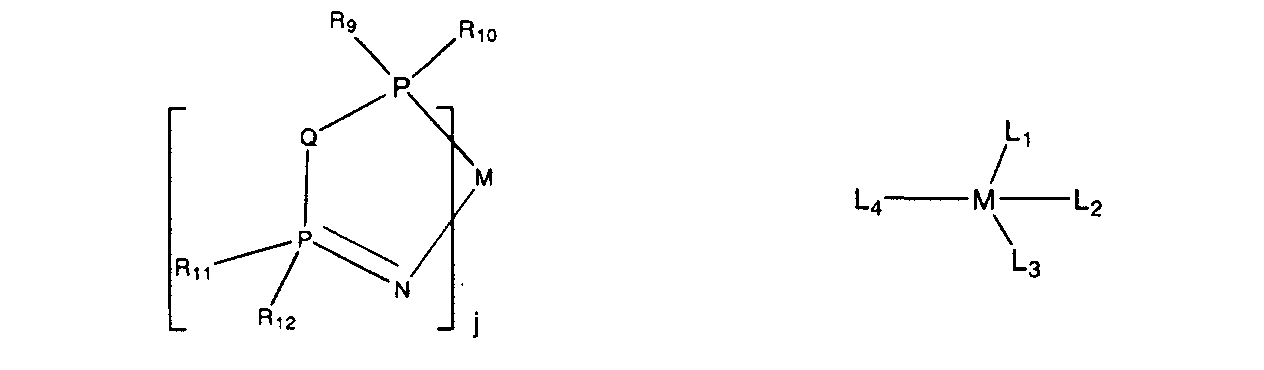
- WO 98/30609 patent application published July 16, 1998 assigned to E.I. du Pont de Nemours teaches the use of various complexes of nickel to polymerize alpha olefins. The most structurally similar complex in the disclosure is compound XXXXI at the middle of page 9 and the associated description of the various substituents. However, the compound does not contain a pyridyl bridge. Rather, the nickel atom completes the cyclic structure in the middle of the compound. The reference does not contemplate or disclose compounds of the present invention which have a pyridyl bridge between the bisphosphinimine functionality. The reference fails to disclose the subject matter of the present invention.
- There are a number of patents and papers by Brookhart and/or Gibson disclosing the use of Group 8, 9 or 10 metals to polymerize olefins. However, such papers did not teach the copolymerizations (e.g. WO 98/27124). The present invention provides olefin copolymerization using an iron based catalyst.
- The present invention provides a process for the polymerization of one or more C2-12 alpha olefins in the presence of an activatable complex of a Group 8, 9 or 10 metal and ligand of formula I:wherein R2, R3, R4 and R5 are independently selected from the group consisting of a hydrocarbyl radical which is unsubstituted, further substituted or an inert functional group; R6 and R7 are independently selected from the group consisting of a hydrocarbyl radical which is unsubstituted or further substituted, trialkyl silyl radical and an inert functional group; and R8, R9 and R10 are independently selected from the group consisting of a hydrogen atom, a hydrocarbyl radical which is unsubstituted or further substituted and an inert functional group.
- A further aspect of the present invention provides a process for the polymerization of one or more C2-12 alpha olefins in the presence of:
- (a) a complex comprising a Group 8, 9 or 10 metal and ligand of
formula I:
wherein R2, R3, R4 and R5 are each independently selected from the group consisting of hydrocarbyl, substituted hydrocarbyl or an inert functional group; R6 and R7 are each independently selected from hydrocarbyl, substituted hydrocarbyl, trialkyl silyl and substituted or unsubstituted aryl; and R8, R9 and R10 are each independently selected from hydrogen, hydrocarbyl, substituted hydrocarbyl, an inert functional group; and
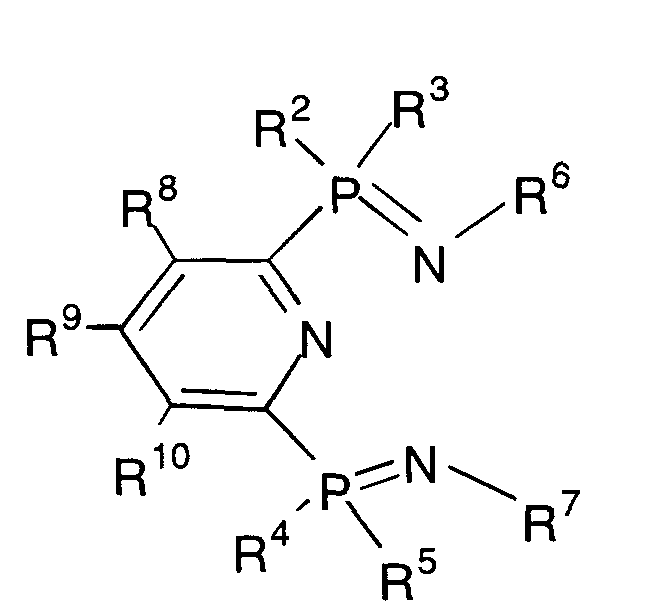
- (b) an activator at a temperature from 20 to 250°C and at a pressure from 15 to 15000 psi.
-
- In a further aspect, the present invention provides a process for reacting one or more C2-12 alpha olefins in the presence of a catalyst of formula III:wherein R2 to R10 and M are defined above; L1 is a neutral monodenate ligand which is displaced by one or more of an activator, a scavenger or a monomer; x is from 0 to 12; L2 is an activatable ligand; and y is the oxidation state of the metal; with an activator at a temperature from 20 to 250°C and at a pressure from 15 to 15000 psi.

- The present invention further comprises reacting a compound of formula II:wherein R2, R3, R4, R5, R6, R7, R8, R9, R10 and M are as defined above, X is a halogen and n is an integer from 1 to 3 with an alkylating agent at a temperature from -50 to 250°C to produce a compound of formula III as defined above.

- The present invention also provides an olefin co- or homopolymer having a weight average molecular weight (Mw) from 5 x 10⁴ to 107 and a degree of short chain branching from 1-30 per 1000 carbon atoms prepared in the presence of an iron (or cobalt) containing catalyst.
- The term "scavenger" as used in this specification is meant to include those compounds effective for removing polar impurities from the reaction solvent. Such impurities can be inadvertently introduced with any of the polymerization reaction components, particularly with solvent, monomer and catalyst feed; and can adversely affect catalyst activity and stability. It can result in decreasing or even elimination of catalytic activity, particularly when an activator capable of ionizing the Group 8, 9 or 10 metal complex is also present.
- The term "an inert functional group" means a functional group on a ligand or substituent which does not participate or react in the polymerization reaction. For example, in the polymerization aspect of the present invention an inert functional group would not react with any of the monomers, the activator or the scavenger of the present invention. Similarly for the alkylation of the metal complex or the formation of the metal complex the inert functional group would not interfere with the alkylation reaction or the formation of the metal complex respectively.
- The phrase "a neutral monodenate ligand" means a ligand which is only loosely bound to the metal by a coordinative bond. These may include water (H2O) or tetrahydrofuran (THF).
- As used in this specification, an activatable ligand is a ligand removed or transformed by an activator. These include anionic substituents and/or bound ligands. Exemplary activatable ligands are independently selected from the group consisting of a hydrogen atom, a halogen atom, a C1-10 hydrocarbyl radical, a C1-10 alkoxy radical, a C5-10 aryl oxide radical; each of which said hydrocarbyl, alkoxy, and aryl oxide radicals may be unsubstituted by or further substituted by a halogen atom, a C1-8 alkyl radical, a C1-8 alkoxy radical, a C6-10 aryl or aryl oxy radical, an amido radical which is unsubstituted or substituted by up to two C1-8 alkyl radicals, and a phosphido radical which is unsubstituted or substituted by up to two C1-8 alkyl radicals.
- In the above compounds formula I - III, R2, R3, R4 and R5 are independently selected from the group consisting of a hydrocarbyl radical and an inert functional group. Preferably R2, R3, R4 and R5 are selected from the group consisting of C1-10 alkyl or aryl radicals, most preferably C1-4 radicals such as a bulky t-butyl radical and phenyl radicals. In the above compounds, R8, R9 and R10 are independently selected from the group consisting of a hydrogen atom, a hydrocarbyl radical which is unsubstituted or further substituted and an inert functional group, preferably a hydrogen atom and a C1-10, most preferably a C1-4 alkyl radical. In the above formula, R6 and R7 are independently selected from the group consisting of a hydrocarbyl radical, preferably a phenyl radical which is unsubstituted or substituted by up to five hydrocarbyl radicals, or a C1-10 alkyl radical, wherein two of the hydrocarbyl radicals taken together may form ring, or a trialkyl, preferably C1-6, most preferably C1-4 silyl radical. In the complex of formula III, R2 through R10 are as defined above and L1 is a neutral monodenate ligand easily displaced by one or more of a scavenger, activator or monomer, preferably water or tetrahydrofuran. L2 is an activatable ligand, preferably a halogen or a C1-6 alkyl or alkoxide radical, most preferably a chloride, bromide, or a C1-4 alkyl or alkoxide radical; x is from 0 to 12, preferably from 0 to 6; and y is the oxidation state of the metal M, preferably 2 or 3.
- In the compound of formula I and III, preferably R8, R9 and R10 are independently selected from the group consisting of a hydrogen atom or a hydrocarbyl radical, preferably a hydrogen atom and a C1-4 alkyl radical; R4, R5, R2 and R3 are independently selected from the group consisting of a hydrocarbyl radical which is unsubstituted or further substituted and an inert functional group; and R6 and R7 are independently selected from the group consisting of trimethyl silyl and an aryl radical, preferably from 6 to 14 carbon atoms which is unsubstituted or substituted by one or more radicals selected from the group consisting of C1-6 hydrocarbyl radicals, most preferably 2,6-di-isopropyl phenyl radicals. In a particularly preferred aspect of the present invention R8, R9 and R10 are the same; R2, R3, R4 and R5 are the same; and R6 and R7 are the same.
- In the compound of formula II, preferred substituents for R2, R3, R4, R5, R6, R7, R8, R9 and R10 are as defined immediately above.
- The metal complexes of the present invention may be prepared by reacting the ligand with a compound of MXn • A (H2O) X, wherein X may be selected from the group consisting of halogen, C1-6 alkoxide, nitrate or sulfate, preferably halide and most preferably chloride or bromide; and A is 0 or an integer from 1-6.
- The reaction of the ligand of formula I with the compound of the formula MXn • A (H2O) may be conducted in a hydrocarbyl solvent at temperature from -50 to 250°C, preferably from 20 to 120°C.
- The resulting compound may then be alkylated (either partially or fully). Some alkylating agents are Grignard agents of the formula RMgX and organolithium reagents LiR wherein R is a C1-10 alkyl radical and X is a halogen and alkyl aluminum reagents. Alkyl aluminum reagents include trialkyl aluminum, alkyl aluminum halides (i.e. (R)xALX3-x wherein R is a C1-10 alkyl radical, X is a halogen, x is 1 or 2 and MAO as described below).
- Solution polymerization processes are fairly well known in the art. These processes are conducted in the presence of an inert hydrocarbon solvent typically a C5-12 hydrocarbon which may be unsubstituted or substituted by C1-4 alkyl group such as pentane, hexane, heptane, octane, cyclohexane, methylcyclohexane or hydrogenated naphtha. An additional solvent is Isopar E (C8-12 aliphatic solvent, Exxon Chemical Co.).
- The polymerization may be conducted at temperatures from about 20 to about 250°C. Depending on the product being made, this temperature may be relatively low such as from 20 to about 180°C. The pressure of the reaction may be as high as about 15,000 psig for the older high pressure processes or may range from about 15 to 4,500 psig.
- Suitable olefin monomers may be ethylene and C3-20 mono- and diolefins. Preferred monomers include ethylene and C3-12 alpha olefins which are unsubstituted or substituted by up to two C1-6 alkyl radicals. Illustrative non-limiting examples of such alpha-olefins are one or more of propylene, 1-butene, 1-pentene, 1-hexene, 1-octene and 1-decene.
- The reaction product of the present invention, in the presence of a single alpha olefin, may be an oligomer having a molecular weight (Mw) less than about 1500. The reaction product of the present invention may also be a co- or homopolymer of one or more alpha olefins. The polymers prepared in accordance with the present invention have a good molecular weight. That is, weight average molecular weight (Mw) will preferably be greater than about 50,000 ranging up to 107, preferably 105 to 107.
- The polyethylene polymers which may be prepared in accordance with the present invention typically comprise not less than 60, preferably not less than 70, most preferably not less than 80 weight % of ethylene and the balance of one or more C4-10 alpha olefins, preferably selected from the group consisting of 1-butene, 1-hexene and 1-octene. The polyethylene prepared in accordance with the present invention may contain branching (e.g. one or more branches per 1000 carbon atoms, preferably 1-30 branches per 1000 carbon atoms, typical 1-20 branches per 1000 carbon atoms and most preferably 1-10 branches per 1000 carbon atoms).
- The activator may be selected from the group consisting of:
- (i) an aluminoxane; and
- (ii) an activator capable of ionizing the Group 8, 9 or 10 metal complex (which may be used in combination with an alkylating activator).
-
- The aluminoxane activator may be of the formula (R20)2AIO(R20AIO)mAl(R20)2 wherein each R20 is independently selected from the group consisting of C1-20 hydrocarbyl radicals, m is from 0 to 50, and preferably R20 is a C1-4 alkyl radical and m is from 5 to 30. The aluminoxane activator may be used prior to the reaction but preferably in situ alkylation is typical (e.g. alkyl groups replacing leaving ligands, hydrogen or halide groups).
- If the Group 8, 9 or 10 metal complex is activated only with aluminoxane, the amount of aluminoxane will depend on the reactivity of the alkylating agent. Activation with aluminoxane generally requires a molar ratio of aluminum in the activator to the Group 8, 9 or 10 metal in the complex from 20:1 to 1000:1. MAO may be the higher end of the above noted range.
- The activator of the present invention may be a combination of an alkylating activator which also serves as a scavenger other than aluminoxane in combination with an activator capable of ionizing the Group 8, 9 or 10 complex.
- The alkylating activator (which may also serve as a scavenger) may be selected from the group consisting of: (R)pMgX2-p wherein X is a halide, each R is independently selected from the group consisting of C1-10 alkyl radicals, preferably C1-8 alkyl radicals and p is 1 or 2; RLi wherein R is as defined above; (R)qZnX2-q wherein R is as defined above, X is halogen and q is 1 or 2; (R)sAIX3-s wherein R is as defined above, X is halogen and s is an integer from 1 to 3. Preferably, in the above compounds R is a C1-4 alkyl radical and X is chlorine. Commercially available compounds include triethyl aluminum (TEAL), diethyl aluminum chloride (DEAC), dibutyl magnesium ((Bu)2Mg) and butyl ethyl magnesium (BuEtMg or BuMgEt).
- The activator capable of ionizing the Group 8, 9 or 10 metal complex may be selected from the group consisting of:
- (i) compounds of the formula [R15]+ [B(R18)4]- wherein B is a boron atom, R15 is a cyclic C5-7 aromatic cation or a triphenyl methyl cation and each R18 is independently selected from the group consisting of phenyl radicals which are unsubstituted or substituted with from 3 to 5 substituents selected from the group consisting of a fluorine atom, a C1-4 alkyl or alkoxy radical which is unsubstituted or substituted by a fluorine atom, and a silyl radical of the formula -Si-(R19)3 wherein each R19 is independently selected from the group consisting of a hydrogen atom and a C1-4 alkyl radical; and
- (ii) compounds of the formula [(R16)t ZH]+[B(R18)4]- wherein B is a boron atom, H is a hydrogen atom, Z is a nitrogen atom or phosphorus atom, t is 2 or 3 and R16 is selected from the group consisting of C1-8 alkyl radicals, a phenyl radical which is unsubstituted or substituted by up to three C1-4 alkyl radicals, or one R16 taken together with the nitrogen atom to form an anilinium radical and R18 is as defined above; and
- (iii) compounds (activators) of the formula B(R18)3 wherein R18 is as defined above.
-
- In the above compounds, preferably R18 is a pentafluorophenyl radical, R15 is a triphenylmethyl cation, Z is a nitrogen atom and R16 is a C1-4 alkyl radical or R16 taken together with the nitrogen atom to form an anilinium radical which is substituted by two C1-4 alkyl radicals.
- The activator capable of ionizing the Group 8, 9 or 10 metal complex abstract one or more L1 ligands so as to ionize the Group 8, 9 or 10 metal center into a cation, but not to covalently bond with the Group 8, 9 or 10 metal; and to provide sufficient distance between the ionized Group 8, 9 or 10 metal and the ionizing activator to permit a polymerizable olefin to enter the resulting active site.
- Examples of compounds capable of ionizing the Group 8, 9 or 10 metal complex include the following compounds:
- triethylammonium tetra(phenyl)boron,
- tripropylammonium tetra(phenyl)boron,
- tri(n-butyl)ammonium tetra(phenyl)boron,
- trimethylammonium tetra(p-tolyl)boron,
- trimethylammonium tetra(o-tolyl)boron,
- tributylammonium tetra(pentafluorophenyl)boron,
- tributylammonium tetra(pentafluorophenyl)boron,
- tri(n-butyl)ammonium tetra(o-tolyl)boron,
- N,N-dimethylanilinium tetra(phenyl)boron,
- N,N-diethylanilinium tetra(phenyl)boron,
- N,N-diethylanilinium tetra(phenyl)n-butylboron,
- N,N-2,4,6-pentamethylanilinium tetra(phenyl)boron,
- di-(isopropyl)ammonium tetra(pentafluorophenyl)boron,
- dicyclohexylammonium tetra(phenyl)boron,
- triphenylphosphonium tetra(phenyl)boron,
- tri(methylphenyl)phosphonium tetra(phenyl)boron,
- tri(dimethylphenyl)phosphonium tetra(phenyl)boron,
- tropillium tetrakispentafluorophenyl borate,
- triphenylmethylium tetrakispentafluorophenyl borate,
- benzene (diazonium) tetrakispentafluorophenyl borate,
- tropillium phenyltrispentafluorophenyl borate,
- triphenylmethylium phenyltrispentafluorophenyl borate,
- benzene (diazonium) phenyltrispentafluorophenyl borate,
- tropillium tetrakis (2,3,5,6-tetrafluorophenyl) borate,
- triphenylmethylium tetrakis (2,3,5,6-tetrafluorophenyl) borate,
- benzene (diazonium) tetrakis (3,4,5-trifluorophenyl) borate,
- tropillium tetrakis (3,4,5-trifluorophenyl) borate,
- benzene (diazonium) tetrakis (3,4,5-trifluorophenyl) borate,
- tropillinum tetrakis (1,2,2-trifluoroethenyl) borate,
- triphenylmethylium tetrakis (1,2,2-trifluoroethenyl) borate,
- benzene (diazonium) tetrakis (1,2,2-trifluoroethenyl) borate,
- tropillium tetrakis (2,3,4,5-tetrafluorophenyl) borate,
- triphenylmethylium tetrakis (2,3,4,5-tetrafluorophenyl) borate, and
- benzene (diazonium) tetrakis (2,3,4,5-tetrafluorophenyl) borate.
-
- Readily commercially available activators which are capable of ionizing the Group 8, 9 or 10 metal complexes include:
- N,N- dimethylaniliniumtetrakispentafluorophenyl borate,
- triphenylmethylium tetrakispentafluorophenyl borate, and
- trispentafluorophenyl boron.
-
- If the Group 8, 9 or 10 metal complex is activated with a combination of an aluminum alkyl compound (generally other than aluminoxane), and a compound capable of ionizing the Group 8, 9 or 10 metal complex; the molar ratios of Group 8, 9 or 10 metal:metal in the alkylating agent (e.g. Al); metalloid (e.g. boron or phosphorus) in the activator capable of ionizing the Group 8, 9 or 10 metal complex (e.g. boron) may range from 1:1:1 to 1:100:5. Preferably, the alkylating activator is premixed/reacted with the Group 8, 9 or 10 metal complex and the resulting alkylated species is then reacted with the activator capable of ionizing the Group 8, 9 or 10 metal complex.
- In a solution polymerization, the monomers are dissolved/dispersed in the solvent either prior to being fed to the reactor or for gaseous monomers, the monomer may be fed to the reactor so that it will dissolve in the reaction mixture. Prior to mixing, the solvent and monomers are generally purified to remove polar moieties. The polar moieties or catalyst poisons include water, oxygen, metal impurities, etc. Preferably steps are taken before provision of such into the reaction vessel, for example by chemical treatment or careful separation techniques after or during the synthesis or preparation of the various components. The feedstock purification prior to introduction into the reaction solvent follows standard practices in the art (e.g. molecular sieves, alumina beds and oxygen removal catalysts) are used for the purification of ethylene, alpha-olefin and optional diene. The solvent itself as well (e.g. cyclohexane and toluene) is similarly treated. In some instances, out of an abundance of caution, excess scavenging activators may be used in the polymerization process.
- The feedstock may be heated prior to feeding into the reactor. However, in many instances it is desired to remove heat from the reactor so the feedstock may be at ambient temperature to help cool the reactor.
- Generally, the catalyst components may be premixed in the solvent for the reaction or fed as separate streams to the reactor. In some instances premixing is desirable to provide a reaction time for the catalyst components prior to entering the reaction. Such an "in line mixing" technique is described in a number of patents in the name of DuPont Canada Inc. For example it is described in U.S. patent 5,589,555 issued December 31, 1996.
- The reactor may comprise a tube or serpentine reactor used in the "high pressure" polymerizations or it may comprise one or more reactors or autoclaves. It is well known that the use in series of two such reactors each of which may be operated so as to achieve different polymer molecular weight characteristics. The residence time in the reactor system will depend on the design and the capacity of the reactor. Generally, the reactors should be operated under conditions to achieve a thorough mixing of the reactants. On leaving the reactor system, the solvent is removed and the resulting polymer is finished in a conventional manner.
- The present invention will now be illustrated by the following examples in which unless otherwise specified weight means weight % and parts means parts by weight (e.g. grams).
Materials: 2,6-dibromopyridine, diethylphosphine (Et2PH), diphenylphosphine (Ph2PH), di-tert-butylphosphine chloride (t-Bu2PCl), iron (II) chloride (FeCl2), iron (II) chloride tetrahydrates (FeCl2.4(H2O)), iron (II) tetrafluoroborate hexahydrate (Fe(BF4)2.4H2O), iron (III) bromide (FeBr3), iron (III) chloride (FeCl3.6H2O), cobalt chloride (CoCl2), bis (benzonitrile) dichloropalladium (II) (PdCl2(PhCN)2), nickel (II) bromide (NiBr2), n-Butyl lithium (BuLi, 1.6M in hexane), and trimethylsilyl azide (TMSN3) were purchased from Aldrich Chemical Company, Inc. and Strem Chemical Inc. Solvents were prepared by passing through molecular sieves, de-oxo catalysts and alumina columns prior to use. Methylaluminoxane (PMAO-IP) (13.5 weight % of Al) was purchased from AKZO-NOBEL and used as supplied. 2,6-bis (diphenylphosphino)pyridine (Ic) was prepared using the method described in the literature (G. R. Newkome and D. C. Hager, J. Org. Chem., 43(5), 947, 1978). Diimine-Nickel complex (VIII) was synthesized as described in the literature (L.K. Johnson, C.M. Killiam, M. Brookhart, J. Am. Chem. Soc., 117, 6414, 1995). The anhydrous toluene was purchased from Aldrich and purified over molecular sieves prior to use. B(C6F5)3 was purchased from Boulder Scientific Inc. and used without further purification.
Measurements: NMR spectra were recorded using a Bruker 200MHz spectrometer. 1H NMR chemical shifts were reported with reference to tetramethylsilane. Polymer molecular weights and molecular weight distributions were measured by GPC (Waters 150-C) at 140°C in 1,2,4-trichlorobenzene calibrated using polyethylene standards. DSC was conducted on a DSC 220 C from Seiko Instruments. The heating rate is 10°C/minute from 0 to 200°C. FT-IR was conducted on a Nicolet Model 750 Magna IR spectrometer. Ml was measured on an automatic Ml machine with model number of MP993 at 190°C.
Operation: All synthesis and catalyst preparations were performed under nitrogen or argon using standard Schlenk techniques or in a dry-box. - To a THF (100 mL) solution of 2,6-dibromopyridine (2.37 g, 10 mmol) at -78°C was added slowly a THF (30 mL) solution of BuLi (6.25 mL, 1.6M in hexane, 10 mmol). The resulting yellow solution was allowed to warm to -25°C. A THF (30 mL) solution of t-Bu2PCl (1.81 g, 10 mmol) was added to the reaction mixture slowly. The brown solution was allowed to warm to room temperature and was stirred for 1 hour. The reaction mixture was cooled to -78°C and a THF (30 mL) solution of BuLi (6.25 mL, 1.6 M in hexane, 10 mmol) was slowly added. The reaction mixture was warmed to -25°C and a THF (30 mL) solution of t-Bu2PCI (1.81 g, 10 mmol) was added. The reaction mixture was warmed to room temperature and stirred for another 1 hour. All volatiles were then removed under vacuum. The resulting residue was dissolved in heptane (50 mL) and LiBr was removed by filtration. When the heptane was evaporated, a brown oily residue was obtained. The pure product was obtained by vacuum distillation of the residue (122°C / 0.5 mmHg). 1H NMR (toluene-d8, δ): 1.29 (d, J = 11.4Hz, 36H), 6.95 (m, 1H), 7.45 (m, 2H). The purity and molecular formula (M+=367 (30%)) were confirmed by GC-MS.

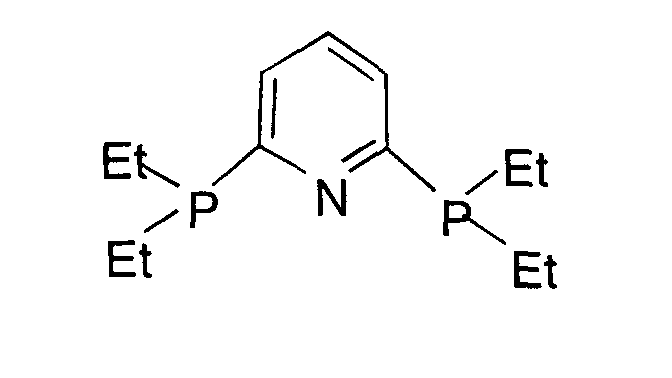
- A THF (100 mL) solution of diethyl phosphine (4.61 g, 51.2 mmol) was treated with n-BuLi (32 mL, 1.6 M, 51.2 mmol) using a drop-wise addition. The reaction mixture was allowed to stir 20 minutes and was then added to a solution of 2,6-dibromopyridine (6.04 g, 25.5 mmol) at 50°C resulting in a darkening of the solution to a brown/black color. The reaction was then further heated at 50°C for 5 hours. The product (1.52 g, yield: 50%) was purified by a short path distillation (76-78°C / 0.3 mmHg).
- A 200 mL Schlenk flask was fitted with a condenser, a nitrogen inlet, a gas outlet bubbler and a TMSN3 (trimethyl silyl azide) addition line. The flask was charged with 2,6-(t-Bu2P)2pyridine (la) (1.84 g, 5 mmol). The TMSN3 line was charged with TMSN3 (7.3 mL, 5.5 mmol) through a syringe. At room temperature, 3 mL of TMSN3 was injected into the flask and the mixture was heated to 95°C. The remaining TMSN3 was added to the reaction at 95°C. As the addition occurred, nitrogen was evolved. After the addition was completed, the reaction mixture was kept for an additional 2 hours at 110°C. When the slight excess of TMSN3 was removed under vacuum, a white solid (2.7 g, 100%) was obtained.
- 1H NMR (toluene-d8, δ): 0.42 (s, 18H), 1.21 (d, J = 14.3Hz, 36H), 7.23 (m, 1H), 8.36 (m, 2H).

- A 200 mL Schlenk flask was fitted with a condenser, a nitrogen inlet, a gas outlet bubbler and a TMSN3 addition line. The flask was charged with 2,6-(Et2P)2pyridine (Ib) (1.28 g, 5 mmol). The TMSN3 line was charged with TMSN3 (7.3 mL, 5.5 mmol) through a syringe. At room temperature, 3 mL of TMSN3 was injected into the flask and the mixture was heated to 95°C. The remaining TMSN3 was added to the reaction at 95°C. As the addition occurred, nitrogen was evolved. After the addition was completed, the reaction mixture was kept for an additional 2 hours at 110°C. When the slight excess of TMSN3 was removed under vacuum, an oil (2.15 g, 100%) was obtained. 1H NMR (toluene-d8, δ): 0.38 (s, 18H), 0.84 (t, J = 7.6Hz, 6H), 0.92 (t, J = 7.7Hz, 6H), 1.66 (m, 8H), 7.19 (m, 2H), 8.06 (m, 2H).
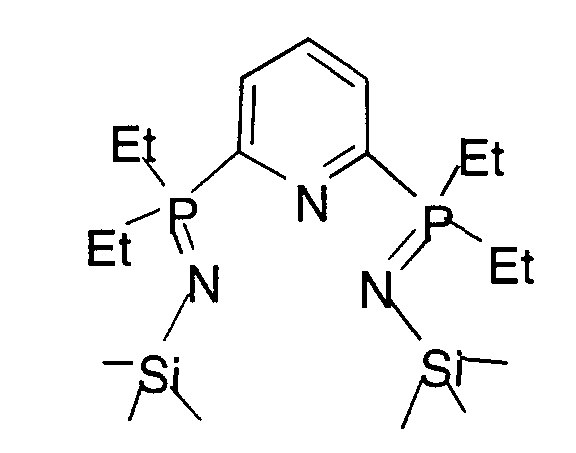
- A 200 mL Schlenk flask was fitted with a condenser, a nitrogen inlet, a gas outlet bubbler and a TMSN3 addition line. The flask was charged with 2,6-(Ph2P)2pyridine (Ic) (2.24 g, 5 mmol). The TMSN3 line was charged with TMSN3 (7.3 mL, 5.5 mmol) through a syringe. At room temperature, 3 mL of TMSN3 was injected into the flask and the mixture was heated to 95°C. The remaining TMSN3 was added to the reaction at 95°C. As the addition occurred, nitrogen was evolved. After the addition was completed, the reaction mixture was kept for an additional 2 hours at 110°C. When the slight excess of TMSN3 was removed under vacuum, a white solid (3.1 g, 100%) was obtained. 1H NMR (toluene-d8, δ): 0.30 (s, 18H), 7.03 (m, 4H), 6.97 (m, 8H), 7.16 (m, 1H), 7.55 (m, 8H), 8.32 (m, 2H).

- General Procedure: The ligand (2,6-(t-Bu2P=NTMS)2pyridine (lla), 1 eq.) and a metal salt (FeCl2, FeCl2.4H2O, CoCl2, FeBr3, FeCl3.6H2O or NiBr2) were added together in a Schlenk flask in a dry-box. Then the flask was charged with THF (30 mL) or dichloromethane (CH2Cl2, 30 mL). The mixture was stirred for several hours until there were no detectable metal salts left in the flask. The reaction solution was filtered to remove some insoluble polymeric materials and was concentrated. Heptane (5 mL) was added to precipitate the complex. The resultant solid was filtered and washed with heptane and dried in vacuo.
- Isolated as a beige yellow solid (Yield: 80%). 1H NMR (THF-d8, all peaks appear as singlets due to their broadness, δ): 0.13 (s, br), 1.29 (s, br), 8.5 (s, br).
- Isolated as a white solid (Yield: 90%). 1H NMR (THF-d8, all peaks appear as singlets due to their broadness, δ): 0.01 (s, br), 1.21 (s, br), 8.5 (s, br), 10.2 (s, br).
- Isolated as a blue solid (Yield: 100%). 1H NMR (THF-d8, all peaks appear as singlets due to their broadness, δ): -1.16 (s, br), 0.03 (s, br), 0.66 (s, br), 0.87 (s, br), 1.27 (s, br.), 7.13 (s, br.), 7.46 (s, br.).
- Isolated as a brown solid (Yield: 95%). 1H NMR (THF-d8, δ): 0.09 (s, 18H), 1.24 (d, 36H), 8.4 (s, br, 2H), 7.97 (s, br., 1H).
- Isolated as a THF insoluble yellow solid (Yield: 100%).
- Isolated as a greenish solid (Yield: 50%). 1H NMR (THF-d8, δ): 0.09 (s,18H), 1.23 (d, 36H), 8.3 (s, br, 2H), 7.95 (s, br., 1H).
- The ligand (2,6-(Ph2P=NTMS)2pyridine, IIc) (0.622 g, 1 mmol) and PdCl2(PhCN)2 (0.384 g, 1 mmol) were added together in a Schlenk flask in a dry-box. The flask was charged with dichloromethane (CH2Cl2, 30 mL). The mixture was stirred for 12 hours. The reaction solution was filtered to remove some insoluble polymeric materials and was concentrated. Heptane (5 mL) was added to precipitate the complex. The resultant solid was filtered, washed with heptane and dried in vacuo. The product was isolated as a yellow solid (Yield: 74%). 1H NMR (toluene-d8, δ): 0.17 (s, 18H), 7.20 (m, 12H), 7.4 (m, 1H), 7.85 (m, 8H), 8.45 (m, 2H).

- Ethylene polymerization experiments were carried out at room temperature in a Schlenk flask (50 mL) equipped with magnetic stirring bar with constant supply of neat gaseous ethylene at atmospheric pressure. The catalysts were activated by PMAO-IP. In a typical experiment, the flask was charged with a toluene (25 mL) solution of IIIa (15 mg, 0.0224 mmol) and was purged with ethylene gas. Then a toluene (5 mL) solution of PMAO-IP (13.5 Al weight %, 4.49 g, 22.4 mmol in toluene) was injected via syringe. After 0.5 hours, the ethylene supply was closed and the reaction mixture with polyethylene solid was pour into an acidified ethanol (5 vol % HCI). The product was filtered off and dried under vacuum for 6 hours.
Polymerization of Ethylene at Low Pressure and Room Temperature Example No Complex No. Activity (gPE/mmol M. h) Mol. Wt. (polydispersity) 13 IIIa 10.7 609,700 (1.8) 14 IIIb 9.43 782,100 (2.4) 15 Va 4.51 396,400 (1.7) - In the examples, the pressures given are gauge pressures. The following abbreviations and terms are used:
- Branching: reported as the number of methyl groups per 1000 methylene groups in the polymer. It is determined by 13C{1H}-NMR.
- Polydispersity: weight average molecular weight (Mw) divided by number average molecular weight (Mn).
- DSC: differential scanning calorimetry.
- GPC: gel permeation chromatography.
- MeOH: methanol.
- PMAO-IP: a type of polymethylaluminoxane.
-
- All the polymerization experiments described below were conducted using an Autoclave Engineers Zipperclave reactor (500 mL). All the chemicals (solvent, catalyst and cocatalyst) were fed into the reactor batchwise except ethylene which was fed on demand. No product was removed during the polymerization reaction. As are known to those skilled in the art, all the feed steams were purified prior to feeding into the reactor by contact with various absorption media to remove catalysts killing impurities such as water, oxygen, sulfur and polar materials. All components were stored and manipulated under an atmosphere of purified argon or nitrogen. The reactor uses a programmable logical control (PLC) system with Wonderware 5.1 software for the process control. Ethylene polymerizations were performed in the reactor equipped with an air driven stirrer and an automatic temperature control system.
- The catalyst was dissolved in toluene. Polymerization temperature was 50°C for slurry polymerizations and 140°C for solution polymerizations. The polymerization reaction time varied from 9 to 60 minutes for each experiment. The reaction was terminated by adding 5 mL of methanol to the reactor and the polymer was recovered by evaporation of the solvent. The polymerization activities were calculated based on the weight of the polymer produced.
- Toluene (216 mL) was transferred into the reactor with 0.5 mL of PMAO-IP (216.0 umol) in 10 mL of toluene as a scavenger. The solution was heated to 50°C and saturated with 300 psig of ethylene. The catalyst (IIIa) (64.6 umol, 43.2 mg) was dissolved in toluene (12.2 mL) and then injected into the reactor. After one minute, PMAO-IP (38.8 mmol, 8.6 mL) was injected into the reactor. The polymerization happened immediately and reaction temperature raised to 70°C. The reaction was terminated by adding 5 mL of MeOH after 30 minutes. The polymer was dried. Yield = 22.2 g. Activity = 687.4 gPE/mmolcat*hr. Mn = 943 x 103. Tm = 132.9°C. I2, I5 and I21 were not measurable indicating the formation of a high molecular weight polymer.
- Toluene (216 mL) was transferred into the reactor with 0.5 mL of PMAO-IP (216.0 umol) in 10 mL of toluene as a scavenger. The solution was heated to 50°C and saturated with 300 psig of ethylene. The catalyst (IIIa) (64.6 umol, 43.2 mg) was dissolved in toluene (11.8 mL) and transferred into a catalyst injection bomb, and then mixed with PMAO-IP (1.8 mmol, 0.4 mL). B(C6F5)3 (68.4 umol, 35 mg) was dissolved in toluene (12.4 mL) and loaded into a cocatalyst injection bomb. The catalyst and cocatalyst were injected into the reactor simultaneously. The polymerization happened slowly at the beginning, then the polymerization temperature climbed to 97°C. The polymerization reaction was terminated by adding 5 mL of MeOH after 53 minutes. The polymer was dried. Yield = 10.1 g. Activity = 178.7 gPE/mmolcat*hr. Mn = 687x103. Tm = 133.8°C. I2, I5 and I21 were not measurable indicating the formation of a high molecular weight polymer.
- Toluene (216 mL) and FeCl2 (64.6 umol, 8.2 mg) were transferred into the reactor with 0.5 mL of PMAO-IP (216.0 umol) in 10 mL of toluene as a scavenger. The solution was heated to 50°C and saturated with 300 psig of ethylene. The ligand (IIa) (67 umol, 36.2 mg) was dissolved in toluene (12.2 mL) and then injected into the reactor. The reaction mixture was stirred for 5 minutes, then PMAO-IP (38.8 mmol, 8.6 mL) was injected into the reactor. No reaction temperature increase was observed. The reaction was terminated by adding 5 mL of MeOH after 36 minutes. The polymer was dried. Yield = 3.3 g. Activity = 85.3 gPE/mmolcat*hr. Tm = 132.1°C. 12, 15 and 121 were not measurable indicating the formation of a high molecular weight polymer.
- Toluene (216 mL) and 1-octene (30 mL) were transferred into the reactor with 0.5 mL of PMAO-IP (216.0 umol) in 10 mL of toluene as a scavenger. The solution was heated to 50°C and saturated with 100 psig of ethylene. The catalyst (IIIa) (64.8 umol, 43.3 mg) was dissolved in toluene (12.2 mL) and then injected into the reactor. After one minute, PMAO-IP (38.8 mmol, 8.6 mL) was injected into the reactor. The reaction temperature reached 63°C at the beginning. The polymerization reaction was terminated by adding 5 mL of MeOH after 9 minutes. The polymer was dried. Yield = 5.4 g. Activity = 555.8 gPE/mmolcat*hr. Mn = 158.7x10³. Tm = 105.9°C. 12.3 branches per 1000 carbon atoms was determined by 13C{1H] NMR. I2, I5 and I21 were not measurable indicating the formation of a high molecular weight polymer.
- Toluene (216 mL) was transferred into the reactor with 0.5 mL of PMAO-IP (216.0 umol) in 10 mL of toluene as a scavenger. The solution was heated to 50°C and saturated with 300 psig of ethylene. The catalyst (IV) (64.8 umol, 44.0 mg) was dissolved in toluene (12.2 mL) and then injected into the reactor. After one minute, PMAO-IP (38.8 mmol, 8.6 mL) was injected into the reactor. The polymerization happened immediately and reaction temperature raised to 63°C. The reaction was terminated by adding 5 mL of MeOH after 30 minutes. The polymer was dried. Yield = 6.2 g. Activity = 191.4 gPE/mmolcat*hr. Tm = 127.3°C. I2, I5 and I21 were not measurable indicating the formation of a high molecular weight polymer.
- Toluene (216 mL) was transferred into the reactor with 0.5 mL of PMAO-IP (216.0 umol) in 10 mL of toluene as a scavenger. The solution was heated to 50°C and saturated with 300 psig of ethylene. PMAO-IP (38.8 mmol, 8.6 mL) was injected into the reactor. After one minute, the catalyst (Va) (64.6 umol, 50.3 mg) was dissolved in toluene and injected to the reactor. The polymerization happened immediately and reaction temperature raised to 137°C. The reaction was terminated by adding 5 mL of MeOH after 9.5 minutes. The polymer was dried. Yield = 20.4 g. Activity = 1956.0 gPE/mmolcat*hr. Tm = 132.9°C. I2, I5 and I21 were not measurable indicating the formation of a high molecular weight polymer.
- Toluene (216 mL) was transferred into the reactor with 0.5 mL of PMAO-IP (216.0 umol) in 10 mL of toluene as a scavenger. The solution was heated to 50°C and saturated with 300 psig of ethylene. PMAO-IP (38.8 mmol, 8.6 mL) was injected into the reactor. After one minute, the catalyst (VI) (64.6 umol, 43.8 mg) was dissolved in toluene and injected to the reactor. The polymerization happened immediately and reaction temperature raised to 75°C. The reaction was terminated by adding 5 mL of MeOH after 10 minutes. The polymer was dried. Yield = 9.9 g. Activity = 913.9 gPE/mmolcat*hr. Tm = 129.3°C. I2, I5 and I21 were not measurable indicating the formation of a high molecular weight polymer.
- Toluene (216 mL) was transferred into the reactor with 0.5 mL of PMAO-IP (216.0 umol) in 10 mL of toluene as a scavenger. The solution was heated to 50°C and saturated with 300 psig of ethylene. PMAO-IP (38.8 mmol, 8.6 mL) was injected into the reactor. After one minute, the catalyst (VII) (69.3 umol, 51.9 mg) was dissolved in toluene (12.2 mL) and then injected into the reactor. Polymerization happened immediately and reaction temperature raised to 55°C. The reaction was terminated by adding 5 mL of MeOH after 20 minutes. The polymer was dried. Yield = 6.3 g. Activity = 272.8 gPE/mmolcat*hr. Tm = 135.4°C. I21 = 2.21; I2 and I5 were not measurable.
- Toluene (216 mL) was transferred into the reactor with 0.5 mL of PMAO-IP (216.0 umol) in 10 mL of toluene as a scavenger. The solution was heated to 140°C and saturated with 240 psig of ethylene. PMAO-IP (38.8 mmol, 8.6 mL) was injected into the reactor. After one minute, the catalyst (IIIa) (64.6 umol, 43.2 mg) was dissolved in toluene and injected to the reactor. The polymerization happened immediately, reaction temperature raised to 150°C and the catalyst deactivated within minutes. The reaction was terminated by adding 5 mL of MeOH after 13 minutes. The polymer was dried. Yield = 7.9 g. Activity = 564.8 gPE/mmolcat*hr. Tm = 133.4°C. I2, I5 and I21 were not measurable indicating the formation of a high molecular weight polymer.
- Toluene (216 mL) was transferred into the reactor with 0.5 mL of PMAO-IP (216.0 umol) in 10 mL of toluene as a scavenger. The solution was heated to 140°C and saturated with 286 psig of ethylene. PMAO-IP (38.8 mmol, 8.6 mL) was injected into the reactor. After one minute, the catalyst (IIIb) (64.6 umol, 44.5 mg) was dissolved in toluene and injected to the reactor. The polymerization happened immediately, reaction temperature raised to 150°C and the catalyst deactivated within 1 minute. The reaction was terminated by adding 5 mL of MeOH after 10 minutes. The polymer was dried. Yield = 6.1 g. Activity = 564.3 gPE/mmolcat*hr. Tm = 141.0°C. 12, 15 and 121 were not measurable indicating the formation of a high molecular weight polymer.
- Toluene (216 mL) and 40 mL of 1-octene were transferred into the reactor with 0.5 mL of PMAO-IP (216.0 umol) in 10 mL of toluene as a scavenger. The solution was heated to 140°C and saturated with 300 psig of ethylene. PMAO-IP (38.8 mmol, 8.6 mL) was injected into the reactor. After one minute, the catalyst (Va) (64.6 umol, 50.3 mg) was dissolved in toluene and injected to the reactor. The polymerization happened immediately with no temperature raise. The reaction was terminated by adding 5 mL of MeOH after 10 minutes. The polymer was dried. Yield = 4.5 g. Activity = 409.7 gPE/mmolcat*hr. Tm = 130.2°C. 8.2 branches per 1000 carbon atoms was determined by 13C{1H] NMR. I2 and I5 were not measurable and I21 = 0.3649.
- Cyclohexane (216 mL) was transferred into the reactor. The solvent was heated to 160°C and saturated with 306 psig of ethylene. PMAO-IP (13.0 mmol, 3.25 mL) was injected into the reactor. After one minute, the catalyst (VIII) (43.6 umol, 27.1 mg) was dissolved in toluene and injected to the reactor. The polymerization happened immediately with no temperature raise. The reaction was terminated by adding 5 mL of MeOH after 10 minutes. The polymer was dried. Yield = 2.5 g. Activity = 347.2 gPE/mmolcat*hr. Mn = 2.2 x 10³. Mw = 26 x 103.
Claims (42)
- A ligand of formula I:wherein R2, R3, R4 and R5 are independently selected from the group consisting of a C1-10 alkyl or aryl radical; R6 and R7 are independently selected from the group consisting of a) tri C1-16 alkyl silyl radicals and b) phenyl radicals which are unsubstituted or substituted by up to five substituents independently selected from the group consisting of a C1-10 hydrocarbyl radical, wherein two of said hydrocarbyl radicals taken together may form a ring; and R8 R9 and R10 are independently selected from the group consisting of a hydrogen atom and a C1-4 alkyl radical.

- The ligand according to claim 1, wherein R2, R3, R4 and R5 are independently selected from the group consisting of a t-butyl radical or a phenyl radical.
- The ligand according to claim 2, wherein R6 and R7 are independently selected from the group consisting of a trimethyl silyl radical and a 2,6-di-isopropyl phenyl radical.
- The ligand according to claim 3, wherein R8, R9 and R10 are a hydrogen atom.
- The ligand according to claim 4, wherein R8, R9 and R10 are independently selected from the group consisting of C1-4 alkyl radicals.
- The ligand according to claim 5, wherein R8, R9 and R10 are the same.
- A process for the polymerization of one or more C2-12 alpha olefins in the presence of:(a) a complex comprising a Group 8, 9 or 10 metal and ligand of formula I:wherein R2, R3, R4 and R5 are independently selected from the group consisting of a C1-10 alkyl or aryl radical; R6 and R7 are independently selected from the group consisting of a) tri C1-16 alkyl silyl radicals and b) phenyl radicals which are unsubstituted or substituted by up to five substituents independently selected from the group consisting of a C1-10 hydrocarbyl radical, wherein two of said hydrocarbyl radicals taken together may form a ring; and R8, R9 and R10 are independently selected from the group consisting of a hydrogen atom and a C1-4 alkyl radical; and
 (b) an activator selected from the group consisting of:at a temperature from 20 to 250°C and at a pressure from 15 to 15000 psi.(i) aluminoxane compounds R20 2AIO(R20AIO)mAIR20 2 wherein each R20 is independently selected form the group consisting of C1-20 hydrocarbyl radical and m is from 5 to 30 to provide a molar ratio of aluminum to Group 8, 9 or 10 metal from 20:1 to 1000:1;(ii) anions of the formula [B(R18)4]- wherein each R18 is independently selected from the group consisting of phenyl radicals which are unsubstituted or substituted by up to 5 substituents selected from the group consisting of a fluorine atom, a C1-4 alkyl or alkoxy radical which is unsubstituted or substituted by a fluorine atom and a silyl radical of the formula -Si(R19)3; wherein each R19 is independently selected from the group consisting of a hydrogen atom and a C1-4 alkyl radical; and an activator of the formula [B(R18)3] wherein R18 is as defined above and to provide a molar ratio of Group 8, 9 or 10 metal to boron from 1:1 to 1:3; and(iii) a mixture of activators (i) and (ii) and an aluminum compound selected from the group consisting of aluminum alkyls of the formula AIR3-nXn in which R is independently selected from the group consisting of a C1-8 alkyl radical, X is a halogen atom and n is 0, 1, 2 or 3 to provide a ratio of Group 8, 9 or 10 metal to aluminum to boron from 1:1:1 to 1:100:5;
 - The process according to claim 7, wherein said one or more olefins are selected from the group consisting of ethylene, propylene, butene, hexene and octene.
- The process according to claim 8, wherein M is selected from the group consisting of Fe, Co, Ni and Pd.
- The process according to claim 9, wherein R20 is a methyl radical.
- The process according to claim 10, wherein R2, R3, R4 and R5 are independently selected from the group consisting of a t-butyl radical or a phenyl radical.
- The process according to claim 11, wherein R6 and R7 are independently selected from the group consisting of a trimethyl silyl radical and a 2,6-di-isopropyl phenyl radical.
- The process according to claim 12, wherein R8, R9 and R10 are a hydrogen atom.
- The process according to claim 13, wherein R8, R9 and R10 are independently selected from the group consisting of C1-4 alkyl radicals.
- The process according to claim 14, wherein R8, R9 and R10 are the same.
- The process according to claim 15, wherein the temperature is from 120 to 250°C, the pressure is from 100 to 4,500 psig, the activator is an aluminoxane in which each R20 is selected from the group consisting of C1-4 alkyl radicals and m is from 5 to 30.
- The process according to claim 15, wherein the temperature is from 20 to 120°C, the pressure is from 15 to 4,500 psig, the activator is an aluminoxane in which each R20 is selected from the group consisting of C1-4 alkyl radicals and m is from 5 to 30.
- The process according to claim 15, wherein the temperature is from 120 to 250°C, the pressure is from 100 to 4,500 psig and the activator is an ionic activator selected from the group consisting of N,N-dimethylaniliniumtetrakispentafluorophenyl borate, triphenylmethylium tetrakispentafluorophenyl borate and trispentafluorophenyl boron.
- The process according to claim 15, wherein the temperature is from 20 to 120°C, the pressure is from 15 to 4,500 psig and the activator is an ionic activator selected from the group consisting of N,N-dimethylaniliniumtetrakispentafluorophenyl borate, triphenylmethylium tetrakispentafluorophenyl borate and trispentafluorophenyl boron.
- The process according to claim 15, wherein the temperature is from 120 to 250°C, the pressure is from 15 to 4,500 psig and the activator is a combination of an ionic activator selected from the group consisting of N,N- dimethylaniliniumtetrakispentafluorophenyl borate, triphenylmethylium tetrakispentafluorophenyl borate and trispentafluorophenyl boron and an aluminum alkyl compound.
- The process according to claim 15, wherein the temperature is from 20 to 120°C, the pressure is from 15 to 4,500 psig and the activator is a combination of an ionic activator selected from the group consisting of N,N- dimethylaniliniumtetrakispentafluorophenyl borate, triphenylmethylium tetrakispentafluorophenyl borate and trispentafluorophenyl boron and an aluminum alkyl compound.
- A process comprising reacting a compound of formula II:wherein R2, R3, R4 and R5 are independently selected from the group consisting of a hydrocarbyl radical which is unsubstituted or further substituted and an inert functional group; R6 and R7 are independently selected from the group consisting of a hydrocarbyl radical which is unsubstituted or further substituted, a trialkyl silyl radical and an inert functional group; and R8, R9 and R10 are independently selected from the group consisting of a hydrocarbyl radical which is unsubstituted, further substituted, or an inert functional group; M is a Group 8, 9 or 10 metal; X is a halogen atom or a C1-10 alkoxy radical; and n is an integer from 1 to 3; with an alkylating agent at a temperature from -50 to 200°C.

- The process according to claim 22, wherein the alkylating agent is selected from the group consisting of a Grignard reagent of the formula RMgX wherein R is a C1-10 alkyl radical and X is a halide; LiR wherein R is a C1-10 alkyl agent; and alkyl aluminum reagents.
- A process for reacting one or more C2-12 alpha olefins in the presence of a catalyst of formula III:wherein R2, R3, R4 and R5 are independently selected from the group consisting of a C1-10 alkyl or aryl radical; R6 and R7 are independently selected from the group consisting of a) tri C1-16 alkyl silyl radicals and b) phenyl radicals which are unsubstituted or substituted by up to five substituents independently selected from the group consisting of a C1-10 hydrocarbyl radical, wherein two of said hydrocarbyl radicals taken together may form a ring; and R8, R9 and R10 are independently selected from the group consisting of a hydrogen atom and a C1-4 alkyl radical; M is a Group 8, 9, or 10 metal; L1 is a neutral monodenate ligand which is displaced by one or more of an activator, a scavenger, or a monomer; L2 is an activatable ligand; x is from 0 to 12; and y is equal to the oxidation state of the metal; with an activator selected from the group consisting of:
 at a temperature from 20 to 250°C and at a pressure from 15 to 15000 psi.(i) aluminoxane compounds R20 2AlO(R20AlO)mAlR20 2 wherein each R20 is independently selected form the group consisting of C1-20 hydrocarbyl radical and m is from 5 to 30 to provide a molar ratio of aluminum to Group 8, 9 or 10 metal from 20:1 to 1000:1;(ii) anions of the formula [B(R18)4]- wherein each R18 is independently selected from the group consisting of phenyl radicals which are unsubstituted or substituted by up to 5 substituents selected from the group consisting of a fluorine atom, a C1-4 alkyl or alkoxy radical which is unsubstituted or substituted by a fluorine atom and a silyl radical of the formula -Si(R19)3 wherein each R19 is independently selected from the group consisting of a hydrogen atom and a C1-4 alkyl radical; and an activator of the formula [B(R18)3] wherein R18 is as defined above and to provide a molar ratio of Group 8, 9 or 10 metal to boron from 1:1 to 1:3; and(iii) a mixture of activators (i) and (ii) and an aluminum compound selected from the group consisting of aluminum alkyls of the formula AIR3-nXn in which R is independently selected from the group consisting of a C1-8 alkyl radical and a C1-8 alkoxy radical, X is a halogen atom and n is 0, 1, 2 or 3 to provide a ratio of Group 8, 9 or 10 metal to aluminum to boron from 1:1:1 to 1:100:5;
 - The process according to claim 24, wherein L1 is selected from the group consisting of a water and tetrahydrofuran.
- The process according to claim 25, wherein L2 is selected from the group consisting of C1-4 alkyl radical, C1-4 alkoxy radical and a halogen atom.
- The process according to claim 26, wherein y is 2 or 3.
- The process according to claim 27, wherein said one or more olefins are selected from the group consisting of ethylene, propylene, butene, hexene and octene.
- The process according to claim 28, wherein in R2, R3, R4 and R5 are phenyl radicals.
- The process according to claim 29, wherein in the precursor R6 and R7 are selected from the group consisting of 2,6-di-isopropyl phenyl radicals and trimethyl silyl radicals.
- The process according to claim 30, wherein M is selected from the group consisting of Fe, Co, Ni and Pd.
- The process according to claim 31, wherein the temperature is from 120 to 250°C and the pressure is from 100 to 4,500 psig.
- The process according to claim 32, wherein the activator is an aluminoxane in which each R20 is selected from the group consisting of C1-4 alkyl radicals and m is from 5 to 30.
- The process according to claim 33, wherein R20 is a methyl radical.
- The process according to claim 33, wherein the activator is an ionic activator selected from the group consisting of N,N-dimethylaniliniumtetrakispentafluorophenyl borate, triphenylmethylium tetrakispentafluorophenyl borate and trispentafluorophenyl boron.
- The process according to claim 33, wherein the activator is a combination of an ionic activator selected from the group consisting of N,N- dimethylaniliniumtetrakispentafluorophenyl borate, triphenylmethylium tetrakispentafluorophenyl borate and trispentafluorophenyl boron and an aluminum alkyl.
- The process according to claim 31, wherein the temperature is from 20 to 120°C and the pressure is from 15 to 4,500 psig.
- The process according to claim 37, wherein the activator is an aluminoxane in which each R20 is selected from the group consisting of C1-4 alkyl radicals and m is from 5 to 30.
- The process according to claim 38, wherein R20 is a methyl radical.
- The process according to claim 39, wherein the activator is an ionic activator selected from the group consisting of N,N-dimethylaniliniumtetrakispentafluorophenyl borate, triphenylmethylium tetrakispentafluorophenyl borate and trispentafluorophenyl boron.
- The process according to claim 39, wherein the activator is a combination of an ionic activator selected from the group consisting of N,N- dimethylaniliniumtetrakispentafluorophenyl borate, triphenylmethylium tetrakispentafluorophenyl borate and trispentafluorophenyl boron and an aluminum alkyl.
- A polyolefin having a weight average molecular weight (Mw) from 5 x 10⁴ to 107 and a degree of short chain branching from 1-30 per 1000 carbon atoms when prepared by a process according to claim 7.
Priority Applications (4)
| Application Number | Priority Date | Filing Date | Title |
|---|---|---|---|
| US09/193,453 US6133387A (en) | 1998-11-17 | 1998-11-17 | Group 8, 9 or 10 olefin copolymerization catalyst |
| EP00302214A EP1134235B1 (en) | 1998-02-05 | 2000-03-17 | Group 8, 9 or 10 olefin copolymerization catalyst |
| DE60044706T DE60044706D1 (en) | 2000-03-17 | 2000-03-17 | Group 8, 9 or 10 olefin polymerization catalysts |
| AT00302214T ATE474860T1 (en) | 1998-02-05 | 2000-03-17 | GROUP 8, 9 OR 10 OLEFIN POLYMERIZATION CATALYSTS |
Applications Claiming Priority (2)
| Application Number | Priority Date | Filing Date | Title |
|---|---|---|---|
| US09/019,343 US6268865B1 (en) | 1998-01-13 | 1998-02-05 | Method and apparatus for three-dimensional painting |
| EP00302214A EP1134235B1 (en) | 1998-02-05 | 2000-03-17 | Group 8, 9 or 10 olefin copolymerization catalyst |
Publications (2)
| Publication Number | Publication Date |
|---|---|
| EP1134235A1 true EP1134235A1 (en) | 2001-09-19 |
| EP1134235B1 EP1134235B1 (en) | 2010-07-21 |
Family
ID=26073045
Family Applications (1)
| Application Number | Title | Priority Date | Filing Date |
|---|---|---|---|
| EP00302214A Expired - Lifetime EP1134235B1 (en) | 1998-02-05 | 2000-03-17 | Group 8, 9 or 10 olefin copolymerization catalyst |
Country Status (2)
| Country | Link |
|---|---|
| EP (1) | EP1134235B1 (en) |
| AT (1) | ATE474860T1 (en) |
Citations (4)
| Publication number | Priority date | Publication date | Assignee | Title |
|---|---|---|---|---|
| US5557023A (en) | 1995-05-23 | 1996-09-17 | The Governors Of The University Of Alberta | Olefin oligomerization in the presence of novel complexes |
| US5589555A (en) | 1991-10-03 | 1996-12-31 | Novacor Chemicals (International) S.A. | Control of a solution process for polymerization of ethylene |
| WO1998027124A1 (en) * | 1996-12-17 | 1998-06-25 | E.I. Du Pont De Nemours And Company | Polymerization of ethylene with specific iron or cobalt complexes, novel pyridinebis(imines) and novel complexes of pyridinebis(imines) with iron and cobalt |
| WO1998030609A1 (en) | 1997-01-14 | 1998-07-16 | E.I. Du Pont De Nemours And Company | Polymerization of olefins |
-
2000
- 2000-03-17 EP EP00302214A patent/EP1134235B1/en not_active Expired - Lifetime
- 2000-03-17 AT AT00302214T patent/ATE474860T1/en not_active IP Right Cessation
Patent Citations (4)
| Publication number | Priority date | Publication date | Assignee | Title |
|---|---|---|---|---|
| US5589555A (en) | 1991-10-03 | 1996-12-31 | Novacor Chemicals (International) S.A. | Control of a solution process for polymerization of ethylene |
| US5557023A (en) | 1995-05-23 | 1996-09-17 | The Governors Of The University Of Alberta | Olefin oligomerization in the presence of novel complexes |
| WO1998027124A1 (en) * | 1996-12-17 | 1998-06-25 | E.I. Du Pont De Nemours And Company | Polymerization of ethylene with specific iron or cobalt complexes, novel pyridinebis(imines) and novel complexes of pyridinebis(imines) with iron and cobalt |
| WO1998030609A1 (en) | 1997-01-14 | 1998-07-16 | E.I. Du Pont De Nemours And Company | Polymerization of olefins |
Non-Patent Citations (5)
| Title |
|---|
| CALHOUN, H. P. ET AL: "Complexes of dimethylaminophosphazenes with metal ions", CAN. J. CHEM. (1975), 53(12), 1765-74, XP000913462 * |
| INORG. CHEM., vol. 34, 1995, pages 4092 - 4105 |
| INORG. CHEM., vol. 35, no. 6, 1996, pages 1518 - 28 |
| J. ORGANOMET. CHEM., vol. 527, no. 1-2, 1997, pages 263 - 276 |
| ORGANOMETALLICS, vol. 10, 1991, pages 1421 - 1431 |
Also Published As
| Publication number | Publication date |
|---|---|
| ATE474860T1 (en) | 2010-08-15 |
| EP1134235B1 (en) | 2010-07-21 |
Similar Documents
| Publication | Publication Date | Title |
|---|---|---|
| US6710007B2 (en) | Polymerization of olefinic compounds | |
| US6239237B1 (en) | Group 8, 9 or 10 transition metal catalyst for olefin polymerization | |
| ES2255914T3 (en) | ALFA-OLEFIN POLYMERIZATION WITH TRANSIT METAL CATALYST BASED ON BIDENTED LIGANDS WITH PIRIDINE OR QUINOLINE REMAINS. | |
| US20050043496A1 (en) | Catalysts for olefin polymerization | |
| EP1208108B1 (en) | Polymerisation process catalysed by a bidentate bisphosphine-group viii metal complex | |
| US6133387A (en) | Group 8, 9 or 10 olefin copolymerization catalyst | |
| AU2001275070A1 (en) | Catalysts for olefin polymerization | |
| JP3014455B2 (en) | Monocyclopentadienyl metal compound for catalyst for producing ethylene-α-olefin copolymer | |
| KR20050117571A (en) | Polymerisation catalysts | |
| US6060568A (en) | Carbene transition metal catalysts | |
| US6677441B2 (en) | Cationic group 3 catalyst system | |
| US6380333B1 (en) | Group 8, 9 or 10 olefin copolymerization catalyst | |
| US6696532B2 (en) | Phosphinimine methanide transition metal catalysts | |
| EP1134235B1 (en) | Group 8, 9 or 10 olefin copolymerization catalyst | |
| EP1252201B1 (en) | Iron olefin copolymerization catalyst | |
| CA2285523C (en) | Group 8, 9 or 10 olefin copolymerization catalyst | |
| WO2002059165A2 (en) | Polymerization of olefinic compounds | |
| CA2316135C (en) | Aluminum phosphinimine complexes for olefin polymerization | |
| CA2425509A1 (en) | Bimetallic polymerization catalysts comprising multidentate ligands | |
| US20030028041A1 (en) | Novel aluminum complexes for olefin polymerization | |
| WO2002059157A2 (en) | Cationic catalyst system |
Legal Events
| Date | Code | Title | Description |
|---|---|---|---|
| PUAI | Public reference made under article 153(3) epc to a published international application that has entered the european phase |
Free format text: ORIGINAL CODE: 0009012 |
|
| AK | Designated contracting states |
Kind code of ref document: A1 Designated state(s): AT BE CH CY DE DK ES FI FR GB GR IE IT LI LU MC NL PT SE |
|
| AX | Request for extension of the european patent |
Free format text: AL;LT;LV;MK;RO;SI |
|
| 17P | Request for examination filed |
Effective date: 20020312 |
|
| AKX | Designation fees paid |
Free format text: AT BE CH CY DE DK ES FI FR GB GR IE IT LI LU MC NL PT SE |
|
| 17Q | First examination report despatched |
Effective date: 20051006 |
|
| GRAP | Despatch of communication of intention to grant a patent |
Free format text: ORIGINAL CODE: EPIDOSNIGR1 |
|
| GRAS | Grant fee paid |
Free format text: ORIGINAL CODE: EPIDOSNIGR3 |
|
| GRAA | (expected) grant |
Free format text: ORIGINAL CODE: 0009210 |
|
| AK | Designated contracting states |
Kind code of ref document: B1 Designated state(s): AT BE CH CY DE DK ES FI FR GB GR IE IT LI LU MC NL PT SE |
|
| REG | Reference to a national code |
Ref country code: GB Ref legal event code: FG4D |
|
| REG | Reference to a national code |
Ref country code: CH Ref legal event code: EP |
|
| REG | Reference to a national code |
Ref country code: IE Ref legal event code: FG4D |
|
| REF | Corresponds to: |
Ref document number: 60044706 Country of ref document: DE Date of ref document: 20100902 Kind code of ref document: P |
|
| REG | Reference to a national code |
Ref country code: NL Ref legal event code: T3 |
|
| PG25 | Lapsed in a contracting state [announced via postgrant information from national office to epo] |
Ref country code: FI Free format text: LAPSE BECAUSE OF FAILURE TO SUBMIT A TRANSLATION OF THE DESCRIPTION OR TO PAY THE FEE WITHIN THE PRESCRIBED TIME-LIMIT Effective date: 20100721 Ref country code: AT Free format text: LAPSE BECAUSE OF FAILURE TO SUBMIT A TRANSLATION OF THE DESCRIPTION OR TO PAY THE FEE WITHIN THE PRESCRIBED TIME-LIMIT Effective date: 20100721 |
|
| PG25 | Lapsed in a contracting state [announced via postgrant information from national office to epo] |
Ref country code: PT Free format text: LAPSE BECAUSE OF FAILURE TO SUBMIT A TRANSLATION OF THE DESCRIPTION OR TO PAY THE FEE WITHIN THE PRESCRIBED TIME-LIMIT Effective date: 20101122 Ref country code: CY Free format text: LAPSE BECAUSE OF FAILURE TO SUBMIT A TRANSLATION OF THE DESCRIPTION OR TO PAY THE FEE WITHIN THE PRESCRIBED TIME-LIMIT Effective date: 20100721 |
|
| PG25 | Lapsed in a contracting state [announced via postgrant information from national office to epo] |
Ref country code: BE Free format text: LAPSE BECAUSE OF FAILURE TO SUBMIT A TRANSLATION OF THE DESCRIPTION OR TO PAY THE FEE WITHIN THE PRESCRIBED TIME-LIMIT Effective date: 20100721 Ref country code: GR Free format text: LAPSE BECAUSE OF FAILURE TO SUBMIT A TRANSLATION OF THE DESCRIPTION OR TO PAY THE FEE WITHIN THE PRESCRIBED TIME-LIMIT Effective date: 20101022 Ref country code: SE Free format text: LAPSE BECAUSE OF FAILURE TO SUBMIT A TRANSLATION OF THE DESCRIPTION OR TO PAY THE FEE WITHIN THE PRESCRIBED TIME-LIMIT Effective date: 20100721 |
|
| PG25 | Lapsed in a contracting state [announced via postgrant information from national office to epo] |
Ref country code: DK Free format text: LAPSE BECAUSE OF FAILURE TO SUBMIT A TRANSLATION OF THE DESCRIPTION OR TO PAY THE FEE WITHIN THE PRESCRIBED TIME-LIMIT Effective date: 20100721 |
|
| PLBE | No opposition filed within time limit |
Free format text: ORIGINAL CODE: 0009261 |
|
| STAA | Information on the status of an ep patent application or granted ep patent |
Free format text: STATUS: NO OPPOSITION FILED WITHIN TIME LIMIT |
|
| 26N | No opposition filed |
Effective date: 20110426 |
|
| PG25 | Lapsed in a contracting state [announced via postgrant information from national office to epo] |
Ref country code: ES Free format text: LAPSE BECAUSE OF FAILURE TO SUBMIT A TRANSLATION OF THE DESCRIPTION OR TO PAY THE FEE WITHIN THE PRESCRIBED TIME-LIMIT Effective date: 20101101 |
|
| REG | Reference to a national code |
Ref country code: DE Ref legal event code: R097 Ref document number: 60044706 Country of ref document: DE Effective date: 20110426 |
|
| PG25 | Lapsed in a contracting state [announced via postgrant information from national office to epo] |
Ref country code: MC Free format text: LAPSE BECAUSE OF NON-PAYMENT OF DUE FEES Effective date: 20110331 |
|
| REG | Reference to a national code |
Ref country code: CH Ref legal event code: PL |
|
| REG | Reference to a national code |
Ref country code: IE Ref legal event code: MM4A |
|
| PG25 | Lapsed in a contracting state [announced via postgrant information from national office to epo] |
Ref country code: LI Free format text: LAPSE BECAUSE OF NON-PAYMENT OF DUE FEES Effective date: 20110331 Ref country code: IE Free format text: LAPSE BECAUSE OF NON-PAYMENT OF DUE FEES Effective date: 20110317 Ref country code: CH Free format text: LAPSE BECAUSE OF NON-PAYMENT OF DUE FEES Effective date: 20110331 |
|
| PGFP | Annual fee paid to national office [announced via postgrant information from national office to epo] |
Ref country code: IT Payment date: 20120320 Year of fee payment: 13 |
|
| PGFP | Annual fee paid to national office [announced via postgrant information from national office to epo] |
Ref country code: DE Payment date: 20130314 Year of fee payment: 14 Ref country code: GB Payment date: 20130313 Year of fee payment: 14 Ref country code: FR Payment date: 20130325 Year of fee payment: 14 |
|
| PG25 | Lapsed in a contracting state [announced via postgrant information from national office to epo] |
Ref country code: LU Free format text: LAPSE BECAUSE OF NON-PAYMENT OF DUE FEES Effective date: 20110317 |
|
| PGFP | Annual fee paid to national office [announced via postgrant information from national office to epo] |
Ref country code: NL Payment date: 20130309 Year of fee payment: 14 |
|
| REG | Reference to a national code |
Ref country code: DE Ref legal event code: R119 Ref document number: 60044706 Country of ref document: DE |
|
| REG | Reference to a national code |
Ref country code: NL Ref legal event code: V1 Effective date: 20141001 |
|
| GBPC | Gb: european patent ceased through non-payment of renewal fee |
Effective date: 20140317 |
|
| REG | Reference to a national code |
Ref country code: FR Ref legal event code: ST Effective date: 20141128 |
|
| REG | Reference to a national code |
Ref country code: DE Ref legal event code: R119 Ref document number: 60044706 Country of ref document: DE Effective date: 20141001 |
|
| PG25 | Lapsed in a contracting state [announced via postgrant information from national office to epo] |
Ref country code: GB Free format text: LAPSE BECAUSE OF NON-PAYMENT OF DUE FEES Effective date: 20140317 Ref country code: FR Free format text: LAPSE BECAUSE OF NON-PAYMENT OF DUE FEES Effective date: 20140331 Ref country code: DE Free format text: LAPSE BECAUSE OF NON-PAYMENT OF DUE FEES Effective date: 20141001 |
|
| PG25 | Lapsed in a contracting state [announced via postgrant information from national office to epo] |
Ref country code: NL Free format text: LAPSE BECAUSE OF NON-PAYMENT OF DUE FEES Effective date: 20141001 |
|
| PG25 | Lapsed in a contracting state [announced via postgrant information from national office to epo] |
Ref country code: IT Free format text: LAPSE BECAUSE OF NON-PAYMENT OF DUE FEES Effective date: 20140317 |