-
The present invention relates to an olefin
polymerization catalyst prepared by using a modified
aluminumoxy compound as one component, and a process for
producing an olefin polymer with said catalyst.
-
Many processes for producing an olefin polymer using
a metallocene complex have been already reported. For
example, a process for producing an olefin polymer, using
a metallocene complex and an aluminoxane is reported in
JP58-19306A. However, this process using bis( η
5-cyclopentadienyl)zirconium dichloride and
methylaluminoxane provided olefin polymers of low
molecular weight.
-
Though many proposals relating to modification of an
aluminum oxy compound have been reported in order to solve
these problems, there have been few proposals relating to
a method for increasing the molecular weight of olefin
polymers.
-
For example, JP-A-02-172991 discloses a
benzene-insoluble aluminumoxy compound prepared by
reacting an aluminoxane with water. Further,
JP-A-07-70145 discloses an aluminumoxy compound obtained
by reacting an aluminoxane with a catecol borane. The
increase of the molecular weight of the olefin polymer
according to these methods has not been completed.
-
Though an olefin polymerization process using zirconocene
and an aluminum oxy compound having an electron withdrawing
group such as a pentafluorophenoxy group or the like is
disclosed in JP-A-06-329714, the molecular weight of the
olefin polymers obtained is not necessarily sufficient.
Therefore, the more increase of the molecular weight has
been required.
-
Though Choong Hoon Lee et al. in Journal of Molecular
Catalysis A: Chemical 132(1998)231-239, reported with
respect to olefin polymerization using a reaction product
of methylaluminoxane and trispentafluorephenylborane, and
bis(cyclopentadienyl)zirconium dichloride, the molecular
weight of the olefin polymer was not mentioned.
-
As a method for increasing a molecular weight of a olefin
polymer, thought JP-A-64-045406 discloses an olefin
polymerization method which uses
bis(cyclopentadienyl)zirconium dichloride,
methylaluminoxane and tetraethoxysilane, the molecular
weight of thus obtained olefin polymer was insufficient
from the industrial view point. Particularly, when
copolymerization of ethylene with 1-hexene is carried out
at high temperature, the molecular weight of thus obtained
copolymer was very low.
-
Further, JP-A-09-087313 discloses a process for producing
a copolymer of ethylene with 1-hexene using
dimethylsilylene(tetramethylcyclopentadienyl)
(3-tert-butyl-5-methyl-2-phenoxy)titanium dichloride,
triisobutylaluminum and N,N-dimethylaniliniumtetrakis
(pentafluorophenyl)borate. Though a copolymer of
comparatively high molecular weight is obtained with a high
activity by using them, further increase of the molecular
weight has been desired .
-
An object of the present invention is to provide an
olefin polymerization catalyst giving an olefin polymer of
higher molecular weight and a process for producing an olefin
polymer having a high molecular weight using said catalyst.
-
This object could be achieved by the provision of
a specific olefin polymerization
catalyst prepared by using a modified aluminumoxy compound
obtained by pre-reacting an aluminumoxy compound with a
specific boron compound, and by a process for
producing an olefin polymer by polymerizing an olefin with
said olefin polymerization catalyst.
-
That is, the present invention relates to an olefin
polymerization catalyst prepared by contacting (A) with (B)
described below, or (A), (B) and (C) described below, and
further to a process for producing an olefin polymer which
comprises polymerizing an olefin with said catalyst:
- (A) a transition metal compound in which the number
of a transition metal is the same as that of groups having
a cyclopentadiene type anion skeleton, in its molecule.
- (B) at least one aluminum compound selected from the
following (B1) to (B3);
- (B1) an organoaluminum compound represented by the general
formula E1 aAlZ3-a,
- (B2) a cyclic aluminoxane having a structure represented
by the general formula {-Al(E2)-O-}b, and
- (B3) a linear aluminoxane having a structure represented
by the general formula E3{-Al(E3)-O-}cAlE3 2
(wherein E1, E2 and E3 respectively represent a hydrocarbon
group, all of E1, E2 and E3 may be the same or different,
Z represents a hydrogen atom or a halogen atom, and all of
Z may be the same or different, a represents a numeral
satisfying 0<a≦ 3, b represents an integer of not less than
2, and c represents an integer of not less than 1); and
- (C) a modified aluminumoxy compound obtained by reacting
(c1) an aluminumoxy compound with a boron compound
represented by the general formula BQ1Q2Q3
(wherein B is a boron atom in the trivalent valence state;
and Q1, Q2 and Q3 are respectively a halogen atom, a hydrocarbon
group, a halogenated hydrocarbon group, a substituted silyl
group, an alkoxy group or a di-substituted amino group which
may be the same or different). -
-
Fig. 1 shows a flow chart for assisting the understanding
of the present invention. The flow chart is a typical example
of the mode of operation of the present invention, but the
present invention is not limited thereto.
-
The present invention is further illustrated in
detail below.
(A)Transition metal compound:
-
The transition metal compound is a transition metal
compound in which the number of a transition metal of the
Group IV of the Periodic Table of the Elements is the same
as that of a group having a cyclopentadiene type anion
skeleton, in its molecule, and for example, a transition
metal compound having one transition metal of the Group IV
and one group having a cyclopentadiene type anion skeleton,
and a µ-oxo type dimmer thereof.
-
Herein, the transition metal atom of the Group IV
represents a transition metal atom of the Group IV of the
Periodic Table of the Elements (Revised edition of IUPAC
Inorganic Chemistry Nomenclature 1989), and examples
thereof include a titanium atom, a zirconium atom and a hafnium
atom. A titanium atom or a zirconium atom is
preferable.
-
The transition metal compound used in the present
invention is preferably a transition metal compound
represented by the general formula (I) or (II):
CpMX1 3
(CPMX1 m)2X2 3-m
(wherein M represents a transition metal atom of the Group
IV of the Periodic Table of the Elements; Cp represents a
group having a cyclopentadiene type anion skeleton; each
of X1 represents a hydrogen atom, a halogen atom, an alkyl
group, an aralkyl group, an aryl group, a substituted silyl
group, an alkoxy group, an aralkyloxy group, an aryloxy group,
a di-substituted amino group, an alkylthio group, an
aralkylthio group, an arylthio group, an alkylseleno group,
an aralkylseleno group or arylseleno group; X2 represents
an atom of Group XVI of the Periodic Table of the Elements;
m is 1 or 2; and a plurarity of respective Cp, M, X1 and X2
may be the same or different and Cp and X1 may be bonded to
each other directly through a bridging group.)
-
M is the same transition metal atom of the Group IV
of the Periodic Table of the Elements as described above.
-
Further, examples of the group having a cyclopentadiene
type anion skeleton represented as the substituent group,
Cp, include an η5-(substituted)cyclopentadienyl group, an
η5-(substituted)indenyl group and an η5-(substituted)
fluorenyl group. Specific examples include an
η5-cyclopentadienyl group, an η5-methylcyclopentadienyl
group, an η5-dimethylcyclopentadienyl group, an η
5-trimethylcyclopentadienyl group, an η
5-tetramethylcyclopentadienyl group, an η
5-pentamethylcyclopentadienyl group, an η
5-ethylcyclopentadienyl group, an η
5-n-propylcyclopentadienyl group, an η
5-isopropylcyclopentadienyl group, an η
5-n-butylcyclopentadienyl group, an η
5-sec-butylcyclopentadienyl group, an η
5-tert-butylcyclopentadienyl group, an η
5-phenylcyclopentadienyl group, an η
5-trimethylsilylcyclopentadienyl group, an η
5-tert-butyldimethylsilylcyclopentadienyl group, an η
5-indenyl group, an η5-methylindenyl group, an η
5-dimethylindenyl group, an η5-n-propylindenyl group, an
η5-isopropylindenyl group, an η5-n-butylindenyl group, an
η5-tert-butylindenyl group, an η5-phenylindenyl group, an
η5-methylphenylindenyl group, an η5-naphthylindenyl group,
an η5-trimethylsilylindenyl group, an η
5-tetrahydroindenyl group, an η5-fluorenyl group, an η
5-methylfluorenyl group, an η5-dimethylfluorenyl group, an
η5-tert-butylfluorenyl group, an η
5-di-tert-butylfluorenyl group, an η5-phenylfluorenyl
group, an η5-diphenylfluorenyl group, an η
5-trimethylsilylfluorenyl group and an η
5-bis-trimethylsilylfluorenyl group. An η
5-cyclopentadienyl group, an η5-methylcyclopentadienyl
group, an η5-n-butylcyclopentadienyl group, an η
5-tert-butylcyclopentadienyl group, an η
5-tetramethylcyclopentadienyl group, an η5-indenyl group,
an η5-tetrahydroindenyl group or an η5-fluorenyl group is
preferable.
-
As the halogen atom in the substituent, X1, a fluorine
atom, a chlorine atom, a bromine atom and an iodine atom
are illustrated. A chlorine atom or a bromine atom is
preferable and a chlorine atom is more preferable.
-
As the alkyl group in the substituent, X1, an alkyl
group having 1 to 20 carbon atoms is preferred, and examples
include a methyl group, an ethyl group, a n-propyl group,
an isopropyl group, a n-butyl group, a sec-butyl group, a
tert-butyl group, an isobutyl group, a n-pentyl group, a
neopentyl group, a sec-amyl group, a n-hexyl group, an-octyl
group, a n-decyl group, a n-dodecyl group, a n-pentadecyl
group and a n-eicosyl group, and a methyl group,
an ethyl group, an isopropyl group, a tert-butyl group or
an isobutyl group or a sec-amyl group is more preferable.
-
All of these alkyl groups may be substituted with a
halogen atom such as a fluorine atom, a chlorine atom, a
bromine atom or an iodine atom. Examples of the alkyl group
having 1 to 10 carbon atoms which is substituted with the
halogen atom, include a fluoromethyl group, a
trifluoromethyl group, a chloromethyl group, a
trichloromethyl group, a fluoroethyl group, a
pentafluoroethyl group, a perfluoropropyl group, a
perfluorobutyl group, a perfluorohexyl group, a
perfluorooctyl group, a perchloropropyl group, a
perchlorobutyl group and a perbromopropyl group.
-
Further, all of these alkyl groups may be partially
substituted with an alkoxy group such as a methoxy group and
an ethoxy group, an aryloxy group such as a phenoxy
group or an aralkyloxy group such as a benzyloxy
group,
-
As the aralkyl group in the substituent, X1, an aralkyl
group having 7 to 20 carbon atoms is preferable, and examples
thereof include a benzyl group, a (2-methylphenyl)methyl
group, a (3-methylphenyl)methyl group, a
(4-methylphenyl)methyl group, a
(2,3-dimethylphenyl)methyl group, a
(2,4-dimethylphenyl)methyl group, a
(2,5-dimethylphenyl)methyl group, a
(2,6-dimethylphenyl)methyl group, a
(3,4-dimethylphenyl)methyl group, a
(3,5-dimethylphenyl)methyl group, a
(2,3,4-timethylphenyl)methyl group, a
(2,3,5-timethylphenyl)methyl group, a
(2,3,6-timethylphenyl)methyl group, a
(3,4,5-timethylphenyl)methyl group, a
(2,4,6-timethylphenyl)methyl group, a
(2,3,4,5-tetramethylphenyl)methyl group, a
(2,3,4,6-tetramethylphenyl)methyl group, a
(2,3,5,6-tetramethylphenyl)methyl group, a
(pentamethylphenyl)methyl group, an (ethylphenyl)methyl
group, a (n-propylphenyl)methyl group, an
(isopropylphenyl)methyl group, a (n-butylphenyl)methyl
group, a (sec-butylphenyl)methyl group, a
(tert-butylphenyl)methyl group, a (n-pentylphenyl)methyl
group, a (neopentylphenyl)methyl group, a
(n-hexylphenyl)methyl group, a (n-octylphenyl)methyl group,
a (n-decylphenyl)methyl group, a (n-dodecylphenyl)methyl
group, a naphthylmethyl and an anthracenylmethyl group,
and a benzyl group is more preferable.
-
All of these aralkyl groups may be partially substituted
with a halogen atom such as a fluorine atom, a chlorine atom,
a bromine atom or an iodine atom, an alkoxy group such as
a methoxy group and an ethoxy group, an aryloxy
group such as a phenoxy group or an aralkyloxy
group such as a benzyloxy group.
-
As the aryl group in the substituent, X1, an aryl group
having 6 to 20 carbon atoms is preferable, and examples
thereof include a phenyl group, a 2-tolyl group, a 3-tolyl
group, a 4-tolyl group, a 2,3-xylyl group, a 2,4-xylyl group,
a 2,5-xylyl group, a 2,6-xylyl group, a 3,4-xylyl group,
a 3,5-xylyl group, a 2,3,4-trimethylphenyl group, a
2,3,5-trimethylphenyl group, a 2,3,6-trimethylphenyl group,
a 2,4,6-trimethylphenyl group, a 3,4,5-trimethylphenyl
group, a 2,3,4,5-tetramethylphenyl group, a
2,3,4,6-tetramethylphenyl group, a
2,3,5,6-tetramethylphenyl group, a pentamethylphenyl group,
an ethylphenyl group, a n-propylphenyl group, an
isopropylphenyl group, a n-butylphenyl group, a
sec-butylphenyl group, a tert-butylphenyl group, a
n-pentylphenyl group, a neopentylphenyl group, a
n-hexylphenyl group, a n-octylphenyl group, a n-decylphenyl
group, a n-dodecylphenyl group, a n-tetradecylphenyl group,
a naphthyl group and an anthracenyl group, and
a phenyl group is more preferable.
-
All of these aryl groups may be partially substituted
with a halogen atom such as a fluorine atom, a chlorine atom,
a bromine atom or an iodine atom, an alkoxy group such as
a methoxy group and an ethoxy group, an aryloxy
group such as a phenoxy group or an aralkyloxy
group such as a benzyloxy group.
-
The substituted silyl group in the substituent, X1,
is a silyl group substituted with a hydrocarbon group, and
examples of the hydrocarbon group include alkyl groups having
1 to 10 carbon atoms such as a methyl group, an ethyl group,
a n-propyl group, an isopropyl group, a n-butyl group, a
sec-butyl group, a tert-butyl group, an isobutyl group, a
n-pentyl group, a n-hexyl group and a cyclohexyl group, and
aryl groups having up to 10 carbon atoms such as
a phenyl group. Examples of such
substituted silyl group having 1 to 20 carbon atoms include
mono-substituted silyl groups having 1 to 20 carbon atoms
such as a methylsilyl group, an ethylsilyl group and a
phenylsilyl group; di-substituted silyl groups
having 2 to 20 carbon atoms such as a dimethylsilyl group,
a diethylsilyl group and a diphenylsilyl group;
and tri-substituted silyl groups having 3 to 20 carbon atoms
such as a trimethylsilyl group, a triethylsilyl group, a
tri-n-propylsilyl group, a triisopropylsilyl group, a
tri-n-butylsilyl group, a tri-sec-butylsilyl group, a
tri-tert-butylsilyl group, a tri-isobutylsilyl group, a
tert-butyl-dimethylsilyl group, a tri-n-pentylsilyl group,
a tri-n-hexylsilyl group, a tricyclohexylsilyl group and a
triphenylsilyl group,and a trimethylsilyl group,
a tert-butyldimethylsilyl group or a triphenylsilyl group
is preferable.
-
All of the hydrocarbon groups of these substituted silyl
groups may be partially substituted with a halogen atom such
as a fluorine atom, a chlorine atom, a bromine atom or an
iodine atom, an alkoxy group such as a methoxy group and an
ethoxy group, an aryloxy group such as a phenoxy
group or an aralkyloxy group such as a benzyloxy
group.
-
As the alkoxy group in the substituent, X1, an alkoxy
group having 1 to 20 carbon atoms is preferable, and examples
thereof include a methoxy group, an ethoxy group, a n-propoxy
group, an isopropoxy group, a n-butoxy group, a sec-butoxy
group, a tert-butoxy group, a n-pentoxy group, a neopentoxy
group, an-hexoxygroup, an-octoxy group, an-dodecoxy group,
a n-pentadecoxy group and a n-eicosoxy group and,
a methoxy group, an ethoxy group, an isopropoxy group or
a tert-butoxy group is preferable.
-
All of these alkoxy groups may be partially substituted
with a halogen atom such as a fluorine atom, a chlorine atom,
a bromine atom or an iodine atom, an alkoxy group such as
a methoxy group and an ethoxy group, an aryloxy
group such as a phenoxy group, or an aralkyloxy
group such as a benzyloxy group.
-
As the aralkyloxy group in the substituent, X1, an
aralkyloxy group having 7 to 20 carbon atoms is preferable,
and examples thereof include a benzyloxy group, a
(2-methylphenyl)methoxy group, a (3-methylphenyl)methoxy
group, a (4-methylphenyl)methoxy group, a
(2,3-dimethylphenyl)methoxy group, a
(2,4-dimethylphenyl)methoxy group, a
(2,5-dimethylphenyl)methoxy group, a
(2,6-dimethylphenyl)methoxy group, a
(3,4-dimethylphenyl)methoxy group, a
(3,5-dimethylphenyl)methoxy group, a
(2,3,4-trimethylphenyl)methoxy group, a
(2,3,5-trimethylphenyl)methoxy group, a
(2,3,6-trimethylphenyl)methoxy group, a
(2,4,5-trimethylphenyl)methoxy group, a
(2,4,6-trimethylphenyl)methoxy group, a
(3,4,5-trimethylphenyl)methoxy group, a
(2,3,4,5-tetramethylphenyl)methoxy group, a
(2,3,4,6-tetramethylphenyl)methoxy group, a
(2,3,5,6-tetramethylphenyl)methoxy group, a
(pentamethylphenyl)methoxy group, an (ethylphenyl)methoxy
group, a (n-propylphenyl)methoxy group, an
(isopropylphenyl)methoxy group, (n-butylphenyl)methoxy
group, a (sec-butylphenyl)methoxy group, a
(tert-butylphenyl)methoxy group, a (n-hexylphenyl)methoxy
group, a (n-octylphenyl)methoxy group, a
(n-decylphenyl)methoxy group, a naphthylmethoxygroup and an
anthracenylmethoxy group,and a benzyloxy group
is more preferable.
-
All of these aralkyloxy groups may be partially
substituted with a halogen atom such as a fluorine atom,
a chlorine atom, a bromine atom or an iodine atom, an alkoxy
group such as a methoxy group and an ethoxy group,
an aryloxy group such as a phenoxy group or an
aralkyloxy group such as a benzyloxy group.
-
As the aryloxy group in the substituent X1,an aryloxy
group having 6 to 20 carbon atoms is preferable, and examples
thereof include a phenoxy group, a 2-methylphenoxy group,
a 3-methylphenoxy group, a 4-methylphenoxy group, a
2,3-dimethylphenoxy group, a 2,4-dimethylphenoxy group, a
2,5-dimethylphenoxy group, a 2,6-dimethylphenoxy group, a
3,4-dimethylphenoxy group, a 3,5-dimethylphenoxy group, a
2-tert-butyl-3-methylphenoxy group, a
2-tert-butyl-4-methylphenoxy group, a
2-tert-butyl-5-methylphenoxy group, a
2-tert-butyl-6-methylphenoxy group, a
2,3,4-trimethylphenoxy group, a 2,3,5-trimethylphenoxy
group, a 2,3,6-trimethylphenoxy group, a
2,4,5-trimethylphenoxy group, a 2,4,6-trimethylphenoxy
group, a 2-tert-butyl-3,4-dimethylphenoxy group, a
2-tert-butyl-3,5-dimethylphenoxy group, a
2-tert-butyl-3,6-dimethylphenoxy group, a
2,6-di-tert-butyl-3-methylphenoxy group, a
2-tert-butyl-4,5-dimethylphenoxy group, a
2,6-di-tert-butyl-4-methylphenoxy group, a
3,4,5-trimethylphenoxy group, a
2,3,4,5-tetramethylphenoxy group, a
2-tert-butyl-3,4,5-trimethylphenoxy group, a
2,3,4,6-tetramethylphenoxy group, a
2-tert-butyl-3,4,6-trimethylphenoxy group, a
2,6-di-tert-butyl-3,4-dimethylphenoxy group, a
2,3,5,6-tetramethylphenoxy group, a 2-tert-butyl-3,5,6-trimethylphenoxy
group, a
2,6-di-tert-butyl-3,5-dimethylphenoxy group,
pentamethylphenoxy group, an ethylphenoxy group, a
n-propylphenoxy group, an isopropylphenoxy group, a
n-butylphenoxy group, a sec-butylphenoxy group, a
tert-butylphenoxy group, a n-hexylphenoxy group, a
n-octylphenoxy group, a n-decylphenoxy group, a
n-tetradecylphenoxy group, a naphthoxy group and an
anthracenoxy group.
-
All of these aryloxy groups may be partially substituted
with a halogen atom such as a fluorine atom, a chlorine atom,
a bromine atom or an iodine atom, an alkoxy group such as
a methoxy group and an ethoxy group, an aryloxy
group such as a phenoxy group or an aralkyloxy
group such as a benzyloxy group.
-
The di-substituted amino group in the substituent, X1,
is an amino group substituted with two hydrocarbon groups
or silyl groups, and examples of the hydrocarbon group
include alkyl groups having 1 to 10 carbon atoms such as
a methyl group, an ethyl group, a n-propyl group, an isopropyl
group, an-butyl group, a sec-butyl group, a tert-butyl group,
an isobutyl group, a n-pentyl group, a n-hexyl group and a
cyclohexyl group; aryl groups having 6 to 10
carbon atoms such as a phenyl group; and aralkyl
groups having 7 to 10 carbon atoms such as a benzyl group
-
The silyl group include, for example,
a trimethylsilyl group and tert-butyldimethylsilyl group.
-
Examples of such di-substituted amino group include
a dimethylamino group, a diethylamino group, a
di-n-propylamino group, a diisopropylamino group, a
di-n-butylamino group, a di-sec-butylamino group, a
di-tert-butylamino group, a di-isobutylamino group, a
tert-butylisopropylamino group, a di-n-hexylamino group,
a di-n-octylamino group, a diphenylamino group, a
bistrimethylsilylamino group and a
bis-tert-butyldimethylsilylamino group, and
a dimethylamino group, an diethylamino group, a
diisopropylamino group, a di-tert-butylamino group, a
bis-trimethylsilylamino group are preferred.
-
All of these di-substituted amino groups may be
partially substituted with a halogen atom such as a fluorine
atom, a chlorine atom, a bromine atom or an iodine atom,
an alkoxy group such as a methoxy group and an ethoxy
group, an aryloxy group such as a phenoxy group or
an aralkyloxy group such as a benzyloxy group.
-
As the alkylthio group in the substituent, X1, an
alkylthio group having 1 to 20 carbon atoms is preferred,
and examples include a methylthio group, an ethylthio group,
a n-propylthio group, an isopropylthio group, a n-butylthio
group, a sec-butylthio group, a tert-butylthio group, a
n-pentylthio group, a neopentylthio group, a n-hexylthio
group, a n-octylthio group, a n-dodecylthio group, a
n-pentadecylthio group and a n-eicosylthio group,
and a methylthio group, an ethylthio group, an
isopropylthio group or a tert-butylthio group is more
preferable.
-
All of these alkylthio groups may be substituted with
a halogen atom such as a fluorine atom, a chlorine atom,
a bromine atom or an iodine atom. Further, all of these
alkylthio groups may be partially substituted with an alkoxy
group such as a methoxy group and an ethoxy group,
an aryloxy group such as a phenoxy group or an
aralkyloxy group such as a benzyloxy group.
-
As the aralkylthio group in the substituent, X1, an
aralkylthio group having 7 to 20 carbon atoms is preferable,
and examples thereof include a benzylthio group, a
(2-methylphenyl)methylthio group, a
(3-methylphenyl)methylthio group, a
(4-methylphenyl)methylthio group, a
(2,3-dimethylphenyl)methylthio group, a
(2,4-dimethylphenyl)methylthio group, a
(2,5-dimethylphenyl)methylthio group, a
(2,6-dimethylphenyl)methylthio group, a
(3,4-dimethylphenyl)methylthio group, a
(3,5-dimethylphenyl)methylthio group, a
(2,3,4-timethylphenyl)methylthio group, a
(2,3,5-timethylphenyl)methylthio group, a
(2,3,6-timethylphenyl)methylthio group, a
(2,4,5-timethylphenyl)methylthio group, a
(2,4,6-timethylphenyl)methylthio group, a
(3,4,5-timethylphenyl)methylthio group, a
(2,3,4,5-tetramethylphenyl)methylthio group, a
(2,3,4,6-tetramethylphenyl)methylthio group, a
(2,3,5,6-tetramethylphenyl)methylthio group, a
(pentamethylphenyl)methylthio group, an
(ethylphenyl)methylthio group, a
(n-propylphenyl)methylthio group, an
(isopropylphenyl)methylthio group, a
(n-butylphenyl)methylthio group, a
(sec-butylphenyl)methylthio group, a
(tert-butylphenyl)methylthio group, a
(n-hexylphenyl)methylthio group, a
(n-octylphenyl)methylthio group, a
(n-decylphenyl)methylthio group, a naphthylmethylthio
group and ananthracenylmethylthio group, and a
benzylthio group is more preferable.
-
All of these aralkylthio groups may be partially
substituted with a halogen atom such as a fluorine atom,
a chlorine atom, a bromine atom or an iodine atom, an alkoxy
group such as a methoxy group and an ethoxy group,
an aryloxy group such as a phenoxy group or an
aralkyloxy group such as a benzyloxy group.
-
As the arylthio group in the substituent, X1, an arylthio
group having 6 to 20 carbon atoms is preferable, and examples
thereof include a phenylthio group, a 2-methyphenylthio
group, a 3-methylphenylthio group, a 4-methylphenylthio
group, a 2,3-dimethylphenylthio group, a
2,4-dimethylphenylthio group, a 2,5-dimethylphenylthio
group, a 2,6-dimethylphenylthio group, a
3,4-dimethylphenylthio group, a 3,5-dimethylphenylthio
group, a 2-tert-butyl-3-methylphenylthio group, a
2-tert-butyl-4-methylphenylthio group, a
2-tert-butyl-5-methylphenylthio group, a
2-tert-butyl-6-methylphenylthio group, a
2,3,4-trimethylphenylthio group, a
2,3,5-trimethylphenylthio group, a
2,3,6-trimethylphenylthio group, a
2,4,5-trimethylphenylthio group, a
2,4,6-trimethylphenylthio group, a
2-tert-butyl-3,4-dimethylphenylthio group, a
2-tert-butyl-3,5-dimethylphenylthio group, a
2-tert-butyl-3,6-dimethylphenylthio group, a
2,6-di-tert-butyl-3-methylphenylthio group, a
2-tert-butyl-4,5-dimethylphenylthio group, a
2,6-di-tert-butyl-4-methylphenylthio group, a
3,4,5-trimethylphenylthio group, a
2,3,4,5-tetramethylphenylthio group, a
2,3,4,6-tetramethylphenylthio group, a
2-tert-butyl-3,4,6-trimethylphenylthio group, a
2,6-di-tert-butyl-3,4-dimethylphenylthio group, a
2,3,5,6-tetramethylphenylthio group, a
2-tert-butyl-3,5,6-trimethylphenylthio group, a
2,6-di-tert-butyl-3,5-dimethylphenulthio group, a
pentamethylphenylthio group, an ethylphenylthio group, a
n-propylphenylthio group, an isopropylphenylthio group, a
n-butylphenylthio group, a sec-butylphenylthio group, a
tert-butylphenylthio group, a n-pentylphenylthio group, a
neopentylphenylthio group, a n-hexylphenylthio group, a
n-octylphenylthio group, a n-decylphenylthio group, a
n-tetradecylphenylthio group, a naphthylthio group and an
anthracenylthio group.
-
All of these arylthio groups may be partially
substituted with a halogen atom such as a fluorine atom,
a chlorine atom, a bromine atom or an iodine atom, an alkoxy
group such as a methoxy group and an ethoxy group,
an aryloxy group such as a phenoxy group or an
aralkyloxy group such as a benzyloxy group,
-
As the alkylseleno group in the substituent, X1, an alkyl
group having 1 to 20 carbon atoms is preferred, and examples
include a methylseleno group, an ethylseleno group, a
n-propylseleno group, an isopropylseleno group, a
n-butylseleno group, a sec-butylseleno group, a
tert-butylseleno group, a n-pentylseleno group, a
neopentylseleno group, a n-hexylseleno group, a
n-octylseleno group, a n-dodecylseleno group, a
n-pentadecylseleno group and a n-eicosylseleno group,
and a methylseleno group, an ethylseleno group, an
isopropylseleno group or a tert-butylseleno group is more
preferable.
-
All of these alkylseleno groups may be partially
substituted with a halogen atom such as a fluorine atom,
a chlorine atom, a bromine atom or an iodine atom, an alkoxy
group such as a methoxy group and an ethoxy group,
an aryloxy group such as a phenoxy group or an
aralkyloxy group such as a benzyloxy group.
-
As the aralkylseleno group in the substituent, X1, an
aralkylseleno group having 7 to 20 carbon atoms is preferable,
and examples thereof include a benzylseleno group, a
(2-methylphenyl)methylseleno group, a
(3-methylphenyl)methylseleno group, a
(4-methylphenyl)methylseleno group, a
(2,3-dimethylphenyl)methylseleno group, a
(2,4-dimethylphenyl)methylseleno group, a
(2,5-dimethylphenyl)methylseleno group, a
(2,6-dimethylphenyl)methylseleno group, a
(3,4-dimethylphenyl)methylseleno group, a
(3,5-dimethylphenyl)methylseleno group, a
(2,3,4-timethylphenyl)methylseleno group, a
(2,3,5-timethylphenyl)methylseleno group, a
(2,3,6-timethylphenyl)methylseleno group, a
(2,4,5-timethylphenyl)methylseleno group, a
(2,4,6-timethylphenyl)methylseleno group, a
(3,4,5-timethylphenyl)methylseleno group, a
(2,3,4,5-tetramethylphenyl)methylseleno group, a
(2,3,4,6-tetramethylphenyl)methylseleno group, a
(2,3,5,6-tetramethylphenyl)methylseleno group, a
(pentamethylphenyl)methylseleno group, an
(ethylphenyl)methylseleno group, a
(n-propylphenyl)methylseleno group, an
(isopropylphenyl)methylseleno group, a
(n-butylphenyl)methylseleno group, a
(sec-butylphenyl)methylseleno group, a
(tert-butylphenyl)methylseleno group, a
(n-hexylphenyl)methylseleno group, a
(n-octylphenyl)methylseleno group, a
(n-decylphenyl)methylseleno group, a naphthylmethylseleno
group and an anthracenylmethylseleno group, and
a benzylseleno group is more preferable.
-
All of these aralkylseleno groups may be partially
substituted with a halogen atom such as a fluorine atom,
a chlorine atom, a bromine atom or an iodine atom, an alkoxy
group such as a methoxy group and an ethoxy group,
an aryloxy group such as a phenoxy group or an
aralkyloxy group such as a benzyloxy group.
-
As the arylseleno group in the substituent, X1, an
arylseleno group having 6 to 20 carbon atoms is preferable,
and examples thereof include a phenylseleno group, a
2-methylphenylseleno group, a 3-methylphenylseleno group,
a 4-methylphenylseleno group, a 2,3-dimethylphenylseleno
group, a 2,4-dimethylphenylseleno group, a
2,5-dimethylphenylseleno group, a
2,6-dimethylphenylseleno group, a
3,4-dimethylphenylseleno group, a
3,5-dimethylphenylseleno group, a
2-tert-butyl-3-methylphenylseleno group, a
2-tert-butyl-4-methylphenylseleno group, a
2-tert-butyl-5-methylphenylseleno group, a
2-tert-butyl-6-methylphenylseleno group, a
2,3,4-trimethylphenylseleno group, a
2,3,5-trimethylphenylseleno group, a
2,3,6-trimethylphenylseleno group, a
2,4,5-trimethylphenylseleno group, a
2,4,6-trimethylphenylseleno group, a
2-tert-butyl-3,4-dimethylphenylseleno group, a
2-tert-butyl-3,5-dimethylphenylseleno group, a
2-tert-butyl-3,6-dimethylphenylseleno group, a
2,6-di-tert-butyl-3-methylphenylseleno group, a
2-tert-butyl-4,5-dimethylphenylseleno group, a
2,6-di-tert-butyl-4-methylphenylseleno group, a
3,4,5-trimethylphenylseleno group, a
2,3,4,5-tetramethylphenylseleno group, a
2,3,4,6-tetramethylphenylseleno group, a
2-tert-butyl-3,4,6-trimethylphenylseleno group, a
2,6-di-tert-butyl-3,4-dimethylphenylseleno group, a
2,3,5,6-tetramethylphenylseleno group, a
2-tert-butyl-3,5,6-trimethylphenylseleno group, a
2,6-di-tert-butyl-3,5-dimethylphenulseleno group, a
pentamethylphenylseleno group, an ethylphenylseleno group,
a n-propylphenylseleno group, an isopropylphenylseleno
group, an-butylphenylseleno group, a sec-butylphenylseleno
group, a tert-butylphenylseleno group, a
n-pentylphenylseleno group, a neopentylphenylseleno group,
a n-hexylphenylseleno group, a n-octylphenylseleno group,
a n-decylphenylseleno group, a n-tetradecylphenylseleno
group, a naphthylseleno group and an anthracenylseleno group.
-
All of these arylseleno groups may be partially
substituted with a halogen atom such as a fluorine atom,
a chlorine atom, a bromine atom or an iodine atom, an alkoxy
group such as a methoxy group and an ethoxy group,
an aryloxy group such as a phenoxy group or an
aralkyloxy group such as a benzyloxy group.
-
X1 is preferably a halogen atom, an alkyl group, an
aralkyl group, an alkoxy group, an aryloxy group or a
di-substituted amino group, and more preferably a halogen
atom, an alkyl group, an alkoxy group or an aryloxy group.
-
X2 in the general formula (I) or (II) represents an
atom of Group XVI of the Periodic Table of the Elements,
and specific examples thereof include an oxygen atom, a sulfur
atom and a selenium atom, an oxygen atom or a sulfur atom
is preferable and an oxygen atom is more preferable.
-
In the general formula (I) or (II) above, Cp may be
bonded to X1 directly or trough a bridging group. The bridging
group includes a divalent bridging group containing an atom
of the Group XIV of the Periodic Table of the Elements and
the like, preferably a divalent bridging group containing
a carbon atom or silicon group, more preferably a divalent
bridging group in which an atom bonded to Cp and X1 is a
carbon atom and/or silicon atom, further preferably a
divalent bridging group in which an atom bonded to Cp and
X1 is a carbon atom and/or silicon atom and in which Cp is
bonded to X1 through at most 3 atoms. Specific examples
thereof include a methylene group, ethylene group, propylene
group, dimethylmethylene group(isopropylidene group),
diphenylmethylene group, tetramethylethylene group,
silylene group, dimethylsilylene group, diethylsilylene
group, diphenylsilylene group, tetramethyldisilylene group
and dimethoxysilylene group, preferably a methylene
group, ethylene group, dimethylmethylene group,
dimethylsilylene group, diethylsilylene group and
diphenylsilylene group. Preferably, the transition metal
compound represented by the general formula(I) or (II) is
a transition metal compound in which Cp is bonded to X1 trough
a bridging group.
-
As the transition metal compound used in the present
invention, a transition metal compound represented by the
general formula (III) or (IV) below is more preferable:
CpYMX1 2
(CpYMX1 n)2X2 2-n
(wherein respective M, Cp, X1 and X2 is the same as defined
in the general formula (I)or (II) above; Y is a group having
at least one atom of the Group XV or XVI of the Periodic
Table of the Elements and σ-bonding to M through the atom
in the group; Cp and X1 may be bonded each other directly
or through a bridging group; n is 0 or 1; and a plurarity
of respective Cp, M, X1 and X2 may be the same or different.)
-
Y in the formula (III) or (IV) represents a group having
an atom of the Group XV or XVI of the Periodic Table of the
Elements and σ-bonding to M through the atom in the group,
for example, a group having an oxygen atom, nitrogen atom,
sulfur atom or phosphorus atom and σ -bonding to M through
the atom in the group, respectively, preferably having an
oxygen atom or nitrogen atom and σ-bonding to M through
the oxygen atom or nitrogen atom.
-
In the general formula (III) or (IV) described above,
respective Cp and Y are bonded to each other directly or through
a bridging group. The bridging group includes a divalent
bridging group containing at least one atom of the Group
XIV, XV or XVI of the Periodic Table of the Elements (Revised
edition of IUPAC Inorganic Chemistry Nomenclature 1989),
preferably a divalent bridging group containing a carbon
atom and/or silicon atom, more preferably a divalent bridging
group in which an atom bonding to Cp or Y is a carbon atom
or silicon atom, and particularly preferably a divalent
bridging group in which an atom bonding to Cp or Y is a carbon
atom or silicon atom, and in which Cp is bonded to Y through
at most 3 atoms.Examples of the divalent bridging group
include the following divalent groups:
Wherein, R
a represents a halogen atom, an alkyl group having
1 to 20 carbon atoms , which may be substituted with a halogen
atom, an aralkyl group having 7 to 20 carbon atoms, which
may be substituted with a halogen atom or an aryl group having
6 to 20 carbon atoms, which may be substituted with a halogen
atom, and X represents a hydrogen atom or halogen atom.
-
Specific examples thereof preferably include a
methylene group, ethylene group, propylene group,
dimethylmethylene group(isopropylidene group),
diphenylmethylene group, tetramethylethylene group,
silylene group, dimethylsilylene group, diethylsilylene
group, diphenylsilylene group, tetramethyldisilylene group
and dimethoxysilylene group, more preferably a
methylene group, ethylene group, dimethylmethylene group,
dimethylsilylene group, diethylsilylene group and
diphenylsilylene group.
-
As Y, examples of a group σ-bonding to M through an
oxygen atom include -O-, an alkoxy group, aryloxy group and
aralkyloxy group, and specific examples include -O- and the
same examples as those listed in the alkoxy group, aryloxy
group and aralkyloxy group of X1. Herein, -O- means that
an oxygen atom is σ-bonded to M and is bonded to Cp through
a bridging group.
-
As Y, examples of a group σ-bonding to M through a nitrogen
atom include a mono-substituted amino group and
di-substituted amino group, and specific examples include
the same examples as those listed in the di-substituted amino
group of X1.
-
As a substituent, Y, a mono-substituted group is an amino
group substituted with one hydrocarbon or silyl group, and
the hydrocarbon group includes an alkyl group having 1 to
10 carbon atoms such as a methyl group, ethyl group, n-propyl
group, isopropyl group, n-butyl group, sec-butyl group,
tert-butyl group, isobutyl group, n-pentyl group, n-hexyl
group and cyclohexyl group; an aryl group having
6 to 10 carbon atoms such as a phenyl group; and
an aralkyl group having 7 to 10 carbon atoms such as a benzyl
group. Examples of the silyl group include a
trimethylsilyl group and tert-butyldimethylsilyl group.
-
Examples of the mono-substituted amino group include,
for example, a methylamino group, ethylamino group,
n-propylamino group, isopropylamino group, n-butylamino
group, sec-butylamino group, tert-butylamino group,
isobutylamino group, n-pentylamino group, n-hexylamino
group, n-octylamino group, phenylamino group,
trimethylsilyl amino group and tert-butyldimethylsilylamino
group, and preferably a methylamino group,
ethylamino group, isopropylamino group, tert-butylamino
group and trimethylsilyl amino group. These
mono-substituted amino group may be partially substituted
with a halogen atom such as a fluorine atom, chlorine atom,
bromine atom and iodine atom, an alkoxy group such as methoxy
group and ethoxy group, an aryloxy group such as
phenoxy group and an aralkyloxy group such as
benzyloxy group.
-
In the mono-substituted amino group as Y , the nitrogen
atom is σ -bonded to M and is bonded to Cp through a bridging
group.
-
Specific examples of the transition metal compound
represented by the general formula (III) or (IV) include
dimethylsilylene(methylamino)(cyclopentadienyl)titanium
dichloride, dimethylsilylene(tert-butylamino)
(cyclopentadienyl)titanium dichloride, dimethylsilylene
(phenylamino)(cyclopentadienyl)titanium dichloride and
dimethylsilylene(cyclohexylamino)(cyclopentadienyl)
titanium dichloride, compounds in which
cyclopentadienyl in the above-compounds is replaced with
methylcyclopentadienyl, tetramethylcyclopentadienyl,
ethylcyclopentadienyl, n-butylcyclopentadienyl,
tert-butylcyclopentadienyl,
di-tert-butylcyclopentadienyl,
tert-butylmethylsilylcyclopentadienyl,
phenylcyclopentadienyl, ethylindenyl, phenylindenyl or
fluorenyl, compounds in which dimethylsilylene in the
above-compounds is replaced with dimethylsilylene,
diphenylsilylene, methylene, ethylene or isopropylidene,
compounds in which titanium in the above-compounds is
replaced with zirconium or hafnium, and compounds in which
dichloride in the above-compounds is replaced with dimethyl,
dimethoxide, bis(dimethylamido) or bis(diethylamide); µ
-oxobis{dimethylsilylene(methylamino)(cyclopentadienyl)
titanium chloride}, µ
-oxobis{dimethylsilylene(tert-butylamino)
(cyclopentadienyl)titanium chloride}, µ
-oxobis{dimethylsilylene
(phenylamino)(cyclopentadienyl)titanium chloride} and µ
-oxobis{dimethylsilylene(cyclohexylamino)(cyclopentadie
nyl) titanium chloride}, compounds in which
cyclopentadienyl in the above-compounds is replaced with
methylcyclopentadienyl, tetramethylcyclopentadienyl,
ethylcyclopentadienyl, n-butylcyclopentadienyl,
tert-butylcyclopentadienyl,
di-tert-butylcyclopentadienyl,
tert-butylmethylsilylcyclopentadienyl,
phenylcyclopentadienyl, ethylindenyl, phenylindenyl or
fluorenyl, compounds in which dimethylsilylene in the
above-compounds is replaced with dimethylsilylene,
diphenylsilylene, methylene, ethylene or isopropylidene,
compounds in which titanium in the above-compounds is
replaced with zirconium or hafnium, and compounds in which
chloride in the above-compounds is replaced with methyl,
methoxide, dimethylamido or diethylamide; and di-µ
-oxobis{dimethylsilylene(methylamino)(cyclopentadienyl)
titanium}, di- µ
-oxobis{dimethylsilylene(tert-butylamino)
(cyclopentadienyl)titanium}, di-µ
-oxobis{dimethylsilylene
(phenylamino)(cyclopentadienyl)titanium) and di-µ
-oxobis{dimethylsilylene(cyclohexylamino)(cyclopentadie
nyl)titanium}, compounds in which
cyclopentadienyl in the above-compounds is replaced with
methylcyclopentadienyl, tetramethylcyclopentadienyl,
ethylcyclopentadienyl, n-butylcyclopentadienyl,
tert-butylcyclopentadienyl,
di-tert-butylcyclopentadienyl,
tert-butylmethylsilylcyclopentadienyl,
phenylcyclopentadienyl, ethyindenyl, phenylindenyl or
fluorenyl, compounds in which dimethylsilylene in the
above-compounds is replaced with dimethylsilylene,
diphenylsilylene, methylene, ethylene or isopropylidene,
and compounds in which titanium in the above-compounds is
replaced with zirconium or hafnium.
-
More preferable transition metal compound used in the
present invention include transition metal compounds
represented by the general formulas (V), (VI) and (VII);
and
wherein, in the general formula (V), (VI) or (VII), M
represents a transition metal atom of the Group IV of the
Periodic Table of the Elements; A represents an atom of the
Group XVI of the Periodic Table of the Elements; J represents
an atom of the Group XIV of the Periodic Table of the Elements;
Cp represents a group having a cyclopentadiene type anion
skeleton; each of X
1, R
1, R
2, R
3, R
4, R
5 and R
6 independently
represents a hydrogen atom, a halogen atom, an alkyl group,
an aralkyl group, an aryl group, a substituted silyl group,
an alkoxy group, an aralkyloxy group, an aryloxy group, a
di-substituted amino group, an alkylthio group, an
aralkylthio group, an arylthio group, an alkylseleno group,
an aralkylseleno group or arylseleno group; X
2 represents
an atom of Group XVI of the Periodic Table of the Elements;
R
1, R
2, R
3, R
4, R
5 and R
6 may be optionally combined with each
other to form a ring; and in the general formula (VI) or
(VII), two of M, A, J, Cp, X
1, X
2, R
1, R
2, R
3, R
4, R
5 and R
6
may be respectively the same or different.
-
M, Cp, and X2 in the general formula (V), (VI) or (VII)
are the same as those defined in the general formula (I)
or (II) described above. And, each of X1, X2, R1, R2, R3, R4,
R5 and R6 in the general formula (V), (VI) or (VII) is
independently the same as X1 defined in the general formula
(I) or (II) described above.
-
Further, each of R1, R2, R3 and R4 is independently
preferably a hydrogen atom, halogen atom, alkyl group,
aralkyl group, aryl group, substituted silyl group, alkoxy
group, aralkyloxy group or aryloxy group, and among these,
alkyl group, aralkyl group, aryl group or substituted silyl
group as R1 are more preferable.
-
Moreover, each of R5 and R6 in the general formula (V),
(VI) or (VII), is independently preferably a hydrogen atom,
alkyl group, aralkyl group, aryl group, substituted silyl
group, alkoxy group, aralkyloxy group or aryloxy group.
-
Furthermore, A in the general formula (V), (VI) or (VII),
is an atom of the Group XVI of the Periodic Table of the
Elements such as an oxygen atom, sulfur atom or selenium atom,
preferably an oxygen atom.
-
J in the general formula (V), (VI) or (VII), represents
a transition metal atom of the Group IV of the Periodic Table
of the Elements such as a carbon atom, silicon atom or germanium
atom, and preferably a carbon atom and silicon
atom.
-
As such transition metal compounds, specific examples
of those represented by the general formula (V) include
methylene( η5-cyclopentadienyl)(3,5-dimethyl-2-phenoxy)
titanium dichloride, methylene( η5-cyclopentadienyl)
(3-tert-butyl-2-phenoxy)titanium dichloride, methylene(η
5-cyclopentadienyl)(3-tert-butyl-5-methyl-2-phenoxy)tit
anium dichloride, methylene( η
5-cyclopentadienyl)(3-phenyl-2-phenoxy)titanium
dichloride, methylene( η
5-cyclopentadienyl)(3-tert-butyldimethylsilyl-5-methyl-2-phenoxy)titanium
dichloride, methylene( η
5-cyclopentadienyl)(3-trimethylsilyl-5-methyl-2-phenoxy
)titanium dichloride, methylene( η
5-cyclopentadienyl)(3-tert-butyl-5-methoxy-2-phenoxy)ti
tanium dichloride, methylene( η
5-cyclopentadienyl)(3-tert-butyl-5-chloro-2-phenoxy)tit
anium dichloride, methylene( η
5-tetramethylcyclopentadienyl)(3,5-dimethyl-2-phenoxy)t
itanium dichloride, methylene( η
5-tetramethylcyclopentadienyl)(3-tert-butyl-2-phenoxy)t
itanium dichloride, methylene( η
5-tetramethylcyclopentadienyl)(3-tert-butyl-5-methyl-2-phenoxy)titanium
dichloride, methylene( η
5-tetramethylcyclopentadienyl)(3-phenyl-2-phenoxy)titan
ium dichloride, methylene( η
5-tetramethylcyclopentadienyl)(3-tert-butyldimethylsily
1-5-methyl-2-phenoxy)titanium dichloride, methylene( η
5-tetramethylcyclopentadienyl)(3-trimethylsilyl-5-methy
1-2-phenoxy)titanium dichloride, methylene( η
5-tetramethylcyclopentadienyl)(3-tert-butyl-5-methoxy-2
-phenoxy)titanium dichloride, methylene( η
5-tetramethylcyclopentadienyl)(3-tert-butyl-5-chloro-2-phenoxy)titanium
dichloride, isopropylidene( η
5-cyclopentadienyl)(3,5-dimethyl-2-phenoxy)titanium
dichloride, isopropylidene( η
5-cyclopentadienyl)(3-tert-butyl-2-phenoxy)titanium
dichloride, isopropylidene( η
5-cyclopentadienyl)(3-tert-butyl-5-methyl-2-phenoxy)tit
anium dichloride, isopropylidene
( η5-cyclopentadienyl)(3-phenyl-2-phenoxy)titanium
dichloride, isopropylidene( η
5-cyclopentadienyl)(3-tert-butyldimethylsilyl-5-methyl-2-phenoxy)titanium
dichloride, isopropylidene( η
5-cyclopentadienyl)(3-trimethylsilyl-5-methyl-2-phenoxy
)titanium dichloride, isopropylidene( η
5-cyclopentadienyl)(3-tert-butyl-5-methoxy-2-phenoxy)ti
tanium dichloride, isopropylidene
( η5-cyclopentadienyl)(3-tert-butyl-5-chloro-2-phenoxy)
titanium dichloride, isopropylidene( η
5-tetramethylcyclopentadienyl)(3,5-dimethyl-2-phenoxy)t
itanium dichloride, isopropylidene( η
5-tetramethylcyclopentadienyl)(3-tert-butyl-2-phenoxy)t
itanium dichloride, isopropylidene( η
5-tetramethylcyclopentadienyl)(3-tert-butyl-5-methyl-2-phenoxy)titanium
dichloride, isopropylidene( η
5-tetramethylcyclopentadienyl)(3-phenyl-2-phenoxy)titan
ium dichloride, isopropylidene( η
5-tetramethylcyclopentadienyl)(3-tert-butyldimethylsily
1-5-methyl-2-phenoxy)titanium dichloride,
isopropylidene(η
5-tetramethylcyclopentadienyl)(3-trimethylsilyl-5-methy
1-2-phenoxy)titanium dichloride, isopropylidene( η
5-tetramethylcyclopentadienyl)(3-tert-butyl-5-methoxy-2
-phenoxy)titanium dichloride, isopropylidene( η
5-tetramethylcyclopentadienyl)(3-tert-butyl-5-chloro-2-phenoxy)titanium
dichloride, diphenylmethylene( η
5-cyclopentadienyl)(3,5-dimethyl-2-phenoxy)titanium
dichloride, diphenylmethylene( η
5-cyclopentadienyl)(3-tert-butyl-2-phenoxy)titanium
dichloride, diphenylmethylene( η
5-cyclopentadienyl)(3-tert-butyl-5-methyl-2-phenoxy)tit
anium dichloride, diphenylmethylene( η
5-cyclopentadienyl)(3-phenyl-2-phenoxy)titanium
dichloride, diphenylmethylene( η
5-cyclopentadienyl)(3-tert-butyldimethylsilyl-5-methyl-2-phenoxy)titanium
dichloride, diphenylmethylene( η
5-cyclopentadienyl)(3-trimethylsilyl-5-methyl-2-phenoxy)
titanium dichloride, diphenylmethylene( η
5-cyclopentadienyl)(3-tert-butyl-5-methoxy-2-phenoxy)ti
tanium dichloride, diphenylmethylene( η
5-cyclopentadienyl)(3-tert-butyl-5-chloro-2-phenoxy)tit
anium dichloride, diphenylmethylene( η
5-tetramethylcyclopentadienyl)(3,5-dimethyl-2-phenoxy)t
itanium dichloride, diphenylmethylene( η
5-tetramethylcyclopentadienyl)(3-tert-butyl-2-phenoxy)t
itanium dichloride, diphenylmethylene( η
5-tetramethylcyclopentadienyl)(3-tert-butyl-5-methyl-2-phenoxy)titanium
dichloride, diphenylmethylene( η
5-tetramethylcyclopentadienyl)(3-phenyl-2-phenoxy)titan
ium dichloride, diphenylmethylene( η
5-tetramethylcyclopentadienyl)(3-tert-butyldimethylsily
1-5-methyl-2-phenoxy)titanium dichloride,
diphenylmethylene (η5-tetra
methylcyclopentadienyl)(3-trimethylsilyl-5-methyl-2-phe
noxy)titanium dichloride, diphenylmethylene( η
5-tetramethylcyclopentadienyl)(3-tert-butyl-5-methoxy-2
-phenoxy)titanium dichloride and diphenylmethylene (η
5-tetramethylcyclopentadienyl)(3-tert-butyl-5-chloro-2-phenoxy)titanium
dichloride; compounds in which
titanium of these compounds is replaced with zirconium or
hafnium; compounds in which dichloride of these compounds
is replaced by dimethyl, dibenzyl, dimethoxide, diphenoxide,
bis(dimethylamino) or bis(diethylamino); compounds in
which ( η5-cyclopentadienyl) of these compounds is replaced
with ( η5-methylcyclopentadienyl), ( η
5-dimethylcyclopentadienyl), ( η
5-trimethylcyclopentadienyl), ( η
5-n-butylcyclopentadienyl), ), ( η
5-tert-butylcyclopentadienyl), ( η
5-trimethylsilylcyclopentadienyl), ( η
5-tert-butyldimethylsilylcyclopentadienyl), ( η5-indenyl),
( η5-methylindenyl), ( η5-phenylindenyl) or ( η
5-fluorenyl); compounds in which (3,5-dimethyl-2-phenoxy)
of these compounds is replaced with (2-phenoxy),
(3-methyl-2-phenoxy), (3,5-di-tert-butyl-2-phenoxy),
(3-phenyl-5-methyl-2-phenoxy),
(3-tert-butyldimethylsilyl-2-phenoxy) or
(3-trimethylsilyl-2-phenoxy);
-
Furthermore, dimethylsilylene ( η
5-cyclopentadienyl)(2-phenoxy)titanium dichloride,
dimethylsilylene( η5-cyclopentadienyl)
(3-methyl-2-phenoxy)titanium dichloride,
dimethylsilylene ( η5-cyclopentadienyl)
(3,5-dimethyl-2-phenoxy)titanium dichloride,
dimethylsilylene( η5-cyclopentadienyl)
(3-tert-butyl-2-phenoxy)titanium dichloride,
dimethylsilylene( η5-cyclopentadienyl)
(3-tert-butyl-5-methyl-2-phenoxy)titanium dichloride,
dimethylsilylene( η5-cyclopentadienyl)
(3,5-di-tert-butyl-2-phenoxy)titanium dichloride,
dimethylsilylene ( η5-cyclopentadienyl)
(5-methyl-3-phenyl-2-phenoxy)titanium dichloride,
dimethylsilylene(η5-cyclopentadienyl)
(3-tert-butyldimethylsilyl-5-methyl-2-phenoxy)titanium
dichloride, dimethylsilylene( η
5-cyclopentadienyl)(5-methyl-3-trimethylsilyl-2-phenoxy
)titanium dichloride, dimethylsilylene( η
5-cyclopentadienyl)(3-tert-butyl-5-methoxy-2-phenoxy)ti
tanium dichloride, dimethylsilylene( η
5-cyclopentadienyl)(3-tert-butyl-5-chloro-2-phenoxy)tit
anium dichloride, dimethylsilylene( η
5-cyclopentadienyl)(3,5-di-sec-amyl-2-phenoxy)titanium
dichloride, dimethylsilylene( η
5-cyclopentadienyl)(1-naphtoxy-2-yl)titanium dichloride,
dimethylsilylene
(η5-tetramethylcyclopentadienyl)(2-phenoxy)titanium
dichloride, dimethylsilylene( η
5-tetramethylcyclopentadienyl)(3-methyl-2-phenoxy)
titanium dichloride, dimethylsilylene( η
5-tetramethylcyclopentadienyl)(3,5-dimethyl-2-phenoxy)t
itanium dichloride, dimethylsilylene( η
5-tetramethylcyclopentadienyl)(3-tert-butyl-2-phenoxy)t
itanium dichloride, dimethylsilylene( η
5-tetramethylcyclopentadienyl)(3-tert-butyl-5-methyl-2-phenoxy)titanium
dichloride, dimethylsilylene ( η
5-tetramethylcyclopentadienyl)(3,5-di-tert-butyl-2-phen
oxy)titanium dichloride, dimethylsilylene( η
5-tetramethylcyclopentadienyl)(5-methyl-3-phenyl-2-phen
oxy)titanium dichloride, dimethylsilylene(η
5-tetramethylcyclopentadienyl)(3-tert-butyldimethylsily
1-5-methyl-2-phenoxy)titanium dichloride,
dimethylsilylene(η5-tetramethylcyclopentadienyl)
(5-methyl-3-trimethylsilyl-2-phenoxy)titanium dichloride,
dimethylsilylene( η5-tetramethylcyclopentadienyl)
(3-tert-butyl-5-methoxy-2-phenoxy)titanium dichloride,
dimethylsilylene ( η5-tetramethylcyclopentadienyl)
(3-tert-butyl-5-chloro-2-phenoxy)titanium dichloride,
dimethylsilylene( ( η5-tetramethylcyclopentadienyl)
(3,5-di-sec-amyl-2-phenoxy)titanium dichloride, and
dimethylsilylene( η5-tetramethylcyclopentadienyl)
(1-naphtoxy-2-yl) titanium dichloride; compounds wherein
( η5-cyclopentadienyl) of these compounds is replaced by
( η5-methylcyclopentadienyl), ( η
5-dimethylcyclopentadienyl), ( η
5-trimethylcyclopentadienyl), ( η5-ethylcyclopentadienyl),
( η5-n-propylcyclopentadienyl), ( η
5-isopropylcyclopentadienyl), ( η
5-n-butylcyclopentadienyl),( η
5-sec-butylcyclopentadienyl), ( η
5-isobutylcyclopentadienyl), ( η
5-tert-butylcyclopentadienyl), ( η
5-trimethylsilylcyclopentadienyl), ( η
5-tert-butyldimethylsilylcyclopentadienyl), ( η
5-phenylcyclopentadienyl), ( η5-indenyl) , ( η
5-methylindenyl), ( η5-phenylindenyl) or ( η5-fluorenyl);
compounds wherein (2-phenoxy) of these compounds is replaced
with (3-phenyl-2-phenoxy), (3-trimethylsilyl-2-phenoxy)
or (3-tert-butyldimethylsilyl-2-phenoxy); compounds in
which dimethylsilylene of these compounds is replaced with
diethylsilylene, diphenylsilylene or dimethoxysilylene;
compounds in which titanium of these compounds is replaced
with zirconium or hafnium; and compounds in which dichloride
of these compounds is replaced with dimethyl, dibenzyl,
dimethoxide, diphenoxide, bis(dimethylamino) or
bis(diethylamino).
-
Specific examples of the transition metal compound
represented by the general formula (VI) include µ
-oxobis{isopropylidene( η5-cyclopentadienyl)
(2-phenoxy)titanium chloride}, µ-oxobis{isopropylidene( η
5-cyclopentadienyl)(2-phenoxy)titanium methoxide}, µ
-oxobis{isopropylidene( η5-cyclopentadienyl)
(3-tert-butyl-5-methyl-2-phenoxy)titanium chloride}, µ
-oxobis{isopropylidene( η5-cyclopentadienyl)
(3-tert-butyl-5-methyl-2-phenoxy)titanium methoxide}, µ
-oxobis{isopropylidene( η5-methylcyclopentadienyl)
(2-phenoxy)titanium chloride}, µ-oxobis{isopropylidene
(η5-methylcyclopentadienyl) (2-phenoxy)titanium
methoxide}, µ-oxobis{isopropylidene( η
5-methylcyclopentadienyl)(3-tert-butyl-5-methyl-2-phenox
y)titanium chloride}, µ-oxobis{isopropylidene
( η5-methylcyclopentadienyl)
(3-tert-butyl-5-methyl-2-phenoxy)titanium methoxide}, µ
-oxobis{isopropylidene
( η5-tetramethylcyclopentadienyl)(2-phenoxy)titanium
chloride}, µ-oxobis{isopropylidene( η
5-tetramethylcyclopentadienyl)(2-phenoxy)titanium
methoxide}, µ-oxobis{isopropylidene( η
5-tetramethylcyclopentadienyl)(3-tert-butyl-5-methyl-2-p
henoxy)titanium chloride}, µ-oxobis{isopropylidene
( η5-tetramethylcyclopentadienyl)
(3-tert-butyl-5-methyl-2-phenoxy)titanium methoxide}, µ
-oxobis{dimethylsilylene( η
5-cyclopentadienyl)(2-phenoxy)titanium chloride}, µ
-oxobis{dimethylsilylene( η
5-cyclopentadienyl)(2-phenoxy)titanium methoxide}, µ
-oxobis{dimethylsilylene( η
5-cyclopentadienyl)(3-tert-butyl-5-methyl-2-phenoxy)tit
anium chloride}, µ -oxobis(dimethylsilylene( η
5-cyclopentadienyl)(3-tert-butyl-5-methyl-2-phenoxy)tit
anium methoxide}, µ-oxobis{dimethylsilylene( η
5-methylcyclopentadienyl)(2-phenoxy)titanium chloride},
µ-oxobis{dimethylsilylene(η
5-methylcyclopentadienyl)(2-phenoxy)titanium methoxide},
µ -oxobis{dimethylsilylene(η
5-methylcyclopentadienyl)(3-tert-butyl-5-methyl-2-pheno
xy)titanium chloride}, µ -oxobis{dimethylsilylene( η
5-methylcyclopentadienyl)(3-tert-butyl-5-methyl-2-pheno
xy)titanium methoxide}, µ-oxobis{dimethylsilylene( η
5-tetramethylcyclopentadienyl)(2-phenoxy)titanium
chloride}, µ-oxobis{dimethylsilylene( η
5-tetramethylcyclopentadienyl)(2-phenoxy)titanium
methoxide}, µ-oxobis{dimethylsilylene( η
5-tetramethylcyclopentadienyl)(3-tert-butyl-5-methyl-2-phenoxy)titanium
chloride}, µ -oxobis{dimethylsilylene(η
5-tetramethylcyclopentadienyl)(3-tert-butyl-5-methyl-2-phenoxy)titanium
methoxide}; compounds in which titanium
of these compounds is replaced with zirconium or hafnium;
compounds in which chloride of these compounds is replaced
with methyl, benzyl, phenoxide, dimethylamino or
diethylamino; compounds in which (η5-cyclopentadienyl) of
these compounds is replaced with ( η
5-dimethylcyclopentadienyl), (η
5-trimethylcyclopentadienyl), ( η
5-n-butylcyclopentadienyl), ( η
5-tert-butylcyclopentadienyl), ( η
5-trimethylsilylcyclopentadienyl), ( η
5-tert-butyldimethylsilylcyclopentadienyl), ( η5-indenyl),
( η5-methylindenyl), ( η5-phenylindenyl) or ( η
5-fluorenyl); and compounds in which (2-phenoxy) of these
compounds is replaced with (3-methyl-2-phenoxy),
(3,5-dimethyl-2-phenoxy),(3,5-di-tert-butyl-2-phenoxy),
(3-phenyl-5-methyl-2-phenoxy) or
(3-trimethylsilyl-5-methyl-2-phenoxy).
-
Specific examples of the transition metal compound
represented by the general formula (VII) include di-µ
-oxobis{isopropylidene( η5-cyclopentadienyl)
(2-phenoxy)titanium}, di-µ -oxobis{isopropylidene( η
5-cyclopentadienyl)(3-tert-butyl-5-methyl-2-phenoxy)tit
anium}, di-µ-oxobis{isopropylidene( η
5-methylcyclopentadienyl)(2-phenoxy)titanium}, di-µ
-oxobis{isopropylidene(η5-methylcyclopentadienyl)
(3-tert-butyl-5-methyl-2-phenoxy)titanium}, di-µ
-oxobis{isopropylidene( η5-tetramethylcyclopentadienyl)
(2-phenoxy)titanium}, di-µ-oxobis{isopropylidene( η
5-tetramethyl cyclopentadienyl)
(3-tert-butyl-5-methyl-2-phenoxy)titanium}, di-µ
-oxobis{dimethylsilylene ( η 5-cyclopentadienyl)
(2-phenoxy)titanium}, di-µ -oxobis{dimethylsilylene( η
5-cyclopentadienyl)(3-tert-butyl-5-methyl-2-phenoxy)tit
anium), di-µ-oxobis{dimethylsilylene(η
5-methylcyclopentadienyl) (2-phenoxy)titanium}, di- µ
-oxobis{dimethylsilylene ( η5-methylcyclopentadienyl)
(3-tert-butyl-5-methyl-2-phenoxy)titanium), di-µ
-oxobis{dimethylsilylene( η
5-tetramethylcyclopentadienyl)(2-phenoxy)titanium}, di-µ-oxobis(dimethylsilylene(
η5-tetramethyl
cyclopentadienyl)(3-tert-butyl-5-methyl-2-phenoxy)titan
ium}; compounds in which titanium of these compounds is
replaced with zirconium or hafnium; compounds in which ( η
5-cyclopentadienyl) of these compounds is replaced with ( η
5-dimethylcyclopentadienyl),(η
5-trimethylcyclopentadienyl), ( η
5-n-butylcyclopentadienyl), ( η
5-tert-butylcyclopentadienyl), ( η
5-trimethylsilylcyclopentadienyl), ( η
5-tert-butyldimethylsilylcyclopentadienyl), (η5-indenyl),
( η5-methylindenyl), ( η5-phenylindenyl) or ( η
5-fluorenyl); and compounds in which (2-phenoxy) of these
compounds is replaced with (3-methyl-2-phenoxy),
(3,5-dimethyl-2-phenoxy),(3,5-di-tert-butyl-2-phenoxy),
(3-phenyl-5-methyl-2-phenoxy) or
(3-trimethylsilyl-5-methyl-2-phenoxy).
-
These transition metal compounds can be synthesized
by a known method.
(B) Aluminum compound
-
The aluminum compound (B) used in the present invention
is an aluminum compound selected from the following (B1)
to (B3);
- (B1) an organoaluminum compound represented by the general
formula E1 aAlZ3-a,
- (B2) a cyclic aluminoxane having a structure represented
by the general formula {-Al(E2)-O-}b, and
- (B3) a linear aluminoxane having a structure represented
by the general formula E3{-Al(E3)-O-}cAlE3 2
(wherein E1, E2 and E3 respectively represent a hydrocarbon
group, all of E1, E2 and E3 may be the same or different,
Z represents a hydrogen atom or a halogen atom, and all of
Z may be the same or different, a represents a numeral
satisfying 0<a≦ 3, b represents an integer of not less than
2, and c represents an integer of not less than 1.)-
-
As the hydrocarbon group in E1, E2 or E3, a hydrocarbon
group having 1 to 8 carbon atoms is preferable and an alkyl
group is more preferable.
-
Specific examples of the organoaluminum compound (B1),
represented by the general formula EaAlZ3-a include
trialkylaluminums such as trimethylaluminum,
triethylaluminum, tri-n-propylaluminum,
triisopropylaluminum, triisobutylaluminum and
tri-n-hexylaluminum; dialkylaluminum chlorides
such as dimethylaluminum chloride, diethylaluminum chloride,
di-n-propylaluminum chloride, diisopropylaluminum chloride,
diisobutylaluminum chloride and di-n-hexylaluminum
chloride; alkylaluminum dichlorides such as
methylaluminum dichloride, ethylaluminum dichloride,
n-propylaluminum dichloride, isopropylaluminum dichloride,
isobutylaluminum dichloride' and n-hexylaluminum dichloride;
and dialkylaluminum hydrides such as
dimethylaluminum hydride, diethylaluminum hydride,
di-n-propylaluminum hydride, diisopropylaluminum hydride,
diisobutylaluminum hydride and di-n-hexylaluminum hydride.
-
Trialkylaluminums are preferable, and
triethylaluminum and triisobutylaluminum are more
preferred.
-
Specific examples of E2 and E3 in the cyclic
aluminoxane (B2) having a structure represented by the general
formula {-Al(E2)-O-}b and the linear aluminoxane (B3) having
a structure represented by the general formula
E3-{Al(E3)-O-}cAlE3 2 include alkyl groups such as a methyl
group, an ethyl group, a n-propyl group, an isopropyl group,
a n-butyl group, an isobutyl group, a n-pentylgroup and a
neopentyl group. b is an integer of not less than 2,
c is an integer of not less than 1. Preferably, each of E2
and E3 is independently a methyl group or an isobutyl group,
b is from 2 to 40 and c is from 1 to 40. Methylaluminoxane,
methylisobutylaluminoxane and butylaluminoxane are
particularly preferable.
-
The above aluminoxane is prepared by various methods.
The method is not specifically limited, and the aluminoxane
may be prepared according to a known method. For example,
the aluminoxane is prepared by contacting a solution obtained
by dissolving a trialkylaluminum (e.g. trimethylaluminum)
in a suitable organic solvent (e.g. benzene, aliphatic
hydrocarbon) with water. Also, there can be illustrated a
method for preparing the aluminoxane by contacting a
trialkylaluminum (e.g. trimethylaluminum) with a metal
salt containing crystal water (e.g. copper sulfate hydrate).
-
It is supposed that thus obtained aluminoxane or a
commercial aluminoxane is generally a mixture of (B2) and
(B3).
(C) Modified aluminumoxy compound
-
The modified aluminum oxy compound (C) used in the
present invention is a modified aluminumoxy compound
obtained by reacting an aluminumoxy compound(C1) with a
boron compound (C2) represented by the general formula:
BQ1Q2Q3
wherein B represents a boron atom in the trivalent valence
state; Q1 to Q3 are respectively a halogen atom, a hydrocarbon
group, a halogenated hydrocarbon group, a substituted silyl
group, an alkoxy group or a di-substituted amino group and
they may be the same or different.
(C1) Aluminumoxy compound
-
An aluminumoxy compound (C1) is used for preparing the
modified aluminumoxy compound (C).
-
Examples of the aluminumoxy compound include
methylaluminoxane, ethylaluminoxane, propylaluminoxane,
n-butylaluminoxane, isobutylaluminoxane,
methylethylaluminoxane, methylbutylaluminoxane,
methylisobutylaluminoxane, n-pentylaluminixane and
n-hexylaluminoxane.
-
Further, the aluminumoxy compound (C1) preferably
include a cyclic aluminoxanes (C1a) having a structure
represented by the general formula {-Al(E2)-O-}b ,
a linear aluminoxane (C1b) having a structure
represented by the general formula E3{-Al(E3)-O-}cAlE3 2
(wherein E2 and E3 respectively represent a hydrocarbon group,
all of E2 and all of E3 may be the same or different, b represents
an integer of not less than 2, and c represents an integer
of not less than 1.), and a mixture thereof.
-
The (C1a) and (C1b) are the same as (B2) and (B3) described
above, respectively. As the aluminumoxy compound (C1) used
in the present invention, isobutylaluminoxane is most
preferable.
-
The aluminumoxy compounds may be used alone or in
combination of 2 or more kinds.
(C2) Boron compound
-
A boron compound (C2) represented by the general
formula:
BQ1Q2Q3
wherein B and Q1 to Q3 are the same as defined above, is
used in preparation of the modified aluminumoxy compound.
Each of Q1 to Q3 is preferably a halogen atom, a hydrocarbon
group having 1 to 20 carbon atoms, a halogenated hydrocarbon
group having 1 to 20 carbon atoms, a substituted silyl group
having 1 to 20 carbon atoms, an alkoxy group having 1 to
20 carbon atoms or a di-substituted amino group having 2
to 20 carbon atoms, and each of more preferable Q1 to Q3
is a halogen atom, a hydrocarbon group having 1 to 20 carbon
atoms or a halogenated hydrocarbon group having 1 to 20
carbon atoms. Each of the more preferable Q1 to Q3 is a
fluorinated hydrocarbon group having 1 to 20 carbon atoms
which contains at least one fluorine atom, and in particular,
each of Q1 to Q3 is preferably a fluorinated aryl group having
6 to 20 carbon atoms which contains at least one fluorine
atom.
-
Specific examples of the compound (C2) include
tris(pentafluorophenyl)borane,
tris(2,3,5,6-tetrafluorophenyl)borane,
tris(2,3,4,5-tetrafluorophenyl)borane,
tris(3,4,5-trifluorophenyl)borane,
tris(2,3,4-trifluorophenyl)borane and
phenylbis(pentafluorophenyl)borane, and
tris(pentafluorophenyl)borane is most preferable.
Production of modified aluminumoxy compound
-
The modified aluminumoxy compound (C) used in the
present invention is obtained by reacting the aluminumoxy
compound (C1) with the boron compound represented by the
general formula BQ1Q2Q3 (C2).
-
The reaction is preferably carried out under an inert
gas atmosphere. The reaction temperature is not specifically
limited, and is usually -80°C to 200°C, preferably -50°C to
150°C, and more preferably 50°C to 150°C. The reaction time
is not specifically limited, and is usually 1 minute to 20
hours and preferably 2 minutes to 15 hours. Further, the
reaction may be carried out in the presence or absence of
a solvent. The solvent used is not specifically limited,
and includes an aliphatic hydrocarbon solvent or an aromatic
hydrocarbon solvent. Specific examples thereof include
hexane, heptane, benzene and toluene.
-
The molar ratio of respective components used in the
reaction is not specifically limited, and the molar ratio
of the component (C1) to the component (C2) [(C1):(C2)] is
preferably within a range of 1 : 3 to 1 : 0.01, more preferably
1 : 1 to 1 : 0.05.
-
The modified aluminumoxy compound obtained by the
reaction described above can be used as a catalyst component
for olefin polymerization after purification by isolation
such as recrystallization, but the reaction
solution can be also used for the catalyst component for
olefin polymerization as it is. [Polymerization of Olefin]
-
The polymerization catalyst obtained by contacting the
above-mentioned (A) and (C), or (A), (B) and (C) is used.
As contact methods, any means can be adopted so far as contact
of (A) and (B) or (A), (B) and (C) is completed to form the
catalyst. For example, a method in which (A) and (B) or further
(C) are mixed to contact them together after diluting at
least one of them or without diluting them, and a method
in which they are separately supplied in a polymerization
reactor to contact them together in the reactor
can be adopted.
-
As a method for supplying respective catalyst
components to a polymerization reactor, they are preferably
supplied under a water-free condition in an inert gas such
as nitrogen or argon.
-
When (A), (B) and (C) are used to form the catalyst,
a reaction product obtained by previously contacting
arbitrary two components of them and the remainder may be
separately supplied to a polymerization reactor.
-
With respect to amounts of the respective components
used, it is usually desirable to use the respective components
so that the molar ratio of the aluminum compound(B) to the
transition metal compound (A)[transition metal atom
contained in the transition metal compound] is 0.1 to 10000
and preferably 5 to 2000, the molar ratio of the modified
aluminumoxy compound(C) to the transition metal compound
(A)[transition metal atom contained in the transition metal
compound] is 1 to 10000 and preferably 1 to 5000.
-
When the respective components are used as a solution,
a suspension or slurry in which they are dissolved, suspended
or slurried in a solvent, the concentration of the respective
components is appropriately selected according to the
conditions such as the abilities of apparatuses for supplying
the respective components in a polymerization reactor.
It is desirable to use the respective components so that
the concentration of (A) is usually 0.001 to 200 mmol/l in
terms of a transition metal atom contained in the transition
metal compound (A), more preferably 0.001 to 100 mmol/l and
further preferably 0.05 to 50 mmol/l; that of respective
(B) and (C) is usually 0.01 to 5000 mmol/l, more preferably
0.1 to 2500 mmol/l and further preferably 0.1 to 2000 mmol/l
in terms of Al atom.
-
The method for supplying the respective components or
the catalyst in a polymerization reactor is not particularly
limited, and the respective catalyst components may be
supplied to the polymerization reactor in a solid state,
in a state of a solution dissolved with a hydrocarbon solvent,
in a suspension state or in a slurry state.
-
As olefins which can be applied to the
polymerization in the present invention, olefins having
2 to 20 carbon atoms such as, particularly, ethylene and
an α-olefin having 3 to 20 carbon atoms, diolefins having
4 to 20 carbon atoms can be used, and two
or more of olefins described above as monomers can also
be used, simultaneously. Specific examples of the olefin
include straight chain olefins such as ethylene,
propylene, 1-butene, 1-pentene, 1-hexene, 1-heptene,
1-octene, 1-nonene and 1-decene; branched
olefins such as 3-methyl-1-butene, 3-methyl-1-pentene,
4-methyl-1-pentene and 5-methyl-1-hexene, and
vinylcyclohexane, but the present invention should
not be limited to the above-mentioned compounds . Specific
examples of the combination of monomers in case of
conducting copolymerization include combinations of
ethylene with an α-olefin having 3 to 20 carbon atoms
such as ethylene with propylene, ethylene with 1-butene,
ethylene with 1-hexene, ethylene with 1-octene and a
combination of propylene with 1-butene, but
the present invention should not be limited thereto.
-
The present invention can be effectively applied to the
production of the copolymer of ethylene and the α-olefin
such as in particular, propylene, 1-butene,
4-methyl-1-pentene, 1-hexene or 1-octene.
-
The polymerization process should not be also
specifically limited, and there can be a solvent
polymerization or slurry polymerization in which an
aliphatic hydrocarbon such as butane, pentane, hexane,
heptane and octane; an aromatic hydrocarbon such
as benzene and toluene; or a halogenated hydrocarbon
such as methylene dichloride is used as a
polymerization medium. Further, a high pressure ionic
polymerization in which the polymerization of an olefin is
conducted without a solvent under which a produced olefin
polymer is melt in the olefin in a supercritical liquid state
at a high temperature under a high pressure, and a gas phase
polymerization in a gaseous monomer are possible.
Further, both of a continuous polymerization and a batch-wise
polymerization are possible.
-
The polymerization temperature can be usually
adopted within a range of -50°C to 350°C, preferably 0°C
to 300°C, more preferably 50°C to 300°C. The present
invention is preferably applied to a high temperature
polymerization having a highly industrial value. The
polymerization temperature is particularly preferably
within a range of 150°C to 350°C
-
The polymerization pressure can be adopted at a range
of usually normal pressure to 350Mpa, normal pressure
to 300Mpa, and more preferably normal pressure to 200Mpa.
-
In the present invention, the polymerization is
preferably performed by a high pressure ionic
polymerization. Specifically, the polymerization is
carried out at a temperature of 100°C or more, preferably
135 to 300°C, under a pressure of at least 30MPa, preferably
35 to 300MPa.
-
The polymerization may be performed in a batch-wise
manner or a continuous manner, preferably a continuous
manner. As a reactor, a stirring vessel type reactor or
a tubular reactor can be used. The polymerization can
be performed in a single reaction zone. Alternatively,
the polymerization can also be performed by partitioning
one reactor into a plurality of reaction zones or
communicating a plurality of reactors in series or parallel.
In case of using a plurality of reactors, a combination
of vessel reactors or a combination of a vessel reactor
and a tubular reactor may be adopted. In a method for
polymerizing using a plurality of reaction zones or a
plurality of reactors, polymers having different
characteristics can also be produced by changing the
temperature, pressure and gas composition of each reaction
zone.
-
In general, the polymerization time is appropriately
determined according to the kind of a desired polymer
and a reaction apparatus, and the conditions are not
specifically limited and a range of 1 minute to 20 hours
can be adopted. Further, a chain transfer agent such
as hydrogen can also be added to adjust the
molecular weight of a copolymer in the present invention.
EXAMPLES
-
The present invention is further illustrated in
detail according to Examples and Comparative Examples
below, but the present invention is not limited thereto.
-
Properties of the polymers in Examples were measured
according to methods described below.
(1) Melting point of copolymer:
-
It was measured under the following conditions using
SSC5000 thermal analysis system manufactured by Seiko
Instruments Inc.
- Heating: heating to 150°C and maintaining for 5
minutes
- Cooling: 150°C to 10°C (5°C/min.) and maintaining
for 10 minutes
- Measurement: 10°C to 160°C (5°C/min.)
-
(2) Content of repeating unit derived from α-olefin in
copolymer:
-
It was determined from the characteristic absorption
of ethylene and α-olefin using an infrared spectrometer
(FTIR1600 series, manufactured by Perkin-Elmer Inc.) and
was represented as a short-chain branch (SCB) number per
1000 carbon atoms.
(3) Intrinsic viscosity ([η]):
-
100 mg of a obtained copolymer was dissolved in 50ml
of tetralin at 135°C and the solution was set in an oil bath
maintained at 135°C. Using an Ubbelohde viscometer, the
intrinsic viscosity was determined by the falling speed of
the tetralin solution in which said sample was dissolved.
(Unit: dl/g)
(4) Weight average molecular weight (Mw), number average
molecular weight (Mn) and molecular weight distribution
(Mw/Mn):
-
They were determined under the following conditions
using gel permeation chromatograph (150, C, manufactured
by Waters Co.).
- Column: TSK gel GMH-HT
- Measurement temperature: set at 145°C
- Measurement concentration: 10 mg/10 ml
ortho-dichlorobenzene
-
Reference Example 1
[Synthesis of transition metal compound:
dimethylsilylene( η5-tetramethylcyclopentadienyl)
(3-tert-butyl-5-methyl-2-phenoxy)titanium
dimethoxide](Compound al)
-
In a Schlenk tube, 0.131g (4.1mmol) of methyl
alcohol was dissolved in 10ml of anhydrous diethyl ether
and a diethyl ether solution (3.9ml, 4.1mmol) of
methyllithium having a concentration of 1.05mol/L was
added dropwise at -78°C thereto. The resulting mixture
was heated to 20°C, the formation of lithium methoxide
was confirmed by gas generation, and the resulting
reaction solution was again cooled to -78°C. Into the
reaction solution, 20ml of an anhydrous diethyl ether
suspension liquid of 0.919g (2.0mmol) of
dimethylsilylene( η
5-tetramethylcyclopentadienyl)(3-tert-butyl-5-methyl
-2-phenoxy)titanium dichloride which was previously
prepared in another Schlenk tube was transferred, and
then, the resulting reaction mixture was gradually heated
to room temperature to obtain a reaction solution. After
concentrating the reaction solution, 20ml of toluene was
added and an insoluble product was separated by filtration.
The filtrate was concentrated to obtain
dimethylsilylene( η5-tetramethylcyclopentadienyl)
(3-tert-butyl-5-methyl-2-phenoxy)titanium
dimethoxide represented by the structural formula
described below of yellow crystals (0.86g,
95%)(hereinafter, referred to as "Compound al").
-
1H-NMR (270MHz, C
6D
6); δ7.26 (m, 2H), 4.13(s, 6H), 2.33
(s, 3H), 1.97(s, 6H), 1.89(s, 6H), 1.59(s, 9H), 0.55(s, 6H)
Example 1(1)
-
After a dropping funnel was installed on a 50ml
three-necked flask and the atmosphere was replaced with
nitrogen, a thermometer was installed. Into the flask, 10ml
of polybutylaluminoxane (PBAO manufactured by Tosoh-Akzo
Co., Ltd., hexane solution: 0.68mol/l) was charged and
stirred. Into the dropping funnel, 7.4 ml of
trispentafluorophenylborane (toluene solution: 0.19mol/l)
was charged and added dropwise thereto at 25 to 30°C. After
completion of the dropwise addition, the resultant was heated
and stirred at 60°C for 4 hours and further at 80°C for 2
hours. 10.2 ml of toluene was added thereto to obtain a light
yellow transparent solution (the concentration of Al is
0.25mol/l according to the charge amount)(hereinafter,
referred to as "Compound cl solution").
Example 1(2)
-
After the atmosphere of a 0.4 liter inner volume of
autoclave type reactor equipped with a stirrer was replaced
with argon, 185ml of cyclohexane as a solvent and 15ml of
1-hexene as an α-olefin were charged thereto, and the
temperature of the reactor was raised to 180°C. After raising
the temperature, ethylene was fed while adjusting its
pressure at 2.5Mpa. After the system was stabilized, 2 ml
of the Compound c1 solution (equivalent to 0.5 mmol in terms
of Al atom) and 0.5 ml of a heptane solution in which a
mixture of the compound al and triisobutylaluminum was
dissolved( the concentration of the compound al is 1 µ mol/ml,
the concentration of triisobutylaluminum is 50 µ mol/ml,
and the molar ratio of Al to Ti was adjusted to 50) (namely,
0.5 µ mol of the compound al and 25 µ mol of
triisobutylaluminum) were charged. Polymerization was
carried out for 2 minutes . As a result of the polymerization,
2.32g of an ethylene-1-hexene copolymer having a [η] of
1.69dl/g, an SCB of 29.9, melting points of 85.8°C, Mw of
116600 and Mw/Mn of 1.7 was obtained. Polymerization
activity based on 1 mole of Ti atom was 4.6×10⁶ g/mol-Ti
per 2 minutes.
Example 2(1)
-
After a dropping funnel was installed on a 50ml
three-necked flask and the atmosphere was replaced with
nitrogen, a thermometer was installed. Into the flask, 10ml
of polyisobutylaluminoxane (PBAO manufactured by Tosoh-Akzo
Co., Ltd., hexane solution: 0.96mol/l) was charged and
stirred. Into the dropping funnel, 9.4 ml of
trispentafluorophenylborane (toluene solution: 0.20mol/l)
was charged and added dropwise thereto at 25 to 30°C. After
completion of the dropwise addition, the resultant was heated
to 95°C and stirred for 8 hours. A light yellow transparent
solution (the concentration of Al is 0.49mol/l according
to the charge amount) (hereinafter, referred to as "Compound
c2 solution") was obtained.
Example 2(2)
-
After the atmosphere of a 0.4 liter inner volume of
autoclave type reactor equipped with a stirrer was replaced
with argon, 185ml of cyclohexane as a solvent and 15ml of
1-hexene as an α-olefin were charged thereto, and the
temperature of the reactor was raised to 180°C. After raising
the temperature, ethylene was fed while adjusting its
pressure at 2.5Mpa. After the system was stabilized, 1.04
ml of the Compound c2 solution(equivalent to 0.5 mmol in
terms of Al atom) and 0.5 ml of a heptane solution in which
a mixture of the compound al and triisobutylaluminum was
dissolved(the concentration of the compound al is 1 µ mol/ml,
the concentration of triisobutylaluminum is 50 µ mol/ml,
and the molar ratio of Al to Ti was adjusted to 50) (namely,
0.5 µ mol of the compound al and 25µ mol of
triisobutylaluminum) were charged. Polymerization was
carried out for 2 minutes. As a result of the polymerization,
4.15g of an ethylene-1-hexene copolymer having a [η] of
1.47dl/g, an SCB of 29.3, melting points of 77.4°C and 88.3°C,
Mw of 100100 and Mw/Mn of 1.9 was obtained. Polymerization
activity based on 1 mole of Ti atom was 8.3×10⁶ g/mol-Ti
per 2 minutes.
Comparative Example 1
-
After the atmosphere of a 0.4 liter inner volume of
autoclave type reactor equipped with a stirrer was replaced
with argon, 185ml of cyclohexane as a solvent and 15ml of
1-hexene as an α-olefin were charged thereto, and the
temperature of the reactor was raised to 180°C. After raising
the temperature, ethylene was fed while adjusting its
pressure at 2.5Mpa. After the system was stabilized, 0.2
mmol of triisobutylaluminum and 0.5 ml of a heptane solution
in which a mixture of the compound al and triisobutylaluminum
was dissolved(the concentration of the compound al is 1 µ
mol/ml, the concentration of triisobutylaluminum is 50 µ
mol/ml)(namely, 0.5 µ mol of the compound al and 25 µ mol of
triisobutylaluminum) were charged, and subsequently 1.5 ml
of a heptane slurry of
dimethylaniliniumtetrakispentafluorophenyl borate(slurry
concentration of 1 µ mol/ml) was charged. Polymerization
was carried out for 2 minutes. As a result of the
polymerization, 2.33g of an ethylene-1-hexene copolymer
having a [η] of 1.04dl/g, an SCB of 31.7, melting points
of 78.3°C and 89.9°C, Mw of 56500 and Mw/Mn of 1.9 was obtained.
Polymerization activity based on 1 mole of Ti atom was 4.7
×106 g/mol-Ti per 2 minutes.
Comparative Example 2
-
After the atmosphere of a 0.4 liter inner volume of
autoclave type reactor equipped with a stirrer was replaced
with argon, 185ml of cyclohexane as a solvent and 15ml of
1-hexene as an α-olefin were charged thereto, and the
temperature of the reactor was raised to 180°C. After raising
the temperature, ethylene was fed while adjusting its
pressure at 2.5Mpa. After the system was stabilized, 0.72ml
(equivalent to 0.5mmol in terms of Al atom) of
polybutylaluminoxane (PBAO manufactured by Tosoh-Akzo Co.,
Ltd., and hexane solution: 0.68mol/l), 0.5ml of a heptane
solution in which the compound al and tributylaluminixane
were mixed (the concentration of the compound al was 1
µ mol/ml and the concentration of PBAO was 50 µ mol/ml, the
molar ratio of A1 atom to Ti atom was adjusted at 50.) (namely
0.5µ mol of the compound al and 25 µ mol of
tributylaluminixane), and 1.5ml of a heptane slurry of
N,N-dimethylaniliniumtetrakispentafluorphenylborate
(concentration of 1 µ mol/ml) were charged. Polymerization
was carried out for 2 minutes. As a result of the
polymerization, 2.20g of an ethylene-hexene-1 copolymer
having an [η] of 0.98dl/g, a SCB of 34.8, melting points
of 73.6°C and 84.9°C, a Mw of 56300 and a Mw/Mn of 2.4 was
obtained. Polymerization activity based on 1 mole of Ti
atom was 4.4×10⁶ g/mol-Ti per 2 minutes.
Comparative Example 3
-
After the atmosphere of a 0.4 liter inner volume of
autoclave type reactor equipped with a stirrer was replaced
with argon, 140ml of cyclohexane as a solvent and 60ml of
1-hexene as an α-olefin were charged thereto, and the
temperature of the reactor was raised to 180°C. After raising
the temperature, ethylene was fed while adjusting its
pressure at 2.5Mpa. After the system was stabilized, 1.04
ml of the Compound c2 solution(equivalent to 0.5 mmol in
terms of Al atom) prepared in Example 2(1) and 0.5 ml of
a heptane solution in which a mixture of
bis-n-butylcyclopentadienylzirconium
dichloride(herein-after, referred to as "compound a2") and
triisobutylaluminum was dissolved(the concentration of the
compound a2 is 1 µ mol/ml, the concentration of
triisobutylaluminum is 50 µ mol/ml, and the molar ratio of
Al to Zr was adjusted to 50) (namely, 0.5µ mol of the compound
a2 and 25µ mol of triisobutylaluminum) were charged.
Polymerization was carried out for 2 minutes. As a result
of the polymerization, 1.37g of an ethylene-1-hexene
copolymer having a [η ] of 0.49dl/g, an SCB of 9.3, melting
points of 111.2°C and 115.5°C, Mw of 20700 and Mw/Mn of 2.01
was obtained. Polymerization activity based on 1 mole of
Zr atom was 2.7×10⁶ g/mol-Zr per 2 minutes.
-
As described above in detail, according to the present
invention, an olefin polymerization catalyst giving an
olefin polymer of high molecular weight and a process for
producing an olefin polymer of high molecular weight are
provided.

 Wherein, Ra represents a halogen atom, an alkyl group having 1 to 20 carbon atoms , which may be substituted with a halogen atom, an aralkyl group having 7 to 20 carbon atoms, which may be substituted with a halogen atom or an aryl group having 6 to 20 carbon atoms, which may be substituted with a halogen atom, and X represents a hydrogen atom or halogen atom.
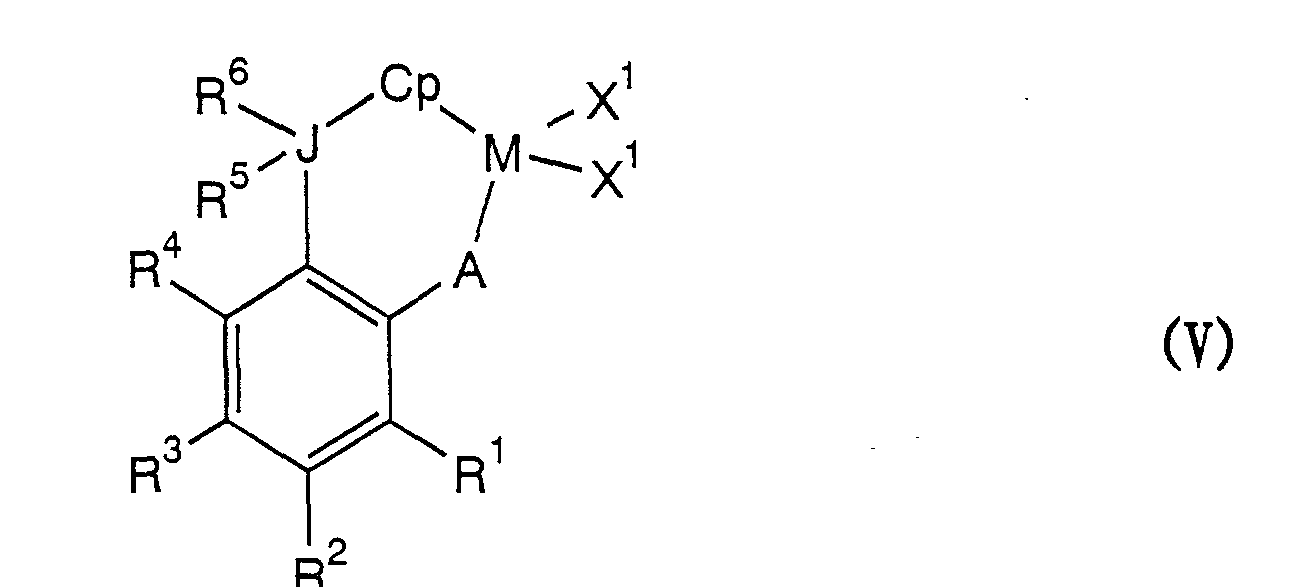 and
and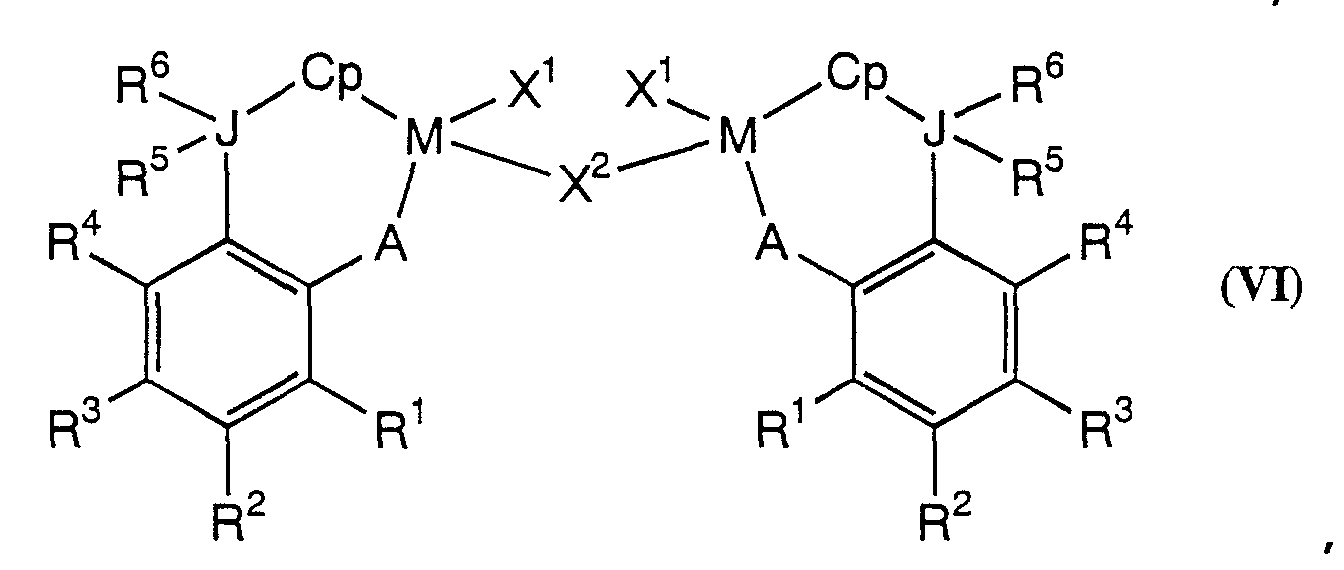 wherein, in the general formula (V), (VI) or (VII), M represents a transition metal atom of the Group IV of the Periodic Table of the Elements; A represents an atom of the Group XVI of the Periodic Table of the Elements; J represents an atom of the Group XIV of the Periodic Table of the Elements; Cp represents a group having a cyclopentadiene type anion skeleton; each of X1, R1, R2, R3, R4, R5 and R6 independently represents a hydrogen atom, a halogen atom, an alkyl group, an aralkyl group, an aryl group, a substituted silyl group, an alkoxy group, an aralkyloxy group, an aryloxy group, a di-substituted amino group, an alkylthio group, an aralkylthio group, an arylthio group, an alkylseleno group, an aralkylseleno group or arylseleno group; X2 represents an atom of Group XVI of the Periodic Table of the Elements; R1, R2, R3, R4, R5 and R6 may be optionally combined with each other to form a ring; and in the general formula (VI) or (VII), two of M, A, J, Cp, X1, X2, R1, R2, R3, R4, R5 and R6 may be respectively the same or different.
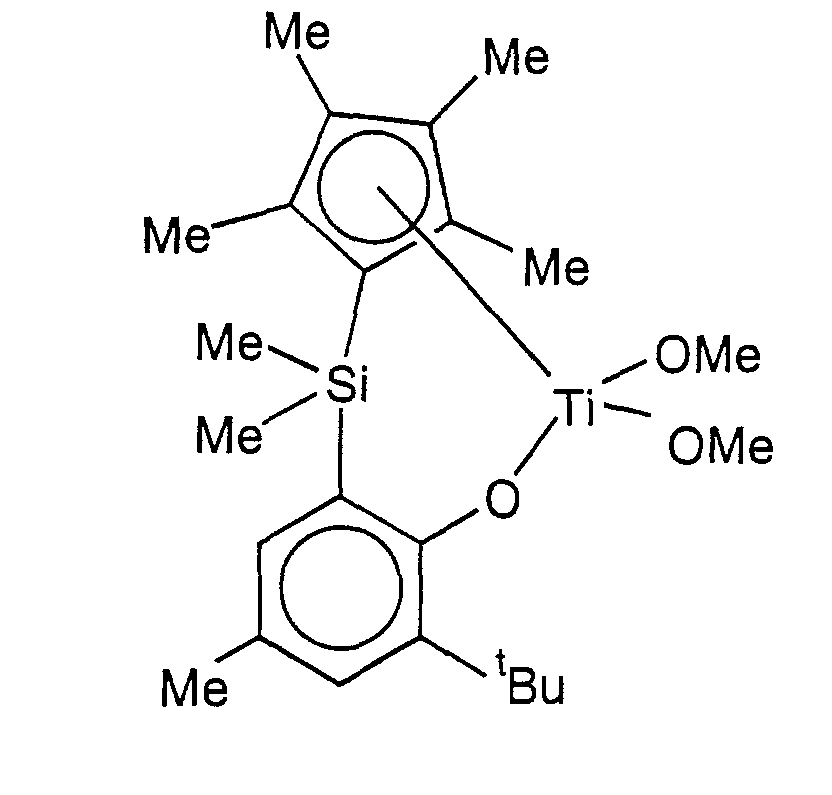
 or
or wherein, in the general formula (I), (II] or (III], M represents a transition metal atom of the Group IV of the Periodic Table of the Elements; A represents an atom of the Group XVI of the Periodic Table of the Elements; J represents an atom of the Group XIV of the Periodic Table of the Elements ; Cp represents a group having a cyclopentadiene type anion skeleton; each of X1, R1, R2, R3, R4, R5 and R6 independently represents a hydrogen atom, a halogen atom, an alkyl group, an aralkyl group, an aryl group, a substituted silyl group, an alkoxy group, an aralkyloxy group, an aryloxy group, a di-substituted amino group, an alkylthio group, an aralkylthio group, an arylthio group, an alkylseleno group, an aralkylseleno group or arylseleno group; X2 represents an atom of Group XVI of the Periodic Table of the Elements; R1, R2, R3, R4, R5 and R6 may be optionally combined with each other to form a ring; and in the general formula (II) or (III), two of M, A, J, Cp, X1, X2, X3, R1, R2, R3, R4, R5 and R6 may be respectively the same or different.