EP1133118A2 - IP/Data traffic allocating method to maintain QoS - Google Patents
IP/Data traffic allocating method to maintain QoS Download PDFInfo
- Publication number
- EP1133118A2 EP1133118A2 EP01440037A EP01440037A EP1133118A2 EP 1133118 A2 EP1133118 A2 EP 1133118A2 EP 01440037 A EP01440037 A EP 01440037A EP 01440037 A EP01440037 A EP 01440037A EP 1133118 A2 EP1133118 A2 EP 1133118A2
- Authority
- EP
- European Patent Office
- Prior art keywords
- paths
- qos
- traffic
- path
- network
- Prior art date
- Legal status (The legal status is an assumption and is not a legal conclusion. Google has not performed a legal analysis and makes no representation as to the accuracy of the status listed.)
- Withdrawn
Links
Images

Classifications
-
- H—ELECTRICITY
- H04—ELECTRIC COMMUNICATION TECHNIQUE
- H04L—TRANSMISSION OF DIGITAL INFORMATION, e.g. TELEGRAPHIC COMMUNICATION
- H04L47/00—Traffic control in data switching networks
- H04L47/10—Flow control; Congestion control
-
- H—ELECTRICITY
- H04—ELECTRIC COMMUNICATION TECHNIQUE
- H04L—TRANSMISSION OF DIGITAL INFORMATION, e.g. TELEGRAPHIC COMMUNICATION
- H04L43/00—Arrangements for monitoring or testing data switching networks
-
- H—ELECTRICITY
- H04—ELECTRIC COMMUNICATION TECHNIQUE
- H04L—TRANSMISSION OF DIGITAL INFORMATION, e.g. TELEGRAPHIC COMMUNICATION
- H04L47/00—Traffic control in data switching networks
- H04L47/10—Flow control; Congestion control
- H04L47/11—Identifying congestion
-
- H—ELECTRICITY
- H04—ELECTRIC COMMUNICATION TECHNIQUE
- H04L—TRANSMISSION OF DIGITAL INFORMATION, e.g. TELEGRAPHIC COMMUNICATION
- H04L47/00—Traffic control in data switching networks
- H04L47/10—Flow control; Congestion control
- H04L47/24—Traffic characterised by specific attributes, e.g. priority or QoS
-
- H—ELECTRICITY
- H04—ELECTRIC COMMUNICATION TECHNIQUE
- H04L—TRANSMISSION OF DIGITAL INFORMATION, e.g. TELEGRAPHIC COMMUNICATION
- H04L43/00—Arrangements for monitoring or testing data switching networks
- H04L43/08—Monitoring or testing based on specific metrics, e.g. QoS, energy consumption or environmental parameters
- H04L43/0852—Delays
-
- H—ELECTRICITY
- H04—ELECTRIC COMMUNICATION TECHNIQUE
- H04L—TRANSMISSION OF DIGITAL INFORMATION, e.g. TELEGRAPHIC COMMUNICATION
- H04L43/00—Arrangements for monitoring or testing data switching networks
- H04L43/08—Monitoring or testing based on specific metrics, e.g. QoS, energy consumption or environmental parameters
- H04L43/0852—Delays
- H04L43/087—Jitter
Definitions
- This invention relates to a method and arrangement for improving the quality of service (QoS) of transmissions in a Data Network.
- QoS quality of service
- An application of such an invention is in the transmission of information over a network using the Internet Protocol (IP).
- IP Internet Protocol
- IP/Data networking is a developing market, and carriers need to be able to provide QoS guarantees for different grades of traffic.
- IP traffic is subject to variable QoS depending on network usage.
- This invention extends the work of the IETF (Internet Engineering Task Force) in the areas of Differentiated Services (DiffServ) and Integrated Services (IntServ) and all associated patents either granted or pending.
- This invention aims to address some of the failings inherent within these two bodies of work.
- the scalability and performance limitations of the IntServ model as well as the lack of native direct support for QoS performance guarantees within the DiffServ model.
- This specification therefore discloses a method of allocating traffic to a path or paths between a sending node and a receiving node in a network, wherein each message includes a QoS flag, the method including:
- the "all-practical-paths maximal flow” technique utilizes a network status mapping method under which the nodes are aware of the traffic conditions across the network.
- Application Number 44470/99 describes an iterative hierarchal structure of interconnected nodes in which the available capacity of each node is reported to the nodes higher in the hierarchy, and which determines an overall availability for the group of nodes reporting to it.
- This iterative structure means that the overall amount of information exchanged for remote nodes is condensed, while more detailed information is exchanged about proximate nodes. In this manner, a node can determine the available capacity between itself and a destination node over various paths.
- the Internet Protocol makes provision for a grade of service field to indicate the required grade of service of a datagram.
- IP Internet Protocol
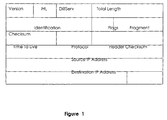
- Figure 1 The Internet Protocol (IP) header format is shown in Figure 1 and includes the following fields:
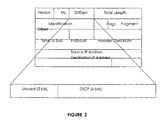
- the DS field (Field 3) is 8 bits with the following functions:-
- the DSCP specifies the required grade of service.
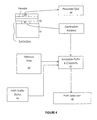
- a datagram 41 includes a header 42.
- the header includes a DS field 43 from which a required QoS can be determined by analysing the DSCP information.
- Each node has access to network architecture information 45 which is combined in path identification process 47 with network traffic status information 46 and the destination address in process 50, to determine the available paths from the source to the destination, and the available capacity for each of those paths.
- the required QoS information 44 is then combined with the path/capacity information in a path selection process 48 to determine over which path or paths the datagram is to be transmitted.
- the DS field may be used directly to correspond to a QoS, or it may be translated, eg, via a look-up table to a hierarchical priority list implemented in the network which the traffic transits.
- the path selection process implements the following: From the DS field, a required QoS is selected at 44 from two or more available options. In this example the options are, in order of priority.
- EF Expedited Forwarding characteristics: Low Latency, Low Jitter, No discard Applications: Real time, interactive compressed multimedia; Real time, industry control/monitoring systems; SNA etc traffic.
- EF - DE Expedited Forwarding with discard Eligible Characteristics: Discard tolerant, low Latency, low jitter Applications: Real time, interactive games
- the QoS is implemented as follows:
- This pattern is repeated down the priority list.
- low priority datagrams may use shorter paths, but, as use increases and higher priority traffic needs to be sent, low priority datagrams are pushed to longer paths.
- This technique facilitates efficient use of the network by distributing traffic over the available paths, while ensuring the higher priority datagrams have low latency by transmitting them on the shortest paths.
- Figure 3 illustrates the probability with which different classes of traffic would be allocated to a 500mb/s link.
Landscapes
- Engineering & Computer Science (AREA)
- Computer Networks & Wireless Communication (AREA)
- Signal Processing (AREA)
- Data Exchanges In Wide-Area Networks (AREA)
Abstract
Description
the method including:
- at the sending node, compiling a traffic status map of the available capacity on the or each practical path between the sending node and the receiving node;
- allocating messages to paths on the basis of its QoS flag, and the available capacity of the paths.
- 6-7 Unused (reserved for explicit congestion notification);
- 0-6 Differentiated Services Code Point (DSCP)
- Expedited Forwarding (EF)
- Assured Forwarding (AF1-4)
- Best Effort (BE)
- Class Selector (CS)
From the DS field, a required QoS is selected at 44 from two or more available options. In this example the options are, in order of priority.
EF = Expedited Forwarding
characteristics:
Low Latency, Low Jitter, No discard
Applications:
Real time, interactive compressed multimedia;
Real time, industry control/monitoring systems;
SNA etc traffic.
EF - DE = Expedited Forwarding with discard Eligible
Characteristics:
Discard tolerant, low Latency, low jitter
Applications:
Real time, interactive games
AF1 = AF-ND = Assured Forwarding, No Discard (Vbr-nrt)
Characteristics:
No discard; latency & jitter tolerant
Applications:
Transaction networks, X. 25 applications
AF2 = AF = Assured forwarding (Vbr-nrt)
Characteristics:
Weighted variable discard; latency & jitters tolerant.
Platinum, gold, silver, Bronze priorities.
Applications:
Standard Services
BE = Best efforts
Characteristics:
No guarantees,
Applications:
Little or no carrier change.
- a 20% probability of allocating AF1 traffic,
- a 40% probability of allocating AF2 traffic, and
- an 80% probability of allocating BE traffic.
Claims (3)
- A method of allocating traffic to a path or paths between a sending node and a receiving node in a network, wherein each message includes a QoS flag,
the method including:at the sending node, compiling a traffic status map of the available capacity on the or each practical path between the sending node and the receiving node;allocating messages to paths on the basis of its QoS flag, and the available capacity of the paths. - A method as claimed in claim 1 in which the QoS hierarchy allocates the highest priority messages to the shorter paths with available capacity in preference to lower priority messages, the lower priority messages being allocated to longer paths as traffic conditions require.
- A method of allocating traffic in a network substantially as herein described with reference to the accompanying drawings.
Applications Claiming Priority (2)
| Application Number | Priority Date | Filing Date | Title |
|---|---|---|---|
| AU20795/00 | 2000-03-10 | ||
| AU2079500 | 2000-03-10 |
Publications (2)
| Publication Number | Publication Date |
|---|---|
| EP1133118A2 true EP1133118A2 (en) | 2001-09-12 |
| EP1133118A3 EP1133118A3 (en) | 2002-02-06 |
Family
ID=3710107
Family Applications (1)
| Application Number | Title | Priority Date | Filing Date |
|---|---|---|---|
| EP01440037A Withdrawn EP1133118A3 (en) | 2000-03-10 | 2001-02-19 | IP/Data traffic allocating method to maintain QoS |
Country Status (2)
| Country | Link |
|---|---|
| US (1) | US20020049854A1 (en) |
| EP (1) | EP1133118A3 (en) |
Families Citing this family (25)
| Publication number | Priority date | Publication date | Assignee | Title |
|---|---|---|---|---|
| US7154858B1 (en) * | 1999-06-30 | 2006-12-26 | Cisco Technology, Inc. | System and method for measuring latency of a selected path of a computer network |
| US20050283658A1 (en) * | 2004-05-21 | 2005-12-22 | Clark Thomas K | Method, apparatus and program storage device for providing failover for high availability in an N-way shared-nothing cluster system |
| ATE413044T1 (en) * | 2004-06-30 | 2008-11-15 | Huawei Tech Co Ltd | METHOD FOR PERIODICALLY ACQUIRING A QUALITY OF SERVICE (QOS) OF A MULTIMEDIA STREAM |
| US8149715B1 (en) | 2007-07-17 | 2012-04-03 | Marvell International Ltd. | Mesh network operations |
| US8369782B1 (en) | 2007-08-13 | 2013-02-05 | Marvell International Ltd. | Bluetooth wideband scan mode |
| US8553561B1 (en) | 2007-08-22 | 2013-10-08 | Marvell International Ltd. | Quality of service for mesh networks |
| US8577305B1 (en) | 2007-09-21 | 2013-11-05 | Marvell International Ltd. | Circuits and methods for generating oscillating signals |
| US8588705B1 (en) | 2007-12-11 | 2013-11-19 | Marvell International Ltd. | System and method of determining Power over Ethernet impairment |
| EP2635077B1 (en) | 2008-06-16 | 2016-11-23 | Marvell World Trade Ltd. | Short-range wireless communication |
| US8310967B1 (en) | 2008-06-19 | 2012-11-13 | Marvell International Ltd. | Infrastructure and ad-hoc node device |
| US8600324B1 (en) | 2008-06-27 | 2013-12-03 | Marvell International Ltd | Circuit and method for adjusting a digitally controlled oscillator |
| US8472968B1 (en) | 2008-08-11 | 2013-06-25 | Marvell International Ltd. | Location-based detection of interference in cellular communications systems |
| US9288764B1 (en) | 2008-12-31 | 2016-03-15 | Marvell International Ltd. | Discovery-phase power conservation |
| US8472427B1 (en) | 2009-04-06 | 2013-06-25 | Marvell International Ltd. | Packet exchange arbitration for coexisting radios |
| US9066369B1 (en) | 2009-09-16 | 2015-06-23 | Marvell International Ltd. | Coexisting radio communication |
| US8340034B1 (en) | 2009-11-11 | 2012-12-25 | Marvell International Ltd. | Bluetooth and wireless LAN arbitration |
| US8767771B1 (en) | 2010-05-11 | 2014-07-01 | Marvell International Ltd. | Wakeup beacons for mesh networks |
| KR101616491B1 (en) | 2010-10-20 | 2016-04-28 | 마벨 월드 트레이드 리미티드 | Pre-association discovery |
| US8750278B1 (en) | 2011-05-26 | 2014-06-10 | Marvell International Ltd. | Method and apparatus for off-channel device invitation |
| US8983557B1 (en) | 2011-06-30 | 2015-03-17 | Marvell International Ltd. | Reducing power consumption of a multi-antenna transceiver |
| US9125216B1 (en) | 2011-09-28 | 2015-09-01 | Marvell International Ltd. | Method and apparatus for avoiding interference among multiple radios |
| US9036517B2 (en) | 2012-01-09 | 2015-05-19 | Marvell World Trade Ltd. | Methods and apparatus for establishing a tunneled direct link setup (TDLS) session between devices in a wireless network |
| WO2013119810A1 (en) | 2012-02-07 | 2013-08-15 | Marvell World Trade Ltd. | Method and apparatus for multi-network communication |
| US9609676B1 (en) | 2012-03-30 | 2017-03-28 | Marvell International Ltd. | Efficient transition from discovery to link establishment |
| US9450649B2 (en) | 2012-07-02 | 2016-09-20 | Marvell World Trade Ltd. | Shaping near-field transmission signals |
Family Cites Families (4)
| Publication number | Priority date | Publication date | Assignee | Title |
|---|---|---|---|---|
| EP0660569A1 (en) * | 1993-12-22 | 1995-06-28 | International Business Machines Corporation | Method and system for improving the processing time of the path selection in a high speed packet switching network |
| FI105969B (en) * | 1998-08-10 | 2000-10-31 | Nokia Networks Oy | Service quality management in a mobile communication system |
| US6788692B1 (en) * | 1999-05-03 | 2004-09-07 | Nortel Networks Limited | Network switch load balancing |
| US6542964B1 (en) * | 1999-06-02 | 2003-04-01 | Blue Coat Systems | Cost-based optimization for content distribution using dynamic protocol selection and query resolution for cache server |
-
2001
- 2001-02-19 EP EP01440037A patent/EP1133118A3/en not_active Withdrawn
- 2001-03-09 US US09/801,707 patent/US20020049854A1/en not_active Abandoned
Also Published As
| Publication number | Publication date |
|---|---|
| US20020049854A1 (en) | 2002-04-25 |
| EP1133118A3 (en) | 2002-02-06 |
Similar Documents
| Publication | Publication Date | Title |
|---|---|---|
| EP1133118A2 (en) | IP/Data traffic allocating method to maintain QoS | |
| JP4796157B2 (en) | System and method for implementing resource allocation in network communications | |
| JP3545988B2 (en) | Communication method and communication device | |
| US9413546B2 (en) | QOS provisioning in a network having dynamic link states | |
| US6898641B1 (en) | Network routing system and routing apparatus | |
| EP1423945B1 (en) | Method and arrangement in an ip network | |
| US6643258B1 (en) | Communication resource management method and node device using priority control and admission control | |
| Mirhakkak et al. | Dynamic bandwidth management and adaptive applications for a variable bandwidth wireless environment | |
| US6910024B2 (en) | System for pricing-based quality of service (PQoS) control in networks | |
| US7889743B2 (en) | Information dissemination method and system having minimal network bandwidth utilization | |
| US6977896B1 (en) | IP communications network system and QoS guaranteeing apparatus | |
| EP1198929B1 (en) | Receiver driven differentiated service marking for unicast and multicast applications | |
| US20020152319A1 (en) | Accounting management support based on QOS in an IP centric distributed network | |
| Mathy et al. | The Internet: a global telecommunications solution? | |
| JP2001197104A (en) | Apparatus and method for time-based multimedia object streaming | |
| CN101692657A (en) | Differentiated service core router and data forwarding method thereof | |
| Bhatti et al. | QoS-sensitive flows: Issues in IP packet handling | |
| KR102058514B1 (en) | Policy based path control system in multi-path environments | |
| CN118764546A (en) | A multi-link communication method based on communication protocol analysis | |
| AU2325901A (en) | Ip/date traffic allocating method to maintain QoS | |
| Zheng et al. | An overview of research on QoS routing | |
| Huang et al. | Load-sharing in wireless multi-homed systems | |
| EP2031805A1 (en) | Packet-type based resilience using network coding | |
| KR100510820B1 (en) | Admission control method using the link and path level information in differentiated service network | |
| Kantawala et al. | QoS architecture for session oriented GIG applications |
Legal Events
| Date | Code | Title | Description |
|---|---|---|---|
| PUAI | Public reference made under article 153(3) epc to a published international application that has entered the european phase |
Free format text: ORIGINAL CODE: 0009012 |
|
| AK | Designated contracting states |
Kind code of ref document: A2 Designated state(s): AT BE CH CY DE DK ES FI FR GB GR IE IT LI LU MC NL PT SE TR |
|
| AX | Request for extension of the european patent |
Free format text: AL;LT;LV;MK;RO;SI |
|
| PUAL | Search report despatched |
Free format text: ORIGINAL CODE: 0009013 |
|
| AK | Designated contracting states |
Kind code of ref document: A3 Designated state(s): AT BE CH CY DE DK ES FI FR GB GR IE IT LI LU MC NL PT SE TR |
|
| AX | Request for extension of the european patent |
Free format text: AL;LT;LV;MK;RO;SI |
|
| RIC1 | Information provided on ipc code assigned before grant |
Free format text: 7H 04L 12/56 A, 7H 04L 12/26 B |
|
| 17P | Request for examination filed |
Effective date: 20020323 |
|
| AKX | Designation fees paid |
Free format text: AT BE CH CY DE DK ES FI FR GB GR IE IT LI LU MC NL PT SE TR |
|
| STAA | Information on the status of an ep patent application or granted ep patent |
Free format text: STATUS: THE APPLICATION IS DEEMED TO BE WITHDRAWN |
|
| 18D | Application deemed to be withdrawn |
Effective date: 20060901 |