EP1132891A1 - Voice encoder, voice decoder, and voice encoding and decoding method - Google Patents
Voice encoder, voice decoder, and voice encoding and decoding method Download PDFInfo
- Publication number
- EP1132891A1 EP1132891A1 EP00961220A EP00961220A EP1132891A1 EP 1132891 A1 EP1132891 A1 EP 1132891A1 EP 00961220 A EP00961220 A EP 00961220A EP 00961220 A EP00961220 A EP 00961220A EP 1132891 A1 EP1132891 A1 EP 1132891A1
- Authority
- EP
- European Patent Office
- Prior art keywords
- spectrum envelope
- curved surface
- speech
- information
- fundamental frequency
- Prior art date
- Legal status (The legal status is an assumption and is not a legal conclusion. Google has not performed a legal analysis and makes no representation as to the accuracy of the status listed.)
- Withdrawn
Links
Images





Classifications
-
- G—PHYSICS
- G10—MUSICAL INSTRUMENTS; ACOUSTICS
- G10L—SPEECH ANALYSIS TECHNIQUES OR SPEECH SYNTHESIS; SPEECH RECOGNITION; SPEECH OR VOICE PROCESSING TECHNIQUES; SPEECH OR AUDIO CODING OR DECODING
- G10L19/00—Speech or audio signals analysis-synthesis techniques for redundancy reduction, e.g. in vocoders; Coding or decoding of speech or audio signals, using source filter models or psychoacoustic analysis
- G10L19/04—Speech or audio signals analysis-synthesis techniques for redundancy reduction, e.g. in vocoders; Coding or decoding of speech or audio signals, using source filter models or psychoacoustic analysis using predictive techniques
- G10L19/06—Determination or coding of the spectral characteristics, e.g. of the short-term prediction coefficients
Definitions
- the present invention relates to a speech coder, speech decoder and speech coding/decoding method used for a communication apparatus in a radio communication system such as a car telephone or cellular telephone.
- FIG.1 is a block diagram showing a configuration of a conventional speech coder and speech decoder.
- spectrum envelope analysis section 11 estimates spectrum envelope information of an input speech signal.
- Spectrum envelope quantization section 12 quantizes the spectrum envelope information estimated by spectrum envelope analysis section 11.
- Inverse filter 13 filters the inverse characteristic of the frequency characteristic of the spectrum envelope information quantized by spectrum envelope quantization section 12 for the input speech signal and removes the spectrum envelope component. This makes it possible to obtain a signal with a flat frequency characteristic. This signal is considered to be simulating an excitation signal generated by the vocal cords in the process of vocalization. Hereinafter, this signal is referred to as an "excitation signal”.
- Excitation codebook 14 stores signals having a flat frequency characteristic. Excitation coding section 15 searches the signal closest to the excitation signal from excitation codebook 14 and outputs the code (hereinafter, referred to as "excitation code").
- Multiplexing section 16 multiplexes the code showing the quantized value of the spectrum envelope information output from spectrum envelope quantization section 12 and the excitation code output from excitation coding section 15 into a code string and sends this code string to a communication path.
- inverse multiplexing section 21 separates the received code string into the code showing the quantized value of the spectrum envelope information and the excitation code.
- Excitation codebook 22 stores signals identical to those in excitation codebook 14.
- Excitation selection section 23 selects and extracts a signal corresponding to the received excitation code from excitation codebook 22.
- Synthesis filter 24 performs filtering so that the signal extracted by excitation selection section 23 has the frequency characteristic of the received spectrum envelope information and outputs the decoded speech.
- the conventional speech coder and speech decoder separate spectrum envelope information with different signal dynamic ranges and quantization characteristics from the excitation signal, constitute quantizers according to their respective characteristics, thereby implementing high quality speech coding/decoding.
- the conventional speech coder and speech decoder above perform filtering based on the result from quantizing spectrum envelope information, when sufficient accuracy cannot be obtained in the quantization of the spectrum envelope information using a low bit rate, the conventional speech coder and speech decoder above fail to flatten an excitation signal, producing a problem of reduced quantization efficiency and deteriorated quality of the decoded speech.
- This object is attained, focused on the fact that a speech signal is generated by extracting a spectrum envelope curved surface, which is continuous on the time scale, based on a fundamental frequency, by completely separating spectrum envelope information from excitation information, implementing speech coding/decoding processing independent of the quantization accuracy of the spectrum envelope information and implementing highly efficient speech coding/decoding processing through a highly efficient technique of quantizing the spectrum envelope information, which is effective in an analysis/synthesis model.
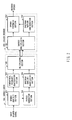
- FIG.2 is a block diagram showing a configuration of a speech coder and speech decoder according to Embodiment 1 of the present invention.
- speech analysis section 101 extracts a fundamental frequency and short-time spectrum envelope information from an input speech signal.
- Fundamental frequency quantization section 102 quantizes the fundamental frequency extracted by speech analysis section 101.
- Matrix generation section 103 generates a spectrum envelope curved surface on the time-frequency plane by arranging short-time spectrum envelope information extracted by speech analysis section 101 along the time-axis.
- Spectrum envelope quantization section 104 quantizes the spectrum envelope curved surface generated by matrix generation section 103.
- the spectrum envelope information is quantized as a continuous function on the time-frequency plane because when only the extracted spectrum envelope is quantized, the spectrum envelope information is quantized depending on the excitation information, making it impossible to realize a separation in information quantization processing, which is the essence of the present invention.
- Multiplexing section 105 multiplexes the code showing the quantized value of the spectrum envelope curved surface output from spectrum envelope quantization section 104 and the code showing the quantized value of the fundamental frequency output from fundamental frequency quantization section 102 and sends out the multiplexed code to a communication path.
- inverse multiplexing section 201 separates the received code string into the code showing the quantized value of the spectrum envelope information and the code showing the quantized value of the fundamental frequency.
- Spectrum envelope configuration section 202 reconfigures the spectrum envelope curved surface quantized from the received spectrum envelope information.
- Speech synthesis section 203 extracts the spectrum envelope curved surface reconfigured by spectrum envelope configuration section 202 based on the fundamental frequency information and synthesizes this into a decoded speech and outputs.
- the fundamental frequency and short-time spectrum envelope information are extracted from the input speech signal input by speech analysis section 101 of speech coder 100.
- the extracted fundamental frequency is quantized by fundamental frequency quantization section 102.
- the extracted short-time spectrum envelope information is arranged along the time-axis by matrix generation section 103 and a spectrum envelope curved surface is generated on the time-frequency plane.
- the spectrum envelope curved surface is quantized by spectrum envelope quantization section 104.
- the quantized fundamental frequency and spectrum envelope curved surface are multiplexed by multiplexing section 105 and sent out to the communication path. Then, the fundamental frequency and spectrum envelope curved surface are received by inverse multiplexing section 201 of speech decoder 200 and separated into the quantized value of the spectrum envelope information and the quantized value of the fundamental frequency.
- the quantized value of the spectrum envelope information is input to spectrum envelope configuration section 202 and the spectrum envelope curved surface is reconfigured by spectrum envelope configuration section 202.
- speech synthesis section 203 extracts the reconfigured spectrum envelope curved surface based on the fundamental frequency information, synthesizes this into a decoded speech and outputs.
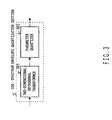
- FIG.3 is the block diagram showing an internal configuration of a spectrum envelope quantization section of a speech coder according to Embodiment 2 of the present invention.
- the configuration of the speech coder according to this Embodiment is the same as the configuration of the speech coder shown in FIG.2 of Embodiment 1, and therefore explanations thereof are omitted.
- two-dimensional orthogonal transformer 301 performs a two-dimensional orthogonal transformation on a spectrum envelope curved surface in the time-axis direction and frequency-axis direction.
- Parameter quantizer 302 quantizes the transformation coefficient obtained through the two-dimensional orthogonal transformation processing by two-dimensional orthogonal transformer 301.
- parameter quantizer 302 quantizes only the coefficient information of the low frequency component.
- FIG.4 is a block diagram showing an internal configuration of a spectrum envelope quantization section of a speech coder according to Embodiment 3 of the present invention.
- the configuration of the speech coder according to this Embodiment is the same as the configuration of the speech coder of Embodiment 1 shown in FIG.2, and therefore explanations thereof are omitted.
- model applier 311 models a spectrum envelope curved surface and extracts a model parameter.
- This model results from modeling of a spectrum envelope curved surface in the time-frequency space and modeling is available by, for example, applying a crossfield model to both sections on the time-axis of the spectrum envelope curved surface and complementing the crossfield model as shown in FIG.5.
- Parameter quantizer 302 quantizes the model parameter extracted by model applier 311.
- FIG.6 is a block diagram showing an internal configuration of a spectrum envelope quantization section of a speech coder according to Embodiment 4 of the present invention.
- the configuration of the speech coder according to this Embodiment is the same as the configuration of the speech coder of Embodiment 1 shown in FIG.2, and therefore explanations thereof are omitted.
- time-axis orthogonal transformer 321 performs an orthogonal transformation in the time-axis direction on a spectrum envelope curved surface.
- Model applier 311 applies a model according to the degree on the time-axis to the orthogonal-transformed time-axis transformation coefficient and extracts a parameter.
- Parameter quantizer 302 quantizes the model parameter extracted by model applier 311.
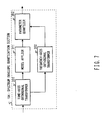
- FIG.7 is a block diagram showing an internal configuration of a spectrum envelope quantization section of a speech coder according to Embodiment 5 of the present invention.
- the configuration of the speech coder according to this Embodiment is the same as the configuration of the speech coder of Embodiment 1 shown in FIG.2, and therefore explanations thereof are omitted.
- time-axis orthogonal transformer 331 performs an orthogonal transformation in the time-axis direction on a spectrum envelope curved surface and classifies it into ones whose orthogonal-transformed time-axis transformation coefficient will be modeled and others whose orthogonal-transformed time-axis transformation coefficient will not be modeled.
- This classification method is a method whereby a crossfield model is applied to the 0th order coefficient of the time-axis because it is a spectrum envelope obtained by averaging the spectrum envelope curved surface and no model is applied to other coefficients.
- Model applier 311 applies a model according to the order on the time-axis to some of the orthogonal-transformed time-axis transformation coefficients and extracts a parameter.
- Frequency-axis orthogonal transformer 332 performs an orthogonal transformation in the frequency-axis direction on the time-axis transformation coefficients to which no model is applied.
- Parameter quantizer 302 quantizes the model parameter extracted by model applier 311 and the transformation coefficients output from frequency-axis orthogonal transformer 332.
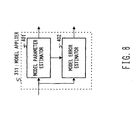
- FIG.8 is a block diagram showing an internal configuration of a model applier of a speech coder according to Embodiment 6 of the present invention.
- Model applier 311 according to this Embodiment is shown in one of Embodiments 3 to 5 above.
- Model parameter estimator 401 applies a model to an input signal and extracts a parameter.
- an input signal is modeled with a crossfield model taking into account the speech generation process.
- the model cannot show zero points contained in the signal producing analysis distortion by the model.
- model error estimator 402 estimates the analysis distortion generated when the model is applied and outputs the estimated analysis distortion to the parameter quantizer.
- FIG.9 is a block diagram showing an internal configuration of a parameter quantizer of a speech coder according to Embodiment 7 of the present invention.
- Parameter quantizer 302 according to this Embodiment is shown in one of Embodiments 2 to 5 above.
- Weight calculator 501 determines quantization sensitivity for each quantization target value using fundamental frequency information. An example of the method of determining quantization sensitivity by weight calculator 501 is shown below.
- Speech decoding processing generates a decoded speech by extracting a spectrum envelope curved surface according to the fundamental frequency and connecting it on the time-axis. At this time, the harmonic wave amplitude value of the fundamental frequency becomes information more important than that of the other spectrum amplitude values. Therefore, a weighting factor curved surface obtained by assigning weights to the harmonic wave amplitude value at the position of the extracted spectrum envelope is generated.
- quantization sensitivity of each quantization target value is determined by transforming using a method similar to that of the transformation used to obtain the quantization target value and calculating a weighting factor in the quantization target parameter space.
- Weight calculator 502 determines quantization sensitivity for each quantization target value using the spectrum envelope information. An example of the method of determining quantization sensitivity by weight calculator 502 is shown below.
- noise of a same magnitude is added to a certain signal, noise of a signal with a small dynamic range is perceptually more conspicuous than noise of a signal with a large dynamic range. Therefore, a weighting factor curved surface is generated with a greater weight assigned for a signal of a smaller amplitude on the spectrum envelope curved surface.
- quantization sensitivity for each quantization target value is determined by carrying out a transformation using a method similar to that for the transformation to obtain the quantization target value and calculating a weighting factor in the quantization target parameter space. Since the method of applying the quantizer by weight calculator 502 is also necessary in decoding processing, it is desirable to use a spectrum envelope information quantized with a preceding frame in order to establish synchronization with the decoding processing.
- Statistical quantity accumulator 503 accumulates a statistical quantity for every quantization target value acquired beforehand.
- Quantization generator 504 designs a quantizer from the quantization sensitivity corresponding to the quantization target values output from weight calculator 501 and weight calculator 502 and a statistical quantity accumulated in statistical quantity accumulator 503.
- the dispersion of quantization target values is accumulated as a statistical quantity and a quantization step width is determined based on this dispersion and quantization sensitivity.
- quantization sensitivity is large. That is, a smaller quantization step width is set for a quantization target value susceptible to quantization errors.
- Quantizer 505 quantizes quantization target values based on the design result of quantizer generator 504.
- this Embodiment determines quantization sensitivity for each quantization target value using two information pieces, the fundamental frequency information and spectrum envelope information, but it is also possible to determine quantization sensitivity using the information of either of the two to design the quantizer.
- FIG.10 is a block diagram showing an internal configuration of a parameter quantizer of a speech coder according to Embodiment 8 of the present invention.
- Parameter quantizer 302 according to this Embodiment is shown in one of Embodiments 2 to 5 above.
- Error scale determinator 511 adaptively determines a quantization error scale on a spectrum envelope using the fundamental frequency information.
- Error scale determinator 512 adaptively determines a quantization error scale on a spectrum envelope using the spectrum envelope information.
- Error scale synthesizer 513 synthesizes the error scales obtained from error scale determinator 511 and error scale determinator 512 into one error scale.
- Codebook 514 stores quantized values.
- Spectrum envelope configurator 515 converts a quantized value stored in codebook 514 into a spectrum envelope curved surface.
- Spectrum envelope configurator 516 converts a quantization target value into a spectrum envelope curved surface.
- Error calculator 517 calculates an error between the spectrum envelope curved surface composed by spectrum envelope configurator 515 and the spectrum envelope curved surface composed by spectrum envelope configurator 516 based on the error scale output from error scale synthesizer 513.
- Code selector 518 selects and outputs the code corresponding to the quantized value, which corresponds to the smallest error from codebook 514.
- This Embodiment determines a quantization error scale on the spectrum envelope with respect to both the fundamental frequency and the spectrum envelope information, but it is also possible to determine a quantization error scale with respect to either of the two to calculate an error.
- FIG.11 is a block diagram showing an internal configuration of a parameter quantizer of a speech coder according to Embodiment 9 of the present invention.
- Parameter quantizer 302 according to this Embodiment is shown in one of Embodiments 2 to 5 above.
- Error function determinator 521 adaptively determines a quantization error weighting factor on a spectrum envelope using the fundamental frequency information.
- Error function determinator 522 adaptively determines a quantization error weighting factor on a spectrum envelope using the spectrum envelope information.
- Error function synthesizer 523 synthesizes the quantization error weighting functions obtained from error function determinator 521 and error function determinator 522 into one error function.
- Error function converter 524 defines an error scale on a quantization parameter that converts the quantization error weighting function output from error function synthesizer 523.
- Codebook 525 stores quantized values. Error calculator 526 calculates an error between a quantization target value and a quantized value stored in codebook 525 based on the error scale output from error function converter 524.
- Code selector 527 selects and outputs the code corresponding to the quantized value, which corresponds to the smallest error from codebook 525.
- This Embodiment determines a quantization error weighting function on a spectrum envelope with respect to both the fundamental frequency and the spectrum envelope information, but it is also possible to determine a quantization error weighting function with respect to either of the two to calculate an error.
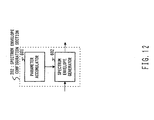
- FIG.12 is a block diagram showing an internal configuration of a spectrum envelope configuration section of a speech decoder according to Embodiment 10 of the present invention.
- the configuration of the speech decoder according to this embodiment is the same as the configuration of the speech decoder of Embodiment 1 shown in FIG.2, and therefore explanations thereof are omitted.
- the speech coding/decoding method using an orthogonal transformation is intended to compress information by not transmitting the high frequency component, which is not perceptually important on the coding side. Therefore, this Embodiment generates an envelope curved surface by complementing the parameter, which has not been received, using the parameter value statistically calculated beforehand on the decoding side.
- parameter accumulator 601 stores parameter values statistically calculated beforehand, corresponding to parameters other than the quantization target.
- Spectrum envelope generator 602 generates a spectrum envelope curved surface based on the input spectrum envelope information.
- the speech coder, speech decoder and speech coding/decoding method of the present invention can completely separate spectrum envelope information from excitation information, achieve speech coding/decoding processing independent of the quantization accuracy of spectrum envelope information and achieve highly efficient speech coding/decoding processing through a highly efficient technique of quantizing spectrum envelope information, which is effective in an analysis/synthesis model, and thereby implement speech decoding of high quality even when information is transmitted at a low bit rate.
- the present invention is ideally applicable to a base station apparatus or a communication terminal apparatus in a radio communication system that carries out radio communication of speech data.
Landscapes
- Engineering & Computer Science (AREA)
- Physics & Mathematics (AREA)
- Spectroscopy & Molecular Physics (AREA)
- Computational Linguistics (AREA)
- Signal Processing (AREA)
- Health & Medical Sciences (AREA)
- Audiology, Speech & Language Pathology (AREA)
- Human Computer Interaction (AREA)
- Acoustics & Sound (AREA)
- Multimedia (AREA)
- Compression, Expansion, Code Conversion, And Decoders (AREA)
- Transmission Systems Not Characterized By The Medium Used For Transmission (AREA)
Abstract
In speech coder 100, speech analysis section 101
extracts a fundamental frequency and spectrum envelope
information from an input speech signal. Fundamental
frequency quantization section 102 quantizes the
fundamental frequency. Matrix generation section 103
generates a spectrum envelope curved surface from the
spectrum envelope information and spectrum envelope
quantization section 104 quantizes the spectrum envelope
curved surface. Multiplexing section 105 multiplexes a
quantized value of the spectrum envelope curved surface
and a quantized value of the fundamental frequency and
sends out the multiplexed quantized value. In speech
decoder 200, spectrum envelope configuration section 202
reconfigures the spectrum envelope curved surface
quantized from the spectrum envelope information and
speech synthesis section 203 extracts the spectrum
envelope curved surface based on the fundamental
frequency information and synthesizes a decoded speech.
This makes it possible to implement speech decoding of
high quality even when information is transmitted at a
low bit rate.
Description
- The present invention relates to a speech coder, speech decoder and speech coding/decoding method used for a communication apparatus in a radio communication system such as a car telephone or cellular telephone.
- In the field of a radio communication system whose demand is rapidly increasing in recent years, the development of an apparatus capable of coding/decoding speech of high quality at a low bit rate is being carried forward for the effective utilization of radio wave resources.
- FIG.1 is a block diagram showing a configuration of a conventional speech coder and speech decoder.
- In
speech coder 1 in FIG.1, spectrumenvelope analysis section 11 estimates spectrum envelope information of an input speech signal. Spectrumenvelope quantization section 12 quantizes the spectrum envelope information estimated by spectrumenvelope analysis section 11. -
Inverse filter 13 filters the inverse characteristic of the frequency characteristic of the spectrum envelope information quantized by spectrumenvelope quantization section 12 for the input speech signal and removes the spectrum envelope component. This makes it possible to obtain a signal with a flat frequency characteristic. This signal is considered to be simulating an excitation signal generated by the vocal cords in the process of vocalization. Hereinafter, this signal is referred to as an "excitation signal". - Excitation codebook 14 stores signals having a flat frequency characteristic.
Excitation coding section 15 searches the signal closest to the excitation signal from excitation codebook 14 and outputs the code (hereinafter, referred to as "excitation code"). -
Multiplexing section 16 multiplexes the code showing the quantized value of the spectrum envelope information output from spectrumenvelope quantization section 12 and the excitation code output fromexcitation coding section 15 into a code string and sends this code string to a communication path. - In
speech decoder 2 in FIG.1, inverse multiplexing section 21 separates the received code string into the code showing the quantized value of the spectrum envelope information and the excitation code. -
Excitation codebook 22 stores signals identical to those in excitation codebook 14.Excitation selection section 23 selects and extracts a signal corresponding to the received excitation code fromexcitation codebook 22. -
Synthesis filter 24 performs filtering so that the signal extracted byexcitation selection section 23 has the frequency characteristic of the received spectrum envelope information and outputs the decoded speech. - In this way, the conventional speech coder and speech decoder separate spectrum envelope information with different signal dynamic ranges and quantization characteristics from the excitation signal, constitute quantizers according to their respective characteristics, thereby implementing high quality speech coding/decoding.
- However, since the conventional speech coder and speech decoder above perform filtering based on the result from quantizing spectrum envelope information, when sufficient accuracy cannot be obtained in the quantization of the spectrum envelope information using a low bit rate, the conventional speech coder and speech decoder above fail to flatten an excitation signal, producing a problem of reduced quantization efficiency and deteriorated quality of the decoded speech.
- It is an object of the present invention to provide a speech coder, speech decoder and speech coding/decoding method capable of realizing speech decoding of high quality even when information is transmitted at a low bit rate.
- This object is attained, focused on the fact that a speech signal is generated by extracting a spectrum envelope curved surface, which is continuous on the time scale, based on a fundamental frequency, by completely separating spectrum envelope information from excitation information, implementing speech coding/decoding processing independent of the quantization accuracy of the spectrum envelope information and implementing highly efficient speech coding/decoding processing through a highly efficient technique of quantizing the spectrum envelope information, which is effective in an analysis/synthesis model.
-
- FIG.1 is a block diagram showing a configuration of a conventional speech coder and speech decoder;
- FIG.2 is a block diagram showing a configuration
of a speech coder and speech decoder according to
Embodiment 1 of the present invention; - FIG.3 is a block diagram showing an internal
configuration of a spectrum envelope quantization
section of a speech coder according to
Embodiment 2 of the present invention; - FIG.4 is a block diagram showing an internal configuration of a spectrum envelope quantization section of a speech coder according to Embodiment 3 of the present invention;
- FIG.5 is a model diagram of a spectrum envelope curved surface according to Embodiment 3 of the present invention;
- FIG.6 is a block diagram showing an internal configuration of a spectrum envelope quantization section of a speech coder according to Embodiment 4 of the present invention;
- FIG.7 is a block diagram showing an internal
configuration of a spectrum envelope quantization
section of a speech coder according to
Embodiment 5 of the present invention; - FIG.8 is a block diagram showing an internal configuration of a model applier of a speech coder according to Embodiment 6 of the present invention;
- FIG.9 is a block diagram showing an internal configuration of a parameter quantizer of a speech coder according to Embodiment 7 of the present invention;
- FIG.10 is a block diagram showing an internal configuration of a parameter quantizer of a speech coder according to Embodiment 8 of the present invention;
- FIG.11 is a block diagram showing an internal configuration of a parameter quantizer of a speech coder according to Embodiment 9 of the present invention; and
- FIG.12 is a block diagram showing an internal configuration of a spectrum envelope configuration section of a speech decoder according to Embodiment 10 of the present invention.
-
- With reference now to the attached drawings, embodiments of the present invention will be explained below.
- FIG.2 is a block diagram showing a configuration of a speech coder and speech decoder according to
Embodiment 1 of the present invention. - In
speech coder 100 in FIG.2,speech analysis section 101 extracts a fundamental frequency and short-time spectrum envelope information from an input speech signal. Fundamentalfrequency quantization section 102 quantizes the fundamental frequency extracted byspeech analysis section 101. - By the way, regarding a speech analysis that extracts a fundamental frequency and short-time spectrum envelope information from an input speech signal, a speech analysis conducted based on a STRAIGHT analysis/synthesis model is already disclosed in "Speech Conversion Using Interpolation in Time Frequency Area" (by Hideki Kawahara, Ikuyo Masuda, TECHNICAL REPORT OF IEICE EA96-28,pp.9-18, 1996), etc. In this model, the excitation information is only a fundamental frequency and fully independent of the spectrum envelope information, and therefore quantization errors of the excitation information and spectrum envelope information have no influence on the quantization of the information of each other.
-
Matrix generation section 103 generates a spectrum envelope curved surface on the time-frequency plane by arranging short-time spectrum envelope information extracted byspeech analysis section 101 along the time-axis. Spectrumenvelope quantization section 104 quantizes the spectrum envelope curved surface generated bymatrix generation section 103. - By the way, the spectrum envelope information is quantized as a continuous function on the time-frequency plane because when only the extracted spectrum envelope is quantized, the spectrum envelope information is quantized depending on the excitation information, making it impossible to realize a separation in information quantization processing, which is the essence of the present invention.
-
Multiplexing section 105 multiplexes the code showing the quantized value of the spectrum envelope curved surface output from spectrumenvelope quantization section 104 and the code showing the quantized value of the fundamental frequency output from fundamentalfrequency quantization section 102 and sends out the multiplexed code to a communication path. - In
speech decoder 200 in FIG.2,inverse multiplexing section 201 separates the received code string into the code showing the quantized value of the spectrum envelope information and the code showing the quantized value of the fundamental frequency. - Spectrum
envelope configuration section 202 reconfigures the spectrum envelope curved surface quantized from the received spectrum envelope information.Speech synthesis section 203 extracts the spectrum envelope curved surface reconfigured by spectrumenvelope configuration section 202 based on the fundamental frequency information and synthesizes this into a decoded speech and outputs. - Next, a flow of the information processing operation of the speech coder and speech decoder according to this Embodiment shown in FIG.2 will be explained.
- First, the fundamental frequency and short-time spectrum envelope information are extracted from the input speech signal input by
speech analysis section 101 ofspeech coder 100. The extracted fundamental frequency is quantized by fundamentalfrequency quantization section 102. - On the other hand, the extracted short-time spectrum envelope information is arranged along the time-axis by
matrix generation section 103 and a spectrum envelope curved surface is generated on the time-frequency plane.The spectrum envelope curved surface is quantized by spectrumenvelope quantization section 104. - The quantized fundamental frequency and spectrum envelope curved surface are multiplexed by
multiplexing section 105 and sent out to the communication path. Then, the fundamental frequency and spectrum envelope curved surface are received byinverse multiplexing section 201 ofspeech decoder 200 and separated into the quantized value of the spectrum envelope information and the quantized value of the fundamental frequency. - The quantized value of the spectrum envelope information is input to spectrum
envelope configuration section 202 and the spectrum envelope curved surface is reconfigured by spectrumenvelope configuration section 202. - Then,
speech synthesis section 203 extracts the reconfigured spectrum envelope curved surface based on the fundamental frequency information, synthesizes this into a decoded speech and outputs. - Thus, by quantizing excitation information and spectrum envelope information independently, even if the quantization accuracy of either information deteriorates it is possible to prevent the quantization efficiency of the other information from decreasing and thereby implement speech decoding of high quality even when information is transmitted at a low bit rate.
- FIG.3 is the block diagram showing an internal configuration of a spectrum envelope quantization section of a speech coder according to
Embodiment 2 of the present invention. - The configuration of the speech coder according to this Embodiment is the same as the configuration of the speech coder shown in FIG.2 of
Embodiment 1, and therefore explanations thereof are omitted. - In spectrum
envelope quantization section 104 in FIG.3, two-dimensionalorthogonal transformer 301 performs a two-dimensional orthogonal transformation on a spectrum envelope curved surface in the time-axis direction and frequency-axis direction.Parameter quantizer 302 quantizes the transformation coefficient obtained through the two-dimensional orthogonal transformation processing by two-dimensionalorthogonal transformer 301. - Here, it is generally perceptually difficult to recognize a difference of the high frequency component of the spectrum envelope curved surface. Therefore, the speech quality does not deteriorate a great deal even if a speech is synthesized on the decoding side using only the coefficient information of the low frequency component obtained through an orthogonal transformation. Thus,
parameter quantizer 302 quantizes only the coefficient information of the low frequency component. - In this way, it is possible to delete information, which is perceptually not important by using an orthogonal transformation, and implement speech decoding of high quality even when information is transmitted at a low bit rate.
- FIG.4 is a block diagram showing an internal configuration of a spectrum envelope quantization section of a speech coder according to Embodiment 3 of the present invention.
- The configuration of the speech coder according to this Embodiment is the same as the configuration of the speech coder of
Embodiment 1 shown in FIG.2, and therefore explanations thereof are omitted. - In spectrum
envelope quantization section 104 in FIG. 4,model applier 311 models a spectrum envelope curved surface and extracts a model parameter. - This model results from modeling of a spectrum envelope curved surface in the time-frequency space and modeling is available by, for example, applying a crossfield model to both sections on the time-axis of the spectrum envelope curved surface and complementing the crossfield model as shown in FIG.5.
-
Parameter quantizer 302 quantizes the model parameter extracted bymodel applier 311. - By modeling a spectrum envelope curved surface in this way, it is possible to improve the quantization efficiency of the spectrum envelope curved surface and implement speech decoding of high quality even when information is transmitted at a low bit rate.
- FIG.6 is a block diagram showing an internal configuration of a spectrum envelope quantization section of a speech coder according to Embodiment 4 of the present invention.
- The configuration of the speech coder according to this Embodiment is the same as the configuration of the speech coder of
Embodiment 1 shown in FIG.2, and therefore explanations thereof are omitted. - In spectrum
envelope quantization section 104 in FIG.6, time-axisorthogonal transformer 321 performs an orthogonal transformation in the time-axis direction on a spectrum envelope curved surface.Model applier 311 applies a model according to the degree on the time-axis to the orthogonal-transformed time-axis transformation coefficient and extracts a parameter.Parameter quantizer 302 quantizes the model parameter extracted bymodel applier 311. - By applying a model according to the degree of the time-axis transformation coefficient in this way, it is possible to improve the quantization efficiency of modeling and implement speech decoding of high quality even when information is transmitted at a low bit rate.
- FIG.7 is a block diagram showing an internal configuration of a spectrum envelope quantization section of a speech coder according to
Embodiment 5 of the present invention. - The configuration of the speech coder according to this Embodiment is the same as the configuration of the speech coder of
Embodiment 1 shown in FIG.2, and therefore explanations thereof are omitted. - In spectrum
envelope quantization section 104 in FIG.7, time-axisorthogonal transformer 331 performs an orthogonal transformation in the time-axis direction on a spectrum envelope curved surface and classifies it into ones whose orthogonal-transformed time-axis transformation coefficient will be modeled and others whose orthogonal-transformed time-axis transformation coefficient will not be modeled. One example of this classification method is a method whereby a crossfield model is applied to the 0th order coefficient of the time-axis because it is a spectrum envelope obtained by averaging the spectrum envelope curved surface and no model is applied to other coefficients. -
Model applier 311 applies a model according to the order on the time-axis to some of the orthogonal-transformed time-axis transformation coefficients and extracts a parameter. Frequency-axisorthogonal transformer 332 performs an orthogonal transformation in the frequency-axis direction on the time-axis transformation coefficients to which no model is applied.Parameter quantizer 302 quantizes the model parameter extracted bymodel applier 311 and the transformation coefficients output from frequency-axisorthogonal transformer 332. - By applying a model only to the time-axis transformation coefficient whose quantization efficiency will improve with modeling in this way, it is possible to improve the quantization efficiency of modeling, reduce modeling distortion and implement speech decoding of high quality even when information is transmitted at a low bit rate.
- FIG.8 is a block diagram showing an internal configuration of a model applier of a speech coder according to Embodiment 6 of the present invention.
-
Model applier 311 according to this Embodiment is shown in one of Embodiments 3 to 5 above. -
Model parameter estimator 401 applies a model to an input signal and extracts a parameter. - For example, in case of speech coding, an input signal is modeled with a crossfield model taking into account the speech generation process. However, when the order of the model is low, the model cannot show zero points contained in the signal producing analysis distortion by the model.
- Therefore,
model error estimator 402 estimates the analysis distortion generated when the model is applied and outputs the estimated analysis distortion to the parameter quantizer. - By quantizing modeling distortion in this way, it is possible to improve the quantization efficiency of modeling, reduce modeling distortion and implement speech decoding of high quality even when information is transmitted at a low bit rate.
- FIG.9 is a block diagram showing an internal configuration of a parameter quantizer of a speech coder according to Embodiment 7 of the present invention.
-
Parameter quantizer 302 according to this Embodiment is shown in one ofEmbodiments 2 to 5 above. -
Weight calculator 501 determines quantization sensitivity for each quantization target value using fundamental frequency information. An example of the method of determining quantization sensitivity byweight calculator 501 is shown below. - Speech decoding processing generates a decoded speech by extracting a spectrum envelope curved surface according to the fundamental frequency and connecting it on the time-axis. At this time, the harmonic wave amplitude value of the fundamental frequency becomes information more important than that of the other spectrum amplitude values. Therefore, a weighting factor curved surface obtained by assigning weights to the harmonic wave amplitude value at the position of the extracted spectrum envelope is generated.
- Next, quantization sensitivity of each quantization target value is determined by transforming using a method similar to that of the transformation used to obtain the quantization target value and calculating a weighting factor in the quantization target parameter space.
-
Weight calculator 502 determines quantization sensitivity for each quantization target value using the spectrum envelope information. An example of the method of determining quantization sensitivity byweight calculator 502 is shown below. - When noise of a same magnitude is added to a certain signal, noise of a signal with a small dynamic range is perceptually more conspicuous than noise of a signal with a large dynamic range. Therefore, a weighting factor curved surface is generated with a greater weight assigned for a signal of a smaller amplitude on the spectrum envelope curved surface.
- Then, quantization sensitivity for each quantization target value is determined by carrying out a transformation using a method similar to that for the transformation to obtain the quantization target value and calculating a weighting factor in the quantization target parameter space. Since the method of applying the quantizer by
weight calculator 502 is also necessary in decoding processing, it is desirable to use a spectrum envelope information quantized with a preceding frame in order to establish synchronization with the decoding processing. -
Statistical quantity accumulator 503 accumulates a statistical quantity for every quantization target value acquired beforehand.Quantization generator 504 designs a quantizer from the quantization sensitivity corresponding to the quantization target values output fromweight calculator 501 andweight calculator 502 and a statistical quantity accumulated instatistical quantity accumulator 503. - For example, when a scalar quantizer is used, the dispersion of quantization target values is accumulated as a statistical quantity and a quantization step width is determined based on this dispersion and quantization sensitivity. When the dispersion is the same, quantization sensitivity is large. That is, a smaller quantization step width is set for a quantization target value susceptible to quantization errors.
-
Quantizer 505 quantizes quantization target values based on the design result ofquantizer generator 504. - Thus, by making a quantizer adaptable to the fundamental frequency and spectrum envelope information, it is possible to reduce objective quantization distortion of the synthesized speech signal and perceptual distortion.
- By the way, this Embodiment determines quantization sensitivity for each quantization target value using two information pieces, the fundamental frequency information and spectrum envelope information, but it is also possible to determine quantization sensitivity using the information of either of the two to design the quantizer.
- FIG.10 is a block diagram showing an internal configuration of a parameter quantizer of a speech coder according to Embodiment 8 of the present invention.
-
Parameter quantizer 302 according to this Embodiment is shown in one ofEmbodiments 2 to 5 above. -
Error scale determinator 511 adaptively determines a quantization error scale on a spectrum envelope using the fundamental frequency information.Error scale determinator 512 adaptively determines a quantization error scale on a spectrum envelope using the spectrum envelope information.Error scale synthesizer 513 synthesizes the error scales obtained fromerror scale determinator 511 anderror scale determinator 512 into one error scale. -
Codebook 514 stores quantized values.Spectrum envelope configurator 515 converts a quantized value stored incodebook 514 into a spectrum envelope curved surface.Spectrum envelope configurator 516 converts a quantization target value into a spectrum envelope curved surface. -
Error calculator 517 calculates an error between the spectrum envelope curved surface composed byspectrum envelope configurator 515 and the spectrum envelope curved surface composed byspectrum envelope configurator 516 based on the error scale output fromerror scale synthesizer 513. -
Code selector 518 selects and outputs the code corresponding to the quantized value, which corresponds to the smallest error fromcodebook 514. - By calculating the error of the spectrum envelope curved surface on the time-frequency plane using the error scale at the time of the quantization adapted to the fundamental frequency and the spectrum envelope information in this way, it is possible to reduce objective quantization distortion and perceptual distortion of the synthesized speech signal.
- This Embodiment determines a quantization error scale on the spectrum envelope with respect to both the fundamental frequency and the spectrum envelope information, but it is also possible to determine a quantization error scale with respect to either of the two to calculate an error.
- FIG.11 is a block diagram showing an internal configuration of a parameter quantizer of a speech coder according to Embodiment 9 of the present invention.
-
Parameter quantizer 302 according to this Embodiment is shown in one ofEmbodiments 2 to 5 above. -
Error function determinator 521 adaptively determines a quantization error weighting factor on a spectrum envelope using the fundamental frequency information.Error function determinator 522 adaptively determines a quantization error weighting factor on a spectrum envelope using the spectrum envelope information.Error function synthesizer 523 synthesizes the quantization error weighting functions obtained fromerror function determinator 521 anderror function determinator 522 into one error function.Error function converter 524 defines an error scale on a quantization parameter that converts the quantization error weighting function output fromerror function synthesizer 523. -
Codebook 525 stores quantized values.Error calculator 526 calculates an error between a quantization target value and a quantized value stored incodebook 525 based on the error scale output fromerror function converter 524. -
Code selector 527 selects and outputs the code corresponding to the quantized value, which corresponds to the smallest error fromcodebook 525. - By calculating the error between quantization parameters using the error scale at the time of the quantization adapted to the fundamental frequency and the spectrum envelope information in this way, it is possible to reduce objective quantization distortion of a synthesized speech signal and perceptual distortion with a small amount of processing.
- This Embodiment determines a quantization error weighting function on a spectrum envelope with respect to both the fundamental frequency and the spectrum envelope information, but it is also possible to determine a quantization error weighting function with respect to either of the two to calculate an error.
- FIG.12 is a block diagram showing an internal configuration of a spectrum envelope configuration section of a speech decoder according to Embodiment 10 of the present invention.
- By the way, the configuration of the speech decoder according to this embodiment is the same as the configuration of the speech decoder of
Embodiment 1 shown in FIG.2, and therefore explanations thereof are omitted. - As explained in
Embodiment 2 above, the speech coding/decoding method using an orthogonal transformation is intended to compress information by not transmitting the high frequency component, which is not perceptually important on the coding side. Therefore, this Embodiment generates an envelope curved surface by complementing the parameter, which has not been received, using the parameter value statistically calculated beforehand on the decoding side. - In spectrum
envelope configuration section 202 in FIG.12,parameter accumulator 601 stores parameter values statistically calculated beforehand, corresponding to parameters other than the quantization target.Spectrum envelope generator 602 generates a spectrum envelope curved surface based on the input spectrum envelope information. - By using a statistically calculated value as the parameter other than the quantization target in this way, it is possible to restore a more accurate spectrum envelope curved surface than in the case where an arbitrary value is used.
- As described above, the speech coder, speech decoder and speech coding/decoding method of the present invention can completely separate spectrum envelope information from excitation information, achieve speech coding/decoding processing independent of the quantization accuracy of spectrum envelope information and achieve highly efficient speech coding/decoding processing through a highly efficient technique of quantizing spectrum envelope information, which is effective in an analysis/synthesis model, and thereby implement speech decoding of high quality even when information is transmitted at a low bit rate.
- This application is based on the Japanese Patent Application No.HEI 11-275119 filed on September 28, 1999, entire content of which is expressly incorporated by reference herein.
- The present invention is ideally applicable to a base station apparatus or a communication terminal apparatus in a radio communication system that carries out radio communication of speech data.
Claims (14)
- A speech coder comprising:speech analyzing means for extracting a fundamental frequency and spectrum envelope information from an input speech signal;fundamental frequency quantizing means for quantizing the extracted fundamental frequency;matrix generating means for generating a spectrum envelope curved surface from the extracted spectrum envelope information;spectrum envelope quantizing means for quantizing the generated spectrum envelope curved surface; andmultiplexing means for multiplexing the quantized value of the spectrum envelope curved surface and the quantized value of the fundamental frequency and sending the multiplexed value.
- The speech coder according to claim 1, wherein the spectrum envelope quantizing means comprising:two-dimensional orthogonal transforming means for performing a two-dimensional orthogonal transformation in the time-axis direction and frequency-axis direction on the spectrum envelope curved surface; andparameter quantization means for quantizing the transformation coefficient output from this two-dimensional orthogonal transforming means.
- The speech coder according to claim 1, wherein the spectrum envelope quantizing means comprising:model applying means for modeling the spectrum envelope curved surface and extracting a model parameter; andparameter quantizing means for quantizing the extracted model parameter.
- The speech coder according to claim 1, wherein the spectrum envelope quantizing means comprising:time-axis orthogonal transforming means for performing an orthogonal transformation in the time-axis direction on the spectrum envelope curved surface;model applying means for applying a model according to the order on the time-axis to the orthogonal-transformed time-axis transformation coefficient and extracting a parameter; andparameter quantizing means for quantizing the extracted model parameter.
- The speech coder according to claim 4, further comprising frequency-axis orthogonal transforming means for performing an orthogonal transformation in the frequency-axis direction on a time-axis transformation coefficient to which no model is applied, wherein the parameter quantizing means quantizes the extracted model parameter and the transformation coefficient output from said frequency-axis orthogonal transforming means.
- The speech coder according to claim 3, wherein the model applying means comprising:model parameter estimating means for applying a model to an input signal and extracting a parameter; andmodel error estimating means for estimating analysis distortion generated when the model is applied by this model parameter estimating means.
- The speech coder according to claim 2, wherein the parameter quantizing means comprising:weight calculating means for determining quantization sensitivity for each quantization target value using at least one of the fundamental frequency information and spectrum envelope information;statistical quantity storing means for storing a statistical quantity calculated beforehand for every quantization target;quantization generating means for designing a quantizer from quantization sensitivity corresponding to the quantization target value output from said weight calculating means and the statistical quantity stored in the statistical quantity storing means; andquantizing means for quantizing the quantization target value based on the design result of this quantization generating means.
- The speech coder according to claim 2, wherein the parameter quantizing means comprising:error scale determining means for adaptively determining a quantization error scale on the spectrum envelope using at least one of the fundamental frequency information and spectrum envelope information;first spectrum envelope configuring means for converting a quantized value stored in a codebook to a spectrum envelope curved surface;second spectrum envelope configuring means for converting the quantization target value to a spectrum envelope curved surface;error calculating means for calculating an error between the spectrum envelope curved surface configured by said first spectrum envelope configuring means and the spectrum envelope curved surface configured by said second spectrum envelope configuring means based on the error scale; andcode selecting means for selecting a code corresponding to a quantized value with a minimum error from the codebook.
- The speech coder according to claim 2, wherein the parameter quantizing means comprising:error function determining means for adaptively determining a quantization error weighting function on the spectrum envelope using at least one of the fundamental frequency information and spectrum envelope information;error function converting means for defining an error scale on the quantization parameter that converts the quantization error weighting function;error calculating means for calculating an error between the quantization target value and quantized value stored in the codebook based on the error scale; andcode selecting means for selecting a code corresponding to a quantized value with a minimum error from the codebook.
- A speech decoder comprising:inverse multiplexing means for separating a code string sent from the speech coder according to claim 1 into a code showing a quantized value of spectrum envelope information and a code showing a quantized value of a fundamental frequency;spectrum envelope configuring means for reconfiguring a quantized spectrum envelope curved surface from the received spectrum envelope information; andspeech synthesizing means for extracting the reconfigured spectrum envelope curved surface based on the fundamental frequency information and synthesizing a decoded speech.
- The speech decoder according to claim 10, wherein the spectrum envelope configuring means comprising:parameter storing means for storing parameter values statistically calculated according to parameters other than the equalization target; andspectrum envelope generating means for generating a spectrum envelope curved surface based on the input spectrum envelope information.
- A speech coding/decoding method with the coding side comprising the steps of:extracting a fundamental frequency and spectrum envelope information from an input speech signal;quantizing the extracted fundamental frequency;generating and quantizing a spectrum envelope curved surface from the extracted spectrum envelope information; andsending the quantized value of the spectrum envelope curved surface multiplexed with the quantized value of the fundamental frequency, andwith the decoding side comprising the steps of:separating the received code string into a code showing a quantized value of spectrum envelope information and a code showing a quantized value of a fundamental frequency;reconfiguring a quantized spectrum envelope curved surface from the received spectrum envelope information; andextracting the reconfigured spectrum envelope curved surface based on the fundamental frequency information and synthesizing a decoded speech.
- A mechanically readable recording medium that records a speech coding program to make a computer execute the steps of:extracting a fundamental frequency and spectrum envelope information from an input speech signal;quantizing the extracted fundamental frequency;generating a spectrum envelope curved surface from the extracted spectrum envelope information;quantizing the generated spectrum envelope curved surface; andmultiplexing the quantized value of the spectrum envelope curved surface and the quantized value of the fundamental frequency.
- A mechanically readable recording medium that records a speech decoding program to make a computer execute the steps of:separating a received code string into a code showing a quantized value of spectrum envelope information and a code showing a quantized value of a fundamental frequency;reconfiguring a quantized spectrum envelope curved surface from the received spectrum envelope information; andextracting the reconfigured spectrum envelope curved surface based on the fundamental frequency information and synthesizing a decoded speech.
Applications Claiming Priority (3)
| Application Number | Priority Date | Filing Date | Title |
|---|---|---|---|
| JP27511999 | 1999-09-28 | ||
| JP27511999A JP3360046B2 (en) | 1999-09-28 | 1999-09-28 | Audio encoding device, audio decoding device, and audio codec decoding method |
| PCT/JP2000/006542 WO2001024164A1 (en) | 1999-09-28 | 2000-09-25 | Voice encoder, voice decoder, and voice encoding and decoding method |
Publications (1)
| Publication Number | Publication Date |
|---|---|
| EP1132891A1 true EP1132891A1 (en) | 2001-09-12 |
Family
ID=17550984
Family Applications (1)
| Application Number | Title | Priority Date | Filing Date |
|---|---|---|---|
| EP00961220A Withdrawn EP1132891A1 (en) | 1999-09-28 | 2000-09-25 | Voice encoder, voice decoder, and voice encoding and decoding method |
Country Status (4)
| Country | Link |
|---|---|
| EP (1) | EP1132891A1 (en) |
| JP (1) | JP3360046B2 (en) |
| AU (1) | AU7321200A (en) |
| WO (1) | WO2001024164A1 (en) |
Cited By (1)
| Publication number | Priority date | Publication date | Assignee | Title |
|---|---|---|---|---|
| EP2618330A3 (en) * | 2012-01-18 | 2014-03-26 | Fujitsu Limited | Audio coding device and method |
Families Citing this family (3)
| Publication number | Priority date | Publication date | Assignee | Title |
|---|---|---|---|---|
| US9072535B2 (en) | 2011-05-27 | 2015-07-07 | Ethicon Endo-Surgery, Inc. | Surgical stapling instruments with rotatable staple deployment arrangements |
| KR100738109B1 (en) * | 2006-04-03 | 2007-07-12 | 삼성전자주식회사 | Method and apparatus for quantizing and dequantizing an input signal, method and apparatus for encoding and decoding an input signal |
| KR20260030802A (en) * | 2023-07-05 | 2026-03-06 | 소니그룹주식회사 | Decoding device, decoding method, program and encoding device |
Family Cites Families (1)
| Publication number | Priority date | Publication date | Assignee | Title |
|---|---|---|---|---|
| JP2707577B2 (en) * | 1988-03-07 | 1998-01-28 | 富士通株式会社 | Formant extraction equipment |
-
1999
- 1999-09-28 JP JP27511999A patent/JP3360046B2/en not_active Expired - Fee Related
-
2000
- 2000-09-25 AU AU73212/00A patent/AU7321200A/en not_active Abandoned
- 2000-09-25 EP EP00961220A patent/EP1132891A1/en not_active Withdrawn
- 2000-09-25 WO PCT/JP2000/006542 patent/WO2001024164A1/en not_active Ceased
Non-Patent Citations (1)
| Title |
|---|
| See references of WO0124164A1 * |
Cited By (2)
| Publication number | Priority date | Publication date | Assignee | Title |
|---|---|---|---|---|
| EP2618330A3 (en) * | 2012-01-18 | 2014-03-26 | Fujitsu Limited | Audio coding device and method |
| US9135921B2 (en) | 2012-01-18 | 2015-09-15 | Fujitsu Limited | Audio coding device and method |
Also Published As
| Publication number | Publication date |
|---|---|
| JP3360046B2 (en) | 2002-12-24 |
| JP2001100798A (en) | 2001-04-13 |
| WO2001024164A1 (en) | 2001-04-05 |
| AU7321200A (en) | 2001-04-30 |
Similar Documents
| Publication | Publication Date | Title |
|---|---|---|
| US6681204B2 (en) | Apparatus and method for encoding a signal as well as apparatus and method for decoding a signal | |
| EP0709827B1 (en) | Speech coding apparatus, speech decoding apparatus, speech coding and decoding method and a phase amplitude characteristic extracting apparatus for carrying out the method | |
| US7729905B2 (en) | Speech coding apparatus and speech decoding apparatus each having a scalable configuration | |
| CN1750124B (en) | Bandwidth extension of band limited audio signals | |
| EP3336843B1 (en) | Speech coding method and speech coding apparatus | |
| US20070156397A1 (en) | Coding equipment | |
| US20020077812A1 (en) | Voice code conversion apparatus | |
| JP4583093B2 (en) | Bit rate extended speech encoding and decoding apparatus and method | |
| CA2426001C (en) | Method and system for estimating artificial high band signal in speech codec | |
| JPH08263099A (en) | Encoder | |
| US5926785A (en) | Speech encoding method and apparatus including a codebook storing a plurality of code vectors for encoding a speech signal | |
| JP5313967B2 (en) | Bit rate extended speech encoding and decoding apparatus and method | |
| EP1132891A1 (en) | Voice encoder, voice decoder, and voice encoding and decoding method | |
| EP0971337A1 (en) | Method and device for emphasizing pitch | |
| KR20020040846A (en) | Voice data processing device and processing method | |
| US20040030545A1 (en) | Pitch cycle search range setting apparatus and pitch cycle search apparatus | |
| KR101737254B1 (en) | Apparatus and method for synthesizing an audio signal, decoder, encoder, system and computer program | |
| JP4373693B2 (en) | Hierarchical encoding method and hierarchical decoding method for acoustic signals | |
| EP1557825B1 (en) | Bandwidth expanding device and method | |
| KR100718487B1 (en) | Harmonic noise weighting in digital speech coders | |
| JP3089967B2 (en) | Audio coding device | |
| JPH0844398A (en) | Voice encoding device | |
| JP3192051B2 (en) | Audio coding device | |
| KR20010005669A (en) | Method and device for coding lag parameter and code book preparing method | |
| JP3715417B2 (en) | Audio compression encoding apparatus, audio compression encoding method, and computer-readable recording medium storing a program for causing a computer to execute each step of the method |
Legal Events
| Date | Code | Title | Description |
|---|---|---|---|
| PUAI | Public reference made under article 153(3) epc to a published international application that has entered the european phase |
Free format text: ORIGINAL CODE: 0009012 |
|
| 17P | Request for examination filed |
Effective date: 20010713 |
|
| AK | Designated contracting states |
Kind code of ref document: A1 Designated state(s): AT BE CH CY DE DK ES FI FR GB GR IE IT LI LU MC NL PT |
|
| AX | Request for extension of the european patent |
Free format text: AL;LT;LV;MK;RO;SI |
|
| STAA | Information on the status of an ep patent application or granted ep patent |
Free format text: STATUS: THE APPLICATION HAS BEEN WITHDRAWN |
|
| 18W | Application withdrawn |
Effective date: 20030128 |