EP1130928A1 - Overload prevention in an intelligent network - Google Patents
Overload prevention in an intelligent network Download PDFInfo
- Publication number
- EP1130928A1 EP1130928A1 EP00307618A EP00307618A EP1130928A1 EP 1130928 A1 EP1130928 A1 EP 1130928A1 EP 00307618 A EP00307618 A EP 00307618A EP 00307618 A EP00307618 A EP 00307618A EP 1130928 A1 EP1130928 A1 EP 1130928A1
- Authority
- EP
- European Patent Office
- Prior art keywords
- scp
- request
- monitoring
- monitor
- ssp
- Prior art date
- Legal status (The legal status is an assumption and is not a legal conclusion. Google has not performed a legal analysis and makes no representation as to the accuracy of the status listed.)
- Granted
Links
- 230000002265 prevention Effects 0.000 title 1
- 238000012544 monitoring process Methods 0.000 claims description 39
- 238000000034 method Methods 0.000 claims description 28
- 230000000977 initiatory effect Effects 0.000 claims description 12
- 230000011664 signaling Effects 0.000 claims description 2
- 238000007726 management method Methods 0.000 abstract 3
- 238000001914 filtration Methods 0.000 description 6
- 238000010586 diagram Methods 0.000 description 5
- 102100026009 NF-kappa-B inhibitor zeta Human genes 0.000 description 4
- 101710115530 NF-kappa-B inhibitor zeta Proteins 0.000 description 4
- 238000001514 detection method Methods 0.000 description 3
- 101000760781 Homo sapiens Tyrosyl-DNA phosphodiesterase 2 Proteins 0.000 description 1
- 102100024578 Tyrosyl-DNA phosphodiesterase 2 Human genes 0.000 description 1
Images


Classifications
-
- H—ELECTRICITY
- H04—ELECTRIC COMMUNICATION TECHNIQUE
- H04L—TRANSMISSION OF DIGITAL INFORMATION, e.g. TELEGRAPHIC COMMUNICATION
- H04L12/00—Data switching networks
- H04L12/28—Data switching networks characterised by path configuration, e.g. LAN [Local Area Networks] or WAN [Wide Area Networks]
-
- H—ELECTRICITY
- H04—ELECTRIC COMMUNICATION TECHNIQUE
- H04Q—SELECTING
- H04Q3/00—Selecting arrangements
- H04Q3/0016—Arrangements providing connection between exchanges
- H04Q3/0029—Provisions for intelligent networking
-
- H—ELECTRICITY
- H04—ELECTRIC COMMUNICATION TECHNIQUE
- H04Q—SELECTING
- H04Q3/00—Selecting arrangements
- H04Q3/0016—Arrangements providing connection between exchanges
- H04Q3/0062—Provisions for network management
- H04Q3/0091—Congestion or overload control
Definitions
- This invention relates to traffic management in telephone systems and more particularly to dynamic traffic management in an intelligent network (IN) of a telephone system.
- Traffic Management is manually initiated when the service or network management center has detected a congestion situation or any other situation that requires manually initiated controls.
- ETSI European Telecommunication Standardization Institute
- ITU CS-1R and CS-2
- Traffic Management is manually initiated when the service or network management center has detected a congestion situation or any other situation that requires manually initiated controls.
- the personnel at the Network Management Center would have to make a decision as to whether the number of failed calls over specific routes exceeded limits, before invoking the appropriate service logic at the SCP to send a Call Gap command and/or an ActivateServiceFiltering (ASF) command to filter calls over specific routes.
- ASF ActivateServiceFiltering
- the SCP can make a decision for Automatic Call Congestion through indirect methods such as arming EDP-4R in every IN call and thereafter keeping a counter at the SCP's end in order to make the decision on the number of failed calls over a period of time before deciding to send a CallGap or ASF.
- the filtering criteria is done either based on the CalledAddressValue and/or Service Key when the triggering criteria is met, after the call hits any of the TDPs - TDP2, TDP3,TDP4 etc.
- ITU CS-1R TDP4 can be armed in a Notification mode, which can then be used to monitor failed calls over a route.
- these methods would unnecessarily increase the traffic over SS7 link between SSP and SCP.
- the foregoing problem of the art is overcome and an advance in the art is achieved by providing a method of traffic management using an intelligent network node, such as a Service Control Point, (SCP).
- SCP Service Control Point
- the aforementioned problems are overcome and an advance in the art is achieved by providing a method and apparatus for managing call traffic in a system having a service switching point (SSP) connected to a service control point (SCP) comprising the steps of: sending a traffic monitoring initiation request from the SCP to the SSP; monitoring call traffic at the SSP according to the traffic monitoring request; sending a response to the SCP including results of said monitoring; determining from said results if traffic management heeds to be applied; and if traffic management needs to be applied, applying traffic management.
- SSP service switching point
- SCP service control point
- FIG. 1 is a diagram illustrating traffic management using known INAP operations.
- FIG. 2 is a diagram illustrating traffic management using operations according to the present invention.
- FIG. 3 is flow diagram of a threshold based traffic management sequence.
- FIG. 4 is a flow diagram of a time duration traffic management sequence.
- FIG. 1 shows a flow diagram of information communications in an ETSI INAP system 10 between a SSP 12 and a SCP 14 during an INAP call traffic management operation using presently existing techniques.
- First systems personnel send an InitialDP and/or analyzed information message to SCP 14.
- the InitialDP message is an invitation to arm an event detection point, such as EDP-4R, in every IN call and thereafter keep a count at the SCP's end in order to make the decision on the number of failed calls over a period of time.
- SCP 14 responds with a request for a report on the basic call state model, especially requesting reports for data items 4r, 7n and 9br.
- SCP 14 also requests analyzed information for the next connect operation from SSP 12.
- SSP 12 sends an event report on the basic call state model route select failures (ERBCSM-RSF).
- ERBCSM-RSF basic call state model route select failures
- SSP 12 sends another InitialDP and/or analyzed information message to SCP 14, which starts another process to obtain a subsequent ERBCSM-RSF.
- SCP 14 keeps track of the failing routes before sending a new DestinationRoutingAddress (DRA) sending a Call Gap later after gathering more data.
- DDA DestinationRoutingAddress
- a method 200 that does not have the disadvantage of burdening the SS7 connection between SSP 12' and SCP 14'.
- SSP 12' and SCP 14' are very similar to SSP 12 and SCP 14 in FIG. 1, but have software to provide operation according to the present invention.
- the new method 200 for system 10' has SCP 12' send a non-call related operation MonitorRouteRequest (new) in which the SCP 12' specifies the route/route list to be monitored.
- This operation will have parameters which can request the SSP 12' to either inform the SCP 14' when a high watermark of failures has been reached at the SSP 12' (shown in FIG 3) or to inform SCP 14' of the number failed calls over the specified route(s) within a specified interval during a particular time of day (shown in FIG. 4).
- This is done by the SCP 14' requesting the SSP 12' to dynamically arm DP4 (routeSelectFailure) for a particular set of route/routeList and incrementing a counter whenever calls over the specified route hits this particular DP. This is not equivalent to the arming of a TDP-4 statically.
- the SCP 14' requests the SSP 12' to increment a routeSelectFailed counter whenever a call over a particular route fails.
- the SSP 12' sends a MonitorRouteReport in a TC-Begin with either the number of routeSelectFailures for a particular interval or by filling in the parameter indicating that the high watermark has been reached.
- the SCP 14' can now decide to send either a CallGap or an ASF with the appropriate filtering criteria.
- the filtering criteria can now be based on the number of failed calls in the specified duration because of the information gathered in either a single report or a small number of reports.
- the SCP 14' can have service logic to calculate the number of calls that should go through and the number of calls which need to be gapped/filtered. The overall result is that the SCP 14' has more real time control of traffic problems in a switch as detected at SSP 12'.
- the gapping/filtering of calls are dynamic and can be done without human operator intervention.
- the SCP 14' also uses this information when sending the Connect/Analyze Information Operation to the SSP 12'. Because of the failed route information, the SCP 14' can avoid those DRAs (DestinationRoutingAddress) which would otherwise go over routes that have a high probably of failing due to network congestion. In such a case, an alternative route is sent in the DRA in the Connect/Analyze Information operation.
- DRAs DisestinationRoutingAddress
- Such a service can also be used for Automatic Call Distribution (ACD) over routes which are liable to face network congestion to complete a higher percentage of the ACD calls during times of network congestion.
- ACD Automatic Call Distribution
- the MonitorRouteRequest is a Class 1 operation, meaning that both errors and ReturnResults can be sent for the operation. This operation is a non-call related operation, and should not be sent in the context of the call.
- SCF SCP function
- SSF SSP function
- SCF Service Control Function
- SSF Service Switching Function
- the SSF monitors specified routes for DP4 hits (RouteSelectFailure).
- the SSF transfers the results of the operation either when a certain threshold is reached (Monitoring Criteria) or when the stop time is reached.
- SLPI Service Logic Program Instance
- SSF precondition 1. None.
- SSF postcondition 1.
- the Service Switching Functionality Management Entity (SSME) Finite State Machine (FSM) is in the state "Non-call Associated Treatment”.
- This operation is used to report the values of route list counters of a previous MonitorRouteRequest operation.
- Error handling Operation related error handling is not applicable, due to class 4 operation.
- the SCME forwards the received counter values to the SLPI.
Landscapes
- Engineering & Computer Science (AREA)
- Computer Networks & Wireless Communication (AREA)
- Signal Processing (AREA)
- Data Exchanges In Wide-Area Networks (AREA)
- Telephonic Communication Services (AREA)
- Monitoring And Testing Of Exchanges (AREA)
Abstract
Description
- This invention relates to traffic management in telephone systems and more particularly to dynamic traffic management in an intelligent network (IN) of a telephone system.
- In presently operating systems, as in European Telecommunication Standardization Institute (ETSI)-INAP, or ITU (CS-1R and CS-2) Traffic Management is manually initiated when the service or network management center has detected a congestion situation or any other situation that requires manually initiated controls. In this situation the personnel at the Network Management Center would have to make a decision as to whether the number of failed calls over specific routes exceeded limits, before invoking the appropriate service logic at the SCP to send a Call Gap command and/or an ActivateServiceFiltering (ASF) command to filter calls over specific routes.
- Alternatively, with the known ETSI-INAP operations, the SCP can make a decision for Automatic Call Congestion through indirect methods such as arming EDP-4R in every IN call and thereafter keeping a counter at the SCP's end in order to make the decision on the number of failed calls over a period of time before deciding to send a CallGap or ASF. The filtering criteria is done either based on the CalledAddressValue and/or Service Key when the triggering criteria is met, after the call hits any of the TDPs - TDP2, TDP3,TDP4 etc. With ITU CS-1R TDP4 can be armed in a Notification mode, which can then be used to monitor failed calls over a route. However these methods would unnecessarily increase the traffic over SS7 link between SSP and SCP.
-
- ASF - Activate Service Filtering
- ASN-1- Abstract Syntax Notation Number One
- A info - Analyze Information
- A'd info - Analyzed Information
- BCSM -Basic Call State Model
- CS1 -
Capability Set 1 - CS2 -
Capability Set 2 - EDP - Event Detection Point
- ERBCSM - Event Report BCSM
- INAP - Intelligent Network Application Protocol
- IN - Intelligent Network
- ITU - International Telecommunication Union
- RRBCSM - Request Report BCSM
- RSF - Route Select Failure
- SCP - Service Control Point
- SS7 - Signaling System #7
- SSP - Service Switching Point
- TDP - Trigger Detection Point
-
- Briefly stated, in accordance with one aspect of the invention, the foregoing problem of the art is overcome and an advance in the art is achieved by providing a method of traffic management using an intelligent network node, such as a Service Control Point, (SCP). This method provides a way by which an SCP can make an intelligent decision by monitoring the traffic over specified routes.
- In accordance with another aspect of the invention, the aforementioned problems are overcome and an advance in the art is achieved by providing a method and apparatus for managing call traffic in a system having a service switching point (SSP) connected to a service control point (SCP) comprising the steps of: sending a traffic monitoring initiation request from the SCP to the SSP; monitoring call traffic at the SSP according to the traffic monitoring request; sending a response to the SCP including results of said monitoring; determining from said results if traffic management heeds to be applied; and if traffic management needs to be applied, applying traffic management.
- FIG. 1 is a diagram illustrating traffic management using known INAP operations.
- FIG. 2 is a diagram illustrating traffic management using operations according to the present invention.
- FIG. 3 is flow diagram of a threshold based traffic management sequence.
- FIG. 4 is a flow diagram of a time duration traffic management sequence.
- FIG. 1 shows a flow diagram of information communications in an
ETSI INAP system 10 between aSSP 12 and aSCP 14 during an INAP call traffic management operation using presently existing techniques. First systems personnel send an InitialDP and/or analyzed information message toSCP 14. The InitialDP message is an invitation to arm an event detection point, such as EDP-4R, in every IN call and thereafter keep a count at the SCP's end in order to make the decision on the number of failed calls over a period of time. SCP 14 responds with a request for a report on the basic call state model, especially requesting reports fordata items 4r, 7n and 9br.SCP 14 also requests analyzed information for the next connect operation fromSSP 12. In response, SSP 12 sends an event report on the basic call state model route select failures (ERBCSM-RSF). After sending the ERBCSM-RSF, SSP 12 sends another InitialDP and/or analyzed information message toSCP 14, which starts another process to obtain a subsequent ERBCSM-RSF. SCP 14 keeps track of the failing routes before sending a new DestinationRoutingAddress (DRA) sending a Call Gap later after gathering more data. As shown, there are many such message sequences betweenSSP 12 andSCP 14, thereby heavily loading the SS7 connections between them. This is the state of the art before the present invention. - As shown in FIG. 2, a method 200 that does not have the disadvantage of burdening the SS7 connection between SSP 12' and SCP 14'. SSP 12' and SCP 14' are very similar to
SSP 12 and SCP 14 in FIG. 1, but have software to provide operation according to the present invention. The new method 200 for system 10' has SCP 12' send a non-call related operation MonitorRouteRequest (new) in which the SCP 12' specifies the route/route list to be monitored. This operation will have parameters which can request the SSP 12' to either inform the SCP 14' when a high watermark of failures has been reached at the SSP 12' (shown in FIG 3) or to inform SCP 14' of the number failed calls over the specified route(s) within a specified interval during a particular time of day (shown in FIG. 4). This is done by the SCP 14' requesting the SSP 12' to dynamically arm DP4 (routeSelectFailure) for a particular set of route/routeList and incrementing a counter whenever calls over the specified route hits this particular DP. This is not equivalent to the arming of a TDP-4 statically. The SCP 14' requests the SSP 12' to increment a routeSelectFailed counter whenever a call over a particular route fails. When the monitoring criteria is satisfied the SSP 12' sends a MonitorRouteReport in a TC-Begin with either the number of routeSelectFailures for a particular interval or by filling in the parameter indicating that the high watermark has been reached. The SCP 14' can now decide to send either a CallGap or an ASF with the appropriate filtering criteria. The filtering criteria can now be based on the number of failed calls in the specified duration because of the information gathered in either a single report or a small number of reports. The SCP 14' can have service logic to calculate the number of calls that should go through and the number of calls which need to be gapped/filtered. The overall result is that the SCP 14' has more real time control of traffic problems in a switch as detected at SSP 12'. The gapping/filtering of calls are dynamic and can be done without human operator intervention. Alternatively, the SCP 14' also uses this information when sending the Connect/Analyze Information Operation to the SSP 12'. Because of the failed route information, the SCP 14' can avoid those DRAs (DestinationRoutingAddress) which would otherwise go over routes that have a high probably of failing due to network congestion. In such a case, an alternative route is sent in the DRA in the Connect/Analyze Information operation. This will ensure that failure rate of IN calls failing due to network congestion is low and that network loads are maintained within reasonable limits, thereby allowing a greater percentage of calls to be completed by system 10'. Such a service can also be used for Automatic Call Distribution (ACD) over routes which are liable to face network congestion to complete a higher percentage of the ACD calls during times of network congestion. - The MonitorRouteRequest is a
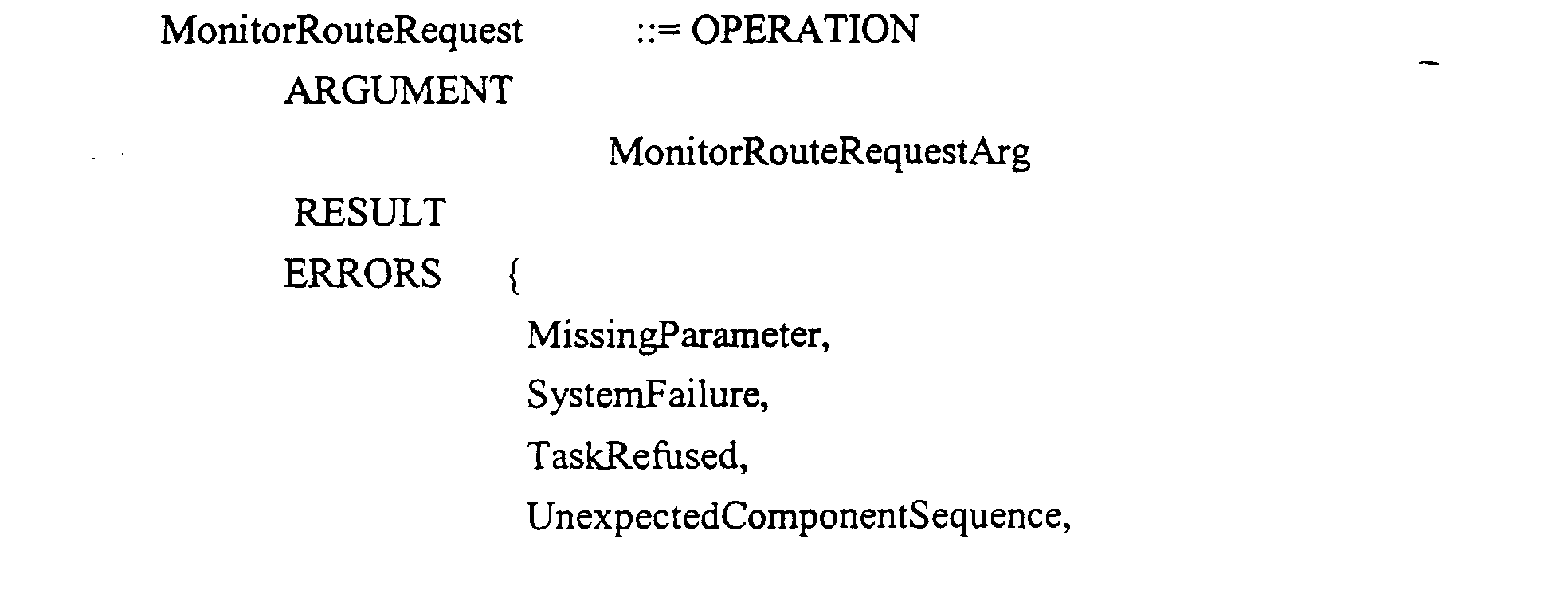
Class 1 operation, meaning that both errors and ReturnResults can be sent for the operation. This operation is a non-call related operation, and should not be sent in the context of the call. - The following are technical definitions of the SCP function (SCF) and the SSP function (SSF) operating SSP 12' and SCP 14' to provide the method 200 and error messages also. The technical definitions are specified in ASN-1 (Abstract Syntax Notation #1) defined in CCITT X.208 (1999).
-

-
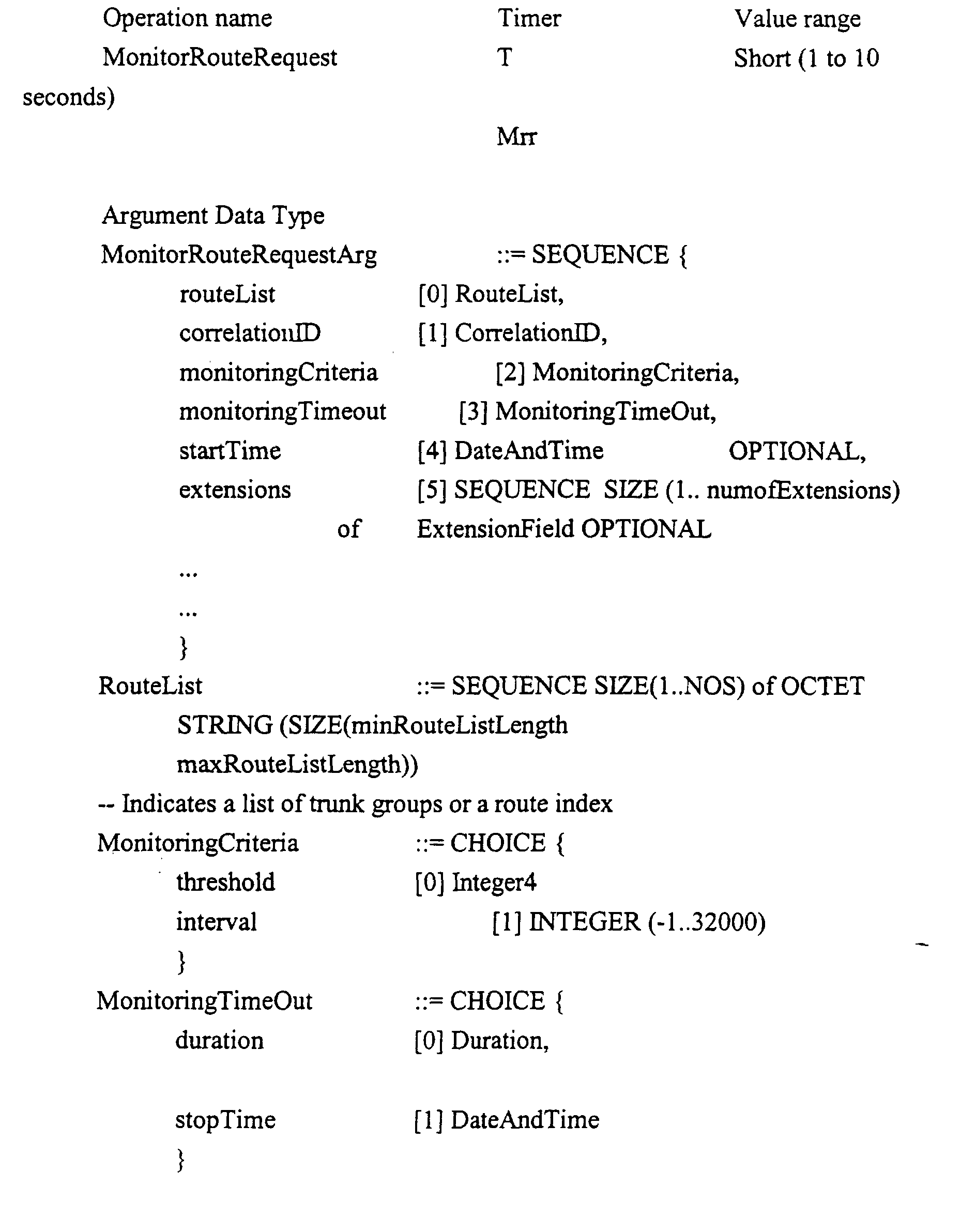
- When receiving this operation, the SSF monitors specified routes for DP4 hits (RouteSelectFailure). The SSF transfers the results of the operation either when a certain threshold is reached (Monitoring Criteria) or when the stop time is reached.
-
- 1. RouteList: This parameter is used to specify the outgoing trunk group to monitor. A sequence of routes may also be provided
- 2. CorrelationID: This parameter is used by the SCF to associate the MonitorRouteRequest with the MonitorRouteReport sent by the SSF.
- 3. MonitoringCriteria : This parameter specifies when the monitoring results are to be sent to the SCP.
- A. threshold - This parameter specifies that the report should be sent whenever the threshold is exceeded.
- B. interval - This parameter indicates that the monitoring report should be sent at the expiration of the interval timer.
- 4. MonitoringTimeout: This parameter indicates the duration, during which the monitoring should be active.
- A. duration - If the duration timer expires then the monitoring should be
removed.
- A duration of'0' indicates that monitoring should be removed
- A duration of '-1' indicates an infinite duration.
- B. stopTime : When the stop time is met then the route monitoring is removed.
- 5. StartTime: This parameterdefines when filtering is started. If "startTime" is not provided or was already met, the SSF starts monitoring immediately.
-
- 1) Service Logic Program Instance (SLPI) decides to monitor traffic over specific routes.
-
- 1) Service Logic Program Instance (SLPI) starts an application timer to monitor the expected end of monitoring routes
- 2) The Service Control Functionality Management Entity (SCME) is in the state "Waiting for SSF MonitoringRouteReport".
-
- SSF precondition:
1. None.
SSF postcondition: - 1. The Service Switching Functionality Management Entity (SSME) Finite State Machine (FSM) is in the state "Non-call Associated Treatment".
- 1. If the SSF detects an error with any of the defined error values then this error is reported to the SCF.

- This operation is used to report the values of route list counters of a previous MonitorRouteRequest operation.
-
- 1. routeCounters: The parameter contains the count of failed calls over selected routes ,during the monitoring period. It is a list of route counter identifications and the related value. If a threshold was specified for a particular route , then the counter value holds the specified threshold value.
- 2. correlationID: This parameter is used by the SCF to associate the MonitorRouteReport from a previously sent MonitorRouteRequest.
-
-
- 1) Monitoring of routes is currently running and the interval timer has expired ;or
- 2) Monitoring of routes is running and the threshold value has been reached ;or
- 3) Monitoring has finished (duration time expired or stop time met) ;or
- 4) The operation MonitorRouteRequest is received and encounters an active route monitoring entity.
-
- 1) Monitoring of routes proceeds or is ended depending on the duration time.
- Error handling: Operation related error handling is not applicable, due to
class 4 operation. - SCF precondition:
- 1) Monitoring of routes is running.
- 2) The SCME is in the state "Waiting for SSF MonitorRouteRequest". SCF postcondition:
-
- The SCME forwards the received counter values to the SLPI.
- Thus, it will be appreciated that a new dynamic traffic management system and method have been shown and described. Although this invention has been described with respect to a preferred embodiment, those skilled in the art may devise numerous other arrangements without departing from the scope of the invention as defined in the following claims.
Claims (12)
- A method for managing call traffic in a system having a service switching point (SSP) connected to a service control point (SCP) comprising the steps of:sending a traffic monitoring initiation request from the SCP to the SSP; monitoring call traffic at the SSP according to the traffic monitoring request;sending a response to the SCP including results of said monitoring; determining from said results if traffic management needs to be applied;if traffic management needs to be applied, applying traffic management.
- The method of claim 1, wherein said monitoring initiation request is a monitor route request.
- The method of claim 1, wherein said monitoring initiation request is a TC-Begin request.
- The method of claim 1, wherein said monitoring initiation request is a monitor route request and said response to the SCP is monitor route report.
- The method of claim 1, wherein said monitoring initiation request is a monitor route request and said response to the SCP is monitor route report with information that a high watermark of failures has been reached.
- The method of claim 1, wherein:said monitoring initiation request is a monitor route request;said response to the SCP is monitor route report with information that a high watermark of failures has been reached; andsaid applying of network management step includes sending a call gap instruction to the SSP.
- The method of claim 6, wherein call gap criteria are sent along with the call gap instruction.
- The method of claim 1, wherein said monitoring initiation request is a TC-Begin request to monitor all failures for a set period of time and said response to the SCP is monitor report with information of the number of call failures during the preset time, which has expired.
- The method of claim 1, wherein:said monitoring initiation request is a TC-Begin request to monitor all failures for a set period of time;said response to the SCP is monitor report with information of all failures during the set period of time; andsaid applying of network management step includes sending a call gap instruction to the SSP.
- The method of claim 1, wherein:said monitoring initiation request is a TC-Begin request to monitor all failures for a set period of time;said response to the SCP is monitor report with information of all failures during the set period of time; andsaid applying of network management step includes sending a connect- and analyze information instruction that has an alternative route in a destination route address (DRA) data field to the SSP.
- The method of claim 1, wherein:said monitoring initiation request is a monitor route request;said response to the SCP is monitor route report with information that a high watermark of failures has been reached; andsaid applying of network management step includes sending a connect- and analyze information instruction that has an alternative route in a destination route address (DRA) data field to the SSP.
- An arrangement for managing call traffic in a system having a service switching point (SSP) connected by SS7 connections and signaling to a service control point (SCP) comprising:means for sending a traffic monitoring initiation request from the SCP to the SSP;means monitoring call traffic at the SSP according to the traffic monitoring request in response thereto;means for sending a response to the SCP including results of said monitoring;means for determining from said results if traffic management needs to be applied; andmeans for applying traffic management if traffic management is needed to reduce route failures.
Applications Claiming Priority (2)
| Application Number | Priority Date | Filing Date | Title |
|---|---|---|---|
| US09/514,237 US6453028B1 (en) | 2000-02-28 | 2000-02-28 | Dynamic traffic management in an intelligent network of a telephone system |
| US514237 | 2000-02-28 |
Publications (2)
| Publication Number | Publication Date |
|---|---|
| EP1130928A1 true EP1130928A1 (en) | 2001-09-05 |
| EP1130928B1 EP1130928B1 (en) | 2008-06-04 |
Family
ID=24046352
Family Applications (1)
| Application Number | Title | Priority Date | Filing Date |
|---|---|---|---|
| EP00307618A Expired - Lifetime EP1130928B1 (en) | 2000-02-28 | 2000-09-04 | Overload prevention in an intelligent network |
Country Status (6)
| Country | Link |
|---|---|
| US (1) | US6453028B1 (en) |
| EP (1) | EP1130928B1 (en) |
| JP (1) | JP3712624B2 (en) |
| KR (1) | KR100762557B1 (en) |
| CA (1) | CA2331958C (en) |
| DE (1) | DE60039100D1 (en) |
Families Citing this family (7)
| Publication number | Priority date | Publication date | Assignee | Title |
|---|---|---|---|---|
| JP2002009940A (en) * | 2000-06-21 | 2002-01-11 | Fujitsu Ltd | Communication control method and device in intelligent network |
| EP1402355B1 (en) * | 2001-05-23 | 2018-08-29 | Tekelec Global, Inc. | Methods and systems for automatically configuring network monitoring system |
| CN1182740C (en) * | 2001-07-30 | 2004-12-29 | 华为技术有限公司 | A method for actively establishing a call by a service control point in a mobile intelligent network |
| KR100386948B1 (en) * | 2001-08-07 | 2003-06-09 | 김영탁 | Apparatus for Traffic Monitoring and Interface of ITMA |
| US8233492B1 (en) * | 2007-03-27 | 2012-07-31 | Cisco Technology, Inc. | Voice gateway failure decoder |
| EP1983788A1 (en) * | 2007-04-20 | 2008-10-22 | Koninklijke KPN N.V. | Monitoring roaming calls |
| USD667561S1 (en) | 2009-11-13 | 2012-09-18 | 3M Innovative Properties Company | Sample processing disk cover |
Citations (2)
| Publication number | Priority date | Publication date | Assignee | Title |
|---|---|---|---|---|
| WO1996015634A2 (en) * | 1994-11-11 | 1996-05-23 | Nokia Telecommunications Oy | Overload prevention in a telecommunications network node |
| WO1999040737A1 (en) * | 1998-02-06 | 1999-08-12 | Marconi Communications Limited | Overload prevention in an intelligent network |
Family Cites Families (8)
| Publication number | Priority date | Publication date | Assignee | Title |
|---|---|---|---|---|
| US4979118A (en) * | 1989-03-10 | 1990-12-18 | Gte Laboratories Incorporated | Predictive access-control and routing system for integrated services telecommunication networks |
| US5581610A (en) * | 1994-10-19 | 1996-12-03 | Bellsouth Corporation | Method for network traffic regulation and management at a mediated access service control point in an open advanced intelligent network environment |
| FI97185C (en) * | 1994-11-11 | 1996-10-25 | Nokia Telecommunications Oy | Overload lock in a node in a data communication network |
| US5778057A (en) * | 1996-02-09 | 1998-07-07 | Bell Communications Research, Inc. | Service control point congestion control method |
| KR0169035B1 (en) * | 1996-05-30 | 1999-01-15 | 양승택 | A massively concentrated call processing method in a telephone voting service provided through interaction with an intelligent information providing system using an extended service filtering technique |
| GB9622629D0 (en) * | 1996-10-30 | 1997-01-08 | British Telecomm | Communications network |
| US5930348A (en) * | 1997-03-20 | 1999-07-27 | Northern Telecom Limited | Dynamically controlled routing of calls in intelligent networks |
| DE69816053T2 (en) * | 1997-03-25 | 2004-06-03 | British Telecommunications Public Ltd. Co. | Telecommunications network with congestion control |
-
2000
- 2000-02-28 US US09/514,237 patent/US6453028B1/en not_active Expired - Lifetime
- 2000-09-04 EP EP00307618A patent/EP1130928B1/en not_active Expired - Lifetime
- 2000-09-04 DE DE60039100T patent/DE60039100D1/en not_active Expired - Lifetime
-
2001
- 2001-01-22 CA CA002331958A patent/CA2331958C/en not_active Expired - Fee Related
- 2001-02-26 KR KR1020010009628A patent/KR100762557B1/en not_active Expired - Fee Related
- 2001-02-28 JP JP2001053268A patent/JP3712624B2/en not_active Expired - Fee Related
Patent Citations (2)
| Publication number | Priority date | Publication date | Assignee | Title |
|---|---|---|---|---|
| WO1996015634A2 (en) * | 1994-11-11 | 1996-05-23 | Nokia Telecommunications Oy | Overload prevention in a telecommunications network node |
| WO1999040737A1 (en) * | 1998-02-06 | 1999-08-12 | Marconi Communications Limited | Overload prevention in an intelligent network |
Non-Patent Citations (1)
| Title |
|---|
| LEE Y ET AL: "An overload control of SCP in advanced intelligent network with fairness and priority", COMPUTER COMMUNICATIONS,NL,ELSEVIER SCIENCE PUBLISHERS BV, AMSTERDAM, vol. 22, no. 2, 25 January 1999 (1999-01-25), pages 137 - 143, XP004157081, ISSN: 0140-3664 * |
Also Published As
| Publication number | Publication date |
|---|---|
| CA2331958A1 (en) | 2001-08-28 |
| US6453028B1 (en) | 2002-09-17 |
| DE60039100D1 (en) | 2008-07-17 |
| CA2331958C (en) | 2003-12-09 |
| JP3712624B2 (en) | 2005-11-02 |
| KR100762557B1 (en) | 2007-10-01 |
| JP2001274905A (en) | 2001-10-05 |
| KR20010085597A (en) | 2001-09-07 |
| EP1130928B1 (en) | 2008-06-04 |
Similar Documents
| Publication | Publication Date | Title |
|---|---|---|
| CA2254135C (en) | Service control point congestion control method | |
| US5825860A (en) | Load sharing group of service control points connected to a mediation point for traffic management control | |
| US6101250A (en) | Method for controlling an intelligent network call | |
| US6453028B1 (en) | Dynamic traffic management in an intelligent network of a telephone system | |
| EP1422914A1 (en) | The method for initiative setting up the call by the server control point in the mobile intelligent network | |
| US6473402B1 (en) | Communications link interconnecting service control points of a load sharing group for traffic management control | |
| US20010048673A1 (en) | Maintaining connection between IN control point and switching point | |
| CN1136739C (en) | Method of controlling service execution in intelligent network and switching point in intelligent network | |
| CA2237625C (en) | Communications link interconnecting service control points of a load sharing group for traffic management control | |
| US6947541B2 (en) | Enhancing an intelligent network service | |
| RU2372745C2 (en) | Method of providing of calls processing for user of intelligent network | |
| US20010053217A1 (en) | Interworking between services in telecommunications network | |
| CN1121795C (en) | Method of exiting collect information phase in intelligent network | |
| JP3317502B2 (en) | Load balancing group of service control points connected to relay points for traffic management control | |
| CN101578888B (en) | Invoking a service in an interlligent network | |
| KR960002679B1 (en) | Traffic controller of the intelligent network and the method therefor | |
| US20090022300A1 (en) | Method for recovery from linkset failure in telecommunications network | |
| KR100907994B1 (en) | Control Method of Intelligent Network Switching System using Split Leg Control | |
| KR20010088168A (en) | Method for stabilizing state of own station in congestion of No.7 network element | |
| US20070071219A1 (en) | Method for improving control capability of service control point during a call | |
| US20030076938A1 (en) | Process and apparatus for controlling the generation of statistical information in a CSS signaling node, CSS protocol stack and administration application for doing the same |
Legal Events
| Date | Code | Title | Description |
|---|---|---|---|
| PUAI | Public reference made under article 153(3) epc to a published international application that has entered the european phase |
Free format text: ORIGINAL CODE: 0009012 |
|
| 17P | Request for examination filed |
Effective date: 20000920 |
|
| AK | Designated contracting states |
Kind code of ref document: A1 Designated state(s): AT BE CH CY DE DK ES FI FR GB GR IE IT LI LU MC NL PT SE |
|
| AX | Request for extension of the european patent |
Free format text: AL;LT;LV;MK;RO;SI |
|
| AKX | Designation fees paid |
Free format text: DE FR GB |
|
| 17Q | First examination report despatched |
Effective date: 20010406 |
|
| 17Q | First examination report despatched |
Effective date: 20010406 |
|
| GRAP | Despatch of communication of intention to grant a patent |
Free format text: ORIGINAL CODE: EPIDOSNIGR1 |
|
| GRAS | Grant fee paid |
Free format text: ORIGINAL CODE: EPIDOSNIGR3 |
|
| GRAA | (expected) grant |
Free format text: ORIGINAL CODE: 0009210 |
|
| AK | Designated contracting states |
Kind code of ref document: B1 Designated state(s): DE FR GB |
|
| REG | Reference to a national code |
Ref country code: GB Ref legal event code: FG4D |
|
| REF | Corresponds to: |
Ref document number: 60039100 Country of ref document: DE Date of ref document: 20080717 Kind code of ref document: P |
|
| PLBE | No opposition filed within time limit |
Free format text: ORIGINAL CODE: 0009261 |
|
| STAA | Information on the status of an ep patent application or granted ep patent |
Free format text: STATUS: NO OPPOSITION FILED WITHIN TIME LIMIT |
|
| 26N | No opposition filed |
Effective date: 20090305 |
|
| REG | Reference to a national code |
Ref country code: GB Ref legal event code: 732E Free format text: REGISTERED BETWEEN 20131107 AND 20131113 |
|
| REG | Reference to a national code |
Ref country code: FR Ref legal event code: CD Owner name: ALCATEL-LUCENT USA INC. Effective date: 20131122 |
|
| REG | Reference to a national code |
Ref country code: FR Ref legal event code: GC Effective date: 20140410 |
|
| REG | Reference to a national code |
Ref country code: FR Ref legal event code: RG Effective date: 20141015 |
|
| REG | Reference to a national code |
Ref country code: FR Ref legal event code: PLFP Year of fee payment: 16 |
|
| REG | Reference to a national code |
Ref country code: FR Ref legal event code: PLFP Year of fee payment: 17 |
|
| PGFP | Annual fee paid to national office [announced via postgrant information from national office to epo] |
Ref country code: GB Payment date: 20160920 Year of fee payment: 17 Ref country code: DE Payment date: 20160921 Year of fee payment: 17 |
|
| PGFP | Annual fee paid to national office [announced via postgrant information from national office to epo] |
Ref country code: FR Payment date: 20160921 Year of fee payment: 17 |
|
| REG | Reference to a national code |
Ref country code: DE Ref legal event code: R119 Ref document number: 60039100 Country of ref document: DE |
|
| GBPC | Gb: european patent ceased through non-payment of renewal fee |
Effective date: 20170904 |
|
| REG | Reference to a national code |
Ref country code: FR Ref legal event code: ST Effective date: 20180531 |
|
| PG25 | Lapsed in a contracting state [announced via postgrant information from national office to epo] |
Ref country code: DE Free format text: LAPSE BECAUSE OF NON-PAYMENT OF DUE FEES Effective date: 20180404 Ref country code: GB Free format text: LAPSE BECAUSE OF NON-PAYMENT OF DUE FEES Effective date: 20170904 |
|
| PG25 | Lapsed in a contracting state [announced via postgrant information from national office to epo] |
Ref country code: FR Free format text: LAPSE BECAUSE OF NON-PAYMENT OF DUE FEES Effective date: 20171002 |
|
| REG | Reference to a national code |
Ref country code: DE Ref legal event code: R082 Ref document number: 60039100 Country of ref document: DE Representative=s name: BARKHOFF REIMANN VOSSIUS, DE Ref country code: DE Ref legal event code: R081 Ref document number: 60039100 Country of ref document: DE Owner name: WSOU INVESTMENTS, LLC, LOS ANGELES, US Free format text: FORMER OWNER: LUCENT TECHNOLOGIES INC., MURRAY HILL, N.J., US |
|
| REG | Reference to a national code |
Ref country code: GB Ref legal event code: 732E Free format text: REGISTERED BETWEEN 20201001 AND 20201007 |