EP1130923A2 - Contents transmission system and contents processing apparatus - Google Patents
Contents transmission system and contents processing apparatus Download PDFInfo
- Publication number
- EP1130923A2 EP1130923A2 EP01301639A EP01301639A EP1130923A2 EP 1130923 A2 EP1130923 A2 EP 1130923A2 EP 01301639 A EP01301639 A EP 01301639A EP 01301639 A EP01301639 A EP 01301639A EP 1130923 A2 EP1130923 A2 EP 1130923A2
- Authority
- EP
- European Patent Office
- Prior art keywords
- code stream
- contents
- code
- terminals
- terminal
- Prior art date
- Legal status (The legal status is an assumption and is not a legal conclusion. Google has not performed a legal analysis and makes no representation as to the accuracy of the status listed.)
- Withdrawn
Links
Images




Classifications
-
- H—ELECTRICITY
- H04—ELECTRIC COMMUNICATION TECHNIQUE
- H04N—PICTORIAL COMMUNICATION, e.g. TELEVISION
- H04N21/00—Selective content distribution, e.g. interactive television or video on demand [VOD]
- H04N21/40—Client devices specifically adapted for the reception of or interaction with content, e.g. set-top-box [STB]; Operations thereof
- H04N21/41—Structure of client; Structure of client peripherals
- H04N21/4104—Peripherals receiving signals from specially adapted client devices
- H04N21/4126—The peripheral being portable, e.g. PDAs or mobile phones
-
- H—ELECTRICITY
- H04—ELECTRIC COMMUNICATION TECHNIQUE
- H04L—TRANSMISSION OF DIGITAL INFORMATION, e.g. TELEGRAPHIC COMMUNICATION
- H04L67/00—Network arrangements or protocols for supporting network services or applications
- H04L67/01—Protocols
- H04L67/04—Protocols specially adapted for terminals or networks with limited capabilities; specially adapted for terminal portability
-
- H—ELECTRICITY
- H04—ELECTRIC COMMUNICATION TECHNIQUE
- H04L—TRANSMISSION OF DIGITAL INFORMATION, e.g. TELEGRAPHIC COMMUNICATION
- H04L69/00—Network arrangements, protocols or services independent of the application payload and not provided for in the other groups of this subclass
- H04L69/04—Protocols for data compression, e.g. ROHC
-
- H—ELECTRICITY
- H04—ELECTRIC COMMUNICATION TECHNIQUE
- H04L—TRANSMISSION OF DIGITAL INFORMATION, e.g. TELEGRAPHIC COMMUNICATION
- H04L69/00—Network arrangements, protocols or services independent of the application payload and not provided for in the other groups of this subclass
- H04L69/14—Multichannel or multilink protocols
-
- H—ELECTRICITY
- H04—ELECTRIC COMMUNICATION TECHNIQUE
- H04L—TRANSMISSION OF DIGITAL INFORMATION, e.g. TELEGRAPHIC COMMUNICATION
- H04L69/00—Network arrangements, protocols or services independent of the application payload and not provided for in the other groups of this subclass
- H04L69/18—Multiprotocol handlers, e.g. single devices capable of handling multiple protocols
-
- H—ELECTRICITY
- H04—ELECTRIC COMMUNICATION TECHNIQUE
- H04N—PICTORIAL COMMUNICATION, e.g. TELEVISION
- H04N21/00—Selective content distribution, e.g. interactive television or video on demand [VOD]
- H04N21/20—Servers specifically adapted for the distribution of content, e.g. VOD servers; Operations thereof
- H04N21/23—Processing of content or additional data; Elementary server operations; Server middleware
- H04N21/238—Interfacing the downstream path of the transmission network, e.g. adapting the transmission rate of a video stream to network bandwidth; Processing of multiplex streams
-
- H—ELECTRICITY
- H04—ELECTRIC COMMUNICATION TECHNIQUE
- H04N—PICTORIAL COMMUNICATION, e.g. TELEVISION
- H04N21/00—Selective content distribution, e.g. interactive television or video on demand [VOD]
- H04N21/40—Client devices specifically adapted for the reception of or interaction with content, e.g. set-top-box [STB]; Operations thereof
- H04N21/43—Processing of content or additional data, e.g. demultiplexing additional data from a digital video stream; Elementary client operations, e.g. monitoring of home network or synchronising decoder's clock; Client middleware
- H04N21/436—Interfacing a local distribution network, e.g. communicating with another STB or one or more peripheral devices inside the home
- H04N21/4363—Adapting the video stream to a specific local network, e.g. a Bluetooth® network
- H04N21/43637—Adapting the video stream to a specific local network, e.g. a Bluetooth® network involving a wireless protocol, e.g. Bluetooth®, RF or wireless LAN [IEEE 802.11]
-
- H—ELECTRICITY
- H04—ELECTRIC COMMUNICATION TECHNIQUE
- H04N—PICTORIAL COMMUNICATION, e.g. TELEVISION
- H04N21/00—Selective content distribution, e.g. interactive television or video on demand [VOD]
- H04N21/40—Client devices specifically adapted for the reception of or interaction with content, e.g. set-top-box [STB]; Operations thereof
- H04N21/43—Processing of content or additional data, e.g. demultiplexing additional data from a digital video stream; Elementary client operations, e.g. monitoring of home network or synchronising decoder's clock; Client middleware
- H04N21/44—Processing of video elementary streams, e.g. splicing a video clip retrieved from local storage with an incoming video stream or rendering scenes according to encoded video stream scene graphs
- H04N21/4402—Processing of video elementary streams, e.g. splicing a video clip retrieved from local storage with an incoming video stream or rendering scenes according to encoded video stream scene graphs involving reformatting operations of video signals for household redistribution, storage or real-time display
-
- H—ELECTRICITY
- H04—ELECTRIC COMMUNICATION TECHNIQUE
- H04L—TRANSMISSION OF DIGITAL INFORMATION, e.g. TELEGRAPHIC COMMUNICATION
- H04L1/00—Arrangements for detecting or preventing errors in the information received
- H04L2001/0092—Error control systems characterised by the topology of the transmission link
- H04L2001/0096—Channel splitting in point-to-point links
-
- H—ELECTRICITY
- H04—ELECTRIC COMMUNICATION TECHNIQUE
- H04W—WIRELESS COMMUNICATION NETWORKS
- H04W4/00—Services specially adapted for wireless communication networks; Facilities therefor
- H04W4/18—Information format or content conversion, e.g. adaptation by the network of the transmitted or received information for the purpose of wireless delivery to users or terminals
Definitions
- the present invention relates to a contents transmission system and a contents processing apparatus used in the contents transmission system that transmits contents such as video and speech signals in the form of compression-encoded code streams via networks, receives them with devices such as handyphones, portable information terminals and personal computers, decodes, reconstructs and modifies them.
- the multimedia contents transmission system When the multimedia contents transmission system is built, it may be a general manner to transmit multimedia contents stored in server computers to portable terminals with radio transceivers via wireless networks, decode, reconstruct and display the multimedia contents received at such portable terminals.
- the multimedia contents are video coded streams coded by an MPEG-4 format
- the coded stream received in a portable terminal is decoded with an MPEG-4 decoder and the decoded video signal is displayed on a display device.
- the object of this invention is to provide a contents transmission system and a contents processing apparatus that can easily process the contents transmitted in the form of code streams that inherently require a complex data processing, for use in terminals like portable terminals of limited throughputs.
- This invention provides a contents transmission system comprising a first terminal which receives a first code stream produced by compression-encoding contents and has a converter section converting the first code stream into a second code stream having a data size smaller than that of the first code stream and a transmission section transmitting the second code stream, and a second terminal which receives the second code stream transmitted from the first terminal and has a reconstruction section reconstructing the contents by decoding the second code stream.
- the first code stream is, for example, an MPEG-4-based core profile code stream
- the second code stream is an MPEG-4-based simple profile code stream.
- the contents transmitted in the form of the first code stream which requires a high throughput in encoding and reconstruction are converted into the second code stream having a data size smaller than that of the first code stream, and then it becomes possible for the second terminal corresponding to only the second code stream to conduct encoding and reconstruction.
- This invention also provides a contents transmission system comprising a plurality of terminals including at least one terminal having a function of reconstructing contents by decoding the received code stream, and a transmission channel which connects such plurality of terminals to each other.
- the original content is reconstructed by collecting via the transmission channel the code stream received at each terminal, decoding the code streams and then combining the code streams.
- a server when a server, for example, transmits contents to each terminal in the form of a code stream, even if the channel for its transmission does not have a bandwidth large enough to carry a complex contents code stream of a large data size, it becomes possible to reconstruct such complex contents of a large data size by receiving segmented code streams at the plurality of terminals and collecting the code streams to at least one terminal for their decoding and combination.
- this invention provides a contents transmission system comprising a plurality of terminals a first transmission channel which connects the plurality of terminals to each other, and a second transmission channel.
- the plurality of terminals includes a transmission section which transmit a code stream produced by compression-encoding contents via the second transmission channel.
- At least one of the terminals has a function of separating a code stream into a plurality of separated code streams, transmitting one of the separated code streams via the second transmission channel and transmitting the other separated code streams to the other terminals via the first transmission channel.
- the contents are reconstructed from the separated code streams transmitted from the plurality of terminals via the second transmission channel.
- a terminal when a terminal, for example, transmits contents to a server in the form of a code stream, even if the channel for its transmission does not have a bandwidth large enough to carry a complex contents code stream of a large data size, it becomes possible to transmit easily such a complex contents code stream of a large data size by splitting the code stream for transmission into several code streams in at least one terminal and transmitting the split code streams from each terminal to the server.
- this invention provides a contents transmission system comprising a plurality of terminals which each have functions of producing a code stream by encoding contents and reconstructing the contents by decoding the code stream, at least one of the terminals working as a server, a first network connecting the plurality of terminals to each other, a second network, and a transmission channel connecting the server to the second network.
- the server takes in a code stream from the second network through the transmission channel and distributes the code stream to the other terminals in the plurality of terminals.
- the users may gather with terminals like portable information terminals and personal computers and form a first simplified network like a Bluetooth network. Then the users may have access to the terminal that works as a server in the second network like the Internet, and each terminal can share the contents in the second network to conduct various processing and jobs. Also it becomes easy to present and disclose contents on the second network.
- this invention provides a contents processing apparatus comprising a receiver section which receives a first code stream obtained by encoding contents, a converter section which converts the received first code stream into a second code stream having a data size smaller than that of the first code stream, and a transmitter section which transmits the second code stream.
- the converter section decodes, for example, the first code stream received by the receiver section, and produces the second code stream by encoding the contents obtained from this decoding by an encoding method different from that employed in the received code stream. As a result, the conversion from the first code stream to the second code stream is implemented.
- This converter section intakes, for example, an MPEG-4-based core profile code stream as the first code stream and converts it into an MPEG-4-based simple profile code stream.
- FIG. 1 shows the schematic configuration of a contents transmission system according to the first embodiment of the invention.
- This contents transmission system comprises a master terminal 100 and a slave terminal 200.
- the master terminal 100 receives the code streams of contents transmitted through broadband code division multiple access channels, for example, IMT-2000, W-CDMA, cdma 2000, DS-CDMA (direct sequence), MC-CDMA (multi carrier), from a server computer (not shown), and the slave terminal 200 receives the code streams of contents transmitted from the master terminal 100 through a short-range wireless communications system like Bluetooth.
- broadband code division multiple access channels for example, IMT-2000, W-CDMA, cdma 2000, DS-CDMA (direct sequence), MC-CDMA (multi carrier)
- the master terminal 100 is a contents processing apparatus having a high throughput in processing contents like video and speech/audio signals, compared with the slave terminal.
- the master terminal 100 can decode and reconstruct a contents code stream transmitted via a broadband code division multiple access channel with no difficulty. It is, for example, a portable or desktop personal computer.
- the slave terminal 200 is a portable terminal like a handypone and a portable information terminal that has a lower throughput than the master terminal 100 because it places priority on energy saving and portability. Therefore, it cannot decode or reconstruct the complicated contents code stream sent through the broadband code division multiple access channel even if it has received and demodulated the contents code stream.
- the master terminal 100 also converts the contents code stream which is sent through the broadband code division multiple access channel and requires a relatively complicated processing into a contents code stream requiring a relatively easy processing.
- the master terminal 100 transmits the converted contents code stream to the slave terminal 200 through the Bluetooth system.
- the slave terminal 200 decodes and reconstructs the contents code stream that it has received and demodulated. Then it becomes possible for the slave terminal 200 to decode and reconstruct the contents that are too complicated for the slave to reconstruct by itself.
- the configurations of the master terminal 100 and the slave terminal 200 will be explained.
- FIG. 2 shows the configuration of the master terminal 100.
- a wideband code division multiple access transceiver 101 receives and demodulates a first contents code stream requiring a high throughput in decoding and reconstruction.
- the first contents code stream is converted by a contents converter section 102 into a second contents code stream having a smaller data size than that of the first contents code stream.
- the second code stream is sent to a Bluetooth transceiver 103 and then modulated to be sent to the slave terminal 200 by Bluetooth.
- the master terminal 100 is a personal computer
- the wideband code division multiple access transceiver 101 and Bluetooth transceiver 103 are provided in the form of radio communications adapters like a wireless PCMCIA card, for example.
- the antenna used in the wireless transceivers can be mounted on the master terminal 100, a personal computer, as shown in FIG. 1.
- the contents converter section 102 will be described in detail later.
- FIG. 3 is a diagram illustrating the configuration of the slave terminal 200.
- the contents code stream transmitted from the master terminal 100 is received and demodulated by a Bluetooth transceiver 201 and then decoded and reconstructed by a contents receiver 202.
- the contents converter 102 of the master terminal 100 converts the first contents code stream requiring a high throughput in reconstruction into the second contents code stream requiring a lower throughput in reconstruction than that of the first contents code stream. In the case of such contents conversion, it may happen that the function of contents reconstruction that can be conducted by the master terminal 100 is not realized in the slave terminal 200. However, it does not happen that the slave terminal 200 can view no converted contents. Although the function is limited to some extent, it can reconstruct the contents. A specific example of this contents converter 102 is described below.
- a stream of the core file in the MPEG-4 Visual (hereafter, core profile code stream) has more than one arbitrary shape of visual objects and it is possible to handle each of the objects separately.
- a core profile core stream has complicated contents and requires a high throughput in contents reconstruction.
- a simple profile stream in the same MPEG-4 Visual has a usual frame structure and can handle a single video image, while it does not demand a high throughput in contents reconstruction.
- the contents converter 102 in the master terminal 100 converts a core profile code stream including a plurality of arbitrary shapes of visual objects into a simple profile code stream of a single frame structure.
- the contents converter section 102 inputs the converted simple profile code stream to the Bluetooth transceiver 103.
- the Bluetooth transceiver 103 transmits the converted simple profile code stream to the slave terminal 200 by Bluetooth.
- the slave terminal 200 now can decode and reconstruct the contents of the core profile. Namely, although the slave terminal 200 alone cannot directly decode a plurality of arbitrary shapes of visual objects of the core profile, it can view the contents by decoding the objects into images of the simple profile of a single frame structure.
- FIGS. 4A and 4B show such an example. Although there are three visual objects in the image before contents conversion in FIG. 4A, they are converted into an image of a single frame structure after contents conversion in FIG. 4B.
- FIGS. 5A and 5B show an example of specific contents conversion (code stream conversion) by the contents converter section 102.
- FIG. 5A shows a core profile code stream before conversion
- FIG. 5B shows a simple profile code stream after conversion.
- the core profile code stream includes shape information S1, S2 and S3 indicating the contours of video objects or boundaries between the video objects and the background, and texture information T1, T2 and T3 indicating the contents of objects.
- this core profile code stream is converted into a simple profile code stream, only texture information T1, T2 and T3 are taken out from this core profile code stream. If necessary, texture information T1, T2 and T3 are transformed to a code stream of texture information T1', T2' and T3' arrayed as shown in FIG. 5B.
- the slave terminal 200 can display the contents on a contents receiver 202 in the form of image of a single frame structure, even based on the texture information alone.
- the slave terminal 200 like a portable terminal of a limited throughput can reconstruct and view via Bluetooth contents information received by a master terminal of a high throughput via the broadband code division multiple access channel.
- the master terminal 100 receives a contents code stream transmitted from a server and transmits the converted contents code stream to the slave terminal 200, while the slave terminal 100 receives a contents code stream sent from the master terminal 200.
- the slave terminal 200 can transmit data to the master terminal 100 by Bluetooth. Since this form of implementation is not directly related with the goal of this invention, its explanation is not provided here.
- FIG. 6 shows a contents transmission system according to the second embodiment of the present invention.
- This contents transmission system comprises a terminal A300-1 and terminal B300-2.
- the terminals A300-1 and B300-2 receive contents code streams via the broadband code division multiple access channel and demodulate them. They are configured to exchange such received code streams between the terminals A300-1 and B300-2 by means of Bluetooth; namely, they can communicate with each other.
- FIG. 7 is a detailed configuration of a terminal 300 including terminals A300-1 and B300-2.
- This terminal 300 comprises a wideband code division multiple access transceiver 301, contents combination/ separation device 302, contents storage 303, Bluetooth transceiver 304 and display device 305.
- the contents combination/separation device 302 has a function of decoding contents code streams and encoding contents. In this example, each function block is explained for the case where the terminal 300 receives data.
- the wideband code division multiple access transceiver 301 receives and demodulates a code stream 311 transmitted from a server (not shown).
- a server not shown
- the received code stream 313 is transferred from the wideband code division multiple access transceiver 301 to the Bluetooth transceiver 304 and then transmitted to the terminal B300-2.
- the received code stream 312 sent from the wideband code division multiple access transceiver 301 is transferred to the contents combination/separation device 302.
- the contents combination/separation device 302 combines the received code stream 312 sent from the wideband code division multiple access transceiver 301 and the received code stream 315 sent from the Bluetooth transceiver 304 after decoding them in order to reconstruct the contents. At this time it is also possible to reconstruct the contents 314 stored in the contents storage 303.
- the contents combination/separation device 302 decodes only the received code stream 312 sent from the wideband code division multiple access transceiver 301 for reconstruction and reconstructs only the contents stored in the contents storage 303. Contents 314 and 317 thereby reconstructed by the contents combination/separation device 302 are stored in the contents storage 303, if necessary, and displayed on the display device 305.
- the contents combination/separation device 302 can also separate contents stored in the contents storage 303, those obtained by decoding the code stream 312 sent from the wideband code division multiple access transceiver 301 and those obtained by decoding the code stream 315 sent from the Bluetooth transceiver 304.
- the present embodiment enables to reconstruct complex contents of a large amount of data by splitting a code stream into a plurality of code streams and sending them across the terminals A300-1 and B300-2, collecting them in a single terminal by means of Bluetooth and decoding them, and then combining them, even if a single broadband code division multiple access channel does not have a bandwidth large enough to send code streams of complex contents of a large data size (for example, core profile code streams).
- FIG. 8 shows a first example of contents transmission.
- a server (not shown) splits the code stream 10 of complex contents of a large data size into two code streams 11 and 12, according to the bandwidth of the broadband code division multiple access channel, and then transmits them to terminals A300-1 and B300-2, respectively.
- the transmitted code streams 11 and 12 are received and demodulated in terminals A301 and B302 by the wideband code division multiple access transceiver 301 as received code streams 13 and 14.
- the terminal B302 demodulates the received code stream 14 with the Bluetooth transceiver 316 and transmits it to the terminal A301.
- the terminal A301 combines the received code stream 313 sent from the wideband code division multiple access transceiver 301 with the received code stream 314 sent from the Bluetooth transceiver 304 after decoding it with the combination/separation device 302.
- the contents 15 which are the same as those of the original code stream 10 are reconstructed and then stored in the contents storage 303.
- terminals A301 and B302 in cooperation receive and decode the code stream 10 of a great data size which exceeds the throughput of a single broadband code division multiple access channel. Then original complex contents can thereby be reconstructed. In this case, since in the terminals A301 and B302 the contents combination/separation device 302 decodes the divided code streams, the data processing is easier than decoding a code stream that has not been divided.
- FIG. 9 shows a second example of contents transmission.
- the contents combination/ separation device 302 splits complex contents of a large data size stored in the contents storage 303 into two parts responding to the bandwidth of the broadband code division multiple access channel and then encodes them into two code streams 21 and 22 for transmission in the terminal A301.
- the code stream 21 is modulated by the wideband code division multiple access transceiver 301 and transmitted to a server as a code stream 23.
- the code stream 22 is sent to the terminal B302 after modulated by the Bluetooth transceiver 304.
- the terminal B302 modulates the received and demodulated code stream 24, using the wideband code division multiple access transceiver 301, and then transmits it to a server.
- the server reconstructs complex contents of a large data size by combining the code streams 23 and 24 sent from terminals A301 and B302, respectively, into a code stream 25 and then decodes this code stream.
- the terminals A301 decodes two code streams divided by the contents combination/ separation device 302, the data processing becomes easier than directly decoding a code stream of complex contents of a great data size that has not been divided.
- the first example of contents transmission has explained the method (FIG. 8) of collecting the divided code streams of complex contents of a large data size and then reconstructing them, while the second one has described the method (FIG. 9) of transmitting a code stream of complex contents of a large data size with a single terminal A301 which works as a master. It is also possible that both terminals A301 and B302 conduct similar processing and reconstruct complex contents of a large data size.
- FIG. 10 shows a third example of contents transmission.
- a server splits the code stream of complex contents of a large data size into two parts and sends the two split code streams 31 to terminal A301 and B302 respectively through the broadband code division multiple access channel.
- Terminals A301 and B302 receive code streams 32 and 33, respectively.
- the terminal A301 transmits the code stream 32 that has been received by the wideband code division multiple access transceiver 301 and modulated by the Bluetooth transceiver 304, while in the terminal B302 the code stream 33 which has received and decoded by the wideband code division multiple access transceiver 301 is transmitted to the terminal A301 by the Bluetooth transceiver 304.
- the code stream received and demodulated by the wideband code division multiple access transceiver 301 and that received and demodulated by the Bluetooth transceiver 304 are decoded by the contents combination/separation device 302 and then combined.
- contents 34 and 35 which are the same as the original contents made of the code stream 30, are each reconstructed and stored in the contents storage 303.
- the contents combination/ separation device 302 decodes and combines the two split code streams, the data processing is easier than directly decoding the code stream that has not been split (or combined).
- FIG. 11 illustrates the forth example of contents transmission according to the embodiment of the invention.
- code streams 41-1 and 41-2 can be transmitted to form meaningful information by exchanging and combining contents 40-1 and 40-2 through Bluetooth channels, for example, which have been received, demodulated and decoded by terminals A301 and B302, respectively.
- a server sends a code stream to a terminal (either terminal A301 or terminal B302), if the code stream is split and transmitted over several times, a single piece of the code stream alone does not make sense but, if those split code streams are decoded and combined, they make meaningful information.
- FIG. 12 shows a fifth example of contents transmission.
- this code stream may be divided into a code stream 50 which is basic data and two code streams 51 and 52 which are additional data for high resolution display.
- the basic code stream 50 is, for example, the DC element of the quantized DCT coefficient of the code stream provided by an MPEG-4 video signal encoder, while the additional code streams 51 and 52 for high resolution display are AC elements of the quantized DCT coefficient.
- the basic code stream 50 is sent to both terminals A301 and B302, while the two additional code streams for high resolution display are sent to terminals A301 and B302, respectively.
- low resolution images are provided in terminals A301 and B302 when the basic code stream 50 sent through the broadband code division multiple access channel is decoded.
- a high resolution image can be recovered by exchanging through Bluetooth channels, decoding, combining and reconstructing the additional code streams 51 and 52 which have been received in terminals A301 and B302 through the broadband code division multiple access channel.
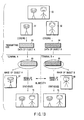
- FIG. 13 illustrates a sixth example of contents transmission which utilizes the feature wherein each of the MPEG-4 objects can be encoded separately.
- the original image is divided into the background and objects, and they are each encoded and then their code streams are transmitted.
- a server splits the contents 60 (original image) having two objects (A and B) into two contents 61 of object A and contents 62 of object B, and then encode these contents. Later, the code stream 63 of contents 61 is sent to the terminal A301 through the broadband code division multiple access channel, while the code stream 64 of contents 62 is sent to terminal B302.
- Terminals A301 and B302 each receive code streams 63 and 64 respectively through the broadband code division multiple access channel, and decode the received code streams 65 and 66 in order to reconstruct the contents 67 and 68 (the same as contents 61 and 62) having only the object A data or the object B data, respectively.
- Terminals A301 and B302 exchange received code streams 65 and 66 through Bluetooth channels, for example, and decode them in each terminal for reconstruction. Then the contents 70 which are the same as the original contents 60 having objects A and B are recovered.
- the terminals A301 and B302 each exchange received code streams and combine them. As a result, compared with the case where terminals A301 and B302 each receive the whole code stream including the data of objects A and B through the broadband code division multiple access channel, the data size transmitted in the broadband code division multiple access channel is reduced. Then the traffic in the broadband code division multiple access channel can be lightened and the expense of broadband code division multiple access channel that a terminal user have to pay can also be reduced.
- a plurality of terminals receive MPEG-4 based code streams from separate servers and terminals through the broadband code division multiple access channel and exchange data through Bluetooth channels for data combination.
- a terminal user may call the terminal of his or her friend to receive video data and exchange data to introduce each other and share such video data.
- FIG. 14 illustrates the configuration of a contents transmission system according to the third embodiment of the present invention.
- This contents transmission system comprises a portable terminal 400, a personal computer 500, a server 600 and a radio transceiver 700.
- the server 600 compression-encoded multimedia contents are stored.
- the server 600 is connected to the radio transceiver 700, while the radio transceiver 700 and the portable terminal 400 are connected through the broadband code division multiple access channel 801. Namely, it is possible to send a code stream of multimedia contents stored in the server 600 from the radio transceiver 700 to the portable terminal 400 through the broadband code division multiple access channel 801. It is also possible to send a code stream of multimedia contents from the portable terminal 400 to the server 600 through the broadband code division multiple access channel 801 and the radio transceiver 700.
- the portable terminal 400 and the personal computer 500 are connected by a Bluetooth channel 802, and the transmission and reception of multimedia contents are enabled by Bluetooth.
- FIG. 15 shows a block diagram that illustrates the detailed configuration of the portable terminal 400.
- this portable terminal 400 comprises a wideband code division multiple access transceiver 401, a demultiplexer 402, a simple profile decoder 403, a speech decoder 404, a video display 405 such as LCD and CRT, an audio output device 406 like speakers, a video input device 407 like video cameras, a speech input device 408 like microphones, a simple profile video encoder 409, a speech encoder 410, a multiplexer 411, a Bluetooth transceiver 412, a controller (CPU) 421 and a memory 422.
- CPU central processing unit
- the simple profile decoder 403 and the simple profile encoder 409 with priority on improving portability and reducing power consumption of the portable terminal 400, can decode and encode only a simple profile code stream whose data processing load is light but cannot decode or encode a core profile code stream.
- the operations conducted in the portable terminal 400 are explained for the case where it receives the code stream of the multimedia contents sent via the broadband code division multiple access channel 801.
- This data processing is controlled by the controller 421 according to a control program stored in the memory 422.
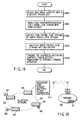
- the wideband code division multiple access transceiver 401 receives a video compression-code stream sent via the broadband code division multiple access channel 801 (S1001) and then the demultiplexer 402 demultiplexes the video compression-code stream (S1002).
- the class of the demultiplexed video compression code streams is identified (S1003). Specifically, it is determined whether it is a MPEG-4-based simple profile code stream or a MPEG-4-based core profile code stream. If it is a simple profile code stream (if Yes at S1004), the simple profile video decoder 403 decodes the video compression code stream (S1005) and displays the video image (S1006) with the video display unit 405.
- the Bluetooth transceiver 412 transmits the video compression code stream of multimedia contents to the personal computer 500 (S1007).
- the personal computer 500 converts the core profile code stream into a simple profile code stream, as described in detail later (S1008).
- the Bluetooth transceiver 412 receives the converted video compression code stream of multimedia contents sent from the personal computer 500 (S1009), demultiplexes the video compression code stream with the demultiplexer 402 (S1010), decodes it with the simple profile video decoder 403 (S1005), and displays a video image with the video display unit 405 (S1006).
- the multimedia contents sent via the broadband code division multiple access channel 801 include a speech code stream (hereafter, a speech compression code stream) which is a speech signal encoded by speech-use coding methods like GSM, ITU-TG. 723.0, G.279, and an audio code stream (hereafter, an audio compression code stream) which is an audio signal encoded by audio-use coding methods like AAC, Twin VQ and MPEG AUDIO.
- the speech decoder 404 can decode a speech compression code stream which does not require a high throughput. If it cannot decode a speech compression code stream which requires a high throughput, it conducts the following processing, although this processing is not shown in the flow chart of FIG. 16.
- the wideband code division multiple access transceiver 401 After the wideband code division multiple access transceiver 401 receives a speech compression code stream or an audio compression code stream of multimedia contents (speech/audio compression code streams) sent through the broadband code division multiple access channel 801, its class, namely whether it is a speech compression code stream or an audio compression code stream, is determined. If it is a speech compression code stream, the speech decoder 404 decodes the stream and the speech output device 406 provides the speech.
- the speech/audio compression code stream demultiplexed by the demultiplexer 402 is a speech compression code stream, namely, if it is an audio compression code stream
- the code stream of multimedia contents including it is sent to the personal computer 500 by the Bluetooth transceiver 412.
- the personal computer 500 converts the audio compression code stream into a speech compression code stream, as described in detail later.
- the Bluetooth transceiver 412 receives the converted speech compression code stream of multimedia contents sent via the Bluetooth channel, while the demultiplexer 402 demultiplexes the speech compression code stream.
- the demultiplexed speech compression code stream is decoded by the speech decoder 404, and the recovered speech is provided by the speech output device 406.
- FIG. 17 is a function block diagram illustrating the detailed configuration of the personal computer 500.
- the personal computer 500 comprises a Bluetooth transceiver 501, a demultiplexer 502, a simple/core profile video decoder 503, a speech/audio decoder 504, a video synthesizer 505, a video display 506 like LCD and CRT, a speech/audio output device 507, a video input device 508 like video cameras, a speech input device 509 like microphones, a simple/core profile video encoder 510, a speech/audio decoder 511, a multiplexer 512, a controller (CPU) 521 and a memory 522.
- CPU central processing unit
- the simple/core profile video decoder 503 has a function of decoding a simple profile code stream, like the simple profile video decoder 403 shown in FIG. 15, and another function of decoding a core profile code stream.
- the simple/core profile video encoder 510 has a function of encoding video contents into a simple profile code stream, like the simple profile video encoder 409 shown in FIG. 15, and another function of encoding video contents into a core profile code stream.
- the speech/audio decoder 504 has a function of decoding a speech compression code stream, like the speech decoder 503 shown in FIG. 15, and another function of decoding an audio compression code stream.
- the speech/audio encoder 511 has a function of encoding speech/audio contents into a speech compression simple profile code stream, like the speech encoder 410 shown in FIG. 15, and another function of encoding speech/audio contents into an audio code stream.
- the personal computer 500 Since the personal computer 500 is not required to have such portability and power saving capability that the portable terminal 400 must have, it is no problem to have a simple/core profile video decoder 503 that needs a high data processing capability, a speech/audio decoder 504, a simple/core profile video encoder 510 and a speech/audio encoder 511.
- the Bluetooth transceiver 501 receives the video compression code stream of multimedia contents sent from the portable terminal 400 (S2001), and the demultiplexer 502 demultiplexes the video compression code stream (S2002).
- the video compression code stream is a core profile code stream, and it is converted into a simple profile code stream (S2003).
- the conversion from the core profile code stream to a simple profile code stream is first conducted by the decoding of core profile code stream with the simple/core file video decoder 503 and then by the encoding of the resulting image contents into a simple profile code stream with the simple/core profile video encoder 510.
- the conversion from a core profile code stream to a simple profile code stream may be conducted by the contents conversion method described in FIGS. 5A and 5B for the first embodiment of the present invention.
- the multiplexer 512 multiplexes the converted simple profile code stream (S2004), and the Bluetooth transceiver 501 modulates it to transmit it to the portable terminal 400 as a code stream of multimedia contents (S2005).
- the multimedia contents transmitted from the portable terminal 400, received and decoded by the Bluetooth transceiver 501 include an audio compression code stream
- it is demultiplexed by the demultiplexer 502 and decoded by the speech/audio decoder 404.
- the obtained audio contents are converted into a speech compression code stream by the speech/audio encoder 511 and then multiplexed by the multiplexer 512. Later, they are demodulated by the Bluetooth transceiver 501 and then transmitted to the portable terminal 400 as the code streams of multimedia contents.
- the video signal entered from the video input device 407 is encoded into a simple profile code stream by the simple profile video encoder 409 and then sent to the personal computer 500 through the multiplexer 411 and the Bluetooth transceiver 412.
- the demultiplexer 502 demultiplexes the simple profile code stream which has been transmitted from the portable terminal 400 by means of Bluetooth, received and demodulated by the Bluetooth transceiver 501, and then decoded by the simple/core profile video decoder 503.
- a plurality of video objects in the obtained video contents are combined by the image synthesizer 505 and then displayed as video images on the video display 506.
- the video contents decoded by the simple/core profile video decoder 503 are encoded into a core profile code stream by the simple/core profile video encoder 510. It can be the case in which the video signal entered from the video input device 508 in the personal computer 500 is encoded as separate video objects into core profile code streams by the simple/core profile video encoder 510, and then these two series of core profile code streams provided by the simple/core profile video encoder 510 are multiplexed by the multiplexer 512 to be transmitted to the portable terminal 400 by the Bluetooth transceiver 501. Also the core profile code stream transmitted from the personal computer 500 to the portable terminal 400 may be sent to another personal computer (not shown) by the wideband code division multiple access transceiver 401 in the portable terminal 400.
- FIG. 19 illustrates the schematic configuration of a contents transmission system according to the forth embodiment of the present invention.
- a group of terminals 901-904 comprising personal computers or portable terminals are connected to each other through a simplified network 900 (hereafter, Bluetooth network) of which lower layer is Bluetooth.
- a simplified network 900 hereafter, Bluetooth network
- this server terminal 904 works as a network gateway and a media processing server as well as a web server.
- the network gateway function of the terminal 904 enables the Bluetooth network 900 to be connected to the Internet 920.
- the transmission channel connecting the Bluetooth network 900 and the Internet 920 is the broadband code division multiple access channel 910 in this example.
- terminals 901-904 on the Bluetooth network 900 can use resources on the Internet through a relatively wide bandwidth and that those terminals 901-904 in cooperation can transmit a variety of contents to the Internet 920.
- the compression code stream of multimedia contents existing in the Internet 920 is entered to the terminal 904 which works as a gateway through the broadband code division multiple access channel 910, and the compression code stream of multimedia contents is distributed to the other terminals 901-903 on the Bluetooth network 900. Then the terminals 901-903 can share contents in the Internet 920 in an efficient way with no need of each having a separate interface with the Internet 920.
- original image code streams which have been obtained by an MPEG-4-based video compression encoding in terminals 901-903 of video information captured by video cameras 906, 907 connected to the terminals 901-903 or by reading out MPEG-4-based video compression encode streams stored in a contents storage 905 mounted in a terminal 901, are transferred via the Bluetooth network 900 to the terminal 904 that works as a media processing server.
- the terminal 904 working as a media processing server combines video compression code streams sent from a plurality of terminals through the Bluetooth network 900 on a real time basis to produce a new MPEG-4 based video compression code stream.
- a web server 921 for example, on the Internet 920 via the broadband code division multiple access channel 910, it becomes possible to disclose the video image data in cooperation among terminals on the Bluetooth network 900 that has been temporarily built at a local site.
- a plurality of terminals such as personal computers can easily cooperate with each other through a temporal network built by a simplified short-range wireless communication means like Bluetooth.
- a simplified short-range wireless communication means like Bluetooth.
- the broadband code division multiple access channel and Bluetooth channels have been employed.
- the configuration of the transmission system according to the present invention is not limited to only those channels. Indeed, it is appreciated by those having skill in the art that the present invention can be realized by using other types of wireless and wired transmission channels.
- the present invention makes terminals like portable terminals of relatively low throughput possible to provide a contents transmission system and a contents processing apparatus which can easily handle the contents transmitted as a code stream like a MPEG-4 core profile code stream which requires a complex data processing during decoding and reconstruction.
Landscapes
- Engineering & Computer Science (AREA)
- Signal Processing (AREA)
- Computer Networks & Wireless Communication (AREA)
- Multimedia (AREA)
- Computer Security & Cryptography (AREA)
- Mobile Radio Communication Systems (AREA)
- Small-Scale Networks (AREA)
- Two-Way Televisions, Distribution Of Moving Picture Or The Like (AREA)
- Communication Control (AREA)
- Compression Or Coding Systems Of Tv Signals (AREA)
- Reduction Or Emphasis Of Bandwidth Of Signals (AREA)
- Compression, Expansion, Code Conversion, And Decoders (AREA)
Abstract
Description
Claims (23)
- A contents transmission system characterized by comprising:a first terminal (100) configured to receive a first code stream produced by compression-encoding contents, and having a converter section (102) for converting
the first code stream into a second code stream having a data size smaller than that of the first code stream, and a transmission section transmitting the second code stream; anda second terminal (200) configured to receive the second code stream transmitted from said first terminal, and have a reconstruction section reconstructing the contents by decoding the second code stream. - The contents transmission system according to claim 1, characterized in that said converter section (102) converts an MPEG-4-based core profile code stream corresponding to the first code stream into an MPEG-4-based simple profile code stream corresponding to the second code stream.
- The contents transmission system according to claim 1 or 2, characterized in that said first terminal
comprises a personal computer (1.00) and said second terminal comprises a portable terminal (200). - The contents transmission system according to claim 1, 2 or 3 characterized in that said first terminal
(100) transmits and receives the first code stream by wideband code division multiple access and transmits and receives the second code stream by Bluetooth. - The contents transmission system according to claim 1, 2 or 3 characterized in that said converter section
(102) converts the first code stream transferred from said second terminal (200) into the second code stream and transferring the converted second code stream to said second terminal. - The contents transmission system according to claim 5, characterized in that said first code stream includes an MPEG-4-based core profile code stream and the second code stream includes an MPEG-4-based simple profile code stream.
- A contents transmission system
comprising:a plurality of terminals (A, B) including at least one terminal which receives a code stream produced by compression-encoding contents and decodes the code stream to reconstruct the contents;a transmission channel connecting said plurality of terminals to each other; anda contents processor device (302) which gathers to at least one of said terminals the code streams received by said plurality of terminals via said transmission channel, decodes the code streams, and then combines the code streams to reconstruct the original contents. - The contents transmission system according to claim 7, characterized in that said transmission channel comprises a Bluetooth channel.
- A contents transmission system which comprises:a plurality of terminals (A, B);a first transmission channel which connects said plurality of terminals to each other; anda second transmission channel; andwherein said plurality of terminals includes a transmission section (304) configured to transmit a code stream produced by compression-encoding contents via said second transmission channel, at least one of said terminals has a function of separating a code stream into a plurality of separated code streams, transmitting one of the separated code streams via said second transmission channel and transmitting the other separated code streams to the other terminals via said first transmission channel, andthe contents are reconstructed from the separated code streams transmitted from said plurality of terminals via said second transmission channel.
- A contents transmission system characterized by comprising:a plurality of terminals (A, B) which each have functions of producing a code stream by encoding contents and reconstructing the contents by decoding the code stream, at least one of said terminals working as a server;a first network connecting said plurality of terminals to each other;a second network; anda transmission channel connecting said server to said second network, said server taking a code stream from said second network through said transmission channel and distributing the code stream to the other terminals in said plurality of terminals.
- A contents transmission system which comprises:a plurality of terminals (A, B) which each have functions of producing a code stream by encoding contents and reconstructing the contents by decoding the code stream, at least one of said terminals working as a server;a first network connecting said plurality of terminals to each other;a second network; anda transmission channel connecting said server to said second network; andwherein said server combines code streams produced by the other terminals in said plurality of terminals and transmits the combined code stream to said second network through said transmission channel.
- A contents processing apparatus comprising:a receiver section (101) which receives a first code stream obtained by encoding contents;a converter section (102) which converts the received first code stream into a second code stream having a data size smaller than that of the first code stream; anda transmitter section (103) which transmits the second code stream.
- The contents processing apparatus according to claim 12, characterized in that said converter section (102) converts an MPEG-4-based core profile code stream corresponding to the first code stream into an MPEG-4-based simple profile code stream corresponding to the second code stream.
- The contents processing apparatus according to claim 12, characterized in that said receiver section (101) receives the first code stream by wideband code division multiple access, and said transmitter section (103) transmits the second code stream by Bluetooth.
- A contents processing apparatus characterized by comprising:a first terminal (100) having a converter section (102) which converts a first code stream produced by compression-encoding contents into a second code stream having a data size smaller than that of the first code stream; anda second terminal (200) reconstructing the contents by decoding the second code stream, receiving the first code stream and transferring the received first code stream to said first terminal,said converter section (102) converting the first code stream transferred from said second terminal into the second code stream and transferring the converted second code stream to said second terminal.
- The contents processing apparatus according to claim 15, characterized in that said first code stream includes an MPEG-4-based core profile code stream and said second code stream includes an MPEG-4-based simple profile code stream.
- The contents processing apparatus according to claim 16, characterized in that said converter section (102) converts the MPEG-4-based core profile code stream into an MPEG-4-based simple profile code stream.
- The contents processing apparatus according to claim 15, characterized in that said converter section (102) decodes the first code stream and produces the second code stream by encoding the contents obtained from this decoding with a coding method different from that employed in the first code stream.
- The contents processing apparatus according to claim 18, characterized in that said first code stream includes an MPEG-4-based core profile code stream, and said converter section (102) converts the MPEG-4-based core profile code stream into an MPEG-4-based simple profile code stream.
- A contents transmission system for transmitting a code stream obtained by compression-encoding contents, characterized by comprising:a first transmission channel;a second transmission channel;a first terminal (A) which receives a first code stream through said first transmission channel;a second terminal (B) which receives a second code stream through said first transmission channel;an exchanger device which exchanges the first and second code streams received by said first and second terminals through said second transmission channel;a reconstruction device (302) which decodes the code stream received through said first transmission channel and the code stream received through said second transmission channel and combines the decoded streams to reconstruct the contents.
- A contents converting method characterized by comprising:
converting a first code stream produced by compression-encoding contents into a second code stream having a data size smaller than that of the first code stream. - The method according to claim 21, characterized in that said converting step includes dividing the first code stream into a plurality of code streams to produce the second code stream.
- A computer program product for a contents transmission system characterized by comprising:means for instructing a computer to convert a first code stream produced by compression-encoding contents into a second code stream having a data size smaller than that of the first code stream; andmeans for instructing the computer to decode the second code stream for reconstructing the contents.
Applications Claiming Priority (2)
| Application Number | Priority Date | Filing Date | Title |
|---|---|---|---|
| JP2000054947A JP2001245268A (en) | 2000-02-29 | 2000-02-29 | Content transmission system and content processing device |
| JP2000054947 | 2000-02-29 |
Publications (2)
| Publication Number | Publication Date |
|---|---|
| EP1130923A2 true EP1130923A2 (en) | 2001-09-05 |
| EP1130923A3 EP1130923A3 (en) | 2004-01-28 |
Family
ID=18576142
Family Applications (1)
| Application Number | Title | Priority Date | Filing Date |
|---|---|---|---|
| EP20010301639 Withdrawn EP1130923A3 (en) | 2000-02-29 | 2001-02-23 | Contents transmission system and contents processing apparatus |
Country Status (3)
| Country | Link |
|---|---|
| US (5) | US20010017853A1 (en) |
| EP (1) | EP1130923A3 (en) |
| JP (1) | JP2001245268A (en) |
Cited By (2)
| Publication number | Priority date | Publication date | Assignee | Title |
|---|---|---|---|---|
| RU2359424C2 (en) * | 2004-02-06 | 2009-06-20 | Софтбанк Бб Корп. | Video-telephone system, design of autonomous base station, television subscriber adapter and method of video-telephone communication |
| US10992727B2 (en) | 2015-04-08 | 2021-04-27 | Sony Corporation | Transmission apparatus, transmission method, reception apparatus, and reception method |
Families Citing this family (30)
| Publication number | Priority date | Publication date | Assignee | Title |
|---|---|---|---|---|
| JP3699889B2 (en) * | 2000-08-01 | 2005-09-28 | 株式会社東芝 | Information processing apparatus and communication function expansion method |
| US7809944B2 (en) * | 2001-05-02 | 2010-10-05 | Sony Corporation | Method and apparatus for providing information for decrypting content, and program executed on information processor |
| EP1309181A1 (en) * | 2001-11-06 | 2003-05-07 | Thomson Licensing S.A. | Device, method and system for multimedia content adaption |
| DE60114054T2 (en) * | 2001-11-28 | 2006-06-22 | Nokia Corp. | TEACHING PROCESS AND SYSTEM USING WIRELESS COMMUNICATION |
| FR2838589B1 (en) | 2002-04-10 | 2005-03-04 | Thomson Licensing Sa | DATA TRANSMISSION DEVICE AND DATA RECEIVING DEVICE |
| JPWO2003101102A1 (en) * | 2002-05-24 | 2005-09-29 | 三菱電機株式会社 | Movie file playback method for portable communication device and movie file playback device for portable communication device |
| JP2004104347A (en) * | 2002-09-06 | 2004-04-02 | Ricoh Co Ltd | Image processing apparatus, image processing method, program, and recording medium |
| US7369868B2 (en) * | 2002-10-30 | 2008-05-06 | Sony Ericsson Mobile Communications Ab | Method and apparatus for sharing content with a remote device using a wireless network |
| KR20040039807A (en) * | 2002-11-05 | 2004-05-12 | 엘지전자 주식회사 | Method for picture decoding of computer |
| US8089911B2 (en) | 2004-05-01 | 2012-01-03 | Neocific, Inc. | Methods and apparatus for cellular broadcasting and communication system |
| CA2566124C (en) | 2004-05-13 | 2014-09-30 | Qualcomm Incorporated | Method and apparatus for allocation of information to channels of a communication system |
| US8670421B2 (en) * | 2004-11-30 | 2014-03-11 | Symbol Technologies, Inc. | System and method for cohesive radio operation |
| US9780959B2 (en) * | 2005-03-25 | 2017-10-03 | Neocific, Inc. | Methods and apparatus for power efficient broadcasting and communication systems |
| CN101091390B (en) | 2005-06-09 | 2011-01-12 | 桥扬科技有限公司 | Method and apparatus for power efficient broadcast and communication system |
| US7849154B2 (en) * | 2005-06-27 | 2010-12-07 | M:Metrics, Inc. | Acquiring, storing, and correlating profile data of cellular mobile communications system's users to events |
| US20080091489A1 (en) * | 2005-06-27 | 2008-04-17 | Larock Garrison J | Acquiring, storing, and correlating profile data of cellular mobile communications system's users to Events |
| US8989661B2 (en) | 2005-08-30 | 2015-03-24 | Broadcom Corporation | Method and system for optimized architecture for bluetooth streaming audio applications |
| WO2007107982A1 (en) * | 2006-03-17 | 2007-09-27 | Sandisk Il Ltd | Session handover between terminals |
| FR2900750B1 (en) * | 2006-05-02 | 2008-11-28 | Oberthur Card Syst Sa | PORTABLE ELECTRONIC ENTITY CAPABLE OF RECEIVING A DIFFUSE MULTIMEDIA DATA STREAM. |
| WO2007143394A2 (en) | 2006-06-02 | 2007-12-13 | Nielsen Media Research, Inc. | Digital rights management systems and methods for audience measurement |
| US8000720B2 (en) * | 2007-12-13 | 2011-08-16 | At&T Intellectual Property I, Lp | Reducing bandwidth when transmitting content to a cellular device |
| US8503991B2 (en) | 2008-04-03 | 2013-08-06 | The Nielsen Company (Us), Llc | Methods and apparatus to monitor mobile devices |
| JP2010117863A (en) * | 2008-11-12 | 2010-05-27 | Toshiba Corp | Content reproduction device and content reproduction method |
| US8547884B2 (en) | 2010-09-28 | 2013-10-01 | Neocific, Inc. | Methods and apparatus for flexible use of frequency bands |
| US9317377B1 (en) * | 2011-03-23 | 2016-04-19 | Riverbed Technology, Inc. | Single-ended deduplication using cloud storage protocol |
| US8315620B1 (en) | 2011-05-27 | 2012-11-20 | The Nielsen Company (Us), Llc | Methods and apparatus to associate a mobile device with a panelist profile |
| JP5600093B2 (en) * | 2011-12-06 | 2014-10-01 | 日本電信電話株式会社 | Wireless gateway system |
| US9781180B2 (en) * | 2013-12-20 | 2017-10-03 | Verizon Patent And Licensing Inc. | Redistributing broadcasted content |
| US9585015B2 (en) * | 2015-04-21 | 2017-02-28 | Motorola Solutions, Inc | Method and apparatus for authentication of collaborative mobile devices |
| CN111935221B (en) * | 2020-07-03 | 2023-04-28 | Oppo(重庆)智能科技有限公司 | File transmission method, device, storage medium and terminal |
Family Cites Families (20)
| Publication number | Priority date | Publication date | Assignee | Title |
|---|---|---|---|---|
| DE69324873T2 (en) * | 1992-09-21 | 1999-10-21 | Canon K.K., Tokio/Tokyo | Network system and terminal device |
| US5491514A (en) * | 1993-01-28 | 1996-02-13 | Matsushita Electric Industrial Co., Ltd. | Coding apparatus, decoding apparatus, coding-decoding apparatus for video signals, and optical disks conforming thereto |
| US5606359A (en) * | 1994-06-30 | 1997-02-25 | Hewlett-Packard Company | Video on demand system with multiple data sources configured to provide vcr-like services |
| MY121893A (en) * | 1995-04-28 | 2006-03-31 | Qualcomm Inc | Method and apparatus for providing variable rate data in a communications system using statistical multiplexing. |
| US5764696A (en) * | 1995-06-02 | 1998-06-09 | Time Domain Corporation | Chiral and dual polarization techniques for an ultra-wide band communication system |
| US6209132B1 (en) * | 1995-06-15 | 2001-03-27 | Intel Corporation | Host apparatus for simulating two way connectivity for one way data streams |
| US5758090A (en) * | 1995-09-22 | 1998-05-26 | Airnet Communications, Inc. | Frequency reuse planning for CDMA cellular communication system by grouping of available carrier frequencies and power control based on the distance from base station |
| SE511236C2 (en) * | 1996-11-29 | 1999-08-30 | Ericsson Telefon Ab L M | A modem with IP support |
| US6088351A (en) * | 1996-06-14 | 2000-07-11 | Trw Inc. | Method and apparatus for accommodating signal blockage in satellite mobile radio systems |
| US6006105A (en) * | 1996-08-02 | 1999-12-21 | Lsi Logic Corporation | Multi-frequency multi-protocol wireless communication device |
| JPH11119722A (en) * | 1997-10-15 | 1999-04-30 | Canon Inc | Display system |
| IL127790A (en) * | 1998-04-21 | 2003-02-12 | Ibm | System and method for selecting, accessing and viewing portions of an information stream(s) using a television companion device |
| US6496122B2 (en) * | 1998-06-26 | 2002-12-17 | Sharp Laboratories Of America, Inc. | Image display and remote control system capable of displaying two distinct images |
| EP0975123A1 (en) * | 1998-07-15 | 2000-01-26 | Telefonaktiebolaget L M Ericsson (Publ) | Communication device and method for reliable and low-delay packet transmission |
| US6611530B1 (en) * | 1999-09-21 | 2003-08-26 | Hewlett-Packard Development Company, L.P. | Video communication using multiple streams |
| KR100382454B1 (en) * | 1999-12-15 | 2003-05-09 | 니폰덴신뎅와 가부시키가이샤 | Adaptive array antenna transmitting/receiving apparatus |
| US20050259682A1 (en) * | 2000-02-03 | 2005-11-24 | Yuval Yosef | Broadcast system |
| US6901067B1 (en) * | 2000-02-04 | 2005-05-31 | Lucent Technologies Inc. | Method and device for generating a PCM signal stream from a streaming packet source |
| US20010047517A1 (en) * | 2000-02-10 | 2001-11-29 | Charilaos Christopoulos | Method and apparatus for intelligent transcoding of multimedia data |
| US6934334B2 (en) * | 2000-10-02 | 2005-08-23 | Kabushiki Kaisha Toshiba | Method of transcoding encoded video data and apparatus which transcodes encoded video data |
-
2000
- 2000-02-29 JP JP2000054947A patent/JP2001245268A/en not_active Abandoned
-
2001
- 2001-02-23 EP EP20010301639 patent/EP1130923A3/en not_active Withdrawn
- 2001-02-27 US US09/793,580 patent/US20010017853A1/en not_active Abandoned
-
2005
- 2005-06-02 US US11/142,318 patent/US20050213544A1/en not_active Abandoned
-
2006
- 2006-01-06 US US11/326,484 patent/US20060114860A1/en not_active Abandoned
- 2006-01-10 US US11/328,128 patent/US20060114861A1/en not_active Abandoned
- 2006-01-10 US US11/328,055 patent/US20060109823A1/en not_active Abandoned
Cited By (2)
| Publication number | Priority date | Publication date | Assignee | Title |
|---|---|---|---|---|
| RU2359424C2 (en) * | 2004-02-06 | 2009-06-20 | Софтбанк Бб Корп. | Video-telephone system, design of autonomous base station, television subscriber adapter and method of video-telephone communication |
| US10992727B2 (en) | 2015-04-08 | 2021-04-27 | Sony Corporation | Transmission apparatus, transmission method, reception apparatus, and reception method |
Also Published As
| Publication number | Publication date |
|---|---|
| JP2001245268A (en) | 2001-09-07 |
| US20060114860A1 (en) | 2006-06-01 |
| US20010017853A1 (en) | 2001-08-30 |
| EP1130923A3 (en) | 2004-01-28 |
| US20050213544A1 (en) | 2005-09-29 |
| US20060114861A1 (en) | 2006-06-01 |
| US20060109823A1 (en) | 2006-05-25 |
Similar Documents
| Publication | Publication Date | Title |
|---|---|---|
| US20060109823A1 (en) | Contents transmission system and contents processing apparatus | |
| US10009790B2 (en) | Wide area transport networks for mobile radio access networks and methods of use | |
| AU657510B2 (en) | Improved image encoding/decoding method and apparatus | |
| RU2159507C1 (en) | Device for information encoding and decoding, information transmission system using channel compression, system for information transmission in telecommunication network | |
| KR100281463B1 (en) | Sub-data encoding apparatus in object based encoding system | |
| TW200810563A (en) | Encoding apparatus, decoding apparatus, encoding method, decoding method, program of encoding method, program of decoding method, recording medium in which program of encoding method is recorded, and recording medium in which program of deocding method i | |
| CN102148964A (en) | Three-generation (3G) mobile internet video monitoring system | |
| KR20010052710A (en) | Method and aparatus in transmission of images | |
| JP2001515286A (en) | An Elegant Computation Reduction Method Using Priority Information in Multiple Object Environments | |
| US7212974B2 (en) | System and method for compressing and encoding data | |
| EP1090506A1 (en) | A method for transmitting video images, a data transmission system and a multimedia terminal | |
| CN207399398U (en) | Remote monitoring system | |
| CN108989748A (en) | Method and system for video image transmission based on microwave technology | |
| CN102740217A (en) | GSM-R (Global System for Mobile Communications for Railway) emergency system and method | |
| JP2002261717A (en) | Wireless communication system | |
| CN117156157B (en) | Encoding and decoding methods and electronic devices | |
| JPH09284567A (en) | Data transmitter and data transmission method | |
| Davidson et al. | The impact of digital technologies on future land mobile spectrum requirements | |
| KR100311573B1 (en) | Wavelet-based Software Encoder and Decoder | |
| JP3258217B2 (en) | Encoding / decoding method and apparatus therefor | |
| JP2005176068A (en) | Video distribution system and method | |
| JP2003047010A (en) | Dynamic image data transmitting system and method there of | |
| TW201031214A (en) | Method and system for reducing the bit stream and electronic device theereof | |
| KR0124160B1 (en) | Layered coding method in atm | |
| Urcia-Paredes et al. | An Algorithm for Image Transmission Using FM-RDS Communication Modules |
Legal Events
| Date | Code | Title | Description |
|---|---|---|---|
| PUAI | Public reference made under article 153(3) epc to a published international application that has entered the european phase |
Free format text: ORIGINAL CODE: 0009012 |
|
| 17P | Request for examination filed |
Effective date: 20010306 |
|
| AK | Designated contracting states |
Kind code of ref document: A2 Designated state(s): AT BE CH CY DE DK ES FI FR GB GR IE IT LI LU MC NL PT SE TR |
|
| AX | Request for extension of the european patent |
Free format text: AL;LT;LV;MK;RO;SI |
|
| RIC1 | Information provided on ipc code assigned before grant |
Ipc: 7H 04N 5/00 B Ipc: 7H 04N 7/24 A |
|
| PUAL | Search report despatched |
Free format text: ORIGINAL CODE: 0009013 |
|
| AK | Designated contracting states |
Kind code of ref document: A3 Designated state(s): AT BE CH CY DE DK ES FI FR GB GR IE IT LI LU MC NL PT SE TR |
|
| AX | Request for extension of the european patent |
Extension state: AL LT LV MK RO SI |
|
| AKX | Designation fees paid |
Designated state(s): DE FR GB |
|
| STAA | Information on the status of an ep patent application or granted ep patent |
Free format text: STATUS: THE APPLICATION HAS BEEN WITHDRAWN |
|
| 18W | Application withdrawn |
Effective date: 20080430 |