EP1130890A2 - Mobile telephone with electronic mail function - Google Patents
Mobile telephone with electronic mail function Download PDFInfo
- Publication number
- EP1130890A2 EP1130890A2 EP01104801A EP01104801A EP1130890A2 EP 1130890 A2 EP1130890 A2 EP 1130890A2 EP 01104801 A EP01104801 A EP 01104801A EP 01104801 A EP01104801 A EP 01104801A EP 1130890 A2 EP1130890 A2 EP 1130890A2
- Authority
- EP
- European Patent Office
- Prior art keywords
- key
- telephone
- registered
- mobile telephone
- Prior art date
- Legal status (The legal status is an assumption and is not a legal conclusion. Google has not performed a legal analysis and makes no representation as to the accuracy of the status listed.)
- Withdrawn
Links
Images



Classifications
-
- H—ELECTRICITY
- H04—ELECTRIC COMMUNICATION TECHNIQUE
- H04M—TELEPHONIC COMMUNICATION
- H04M1/00—Substation equipment, e.g. for use by subscribers
- H04M1/72—Mobile telephones; Cordless telephones, i.e. devices for establishing wireless links to base stations without route selection
- H04M1/724—User interfaces specially adapted for cordless or mobile telephones
- H04M1/72403—User interfaces specially adapted for cordless or mobile telephones with means for local support of applications that increase the functionality
- H04M1/7243—User interfaces specially adapted for cordless or mobile telephones with means for local support of applications that increase the functionality with interactive means for internal management of messages
-
- H—ELECTRICITY
- H04—ELECTRIC COMMUNICATION TECHNIQUE
- H04B—TRANSMISSION
- H04B1/00—Details of transmission systems, not covered by a single one of groups H04B3/00 - H04B13/00; Details of transmission systems not characterised by the medium used for transmission
- H04B1/38—Transceivers, i.e. devices in which transmitter and receiver form a structural unit and in which at least one part is used for functions of transmitting and receiving
-
- H—ELECTRICITY
- H04—ELECTRIC COMMUNICATION TECHNIQUE
- H04L—TRANSMISSION OF DIGITAL INFORMATION, e.g. TELEGRAPHIC COMMUNICATION
- H04L51/00—User-to-user messaging in packet-switching networks, transmitted according to store-and-forward or real-time protocols, e.g. e-mail
- H04L51/58—Message adaptation for wireless communication
-
- H—ELECTRICITY
- H04—ELECTRIC COMMUNICATION TECHNIQUE
- H04M—TELEPHONIC COMMUNICATION
- H04M1/00—Substation equipment, e.g. for use by subscribers
- H04M1/26—Devices for calling a subscriber
- H04M1/27—Devices whereby a plurality of signals may be stored simultaneously
- H04M1/274—Devices whereby a plurality of signals may be stored simultaneously with provision for storing more than one subscriber number at a time, e.g. using toothed disc
- H04M1/2745—Devices whereby a plurality of signals may be stored simultaneously with provision for storing more than one subscriber number at a time, e.g. using toothed disc using static electronic memories, e.g. chips
- H04M1/27467—Methods of retrieving data
- H04M1/2747—Scrolling on a display
-
- H—ELECTRICITY
- H04—ELECTRIC COMMUNICATION TECHNIQUE
- H04M—TELEPHONIC COMMUNICATION
- H04M1/00—Substation equipment, e.g. for use by subscribers
- H04M1/72—Mobile telephones; Cordless telephones, i.e. devices for establishing wireless links to base stations without route selection
- H04M1/724—User interfaces specially adapted for cordless or mobile telephones
- H04M1/72403—User interfaces specially adapted for cordless or mobile telephones with means for local support of applications that increase the functionality
-
- H—ELECTRICITY
- H04—ELECTRIC COMMUNICATION TECHNIQUE
- H04L—TRANSMISSION OF DIGITAL INFORMATION, e.g. TELEGRAPHIC COMMUNICATION
- H04L51/00—User-to-user messaging in packet-switching networks, transmitted according to store-and-forward or real-time protocols, e.g. e-mail
- H04L51/48—Message addressing, e.g. address format or anonymous messages, aliases
-
- H—ELECTRICITY
- H04—ELECTRIC COMMUNICATION TECHNIQUE
- H04M—TELEPHONIC COMMUNICATION
- H04M1/00—Substation equipment, e.g. for use by subscribers
- H04M1/26—Devices for calling a subscriber
- H04M1/27—Devices whereby a plurality of signals may be stored simultaneously
- H04M1/274—Devices whereby a plurality of signals may be stored simultaneously with provision for storing more than one subscriber number at a time, e.g. using toothed disc
- H04M1/2745—Devices whereby a plurality of signals may be stored simultaneously with provision for storing more than one subscriber number at a time, e.g. using toothed disc using static electronic memories, e.g. chips
- H04M1/27453—Directories allowing storage of additional subscriber data, e.g. metadata
-
- H—ELECTRICITY
- H04—ELECTRIC COMMUNICATION TECHNIQUE
- H04M—TELEPHONIC COMMUNICATION
- H04M1/00—Substation equipment, e.g. for use by subscribers
- H04M1/72—Mobile telephones; Cordless telephones, i.e. devices for establishing wireless links to base stations without route selection
- H04M1/724—User interfaces specially adapted for cordless or mobile telephones
- H04M1/72403—User interfaces specially adapted for cordless or mobile telephones with means for local support of applications that increase the functionality
- H04M1/72445—User interfaces specially adapted for cordless or mobile telephones with means for local support of applications that increase the functionality for supporting Internet browser applications
Definitions
- the present invention relates to a mobile telephone having a function of non-voice information communicating mode (information mode, so called as "i-mode" for example), and more particularly to the mobile telephone constructed so that a switching to a mail creation mode can be effected by simple key operations.
- the non-voice information communicating mode is an operation mode of on line data service employing a digital mobile telephone, by means of which site (contents) connecting service, internet connecting service, message service, i-mode mail, etc. can be utilized.
- an icon of "mail” is selected on an icon screen to call up a "mail screen”.
- "new mail creation” is selected on the mail screen.
- the new mail creation screen is divided into creation screens for mail text creation, address creation, and title creation in order. These creation screens are sequentially selected, and the mail is created to complete a transmittable mail.
- the destination address of the mail can be determined utilizing the registered mail address.
- creation of the mail cannot be conducted easily, because the mail address cannot be called up directly from the screen indicating names and telephone numbers.
- the invention has been made in order to solve such problem, and it is an object of the invention to provide a mobile telephone in which new mail creation can be conducted by simple key operations when a telephone directory screen is displayed.
- a mobile telephone comprises a telephone directory in which mail addresses are registered, and a browser function key, in that by pushing the browser function key when a telephone directory screen is displayed by selecting the telephone directory, a switching to mail creation mode is conducted.
- the switching to the new mail creation mode can be quickly made through another step besides a step of selecting the "mail" on the icon screen to display "the mail screen”.
- the browser function key may be a warp (jump) key adapted to jump to non voice information communicating mode.
- the transition to the new mail creation mode can be made by simple key operations.
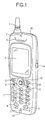
- Fig. 1 is a schematic view showing a structure of a mobile telephone having a function of non-voice information communicating mode (i-mode, for example) according to one embodiment of the invention.
- the mobile telephone according to the embodiment of the invention is designed to have an antenna 1, an incoming call/charging lamp 2, a receiver 3, a liquid crystal display 4, a left soft key 5 serving also as a telephone directory button, a conversation starting button 6, ten keys or dial keys 7, a warp (jump) key 8 for switching into the non-voice information communicating mode, a transmitter 9, an external connection terminal 10, a voice/manner key 11, a power/stop/hold key 12, a right soft key 13 serving also as a redial/clear button, a navigation key 14 which can select the displays in upward, downward, right and left directions having also a scroll function, and can determine the selection by pushing a center button, and an earphone microphone terminal 15, and an infrared port 16.
- Fig. 2 is a diagram showing circuit blocks for realizing the mobile telephone having the above described structure.
- radio waves received by the antenna 1 is received at a receiving part (not shown) of a radio communication section 18, and the received information is transmitted to a control section 20.
- the control section 20 displays the received information such as a telephone number, on the display 4 such as a liquid crystal display unit.
- the control section 20 converts the received information into a voice information and outputs by voice through a speaker (receiver) 3 of a receiving section.
- the transmitter (microphone) 9 receives a user's voice and transmit it by radio to a person on the other end of the line by way of a transmitting part (not shown) of the radio communication section 18 and the antenna 1.
- the control section 20 also controls a memory 26 to record the voice information such as the telephone conversation in progress, or to read out the recorded information.
- a ten key operating section 22 inputs dial signals or so into the control section 20 by operating the ten keys 7.
- a function key operating section 24 for operating other function keys than the ten keys acts to input an operation of the operated function key, for example, the navigation key 14 into the control section 20.
- the memory 26 is adapted to register and read out the data in the telephone directory including the mail addresses by the operation of the ten keys 7.
- the control section 20 is so constructed as to control a switching to the mail creation mode, when the warp key 8 is pushed while the data of the telephone directory is displayed on the display section 4.
- the infrared input and output section 28 conducts exchange of infrared signals by way of the infrared port 16.
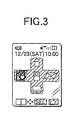
- Fig. 3 shows an example of an icon screen which is displayed during a waiting period on a display section of the mobile telephone having the above described structure.
- the icon screen is displayed in a shape of a cross, including an i-mode icon, an i-mode mail icon, a telephone directory icon, and a screen icon, in clockwise and a menu icon at a center.
- a selected icon screen is adapted to be enlarged, and which icon screen has now been selected is shown.
- Figs. 4A to 4E show the transitions of the screens displayed on the mobile telephone for explanation of the mode for carrying out the invention.
- Figs. 4A to 4D are transition views when making a telephone call by calling up the telephone directory, which is a usual utilization system of calling up the telephone directory.
- the left soft key 5 is pushed and then, a navigation decision key of the navigation key 14 is pushed several times to display a group call up screen (Refer to Fig. 4A). Then, by operating the upward or downward scroll key of the navigation key to select an appropriate group number (Refer to Fig.4B).
- the mail address which has been registered in the telephone directory can be called up, and the switching to the mail creation mode can be performed.
- the mail address screen can be also used so that the transition to the new mail creation mode can be effected, by pushing the warp key 8 while the mail address screen is indicated.
- Fig. 4E shows an example of the "mail address screen" in which by pushing the warp key 8 in a state where the telephone directory is used to call up the counterpart person, the switching to the new mail creation mode can be effected. This can save a trouble of inputting each time the address to which the mail is dispatched, and creation and dispatch of the new mail can be simplified.
- Fig. 5 shows a data structure of the telephone directory according to the embodiment.
- the telephone directory includes columns for list numbers, names/telephone numbers, mail addresses, and notes, as shown in Fig. 5.
- the desired data are previously registered in these data entry columns.
- Fig. 6 is a flow chart for explaining operations for switching to the new mail creation mode by pushing the browser function key (warp key).
- Step 61 the registered content of the selected name in the telephone directory is displayed (Step 61). Then, whether or not the browser function key (the warp key) has been pushed is judged (Step 62). If the browser function key (the warp key) has been pushed, the mail address is called up in case where the mail address has been registered in the telephone directory, or the telephone number is called up in case where the mail address has not been registered to switch to the mail creation screen (Step 63). Alternatively, if the browser function key (the warp key) has not been pushed, the registered contents of the telephone directory shall be continued to be displayed (Step 64).
- the mobile telephone comprises the telephone directory in which mail addresses can be registered, and the browser function key, in that by pushing the browser function key when the telephone directory screen is displayed by selecting the telephone directory, the switching to the mail creation mode can be conducted.
- the invention can attain such an effect that the transition to the new mail creation mode can be quickly made through the other step besides the step of selecting the "mail" on the icon screen to display "the mail screen”.
- the browser function key is the warp key adapted to switch to the non voice information communicating mode.
Landscapes
- Engineering & Computer Science (AREA)
- Signal Processing (AREA)
- Computer Networks & Wireless Communication (AREA)
- Human Computer Interaction (AREA)
- Business, Economics & Management (AREA)
- General Business, Economics & Management (AREA)
- Telephone Function (AREA)
- Mobile Radio Communication Systems (AREA)
- Information Transfer Between Computers (AREA)
- Telephonic Communication Services (AREA)
- Computer And Data Communications (AREA)
Abstract
Description
Claims (6)
- A mobile telephone comprises:a telephone directory in which electronic mail addresses is registered;a browser function key which cause to switch to a mail creation mode by pushing said browser function key when an electronic mail address is displayed by selecting in said telephone directory.
- A mobile telephone as claimed in claim 1, wherein said browser function key is a key to switch non voice information communicating mode.
- A mobile telephone as claimed in claim 1, wherein when an electronic mail address of a destination has been registered in the telephone directory, the mail address is automatically registered as the "new mail" in the mail creation mode.
- A mobile telephone as claimed in claim 1, wherein when a mail address of a destination has not been registered in the telephone directory, a telephone number of the destination is automatically registered as the "new mail" in the mail creation mode.
- A mobile telephone as claimed in claim 3, wherein when neither of the mail address nor the telephone number has been registered, it is prohibited to switch to a mail creation mode by pushing said browser function key.
- A mobile telephone as claimed in claim 4, wherein when neither of the mail address nor the telephone number has been registered, it is prohibited to switch to a mail creation mode by pushing said browser function key.
Applications Claiming Priority (2)
| Application Number | Priority Date | Filing Date | Title |
|---|---|---|---|
| JP2000054914 | 2000-02-29 | ||
| JP2000054914A JP2001245037A (en) | 2000-02-29 | 2000-02-29 | Mobile phone |
Publications (2)
| Publication Number | Publication Date |
|---|---|
| EP1130890A2 true EP1130890A2 (en) | 2001-09-05 |
| EP1130890A3 EP1130890A3 (en) | 2003-11-12 |
Family
ID=18576112
Family Applications (1)
| Application Number | Title | Priority Date | Filing Date |
|---|---|---|---|
| EP01104801A Withdrawn EP1130890A3 (en) | 2000-02-29 | 2001-02-27 | Mobile telephone with electronic mail function |
Country Status (6)
| Country | Link |
|---|---|
| US (1) | US20010036844A1 (en) |
| EP (1) | EP1130890A3 (en) |
| JP (1) | JP2001245037A (en) |
| KR (1) | KR20010085735A (en) |
| CN (1) | CN1311619A (en) |
| AU (1) | AU2325001A (en) |
Cited By (5)
| Publication number | Priority date | Publication date | Assignee | Title |
|---|---|---|---|---|
| WO2003062975A1 (en) * | 2002-01-22 | 2003-07-31 | Fujitsu Limited | Menu element selecting device and method |
| EP1229703A3 (en) * | 2001-02-02 | 2003-11-12 | Nokia Corporation | Mobile telecommunications device |
| WO2004051949A1 (en) * | 2002-11-29 | 2004-06-17 | Eun Young Chung | System and method for providing integrated communication id |
| EP1505810A1 (en) * | 2003-08-04 | 2005-02-09 | Matsushita Electric Industrial Co., Ltd. | Communication terminal apparatus and processing method for sending and receiving e-mail |
| EP1641227A1 (en) * | 2004-09-24 | 2006-03-29 | Topseed Technology Corp. | Method and apparatus for fast delivery of e-mail by a message transceiver |
Families Citing this family (8)
| Publication number | Priority date | Publication date | Assignee | Title |
|---|---|---|---|---|
| US20040164973A1 (en) * | 2002-06-28 | 2004-08-26 | Kyocera Corporation | Personal digital assistant and program for controlling used for the same |
| MXPA05003173A (en) | 2002-09-27 | 2006-05-17 | Axesstel Inc | Telephony terminal providing connection between a telephone and a data network. |
| ES2365520T3 (en) * | 2004-07-21 | 2011-10-06 | J-Data Co., Ltd. | MOBILE PHONE, AND MOBILE INFORMATION TERMINAL. |
| US7619615B1 (en) * | 2004-08-31 | 2009-11-17 | Sun Microsystems, Inc. | Method and apparatus for soft keys of an electronic device |
| JP2006350831A (en) * | 2005-06-17 | 2006-12-28 | Ntt Docomo Inc | Communication apparatus and browser switching method |
| JP2007122299A (en) * | 2005-10-27 | 2007-05-17 | Nec Corp | Portable communication device |
| US8121610B2 (en) | 2006-03-31 | 2012-02-21 | Research In Motion Limited | Methods and apparatus for associating mapping functionality and information in contact lists of mobile communication devices |
| JP4884514B2 (en) * | 2009-10-21 | 2012-02-29 | 富士通株式会社 | Electronic device and menu item selection method and program thereof |
Family Cites Families (5)
| Publication number | Priority date | Publication date | Assignee | Title |
|---|---|---|---|---|
| US6587700B1 (en) * | 1994-06-23 | 2003-07-01 | At&T Wireless Services, Inc. | Personal communicator with flip element display |
| WO1997050264A1 (en) * | 1996-06-24 | 1997-12-31 | Samsung Information Systems America | Mobile telephone with integrated multiple communication functionalities |
| US6005928A (en) * | 1997-04-15 | 1999-12-21 | Mci Communication Corporation | Method and system for automatic distribution addressing |
| US5923327A (en) * | 1997-04-23 | 1999-07-13 | Bell-Northern Research Ltd. | Scrolling with automatic compression and expansion |
| US6600930B1 (en) * | 1997-07-11 | 2003-07-29 | Sony Corporation | Information provision system, information regeneration terminal, and server |
-
2000
- 2000-02-29 JP JP2000054914A patent/JP2001245037A/en active Pending
-
2001
- 2001-02-27 EP EP01104801A patent/EP1130890A3/en not_active Withdrawn
- 2001-02-27 US US09/794,588 patent/US20010036844A1/en not_active Abandoned
- 2001-02-27 CN CN01108310A patent/CN1311619A/en active Pending
- 2001-02-27 AU AU23250/01A patent/AU2325001A/en not_active Abandoned
- 2001-02-28 KR KR1020010010495A patent/KR20010085735A/en not_active Withdrawn
Cited By (8)
| Publication number | Priority date | Publication date | Assignee | Title |
|---|---|---|---|---|
| EP1229703A3 (en) * | 2001-02-02 | 2003-11-12 | Nokia Corporation | Mobile telecommunications device |
| GB2371948B (en) * | 2001-02-02 | 2005-09-14 | Nokia Mobile Phones Ltd | Mobile telecommunications device |
| EP1780997A3 (en) * | 2001-02-02 | 2008-09-17 | Nokia Corporation | Mobile telecommunications device |
| US7512399B2 (en) | 2001-02-02 | 2009-03-31 | Nokia Corporation | Mobile telecommunications device |
| WO2003062975A1 (en) * | 2002-01-22 | 2003-07-31 | Fujitsu Limited | Menu element selecting device and method |
| WO2004051949A1 (en) * | 2002-11-29 | 2004-06-17 | Eun Young Chung | System and method for providing integrated communication id |
| EP1505810A1 (en) * | 2003-08-04 | 2005-02-09 | Matsushita Electric Industrial Co., Ltd. | Communication terminal apparatus and processing method for sending and receiving e-mail |
| EP1641227A1 (en) * | 2004-09-24 | 2006-03-29 | Topseed Technology Corp. | Method and apparatus for fast delivery of e-mail by a message transceiver |
Also Published As
| Publication number | Publication date |
|---|---|
| JP2001245037A (en) | 2001-09-07 |
| EP1130890A3 (en) | 2003-11-12 |
| US20010036844A1 (en) | 2001-11-01 |
| CN1311619A (en) | 2001-09-05 |
| KR20010085735A (en) | 2001-09-07 |
| AU2325001A (en) | 2001-08-30 |
Similar Documents
| Publication | Publication Date | Title |
|---|---|---|
| US7177665B2 (en) | E-mail handling method for portable telephone and portable telephone using said handling method | |
| US20010022839A1 (en) | Method for changing scroll mode in portable telephone and portable telephone using said method | |
| KR100749834B1 (en) | Potable Telephone with Bookmark Sort Function and Bookmark List Display Method Thereof | |
| KR100771943B1 (en) | Screen setting method in portable telephone and portable telephone using the same | |
| EP1130890A2 (en) | Mobile telephone with electronic mail function | |
| EP1130883B1 (en) | Portable telephone with URL accessing function | |
| KR100681193B1 (en) | Portable wireless terminal having message composition function and method thereof | |
| KR100598064B1 (en) | Short message service method using shortcut key in wireless communication terminal | |
| JP2001245030A (en) | Screen screen setting method for mobile phone and mobile phone using the screen screen setting method | |
| JP2001243146A (en) | Homepage connection method in mobile phone and mobile phone using the connection method | |
| JP2001245349A (en) | URL calling method in mobile phone and mobile phone using the calling method | |
| JP2001245350A (en) | URL calling method in mobile phone and mobile phone using the calling method | |
| KR20060014196A (en) | Character input method of mobile communication terminal | |
| JP2002111848A (en) | Communication terminal device and telephone number display method | |
| KR20070071853A (en) | How to provide voice menu of mobile communication terminal |
Legal Events
| Date | Code | Title | Description |
|---|---|---|---|
| PUAI | Public reference made under article 153(3) epc to a published international application that has entered the european phase |
Free format text: ORIGINAL CODE: 0009012 |
|
| AK | Designated contracting states |
Kind code of ref document: A2 Designated state(s): AT BE CH CY DE DK ES FI FR GB GR IE IT LI LU MC NL PT SE TR |
|
| AX | Request for extension of the european patent |
Free format text: AL;LT;LV;MK;RO;SI |
|
| PUAL | Search report despatched |
Free format text: ORIGINAL CODE: 0009013 |
|
| AK | Designated contracting states |
Kind code of ref document: A3 Designated state(s): AT BE CH CY DE DK ES FI FR GB GR IE IT LI LU MC NL PT SE TR |
|
| AX | Request for extension of the european patent |
Extension state: AL LT LV MK RO SI |
|
| RIC1 | Information provided on ipc code assigned before grant |
Ipc: 7H 04M 1/2745 B Ipc: 7H 04M 1/247 B Ipc: 7H 04M 1/725 A |
|
| 17P | Request for examination filed |
Effective date: 20040122 |
|
| STAA | Information on the status of an ep patent application or granted ep patent |
Free format text: STATUS: THE APPLICATION HAS BEEN WITHDRAWN |
|
| 18W | Application withdrawn |
Effective date: 20040402 |