EP1130885A2 - Method for changing scroll mode in portable telephone and portable telephone using said method - Google Patents
Method for changing scroll mode in portable telephone and portable telephone using said method Download PDFInfo
- Publication number
- EP1130885A2 EP1130885A2 EP01104809A EP01104809A EP1130885A2 EP 1130885 A2 EP1130885 A2 EP 1130885A2 EP 01104809 A EP01104809 A EP 01104809A EP 01104809 A EP01104809 A EP 01104809A EP 1130885 A2 EP1130885 A2 EP 1130885A2
- Authority
- EP
- European Patent Office
- Prior art keywords
- scroll
- portable telephone
- scroll mode
- mode
- displayed
- Prior art date
- Legal status (The legal status is an assumption and is not a legal conclusion. Google has not performed a legal analysis and makes no representation as to the accuracy of the status listed.)
- Withdrawn
Links
Images



Classifications
-
- H—ELECTRICITY
- H04—ELECTRIC COMMUNICATION TECHNIQUE
- H04M—TELEPHONIC COMMUNICATION
- H04M1/00—Substation equipment, e.g. for use by subscribers
- H04M1/72—Mobile telephones; Cordless telephones, i.e. devices for establishing wireless links to base stations without route selection
- H04M1/724—User interfaces specially adapted for cordless or mobile telephones
- H04M1/72469—User interfaces specially adapted for cordless or mobile telephones for operating the device by selecting functions from two or more displayed items, e.g. menus or icons
-
- H—ELECTRICITY
- H04—ELECTRIC COMMUNICATION TECHNIQUE
- H04B—TRANSMISSION
- H04B1/00—Details of transmission systems, not covered by a single one of groups H04B3/00 - H04B13/00; Details of transmission systems not characterised by the medium used for transmission
- H04B1/38—Transceivers, i.e. devices in which transmitter and receiver form a structural unit and in which at least one part is used for functions of transmitting and receiving
-
- H—ELECTRICITY
- H04—ELECTRIC COMMUNICATION TECHNIQUE
- H04M—TELEPHONIC COMMUNICATION
- H04M1/00—Substation equipment, e.g. for use by subscribers
- H04M1/26—Devices for calling a subscriber
- H04M1/27—Devices whereby a plurality of signals may be stored simultaneously
- H04M1/274—Devices whereby a plurality of signals may be stored simultaneously with provision for storing more than one subscriber number at a time, e.g. using toothed disc
- H04M1/2745—Devices whereby a plurality of signals may be stored simultaneously with provision for storing more than one subscriber number at a time, e.g. using toothed disc using static electronic memories, e.g. chips
- H04M1/27467—Methods of retrieving data
- H04M1/2747—Scrolling on a display
Definitions
- the present invention relates to a scroll mode changing method in a portable telephone having a non-voice information communicating mode (for example, information mode so called i-mode) function, and more particularly to a method capable of changing a current scroll mode through a scroll mode changing operation.
- the non-voice information communicating mode implies an operation mode of an online data service using a digital portable telephone and can utilize a site (contents) connecting service registered on a center, an internet connecting service, a message service and an i-mode mail (e-mail).
- the invention has been made to solve such a problem and has an object to provide a scroll mode changing method in a portable telephone which can change a current scroll mode through a scroll mode changing operation and a portable telephone using the scroll changing method.
- a first aspect of the invention is directed to a scroll mode changing method in a portable telephone capable of carrying out non-voice information communication, wherein when a screen in an operation mode is displayed on a display section of the portable telephone and the screen is to be scrolled to display a scroll screen, a current scroll mode can be changed through a user's scroll mode changing operation.
- a scroll mode changing method in a portable telephone capable of carrying out non-voice information communication, wherein when a screen in an operation mode is displayed on a display section of the portable telephone and the screen is to be scrolled to display a scroll screen, a current scroll mode can be changed through a user's scroll mode changing operation.
- a second aspect of the invention is directed to the scroll mode changing method in a portable telephone according to the first aspect of the invention, wherein the scroll mode changing operation can be carried out through an operation of a browser function key.
- a third aspect of the invention is directed to the scroll mode changing method in a portable telephone according to the first or second aspect of the invention, wherein the scroll mode includes a line scroll mode and a page scroll.
- the scroll mode includes a line scroll mode and a page scroll.
- a fourth aspect of the invention is directed to a portable telephone capable of changing a scroll mode by using the scroll mode changing method according to the first or second aspect of the invention.
- a portable telephone capable of properly changing a scroll mode .
- Fig. 1 is a schematic diagram showing the structure of a portable telephone having a non-voice information communicating mode (for example, i-mode) function according to the embodiment of the invention.
- the portable telephone according to the embodiment of the invention comprises an antenna 1, an incoming /charging lamp 2, a receiver 3, a liquid crystal display 4, a left soft key 5 also serving as a telephone book button, a calling start button 6, a ten key or a dial key 7, a warp key 8 for switching to a non-voice information communicating operation mode, a transmitter 9, an external connecting terminal 10, a voice / manner key 11, a power / end / response holding key 12, a right soft key 13 also serving as a redial / clear button, a navigation key 14 also serving as a scroll function to select display in each of vertical and transverse directions and serving to carrying out selection and determination by pushing a central button, an earphone microphone terminal 15, and an infrared port 16.
- a non-voice information communicating mode for example, i-mode
- Fig. 2 shows a circuit block for implementing a portable telephone having the above-mentioned structure.
- the portable telephone shown in Fig. 2 receives radio waves by a receiving section (not shown) of a wireless communicating section 18 through the antenna 1 and transmits the received information to a control section 20.
- the control section 20 displays the received information such as a received telephone number on the display section 4 such as a liquid crystal display.
- the control section 20 converts the received information into voice information and outputs a voice through the speaker (receiver) 3 in a receiving section.
- the transmitter (microphone) 9 receives a user's voice and transmits the voice to the control section 20 and carries out wireless transmission to a calling party through a transmitting section (not shown) of the wireless communicating section 18 and the antenna 1.
- the control section 20 stores, in a memory 26, voice information such as the contents of calling during the calling or reads the stored information.
- a ten key operating section 22 serves to input a dial signal to the control section 20 through the operation of the ten key 7, and a function key operating section 24 other than the ten key serves to input the operation of the operated function key, for example, the navigation key 14 to the control section 20 .
- an infrared input/output section 28 serves to exchange an infrared signal through the infrared port 16.
- the memory 26 serves to store a received mail, for example.
- the control section 20 serves to scroll and display the screen when the navigation key 14 of the function key operating section 24 is manipulated with the screen in an operation mode during an operation displayed on the display section 4. Furthermore, a scroll mode can be changed, for example, a scroll line by line is changed into a scroll page by page through a scroll mode changing operation by a user.
- Fig. 3 shows an example of an icon screen to be displayed during waiting in a display section of a portable telephone having the above-mentioned structure.
- an icon screen is displayed in a cross shape. From the top, an i-mode main icon, an i-mode mail icon, a telephone book icon and a screen icon are displayed clockwise respectively, and a menu icon is displayed on the center. A selected icon screen is enlarged and displayed so that the icon screen which is being selected is apparent.
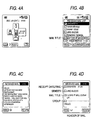
- Fig. 4 shows an example of a transition of a display screen of the portable telephone for explaining the embodiment of the invention. More specifically, Fig. 4 shows an example of a mail processing. As shown in Fig. 4A, an icon selected on a displayed icon screen, that is, "mail" is enlarged and displayed. In this state, a mail processing operation is started through the manipulation of a determination key of the navigation key 14, and a mail handling screen is displayed.
- the "received mail list” is displayed as shown in Fig. 4B.
- a list of the received mail is displayed irrespective of unsealing or sealing of the mail.
- a mail address, a telephone number and a name are displayed on the screen, and a title or a part of the title for the received mail which is highlighted is displayed together.
- a title is displayed in a title part of the received mail which is highlighted, and a received mail number and a date of receipt are displayed together. If the title is long, a part of the title is displayed. Furthermore, an illustration representing the unsealing or sealing of the received mail (that is, a picture of the unsealing or sealing of an envelope) is displayed on the left side of a portion where the received mail list is displayed.
- the name is displayed with priority.
- a first screen shown in Fig. 4C is obtained and only a mail text is displayed over the whole screen.
- a scroll function is utilized. In this case, if a current scroll mode is set to be a line scroll mode, scrolling is carried out for each line. Moreover, in the case in which the line scroll is to be changed into a page scroll, the page scroll mode can be obtained by pushing the warp key (browser function key) 8.
- the current scroll mode is set to be the page scroll
- the scrolling is carried out for each page.
- the line scroll mode can be obtained by pushing the warp key (browser function key) 8.
- Fig. 4D shows an example in which the previous screen is displayed for Fig. 4C.
- the received mail is constituted by an array of a date of receipt, a sender, a title of the mail and a mail text in order.
- the mail text is displayed on a line having a boundary provided through an unsealing mark and a broken line and therebelow.
- a boundary between a header portion and a mail text is clearly distinguished through a broken line as is apparent from the array of the received mail. Therefore, it is possible to easily display only the mail text by editing and displaying the broken line and a portion provided therebelow through mail reading software, for example.
- Fig. 5 is a flow chart for explaining a scroll changing operation.
- a screen in an operation mode is displayed on the display section 4 (Step 51).
- the warp key (browser function key) 8 is pushed down or not (Step 52). If the warp key (browser function key) 8 is pushed down, the scroll mode is changed (Step 53). If the warp key (browser function key) 8 is not pushed down, the current scroll mode is maintained (Step 54).
- a scroll mode changing method in a portable telephone capable of carrying out non-voice information communication, wherein when a screen in an operation mode is displayed on a display section of the portable telephone and the screen is to be scrolled to display a scroll screen, a current scroll mode can be changed through a user's scroll mode changing operation.
- the scroll mode changing method in a portable telephone wherein the scroll mode changing operation can be carried out through an operation of a browser function key.
- the scroll mode changing method in a portable telephone wherein the scroll mode includes a line scroll mode and a page scroll.
- the scroll mode includes a line scroll mode and a page scroll.
- a portable telephone capable of changing a scroll mode by using the scroll mode changing method according to the first or second aspect of the invention.
Landscapes
- Engineering & Computer Science (AREA)
- Signal Processing (AREA)
- Human Computer Interaction (AREA)
- Computer Networks & Wireless Communication (AREA)
- Telephone Function (AREA)
- Telephone Set Structure (AREA)
- Mobile Radio Communication Systems (AREA)
- User Interface Of Digital Computer (AREA)
- Digital Computer Display Output (AREA)
- Telephonic Communication Services (AREA)
Abstract
Description
Claims (6)
- A changing scroll mode method for a portable telephone capable of carrying out non-voice information communication, comprising the steps of:displaying a screen on a display section of the portable telephone in a first scroll mode; andchanging the first scroll mode into a second scroll mode through a user's scroll mode changing operation.
- The changing scroll mode method according to claim 1, wherein the changing scroll mode operation is an operation of a browser function key.
- The changing scroll mode method in a portable telephone according to claim 1, wherein the first and second scroll modes include a line scroll mode and a page scroll.
- The changing scroll mode method in a portable telephone according to claim 2, wherein the first and second scroll modes include a line scroll mode and a page scroll.
- A portable telephone capable of carrying out non-voice information communication, comprising:a display section for displaying a screen image; anda browser function key to change a scroll mode through a user's operation.
- A portable telephone according to claim 5, wherein the scroll modes include a line scroll mode and a page scroll.
Applications Claiming Priority (2)
| Application Number | Priority Date | Filing Date | Title |
|---|---|---|---|
| JP2000054920A JP2001245351A (en) | 2000-02-29 | 2000-02-29 | Scroll mode change method in mobile phone and mobile phone using the scroll change method |
| JP2000054920 | 2000-02-29 |
Publications (2)
| Publication Number | Publication Date |
|---|---|
| EP1130885A2 true EP1130885A2 (en) | 2001-09-05 |
| EP1130885A3 EP1130885A3 (en) | 2003-11-12 |
Family
ID=18576118
Family Applications (1)
| Application Number | Title | Priority Date | Filing Date |
|---|---|---|---|
| EP01104809A Withdrawn EP1130885A3 (en) | 2000-02-29 | 2001-02-27 | Method for changing scroll mode in portable telephone and portable telephone using said method |
Country Status (6)
| Country | Link |
|---|---|
| US (1) | US20010022839A1 (en) |
| EP (1) | EP1130885A3 (en) |
| JP (1) | JP2001245351A (en) |
| KR (1) | KR20010085734A (en) |
| CN (1) | CN1311618A (en) |
| AU (1) | AU2325301A (en) |
Families Citing this family (39)
| Publication number | Priority date | Publication date | Assignee | Title |
|---|---|---|---|---|
| JP2001344175A (en) * | 2000-05-31 | 2001-12-14 | Net Village Co Ltd | Method of transmitting text data at portable terminal |
| US7421666B2 (en) * | 2000-10-11 | 2008-09-02 | Microsoft Corporation | Browser navigation for devices with a limited input system |
| US6822664B2 (en) | 2000-10-11 | 2004-11-23 | Microsoft Corporation | Browser navigation for devices with a limited input system |
| JP2002261918A (en) * | 2001-03-02 | 2002-09-13 | Hitachi Ltd | Mobile phone |
| US8347104B2 (en) | 2001-12-26 | 2013-01-01 | Research In Motion Limited | Security interface for a mobile device |
| USD470116S1 (en) | 2002-02-05 | 2003-02-11 | Motorola, Inc. | Housing for communication devices or similar articles |
| USD469748S1 (en) | 2002-02-05 | 2003-02-04 | Motorola, Inc. | Housing for a communication device or similar articles |
| USD472895S1 (en) | 2002-02-05 | 2003-04-08 | Motorola, Inc. | Housing for a communication device and similar articles |
| USD478883S1 (en) | 2002-02-11 | 2003-08-26 | Sony Ericsson Mobile Communications Ab | Mobile communication device |
| AU2003217586A1 (en) * | 2002-02-21 | 2003-09-09 | Mobicom Corporation | Article comprising an adaptable input device abstract |
| USD479514S1 (en) | 2002-03-22 | 2003-09-09 | Benq Corporation | Mobile phone |
| USD469750S1 (en) | 2002-04-19 | 2003-02-04 | Modottel Co., Ltd. | Mobile phone |
| USD469415S1 (en) | 2002-04-19 | 2003-01-28 | Modottel Co., Ltd. | Mobile phone |
| USD469416S1 (en) | 2002-04-19 | 2003-01-28 | Modottel Co., Ltd. | Mobile phone |
| USD480057S1 (en) | 2002-05-15 | 2003-09-30 | Motorola, Inc. | Housing for a communication device or similar articles |
| USD478882S1 (en) | 2002-08-06 | 2003-08-26 | Quanta Computer, Inc. | Cellular phone |
| USD487066S1 (en) | 2002-09-09 | 2004-02-24 | Nokia Corporation | Handset |
| US20040250220A1 (en) * | 2003-06-09 | 2004-12-09 | Mika Kalenius | System, apparatus, and method for navigation in a hypertext document |
| USD502691S1 (en) * | 2003-09-18 | 2005-03-08 | Siemens Aktiengesellschaft | Mobile phone |
| USD502933S1 (en) * | 2003-10-10 | 2005-03-15 | Siemens Aktiengesellschaft | Mobile phone |
| USD502456S1 (en) * | 2004-01-23 | 2005-03-01 | Siemens Aktiengesellschaft | Mobile phone |
| USD515534S1 (en) * | 2004-04-02 | 2006-02-21 | Samsung Electronics Co., Ltd. | Cellular phone |
| TWD105106S1 (en) * | 2004-04-29 | 2005-06-11 | 明基電通股份有限公司 | Mobile phone |
| JP4786233B2 (en) * | 2004-07-30 | 2011-10-05 | 京セラミタ株式会社 | Electric equipment and control method thereof |
| KR101307716B1 (en) * | 2005-05-04 | 2013-09-11 | 힐크레스트 래보래토리스, 인크. | Methods and systems for scrolling and pointing in user interfaces |
| JP2006350831A (en) * | 2005-06-17 | 2006-12-28 | Ntt Docomo Inc | Communication apparatus and browser switching method |
| US20070028191A1 (en) * | 2005-08-01 | 2007-02-01 | Kyocera Mita Corporation | Electronic device and storage medium for control program thereof |
| KR100841310B1 (en) | 2005-09-12 | 2008-06-25 | 엘지전자 주식회사 | Mobile communication terminal |
| EP1947855A4 (en) | 2005-10-07 | 2010-09-01 | Sharp Kk | Receiving apparatus, server, television receiver, mobile terminal device, system, receiving method, information processing program, and recording medium |
| USD563931S1 (en) * | 2006-02-10 | 2008-03-11 | Samsung Electronics Co., Ltd. | Portable phone |
| JP2008165448A (en) * | 2006-12-27 | 2008-07-17 | Kyocera Corp | Display device and display control method |
| KR101496451B1 (en) * | 2007-01-19 | 2015-03-05 | 엘지전자 주식회사 | Terminal and display method of scroll bar using the same |
| JP5172169B2 (en) | 2007-02-16 | 2013-03-27 | シャープ株式会社 | Content display device, television receiver, content display method, content display control program, and recording medium |
| JP2008182761A (en) * | 2008-03-25 | 2008-08-07 | Kyocera Corp | Communication device |
| JP2010238249A (en) * | 2010-06-02 | 2010-10-21 | Kyocera Corp | Communication apparatus and display control method |
| JP5247767B2 (en) * | 2010-06-24 | 2013-07-24 | 楽天株式会社 | Information providing server, information providing method, information providing program, and computer-readable recording medium |
| JP5914983B2 (en) * | 2011-04-27 | 2016-05-11 | セイコーエプソン株式会社 | Tape printing apparatus and display method in tape printing apparatus |
| JP5343107B2 (en) * | 2011-06-03 | 2013-11-13 | 京セラ株式会社 | Display device and control method |
| JP2012157021A (en) * | 2012-03-05 | 2012-08-16 | Kyocera Corp | Display device and control method |
Family Cites Families (6)
| Publication number | Priority date | Publication date | Assignee | Title |
|---|---|---|---|---|
| MY118477A (en) * | 1994-04-20 | 2004-11-30 | Sony Corp | Communication terminal apparatus and control method thereof |
| FI102868B1 (en) * | 1996-02-26 | 1999-02-26 | Nokia Mobile Phones Ltd | Terminal for use of telecommunications service |
| GB2322508A (en) * | 1997-02-21 | 1998-08-26 | Nokia Mobile Phones Ltd | Display scrolling means for a radio telephone handset |
| US6125287A (en) * | 1997-09-05 | 2000-09-26 | Fujitsu Limited | Wireless telephone having an improved user interface |
| DE59810949D1 (en) * | 1997-10-15 | 2004-04-15 | Nokia Corp | Mobile phone for internet applications |
| JPH11161402A (en) * | 1997-11-26 | 1999-06-18 | Sony Corp | Portable information terminal and information scrolling method thereof |
-
2000
- 2000-02-29 JP JP2000054920A patent/JP2001245351A/en not_active Withdrawn
-
2001
- 2001-02-27 AU AU23253/01A patent/AU2325301A/en not_active Abandoned
- 2001-02-27 CN CN01108309A patent/CN1311618A/en active Pending
- 2001-02-27 US US09/794,855 patent/US20010022839A1/en not_active Abandoned
- 2001-02-27 EP EP01104809A patent/EP1130885A3/en not_active Withdrawn
- 2001-02-28 KR KR1020010010494A patent/KR20010085734A/en not_active Withdrawn
Also Published As
| Publication number | Publication date |
|---|---|
| KR20010085734A (en) | 2001-09-07 |
| US20010022839A1 (en) | 2001-09-20 |
| AU2325301A (en) | 2001-08-30 |
| EP1130885A3 (en) | 2003-11-12 |
| JP2001245351A (en) | 2001-09-07 |
| CN1311618A (en) | 2001-09-05 |
Similar Documents
| Publication | Publication Date | Title |
|---|---|---|
| EP1130885A2 (en) | Method for changing scroll mode in portable telephone and portable telephone using said method | |
| EP1130884B1 (en) | E-mail handling method for portable telephone and portable telephone using said handling method | |
| US6907276B2 (en) | Mobile communication terminal with external display unit | |
| JP4498523B2 (en) | Bookmark list display method and mobile phone | |
| EP1785824A2 (en) | Method for displaying menus in a portable terminal | |
| KR100771943B1 (en) | Screen setting method in portable telephone and portable telephone using the same | |
| EP1130890A2 (en) | Mobile telephone with electronic mail function | |
| EP1130883B1 (en) | Portable telephone with URL accessing function | |
| JP2002291052A (en) | mobile phone | |
| JP3762610B2 (en) | Telephone | |
| JP2001245352A (en) | COMPOSITE SCREEN SCREEN SETTING METHOD IN MOBILE PHONE AND MOBILE PHONE USING THE COMPOSITE SCREEN SCREEN SETTING METHOD | |
| JP2001243146A (en) | Homepage connection method in mobile phone and mobile phone using the connection method | |
| JP2001245030A (en) | Screen screen setting method for mobile phone and mobile phone using the screen screen setting method | |
| JP2001245350A (en) | URL calling method in mobile phone and mobile phone using the calling method | |
| JP2001245349A (en) | URL calling method in mobile phone and mobile phone using the calling method | |
| KR20050018487A (en) | Method for storing data contain short message | |
| JP2001257790A (en) | Image communication apparatus and image communication method | |
| JP2006040178A (en) | Mobile terminal device, wireless communication system, and picture diary exchange method |
Legal Events
| Date | Code | Title | Description |
|---|---|---|---|
| PUAI | Public reference made under article 153(3) epc to a published international application that has entered the european phase |
Free format text: ORIGINAL CODE: 0009012 |
|
| AK | Designated contracting states |
Kind code of ref document: A2 Designated state(s): AT BE CH CY DE DK ES FI FR GB GR IE IT LI LU MC NL PT SE TR |
|
| AX | Request for extension of the european patent |
Free format text: AL;LT;LV;MK;RO;SI |
|
| PUAL | Search report despatched |
Free format text: ORIGINAL CODE: 0009013 |
|
| AK | Designated contracting states |
Kind code of ref document: A3 Designated state(s): AT BE CH CY DE DK ES FI FR GB GR IE IT LI LU MC NL PT SE TR |
|
| AX | Request for extension of the european patent |
Extension state: AL LT LV MK RO SI |
|
| 17P | Request for examination filed |
Effective date: 20040205 |
|
| 17Q | First examination report despatched |
Effective date: 20040517 |
|
| AKX | Designation fees paid |
Designated state(s): DE FI FR GB NL SE |
|
| STAA | Information on the status of an ep patent application or granted ep patent |
Free format text: STATUS: THE APPLICATION IS DEEMED TO BE WITHDRAWN |
|
| 18D | Application deemed to be withdrawn |
Effective date: 20050503 |