EP1130798A1 - Système de contrôle de la puissance d'émission d'une station de base avec laquelle plusieurs stations mobiles sont en communication - Google Patents
Système de contrôle de la puissance d'émission d'une station de base avec laquelle plusieurs stations mobiles sont en communication Download PDFInfo
- Publication number
- EP1130798A1 EP1130798A1 EP01400356A EP01400356A EP1130798A1 EP 1130798 A1 EP1130798 A1 EP 1130798A1 EP 01400356 A EP01400356 A EP 01400356A EP 01400356 A EP01400356 A EP 01400356A EP 1130798 A1 EP1130798 A1 EP 1130798A1
- Authority
- EP
- European Patent Office
- Prior art keywords
- base station
- signals
- sub
- power
- composite
- Prior art date
- Legal status (The legal status is an assumption and is not a legal conclusion. Google has not performed a legal analysis and makes no representation as to the accuracy of the status listed.)
- Granted
Links
- 230000005540 biological transmission Effects 0.000 title claims abstract description 20
- 239000002131 composite material Substances 0.000 claims abstract description 79
- 238000004891 communication Methods 0.000 claims abstract description 15
- 238000000034 method Methods 0.000 claims description 21
- 101000666730 Homo sapiens T-complex protein 1 subunit alpha Proteins 0.000 abstract 1
- 102100038410 T-complex protein 1 subunit alpha Human genes 0.000 abstract 1
- 229920006395 saturated elastomer Polymers 0.000 description 5
- 230000015572 biosynthetic process Effects 0.000 description 2
- 230000015556 catabolic process Effects 0.000 description 2
- 238000006243 chemical reaction Methods 0.000 description 2
- 230000000694 effects Effects 0.000 description 2
- 238000012795 verification Methods 0.000 description 2
- 230000003321 amplification Effects 0.000 description 1
- 238000013459 approach Methods 0.000 description 1
- 230000002238 attenuated effect Effects 0.000 description 1
- 238000010586 diagram Methods 0.000 description 1
- 230000000116 mitigating effect Effects 0.000 description 1
- 238000003199 nucleic acid amplification method Methods 0.000 description 1
- 238000012545 processing Methods 0.000 description 1
- 238000012549 training Methods 0.000 description 1
- 238000011282 treatment Methods 0.000 description 1
Images


Classifications
-
- H—ELECTRICITY
- H04—ELECTRIC COMMUNICATION TECHNIQUE
- H04W—WIRELESS COMMUNICATION NETWORKS
- H04W52/00—Power management, e.g. Transmission Power Control [TPC] or power classes
- H04W52/04—Transmission power control [TPC]
- H04W52/18—TPC being performed according to specific parameters
- H04W52/28—TPC being performed according to specific parameters using user profile, e.g. mobile speed, priority or network state, e.g. standby, idle or non-transmission
- H04W52/281—TPC being performed according to specific parameters using user profile, e.g. mobile speed, priority or network state, e.g. standby, idle or non-transmission taking into account user or data type priority
-
- H—ELECTRICITY
- H04—ELECTRIC COMMUNICATION TECHNIQUE
- H04W—WIRELESS COMMUNICATION NETWORKS
- H04W52/00—Power management, e.g. Transmission Power Control [TPC] or power classes
- H04W52/04—Transmission power control [TPC]
- H04W52/30—Transmission power control [TPC] using constraints in the total amount of available transmission power
- H04W52/34—TPC management, i.e. sharing limited amount of power among users or channels or data types, e.g. cell loading
- H04W52/343—TPC management, i.e. sharing limited amount of power among users or channels or data types, e.g. cell loading taking into account loading or congestion level
-
- H—ELECTRICITY
- H04—ELECTRIC COMMUNICATION TECHNIQUE
- H04W—WIRELESS COMMUNICATION NETWORKS
- H04W52/00—Power management, e.g. Transmission Power Control [TPC] or power classes
- H04W52/04—Transmission power control [TPC]
- H04W52/30—Transmission power control [TPC] using constraints in the total amount of available transmission power
- H04W52/34—TPC management, i.e. sharing limited amount of power among users or channels or data types, e.g. cell loading
- H04W52/346—TPC management, i.e. sharing limited amount of power among users or channels or data types, e.g. cell loading distributing total power among users or channels
Definitions
- the present invention relates to a power control system transmission of a base station with which several mobile stations are in communication.
- the signal which is transmitted by a base station serving a cell is a composite signal consisting of the sum of the signals respectively dedicated to mobile stations which are under the coverage of said cell and signals specific for all mobile stations. All these signals are transmitted multiplexed. For example, as is the case in a telecommunications system CDMA, all these signals are transmitted at the same time, on the same frequency, multiplexed using spreading codes.
- FIG. 1 There is shown, schematically in FIG. 1, the transmitting section of a base station of such a telecommunications system. It can be seen that the signals e 1 to e N intended for the different mobile stations are summed in a summing unit 10 and that the sum signal is converted into radio frequency frequencies in a conversion unit 11 before being amplified by an amplifier 12 for be sent to mobile stations attached to said base station by means of an antenna 13.
- each mobile station SM i transmits a control signal TPC i which is representative of a request to increase or decrease on the part of the base station the transmit power which is intended for it.
- power control units 14 1 to 14 N are provided for respectively receiving the control signals TPC 1 to TCP N transmitted by mobile stations SM 1 to SM N and for modifying, before their applications to the corresponding inputs of the summation unit 10, the input signals e 1 to e N in accordance with the requests of these control signals TPC 1 to TCP N.
- the total power of the composite signal transmitted by the base station is the sum of the powers of the various signals (dedicated and common) that compose it. This power varies over time and depends at all times on the number of stations mobiles attached to said base station.
- the power that can be supplied by the power amplifier 12 of a base station of such a telecommunications system is necessarily limited, if although when the number of mobile stations attached to it increases or when the mobiles move away overall from the base station, its output signal becomes saturated. What is more, the non-linearity of this amplifier causes strong distortion of the output signal even before reaching this saturation level. This results in a communication breakdown for all mobile stations against which it is important to guard.
- the value of operating power is for example equal to the saturation value of the power amplifier 12 minus a value of shrinkage taking into account instantaneous fluctuations in the strength of the composite signal around its average value.
- a known solution for implementing these means consists in using a power limiter which, when the base station is saturated, acts on the signal composite so that its transmit power, after amplification, is lower at a predetermined power.
- this solution has the effect of affecting uniformly all the elementary signals forming the composite signal.
- the distortion of the composite signal is certainly avoided but the contribution to the power transmitted to a particular mobile station is necessarily less than that required by said mobile station.
- the disadvantage of such a solution lies in the fact that all mobile stations are uniformly affected in the quality of their transmission.
- FIG. 2 a system which uses means allowing the implementation of another known solution to the problem mentioned above.
- the same units as those which have already been shown in FIG. 1 have the same references.
- This system also includes limiting units 1 to 15 N which act respectively on the elementary signals forming the composite signal. These units 15 1 to 15 N are, for example, as is the case in FIG. 2, placed between the power control units 14 1 and 14 N and the corresponding inputs of the summing unit 10.
- Each unit 15 i has the role of modifying the signal on its input so as to limit its average contribution Pi to the power of the composite signal transmitted to a predetermined value Pi_max, the sum of these values Pi_max always being less than or equal to the value of the desired operating transmit power.
- the elementary signals intended for a mobile station can become saturated, without having an impact on the signals other mobile stations.
- the power level it receives will not sufficient to maintain the communication which will then be interrupted.
- the other mobile stations whose elementary signals are not saturated do not have to experience a communication breakdown.
- a disadvantage of this method is that it is necessary, to establishing a new communication from a mobile station, deciding on the maximum value Pi_max allowed for its contribution to the transmission power of the base station to which it is attached, which is not trivial in itself because all decision has a significant impact on the capacity and extent of coverage of the base station concerned.
- it must also always be ensured that the sum of the maximum powers Pi_max of transmission of the dedicated signals either always lower than the value of the operating power of the station based. This requires an expensive planning unit in the network and difficult to maintain, especially when communications are switched from base station to another when moving the mobile.
- the signal strength composite is equal to the sum of the powers of the elementary signals forming this composite signal.
- the power contribution of each elementary signal to the base station transmit power being limited by its maximum power Pi_max
- the transmit power of the composite signal is limited by the sum of these maximum power contributions.
- the power contributions of elementary signals are not all at the same time at their maximum values. Through example, only signals intended for mobile stations at the edge of the wheel coverage will be at the same time at their maximum power level, then that the signals intended for mobile stations close to the base station will be transmitted at a lower power value. So even at high load, the composite signal strength is far from reaching its operating value, which does not will therefore hardly ever be used.
- the aim of the present invention is therefore to propose a method which does not not have the above mentioned disadvantages of state methods of technical.
- it is to propose a method which makes it possible to use at better the power of the base station while avoiding distortion, underutilization of radio capacity, and overly cumbersome planning facilities of power in the network.
- the present invention relates to a system for controlling the transmitting power of a base station with which several mobile stations are in communication, said base station comprising control units for power which respectively receive the signals intended for said mobile stations as well as power control signals transmitted by said mobile stations for controlling the contribution of said signal to the transmit power of said station basic, a summator to form a composite signal from said signals delivered by said power control units.
- This control system is characterized in that said base station includes summing units, the input signals of a given priority level being applied to the inputs of each summing unit which then delivers a sub-composite signal to the input of a unit attenuation whose output is connected to the input of said summator, each unit attenuation being provided to attenuate by a variable attenuation coefficient the sub-composite signal at its input when the transmit power of said station base exceeds a predetermined power, said attenuation coefficient being all the more more important than the priority level of the corresponding input signals is low.
- said attenuation coefficient of each attenuation unit is a power P of a basic attenuation coefficient, the P value being identical for all said attenuation units.
- each attenuation coefficient base is less than one, the coefficient of one attenuation unit is all the more neighbor of the unit that the priority level of the corresponding input signals is high.
- the assignment of an input signal intended for a mobile station with a sub-composite signal is only changed when the arrival of at least one event which concerns only said mobile station.
- said or each event is a change of service type, reaching the saturation level, entering software handover of said mobile station.
- soft-handover takes place when the mobile is attached to more than one base station at a time, entry into soft-handover being the event corresponding to the moment when the mobile begins to be linked at the same time to more than one base station.
- the present invention also relates to a method for controlling the transmitting power of the transmitting section of a base station which receives on its inputs of the input signals which are intended to be transmitted to mobile stations attached to said base station.
- a method is characterized in what it is to form groups of input signals according to priority criteria predetermined assigned to said input signals and to be formed from said signals input of each group of the sub-composite signals, to be formed from said sub-composite signals a composite signal which is transmitted to said stations mobile, and in that it consists in attenuating said sub-composite signals so the composite signal strength is always below a level of predetermined power, the attenuation coefficients respectively applied to said sub-composite signals being different according to the sub-composite signals considered.
- said attenuation coefficient applied to each sub-composite signal has a value all the more important as the priority level of the input signals which form it is high.
- the attenuation coefficients respectively applied to the sub-composite signals are the same power P of basic attenuation coefficients, the variation of said attenuation coefficients being obtained by the variation of said value of the power P.
- the value of P is chosen to be so as to allow the critical power level not to be exceeded, the value of just below P-1, exceeding said critical power level.
- each attenuation coefficient base is less than one, the coefficient of one attenuation unit being all the more neighbor of the unit that the priority level of the corresponding input signals is high.
- an input signal intended for a mobile station is assigned to a sub-composite signal formation group at start of communication.
- the assignment of an input signal intended for a mobile station to a group for forming a sub-composite signal is only modified at the time of the arrival of at least one event which does not concern only that said mobile station.
- said or each event is a change in type of service, reaching saturation level, entering software handover of said mobile station.
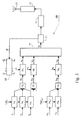
- Fig. 3 we consider the transmitting section of a base station SB which receives on its inputs input signals e 1 to e N which are intended to be transmitted to mobile stations SM 1 to SM M attached to said base station SB.
- These input signals e 1 to e N can be signals dedicated to such and such a mobile station but also signals intended for a set or all of the mobile stations SM 1 to SM M.
- groups of signals are formed input according to predetermined priority criteria assigned to these signals and one sum the input signals of each group so as to form sub-composite signals.
- the sub-composite signals thus formed are the object of processing. respective attenuation before being summed to form a composite signal which is transmitted to said mobile stations.
- the mitigation treatments implemented are provided so that the strength of the composite signal is always less than a predetermined power called the operating power of said station basis, the attenuation coefficients being different according to the composite signals considered.
- This transmitting section includes as many power control units 14 1 to 14 N as input signals e 1 to e N that it is capable of transmitting to M mobile stations SM 1 to SM M. It comprises summing units 15 1 to 15 K so as to form K sub-composite signals Sc 1 to Sc K respectively applied to attenuation units 16 1 to 16 K.
- each summing unit 15 1 to 15 K On the inputs of each summing unit 15 1 to 15 K are applied input signals, forming a group of input signals, selected according to priority criteria. Each sub-composite signal is therefore assigned a priority level.
- each attenuation coefficient ⁇ i has a value which is between 0 and 1.
- the sub-composite signals sc are applied to a unit of summation 10 intended to form a composite signal Sc.
- the composite signal Sc is converted into radio frequency frequencies in a conversion unit 11 before being amplified by an amplifier 12 to be sent to the by means of an antenna 13.
- the value of P is greater than or equal to zero. So, it’s by vary the value of P which will vary the contribution to the transmission power of each sub-composite signal. This value of P is determined so that the composite signal power is approximately equal to the power level of operation.
- the system of the present invention comprises a verification unit 17 which receives on its input the composite signal coming from the summator 10 and which delivers the value of P to a calculation unit 18 provided for determining the coefficients ⁇ 1 to ⁇ K to from the basic coefficients ⁇ 0/1 to ⁇ 0 / K.
- the verification unit 17 increments the value of P, which results in an increase in the attenuation coefficients ⁇ 1 to ⁇ K and therefore of the signals under -composites sc 1 to sc K.
- it decrements the value of P, which has the effect of reducing the attenuation coefficients ⁇ 1 to ⁇ K and therefore of the sub-composite signals sc 1 to sc K .
- a call is assigned to a level of priority at the start of the call. Membership of a training group of one sub-composite signal rather than another is only changed according to exceptional events which concern only him. It can be, by example, of a change in type of service, from reaching saturation level of said call, of its entry into the soft handover phase, of the variation in the number of base stations to which the corresponding mobile station is attached during the handover, etc. Calls are therefore assigned to a sub-composite signal regardless of what happens to other calls.
- the present invention allows optimal effective use of power from the base station when it becomes full. It doesn't require, unlike prior art systems, rapid refreshment of maximum power levels between all signals, nor a joint determination of these levels. In fact, the basic coefficients are determined in advance by the network operator.
Landscapes
- Engineering & Computer Science (AREA)
- Computer Networks & Wireless Communication (AREA)
- Signal Processing (AREA)
- Mobile Radio Communication Systems (AREA)
- Radio Relay Systems (AREA)
Abstract
Description
Claims (14)
- Système de contrôle de la puissance d'émission d'une station de base (SB) avec laquelle plusieurs stations mobiles (SM1 à SMN) sont en communication, ladite station de base (SB) comportant des unités de commande de puissance (141 à 14N) qui reçoivent respectivement les signaux destinés auxdites stations mobiles (SM1 à SMN) ainsi que des signaux de commande de puissance (TCP1 à TCPN) émis par lesdites stations mobiles (SM1 à SMN) pour commander la contribution dudit signal à la puissance d'émission de ladite station de base (SB), un sommateur (10) pour former un signal composite (Sc) à partir desdits signaux délivrés par lesdites unités de commande de puissance, caractérisé en ce que ladite station de base (SB) comporte des unités de sommation (151 à 15K), les signaux d'entrée d'un niveau de priorité donné étant appliqués aux entrées de chaque unité de sommation qui délivre alors un signal sous-composite (Sc1 à ScK) à l'entrée d'une unité d'atténuation (161 à 16K) dont la sortie est reliée à l'entrée dudit sommateur (10), chaque unité d'atténuation (161 à 16K) étant prévue pour atténuer d'un coefficient d'atténuation variable (α1 à αK) le signal sous-composite (Sc1 à ScK) à son entrée lorsque la puissance d'émission de ladite station de base dépasse une puissance prédéterminée, ledit coefficient d'atténuation (α1 à αK) étant d'autant plus important que le niveau de priorité des signaux d'entrée correspondant est faible.
- Système de contrôle de puissance d'émission d'une station de base selon la revendication 1, caractérisé en ce que ledit coefficient d'atténuation (α1 à αK) de chaque unité d'atténuation (161 à 16K) est une puissance P d'un coefficient d'atténuation de base (α 0 / 1 à α 0 / K), la valeur de P étant identique pour toutes lesdites unités d'atténuation.
- Système de contrôle de puissance d'émission d'une station de base selon la revendication 2, caractérisé en ce que chaque coefficient d'atténuation de base (α 0 / 1 à α 0 / K) est inférieur à l'unité, le coefficient d'une unité d'atténuation est d'autant plus voisin de l'unité que le niveau de priorité des signaux d'entrée correspondant est fort.
- Système de contrôle de puissance d'émission d'une station de base selon une des revendications précédentes, caractérisé en ce qu'un signal d'entrée (ei) destiné à une station mobile (SMi) est affecté à un signal sous-composite (Scj) au début de la communication.
- Système de contrôle selon une des revendications précédentes, caractérisé en ce que l'affectation d'un signal d'entrée (ei) destiné à une station mobile (Smi) à un signal sous-composite (Scj) n'est modifiée qu'au moment de l'arrivée d'au moins un événement qui ne concerne que ladite station mobile.
- Système de contrôle selon la revendication 5, caractérisé en ce que ledit ou chaque événement est un changement de type de service, une atteinte du niveau de saturation, de l'entrée en soft handover de ladite station mobile.
- Procédé de contrôle de la puissance d'émission de la section émettrice d'une station de base (SB) qui reçoit sur ses entrées des signaux d'entrée (e1 à eN) qui sont destinés à être transmis à des stations mobiles (SM1 à SMM) rattachées à ladite station de base (SB), caractérisé en ce qu'il consiste à former des groupes de signaux d'entrée selon des critères de priorité prédéterminés affectés auxdits signaux d'entrée (e1 à eN) et à former à partir desdits signaux d'entrée (e1 à eN) de chaque groupe des signaux sous-composites (Sc1 à ScK), à former à partir desdits signaux sous-composites (Sc1 à ScK) un signal composite (Sc) qui est transmis auxdites stations mobiles(SM1 à SMM), et en ce qu'il consiste à atténuer lesdits signaux sous-composites (Sc1 à ScK) de manière à ce que la puissance du signal composite soit toujours inférieure à une puissance prédéterminée, les coefficients d'atténuation (α1 à αK) respectivement appliqués auxdits signaux sous-composites (Sc1 à ScK) étant différents selon les signaux sous-composites considérés (Sc1 à ScK).
- Procédé de contrôle selon la revendication 7, caractérisé en ce que ledit coefficient d'atténuation (α1 à αK) appliqué à chaque signal sous-composite a une valeur d'autant plus importante que le niveau de priorité des signaux d'entrée qui le forment est fort.
- Procédé de contrôle selon la revendication 8, caractérisé en ce que les coefficients d'atténuation (α1 à αK) respectivement appliqués aux signaux sous-composites (Sc1 à ScK) sont une même puissance P de coefficients d'atténuation de base (α 0 / 1 à α 0 / K), la variation desdits coefficients d'atténuation étant obtenue par la variation de ladite valeur de la puissance P.
- Procédé de contrôle selon la revendication 9, caractérisé en ce que la valeur de P est choisie de manière à permettre un non-dépassement de ladite puissance prédéterminée, la valeur de juste inférieure P-1 donnant un dépassement de ladite puissance prédéterminée.
- Procédé de contrôle de puissance d'émission d'une station de base selon la revendication 9 ou 10, caractérisé en ce que chaque coefficient d'atténuation de base (α 0 / 1 à α 0 / K) est inférieur à l'unité, le coefficient d'une unité d'atténuation (α 0 / 1 à α 0 / K) étant d'autant plus voisin de l'unité que le niveau de priorité des signaux d'entrée correspondant est fort.
- Procédé de contrôle de puissance d'émission d'une station de base selon une des revendications 7 à 11, caractérisé en ce qu'un signal d'entrée destiné à une station mobile est affecté à un groupe de formation d'un signal sous-composite au début de la communication.
- Procédé de contrôle selon une des revendications 7 à 12, caractérisé en ce que l'affectation d'un signal d'entrée destiné à une station mobile à un groupe de formation d'un signal sous-composite n'est modifiée qu'au moment de l'arrivée d'au moins un événement qui ne concerne uniquement que ladite station mobile.
- Procédé de contrôle selon la revendication 13, caractérisé en ce que ledit ou chaque événement est un changement de type de service, une atteinte du niveau de saturation, de l'entrée en soft handover de ladite station mobile.
Applications Claiming Priority (2)
| Application Number | Priority Date | Filing Date | Title |
|---|---|---|---|
| FR0002726 | 2000-02-29 | ||
| FR0002726A FR2805703B1 (fr) | 2000-02-29 | 2000-02-29 | Systeme de controle de la puissance d'emission d'une station de base avec laquelle plusieurs stations mobiles sont en communication |
Publications (2)
| Publication Number | Publication Date |
|---|---|
| EP1130798A1 true EP1130798A1 (fr) | 2001-09-05 |
| EP1130798B1 EP1130798B1 (fr) | 2002-09-25 |
Family
ID=8847674
Family Applications (1)
| Application Number | Title | Priority Date | Filing Date |
|---|---|---|---|
| EP01400356A Expired - Lifetime EP1130798B1 (fr) | 2000-02-29 | 2001-02-12 | Système de contrôle de la puissance d'émission d'une station de base avec laquelle plusieurs stations mobiles sont en communication |
Country Status (7)
| Country | Link |
|---|---|
| US (1) | US6873856B2 (fr) |
| EP (1) | EP1130798B1 (fr) |
| JP (1) | JP2001274749A (fr) |
| CN (1) | CN1180642C (fr) |
| AT (1) | ATE225099T1 (fr) |
| DE (1) | DE60100029T2 (fr) |
| FR (1) | FR2805703B1 (fr) |
Families Citing this family (19)
| Publication number | Priority date | Publication date | Assignee | Title |
|---|---|---|---|---|
| FR2824685B1 (fr) * | 2001-05-14 | 2003-10-03 | Evolium Sas | Procede pour fixer des parametres d'adaptation de debit specifiques a chaque service dans un systeme de radiocommunications mobiles |
| KR100487221B1 (ko) * | 2001-11-23 | 2005-05-03 | 삼성전자주식회사 | 이동 통신시스템에서 제어정보의 송신 전력 제어 방법 및장치 |
| WO2003049353A1 (fr) * | 2001-12-05 | 2003-06-12 | Qualcomm, Incorporated | Systeme et procede permettant d'ajuster la qualite de service dans un systeme de communication |
| KR100464447B1 (ko) * | 2001-12-11 | 2005-01-03 | 삼성전자주식회사 | 이동통신시스템에서 서비스 품질에 따른 데이터 패킷의 스케줄링 방법 및 장치 |
| US7177658B2 (en) | 2002-05-06 | 2007-02-13 | Qualcomm, Incorporated | Multi-media broadcast and multicast service (MBMS) in a wireless communications system |
| TWI225339B (en) * | 2002-06-06 | 2004-12-11 | Via Telecom Co Ltd | Power control of plural packet data control channels |
| JP3574446B2 (ja) * | 2002-09-19 | 2004-10-06 | 松下電器産業株式会社 | 送信電力制御方法および基地局装置 |
| ATE322769T1 (de) * | 2002-09-23 | 2006-04-15 | Verfahren und anordnung zur leistungsregelung in einem mobilen funksystem | |
| CN100574134C (zh) * | 2002-09-23 | 2009-12-23 | 艾利森电话股份有限公司 | 在移动无线电系统中用于功率控制的方法和设备 |
| US7318187B2 (en) * | 2003-08-21 | 2008-01-08 | Qualcomm Incorporated | Outer coding methods for broadcast/multicast content and related apparatus |
| US8694869B2 (en) | 2003-08-21 | 2014-04-08 | QUALCIMM Incorporated | Methods for forward error correction coding above a radio link control layer and related apparatus |
| US8804761B2 (en) | 2003-08-21 | 2014-08-12 | Qualcomm Incorporated | Methods for seamless delivery of broadcast and multicast content across cell borders and/or between different transmission schemes and related apparatus |
| JP4420329B2 (ja) | 2003-11-11 | 2010-02-24 | ソニー・エリクソン・モバイルコミュニケーションズ株式会社 | 移動体通信端末及び送信電力制御方法 |
| US7551637B2 (en) * | 2004-01-23 | 2009-06-23 | Qualcomm Incorporated | Method and apparatus for channel sensitive scheduling in a communication system |
| JP2006115159A (ja) * | 2004-10-14 | 2006-04-27 | Matsushita Electric Ind Co Ltd | ドアフォンシステム |
| JP2007019594A (ja) * | 2005-07-05 | 2007-01-25 | Nec Corp | 無線基地局及び送信電力調整方法 |
| GB0706781D0 (en) * | 2007-04-05 | 2007-05-16 | Vodafone Plc | Telecommunications networks and devices |
| KR101837869B1 (ko) * | 2013-07-29 | 2018-04-19 | 후지쯔 가부시끼가이샤 | 전력 제어 방법, 사용자 장비 및 통신 시스템 |
| CN110333478B (zh) * | 2018-03-30 | 2022-05-17 | 华为技术有限公司 | 一种到达角度、出发角度确定方法及通信装置 |
Citations (4)
| Publication number | Priority date | Publication date | Assignee | Title |
|---|---|---|---|---|
| WO1995024102A2 (fr) * | 1994-02-25 | 1995-09-08 | Nokia Telecommunications Oy | Procede de transmission d'appels de priorites differentes dans un reseau cellulaire |
| EP0907296A1 (fr) * | 1997-10-01 | 1999-04-07 | Motorola Semiconducteurs S.A. | Système de communication avec du reseau, du dispositif portable et du procédé |
| WO2000001087A1 (fr) * | 1998-06-29 | 2000-01-06 | Northrop Grumman Corporation | Procede de reglage adaptatif d'une liaison de donnees multicanal |
| WO2000003487A1 (fr) * | 1998-07-10 | 2000-01-20 | Motorola Inc. | Technique et dispositif correspondant d'attribution de puissance de transmission a des unites d'abonne dans un systeme de communication sans fil |
Family Cites Families (2)
| Publication number | Priority date | Publication date | Assignee | Title |
|---|---|---|---|---|
| US5893035A (en) * | 1996-09-16 | 1999-04-06 | Qualcomm Incorporated | Centralized forward link power control |
| US6173162B1 (en) * | 1997-06-16 | 2001-01-09 | Telefonaktiebolaget Lm Ericsson (Publ) | Multiple code channel power control in a radio communication system |
-
2000
- 2000-02-29 FR FR0002726A patent/FR2805703B1/fr not_active Expired - Fee Related
-
2001
- 2001-02-08 US US09/778,746 patent/US6873856B2/en not_active Expired - Fee Related
- 2001-02-12 DE DE60100029T patent/DE60100029T2/de not_active Expired - Fee Related
- 2001-02-12 AT AT01400356T patent/ATE225099T1/de not_active IP Right Cessation
- 2001-02-12 EP EP01400356A patent/EP1130798B1/fr not_active Expired - Lifetime
- 2001-02-21 JP JP2001045192A patent/JP2001274749A/ja not_active Withdrawn
- 2001-02-27 CN CNB011108592A patent/CN1180642C/zh not_active Expired - Fee Related
Patent Citations (4)
| Publication number | Priority date | Publication date | Assignee | Title |
|---|---|---|---|---|
| WO1995024102A2 (fr) * | 1994-02-25 | 1995-09-08 | Nokia Telecommunications Oy | Procede de transmission d'appels de priorites differentes dans un reseau cellulaire |
| EP0907296A1 (fr) * | 1997-10-01 | 1999-04-07 | Motorola Semiconducteurs S.A. | Système de communication avec du reseau, du dispositif portable et du procédé |
| WO2000001087A1 (fr) * | 1998-06-29 | 2000-01-06 | Northrop Grumman Corporation | Procede de reglage adaptatif d'une liaison de donnees multicanal |
| WO2000003487A1 (fr) * | 1998-07-10 | 2000-01-20 | Motorola Inc. | Technique et dispositif correspondant d'attribution de puissance de transmission a des unites d'abonne dans un systeme de communication sans fil |
Also Published As
| Publication number | Publication date |
|---|---|
| FR2805703A1 (fr) | 2001-08-31 |
| FR2805703B1 (fr) | 2003-09-05 |
| CN1180642C (zh) | 2004-12-15 |
| ATE225099T1 (de) | 2002-10-15 |
| DE60100029T2 (de) | 2003-08-14 |
| JP2001274749A (ja) | 2001-10-05 |
| US20010027112A1 (en) | 2001-10-04 |
| US6873856B2 (en) | 2005-03-29 |
| DE60100029D1 (de) | 2002-10-31 |
| EP1130798B1 (fr) | 2002-09-25 |
| CN1311613A (zh) | 2001-09-05 |
Similar Documents
| Publication | Publication Date | Title |
|---|---|---|
| EP1130798B1 (fr) | Système de contrôle de la puissance d'émission d'une station de base avec laquelle plusieurs stations mobiles sont en communication | |
| FR2746233A1 (fr) | Procede de determination de coefficients de ponderation dans un recepteur radio amdc | |
| FR2677510A1 (fr) | Appareil et procede de detection de la saturation et de commande d'un amplificateur de puissance. | |
| FR2798244A1 (fr) | Circuit et procede d'amplification de puissance a rendement eleve autorisant une large gamme de reduction de puissance dynamique | |
| FR2877176A1 (fr) | Procede et dispositif pour ordonnancer et transmettre des paquets de donnees a partir d'un emetteur commun vers une pluralite d'utilisateurs partageant un canal de transmission coummun. | |
| FR2750551A1 (fr) | Commutateur repeteur a largeur de bande variable et procede associe | |
| EP0984653A1 (fr) | Passage de la couche microcellulaire à la couche macrocellulaire dans un système à deux couches d'un réseau de télécommunications | |
| EP1393464A1 (fr) | Procede de controle de puissance d'emission | |
| EP1223782A1 (fr) | Procédé de gestion de ressources de traitement dans un système de radiocommunications mobiles | |
| EP1473954B1 (fr) | Dispositif et procédé de contrôle de charge avec contrôle de puissance | |
| FR2813006A1 (fr) | Procede pour tenir compte de la capacite de traitement du trafic, pour le controle de la charge de trafic dans un reseau de radiocommunications mobiles | |
| EP0669729B1 (fr) | Procédé permettant une égalisation multivoie dans un récepteur radioélectrique, en présence d'interférences et de multitrajets de propagation | |
| EP1201046B1 (fr) | Procede et systeme de telecommunication par satellites defilants dans lequel les communications sont transferables d'un satellite a un autre | |
| CA2197236A1 (fr) | Dispositif de correction de la caracteristique amplitude/frequence d'un signal ayant transite par un cable et egaliseur frequentiel correspondant | |
| FR2832275A1 (fr) | Procede d'ecretage de signaux a plusieurs porteuses transmis par un meme amplificateur non-lineaire | |
| EP1311062B1 (fr) | Procédé d'optimisation du rendement d'un amplificateur destiné à amplifier simultanement plusieurs porteuses modulées | |
| EP0511698B1 (fr) | Egaliseur adaptatif semi-récursif | |
| EP1143639A1 (fr) | Procédé d'ajustement des instants d'émission dans un système de radiocommunications mobiles | |
| EP1206045A1 (fr) | Procédé de correction de l'erreur de frequence | |
| EP0948146B1 (fr) | Compensation de dynamique des signaux pour répéteur de télécommunications spatiales | |
| EP2489139B1 (fr) | Dispositif et procede de controle des ressources radio pour systemes de communications par satellites | |
| EP0562963B1 (fr) | Dispositif de commande de gain dans un récepteur de signaux d'information | |
| FR2872670A1 (fr) | Procede de repartition de ressources radio entre une pluralite de canaux de transport multiplexes dans un canal physique | |
| EP0859472A1 (fr) | Emetteur à accès multiple par répartition de code | |
| EP1585217B1 (fr) | Procédé de contrôle de la puissance du signal de sortie d'un système amplificateur, et système associé |
Legal Events
| Date | Code | Title | Description |
|---|---|---|---|
| PUAI | Public reference made under article 153(3) epc to a published international application that has entered the european phase |
Free format text: ORIGINAL CODE: 0009012 |
|
| AK | Designated contracting states |
Kind code of ref document: A1 Designated state(s): AT BE CH CY DE DK ES FI FR GB GR IE IT LI LU MC NL PT SE TR |
|
| AX | Request for extension of the european patent |
Free format text: AL;LT;LV;MK;RO;SI |
|
| 17P | Request for examination filed |
Effective date: 20011208 |
|
| GRAG | Despatch of communication of intention to grant |
Free format text: ORIGINAL CODE: EPIDOS AGRA |
|
| RIC1 | Information provided on ipc code assigned before grant |
Free format text: 7H 04B 7/005 A |
|
| 17Q | First examination report despatched |
Effective date: 20020222 |
|
| GRAG | Despatch of communication of intention to grant |
Free format text: ORIGINAL CODE: EPIDOS AGRA |
|
| GRAH | Despatch of communication of intention to grant a patent |
Free format text: ORIGINAL CODE: EPIDOS IGRA |
|
| AKX | Designation fees paid |
Free format text: AT BE CH CY DE DK ES FI FR GB GR IE IT LI LU MC NL PT SE TR |
|
| GRAH | Despatch of communication of intention to grant a patent |
Free format text: ORIGINAL CODE: EPIDOS IGRA |
|
| GRAA | (expected) grant |
Free format text: ORIGINAL CODE: 0009210 |
|
| AK | Designated contracting states |
Kind code of ref document: B1 Designated state(s): AT BE CH CY DE DK ES FI FR GB GR IE IT LI LU MC NL PT SE TR |
|
| PG25 | Lapsed in a contracting state [announced via postgrant information from national office to epo] |
Ref country code: IE Free format text: LAPSE BECAUSE OF FAILURE TO SUBMIT A TRANSLATION OF THE DESCRIPTION OR TO PAY THE FEE WITHIN THE PRESCRIBED TIME-LIMIT Effective date: 20020925 Ref country code: IT Free format text: LAPSE BECAUSE OF FAILURE TO SUBMIT A TRANSLATION OF THE DESCRIPTION OR TO PAY THE FEE WITHIN THE PRESCRIBED TIME-LIMIT;WARNING: LAPSES OF ITALIAN PATENTS WITH EFFECTIVE DATE BEFORE 2007 MAY HAVE OCCURRED AT ANY TIME BEFORE 2007. THE CORRECT EFFECTIVE DATE MAY BE DIFFERENT FROM THE ONE RECORDED. Effective date: 20020925 Ref country code: TR Free format text: LAPSE BECAUSE OF FAILURE TO SUBMIT A TRANSLATION OF THE DESCRIPTION OR TO PAY THE FEE WITHIN THE PRESCRIBED TIME-LIMIT Effective date: 20020925 Ref country code: AT Free format text: LAPSE BECAUSE OF FAILURE TO SUBMIT A TRANSLATION OF THE DESCRIPTION OR TO PAY THE FEE WITHIN THE PRESCRIBED TIME-LIMIT Effective date: 20020925 Ref country code: GR Free format text: LAPSE BECAUSE OF FAILURE TO SUBMIT A TRANSLATION OF THE DESCRIPTION OR TO PAY THE FEE WITHIN THE PRESCRIBED TIME-LIMIT Effective date: 20020925 Ref country code: NL Free format text: LAPSE BECAUSE OF FAILURE TO SUBMIT A TRANSLATION OF THE DESCRIPTION OR TO PAY THE FEE WITHIN THE PRESCRIBED TIME-LIMIT Effective date: 20020925 Ref country code: FI Free format text: LAPSE BECAUSE OF FAILURE TO SUBMIT A TRANSLATION OF THE DESCRIPTION OR TO PAY THE FEE WITHIN THE PRESCRIBED TIME-LIMIT Effective date: 20020925 |
|
| REF | Corresponds to: |
Ref document number: 225099 Country of ref document: AT Date of ref document: 20021015 Kind code of ref document: T |
|
| REG | Reference to a national code |
Ref country code: GB Ref legal event code: FG4D Free format text: NOT ENGLISH |
|
| REG | Reference to a national code |
Ref country code: CH Ref legal event code: EP |
|
| REG | Reference to a national code |
Ref country code: IE Ref legal event code: FG4D Free format text: FRENCH |
|
| REF | Corresponds to: |
Ref document number: 60100029 Country of ref document: DE Date of ref document: 20021031 |
|
| PG25 | Lapsed in a contracting state [announced via postgrant information from national office to epo] |
Ref country code: DK Free format text: LAPSE BECAUSE OF FAILURE TO SUBMIT A TRANSLATION OF THE DESCRIPTION OR TO PAY THE FEE WITHIN THE PRESCRIBED TIME-LIMIT Effective date: 20021225 Ref country code: SE Free format text: LAPSE BECAUSE OF FAILURE TO SUBMIT A TRANSLATION OF THE DESCRIPTION OR TO PAY THE FEE WITHIN THE PRESCRIBED TIME-LIMIT Effective date: 20021225 |
|
| PG25 | Lapsed in a contracting state [announced via postgrant information from national office to epo] |
Ref country code: PT Free format text: LAPSE BECAUSE OF FAILURE TO SUBMIT A TRANSLATION OF THE DESCRIPTION OR TO PAY THE FEE WITHIN THE PRESCRIBED TIME-LIMIT Effective date: 20021226 |
|
| PG25 | Lapsed in a contracting state [announced via postgrant information from national office to epo] |
Ref country code: LU Free format text: LAPSE BECAUSE OF NON-PAYMENT OF DUE FEES Effective date: 20030212 Ref country code: CY Free format text: LAPSE BECAUSE OF FAILURE TO SUBMIT A TRANSLATION OF THE DESCRIPTION OR TO PAY THE FEE WITHIN THE PRESCRIBED TIME-LIMIT Effective date: 20030212 |
|
| GBT | Gb: translation of ep patent filed (gb section 77(6)(a)/1977) |
Effective date: 20030129 |
|
| PG25 | Lapsed in a contracting state [announced via postgrant information from national office to epo] |
Ref country code: BE Free format text: LAPSE BECAUSE OF NON-PAYMENT OF DUE FEES Effective date: 20030228 Ref country code: MC Free format text: LAPSE BECAUSE OF NON-PAYMENT OF DUE FEES Effective date: 20030228 |
|
| NLV1 | Nl: lapsed or annulled due to failure to fulfill the requirements of art. 29p and 29m of the patents act | ||
| RAP2 | Party data changed (patent owner data changed or rights of a patent transferred) |
Owner name: MITSUBISHI ELECTRIC INFORMATION TECHNOLOGY CENTRE |
|
| PG25 | Lapsed in a contracting state [announced via postgrant information from national office to epo] |
Ref country code: ES Free format text: LAPSE BECAUSE OF FAILURE TO SUBMIT A TRANSLATION OF THE DESCRIPTION OR TO PAY THE FEE WITHIN THE PRESCRIBED TIME-LIMIT Effective date: 20030328 |
|
| REG | Reference to a national code |
Ref country code: FR Ref legal event code: CA |
|
| REG | Reference to a national code |
Ref country code: IE Ref legal event code: FD4D Ref document number: 1130798E Country of ref document: IE |
|
| PLBE | No opposition filed within time limit |
Free format text: ORIGINAL CODE: 0009261 |
|
| STAA | Information on the status of an ep patent application or granted ep patent |
Free format text: STATUS: NO OPPOSITION FILED WITHIN TIME LIMIT |
|
| 26N | No opposition filed |
Effective date: 20030626 |
|
| PG25 | Lapsed in a contracting state [announced via postgrant information from national office to epo] |
Ref country code: LI Free format text: LAPSE BECAUSE OF NON-PAYMENT OF DUE FEES Effective date: 20050228 Ref country code: CH Free format text: LAPSE BECAUSE OF NON-PAYMENT OF DUE FEES Effective date: 20050228 |
|
| REG | Reference to a national code |
Ref country code: CH Ref legal event code: PL |
|
| PGFP | Annual fee paid to national office [announced via postgrant information from national office to epo] |
Ref country code: GB Payment date: 20080117 Year of fee payment: 8 |
|
| PGFP | Annual fee paid to national office [announced via postgrant information from national office to epo] |
Ref country code: FR Payment date: 20080225 Year of fee payment: 8 |
|
| PGFP | Annual fee paid to national office [announced via postgrant information from national office to epo] |
Ref country code: DE Payment date: 20090216 Year of fee payment: 9 |
|
| GBPC | Gb: european patent ceased through non-payment of renewal fee |
Effective date: 20090212 |
|
| REG | Reference to a national code |
Ref country code: FR Ref legal event code: ST Effective date: 20091030 |
|
| PG25 | Lapsed in a contracting state [announced via postgrant information from national office to epo] |
Ref country code: FR Free format text: LAPSE BECAUSE OF NON-PAYMENT OF DUE FEES Effective date: 20090302 Ref country code: GB Free format text: LAPSE BECAUSE OF NON-PAYMENT OF DUE FEES Effective date: 20090212 |
|
| PG25 | Lapsed in a contracting state [announced via postgrant information from national office to epo] |
Ref country code: DE Free format text: LAPSE BECAUSE OF NON-PAYMENT OF DUE FEES Effective date: 20100901 |