The present invention relates to a procedure for
producing petroleum pitches of the type termed
commercially as " binding" or " impregnating" , to the
pitch so obtained and to its use in the fabrication of
anodes for the Aluminium industry, electrographites for
steel production, and also the conforming, agglomeration
and impregnation of carbon compounds and ceramic
(refractory) materials, and in the production of general
purpose carbon fibres.
The pitches that constitute the purpose of the
present invention are produced from petroleum fractions
and residues and have the advantage, when compared to
those presently in use and obtained from the distillation
of coal tar, of being much less toxic and less polluting
in terms of poly-aromatic hydrocarbons (benzo(a)pyrene,
crysene, dibenzo-anthracene, etc.).
The production of electrical carbons (anodes and
electrographites), of carbon agglomerates, and of
graphite, has the need to make use of materials that
provoke mutual adherence of the grains and particles of
the different types of carbon, coke or graphite employed
in their production process. There is also a requirement
for a material which, once the shaping process of the
piece or electrode is over, through impregnation of its
outside surface, seals the open pores and improves the end
properties of the block. The first type of material is
commercially known as agglomerating pitch; and
impregnating in its second application.
The materials employed for binding or impregnating
must fulfil different characteristics among which are:
- Once the carbon artefact is ready, the binding or
impregnating agent must not reduce the density or
conductivity of the whole;
- Result in strong bonding between particles, low post-carbonising
porosity and high mechanical strength;
- Sufficient fusibility (softening point) and
satisfactory viscosity to permit the correct mixing and
compacting of the artefact;
- High degree of purity and absence of catalytic metals
from the oxidation and gasification reactions;
- Low Sulphur and ash content;
- High coke yield and easy graphitization, if necessary.
- Very easy to extrude, meaning the production of a
monofilament in a continuous and highly uniform manner.
All these properties are met by both commercial coal
tar pitches and the petroleum pitches object of this
invention. Nevertheless, the petroleum pitches obtained
according to the procedure claimed herein have the
exceptional virtue of being environmentally clean: they
produce practically no polluting gaseous emissions, like
carcinogenic polyaromatics of the benzo(a)pyrene, crysene,
dibenzoanthracene, etc. types.
Nor are they present in a meaningful amount in the
solid artefact. When comparing the contents in these
carcinogenic polyaromatic hydrocarbons of coal tar pitches
and those of petroleum produced according to the process
of the invention, the latter offer a reduction of up to
95%, both in emissions and by weight of carcinogenic
polyaromatics in the solid pitch.
The objective of this invention is to define the
process and operating conditions in order that through the
heat treatment of petroleum fractions or residues selected
for this purpose, they evolve; and by combining cracking,
dehydrogenation and polymerisation reactions it is
possible to obtain a petroleum pitch with suitable
properties to be used for binding or impregnating in the
production of anodes for the production of Aluminium,
electrographites for producing steel, in the manufacture
of whatever composition or conglomerate of a carbonaceous
nature and in the production of carbon fibres.
As a result of his research, the applicant has
discovered how to obtain a highly aromatic pitch, with
variable anisotropy contents in the range 0 - 70%,
according to the wish of the producer; and insoluble in
Toluene and Quinoline within the range 0 - 50% and 0 - 30%
by weight, respectively, again according to the wish of
the producer, by controlling the variables of this new
process.
In addition to permitting pitches to be obtained with
coke yields (40 - 70%) and softening points (60 - 250° C)
suitable for their subsequent use (mainly anodes,
electrographites and carbon compounds),this petroleum
pitch is environmentally " cleaner" than that of coal
tar. In the solid pitch, the equivalent content in
benzo(a)pyrene, is below 4000 ppm; the emission of PAHs in
gases being less than 6 mg/m3. In both cases these
contents imply a reduction of 85-95% in comparison with
those encountered in coal tar pitches.
These new petroleum pitches can replace those
currently in use by manufacturers of electrodes,
electrographites and carbon compositions without any
requirement to alter any stage in their productive system
since they adapt to the latter and satisfy the
specifications set by the user in each case.
Consequently and in accordance with a first aspect,
the present invention provides a procedure for obtaining
non-polluting petroleum pitches, of the binding or
impregnating type, said procedure comprising the
subjecting of a petroleum fraction or residue to a heat
treatment at temperatures lying between 350° and 470° C,
preferably between 370° and 430° C, for a time less than
120 minutes, preferably less than 60 minutes and under a
pressure under 20 atmospheres absolute, preferably under
10 atmospheres absolute.
The input material for producing petroleum pitches
according to the invention includes industrial petroleum
residues, such as atmospheric petroleum residues, residues
obtained under reduced pressure conditions, or heavy
petroleum oils coming from thermal or catalytic cracking
of petroleum-derived products.
The more reactive the feed is or the higher the
process temperature, the faster does the system evolve,
and it is difficult to control, the material at the end
being transformed into a solid product totally insoluble
in quinoline and termed coke. This material lacks the
binding and impregnating properties of petroleum pitch.
On the other hand, if the temperature or reactivity
of the feed are not sufficiently high, the process is more
easily controllable and the formation of coke can be
avoided.
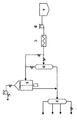
The feed selected, as may be seen from the process
schematic attached, is held in a tank (A) at between 100°
and 150° C, is extracted by pump (B) and heated in an oven
(C) up to a minimum temperature of 300° C without
undergoing any change in chemical composition. Next it is
transferred to a flash distillation column (D) in order to
remove the light distillates and then to a stirred
reaction chamber (E), or else directly without passing
through the distillation column (D), to the said stirred
reaction chamber. In both cases the distillates are sent
to a fractioning column (F) in order to be used later. In
the reaction chamber (E) the product is treated thermally
with the provision of external heat in order maintain the
temperature constant. This temperature shall be maintained
between 350° and 470° C, preferably between 370° and 430°
C, for a dwelling time less than 120 minutes, preferably
less than 60 minutes and under a pressure under 20
atmospheres absolute, and preferably under 10 atmospheres
absolute.
During this stage different dehydrogenation, cracking
and polymerisation reactions occur within the material,
producing a high amount of distillates ranging between 40
and 90%. The removal of these distillates from the
reaction mass results in an increased density and
viscosity of the medium, making highly its outflow from
the reactor. By controlling the variables of pressure and
temperature, it is possible to manage that the pitch
produced in the reactor can flow through the outlet (200-350°
C) or an extruder (G) in order to transfer it to a
storage tank where it shall be kept liquid at the
corresponding temperature or else to a conveyor belt
system in an inert atmosphere where the pitch produced
solidifies.
The product so obtained proves to be a highly
aromatic pitch, with anisotropy contents variable in the
range 0-70% (measured as a mesophase percentage observed
in a polarised light optical microscope over a total of
5000 points), at the will of the producer, and insoluble
in Toluene and Quinoline within the range 0-50% and 0-30%
respectively, also at the will of the producer, through
the control of the variables in this new process. These
new petroleum pitches can replace those currently being
used by manufacturers of electrodes, electrographites and
carbon compositions with no need to alter any stage of
their productive system since they adapt to the latter and
satisfy the specifications set by the user in each case.
Likewise they can be used as agglomerating agent in
refractory products and a base material for producing
general purpose carbon fibre.
The product obtained, as can be gathered from the
details of this description, in addition to having
softening points (60-250° C) adaptable to its subsequent
use, is environmentally " clean" . In the solid pitch, the
equivalent benzo(a)pyrene content is below 4000 ppm; their
PAH emission in gases being less than 5 mg/m3. In both
cases, these contents imply a reduction of 85-95% in
comparison with those found in coal tar pitches presently
in use.
According to a second aspect, the present invention
provides a highly aromatic petroleum pitch, which has the
following properties:
- anisotropy content of 0-70%;
- content of matter insoluble in Toluene and Quinoline of
0-50% and 0-30%, respectively;
- coke yield of between 40 and 70% when carbonised at
1000° C;
- softening point between 60° and 250° C;
- PAH content measured as equivalent benzo(a)pyrene less
than 4000 ppm;
- PAH emission in gases less than 5 mg/m3.
Finally, and according to a third aspect, the present
invention provides for the use of highly aromatic
petroleum pitches which have the properties aforementioned
and obtained by the procedure described above, in the
manufacture of anodes, in particular anodes for the
aluminium industry, electrographites for steel production,
as well as in the conforming, agglomerating and
impregnating of carbon compositions and graphitic
materials and in the fabrication of carbon fibres.
Herebelow examples are given by way of illustration
but not restrictively, of the procedure of the present
invention.
Example 1
A decanted oil obtained by catalytic cracking in a
fluid bed of a light petroleum residue, with an
asphaltenes content less than 0.8%, and density of between
1.02 and 1.03 g/cm
3, is subjected to heat treatment at
460° C for 30 minutes in an inert atmosphere and under a
pressure of 4 atmospheres absolute. Afterwards it is
cooled down to 210° C during five minutes, the pressure
being maintained constant, and is extracted from the plant
becoming solid at the outlet. The resulting product is
32.5% by weight of the total decanted oil. The resulting
product, termed petroleum pitch, has the following
properties:
| Matter insoluble in Toluene(% by weight) | 31.2 |
| Matter insoluble in Quinoline(% by weight) | 13.1 |
| Viscosity at 177° C (cP) | 1210 |
| Viscosity at 240° C (cP) | 280 |
| Ring and Ball (°C) | 118 |
| Sulphur (% by weight) | 2.2 |
| Fixed carbon yield (% by weight) | 57 |
Moreover, this petroleum pitch is environmentally
" cleaner" than that of coal tar since its content in
PAHs measured as equivalent benzo(a)pyrene is 3600 ppm
with a PAH emission in gases of 6 mg/m3. In both cases
these contents imply a reduction of 85-95% in comparison
with the figures corresponding coal tar pitches presently
in use.
This petroleum pitch can replace those in use by
manufacturers of electrodes, electrographites and carbon
compositions without any requirement to alter any stage in
their productive system since they adapt to the latter and
satisfy the specifications set by the user in each case.
Example 2
A petroleum residue coming from an ethylene producing
operation starting with Naphtha, with an asphaltenes
content of 9%, density of 1.07 g/cm3 at 15° C and Sulphur
content less than 0.5%, is subjected to a pre-heating
treatment at 300° C for 8 minutes in an inert atmosphere
and at atmospheric pressure, later reaching 410° C for 30
minutes in an inert atmosphere and at a pressure of
4atmospheres absolute. Afterwards it is cooled down to
210° C during five minutes, the pressure being maintained
constant, and is extracted from the plant becoming solid
also in an inert atmosphere at the outlet. The resulting
product is 34.2% by weight of the total residue fed to the
plant.
The resulting product, termed petroleum pitch, has
the properties indicated in Table II, column A:
| Example | 2 | 3 |
| Column | A | B |
| Matter insoluble in Toluene(% by weight) | 27.6 | 22.01 |
| Matter insoluble in Quinoline(% by weight) | <0.1 | <0.1 |
| |
| Viscosity at 177° C (cP) | 7500 | 474 |
| Viscosity at 204° C (cP) | 1150 | 119 |
| |
| Ring and Ball (°C) | 149 | 100 |
| Sulphur (% by weight) | <0.1 | <0.1 |
| |
| Carbon yield (% by weight) | 59 | 51 |
| Commercial equivalent | " binding " | " impregnating " |
This petroleum pitch is environmentally " cleaner"
than those of coal tar for its low Sulphur content (less
than 0.1% by weight) and the low PAH concentration
(measured as equivalent benzo(a)pyrene) present in it
(3290 ppm) and its low PAH emission in gases of (5 mg/m3),
but in addition it can replace the pitches presently in
use by manufacturers of electrodes, electrographites and
carbon compositions without any requirement to alter any
stage in their productive system since they adapt to the
latter and satisfy the specifications set by the user in
each case, with the advantage of having, with respect to
coal tar pitches, 85-95% less PAHs expressed as equivalent
benzo(a)pyrene.
Example 3
A petroleum residue coming from an ethylene producing
operation starting with Naphtha, with an asphaltenes
content of 9%, density of 1.07 g/cm3 at 15° C and Sulphur
content less than 0.5%, is subjected to a pre-heating
treatment at 300° C for 8 minutes in an inert atmosphere
and at atmospheric pressure, later reaching 420° C for 40
minutes in an inert atmosphere and at a pressure of 11
atmospheres absolute. Afterwards it is cooled down to 210°
C during five minutes, the pressure being maintained
constant, and is extracted from the plant becoming solid
also in an inert atmosphere at the outlet. The resulting
product is 36.8% by weight of the total residue fed to the
plant.
The resulting product, termed petroleum pitch, has
the properties indicated in Table II, column B.
This petroleum pitch is " cleaner" than those of
coal tar for its low Sulphur content (less than 0.1% by
weight) and the low equivalent benzo(a)pyrene
concentration present in the pitch (1820 ppm) and PAH
emission in gases (4 mg/m3), but in addition it proves to
be a product which can replace the pitches presently in
use by manufacturers of electrodes, electrographites and
carbon compositions without any requirement to alter any
stage in their productive system since they adapt to the
latter and satisfy the specifications set by the user in
each case, with the advantage of having, with respect to
coal tar pitches, 85-95% less PAHs expressed as equivalent
benzo(a)pyrene.
In Table III attached hereto are to be found details
of PAH and equivalent benzo(a)pyrene analyses of two
commercially available pitches and the pitches of example
2 and example 3.
| Comparison of PAH (ppm) and Benzo(a)pyrene (ppm) contents in petroleum and commercially available carbon pitches |
| | Commercially available binding carbon pitch | Commercially available impregnating carbon pitch | Petroleum pitch A (Example 2) | Petroleum pitch B (Example 3) |
| | PAHs | Equivalent B(a)P | PAHs | Equivalent B(a)P | PAHs | Equivalent B(a)P | PAHs | Equivalent B(a)P |
| Fluorene | 534 | | 1250 | | 1117 | | 80 |
| Phenantrene | 3714 | | 5878 | | 9095 | | 533 |
| Anthracene | 2611 | | 1792 | | 1770 | | 180 |
| Fluoranthene | 23524 | 800 | 12988 | 442 | 1907 | 65 | 311 | 11 |
| Pyrene | 15553 | | 9774 | | 3473 | | 770 |
| Benzo(a)anthracene | 17267 | 570 | 9149 | 302 | 1530 | 50 | 449 | 15 |
| Crysene | 22248 | 5784 | 11415 | 2968 | 1678 | 436 | 588 | 153 |
| Benzo(b)fluoranthene | 15199 | 1520 | 18079 | 1808 | 560 | 56 | 350 | 25 |
| Benzo(k)fluoranthene | 15955 | 160 | 14173 | 142 | 722 | 7 | 353 | 4 |
| Benzo(e)pyrene | 7889 | 394 | 8793 | 440 | 667 | 33 | 398 | 20 |
| Benzo(a)pyrene | 16048 | 16048 | 15571 | 15571 | 1513 | 1513 | 838 | 838 |
| Perylene | 4176 | | 3245 | | 214 | | 100 |
| Indeno(1,2,3,c,d)pyrene | 18434 | 1843 | 33948 | 3395 | 1318 | 132 | 814 | 81 |
| Dibenzo(a,b)anthracen | 2595 | 3632 | 4510 | 6314 | 360 | 504 | 240 | 336 |
| e | 7486 | 7486 | 13815 | 13815 | 493 | 493 | 338 | 338 |
| Benzo(g,h,i)perylene | 2232 | | 4307 | | 204 | | 166 |
| Dibenzo(1,2,4,5)pyrene |
| | 180463 | 38238 | 168689 | 45196 | 26622 | 3290 | 6409 | 1820 |
| Total (ppm) | 18.0 | | 16.9 | | 2.7 | | 0.6 |
| % by weight |
A residue coming from an ethylene producing operation
starting with Naphtha, with an asphaltenes content of 9%,
density of 1.07 g/cm
3 at 15° C and Sulphur content less
than 0.5%, is subjected to a pre-heating treatment at 300°
C for 5 minutes in an inert atmosphere and at atmospheric
pressure, later reaching 400° C for 30 minutes in an inert
atmosphere and at a pressure of 1.1 atmospheres absolute.
Afterwards it is cooled down to 210° C during five
minutes, the pressure being maintained constant, and is
extracted from the plant becoming solid also in an inert
atmosphere at the outlet. The resulting product is 30.4%
by weight of the total residue fed to the plant.
| Matter insoluble in Toluene(% by weight) | 30.0 |
| Matter insoluble in Quinoline(% by weight) | 1.0 |
| Viscosity at 177° C (cP) | 9000 |
| Viscosity at 240° C (cP) | 850 |
| Ring and Ball (°C) | 190 |
| Sulphur (% by weight) | 0.1 |
| Fixed carbon yield (% by weight) | 64 |
This petroleum pitch is " cleaner" than those of
coal tar for its low Sulphur content (less than 0.1% by
weight) and the low concentration of PAHs measured as
equivalent benzo(a)pyrene present in the pitch (2250 ppm)
and PAH emissions in gases (4 mg/m3). This pitch has an
important facility for extrusion, producing mono-filaments
in a continuous and highly uniform manner.
According to another aspect of the invention, in
order to alter determined properties of the pitches, for
example the wettability, a coal tar can be added to the
petroleum residue or fraction before subjecting the latter
to the heat treatment, said coal tar being in amounts
lying between 10 and 90% by weight and preferably between
30 and 70%.