EP1130070A2 - Adhesives for thermally shrinkable films or labels - Google Patents
Adhesives for thermally shrinkable films or labels Download PDFInfo
- Publication number
- EP1130070A2 EP1130070A2 EP01104414A EP01104414A EP1130070A2 EP 1130070 A2 EP1130070 A2 EP 1130070A2 EP 01104414 A EP01104414 A EP 01104414A EP 01104414 A EP01104414 A EP 01104414A EP 1130070 A2 EP1130070 A2 EP 1130070A2
- Authority
- EP
- European Patent Office
- Prior art keywords
- weight
- percent
- radiation curable
- curable adhesive
- film
- Prior art date
- Legal status (The legal status is an assumption and is not a legal conclusion. Google has not performed a legal analysis and makes no representation as to the accuracy of the status listed.)
- Withdrawn
Links
- 239000000853 adhesive Substances 0.000 title claims abstract description 72
- 230000001070 adhesive effect Effects 0.000 title claims abstract description 72
- 230000005855 radiation Effects 0.000 claims abstract description 57
- 238000000034 method Methods 0.000 claims abstract description 27
- 239000011248 coating agent Substances 0.000 claims abstract description 5
- 238000000576 coating method Methods 0.000 claims abstract description 5
- 230000000694 effects Effects 0.000 claims abstract description 4
- 239000000203 mixture Substances 0.000 claims description 31
- 229920005989 resin Polymers 0.000 claims description 24
- 239000011347 resin Substances 0.000 claims description 24
- 239000012952 cationic photoinitiator Substances 0.000 claims description 17
- 239000007788 liquid Substances 0.000 claims description 16
- 229920000728 polyester Polymers 0.000 claims description 15
- 229920001400 block copolymer Polymers 0.000 claims description 14
- 150000002009 diols Chemical class 0.000 claims description 12
- 239000003963 antioxidant agent Substances 0.000 claims description 11
- 239000007787 solid Substances 0.000 claims description 9
- 239000002480 mineral oil Substances 0.000 claims description 8
- 230000003078 antioxidant effect Effects 0.000 claims description 7
- 235000010446 mineral oil Nutrition 0.000 claims description 7
- ISWSIDIOOBJBQZ-UHFFFAOYSA-N Phenol Chemical compound OC1=CC=CC=C1 ISWSIDIOOBJBQZ-UHFFFAOYSA-N 0.000 claims description 6
- -1 vinyl ether olefins Chemical class 0.000 description 28
- RSWGJHLUYNHPMX-UHFFFAOYSA-N Abietic-Saeure Chemical class C12CCC(C(C)C)=CC2=CCC2C1(C)CCCC2(C)C(O)=O RSWGJHLUYNHPMX-UHFFFAOYSA-N 0.000 description 24
- KHPCPRHQVVSZAH-HUOMCSJISA-N Rosin Chemical class O(C/C=C/c1ccccc1)[C@H]1[C@H](O)[C@@H](O)[C@@H](O)[C@@H](CO)O1 KHPCPRHQVVSZAH-HUOMCSJISA-N 0.000 description 24
- KHPCPRHQVVSZAH-UHFFFAOYSA-N trans-cinnamyl beta-D-glucopyranoside Chemical class OC1C(O)C(O)C(CO)OC1OCC=CC1=CC=CC=C1 KHPCPRHQVVSZAH-UHFFFAOYSA-N 0.000 description 24
- PEDCQBHIVMGVHV-UHFFFAOYSA-N Glycerine Chemical compound OCC(O)CO PEDCQBHIVMGVHV-UHFFFAOYSA-N 0.000 description 12
- 238000001723 curing Methods 0.000 description 11
- 235000007586 terpenes Nutrition 0.000 description 10
- 239000000463 material Substances 0.000 description 8
- 150000003505 terpenes Chemical class 0.000 description 8
- 235000006708 antioxidants Nutrition 0.000 description 7
- 239000003921 oil Substances 0.000 description 7
- 239000000126 substance Substances 0.000 description 7
- 239000000654 additive Substances 0.000 description 6
- 150000002118 epoxides Chemical class 0.000 description 6
- 238000002372 labelling Methods 0.000 description 6
- 229920000642 polymer Polymers 0.000 description 6
- 125000001931 aliphatic group Chemical group 0.000 description 5
- 229920006270 hydrocarbon resin Polymers 0.000 description 5
- 229920005862 polyol Polymers 0.000 description 5
- 150000003077 polyols Chemical class 0.000 description 5
- 239000004593 Epoxy Substances 0.000 description 4
- XYFCBTPGUUZFHI-UHFFFAOYSA-N Phosphine Chemical compound P XYFCBTPGUUZFHI-UHFFFAOYSA-N 0.000 description 4
- 239000005062 Polybutadiene Substances 0.000 description 4
- 229930195733 hydrocarbon Natural products 0.000 description 4
- 229920002857 polybutadiene Polymers 0.000 description 4
- 239000002023 wood Substances 0.000 description 4
- LYCAIKOWRPUZTN-UHFFFAOYSA-N Ethylene glycol Chemical compound OCCO LYCAIKOWRPUZTN-UHFFFAOYSA-N 0.000 description 3
- RRHGJUQNOFWUDK-UHFFFAOYSA-N Isoprene Chemical compound CC(=C)C=C RRHGJUQNOFWUDK-UHFFFAOYSA-N 0.000 description 3
- OKKJLVBELUTLKV-UHFFFAOYSA-N Methanol Chemical compound OC OKKJLVBELUTLKV-UHFFFAOYSA-N 0.000 description 3
- 239000004743 Polypropylene Substances 0.000 description 3
- 239000004793 Polystyrene Substances 0.000 description 3
- LFOXEOLGJPJZAA-UHFFFAOYSA-N [(2,6-dimethoxybenzoyl)-(2,4,4-trimethylpentyl)phosphoryl]-(2,6-dimethoxyphenyl)methanone Chemical compound COC1=CC=CC(OC)=C1C(=O)P(=O)(CC(C)CC(C)(C)C)C(=O)C1=C(OC)C=CC=C1OC LFOXEOLGJPJZAA-UHFFFAOYSA-N 0.000 description 3
- 150000001336 alkenes Chemical class 0.000 description 3
- 125000003118 aryl group Chemical group 0.000 description 3
- 229920001577 copolymer Polymers 0.000 description 3
- 125000004122 cyclic group Chemical group 0.000 description 3
- 230000001419 dependent effect Effects 0.000 description 3
- 150000002148 esters Chemical class 0.000 description 3
- 238000011049 filling Methods 0.000 description 3
- 150000002430 hydrocarbons Chemical class 0.000 description 3
- 239000003208 petroleum Substances 0.000 description 3
- 239000003209 petroleum derivative Substances 0.000 description 3
- 238000006116 polymerization reaction Methods 0.000 description 3
- 229920001155 polypropylene Polymers 0.000 description 3
- 229920002223 polystyrene Polymers 0.000 description 3
- 150000003097 polyterpenes Chemical class 0.000 description 3
- 239000012956 1-hydroxycyclohexylphenyl-ketone Substances 0.000 description 2
- YIKSHDNOAYSSPX-UHFFFAOYSA-N 1-propan-2-ylthioxanthen-9-one Chemical compound S1C2=CC=CC=C2C(=O)C2=C1C=CC=C2C(C)C YIKSHDNOAYSSPX-UHFFFAOYSA-N 0.000 description 2
- HECLRDQVFMWTQS-RGOKHQFPSA-N 1755-01-7 Chemical class C1[C@H]2[C@@H]3CC=C[C@@H]3[C@@H]1C=C2 HECLRDQVFMWTQS-RGOKHQFPSA-N 0.000 description 2
- PIZHFBODNLEQBL-UHFFFAOYSA-N 2,2-diethoxy-1-phenylethanone Chemical compound CCOC(OCC)C(=O)C1=CC=CC=C1 PIZHFBODNLEQBL-UHFFFAOYSA-N 0.000 description 2
- XMLYCEVDHLAQEL-UHFFFAOYSA-N 2-hydroxy-2-methyl-1-phenylpropan-1-one Chemical compound CC(C)(O)C(=O)C1=CC=CC=C1 XMLYCEVDHLAQEL-UHFFFAOYSA-N 0.000 description 2
- 229920005789 ACRONAL® acrylic binder Polymers 0.000 description 2
- NLZUEZXRPGMBCV-UHFFFAOYSA-N Butylhydroxytoluene Chemical compound CC1=CC(C(C)(C)C)=C(O)C(C(C)(C)C)=C1 NLZUEZXRPGMBCV-UHFFFAOYSA-N 0.000 description 2
- 239000013032 Hydrocarbon resin Substances 0.000 description 2
- 239000004698 Polyethylene Substances 0.000 description 2
- PPBRXRYQALVLMV-UHFFFAOYSA-N Styrene Chemical compound C=CC1=CC=CC=C1 PPBRXRYQALVLMV-UHFFFAOYSA-N 0.000 description 2
- BGYHLZZASRKEJE-UHFFFAOYSA-N [3-[3-(3,5-ditert-butyl-4-hydroxyphenyl)propanoyloxy]-2,2-bis[3-(3,5-ditert-butyl-4-hydroxyphenyl)propanoyloxymethyl]propyl] 3-(3,5-ditert-butyl-4-hydroxyphenyl)propanoate Chemical compound CC(C)(C)C1=C(O)C(C(C)(C)C)=CC(CCC(=O)OCC(COC(=O)CCC=2C=C(C(O)=C(C=2)C(C)(C)C)C(C)(C)C)(COC(=O)CCC=2C=C(C(O)=C(C=2)C(C)(C)C)C(C)(C)C)COC(=O)CCC=2C=C(C(O)=C(C=2)C(C)(C)C)C(C)(C)C)=C1 BGYHLZZASRKEJE-UHFFFAOYSA-N 0.000 description 2
- 238000010521 absorption reaction Methods 0.000 description 2
- 230000002411 adverse Effects 0.000 description 2
- 150000001298 alcohols Chemical class 0.000 description 2
- RWCCWEUUXYIKHB-UHFFFAOYSA-N benzophenone Chemical compound C=1C=CC=CC=1C(=O)C1=CC=CC=C1 RWCCWEUUXYIKHB-UHFFFAOYSA-N 0.000 description 2
- 239000012965 benzophenone Substances 0.000 description 2
- 235000010290 biphenyl Nutrition 0.000 description 2
- 239000004305 biphenyl Substances 0.000 description 2
- 125000006267 biphenyl group Chemical group 0.000 description 2
- MQDJYUACMFCOFT-UHFFFAOYSA-N bis[2-(1-hydroxycyclohexyl)phenyl]methanone Chemical compound C=1C=CC=C(C(=O)C=2C(=CC=CC=2)C2(O)CCCCC2)C=1C1(O)CCCCC1 MQDJYUACMFCOFT-UHFFFAOYSA-N 0.000 description 2
- 230000015556 catabolic process Effects 0.000 description 2
- 238000006731 degradation reaction Methods 0.000 description 2
- 239000003085 diluting agent Substances 0.000 description 2
- 239000000945 filler Substances 0.000 description 2
- 125000002887 hydroxy group Chemical group [H]O* 0.000 description 2
- 239000004615 ingredient Substances 0.000 description 2
- 230000002452 interceptive effect Effects 0.000 description 2
- 230000000670 limiting effect Effects 0.000 description 2
- 238000002156 mixing Methods 0.000 description 2
- JRZJOMJEPLMPRA-UHFFFAOYSA-N olefin Natural products CCCCCCCC=C JRZJOMJEPLMPRA-UHFFFAOYSA-N 0.000 description 2
- 238000004806 packaging method and process Methods 0.000 description 2
- 238000009928 pasteurization Methods 0.000 description 2
- WXZMFSXDPGVJKK-UHFFFAOYSA-N pentaerythritol Chemical class OCC(CO)(CO)CO WXZMFSXDPGVJKK-UHFFFAOYSA-N 0.000 description 2
- ZUOUZKKEUPVFJK-UHFFFAOYSA-N phenylbenzene Natural products C1=CC=CC=C1C1=CC=CC=C1 ZUOUZKKEUPVFJK-UHFFFAOYSA-N 0.000 description 2
- 229910000073 phosphorus hydride Inorganic materials 0.000 description 2
- 229920001633 poly(α-methyl styrene) Polymers 0.000 description 2
- 229920005906 polyester polyol Polymers 0.000 description 2
- 229920000573 polyethylene Polymers 0.000 description 2
- 239000003381 stabilizer Substances 0.000 description 2
- 239000000758 substrate Substances 0.000 description 2
- 239000003784 tall oil Substances 0.000 description 2
- QNODIIQQMGDSEF-UHFFFAOYSA-N (1-hydroxycyclohexyl)-phenylmethanone Chemical compound C=1C=CC=CC=1C(=O)C1(O)CCCCC1 QNODIIQQMGDSEF-UHFFFAOYSA-N 0.000 description 1
- KWVGIHKZDCUPEU-UHFFFAOYSA-N 2,2-dimethoxy-2-phenylacetophenone Chemical compound C=1C=CC=CC=1C(OC)(OC)C(=O)C1=CC=CC=C1 KWVGIHKZDCUPEU-UHFFFAOYSA-N 0.000 description 1
- OXBLVCZKDOZZOJ-UHFFFAOYSA-N 2,3-Dihydrothiophene Chemical compound C1CC=CS1 OXBLVCZKDOZZOJ-UHFFFAOYSA-N 0.000 description 1
- RIWRBSMFKVOJMN-UHFFFAOYSA-N 2-methyl-1-phenylpropan-2-ol Chemical compound CC(C)(O)CC1=CC=CC=C1 RIWRBSMFKVOJMN-UHFFFAOYSA-N 0.000 description 1
- WPMYUUITDBHVQZ-UHFFFAOYSA-M 3-(3,5-ditert-butyl-4-hydroxyphenyl)propanoate Chemical compound CC(C)(C)C1=CC(CCC([O-])=O)=CC(C(C)(C)C)=C1O WPMYUUITDBHVQZ-UHFFFAOYSA-M 0.000 description 1
- VSAWBBYYMBQKIK-UHFFFAOYSA-N 4-[[3,5-bis[(3,5-ditert-butyl-4-hydroxyphenyl)methyl]-2,4,6-trimethylphenyl]methyl]-2,6-ditert-butylphenol Chemical compound CC1=C(CC=2C=C(C(O)=C(C=2)C(C)(C)C)C(C)(C)C)C(C)=C(CC=2C=C(C(O)=C(C=2)C(C)(C)C)C(C)(C)C)C(C)=C1CC1=CC(C(C)(C)C)=C(O)C(C(C)(C)C)=C1 VSAWBBYYMBQKIK-UHFFFAOYSA-N 0.000 description 1
- 239000004215 Carbon black (E152) Substances 0.000 description 1
- 229920010800 Duradene Polymers 0.000 description 1
- 229920002943 EPDM rubber Polymers 0.000 description 1
- LFQSCWFLJHTTHZ-UHFFFAOYSA-N Ethanol Chemical compound CCO LFQSCWFLJHTTHZ-UHFFFAOYSA-N 0.000 description 1
- JOYRKODLDBILNP-UHFFFAOYSA-N Ethyl urethane Chemical compound CCOC(N)=O JOYRKODLDBILNP-UHFFFAOYSA-N 0.000 description 1
- 238000005727 Friedel-Crafts reaction Methods 0.000 description 1
- 239000004831 Hot glue Substances 0.000 description 1
- VQTUBCCKSQIDNK-UHFFFAOYSA-N Isobutene Chemical group CC(C)=C VQTUBCCKSQIDNK-UHFFFAOYSA-N 0.000 description 1
- JKIJEFPNVSHHEI-UHFFFAOYSA-N Phenol, 2,4-bis(1,1-dimethylethyl)-, phosphite (3:1) Chemical compound CC(C)(C)C1=CC(C(C)(C)C)=CC=C1OP(OC=1C(=CC(=CC=1)C(C)(C)C)C(C)(C)C)OC1=CC=C(C(C)(C)C)C=C1C(C)(C)C JKIJEFPNVSHHEI-UHFFFAOYSA-N 0.000 description 1
- 229920002367 Polyisobutene Polymers 0.000 description 1
- 239000004721 Polyphenylene oxide Substances 0.000 description 1
- 239000007983 Tris buffer Substances 0.000 description 1
- 238000003848 UV Light-Curing Methods 0.000 description 1
- 230000002378 acidificating effect Effects 0.000 description 1
- 229920006397 acrylic thermoplastic Polymers 0.000 description 1
- 125000002015 acyclic group Chemical group 0.000 description 1
- XYLMUPLGERFSHI-UHFFFAOYSA-N alpha-Methylstyrene Chemical compound CC(=C)C1=CC=CC=C1 XYLMUPLGERFSHI-UHFFFAOYSA-N 0.000 description 1
- 239000010775 animal oil Substances 0.000 description 1
- 239000002518 antifoaming agent Substances 0.000 description 1
- 150000004982 aromatic amines Chemical class 0.000 description 1
- 150000004945 aromatic hydrocarbons Chemical class 0.000 description 1
- 239000010692 aromatic oil Substances 0.000 description 1
- 230000009286 beneficial effect Effects 0.000 description 1
- 235000013361 beverage Nutrition 0.000 description 1
- 229930003642 bicyclic monoterpene Natural products 0.000 description 1
- 150000001604 bicyclic monoterpene derivatives Chemical class 0.000 description 1
- 230000015572 biosynthetic process Effects 0.000 description 1
- 238000009835 boiling Methods 0.000 description 1
- 229920005549 butyl rubber Polymers 0.000 description 1
- 239000011203 carbon fibre reinforced carbon Substances 0.000 description 1
- 239000003054 catalyst Substances 0.000 description 1
- 125000002091 cationic group Chemical group 0.000 description 1
- 239000003086 colorant Substances 0.000 description 1
- 150000001875 compounds Chemical class 0.000 description 1
- 238000009833 condensation Methods 0.000 description 1
- 230000005494 condensation Effects 0.000 description 1
- 238000010924 continuous production Methods 0.000 description 1
- 239000007822 coupling agent Substances 0.000 description 1
- 238000004132 cross linking Methods 0.000 description 1
- 238000013036 cure process Methods 0.000 description 1
- 230000032798 delamination Effects 0.000 description 1
- 239000012955 diaryliodonium Substances 0.000 description 1
- 125000005520 diaryliodonium group Chemical group 0.000 description 1
- 150000001993 dienes Chemical class 0.000 description 1
- 229920001971 elastomer Polymers 0.000 description 1
- 238000010894 electron beam technology Methods 0.000 description 1
- 125000003700 epoxy group Chemical group 0.000 description 1
- 239000012949 free radical photoinitiator Substances 0.000 description 1
- 235000015203 fruit juice Nutrition 0.000 description 1
- 230000004927 fusion Effects 0.000 description 1
- 239000011521 glass Substances 0.000 description 1
- 238000010438 heat treatment Methods 0.000 description 1
- XMBWDFGMSWQBCA-UHFFFAOYSA-N hydrogen iodide Chemical class I XMBWDFGMSWQBCA-UHFFFAOYSA-N 0.000 description 1
- 230000000977 initiatory effect Effects 0.000 description 1
- 238000005259 measurement Methods 0.000 description 1
- 230000007246 mechanism Effects 0.000 description 1
- QSHDDOUJBYECFT-UHFFFAOYSA-N mercury Chemical compound [Hg] QSHDDOUJBYECFT-UHFFFAOYSA-N 0.000 description 1
- 239000002184 metal Substances 0.000 description 1
- 229910052751 metal Inorganic materials 0.000 description 1
- 238000012986 modification Methods 0.000 description 1
- 230000004048 modification Effects 0.000 description 1
- 239000000178 monomer Substances 0.000 description 1
- 150000002902 organometallic compounds Chemical class 0.000 description 1
- 230000036961 partial effect Effects 0.000 description 1
- 239000002530 phenolic antioxidant Substances 0.000 description 1
- 150000002989 phenols Chemical class 0.000 description 1
- 125000001997 phenyl group Chemical group [H]C1=C([H])C([H])=C(*)C([H])=C1[H] 0.000 description 1
- AQSJGOWTSHOLKH-UHFFFAOYSA-N phosphite(3-) Chemical class [O-]P([O-])[O-] AQSJGOWTSHOLKH-UHFFFAOYSA-N 0.000 description 1
- 239000003504 photosensitizing agent Substances 0.000 description 1
- 239000000049 pigment Substances 0.000 description 1
- 239000004033 plastic Substances 0.000 description 1
- 229920003023 plastic Polymers 0.000 description 1
- 239000002985 plastic film Substances 0.000 description 1
- 229920000233 poly(alkylene oxides) Polymers 0.000 description 1
- 229920003229 poly(methyl methacrylate) Polymers 0.000 description 1
- 229920000058 polyacrylate Polymers 0.000 description 1
- 229920001083 polybutene Polymers 0.000 description 1
- 229920000647 polyepoxide Polymers 0.000 description 1
- 229920000570 polyether Polymers 0.000 description 1
- 229920001195 polyisoprene Polymers 0.000 description 1
- 229920000098 polyolefin Polymers 0.000 description 1
- 229920001451 polypropylene glycol Polymers 0.000 description 1
- 229920005996 polystyrene-poly(ethylene-butylene)-polystyrene Polymers 0.000 description 1
- 239000004800 polyvinyl chloride Substances 0.000 description 1
- 229920000915 polyvinyl chloride Polymers 0.000 description 1
- 238000002360 preparation method Methods 0.000 description 1
- 238000012545 processing Methods 0.000 description 1
- 238000003847 radiation curing Methods 0.000 description 1
- 229920005604 random copolymer Polymers 0.000 description 1
- 239000000376 reactant Substances 0.000 description 1
- 230000002441 reversible effect Effects 0.000 description 1
- 239000006254 rheological additive Substances 0.000 description 1
- 239000005060 rubber Substances 0.000 description 1
- 229920006395 saturated elastomer Polymers 0.000 description 1
- 229920006300 shrink film Polymers 0.000 description 1
- 229920003048 styrene butadiene rubber Polymers 0.000 description 1
- 125000000446 sulfanediyl group Chemical group *S* 0.000 description 1
- RWSOTUBLDIXVET-UHFFFAOYSA-O sulfonium Chemical compound [SH3+] RWSOTUBLDIXVET-UHFFFAOYSA-O 0.000 description 1
- 150000003464 sulfur compounds Chemical class 0.000 description 1
- 239000004094 surface-active agent Substances 0.000 description 1
- 229920006250 telechelic polymer Polymers 0.000 description 1
- 229920001897 terpolymer Polymers 0.000 description 1
- ISXSCDLOGDJUNJ-UHFFFAOYSA-N tert-butyl prop-2-enoate Chemical compound CC(C)(C)OC(=O)C=C ISXSCDLOGDJUNJ-UHFFFAOYSA-N 0.000 description 1
- ZIBGPFATKBEMQZ-UHFFFAOYSA-N triethylene glycol Chemical class OCCOCCOCCO ZIBGPFATKBEMQZ-UHFFFAOYSA-N 0.000 description 1
- 239000008158 vegetable oil Substances 0.000 description 1
- 235000013311 vegetables Nutrition 0.000 description 1
- 229920006163 vinyl copolymer Polymers 0.000 description 1
- 125000000391 vinyl group Chemical group [H]C([*])=C([H])[H] 0.000 description 1
- 229920002554 vinyl polymer Polymers 0.000 description 1
- 238000009736 wetting Methods 0.000 description 1
- 239000000080 wetting agent Substances 0.000 description 1
Classifications
-
- C—CHEMISTRY; METALLURGY
- C09—DYES; PAINTS; POLISHES; NATURAL RESINS; ADHESIVES; COMPOSITIONS NOT OTHERWISE PROVIDED FOR; APPLICATIONS OF MATERIALS NOT OTHERWISE PROVIDED FOR
- C09J—ADHESIVES; NON-MECHANICAL ASPECTS OF ADHESIVE PROCESSES IN GENERAL; ADHESIVE PROCESSES NOT PROVIDED FOR ELSEWHERE; USE OF MATERIALS AS ADHESIVES
- C09J153/00—Adhesives based on block copolymers containing at least one sequence of a polymer obtained by reactions only involving carbon-to-carbon unsaturated bonds; Adhesives based on derivatives of such polymers
- C09J153/005—Modified block copolymers
-
- C—CHEMISTRY; METALLURGY
- C09—DYES; PAINTS; POLISHES; NATURAL RESINS; ADHESIVES; COMPOSITIONS NOT OTHERWISE PROVIDED FOR; APPLICATIONS OF MATERIALS NOT OTHERWISE PROVIDED FOR
- C09J—ADHESIVES; NON-MECHANICAL ASPECTS OF ADHESIVE PROCESSES IN GENERAL; ADHESIVE PROCESSES NOT PROVIDED FOR ELSEWHERE; USE OF MATERIALS AS ADHESIVES
- C09J7/00—Adhesives in the form of films or foils
- C09J7/30—Adhesives in the form of films or foils characterised by the adhesive composition
- C09J7/38—Pressure-sensitive adhesives [PSA]
- C09J7/381—Pressure-sensitive adhesives [PSA] based on macromolecular compounds obtained by reactions involving only carbon-to-carbon unsaturated bonds
- C09J7/387—Block-copolymers
-
- C—CHEMISTRY; METALLURGY
- C09—DYES; PAINTS; POLISHES; NATURAL RESINS; ADHESIVES; COMPOSITIONS NOT OTHERWISE PROVIDED FOR; APPLICATIONS OF MATERIALS NOT OTHERWISE PROVIDED FOR
- C09J—ADHESIVES; NON-MECHANICAL ASPECTS OF ADHESIVE PROCESSES IN GENERAL; ADHESIVE PROCESSES NOT PROVIDED FOR ELSEWHERE; USE OF MATERIALS AS ADHESIVES
- C09J2203/00—Applications of adhesives in processes or use of adhesives in the form of films or foils
- C09J2203/334—Applications of adhesives in processes or use of adhesives in the form of films or foils as a label
-
- C—CHEMISTRY; METALLURGY
- C09—DYES; PAINTS; POLISHES; NATURAL RESINS; ADHESIVES; COMPOSITIONS NOT OTHERWISE PROVIDED FOR; APPLICATIONS OF MATERIALS NOT OTHERWISE PROVIDED FOR
- C09J—ADHESIVES; NON-MECHANICAL ASPECTS OF ADHESIVE PROCESSES IN GENERAL; ADHESIVE PROCESSES NOT PROVIDED FOR ELSEWHERE; USE OF MATERIALS AS ADHESIVES
- C09J2453/00—Presence of block copolymer
-
- Y—GENERAL TAGGING OF NEW TECHNOLOGICAL DEVELOPMENTS; GENERAL TAGGING OF CROSS-SECTIONAL TECHNOLOGIES SPANNING OVER SEVERAL SECTIONS OF THE IPC; TECHNICAL SUBJECTS COVERED BY FORMER USPC CROSS-REFERENCE ART COLLECTIONS [XRACs] AND DIGESTS
- Y10—TECHNICAL SUBJECTS COVERED BY FORMER USPC
- Y10T—TECHNICAL SUBJECTS COVERED BY FORMER US CLASSIFICATION
- Y10T428/00—Stock material or miscellaneous articles
- Y10T428/13—Hollow or container type article [e.g., tube, vase, etc.]
- Y10T428/1328—Shrinkable or shrunk [e.g., due to heat, solvent, volatile agent, restraint removal, etc.]
-
- Y—GENERAL TAGGING OF NEW TECHNOLOGICAL DEVELOPMENTS; GENERAL TAGGING OF CROSS-SECTIONAL TECHNOLOGIES SPANNING OVER SEVERAL SECTIONS OF THE IPC; TECHNICAL SUBJECTS COVERED BY FORMER USPC CROSS-REFERENCE ART COLLECTIONS [XRACs] AND DIGESTS
- Y10—TECHNICAL SUBJECTS COVERED BY FORMER USPC
- Y10T—TECHNICAL SUBJECTS COVERED BY FORMER US CLASSIFICATION
- Y10T428/00—Stock material or miscellaneous articles
- Y10T428/13—Hollow or container type article [e.g., tube, vase, etc.]
- Y10T428/1328—Shrinkable or shrunk [e.g., due to heat, solvent, volatile agent, restraint removal, etc.]
- Y10T428/1331—Single layer [continuous layer]
-
- Y—GENERAL TAGGING OF NEW TECHNOLOGICAL DEVELOPMENTS; GENERAL TAGGING OF CROSS-SECTIONAL TECHNOLOGIES SPANNING OVER SEVERAL SECTIONS OF THE IPC; TECHNICAL SUBJECTS COVERED BY FORMER USPC CROSS-REFERENCE ART COLLECTIONS [XRACs] AND DIGESTS
- Y10—TECHNICAL SUBJECTS COVERED BY FORMER USPC
- Y10T—TECHNICAL SUBJECTS COVERED BY FORMER US CLASSIFICATION
- Y10T428/00—Stock material or miscellaneous articles
- Y10T428/13—Hollow or container type article [e.g., tube, vase, etc.]
- Y10T428/1334—Nonself-supporting tubular film or bag [e.g., pouch, envelope, packet, etc.]
-
- Y—GENERAL TAGGING OF NEW TECHNOLOGICAL DEVELOPMENTS; GENERAL TAGGING OF CROSS-SECTIONAL TECHNOLOGIES SPANNING OVER SEVERAL SECTIONS OF THE IPC; TECHNICAL SUBJECTS COVERED BY FORMER USPC CROSS-REFERENCE ART COLLECTIONS [XRACs] AND DIGESTS
- Y10—TECHNICAL SUBJECTS COVERED BY FORMER USPC
- Y10T—TECHNICAL SUBJECTS COVERED BY FORMER US CLASSIFICATION
- Y10T428/00—Stock material or miscellaneous articles
- Y10T428/13—Hollow or container type article [e.g., tube, vase, etc.]
- Y10T428/1334—Nonself-supporting tubular film or bag [e.g., pouch, envelope, packet, etc.]
- Y10T428/1345—Single layer [continuous layer]
-
- Y—GENERAL TAGGING OF NEW TECHNOLOGICAL DEVELOPMENTS; GENERAL TAGGING OF CROSS-SECTIONAL TECHNOLOGIES SPANNING OVER SEVERAL SECTIONS OF THE IPC; TECHNICAL SUBJECTS COVERED BY FORMER USPC CROSS-REFERENCE ART COLLECTIONS [XRACs] AND DIGESTS
- Y10—TECHNICAL SUBJECTS COVERED BY FORMER USPC
- Y10T—TECHNICAL SUBJECTS COVERED BY FORMER US CLASSIFICATION
- Y10T428/00—Stock material or miscellaneous articles
- Y10T428/28—Web or sheet containing structurally defined element or component and having an adhesive outermost layer
-
- Y—GENERAL TAGGING OF NEW TECHNOLOGICAL DEVELOPMENTS; GENERAL TAGGING OF CROSS-SECTIONAL TECHNOLOGIES SPANNING OVER SEVERAL SECTIONS OF THE IPC; TECHNICAL SUBJECTS COVERED BY FORMER USPC CROSS-REFERENCE ART COLLECTIONS [XRACs] AND DIGESTS
- Y10—TECHNICAL SUBJECTS COVERED BY FORMER USPC
- Y10T—TECHNICAL SUBJECTS COVERED BY FORMER US CLASSIFICATION
- Y10T428/00—Stock material or miscellaneous articles
- Y10T428/28—Web or sheet containing structurally defined element or component and having an adhesive outermost layer
- Y10T428/2813—Heat or solvent activated or sealable
- Y10T428/2817—Heat sealable
-
- Y—GENERAL TAGGING OF NEW TECHNOLOGICAL DEVELOPMENTS; GENERAL TAGGING OF CROSS-SECTIONAL TECHNOLOGIES SPANNING OVER SEVERAL SECTIONS OF THE IPC; TECHNICAL SUBJECTS COVERED BY FORMER USPC CROSS-REFERENCE ART COLLECTIONS [XRACs] AND DIGESTS
- Y10—TECHNICAL SUBJECTS COVERED BY FORMER USPC
- Y10T—TECHNICAL SUBJECTS COVERED BY FORMER US CLASSIFICATION
- Y10T428/00—Stock material or miscellaneous articles
- Y10T428/28—Web or sheet containing structurally defined element or component and having an adhesive outermost layer
- Y10T428/2813—Heat or solvent activated or sealable
- Y10T428/2817—Heat sealable
- Y10T428/2826—Synthetic resin or polymer
Definitions
- This invention relates to radiation curable adhesives for use with thermally-shrinkable films or labels.
- This invention is directed to thermally shrinkable films or labels coated with radiation curable adhesive compositions and to a process for applying such films or labels to containers wherein they are adhered to the container surface.
- This method of labeling is particularly attractive, for example, to breweries which often bottle and package their products under a variety of trade names.
- these breweries are no longer required to stock a large inventory of pre-printed containers for each brand and could, instead, stock only unprinted containers together with a supply of the appropriate thermally shrinkable printed film labels.
- the presence of the film label around the container would provide additional protection against the printed containers rubbing together during transport.
- the containers are subjected to heating either during hot filling (e.g., fruit juice processing) or after filling as when a separate pasteurization step is required, these processes put additional stress on the adhesive bond.
- hot filling e.g., fruit juice processing
- a separate pasteurization step e.g., a separate pasteurization step
- radiation curable adhesive compositions permit satisfactory application of thermally shrinkable films or labels onto containers even at the high speeds involved in continuous processes and where such radiation curable adhesive composition gains instant high heat resistance after curing.
- the resultant bond is strong, and retains its configuration even after the heat shrinking operation and any additional pasteurization operations so that the "shoulder seams" formed at the ends of the container as well as the seam joint formed at the interface of the leading and trailing edge of the film remain in the desired configuration with no distortion of the label or undesirable exposure of the container at the seam lap.
- the present invention is directed to thermally shrinkable films or labels having coated thereon a radiation curable adhesive and to a process for applying thermally shrinkable films or labels to containers comprising the steps of a) coating at least a portion of a thermally shrinkable but unshrunken film or label segment with a radiation curable adhesive; b) applying the film or label to the longitudinal surface of the container; c) subjecting the radiation curable adhesive to a radiation source to effect curing thereof and, d) subjecting the container to heat to shrink the film or label onto the container so as to permanently affix it thereto.
- the radiation curable adhesive is applied to a narrow region of the container or at the leading end of the film segment to secure the leading end of the film to the container, the film wrapped around the container and the film segment secured to the container by overlapping the trailing end, a narrow region of which has been coated with the radiation curable adhesive.
- shrink labeled containers wherein the labels are affixed to the container utilizing radiation curable adhesive having an epoxidized block copolymer or a cycloaliphatic epoxide as the base resin.
- solid hydrogenated tackifier as used herein, is intended to mean any composition which is solid at room temperature and which is useful to impart tack to the radiation curable adhesive composition.
- ASTM D-1878-61T defines tack as "the property of a material which enables it to form a bond of measurable strength immediately on contact with another surface".
- base resin as used herein is intended to mean a polymer which undergoes curing upon UV exposure.
- Radiation curable adhesives as used herein is intended to mean adhesives that generally comprise one or more of the following:
- It is a further object of the present invention to provide a process for applying thermally shrinkable films or labels to containers comprising the steps of a) coating at least a portion of a thermally shrinkable but unshrunken film or label segment with a radiation curable adhesive; b) applying the label or film to the longitudinal surface of the container; c) subjecting the radiation curable adhesive to a radiation source to effect curing thereof; and c) subjecting the container to heat to shrink the film or label onto the container so as to permanently affix it thereto.
- Preferred radiation curable adhesives of the present invention have a viscosity at the application temperature of less than about 2,000 cps, more preferably less than about 1,000 cps
- Preferred radiation curable adhesives of the present invention are cationically curable systems, preferably based on epoxidized block copolymers or cycloaliphatic epoxides (with an epoxy functionality greater than 1, preferably 2).
- the most preferred epoxidized block copolymer base is L-207.
- the most preferred cycloaliphatic epoxides are CYRACURE UVR-6110 and CYRACURE UVR-6105 (each of these has a functionality of 2).
- the preferred epoxidized block copolymer radiation curable adhesive composition of the present invention comprises:
- the even more preferred epoxidized block copolymer radiation curable adhesive composition of the present invention comprises:
- the preferred cycloaliphatic epoxide radiation curable adhesive composition of the present invention comprises:
- the even more preferred cycloaliphatic epoxide radiation curable adhesive composition of the present invention comprises:
- Tackifiers are chosen to impart substantial adhesive strength, promote substrate wetting and generally enhance adhesive performance, i.e. to optimize tack performance versus temperature performance of the composition.
- Tackifiers may comprise resins derived from renewable resources such as rosin derivatives including wood rosin, tall oil, gum rosin; rosin esters, natural and synthetic terpenes, and derivatives of such.
- Aliphatic, aromatic or mixed aliphatic-aromatic petroleum based tackifiers are also useful in the radiation curable adhesives of this invention.
- Examples include, but are not limited to, rosin itself, hydrogenated rosin, dehydrogenated rosin, dimerized and polymerized rosin, and the esters of rosin and the modified rosins with alcohols and polyols such as methanol, ethylene glycol, di- and triethylene glycols, glycerol, or pentaerythritol, and the like. Many such materials are commercially available under a wide variety of trade names.
- An example of a commercially available solid hydrogenated tackifiers useful in this invention is Escorez 5400 sold by Exxon.
- Radiation curable adhesive compositions of the invention acquire their adhesive characteristics upon exposure to a radiant energy source such as electron beam or ultraviolet light (UV).
- a radiant energy source such as electron beam or ultraviolet light (UV).
- UV ultraviolet light
- one or more photoinitiators and/or photosensitizers are added to the composition prior to exposure to the radiant energy source. Insuring that the emission of the light source corresponds with the absorption of the photoinitiator is critical.
- the photoinitiators are typically employed in concentrations ranging from about 0.02% by weight to about 5% by weight. The concentration is chosen based on the thickness of the application of the uncured radiation curable composition.
- Commercial examples include the cationic photoinitiator CYRACURE UVI 6974 available from UNION CARBIDE.
- free-radical photoinitiators which may be used include one or more of the following: Benzophenone; Benzyldimethyl ketal; Isopropylthioxanthone; bis(2,6-dimethoxybenzoyl)(2,4,4-trimethylpentyl)phosphineoxide; 2-hydroxy-2-methyl-1-phenyl-1-propanone; Diphenyl(2,4,6-trimethybenzoyl)phosphine oxides; 1-hydroxycyclohexyl phenyl ketone; 2-benzyl-2-(dimethylamino)-1->4-(4-morpholinyl)phenyl-1-butanone; alpha,alpha.-dimethoxy-alpha-phenylacetophenone; 2,2-diethoxyacetophenone; 2-methyl-1->4-(methylthio)phenyl-2-(4-morpholinyl)-1-propanone; 2-hydroxy-1-4-(hydroxyethoxy)phenyl-2
- Photoinitiators may be used to achieve the best possible cure of adhesive compositions. Photoinitiators are preferably used in the least amount necessary to initiate cure at the line speed of the process.
- optional mineral oils which may be used include refined hydrocarbon oils typically present in adhesives, including paraffinic, aromatic, and naphthenic oils available under the trade designations KAYDOL (produced by WITCO), TUFFLO (produced by ARCO), and the like.
- the refined oils serve as a diluent and improve surface tack properties.
- Non-aromatic oils are preferred as these absorb less UV light.
- Liquid tackifying resins useful herein include aliphatic and cycloaliphatic hydrocarbons and modified hydrocarbons and hydrogenated derivatives and terpenes and hydrogenated derivatives. These liquid tackifying resins have softening points of less than about 70°C, preferably less than about 50°Cand most preferably less than about 30°
- liquid tackifying resins include but are not limited to REGALITE R-10, a C 5 liquid tackifier with a softening point of 10°C available from HERCULES, and WINGTACK 10, a liquid hydrocarbon resin with a softening point of 10° C. available from GOODYEAR CHEMICAL CO.
- Antioxidants or stabilizers are typically added to the commercially available compounds in order to protect the ingredients against degradation during preparation and use of the adhesive compositions, however without interfering with radiation curing. Combinations of antioxidants are often more effective due to the different mechanisms of degradation to which various adhesives are subject. Certain hindered phenols, organometallic compounds, aromatic amines, aromatic phosphites, and sulfur compounds are useful for this purpose. Examples of effective types of these materials include phenolic antioxidants, thio compounds, and tris-(nonylated phenyl) phosphites.
- antioxidants examples include IRGANOX 1010 (pentaetythrityl-tetrakis[3-(3,5-di-tert butyl-4-hydroxyphenyl)propionate; IONOL (2,6-ditertiary-butyl-4-methyl phenol); IONOX 330 (3,4,6-tris (35-di-tertiary-butyl-p-hydroxybenzyl)-1,3,5-trimethylbenzene); and POLYGARD HR (tris-(2,4-di-tertiary-butyl-phenyl) phosphite).
- the adhesive composition may further contain relatively minor amounts of ingredients, such as fillers, coupling agents, colorants, and other additives which do not substantially adversely affect the system, such as, for example, by adversely interfering with adhesion to a substrate surface.
- ingredients such as fillers, coupling agents, colorants, and other additives which do not substantially adversely affect the system, such as, for example, by adversely interfering with adhesion to a substrate surface.
- the radiation curable adhesive compositions of the present invention are typically prepared by blending the components at an elevated temperature, preferably between about 50°C and about 200°C, until a homogeneous blend is obtained, usually less than three (3) hours.
- elevated temperature preferably between about 50°C and about 200°C
- Various methods of blending are known to the art and any method that produces a homogenous blend is satisfactory.
- the radiation curable adhesive is then used to affix the thermally shrinkable labels to the appropriate containers using conventional packaging equipment, especially that described in U.S. Pat. Nos. 4,704,173 and 4,844,957.
- the technique is particularly useful in the labeling of glass, metal or plastic cylindrical or multi-faceted containers using thermally shrinkable labels made from polyolefins such as polypropylene or polyethylene or from polyvinyl chloride films or similar plastic sheets such as foamed polyethylene, polypropylene or polystyrene.
- Typical, but non-limiting, process parameters may include:
- the labels shrink uniformly around the container and not slip at the seam.
- the final container should be able to withstand heat or cold without delamination or seam slippage.
- the radiation curable adhesives according to this invention may also be cured effectively beneath a transparent section of a non-thermally shrinkable film or label.
- Viscosity measurements were made using a Brookfield viscometer.
Landscapes
- Chemical & Material Sciences (AREA)
- Chemical Kinetics & Catalysis (AREA)
- Organic Chemistry (AREA)
- Adhesives Or Adhesive Processes (AREA)
- Laminated Bodies (AREA)
- Adhesive Tapes (AREA)
- Details Of Rigid Or Semi-Rigid Containers (AREA)
Abstract
Description
- This invention relates to radiation curable adhesives for use with thermally-shrinkable films or labels.
- This invention is directed to thermally shrinkable films or labels coated with radiation curable adhesive compositions and to a process for applying such films or labels to containers wherein they are adhered to the container surface.
- There has been a trend in the packaging industry, and particularly in the beverage segment of such industry, to replace lithographically preprinted cans with blank cans which can be filled as desired. The labeling of these cans is carried out by applying to the container a printed label formed from a heat shrink film some time soon before or after the filling operation.
- This method of labeling is particularly attractive, for example, to breweries which often bottle and package their products under a variety of trade names. By utilizing a thermally shrinkable labeling process, these breweries are no longer required to stock a large inventory of pre-printed containers for each brand and could, instead, stock only unprinted containers together with a supply of the appropriate thermally shrinkable printed film labels. Moreover, the presence of the film label around the container would provide additional protection against the printed containers rubbing together during transport.
- Initially these labeling operations were carried out using processes and methods such as described in U.S. Pat. No. 3,822,459 issued Jul. 9, 1974, to Aveberg et al. These earlier processes required the formation of a tube or sleeve of thermally shrinkable film which was then placed over the container and heated in order to shrink the film to conform to the size and shape of the container. Recently Hoffman, in U.S. Pat. Nos. 3,765,991; 3,834,963; 4,108,710; 4,704,173; and 4,844,957, has proposed a process which does not require a preformed sleeve and permits the application of the film directly from a continuous roll of film material onto the container.
- Both techniques, but especially the high speed continuous operation such as described by Hoffman, require the use of an adhesive which will form an adequate bond between the container and the label. More specifically, the bond must be such that it will not shrink and separate at the seam during the heat shrinking step. The bond should also form a smooth coating which will not bubble or cause creasing of the film during curing.
- Moreover, in many applications, the containers are subjected to heating either during hot filling (e.g., fruit juice processing) or after filling as when a separate pasteurization step is required, these processes put additional stress on the adhesive bond. When used in these processes, conventional adhesives do not have adequate heat strength.
- To provide the desirable properties required of an adhesive for use with thermally shrinkable films or labels, the prior art teaches the use of hot melt adhesives. Heretofore, curable adhesives for thermally shrinkable films or labels has not been considered.
- We have found that radiation curable adhesive compositions permit satisfactory application of thermally shrinkable films or labels onto containers even at the high speeds involved in continuous processes and where such radiation curable adhesive composition gains instant high heat resistance after curing. The resultant bond is strong, and retains its configuration even after the heat shrinking operation and any additional pasteurization operations so that the "shoulder seams" formed at the ends of the container as well as the seam joint formed at the interface of the leading and trailing edge of the film remain in the desired configuration with no distortion of the label or undesirable exposure of the container at the seam lap.
- Thus, the present invention is directed to thermally shrinkable films or labels having coated thereon a radiation curable adhesive and to a process for applying thermally shrinkable films or labels to containers comprising the steps of a) coating at least a portion of a thermally shrinkable but unshrunken film or label segment with a radiation curable adhesive; b) applying the film or label to the longitudinal surface of the container; c) subjecting the radiation curable adhesive to a radiation source to effect curing thereof and, d) subjecting the container to heat to shrink the film or label onto the container so as to permanently affix it thereto.
- With some adhesive compositions it is possible, and may be desirable, to reverse steps b) and c). Such adhesives undergo initiation and partial polymerization under UV light, but continue and eventually complete their cure after removal from the UV light source. These adhesives complete their cure some time after exposure in what is commonly known as the dark-cure process. Cationic curing systems typically exhibit dark cure behavior, whereas free-radical curing systems typically do not.
- In a preferred embodiment, the radiation curable adhesive is applied to a narrow region of the container or at the leading end of the film segment to secure the leading end of the film to the container, the film wrapped around the container and the film segment secured to the container by overlapping the trailing end, a narrow region of which has been coated with the radiation curable adhesive.
- Also disclosed herein are shrink labeled containers wherein the labels are affixed to the container utilizing radiation curable adhesive having an epoxidized block copolymer or a cycloaliphatic epoxide as the base resin.
- The term "solid hydrogenated tackifier" as used herein, is intended to mean any composition which is solid at room temperature and which is useful to impart tack to the radiation curable adhesive composition. ASTM D-1878-61T defines tack as "the property of a material which enables it to form a bond of measurable strength immediately on contact with another surface".
- The term "base resin" as used herein is intended to mean a polymer which undergoes curing upon UV exposure.
- Radiation curable adhesives as used herein is intended to mean adhesives that generally comprise one or more of the following:
- (a) a base resin, such as epoxidized block copolymer (as described in U.S. Pat. No. 5,516,824 and U.S. Pat. No. 5,776,998); and/or a cycloaliphatic epoxy (such as CYRACURE UVI6110 available from UNION CARBIDE); an olefin (including that having a Carbon-Carbon double bond pendant to the backbone or on ends - such materials may be oligomeric, polymeric or monomeric and the backbone may vary in polarity ranging from aliphatic, urethane, polyester and polyether);
- (b) a photoinitiator, the type of which is dependent on the type of chemistry of the base resin e.g. cationic photoinitiator suitable for curing epoxidized block copolymer, cycloaliphatic epoxies, and vinyl ether olefins which includes sulfonium or iodonium salts such as SARCAT CD1010, SARCAT CD 1011 AND SARCAT CD 1012 (available from SARTOMER) (note: SARCAT CD1010 is also available under the trade name CYRACURE UVI 6974 from UNION CARBIDE). For free-radical curing systems such as olefinic or thiol-ene curing systems the following photoinitiators may be suitable: IRGACURE 651, 184 and 1700 and DAROCUR 1173, available from CIBA-GEIGY; as well as GENOCURE LBP available from RAHN; and ESACURE KIP150 available from SARTOMER. Other examples of photoinitiators which may be used include one or more of the following: Benzophenone, Benzyldimethyl ketal, Isopropylthioxanthone, bis(2,6-dimethoxybenzoyl)(2,4,4-trimethylpentyl) phosphineoxide, 2-hydroxy-2-methyl-1-phenyl-1-propanone, Diphenyl(2,4,6-trimethybenzoyl)phosphine oxides, 1-hydroxycyclohexyl phenyl ketone, 2-benzyl-2-(dimethylamino)-1-4-(4-morpholinyl)phenyl-1-butanone, alpha,alpha.-dimethoxy-alpha-phenylacetophenone, 2,2-diethoxyacetophenone, 2-methyl-1-4-(methylthio)phenyl-2-(4-morpholinyl)-1-propanone, 2-hydroxy-1-4-(hydroxyethoxy)phenyl-2-methyl-1-propanone;
- (c) a tackifier, such as the C5/C9 hydrocarbon resins, synthetic polyterpenes, rosin, rosin esters, natural terpenes, and the like. More particularly, the useful tackifying resins include any compatible resins or mixtures thereof such as natural and modified rosins including gum rosin, wood rosin, tall oil rosin, distilled rosin, hydrogenated rosin, dimerized rosin, and polymerized rosin; glycerol and pentaerythritol esters of natural and modified rosins, including the glycerol ester of pale, wood rosin, the glycerol ester of hydrogenated rosin, the glycerol ester of polymerized rosin, the pentaerythritol ester of hydrogenated rosin, and the phenolic-modified pentaerythritol ester of rosin; copolymers and terpolymers of natural terpenes, such as styrene/terpene and alpha methyl styrene/terpene; polyterpene resins generally resulting from the polymerization of terpene hydrocarbons, such as the bicyclic monoterpene known as pinene, in the presence of Friedel-Crafts catalysts at moderately low temperatures; also included are the hydrogenated polyterpene resins; phenolic modified terpene resins and hydrogenated derivatives thereof such, for example, as the resin product resulting from the condensation, in an acidic medium, of a bicyclic terpene and a phenol; aliphatic petroleum hydrocarbon resins resulting from the polymerization of monomers consisting primarily of olefins and diolefins; hydrogenated aliphatic petroleum hydrocarbon resins; and cyclic petroleum hydrocarbon resins and the hydrogenated derivatives thereof; also included are the cyclic or acyclic C5 resins and aromatic modified acyclic or cyclic resins. Mixtures of two or more of the above described tackifying resins may be required;
- (d) a diluent, such as a plasticizing or extending oil including olefin oligomers and low molecular weight polymers as well as vegetable and animal oil and their derivatives. The petroleum derived oils which may be employed are relatively high boiling materials containing only a minor proportion of aromatic hydrocarbons (preferably less than 30% and, more particularly, less than 15% by weight of the oil). Alternatively, the oil may be totally non-aromatic. Suitable oligomers include polypropylenes, polybutenes, hydrogenated polyisoprene, hydrogenated polybutadiene, or the like having average molecular weights between about 350 and about 10,000;
- (e) a wax, such as a petroleum derived paraffinic or mycrocrystalline wax (including PACEMAKER 53 available from CITGO) is useful for altering the viscosity, green-strength, reducing tack of the final composition;
- (f) a compatible polymer such as a block copolymer including polystyrene-polybutadiene-polystyrene, polystyrene-polyisoprene-polystyrene, poly(alphamethyl-styrene)-polybutadiene-poly(alpha-methyl-styrene), poly(alpha-methylstyrene)-polyisoprene-poly(alpha-methyl-styrene), as well as the hydrogenated modifications thereof, e.g. polystyrene-poly(ethylene-butylene)-polystyrene. These copolymers may be prepared by methods taught, for example, in U.S. Pat. Nos. 3,239,478; 3,247,269; 3,700,633; 3,753,936; and 3,932,327. For higher polarity systems, polymers such as polyesters (e.g. DYNAPOL materials available from HULS and sulfonated polyesters (available from EASTMAN under the title AQ series) and acrylic polymers (such as ACRONAL AC205 and ACRONAL AC 258 available from BASF) which are also reactive with free-radical systems and nonreactive acrylics (such as those available from SCHENECTADY CHEMICAL). Other, non-limiting examples of additional materials include the following: SBR random copolymers with low (<20%) or high (>20%) vinyl contents, available under the tradename DURADENE from FIRESTONE (these high vinyl copolymers are reactive and contribute to the crosslinking of the system); EPDM copolymers which can react into the polymer network via unsaturated sites, and saturated analogs (e.g. EP rubber) that can modify the peel and tack of the adhesive. These are available from EXXON under the trade name VISTALON; butyl rubber, which is a copolymer of isoprene and isobutylene and is available from EXXON CHEMICAL COMPANY under the trade name SB BUTYL; polyisobutylene, available from EXXON CHEMICAL COMPANY under the trade name VISTANEX; and liquid polyisopropylene such as is available from KURARAY INC. under the trade name LIR;
- (g) an alcohol-containing co-reactant for cationic-curing systems which is often added to adjust crosslink density, Tg, viscosity, and specific adhesion. Examples include, polyesterpolyols available from STEPAN CHEMICAL COMPANY and from UNION CARBIDE; polyalkylene oxide polyols such as PEG and PPG available from UNION CARBIDE; aliphatic diols such as L-2203 available from SHELL (this is an ethylene butylene diol); and L-1203 an ethylene butylene mono-ol available from SHELL; also useful are polybutadiene polyols available from ATOCHEM; epoxidized polybutadiene polyols for alcohols may also be used; and
- (h) other additives known to those skilled in the art. These additives may include, but are not limited to, pigments, fillers, fluorescent additives, flow and leveling additives, wetting agents, surfactants, antifoaming agents, rheology modifiers, stabilizers, and antioxidants. Preferred additives are those which do not have appreciable absorption in the wavelengths of interest.
-
- It is an object of the present invention to provide thermally shrinkable films or labels having coated thereon a radiation curable adhesive.
- It is a further object of the present invention to provide a process for applying thermally shrinkable films or labels to containers comprising the steps of a) coating at least a portion of a thermally shrinkable but unshrunken film or label segment with a radiation curable adhesive; b) applying the label or film to the longitudinal surface of the container; c) subjecting the radiation curable adhesive to a radiation source to effect curing thereof; and c) subjecting the container to heat to shrink the film or label onto the container so as to permanently affix it thereto.
- Preferred radiation curable adhesives of the present invention have a viscosity at the application temperature of less than about 2,000 cps, more preferably less than about 1,000 cps
- Preferred radiation curable adhesives of the present invention are cationically curable systems, preferably based on epoxidized block copolymers or cycloaliphatic epoxides (with an epoxy functionality greater than 1, preferably 2). The most preferred epoxidized block copolymer base is L-207. The most preferred cycloaliphatic epoxides are CYRACURE UVR-6110 and CYRACURE UVR-6105 (each of these has a functionality of 2).
- The preferred epoxidized block copolymer radiation curable adhesive composition of the present invention comprises:
- (a) from about 5 percent by weight to about 60 percent by weight of at least one epoxidized block copolymer;
- (b) from about 20 percent by weight to about 85 percent by weight of at least one solid-hydrogenated tackifier;
- (c) about 0.02 percent by weight to about 5 percent by weight of at least one cationic photoinitiator;
- (d) about 0 percent by weight to about 40 percent by weight of at least one mineral oil;
- (e) about 0 percent by weight to about 40 percent by weight of at least one liquid tackifier; and
- (f) about 0 percent by weight to about 3 percent by weight of an antioxidant.
-
- The even more preferred epoxidized block copolymer radiation curable adhesive composition of the present invention comprises:
- (a) from about 20 percent by weight to about 40 percent by weight of at least one epoxidized block copolymer;
- (b) from about 50 percent by weight to about 70 percent by weight of at least one solid-hydrogenated tackifier;
- (c) about 0.2 percent by weight to about 2 percent by weight of at least one cationic photoinitiator;
- (d) about 0 percent by weight to about 25 percent by weight of at least one mineral oil; and
- (e) about 0 percent by weight to about 1.5 percent by weight of at least one hindered phenol antioxidant.
-
- The preferred cycloaliphatic epoxide radiation curable adhesive composition of the present invention comprises:
- (a) from about 10% by weight to about 50% by weight of at least one epoxidized cycloaliphtic base resin;
- (b) from about 0.1% by weight to about 2.0% by weight of at least one cationic photoinitiator;
- (c) from about 0% by weight to about 80% by weight of at least one solid or liquid polyester diol; and
- (d) from about 0% by weight to about 60% by weight of at least one polar tackifier.
-
- The even more preferred cycloaliphatic epoxide radiation curable adhesive composition of the present invention comprises:
- (a) from about 20% by weight to about 30% by weight of at least one epoxidized cycloaliphatic base resin;
- (b) from about 1.0% by weight to about 2.0% by weight of at least one cationic photoinitiator;
- (c) from about 60% by weight to about 80% by weight of at least one solid or liquid polyester diol; and
- (d) from about 0% by weight to about 10% by weight of at least one polar tackifier.
-
- Tackifiers are chosen to impart substantial adhesive strength, promote substrate wetting and generally enhance adhesive performance, i.e. to optimize tack performance versus temperature performance of the composition. Tackifiers may comprise resins derived from renewable resources such as rosin derivatives including wood rosin, tall oil, gum rosin; rosin esters, natural and synthetic terpenes, and derivatives of such. Aliphatic, aromatic or mixed aliphatic-aromatic petroleum based tackifiers are also useful in the radiation curable adhesives of this invention. Examples include, but are not limited to, rosin itself, hydrogenated rosin, dehydrogenated rosin, dimerized and polymerized rosin, and the esters of rosin and the modified rosins with alcohols and polyols such as methanol, ethylene glycol, di- and triethylene glycols, glycerol, or pentaerythritol, and the like. Many such materials are commercially available under a wide variety of trade names. An example of a commercially available solid hydrogenated tackifiers useful in this invention is Escorez 5400 sold by Exxon.
- Radiation curable adhesive compositions of the invention acquire their adhesive characteristics upon exposure to a radiant energy source such as electron beam or ultraviolet light (UV). For industrial use, medium pressure mercury vapor lamps (with or without electrodes) are commonly used to cure the composition. In the case of UV curing, one or more photoinitiators and/or photosensitizers are added to the composition prior to exposure to the radiant energy source. Insuring that the emission of the light source corresponds with the absorption of the photoinitiator is critical. The photoinitiators are typically employed in concentrations ranging from about 0.02% by weight to about 5% by weight. The concentration is chosen based on the thickness of the application of the uncured radiation curable composition. Commercial examples include the cationic photoinitiator CYRACURE UVI 6974 available from UNION CARBIDE.
- Examples of free-radical photoinitiators which may be used include one or more of the following: Benzophenone; Benzyldimethyl ketal; Isopropylthioxanthone; bis(2,6-dimethoxybenzoyl)(2,4,4-trimethylpentyl)phosphineoxide; 2-hydroxy-2-methyl-1-phenyl-1-propanone; Diphenyl(2,4,6-trimethybenzoyl)phosphine oxides; 1-hydroxycyclohexyl phenyl ketone; 2-benzyl-2-(dimethylamino)-1->4-(4-morpholinyl)phenyl-1-butanone; alpha,alpha.-dimethoxy-alpha-phenylacetophenone; 2,2-diethoxyacetophenone; 2-methyl-1->4-(methylthio)phenyl-2-(4-morpholinyl)-1-propanone; 2-hydroxy-1-4-(hydroxyethoxy)phenyl-2-methyl-1 -propanone.
- Combinations of photoinitiators may be used to achieve the best possible cure of adhesive compositions. Photoinitiators are preferably used in the least amount necessary to initiate cure at the line speed of the process.
- Examples of optional mineral oils which may be used include refined hydrocarbon oils typically present in adhesives, including paraffinic, aromatic, and naphthenic oils available under the trade designations KAYDOL (produced by WITCO), TUFFLO (produced by ARCO), and the like. The refined oils serve as a diluent and improve surface tack properties. Non-aromatic oils are preferred as these absorb less UV light.
- Liquid tackifying resins useful herein include aliphatic and cycloaliphatic hydrocarbons and modified hydrocarbons and hydrogenated derivatives and terpenes and hydrogenated derivatives. These liquid tackifying resins have softening points of less than about 70°C, preferably less than about 50°Cand most preferably less than about 30°
- Examples of useful liquid tackifying resins include but are not limited to REGALITE R-10, a C5 liquid tackifier with a softening point of 10°C available from HERCULES, and WINGTACK 10, a liquid hydrocarbon resin with a softening point of 10° C. available from GOODYEAR CHEMICAL CO.
- Antioxidants or stabilizers are typically added to the commercially available compounds in order to protect the ingredients against degradation during preparation and use of the adhesive compositions, however without interfering with radiation curing. Combinations of antioxidants are often more effective due to the different mechanisms of degradation to which various adhesives are subject. Certain hindered phenols, organometallic compounds, aromatic amines, aromatic phosphites, and sulfur compounds are useful for this purpose. Examples of effective types of these materials include phenolic antioxidants, thio compounds, and tris-(nonylated phenyl) phosphites.
- Examples of commercially available antioxidants are IRGANOX 1010 (pentaetythrityl-tetrakis[3-(3,5-di-tert butyl-4-hydroxyphenyl)propionate; IONOL (2,6-ditertiary-butyl-4-methyl phenol); IONOX 330 (3,4,6-tris (35-di-tertiary-butyl-p-hydroxybenzyl)-1,3,5-trimethylbenzene); and POLYGARD HR (tris-(2,4-di-tertiary-butyl-phenyl) phosphite).
- The adhesive composition may further contain relatively minor amounts of ingredients, such as fillers, coupling agents, colorants, and other additives which do not substantially adversely affect the system, such as, for example, by adversely interfering with adhesion to a substrate surface.
- The radiation curable adhesive compositions of the present invention are typically prepared by blending the components at an elevated temperature, preferably between about 50°C and about 200°C, until a homogeneous blend is obtained, usually less than three (3) hours. Various methods of blending are known to the art and any method that produces a homogenous blend is satisfactory.
- The radiation curable adhesive is then used to affix the thermally shrinkable labels to the appropriate containers using conventional packaging equipment, especially that described in U.S. Pat. Nos. 4,704,173 and 4,844,957. The technique is particularly useful in the labeling of glass, metal or plastic cylindrical or multi-faceted containers using thermally shrinkable labels made from polyolefins such as polypropylene or polyethylene or from polyvinyl chloride films or similar plastic sheets such as foamed polyethylene, polypropylene or polystyrene.
- Typical, but non-limiting, process parameters may include:
- (a) applying radiation curable adhesive to thermally shrinkable film, preferably to a UV transparent edge section of the film that is non-inked and transmits at least 50% of supplied UV light;
- (b) using a labeling speed of greater than about 40 containers per minute at an application temperature that is dependent on the type of film or label, and type and amount of radiation curable adhesive, but typically from about 75° F to about 300° F;
- (c) radiation curable adhesive may be applied from either a patterned or a smooth role at a thickness of about 0.1 to about 1.0 mil;
- (d) radiation curable adhesive may be irradiated either before wrapping or, preferably, after wrapping. Irradiation is preferably carried out at a low dose (i.e. about 400 mJ/cm2 and most preferably at less than about 200 mJ/cm2 UVB dose from a Fusion H bulb) as low dose is beneficial to avoid any shrinkage of the label during irradiation and to maximize line speed);
- (e) choice of UV lamps is generally dependent on the type of photoinitiator. For practical reasons it is preferred to use two or less lamps of the standard Hg UV type with a power of about 600 W per inch;
- (f) wrapped and irradiated containers may then be passed through a heat-shrink tunnel.
-
- In general, it is preferred that the labels shrink uniformly around the container and not slip at the seam. In addition the final container should be able to withstand heat or cold without delamination or seam slippage.
- The radiation curable adhesives according to this invention may also be cured effectively beneath a transparent section of a non-thermally shrinkable film or label.
- This invention can be further illustrated by the following examples of preferred embodiments thereof although it will be understood that these examples are included merely for purposes of illustration and are not intended to limit the scope of the invention unless otherwise specifically indicated.
- Viscosity measurements were made using a Brookfield viscometer.
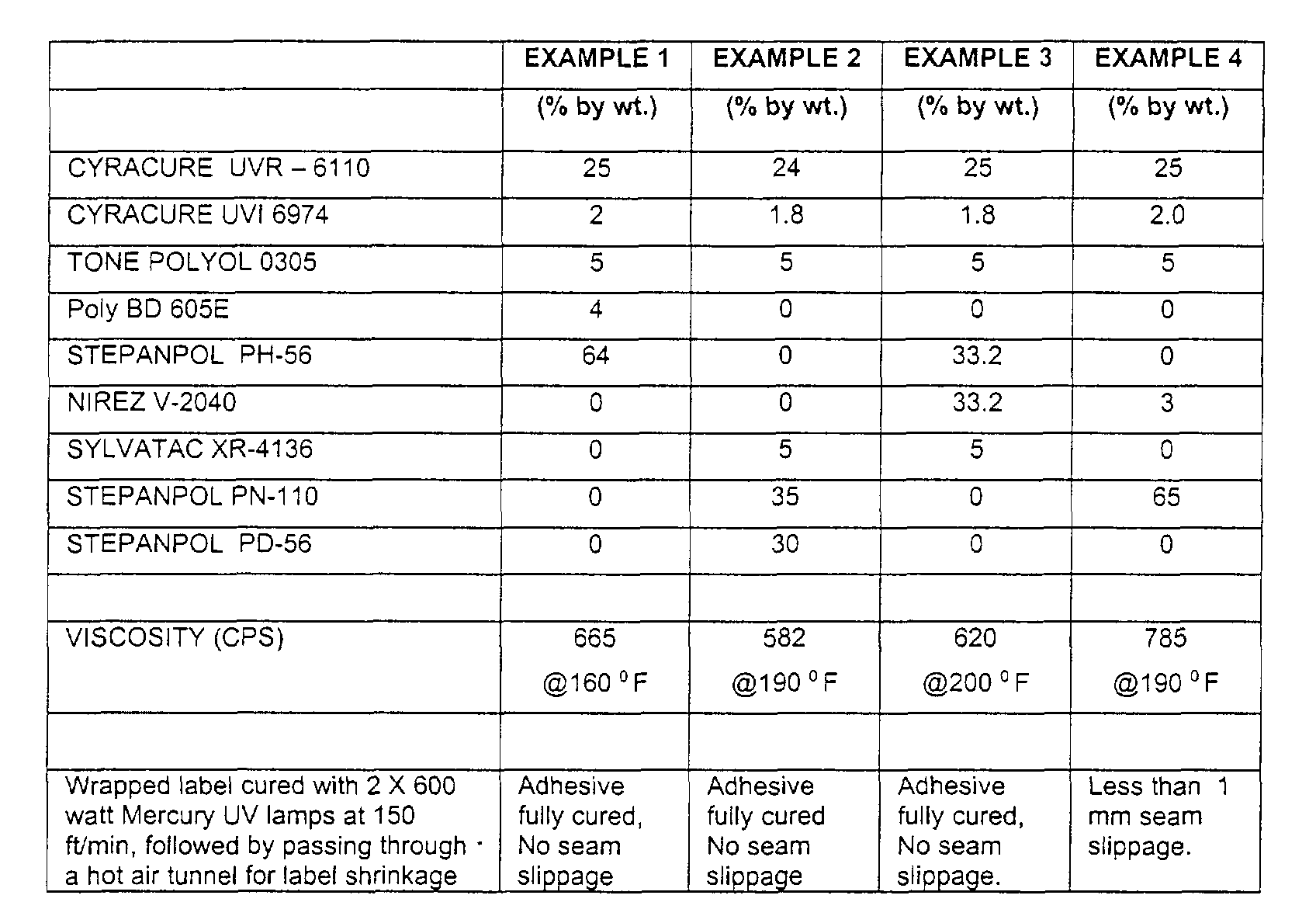
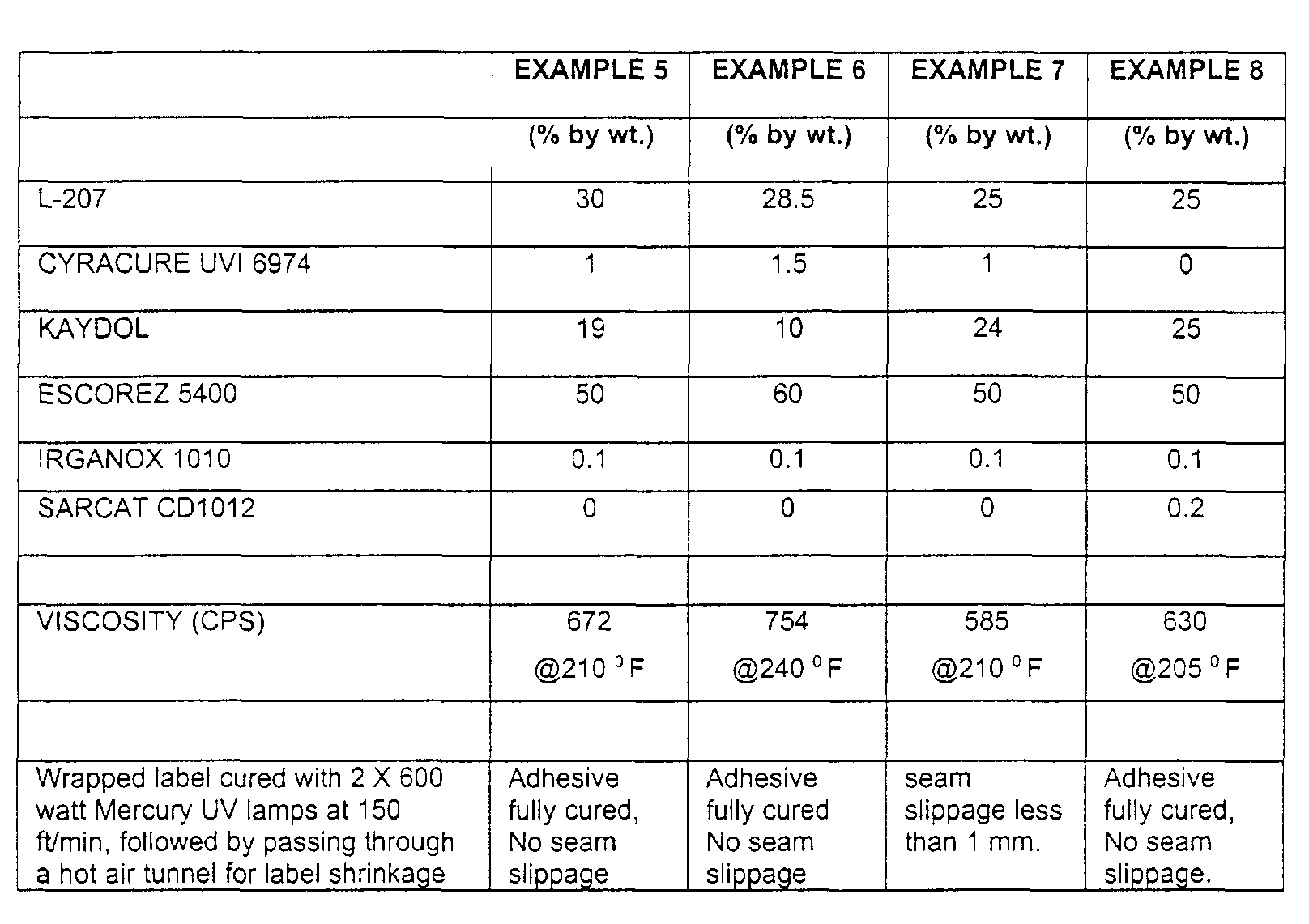
- In the examples, the commercial components are identified as follows:
- CYRACURE UVR-6110 is a UV curable cycloaliphatic epoxide available from UNION CARBIDE.
- CYRACURE UVI 6974 is cationic photoinitiator available from UNION CARBIDE.
- TONE POLYOL 0305 is a polyester polyol available from UNION CARBIDE.
- STEPANPOL PH-56 is a polyester diol available from STEPAN.
- STEPANPOL PN-110 is a polyester diol available from STEPAN.
- STEPANPOL PD-200 is a polyester diol available from STEPAN.
- STEPANPOL PD-110 LV is a polyester diol available from STEPAN.
- STEPANPOL PD-56 is a polyester diol available from STEPAN.
- PLASTHALL BH-1 is a polyester diol available from C.P HALL.
- SYLVATAC XR-4136 is a wood rosin available from ARIZONA CHEMICAL.
- NIREZ V-2040 is a terpene tackifier available from ARIZONA CHEMICAL.
- POLY BD 605E is a epoxidized polybutadiene available from ELF ATOCHEM.
- L-207 is a hetero-telechelic polymer consisting of a primary hydroxyl functionality on one end of the polymer and epoxidized isoprene functionality on the other end. It has a hydroxyl equivalent weight of 6,600 and an epoxy equivalent weight of 590 and is available from SHELL CHEMICAL COMPANY.
- ESCOREZ 5400 is a hydrogenated DCPD (dicyclopentadiene) resin having a softening point of 100 °C and is available from EXXON.
- KAYDOL is a naphthenic mineral oil and is available from WITCO.
- REGALITE R-10 is a C5 liquid tackifier with a softening point of 10 °C and is available from HERCULES.
- SARCAT CD1012 is a diaryl iodonium hexafluoroantimonate used as a cationic photoinitiator and is available from SARTOMER.
- CYRACURE UV16974 is a tri-aryl hexfluoro antimonate cationic photoinitiator and is available from UNION CARBIDE.
- IRGANOX 1010 is a hindered phenol anti-oxidant available from CIBA-GEIGY.
-
- All of the above examples show the superior adhesion, heat and shrink resistant properties of the adhesives described herein
Claims (17)
- A thermally shrinkable film or label having coated thereon a radiation curable adhesive composition.
- The thermally shrinkable film or label according to claim 1 wherein the radiation curable adhesive is coated beneath a transparent section of the thermally shrinkable film or label.
- The thermally shrinkable film or label according to claim 1 wherein the radiation curable adhesive has a viscosity at its application temperature of less than about 2,000 cps.
- The thermally shrinkable film or label according to claim 1 wherein the radiation curable adhesive has a viscosity at its application temperature of less than about 1,000 cps.
- The thermally shrinkable film or label according to claim 1 wherein the radiation curable adhesive composition comprises:(a) from about 5 percent by weight to about 60 percent by weight of at least one epoxidized block copolymer;(b) from about 20 percent by weight to about 85 percent by weight of at least one solid-hydrogenated tackifier;(c) about 0.02 percent by weight to about 5 percent by weight of at least one cationic photoinitiator;(d) about 0 percent by weight to about 40 percent by weight of at least one mineral oil;(e) about 0 percent by weight to about 40 percent by weight of at least one liquid tackifier; and(f) about 0 percent by weight to about 3 percent by weight of an antioxidant.
- The thermally shrinkable film or label according to claim 1 wherein the radiation curable adhesive composition comprises:(a) from about 20 percent by weight to about 40 percent by weight of at least one epoxidized block copolymer;(b) from about 50 percent by weight to about 70 percent by weight of at least one solid-hydrogenated tackifier;(c) about 0.2 percent by weight to about 2 percent by weight of at least one cationic photoinitiator;(d) about 0 percent by weight to about 25 percent by weight of at least one mineral oil; and(e) about 0 percent by weight to about 1.5 percent by weight of at least one hindered phenol antioxidant.
- The thermally shrinkable film or label according to claim 1 wherein the radiation curable adhesive composition comprises:(a) from about 10% by weight to about 50% by weight of at least one epoxidized cycloaliphtic base resin;(b) from about 0.1% by weight to about 2.0% by weight of at least one cationic photoinitiator;(c) from about 0% by weight to about 80% by weight of at least one solid or liquid polyester diol; and(d) from about 0% by weight to about 60% by weight of at least one polar tackifier.
- The thermally shrinkable film or label according to claim 1 wherein the radiation curable adhesive comprises:(a) from about 20% by weight to about 30% by weight of at least one epoxidized cycloaliphatic base resin;(b) from about 1.0% by weight to about 2.0% by weight of at least one cationic photoinitiator;(c) from about 60% by weight to about 80% by weight of at least one solid or liquid polyester diol; and(d) from about 0% by weight to about 10% by weight of at least one polar tackifier.
- A process for applying a thermally shrinkable film or label to a container comprising the steps of:(a) coating at least a portion of a thermally shrinkable but unshrunken film or label segment with a radiation curable adhesive;(b) applying the film or label to the longitudinal surface of the container;(c) subjecting the radiation curable adhesive to a radiation source to effect curing thereof; and(d) subjecting the container to heat to shrink the film or label onto the container so as to permanently affix it thereto
- The process according to claim 9, wherein the radiation curable adhesive has a viscosity at its application temperature of less than about 2,000 cps.
- The process according to claim 9, wherein the radiation curable adhesive has a viscosity at its application temperature of less than about 1,000 cps.
- The process according to claim 9 wherein the radiation curable adhesive comprises:(a) from about 5 percent by weight to about 60 percent by weight of at least one epoxidized block copolymer;(b) from about 20 percent by weight to about 85 percent by weight of at least one solid-hydrogenated tackifier;(c) about 0.02 percent by weight to about 5 percent by weight of at least one cationic photoinitiator;(d) about 0 percent by weight to about 40 percent by weight of at least one mineral oil;(e) about 0 percent by weight to about 40 percent by weight of at least one liquid tackifier; and(f) about 0 percent by weight to about 3 percent by weight of an antioxidant.
- The process according to claim 9 wherein the radiation curable adhesive composition comprises:(a) from about 20 percent by weight to about 40 percent by weight of at least one epoxidized block copolymer;(b) from about 50 percent by weight to about 70 percent by weight of at least one solid-hydrogenated tackifier;(c) about 0.2 percent by weight to about 2 percent by weight of at least one cationic photoinitiator;(d) about 0 percent by weight to about 25 percent by weight of at least one mineral oil; and(e) about 0 percent by weight to about 1.5 percent by weight of at least one hindered phenol antioxidant.
- The process according to claim 9 wherein the radiation curable adhesive composition comprises:(a) from about 10% by weight to about 50% by weight of at least one epoxidized cycloaliphatic base resin;(b) from about 0.1% by weight to about 2.0% by weight of at least one cationic photoinitiator;(c) from about 0% by weight to about 80% by weight of at least one solid or liquid polyester diol; and(d) from about 0% by weight to about 60% by weight of at least one polar tackifier.
- The process according to claim 9 wherein the radiation curable adhesive composition comprises:(a) from about 20% by weight to about 30% by weight of at least one epoxidized cycloaliphatic base resin;(b) from about 1.0% by weight to about 2.0% by weight of at least one cationic photoinitiator;(c) from about 60% by weight to about 80% by weight of at least one solid or liquid polyester diol; and(d) from about 0% by weight to about 10% by weight of at least one polar tackifier.
- The process according to claim 9 wherein the radiation curable adhesive is applied to a narrow longitudinal region of the container or of the leading end of the film segment to secure the leading end of the film to the container, the film wrapped around the container and the film segment secured to the container by overlapping the trailing end, a narrow region of which has been coated with the radiation curable adhesive.
- A film or label having a radiation curable adhesive coated beneath a transparent section of the film or label.
Applications Claiming Priority (2)
| Application Number | Priority Date | Filing Date | Title |
|---|---|---|---|
| US515881 | 2000-02-29 | ||
| US09/515,881 US6649259B1 (en) | 2000-02-29 | 2000-02-29 | Adhesives for thermally shrinkable films or labels |
Publications (2)
| Publication Number | Publication Date |
|---|---|
| EP1130070A2 true EP1130070A2 (en) | 2001-09-05 |
| EP1130070A3 EP1130070A3 (en) | 2002-08-07 |
Family
ID=24053157
Family Applications (1)
| Application Number | Title | Priority Date | Filing Date |
|---|---|---|---|
| EP01104414A Withdrawn EP1130070A3 (en) | 2000-02-29 | 2001-02-26 | Adhesives for thermally shrinkable films or labels |
Country Status (4)
| Country | Link |
|---|---|
| US (1) | US6649259B1 (en) |
| EP (1) | EP1130070A3 (en) |
| JP (1) | JP2001343895A (en) |
| CA (1) | CA2338874A1 (en) |
Cited By (17)
| Publication number | Priority date | Publication date | Assignee | Title |
|---|---|---|---|---|
| WO2005080518A1 (en) * | 2004-02-18 | 2005-09-01 | Eastman Chemical Company | Radiation-curable adhesive compositions |
| DE102005006282A1 (en) * | 2005-02-10 | 2006-08-24 | Henkel Kgaa | Radiation-crosslinkable hot melt pressure sensitive adhesives |
| EP1634817A3 (en) * | 2004-09-08 | 2006-09-13 | Krones Aktiengesellschaft | Item with a labelled surface and device for labelling an item |
| US7262242B2 (en) | 2004-02-18 | 2007-08-28 | Eastman Chemical Company | Aromatic/acrylate tackifier resin and acrylic polymer blends |
| US7332540B2 (en) | 2004-02-18 | 2008-02-19 | Eastman Chemical Company | Aromatic-acrylate tackifier resins |
| DE102007015801A1 (en) | 2007-03-30 | 2008-10-02 | Henkel Ag & Co. Kgaa | Radiation-crosslinking hotmelt adhesive |
| EP2394918A1 (en) | 2010-06-08 | 2011-12-14 | Henkel AG & Co. KGaA | Method for bonding UV-hardening adhesives |
| WO2015153612A1 (en) * | 2014-03-31 | 2015-10-08 | Avery Dennison Corporation | Printable adhesive and label assembly |
| JP2016074814A (en) * | 2014-10-06 | 2016-05-12 | Dic株式会社 | Double-sided pressure-sensitive adhesive tape, method for producing double-sided pressure-sensitive adhesive tape, adhesion method, and separation method |
| US9441084B2 (en) | 2013-03-13 | 2016-09-13 | Poly6 Techniques | One-pot, high-performance recycling method for polymer waste achieved through renewable polymer synthesis |
| US9827739B2 (en) | 2012-07-26 | 2017-11-28 | 3M Innovative Properties Company | Heat de-bondable optical articles |
| US10144840B2 (en) | 2013-03-13 | 2018-12-04 | Poly6 Technologies | One-pot, high-performance recycling of polymer waste using renewable polymer synthesis |
| US10414953B2 (en) | 2016-02-19 | 2019-09-17 | Avery Dennison Corporation | Two stage methods for processing adhesives and related compositions |
| US10471681B2 (en) | 2012-07-26 | 2019-11-12 | 3M Innovative Properties Company | Heat de-bondable adhesive articles |
| US10640595B2 (en) | 2016-10-25 | 2020-05-05 | Avery Dennison Corporation | Controlled architecture polymerization with photoinitiator groups in backbone |
| US10745503B2 (en) | 2017-08-18 | 2020-08-18 | Fina Technology, Inc. | Epoxidized polyfarnesene and methods for producing the same |
| US12163069B2 (en) | 2017-12-19 | 2024-12-10 | Avery Dennison Corporation | Post-polymerization functionalization of pendant functional groups |
Families Citing this family (27)
| Publication number | Priority date | Publication date | Assignee | Title |
|---|---|---|---|---|
| AU2001257298A1 (en) * | 2000-04-27 | 2001-11-07 | Kraton Polymers Research B.V. | Non-aqueous solvent-free process for making uv curable adhesives and sealants from epoxidized monohydroxylated diene polymers |
| JP2002069269A (en) * | 2000-08-29 | 2002-03-08 | Dainippon Ink & Chem Inc | UV curable composition and optical disk |
| US20020161464A1 (en) * | 2001-04-13 | 2002-10-31 | Pepsico, Inc. | Method and apparatus for creating personalized labels |
| US6803081B2 (en) * | 2001-06-26 | 2004-10-12 | National Starch And Chemical Investment Holding Corporation | Radiation curable adhesive |
| CN1678639A (en) * | 2002-07-24 | 2005-10-05 | 粘合剂研究公司 | Convertible pressure sensitive adhesive tape and its use on display screens |
| JP2004279470A (en) * | 2003-03-12 | 2004-10-07 | Osaka Sealing Printing Co Ltd | Mounting label |
| DE102004047595A1 (en) * | 2004-09-30 | 2006-04-13 | Krones Ag | Method and device for equipping vessels |
| JP2009503200A (en) * | 2005-07-28 | 2009-01-29 | ダウ グローバル テクノロジーズ インコーポレイティド | Biaxially oriented polystyrene film with small rubber particles and low rubber particle gel content |
| ATE468375T1 (en) * | 2005-09-09 | 2010-06-15 | Avery Dennison Corp | HEAT SHRINKABLE FILM WITH METHACRYLATE RESIN-BASED CURRENT ADHESIVE |
| US7858332B2 (en) | 2006-01-27 | 2010-12-28 | The Brigham And Women's Hospital, Inc. | Chemoprevention of endometrial cancer |
| US7696260B2 (en) * | 2006-03-30 | 2010-04-13 | Dsm Ip Assets B.V. | Cationic compositions and methods of making and using the same |
| JP4933835B2 (en) * | 2006-05-18 | 2012-05-16 | 浅井物産株式会社 | Method for manufacturing article with film |
| GB2439728B (en) * | 2006-07-03 | 2010-07-21 | Fuji Seal Int Inc | Heat-shrinkable film |
| ATE529465T1 (en) * | 2006-07-27 | 2011-11-15 | Dow Global Technologies Llc | SHRINK LABELS MADE OF ORIENTED POLYSTYRENE FILM WITH SMALL RUBBER PARTICLES AND LOW RUBBER PARTICLE GEL CONTENT AND BLOCK COPOLYMERS |
| JP2008145498A (en) * | 2006-12-06 | 2008-06-26 | Dainippon Printing Co Ltd | Roll shrink label, container with roll shrink label, and production method thereof |
| US8282754B2 (en) | 2007-04-05 | 2012-10-09 | Avery Dennison Corporation | Pressure sensitive shrink label |
| US8535464B2 (en) | 2007-04-05 | 2013-09-17 | Avery Dennison Corporation | Pressure sensitive shrink label |
| WO2009045737A1 (en) | 2007-10-02 | 2009-04-09 | Dow Global Technologies Inc. | Multilayer coextruded shrink labels of oriented polystyrene film containing small rubber particles and low rubber particle gel content and block copolymers |
| US20090146336A1 (en) * | 2007-10-02 | 2009-06-11 | R Tape Corporation | Process for making shrink films with embossed optical or holographic devices |
| FR2937042B1 (en) * | 2008-10-14 | 2013-03-15 | Centre Nat Rech Scient | PHOTORETICULABLE ANTIFOULING COMPOSITIONS, FILMS OBTAINED THEREFROM AND CORRESPONDING USES THEREOF |
| JP5498832B2 (en) * | 2009-03-25 | 2014-05-21 | 電気化学工業株式会社 | Energy ray curable resin composition, adhesive and cured product using the same |
| BR122014017821A2 (en) | 2010-01-28 | 2019-07-09 | Avery Dennison Corporation | SYSTEM FOR APPLICATION OF LABELS IN ARTICLES |
| HUE073469T2 (en) | 2012-05-09 | 2026-01-28 | Dexerials Corp | Method of manufacturing image display apparatus |
| TWI557177B (en) | 2015-12-16 | 2016-11-11 | 財團法人工業技術研究院 | Low dielectric constant and solventless resin composition and substrate structure |
| EP3605506B1 (en) * | 2017-03-24 | 2023-08-16 | Toyobo Co., Ltd. | Heat-shrinkable label, packaging body, and manufacturing method for heat-shrinkable label |
| WO2020053649A2 (en) | 2018-09-14 | 2020-03-19 | Polysack Flexible Packaging Ltd. | Methods for forming high shrink wrap label sleeves |
| WO2020053651A1 (en) | 2018-09-14 | 2020-03-19 | Polysack Flexible Packaging Ltd. | Shrink wrap labels for shaped articles |
Citations (1)
| Publication number | Priority date | Publication date | Assignee | Title |
|---|---|---|---|---|
| WO2001055276A1 (en) | 2000-01-31 | 2001-08-02 | H.B. Fuller Licensing & Financing, Inc. | Radiation curable adhesive compositions comprising block copolymers having vinyl functionalized polydiene blocks |
Family Cites Families (35)
| Publication number | Priority date | Publication date | Assignee | Title |
|---|---|---|---|---|
| US3247269A (en) | 1962-01-23 | 1966-04-19 | Columbian Carbon | Methods of producing cyclic polyolefins |
| US3239478A (en) | 1963-06-26 | 1966-03-08 | Shell Oil Co | Block copolymer adhesive compositions and articles prepared therefrom |
| US3765991A (en) | 1970-01-23 | 1973-10-16 | B & J Mfg Co | Labeling apparatus |
| US3834963A (en) | 1970-01-23 | 1974-09-10 | B & J Mfg Co | Method for applying labels to containers |
| US3753936A (en) | 1970-02-18 | 1973-08-21 | Phillips Petroleum Co | Branched rubbery block copolymer adhesive |
| US3700633A (en) | 1971-05-05 | 1972-10-24 | Shell Oil Co | Selectively hydrogenated block copolymers |
| US3822459A (en) | 1971-12-20 | 1974-07-09 | Owens Illinois Inc | Machine for producing a plastic-covered glass container |
| US4108710A (en) | 1972-02-14 | 1978-08-22 | B & H Manufacturing Company, Inc. | Apparatus for applying labels to containers |
| US3932327A (en) | 1973-02-05 | 1976-01-13 | Phillips Petroleum Company | Adhesive compositions |
| JPS5893765A (en) * | 1981-11-30 | 1983-06-03 | Toobi:Kk | Ultraviolet-curable adhesive and ultraviolet-curable label |
| US4844957A (en) | 1982-05-27 | 1989-07-04 | B & H Manufacturing Company, Inc. | System for applying heat shrink film to containers and other articles and heat shrinking the same |
| US4704173A (en) | 1982-05-27 | 1987-11-03 | Wolfgang Hoffman | System for applying heat shrink film to containers and other articles and heat shrinking the same |
| CA1243146A (en) | 1983-02-07 | 1988-10-11 | Joseph V. Koleske | Photocopolymerizable compositions based on hydroxyl- containing organic materials and substituted cycloaliphatic monoepoxide reactive diluents |
| JPS6011342A (en) * | 1983-07-01 | 1985-01-21 | Kureha Chem Ind Co Ltd | Heat-resistant laminate and manufacture thereof |
| EP0208261A2 (en) * | 1985-07-12 | 1987-01-14 | CERAMI COLOR Gesellschaft für Hartfaserbeschichtung m.b.H. | Method and device for coating flat objects |
| US5190609A (en) * | 1991-04-02 | 1993-03-02 | Avery Dennison Corporation | Stable pressure sensitive shrink label technique |
| US5252155A (en) * | 1992-03-10 | 1993-10-12 | National Starch And Chemical Investment Holding Corporation | Shrink film labeling with polyurethane hot melts |
| US5639529A (en) * | 1993-02-02 | 1997-06-17 | Moore Business Forms, Inc. | Permanent placed, easy removable label, for bottles and cans |
| US5393818A (en) | 1993-04-06 | 1995-02-28 | Shell Oil Company | Solvent-free laminating adhesive composition from epoxidized block polymer |
| CA2115888A1 (en) * | 1993-04-15 | 1994-10-16 | Clayton A. George | Epoxy/polyester hot melt compositions |
| US5544770A (en) * | 1993-05-07 | 1996-08-13 | Travisano; Frank P. | Tamper evident seal and system |
| JPH0762304A (en) * | 1993-08-31 | 1995-03-07 | Sekisui Chem Co Ltd | Adhesive tape manufacturing method |
| JPH0885780A (en) * | 1994-09-16 | 1996-04-02 | Sumitomo Electric Ind Ltd | Heat-resistant adhesive and heat-shrinkable article using the same |
| TW309535B (en) | 1994-10-11 | 1997-07-01 | Shell Int Research | |
| GB9504145D0 (en) * | 1995-03-02 | 1995-04-19 | De La Rue Holographics Ltd | Improvements relating to packaging |
| JP3647924B2 (en) * | 1995-04-28 | 2005-05-18 | 株式会社フジシールインターナショナル | Thermal label for battery exterior |
| US5747192A (en) * | 1995-06-07 | 1998-05-05 | Avery Dennison Corporation | Single ply PSA labels for battery applications |
| US5776998A (en) * | 1995-06-16 | 1998-07-07 | Shell Oil Company | Non-aqueous solvent free process for making UV curable adhesives and sealants from epoxidized monohydroxylated diene polymers |
| US5656360A (en) * | 1996-02-16 | 1997-08-12 | Minnesota Mining And Manufacturing Company | Article with holographic and retroreflective features |
| GB2320615B (en) * | 1996-12-19 | 2001-06-20 | Lintec Corp | Process for producing a chip and pressure sensitive adhesive sheet for said process |
| US6312800B1 (en) * | 1997-02-10 | 2001-11-06 | Lintec Corporation | Pressure sensitive adhesive sheet for producing a chip |
| DE19732169B4 (en) * | 1997-07-25 | 2007-10-11 | Infineon Technologies Ag | Device for DC power supply |
| US6372341B1 (en) * | 1998-04-27 | 2002-04-16 | 3M Innovative Properties Company | Tampa-indicating article for reusable substrates |
| US6181446B1 (en) * | 1998-05-07 | 2001-01-30 | Foilmark, Inc. | Holographic shrink wrap element and method for manufacture thereof |
| US6127024A (en) * | 1998-05-21 | 2000-10-03 | Morgan Adhesives Company | Single ply battery label including varnish with patterned edges |
-
2000
- 2000-02-29 US US09/515,881 patent/US6649259B1/en not_active Expired - Lifetime
-
2001
- 2001-02-26 EP EP01104414A patent/EP1130070A3/en not_active Withdrawn
- 2001-02-27 JP JP2001052700A patent/JP2001343895A/en active Pending
- 2001-02-28 CA CA002338874A patent/CA2338874A1/en not_active Abandoned
Patent Citations (1)
| Publication number | Priority date | Publication date | Assignee | Title |
|---|---|---|---|---|
| WO2001055276A1 (en) | 2000-01-31 | 2001-08-02 | H.B. Fuller Licensing & Financing, Inc. | Radiation curable adhesive compositions comprising block copolymers having vinyl functionalized polydiene blocks |
Cited By (27)
| Publication number | Priority date | Publication date | Assignee | Title |
|---|---|---|---|---|
| US7723466B2 (en) | 2004-02-18 | 2010-05-25 | Eastman Chemical Company | Aromatic-acrylate tackifier resins |
| US7238732B2 (en) | 2004-02-18 | 2007-07-03 | Eastman Chemical Company | Radiation-curable adhesive compositions |
| US7262242B2 (en) | 2004-02-18 | 2007-08-28 | Eastman Chemical Company | Aromatic/acrylate tackifier resin and acrylic polymer blends |
| WO2005080518A1 (en) * | 2004-02-18 | 2005-09-01 | Eastman Chemical Company | Radiation-curable adhesive compositions |
| US7332540B2 (en) | 2004-02-18 | 2008-02-19 | Eastman Chemical Company | Aromatic-acrylate tackifier resins |
| EP1634817A3 (en) * | 2004-09-08 | 2006-09-13 | Krones Aktiengesellschaft | Item with a labelled surface and device for labelling an item |
| AU2006212536B2 (en) * | 2005-02-10 | 2012-04-19 | Henkel Kommanditgesellschaft Auf Aktien | Radiation cross-linkable hot-melt contact adhesives |
| WO2006084537A3 (en) * | 2005-02-10 | 2007-04-26 | Henkel Kgaa | Radiation cross-linkable hot-melt contact adhesives |
| US7682477B2 (en) | 2005-02-10 | 2010-03-23 | Henkel Kommanditgesellschaft Auf Aktien (Henkel Kgaa) | Radiation cross-linkable hot-melt contact adhesives |
| DE102005006282A1 (en) * | 2005-02-10 | 2006-08-24 | Henkel Kgaa | Radiation-crosslinkable hot melt pressure sensitive adhesives |
| DE102007015801A1 (en) | 2007-03-30 | 2008-10-02 | Henkel Ag & Co. Kgaa | Radiation-crosslinking hotmelt adhesive |
| EP2394918A1 (en) | 2010-06-08 | 2011-12-14 | Henkel AG & Co. KGaA | Method for bonding UV-hardening adhesives |
| US9827739B2 (en) | 2012-07-26 | 2017-11-28 | 3M Innovative Properties Company | Heat de-bondable optical articles |
| US10471681B2 (en) | 2012-07-26 | 2019-11-12 | 3M Innovative Properties Company | Heat de-bondable adhesive articles |
| US10144840B2 (en) | 2013-03-13 | 2018-12-04 | Poly6 Technologies | One-pot, high-performance recycling of polymer waste using renewable polymer synthesis |
| US9441084B2 (en) | 2013-03-13 | 2016-09-13 | Poly6 Techniques | One-pot, high-performance recycling method for polymer waste achieved through renewable polymer synthesis |
| CN107109156A (en) * | 2014-03-31 | 2017-08-29 | 艾利丹尼森公司 | Printable adhesive and label assembly |
| AU2015240954B2 (en) * | 2014-03-31 | 2018-06-28 | Avery Dennison Corporation | Printable adhesive and label assembly |
| WO2015153612A1 (en) * | 2014-03-31 | 2015-10-08 | Avery Dennison Corporation | Printable adhesive and label assembly |
| JP2016074814A (en) * | 2014-10-06 | 2016-05-12 | Dic株式会社 | Double-sided pressure-sensitive adhesive tape, method for producing double-sided pressure-sensitive adhesive tape, adhesion method, and separation method |
| US10414953B2 (en) | 2016-02-19 | 2019-09-17 | Avery Dennison Corporation | Two stage methods for processing adhesives and related compositions |
| US11091675B2 (en) | 2016-02-19 | 2021-08-17 | Avery Dennison Corporation | Two stage methods for processing adhesives and related compositions |
| US11312884B2 (en) | 2016-02-19 | 2022-04-26 | Avery Dennison Corporation | Two stage methods for processing adhesives and related compositions |
| US12065588B2 (en) | 2016-02-19 | 2024-08-20 | Avery Dennison Corporation | Two stage methods for processing adhesives and related compositions |
| US10640595B2 (en) | 2016-10-25 | 2020-05-05 | Avery Dennison Corporation | Controlled architecture polymerization with photoinitiator groups in backbone |
| US10745503B2 (en) | 2017-08-18 | 2020-08-18 | Fina Technology, Inc. | Epoxidized polyfarnesene and methods for producing the same |
| US12163069B2 (en) | 2017-12-19 | 2024-12-10 | Avery Dennison Corporation | Post-polymerization functionalization of pendant functional groups |
Also Published As
| Publication number | Publication date |
|---|---|
| US6649259B1 (en) | 2003-11-18 |
| CA2338874A1 (en) | 2001-08-29 |
| EP1130070A3 (en) | 2002-08-07 |
| JP2001343895A (en) | 2001-12-14 |
Similar Documents
| Publication | Publication Date | Title |
|---|---|---|
| US6649259B1 (en) | Adhesives for thermally shrinkable films or labels | |
| JP4435568B2 (en) | Multilayer shrink films and articles encapsulated with them | |
| CA1126688A (en) | Radiation cured adhesive composition | |
| US7156944B2 (en) | Fusible adhesives crosslinkable by radiation | |
| AU2002347921A1 (en) | Multilayered shrink films and articles encapsulated therewith | |
| JP4494775B2 (en) | Radiation curable adhesive | |
| US20090068486A1 (en) | Heat shrink films and articles encapsulated therein | |
| US7682477B2 (en) | Radiation cross-linkable hot-melt contact adhesives | |
| US20210087432A1 (en) | Shrink wrap labels for shaped articles | |
| JP2520145B2 (en) | Ultraviolet-crosslinkable hot melt adhesive composition | |
| JPH10158626A (en) | Hot-melt adhesive composition excellent in resistances to heat and cold | |
| JP2008145498A (en) | Roll shrink label, container with roll shrink label, and production method thereof | |
| CA2667615A1 (en) | Radiation curable adhesive with high molecular weight oligomer | |
| US20210139689A1 (en) | Methods for forming high shrink wrap label sleeves | |
| JP2025514273A (en) | UV-curable acrylic pressure-sensitive adhesive | |
| JPS6229468B2 (en) | ||
| EP1278801B1 (en) | Formulation for strippable adhesive and coating films | |
| KR102604665B1 (en) | UV curable composition and UV curable sheet using the same | |
| Benedek | Principles of pressure-sensitive design and formulation | |
| US20040162371A1 (en) | Formulation for strippable adhesive and coating films | |
| AU2008203362A1 (en) | Radiation curable adhesive | |
| AU2002352190A1 (en) | Radiation Curable Adhesive | |
| HK1071330A (en) | Multilayered shrink films and articles encapsulated therewith |
Legal Events
| Date | Code | Title | Description |
|---|---|---|---|
| PUAI | Public reference made under article 153(3) epc to a published international application that has entered the european phase |
Free format text: ORIGINAL CODE: 0009012 |
|
| AK | Designated contracting states |
Kind code of ref document: A2 Designated state(s): AT BE CH CY DE DK ES FI FR GB GR IE IT LI LU MC NL PT SE TR |
|
| AX | Request for extension of the european patent |
Free format text: AL;LT;LV;MK;RO;SI |
|
| RIC1 | Information provided on ipc code assigned before grant |
Free format text: 7C 09J 7/02 A, 7C 09J 153/00 B, 7G 09F 3/10 B, 7C 09J 161/00 B, 7C 09J 163/08 B, 7C 09J 163/00 B, 7B 65C 9/24 B, 7B 65C 3/06 B |
|
| PUAL | Search report despatched |
Free format text: ORIGINAL CODE: 0009013 |
|
| AK | Designated contracting states |
Kind code of ref document: A3 Designated state(s): AT BE CH CY DE DK ES FI FR GB GR IE IT LI LU MC NL PT SE TR |
|
| AX | Request for extension of the european patent |
Free format text: AL;LT;LV;MK;RO;SI |
|
| 17P | Request for examination filed |
Effective date: 20030206 |
|
| AKX | Designation fees paid |
Designated state(s): AT BE CH CY DE DK ES FI FR GB GR IE IT LI LU MC NL PT SE TR |
|
| 17Q | First examination report despatched |
Effective date: 20030515 |
|
| TPAC | Observations by third parties |
Free format text: ORIGINAL CODE: EPIDOSNTIPA |
|
| STAA | Information on the status of an ep patent application or granted ep patent |
Free format text: STATUS: THE APPLICATION IS DEEMED TO BE WITHDRAWN |
|
| 18D | Application deemed to be withdrawn |
Effective date: 20051203 |