EP1130039A1 - Powder paint binder composition - Google Patents
Powder paint binder composition Download PDFInfo
- Publication number
- EP1130039A1 EP1130039A1 EP00200705A EP00200705A EP1130039A1 EP 1130039 A1 EP1130039 A1 EP 1130039A1 EP 00200705 A EP00200705 A EP 00200705A EP 00200705 A EP00200705 A EP 00200705A EP 1130039 A1 EP1130039 A1 EP 1130039A1
- Authority
- EP
- European Patent Office
- Prior art keywords
- binder composition
- powder paint
- composition according
- crosslinker
- acid
- Prior art date
- Legal status (The legal status is an assumption and is not a legal conclusion. Google has not performed a legal analysis and makes no representation as to the accuracy of the status listed.)
- Withdrawn
Links
Classifications
-
- C—CHEMISTRY; METALLURGY
- C08—ORGANIC MACROMOLECULAR COMPOUNDS; THEIR PREPARATION OR CHEMICAL WORKING-UP; COMPOSITIONS BASED THEREON
- C08G—MACROMOLECULAR COMPOUNDS OBTAINED OTHERWISE THAN BY REACTIONS ONLY INVOLVING UNSATURATED CARBON-TO-CARBON BONDS
- C08G18/00—Polymeric products of isocyanates or isothiocyanates
- C08G18/06—Polymeric products of isocyanates or isothiocyanates with compounds having active hydrogen
- C08G18/28—Polymeric products of isocyanates or isothiocyanates with compounds having active hydrogen characterised by the compounds used containing active hydrogen
- C08G18/40—High-molecular-weight compounds
- C08G18/42—Polycondensates having carboxylic or carbonic ester groups in the main chain
- C08G18/4205—Polycondensates having carboxylic or carbonic ester groups in the main chain containing cyclic groups
- C08G18/4208—Polycondensates having carboxylic or carbonic ester groups in the main chain containing cyclic groups containing aromatic groups
- C08G18/4211—Polycondensates having carboxylic or carbonic ester groups in the main chain containing cyclic groups containing aromatic groups derived from aromatic dicarboxylic acids and dialcohols
-
- C—CHEMISTRY; METALLURGY
- C08—ORGANIC MACROMOLECULAR COMPOUNDS; THEIR PREPARATION OR CHEMICAL WORKING-UP; COMPOSITIONS BASED THEREON
- C08G—MACROMOLECULAR COMPOUNDS OBTAINED OTHERWISE THAN BY REACTIONS ONLY INVOLVING UNSATURATED CARBON-TO-CARBON BONDS
- C08G18/00—Polymeric products of isocyanates or isothiocyanates
- C08G18/06—Polymeric products of isocyanates or isothiocyanates with compounds having active hydrogen
- C08G18/70—Polymeric products of isocyanates or isothiocyanates with compounds having active hydrogen characterised by the isocyanates or isothiocyanates used
- C08G18/72—Polyisocyanates or polyisothiocyanates
- C08G18/73—Polyisocyanates or polyisothiocyanates acyclic
-
- C—CHEMISTRY; METALLURGY
- C08—ORGANIC MACROMOLECULAR COMPOUNDS; THEIR PREPARATION OR CHEMICAL WORKING-UP; COMPOSITIONS BASED THEREON
- C08G—MACROMOLECULAR COMPOUNDS OBTAINED OTHERWISE THAN BY REACTIONS ONLY INVOLVING UNSATURATED CARBON-TO-CARBON BONDS
- C08G18/00—Polymeric products of isocyanates or isothiocyanates
- C08G18/06—Polymeric products of isocyanates or isothiocyanates with compounds having active hydrogen
- C08G18/70—Polymeric products of isocyanates or isothiocyanates with compounds having active hydrogen characterised by the isocyanates or isothiocyanates used
- C08G18/72—Polyisocyanates or polyisothiocyanates
- C08G18/80—Masked polyisocyanates
- C08G18/8061—Masked polyisocyanates masked with compounds having only one group containing active hydrogen
- C08G18/807—Masked polyisocyanates masked with compounds having only one group containing active hydrogen with nitrogen containing compounds
- C08G18/8074—Lactams
-
- C—CHEMISTRY; METALLURGY
- C08—ORGANIC MACROMOLECULAR COMPOUNDS; THEIR PREPARATION OR CHEMICAL WORKING-UP; COMPOSITIONS BASED THEREON
- C08G—MACROMOLECULAR COMPOUNDS OBTAINED OTHERWISE THAN BY REACTIONS ONLY INVOLVING UNSATURATED CARBON-TO-CARBON BONDS
- C08G2150/00—Compositions for coatings
- C08G2150/20—Compositions for powder coatings
Definitions
- the invention relates to a powder paint binder composition which results after curing in an outdoor (super)durable powder coating.
- Thermosetting powder paint compositions for outdoor applications predominantly contain curable polyester resins which are carboxyl- or hydroxyl-functional to ensure a crosslinking reaction.
- Suitable curing agents are for example blocked isocyanates for example caprolactam blocked isophorone diisocyanate in combination with hydroxyl functional polyesters and triglycidylisocyanurate in combination with carboxyl functional polyesters.
- a wide range of polyesters allows a combination of useful properties such as tunable reactivity, color stability, appearance, corrosion resistance and weathering performance.
- the outdoor segment may be subdivided in a durable part (polyesters comprising about 10-30% isophtalic acid units and 70-90% terephtalic acid units) and a superdurable part (fully isophtalic acid based)
- the binder compositions comprising a hydroxyl functional polyester comprising 100 % isophtalic acid units and a blocked isocyanates result in products which are too brittle.
- thermosetting powder paint binder composition according to the invention comprises:
- the aliphatic chain may contain between 0 and 25 % by weight cycloaliphatic groups.Preferably this amount is less than 5 % by weight. More preferably the chain comprises no cycloaliphatic groups.
- the powder paint composition according to the invention yields coatings showing good UV-resistance in combination with a good flexibility and good mechanical properties such as for example the impact resistance.
- the combination of the superior weathering characteristics and good resistance properties is very surprising.
- the characteristics may be achieved after a curing time between for example 1 and 15 minutes at a temperature between for example 135°C and 250°C.
- the groups of the crosslinker which are capable of reacting with hydroxyl groups are isocyanate groups.
- the isocyanate functionality of the crosslinker is preferably equal or higher than 2 and is more preferably between 2 and 6.
- the atoms of the crosslinker having isocyanate units and having an aliphatic chain with more than 6 atoms may be for example carbon atoms, nitrogen atoms, sulfur atoms, oxygen atoms and/or phosphoric atoms.
- the atoms are carbon atoms.
- the amount of carbon atoms in the aliphatic chain between the isocyanate groups of the crosslinker is higher than 6 and may be less than for example 30 carbon atoms.
- the amount of carbon atoms is 8 or higher and more preferably 9 or higher.
- the crosslinker is a blocked crosslinker because the isocyanate in the crosslinker must be protected in order to avoid the crosslinking reaction at room temperature and to provide good storage stability of the coating.
- a suitable blocking agent may be selected ,for example, from the group consisting of caprolactam, imidazol, triazole, benzotriazole, pyrazole, oxime such as for example acetoxyoxime, ethyl acetoacetate, hydroxylamine, imide, N-hydroxyimide, phenol, cyclohexanol and malonic acid ester.
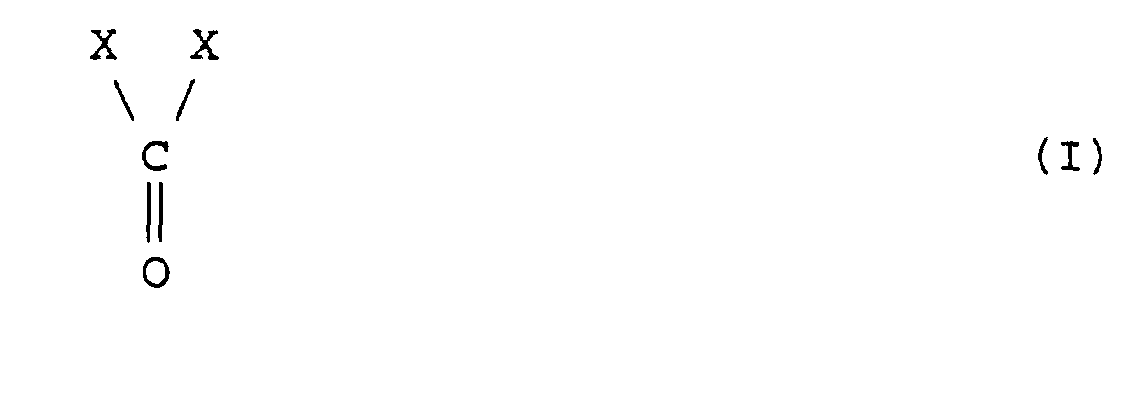
- Suitable aliphatic crosslinkers include for example the isocyanates obtained by phosgenation of amines and for example the reaction products (according to PCT/NL 99/00589) of an amine and a carbonic acid derivative according to the following general formula: where fragments X in the form of XH are a lactam, oxime, imide or triazole.
- Suitable amines include mono-, di-, tri-, polyamines or mixtures of these. Suitable amines include for example diaminebutane, diaminohexane, diaminooctane (DAO), diaminonane, diaminododecane (DA), trisaminononane (TAN), trisaminoethylamine, hydrogenated methylene dianiline, diamino dioxydecane, diamino dioxododecane, bishexamethylene trisamine and Jeffamines.
- Other suitable amines are for example oligomers, as reaction products of two components. Examples of oligomers are the reaction products of a diamine with adipic acid, urea, carbonyl biscaprolactamate (CBC) and with 1 or 2 caprolactam molecules.
- Suitable crosslinkers are for example caprolactam blocked diisocyanates and triisocyanates, for example, 1,12-diisocyanatododecane, 1,8-diisocyanatodooctane, 1,8-diisocyanato(5-isocyanatomethyl)octane, 1,9-diisocyanatononane, 1,10-diisocyanatodecane, 1,11- diisocyanatoundecane trisisocyanate , 1,11- diisocyanato( 3,6,9-trioxy)undecane and/or trisisocyanate.
- the polyester comprises at least 90 mol.% of isophtalic acid units. More preferably the polyester comprises 100 mol.% (with respect to the total amount of acid monomers) isopthalic acid units
- a suitable range for the hydroxy number of the polyester ranges between for example 20 and 150 mg KOH/g resin, the acid number may be lower than 25, and the glass transition temperature ranges between 25 and 100 degrees celcius.
- the molar ratio hydroxyl functional groups of the polymer : isocyanate groups of the crosslinker may range between for example 2:1 and 1:2 and preferably between 1,2 : 1 and 1: 1,5.
- Polyesters are generally based on the residues of aliphatic polyalcohols and polycarboxylic acids.
- the polyester may comprise units of for example terephthalic acid, 2,6-naphthalene dicarboxylic acid and 4,4-oxybisbenzoic acid.
- aromatic cycloaliphatic and/or acyclic polycarboxylic acids useful herein include, for example, 3,6-dichloro phthalic acid, tetrachloro phthalic acid, tetrahydro phthalic acid, hexahydro terephthalic acid, hexachloro endomethylene tetrahydro phthalic acid, phthalic acid, azelaic acid, sebacic acid, decane dicarboxylic acid, adipic acid, succinic acid and maleic acid.
- These other carboxylic acids can be used in amounts of up to for example 25 mol% of the total amount of carboxylic acids. These acids may be used as such, or, in so far as available at their anhydrides, acid chlorides or lower alkyl esters.Small amounts of trifunctional acids for example trimelittic acid may be applied to obtain branched polyesters.
- Hydroxy carboxylic acids and/or optionally lactones can also be used, such as, for example, 12-hydroxy stearic acid, hydroxy pivalic acid and ⁇ -caprolactone.
- Monocarboxylic acids such as, for example, benzoic acid, tert.-butyl benzoic acid, hexahydro benzoic acid and saturated aliphatic monocarboxylic acids, may, if desired, be used in minor amounts.
- trifunctional alcohols may be used in order to obtain branched polyesters.
- usefull polyols are glycerol, hexanetriol, trimethylol ethane, trimethylol propane and tris- (2-hydroxyethyl)-isocyanurate.
- Tetrafunctional monomers generally are not preferred, because these may cause too much branching and gelling, although minute quantities can be used.
- useful polyfunctional alcohols and acids are sorbitol, pentaerithritol and pyromellitic acid.
- trifunctional monomers are preferred.
- polyesters are prepared according to conventional procedures by esterification or transesterification, optionally in the presence of customary esterification catalysts such as, for instance, dibutyltin oxide or tetrabutyl titanate. Preparation conditions and the COOH/OH ratio can be selected so as to obtain end products that have an acid number and/or a hydroxyl number within the targeted range of values.
- esterification catalysts such as, for instance, dibutyltin oxide or tetrabutyl titanate.
- thermosetting powder coatings in general and the chemical reactions for curing powder paints to form cured coatings are described by Misev in Powder Coatings, Chemistry and Technology (1991, John Wiley) on pp. 42-54, p. 148 and pp. 224-226.
- the isocyanate / hydroxyl curing reaction is described at pages 56-68.
- a thermosetting powder paint binder composition is generally defined as the resinous part of the powder paint consisting of polymer and crosslinker.
- the usual additives can be used in the binder composition and in the powder paint system according to the invention, such as for example pigments, fillers, degassing agents, flow agents and stabilizers.
- Suitable pigments are for example inorganic pigments, such as for example titanium dioxide, zinc sulphide, iron oxide and chromium oxide, and also organic pigments such as for example azo compounds.
- Suitable fillers are for example metal oxides, silicates, carbonates and sulphates.
- UV stabilizers such as quinones, (sterically hindered) phenolic compounds, phosphonites, phosphites, thioethers and HALS compounds (hindered amine light stabilizers) can for example be used as stabilizers.
- degassing agents examples include benzoin and cyclohexane dimethanol bisbenzoate.
- the flow agents include for example polyalkylacrylates, fluorohydrocarbons and silicone fluids.
- Other suitable additives are for example additives for improving tribocharging, such as sterically hindered tertiary amines that are described in EP-B-371528.
- Powder paints according to the invention can be applied in the usual manner, for example by electrostatically spraying the powder onto an earthed substrate and curing the coating by exposing it to heat at a suitable temperature for a sufficient length of time.
- the applied powder can for example be heated in a gas oven, an electric oven or with the aid of infrared radiation.
- Thermosetting powder paint compositions intended for industrial applications are described in a general sense in Powder Coatings, Chemistry and Technology, Misev, pages 141-173 (1991).
- compositions according to the present invention can be used in powder paints for use on, for example, metal, wooden and plastic substrates.
- the coatings are also suitable for use in the automotive industry for coating parts and accessories.
- the type of monomers to be used to prepare the polyester, the crosslinkers and the curing conditions can be chosen to depend on the desired use.
- the systems according to the invention can be used in pigmented an in unpigmented compositions.
- the usual additives such as pigments, fillers, stabilizers, dispersing agents, flow-promoting agents and defoaming agents can be added to the binder system according to the invention.
- a polyester resin comprising 100% isophtalic acid units and an acid value of 45 Uralac P1550TM of DSM Resins
- the crosslinker according to experiment 1 flow aid (Resiflow PV 5)
- titanium dioxide (Kronos 2160) and benzoin were mixed in an extruder at 100°C.
- the extrudate was cooled, ground and sieved, and the sieve fraction smaller than 90 micrometers was used as powder coating.
- the powder coating was sprayed electrostatically onto aluminium panels. The panels sprayed with powder coating were cured in a furnace at 150°C for 30 minutes.
- Example 1 was repeated with the exception that the crosslinker was replaced by Vestagon B1530TM being isophoron diisocyanate blocked with caprolactam.
Landscapes
- Chemical & Material Sciences (AREA)
- Health & Medical Sciences (AREA)
- Chemical Kinetics & Catalysis (AREA)
- Medicinal Chemistry (AREA)
- Polymers & Plastics (AREA)
- Organic Chemistry (AREA)
- Paints Or Removers (AREA)
- Polyurethanes Or Polyureas (AREA)
Abstract
The invention is directed to a
thermosetting powder paint binder composition
comprising:
The polyester may comprise 100 mol% of
isophtalic acid units.
The powder coatings show an improved
combination of weathering characteristics and
mechanical properties.
Description
- The invention relates to a powder paint binder composition which results after curing in an outdoor (super)durable powder coating.
- Thermosetting powder paint compositions for outdoor applications predominantly contain curable polyester resins which are carboxyl- or hydroxyl-functional to ensure a crosslinking reaction. Suitable curing agents are for example blocked isocyanates for example caprolactam blocked isophorone diisocyanate in combination with hydroxyl functional polyesters and triglycidylisocyanurate in combination with carboxyl functional polyesters. A wide range of polyesters allows a combination of useful properties such as tunable reactivity, color stability, appearance, corrosion resistance and weathering performance. The outdoor segment may be subdivided in a durable part (polyesters comprising about 10-30% isophtalic acid units and 70-90% terephtalic acid units) and a superdurable part (fully isophtalic acid based)
- However, a further improvement of the powder paint compositions having good weathering characteristics is necessary because the binder compositions comprising a hydroxyl functional polyester comprising 100 % isophtalic acid units and a blocked isocyanates result in products which are too brittle.
- It is the object of the present invention to provide a powder paint (binder) composition which results after curing in a powder coating having an excellent combination of weathering performance, flexibility, impact resistance and flow properties.
- The thermosetting powder paint binder composition according to the invention comprises:
- a) a polyester comprising at least 75 mol% of the acid monomers of isophtalic acid units and
- b) a crosslinker containing groups capable of reacting with hydroxyl groups and having a lineair aliphatic chain with more than 6 atoms.
-
- The aliphatic chain may contain between 0 and 25 % by weight cycloaliphatic groups.Preferably this amount is less than 5 % by weight. More preferably the chain comprises no cycloaliphatic groups.
- The powder paint composition according to the invention yields coatings showing good UV-resistance in combination with a good flexibility and good mechanical properties such as for example the impact resistance. The combination of the superior weathering characteristics and good resistance properties is very surprising.
- The characteristics may be achieved after a curing time between for example 1 and 15 minutes at a temperature between for example 135°C and 250°C.
- Preferably, the groups of the crosslinker which are capable of reacting with hydroxyl groups are isocyanate groups.
- The isocyanate functionality of the crosslinker is preferably equal or higher than 2 and is more preferably between 2 and 6.
- The atoms of the crosslinker having isocyanate units and having an aliphatic chain with more than 6 atoms may be for example carbon atoms, nitrogen atoms, sulfur atoms, oxygen atoms and/or phosphoric atoms.
- Preferably the atoms are carbon atoms.
- The amount of carbon atoms in the aliphatic chain between the isocyanate groups of the crosslinker is higher than 6 and may be less than for example 30 carbon atoms.Preferably the amount of carbon atoms is 8 or higher and more preferably 9 or higher.
- Preferably the crosslinker is a blocked crosslinker because the isocyanate in the crosslinker must be protected in order to avoid the crosslinking reaction at room temperature and to provide good storage stability of the coating. A suitable blocking agent may be selected ,for example, from the group consisting of caprolactam, imidazol, triazole, benzotriazole, pyrazole, oxime such as for example acetoxyoxime, ethyl acetoacetate, hydroxylamine, imide, N-hydroxyimide, phenol, cyclohexanol and malonic acid ester.
- Suitable aliphatic crosslinkers include for example the isocyanates obtained by phosgenation of amines and for example the reaction products (according to PCT/NL 99/00589) of an amine and a carbonic acid derivative according to the following general formula:where fragments X in the form of XH are a lactam, oxime, imide or triazole.
- Suitable amines include mono-, di-, tri-, polyamines or mixtures of these. Suitable amines include for example diaminebutane, diaminohexane, diaminooctane (DAO), diaminonane, diaminododecane (DA), trisaminononane (TAN), trisaminoethylamine, hydrogenated methylene dianiline, diamino dioxydecane, diamino dioxododecane, bishexamethylene trisamine and Jeffamines. Other suitable amines are for example oligomers, as reaction products of two components. Examples of oligomers are the reaction products of a diamine with adipic acid, urea, carbonyl biscaprolactamate (CBC) and with 1 or 2 caprolactam molecules.
- Suitable crosslinkers are for example caprolactam blocked diisocyanates and triisocyanates, for example, 1,12-diisocyanatododecane, 1,8-diisocyanatodooctane, 1,8-diisocyanato(5-isocyanatomethyl)octane, 1,9-diisocyanatononane, 1,10-diisocyanatodecane, 1,11- diisocyanatoundecane trisisocyanate , 1,11- diisocyanato( 3,6,9-trioxy)undecane and/or trisisocyanate.
- Preferably the polyester comprises at least 90 mol.% of isophtalic acid units. More preferably the polyester comprises 100 mol.% (with respect to the total amount of acid monomers) isopthalic acid units
- A suitable range for the hydroxy number of the polyester ranges between for example 20 and 150 mg KOH/g resin, the acid number may be lower than 25, and the glass transition temperature ranges between 25 and 100 degrees celcius. The molar ratio hydroxyl functional groups of the polymer : isocyanate groups of the crosslinker may range between for example 2:1 and 1:2 and preferably between 1,2 : 1 and 1: 1,5.
- Polyesters are generally based on the residues of aliphatic polyalcohols and polycarboxylic acids.
- In case the acid units are not 100% isophtalic acid units the polyester may comprise units of for example terephthalic acid, 2,6-naphthalene dicarboxylic acid and 4,4-oxybisbenzoic acid.
- Other suitable aromatic cycloaliphatic and/or acyclic polycarboxylic acids useful herein include, for example, 3,6-dichloro phthalic acid, tetrachloro phthalic acid, tetrahydro phthalic acid, hexahydro terephthalic acid, hexachloro endomethylene tetrahydro phthalic acid, phthalic acid, azelaic acid, sebacic acid, decane dicarboxylic acid, adipic acid, succinic acid and maleic acid. These other carboxylic acids can be used in amounts of up to for example 25 mol% of the total amount of carboxylic acids. These acids may be used as such, or, in so far as available at their anhydrides, acid chlorides or lower alkyl esters.Small amounts of trifunctional acids for example trimelittic acid may be applied to obtain branched polyesters.
- Hydroxy carboxylic acids and/or optionally lactones can also be used, such as, for example, 12-hydroxy stearic acid, hydroxy pivalic acid and ε-caprolactone. Monocarboxylic acids, such as, for example, benzoic acid, tert.-butyl benzoic acid, hexahydro benzoic acid and saturated aliphatic monocarboxylic acids, may, if desired, be used in minor amounts.
- Useful polyalcohols, in particular diols, reactable with the carboxylic acids to obtain the polyester include aliphatic diols such as, for example, ethylene glycol, propane-1,2-diol, propane-1,3-diol, butane-1,2-diol, butane-1,4-diol, butane-1,3-diol, 2,2-dimethylpropanediol-1,3 (= neopentyl glycol), hexane-2,5-diol, hexane-1,6-diol, 2,2-bis-(4-hydroxy-cyclohexyl)-propane (hydrogenated bisphenol-A), 1,4-dimethylolcyclohexane, diethylene glycol, dipropylene glycol, 2,2-bis[4-(2-hydroxy ethoxy)-phenyl] propane, the hydroxy pivalic ester of neopentyl glycol, butyethylpropane diol and ethylmethylpropane diol.
- Small amounts, such as less than for example about 20 wt.% and preferably less than 15 wt.%, of trifunctional alcohols may be used in order to obtain branched polyesters. Examples of usefull polyols are glycerol, hexanetriol, trimethylol ethane, trimethylol propane and tris- (2-hydroxyethyl)-isocyanurate.
- Tetrafunctional monomers generally are not preferred, because these may cause too much branching and gelling, although minute quantities can be used. Examples of useful polyfunctional alcohols and acids are sorbitol, pentaerithritol and pyromellitic acid. However, in order to synthesise branched polyesters, trifunctional monomers are preferred.
- The polyesters are prepared according to conventional procedures by esterification or transesterification, optionally in the presence of customary esterification catalysts such as, for instance, dibutyltin oxide or tetrabutyl titanate. Preparation conditions and the COOH/OH ratio can be selected so as to obtain end products that have an acid number and/or a hydroxyl number within the targeted range of values.
- The preparation of thermosetting powder coatings in general and the chemical reactions for curing powder paints to form cured coatings are described by Misev in Powder Coatings, Chemistry and Technology (1991, John Wiley) on pp. 42-54, p. 148 and pp. 224-226. The isocyanate / hydroxyl curing reaction is described at pages 56-68.A thermosetting powder paint binder composition is generally defined as the resinous part of the powder paint consisting of polymer and crosslinker.
- If so desired, the usual additives can be used in the binder composition and in the powder paint system according to the invention, such as for example pigments, fillers, degassing agents, flow agents and stabilizers. Suitable pigments are for example inorganic pigments, such as for example titanium dioxide, zinc sulphide, iron oxide and chromium oxide, and also organic pigments such as for example azo compounds. Suitable fillers are for example metal oxides, silicates, carbonates and sulphates.
- Primary and/or secondary antioxidants, UV stabilizers such as quinones, (sterically hindered) phenolic compounds, phosphonites, phosphites, thioethers and HALS compounds (hindered amine light stabilizers) can for example be used as stabilizers.
- Examples of degassing agents are benzoin and cyclohexane dimethanol bisbenzoate. The flow agents include for example polyalkylacrylates, fluorohydrocarbons and silicone fluids. Other suitable additives are for example additives for improving tribocharging, such as sterically hindered tertiary amines that are described in EP-B-371528.
- Powder paints according to the invention can be applied in the usual manner, for example by electrostatically spraying the powder onto an earthed substrate and curing the coating by exposing it to heat at a suitable temperature for a sufficient length of time. The applied powder can for example be heated in a gas oven, an electric oven or with the aid of infrared radiation.
- Thermosetting powder paint compositions intended for industrial applications are described in a general sense in Powder Coatings, Chemistry and Technology, Misev, pages 141-173 (1991).
- Compositions according to the present invention can be used in powder paints for use on, for example, metal, wooden and plastic substrates. The coatings are also suitable for use in the automotive industry for coating parts and accessories.
- The type of monomers to be used to prepare the polyester, the crosslinkers and the curing conditions can be chosen to depend on the desired use.
- The systems according to the invention can be used in pigmented an in unpigmented compositions.
- If so desired, the usual additives such as pigments, fillers, stabilizers, dispersing agents, flow-promoting agents and defoaming agents can be added to the binder system according to the invention.
- The invention will be elucidated below on the basis of the following examples.
-
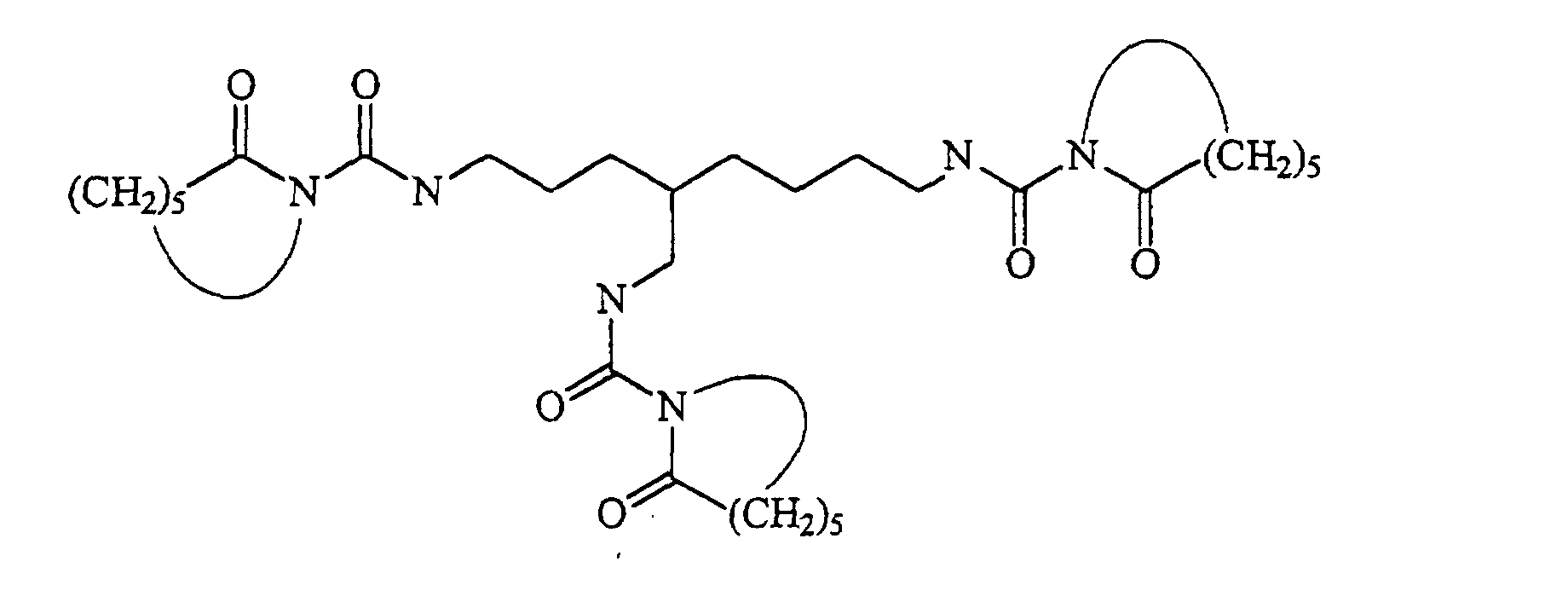
- 302.4 g (1.2 mol) carbonyl-bis-caprolactam was dissolved in 400 ml ethyl acetate at 78°C. In one hour 69.3 g (0.4 mol) triamino nonane, dissolved in 100 ml ethyl acetate, was added dropwise. The reaction was monitored by means of TLC. After 3 hours the clear solution was cooled to room temperature and extracted 4 times with 500 ml water (with some NaCl). The solution was then dried with Na2SO4. The Na2SO4 was removed by filtration and the ethyl acetate was removed by means of the rotavapor. The product was dried at 75°C and in a vacuum. Caprolactam-blocked of 1,8-diisocyanato, 4-(isocyanatomethyl) octane was obtained pure, as a lightly coloured oil (yield = 99%).
- A polyester resin comprising 100% isophtalic acid units and an acid value of 45 ( Uralac P1550™ of DSM Resins), the crosslinker according to experiment 1, flow aid (Resiflow PV 5) , titanium dioxide (Kronos 2160) and benzoin were mixed in an extruder at 100°C. The extrudate was cooled, ground and sieved, and the sieve fraction smaller than 90 micrometers was used as powder coating. The powder coating was sprayed electrostatically onto aluminium panels. The panels sprayed with powder coating were cured in a furnace at 150°C for 30 minutes.
- Example 1 was repeated with the exception that the crosslinker was replaced by Vestagon B1530™ being isophoron diisocyanate blocked with caprolactam.
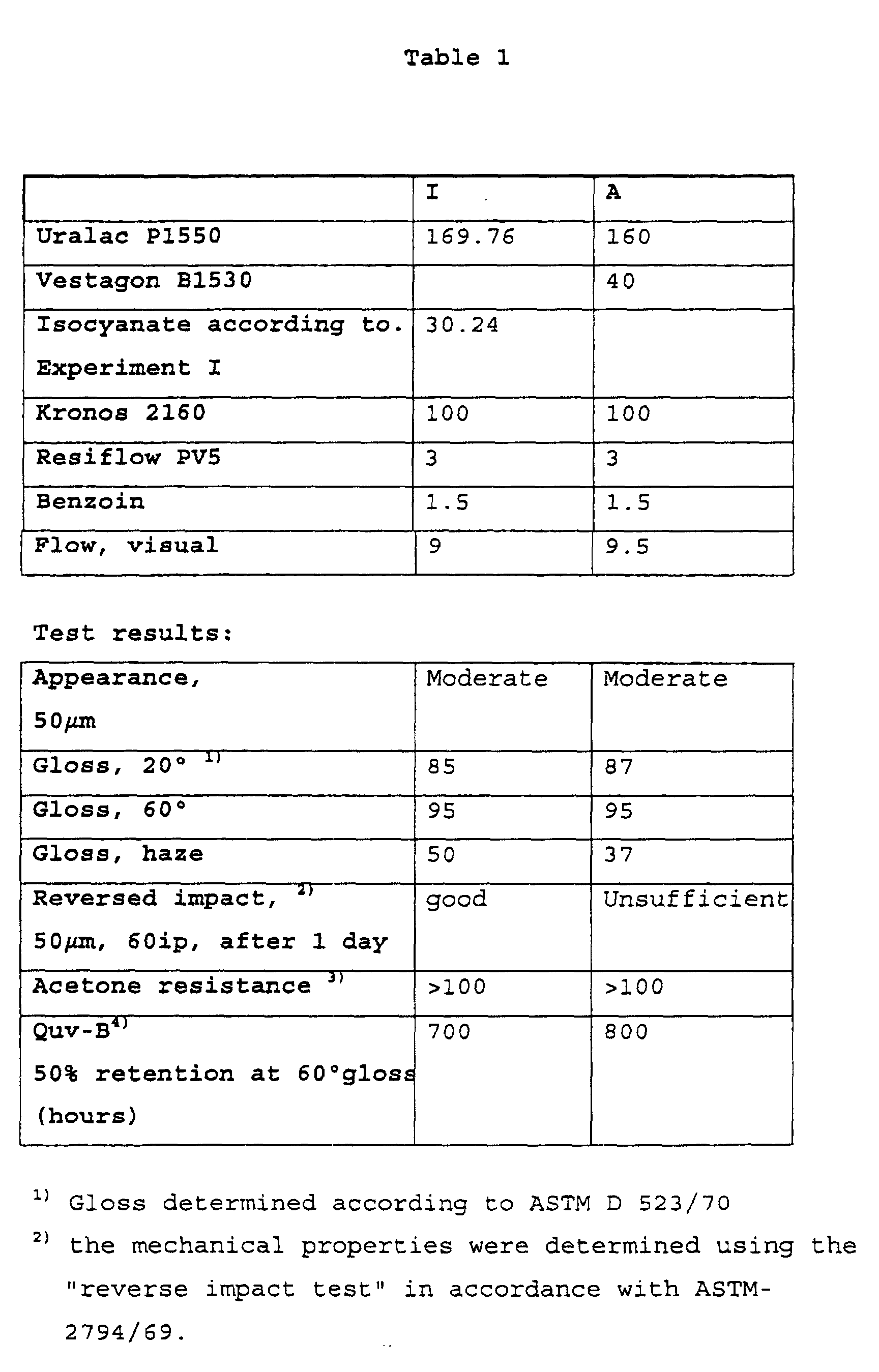

- These experiments show that the binder composition according to the invention results in an improved combination of weathering characteristics and mechanical properties.
Claims (10)
- A thermosetting powder paint binder composition comprising:a) a polyester comprising at least 75 mol% of isophtalic acid units andb)a crosslinker containing groups capable of reacting with hydroxyl groups and having an aliphatic linear chain with more than 6 atoms.
- A thermosetting powder paint binder composition according to Claim 1 characterized in that the crosslinker contains isocyanate groups and the isocyanate functionality is equal or higher than 2.
- A composition according to any one of Claims 1-2 characterised in that the crosslinker has an aliphatic chain with more than 6 carbon atoms.
- A composition according to Claim 3 characterised in that the amount of carbon atoms is between 7 and 30.
- A thermosetting powder paint binder composition according to any one of claims 1-4 characterised in that the the polyester comprises at least 90 mol% of isophtalic acid units.
- A thermosetting powder paint binder composition according to Claim 5 characterised in that the polyester comprises 100 mol% of isophtalic acid units.
- A thermosetting powder paint binder composition according to any one of Claims 1-6 wherein the crosslinker is a blocked 1,12-diisocyanatododecane, 1,8-diisocyanatodooctane, 1,8-diisocyanato(5-isocyanatomethyl)octane, 1,9-diisocyanatononane, 1,10- diisocyanatodecane, 1,11- diisocyanatoundecane trisisocyanate , 1,11-diisocyanato( 3,6,9-trioxy) undecane and/or trisisocyanate.
- A powder paint composition comprising a binder composition according to any one of Claims 1-7.
- A powder coating obtained by curing of a paint according to Claim 8.
- A wholly or partly coated substrate,
characterized in that as coating use is made of a powder coating according to Claim 9.
Priority Applications (5)
| Application Number | Priority Date | Filing Date | Title |
|---|---|---|---|
| EP00200705A EP1130039A1 (en) | 2000-02-29 | 2000-02-29 | Powder paint binder composition |
| PCT/NL2001/000110 WO2001064769A1 (en) | 2000-02-29 | 2001-02-09 | Powder paint binder composition |
| EP01908454A EP1263829A1 (en) | 2000-02-29 | 2001-02-09 | Powder paint binder composition |
| AU2001236197A AU2001236197A1 (en) | 2000-02-29 | 2001-02-09 | Powder paint binder composition |
| US10/229,268 US20030088020A1 (en) | 2000-02-29 | 2002-08-28 | Powder paint binder composition |
Applications Claiming Priority (1)
| Application Number | Priority Date | Filing Date | Title |
|---|---|---|---|
| EP00200705A EP1130039A1 (en) | 2000-02-29 | 2000-02-29 | Powder paint binder composition |
Publications (1)
| Publication Number | Publication Date |
|---|---|
| EP1130039A1 true EP1130039A1 (en) | 2001-09-05 |
Family
ID=8171121
Family Applications (2)
| Application Number | Title | Priority Date | Filing Date |
|---|---|---|---|
| EP00200705A Withdrawn EP1130039A1 (en) | 2000-02-29 | 2000-02-29 | Powder paint binder composition |
| EP01908454A Withdrawn EP1263829A1 (en) | 2000-02-29 | 2001-02-09 | Powder paint binder composition |
Family Applications After (1)
| Application Number | Title | Priority Date | Filing Date |
|---|---|---|---|
| EP01908454A Withdrawn EP1263829A1 (en) | 2000-02-29 | 2001-02-09 | Powder paint binder composition |
Country Status (4)
| Country | Link |
|---|---|
| US (1) | US20030088020A1 (en) |
| EP (2) | EP1130039A1 (en) |
| AU (1) | AU2001236197A1 (en) |
| WO (1) | WO2001064769A1 (en) |
Cited By (2)
| Publication number | Priority date | Publication date | Assignee | Title |
|---|---|---|---|---|
| EP1647564A1 (en) * | 2004-10-12 | 2006-04-19 | Bayer MaterialScience LLC | A flexible,weather resistant powder coating composition based on phthalic acid units containing polyesters |
| EP2868724A4 (en) * | 2012-06-29 | 2016-02-17 | Asahi Glass Co Ltd | POWDER COATING COMPOSITION, PROCESS FOR PRODUCING CURED FILM, AND COATED ARTICLE |
Families Citing this family (1)
| Publication number | Priority date | Publication date | Assignee | Title |
|---|---|---|---|---|
| WO2004046156A1 (en) * | 2002-11-20 | 2004-06-03 | Dsm Ip Assets B.V. | Silane coupling agent, process for the preparation of a silane coupling agent, use of said silane coupling agent in a composite or on a substrate, nanoparticles and use thereof in a coating. |
Citations (5)
| Publication number | Priority date | Publication date | Assignee | Title |
|---|---|---|---|---|
| FR2069018A5 (en) * | 1969-11-04 | 1971-09-03 | Bayer Ag | |
| FR2153295A1 (en) * | 1971-09-20 | 1973-05-04 | Cassella Farbwerke Mainkur Ag | |
| DE2924149A1 (en) * | 1978-06-19 | 1979-12-20 | Toray Industries | 1,6,11-UNDECANTRIISOCYANATE, PROCESS FOR THE PREPARATION THEREOF AND ITS USE |
| EP0553750A2 (en) * | 1992-01-29 | 1993-08-04 | Nippon Ester Co., Ltd | Resin composition for powder coating |
| JPH08337644A (en) * | 1995-06-13 | 1996-12-24 | Nippon Ester Co Ltd | Polyester resin and composition for powder coating material |
-
2000
- 2000-02-29 EP EP00200705A patent/EP1130039A1/en not_active Withdrawn
-
2001
- 2001-02-09 EP EP01908454A patent/EP1263829A1/en not_active Withdrawn
- 2001-02-09 AU AU2001236197A patent/AU2001236197A1/en not_active Abandoned
- 2001-02-09 WO PCT/NL2001/000110 patent/WO2001064769A1/en not_active Ceased
-
2002
- 2002-08-28 US US10/229,268 patent/US20030088020A1/en not_active Abandoned
Patent Citations (5)
| Publication number | Priority date | Publication date | Assignee | Title |
|---|---|---|---|---|
| FR2069018A5 (en) * | 1969-11-04 | 1971-09-03 | Bayer Ag | |
| FR2153295A1 (en) * | 1971-09-20 | 1973-05-04 | Cassella Farbwerke Mainkur Ag | |
| DE2924149A1 (en) * | 1978-06-19 | 1979-12-20 | Toray Industries | 1,6,11-UNDECANTRIISOCYANATE, PROCESS FOR THE PREPARATION THEREOF AND ITS USE |
| EP0553750A2 (en) * | 1992-01-29 | 1993-08-04 | Nippon Ester Co., Ltd | Resin composition for powder coating |
| JPH08337644A (en) * | 1995-06-13 | 1996-12-24 | Nippon Ester Co Ltd | Polyester resin and composition for powder coating material |
Non-Patent Citations (1)
| Title |
|---|
| DATABASE WPI Week 9710, Derwent World Patents Index; AN 103723, XP002144119, "Ester resins for powder coatings of good weather resistance" * |
Cited By (5)
| Publication number | Priority date | Publication date | Assignee | Title |
|---|---|---|---|---|
| EP1647564A1 (en) * | 2004-10-12 | 2006-04-19 | Bayer MaterialScience LLC | A flexible,weather resistant powder coating composition based on phthalic acid units containing polyesters |
| EP2868724A4 (en) * | 2012-06-29 | 2016-02-17 | Asahi Glass Co Ltd | POWDER COATING COMPOSITION, PROCESS FOR PRODUCING CURED FILM, AND COATED ARTICLE |
| US9714360B2 (en) | 2012-06-29 | 2017-07-25 | Asahi Glass Company, Limited | Powder coating composition, process for producing cured film and coated article |
| EP3722384A1 (en) * | 2012-06-29 | 2020-10-14 | Agc Inc. | Powder coating composition, process for producing cured film and coated article |
| US11286399B2 (en) | 2012-06-29 | 2022-03-29 | AGC Inc. | Powder coating composition, process for producing cured film and coated article |
Also Published As
| Publication number | Publication date |
|---|---|
| US20030088020A1 (en) | 2003-05-08 |
| WO2001064769A1 (en) | 2001-09-07 |
| EP1263829A1 (en) | 2002-12-11 |
| AU2001236197A1 (en) | 2001-09-12 |
Similar Documents
| Publication | Publication Date | Title |
|---|---|---|
| RU2456320C2 (en) | Heat curable polyester composition for powder coating | |
| US5464909A (en) | Powder coating having good UV resistance | |
| US20020055609A1 (en) | Condensation polymer containing hydroxyalkylamide groups | |
| JP2004331952A (en) | Highly reactive polyurethane powder coating composition, its manufacturing method, effective catalyst for the composition, powder coating curing agent for manufacturing powder coating coated layer, use of polymer and catalyst and coating composition | |
| EP0600546A1 (en) | Binder composition for powder paints | |
| US5728779A (en) | Powder paint of epoxy-reactive polymer and aliphatic chain-containing polyepoxide | |
| KR20060052160A (en) | Flexible Super Durable Powder Coating Composition | |
| EP0706546A1 (en) | Powder coating compositions | |
| US5554701A (en) | Crosslinked polyesters made from decahydronaphthalene dimethanol | |
| JP2004346324A (en) | Powder coating film produced by using crosslinker capable of curing at low temperature and coated article | |
| WO2001094439A1 (en) | Hot melt coating composition | |
| US20020028932A1 (en) | Process for the preparation of an N-alkyl or N-aryl carbamoyl derivative | |
| JPH07179812A (en) | Thermosetting, epoxide-free coating system, process for the production of said compound, powder lacquer comprising said compound, protective layer comprising said compound, and process for producing said layer | |
| EP2150590B1 (en) | Composition comprising anti-bridging agent | |
| JPH09227800A (en) | Mat polyurethane powder coating material and its use for applying to heat-resistant support | |
| US20030088020A1 (en) | Powder paint binder composition | |
| WO2018168917A1 (en) | Composition for powder coating materials, and coated article | |
| US20020061963A1 (en) | Polyester triglycidyl isocyanurate resin powder coatings based on 1,3-propanediol | |
| US6827971B2 (en) | Use of polyurethane powder coating materials | |
| US20040018374A1 (en) | Use of PUR powder coating materials for coil coatings featuring a matt appearance | |
| US20030149224A1 (en) | Thermosetting composition | |
| EP1192230B1 (en) | A binder composition for a powder paint | |
| EP1149848A1 (en) | Powder paint composition | |
| HUP0000033A2 (en) | Compositions for obtaining a mat or glossy coatings, process for producing thereof, use of this compositions and resulting coatings | |
| EP1115709A1 (en) | Process for the preparation of an n-alkyl or n-aryl carbamoyl derivative |
Legal Events
| Date | Code | Title | Description |
|---|---|---|---|
| PUAI | Public reference made under article 153(3) epc to a published international application that has entered the european phase |
Free format text: ORIGINAL CODE: 0009012 |
|
| AK | Designated contracting states |
Kind code of ref document: A1 Designated state(s): AT BE CH CY DE DK ES FI FR GB GR IE IT LI LU MC NL PT SE |
|
| AX | Request for extension of the european patent |
Free format text: AL;LT;LV;MK;RO;SI |
|
| AKX | Designation fees paid | ||
| REG | Reference to a national code |
Ref country code: DE Ref legal event code: 8566 |
|
| STAA | Information on the status of an ep patent application or granted ep patent |
Free format text: STATUS: THE APPLICATION IS DEEMED TO BE WITHDRAWN |
|
| 18D | Application deemed to be withdrawn |
Effective date: 20020306 |