EP1130018A1 - Drug dependence remedies - Google Patents
Drug dependence remedies Download PDFInfo
- Publication number
- EP1130018A1 EP1130018A1 EP99954381A EP99954381A EP1130018A1 EP 1130018 A1 EP1130018 A1 EP 1130018A1 EP 99954381 A EP99954381 A EP 99954381A EP 99954381 A EP99954381 A EP 99954381A EP 1130018 A1 EP1130018 A1 EP 1130018A1
- Authority
- EP
- European Patent Office
- Prior art keywords
- drug dependence
- drugs
- rats
- dependence
- addicting
- Prior art date
- Legal status (The legal status is an assumption and is not a legal conclusion. Google has not performed a legal analysis and makes no representation as to the accuracy of the status listed.)
- Granted
Links
- 208000011117 substance-related disease Diseases 0.000 title claims abstract description 36
- 206010013663 drug dependence Diseases 0.000 title claims abstract description 30
- 239000003814 drug Substances 0.000 claims abstract description 57
- 150000001875 compounds Chemical class 0.000 claims abstract description 39
- 150000003839 salts Chemical class 0.000 claims abstract description 17
- 150000004885 piperazines Chemical class 0.000 claims abstract description 13
- 125000002947 alkylene group Chemical group 0.000 claims abstract description 10
- 229940124597 therapeutic agent Drugs 0.000 claims abstract description 9
- 125000003545 alkoxy group Chemical group 0.000 claims abstract description 8
- 230000003449 preventive effect Effects 0.000 claims abstract description 8
- 239000004480 active ingredient Substances 0.000 claims abstract description 7
- ZPUCINDJVBIVPJ-LJISPDSOSA-N cocaine Chemical compound O([C@H]1C[C@@H]2CC[C@@H](N2C)[C@H]1C(=O)OC)C(=O)C1=CC=CC=C1 ZPUCINDJVBIVPJ-LJISPDSOSA-N 0.000 claims description 20
- BQJCRHHNABKAKU-KBQPJGBKSA-N morphine Chemical compound O([C@H]1[C@H](C=C[C@H]23)O)C4=C5[C@@]12CCN(C)[C@@H]3CC5=CC=C4O BQJCRHHNABKAKU-KBQPJGBKSA-N 0.000 claims description 20
- 229960003920 cocaine Drugs 0.000 claims description 10
- 229960005181 morphine Drugs 0.000 claims description 10
- 229960001252 methamphetamine Drugs 0.000 claims description 7
- MYWUZJCMWCOHBA-VIFPVBQESA-N methamphetamine Chemical compound CN[C@@H](C)CC1=CC=CC=C1 MYWUZJCMWCOHBA-VIFPVBQESA-N 0.000 claims description 7
- 125000003310 benzodiazepinyl group Chemical class N1N=C(C=CC2=C1C=CC=C2)* 0.000 claims description 3
- JTJMJGYZQZDUJJ-UHFFFAOYSA-N phencyclidine Chemical compound C1CCCCN1C1(C=2C=CC=CC=2)CCCCC1 JTJMJGYZQZDUJJ-UHFFFAOYSA-N 0.000 claims description 3
- SNICXCGAKADSCV-JTQLQIEISA-N (-)-Nicotine Chemical compound CN1CCC[C@H]1C1=CC=CN=C1 SNICXCGAKADSCV-JTQLQIEISA-N 0.000 claims description 2
- 229960002715 nicotine Drugs 0.000 claims description 2
- SNICXCGAKADSCV-UHFFFAOYSA-N nicotine Natural products CN1CCCC1C1=CC=CN=C1 SNICXCGAKADSCV-UHFFFAOYSA-N 0.000 claims description 2
- 229950010883 phencyclidine Drugs 0.000 claims description 2
- LFQSCWFLJHTTHZ-UHFFFAOYSA-N Ethanol Chemical compound CCO LFQSCWFLJHTTHZ-UHFFFAOYSA-N 0.000 claims 1
- 229940066771 systemic antihistamines piperazine derivative Drugs 0.000 abstract description 12
- 229940079593 drug Drugs 0.000 description 48
- 241000700159 Rattus Species 0.000 description 29
- 238000012360 testing method Methods 0.000 description 24
- 238000000034 method Methods 0.000 description 16
- 239000000243 solution Substances 0.000 description 16
- 230000000694 effects Effects 0.000 description 13
- 230000003750 conditioning effect Effects 0.000 description 12
- 239000002504 physiological saline solution Substances 0.000 description 12
- 229940126062 Compound A Drugs 0.000 description 9
- NLDMNSXOCDLTTB-UHFFFAOYSA-N Heterophylliin A Natural products O1C2COC(=O)C3=CC(O)=C(O)C(O)=C3C3=C(O)C(O)=C(O)C=C3C(=O)OC2C(OC(=O)C=2C=C(O)C(O)=C(O)C=2)C(O)C1OC(=O)C1=CC(O)=C(O)C(O)=C1 NLDMNSXOCDLTTB-UHFFFAOYSA-N 0.000 description 9
- 238000005192 partition Methods 0.000 description 8
- 206010013654 Drug abuse Diseases 0.000 description 6
- 230000001186 cumulative effect Effects 0.000 description 6
- 230000001143 conditioned effect Effects 0.000 description 5
- 230000000144 pharmacologic effect Effects 0.000 description 5
- 238000002360 preparation method Methods 0.000 description 5
- 125000004432 carbon atom Chemical group C* 0.000 description 4
- 210000003169 central nervous system Anatomy 0.000 description 4
- PIQVDUKEQYOJNR-VZXSFKIWSA-N cocaine hydrochloride Chemical compound [Cl-].O([C@H]1C[C@@H]2CC[C@@H]([NH+]2C)[C@H]1C(=O)OC)C(=O)C1=CC=CC=C1 PIQVDUKEQYOJNR-VZXSFKIWSA-N 0.000 description 4
- 229960003771 cocaine hydrochloride Drugs 0.000 description 4
- 230000005764 inhibitory process Effects 0.000 description 4
- RHCSKNNOAZULRK-UHFFFAOYSA-N mescaline Chemical compound COC1=CC(CCN)=CC(OC)=C1OC RHCSKNNOAZULRK-UHFFFAOYSA-N 0.000 description 4
- 229960005195 morphine hydrochloride Drugs 0.000 description 4
- XELXKCKNPPSFNN-BJWPBXOKSA-N morphine hydrochloride trihydrate Chemical compound O.O.O.Cl.O([C@H]1[C@H](C=C[C@H]23)O)C4=C5[C@@]12CCN(C)[C@@H]3CC5=CC=C4O XELXKCKNPPSFNN-BJWPBXOKSA-N 0.000 description 4
- -1 thinner Chemical class 0.000 description 4
- YXFVVABEGXRONW-UHFFFAOYSA-N Toluene Chemical compound CC1=CC=CC=C1 YXFVVABEGXRONW-UHFFFAOYSA-N 0.000 description 3
- 230000002401 inhibitory effect Effects 0.000 description 3
- 238000005259 measurement Methods 0.000 description 3
- TWXDDNPPQUTEOV-FVGYRXGTSA-N methamphetamine hydrochloride Chemical compound Cl.CN[C@@H](C)CC1=CC=CC=C1 TWXDDNPPQUTEOV-FVGYRXGTSA-N 0.000 description 3
- 229960002532 methamphetamine hydrochloride Drugs 0.000 description 3
- 230000002265 prevention Effects 0.000 description 3
- 208000024891 symptom Diseases 0.000 description 3
- KWTSXDURSIMDCE-QMMMGPOBSA-N (S)-amphetamine Chemical compound C[C@H](N)CC1=CC=CC=C1 KWTSXDURSIMDCE-QMMMGPOBSA-N 0.000 description 2
- USSIQXCVUWKGNF-UHFFFAOYSA-N 6-(dimethylamino)-4,4-diphenylheptan-3-one Chemical compound C=1C=CC=CC=1C(CC(C)N(C)C)(C(=O)CC)C1=CC=CC=C1 USSIQXCVUWKGNF-UHFFFAOYSA-N 0.000 description 2
- CSCPPACGZOOCGX-UHFFFAOYSA-N Acetone Chemical compound CC(C)=O CSCPPACGZOOCGX-UHFFFAOYSA-N 0.000 description 2
- VAYOSLLFUXYJDT-RDTXWAMCSA-N Lysergic acid diethylamide Chemical compound C1=CC(C=2[C@H](N(C)C[C@@H](C=2)C(=O)N(CC)CC)C2)=C3C2=CNC3=C1 VAYOSLLFUXYJDT-RDTXWAMCSA-N 0.000 description 2
- XADCESSVHJOZHK-UHFFFAOYSA-N Meperidine Chemical compound C=1C=CC=CC=1C1(C(=O)OCC)CCN(C)CC1 XADCESSVHJOZHK-UHFFFAOYSA-N 0.000 description 2
- 241001465754 Metazoa Species 0.000 description 2
- GLUUGHFHXGJENI-UHFFFAOYSA-N Piperazine Chemical compound C1CNCCN1 GLUUGHFHXGJENI-UHFFFAOYSA-N 0.000 description 2
- 150000001298 alcohols Chemical class 0.000 description 2
- 229940025084 amphetamine Drugs 0.000 description 2
- 229940053197 benzodiazepine derivative antiepileptics Drugs 0.000 description 2
- 230000037396 body weight Effects 0.000 description 2
- RYYVLZVUVIJVGH-UHFFFAOYSA-N caffeine Chemical compound CN1C(=O)N(C)C(=O)C2=C1N=CN2C RYYVLZVUVIJVGH-UHFFFAOYSA-N 0.000 description 2
- 239000002775 capsule Substances 0.000 description 2
- 239000003874 central nervous system depressant Substances 0.000 description 2
- 239000003795 chemical substances by application Substances 0.000 description 2
- 238000007405 data analysis Methods 0.000 description 2
- 239000002552 dosage form Substances 0.000 description 2
- 239000008187 granular material Substances 0.000 description 2
- 239000000380 hallucinogen Substances 0.000 description 2
- HQKMJHAJHXVSDF-UHFFFAOYSA-L magnesium stearate Chemical compound [Mg+2].CCCCCCCCCCCCCCCCCC([O-])=O.CCCCCCCCCCCCCCCCCC([O-])=O HQKMJHAJHXVSDF-UHFFFAOYSA-L 0.000 description 2
- 240000004308 marijuana Species 0.000 description 2
- 229960001797 methadone Drugs 0.000 description 2
- 125000000956 methoxy group Chemical group [H]C([H])([H])O* 0.000 description 2
- 239000004081 narcotic agent Substances 0.000 description 2
- 239000000014 opioid analgesic Substances 0.000 description 2
- 239000003960 organic solvent Substances 0.000 description 2
- 229960000482 pethidine Drugs 0.000 description 2
- 230000010411 postconditioning Effects 0.000 description 2
- ODLMAHJVESYWTB-UHFFFAOYSA-N propylbenzene Chemical compound CCCC1=CC=CC=C1 ODLMAHJVESYWTB-UHFFFAOYSA-N 0.000 description 2
- 230000002385 psychotomimetic effect Effects 0.000 description 2
- 238000013222 sprague-dawley male rat Methods 0.000 description 2
- 239000003826 tablet Substances 0.000 description 2
- VZGDMQKNWNREIO-UHFFFAOYSA-N tetrachloromethane Chemical compound ClC(Cl)(Cl)Cl VZGDMQKNWNREIO-UHFFFAOYSA-N 0.000 description 2
- 238000012549 training Methods 0.000 description 2
- OOBHFESNSZDWIU-GXSJLCMTSA-N (2s,3s)-3-methyl-2-phenylmorpholine Chemical compound C[C@@H]1NCCO[C@H]1C1=CC=CC=C1 OOBHFESNSZDWIU-GXSJLCMTSA-N 0.000 description 1
- WRRSFOZOETZUPG-FFHNEAJVSA-N (4r,4ar,7s,7ar,12bs)-9-methoxy-3-methyl-2,4,4a,7,7a,13-hexahydro-1h-4,12-methanobenzofuro[3,2-e]isoquinoline-7-ol;hydrate Chemical compound O.C([C@H]1[C@H](N(CC[C@@]112)C)C3)=C[C@H](O)[C@@H]1OC1=C2C3=CC=C1OC WRRSFOZOETZUPG-FFHNEAJVSA-N 0.000 description 1
- UVSWWUWQVAQPJR-UHFFFAOYSA-N 1-[2-(3,4-dimethoxyphenyl)ethyl]-4-(3-phenylpropyl)piperazine Chemical compound C1=C(OC)C(OC)=CC=C1CCN1CCN(CCCC=2C=CC=CC=2)CC1 UVSWWUWQVAQPJR-UHFFFAOYSA-N 0.000 description 1
- XWOXAKBQEMQMFH-UHFFFAOYSA-N 1-[2-(3,4-dimethoxyphenyl)ethyl]-4-(3-phenylpropyl)piperazine;dihydrochloride Chemical compound Cl.Cl.C1=C(OC)C(OC)=CC=C1CCN1CCN(CCCC=2C=CC=CC=2)CC1 XWOXAKBQEMQMFH-UHFFFAOYSA-N 0.000 description 1
- 208000019901 Anxiety disease Diseases 0.000 description 1
- OYPRJOBELJOOCE-UHFFFAOYSA-N Calcium Chemical compound [Ca] OYPRJOBELJOOCE-UHFFFAOYSA-N 0.000 description 1
- 241000218236 Cannabis Species 0.000 description 1
- 235000012766 Cannabis sativa ssp. sativa var. sativa Nutrition 0.000 description 1
- 235000012765 Cannabis sativa ssp. sativa var. spontanea Nutrition 0.000 description 1
- 229920002134 Carboxymethyl cellulose Polymers 0.000 description 1
- 206010012289 Dementia Diseases 0.000 description 1
- 206010012689 Diabetic retinopathy Diseases 0.000 description 1
- LYCAIKOWRPUZTN-UHFFFAOYSA-N Ethylene glycol Chemical compound OCCO LYCAIKOWRPUZTN-UHFFFAOYSA-N 0.000 description 1
- 208000010412 Glaucoma Diseases 0.000 description 1
- 239000004866 Hashish Substances 0.000 description 1
- GVGLGOZIDCSQPN-PVHGPHFFSA-N Heroin Chemical compound O([C@H]1[C@H](C=C[C@H]23)OC(C)=O)C4=C5[C@@]12CCN(C)[C@@H]3CC5=CC=C4OC(C)=O GVGLGOZIDCSQPN-PVHGPHFFSA-N 0.000 description 1
- 229920002153 Hydroxypropyl cellulose Polymers 0.000 description 1
- LPHGQDQBBGAPDZ-UHFFFAOYSA-N Isocaffeine Natural products CN1C(=O)N(C)C(=O)C2=C1N(C)C=N2 LPHGQDQBBGAPDZ-UHFFFAOYSA-N 0.000 description 1
- GUBGYTABKSRVRQ-QKKXKWKRSA-N Lactose Natural products OC[C@H]1O[C@@H](O[C@H]2[C@H](O)[C@@H](O)C(O)O[C@@H]2CO)[C@H](O)[C@@H](O)[C@H]1O GUBGYTABKSRVRQ-QKKXKWKRSA-N 0.000 description 1
- NPPQSCRMBWNHMW-UHFFFAOYSA-N Meprobamate Chemical compound NC(=O)OCC(C)(CCC)COC(N)=O NPPQSCRMBWNHMW-UHFFFAOYSA-N 0.000 description 1
- JEYCTXHKTXCGPB-UHFFFAOYSA-N Methaqualone Chemical compound CC1=CC=CC=C1N1C(=O)C2=CC=CC=C2N=C1C JEYCTXHKTXCGPB-UHFFFAOYSA-N 0.000 description 1
- DUGOZIWVEXMGBE-UHFFFAOYSA-N Methylphenidate Chemical compound C=1C=CC=CC=1C(C(=O)OC)C1CCCCN1 DUGOZIWVEXMGBE-UHFFFAOYSA-N 0.000 description 1
- 239000008896 Opium Substances 0.000 description 1
- 229910019142 PO4 Inorganic materials 0.000 description 1
- QVDSEJDULKLHCG-UHFFFAOYSA-N Psilocybine Natural products C1=CC(OP(O)(O)=O)=C2C(CCN(C)C)=CNC2=C1 QVDSEJDULKLHCG-UHFFFAOYSA-N 0.000 description 1
- 208000017442 Retinal disease Diseases 0.000 description 1
- 229920002472 Starch Polymers 0.000 description 1
- 208000007271 Substance Withdrawal Syndrome Diseases 0.000 description 1
- 208000025865 Ulcer Diseases 0.000 description 1
- 230000003044 adaptive effect Effects 0.000 description 1
- 238000011292 agonist therapy Methods 0.000 description 1
- 229940035676 analgesics Drugs 0.000 description 1
- 229940124332 anorexigenic agent Drugs 0.000 description 1
- 230000003042 antagnostic effect Effects 0.000 description 1
- 239000000730 antalgic agent Substances 0.000 description 1
- 229940125713 antianxiety drug Drugs 0.000 description 1
- 239000002249 anxiolytic agent Substances 0.000 description 1
- 239000002830 appetite depressant Substances 0.000 description 1
- 229940125717 barbiturate Drugs 0.000 description 1
- 150000007656 barbituric acids Chemical class 0.000 description 1
- 239000011230 binding agent Substances 0.000 description 1
- RMRJXGBAOAMLHD-IHFGGWKQSA-N buprenorphine Chemical compound C([C@]12[C@H]3OC=4C(O)=CC=C(C2=4)C[C@@H]2[C@]11CC[C@]3([C@H](C1)[C@](C)(O)C(C)(C)C)OC)CN2CC1CC1 RMRJXGBAOAMLHD-IHFGGWKQSA-N 0.000 description 1
- 229960001736 buprenorphine Drugs 0.000 description 1
- 125000004106 butoxy group Chemical group [*]OC([H])([H])C([H])([H])C(C([H])([H])[H])([H])[H] 0.000 description 1
- 229960001948 caffeine Drugs 0.000 description 1
- VJEONQKOZGKCAK-UHFFFAOYSA-N caffeine Natural products CN1C(=O)N(C)C(=O)C2=C1C=CN2C VJEONQKOZGKCAK-UHFFFAOYSA-N 0.000 description 1
- 229910052791 calcium Inorganic materials 0.000 description 1
- 239000011575 calcium Substances 0.000 description 1
- 239000001768 carboxy methyl cellulose Substances 0.000 description 1
- 235000010948 carboxy methyl cellulose Nutrition 0.000 description 1
- 239000008112 carboxymethyl-cellulose Substances 0.000 description 1
- 239000001913 cellulose Substances 0.000 description 1
- 229920002678 cellulose Polymers 0.000 description 1
- 230000002490 cerebral effect Effects 0.000 description 1
- 244000261228 chanvre indien Species 0.000 description 1
- 235000005607 chanvre indien Nutrition 0.000 description 1
- RNFNDJAIBTYOQL-UHFFFAOYSA-N chloral hydrate Chemical compound OC(O)C(Cl)(Cl)Cl RNFNDJAIBTYOQL-UHFFFAOYSA-N 0.000 description 1
- 229960002327 chloral hydrate Drugs 0.000 description 1
- 239000011248 coating agent Substances 0.000 description 1
- 229960004126 codeine Drugs 0.000 description 1
- OROGSEYTTFOCAN-DNJOTXNNSA-N codeine Natural products C([C@H]1[C@H](N(CC[C@@]112)C)C3)=C[C@H](O)[C@@H]1OC1=C2C3=CC=C1OC OROGSEYTTFOCAN-DNJOTXNNSA-N 0.000 description 1
- 229960002069 diamorphine Drugs 0.000 description 1
- 230000001079 digestive effect Effects 0.000 description 1
- 201000010099 disease Diseases 0.000 description 1
- 208000037265 diseases, disorders, signs and symptoms Diseases 0.000 description 1
- 230000004064 dysfunction Effects 0.000 description 1
- 238000002474 experimental method Methods 0.000 description 1
- VZCYOOQTPOCHFL-OWOJBTEDSA-L fumarate(2-) Chemical class [O-]C(=O)\C=C\C([O-])=O VZCYOOQTPOCHFL-OWOJBTEDSA-L 0.000 description 1
- 108010025899 gelatin film Proteins 0.000 description 1
- 150000004677 hydrates Chemical class 0.000 description 1
- 150000003840 hydrochlorides Chemical class 0.000 description 1
- OROGSEYTTFOCAN-UHFFFAOYSA-N hydrocodone Natural products C1C(N(CCC234)C)C2C=CC(O)C3OC2=C4C1=CC=C2OC OROGSEYTTFOCAN-UHFFFAOYSA-N 0.000 description 1
- 239000001863 hydroxypropyl cellulose Substances 0.000 description 1
- 235000010977 hydroxypropyl cellulose Nutrition 0.000 description 1
- 239000001866 hydroxypropyl methyl cellulose Substances 0.000 description 1
- 229920003088 hydroxypropyl methyl cellulose Polymers 0.000 description 1
- 235000010979 hydroxypropyl methyl cellulose Nutrition 0.000 description 1
- UFVKGYZPFZQRLF-UHFFFAOYSA-N hydroxypropyl methyl cellulose Chemical compound OC1C(O)C(OC)OC(CO)C1OC1C(O)C(O)C(OC2C(C(O)C(OC3C(C(O)C(O)C(CO)O3)O)C(CO)O2)O)C(CO)O1 UFVKGYZPFZQRLF-UHFFFAOYSA-N 0.000 description 1
- 239000003326 hypnotic agent Substances 0.000 description 1
- 230000000147 hypnotic effect Effects 0.000 description 1
- 208000026278 immune system disease Diseases 0.000 description 1
- 230000006698 induction Effects 0.000 description 1
- 239000007924 injection Substances 0.000 description 1
- 238000002347 injection Methods 0.000 description 1
- 230000003993 interaction Effects 0.000 description 1
- 150000003893 lactate salts Chemical class 0.000 description 1
- 239000008101 lactose Substances 0.000 description 1
- 239000000314 lubricant Substances 0.000 description 1
- 229960003511 macrogol Drugs 0.000 description 1
- 235000019359 magnesium stearate Nutrition 0.000 description 1
- 150000002688 maleic acid derivatives Chemical class 0.000 description 1
- 229960004815 meprobamate Drugs 0.000 description 1
- 229960002803 methaqualone Drugs 0.000 description 1
- 229960001344 methylphenidate Drugs 0.000 description 1
- 210000005036 nerve Anatomy 0.000 description 1
- 210000002569 neuron Anatomy 0.000 description 1
- 229940005483 opioid analgesics Drugs 0.000 description 1
- 229960001027 opium Drugs 0.000 description 1
- 150000003891 oxalate salts Chemical class 0.000 description 1
- VOKSWYLNZZRQPF-GDIGMMSISA-N pentazocine Chemical compound C1C2=CC=C(O)C=C2[C@@]2(C)[C@@H](C)[C@@H]1N(CC=C(C)C)CC2 VOKSWYLNZZRQPF-GDIGMMSISA-N 0.000 description 1
- 229960005301 pentazocine Drugs 0.000 description 1
- 238000001050 pharmacotherapy Methods 0.000 description 1
- 229960003209 phenmetrazine Drugs 0.000 description 1
- 235000021317 phosphate Nutrition 0.000 description 1
- 150000003013 phosphoric acid derivatives Chemical class 0.000 description 1
- 229960000753 pipradrol Drugs 0.000 description 1
- XSWHNYGMWWVAIE-UHFFFAOYSA-N pipradrol Chemical compound C=1C=CC=CC=1C(C=1C=CC=CC=1)(O)C1CCCCN1 XSWHNYGMWWVAIE-UHFFFAOYSA-N 0.000 description 1
- 229920000036 polyvinylpyrrolidone Polymers 0.000 description 1
- 239000001267 polyvinylpyrrolidone Substances 0.000 description 1
- 235000013855 polyvinylpyrrolidone Nutrition 0.000 description 1
- 230000001681 protective effect Effects 0.000 description 1
- QKTAAWLCLHMUTJ-UHFFFAOYSA-N psilocybin Chemical compound C1C=CC(OP(O)(O)=O)=C2C(CCN(C)C)=CN=C21 QKTAAWLCLHMUTJ-UHFFFAOYSA-N 0.000 description 1
- 230000004800 psychological effect Effects 0.000 description 1
- 230000002207 retinal effect Effects 0.000 description 1
- 210000001210 retinal vessel Anatomy 0.000 description 1
- 201000000980 schizophrenia Diseases 0.000 description 1
- 108010085082 sigma receptors Proteins 0.000 description 1
- 229920002050 silicone resin Polymers 0.000 description 1
- 239000008107 starch Substances 0.000 description 1
- 235000019698 starch Nutrition 0.000 description 1
- 239000000021 stimulant Substances 0.000 description 1
- 150000003467 sulfuric acid derivatives Chemical class 0.000 description 1
- 239000000454 talc Substances 0.000 description 1
- 229910052623 talc Inorganic materials 0.000 description 1
- 238000010998 test method Methods 0.000 description 1
- 125000000383 tetramethylene group Chemical group [H]C([H])([*:1])C([H])([H])C([H])([H])C([H])([H])[*:2] 0.000 description 1
- 238000002560 therapeutic procedure Methods 0.000 description 1
- 239000003204 tranquilizing agent Substances 0.000 description 1
- 230000002936 tranquilizing effect Effects 0.000 description 1
- 231100000397 ulcer Toxicity 0.000 description 1
- 235000015112 vegetable and seed oil Nutrition 0.000 description 1
- 239000008158 vegetable oil Substances 0.000 description 1
Classifications
-
- A—HUMAN NECESSITIES
- A61—MEDICAL OR VETERINARY SCIENCE; HYGIENE
- A61K—PREPARATIONS FOR MEDICAL, DENTAL OR TOILETRY PURPOSES
- A61K31/00—Medicinal preparations containing organic active ingredients
- A61K31/33—Heterocyclic compounds
- A61K31/395—Heterocyclic compounds having nitrogen as a ring hetero atom, e.g. guanethidine or rifamycins
- A61K31/495—Heterocyclic compounds having nitrogen as a ring hetero atom, e.g. guanethidine or rifamycins having six-membered rings with two or more nitrogen atoms as the only ring heteroatoms, e.g. piperazine or tetrazines
-
- C—CHEMISTRY; METALLURGY
- C07—ORGANIC CHEMISTRY
- C07D—HETEROCYCLIC COMPOUNDS
- C07D295/00—Heterocyclic compounds containing polymethylene-imine rings with at least five ring members, 3-azabicyclo [3.2.2] nonane, piperazine, morpholine or thiomorpholine rings, having only hydrogen atoms directly attached to the ring carbon atoms
- C07D295/04—Heterocyclic compounds containing polymethylene-imine rings with at least five ring members, 3-azabicyclo [3.2.2] nonane, piperazine, morpholine or thiomorpholine rings, having only hydrogen atoms directly attached to the ring carbon atoms with substituted hydrocarbon radicals attached to ring nitrogen atoms
- C07D295/08—Heterocyclic compounds containing polymethylene-imine rings with at least five ring members, 3-azabicyclo [3.2.2] nonane, piperazine, morpholine or thiomorpholine rings, having only hydrogen atoms directly attached to the ring carbon atoms with substituted hydrocarbon radicals attached to ring nitrogen atoms substituted by singly bound oxygen or sulfur atoms
- C07D295/096—Heterocyclic compounds containing polymethylene-imine rings with at least five ring members, 3-azabicyclo [3.2.2] nonane, piperazine, morpholine or thiomorpholine rings, having only hydrogen atoms directly attached to the ring carbon atoms with substituted hydrocarbon radicals attached to ring nitrogen atoms substituted by singly bound oxygen or sulfur atoms with the ring nitrogen atoms and the oxygen or sulfur atoms separated by carbocyclic rings or by carbon chains interrupted by carbocyclic rings
-
- A—HUMAN NECESSITIES
- A61—MEDICAL OR VETERINARY SCIENCE; HYGIENE
- A61P—SPECIFIC THERAPEUTIC ACTIVITY OF CHEMICAL COMPOUNDS OR MEDICINAL PREPARATIONS
- A61P25/00—Drugs for disorders of the nervous system
- A61P25/30—Drugs for disorders of the nervous system for treating abuse or dependence
Definitions
- the present invention relates to drugs which contain 1, 4-(diphenylalkyl)piperazine derivatives as active ingredients and are useful for prevention or treatment of drug dependence due to drug abuse.
- Drug dependence is a functional adaptive condition of a central nervous system changed by interactions between living bodies and drugs.
- the drug dependence is classified as psychological dependence wherein one depends on psychological effects of drugs and physical dependence to avoid unpleasant bioreactions due to withdrawal (withdrawal symptoms).
- Symptoms always observed in the drug dependence are psychological dependence on drugs which have been intaken and a strong impulse to demand the drugs (Pharmacia, 34 , 900-904 (1998)).
- a fear of the drug dependence due to drug abuse is one of serious social problems.
- An agonist therapy of cocaine and the like are actively being studied as a pharmacotherapy of the drug dependence (Pharmacia, 34 , 877-882 (1998)).
- All the addicting drugs act on the central nervous system as main effects or side effects and are roughly classified as opioid analgesics, central nervous system depressants, central nervous system stimulators and psychotomimetics.
- opioid analgesic examples include opium and morphine contained in it, heroin semisynthesized from morphine and synthetic narcotics such as pethidine and methadone having the similar pharmacological actions and dependency to those of them, and antagonistic analgesics such as pentazocine and buprenorphine.
- central nervous system depressant examples include hypnotics such as barbituric acid derivatives, methaqualone, benzodiazepine derivatives and chloral hydrate, antianxiety drugs such as meprobamate and benzodiazepine derivatives, organic solvents such as thinner, alcohols and the like.
- Examples of the central nervous system stimulator are cocaine, which is one of typical narcotics, stimulants such as amphetamines, anorexigenic agents such as phenmetrazine, stimulators such as methylphenidate and pipradrol and drugs contained in luxury goods such as nicotine and caffeine.
- Examples of the psychotomimetic are hallucinogens such as LSD, DOM (2-amino-1-(2, 5-dimethoxy-4-methyl)phenylpropane) and mescaline, PCP (phencyclidine), cannabis and the like ("NEW Pharmacology", p. 606-611, Nankodo, 1989).
- the addicting drugs are also classified according to existence of crossing of their tolerance-dependency.
- Morphine type addicting drugs are exemplified by morphine, codeine, methadone, pethidine and the like.
- Barbiturate-alcohol type addicting drugs are exemplified by barbiturates, alcohols, weak tranquilizers and the like.
- Cocaine type addicting drugs are exemplified by cocaine and the like.
- Amphetamine type addicting drugs are exemplified by amphetamine, methamphetamine and the like.
- Cannabis type addicting drugs are exemplified by marihuana, hashish and the like.
- Hallucinogen type addicting drugs are exemplified by LSD-25, mescaline, psilocybin and the like.
- Organic solvent type addicting drugs are exemplified by toluene, acetone, carbon tetrachloride and the like ("Opioid", p. 118-120, Kagakudojin, 1991).
- 1, 4-(diphenylalkyl)piperazine derivatives which are active ingredients of the present invention, have strong affinity for the ⁇ receptor and are useful as therapeutic agents for cerebral nerves dysfunctions such as dementia, depression, schizophrenia and anxiety neurosis, diseases accompanied by immune disorders and cryptorrhea, digestive ulcer and the like. It was reported that the derivatives are useful as preventive or therapeutic agents for ophthalmopathy, particularly retinal diseases such as diabetic retinopathy and occlusion of retinal vessels and glaucoma since the derivatives exhibit protective actions on retinal nerve cells (Japanese Laid-open Patent Publication No. 120569/1998).
- 1, 4-(diphenylalkyl)piperazine derivatives exhibit inhibitory actions on drug dependence. Namely, the present inventors found that the 1, 4-(diphenylalkyl)piperazine derivatives are useful as preventive or therapeutic agents for the drug dependence due to drug abuse.
- the present invention relates to the preventive or therapeutic agents for the drug dependence containing compounds represented by the following general formula [I] or salts thereof as active ingredients. [wherein R 1 is lower alkoxy. R 2 is lower alkoxy. "A” is lower alkylene. “B” is lower alkylene.]
- the lower alkoxy is lower alkoxy having one to six carbon atoms such as methoxy, ethoxy, propoxy or butoxy.
- the lower alkylene is lower alkylene having one to six carbon atoms such as methylene, ethylene, propylene or butylene.
- Preferred examples of the compound are compounds wherein each group is the following in the compounds represented by the general formula [I] or salts thereof;
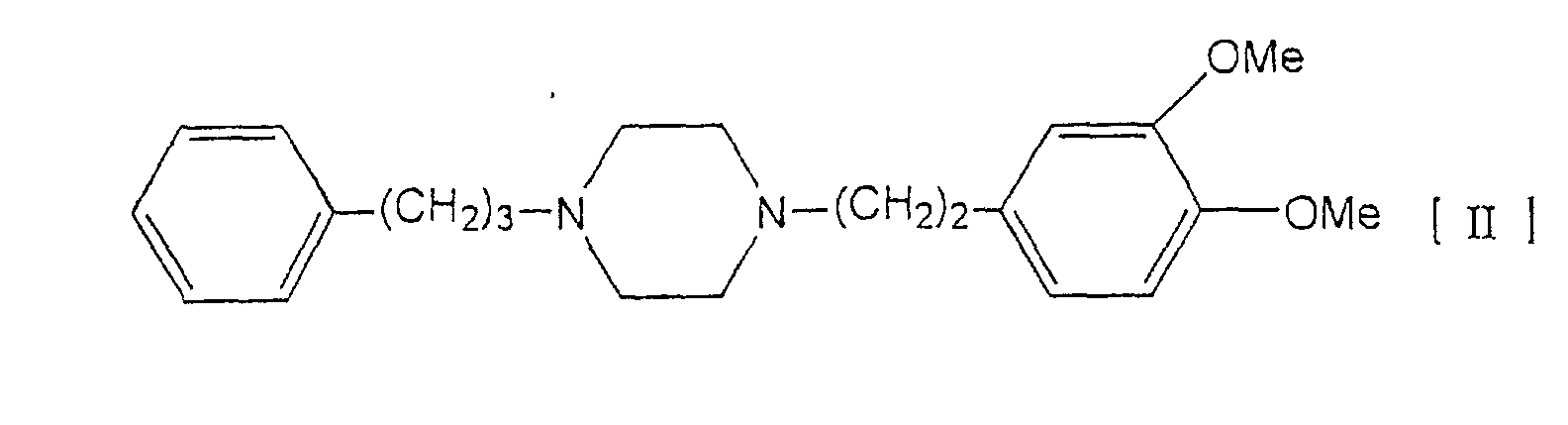
- Examples of particularly preferred compounds are 1-[2-(3, 4-dimethoxyphenyl)ethyl]-4-(3-phenylpropyl)piperazine represented by the following formula [II] or salts thereof.
- the above-mentioned salts can be pharmaceutically acceptable salts, and are exemplified by hydrochlorides, sulfates, phosphates, lactates, maleates, fumarates, oxalates and the like.
- the above-mentioned compounds can take the form of hydrates.
- the present invention can widely be applied to the drug dependence due to the drug abuse and is not limited to specific drug dependence.
- oral preparations such as tablets, capsules and granules, injections and the like. These preparations can be prepared by general techniques. For example, in order to prepare the oral preparations such as tablets, capsules and granules, the compound [I] or the salts thereof can be formulated into the preparations, if necessary, by adding an extending agent such as lactose, starch, crystalline cellulose or vegetable oil, a lubricant such as magnesium stearate or talc, a binder such as hydroxypropylcellulose or polyvinyl pyrrolidone, a disintegrator such as calcium carboxymethylcellulose, a coating agent such as hydroxypropylmethylcellulose, macrogol or a silicone resin, or a gelatin film forming agent.
- an extending agent such as lactose, starch, crystalline cellulose or vegetable oil, a lubricant such as magnesium stearate or talc, a binder such as hydroxypropylcellulose or polyvinyl pyrrolidon
- the dosage is appropriately adjusted depending on symptoms, age, dosage form and the like, and in the case of the oral preparations, the usual daily dosage is 1 to 1000 mg, which can be given in a single dose or several divided doses.
- mice Male Sprague-Dawley rats, body weight: about 250 g, 5.5 weeks old, were used in groups of eight.
- An apparatus was used wherein a rectangular parallelepiped box was divided into two compartments at the center in length by a sliding partition and one compartment was made white while the other compartment was made black.
- test compound and addicting drugs to be used were dissolved in physiological saline.
- the solutions of the test compound (1 mg/ml and 3 mg/ml) were administered subcutaneously to the rats (1 ml/kg).
- the solutions of the addicting drugs were administered subcutaneously to a morphine administration group (physiological saline and an 8 mg/ml solution of morphine hydrochloride) and intraperitonealy to a cocaine administration group (physiological saline and a 4 mg/ml solution of cocaine hydrochloride) and to a methamphetamine administration group (physiological saline and a 2 mg/ml solution of methamphetamine hydrochloride) (1 ml/kg respectively).
- the rats were placed in the box from which the partition had been removed. Each cumulative time the rats had spent in the white compartment and the black compartment respectively was measured for 15 minutes, and the spent time in the compartment where the rats had spent longer time (pre value) was determined from a difference between them. This operation was carried out once a day for three days.
- the box was divided into two compartments by the partition.
- the solution of the test compound was administered to the rats, and 30 minutes later, the solution of the addicting drug was further administered to the rats.
- the rats were confined for 50 minutes to the compartment in which the rats had spent shorter time in pre-conditioning.
- the next day only physiological saline was administered to the rats, and next the rats were confined for 50 minutes to the compartment in which the rats had spent longer time. This training was repeated three times (2 ⁇ 3 days).
- the partition was removed from the box, and the conditioned rats were placed in the box. Each cumulative time the rats had spent in the white compartment and the black compartment respectively was measured for 15 minutes, and the spent time in the compartment where the rats had spent longer time (post value) was determined from a difference between them.
- the cumulative time the rats had spent in the respective compartments was measured by using an infrared sensor.
- CPP score (sec.) post value (sec.)-pre value (sec.)
- Inhibition rate (%) [(A-B)/A] ⁇ 100
- Table 1 shows that when the compound A was administered, the inhibition rates of the motivational effects of the conditioning drugs increased depending on the doses in all the administration groups, and that the compound A apparently inhibited the potential of the addicting drugs to induce the psychological dependence.
- mice Male Sprague-Dawley rats, body weight: about 250 g, 5.5 weeks old, were used in groups of eight.
- An apparatus was used wherein a rectangular parallelepiped box was divided into two compartments at the center in length by a sliding partition and one compartment was made white while the other compartment was made black.
- test compound and addicting drugs to be used were dissolved in physiological saline.
- the solutions of the test compound (0.3 mg/ml, 1 mg/ml and 3 mg/ml solutions) were administered subcutaneously to the rats (1 ml/kg).
- the solutions of the addicting drugs were administered subcutaneously to morphine administration groups (2 mg/ml, 4 mg/ml and 8 mg/ml solutions of morphine hydrochloride) and intraperitonealy to cocaine administration groups (2 mg/ml, 4 mg/ml and 8 mg/ml solutions of cocaine hydrochloride) and to methamphetamine administration groups (1 mg/ml, 2 mg/ml and 4 mg/ml) (1 ml/kg respectively).
- Physiological saline was administered by the same method as the method of administration of each administration group (1 ml/kg respectively).
- the rats were placed in the box from which the partition had been removed. Each cumulative time the rats had spent in the white compartment and the black compartment respectively was measured for 15 minutes, and the spent time in the compartment where the rats had spent longer time (pre value) was determined from a difference between them. This operation was carried out once a day for three days.
- the box was divided into two compartments by the partition.
- the solution of the addicting drug or the solution of the test compound was administered subcutaneously to the rats.
- the rats were confined for 50 minutes to the compartment in which the rats had spent shorter time in pre-conditioning.
- physiological saline was administered subcutaneously to the rats, and next the rats were confined for 50 minutes to the compartment in which the rats had spent longer time. This training was repeated three times (2 ⁇ 3 days).
- the partition was removed from the box, and the conditioned rats were placed in the box. Each cumulative time the rats spent in the white compartment and the black compartment respectively was measured for 15 minutes, and the spent time in the compartment where the rats had spent longer time (post value) was determined from a difference between them.
- the cumulative time the rats had spent in the respective compartments was measured by using an infrared sensor.
- CPP scores (sec.) showing a motivational effect of the conditioning drug as an index.
- CPP score (sec.) post value (sec.)-pre value (sec.)
- Table 2 shows test results using morphine hydrochloride and cocaine hydrochloride.
- Table 3 shows test results using methamphetamine hydrochloride.
- Table 4 shows test results using the compound A as the test compound.
- CPP score sec.
- CPP score sec.
- CPP score (sec.)
- Physiological saline 0.3 mg/kg 1 mg/kg 3 mg/kg Compound A administration group -13 -37 -45 -64
- Table 4 shows that when the compound A is administered, the conditioning drug exhibits no motivational effect (CPP score (sec.)) at any doses and the compound A has no potential to induce psychological dependence.
- the present invention provides drugs which contain 1, 4-(diphenylalkyl)piperazine derivatives as active ingredients and are useful for prevention or treatment of drug dependence due to drug abuse.
Landscapes
- Chemical & Material Sciences (AREA)
- Health & Medical Sciences (AREA)
- Organic Chemistry (AREA)
- Medicinal Chemistry (AREA)
- Veterinary Medicine (AREA)
- Public Health (AREA)
- General Health & Medical Sciences (AREA)
- Animal Behavior & Ethology (AREA)
- Life Sciences & Earth Sciences (AREA)
- Pharmacology & Pharmacy (AREA)
- Biomedical Technology (AREA)
- General Chemical & Material Sciences (AREA)
- Nuclear Medicine, Radiotherapy & Molecular Imaging (AREA)
- Chemical Kinetics & Catalysis (AREA)
- Neurosurgery (AREA)
- Neurology (AREA)
- Bioinformatics & Cheminformatics (AREA)
- Engineering & Computer Science (AREA)
- Psychiatry (AREA)
- Addiction (AREA)
- Epidemiology (AREA)
- Pharmaceuticals Containing Other Organic And Inorganic Compounds (AREA)
Abstract

Description
- The present invention relates to drugs which contain 1, 4-(diphenylalkyl)piperazine derivatives as active ingredients and are useful for prevention or treatment of drug dependence due to drug abuse.
- Drug dependence is a functional adaptive condition of a central nervous system changed by interactions between living bodies and drugs. The drug dependence is classified as psychological dependence wherein one depends on psychological effects of drugs and physical dependence to avoid unpleasant bioreactions due to withdrawal (withdrawal symptoms). Symptoms always observed in the drug dependence are psychological dependence on drugs which have been intaken and a strong impulse to demand the drugs (Pharmacia, 34, 900-904 (1998)).
- A fear of the drug dependence due to drug abuse is one of serious social problems. There is not a direct therapy of the psychological dependence, which is essence of the drug dependence, and addiction, which is its symptom, yet (Pharmacia, 34, 905-909 (1998)). An agonist therapy of cocaine and the like are actively being studied as a pharmacotherapy of the drug dependence (Pharmacia, 34, 877-882 (1998)).
- All the addicting drugs act on the central nervous system as main effects or side effects and are roughly classified as opioid analgesics, central nervous system depressants, central nervous system stimulators and psychotomimetics.
- Examples of the opioid analgesic are opium and morphine contained in it, heroin semisynthesized from morphine and synthetic narcotics such as pethidine and methadone having the similar pharmacological actions and dependency to those of them, and antagonistic analgesics such as pentazocine and buprenorphine.
- Examples of the central nervous system depressant are hypnotics such as barbituric acid derivatives, methaqualone, benzodiazepine derivatives and chloral hydrate, antianxiety drugs such as meprobamate and benzodiazepine derivatives, organic solvents such as thinner, alcohols and the like.
- Examples of the central nervous system stimulator are cocaine, which is one of typical narcotics, stimulants such as amphetamines, anorexigenic agents such as phenmetrazine, stimulators such as methylphenidate and pipradrol and drugs contained in luxury goods such as nicotine and caffeine.
- Examples of the psychotomimetic are hallucinogens such as LSD, DOM (2-amino-1-(2, 5-dimethoxy-4-methyl)phenylpropane) and mescaline, PCP (phencyclidine), cannabis and the like ("NEW Pharmacology", p. 606-611, Nankodo, 1989).
- The addicting drugs are also classified according to existence of crossing of their tolerance-dependency. Morphine type addicting drugs are exemplified by morphine, codeine, methadone, pethidine and the like. Barbiturate-alcohol type addicting drugs are exemplified by barbiturates, alcohols, weak tranquilizers and the like. Cocaine type addicting drugs are exemplified by cocaine and the like. Amphetamine type addicting drugs are exemplified by amphetamine, methamphetamine and the like. Cannabis type addicting drugs are exemplified by marihuana, hashish and the like. Hallucinogen type addicting drugs are exemplified by LSD-25, mescaline, psilocybin and the like. Organic solvent type addicting drugs are exemplified by toluene, acetone, carbon tetrachloride and the like ("Opioid", p. 118-120, Kagakudojin, 1991).
- It was reported that 1, 4-(diphenylalkyl)piperazine derivatives, which are active ingredients of the present invention, have strong affinity for the σ receptor and are useful as therapeutic agents for cerebral nerves dysfunctions such as dementia, depression, schizophrenia and anxiety neurosis, diseases accompanied by immune disorders and cryptorrhea, digestive ulcer and the like (Japanese Laid-open Patent Publication No. 89949/1995). It was reported that the derivatives are useful as preventive or therapeutic agents for ophthalmopathy, particularly retinal diseases such as diabetic retinopathy and occlusion of retinal vessels and glaucoma since the derivatives exhibit protective actions on retinal nerve cells (Japanese Laid-open Patent Publication No. 120569/1998).
- A study of the drug dependence of the 1, 4-(diphenylalkyl)piperazine derivatives has not been done yet, and it is a very interesting subject.
- Studying precisely in order to find new pharmacological actions of 1, 4-(diphenylalkyl)piperazine derivatives, the present inventors found that the 1, 4-(diphenylalkyl)piperazine derivatives exhibit inhibitory actions on drug dependence. Namely, the present inventors found that the 1, 4-(diphenylalkyl)piperazine derivatives are useful as preventive or therapeutic agents for the drug dependence due to drug abuse.
- The present invention relates to the preventive or therapeutic agents for the drug dependence containing compounds represented by the following general formula [I] or salts thereof as active ingredients.[wherein R1 is lower alkoxy. R2 is lower alkoxy. "A" is lower alkylene. "B" is lower alkylene.]

- The groups defined above are described in more detail. The lower alkoxy is lower alkoxy having one to six carbon atoms such as methoxy, ethoxy, propoxy or butoxy. The lower alkylene is lower alkylene having one to six carbon atoms such as methylene, ethylene, propylene or butylene.
- Preferred examples of the compound are compounds wherein each group is the following in the compounds represented by the general formula [I] or salts thereof;
- (1a) "A" is lower alkylene having two to four carbon atoms; and/or
- (2a) "B" is lower alkylene having two to four carbon atoms. Namely,
-
- Compounds defined by above (1a) in the compounds represented by the general formula [I] or salts thereof,
- Compounds defined by above (2a) in the compounds represented by the general formula [I] or salts thereof, and
- Compounds defined by a combination of above (1a) and above (2a) in the compounds represented by the general formula [I] or salts thereof.
- Particularly preferred examples of the compound are compounds wherein each group is the following in the compounds represented by the general formula [I] or salts thereof;
- (1b) R1 is methoxy; and/or
- (2b) R2 is methoxy. Namely,
-
- Compounds defined by above (1b) in the compounds represented by the general formula [I] or salts thereof,
- Compounds defined by above (2b) in the compounds represented by the general formula [I] or salts thereof, and
- Compounds defined by a combination of above (1b) and above (2b) in the compounds represented by the general formula [I] or salts thereof.
- Examples of particularly preferred compounds are 1-[2-(3, 4-dimethoxyphenyl)ethyl]-4-(3-phenylpropyl)piperazine represented by the following formula [II] or salts thereof.

- The above-mentioned salts can be pharmaceutically acceptable salts, and are exemplified by hydrochlorides, sulfates, phosphates, lactates, maleates, fumarates, oxalates and the like. The above-mentioned compounds can take the form of hydrates.
- The present invention can widely be applied to the drug dependence due to the drug abuse and is not limited to specific drug dependence.
- As a method of calibrating existence or intensity of the potential of drugs to induce the psychological dependence, a method has been used since olden times in which selective intake behavior or self-intake behavior toward test drugs is observed. In recent years, as a relatively simple and reliable method, a method wherein effects on conditioned place preference are indexed (CPP method) is applied ("Opioid", p. 118-120, Kagakudojin, 1991). The present inventors studied existence or intensity of the potential of addicting drugs to induce the psychological dependence in the presence of the 1, 4-(diphenylalkyl)piperazine derivatives by using this conditioned place preference test method (CPP method). Details will be described in the part of "Pharmacological Tests". It is found that the 1, 4-(diphenylalkyl)piperazine derivatives exhibit excellent inhibitory effects on the potential of the addicting drugs to induce the psychological dependence and are useful for the prevention or the treatment of the drug dependence due to the abuse of the addicting drugs.
- Examples of dosage forms of the drugs are oral preparations such as tablets, capsules and granules, injections and the like. These preparations can be prepared by general techniques. For example, in order to prepare the oral preparations such as tablets, capsules and granules, the compound [I] or the salts thereof can be formulated into the preparations, if necessary, by adding an extending agent such as lactose, starch, crystalline cellulose or vegetable oil, a lubricant such as magnesium stearate or talc, a binder such as hydroxypropylcellulose or polyvinyl pyrrolidone, a disintegrator such as calcium carboxymethylcellulose, a coating agent such as hydroxypropylmethylcellulose, macrogol or a silicone resin, or a gelatin film forming agent.
- The dosage is appropriately adjusted depending on symptoms, age, dosage form and the like, and in the case of the oral preparations, the usual daily dosage is 1 to 1000 mg, which can be given in a single dose or several divided doses.
- Pharmacological Tests are shown below as Examples.
- Effects of 1, 4-(diphenylalkyl)piperazine derivatives on the potency of induction of psychological dependence by addicting drugs were studied by using the conditioned place preference test (CPP method) according to the report of Suzuki et al. (Life Science, 57, 1277-1284 (1995)).
- Male Sprague-Dawley rats, body weight: about 250 g, 5.5 weeks old, were used in groups of eight.
- An apparatus was used wherein a rectangular parallelepiped box was divided into two compartments at the center in length by a sliding partition and one compartment was made white while the other compartment was made black.
- A test compound and addicting drugs to be used were dissolved in physiological saline.
- The solutions of the test compound (1 mg/ml and 3 mg/ml) were administered subcutaneously to the rats (1 ml/kg). The solutions of the addicting drugs were administered subcutaneously to a morphine administration group (physiological saline and an 8 mg/ml solution of morphine hydrochloride) and intraperitonealy to a cocaine administration group (physiological saline and a 4 mg/ml solution of cocaine hydrochloride) and to a methamphetamine administration group (physiological saline and a 2 mg/ml solution of methamphetamine hydrochloride) (1 ml/kg respectively).
- The rats were placed in the box from which the partition had been removed. Each cumulative time the rats had spent in the white compartment and the black compartment respectively was measured for 15 minutes, and the spent time in the compartment where the rats had spent longer time (pre value) was determined from a difference between them. This operation was carried out once a day for three days.
- The box was divided into two compartments by the partition. The solution of the test compound was administered to the rats, and 30 minutes later, the solution of the addicting drug was further administered to the rats. The rats were confined for 50 minutes to the compartment in which the rats had spent shorter time in pre-conditioning. The next day, only physiological saline was administered to the rats, and next the rats were confined for 50 minutes to the compartment in which the rats had spent longer time. This training was repeated three times (2 × 3 days).
- The partition was removed from the box, and the conditioned rats were placed in the box. Each cumulative time the rats had spent in the white compartment and the black compartment respectively was measured for 15 minutes, and the spent time in the compartment where the rats had spent longer time (post value) was determined from a difference between them.
- The cumulative time the rats had spent in the respective compartments was measured by using an infrared sensor.
- The potential of the addicting drugs to induce the psychological dependence was evaluated by using CPP scores (sec.) showing a motivational effect of the conditioning drug as an index.
- Effects of the test compound on the potential of the addicting drugs to induce the psychological dependence was determined by the following equation as inhibition rates (%).
- A: CPP score (sec.) of physiological saline administration group
- B: CPP score (sec.) of test compound administration group
-
- Experiments were carried out by using morphine hydrochloride, cocaine hydrochloride and methamphetamine hydrochloride as the addicting drugs and 1-[2-(3, 4-dimethoxyphenyl)ethyl]-4-(3-phenylpropyl)piperazine dihydrochloride (hereinafter referred to as "compound A") represented by the following formula [III] as the test compound respectively. These results are shown in Table 1.

Addicting drug Inhibition rate (%) Compound A (1 mg/kg) Compound A (3 mg/kg) Morphine administration group 38 50 Cocaine administration group 26 55 Methamphetamine administration group 55 57 - Table 1 shows that when the compound A was administered, the inhibition rates of the motivational effects of the conditioning drugs increased depending on the doses in all the administration groups, and that the compound A apparently inhibited the potential of the addicting drugs to induce the psychological dependence.
- Male Sprague-Dawley rats, body weight: about 250 g, 5.5 weeks old, were used in groups of eight.
- An apparatus was used wherein a rectangular parallelepiped box was divided into two compartments at the center in length by a sliding partition and one compartment was made white while the other compartment was made black.
- A test compound and addicting drugs to be used were dissolved in physiological saline.
- The solutions of the test compound (0.3 mg/ml, 1 mg/ml and 3 mg/ml solutions) were administered subcutaneously to the rats (1 ml/kg). The solutions of the addicting drugs were administered subcutaneously to morphine administration groups (2 mg/ml, 4 mg/ml and 8 mg/ml solutions of morphine hydrochloride) and intraperitonealy to cocaine administration groups (2 mg/ml, 4 mg/ml and 8 mg/ml solutions of cocaine hydrochloride) and to methamphetamine administration groups (1 mg/ml, 2 mg/ml and 4 mg/ml) (1 ml/kg respectively). Physiological saline was administered by the same method as the method of administration of each administration group (1 ml/kg respectively).
- The rats were placed in the box from which the partition had been removed. Each cumulative time the rats had spent in the white compartment and the black compartment respectively was measured for 15 minutes, and the spent time in the compartment where the rats had spent longer time (pre value) was determined from a difference between them. This operation was carried out once a day for three days.
- The box was divided into two compartments by the partition. The solution of the addicting drug or the solution of the test compound was administered subcutaneously to the rats. The rats were confined for 50 minutes to the compartment in which the rats had spent shorter time in pre-conditioning. The next day, physiological saline was administered subcutaneously to the rats, and next the rats were confined for 50 minutes to the compartment in which the rats had spent longer time. This training was repeated three times (2×3 days).
- The partition was removed from the box, and the conditioned rats were placed in the box. Each cumulative time the rats spent in the white compartment and the black compartment respectively was measured for 15 minutes, and the spent time in the compartment where the rats had spent longer time (post value) was determined from a difference between them.
- The cumulative time the rats had spent in the respective compartments was measured by using an infrared sensor.
- The potential to induce psychological dependence was evaluated by using CPP scores (sec.) showing a motivational effect of the conditioning drug as an index.
- The motivational effects of the addicting drugs and the test compound, which were the conditioning drugs, were determined by the following equation.
- Table 2 shows test results using morphine hydrochloride and cocaine hydrochloride. Table 3 shows test results using methamphetamine hydrochloride. Table 4 shows test results using the compound A as the test compound.
CPP score (sec.) Physiological saline 2 mg/kg 4 mg/kg 8 mg/kg Morphine administration group 19 171 187 228 Cocaine administration group 19 141 178 259 CPP score (sec.) Physiological saline 1 mg/kg 2 mg/kg 4 mg/kg Methamphetamine administration group 19 155 224 151 - Tables 2 and 3 show that when morphine, cocaine or methamphetamine, which is the addicting drug, is administered, the motivational effects (CPP score (sec.)) of the conditioning drugs are plus and these addicting drugs have appetitive effects (potential to induce psychological dependence).
CPP score (sec.) Physiological saline 0.3 mg/kg 1 mg/kg 3 mg/kg Compound A administration group -13 -37 -45 -64 - On the other hand, Table 4 shows that when the compound A is administered, the conditioning drug exhibits no motivational effect (CPP score (sec.)) at any doses and the compound A has no potential to induce psychological dependence.
- From the above-mentioned results, it is recognized that the 1, 4-(diphenylalkyl)piperazine, derivatives exhibit inhibitory effects on the potential of the addicting drugs to induce the psychological dependence and are useful as preventive or therapeutic agents for drug dependence due to drug abuse.
- The present invention provides drugs which contain 1, 4-(diphenylalkyl)piperazine derivatives as active ingredients and are useful for prevention or treatment of drug dependence due to drug abuse.
Claims (3)
- A preventive or therapeutic agent for drug dependence comprising a 1, 4-(diphenylalkyl)piperazine derivative represented by the following general formula [I] or a salt thereof as an active ingredient,wherein R1 is lower alkoxy; R2 is lower alkoxy; "A" is lower alkylene; and "B" is lower alkylene.

- A preventive or therapeutic agent for drug dependence comprising a compound represented by the following formula [II] or a salt thereof as an active ingredient.
- The preventive or therapeutic agent for drug dependence as claimed in claim 1 or 2, wherein the drug dependence is morphine-induced drug dependence, cocaine-induced drug dependence, methamphetamine-induced drug dependence, nicotine-induced drug dependence, alcohol-induced drug dependence, phencyclidine-induced drug dependence or benzodiazepine derivative-induced drug dependence.
Applications Claiming Priority (3)
| Application Number | Priority Date | Filing Date | Title |
|---|---|---|---|
| JP31746898 | 1998-11-09 | ||
| JP31746898 | 1998-11-09 | ||
| PCT/JP1999/006148 WO2000027833A1 (en) | 1998-11-09 | 1999-11-04 | Drug dependence remedies |
Publications (3)
| Publication Number | Publication Date |
|---|---|
| EP1130018A1 true EP1130018A1 (en) | 2001-09-05 |
| EP1130018A4 EP1130018A4 (en) | 2003-01-15 |
| EP1130018B1 EP1130018B1 (en) | 2007-01-17 |
Family
ID=18088576
Family Applications (1)
| Application Number | Title | Priority Date | Filing Date |
|---|---|---|---|
| EP99954381A Expired - Lifetime EP1130018B1 (en) | 1998-11-09 | 1999-11-04 | Drug dependence remedy |
Country Status (9)
| Country | Link |
|---|---|
| US (1) | US6492369B2 (en) |
| EP (1) | EP1130018B1 (en) |
| KR (1) | KR100700347B1 (en) |
| CN (1) | CN1131221C (en) |
| CA (1) | CA2349452C (en) |
| DE (1) | DE69934902T2 (en) |
| ES (1) | ES2281196T3 (en) |
| NO (1) | NO321735B1 (en) |
| WO (1) | WO2000027833A1 (en) |
Cited By (7)
| Publication number | Priority date | Publication date | Assignee | Title |
|---|---|---|---|---|
| WO2009130310A1 (en) * | 2008-04-25 | 2009-10-29 | Laboratorios Del Dr. Esteve, S.A. | 1-aryl-3-aminoalkoxy pyrazoles as sigma ligands enhancing analgesic effect of opioids and attenuating the dependency thereof |
| EP2353591A1 (en) | 2010-02-04 | 2011-08-10 | Laboratorios Del. Dr. Esteve, S.A. | Sigma ligands for potentiating the analgesic effect of opioids and opiates in post-operative pain and attenuating the dependency thereof |
| US9782483B2 (en) | 2010-05-21 | 2017-10-10 | Laboratories Del Dr. Esteve, S.A. | Sigma ligands for the prevention and/or treatment of emesis induced by chemotherapy or radiotherapy |
| US9789117B2 (en) | 2011-05-18 | 2017-10-17 | Laboratorios Del Dr. Esteve, S.A. | Use of sigma ligands in diabetes type-2 associated pain |
| US9789115B2 (en) | 2010-08-03 | 2017-10-17 | Laboratorios Del Dr. Esteve, S.A. | Use of sigma ligands in opioid-induced hyperalgesia |
| US9844516B2 (en) | 2010-02-04 | 2017-12-19 | Laboratorios De Dr. Esteve | Sigma ligands for use in the prevention and/or treatment of post-operative pain |
| US9931346B2 (en) | 2013-12-17 | 2018-04-03 | Laboratorios Del Dr. Esteve S.A. | Serotonin-norepinephrine reuptake inhibitors (SNRIs) and Sigma receptor ligands combinations |
Family Cites Families (6)
| Publication number | Priority date | Publication date | Assignee | Title |
|---|---|---|---|---|
| US5556857A (en) * | 1991-05-08 | 1996-09-17 | Otsuka Pharmaceutical Co., Ltd. | Disturbance-of-consciousness improving agent |
| JPH06509069A (en) * | 1991-06-27 | 1994-10-13 | バージニア・コモンウェルス・ユニバーシティ | Sigma receptor ligands and their uses |
| US6087346A (en) * | 1993-06-23 | 2000-07-11 | Cambridge Neuroscience, Inc. | Sigma receptor ligands and the use thereof |
| JP2883970B2 (en) | 1993-07-28 | 1999-04-19 | 参天製薬株式会社 | New 1,4- (diphenylalkyl) piperazine derivatives |
| ATE197047T1 (en) * | 1993-07-28 | 2000-11-15 | Santen Pharmaceutical Co Ltd | 1,4-DI(PHENYLALKYL)PIPERAZINE DERIVATIVES |
| JPH10120569A (en) | 1996-10-21 | 1998-05-12 | Santen Pharmaceut Co Ltd | Eye disease prevention or treatment |
-
1999
- 1999-11-04 WO PCT/JP1999/006148 patent/WO2000027833A1/en not_active Ceased
- 1999-11-04 CN CN99813110A patent/CN1131221C/en not_active Expired - Fee Related
- 1999-11-04 CA CA002349452A patent/CA2349452C/en not_active Expired - Fee Related
- 1999-11-04 EP EP99954381A patent/EP1130018B1/en not_active Expired - Lifetime
- 1999-11-04 ES ES99954381T patent/ES2281196T3/en not_active Expired - Lifetime
- 1999-11-04 DE DE69934902T patent/DE69934902T2/en not_active Expired - Lifetime
- 1999-11-04 KR KR1020017005777A patent/KR100700347B1/en not_active Expired - Fee Related
-
2001
- 2001-05-04 NO NO20012226A patent/NO321735B1/en not_active IP Right Cessation
- 2001-05-07 US US09/850,431 patent/US6492369B2/en not_active Expired - Fee Related
Non-Patent Citations (2)
| Title |
|---|
| No further relevant documents disclosed * |
| See also references of WO0027833A1 * |
Cited By (14)
| Publication number | Priority date | Publication date | Assignee | Title |
|---|---|---|---|---|
| US8877753B2 (en) | 2008-04-25 | 2014-11-04 | Laboratorios Del Dr. Esteve, S.A. | 1-aryl-3-aminoalkoxy pyrazoles as sigma ligands enhancing analgesic effect of opioids and attenuating the dependency thereof |
| EP2116539A1 (en) | 2008-04-25 | 2009-11-11 | Laboratorios Del. Dr. Esteve, S.A. | 1-aryl-3-aminoalkoxy-pyrazoles as sigma ligands enhancing analgesic effects of opioids and attenuating the dependency thereof |
| US9914705B2 (en) | 2008-04-25 | 2018-03-13 | Laboratorios Del Dr. Esteve, S.A. | 1-aryl-3-aminoalkoxy pyrazoles as sigma ligands enhancing analgesic effect of opioids and attenuating the dependency thereof |
| WO2009130310A1 (en) * | 2008-04-25 | 2009-10-29 | Laboratorios Del Dr. Esteve, S.A. | 1-aryl-3-aminoalkoxy pyrazoles as sigma ligands enhancing analgesic effect of opioids and attenuating the dependency thereof |
| EP2671875A1 (en) | 2008-04-25 | 2013-12-11 | Laboratorios Del Dr. Esteve, S.A. | 1-aryl-3-aminoalkoxy pyrazoles as sigma ligands enhancing analgesic effect of opioids and attenuating the dependency thereof |
| RU2519060C2 (en) * | 2008-04-25 | 2014-06-10 | Лабораторьос Дель Др. Эстеве, С.А. | 1-aryl-3-aminoalkoxypyrazol as sigma ligands intensifying analgesic action of opioids and relieving addiction thereto |
| WO2011095585A1 (en) | 2010-02-04 | 2011-08-11 | Laboratorios Del Dr. Esteve, S.A. | Sigma ligands for potentiating the analgesic effect of opioids and opiates in post-operative pain and attenuating the dependency thereof |
| US9757358B2 (en) | 2010-02-04 | 2017-09-12 | Laboratorios Del Dr. Esteve, S.A. | Sigma ligands for potentiating the analgesic effect of opioids and opiates in post-operative pain and attenuating the dependency thereof |
| US9844516B2 (en) | 2010-02-04 | 2017-12-19 | Laboratorios De Dr. Esteve | Sigma ligands for use in the prevention and/or treatment of post-operative pain |
| EP2353591A1 (en) | 2010-02-04 | 2011-08-10 | Laboratorios Del. Dr. Esteve, S.A. | Sigma ligands for potentiating the analgesic effect of opioids and opiates in post-operative pain and attenuating the dependency thereof |
| US9782483B2 (en) | 2010-05-21 | 2017-10-10 | Laboratories Del Dr. Esteve, S.A. | Sigma ligands for the prevention and/or treatment of emesis induced by chemotherapy or radiotherapy |
| US9789115B2 (en) | 2010-08-03 | 2017-10-17 | Laboratorios Del Dr. Esteve, S.A. | Use of sigma ligands in opioid-induced hyperalgesia |
| US9789117B2 (en) | 2011-05-18 | 2017-10-17 | Laboratorios Del Dr. Esteve, S.A. | Use of sigma ligands in diabetes type-2 associated pain |
| US9931346B2 (en) | 2013-12-17 | 2018-04-03 | Laboratorios Del Dr. Esteve S.A. | Serotonin-norepinephrine reuptake inhibitors (SNRIs) and Sigma receptor ligands combinations |
Also Published As
| Publication number | Publication date |
|---|---|
| DE69934902T2 (en) | 2007-10-18 |
| WO2000027833A1 (en) | 2000-05-18 |
| CA2349452A1 (en) | 2000-05-18 |
| NO20012226L (en) | 2001-06-12 |
| US20020019399A1 (en) | 2002-02-14 |
| EP1130018A4 (en) | 2003-01-15 |
| CN1325391A (en) | 2001-12-05 |
| US6492369B2 (en) | 2002-12-10 |
| NO20012226D0 (en) | 2001-05-04 |
| EP1130018B1 (en) | 2007-01-17 |
| NO321735B1 (en) | 2006-06-26 |
| CN1131221C (en) | 2003-12-17 |
| ES2281196T3 (en) | 2007-09-16 |
| DE69934902D1 (en) | 2007-03-08 |
| CA2349452C (en) | 2009-02-10 |
| KR100700347B1 (en) | 2007-03-29 |
| KR20010089413A (en) | 2001-10-06 |
Similar Documents
| Publication | Publication Date | Title |
|---|---|---|
| EP0144243B1 (en) | Analgesic compositions | |
| EP0185472B1 (en) | Analgesic compositions | |
| Ryan et al. | Spinal pain suppression mechanisms may differ for phasic and tonic pain | |
| EP0163697B1 (en) | A rapid method for interrupting the narcotic addiction syndrome | |
| AU754088B2 (en) | Noribogaine in the treatment of pain and drug addiction | |
| Archer et al. | Narcotic antagonists | |
| Preston et al. | Differential naltrexone antagonism of hydromorphone and pentazocine effects in human volunteers. | |
| Winter | The stimulus properties of morphine and ethanol | |
| US6077846A (en) | Epibatidine and derivatives thereof as cholinergic receptor agonists and antagonists | |
| CA2193799A1 (en) | Dopamine d1 agonists for the treatment of dementia | |
| CA2349452C (en) | Therapeutic agents for drug dependence | |
| Gyang et al. | The inhibition of autonomic neuro-effector transmission by morphine-like drugs and its use as a screening test for narcotic analgesic drugs | |
| Lal et al. | Discriminable stimuli produced by analgesics | |
| Peachey | Clinical observations of agonist-antagonist analgesic dependence | |
| EP0770081B1 (en) | Heterocycle-condensed morphinoid derivatives | |
| WO1993020821A1 (en) | Agents for treating substance abuse disorders | |
| Chau et al. | Antitussive effect of the optical isomers of mu, kappa and sigma opiate agonists/antagonists in the cat. | |
| JP3752580B2 (en) | Drug dependence treatment | |
| GB2222768A (en) | Analgesic compounds and compositions | |
| Popoli et al. | Verapamil and flunarizine inhibit phencyclidine-induced effects: an EEG and behavioural study in rats | |
| EP0207606A2 (en) | Use of pinacidil as an antiasthma agent | |
| CA1098035A (en) | Anti-tussive and anti-thrombotic compositions containing tetrahydroxyaporphine or l-glaucine | |
| GB2182561A (en) | Pharmaceutical compositions containing thiazoles | |
| JP2955550B2 (en) | NK-1 receptor antagonist for the treatment of late emesis | |
| US5026699A (en) | Use of 5,11-dihydro-6H-pyrido[2,3-b][1,4]-benzodiazepin-6-ones substituted in the 11-position for treating bradycardia and bradyarrhythmia in human and veterinary medicine |
Legal Events
| Date | Code | Title | Description |
|---|---|---|---|
| PUAI | Public reference made under article 153(3) epc to a published international application that has entered the european phase |
Free format text: ORIGINAL CODE: 0009012 |
|
| 17P | Request for examination filed |
Effective date: 20010525 |
|
| AK | Designated contracting states |
Kind code of ref document: A1 Designated state(s): AT BE CH CY DE DK ES FI FR GB GR IE IT LI LU MC NL PT SE |
|
| A4 | Supplementary search report drawn up and despatched |
Effective date: 20021128 |
|
| AK | Designated contracting states |
Kind code of ref document: A4 Designated state(s): AT BE CH CY DE DK ES FI FR GB GR IE IT LI LU MC NL PT SE |
|
| 17Q | First examination report despatched |
Effective date: 20040305 |
|
| GRAP | Despatch of communication of intention to grant a patent |
Free format text: ORIGINAL CODE: EPIDOSNIGR1 |
|
| RTI1 | Title (correction) |
Free format text: DRUG DEPENDENCE REMEDY |
|
| GRAS | Grant fee paid |
Free format text: ORIGINAL CODE: EPIDOSNIGR3 |
|
| GRAA | (expected) grant |
Free format text: ORIGINAL CODE: 0009210 |
|
| AK | Designated contracting states |
Kind code of ref document: B1 Designated state(s): AT BE CH CY DE DK ES FI FR GB GR IE IT LI LU MC NL PT SE |
|
| PG25 | Lapsed in a contracting state [announced via postgrant information from national office to epo] |
Ref country code: NL Free format text: LAPSE BECAUSE OF FAILURE TO SUBMIT A TRANSLATION OF THE DESCRIPTION OR TO PAY THE FEE WITHIN THE PRESCRIBED TIME-LIMIT Effective date: 20070117 Ref country code: LI Free format text: LAPSE BECAUSE OF FAILURE TO SUBMIT A TRANSLATION OF THE DESCRIPTION OR TO PAY THE FEE WITHIN THE PRESCRIBED TIME-LIMIT Effective date: 20070117 Ref country code: FI Free format text: LAPSE BECAUSE OF FAILURE TO SUBMIT A TRANSLATION OF THE DESCRIPTION OR TO PAY THE FEE WITHIN THE PRESCRIBED TIME-LIMIT Effective date: 20070117 Ref country code: DK Free format text: LAPSE BECAUSE OF FAILURE TO SUBMIT A TRANSLATION OF THE DESCRIPTION OR TO PAY THE FEE WITHIN THE PRESCRIBED TIME-LIMIT Effective date: 20070117 Ref country code: CH Free format text: LAPSE BECAUSE OF FAILURE TO SUBMIT A TRANSLATION OF THE DESCRIPTION OR TO PAY THE FEE WITHIN THE PRESCRIBED TIME-LIMIT Effective date: 20070117 Ref country code: AT Free format text: LAPSE BECAUSE OF FAILURE TO SUBMIT A TRANSLATION OF THE DESCRIPTION OR TO PAY THE FEE WITHIN THE PRESCRIBED TIME-LIMIT Effective date: 20070117 |
|
| REG | Reference to a national code |
Ref country code: GB Ref legal event code: FG4D |
|
| REG | Reference to a national code |
Ref country code: CH Ref legal event code: EP |
|
| REG | Reference to a national code |
Ref country code: IE Ref legal event code: FG4D |
|
| REF | Corresponds to: |
Ref document number: 69934902 Country of ref document: DE Date of ref document: 20070308 Kind code of ref document: P |
|
| PG25 | Lapsed in a contracting state [announced via postgrant information from national office to epo] |
Ref country code: SE Free format text: LAPSE BECAUSE OF FAILURE TO SUBMIT A TRANSLATION OF THE DESCRIPTION OR TO PAY THE FEE WITHIN THE PRESCRIBED TIME-LIMIT Effective date: 20070417 |
|
| ET | Fr: translation filed | ||
| PG25 | Lapsed in a contracting state [announced via postgrant information from national office to epo] |
Ref country code: PT Free format text: LAPSE BECAUSE OF FAILURE TO SUBMIT A TRANSLATION OF THE DESCRIPTION OR TO PAY THE FEE WITHIN THE PRESCRIBED TIME-LIMIT Effective date: 20070618 |
|
| NLV1 | Nl: lapsed or annulled due to failure to fulfill the requirements of art. 29p and 29m of the patents act | ||
| REG | Reference to a national code |
Ref country code: CH Ref legal event code: PL |
|
| REG | Reference to a national code |
Ref country code: ES Ref legal event code: FG2A Ref document number: 2281196 Country of ref document: ES Kind code of ref document: T3 |
|
| PLBE | No opposition filed within time limit |
Free format text: ORIGINAL CODE: 0009261 |
|
| STAA | Information on the status of an ep patent application or granted ep patent |
Free format text: STATUS: NO OPPOSITION FILED WITHIN TIME LIMIT |
|
| 26N | No opposition filed |
Effective date: 20071018 |
|
| PG25 | Lapsed in a contracting state [announced via postgrant information from national office to epo] |
Ref country code: BE Free format text: LAPSE BECAUSE OF FAILURE TO SUBMIT A TRANSLATION OF THE DESCRIPTION OR TO PAY THE FEE WITHIN THE PRESCRIBED TIME-LIMIT Effective date: 20070117 |
|
| PG25 | Lapsed in a contracting state [announced via postgrant information from national office to epo] |
Ref country code: GR Free format text: LAPSE BECAUSE OF FAILURE TO SUBMIT A TRANSLATION OF THE DESCRIPTION OR TO PAY THE FEE WITHIN THE PRESCRIBED TIME-LIMIT Effective date: 20070418 |
|
| PG25 | Lapsed in a contracting state [announced via postgrant information from national office to epo] |
Ref country code: MC Free format text: LAPSE BECAUSE OF NON-PAYMENT OF DUE FEES Effective date: 20071130 |
|
| PG25 | Lapsed in a contracting state [announced via postgrant information from national office to epo] |
Ref country code: IE Free format text: LAPSE BECAUSE OF NON-PAYMENT OF DUE FEES Effective date: 20071105 |
|
| PG25 | Lapsed in a contracting state [announced via postgrant information from national office to epo] |
Ref country code: CY Free format text: LAPSE BECAUSE OF FAILURE TO SUBMIT A TRANSLATION OF THE DESCRIPTION OR TO PAY THE FEE WITHIN THE PRESCRIBED TIME-LIMIT Effective date: 20070117 |
|
| PG25 | Lapsed in a contracting state [announced via postgrant information from national office to epo] |
Ref country code: LU Free format text: LAPSE BECAUSE OF NON-PAYMENT OF DUE FEES Effective date: 20071104 |
|
| PGFP | Annual fee paid to national office [announced via postgrant information from national office to epo] |
Ref country code: FR Payment date: 20101123 Year of fee payment: 12 |
|
| PGFP | Annual fee paid to national office [announced via postgrant information from national office to epo] |
Ref country code: DE Payment date: 20101027 Year of fee payment: 12 |
|
| PGFP | Annual fee paid to national office [announced via postgrant information from national office to epo] |
Ref country code: GB Payment date: 20101103 Year of fee payment: 12 Ref country code: IT Payment date: 20101111 Year of fee payment: 12 |
|
| PGFP | Annual fee paid to national office [announced via postgrant information from national office to epo] |
Ref country code: ES Payment date: 20101126 Year of fee payment: 12 |
|
| GBPC | Gb: european patent ceased through non-payment of renewal fee |
Effective date: 20111104 |
|
| REG | Reference to a national code |
Ref country code: FR Ref legal event code: ST Effective date: 20120731 |
|
| PG25 | Lapsed in a contracting state [announced via postgrant information from national office to epo] |
Ref country code: IT Free format text: LAPSE BECAUSE OF NON-PAYMENT OF DUE FEES Effective date: 20111104 |
|
| REG | Reference to a national code |
Ref country code: DE Ref legal event code: R119 Ref document number: 69934902 Country of ref document: DE Effective date: 20120601 |
|
| PG25 | Lapsed in a contracting state [announced via postgrant information from national office to epo] |
Ref country code: GB Free format text: LAPSE BECAUSE OF NON-PAYMENT OF DUE FEES Effective date: 20111104 |
|
| PG25 | Lapsed in a contracting state [announced via postgrant information from national office to epo] |
Ref country code: FR Free format text: LAPSE BECAUSE OF NON-PAYMENT OF DUE FEES Effective date: 20111130 |
|
| REG | Reference to a national code |
Ref country code: ES Ref legal event code: FD2A Effective date: 20130603 |
|
| PG25 | Lapsed in a contracting state [announced via postgrant information from national office to epo] |
Ref country code: DE Free format text: LAPSE BECAUSE OF NON-PAYMENT OF DUE FEES Effective date: 20120601 |
|
| PG25 | Lapsed in a contracting state [announced via postgrant information from national office to epo] |
Ref country code: ES Free format text: LAPSE BECAUSE OF NON-PAYMENT OF DUE FEES Effective date: 20111105 |