EP1130015A1 - Pyridazinone derivatives - Google Patents
Pyridazinone derivatives Download PDFInfo
- Publication number
- EP1130015A1 EP1130015A1 EP99937056A EP99937056A EP1130015A1 EP 1130015 A1 EP1130015 A1 EP 1130015A1 EP 99937056 A EP99937056 A EP 99937056A EP 99937056 A EP99937056 A EP 99937056A EP 1130015 A1 EP1130015 A1 EP 1130015A1
- Authority
- EP
- European Patent Office
- Prior art keywords
- group
- substituted
- aromatic heterocyclic
- alkyl
- methyl
- Prior art date
- Legal status (The legal status is an assumption and is not a legal conclusion. Google has not performed a legal analysis and makes no representation as to the accuracy of the status listed.)
- Withdrawn
Links
- 0 C*(*=C(C)C(*)=C1N)C1=O Chemical compound C*(*=C(C)C(*)=C1N)C1=O 0.000 description 5
Classifications
-
- C—CHEMISTRY; METALLURGY
- C07—ORGANIC CHEMISTRY
- C07D—HETEROCYCLIC COMPOUNDS
- C07D401/00—Heterocyclic compounds containing two or more hetero rings, having nitrogen atoms as the only ring hetero atoms, at least one ring being a six-membered ring with only one nitrogen atom
- C07D401/02—Heterocyclic compounds containing two or more hetero rings, having nitrogen atoms as the only ring hetero atoms, at least one ring being a six-membered ring with only one nitrogen atom containing two hetero rings
- C07D401/04—Heterocyclic compounds containing two or more hetero rings, having nitrogen atoms as the only ring hetero atoms, at least one ring being a six-membered ring with only one nitrogen atom containing two hetero rings directly linked by a ring-member-to-ring-member bond
-
- C—CHEMISTRY; METALLURGY
- C07—ORGANIC CHEMISTRY
- C07D—HETEROCYCLIC COMPOUNDS
- C07D237/00—Heterocyclic compounds containing 1,2-diazine or hydrogenated 1,2-diazine rings
- C07D237/02—Heterocyclic compounds containing 1,2-diazine or hydrogenated 1,2-diazine rings not condensed with other rings
- C07D237/06—Heterocyclic compounds containing 1,2-diazine or hydrogenated 1,2-diazine rings not condensed with other rings having three double bonds between ring members or between ring members and non-ring members
- C07D237/10—Heterocyclic compounds containing 1,2-diazine or hydrogenated 1,2-diazine rings not condensed with other rings having three double bonds between ring members or between ring members and non-ring members with hetero atoms or with carbon atoms having three bonds to hetero atoms with at the most one bond to halogen, e.g. ester or nitrile radicals, directly attached to ring carbon atoms
- C07D237/14—Oxygen atoms
-
- C—CHEMISTRY; METALLURGY
- C07—ORGANIC CHEMISTRY
- C07D—HETEROCYCLIC COMPOUNDS
- C07D237/00—Heterocyclic compounds containing 1,2-diazine or hydrogenated 1,2-diazine rings
- C07D237/02—Heterocyclic compounds containing 1,2-diazine or hydrogenated 1,2-diazine rings not condensed with other rings
- C07D237/06—Heterocyclic compounds containing 1,2-diazine or hydrogenated 1,2-diazine rings not condensed with other rings having three double bonds between ring members or between ring members and non-ring members
- C07D237/10—Heterocyclic compounds containing 1,2-diazine or hydrogenated 1,2-diazine rings not condensed with other rings having three double bonds between ring members or between ring members and non-ring members with hetero atoms or with carbon atoms having three bonds to hetero atoms with at the most one bond to halogen, e.g. ester or nitrile radicals, directly attached to ring carbon atoms
- C07D237/18—Sulfur atoms
-
- C—CHEMISTRY; METALLURGY
- C07—ORGANIC CHEMISTRY
- C07D—HETEROCYCLIC COMPOUNDS
- C07D237/00—Heterocyclic compounds containing 1,2-diazine or hydrogenated 1,2-diazine rings
- C07D237/02—Heterocyclic compounds containing 1,2-diazine or hydrogenated 1,2-diazine rings not condensed with other rings
- C07D237/06—Heterocyclic compounds containing 1,2-diazine or hydrogenated 1,2-diazine rings not condensed with other rings having three double bonds between ring members or between ring members and non-ring members
- C07D237/10—Heterocyclic compounds containing 1,2-diazine or hydrogenated 1,2-diazine rings not condensed with other rings having three double bonds between ring members or between ring members and non-ring members with hetero atoms or with carbon atoms having three bonds to hetero atoms with at the most one bond to halogen, e.g. ester or nitrile radicals, directly attached to ring carbon atoms
- C07D237/24—Carbon atoms having three bonds to hetero atoms with at the most one bond to halogen
-
- C—CHEMISTRY; METALLURGY
- C07—ORGANIC CHEMISTRY
- C07D—HETEROCYCLIC COMPOUNDS
- C07D237/00—Heterocyclic compounds containing 1,2-diazine or hydrogenated 1,2-diazine rings
- C07D237/26—Heterocyclic compounds containing 1,2-diazine or hydrogenated 1,2-diazine rings condensed with carbocyclic rings or ring systems
- C07D237/28—Cinnolines
-
- C—CHEMISTRY; METALLURGY
- C07—ORGANIC CHEMISTRY
- C07D—HETEROCYCLIC COMPOUNDS
- C07D401/00—Heterocyclic compounds containing two or more hetero rings, having nitrogen atoms as the only ring hetero atoms, at least one ring being a six-membered ring with only one nitrogen atom
- C07D401/02—Heterocyclic compounds containing two or more hetero rings, having nitrogen atoms as the only ring hetero atoms, at least one ring being a six-membered ring with only one nitrogen atom containing two hetero rings
- C07D401/12—Heterocyclic compounds containing two or more hetero rings, having nitrogen atoms as the only ring hetero atoms, at least one ring being a six-membered ring with only one nitrogen atom containing two hetero rings linked by a chain containing hetero atoms as chain links
-
- C—CHEMISTRY; METALLURGY
- C07—ORGANIC CHEMISTRY
- C07D—HETEROCYCLIC COMPOUNDS
- C07D401/00—Heterocyclic compounds containing two or more hetero rings, having nitrogen atoms as the only ring hetero atoms, at least one ring being a six-membered ring with only one nitrogen atom
- C07D401/14—Heterocyclic compounds containing two or more hetero rings, having nitrogen atoms as the only ring hetero atoms, at least one ring being a six-membered ring with only one nitrogen atom containing three or more hetero rings
-
- C—CHEMISTRY; METALLURGY
- C07—ORGANIC CHEMISTRY
- C07D—HETEROCYCLIC COMPOUNDS
- C07D403/00—Heterocyclic compounds containing two or more hetero rings, having nitrogen atoms as the only ring hetero atoms, not provided for by group C07D401/00
- C07D403/02—Heterocyclic compounds containing two or more hetero rings, having nitrogen atoms as the only ring hetero atoms, not provided for by group C07D401/00 containing two hetero rings
- C07D403/12—Heterocyclic compounds containing two or more hetero rings, having nitrogen atoms as the only ring hetero atoms, not provided for by group C07D401/00 containing two hetero rings linked by a chain containing hetero atoms as chain links
-
- C—CHEMISTRY; METALLURGY
- C07—ORGANIC CHEMISTRY
- C07D—HETEROCYCLIC COMPOUNDS
- C07D405/00—Heterocyclic compounds containing both one or more hetero rings having oxygen atoms as the only ring hetero atoms, and one or more rings having nitrogen as the only ring hetero atom
- C07D405/02—Heterocyclic compounds containing both one or more hetero rings having oxygen atoms as the only ring hetero atoms, and one or more rings having nitrogen as the only ring hetero atom containing two hetero rings
- C07D405/12—Heterocyclic compounds containing both one or more hetero rings having oxygen atoms as the only ring hetero atoms, and one or more rings having nitrogen as the only ring hetero atom containing two hetero rings linked by a chain containing hetero atoms as chain links
-
- C—CHEMISTRY; METALLURGY
- C07—ORGANIC CHEMISTRY
- C07D—HETEROCYCLIC COMPOUNDS
- C07D409/00—Heterocyclic compounds containing two or more hetero rings, at least one ring having sulfur atoms as the only ring hetero atoms
- C07D409/02—Heterocyclic compounds containing two or more hetero rings, at least one ring having sulfur atoms as the only ring hetero atoms containing two hetero rings
- C07D409/04—Heterocyclic compounds containing two or more hetero rings, at least one ring having sulfur atoms as the only ring hetero atoms containing two hetero rings directly linked by a ring-member-to-ring-member bond
-
- C—CHEMISTRY; METALLURGY
- C07—ORGANIC CHEMISTRY
- C07D—HETEROCYCLIC COMPOUNDS
- C07D409/00—Heterocyclic compounds containing two or more hetero rings, at least one ring having sulfur atoms as the only ring hetero atoms
- C07D409/02—Heterocyclic compounds containing two or more hetero rings, at least one ring having sulfur atoms as the only ring hetero atoms containing two hetero rings
- C07D409/12—Heterocyclic compounds containing two or more hetero rings, at least one ring having sulfur atoms as the only ring hetero atoms containing two hetero rings linked by a chain containing hetero atoms as chain links
-
- C—CHEMISTRY; METALLURGY
- C07—ORGANIC CHEMISTRY
- C07D—HETEROCYCLIC COMPOUNDS
- C07D417/00—Heterocyclic compounds containing two or more hetero rings, at least one ring having nitrogen and sulfur atoms as the only ring hetero atoms, not provided for by group C07D415/00
- C07D417/02—Heterocyclic compounds containing two or more hetero rings, at least one ring having nitrogen and sulfur atoms as the only ring hetero atoms, not provided for by group C07D415/00 containing two hetero rings
- C07D417/04—Heterocyclic compounds containing two or more hetero rings, at least one ring having nitrogen and sulfur atoms as the only ring hetero atoms, not provided for by group C07D415/00 containing two hetero rings directly linked by a ring-member-to-ring-member bond
-
- C—CHEMISTRY; METALLURGY
- C07—ORGANIC CHEMISTRY
- C07D—HETEROCYCLIC COMPOUNDS
- C07D471/00—Heterocyclic compounds containing nitrogen atoms as the only ring hetero atoms in the condensed system, at least one ring being a six-membered ring with one nitrogen atom, not provided for by groups C07D451/00 - C07D463/00
- C07D471/12—Heterocyclic compounds containing nitrogen atoms as the only ring hetero atoms in the condensed system, at least one ring being a six-membered ring with one nitrogen atom, not provided for by groups C07D451/00 - C07D463/00 in which the condensed system contains three hetero rings
Definitions
- the present invention relates to a pyridazinone derivative having a cell adhesion inhibiting activity and useful for the treatment or prevention of inflammation, asthma, chronic articular rheumatism, arteriosclerosis, allergy, cancer metastasis, inflammatory disorder accompanying operation or treatment, ischemic reperfusion injury, rejection at organ transplantation, psoriasis, acute pulmonary injury, inflammatory intestinal disease, burn and the like, or pharmaceutically acceptable salt thereof, and a pharmaceutical composition comprising as an active ingredient the derivative or a pharmaceutically acceptable salt thereof.
- An inflammatory reaction is a sort of defense reaction which occurs at the time when a living body has received a stimulus caused by an alien substance, microbism or the like from the outside.
- leukocytes which have infiltrated from blood vessels are observed, and the overresponse of the leukocytes causes tissue injury.
- the infiltration of leukocytes into tissues from blood vessels proceeds through several steps ( Cell, 67, 1033-1036 (1991); Immunol Today, 14, 99-102 (1993); Cell, 76, 301-314 (1994)).
- the infiltration of leukocytes into tissues at an inflammatory site observed mainly at early stage of inflammation is begun with the occurrence of adhesion of leukocytes circulating in blood vessels at physiological state to vascular endothelial cells. Since the phenomena of the adhesion of leukocytes to vascular endothelial cells and the infiltration into tissues are observed at chronic articular rheumatism, asthma, inflammatory intestinal disease, arteriosclerosis, and the like, the adhesion of leukocytes to vascular endothelial cells is considered to be an important step for the progress of these various diseases ( Arthritis Rheum., 36, 147-157 (1993); J. Clin. Invest., 93 : 1411-1421 (1994); The Journal of the Japanese Society of Internal Medicine, 82 : 1480-1485 (1993); Nature, 362 : 801-809 (1993)).
- the agents inhibiting cell adhesion are useful for the diseases mentioned above which are intractable and/or sufficient therapeutic methods are not established, because they have a different mode of action from that of pharmaceuticals hitherto employed.
- An object of the present invention is to provide a pyridazinone derivative having a strong cell adhesion inhibiting activity and possessing an antiinflammatory activity, an antiasthmatic activity, an antirheumatic activity, an antiarteriosclerotic activity, an antiallergic activity, a suppressive activity of cancer metastasis, a suppressive activity of inflammatory disorder accompanying operation or treatment, a suppressive activity of ischemic reperfusion injury, a suppressive activity of rejection at organ transplantation, an antipsoriatic activity, a suppressive activity of acute pulmonary injury, a therapeutic activity of inflammatory intestinal disease, a therapeutic activity of burn and the like, or pharmaceutically acceptable salt thereof, and a medicament comprising as an active ingredient the derivative or a pharmaceutically acceptable salt thereof.
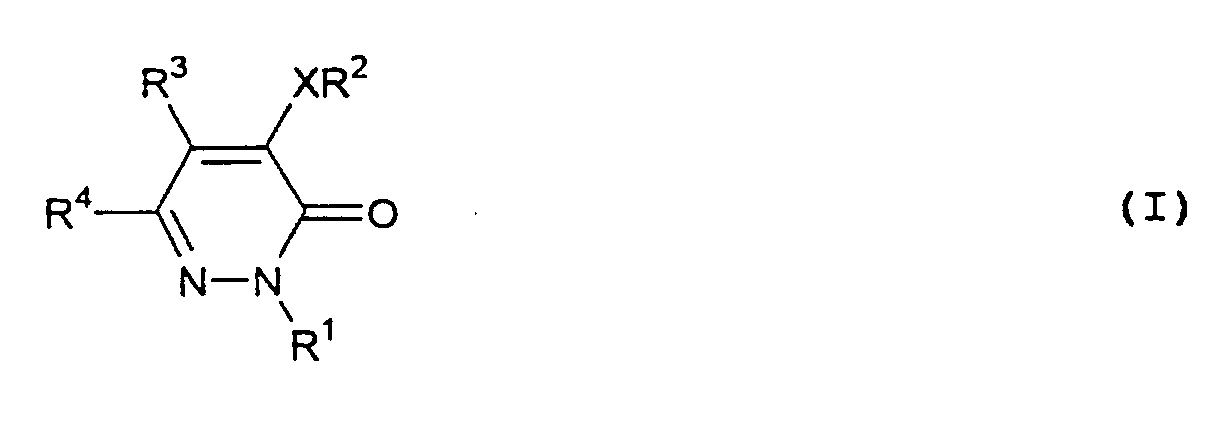
- the present invention relates to a pyridazinone derivative represented by formula (I):
- the present invention relates to a pharmaceutical composition
- a pharmaceutical composition comprising as an active ingredient the derivative or a pharmaceutically acceptable salt thereof, and a pharmaceutically acceptable carrier or diluent.
- the present invention relates to use of the derivative or a pharmaceutically acceptable salt thereof as a cell adhesion inhibitor.
- the present invention relates to use of the derivative or a pharmaceutically acceptable salt thereof for manufacturing a medicament for the treatment or prevention of a disease relating to cell adhesion.
- the present invention relates to a method for inhibiting cell adhesion by administering an effective amount of the derivative or a pharmaceutically acceptable salt thereof.
- the present invention relates to a method for treating or preventing a disease relating to cell adhesion by administering an effective amount of the derivative or a pharmaceutically acceptable salt thereof.
- a pyridazinone derivative represented by formula (I) or a pharmaceutically acceptable salt thereof has an activity of strongly inhibiting the adhesion of leukocytes, and therefore accomplished the present invention.
- the pyridazinone derivative represented by formula (I) can include optically active isomers depending on its substituents, and these isomers are also included in the present invention. In addition, the hydrates thereof are also included.
- the "cell adhesion inhibitor” means a pharmaceutical agent exhibiting a useful pharmacological activity directly or indirectly through inhibiting the process of cell adhesion.
- the cell adhesion inhibitor may be used preventively or therapeutically, and the examples of its use include an antiinflammatory agent, an antiasthmatic agent, an antirheumatic agent, an antiarteriosclerotic agent, an antiallergic agent, a suppressant of cancer metastasis, a suppressant of inflammatory disorder accompanying operation or treatment, a suppressant of ischemic reperfusion injury, a suppressant of rejection at organ transplantation, antipsoriatic agent, a suppressant of acute pulmonary injury, a remedy of inflammatory intestinal disease, a remedy of burn and the like, but the present invention is not limited thereto.
- the "disease relating to cell adhesion” includes mentioned inflammation, asthma, rheumatism, arteriosclerosis, allergy, cancer, inflammatory disorder accompanying operation or treatment, ischemic reperfusion injury, rejection at organ transplantation, psoriasis, acute pulmonary injury, inflammatory intestinal disease, burn and the like, but the present invention is not limited thereto.
- the "substituted phenyl group” means a phenyl group having 1 to 5 substituents, which substitute the hydrogen atom(s) on the ring and are the same or different, selected from a (C 1 -C 8 )alkyl group, a halo(C 1 -C 8 )alkyl group, a (C 1 -C 8 )alkoxy group, a halo(C 1 -C 8 )alkoxy group, a (C 1 -C 8 )alkylthio group, a (C 1 -C 8 )alkoxycarbonyl group, a carbamoyl group, a cyano group, a nitro group, a halogen atom, a carboxyl group, a hydroxyl group, an amino group, an amino group substituted with one or two (C 1 -C 8 )
- Specific examples include a 2-methylphenyl group, a 3-methylphenyl group, a 4-methylphenyl group, a 4-tert-butylphenyl group, a 2-methoxyphenyl group, a 3-methoxyphenyl group, a 4-methoxyphenyl group, a 3,4-dimethoxyphenyl group, a 4-trifluoromethylphenyl group, a 4-trifluoromethoxyphenyl group, a 2-methylthiophenyl group, a 4-methylthiophenyl group, a 4-trifluoromethylthiophenyl group, a 2-methoxycarbonylphenyl group, a 3-methoxycarbonylphenyl group, a 4-methoxycarbonylphenyl group, a 2-carbamoylphenyl group, a 3-carbamoylphenyl group, a 4-carbamoylphenyl group, a 2-cyanophenyl group, a 3-cyanoph
- aromatic heterocyclic group examples include a 2-furyl group, a 3-furyl group, a 2-thienyl group, a 3-thienyl group, a 2-pyrrolyl group, a 2-pyridyl group, a 3-pyridyl group, a 4-pyridyl group, a 2-pyridyl N -oxide group, a 3-pyridyl N-oxide group, a 4-pyridyl N-oxide group, a 2-oxazolyl group, a 3-isoxazolyl group, a 2-thiazolyl group, a 4-thiazolyl group, a 5-thiazolyl group, a 2-imidazolyl group, a 3-pyrazolyl group, a 2-pyrimidinyl group, a 3-pyridazinyl group, a 2-pyrazinyl group, a 2-(1,3,5-triazinyl) group, a 3-(1H-1,2,4-
- the "substituted aromatic heterocyclic group” means a substituted aromatic heterocyclic group having 1 to 5 substituents, which are the same or different, selected from a (C 1 -C 8 )alkyl group, a (C 1 -C 8 )alkoxy group, a (C 1 -C 8 )alkylthio group, a (C 1 -C 8 )alkoxycarbonyl group, a carboxyl group, a carbamoyl group, a cyano group, a nitro group or a halogen atom, and examples include a 4-methyl-5-thiazolyl group, a 6-methyl-2-pyridyl group, a 3-methoxy-4-pyridyl group, a 6-methoxy-3-pyridyl group, a 6-methylthio-3-pyridyl group, a 4-ethoxycarbonyl-2-thienyl group, a 4-carboxy-2-thienyl group, a 4-ch
- the "(C 1 -C 8 )alkyl group” means a "linear, branched or cyclic" alkyl group, and examples include a methyl group, an ethyl group, a propyl group, an isopropyl group, a cyclopropyl group, a butyl group, an isobutyl group, a sec-butyl group, a tert-butyl group, a cyclobutyl group, a pentyl group, an isopentyl group, a neopentyl group, a cyclopentyl group, a hexyl group, a cyclohexyl group, a cycloheptyl group, an octyl group, a cyclooctyl group and the like.
- substituted (C 1 -C 8 )alkyl group means an alkyl group substituted with one or more substituents, which are the same or different, selected from a halogen atom, a hydroxyl group, a (C 1 -C 8 )alkoxy group, a (C 1 -C 8 )alkylthio group, a (C 1 -C 8 )alkoxycarbonyl group, a carboxyl group, a cyano group, a nitro group, an amino group, a hydroxyamino group, an amino group substituted with one or two (C 1 -C 8 )alkyl groups which are the same or different, a 4-to 10-membered cyclic amino group, a (C 1 -C 8 )alkxvlcarbonylamino group, a carbamoyl group, an aminocarbonyl group substituted with one or two (C 1 -C 8 )alkyl groups which are the same or different,
- aralkyl group means an alkyl group having 1 to 8 carbon atoms substituted with an aryl group having 7 to 15 carbon atoms or an aromatic heterocyclic group, and the "aryl” moiety includes phenyl, naphthyl, anthranyl and the like, the definition of the aromatic heterocyclic group being the same as described above.
- aralkyl group examples include a benzyl group, a phenethyl group, a 2-phenylpropyl group, a 2-pyridylmethyl group, a 3-pyridylmethyl group, a 4-pyridylmethyl group, a 2-pyridylmethyl N-oxide group, a 3-pyridylmethyl N-oxide group, a 4-pyridylmethyl N-oxide group, a 2-thienylmethyl group, a 3-thienylmethyl group, a 2-thienylethylgroup, a 3-thienylethyl group, a 2-furylmethyl group, a 3-furylmethyl group, a 2-furylethyl group, a 3-furylethyl group, a 2-quinoxalylmethyl group, a 3-indolylethyl group and the like.
- the "substituted aralkyl group” can be an aralkyl group having an aryl ring or aromatic heterocycle substituted with 1 to 5 substituents, which are the same or different, selected from a (C 1 -C 8 )alkyl group, a (C 1 -C 8 )alkoxy group, a (C 1 -C 8 )alkoxycarbonyl group, a carboxyl group, a cyano group, a nitro group or a halogen atom, and examples include a 4-methylbenzyl group, a 4-methoxybenzyl group, a 4-fluorobenzyl group, a (4-methyl-5-thiazolyl)ethyl group, a (4-chloro-2-pyridyl)methyl group, a (4-chloro-2-pyridyl)methyl N-oxide group, a (6-methyl-2-pyridyl)methyl group, a (6-methyl-2-pyridyl)methyl
- amino group substituted with one or two (C 1 -C 8 )alkyl groups which are the same or different means an amino group substituted with one or two groups, which are the same or different, selected from the alkyl groups having the same meaning as the above-described "(C 1 -C 8 )alkyl group", and examples include a methylamino group, a dimethylamino group, an ethylamino group, a diethylamino group, a methylethylamino group, a propylamino group, a dipropylamino group, an isopropylamino group, a diisopropylamino group, a butylamino group, a dibutylamino group and the like.
- amino group substituted with two groups selected from (C 1 -C 8 )alkyl groups can be further substituted with a (C 1 -C 8 )alkyl group, a substituted (C 1 -C 8 )alkyl group, an aralkyl group or a substituted aralkyl group to form an ammonium base, and examples include a trimethylammonium base, a triethylammonium base, a benzyldimethylammonium base and the like.
- the "4- to 10-membered cyclic amino group” means a cyclic amino group which can contain a nitrogen atom; an oxygen atom or a sulfur atom, and examples include a pyrrolidino group, a piperidino group, a piperazino group, an N -methylpiperazino group, an N -phenylpiperazino group, a morpholino group, a thiomorpholino group, a hexamethyleneimino group, a 3,3,5-trimethylhexahydroazepino group and the like.
- the cyclic amino group can form a quaternary base further substituted with a (C 1 -C 8 )alkyl group, a substituted (C 1 -C 8 )alkyl group, an aralkyl group or a substituted aralkyl group, and examples include a methylpyrrolidinium base, a methylpiperidinium base, a methylmorpholinium base and the like.
- the "(C 1 -C 8 )alkoxycarbonyl group” means a carbonyl group having a "leaner, branched or cyclic" alkoxy group having 1 to 8 carbon atoms, and examples include a methoxycarbonyl group, an ethoxycarbonyl group, a propoxycarbonyl group, an isopropoxycarbonyl group, a tert butoxycarbonyl group, a cyclopropylcarbonyl group and the like.
- aminocarbonyl group substituted with one or two (C 1 -C 8 )alkyl groups or substituted (C 1 -C 8 )alkyl groups which are the same or different means an aminocarbonyl group substituted with one or two groups, which are the same or different, selected from the alkyl groups having the same meaning as the above-described "(C 1 -C 8 )alkyl group” or "substituted (C 1 -C 8 )alkyl group", and examples include a methylaminocarbonyl group, a dimethylaminocarbonyl group, an ethylaminocarbonyl group, an ethylmethylaminocarbonyl group, a propylaminocarbonyl group, an isopropylaminocarbonyl group, a cyclopropylaminocarbonyl group, a hydroxymethylaminocarbonyl group, a methoxymethylaminocarbonyl group, a carboxymethylamin
- the "4- to 10-membered cyclic aminocarbonyl group” means a carbonyl group having the cyclic amino group having the same meaning as the above-described "4- to 10-membered cyclic amino group", and examples include a pyrrolidinocarbonyl group, a piperidinocarbonyl group, a piperazinocarbonyl group, an N-methyl-piperazinocarbonyl group, an N -phenyl-piperazinocarbonyl group, a morpholinocarbonyl group, a thiomorpholinocarbonyl group and the like.
- substituted phenylaminocarbonyl group means an aminocarbonyl group having the phenyl group having the same meaning as the above-described "substituted phenyl group", and the examples include a phenylaminocarbonyl group, a 4-methylphenylaminocarbonyl group, a 4-methoxyphenylaminocarbonyl group, a 4-methylthiophenylaminocarbonyl group, a 4-chlorophenylaminocarbonyl group, a 4-cyanophenylaminocarbonyl group and the like.
- aromatic heterocyle-aminocarbonyl group means an aminocarbonyl group having the aromatic heterocyclic group of the same meaning as the above-described "substituted aromatic heterocyclic group", and examples include a 2-pyridylaminocarbonyl group, a 3-pyridylaminocarbonyl group, a 4-pyridylaminocarbonyl group, a 2-thiazolylaminocarbonyl group and the like.
- substituted aromatic heterocyle-aminocarbonyl group means an aminocarbonyl group having the aromatic heterocyclic group of the same meaning as the above-described "substituted aromatic heterocyclic group", and examples include a 4-methyl-5-thiazolylaminocarbonyl group, a 6-methyl-2-pyridylaminocarbonyl group and the like.
- the "(C 1 -C 8 )alkoxy group” means a "linear, branched or cyclic" alkoxy group having 1 to 8 carbon atoms, and examples include a methoxy group, an ethoxy group, a propoxy group, an isopropoxy group, a butoxy group, an isobutoxy group, a cyclopropylmethoxy group, a pentyloxy group, a hexyloxy group, a heptyloxy group, an octyloxy group and the like.
- halogen atom means each atom of fluorine, chlorine, bromine, and iodine.
- (C 1 -C 8 )alkylcarbonyl group means a carbonyl group having the alkyl group of the same meaning as the above-described "(C 1 -C 8 )alkyl group", and examples include an acetyl group, a propionyl group, a butyryl group, an isobutyryl group, a valeryl group, an isovaleryl group, a pentylcarbonyl group, a hexylcarbonyl group, a heptylcarbonyl group, an octylcarbonyl group and the like.
- halo(C 1 -C 8 )alkyl group means a "linear, branched or cyclic" alkyl group having 1 to 8 carbon atoms substituted with one or more halogen atoms which are the same or different, and examples include a chloromethyl group, a dichloromethyl group, a trichloromethyl group, a fluoromethyl group, a difluoromethyl group, a trifluoromethyl group, a 2,2,2-trifluoroethyl group and the like.
- halo(C 1 -C 8 )alkoxy group means a "linear, branched or cyclic" alkoxy group having 1 to 8 carbon atoms substituted with one or more halogen atoms which are the same or different, and examples include a chloromethoxy group, a dichloromethoxy group, a trichloromethoxy group, a fluoromethoxy group, a difluoromethoxy group, a trifluoromethoxy group and the like.
- the "(C 1 -C 8 )alkylthio group” means a "linear, branched or cyclic" alkylthio group having 1 to 8 carbon atoms, and examples include a methylthio group, an ethylthio group, a propylthio group, an isopropylthio group, a butylthio group and the like.
- (C 1 -C 8 )alkylcarbonylamino group means an amino group having the alkylcarbonyl group of the same meaning as the above-described "(C 1 -C 8 )alkylcarbonyl group", and examples include a methylcarbonylamino group, an ethylcarbonylamino group, a propylcarbonylamino group, an isopropylcarbonylamino group, a butylcarbonylamino group, a pentylcarbonylamino group, a hexylcarbonylamino group, a heptylcarbonylamino group, an octylcarbonylamino group and the like.
- (C 1 -C 8 )alkoxycarbonylamino group means an amino group having the alkoxycarbonyl group of the same meaning as the above-described "(C 1 -C 8 )alkoxycarbonyl group", and examples include a methoxycarbonylamino group, an ethoxycarbonylamino group, a propoxycarbonylamino group, an isopropoxycarbonylamino group, a tert -butoxycarbonylamino group and the like.
- (C 1 -C 8 )alkylsulfonylamino group means a sulfonylamino group having the alkyl group of the same meaning as the above-described "(C 1 -C 8 )alkyl group", and examples include a methylsulfonylamino group, an ethylsulfonylamino group, a propylsulfonylamino group, an isopropylsulfonylamino group, a butylsulfonylamino group, a pentylsulfonylamino group, a hexylsulfonylamino group and the like.
- phenylcarbonylamino group, aromatic heterocyclic-carbonylamino group, phenylsulfonylamino group or aromatic heterocyclic-sulfonylamino group having 1 to 5 substituents selected from a (C 1 -C 8 )alkyl group, a (C 1 -C 8 )alkoxy group, a cyano group, a nitro group or a halogen atom on the ring” means a carbonylamino group and sulfonylamino group having a phenyl group or an aromatic heterocyclic group substituted with 1 to 5 groups, which are the same or different, selected from the alkyl group, alkoxy group and halogen atom having the same meaning as the above-described "(C 1 -C 8 )alkyl group", "(C 1 -C 8 )alkoxy group” and "halogen atom”.
- Examples thereof include a phenylcarbonylamino group, a 4-methylphenylcarbonylamino group, a 4-methoxyphenylcarbonylamino group, a 4-fluorophenylcarbonylamino group, a 4-chlorophenylcarbonylamino group, a 2-methyl-3-pyridylcarbonylamino group, a 6-methyl-3-pyridylcarbonylamino group, a 2-chloro-3-pyridylcarbonylamino group, a 6-methyl-3-pyridylcarbonylamino group, a 4-methylphenylsulfonylamino group, a 4-methoxyphenylsulfonylamino group, a 4-fluorophenylsulfonylamino group, a 4-chlorophenylsulfonylamino group and the like.
- Examples of the "pharmaceutically acceptable salt" of the pyridazinone derivative represented by formula (I) in the present invention include inorganic salts, such as hydrochlorides, sulfates, nitrates, phosphates and the like, organic salts, such as acetates, fumarates, maleates, tartarates, citrates, lactates, oxalates, methansulfonates, benzenesulfonates, p-toluenesulfonates, and salts with metal ions, such as sodium ion, potassium ion, calcium ion and the like.
- inorganic salts such as hydrochlorides, sulfates, nitrates, phosphates and the like
- organic salts such as acetates, fumarates, maleates, tartarates, citrates, lactates, oxalates, methansulfonates, benzenesulfonates,
- the pyridazinone derivative represented by formula (I) can be produced according to the following Production Methods 1 to 13, for example.
- R 1 , R 2 , R 3 , R 4 , R 5 , R 6 , R 9 , R 10 and X have the same meanings as described above.
- A represents a halogen atom
- E represents a halogen atom or a (C 1 -C 8 )alkoxy group
- R 11 represents a (C 1 -C 8 )alkyl group, a substituted (C 1 -C 8 )alkyl group, a phenyl group, a substituted phenyl group, an aralkyl group, a substituted aralkyl group, an aromatic heterocyclic group or a substituted aromatic heterocyclic group
- G represents O or S
- NR 12 R 13 represents an amino group, an amino group substituted with one or two groups, which are the same or different, selected from (C 1 -C 8 )alkyl groups, or a 4- to 10-membered cyclic amino group
- J represents a (C 1 -C 8 )alkoxy group
- L represents a hydroxyl group or a (C 1 -C 8 )alkoxy group
- M represents a hydrogen atom, a hydroxy
- T represents a pyridyl group or a substituted pyridyl group
- U represents a pyridyl N -oxide group or a substituted pyridyl N-oxide group
- the substituent(s) of the substituted pyridyl group or substituted pyridyl N-oxide group having the same meaning as the substituent(s) of the substituted aromatic heterocyle.
- V represents a methyl group or an ethyl group and p represents an integer of 1 or 2.
- Compound (IV-a) can be produced according to known methods ( Synthesis, 91 (1997); Tetrahedron, 51 : 12745 (1995) ; J . Indian Chem. Soc ., 69: 314 (1992) ; J . Serb. Chem . Soc ., 57: 725 (1992); Indian J. Chem. SectB ., 31B : 273 (1992); Synth. Commun ., 21: 1935 (1991); Synth. Commun ., 21: 1021 (1992); Liebig. Ann. Chem ., 10 : 1005 (1988); Tetrahedron Lett., 21: 2939 (1980); J.
- Compound (I-a) can be produced by reacting Compound (IV-a) obtained in Step A and Compound (V) usually at 0°C to room temperature for 1 to 24 hours in the presence or absence of an inert solvent and in the presence of a base using a phase transfer catalyst, copper powder, a copper(I) halide and the like, if necessary.
- the inert solvent examples include alcohols such as methanol and ethanol, ethers such as tetrahydrofuran, diethyl ether and dioxane, hydrocarbons such as toluene and benzene, halogenated hydrocarbons such as dichloromethane, chloroform and 1,2-dichloroethane, ketone-type solvents such as acetone and methyl ethyl ketone, polar organic solvents such as acetonitrile, N,N -dimethylformamide and dimethyl sulfoxide, water or mixed solvents thereof.
- alcohols such as methanol and ethanol
- ethers such as tetrahydrofuran, diethyl ether and dioxane
- hydrocarbons such as toluene and benzene
- halogenated hydrocarbons such as dichloromethane, chloroform and 1,2-dichloroethane
- ketone-type solvents such as ace
- the base examples include nitrogen-containing organic bases such as triethylamine, diisopropylethylamine and pyridine, inorganic bases such as potassium carbonate, sodium hydrogen carbonate, sodium hydroxide, sodium hydride and metallic sodium, organic bases such as sodium acetate, potassium acetate and ammonium acetate, alcoholates such as potassium t-butoxide and sodium ethoxide.
- the phase transfer catalyst can be exemplified by quaternary ammonium salts such as benzyltriethylammonium bromide, and crown ethers such as 18-crown-6-ether.
- Compound (I-b) can be produced by reacting Compound (II) and Compound (VI) usually at 0°C to 100°C for 1 to 24 hours in the presence or absence of an inert solvent and in the presence of a base.
- the inert solvent include alcohols such as methanol and ethanol, ethers such as tetrahydrofuran, diethyl ether and dioxane, hydrocarbons such as toluene and benzene, halogenated hydrocarbons such as dichloromethane, chloroform and 1,2-dichloroethane, ketone-type solvents such as acetone, organic polar solvents such as acetonitrile, N,N -dimethylformamide and dimethyl sulfoxide, water or mixed solvents thereof.
- the base examples include nitrogen-containing organic bases such as triethylamine, diisopropylethylamine, piperidine, morpholine and pyridine, inorganic bases such as potassium carbonate, sodium hydrogen carbonate, sodium hydroxide, sodium hydride and metallic sodium, alcoholates such as potassium t-butoxide and sodium ethoxide, organic bases such as sodium acetate, potassium acetate and ammonium acetate.
- nitrogen-containing organic bases such as triethylamine, diisopropylethylamine, piperidine, morpholine and pyridine
- inorganic bases such as potassium carbonate, sodium hydrogen carbonate, sodium hydroxide, sodium hydride and metallic sodium
- alcoholates such as potassium t-butoxide and sodium ethoxide
- organic bases such as sodium acetate, potassium acetate and ammonium acetate.
- Compound (VI) is commercially available (for example, a product of Aldrich Company or the like) or can be produced according to
- Compound (IV-c) can be produced by reacting Compound (IV-b) produced according to the method of Step A with an alcohol such as ethylene glycol usually at room temperature to the boiling point of the solvent for 1 to 48 hours under the usual conditions for protecting a carbonyl group, for example, in the presence of an organic acid catalyst such as p-toluenesulfonic acid in an aromatic hydrocarbon such as toluene or benzene with removing water formed during the reaction by means of a water-separating apparatus, distillation, a Lewis acid such as boron trifluoride, or a dehydrating agent such as an orthoester.
- an alcohol such as ethylene glycol usually at room temperature to the boiling point of the solvent for 1 to 48 hours
- an organic acid catalyst such as p-toluenesulfonic acid in an aromatic hydrocarbon such as toluene or benzene
- a Lewis acid such as boron trifluoride
- a dehydrating agent such as an orthoester.
- Compound (I-c or I-c') can be produced by reacting Compound (IV-c) produced in above Step D and Compound (V or V') usually at 0°C to room temperature for 1 to 24 hours in the presence or absence of an inert solvent and in the presence of a base using a phase transfer catalyst, copper powder, a copper (I) halide and the like, if necessary.
- the inert solvent examples include alcohols such as methanol and ethanol, ethers such as tetrahydrofuran, diethyl ether and dioxane, hydrocarbons such as toluene and benzene, halogenated hydrocarbons such as dichloromethane, chloroform and 1,2-dichloroethane, ketone-type solvents such as acetone, polar organic solvents such as acetonitrile, N , N -dimethylformamide and dimethyl sulfoxide, water or mixed solvents thereof.
- alcohols such as methanol and ethanol
- ethers such as tetrahydrofuran, diethyl ether and dioxane
- hydrocarbons such as toluene and benzene
- halogenated hydrocarbons such as dichloromethane, chloroform and 1,2-dichloroethane
- ketone-type solvents such as acetone
- polar organic solvents such as
- the base examples include nitrogen-containing organic bases such as triethylamine, diisopropylethylamine and pyridine, inorganic bases such as potassium carbonate, sodium hydrogen carbonate, sodium hydroxide, sodium hydride and metallic sodium, organic bases such as sodium acetate, potassium acetate and ammonium acetate, alcoholates such as potassium t-butoxide and sodium ethoxide.
- the phase transfer catalyst may be exemplified by quaternary ammonium salts such as benzyltriethylammonium bromide, and crown ethers such as 18-crown-6-ether.
- the compound (I-d or I-d') can be produced by reacting Compound (I-c or I-c') produced in Step E usually at room temperature to the boiling point of the solvent for 1 to 24 hours in an alcohol such as methanol or ethanol, an ether such as tetrahydrofuran or dioxane, water or a mixed solvent thereof in the presence of a mineral acid such as hydrochloric acid or sulfuric acid, an organic acid such as acetic acid or tartaric acid, perchloric acid, or the like.
- an alcohol such as methanol or ethanol
- an ether such as tetrahydrofuran or dioxane
- water or a mixed solvent thereof in the presence of a mineral acid such as hydrochloric acid or sulfuric acid, an organic acid such as acetic acid or tartaric acid, perchloric acid, or the like.
- Compound (I-f) can be produced by hydrolyzing Compound (I-e) produced according to the method of Step B or C with a mineral acid such as hydrochloric acid or sulfuric acid, an organic acid such as formic acid, acetic acid or trifluoroacetic acid or an inorganic base such as potassium hydroxide or sodium hydroxide without solvent or in an alcohol such as methanol or ethanol, an ether such as tetrahydrofuran, diethyl ether or dioxane, a hydrocarbon such as toluene or benzene, a halogenated hydrocarbon such as dichloromethane, chloroform or 1,2-dichloroethane, a polar organic solvent such as acetonitrile, N , N -dimethylformamide or dimethyl sulfoxide, water or a mixed solvent thereof, usually at 0°C to the boiling temperature of the solvent for 1 to 24 hours.
- a mineral acid such as hydrochloric acid or sulfuric acid
- Compound (I-h) can be produced by reacting Compound (I-g) produced according to the method of Step B, C or G with an amine (V') without solvent or in an alcohol such as methanol or ethanol, an ether such as tetrahydrofuran, diethyl ether or dioxane, a hydrocarbon such as toluene or benzene, a halogenated hydrocarbon such as dichloromethane, chloroform or 1,2-dichloroethane, a polar organic solvent such as acetonitrile, N , N -dimethylformamide or dimethyl sulfoxide, water or a mixed solvent thereof in the presence or absence of a nitrogen-containing organic base such as pyridine or triethylamine or a dehydrating agent such as dicyclohexylcarbodiimide, usually at 0°C to room temperature for 1 to 24 hours.
- an amine (V') without solvent or in an alcohol such as methanol or
- Compound (I-j) can be produced by reacting Compound (I-i) produced according to the method of Step B, C, E, F, G or H with 1 to 3 equivalents of an organic or inorganic oxidizing agent such as hydrogen peroxide, peracetic acid, m-chloroperbenzoic acid, potassium permanganate, N -chlorosuccinimide, chromic acid, potassium dichromate in a single solvent of a halogenated hydrocarbon such as dichloromethane, chloroform or 1,2-dichloroethane, an ether such as tetrahydrofuran, diethyl ether or dioxane, water, acetic acid, formic acid or the like, or a mixed solvent thereof, usually at 0°C to 100°C for 1 to 24 hours.
- an organic or inorganic oxidizing agent such as hydrogen peroxide, peracetic acid, m-chloroperbenzoic acid, potassium permanganate, N -chloro
- Compound (I-m) can be produced by reacting Compound (I-k) produced according to the method of Step B, C, F, G, H or I with a reducing agent, e.g., a metal hydride such as lithium aluminium hydride or sodium borohydride, a boron compound such as diborane, a silicon compound such as triethylsilane, or a tin compound such as tributyltin hydride in a single solvent of an alcohol such as methanol or ethanol, an ether such as dioxane, tetrahydrofuran or diethyl ether, a hydrocarbon such as toluene or benzene, water, acetic acid or the like, or a mixed solvent thereof, usually at 0°C to room temperature for 1 to 24 hours.
- a metal hydride such as lithium aluminium hydride or sodium borohydride
- a boron compound such as diborane
- silicon compound such as
- Compound (I-n) can be produced by reacting Compound (I-m) produced in Step I with an acyl halide or a carboxylic acid derivative of various type usually at 0°C to room temperature for 1 to 24 hours in the presence or absence of an inert solvent and in the presence of a base or in the presence of a dehydrating agent such as dicyclohexylcarbodiimide using a phase transfer catalyst, if necessary.
- the inert solvent examples include ethers such as tetrahydrofuran, diethyl ether and dioxane, hydrocarbons such as toluene and benzene, halogenated hydrocarbons such as dichloromethane, chloroform and 1,2-dichloroethane, ketone-type solvents such as acetone, polar organic solvents such as acetonitrile, N,N -dimethylformamide and dimethyl sulfoxide as single solvents or mixed solvents thereof.
- ethers such as tetrahydrofuran, diethyl ether and dioxane
- hydrocarbons such as toluene and benzene
- halogenated hydrocarbons such as dichloromethane, chloroform and 1,2-dichloroethane
- ketone-type solvents such as acetone
- polar organic solvents such as acetonitrile, N,N -dimethylformamide and dimethyl s
- the base examples include nitrogen-containing organic bases such as triethylamine, diisopropylethylamine and pyridine, inorganic bases such as potassium carbonate, sodium hydroxide, sodium hydride and metallic sodium, organic bases such as sodium acetate, potassium acetate and ammonium acetate, alcoholates such as potassium t-butoxide and sodium ethoxide.
- the phase transfer catalyst may be exemplified by quaternary ammonium salts such as benzyltriethylammonium bromide, and crown ethers such as 18-crown-6-ether.
- Compound (I-q) can be produced by reacting Compound (I-p) produced according to the method of Step B, C, D, F or I with an alcohol such as ethylene glycol usually at room temperature to the boiling point of the solvent for 1 to 48 hours under the usual conditions for protecting a carbonyl group, for example, in the presence of an organic acid catalyst such as p-toluenesulfonic acid in an aromatic hydrocarbon such as toluene or benzene with removing water formed in the reaction system by means of a water-separating apparatus, distillation, a Lewis acid such as boron trifluoride, or a dehydrating agent such as an orthoester.
- an organic acid catalyst such as p-toluenesulfonic acid in an aromatic hydrocarbon such as toluene or benzene
- Compound (IV-d) can be produced by reacting Compound (IV-a') produced according to the method of Step A with 1 to 3 equivalents of an organic or inorganic oxidizing agent such as hydrogen peroxide, peracetic acid, m-chloroperbenzoic acid, potassium permanganate, N -chlorosuccinimide, chromic acid, potassium dichromate in a single solvent of a halogenated hydrocarbon such as dichloromethane, chloroform or 1,2-dichloroethane, an ether such as tetrahydrofuran, diethyl ether or dioxane,. water, acetic acid, formic acid or the like, or a mixed solvent thereof, usually at 0°C to 100°C for 1 to 24 hours.
- an organic or inorganic oxidizing agent such as hydrogen peroxide, peracetic acid, m-chloroperbenzoic acid, potassium permanganate, N -chlorosuccinimide, chro
- Compound (I-r) can be produced from Compound (IV-d) and Compound (V) according to the method of Step B.
- Compound (I-s) can be produced by reacting Compound (I-h') produced in Step H with a dehydrating agent such as acetic anhydride, acetic anhydride-sodium acetate, thionyl chloride, diphosphorus pentaoxide, phosphorus pentachloride, phosphorus oxychloride or dicyclohexylamide in the presence or absence of an inert solvent usually at room temperature to 30°C for 1 to 24 hours.
- a dehydrating agent such as acetic anhydride, acetic anhydride-sodium acetate, thionyl chloride, diphosphorus pentaoxide, phosphorus pentachloride, phosphorus oxychloride or dicyclohexylamide
- an ether such as tetrahydrofuran, diethyl ether or dioxane, an hydrocarbon such as toluene or benzene, a halogenated hydrocarbon such as dichloromethane, chloroform or 1,2-dichloroethane may be used singly or as a mixed solvent thereof.
- Compound (I-t) can be produced by reacting Compound (I-s) produced in Step O with hydrogen sulfide in the presence or absence of an inert solvent, optionally using a catalyst such as pyridine, pyridine-triethylamine or diethylamine, usually at 0°C to room temperature for 1 to 24 hours.
- an inert solvent an ether such as tetrahydrofuran, diethyl ether or dioxane, a hydrocarbon such as toluene or benzene may be used singly or as a mixed solvent thereof.
- Compound (VI-a) can be produced by reacting Compound (I-s) produced in Step O with an alcohol and hydrogen chloride usually at 0°C to room temperature for 1 to 24 hours.
- the alcohol include methanol and ethanol.
- Compound (I-u) can be produced by reacting Compound (VI-a) produced in Step Q with an amine in an inert solvent such as an alcohol usually at room temperature to the boiling point of the solvent for 1 to 24 hours.
- an inert solvent such as an alcohol usually at room temperature to the boiling point of the solvent for 1 to 24 hours.
- the alcohol include methanol and ethanol.
- the pyridazinone derivative represented by formula (I) or a pharmaceutically acceptable salt thereof according to the present invention is used solely or as a composition comprising a pharmaceutically acceptable inert carrier or diluent, with formulating it into a preparation form suitable for oral administration or parenteral administration, e.g., a liquid, a tablet (including a sugar-coated tablet, film-coated tablet), a powder, a granular, a capsule (including a soft capsule), an injection, a suspension, a suppository, an emulsion, an ointment, a cream, a lotion, a poultice or the like.
- a pharmaceutically acceptable inert carrier or diluent e.g., a liquid, a tablet (including a sugar-coated tablet, film-coated tablet), a powder, a granular, a capsule (including a soft capsule), an injection, a suspension, a suppository, an emulsion,
- the compound may be generally administered in an amount of at least 0.05 mg/kg-body weight, preferably 0.5 to 10 mg/kg-body weight per adult by one dose or divided doses per day.
- concentration of the active ingredient may be at least 0.001%, preferably from 0.1 to 2% which is most suitable, and the preparation may be applied in an amount of 30 mg to 100 mg per cm 2 .
- the present inhibitor it is also possible to use it as a mixture with other cell adhesion inhibitor.
- Pentan-2,3,4-trione 3-(3-chlorophenylhydrazone) (1.50 g) was added to a suspension of 66% sodium hydride (0.48 g) in anhydrous tetrahydrofuran (30 ml) under ice cooling, followed by stirring at room temperature for 30 minutes. Then, a solution of phenylthioacetyl chloride (1.19 g) in anhydrous tetrahydrofuran (5 ml) was added dropwise under ice cooling, followed by stirring at room temperature for 12 hours. The reaction mixture was poured into ice-water, and extracted with ethyl acetate. After washing with water and a brine, the organic layer was dried over anhydrous magnesium sulfate.
- Pentan-2,3,4-trione 3- (3-chlorophenylhydrazone) (2.39 g) was added to a suspension of 66% sodium hydride (0.77 g) in anhydrous tetrahydrofuran (40 ml) under ice cooling, followed by stirring at room temperature for 30 minutes. Then, a solution of 2-thiopheneacetyl chloride (1.77 g) in anhydrous tetrahydrofuran (10 ml) was added dropwise under ice cooling, followed by stirring at room temperature for 2 hours. The reaction mixture was poured into water and extracted with ethyl acetate. After washing with water and a brine, the organic layer was dried over anhydrous magnesium sulfate.
- Methanesulfonyl chloride (0.1 ml) was added to a solution of 6-acetyl-4-(4-aminophenylthio)-2-(4-fluorophenyl)-5-methyl-3(2H)-pyridazinone (185 mg) in pyridine (2 ml) at 5°C, followed by stirring at room temperature for 1 hour. Water was added to the reaction mixture and the mixture was extracted with ethyl acetate. After washing with a saturated aqueous sodium hydrogen carbonate solution and a brine, the organic layer was dried over anhydrous magnesium sulfate.
- Methyl iodide (0.9 ml) was added to a solution of 6-acetyl-4-(4-aminophenylthio)-2-(4-fluorophenyl)-5-methyl-3(2H)-pyridazinone (370 mg) and 2,6-lutidine (1 ml) in N,N -dimethylformamide (5 ml) at 5°C, followed by stirring at room temperature for 12 hours. Water was added to the reaction mixture and the mixture was extracted with ethyl acetate. After washing with water and a brine, the organic layer was dried over anhydrous magnesium sulfate.
- DMEM Dulbecco modified Eagle's media
- fMLP formylmethionyl-leucyl-phenylalanine
- the present invention provides a pyridazinone derivative having a strong cell adhesion inhibiting activity and possessing an antiinflammatory activity, an antiasthmatic activity, an antirheumatic activity, an antiarteriosclerotic activity, an antiallergic activity, a suppressive activity of cancer metastasis, a suppressive activity of inflammatory disorder accompanying operation or treatment, a suppressive activity of ischemic reperfusion injury, a suppressive activity of rejection at organ transplantation, an antipsoriatic activity, a suppressive activity of acute pulmonary injury, a therapeutic activity of inflammatory intestinal disease, a therapeutic activity of burn and the like.
Landscapes
- Chemical & Material Sciences (AREA)
- Organic Chemistry (AREA)
- Pharmaceuticals Containing Other Organic And Inorganic Compounds (AREA)
- Plural Heterocyclic Compounds (AREA)
Abstract
A pyridazinone derivative represented by formula
(I) :
 {wherein R1 represents a phenyl group, a substituted phenyl
group, an aromatic heterocyclic group or a substituted
aromatic heterocyclic group; R2 represents a (C1-C8)alkyl
group, a substituted (C1-C8)alkyl group, a phenyl group, a
substituted phenyl group, an aralkyl group, a substituted
aralkyl group, an aromatic heterocyclic group, a
substituted aromatic heterocyclic group, an amino group, an
amino group substituted with one or two (C1-C8)alkyl groups
which are the same or different, a 4- to 10-membered cyclic
amino group, a cyano group, a carboxyl group, a
(C1-C8)alkoxyearbonyl group, a carbamoyl group, a
thiocarbamoyl group, an aminocarbonyl group, an
aminocarbonyl group substituted with one or two
(C1-C8)alkyl groups or substituted (C1-C8)alkyl groups which
are the same or different, a 4- to 10-membered cyclic
aminocarbonyl group, a phenylaminocarbonyl group, a
substituted phenylaminocarbonyl group, an aromatic
heterocyle-aminocarbonyl group or a substituted aromatic
heterocyle-aminocarbonyl group; R3 represents a hydrogen
atom, a (C1-C8)alkyl group, a substituted (C1-C8)alkyl group,
a phenyl group, a substituted phenyl group, an aromatic
heterocyclic group or a substituted aromatic heterocyclic
group; and R4 represents a cyano group,
{wherein R1 represents a phenyl group, a substituted phenyl
group, an aromatic heterocyclic group or a substituted
aromatic heterocyclic group; R2 represents a (C1-C8)alkyl
group, a substituted (C1-C8)alkyl group, a phenyl group, a
substituted phenyl group, an aralkyl group, a substituted
aralkyl group, an aromatic heterocyclic group, a
substituted aromatic heterocyclic group, an amino group, an
amino group substituted with one or two (C1-C8)alkyl groups
which are the same or different, a 4- to 10-membered cyclic
amino group, a cyano group, a carboxyl group, a
(C1-C8)alkoxyearbonyl group, a carbamoyl group, a
thiocarbamoyl group, an aminocarbonyl group, an
aminocarbonyl group substituted with one or two
(C1-C8)alkyl groups or substituted (C1-C8)alkyl groups which
are the same or different, a 4- to 10-membered cyclic
aminocarbonyl group, a phenylaminocarbonyl group, a
substituted phenylaminocarbonyl group, an aromatic
heterocyle-aminocarbonyl group or a substituted aromatic
heterocyle-aminocarbonyl group; R3 represents a hydrogen
atom, a (C1-C8)alkyl group, a substituted (C1-C8)alkyl group,
a phenyl group, a substituted phenyl group, an aromatic
heterocyclic group or a substituted aromatic heterocyclic
group; and R4 represents a cyano group,
Description
The present invention relates to a pyridazinone
derivative having a cell adhesion inhibiting activity and
useful for the treatment or prevention of inflammation,
asthma, chronic articular rheumatism, arteriosclerosis,
allergy, cancer metastasis, inflammatory disorder
accompanying operation or treatment, ischemic reperfusion
injury, rejection at organ transplantation, psoriasis,
acute pulmonary injury, inflammatory intestinal disease,
burn and the like, or pharmaceutically acceptable salt
thereof, and a pharmaceutical composition comprising as an
active ingredient the derivative or a pharmaceutically
acceptable salt thereof.
An inflammatory reaction is a sort of defense
reaction which occurs at the time when a living body has
received a stimulus caused by an alien substance, microbism
or the like from the outside. At an inflammatory site,
leukocytes which have infiltrated from blood vessels are
observed, and the overresponse of the leukocytes causes
tissue injury. The infiltration of leukocytes into tissues
from blood vessels proceeds through several steps (Cell, 67,
1033-1036 (1991); Immunol Today, 14, 99-102 (1993); Cell,
76, 301-314 (1994)). For example, the infiltration of
leukocytes into tissues at an inflammatory site observed
mainly at early stage of inflammation is begun with the
occurrence of adhesion of leukocytes circulating in blood
vessels at physiological state to vascular endothelial
cells. Since the phenomena of the adhesion of leukocytes
to vascular endothelial cells and the infiltration into
tissues are observed at chronic articular rheumatism,
asthma, inflammatory intestinal disease, arteriosclerosis,
and the like, the adhesion of leukocytes to vascular
endothelial cells is considered to be an important step for
the progress of these various diseases (Arthritis Rheum.,
36, 147-157 (1993); J. Clin. Invest., 93: 1411-1421 (1994);
The Journal of the Japanese Society of Internal Medicine,
82: 1480-1485 (1993); Nature, 362: 801-809 (1993)).
Therefore, preventive or therapeutic effects on the
above diseases including inflammation can be expected by
inhibiting the adhesion of leukocytes to vascular
endothelial cells. In fact, it has been reported that an
antibody against an adhesion molecule of leukocytes such as
LFA-1 or Mac-1, an antibody against ICAM-1 of a vascular
endothelial cell or the like, suppresses the tissue
infiltration of leukocytes in various laboratory animal
models (Science, 255: 1125-1127 (1992); Am. Rev. Respir.
Dis., 147: 435-441 (1993)).
In addition, it has been revealed that derivatives
of sialyl Lewis X which is sugar chain ligands of
E-selectin are effective for inflammatory diseases as
selectin inhibitors (Japan Society of Chest Disease (37th),
210 (1997)). However, these are used only limitedly owing
to their antigenicity and low oral bioavailability.
Therefore, some low molecular weight compounds have been
reported for the purpose of overcoming these defects. For
example, The Year's Drug News (p. 506, Prous Science
(1995)) describes various low molecular weight compounds
which exhibit a cell adhesion inhibiting activity.
Furthermore, since cell adhesion of cancer cells acts an
important role in their metastasis, inhibition of cell
adhesion has been also. thought to be effective in the
cancer therapy (Cancer Res., 82: 1120-1129 (1991); Cancer
Res., 53: 354-361 (1993)). In conclusion, the agents
inhibiting cell adhesion are useful for the diseases
mentioned above which are intractable and/or sufficient
therapeutic methods are not established, because they have
a different mode of action from that of pharmaceuticals
hitherto employed.
An object of the present invention is to provide a
pyridazinone derivative having a strong cell adhesion
inhibiting activity and possessing an antiinflammatory
activity, an antiasthmatic activity, an antirheumatic
activity, an antiarteriosclerotic activity, an antiallergic
activity, a suppressive activity of cancer metastasis, a
suppressive activity of inflammatory disorder accompanying
operation or treatment, a suppressive activity of ischemic
reperfusion injury, a suppressive activity of rejection at
organ transplantation, an antipsoriatic activity, a
suppressive activity of acute pulmonary injury, a
therapeutic activity of inflammatory intestinal disease, a
therapeutic activity of burn and the like, or
pharmaceutically acceptable salt thereof, and a medicament
comprising as an active ingredient the derivative or a
pharmaceutically acceptable salt thereof.
The present invention relates to a pyridazinone
derivative represented by formula (I):
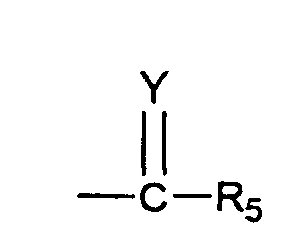
- (wherein R5 represents a hydrogen atom, a (C1-C8)alkyl group, a substituted (C1-C8)alkyl group, a (C1-C8)alkoxy group, a hydroxyl group, amino group, an amino group substituted with one or two (C1-C8)alkyl groups which are the same or different, a 4- to 10-membered cyclic amino group, phenyl group, a substituted phenyl group, an aromatic heterocyclic group or a substituted aromatic heterocyclic group, or R5 may form (CR7 2)m (wherein R7 are the same or different and represents hydrogen atom, a (C1-C8)alkyl group, a substituted (C1-C8)alkyl group, a phenyl group, a substituted phenyl group, an aromatic heterocyclic group or a substituted aromatic heterocyclic group, and m represent an integer of 2 to 7) together with R3 to form a ring; and
- Y represents NH, O or S),
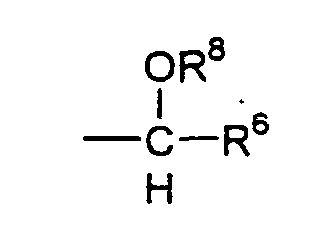
- (wherein R6 represents a hydrogen atom, a (C1-C8)alkyl group, a substituted (C1-C8)alkyl group, a phenyl group, a substituted phenyl group, an aromatic heterocyclic group or a substituted aromatic heterocyclic group, or R6 may form (CR7 2)m (wherein R7 and m have the same meanings as described above) together with R3 to form a ring; and
- R8 represents a hydrogen atom or a (C1-C8)alkylcarbonyl group), or

- (wherein R6 has the same meaning as described above; and
- R9 and R10 are the same or different and represent a (C1-C8)alkyl group or a substituted (C1-C8)alkyl group, or R9 and R10 together form a (C2-C4)alkylene chain and may form a ring together with the atoms attached thereto); and
- X represents a single bond, O or S(O)n (wherein n represents an integer of 0, 1 or 2)},
Further, the present invention relates to a
pharmaceutical composition comprising as an active
ingredient the derivative or a pharmaceutically acceptable
salt thereof, and a pharmaceutically acceptable carrier or
diluent.
Furthermore, the present invention relates to use
of the derivative or a pharmaceutically acceptable salt
thereof as a cell adhesion inhibitor.
Moreover, the present invention relates to use of
the derivative or a pharmaceutically acceptable salt
thereof for manufacturing a medicament for the treatment or
prevention of a disease relating to cell adhesion.
Also, the present invention relates to a method for
inhibiting cell adhesion by administering an effective
amount of the derivative or a pharmaceutically acceptable
salt thereof.
Additionally, the present invention relates to a
method for treating or preventing a disease relating to
cell adhesion by administering an effective amount of the
derivative or a pharmaceutically acceptable salt thereof.
In order to solve the above problems, as a result
of studies for the purpose of creating a pharmaceutical
agent inhibiting cell adhesion, the present inventors have
found that a pyridazinone derivative represented by formula
(I) or a pharmaceutically acceptable salt thereof has an
activity of strongly inhibiting the adhesion of leukocytes,
and therefore accomplished the present invention.
The pyridazinone derivative represented by formula
(I) can include optically active isomers depending on its
substituents, and these isomers are also included in the
present invention. In addition, the hydrates thereof are
also included.
The terms in the present invention will be
explained below.
In the present invention, the "cell adhesion
inhibitor" means a pharmaceutical agent exhibiting a useful
pharmacological activity directly or indirectly through
inhibiting the process of cell adhesion. The cell adhesion
inhibitor may be used preventively or therapeutically, and
the examples of its use include an antiinflammatory agent,
an antiasthmatic agent, an antirheumatic agent, an
antiarteriosclerotic agent, an antiallergic agent, a
suppressant of cancer metastasis, a suppressant of
inflammatory disorder accompanying operation or treatment,
a suppressant of ischemic reperfusion injury, a suppressant
of rejection at organ transplantation, antipsoriatic agent,
a suppressant of acute pulmonary injury, a remedy of
inflammatory intestinal disease, a remedy of burn and the
like, but the present invention is not limited thereto.
The "disease relating to cell adhesion" includes mentioned
inflammation, asthma, rheumatism, arteriosclerosis, allergy,
cancer, inflammatory disorder accompanying operation or
treatment, ischemic reperfusion injury, rejection at organ
transplantation, psoriasis, acute pulmonary injury,
inflammatory intestinal disease, burn and the like, but the
present invention is not limited thereto.
In the definition of each group in formula (I),
"(C1-C8)" means that the number of carbon atoms is from 1
to 8.
Among the substituents of R1, R2, R3, R5, R6, R7 and
the like, the "substituted phenyl group" means a phenyl
group having 1 to 5 substituents, which substitute the
hydrogen atom(s) on the ring and are the same or different,
selected from a (C1-C8)alkyl group, a halo(C1-C8)alkyl group,
a (C1-C8)alkoxy group, a halo(C1-C8)alkoxy group, a
(C1-C8)alkylthio group, a (C1-C8)alkoxycarbonyl group, a
carbamoyl group, a cyano group, a nitro group, a halogen
atom, a carboxyl group, a hydroxyl group, an amino group,
an amino group substituted with one or two (C1-C8)alkyl
groups which are the same or different, a 4- to 10-membered
cyclic amino group, an aminocarbonyl group substituted with
one or two (C1-C8)alkyl groups which are the same or
different, a 4- to 10-membered cyclic aminocarbonyl group,
a (C1-C8)alkylcarbonylamino group, a
(C1-C8)alkoxycarbonylamino group, a hydroxyamino group, an
N-acetylhydroxyamino group, an acetoxyamino group, a
methylenedioxy group, an ethylenedioxy group, a
(C1-C8)alkylsulfonylamino group, a phenylcarbonylamino
group, a phenylcarbonylamino group having 1 to 5
substituents, which are the same or different, selected
from a (C1-C8)alkyl group, a (C1-C8)alkoxy group, a cyano
group, a nitro group or a halogen atom on the ring, an
aromatic heterocyclic-carbonylamino group, an aromatic
heterocyclic-carbonylamino group having 1 to 5 substituents,
which are the same or different, selected from a
(C1-C8)alkyl group, a (C1-C8)alkoxy group, a cyano group, a
nitro group or a halogen atom on the ring, a
phenylsulfonylamino group, a phenylsulfonylamino group
having 1 to 5 substituents, which are the same or different,
selected from a (C1-C8)alkyl group, a (C1-C8)alkoxy group, a
cyano group, a nitro group or a halogen atom on the ring,
an aromatic heterocyclic-sulfonylamino group, an aromatic
heterocyclic-sulfonylamino group having 1 to 5 substituents,
which are the same or different, selected from a
(C1-C8)alkyl group, a (C1-C8)alkoxy group, cyano group,
nitro group or a halogen atom on the ring. Specific
examples include a 2-methylphenyl group, a 3-methylphenyl
group, a 4-methylphenyl group, a 4-tert-butylphenyl group,
a 2-methoxyphenyl group, a 3-methoxyphenyl group, a
4-methoxyphenyl group, a 3,4-dimethoxyphenyl group, a
4-trifluoromethylphenyl group, a 4-trifluoromethoxyphenyl
group, a 2-methylthiophenyl group, a 4-methylthiophenyl
group, a 4-trifluoromethylthiophenyl group, a
2-methoxycarbonylphenyl group, a 3-methoxycarbonylphenyl
group, a 4-methoxycarbonylphenyl group, a 2-carbamoylphenyl
group, a 3-carbamoylphenyl group, a 4-carbamoylphenyl group,
a 2-cyanophenyl group, a 3-cyanophenyl group, a
4-cyanophenyl group, a 2-nitrophenyl group, a 3-nitrophenyl
group, a 4-nitrophenyl group, a 2-fluorophenyl group, a
3-fluorophenyl group, a 4-fluorophenyl group, a
2,4-difluorophenyl group, a 2-chlorophenyl group, a
3-chlorophenyl group, a 4-chlorophenyl group, a
2,4-dichlorophenyl group, a 3,4-dichlorophenyl group, a
2-bromorophenyl group, a 3-bromorophenyl group, a
4-bromorophenyl group, a 2-carboxyphenyl group, a
3-carboxyphenyl group, a 4-carboxyphenyl group, a
2-hydroxyphenyl group, a 3-hydroxyphenyl group, a
4-hydroxyphenyl group, a 3,5-di-tert-butyl-4-hydroxyphenyl
group, a 2-aminophenyl group, a 3-aminophenyl group, a
4-aminophenyl group, a 4-methylaminophenyl group, a
4-dimethylaminophenyl group, a 4-pyrrolidinophenyl group, a
4-methylaminocarbonylphenyl group, a
4-dimethylaminocarbonylphenyl group, a 4-acetylaminophenyl
group, a 4-ethoxycarbonylamino group, a
4-pyrrolidinocarbonylphenyl group, a 4-hydroxyaminophenyl
group, a 4-acetylhydroxyaminophenyl group, a
4-acetoxyaminophenyl group, a 3,4-methylenedioxyphenyl
group, a 3,4-ethylenedioxyphenyl group, a
4-methylsulfonylaminophenyl group, a
4-phenylsulfonylaminophenyl group, a
4-phenylcarbonylaminophenyl group, a
4-methylphenylcarbonylaminophenyl group, a
4-methoxyphenylcarbonylaminophenyl group, a
4-cyanophenylcarbonylaminophenyl group, a
4-nitrophenylcarbonylaminophenyl group, a
4-fluorophenylcarbonylaminophenyl group, a
2-furylcarbonylaminophenyl group, a
2-thienylcarbonylaminophenyl group, and the like.
Examples of the "aromatic heterocyclic group"
include a 2-furyl group, a 3-furyl group, a 2-thienyl group,
a 3-thienyl group, a 2-pyrrolyl group, a 2-pyridyl group, a
3-pyridyl group, a 4-pyridyl group, a 2-pyridyl N-oxide
group, a 3-pyridyl N-oxide group, a 4-pyridyl N-oxide group,
a 2-oxazolyl group, a 3-isoxazolyl group, a 2-thiazolyl
group, a 4-thiazolyl group, a 5-thiazolyl group, a
2-imidazolyl group, a 3-pyrazolyl group, a 2-pyrimidinyl
group, a 3-pyridazinyl group, a 2-pyrazinyl group, a
2-(1,3,5-triazinyl) group, a 3-(1H-1,2,4-triazolyl) group,
a 5-(1H-tetrazolyl) group, a 2-indolyl group, a 8-quinolyl
group, a 2-purinyl group and the like. These can include
benzo derivatives, and examples include a 2-benzoxazolyl
group, a 2-benzothiazolyl group, a 2-benzimidazolyl group
and the like.
The "substituted aromatic heterocyclic group" means
a substituted aromatic heterocyclic group having 1 to 5
substituents, which are the same or different, selected
from a (C1-C8)alkyl group, a (C1-C8)alkoxy group, a
(C1-C8)alkylthio group, a (C1-C8)alkoxycarbonyl group, a
carboxyl group, a carbamoyl group, a cyano group, a nitro
group or a halogen atom, and examples include a 4-methyl-5-thiazolyl
group, a 6-methyl-2-pyridyl group, a 3-methoxy-4-pyridyl
group, a 6-methoxy-3-pyridyl group, a 6-methylthio-3-pyridyl
group, a 4-ethoxycarbonyl-2-thienyl group, a
4-carboxy-2-thienyl group, a 4-chloro-2-pyridyl group, a
4-chloro-3-pyridyl group, 2-chloro-3-pyridyl group, a
6-chloro-3-pyridyl group, a 2-cyano-4-pyridyl group, a
2-cyano-3-pyridyl group, a 6-cyano-3-pyridyl group, a
3-carboxy-2-pyridyl group, a 5-carboxy-2-pyridyl group, a
2-carboxy-4-pyridyl group, a 2-carboxy-3-pyridyl group, a
6-carboxy-3-pyridyl group, a 6-methyl-2-pyridyl N-oxide
group, a 4-chloro-2-pyridyl N-oxide group, a 6-methoxy-3-pyridyl
N-oxide group, a 4-ethoxycarbonyl-2-thiazolyl group,
a 4-carboxy-2-thiazolyl group, a 1-methyl-2-imidazolyl
group, a 5-methyl-2-(1,3,4-thiadiazolyl) group, a 4-methyl-3-(4H-1,2,4-triazolyl)
group, a 1-methyl-5-(1H-tetrazolyl)
group and the like.
The "(C1-C8)alkyl group" means a "linear, branched
or cyclic" alkyl group, and examples include a methyl group,
an ethyl group, a propyl group, an isopropyl group, a
cyclopropyl group, a butyl group, an isobutyl group, a
sec-butyl group, a tert-butyl group, a cyclobutyl group, a
pentyl group, an isopentyl group, a neopentyl group, a
cyclopentyl group, a hexyl group, a cyclohexyl group, a
cycloheptyl group, an octyl group, a cyclooctyl group and
the like.
The "substituted (C1-C8)alkyl group" means an alkyl
group substituted with one or more substituents, which are
the same or different, selected from a halogen atom, a
hydroxyl group, a (C1-C8)alkoxy group, a (C1-C8)alkylthio
group, a (C1-C8)alkoxycarbonyl group, a carboxyl group, a
cyano group, a nitro group, an amino group, a hydroxyamino
group, an amino group substituted with one or two
(C1-C8)alkyl groups which are the same or different, a 4-to
10-membered cyclic amino group, a
(C1-C8)alkxvlcarbonylamino group, a carbamoyl group, an
aminocarbonyl group substituted with one or two
(C1-C8)alkyl groups which are the same or different, a 4-to
10-membered cyclic aminocarbonyl group, a
(C1-C8)alkylsulfonylamino group, a phenylcarbonylamino
group, a phenylcarbonylamino group having 1 to 5
substituents, which are the same or different, selected
from a (C1-C8)alkyl group, a (C1-C8)alkoxy group, a
(C1-C8)alkoxycarbonyl group, a cyano group, a nitro group
or a halogen atom on the ring, an aromatic heterocyclic-carbonylamino
group, an aromatic heterocyclic-carbonylamino
group having 1 to 5 substituents, which are the same or
different, selected from a (C1-C8)alkyl group, a
(C1-C8)alkoxy group, a (C1-C8)alkoxycarbonyl group, a cyano
group, a nitro group or a halogen atom on the ring, a
phenylsulfonylamino group, a phenylsulfonylamino group
having 1 to 5 substituents, which are the same or different,
selected from a (C1-C8)alkyl group, a (C1-C8)alkoxy group, a
(C1-C8)alkoxycarbonyl group, a cyano group, a nitro group
or a halogen atom on the ring, an aromatic heterocyclic-sulfonylamino
group, an aromatic heterocyclic-sulfonylamino
group having 1 to 5 substituents, which are the same or
different, selected from a (C1-C8)alkyl group, a
(C1-C8)alkoxy group, a (C1-C8)alkoxycarbonyl group, a cyano
group, a nitro group or a halogen atom on the ring, and
examples include a fluoromethyl group, a difluoromethyl
group, a trifluoromethyl group, a hydroxymethyl group, a
hydroxyethyl group, a hydroxypropyl group, a methoxymethyl
group, a methoxyethyl group, a carboxymethyl group, a
carboxyethyl group, a methoxycarbonylmethyl group, an
ethoxycarbonylmethyl group, a methoxycarbonylethyl group,
an ethoxycarbonylethyl group, an aminomethyl group, an
aminoethyl group, an aminopropyl group, a hydroxyaminoethyl
group, a hydroxyaminopropyl group, a methylaminomethyl
group, a methylaminoethyl group, a dimethylaminomethyl
group, a dimethylaminoethyl group, a pyrrolidinoethyl group,
a piperidinoethyl group, a 1-methyl-4-piperidino group, an
acetylaminoethyl group, a formamidoethyl group, a
carbamoylmethyl group, a carbamoylethyl group, a
methylaminocarbonylmethyl group, a
dimethylaminocarbonylethyl group, a
piperidinocarbonylmethyl group, a methylsulfonylaminoethyl
group, a phenylcarbonylaminoethyl group, a
phenylsulfonylaminoethyl group and the like.
The "aralkyl group" means an alkyl group having 1
to 8 carbon atoms substituted with an aryl group having 7
to 15 carbon atoms or an aromatic heterocyclic group, and
the "aryl" moiety includes phenyl, naphthyl, anthranyl and
the like, the definition of the aromatic heterocyclic group
being the same as described above. Examples of the
"aralkyl group" include a benzyl group, a phenethyl group,
a 2-phenylpropyl group, a 2-pyridylmethyl group, a
3-pyridylmethyl group, a 4-pyridylmethyl group, a
2-pyridylmethyl N-oxide group, a 3-pyridylmethyl N-oxide
group, a 4-pyridylmethyl N-oxide group, a 2-thienylmethyl
group, a 3-thienylmethyl group, a 2-thienylethylgroup, a
3-thienylethyl group, a 2-furylmethyl group, a
3-furylmethyl group, a 2-furylethyl group, a 3-furylethyl
group, a 2-quinoxalylmethyl group, a 3-indolylethyl group
and the like.
The "substituted aralkyl group" can be an aralkyl
group having an aryl ring or aromatic heterocycle
substituted with 1 to 5 substituents, which are the same or
different, selected from a (C1-C8)alkyl group, a
(C1-C8)alkoxy group, a (C1-C8)alkoxycarbonyl group, a
carboxyl group, a cyano group, a nitro group or a halogen
atom, and examples include a 4-methylbenzyl group, a
4-methoxybenzyl group, a 4-fluorobenzyl group, a (4-methyl-5-thiazolyl)ethyl
group, a (4-chloro-2-pyridyl)methyl group,
a (4-chloro-2-pyridyl)methyl N-oxide group, a (6-methyl-2-pyridyl)methyl
group, a (6-methyl-2-pyridyl)methyl N-oxide
group, a (5-chloro-2-pyridyl)methyl group, a (5-chloro-2-pyridyl)methyl
N-oxide group, a (2,6-dichloro-4-pyridyl)methyl
group, a (2-cyano-4-pyridyl)methyl group, a
(2-carboxy-4-pyridyl)methyl group, a (5-methoxy-3-indol)methyl
group, a (5-bromo-3-indol)ethyl group, a
(3,5-dimethyl-4-pyrazolyl)methyl group, a (3-methyl-2-thienyl)methyl
group and the like.
The "amino group substituted with one or two
(C1-C8)alkyl groups which are the same or different" means
an amino group substituted with one or two groups, which
are the same or different, selected from the alkyl groups
having the same meaning as the above-described
"(C1-C8)alkyl group", and examples include a methylamino
group, a dimethylamino group, an ethylamino group, a
diethylamino group, a methylethylamino group, a propylamino
group, a dipropylamino group, an isopropylamino group, a
diisopropylamino group, a butylamino group, a dibutylamino
group and the like. Moreover, the amino group substituted
with two groups selected from (C1-C8)alkyl groups can be
further substituted with a (C1-C8)alkyl group, a
substituted (C1-C8)alkyl group, an aralkyl group or a
substituted aralkyl group to form an ammonium base, and
examples include a trimethylammonium base, a
triethylammonium base, a benzyldimethylammonium base and
the like.
The "4- to 10-membered cyclic amino group" means a
cyclic amino group which can contain a nitrogen atom; an
oxygen atom or a sulfur atom, and examples include a
pyrrolidino group, a piperidino group, a piperazino group,
an N-methylpiperazino group, an N-phenylpiperazino group, a
morpholino group, a thiomorpholino group, a
hexamethyleneimino group, a 3,3,5-trimethylhexahydroazepino
group and the like. Moreover, the cyclic amino group can
form a quaternary base further substituted with a
(C1-C8)alkyl group, a substituted (C1-C8)alkyl group, an
aralkyl group or a substituted aralkyl group, and examples
include a methylpyrrolidinium base, a methylpiperidinium
base, a methylmorpholinium base and the like.
The "(C1-C8)alkoxycarbonyl group" means a carbonyl
group having a "leaner, branched or cyclic" alkoxy group
having 1 to 8 carbon atoms, and examples include a
methoxycarbonyl group, an ethoxycarbonyl group, a
propoxycarbonyl group, an isopropoxycarbonyl group, a tert
butoxycarbonyl group, a cyclopropylcarbonyl group and the
like.
The "aminocarbonyl group substituted with one or
two (C1-C8)alkyl groups or substituted (C1-C8)alkyl groups
which are the same or different" means an aminocarbonyl
group substituted with one or two groups, which are the
same or different, selected from the alkyl groups having
the same meaning as the above-described "(C1-C8)alkyl
group" or "substituted (C1-C8)alkyl group", and examples
include a methylaminocarbonyl group, a
dimethylaminocarbonyl group, an ethylaminocarbonyl group,
an ethylmethylaminocarbonyl group, a propylaminocarbonyl
group, an isopropylaminocarbonyl group, a
cyclopropylaminocarbonyl group, a
hydroxymethylaminocarbonyl group, a
methoxymethylaminocarbonyl group, a
carboxymethylaminocarbonyl group, a
carbamoylmethylaminocarbonyl group and the like.
The "4- to 10-membered cyclic aminocarbonyl group"
means a carbonyl group having the cyclic amino group having
the same meaning as the above-described "4- to 10-membered
cyclic amino group", and examples include a
pyrrolidinocarbonyl group, a piperidinocarbonyl group, a
piperazinocarbonyl group, an N-methyl-piperazinocarbonyl
group, an N-phenyl-piperazinocarbonyl group, a
morpholinocarbonyl group, a thiomorpholinocarbonyl group
and the like.
The "substituted phenylaminocarbonyl group" means
an aminocarbonyl group having the phenyl group having the
same meaning as the above-described "substituted phenyl
group", and the examples include a phenylaminocarbonyl
group, a 4-methylphenylaminocarbonyl group, a
4-methoxyphenylaminocarbonyl group, a
4-methylthiophenylaminocarbonyl group, a
4-chlorophenylaminocarbonyl group, a
4-cyanophenylaminocarbonyl group and the like.
The "aromatic heterocyle-aminocarbonyl group" means
an aminocarbonyl group having the aromatic heterocyclic
group of the same meaning as the above-described
"substituted aromatic heterocyclic group", and examples
include a 2-pyridylaminocarbonyl group, a
3-pyridylaminocarbonyl group, a 4-pyridylaminocarbonyl
group, a 2-thiazolylaminocarbonyl group and the like.
The "substituted aromatic heterocyle-aminocarbonyl
group" means an aminocarbonyl group having the aromatic
heterocyclic group of the same meaning as the above-described
"substituted aromatic heterocyclic group", and
examples include a 4-methyl-5-thiazolylaminocarbonyl group,
a 6-methyl-2-pyridylaminocarbonyl group and the like.
The "(C1-C8)alkoxy group" means a "linear, branched
or cyclic" alkoxy group having 1 to 8 carbon atoms, and
examples include a methoxy group, an ethoxy group, a
propoxy group, an isopropoxy group, a butoxy group, an
isobutoxy group, a cyclopropylmethoxy group, a pentyloxy
group, a hexyloxy group, a heptyloxy group, an octyloxy
group and the like.
The "halogen atom" means each atom of fluorine,
chlorine, bromine, and iodine.
The "(C1-C8)alkylcarbonyl group" means a carbonyl
group having the alkyl group of the same meaning as the
above-described "(C1-C8)alkyl group", and examples include
an acetyl group, a propionyl group, a butyryl group, an
isobutyryl group, a valeryl group, an isovaleryl group, a
pentylcarbonyl group, a hexylcarbonyl group, a
heptylcarbonyl group, an octylcarbonyl group and the like.
The "halo(C1-C8)alkyl group" means a "linear,
branched or cyclic" alkyl group having 1 to 8 carbon atoms
substituted with one or more halogen atoms which are the
same or different, and examples include a chloromethyl
group, a dichloromethyl group, a trichloromethyl group, a
fluoromethyl group, a difluoromethyl group, a
trifluoromethyl group, a 2,2,2-trifluoroethyl group and the
like.
The "halo(C1-C8)alkoxy group" means a "linear,
branched or cyclic" alkoxy group having 1 to 8 carbon atoms
substituted with one or more halogen atoms which are the
same or different, and examples include a chloromethoxy
group, a dichloromethoxy group, a trichloromethoxy group, a
fluoromethoxy group, a difluoromethoxy group, a
trifluoromethoxy group and the like.
The "(C1-C8)alkylthio group" means a "linear,
branched or cyclic" alkylthio group having 1 to 8 carbon
atoms, and examples include a methylthio group, an
ethylthio group, a propylthio group, an isopropylthio group,
a butylthio group and the like.
The "(C1-C8)alkylcarbonylamino group" means an amino
group having the alkylcarbonyl group of the same meaning as
the above-described "(C1-C8)alkylcarbonyl group", and
examples include a methylcarbonylamino group, an
ethylcarbonylamino group, a propylcarbonylamino group, an
isopropylcarbonylamino group, a butylcarbonylamino group, a
pentylcarbonylamino group, a hexylcarbonylamino group, a
heptylcarbonylamino group, an octylcarbonylamino group and
the like.
The "(C1-C8)alkoxycarbonylamino group" means an
amino group having the alkoxycarbonyl group of the same
meaning as the above-described "(C1-C8)alkoxycarbonyl
group", and examples include a methoxycarbonylamino group,
an ethoxycarbonylamino group, a propoxycarbonylamino group,
an isopropoxycarbonylamino group, a tert-butoxycarbonylamino
group and the like.
The "(C1-C8)alkylsulfonylamino group" means a
sulfonylamino group having the alkyl group of the same
meaning as the above-described "(C1-C8)alkyl group", and
examples include a methylsulfonylamino group, an
ethylsulfonylamino group, a propylsulfonylamino group, an
isopropylsulfonylamino group, a butylsulfonylamino group, a
pentylsulfonylamino group, a hexylsulfonylamino group and
the like.
The "phenylcarbonylamino group, aromatic
heterocyclic-carbonylamino group, phenylsulfonylamino group
or aromatic heterocyclic-sulfonylamino group having 1 to 5
substituents selected from a (C1-C8)alkyl group, a
(C1-C8)alkoxy group, a cyano group, a nitro group or a
halogen atom on the ring" means a carbonylamino group and
sulfonylamino group having a phenyl group or an aromatic
heterocyclic group substituted with 1 to 5 groups, which
are the same or different, selected from the alkyl group,
alkoxy group and halogen atom having the same meaning as
the above-described "(C1-C8)alkyl group", "(C1-C8)alkoxy
group" and "halogen atom". Examples thereof include a
phenylcarbonylamino group, a 4-methylphenylcarbonylamino
group, a 4-methoxyphenylcarbonylamino group, a
4-fluorophenylcarbonylamino group, a
4-chlorophenylcarbonylamino group, a 2-methyl-3-pyridylcarbonylamino
group, a 6-methyl-3-pyridylcarbonylamino
group, a 2-chloro-3-pyridylcarbonylamino
group, a 6-methyl-3-pyridylcarbonylamino
group, a 4-methylphenylsulfonylamino
group, a 4-methoxyphenylsulfonylamino group, a
4-fluorophenylsulfonylamino group, a
4-chlorophenylsulfonylamino group and the like.
Examples of the "pharmaceutically acceptable salt"
of the pyridazinone derivative represented by formula (I)
in the present invention include inorganic salts, such as
hydrochlorides, sulfates, nitrates, phosphates and the like,
organic salts, such as acetates, fumarates, maleates,
tartarates, citrates, lactates, oxalates, methansulfonates,
benzenesulfonates, p-toluenesulfonates, and salts with
metal ions, such as sodium ion, potassium ion, calcium ion
and the like.
The pyridazinone derivative represented by formula
(I) can be produced according to the following Production
Methods 1 to 13, for example. In the formulae of the
following Production Methods, R1, R2, R3, R4, R5, R6, R9, R10
and X have the same meanings as described above. A
represents a halogen atom; E represents a halogen atom or a
(C1-C8)alkoxy group; R11 represents a (C1-C8)alkyl group, a
substituted (C1-C8)alkyl group, a phenyl group, a
substituted phenyl group, an aralkyl group, a substituted
aralkyl group, an aromatic heterocyclic group or a
substituted aromatic heterocyclic group; G represents O or
S; NR12R13 represents an amino group, an amino group
substituted with one or two groups, which are the same or
different, selected from (C1-C8)alkyl groups, or a 4- to
10-membered cyclic amino group; J represents a
(C1-C8)alkoxy group; L represents a hydroxyl group or a (C1-C8)alkoxy
group; M represents a hydrogen atom, a hydroxyl
group, a (C1-C8)alkyl group, a substituted (C1-C8)alkyl
group, a (C1-C8)alkoxy group or a substituted (C1-C8)alkoxy
group; Q represents a (C1-C8)alkylcarbonyl group. Each
definition of the halogen atom, (C1-C8)alkoxy group, (C1-C8)alkyl
group, substituted (C1-C8)alkyl group, phenyl group,
substituted phenyl group, aralkyl group, substituted
aralkyl group, aromatic heterocyclic group, substituted
aromatic heterocyclic group, amino group substituted with
one or two groups, which are the same or different,
selected from (C1-C8)alkyl groups, or a 4- to 10-membered
cyclic amino group has the same meaning as described above.
T represents a pyridyl group or a substituted pyridyl group,
U represents a pyridyl N-oxide group or a substituted
pyridyl N-oxide group, the substituent(s) of the
substituted pyridyl group or substituted pyridyl N-oxide
group having the same meaning as the substituent(s) of the
substituted aromatic heterocyle. V represents a methyl
group or an ethyl group and p represents an integer of 1 or
2.
The methods for producing the compounds of the
present invention are shown below; however, the present
invention is not limited thereto.


Compound (IV-a) can be produced according to known
methods (Synthesis, 91 (1997); Tetrahedron, 51: 12745
(1995) ; J. Indian Chem. Soc., 69: 314 (1992) ; J. Serb. Chem.
Soc., 57: 725 (1992); Indian J. Chem. SectB., 31B: 273
(1992); Synth. Commun., 21: 1935 (1991); Synth. Commun.,
21: 1021 (1992); Liebig. Ann. Chem., 10: 1005 (1988);
Tetrahedron Lett., 21: 2939 (1980); J. Heterocyclic Chem.,
18: 333 (1981)) or from Compound (II) obtainable according
to the methods described in these literatures and Compound
(III) by use of a known method (Indian J. Chem. SectB.,
31B: 273 (1992)) or a method based on the method described
in the literature. Compound (III) is commercially
available (for example, a product of Aldrich Company or the
like) or can be produced according to a known method (Beil.,
2: 199, 215) or based on the method described therein.
Compound (I-a) can be produced by reacting Compound
(IV-a) obtained in Step A and Compound (V) usually at 0°C
to room temperature for 1 to 24 hours in the presence or
absence of an inert solvent and in the presence of a base
using a phase transfer catalyst, copper powder, a copper(I)
halide and the like, if necessary. Examples of the inert
solvent include alcohols such as methanol and ethanol,
ethers such as tetrahydrofuran, diethyl ether and dioxane,
hydrocarbons such as toluene and benzene, halogenated
hydrocarbons such as dichloromethane, chloroform and
1,2-dichloroethane, ketone-type solvents such as acetone
and methyl ethyl ketone, polar organic solvents such as
acetonitrile, N,N-dimethylformamide and dimethyl sulfoxide,
water or mixed solvents thereof. Examples of the base
include nitrogen-containing organic bases such as
triethylamine, diisopropylethylamine and pyridine,
inorganic bases such as potassium carbonate, sodium
hydrogen carbonate, sodium hydroxide, sodium hydride and
metallic sodium, organic bases such as sodium acetate,
potassium acetate and ammonium acetate, alcoholates such as
potassium t-butoxide and sodium ethoxide. The phase
transfer catalyst can be exemplified by quaternary ammonium
salts such as benzyltriethylammonium bromide, and crown
ethers such as 18-crown-6-ether.
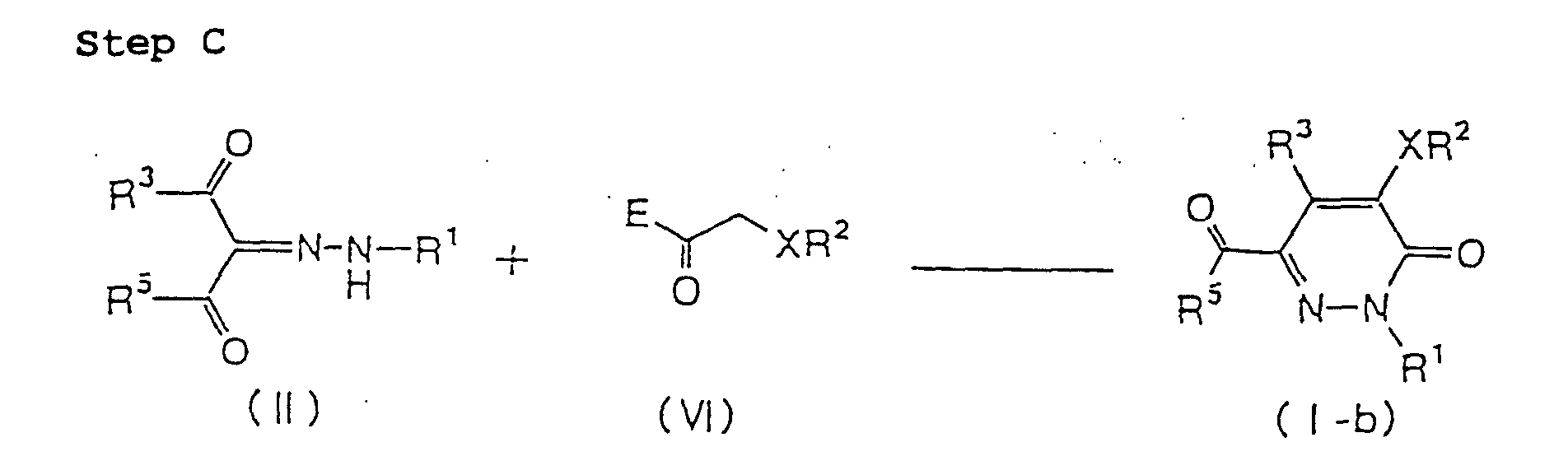
Compound (I-b) can be produced by reacting Compound
(II) and Compound (VI) usually at 0°C to 100°C for 1 to 24
hours in the presence or absence of an inert solvent and in
the presence of a base. Examples of the inert solvent
include alcohols such as methanol and ethanol, ethers such
as tetrahydrofuran, diethyl ether and dioxane, hydrocarbons
such as toluene and benzene, halogenated hydrocarbons such
as dichloromethane, chloroform and 1,2-dichloroethane,
ketone-type solvents such as acetone, organic polar
solvents such as acetonitrile, N,N-dimethylformamide and
dimethyl sulfoxide, water or mixed solvents thereof.
Examples of the base include nitrogen-containing
organic bases such as triethylamine, diisopropylethylamine,
piperidine, morpholine and pyridine, inorganic bases such
as potassium carbonate, sodium hydrogen carbonate, sodium
hydroxide, sodium hydride and metallic sodium, alcoholates
such as potassium t-butoxide and sodium ethoxide, organic
bases such as sodium acetate, potassium acetate and
ammonium acetate. Compound (VI) is commercially available
(for example, a product of Aldrich Company or the like) or
can be produced according to a known method (Beil., 6: 162)
or based on the method.
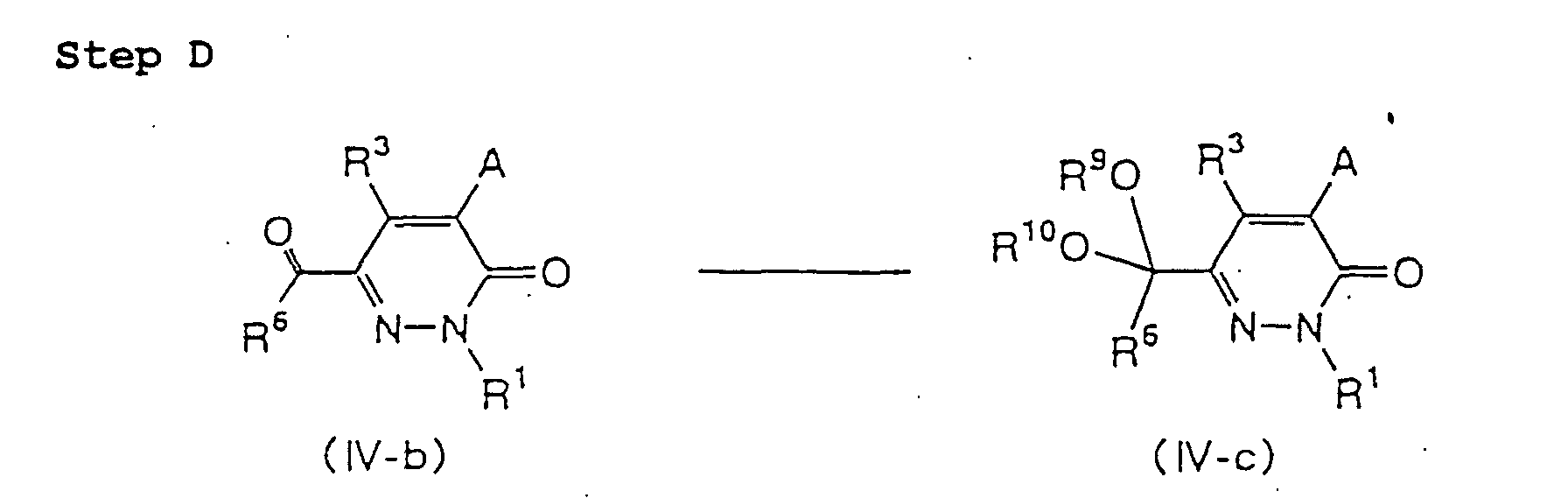
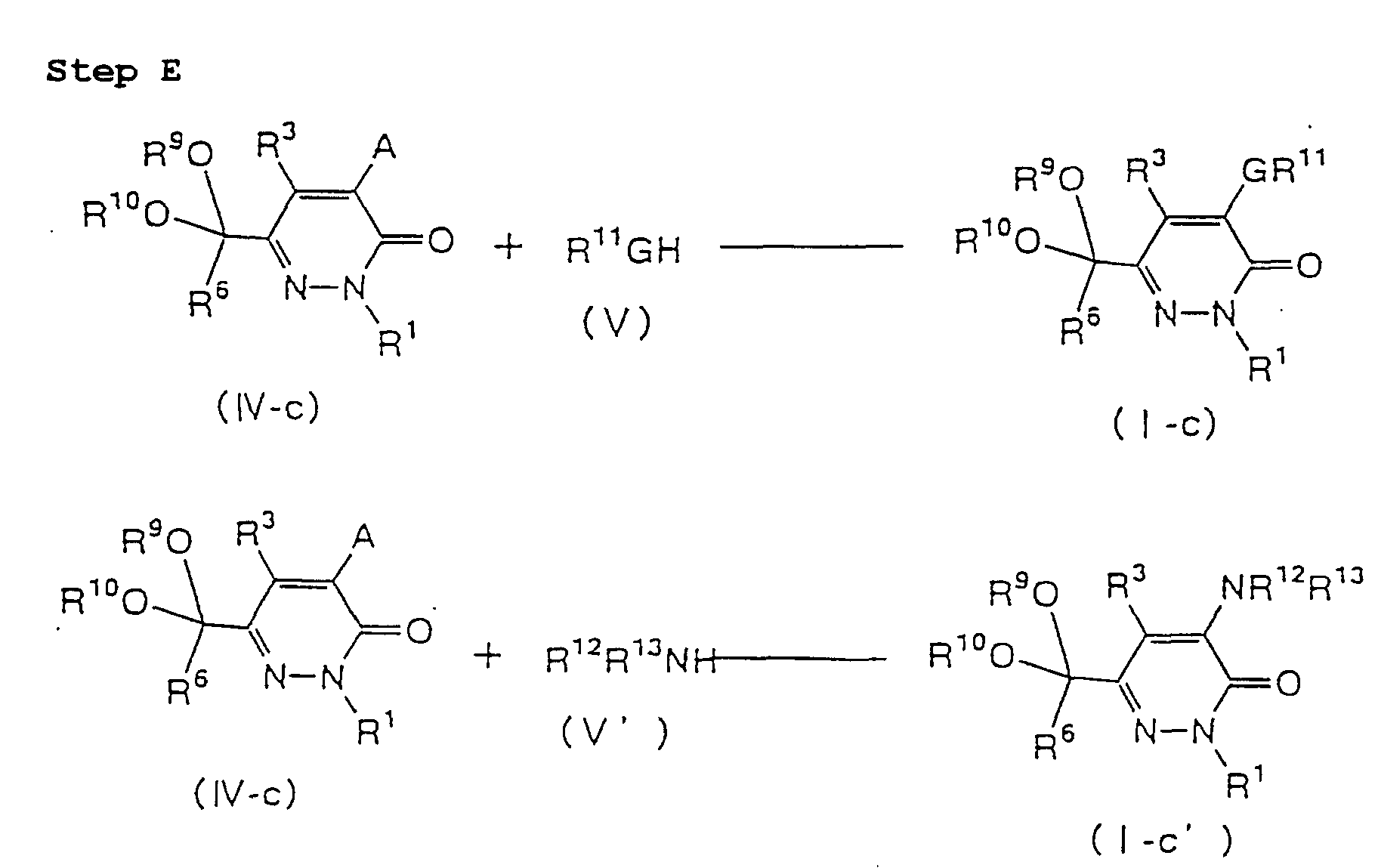
Compound (IV-c) can be produced by reacting
Compound (IV-b) produced according to the method of Step A
with an alcohol such as ethylene glycol usually at room
temperature to the boiling point of the solvent for 1 to 48
hours under the usual conditions for protecting a carbonyl
group, for example, in the presence of an organic acid
catalyst such as p-toluenesulfonic acid in an aromatic
hydrocarbon such as toluene or benzene with removing water
formed during the reaction by means of a water-separating
apparatus, distillation, a Lewis acid such as boron
trifluoride, or a dehydrating agent such as an orthoester.
Compound (I-c or I-c') can be produced by reacting
Compound (IV-c) produced in above Step D and Compound (V or
V') usually at 0°C to room temperature for 1 to 24 hours in
the presence or absence of an inert solvent and in the
presence of a base using a phase transfer catalyst, copper
powder, a copper (I) halide and the like, if necessary.
Examples of the inert solvent include alcohols such as
methanol and ethanol, ethers such as tetrahydrofuran,
diethyl ether and dioxane, hydrocarbons such as toluene and
benzene, halogenated hydrocarbons such as dichloromethane,
chloroform and 1,2-dichloroethane, ketone-type solvents
such as acetone, polar organic solvents such as
acetonitrile, N,N-dimethylformamide and dimethyl sulfoxide,
water or mixed solvents thereof. Examples of the base
include nitrogen-containing organic bases such as
triethylamine, diisopropylethylamine and pyridine,
inorganic bases such as potassium carbonate, sodium
hydrogen carbonate, sodium hydroxide, sodium hydride and
metallic sodium, organic bases such as sodium acetate,
potassium acetate and ammonium acetate, alcoholates such as
potassium t-butoxide and sodium ethoxide. The phase
transfer catalyst may be exemplified by quaternary ammonium
salts such as benzyltriethylammonium bromide, and crown
ethers such as 18-crown-6-ether.

The compound (I-d or I-d') can be produced by
reacting Compound (I-c or I-c') produced in Step E usually
at room temperature to the boiling point of the solvent for
1 to 24 hours in an alcohol such as methanol or ethanol, an
ether such as tetrahydrofuran or dioxane, water or a mixed
solvent thereof in the presence of a mineral acid such as
hydrochloric acid or sulfuric acid, an organic acid such as
acetic acid or tartaric acid, perchloric acid, or the like.

Compound (I-f) can be produced by hydrolyzing
Compound (I-e) produced according to the method of Step B
or C with a mineral acid such as hydrochloric acid or
sulfuric acid, an organic acid such as formic acid, acetic
acid or trifluoroacetic acid or an inorganic base such as
potassium hydroxide or sodium hydroxide without solvent or
in an alcohol such as methanol or ethanol, an ether such as
tetrahydrofuran, diethyl ether or dioxane, a hydrocarbon
such as toluene or benzene, a halogenated hydrocarbon such
as dichloromethane, chloroform or 1,2-dichloroethane, a
polar organic solvent such as acetonitrile,
N,N-dimethylformamide or dimethyl sulfoxide, water or a
mixed solvent thereof, usually at 0°C to the boiling
temperature of the solvent for 1 to 24 hours.

Compound (I-h) can be produced by reacting Compound
(I-g) produced according to the method of Step B, C or G
with an amine (V') without solvent or in an alcohol such as
methanol or ethanol, an ether such as tetrahydrofuran,
diethyl ether or dioxane, a hydrocarbon such as toluene or
benzene, a halogenated hydrocarbon such as dichloromethane,
chloroform or 1,2-dichloroethane, a polar organic solvent
such as acetonitrile, N,N-dimethylformamide or dimethyl
sulfoxide, water or a mixed solvent thereof in the presence
or absence of a nitrogen-containing organic base such as
pyridine or triethylamine or a dehydrating agent such as
dicyclohexylcarbodiimide, usually at 0°C to room
temperature for 1 to 24 hours.

Compound (I-j) can be produced by reacting Compound
(I-i) produced according to the method of Step B, C, E, F,
G or H with 1 to 3 equivalents of an organic or inorganic
oxidizing agent such as hydrogen peroxide, peracetic acid,
m-chloroperbenzoic acid, potassium permanganate,
N-chlorosuccinimide, chromic acid, potassium dichromate in
a single solvent of a halogenated hydrocarbon such as
dichloromethane, chloroform or 1,2-dichloroethane, an ether
such as tetrahydrofuran, diethyl ether or dioxane, water,
acetic acid, formic acid or the like, or a mixed solvent
thereof, usually at 0°C to 100°C for 1 to 24 hours.
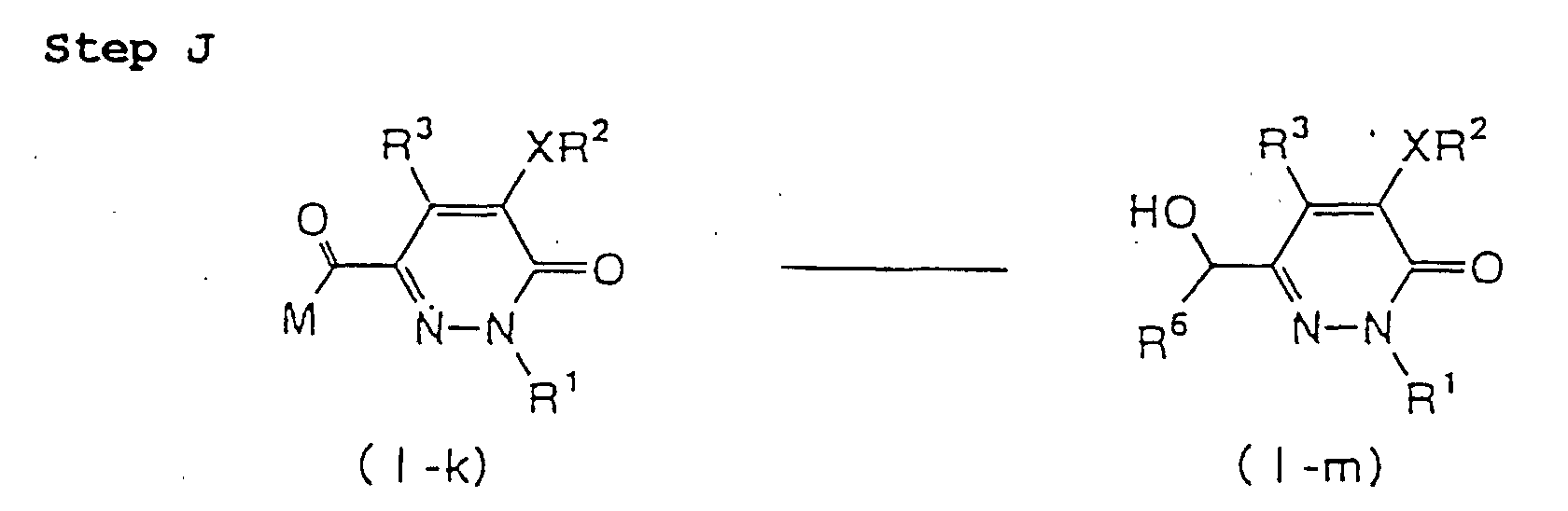
Compound (I-m) can be produced by reacting Compound
(I-k) produced according to the method of Step B, C, F, G,
H or I with a reducing agent, e.g., a metal hydride such as
lithium aluminium hydride or sodium borohydride, a boron
compound such as diborane, a silicon compound such as
triethylsilane, or a tin compound such as tributyltin
hydride in a single solvent of an alcohol such as methanol
or ethanol, an ether such as dioxane, tetrahydrofuran or
diethyl ether, a hydrocarbon such as toluene or benzene,
water, acetic acid or the like, or a mixed solvent thereof,
usually at 0°C to room temperature for 1 to 24 hours.
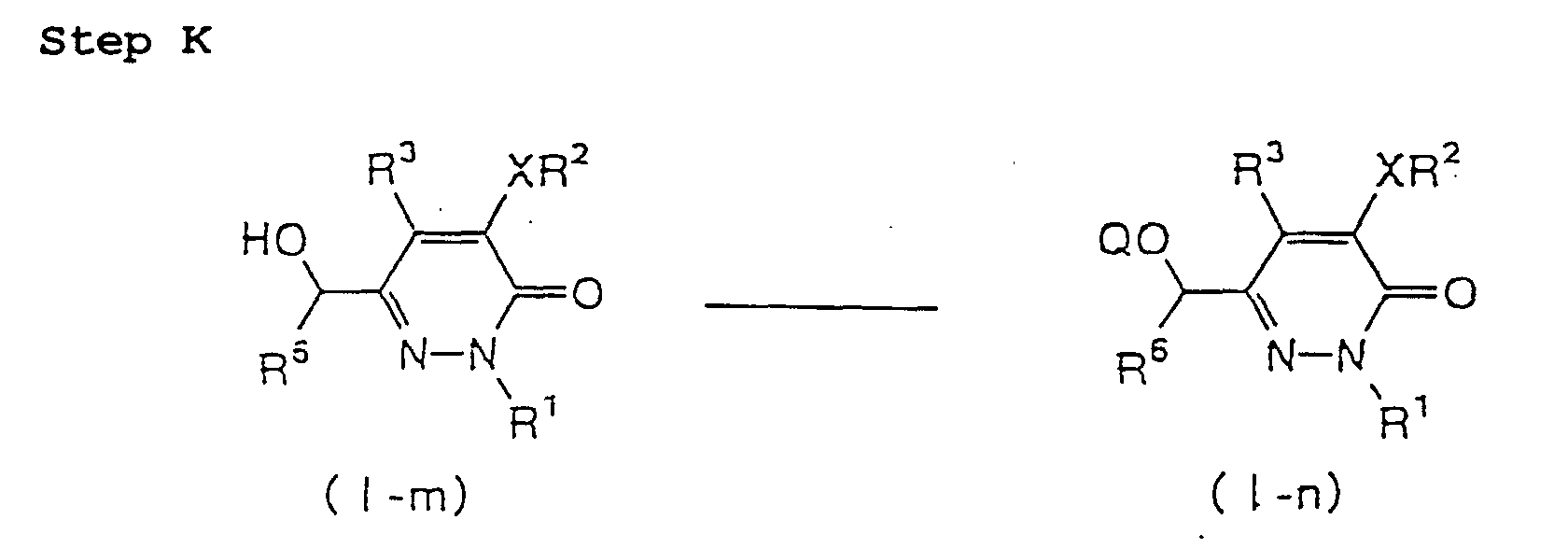
Compound (I-n) can be produced by reacting Compound
(I-m) produced in Step I with an acyl halide or a
carboxylic acid derivative of various type usually at 0°C
to room temperature for 1 to 24 hours in the presence or
absence of an inert solvent and in the presence of a base
or in the presence of a dehydrating agent such as
dicyclohexylcarbodiimide using a phase transfer catalyst,
if necessary. Examples of the inert solvent include ethers
such as tetrahydrofuran, diethyl ether and dioxane,
hydrocarbons such as toluene and benzene, halogenated
hydrocarbons such as dichloromethane, chloroform and
1,2-dichloroethane, ketone-type solvents such as acetone,
polar organic solvents such as acetonitrile,
N,N-dimethylformamide and dimethyl sulfoxide as single
solvents or mixed solvents thereof. Examples of the base
include nitrogen-containing organic bases such as
triethylamine, diisopropylethylamine and pyridine,
inorganic bases such as potassium carbonate, sodium
hydroxide, sodium hydride and metallic sodium, organic
bases such as sodium acetate, potassium acetate and
ammonium acetate, alcoholates such as potassium t-butoxide
and sodium ethoxide. The phase transfer catalyst may be
exemplified by quaternary ammonium salts such as
benzyltriethylammonium bromide, and crown ethers such as
18-crown-6-ether.
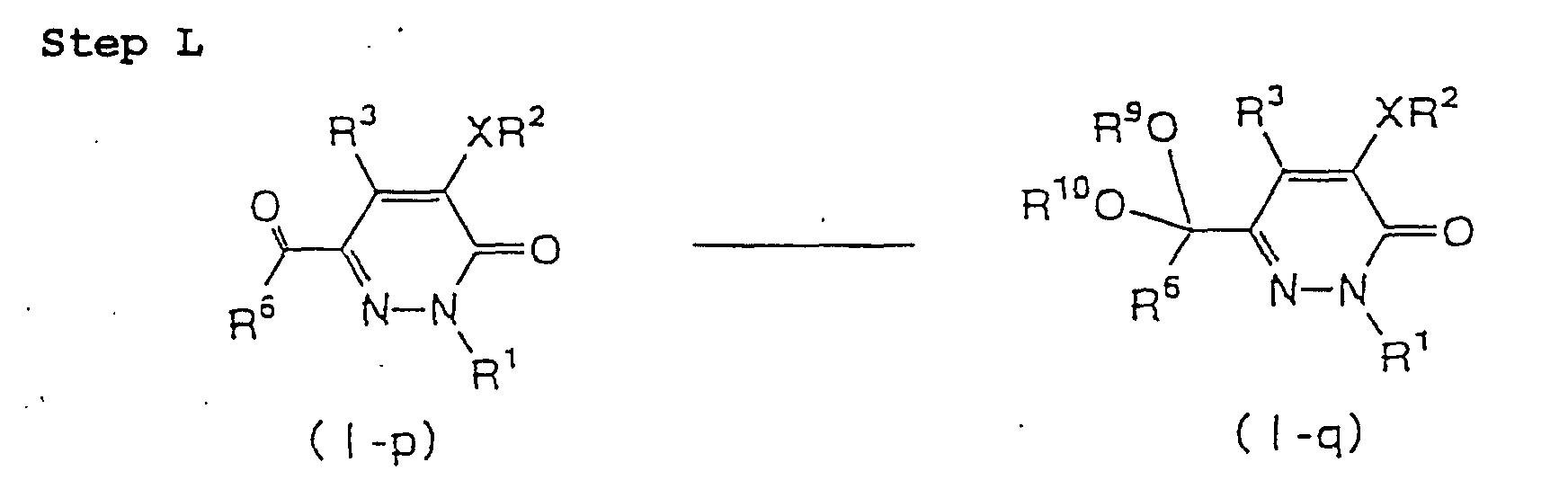
Compound (I-q) can be produced by reacting Compound
(I-p) produced according to the method of Step B, C, D, F
or I with an alcohol such as ethylene glycol usually at
room temperature to the boiling point of the solvent for 1
to 48 hours under the usual conditions for protecting a
carbonyl group, for example, in the presence of an organic
acid catalyst such as p-toluenesulfonic acid in an aromatic
hydrocarbon such as toluene or benzene with removing water
formed in the reaction system by means of a water-separating
apparatus, distillation, a Lewis acid such as
boron trifluoride, or a dehydrating agent such as an
orthoester.

Compound (IV-d) can be produced by reacting
Compound (IV-a') produced according to the method of Step A
with 1 to 3 equivalents of an organic or inorganic
oxidizing agent such as hydrogen peroxide, peracetic acid,
m-chloroperbenzoic acid, potassium permanganate,
N-chlorosuccinimide, chromic acid, potassium dichromate in
a single solvent of a halogenated hydrocarbon such as
dichloromethane, chloroform or 1,2-dichloroethane, an ether
such as tetrahydrofuran, diethyl ether or dioxane,. water,
acetic acid, formic acid or the like, or a mixed solvent
thereof, usually at 0°C to 100°C for 1 to 24 hours.
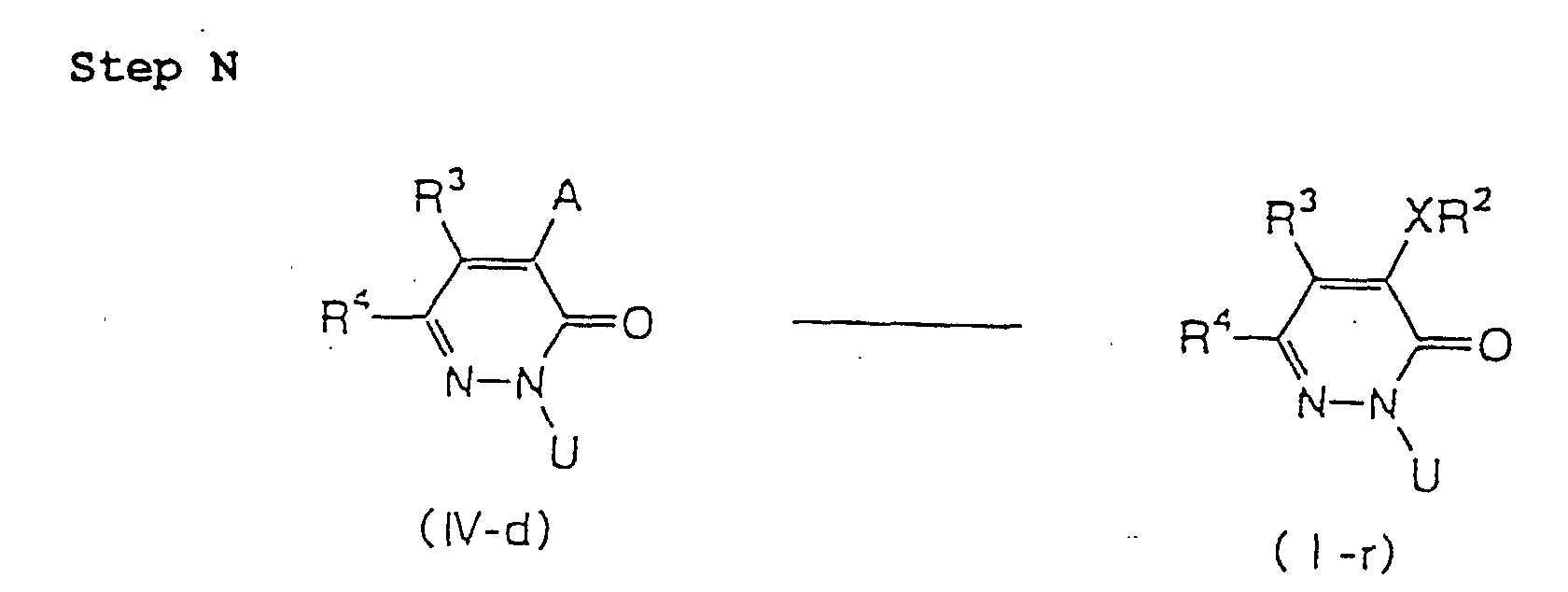
Compound (I-r) can be produced from Compound (IV-d)
and Compound (V) according to the method of Step B.

Compound (I-s) can be produced by reacting Compound
(I-h') produced in Step H with a dehydrating agent such as
acetic anhydride, acetic anhydride-sodium acetate, thionyl
chloride, diphosphorus pentaoxide, phosphorus pentachloride,
phosphorus oxychloride or dicyclohexylamide in the presence
or absence of an inert solvent usually at room temperature
to 30°C for 1 to 24 hours. As the inert solvent, an ether
such as tetrahydrofuran, diethyl ether or dioxane, an
hydrocarbon such as toluene or benzene, a halogenated
hydrocarbon such as dichloromethane, chloroform or
1,2-dichloroethane may be used singly or as a mixed solvent
thereof.
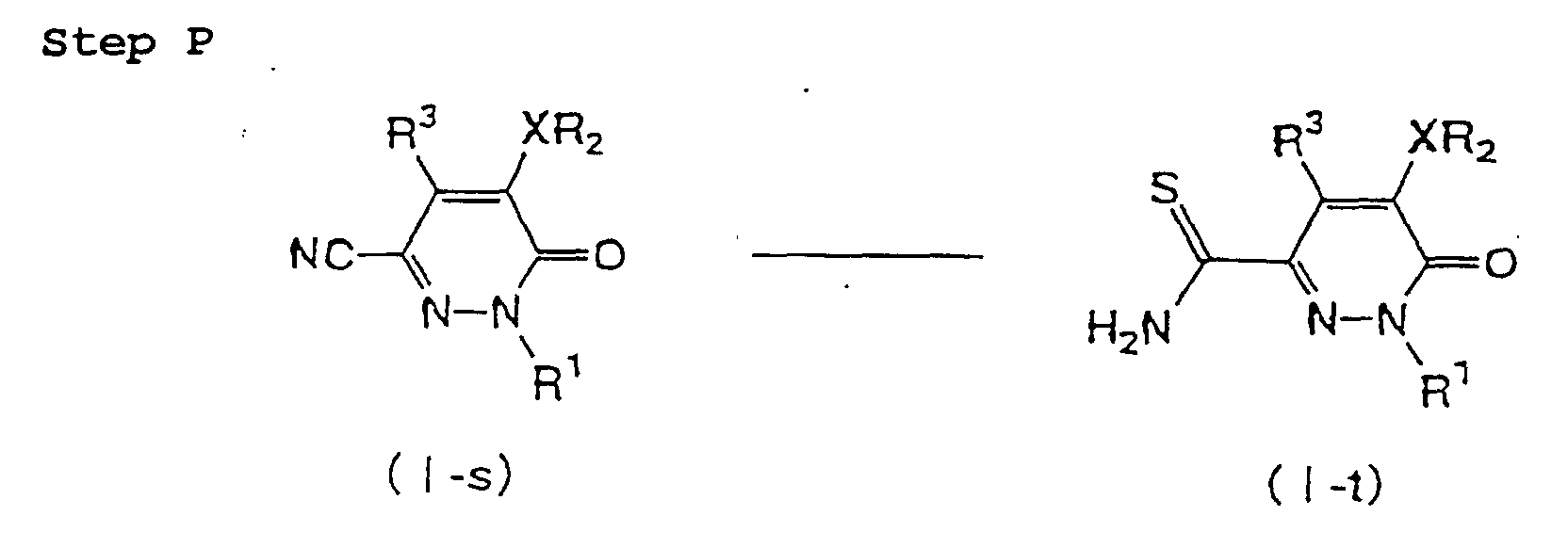
Compound (I-t) can be produced by reacting Compound
(I-s) produced in Step O with hydrogen sulfide in the
presence or absence of an inert solvent, optionally using a
catalyst such as pyridine, pyridine-triethylamine or
diethylamine, usually at 0°C to room temperature for 1 to
24 hours. As the inert solvent, an ether such as
tetrahydrofuran, diethyl ether or dioxane, a hydrocarbon
such as toluene or benzene may be used singly or as a mixed
solvent thereof.

Compound (VI-a) can be produced by reacting
Compound (I-s) produced in Step O with an alcohol and
hydrogen chloride usually at 0°C to room temperature for 1
to 24 hours. Examples of the alcohol include methanol and
ethanol.

Compound (I-u) can be produced by reacting Compound
(VI-a) produced in Step Q with an amine in an inert solvent
such as an alcohol usually at room temperature to the
boiling point of the solvent for 1 to 24 hours. Examples
of the alcohol include methanol and ethanol.
The pyridazinone derivative represented by formula
(I) or a pharmaceutically acceptable salt thereof according
to the present invention is used solely or as a composition
comprising a pharmaceutically acceptable inert carrier or
diluent, with formulating it into a preparation form
suitable for oral administration or parenteral
administration, e.g., a liquid, a tablet (including a
sugar-coated tablet, film-coated tablet), a powder, a
granular, a capsule (including a soft capsule), an
injection, a suspension, a suppository, an emulsion, an
ointment, a cream, a lotion, a poultice or the like. The
dose varies with age, body weight and administration form,
but in the case of the treatment of the whole body, the
compound may be generally administered in an amount of at
least 0.05 mg/kg-body weight, preferably 0.5 to 10 mg/kg-body
weight per adult by one dose or divided doses per day.
In the case of topical treatment, e.g., a preparation for
application, the concentration of the active ingredient may
be at least 0.001%, preferably from 0.1 to 2% which is most
suitable, and the preparation may be applied in an amount
of 30 mg to 100 mg per cm2. In the employment of the
present inhibitor, it is also possible to use it as a
mixture with other cell adhesion inhibitor.
The present invention will be explained below in
detail with reference to Production Examples and Test
Examples. However, the present invention is not limited
thereto.
Pentan-2,3,4-trione 3-(3-chlorophenylhydrazone)
(1.50 g) was added to a suspension of 66% sodium hydride
(0.48 g) in anhydrous tetrahydrofuran (30 ml) under ice
cooling, followed by stirring at room temperature for 30
minutes. Then, a solution of phenylthioacetyl chloride
(1.19 g) in anhydrous tetrahydrofuran (5 ml) was added
dropwise under ice cooling, followed by stirring at room
temperature for 12 hours. The reaction mixture was poured
into ice-water, and extracted with ethyl acetate. After
washing with water and a brine, the organic layer was dried
over anhydrous magnesium sulfate. The solvent was removed
by evaporation, the resulting residue was purified by
silica gel column chromatography (ethyl acetate:hexane =
8:1), and the resulting crude crystals were recrystallized
from ethyl acetate/hexane to obtain 6-acetyl-2-(3-chlorophenyl)-5-methyl-4-phenylthio-3(2H)-pyridazinone
(1.6
g) (Compound No. 1-64).
A mixture of methyl 1-(3-chlorophenyl)-5-(4-fluorophenylthio)-4-methyl-6-oxohydropridazin-3-carboxylate
(0.10 g), formic acid (1 ml) and sulfuric acid (1 ml) was
heated under reflux for 3 hours. After cooling on standing,
the reaction mixture was poured into water and extracted
with ethyl acetate. After washing with water and a brine,
the organic layer was dried over anhydrous magnesium
sulfate. The solvent was removed by evaporation, and the
resulting residue was purified by silica gel column
chromatography (ethyl acetate:methanol = 20:1) to obtain
the aimed compound (0.05 g) (Compound No. 1-80).
To a solution of methyl 1-(3-chlorophenyl)-5-(4-fluorophenylthio)
-4-methyl-6-oxohydropridazin-3-carboxylate
(0.50 g) in ethanol (80 ml) were added 28% aqueous ammonia
(30 ml) and ammonium chloride (0.07 g), followed by
stirring at room temperature for 5 hours. The solvent was
removed by evaporation, water was added to the resulting
residue, and the mixture was extracted with ethyl acetate.
After washing with water and a brine, the organic layer was
dried over anhydrous magnesium sulfate. The solvent was
removed by evaporation, and the resulting residue was
purified by silica gel column chromatography (ethyl
acetate:hexane = 3:1) to obtain the aimed compound (0.35 g)
(Compound No. 1-82).
To a solution of 6-acetyl-2-(3-chlorophenyl)-5-methyl-4-phenylthio-3(2H)-pyridazinone
(0.37 g) in 1,2-dichloroethane
(10 ml) was added m-chloroperbenzoic acid
(0.65 g), followed by stirring at room temperature for 12
hours. An aqueous solution of sodium thiosulfate was added
to the reaction mixture to decompose excess oxidizing agent,
and then the mixture was extracted with chloroform. After
washing with a saturated aqueous sodium hydrogen carbonate
solution and a brine, the organic layer was dried over
anhydrous magnesium sulfate. The solvent was removed by
evaporation, and the resulting residue was allowed to stand
at room temperature to obtain crystalline 6-acetyl-2-(3-chlorophenyl)-5-methyl-4-phenylsulfonyl-3(2H)
-pyridazinone
(0.38 g) (Compound No. 1-83).
Pentan-2,3,4-trione 3- (3-chlorophenylhydrazone)
(2.39 g) was added to a suspension of 66% sodium hydride
(0.77 g) in anhydrous tetrahydrofuran (40 ml) under ice
cooling, followed by stirring at room temperature for 30
minutes. Then, a solution of 2-thiopheneacetyl chloride
(1.77 g) in anhydrous tetrahydrofuran (10 ml) was added
dropwise under ice cooling, followed by stirring at room
temperature for 2 hours. The reaction mixture was poured
into water and extracted with ethyl acetate. After washing
with water and a brine, the organic layer was dried over
anhydrous magnesium sulfate. The solvent was removed by
evaporation, the resulting residue was purified by silica
gel column chromatography (ethyl acetate:hexane = 1:4), and
the resulting crude crystals were washed with hexane to
obtain 6-acetyl-2-(3-chlorophenyl)-5-methyl-4-(2-thienyl)-3
(2H) -pyridazinone (2.19 g) (Compound No. 1-97).
Hydrogen sulfide was bubbled into a solution of 6-acetyl-2-
(3-chlorophenyl) -5-methyl-3-oxo-2-hydropyridazin-4-carbonitrile
(1.36 g) and triethylamine (0.8 ml) in
pyridine (20 ml) at 10°C for 10 minutes,. followed by
stirring at the same temperature for 1 hour. The solvent
was removed by evaporation, and the resulting residue was
crystallized from ethyl acetate/hexane to obtain 6-acetyl-4-(aminothioxomethyl)-2-(3-chlorophenyl)-5-methyl-3(2H)-pyridazinone
(0.90 g) (Compound No. 1-153).
To a suspension (5 ml) of 6-acetyl-4-(aminothioxomethyl)-2-(3-chlorophenyl)-5-methyl-3(2H)-pyridazinone
(200 mg) in ethanol (5 ml) was added a 50%
aqueous solution of chloroacetoaldehyde, followed by
heating under reflux for 10 hours. After cooling on
standing, the reaction mixture was extracted with ethyl
acetate. After washing with a saturated sodium hydrogen
carbonate aqueous solution and a brine, the organic layer
was dried over anhydrous magnesium sulfate. The solvent
was removed by evaporation, the resulting residue was
purified by silica gel column chromatography (ethyl
acetate:hexane = 1:2), and the resulting crude crystals was
washed with hexane to obtain 6-acetyl-2-(3-chlorophenyl)-5-methyl-4-(1,3-thiazol-2-yl)-3(2H)-pyridazinone
(90 mg)
(Compound No. 1-155).
To a solution of 4-((6-acetyl-2-(4-fluorophenyl)-5-methyl-3-oxo-2-hydropyridazin-4-yloxy)methyl)pyridin-2-carbonitrile
(100 mg) in 1,4-dioxane (5 ml) was added 6N
hydrochloric acid (3 ml), followed by heating under reflux
for 24 hours. The solvent was removed by evaporation, a
10% aqueous sodium hydroxide solution was added to the
resulting residue to adjust the pH to 3 to 4, and then the
mixture was stirred at room temperature for 1 hour. The
crystals precipitated were filtered off, washed with water
and diethyl ether, and then dried to obtain 4-((6-acetyl-2-(4-fluorophenyl)-5-methyl-3-oxo-2-hydropyridazin-4-yloxy)methyl)pyridin-2-carboxylic
acid (53 mg) (Compound No.
1-164).
Methanesulfonyl chloride (0.1 ml) was added to a
solution of 6-acetyl-4-(4-aminophenylthio)-2-(4-fluorophenyl)-5-methyl-3(2H)-pyridazinone
(185 mg) in
pyridine (2 ml) at 5°C, followed by stirring at room
temperature for 1 hour. Water was added to the reaction
mixture and the mixture was extracted with ethyl acetate.
After washing with a saturated aqueous sodium hydrogen
carbonate solution and a brine, the organic layer was dried
over anhydrous magnesium sulfate. The solvent was removed
by evaporation, and the resulting residue was purified by
silica gel column chromatography (ethyl
acetate:hexane = 1:1), and was crystallized from ether to
obtain 6-acetyl-2-(4-fluorophenyl)-5-methyl-4-(4-methylsulfonylaminophenylthio)-3(2H)-pyridazinone
(180 mg)
(Compound No. 4-01).
Methyl iodide (0.9 ml) was added to a solution of
6-acetyl-4-(4-aminophenylthio)-2-(4-fluorophenyl)-5-methyl-3(2H)-pyridazinone
(370 mg) and 2,6-lutidine (1 ml) in N,N-dimethylformamide
(5 ml) at 5°C, followed by stirring at
room temperature for 12 hours. Water was added to the
reaction mixture and the mixture was extracted with ethyl
acetate. After washing with water and a brine, the organic
layer was dried over anhydrous magnesium sulfate. The
solveht was removed by evaporation, and the resulting
residue was purified by silica gel column chromatography
(ethyl acetate:hexane = 1:1), and was crystallized from
ether/hexane to obtain 6-acetyl-4-(4-dimethylaminophenylthio)-2-(4-fluorophenyl)-5-methyl-3(2H)-pyridazinone
(120 mg) (Compound No. 4-04).
Sodium borohydride (26 mg) was added to a solution
of 6-acetyl-2-(4-chlorophenyl)-4-(4-chlorophenylthio)-5-methyl-3(2H)-pyridazinone
(0.50 g) in ethanol (50 ml) under
icecooling, followed by stirring at 5°C for 3 hours. The
reaction mixture was poured into water and extracted with
chloroform. After washing with water and a brine, the
organic layer was dried over anhydrous magnesium sulfate.
The solvent was removed by evaporation, and the resulting
residue was allowed to stand at room temperature to obtain
crystalline 2-(3-chlorophenyl)-6-(1-hydroxyethyl)-5-methyl-4-phenylthio-3(2H)-pyridazinone
(0.48 g) (Compound No. 6-01).
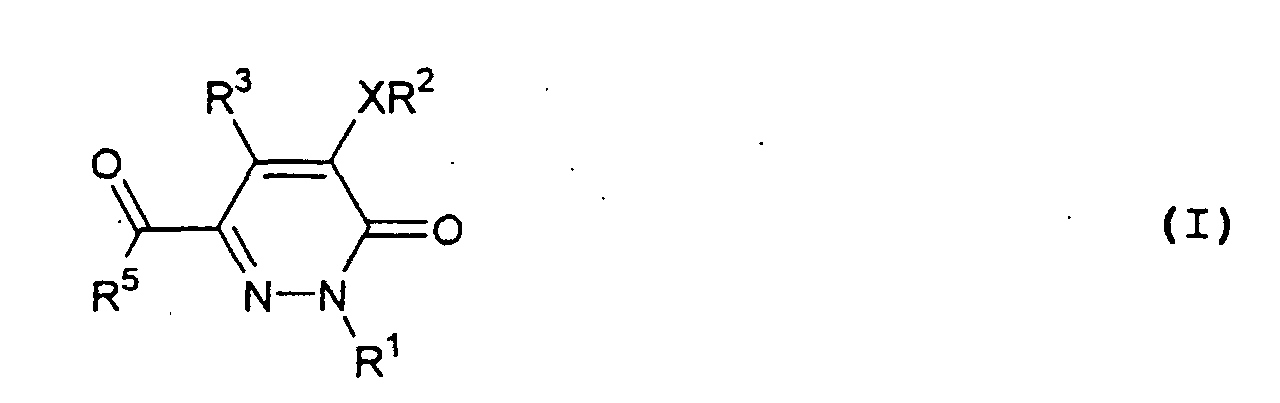
| Compound No. | R1 | X | R2 | R3 | R5 | Melting point (°C) |
| 1-01 | 3-Cl-Ph | S | 2-Cl-Ph | Me | Me | 136-137 |
| 1-02 | 3-Cl-Ph | S | 3-Cl-Ph | Me | Me | 120-121 |
| 1-03 | 3-Cl-Ph | S | 4-Cl-Ph | Me | Me | 135-136 |
| 1-04 | 3-Cl-Ph | S | 2-MeO-Ph | Me | Me | 115-116 |
| 1-05 | 3-Cl-Ph | S | 3-MeO-Ph | Me | Me | 76-77 |
| 1-06 | 3-Cl-Ph | S | 4-MeO-Ph | Me | Me | 60-62 |
| 1-07 | 3-Cl-Ph | S | 4-F-Ph | Me | Me | 95-96 |
| 1-08 | 3-Cl-Ph | S | 4-Me-Ph | Me | Me | 102-103 |
| 1-09 | 3-Cl-Ph | S | 4-tBu-Ph | Me | Me | 104-105 |
| 1-10 | 3-Cl-Ph | S | 4-NO2-Ph | Me | Me | 158-160 |
| 1-11 | 3-Cl-Ph | S | 2-pyridyl | Me | Me | 119-120 |
| 1-12 | 3-Cl-Ph | S | 2-pyridyl | Me | Me | 159-160 |
| 1-13 | 3-Cl-Ph | S | 2-pyrimidinyl | Me | Me | 124-125 |
| 1-14 | 3-Cl-Ph | S | 4-Me-3-(4H- | Me | Me | 157-158 |
| 1,2,4-triazolyl) | ||||||
| 1-15 | 3-Cl-Ph | S | Me | Me | Me | 130-132 |
| 1-16 | 3-Cl-Ph | S | iPr | Me | Me . | 69-71 |
| 1-17 | 3-Cl-Ph | S | tBu | Me | Me | 51-53 |
| 1-18 | 4-MeO-Ph | S | Et | Me | Me | 110-112 |
| 1-19 | 3-Cl-Ph | S | Bn | Me | Me | 97-99 |
| 1-20 | 4-F-Ph | S | 4-F-Ph | Me | Me | 111-112 |
| 1-21 | 4-F-Ph | S | 2-pyridyl | Me | Me | 128-129 |
| 1-22 | 4-F-Ph | S | 3-pyridyl | Me | Me | 116-117 |
| 1-23 | 4-F-Ph | S | 3-pyridyl | Me | Me | 157-159 (hydrochloride) |
| 1-24 | 4-F-Ph | S | 4-pyridyl | Me | Me | 132-133 |
| 1-25 | 4-F-Ph | S | 4-pyridyl | Me | Me | 109-115 (hydrochloride) |
| 1-26 | 3-Cl-Ph | S | CH2CO2Me | Me | Me | 130-131 |
| 1-27 | 4-F-Ph | S | CH2CO2Me | Me | Me | 129-130 |
| 1-28 | 4-F-Ph | S | CH2CH2CO2Et | Me | Me | 47-48 |
| 1-29 | 4-Cl-Ph | S | 4-Cl-Ph | Me | Me | 185-186 |
| 1-30 | 4-MeO-Ph | S | Ph | Me | Me | 90-92 |
| 1-31 | 3-pyridyl | S | 4-F-Ph | Me | Me | 81-83 |
| 1-32 | 3-pyridyl | S | 4-pyridyl | Me | Me | 148-149 |
| 1-33 | 3-pyridyl | O | Et | Me | Me | 148-149 |
| 1-34 | 4-F-Ph | S | CH2CH2NMe2 | Me | Me | 188-190 (hydrochloride) |
| 1-35 | 4-F-Ph | S | CH2CH2NMe2 | He | Me | 49-51 |
| 1-36 | 4-F-Ph | S | 2-imidazolyl | Me | Me | 225-227 |
| 1-37 | 4-F-Ph | S | 2-thiazolyl | Me | Me | 101-102 |
| 1-38 | 4-F-Ph | S | CH2CH2OH | Me | Me | 122-123 |
| 1-39 | 4-F-Ph | S | CH2CH2NHAc | Me | Me | 133-134 |
| 1-40 | 4-F-Ph | S | 5-HO2C-2-pyridyl | Me | Me | 230-232 |
| 1-41 | 4-F-Ph | S | 3-HO2C-2-pyridyl | Me | Me | 226-228 |
| 1-42 | 4-F-Ph | S | 4-OH-3,5-di-tBu-Ph | Me | Me | 119-120 |
| 1-43 | 4-F-Ph | S | 2-HO2C-Ph | Me | Me | 238-239 |
| 1-44 | 4-F-Ph | S | 3-(1H-1,2,4-triazolyl) | Me | Me | 180-182 |
| 1-45 | 4-F-Ph | S | 1-Me-5-(1H-tetrazolyl) | Me | Me | 91-93 |
| 1-46 | 4-F-Ph | S | 5-Me-2-(1,3,4-thiadiazolyl) | Me | Me | 84-86 |
| 1-47 | 4-F-Ph | S | 8-quinolyl | Me | Me | 101-103 |
| 1-48 | 4-F-Ph | S | 2-thienyl | Me | Me | 67-69 |
| 1-49 | 2-CN-Ph | S | 4-F-Ph | Me | Me | 118-120 |
| 1-50 | 6-MeO-3-pyridyl | S | 4-F-Ph | Me | Me | 88-89 |
| 1-51 | 4-F-Ph | S | CH2CH2NH2 | Me | Me | 104-106 |
| 1-52 | 3-pyridyl | S | 4-NH2-Ph | Me | Me | 161-163 |
| 1-53 | 3-pyridyl | S | 2-NH2-Ph | Me | Me | 148-150 |
| 1-54 | 4-F-Ph | S | 2-NH2-Ph | Me | Me | 140-142 |
| 1-55 | 4-F-Ph | S | 3-NH2-Ph | Me | Me | 132-134 |
| 1-56 | 4-F-Ph | S | 4-NH2-Ph | Me | Me | 148-150 |
| 1-57 | 4-F-Ph | S | 4-NH2-Ph | Me | Me | 169-174 (hydrochloride) |
| 1-58 | 4-F-Ph | S | 4-ACNH-Ph | Me | Me | 210-212 |
| 1-59 | 3-pyridyl | S | 4-AcNH-Ph | Me | Me | 181-183 |
| 1-60 | 3-pyridyl | S | CH2CH2NH2 | Me | Me | 112-114 |
| 1-61 | 3-Cl-Ph | S | CH2CH2NH2 | Me | Me | 84-86 |
| 1-62 | 4-F-Ph | S | (CH2)3OH | Me | Me | 97-98 |
| 1-63 | 3-Cl-Ph | S | 2-pyridyl N-oxide | Me | Me | 165-166 |
| 1-64 | 3-Cl-Ph | S | Ph | Me | Me | 99-100 |
| 1-65 | 3-Cl-Ph | S | Ph | H | Me | 142-144 |
| 1-66 | 3,4-Cl-Ph | S | Ph | Me | Me | 122-127 |
| 1-67 | 2-Cl-Ph | S | Ph | Me | Me | 77-78 |
| 1-68 | 3-pyridyl | S | Ph | Me | Me | 63-64 |
| 1-69 | 4-Cl-Ph | S | Ph | Me | Me | 121-122 |
| 1-70 | 3-Cl-Ph | O | Ph | Me | Me | 139-141 |
| 1-71 | 3-Cl-Ph | O | 4-Cl-Ph | Me | Me | 166-167 |
| 1-72 | 4-Cl-Ph | O | 4-Cl-Ph | Me | Me | 169-170 |
| 1-73 | 3-Cl-Ph | O | 4-F-Ph | Me | Me | 147-148 |
| 1-74 | 3-F-Ph | O | 4-F-Ph | Me | Me | 165-166 |
| 1-75 | 3-Cl-Ph | - | CN | Me | Me | 139-141 |
| 1-76 | C-Cl-Ph | S | Ph | Ph | Ph | 198-199 |
| 1-77 | 4-F-Ph | - | CO2Et | Me | Me | 96-97 |
| 1-78 | 3-Cl-Ph | S | Ph | Me | OMe | 55-57 |
| 1-79 | 3-Cl-Ph | S | 4-F-Ph | Me | OMe | 113-115 |
| 1-80 | 3-Cl-Ph | S | 4-F-Ph | Me | OH | 215-225 |
| 1-81 | 3-Cl-Ph | S | Ph | Me | NH2 | 87-89 |
| 1-81 | 3-Cl-Ph | S | 4-F-Ph | Me | NH2 | 126-128 |
| 1-83 | 3-Cl-Ph | SO2 | Ph | Me | Me | 175-176 |
| 1-84 | 3-Cl-Ph | SO | Ph | Me | Me | 186-188 |
| 1-85 | 4-F-Ph | SO2 | 4-pyridyl | Me | Me | 206-208 |
| 1-86 | 3-pyridyl N-oxide | SO | 4-F-Ph | Me | Me | 161-163 |
| 1-87 | 4-F-Ph | S | 4-F-Ph | H | NH2 | 71-73 |
| 1-88 | 4-F-Ph | S | 4-F-Ph | Me | OH | 203-204 |
| 1-89 | 4-F-Ph | S | 4-F-Ph | Me | OMe | 106-108 |
| 1-90 | 4-F-Ph | S | 4-AcNH-Ph | Me | OMe | 147-148 |
| 1-91 | 4-F-Ph | S | 4-AcNH-Ph | Me | OH | 213-215 |
| 1-92 | 4-F-Ph | S | 4-AcNH-Ph | Me | OH | 260 (decomposed, hydrochloride) |
| 1-93 | 4-F-Ph | S | 4-F-Ph | Me | NHOH | 145-147 |
| 1-94 | 4-F-Ph | S | 4-NH2-Ph | Me | OMe | 128-129 |
| 1-95 | 4-F-Ph | S | 4-AcNH-Ph | Me | NH2 | 237-238 |
| 1-96 | 4-F-Ph | S | 4-NH2-Ph | Me | NH2 | 168-169 |
| 1-97 | 3-Cl-Ph | - | 2-thienyl | Me | Me | 116-117 |
| 1-98 | 3-F-Ph | - | 2-thienyl | Me | Me | 112-113 |
| 1-99 | 4-MeO-Ph | - | 2-thienyl | Me | Me | 122-123 |
| 1-100 | 4-F-Ph | - | 2-thienyl | Me | Me | 130-131 |
| 1-101 | 4-F-Ph | - | 3-thienyl | Me | Me | 96-97 |
| 1-102 | 3-pyridyl | - | 2-thienyl | Me | Me | 89-90 |
| 1-103 | 3-Cl-Ph | - | Ph | Me | Me | 94-95 |
| 1-104 | 3-Cl-Ph | - | 2-MeO-Ph | Me | Me | 100-102 |
| 1-105 | 3-Cl-Ph | - | 4-MeO-Ph | Me | Me | 102-104 |
| 1-106 | 3-Cl-Ph | - | 3,4-(HeO)2-Ph | Me | Me | 132-134 |
| 1-107 | 4-F-Ph | O | i-Pr | Me | Me | 79-80 |
| 1-108 | 4-F-Ph | O | cyclopentyl | Me | Me | 95-96 |
| 1-109 | 4-F-Ph | O | CH2CH2NMe2 | Me | Me | 175-176 (hydrochloride) |
| 1-110 | 4-F-Ph | O | 3-pyridyl | Me | Me | 165-166 |
| 1-111 | 4-F-Ph | O | 4-pyridyl | Me | Me | 184-185 |
| 1-112 | 4-F-Ph | O | 1-methyl-4-piperidino | Me | Me | 183-184 (hydrochloride) |
| 1-113 | 4-F-Ph | O | 2-pyridylmethyl | Me | Me | 153-154 |
| 1-114 | 4-F-Ph | O | 3-pyridylmethyl | Me | Me | 153-156 (hydrochloride) |
| 1-115 | 4-F-Ph | O | 4-pyridylmethyl | Me | Me | 167-168 |
| 1-116 | 4-F-Ph | O | 4-F-benzyl | Me | Me | 168-169 |
| 1-117 | 4-F-Ph | O | 2-thienylmethyl | Me | Me | 146-147 |
| 1-118 | 4-F-Ph | O | 3-thienylmethyl | Me | Me | 153-154 |
| 1-119 | 4-F-Ph | O | 2-furylmethyl | Me | Me | 145-146 |
| 1-120 | 4-F-Ph | O | 3-furylmethyl | Me | Me | 153-154 |
| 1-121 | 4-F-Ph | O | 2-thiazolylmethyl | Me | Me | 172-173 |
| 1-122 | 4-F-Ph | O | (4-methyl-5-thiazolyl)ethyl | Me | Me | 79-80 |
| 1-123 | 4-F-Ph | O | 2-thienylethyl | Me | Me | 67-68 |
| 1-124 | 4-F-Ph | O | 3-thienylethyl | Me | Me | 65-66 |
| 1-125 | 4-F-Ph | O | (4-Cl-2-pyridyl)methyl | Me | Me | 155-156 |
| 1-126 | 3-pyridyl N-oxide | O | 4-pyridylmethyl | Me | Me | 161-162 |
| 1-127 | 3-pyridyl N-oxide | O | 4-F-Ph | Me | Me | 171-173 |
| 1-128 | 4-F-Ph | O | 2-pyridylmethyl N-oxide | Me | Me | 218-220 |
| 1-129 | 4-F-Ph | O | 3-pyridylmethyl N-oxide | Me | Me | 186-188 |
| 1-130 | 4-F-Ph | O | 4-pyridylmethyl N-oxide | Me | Me | 165-167. |
| 1-131 | 4-F-Ph | O | (4-Cl-2-pyridyl)methyl N-oxide | Me | Me | 138-139 |
| 1-132 | 4-F-Ph | O | 3-pyridyl N-oxide | Me | Me | 182-184 |
| 1-133 | 4-F-Ph | O | (6-Me-2-pyridyl)methyl N-oxide | Me | Me | 175-177 |
| 1-134 | 3-pyridyl N-oxide | S | 4-F-Ph | Me | Me | 122-123 |
| 1-135 | 3-pyridyl N-oxide | S | 4-Cl-Ph | Me | Me | 172-174 |
| 1-136 | 3-pyridyl N-oxide | S | 2,4-di-F-Ph | Me | Me | 152-154 |
| 1-137 | 3-pyridyl N-oxide | S | 4-Me-Ph | Me | Me | 176-178 |
| 1-138 | 3-pyridyl N-oxide | S | 2-OMe-Ph | Me | Me | paste.* |
| 1-139 | 3-pyridyl N-oxide | S | 3-OMe-Ph | Me | Me | 85-87 |
| 1-140 | 3-pyridyl N-oxide | S | 4-OMe-Ph | Me | Me | 166-168 |
| 1-141 | 3-pyridyl N-oxide | S | 3,4-di-OMe-Ph | Me | Me | 106-108 |
| 1-142 | 3-pyridyl N-oxide | S | 4-OCF3-Ph | Me | Me | 182-184 |
| 1-143 | 3-pyridyl N-oxide | S | Et | Me | Me | 150-152 |
| 1-144 | 3-pyridyl N-oxide | S | i-Pr | Me | Me | 108-110 |
| 1-145 | 6-OMe-3-pyridyl N-oxide | S | 4-F-Ph | Me | Me | 120-122 |
| 1-146 | 3-pyridyl N-oxide | S | 2-thienyl | Me | Me | paste * |
| 1-147 | 3-pyridyl N-oxide | S | 4-pyridyl | Me | Me | 147-149 |
| 1-148 | 3-pyridyl N-oxide | S | 4-OMe-Bn | Me | Me | 53-155 |
| 1-149 | 3-pyridyl N-oxide | S | CH2CO2Et | Me | Me | 107-109 |
| 1-150 | 3-pyridyl N-oxide | S | 4-NH2-Ph | Me | Me | 187-189 |
| 1-151 | 3-pyridyl N-oxide | S | 4-NHAc-Ph | Me | Me | 243-245 |
| 1-152 | 3-pyridyl N-oxide | S | CH2CH2NH2 | Me | Me | 166-168 |
| 1-153 | 3-Cl-Ph | - | CSNH2 | Me | Me | 195-197 |
| 1-154 | 3-Cl-Ph | - | 4-CO2Et-2-thienyl | Me | Me | 172-174 |
| 1-155 | 3-Cl-Ph | - | 2-thiazolyl | Me | Me | 158-160 |
| 1-156 | 3-Cl-Ph | - | 4-CO2H-2-thienyl | Me | Me | 264-266 |
| 1-157 | 3-Cl-Ph | S | CH2CO2H | Me | Me | 159-160 |
| 1-158 | 4-F-Ph | S | CH2CO2H | Me | Me | 158-160 |
| 1-159 | 4-F-Ph | S | CH2CH2CO2H | Me | Me | 103-105 |
| 1-160 | 4-F-Ph | S | CH2CONH2 | Me | Me | 168-170 |
| 1-161 | 4-F-Ph | O | CH2CO2H | Me | Me | 177-178 |
| 1-162 | 4-F-Ph | - | CO2H | Me | Me | 127-128 |
| 1-163 | 4-F-Ph | O | (2-CN-4-pyridyl)methyl | Me | Me | 166-167 |
| 1-164 | 4-F-Ph | O | (2-CO2H-4-pyridyl)methyl | Me | Me | 217 (decomposed) |
| 1-165 | 2-CN-3-pyridyl | S | 4-F-Ph | Me | Me | 96-97 |
| 1-166 | 6-CM-3-pyridyl | S | 4-F-Ph | Me | Me | 101-101 |
| 1-167 | 3-Cl-Ph | S | 2-thienyl | Me | Me | 106-107 |
| 1-168 | 3-Cl-Ph | S | 3-pyridyl | Me | Me | 136-138 |
| 1-169 | 3-Cl-Ph | S | 4-NH2-Ph | Me | Me | 125-126 |
| 1-170 | 3-Cl-Ph | S | 4-NHAc-Ph | Me | Me | 202-204 |
| 1-171 | 3-Cl-Ph | S | (CH2)2OH | Me | Me | 107-108 |
| 1-172 | 3-Cl-Ph | S | (CH2)3OH | Me | Me | 77-78 |
| 1-173 | 3-Cl-Ph | S | 1-methyl-5-(1H-tetrazolyl) | Me | Me | 81-83 |
| 1-174 | 3-Cl-Ph | S | 2-F-Ph | Me | OBu-t | 96-97 |
NMR data of the compounds having a paste property
in Table 1 are shown below.


| Compound No. | 1H-NMR (CDCl3/TMS, δ value (ppm))* |
| 1-138 | 2.61 (3H, s), 2.65 (3H, s), 3.83 (3H, s), 6.87-6.90 (2H, m), 7.26-7.34 (3H, m), 7.75 (1H, d, 8.4 Hz), 8.19 (1H, d, 6.5 Hz), 8.65 (1H, s) |
| 1-146 | 2.59 (3H, s), 2.75 (3H, s), 7.00 (1H, dd, 3.7 Hz, 5.1 Hz), 7.34-7.41 (3H, m), 7.75 (1H, d, 8.5 Hz), 8.22 (1H, d, 6.2 Hz), 8.65 (1H, s) |
| Compound No. | R1 | X | R2 | Melting point (°C) |
| 2-01 | 4-F-Ph | S | Ph | 212-213 |
| Compound No. | R1 | X | R14 | R3 | R5 | Melting point (°C) |
| 3-01 | 4-F-Ph | - | 3-pyridyl | He | He | amorphous * |
| 3-02 | 4-F-Ph | - | CH2CO2Et | Me | Me | 105-106 |
| 3-03 | 3-Cl-Ph | - | H | Me | Me | 141-142 |
NMR data of Compound 3-01 are shown below.
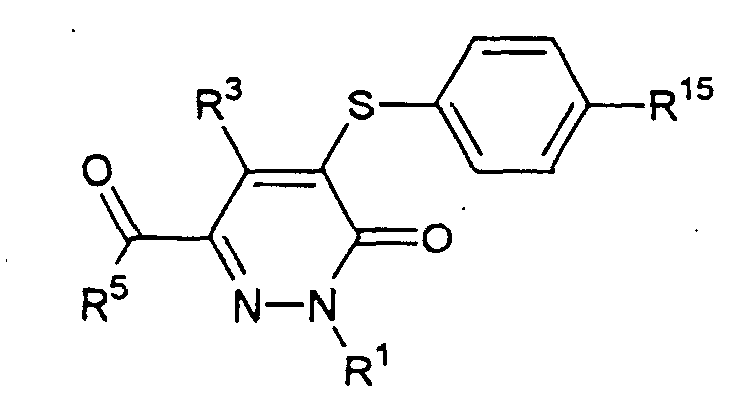
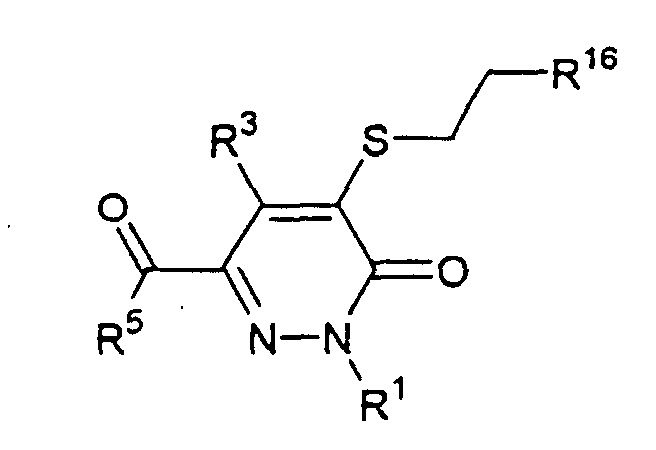
| Compound No. | 1H-NMR (CDCl3/TMS, δ value (ppm)) |
| 3-01 | 2.58 (3H, s), 2.73 (3H, s), 7.17-7.28 (3H, m), 7.56 (2H, m), 8.21 (1H, m), 8.31 (1H, m), 8.65 (1H, s) |
| Compound No. | R1 | X | R15 | R3 | R5 | Melting point (°C) |
| 4-01 | 4-F-Ph | S | NHSO2Me | Me | Me | 182-184 |
| 4-02 | 4-F-Ph | S | NHSO2Ph | Me | Me | 258-260 |
| 4-03 | 3-pyridyl | S | NHSO2Me | Me | Me | 139-141 |
| 4-04 | 4-F-Ph | S | NMe2 | Me | Me | 172-174 |
| 4-05 | 4-F-Ph | S | N+Me3(I-) | He | He | 170-172 |
| 4-06 | 4-F-Ph | S | NHCOCO2Et | Me | Me | 152-154 |
| Compound No. | R1 | X | R16 | R3 | R5 | Melting point (°C) |
| 5-01 | 4-F-Ph | S | NHSO2Me | Me | Me | paste |
| 5-02 | 4-F-Ph | S | NHSO2Ph | Me | Me | paste |
| 5-03 | 4-F-Ph | S | OSO2Me | Me | He | 51-52 |
| 5-04 | 4-F-Ph | S | morpholino | Me | Me | 92-93 |
| 5-05 | 4-F-Ph | S | 2-piperidinoethyl | Me | Me | 56-57 |
| 5-06 | 4-F-Ph | S | (CH2)2NHMe | He | He | 100-101 |
| 5-07 | 4-F-Ph | S | (CH2)2NHOH | He | Me | 103-105 |
NMR data of Compounds 5-01 and 5-02 are shown below.
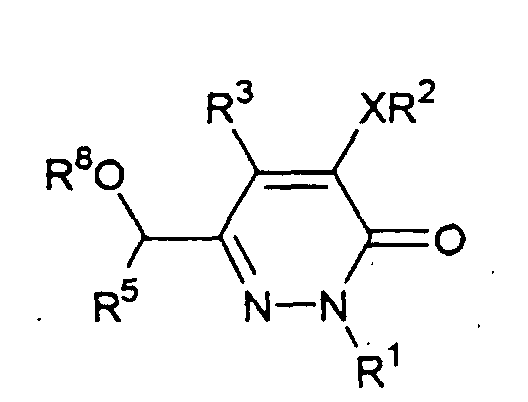
| Compound No. | 1H-NMR (CDCl3/TMS, δ value (ppm)) |
| 5-01 | 2.57 (3H, s), 2.69 (3H, s), 2.94 (3H, s), 3.28-3.45 (4H, m), 5.25 (1H, bs), 7.13-7.30 (2H, m), 7.54-7.65 (2H, m) |
| 5-02 | 2.56 (3H, s), 2.64 (3H, s), 3.15-3.30 (4h, m), 5.43 (1H, bs), 7.16-7.23 (2H, m), 7.41-7.80 (5H, m), 7.81-7.84 (2H, m) |
| Compound No. | R1 | X | R2 | R3 | R6 | R8 | Melting point (°C) |
| 6-01 | 3-Cl-Ph | S | Ph | Me | He | H | 180-182 |
| 6-02 | 4-F-Ph | S | 4-pyridyl | Me | Me | H | 194-196 |
Herein, in the symbols in Table, "Me", "Et", "iPr",
"tBu", "Ac", "Ph" and "Bn" show a methyl group, an ethyl
group, an isopropyl group, a tert-butyl group, an acetyl
group, a phenyl group and a benzyl group, respectively.
To a 96 hole culture plate coated with keyhole
limpet hemocyanin were added Dulbecco modified Eagle's
media (DMEM, 25 µl) containing various concentrations of
the test substance. The neutrophils isolated from human
peripheral blood were labeled with fluorescence by means of
5,6-carboxyfluorescein diacetate, suspended into DMEM in a
concentration of 1×10⁶ cells/ml, and inoculated to the
above plate in an amount of 50 µl. Then, after the
addition of 25 µl of formylmethionyl-leucyl-phenylalanine
(hereinafter referred to as "fMLP") (final concentration of
50 nM), the cells were cultured at 37°C for a certain
period of time to induce the adhesion of the neutrophils to
the plate. After culturing, the plate was washed with
phosphate-buffered physiological saline to remove the
neutrophils which were not adhered. The adhered
neutrophils were dissolved and then the fluorescence
intensity was measured. Using the data of a non-stimulated
group where the stimulation with fMLP was not carried out
and an fMLP-stimulated group where the stimulation was
carried out, the adhesion inhibition rate at each
concentration of the test substance was determined
according to the following equation. From the
concentration-inhibition curve, 50% inhibitory
concentration (IC50) was calculated. Table 7 shows the
results
Adhesion inhibition rate (%) = (Fmax-Fx) / (Fmax-Fo) × 100
- Fx :
- the fluorescence intensity of the group treated with a test substance
- Fmax :
- the fluorescence intensity of the fMLP-stimulated group
- Fo :
- the fluorescence intensity of the non-stimulated group
| Test of neutrophil adhesion inhibitory (50% inhibition concentration) | |||
| Compound No. | IC50 (µM) | Compound No. | IC50 (µM) |
| 1-01 | 0.016 | 1-32 | 0.165 |
| 1-03 | 0.027 | 1-64 | 0.004 |
| 1-04 | 0.619 | 1-68 | 0.007 |
| 1-05 | 0.032 | 1-69 | 0.222 |
| 1-06 | 0.040 | 1-70 | 0.018 |
| 1-07 | 0.020 | 1-73 | 0.032 |
| 1-08 | 0.139 | 1-74 | 0.048 |
| 1-10 | 0.093 | 1-80 | 0.668 |
| 1-11 | 0.079 | 1-83 | 0.012 |
| 1-12 | 0.007 | 1-84 | 0.010 |
| 1-15 | 0.058 | 1-97 | 0.011 |
| 1-16 | 0.017 | 1-98 | 0.656 |
| 1-17 | 0.019 | 1-100 | 0.410 |
| 1-20 | 0.005 | 1-102 | 0.310 |
| 1-21 | 0.196 | 1-113 | 0.358 |
| 1-22 | 0.009 | 1-115 | 0.044 |
| 1-23 | 0.006 | 1-130 | 0.138 |
| 1-24 | 0.014 | 1-134 | 0.463 |
| 1-25 | 0.010 | 1-151 | 0.975 |
| 1-26 | 0.139 | 6-01 | 0.009 |
| 1-31 | 0.055 | 6-02 | 0.306 |
The present invention provides a pyridazinone
derivative having a strong cell adhesion inhibiting
activity and possessing an antiinflammatory activity, an
antiasthmatic activity, an antirheumatic activity, an
antiarteriosclerotic activity, an antiallergic activity, a
suppressive activity of cancer metastasis, a suppressive
activity of inflammatory disorder accompanying operation or
treatment, a suppressive activity of ischemic reperfusion
injury, a suppressive activity of rejection at organ
transplantation, an antipsoriatic activity, a suppressive
activity of acute pulmonary injury, a therapeutic activity
of inflammatory intestinal disease, a therapeutic activity
of burn and the like.
Claims (8)
- A pyridazinone derivative represented by formula (I):
 {wherein R1 represents a phenyl group, a substituted phenyl group, an aromatic heterocyclic group or a substituted aromatic heterocyclic group;R2 represents a (C1-C8)alkyl group, a substituted (C1-C8)alkyl group, a phenyl group, a substituted phenyl group, an aralkyl group, a substituted aralkyl group, an aromatic heterocyclic group, a substituted aromatic heterocyclic group, an amino group, an amino group substituted with one or two (C1-C8)alkyl groups which are the same or different, a 4- to 10-membered cyclic amino group, a cyano group, a carboxyl group, a (C1-C8)alkoxycarbonyl group, a carbamoyl group, a thiocarbamoyl group, an aminocarbonyl group, an aminocarbonyl group substituted with one or two (C1-C8)alkyl groups or substituted (C1-C8)alkyl groups which are the same or different, a 4- to 10-membered cyclic aminocarbonyl group, a phenylaminocarbonyl group, a substituted phenylaminocarbonyl group, an aromatic heterocyle-aminocarbonyl group or a substituted aromatic heterocyle-aminocarbonyl group;R3 represents a hydrogen atom, a (C1-C8)alkyl group, a substituted (C1-C8)alkyl group, a phenyl group, a substituted phenyl group, an aromatic heterocyclic group or a substituted aromatic heterocyclic group;R4 represents a cyano group,
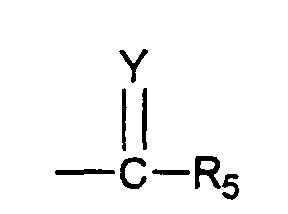 (wherein R5 represents a hydrogen atom, a (C1-C8)alkyl group, a substituted (C1-C8)alkyl group, a (C1-C8)alkoxy group, a hydroxyl group, amino group, an amino group substituted with one or two (C1-C8)alkyl groups which are the same or different, a 4- to 10-membered cyclic amino group, phenyl group, a substituted phenyl group, an aromatic heterocyclic group or a substituted aromatic heterocyclic group, or R5 may form (CR7 2)m (wherein R7 are the same or different and represents hydrogen atom, a (C1-C8)alkyl group, a substituted (C1-C8)alkyl group, a phenyl group, a substituted phenyl group, an aromatic heterocyclic group or a substituted aromatic heterocyclic group, and m represent an integer of 2 to 7) together with R3 to form a ring; andY represents NH, O or S),
 (wherein R6 represents a hydrogen atom, a (C1-C8)alkyl group, a substituted (C1-C8)alkyl group, a phenyl group, a substituted phenyl group, an aromatic heterocyclic group or a substituted aromatic heterocyclic group, or R6 may form (CR7 2)m (wherein R7 and m have the same meanings as described above) together with R3 to form a ring; andR8 represents a hydrogen atom or a (C1-C8)alkylcarbonyl group), or
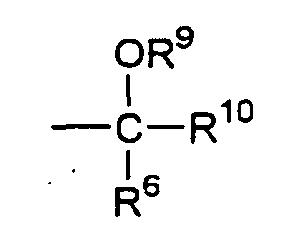 (wherein R6 has the same meaning as described above; andR9 and R10 are the same or different and represent a (C1-C8)alkyl group or a substituted (C1-C8)alkyl group, or R9 and R10 together form a (C2-C4)alkylene chain and may form a ring together with the atoms attached thereto); andX represents a single bond, O or S(O)n (wherein n represents an integer of 0, 1 or 2)},a pharmaceutically acceptable salt thereof, or a derivative thereof.
 - A pharmaceutical composition comprising as an active ingredient the derivative according to claim 1 or a pharmaceutically acceptable salt thereof, and a pharmaceutically acceptable carrier or diluent.
- Use of the derivative according to claim 1 or a pharmaceutically acceptable salt thereof as a cell adhesion inhibitor.
- Use of the derivative according to claim 1 or a pharmaceutically acceptable salt thereof for manufacturing a medicament for the treatment or prevention of a disease relating to cell adhesion.
- The use according to claim 4, wherein the disease is inflammation, asthma, chronic. articular rheumatism, arteriosclerosis, allergy, cancer metastasis, inflammatory disorder accompanying operation or treatment, ischemic reperfusion injury, rejection at organ transplantation, psoriasis, acute pulmonary injury, inflammatory intestinal disease, or burn.
- A method for inhibiting cell adhesion by administering an effective amount of the derivative according to claim 1 or a pharmaceutically acceptable salt thereof.
- A method for treating or preventing a disease relating to cell adhesion by administering an effective amount of the derivative according to claim 1 or a pharmaceutically acceptable salt thereof.
- The method according to claim 7, wherein the disease is inflammation, asthma, chronic articular rheumatism, arteriosclerosis, allergy, cancer metastasis, inflammatory disorder accompanying operation or treatment, ischemic reperfusion injury, rejection at organ transplantation, psoriasis, acute pulmonary injury, inflammatory intestinal disease, or burn.
Applications Claiming Priority (3)
| Application Number | Priority Date | Filing Date | Title |
|---|---|---|---|
| JP22962398 | 1998-08-14 | ||
| JP22962398 | 1998-08-14 | ||
| PCT/JP1999/004384 WO2000009488A1 (en) | 1998-08-14 | 1999-08-12 | Pyridazinone derivatives |
Publications (2)
| Publication Number | Publication Date |
|---|---|
| EP1130015A1 true EP1130015A1 (en) | 2001-09-05 |
| EP1130015A4 EP1130015A4 (en) | 2006-02-08 |
Family
ID=16895102
Family Applications (1)
| Application Number | Title | Priority Date | Filing Date |
|---|---|---|---|
| EP99937056A Withdrawn EP1130015A4 (en) | 1998-08-14 | 1999-08-12 | PYRIDAZINONE DERIVATIVES |
Country Status (7)
| Country | Link |
|---|---|
| US (1) | US6469003B1 (en) |
| EP (1) | EP1130015A4 (en) |
| KR (1) | KR100657189B1 (en) |
| CN (1) | CN1263746C (en) |
| AU (1) | AU756275B2 (en) |
| CA (1) | CA2340230C (en) |
| WO (1) | WO2000009488A1 (en) |
Cited By (9)
| Publication number | Priority date | Publication date | Assignee | Title |
|---|---|---|---|---|
| WO2005077915A1 (en) * | 2004-02-10 | 2005-08-25 | Janssen Pharmaceutica, N.V. | Pyridazinones as antagonists of a4 integrins |
| WO2005077914A1 (en) * | 2004-02-10 | 2005-08-25 | Janssen Pharmaceutica, N.V. | PYRIDAZINONE UREAS AS ANTAGONISTS OF α4 INTEGRINS |
| WO2006053555A3 (en) * | 2004-11-22 | 2006-07-27 | Elmar Reinhold Burchardt | Pyrazol-3-one and/or pyridazin-3-one derivatives used as inhibitors of lysyl oxidase |
| WO2008080056A3 (en) * | 2006-12-21 | 2008-12-18 | Sloan Kettering Inst Cancer | Pyridazinones and furan-containing compounds |
| WO2015132427A1 (en) * | 2014-03-04 | 2015-09-11 | Universidade De Vigo | Pyridazin-3(2h)-one derivatives which are selective inhibitors of the isoform b of monoamine oxidase |
| WO2017202816A1 (en) * | 2016-05-25 | 2017-11-30 | Bayer Pharma Aktiengesellschaft | 3-oxo-2,6-diphenyl-2,3-dihydropyridazine-4-carboxamides |
| WO2018146010A1 (en) * | 2017-02-09 | 2018-08-16 | Bayer Aktiengesellschaft | 2-heteroaryl-3-oxo-2,3-dihydropyridazine-4-carboxamides for the treatment of cancer |
| WO2019101643A1 (en) * | 2017-11-21 | 2019-05-31 | Bayer Aktiengesellschaft | 3-oxo-6-heteroaryl-2-phenyl-2,3-dihydropyridazine-4-carboxamides |
| EA037978B1 (en) * | 2017-11-21 | 2021-06-18 | Байер Акциенгезельшафт | 2-heteroaryl-3-oxo-2,3-dihydropyridazine-4-carboxamides for the treatment of cancer |
Families Citing this family (5)
| Publication number | Priority date | Publication date | Assignee | Title |
|---|---|---|---|---|
| CA2742411A1 (en) * | 2000-09-18 | 2002-03-21 | Eisai R&D Management Co., Ltd. | Pyridazinone and triazinone compounds and use thereof as pharmaceutical preparations |
| RU2279428C2 (en) * | 2000-09-18 | 2006-07-10 | Эйсай Ко., Лтд. | Derivatives of pyridazinone and triazinone and their using as pharmaceutical preparations |
| DE102008019907A1 (en) * | 2008-04-21 | 2009-10-22 | Merck Patent Gmbh | pyridazinone derivatives |
| MY170610A (en) | 2009-02-05 | 2019-08-20 | Takeda Pharmaceuticals Co | Pyridazinone compounds |
| CN119569658A (en) * | 2024-11-05 | 2025-03-07 | 华南师范大学 | Sulfonyl pyridazinone compound and preparation method and application thereof |
Family Cites Families (5)
| Publication number | Priority date | Publication date | Assignee | Title |
|---|---|---|---|---|
| JPS62223176A (en) * | 1986-03-25 | 1987-10-01 | Nissan Chem Ind Ltd | Pyridazinone derivative, production thereof and insecticide, acaricide and namatocide |
| AU681694B2 (en) * | 1993-09-06 | 1997-09-04 | Ishihara Sangyo Kaisha Ltd. | Pyridazinone derivatives or their salts, processes for theirproduction, and anti-shock agents containing them |
| AU691673B2 (en) | 1994-11-14 | 1998-05-21 | Dow Agrosciences Llc | Pyridazinones and their use as fungicides |
| US6013674A (en) | 1997-06-02 | 2000-01-11 | Eli Lilly And Company | Cell adhesion inhibitors |
| BR9812127A (en) | 1997-08-22 | 2000-07-18 | Abbott Lab | Arylpyridazinones as inhibitors of prostaglein biosynthesis endoperoxide h synthase |
-
1999
- 1999-08-12 KR KR1020017001880A patent/KR100657189B1/en not_active Expired - Fee Related
- 1999-08-12 WO PCT/JP1999/004384 patent/WO2000009488A1/en not_active Ceased
- 1999-08-12 US US09/762,877 patent/US6469003B1/en not_active Expired - Fee Related
- 1999-08-12 EP EP99937056A patent/EP1130015A4/en not_active Withdrawn
- 1999-08-12 AU AU51976/99A patent/AU756275B2/en not_active Ceased
- 1999-08-12 CA CA002340230A patent/CA2340230C/en not_active Expired - Fee Related
- 1999-08-12 CN CNB998122548A patent/CN1263746C/en not_active Expired - Fee Related
Cited By (21)
| Publication number | Priority date | Publication date | Assignee | Title |
|---|---|---|---|---|
| WO2005077914A1 (en) * | 2004-02-10 | 2005-08-25 | Janssen Pharmaceutica, N.V. | PYRIDAZINONE UREAS AS ANTAGONISTS OF α4 INTEGRINS |
| WO2005077915A1 (en) * | 2004-02-10 | 2005-08-25 | Janssen Pharmaceutica, N.V. | Pyridazinones as antagonists of a4 integrins |
| WO2006053555A3 (en) * | 2004-11-22 | 2006-07-27 | Elmar Reinhold Burchardt | Pyrazol-3-one and/or pyridazin-3-one derivatives used as inhibitors of lysyl oxidase |
| US9562019B2 (en) | 2006-12-21 | 2017-02-07 | Sloan-Kettering Institute For Cancer Research | Substituted pyridazines as EGFR and/or KRAS inhibitors |
| WO2008080056A3 (en) * | 2006-12-21 | 2008-12-18 | Sloan Kettering Inst Cancer | Pyridazinones and furan-containing compounds |
| AU2007336781B2 (en) * | 2006-12-21 | 2014-06-26 | Sloan-Kettering Institute For Cancer Research | Pyridazinones and furan-containing compounds |
| AU2007336781C1 (en) * | 2006-12-21 | 2014-10-09 | Sloan-Kettering Institute For Cancer Research | Pyridazinones and furan-containing compounds |
| US10253000B2 (en) | 2014-03-04 | 2019-04-09 | Universidade De Vigo | Pyridazin-3(2H)-one derivatives as monoamine oxidase selective isoform B inhibitors |
| WO2015132427A1 (en) * | 2014-03-04 | 2015-09-11 | Universidade De Vigo | Pyridazin-3(2h)-one derivatives which are selective inhibitors of the isoform b of monoamine oxidase |
| WO2017202816A1 (en) * | 2016-05-25 | 2017-11-30 | Bayer Pharma Aktiengesellschaft | 3-oxo-2,6-diphenyl-2,3-dihydropyridazine-4-carboxamides |
| US11040035B2 (en) | 2016-05-25 | 2021-06-22 | Bayer Pharma Aktiengesellschaft | 3-oxo-2,6-diphenyl-2,3-dihydropyridazine-4-carboxamides |
| US11795164B2 (en) | 2017-02-09 | 2023-10-24 | Bayer Aktiengesellschaft | 2-heteroaryl-3-oxo-2,3-dihydropyridazine-4-carboxamides for the treatment of cancer |
| WO2018146010A1 (en) * | 2017-02-09 | 2018-08-16 | Bayer Aktiengesellschaft | 2-heteroaryl-3-oxo-2,3-dihydropyridazine-4-carboxamides for the treatment of cancer |
| IL268469A (en) * | 2017-02-09 | 2019-09-26 | Bayer Pharma AG | 2-Troaril-3-oxo-3,2-dihydropyridazine-4-carboxamides for the treatment of cancer |
| KR20190115460A (en) * | 2017-02-09 | 2019-10-11 | 바이엘 악티엔게젤샤프트 | 2-heteroaryl-3-oxo-2,3-dihydropyridazine-4-carboxamide for the treatment of cancer |
| US12522594B2 (en) | 2017-02-09 | 2026-01-13 | Deutsches Krebsforschungszentrum | 2-heteroaryl-3-oxo-2,3-dihydropyridazine-4-carboxamides for the treatment of cancer |
| AU2018217860B2 (en) * | 2017-02-09 | 2021-07-08 | Deutsches Krebsforschungszentrum Stiftung des öffentlichen Rechts | 2-heteroaryl-3-oxo-2,3-dihydropyridazine-4-carboxamides for the treatment of cancer |
| TWI770113B (en) * | 2017-02-09 | 2022-07-11 | 德商拜耳廠股份有限公司 | 2-heteroaryl-3-oxo-2,3-dihydropyridazine-4-carboxamides |
| WO2019101643A1 (en) * | 2017-11-21 | 2019-05-31 | Bayer Aktiengesellschaft | 3-oxo-6-heteroaryl-2-phenyl-2,3-dihydropyridazine-4-carboxamides |
| US11591311B2 (en) | 2017-11-21 | 2023-02-28 | Bayer Aktiengesellschaft | 3-oxo-6-heteroaryl-2-phenyl-2,3-dihydropyridazine-4-carboxamides |
| EA037978B1 (en) * | 2017-11-21 | 2021-06-18 | Байер Акциенгезельшафт | 2-heteroaryl-3-oxo-2,3-dihydropyridazine-4-carboxamides for the treatment of cancer |
Also Published As
| Publication number | Publication date |
|---|---|
| KR20010072465A (en) | 2001-07-31 |
| CA2340230C (en) | 2008-03-11 |
| KR100657189B1 (en) | 2006-12-14 |
| CN1263746C (en) | 2006-07-12 |
| EP1130015A4 (en) | 2006-02-08 |
| US6469003B1 (en) | 2002-10-22 |
| AU756275B2 (en) | 2003-01-09 |
| AU5197699A (en) | 2000-03-06 |
| CN1323297A (en) | 2001-11-21 |
| CA2340230A1 (en) | 2000-02-24 |
| WO2000009488A1 (en) | 2000-02-24 |
Similar Documents
| Publication | Publication Date | Title |
|---|---|---|
| ES2218548T3 (en) | TRISUSTITUTED PHENYL DERIVATIVES, USEFUL AS INHIBITORS OF THE PDE IV. | |
| US5716967A (en) | Isoxazoline compounds as antiinflammatory agents | |
| KR100626605B1 (en) | Novel pyridazine derivatives and medicines using the same | |
| CA2340230C (en) | Pyridazinone derivatives having cell adhesion inhibiting activity | |
| US7115591B2 (en) | Prostaglandin endoperoxide H synthase biosynthesis inhibitors | |
| JP5624762B2 (en) | Novel pyrrolinone derivative and pharmaceutical composition containing the same | |
| JP3898757B2 (en) | Trisubstituted phenyl derivatives useful as PDE IV inhibitors | |
| EP0966446B1 (en) | Bicyclic inhibitors of protein farnesyl transferase | |
| US9422240B2 (en) | Partially saturated nitrogen-containing heterocyclic compound | |
| US6034089A (en) | Aryl thiophene derivatives as PDE IV inhibitors | |
| CZ291040B6 (en) | Trisubstituted phenyl derivatives and pharmaceutical composition containing them | |
| JP4915715B2 (en) | Phenylpyridazine derivative and pharmaceutical containing the same | |
| SK282708B6 (en) | D4 receptor selectivity piperazine derivatives their preparation method, use and pharmaceutical preparation containing them | |
| CS228536B2 (en) | Production method of 3-aryl-5-isothiazole | |
| ES2217428T3 (en) | VINILPIRIDINE DERIVATIVES REPLACED AND MEDICINES CONTAINING THEM | |
| US6200993B1 (en) | Heterosubstituted pyridine derivatives as PDE4 inhibitors | |
| JP3465825B2 (en) | Triarylethane derivatives as PDE IV IV inhibitors | |
| SK279472B6 (en) | PHENOXY AND PHENOXYALKYLPIPERIDINS, PHARMACEUTICAL PRO | |
| EP0077983B1 (en) | Triazine derivatives, processes for preparation thereof and pharmaceutical compositions comprising the same | |
| HUP0102646A2 (en) | Phthalazine derivatives phosphodiesterase 4 inhibitors and pharmaceutical compositions containing the same | |
| JP2912566B2 (en) | Acylated aminoalkaneimidazoles and -triazoles | |
| US6107295A (en) | Arylalkanoyl pyridazines | |
| JP3335132B2 (en) | Novel pyridazine derivative and drug containing the same as active ingredient | |
| JP2000119257A (en) | Pyridazinone derivative | |
| US5656631A (en) | Pyridazine derivatives |
Legal Events
| Date | Code | Title | Description |
|---|---|---|---|
| PUAI | Public reference made under article 153(3) epc to a published international application that has entered the european phase |
Free format text: ORIGINAL CODE: 0009012 |
|
| 17P | Request for examination filed |
Effective date: 20010214 |
|
| AK | Designated contracting states |
Kind code of ref document: A1 Designated state(s): CH DE FR GB IT LI |
|
| A4 | Supplementary search report drawn up and despatched |
Effective date: 20051223 |
|
| 17Q | First examination report despatched |
Effective date: 20080704 |
|
| STAA | Information on the status of an ep patent application or granted ep patent |
Free format text: STATUS: THE APPLICATION IS DEEMED TO BE WITHDRAWN |
|
| 18D | Application deemed to be withdrawn |
Effective date: 20110301 |