EP1129731A2 - Compositions, processes and methods of improving the wear resistance of prosthetic medical devices - Google Patents
Compositions, processes and methods of improving the wear resistance of prosthetic medical devices Download PDFInfo
- Publication number
- EP1129731A2 EP1129731A2 EP01104246A EP01104246A EP1129731A2 EP 1129731 A2 EP1129731 A2 EP 1129731A2 EP 01104246 A EP01104246 A EP 01104246A EP 01104246 A EP01104246 A EP 01104246A EP 1129731 A2 EP1129731 A2 EP 1129731A2
- Authority
- EP
- European Patent Office
- Prior art keywords
- cross
- medical device
- prosthetic medical
- linked
- irradiated
- Prior art date
- Legal status (The legal status is an assumption and is not a legal conclusion. Google has not performed a legal analysis and makes no representation as to the accuracy of the status listed.)
- Withdrawn
Links
- 239000000203 mixture Substances 0.000 title claims abstract description 65
- 238000000034 method Methods 0.000 title claims abstract description 35
- 229920005989 resin Polymers 0.000 claims abstract description 57
- 239000011347 resin Substances 0.000 claims abstract description 57
- 229920000642 polymer Polymers 0.000 claims abstract description 46
- 238000002156 mixing Methods 0.000 claims abstract description 17
- 238000004132 cross linking Methods 0.000 claims abstract description 15
- 238000001746 injection moulding Methods 0.000 claims abstract description 13
- 239000002952 polymeric resin Substances 0.000 claims abstract description 8
- 229920003002 synthetic resin Polymers 0.000 claims abstract description 8
- 238000007493 shaping process Methods 0.000 claims abstract 9
- 239000004699 Ultra-high molecular weight polyethylene Substances 0.000 claims description 28
- 229920000785 ultra high molecular weight polyethylene Polymers 0.000 claims description 28
- 229920001903 high density polyethylene Polymers 0.000 claims description 21
- 239000004700 high-density polyethylene Substances 0.000 claims description 21
- 239000000843 powder Substances 0.000 claims description 21
- -1 LDPP Polymers 0.000 claims description 19
- 239000004743 Polypropylene Substances 0.000 claims description 16
- 239000004698 Polyethylene Substances 0.000 claims description 13
- 239000004705 High-molecular-weight polyethylene Substances 0.000 claims description 10
- 229920001684 low density polyethylene Polymers 0.000 claims description 10
- 239000004702 low-density polyethylene Substances 0.000 claims description 10
- 230000000399 orthopedic effect Effects 0.000 claims description 10
- 238000004519 manufacturing process Methods 0.000 claims description 8
- 239000007924 injection Substances 0.000 claims description 7
- 238000002347 injection Methods 0.000 claims description 7
- 210000003127 knee Anatomy 0.000 claims description 6
- 210000003423 ankle Anatomy 0.000 claims description 5
- 239000012298 atmosphere Substances 0.000 claims description 5
- 239000000945 filler Substances 0.000 claims description 5
- 229920000098 polyolefin Polymers 0.000 claims description 5
- 210000000707 wrist Anatomy 0.000 claims description 5
- 239000000975 dye Substances 0.000 claims description 3
- 239000000314 lubricant Substances 0.000 claims description 3
- 239000000126 substance Substances 0.000 claims description 3
- 238000010894 electron beam technology Methods 0.000 claims description 2
- 238000001125 extrusion Methods 0.000 claims description 2
- 239000003112 inhibitor Substances 0.000 claims description 2
- 150000003254 radicals Chemical class 0.000 claims description 2
- 239000007943 implant Substances 0.000 claims 14
- VGGSQFUCUMXWEO-UHFFFAOYSA-N Ethene Chemical compound C=C VGGSQFUCUMXWEO-UHFFFAOYSA-N 0.000 claims 8
- 229920006798 HMWPE Polymers 0.000 claims 8
- TZXKOCQBRNJULO-UHFFFAOYSA-N Ferriprox Chemical compound CC1=C(O)C(=O)C=CN1C TZXKOCQBRNJULO-UHFFFAOYSA-N 0.000 claims 7
- 229920005672 polyolefin resin Polymers 0.000 claims 2
- 238000007789 sealing Methods 0.000 claims 2
- 239000000872 buffer Substances 0.000 claims 1
- 238000000748 compression moulding Methods 0.000 claims 1
- 230000001678 irradiating effect Effects 0.000 claims 1
- 229920000307 polymer substrate Polymers 0.000 claims 1
- 239000000463 material Substances 0.000 abstract description 22
- 239000011159 matrix material Substances 0.000 abstract description 11
- 230000001747 exhibiting effect Effects 0.000 abstract 1
- 229920001155 polypropylene Polymers 0.000 description 8
- 239000000523 sample Substances 0.000 description 6
- 150000001875 compounds Chemical class 0.000 description 5
- 229920000573 polyethylene Polymers 0.000 description 5
- IJGRMHOSHXDMSA-UHFFFAOYSA-N Atomic nitrogen Chemical compound N#N IJGRMHOSHXDMSA-UHFFFAOYSA-N 0.000 description 4
- OKTJSMMVPCPJKN-UHFFFAOYSA-N Carbon Chemical compound [C] OKTJSMMVPCPJKN-UHFFFAOYSA-N 0.000 description 4
- 239000012299 nitrogen atmosphere Substances 0.000 description 4
- 239000002245 particle Substances 0.000 description 4
- 239000011343 solid material Substances 0.000 description 4
- 239000004952 Polyamide Substances 0.000 description 3
- 210000000988 bone and bone Anatomy 0.000 description 3
- 229920006037 cross link polymer Polymers 0.000 description 3
- 229910052751 metal Inorganic materials 0.000 description 3
- 239000002184 metal Substances 0.000 description 3
- 150000002739 metals Chemical class 0.000 description 3
- 229920002647 polyamide Polymers 0.000 description 3
- 210000001519 tissue Anatomy 0.000 description 3
- XKRFYHLGVUSROY-UHFFFAOYSA-N Argon Chemical compound [Ar] XKRFYHLGVUSROY-UHFFFAOYSA-N 0.000 description 2
- IAYPIBMASNFSPL-UHFFFAOYSA-N Ethylene oxide Chemical compound C1CO1 IAYPIBMASNFSPL-UHFFFAOYSA-N 0.000 description 2
- QVGXLLKOCUKJST-UHFFFAOYSA-N atomic oxygen Chemical compound [O] QVGXLLKOCUKJST-UHFFFAOYSA-N 0.000 description 2
- 229910052799 carbon Inorganic materials 0.000 description 2
- 239000006229 carbon black Substances 0.000 description 2
- 239000004917 carbon fiber Substances 0.000 description 2
- 230000006835 compression Effects 0.000 description 2
- 238000007906 compression Methods 0.000 description 2
- 230000002708 enhancing effect Effects 0.000 description 2
- 239000000835 fiber Substances 0.000 description 2
- 239000007789 gas Substances 0.000 description 2
- 239000003365 glass fiber Substances 0.000 description 2
- 239000007788 liquid Substances 0.000 description 2
- 239000010445 mica Substances 0.000 description 2
- 229910052618 mica group Inorganic materials 0.000 description 2
- 239000011812 mixed powder Substances 0.000 description 2
- 239000002071 nanotube Substances 0.000 description 2
- 229910052757 nitrogen Inorganic materials 0.000 description 2
- 229920001778 nylon Polymers 0.000 description 2
- 239000001301 oxygen Substances 0.000 description 2
- 229910052760 oxygen Inorganic materials 0.000 description 2
- 239000008188 pellet Substances 0.000 description 2
- 230000005855 radiation Effects 0.000 description 2
- 239000013074 reference sample Substances 0.000 description 2
- 239000003381 stabilizer Substances 0.000 description 2
- 239000000454 talc Substances 0.000 description 2
- 229910052623 talc Inorganic materials 0.000 description 2
- 239000004677 Nylon Substances 0.000 description 1
- RTAQQCXQSZGOHL-UHFFFAOYSA-N Titanium Chemical compound [Ti] RTAQQCXQSZGOHL-UHFFFAOYSA-N 0.000 description 1
- 229920010741 Ultra High Molecular Weight Polyethylene (UHMWPE) Polymers 0.000 description 1
- 150000001252 acrylic acid derivatives Chemical class 0.000 description 1
- 239000000654 additive Substances 0.000 description 1
- 239000000956 alloy Substances 0.000 description 1
- 229910045601 alloy Inorganic materials 0.000 description 1
- 229910052786 argon Inorganic materials 0.000 description 1
- 230000015572 biosynthetic process Effects 0.000 description 1
- 238000006555 catalytic reaction Methods 0.000 description 1
- 239000003086 colorant Substances 0.000 description 1
- 238000001816 cooling Methods 0.000 description 1
- 230000003413 degradative effect Effects 0.000 description 1
- 230000003467 diminishing effect Effects 0.000 description 1
- 230000000694 effects Effects 0.000 description 1
- 229920001971 elastomer Polymers 0.000 description 1
- 239000003822 epoxy resin Substances 0.000 description 1
- 239000012467 final product Substances 0.000 description 1
- 230000009969 flowable effect Effects 0.000 description 1
- 230000005251 gamma ray Effects 0.000 description 1
- LNEPOXFFQSENCJ-UHFFFAOYSA-N haloperidol Chemical compound C1CC(O)(C=2C=CC(Cl)=CC=2)CCN1CCCC(=O)C1=CC=C(F)C=C1 LNEPOXFFQSENCJ-UHFFFAOYSA-N 0.000 description 1
- 230000005802 health problem Effects 0.000 description 1
- 239000012263 liquid product Substances 0.000 description 1
- 150000004668 long chain fatty acids Chemical class 0.000 description 1
- 238000003754 machining Methods 0.000 description 1
- 238000002844 melting Methods 0.000 description 1
- 230000008018 melting Effects 0.000 description 1
- 239000013528 metallic particle Substances 0.000 description 1
- 238000012986 modification Methods 0.000 description 1
- 230000004048 modification Effects 0.000 description 1
- 239000000178 monomer Substances 0.000 description 1
- 238000000465 moulding Methods 0.000 description 1
- 230000017074 necrotic cell death Effects 0.000 description 1
- 150000002894 organic compounds Chemical class 0.000 description 1
- 239000006179 pH buffering agent Substances 0.000 description 1
- 230000001717 pathogenic effect Effects 0.000 description 1
- 230000000704 physical effect Effects 0.000 description 1
- 229920000548 poly(silane) polymer Polymers 0.000 description 1
- 229920000647 polyepoxide Polymers 0.000 description 1
- 229920000728 polyester Polymers 0.000 description 1
- 229920000570 polyether Polymers 0.000 description 1
- 229920002635 polyurethane Polymers 0.000 description 1
- 239000004814 polyurethane Substances 0.000 description 1
- 239000002994 raw material Substances 0.000 description 1
- 238000009877 rendering Methods 0.000 description 1
- 239000005060 rubber Substances 0.000 description 1
- 150000003839 salts Chemical class 0.000 description 1
- 239000007787 solid Substances 0.000 description 1
- 239000010935 stainless steel Substances 0.000 description 1
- 229910001220 stainless steel Inorganic materials 0.000 description 1
- 239000007858 starting material Substances 0.000 description 1
- 230000001954 sterilising effect Effects 0.000 description 1
- 238000004659 sterilization and disinfection Methods 0.000 description 1
- 238000005728 strengthening Methods 0.000 description 1
- 230000008354 tissue degradation Effects 0.000 description 1
- 229910052719 titanium Inorganic materials 0.000 description 1
- 239000010936 titanium Substances 0.000 description 1
- WFKWXMTUELFFGS-UHFFFAOYSA-N tungsten Chemical compound [W] WFKWXMTUELFFGS-UHFFFAOYSA-N 0.000 description 1
- 229910052721 tungsten Inorganic materials 0.000 description 1
- 239000010937 tungsten Substances 0.000 description 1
Images

Classifications
-
- A—HUMAN NECESSITIES
- A61—MEDICAL OR VETERINARY SCIENCE; HYGIENE
- A61L—METHODS OR APPARATUS FOR STERILISING MATERIALS OR OBJECTS IN GENERAL; DISINFECTION, STERILISATION OR DEODORISATION OF AIR; CHEMICAL ASPECTS OF BANDAGES, DRESSINGS, ABSORBENT PADS OR SURGICAL ARTICLES; MATERIALS FOR BANDAGES, DRESSINGS, ABSORBENT PADS OR SURGICAL ARTICLES
- A61L27/00—Materials for grafts or prostheses or for coating grafts or prostheses
- A61L27/14—Macromolecular materials
- A61L27/16—Macromolecular materials obtained by reactions only involving carbon-to-carbon unsaturated bonds
-
- A—HUMAN NECESSITIES
- A61—MEDICAL OR VETERINARY SCIENCE; HYGIENE
- A61L—METHODS OR APPARATUS FOR STERILISING MATERIALS OR OBJECTS IN GENERAL; DISINFECTION, STERILISATION OR DEODORISATION OF AIR; CHEMICAL ASPECTS OF BANDAGES, DRESSINGS, ABSORBENT PADS OR SURGICAL ARTICLES; MATERIALS FOR BANDAGES, DRESSINGS, ABSORBENT PADS OR SURGICAL ARTICLES
- A61L27/00—Materials for grafts or prostheses or for coating grafts or prostheses
- A61L27/14—Macromolecular materials
- A61L27/26—Mixtures of macromolecular compounds
Definitions
- the present invention relates to polymeric compositions and methods of making the same for use in fabricating prosthetic medical devices, as well as prosthetic devices made at least partially therefrom with improved wear resistance.
- prosthetic medical devices are implanted into load-bearing joints such as knees, hips, etc. As such, these prosthetic devices must be very strong and possess a high degree of wear resistance.
- the prosthetic medical device industry has utilized various metals and polymers and combinations thereof to fabricate prosthetic devices.
- metals and polymers have drawbacks. For example, metals such as stainless steel, tungsten and titanium, and alloys thereof, may succumb to the corrosive environment of the body and eventually begin to wear. Such wear may result in fine metallic particles being scraped away from the contact surface of the device and into surrounding tissue and bone which may potentially cause pathogenic problems.
- Polymers such as polyethylene, polypropylene and nylons may also exhibit wear and may consequently produce particles which diffuse into tissue and bone. Both metallic and polymeric particles shed from these prosthetic medical devices are of concern because they may be inherently reactive with the tissue and bone they contact, thus possibly causing tissue degradation or necrosis.
- prosthetic medical devices cannot be formed by inexpensive injection molding techniques. Instead, these medical devices must be formed by extrusion, for example, which requires further machining into the finished article. Injection molding, on-the-other-hand, allows for the final article to be formed in virtually one step.
- the present invention provides compositions, as well as methods of improving the wear resistance of prosthetic medical devices, by selectively cross-linking a polymeric resin using a controlled cross-linking process providing optimum strength and wear resistance, thus diminishing or eliminating the frequency by which foreign particles are liberated from the implanted prosthesis, thereby reducing the risk of compromising the patient's health.
- the present invention also provides compositions and methods of injection molding prosthetic medical devices thus rendering a less expensive, and more facile prosthetic medical device fabrication process.
- a device can be fabricated that possesses the required strength and wear resistance and thereby avoids or reduces the level of polymeric material liberated from the device.
- One aspect of the present invention provides for a polymeric composition containing mixtures of cross-linked and non-crosslinked polyolefinic resins blended together and ultimately formed into cured polymeric articles.
- the resulting composition and fabricated article made from the blended polymeric material of the present invention contains cross-linked, linear and branched polyolefinic resins.
- the physical properties of the resulting compositions of the present invention have been found to exhibit an unexpectedly high degree of wear resistance and strength.
- a preferred use of the composition of the present invention may be for prosthetic joints or components for devices for shoulders, elbows, ankles, wrists, fingers, jaws, hips, knees, vertebra, and other load-bearing orthopedic prosthetic medical devices.
- Other preferred prosthetic medical devices fabricated from the composition of the present invention include such articles as syringes, catheters and surgical implements requiring a high degree of wear resistance.
- a method of producing the polymeric composition is provided.
- methods for fabricating prosthetic medical devices made from the polymeric composition are provided.
- a preferred embodiment of the present invention seeks to achieve a desirable balance of wear resistance and high tensile strength and toughness.
- a desirable balance is achieved by virtue of combining, in an integrated matrix, cross-linked and non-crosslinked polyolefinic polymers and resins.
- the present invention provides for the mixture to be formed in any suitable manner or otherwise made into prosthetic medical devices.
- the finished articles preferably can then be processed and packaged for use alone or as components of prosthetic medical devices.
- compositions of the present invention allow for the blended polymeric mixture to be injection molded. This is possible because selected mixture combinations exhibit rheological properties and characteristics which are amenable to injection molding. Such mixtures exhibit a relatively low viscosity providing a flowable liquid to be fed into injection molding equipment.
- polystyrene resins are defined as an organic compound having repeating units of similar or different monomers.
- a resin is defined herein as a partially cured polymer having utility as a moldable material suitable for curing into a solid article.
- the polymers and resins of the present invention have molecular weights ranging from between 1,000 to 10,000,000. While the invention preferably uses polyolefinic polymers or resins, any polymer capable of being formed into, and used as, prosthetic devices may be used.
- examples of such polyolefinic materials may be polyethylene (PE), polypropylene (PP), high molecular weight polypropylene (HMWPP), high molecular weight polyethylene (HMWPE), ultra high molecular weight polyethylene (UHMWPE) and ultra high molecular weight polypropylene (UHMWPP), high density polyethylene (HDPE), low density polyethylene (LDPE), high density polypropylene (HDPP) and low density polypropylene (LDPP).
- Other polymers and resins of the present invention may be polysilanes, polyurethanes, polyethers, polyamides, polyesters, polyalkyl acrylates, nylon, rubber and epoxy resins. It should be understood that the above list of polymers is not exhaustive, and other polymers may also be employed in the present invention.
- a further aspect of the invention provides for the use of mixtures of polymers and resins, both cross-linked and non-crosslinked varieties, to form a single blended matrix. It is also emphasized that not every polymer or resin component of the present invention need participate in, or be responsible for, the structural integrity or physical characteristics of the resulting prosthetic medical device, but could also serve to improve processing and handling manipulations performed on the raw materials, intermediate articles and workpieces, as well as the finished devices.
- Another aspect of the invention provides for the use of lubricants, dyes, stabilizers and other processing compounds to be incorporated into the polymeric matrix. These compounds enhance the polymeric mixture's manufacturing properties but do not necessarily contribute to the structural integrity of the final matrix.
- solid materials may be incorporated into the polymer or resin mixtures.
- Such solid materials may be, for example, chopped carbon or glass fiber or nanotubes, carbon black, graphite powder, talc, mica, polyamide fiber and other fillers commonly used in the polymer industry.
- a process whereby polyolefinic polymers or resins are sealed in a container preferably purged of most or all oxygen and filled with an inert atmosphere such as nitrogen.
- a powdered form of the polyolefinic polymer resin is irradiated to effect a certain degree of cross-linking to the polyolefinic polymer or resin.
- Other cross-linking methods may also be utilized, such as those employed in U.S. Patent No. 5,728,748, 5,650,485, 5,449,745, 5,414,049, 5,153,039, 5,160,464, 5,037,928 and U.S. Provisional Application No.
- the irradiated material now possessing a certain degree of cross-linking, is ready to be blended into a polymeric mixture, and processed into a prosthetic device.
- the present invention also provides for further irradiation of the finished article or workpiece. Such subsequent irradiation may be necessary or desirable for further strengthening or sterilization of the finished article or workpiece.
- the irradiated polyolefinic polymer or resin is blended with non-irradiated polyolefinic polymer or resin into a mixture which is then preferably processed and cured into either a finished article or unfinished stock article.
- the processed polymeric mixture may also be rendered as a powder or pellet, for example.
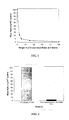
- FIG. 1 is a representation of data plotting wear rate (mg/mil) vs. percentage of cross-linked polymer incorporated into the final matrix.
- FIG. 2 is a representation of data plotting wear rate (mg/mil) vs. percentage of cross-linked polymer incorporated into the final matrix.
- FIG. 3 is a representation of a process flow chart diagramming the steps involved in molding the polymeric blends.
- compositions according to a preferred embodiment of the present invention are blends of irradiated or otherwise cross-linked polyolefinic polymers or resins combined with linear or uncross-linked polyolefinic polymers or resins. These compositions of the present invention improve the durability of articles fabricated therefrom by increasing the wear resistance in load-bearing environments. See FIGS. 1 and 2.
- the cross-linked, linear and/or branched polyolefinic polymers or resins may be the same or different monomeric starting materials.
- the blended polymer or resin mixture may then be processed and cured directly into prosthetic devices by injection molding, or alternatively into stock articles or workpieces that may be formed into the desired shape in the future.
- the blended polymer may also be produced in a powder, flake or pellet to be used for future processing.
- the composition of the present invention may be blended to contain from about 1% to about 99% by weight, based on the total weight of the composition, of a polyolefinic polymer or resin powder which has been irradiated with radiation for a sufficient period of time to cause cross-linking of the polyolefinic polymer or resin.
- a range of about 1 - 1,000 Mrads may be used to irradiate the polyolefin.
- 1-100 Mrads may be used, and in the most preferred range 5-20 Mrads may be used.
- Preferred polymers for irradiation may be selected from one or more of the following: polyethylene, polypropylene and/or branched derivatives thereof.
- the polymer type is a polyethylene.
- the polyolefins of the present invention may have a molecular weight ranging between about 1000 to about 10,000,000.
- UHMWPE may be used in the present invention.
- the ratio of irradiated and non-irradiated polyolefin may range from about 1 - 99% irradiated polyolefin.
- a 50:50 mixture of irradiated and non-irradiated polyolefinic powder may be blended together.
- An even more preferred embodiment of the present invention provides for the mixture of a 30:70 blend of irradiated to non-irradiated polyolefinic powder.
- a blend of UHMWPE powder is blended with HDPE powder.
- either the UHMWPE or the HDPE may be cross-linked.
- the UHMWPE is cross-linked then blended with uncross-linked HDPE.
- a preferred ratio blend is 1:99 % UHMWPE to HDPE. In a more preferred embodiment, the ratio may be 20:80 UHMWPE to HDPE. The most preferred ratio is 30:70 UHMWPE to HDPE. This mixture is preferably injection molded into a prosthetic device.
- a method is provided to prepare the above described polymeric compositions.
- a selected polyolefinic polymer or resin is packaged in an air-tight container which is transparent or opaque.
- the container is purged of at least most of the ambient oxygen and, preferably, filled with an inert atmosphere such as nitrogen or argon.
- the filled package is then preferably irradiated using gamma ray, x-ray or electron beam irradiation.
- the total dose may vary according to the amount of cross-linking desired.
- the powder is preferably heated to a temperature below, at, or above the melting point of the polymeric material and annealed for a selected period of time at the elevated temperature.
- the material is then preferably cooled or allowed to cool.
- the irradiated material is then mixed with non-irradiated polyolefinic linear polymer or resin.
- the weight percent for the mixture will vary according to the desired amount of cross-linking to be contained in the final product as discussed above.
- the mixing may be performed in a blender, rotary mixer, tumbling mill, or any other suitable blending or mixing device.
- the mixed powder is then extruded or molded into material stock. See FIG. 3. Alternatively, the mixed powder may be injection molded into the desired shape. If necessary, the final component is then machined into the desired shape, cleaned and packaged.
- the packaged article may then be sterilized by the use of a non-radiation method such as gas plasma or ethylene oxide, or by another irradiation treatment such as those set forth in the above patents and applications which have been incorporated by reference.
- UHMWPE is packaged in a substantially oxygen-free environment.
- the packaged material is then irradiated for a total dose of 10-12 Mrads.
- the package is then annealed at an elevated temperature ranging from approximately 100°C - 150°C for three days, followed by ambient cooling.
- the irradiated material is then blended with non-cross-linked UHMWPE or HDPE to a ratio of approximately 5-30% irradiated powder. See FIG. 2.
- the powder blend is then preferably melted into a liquid which exhibits rheological properties and characteristics suitable for injection molding applications.
- the liquid product is then fed into injection molding equipment which correspondingly renders the polymer into a finished article or preformed bar or block.
- the finished article may then be packaged and sterilized using ethylene oxide or gas plasma.
- the preformed bar or block may be further processed into a finished article.
- additives such as lubricants, dyes, stabilizers and other process enhancing compounds are incorporated into the polymeric mixture.
- Such compounds may not necessarily enhance the strength or structural integrity of the final polymeric matrix, but do aid in the manufacturing process or enhance the overall appearance of the finished article.
- examples of these compounds may be long chain fatty acids and their salts, organic and inorganic coloring agents, free radical inhibitors, pH buffering agents and other materials known to enhance processing of polymers within the polymer industry.
- solid materials may be incorporated into the polymer or resin mixtures.
- Such solid materials may be, for example, chopped carbon or glass fiber or nanotubes, carbon black, graphite powder, talc, mica, polyamide fiber and other fillers commonly used in the polymer industry.
- such fillers may be advantageously added to a polymer matrix for the purposes of enhancing strength, durability, bulk density, machineablity of the resulting polymeric article.
- the above list is not exhaustive and other uses of the fillers may also be contemplated.
- the polymeric material is prepared as discussed immediately above, then compression molded or extruded into a preformed bar or block.
- the preformed articles may be shaped into finished prosthetic medical devices in the future.
- GUR1050 e.g., UHMWPE having average molecular weight of 4,000,000 -6,000,000 powder was irradiated at 12 Mrads in a nitrogen atmosphere and stabilized in a nitrogen atmosphere at 100°C for three days.
- Several mixtures of the cross-linked irradiated powder were prepared by blend-mixing with non-irradiated powder in the following proportions SAMPLE NUMBER % IRRADIATED, CROSSLINKED % NON-IRRADIATED 1 5 95 2 10% 90% 3 30% 70% 4 100% 0%
- a reference sample (Sample 0) containing 0% irradiated and 100% un-irradiated powder was also prepared.
- the powder samples were compression molded into blanks which were machined into cups and then subjected to a hip simulator test to determine the wear rate of the material.
- GUR1050 e.g., UHMWPE having average molecular weight of 4,000,000 -6,000,000 powder was irradiated at 12 Mrads in a nitrogen atmosphere and stabilized in a nitrogen atmosphere at 100°C for three days.
- a mixture of the cross-linked irradiated powder was prepared by blend-mixing with HDPE non-irradiated powder in the following proportions: SAMPLE NUMBER % IRRADIATED, CROSSLINKED % NON-IRRADIATED 1 0 100 (UHMWPE) 2 30 (UHMWPE) 70 (HDPE)
- the powder samples were injection molded into blanks which were machined into cups and then subjected to a hip simulator test to determine the wear rate of the material.
Landscapes
- Health & Medical Sciences (AREA)
- Chemical & Material Sciences (AREA)
- Dermatology (AREA)
- Medicinal Chemistry (AREA)
- Oral & Maxillofacial Surgery (AREA)
- Transplantation (AREA)
- Epidemiology (AREA)
- Life Sciences & Earth Sciences (AREA)
- Animal Behavior & Ethology (AREA)
- General Health & Medical Sciences (AREA)
- Public Health (AREA)
- Veterinary Medicine (AREA)
- Chemical Kinetics & Catalysis (AREA)
- Materials For Medical Uses (AREA)
- Prostheses (AREA)
- Compositions Of Macromolecular Compounds (AREA)
- Injection Moulding Of Plastics Or The Like (AREA)
Abstract
Description
- The present invention relates to polymeric compositions and methods of making the same for use in fabricating prosthetic medical devices, as well as prosthetic devices made at least partially therefrom with improved wear resistance.
- Many prosthetic medical devices are implanted into load-bearing joints such as knees, hips, etc. As such, these prosthetic devices must be very strong and possess a high degree of wear resistance. Presently, the prosthetic medical device industry has utilized various metals and polymers and combinations thereof to fabricate prosthetic devices. Unfortunately, both metals and polymers have drawbacks. For example, metals such as stainless steel, tungsten and titanium, and alloys thereof, may succumb to the corrosive environment of the body and eventually begin to wear. Such wear may result in fine metallic particles being scraped away from the contact surface of the device and into surrounding tissue and bone which may potentially cause pathogenic problems. Polymers, such as polyethylene, polypropylene and nylons may also exhibit wear and may consequently produce particles which diffuse into tissue and bone. Both metallic and polymeric particles shed from these prosthetic medical devices are of concern because they may be inherently reactive with the tissue and bone they contact, thus possibly causing tissue degradation or necrosis.
- Various methods have been devised attempting to reduce the wear rate of the load bearing prosthetic medical devices. For polymers, a common practice within the prosthetic medical device industry is to use cross-linked polymers and resins to form the medical device. Polymers are commonly cross-linked by chemical catalysis or irradiation exposure. Most cross-linking methodologies do result in greater wear resistance. However, indiscriminate or uncontrolled cross-linking may result in the formation of a weakened polymeric matrix, not capable of withstanding the enormous pressures placed on the devices in the patient resulting in degradative wear as described above.
- Another difficulty conventionally encountered in the manufacturing process of prosthetic medical devices is that they cannot be formed by inexpensive injection molding techniques. Instead, these medical devices must be formed by extrusion, for example, which requires further machining into the finished article. Injection molding, on-the-other-hand, allows for the final article to be formed in virtually one step.
- Therefore, a need exists within the prosthetic medical device industry to fabricate an improved polymeric prosthetic device possessing sufficient strength to withstand the stress and pressure imposed on it, yet resist wear so that foreign particles liberated from the prosthetic device do not cause health problems to the patient. There also exists a need to fabricate the devices inexpensively by injection molding. The present invention provides compositions, as well as methods of improving the wear resistance of prosthetic medical devices, by selectively cross-linking a polymeric resin using a controlled cross-linking process providing optimum strength and wear resistance, thus diminishing or eliminating the frequency by which foreign particles are liberated from the implanted prosthesis, thereby reducing the risk of compromising the patient's health. The present invention also provides compositions and methods of injection molding prosthetic medical devices thus rendering a less expensive, and more facile prosthetic medical device fabrication process.
- It has been discovered that by selectively cross-linking components of a polymeric matrix used for prosthetic medical devices, a device can be fabricated that possesses the required strength and wear resistance and thereby avoids or reduces the level of polymeric material liberated from the device.
- One aspect of the present invention provides for a polymeric composition containing mixtures of cross-linked and non-crosslinked polyolefinic resins blended together and ultimately formed into cured polymeric articles. Preferably, the resulting composition and fabricated article made from the blended polymeric material of the present invention contains cross-linked, linear and branched polyolefinic resins. The physical properties of the resulting compositions of the present invention have been found to exhibit an unexpectedly high degree of wear resistance and strength. As such, a preferred use of the composition of the present invention may be for prosthetic joints or components for devices for shoulders, elbows, ankles, wrists, fingers, jaws, hips, knees, vertebra, and other load-bearing orthopedic prosthetic medical devices. Other preferred prosthetic medical devices fabricated from the composition of the present invention include such articles as syringes, catheters and surgical implements requiring a high degree of wear resistance.
- In another aspect of the present invention, a method of producing the polymeric composition is provided. In other aspects of the invention, methods for fabricating prosthetic medical devices made from the polymeric composition are provided.
- A preferred embodiment of the present invention seeks to achieve a desirable balance of wear resistance and high tensile strength and toughness. A desirable balance is achieved by virtue of combining, in an integrated matrix, cross-linked and non-crosslinked polyolefinic polymers and resins. Once blended, the present invention provides for the mixture to be formed in any suitable manner or otherwise made into prosthetic medical devices. The finished articles preferably can then be processed and packaged for use alone or as components of prosthetic medical devices.
- It has been discovered that certain compositions of the present invention allow for the blended polymeric mixture to be injection molded. This is possible because selected mixture combinations exhibit rheological properties and characteristics which are amenable to injection molding. Such mixtures exhibit a relatively low viscosity providing a flowable liquid to be fed into injection molding equipment.
- Another aspect of the present invention provides for the use of polyolefinic polymers and resins. Within the context of the present invention, a polymer is defined as an organic compound having repeating units of similar or different monomers. A resin is defined herein as a partially cured polymer having utility as a moldable material suitable for curing into a solid article. The polymers and resins of the present invention have molecular weights ranging from between 1,000 to 10,000,000. While the invention preferably uses polyolefinic polymers or resins, any polymer capable of being formed into, and used as, prosthetic devices may be used. Preferably, examples of such polyolefinic materials may be polyethylene (PE), polypropylene (PP), high molecular weight polypropylene (HMWPP), high molecular weight polyethylene (HMWPE), ultra high molecular weight polyethylene (UHMWPE) and ultra high molecular weight polypropylene (UHMWPP), high density polyethylene (HDPE), low density polyethylene (LDPE), high density polypropylene (HDPP) and low density polypropylene (LDPP). Other polymers and resins of the present invention may be polysilanes, polyurethanes, polyethers, polyamides, polyesters, polyalkyl acrylates, nylon, rubber and epoxy resins. It should be understood that the above list of polymers is not exhaustive, and other polymers may also be employed in the present invention.
- A further aspect of the invention provides for the use of mixtures of polymers and resins, both cross-linked and non-crosslinked varieties, to form a single blended matrix. It is also emphasized that not every polymer or resin component of the present invention need participate in, or be responsible for, the structural integrity or physical characteristics of the resulting prosthetic medical device, but could also serve to improve processing and handling manipulations performed on the raw materials, intermediate articles and workpieces, as well as the finished devices.
- Another aspect of the invention provides for the use of lubricants, dyes, stabilizers and other processing compounds to be incorporated into the polymeric matrix. These compounds enhance the polymeric mixture's manufacturing properties but do not necessarily contribute to the structural integrity of the final matrix.
- In another aspect of the present invention, solid materials may be incorporated into the polymer or resin mixtures. Such solid materials may be, for example, chopped carbon or glass fiber or nanotubes, carbon black, graphite powder, talc, mica, polyamide fiber and other fillers commonly used in the polymer industry.
- In another aspect of the invention, a process is provided whereby polyolefinic polymers or resins are sealed in a container preferably purged of most or all oxygen and filled with an inert atmosphere such as nitrogen. Preferably, a powdered form of the polyolefinic polymer resin is irradiated to effect a certain degree of cross-linking to the polyolefinic polymer or resin. Other cross-linking methods may also be utilized, such as those employed in U.S. Patent No. 5,728,748, 5,650,485, 5,449,745, 5,414,049, 5,153,039, 5,160,464, 5,037,928 and U.S. Provisional Application No. 60/130,322, each of which is incorporated herein as if fully set forth. The irradiated material, now possessing a certain degree of cross-linking, is ready to be blended into a polymeric mixture, and processed into a prosthetic device. Optionally, the present invention also provides for further irradiation of the finished article or workpiece. Such subsequent irradiation may be necessary or desirable for further strengthening or sterilization of the finished article or workpiece.
- In another aspect of the present invention the irradiated polyolefinic polymer or resin is blended with non-irradiated polyolefinic polymer or resin into a mixture which is then preferably processed and cured into either a finished article or unfinished stock article. The processed polymeric mixture may also be rendered as a powder or pellet, for example.
- FIG. 1 is a representation of data plotting wear rate (mg/mil) vs. percentage of cross-linked polymer incorporated into the final matrix.
- FIG. 2 is a representation of data plotting wear rate (mg/mil) vs. percentage of cross-linked polymer incorporated into the final matrix.
- FIG. 3 is a representation of a process flow chart diagramming the steps involved in molding the polymeric blends.
- The compositions according to a preferred embodiment of the present invention are blends of irradiated or otherwise cross-linked polyolefinic polymers or resins combined with linear or uncross-linked polyolefinic polymers or resins. These compositions of the present invention improve the durability of articles fabricated therefrom by increasing the wear resistance in load-bearing environments. See FIGS. 1 and 2.
- The cross-linked, linear and/or branched polyolefinic polymers or resins may be the same or different monomeric starting materials. The blended polymer or resin mixture may then be processed and cured directly into prosthetic devices by injection molding, or alternatively into stock articles or workpieces that may be formed into the desired shape in the future. The blended polymer may also be produced in a powder, flake or pellet to be used for future processing.
- Generally, the composition of the present invention may be blended to contain from about 1% to about 99% by weight, based on the total weight of the composition, of a polyolefinic polymer or resin powder which has been irradiated with radiation for a sufficient period of time to cause cross-linking of the polyolefinic polymer or resin. In a preferred embodiment, a range of about 1 - 1,000 Mrads may be used to irradiate the polyolefin. In an even more preferred embodiment of the present invention, 1-100 Mrads may be used, and in the most preferred range 5-20 Mrads may be used.
- Preferred polymers for irradiation may be selected from one or more of the following: polyethylene, polypropylene and/or branched derivatives thereof. In a preferred embodiment, the polymer type is a polyethylene. The polyolefins of the present invention may have a molecular weight ranging between about 1000 to about 10,000,000. Preferably, UHMWPE may be used in the present invention. The ratio of irradiated and non-irradiated polyolefin may range from about 1 - 99% irradiated polyolefin. In a preferred embodiment, a 50:50 mixture of irradiated and non-irradiated polyolefinic powder may be blended together. An even more preferred embodiment of the present invention provides for the mixture of a 30:70 blend of irradiated to non-irradiated polyolefinic powder.
- In yet another preferred embodiment a blend of UHMWPE powder is blended with HDPE powder. In this embodiment, either the UHMWPE or the HDPE may be cross-linked. In an even more preferred embodiment of the present invention, the UHMWPE is cross-linked then blended with uncross-linked HDPE. A preferred ratio blend is 1:99 % UHMWPE to HDPE. In a more preferred embodiment, the ratio may be 20:80 UHMWPE to HDPE. The most preferred ratio is 30:70 UHMWPE to HDPE. This mixture is preferably injection molded into a prosthetic device.
- In another aspect of the invention, a method is provided to prepare the above described polymeric compositions. In such a method, a selected polyolefinic polymer or resin is packaged in an air-tight container which is transparent or opaque. The container is purged of at least most of the ambient oxygen and, preferably, filled with an inert atmosphere such as nitrogen or argon. The filled package is then preferably irradiated using gamma ray, x-ray or electron beam irradiation. The total dose may vary according to the amount of cross-linking desired. After irradiation, the powder is preferably heated to a temperature below, at, or above the melting point of the polymeric material and annealed for a selected period of time at the elevated temperature. The material is then preferably cooled or allowed to cool. The irradiated material is then mixed with non-irradiated polyolefinic linear polymer or resin. The weight percent for the mixture will vary according to the desired amount of cross-linking to be contained in the final product as discussed above. The mixing may be performed in a blender, rotary mixer, tumbling mill, or any other suitable blending or mixing device. The mixed powder is then extruded or molded into material stock. See FIG. 3. Alternatively, the mixed powder may be injection molded into the desired shape. If necessary, the final component is then machined into the desired shape, cleaned and packaged. The packaged article may then be sterilized by the use of a non-radiation method such as gas plasma or ethylene oxide, or by another irradiation treatment such as those set forth in the above patents and applications which have been incorporated by reference.
- In a preferred embodiment of the composition, UHMWPE is packaged in a substantially oxygen-free environment. The packaged material is then irradiated for a total dose of 10-12 Mrads. The package is then annealed at an elevated temperature ranging from approximately 100°C - 150°C for three days, followed by ambient cooling. The irradiated material is then blended with non-cross-linked UHMWPE or HDPE to a ratio of approximately 5-30% irradiated powder. See FIG. 2. The powder blend is then preferably melted into a liquid which exhibits rheological properties and characteristics suitable for injection molding applications. The liquid product is then fed into injection molding equipment which correspondingly renders the polymer into a finished article or preformed bar or block. The finished article may then be packaged and sterilized using ethylene oxide or gas plasma. The preformed bar or block may be further processed into a finished article.
- In another preferred embodiment, additives such as lubricants, dyes, stabilizers and other process enhancing compounds are incorporated into the polymeric mixture. Such compounds may not necessarily enhance the strength or structural integrity of the final polymeric matrix, but do aid in the manufacturing process or enhance the overall appearance of the finished article. Examples of these compounds may be long chain fatty acids and their salts, organic and inorganic coloring agents, free radical inhibitors, pH buffering agents and other materials known to enhance processing of polymers within the polymer industry.
- In another preferred embodiment of the present invention, solid materials may be incorporated into the polymer or resin mixtures. Such solid materials may be, for example, chopped carbon or glass fiber or nanotubes, carbon black, graphite powder, talc, mica, polyamide fiber and other fillers commonly used in the polymer industry. As is known in the polymer industry, such fillers may be advantageously added to a polymer matrix for the purposes of enhancing strength, durability, bulk density, machineablity of the resulting polymeric article. Of, course the above list is not exhaustive and other uses of the fillers may also be contemplated.
- In another aspect of the invention the polymeric material is prepared as discussed immediately above, then compression molded or extruded into a preformed bar or block. The preformed articles may be shaped into finished prosthetic medical devices in the future.
- GUR1050 (e.g., UHMWPE having average molecular weight of 4,000,000 -6,000,000) powder was irradiated at 12 Mrads in a nitrogen atmosphere and stabilized in a nitrogen atmosphere at 100°C for three days. Several mixtures of the cross-linked irradiated powder were prepared by blend-mixing with non-irradiated powder in the following proportions
SAMPLE NUMBER % IRRADIATED, CROSSLINKED % NON-IRRADIATED 1 5 95 2 10% 90% 3 30% 70% 4 100% 0% - A reference sample (Sample 0) containing 0% irradiated and 100% un-irradiated powder was also prepared.
- The powder samples were compression molded into blanks which were machined into cups and then subjected to a hip simulator test to determine the wear rate of the material.
- The results were as follows:
SAMPLE NUMBER WEAR RATE (mm3/106 cycles) % REDUCTION (from reference) % CROSSLINKED 0 (Reference) 102.1 0 0 1 23.1 77.4 5 2 10.6 89.6 10 3 5.8 94.3 30 4 1.9 98.1 100 - The results show that a mixture containing as little as 5% irradiated material produces an almost 77% reduction in the wear rate. In mixtures containing 30% irradiated material, the wear reduction is almost 94%. Therefore, mixtures containing from about 5% to about 30% irradiated material demonstrate an optimum wear reduction versus cost as the cost of production of the material increases as the percentage irradiated material content increases.
- GUR1050 (e.g., UHMWPE having average molecular weight of 4,000,000 -6,000,000) powder was irradiated at 12 Mrads in a nitrogen atmosphere and stabilized in a nitrogen atmosphere at 100°C for three days. A mixture of the cross-linked irradiated powder was prepared by blend-mixing with HDPE non-irradiated powder in the following proportions:
SAMPLE NUMBER % IRRADIATED, CROSSLINKED % NON-IRRADIATED 1 0 100 (UHMWPE) 2 30 (UHMWPE) 70 (HDPE) - The powder samples were injection molded into blanks which were machined into cups and then subjected to a hip simulator test to determine the wear rate of the material.
- The results were as follows:
SAMPLE NUMBER WEAR RATE (mm3/106 cycles) % REDUCTION (from reference) % CROSSLINKED 1 (Reference) 102.1 0 0 2 4.1 95.9 30 - While the foregoing description of examples and figures illustrates preferred embodiments of the various methods, compositions and articles of manufacture in accordance with the present invention, it should be appreciated that the invention also covers various permutations of the foregoing described features, and that certain modifications may be made in the foregoing without departing from the spirit and scope of the present invention which is defined by the claims set forth immediately hereafter.
Claims (46)
- A prosthetic medical device comprising:
a) a cured polymeric substance produced from a blended mixture of at least one cross-linked and at least one non-crosslinked polyolefinic resin(s). - The prosthetic medical device according to claim 1 wherein said crosslinked and non-crosslinked polyolefinic resins are selected from the group comprising PE, PP, HMWPE, HMWPP, HDPE, HDPP, LDPE, LDPP, UHMWPE and UHMWPP.
- The prosthetic medical device according to claim 1 wherein said cross-linked and non-cross-linked polyolefinic resins are UHMWPE.
- The prosthetic medical device according to claim 1 wherein said cross-linked polyolefinic resin(s) are produced by exposing said resin(s) to an irradiation source.
- The prosthetic medical device according to claim 4 wherein said resin(s) are contained in an inert environment.
- The prosthetic medical device according to claim 1 wherein the device is in the shape of components of implantable devices selected from the group comprising components of implants for a shoulder, an elbow, an ankle, a wrist, a finger, a jaw, a hip, a knee, or a vertebra.
- The prosthetic medical device in claim 1 wherein the device a load-bearing orthopedic implant.
- The prosthetic medical device according to claim 1 wherein said cured polymeric substance has been injection molded.
- The prosthetic medical device of claim 1 wherein said at least one cross-linked polyolefinic resin is UHMWPE and said at least one non-crosslinked polyolefinic resin is HDPE.
- A polymeric composition for fabricating prosthetic medical devices comprising:a) one or more non-cross-linked polyolefinic resin(s); andb) one or more cross-linked polyolefinic resin(s) whereby said resins are blended and cured into a polymeric article.
- The composition of claim 10 wherein said non-cross-linked polyolefinic resin(s) are selected from the group comprising PE, PP, HMWPE, HMWPP, HDPE, HDPP, LDPE, LDPP, UHMWPE and UHMWPP.
- The composition of claim 10 wherein said cross-linked polyolefinic resin(s) are selected from the group comprising PE, PP, HMWPE, HMWPP, LDPE, LDPP, UHMWPE and UHMWPP.
- The composition of claim 10 wherein said cross-linked polyolefin resin has a molecular weight between 1,000 - 10,000,000.
- The composition of claim 10 wherein said non-cross-linked polyolefin resin has a molecular weight between 1,000 - 10,000,000.
- The composition of claim 10 wherein said cross-linked polyolefin was produced by gamma, electron beam or x-ray irradiation.
- The composition of claim 10, wherein said cross-linked polyolefinic resin is present in amounts between 1% to 99%.
- The composition of claim 10 wherein said cross-linked and non-cross-linked polyolefinic resins are blended to homogeneity.
- The composition of claim 10 wherein said polyolefinic resins are injection molded.
- A method of fabricating a prosthetic medical device comprising the steps of:a) blending non-cross-linked polyolefinic resins with cross-linked polyolefinic resins;b) forming a workpiece from the blended mixture; andc) shaping the workpiece into a prosthetic medical device.
- The method of claim 19 wherein the step of blending comprises blending non-cross-linked and cross-linked polyolefinic resins selected from the group comprising PE, PP, HMWPE, HMWPP, HDPE, HDPP, LDPE, LDPP, UHMWPE and UHMWPP.
- The method of claim 19 wherein the step of blending comprises blending non-cross-linked polyolefinic resin selected from the group comprising PE, PP, HMWPE, HMWPP, HDPE, HDPP, LDPE, LDPP, UHMWPE and UHMWPP.
- The method of claim 19 wherein the step of blending comprises blending irradiated polyolefinic resin selected from the group comprising PE, PP, HMWPE, HMWPP, HDPE, HDPP, LDPE, LDPP, UHMWPE and UHMWPP.
- The method of claim 19 further comprising the step of providing said resins in powder form.
- The method of claim 19 further comprising the step of subjecting said resins to an extrusion device.
- The method of claim 19 further comprising the step of subjecting said resins to a compression molding device.
- The method of claim 19 further comprising the step of subjecting said resins to an injection molding device.
- The method of claim 19 further comprising the step of producing said cross-linked polyolefinic resin by sealing non-cross-linked polyolefinic resin in an inert atmosphere and exposing said sealed resin to an irradiation source to obtain a desired level of cross-linking.
- The method of claim 19 wherein the step of shaping the workpiece further comprises shaping the workpiece into a component for an orthopedic implant selected from the group of implants for shoulders, elbows, ankles, wrists, fingers, jaws, hips, knees and vertebra.
- The method of claim 19 wherein the step of shaping the workpiece further comprises shaping the workpiece into load-bearing orthopedic implants.
- A method of fabricating a prosthetic medical device comprising the steps of:a) sealing powdered UHMWPE in an airtight container;b) providing an inert atmosphere within said airtight container;c) exposing said UHMWPE within said airtight container to an irradiation source to obtain a predetermined level of cross-linking;d) blending non-irradiated resin with irradiated UHMWPE resin; ande) forming a cured workpiece from the blended mixture.
- The method of claim 30 further comprising the step of shaping said workpiece into a prosthetic medical device.
- The method of claim 30 further comprising the step of blending irradiated UHMWPE with non-irradiated HDPE.
- The method of claim 30 further comprising a prosthetic medical device by injection molding.
- A prosthetic medical device fabricated by a process comprising the steps ofa) irradiating at least one polymeric resin in the presence of an inert atmosphere to yield a cross-linked irradiated polymeric resin;b) blending at least one non-irradiated polymer with said at least one irradiated polymeric resin to form a blended mixture;c) forming a cured workpiece from said blended mixture; andd) shaping said workpiece into a prosthetic medical device.
- The prosthetic medical device of claim 34 fabricated into a load-bearing medical device.
- The prosthetic medical device of claim 34 shaped into component for an a orthopedic implant selected from the group of implants for shoulders, elbows, ankles, wrists, fingers, jaws, hips, knees and vertebra.
- The prosthetic medical device of claim 34 shaped into component for an a orthopedic implant selected from the group of implants for load-bearing orthopedic implants.
- The prosthetic medical device of claim 34 wherein said irradiated and non-irradiated polymeric resins are the same or different types of polymer substrates.
- The prosthetic medical device of claim 34 wherein said irradiated and non-irradiated polymeric resins are selected from the group comprising PE, PP, HMWPE, HMWPP, HDPE, HDPP, LDPE, LDPP, UHMWPE and UHMWPP.
- The prosthetic medical device of claim 34 further comprising blending irradiated UHMWPE with non-irradiated HDPE.
- The prosthetic medical device of claim 34 further comprising shaping said workpiece by injection molding.
- A prosthetic medical device having improved wear resistance comprising:
an irradiated polymer and a non-irradiated polymer blended as a mixture, injection molded and cured into a finished article or workpiece. - The prosthetic medical device of claim 42 further comprising one or more irradiated and non-irradiated polymers selected from the group comprising PE, PP, HMWPE, HMWPP, HDPE, HDPP, LDPE, LDPP, UHMWPE and UHMWPP.
- The prosthetic medical device of claim 42 shaped into a component for an orthopedic implant selected from the group of implants for shoulders, elbows, ankles, wrists, fingers, jaws, hips, knees and vertebra.
- The prosthetic medical device of claim 42 shaped into a component for an orthopedic implant selected from the group of implants for load-bearing orthopedic prosthetic medical devices.
- The prosthetic medical device of claim 42 further comprising lubricants, dyes, fillers, buffers and free radical inhibitors.
Applications Claiming Priority (2)
| Application Number | Priority Date | Filing Date | Title |
|---|---|---|---|
| US09/515,877 US6414086B1 (en) | 2000-02-29 | 2000-02-29 | Compositions, processes and methods of improving the wear resistance of prosthetic medical devices |
| US515877 | 2000-02-29 |
Publications (2)
| Publication Number | Publication Date |
|---|---|
| EP1129731A2 true EP1129731A2 (en) | 2001-09-05 |
| EP1129731A3 EP1129731A3 (en) | 2003-03-26 |
Family
ID=24053137
Family Applications (1)
| Application Number | Title | Priority Date | Filing Date |
|---|---|---|---|
| EP01104246A Withdrawn EP1129731A3 (en) | 2000-02-29 | 2001-02-22 | Compositions, processes and methods of improving the wear resistance of prosthetic medical devices |
Country Status (3)
| Country | Link |
|---|---|
| US (5) | US6414086B1 (en) |
| EP (1) | EP1129731A3 (en) |
| CA (1) | CA2335271C (en) |
Cited By (2)
| Publication number | Priority date | Publication date | Assignee | Title |
|---|---|---|---|---|
| EP1413414A1 (en) * | 1998-06-10 | 2004-04-28 | Depuy Products, Inc. | Cross-linked molded plastic bearings |
| EP1441886A1 (en) | 2001-10-30 | 2004-08-04 | DSM IP Assets B.V. | Process for manufacturing a shaped part of ultra high molecular weight polyethylene |
Families Citing this family (65)
| Publication number | Priority date | Publication date | Assignee | Title |
|---|---|---|---|---|
| US8865788B2 (en) * | 1996-02-13 | 2014-10-21 | The General Hospital Corporation | Radiation and melt treated ultra high molecular weight polyethylene prosthetic devices |
| US8563623B2 (en) * | 1996-02-13 | 2013-10-22 | The General Hospital Corporation | Radiation melt treated ultra high molecular weight polyethylene prosthetic devices |
| WO2001045595A2 (en) * | 1999-12-17 | 2001-06-28 | Cartificial A/S | A prosthetic device |
| US6414086B1 (en) * | 2000-02-29 | 2002-07-02 | Howmedica Osteonics Corp. | Compositions, processes and methods of improving the wear resistance of prosthetic medical devices |
| US6818172B2 (en) * | 2000-09-29 | 2004-11-16 | Depuy Products, Inc. | Oriented, cross-linked UHMWPE molding for orthopaedic applications |
| US6645251B2 (en) * | 2001-01-22 | 2003-11-11 | Smith & Nephew, Inc. | Surfaces and processes for wear reducing in orthopaedic implants |
| US20050177238A1 (en) * | 2001-05-01 | 2005-08-11 | Khandkar Ashok C. | Radiolucent bone graft |
| US7776085B2 (en) * | 2001-05-01 | 2010-08-17 | Amedica Corporation | Knee prosthesis with ceramic tibial component |
| US7695521B2 (en) | 2001-05-01 | 2010-04-13 | Amedica Corporation | Hip prosthesis with monoblock ceramic acetabular cup |
| EP1408874B1 (en) * | 2001-06-14 | 2012-08-08 | Amedica Corporation | Metal-ceramic composite articulation |
| EP2319453B1 (en) * | 2001-09-28 | 2016-07-20 | Boston Scientific Limited | A cardiovascular balloon catheter comprising nanocomposites |
| US7186364B2 (en) * | 2002-01-28 | 2007-03-06 | Depuy Products, Inc. | Composite prosthetic bearing constructed of polyethylene and an ethylene-acrylate copolymer and method for making the same |
| US7819925B2 (en) * | 2002-01-28 | 2010-10-26 | Depuy Products, Inc. | Composite prosthetic bearing having a crosslinked articulating surface and method for making the same |
| US20050146070A1 (en) * | 2002-06-21 | 2005-07-07 | Massachusetts General Hospital | Meta lback or mesh crosslinking |
| US20060085080A1 (en) * | 2002-10-11 | 2006-04-20 | Cartificial A/S | Medical device comprising a bio-compatible polymeric product with a layered structure |
| US7162308B2 (en) | 2002-11-26 | 2007-01-09 | Wilson Greatbatch Technologies, Inc. | Nanotube coatings for implantable electrodes |
| AU2003297195A1 (en) * | 2002-12-17 | 2004-07-22 | Amedica Corporation | Total disc implant |
| ATE454110T1 (en) | 2003-06-27 | 2010-01-15 | Abs Corp | SYSTEM FOR ANKLE JOINT ARTHROPLASTY |
| US7153325B2 (en) * | 2003-08-01 | 2006-12-26 | Ultra-Kinetics, Inc. | Prosthetic intervertebral disc and methods for using the same |
| EP1682161A4 (en) * | 2003-10-29 | 2011-12-07 | Gentis Inc | Polymerizable emulsions for tissue engineering |
| ES2622873T3 (en) | 2004-03-11 | 2017-07-07 | Acumed Llc | Bone replacement systems |
| US7344672B2 (en) * | 2004-10-07 | 2008-03-18 | Biomet Manufacturing Corp. | Solid state deformation processing of crosslinked high molecular weight polymeric materials |
| US7462318B2 (en) * | 2004-10-07 | 2008-12-09 | Biomet Manufacturing Corp. | Crosslinked polymeric material with enhanced strength and process for manufacturing |
| US7547405B2 (en) | 2004-10-07 | 2009-06-16 | Biomet Manufacturing Corp. | Solid state deformation processing of crosslinked high molecular weight polymeric materials |
| US8262976B2 (en) | 2004-10-07 | 2012-09-11 | Biomet Manufacturing Corp. | Solid state deformation processing of crosslinked high molecular weight polymeric materials |
| US20060111971A1 (en) * | 2004-11-24 | 2006-05-25 | Microsoft Corporation | System and method for on-line and off-line advertising in content delivered to a display screen |
| US7896921B2 (en) * | 2004-12-30 | 2011-03-01 | Depuy Products, Inc. | Orthopaedic bearing and method for making the same |
| US7883653B2 (en) | 2004-12-30 | 2011-02-08 | Depuy Products, Inc. | Method of making an implantable orthopaedic bearing |
| US7879275B2 (en) * | 2004-12-30 | 2011-02-01 | Depuy Products, Inc. | Orthopaedic bearing and method for making the same |
| AU2006259555B2 (en) * | 2005-06-14 | 2011-03-03 | Omni Life Science, Inc. | Crosslinked polyethylene article |
| US7538379B1 (en) * | 2005-06-15 | 2009-05-26 | Actel Corporation | Non-volatile two-transistor programmable logic cell and array layout |
| US7541804B2 (en) * | 2005-07-29 | 2009-06-02 | Everspin Technologies, Inc. | Magnetic tunnel junction sensor |
| US7731753B2 (en) | 2005-09-01 | 2010-06-08 | Spinal Kinetics, Inc. | Prosthetic intervertebral discs |
| US20070083200A1 (en) * | 2005-09-23 | 2007-04-12 | Gittings Darin C | Spinal stabilization systems and methods |
| US7867169B2 (en) * | 2005-12-02 | 2011-01-11 | Abbott Cardiovascular Systems Inc. | Echogenic needle catheter configured to produce an improved ultrasound image |
| US8264137B2 (en) * | 2006-01-03 | 2012-09-11 | Samsung Electronics Co., Ltd. | Curing binder material for carbon nanotube electron emission cathodes |
| US8252058B2 (en) | 2006-02-16 | 2012-08-28 | Amedica Corporation | Spinal implant with elliptical articulatory interface |
| US20070198093A1 (en) * | 2006-02-17 | 2007-08-23 | Amedica Corporation | Spinal implant with offset keels |
| US20070270952A1 (en) * | 2006-04-19 | 2007-11-22 | Spinal Kinetics, Inc. | Prosthetic intervertebral discs implantable by minimally invasive surgical techniques |
| US8048118B2 (en) * | 2006-04-28 | 2011-11-01 | Warsaw Orthopedic, Inc. | Adjustable interspinous process brace |
| US7794402B2 (en) * | 2006-05-15 | 2010-09-14 | Advanced Cardiovascular Systems, Inc. | Echogenic needle catheter configured to produce an improved ultrasound image |
| WO2008030574A1 (en) * | 2006-09-07 | 2008-03-13 | Amberwave Systems Corporation | Defect reduction using aspect ratio trapping |
| US9278007B2 (en) | 2006-09-26 | 2016-03-08 | Spinal Kinetics, Inc. | Prosthetic intervertebral discs having cast end plates and methods for making and using them |
| US8403987B2 (en) | 2006-09-27 | 2013-03-26 | Spinal Kinetics Inc. | Prosthetic intervertebral discs having compressible core elements bounded by fiber-containing membranes |
| US9381098B2 (en) * | 2006-09-28 | 2016-07-05 | Spinal Kinetics, Inc. | Tool systems for implanting prosthetic intervertebral discs |
| WO2008101116A1 (en) * | 2007-02-14 | 2008-08-21 | Brigham And Women's Hospital, Inc. | Crosslinked polymers and methods of making the same |
| CN101711200B (en) * | 2007-04-28 | 2014-12-03 | 卡马尔·阿拉维 | Flexible multilayer material preferably for inflatable balloon casings, and method for producing inflatable casings |
| ES2537175T3 (en) * | 2007-06-01 | 2015-06-03 | Covidien Lp | Extension tubes for balloon catheters |
| US8641959B2 (en) * | 2007-07-27 | 2014-02-04 | Biomet Manufacturing, Llc | Antioxidant doping of crosslinked polymers to form non-eluting bearing components |
| EP2194922A4 (en) * | 2007-08-27 | 2012-11-21 | Vladimir Shur | Knee prosthesis |
| CN102307945B (en) * | 2008-11-20 | 2015-07-01 | 捷迈有限责任公司 | polyethylene material |
| WO2010107442A1 (en) * | 2009-03-20 | 2010-09-23 | Linares Medical Devices, Llc | Wear compensating joint assembly incorporating a pressurized fluid injectable reservoir upwardly biasing a hardened plastic with a wear surface |
| JP4806717B2 (en) * | 2009-06-25 | 2011-11-02 | 株式会社沖データ | Image processing system |
| US8123813B2 (en) * | 2009-07-14 | 2012-02-28 | Biomet Manufacturing Corp. | Pyrocarbon orthopedic implant |
| GB0922339D0 (en) | 2009-12-21 | 2010-02-03 | Mcminn Derek J W | Acetabular cup prothesis and introducer thereof |
| GB2524668A (en) | 2012-09-10 | 2015-09-30 | Acumed Llc | Radial head prosthesis with floating articular member |
| US9586370B2 (en) | 2013-08-15 | 2017-03-07 | Biomet Manufacturing, Llc | Method for making ultra high molecular weight polyethylene |
| US9579205B2 (en) | 2013-09-12 | 2017-02-28 | Ronen Shavit | Liners for medical joint implants with improved wear-resistance |
| ES2652271T3 (en) * | 2014-12-22 | 2018-02-01 | Borealis Ag | Process for producing multimodal polyethylene blends that include ultra-high molecular weight components |
| US9763792B2 (en) | 2015-10-01 | 2017-09-19 | Acumed Llc | Radial head prosthesis with rotate-to-lock interface |
| KR101880395B1 (en) * | 2017-04-06 | 2018-07-19 | 성균관대학교산학협력단 | Multifunctional bio implantable structure and method of preparing the same |
| WO2019005802A1 (en) * | 2017-06-26 | 2019-01-03 | The Regents Of The University Of California | Thermally robust, electromagnetic interference compatible, devices for non-invasive and invasive surgery |
| WO2019097791A1 (en) * | 2017-11-14 | 2019-05-23 | 株式会社豊田自動織機 | Sliding member and method for manufacturing same |
| CN113632293B (en) * | 2019-03-25 | 2025-01-07 | 国际人造丝公司 | Injection molded medical devices made from high molecular weight polyethylene |
| CN111607152B (en) * | 2020-06-30 | 2021-11-05 | 江南大学 | High-wear-resistance crosslinked polyethylene material and preparation method thereof |
Citations (4)
| Publication number | Priority date | Publication date | Assignee | Title |
|---|---|---|---|---|
| US5037928A (en) | 1989-10-24 | 1991-08-06 | E. I. Du Pont De Nemours And Company | Process of manufacturing ultrahigh molecular weight linear polyethylene shaped articles |
| US5153039A (en) | 1990-03-20 | 1992-10-06 | Paxon Polymer Company, L.P. | High density polyethylene article with oxygen barrier properties |
| US5160464A (en) | 1983-12-09 | 1992-11-03 | National Research Development Corporation | Polymer irradiation |
| US5414049A (en) | 1993-06-01 | 1995-05-09 | Howmedica Inc. | Non-oxidizing polymeric medical implant |
Family Cites Families (9)
| Publication number | Priority date | Publication date | Assignee | Title |
|---|---|---|---|---|
| IT1242305B (en) * | 1990-03-09 | 1994-03-04 | Ausimont Srl | COMPOSITIONS OF CROSS-LINKED POLYPROPYLENE SUITABLE FOR THE PREPARATION OF FOAMED MATERIALS |
| NL9001745A (en) * | 1990-08-01 | 1992-03-02 | Stamicarbon | SOLUTION OF ULTRA-HIGH MOLECULAR POLYETHENE. |
| WO1995006148A1 (en) * | 1993-08-20 | 1995-03-02 | Smith & Nephew Richards, Inc. | Self-reinforced ultra-high molecular weight polyethylene composites |
| US5879400A (en) | 1996-02-13 | 1999-03-09 | Massachusetts Institute Of Technology | Melt-irradiated ultra high molecular weight polyethylene prosthetic devices |
| US6017975A (en) * | 1996-10-02 | 2000-01-25 | Saum; Kenneth Ashley | Process for medical implant of cross-linked ultrahigh molecular weight polyethylene having improved balance of wear properties and oxidation resistance |
| EP1028760B1 (en) * | 1996-10-15 | 2004-04-14 | Orthopaedic Hospital | Wear resistant surface-gradient cross-linked polyethylene |
| CA2370208C (en) * | 1999-04-21 | 2008-09-09 | Howmedica Osteonics Corp. | Selectively cross-linked polyethylene orthopedic devices |
| US6143232A (en) | 1999-07-29 | 2000-11-07 | Bristol-Meyers Squibb Company | Method of manufacturing an articulating bearing surface for an orthopaedic implant |
| US6414086B1 (en) * | 2000-02-29 | 2002-07-02 | Howmedica Osteonics Corp. | Compositions, processes and methods of improving the wear resistance of prosthetic medical devices |
-
2000
- 2000-02-29 US US09/515,877 patent/US6414086B1/en not_active Expired - Lifetime
-
2001
- 2001-02-12 CA CA002335271A patent/CA2335271C/en not_active Expired - Lifetime
- 2001-02-22 EP EP01104246A patent/EP1129731A3/en not_active Withdrawn
- 2001-07-19 US US09/909,156 patent/US6436137B2/en not_active Expired - Lifetime
-
2002
- 2002-05-01 US US10/137,050 patent/US6566451B2/en not_active Expired - Lifetime
-
2003
- 2003-03-05 US US10/379,642 patent/US6905511B2/en not_active Expired - Lifetime
-
2005
- 2005-02-25 US US11/067,139 patent/US7186362B2/en not_active Expired - Lifetime
Patent Citations (7)
| Publication number | Priority date | Publication date | Assignee | Title |
|---|---|---|---|---|
| US5160464A (en) | 1983-12-09 | 1992-11-03 | National Research Development Corporation | Polymer irradiation |
| US5037928A (en) | 1989-10-24 | 1991-08-06 | E. I. Du Pont De Nemours And Company | Process of manufacturing ultrahigh molecular weight linear polyethylene shaped articles |
| US5153039A (en) | 1990-03-20 | 1992-10-06 | Paxon Polymer Company, L.P. | High density polyethylene article with oxygen barrier properties |
| US5414049A (en) | 1993-06-01 | 1995-05-09 | Howmedica Inc. | Non-oxidizing polymeric medical implant |
| US5449745A (en) | 1993-06-01 | 1995-09-12 | Howmedica Inc. | Non-oxidizing polymeric medical implant |
| US5650485A (en) | 1993-06-01 | 1997-07-22 | Howmedica Inc. | Non-oxidizing polymeric medical implant |
| US5728748A (en) | 1993-06-01 | 1998-03-17 | Howmedica Inc. | Non oxidizing polymeric medical implant |
Cited By (3)
| Publication number | Priority date | Publication date | Assignee | Title |
|---|---|---|---|---|
| EP1413414A1 (en) * | 1998-06-10 | 2004-04-28 | Depuy Products, Inc. | Cross-linked molded plastic bearings |
| EP1441886A1 (en) | 2001-10-30 | 2004-08-04 | DSM IP Assets B.V. | Process for manufacturing a shaped part of ultra high molecular weight polyethylene |
| JP2005507325A (en) * | 2001-10-30 | 2005-03-17 | ディーエスエム アイピー アセッツ ビー.ブイ. | Method for producing molded article of ultra high molecular weight polyethylene |
Also Published As
| Publication number | Publication date |
|---|---|
| CA2335271C (en) | 2008-07-15 |
| US6566451B2 (en) | 2003-05-20 |
| CA2335271A1 (en) | 2001-08-29 |
| US20050167893A1 (en) | 2005-08-04 |
| US6436137B2 (en) | 2002-08-20 |
| US6905511B2 (en) | 2005-06-14 |
| US6414086B1 (en) | 2002-07-02 |
| US20020165321A1 (en) | 2002-11-07 |
| US20020002246A1 (en) | 2002-01-03 |
| EP1129731A3 (en) | 2003-03-26 |
| US7186362B2 (en) | 2007-03-06 |
| US20030220451A1 (en) | 2003-11-27 |
Similar Documents
| Publication | Publication Date | Title |
|---|---|---|
| US6436137B2 (en) | Compositions, processes and methods of improving the wear resistance of prosthetic medical devices | |
| EP2277560B1 (en) | Ultra high molecular weight polyethylene articles and methods od forming ultra high molecular weight polyethylene articles | |
| US7785508B2 (en) | Method for producing medical implant or medical implant part | |
| CA2429930C (en) | Sequentially cross-linked polyethylene | |
| WO2008101073A2 (en) | Crosslinked polymers | |
| AU2012203503B2 (en) | Ultra high molecular weight polyethylene articles and methods of forming ultra high molecular weight polyethylene articles | |
| EP2921186B1 (en) | Annealing method for cross-linked polyethylene | |
| AU2014201581B2 (en) | Ultra high molecular weight polyethylene articles and methods of forming ultra high molecular weight polyethylene articles | |
| CZ304799B6 (en) | Thermoplastic polymer composition for skeletal replacements and process for preparing thereof |
Legal Events
| Date | Code | Title | Description |
|---|---|---|---|
| PUAI | Public reference made under article 153(3) epc to a published international application that has entered the european phase |
Free format text: ORIGINAL CODE: 0009012 |
|
| AK | Designated contracting states |
Kind code of ref document: A2 Designated state(s): AT BE CH CY DE DK ES FI FR GB GR IE IT LI LU MC NL PT SE TR |
|
| AX | Request for extension of the european patent |
Free format text: AL;LT;LV;MK;RO;SI |
|
| PUAL | Search report despatched |
Free format text: ORIGINAL CODE: 0009013 |
|
| AK | Designated contracting states |
Kind code of ref document: A3 Designated state(s): AT BE CH CY DE DK ES FI FR GB GR IE IT LI LU MC NL PT SE TR Designated state(s): AT BE CH CY DE DK ES FI FR GB GR IE IT LI LU MC NL PT SE TR |
|
| AX | Request for extension of the european patent |
Extension state: AL LT LV MK RO SI |
|
| RIC1 | Information provided on ipc code assigned before grant |
Ipc: 7A 61L 27/16 B Ipc: 7A 61L 27/26 A |
|
| 17P | Request for examination filed |
Effective date: 20030901 |
|
| AKX | Designation fees paid |
Designated state(s): AT BE CH CY DE DK ES FI FR GB GR IE IT LI LU MC NL PT SE TR |
|
| RAP1 | Party data changed (applicant data changed or rights of an application transferred) |
Owner name: HOWMEDICA OSTEONICS CORP. |
|
| RAP1 | Party data changed (applicant data changed or rights of an application transferred) |
Owner name: HOWMEDICA OSTEONICS CORP. |
|
| RAP3 | Party data changed (applicant data changed or rights of an application transferred) |
Owner name: HOWMEDICA OSTEONICS CORP. |
|
| 17Q | First examination report despatched |
Effective date: 20070303 |
|
| GRAP | Despatch of communication of intention to grant a patent |
Free format text: ORIGINAL CODE: EPIDOSNIGR1 |
|
| STAA | Information on the status of an ep patent application or granted ep patent |
Free format text: STATUS: THE APPLICATION IS DEEMED TO BE WITHDRAWN |
|
| 18D | Application deemed to be withdrawn |
Effective date: 20090108 |