EP1128393A2 - Hulls waste volume-reduction treatment equipment - Google Patents
Hulls waste volume-reduction treatment equipment Download PDFInfo
- Publication number
- EP1128393A2 EP1128393A2 EP00308471A EP00308471A EP1128393A2 EP 1128393 A2 EP1128393 A2 EP 1128393A2 EP 00308471 A EP00308471 A EP 00308471A EP 00308471 A EP00308471 A EP 00308471A EP 1128393 A2 EP1128393 A2 EP 1128393A2
- Authority
- EP
- European Patent Office
- Prior art keywords
- hulls
- waste
- volume
- reduction treatment
- treatment equipment
- Prior art date
- Legal status (The legal status is an assumption and is not a legal conclusion. Google has not performed a legal analysis and makes no representation as to the accuracy of the status listed.)
- Withdrawn
Links
- 239000002699 waste material Substances 0.000 title claims abstract description 92
- 238000011038 discontinuous diafiltration by volume reduction Methods 0.000 title claims abstract description 61
- 229910001093 Zr alloy Inorganic materials 0.000 claims abstract description 65
- XLYOFNOQVPJJNP-UHFFFAOYSA-N water Substances O XLYOFNOQVPJJNP-UHFFFAOYSA-N 0.000 claims abstract description 60
- 239000000843 powder Substances 0.000 claims abstract description 58
- 239000000428 dust Substances 0.000 claims abstract description 9
- 238000012958 reprocessing Methods 0.000 claims abstract description 8
- 239000000126 substance Substances 0.000 claims abstract description 7
- 238000005253 cladding Methods 0.000 claims abstract description 4
- 239000000446 fuel Substances 0.000 claims abstract description 4
- 238000011068 loading method Methods 0.000 claims abstract description 4
- 239000002915 spent fuel radioactive waste Substances 0.000 claims abstract description 4
- 238000005507 spraying Methods 0.000 claims abstract description 3
- 230000006835 compression Effects 0.000 claims description 28
- 238000007906 compression Methods 0.000 claims description 28
- 239000010802 sludge Substances 0.000 claims description 19
- 239000004570 mortar (masonry) Substances 0.000 claims description 15
- 239000004568 cement Substances 0.000 claims description 12
- 238000001035 drying Methods 0.000 claims description 11
- 239000002245 particle Substances 0.000 claims description 8
- 238000012545 processing Methods 0.000 claims description 6
- 238000002156 mixing Methods 0.000 claims description 5
- 238000005245 sintering Methods 0.000 claims description 4
- 239000007787 solid Substances 0.000 claims description 3
- 239000007788 liquid Substances 0.000 description 11
- 239000002775 capsule Substances 0.000 description 10
- 239000011261 inert gas Substances 0.000 description 10
- 238000004880 explosion Methods 0.000 description 6
- UFHFLCQGNIYNRP-UHFFFAOYSA-N Hydrogen Chemical compound [H][H] UFHFLCQGNIYNRP-UHFFFAOYSA-N 0.000 description 5
- 239000001257 hydrogen Substances 0.000 description 5
- 229910052739 hydrogen Inorganic materials 0.000 description 5
- 238000003608 radiolysis reaction Methods 0.000 description 5
- 238000011156 evaluation Methods 0.000 description 4
- 238000010586 diagram Methods 0.000 description 3
- 230000000694 effects Effects 0.000 description 3
- 238000000034 method Methods 0.000 description 3
- 230000000717 retained effect Effects 0.000 description 3
- 238000010008 shearing Methods 0.000 description 3
- QVGXLLKOCUKJST-UHFFFAOYSA-N atomic oxygen Chemical compound [O] QVGXLLKOCUKJST-UHFFFAOYSA-N 0.000 description 2
- 239000001301 oxygen Substances 0.000 description 2
- 229910052760 oxygen Inorganic materials 0.000 description 2
- 230000002265 prevention Effects 0.000 description 2
- 238000007711 solidification Methods 0.000 description 2
- 230000008023 solidification Effects 0.000 description 2
- 238000012546 transfer Methods 0.000 description 2
- 230000001143 conditioned effect Effects 0.000 description 1
- 238000005516 engineering process Methods 0.000 description 1
- 238000012423 maintenance Methods 0.000 description 1
- 239000007921 spray Substances 0.000 description 1
- 238000012360 testing method Methods 0.000 description 1
Images

Classifications
-
- G—PHYSICS
- G21—NUCLEAR PHYSICS; NUCLEAR ENGINEERING
- G21F—PROTECTION AGAINST X-RADIATION, GAMMA RADIATION, CORPUSCULAR RADIATION OR PARTICLE BOMBARDMENT; TREATING RADIOACTIVELY CONTAMINATED MATERIAL; DECONTAMINATION ARRANGEMENTS THEREFOR
- G21F9/00—Treating radioactively contaminated material; Decontamination arrangements therefor
- G21F9/28—Treating solids
- G21F9/34—Disposal of solid waste
- G21F9/36—Disposal of solid waste by packaging; by baling
-
- G—PHYSICS
- G21—NUCLEAR PHYSICS; NUCLEAR ENGINEERING
- G21F—PROTECTION AGAINST X-RADIATION, GAMMA RADIATION, CORPUSCULAR RADIATION OR PARTICLE BOMBARDMENT; TREATING RADIOACTIVELY CONTAMINATED MATERIAL; DECONTAMINATION ARRANGEMENTS THEREFOR
- G21F9/00—Treating radioactively contaminated material; Decontamination arrangements therefor
- G21F9/28—Treating solids
- G21F9/30—Processing
- G21F9/301—Processing by fixation in stable solid media
- G21F9/302—Processing by fixation in stable solid media in an inorganic matrix
- G21F9/304—Cement or cement-like matrix
Definitions
- the present invention relates to hulls waste volume-reduction treatment equipment by which the zircaloy and fuel cladding tube residues arising from shearing and dissolving processes during chemical reprocessing of a light-water reactor spent fuel are reduced by compressive volume reduction; the invention relates more particularly to hulls waste volume-reduction treatment equipment that not only effectively prevents the likely explosion of dust particles due to the occurrence of powder zircaloy during compression, but also simplifies the compression equipment, reduces the quantity of secondary waste, removes moisture from the compressively volume-reduced waste, and thereby extending the subsequent period of waste storage in addition to improving the safety of the finally treated waste and the reliability of the final disposal
- the hulls waste including the zircaloy that occurs in chemical reprocessing facilities usually undergoes compressive volume reduction using a large-size compressor.
- the zircaloy powder occurring during compression however, easily reacts to the oxygen contained in the atmosphere and could cause dust particles to explode. It has been proposed, therefore, that hulls waste should be compressed in water or under an inert gas atmosphere.
- Japanese Application Patent Laid-Open Publication No. Hei-64588 (1999) proposes that a sealed capsule containing the hulls waste treated should be compressed in a cavity charged with an inert gas.
- the zircaloy powder occurring during the compression of the hulls waste including the zircaloy that occurs in reprocessing facilities easily reacts to the oxygen contained in the atmosphere and could cause dust particles to explode, the hulls waste must be compressed in water or under an inert gas atmosphere.
- a pretreatment unit such as a capsulation unit
- problems associated with safety because the capsule could be damaged during compression and because dust particles are most likely to explode in the event of capsule damage.
- the avoidance of capsule damage requires highly accurate positioning for compression, working efficiency is difficult to improve.
- the process of preparing the capsule and the process of transferring the hulls to the capsule must be performed remotely and this makes it difficult to improve treatment efficiency.
- the treatment equipment requires a large compressor and other components such as a capsulation unit and a capsule handling unit, and thus needs to be structured into very large dimensions as a whole.
- the first objective of the present invention is to supply hulls waste volume-reduction treatment quipment capable of reducing the volume of hulls waste by compressing it with a simplified equipment configuration.
- the second objective of the present invention is to supply hulls waste volume-reduction treatment equipment capable of reducing safely the volume of hulls waste by compressing it.
- the third objective of the present invention is to supply hulls waste volume-reduction treatment quipment capable of reducing the quantity of secondary waste arising from compressive volume reduction of hulls waste.
- the fourth objective of the present invention is to supply hulls waste volume-reduction treatment equipment that can create hulls waste containing no moisture after compression, and suitable for extended storage and final disposal
- the volume of hulls waste can be compressively reduced using simplified equipment.
- compressive volume reduction of hulls waste can be executed safely.
- the quantity of occurrence of secondary waste, associated with compressive volume reduction can also be reduced.
- Figure 1 is a schematic block diagram of the hulls waste volume-reduction treatment equipment described as the first embodiment of the present invention.
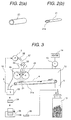
- Figure 2 (a) shows the shape of a sheared hulls piece existing before undergoing compressive volume reduction.
- Figure 2 (b) shows the shape of the sheared hulls piece existing after undergoing compressive volume reduction.
- Figure 3 is a schematic block diagram of the hulls waste volume-reduction treatment equipment described as the second embodiment of the present invention.
- Figure 1 is a schematic block diagram of the hulls waste volume-reduction treatment equipment described as the first embodiment of the present invention.
- the hulls waste volume-reduction treatment equipment described as the first embodiment of the present invention comprises:
- the sheared hulls piece 20 that has stemmed from shearing in chemical reprocessing facilities is loaded from hulls piece inlet 3a.
- the sheared hulls piece during loading has a cross-section circular cylindrical shape as shown in Fig. 2 (a).
- the sheared hulls piece is being passed through clearance 1 between rotary cylindrical bodies 2a and 2b, the hulls piece is compressed into hulls piece 21 of a flat shape with the necessary and sufficient cavity 21a left for the internal moisture of the piece to evaporate, as shown in Fig. 2 (b). Since the zircaloy powder occurring during compression is released into pooled water 22, there is no danger of ignition or explosion.
- compressed hulls piece 21 is carried from pooled water 22 to drying chamber 12 by conveyors 4a, 4b, and 4c installed at the bottom of casing 3. Since drying chamber 12 is always maintained in a dry atmosphere by heater 14 and fan 13, the moisture on the surface and inner wall of compressed hulls piece 21 is sufficiently dried by the heat generated from the hulls itself, the dry atmosphere, and the effect of cavity 21a. The compressed hulls piece 21 that has been sufficiently dried is unloaded from compressed hulls piece outlet 5 into container 19.
- the zircaloy powder that occurred during compression is released into pooled water 22, since the one-way water stream formed by pump 7 and nozzle 6 is present directly below rotary cylindrical bodies 2a and 2b, the zircaloy powder is conducted together with this stream into zircaloy powder carrier waterstream receiving port 8 by the stream.
- the zircaloy powder carrier water is separated into sludge laden with the zircaloy powder, and filtered water, by solid-liquid separator 9.
- the filtered water is carried to pump 7 via pipeline 10 and then reused as pooled water.
- the sludge laden with the zircaloy powder is sent to sludge reservoir 15 via sludge transfer pipeline 11.
- the sludge laden with the zircaloy powder that has been stored into sludge reservoir 15 is conditioned into mortar of the required flow rate by undergoing mixing with premixed cement in cement hopper 16 and mixing in mixer 18. If the flow rate of the mortar is not sufficient, the flow rate can be adjusted by adding water from water adding tank 17 intended for cement flow rate adjustment. After the required mortar flow rate has thus been obtained, the mortar is poured into and solidified inside container 18a that already contains the required quantity of compressed hulls piece 21.
- sheared hulls piece 20 undergoes compressive volume reduction by being loaded into the clearance between two rotary cylindrical bodies 2a and 2b. Therefore, no pretreatment unit, such as a large compressor or a capsulation unit, is required and compressive volume reduction with simplified equipment is possible.
- the processing water laden with the zircaloy powder resulting from compression with rotary cylindrical bodies 2a and 2b is separated into treated water and sludge laden with the zircaloy powder and the treated water is reused to collect the zircaloy powder resulting from compression, the quantity of secondary waste stemming from the treatment equipment during compressive volume reduction of sheared hulls piece 20 can be reduced.
- the hulls waste volume-reduction treatment equipment described as the second embodiment of the present invention comprises:
- the sheared hulls piece 20 that has stemmed from shearing in chemical reprocessing facilities is loaded from hulls piece inlet 3a.
- the sheared hulls piece is being passed through clearance 1 between rotary cylindrical bodies 2a and 2b, the hulls piece is compressed into hulls piece 21 having a flat shape with the necessary and sufficient cavity 21a left for the internal moisture of the piece to evaporate, as shown in Fig. 2 (b). Since the zircaloy powder occurring during compression is accompanied by the water flowing down from nozzle 32, there is no danger of ignition or explosion.
- compressed hulls piece 21 is carried to drying chamber 12 by conveyor 4 installed at the bottom of casing 31. Since drying chamber 12 is always maintained in a dry atmosphere by heater 14 and fan 13, the moisture on the surface and inner wall of compressed hulls piece 21 is sufficiently dried by the heat generated from the hulls itself, the dry atmosphere, and the effect of cavity 21a. The compressed hulls piece 21 that has been sufficiently dried is unloaded from compressed hulls piece outlet 5 into container 19.
- the zircaloy powder that occurred during the compression of hulls is accompanied by the water flowing down from nozzle 32, then passed to sloped bottom 31a of casing 31, and released into zircaloy powder carrier waterstream receiving port 8.
- the treated water in the zircaloy powder carrier water is separated from the zircaloy powder by metallic filtered solid-liquid separator 33, and the zircaloy powder is retained in metallic filter 34.
- the filtered water that has been passed through metallic filtered solid-liquid separator 33 is carried to pump 7 via pipeline 10 and then reused as the water that flows downward. After the required period of test use of the metallic filter laden with the separated zircaloy powder, this filter is removed with the zircaloy powder retained.
- the metallic filter 34 that has been removed with the zircaloy powder retained is stored into compression vessel 35 for sintering use, where the filter then undergoes high-pressure high-temperature treatment to create sintered body 36.
- the sintered body 36 that has thus been obtained is stored together with compressed hulls piece 21 into container 19.
- solid-liquid separator 33 separates treated water and zircaloy powder via metallic filter 34 and the zircaloy powder is sintered together with metallic filter 34 into solid form, increases in the volume of the waste are significantly reduced and a stable, solidified body can be obtained, which in turn enables significant reduction of the quantity of solidified zircaloy powder bodies stemming as secondary waste from the treatment equipment during compressive volume reduction of sheared hulls piece 20.
- the present invention is not limited to the embodiments described above and permits these embodiments to be modified into various form.
- two rotary cylindrical bodies 2a and 2b are used to reduce the volume of sheared hulls piece 20 compressively, four or more such cylindrical bodies can be used.
- water 37 is supplied dropwise to the clearance between the two rotary cylindrical bodies 2a and 2b, the water can be injected using a spray means.
Landscapes
- Engineering & Computer Science (AREA)
- Physics & Mathematics (AREA)
- General Engineering & Computer Science (AREA)
- High Energy & Nuclear Physics (AREA)
- Chemical & Material Sciences (AREA)
- Inorganic Chemistry (AREA)
- Environmental & Geological Engineering (AREA)
- Processing Of Solid Wastes (AREA)
Abstract
Description
Claims (9)
- Hulls waste volume-reduction treatment equipment characterized in that: at least two rotary cylindrical bodies having the required clearance between each other and rotating in mutually opposite directions are provided and compressive reduction in the volume of the zircaloy and fuel cladding tube residues (hulls) generated during chemical reprocessing of a light-water reactor spent fuel is accomplished by loading hulls into the clearances between said rotary cylindrical bodies.
- Hulls waste volume-reduction treatment equipment set forth in Claim 1 above, wherein said equipment is characterized in that said rotary cylindrical bodies are arranged in order for at least said clearances to be positioned in water or a means for feeding or spraying water downward into said clearances is provided and thus dust particles due to the occurrence of zircaloy powder during compressive volume-reduction treatment is prevented from exploding.
- Hulls waste volume-reduction treatment equipment set forth in Claim 2 above, wherein said equipment is characterized in that a means for giving a constant stream of water in one specific direction at the bottom of the clearances between the rotary cylindrical bodies and thus the movement of zircaloy powder is prevented from stopping and remaining near said rotary cylindrical bodies.
- Hulls waste volume-reduction treatment equipment set forth in Claim 2 or 3 above, wherein said equipment is characterized in that: a means by which processing water laden with the zircaloy powder resulting from compression is separated into treated water and either the zircaloy powder or sludge laden therewith, and a means for reusing said treated water to collect the zircaloy powder resulting from compression are provided and thus the quantity of secondary waste which occurs is reduced.
- Hulls waste volume-reduction treatment equipment set forth in Claim 4 above, wherein said equipment is characterized in that: a means for preparing mortar by mixing said treated water and separated sludge with cement, and a container into which said mortar is to be poured are provided and thus a solidified cement body is created.
- Hulls waste volume-reduction treatment equipment set forth in Claim 4 above, wherein said equipment is characterized in that: said separating means has a metallic filter for separating said processing water into treated water and zircaloy powder, and a means for sintering said zircaloy powder and said metallic filter together into solid form, and thus minimizes increases in waste volume while at the same time obtaining a stable, solidified body.
- Hulls waste volume-reduction treatment equipment set forth in Claim 2 or 3 above, wherein said equipment is characterized in that: the clearances between said rotary cylindrical bodies are set to a size at which no closed spaces are formed inside the compressed pieces of the hulls waste by controlling the degree of compression of the waste, then the residual moisture sticking to the compressed pieces is evaporated by the emission of the heat inherent in the hulls waste itself, and the compressed pieces of the hulls waste are dried immediately after its compressive volume reduction.
- Hulls waste volume-reduction treatment equipment set forth in Claim 7 above, wherein said equipment is characterized in that: a drying chamber in which the hulls waste that has undergone compressive volume reduction is to be placed in a dry atmosphere before being released, is provided and thus the drying of the residual moisture sticking to the compressed pieces of the waste is accelerated.
- Hulls waste volume-reduction treatment equipment set forth in Claim 5 above, wherein said equipment is characterized in that: the container into which aforementioned mortar is to be poured contains the compressed pieces of said hulls waste, and said compressed pieces are solidified with said mortar to minimize increases in the volume of the compressively volume-reduced hulls waste.
Applications Claiming Priority (2)
| Application Number | Priority Date | Filing Date | Title |
|---|---|---|---|
| JP2000042192A JP2001228295A (en) | 2000-02-21 | 2000-02-21 | Hull waste volume reduction equipment |
| JP2000042192 | 2000-02-21 |
Publications (2)
| Publication Number | Publication Date |
|---|---|
| EP1128393A2 true EP1128393A2 (en) | 2001-08-29 |
| EP1128393A3 EP1128393A3 (en) | 2004-02-25 |
Family
ID=18565295
Family Applications (1)
| Application Number | Title | Priority Date | Filing Date |
|---|---|---|---|
| EP00308471A Withdrawn EP1128393A3 (en) | 2000-02-21 | 2000-09-27 | Hulls waste volume-reduction treatment equipment |
Country Status (2)
| Country | Link |
|---|---|
| EP (1) | EP1128393A3 (en) |
| JP (1) | JP2001228295A (en) |
Cited By (2)
| Publication number | Priority date | Publication date | Assignee | Title |
|---|---|---|---|---|
| GB2511084A (en) * | 2013-02-22 | 2014-08-27 | Dbd Ltd | Hazardous Waste Separation Process |
| JP2014202703A (en) * | 2013-04-09 | 2014-10-27 | 株式会社東芝 | Drying container for radioactive waste |
Family Cites Families (5)
| Publication number | Priority date | Publication date | Assignee | Title |
|---|---|---|---|---|
| JPS57105233A (en) * | 1980-12-23 | 1982-06-30 | Hitachi Ltd | Granulating apparatus |
| DE3416620C2 (en) * | 1984-05-05 | 1986-05-07 | Transnuklear Gmbh, 6450 Hanau | Underwater shredding device |
| EP0566960A2 (en) * | 1992-04-22 | 1993-10-27 | Siemens Aktiengesellschaft | Chopping ans wrapping of fuel assembly ducts or similar nuclear reactor structure elements |
| JPH1114797A (en) * | 1997-06-24 | 1999-01-22 | Ishikawajima Harima Heavy Ind Co Ltd | Radioactive waste crushing and sorting facility |
| JP3708300B2 (en) * | 1997-08-12 | 2005-10-19 | 株式会社神戸製鋼所 | Volume reduction processing method and volume reduction processing apparatus for radioactive metal waste containing zirconium alloy |
-
2000
- 2000-02-21 JP JP2000042192A patent/JP2001228295A/en active Pending
- 2000-09-27 EP EP00308471A patent/EP1128393A3/en not_active Withdrawn
Cited By (2)
| Publication number | Priority date | Publication date | Assignee | Title |
|---|---|---|---|---|
| GB2511084A (en) * | 2013-02-22 | 2014-08-27 | Dbd Ltd | Hazardous Waste Separation Process |
| JP2014202703A (en) * | 2013-04-09 | 2014-10-27 | 株式会社東芝 | Drying container for radioactive waste |
Also Published As
| Publication number | Publication date |
|---|---|
| JP2001228295A (en) | 2001-08-24 |
| EP1128393A3 (en) | 2004-02-25 |
Similar Documents
| Publication | Publication Date | Title |
|---|---|---|
| EP0096342B1 (en) | Method of processing radioactive waste | |
| CN117410511A (en) | Recycling method and battery processing device for disposal of used batteries, in particular rechargeable batteries | |
| US5368633A (en) | Pressurized radioactive gas treatment system | |
| EP1128393A2 (en) | Hulls waste volume-reduction treatment equipment | |
| JPH07104440B2 (en) | Radioactive waste solidification method and equipment | |
| KR101544668B1 (en) | The volume reduction processing method of radioactive waste using the powder metallurgy technology | |
| EP0020691A4 (en) | Immobilization of waste material. | |
| JP4394909B2 (en) | Method for drying metal wastes with a tendency to ignite to be compressed and apparatus associated with the method | |
| RU2106257C1 (en) | Method for compaction of self-inflammable and/or explosive metal chips | |
| RU2557110C1 (en) | Development of modular complex of process equipment for storage of hazardous wastes | |
| JPH0298689A (en) | Containment vessel pressure suppression device | |
| JP3714249B2 (en) | Method for immobilizing hazardous substances | |
| KR102877947B1 (en) | The Post-treatment Process Control method for Treatment and Disposal of C-14 and H-3 in Radioactive Waste Activated Carbon | |
| JP2002318298A (en) | Radioactive waste treatment method and treatment equipment | |
| JP2001066100A (en) | Chemical agent removal treatment method and treatment device | |
| RU2179538C2 (en) | Method of manufacturing radiation protective concrete | |
| RU2107523C1 (en) | Device for fire extinguishing | |
| RU2194316C2 (en) | Method for producing radiation shielding concrete | |
| KR100779879B1 (en) | Apparatus and method for recycling dust generated from incineration and melting treatment facilities of hazardous waste | |
| JP2017111106A (en) | Contaminated water interception and fuel debris recovery method | |
| JP2003028989A (en) | Method and apparatus for treating radioactive aluminum waste | |
| JPH05164892A (en) | Combustible gas control system for nuclear reactor | |
| CN119786108A (en) | A process and system for treating organic waste liquid | |
| Arendt et al. | A Brief Guide to UF6 Handling | |
| CA1076766A (en) | Low-level radioactive waste disposal process and apparatus |
Legal Events
| Date | Code | Title | Description |
|---|---|---|---|
| PUAI | Public reference made under article 153(3) epc to a published international application that has entered the european phase |
Free format text: ORIGINAL CODE: 0009012 |
|
| 17P | Request for examination filed |
Effective date: 20001016 |
|
| AK | Designated contracting states |
Kind code of ref document: A2 Designated state(s): AT BE CH CY DE DK ES FI FR GB GR IE IT LI LU MC NL PT SE |
|
| AX | Request for extension of the european patent |
Free format text: AL;LT;LV;MK;RO;SI |
|
| RIC1 | Information provided on ipc code assigned before grant |
Ipc: 7G 21F 9/30 B Ipc: 7G 21C 19/375 B Ipc: 7G 21F 9/36 A |
|
| PUAL | Search report despatched |
Free format text: ORIGINAL CODE: 0009013 |
|
| AK | Designated contracting states |
Kind code of ref document: A3 Designated state(s): AT BE CH CY DE DK ES FI FR GB GR IE IT LI LU MC NL PT SE |
|
| AX | Request for extension of the european patent |
Extension state: AL LT LV MK RO SI |
|
| AKX | Designation fees paid |
Designated state(s): FR GB |
|
| REG | Reference to a national code |
Ref country code: DE Ref legal event code: 8566 |
|
| STAA | Information on the status of an ep patent application or granted ep patent |
Free format text: STATUS: THE APPLICATION IS DEEMED TO BE WITHDRAWN |
|
| 18D | Application deemed to be withdrawn |
Effective date: 20040826 |