EP1128360A2 - Method for optimizing the acoustic quality of an acoustic signal on the basis of psyscho-acoustic parameters - Google Patents
Method for optimizing the acoustic quality of an acoustic signal on the basis of psyscho-acoustic parameters Download PDFInfo
- Publication number
- EP1128360A2 EP1128360A2 EP01830129A EP01830129A EP1128360A2 EP 1128360 A2 EP1128360 A2 EP 1128360A2 EP 01830129 A EP01830129 A EP 01830129A EP 01830129 A EP01830129 A EP 01830129A EP 1128360 A2 EP1128360 A2 EP 1128360A2
- Authority
- EP
- European Patent Office
- Prior art keywords
- sound
- acoustic
- psycho
- perceived
- roughness
- Prior art date
- Legal status (The legal status is an assumption and is not a legal conclusion. Google has not performed a legal analysis and makes no representation as to the accuracy of the status listed.)
- Withdrawn
Links
Images
Classifications
-
- G—PHYSICS
- G10—MUSICAL INSTRUMENTS; ACOUSTICS
- G10L—SPEECH ANALYSIS TECHNIQUES OR SPEECH SYNTHESIS; SPEECH RECOGNITION; SPEECH OR VOICE PROCESSING TECHNIQUES; SPEECH OR AUDIO CODING OR DECODING
- G10L25/00—Speech or voice analysis techniques not restricted to a single one of groups G10L15/00 - G10L21/00
- G10L25/48—Speech or voice analysis techniques not restricted to a single one of groups G10L15/00 - G10L21/00 specially adapted for particular use
- G10L25/69—Speech or voice analysis techniques not restricted to a single one of groups G10L15/00 - G10L21/00 specially adapted for particular use for evaluating synthetic or decoded voice signals
-
- G—PHYSICS
- G10—MUSICAL INSTRUMENTS; ACOUSTICS
- G10K—SOUND-PRODUCING DEVICES; METHODS OR DEVICES FOR PROTECTING AGAINST, OR FOR DAMPING, NOISE OR OTHER ACOUSTIC WAVES IN GENERAL; ACOUSTICS NOT OTHERWISE PROVIDED FOR
- G10K15/00—Acoustics not otherwise provided for
- G10K15/02—Synthesis of acoustic waves
-
- H—ELECTRICITY
- H04—ELECTRIC COMMUNICATION TECHNIQUE
- H04S—STEREOPHONIC SYSTEMS
- H04S1/00—Two-channel systems
Definitions
- This invention relates to a procedure for optimising the acoustic quality of an acoustic signal.
- the procedure is particularly suitable for being applied to the optimisation of the sound perceived inside the passenger compartment of a moving motor vehicle, also if naturally other applications are not excluded.
- Purpose of this invention is to permit a substantial progress in the design and optimisation of the acoustic quality of an acoustic signal.
- the fundamental concept underlying this invention consists in comprehending that a development is required from the traditional sound synthesis method, based on controlling the physical properties of sound, to a procedure based on directly controlling the psycho-acoustic characteristics of sound.
- additional interventions according to this invention include psycho-acoustic parameters such as loudness, roughness, sharpness, impulsiveness and any other psycho-acoustic variables.
- a form of embodiment according to this invention focuses on the "roughness” parameter.
- This parameter is discussed and defined in literature as a "sensation of dissonance” (R. Plomp, Aspects of tone sensation, Academic Press, 1976).
- the applicant identified a set of physical characteristics on which to intervene to control the output roughness.
- algorithms have been selected for operating on amplitude modulations.
- the fundamental principle of roughness synthesis is based on a particular filtering operation which separates the area of the frequencies concerned from the residual part of the spectrum. This "isolated” area is manipulated by means of active or passive roughness component filtering, on the basis of the so-called “roughness curve” defined by Plomp (see above).
- the portion with increased or decreased roughness is then combined again with its completion to obtain the complete sample with the new overall value of roughness.
- the necessary filtering algorithms can be optimised in terms of computation and in terms of filtering quality, to obtain a practically "perfect” signal after manipulation without any form of phase distortion nor filter output "contour effects”.
- the procedure according to this invention employs a roughness synthesis module which is based on the following logical steps:
- the procedure according to this invention may be firstly applied in laboratory. Its use in this case requires interfacing with systems for playing recorded sounds or systems for the synthesis of artificial sounds (inputs) and with other systems for playing sounds for the administration of sounds obtained after manipulation to the ears of a listener (output).
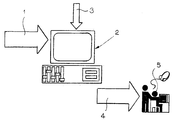
- FIG. 1 schematically illustrates the system used.
- number 1 indicates the input acoustic signal to a processor 2 by means of which the required psycho-acoustic characteristics (3) are introduced (controlled), according to the criteria illustrated above, as an example, in the case of the roughness parameter.
- the acoustic signal 4 thus manipulated, output from the processor 2, is submitted to the subjective judgement of a plurality of panels formed by statistically representative experimental individuals 5.
- very high fidelity stereophonic headphones can be used with suitable amplification and sound signal conditioning systems.
- the method of use of this system is based on subjective listening test and sound evaluation methods. In essence, these methods consist in interviewing the panel members by means of specific questionnaires or other subjective evaluation sampling instruments, on the experimental physiological/psychological effects during listening to acoustic specimens played employing the selected instruments. Such data are the base for subsequent statistic processing which form a description of the mean behaviour, the deviations and the predictive models of the subjective reactions of the chosen population. The results of such investigations provide the information required to defined "acoustic design" specifications of the product, aimed at improving the perceived quality.
- a suitably programmed and interfaced digital signal processor is employed to introduce in the sound perceived inside the passenger compartment the required psycho-acoustic characteristics.
- DSP digital signal processor
Landscapes
- Engineering & Computer Science (AREA)
- Physics & Mathematics (AREA)
- Acoustics & Sound (AREA)
- Multimedia (AREA)
- Audiology, Speech & Language Pathology (AREA)
- Health & Medical Sciences (AREA)
- Signal Processing (AREA)
- General Health & Medical Sciences (AREA)
- Computational Linguistics (AREA)
- Human Computer Interaction (AREA)
- Measurement Of Mechanical Vibrations Or Ultrasonic Waves (AREA)
- Tone Control, Compression And Expansion, Limiting Amplitude (AREA)
- Fittings On The Vehicle Exterior For Carrying Loads, And Devices For Holding Or Mounting Articles (AREA)
Abstract
Description
Claims (2)
- Procedure for the optimisation of the acoustic quality of an acoustic signal characterised in that it comprises the steps of:arranging media (1) for playing a recorded sound or for synthesising an artificial sound,manipulating the sound thus generated (2, 3) so to confer a predefined value of at least one psycho-acoustic parameter, such as roughness, loudness, sharpness or impulsiveness,subjecting the sound thus manipulated to the subjective judgement of a plurality of panels of statistically representative experimental individuals,processing the subjective evaluations of the panels, in association to the psycho-acoustic parameters conferred to the sounds which are the object of the evaluation, in such a way to identify optimisation values of the perceived sound quality.
- Procedure according to claim 1 characterised in that it is applied to the sound perceived inside the passenger compartment of a moving motor vehicle and by the fact that sound processing media are arranged inside the motor vehicle for conferring optimal values of one or more psycho-acoustic parameters to the perceived sound previously defined according to the procedure described in claim 1.
Applications Claiming Priority (2)
| Application Number | Priority Date | Filing Date | Title |
|---|---|---|---|
| ITTO000180 | 2000-02-24 | ||
| IT2000TO000180A IT1319914B1 (en) | 2000-02-24 | 2000-02-24 | PROCEDURE FOR THE OPTIMIZATION OF THE SOUND QUALITY OF A SOUND SIGNAL ON THE BASIS OF PSYCHO-ACOUSTIC PARAMETERS. |
Publications (2)
| Publication Number | Publication Date |
|---|---|
| EP1128360A2 true EP1128360A2 (en) | 2001-08-29 |
| EP1128360A3 EP1128360A3 (en) | 2004-12-08 |
Family
ID=11457483
Family Applications (1)
| Application Number | Title | Priority Date | Filing Date |
|---|---|---|---|
| EP01830129A Withdrawn EP1128360A3 (en) | 2000-02-24 | 2001-02-23 | Method for optimizing the acoustic quality of an acoustic signal on the basis of psyscho-acoustic parameters |
Country Status (2)
| Country | Link |
|---|---|
| EP (1) | EP1128360A3 (en) |
| IT (1) | IT1319914B1 (en) |
Cited By (2)
| Publication number | Priority date | Publication date | Assignee | Title |
|---|---|---|---|---|
| CN102857851A (en) * | 2012-09-12 | 2013-01-02 | 清华大学 | Sound and image synchronizing system for sound quality evaluation |
| DE102024125650A1 (en) | 2024-09-06 | 2026-03-12 | Deutsches Zentrum für Luft- und Raumfahrt e.V. | Methods for optimizing the technical design and operation of an aircraft/vehicle with regard to target parameters of noise development |
Family Cites Families (4)
| Publication number | Priority date | Publication date | Assignee | Title |
|---|---|---|---|---|
| US5434922A (en) * | 1993-04-08 | 1995-07-18 | Miller; Thomas E. | Method and apparatus for dynamic sound optimization |
| US5715372A (en) * | 1995-01-10 | 1998-02-03 | Lucent Technologies Inc. | Method and apparatus for characterizing an input signal |
| US5907622A (en) * | 1995-09-21 | 1999-05-25 | Dougherty; A. Michael | Automatic noise compensation system for audio reproduction equipment |
| CA2230188A1 (en) * | 1998-03-27 | 1999-09-27 | William C. Treurniet | Objective audio quality measurement |
-
2000
- 2000-02-24 IT IT2000TO000180A patent/IT1319914B1/en active
-
2001
- 2001-02-23 EP EP01830129A patent/EP1128360A3/en not_active Withdrawn
Cited By (3)
| Publication number | Priority date | Publication date | Assignee | Title |
|---|---|---|---|---|
| CN102857851A (en) * | 2012-09-12 | 2013-01-02 | 清华大学 | Sound and image synchronizing system for sound quality evaluation |
| CN102857851B (en) * | 2012-09-12 | 2015-04-15 | 清华大学 | Sound and image synchronizing system for sound quality evaluation |
| DE102024125650A1 (en) | 2024-09-06 | 2026-03-12 | Deutsches Zentrum für Luft- und Raumfahrt e.V. | Methods for optimizing the technical design and operation of an aircraft/vehicle with regard to target parameters of noise development |
Also Published As
| Publication number | Publication date |
|---|---|
| ITTO20000180A1 (en) | 2001-08-24 |
| EP1128360A3 (en) | 2004-12-08 |
| IT1319914B1 (en) | 2003-11-12 |
| ITTO20000180A0 (en) | 2000-02-24 |
Similar Documents
| Publication | Publication Date | Title |
|---|---|---|
| US8565908B2 (en) | Systems, methods, and apparatus for equalization preference learning | |
| JP5113307B2 (en) | How to change the harmonic content of a composite waveform | |
| US8891778B2 (en) | Speech enhancement | |
| US20110202155A1 (en) | System and Method for Automatically Producing Haptic Events From a Digital Audio Signal | |
| Croghan et al. | Music preferences with hearing aids: Effects of signal properties, compression settings, and listener characteristics | |
| JP6552963B2 (en) | Processing audio signals for treatment of tinnitus | |
| JP2002529773A5 (en) | ||
| JP2014510474A (en) | Apparatus and method for determining reverberation perception level, audio processor, and signal processing method | |
| US20140272883A1 (en) | Systems, methods, and apparatus for equalization preference learning | |
| Ziemer et al. | Using psychoacoustic models for sound analysis in music | |
| JP4130779B2 (en) | Sound field control system and sound field control method | |
| USRE48462E1 (en) | Systems, methods, and apparatus for equalization preference learning | |
| US9240208B2 (en) | Recording apparatus with mastering function | |
| Choisel et al. | Relating auditory attributes of multichannel reproduced sound to preference and to physical parameters | |
| ITTO20000180A1 (en) | PROCEDURE FOR THE OPTIMIZATION OF THE ACOUSTIC QUALITY OF A SOUND SIGNAL ON THE BASIS OF PSYCHO-ACOUSTIC PARAMETERS. | |
| Hermes | Enhancing creativity through automatic mixing research: Testing spectral clarity predictors in the mixprocess | |
| Bisping | Digital generation of acoustical targets for car sound engineering based on psychometrical data | |
| EP3876226B1 (en) | Method and device for automated harmonization of digital audio signals | |
| Sokolova | Multirate Signal Processing for Wide Dynamic Range Compression and Feedback Control in Hearing Aids | |
| Hyrkas | Algorithms for Roughness Control Using Frequency Shifting and Attenuation | |
| Canévet et al. | Psychoacoustic assessment of active noise control | |
| Saitou et al. | Development of the F0 Control Model for Singing-Voices Synthesis | |
| WO2007015652A2 (en) | A method of mixing audio signals and apparatus for mixing audio signals | |
| Croghan | Perceived Quality of Recorded Music Processed through Compression Hearing Aids | |
| RU2284584C1 (en) | Method for transferring acoustic signal to user and device for realization of said method |
Legal Events
| Date | Code | Title | Description |
|---|---|---|---|
| PUAI | Public reference made under article 153(3) epc to a published international application that has entered the european phase |
Free format text: ORIGINAL CODE: 0009012 |
|
| AK | Designated contracting states |
Kind code of ref document: A2 Designated state(s): AT BE CH CY DE DK ES FI FR GB GR IE IT LI LU MC NL PT SE TR |
|
| AX | Request for extension of the european patent |
Free format text: AL;LT;LV;MK;RO;SI |
|
| PUAL | Search report despatched |
Free format text: ORIGINAL CODE: 0009013 |
|
| AK | Designated contracting states |
Kind code of ref document: A3 Designated state(s): AT BE CH CY DE DK ES FI FR GB GR IE IT LI LU MC NL PT SE TR |
|
| AX | Request for extension of the european patent |
Extension state: AL LT LV MK RO SI |
|
| RIC1 | Information provided on ipc code assigned before grant |
Ipc: 7G 10L 19/00 B Ipc: 7H 04B 1/66 B Ipc: 7H 03G 3/32 B Ipc: 7G 10K 15/00 A |
|
| 17P | Request for examination filed |
Effective date: 20050517 |
|
| AKX | Designation fees paid |
Designated state(s): AT BE CH CY DE DK ES FI FR GB GR IE IT LI LU MC NL PT SE TR |
|
| GRAP | Despatch of communication of intention to grant a patent |
Free format text: ORIGINAL CODE: EPIDOSNIGR1 |
|
| STAA | Information on the status of an ep patent application or granted ep patent |
Free format text: STATUS: THE APPLICATION IS DEEMED TO BE WITHDRAWN |
|
| 18D | Application deemed to be withdrawn |
Effective date: 20070516 |