EP1128282A2 - Method and system for search and retrieval of similar patterns - Google Patents
Method and system for search and retrieval of similar patterns Download PDFInfo
- Publication number
- EP1128282A2 EP1128282A2 EP01200511A EP01200511A EP1128282A2 EP 1128282 A2 EP1128282 A2 EP 1128282A2 EP 01200511 A EP01200511 A EP 01200511A EP 01200511 A EP01200511 A EP 01200511A EP 1128282 A2 EP1128282 A2 EP 1128282A2
- Authority
- EP
- European Patent Office
- Prior art keywords
- pattern
- patterns
- representations
- database
- digital
- Prior art date
- Legal status (The legal status is an assumption and is not a legal conclusion. Google has not performed a legal analysis and makes no representation as to the accuracy of the status listed.)
- Withdrawn
Links
Images




Classifications
-
- G—PHYSICS
- G06—COMPUTING OR CALCULATING; COUNTING
- G06F—ELECTRIC DIGITAL DATA PROCESSING
- G06F16/00—Information retrieval; Database structures therefor; File system structures therefor
- G06F16/50—Information retrieval; Database structures therefor; File system structures therefor of still image data
- G06F16/58—Retrieval characterised by using metadata, e.g. metadata not derived from the content or metadata generated manually
- G06F16/583—Retrieval characterised by using metadata, e.g. metadata not derived from the content or metadata generated manually using metadata automatically derived from the content
- G06F16/5854—Retrieval characterised by using metadata, e.g. metadata not derived from the content or metadata generated manually using metadata automatically derived from the content using shape and object relationship
-
- G—PHYSICS
- G06—COMPUTING OR CALCULATING; COUNTING
- G06V—IMAGE OR VIDEO RECOGNITION OR UNDERSTANDING
- G06V10/00—Arrangements for image or video recognition or understanding
- G06V10/70—Arrangements for image or video recognition or understanding using pattern recognition or machine learning
- G06V10/74—Image or video pattern matching; Proximity measures in feature spaces
- G06V10/75—Organisation of the matching processes, e.g. simultaneous or sequential comparisons of image or video features; Coarse-fine approaches, e.g. multi-scale approaches; using context analysis; Selection of dictionaries
- G06V10/758—Involving statistics of pixels or of feature values, e.g. histogram matching
-
- Y—GENERAL TAGGING OF NEW TECHNOLOGICAL DEVELOPMENTS; GENERAL TAGGING OF CROSS-SECTIONAL TECHNOLOGIES SPANNING OVER SEVERAL SECTIONS OF THE IPC; TECHNICAL SUBJECTS COVERED BY FORMER USPC CROSS-REFERENCE ART COLLECTIONS [XRACs] AND DIGESTS
- Y10—TECHNICAL SUBJECTS COVERED BY FORMER USPC
- Y10S—TECHNICAL SUBJECTS COVERED BY FORMER USPC CROSS-REFERENCE ART COLLECTIONS [XRACs] AND DIGESTS
- Y10S707/00—Data processing: database and file management or data structures
- Y10S707/99931—Database or file accessing
- Y10S707/99933—Query processing, i.e. searching
- Y10S707/99936—Pattern matching access
Definitions
- the invention relates generally to the field of pattern recognition, and in particular to the retrieval of patterns from a database.
- Patterns are central to the design of fabrics, textiles, wallpapers, floor mats, tiles, etc.
- a pattern is composed of various pattern elements.
- a common approach to generating different versions of a pattern is to vary the color of one or more pattern elements. For example, several versions of a 1 ⁇ 2'' vertical stripe pattern can be created by using different combinations of two or more colors.
- the differently colored versions of a pattern are considered perceptually similar in connection with numerous applications. For example, it is common for a fabric designer or manufacturer to offer its customer a large selection of colored patterns, where the entire set is composed of perceptually similar patterns which vary only on the basis of color. The same is true for other colored pattern-based items.
- a furniture store offers its customer a choice of similar fabric patterns for furniture.
- An interior decorator or home manufacturer can offer a selection of similar patterns for wallpaper, tiles, etc.
- a customer can create virtual 3-dimensional furniture with the desired fabric(s) in a selected pattern or create and decorate a virtual 3-dimensional room with selected furniture(s), wallpaper(s), flooring(s), etc.
- a virtual item can be created with different patterns or different versions of a selected pattern in order to make a final selection for custom ordering.
- a customer or user commonly wants to view one or more versions of a selected pattern in order to make the final selection.
- a decision on wallpaper may require a customer to view one or more of different available versions of a desired pattern.
- a person making a final decision on the pattern of an item generally employs a two step process for the selection of a specific pattern. First, a desired pattern is selected or provided. Then a version of the selected or provided pattern is selected. The second step of the selection process, that is, the selection of a specific version of a selected or provided pattern, requires a decision-maker to view different versions of the selected or provided pattern.
- each colored pattern is available as a digital image
- the present invention is directed to overcoming one or more of the problems set forth above.
- the invention includes a method for retrieving digital patterns similar to a query pattern by generating representations of each digital pattern in terms of one or more color invariant properties; storing and organizing the patterns and their representations in a database; and searching the database by reference to the representations to identify and retrieve patterns similar to the query pattern.
- a preferred color invariant property is an edge property of each digital pattern, and more particularly its edge orientation.
- the advantage of this invention is that it provides a system for organizing a database of patterns by color invariant properties, such as an edge property.
- Patterns and colors are crucial to the design of wallpapers, fabrics, textiles, floor mats, tile, rugs, etc. These items are usually available in different colored versions of the same pattern. In other words, different versions of the same pattern are created using different colors for the pattern elements. What this means is that different colored versions of a pattern are considered to be similar patterns.
- applications such as fabric selection for furniture or clothing, wallpapers, floor mats, rugs, window treatments, and tile selection in an interior decoration application, different colored versions of a selected pattern are usually reviewed. Such a review requires identification and retrieval of the set of patterns similar to a selected pattern, and at least initially irrespective of color.
- FIG. 1 is a block diagram of the functional components of the invention.
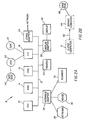
- FIG. 2A is a block diagram of a computer system for implementing the invention.
- FIG. 2B is a block diagram of a client - server model useful in understanding a web-based implementation of the invention.
- FIG. 3 is a chart of the pattern feature extraction and representation component shown in Figure 1.
- FIG. 4 is a chart of the database organization and search component shown in Figure 1.
- FIG. 5 is a chart of the similar pattern identification and ranking component shown in Figure 1.
- FIG. 6 is a diagram of a window centered at pixel location [x,y].
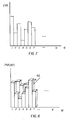
- FIG. 7 is an example of a histogram showing relative frequency of occurrence of edge orientations.
- FIG. 8 is an example of a co-occurrence histogram showing relative frequency of occurrence of an edge with an given orientation neighboring an edge with another orientation.
- FIG. 9 is an illustration of a web-based pattern registration and searching architecture for on-line pattern search and selection.
- the program may be stored in conventional computer readable storage medium, which may comprise, for example; magnetic storage media such as a magnetic disk (such as a floppy disk) or magnetic tape; optical storage media such as an optical disc, optical tape, or machine readable bar code; solid state electronic storage devices such as random access memory (RAM), or read only memory (ROM); or any other physical device or medium employed to store a computer program.
- magnetic storage media such as a magnetic disk (such as a floppy disk) or magnetic tape
- optical storage media such as an optical disc, optical tape, or machine readable bar code
- solid state electronic storage devices such as random access memory (RAM), or read only memory (ROM); or any other physical device or medium employed to store a computer program.
- the subject matter of the present invention relates to digital image understanding technology, which is understood to mean technology that digitally processes a digital image to recognize and thereby assign useful meaning to human understandable objects, attributes or conditions and then to utilize the results obtained in the further processing of the digital image.
- a typical hardware configuration of an information handling/computer system 8 in accordance with the invention preferably has at least one processor or central processing unit (CPU) 10.
- CPU central processing unit
- the CPU 10 is interconnected via a system bus 12 to a random access memory (RAM) 14, a read-only memory (ROM) 16, an input/output (I/O) adapter 18 (for connecting peripheral devices such as disk units 20 and tape drives 22 to the bus 12), a communication adapter 24 (for connecting an information handling system to a data processing network), a user interface adapter 26 (for connecting peripherals 28, 30, 32 such as a keyboard, a mouse, a digital image input unit such as a scanner, and/or other user interface device to the bus 12), a printer 34 and a display adapter 36 (for connecting the bus 12 to a display device 38).
- the invention could be implemented using the structure shown in Figure 2A by including the inventive method within a computer program stored on the storage device 20.
- a query design pattern could be entered into the system through the scanner 32.
- Such a computer program would act on a stored grouping of image designs supplied from a database 40 through the interface adapter 18 or from a remote database through the network connection provided by the communication adapter 24.
- the system would then automatically implement the pattern search and retrieval process and produce the desired digital image output on the display 38, or the printer 34 or communicate the image output through the connection provided by the communication adapter 24.
- the system 8 shown in Figure 2A would correspond to a client computer 8', and its communication adapter 24 would establish a network connection 42 to a server computer 44 over an internet service connection.
- a remote database 46 either resident on the server computer 44 or accessible from the server computer 44 would contain the database of patterns.
- the client computer 8' would run a web browser (e.g., stored locally in RAM 14) that would establish the internet connection via conventional HTTP protocol to a web server program at the remote server computer site; HTML forms-based interchange would then be established between the server computer 44 and the client computer 8' to access the database 46.
- Pattern Representation For each digital pattern in the database 40 (or 46), a representation is automatically extracted by processing the digital image of the pattern to be stored in the database. Since the contours or edges that form a pattern are invariant to color changes, the preferred implementation represents a digital pattern by the properties of it edges. Therefore, first the color edges are detected. Any of the several available edge detection techniques can be used to automatically detect the edges. In the preferred implementation any one of the following options can be selected for the edge detection.
- First the inter-pixel color change for the three color channels is computed by passing a window at location [ x , y ], as shown in Figure 6, over the digital image of the input design.
- the change in color value is computed in a step 100 as follows for a pixel at location [ x , y ]:
- DR x R [ x- 1, y- 1]+ R [ x -1, y ]+ R [ x- 1, y +1] -R [ x +1, y -1]- R [ x +1 ,y ] -R [ x +1, y +1]
- the edge property being calculated in a step 102 is the edge orientation/direction at that particular location.
- the digital pattern is represented in a histogram population in terms of these edge properties.
- edge properties There are two options available in the preferred system for the representation of a digital pattern in terms of its edge properties:
- Each digital pattern and all, or a dominant portion of, the associated representations E [ ⁇ ], P [ ⁇ 1, ⁇ 2] are stored in the database.
- the value of N is selected to be 36.
- Pattern Database Organization and Search For a small database, the representation of the query pattern is compared against the representation of each of the patterns in the database. A pattern whose similarity with the query patterns exceeds a specified threshold is selected as a similar pattern. The selected similar patterns are ranked in decreasing order of their similarity with the query pattern.
- Figure 4 For a large database of patterns, an option exists as shown in Figure 4 to organize the pattern representations in an efficient index structure.
- the purpose of the index structure is to facilitate efficient search of the database for similar patterns. Given a query pattern representation, the index structure is searched first to identify candidate similar patterns, so that only those candidate patterns need to be further examined using more detailed similarity comparison techniques.
- Index structures are constructed from patterns and their associated representations. However, due to the high dimensionality of typical pattern representations, typically, not the entire representation is entered into the index structure. Usually, lower-dimensional data, called index keys, are generated from the representations, and are used for indexing. The keys of similar patterns typically cluster together in the index structure. When a query is posed, those patterns whose keys fall within the same cluster in the index structure as the keys of the query pattern will be considered as candidate similar patterns.
- the set of the first K most dominant orientations (those orientations having the highest relative frequency of occurrence) of a pattern representation is used as the key for the pattern.
- ties i.e. two orientations having the same relative frequency of occurrence
- K has to be less than or equal to 6.
- the set of T most dominant edge orientation pairs is selected as the key for a pattern.
- the ties are resolved by creating all possible keys in a similar manner as described above.
- T is required to be less than or equal to 3.
- the index keys are generated as above indicated in step 110 of index key generation for the patterns in the database.
- the keys of each pattern in the database are inserted into the index structure.
- the keys are organized in an efficient manner to facilitate later search. Any multidimensional index structure can be used for organizing the keys.
- the keys are organized in an R-tree. Each leaf node of the R-tree index contains a key X, and a link referring to a list of patterns whose representation would generate X as one of the keys.
- Each pattern representation further refers to the digital image of the pattern.
- first all its keys are generated in step 114.
- the index structure is searched in step 116.
- the set of patterns whose keys occupy the leaf node where a search terminates in the index structure is added in step 118 to the set of candidate similar patterns.
- This set of candidates is further processed using more detailed methods to identify the similar patterns and to rank them in the decreasing order of their similarity with the query pattern, as described in the following section.
- Similar Pattern Identification and Ranking As shown in Figure 5, each of the representations of a candidate pattern c is compared with the representations of the query pattern q to compute their similarity S(c,q). The pattern identification and ranking begins in step 130 with the representation of the query design, as described in relation to step 114 of Figure 4.
- step 134 Similarity is evaluated in step 134 according to the following metrics, any one of which can be used in the present implementation:
- R c [.] and R q [.] denote the values of a component of the patterns of candidate pattern c and query pattern q, respectively;
- L is the total number of components in the representation.
- R c and R q for each orientation component are compared and the minimum values thereof are summed for the respective patterns for both global properties and local properties.
- S(c,q) is in range [0, 1], where 1 indicates self identity. If the S(c,q) exceeds a specified threshold, the candidate pattern c is considered similar to query pattern q and is added in step 136 to the set of similar patterns in the sorted order. Otherwise, the candidate is discarded. Note that other similarity metrics can also be employed within the scope of this invention.
- the aforementioned set of similar patterns in their sorted order represent different versions similar to the selected query pattern.
- applications such as fabric selection for furniture or clothing, wallpapers, floor mats, rugs, window treatments, and tile selection in an interior decoration application, it is important that different colored versions of a selected pattern may be retrieved and reviewed.
- Such a review requires identification and retrieval of the set of patterns similar to a selected pattern, in which each digital pattern is represented in the database in terms of color invariant properties for purposes of search and retrieval.
- This invention provides such a system for organizing a database of patterns using an edge property based representation for each pattern.
- a web-based pattern registration and searching architecture enables on-line pattern search and selection utilizing a variety of pattern representations and similarity techniques, including the edge property based system described above.
- FIG 9 shows a server host 50 interconnected via a network (e.g., the Internet) with a client host 52.
- a swatch server 54 is run on the server host 50, and a web browser 56 running on the client host 52 causes display of a "swatches" web page generated by an applet 58.
- the client application functionality is incorporated into the applet, which is loaded and run in the web browser 56 and displayed via the applet onto the web browser 56.
- a user at the client host 52 selects a particular pattern in a swatch grid 60 and clicks on a match button 62, which causes the applet 58 to instruct the web browser 56 to execute a request to the swatch server 54 to find patterns matching the selected pattern.
- the swatch server initiates communications with a visual information manager 64, which contains a database of patterns, and which may be indexed according to the invention or by any other conventional indexing architecture.
- the pattern representation algorithm and the searching methodology such as the algorithm and methodology disclosed herein, is included in the visual information manager 64.
- the visual information manager 64 performs the appropriate functions and returns the appropriate response, namely, the list of similar patterns, to the swatch server 54, which in turn causes the swatch server to return the response to the applet 58.
- the applet generates the final web page to be displayed in the web browser 56.
- a user at the client host 52 can elect to upload a particular swatch into the database of patterns residing in the visual information manager by clicking the upload button 66; this pattern would then be uploaded from a storage device accessible to the user, and may have been provided from a variety of sources, including the scanning of a swatch by the input scanner 32 shown in Figure 2.
- the request is communicated from the web browser 56 to the swatch server 54 and in turn to the visual information manager 64, where the representation for the uploaded pattern is calculated and the uploaded pattern and all its corresponding information are properly stored into the database of patterns as described herein.
- the web-based architecture described above generates web pages via applets, it should be understood that other means of web page generation, such as via CGI script, can also be utilized in accordance with the invention.
- pattern representation algorithm and the indexing and searching methodology, is preferably as described herein, it should be understood that other algorithms and methodologies may be incorporated in practice of the web-based pattern registration and searching architecture in accordance with the invention.
Landscapes
- Engineering & Computer Science (AREA)
- Theoretical Computer Science (AREA)
- Databases & Information Systems (AREA)
- Computer Vision & Pattern Recognition (AREA)
- Library & Information Science (AREA)
- General Physics & Mathematics (AREA)
- Physics & Mathematics (AREA)
- General Health & Medical Sciences (AREA)
- Computing Systems (AREA)
- Software Systems (AREA)
- Artificial Intelligence (AREA)
- Evolutionary Computation (AREA)
- Health & Medical Sciences (AREA)
- Multimedia (AREA)
- Medical Informatics (AREA)
- Data Mining & Analysis (AREA)
- General Engineering & Computer Science (AREA)
- Information Retrieval, Db Structures And Fs Structures Therefor (AREA)
- Processing Or Creating Images (AREA)
- Image Processing (AREA)
- Image Analysis (AREA)
Abstract
Description
Pattern Representation: For each digital pattern in the database 40 (or 46), a representation is automatically extracted by processing the digital image of the pattern to be stored in the database. Since the contours or edges that form a pattern are invariant to color changes, the preferred implementation represents a digital pattern by the properties of it edges. Therefore, first the color edges are detected. Any of the several available edge detection techniques can be used to automatically detect the edges. In the preferred implementation any one of the following options can be selected for the edge detection. Consider a 3-channel colored digital pattern. First the inter-pixel color change for the three color channels is computed by passing a window at location [x, y], as shown in Figure 6, over the digital image of the input design. Referring to the flow chart in Figure 3, for a RGB color pattern image, the change in color value is computed in a step 100 as follows for a pixel at location [x, y]:


Pattern Database Organization and Search: For a small database, the representation of the query pattern is compared against the representation of each of the patterns in the database. A pattern whose similarity with the query patterns exceeds a specified threshold is selected as a similar pattern. The selected similar patterns are ranked in decreasing order of their similarity with the query pattern.
Similar Pattern Identification and Ranking: As shown in Figure 5, each of the representations of a candidate pattern c is compared with the representations of the query pattern q to compute their similarity S(c,q). The pattern identification and ranking begins in


Claims (19)
- A method for retrieving digital patterns similar to a query pattern selected by a user, said method comprising the steps of:(a) generating representations of each digital pattern in terms of one or more color invariant properties;(b) storing and organizing the patterns and their representations in a database; and(c) searching the database by reference to the representations to identify and retrieve patterns similar to the query pattern.
- The method as claimed in claim 1 wherein step (b) of storing and organizing the patterns and their representations in the database includes organizing the representations in an index structure.
- The method as claimed in claim 2 wherein the step (c) of searching the database includes:(a) searching the index structure to identify a set of candidate patterns; and(b) analyzing the set of candidate patterns to identify the patterns similar to the query pattern.
- The method as claimed in claim 1 further including the step of ranking the retrieved patterns in a sorted order of their similarity with respect to the query pattern.
- The method as claimed in claim 1 wherein the step (a) of generating representations of each digital pattern in terms of color invariant properties includes generating representations of each digital pattern in terms of its edge properties.
- The method as claimed in claim 5 wherein each digital pattern is represented in terms of edge orientations.
- A web-based program tool that assists in the review and selection of patterns by utilizing the method as claimed in claim 1 to automatically identify and retrieve patterns similar to a selected pattern.
- A method of database organization for a plurality of digital patterns, said method comprising the steps of:(a) generating representations of each digital pattern in terms of one or more color invariant properties; and(b) organizing the database of digital patterns in terms of the representations.
- The method as claimed in claim 8 wherein step (b) of organizing the database in terms of the representations includes organizing the representations in an index structure.
- The method as claimed in claim 8 wherein the step (a) of generating representations of each digital pattern in terms of color invariant properties includes generating representations of each digital pattern in terms of its edge properties.
- The method as claimed in claim 10 wherein each digital pattern is represented in terms of edge orientations.
- A system for retrieving digital patterns similar to a query pattern selected by a user, said system comprising:(a) a database of digital patterns;(b) a processing stage for generating representations of each digital pattern in terms of one or more color invariant properties and organizing the patterns and their representations in a database organization;(c) a provision for storing the patterns and their representations in the database; and(d) a searching stage that searches the database by reference to the representations to identify and retrieve patterns similar to the query pattern.
- The system as claimed in claim 12 wherein the patterns and their representations are organized in an index structure and the searching stage includes a searching algorithm for searching the index structure to identify a set of candidate patterns and analyze the set of candidate patterns to identify the patterns similar to the query pattern.
- The system as claimed in claim 12 wherein the search stage ranks the retrieved patterns in a sorted order of their similarity with respect to the query pattern.
- The system as claimed in claim 12 wherein the processing stage generates representations of each digital pattern in terms of one or more edge properties of each pattern.
- The system as claimed in claim 15 wherein the processing stage generates representations of each pattern in terms of edge orientations.
- A web-based program tool that assists in the review and selection of patterns by automatically identifying and retrieving patterns similar to a selected pattern.
- A web-based program tool that assists in the review and selection of fabric for clothing or furniture by automatically identifying and retrieving clothing or furniture patterns similar to a selected pattern
- A web-based interior decoration program tool that assists in the review and selection of wallpaper, tile, floor treatment or window treatment by automatically identifying and retrieving wallpaper, tile, floor treatment or window treatment patterns similar to a selected pattern.
Applications Claiming Priority (2)
| Application Number | Priority Date | Filing Date | Title |
|---|---|---|---|
| US09/513,405 US6584465B1 (en) | 2000-02-25 | 2000-02-25 | Method and system for search and retrieval of similar patterns |
| US513405 | 2000-02-25 |
Publications (2)
| Publication Number | Publication Date |
|---|---|
| EP1128282A2 true EP1128282A2 (en) | 2001-08-29 |
| EP1128282A3 EP1128282A3 (en) | 2003-11-12 |
Family
ID=24043124
Family Applications (1)
| Application Number | Title | Priority Date | Filing Date |
|---|---|---|---|
| EP01200511A Withdrawn EP1128282A3 (en) | 2000-02-25 | 2001-02-14 | Method and system for search and retrieval of similar patterns |
Country Status (3)
| Country | Link |
|---|---|
| US (1) | US6584465B1 (en) |
| EP (1) | EP1128282A3 (en) |
| JP (1) | JP2001282848A (en) |
Cited By (4)
| Publication number | Priority date | Publication date | Assignee | Title |
|---|---|---|---|---|
| WO2005069162A1 (en) * | 2004-01-06 | 2005-07-28 | Thomson Licensing | Method and apparatus for searching a database in two search steps |
| US7180622B2 (en) * | 2002-11-25 | 2007-02-20 | Eastman Kodak Company | Method and system for automatically forwarding an image product |
| EP1814044A1 (en) * | 2006-01-20 | 2007-08-01 | Kansai Paint Co., Ltd. | Paint pigment identification method, identification system, identification program, and recording medium thereof |
| US9177225B1 (en) | 2014-07-03 | 2015-11-03 | Oim Squared Inc. | Interactive content generation |
Families Citing this family (85)
| Publication number | Priority date | Publication date | Assignee | Title |
|---|---|---|---|---|
| US6671407B1 (en) | 1999-10-19 | 2003-12-30 | Microsoft Corporation | System and method for hashing digital images |
| JP2002032364A (en) * | 2000-07-14 | 2002-01-31 | Ricoh Co Ltd | Document information processing method, document information processing apparatus, and recording medium |
| ATE411558T1 (en) * | 2000-11-09 | 2008-10-15 | Navision As | AUTOMATICALLY GENERATED TASK SEQUENCE |
| KR100429792B1 (en) * | 2000-11-15 | 2004-05-03 | 삼성전자주식회사 | Indexing method of feature vector space and retrieval method |
| JP4155382B2 (en) * | 2001-01-25 | 2008-09-24 | 富士通株式会社 | PATTERN SEARCH METHOD, PATTERN SEARCH DEVICE, COMPUTER-READABLE RECORDING MEDIUM CONTAINING PATTERN SEARCH PROGRAM, PATTERN SEARCH SYSTEM, AND PATTERN SEARCH PROGRAM |
| US7426505B2 (en) * | 2001-03-07 | 2008-09-16 | International Business Machines Corporation | Method for identifying word patterns in text |
| US6975743B2 (en) * | 2001-04-24 | 2005-12-13 | Microsoft Corporation | Robust and stealthy video watermarking into regions of successive frames |
| US7356188B2 (en) * | 2001-04-24 | 2008-04-08 | Microsoft Corporation | Recognizer of text-based work |
| US7020775B2 (en) * | 2001-04-24 | 2006-03-28 | Microsoft Corporation | Derivation and quantization of robust non-local characteristics for blind watermarking |
| US6973574B2 (en) * | 2001-04-24 | 2005-12-06 | Microsoft Corp. | Recognizer of audio-content in digital signals |
| US6996273B2 (en) * | 2001-04-24 | 2006-02-07 | Microsoft Corporation | Robust recognizer of perceptually similar content |
| US7216068B2 (en) * | 2001-04-24 | 2007-05-08 | The Hong Kong Polytechnic University | Digitized thermal functional design of textiles and clothing |
| US6928454B2 (en) * | 2001-05-30 | 2005-08-09 | Ppg Industries Ohio, Inc. | Method and system for color matching decorative products |
| US7266545B2 (en) * | 2001-08-07 | 2007-09-04 | International Business Machines Corporation | Methods and apparatus for indexing in a database and for retrieving data from a database in accordance with queries using example sets |
| US7095873B2 (en) | 2002-06-28 | 2006-08-22 | Microsoft Corporation | Watermarking via quantization of statistics of overlapping regions |
| US7006703B2 (en) * | 2002-06-28 | 2006-02-28 | Microsoft Corporation | Content recognizer via probabilistic mirror distribution |
| US6958103B2 (en) * | 2002-12-23 | 2005-10-25 | Kimberly-Clark Worldwide, Inc. | Entangled fabrics containing staple fibers |
| US7428700B2 (en) * | 2003-07-28 | 2008-09-23 | Microsoft Corporation | Vision-based document segmentation |
| US20050076004A1 (en) * | 2003-09-30 | 2005-04-07 | Hiroyuki Yanagisawa | Computer, database generating method for electronic picture book service, photographed subject information providing method, recording medium, and computer data signal |
| US7203680B2 (en) * | 2003-10-01 | 2007-04-10 | International Business Machines Corporation | System and method for encoding and detecting extensible patterns |
| US7831832B2 (en) * | 2004-01-06 | 2010-11-09 | Microsoft Corporation | Digital goods representation based upon matrix invariances |
| US20050149258A1 (en) * | 2004-01-07 | 2005-07-07 | Ullas Gargi | Assisting navigation of digital content using a tangible medium |
| US20050165690A1 (en) * | 2004-01-23 | 2005-07-28 | Microsoft Corporation | Watermarking via quantization of rational statistics of regions |
| US20060020486A1 (en) * | 2004-04-02 | 2006-01-26 | Kurzweil Raymond C | Machine and method to assist user in selecting clothing |
| US7770014B2 (en) * | 2004-04-30 | 2010-08-03 | Microsoft Corporation | Randomized signal transforms and their applications |
| US7558792B2 (en) * | 2004-06-29 | 2009-07-07 | Palo Alto Research Center Incorporated | Automatic extraction of human-readable lists from structured documents |
| US7302426B2 (en) * | 2004-06-29 | 2007-11-27 | Xerox Corporation | Expanding a partially-correct list of category elements using an indexed document collection |
| US7529731B2 (en) * | 2004-06-29 | 2009-05-05 | Xerox Corporation | Automatic discovery of classification related to a category using an indexed document collection |
| US7685195B2 (en) * | 2005-03-24 | 2010-03-23 | Sas Institute Inc. | Systems and methods for analyzing web site search terms |
| US20070076869A1 (en) * | 2005-10-03 | 2007-04-05 | Microsoft Corporation | Digital goods representation based upon matrix invariants using non-negative matrix factorizations |
| US20070162481A1 (en) * | 2006-01-10 | 2007-07-12 | Millett Ronald P | Pattern index |
| EP1999565A4 (en) * | 2006-03-03 | 2012-01-11 | Perfect Search Corp | Hyperspace index |
| US8266152B2 (en) * | 2006-03-03 | 2012-09-11 | Perfect Search Corporation | Hashed indexing |
| US8396331B2 (en) * | 2007-02-26 | 2013-03-12 | Microsoft Corporation | Generating a multi-use vocabulary based on image data |
| US20080298643A1 (en) * | 2007-05-30 | 2008-12-04 | Lawther Joel S | Composite person model from image collection |
| US7774353B2 (en) * | 2007-08-30 | 2010-08-10 | Perfect Search Corporation | Search templates |
| US7912840B2 (en) * | 2007-08-30 | 2011-03-22 | Perfect Search Corporation | Indexing and filtering using composite data stores |
| US7774347B2 (en) * | 2007-08-30 | 2010-08-10 | Perfect Search Corporation | Vortex searching |
| US8032495B2 (en) * | 2008-06-20 | 2011-10-04 | Perfect Search Corporation | Index compression |
| US8004576B2 (en) | 2008-10-31 | 2011-08-23 | Digimarc Corporation | Histogram methods and systems for object recognition |
| US8185432B2 (en) | 2009-05-08 | 2012-05-22 | Sas Institute Inc. | Computer-implemented systems and methods for determining future profitability |
| WO2011016731A1 (en) * | 2009-08-04 | 2011-02-10 | New Zealand Racing Board | Automatic graphic generation |
| US10204163B2 (en) * | 2010-04-19 | 2019-02-12 | Microsoft Technology Licensing, Llc | Active prediction of diverse search intent based upon user browsing behavior |
| US20130268416A1 (en) * | 2012-04-04 | 2013-10-10 | Adam I. Sandow | Sample identification and distribution system |
| US20170325896A1 (en) | 2014-11-13 | 2017-11-16 | Intuitive Surgical Operations, Inc. | Systems and methods for filtering localization data |
| JP6387290B2 (en) * | 2014-11-28 | 2018-09-05 | 日本電信電話株式会社 | Image search device, image registration device, image feature selection device, method, and program |
| CN105138732B (en) * | 2015-07-27 | 2018-11-23 | 北京邮电大学世纪学院 | A kind of method for generating pattern and device |
| US11200217B2 (en) | 2016-05-26 | 2021-12-14 | Perfect Search Corporation | Structured document indexing and searching |
| CN106934070A (en) * | 2017-04-24 | 2017-07-07 | 东华大学 | A kind of color-woven fabric design producing method of fast reaction |
| US10824317B2 (en) * | 2017-06-14 | 2020-11-03 | Behr Process Corporation | Systems and methods for assisting with color selection |
| CN108804752A (en) * | 2018-04-19 | 2018-11-13 | 佛山欧神诺云商科技有限公司 | A kind of self defined area applies the method and its device of parquets automatically |
| WO2020037312A1 (en) * | 2018-08-17 | 2020-02-20 | Matrix Analytics Corporation | System and method for fabricating decorative surfaces |
| CN112654980B (en) * | 2018-09-21 | 2025-05-13 | 富士胶片株式会社 | Image suggestion device, image suggestion method, and computer readable recording medium |
| JP7784422B2 (en) | 2020-09-25 | 2025-12-11 | アップル インコーポレイテッド | How to navigate the user interface |
| EP4697149A3 (en) | 2020-09-25 | 2026-03-11 | Apple Inc. | Methods for adjusting and/or controlling immersion associated with user interfaces |
| AU2021349381B2 (en) | 2020-09-25 | 2024-02-22 | Apple Inc. | Methods for interacting with virtual controls and/or an affordance for moving virtual objects in virtual environments |
| CN117032450B (en) | 2020-09-25 | 2024-11-08 | 苹果公司 | Method for manipulating objects in an environment |
| CN116670627A (en) | 2020-12-31 | 2023-08-29 | 苹果公司 | Methods for Grouping User Interfaces in Environments |
| US11995230B2 (en) | 2021-02-11 | 2024-05-28 | Apple Inc. | Methods for presenting and sharing content in an environment |
| JP7713533B2 (en) * | 2021-04-13 | 2025-07-25 | アップル インコーポレイテッド | Methods for providing an immersive experience within an environment |
| CN119960596A (en) | 2021-09-23 | 2025-05-09 | 苹果公司 | Device, method and graphical user interface for content application |
| EP4388397A1 (en) | 2021-09-25 | 2024-06-26 | Apple Inc. | Devices, methods, and graphical user interfaces for presenting virtual objects in virtual environments |
| US12456271B1 (en) | 2021-11-19 | 2025-10-28 | Apple Inc. | System and method of three-dimensional object cleanup and text annotation |
| CN119556830A (en) | 2022-01-12 | 2025-03-04 | 苹果公司 | Methods for displaying, selecting, and moving objects and containers in the environment |
| JP7843357B2 (en) | 2022-01-19 | 2026-04-09 | アップル インコーポレイテッド | Methods for displaying and repositioning objects within an environment |
| US12541280B2 (en) | 2022-02-28 | 2026-02-03 | Apple Inc. | System and method of three-dimensional placement and refinement in multi-user communication sessions |
| US12272005B2 (en) | 2022-02-28 | 2025-04-08 | Apple Inc. | System and method of three-dimensional immersive applications in multi-user communication sessions |
| US12321666B2 (en) | 2022-04-04 | 2025-06-03 | Apple Inc. | Methods for quick message response and dictation in a three-dimensional environment |
| EP4511722A1 (en) | 2022-04-20 | 2025-02-26 | Apple Inc. | Obstructed objects in a three-dimensional environment |
| WO2023205457A1 (en) | 2022-04-21 | 2023-10-26 | Apple Inc. | Representations of messages in a three-dimensional environment |
| US12394167B1 (en) | 2022-06-30 | 2025-08-19 | Apple Inc. | Window resizing and virtual object rearrangement in 3D environments |
| US12112011B2 (en) | 2022-09-16 | 2024-10-08 | Apple Inc. | System and method of application-based three-dimensional refinement in multi-user communication sessions |
| US12148078B2 (en) | 2022-09-16 | 2024-11-19 | Apple Inc. | System and method of spatial groups in multi-user communication sessions |
| US12099653B2 (en) | 2022-09-22 | 2024-09-24 | Apple Inc. | User interface response based on gaze-holding event assessment |
| US12405704B1 (en) | 2022-09-23 | 2025-09-02 | Apple Inc. | Interpreting user movement as direct touch user interface interactions |
| CN120266083A (en) | 2022-09-24 | 2025-07-04 | 苹果公司 | Methods for attention-based interaction with user interfaces |
| US12524956B2 (en) | 2022-09-24 | 2026-01-13 | Apple Inc. | Methods for time of day adjustments for environments and environment presentation during communication sessions |
| KR20250075620A (en) | 2022-09-24 | 2025-05-28 | 애플 인크. | Methods for controlling and interacting with a three-dimensional environment. |
| CN121165940A (en) | 2023-01-30 | 2025-12-19 | 苹果公司 | Devices, methods, and graphical user interfaces for displaying multiple sets of controls in response to gaze and/or gesture input |
| US12108012B2 (en) | 2023-02-27 | 2024-10-01 | Apple Inc. | System and method of managing spatial states and display modes in multi-user communication sessions |
| US12443286B2 (en) | 2023-06-02 | 2025-10-14 | Apple Inc. | Input recognition based on distinguishing direct and indirect user interactions |
| US12118200B1 (en) | 2023-06-02 | 2024-10-15 | Apple Inc. | Fuzzy hit testing |
| CN121187445A (en) | 2023-06-04 | 2025-12-23 | 苹果公司 | Methods for managing overlapping windows and applying visual effects |
| US12099695B1 (en) | 2023-06-04 | 2024-09-24 | Apple Inc. | Systems and methods of managing spatial groups in multi-user communication sessions |
| US20250378645A1 (en) | 2024-06-09 | 2025-12-11 | Apple Inc. | Methods of interacting with content in a virtual environment |
Family Cites Families (33)
| Publication number | Priority date | Publication date | Assignee | Title |
|---|---|---|---|---|
| GB9005030D0 (en) * | 1990-03-06 | 1990-05-02 | Crosfield Electronics Ltd | Image data processing |
| US5144688A (en) * | 1990-03-23 | 1992-09-01 | Board Of Regents, The University Of Texas System | Method and apparatus for visual pattern image coding |
| US5495568A (en) | 1990-07-09 | 1996-02-27 | Beavin; William C. | Computerized clothing designer |
| ES2051132T3 (en) * | 1990-09-27 | 1994-06-01 | Computer Ges Konstanz | PROCEDURE FOR THE EXTRACTION OF INDIVIDUAL CHARACTERS FROM RETICULATED IMAGES, FOR THE READING OF A PRINTED OR HAND-WRITTEN CHARACTER SEQUENCE WITH FREE DIVISION. |
| WO1994005112A1 (en) * | 1992-08-25 | 1994-03-03 | Bell Communications Research, Inc. | System and method for creating, transferring, and monitoring services in a telecommunication system |
| US5579471A (en) | 1992-11-09 | 1996-11-26 | International Business Machines Corporation | Image query system and method |
| US5675815A (en) * | 1992-11-09 | 1997-10-07 | Ricoh Company, Ltd. | Language conversion system and text creating system using such |
| WO1995024141A1 (en) * | 1994-03-09 | 1995-09-14 | The Procter & Gamble Company | Improved product disperser with enlarged non-dispensing applicatin/distribution surface |
| US5751829A (en) | 1994-08-18 | 1998-05-12 | Autodesk, Inc. | Spectrally coordinated pattern search-imaging system and method |
| US6389163B1 (en) * | 1994-11-18 | 2002-05-14 | Xerox Corporation | Method and apparatus for automatic image segmentation using template matching filters |
| US5768481A (en) * | 1995-06-05 | 1998-06-16 | Apple Computer, Inc. | Method and apparatus for compression of digitized image data using a dynamic band recompression scheme |
| US5779146A (en) * | 1995-12-06 | 1998-07-14 | Cutler; Paul F. | Decorative fluid discharging fixtures with selectively interchangeable insert |
| US5893095A (en) | 1996-03-29 | 1999-04-06 | Virage, Inc. | Similarity engine for content-based retrieval of images |
| US5852823A (en) | 1996-10-16 | 1998-12-22 | Microsoft | Image classification and retrieval system using a query-by-example paradigm |
| US6283053B1 (en) * | 1996-11-27 | 2001-09-04 | Tuftco Corporation | Independent single end servo motor driven scroll-type pattern attachment for tufting machine |
| US5995115A (en) * | 1997-04-04 | 1999-11-30 | Avid Technology, Inc. | Computer system process and user interface for providing intelligent scissors for image composition |
| GB9707704D0 (en) * | 1997-04-16 | 1997-06-04 | British Telecomm | Display terminal |
| US5977890A (en) * | 1997-06-12 | 1999-11-02 | International Business Machines Corporation | Method and apparatus for data compression utilizing efficient pattern discovery |
| US6285788B1 (en) * | 1997-06-13 | 2001-09-04 | Sharp Laboratories Of America, Inc. | Method for fast return of abstracted images from a digital image database |
| US6128613A (en) * | 1997-06-26 | 2000-10-03 | The Chinese University Of Hong Kong | Method and apparatus for establishing topic word classes based on an entropy cost function to retrieve documents represented by the topic words |
| US6041053A (en) * | 1997-09-18 | 2000-03-21 | Microsfot Corporation | Technique for efficiently classifying packets using a trie-indexed hierarchy forest that accommodates wildcards |
| US9197599B1 (en) * | 1997-09-26 | 2015-11-24 | Verizon Patent And Licensing Inc. | Integrated business system for web based telecommunications management |
| US6006219A (en) * | 1997-11-03 | 1999-12-21 | Newframe Corporation Ltd. | Method of and special purpose computer for utilizing an index of a relational data base table |
| US5949904A (en) | 1997-11-06 | 1999-09-07 | International Business Machines Corporation | Method, apparatus and computer program product for querying by image colors using JPEG image format |
| US6246790B1 (en) | 1997-12-29 | 2001-06-12 | Cornell Research Foundation, Inc. | Image indexing using color correlograms |
| US6072904A (en) * | 1997-12-31 | 2000-06-06 | Philips Electronics North America Corp. | Fast image retrieval using multi-scale edge representation of images |
| US6075540A (en) * | 1998-03-05 | 2000-06-13 | Microsoft Corporation | Storage of appearance attributes in association with wedges in a mesh data model for computer graphics |
| US6145120A (en) * | 1998-03-24 | 2000-11-07 | Lockheed Martin Corporation | Declaration programming language extension for procedural programming languages |
| US6253201B1 (en) * | 1998-06-23 | 2001-06-26 | Philips Electronics North America Corporation | Scalable solution for image retrieval |
| NO983175L (en) * | 1998-07-10 | 2000-01-11 | Fast Search & Transfer Asa | Search system for data retrieval |
| US6304333B1 (en) * | 1998-08-19 | 2001-10-16 | Hewlett-Packard Company | Apparatus and method of performing dithering in a simplex in color space |
| US6192150B1 (en) * | 1998-11-16 | 2001-02-20 | National University Of Singapore | Invariant texture matching method for image retrieval |
| US6411953B1 (en) * | 1999-01-25 | 2002-06-25 | Lucent Technologies Inc. | Retrieval and matching of color patterns based on a predetermined vocabulary and grammar |
-
2000
- 2000-02-25 US US09/513,405 patent/US6584465B1/en not_active Expired - Lifetime
-
2001
- 2001-02-14 EP EP01200511A patent/EP1128282A3/en not_active Withdrawn
- 2001-02-19 JP JP2001041783A patent/JP2001282848A/en active Pending
Cited By (9)
| Publication number | Priority date | Publication date | Assignee | Title |
|---|---|---|---|---|
| US7180622B2 (en) * | 2002-11-25 | 2007-02-20 | Eastman Kodak Company | Method and system for automatically forwarding an image product |
| WO2005069162A1 (en) * | 2004-01-06 | 2005-07-28 | Thomson Licensing | Method and apparatus for searching a database in two search steps |
| CN100445994C (en) * | 2004-01-06 | 2008-12-24 | 汤姆逊许可公司 | Method and device for searching a database in two search steps |
| US7996389B2 (en) | 2004-01-06 | 2011-08-09 | Thomson Licensing | Method and apparatus for searching a database in two search steps |
| EP1814044A1 (en) * | 2006-01-20 | 2007-08-01 | Kansai Paint Co., Ltd. | Paint pigment identification method, identification system, identification program, and recording medium thereof |
| US8290275B2 (en) | 2006-01-20 | 2012-10-16 | Kansai Paint Co., Ltd. | Effective pigment identification method, identification system, identification program, and recording medium therefor |
| US9177225B1 (en) | 2014-07-03 | 2015-11-03 | Oim Squared Inc. | Interactive content generation |
| US9317778B2 (en) | 2014-07-03 | 2016-04-19 | Oim Squared Inc. | Interactive content generation |
| US9336459B2 (en) | 2014-07-03 | 2016-05-10 | Oim Squared Inc. | Interactive content generation |
Also Published As
| Publication number | Publication date |
|---|---|
| JP2001282848A (en) | 2001-10-12 |
| US6584465B1 (en) | 2003-06-24 |
| EP1128282A3 (en) | 2003-11-12 |
Similar Documents
| Publication | Publication Date | Title |
|---|---|---|
| EP1128282A2 (en) | Method and system for search and retrieval of similar patterns | |
| US6411953B1 (en) | Retrieval and matching of color patterns based on a predetermined vocabulary and grammar | |
| US6556710B2 (en) | Image searching techniques | |
| US6522782B2 (en) | Image and text searching techniques | |
| JP3522146B2 (en) | Image matching method and image inquiry device | |
| Lee et al. | Information embedding based on user's relevance feedback for image retrieval | |
| US20180225736A1 (en) | Image processing | |
| US20030147558A1 (en) | Method for image region classification using unsupervised and supervised learning | |
| US20070071323A1 (en) | Apparatus and method for processing user-specified search image points | |
| EP1094422A2 (en) | Systems and methods for ordering categorical attributes to better visualize multidimensional data | |
| JP2009251850A (en) | Commodity recommendation system using similar image search | |
| US20030016250A1 (en) | Computer user interface for perception-based information retrieval | |
| US6522780B1 (en) | Indexing of images and/or text | |
| JP5337673B2 (en) | Image search system | |
| US20140012831A1 (en) | Tile content-based image search | |
| Laaksonen et al. | Content-based image retrieval using self-organizing maps | |
| JP4082043B2 (en) | Image search device | |
| US6522779B2 (en) | Representing an image with a posterized joint histogram | |
| Khotanzad et al. | Color image retrieval using multispectral random field texture model and color content features | |
| Laaksonen et al. | Picsom-a framework for content-based image database retrieval using self-organizing maps | |
| JP2003203090A (en) | Image space display method | |
| JP2000082075A (en) | Image retrieval apparatus, retrieval method, and program recording medium using straight line | |
| Naaz et al. | Enhanced content based image retrieval using machine learning techniques | |
| US6671402B1 (en) | Representing an image with weighted joint histogram | |
| Laaksonen et al. | Application of tree structured self-organizing maps in content-based image retrieval |
Legal Events
| Date | Code | Title | Description |
|---|---|---|---|
| PUAI | Public reference made under article 153(3) epc to a published international application that has entered the european phase |
Free format text: ORIGINAL CODE: 0009012 |
|
| AK | Designated contracting states |
Kind code of ref document: A2 Designated state(s): AT BE CH CY DE DK ES FI FR GB GR IE IT LI LU MC NL PT SE TR |
|
| AX | Request for extension of the european patent |
Free format text: AL;LT;LV;MK;RO;SI |
|
| PUAL | Search report despatched |
Free format text: ORIGINAL CODE: 0009013 |
|
| AK | Designated contracting states |
Kind code of ref document: A3 Designated state(s): AT BE CH CY DE DK ES FI FR GB GR IE IT LI LU MC NL PT SE TR |
|
| AX | Request for extension of the european patent |
Extension state: AL LT LV MK RO SI |
|
| 17P | Request for examination filed |
Effective date: 20040427 |
|
| AKX | Designation fees paid |
Designated state(s): DE FR GB |
|
| 17Q | First examination report despatched |
Effective date: 20050228 |
|
| STAA | Information on the status of an ep patent application or granted ep patent |
Free format text: STATUS: THE APPLICATION IS DEEMED TO BE WITHDRAWN |
|
| 18D | Application deemed to be withdrawn |
Effective date: 20050711 |