EP1128035A1 - Internal-combustion engine - Google Patents
Internal-combustion engine Download PDFInfo
- Publication number
- EP1128035A1 EP1128035A1 EP00103438A EP00103438A EP1128035A1 EP 1128035 A1 EP1128035 A1 EP 1128035A1 EP 00103438 A EP00103438 A EP 00103438A EP 00103438 A EP00103438 A EP 00103438A EP 1128035 A1 EP1128035 A1 EP 1128035A1
- Authority
- EP
- European Patent Office
- Prior art keywords
- cylinder
- cylinder block
- stroke
- casing
- intake
- Prior art date
- Legal status (The legal status is an assumption and is not a legal conclusion. Google has not performed a legal analysis and makes no representation as to the accuracy of the status listed.)
- Withdrawn
Links
- 238000002485 combustion reaction Methods 0.000 title claims abstract description 16
- 238000007906 compression Methods 0.000 claims description 33
- 230000006835 compression Effects 0.000 claims description 32
- 230000033001 locomotion Effects 0.000 description 6
- 239000000446 fuel Substances 0.000 description 5
- 238000012423 maintenance Methods 0.000 description 2
- 238000004519 manufacturing process Methods 0.000 description 2
- 239000000203 mixture Substances 0.000 description 2
- 230000005540 biological transmission Effects 0.000 description 1
- 230000000295 complement effect Effects 0.000 description 1
- 238000001816 cooling Methods 0.000 description 1
- 239000007789 gas Substances 0.000 description 1
- 238000000034 method Methods 0.000 description 1
- 239000013585 weight reducing agent Substances 0.000 description 1
Images



Classifications
-
- F—MECHANICAL ENGINEERING; LIGHTING; HEATING; WEAPONS; BLASTING
- F01—MACHINES OR ENGINES IN GENERAL; ENGINE PLANTS IN GENERAL; STEAM ENGINES
- F01B—MACHINES OR ENGINES, IN GENERAL OR OF POSITIVE-DISPLACEMENT TYPE, e.g. STEAM ENGINES
- F01B1/00—Reciprocating-piston machines or engines characterised by number or relative disposition of cylinders or by being built-up from separate cylinder-crankcase elements
- F01B1/12—Separate cylinder-crankcase elements coupled together to form a unit
-
- F—MECHANICAL ENGINEERING; LIGHTING; HEATING; WEAPONS; BLASTING
- F01—MACHINES OR ENGINES IN GENERAL; ENGINE PLANTS IN GENERAL; STEAM ENGINES
- F01B—MACHINES OR ENGINES, IN GENERAL OR OF POSITIVE-DISPLACEMENT TYPE, e.g. STEAM ENGINES
- F01B13/00—Reciprocating-piston machines or engines with rotating cylinders in order to obtain the reciprocating-piston motion
- F01B13/04—Reciprocating-piston machines or engines with rotating cylinders in order to obtain the reciprocating-piston motion with more than one cylinder
- F01B13/045—Reciprocating-piston machines or engines with rotating cylinders in order to obtain the reciprocating-piston motion with more than one cylinder with cylinder axes arranged substantially tangentially to a circle centred on main shaft axis
-
- F—MECHANICAL ENGINEERING; LIGHTING; HEATING; WEAPONS; BLASTING
- F01—MACHINES OR ENGINES IN GENERAL; ENGINE PLANTS IN GENERAL; STEAM ENGINES
- F01B—MACHINES OR ENGINES, IN GENERAL OR OF POSITIVE-DISPLACEMENT TYPE, e.g. STEAM ENGINES
- F01B13/00—Reciprocating-piston machines or engines with rotating cylinders in order to obtain the reciprocating-piston motion
- F01B13/04—Reciprocating-piston machines or engines with rotating cylinders in order to obtain the reciprocating-piston motion with more than one cylinder
- F01B13/06—Reciprocating-piston machines or engines with rotating cylinders in order to obtain the reciprocating-piston motion with more than one cylinder in star arrangement
- F01B13/068—Reciprocating-piston machines or engines with rotating cylinders in order to obtain the reciprocating-piston motion with more than one cylinder in star arrangement the connection of the pistons with an actuated or actuating element being at the inner ends of the cylinders
-
- F—MECHANICAL ENGINEERING; LIGHTING; HEATING; WEAPONS; BLASTING
- F02—COMBUSTION ENGINES; HOT-GAS OR COMBUSTION-PRODUCT ENGINE PLANTS
- F02B—INTERNAL-COMBUSTION PISTON ENGINES; COMBUSTION ENGINES IN GENERAL
- F02B75/00—Other engines
- F02B75/16—Engines characterised by number of cylinders, e.g. single-cylinder engines
- F02B75/18—Multi-cylinder engines
- F02B2075/1804—Number of cylinders
- F02B2075/1816—Number of cylinders four
Definitions
- the present invention relates to an internal-combustion engine, and more particularly to an efficient internal-combustion engine comprising multiple cylinder block in series mounted in a single casing, wherein each of the cylinder block comprises multiple cylinders that drive the cylinder block to rotate integrally therewith.
- An internal combustion engine is a commonly used machine that converts the energy store in some fuel into motion. All internal combustion engines use a "fixed-cylinder" configuration. A piston in a cylinder and a connecting rod between the piston and the main engine shaft convert the expanding gases in burning fuel from reciprocating linear motion initiated in the piston to rotary movement of the main engine shaft thereby supplying energy in the form of a rotating shaft at the output of the engine.
- this type of the internal combustion engine is inefficient. High-power output requires a large cylinder with many ancillary devices, such as a radiator, fuel pump, carburetor and so on. Thus, fabrication cost and maintenance cost will be high.
- An internal combustion engine with rotary cylinders in accordance with the present invention tends to mitigate and/or obviate the aforementioned problems.
- the main object of the present invention is to provide an internal combustion engine comprised of multiple cylinder blocks in series'mounted a single casing, with the advantage of space and/or weight reduction and efficient power and/or performance improvement.
- an internal combustion engine in accordance with the present invention is a four-stroke engine.
- the engine is comprised of multiple cylinder blocks (20) in series connected with the main shaft (30) in a circular casing (10). Spark plugs (12) are evenly distributed on the outside of the casing (10). Intake ports (14) and exhaust ports (16) are also defined in the casing (10). The number of spark plugs (12), intake ports (14) and exhaust ports (16) is the same.
- Each cylinder block (20), which is rotatably fitted in the casing (10), has multiple cylinders (22) and pistons (220) movably received in the cylinders (22) (the figures show 4 cylinders and 4 pistons).
- the number of pistons (220) is twice the quantity of either the spark plugs (12), intake ports (12) or exhaust ports (14). Namely, there are two spark plugs, two intake ports and two exhaust ports in this embodiment and the angle distance between two similar elements (spark plugs, intake ports or exhaust ports) is 180°.
- the centerlines of the cylinders (22) are respectively perpendicular to the diameter of the casing (10).
- a connecting rod (222) is eccentrically pivotally mounted on a pinion (224), and the end of the connecting rod (222) is pivotally connected to the piston (220).
- the pinion (224) is rotatably attached to the cylinder block (20) by a shaft (226).
- a main gear (32) is stably mounted on the main shaft (30) by a key (34) to engage each pinion (224).
- An output shaft (24) is formed on the cylinder block (20) at end.
- the cylinder block (20) has been rotated clockwise 45°.
- the pistons (220) of cylinder unit 1 have completed a power stroke and are ready for an exhaust stroke; the pistons (220) of cylinder unit 2 have completed an intake stroke and are ready for a compression stroke. Again, all pistons (220) simultaneously arrive at the bottom of the stroke.
- the cylinder block (20) continues to rotate due to inertia and/or the driving force from other cylinder blocks, and all pistons (220) are pushed outwards. After having rotated another 45°, the cylinder block (20) arrives at a position such that cylinder unit 2 is in the same position as cylinder unit 1 shown in Fig.1. Now cylinder unit 2 having completed a compression stroke is ready for a power stroke, and cylinder unit 1 having completed an exhaust stroke is ready for an intake stroke. The spark plugs ignites the air-fuel mixture again to repeat the process described above.
- each cylinder (22) completes one stroke for each 45° the cylinder block rotates, each cylinder (22) will complete an entire four-stroke-cycle, namely, intake, compression, power and exhaust stroke, for every 180° that the cylinder block (20) rotates. Moreover, for every 90° that the cylinder block (20) rotates , two cylinders (22) complete a power stroke to supply energy. Thereby, the cylinder block (20) rotates continuously.
- the piston (220) and the connecting rod (222) are similar to the conventional elements. It is noted that the connecting rod (222) is eccentrically mounted on the pinion (224) to convert the reciprocating linear motion to rotary motion. Notches (228) are defined in the pinion (224) to offset the weight of the pinion connecting post (unnumbered) and balance the pinion (224) so it will run smoothly.
- the internal combustion engine comprises multiple cylinder blocks (20) in series mounted in the casing (10), as shown in Fig. 4.
- the spark plugs (12), intake ports (14) and exhaust ports (16) of adjacent cylinder blocks (20) are staggered by 45°.
- the spark plugs (12) are in linear arrangement, which facilitates the arrangement of the cooling system of the engine to be located in one place rather than all around the casing (10). Furthermore, from this preferred embodiment as shown, it is to be noted that four sets of cylinder blocks are arranged in the casing (10), each being located at a position with 22.5 degree difference so as that, in terms of power output, there is always power generated at every point in the operation of the engine of the invention. With such an arrangement, the power output will be much smoother than a conventional structure.
- Table 1 shows piston operating sequence for the engine.
- the cylinder block (20) in Fig. 1 defines the original position (0°) of cylinder block 1.
- cylinder unit 1 of cylinder block 1 is ready for a power stroke
- cylinder unit 2 is ready for an intake stroke.
- Cylinder blocks 2, 3 and 4 are progressively later than cylinder block 1 by one stroke each, so that "compression/exhaust”, “intake/power”, and “exhaust/compression” are indicated in the corresponding blocks.
- Cylinder unit 1 of cylinder block 2 and cylinder unit 2 of cylinder block 4 are ready for a compression stroke that will consume energy.
- cylinder unit 1 of the cylinder block 1 and cylinder unit 2 of cylinder block 3 are ready for a power stroke that will generate energy.
- the required energy of the compression stroke of cylinder blocks 2 and 4 can be provided by the power stroke of cylinder blocks 1 and 3.
- energy consumed by the compression stroke is provided by other cylinder blocks that have completed a power stroke.
- the engine does not need a flywheel to store energy for the compression stroke, so volume and weight of the engine can be reduced dramatically and the engine runs more smoothly.
- Each row is spaced apart from each other by 22.5 degree (as shown in the attached drawing), such that the power from the power stroke is able to be transmitted much more smoother than the engine having three rows, two rows and one row of cylinders.
- the number in the parenthesis stands for the power stroke. Therefore, when taking one row four cylinder engine for example, there are two power strokes simultaneously, which is one more than a conventional engine, such that the power output is greater and smoother.
- connection between the piston (220) and the pinion (224) enables the cylinder block of the engine to rotate around the main gear (32) which is securely fixed (already described in detail in the original specification as filed).
- the flywheel is no longer needed to store energy for the next stroke.
- Table 2 depicts the engine's energy state.
- cylinder unit 1's operating sequence is "power-exhaust-intake-compression”
- cylinder unit 2's simultaneous operating sequence is later than unit 1 by two strokes and is “intake-compression-power-exhaust”.
- the total energy output is positive in the rotational sectors 0°-45°, 90°-135°, 180°-225° and 270°-315°, and is negative in the rotational sectors 45°-90°, 135°-180°, 225°-270° and 315°-360°.
- cylinder unit 1's simultaneous operating sequence is later than cylinder unit 1 of cylinder block 1 by one stroke and is "compression-power-exhaust-intake", and cylinder unit 2's simultaneous operating sequence is "exhaust-intake-compression-power”.
- the total energy output is positive in the rotational sectors 45°-90°, 135°-180°, 225°-270°, 315°-360°, and is negative in the rotational sectors 0°-45°, 90°-135°, 180°-225°, 270°-315°.
- the energy output of the two cylinder blocks (20) is complementary, the overall energy output of the cylinder blocks 1 and 2 is always positive.
- Cylinder blocks 3 and 4 operate in a similar manner to cylinder blocks 1 and 2, and the energy output of cylinder blocks 3 and 4 is also always positive. The combined energy output all these cylinder blocks 1, 2, 3, and 4 operating simultaneously is continuous and smooth without undulation.
- Table 1 shows the piston operating sequence for the engine.
- the cylinder block (20) in Fig. 1 defines the original position (0°) of cylinder block 1.
- cylinder unit 1 of cylinder block 1 is ready for a power stroke
- cylinder unit 2 is ready for an intake stroke.
- Cylinder blocks 2, 3 and 4 are progressively later than cylinder block 1 by one stroke each, so that "compression/exhaust”, “intake/power”, and “exhaust/compression” are indicated in the corresponding blocks.
- Cylinder unit 1 of cylinder block 2 and cylinder unit 2 of cylinder block 4 are ready for a compression stroke that will consume energy.
- cylinder unit 1 of cylinder block 1 and cylinder unit 2 of cylinder block 3 are ready for a power stroke that will generate energy.
- the required energy of the compression stroke of cylinder blocks 2 and 4 can be provided by the power stroke of cylinder blocks 1 and 3.
- energy consumed by the compression stroke is provided by other cylinder blocks that have completed a power stroke.
- the engine does not need a flywheel to store energy for the compression stroke, so the overall volume and weight of the engine can be reduced dramatically and the engine runs more smoothly.
- connecting rod (222) which are eccentrically and pivotally connected to a pinion (224) and the pinion (224) is mated to a main gear (32)
- the power generated by the power stroke from the piston will be transmitted to the main gear (32) by means of the connecting rod and the pinion.
- No flywheel is necessary to offset the power necessary to drive the motion of other pistons and no crank shaft is necessary to output the power due to the provision of the main shaft
Landscapes
- Engineering & Computer Science (AREA)
- Mechanical Engineering (AREA)
- General Engineering & Computer Science (AREA)
- Combustion Methods Of Internal-Combustion Engines (AREA)
Abstract
An internal combustion engine comprises multiple cylinder blocks (20) in series
rotatably mounted in a single casing. The cylinder blocks (20) each define multiple
cylinders (22) along a circumferential portion of the cylinder block (20) to receive a
piston (220) in each one. The casing (10) forms multiple spark plug holes and defines
multiple exhaust ports (16) and multiple intake ports (14) in the periphery thereof. Each
of the cylinders (22) is accessible to the spark plugs (12), the exhaust ports (16) and the
intake ports (14) upon rotation of the cylinder block (20). The spark plugs (12), the
exhaust ports (16) and the intake ports (14) of various cylinder blocks (20) are
staggered.
Description
- The present invention relates to an internal-combustion engine, and more particularly to an efficient internal-combustion engine comprising multiple cylinder block in series mounted in a single casing, wherein each of the cylinder block comprises multiple cylinders that drive the cylinder block to rotate integrally therewith.
- An internal combustion engine is a commonly used machine that converts the energy store in some fuel into motion. All internal combustion engines use a "fixed-cylinder" configuration. A piston in a cylinder and a connecting rod between the piston and the main engine shaft convert the expanding gases in burning fuel from reciprocating linear motion initiated in the piston to rotary movement of the main engine shaft thereby supplying energy in the form of a rotating shaft at the output of the engine. However, this type of the internal combustion engine is inefficient. High-power output requires a large cylinder with many ancillary devices, such as a radiator, fuel pump, carburetor and so on. Thus, fabrication cost and maintenance cost will be high.
- An internal combustion engine with rotary cylinders in accordance with the present invention tends to mitigate and/or obviate the aforementioned problems.
- The main object of the present invention is to provide an internal combustion engine comprised of multiple cylinder blocks in series'mounted a single casing, with the advantage of space and/or weight reduction and efficient power and/or performance improvement.
- Other objects, advantages and novel features of the invention will become more apparent from the following detailed description when taken in conjunction with the accompanying drawings.
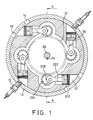
In the drawings - Fig. 1 is a cross-sectional view of a cylinder block of the present invention;
- Fig. 2 is a cross-sectional view of the cylinder block of Fig. 1 rotated 45°;
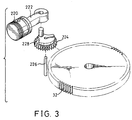
- Fig. 3 is an exploded view of a piston, a pinion and a gear of the present invention;
- Fig. 4 is a longitudinal-sectional view of the present invention while taking the line 4-4 of Fig. 1;
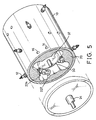
- Fig. 5 is a perspective view in partial section of a preferred embodiment of the present invention; and
- Fig. 6 is a perspective view in partial section of another preferred embodiment of the invention.
-
- Referring to Figs. 1 and 4, an internal combustion engine in accordance with the present invention is a four-stroke engine. The engine is comprised of multiple cylinder blocks (20) in series connected with the main shaft (30) in a circular casing (10). Spark plugs (12) are evenly distributed on the outside of the casing (10). Intake ports (14) and exhaust ports (16) are also defined in the casing (10). The number of spark plugs (12), intake ports (14) and exhaust ports (16) is the same.
- Each cylinder block (20), which is rotatably fitted in the casing (10), has multiple cylinders (22) and pistons (220) movably received in the cylinders (22) (the figures show 4 cylinders and 4 pistons). The number of pistons (220) is twice the quantity of either the spark plugs (12), intake ports (12) or exhaust ports (14). Namely, there are two spark plugs, two intake ports and two exhaust ports in this embodiment and the angle distance between two similar elements (spark plugs, intake ports or exhaust ports) is 180°. The centerlines of the cylinders (22) are respectively perpendicular to the diameter of the casing (10). A connecting rod (222) is eccentrically pivotally mounted on a pinion (224), and the end of the connecting rod (222) is pivotally connected to the piston (220). The pinion (224) is rotatably attached to the cylinder block (20) by a shaft (226). A main gear (32) is stably mounted on the main shaft (30) by a key (34) to engage each pinion (224). An output shaft (24) is formed on the cylinder block (20) at end.
- As shown in Fig. 1, all the pistons (220) move synchronously and arrive at the top of the cylinders (22) at the same time. The upper and lower cylinders (22) are vertical, and their associated pistons (220) installed therein are aligned with the spark plugs (12) and are ready for a power stroke. For the sake of simplicity, the upper and lower cylinder and piston combinations will be identified as "cylinder unit 1". The left and right cylinders (22) are horizontal and their associated pistons (220) installed therein have substantially completed an exhaust stroke and are ready for an intake stroke. Again for the sake of simplicity, these two cylinder and piston combinations will be identified as "cylinder unit 2". When the spark plugs (12) ignites the air-fuel mixture in the cylinders (22) above the pistons (220) in cylinder unit 1, the pistons (220) are pushed inwards to rotate the cylinder block (20) clockwise.
- Referring to Fig. 2, the cylinder block (20) has been rotated clockwise 45°. The pistons (220) of cylinder unit 1 have completed a power stroke and are ready for an exhaust stroke; the pistons (220) of cylinder unit 2 have completed an intake stroke and are ready for a compression stroke. Again, all pistons (220) simultaneously arrive at the bottom of the stroke.
- The cylinder block (20) continues to rotate due to inertia and/or the driving force from other cylinder blocks, and all pistons (220) are pushed outwards. After having rotated another 45°, the cylinder block (20) arrives at a position such that cylinder unit 2 is in the same position as cylinder unit 1 shown in Fig.1. Now cylinder unit 2 having completed a compression stroke is ready for a power stroke, and cylinder unit 1 having completed an exhaust stroke is ready for an intake stroke. The spark plugs ignites the air-fuel mixture again to repeat the process described above.
- Because each cylinder (22) completes one stroke for each 45° the cylinder block rotates, each cylinder (22) will complete an entire four-stroke-cycle, namely, intake, compression, power and exhaust stroke, for every 180° that the cylinder block (20) rotates. Moreover, for every 90° that the cylinder block (20) rotates , two cylinders (22) complete a power stroke to supply energy. Thereby, the cylinder block (20) rotates continuously.
- Referring to Fig. 3, the piston (220) and the connecting rod (222) are similar to the conventional elements. It is noted that the connecting rod (222) is eccentrically mounted on the pinion (224) to convert the reciprocating linear motion to rotary motion. Notches (228) are defined in the pinion (224) to offset the weight of the pinion connecting post (unnumbered) and balance the pinion (224) so it will run smoothly.
- According to the present invention, the internal combustion engine comprises multiple cylinder blocks (20) in series mounted in the casing (10), as shown in Fig. 4. As shown in Fig. 5, the spark plugs (12), intake ports (14) and exhaust ports (16) of adjacent cylinder blocks (20) are staggered by 45°. Alternatively, it is allowable to stagger the cylinder blocks (22) to align the spark plugs (12), the intake ports (14) and the exhaust ports (16).
- As shown in Fig. 6, the spark plugs (12) are in linear arrangement, which facilitates the arrangement of the cooling system of the engine to be located in one place rather than all around the casing (10). Furthermore, from this preferred embodiment as shown, it is to be noted that four sets of cylinder blocks are arranged in the casing (10), each being located at a position with 22.5 degree difference so as that, in terms of power output, there is always power generated at every point in the operation of the engine of the invention. With such an arrangement, the power output will be much smoother than a conventional structure.
- Table 1 shows piston operating sequence for the engine. For purposes of illustration, the cylinder block (20) in Fig. 1 defines the original position (0°) of cylinder block 1. In this state, cylinder unit 1 of cylinder block 1 is ready for a power stroke, and cylinder unit 2 is ready for an intake stroke. When cylinder block 1 rotates from 0° to 45°, cylinder unit 1 and cylinder unit 2 have respectively completed the power stroke and the intake stoke, so "power/intake" is indicated in the block.
Cylinder blocks 2, 3 and 4 are progressively later than cylinder block 1 by one stroke each, so that "compression/exhaust", "intake/power", and "exhaust/compression" are indicated in the corresponding blocks. Cylinder unit 1 of cylinder block 2 and cylinder unit 2 ofcylinder block 4 are ready for a compression stroke that will consume energy. At the same time, cylinder unit 1 of the cylinder block 1 and cylinder unit 2 of cylinder block 3 are ready for a power stroke that will generate energy. Thus, the required energy of the compression stroke ofcylinder blocks 2 and 4 can be provided by the power stroke of cylinder blocks 1 and 3. As shown in table 1, in an entire cycle, energy consumed by the compression stroke is provided by other cylinder blocks that have completed a power stroke. The engine does not need a flywheel to store energy for the compression stroke, so volume and weight of the engine can be reduced dramatically and the engine runs more smoothly.Number of row of the cylinders Number of cylinders in each row 1 2 3 4 5 6 4 90 (2) 45 30 22.5 18 15 6 60 (3) 30 20 15 12 10 8 45 (4) 22.5 15 11.25 9 7.5 10 36 (5) 18 12 9 7.2 6 12 30 (6) 15 10 7.5 6 5 18 20 (9) 10 5 4 20 18 (10) 9 6 4.5 3.6 3 - Taking the engine having four rows and each row being provided with four cylinders for example:
- Each row is spaced apart from each other by 22.5 degree (as shown in the attached drawing), such that the power from the power stroke is able to be transmitted much more smoother than the engine having three rows, two rows and one row of cylinders. It should also be noted that the number in the parenthesis stands for the power stroke. Therefore, when taking one row four cylinder engine for example, there are two power strokes simultaneously, which is one more than a conventional engine, such that the power output is greater and smoother.
- Further, the connection between the piston (220) and the pinion (224) enables the cylinder block of the engine to rotate around the main gear (32) which is securely fixed (already described in detail in the original specification as filed). Thus, because the rotation of the cylinder block around the main gear, the flywheel is no longer needed to store energy for the next stroke.
- Table 2 depicts the engine's energy state. In cylinder block 1, cylinder unit 1's operating sequence is "power-exhaust-intake-compression", and cylinder unit 2's simultaneous operating sequence is later than unit 1 by two strokes and is "intake-compression-power-exhaust". To overlay the two units, the total energy output is positive in the rotational sectors 0°-45°, 90°-135°, 180°-225° and 270°-315°, and is negative in the rotational sectors 45°-90°, 135°-180°, 225°-270° and 315°-360°. In cylinder block 2, cylinder unit 1's simultaneous operating sequence is later than cylinder unit 1 of cylinder block 1 by one stroke and is "compression-power-exhaust-intake", and cylinder unit 2's simultaneous operating sequence is "exhaust-intake-compression-power". To overlay the two units, the total energy output is positive in the rotational sectors 45°-90°, 135°-180°, 225°-270°, 315°-360°, and is negative in the rotational sectors 0°-45°, 90°-135°, 180°-225°, 270°-315°. Because the energy output of the two cylinder blocks (20) is complementary, the overall energy output of the cylinder blocks 1 and 2 is always positive.
Cylinder blocks 3 and 4 operate in a similar manner to cylinder blocks 1 and 2, and the energy output ofcylinder blocks 3 and 4 is also always positive. The combined energy output all thesecylinder blocks 1, 2, 3, and 4 operating simultaneously is continuous and smooth without undulation. - The advantages of the present invention are:
- 1. The internal combustion engine does not need a flywheel, thereby greatly reducing volume and weight of the engine,
- 2. The internal combustion engine in accordance with the present invention is simpler and more efficient, so the fabrication cost and maintenance cost are less expensive.
- 3. More cylinder blocks can be freely added to the internal combustion engine in accordance with the present invention to attain the required power.
-
- It is further known that Table 1 shows the piston operating sequence for the engine. The cylinder block (20) in Fig. 1 defines the original position (0°) of cylinder block 1. In this state, cylinder unit 1 of cylinder block 1 is ready for a power stroke, and cylinder unit 2 is ready for an intake stroke. When cylinder block 1 rotates from 0° to 45°, cylinder unit 1 and cylinder unit 2 have respectively completed the power stroke and the intake stoke, so "power/intake" is indicated in the block.
Cylinder blocks 2, 3 and 4 are progressively later than cylinder block 1 by one stroke each, so that "compression/exhaust", "intake/power", and "exhaust/compression" are indicated in the corresponding blocks. Cylinder unit 1 of cylinder block 2 and cylinder unit 2 ofcylinder block 4 are ready for a compression stroke that will consume energy. At the same time, cylinder unit 1 of cylinder block 1 and cylinder unit 2 of cylinder block 3 are ready for a power stroke that will generate energy. Thus, the required energy of the compression stroke ofcylinder blocks 2 and 4 can be provided by the power stroke of cylinder blocks 1 and 3. As shown in table 1, in an entire cycle, energy consumed by the compression stroke is provided by other cylinder blocks that have completed a power stroke. The engine does not need a flywheel to store energy for the compression stroke, so the overall volume and weight of the engine can be reduced dramatically and the engine runs more smoothly. - Furthermore, because the power transmission uses connecting rod (222) which are eccentrically and pivotally connected to a pinion (224) and the pinion (224) is mated to a main gear (32), the power generated by the power stroke from the piston will be transmitted to the main gear (32) by means of the connecting rod and the pinion. No flywheel is necessary to offset the power necessary to drive the motion of other pistons and no crank shaft is necessary to output the power due to the provision of the main shaft
- Even though numerous characteristics and advantages of the present invention have been set forth in the foregoing description, together with details of the structure and function of the invention, the disclosure is illustrative only, and changes may be made in detail, especially in matters of shape, size, and arrangement of parts within the principles of the invention to the full extent indicated by the broad general meaning of the terms in which the appended claims are expressed.
CYLINCRICAL BLOCKS' OPERATING SEQUENCE Cylindrical block 1 Cylindrical block 2 Cylindrical block 3 Cylindrical block 40-45° Power/Intake Compression/ Exhaust Intake/Power Exhaust/Compression 45-90° Exhaust/Compression Power/Intake Compression/Exhaust Intake/Power 90-135° Intake/Power Exhaust/Compression Power/Intake Compression/ Exhaust 135-180° Compression/Exhaust Intake/Power Exhaust/Compression Power/Intake 180-225° Power/Intake Compression/ Exhaust Intake/Power Exhaust/Compression 225-270° Exhaust/Compression Power/Intake Compression/Exhaust Intake/Power 270-315° Intake/Power Exhaust/Compression Power/Intake Compression/Exhaust 315-360° Compression/Exhaust Intake/Power Exhaust/Compression Power/Intake 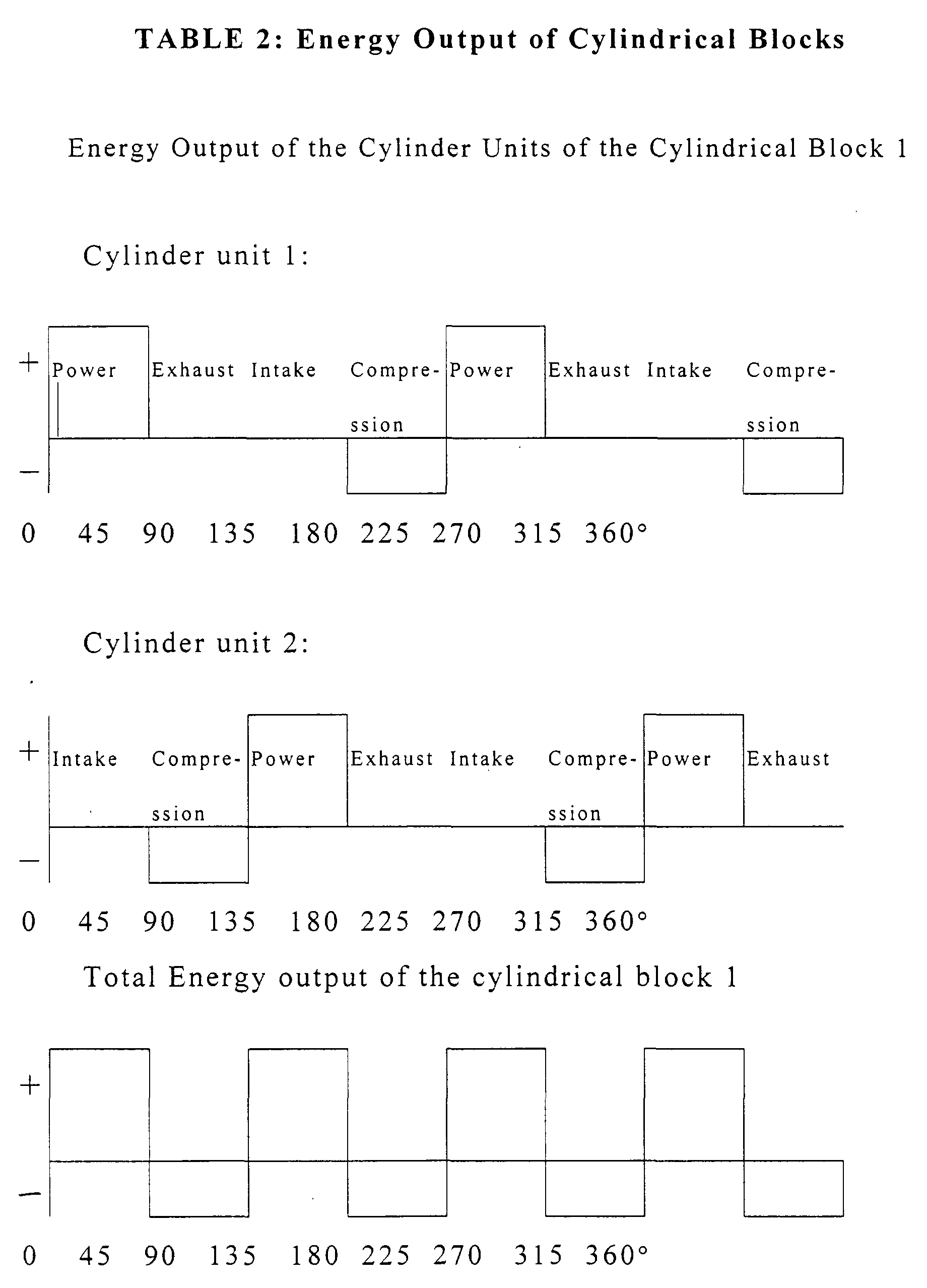


Claims (2)
- An internal combustion engine comprising:a casing having multiple spark plugs located on the periphery thereof, and multiple exhaust ports and intake ports defined in the periphery thereof;a shaft centrally provided in the casing;multiple gears fixed on the shaft;multiple cylinder blocks rotatably provided in series in said casing and each corresponding to one of the gears respectively, each cylinder block having multiple cylinders defined along a circumferential portion of the cylinder block to respectively receive a piston therein, each of the cylinders being accessible to one of the spark plugs, the exhaust ports or the intake ports upon rotation of the cylinder block, wherein the piston is pivotally attached to a connecting rod which is pivotally connected to a pinion which in turn meshes with one of the corresponding gears; andan output shaft integrally formed on the end of the cylinder block;wherein the connecting rod is eccentrically connected to the pinion, and the pinion is fixed on the cylinder block by a shaft;wherein each of the cylinder blocks comprises four cylinders and the casing provides two spark plugs, two exhaust ports and two intake ports to each of the cylinder blocks;wherein the cylinder blocks are located in a staggered manner;wherein the centerlines of the cylinders are non-radial to the centerline of the casing;whereby, each piston sequentially reciprocates through a power stroke, an exhaust stroke, an intake stroke and a compression stroke to rotate the pinion by the connecting rod, whereby the rotation of the pinion causes the cylinder blocks to rotate with respect to the gears to supply a rotational power output through the output shaft.
- The internal-combustion engine as claimed in claim 1, wherein the spark plugs are linearly arranged on the casing.
Priority Applications (1)
| Application Number | Priority Date | Filing Date | Title |
|---|---|---|---|
| EP00103438A EP1128035A1 (en) | 2000-02-28 | 2000-02-28 | Internal-combustion engine |
Applications Claiming Priority (1)
| Application Number | Priority Date | Filing Date | Title |
|---|---|---|---|
| EP00103438A EP1128035A1 (en) | 2000-02-28 | 2000-02-28 | Internal-combustion engine |
Publications (1)
| Publication Number | Publication Date |
|---|---|
| EP1128035A1 true EP1128035A1 (en) | 2001-08-29 |
Family
ID=8167889
Family Applications (1)
| Application Number | Title | Priority Date | Filing Date |
|---|---|---|---|
| EP00103438A Withdrawn EP1128035A1 (en) | 2000-02-28 | 2000-02-28 | Internal-combustion engine |
Country Status (1)
| Country | Link |
|---|---|
| EP (1) | EP1128035A1 (en) |
Cited By (3)
| Publication number | Priority date | Publication date | Assignee | Title |
|---|---|---|---|---|
| RU2309272C1 (en) * | 2006-06-19 | 2007-10-27 | Юрий Константинович Малашенков | Internal combustion engine |
| JP2015124671A (en) * | 2013-12-26 | 2015-07-06 | 株式会社 近藤工作所 | Output extraction device for automobile engine |
| WO2017063710A1 (en) * | 2015-10-16 | 2017-04-20 | Evirgen Bülent Pulat | Rotary-piston cylinder engine |
Citations (4)
| Publication number | Priority date | Publication date | Assignee | Title |
|---|---|---|---|---|
| US2990820A (en) * | 1958-05-01 | 1961-07-04 | Saijo Genzo | Rotating mechanism of main shaft of oil engine |
| US5123394A (en) * | 1990-05-23 | 1992-06-23 | Warren Ogren | Rotary reciprocating internal combustion engine |
| WO1993021434A1 (en) * | 1992-04-10 | 1993-10-28 | Murray Jerome L | Rotary internal combustion engine |
| EP0964136A1 (en) * | 1998-06-09 | 1999-12-15 | Shih-Pin Huang | Rotary internal combustion engine |
-
2000
- 2000-02-28 EP EP00103438A patent/EP1128035A1/en not_active Withdrawn
Patent Citations (4)
| Publication number | Priority date | Publication date | Assignee | Title |
|---|---|---|---|---|
| US2990820A (en) * | 1958-05-01 | 1961-07-04 | Saijo Genzo | Rotating mechanism of main shaft of oil engine |
| US5123394A (en) * | 1990-05-23 | 1992-06-23 | Warren Ogren | Rotary reciprocating internal combustion engine |
| WO1993021434A1 (en) * | 1992-04-10 | 1993-10-28 | Murray Jerome L | Rotary internal combustion engine |
| EP0964136A1 (en) * | 1998-06-09 | 1999-12-15 | Shih-Pin Huang | Rotary internal combustion engine |
Cited By (4)
| Publication number | Priority date | Publication date | Assignee | Title |
|---|---|---|---|---|
| RU2309272C1 (en) * | 2006-06-19 | 2007-10-27 | Юрий Константинович Малашенков | Internal combustion engine |
| JP2015124671A (en) * | 2013-12-26 | 2015-07-06 | 株式会社 近藤工作所 | Output extraction device for automobile engine |
| WO2017063710A1 (en) * | 2015-10-16 | 2017-04-20 | Evirgen Bülent Pulat | Rotary-piston cylinder engine |
| US11261733B2 (en) | 2015-10-16 | 2022-03-01 | Bülent Pulat EVIRGEN | Four-stroke rotary- piston engine with adjustable compression ratio and adjustable valve control times |
Similar Documents
| Publication | Publication Date | Title |
|---|---|---|
| US6739307B2 (en) | Internal combustion engine and method | |
| US4022167A (en) | Internal combustion engine and operating cycle | |
| US3485221A (en) | Omnitorque opposed piston engine | |
| US6062175A (en) | Rotating cylinder internal-combustion engine | |
| US6453869B1 (en) | Internal combustion engine with variable ratio crankshaft assembly | |
| US9169772B2 (en) | One-stroke internal combustion engine | |
| US20120291755A1 (en) | Variable stroke mechanism for internal combustion engine | |
| JP6276753B2 (en) | Polygonal vibrating piston engine | |
| EP2893166A1 (en) | Variable stroke mechanism for internal combustion engine | |
| US20090217903A1 (en) | Rotary internal combustion engine | |
| KR19990081828A (en) | 3 cycle engine | |
| EP1128035A1 (en) | Internal-combustion engine | |
| US6619244B1 (en) | Expansible chamber engine | |
| CA2300584A1 (en) | Internal combustion engine | |
| US20210003121A1 (en) | Process for operating a single-stroke combustion engine | |
| AU728019B2 (en) | Internal-combustion engine | |
| CN101205812A (en) | Four-piston cylinder engine | |
| US7210446B2 (en) | V-twin configuration having rotary mechanical field assembly | |
| JP3307623B2 (en) | Internal combustion engine | |
| CN101963093A (en) | Rotary-piston engine | |
| WO1980002438A1 (en) | Parallel cylinder internal combustion engine | |
| WO1986004637A1 (en) | Axial shaft piston engine | |
| KR890002703B1 (en) | An internal combustion engine | |
| US3685498A (en) | Rotary engine | |
| CN102011643A (en) | Combustion engine |
Legal Events
| Date | Code | Title | Description |
|---|---|---|---|
| PUAI | Public reference made under article 153(3) epc to a published international application that has entered the european phase |
Free format text: ORIGINAL CODE: 0009012 |
|
| AK | Designated contracting states |
Kind code of ref document: A1 Designated state(s): AT BE CH CY DE DK ES FI FR GB GR IE IT LI LU MC NL PT SE |
|
| AX | Request for extension of the european patent |
Free format text: AL;LT;LV;MK;RO;SI |
|
| 17P | Request for examination filed |
Effective date: 20010807 |
|
| AKX | Designation fees paid |
Free format text: AT BE CH CY DE DK ES FI FR GB GR IE IT LI LU MC NL PT SE |
|
| STAA | Information on the status of an ep patent application or granted ep patent |
Free format text: STATUS: THE APPLICATION HAS BEEN WITHDRAWN |
|
| 18W | Application withdrawn |
Effective date: 20050310 |