EP1127896A1 - Process for the preparation of aqueous dispersions of fluoropolymers - Google Patents
Process for the preparation of aqueous dispersions of fluoropolymers Download PDFInfo
- Publication number
- EP1127896A1 EP1127896A1 EP01103317A EP01103317A EP1127896A1 EP 1127896 A1 EP1127896 A1 EP 1127896A1 EP 01103317 A EP01103317 A EP 01103317A EP 01103317 A EP01103317 A EP 01103317A EP 1127896 A1 EP1127896 A1 EP 1127896A1
- Authority
- EP
- European Patent Office
- Prior art keywords
- reactor
- range
- microemulsion
- polymerization
- fluorinated
- Prior art date
- Legal status (The legal status is an assumption and is not a legal conclusion. Google has not performed a legal analysis and makes no representation as to the accuracy of the status listed.)
- Granted
Links
Classifications
-
- C—CHEMISTRY; METALLURGY
- C08—ORGANIC MACROMOLECULAR COMPOUNDS; THEIR PREPARATION OR CHEMICAL WORKING-UP; COMPOSITIONS BASED THEREON
- C08F—MACROMOLECULAR COMPOUNDS OBTAINED BY REACTIONS ONLY INVOLVING CARBON-TO-CARBON UNSATURATED BONDS
- C08F259/00—Macromolecular compounds obtained by polymerising monomers on to polymers of halogen containing monomers as defined in group C08F14/00
- C08F259/08—Macromolecular compounds obtained by polymerising monomers on to polymers of halogen containing monomers as defined in group C08F14/00 on to polymers containing fluorine
-
- C—CHEMISTRY; METALLURGY
- C08—ORGANIC MACROMOLECULAR COMPOUNDS; THEIR PREPARATION OR CHEMICAL WORKING-UP; COMPOSITIONS BASED THEREON
- C08F—MACROMOLECULAR COMPOUNDS OBTAINED BY REACTIONS ONLY INVOLVING CARBON-TO-CARBON UNSATURATED BONDS
- C08F14/00—Homopolymers and copolymers of compounds having one or more unsaturated aliphatic radicals, each having only one carbon-to-carbon double bond, and at least one being terminated by a halogen
- C08F14/18—Monomers containing fluorine
- C08F14/26—Tetrafluoroethene
-
- C—CHEMISTRY; METALLURGY
- C08—ORGANIC MACROMOLECULAR COMPOUNDS; THEIR PREPARATION OR CHEMICAL WORKING-UP; COMPOSITIONS BASED THEREON
- C08F—MACROMOLECULAR COMPOUNDS OBTAINED BY REACTIONS ONLY INVOLVING CARBON-TO-CARBON UNSATURATED BONDS
- C08F2/00—Processes of polymerisation
- C08F2/12—Polymerisation in non-solvents
- C08F2/16—Aqueous medium
- C08F2/22—Emulsion polymerisation
- C08F2/24—Emulsion polymerisation with the aid of emulsifying agents
- C08F2/26—Emulsion polymerisation with the aid of emulsifying agents anionic
Definitions
- the invention relates to a process for the preparation directly from polymerization of fluoropolymers aqueous dispersions, having a multimodal or bimodal distribution of the particle sizes and to the dispersion obtainable by a high conversion preparation process; said dispersions having an average diameter in the range 100 nm-400 nm, preferably 150 nm -300 nm, the fraction of small particles having diameter between 10 and 100 nm is in the range 1.5-35% by weight, preferably 3-25% by weight; the ratio between the average diameter of the small particles with respect to the average diameter of the dispersion obtained from the polymerization being in the range 0.025-0.6.
- the invntion relates to a radical polymerization process of tetrafluoroethylene (TFE) and copolymers thereof in aqueous emulsion, using a specific dosage of surfactants of which at least one is a component of a microemulsion.
- TFE tetrafluoroethylene
- polymeric latexes with a bimodal distribution of the particle diameters with respect to those with a monomodal distribution have a lower viscosity, the concentration being equal.
- This allows to obtain latexes having a higher concentration not exceeding a certain viscosity, for example up to 74% by volume with a viscosity lower than 1,000 cP. This leads, for example, to a better capability of the film formation and better tensile properties of the film.
- Lately (F.Chu, J.Guillot, A.Guyot, Colloid. Polym. Sci., 276 (1998), 305; F.Chu, J.Guillot, A.Guyot, J.Applied Polymer Sci., 70 (1998), 2667) it has been shown for the polymers based on styrene, butyl acrylate and methylmethacrylic acid, that latexes with multimodal, in particular trimodal, distributions of the particle diameters, have more advantageous rheological and colloidal properties with respect to bimodal latexes and much more advantageous with respect to monomodal latexes.
- a latex can be obtained having a solid content up to 80% by volume and minimum viscosity in the case of trimodal distribution of the particle diameters with ratio by weight among large/average/small particles equal to 80/10/10.
- USP 4,864,006 uses a microemulsion based on (per)fluoropolyethers for the polymerization of fluorinated polymers and indicates that all the surfactant necessary for the polymerization is fed into the reactor under the form of microemulsion. Besides, it is indicated that the whole microemulsion must be introduced into the reactor before the starting of the reaction. The amount of the used microemulsion must be higher than 0.05 ml of perfluoropolyether for 1 litre of water. Tests carried out by the Applicant (see comparative Examples) have shown that by operating under the conditions indicated in the patent dispersions with multimodal distributions of the particle diameters are not obtained.
- USP 5,523,346 uses for the PTFE polymerization a microemulsion based on polymerizable unsaturated liquid monomers in order to obtain small PTFE particles. This method does not allow to obtain multimodal distributions of the particle diameters. Besides, it is well known that by operating under these conditions it is extremely dangerous due to the explosiveness of the liquid tetrafluoroethylene.
- USP 3,925,292 and USP 5,789,083 relate to a mixture formed by a dispersion of PTFE and by a dispersion of a thermoplastic copolymer of tetrafluoroethylene.
- a dispersion of PTFE and by a dispersion of a thermoplastic copolymer of tetrafluoroethylene.
- said patents it is neither reported nor described that the obtained single latexes have a multimodal distribution of the particle diameters. It is not indicated that said mixture can be directly obtained from the polymerization process.
- a latex containing a high concentration of polymer generally higher than 25% by weight, preferably higher than 30% by weight, is obtained.
- the Applicant has surprisingly found that by using a dosage system of at least two surfactants of which one is a component of a microemulsion a) based on (per)fluoropolyethers and the other is a fluorinated surfactant not in microemulsion, PTFE latexes having a multimodal or bimodal distribution of the particle diameters are directly obtained from the polymerization process of the invention.
- the fraction and the diameter of the small particles are obtainable from the supernatant layer of the polymerization latex subjected to ultracentrifugation.
- the amount of the surfactant fed before the starting of the polymerization must exceed 0.05 grams for litre of water, while the total amount of the fed surfactant is generally in the range 0.3-10 g for litre of water.
- the amount of the fluorinated surfactant in the microemulsion a) is in the range 1-80% by weight, preferably 1-45% by weight, with respect to the total weight of surfactants a)+c).
- the fluorinated surfactant used in step c) is preferably anionic.
- the granulometric distribution curve of the latex particles has at least two separate peaks (bimodal distribution) by a scanning electronic microscope (SEM) or transmissiom electronic microscope (TEM) or by an atomic force microscope (AFM). Another method is that to use one or more ultracentrifugations of the polymerization latex.
- the latex discharged from the reactor can be subjected, if desired, to the usual post-treatments in connection with the specific uses.
- the discharged dispersion can be coagulated to obtain fine powders having the multimodal distribution according to the present invention.
- the latex concentration carried out for example by clouding or ultrafiltration, can also be mentioned.
- a fluorinated surfactant c) and the microemulsion a) must be fed into the reactor at different reaction progress degrees. For example a feeding of the microemulsion a) and of the surfactant c) before the starting of the reaction, a further feeding of microemulsion a) when more than 50% of tetrafluoroethylene has reacted.
- the Applicant has found that the various obtained populations of the polymer have different not only the particle diameters, but also some properties, such as molecular weight, crystallinity, etc. can be different.
- latexes can be obtained which besides containing a fraction of large particles formed by PTFE or modified PTFE, having a sufficiently high molecular weight such as to be not thermoplastic, contain at least one fraction of small particles formed by a thermoplastic fluoropolymer based on TFE, i.e. a fluoropolymer having a viscosity of the melt lower than 10 7 poise, preferably from 10 3 to 10 7 poise.
- the microemulsion dosage with initiators, comonomers and chain transfer agents must be fed at a reaction progress degree of at least 60%, preferably 80%.
- the dispersions obtained by the process of the invention can be used for the coating of surfaces of organic and/or inorganic polymers, of metals or ceramics, etc. with the advantage to have a better filming with respect to the dispersions having a monomodal distribution of the particles.
- the films obtained from the invention dispersions show also higher tensile properties with respect to the commercial monomodal dispersions having a diameter in the range 180-400 nm. 15
- microemulsions a) used in the process of the present invention are described in USP 4,864,006 and USP 4,990,283, herein incorporated by reference, wherein instead of the indicated non reactive end groups, also hydrofluoropolyethers having one or both end groups containing one H atom, or having one or more chlorine atoms instead of fluorine in the chain end groups, can be used.
- the perfluoropolyether oil phase of the microemulsion a) is present in an amount from 0.002 to 10 ml for litre of water, preferably from 0.01 to 2.5 ml.
- the number average molecular weight of the perfluoropolyethers (PFPE) which can be used for the preparation of the microemulsion a) is in the range 350-8,000, preferably 500-1,000.
- PFPE can have one of the following structures:
- -(C 3 F 6 O)- can represent units of formula - (CF(CF 3 ) CF 2 O) - and/or - (CF 2 -CF (CF 3 ) O) -
- the T end groups are (per) fluoroalkyl groups selected from: -CF 3 , -C 2 F 5 , -C 3 F 7 , -CF 2 Cl, -C 2 F 4 Cl, -C 3 F 6 Cl; optionally one or two F atoms, preferably one, can be replaced by H.
- PFPEs are commercially known, for example FOMBLIN R commercialized by Ausimont.
- the preferred ones among them are: CF 3 O(C 3 F 6 O) n (CF 2 O) m CF 3 wherein n and m are such as to give the above indicated molecular weight values; m/n is in the range 0.01-0.5.
- the fluorinated surfactants of the microemulsion a) have structure (IA).
- the functionalized fluoropolyethers of structure (IA) are obtained for example according to the processes mentioned in EP 148482, USP 3,810,874.
- the surfactants of structure (IIA) and (IIIA) are commercial products, for example FLUORADR FC1013, FORAFAC R 1033D.
- Comonomers having an ethylene unsaturation which can be used are of both hydrogenated and fluorinated type; among the hydrogenated ones, ethylene, propylene, acrylic monomers, for example methylmethacrylate, (meth) acrylic acid, hydroxyethyle-nacrylate, styrene monomers, such as for example styrene, can be mentioned.
- fluorinated comonomers it can be mentioned:
- the determination of the temperature of the first melting and of the heat of crystallization is carried out by the differential calorimetry method, by using a Perkin Elmer calorimeter of the DSC 7 type. About 10 mg of dried polymer are heated from a temperature of 220°C up to 370°C at a rate of 10°C/min. The temperature corresponding to the peak of the melting endothermic curve is indicated as the temperature of the first melting of the polymer. After 15 minutes at 370°C, the polymer is cooled up to a temperature of 220°C at the rate of 10°C/min. The area subtended from the crystallization esothermic curve is integrated and its value, expressed in cal/g, is indicated as heat of crystallization.
- the average diameter of the particles is measured by an instrument based on the laser light diffusion, specifically on the Photon Correlation Spectroscopy, equipped with Brookhaven correlator model 2030 AT and with an Argon Laser light source having a wave length 514.5 nm by Spectra-Physics.
- the latex specimens to be subjected to measurement are suitably diluted by water filtered at 0.2 ⁇ m on Millipore filter.
- the scattering measure is carried out at room temperature and at a 90° angle.
- the latex particle diameter is obtained by the cumulant methods.
- the polymer content of the latex discharged from the reactor and of the supernatant layer obtained by ultracentrifugation is evaluated by the loss weight at 150°C for 1 hour.
- the latex is subjected to centrifugation at 5,000 rpm for 1 hour, using a Kontron ultracentrifuge Centrikon model H401.
- the separated supernatant layer is subjected to determination of the polymer content by weight loss and to determination of the average diameter of the primary particles, as previously described.
- the amorphous index has been determined by IR-spectroscopy according to the Moynihan method (J.Am.Chem.Soc., 1959, 81, 1045) as a ratio of the absorptions A778 and A2365.
- Amorphous index A778/A2365
- the absolute specific weight is determined according to ASTM D4895.
- oils used in Examples 1-13 are the following: CF 3 O (C 3 F 6 O) n (CF 2 O) m CF 3 wherein n can range between 1 and 6; m/n is in the range 0.05-0.1 CF 3 (CF 2 ) n CF 3 wherein n can range between 1 and 8.
- the diameter of the polymer primary particles measured by Laser Light Scattering (LLS) is equal to 157 nm. After ultracentrifugation at 5,000 rpm for 1 hour, an amount of solid equal to 67% by weight of the total weight is separated and the LLS measure on the supernatant phase gives a value of 78 nm. The measured values show that the obtained dispersion has a bimodal distribution of the particle diameters.
- LLS Laser Light Scattering
- the polymer of the supernatant phase has a value of the amorphous index (Moynihan, 773/2365 cm-1) of 0.12, while that of the precipitated phase is of 0.07.
- the diameter of the polymer primary particles measured by Laser Light Scattering (LLS) is equal to 155 nm. After ultracentrifugation at 5,000 rpm for 1 hour, an amount of solid equal to 74.6% by weight of the total weight is separated and the LLS measure on the supernatant phase gives a value of 82 nm. The measured values show that the obtained dispersion has a bimodal distribution of the particle diameters.
- LLS Laser Light Scattering
- the autoclave is maintained under mechanical stirring and it is pressurized with TFE up to a pressure of 20 bar at a temperature of 55°C. At this point 500 cc of a (NH 4 ) 2 Fe(SO 4 ) 2 6H 2 0 (SdM) solution corresponding to 90 mg of SdM are fed into the autoclave.
- the diameter of the polymer primary particles measured by Laser Light Scattering (LLS) is equal to 170 nm. After ultracentrifugation at 5,000 rpm for 1 hour, an amount of solid equal to 95.5% by weight of the total weight is separated and the LLS measure on the supernatant phase gives a value of 65 nm. The measured values show that the obtained dispersion has a bimodal distribution of the particle diameters.
- LLS Laser Light Scattering
- Example 3 15 grams of the dispersion of Example 3, equal to 0.05 ml/litre of perfluoropolyether, are added to 32 litres of carefully degassed water in a 50 litres autoclave equipped with a mechanical stirrer and previously put under vacuum. Also 12 grams of Forafac 1033D, surfactant having the structure (IV) produced and commercialized by Elf Atochem S.A., 200 g of paraffin with softening point in the range 52°C-54°C were previously introduced into the reactor. The autoclave is maintained under mechanical stirring and it is pressurized with TFE up to a pressure of 20 bar at a temperature of 70°C. At this point 500 cc of a (NH 4 ) 2 S 2 O 8 (APS) solution and disuccinic peroxide (DSAP) corresponding to 150 mg of APS and 3,000 mg of DSAP are fed into the autoclave.
- APS NH 4 ) 2 S 2 O 8
- DSAP disuccinic peroxide
- the diameter of the polymer primary particles measured by Laser Light Scattering (LLS) is equal to 165 nm. After ultracentrifugation at 5,000 rpm for 1 hour, an amount of solid equal to 97% by weight of the total weight is separated and the LLS measure on the supernatant phase gives a value of 55 nm. The measured values show that the obtained dispersion has a bimodal distribution of the particle diameters.
- LLS Laser Light Scattering
- Example 3 25 grams of the dispersion of Example 3, equal to 0.08 ml/litre of perfluoropolyether, are added to 32 litres of carefully degassed water in a 50 litres autoclave equipped with a mechanical stirrer and previously put under vacuum. Also 40 grams of ammonium perfluorooctanoate, 200 g of paraffin with softening point in the range 52°C-54°C were previously introduced into the reactor.
- the autoclave is maintained under mechanical stirring and it is pressurized with TFE up to a pressure of 20 bar at a temperature of 70°C. At this point 500 cc of a (NH 4 ) 2 S 2 O 8 (APS) solution and disuccinic peroxide (DSAP) corresponding to 150 mg of APS and 3,000 mg of DSAP are fed into the autoclave.
- APS NH 4 ) 2 S 2 O 8
- DSAP disuccinic peroxide
- the diameter of the polymer primary particles measured by Laser Light Scattering (LLS) is equal to 198 nm. After ultracentrifugation at 5,000 rpm for 1 hour, an amount of solid equal to 95.1% by weight of the total weight is separated and the LLS measure on the supernatant phase gives a value of 58 nm. The measured values show that the obtained dispersion has a bimodal distribution of the particle diameters.
- LLS Laser Light Scattering
- the diameter of the polymer primary particles measured by Laser Light Scattering (LLS) is equal to 200 nm. After ultracentrifugation at 5,000 rpm for 1 hour, an amount of solid equal to 99.8% by weight of the total weight is separated and the LLS measure on the supernatant phase gives a value of 115 nm.
- LLS Laser Light Scattering
- the diameter of the polymer primary particles measured by Laser Light Scattering (LLS) is equal to 176 nm. After ultracentrifugation at 5,000 rpm for 1 hour, an amount of solid equal to 99.5% by weight of the total weight is separated and the LLS measure on the supernatant phase gives a value of 177 nm.
- LLS Laser Light Scattering
- the diameter of the polymer primary particles measured by Laser Light Scattering (LLS) is equal to 186 nm. After ultracentrifugation at 5,000 rpm for 1 hour, an amount of solid equal to 99.8% by weight of the total weight is separated and the LLS measure on the supernatant phase gives a value of 105
- the diameter of the polymer primary particles measured by Laser Light Scattering (LLS) is equal to 261 nm. After ultracentrifugation at 5,000 rpm for 1 hour, an amount of solid equal to 99.9% by weight of the total weight is separated and the LLS measure on the supernatant phase gives a value of 183.
- LLS Laser Light Scattering
- the diameter of the polymer primary particles measured by Laser Light Scattering (LLS) is equal to 115 nm. After ultracentrifugation at 5,000 rpm for 1 hour, an amount of solid equal to 92% by weight of the total weight is separated and the LLS measure on the supernatant phase gives a value of 85 nm.
- LLS Laser Light Scattering
- Example 3 160 grams of the microemulsion of Example 3, equal to 0.52 ml/litre of perfluoropolyether are added to 32 litres of carefully degassed water in a 50 litres autoclave equipped with a mechanical stirrer and previously put under vacuum. Also 100 grams of perfluoromethylvinylether (PMVE) were previously introduced into the reactor. 500 cc of a (NH 4 ) 2 S 2 O 8 (APS) solution corresponding to 1,600 mg of APS are fed into the autoclave. The autoclave is maintained under mechanical stirring and it is pressurized with TFE up to a pressure of 20 bar at a temperature of 30°C. At this point 500 cc of a (NH 4 ) 2 Fe(SO 4 ) 2 6H 2 O (SdM) solution corresponding to 480 mg of SdM are fed into the autoclave.
- APS NH 4 ) 2 S 2 O 8
- the diameter of the polymer primary particles measured by Laser Light Scattering (LLS) is equal to 83 nm. After ultracentrifugation at 5,000 rpm for 1 hour, an amount of solid equal to 28.3% by weight of the total weight is separated and the LLS measure on the supernatant phase gives a value of 79 nm.
- LLS Laser Light Scattering
- the diameter of the polymr primary particles measured by Laser Light Scattering (LLS) is equal to 90 nm. After ultracentrifugation at 5,000 rpm for 1 hour, an amount of solid equal to 31% by weight of the total weight is separated and the LLS measure on the supernatant phase gives a value of 69 nm.
- LLS Laser Light Scattering
- the diameter of the polymer primary particles measured by Laser Light Scattering (LLS) is equal to 115 nm. After ultracentrifugation at 5,000 rpm for 1 hour, an amount of solid equal to 44.5% by weight of the total weight is separated and the LLS measure on the supernatant phase gives a value of 88 nm.
- LLS Laser Light Scattering
Landscapes
- Chemical & Material Sciences (AREA)
- Health & Medical Sciences (AREA)
- Chemical Kinetics & Catalysis (AREA)
- Medicinal Chemistry (AREA)
- Polymers & Plastics (AREA)
- Organic Chemistry (AREA)
- Addition Polymer Or Copolymer, Post-Treatments, Or Chemical Modifications (AREA)
- Polymerisation Methods In General (AREA)
- Compositions Of Macromolecular Compounds (AREA)
- Processes Of Treating Macromolecular Substances (AREA)
Abstract
Description
- The invention relates to a process for the preparation directly from polymerization of fluoropolymers aqueous dispersions, having a multimodal or bimodal distribution of the particle sizes and to the dispersion obtainable by a high conversion preparation process; said dispersions having an average diameter in the range 100 nm-400 nm, preferably 150 nm -300 nm, the fraction of small particles having diameter between 10 and 100 nm is in the range 1.5-35% by weight, preferably 3-25% by weight; the ratio between the average diameter of the small particles with respect to the average diameter of the dispersion obtained from the polymerization being in the range 0.025-0.6.
- In particular the invntion relates to a radical polymerization process of tetrafluoroethylene (TFE) and copolymers thereof in aqueous emulsion, using a specific dosage of surfactants of which at least one is a component of a microemulsion.
- From the literature (J.G.Brodnyan, Trans.Soc.Rheology, 12:3 (1968), 357; J.S.Chong, E.B.Christiansen, A.D.Baer, J. Appl. Pol. Sci., v.15 (1971), 2007; P.-L.Kuo, C.-J.Chen, J.Polymer Sci. Pol. Chemistry, 31 (1993), 99; C.Chang, R.L.Powell, J.Rheol.,38 (1994), 85; Emulsion polymerization and emulsion polymers. Ed. A. Lovell, M.S. El-Aasser, J. Wiley & Sons, Chichester, 1997, p. 450) it is known that polymeric latexes with a bimodal distribution of the particle diameters with respect to those with a monomodal distribution have a lower viscosity, the concentration being equal. This allows to obtain latexes having a higher concentration not exceeding a certain viscosity, for example up to 74% by volume with a viscosity lower than 1,000 cP. This leads, for example, to a better capability of the film formation and better tensile properties of the film.
- Lately (F.Chu, J.Guillot, A.Guyot, Colloid. Polym. Sci., 276 (1998), 305; F.Chu, J.Guillot, A.Guyot, J.Applied Polymer Sci., 70 (1998), 2667) it has been shown for the polymers based on styrene, butyl acrylate and methylmethacrylic acid, that latexes with multimodal, in particular trimodal, distributions of the particle diameters, have more advantageous rheological and colloidal properties with respect to bimodal latexes and much more advantageous with respect to monomodal latexes. For example, a latex can be obtained having a solid content up to 80% by volume and minimum viscosity in the case of trimodal distribution of the particle diameters with ratio by weight among large/average/small particles equal to 80/10/10.
- The above mentioned literature and USP 4,657,966, USP 4,385,157, USP 5,668,207 refer to hydrogenated polymer latexes and fluoropolymer latexes are not mentioned.
- In USP 5,576,381 it is described how to obtain PTFE la-texes with a bimodal distribution of the particle diameters by mixing a latex having a particle diameter in the range 180 nm -400 nm with another latex having an average diameter in a ratio from 0.3 to 0.7 with respect to the particle diameter of the first latex. The process requires the carrying out of two separate polymerization operations with a subsequent mixing in a specific ratio. This complicates the production process, since it requires the separate production of two types of latex and the increase of the storage volumes. Besides, the latex polymerization process with small particles requires to work at a low polymerization conversion, i.e. with low productivity, and it does not allow to obtain the particles having a diameter lower than 100 nm with the typical conversions of the industrial scale. As operating example the preparation of a latex having an average particle diameter of 100 nm the conversion being 10% by weight, is reported. In this patent it is stated that the fluoropolymer latexes with bimodal distribution of the particle sizes can be obtained by carrying out a polymerization reaction with subsequent additions of a surfactant. No example is reported on this aspect. From the examples, bimodal or multimodal distributions of the particle diameters are not obtained from the polymerization. On the other hand, it is known that subsequent additions of surfactants commonly used for the polymerization of tetrafluoroethylene based fluoropolymers, as for example described in USP 3,009,892 and USP 3,391,099 with the purpose to increase the latex stability and the conversion, do not give bimodal or multimodal distributions of the particle diameters. Experiments carried out by the Applicant (see comparative Examples) have shown that by using during the PTFE polymerization subsequent additions of ammonium perfluorooctanoate or of ammonium salt of perfluoropolyether acid as surfactants, multimodal distributions are not obtained.
- The patent application WO 98/58984 mentions the possibility to obtain fluoropolymer latexes having a bimodal distribution of the particles directly from the polymerization but it is not indicated anyway how this result can be obtained.
- USP 4,864,006 uses a microemulsion based on (per)fluoropolyethers for the polymerization of fluorinated polymers and indicates that all the surfactant necessary for the polymerization is fed into the reactor under the form of microemulsion. Besides, it is indicated that the whole microemulsion must be introduced into the reactor before the starting of the reaction. The amount of the used microemulsion must be higher than 0.05 ml of perfluoropolyether for 1 litre of water. Tests carried out by the Applicant (see comparative Examples) have shown that by operating under the conditions indicated in the patent dispersions with multimodal distributions of the particle diameters are not obtained.
- In USP 4,380,618, USP 5,789,508 and WO 97/08214 for the PTFE polymerization and copolymers thereof surfactants of formula:
- In USP 4,038,230 it is described how to obtain large spherical PTFE particles by using a non reactive perfluorinated oil phase, for example perfluorobutane, together with the surfactant. Multimodal distributions of the particle diameters are not reported.
- In USP 3,526,614 in order to obtain a sufficiently large particle diameter, the addition of polivalent metal salts, such as Zn2+, is used. This technique allows to control the final diameter of the PTFE particles, but multimodal distributions of the particle diameters are not reported.
- USP 5,523,346 uses for the PTFE polymerization a microemulsion based on polymerizable unsaturated liquid monomers in order to obtain small PTFE particles. This method does not allow to obtain multimodal distributions of the particle diameters. Besides, it is well known that by operating under these conditions it is extremely dangerous due to the explosiveness of the liquid tetrafluoroethylene.
- In patent application WO 96/22315 a perfluorinated microemulsion is used in order to obtain small particles of thermoprocessable fluoropolymers. Multimodal distributions of the particle diameters are not obtained.
- USP 3,925,292 and USP 5,789,083 relate to a mixture formed by a dispersion of PTFE and by a dispersion of a thermoplastic copolymer of tetrafluoroethylene. In said patents it is neither reported nor described that the obtained single latexes have a multimodal distribution of the particle diameters. It is not indicated that said mixture can be directly obtained from the polymerization process.
- In EP 969,027 in the name of the Applicant, a polymerization process in microemulsion to obtain PTFE particles or PTFE copolymers having a size 5-60 nm, is described. Bimodal distribution is not described.
- The need was felt of a polymerization technique able to give PTFE dispersions having a multimodal distribution as defined below.
- It is therefore an object of the present invention a process for the preparation of a dispersion based on tetrafluoroethytlene (TFE) homopolymers, or based on copolymers thereof with one or more monomers containing at least one unsaturation of ethylene type in amounts from 0 up to 10% by moles, preferably from 0 to 2% by moles, said dispersion having a multimodal or bimodal, preferably bimodal, distribution of the particle diameters, the dispersion having an average diameter in the range 100 nm-400 nm, preferably 150 nm-300 nm, the fraction of the small particles having diameter between 10 and 100 nm being in the range 1.5-35% by weight calculated on the dry product, preferably 3-25% by weight;
the ratio between the average diameter of the small particles with respect to the average diameter of the dispersion obtained from the polymerization being in the range 0.025-0.6;
said process comprising: - a) preparation of an aqueous microemulsion comprising fluorinated surfactants and (per)fluoropolyether (PFPE) oils having non reactive, preferably (per)fluorinated, end groups, optionally containing 1 or more H and/or Cl atoms instead of fluorine;
- b) feeding of the microemulsion into the polymerization reactor befor the beginning of the polymerization or when polymerization has started;
- c) feeding of at least one fluorinated, preferably perfluorinated, surfactant into the reactor before the starting of the polymerization or when polymerization has started;
- d) addition of water (reaction medium) into the reactor, reactor pressurization with gaseous TFE, optional addition of comonomers, chain transfer agents, stabilizers;
- e) addition of the initiator, and optionally during the polymerization of further amounts of comonomers, initiators, chain transfer agents;
- f) discharge from the reactor of the polymer latex; before the starting of the reaction at least a part of the b) and/or c) feedings must be carried out.
-
- With the process of the invention a latex containing a high concentration of polymer, generally higher than 25% by weight, preferably higher than 30% by weight, is obtained.
- The Applicant has surprisingly found that by using a dosage system of at least two surfactants of which one is a component of a microemulsion a) based on (per)fluoropolyethers and the other is a fluorinated surfactant not in microemulsion, PTFE latexes having a multimodal or bimodal distribution of the particle diameters are directly obtained from the polymerization process of the invention.
- The fraction and the diameter of the small particles are obtainable from the supernatant layer of the polymerization latex subjected to ultracentrifugation.
- Preferably the amount of the surfactant fed before the starting of the polymerization must exceed 0.05 grams for litre of water, while the total amount of the fed surfactant is generally in the range 0.3-10 g for litre of water.
- The amount of the fluorinated surfactant in the microemulsion a) is in the range 1-80% by weight, preferably 1-45% by weight, with respect to the total weight of surfactants a)+c).
- The fluorinated surfactant used in step c) is preferably anionic.
- It is possible to check that the granulometric distribution curve of the latex particles has at least two separate peaks (bimodal distribution) by a scanning electronic microscope (SEM) or transmissiom electronic microscope (TEM) or by an atomic force microscope (AFM). Another method is that to use one or more ultracentrifugations of the polymerization latex.
- The latex discharged from the reactor can be subjected, if desired, to the usual post-treatments in connection with the specific uses. For example, the discharged dispersion can be coagulated to obtain fine powders having the multimodal distribution according to the present invention. The latex concentration, carried out for example by clouding or ultrafiltration, can also be mentioned.
- In order to obtain trimodal or higher distributions of the particles, a fluorinated surfactant c) and the microemulsion a) must be fed into the reactor at different reaction progress degrees. For example a feeding of the microemulsion a) and of the surfactant c) before the starting of the reaction, a further feeding of microemulsion a) when more than 50% of tetrafluoroethylene has reacted.
- The Applicant has found that the various obtained populations of the polymer have different not only the particle diameters, but also some properties, such as molecular weight, crystallinity, etc. can be different.
- For example, by using together with the microemulsion a specific dosage of comonomers, initiators and chain transfer agents, latexes can be obtained which besides containing a fraction of large particles formed by PTFE or modified PTFE, having a sufficiently high molecular weight such as to be not thermoplastic, contain at least one fraction of small particles formed by a thermoplastic fluoropolymer based on TFE, i.e. a fluoropolymer having a viscosity of the melt lower than 107 poise, preferably from 103 to 107 poise. In order to obtain the large particle fraction having a sufficiently high molecular weight, the microemulsion dosage with initiators, comonomers and chain transfer agents must be fed at a reaction progress degree of at least 60%, preferably 80%.
- The results of the invention are particularly surprising since the particle nucleation mechanism in polymerization processes in emulsion or in microemulsion is very complex and it is not clarified. The processes leading to the formation of small and large particles influence each other. It is surprising that by the process of the invention multimodal distributions as above defined are obtained.
- The dispersions obtained by the process of the invention, as such or after post-treatment, can be used for the coating of surfaces of organic and/or inorganic polymers, of metals or ceramics, etc. with the advantage to have a better filming with respect to the dispersions having a monomodal distribution of the particles. Besides, the films obtained from the invention dispersions, show also higher tensile properties with respect to the commercial monomodal dispersions having a diameter in the range 180-400 nm. 15
- The microemulsions a) used in the process of the present invention are described in USP 4,864,006 and USP 4,990,283, herein incorporated by reference, wherein instead of the indicated non reactive end groups, also hydrofluoropolyethers having one or both end groups containing one H atom, or having one or more chlorine atoms instead of fluorine in the chain end groups, can be used.
- The perfluoropolyether oil phase of the microemulsion a) is present in an amount from 0.002 to 10 ml for litre of water, preferably from 0.01 to 2.5 ml.
- The number average molecular weight of the perfluoropolyethers (PFPE) which can be used for the preparation of the microemulsion a) is in the range 350-8,000, preferably 500-1,000. The perfluoropolyether chain comprises repeating units having at least one of the following structures, statistically placed along the chain:
- In particular PFPE can have one of the following structures:
- 1) TO-(CF2O)a,-(CF2CF2O)b,-T
with a'/b' in the range 0.5-2, extremes included, a' and b' being integers such as to give the above indicated molecular weight; - 2) TO- (C3F6O)r - (C2F4O)b - (CFXO)t-T
with r/b = 0.5-2.0; (r+b)/t is in the range 10-30, b, r and t being integers such as to give the above indicate molecualr weight, X has the above indicated meaning; - 3) TO-(C3F6O)r,- (CFXO)t,-T
- t' can be 0;
- when t' is different from 0 then r'/t' = 10-100, preferably 10-30; r' and t' being integers such as to give the above indicated molecular weight; X has the above indicated meaning;
-
- In the above indicated formulas:
-(C3F6O)- can represent units of formula - The T end groups, equal to or different from each other, are (per) fluoroalkyl groups selected from: -CF3, -C2F5, -C3F7, -CF2Cl, -C2F4Cl, -C3F6Cl; optionally one or two F atoms, preferably one, can be replaced by H.
- The indicated fluoropolyethers are obtainable by the well known processes in the prior art, see for example the following patents herein incorporated by reference: USP 3,665,041, 2,242,218, 3,715,378, and EP 239,123.
- PFPEs are commercially known, for example FOMBLINR commercialized by Ausimont. The preferred ones among them are:
- The fluorinated surfactants used in the present invention can be selected from the following:
- Preferably the fluorinated surfactants of the microemulsion a) have structure (IA).
- The functionalized fluoropolyethers of structure (IA) are obtained for example according to the processes mentioned in EP 148482, USP 3,810,874. The surfactants of structure (IIA) and (IIIA) are commercial products, for example FLUORADR FC1013, FORAFACR 1033D.
- Comonomers having an ethylene unsaturation which can be used are of both hydrogenated and fluorinated type; among the hydrogenated ones, ethylene, propylene, acrylic monomers, for example methylmethacrylate, (meth) acrylic acid, hydroxyethyle-nacrylate, styrene monomers, such as for example styrene, can be mentioned. Among the fluorinated comonomers it can be mentioned:
- C3-C8 perfluoroolefins, such as hexafluoropropene (HFP);
- C2-C8 hydrogenated fluoroolefins, such as vinyl fluoride (VF), vinylidene fluoride (VDF), trifluoroethylene, perfluoroalkylethylene CH2=CH-Rf, wherein Rf is a C1-C6 perfluoroalkyl, such as hexafluoroisobutene;
- C2-C6 chloro- and/or bromo- and/or iodo-fluoroolefins, such as chlorotrifluoroethylene (CTFE) ;
- (per)fluoroalkylvinylethers (PAVE) CF2=CFORf, wherein Rf is a C1-C6 (per)fluoroalkyl, for example CF3, C2F5, C3F7;
- (per)fluoro-oxyalkylvinylethers CF2=CFOX, wherein X is a C1-C12 alkyl, or a C1-C12 oxyalkyl, or a C1-C12 (per)fluorooxyalkyl having one or more ether groups, for example perfluoro-2-propoxy-propyl;
- fluorodioxoles, preferably perfluorodioxoles.
- The present invention will be better illustrated by the following Examples, which have a merely indicative but not limitative purpose of the scope of the invention itself.
- In Examples 1-13 the properties and the parameters of interest are determined through the analysis and characterization methods herein described.
- The determination of the temperature of the first melting and of the heat of crystallization is carried out by the differential calorimetry method, by using a Perkin Elmer calorimeter of the DSC 7 type. About 10 mg of dried polymer are heated from a temperature of 220°C up to 370°C at a rate of 10°C/min. The temperature corresponding to the peak of the melting endothermic curve is indicated as the temperature of the first melting of the polymer. After 15 minutes at 370°C, the polymer is cooled up to a temperature of 220°C at the rate of 10°C/min. The area subtended from the crystallization esothermic curve is integrated and its value, expressed in cal/g, is indicated as heat of crystallization.
- The average diameter of the particles is measured by an instrument based on the laser light diffusion, specifically on the Photon Correlation Spectroscopy, equipped with Brookhaven correlator model 2030 AT and with an Argon Laser light source having a wave length 514.5 nm by Spectra-Physics. The latex specimens to be subjected to measurement, are suitably diluted by water filtered at 0.2 µm on Millipore filter. The scattering measure is carried out at room temperature and at a 90° angle. The latex particle diameter is obtained by the cumulant methods.
- The polymer content of the latex discharged from the reactor and of the supernatant layer obtained by ultracentrifugation is evaluated by the loss weight at 150°C for 1 hour. In particular about 20 g of latex are weighed in a glass beaker and placed in a stove to dry for 1 hour at 150°C. The content of dry product of the latex is obtained from the formula:
- In order to determine the per cent fraction of the solid separated as a consequence of the ultracentrifugation, one proceeds to normalize the content of the dry product of the supernatant layer after centrifugation with respect to the content of the dry product of the latex before centrifugation, according to the formula:
- In order to evaluate the granulometry distribution of the primary particles, the latex is subjected to centrifugation at 5,000 rpm for 1 hour, using a Kontron ultracentrifuge Centrikon model H401. The separated supernatant layer is subjected to determination of the polymer content by weight loss and to determination of the average diameter of the primary particles, as previously described. As it has been described in the prior art (F.Chu, C.Graillat, J.Guillot, A.Guyot, Colloid.Pol.Sci, 275 (1997), 986) this method which uses ultracentrifugation with PCS allows a careful determination of the particle fractions in the polydispersed latex and it gives results which are confirmed by other techniques such as the transmission electronic microscopy (TEM), capillary hydrodynamic fractionation (CHDF) or field-flow fractionation (FFF).
- The amorphous index has been determined by IR-spectroscopy according to the Moynihan method (J.Am.Chem.Soc., 1959, 81, 1045) as a ratio of the absorptions A778 and A2365.
- The absolute specific weight is determined according to ASTM D4895.
- The surfactants which are used in Examples 1-13 are the following:
- 5 parts of an ammonium salt of an acid having the structure (I) with an acidimetric molecular weight 530, 3 parts of a perfluoropolyether having the structure of type (A) and molecular weight of about 700 and 8 parts of water are introduced into a glass beaker. The resulting dispersion is perfectly limpid.
- 150 grams of the previous dispersion, equal to 0.49 ml/litre of perfluoropolyether, are added to 32 litres of carefully degassed water in a 50 litres autoclave equipped with a mechanical stirrer and previously put under vacuum. Also 140 grams of paraffin with softening point in the range 52°C-54°C were previously introduced into the reactor. 500 cc of (NH4)2S2O8 (APS) solution corresponding to 220 mg of APS are fed into the autoclave. The autoclave is maintained under mechanical stirring and is pressurized with TFE up to a pressure of 20 bar at a temperature of 55°C. At this point 500 cc of a (NH4)2Fe(SO4)26H2O (SdM) solution corresponding to 380 mg of SdM are fed into the autoclave.
- When the pressure in the reactor has decreased of 0.5 bar, one starts to feed TFE by a compressor so as to maintain a constant pressure of 20 bar inside the reactor. Meanwhile the internal temperature of the reactor is increased up to 100°C at a rate equal to 0.7°C/min. During the reaction 56 grams of the aqueous solution containing 100 grams/litre of ammonium perfluorooctanoate are fed into the autoclave. After 80 minutes, the TFE feeding is stopped, when 13,100 grams of TFE have reacted, the reactor is evacuated and cooled.
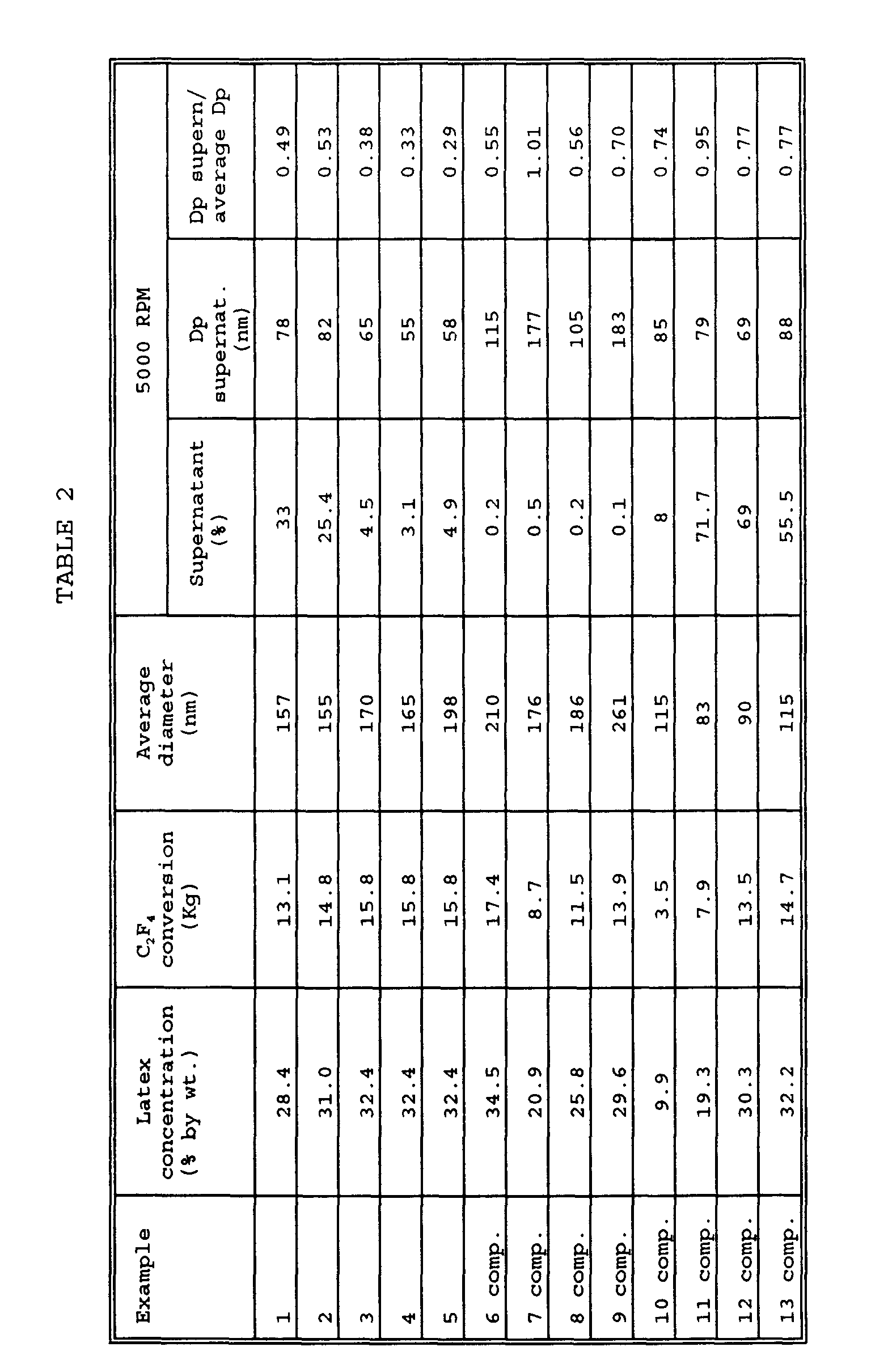
- The diameter of the polymer primary particles measured by Laser Light Scattering (LLS) is equal to 157 nm.
After ultracentrifugation at 5,000 rpm for 1 hour, an amount of solid equal to 67% by weight of the total weight is separated and the LLS measure on the supernatant phase gives a value of 78 nm. The measured values show that the obtained dispersion has a bimodal distribution of the particle diameters. By the DSC analysis it results that the average specimen of the Example has a heat of crystallization of 8.8 cal/g., the supernatant phase -9.39 cal/g and the precipitated phase -6.07 cal/g. - By the FT-IR analysis it results that the polymer of the supernatant phase has a value of the amorphous index (Moynihan, 773/2365 cm-1) of 0.12, while that of the precipitated phase is of 0.07.
- 3 parts of an ammonium salt of an acid having the structure (II) with an acidimetric molecular weight 545, 2 parts of a perfluoropolyether having the structure of type (A) and molecular weight of about 800 and 5 parts of water are introduced into a glass beaker. The resulting dispersion is perfecetly limpid in a temperature range from 15°C to 55°C.
- 100 grams of the previous dispersion, equal to 0.35 ml/litre of perfluoropolyether, are added to 32 litres of carefully degassed water in a 50 litres autoclave equipped with a mechanical stirrer and previously put under vacuum. Also 140 grams of paraffin with softening point in the range 52°C-54°C were previously introduced into the reactor. 500 cc of (NH4)2S2O8 (APS) solution corresponding to 220 mg of APS are fed into the autoclave. The autoclave is maintained under mechanical stirring and it is pressurized with TFE up to a pressure of 20 bar at a temperature of 55°C. At this point 500 cc of a (NH4)2Fe(SO4)26H20 (SdM) solution corresponding to 380 mg of SdM are fed into the autoclave.
- When the pressure in the reactor has decreased of 0.5 bar, one starts to feed TFE by a compressor so as to maintain a constant pressure of 20 bar inside the reactor. Meanwhile the internal temperature of the reactor is increased up to 100°C at a rate equal to 0.7°C/min. During the reaction 60 grams of the aqueous solution containing 100 grams/litre of ammonium perfluorooctanoate are fed into the autoclave. After 94 minutes, the TFE feeding is stopped, when 14,800 grams of TFE have reacted, the reactor is evacuated and cooled.
- The diameter of the polymer primary particles measured by Laser Light Scattering (LLS) is equal to 155 nm.
After ultracentrifugation at 5,000 rpm for 1 hour, an amount of solid equal to 74.6% by weight of the total weight is separated and the LLS measure on the supernatant phase gives a value of 82 nm. The measured values show that the obtained dispersion has a bimodal distribution of the particle diameters. - By the DSC analysis it results that the average specimen of the Example has a heat of crystallization of 8.2 cal/g, the supernatant phase -10.4 cal/g and the precipitated phase -7.1 cal/g. On the average specimen the value of the absolute specific weight SSG = 2,171 has been determined which indicates high molecular weight of the obtained polymer.
- 5 parts of an ammonium salt of an acid having the structure (II) with an acidimetric molecular weight 530, 3 parts of a perfluoropolyether having the structure of type (A) and molecular weight of about 700 and 8 parts of water are introduced into a glass beaker. The resulting dispersion is perfectly limpid.
- 8 grams of the previous dispersion, equal to 0.03 ml/litre of perfluoropolyether, are added to 32 litres of carefully degassed water in a 50 litres autoclave equipped with a mechanical stirrer and previously put under vacuum. Also 11 grams of ammonium perfluorooctanoate and 200 g of paraffin with softening point in the range 52°C-54°C were previously introduced into the reactor. 500 cc of (NH4)2S2O8 (APS) solution and disuccinic peroxide (DSAP) corresponding to 100 mg of APS and 2,000 mg of DSAP are fed into the autoclave. The autoclave is maintained under mechanical stirring and it is pressurized with TFE up to a pressure of 20 bar at a temperature of 55°C. At this point 500 cc of a (NH4)2Fe(SO4)26H20 (SdM) solution corresponding to 90 mg of SdM are fed into the autoclave.
- When the pressure in the reactor has decreased of 0.5 bar, one starts to feed TFE by a compressor so as to maintain a constant pressure of 20 bar inside the reactor. Meanwhile the internal temperature of the reactor is increased up to 86°C at a rate equal to 0.6°C/min. During the reaction 50.5 grams of the aqueous solution containing 100 grams/litre of ammonium perfluorooctanoate are fed into the autoclave. After 109 minutes, the TFE feeding is stopped, when 15,800 grams of TFE have reacted, the reactor is evacuated and cooled.
- The diameter of the polymer primary particles measured by Laser Light Scattering (LLS) is equal to 170 nm. After ultracentrifugation at 5,000 rpm for 1 hour, an amount of solid equal to 95.5% by weight of the total weight is separated and the LLS measure on the supernatant phase gives a value of 65 nm. The measured values show that the obtained dispersion has a bimodal distribution of the particle diameters.
- 15 grams of the dispersion of Example 3, equal to 0.05 ml/litre of perfluoropolyether, are added to 32 litres of carefully degassed water in a 50 litres autoclave equipped with a mechanical stirrer and previously put under vacuum. Also 12 grams of Forafac 1033D, surfactant having the structure (IV) produced and commercialized by Elf Atochem S.A., 200 g of paraffin with softening point in the range 52°C-54°C were previously introduced into the reactor. The autoclave is maintained under mechanical stirring and it is pressurized with TFE up to a pressure of 20 bar at a temperature of 70°C. At this point 500 cc of a (NH4)2S2O8 (APS) solution and disuccinic peroxide (DSAP) corresponding to 150 mg of APS and 3,000 mg of DSAP are fed into the autoclave.
- When the pressure in the reactor has decreased of 0.5 bar, one starts to feed TFE by a compressor so as to maintain a constant pressure of 20 bar inside the reactor. Meanwhile the internal temperature of the reactor is increased up to 85°C at a rate equal to 0.33°C/min. During the reaction 50.5 grams of the aqueous solution containing 100 grams/litre of Forafac 1033D are fed into the autoclave. After 120 minutes, the TFE feeding is stopped, when 15,800 grams of TFE have reacted, the reactor is evacuated and cooled.
- The diameter of the polymer primary particles measured by Laser Light Scattering (LLS) is equal to 165 nm.
After ultracentrifugation at 5,000 rpm for 1 hour, an amount of solid equal to 97% by weight of the total weight is separated and the LLS measure on the supernatant phase gives a value of 55 nm. The measured values show that the obtained dispersion has a bimodal distribution of the particle diameters. - 25 grams of the dispersion of Example 3, equal to 0.08 ml/litre of perfluoropolyether, are added to 32 litres of carefully degassed water in a 50 litres autoclave equipped with a mechanical stirrer and previously put under vacuum. Also 40 grams of ammonium perfluorooctanoate, 200 g of paraffin with softening point in the range 52°C-54°C were previously introduced into the reactor. The autoclave is maintained under mechanical stirring and it is pressurized with TFE up to a pressure of 20 bar at a temperature of 70°C. At this point 500 cc of a (NH4)2S2O8 (APS) solution and disuccinic peroxide (DSAP) corresponding to 150 mg of APS and 3,000 mg of DSAP are fed into the autoclave.
- When the pressure in the reactor has decreased of 0.5 bar, one starts to feed TFE by a compressor so as to maintain a constant pressure of 20 bar inside the reactor. Meanwhile the internal temperature of the reactor is increased up to 85°C at a rate equal to 0.33°C/min. When 13,000 g of TFE have reacted, 150 g of the microemulsion of Example 3 equal to 0.49 ml/litre of perfluoropolyether are fed into the autoclave, the internal temperature of the autoclave is brought to 92°C. When 13,500 g of TFE have reacted, 28 g of perfluoropropylvinylether (PPVE) are fed into the autoclave. After 100 minutes, the TFE feeding is stopped, when 15,800 grams of TFE have reacted, the reactor is evacuated and cooled.
- The diameter of the polymer primary particles measured by Laser Light Scattering (LLS) is equal to 198 nm.
After ultracentrifugation at 5,000 rpm for 1 hour, an amount of solid equal to 95.1% by weight of the total weight is separated and the LLS measure on the supernatant phase gives a value of 58 nm. The measured values show that the obtained dispersion has a bimodal distribution of the particle diameters. - 24 grams of the aqueous solution of the ammonium perfluorooctanoate are added to 32 litres of carefully degassed water in a 50 litres autoclave equipped with a mechanical stirrer and previously put under vacuum. Also 140 grams of paraffin with softening point in the range 52°C-54°C were previously introduced into the reactor. 500 cc of a (NH4)2S2O8 (APS) solution corresponding to 220 mg of APS are fed into the autoclave. The autoclave is maintained under mechanical stirring and it is pressurized with TFE up to a pressure of 20 bar at a temperature of 55°C. At this point 500 cc of a (NH4)2Fe(SO4)26H2O (SdM) solution corresponding to 380 mg of SdM are fed into the autoclave.
- When the pressure in the reactor has decreased of 0.5 bar, one starts to feed TFE by a compressor so as to maintain a constant pressure of 20 bar inside the reactor. Meanwhile the internal temperature of the reactor is increased up to 100°C at a rate equal to 0.7°C/min. During the reaction 60 g of the aqueous solution containing 100 grams/litre of ammonium perfluorooctanoate are fed into the autoclave. After 80 minutes, the TFE feeding is stopped, when 17,400 grams of TFE have reacted, the reactor is evacuated and cooled.
- The diameter of the polymer primary particles measured by Laser Light Scattering (LLS) is equal to 200 nm.
After ultracentrifugation at 5,000 rpm for 1 hour, an amount of solid equal to 99.8% by weight of the total weight is separated and the LLS measure on the supernatant phase gives a value of 115 nm. - 24 grams of an aqueous solution of the ammonium salt of the surfactant having the structure (II) are added to 32 litres of carefully degassed water in a 50 litres autoclave equipped with a mechanical stirrer and previously put under vacuum. Also 140 grams of paraffin with softening point in the range 52°C-54°C were previously introduced into the reactor. 500 cc of a (NH4)2S2O8 (APS) solution corresponding to 220 mg of APS are fed into the autoclave. The autoclave is maintained under mechanical stirring and it is pressurized with TFE up to a pressure of 20 bar at a temperature of 55°C. At this point 500 cc of a (NH4)2Fe(SO4)26H2O (SdM) solution corresponding to 380 mg of SdM are fed into the autoclave.
- When the pressure in the reactor has decreased of 0.5 bar, one starts to feed TFE by a compressor so as to maintain a constant pressure of 20 bar inside the reactor. Meanwhile the internal temperature of the reactor is increased up to 100°C at a rate equal to 0.7°C/min. During the reaction 60 g of the aqueous solution containing 100 grams/litre of the ammonium salt of the surfactant having the structure (II) are fed into the autoclave. After 80 minutes, the TFE feeding is stopped, when 8,700 grams of TFE have reacted, the reactor is evacuated and cooled.
- The diameter of the polymer primary particles measured by Laser Light Scattering (LLS) is equal to 176 nm.
After ultracentrifugation at 5,000 rpm for 1 hour, an amount of solid equal to 99.5% by weight of the total weight is separated and the LLS measure on the supernatant phase gives a value of 177 nm. - 4 parts of a sodium salt of an acid having the structure (II) with an acidimetric molecular weight 545, 2 parts of a perfluorocarbon C8F18 and molecular weight of about 438 and 4 parts of water are introduced into a glass beaker. The resulting dispersion is perfectly limpid.
- 325 grams of the previous dispersion, equal to 01.16 ml/litre of perfluorocarbon, are added to 32 litres of carefully degassed water in a 50 litres autoclave equipped with a mechanical stirrer and previously put under vacuum. Also 140 grams of paraffin with softening point in the range 52°C-54°C were previously introduced into the reactor. 500 cc of (NH4)2S2O8 (APS) solution corresponding to 220 mg of APS are fed into the autoclave. The autoclave is maintained under mechanical stirring and it is pressurized with TFE up to a pressure of 20 bar at a temperature of 55°C. At this point 500 cc of a (NH4)2Fe(SO4)26H20 (SdM) solution corresponding to 380 mg of SdM are fed into the autoclave.
- When the pressure in the reactor has decreased of 0.5 bar, one starts to feed TFE by a compressor so as to maintain a constant pressure of 20 bar inside the reactor. Meanwhile the internal temperature of the reactor is increased up to 100°C at a rate equal to 0.7°C/min. After 42 minutes, the TFE feeding is stopped, when 11,500 grams of TFE have reacted, the reactor is evacuated and cooled.
- The diameter of the polymer primary particles measured by Laser Light Scattering (LLS) is equal to 186 nm.
After ultracentrifugation at 5,000 rpm for 1 hour, an amount of solid equal to 99.8% by weight of the total weight is separated and the LLS measure on the supernatant phase gives a value of 105 - 75 grams of the dispersion of Example 8, equal to 0.27 ml/litre of perfluorocarbon, are added to 32 litres of carefully degassed water in a 50 litres autoclave equipped with a mechanical stirrer and previously put under vacuum. Also 140 grams of paraffin with softening point in the range 52°C-54°C were previously introduced into the reactor. 500 cc of a (NH4)2S2O8 (APS) solution corresponding to 220 mg of APS are fed into the autoclave. The autoclave is maintained under mechanical stirring and it is pressurized with TFE up to a pressure of 20 bar at a temperature of 55°C. At this point 500 cc of a (NH4)2Fe(SO4)26H20 (SdM) solution corresponding to 380 mg of SdM are fed into the autoclave.
- When the pressure in the reactor has decreased of 0.5 bar, one starts to feed TFE by a compressor so as to maintain a constant pressure of 20 bar inside the reactor. Meanwhile the internal temperature of the reactor is increased up to 100°C at a rate equal to 0.7°C/min. During the reaction 60 grams of the aqueous solution containing 100 grams/litre of ammonium perfluorooctanoate are fed into the autoclave. After 76 minutes, the TFE feeding is stopped, when 13,900 grams of TFE have reacted, the reactor is evacuated and cooled.
- The diameter of the polymer primary particles measured by Laser Light Scattering (LLS) is equal to 261 nm.
After ultracentrifugation at 5,000 rpm for 1 hour, an amount of solid equal to 99.9% by weight of the total weight is separated and the LLS measure on the supernatant phase gives a value of 183. - 30 grams of the aqueous solution of ammonium perfluorooctanoate are added to 31 litres of carefully degassed water in a 50 litres autoclave equipped with a mechanical stirrer and previously put under vacuum. Also 140 grams of paraffin with softening point in the range 52°C-54°C and 100 grams of perfluoropropylvinylether (PPVE) were previously introduced into the reactor. 500 cc of a (NH4)2S2O8 (APS) solution corresponding to 1000 mg of APS are fed into the autoclave. The autoclave is maintained under mechanical stirring and it is pressurized with TFE up to a pressure of 20 bar at a temperature of 55°C. At this point 500 cc of a (NH4)2Fe(SO4)26H2O (SdM) solution corresponding to 1,450 mg of SdM are fed into the autoclave.
- When the pressure in the reactor has decreased of 0.5 bar, one starts to feed TFE by a compressor so as to maintain a constant pressure of 20 bar inside the reactor. Meanwhile the internal temperature of the reactor is increased up to 75°C at a rate equal to 0.7°C/min. After 27 minutes, the TFE feeding is stopped, when 3,500 grams of TFE have reacted, the reactor is evacuated and cooled.
- The diameter of the polymer primary particles measured by Laser Light Scattering (LLS) is equal to 115 nm.
After ultracentrifugation at 5,000 rpm for 1 hour, an amount of solid equal to 92% by weight of the total weight is separated and the LLS measure on the supernatant phase gives a value of 85 nm. - 160 grams of the microemulsion of Example 3, equal to 0.52 ml/litre of perfluoropolyether are added to 32 litres of carefully degassed water in a 50 litres autoclave equipped with a mechanical stirrer and previously put under vacuum. Also 100 grams of perfluoromethylvinylether (PMVE) were previously introduced into the reactor. 500 cc of a (NH4)2S2O8 (APS) solution corresponding to 1,600 mg of APS are fed into the autoclave. The autoclave is maintained under mechanical stirring and it is pressurized with TFE up to a pressure of 20 bar at a temperature of 30°C. At this point 500 cc of a (NH4)2Fe(SO4)26H2O (SdM) solution corresponding to 480 mg of SdM are fed into the autoclave.
- When the pressure in the reactor has decreased of 0.5 bar, one starts to feed TFE by a compressor so as to maintain a constant pressure of 20 bar inside the reactor. Meanwhile the internal temperature of the reactor is increased up to 60°C at a rate equal to 0.7°C/min. After 36 minutes, the TFE feeding is stopped, when 7,900 grams of TFE have reacted, the reactor is evacuated and cooled.
- The diameter of the polymer primary particles measured by Laser Light Scattering (LLS) is equal to 83 nm.
After ultracentrifugation at 5,000 rpm for 1 hour, an amount of solid equal to 28.3% by weight of the total weight is separated and the LLS measure on the supernatant phase gives a value of 79 nm. - 140 grams of the microemulsion of Example 3, equal to 0.44 ml/litre of perfluoropolyether are added to 30 litres of carefully degassed water in a 50 litres autoclave equipped with a mechanical stirrer and previously put under vacuum. Also 140 grams of paraffin with softening point in the range 52°C-54°C were previously introduced into the reactor. The autoclave is maintained under mechanical stirring and it is pressurized with TFE up to a pressure of 20 bar at a temperature of 80°C. At this point 500 cc of a (NH4)2S2O8 (APS) solution corresponding to 2,500 mg of APS are fed into the autoclave.
- When the pressure in the reactor has decreased of 0.5 bar, one starts to feed TFE by a compressor so as to maintain a constant pressure of 20 bar inside the reactor. Meanwhile the internal temperature of the reactor is increased up to 100°C at a rate equal to 1.0°C/min. After 25 minutes, the TFE feeding is stopped, when 13,500 grams of TFE have reacted, the reactor is evacuated and cooled.
- The diameter of the polymr primary particles measured by Laser Light Scattering (LLS) is equal to 90 nm.
After ultracentrifugation at 5,000 rpm for 1 hour, an amount of solid equal to 31% by weight of the total weight is separated and the LLS measure on the supernatant phase gives a value of 69 nm. - 3 parts of an ammonium salt of an acid having the structure (II) with an acidimetric molecular weight 545, 2 parts of a perfluoropolyether having the structure of type (A) and molecular weight of about 800 and 5 parts of water are introduced into a glass beaker. The resulting dispersion is perfectly limpid.
- 433 grams of the previous dispersion, equal to 1.55 ml/litre of perfluoropolyether, are added to 30 litres of carefully degassed water in a 50 litres autoclave equipped with a mechanical stirrer and previously put under vacuum. Also 140 grams of paraffin with softening point in the range 52°C-54°C were previously introduced into the reactor. 500 cc of a (NH4)2S2O8 (APS) solution corresponding to 220 mg of APS are fed into the autoclave. The autoclave is maintained under mechanical stirring and it is pressurized with TFE up to a pressure of 20 bar at a temperature of 55°C. At this point 500 cc of a (NH4)2Fe(SO4)26H20 (SdM) solution corresponding to 380 mg of SdM are fed into the autoclave.
- When the pressure in the reactor has decreased of 0.5 bar, one starts to feed TFE by a compressor so as to maintain a constant pressure of 20 bar inside the reactor. Meanwhile the internal temperature of the reactor is increased up to 100°C at a rate equal to 0.75°C/min. After 45 minutes, the TFE feeding is stopped, when 14,700 grams of TFE have reacted, the reactor is evacuated and cooled.
- The diameter of the polymer primary particles measured by Laser Light Scattering (LLS) is equal to 115 nm.
After ultracentrifugation at 5,000 rpm for 1 hour, an amount of solid equal to 44.5% by weight of the total weight is separated and the LLS measure on the supernatant phase gives a value of 88 nm.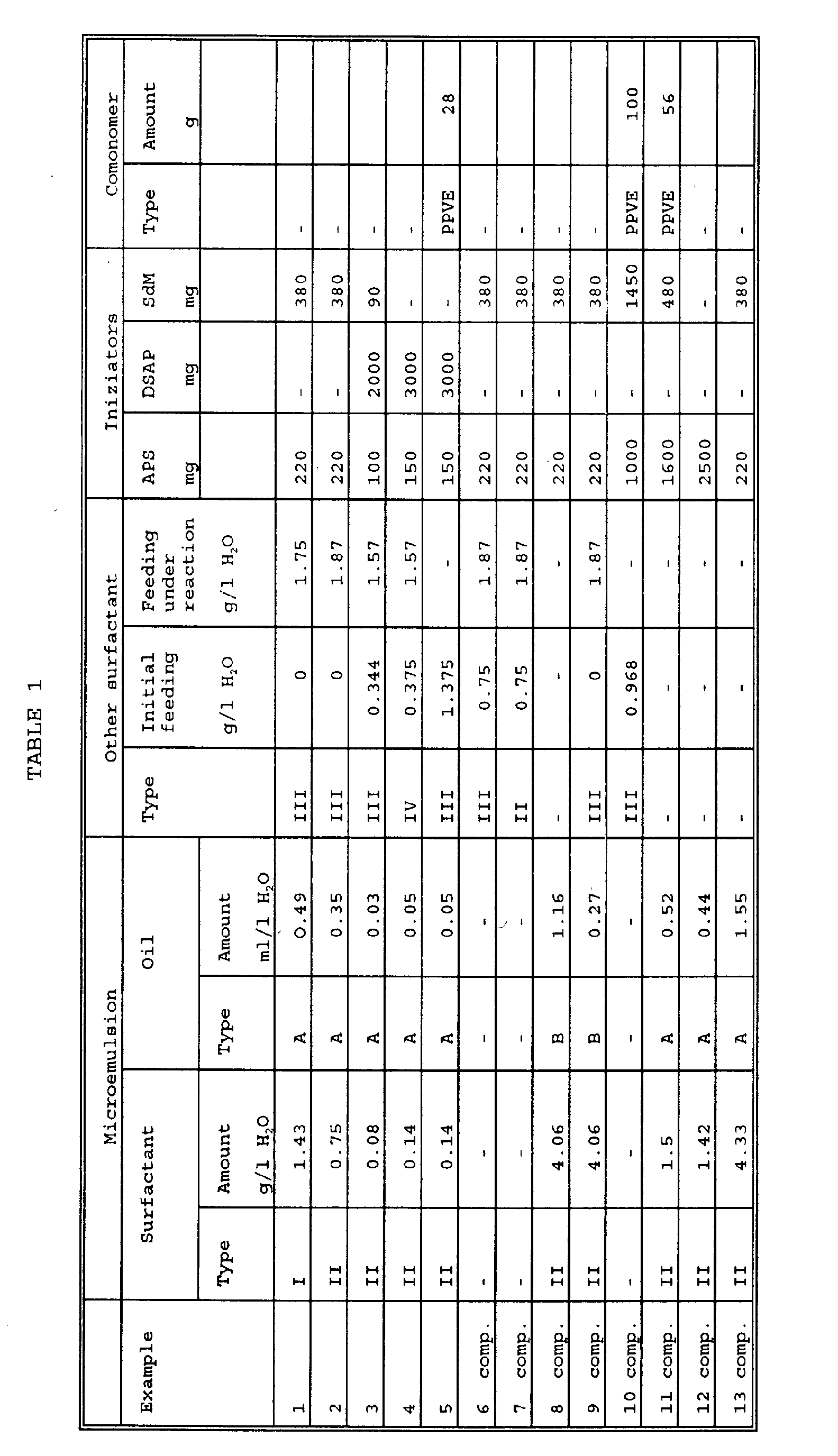
Claims (13)
- A process for the preparation of a dispersion based on tetrafluoroethytlene (TFE) homopolymers, or based on copolymers thereof with one or more monomers containing at least one unsaturation of ethylene type in amounts from 0 up to 10% by moles, preferably from 0 to 2% by moles, said dispersion having a multimodal or bimodal, preferably bimodal, distribution of the particle diameters, the dispersion having an average diameter in the range 100 nm-400 nm, preferably 150 nm-300 nm, the fraction of small particles having diameter between 10 and 100 nm is in the range 1.5-35% by weight calculated on the dry product, preferably 3-25% by weight;
the ratio between the average diameter of the small particles with respect to the average diameter of the dispersion obtained from the polymerization being in the range 0.025-0.6;
said process comprising:a) preparation of an aqueous microemulsion comprising fluorinated surfactants and (per)fluoropolyether (PFPE) oils having non reactive, preferably (per)fluorinated, end groups, optionally containing 1 or more H and/or Cl atoms instead of fluorine;b) feeding of the microemulsion into the polymerization reactor befor the beginning of the polymerization or when polymerization has started;c) feeding of at least one fluorinated, preferably perfluorinated, surfactant into the reactor before the starting of the polymerization or when polymerization has started;d) addition of water (reaction medium) into the reactor, reactor pressurization with gaseous TFE, optional addition of comonomers, chain transfer agents, stabilizers;e) addition of the initiator, and optionally during the polymerization of further amounts of comonomers, initiators, chain transfer agents;f) discharge from the reactor of the polymer latex; before the beginning of the reaction at least a part of the b) and/or c) feedings must be carried out. - A process according to claim 1, wherein the amount of the surfactant fed before polymerization starts is higher than 0.05 grams for litre of water, the total amount of the fed surfactant being in the range 0.3-10 g for litre of water.
- A process according to claims 1-2, wherein the amount of the fluorinated surfactant in the microemulsion a) is in the range 1-80% by weight, preferably 1-45% by weight, with respect to the total weight of surfactants a)+c).
- A process according to claims 1-3, wherein in order to obtain trimodal or higher distributions of the particles, a fluorinated surfactant c) and the microemulsion a) are fed into the reactor at different reaction progress degrees, preferably a feeding of the microemulsion a) and of the surfactant c) before the beginning of the reaction, a further feeding of microemulsion a) when more than 50% of tetrafluoroethylene has reacted.
- A process according to claims 1-4, wherein the perfluoropolyether oil phase of the microemulsion a) is present in an amount from 0.002 to 10 ml for litre of water, preferably from 0.01 to 2.5 ml.
- A process according to claims 1-5, wherein the number average molecular weight of the perfluoropolyethers (PFPE) of the microemulsion a) is in the range 350-8,000, preferably 500-1,000, the perfluoropolyether chain comprises repeating units havaing at least one of the following structures, statistically placed along the chain:
R4 and R5, equal to or different from each other, are selected from H, Cl, or perfluoroalkyl from 1 to 4 carbon atoms. - A process accoding to claim 6, wherein PFPE is selected from the following structures:
when t' is different from 0 then r'/t' = 10-100, preferably 10-30; r' and t' being integers such as to give the above indicated molecular weight; X has the above indicated meaning;
the T end groups, equal to or different from each other, are (per)fluoroalkyl groups selected from: -CF3, -C2F5, -C3F7, -CF2Cl, -C2F4Cl, -C3F6Cl; optionally one or two F atoms, preferably one, can be replaced by H. - A process according to claim 7, wherein the PFPE has the structure:
- A process acording to claims 1-8, wherein the fluorinated surfactants are selected from the following:
- A process according to claim 9, wherein the fluorinated surfactants of the microemulsion a) have structure (IA).
- A process according to claims 1-10, wherein the comonomers having an ethylene unsaturation are of both hydrogenated and fluorinated type.
- A process according to claim 11, wherein the fluorinated comonomers are selected from:C3-C8 perfluoroolefins, such as hexafluoropropene (HFP) ;C2-C8 hydrogenated fluoroolefins, such as vinyl fluoride (VF), vinylidene fluoride (VDF), trifluoroethylene, perfluoroalkylethylene CH2=CH-Rf, wherein Rf is a C1-C6 perfluoroalkyl, such as hexafluoroisobutene;C2-C6 chloro- and/or bromo- and/or iodo-fluoroolefins, such as chlorotrifluoroethylene (CTFE);(per)fluoroalkylvinylethers (PAVE) CF2=CFORf, wherein Rf is a C1-C6 (per) fluoroalkyl, for example CF3, C2F5, C3F7;(per)fluoro-oxyalkylvinylethers CF2=CFOX, wherein X is a C1-C12 alkyl, or a C1-C12 oxyalkyl, or a C1-C12 (per)fluorooxyalkyl having one or more ether groups, for example perfluoro-2-propoxy-propyl;fluorodioxoles, preferably perfluorodioxoles.
- A process according to claim 12, wherein the fluorinated comonomers are selected from:hexafluoropropene (HFP);chlorotrifluoroethylene (CTFE) ;(per)fluoroalkylvinylethers (PAVE) CF2=CFORf, wherein Rf is a C1-C3 (per)fluoroalkyl;perfluorodioxoles.
Applications Claiming Priority (2)
| Application Number | Priority Date | Filing Date | Title |
|---|---|---|---|
| IT2000MI000314A IT1317847B1 (en) | 2000-02-22 | 2000-02-22 | PROCESS FOR THE PREPARATION OF WATER DISPERSIONS OF FLUOROPOLYMERS. |
| ITMI000314 | 2000-02-22 |
Publications (2)
| Publication Number | Publication Date |
|---|---|
| EP1127896A1 true EP1127896A1 (en) | 2001-08-29 |
| EP1127896B1 EP1127896B1 (en) | 2005-06-01 |
Family
ID=11444123
Family Applications (1)
| Application Number | Title | Priority Date | Filing Date |
|---|---|---|---|
| EP01103317A Expired - Lifetime EP1127896B1 (en) | 2000-02-22 | 2001-02-13 | Process for the preparation of aqueous dispersions of fluoropolymers |
Country Status (7)
| Country | Link |
|---|---|
| US (1) | US6576703B2 (en) |
| EP (1) | EP1127896B1 (en) |
| JP (1) | JP2001233908A (en) |
| KR (1) | KR20010083176A (en) |
| AT (1) | ATE296840T1 (en) |
| DE (1) | DE60111092T2 (en) |
| IT (1) | IT1317847B1 (en) |
Cited By (6)
| Publication number | Priority date | Publication date | Assignee | Title |
|---|---|---|---|---|
| WO2002055567A3 (en) * | 2001-01-10 | 2003-10-16 | Solvay | Method for two-step preparation of halogenated polymers and halogenated plurimodal polymers |
| WO2004011508A1 (en) * | 2002-07-29 | 2004-02-05 | 3M Innovative Properties Company | Process for making a fluoroelastomer |
| EP1672095A1 (en) * | 2004-12-20 | 2006-06-21 | Kabushiki Kaisha Kobe Seiko Sho | Connector contact material |
| WO2006135825A1 (en) * | 2005-06-10 | 2006-12-21 | 3M Innovative Properties Company | Aqueous emulsion polymerization of fluorinated monomers in the presence of a partially fluorinated oligomer as an emulsifier |
| EP1783167A4 (en) * | 2004-07-28 | 2009-05-13 | Asahi Glass Co Ltd | POLYMER LATEX CONTAINING FLUORINE, PROCESS FOR PRODUCING THE SAME, AND POLYMER CONTAINING FLUORINE |
| RU2491300C2 (en) * | 2007-10-04 | 2013-08-27 | Гор Энтерпрайз Холдингс, Инк. | Expanding copolymers of tetrafluoroethylene, method of their obtaining and porous expanding products from them |
Families Citing this family (36)
| Publication number | Priority date | Publication date | Assignee | Title |
|---|---|---|---|---|
| JP2002308914A (en) * | 2001-04-17 | 2002-10-23 | Daikin Ind Ltd | Method for producing fluoropolymer latex |
| US7045571B2 (en) * | 2001-05-21 | 2006-05-16 | 3M Innovative Properties Company | Emulsion polymerization of fluorinated monomers |
| US7279522B2 (en) | 2001-09-05 | 2007-10-09 | 3M Innovative Properties Company | Fluoropolymer dispersions containing no or little low molecular weight fluorinated surfactant |
| CN100336860C (en) * | 2003-07-24 | 2007-09-12 | 巨化集团公司 | Nano-emulsified fluorine containing ion exchange resin and its preparation method and application |
| ITMI20032050A1 (en) * | 2003-10-21 | 2005-04-22 | Solvay Solexis Spa | PROCESS FOR THE PREPARATION OF FLUOROPOLYMER DISPERSERS. |
| ITMI20032377A1 (en) * | 2003-12-04 | 2005-06-05 | Solvay Solexis Spa | COPOLYMERS OF TFE. |
| ITMI20040031A1 (en) | 2004-01-14 | 2004-04-14 | Solvay Solexis Spa | PROCESS FOR THE PREPARATION OF FLUOROPOLYMER DISPERSERS |
| US8178612B2 (en) * | 2004-01-22 | 2012-05-15 | E. I. Du Pont De Nemours And Company | Fluoropolymer emulsion coatings |
| EP1570917B1 (en) * | 2004-03-01 | 2009-06-10 | 3M Innovative Properties Company | Method of coating a substrate with a fluoropolymer dispersion |
| ITMI20042553A1 (en) * | 2004-12-30 | 2005-03-30 | Solvay Solexis Spa | PROCESS FOR THE PREPARATION OF FLUOROPOLYMER DISPERSIONS |
| ITMI20042554A1 (en) * | 2004-12-30 | 2005-03-30 | Solvay Solexis Spa | PROCEDURE FOR THE PREPARATION OF FLUOROPOLYMER DISPERSIONS |
| ITMI20050705A1 (en) * | 2005-04-20 | 2006-10-21 | Solvay Solexis Spa | PROCESS FOR THE PREPARATION OF FLUOROPOLYMER DISPERSERS |
| ITMI20051080A1 (en) * | 2005-06-10 | 2006-12-11 | Solvay Solexis Spa | FLUORURED GREASES HAVING LOW MOMENT TORCENT AT LOW TEMPERATURES |
| GB2427170A (en) * | 2005-06-17 | 2006-12-20 | 3M Innovative Properties Co | Fluoropolymer film having glass microspheres |
| GB0514387D0 (en) * | 2005-07-15 | 2005-08-17 | 3M Innovative Properties Co | Aqueous emulsion polymerization of fluorinated monomers using a perfluoropolyether surfactant |
| GB0523853D0 (en) | 2005-11-24 | 2006-01-04 | 3M Innovative Properties Co | Fluorinated surfactants for use in making a fluoropolymer |
| GB0514398D0 (en) * | 2005-07-15 | 2005-08-17 | 3M Innovative Properties Co | Aqueous emulsion polymerization of fluorinated monomers using a fluorinated surfactant |
| GB0525978D0 (en) * | 2005-12-21 | 2006-02-01 | 3M Innovative Properties Co | Fluorinated Surfactants For Making Fluoropolymers |
| US20080015304A1 (en) | 2006-07-13 | 2008-01-17 | Klaus Hintzer | Aqueous emulsion polymerization process for producing fluoropolymers |
| US20070015937A1 (en) * | 2005-07-15 | 2007-01-18 | 3M Innovative Properties Company | Process for recovery of fluorinated carboxylic acid surfactants from exhaust gas |
| ITMI20051397A1 (en) * | 2005-07-21 | 2007-01-22 | Solvay Solexis Spa | FINE POWDERS OF FLUOROPOLYMERS |
| GB2430437A (en) * | 2005-09-27 | 2007-03-28 | 3M Innovative Properties Co | Method of making a fluoropolymer |
| US7728087B2 (en) | 2005-12-23 | 2010-06-01 | 3M Innovative Properties Company | Fluoropolymer dispersion and method for making the same |
| US20070276103A1 (en) * | 2006-05-25 | 2007-11-29 | 3M Innovative Properties Company | Fluorinated Surfactants |
| US7754795B2 (en) * | 2006-05-25 | 2010-07-13 | 3M Innovative Properties Company | Coating composition |
| US8119750B2 (en) * | 2006-07-13 | 2012-02-21 | 3M Innovative Properties Company | Explosion taming surfactants for the production of perfluoropolymers |
| EP2132143B1 (en) * | 2007-02-16 | 2012-12-26 | 3M Innovative Properties Company | System and process for the removal of fluorochemicals from water |
| US20080264864A1 (en) * | 2007-04-27 | 2008-10-30 | 3M Innovative Properties Company | PROCESS FOR REMOVING FLUORINATED EMULSIFIER FROM FLUOROPOLMER DISPERSIONS USING AN ANION-EXCHANGE RESIN AND A pH-DEPENDENT SURFACTANT AND FLUOROPOLYMER DISPERSIONS CONTAINING A pH-DEPENDENT SURFACTANT |
| WO2008147796A1 (en) * | 2007-05-23 | 2008-12-04 | 3M Innovative Properties Company | Aqueous compositions of fluorinated surfactants and methods of using the same |
| EP2160421A1 (en) * | 2007-06-06 | 2010-03-10 | 3M Innovative Properties Company | Fluorinated ether compositions and methods of using the same |
| MX2011000702A (en) * | 2008-07-18 | 2011-02-24 | 3M Innovative Properties Co | Fluorinated ether compounds and methods of using the same. |
| US20110232530A1 (en) * | 2008-11-25 | 2011-09-29 | Dams Rudolf J | Fluorinated ether urethanes and methods of using the same |
| CN102317403A (en) | 2008-12-18 | 2012-01-11 | 3M创新有限公司 | Method of contacting hydrocarbon-bearing formations with fluorinated ether compositions |
| KR101596277B1 (en) * | 2014-07-25 | 2016-02-22 | 한국화학연구원 | Polymerization of Fluorinated Monomers Containing Fluorinated Emulsifier and Fluorinated Polymers Thereby |
| US9855534B1 (en) * | 2016-12-28 | 2018-01-02 | Pall Corporation | Porous PTFE membranes for metal removal |
| CN115322280B (en) * | 2022-09-14 | 2024-02-13 | 浙江巨圣氟化学有限公司 | Preparation method of environmentally friendly polytetrafluoroethylene dispersion emulsion for topcoat |
Citations (3)
| Publication number | Priority date | Publication date | Assignee | Title |
|---|---|---|---|---|
| EP0617058A1 (en) * | 1993-03-23 | 1994-09-28 | AUSIMONT S.p.A. | (Co)polymerization process in aqueous emulsion of fluorinated olefinic monomers |
| WO1998058984A1 (en) * | 1997-06-24 | 1998-12-30 | Dyneon Gmbh | Aqueous dispersion of fluoropolymers of varying particle size |
| EP0969027A1 (en) * | 1998-07-02 | 2000-01-05 | Ausimont S.p.A. | TFE Polymerization process |
Family Cites Families (23)
| Publication number | Priority date | Publication date | Assignee | Title |
|---|---|---|---|---|
| US2242218A (en) | 1936-08-14 | 1941-05-20 | Auer Laszlo | Sizing textiles |
| BE563881A (en) | 1957-01-11 | |||
| DE1595183B2 (en) | 1964-12-08 | 1980-02-07 | E.I. Du Pont De Nemours And Co., Wilmington, Del. (V.St.A.) | Process for the preparation of colloidal dispersions of polymeric perfluorocarbon compounds |
| US3391099A (en) | 1966-04-25 | 1968-07-02 | Du Pont | Polymerization process |
| DE1745169B2 (en) | 1967-02-09 | 1977-04-21 | Montecatini Edison S.P.A., Mailand (Italien) | FLUORINATED LINEAR POLYAETERS AND THE PROCESS FOR THEIR PRODUCTION |
| US3665041A (en) | 1967-04-04 | 1972-05-23 | Montedison Spa | Perfluorinated polyethers and process for their preparation |
| US3810874A (en) | 1969-03-10 | 1974-05-14 | Minnesota Mining & Mfg | Polymers prepared from poly(perfluoro-alkylene oxide) compounds |
| US3925292A (en) | 1970-09-15 | 1975-12-09 | Du Pont | Polytetrafluoroethylene aqueous dispersions which provide coatings of improved gloss |
| US4038230A (en) | 1970-11-19 | 1977-07-26 | Allied Chemical Corporation | Aqueous dispersion of particulate spheroidal polytetrafluoroethylene |
| US4380618A (en) | 1981-08-21 | 1983-04-19 | E. I. Du Pont De Nemours And Company | Batch polymerization process |
| US4385157A (en) | 1981-11-27 | 1983-05-24 | Monsanto Company | Emulsion polymerization process for ABS polyblends |
| CA1195038A (en) | 1983-04-25 | 1985-10-08 | Polysar Limited | Carboxylated latex |
| EP0148482B1 (en) | 1983-12-26 | 1992-03-25 | Daikin Industries, Limited | Process for preparing halogen-containing polyether |
| IT1188635B (en) | 1986-03-27 | 1988-01-20 | Ausimont Spa | INTERNAL FLUOROPOLYEREE LUBRICANTS FOR MAGNETIC REGISTRATION MEDIA |
| IL82308A (en) | 1986-06-26 | 1990-11-29 | Ausimont Spa | Microemulsions containing perfluoropolyethers |
| IT1204903B (en) | 1986-06-26 | 1989-03-10 | Ausimont Spa | POLYMERIZATION PROCESS IN WATER DISPERSION OF FLORATED MONOMERS |
| US5789083A (en) | 1992-12-23 | 1998-08-04 | E. I. Du Pont De Nemours And Company | Aqueous fluoropolymer primer for smooth substrates |
| DE4340943A1 (en) | 1993-12-01 | 1995-06-08 | Hoechst Ag | Aqueous dispersion of fluoropolymers, their production and use for coatings |
| KR950031600A (en) | 1994-04-27 | 1995-12-18 | 가나이 쯔도무 | Control device and control method of automatic transmission |
| US5523346A (en) | 1994-06-10 | 1996-06-04 | W. L. Gore & Associates, Inc. | Seeded microemulsion polymerization for the production of small polymer particles |
| WO1996022315A1 (en) | 1995-01-18 | 1996-07-25 | W.L. Gore & Associates, Inc. | Microemulsion polymerization systems for fluoromonomers |
| US5789508A (en) | 1995-08-31 | 1998-08-04 | E. I. Du Pont De Nemours And Company | Polymerization process |
| WO1997008214A1 (en) | 1995-08-31 | 1997-03-06 | E.I. Du Pont De Nemours And Company | Tetrafluorethylene polymerization process |
-
2000
- 2000-02-22 IT IT2000MI000314A patent/IT1317847B1/en active
-
2001
- 2001-02-13 DE DE60111092T patent/DE60111092T2/en not_active Expired - Fee Related
- 2001-02-13 AT AT01103317T patent/ATE296840T1/en not_active IP Right Cessation
- 2001-02-13 EP EP01103317A patent/EP1127896B1/en not_active Expired - Lifetime
- 2001-02-16 KR KR1020010007819A patent/KR20010083176A/en not_active Withdrawn
- 2001-02-21 JP JP2001045105A patent/JP2001233908A/en not_active Withdrawn
- 2001-02-22 US US09/789,728 patent/US6576703B2/en not_active Expired - Fee Related
Patent Citations (3)
| Publication number | Priority date | Publication date | Assignee | Title |
|---|---|---|---|---|
| EP0617058A1 (en) * | 1993-03-23 | 1994-09-28 | AUSIMONT S.p.A. | (Co)polymerization process in aqueous emulsion of fluorinated olefinic monomers |
| WO1998058984A1 (en) * | 1997-06-24 | 1998-12-30 | Dyneon Gmbh | Aqueous dispersion of fluoropolymers of varying particle size |
| EP0969027A1 (en) * | 1998-07-02 | 2000-01-05 | Ausimont S.p.A. | TFE Polymerization process |
Cited By (9)
| Publication number | Priority date | Publication date | Assignee | Title |
|---|---|---|---|---|
| WO2002055567A3 (en) * | 2001-01-10 | 2003-10-16 | Solvay | Method for two-step preparation of halogenated polymers and halogenated plurimodal polymers |
| WO2004011508A1 (en) * | 2002-07-29 | 2004-02-05 | 3M Innovative Properties Company | Process for making a fluoroelastomer |
| US7094839B2 (en) | 2002-07-29 | 2006-08-22 | 3M Innovative Properties Company | Process for making a fluoroelastomer |
| EP1783167A4 (en) * | 2004-07-28 | 2009-05-13 | Asahi Glass Co Ltd | POLYMER LATEX CONTAINING FLUORINE, PROCESS FOR PRODUCING THE SAME, AND POLYMER CONTAINING FLUORINE |
| EP1672095A1 (en) * | 2004-12-20 | 2006-06-21 | Kabushiki Kaisha Kobe Seiko Sho | Connector contact material |
| US7470465B2 (en) | 2004-12-20 | 2008-12-30 | Kobe Steel, Ltd. | Connector contact material |
| WO2006135825A1 (en) * | 2005-06-10 | 2006-12-21 | 3M Innovative Properties Company | Aqueous emulsion polymerization of fluorinated monomers in the presence of a partially fluorinated oligomer as an emulsifier |
| RU2491300C2 (en) * | 2007-10-04 | 2013-08-27 | Гор Энтерпрайз Холдингс, Инк. | Expanding copolymers of tetrafluoroethylene, method of their obtaining and porous expanding products from them |
| EP2201050B1 (en) * | 2007-10-04 | 2016-07-20 | W.L. Gore & Associates, Inc. | Expandable tfe copolymers, method of making, and porous, expanded articles thereof |
Also Published As
| Publication number | Publication date |
|---|---|
| DE60111092T2 (en) | 2006-05-04 |
| KR20010083176A (en) | 2001-08-31 |
| ATE296840T1 (en) | 2005-06-15 |
| ITMI20000314A0 (en) | 2000-02-22 |
| IT1317847B1 (en) | 2003-07-15 |
| EP1127896B1 (en) | 2005-06-01 |
| ITMI20000314A1 (en) | 2001-08-22 |
| JP2001233908A (en) | 2001-08-28 |
| DE60111092D1 (en) | 2005-07-07 |
| US6576703B2 (en) | 2003-06-10 |
| US20010020063A1 (en) | 2001-09-06 |
Similar Documents
| Publication | Publication Date | Title |
|---|---|---|
| EP1127896B1 (en) | Process for the preparation of aqueous dispersions of fluoropolymers | |
| EP0969027B1 (en) | TFE Polymerization process | |
| JP5593071B2 (en) | Aqueous polymerization of fluorinated monomers using a polymerization agent containing a fluoropolyether acid or salt and a siloxane surfactant. | |
| JP7670460B2 (en) | Method for producing fluoropolymers | |
| JP5588679B2 (en) | Aqueous polymerization of fluorinated monomers using a polymerization agent containing fluoropolyether acid or salt and a short chain fluorosurfactant | |
| EP1059342B1 (en) | Mixtures of fluoropolymer dispersion | |
| CN106084104B (en) | The manufacturing method of aqueous dispersion of polytetrafluoroethyland | |
| US6518352B1 (en) | Fluoropolymer dispersions | |
| JP6622209B2 (en) | Use of polyalkylene oxides to form nuclei in aqueous polymerization of fluoromonomers | |
| JP5198772B2 (en) | Aqueous emulsion polymerization of functionalized fluoromonomers | |
| JP5212104B2 (en) | Method for producing fluorine-containing elastomer | |
| JP2010509444A (en) | Aqueous polymerization of fluorinated monomers using a polymeric agent containing a fluoropolyether acid or salt and a hydrocarbon surfactant. | |
| CN110494516B (en) | Process for making fluoropolymers | |
| JPH1060054A (en) | Polymerization method of vinylidene fluoride | |
| JP5287245B2 (en) | Method for producing fluorine-containing polymer | |
| JP2000239470A (en) | Fluoroelastomer composition | |
| JP2013532740A (en) | High melting point PTFE polymer for melt processing | |
| JP2008545873A (en) | Aqueous emulsion polymerization of fluorinated monomers in the presence of partially fluorinated oligomers as emulsifiers | |
| TW553956B (en) | Aqueous emulsion polymerization process for the manufacturing of fluoropolymers | |
| JP2004231936A (en) | Tetrafluoroethylene copolymer, method for producing the same, and paste extrusion molding | |
| JP5082212B2 (en) | Method for producing fluoroelastomer | |
| WO2025263510A1 (en) | Fluorine-containing polymer production method, aqueous dispersion, and composition |
Legal Events
| Date | Code | Title | Description |
|---|---|---|---|
| PUAI | Public reference made under article 153(3) epc to a published international application that has entered the european phase |
Free format text: ORIGINAL CODE: 0009012 |
|
| AK | Designated contracting states |
Kind code of ref document: A1 Designated state(s): AT BE CH CY DE DK ES FI FR GB GR IE IT LI LU MC NL PT SE TR |
|
| AX | Request for extension of the european patent |
Free format text: AL;LT;LV;MK;RO;SI |
|
| 17P | Request for examination filed |
Effective date: 20020116 |
|
| AKX | Designation fees paid |
Free format text: AT BE CH CY DE DK ES FI FR GB GR IE IT LI LU MC NL PT SE TR |
|
| RAP1 | Party data changed (applicant data changed or rights of an application transferred) |
Owner name: AGORA' S.P.A. |
|
| RAP1 | Party data changed (applicant data changed or rights of an application transferred) |
Owner name: SOLVAY SOLEXIS S.P.A. |
|
| 17Q | First examination report despatched |
Effective date: 20031126 |
|
| GRAP | Despatch of communication of intention to grant a patent |
Free format text: ORIGINAL CODE: EPIDOSNIGR1 |
|
| GRAS | Grant fee paid |
Free format text: ORIGINAL CODE: EPIDOSNIGR3 |
|
| GRAA | (expected) grant |
Free format text: ORIGINAL CODE: 0009210 |
|
| AK | Designated contracting states |
Kind code of ref document: B1 Designated state(s): AT BE CH CY DE DK ES FI FR GB GR IE IT LI LU MC NL PT SE TR |
|
| PG25 | Lapsed in a contracting state [announced via postgrant information from national office to epo] |
Ref country code: FI Free format text: LAPSE BECAUSE OF FAILURE TO SUBMIT A TRANSLATION OF THE DESCRIPTION OR TO PAY THE FEE WITHIN THE PRESCRIBED TIME-LIMIT Effective date: 20050601 Ref country code: LI Free format text: LAPSE BECAUSE OF FAILURE TO SUBMIT A TRANSLATION OF THE DESCRIPTION OR TO PAY THE FEE WITHIN THE PRESCRIBED TIME-LIMIT Effective date: 20050601 Ref country code: AT Free format text: LAPSE BECAUSE OF FAILURE TO SUBMIT A TRANSLATION OF THE DESCRIPTION OR TO PAY THE FEE WITHIN THE PRESCRIBED TIME-LIMIT Effective date: 20050601 Ref country code: CH Free format text: LAPSE BECAUSE OF FAILURE TO SUBMIT A TRANSLATION OF THE DESCRIPTION OR TO PAY THE FEE WITHIN THE PRESCRIBED TIME-LIMIT Effective date: 20050601 Ref country code: BE Free format text: LAPSE BECAUSE OF FAILURE TO SUBMIT A TRANSLATION OF THE DESCRIPTION OR TO PAY THE FEE WITHIN THE PRESCRIBED TIME-LIMIT Effective date: 20050601 |
|
| REG | Reference to a national code |
Ref country code: GB Ref legal event code: FG4D |
|
| REG | Reference to a national code |
Ref country code: CH Ref legal event code: EP |
|
| REG | Reference to a national code |
Ref country code: IE Ref legal event code: FG4D |
|
| REF | Corresponds to: |
Ref document number: 60111092 Country of ref document: DE Date of ref document: 20050707 Kind code of ref document: P |
|
| PG25 | Lapsed in a contracting state [announced via postgrant information from national office to epo] |
Ref country code: SE Free format text: LAPSE BECAUSE OF FAILURE TO SUBMIT A TRANSLATION OF THE DESCRIPTION OR TO PAY THE FEE WITHIN THE PRESCRIBED TIME-LIMIT Effective date: 20050901 Ref country code: DK Free format text: LAPSE BECAUSE OF FAILURE TO SUBMIT A TRANSLATION OF THE DESCRIPTION OR TO PAY THE FEE WITHIN THE PRESCRIBED TIME-LIMIT Effective date: 20050901 Ref country code: GR Free format text: LAPSE BECAUSE OF FAILURE TO SUBMIT A TRANSLATION OF THE DESCRIPTION OR TO PAY THE FEE WITHIN THE PRESCRIBED TIME-LIMIT Effective date: 20050901 |
|
| PG25 | Lapsed in a contracting state [announced via postgrant information from national office to epo] |
Ref country code: ES Free format text: LAPSE BECAUSE OF FAILURE TO SUBMIT A TRANSLATION OF THE DESCRIPTION OR TO PAY THE FEE WITHIN THE PRESCRIBED TIME-LIMIT Effective date: 20050912 |
|
| PG25 | Lapsed in a contracting state [announced via postgrant information from national office to epo] |
Ref country code: PT Free format text: LAPSE BECAUSE OF FAILURE TO SUBMIT A TRANSLATION OF THE DESCRIPTION OR TO PAY THE FEE WITHIN THE PRESCRIBED TIME-LIMIT Effective date: 20051103 |
|
| REG | Reference to a national code |
Ref country code: CH Ref legal event code: PL |
|
| PG25 | Lapsed in a contracting state [announced via postgrant information from national office to epo] |
Ref country code: IE Free format text: LAPSE BECAUSE OF NON-PAYMENT OF DUE FEES Effective date: 20060213 |
|
| PG25 | Lapsed in a contracting state [announced via postgrant information from national office to epo] |
Ref country code: LU Free format text: LAPSE BECAUSE OF NON-PAYMENT OF DUE FEES Effective date: 20060228 Ref country code: MC Free format text: LAPSE BECAUSE OF NON-PAYMENT OF DUE FEES Effective date: 20060228 |
|
| ET | Fr: translation filed | ||
| PLBE | No opposition filed within time limit |
Free format text: ORIGINAL CODE: 0009261 |
|
| STAA | Information on the status of an ep patent application or granted ep patent |
Free format text: STATUS: NO OPPOSITION FILED WITHIN TIME LIMIT |
|
| 26N | No opposition filed |
Effective date: 20060302 |
|
| REG | Reference to a national code |
Ref country code: IE Ref legal event code: MM4A |
|
| PG25 | Lapsed in a contracting state [announced via postgrant information from national office to epo] |
Ref country code: TR Free format text: LAPSE BECAUSE OF FAILURE TO SUBMIT A TRANSLATION OF THE DESCRIPTION OR TO PAY THE FEE WITHIN THE PRESCRIBED TIME-LIMIT Effective date: 20050601 |
|
| PG25 | Lapsed in a contracting state [announced via postgrant information from national office to epo] |
Ref country code: CY Free format text: LAPSE BECAUSE OF FAILURE TO SUBMIT A TRANSLATION OF THE DESCRIPTION OR TO PAY THE FEE WITHIN THE PRESCRIBED TIME-LIMIT Effective date: 20050601 |
|
| PGFP | Annual fee paid to national office [announced via postgrant information from national office to epo] |
Ref country code: DE Payment date: 20090206 Year of fee payment: 9 Ref country code: NL Payment date: 20090215 Year of fee payment: 9 |
|
| PGFP | Annual fee paid to national office [announced via postgrant information from national office to epo] |
Ref country code: GB Payment date: 20090211 Year of fee payment: 9 |
|
| PGFP | Annual fee paid to national office [announced via postgrant information from national office to epo] |
Ref country code: IT Payment date: 20090225 Year of fee payment: 9 |
|
| PGFP | Annual fee paid to national office [announced via postgrant information from national office to epo] |
Ref country code: FR Payment date: 20090213 Year of fee payment: 9 |
|
| REG | Reference to a national code |
Ref country code: NL Ref legal event code: V1 Effective date: 20100901 |
|
| GBPC | Gb: european patent ceased through non-payment of renewal fee |
Effective date: 20100213 |
|
| REG | Reference to a national code |
Ref country code: FR Ref legal event code: ST Effective date: 20101029 |
|
| PG25 | Lapsed in a contracting state [announced via postgrant information from national office to epo] |
Ref country code: FR Free format text: LAPSE BECAUSE OF NON-PAYMENT OF DUE FEES Effective date: 20100301 Ref country code: NL Free format text: LAPSE BECAUSE OF NON-PAYMENT OF DUE FEES Effective date: 20100901 |
|
| PG25 | Lapsed in a contracting state [announced via postgrant information from national office to epo] |
Ref country code: DE Free format text: LAPSE BECAUSE OF NON-PAYMENT OF DUE FEES Effective date: 20100901 |
|
| PG25 | Lapsed in a contracting state [announced via postgrant information from national office to epo] |
Ref country code: GB Free format text: LAPSE BECAUSE OF NON-PAYMENT OF DUE FEES Effective date: 20100213 Ref country code: IT Free format text: LAPSE BECAUSE OF NON-PAYMENT OF DUE FEES Effective date: 20100213 |