EP1126688A2 - Transceiver for HomePNA network - Google Patents
Transceiver for HomePNA network Download PDFInfo
- Publication number
- EP1126688A2 EP1126688A2 EP01200528A EP01200528A EP1126688A2 EP 1126688 A2 EP1126688 A2 EP 1126688A2 EP 01200528 A EP01200528 A EP 01200528A EP 01200528 A EP01200528 A EP 01200528A EP 1126688 A2 EP1126688 A2 EP 1126688A2
- Authority
- EP
- European Patent Office
- Prior art keywords
- signal
- homepna
- data signal
- band signal
- pass
- Prior art date
- Legal status (The legal status is an assumption and is not a legal conclusion. Google has not performed a legal analysis and makes no representation as to the accuracy of the status listed.)
- Withdrawn
Links
- 238000000034 method Methods 0.000 claims abstract description 18
- 230000005540 biological transmission Effects 0.000 claims abstract description 10
- 238000005516 engineering process Methods 0.000 claims abstract description 10
- 238000012545 processing Methods 0.000 claims abstract description 7
- 230000004044 response Effects 0.000 claims description 18
- 238000012549 training Methods 0.000 claims description 9
- 238000001914 filtration Methods 0.000 claims description 8
- 238000005070 sampling Methods 0.000 claims description 8
- 238000001514 detection method Methods 0.000 claims description 7
- 238000005314 correlation function Methods 0.000 claims description 4
- 230000008878 coupling Effects 0.000 claims 5
- 238000010168 coupling process Methods 0.000 claims 5
- 238000005859 coupling reaction Methods 0.000 claims 5
- 230000009977 dual effect Effects 0.000 claims 3
- 230000002123 temporal effect Effects 0.000 abstract description 9
- 230000003595 spectral effect Effects 0.000 abstract description 3
- 238000001228 spectrum Methods 0.000 description 7
- 239000011159 matrix material Substances 0.000 description 6
- 230000006855 networking Effects 0.000 description 6
- 238000006243 chemical reaction Methods 0.000 description 4
- 230000003252 repetitive effect Effects 0.000 description 4
- 230000008901 benefit Effects 0.000 description 3
- 238000010586 diagram Methods 0.000 description 3
- 230000008569 process Effects 0.000 description 3
- 238000012360 testing method Methods 0.000 description 3
- 230000003044 adaptive effect Effects 0.000 description 2
- 238000013507 mapping Methods 0.000 description 2
- 101150012579 ADSL gene Proteins 0.000 description 1
- RZVAJINKPMORJF-UHFFFAOYSA-N Acetaminophen Chemical compound CC(=O)NC1=CC=C(O)C=C1 RZVAJINKPMORJF-UHFFFAOYSA-N 0.000 description 1
- 102100020775 Adenylosuccinate lyase Human genes 0.000 description 1
- 108700040193 Adenylosuccinate lyases Proteins 0.000 description 1
- 230000002238 attenuated effect Effects 0.000 description 1
- 238000004891 communication Methods 0.000 description 1
- 238000007796 conventional method Methods 0.000 description 1
- 238000002592 echocardiography Methods 0.000 description 1
- 230000036039 immunity Effects 0.000 description 1
- 238000012986 modification Methods 0.000 description 1
- 230000004048 modification Effects 0.000 description 1
- 230000002093 peripheral effect Effects 0.000 description 1
- 238000013139 quantization Methods 0.000 description 1
- 230000008707 rearrangement Effects 0.000 description 1
- 230000000630 rising effect Effects 0.000 description 1
- 238000010845 search algorithm Methods 0.000 description 1
- 238000007493 shaping process Methods 0.000 description 1
- 230000011664 signaling Effects 0.000 description 1
- 238000000638 solvent extraction Methods 0.000 description 1
- 238000006467 substitution reaction Methods 0.000 description 1
Images



Classifications
-
- H—ELECTRICITY
- H04—ELECTRIC COMMUNICATION TECHNIQUE
- H04L—TRANSMISSION OF DIGITAL INFORMATION, e.g. TELEGRAPHIC COMMUNICATION
- H04L12/00—Data switching networks
- H04L12/28—Data switching networks characterised by path configuration, e.g. LAN [Local Area Networks] or WAN [Wide Area Networks]
- H04L12/2803—Home automation networks
- H04L12/2838—Distribution of signals within a home automation network, e.g. involving splitting/multiplexing signals to/from different paths
-
- H—ELECTRICITY
- H04—ELECTRIC COMMUNICATION TECHNIQUE
- H04L—TRANSMISSION OF DIGITAL INFORMATION, e.g. TELEGRAPHIC COMMUNICATION
- H04L12/00—Data switching networks
- H04L12/28—Data switching networks characterised by path configuration, e.g. LAN [Local Area Networks] or WAN [Wide Area Networks]
- H04L12/2803—Home automation networks
-
- H—ELECTRICITY
- H04—ELECTRIC COMMUNICATION TECHNIQUE
- H04M—TELEPHONIC COMMUNICATION
- H04M11/00—Telephonic communication systems specially adapted for combination with other electrical systems
- H04M11/06—Simultaneous speech and data transmission, e.g. telegraphic transmission over the same conductors
-
- H—ELECTRICITY
- H04—ELECTRIC COMMUNICATION TECHNIQUE
- H04M—TELEPHONIC COMMUNICATION
- H04M11/00—Telephonic communication systems specially adapted for combination with other electrical systems
- H04M11/06—Simultaneous speech and data transmission, e.g. telegraphic transmission over the same conductors
- H04M11/062—Simultaneous speech and data transmission, e.g. telegraphic transmission over the same conductors using different frequency bands for speech and other data
-
- H—ELECTRICITY
- H04—ELECTRIC COMMUNICATION TECHNIQUE
- H04L—TRANSMISSION OF DIGITAL INFORMATION, e.g. TELEGRAPHIC COMMUNICATION
- H04L12/00—Data switching networks
- H04L12/28—Data switching networks characterised by path configuration, e.g. LAN [Local Area Networks] or WAN [Wide Area Networks]
- H04L12/2803—Home automation networks
- H04L2012/284—Home automation networks characterised by the type of medium used
- H04L2012/2841—Wireless
-
- H—ELECTRICITY
- H04—ELECTRIC COMMUNICATION TECHNIQUE
- H04L—TRANSMISSION OF DIGITAL INFORMATION, e.g. TELEGRAPHIC COMMUNICATION
- H04L12/00—Data switching networks
- H04L12/28—Data switching networks characterised by path configuration, e.g. LAN [Local Area Networks] or WAN [Wide Area Networks]
- H04L12/2803—Home automation networks
- H04L2012/284—Home automation networks characterised by the type of medium used
- H04L2012/2845—Telephone line
Definitions
- the present invention relates generally to the field of communication networks and, more particularly, to a transceiver method and architecture in a home phoneline network.
- the Home Phoneline Networking Alliance (HomePNA) is an association of industry leading companies working together to bring, for example, easy-to-use, high-speed, affordable home networking solutions to clients by providing the manageable tools needed to utilize phoneline networking.
- Hpna 2.0 is the second-generation home phoneline networking technology specification released by the Alliance.
- the new specification brings a faster 10 Mb/s technology (also known as 10M8 technology) to phoneline networking, while at the same time maintaining backward compatibility with existing 1 Mb/s HomePNA technology.
- 10Mb/s technology also known as 10M8 technology
- Some of the advantages of the Alliance's latest 10Mb/s technology include allowing for faster, real-time multi-player gaming, swift downloading of complex files and graph images from the Internet as well as simultaneous shared access to peripherals such as printers. Clients can enjoy all these home entertainment and information services using existing wiring in the home.
- the present invention achieves technical advantages as a method and system of transceiving a data signal in a HomePNA type network.
- the transceiver enables digital signal processing, of the data signal, compliant with the HomePNA 10M8 specification in an Open System Interconnection type network over a shared medium, such as a client's home phoneline.
- the transceiver can be implemented in each station of the HomePNA single-segment network in which the stations are logically connected to the same shared channel on the phoneline.
- the transceiver enables transmission of the data signal in burst on the shared channel while complying with the spectral mask, temporal mask, and other electrical requirements as specified in the HomePNA 10M8 technology.
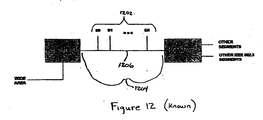
- FIG. 12 there is illustrated a 10M8 system implementing 10M8 compliant devices 1202 on a "shared medium" single-segment network 1204. All compliant devices 1202 are logically connected to the same shared channel on the phonewire 1206. Multiple 10M8 network segments and other network links can be connected through ISO network Data Link Layer (L2 Bridge) or through a Router Gateway (L3).
- the Router Gateway L3 can interconnect a wide-area network link to the in-house 10M8 network 1204. Such wide-area link might be provided via subscriber line (V.90, ISDN, G.992), cable (DOCSIS) or wireless link.
- the L2 Bridge can connect the 10M8 network 1204 with other 10M8 network segments or IEEE 802.3 (10BASE-T, 100 BASE-T) networks.
- the 10M8 network standard is designed to work over "as is" client premises wiring (which is generally a twisted pair) and, therefore, must compete with other technologies and multiple noise sources.
- the present application describes a HomePNA 10M8 compliant transceiver for use in a 10M8 system.
- the present application is organized into transmitter, receiver and channel response sections.
- transmitter and receiver sections only the issues related to digital signal processing are addressed, the issues in link layer, MAC, PHY and AFE are not discussed in detail, however, for a further discussion on these topics and others related to the present invention reference can be made to, Home Phoneline Networking Alliance, Interface Specification for HomePNA 2.0 10M8 Technology, 1999, and later versions, the description of which is hereby incorporated by reference.
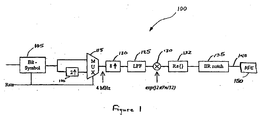
- FIG. 1 there is illustrated a digital signal processing functional block diagram of a transmitter signaling portion (hereinafter referred to as transmitter) 100 of a transceiver in accordance with an exemplary embodiment of the present invention.
- transmitter a transmitter signaling portion
- the data stream is received from a Media Access Controller (MAC) in, for example, a conventional Open System Interconnection type system, and is converted to symbols for filtering and modulation, and terminates at the Infinite Impulse Response (IIR) notch filter block 135.
- MAC Media Access Controller
- IIR Infinite Impulse Response
- the modulated signal at the output 140 of the transmitter path meets or exceeds the PSD mask and temporal mask specified in the 10M8 (Transmitter Electrical Specification).
- the samples at the output 140 of IIR notch 135 are sent to an AFE (analog front end) 150 line interface for digital-to-analog conversion and analog filtering.
- AFE analog front end
- the interface between the digital signal processing core and the AFE 150 is 12 bits operating at 32 MHz sampling rate.
- the highest corner frequency is around 13 MHz, therefore, the sampling rate of the output signal should be higher than 26 MHz.
- the master clock in accordance with the present invention can be advantageously chosen as 32 MHz for convenient up/down conversions.
- Bit-to-symbol mapping is well-known as described in 10M8 section 2.5.
- the sampling rate of the bit-symbol constellation encoder 105 output is either at 2 MHz or 4 MHz depending on the symbol rate defined in the payload encoding (PE) field from the MAC.
- PE payload encoding
- the 2 MHz and 4 MHz outputs are combined at a multiplexor 115 where the 2 MHz output is up converted (110).
- the sampling rate of the output is further converted to the preselected 32 MHz master clock rate by up sampling (120), and the output of the upsampler is coupled to a Low Pass Filter (LPF) 125.
- LPF Low Pass Filter
- the LPF 125 is an asymmetrical Finite Impulse Response (FIR) filter operating at 32 MHz.
- the aysmmetrical FIR is chosen to assist with temperal requirements of the HomePNA specification.
- the filter 125 has 52 real taps. Since the input of the filter is 4 MHz, the filter can be treated as an eight-phase poly-phase filter with 13 taps per phase.
- the complex output of the LPF 125 is modulated to a real pass-band signal centered at 7 MHz by a digital modulator 130.
- the purpose of the LPF 125 is to make the spectrum at the output of the modulator 130 meet the HomePNA Power Spectral Density (PSD) mask requirements at 4, 10 and 13 MHz frequency points without attempting to meet the requirement at 2 and 7 MHz.
- a notch filter 135 resolves the PSD mask requirement at 7 MHz and an analog filter associated with the AFE 150 resolves the 2 MHz PSD mask requirements. This partitioning of the resolution of PSD mask lowers the overall cost for a transceiver.
- the length of the LPF impulse response is constrained to give a sharp envelope rising edge as required in the 10M8 specification section 1.1.3.
- Traditional linear phase symmetrical filters are generally not able to meet this requirement. Therefore, in accordance with the present invention, a FIR filter without linear phase constraint can be designed to meet the specification.
- the frequency and temporal response of an exemplary FIR filter, in accordance with the present invention are shown in Figures 2A and 2B, respectively, and the associated filter tap coefficients, beginning with TAP 0, are as follows:
- the digital modulator 130 receives the base-band complex signal from the LPF 125 output and converts it to a pass-band real signal 132.
- the mathematical operation for 32 MHz sampling rate is as follows:
- the notch filter 135 receives the pass-band real signal 132 and produces the output samples to the AFE 150.
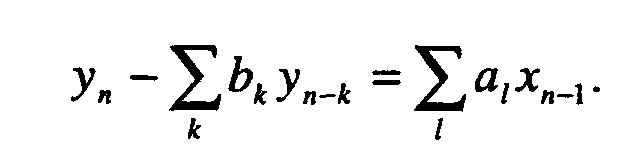
- the IIR notch filter 135 is designed to produce a notch at about 7 MHz to meet the 10M8 PSD specification.
- the sampling rate for the IIR filter 135 is at 32 MHz and exemplary filter tap coefficients are as follows: b 0.649819 a 1 -1.723104 -1.945252 2.811519 3.245981 -3.459699 -3.390466 2.727534 2.553050 -1.605442 -1.370183 0.599372 0.424912 where
- the spectrum and temporal shape of the digitally filtered signal produced by an exemplary embodiment of the notch filter 135 are shown in Figures 3A and 3B.
- the spectrum and temporal shape per the 10M8 specification are shown at 310 and 330, respectively.
- the spectrum and temporal shape of the notch filter output are shown at 320 and 340, respectively.
- the curves are plotted with 12 bit samples operating at 32 MHz.
- receiver 400 receives data from an analog front-end output 402.
- the receiver 400 is implemented in an integrated chip.
- the receiver 400 receives data sampled at 32 MHz, which carries the pass-band signal from the AFE 401.
- a digital demodulator 404 downconverts the pass-band signal received from the AFE 401 to the base-band.
- the down conversion is a linear operation, all the signals and noise are circular shifting in the frequency domain.
- the negative frequency component carries valid information not having to be related to the information in the positive frequency component.
- the ingress at 4 MHz is shifted to -3 MHz; the ingress at 10 MHz is now at 3 MHz; the in-band ingress 7-7.3 MHz is now at 0 - 0.3 MHz; and the ADSL signal at 0-1 MHz is now at -7 to-8 MHz.
- a complex filter operating in the base-band can therefore filter out the RFI ingress, xDSL signal and quantization noise from digital-to-analog conversion processes.
- a raised-cosine (RS) filter 406 operates as a real, low-pass filter in the base-band to effectively filter out the down-converted noise. Since the information only covers from -3 MHz to 3 MHz in the base-band, the sample rate of the RS filter 406 output can be at 8 MHz, although the complex input signal is at 32 MHz from the output of the down-converter. To meet the requirement of immunity to narrow band interference, the stop-band attenuation of the RS filter 406 beyond 3 MHz is, in some embodiments, designed to be less than 50 dB.
- the frequency and impulse response of an exemplary embodiment of the RS filter 406 is shown in Figures 5A and 5B, respectively. Due to the low-pass nature of the RS filter 406, the output can be decimated (408) to 8MHz.
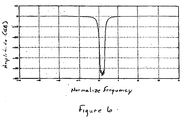
- a receiver notch filter 410 operating at 8 MHz is designed to reject the in-band ingress (7.0-7.3 MHz in the air).
- the stop-band attenuation has to be greater than 50 dB to meet the applicable 10M8 specification section.
- One example of the notch filter is shown in Figure 6.
- the filter 410 is an IIR filter with 7 complex feed forward taps and 6 complex feed back taps.
- the in-band and out-band interference is filtered out.
- the signal is clean except for inter-symbol interference (ISI) which is addressed with decision-feedback equalization described in a later section of the present detailed description.
- ISI inter-symbol interference
- the signal is further used for carrier sensing, collision detection, timing and gain loop control, and adaptive equalization.
- a cross-correlation (Xcor) device 412 operates at 8 MHz output from the receiver notch filter 410. It is to compute the cross correlation function between the incoming signal and the up-sampled (416) 8 MHz native TRN16 signal (414).
- the TRN16 is a 16 symbol white, constant amplitude QPSK sequence which is used in the PHY layer preamble.
- the cross correlation function is used, for example, for carrier sensing, collision detection and adaptive equalization. Noting that the TRN16 signal is orthogonal to any circular shift of itself, i.e. the output of Xcor 412 gives the channel impulse response sampled at 8 MHz, when the TRN16 is received in the signal stream.
- a carrier sensor 418 monitors the output of the cross-correlation function from Xcor 412. Since there are 4 repetitive TRN16s in the preamble, if the valid frame is received, one should expect 4 impulses separated by a 16 symbol-period at the Xcor output as exemplified in Figure 7. Once the 4-impulse pattern appears, it may indicate the starting of a valid frame. The complete carrier sensing function does not finish until the end-of-frame (EOF) signal is received. A valid carrier sensing (CS) frame is confirmed by measuring the applicable properties described in the 10M8 specification. Since missing detection causes much greater damage than false alarming, it is preferable to start the carrier sensing process as soon as the 4 repetitive impulses are detected.
- EAF end-of-frame
- the signal is sent to the inter-frame gap (IFG) as described in the 10M8 specification. Therefore, the latency from receiver 400 to transmitter 100 is bounded by the IFG.
- IFG inter-frame gap
- a collision detection device 420 is used to check if an outgoing transmission signal from an associated transceiver collides with any transmission signals from other stations. For example, when a transceiver sends a signal to the wire, on its receiver path it will receive echoes from the hybrid circuit in the AFE 401. Typically, the hybrid loss is less than -10 dB. Therefore, the received echo signal could be significantly stronger than a colliding signal from another station, for example, that is attenuated by greater than -30 dB.
- the echo signal from the transceiver is removed with an echo cancellor (EC) 422.
- the taps of the echo cancellor 422 are the echo channel's impulse response.
- a preamble starts each transmission frame.
- the echo path is estimated at the beginning of each frame at the Xcor 412 output when the preamble signal is echoed back.
- Transmitter block 426 provides at least the preamble of a transmitted signal that could be echoed back.
- the transmitted signal is subsequently upsampled (424) to 8 MHz.
- the maximum length of the estimated echo channel is 64 8MHz samples and is practically longer than the length of the echo channel.
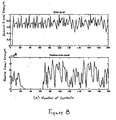
- the power of residue echo is less than -40 dB, as shown in Figure 8.
- the output of echo cancellor 422 is subtracted from the received signal, and the result is applied to the collision detector, which can use conventional techniques to produce a collision detection signal CD.
- a decision-feedback equalizer scheme is used to cancel the channel inter-symbol interface (ISI) from, for example, spectrum nulls that can locate inside the 4 - 10 MHz transmission band due to the multiple reflections from any unterminated stubs.
- ISI channel inter-symbol interface
- 2 and 4Mbauds are specified for different channel conditions.
- the baud rate of the pay-load is not known until the pay-load encoding (PE) field is received. Therefore, two equalizers designed to work at 2 and 4Mbauds have to be trained (432) before the PE field is received.
- the equalizers include a fractional spaced feed forward equalizer (FSE) 430 operating at 8 MHz and a symbol rate based decision feedback equalizer (DFE) 428 operating at 4 or 2 MHz.
- the PE determines whether the DFE 428 operates at 2 or 4 MHz and the FSE 430 is downconverted to 2 or 4 MHz (434) based on the same results.
- Both FSE 430 and DFE 428 are complex filters.
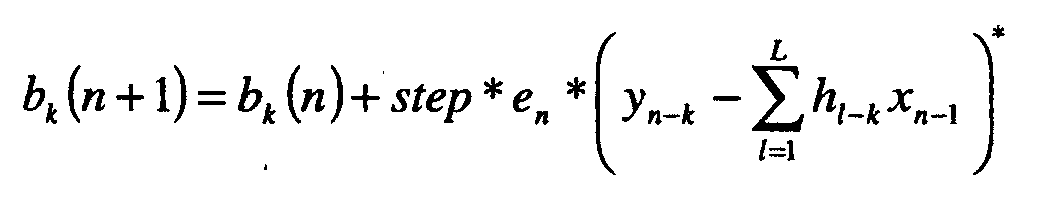
- a received packet can come from a number of different stations. Even if the packet comes from a previous known station, the subsequent channel from that station can vary with time when, for example, the telephone goes on/off hook. Therefore, for each packet, the receiver 400 trains the FSE 430 and DFE 428 during the preamble period before it can decode the header information. However, as discussed above, since the channel impulse response can be obtained at the output of the Xcor 412, fast algorithms can accommodate equalizer training (432) quickly. An exemplary fast training algorithm is described below.
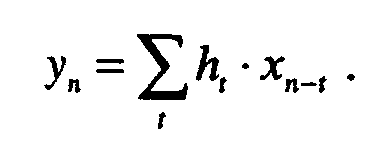
- the signal at the output 437 of the decision feedback-equalizer scheme is and the error at the slicer 436 is
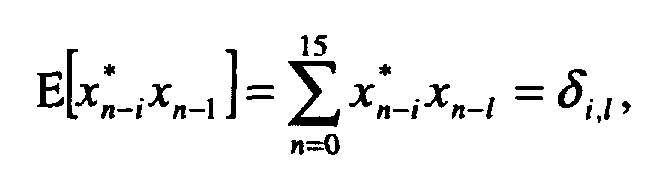
- auto-correlation can be estimated using the TRN16 signal as and the cross-correlation as considering
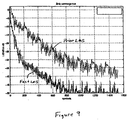
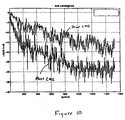
- FIG. 9 A comparison of the convergent speed of the present fast LMS algorithm with an exemplary prior art LMS algorithm is shown in Figures 9 and 10 for 2Mbaud and 4Mbaud equalizers respectively. Both equalizers are initialized with all zeros. As shown in Figure 9, for an equalizer operating at 2Mbaud, it takes 200 2Mbaud symbols for the equalizer converging to 35dB SNR to support the maximum size of 8-bit constellation. However, for a 4Mbaud equalizer, it needs 800 4Mbaud symbols or 400 2Mbaud symbols duration to converge. In both cases the circular repetitive training data are re-circled in the process to take advantage of the unique property of preamble TRN16.
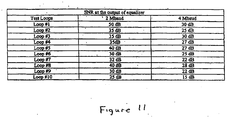
- the 10M8 specification defines ten test loops for evaluating the performance of a 10M8 compliant transceiver.
- the performance of the transceiver according to the present invention was tested (per the 10M8 specification) with a -140 dBm/Hz noise floor and three single-tone interference at 3.75, 7.15, and 10.15 MHz.
- the peak-to-peak voltage for each single-tone interference was 0.28 volts.
- the test performance results are represented in the table shown in Figure 11.
Landscapes
- Engineering & Computer Science (AREA)
- Computer Networks & Wireless Communication (AREA)
- Signal Processing (AREA)
- Automation & Control Theory (AREA)
- Multimedia (AREA)
- Cable Transmission Systems, Equalization Of Radio And Reduction Of Echo (AREA)
- Transceivers (AREA)
- Small-Scale Networks (AREA)
Abstract
Description

| b | 0.649819 | a | 1 |
| -1.723104 | -1.945252 | ||
| 2.811519 | 3.245981 | ||
| -3.459699 | -3.390466 | ||
| 2.727534 | 2.553050 | ||
| -1.605442 | -1.370183 | ||
| 0.599372 | 0.424912 |










Claims (23)
- An apparatus for transceiving a data signal compliant with HomePNA 10M8 technology in an Open System Interconnect network, said apparatus comprising:a transmitter having an input for coupling to an media access control device for receiving a keyed data signal to be transmitted and operably configured to convert said keyed data signal to an encoded signal, said transmitter further operably configured to filter and digitally modulate said encoded signal compliant with HomePNA mask requirements and output said filtered and digitally modulated signal to a first analog front-end device for transmission to a shared medium; anda receiver having an input for coupling to a second analog front-end device for receiving a HomePNA data signal from said shared medium and operably configured to digitally demodulate, filter and decode a pay-load portion of said HomePNA data signal.
- The apparatus of Claim 1, wherein said first analog front-end device and said second analog front-end device are included in a single analog front-end device.
- The apparatus of Claim 1 or Claim 2, wherein said transmitter and said receiver are integrated in an application specific integrated circuit.
- The apparatus of any preceding Claim, wherein said transmitter further comprises an encoder having an input for receiving said keyed data signal and operably configured to encode said received keyed data signal into mapped symbols at a rate defined in a pay-load portion of said keyed data signal.
- The apparatus of any preceding Claim, wherein said transmitter further comprises an asymmetrical finite impulse response (FIR) filter having an input for receiving said encoded signal from an output of said encoder and an output for outputting a base-band complex signal.
- The apparatus of any preceding Claim, further comprising a digital modulator having an input for receiving an output signal from said FIR filter and operably configured to modulate said FIR filter output to a real pass-band signal centered at approximately 7 MHz.
- The apparatus of any preceding Claim, further comprising a notch filter having an input for receiving said real pass-band signal and operably configured to produce a frequency notch at approximately 7 MHz.
- The apparatus of any preceding Claim, wherein said second analog front-end device having an input for coupling to said shared medium and operably configured to sample and filter said HomePNA data signal, and having an output for coupling to said receiver for outputting a pass-band signal responsive to said received HomePNA data signal.
- The apparatus of Claim 8, wherein said receiver further comprises a digital demodulator having an input for receiving said pass-band signal and operably configured to down-convert said pass-band signal to a base-band signal.
- The apparatus of Claim 9, wherein said receiver further comprises a raised-cosine filter having an input for coupling to an output of said digital demodulator for receiving said base-band signal, and operably configured to filter down-converted noise from said base-band signal.
- The apparatus of Claim 10, wherein said receiver further comprises an equalizer having an input for receiving said filtered base-band signal from an output of said real, low-pass filter and operably configured to reduce inter-symbol interference, said equalizer operates at a first and second rate, wherein said operating rate is defined in preamble portion of said HomePNA data signal.
- The apparatus of Claim 11, wherein said equalizer is operably configured to trained reception for a payload portion of said HomePNA data signal.
- A method of transceiving a data signal in a HomePNA 10M8 compliant Open System Interconnect network, said apparatus comprising:in a transmitter path:receiving a data bit stream for transmission from an associated media access controller (MAC);encoding said data bit stream into a symbol signal based on said data bit stream at a first or second symbol rate, wherein said symbol rate is defined in a preamble portion of said data bit stream;filtering said symbol signal to a resultant first base-band signal;digitally modulating said base-band signal to a resultant first pass-band signal centered at approximately 7 MHz;filtering a notch into said first pass-band signal centered at approximately 7 MHz; andsending said first pass-band signal centered and notched at approximately 7 MHz to an analog front end device for transmission to a shared medium; andin a receiver path:receiving a HomePNA data signal from said shared medium;sampling and filtering said HomePNA data signal to a second pass-band signal responsive to said received HomePNA data signal;digitally demodulating said second pass-band signal to a down-converted second base-band signal responsive to said received second pass-band signal;filtering said second base-band signal using a low-pass filtering arrangement, wherein down-converted noise is separated from said second base-band signal;canceling channel inter-symbol interference from said second base-band signal using a dual equalizer arrangement;decoding said second base-band signal subsequent to said noise filtering and said channel inter-symbol interference canceling to a representative bit stream.
- The method of Claim 13, wherein said analog front end device further filters said first pass-band signal to comply with HomePNA mask requirements about a 2 MHz frequency region.
- The method of Claim 13 or Claim 14, wherein said received HomePNA data signal is converted from an analog signal to a digital signal for further processing in said receiver path.
- The method of any of Claims 13 to 16, wherein said transmitter path and said receiver path are integrated in an application specific circuit.
- The method of Claim 13, wherein said dual equalizer arrangement operates to receive a payload portion of said HomePNA data signal at a first and second rate.
- The method of Claim 17, wherein said first rate and said second rate comprise 2 Mbaud and 4 Mbaud, respectively, wherein said operating rate is defined in a pay-load encoding field of said received HomePNA data signal.
- The method of Claim 17, wherein equalizers of said dual equalizer arrangement are trained to receive a pay-load portion of said HomePNA data signal at said first or said second operating rate prior to receiving said pay-load portion, wherein each equalizer can operate at said first or said second operating rate.
- The method of any of Claims 13 to 19 further comprising determining a cross correlation function of said received HomePNA data signal and a predetermined training symbol.
- The method of any of Claims 13 to 21 further comprising, in said receiver path, canceling an echo signal associated with a transmitted signal from said transmitter path.
- The method of any of Claims 13 to 21 further comprising, in said receiver path, detecting a collision between a transmitted signal associated with said transmitter path and other transmitted signals on said shared medium.
- The method of Claim 22, wherein said collision detection further comprises comparing a determined echo signal and said other transmitted signals on said shared medium.
Applications Claiming Priority (2)
| Application Number | Priority Date | Filing Date | Title |
|---|---|---|---|
| US18234900P | 2000-02-14 | 2000-02-14 | |
| US182349P | 2000-02-14 |
Publications (2)
| Publication Number | Publication Date |
|---|---|
| EP1126688A2 true EP1126688A2 (en) | 2001-08-22 |
| EP1126688A3 EP1126688A3 (en) | 2004-12-15 |
Family
ID=22668069
Family Applications (1)
| Application Number | Title | Priority Date | Filing Date |
|---|---|---|---|
| EP01200528A Withdrawn EP1126688A3 (en) | 2000-02-14 | 2001-02-14 | Transceiver for HomePNA network |
Country Status (3)
| Country | Link |
|---|---|
| US (1) | US6922407B2 (en) |
| EP (1) | EP1126688A3 (en) |
| JP (1) | JP2001332995A (en) |
Cited By (5)
| Publication number | Priority date | Publication date | Assignee | Title |
|---|---|---|---|---|
| KR20000072591A (en) * | 2000-09-14 | 2000-12-05 | 송형선 | Internet Service System based on HomePNA Specification |
| EP1337084A2 (en) | 2002-02-15 | 2003-08-20 | Broadcom Corporation | Home networking with backwards compatibility |
| KR100459537B1 (en) * | 2002-11-25 | 2004-12-03 | 한국전자통신연구원 | Apparatus for transmitting/receiving data using HomePNA |
| US6963559B2 (en) | 2001-05-23 | 2005-11-08 | Nokia Corporation | Arrangement of local area network |
| CN100364284C (en) * | 2001-10-22 | 2008-01-23 | 艾闻达通讯公司 | Synthetic voice and data network system with isolating line |
Families Citing this family (35)
| Publication number | Priority date | Publication date | Assignee | Title |
|---|---|---|---|---|
| US6480510B1 (en) | 1998-07-28 | 2002-11-12 | Serconet Ltd. | Local area network of serial intelligent cells |
| US6690677B1 (en) | 1999-07-20 | 2004-02-10 | Serconet Ltd. | Network for telephony and data communication |
| US6549616B1 (en) | 2000-03-20 | 2003-04-15 | Serconet Ltd. | Telephone outlet for implementing a local area network over telephone lines and a local area network using such outlets |
| IL135744A (en) | 2000-04-18 | 2008-08-07 | Mosaid Technologies Inc | Telephone communication system over a single telephone line |
| US6842459B1 (en) | 2000-04-19 | 2005-01-11 | Serconet Ltd. | Network combining wired and non-wired segments |
| WO2001082530A1 (en) * | 2000-04-26 | 2001-11-01 | Koninklijke Philips Electronics N.V. | Residential communication system |
| US7068649B2 (en) * | 2000-08-03 | 2006-06-27 | 2Wire, Inc. | Extended bandwidth homePNA system compatible with homePNA 2.0 |
| US7613823B1 (en) | 2001-02-20 | 2009-11-03 | At&T Intellectual Property Ii, L.P. | Enhanced channel access mechanisms for an HPNA network |
| IL144158A (en) | 2001-07-05 | 2011-06-30 | Mosaid Technologies Inc | Outlet for connecting an analog telephone set to a digital data network carrying voice signals in digital form |
| US7305006B1 (en) | 2001-08-24 | 2007-12-04 | Westell Technologies, Inc. | System for allowing a single device to share multiple transmission lines |
| US7301997B1 (en) * | 2001-09-11 | 2007-11-27 | Vitesse Semiconductor Corporation | Method and apparatus for improved high-speed adaptive equalization |
| IL161190A0 (en) | 2001-10-11 | 2004-08-31 | Serconet Ltd | Outlet with analog signal adapter, method for use thereof and a network using said outlet |
| US7898972B2 (en) * | 2002-01-17 | 2011-03-01 | Agere Systems Inc. | Auxiliary coding for home networking communication system |
| US7251287B1 (en) * | 2002-01-21 | 2007-07-31 | Coppergate Communication Ltd. | Method and system for communication spectral backward compatibility |
| US7324586B2 (en) * | 2002-01-21 | 2008-01-29 | Coppergate Communication, Ltd. | Method and system for communication backward compatibility |
| US7068711B2 (en) * | 2002-03-13 | 2006-06-27 | Agere Systems Inc. | Multi-function equalizer arrangement |
| KR100442877B1 (en) * | 2002-06-15 | 2004-08-06 | 삼성전자주식회사 | Channel Equalizing and Carrier Recovery System for HomePNA receiver, and Method there-of |
| KR100450772B1 (en) * | 2002-11-05 | 2004-10-01 | 한국전자통신연구원 | Apparatus for receiving data in Home Network modem and method thereof |
| IL154234A (en) | 2003-01-30 | 2010-12-30 | Mosaid Technologies Inc | Method and system for providing dc power on local telephone lines |
| IL154921A (en) | 2003-03-13 | 2011-02-28 | Mosaid Technologies Inc | Telephone system having multiple distinct sources and accessories therefor |
| IL157787A (en) | 2003-09-07 | 2010-12-30 | Mosaid Technologies Inc | Modular outlet for data communications network |
| IL159838A0 (en) | 2004-01-13 | 2004-06-20 | Yehuda Binder | Information device |
| IL161869A (en) | 2004-05-06 | 2014-05-28 | Serconet Ltd | System and method for carrying a wireless based signal over wiring |
| US7873058B2 (en) | 2004-11-08 | 2011-01-18 | Mosaid Technologies Incorporated | Outlet with analog signal adapter, a method for use thereof and a network using said outlet |
| US7408949B2 (en) * | 2004-12-01 | 2008-08-05 | Coppergate Communications Ltd. | Hybrid telephone, non-telephone network |
| US7813451B2 (en) | 2006-01-11 | 2010-10-12 | Mobileaccess Networks Ltd. | Apparatus and method for frequency shifting of a wireless signal and systems using frequency shifting |
| WO2009053910A2 (en) | 2007-10-22 | 2009-04-30 | Mobileaccess Networks Ltd. | Communication system using low bandwidth wires |
| US8175649B2 (en) | 2008-06-20 | 2012-05-08 | Corning Mobileaccess Ltd | Method and system for real time control of an active antenna over a distributed antenna system |
| US8837626B2 (en) * | 2011-12-09 | 2014-09-16 | Lsi Corporation | Conditional adaptation of linear filters in a system having nonlinearity |
| CN102232191B (en) | 2009-02-08 | 2015-07-08 | 康宁移动接入有限公司 | Communication system using cables carrying Ethernet signals |
| US20110154420A1 (en) * | 2009-12-17 | 2011-06-23 | Level 3 Communications, Llc | Data Feed Resource Reservation System |
| US9252730B2 (en) * | 2011-07-19 | 2016-02-02 | Mediatek Inc. | Audio processing device and audio systems using the same |
| WO2013142662A2 (en) | 2012-03-23 | 2013-09-26 | Corning Mobile Access Ltd. | Radio-frequency integrated circuit (rfic) chip(s) for providing distributed antenna system functionalities, and related components, systems, and methods |
| US9184960B1 (en) | 2014-09-25 | 2015-11-10 | Corning Optical Communications Wireless Ltd | Frequency shifting a communications signal(s) in a multi-frequency distributed antenna system (DAS) to avoid or reduce frequency interference |
| US10341145B2 (en) * | 2015-03-03 | 2019-07-02 | Intel Corporation | Low power high speed receiver with reduced decision feedback equalizer samplers |
Family Cites Families (13)
| Publication number | Priority date | Publication date | Assignee | Title |
|---|---|---|---|---|
| US6026150A (en) | 1997-10-30 | 2000-02-15 | Epigram | Network protocol--based home entertainment network |
| US6765931B1 (en) * | 1999-04-13 | 2004-07-20 | Broadcom Corporation | Gateway with voice |
| US7933295B2 (en) * | 1999-04-13 | 2011-04-26 | Broadcom Corporation | Cable modem with voice processing capability |
| US6711138B1 (en) * | 1999-09-30 | 2004-03-23 | Conexant Systems, Inc. | Digital subscriber line/home phoneline network router |
| US6754294B1 (en) * | 1999-11-12 | 2004-06-22 | Cornell Research Foundation, Inc. | Dual equalizer for use in an receiver and method of operation |
| US6411657B1 (en) * | 1999-12-30 | 2002-06-25 | Tioga Technologies Inc. | DSL transmitter with digital filtering using a Tomlinson-Harashima precoder |
| WO2001056182A1 (en) * | 2000-01-31 | 2001-08-02 | Texas Instruments Incorporated | Home networking over phone lines |
| US6792049B1 (en) * | 2000-06-15 | 2004-09-14 | Mitsubishi Electric Research Laboratories, Inc. | Digital transceiver system with adaptive channel pre-coding in an asymmetrical communications network |
| US7146104B2 (en) * | 2001-07-05 | 2006-12-05 | Wave7 Optics, Inc. | Method and system for providing a return data path for legacy terminals by using existing electrical waveguides of a structure |
| AU2002364572A1 (en) * | 2001-12-18 | 2003-07-09 | Globespan Virata Incorporated | System and method for rate enhanced shdsl |
| US7152025B2 (en) * | 2002-02-28 | 2006-12-19 | Texas Instruments Incorporated | Noise identification in a communication system |
| US7068711B2 (en) * | 2002-03-13 | 2006-06-27 | Agere Systems Inc. | Multi-function equalizer arrangement |
| KR100469291B1 (en) * | 2003-02-04 | 2005-02-02 | 엘지전자 주식회사 | Timing recovery apparatus |
-
2001
- 2001-02-12 US US09/782,538 patent/US6922407B2/en not_active Expired - Lifetime
- 2001-02-14 JP JP2001081693A patent/JP2001332995A/en active Pending
- 2001-02-14 EP EP01200528A patent/EP1126688A3/en not_active Withdrawn
Cited By (7)
| Publication number | Priority date | Publication date | Assignee | Title |
|---|---|---|---|---|
| US7242732B2 (en) | 1998-10-09 | 2007-07-10 | Broadcom Corporation | Carrier based backwards compatible data networking transmitter, receiver, and signal format |
| KR20000072591A (en) * | 2000-09-14 | 2000-12-05 | 송형선 | Internet Service System based on HomePNA Specification |
| US6963559B2 (en) | 2001-05-23 | 2005-11-08 | Nokia Corporation | Arrangement of local area network |
| CN100364284C (en) * | 2001-10-22 | 2008-01-23 | 艾闻达通讯公司 | Synthetic voice and data network system with isolating line |
| EP1337084A2 (en) | 2002-02-15 | 2003-08-20 | Broadcom Corporation | Home networking with backwards compatibility |
| EP1337084A3 (en) * | 2002-02-15 | 2006-10-04 | Broadcom Corporation | Home networking with backwards compatibility |
| KR100459537B1 (en) * | 2002-11-25 | 2004-12-03 | 한국전자통신연구원 | Apparatus for transmitting/receiving data using HomePNA |
Also Published As
| Publication number | Publication date |
|---|---|
| EP1126688A3 (en) | 2004-12-15 |
| JP2001332995A (en) | 2001-11-30 |
| US20020003835A1 (en) | 2002-01-10 |
| US6922407B2 (en) | 2005-07-26 |
Similar Documents
| Publication | Publication Date | Title |
|---|---|---|
| US6922407B2 (en) | HomePNA 10M8 compliant transceiver | |
| US7254116B2 (en) | Method and apparatus for transceiver noise reduction in a frame-based communications network | |
| CA2322213C (en) | Off-line broadband network interface | |
| EP1033027B1 (en) | Communications methods and apparatus | |
| US6414952B2 (en) | Virtual gateway system and method | |
| US6266367B1 (en) | Combined echo canceller and time domain equalizer | |
| WO1999012330A1 (en) | Home area network system and method | |
| AU7472298A (en) | Method and apparatus for reducing signal processing requirements for transmitting packet-based data with a modem | |
| US6519280B1 (en) | Method and apparatus for inserting idle symbols | |
| US6658049B1 (en) | xDSL repeater system and method | |
| US20070133586A1 (en) | Off-Line Broadband Network Interface | |
| CN101669294A (en) | Method and device for reducing transmission power of packet oriented data and communication system comprising such device | |
| JP2004007401A (en) | Auxiliary coding for home networking communication system | |
| WO2001091507A2 (en) | Pcm upstream and downstream system for universal digital loop carrier | |
| JP2001127828A (en) | ADSL modem | |
| WO2003055159A1 (en) | Method and apparatus for cascaded feedforward filtering in a decision feedback equalizer | |
| WO2001008338A9 (en) | Media converter for data communication on an extended twisted-pair network | |
| WO2026064226A1 (en) | Automotive ethernet using asymmetric concurrent transmission (act) |
Legal Events
| Date | Code | Title | Description |
|---|---|---|---|
| PUAI | Public reference made under article 153(3) epc to a published international application that has entered the european phase |
Free format text: ORIGINAL CODE: 0009012 |
|
| AK | Designated contracting states |
Kind code of ref document: A2 Designated state(s): AT BE CH CY DE DK ES FI FR GB GR IE IT LI LU MC NL PT SE TR |
|
| AX | Request for extension of the european patent |
Free format text: AL;LT;LV;MK;RO;SI |
|
| PUAL | Search report despatched |
Free format text: ORIGINAL CODE: 0009013 |
|
| AK | Designated contracting states |
Kind code of ref document: A3 Designated state(s): AT BE CH CY DE DK ES FI FR GB GR IE IT LI LU MC NL PT SE TR |
|
| AX | Request for extension of the european patent |
Extension state: AL LT LV MK RO SI |
|
| AKX | Designation fees paid | ||
| REG | Reference to a national code |
Ref country code: DE Ref legal event code: 8566 |
|
| STAA | Information on the status of an ep patent application or granted ep patent |
Free format text: STATUS: THE APPLICATION IS DEEMED TO BE WITHDRAWN |
|
| 18D | Application deemed to be withdrawn |
Effective date: 20050616 |