EP1126574A2 - Multi-purpose charging device for batteries - Google Patents
Multi-purpose charging device for batteries Download PDFInfo
- Publication number
- EP1126574A2 EP1126574A2 EP01660017A EP01660017A EP1126574A2 EP 1126574 A2 EP1126574 A2 EP 1126574A2 EP 01660017 A EP01660017 A EP 01660017A EP 01660017 A EP01660017 A EP 01660017A EP 1126574 A2 EP1126574 A2 EP 1126574A2
- Authority
- EP
- European Patent Office
- Prior art keywords
- charging device
- battery
- batteries
- slide
- charged
- Prior art date
- Legal status (The legal status is an assumption and is not a legal conclusion. Google has not performed a legal analysis and makes no representation as to the accuracy of the status listed.)
- Withdrawn
Links
Images


Classifications
-
- H—ELECTRICITY
- H02—GENERATION; CONVERSION OR DISTRIBUTION OF ELECTRIC POWER
- H02J—ELECTRIC POWER NETWORKS; CIRCUIT ARRANGEMENTS OR SYSTEMS FOR SUPPLYING OR DISTRIBUTING ELECTRIC POWER; SYSTEMS FOR STORING ELECTRIC ENERGY
- H02J7/00—Circuit arrangements for charging or discharging batteries or for supplying loads from batteries
- H02J7/70—Circuit arrangements for charging or discharging batteries or for supplying loads from batteries characterised by the mechanical construction
- H02J7/751—Circuit arrangements for charging or discharging batteries or for supplying loads from batteries characterised by the mechanical construction concerning the insertion or the connection of the batteries
-
- H—ELECTRICITY
- H02—GENERATION; CONVERSION OR DISTRIBUTION OF ELECTRIC POWER
- H02J—ELECTRIC POWER NETWORKS; CIRCUIT ARRANGEMENTS OR SYSTEMS FOR SUPPLYING OR DISTRIBUTING ELECTRIC POWER; SYSTEMS FOR STORING ELECTRIC ENERGY
- H02J7/00—Circuit arrangements for charging or discharging batteries or for supplying loads from batteries
- H02J7/40—Circuit arrangements for charging or discharging batteries or for supplying loads from batteries characterised by the exchange of charge or discharge related data
- H02J7/42—Circuit arrangements for charging or discharging batteries or for supplying loads from batteries characterised by the exchange of charge or discharge related data with electronic devices having internal batteries, e.g. mobile phones
Definitions
- the invention relates to a charging device for batteries defined in the preamble of Claim 1.
- the user may need at least one spare battery in addition to the battery in the cellular telephone for changing it to the telephone in a situation that the battery in the cellular telephone gives a notification that it is running out of charge.
- the exhausted battery should then be charged quickly and easily with a suitable device.
- one device manufacturer may have tens of different telephone models with different batteries of different sizes, and several battery models may be suitable for the same cellular telephone, the users must acquire a separate charging device for each type of battery.
- the charging device of one battery type may in some cases be suitable for another type, too, but generally this is not possible with the prior art charging devices. In practice, the prior art operation is difficult and expensive for the user.
- the objectives of the invention are achieved with a battery charging device, in which mechanical adjusters allow the attachment of batteries of different width, length and thickness on the electrical connectors of the charging device for performing the charging.
- the battery charging device for cellular telephones is characterized in what is set forth in the independent claims.
- the electrical connectors needed for charging the batteries are at the first end of the charging device.
- the battery guides on the sides of the connectors of the charging device make sure that the connectors of the battery meet the right connectors in the device.
- the width of the battery to be placed in the charging device influences the width controllers on both sides of the charging device, and the mechanical solution in connection with the width controllers influences the width of the battery guides on the sides of the electrical connectors of the battery charger.
- the stopper After charging, the stopper can be pushed to the bottom of the charging device, whereby the battery can be removed from the device.
- the thickness of batteries to be charged in the charging device can vary, because the thickness of batteries is not restricted by the electric connectors, battery guides or width controllers of the charging device.
- the invention provides the advantage that the same charging device can be used for batteries with different width, length and thickness.
- the invention provides the advantage that the mechanism of the charging device guides the battery to be charged to the electrical contacts automatically and reliably.
- the invention has the advantage that its manufacturing costs are low.
- FIG 1a shows an example of a charging device 10 according to the invention.
- the charging device preferably comprises a cover 11, which is articulated to the device with two hinges 16 at the first end of the charging device.
- the second end of the charging device 10 is open in a way that the battery 15 to be charged can be easily placed in the device.
- the cover 11 can be closed for the duration of charging, and for its part it ensures that the battery 15 to be charged stays in the charging device 10.
- the body of the charging device 10 consists of two parts: the bottom part 12b and the upper part 12a, which are preferably made of plastic by injection moulding.
- the upper part 12a and the bottom part 12b can preferably be connected to each other with fast clips shaped for the parts, by gluing or by some mechanical connecting means.
- Figure la also shows an example of the electrical connectors 17 of the charging device 10, which connectors are of elastic construction so that they spring against the battery connectors and thus ensure a good contact.
- the number of connectors 17 is two or more, preferably four, and they are located close to the first end of the charging device 10.
- Figure la also shows a stopper 14, which is needed when the charging device is used to charge a battery 15, which is short as compared to the total length of the charging device 10.
- FIG. 1b shows an example of a situation in which the charging device is used to charge a battery 15a, which is short as compared to the length of the charging device and narrow as compared to the width of the charging device.
- the battery 15a to be charged is placed in the charging device by pushing it in the direction of the arrow A towards the first end of the charging device 10.
- the shape of these width controllers is preferably a triangle with a cut apex.
- the width controllers are partly located in the body of the charging device, in a space delimited by the upper part 12a and the bottom part 12b so that only the peaks of the width controllers are visible on the sides of the space reserved for the battery 15a.
- the location of the width controllers 19a, 19b in the transverse direction is determined by means of leaf springs 24a, 24b connected to them.
- the leaf springs which are shown in Fig. 2, are entirely located in the body of the charging device in the space between the upper part 12a and the bottom part 12b.
- the leaf springs are fastened at the first end to the upper part 12a and at the second end to the base of the width controllers.
- the wider the battery to be placed in the charging device is, the more the leaf springs 24a, 24b fastened to the width controllers 19a, 19b bend towards the outer edge of the charging device 10.
- the distance between the width controllers 19a, 19b becomes large enough to allow the battery 15a to slip between them.
- the battery 15a presses against the battery guides 18a, 18b, which are located near the first end of the charging device 10, at both edges of the space reserved for the battery.
- the battery guides comprise, on the edges facing each other, guiding surfaces, which form a step-like pattern in the transverse direction of the charging device 10. This enables placing batteries of different width at the right point against the electrical connectors 17 of the charging device.
- the battery guides 18a, 18b are fixed parts of the slide 21 shown in Fig. 2.
- the slide is located in the body of the charging device, whereby only the battery guides 18a, 18b are outwardly visible.
- the slide is not fastened to the charging device as fixed, but it can move in the body in the direction of the longitudinal axis of the body within certain limits.
- the slide is connected with two coil springs 22 in the body, the coil springs are essentially V-shaped, and they impose a force on the slide pushing it away from the first end 21 of the charging device when there is no battery to be charged in the charging device.
- the width controllers 19a, 19b function as locking devices, which determine how the slide 21 and the battery guides 18a, 18b on it can move towards the first end of the charging device 10.
- the sides of the battery do not reach to push the width controllers 19a, 19b sufficiently towards the outer edges of the charging device. Then the width controllers lock the slide 21 in place, whereby the slide and the battery guides 18a, 18b cannot move in the direction of arrow A towards the first end of the charging device.
- the head of the battery to be charged is located in the narrowest gap formed by the closest guiding surfaces of the battery guides, whereby the gap guides the connectors at the end of the battery against the connectors of the charging device 17.
- a short battery 15a is locked in place by a stopper 14 moving up and down.
- the stopper 14 When the battery 15a is pushed towards the electrical connectors 17 of the charging device 10, the stopper 14 is pushed into the body of the charging device.
- the spring 25 pushes the stopper 14 forth, whereby the battery remains pressed between the stopper and the battery guides 18a, 18b.
- the battery 15a has been locked in place to remain stationary.
- the stopper 14 is pushed to the bottom, whereby the battery 15a can be removed from the device.
- a battery with external dimensions as large as the charging device 10 can hold has been placed in the charging device 10.
- the width controllers 19a, 19b are now entirely sunk into the shell parts 12a, 12b, whereby the slide 21 and its battery guides 18a, 18b have been able to move to the extreme position towards the first end of the charging device as pushed by the battery to be placed in the charging device.
- the stopper 14 has been pushed by the battery 15b into the inner space formed by the shell parts 12a, 12b.
- the battery 15b to be charged is supported at the side by the auxiliary guides 13a, 13b.
- the battery thus fills up the space reserved for the battery, it cannot move in the charging device but stays in place reliably.
- the battery is removed from the charging device 10 by lifting it at first up with fingers from the second end of the charging device. After this, the battery 15b can be lifted off the charging device.
- the stopper 14 comes up again and the battery guides 18a, 18b return from the force of the springs 22 to the starting position as far from the first end of the charging device 10 as possible.
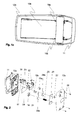
- Fig. 2 shows the parts of a charging device according to the invention as an exploded view.
- the largest single parts that are outwardly visible are the cover 11, the bottom part 12b and the upper part 12a.
- the rest of the parts of the charging device remain either entirely or partly invisible in the space between the bottom part and the upper part.
- the charging device 10 comprises a circuit board 29, which resembles a letter T upside down in Fig. 2, to which connectors 17 for the batteries, a connector 23 of the electrical connector of the charging device and the charging light indicator 35 are connected.
- the slide 21 is arranged to move on the narrow part of the circuit board 29.
- the slide 21 is connected with two V-shaped coil springs 22, which tend to return the slide to a position, which is as far as possible from the first end of the charging device 10.
- the charging device comprises two leaf springs 24a, 24b, which are fastened from their first end to the opposite sides of the outer edges of the upper part 12a, and to the second end of which width controllers 19a, 19b are fastened.
- a coil spring 24 is placed inside the stopper 14.
- the stopper 14 and the circuit board 29 are preferably fastened by means of a board 26 and a screw 27 connected to it to the upper part 12a.
- the board 26 is preferably made of heavy material, such as metal, so as to balance and stabilize the charging device 10.
- the bottom part 12b is connected to the upper part 12a preferably with screws. Four screws are used in the example shown in the drawing.
- Figures 3a and 3b show an example of a charging device according to the invention as seen from the bottom, when the bottom part has been removed.
- Figures 3a and 3b thus show the inner part of the body of the charging device, which is normally hidden.
- the purpose of the drawings is to illustrate how the movement of the slide 21 is adjusted by means of the width controllers 19a, 19b.
- Fig. 3a shows a situation in which there is either no battery in the charging device or the battery in the device is so narrow that its sides do not push the width controllers sufficiently to the direction of the outer edges of the charging device.
- the leaf springs 24a, 24b push the width controllers 19a, 19b towards each other, whereby the claws 30a, 30b in the width controllers are pushed into the dents 32a, 32b on the sides of the slide and thus prevent the movement of the slide towards the first end of the charging device.
- Fig. 3b shows a situation in which there is a wide battery in the charging device, pushing the width controllers 19a, 19b away from each other. Then the claws 30a, 30b move off the dents 32a, 32b and the slide can move towards the first end of the charging device as pushed by the battery.
- Figure 3b shows a situation in which the slide has moved to its extreme position at the first end of the charging device.
- Figures 3a and 3b also show the coil springs 22, the force of which pushes the slide continuously away from the first end of the charging device.
- the slide 21 and the width controllers 19a, 19b are moved back to the position shown in Fig. 3a, as forced by the coil springs 22 and the leaf springs 24a, 24b.
- the same charging device according to the invention can conveniently be used to charge batteries with the following external dimensions: the width of the battery is preferably between 33 and 29 mm, and the length can be between 53 and 72 mm.
Landscapes
- Engineering & Computer Science (AREA)
- Power Engineering (AREA)
- Charge And Discharge Circuits For Batteries Or The Like (AREA)
- Secondary Cells (AREA)
Abstract
The invention relates to a charging device (10) for the batteries of a cellular
telephone, whereby the same device can be used to charge batteries (15) with
different external dimensions. The charging device (10) comprises width controllers
(19a, 19b), the position of which controls the location and position of the actual
battery guides (18a, 18b), which enable batteries of different sizes to get a reliable
contact with the electrical connectors (17) of the charging device. Short batteries are
locked to the charging device by means of a separate stopper (14).
Description
- The invention relates to a charging device for batteries defined in the preamble of Claim 1.
- There are already millions of mobile stations of different cellular networks in use. The use of mobile stations has increased in an explosive scale both in the number of users and the time used by each user. When the use increases, the duration of batteries is in a way critical. New applications are also coming into use, such as the GPRS (General Packet Radio Service) and UTMS (Universal Mobile Telecommunication System), in which the amount of information to be transferred increases substantially. In order to maintain the good quality of data transfer, the power of the transmitter of a cellular telephone must be increased in adverse conditions. The increase of power exhausts the battery of a cellular telephone rapidly. So the user may need at least one spare battery in addition to the battery in the cellular telephone for changing it to the telephone in a situation that the battery in the cellular telephone gives a notification that it is running out of charge. The exhausted battery should then be charged quickly and easily with a suitable device.
- Because one device manufacturer may have tens of different telephone models with different batteries of different sizes, and several battery models may be suitable for the same cellular telephone, the users must acquire a separate charging device for each type of battery. The charging device of one battery type may in some cases be suitable for another type, too, but generally this is not possible with the prior art charging devices. In practice, the prior art operation is difficult and expensive for the user.
- It is an object of this invention to provide a new kind of a charging device for the batteries of cellular telephones, which charging device can be used for batteries of different width, length and thickness.
- The objectives of the invention are achieved with a battery charging device, in which mechanical adjusters allow the attachment of batteries of different width, length and thickness on the electrical connectors of the charging device for performing the charging.
- The battery charging device for cellular telephones according to the invention is characterized in what is set forth in the independent claims.
- Preferred embodiments of the invention are described in the dependent claims.
- The basic idea of the invention is the following: The electrical connectors needed for charging the batteries are at the first end of the charging device. The battery guides on the sides of the connectors of the charging device make sure that the connectors of the battery meet the right connectors in the device. The width of the battery to be placed in the charging device influences the width controllers on both sides of the charging device, and the mechanical solution in connection with the width controllers influences the width of the battery guides on the sides of the electrical connectors of the battery charger. With this method, batteries of different sizes are automatically guided in the right place in the charging device, when they are placed in it. In the longitudinal direction, a stopper has been arranged for batteries of different sizes close to the second end of the charging device to keep the battery in place during charging. After charging, the stopper can be pushed to the bottom of the charging device, whereby the battery can be removed from the device. The thickness of batteries to be charged in the charging device can vary, because the thickness of batteries is not restricted by the electric connectors, battery guides or width controllers of the charging device.
- The invention provides the advantage that the same charging device can be used for batteries with different width, length and thickness.
- In addition, the invention provides the advantage that the mechanism of the charging device guides the battery to be charged to the electrical contacts automatically and reliably.
- Furthermore, the invention has the advantage that its manufacturing costs are low.
- In the following, the invention will be described in more detail with reference to the accompanying drawings, in which
- Figure 1a
- is an exemplary perspective drawing of a charging device according to the invention,
- Figure 1b
- shows a charging device according to the invention from above, when a short and narrow battery has been connected to it for charging,
- Figure 1c
- shows a charging device according to the invention from above, when a long and wide battery has been connected to it for charging,
- Figure 2
- shows the structural parts of a charging device according to the invention as an exploded view,
- Figure 3a
- is an exemplary view of a charging device according to the invention from the bottom, when there is no battery to be charged in the charging device, or the battery to be charged is narrow, and
- Figure 3b
- is an exemplary view of a charging device according to the invention from the bottom, when there is a wide battery to be charged in the charging device.
- Figure 1a shows an example of a
charging device 10 according to the invention. The charging device preferably comprises acover 11, which is articulated to the device with twohinges 16 at the first end of the charging device. The second end of thecharging device 10 is open in a way that thebattery 15 to be charged can be easily placed in the device. Thecover 11 can be closed for the duration of charging, and for its part it ensures that thebattery 15 to be charged stays in thecharging device 10. The body of thecharging device 10 consists of two parts: thebottom part 12b and theupper part 12a, which are preferably made of plastic by injection moulding. Theupper part 12a and thebottom part 12b can preferably be connected to each other with fast clips shaped for the parts, by gluing or by some mechanical connecting means. Figure la also shows an example of theelectrical connectors 17 of thecharging device 10, which connectors are of elastic construction so that they spring against the battery connectors and thus ensure a good contact. The number ofconnectors 17 is two or more, preferably four, and they are located close to the first end of thecharging device 10. Figure la also shows astopper 14, which is needed when the charging device is used to charge abattery 15, which is short as compared to the total length of thecharging device 10. - Figure 1b shows an example of a situation in which the charging device is used to charge a
battery 15a, which is short as compared to the length of the charging device and narrow as compared to the width of the charging device. Thebattery 15a to be charged is placed in the charging device by pushing it in the direction of the arrow A towards the first end of thecharging device 10. When thebattery 15a is placed in the charging device, it meets twowidth controllers upper part 12a and thebottom part 12b so that only the peaks of the width controllers are visible on the sides of the space reserved for thebattery 15a. - The location of the
width controllers leaf springs upper part 12a and thebottom part 12b. The leaf springs are fastened at the first end to theupper part 12a and at the second end to the base of the width controllers. The wider the battery to be placed in the charging device is, the more theleaf springs width controllers charging device 10. As a result of this, the distance between thewidth controllers battery 15a to slip between them. - In the next step, the
battery 15a presses against thebattery guides charging device 10, at both edges of the space reserved for the battery. The battery guides comprise, on the edges facing each other, guiding surfaces, which form a step-like pattern in the transverse direction of thecharging device 10. This enables placing batteries of different width at the right point against theelectrical connectors 17 of the charging device. Thebattery guides slide 21 shown in Fig. 2. The slide is located in the body of the charging device, whereby only thebattery guides coil springs 22 in the body, the coil springs are essentially V-shaped, and they impose a force on the slide pushing it away from thefirst end 21 of the charging device when there is no battery to be charged in the charging device. - The
width controllers slide 21 and the battery guides 18a, 18b on it can move towards the first end of the chargingdevice 10. When there is a narrow battery in the charging device, the sides of the battery do not reach to push thewidth controllers slide 21 in place, whereby the slide and the battery guides 18a, 18b cannot move in the direction of arrow A towards the first end of the charging device. Thus the head of the battery to be charged is located in the narrowest gap formed by the closest guiding surfaces of the battery guides, whereby the gap guides the connectors at the end of the battery against the connectors of the chargingdevice 17. - If a wide battery is placed in the charging device, its sides pushing the
width controllers slide 21, is released. Then theslide 21 can move the maximum distance in the direction of the arrow A towards the first end of the chargingdevice 10, which is the situation in the example of Fig. 1c. Only the furthest guiding surfaces of the battery guides 18a, 18b are then visible, while the inner guiding surfaces are pushed into the body of the charging device. Now the head of the battery to be charged is located in the widest gap formed by the furthest guiding surfaces of the battery guides, and the connectors at the end of the battery are again placed accurately against theconnectors 17 of the charging device. - A
short battery 15a is locked in place by astopper 14 moving up and down. When thebattery 15a is pushed towards theelectrical connectors 17 of the chargingdevice 10, thestopper 14 is pushed into the body of the charging device. When thebattery 15a is in place, thespring 25 pushes thestopper 14 forth, whereby the battery remains pressed between the stopper and the battery guides 18a, 18b. Thus thebattery 15a has been locked in place to remain stationary. When thebattery 15a is removed, thestopper 14 is pushed to the bottom, whereby thebattery 15a can be removed from the device. - In the case shown in Fig. 1c as an example, a battery with external dimensions as large as the charging
device 10 can hold has been placed in the chargingdevice 10. Thewidth controllers shell parts slide 21 and itsbattery guides stopper 14 has been pushed by thebattery 15b into the inner space formed by theshell parts device 10, thebattery 15b to be charged is supported at the side by theauxiliary guides device 10 by lifting it at first up with fingers from the second end of the charging device. After this, thebattery 15b can be lifted off the charging device. Thestopper 14 comes up again and the battery guides 18a, 18b return from the force of thesprings 22 to the starting position as far from the first end of the chargingdevice 10 as possible. - Fig. 2 shows the parts of a charging device according to the invention as an exploded view. The largest single parts that are outwardly visible are the
cover 11, thebottom part 12b and theupper part 12a. The rest of the parts of the charging device remain either entirely or partly invisible in the space between the bottom part and the upper part. The chargingdevice 10 comprises acircuit board 29, which resembles a letter T upside down in Fig. 2, to whichconnectors 17 for the batteries, aconnector 23 of the electrical connector of the charging device and the charginglight indicator 35 are connected. Theslide 21 is arranged to move on the narrow part of thecircuit board 29. Theslide 21 is connected with two V-shaped coil springs 22, which tend to return the slide to a position, which is as far as possible from the first end of the chargingdevice 10. The charging device comprises twoleaf springs upper part 12a, and to the second end of whichwidth controllers stopper 14. Thestopper 14 and thecircuit board 29 are preferably fastened by means of aboard 26 and ascrew 27 connected to it to theupper part 12a. Theboard 26 is preferably made of heavy material, such as metal, so as to balance and stabilize the chargingdevice 10. Thebottom part 12b is connected to theupper part 12a preferably with screws. Four screws are used in the example shown in the drawing. - Figures 3a and 3b show an example of a charging device according to the invention as seen from the bottom, when the bottom part has been removed. Figures 3a and 3b thus show the inner part of the body of the charging device, which is normally hidden. The purpose of the drawings is to illustrate how the movement of the
slide 21 is adjusted by means of thewidth controllers - Fig. 3a shows a situation in which there is either no battery in the charging device or the battery in the device is so narrow that its sides do not push the width controllers sufficiently to the direction of the outer edges of the charging device. In this situation, the
leaf springs width controllers claws dents - Fig. 3b shows a situation in which there is a wide battery in the charging device, pushing the
width controllers claws dents slide 21 and thewidth controllers leaf springs - Due to the invention, the same charging device according to the invention can conveniently be used to charge batteries with the following external dimensions: the width of the battery is preferably between 33 and 29 mm, and the length can be between 53 and 72 mm.
- Some preferred embodiments of the invention have been described above. However, the invention is not limited to the solutions described above. For example, one stopper was mentioned in the preferred embodiment, but more stoppers can be provided to prevent the longitudinal movement of the batteries, whereby it is possible to charge batteries of very different lengths with the same device. In addition, the inventive idea can be applied in many different ways within the scope defined by the attached claims.
Claims (10)
- A charging device (10) for batteries (15, 15a, 15b), which comprises the body of the charging device, which body comprises an upper part (12a) and a bottom part (12b), electrical connectors (17) for charging the batteries (15, 15a, 15b) and battery guides (18a, 18b) for guiding the batteries (15, 15a, 15b) to be charged to the electrical connectors (17), characterized in that the charging device also comprises width controllers (19a, 19b), which are arranged to adapt the distance between the guiding surfaces of the battery guides (18a, 18b) to correspond to the width required by the battery (15, 15a, 15b) to be charged.
- A charging device according to Claim 1, characterized in that there are two leaf springs (24a, 24b) in the upper part (12a) of the charging device for pushing the width controllers (19a, 19b) against the battery to be charged.
- A charging device according to Claim 1, characterized in that the width controllers (19a, 19b) are shaped as triangles with a cut apex, which is arranged to rest against the side of the battery to be charged.
- A charging device according to Claim 1, characterized in that the battery guides (18a, 18b) are a fixed part of a slide (21), which is arranged as moving.
- A charging device according to Claim 1, characterized in that the width controllers (19a, 19b) have claws (30a, 30b) for locking the slide (21) and the battery guides (18a, 18b) of the slide in place.
- A charging device according to Claim 4, characterized in that the slide (21) also comprises two V-shaped coil springs (22) for moving the slide (21) away from the first end of the charging device (10).
- A charging device according to Claim 1, characterized in that it also comprises at least one stopper (14) for fastening the battery to the charging device (10) when the stopper is in the upper position.
- A charging device according to Claim 7, characterized in that the stopper (14) also comprises a spring (25) for controlling the movement of the stopper.
- A charging device according to Claim 1, characterized in that it also comprises a closeable cover (11), which is articulated (16) to the upper part (12a).
- A charging device according to Claim 1, characterized in that the batteries (15, 15a, 15b) to be charged with the charging device are batteries of a cellular telephone.
Applications Claiming Priority (2)
| Application Number | Priority Date | Filing Date | Title |
|---|---|---|---|
| FI20000377A FI20000377A7 (en) | 2000-02-18 | 2000-02-18 | Multi-purpose battery charger |
| FI20000377 | 2000-02-18 |
Publications (1)
| Publication Number | Publication Date |
|---|---|
| EP1126574A2 true EP1126574A2 (en) | 2001-08-22 |
Family
ID=8557610
Family Applications (1)
| Application Number | Title | Priority Date | Filing Date |
|---|---|---|---|
| EP01660017A Withdrawn EP1126574A2 (en) | 2000-02-18 | 2001-01-30 | Multi-purpose charging device for batteries |
Country Status (3)
| Country | Link |
|---|---|
| US (1) | US6337558B2 (en) |
| EP (1) | EP1126574A2 (en) |
| FI (1) | FI20000377A7 (en) |
Cited By (5)
| Publication number | Priority date | Publication date | Assignee | Title |
|---|---|---|---|---|
| EP1311012A2 (en) * | 2001-11-09 | 2003-05-14 | Milwaukee Electric Tool Corporation | Electrical equipment, such as a radio or a audio device, comprising a battery and a locking assembly |
| EP1523081A3 (en) * | 2003-10-10 | 2005-06-15 | R.F. Tech. Co., Ltd. | Portable charger for mobile phones |
| GB2413221A (en) * | 2004-04-06 | 2005-10-19 | Lucent Trans Electronic Co Ltd | Universal battery charging base |
| EP2522064A4 (en) * | 2010-01-07 | 2015-03-04 | Mizco Internat Inc | UNIVERSAL BATTERY CHARGER |
| USD1051039S1 (en) | 2022-09-19 | 2024-11-12 | Hollister Incorporated | Charging dock |
Families Citing this family (12)
| Publication number | Priority date | Publication date | Assignee | Title |
|---|---|---|---|---|
| JP3678188B2 (en) * | 2001-10-09 | 2005-08-03 | ソニー株式会社 | Battery pack charger |
| JP2004158242A (en) * | 2002-11-05 | 2004-06-03 | Alps Electric Co Ltd | Power supply for electronic equipment |
| US7719830B2 (en) * | 2005-05-09 | 2010-05-18 | Apple Inc. | Universal docking station for hand held electronic devices |
| KR20050120874A (en) * | 2004-06-21 | 2005-12-26 | 주식회사 아트랑 | Mobile charger |
| US7688029B2 (en) | 2005-11-08 | 2010-03-30 | Eveready Battery Company, Inc. | Portable battery powered appliance and method of operation |
| US8718717B2 (en) | 2009-07-30 | 2014-05-06 | Orna Vaknin | Public cellular telephone charging station |
| US8482251B2 (en) * | 2009-11-30 | 2013-07-09 | Motorola Solutions, Inc. | Charger device |
| US20130030991A1 (en) * | 2011-07-25 | 2013-01-31 | Ram Electronics | Telecommunications initiated pay per charge system |
| US10243377B2 (en) * | 2013-12-09 | 2019-03-26 | Kenneth E. Clark | Portable multiple mobile electronic device charging station |
| US10003204B2 (en) * | 2013-12-09 | 2018-06-19 | Kenneth E. Clark | Portable multiple mobile electronic device charging station |
| US20190044350A1 (en) * | 2016-10-18 | 2019-02-07 | Phonejuke Inc | Phonejuke Kiosk |
| US20240268042A1 (en) * | 2023-02-08 | 2024-08-08 | Assurant, Inc. | Container for electronic devices |
Family Cites Families (12)
| Publication number | Priority date | Publication date | Assignee | Title |
|---|---|---|---|---|
| US4816735A (en) | 1987-08-10 | 1989-03-28 | Eastman Kodak Company | Battery charger |
| US5059885A (en) | 1989-08-23 | 1991-10-22 | Motorola, Inc. | Battery charger with battery positioning and support apparatus |
| US4963812A (en) | 1989-10-02 | 1990-10-16 | Motorola, Inc. | Battery charger housing for batteries of differing dimensions |
| US5245266A (en) | 1991-11-06 | 1993-09-14 | Yuen Michael M | Battery charger for batteries of differing dimensions |
| US5256954A (en) * | 1992-07-09 | 1993-10-26 | Jeff Chen | Battery pack charging device |
| CN2133939Y (en) | 1992-09-01 | 1993-05-19 | 王福卿 | battery pack charging device |
| JPH0668295U (en) | 1993-02-22 | 1994-09-22 | 怡利電子工業股▲ひん▼有限公司 | Rechargeable battery charger |
| JPH0974686A (en) * | 1995-09-01 | 1997-03-18 | Brother Ind Ltd | Charger |
| US5818197A (en) | 1996-10-30 | 1998-10-06 | Alexander Manufacturing Corp. | Adaptive battery charger with universal interface plate |
| US5742149A (en) | 1997-06-03 | 1998-04-21 | Motorola, Inc. | Adaptable battery charger system |
| US6190795B1 (en) * | 1998-02-09 | 2001-02-20 | Johnson Controls Technology Company | Snap-in battery mounting base |
| US5933330A (en) * | 1998-05-14 | 1999-08-03 | Motorola, Inc. | Portable radiotelephone arrangement having a battery pack and a detachable battery |
-
2000
- 2000-02-18 FI FI20000377A patent/FI20000377A7/en unknown
-
2001
- 2001-01-30 EP EP01660017A patent/EP1126574A2/en not_active Withdrawn
- 2001-02-14 US US09/783,200 patent/US6337558B2/en not_active Expired - Lifetime
Cited By (5)
| Publication number | Priority date | Publication date | Assignee | Title |
|---|---|---|---|---|
| EP1311012A2 (en) * | 2001-11-09 | 2003-05-14 | Milwaukee Electric Tool Corporation | Electrical equipment, such as a radio or a audio device, comprising a battery and a locking assembly |
| EP1523081A3 (en) * | 2003-10-10 | 2005-06-15 | R.F. Tech. Co., Ltd. | Portable charger for mobile phones |
| GB2413221A (en) * | 2004-04-06 | 2005-10-19 | Lucent Trans Electronic Co Ltd | Universal battery charging base |
| EP2522064A4 (en) * | 2010-01-07 | 2015-03-04 | Mizco Internat Inc | UNIVERSAL BATTERY CHARGER |
| USD1051039S1 (en) | 2022-09-19 | 2024-11-12 | Hollister Incorporated | Charging dock |
Also Published As
| Publication number | Publication date |
|---|---|
| FI20000377A7 (en) | 2001-08-19 |
| FI20000377L (en) | 2001-08-18 |
| FI20000377A0 (en) | 2000-02-18 |
| US6337558B2 (en) | 2002-01-08 |
Similar Documents
| Publication | Publication Date | Title |
|---|---|---|
| US6337558B2 (en) | Multi-purpose charging device for batteries | |
| US5664973A (en) | Conductive contact | |
| US5604050A (en) | Latching mechanism and method of latching thereby | |
| CA2037915C (en) | Battery charger with battery guide and support apparatus | |
| CA2231573C (en) | Battery pack having a disconnect switch circuit | |
| US5463688A (en) | Telephone mounting receptacle having opposed retractable latch members | |
| US6774605B2 (en) | Battery pack charging device | |
| CA2178187C (en) | Portable electronic device and method for coupling power thereto | |
| US6068519A (en) | Battery connector | |
| KR19990087155A (en) | Holder for telephone handset, assembly of holder and telephone handset | |
| US11569598B2 (en) | Smart key for vehicle | |
| WO2004049516A1 (en) | Battery connector | |
| US8531156B2 (en) | Battery charger with retractable contacts | |
| EP1028538B1 (en) | Mechanism for holding an integrated circuit card | |
| US20060001400A1 (en) | Battery charger with retention arms | |
| EP1723710B1 (en) | Apparatus for retention of battery in charger | |
| KR200201081Y1 (en) | Cellular-phone battery charger | |
| KR101840645B1 (en) | External battery pack of portable electric device | |
| US8077451B2 (en) | Surface contact card retention assembly | |
| WO2002037804A3 (en) | Communication device with data interface in the charging base station | |
| KR100370649B1 (en) | Charger for portable instrument | |
| CN112909601A (en) | Housing assembly and stacked card holder | |
| KR200206528Y1 (en) | Multi chargeable machine | |
| JPH11250880A (en) | Battery containing structure | |
| KR200157400Y1 (en) | Structure of charger contact terminal |
Legal Events
| Date | Code | Title | Description |
|---|---|---|---|
| PUAI | Public reference made under article 153(3) epc to a published international application that has entered the european phase |
Free format text: ORIGINAL CODE: 0009012 |
|
| AK | Designated contracting states |
Kind code of ref document: A2 Designated state(s): AT BE CH CY DE DK ES FI FR GB GR IE IT LI LU MC NL PT SE TR |
|
| AX | Request for extension of the european patent |
Free format text: AL;LT;LV;MK;RO;SI |
|
| RAP1 | Party data changed (applicant data changed or rights of an application transferred) |
Owner name: NOKIA CORPORATION |
|
| STAA | Information on the status of an ep patent application or granted ep patent |
Free format text: STATUS: THE APPLICATION HAS BEEN WITHDRAWN |
|
| 18W | Application withdrawn |
Withdrawal date: 20021106 |