EP1126408A2 - Detecting embedded information in images - Google Patents
Detecting embedded information in images Download PDFInfo
- Publication number
- EP1126408A2 EP1126408A2 EP01200378A EP01200378A EP1126408A2 EP 1126408 A2 EP1126408 A2 EP 1126408A2 EP 01200378 A EP01200378 A EP 01200378A EP 01200378 A EP01200378 A EP 01200378A EP 1126408 A2 EP1126408 A2 EP 1126408A2
- Authority
- EP
- European Patent Office
- Prior art keywords
- image
- message
- digital image
- embedded
- correlation
- Prior art date
- Legal status (The legal status is an assumption and is not a legal conclusion. Google has not performed a legal analysis and makes no representation as to the accuracy of the status listed.)
- Withdrawn
Links
Images

Classifications
-
- G—PHYSICS
- G06—COMPUTING OR CALCULATING; COUNTING
- G06T—IMAGE DATA PROCESSING OR GENERATION, IN GENERAL
- G06T1/00—General purpose image data processing
- G06T1/0021—Image watermarking
- G06T1/005—Robust watermarking, e.g. average attack or collusion attack resistant
- G06T1/0078—Robust watermarking, e.g. average attack or collusion attack resistant using multiple thresholds
-
- G—PHYSICS
- G06—COMPUTING OR CALCULATING; COUNTING
- G06T—IMAGE DATA PROCESSING OR GENERATION, IN GENERAL
- G06T2201/00—General purpose image data processing
- G06T2201/005—Image watermarking
- G06T2201/0061—Embedding of the watermark in each block of the image, e.g. segmented watermarking
-
- G—PHYSICS
- G06—COMPUTING OR CALCULATING; COUNTING
- G06T—IMAGE DATA PROCESSING OR GENERATION, IN GENERAL
- G06T2201/00—General purpose image data processing
- G06T2201/005—Image watermarking
- G06T2201/0065—Extraction of an embedded watermark; Reliable detection
Definitions
- the invention relates generally to the field of image processing, and in particular to detecting hidden messages embedded in digital images or printed images.
- This field is also referred to as data hiding, data embedding, information hiding, watermarking and also steganography.
- U. S. Patent No. 6,044,156 issued March 28, 2000 to Honsinger et al. entitled Method For Generating An Improved Carrier For Use In An Image Data Embedding Application discloses a technique for embedding messages in digital images data.
- This method for embedding a hidden message into a digitized image includes the steps of: forming a digitized version of the desired message; generating a random phase carrier; convolving the digitized version of the desired message and the random phase carrier to form a dispersed message; and combining the dispersed message with the digitized image to form an image with an embedded hidden message.
- Hidden messages may be embedded in photographic images recorded on film and paper using conventional photographic printing techniques, or they may be embedded in images produced on printers such as ink jet and thermal dye transfer printers, by combining the dispersed message with a digital image using digital image processing techniques.
- the hidden or embedded information can include copyright or proprietor information or other information associated with the digital image.
- the hidden messages are recovered from the image by cross correlating the image containing the dispersed message with a decoding carrier to recover the embedded dispersed message and extracting the digital message data from the recovered dispersed message.
- the above noted need is met according to the present invention by providing a method of detecting an embedded message in a digital image, the embedded message being embedded in periodic blocks in the image, that includes the steps of: selecting a first area in the digital image; selecting a second area in the digital image; performing a correlation between the first and the second image areas; and if the correlation exceeds an predetermined threshold value at at least one pixel location, producing a signal indicating the existence of embedded message in the digital image.
- An advantage of the present invention is that existence of messages embedded in digital images can be detected. Proper warning and measures can be taken for protecting the potential copyright of the digital images.
- Another advantage of the present invention is that the present invention can detect the existence of embedded messages produced by different manufacturers' software.
- the present invention provides a method for detecting the existence of embedded messages in a digital image.
- the digital image can be produced for example by scanning a photographic image in an image scanner and digitizing the signal produced by the scanner.
- Such messages can be embedded by different embedding methods developed by different manufacturers, the only feature that needs to be in common is that the message is embedded in periodic blocks within the image.
- the present invention takes advantage of the fact that many message-embedding was performed in periodic blocks or tiles in the digital image.
- the detection of periodic signals is used as an indication for the existence of embedded information in the digital image.
- the present invention is compatible with many different embedding methods as long as the message is embedded using periodic blocks or tiles.
- One embedding method is discussed below as an example of these embedding methods, however it will be understood that the method of the present invention can be used to detect any message that is embedded using periodic blocks.
- the embedding starts with a digital image I(x,y), a message image M(x,y), and a carrier image C(x,y).
- the message image M(x,y) can include alpha numeric or graphic image objects.
- the carrier image C(x,y) is preferably a random-phase image that is characterized by pixel values randomly distributed in different pixel locations. Details about the carrier image C(x,y) are disclosed in the U.S. Patent No. 6,044,156 which is incorporated herein by reference.
- the preferred form of the convolution operation is circular convolution as described in "Digital Signal Processing" by Alan V. Oppenheim and Ronald W. Schafer, Prentice-Hall, Inc., pages 101-115, which can be efficiently performed in either the space domain (image domain) or the Fourier frequency domain.
- the dispersed message S(x,y) is added, pixel by pixel, to the input digital image I(x,y), in a block or tile wise fashion to produce the digital image I'(x,y) having the embedded dispersed message: wherein the indices (i, j) are integers denoting the two dimensional coordinates of the digital image.
- the blocks of the dispersed message S i,j (x,y)'s are distributed in a spatially periodic fashion, that is, the dispersed messages is repeated periodically in both dimensions of the digital image I'(x,y).
- the dispersed image S(x,y) can exist in many different shapes such as square, triangular, hexagon, or irregular shapes, that can repeat themselves in a periodic fashion in two dimensions.
- the present invention uses the periodic nature of the dispersed image in I'(x,y), used by many embedding programs, for detecting the existence of such embedded information.
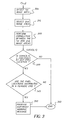
- the detection process starts with selecting a first image area and a second image in the digital image that potentially contains embedded information (boxes 300, 310).
- the first and the second image areas can be from different portions of the image or can be from the identical areas.
- the first and the second image areas might be selected from different digital images received from the same image source, since they may carry the same embedded message.
- a correlation is performed between the two image areas in box 320.
- the correlation is performed in two dimensions as shown in Equation (3) below. If the two image areas are selected from the same area, this operation is simply an autocorrelation. If the digital image I'(x,y) contains information embedded as described in Equation (1). Then we have
- the correlation is characterized by a plurality of delta-function peaks that are distributed in a periodic one-dimensional or two-dimensional array.
- the parameters a, and b are periods of the array along each image dimension; p and q are the offsets; Aij 's are the amplitude of the delta-function peaks, that are related to the amplitude or strength of the embedding signal.
- the background noise is dependent on the source image I(x , y) . Due to the background noise, a threshold value needs to be set for a positive detection of the delta-function peaks. In the present invention, the typical threshold is set at 3 times the root-mean square of the background noise.
- the digital image to be examined may be scanned and digitized from an image on a receiver.
- the delta-function peaks will likely suffer a certain degree of a degradation such as broadening of the peak and reduction in the peak height.
- all these peaks are referred to as delta function peaks. Their validity is determined by comparing to the threshold values.
- a question is asked whether there is any pixel location at which the correlation is above the threshold. If such pixel locations are not found, embedded information is not detected and the detection ends in box 360. If there are plurality of pixel locations having correlation values above threshold, these pixel locations are determined in box 340 whether they are distributed in a periodic array. If they are not, the detection is not confirmed and ends in box 360. This assures that there is no false detection in the embedded signal. If the pixel locations are distributed in a periodic array, they are consistent with the properties as described in Equation (3). Embedded signal is confirmed to exist in the digital image. A signal is produced indicating that copyright or other information is embedded in such an image. Alternatively, the signal indicating the existence of an embedded message can be produced if the correlation exceeds the predetermined threshold at at least one pixel location.
- the detection method may be performed by a programmed computer. Properties that characterize the specific features of the embedding programs from different manufacturers can be stored on the computer where the detection program is run. For example, the periods ( a and b in eEquation (3)) are typically different for different manufacturers. The periods in one of the one-dimensional or two-dimensional arrays are in the range of 16 to 2048 pixels. If the digital image I'(x,y) is scanned from an image on a receiver, the periods in of the one-dimensional or the two-dimensional array correspond to 0.05 inch to 5 inch on the receiver. In addition, the amplitudes Aij 's of the delta function peaks are often different for different manufacturers.
- These pre-stored properties can be used to provide indications to the source of the embedding programs, that is, which manufacturer's program is used to embed the message.
- the periods ( a and b ) and the amplitudes Aij' s are compared to the pre-stored properties. If the properties match with a manufacturer's profile, an electronic message can be sent to an electronic address for that specific manufacturer to notify the detection of the embedded message.
- the detection of the embedded message signal can be used to generate a warning that indicates that the image may be copyright protected.
- the use of the digital image can be restricted unless proper authorization is provided.
- the detection program, the pre-stored properties, and programs for managing authorization of image use are stored on a computer connected to an imaging device or within an imaging device.
- An imaging device can be a kiosk, a printer, a display, a printer and the like that all can produce visual images and/or process digital images. Users can view or produce the images in the form of an imaging service.
- the notification and authorization can all be communicated over the Internet and managed by a service provider or the manufacturer itself.
- the present invention is preferably practiced in an image processing system including a source of digital images, such as a scanner, a computer programmed to process digital images, and an output device such as a thermal or inkjet printer.
- the method of the present invention may be sold as a computer program product including a computer readable storage medium bearing computer code for implementing the steps of the invention.
- Computer readable storage medium may include, for example; magnetic storage media such as a magnetic disc (e.g. a floppy disc) or magnetic tape; optical storage media such as optical disc or optical tape; bar code; solid state electronic storage devices such as random access memory (RAM) or read only memory (ROM); or any other physical device or medium employed to store a computer program.
Landscapes
- Physics & Mathematics (AREA)
- General Physics & Mathematics (AREA)
- Engineering & Computer Science (AREA)
- Theoretical Computer Science (AREA)
- Editing Of Facsimile Originals (AREA)
- Image Processing (AREA)
- Image Analysis (AREA)
- Alarm Systems (AREA)
- Television Systems (AREA)
Abstract
Description


Claims (17)
- A method of detecting an embedded message in a digital image, the embedded message being embedded in periodic blocks in the image, comprising the steps of:a) selecting a first area in the digital image;b) selecting a second area in the digital image;c) performing a correlation between the first and the second image areas; andd) if the correlation exceeds a predetermined threshold value at at least one pixel location, producing a signal indicating the existence of embedded message in the digital image.
- The method of claim 1 wherein the correlation between the first image and the second image areas is performed in two-dimensions.
- The method of claim 1 wherein a same area is selected for the first and the second image areas in the digital image, thereby providing an autocorrelation of the area.
- The method of claim 1 wherein there are at least two digital images and the first image and the second image areas are selected from the two different digital images.
- The method of claim 1 wherein the signal is produced when the correlation exceeds the predetermined threshold value at a plurality of pixel locations.
- The method of claim 5 wherein the plurality of pixel locations are distributed in a one-dimensional or a two-dimensional array.
- The method of claim 6 wherein the periods in of the one-dimensional or two-dimensional array are in the range of 16 to 2048 pixels.
- The method of claim 1 wherein the digital image is scanned and digitized by a scanner from an image printed on a receiver.
- The method of claim 8 wherein the correlation exceeds the predetermined threshold value at a plurality of locations and such plurality of locations are distributed in a one-dimensional or a two-dimensional array.
- The method of claim 9 wherein the periods in of the one-dimensional or the two-dimensional array correspond to 0.05 inch to 5 inch on the receiver
- The method of claim 1 wherein the signal is employed to generate a warning that the image may be copyright protected.
- The method of claim 1 wherein the signal is used to restrict the use of the digital image without proof of proper authorization.
- The method of claim 1 further including the step of sending a notification to a copyright holder requesting permission for the use of copyright images.
- The method of claim 13 wherein the step of sending the message to the copyright holder includes sending the message to an electronic address associated with the copyright holder.
- The method of claim 13 wherein the step of sending the message to the copyright holder includes pre-storing properties of the correlation functions from different manufacturers, determining the manufacturer whose embedding software produced the embedded message using the pre-stored properties, and sending the message to the manufacturer.
- A computer readable storage medium having instructions stored therein for causing a computer to perform the method of claim 1.
- Apparatus for detecting an embedded message in a digital image, the embedded message being embedded in periodic blocks in the image, comprising:a) means for selecting a first area in the digital image;b) means for selecting a second area in the digital image;c) means for performing a correlation between the first and the second image areas; andd) means responsive to the correlation exceeding a predetermined threshold value at at least one pixel location, for producing a signal indicating the existence of embedded message in the digital image.
Applications Claiming Priority (2)
| Application Number | Priority Date | Filing Date | Title |
|---|---|---|---|
| US09/505,327 US6754365B1 (en) | 2000-02-16 | 2000-02-16 | Detecting embedded information in images |
| US505327 | 2000-02-16 |
Publications (2)
| Publication Number | Publication Date |
|---|---|
| EP1126408A2 true EP1126408A2 (en) | 2001-08-22 |
| EP1126408A3 EP1126408A3 (en) | 2003-08-13 |
Family
ID=24009880
Family Applications (1)
| Application Number | Title | Priority Date | Filing Date |
|---|---|---|---|
| EP01200378A Withdrawn EP1126408A3 (en) | 2000-02-16 | 2001-02-05 | Detecting embedded information in images |
Country Status (3)
| Country | Link |
|---|---|
| US (1) | US6754365B1 (en) |
| EP (1) | EP1126408A3 (en) |
| JP (1) | JP2001285624A (en) |
Cited By (2)
| Publication number | Priority date | Publication date | Assignee | Title |
|---|---|---|---|---|
| WO2003049422A1 (en) | 2001-12-03 | 2003-06-12 | Fuso Precision Co., Ltd. | Digital data false alteration detection program and digital data false alteration detection apparatus |
| CN103745428A (en) * | 2014-01-23 | 2014-04-23 | 中国科学院电子学研究所 | Image information hiding method based on radar signal spreading |
Families Citing this family (29)
| Publication number | Priority date | Publication date | Assignee | Title |
|---|---|---|---|---|
| US6424725B1 (en) * | 1996-05-16 | 2002-07-23 | Digimarc Corporation | Determining transformations of media signals with embedded code signals |
| US7190251B2 (en) * | 1999-05-25 | 2007-03-13 | Varatouch Technology Incorporated | Variable resistance devices and methods |
| US8924506B2 (en) * | 2000-12-27 | 2014-12-30 | Bradium Technologies Llc | Optimized image delivery over limited bandwidth communication channels |
| JP2002232685A (en) * | 2001-01-31 | 2002-08-16 | Canon Inc | Digital watermark processing device, information processing device, digital content distribution system, digital watermark insertion method, and storage medium |
| US7474772B2 (en) * | 2003-06-25 | 2009-01-06 | Atrua Technologies, Inc. | System and method for a miniature user input device |
| US7587072B2 (en) * | 2003-08-22 | 2009-09-08 | Authentec, Inc. | System for and method of generating rotational inputs |
| US7330561B2 (en) * | 2003-11-19 | 2008-02-12 | Eastman Kodak Company | Optimal templates for image data embedding |
| US7697729B2 (en) * | 2004-01-29 | 2010-04-13 | Authentec, Inc. | System for and method of finger initiated actions |
| WO2005079413A2 (en) * | 2004-02-12 | 2005-09-01 | Atrua Technologies, Inc. | System and method of emulating mouse operations using finger image sensors |
| US7831070B1 (en) | 2005-02-18 | 2010-11-09 | Authentec, Inc. | Dynamic finger detection mechanism for a fingerprint sensor |
| US8231056B2 (en) | 2005-04-08 | 2012-07-31 | Authentec, Inc. | System for and method of protecting an integrated circuit from over currents |
| US7505613B2 (en) * | 2005-07-12 | 2009-03-17 | Atrua Technologies, Inc. | System for and method of securing fingerprint biometric systems against fake-finger spoofing |
| US20070061126A1 (en) * | 2005-09-01 | 2007-03-15 | Anthony Russo | System for and method of emulating electronic input devices |
| US7940249B2 (en) * | 2005-11-01 | 2011-05-10 | Authentec, Inc. | Devices using a metal layer with an array of vias to reduce degradation |
| WO2007097979A2 (en) * | 2006-02-10 | 2007-08-30 | Atrua Technologies, Inc. | Systems using variable resistance zones and stops for generating inputs to an electronic device |
| US7885436B2 (en) * | 2006-07-13 | 2011-02-08 | Authentec, Inc. | System for and method of assigning confidence values to fingerprint minutiae points |
| US9235274B1 (en) | 2006-07-25 | 2016-01-12 | Apple Inc. | Low-profile or ultra-thin navigation pointing or haptic feedback device |
| US8023160B2 (en) * | 2008-09-10 | 2011-09-20 | Xerox Corporation | Encoding message data in a cover contone image via halftone dot orientation |
| US8014035B2 (en) * | 2008-09-10 | 2011-09-06 | Xerox Corporation | Decoding message data embedded in an image print via halftone dot orientation |
| US8866347B2 (en) | 2010-01-15 | 2014-10-21 | Idex Asa | Biometric image sensing |
| US8791792B2 (en) | 2010-01-15 | 2014-07-29 | Idex Asa | Electronic imager using an impedance sensor grid array mounted on or about a switch and method of making |
| US8421890B2 (en) | 2010-01-15 | 2013-04-16 | Picofield Technologies, Inc. | Electronic imager using an impedance sensor grid array and method of making |
| US20130191366A1 (en) * | 2012-01-23 | 2013-07-25 | Microsoft Corporation | Pattern Matching Engine |
| US20130188712A1 (en) * | 2012-01-24 | 2013-07-25 | Futurewei Technologies, Inc. | Compressed Domain Watermarking with Reduced Error Propagation |
| EP2836960B1 (en) | 2012-04-10 | 2018-09-26 | Idex Asa | Biometric sensing |
| EP3259723A4 (en) | 2015-02-19 | 2018-07-18 | Visa International Service Association | Steganographic image on portable device |
| US9846982B2 (en) * | 2015-10-30 | 2017-12-19 | Ncr Corporation | Document geometric deformation watermarking and tracking |
| CN106909854A (en) * | 2017-01-20 | 2017-06-30 | 奇酷互联网络科技(深圳)有限公司 | Picture management method, device and mobile terminal |
| CN109859092B (en) * | 2019-01-21 | 2023-05-12 | 深圳前海微众银行股份有限公司 | Information hiding method, device, equipment and computer readable storage medium |
Family Cites Families (9)
| Publication number | Priority date | Publication date | Assignee | Title |
|---|---|---|---|---|
| US5721788A (en) * | 1992-07-31 | 1998-02-24 | Corbis Corporation | Method and system for digital image signatures |
| US5636292C1 (en) | 1995-05-08 | 2002-06-18 | Digimarc Corp | Steganography methods employing embedded calibration data |
| DE19520232C1 (en) * | 1995-06-01 | 1996-08-14 | Siemens Ag | Method for encrypting sequences consisting of number-coded information units |
| US5859920A (en) | 1995-11-30 | 1999-01-12 | Eastman Kodak Company | Method for embedding digital information in an image |
| KR20000029626A (en) * | 1997-05-29 | 2000-05-25 | 요트.게.아. 롤페즈 | Method and arrangement for detecting a watermark |
| DE69836455T2 (en) * | 1997-08-20 | 2007-03-29 | Canon K.K. | Electronic watermarking system, electronic information distribution system and device for storing images |
| JPH11232779A (en) * | 1997-11-20 | 1999-08-27 | Toshiba Corp | Copy protection device |
| US6263086B1 (en) * | 1998-04-15 | 2001-07-17 | Xerox Corporation | Automatic detection and retrieval of embedded invisible digital watermarks from halftone images |
| JP3214554B2 (en) * | 1998-05-06 | 2001-10-02 | 日本電気株式会社 | Digital watermark system, digital watermark insertion device, and electronic image demodulation device |
-
2000
- 2000-02-16 US US09/505,327 patent/US6754365B1/en not_active Expired - Fee Related
-
2001
- 2001-02-05 EP EP01200378A patent/EP1126408A3/en not_active Withdrawn
- 2001-02-15 JP JP2001038210A patent/JP2001285624A/en active Pending
Cited By (5)
| Publication number | Priority date | Publication date | Assignee | Title |
|---|---|---|---|---|
| WO2003049422A1 (en) | 2001-12-03 | 2003-06-12 | Fuso Precision Co., Ltd. | Digital data false alteration detection program and digital data false alteration detection apparatus |
| EP1453298A4 (en) * | 2001-12-03 | 2007-04-25 | Fuso Prec Co Ltd | PROGRAM FOR DETECTION OF DAMAGE TO DIGITAL DATA AND APPARATUS FOR DETECTING DAMAGE TO DIGITAL DATA |
| US7840007B2 (en) | 2001-12-03 | 2010-11-23 | Fuso Precision Co., Ltd. | Digital data false alteration detection program and digital data false alteration detection apparatus |
| CN103745428A (en) * | 2014-01-23 | 2014-04-23 | 中国科学院电子学研究所 | Image information hiding method based on radar signal spreading |
| CN103745428B (en) * | 2014-01-23 | 2017-03-29 | 中国科学院电子学研究所 | A kind of Image Hiding extended based on radar signal |
Also Published As
| Publication number | Publication date |
|---|---|
| JP2001285624A (en) | 2001-10-12 |
| US6754365B1 (en) | 2004-06-22 |
| EP1126408A3 (en) | 2003-08-13 |
Similar Documents
| Publication | Publication Date | Title |
|---|---|---|
| EP1126408A2 (en) | Detecting embedded information in images | |
| Barni et al. | A new decoder for the optimum recovery of nonadditive watermarks | |
| Cox et al. | Secure spread spectrum watermarking for images, audio and video | |
| US6246775B1 (en) | Method and appartus for superposing a digital watermark and method and apparatus for detecting a digital watermark | |
| Low et al. | Document identification for copyright protection using centroid detection | |
| US8243982B2 (en) | Embedding information in document border space | |
| Cox et al. | Secure spread spectrum watermarking for multimedia | |
| US8224019B2 (en) | Embedding information in document blank space | |
| US8335342B2 (en) | Protecting printed items intended for public exchange with information embedded in blank document borders | |
| JP5552528B2 (en) | Method and device for securing documents | |
| US7031493B2 (en) | Method for generating and detecting marks | |
| US5835639A (en) | Method for detecting rotation and magnification in images | |
| US8373895B2 (en) | Prevention of unauthorized copying or scanning | |
| JP4296126B2 (en) | Screen creation device | |
| JP2002305646A (en) | Image processor and image forming device | |
| Honsinger | Data embedding using phase dispersion | |
| Barni et al. | A MAP identification criterion for DCT-based watermarking | |
| KR100772754B1 (en) | Method and Apparatus for inserting and detecting watermarks in images derived from a source image | |
| Mahmoud et al. | Frequency domain watermarking: An overview. | |
| EP1096782A2 (en) | Image processing apparatus and method, and storage medium therefor | |
| EP1120741A2 (en) | Adaptive data embedding method for improved image quality | |
| EP1107183B1 (en) | Method and computer program for detecting rotation and magnification of images | |
| Armeni et al. | A transparent watermarking method for color images | |
| Chotikakamthorn et al. | Ring-shaped digital watermark for rotated and scaled images using random-phase sinusoidal function | |
| Mooney et al. | Optical and digital technique for watermark detection |
Legal Events
| Date | Code | Title | Description |
|---|---|---|---|
| PUAI | Public reference made under article 153(3) epc to a published international application that has entered the european phase |
Free format text: ORIGINAL CODE: 0009012 |
|
| AK | Designated contracting states |
Kind code of ref document: A2 Designated state(s): AT BE CH CY DE DK ES FI FR GB GR IE IT LI LU MC NL PT SE TR |
|
| AX | Request for extension of the european patent |
Free format text: AL;LT;LV;MK;RO;SI |
|
| PUAL | Search report despatched |
Free format text: ORIGINAL CODE: 0009013 |
|
| AK | Designated contracting states |
Designated state(s): AT BE CH CY DE DK ES FI FR GB GR IE IT LI LU MC NL PT SE TR |
|
| AX | Request for extension of the european patent |
Extension state: AL LT LV MK RO SI |
|
| 17P | Request for examination filed |
Effective date: 20040115 |
|
| AKX | Designation fees paid |
Designated state(s): DE FR GB |
|
| 17Q | First examination report despatched |
Effective date: 20040723 |
|
| STAA | Information on the status of an ep patent application or granted ep patent |
Free format text: STATUS: THE APPLICATION IS DEEMED TO BE WITHDRAWN |
|
| 18D | Application deemed to be withdrawn |
Effective date: 20041203 |