EP1126016A2 - Solvent compositions - Google Patents
Solvent compositions Download PDFInfo
- Publication number
- EP1126016A2 EP1126016A2 EP01101783A EP01101783A EP1126016A2 EP 1126016 A2 EP1126016 A2 EP 1126016A2 EP 01101783 A EP01101783 A EP 01101783A EP 01101783 A EP01101783 A EP 01101783A EP 1126016 A2 EP1126016 A2 EP 1126016A2
- Authority
- EP
- European Patent Office
- Prior art keywords
- ocf
- difluoromethoxy
- hcf
- tetrafluoroethyl
- difluoromethyl ether
- Prior art date
- Legal status (The legal status is an assumption and is not a legal conclusion. Google has not performed a legal analysis and makes no representation as to the accuracy of the status listed.)
- Granted
Links
Classifications
-
- C—CHEMISTRY; METALLURGY
- C08—ORGANIC MACROMOLECULAR COMPOUNDS; THEIR PREPARATION OR CHEMICAL WORKING-UP; COMPOSITIONS BASED THEREON
- C08J—WORKING-UP; GENERAL PROCESSES OF COMPOUNDING; AFTER-TREATMENT NOT COVERED BY SUBCLASSES C08B, C08C, C08F, C08G or C08H
- C08J9/00—Working-up of macromolecular substances to porous or cellular articles or materials; After-treatment thereof
- C08J9/04—Working-up of macromolecular substances to porous or cellular articles or materials; After-treatment thereof using blowing gases generated by a previously added blowing agent
- C08J9/12—Working-up of macromolecular substances to porous or cellular articles or materials; After-treatment thereof using blowing gases generated by a previously added blowing agent by a physical blowing agent
- C08J9/14—Working-up of macromolecular substances to porous or cellular articles or materials; After-treatment thereof using blowing gases generated by a previously added blowing agent by a physical blowing agent organic
- C08J9/149—Mixtures of blowing agents covered by more than one of the groups C08J9/141 - C08J9/143
-
- C—CHEMISTRY; METALLURGY
- C11—ANIMAL OR VEGETABLE OILS, FATS, FATTY SUBSTANCES OR WAXES; FATTY ACIDS THEREFROM; DETERGENTS; CANDLES
- C11D—DETERGENT COMPOSITIONS; USE OF SINGLE SUBSTANCES AS DETERGENTS; SOAP OR SOAP-MAKING; RESIN SOAPS; RECOVERY OF GLYCEROL
- C11D7/00—Compositions of detergents based essentially on non-surface-active compounds
- C11D7/50—Solvents
- C11D7/5036—Azeotropic mixtures containing halogenated solvents
- C11D7/504—Azeotropic mixtures containing halogenated solvents all solvents being halogenated hydrocarbons
- C11D7/5063—Halogenated hydrocarbons containing heteroatoms, e.g. fluoro alcohols
-
- C—CHEMISTRY; METALLURGY
- C08—ORGANIC MACROMOLECULAR COMPOUNDS; THEIR PREPARATION OR CHEMICAL WORKING-UP; COMPOSITIONS BASED THEREON
- C08J—WORKING-UP; GENERAL PROCESSES OF COMPOUNDING; AFTER-TREATMENT NOT COVERED BY SUBCLASSES C08B, C08C, C08F, C08G or C08H
- C08J2203/00—Foams characterized by the expanding agent
- C08J2203/12—Organic compounds only containing carbon, hydrogen and oxygen atoms, e.g. ketone or alcohol
-
- C—CHEMISTRY; METALLURGY
- C08—ORGANIC MACROMOLECULAR COMPOUNDS; THEIR PREPARATION OR CHEMICAL WORKING-UP; COMPOSITIONS BASED THEREON
- C08J—WORKING-UP; GENERAL PROCESSES OF COMPOUNDING; AFTER-TREATMENT NOT COVERED BY SUBCLASSES C08B, C08C, C08F, C08G or C08H
- C08J2203/00—Foams characterized by the expanding agent
- C08J2203/14—Saturated hydrocarbons, e.g. butane; Unspecified hydrocarbons
-
- C—CHEMISTRY; METALLURGY
- C08—ORGANIC MACROMOLECULAR COMPOUNDS; THEIR PREPARATION OR CHEMICAL WORKING-UP; COMPOSITIONS BASED THEREON
- C08J—WORKING-UP; GENERAL PROCESSES OF COMPOUNDING; AFTER-TREATMENT NOT COVERED BY SUBCLASSES C08B, C08C, C08F, C08G or C08H
- C08J2203/00—Foams characterized by the expanding agent
- C08J2203/14—Saturated hydrocarbons, e.g. butane; Unspecified hydrocarbons
- C08J2203/142—Halogenated saturated hydrocarbons, e.g. H3C-CF3
-
- C—CHEMISTRY; METALLURGY
- C08—ORGANIC MACROMOLECULAR COMPOUNDS; THEIR PREPARATION OR CHEMICAL WORKING-UP; COMPOSITIONS BASED THEREON
- C08J—WORKING-UP; GENERAL PROCESSES OF COMPOUNDING; AFTER-TREATMENT NOT COVERED BY SUBCLASSES C08B, C08C, C08F, C08G or C08H
- C08J2203/00—Foams characterized by the expanding agent
- C08J2203/14—Saturated hydrocarbons, e.g. butane; Unspecified hydrocarbons
- C08J2203/146—Saturated hydrocarbons containing oxygen and halogen atoms, e.g. F3C-O-CH2-CH3
-
- C—CHEMISTRY; METALLURGY
- C11—ANIMAL OR VEGETABLE OILS, FATS, FATTY SUBSTANCES OR WAXES; FATTY ACIDS THEREFROM; DETERGENTS; CANDLES
- C11D—DETERGENT COMPOSITIONS; USE OF SINGLE SUBSTANCES AS DETERGENTS; SOAP OR SOAP-MAKING; RESIN SOAPS; RECOVERY OF GLYCEROL
- C11D2111/00—Cleaning compositions characterised by the objects to be cleaned; Cleaning compositions characterised by non-standard cleaning or washing processes
- C11D2111/10—Objects to be cleaned
- C11D2111/14—Hard surfaces
- C11D2111/22—Electronic devices, e.g. PCBs or semiconductors
-
- C—CHEMISTRY; METALLURGY
- C11—ANIMAL OR VEGETABLE OILS, FATS, FATTY SUBSTANCES OR WAXES; FATTY ACIDS THEREFROM; DETERGENTS; CANDLES
- C11D—DETERGENT COMPOSITIONS; USE OF SINGLE SUBSTANCES AS DETERGENTS; SOAP OR SOAP-MAKING; RESIN SOAPS; RECOVERY OF GLYCEROL
- C11D7/00—Compositions of detergents based essentially on non-surface-active compounds
- C11D7/22—Organic compounds
- C11D7/28—Organic compounds containing halogen
Definitions
- the present invention relates to azeotropic or near azeotropic compositions based on hydrofluoropolyethers (HFPE) to be used as substituents of 1,1,2-trichloro-1,2,2-trifluoroethane (CFC 113).
- HFPE hydrofluoropolyethers
- the present invention relates to azeotropic or near azeotropic mixtures characterized by zero ODP (Ozono Depletion Potential) values or anyway lower than 0.027, by low GWP (Global Warming Potential) and VOC (Volatile Organic Compounds) values to be used as detergent and drying agents in substitution of CFC 113.
- ODP Oleo Depletion Potential
- GWP Global Warming Potential
- VOC Volatile Organic Compounds
- CFC 113 has widely been used as solvent and/or drying agent for industrial applications requiring the removal of organic substances (greases, waxes, oils, resins) and/or water from solid surfaces of various nature (metal, glass surfaces, plastics or composites).
- CFC 113 has been commonly used for the removal of oils and/or abrasives from metal surfaces of mechanical parts characterized by complex shapes, for the cleaning of high precision metal components, for the removal of water traces from valuables and from components of high quality systems previously washed with aqueous mediums.
- CFC 113 has been used for the removal of organic products and of moisture traces present on the surface of printed circuits characterized by a high density of hardly washable components and for which an high reliability is required.
- the removal processes of contaminants from solid surfaces are carried out by techniques which involve the solvent action in liquid phase (cold or hot) and/or by the vapour action; in this case the article is exposed to the fluid vapours at its boiling temperature.
- the vapours by condensing on the cold article surface achieve the solvent and cleaning action.
- CFC 113 has often been used also in combination with organic compounds of various nature in order to improve the solvent performances of the product itself.
- azeotropic or near azeotropic mixtures which had the advantage to avoid fractionations during the industrial steps of use, manufacture and recovery of the exhausted solvent, have widely been used.
- Azeotropic or near azeotrpic mixtures are characterized by a composition of the liquid phase substantially equal to the vapour phase composition, they behave, therefore, as a pure compound with the advantage to positively utilize the different properties of the components of the mixture.
- CFC 113 is characterized by particular chemical-physical properties so to be advantageously used in the previously described field and it allows, furthermore, a simple, cheap and safe use since it is stable, non flammable and non toxic.
- CFCs and specifically CFC 113 have, however, the drawback to have a high ODP, wherefore, their production and commercialization have been banned since 1995.
- the water removal rate is very low and when it is not completely removed it can cause corrosion phenomena of the metal articles previously washed. Therefore such surfaces must be suitably dried after being washed.
- Hydrocarbons, alcohols or other non halogenated organic solvents due to their high flammability, have not a generalized use and require however great investments to avoid the fire and explosion risk in the plants using them.
- Hydrohalogenated solvents represent a class of products more similar to CFC 113, they give lower use complications and allow more generalized applications with respect to the above mentioned alternative systems.
- non toxic solvents having a low environmental impact formed by hydrofluoropolyethers and compositions thereof having limited concentrations of polar substances selected among alcohols, ketones and ethers as described in the European patent appliction EP 805,199, is known in the removal of oils, greases, waxes, etc. from surfaces.
- the Applicant has unexpectedly found mixtures based on hydrofluoropolyethers (HFPE) having an azeotropic or near azeotropic behaviour, characterized by chemical-physical properties such as to be suitable as substitutes of CFC 113, and by an environmental impact expressed in terms of ODP lower than 0.027 and low GWP and VOC values.
- HFPE hydrofluoropolyethers
- compositions of the present invention are able to meet the previously mentioned requirements, they can easily be used at acceptable costs with results almost similar to CFC 113, without implying substantial modifications to the various operating steps, in the respect and protection of the environment.
- An object of the present invention are therefore azeotropic or near azeotropic compositions, based on 1-difluoromethoxy-1,1,2,2-tetrafluoroethyl difluoromethyl ether, to be used as CFC 113 substitutes having a low environmental impact, essentially consisting of: composition % by weight general preferred I) 1-difluoromethoxy 1,1,2,2-tetrafluoroethyl difluoromethyl ether 15-99 25-97 (HCF 2 OCF 2 CF 2 OCF 2 H) ; isopentane 85-1 3-75 II) 1-difluoromethoxy 1,1,2,2-tetrafluoroethyl difluoromethyl ether 25-99 30-97 (HCF 2 OCF 2 CF 2 OCF 2 H) ; methyl-acetate 75-1 3-70 III) 1-difluoromethoxy 1,1,2,2-tetrafluoroethyl difluoromethyl ether 35-99 38-97 (HCF 2 O
- compositions +/- 2 % by weight A) 1-difluoromethoxy-1,1,2,2-tetrafluoroethyl difluoromethyl ether 45 % by wt. (HCF 2 OCF 2 CF 2 OCF 2 H) ; isopentane 55 % by wt.
- Azeotropic or near azeotropic mixtures are based on hydrofluoropolyether 1-difluoromethoxy-1,1,2,2-tetrafluoroethyl difluoromethyl ether obtained by decarboxylation processes of the alkaline salts obtained by hydrolysis and salification of the corresponding acylfluorides, using processes known in the prior art.
- decarboxylation is carried out in the presence of hydrogen-donor compounds, for example water, at temperatures of 140°-170°C and under a pressure of at least 4 atm. See for example EP-695,775 and the Examples reported therein; this patent is herein incorporated by reference.
- hydrofluoropolyether 1-difluoromethoxy-1,1,2,2-tetrafluoroethyl difluoromethyl ether can contain up to about 15% by weight of difluoromethoxy-bis(difluoromethyl ether) (HCF 2 OCF 2 OCF 2 H) as well as lower amounts of other hydrofluoropolyethers present as impurities.
- hydrofluoropolyether of the invention does not undergo dehydrofluorination reactions, which lead to the formation of potentially toxic olefins and avoids the formation of acidity which implies corrosion phenomena of metal materials.
- the hyrofluoropolyether has an ODP value equal to zero and a low GWP value having a short half-life time, with consequent benefit on the greenhouse effect.
- the decomposition reactions which take place due to the radicals present in the atmosphere lead to the formation of simple molecules, not dangerous for the environment, and which do not contribute further to the hydrofluoropolyether greenhouse effect.
- the mixtures based on the hydrofluoropolyether object of the present invention offer an advantageous combination of the boiling temperature and of the evaporation heat such as to confer to them a detergency/drying time suitably short and proper to the continuous operations both in liquid and in vapour phase.
- the evaporation heat is sufficiently low and such as not to allow the solidification of the water traces which must be removed.
- composition variations which take place in all the cases in which non azeotropic mixtures are used, involve deviations of the solving agent performances and the need to proceed to differentiated fillings up in order to restore the original composition and therefore the chemical-physical propertis of the mixture.
- the vapour phase becomes rich in such component until it reaches the flammability limit, with dangers for the safety of the use.
- the flammable component when the flammable component is less volatile, it concentrates in the liquid phase producing a flammable liquid.
- An azeotrope is a special mixture which has singular, unexpected and unpredictable chemical-physical properties, of which the most important ones are reported hereinafter.
- An azeotrope is a mixture of two or more fluids which has the same composition in the vapour and in the liquid phase when it is in equilibrium under determined conditions.
- the azeotropic composition is defined by particular temperature and pressure values; under these conditions the mixtures undergo phase changes at constant composition and temperature as if they were pure compounds.
- a near azeotrope is a mixture of two or more fluids which has a vapour composition substantially equal to that of the liquid and undergoes phase changes without substantially modifying its composition and temperature.
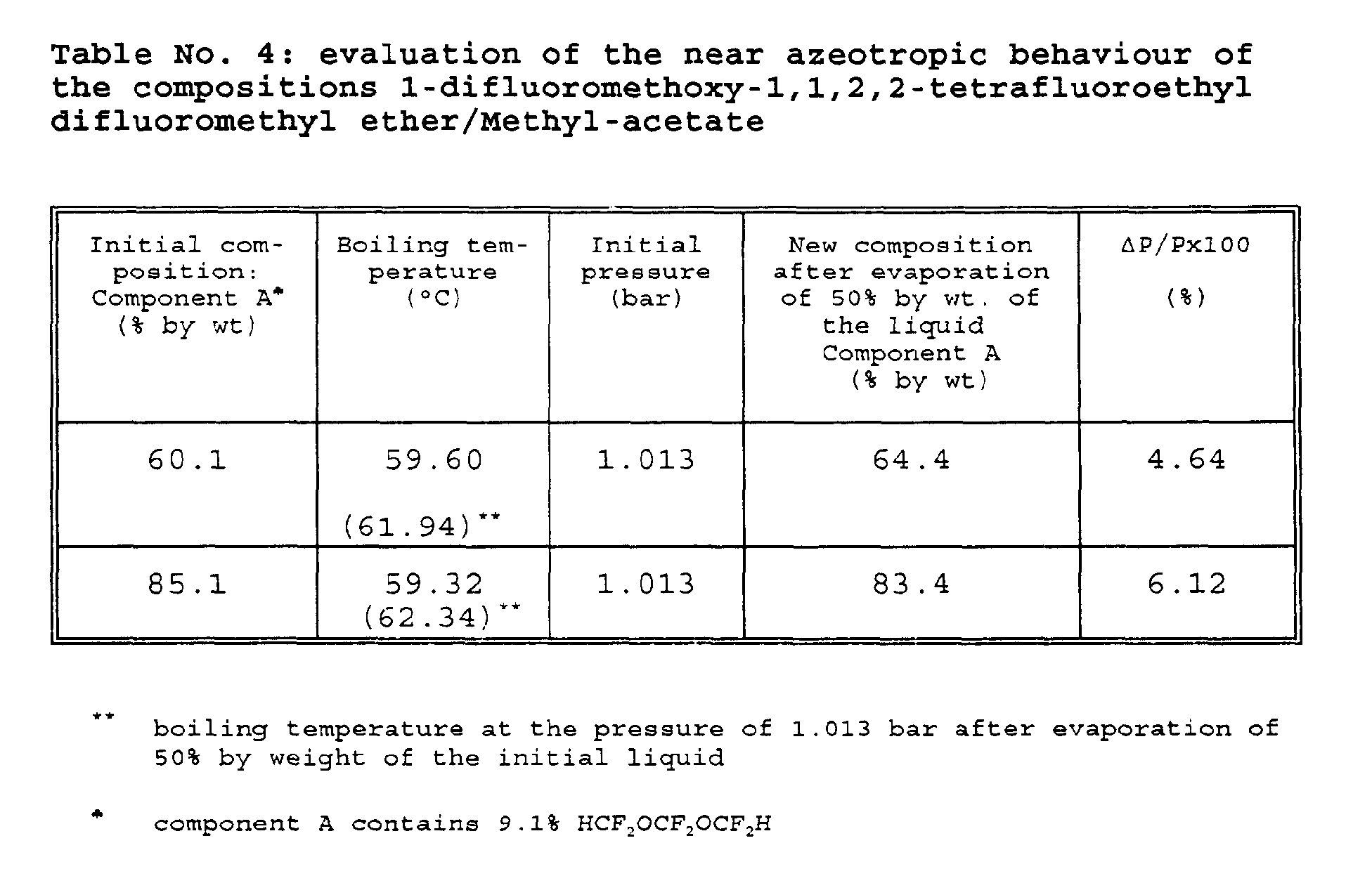
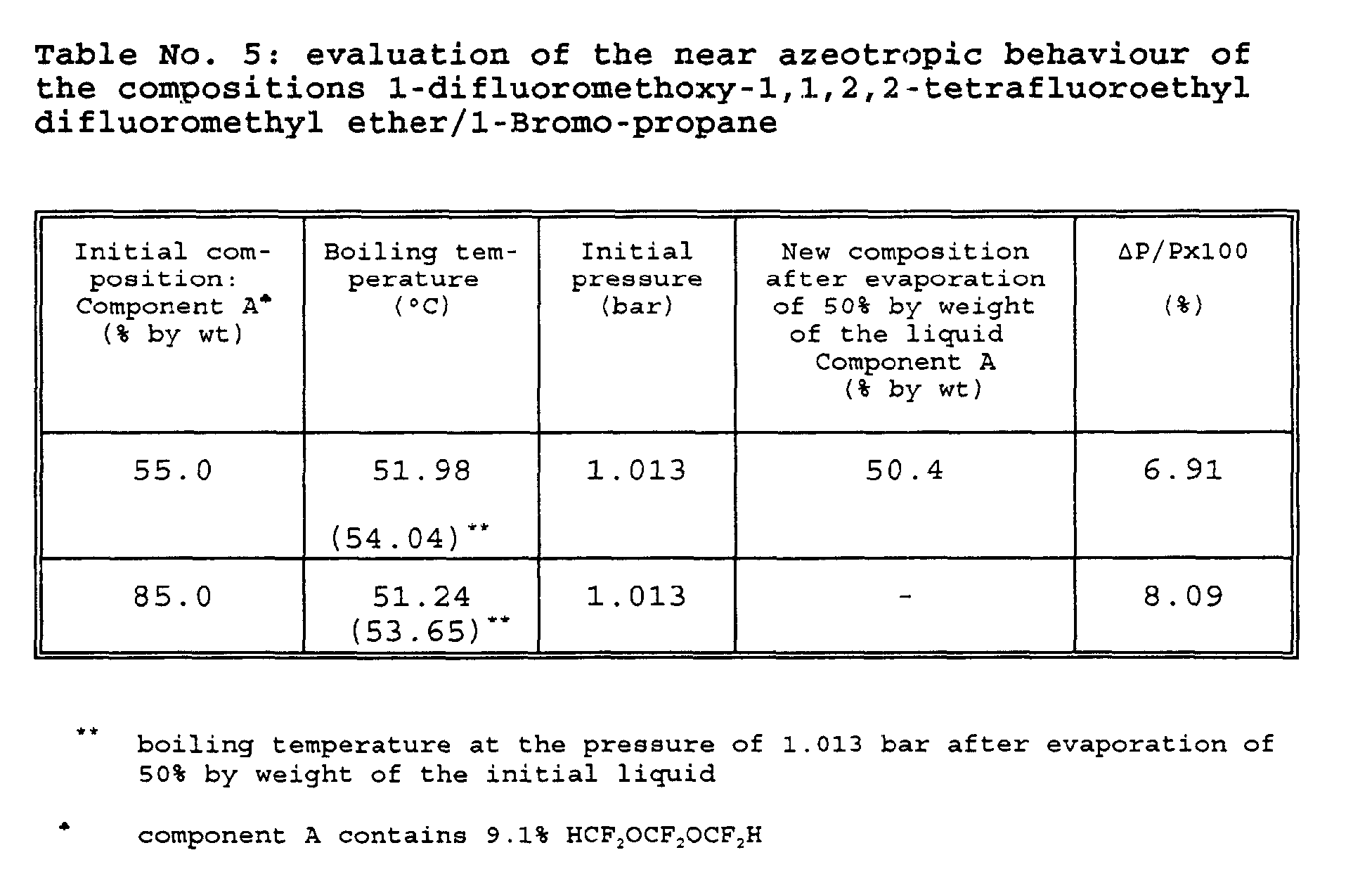
- a composition is near azeotropic when, after evaporation at constant temperature of 50% of the initial mass of the liquid, the per cent variation of the vapour pressure between that of the initial and that of the final composition is lower than 10%. In the case of an azeotrope, no variation of the pressure between that of the initial composition and that obtained after evaporation of 50% of the liquid, is noticed.
- Azeotropic or near azeotropic mixtures fall within the cases which show remarkable, both positive and negative, variations from the Raoult's law. As it is known to the skilled man in the art, such law is valid for systems having an ideal behaviour.
- Deviations with respect to the ideality are caused by unexpected and unpredictable intermolecular interactions among the components of the binary or ternary system such as to generate higher or lower interactions than those existing among the molecules of the pure products.
- vapour pressure of the mixture in the azeotropic point must therefore be characterized by either higher or lower values than those of the pure compounds.
- the azeotropic mixture admits only one composition for each value of the temperature and pressure.
- the combination of all the compositions of the same components having a minimum or a maximum in the boiling temperature at different levels of pressure form a range of azeotropic compositions.
- the mentioned mixtures can be used in combination with stabilizing agents in order to limit the reactions of radical decomposition which are favoured by the temperature and by the presence of metals.
- the radical degradation reactions especially regarding the mixtures containing 1-bromo-propane can be hindered or limited by using nitroparaffins and/or organic substances in the molecule of which double conjugated bonds are present.
- the stabilizers used in combination with the compositions of the present invention have a concentration in the range 0.1-5% by weight with respect to the solvent-detergent and/or drying agent.
- Surfactant agents soluble in the above mixtures can be used in order to further lower the interfacial tension with water to favour the removal phenomena of this from the surfaces subjected to drying and cleaning.
- compositions of the present invention can be used also in applications for aerosol as fluids for cleaning electronic components and as solvents for the preparation of spray formulations.
- the compositions used in these fields can be applied in combination with one or more propellants selected from HFC 134a (1,1,1,2-tetrafluoroethane), HFC 227ea (1,1,1,2,3,3,3-heptafluoropropane), HFC 236ea (1,1,1,2,3,3-hexafluoropropane) and mixtures thereof.
- the mixture of known composition and weight is introduced into a small glass cell, previously evacuated, having an internal volume equal to about 20 cm 3 , equipped with metal connections, feeding valve and with a pressure transducer to evaluate the system vapour pressure.
- the filling ratio by volume is initially equal to about 0.8% by v.
- the cell is introduced in a thermostatic bath and the temperature is slowly changed until an equilibrium value of the vapour pressure equal to 1.013 bar is obtained. The corresponding temperature is recorded and represents the mixture boiling temperature at the pressure of 1.013 bar.
- the temperature is measured close to the equilibrium cell by a thermometer the accuracy of which is equal to +/-0.01 °C; particular attention has been paid so that the external temperature measured in the bath is really the internal one of the cell.
- the cell content is removed at constant temperature by evaporation until having a loss corresponding to 50% by weight of the initial amount.
- the per cent variation suffered by the vapour pressure is determined: when the pressure variation is ⁇ 10%, the mixture has a near azeotropic behaviour.
- the mixtures characterized by a near azeotropic behaviour undergo a limited variation in terms of composition. Analogously the variations connected to the boiling temperatures due to the composition change are very limited. The analyzed solutions were limpid and homogeneous at the boiling temperature and in the usual use conditions. The data referred to the near azeotropic behaviour of the compositions of the present invention are reported in Tables 3-5.
- the concentration of the component A shown in Tables 3-5 comprises also the presence of HCF 2 OCF 2 OCF 2 H as more remarkable secondary component contained in the commercial product.
- the circuit After 5 minutes of dipping, the circuit is allowed to dry for additional 5 minutes at room temperature so as to remove the solvent traces and then is weighed again on an analytical balance.
- Tests of the solvent mixtures are carried out close to the boiling temperature.
- the compositions are placed in a vessel equipped with a condenser which recovers the vapour of the boiling solution.
- azeotropic and near azeotropic mixtures allows to select the best composition depending on the kind of the oily substance to be removed.
- HFC 134a, HFC 227ea and HFC 236ea with some solvent compositions for aerosol applications for the cleaning of electronic components has been studied.
- the solvent composition is placed in a glass test tube having thick walls, resistant to high pressures, and closed at an end by a metal valve. After cooling, the propellant is fed to the test tube and mixed with the solvent mixture.
- the system is introduced in a thermostatic bath and heated up to 0°, 25° and 50°C.
- the complete solubility of the propellant in the solvent composition used for the test has been visually observed.
- the solubility results of the used propellants in the solvent compositions, at the above three different temperatures, are reported in Table 7.
Landscapes
- Chemical & Material Sciences (AREA)
- Organic Chemistry (AREA)
- Engineering & Computer Science (AREA)
- Chemical Kinetics & Catalysis (AREA)
- Health & Medical Sciences (AREA)
- Wood Science & Technology (AREA)
- Oil, Petroleum & Natural Gas (AREA)
- Materials Engineering (AREA)
- Life Sciences & Earth Sciences (AREA)
- Medicinal Chemistry (AREA)
- Polymers & Plastics (AREA)
- Detergent Compositions (AREA)
- Organic Low-Molecular-Weight Compounds And Preparation Thereof (AREA)
- Confectionery (AREA)
- Cleaning And De-Greasing Of Metallic Materials By Chemical Methods (AREA)
- Manufacturing Of Printed Wiring (AREA)
Abstract
Description
| composition % by weight | |||
| general | preferred | ||
| I) | 1-difluoromethoxy | ||
| 1,1,2,2-tetrafluoroethyl difluoromethyl ether | 15-99 | 25-97 | |
| (HCF2OCF2CF2OCF2H) ; isopentane | 85-1 | 3-75 | |
| II) | 1-difluoromethoxy 1,1,2,2-tetrafluoroethyl difluoromethyl ether | 25-99 | 30-97 |
| (HCF2OCF2CF2OCF2H) ; methyl-acetate | 75-1 | 3-70 | |
| III) | 1-difluoromethoxy 1,1,2,2-tetrafluoroethyl difluoromethyl ether | 35-99 | 38-97 |
| (HCF2OCF2CF2OCF2H) ; 1-bromo-propane | 65-1 | 62-3 |
| compositions +/- 2 % by weight | ||
| A) | 1-difluoromethoxy-1,1,2,2-tetrafluoroethyl difluoromethyl ether | 45 % by wt. |
| (HCF2OCF2CF2OCF2H) ; isopentane | 55 % by wt. | |
| B) | 1-difluoromethoxy-1,1,2,2-tetrafluoroethyl difluoromethyl ether | 75 % by wt. |
| (HCF2OCF2CF2OCF2H) ; methyl-acetate | 25 % by wt. | |
| C) | 1-difluoromethoxy-1,1,2,2-tetrafluoroethyl difluoromethyl ether | 75 % by wt. |
| (HCF2OCF2CF2OCF2H) ; 1-bromo-propane | 25 % by wt. |
characterized by a combination of chemical-physical properties such as chemical inertia, high thermal stability, non flammability, evaporation heat and boiling temperature such as to be particularly suitable, in admixture with other organic solvents, for the substitution of CFC 113 in the above indicated industrial applications.
The corresponding temperature is recorded and represents the mixture boiling temperature at the pressure of 1.013 bar.
| chemical-physical and toxicological properties of the hydrofluoropolyether | ||
| Chemical structure | HCF2OCF2CF2OCF2H 1-difluoromethoxy-1,1,2,2-tetrafluoroethyl difluoromethyl ether | CFC 113 1,1,2-trichloro-1,2,2-trifluoroethane |
| Molecular mass | 234.05 | 187.38 |
| Boiling temperature (°C, at 1.013 bar) | 58.21 | 47.55 |
| Evaporation latent heat (KJ/Kg, at 1.013 bar) | 139 | 144 |
| Liquid density at 25°C (g/cm3) | 1.60 | 1.56 |
| Flammability in air (% by volume) | non flammable | non flammable |
| ODP CFC 11=1 | 0 | 1.07 |
| lifetime (years) | <10 | 110 |
| GWP100years CO2=1 | 1,725 | 5,000 |
| Acute toxicity in rat by os, LD50 (ppmv/4 hours) | >5,000 | 43,000 |
| Acute toxicity in rat by inhalation, LC50 (ppmv/4 hours) | >32,000 | 50,000 |
| Surface tension at 20°C (dynes/cm) | 15.5 | 18.1 |
| Isotherm evaporation rate at 20°C (mg/min) | 0.6 | 1 |
| azeotropic compositions (identification of maximum and mimimum values in the boiling temperature at the pressure of 1.013 absolute bar) | |||
| Component A | Component B | Azeotrope composition: component A (% by weight) | Azeotrope boiling temperature (°C) |
| HCF2OCF2CF2OCF2H 1-difluoromethoxy-1,1,2,2-tetrafluoroethyl difluoromethyl ether | Isopentane Boiling T=27.18°C | 44.9 | 23.93 |
| Methyl-acetate Boiling T=55.78 °C | 75.1 | 60.54 | |
| 1-Bromo-propane Boiling T=69.60°C | 75.0 | 51.05 |

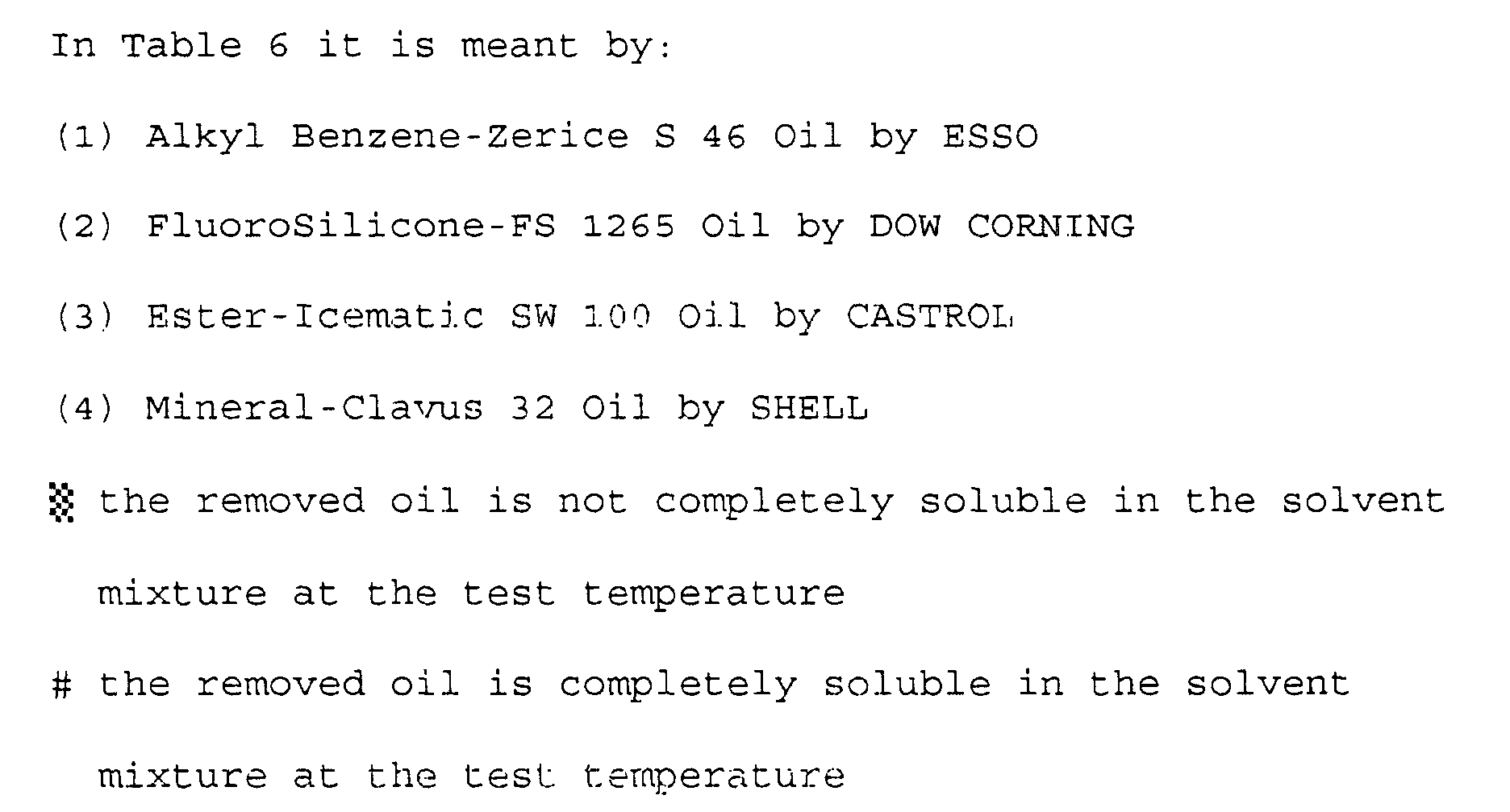
a known amount of an oily product is uniformly spread on the surface of a printed circuit having 35x19 mm sizes; 0.100 g of oil are placed only on a single surface of the circuit, then the article is dipped into the solution to be tested.

| Propellants | Solvent compositions (% by weight) | Propellant concentration in admixture with the solvent compositions (% by wt) | Temperature (°C) | ||
| 0 | 25 | 50 | |||
| HFC 134a | HCF2OCF2CF2OCF2H/ Isopentane (45.0)(55.0) | 51.2 | S | S | S |
| HFC 134a | HCF2OCF2CF2OCF2H/ Methyl-acetate (75.0)(25.0) | 51.3 | S | S | S |
| HFC 134a | HCF2OCF2CF2OCF2H/ Bromo-propane (75.0) (25.0) | 57.2 | S | S | S |
| HFC 227ea | HCF2OCF2CF2OCF2H/ Methyl-acetate (75.0)(25.0) | 53.2 | S | S | S |
| HFC 236ea | HCF2OCF2CF2OCF2H/ Isopentane (45.0)(55.0) | 57.9 | S | S | S |
| S = The propellant is completely soluble in the used solvent. |
Claims (9)
- Azeotropic or near azeotropic compositions, based on 1-difluoromethoxy-1,1,2,2-tetrafluoroethyl difluoromethyl ether, essentially consisting of:
composition % by weight I) 1-difluoromethoxy 1,1,2,2-tetrafluoroethyl 15-99 difluoromethyl ether (HCF2OCF2CF2OCF2H) ; isopentane 85-1 II) 1-difluoromethoxy 1,1,2,2-tetrafluoroethyl 25-99 difluoromethyl ether (HCF2OCF2CF2OCF2H) ; methyl-acetate 75-1 III) 1-difluoromethoxy 1,1,2,2-tetrafluoroethyl 35-99 difluoromethyl ether (HCF2OCF2CF2OCF2H) ; 1-bromo-propane 65-1 - Azeeotropic or near azeotropic compositions according to claim 1 essentially consiting of:
composition % by weight I) 1-difluoromethoxy 1,1,2,2-tetrafluoroethyl 25-97 difluoromethyl ether (HCF2OCF2CF2OCF2H) ; isopentane 3-75 II) 1-difluoromethoxy 1,1,2,2-tetrafluoroethyl 30-97 difluoromethyl ether (HCF2OCF2CF2OCF2H) ; methyl-acetate 3-70 III) 1-difluoromethoxy 1,1,2,2-tetrafluoroethyl 38-97 difluoromethyl ether (HCF2OCF2CF2OCF2H) ; 1-bromo-propane 62-3 - Azeotropic compositions according to claims 1 and 2 which show an absolute minimum or maximum in the boiling temperature at the pressure of 1.013 bar with respect to the pure products, so defined:
A) 1-difluoromethoxy-1,1,2,2-tetrafluoroethyl 45% by wt. difluoromethyl ether (HCF2OCF2CF2OCF2H) ; isopentane 55% by wt. B) 1-difluoromethoxy-1,1,2,2-tetrafluoroethyl 75% by wt. difluoromethyl ether (HCF2OCF2CF2OCF2H) ; methyl-acetone 25% by wt. C) 1-difluoromethoxy-1,1,2,2-tetrafluoroethyl 75% by wt. difluoromethyl ether (HCF2OCF2CF2OCF2H) ; 1-bromo-propane 25% by wt. - Near azeotropic compositions according to claims 1-3, wherein 1-difluoromethoxy-1,1,2,2-tetrafluoroethyl difluoromethyl ether contains up to 15% by weight of difluoromethoxy-bis(difluoromethyl ether).
- Compositions according to claims 1-4 comprising stabilizers for reactions of radical decomposition the concentration of which is in the range 0.1-5% by weight with respect to the solvent-detergent and/or drying agent.
- Compositions according to claim 5, wherein the stabilizers are selected among nitroparaffins and/or organic substances containing double bonds.
- Use of the compositions according to claims from 1 to 6 as solvents-detergents/drying agents in substitution of CFC 113.
- Use of the compositions according to claim 7 as aerosol or spray for the cleaning of electronic components in combination with one or more propellants.
- Use of the compositions according to claim 8, wherein the propellant is selected from: HFC 134a (1,1,1,2-tetrafluoroethane), HFC 227ea (1,1,1,2,3,3,3-heptafluoropropane) or mixtures thereof.
Applications Claiming Priority (2)
| Application Number | Priority Date | Filing Date | Title |
|---|---|---|---|
| ITMI000230 | 2000-02-11 | ||
| IT2000MI000230A IT1317827B1 (en) | 2000-02-11 | 2000-02-11 | SOLVENT COMPOSITIONS. |
Publications (3)
| Publication Number | Publication Date |
|---|---|
| EP1126016A2 true EP1126016A2 (en) | 2001-08-22 |
| EP1126016A3 EP1126016A3 (en) | 2002-09-04 |
| EP1126016B1 EP1126016B1 (en) | 2006-09-27 |
Family
ID=11443983
Family Applications (1)
| Application Number | Title | Priority Date | Filing Date |
|---|---|---|---|
| EP01101783A Expired - Lifetime EP1126016B1 (en) | 2000-02-11 | 2001-01-26 | Solvent compositions |
Country Status (5)
| Country | Link |
|---|---|
| US (1) | US6399562B2 (en) |
| EP (1) | EP1126016B1 (en) |
| JP (1) | JP2001288498A (en) |
| DE (1) | DE60123301D1 (en) |
| IT (1) | IT1317827B1 (en) |
Families Citing this family (2)
| Publication number | Priority date | Publication date | Assignee | Title |
|---|---|---|---|---|
| IT1302028B1 (en) * | 1998-08-19 | 2000-07-20 | Ausimont Spa | EXPANDING COMPOSITIONS |
| US8021490B2 (en) * | 2007-01-04 | 2011-09-20 | Eastman Chemical Company | Substrate cleaning processes through the use of solvents and systems |
Family Cites Families (11)
| Publication number | Priority date | Publication date | Assignee | Title |
|---|---|---|---|---|
| US3250806A (en) * | 1962-04-05 | 1966-05-10 | Du Pont | Fluorocarbon ethers of tetrafluoroethylene epoxide |
| US3515701A (en) * | 1966-05-31 | 1970-06-02 | Minnesota Mining & Mfg | Rubbery polyperfluoroalkylene oxides and process therefor |
| GB2033422B (en) * | 1978-10-23 | 1982-10-13 | Ici Ltd | Solvent cleaning composition |
| DE4006491A1 (en) * | 1990-03-02 | 1991-09-05 | Hoechst Ag | METHOD FOR PRODUCING PERFLUORED ETHERS |
| US5084146A (en) * | 1990-04-09 | 1992-01-28 | E. I. Du Pont De Nemours And Company | Method for preparing perfluoropolyethers |
| US5124064A (en) * | 1990-12-19 | 1992-06-23 | Allied-Signal Inc. | Azeotrope-like compositions of 1,1-dichloro-1-fluoroethane; dichlorotrifluoroethane; ethanol; and alkane having 5 or 6 carbon atoms |
| BE1006433A3 (en) * | 1992-12-03 | 1994-08-23 | Solvay | Composition containing fluorinated ether and use thereof. |
| IT1274591B (en) | 1994-08-05 | 1997-07-18 | Ausimont Spa | PROCESS FOR THE PREPARATION OF HYDROGEN POLYOXYPERFLUOROALKANS TERMINATED |
| US5827812A (en) * | 1995-05-16 | 1998-10-27 | Minnesota Mining And Manufacturing Company | Azeotrope-like compositions and their use |
| IT1283202B1 (en) * | 1996-03-07 | 1998-04-16 | Ausimont Spa | SOLVENTS USABLE AS CLEANING AGENTS |
| IT1302028B1 (en) * | 1998-08-19 | 2000-07-20 | Ausimont Spa | EXPANDING COMPOSITIONS |
-
2000
- 2000-02-11 IT IT2000MI000230A patent/IT1317827B1/en active
-
2001
- 2001-01-26 EP EP01101783A patent/EP1126016B1/en not_active Expired - Lifetime
- 2001-01-26 DE DE60123301T patent/DE60123301D1/en not_active Expired - Lifetime
- 2001-02-09 US US09/779,527 patent/US6399562B2/en not_active Expired - Fee Related
- 2001-02-09 JP JP2001034517A patent/JP2001288498A/en active Pending
Also Published As
| Publication number | Publication date |
|---|---|
| ITMI20000230A0 (en) | 2000-02-11 |
| IT1317827B1 (en) | 2003-07-15 |
| JP2001288498A (en) | 2001-10-16 |
| US6399562B2 (en) | 2002-06-04 |
| DE60123301D1 (en) | 2006-11-09 |
| EP1126016B1 (en) | 2006-09-27 |
| US20020010116A1 (en) | 2002-01-24 |
| EP1126016A3 (en) | 2002-09-04 |
| ITMI20000230A1 (en) | 2001-08-11 |
Similar Documents
| Publication | Publication Date | Title |
|---|---|---|
| KR100275187B1 (en) | Ternary azeotropic composition | |
| EP0608346B1 (en) | Azeotropic compositions of 1,1,2,2,3,3,4,4-octafluorobutane and alcohols or ketones | |
| US8053403B2 (en) | Cleaning compositions | |
| SK13142001A3 (en) | Azeotrope-like compositions of 1,1,1,3,3-pentafluorobutane | |
| WO1997039081A1 (en) | 1,1,2,2,3,3,4,4-octafluorobutane compositions | |
| NO176673B (en) | Use of perfluoroalkylethylenes as detergent and desiccant and preparations for this purpose | |
| WO2014096417A1 (en) | Non-flammable ternary compositions and use of these compositions | |
| US5580906A (en) | Ternary azeotropic compositions | |
| EP0980910B1 (en) | Hydrofluoropolyether-based azeotropic or near azeotropic compositions | |
| USRE39819E1 (en) | Cleaning or drying compositions based on 1,1,1,2,3,4,4,5,5,5-decafluoropentane | |
| US6399562B2 (en) | Solvent compositions | |
| EP1370604B1 (en) | Azeotrope-like compositions of pentafluorobutane and water | |
| US6291416B1 (en) | Cleaning or drying compositions based on F36mfc, CHzCLz, CH3OH and 43-10mee | |
| JPH03181431A (en) | Two-component azeotropic composition of 2, 3-dichloro-1, 1, 1, 3, 3-pentafluoropropane and methanol | |
| US5632928A (en) | Azeotrope (like) compositions with octafluorobutane, optionally chlorinated, and either perfluorodimethylcyclobutane or perfluorohexane | |
| AU710688B2 (en) | Decafluoropentane compositions | |
| EP0980890B1 (en) | Fluorinated foaming compositions | |
| CA2026865A1 (en) | Stabilized azeotrope-like compositions of 1,1-dichloro-2,2,2-trifluoroethane and 1,1-dichloro-1-fluoroethane | |
| US5562855A (en) | Octafluorobutane compositions | |
| US5413730A (en) | Compositions containing a fluorinated ether and use of these compositions | |
| US5259983A (en) | Azeotrope-like compositions of 1-H-perfluorohexane and trifluoroethanol or n-propanol | |
| US6281184B1 (en) | Cleaning or drying compositions based on 43-10mee and on trichloroethylene | |
| WO1994009083A1 (en) | Refrigerant compositions including bis(difluoromethyl) ether | |
| US5688431A (en) | Octafluorobutane compositions | |
| US6281186B1 (en) | Cleaning or drying compositions based on 43-10mee, on CH2C12, on cyclopentane and on CH3OH |
Legal Events
| Date | Code | Title | Description |
|---|---|---|---|
| PUAI | Public reference made under article 153(3) epc to a published international application that has entered the european phase |
Free format text: ORIGINAL CODE: 0009012 |
|
| AK | Designated contracting states |
Kind code of ref document: A2 Designated state(s): AT BE CH CY DE DK ES FI FR GB GR IE IT LI LU MC NL PT SE TR |
|
| AX | Request for extension of the european patent |
Free format text: AL;LT;LV;MK;RO;SI |
|
| PUAL | Search report despatched |
Free format text: ORIGINAL CODE: 0009013 |
|
| AK | Designated contracting states |
Kind code of ref document: A3 Designated state(s): AT BE CH CY DE DK ES FI FR GB GR IE IT LI LU MC NL PT SE TR |
|
| AX | Request for extension of the european patent |
Free format text: AL;LT;LV;MK;RO;SI |
|
| RAP1 | Party data changed (applicant data changed or rights of an application transferred) |
Owner name: AGORA' S.P.A. |
|
| RAP1 | Party data changed (applicant data changed or rights of an application transferred) |
Owner name: SOLVAY SOLEXIS S.P.A. |
|
| 17P | Request for examination filed |
Effective date: 20030225 |
|
| AKX | Designation fees paid |
Designated state(s): DE FR GB IT |
|
| 17Q | First examination report despatched |
Effective date: 20040308 |
|
| GRAP | Despatch of communication of intention to grant a patent |
Free format text: ORIGINAL CODE: EPIDOSNIGR1 |
|
| GRAS | Grant fee paid |
Free format text: ORIGINAL CODE: EPIDOSNIGR3 |
|
| GRAA | (expected) grant |
Free format text: ORIGINAL CODE: 0009210 |
|
| AK | Designated contracting states |
Kind code of ref document: B1 Designated state(s): DE FR GB IT |
|
| PG25 | Lapsed in a contracting state [announced via postgrant information from national office to epo] |
Ref country code: IT Free format text: LAPSE BECAUSE OF FAILURE TO SUBMIT A TRANSLATION OF THE DESCRIPTION OR TO PAY THE FEE WITHIN THE PRESCRIBED TIME-LIMIT;WARNING: LAPSES OF ITALIAN PATENTS WITH EFFECTIVE DATE BEFORE 2007 MAY HAVE OCCURRED AT ANY TIME BEFORE 2007. THE CORRECT EFFECTIVE DATE MAY BE DIFFERENT FROM THE ONE RECORDED. Effective date: 20060927 |
|
| REG | Reference to a national code |
Ref country code: GB Ref legal event code: FG4D |
|
| REF | Corresponds to: |
Ref document number: 60123301 Country of ref document: DE Date of ref document: 20061109 Kind code of ref document: P |
|
| PG25 | Lapsed in a contracting state [announced via postgrant information from national office to epo] |
Ref country code: DE Free format text: LAPSE BECAUSE OF FAILURE TO SUBMIT A TRANSLATION OF THE DESCRIPTION OR TO PAY THE FEE WITHIN THE PRESCRIBED TIME-LIMIT Effective date: 20061228 |
|
| PGFP | Annual fee paid to national office [announced via postgrant information from national office to epo] |
Ref country code: GB Payment date: 20070124 Year of fee payment: 7 |
|
| ET | Fr: translation filed | ||
| PLBE | No opposition filed within time limit |
Free format text: ORIGINAL CODE: 0009261 |
|
| STAA | Information on the status of an ep patent application or granted ep patent |
Free format text: STATUS: NO OPPOSITION FILED WITHIN TIME LIMIT |
|
| 26N | No opposition filed |
Effective date: 20070628 |
|
| PGFP | Annual fee paid to national office [announced via postgrant information from national office to epo] |
Ref country code: IT Payment date: 20070514 Year of fee payment: 7 |
|
| PGFP | Annual fee paid to national office [announced via postgrant information from national office to epo] |
Ref country code: FR Payment date: 20070109 Year of fee payment: 7 |
|
| GBPC | Gb: european patent ceased through non-payment of renewal fee |
Effective date: 20080126 |
|
| REG | Reference to a national code |
Ref country code: FR Ref legal event code: ST Effective date: 20081029 |
|
| PG25 | Lapsed in a contracting state [announced via postgrant information from national office to epo] |
Ref country code: GB Free format text: LAPSE BECAUSE OF NON-PAYMENT OF DUE FEES Effective date: 20080126 |
|
| PG25 | Lapsed in a contracting state [announced via postgrant information from national office to epo] |
Ref country code: FR Free format text: LAPSE BECAUSE OF NON-PAYMENT OF DUE FEES Effective date: 20080131 |
|
| PG25 | Lapsed in a contracting state [announced via postgrant information from national office to epo] |
Ref country code: IT Free format text: LAPSE BECAUSE OF NON-PAYMENT OF DUE FEES Effective date: 20080126 |