FIELD OF THE INVENTION
The present invention relates to a novel ink
composition which results in excellent image quality as well
as high image fastness and an image forming method, and in
more detail to an ink composition which can be employed in an
ink jet recording method and an image forming method which is
capable to accomplishing ink jet recording.
BACKGROUND OF THE INVENTION
An ink jet recording method makes it possible to record
extremely fine images employing a relatively simple
apparatus, and has been increasingly developed in various
fields. In broad fields, produced have been printers which
utilize ink jet recording systems. Further, a wide variety
of ink has been developed depending on need.
Water based ink jet recording compositions are commonly
employed for ink jet recording. The water based ink jet
recording compositions employed for ink jet recording are
mainly divided into dye based ink and pigment based ink.
The dye based ink is highly valued on the market due to
its vivid color reproduction as well as its excellent storage
stability. On the other hand, it does not sufficiently meet
requirements for image retention quality (such as light
fastness, minimum bleeding, and the like).
The pigment based ink exhibits higher image retention
compared to the dye based ink, but it necessitates a
dispersion process for its production. The stability of the
resultant dispersion is limited. Therefore, when employing
ink jet recording, problems occur such as disadvantages for
cost reduction, clogging during use over an extended period
of time, and the like. Further, the resultant image quality
(such as color reproduction, glossiness, bronzing, and the
like) is inferior to dyes.
Under such current situation, demanded have been novel
colorants which exhibit the excellent properties of dyes
(such as image quality and ink storage stability) and the
image retention quality of pigments (such as light fastness,
minimum bleeding, and the like).
In recent years, developed has been technology in which
specified pigments are subjected to chemical modification so
that they become soluble in organic solvents. For example,
Japanese Patent Publication Open to Public Inspection No. 7-150068
discloses organic solvent-soluble compounds in which
nitrogen atom(s) of pigments such as quinacridone, indigo,
and the like, are subjected to chemical modification
employing a specified oxycarbonyl group, and further
discloses that when the resulting modified compound is
subjected to thermal treatment, the original pigment is
regenerated (latent pigment technology).
Further, Japanese Patent Publication Open to Public
Inspection Nos. 11-246809 and 11-293166 disclose technology
in which said latent technology is applied to ink jet
recording. However, compounds, which are obtained by
substituting disclosed pigments, are only soluble in organic
solvents. Thus when ink is prepared, water-insoluble organic
solvents are required.
Employed as water-insoluble organic solvents, which are
employed to prepare said ink, are low-boiling point and high-boiling
point water-insoluble organic solvents. Said low-boiling
point water-insoluble organic solvents are not
preferred because during printing as well as the drying
process, organic solvents volatize to result in adverse
effects to humans as well as to the environment. Further,
the volatilization of said water-insoluble organic solvents
on the printing head results in frequent clogging of the
orifice of said head. Still further, when said high-boiling
point water-insoluble organic solvents are employed, the
drying properties of images are degraded and a large amount
of solvent remains. Specifically, when special glossy paper
sheets, which are capable of producing high quality, are
used, drying properties are further degraded. As a result,
when the printed paper sheet is placed on another, parts of
the image may be transferred to the reverse surface.
It is a first object of the present invention to
provide an ink composition which exhibits storage stability
of ink for an extended period of time and results in high
image quality as well as sufficient image retention. It is a
second object of the present invention to provide a method
which forms images exhibiting high image quality as well as
sufficient image retention, employing a novel water based ink
composition.
The aforementioned objects of the present invention are
achieved by the embodiments described below.
DETAILED DESCRIPTION OF THE INVENTION
The present invention will now be detailed.
Insoluble pigments in precursors (hereinafter
occasionally referred to as precursors of the present
invention) which can be converted to insoluble pigments by at
least one means selected from a chemical means, a thermal
means, a photodecomposition means, and a radiation means of
the present invention are not particularly limited. The
insoluble pigments denote all organic pigments excepting lake
pigments obtained from acidic or basic dye and soluble azo
pigments (azo lake pigments), and include insoluble azo
pigments, condensed azo pigments, phthalocyanine pigments and
condensed polycyclic pigments. The classification of
solubility can be referred to the description of page 319 of
Shikizai Kogaku (Colored Material) Handbook (edited by
Shikizai Kyokai, 1st ed., 1989).
Examples include azo pigments, azomethine pigments,
methine pigments, diphenylmethane pigments, triphenylmethane
pigments, quinacridone pigments, anthraquinone pigments,
perylene pigments, indigo pigments, quinophthalone pigments,
isoindolinone pigments, isoindoline pigments, azine pigments,
oxazine pigments, thiazine pigments, dioxazine pigments,
thiazole pigments, phthalocyanine pigments,
diketopyrrolopyrrole pigments, and the like.
These pigments may have substituents which include
halogen atoms (for example, chlorine atoms and the like);
alkyl groups (for example, a methyl group, an ethyl group, a
pentyl group, and the like); aryl groups (for example, a
phenyl group); heterocyclic ring groups (for example, a
pyridyl group, furyl group, thienyl group, and the like);
alkoxy groups (for example, a methoxy group, an ethoxy group,
a hexyloxy group, and the like); amino group (for example, a
dimethylamino group and the like); acylamino groups (for
example, an acetylamino group, a propanoylamino group, a
benzoylamino group, and the like); sulfonylamino groups (for
example, a methanesulfonamido group, benzenesulfonamido
group, and the like); and the like.
Insoluble pigments preferred in the present invention
include acetanilide based azo pigments, isoindoline pigments,
isoindolinone pigments, quinacridone pigments, naphthol azo
pigments, pyrrolopyrrole pigments, and phthalocyanine
pigments.
Precursors of the present invention are preferably
water-soluble compounds. The water-soluble compounds
preferably have solubility of 0.5 g or more in 100 ml of
water, and more preferably 10 g or less.
A preferred method to allow said precursors to become
water-soluble is that at least one chemically modifiable
nitrogen atom of said insoluble pigment is subjected to
chemical modification and further when said chemical
modification is carried out, at least one of introduced
groups includes a water solubilizing group.
Listed as introduced groups during said chemical
modification are, for example, an acyl group, an oxycarbonyl
group, an aminocarbonyl group, a thiocarbonyl group, a
sulfonyl group, an aminosulfonyl group, and the like.
The water solubilizing groups are not particularly
restricted as far as they give necessary solubility in water-based
solvent, and examples are any of the anionic group (for
example, SO3X, COOX, and the like wherein X represents a
hydrogen atom, or a counter cation); cationic groups (for
example, quaternary ammonium salts and the like); and
nonionic groups (for example, a group having a
polyoxyalkylene structure; a group having a polyhydric
alcohol ester structure, and the like). However, anionic
groups are preferred, and of them, groups having at least one
-SO3X are more preferred.
As the precursors of the present invention, preferred
are compounds represented by General Formulas (1), (4), (5),
(6), (7), (8), (9), (10), or (11), described below. The
precursors represented by General Formulas (1), (5), (10),
and (11) are preferable because of advantage in high
saturation, wide color reproduction area and high stability
against light, and those represented by General Formulas (4)
and (9) are preferable because the water insoluble pigment
obtained thereform are extremely advantageous in high
stability against light and red color reproduction.
Compounds represented by General Formulas (1), (4),
(5), (6), (7), (8), (9), (10), or (11) will now be described
successively.
First, described are the compounds represented by
General Formula (1).
wherein R
1 represents an alkyl group or an aryl group which
may have a substituent, R
2 represents a phenyl group which
may have a substituent, and R
3 represents a phenyl group
which may have a substituent. However, at least one of R
1,
R
2, and R
3 is a group represented by General Formulas (2) or
(3):
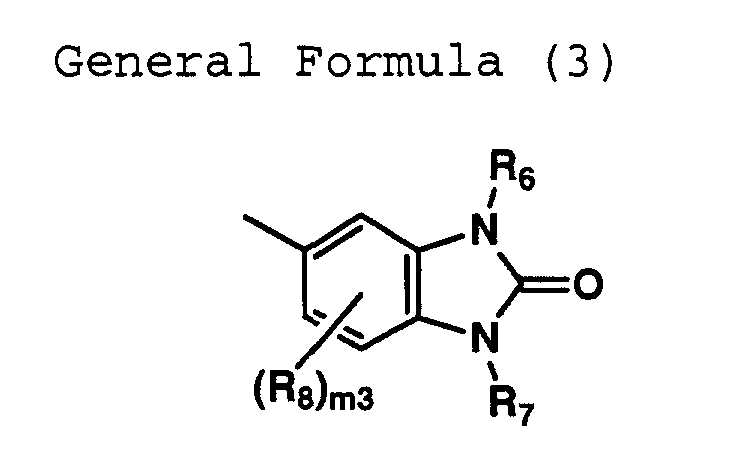
In General Formulas (2) and (3), R4 represents a
substituent having a water solubilizing group, R5 represents
a substituent, and m2 represent 0 to 3. R6 and R7 each
represent a substituent having a water solubilizing group, R8
represents a substituent, and m3 represents 0 to 3.
Listed as alkyl groups represented by R1, which may
have a substituent in General Formula (1), are, for example,
a methyl group, an ethyl group, a t-butyl group, and the
like. Listed as aryl groups, which may have a substituent,
are, for example, a phenyl group, a p-methoxyphenyl group,
and the like. A non-substituted alkyl group and a phenyl
group substituted by alkyl group are preferable for R1.
In a phenyl group which may have a substituent
represented by R2, listed as substituents which said phenyl
group may have, are, for example, alkyl groups (for example,
a methyl group, an ethyl group, and the like), alkyloxy
groups (for example, a methoxy group, an ethoxy group, and
the like), halogen atoms (for example, a fluorine atom, a
chlorine atom, and the like), and the like.
In a phenyl group which may have a substituent
represented by R3, listed as substituents which said phenyl
group may have, are, for example, alkyl groups (for example,
a methyl group, an ethyl group, a trifluoromethyl group, and
the like); alkyloxy groups (for example, a methoxy group, an
ethoxy group, and the like); halogen atoms (for example, a
fluorine atom, a chlorine atom, and the like); a nitro group,
a carbamoyl groups (for example, a phenylcarbamoyl group, and
the like); sulfamoyl groups (for example, phenylsulfamoyl
group, and the like); alkyloxycarbonyl group (for example, a
methoxycarbonyl group, and the like); and the like.
At least one of R1, R2, and R3 is a group represented by
General Formulas (2) or (3). Preferred as substituents
having a water solubilizing group represented by R4, R6, and
R7 in General Formulas (2) and (3) are those represented by
General Formula (12) described below:
General Formula (12) -(J1)m1(J2)m2Y
wherein J1 represents a divalent bondable bonding group.
Said divalent bonding groups, which are preferred, include
-CO-, -COO-, -CONR- (wherein R represents a hydrogen atom or
an alkyl group), -CS-, -SO2-, -SO2NR- (wherein R represents a
hydrogen atom, or an alkyl group), -CONHSO2-, -S-, -Si-, and
the like.
J
2 represents a divalent bondable bonding group.
Listed as said divalent bonding groups are, for example, an
alkylene group, a phenylene group, -O-, -COO-, -OCO-,
(wherein R represents a substituent such as, for example, a
halogen atom, -OH, and the like), and those groups in
combination.
Y represents a water solubilizing group. Employed as
said water solubilizing groups are any of the anionic groups
(for example, SO3X, COOX wherein X represents a hydrogen
atom, or a counter cation, and the like), cationic groups
(for example, quaternary ammonium salts and the like), and
nonionic groups (for example, a group having a
polyoxyalkylene structure, a group having a polyhydric
alcohol ester structure, and the like). However, anionic
groups are preferred and of them, groups having at least one
-SO3X are more preferred.
m1 represents 1 or 2, while m2 represents 1 to 3.
Listed as substituents represented by R5 and R8 in
General Formulas (2) and (3) are, for example, an alkyl group
(for example, a methyl group, an ethyl group, a
trifluoromethyl group, and the like), an alkyloxy group (for
example, a methoxy group, an ethoxy group, and the like), a
halogen atom (for example, a fluorine atom, a chlorine atom,
and the like), a nitro group, a carbamoyl group (for example,
a phenylcarbamoyl group, and the like), a sulfamoyl group
(for example, a phenylsulfamoyl group, and the like), an
alkyloxycarbonyl group (for example, a methoxycarbonyl group,
and the like), and the like.
Compounds represented by General Formula (4) will now
be described.
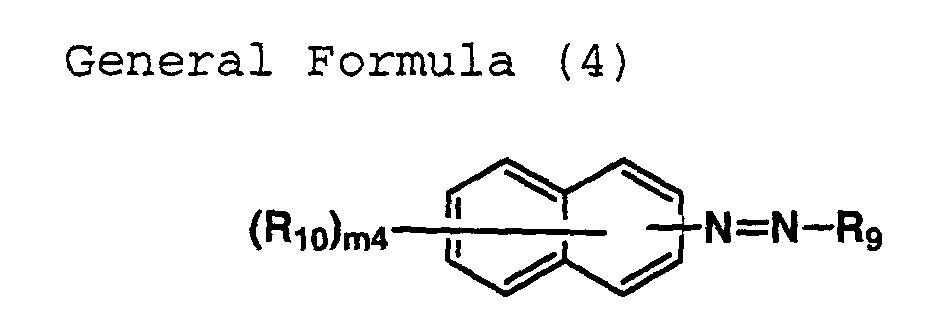
wherein R
9 represents a phenyl group which may have a
substituent, R
10 represents a hydroxyl group, or an amino
group, an acylamino group or a carbamoyl group which may have
a substituent, and m
4 represents 0 to 7. However, at least
one substituent of R
9 or R
10 is a group represented by General
Formula (2) or General Formula (3), or a group R
9 or R
10
mentioned above which is substituted by the group represented
by the General Formula (2) or (3).
In General Formula (4), R9 represents a phenyl group
which may have a substituent. Listed as substituents, which
said phenyl group may have, are, for example, an alkyl group
(for example, a methyl group, an ethyl group, a
trifluoromethyl group, and the like), an alkyloxy group (for
example, a methoxy group, an ethoxy group, and the like), a
halogen atom (for example, a fluorine atom, a chlorine atom,
and the like), a nitro group, a carbamoyl group (for example,
a phenylcarbamoyl group, and the like), a sulfamoyl group
(for example, a phenylsulfamoyl group, and the like), an
alkyloxycarbonyl group (for example, a methoxycarbonyl group,
and the like), and the like.
In the amino group, the acylamino group, and the
carbamoyl group, which may have a substituent represented by
R10, listed as substituents which may have an amino group, an
acylamino group, and a carbamoyl group are, for example, an
alkyl group (for example, a methyl group, an ethyl group, a
trifluoromethyl group, and the like), an aryl group (for
example, a phenyl group, a benzimidazolyl group, and the
like), and the like.
At least one substituent of R9 or R10 is a group
represented by General Formula (2) or General Formula (3).
The groups represented by said General Formula (2) or (3) are
the same as those represented by General Formulas (2) and (3)
which are previously described in General Formula (1).
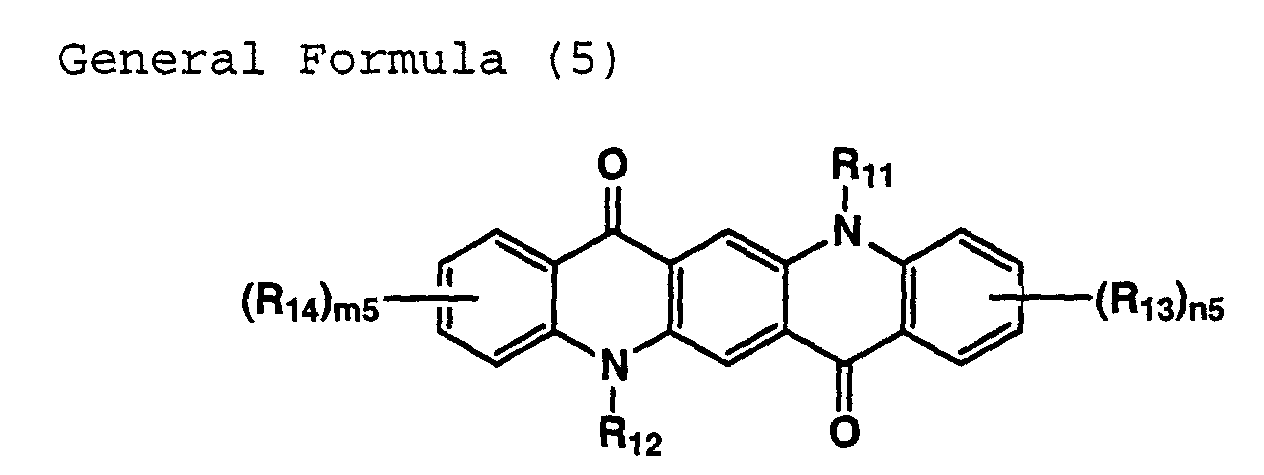
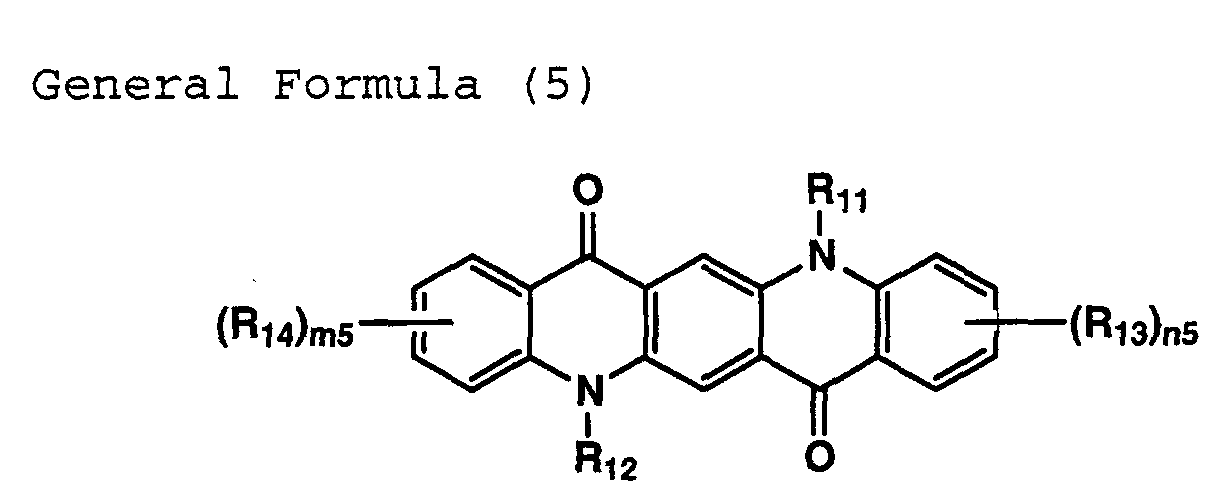
Compounds represented by General Formula (5) will now
be described.
wherein R
11 and R
12 each represent a substituent having a
water solubilizing group, R
13 and R
14 each represent a
substituent, n
5 and m
5 each represent 0 to 4.
In General Formula (5), substituents having a water
solubilizing group represented by R11 and R12 are the same as
those having a water solubilizing group represented by R4,
R6, and R7 described in General Formula (1), and the
substituents represented by General Formula (12), which were
previously shown while describing General Formula (1), are
preferred.
Listed as substituents represented by R13 and R14 are,
for example, a halogen atom (for example, a chlorine atom,
and the like), an alkyl group (for example, a methyl group,
an ethyl group, a pentyl group, and the like), and an alkoxy
group (such as a methoxy group, an ethoxy group, a hexyloxy
group, and the like).
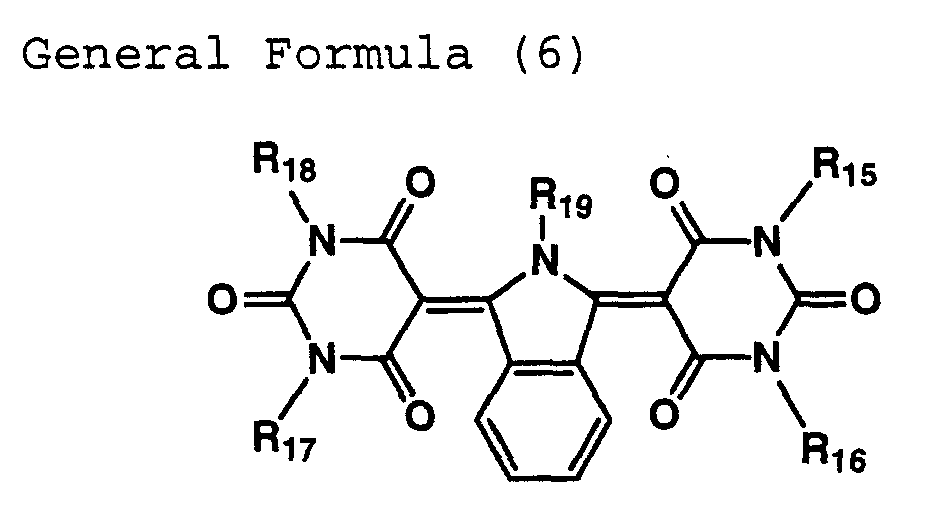
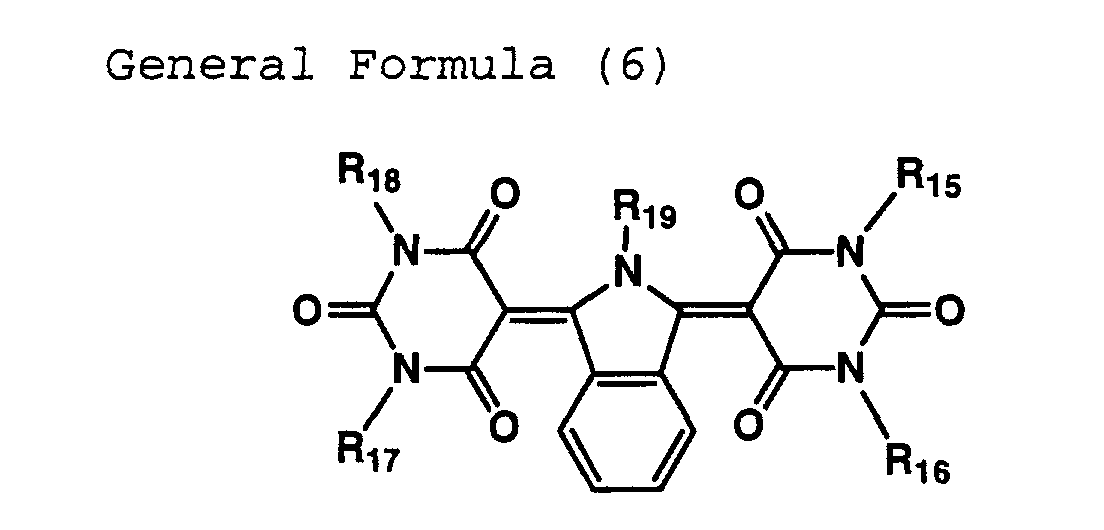
Compounds represented by General Formula (6) will be
described below.
wherein R
15, R
16, R
17, R
18, and R
19 each represent a hydrogen
atom or a substituent having a water solubilizing group.
However, at least two of R
15, R
16, R
17, R
18, and R
19 represent a
substituent having a water solubilizing group.
In General Formula (6), the substituents having a water
solubilizing group represented by R15, R16, R17, R18, and R19
are the same as those having a water solubilizing group
represented by R4, R6, and R7, and are preferably those
represented by General Formula (12), which was previously
described in General Formula (1).
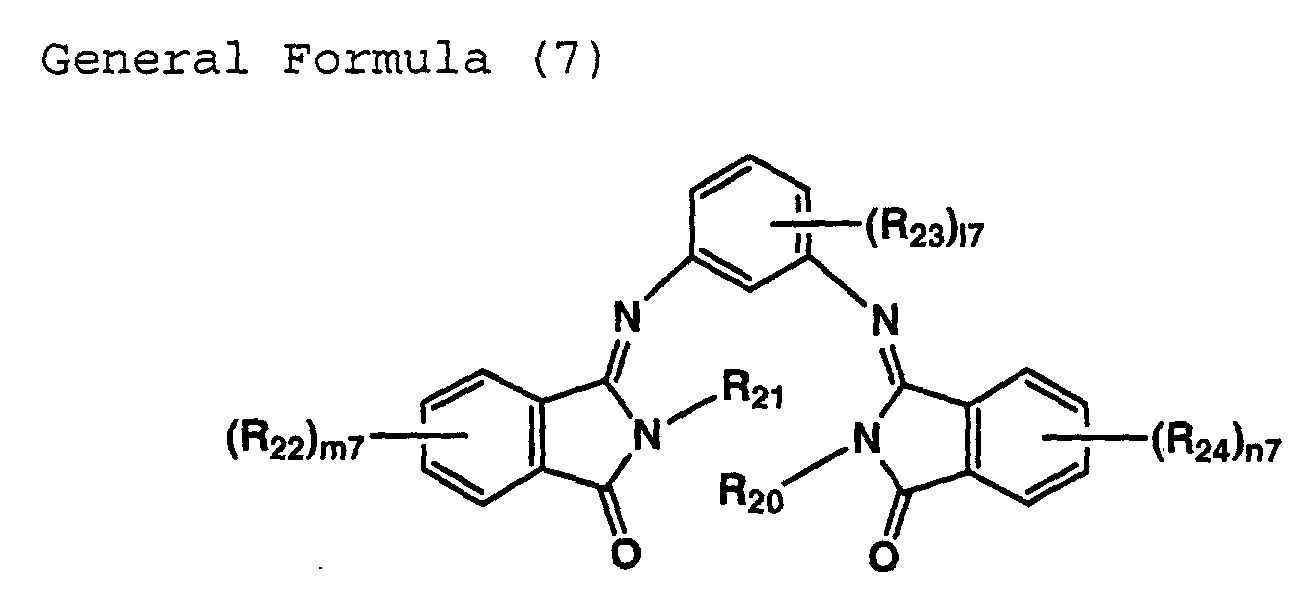
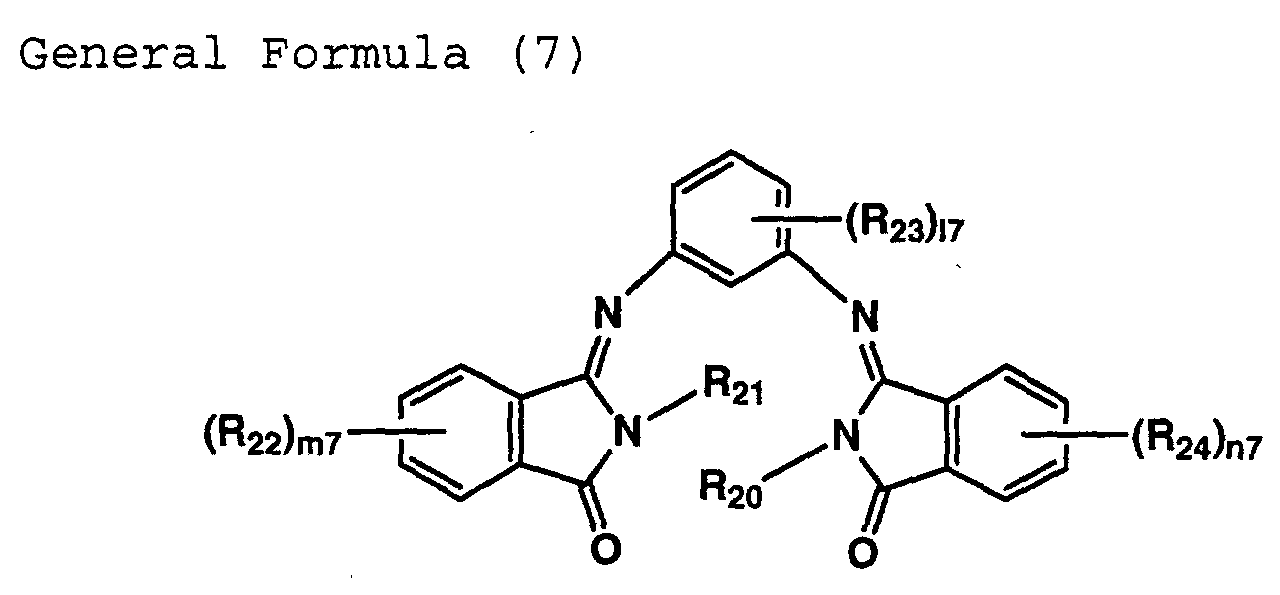
The compounds represented by General Formula (7) will
be described.
wherein R
20 and R
21 each represent a substituent having a
water solubilizing group, R
22, R
23, and R
24 each represent a
substituent, and m
7, l
7, and n
7 each represent 0 to 4.
In General Formula (7), the substituents having a water
solubilizing group represented by R20 and R21 are the same as
those having a water solubilizing group represented by R4,
R6, and R7, and are preferably those represented by General
Formula (12), which was previously described in General
Formula (1).
Listed as substituents represented by R
22, R
23, and R
24
are an alkyl group (for example, a methyl group, an ethyl
group, and the like), a halogen atom (for example, chlorine
atom and the like), and the like.
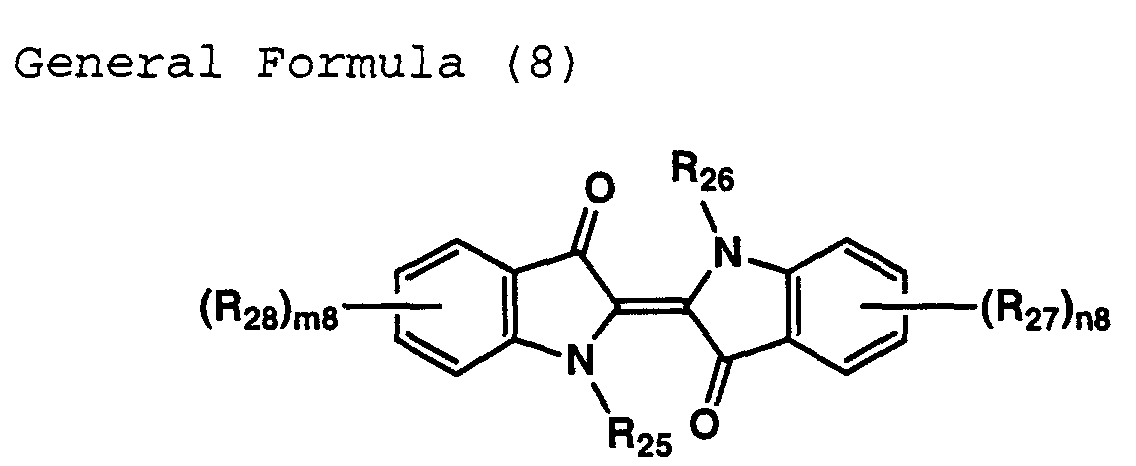
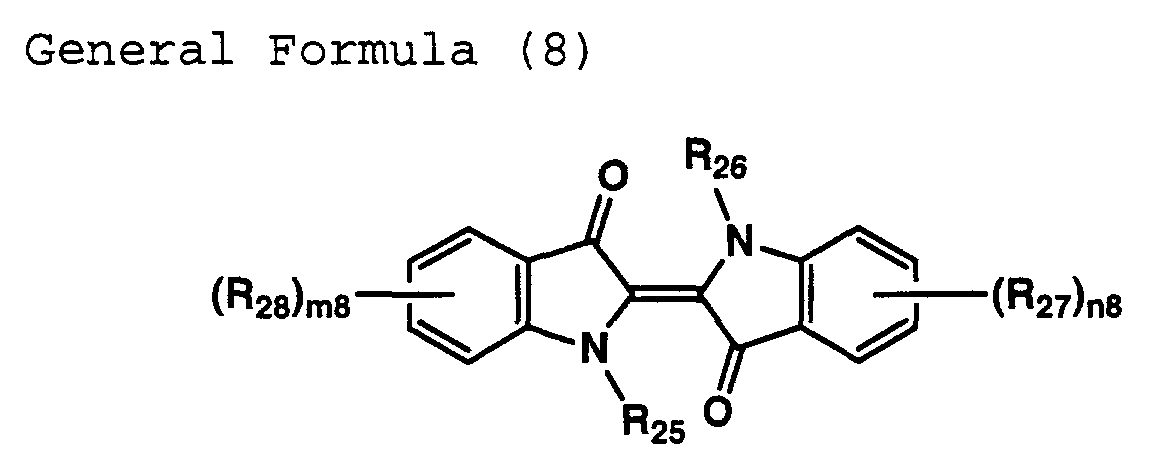
Next, the compounds represented by General Formula (8)
will be described.
wherein R
25 and R
26 each represent a substituent having a
water solubilizing group, R
27 and R
28 each represent a
substituent, and n
8 and m
8 each represent 0 to 4.
In General Formula (8), the substituents having a water
solubilizing group represented by R25 and R26 are the same as
those having a water solubilizing group represented by R4,
R6, and R7, and preferably are those represented by General
Formula (12), which was previously described in General
Formula (1).
Listed as substituents represented by R
27 and R
28 are an
alkyloxy group (for example, a methoxy group, an ethoxy
group, and the like), a halogen atom (for example, chlorine
atom and the like), and the like.
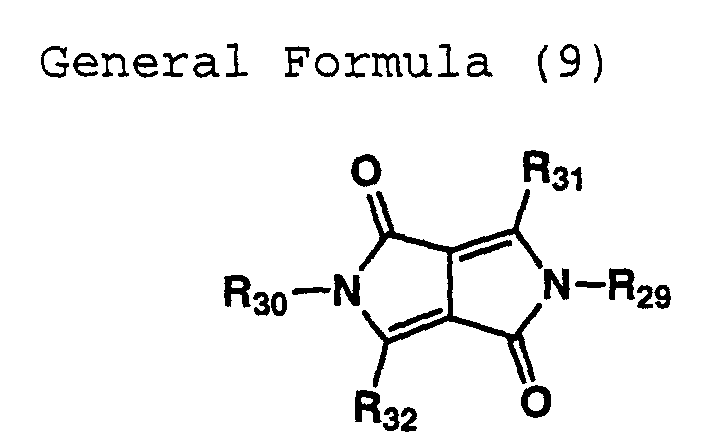
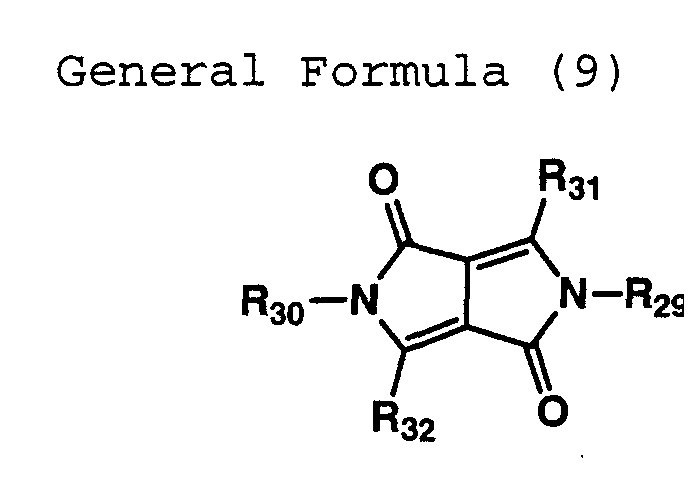
The compounds represented by General Formula (9) will
be described next.
wherein R
29 and R
30 each represent a substituent having a
water solubilizing group, and R
31 and R
32 each represent a
hydrogen atom or a substituent.
In General Formula (9), the substituents having a water
solubilizing group represented by R29 and R30 are the same as
those having a water solubilizing group represented by R4,
R6, and R7, and preferably are those represented by General
Formula (12), which was previously described in General
Formula (1).
Substituents represented by R
31 and R
32 preferably are
phenyl groups which may have a substituent. The substituent
for the phenyl group include, for example, a halogen atom
(for example, a chlorine atom and the like), an alkyl group
(for example, a methyl group, an ethyl group, and the like),
an alkoxy group (for example, a methoxy group, an ethoxy
group, and the like), and an amino group (for example, a
dimethylamino group, and the like).
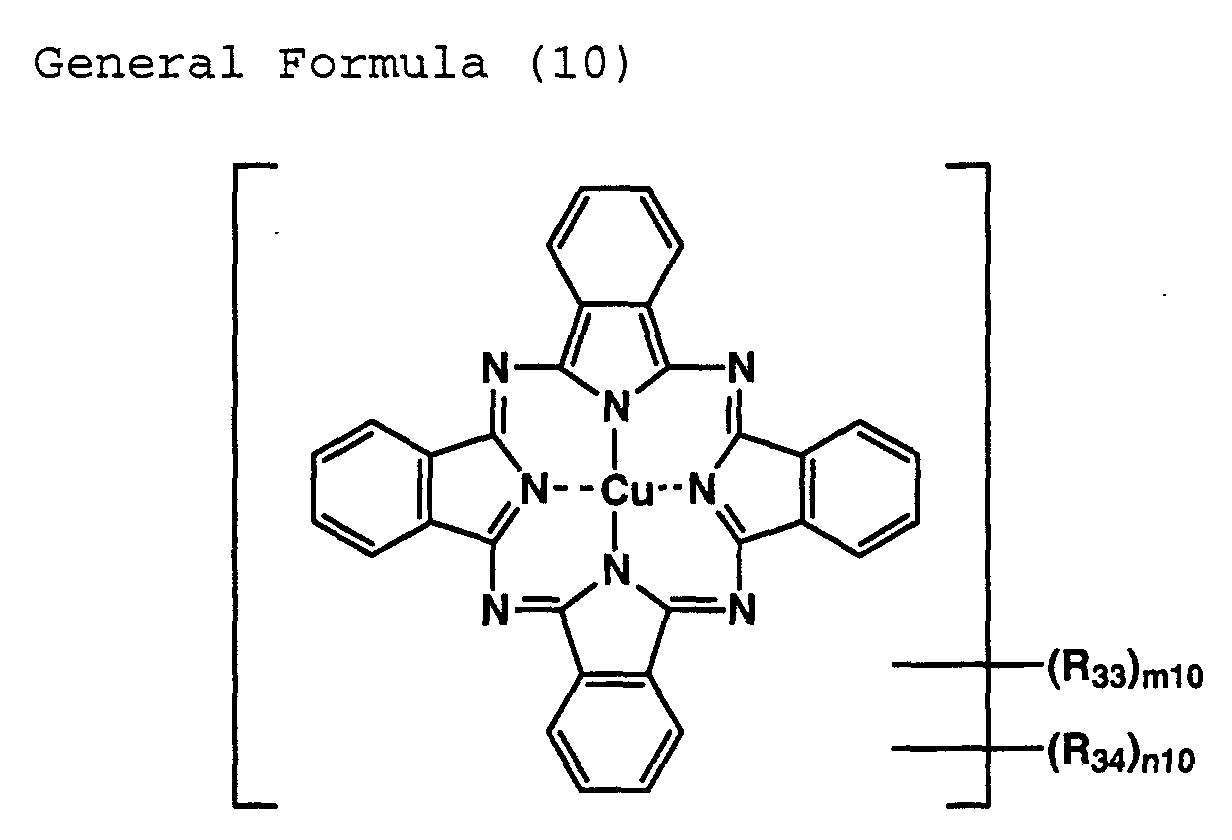
Next, the compounds represented by General Formula (10)
will be described.
wherein R
33 represents a substituent having a water
solubilizing group, R
34 represents a substituent, and m
10
represents 0 to 8, while n
10 represents 0 to 8.
In General Formula (10), the substituents having a
water solubilizing group represented by R33 are the same as
those having a water solubilizing group represented by R4,
R6, and R7, which were previously described in General
Formula (1) and preferably are those represented by General
Formula (12), which also were previously described in General
Formula (1).
Listed as substituents represented by R34 are a halogen
atom (for example, a chlorine atom and the like), an alkyl
group (for example, a methyl group, an ethyl group, a pentyl
group, and the like), and an alkoxy group (for example, a
methoxy group, an ethoxy group, a hexyloxy group, and the
like). Those represented by the General Formula (11) are
most preferable in the present invention.
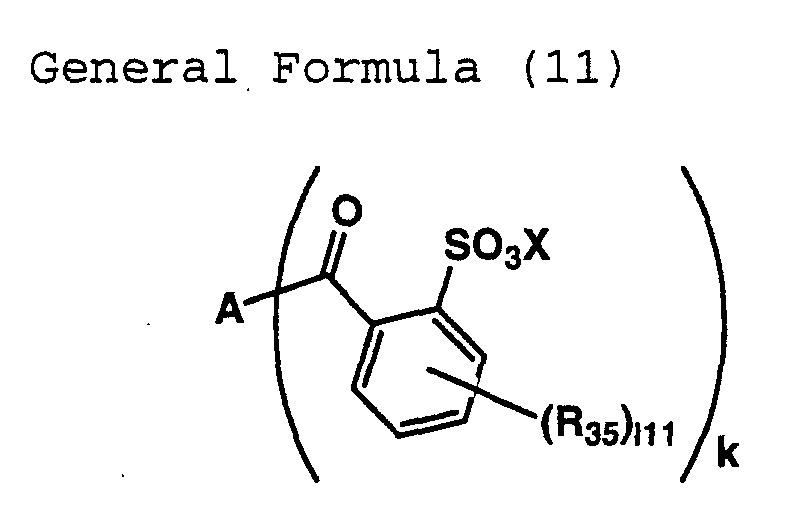
Next, the compounds represented by General Formula (11)
will be described.
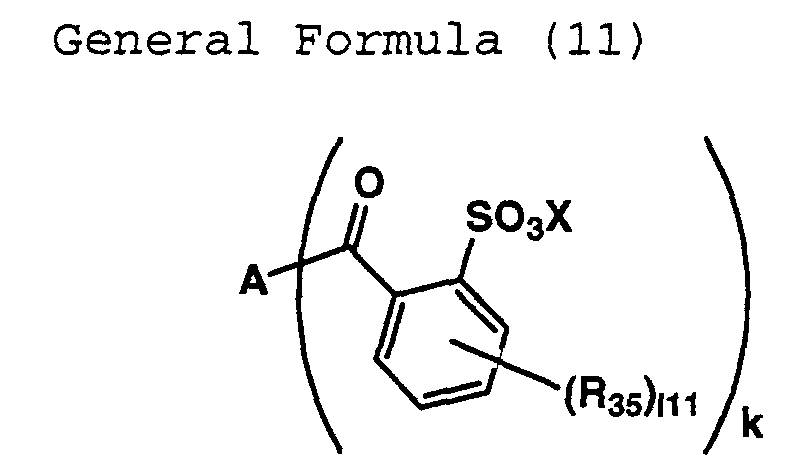
In General Formula (11), "A" represents an insoluble
pigment residual group, and the group in the parenthesis
bonds to the nitrogen atom of "A". X represents a hydrogen
atom or a counter cation, R35 represents a substituent, and
l11 represents 0 to 4. Further, when l11 is 2 to 4, a
plurality of R35 may be joined together to form a ring, while
"k" represents 1 to 5.
In General Formula (11), listed as insoluble pigment
residual groups are, for example, residual groups of azo
pigments, azomethine pigments, methine pigments,
diphenylmethane pigments, triphenylmethane pigments,
quinacridone pigments, anthraquinone pigments, perylene
pigments, indigo pigments, quinophthalone pigments,
isoindolinone pigments, isoindoline pigments, azine pigments,
oxazine pigments, thiazine pigments, dioxazine pigments,
thiazole pigments, phthalocyanine pigments,
diketopyrrolopyrrole pigments, and the like.
These pigments may have substituents which include
halogen atoms (for example, chlorine atom and the like),
alkyl groups (for example, a methyl group, an ethyl group, a
pentyl group, and the like), aryl groups (for example, a
phenyl group), heterocyclic ring groups (for example, a
pyridyl group, furyl group, thienyl group, and the like),
alkoxy groups (for example, a methoxy group, an ethoxy group,
a hexyloxy group, and the like), amino group (for example, a
dimethylamino group and the like), acylamino groups (for
example, an acetylamino group, a propanoylamino group, a
benzoylamino group, and the like), sulfonylamino groups (for
example, a methanesulfonamido group, benzenesulfonamido
group, and the like), and the like.
Insoluble pigments preferred in the present invention
include acetanilide azo pigments, isoindoline pigments,
isoindolinone pigments, quinacridone pigments, naphthol azo
pigments, pyrrolopyrrole pigments, indigo pigments, and
phthalocyanine pigments.
Listed as specific examples of counter cations
represented by X are metal ions such as lithium ions, sodium
ions, potassium ions, and the like.
Listed as specific examples of substituents represented
by R35 are a halogen atom (for example, a chlorine atom, a
bromine atom, an iodine atom, and the like), a nitro group,
an alkoxy group (for example, a methoxy group, an ethoxy
group, an isopropyloxy group, and the like), a SO3X group
(wherein X represents a hydrogen atom or a counter cation;
listed as specific example of counter cations are metal ions
such as a lithium ion, a sodium ion, a potassium ion, and the
like, and an ammonium ion).
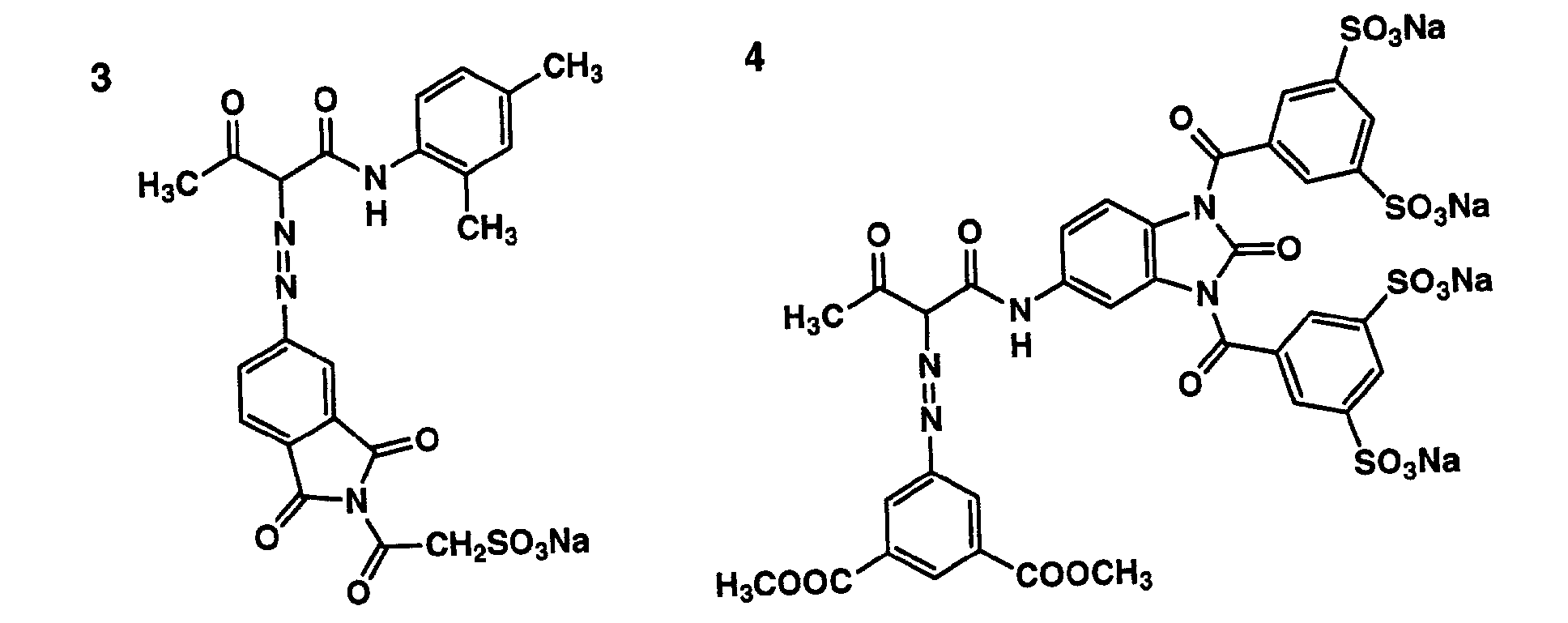
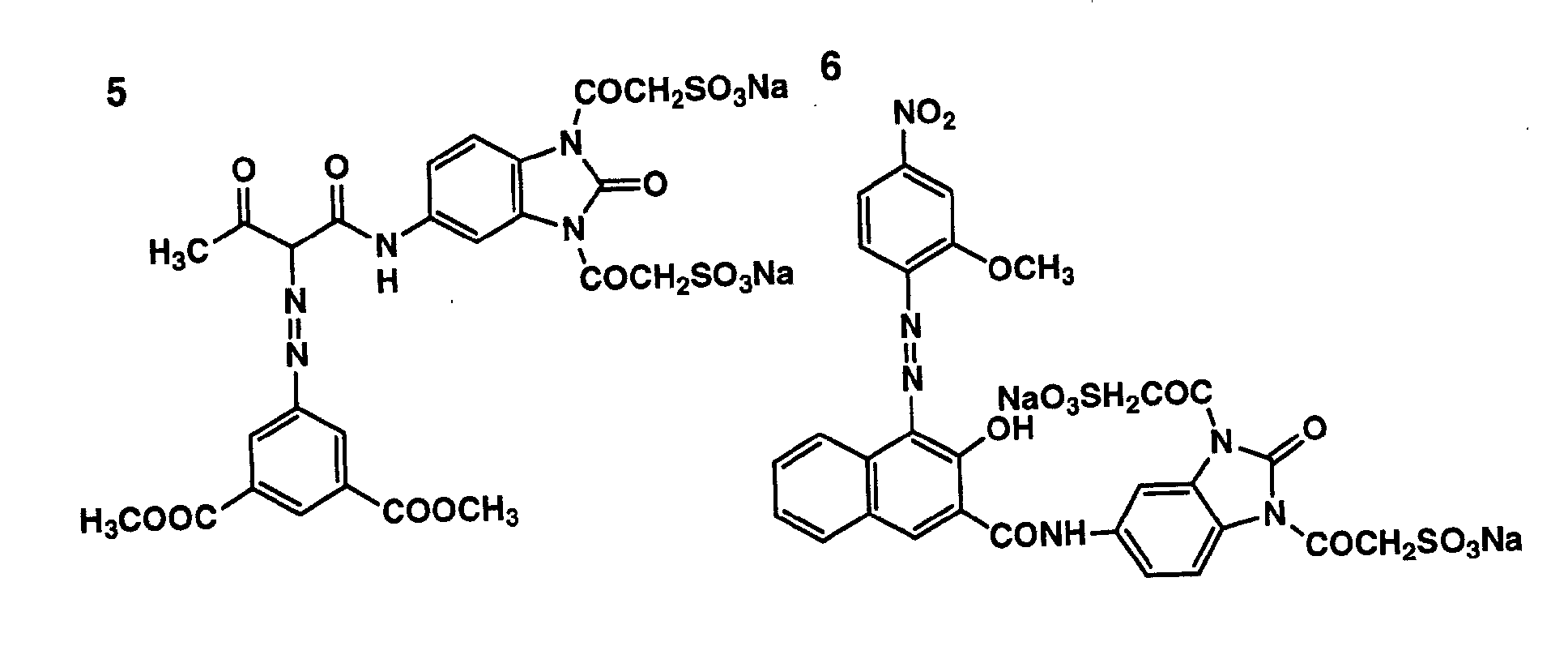
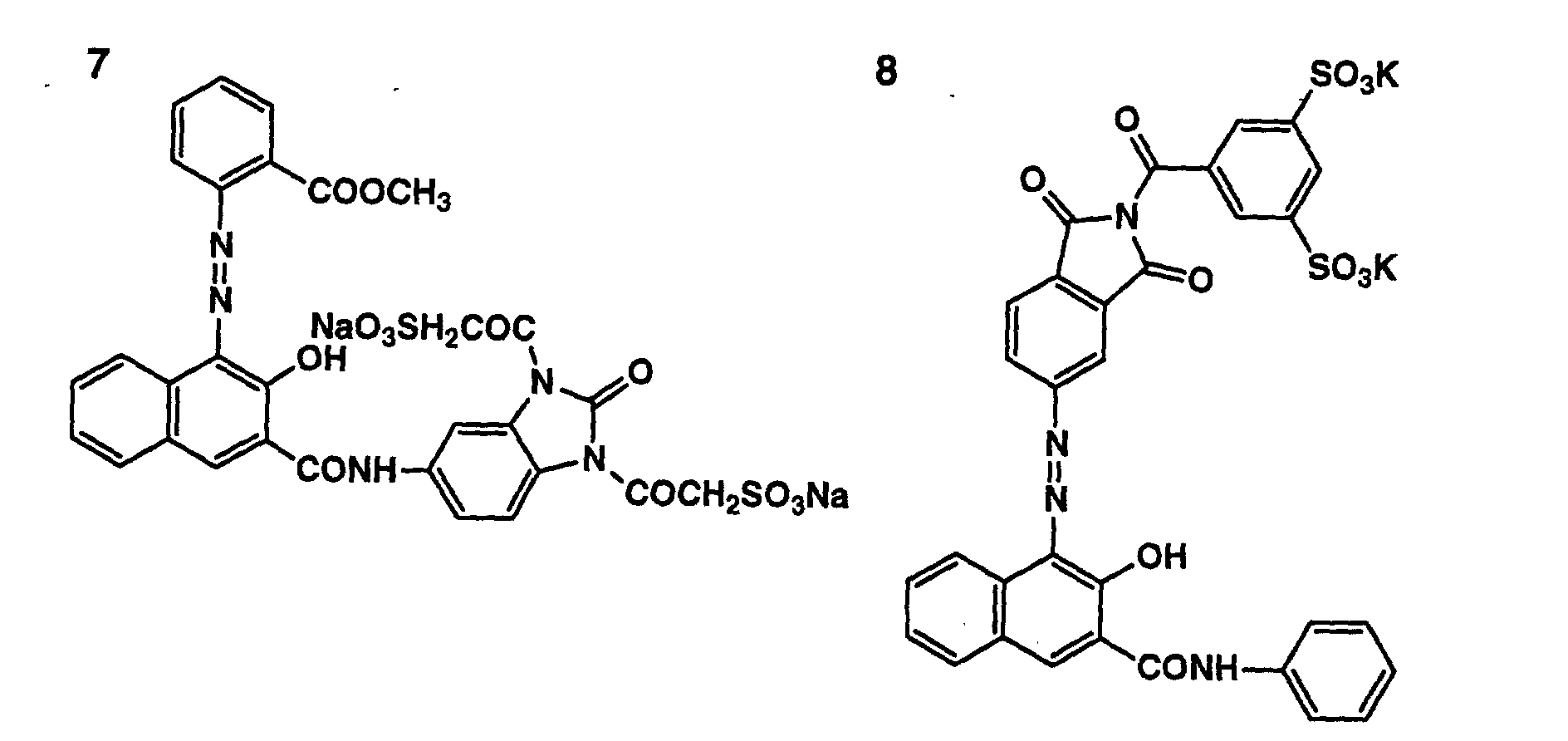
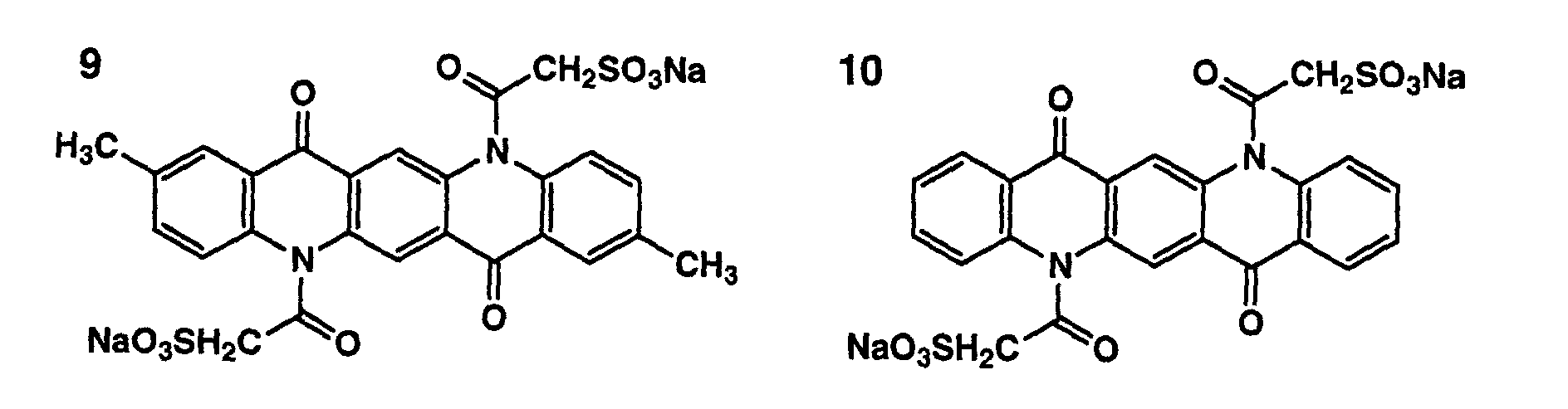
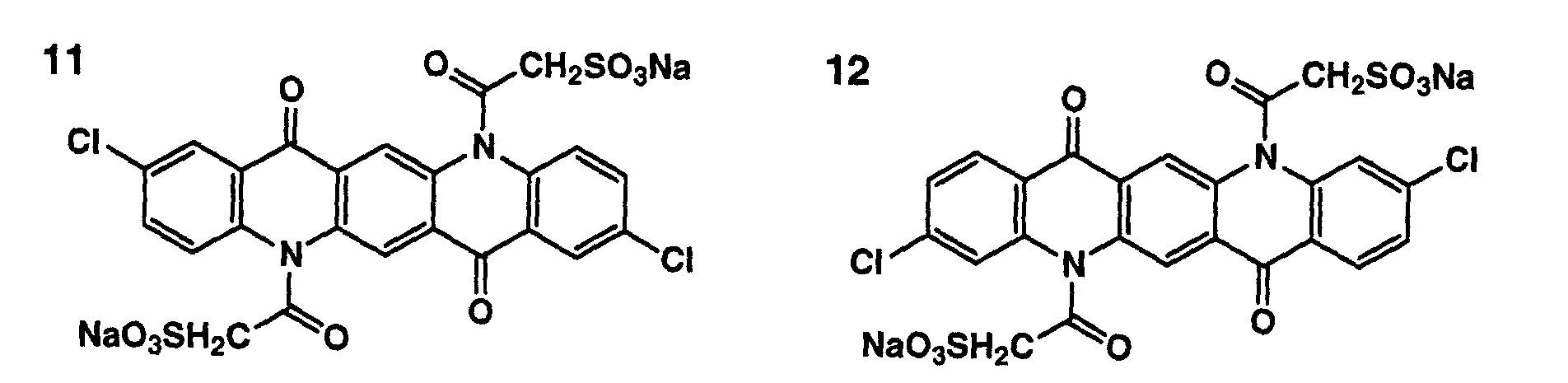
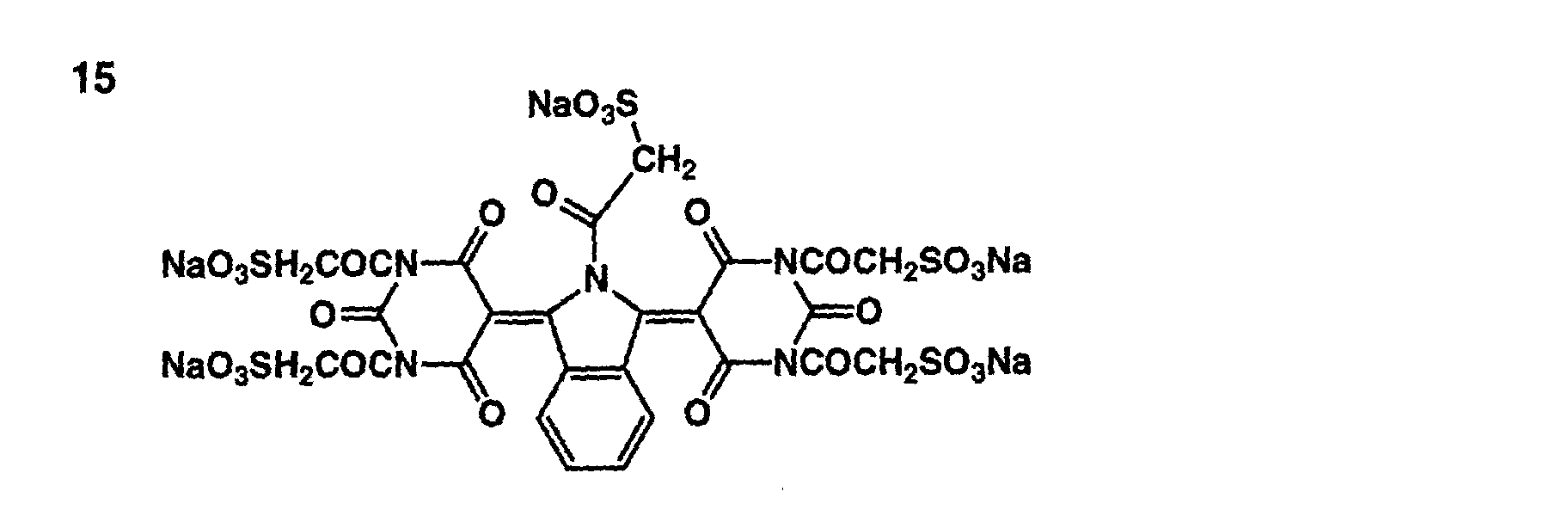
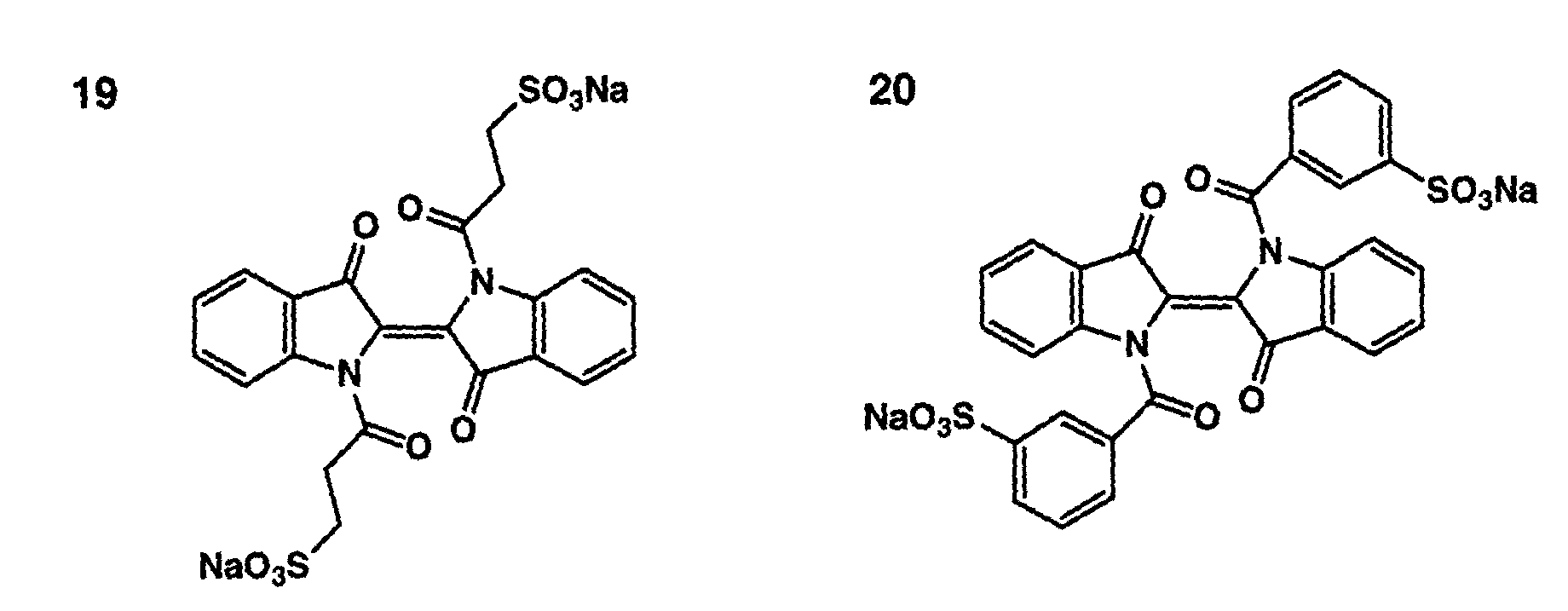
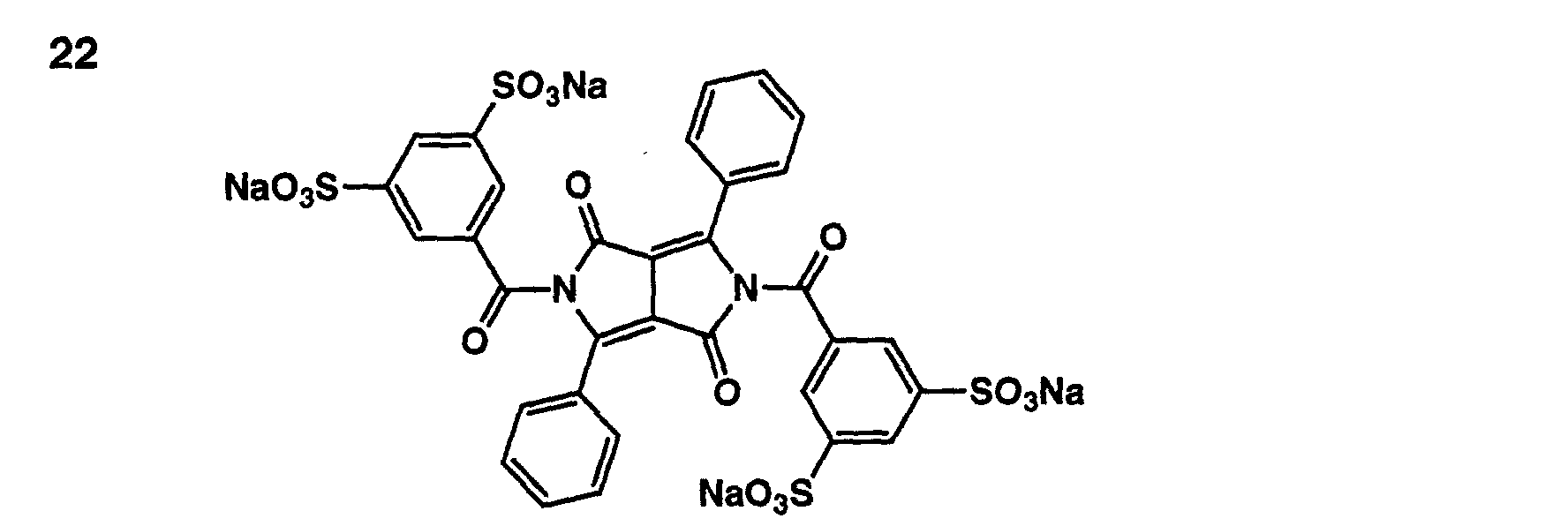
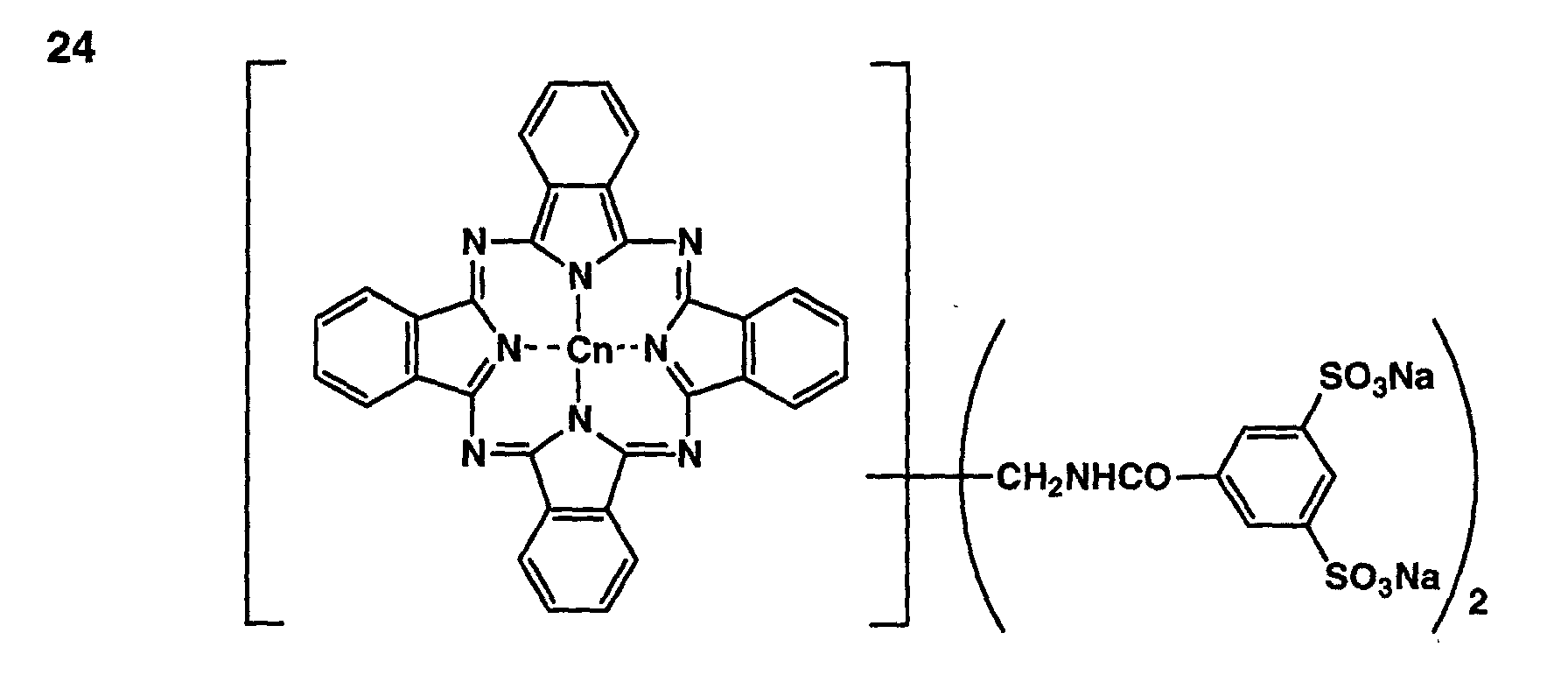
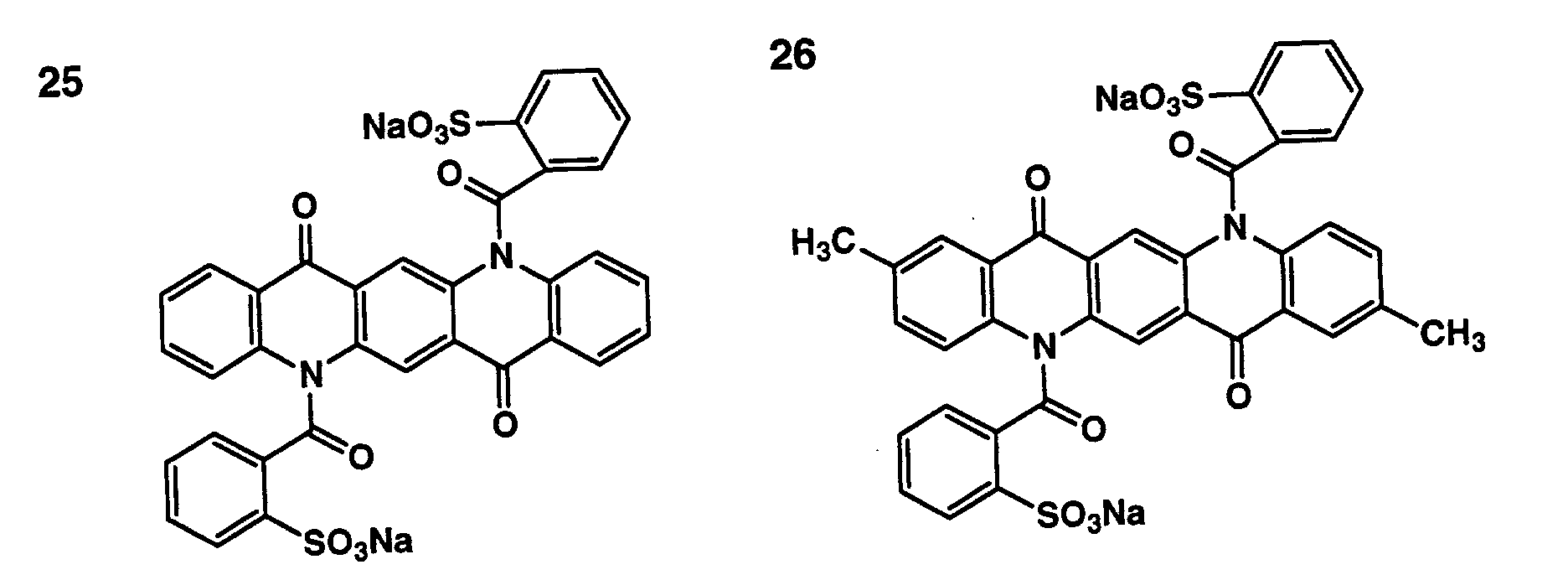
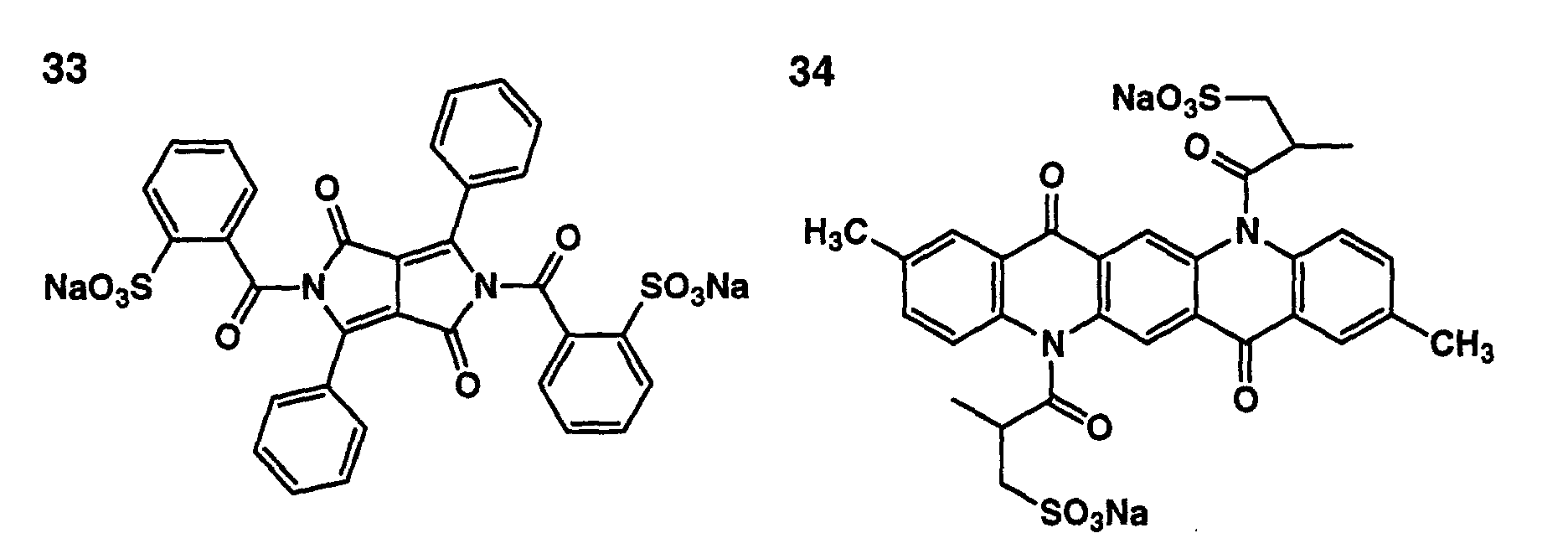
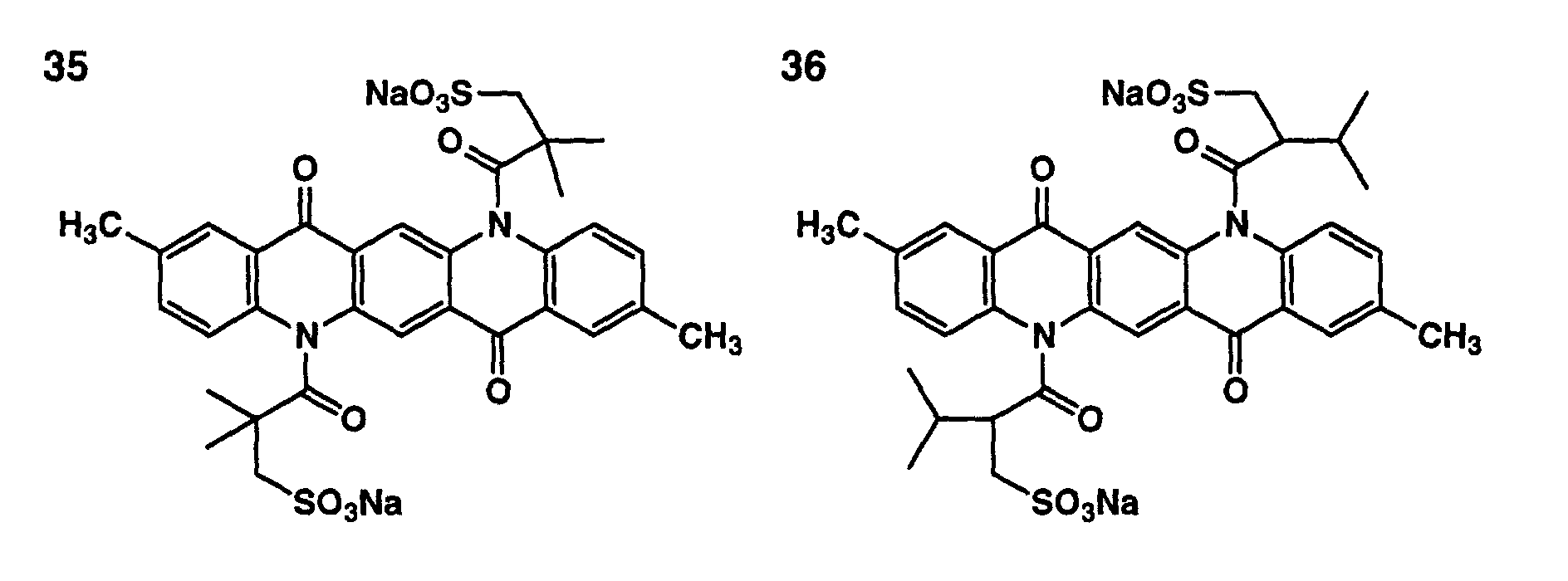
Specific examples of compounds, which can be converted
to insoluble pigments of the present invention, are
illustrated below.
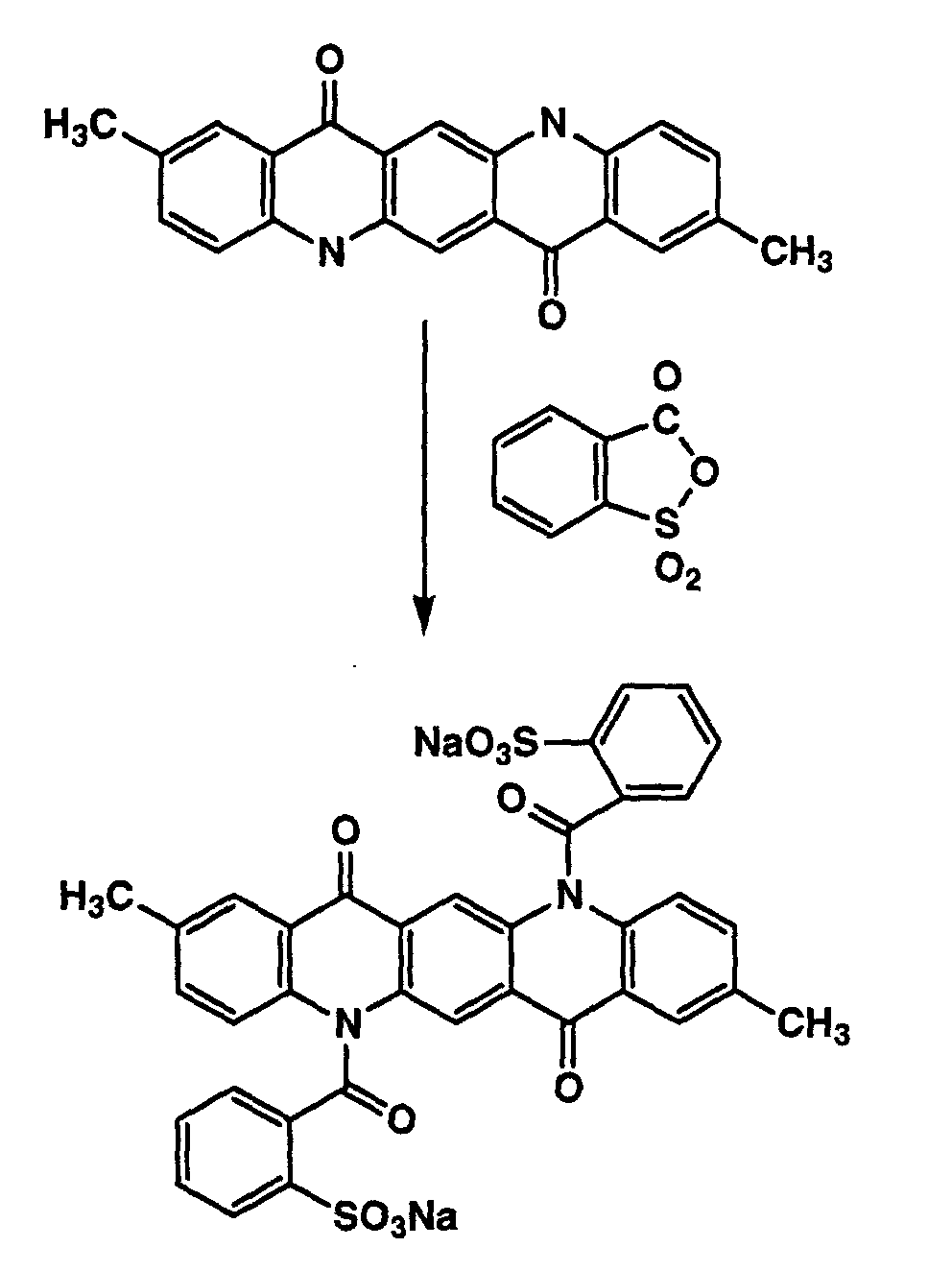
The precursors of the present invention can be
synthesized by modifying the corresponding insoluble
pigments, employing methods known in the art.
Listed as methods known in the art, which modify said
insoluble pigments, are, for example, acylation using acid
chlorides or acid anhydrides, oxycarbonylation using
chloroformic acid esters or O(COOR)2 (wherein R represents an
alkyl group, a phenyl group, and the like), sulfonylation
using sulfonyl chloride, and the like.
Synthesis examples of the precursors of the present
invention will now be described.
Synthesis Example 1
Synthesis of Exemplified Compound 20
Dispersed into 150 ml of N,N-dimethylformamide were 26
g of indigo and 27 g of 2,6-lutidine, and 46 g of m-sulfobenzoyl
chloride were then added to the resultant
dispersion over one hour. After said addition, the resultant
mixture underwent reaction at an internal temperature of 80
°C for 10 hours.
The reaction mixture was cooled to room temperature and
an aqueous solution containing 42 g of barium chloride was
added. The solid deposit was collected by filtration. The
resultant solid was dissolved in 400 ml of warm water, and
impurities were removed by heated filtration. Added to the
obtained solution was an aqueous solution containing 35 g of
potassium sulfate, and the resultant mixture was stirred.
The resultant deposit was removed by filtration and the
filtrate was concentrated under reduced pressure. The
resultant residue was recrystallized in pure water, and 16 g
of the target compound was obtained.
The obtained compound was identified as the target
compound, employing NMR as well as mass spectra.
Synthesis Example 2
Synthesis of Exemplified Compound 26
A mixture consisting of 13.6 g of dimethylquinacridone
(Pig. Red 122), which had been washed with heated acetone and
subsequently dried, 400 ml of dried N-methyl-2-pyrrolidone,
6.4 g of sodium hydride, and 100 ml of hexamethylene
phosphorictriamide (HMPA) was stirred at 80 °C for 30
minutes. After cooling to 60 °C, 9.2 g of o-sulfobenzoic
anhydride were added, and the resultant mixture was heated
and stirred at 80 °C for 2 hours. After cooling to 60 °C, 9.2
g of o-sulfobenzoic anhydride were added, and the resultant
mixture was heated and stirred at 80 °C for 8 hours. The
mixture was cooled to room temperature, and 2 liters of n-hexane
were added and stirred. Then, the resultant mixture
was left untouched. The upper layer of the resultant two
layers was removed by decantation. Said operation was
repeated twice and a yellowish brown solid was obtained. The
resultant solid was blended with iced water and stirred.
After adjusting the pH to 9 using hydrochloric acid, 20 g of
sodium chloride were added to the resultant mixture. The
resultant mixture was heated to 60 °C, then cooled over night
and left untouched. A small amount of deposit solid was
removed by filtration, and 40 g of sodium chloride were
further added to the filtrate and the resultant mixture was
heated to 60 °C, cooled over night and left untouched. Then
the target compound was obtained by collecting the solid
deposit employing filtration. The yield after drying was 8.5
g.
The obtained compound was identified as the target
compound employing NMR as well as mass spectra.
The water based composition of the present invention is
obtained by dissolving the precursors of the present
invention in a water based solvent.
The water based solvents, as described in the present
invention, refers to solvents prepared by blending water with
water-soluble organic solvents. These solvents may be
blended with a small amount of other solvents.
Listed as water soluble organic solvents employed in
the present invention are, for example, alcohols (for
instance, methanol, ethanol, propanol, isopropanol, butanol,
isobutanol, secondary butanol, tertiary butanol, pentanol,
hexanol, cyclohexanol, benzyl alcohol, and the like),
polyhydric alcohols (for instance, ethylene glycol,
diethylene glycol, trimethylene glycol, polyethylene glycol,
propylene glycol, dipropylene glycol, polypropylene glycol,
butylenes glycol, hexanediol, pentanediol, glycerin,
hexanetriol, thiodiglycol, and the like), polyhydric alcohol
ethers (for instance, ethylene glycol monomethyl ether,
ethylene glycol monoethyl ether, ethylene glycol monobutyl
ether, diethylene glycol monomethyl ether, diethylene glycol
monomethyl ether, diethylene glycol monobutyl ether,
propylene glycol monomethyl ether, propylene glycol monobutyl
ether, ethylene glycol monomethyl ether acetate, trimethylene
glycol monomethyl ether, trimethylene glycol monoethyl ether,
trimethylene glycol monobutyl ether, ethylene glycol
monophenyl ether, propylene glycol monophenyl ether, and the
like), amines (for example, ethanolamine, diethanolamine,
triethanolamine, N-methyldiethanolamine, N-ethyldiethanolamine,
morpholine, N-ethyl morpholine,
ethylenediamine, diethylenediamine, triethylenetetramine,
tetraethylenepentamine, polyethyleneimine,
pentamethyldiethylenetriamine, tetramethylpropylenediamine,
and the like), amides (for example, formamide, N,N-dimethylformamide,
N,N-dimethylacetoamide, and the like),
heterocycles (for example, 2-pyrrolidone, N-methyl-2-pyrrolidone,
cyclohexylpyrrolidone, 2-oxazolidone, 1,3-dimethyl-2-imidazolidinone,
and the like), sulfoxides (for
example, dimethylsulfoxide, and the like), sulfones (for
example, sulfolane, and the like), acetonitrile, acetone, and
the like. Said water-soluble organic solvents may be used
individually or in combination. The added amount of total
water-soluble organic solvents in ink is preferably between 5
and 60 percent by weight.
The precursor is dissolved in water-based solvent. In
other words, there is no insoluble material substantially.
The soluble precursor is different from an ink dispersion in
which the precursor is dispersed stably with assist of
surfactant, if it is necessary. It is also different from a
dispersion in which precursor dissolved in non-water-solvent
is dispersed in the water-based solvent, if it is necessary.
The dissolved state means the similar state as water based
dye ink for ink-jet printing which is obtained by dissolving
acidic dye or direct dye in water based solvent
homogeneously. Measurement of laser photon correlation
method may be employed to determine whether it is dissolved
or not. When an ink, in which the precursor is dissolved in
the water based solvent of the invention, is measured,
particle distribution diameter is not observed essentially.
To the contrary particle having average diameter of several
tens nanometer to several tens micrometer are observed in the
above mentioned dispersion ink or ordinary pigment based ink.
Observation of sediment residue by super centrifugal
separator is another measure to determine whether it is
dissolved or not. The sediment residue is not observed in an
ink in which the precursor is dissolved in the water based
solvent. To the contrary sediment residue is observed in the
above mentioned dispersion ink or ordinary pigment based ink.
In order to meet requirements for improving various
performances such as ejection stabilizing properties,
adaptability to print heads as well as ink cartridges,
storage stability, image retention quality, and the like, if
desired, added to the ink composition of the present
invention may be viscosity control agents, surface tension
control agents, specific resistance control agents, film
forming agents, dispersing agents, surface active agents, UV
absorbers, antioxidants, fade resistant agents, antiseptic
agents, rust preventives, and the like.
The viscosity of the ink composition of the present
invention during its flying is preferably no more than 40
cps, is more preferably no more than 30 cps, and is most
preferably between 2 and 12 cps.
The surface tension of the ink composition of the
present invention during its flying is preferably at least 20
mN/m, and is more preferably between 40 and 60 mN/m.
In the ink compositions of the present invention, the
content of precursors of the present invention is preferably
between 0.5 and 10 weight percent based on the total weight
of the ink composition.
The image forming method of the present invention will
now be described.
Preferred as methods for printing with the water based
ink compositions of the present invention is an ink jet print
system.
The ink jet print system employed in the present
invention is not particularly limited, and either a
continuous system or an on-demand system may be employed.
On-demand type systems include electric-mechanical conversion
systems (for example, a single cavity type, a double cavity
type, a vender type, a piston type, a share mode type, a
shared wall type, and the like), electric-thermal conversion
systems (for example, a thermal ink jet type, a bubble ink
jet type, and the like), and the like.
Employed as print media may be either so-called plain
paper or special paper (coated paper or glossy paper).
On the print media, the precursors of the present
invention are converted to insoluble pigments, by any of a
chemical means, a thermal means, a photodecomposition means,
and a radiation means, or a means of a combination of these,
which are capable of converting said precursors of the
present invention to insoluble pigments.
The chemical means, as described above, implies that
compounds (hereinafter occasionally referred to as pigment
formation promoting compounds), which initiate the conversion
of the precursor to the insoluble pigment or promote said
conversion, are placed together with said precursors on the
print medium, while employing any appropriate method.
Listed as methods to allow said compounds to be placed
together with the precursors on the print medium are a method
in which special print media, into which said pigment
formation promoting compounds are previously incorporated,
are employed, a method in which pigment formation promoting
compounds are supplied onto the medium before or after
printing, and the like.
Methods in which pigment formation promoting compounds
are supplied onto the print medium before or after printing
include, for example:
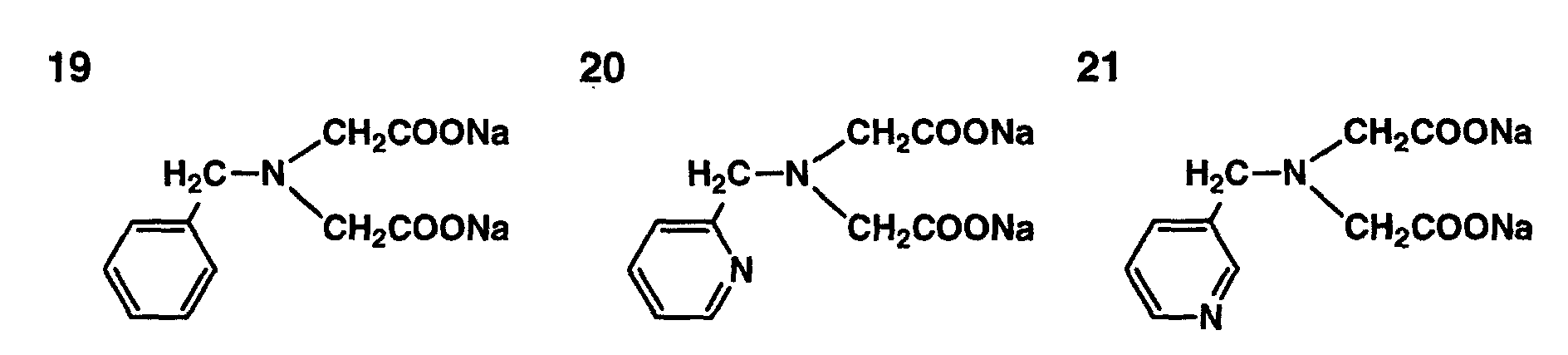
Listed as pigment formation promoting compounds are
acids, bases, nucleophilic agents, electrophilic agents,
oxidizing agents, reducing agents, coordination compounds,
and the like. Of these, acids or bases are preferred, and
acids are specifically preferred.
Further, pigment formation promoting compounds are
preferably water-soluble compounds, and are more preferably
supplied onto a print medium in the form of the solution in
which water is employed as the main component.
Listed as acids employed as pigment formation promoting
compounds may be either organic acids or inorganic acids.
Listed as organic acids are, for example, acetic acid,
propionic acid, lauric acid, acrylic acid, ascorbic acid,
benzoic acid, salicylic acid, lactic acid, oxalic acid, and
the like;, while listed as inorganic acids are, for example,
hydrochloric acid, nitric acid, sulfuric acid, phosphoric
acid, boric acid, and the like. Employed as bases may be
either organic bases or inorganic bases. Listed as organic
bases are, for example, pyridine, triethylamine,
aminoethanol, triethanolamine, dimethylaniline, and lutidine,
while as listed as inorganic bases are, for example,
potassium carbonate, sodium carbonate, sodium bicarbonate,
potassium bicarbonate, sodium hydroxide, potassium hydroxide,
sodium acetate, and the like.
In the chemical means of the resent invention,
employing a method in which precursors are converted to
insoluble pigments, employing acids or bases, said conversion
is preferably carried out by generating bases on the
recording medium. With respect to the methods described
below, included are:
"a)" exhibits advantages, in which in order to supply
acids or bases, an aqueous solution is supplied onto a
recording medium in addition to the recording ink, and as a
result, the supply amount does not exceed the absorbable
amount of said recording medium so that no bleeding results,
and the printer cost is lowered due to a decrease in the
device load; "b)" exhibits advantages in which the supply
channel is not eroded by acids or bases during use over
extended period of time; and "c)" exhibits advantages in
which during storage, the base is neutralized by carbonic
acid gas in ambient air and as a result, regeneration of
pigments after storage is not affected.
A process in which acids are generated on a recording
medium will be described. Processes for generating acids on
the recording medium include, for example, a method in which
acids are generated in response to monochromatic light or
thermal stimulus, or a method in which a plurality of
components undergo chemical reaction to generate acids.
Widely employed as a method, in which acids are
generated in response to monochromatic light or thermal
stimulus, may be acid-generating compounds which are employed
in the field of photosensitive resins. Listed as examples of
acid-generating compounds which may preferably be employed
are diazonium salts, iodonium salts, sulfonium salts,
phosphonium salts, sulfonic acid esters, sulfonic acid
chlorides, sulfamic acid salts, organic halides, and the
like. Further, listed as specific examples of those
compounds are those disclosed in Japanese Patent Publication
Nos. 62-44258, 59-1281, 3-4898, and 2-39783; and Japanese
Patent Publication Open to Public Inspection Nos. 54-74728,
53-36223, 59-148784, 7-20629, 7-271029; as well as others.
Methods, in which a plurality of components undergoes
chemical reaction, include, for example, a method in which
acids are generated through complex forming reaction. The
method in which acids are generated through said complex
forming reaction is preferable as the process for generating
acids on the recording medium of the present invention.
Said complex forming reaction takes place utilizing a
plurality of components, for example, component X1 and Y1, as
shown below.
Component X1 is a compound which forms a stable complex
together with the metal ions of component Y1, and preferably
includes water-soluble multidentate ligands. Further,
preferably, component X1 is a neutral or weakly acidic
compound. Component Y1 is a salt consisting of a metal ion
capable of forming a complex, and an acidic ion. Metal ions
employed herein are preferably transition metal ions, and are
more preferably metal ions having an atomic number of 21
through 30. They are more preferably ions of manganese,
iron, cobalt, nickel, copper, zinc, and the most preferable
metal is zinc. Cited as acidic ions are, for example, a
sulfuric acid ion, a hydrochloric acid ion, a phosphoric acid
ion, and the like. The salts of component Y1 are preferably
water-soluble.
When component X1 and component Y1 are mixed, for
example, in water, acids are generated and the pH decreases.
This mechanism is understood to function in such a manner
that a ligand forming compound of component X1 coordinates
with the metal ion of Y1 to form a stable complex and the pH
decreases due to the resulting acidic component.
A preferable acid generating method is one in which a
plurality of components undergo chemical reaction to generate
acids. At that time, a plurality of said components are
individually added to the ink as well as to the recording
medium.
The embodiment of the preferable acid generating method
of the present invention is one in which an acid is generated
through the complex forming reaction between the component of
the ink composition and the component of the recording
medium.
Specific examples, utilizing the complex forming
reaction, which are particularly preferred, are the method in
which acids are formed by mixing any compound in Group X1 and
any compound in Group Y1.
Examples of Group X
1 are illustrated.
Group Y1: zinc sulfate, copper sulfate, cobalt sulfate,
nickel sulfate, manganese sulfate. These may be hydrated.
Of these, zinc sulfate is preferred.
The specifically preferable acid generation method is
one in which acids are generated on the recording medium by
carrying out recording on said recording medium comprising at
least one compound in said Y1 Group, employing the ink
comprising at least one compound in said X1 Group. After
recording, heating is more preferably carried out.
Herein described is an acid generation method utilizing
the complex forming reaction as well as an image forming
method having a process in which acids are formed utilizing
said complex forming reaction. Said image forming method
having a process, in which acids are formed utilizing said
complex forming reaction, is useful for an image forming
method in which other ink compositions, comprising no
precursors which can be converted to an insoluble pigment.
Said image forming method having a process in which an acid
is formed, utilizing said complex forming reaction, is useful
for image formation, utilizing ink jet recording employing
ink compositions containing selected colorants, for example,
from acid dyes, direct dyes, reactive dyes, disperse dyes,
and pigments, and is effective for minimization of color
bleeding, increase in water resistance of images,
minimization of bleeding, and the like. Specifically, said
effects are pronounced when images are formed employing a
water based ink comprising colorants selected from acid dyes,
direct dyes, reactive dyes, and pigments in an amount of at
least 50 percent water.
After image formation, some or all acids generated by
the complex forming reaction are preferably removed by water
washing. Said acids may be removed by washing the formed
images with either water or weakly alkaline water.
Cited as base generating processes on a recording
medium are, for example those utilizing a method in which a
base is generated employing either decomposition or self
reaction of any of single component compounds and a method in
which a plurality of components undergo chemical reaction
whereby a base is generated.
Listed as said base generating methods are those
employing salts formed between organic acids which are
subjected to thermal decarboxylation and bases, compounds
which release amines through intramolecular nucleophilic
displacement reaction, Lossen rearrangement, Beckmann
rearrangement, and the like. Such specific examples are
described in U.S. Pat. Nos. 4,511,493, and 4,657,848;
Japanese Patent Publication Open to Public Inspection Nos.
50-22625, 61-251840, 61-219950, 61-55646, 61-55645, 61-55644,
61-53639, 61-32844, and 62-65038; and others. The
specifically preferable base generating method is one
employing a complex forming reaction. Such specific examples
are described in Japanese Patent Publication Open to Public
Inspection Nos. 62-187847 and 12-85236.
The preferable base generating method is one in which a
plurality of components undergo chemical reaction, thereby
forming a base. At that time, a plurality of components are
preferably incorporated individually into the ink as well as
the recording medium
The embodiment of the preferable base generating method
of the present invention is one in which bases are generated
through complex forming a reaction between the component of
the ink composition and the component in the recording
medium.
Specific examples, which are particularly preferable as
the base generating method, utilizing the complex forming
reaction, are methods in which any compound in Group X
2 and
any compound in Group Y
2 described below are mixed, thereby
generating bases.
Group Y2: basic zinc carbonate, calcium carbonate,
basic cobalt carbonate, basic copper carbonate, basic nickel
carbonate, nickel hydroxide, ZnO, Zn(OH)2, Co(OH)2, Cu(OH)2,
Ni(OH)2, Mn(CO)3. In Group Y2, zinc oxide is preferable.
The specifically preferable base generating method is
one in which base are generated on a recording medium by
carrying out recording on said recording medium comprising at
least one of the Group X2 compounds, employing ink comprising
at least one of the Group Y2 compounds. After recording, it
is more preferable to carry out heating.
Compounds, which are necessary for generating either
bases or acids, are supplied onto a recording medium.
Supplying methods include:
Said methods may be employed individually or in
combination.
Image forming methods, utilizing acid or base
generating methods include those having process (A) in which
recording is carried out on a recording medium, employing an
ink composition comprising precursors which can be converted
to an insoluble pigment, employing either an acid or a base,
and process (B) which generates either an acid or a base on
the recording medium. The order of processes A) and B) is
optional and both may simultaneously be carried out.
Further, the image forming method of the present invention
preferably include, in addition to processes (A) and (B),
process (C) in which precursors, which can be converted to an
insoluble pigment employing either an acid or a base, are
converted to said insoluble pigment. Still further, the
image forming method of the present invention preferably
include, in addition to processes (A), (B), and (C), process
(D) in which said recording medium is heated. Process (D) is
preferably included to promote said processes (B) and (C).
However, a preferable embodiment is such that process (D) is
simultaneously carried out with process (A), or is carried
out immediately after process (A).
Further, the process for heating recording media may be
carried out so that it is divided into several portions which
are regulated at the same or different temperatures. The
heating temperature is preferably in the range of 50 to 230
°C, and is more preferably in the range of 80 to 190 °C. The
heating time is preferably in the range of 0.5 to 60 seconds.
During heating, pressure in the range of 0.5 to 45 Kgf/cm2 is
preferably applied. Cited as heating means are heated
rollers (for example, electrophotographic heated fixing
rollers), warm forced air, infrared heaters, and the like.
The thermal means, which converts the precursors of the
present invention to insoluble pigments, as described herein,
means that printed materials are heated after printing.
The heating temperature is preferably in the range of
50 to 230 °C, and is more preferably in the range of 70 to
190 °C. Listed as heating means are heated rollers (for
example, heated fixing rollers such as used for
electrophotography), heated forced air, infrared heaters and
the like.
The photodecomposition means which converts the
precursors of the present invention to insoluble pigments, as
described herein, means that printed materials are subjected
to irradiation of ultraviolet rays, visible light, infrared
rays, and the like, after printing.
The Preferred embodiment, in which the precursors of
the present invention are converted to insoluble pigments, is
a method, in which either before or after printing, either an
acidic or a basic solution is supplied to a print medium and
heated.
EXAMPLES
Example 1
Preparation of Ink
Preparation of Present Invention Ink Samples 1 through 27 and
Comparative Dye Ink Sample 29
Each ink was prepared in such a manner that colorants,
shown in Tables 1 and 2 in an amount, shown in Tables 1 and 2
and solvents shown in Tables 1 and 2 in an amount shown in
Tables 1 and 2, were employed so that the total volume was
adjusted to 100 parts by adding deionized water. Further,
additives shown in Tables 1 and 2 were added so as to obtain
a concentration of 0.1 percent.
Preparation of Comparative Pigment Ink Sample 28
A mixture consisting of 6 parts of Pigment Red (a
comparative pigment), 6 parts of Olefin STG (Shin-Etsu
Kagaku), and 8 parts of deionized water was dispersed for 8
hours employing a sand mill (in which 0.3 mm zirconia beads
were employed).
Added to the resultant dispersion were 20 parts of
diethylene glycol, and ink was then prepared by adjusting the
total volume to 100 parts by adding deionized water.
| | Colorant | Solvent | Additive (added to obtain 0.1%) |
| | Type | Amount | Type | Amount |
| 1 | 1 | 4 | diethylene glycol | 25 | Surfinol 465 | present invention |
| 2 | 2 | 4 | diethylene glycol | 20 | Surfinol 465 | present invention |
| 3 | 4 | 4 | diethylene glycol | 20 | Surfinol 465 | present invention |
| 4 | 7 | 3 | diethylene glycol | 20 | Surfinol 465 | present invention |
| 5 | 8 | 2 | diethylene glycol monomethyl ether | 25 | Surfinol 465 | present invention |
| 6 | 9 | 2 | diethylene glycol | 20 | DES | present invention |
| 7 | 10 | 2 | diethylene glycol | 30 | Surfinol 465 | present invention |
| 8 | 13 | 2 | diethylene glycol | 30 | Surfinol 465 | present invention |
| 9 | 14 | 2 | diethylene glycol | 30 | Surfinol 465 | present invention |
| 10 | 15 | 5 | diethylene glycol | 15 | Surfinol 465 | present invention |
| 11 | 16 | 4 | N-methyl-2-pyrrolidone | 20 | Surfinol 465 | present invention |
| 12 | 17 | 4 | diethylene glycol | 20 | Surfinol 465 | present invention |
| 13 | 20 | 3 | glycerin | 15 | Surfinol 465 | present invention |
| 14 | 23 | 2 | diethylene glycol | 20 | Surfinol 465 | present invention |
| 15 | 24 | 2 | diethylene glycol | 20 | Surfinol 465 | present invention |
| 16 | 25 | 6 | N-methyl-2-pyrrolidone | 30 | Surfinol 465 | present invention |
| 17 | 26 | 6 | N-methyl-2-pyrrolidone | 30 | Surfinol 465 | present invention |
| 18 | 27 | 4 | N,N-dimethylformamide | 30 | Surfinol 465 | present invention |
| 19 | 28 | 4 | N-methyl-2-pyrrolidone | 30 | Surfinol 465 | present invention |
| 20 | 29 | 5 | N-methyl-2-pyrrolidone | 30 | Surfinol 465 | present invention |
| 21 | 30 | 3 | N-methyl-2-pyrrolidone | 25 | DES | present invention |
| | Colorant | Solvent | Additive (added to obtain 0.1%) |
| | Type | Amount | Type | Amount |
| 22 | 31 | 4 | diethylene glycol | 30 | Surfinol 465 | present invention |
| 23 | 32 | 3 | N-methyl-2-pyrrolidone | 30 | Surfinol 465 | present invention |
| 24 | 33 | 3 | N,N-dimethylacetamide | 30 | Surfinol 465 | present invention |
| 25 | 35 | 3 | N-methyl-2-pyrrolidone | 30 | Surfinol 465 | present invention |
| 26 | 36 | 2 | N-methyl-2-pyrrolidone | 30 | Surfinol 465 | present invention |
| 27 | 37 | 2 | N-methyl-2-pyrrolidone | 30 | Surfinol 465 | present invention |
| 28 | comparative pigment 1 | 4 | diethylene glycol | 20 | | comparative |
| 29 | comparative dye 2 | 2 | diethylene glycol | 20 | Surfinol 465 | comparative |
| Comparative pigment 1: Pigment Red 4, |
| Comparative dye 2: Acid Yellow 23 |
An image sample was obtained by printing an image on
plain paper (Xerox 4024) employing Ink Sample 13 (red ink),
while employing an Ink Jet Printer MJ-810 (manufactured by
Seiko Epson Corporation).
After 10 percent aqueous sodium carbonate solution was
applied onto the resultant sample, and subsequently dried,
the resultant sample was subjected to treatment employing a
electrophotographic heated fixing roller set at 180 °C, and
Image Sample 1, having a blue tinted image, was obtained.
The obtained Image 1 was one of those which were subjected to
conversion to an insoluble pigment.
Preparation of Image Sample 2
An image sample was obtained by printing an image on
plain paper (Xerox 4024) employing Ink Sample 13 (red ink),
while employing an Ink Jet Printer BJC700J (manufactured by
Canon Inc.).
At the time, a water resistance enhancing agent for
plain paper was replaced with 10 percent aqueous sodium
carbonate solution so that said 10 percent aqueous sodium
carbonate solution is blended with an Ink 13 image on the
plain paper.
The resultant sample was subjected to treatment
employing an electrophotographic heated fixing roller set at
180 °C to obtain blue tinted Image 2. The obtained Image 2
was one which was subjected to conversion to the insoluble
pigment.
Preparation of Image 3
An image sample was obtained by printing an image on
plain paper (Xerox 4024) employing Ink Sample 7 (yellowish
green ink), while employing an Ink Jet Printer MJ-810
(manufactured by Seiko Epson Corporation).
After 10 percent aqueous sodium carbonate solution was
applied onto the resultant sample employing a wire bar, the
coating was dried employing heated forced air (at 100 °C) to
obtain reddish violet Image 3. Obtained Image 3 was one of
those which were subjected to conversion to the insoluble
pigment.
Preparation of Image 4
An image sample was obtained by printing an image on
special glossy paper (Photo Jet Paper QP Double Weight,
manufactured by Konica Corp.) employing Ink Sample 13 (red
ink), while employing an Ink Jet Printer MJ-810 (manufactured
by Seiko Epson Corporation).
After 10 percent aqueous sodium carbonate solution was
applied onto the resultant sample employing a wire bar, and
subsequently dried, the resultant sample was subjected to
treatment employing an electrophotographic heated fixing
roller set at 180 °C, and blue tinted Image Sample 4 was
obtained. The obtained Image 4 was one of those which were
subjected to conversion to an insoluble pigment.
Preparation of Image 5
An image sample was obtained by printing an image on
special glossy paper (Photo Jet Paper QP Double Weight,
manufactured by Konica Corp.) employing Ink Sample 13 (red
ink), while employing an Ink Jet Printer MJ-810 (manufactured
by Seiko Epson Corporation).
After 10 percent aqueous sodium carbonate solution was
applied onto the resultant sample employing a wire bar, and
subsequently dried, the resultant sample was dried with
forced hot air (at about 80 °C) for one minute employing a
dryer to obtain blue tinted Image 5. The obtained Image 5
was one of those which were subjected to conversion to an
insoluble pigment.
Preparation of Image 6
An image sample was obtained by printing an image on
special glossy paper (Photo Jet Paper QP Double Weight,
manufactured by Konica Corp.) which was previously coated
with 10 percent aqueous sodium carbonate solution employing a
wire bar, and subsequently dried, employing Ink Sample 13
(red ink), while employing an Ink Jet Printer MJ-810
(manufactured by Seiko Epson Corporation).
The resultant sample was subjected to treatment
employing an electrophotographic heated fixing roller, set at
180 °C, to obtain blue tinted Image Sample 6. The obtained
Image 6 was one of those which were subjected to conversion
to an insoluble pigment.
Preparation of Image 7
Image 7 was obtained by printing an image on plain
paper (Xerox 4024) employing Ink Sample 28 (comparative
pigment ink), while employing an Ink Jet Printer MJ-810
(manufactured by Seiko Epson Corporation).
Preparation of Image 8
Image 8 was obtained by printing an image on plain
paper (Xerox 4024) employing Ink Sample 29 (comparative dye
ink), while employing an Ink Jet Printer MJ-810 (manufactured
by Seiko Epson Corporation.).
Preparation of Images 9 through 22
Images 9 through 22 were prepared in the same manner as
Image 5, except that Ink Sample 13 employed to prepare Image
5 was replaced with each of Ink Samples 1, 2, 3, 4, 5, 6, 7,
8, 9, 10, 11, 12, 14, and 15. All obtained Images 9 through
22 were ones which were subjected to conversion to an
insoluble pigment.
Preparation of Image 23
An image sample was obtained by printing an image on
special glossy paper (Photo Jet Paper QP Double Weight,
manufactured by Konica Corp.) employing Ink Sample 17 (yellow
ink), while employing an Ink Jet Printer MJ-810 (manufactured
by Seiko Epson Corporation). The resultant sample was coated
with an aqueous sulfuric acid solution diluted by a factor of
50, employing a wire bar, and subsequently dried. Thereafter
the dried sample was subjected to treatment employing an
electrophotographic heated fixing roller set at 180 °C to
obtain magenta Image 23. Obtained Image 23 was one of those
which were subjected to conversion to an insoluble pigment.
Preparation of Image 24
An image sample was obtained by printing an image on
special glossy paper (Photo Jet Paper QP Double Weight,
manufactured by Konica Corp.) employing Ink Sample 17 (yellow
ink), while employing an Ink Jet Printer MJ-810 (manufactured
by Seiko Epson Corporation.). The resultant sample was
coated with a 10 percent aqueous p-toluenesulfonic acid
solution employing a wire bar, and subsequently dried.
Thereafter the dried sample was subjected to treatment
employing an electrophotographic heated fixing roller set at
180 °C to obtain magenta Image 24. Obtained Image 24 was one
of those which were subjected to conversion to the insoluble
pigment.
Preparation of Image 25
An image sample was obtained by printing an image on
special glossy paper (Photo Jet Paper QP Double Weight,
manufactured by Konica Corp.), which had been coated with a
10 percent aqueous p-toluenesulfonic acid solution and
subsequently dried, employing Ink Sample 17 (yellow ink),
while employing an Ink Jet Printer MJ-810 (manufactured by
Seiko Epson Corporation). The resultant sample was coated
with a 10 percent aqueous p-toluenesulfonic acid solution
employing a wire bar, and subsequently dried. Thereafter,
the obtained sample was subjected to treatment employing an
electrophotographic heated fixing roller set at 180 °C to
obtain magenta Image 25. Obtained Image 25 was one of those
which were subjected to conversion to an insoluble pigment.
Preparation of Images 26 through 33
Images 26 through 33 were prepared in the same manner
as Image 23, except that Ink Sample 17 employed to prepare
Image 23 was replaced with each of Ink Samples 16, 18, 19,
20, 21, 22, 23, and 27. All obtained Images 26 through 33
were those which were subjected to conversion to an insoluble
pigment.
Preparation of Image 34
Image 34 was obtained by printing an image on special
glossy paper (Photo Jet Paper QP Double Weight, manufactured
by Konica Corp.) employing Ink Sample 28 (comparative pigment
ink), while employing an Ink Jet Printer MJ-810 (manufactured
by Seiko Epson Corporation).
Preparation of Image 35
Image 35 was obtained by printing an image on special
glossy paper (Photo Jet Paper QP Double Weight, manufactured
by Konica Corp.) employing Ink Sample 29 (comparative dye
ink), while employing an Ink Jet Printer MJ-810 (manufactured
by Seiko Epson Corporation).
Example 3
Light fastness, as an image retention quality, as well
as the bleeding of Images 1, 2, 3, 7, and 8, which were
obtained by printing an image on plain paper, was evaluated
as described below. Table 3 shows the obtained results.
The color of the images of the present invention was in
no way inferior to that prepared by dye ink, and the image
quality was improved compared to comparative Image 7.
<<Evaluation of Light Fastness>>
A sample having a reflection density of about 1.0 was
irradiated (70,000 Lx and 400 hours), employing a Xe
fademeter. The residual ratio of the reflection density was
calculated by the formula described below, and was evaluated
based on the criteria described below.
Reflection density residual ratio (in percent) =
[(reflection density after Xe irradiation)/(reflection
density prior to Xe irradiation)] × 100
<Evaluation Criteria>
A: Reflection density residual ratio was at least 90 percent
B: Reflection density residual ratio was 70 to less than 90
percent
C: Reflection density residual ratio was less than 70 percent
<<Evaluation of Bleeding>>
An image sample was stored at an ambience of 60 °C and
relative humidity of 80 percent for 30 days, and bleeding of
fine lines having a width of 1 mm was visually evaluated
based on the criteria described below.
<Evaluation Criteria>
A: The increase in line width due to bleeding was less than 5
percent.
B: The increase in line width due to bleeding was 5 to less
than 10 percent.
C: The increase in line width due to bleeding was at least 10
percent.
| Image |
Light Fastness |
Bleeding |
| 1 |
A |
A |
present invention |
| 2 |
A |
A |
present invention |
| 3 |
A |
A |
present invention |
| 7 |
B |
B |
comparative |
| 8 |
C |
C |
comparative |
Example 4
The light fastness, as image retention quality, as well
as the bleeding of Images 4, 5, 6, 9, 10, 11, 12, 13, 14, 15,
16, 17, 18, 19, 20, 21, 22, 23, 26, 27, 28, 29, 30, 31, 32,
33, 34, and 35, which were obtained by printing an image on
special glossy paper, was evaluated in the same way as
Example 3. Further, glossiness as well as bronzing as an
image quality was visually evaluated based on the evaluation
criteria described below. Tables 4 and 5 show the obtained
results.
<<Evaluation of Glossiness>>
<Evaluation Criteria>
A: Glossiness of the image area was the same as the non-image
area.
B: Glossiness of the image area was clearly inferior to the
non-image area.
<<Evaluation of Bronzing>>
<Evaluation Criteria>
A: Metallic gloss was not observed on the image
B: Metallic gloss was observed on the image.
| Image |
Image Quality |
Image Retention |
| |
Glossiness |
Bronzing |
Light Fastness |
Bleeding |
| 4 |
A |
A |
A |
A |
present invention |
| 5 |
A |
A |
A |
A |
present invention |
| 6 |
A |
A |
A |
A |
present invention |
| 9 |
A |
A |
A |
A |
present invention |
| 10 |
A |
A |
A |
A |
present invention |
| 11 |
A |
A |
A |
A |
present invention |
| 12 |
A |
A |
A |
A |
present invention |
| 13 |
A |
A |
A |
A |
present invention |
| 14 |
A |
A |
A |
A |
present invention |
| 15 |
A |
A |
A |
A |
present invention |
| 16 |
A |
A |
A |
A |
present invention |
| 17 |
A |
A |
A |
A |
present invention |
| 18 |
A |
A |
A |
A |
present invention |
| 19 |
A |
A |
A |
A |
present invention |
| 20 |
A |
A |
A |
A |
present invention |
| 21 |
A |
A |
A |
A |
present invention |
| 22 |
A |
A |
A |
A |
present invention |
| 23 |
A |
A |
A |
A |
present invention |
| 26 |
A |
A |
A |
A |
present invention |
| 27 |
A |
A |
A |
A |
present invention |
| 28 |
A |
A |
A |
A |
present invention |
| 29 |
A |
A |
A |
A |
present invention |
| 30 |
A |
A |
A |
A |
present invention |
| 31 |
A |
A |
A |
A |
present invention |
| 32 |
A |
A |
A |
A |
present invention |
| |
Image Quality |
Image Retention |
| Image |
Glossiness |
Bronzing |
Light Fastness |
Bleeding |
| 33 |
A |
A |
A |
A |
present invention |
| 34 |
C |
C |
B |
B |
comparative example |
| 35 |
A |
A |
C |
C |
comparative example |
Example 5
Storage Stability of Ink
Images were obtained by printing an image on plain
paper (Xerox 4024), employing each of Ink Samples of 1
through 27, Comparative Pigment Ink 28, and Comparative Dye
Ink 29, prepared in Example 1, which had been stored at 60 °C
for 60 days, while employing an Ink Jet Printer MJ-810
(manufactured by Seiko Epson Corporation).
The image obtained by printing employing Comparative
Pigment Ink Sample 28 resulted in many streaked image
problems. By contrast, the images obtained by printing
employing Ink Samples 1 through 27 after the storage resulted
in no image problems, in the same manner as images obtained
by printing employing Ink Samples 1 through 1 to 27 before
the storage.
Preparation of Ink
Ink Nos. 1 through 4 were prepared by mixing a
colorant, a solvent and an additive as shown in Table 1 in an
amount, also shown in Table 1, followed by adjusting the
total to 100 parts by adding deionized water.
| No. | Colorant | Solvent | | Additive |
| 1 | Exemplified 20 (1.5 parts) | DMAc (40 parts) | | A19 (1.3 parts) | Surfinol 465 (0.1 part) |
| 2 | Exemplified 20 (1.5 parts) | DMAc (40 parts) | | | Surfinol 465 (0.1 part) |
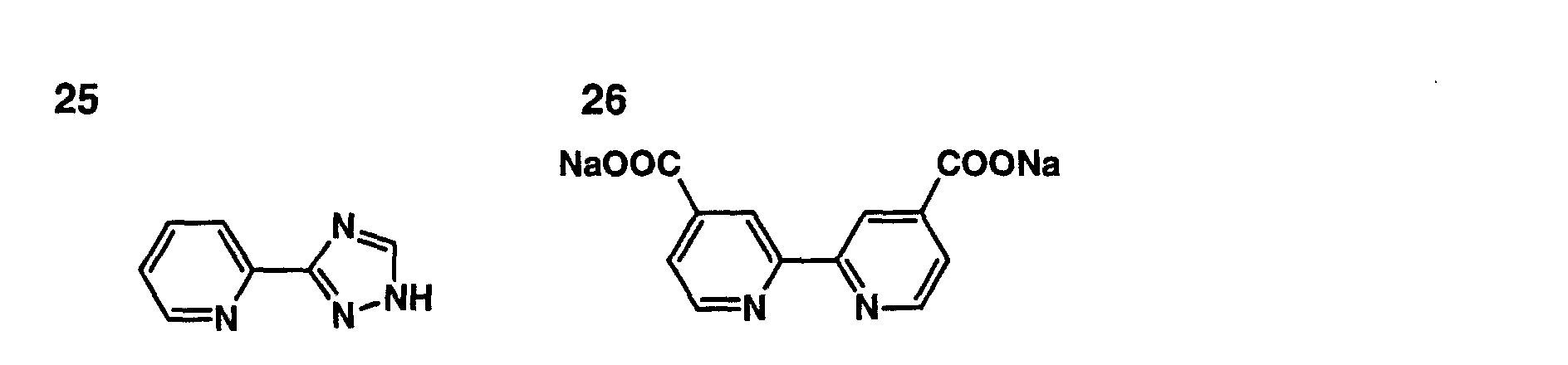
| 3 | Exemplified 26 (2 parts) | DEG (15 parts) | GLY (15 parts) | A1 (6 parts) | Surfinol 465 (0.1 part) |
| 4 | Exemplified 25 (2 parts) | DEG (15 parts) | GLY (15 parts) | | Surfinol 465 (0.1 part) |
| DMAc: N,N-dimethylacetoamide |
| DEG: ethylene glycol |
| GLY: glycerin |
Preparation of Recording Media 1
| Zinc oxide | 100 weight parts |
| Polyvinyl alcohol | 25 weight parts |
| SBR latex | 6 weight parts |
| Water | 600 weight parts |
were blended. The resultant blend was applied onto a paper
support (having a thickness of 240 µm) laminated on both side
with polyethylene, employing a blade coater, and subsequently
dried at 70 °C, whereby Recording Medium 1 was prepared.
Recording Medium 2 was prepared by applying a coating
mix having the composition described below onto a paper
support (having a thickness of 240 µm) laminated on both
sides with polyethylene, and subsequently drying the coating
at 70 °C.
| Acid process gelatin | 6 g/m2 |
| Polyvinyl alcohol | 4 g/m2 |
| Zinc hydroxide | 6 g/m2 |
| Surface Active Agent 1 | 0.04 g/m2 |
Incidentally, hardening was carried out employing
Gelatin Hardener 1.
Preparation of Recording Medium 3
Photo Jet Paper QP Double Weight manufactured by Konica
Corp. was coated with a 30 percent aqueous zinc sulfate
heptahydrate solution employing a wire bar, and subsequently
dried at room temperature employing forced air.
After recording was carried out onto Recording Medium 1
employing Ink No. 1 (red ink), while employing an Ink Jet
Printer MJ-810 (manufactured by Seiko Epson Corporation), the
resultant Medium 1 was processed, employing an
electrophotographic heated fixing roller set at 150 °C,
whereby Image 1 was prepared. The resultant image was blue.
Thus it was found that conversion to an insoluble pigment was
carried out.
Preparation of Image 2
After the entire surface of Recording Medium 2 was
recorded employing 5 percent aqueous A-1 solution, while
employing an Ink Jet Printer MJ-810 (manufactured by Seiko
Epson Corporation), the resultant Medium 2 was dried by 100
°C forced air. Then recording was carried out employing Ink
No. 2, while employing said printer. Thereafter, the printed
medium was thermally treated, employing 100 °C forced air,
whereby Image 2 was prepared. The obtained image was blue.
Thus it was found that conversion to an insoluble pigment was
carried out.
Preparation of Image 3
After recording was carried out onto Recording Medium 3
employing Ink No. 3 (yellow), while employing an Ink Jet
Printer PM770 (manufactured by Seiko Epson Corporation), the
resultant Medium 3 was processed employing an
electrophotographic heated fixing roller set at 150 °C, to
obtain a magenta image, which was found to be an image
subjected to conversion to an insoluble pigment.
Preparation of Image 4
After the entire surface of Recording Medium 4 was
recorded employing 15 percent aqueous picolinic acid (A1)
solution, while employing an Ink Jet Printer PM770
(manufactured by Seiko Epson Corporation), the resultant
Medium 4 was dried by 100 °C forced air heated to obtain a
magenta image. It was found that the obtained Image 4 was one
in which conversion to an insoluble pigment was carried out.
The image quality as well as image retention of
obtained Images 1 through 4 was evaluated. The evaluation
results are described below.
| Image No. | Image Quality | Image Retention | Chemical Means |
| | Glossiness | Bronzing | Light Fastness | Bleeding |
| 1 | A | A | A | A | base generation | Inventive |
| 2 | A | A | A | A | base generation | Inventive |
| 3 | A | A | A | A | acid generation | Inventive |
| 4 | A | A | A | A | acid generation | Inventive |
The storage stability of ink was evaluated as described
below.
<<Evaluation of Storage Stability of Ink>>
After storing the prepared ink at 60 °C for 60 days,
recording was carried out onto plain paper (Xerox 4024)
employing the resultant ink, while employing an Ink Jet
Printer MJ-810 (manufactured by Seiko Epson Corporation).
Images prepared employing stored Ink Nos. 1 through 4
resulted in no image problem in the same manner as those
prepared employing Ink Nos. 1 through 4 before storage.
Images 3 and 4 were rinsed in pure water for 15
seconds. It was found that the pH of the resultant rinse
solution varied to be in the weak acidic region and some of
the acid was released from each image. Thereafter, each
image was obtained by forced air drying. The pH of the layer
surface of the image was measured and was found about 4.9.
The resultant image was compared to one prior to said
treatment and resulted in no bleeding, no degradation in hue,
no decrease in density, and also no degradation of image
retention quality.
The water based ink composition of the present
invention exhibits excellent storage stability of ink, and
images obtained by the image forming method of the present
invention, employing the water based ink composition of the
present invention, exhibits improved image quality
(glossiness and bronzing formation) compared to conventional
pigment ink images, and also exhibits excellent image quality
approaching dye image quality. Further, said image exhibits
excellent image fastness (light fastness and bleeding) which
approaches conventional pigment ink images.

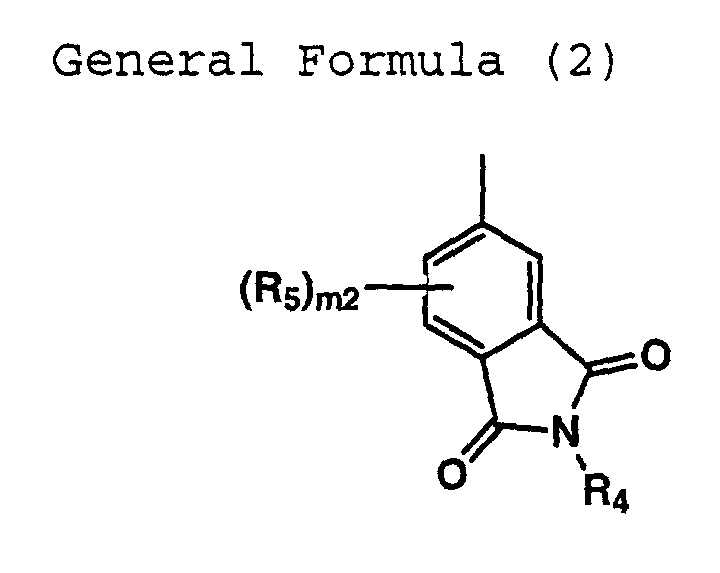

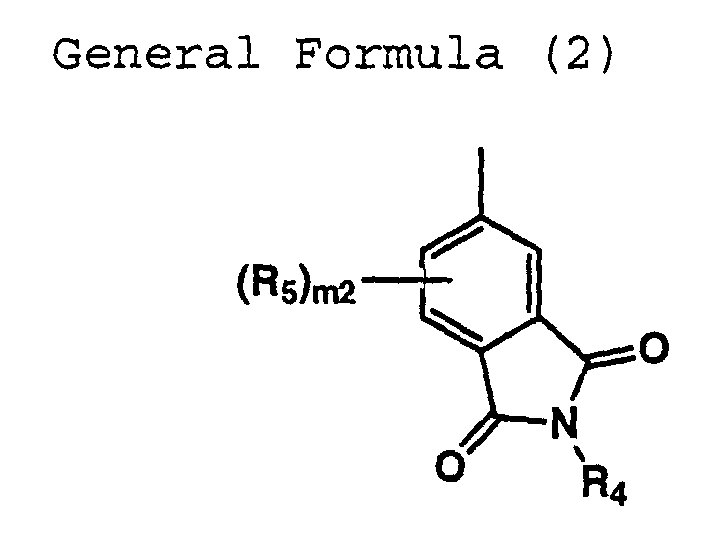
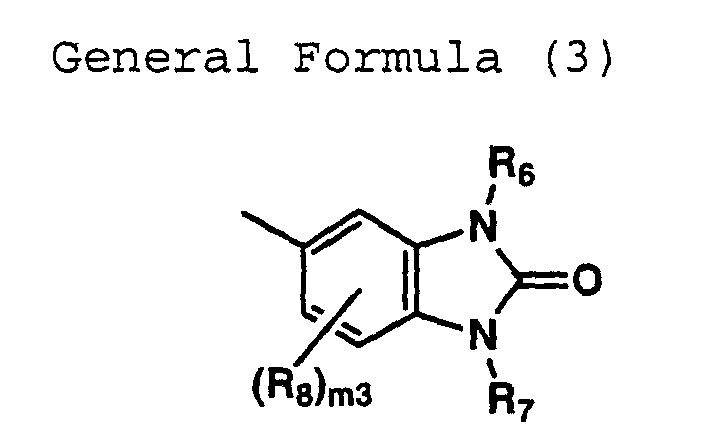























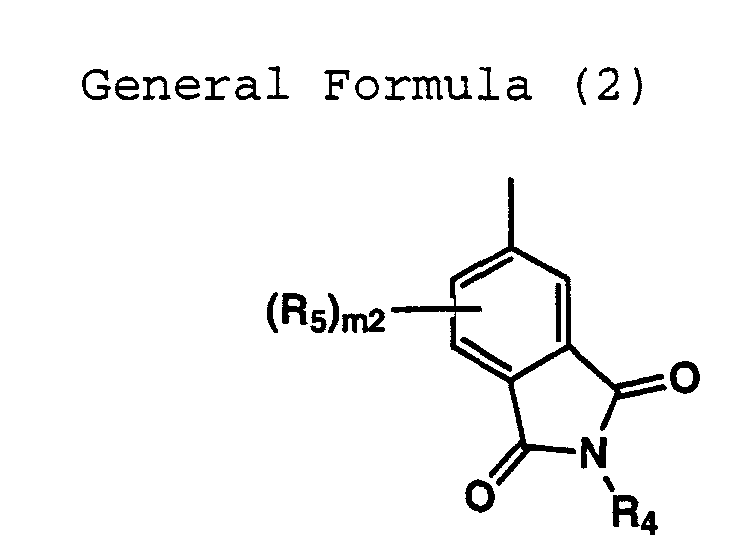 wherein (2) and (3), R4 represents a substituent having a water solubilizing group, R5 represents a substituent, and m2 represent 0 to 3, R6 and R7 each represent a substituent having a water solubilizing group, R8 represents a substituent, and m3 represents 0 to 3.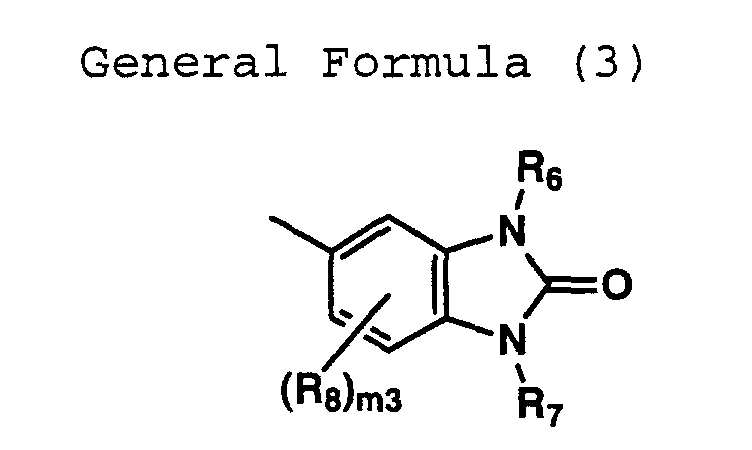

 wherein (2) and (3), each of R4, R6 and R7 represents a substituent having a water solubilizing group, each of R5 and R8 represents a substituent, and m2 represents 0 to 3, or a group R9 or R10 mentioned above which is substituted by the group represented by General Formula (2) or (3).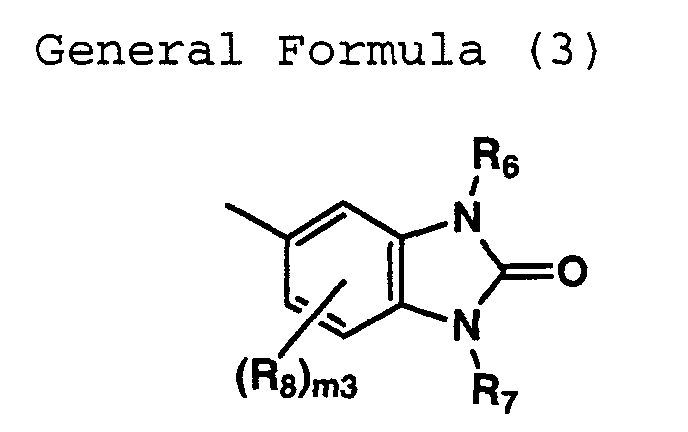



 in General Formulas (2) and (3), R4 represents a substituent having a water solubilizing group, R5 represents a substituent, and m2 represent 0 to 3, R6 and R7 each represent a substituent having a water solubilizing group, R8 represents a substituent, and m3 represents 0 to 3,
 wherein R9 represents a phenyl group which may have a substituent, R10 represents a hydroxyl group, or an amino group, an acylamino group or a carbamoyl group which may have a substituent, and m4 represents 0 to 7, with proviso that, at least one substituent of R9 or R10 is a group represented by General Formula (2) or General Formula (3), or a group R9 or R10 mentioned above which is substituted by the group represented by the General Formula (2) or (3),
 wherein R11 and R12 each represent a substituent having a water solubilizing group, R13 and R14 each represent a substituent, n5 and m5 each represent 0 to 4,
 wherein R15, R16, R17, R18, and R19 each represent a hydrogen atom or a substituent having a water solubilizing group, with proviso that, at least two of R15, R16, R17, R18, or R19 are substituents having a water solubilizing group,
 wherein R20 and R21 each represent a substituent having a water solubilizing group, R22, R23, and R24 each represent a substituent, and m7, l7, and n7 each represent 0 to 4,
 wherein R25 and R26 each represent a substituent having a water solubilizing group, R27, and R28 each represent a substituent, and m8 and n8 each represent 0 to 4,
 wherein R29 and R30 each represent a substituent having a water solubilizing group, and R31 and R32 each represent a hydrogen atom or a substituent,
 wherein R33 represents a substituent having a water solubilizing group, R34 represents a substituent, and m10 represents 0 to 8, while n10 represents 0 to 8,
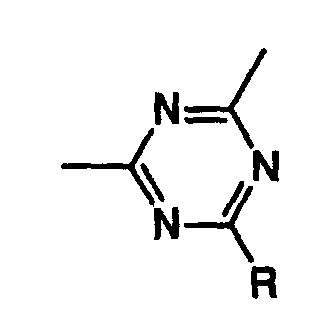
 wherein "A" represents an insoluble pigment residual group, and the group in the parenthesis bonds to the nitrogen atom of "A", X represents a hydrogen atom or a counter cation, R35 represents a substituent, and l11 represents 0 to 4, and when l11 is 2 to 4, a plurality of R35 may be joined together to form a ring, while "k" represents 1 to 5.