EP1125927B1 - A method for preparation of a quaternary ammonium salt - Google Patents
A method for preparation of a quaternary ammonium salt Download PDFInfo
- Publication number
- EP1125927B1 EP1125927B1 EP01103302A EP01103302A EP1125927B1 EP 1125927 B1 EP1125927 B1 EP 1125927B1 EP 01103302 A EP01103302 A EP 01103302A EP 01103302 A EP01103302 A EP 01103302A EP 1125927 B1 EP1125927 B1 EP 1125927B1
- Authority
- EP
- European Patent Office
- Prior art keywords
- reaction
- group
- pyridine
- quaternary ammonium
- ammonium salt
- Prior art date
- Legal status (The legal status is an assumption and is not a legal conclusion. Google has not performed a legal analysis and makes no representation as to the accuracy of the status listed.)
- Expired - Lifetime
Links
Images

Classifications
-
- C—CHEMISTRY; METALLURGY
- C07—ORGANIC CHEMISTRY
- C07D—HETEROCYCLIC COMPOUNDS
- C07D233/00—Heterocyclic compounds containing 1,3-diazole or hydrogenated 1,3-diazole rings, not condensed with other rings
- C07D233/54—Heterocyclic compounds containing 1,3-diazole or hydrogenated 1,3-diazole rings, not condensed with other rings having two double bonds between ring members or between ring members and non-ring members
- C07D233/56—Heterocyclic compounds containing 1,3-diazole or hydrogenated 1,3-diazole rings, not condensed with other rings having two double bonds between ring members or between ring members and non-ring members with only hydrogen atoms or radicals containing only hydrogen and carbon atoms, attached to ring carbon atoms
- C07D233/58—Heterocyclic compounds containing 1,3-diazole or hydrogenated 1,3-diazole rings, not condensed with other rings having two double bonds between ring members or between ring members and non-ring members with only hydrogen atoms or radicals containing only hydrogen and carbon atoms, attached to ring carbon atoms with only hydrogen atoms or radicals containing only hydrogen and carbon atoms, attached to ring nitrogen atoms
-
- C—CHEMISTRY; METALLURGY
- C07—ORGANIC CHEMISTRY
- C07D—HETEROCYCLIC COMPOUNDS
- C07D213/00—Heterocyclic compounds containing six-membered rings, not condensed with other rings, with one nitrogen atom as the only ring hetero atom and three or more double bonds between ring members or between ring members and non-ring members
- C07D213/02—Heterocyclic compounds containing six-membered rings, not condensed with other rings, with one nitrogen atom as the only ring hetero atom and three or more double bonds between ring members or between ring members and non-ring members having three double bonds between ring members or between ring members and non-ring members
- C07D213/04—Heterocyclic compounds containing six-membered rings, not condensed with other rings, with one nitrogen atom as the only ring hetero atom and three or more double bonds between ring members or between ring members and non-ring members having three double bonds between ring members or between ring members and non-ring members having no bond between the ring nitrogen atom and a non-ring member or having only hydrogen or carbon atoms directly attached to the ring nitrogen atom
- C07D213/06—Heterocyclic compounds containing six-membered rings, not condensed with other rings, with one nitrogen atom as the only ring hetero atom and three or more double bonds between ring members or between ring members and non-ring members having three double bonds between ring members or between ring members and non-ring members having no bond between the ring nitrogen atom and a non-ring member or having only hydrogen or carbon atoms directly attached to the ring nitrogen atom containing only hydrogen and carbon atoms in addition to the ring nitrogen atom
- C07D213/16—Heterocyclic compounds containing six-membered rings, not condensed with other rings, with one nitrogen atom as the only ring hetero atom and three or more double bonds between ring members or between ring members and non-ring members having three double bonds between ring members or between ring members and non-ring members having no bond between the ring nitrogen atom and a non-ring member or having only hydrogen or carbon atoms directly attached to the ring nitrogen atom containing only hydrogen and carbon atoms in addition to the ring nitrogen atom containing only one pyridine ring
- C07D213/20—Quaternary compounds thereof
-
- C—CHEMISTRY; METALLURGY
- C07—ORGANIC CHEMISTRY
- C07D—HETEROCYCLIC COMPOUNDS
- C07D231/00—Heterocyclic compounds containing 1,2-diazole or hydrogenated 1,2-diazole rings
- C07D231/02—Heterocyclic compounds containing 1,2-diazole or hydrogenated 1,2-diazole rings not condensed with other rings
- C07D231/10—Heterocyclic compounds containing 1,2-diazole or hydrogenated 1,2-diazole rings not condensed with other rings having two or three double bonds between ring members or between ring members and non-ring members
- C07D231/12—Heterocyclic compounds containing 1,2-diazole or hydrogenated 1,2-diazole rings not condensed with other rings having two or three double bonds between ring members or between ring members and non-ring members with only hydrogen atoms, hydrocarbon or substituted hydrocarbon radicals, directly attached to ring carbon atoms
-
- C—CHEMISTRY; METALLURGY
- C07—ORGANIC CHEMISTRY
- C07D—HETEROCYCLIC COMPOUNDS
- C07D233/00—Heterocyclic compounds containing 1,3-diazole or hydrogenated 1,3-diazole rings, not condensed with other rings
- C07D233/54—Heterocyclic compounds containing 1,3-diazole or hydrogenated 1,3-diazole rings, not condensed with other rings having two double bonds between ring members or between ring members and non-ring members
- C07D233/56—Heterocyclic compounds containing 1,3-diazole or hydrogenated 1,3-diazole rings, not condensed with other rings having two double bonds between ring members or between ring members and non-ring members with only hydrogen atoms or radicals containing only hydrogen and carbon atoms, attached to ring carbon atoms
-
- C—CHEMISTRY; METALLURGY
- C07—ORGANIC CHEMISTRY
- C07D—HETEROCYCLIC COMPOUNDS
- C07D249/00—Heterocyclic compounds containing five-membered rings having three nitrogen atoms as the only ring hetero atoms
- C07D249/02—Heterocyclic compounds containing five-membered rings having three nitrogen atoms as the only ring hetero atoms not condensed with other rings
- C07D249/08—1,2,4-Triazoles; Hydrogenated 1,2,4-triazoles
Definitions
- the present invention relates to a method for preparation of a quaternary ammonium salt at high yield in a short reaction time.
- Quaternary ammonium salts have been a remarkably important compound as starting materials for medicines and quasi-drugs and cosmetics, phase-transfer catalysts, ionized solvents, etc.
- quaternary pyridinium salts have recently be noticed mainly as an antibacterial agent and have been thought to increase its demand in future.
- the reaction time is long and further yield of the object compound, a quaternary pyridinium salt, is such low as 1.7 %
- the yield is considerably such high as 95 % but the reaction time is remarkably long such as 8 to 16 hours, and therefore both methods are not satisfactory as a method for production of a quaternary ammonium salt in an industrial scale.
- GB 379396 describes the preparation of quaternary ammonium salts by reacting alkyl halides with pyridine compouds at 120-150 °C.
- the present invention has been accomplished under such circumstances as above and its object is to provide a method for preparation of a quaternary ammonium salt by reacting a pyridine compound or an N-lower alkyl imidazole(hereinafter the pyridine compound and the N-lower alkyl imidazole are, sometimes, inclusively abbreviated as a heterocyclic compound of the present invention) with an alkyl halide in an industrial scale at high efficiency in a short reaction time.
- the present invention relates to a method for preparation of a quaternary ammonium salt comprising reacting an alkyl halide with 2 equimolar amount or more per the alkyl halide of a pyridine compound or an N-lower alkyl imidazole at 120°C to 350°C.
- the present inventors have extensively conducted study in order to fulfill the above object to arrive at the finding that a quaternary ammonium salt can be produced effectively in a short reaction time by reacting an alkyl halide with 2 equimolar amount or more per the alkyl halide of a pyridine compound or an N-lower alkyl imidazole at 120°C to 350°C, and the present invention has been completed on the basis of this finding.
- Fig.1 shows the continuous reaction plant used in Example 4 and 5.
- the N-lower alkyl imidazole includes one in which a hydrogen atom binding to a nitrogen atom is substituted by a lower alkyl group having 1 to 4 carbon atoms such as a methyl group, an ethyl group, an n-propyl group, an iso-propyl group, an n-butyl group, an iso-butyl group, a tert-butyl group, a sec-butyl group etc., and is specifically exemplified by N-methylimidazole, N-ethylimidazole, N-n-propylimidazole, N-iso-propylimidazole, N-n-butylimidazole, N-iso-butylimidazole, N-tert-butylimidazole, N-sec-butylimidazole etc., among which N-methylimidazole is preferable.
- the pyridine compound of the present invention includes pyridine or a pyridine derivative whose 1 to 3 hydrogen atoms are substituted by a lower alkyl group having 1 to 4 carbon atoms mentioned above, which is specifically exemplified by picoline, dimethyl pyridine, trimethyl pyridine, ethyl pyridine, propyl pyridine, butyl pyridine etc, among which pyridine and picoline are preferable.
- the alkyl halide of the present invention includes one shown by the following general formula [1] R 1 -Y (wherein R 1 is an alkyl group and Y is a halogen atom).
- the alkyl group shown by R 1 in the general formula [1] may be straight chained or branched and includes one having generally 1 to 30 carbon atoms, preferably 1 to 24 carbon atoms, more preferably 3 to 24 carbon atoms, which is specifically exemplified by a methyl group, an ethyl group, an n-propyl group, an iso-propyl group, an n-butyl group, an iso-butyl group, a sec-butyl group, a tert-butyl group, an n-pentyl group, an isopentyl group, a sec-pentyl group, a tert-pentyl group, a neopentyl group, an n-hexyl group, an isohexyl group, a 3-methylpentyl group, a 2-methylpentyl group, a 1-methylpentyl group, a 1-ethylbutyl group, a 2-
- the halogen atom shown by Y includes a fluorine atom, a chlorine atom, an iodine atom, a bromine atom, etc.
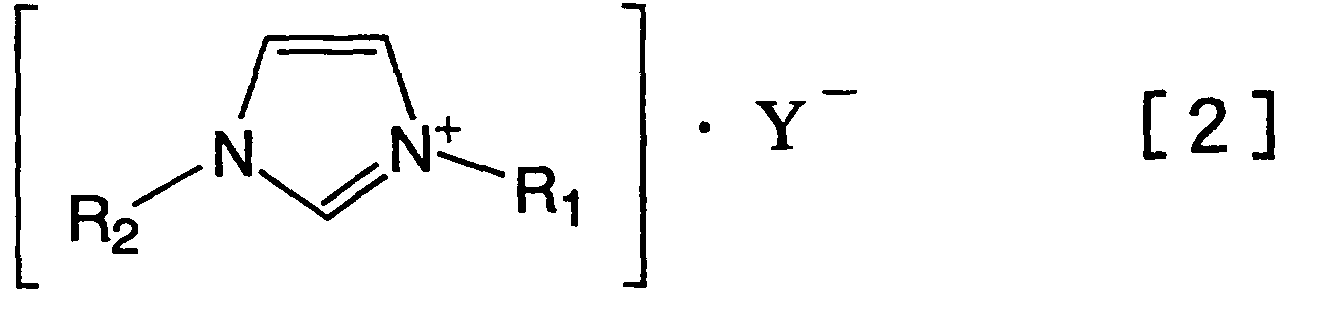
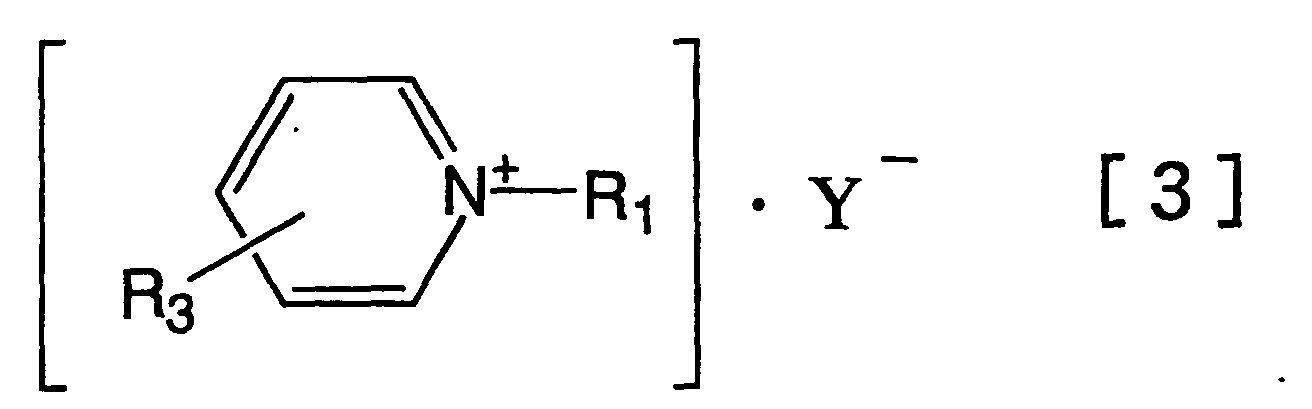
- the quaternary ammonium salt of the present invention can be shown by the following general formula [2] or [3] (wherein R 2 is a lower alkyl group having 1 to 4 carbon atoms mentioned above, R 3 is a hydrogen atom or one to three lower alkyl groups having 1 to 4 carbon atoms mentioned above and R 1 and Y have the same meaning as above).
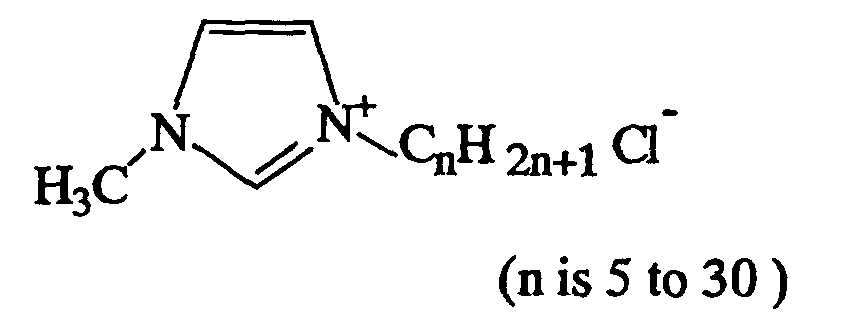
- Specific examples of the quaternary ammonium salts obtained by reacting an alkyl halide with an N-lower alkyl imidazole are as follows.
- Specific examples of the quaternary ammonium salts obtained by reacting an alkyl halide with a pyridine compound are as follows including those of which 1 to 3 hydrogen atoms are substituted by a lower alkyl group having 1 to 4 carbon atoms.
- the preparation of the quaternary ammonium salt by the present invention is realized, for instance, by reacting the alkyl halide with 2 equimolar amount or more per the alkyl halide of the heterocyclic compound of the present invention in an airtight container such as autoclave at 120°C to 350°C, among which the continuous preparation of a quaternary ammonium salt using a pipe reactor is preferable, and may be conducted concretely by a method mentioned below.
- the alkyl halide and the heterocyclic compound of the present invention are charged into a pipe reactor from the one end thereof continuously, for instance, with a pump at the introduction speed mentioned below and those compounds are passed through the pipe reactor which is kept at the desired temperature, wherein the reaction is allowed to take place continuously, and then the reaction product produced in the reactor is taken out from the other end of the reactor continuously.
- the pressure in the pipe reactor may be controlled by installing a control valve equipped on the end of the pipe reactor. Even when the pressure is increased too high, the reaction efficacy is not increased, and thus the pressure may be adjusted to generally 1 to 100 kg/cm 2 , preferably 2 to 20 kg/cm 2 , more preferably 2 to 10 kg/cm 2 .
- the quaternary ammonium salt taken from the pipe reactor may be subjected to the after-treatment which has so far been conducted generally in this kind of technical field, such as crystallization with a spray dryer or a film evaporator.
- the pipe reactor of the present invention includes those having two openings at the both ends, which can be made into sealed condition by closing the openings and is durable ever under high temperature and high pressure, and among them, preferable ones are those wherein heat is conducted up to the inner part by heating from the outer side.
- a typical example of the pipe reactor is one made of stainless steal of which shape can be kept without deformation under heating up to about 500°C under pressure up to about 100kg/cm 2 .
- the volume of the pipe reactor is adjusted according to the required amount of a quaternary ammonium salt etc. and the time required for the reaction is set forth according to the combination of the kinds of starting materials (as mentioned below, it is generally 5 minutes to 6 hours), and then the introduction speed is calculated by the equations using thus determined values.
- the introduction speed means the total amount of the alkyl halide and the heterocyclic compound of the present invention to be introduced per unit of time, and a ratio of these two compounds are such one as 2 equimolar amount or more per the alkyl halide of the heterocyclic compound of the present invention per the alkyl halide.
- the alkyl halide is mixed with 2 equimolar amount or more per the alkyl halide of the heterocyclic compound of the present invention, and then the mixture may be introduced into the pipe reactor at the introduction speed adjusted as mentioned above. More particularly, for instance, when the volume of the pipe reactor is set forth as 200ml and the time required for the reaction is set forth as 15minutes, then the introduction speed is calculated as 200ml ⁇ 15min ⁇ 13.3ml/min, and on the basis of this value it can be determined generally as 1.3 to 13.3ml/min, preferably as 6.7 to 13.3mil/min, still preferably as 13.3ml/min.
- An amount of the heterocyclic compound of the present invention to be used is generally 2 equimolar amount or more per the alkyl halide, whereupon the desired reaction can be completed by adjusting the reaction temperature of 120°C to 350°C, and preferably the amount is 2 to 20 equimolar amount, more preferably it is 3 to 10 equimolar amount.
- an amount of the heterocyclic compound of the present invention to be used is a theoretical amount or a slightly excess amount to the alkyl halide, the reaction is not completed even after a long reaction time.
- the reaction temperature is generally 120°C to 350°C, preferably 140 to 300°C, more preferably 150 to 250°C.
- the preparation of the present invention may be conducted under streams of an inert gas such as helium gas, nitrogen gas and argon gas and, in this case, the reaction temperature may be increased by elevating pressure of the inert gas in the reaction system. Even when the pressure is increased too high, the reaction efficacy is not increased, and thus the pressure may be adjusted to generally 1 to 100 kg/cm 2 , preferably 2 to 20 kg/cm 2 , more preferably 2 to 10 kg/cm 2 .
- an inert gas such as helium gas, nitrogen gas and argon gas
- the reaction temperature may be increased by elevating pressure of the inert gas in the reaction system. Even when the pressure is increased too high, the reaction efficacy is not increased, and thus the pressure may be adjusted to generally 1 to 100 kg/cm 2 , preferably 2 to 20 kg/cm 2 , more preferably 2 to 10 kg/cm 2 .
- the reaction time is generally 5 minutes to 6 hours, preferably 5 minutes to 2 hours, more preferably 5 to 30 minutes.
- the after-treatment of the present invention may be conducted according to the general method of after treatment in this kind of technical field.
- a quaternary ammonium salt can be obtained effectively and easily in a short reaction time even without setting severe reaction conditions.
- the quaternary ammonium salt obtained by the method of the present invention is useful as starting materials for medicines, quasi-drugs, cosmetics, etc., phase-transfer catalysts, ionized solvents, antibacterial agents, etc.
- Nitrogen gas was introduced in an autoclave charged with 115.1 g (0.44 mole) of n-cetyl chloride and 146.6 g (1.85 mole) of pyridine to adjust the pressure in the autoclave to 2 kg/cm 2 , followed by agitation at 180°C for 15 minutes to allow a reaction to take place.
- the reaction solution after the reaction was analyzed by HPLC to confirm the reaction rate to be 100 %.
- To the obtained powdery crystal was added 316 ml of methylethyl ketone, followed by agitation at room temperature, and the resulting crystal was recovered by filtration, washed with methylethyl ketone and dried under reduced pressure to give 142.5 g of powdery crystal (yield 95 %).
- the obtained crystal was determined as cetyl pyridinium chloride by measuring the melting point and 1 HNMR analysis.
- Example 2 The same process as in Example 1 except for agitation at 160°C for 30 minutes was conducted to give n-cetyl pyridinium chloride. After the reaction, the reaction solution was analyzed by HPLC to confirm the reaction rate to be 100 %.
- Nitrogen gas was introduced into an autoclave charged with 115.1 g (0.44 mole) of n-cetyl chloride and 38.4 g (0.44 mole) of pyridine to adjust the pressure in the autoclave to 2 kg/cm 2 , followed by agitation at 160°C for 4 hours to allow a reaction to take place. After the reaction, the reaction solution was analyzed by HPLC to find the reaction rate to be 80 %.
- Nitrogen gas was introduced into an autoclave charged with 40.8 g (0.44 mole) of n-butyl chloride and 146.6g (1.85 mole) of pyridine to adjust the pressure in the autoclave to 2 kg/cm 2 , followed by agitation at 180°C for 15 minutes to allow a reaction to take place. After the reaction, the reaction solution was analyzed by HPLC to find the reaction rate to be 100 %.
- n-cetyl chloride was continuously introduced into the pipe reactor at 6.29 ml/min with pump1 ⁇ and at the same time pyridine was continuously introduced into the pipe reactor at 7.04 ml/min with pump2 ⁇ to adjust the inner pressure of the pipe reactor to 5kg/cm 2 and the inner temperature to 180°C.
- reaction solution(261.7g) taken from the end of condenser was dried under reduced pressure with the spray dryer to obtain 150 g of powdery crystal(yield 100%). Analysis of the reaction solution by HPLC showed the reaction rate to be 100 %. After the same treatment of the above obtained powdery crystal as in Example 1 gave 141.0 g of powdery crystal (yield 94 %).
- Example 4 The same process as in Example 4 except for using a film evaporator in place of a spray dryer was conducted to give n-cetyl pyridinium chloride. After the reaction, the reaction solution was analyzed by HPLC to confirm the reaction rate to be 100 %.
- Nitrogen gas was introduced into an autoclave charged with 95.9 g (0.70 mole) of n-butyl bromide and 241.4 g (2.94 mole) of 1-methyl imidazole to adjust the pressure in the autoclave to 2 kg/cm 2 , followed by agitation at 160°C for 30 minutes to allow a reaction to take place. After the reaction, the reaction solution was analyzed by NMR to find the reaction rate to be 100 %.
- Nitrogen gas was introduced into an autoclave charged with 182.6 g (0.70 mole) of n-cetyl chloride and 241.4 g (2.94 mole) of 1-methyl imidazole to adjust the pressure in the autoclave to 2 kg/cm 2 , followed by agitation at 180°C for 30 minutes to allow a reaction to take place. After the reaction, the reaction solution was analyzed by NMR to find the reaction rate to be 100 %.
- Nitrogen gas was introduced into an autoclave charged with 52.1 g (0.38 mole) of n-butyl bromide and 178.4 g (1.92 mole) of 4-picoline to adjust the pressure in the autoclave to 2 kg/cm 2 , followed by agitation at 160°C for 15 minutes to allow a reaction to take place. After the reaction, the reaction solution was analyzed by NMR to find the reaction rate to be 100 %.
- Nitrogen gas was introduced into an autoclave charged with 100.0 g (0.38 mole) of n-cetyl chloride and 178.4 g (1.92 mole) of 4-picoline to adjust the pressure in the autoclave to 2 kg/cm 2 , followed by agitation at 180°C for 15 minutes to allow a reaction to take place. After the reaction, the reaction solution was analyzed by NMR to find the reaction rate to be 94%.
- the present invention is to provide a method for preparation of a quaternary ammonium salt effectively in a short reaction time by reacting an alkyl halide with a heterocyclic compound of the present invention, and according to the method of the present invention, all of problems found in known methods, namely requirements for severe reaction conditions and complicated reaction process steps and a poor reaction rate and a long reaction time, can be solved. Further, the object quaternary ammonium salt can continuously be produced by conducting the reaction in a pipe reactor of the present invention, and thus the method of the present invention is excellent also from industrial point of view.
Landscapes
- Chemical & Material Sciences (AREA)
- Organic Chemistry (AREA)
- Pyridine Compounds (AREA)
- Plural Heterocyclic Compounds (AREA)
Description


















preferably,
Claims (9)
- A method for preparation of a quaternary ammonium salt, which comprises reacting an alkyl halide with 2 equimolar amount or more per the alkyl halide of a pyridine compound or an N-lower alkyl imidazole at 120 to 350°C.
- A method according to Claim 1, wherein the reaction temperature is 140 to 300°C.
- A method for continuous production of a quaternary ammonium salt comprises introducing continuously an alkyl halide and 2 equimolar amount or more per the alkyl halide of a pyridine compound or an N-lower alkyl imidazole into a pipe reactor from the one end thereof under heating at 120 to 350°C to pass through the reactor wherein a reaction is allowed to take place, and taking out continuously the resulting quaternary ammonium salt from the other end of the reactor.
- A method according to Claim 3, wherein the temperature is 140 to 300°C.
- A method according to Claim 3, wherein an introduction speed of the pyridine compound or the N-lower alkyl imidazole and the alkyl halide and a volume of the reactor are adjusted in such a way that the reaction is completed around the end position of the reactor.
- A method according to Claim 1 to 5, wherein the pyridine compound is pyridine or a pyridine derivative having a lower alkyl group at hydrogen atom(s) of the pyridine ring.
- A method according to Claim 1 to 5, wherein the N-lower alkyl imidazole is N-methylimidazole.
- A method according to any of Claim 1 to 7, wherein the alkyl halide is a cetyl halide.
- A method according to Claim 8 , wherein the cetyl halide is cetyl chloride
Applications Claiming Priority (2)
| Application Number | Priority Date | Filing Date | Title |
|---|---|---|---|
| JP2000034564 | 2000-02-14 | ||
| JP2000034564 | 2000-02-14 |
Publications (2)
| Publication Number | Publication Date |
|---|---|
| EP1125927A1 EP1125927A1 (en) | 2001-08-22 |
| EP1125927B1 true EP1125927B1 (en) | 2005-12-07 |
Family
ID=18558881
Family Applications (1)
| Application Number | Title | Priority Date | Filing Date |
|---|---|---|---|
| EP01103302A Expired - Lifetime EP1125927B1 (en) | 2000-02-14 | 2001-02-13 | A method for preparation of a quaternary ammonium salt |
Country Status (6)
| Country | Link |
|---|---|
| US (1) | US6414159B2 (en) |
| EP (1) | EP1125927B1 (en) |
| KR (1) | KR20010082102A (en) |
| AU (1) | AU776185B2 (en) |
| CA (1) | CA2335703A1 (en) |
| DE (1) | DE60115517T2 (en) |
Cited By (6)
| Publication number | Priority date | Publication date | Assignee | Title |
|---|---|---|---|---|
| US7572855B2 (en) | 2005-01-28 | 2009-08-11 | Bridgestone Corporation | Nano-composite and compositions manufactured thereof |
| US7576155B2 (en) | 2002-12-18 | 2009-08-18 | Bridgestone Corporation | Method for clay exfoliation, compositions therefore, and modified rubber containing same |
| US7579398B2 (en) | 2005-02-02 | 2009-08-25 | Bridgestone Corporation | Nano-composite and compositions therefrom |
| US7601772B2 (en) | 2005-12-20 | 2009-10-13 | Bridgestone Corporation | Nano-composite and method thereof |
| US7935184B2 (en) | 2006-06-19 | 2011-05-03 | Bridgestone Corporation | Method of preparing imidazolium surfactants |
| WO2024147146A1 (en) | 2023-01-03 | 2024-07-11 | Rajaram Samant | Novel quaternary ammonium compounds (qacs) and process for preparation thereof |
Families Citing this family (6)
| Publication number | Priority date | Publication date | Assignee | Title |
|---|---|---|---|---|
| US8853454B2 (en) * | 2006-08-29 | 2014-10-07 | Mionix Corporation | Quaternary ammonium salts as microbe inhibitors |
| KR101651915B1 (en) | 2009-09-14 | 2016-08-29 | 한화케미칼 주식회사 | A method for preparing water-soluble nanoparticles and their dispersions |
| CN103539727A (en) * | 2013-10-16 | 2014-01-29 | 南阳利欣药业有限公司 | Method used for preparing hexadecylpyridinium chloride |
| WO2016092499A1 (en) * | 2014-12-12 | 2016-06-16 | Jubilant Life Sciences Limited | An improved process for the production of quaternary pyridinium salts |
| CN107410318A (en) * | 2017-04-20 | 2017-12-01 | 齐齐哈尔大学 | A kind of pyridine heterocycle quaternary cationics disinfectant use in agriculture |
| CN108047129A (en) * | 2017-12-29 | 2018-05-18 | 中山百灵生物技术有限公司 | A kind of new method for synthesizing high-purity Cetylpyridinium Chloride |
Family Cites Families (2)
| Publication number | Priority date | Publication date | Assignee | Title |
|---|---|---|---|---|
| GB379396A (en) | 1931-06-01 | 1932-09-01 | Ici Ltd | Manufacture of new quaternary ammonium salts |
| GB9618634D0 (en) | 1996-09-06 | 1996-10-16 | Univ Southampton | Anti cancer drugs |
-
2001
- 2001-02-09 KR KR1020010006415A patent/KR20010082102A/en not_active Withdrawn
- 2001-02-09 AU AU18419/01A patent/AU776185B2/en not_active Ceased
- 2001-02-09 US US09/779,743 patent/US6414159B2/en not_active Expired - Lifetime
- 2001-02-13 EP EP01103302A patent/EP1125927B1/en not_active Expired - Lifetime
- 2001-02-13 CA CA002335703A patent/CA2335703A1/en not_active Abandoned
- 2001-02-13 DE DE60115517T patent/DE60115517T2/en not_active Expired - Lifetime
Cited By (6)
| Publication number | Priority date | Publication date | Assignee | Title |
|---|---|---|---|---|
| US7576155B2 (en) | 2002-12-18 | 2009-08-18 | Bridgestone Corporation | Method for clay exfoliation, compositions therefore, and modified rubber containing same |
| US7572855B2 (en) | 2005-01-28 | 2009-08-11 | Bridgestone Corporation | Nano-composite and compositions manufactured thereof |
| US7579398B2 (en) | 2005-02-02 | 2009-08-25 | Bridgestone Corporation | Nano-composite and compositions therefrom |
| US7601772B2 (en) | 2005-12-20 | 2009-10-13 | Bridgestone Corporation | Nano-composite and method thereof |
| US7935184B2 (en) | 2006-06-19 | 2011-05-03 | Bridgestone Corporation | Method of preparing imidazolium surfactants |
| WO2024147146A1 (en) | 2023-01-03 | 2024-07-11 | Rajaram Samant | Novel quaternary ammonium compounds (qacs) and process for preparation thereof |
Also Published As
| Publication number | Publication date |
|---|---|
| EP1125927A1 (en) | 2001-08-22 |
| CA2335703A1 (en) | 2001-08-14 |
| AU776185B2 (en) | 2004-09-02 |
| US20010018526A1 (en) | 2001-08-30 |
| KR20010082102A (en) | 2001-08-29 |
| US6414159B2 (en) | 2002-07-02 |
| DE60115517T2 (en) | 2006-08-17 |
| DE60115517D1 (en) | 2006-01-12 |
| AU1841901A (en) | 2001-08-16 |
Similar Documents
| Publication | Publication Date | Title |
|---|---|---|
| US6414159B2 (en) | Method for preparation of a quaternary ammonium salt | |
| AU604488B2 (en) | N-alkylated quaternary pyrimidinium compounds | |
| EP2307384B1 (en) | Process for preparing 1,3-disubstituted pyrazolecarboxylic esters | |
| US4124767A (en) | Imidazolyl-oxime ethers having anti-mycotic and bactericidal activity | |
| EP1042292B1 (en) | Method for producing isoureas | |
| US5877329A (en) | Palladium catalyzed indolization | |
| Sasaki et al. | Ring Transformation of 1, 3, 4-Oxadiazole to s-Triazole-Fused Heterocycles. New Synthetic Route for Thiazolo [2, 3-c]-s-triazole and 7H-s-Triazolo [3, 4-b][1, 3, 4] thiadiazine | |
| JP4774604B2 (en) | Method for producing quaternary ammonium salt | |
| Yamauchi et al. | Esters of phosphorus oxy-acids as alkylating agents. Part II. N-Alkylation of imidazole and related heterocyclic compounds with trialkyl phosphates | |
| WO2016152831A1 (en) | Method for producing pyrazole derivative | |
| Papadopoulos et al. | Reactions of azoles with isocyanates at elevated temperature | |
| Etter et al. | An enolized sulfonamide formed by strong hydrogen bonding to triphenylphosphine oxide | |
| IL268380A (en) | Process for preparing halogenated imidazopyridine derivatives | |
| JP2001247522A (en) | Method for producing quaternary alkyl ammonium tetrafluoroborate | |
| IL130470A (en) | Process for the preparation of heteroaryl-zinc halides | |
| KR20050013234A (en) | Method for the production of 1,2,4-triazolylmethyl-oxiranes | |
| Al-Mousawi et al. | Studies with Condensed Azines: New Routes toPyrazolo [3, 4-b] pyridines andPyrrolo [3, 2-b] pyridines | |
| CN108690018B (en) | Preparation method of imidazo [1,2-a ] pyridine derivative | |
| JP7001699B2 (en) | 4-[(4,5-Dihydro-3-methoxy-4-methyl-5-oxo-1H-1,2,4-triazole-1-yl) carbonyl) sulfamoyl] -5-methylthiophene-3-carboxylic acid How to prepare methyl | |
| IE47801B1 (en) | Preparation of 4-methyl-5-((2-aminoethyl)-thiomethyl)-imidazole dihydrochloride | |
| Roman et al. | Synthesis and reactivity of novel 1H-isochromeno [3, 4-d] imidazol-1-onium salts | |
| FI76787C (en) | FOERFARANDE FOER FRAMSTAELLNING AV 5- (CYAN ELLER KARBAMYL) - / 3-4'-BIPYRIDIN / -6 (1H) -ON OCH IMINIUMSALT TILL ANVAENDNING SOM MELLANPRODUKT I FOERFARANDET. | |
| Laus et al. | Synthesis and crystal structures of new 1, 4-disubstituted 1, 2, 4-triazoline-5-thiones | |
| WO2007090464A1 (en) | Process for preparing letrozole | |
| Roman et al. | Full Text HTML |
Legal Events
| Date | Code | Title | Description |
|---|---|---|---|
| PUAI | Public reference made under article 153(3) epc to a published international application that has entered the european phase |
Free format text: ORIGINAL CODE: 0009012 |
|
| AK | Designated contracting states |
Kind code of ref document: A1 Designated state(s): AT BE CH CY DE DK ES FI FR GB GR IE IT LI LU MC NL PT SE TR |
|
| AX | Request for extension of the european patent |
Free format text: AL;LT;LV;MK;RO;SI |
|
| 17P | Request for examination filed |
Effective date: 20010816 |
|
| AKX | Designation fees paid |
Free format text: DE FR GB |
|
| 17Q | First examination report despatched |
Effective date: 20030825 |
|
| GRAP | Despatch of communication of intention to grant a patent |
Free format text: ORIGINAL CODE: EPIDOSNIGR1 |
|
| GRAS | Grant fee paid |
Free format text: ORIGINAL CODE: EPIDOSNIGR3 |
|
| GRAA | (expected) grant |
Free format text: ORIGINAL CODE: 0009210 |
|
| AK | Designated contracting states |
Kind code of ref document: B1 Designated state(s): DE FR GB |
|
| REG | Reference to a national code |
Ref country code: GB Ref legal event code: FG4D |
|
| REF | Corresponds to: |
Ref document number: 60115517 Country of ref document: DE Date of ref document: 20060112 Kind code of ref document: P |
|
| ET | Fr: translation filed | ||
| PLBE | No opposition filed within time limit |
Free format text: ORIGINAL CODE: 0009261 |
|
| STAA | Information on the status of an ep patent application or granted ep patent |
Free format text: STATUS: NO OPPOSITION FILED WITHIN TIME LIMIT |
|
| 26N | No opposition filed |
Effective date: 20060908 |
|
| REG | Reference to a national code |
Ref country code: FR Ref legal event code: PLFP Year of fee payment: 16 |
|
| REG | Reference to a national code |
Ref country code: FR Ref legal event code: PLFP Year of fee payment: 17 |
|
| REG | Reference to a national code |
Ref country code: FR Ref legal event code: PLFP Year of fee payment: 18 |
|
| REG | Reference to a national code |
Ref country code: GB Ref legal event code: 732E Free format text: REGISTERED BETWEEN 20180709 AND 20180711 |
|
| REG | Reference to a national code |
Ref country code: DE Ref legal event code: R082 Ref document number: 60115517 Country of ref document: DE Representative=s name: DOMPATENT VON KREISLER SELTING WERNER - PARTNE, DE Ref country code: DE Ref legal event code: R081 Ref document number: 60115517 Country of ref document: DE Owner name: FUJIFILM WAKO PURE CHEMICAL CORPORATION, JP Free format text: FORMER OWNER: WAKO PURE CHEMICAL INDUSTRIES, LTD., OSAKA, JP |
|
| REG | Reference to a national code |
Ref country code: FR Ref legal event code: CA Effective date: 20181106 Ref country code: FR Ref legal event code: CD Owner name: FUJIFILM WAKO PURE CHEMICAL CORPORATION, JP Effective date: 20181106 Ref country code: FR Ref legal event code: TP Owner name: FUJIFILM WAKO PURE CHEMICAL CORPORATION, JP Effective date: 20181106 |
|
| PGFP | Annual fee paid to national office [announced via postgrant information from national office to epo] |
Ref country code: GB Payment date: 20200206 Year of fee payment: 20 Ref country code: DE Payment date: 20200129 Year of fee payment: 20 |
|
| PGFP | Annual fee paid to national office [announced via postgrant information from national office to epo] |
Ref country code: FR Payment date: 20200113 Year of fee payment: 20 |
|
| REG | Reference to a national code |
Ref country code: DE Ref legal event code: R071 Ref document number: 60115517 Country of ref document: DE |
|
| REG | Reference to a national code |
Ref country code: GB Ref legal event code: PE20 Expiry date: 20210212 |
|
| PG25 | Lapsed in a contracting state [announced via postgrant information from national office to epo] |
Ref country code: GB Free format text: LAPSE BECAUSE OF EXPIRATION OF PROTECTION Effective date: 20210212 |