EP1125571A2 - Trunks-type disposable pants - Google Patents
Trunks-type disposable pants Download PDFInfo
- Publication number
- EP1125571A2 EP1125571A2 EP01301411A EP01301411A EP1125571A2 EP 1125571 A2 EP1125571 A2 EP 1125571A2 EP 01301411 A EP01301411 A EP 01301411A EP 01301411 A EP01301411 A EP 01301411A EP 1125571 A2 EP1125571 A2 EP 1125571A2
- Authority
- EP
- European Patent Office
- Prior art keywords
- sheets
- inner sheets
- pants
- rear side
- cutouts
- Prior art date
- Legal status (The legal status is an assumption and is not a legal conclusion. Google has not performed a legal analysis and makes no representation as to the accuracy of the status listed.)
- Withdrawn
Links
Images



Classifications
-
- A—HUMAN NECESSITIES
- A61—MEDICAL OR VETERINARY SCIENCE; HYGIENE
- A61F—FILTERS IMPLANTABLE INTO BLOOD VESSELS; PROSTHESES; DEVICES PROVIDING PATENCY TO, OR PREVENTING COLLAPSING OF, TUBULAR STRUCTURES OF THE BODY, e.g. STENTS; ORTHOPAEDIC, NURSING OR CONTRACEPTIVE DEVICES; FOMENTATION; TREATMENT OR PROTECTION OF EYES OR EARS; BANDAGES, DRESSINGS OR ABSORBENT PADS; FIRST-AID KITS
- A61F13/00—Bandages or dressings; Absorbent pads
- A61F13/15—Absorbent pads, e.g. sanitary towels, swabs or tampons for external or internal application to the body; Supporting or fastening means therefor; Tampon applicators
- A61F13/45—Absorbent pads, e.g. sanitary towels, swabs or tampons for external or internal application to the body; Supporting or fastening means therefor; Tampon applicators characterised by the shape
- A61F13/49—Absorbent pads, e.g. sanitary towels, swabs or tampons for external or internal application to the body; Supporting or fastening means therefor; Tampon applicators characterised by the shape specially adapted to be worn around the waist, e.g. diapers or nappies
- A61F13/494—Absorbent pads, e.g. sanitary towels, swabs or tampons for external or internal application to the body; Supporting or fastening means therefor; Tampon applicators characterised by the shape specially adapted to be worn around the waist, e.g. diapers or nappies characterised by edge leakage prevention means
- A61F13/49473—Absorbent pads, e.g. sanitary towels, swabs or tampons for external or internal application to the body; Supporting or fastening means therefor; Tampon applicators characterised by the shape specially adapted to be worn around the waist, e.g. diapers or nappies characterised by edge leakage prevention means the edge leakage prevention means having a continuous closed form, e.g. circle, ellipse, rectangle
-
- A—HUMAN NECESSITIES
- A61—MEDICAL OR VETERINARY SCIENCE; HYGIENE
- A61F—FILTERS IMPLANTABLE INTO BLOOD VESSELS; PROSTHESES; DEVICES PROVIDING PATENCY TO, OR PREVENTING COLLAPSING OF, TUBULAR STRUCTURES OF THE BODY, e.g. STENTS; ORTHOPAEDIC, NURSING OR CONTRACEPTIVE DEVICES; FOMENTATION; TREATMENT OR PROTECTION OF EYES OR EARS; BANDAGES, DRESSINGS OR ABSORBENT PADS; FIRST-AID KITS
- A61F13/00—Bandages or dressings; Absorbent pads
- A61F13/15—Absorbent pads, e.g. sanitary towels, swabs or tampons for external or internal application to the body; Supporting or fastening means therefor; Tampon applicators
- A61F13/45—Absorbent pads, e.g. sanitary towels, swabs or tampons for external or internal application to the body; Supporting or fastening means therefor; Tampon applicators characterised by the shape
- A61F13/49—Absorbent pads, e.g. sanitary towels, swabs or tampons for external or internal application to the body; Supporting or fastening means therefor; Tampon applicators characterised by the shape specially adapted to be worn around the waist, e.g. diapers or nappies
- A61F13/496—Absorbent pads, e.g. sanitary towels, swabs or tampons for external or internal application to the body; Supporting or fastening means therefor; Tampon applicators characterised by the shape specially adapted to be worn around the waist, e.g. diapers or nappies in the form of pants or briefs
-
- A—HUMAN NECESSITIES
- A61—MEDICAL OR VETERINARY SCIENCE; HYGIENE
- A61F—FILTERS IMPLANTABLE INTO BLOOD VESSELS; PROSTHESES; DEVICES PROVIDING PATENCY TO, OR PREVENTING COLLAPSING OF, TUBULAR STRUCTURES OF THE BODY, e.g. STENTS; ORTHOPAEDIC, NURSING OR CONTRACEPTIVE DEVICES; FOMENTATION; TREATMENT OR PROTECTION OF EYES OR EARS; BANDAGES, DRESSINGS OR ABSORBENT PADS; FIRST-AID KITS
- A61F13/00—Bandages or dressings; Absorbent pads
- A61F13/15—Absorbent pads, e.g. sanitary towels, swabs or tampons for external or internal application to the body; Supporting or fastening means therefor; Tampon applicators
- A61F13/45—Absorbent pads, e.g. sanitary towels, swabs or tampons for external or internal application to the body; Supporting or fastening means therefor; Tampon applicators characterised by the shape
- A61F13/49—Absorbent pads, e.g. sanitary towels, swabs or tampons for external or internal application to the body; Supporting or fastening means therefor; Tampon applicators characterised by the shape specially adapted to be worn around the waist, e.g. diapers or nappies
- A61F13/496—Absorbent pads, e.g. sanitary towels, swabs or tampons for external or internal application to the body; Supporting or fastening means therefor; Tampon applicators characterised by the shape specially adapted to be worn around the waist, e.g. diapers or nappies in the form of pants or briefs
- A61F13/4963—Absorbent pads, e.g. sanitary towels, swabs or tampons for external or internal application to the body; Supporting or fastening means therefor; Tampon applicators characterised by the shape specially adapted to be worn around the waist, e.g. diapers or nappies in the form of pants or briefs characterized by the seam
-
- A—HUMAN NECESSITIES
- A61—MEDICAL OR VETERINARY SCIENCE; HYGIENE
- A61F—FILTERS IMPLANTABLE INTO BLOOD VESSELS; PROSTHESES; DEVICES PROVIDING PATENCY TO, OR PREVENTING COLLAPSING OF, TUBULAR STRUCTURES OF THE BODY, e.g. STENTS; ORTHOPAEDIC, NURSING OR CONTRACEPTIVE DEVICES; FOMENTATION; TREATMENT OR PROTECTION OF EYES OR EARS; BANDAGES, DRESSINGS OR ABSORBENT PADS; FIRST-AID KITS
- A61F13/00—Bandages or dressings; Absorbent pads
- A61F13/15—Absorbent pads, e.g. sanitary towels, swabs or tampons for external or internal application to the body; Supporting or fastening means therefor; Tampon applicators
- A61F13/53—Absorbent pads, e.g. sanitary towels, swabs or tampons for external or internal application to the body; Supporting or fastening means therefor; Tampon applicators characterised by the absorbing medium
- A61F13/539—Absorbent pads, e.g. sanitary towels, swabs or tampons for external or internal application to the body; Supporting or fastening means therefor; Tampon applicators characterised by the absorbing medium characterised by the connection of the absorbent layers with each other or with the outer layers
-
- A—HUMAN NECESSITIES
- A61—MEDICAL OR VETERINARY SCIENCE; HYGIENE
- A61F—FILTERS IMPLANTABLE INTO BLOOD VESSELS; PROSTHESES; DEVICES PROVIDING PATENCY TO, OR PREVENTING COLLAPSING OF, TUBULAR STRUCTURES OF THE BODY, e.g. STENTS; ORTHOPAEDIC, NURSING OR CONTRACEPTIVE DEVICES; FOMENTATION; TREATMENT OR PROTECTION OF EYES OR EARS; BANDAGES, DRESSINGS OR ABSORBENT PADS; FIRST-AID KITS
- A61F13/00—Bandages or dressings; Absorbent pads
- A61F13/15—Absorbent pads, e.g. sanitary towels, swabs or tampons for external or internal application to the body; Supporting or fastening means therefor; Tampon applicators
- A61F13/45—Absorbent pads, e.g. sanitary towels, swabs or tampons for external or internal application to the body; Supporting or fastening means therefor; Tampon applicators characterised by the shape
- A61F2013/4512—Absorbent pads, e.g. sanitary towels, swabs or tampons for external or internal application to the body; Supporting or fastening means therefor; Tampon applicators characterised by the shape folded in special shape during use
- A61F2013/4518—Absorbent pads, e.g. sanitary towels, swabs or tampons for external or internal application to the body; Supporting or fastening means therefor; Tampon applicators characterised by the shape folded in special shape during use formed from two separated panels
- A61F2013/4531—Absorbent pads, e.g. sanitary towels, swabs or tampons for external or internal application to the body; Supporting or fastening means therefor; Tampon applicators characterised by the shape folded in special shape during use formed from two separated panels by lateral panels joined at the centreline, i.e. along the longitudinal axis
Definitions
- This invention relates to trunks-type disposable pants.
- Japanese Patent Application Publication No. 1994-63072A describes trunks-type disposable pants made by a process comprising steps of placing separately formed with front and rear bodies, bonding these front and rear bodies along bond lines extending on crotch regions of these bodies so as to describe curves being convex upward and attaching a longitudinally larger liquid-absorbent panel to the inner surface of the crotch region. Excretion is absorbed by the liquid-absorbent panel attached to the crotch region.
- the longitudinally larger liquid-absorbent panel has a desired width dimension and attached to the crotch region so as to extend in horizontal direction.
- Transversely opposite side edges of the panel are compressed between thighs of a wearer and these side edges may give the wearer a feeling of incompatibility as the pants are put on the wearer's body.
- these side edges have not barriers to prevent excretion spread over the upper surface of the panel from leaking through gap defined between both sides of the crotch region and the wearer's thighs.
- trunks-type disposable pants improved so that excretion leak possibly occurring from both sides of a crotch region is reliably avoided without giving a wearer a feeling of incompatibility.
- trunks-type disposable pants having a waist-opening at its top and a pair of leg-openings at its bottom wherein the waist-opening is provided along its peripheral edge having an elastic stretchability circumferentially of the waist-opening.
- the trunks-type disposable pants further comprises a pair of inner sheets confronting each other and a pair of outer sheets lying outside respective the inner sheets, the inner sheets as well as the outer sheets being contoured by upper and lower ends transversely extending in parallel to each other, respectively, and front and rear side portions longitudinally extending in parallel to each other, respectively, the inner sheets are formed between their front and rear side portions with cutouts depressed from the upper ends toward the lower ends and provided with mat-like liquid-absorbent panels attached to opposed surfaces of the inner sheets so that the opposed surfaces of the inner sheets are bonded together by means of bond lines extending in parallel to the cutouts and partially extending below the liquid-absorbent panels, and opposed surfaces of the inner sheets and the outer sheets are bonded together along the front and rear side portions of these sheets.
- the trunks-type disposable pants according to this invention has a simplified construction such that the inner sheets are placed upon each other and the opposed surfaces of these inner sheets are bonded together while the respective inner sheets are placed upon the respectively adjacent outer sheets and the opposed surfaces of respective pairs of the adjacent inner and outer sheets are bonded together.
- Such simplified construction facilitates the pants to be made and is suitable for disposable sanitary article.
- the side sheets and the regions in the opposed surfaces of the inner sheets extending from the bottom sides to the bond lines are expanded outward transversely of the pants as the elastic members attached to the respective side sheets contract. Consequently, these sheets form the pocket opening upwardly of the pants.
- the pocket includes therein the liquid-absorbent panels.
- the side sheets and the inner sheets define the barriers so that the amount of excretion discharged into the pocket is absorbed by the panels and the barriers prevent any leak of the excretion from possibly occurring in the vicinity of the crotch region.
- the regions in the opposed surfaces of the inner sheets extending from the bottom sides to the bond lines are expanded outward transversely of the pants as the elastic members bonded to the inner sheets contract. Consequently, the inner sheets form the pocket opening upwardly of the pants.
- the pocket includes therein the liquid-absorbent panels and the respective inner sheets define barriers functioning to prevent any amount of the excretion having been discharged into the pocket and absorbed by the panels from leaking from the crotch region.
- the panels extend in parallel to the inner sheets substantially in vertical direction and therefore are less bulky in the crotch region than when these panels in horizontal direction. In this manner, it is not apprehended that the panels give the wearer a feeling of incompatibility.
- the novel pants achieve a substantially higher bonding strength as measured circumferentially of the pants than that achieved by the pants in which the opposed surfaces are not bonded together along the regions. This is because, according to this invention, the opposed surfaces of the inner sheets are bonded together along regions of the front and rear side portions extending in the vicinity of the respective upper ends of said inner sheets.
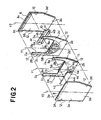
- Fig. 1 is a perspective view showing disposable pants 1 as partially broken away and Fig. 2 is an exploded perspective view showing the pants of Fig. 1.
- a pair of inner sheets 2A, 2B are opposed to each other symmetrically with respect to a plane and a pair of outer sheets 3A, 3B are arranged outside the respective inner sheets 2A, 2B so as to be opposed to each other also with respect to a plane.
- Liquid-resistant side sheets 4A, 4B are interposed between the inner and the outer sheets 2A, 2B; 3A, 3B, respectively.
- the pants 1 further comprise a pair of mat-like liquid-absorbent panels 5A, 5B.
- the inner sheets 2A, 2B and the outer sheets 3A, 3B define together a waist-opening 6 along a top of the pants 1 and a pair of leg-openings 7 along a bottom of the pants 1.
- the waist-opening 6 is provided along its peripheral edge with a film-like elastically stretchable member 8 bonded with tension thereto so as to extend circumferentially of the pants 1.
- the inner sheets 2A, 2B is contoured by upper and lower ends 2a, 2b extending in parallel to each other transversely of the pants 1 and a front and rear side portions 2c, 2d extending in parallel to each other longitudinally of the pants 1.
- the inner sheet 2A, 2B is formed between the front and rear side portions 2c, 2d with a cutout 9 depressed from the upper end 2a toward the lower end 2b.
- This cutout 9 is contoured by opposite sides 9a of the inner sheet 2A, 2B extending longitudinally thereof and a bottom side 9b of the inner sheet 2A, 2B transversely extending between respective lower ends of the opposite sides 9a.
- the side sheet 4A, 4B transversely extends above the panel 5A, 5B.
- the rear side edge 2d of the inner sheet 2A, 2B gets nearer, describing a circular arc, to a longitudinal center line Y1 bisecting a dimension between the front side portion 2c and the rear side portion 2d as the rear side edge 2d extends from the upper end 2a toward the lower end 2b.
- the panel 5A, 5B is placed in a region surrounded by the front and rear side portions 2c, 2d, the lower end 2b and the bottom side 9b of the inner sheet 2A, 2B and bonded to a surface of the sheet 2A, 2B opposed to the panel 5A, 5B.
- the side sheet 4A, 4B is of a rectangular shape which is transversely longer and has a fixed end 4a bonded to the inner sheet 2A, 2B in the vicinity of its bottom side 9b, a free end 4b extending across the cutout 9 above the fixed end 4a, and transversely opposite fixed ends 4c longitudinally extending in parallel to the front and rear side portions 2c, 2d of the inner sheet 2A, 2B and bonded to the inner sheet 2A, 2b in the vicinity of its opposite sides 9a.
- the free end 4b is provided with a transversely extending elastically stretchable member 10 bonded with tension thereto so that the member 10 is covered with a portion of the free end 4b.
- the outer sheet 3A, 3B is contoured by upper and lower ends 3a, 3b transversely extending in parallel to each other and front and rear side edges 3c, 3d longitudinally extending in parallel to each other.
- the rear side edge 3d of the outer sheet 3A, 3B gets nearer, describing a circular arc, to a longitudinal center line Y2 bisecting a dimension between the front side edge 3c and the rear side edge 3d as the rear side edge 3d extends from the upper end 3a toward the lower end 3b.
- Surface of the outer sheet 3A, 3B opposed to the inner sheet 2A, 2B is provided along its upper end 3a with a transversely extending elastic member 8 bonded thereto.
- the inner sheets 2A, 2B are placed upon each other with the respective center lines Y1 brought in line with each other and then the opposed surfaces thereof are continuously or intermittently bonded to each other along bond lines 11.
- bond lines 11 extend in parallel to the cutouts 9, describing circular arcs, from the upper ends 2a toward the lower ends 2b of the sheets 2A, 2B, respectively.
- the portions of the bond lines 11 describing the circular arcs extend between the panels 5A, 5B and the lower ends 2b of the sheets 2A, 2B.
- the respective fixed ends 4a of the side sheets 4A, 4B are partially folded back to respective inner surfaces of the side sheets 4A, 4B and these fixed ends 4a are bonded to respective outer surfaces of the sheets 2A, 2B in the vicinity of their respective bottom sides 9b.
- the transversely opposite ends 4c also are bonded to the sheets 2A, 2B in the vicinity of their opposed sides 9a with the elastic members 10 being kept under tension.
- the inner sheets 2A, 2B and the outer sheets 3A, 3B are placed upon one another, respectively, with the center lines Y1, Y2 of these inner and outer sheets 2A, 2B; 3A, 3B brought in line with one another, respectively.
- the upper and lower ends 2a, 3a; 2b, 3b as well as the front and rear side portions 2c, 3c; 2d, 3d of the inner and outer sheets 2A, 2B; 3A, 3B are also brought in lines, respectively, with one another.
- the inner and outer sheets 2A, 3A have their surfaces opposed to each other continuously or intermittently bonded to each other by means of bond lines 12 extending along the front and rear side portion 2c, 2d; 3c, 3d, respectively.
- the inner and outer sheets 2B, 3B have their surfaces opposed to each other continuously or intermittently bonded to each other by means of bond lines 12 extending along the front and rear side portions 2c, 2d; 3c, 3d, respectively.
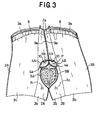
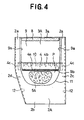
- Fig. 3 is a perspective view showing the pants of Fig. 1 as viewed in a section taken along line A - A in Fig. 1 and Fig. 4 is a sectional view showing the pants of Fig. 1 as taken along line B - B.
- the respective opposed sides 9a are placed upon each other so as to be oriented inwardly of the pants 1.
- the inner sheets 2A, 2B and the outer sheets 3A, 3B have their front and rear side portions 2c, 2d; 3c, 3d placed upon one another so as to be oriented outwardly of the pants 1.
- the respective side sheets 4A, 4B as well as the opposed surfaces of the inner sheets 2A, 2B extending from their bottom sides 9b to the respective bond lines 11 expand outward transversely of the pants 1 as the elastic members 10 bonded with tension to the respective free ends 4b of the side sheets 4A, 4B contract so that these sheets 2A, 2B, 4A, 4B form a pocket P opening upwardly of the pants 1.
- the respective fixed ends 4a of the side sheets 4A, 4B have been folded back toward the inner surfaces thereof and bonded to the respective outer surfaces of the inner sheets 2A, 2B.
- the respective free ends 4b of the side sheets 4A, 4B are biased to tilt outward transversely of the pants 1 and thereby to open the pocket P.
- the side sheets 4A, 4B and the inner sheets 2A, 2B forming the pocket P serve as barriers of the pocket P.
- Excretion discharged into the pocket P is absorbed by the panels 5A, 5B lying within the pocket P.
- the barriers function to prevent excretion leak from occurring in the vicinity of a crotch region.
- the panels 5A, 5B extend substantially in vertical direction in parallel to the inner sheets 2A, 2B and, in a wearer's crotch region, are less bulky than in the case of the panels 5A, 5B extending in horizontal direction. Thus, it is not apprehended that these panels 5A, 5B might give the wearer a feeling of incompatibility.
- Fig. 5 is a perspective view showing the trunks-type disposable pants 1 as a specific embodiment of this invention different from that of Fig. 1 as viewed from the front and Fig, 6 is an exploded perspective view showing the pants 1 of Fig. 5.
- the inner sheets 2A, 2B are symmetrically opposed to each other with respect to a plane and the outer sheets 3A, 3B are also symmetrically opposed to each other with respect to a plane outside the inner sheets 2A, 2B.
- the pants 1 comprise a pair of inner sheets 2A, 2B, a pair of outer sheets 3A, 3B and a pair of mat-like liquid-absorbent panels 5A, 5B so as to define a waist-opening 6 at a top of the pants 1 and a pair of leg-openings 7 at a bottom of the pants 1.
- the waist-opening 6 is provided along its peripheral edge with a circumferentially extending film-like elastically stretchable member 8 bonded with tension thereto.
- the inner sheets 2A, 2B is contoured by upper and lower ends 2a, 2b extending in parallel to each other transversely of the pants 1 and a front and rear side portions 2c, 2d extending in parallel to each other longitudinally of the pants 1.
- the inner sheet 2A, 2B is formed between the front and rear side portions 2c, 2d with a cutout 9 depressed from the upper end 2a toward the lower end 2b.
- the rear side edge 2d of the inner sheet 2A, 2B gets nearer, describing a circular arc, to a longitudinal center line Y1 as the rear side edge 2d extends from the upper end 2a toward the lower end 2b.
- the inner sheets 2A, 2B are provided in the vicinity of their bottom sides 9b with elastically stretchable members 13 transversely extending above the respective panels 5A, 5B in a manner such that these members 13 are bonded with tension to the respective inner sheets 2A, 2B and covered with portions thereof.
- the panel 5A, 5B is placed in a region surrounded by the front and rear side portions 2c, 2d, the lower end 2b and the bottom side 9b of the inner sheet 2A, 2B and bonded to a surface of the sheet 2A, 2B opposed to the panel 5A, 5B.
- the outer sheet 3A, 3B is contoured by upper and lower ends 3a, 3b transversely extending in parallel to each other and front and rear side edges 3c, 3d longitudinally extending in parallel to each other.
- the rear side edge 3d of the outer sheet 3A, 3B gets nearer, describing a circular arc, to a longitudinal center line Y2 bisecting a dimension between the front side edge 3c and the rear side edge 3d as the rear side edge 3d extends from the upper end 3a toward the lower end 3b.
- Surface of the outer sheet 3A, 3B opposed to the inner sheet 2A, 2B is provided along its upper end 3a with a transversely extending elastic member 8 bonded thereto.
- the inner sheets 2A, 2B are placed upon each other with the respective center lines Y1 brought in line with each other and then the opposed surfaces thereof are continuously or intermittently bonded to each other along bond lines 11.
- These bond lines 11 extend in parallel to the cutouts 9, describing circular arcs, from the upper ends 2a toward the lower ends 2b of the sheets 2A, 2B, respectively.
- the portions of the bond lines 11 describing the circular arcs extend between the panels 5A, 5B and the lower ends 2b of the sheets 2A, 2B.
- the respective fixed ends 4a of the side sheets 4A, 4B are partially folded back to respective inner surfaces of the side sheets 4A, 4B and these fixed ends 4a are bonded to respective outer surfaces of the sheets 2A, 2B in the vicinity of their respective bottom sides 9b.
- the transversely opposite ends 4c also are bonded to the sheets 2A, 2B in the vicinity of their opposed sides 9a with the elastic members 10 being kept under tension.
- the inner sheets 2A, 2B and the outer sheets 3A, 3B are placed upon one another, respectively, with the center lines Y1, Y2 of these inner and outer sheets 2A, 2B; 3A, 3B brought in line with one another, respectively. Then the inner and outer sheets 2A, 3A have their surfaces opposed to each other continuously or intermittently bonded to each other by means of bond lines 12 extending along the front and rear side portions 2c, 2d; 3c, 3d, respectively. similarly, the inner and outer sheets 2B, 3B have their surfaces opposed to each other continuously or intermittently bonded to each other by means of bond lines 12 extending along the front and rear side portions 2c, 2d; 3c, 3d, respectively.
- the front and rear side portions 2c, 2d of the sheets 2A, 2B have portions lying in the upper ends 2a and bonded to each other along bond lines 14. These portions bonded together provide a higher bonding strength as measured circumferentially of the pants 1 than the bonding strength which will be provided by these portions not bonded together. In this manner, there is no anxiety that the inner sheets 2A, 2B might be separated from each other as the pants 1 are put on the wearer's body and the waist-opening is circumferentially stretched.
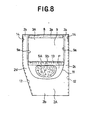
- Fig. 7 is a perspective view showing the pants of Fig. 5 as viewed in a section taken along line C - C in Fig. 5 and Fig. 8 is a sectional view taken along line D - D in Fig. 5.
- the inner sheets 2A, 2B are placed upon each other so that the respective pairs of opposed sides 9a face inwardly of the pants 1 in contact with each other.
- the front and rear side portions 2c, 2d of the respective inner sheets 2A, 2B face outwardly of the pants 1 in contact with the front and rear side edges 3c, 3d of the adjacent outer sheets 3A, 3B, respectively.
- the opposed surfaces of the inner sheets 2A, 2B extending from their bottom sides 9b to the respective bond lines 11 expand outward transversely of the pants 1 as elastic members 13 contract, resulting in formation of a pocket P opening upwardly of the pants 1.
- the inner sheets 2A, 2B forming the pocket P serve as barriers of the pocket P.
- Excretion discharged into the pocket P is absorbed by the panels 5A, 5B lying within the pocket P.
- the barriers function to prevent excretion leak from occurring in the vicinity of a crotch region.
- the panels 5A, 5B extend substantially in vertical direction in parallel to the inner sheets 2A, 2B and, in a wearer's crotch region, are substantially less bulky than in the case of the panels 5A, 5B extending in horizontal direction. Thus, it is not apprehended that these panels 5A, 5B give the wearer a feeling of incompatibility.
- the surfaces of the inner sheets 2A, 2B opposed to each other have their upper ends 2a not bonded to each other and therefore it is not apprehended that the regions of the sheets 2A, 2B extending in the vicinity of their upper ends 2a might give the wearer a feeling of stiffness even when these regions are pressed against the wearer's skin under a contractile force of the elastic members 8.
- the sheets 2A, 2B are bonded together leaving innermost edges of the opposed sides 9a free over an extent sufficient to alleviate a stiffness of the bonded regions even when these innermost edges come in contact with the wearer's crotch. In this way, stimulation possibly experienced by the wearer's skin can be effectively alleviated.
- the surfaces of the inner sheet 2A and the adjacent outer sheet 3A as well as the surfaces of the inner sheet 2B and the adjacent outer sheet 3B are bonded to one another leaving outermost edges of their front and rear sides 2c, 3c, 2d, 3d free over an extent sufficient to alleviate a stiffness of the bonded regions even when these innermost edges come in contact with the wearer's arms. In this way, stimulation possibly experienced by the wearer's skin is effectively alleviated.
- both the front side portions 2c, 3c and the rear side portions 2d, 3d of the inner and outer sheets 2A, 2B; 3A, 3B get near to the respective center lines Y1, Y2, describing circular arcs or describing straight lines as these front and rear side portions extend from their upper ends 2a, 3a to their lower ends 2b, 3b.
- the inner sheets 2A, 2B and/or the outer sheets 3A, 3B may be formed with a nonwoven fabric of thermoplastic fiber.
- the side sheets 4A, 4B also may be formed with a nonwoven fabric of thermoplastic fiber.
- the nonwoven fabric made porous to improve its moisture-pervious property or the nonwoven fabric formed on its sheet surface with irregularities to improve its cushioning property also may be used for this purpose.
- the inner sheets 2A, 2B destined to come in direct contact with the wearer's crotch are preferably formed with the material offering high liquid-permeability, moisture-permeability and softness, for example, rayon or cotton fiber containing nonwoven fabric.
- SMS nonwoven fabric comprising high water-resistance melt blown nonwoven fabric having opposite sheet surfaces each laminated with sheet surface of spun bond nonwoven fabric having a high strength and a high flexibility.
- the SMS nonwoven fabric is obtained by sandwiching the melt blown nonwoven fabric between two layers of spun bond nonwoven fabric and then bonding these melt blown nonwoven fabric and spun bond nonwoven fabric together using a technique of press working.
- Use of the SMS nonwoven fabric advantageously results in the pants 1 having a high strength, a high water-resistance and a comfortable touch.
- the outer sheets 3A, 3B may be also formed with a nonwoven fabric which is stretchable transversely thereof or both transversely and longitudinally thereof.
- the elastic members 8 associated with the waist-opening provided along the upper ends 3a of the sheets 3A, 3B may be eliminated.
- the elastic members 8, 10, 13 may be formed with a synthetic rubber, a natural rubber, a stretchable film containing synthetic rubber, or a spun bond nonwoven fabric or a melt blown nonwoven fabric containing synthetic rubber as a principal ingredient. It is also possible to cover the elastic members 8, 10, 13 with nonwoven fabric and to bond the elastic members with tension to said nonwoven fabric.
- the liquid-absorbent panel 5A, 5B comprises a mixture of fluff pulp and high absorption polymer grains compressed to a desired thickness and entirely covered with a water-pervious sheet such as tissue paper (not shown). Bonding of the panels 5A, 5B, the elastic members 8, 10, 13 and the sheets 2A, 2B, 3A, 3B, 4A, 4B may be carried out using suitable adhesive such as hot melt adhesive, pressure-sensitive adhesive or a fusing technique such as heat-sealing or supersonic sealing.
- suitable adhesive such as hot melt adhesive, pressure-sensitive adhesive or a fusing technique such as heat-sealing or supersonic sealing.
Landscapes
- Health & Medical Sciences (AREA)
- Life Sciences & Earth Sciences (AREA)
- Engineering & Computer Science (AREA)
- Biomedical Technology (AREA)
- Heart & Thoracic Surgery (AREA)
- Vascular Medicine (AREA)
- Epidemiology (AREA)
- Animal Behavior & Ethology (AREA)
- General Health & Medical Sciences (AREA)
- Public Health (AREA)
- Veterinary Medicine (AREA)
- Absorbent Articles And Supports Therefor (AREA)
- Undergarments, Swaddling Clothes, Handkerchiefs Or Underwear Materials (AREA)
- Orthopedics, Nursing, And Contraception (AREA)
Abstract
Description
- This invention relates to trunks-type disposable pants.
- Japanese Patent Application Publication No. 1994-63072A describes trunks-type disposable pants made by a process comprising steps of placing separately formed with front and rear bodies, bonding these front and rear bodies along bond lines extending on crotch regions of these bodies so as to describe curves being convex upward and attaching a longitudinally larger liquid-absorbent panel to the inner surface of the crotch region. Excretion is absorbed by the liquid-absorbent panel attached to the crotch region.
- In the pants disclosed in the Gazette, the longitudinally larger liquid-absorbent panel has a desired width dimension and attached to the crotch region so as to extend in horizontal direction. Transversely opposite side edges of the panel are compressed between thighs of a wearer and these side edges may give the wearer a feeling of incompatibility as the pants are put on the wearer's body. In addition, these side edges have not barriers to prevent excretion spread over the upper surface of the panel from leaking through gap defined between both sides of the crotch region and the wearer's thighs.
- In view of the problem as has been described above, it is an object of this invention to provide trunks-type disposable pants improved so that excretion leak possibly occurring from both sides of a crotch region is reliably avoided without giving a wearer a feeling of incompatibility.
- According to this invention, there is provided trunks-type disposable pants having a waist-opening at its top and a pair of leg-openings at its bottom wherein the waist-opening is provided along its peripheral edge having an elastic stretchability circumferentially of the waist-opening.
- The trunks-type disposable pants further comprises a pair of inner sheets confronting each other and a pair of outer sheets lying outside respective the inner sheets, the inner sheets as well as the outer sheets being contoured by upper and lower ends transversely extending in parallel to each other, respectively, and front and rear side portions longitudinally extending in parallel to each other, respectively, the inner sheets are formed between their front and rear side portions with cutouts depressed from the upper ends toward the lower ends and provided with mat-like liquid-absorbent panels attached to opposed surfaces of the inner sheets so that the opposed surfaces of the inner sheets are bonded together by means of bond lines extending in parallel to the cutouts and partially extending below the liquid-absorbent panels, and opposed surfaces of the inner sheets and the outer sheets are bonded together along the front and rear side portions of these sheets.
- The trunks-type disposable pants according to this invention has a simplified construction such that the inner sheets are placed upon each other and the opposed surfaces of these inner sheets are bonded together while the respective inner sheets are placed upon the respectively adjacent outer sheets and the opposed surfaces of respective pairs of the adjacent inner and outer sheets are bonded together. Such simplified construction facilitates the pants to be made and is suitable for disposable sanitary article.
- With the novel pants having the side sheets bonded to the inner sheets in the vicinity of their bottom sides, the side sheets and the regions in the opposed surfaces of the inner sheets extending from the bottom sides to the bond lines are expanded outward transversely of the pants as the elastic members attached to the respective side sheets contract. Consequently, these sheets form the pocket opening upwardly of the pants. The pocket includes therein the liquid-absorbent panels. The side sheets and the inner sheets define the barriers so that the amount of excretion discharged into the pocket is absorbed by the panels and the barriers prevent any leak of the excretion from possibly occurring in the vicinity of the crotch region.
- In the pants having the elastic members bonded to the respective inner sheets in the vicinity of the bottom sides thereof, the regions in the opposed surfaces of the inner sheets extending from the bottom sides to the bond lines are expanded outward transversely of the pants as the elastic members bonded to the inner sheets contract. Consequently, the inner sheets form the pocket opening upwardly of the pants. The pocket includes therein the liquid-absorbent panels and the respective inner sheets define barriers functioning to prevent any amount of the excretion having been discharged into the pocket and absorbed by the panels from leaking from the crotch region.
- The panels extend in parallel to the inner sheets substantially in vertical direction and therefore are less bulky in the crotch region than when these panels in horizontal direction. In this manner, it is not apprehended that the panels give the wearer a feeling of incompatibility.
- The novel pants achieve a substantially higher bonding strength as measured circumferentially of the pants than that achieved by the pants in which the opposed surfaces are not bonded together along the regions. This is because, according to this invention, the opposed surfaces of the inner sheets are bonded together along regions of the front and rear side portions extending in the vicinity of the respective upper ends of said inner sheets.
- Fig. 1 is a perspective view showing one embodiment of a trunks-type disposable pants according to this invention as viewed from the front;
- Fig. 2 is an exploded perspective view showing the pants of Fig. 1;
- Fig. 3 is a perspective view showing the pants of Fig-1 as viewed in a section taken along line A - A in Fig. 1;
- Fig. 4 is a sectional view showing the pants of Fig. 1 as taken along line B - B;
- Fig. 5 is a perspective view showing the trunks-type disposable pants as one embodiment of this invention different from that of Fig. 1 as viewed from the front;
- Fig. 6 is an exploded perspective view showing the pants of Fig. 5;
- Fig. 7 is a perspective view showing the pants of Fig. 5 as viewed in a section taken along line C - C in Fig. 5; and
- Fig. 8 is a sectional view showing the pants of Fig. 5 as taken along line D - D in Fig. 5.
-
- Details of disposable pants of trunks-type according to this invention will be more fully understood from the description given hereunder with reference to the accompanying drawings.
- Fig. 1 is a perspective view showing
disposable pants 1 as partially broken away and Fig. 2 is an exploded perspective view showing the pants of Fig. 1. In Fig. 2, a pair ofinner sheets outer sheets inner sheets resistant side sheets outer sheets - In addition to these pair of symmetric
inner sheets outer sheets resistant side sheets pants 1 further comprise a pair of mat-like liquid-absorbent panels - In the
pants 1, theinner sheets outer sheets pants 1 and a pair of leg-openings 7 along a bottom of thepants 1. The waist-opening 6 is provided along its peripheral edge with a film-like elasticallystretchable member 8 bonded with tension thereto so as to extend circumferentially of thepants 1. - The
inner sheets lower ends pants 1 and a front andrear side portions pants 1. Theinner sheet rear side portions cutout 9 depressed from theupper end 2a toward thelower end 2b. Thiscutout 9 is contoured byopposite sides 9a of theinner sheet bottom side 9b of theinner sheet opposite sides 9a. - In the vicinity of the
bottom sides 9b of theinner sheet side sheet panel rear side edge 2d of theinner sheet front side portion 2c and therear side portion 2d as therear side edge 2d extends from theupper end 2a toward thelower end 2b. - The
panel rear side portions lower end 2b and thebottom side 9b of theinner sheet sheet panel - The
side sheet fixed end 4a bonded to theinner sheet bottom side 9b, afree end 4b extending across thecutout 9 above thefixed end 4a, and transversely oppositefixed ends 4c longitudinally extending in parallel to the front andrear side portions inner sheet inner sheet opposite sides 9a. Thefree end 4b is provided with a transversely extending elasticallystretchable member 10 bonded with tension thereto so that themember 10 is covered with a portion of thefree end 4b. - The
outer sheet lower ends rear side edges rear side edge 3d of theouter sheet front side edge 3c and therear side edge 3d as therear side edge 3d extends from theupper end 3a toward thelower end 3b. Surface of theouter sheet inner sheet upper end 3a with a transversely extendingelastic member 8 bonded thereto. - To assemble the components illustrated by Fig. 2 in the exploded perspective view and thereby to obtain the
pants 1, theinner sheets bond lines 11. These.bond lines 11 extend in parallel to thecutouts 9, describing circular arcs, from theupper ends 2a toward thelower ends 2b of thesheets bond lines 11 describing the circular arcs extend between thepanels lower ends 2b of thesheets - After the opposed surfaces of the
inner sheets fixed ends 4a of theside sheets side sheets fixed ends 4a are bonded to respective outer surfaces of thesheets respective bottom sides 9b. At the same time, the transverselyopposite ends 4c also are bonded to thesheets opposed sides 9a with theelastic members 10 being kept under tension. - The
inner sheets outer sheets outer sheets lower ends rear side portions outer sheets - The inner and
outer sheets bond lines 12 extending along the front andrear side portion outer sheets bond lines 12 extending along the front andrear side portions - Fig. 3 is a perspective view showing the pants of Fig. 1 as viewed in a section taken along line A - A in Fig. 1 and Fig. 4 is a sectional view showing the pants of Fig. 1 as taken along line B - B. Of the
inner sheets sides 9a are placed upon each other so as to be oriented inwardly of thepants 1. Theinner sheets outer sheets rear side portions pants 1. - In the
pants 1 assembled, therespective side sheets inner sheets bottom sides 9b to therespective bond lines 11 expand outward transversely of thepants 1 as theelastic members 10 bonded with tension to the respectivefree ends 4b of theside sheets sheets pants 1. - In the
pants 1 assembled, the respectivefixed ends 4a of theside sheets inner sheets free ends 4b of theside sheets pants 1 and thereby to open the pocket P. - The
side sheets inner sheets panels panels inner sheets panels panels - Fig. 5 is a perspective view showing the trunks-type
disposable pants 1 as a specific embodiment of this invention different from that of Fig. 1 as viewed from the front and Fig, 6 is an exploded perspective view showing thepants 1 of Fig. 5. Referring to Fig. 6, theinner sheets outer sheets inner sheets - The
pants 1 according to this alternative embodiment comprise a pair ofinner sheets outer sheets absorbent panels pants 1 and a pair of leg-openings 7 at a bottom of thepants 1. The waist-opening 6 is provided along its peripheral edge with a circumferentially extending film-like elasticallystretchable member 8 bonded with tension thereto. - The
inner sheets lower ends pants 1 and a front andrear side portions pants 1. Theinner sheet rear side portions cutout 9 depressed from theupper end 2a toward thelower end 2b. Therear side edge 2d of theinner sheet rear side edge 2d extends from theupper end 2a toward thelower end 2b. - The
inner sheets bottom sides 9b with elasticallystretchable members 13 transversely extending above therespective panels members 13 are bonded with tension to the respectiveinner sheets - The
panel rear side portions lower end 2b and thebottom side 9b of theinner sheet sheet panel - The
outer sheet lower ends rear side edge 3d of theouter sheet front side edge 3c and therear side edge 3d as therear side edge 3d extends from theupper end 3a toward thelower end 3b. Surface of theouter sheet inner sheet upper end 3a with a transversely extendingelastic member 8 bonded thereto. - To assemble the components illustrated by Fig. 6 in the exploded perspective view and thereby to obtain the
pants 1, theinner sheets bond lines 11 extend in parallel to thecutouts 9, describing circular arcs, from the upper ends 2a toward the lower ends 2b of thesheets bond lines 11 describing the circular arcs extend between thepanels sheets - After the opposed surfaces of the
inner sheets side sheets side sheets sheets bottom sides 9b. At the same time, the transversely opposite ends 4c also are bonded to thesheets opposed sides 9a with theelastic members 10 being kept under tension. - The
inner sheets outer sheets outer sheets outer sheets bond lines 12 extending along the front andrear side portions outer sheets bond lines 12 extending along the front andrear side portions - In the
pants 1 according to this alternative embodiment, the front andrear side portions sheets pants 1 than the bonding strength which will be provided by these portions not bonded together. In this manner, there is no anxiety that theinner sheets pants 1 are put on the wearer's body and the waist-opening is circumferentially stretched. - Fig. 7 is a perspective view showing the pants of Fig. 5 as viewed in a section taken along line C - C in Fig. 5 and Fig. 8 is a sectional view taken along line D - D in Fig. 5. The
inner sheets opposed sides 9a face inwardly of thepants 1 in contact with each other. The front andrear side portions inner sheets pants 1 in contact with the front and rear side edges 3c, 3d of the adjacentouter sheets - In the
pants 1 assembled, the opposed surfaces of theinner sheets bottom sides 9b to therespective bond lines 11 expand outward transversely of thepants 1 aselastic members 13 contract, resulting in formation of a pocket P opening upwardly of thepants 1. - The
inner sheets panels panels inner sheets panels panels - The surfaces of the
inner sheets upper ends 2a not bonded to each other and therefore it is not apprehended that the regions of thesheets upper ends 2a might give the wearer a feeling of stiffness even when these regions are pressed against the wearer's skin under a contractile force of theelastic members 8. - In these embodiments of the
pants 1 illustrated by Figs. 1 and 5, respectively, thesheets opposed sides 9a free over an extent sufficient to alleviate a stiffness of the bonded regions even when these innermost edges come in contact with the wearer's crotch. In this way, stimulation possibly experienced by the wearer's skin can be effectively alleviated. - The surfaces of the
inner sheet 2A and the adjacentouter sheet 3A as well as the surfaces of theinner sheet 2B and the adjacentouter sheet 3B are bonded to one another leaving outermost edges of their front andrear sides - An alternative embodiment is also possible such that both the
front side portions rear side portions outer sheets upper ends lower ends - The
inner sheets outer sheets side sheets inner sheets - It is also possible to use composite nonwoven fabric (SMS nonwoven fabric) comprising high water-resistance melt blown nonwoven fabric having opposite sheet surfaces each laminated with sheet surface of spun bond nonwoven fabric having a high strength and a high flexibility. The SMS nonwoven fabric is obtained by sandwiching the melt blown nonwoven fabric between two layers of spun bond nonwoven fabric and then bonding these melt blown nonwoven fabric and spun bond nonwoven fabric together using a technique of press working. Use of the SMS nonwoven fabric advantageously results in the
pants 1 having a high strength, a high water-resistance and a comfortable touch. - The
outer sheets elastic members 8 associated with the waist-opening provided along the upper ends 3a of thesheets - The
elastic members elastic members - It is also possible to attach the
elastic members 8 associated with the waist-opening to the respective outer surfaces of theouter sheets pants 1 assembled, it is possible to cover the exposed regions of theelastic members 8 attached to the opposed surfaces of thesheets elastic members 8 from coming in contact with the wearer's skin. - The liquid-
absorbent panel panels elastic members sheets
Claims (5)
- Trunks-type disposable pants having a waist-opening at its top and a pair of leg-openings at its bottom wherein said waist-opening is provided along its peripheral edge having an elastic stretchability circumferentially of said waist-opening.said trunks-type disposable pants further comprisingsaid pants including a pair of inner sheets confronting each other and a pair of outer sheets lying outside respective said inner sheets, said inner sheets as well as said outer sheets being contoured by upper and lower ends transversely extending in parallel to each other, respectively, and front and rear side portions longitudinally extending in parallel to each other, respectively;said inner sheets being formed between their front and rear side portions with cutouts depressed from said upper ends toward said lower ends and provided with mat-like liquid-absorbent panels attached to opposed surfaces of said inner sheets so that said opposed surfaces of said inner sheets are bonded together by means of bond lines extending in parallel to said cutouts and partially extending below said liquid-absorbent panels; andopposed surfaces of said inner sheets and said outer sheets being bonded together along said front and rear side portions of these sheets.
- The pants according to Claim 1, wherein the opposed surfaces of said inner sheets are bonded together along the upper ends of said inner sheets and along limited regions of said front and rear side portions lying in the vicinity of said upper ends of said inner sheets, at least along said limited regions of said front and rear side portions lying in the vicinity of said upper ends of said inner sheets.
- The pants according to Claim 1, wherein elastically stretchable members are bonded with tension to said inner sheets along respective said bottom sides of said cutouts so as to extend above respective said liquid-absorbent panels transversely of said inner sheets.
- The pants according to Claim 1, wherein liquid-resistant side sheets are bonded to said inner sheets along respective said bottom sides of said cutouts so as to extend above respective said liquid-absorbent panels transversely of said inner sheets, said side sheets being made of nonwoven fabric and having fixed ends transversely extending and fixed to said inner sheets, free ends extending above said fixed ends across said cutouts and transversely opposite fixed sides fixed to said inner sheets along said cutouts so as to extend longitudinally of said side sheets, said free ends being provided with elastically stretchable members bonded with tension thereto so as to extend transversely of said side sheets.
- The pants according to claim 1, wherein said inner sheets and/or said outer sheets are made of nonwoven fabric.
Applications Claiming Priority (2)
| Application Number | Priority Date | Filing Date | Title |
|---|---|---|---|
| JP2000046767A JP3717362B2 (en) | 2000-02-18 | 2000-02-18 | Trunks-type disposable pants |
| JP2000046767 | 2000-02-18 |
Publications (2)
| Publication Number | Publication Date |
|---|---|
| EP1125571A2 true EP1125571A2 (en) | 2001-08-22 |
| EP1125571A3 EP1125571A3 (en) | 2001-11-28 |
Family
ID=18569125
Family Applications (1)
| Application Number | Title | Priority Date | Filing Date |
|---|---|---|---|
| EP01301411A Withdrawn EP1125571A3 (en) | 2000-02-18 | 2001-02-19 | Trunks-type disposable pants |
Country Status (10)
| Country | Link |
|---|---|
| US (1) | US6293937B2 (en) |
| EP (1) | EP1125571A3 (en) |
| JP (1) | JP3717362B2 (en) |
| KR (1) | KR20010082740A (en) |
| CN (1) | CN1312063A (en) |
| AU (1) | AU2303401A (en) |
| BR (1) | BR0100721A (en) |
| CA (1) | CA2336723A1 (en) |
| ID (1) | ID29554A (en) |
| SG (1) | SG85230A1 (en) |
Cited By (8)
| Publication number | Priority date | Publication date | Assignee | Title |
|---|---|---|---|---|
| EP1565139A1 (en) * | 2002-11-25 | 2005-08-24 | Kimberly-Clark Worldwide, Inc. | Process to make boxer shorts with an absorbent core |
| US7344526B2 (en) | 2003-12-15 | 2008-03-18 | Kimberly-Clark Worldwide, Inc. | Absorbent garment |
| US7491196B2 (en) | 2003-12-15 | 2009-02-17 | Kimberly-Clark Worldwide, Inc. | Absorbent garment |
| US7686796B2 (en) | 2003-12-15 | 2010-03-30 | Kimberly-Clark Worldwide, Inc. | Absorbent garment and method for placing an absorbent garment on a wearer's waist |
| US7993322B2 (en) | 2003-12-15 | 2011-08-09 | Kimberly-Clark Worldwide, Inc. | Absorbent garment having outer shell and adjustable absorbent assembly therein |
| US8147642B2 (en) | 2002-12-09 | 2012-04-03 | Kimberly-Clark Worldwide, Inc. | Process of making boxer shorts from a web |
| US8282618B2 (en) | 2002-12-11 | 2012-10-09 | Kimberly-Clark Worldwide, Inc. | Disposable boxer brief |
| US9700079B2 (en) | 2002-12-09 | 2017-07-11 | Kimberly-Clark Worldwide, Inc. | Process of making boxer shorts from a web with various leg opening shapes |
Families Citing this family (37)
| Publication number | Priority date | Publication date | Assignee | Title |
|---|---|---|---|---|
| JP3557133B2 (en) * | 1999-09-03 | 2004-08-25 | ユニ・チャーム株式会社 | Disposable diapers |
| IL131926A (en) * | 1999-09-16 | 2007-10-31 | Chaim Ben Natan | Anti-irritant diaper |
| JP3771416B2 (en) * | 2000-03-16 | 2006-04-26 | ユニ・チャーム株式会社 | Trunks-type disposable pants and method for manufacturing the same |
| US6482191B1 (en) * | 2000-10-23 | 2002-11-19 | The Procter & Gamble Company | Elasticated topsheet with an elongate slit opening |
| JP3745984B2 (en) * | 2001-07-30 | 2006-02-15 | ユニ・チャーム株式会社 | Pants-type disposable diapers |
| JP4116821B2 (en) * | 2002-05-22 | 2008-07-09 | ユニ・チャーム株式会社 | Pants-type diapers |
| US7086095B2 (en) | 2002-11-21 | 2006-08-08 | Kimberly-Clark Worldwide, Inc. | Boxer-style absorbent underpant and method of making same |
| US8176573B2 (en) | 2002-12-09 | 2012-05-15 | Kimberly-Clark Worldwide, Inc. | Boxer shorts and process of making boxer shorts from one or more webs |
| US8361049B2 (en) | 2002-12-09 | 2013-01-29 | Kimberly-Clark Worldwide, Inc. | Boxer shorts and process of making boxer shorts with expandable material |
| US20040107481A1 (en) | 2002-12-09 | 2004-06-10 | Mortell Heather Schenck | Process to make boxer shorts having a contracted crotch region |
| WO2004062398A1 (en) | 2003-01-10 | 2004-07-29 | Zuiko Corporation | Wearing article and method of manufacturing the same |
| US7875014B2 (en) | 2003-12-15 | 2011-01-25 | Kimberly-Clark Worldwide, Inc. | Absorbent garment having a garment shell |
| US20050148980A1 (en) * | 2003-12-30 | 2005-07-07 | Kimberly-Clark Worldwide, Inc. | Absorbent garment having outer shell and discreet absorbent assembly adapted for positioning therein |
| US6926702B1 (en) * | 2004-03-04 | 2005-08-09 | Lisa Diane Crislip Wilkinson | Diaper with legs |
| US20050215972A1 (en) * | 2004-03-29 | 2005-09-29 | Roe Donald C | Disposable absorbent articles with zones comprising elastomeric components |
| US20050256473A1 (en) * | 2004-04-29 | 2005-11-17 | Kimberly-Clark Worldwide, Inc. | Absorbent articles containing absorbent leg regions |
| US7288162B2 (en) * | 2004-04-30 | 2007-10-30 | Kimberly-Clark Worldwide, Inc. | Process for making a garment including an absorbent assembly |
| US7854022B2 (en) | 2005-01-10 | 2010-12-21 | Hbi Branded Apparel Enterprises, Llc | Garments having seamless edge bands and processes for making same |
| KR100741906B1 (en) * | 2006-05-29 | 2007-07-24 | 황선문 | Disposable Pants for Procedures and Surgery |
| FR2905593B1 (en) * | 2006-09-13 | 2009-08-21 | Univ Paris Curie | UNDERWEAR FOR INCONTINENT PERSON AND TREATMENT DEVICE ASSOCIATED WITH UNDERWEAR |
| US20090062765A1 (en) * | 2007-08-31 | 2009-03-05 | Schermerhorn James R | Discretion in absorbent garments |
| US8181273B2 (en) * | 2009-01-26 | 2012-05-22 | Michelle Kane | Disposable skirts and shorts diapers |
| CN102078243A (en) * | 2010-10-18 | 2011-06-01 | 杭州珂瑞特机械制造有限公司 | Short trousers type outerwear baby diaper |
| CN102078241A (en) * | 2010-10-18 | 2011-06-01 | 杭州珂瑞特机械制造有限公司 | Short trousers type outerwear paper diaper |
| CN101999962A (en) * | 2010-11-24 | 2011-04-06 | 杭州珂瑞特机械制造有限公司 | Short-type outer thin cotton diaper for baby |
| CN101999963A (en) * | 2010-11-24 | 2011-04-06 | 杭州珂瑞特机械制造有限公司 | Shorts type external infant thin cotton training pants |
| WO2014044831A1 (en) * | 2012-09-21 | 2014-03-27 | Brady Yvonne Anne | An undergarment |
| RU2664957C1 (en) | 2015-03-31 | 2018-08-23 | Кимберли-Кларк Ворлдвайд, Инк. | Absorbent article with a waist sealing element and a way for the production thereof |
| WO2016159983A1 (en) | 2015-03-31 | 2016-10-06 | Kimberly-Clark Worldwide, Inc. | Absorbent article with compressible waist containment member and method of manufacturing thereof |
| WO2016159981A1 (en) | 2015-03-31 | 2016-10-06 | Kimberly-Clark Worldwide, Inc. | Absorbent article with selectively positioned waist containment member |
| US10159610B2 (en) | 2015-06-29 | 2018-12-25 | Kimberly-Clark Worldwide, Inc. | Absorbent article with partially enclosed waist containment member and method of manufacturing thereof |
| US20170246054A1 (en) | 2015-08-31 | 2017-08-31 | Kimberly-Clark Worldwide, Inc. | Absorbent article with absorbent body providing improved access to containment pocket of waist containment member |
| DE112015006858T5 (en) | 2015-08-31 | 2018-05-17 | Kimberly-Clark Worldwide, Inc. | Elastic composite and absorbent article incorporating same |
| BR112018004622B1 (en) | 2015-09-29 | 2022-06-28 | Kimberly-Clark Worldwide, Inc | ABSORBENT ARTICLE WITH SELECTIVELY POSITIONED WAIST CONTAINMENT ELEMENT HAVING IMPROVED WAIST SEAL |
| US20170099881A1 (en) * | 2015-10-13 | 2017-04-13 | Ronald N. Travisano | Mens underwear brief |
| BR112018011900A2 (en) * | 2015-12-15 | 2018-11-27 | Procter & Gamble | waistband frame with tack-free adhesive |
| JP7581111B2 (en) * | 2021-03-31 | 2024-11-12 | 花王株式会社 | Sheet for absorbent article and absorbent article including same |
Citations (1)
| Publication number | Priority date | Publication date | Assignee | Title |
|---|---|---|---|---|
| EP1048231A1 (en) * | 1998-11-12 | 2000-11-02 | Uni-Charm Company Limited | Disposable trunks type shorts and production method therefor |
Family Cites Families (14)
| Publication number | Priority date | Publication date | Assignee | Title |
|---|---|---|---|---|
| US1833960A (en) * | 1930-05-01 | 1931-12-01 | Bertha S Alsop | Baby's diaper |
| US5062840B1 (en) * | 1989-05-22 | 1995-01-03 | John N Holt | Disposable diapers |
| US5176672A (en) * | 1990-11-13 | 1993-01-05 | Kimberly-Clark Corporation | Pocket-like diaper or absorbent article |
| JP3129847B2 (en) | 1992-08-24 | 2001-01-31 | ユニ・チャーム株式会社 | Disposable diapers |
| US5397318A (en) * | 1993-06-10 | 1995-03-14 | The Procter & Gamble Company | Absorbent article having a pocket cuff |
| US5601544A (en) * | 1993-12-23 | 1997-02-11 | Kimberly-Clark Corporation | Child's training pant with elasticized shaped absorbent and method of making the same |
| CA2142128A1 (en) * | 1994-07-29 | 1996-01-30 | Paulette Mary Rosch | Disposable swimwear |
| US5853403A (en) * | 1994-10-25 | 1998-12-29 | Kimberly-Clark Worldwide, Inc. | Absorbent article with body contacting liquid control member |
| WO1997018785A1 (en) * | 1995-11-22 | 1997-05-29 | Kimberly-Clark Worldwide, Inc. | Disposable absorbent article having a garment-like appearance |
| US6133501A (en) * | 1996-10-24 | 2000-10-17 | Kimberly-Clark Worldwide, Inc. | Absorbent article with retaining structure for receiving and retaining fecal material |
| JP3429656B2 (en) * | 1998-01-30 | 2003-07-22 | ユニ・チャーム株式会社 | Disposable diapers |
| JP3652535B2 (en) * | 1998-12-09 | 2005-05-25 | ユニ・チャーム株式会社 | Disposable trunks pants |
| JP3652534B2 (en) * | 1998-12-09 | 2005-05-25 | ユニ・チャーム株式会社 | Method for producing disposable trunks-type wearing article |
| JP3488147B2 (en) * | 1999-09-10 | 2004-01-19 | テイコク株式会社 | Sanitary spats |
-
2000
- 2000-02-18 JP JP2000046767A patent/JP3717362B2/en not_active Expired - Fee Related
-
2001
- 2001-02-14 CA CA002336723A patent/CA2336723A1/en not_active Abandoned
- 2001-02-16 BR BR0100721-1A patent/BR0100721A/en not_active IP Right Cessation
- 2001-02-16 SG SG200100868A patent/SG85230A1/en unknown
- 2001-02-16 AU AU23034/01A patent/AU2303401A/en not_active Abandoned
- 2001-02-16 ID IDP20010139D patent/ID29554A/en unknown
- 2001-02-16 US US09/785,638 patent/US6293937B2/en not_active Expired - Fee Related
- 2001-02-17 KR KR1020010008012A patent/KR20010082740A/en not_active Withdrawn
- 2001-02-19 EP EP01301411A patent/EP1125571A3/en not_active Withdrawn
- 2001-02-19 CN CN01116875A patent/CN1312063A/en active Pending
Patent Citations (1)
| Publication number | Priority date | Publication date | Assignee | Title |
|---|---|---|---|---|
| EP1048231A1 (en) * | 1998-11-12 | 2000-11-02 | Uni-Charm Company Limited | Disposable trunks type shorts and production method therefor |
Cited By (9)
| Publication number | Priority date | Publication date | Assignee | Title |
|---|---|---|---|---|
| EP1565139A1 (en) * | 2002-11-25 | 2005-08-24 | Kimberly-Clark Worldwide, Inc. | Process to make boxer shorts with an absorbent core |
| US8147642B2 (en) | 2002-12-09 | 2012-04-03 | Kimberly-Clark Worldwide, Inc. | Process of making boxer shorts from a web |
| US9700079B2 (en) | 2002-12-09 | 2017-07-11 | Kimberly-Clark Worldwide, Inc. | Process of making boxer shorts from a web with various leg opening shapes |
| US8282618B2 (en) | 2002-12-11 | 2012-10-09 | Kimberly-Clark Worldwide, Inc. | Disposable boxer brief |
| US7344526B2 (en) | 2003-12-15 | 2008-03-18 | Kimberly-Clark Worldwide, Inc. | Absorbent garment |
| US7491196B2 (en) | 2003-12-15 | 2009-02-17 | Kimberly-Clark Worldwide, Inc. | Absorbent garment |
| US7686796B2 (en) | 2003-12-15 | 2010-03-30 | Kimberly-Clark Worldwide, Inc. | Absorbent garment and method for placing an absorbent garment on a wearer's waist |
| US7993322B2 (en) | 2003-12-15 | 2011-08-09 | Kimberly-Clark Worldwide, Inc. | Absorbent garment having outer shell and adjustable absorbent assembly therein |
| US8672916B2 (en) | 2003-12-15 | 2014-03-18 | Kimberly-Clark Worldwide, Inc. | Absorbent garment having outer shell and adjustable absorbent assembly therein |
Also Published As
| Publication number | Publication date |
|---|---|
| EP1125571A3 (en) | 2001-11-28 |
| US6293937B2 (en) | 2001-09-25 |
| CA2336723A1 (en) | 2001-08-18 |
| JP3717362B2 (en) | 2005-11-16 |
| CN1312063A (en) | 2001-09-12 |
| BR0100721A (en) | 2001-10-09 |
| US20010016722A1 (en) | 2001-08-23 |
| KR20010082740A (en) | 2001-08-30 |
| AU2303401A (en) | 2001-08-23 |
| SG85230A1 (en) | 2001-12-19 |
| ID29554A (en) | 2001-09-06 |
| JP2001224615A (en) | 2001-08-21 |
Similar Documents
| Publication | Publication Date | Title |
|---|---|---|
| US6293937B2 (en) | Trunks-type disposable pants | |
| CA2350009C (en) | Disposable pants of trunks-type | |
| EP1110463B1 (en) | Disposable pants of trunks-type | |
| JP3478722B2 (en) | Disposable diapers | |
| EP1177782B1 (en) | Disposable garment | |
| US6458116B1 (en) | Disposable pants of trunks-type and process for making the same | |
| EP1108409B1 (en) | Disposable diaper | |
| EP1260206A2 (en) | Pants-type disposable wearing article | |
| CA2454374C (en) | Pants-type disposable wearing article | |
| KR100418463B1 (en) | Throwaway trunks type underpants | |
| EP1205169B1 (en) | Disposable diaper | |
| JP2003126148A (en) | Pants-type disposable wearing article | |
| AU2003207283B2 (en) | Pants-type disposable wearing article | |
| EP1025825B1 (en) | Disposable diaper | |
| EP1166733B1 (en) | Disposable absorbent article | |
| JP2988541B2 (en) | Disposable pants-type diapers | |
| WO2004112673A1 (en) | Pants-type disposable wearing article | |
| KR20000028995A (en) | Pants-like disposable garment | |
| JPH0686726U (en) | Three-dimensional pants type disposable diaper | |
| JP2001079036A (en) | Disposable pants-type body fluid treatment article | |
| JPH09215708A (en) | Disposable wearing articles |
Legal Events
| Date | Code | Title | Description |
|---|---|---|---|
| PUAI | Public reference made under article 153(3) epc to a published international application that has entered the european phase |
Free format text: ORIGINAL CODE: 0009012 |
|
| AK | Designated contracting states |
Kind code of ref document: A2 Designated state(s): DE FR GB NL SE Kind code of ref document: A2 Designated state(s): AT BE CH CY DE DK ES FI FR GB GR IE IT LI LU MC NL PT SE TR |
|
| AX | Request for extension of the european patent |
Free format text: AL;LT;LV;MK;RO;SI |
|
| PUAL | Search report despatched |
Free format text: ORIGINAL CODE: 0009013 |
|
| AK | Designated contracting states |
Kind code of ref document: A3 Designated state(s): AT BE CH CY DE DK ES FI FR GB GR IE IT LI LU MC NL PT SE TR |
|
| AX | Request for extension of the european patent |
Free format text: AL;LT;LV;MK;RO;SI |
|
| 17P | Request for examination filed |
Effective date: 20020513 |
|
| AKX | Designation fees paid |
Free format text: DE FR GB NL SE |
|
| RAP1 | Party data changed (applicant data changed or rights of an application transferred) |
Owner name: UNI-CHARM CORPORATION |
|
| 17Q | First examination report despatched |
Effective date: 20050601 |
|
| STAA | Information on the status of an ep patent application or granted ep patent |
Free format text: STATUS: THE APPLICATION IS DEEMED TO BE WITHDRAWN |
|
| 18D | Application deemed to be withdrawn |
Effective date: 20051012 |