EP1124920B1 - Cyclic thiourea additives for lubricants - Google Patents
Cyclic thiourea additives for lubricants Download PDFInfo
- Publication number
- EP1124920B1 EP1124920B1 EP99971639A EP99971639A EP1124920B1 EP 1124920 B1 EP1124920 B1 EP 1124920B1 EP 99971639 A EP99971639 A EP 99971639A EP 99971639 A EP99971639 A EP 99971639A EP 1124920 B1 EP1124920 B1 EP 1124920B1
- Authority
- EP
- European Patent Office
- Prior art keywords
- alkyl
- composition
- additives
- diaminopropane
- chain
- Prior art date
- Legal status (The legal status is an assumption and is not a legal conclusion. Google has not performed a legal analysis and makes no representation as to the accuracy of the status listed.)
- Expired - Lifetime
Links
- UMGDCJDMYOKAJW-UHFFFAOYSA-N thiourea Chemical compound NC(N)=S UMGDCJDMYOKAJW-UHFFFAOYSA-N 0.000 title claims abstract description 25
- 239000000314 lubricant Substances 0.000 title claims abstract description 16
- 125000004122 cyclic group Chemical group 0.000 title claims abstract description 13
- XSQUKJJJFZCRTK-UHFFFAOYSA-N Urea Natural products NC(N)=O XSQUKJJJFZCRTK-UHFFFAOYSA-N 0.000 title claims abstract description 12
- 239000000654 additive Substances 0.000 title claims description 54
- 239000000203 mixture Substances 0.000 claims abstract description 61
- 125000000217 alkyl group Chemical group 0.000 claims abstract description 30
- 239000001257 hydrogen Substances 0.000 claims abstract description 10
- 229910052739 hydrogen Inorganic materials 0.000 claims abstract description 10
- 239000010687 lubricating oil Substances 0.000 claims description 37
- HCHKCACWOHOZIP-UHFFFAOYSA-N Zinc Chemical compound [Zn] HCHKCACWOHOZIP-UHFFFAOYSA-N 0.000 claims description 17
- 239000007866 anti-wear additive Substances 0.000 claims description 17
- 239000011701 zinc Substances 0.000 claims description 17
- 229910052725 zinc Inorganic materials 0.000 claims description 17
- 125000004432 carbon atom Chemical group C* 0.000 claims description 11
- 230000000996 additive effect Effects 0.000 claims description 10
- 239000002270 dispersing agent Substances 0.000 claims description 8
- TUFJPPAQOXUHRI-KTKRTIGZSA-N n'-[(z)-octadec-9-enyl]propane-1,3-diamine Chemical compound CCCCCCCC\C=C/CCCCCCCCNCCCN TUFJPPAQOXUHRI-KTKRTIGZSA-N 0.000 claims description 8
- 239000003112 inhibitor Substances 0.000 claims description 7
- 239000003599 detergent Substances 0.000 claims description 6
- 230000002929 anti-fatigue Effects 0.000 claims description 5
- JEIPFZHSYJVQDO-UHFFFAOYSA-N iron(III) oxide Inorganic materials O=[Fe]O[Fe]=O JEIPFZHSYJVQDO-UHFFFAOYSA-N 0.000 claims description 5
- SNRUBQQJIBEYMU-UHFFFAOYSA-N Dodecane Natural products CCCCCCCCCCCC SNRUBQQJIBEYMU-UHFFFAOYSA-N 0.000 claims description 4
- 238000005260 corrosion Methods 0.000 claims description 4
- 230000007797 corrosion Effects 0.000 claims description 4
- 125000003438 dodecyl group Chemical group [H]C([H])([H])C([H])([H])C([H])([H])C([H])([H])C([H])([H])C([H])([H])C([H])([H])C([H])([H])C([H])([H])C([H])([H])C([H])([H])C([H])([H])* 0.000 claims description 4
- 229930195735 unsaturated hydrocarbon Natural products 0.000 claims description 4
- 239000005069 Extreme pressure additive Substances 0.000 claims description 3
- QVGXLLKOCUKJST-UHFFFAOYSA-N atomic oxygen Chemical compound [O] QVGXLLKOCUKJST-UHFFFAOYSA-N 0.000 claims description 3
- LMVFSACRPDMFSQ-UHFFFAOYSA-N n'-[3-(8-methylnonoxy)propyl]propane-1,3-diamine Chemical compound CC(C)CCCCCCCOCCCNCCCN LMVFSACRPDMFSQ-UHFFFAOYSA-N 0.000 claims description 3
- 239000001301 oxygen Substances 0.000 claims description 3
- 229910052760 oxygen Inorganic materials 0.000 claims description 3
- WEYCOGBXTJHNNS-UHFFFAOYSA-N 6-(10-methylundecoxy)hexane-1,3-diamine Chemical compound CC(C)CCCCCCCCCOCCCC(N)CCN WEYCOGBXTJHNNS-UHFFFAOYSA-N 0.000 claims description 2
- QUKOANMEXNUNMH-UHFFFAOYSA-N 6-(11-methyldodecoxy)hexane-1,3-diamine Chemical compound CC(C)CCCCCCCCCCOCCCC(N)CCN QUKOANMEXNUNMH-UHFFFAOYSA-N 0.000 claims description 2
- XMAZQTCSWFSXBK-UHFFFAOYSA-N 6-tetradecoxyhexane-1,3-diamine Chemical compound CCCCCCCCCCCCCCOCCCC(N)CCN XMAZQTCSWFSXBK-UHFFFAOYSA-N 0.000 claims description 2
- RTZKZFJDLAIYFH-UHFFFAOYSA-N ether Substances CCOCC RTZKZFJDLAIYFH-UHFFFAOYSA-N 0.000 claims description 2
- 125000002347 octyl group Chemical group [H]C([*])([H])C([H])([H])C([H])([H])C([H])([H])C([H])([H])C([H])([H])C([H])([H])C([H])([H])[H] 0.000 claims description 2
- 125000004435 hydrogen atom Chemical class [H]* 0.000 claims 4
- 125000001033 ether group Chemical group 0.000 claims 1
- 229930195734 saturated hydrocarbon Natural products 0.000 claims 1
- UFHFLCQGNIYNRP-UHFFFAOYSA-N Hydrogen Chemical compound [H][H] UFHFLCQGNIYNRP-UHFFFAOYSA-N 0.000 abstract description 4
- KFZMGEQAYNKOFK-UHFFFAOYSA-N Isopropanol Chemical compound CC(C)O KFZMGEQAYNKOFK-UHFFFAOYSA-N 0.000 description 93
- QGJOPFRUJISHPQ-UHFFFAOYSA-N Carbon disulfide Chemical compound S=C=S QGJOPFRUJISHPQ-UHFFFAOYSA-N 0.000 description 51
- IJGRMHOSHXDMSA-UHFFFAOYSA-N Atomic nitrogen Chemical compound N#N IJGRMHOSHXDMSA-UHFFFAOYSA-N 0.000 description 46
- 239000000047 product Substances 0.000 description 35
- 239000003921 oil Substances 0.000 description 34
- 235000019198 oils Nutrition 0.000 description 34
- -1 cyclic thioureas Chemical class 0.000 description 31
- HEMHJVSKTPXQMS-UHFFFAOYSA-M Sodium hydroxide Chemical compound [OH-].[Na+] HEMHJVSKTPXQMS-UHFFFAOYSA-M 0.000 description 27
- 229910052757 nitrogen Inorganic materials 0.000 description 23
- 239000002199 base oil Substances 0.000 description 22
- 239000002904 solvent Substances 0.000 description 21
- 238000001816 cooling Methods 0.000 description 20
- 238000006243 chemical reaction Methods 0.000 description 17
- 238000012360 testing method Methods 0.000 description 16
- RWSOTUBLDIXVET-UHFFFAOYSA-N Dihydrogen sulfide Chemical compound S RWSOTUBLDIXVET-UHFFFAOYSA-N 0.000 description 15
- CSNNHWWHGAXBCP-UHFFFAOYSA-L Magnesium sulfate Chemical compound [Mg+2].[O-][S+2]([O-])([O-])[O-] CSNNHWWHGAXBCP-UHFFFAOYSA-L 0.000 description 15
- 238000009472 formulation Methods 0.000 description 15
- 229910000037 hydrogen sulfide Inorganic materials 0.000 description 15
- 239000003518 caustics Substances 0.000 description 13
- 239000007788 liquid Substances 0.000 description 13
- IMNFDUFMRHMDMM-UHFFFAOYSA-N N-Heptane Chemical compound CCCCCCC IMNFDUFMRHMDMM-UHFFFAOYSA-N 0.000 description 12
- VLKZOEOYAKHREP-UHFFFAOYSA-N n-Hexane Chemical compound CCCCCC VLKZOEOYAKHREP-UHFFFAOYSA-N 0.000 description 11
- 238000003756 stirring Methods 0.000 description 11
- YIWUKEYIRIRTPP-UHFFFAOYSA-N 2-ethylhexan-1-ol Chemical compound CCCCC(CC)CO YIWUKEYIRIRTPP-UHFFFAOYSA-N 0.000 description 10
- YXFVVABEGXRONW-UHFFFAOYSA-N Toluene Chemical compound CC1=CC=CC=C1 YXFVVABEGXRONW-UHFFFAOYSA-N 0.000 description 10
- 239000001993 wax Substances 0.000 description 10
- 239000012467 final product Substances 0.000 description 8
- 239000007795 chemical reaction product Substances 0.000 description 7
- 150000001875 compounds Chemical class 0.000 description 7
- 229910052500 inorganic mineral Inorganic materials 0.000 description 7
- 229910052943 magnesium sulfate Inorganic materials 0.000 description 7
- 235000019341 magnesium sulphate Nutrition 0.000 description 7
- 239000011707 mineral Substances 0.000 description 7
- 235000010755 mineral Nutrition 0.000 description 7
- 239000012044 organic layer Substances 0.000 description 7
- 231100000241 scar Toxicity 0.000 description 7
- 239000010689 synthetic lubricating oil Substances 0.000 description 7
- OAICVXFJPJFONN-UHFFFAOYSA-N Phosphorus Chemical compound [P] OAICVXFJPJFONN-UHFFFAOYSA-N 0.000 description 6
- 150000002430 hydrocarbons Chemical group 0.000 description 6
- 229910052698 phosphorus Inorganic materials 0.000 description 6
- 239000011574 phosphorus Substances 0.000 description 6
- 239000012429 reaction media Substances 0.000 description 6
- CTQNGGLPUBDAKN-UHFFFAOYSA-N O-Xylene Chemical group CC1=CC=CC=C1C CTQNGGLPUBDAKN-UHFFFAOYSA-N 0.000 description 5
- 239000004480 active ingredient Substances 0.000 description 5
- 239000012141 concentrate Substances 0.000 description 5
- 150000002170 ethers Chemical class 0.000 description 5
- 238000000034 method Methods 0.000 description 5
- 238000010926 purge Methods 0.000 description 5
- 239000003963 antioxidant agent Substances 0.000 description 4
- 229920001577 copolymer Polymers 0.000 description 4
- 239000002480 mineral oil Substances 0.000 description 4
- 239000010705 motor oil Substances 0.000 description 4
- 229920005862 polyol Polymers 0.000 description 4
- 229920006395 saturated elastomer Polymers 0.000 description 4
- 0 *N(CCCN1*)C1=* Chemical compound *N(CCCN1*)C1=* 0.000 description 3
- BIGYLAKFCGVRAN-UHFFFAOYSA-N 1,3,4-thiadiazolidine-2,5-dithione Chemical class S=C1NNC(=S)S1 BIGYLAKFCGVRAN-UHFFFAOYSA-N 0.000 description 3
- UHOVQNZJYSORNB-UHFFFAOYSA-N Benzene Chemical compound C1=CC=CC=C1 UHOVQNZJYSORNB-UHFFFAOYSA-N 0.000 description 3
- 239000003795 chemical substances by application Substances 0.000 description 3
- 125000000753 cycloalkyl group Chemical group 0.000 description 3
- 230000000994 depressogenic effect Effects 0.000 description 3
- 150000002148 esters Chemical class 0.000 description 3
- 239000012530 fluid Substances 0.000 description 3
- 229930195733 hydrocarbon Natural products 0.000 description 3
- 239000003607 modifier Substances 0.000 description 3
- 239000003208 petroleum Substances 0.000 description 3
- 229920000642 polymer Polymers 0.000 description 3
- 150000003077 polyols Chemical class 0.000 description 3
- 238000000746 purification Methods 0.000 description 3
- 238000010992 reflux Methods 0.000 description 3
- 239000000126 substance Substances 0.000 description 3
- KZNICNPSHKQLFF-UHFFFAOYSA-N succinimide Chemical class O=C1CCC(=O)N1 KZNICNPSHKQLFF-UHFFFAOYSA-N 0.000 description 3
- 150000003626 triacylglycerols Chemical class 0.000 description 3
- XLYOFNOQVPJJNP-UHFFFAOYSA-N water Substances O XLYOFNOQVPJJNP-UHFFFAOYSA-N 0.000 description 3
- VXNZUUAINFGPBY-UHFFFAOYSA-N 1-Butene Chemical compound CCC=C VXNZUUAINFGPBY-UHFFFAOYSA-N 0.000 description 2
- FRIBMENBGGCKPD-UHFFFAOYSA-N 3-(2,3-dimethoxyphenyl)prop-2-enal Chemical compound COC1=CC=CC(C=CC=O)=C1OC FRIBMENBGGCKPD-UHFFFAOYSA-N 0.000 description 2
- 239000004215 Carbon black (E152) Substances 0.000 description 2
- 229920000089 Cyclic olefin copolymer Polymers 0.000 description 2
- VGGSQFUCUMXWEO-UHFFFAOYSA-N Ethene Chemical compound C=C VGGSQFUCUMXWEO-UHFFFAOYSA-N 0.000 description 2
- 239000005977 Ethylene Substances 0.000 description 2
- ZOKXTWBITQBERF-UHFFFAOYSA-N Molybdenum Chemical compound [Mo] ZOKXTWBITQBERF-UHFFFAOYSA-N 0.000 description 2
- 229920002367 Polyisobutene Polymers 0.000 description 2
- UIIMBOGNXHQVGW-UHFFFAOYSA-M Sodium bicarbonate Chemical compound [Na+].OC([O-])=O UIIMBOGNXHQVGW-UHFFFAOYSA-M 0.000 description 2
- NINIDFKCEFEMDL-UHFFFAOYSA-N Sulfur Chemical compound [S] NINIDFKCEFEMDL-UHFFFAOYSA-N 0.000 description 2
- 239000002253 acid Substances 0.000 description 2
- 125000003118 aryl group Chemical group 0.000 description 2
- 230000015572 biosynthetic process Effects 0.000 description 2
- 238000009835 boiling Methods 0.000 description 2
- BTANRVKWQNVYAZ-UHFFFAOYSA-N butan-2-ol Chemical compound CCC(C)O BTANRVKWQNVYAZ-UHFFFAOYSA-N 0.000 description 2
- 239000006227 byproduct Substances 0.000 description 2
- DKVNPHBNOWQYFE-UHFFFAOYSA-N carbamodithioic acid Chemical compound NC(S)=S DKVNPHBNOWQYFE-UHFFFAOYSA-N 0.000 description 2
- 239000003245 coal Substances 0.000 description 2
- 125000000113 cyclohexyl group Chemical group [H]C1([H])C([H])([H])C([H])([H])C([H])(*)C([H])([H])C1([H])[H] 0.000 description 2
- 125000001511 cyclopentyl group Chemical group [H]C1([H])C([H])([H])C([H])([H])C([H])(*)C1([H])[H] 0.000 description 2
- 230000007423 decrease Effects 0.000 description 2
- 150000004985 diamines Chemical class 0.000 description 2
- 239000003085 diluting agent Substances 0.000 description 2
- USIUVYZYUHIAEV-UHFFFAOYSA-N diphenyl ether Chemical class C=1C=CC=CC=1OC1=CC=CC=C1 USIUVYZYUHIAEV-UHFFFAOYSA-N 0.000 description 2
- 238000004821 distillation Methods 0.000 description 2
- 239000012990 dithiocarbamate Substances 0.000 description 2
- 125000004185 ester group Chemical group 0.000 description 2
- 239000010696 ester oil Substances 0.000 description 2
- 230000032050 esterification Effects 0.000 description 2
- 238000005886 esterification reaction Methods 0.000 description 2
- 239000000446 fuel Substances 0.000 description 2
- 239000007789 gas Substances 0.000 description 2
- 125000005842 heteroatom Chemical group 0.000 description 2
- 150000002431 hydrogen Chemical class 0.000 description 2
- 230000001050 lubricating effect Effects 0.000 description 2
- 125000002960 margaryl group Chemical group [H]C([*])([H])C([H])([H])C([H])([H])C([H])([H])C([H])([H])C([H])([H])C([H])([H])C([H])([H])C([H])([H])C([H])([H])C([H])([H])C([H])([H])C([H])([H])C([H])([H])C([H])([H])C([H])([H])C([H])([H])[H] 0.000 description 2
- 229910052750 molybdenum Inorganic materials 0.000 description 2
- 239000011733 molybdenum Substances 0.000 description 2
- 125000001421 myristyl group Chemical group [H]C([*])([H])C([H])([H])C([H])([H])C([H])([H])C([H])([H])C([H])([H])C([H])([H])C([H])([H])C([H])([H])C([H])([H])C([H])([H])C([H])([H])C([H])([H])C([H])([H])[H] 0.000 description 2
- 230000007935 neutral effect Effects 0.000 description 2
- 229940078552 o-xylene Drugs 0.000 description 2
- 125000001117 oleyl group Chemical group [H]C([*])([H])C([H])([H])C([H])([H])C([H])([H])C([H])([H])C([H])([H])C([H])([H])C([H])([H])/C([H])=C([H])\C([H])([H])C([H])([H])C([H])([H])C([H])([H])C([H])([H])C([H])([H])C([H])([H])C([H])([H])[H] 0.000 description 2
- 125000000913 palmityl group Chemical group [H]C([*])([H])C([H])([H])C([H])([H])C([H])([H])C([H])([H])C([H])([H])C([H])([H])C([H])([H])C([H])([H])C([H])([H])C([H])([H])C([H])([H])C([H])([H])C([H])([H])C([H])([H])C([H])([H])[H] 0.000 description 2
- 239000013618 particulate matter Substances 0.000 description 2
- 125000002958 pentadecyl group Chemical group [H]C([*])([H])C([H])([H])C([H])([H])C([H])([H])C([H])([H])C([H])([H])C([H])([H])C([H])([H])C([H])([H])C([H])([H])C([H])([H])C([H])([H])C([H])([H])C([H])([H])C([H])([H])[H] 0.000 description 2
- 229920013639 polyalphaolefin Polymers 0.000 description 2
- 229920000570 polyether Polymers 0.000 description 2
- 239000007858 starting material Substances 0.000 description 2
- 125000004079 stearyl group Chemical group [H]C([*])([H])C([H])([H])C([H])([H])C([H])([H])C([H])([H])C([H])([H])C([H])([H])C([H])([H])C([H])([H])C([H])([H])C([H])([H])C([H])([H])C([H])([H])C([H])([H])C([H])([H])C([H])([H])C([H])([H])C([H])([H])[H] 0.000 description 2
- 229910052717 sulfur Inorganic materials 0.000 description 2
- 239000011593 sulfur Substances 0.000 description 2
- 238000003786 synthesis reaction Methods 0.000 description 2
- 150000003568 thioethers Chemical class 0.000 description 2
- 125000002889 tridecyl group Chemical group [H]C([*])([H])C([H])([H])C([H])([H])C([H])([H])C([H])([H])C([H])([H])C([H])([H])C([H])([H])C([H])([H])C([H])([H])C([H])([H])C([H])([H])C([H])([H])[H] 0.000 description 2
- XFNJVJPLKCPIBV-UHFFFAOYSA-N trimethylenediamine Chemical compound NCCCN XFNJVJPLKCPIBV-UHFFFAOYSA-N 0.000 description 2
- 239000008096 xylene Substances 0.000 description 2
- 150000005208 1,4-dihydroxybenzenes Chemical class 0.000 description 1
- LPZOCVVDSHQFST-UHFFFAOYSA-N 2-[4-[2-(2,3-dihydro-1H-inden-2-ylamino)pyrimidin-5-yl]-3-ethylpyrazol-1-yl]-1-(2,4,6,7-tetrahydrotriazolo[4,5-c]pyridin-5-yl)ethanone Chemical compound C1C(CC2=CC=CC=C12)NC1=NC=C(C=N1)C=1C(=NN(C=1)CC(=O)N1CC2=C(CC1)NN=N2)CC LPZOCVVDSHQFST-UHFFFAOYSA-N 0.000 description 1
- FYELSNVLZVIGTI-UHFFFAOYSA-N 2-[4-[2-(2,3-dihydro-1H-inden-2-ylamino)pyrimidin-5-yl]-5-ethylpyrazol-1-yl]-1-(2,4,6,7-tetrahydrotriazolo[4,5-c]pyridin-5-yl)ethanone Chemical compound C1C(CC2=CC=CC=C12)NC1=NC=C(C=N1)C=1C=NN(C=1CC)CC(=O)N1CC2=C(CC1)NN=N2 FYELSNVLZVIGTI-UHFFFAOYSA-N 0.000 description 1
- OYPRJOBELJOOCE-UHFFFAOYSA-N Calcium Chemical compound [Ca] OYPRJOBELJOOCE-UHFFFAOYSA-N 0.000 description 1
- 239000005749 Copper compound Substances 0.000 description 1
- XDTMQSROBMDMFD-UHFFFAOYSA-N Cyclohexane Chemical compound C1CCCCC1 XDTMQSROBMDMFD-UHFFFAOYSA-N 0.000 description 1
- LFQSCWFLJHTTHZ-UHFFFAOYSA-N Ethanol Chemical compound CCO LFQSCWFLJHTTHZ-UHFFFAOYSA-N 0.000 description 1
- PIICEJLVQHRZGT-UHFFFAOYSA-N Ethylenediamine Chemical compound NCCN PIICEJLVQHRZGT-UHFFFAOYSA-N 0.000 description 1
- BPQQTUXANYXVAA-UHFFFAOYSA-N Orthosilicate Chemical compound [O-][Si]([O-])([O-])[O-] BPQQTUXANYXVAA-UHFFFAOYSA-N 0.000 description 1
- 235000019484 Rapeseed oil Nutrition 0.000 description 1
- VYPSYNLAJGMNEJ-UHFFFAOYSA-N Silicium dioxide Chemical compound O=[Si]=O VYPSYNLAJGMNEJ-UHFFFAOYSA-N 0.000 description 1
- XUIMIQQOPSSXEZ-UHFFFAOYSA-N Silicon Chemical compound [Si] XUIMIQQOPSSXEZ-UHFFFAOYSA-N 0.000 description 1
- 229910000831 Steel Inorganic materials 0.000 description 1
- WYURNTSHIVDZCO-UHFFFAOYSA-N Tetrahydrofuran Chemical class C1CCOC1 WYURNTSHIVDZCO-UHFFFAOYSA-N 0.000 description 1
- ZGSDJMADBJCNPN-UHFFFAOYSA-N [S-][NH3+] Chemical class [S-][NH3+] ZGSDJMADBJCNPN-UHFFFAOYSA-N 0.000 description 1
- 150000007513 acids Chemical class 0.000 description 1
- 150000001298 alcohols Chemical class 0.000 description 1
- 150000001336 alkenes Chemical class 0.000 description 1
- 150000004996 alkyl benzenes Chemical class 0.000 description 1
- 125000002947 alkylene group Chemical group 0.000 description 1
- 150000001408 amides Chemical class 0.000 description 1
- 239000010775 animal oil Substances 0.000 description 1
- 239000002518 antifoaming agent Substances 0.000 description 1
- 230000003078 antioxidant effect Effects 0.000 description 1
- 238000000149 argon plasma sintering Methods 0.000 description 1
- 239000010426 asphalt Substances 0.000 description 1
- 239000012298 atmosphere Substances 0.000 description 1
- PTYONPWKVPLXDZ-UHFFFAOYSA-N azanium;carbamothioate Chemical compound [NH4+].NC([O-])=S PTYONPWKVPLXDZ-UHFFFAOYSA-N 0.000 description 1
- 230000005540 biological transmission Effects 0.000 description 1
- 239000011575 calcium Substances 0.000 description 1
- 229910052791 calcium Inorganic materials 0.000 description 1
- ZMRQTIAUOLVKOX-UHFFFAOYSA-L calcium;diphenoxide Chemical compound [Ca+2].[O-]C1=CC=CC=C1.[O-]C1=CC=CC=C1 ZMRQTIAUOLVKOX-UHFFFAOYSA-L 0.000 description 1
- 239000004359 castor oil Substances 0.000 description 1
- 230000015556 catabolic process Effects 0.000 description 1
- 239000003054 catalyst Substances 0.000 description 1
- 230000003197 catalytic effect Effects 0.000 description 1
- 238000004517 catalytic hydrocracking Methods 0.000 description 1
- 238000002485 combustion reaction Methods 0.000 description 1
- 150000001880 copper compounds Chemical class 0.000 description 1
- 125000001995 cyclobutyl group Chemical group [H]C1([H])C([H])([H])C([H])(*)C1([H])[H] 0.000 description 1
- 125000000582 cycloheptyl group Chemical group [H]C1([H])C([H])([H])C([H])([H])C([H])([H])C([H])(*)C([H])([H])C1([H])[H] 0.000 description 1
- 125000006547 cyclononyl group Chemical group [H]C1([H])C([H])([H])C([H])([H])C([H])([H])C([H])([H])C([H])(*)C([H])([H])C([H])([H])C1([H])[H] 0.000 description 1
- 125000000640 cyclooctyl group Chemical group [H]C1([H])C([H])([H])C([H])([H])C([H])([H])C([H])(*)C([H])([H])C([H])([H])C1([H])[H] 0.000 description 1
- 125000001559 cyclopropyl group Chemical group [H]C1([H])C([H])([H])C1([H])* 0.000 description 1
- 238000001212 derivatisation Methods 0.000 description 1
- 239000002274 desiccant Substances 0.000 description 1
- 150000001991 dicarboxylic acids Chemical class 0.000 description 1
- 235000014113 dietary fatty acids Nutrition 0.000 description 1
- ZBCBWPMODOFKDW-UHFFFAOYSA-N diethanolamine Chemical compound OCCNCCO ZBCBWPMODOFKDW-UHFFFAOYSA-N 0.000 description 1
- LTYMSROWYAPPGB-UHFFFAOYSA-N diphenyl sulfide Chemical class C=1C=CC=CC=1SC1=CC=CC=C1 LTYMSROWYAPPGB-UHFFFAOYSA-N 0.000 description 1
- DMBHHRLKUKUOEG-UHFFFAOYSA-N diphenylamine Chemical class C=1C=CC=CC=1NC1=CC=CC=C1 DMBHHRLKUKUOEG-UHFFFAOYSA-N 0.000 description 1
- 239000006185 dispersion Substances 0.000 description 1
- 238000004090 dissolution Methods 0.000 description 1
- 239000000839 emulsion Substances 0.000 description 1
- 230000007613 environmental effect Effects 0.000 description 1
- 238000006266 etherification reaction Methods 0.000 description 1
- 238000000605 extraction Methods 0.000 description 1
- 239000000194 fatty acid Substances 0.000 description 1
- 229930195729 fatty acid Natural products 0.000 description 1
- 238000001914 filtration Methods 0.000 description 1
- 239000013020 final formulation Substances 0.000 description 1
- 238000005194 fractionation Methods 0.000 description 1
- 238000007306 functionalization reaction Methods 0.000 description 1
- 239000004519 grease Substances 0.000 description 1
- 238000010438 heat treatment Methods 0.000 description 1
- 125000002887 hydroxy group Chemical group [H]O* 0.000 description 1
- 238000006317 isomerization reaction Methods 0.000 description 1
- 239000010699 lard oil Substances 0.000 description 1
- 239000010410 layer Substances 0.000 description 1
- 238000005259 measurement Methods 0.000 description 1
- 238000002844 melting Methods 0.000 description 1
- 230000008018 melting Effects 0.000 description 1
- 238000005555 metalworking Methods 0.000 description 1
- 235000010446 mineral oil Nutrition 0.000 description 1
- 238000002156 mixing Methods 0.000 description 1
- 230000004048 modification Effects 0.000 description 1
- 238000012986 modification Methods 0.000 description 1
- 239000005078 molybdenum compound Substances 0.000 description 1
- MFIGJRRHGZYPDD-UHFFFAOYSA-N n,n'-di(propan-2-yl)ethane-1,2-diamine Chemical compound CC(C)NCCNC(C)C MFIGJRRHGZYPDD-UHFFFAOYSA-N 0.000 description 1
- 125000004433 nitrogen atom Chemical group N* 0.000 description 1
- 125000001741 organic sulfur group Chemical group 0.000 description 1
- 230000003647 oxidation Effects 0.000 description 1
- 238000007254 oxidation reaction Methods 0.000 description 1
- 238000005325 percolation Methods 0.000 description 1
- 150000004986 phenylenediamines Chemical class 0.000 description 1
- 150000008301 phosphite esters Chemical class 0.000 description 1
- 229920000193 polymethacrylate Polymers 0.000 description 1
- 235000013824 polyphenols Nutrition 0.000 description 1
- 229920006389 polyphenyl polymer Polymers 0.000 description 1
- 229920001296 polysiloxane Polymers 0.000 description 1
- 230000001105 regulatory effect Effects 0.000 description 1
- 150000003873 salicylate salts Chemical class 0.000 description 1
- 150000003333 secondary alcohols Chemical class 0.000 description 1
- 238000000926 separation method Methods 0.000 description 1
- 239000003079 shale oil Substances 0.000 description 1
- 239000010703 silicon Substances 0.000 description 1
- 229910052710 silicon Inorganic materials 0.000 description 1
- 229910000030 sodium bicarbonate Inorganic materials 0.000 description 1
- 238000000638 solvent extraction Methods 0.000 description 1
- 239000011877 solvent mixture Substances 0.000 description 1
- 239000010959 steel Substances 0.000 description 1
- 150000003890 succinate salts Chemical class 0.000 description 1
- 229960002317 succinimide Drugs 0.000 description 1
- BDHFUVZGWQCTTF-UHFFFAOYSA-M sulfonate Chemical compound [O-]S(=O)=O BDHFUVZGWQCTTF-UHFFFAOYSA-M 0.000 description 1
- 150000003871 sulfonates Chemical class 0.000 description 1
- 125000005329 tetralinyl group Chemical group C1(CCCC2=CC=CC=C12)* 0.000 description 1
- 150000003585 thioureas Chemical class 0.000 description 1
- 230000002110 toxicologic effect Effects 0.000 description 1
- 231100000027 toxicology Toxicity 0.000 description 1
- 238000009834 vaporization Methods 0.000 description 1
- 230000008016 vaporization Effects 0.000 description 1
- 235000015112 vegetable and seed oil Nutrition 0.000 description 1
- 239000008158 vegetable oil Substances 0.000 description 1
- 150000003738 xylenes Chemical class 0.000 description 1
Classifications
-
- C—CHEMISTRY; METALLURGY
- C10—PETROLEUM, GAS OR COKE INDUSTRIES; TECHNICAL GASES CONTAINING CARBON MONOXIDE; FUELS; LUBRICANTS; PEAT
- C10M—LUBRICATING COMPOSITIONS; USE OF CHEMICAL SUBSTANCES EITHER ALONE OR AS LUBRICATING INGREDIENTS IN A LUBRICATING COMPOSITION
- C10M169/00—Lubricating compositions characterised by containing as components a mixture of at least two types of ingredient selected from base-materials, thickeners or additives, covered by the preceding groups, each of these compounds being essential
- C10M169/04—Mixtures of base-materials and additives
-
- C—CHEMISTRY; METALLURGY
- C10—PETROLEUM, GAS OR COKE INDUSTRIES; TECHNICAL GASES CONTAINING CARBON MONOXIDE; FUELS; LUBRICANTS; PEAT
- C10M—LUBRICATING COMPOSITIONS; USE OF CHEMICAL SUBSTANCES EITHER ALONE OR AS LUBRICATING INGREDIENTS IN A LUBRICATING COMPOSITION
- C10M135/00—Lubricating compositions characterised by the additive being an organic non-macromolecular compound containing sulfur, selenium or tellurium
- C10M135/12—Thio-acids; Thiocyanates; Derivatives thereof
- C10M135/14—Thio-acids; Thiocyanates; Derivatives thereof having a carbon-to-sulfur double bond
- C10M135/16—Thio-acids; Thiocyanates; Derivatives thereof having a carbon-to-sulfur double bond thiourea type, i.e. containing the group
-
- C—CHEMISTRY; METALLURGY
- C10—PETROLEUM, GAS OR COKE INDUSTRIES; TECHNICAL GASES CONTAINING CARBON MONOXIDE; FUELS; LUBRICANTS; PEAT
- C10M—LUBRICATING COMPOSITIONS; USE OF CHEMICAL SUBSTANCES EITHER ALONE OR AS LUBRICATING INGREDIENTS IN A LUBRICATING COMPOSITION
- C10M135/00—Lubricating compositions characterised by the additive being an organic non-macromolecular compound containing sulfur, selenium or tellurium
- C10M135/32—Heterocyclic sulfur, selenium or tellurium compounds
-
- C—CHEMISTRY; METALLURGY
- C10—PETROLEUM, GAS OR COKE INDUSTRIES; TECHNICAL GASES CONTAINING CARBON MONOXIDE; FUELS; LUBRICANTS; PEAT
- C10M—LUBRICATING COMPOSITIONS; USE OF CHEMICAL SUBSTANCES EITHER ALONE OR AS LUBRICATING INGREDIENTS IN A LUBRICATING COMPOSITION
- C10M2203/00—Organic non-macromolecular hydrocarbon compounds and hydrocarbon fractions as ingredients in lubricant compositions
- C10M2203/10—Petroleum or coal fractions, e.g. tars, solvents, bitumen
- C10M2203/1006—Petroleum or coal fractions, e.g. tars, solvents, bitumen used as base material
-
- C—CHEMISTRY; METALLURGY
- C10—PETROLEUM, GAS OR COKE INDUSTRIES; TECHNICAL GASES CONTAINING CARBON MONOXIDE; FUELS; LUBRICANTS; PEAT
- C10M—LUBRICATING COMPOSITIONS; USE OF CHEMICAL SUBSTANCES EITHER ALONE OR AS LUBRICATING INGREDIENTS IN A LUBRICATING COMPOSITION
- C10M2207/00—Organic non-macromolecular hydrocarbon compounds containing hydrogen, carbon and oxygen as ingredients in lubricant compositions
- C10M2207/02—Hydroxy compounds
- C10M2207/023—Hydroxy compounds having hydroxy groups bound to carbon atoms of six-membered aromatic rings
- C10M2207/028—Overbased salts thereof
-
- C—CHEMISTRY; METALLURGY
- C10—PETROLEUM, GAS OR COKE INDUSTRIES; TECHNICAL GASES CONTAINING CARBON MONOXIDE; FUELS; LUBRICANTS; PEAT
- C10M—LUBRICATING COMPOSITIONS; USE OF CHEMICAL SUBSTANCES EITHER ALONE OR AS LUBRICATING INGREDIENTS IN A LUBRICATING COMPOSITION
- C10M2215/00—Organic non-macromolecular compounds containing nitrogen as ingredients in lubricant Compositions
- C10M2215/24—Organic non-macromolecular compounds containing nitrogen as ingredients in lubricant Compositions having hydrocarbon substituents containing thirty or more carbon atoms, e.g. nitrogen derivatives of substituted succinic acid
- C10M2215/28—Amides; Imides
-
- C—CHEMISTRY; METALLURGY
- C10—PETROLEUM, GAS OR COKE INDUSTRIES; TECHNICAL GASES CONTAINING CARBON MONOXIDE; FUELS; LUBRICANTS; PEAT
- C10M—LUBRICATING COMPOSITIONS; USE OF CHEMICAL SUBSTANCES EITHER ALONE OR AS LUBRICATING INGREDIENTS IN A LUBRICATING COMPOSITION
- C10M2219/00—Organic non-macromolecular compounds containing sulfur, selenium or tellurium as ingredients in lubricant compositions
- C10M2219/04—Organic non-macromolecular compounds containing sulfur, selenium or tellurium as ingredients in lubricant compositions containing sulfur-to-oxygen bonds, i.e. sulfones, sulfoxides
- C10M2219/046—Overbased sulfonic acid salts
-
- C—CHEMISTRY; METALLURGY
- C10—PETROLEUM, GAS OR COKE INDUSTRIES; TECHNICAL GASES CONTAINING CARBON MONOXIDE; FUELS; LUBRICANTS; PEAT
- C10M—LUBRICATING COMPOSITIONS; USE OF CHEMICAL SUBSTANCES EITHER ALONE OR AS LUBRICATING INGREDIENTS IN A LUBRICATING COMPOSITION
- C10M2219/00—Organic non-macromolecular compounds containing sulfur, selenium or tellurium as ingredients in lubricant compositions
- C10M2219/06—Thio-acids; Thiocyanates; Derivatives thereof
- C10M2219/062—Thio-acids; Thiocyanates; Derivatives thereof having carbon-to-sulfur double bonds
- C10M2219/064—Thiourea type compounds
-
- C—CHEMISTRY; METALLURGY
- C10—PETROLEUM, GAS OR COKE INDUSTRIES; TECHNICAL GASES CONTAINING CARBON MONOXIDE; FUELS; LUBRICANTS; PEAT
- C10M—LUBRICATING COMPOSITIONS; USE OF CHEMICAL SUBSTANCES EITHER ALONE OR AS LUBRICATING INGREDIENTS IN A LUBRICATING COMPOSITION
- C10M2219/00—Organic non-macromolecular compounds containing sulfur, selenium or tellurium as ingredients in lubricant compositions
- C10M2219/09—Heterocyclic compounds containing no sulfur, selenium or tellurium compounds in the ring
-
- C—CHEMISTRY; METALLURGY
- C10—PETROLEUM, GAS OR COKE INDUSTRIES; TECHNICAL GASES CONTAINING CARBON MONOXIDE; FUELS; LUBRICANTS; PEAT
- C10M—LUBRICATING COMPOSITIONS; USE OF CHEMICAL SUBSTANCES EITHER ALONE OR AS LUBRICATING INGREDIENTS IN A LUBRICATING COMPOSITION
- C10M2223/00—Organic non-macromolecular compounds containing phosphorus as ingredients in lubricant compositions
- C10M2223/02—Organic non-macromolecular compounds containing phosphorus as ingredients in lubricant compositions having no phosphorus-to-carbon bonds
- C10M2223/04—Phosphate esters
- C10M2223/047—Thioderivatives not containing metallic elements
-
- C—CHEMISTRY; METALLURGY
- C10—PETROLEUM, GAS OR COKE INDUSTRIES; TECHNICAL GASES CONTAINING CARBON MONOXIDE; FUELS; LUBRICANTS; PEAT
- C10N—INDEXING SCHEME ASSOCIATED WITH SUBCLASS C10M RELATING TO LUBRICATING COMPOSITIONS
- C10N2030/00—Specified physical or chemical properties which is improved by the additive characterising the lubricating composition, e.g. multifunctional additives
- C10N2030/06—Oiliness; Film-strength; Anti-wear; Resistance to extreme pressure
Definitions
- This invention is related to lubricating oils and, more particularly, to a class of ashless and nonphosphorus-containing antiwear, antifatigue, and extreme pressure additives derived from cyclic thioureas.
- Zinc dialkyldithiophosphates have been used in formulated oils as antiwear additives for more than 50 years.
- ZDDP Zinc dialkyldithiophosphates
- phosphorus also a component of ZDDP, is suspected of limiting the service life of the catalytic converters that are used on cars to reduce pollution. It is important to limit the particulate matter and pollution formed during engine use for toxicological and environmental reasons, but it is also important to maintain undiminished the antiwear properties of the lubricating oil.
- non-zinc i.e., ashless, non-phosphorus-containing lubricating oil additives
- reaction products of 2,5-dimercapto-1,3,4-thiadiazoles and unsaturated mono-, di-, and tri-glycerides disclosed in U.S. Patent No. 5,512,190 and the dialkyl dithiocarbamate-derived organic ethers of U.S. Patent No. 5,514,189.
- U.S. Patent No. 5,512,190 discloses an additive that provides antiwear properties to a lubricating oil.
- the additive is the reaction product of 2,5-dimercapto-1,3,4-thiadiazole and a mixture of unsaturated mono-, di-, and triglycerides.
- a lubricating oil additive with antiwear properties produced by reacting a mixture of unsaturated mono-, di-, and triglycerides with diethanolamine to provide an intermediate reaction product and reacting the intermediate reaction product with 2,5-dimercapto-1,3,4 thiadiazole.
- U.S. Patent No. 5,514,189 discloses that dialkyl dithiocarbamate-derived organic ethers have been found to be effective antiwear/antioxidant additives for lubricants and fuels.
- U.S. Patent Nos. 5,084,195 and 5,300,243 disclose N-acyl-thiourethane thioureas as antiwear additives specified for lubricants or hydraulic fluids.
- U.S. Patent No. 5,498,809 discloses oil soluble copolymers derived from ethylene and 1-butene that have a number average molecular weight between about 1,500 and 7,500, at least about 30 percent of all polymer chains terminated with ethylvinylidene groups, and an ethylene-derived content of not greater than about 50 weight percent, and which form solutions in mineral oil free of polymer aggregates, as determined by light scattering measurements.
- Lubricating oil additives, particularly dispersants, produced by the functionalization and derivatization of the these copolymers are said to have enhanced performance (e.g., improved dispersancy and pour point) in lubricating oil compositions, attributable in part to the combination of properties characterizing the copolymers.
- GB 1 117 643 A discloses a lubricant composition comprising a cyclic urea compound.
- the present invention relates to substituted cyclic thiourea compounds of the formulas wherein R 1 and R 2 are independently selected from the group consisting of alkyl, functionalized alkyl, and hydrogen, wherein alkyl is an alkyl chain of from 12 to 18 carbon atoms.
- R 1 and/or R 2 can be a straight or branched chain, fully saturated or partially unsaturated, alkyl moiety, having from 12 to 18 carbon atoms, e.g., dodecyl, tridecyl, tetradecyl, pentadecyl, hexadecyl, heptadecyl, octadecyl, oleyl, and the like, and isomers and mixtures thereof.
- R 1 and/or R 2 can be a straight or branched chain, a fully saturated or partially unsaturated hydrocarbon chain, preferably having from 12 to 18 carbon atoms, within which may be ester groups or heteroatoms, such as oxygen and sulfur, which may take the form of ethers, polyethers, and sulfides. This is what is meant by "functionalized alkyl.”
- the cyclic thiourea compounds of this invention are useful as ashless, non-phosphorus-containing antifatigue, antiwear, extreme pressure additives for lubricating oils.
- the present invention also relates to lubricating oil compositions comprising a lubricating oil and a functional property-improving amount of at least one cyclic thiourea compound of the above formulas. More particularly, the present invention is directed to a composition comprising:
- cyclic thiourea compounds of the present invention are selected from the group consisting of compounds of the formulas wherein R 1 and R 2 are independently selected from the group consisting of alkyl, functionalized alkyl, and hydrogen.
- R 1 and/or R 2 is an alkyl moiety of 12 to 18 carbon atoms, and can have either a straight chain or a branched chain, a fully saturated or partially unsaturated hydrocarbon chain, e.g. dodecyl, tridecyl, tetradecyl, pentadecyl, hexadecyl, heptadecyl, octadecyl, oleyl, and the like, and isomers, and mixtures thereof.
- dodecyl tridecyl, tetradecyl, pentadecyl, hexadecyl, heptadecyl, octadecyl, oleyl, and the like, and isomers, and mixtures thereof.
- R 1 and/or R 2 have from 12 to 18 carbon atoms, and can be either a straight chain or a branched chain, a fully saturated or partially unsaturated hydrocarbon chain, wherein said chains may contain ester groups or heteroatoms, such as oxygen and/or sulfur, which may take the form of ethers, polyethers, sulfides, and the like.
- alkyl is also intended to include “cycloalkyl.” Where the alkyl is cyclic, it preferably contains from 3 to 9 carbon atoms, e.g., cyclopropyl, cyclobutyl, cyclopentyl, cyclohexyl, cycloheptyl, cyclooctyl, cyclononyl, and the like. Cycloalkyl moieties having 5 or 6 carbon atoms, i.e., cyclopentyl or cyclohexyl, are more preferred.
- R 1 or R 2 can be hydrogen; No more than one of R 1 or R 2 be hydrogen. At least one of the nitrogen atoms of the cyclic thioureas of the present invention has an alkyl or functionalized alkyl substituent, as defined herein, attached thereto.
- diamines are examples of those that can be used to react with carbon disulfide to form the cyclic thioureas of the present invention:
- cyclic thiourea compounds of this invention can improve the antifatigue, antiwear, and extreme pressure properties of a lubricant.
- the synthesis of the cyclic thiourea compounds of the present invention can be carried out by the reaction of 1,2-ethylene or 1,3-propylene diamines with carbon disulfide to form a thiocarbamate ammonium intermediate, which then cyclizes to the product with gaseous hydrogen sulfide as the by-product.
- the starting material is a 1,2-ethylene diamine
- the resulting product will be the above-shown five-membered ring
- the starting material is a 1,3-propylene diamine
- the resulting product will be the above-shown six-membered ring.
- solvents can be used in this reaction, provided that they are inert toward carbon disulfide under the reaction conditions.
- solvents may be secondary alcohols, e.g., isopropyl alcohol and sec-butyl alcohol; linear, branched, or cyclic hydrocarbons, e.g., hexane, heptane, cyclohexane and mixtures thereof; aromatic or alkylaromatic solvents, e.g., benzene, toluene, xylenes, or tetralins; or petroleum mineral oils or synthetic oils, e.g., poly ⁇ -olefins or polyol ester oils.
- the reaction process may require a single solvent or a mixture of solvents, of which one or all may be removed from the cyclic thiourea product or may remain therewith as part of the product's commercial composition.
- the final product may be isolated neat or diluted in a solvent.
- the reaction is carried out by the slow addition of carbon disulfide to the diamine in an appropriate solvent under an inert atmosphere, e.g., nitrogen, forming first the thiocarbamide ammonium salt intermediate.
- the reaction is very exothermic and its temperature should be kept below about 40°C, preferably between about 20° and 30°C, by cooling means such as, for example, a cooling jacket, coils, or an ice-bath, to minimize the vaporization of carbon disulfide and its consequent loss. Higher temperatures can be maintained, if desired, if the reactor is sealed and/or kept under pressure.
- the temperature is slowly raised to about 140° to 160°C.
- the thiocarbamide ammonium salt cyclizes to the cyclic thiourea product releasing the by-product, hydrogen sulfide.
- Nitrogen is sparged through and/or above the reaction media to remove the hydrogen sulfide gas more efficiently, while the temperature is held between about 70° to 85°C.
- the hydrogen sulfide is collected in a caustic trap, and when its evolution has ceased or minimized the reaction media temperature is raised to about 100°C. At this temperature, any low boiling or volatile solvents, such as isopropyl alcohol, are distilled off.
- the temperature is then increased to about 140° to 160°C for about one to five hours, while the reaction media are sparged with nitrogen to ensure that the reaction goes to completion.
- the reaction is then cooled to room temperature, whereupon the product may solidify. If it is desired to depress the melting point of the product closer to room temperature, a high boiling alcohol, such as, 2-ethylhexanol, may be added at a concentration of about one to about five weight percent.
- the reaction product is then warmed to the liquid state and polish filtered.
- the product can be washed with a caustic solution neat or prediluted with a solvent or solvent mixture, such as heptane and isopropyl alcohol.
- a solvent or solvent mixture such as heptane and isopropyl alcohol.
- the product can then be dried by use of drying agents, such as magnesium sulfate, or by vacuum stripping.
- the cyclic thiourea additives of this invention can be used as either a partial or complete replacement for the zinc dialkyldithiophosphates currently used. They can also be used in combination with other additives typically found in lubricating oils, as well as with other ashless, antiwear additives.
- the additives typically found in lubricating oils are, for example, dispersants, detergents, corrosion/rust inhibitors, antioxidants, antiwear agents, antifoamants, friction modifiers, seal swell agents, demulsifiers, VI improvers, pour point depressants, and the like. See, for example, U.S. Patent No. 5,498,809 for a description of useful lubricating oil composition additives.
- dispersants include polyisobutylene succinimides, polyisobutylene succinate esters, Mannich Base ashless dispersants, and the like.
- detergents include metallic phenates, metallic sulfonates, metallic salicylates, and the like.
- antioxidants include alkylated diphenylamines, N-alkylated phenylenediamines, hindered phenolics, alkylated hydroquinones, hydroxylated thiodiphenyl ethers, alkylidenebisphenols, oil soluble copper compounds, and the like.
- antiwear additives examples include organo borates, organo phosphites, organic sulfur-containing compounds, zinc dialkyldithiophosphates, zinc diaryldithiophosphates, phosphosulfurized hydrocarbons, and the like.
- organo borates organo phosphites, organic sulfur-containing compounds, zinc dialkyldithiophosphates, zinc diaryldithiophosphates, phosphosulfurized hydrocarbons, and the like.
- the following are exemplary of such additives and are commercially available from The Lubrizol Corporation: Lubrizol 677A, Lubrizol 1095, Lubrizol 1097, Lubrizol 1360, Lubrizol 1395, Lubrizol 5139, and Lubrizol 5604, among others.
- friction modifiers include fatty acid esters and amides, organo molybdenum compounds, molybdenum dialkylthiocarbamates, molybdenum dialkyl dithiophosphates, and the like.
- An example of an antifoamant is polysiloxane, and the like.
- An example of a rust inhibitor is a polyoxyalkylene polyol, and the like.
- Examples of VI improvers include olefin copolymers and dispersant olefin copolymers, and the like.
- An example of a pour point depressant is polymethacrylate, and the like.
- compositions when they contain these additives, are typically blended into the base oil in amounts such that the additives therein are effective to provide their normal attendant functions. Representative effective amounts of such additives are illustrated in TABLE 1. Additives Preferred Weight % More Preferred Weight % V.I.
- additive concentrates comprising concentrated solutions or dispersions of the subject additives of this invention, together with one or more of said other additives (said concentrate when constituting an additive mixture being referred to herein as an additive-package) whereby several additives can be added simultaneously to the base oil to form the lubricating oil composition. Dissolution of the additive concentrate into the lubricating oil can be facilitated by solvents and/or by mixing accompanied by mild heating, but this is not essential.
- the concentrate or additive-package will typically be formulated to contain the additives in proper amounts to provide the desired concentration in the final formulation when the additive-package is combined with a predetermined amount of base lubricant.
- the subject additives of the present invention can be added to small amounts of base oil or other compatible solvents along with other desirable additives to form additive-packages containing active ingredients in collective amounts of, typically, from about 2.5 to about 90 percent, preferably from about 15 to about 75 percent, and more preferably from about 25 percent to about 60 percent by weight additives in the appropriate proportions with the remainder being base oil.
- the final formulations can typically employ about 1 to 20 weight percent of the additive-package with the remainder being base oil.
- weight percentages expressed herein are based on the active ingredient (AI) content of the additive, and/or upon the total weight of any additive-package, or formulation, which will be the sum of the AI weight of each additive plus the weight of total oil or diluent.
- the lubricant compositions of the invention contain the additives in a concentration ranging from about 0.05 to about 30 weight percent.
- a concentration range for the additives ranging from about 0.1 to about 10 weight percent based on the total weight of the oil composition is preferred.
- a more preferred concentration range is from about 0.2 to about 5 weight percent.
- Oil concentrates of the additives can contain from about 1 to about 75 weight percent of the additive reaction product in a carrier or diluent oil of lubricating oil viscosity.
- the additives of the present invention are useful in a variety of lubricating oil base stocks.
- the lubricating oil base stock is any natural or synthetic lubricating oil base stock fraction having a kinematic viscosity at 100°C of about 2 to about 200 cSt, more preferably about 3 to about 150 cSt, and most preferably about 3 to about 100 cSt.
- the lubricating oil base stock can be derived from natural lubricating oils, synthetic lubricating oils, or mixtures thereof.
- Suitable lubricating oil base stocks include base stocks obtained by isomerization of synthetic wax and wax, as well as hydrocrackate base stocks produced by hydrocracking (rather than solvent extracting) the aromatic and polar components of the crude.
- Natural lubricating oils include animal oils, vegetable oils (e.g., rapeseed oils, castor oils, and lard oil), petroleum oils, mineral oils, and oils derived from coal or shale.
- Synthetic oils include hydrocarbon oils and halo-substituted hydrocarbon oils, such as, polymerized and interpolymerized olefins, alkylbenzenes, polyphenyls, alkylated diphenyl ethers, alkylated diphenyl ethers, alkylated diphenyl sulfides, as well as their derivatives, analogs, homologues, and the like.
- Synthetic lubricating oils also include alkylene oxide polymers, interpolymers, copolymers, and derivatives thereof, wherein the terminal hydroxyl groups have been modified by esterification, etherification, etc.
- esters of dicarboxylic acids with a variety of alcohols.
- Esters useful as synthetic oils also include those made from C 5 to C 12 monocarboxylic acids and polyols and polyol ethers.
- Silicon-based oils (such as the polyalkyl-, polyaryl-, polyalkoxy-, or polyaryloxy-siloxane oils and silicate oils) comprise another useful class of synthetic lubricating oils.
- Other synthetic lubricating oils include liquid esters of phosphorus-containing acids, polymeric tetrahydrofurans, poly ⁇ -olefins, and the like.
- the lubricating oil may be derived from unrefined, refined, rerefined oils, or mixtures thereof.
- Unrefined oils are obtained directly from a natural source or synthetic source (e.g., coal, shale, or tar and bitumen) without further purification or treatment.
- Examples of unrefined oils include a shale oil obtained directly from a retorting operation, a petroleum oil obtained directly from distillation, or an ester oil obtained directly from an esterification process, each of which is then used without further treatment.
- Refined oils are similar to unrefined oils, except that refined oils have been treated in one or more purification steps to improve one or more properties.
- Suitable purification techniques include distillation, hydrotreating, dewaxing, solvent extraction, acid or base extraction, filtration, percolation, and the like, all of which are well-known to those skilled in the art.
- Rerefined oils are obtained by treating refined oils in processes similar to those used to obtain the refined oils. These rerefined oils are also known as reclaimed or reprocessed oils and often are additionally processed by techniques for removal of spent additives and oil breakdown products.
- Lubricating oil base stocks derived from the hydroisomerization of wax may also be used, either alone or in combination with the aforesaid natural and/or synthetic base stocks.
- Such wax isomerate oil is produced by the hydroisomerization of natural or synthetic waxes or mixtures thereof over a hydroisomerization catalyst. Natural waxes are typically the slack waxes recovered by the solvent dewaxing of mineral oils; synthetic waxes are typically the wax produced by the Fischer-Tropsch process. The resulting isomerate product is typically subjected to solvent dewaxing and fractionation to recover various fractions having a specific viscosity range.
- Wax isomerate is also characterized by possessing very high viscosity indices, generally having a VI of at least 130, preferably at least 135 or higher and, following dewaxing, a pour point of about -20°C or lower.
- the additives of the present invention are especially useful as components in many different lubricating oil compositions.
- the additives can be included in a variety of oils with lubricating viscosity, including natural and synthetic lubricating oils and mixtures thereof.
- the additives can be included in crankcase lubricating oils for spark-ignited and compression-ignited internal combustion engines.
- the compositions can also be used in gas engine lubricants, turbine lubricants, automatic transmission fluids, gear lubricants, compressor lubricants, metal-working lubricants, hydraulic fluids, and other lubricating oil and grease compositions.
- the additives can also be used in motor fuel compositions.
- reaction media are washed with 75 mL of aqueous 2.6 M NaOH.
- the organic media are dried over magnesium sulfate and the xylene solvent removed under vacuum stripping to yield 47 grams of final product.
- the product solidifies on cooling to room temperature.
- the concentrated product is then redissolved in 150 mL of heptane and washed with 50 mL of 10 percent NaOH.
- the organic media are dried over magnesium sulfate and the heptane solvent is removed under vacuum stripping to yield 10.5 grams of final product.
- the product solidifies on cooling to room temperature.
- Example 3 One hundred and fifty grams of the product of Example 3 is washed with 90 mL of 2.7M aqueous NaOH. After separation of the product layer in a separatory funnel (20 mL of isopropyl alcohol may need to be added to break up any emulsion that may have formed), it is dried over anhydrous magnesium sulfate and filtered. If isopropyl alcohol is used, it is removed under vacuum stripping.
- reaction media are washed with 100 mL of aqueous 10 weight percent NaHCO 3 .
- the organic media are dried over magnesium sulfate and the toluene solvent is removed under vacuum stripping to yield the final product.
- the product solidifies on cooling to room temperature.
- the temperature is then raised and maintained at 155°C for four hours, yielding a clear yellow liquid that solidifies on cooling.
- the temperature is maintained at 155°C for 4.5 hours, yielding a clear yellow liquid that solidifies on cooling.
- the temperature is maintained at 145°C for one hour, followed by the addition of 29 grams of SNO-100 mineral base oil, yielding a clear yellow liquid that remains a liquid on cooling.
- At room temperature is added 100 mL of hexane and 50 mL of 5 weight percent aqueous NaOH. This mixture is vigorously stirred for fifteen minutes and then transferred to a separatory funnel to isolate the organic layer (after standing for 30 to 45 minutes).
- the product is then placed under vacuum (100 mm Hg) at 100°C to remove residual isopropyl alcohol and water. The final product isolated weighed 110 grams.
- the concentrated product is then redissolved in 150 mL of heptane and washed with 50 mL of 10 percent NaOH.
- the organic media are dried over magnesium sulfate and the heptane solvent removed under vacuum stripping to yield 10.5 grams of an oily product that solidifies on cooling to room temperature.
- the temperature is then slowly raised to 155°C, distilling off the isopropyl alcohol, maintained at that temperature for four hours, and lowered to room temperature, whereupon 150 mL of 5 weight percent aqueous NaOH and 200 mL of isopropyl alcohol are added. This mixture is vigorously stirred for fifteen minutes and then transferred to a separatory funnel to isolate the organic layer (after standing for 30 to 45 minutes). The product is then placed under vacuum (100 mm Hg) at 100°C to remove residual isopropyl alcohol and water. To this solution is added 35 grams of 2-ethylhexanol. The final product isolated weighed 1,004 grams.
- the antiwear properties of the novel reaction product in a fully formulated lubricating oil were determined in the Four-Ball Wear Test under the ASTM D 4172 test conditions.
- the fully formulated lubricating oils tested also contained 1 weight percent cumene hydroperoxide to help simulate the environment within a running engine.
- the additives were tested for effectiveness in two motor oil formulations (See description in Table 2) and compared to identical formulations with and without any zinc dialkyldithiophosphate. In Table 3, the numerical value of the test results (Average Wear Scar Diameter, mm) decreases with an increase in effectiveness.
- the antiwear properties of the additives of this invention in a fully formulated lubricating oil were determined in the Four-Ball Wear Test under the ASTM D 4172 test conditions.
- the specimen parts (6 mm diameter AISI 52100 steel ball of 800 ⁇ 20 kg/mm 2 hardness and hardened ground NSOH B01 gauge plate of RC 60/0.4 micron) were rinsed and then sonicated for 15 minutes with technical grade hexanes. This procedure was repeated with isopropyl alcohol.
- the specimens were dried with nitrogen and set into the TE77.
- the oil bath was filled with 10 mL of sample.
- the test was run at a 30 Hertz Frequency, 100 Newton Load, 2.35 mm Amplitude. The test started with the specimens and oil at room temperature.
- the temperature was ramped over 15 minutes to 50°C, where it dwelled for 15 minutes.
- the temperature was ramped over 15 minutes to 100°C, where it dwelled at 100°C for 45 minutes.
- a third temperature ramp over 15 minutes to 150°C was followed by a final dwell at 150°C for 15 minutes.
- the total length of the test was two hours.
- the wear scar diameter on the 6 mm ball was measured using a Leica Stereo Zoom 6® Stereomicroscope and a Mitutoyo 164 series Digimatic Head.
- the fully formulated lubricating oils tested contained 1 weight percent cumene hydroperoxide to help simulate the environment within a running engine.
- the additives of the present invention can, if desired, also be used in combination with ZDDP antiwear additives.
- Formulations A and B were used as described above, except that the antiwear additive system was a combination of the antiwear additive of the present invention and ZDDP, resulting in a 1 weight percent total antiwear additive combination in each formulation.
- the extreme pressure (EP) properties of the additives of this invention in a lubricating oil were determined in the Four-Ball Weld Test under the ASTM D 2783 test conditions.
- the additives were blended into an ISO 46 Grade Group II base oil (Chevron RLOP 240 R) at the weight percents cited in Table 7. The higher the Load Wear Index and the higher the Weld Point, the better the result. (Chevron RLOP 240 R) at the weight percents cited in Table 7. The higher the Load Wear Index and the higher the Weld Point, the better the result.
Landscapes
- Chemical & Material Sciences (AREA)
- Chemical Kinetics & Catalysis (AREA)
- General Chemical & Material Sciences (AREA)
- Oil, Petroleum & Natural Gas (AREA)
- Organic Chemistry (AREA)
- Lubricants (AREA)
- Steroid Compounds (AREA)
Abstract
Description
- This invention is related to lubricating oils and, more particularly, to a class of ashless and nonphosphorus-containing antiwear, antifatigue, and extreme pressure additives derived from cyclic thioureas.
- In developing lubricating oils, there have been many attempts to provide additives that impart antifatigue, antiwear, and extreme pressure properties thereto. Zinc dialkyldithiophosphates (ZDDP) have been used in formulated oils as antiwear additives for more than 50 years. However, zinc dialkyldithiophosphates give rise to ash, which contributes to particulate matter in automotive exhaust emissions, and regulatory agencies are seeking to reduce emissions of zinc into the environment. In addition, phosphorus, also a component of ZDDP, is suspected of limiting the service life of the catalytic converters that are used on cars to reduce pollution. It is important to limit the particulate matter and pollution formed during engine use for toxicological and environmental reasons, but it is also important to maintain undiminished the antiwear properties of the lubricating oil.
- In view of the aforementioned shortcomings of the known zinc and phosphorus-containing additives, efforts have been made to provide lubricating oil additives that contain neither zinc nor phosphorus.
- Illustrative of non-zinc, i.e., ashless, non-phosphorus-containing lubricating oil additives are the reaction products of 2,5-dimercapto-1,3,4-thiadiazoles and unsaturated mono-, di-, and tri-glycerides disclosed in U.S. Patent No. 5,512,190 and the dialkyl dithiocarbamate-derived organic ethers of U.S. Patent No. 5,514,189.
- U.S. Patent No. 5,512,190 discloses an additive that provides antiwear properties to a lubricating oil. The additive is the reaction product of 2,5-dimercapto-1,3,4-thiadiazole and a mixture of unsaturated mono-, di-, and triglycerides. Also disclosed is a lubricating oil additive with antiwear properties produced by reacting a mixture of unsaturated mono-, di-, and triglycerides with diethanolamine to provide an intermediate reaction product and reacting the intermediate reaction product with 2,5-dimercapto-1,3,4 thiadiazole.
- U.S. Patent No. 5,514,189 discloses that dialkyl dithiocarbamate-derived organic ethers have been found to be effective antiwear/antioxidant additives for lubricants and fuels.
- U.S. Patent Nos. 5,084,195 and 5,300,243 disclose N-acyl-thiourethane thioureas as antiwear additives specified for lubricants or hydraulic fluids.
- U.S. Patent No. 5,498,809 discloses oil soluble copolymers derived from ethylene and 1-butene that have a number average molecular weight between about 1,500 and 7,500, at least about 30 percent of all polymer chains terminated with ethylvinylidene groups, and an ethylene-derived content of not greater than about 50 weight percent, and which form solutions in mineral oil free of polymer aggregates, as determined by light scattering measurements. Lubricating oil additives, particularly dispersants, produced by the functionalization and derivatization of the these copolymers are said to have enhanced performance (e.g., improved dispersancy and pour point) in lubricating oil compositions, attributable in part to the combination of properties characterizing the copolymers.
- GB 1 117 643 A discloses a lubricant composition comprising a cyclic urea compound.
- The present invention relates to substituted cyclic thiourea compounds of the formulaswherein R1 and R2 are independently selected from the group consisting of alkyl, functionalized alkyl, and hydrogen, wherein alkyl is an alkyl chain of from 12 to 18 carbon atoms.
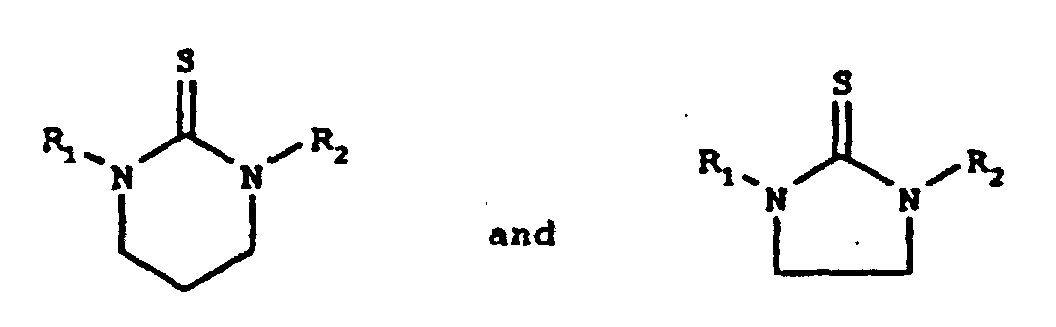
- In the above structural formulas, R1 and/or R2 can be a straight or branched chain, fully saturated or partially unsaturated, alkyl moiety, having from 12 to 18 carbon atoms, e.g., dodecyl, tridecyl, tetradecyl, pentadecyl, hexadecyl, heptadecyl, octadecyl, oleyl, and the like, and isomers and mixtures thereof. Additionally, R1 and/or R2 can be a straight or branched chain, a fully saturated or partially unsaturated hydrocarbon chain, preferably having from 12 to 18 carbon atoms, within which may be ester groups or heteroatoms, such as oxygen and sulfur, which may take the form of ethers, polyethers, and sulfides. This is what is meant by "functionalized alkyl."
- The cyclic thiourea compounds of this invention are useful as ashless, non-phosphorus-containing antifatigue, antiwear, extreme pressure additives for lubricating oils.
- The present invention also relates to lubricating oil compositions comprising a lubricating oil and a functional property-improving amount of at least one cyclic thiourea compound of the above formulas. More particularly, the present invention is directed to a composition comprising:
- (A) a lubricant, and
- (B) at least one cyclic thiourea selected from the group consisting of:
wherein R1 and R2 are independently selected from the group consisting of alkyl, functionalized alkyl, and hydrogen, wherein alkyl is an alkyl chain of from 12 to 18 carbon atoms.

-
- The cyclic thiourea compounds of the present invention are selected from the group consisting of compounds of the formulaswherein R1 and R2 are independently selected from the group consisting of alkyl, functionalized alkyl, and hydrogen.
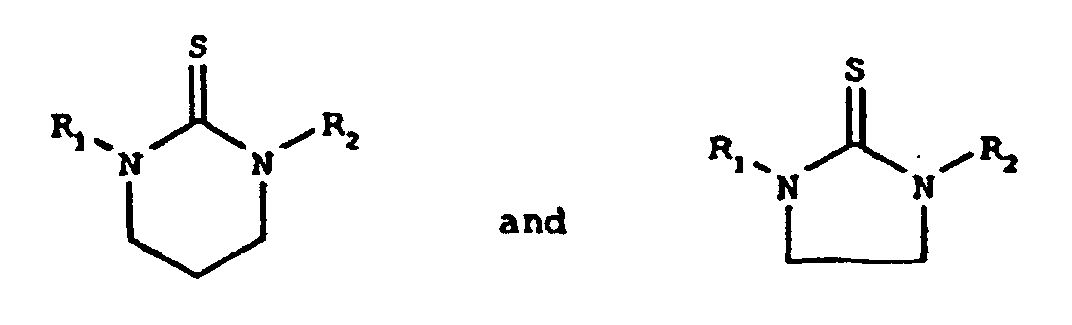
- In the above structural formula, R1 and/or R2 is an alkyl moiety of 12 to 18 carbon atoms, and can have either a straight chain or a branched chain, a fully saturated or partially unsaturated hydrocarbon chain, e.g. dodecyl, tridecyl, tetradecyl, pentadecyl, hexadecyl, heptadecyl, octadecyl, oleyl, and the like, and isomers, and mixtures thereof. R1 and/or R2 have from 12 to 18 carbon atoms, and can be either a straight chain or a branched chain, a fully saturated or partially unsaturated hydrocarbon chain, wherein said chains may contain ester groups or heteroatoms, such as oxygen and/or sulfur, which may take the form of ethers, polyethers, sulfides, and the like. As employed herein, the term "alkyl" is also intended to include "cycloalkyl." Where the alkyl is cyclic, it preferably contains from 3 to 9 carbon atoms, e.g., cyclopropyl, cyclobutyl, cyclopentyl, cyclohexyl, cycloheptyl, cyclooctyl, cyclononyl, and the like. Cycloalkyl moieties having 5 or 6 carbon atoms, i.e., cyclopentyl or cyclohexyl, are more preferred.
- R1 or R2 can be hydrogen; No more than one of R1 or R2 be hydrogen. At least one of the nitrogen atoms of the cyclic thioureas of the present invention has an alkyl or functionalized alkyl substituent, as defined herein, attached thereto.
- The following diamines are examples of those that can be used to react with carbon disulfide to form the cyclic thioureas of the present invention:
- Octyl/decyloxypropyl-1,3-diaminopropane (DA-1214, Tomah Inc.);
- Isodecyloxypropyl-1,3-diaminopropane (DA-14, Tomah Products Inc.);
- Isododecyloxypropyl-1,3-diaminopropane (DA-16, Tomah Products Inc.);
- Dodecyl/tetradecyloxypropyl-1,3-diaminopropane (DA-1618, Tomah Products Inc.);
- Isotridecyloxypropyl-1,3-diaminopropane (DA-17, Tomah Products Inc.);
- Tetradecyloxypropyl-1,3-diaminopropane (DA-18, Tomah Products Inc.);
- N-coco-1,3-diaminopropanes (Duomeen C, Akzo Nobel Chemicals Inc.);
- N-tallow-1,3-diaminopropanes (Duomeen T, Akzo Nobel Chemicals Inc.);
- N-oleyl-1,3-diaminopropane (Duomeen O, Akzo Nobel Chemicals Inc.); and the like.
-
- The use of the cyclic thiourea compounds of this invention can improve the antifatigue, antiwear, and extreme pressure properties of a lubricant.
- The synthesis of the cyclic thiourea compounds of the present invention can be carried out by the reaction of 1,2-ethylene or 1,3-propylene diamines with carbon disulfide to form a thiocarbamate ammonium intermediate, which then cyclizes to the product with gaseous hydrogen sulfide as the by-product. Those skilled in the art will recognize that if the starting material is a 1,2-ethylene diamine, the resulting product will be the above-shown five-membered ring, whereas if the starting material is a 1,3-propylene diamine, the resulting product will be the above-shown six-membered ring.
- A variety of solvents can be used in this reaction, provided that they are inert toward carbon disulfide under the reaction conditions. Such solvents may be secondary alcohols, e.g., isopropyl alcohol and sec-butyl alcohol; linear, branched, or cyclic hydrocarbons, e.g., hexane, heptane, cyclohexane and mixtures thereof; aromatic or alkylaromatic solvents, e.g., benzene, toluene, xylenes, or tetralins; or petroleum mineral oils or synthetic oils, e.g., poly α-olefins or polyol ester oils. The reaction process may require a single solvent or a mixture of solvents, of which one or all may be removed from the cyclic thiourea product or may remain therewith as part of the product's commercial composition. The final product may be isolated neat or diluted in a solvent.
- The reaction is carried out by the slow addition of carbon disulfide to the diamine in an appropriate solvent under an inert atmosphere, e.g., nitrogen, forming first the thiocarbamide ammonium salt intermediate. The reaction is very exothermic and its temperature should be kept below about 40°C, preferably between about 20° and 30°C, by cooling means such as, for example, a cooling jacket, coils, or an ice-bath, to minimize the vaporization of carbon disulfide and its consequent loss. Higher temperatures can be maintained, if desired, if the reactor is sealed and/or kept under pressure.
- After the carbon disulfide addition is complete, the temperature is slowly raised to about 140° to 160°C. At about 70° to 85°C, the thiocarbamide ammonium salt cyclizes to the cyclic thiourea product releasing the by-product, hydrogen sulfide. Nitrogen is sparged through and/or above the reaction media to remove the hydrogen sulfide gas more efficiently, while the temperature is held between about 70° to 85°C. The hydrogen sulfide is collected in a caustic trap, and when its evolution has ceased or minimized the reaction media temperature is raised to about 100°C. At this temperature, any low boiling or volatile solvents, such as isopropyl alcohol, are distilled off. The temperature is then increased to about 140° to 160°C for about one to five hours, while the reaction media are sparged with nitrogen to ensure that the reaction goes to completion. The reaction is then cooled to room temperature, whereupon the product may solidify. If it is desired to depress the melting point of the product closer to room temperature, a high boiling alcohol, such as, 2-ethylhexanol, may be added at a concentration of about one to about five weight percent. The reaction product is then warmed to the liquid state and polish filtered.
- If there is a need to ensure the nonexistence of ammonium sulfides in the product, the product can be washed with a caustic solution neat or prediluted with a solvent or solvent mixture, such as heptane and isopropyl alcohol. The product can then be dried by use of drying agents, such as magnesium sulfate, or by vacuum stripping.
- The cyclic thiourea additives of this invention can be used as either a partial or complete replacement for the zinc dialkyldithiophosphates currently used. They can also be used in combination with other additives typically found in lubricating oils, as well as with other ashless, antiwear additives. The additives typically found in lubricating oils are, for example, dispersants, detergents, corrosion/rust inhibitors, antioxidants, antiwear agents, antifoamants, friction modifiers, seal swell agents, demulsifiers, VI improvers, pour point depressants, and the like. See, for example, U.S. Patent No. 5,498,809 for a description of useful lubricating oil composition additives. Examples of dispersants include polyisobutylene succinimides, polyisobutylene succinate esters, Mannich Base ashless dispersants, and the like. Examples of detergents include metallic phenates, metallic sulfonates, metallic salicylates, and the like. Examples of antioxidants include alkylated diphenylamines, N-alkylated phenylenediamines, hindered phenolics, alkylated hydroquinones, hydroxylated thiodiphenyl ethers, alkylidenebisphenols, oil soluble copper compounds, and the like. Examples of antiwear additives that can be used in combination with the additives of the present invention include organo borates, organo phosphites, organic sulfur-containing compounds, zinc dialkyldithiophosphates, zinc diaryldithiophosphates, phosphosulfurized hydrocarbons, and the like. The following are exemplary of such additives and are commercially available from The Lubrizol Corporation: Lubrizol 677A, Lubrizol 1095, Lubrizol 1097, Lubrizol 1360, Lubrizol 1395, Lubrizol 5139, and Lubrizol 5604, among others. Examples of friction modifiers include fatty acid esters and amides, organo molybdenum compounds, molybdenum dialkylthiocarbamates, molybdenum dialkyl dithiophosphates, and the like. An example of an antifoamant is polysiloxane, and the like. An example of a rust inhibitor is a polyoxyalkylene polyol, and the like. Examples of VI improvers include olefin copolymers and dispersant olefin copolymers, and the like. An example of a pour point depressant is polymethacrylate, and the like.
- Compositions, when they contain these additives, are typically blended into the base oil in amounts such that the additives therein are effective to provide their normal attendant functions. Representative effective amounts of such additives are illustrated in TABLE 1.
Additives Preferred Weight % More Preferred Weight % V.I. Improver 1-12 1-4 Corrosion Inhibitor 0.01-3 0.01-1.5 Oxidation Inhibitor 0.01-5 0.01-1.5 Dispersant 01.-10 0.1-5 Lube Oil Flow Improver 0.01-2 0.01-1.5 Detergent/Rust Inhibitor 0.01-6 0.01-3 Pour Point Depressant 0.01-1.5 0.01-0.5 Antifoaming Agent 0.001-0.1 0.001-0.01 Antiwear Agent 0.001-5 0.001-1.5 Seal Swellant 0.1-8 01.-4 Friction Modifier 0.01-3 0.01-1.5 Lubricating Base Oil Balance Balance - When other additives are employed, it may be desirable, although not necessary, to prepare additive concentrates comprising concentrated solutions or dispersions of the subject additives of this invention, together with one or more of said other additives (said concentrate when constituting an additive mixture being referred to herein as an additive-package) whereby several additives can be added simultaneously to the base oil to form the lubricating oil composition. Dissolution of the additive concentrate into the lubricating oil can be facilitated by solvents and/or by mixing accompanied by mild heating, but this is not essential. The concentrate or additive-package will typically be formulated to contain the additives in proper amounts to provide the desired concentration in the final formulation when the additive-package is combined with a predetermined amount of base lubricant. Thus, the subject additives of the present invention can be added to small amounts of base oil or other compatible solvents along with other desirable additives to form additive-packages containing active ingredients in collective amounts of, typically, from about 2.5 to about 90 percent, preferably from about 15 to about 75 percent, and more preferably from about 25 percent to about 60 percent by weight additives in the appropriate proportions with the remainder being base oil. The final formulations can typically employ about 1 to 20 weight percent of the additive-package with the remainder being base oil.
- All of the weight percentages expressed herein (unless otherwise indicated) are based on the active ingredient (AI) content of the additive, and/or upon the total weight of any additive-package, or formulation, which will be the sum of the AI weight of each additive plus the weight of total oil or diluent.
- In general, the lubricant compositions of the invention contain the additives in a concentration ranging from about 0.05 to about 30 weight percent. A concentration range for the additives ranging from about 0.1 to about 10 weight percent based on the total weight of the oil composition is preferred. A more preferred concentration range is from about 0.2 to about 5 weight percent. Oil concentrates of the additives can contain from about 1 to about 75 weight percent of the additive reaction product in a carrier or diluent oil of lubricating oil viscosity.
- In general, the additives of the present invention are useful in a variety of lubricating oil base stocks. The lubricating oil base stock is any natural or synthetic lubricating oil base stock fraction having a kinematic viscosity at 100°C of about 2 to about 200 cSt, more preferably about 3 to about 150 cSt, and most preferably about 3 to about 100 cSt. The lubricating oil base stock can be derived from natural lubricating oils, synthetic lubricating oils, or mixtures thereof. Suitable lubricating oil base stocks include base stocks obtained by isomerization of synthetic wax and wax, as well as hydrocrackate base stocks produced by hydrocracking (rather than solvent extracting) the aromatic and polar components of the crude. Natural lubricating oils include animal oils, vegetable oils (e.g., rapeseed oils, castor oils, and lard oil), petroleum oils, mineral oils, and oils derived from coal or shale.
- Synthetic oils include hydrocarbon oils and halo-substituted hydrocarbon oils, such as, polymerized and interpolymerized olefins, alkylbenzenes, polyphenyls, alkylated diphenyl ethers, alkylated diphenyl ethers, alkylated diphenyl sulfides, as well as their derivatives, analogs, homologues, and the like. Synthetic lubricating oils also include alkylene oxide polymers, interpolymers, copolymers, and derivatives thereof, wherein the terminal hydroxyl groups have been modified by esterification, etherification, etc.
- Another suitable class of synthetic lubricating oils comprises the esters of dicarboxylic acids with a variety of alcohols. Esters useful as synthetic oils also include those made from C5 to C12 monocarboxylic acids and polyols and polyol ethers.
- Silicon-based oils (such as the polyalkyl-, polyaryl-, polyalkoxy-, or polyaryloxy-siloxane oils and silicate oils) comprise another useful class of synthetic lubricating oils. Other synthetic lubricating oils include liquid esters of phosphorus-containing acids, polymeric tetrahydrofurans, poly α-olefins, and the like.
- The lubricating oil may be derived from unrefined, refined, rerefined oils, or mixtures thereof. Unrefined oils are obtained directly from a natural source or synthetic source (e.g., coal, shale, or tar and bitumen) without further purification or treatment. Examples of unrefined oils include a shale oil obtained directly from a retorting operation, a petroleum oil obtained directly from distillation, or an ester oil obtained directly from an esterification process, each of which is then used without further treatment. Refined oils are similar to unrefined oils, except that refined oils have been treated in one or more purification steps to improve one or more properties. Suitable purification techniques include distillation, hydrotreating, dewaxing, solvent extraction, acid or base extraction, filtration, percolation, and the like, all of which are well-known to those skilled in the art. Rerefined oils are obtained by treating refined oils in processes similar to those used to obtain the refined oils. These rerefined oils are also known as reclaimed or reprocessed oils and often are additionally processed by techniques for removal of spent additives and oil breakdown products.
- Lubricating oil base stocks derived from the hydroisomerization of wax may also be used, either alone or in combination with the aforesaid natural and/or synthetic base stocks. Such wax isomerate oil is produced by the hydroisomerization of natural or synthetic waxes or mixtures thereof over a hydroisomerization catalyst. Natural waxes are typically the slack waxes recovered by the solvent dewaxing of mineral oils; synthetic waxes are typically the wax produced by the Fischer-Tropsch process. The resulting isomerate product is typically subjected to solvent dewaxing and fractionation to recover various fractions having a specific viscosity range. Wax isomerate is also characterized by possessing very high viscosity indices, generally having a VI of at least 130, preferably at least 135 or higher and, following dewaxing, a pour point of about -20°C or lower.
- The additives of the present invention are especially useful as components in many different lubricating oil compositions. The additives can be included in a variety of oils with lubricating viscosity, including natural and synthetic lubricating oils and mixtures thereof. The additives can be included in crankcase lubricating oils for spark-ignited and compression-ignited internal combustion engines. The compositions can also be used in gas engine lubricants, turbine lubricants, automatic transmission fluids, gear lubricants, compressor lubricants, metal-working lubricants, hydraulic fluids, and other lubricating oil and grease compositions. The additives can also be used in motor fuel compositions.
- The advantages and the important features of the present invention will be more apparent from the following examples.
- Into a one-liter flask blanketed with nitrogen are charged 300 mL of o-xylene and 50 grams (0.20 mole) of Akzo's Duomeen C (N-coco-1,3-propylenediamine). To this is added, with stirring and external cooling, 17 grams (0.22 mole) of carbon disulfide in 70 mL of o-xylene at a rate such that the exothermic reaction does not exceed 30°C. The temperature is then slowly raised to 120°C with the evolution of hydrogen sulfide, which is caught in a caustic trap under a nitrogen purge. The temperature is maintained at 120°C for five hours, yielding a clear yellow liquid. At room temperature, the reaction media are washed with 75 mL of aqueous 2.6 M NaOH. The organic media are dried over magnesium sulfate and the xylene solvent removed under vacuum stripping to yield 47 grams of final product. The product solidifies on cooling to room temperature.
- Into a 500 mL flask blanketed with nitrogen are charged 200 mL of isopropyl alcohol and 10 grams (0.04 mole) of Akzo's Duomeen C (N-coco-1,3-propylenediamine). To this, 3.4 grams (0.045 mole) of carbon disulfide is added at room temperature with stirring. The temperature is then slowly raised to reflux (82°C) with the evolution of hydrogen sulfide, which is caught in a caustic trap. The temperature is maintained at 82°C for 16 hours, yielding a clear yellow liquid. The product is then filtered and the isopropyl alcohol solvent removed under vacuum. The concentrated product is then redissolved in 150 mL of heptane and washed with 50 mL of 10 percent NaOH. The organic media are dried over magnesium sulfate and the heptane solvent is removed under vacuum stripping to yield 10.5 grams of final product. The product solidifies on cooling to room temperature.
- Into a one-liter flask blanketed with nitrogen are charged 146 grams of SNO-100 mineral base oil, 15 grams of isopropyl alcohol, and 121 grams (0.50 mole) of Akzo's Duomeen C (N-coco-1,3-propylenediamine). To this is added, with stirring and external cooling, 41 grams (0.5 mole) of carbon disulfide at a rate such that the exothermic reaction does not exceed 30°C. The temperature is then very slowly raised to 160°C with the evolution of hydrogen sulfide, which is caught in a caustic trap under a nitrogen purge. The temperature is maintained at 160°C for four hours, yielding a clear yellow liquid that solidifies on cooling.
- One hundred and fifty grams of the product of Example 3 is washed with 90 mL of 2.7M aqueous NaOH. After separation of the product layer in a separatory funnel (20 mL of isopropyl alcohol may need to be added to break up any emulsion that may have formed), it is dried over anhydrous magnesium sulfate and filtered. If isopropyl alcohol is used, it is removed under vacuum stripping.
- Into a two-liter flask blanketed with nitrogen are charged 465 grams of SNO-100 mineral base oil, 36 grams of isopropyl alcohol, and 300 grams (0.85 mole) of Akzo's Duomeen O (N-oleyl-1,3-propylenediamine). To this is added, with stirring and external cooling, 64.8 grams (0.85 mole) of carbon disulfide at a rate such that the exothermic reaction does not exceed 30°C. The temperature is then very slowly raised to 155°C with the evolution of hydrogen sulfide and isopropyl alcohol, which is caught in a caustic trap under a nitrogen purge. The temperature is maintained at 155°C for three hours, yielding a clear yellow liquid that solidifies on cooling. At room temperature are added 150 mL of hexane, 120 mL of isopropyl alcohol, and 180 mL of 5.6M NaOH. This mixture is vigorously stirred for ten minutes, then transferred to a separatory funnel to isolate the organic layer. The isolated organic layer is then dried over magnesium sulfate and filtered. To this solution are added 30 additional grams of SNO-100 and 24 grams of 2-ethylhexanol. The product is then placed under vacuum at 100°C to remove residual isopropyl alcohol, yielding 754 grams of final product.
- Into a one-liter flask blanketed with nitrogen are charged 200 mL of toluene and 60 grams (0.18 mole) of Akzo's Duomeen O (N-oleyl-1,3-propylenediamine). To this is added, with stirring and external cooling, 15 grams (0.2 mole) of carbon disulfide in 50 mL of toluene at a rate such that the exothermic reaction does not exceed 30°C. The reaction media are then stirred for one hour at room temperature. The temperature is then slowly raised to reflux (110°C) whereby hydrogen sulfide is evolved, which is caught in a caustic trap. The temperature is maintained at 110°C for seven hours, yielding a clear yellow liquid. At room temperature, the reaction media are washed with 100 mL of aqueous 10 weight percent NaHCO3. The organic media are dried over magnesium sulfate and the toluene solvent is removed under vacuum stripping to yield the final product. The product solidifies on cooling to room temperature.
- Into a 500 mL flask blanketed with nitrogen are charged 63 grams of SNO-100 mineral base oil, 5 grams of isopropyl alcohol, and 67 grams (0.2 mole) of Akzo's Duomeen O (N-oleyl-1,3-propylenediamine). To this is added, with stirring and external cooling, 16 grams (0.21 mole) of carbon disulfide at a rate such that the exothermic reaction does not exceed 30°C. The temperature is then very slowly raised to 70°C and held there for 15 minutes with the evolution of hydrogen sulfide, which is caught in a caustic trap under a nitrogen purge. The temperature is then slowly raised to 160°C and maintained there for two hours, yielding a clear yellow liquid. To these 160°C solution media is added four grams of 2-ethylhexanol. The product is filtered through a bed of celite filter aid at room temperature and then slowly solidifies over a period of several hours.
- Into a two-liter flask blanketed with nitrogen are charged 465 grams of SNO-100 mineral base oil, 36 grams of isopropyl alcohol, and 300 grams (0.85 mole) of Akzo's Duomeen O (N-oleyl-1,3-propylenediamine). To this is added, with stirring and external cooling, 64.8 grams (0.85 mole) of carbon disulfide at a rate such that the exothermic reaction does not exceed 30°C. The temperature is then very slowly raised to 89°C with the evolution of hydrogen sulfide, which is caught in a caustic trap under a nitrogen purge. Next, the isopropyl alcohol is refluxed for 1.5 hours and then distilled off. The temperature is then raised and maintained at 155°C for four hours, yielding a clear yellow liquid that solidifies on cooling. At room temperature are added 150 mL of 10 weight percent aqueous NaOH and 120 mL of isopropyl alcohol. This mixture is vigorously stirred for fifteen minutes and then transferred to a separatory funnel to isolate the organic layer. The isolated organic layer is then dried over magnesium sulfate and filtered. To this solution is added 30 grams of2-ethylhexanol. The product is then placed under vacuum at 100°C to remove residual isopropyl alcohol, yielding 776 grams of final product. Another 85 grams of SNO-100 is added to reduce the active ingredient to 40 wt%.
- Into a three liter flask blanketed with nitrogen is charged 928 grams of SNO-100 mineral base oil, 60 grams of isopropyl alcohol and 500 grams (1.4 moles) of Akzo's Duomeen O (N-oleyl-1,3-propylenediamine). To this is added, with stirring and external cooling, 121 grams (1.6 moles) of carbon disulfide at a rate such that the exothermic reaction does not exceed 30°C. The temperature is then very slowly raised to 75-80°C with the evolution of hydrogen sulfide, which is caught in a caustic trap under a nitrogen sparge. The temperature is then slowly raised to 155°C, distilling off the isopropyl alcohol. The temperature is maintained at 155°C for 4.5 hours, yielding a clear yellow liquid that solidifies on cooling. At room temperature are added 150 mL of 5 weight percent aqueous NaOH and 135 mL of isopropyl alcohol. This mixture is vigorously stirred for thirty minutes and then transferred to a separatory funnel to isolate the organic layer. To this solution is added 26 grams of 2-ethylhexanol. The product is then placed under vacuum at 100°C to remove residual isopropyl alcohol and water.
- Into a 250 mL flask blanketed with nitrogen are charged 40 mL of isopropyl alcohol and 80 grams (0.24 mole) of Tomah Products Inc.'s ether diamine DA-16 (isodecyloxypropyl-1,3-propylenediamine). To this is added, with stirring and external cooling, 18.2 grams (0.24 mole) of carbon disulfide at a rate such that the exothermic reaction does not exceed 30°C. The temperature is then very slowly raised to 75° to 80°C with the evolution of hydrogen sulfide, which is caught in a caustic trap under a nitrogen sparge. The temperature is then slowly raised to 145°C, distilling off the isopropyl alcohol. The temperature is maintained at 145°C for one hour, followed by the addition of 29 grams of SNO-100 mineral base oil, yielding a clear yellow liquid that remains a liquid on cooling. At room temperature is added 100 mL of hexane and 50 mL of 5 weight percent aqueous NaOH. This mixture is vigorously stirred for fifteen minutes and then transferred to a separatory funnel to isolate the organic layer (after standing for 30 to 45 minutes). The product is then placed under vacuum (100 mm Hg) at 100°C to remove residual isopropyl alcohol and water. The final product isolated weighed 110 grams.
- Into a 500 mL flask blanketed with nitrogen are charged 200 mL of isopropyl alcohol and 10 grams (0.069 mole) of N,N'-diisopropylethylenediamine. To this is added, at room temperature with stirring, 5.3 grams (0.07 mole) of carbon disulfide. The temperature is then slowly raised to reflux (82°C) with the evolution of hydrogen sulfide, which is caught in a caustic trap. The temperature is maintained at 82°C for 16 hours, yielding a clear yellow liquid. The product is then filtered and the isopropyl alcohol solvent is removed under vacuum. The concentrated product is then redissolved in 150 mL of heptane and washed with 50 mL of 10 percent NaOH. The organic media are dried over magnesium sulfate and the heptane solvent removed under vacuum stripping to yield 10.5 grams of an oily product that solidifies on cooling to room temperature.
- Into a two-liter flask blanketed with nitrogen are charged 588 grams of SNO-100 mineral base oil, 40 grams of isopropyl alcohol, and 375 grams (0.1 mole) of Akzo's Duomeen O (N-oleyl-1,3-propylenediamine). To this is added, with stirring and external cooling, 83.6 grams (0.11 mole) of carbon disulfide at a rate such that the exothermic reaction does not exceed 30°C. The temperature is then very slowly raised to 75° to 80°C with the evolution of hydrogen sulfide, which is caught in a caustic trap under a nitrogen sparge. The temperature is then slowly raised to 155°C, distilling off the isopropyl alcohol, maintained at that temperature for four hours, and lowered to room temperature, whereupon 150 mL of 5 weight percent aqueous NaOH and 200 mL of isopropyl alcohol are added. This mixture is vigorously stirred for fifteen minutes and then transferred to a separatory funnel to isolate the organic layer (after standing for 30 to 45 minutes). The product is then placed under vacuum (100 mm Hg) at 100°C to remove residual isopropyl alcohol and water. To this solution is added 35 grams of 2-ethylhexanol. The final product isolated weighed 1,004 grams.
- The antiwear properties of the novel reaction product in a fully formulated lubricating oil were determined in the Four-Ball Wear Test under the ASTM D 4172 test conditions. The fully formulated lubricating oils tested also contained 1 weight percent cumene hydroperoxide to help simulate the environment within a running engine. The additives were tested for effectiveness in two motor oil formulations (See description in Table 2) and compared to identical formulations with and without any zinc dialkyldithiophosphate. In Table 3, the numerical value of the test results (Average Wear Scar Diameter, mm) decreases with an increase in effectiveness.
SAE 10W-30 Motor Oil Formulations Component Formulation A (wt%) Formulation B (wt%) Solvent Neutral 100 Balance Balance Solvent Neutral 150 60 60 Succinimide Dispersant 7.5 7.5 Overbased Calcium Phenate Detergent 2.0 -- Overbased Calcium Sulfonate Detergent -- 2.0 Corrosion/Rust Inhibitor 0.6 0.6 Antioxidant 0.5 0.5 Pour Point Depressant 0.1 0.1 OCP VI Improver 5.5 5.5 Antiwear Additive 1.0 1.0 Falex Four-Ball Wear Results Compound Formulation Wear Scar Diameter, mm No antiwear additive A 0.93 Zinc dialkyldithiophosphate A 0.46 Example 1 A 0.48 Example 2 A 0.45 Example 5 A 0.51 Example 6 A 0.42 Example 7 A 0.62 Example 8 A 0.44 Example 9 A 0.52 Example 10 A 0.54 Example 11 A 0.51 Example 12 A 0.70 No antiwear additive B 0.98 Zinc dialkyldithiophosphate B 0.53 Example 1 B 0.48 Example 2 B 0.41 Example 3 B 0.51 Example 4 B 0.53 Example 6 B 0.46 Example 7 B 0.41 Example 8 B 0.41 Example 9 B 0.52 Example 10 B 0.51 Example 11 B 0.52 - The antiwear properties of the additives of this invention in a fully formulated lubricating oil were determined in the Four-Ball Wear Test under the ASTM D 4172 test conditions. The specimen parts (6 mm diameter AISI 52100 steel ball of 800 ±20 kg/mm2 hardness and hardened ground NSOH B01 gauge plate of RC 60/0.4 micron) were rinsed and then sonicated for 15 minutes with technical grade hexanes. This procedure was repeated with isopropyl alcohol. The specimens were dried with nitrogen and set into the TE77. The oil bath was filled with 10 mL of sample. The test was run at a 30 Hertz Frequency, 100 Newton Load, 2.35 mm Amplitude. The test started with the specimens and oil at room temperature. Immediately, the temperature was ramped over 15 minutes to 50°C, where it dwelled for 15 minutes. The temperature was ramped over 15 minutes to 100°C, where it dwelled at 100°C for 45 minutes. A third temperature ramp over 15 minutes to 150°C was followed by a final dwell at 150°C for 15 minutes. The total length of the test was two hours. At the end of the test, the wear scar diameter on the 6 mm ball was measured using a Leica Stereo Zoom 6® Stereomicroscope and a Mitutoyo 164 series Digimatic Head. The fully formulated lubricating oils tested contained 1 weight percent cumene hydroperoxide to help simulate the environment within a running engine. The additives were tested for effectiveness in two motor oil formulations (See description in Table 2) and compared to identical formulations with and without any zinc dialkyldithiophosphate. In Table 4 the numerical value of the test results (Wear Scar Diameter, mm) decreases with an increase in effectiveness.
Cameron-Plint High Frequency Friction Machine (Model TE77) Wear Results Compound Formulation Wear Scar Diameter, mm No antiwear additive A 0.66 Zinc dialkyldithiophosphate A 0.46 Example 2 A 0.44 Example 6 A 0.37 Example 11 A 0.51 Example 12 A 0.55 No antiwear additive B 0.67 Zinc dialkyldithiophosphate B 0.54 Example 2 B 0.39 Example 7 B 0.57 Example 8 B 0.57 Example 11 B 0.57 - The additives of the present invention can, if desired, also be used in combination with ZDDP antiwear additives. The four ball and Cameron-Plint data, run as described above, shown below in Tables 5 and 6, respectively, confirm the effectiveness of the additives of the present invention in combination with ZDDP. Formulations A and B were used as described above, except that the antiwear additive system was a combination of the antiwear additive of the present invention and ZDDP, resulting in a 1 weight percent total antiwear additive combination in each formulation.
Falex Four-Ball Wear Results of Additives in Mixtures with ZDDP Compound Weight % ZDDP wt% Formulation Wear Scar Diameter, mm Example 1 0.25 0.75 A 0.55 Example 1 0.50 0.50 A 0.52 Example 1 0.75 0.25 A 0.47 Example 1 0.25 0.75 B 0.48 Example 1 0.50 0.50 B 0.52 Example 1 0.75 0.25 B 0.38 Example 7 0.25 0.75 A 0.53 Example 7 0.50 0.50 A 0.55 Example 7 0.75 0.25 A 0.58 Example 7 0.25 0.75 B 0.53 Example 7 0.50 0.50 B 0.68 Example 7 0.75 0.25 B 0.50 Example 11 0.25 0.75 A 0.55 Example 11 0.50 0.50 A 0.61 Example 11 0.75 0.25 A 0.51 Example 11 0.25 0.75 B 0.55 Example 11 0.50 0.50 B 0.62 Example 11 0.75 0.25 B 0.54 Cameron-Plint High Frequency Friction Machine Wear (Model TE77)
Results of Additives in Mixtures with ZDDPCompound Weight % ZDDP wt% Formulation Wear Scar Diameter, mm Example 1 0.25 0.75 A 0.53 Example 1 0.50 0.50 A 0.55 Example 1 0.75 0.25 A 0.39 Example 1 0.25 0.75 B 0.57 Example 1 0.50 0.50 B 0.52 Example 1 0.75 0.25 B 0.36 Example 7 0.25 0.75 A 0.48 Example 7 0.50 0.50 A 0.66 Example 7 0.75 0.25 A 0.40 Example 7 0.25 0.75 B 0.58 Example 7 0.50 0.50 B 0.59 Example 7 0.75 0.25 B 0.53 Example 11 0.25 0.75 A 0.56 Example 11 0.50 0.50 A 0.48 Example 11 0.75 0.25 A 0.42 Example 11 0.25 0.75 B 0.61 Example 11 0.50 0.50 B 0.58 Example 11 0.75 0.25 B 0.47 - The extreme pressure (EP) properties of the additives of this invention in a lubricating oil were determined in the Four-Ball Weld Test under the ASTM D 2783 test conditions. The additives were blended into an ISO 46 Grade Group II base oil (Chevron RLOP 240 R) at the weight percents cited in Table 7. The higher the Load Wear Index and the higher the Weld Point, the better the result. (Chevron RLOP 240 R) at the weight percents cited in Table 7. The higher the Load Wear Index and the higher the Weld Point, the better the result.
Four-Ball Extreme Pressure Testing Results Compounds wt% Oil Weld Point (Kg) Load Wear Index No antiwear additive 0 ISO 46 100 16.8 Example 11 1 ISO 46 160 21.6 Example 11 2 ISO 46 160 33.1 Example 13 1 ISO 46 120 32.1 Example 13 2 ISO 46 160 27.4 - In view of the many changes and modifications that can be made without departing from principles underlying the invention, reference should be made to the appended claims for an understanding of the scope of the protection to be afforded the invention.
Claims (12)
- A composition comprising:(A) a lubricant, and(B) at least one cyclic thiourea selected from the group consisting of:wherein R1 and R2 are independently selected from the group consisting of alkyl, functionalized alkyl, and hydrogen, with no more than one of R1 or R2 being hydrogen, wherein alkyl is an alkyl chain of from 12 to 18 carbon atoms.

- The composition of claim 1 wherein the lubricant is a lubricating oil.
- The composition of claims 1 or 2 wherein the cyclic thiourea is
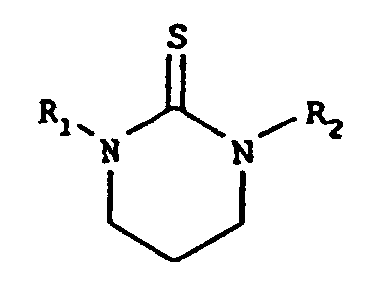
- The composition of claims 1 or 2 wherein the cyclic thiourea is

- The composition of claim 4 wherein R1 is hydrogen and R2 is an alkyl chain of from 12 to 18 carbon atoms.
- The composition of claim 4 wherein R1 is hydrogen and R2 is a functionalized alkyl chain of from 12 to 18 linear carbon atoms containing at least one ether oxygen within the chain.
- The composition of claims 1 or 2 wherein the cyclic thiourea is derived from:octyl/decyloxypropyl-1,3-diaminopropane;isodecyloxypropyl-1,3-diaminopropane;isododecyloxypropyl-1,3-diaminopropane;dodecyl/tetradecyloxypropyl-1,3-diaminopropane;isotridecyloxypropyl-1,3-diaminopropane;tetradecyloxypropyl-1,3-diaminopropane;N-coco-1,3-diaminopropanes;N-tallow-1,3-diaminopropanes; orN-oleyl-1,3-diaminopropane.
- The composition of claim wherein the cyclic thiourea is present in a concentration in the range of from 0.01 to 10 wt%.
- The composition of claims 1 or 2 further comprising at least one additive selected from the group consisting of dispersants, detergents, corrosion/rust inhibitors, zinc dialkyldithiophosphates, VI improvers, and pour point depressants.
- The composition of claim 1 further comprising zinc dialkyldithiophosphate.
- The composition of claims 1 or 2 wherein the alkyl is a straight chain alkyl, a branched chain alkyl, an alkyl containing a cyclic structure, a fully saturated hydrocarbon (alkyl) chain, or a partially unsaturated hydrocarbon (alkyl) chain.
- Use of component (B) as defined in claim 1 as an antifatigue, antiwear or extreme pressure additive for lubricating oils.
Applications Claiming Priority (3)
| Application Number | Priority Date | Filing Date | Title |
|---|---|---|---|
| US09/173,888 US5935913A (en) | 1998-10-16 | 1998-10-16 | Cyclic thiourea additives for lubricants |
| US173888 | 1998-10-16 | ||
| PCT/US1999/031298 WO2000053703A1 (en) | 1998-10-16 | 1999-09-27 | Cyclic thiourea additives for lubricants |
Publications (2)
| Publication Number | Publication Date |
|---|---|
| EP1124920A1 EP1124920A1 (en) | 2001-08-22 |
| EP1124920B1 true EP1124920B1 (en) | 2004-06-09 |
Family
ID=22633937
Family Applications (1)
| Application Number | Title | Priority Date | Filing Date |
|---|---|---|---|
| EP99971639A Expired - Lifetime EP1124920B1 (en) | 1998-10-16 | 1999-09-27 | Cyclic thiourea additives for lubricants |
Country Status (11)
| Country | Link |
|---|---|
| US (1) | US5935913A (en) |
| EP (1) | EP1124920B1 (en) |
| JP (1) | JP3602057B2 (en) |
| CN (1) | CN1236029C (en) |
| AT (1) | ATE268807T1 (en) |
| AU (1) | AU760946B2 (en) |
| BR (1) | BR9914574A (en) |
| CA (1) | CA2346485A1 (en) |
| DE (1) | DE69917921T2 (en) |
| ES (1) | ES2221483T3 (en) |
| WO (1) | WO2000053703A1 (en) |
Families Citing this family (12)
| Publication number | Priority date | Publication date | Assignee | Title |
|---|---|---|---|---|
| US6187722B1 (en) * | 1999-07-22 | 2001-02-13 | Uniroyal Chemical Company, Inc. | Imidazole thione additives for lubricants |
| US6187726B1 (en) * | 1999-11-12 | 2001-02-13 | Ck Witco Corporation | Substituted linear thiourea additives for lubricants |
| US7250009B2 (en) * | 2000-02-18 | 2007-07-31 | Weber Lawrence J | Golf ball lubricant |
| US6761645B1 (en) * | 2000-02-18 | 2004-07-13 | Lawrence J. Weber | Golf ball lubricant |
| DE60204245T2 (en) * | 2001-01-24 | 2006-02-02 | Crompton Corp., Middlebury | Oil-soluble compositions for lubricants containing imidazolidines thiones as an additive |
| EP1394242A3 (en) * | 2002-08-07 | 2004-04-21 | Rohm And Haas Company | Cyclic thioureas and their use as additives for lubricating oils |
| EP1394241A1 (en) * | 2002-08-07 | 2004-03-03 | Rohm And Haas Company | Cyclic thioureas as additives for lubricating oils |
| EP1394240A1 (en) * | 2002-08-07 | 2004-03-03 | Rohm And Haas Company | Bicyclic thioamides as additives for lubricating oils |
| EP1394243A1 (en) * | 2002-08-07 | 2004-03-03 | Rohm and Haas | Cyclic aminothioureas as additives for lubricating oils |
| US7501510B2 (en) * | 2004-03-26 | 2009-03-10 | The University Of Hong Kong | Thiourea compositions and uses thereof |
| EP2071008A1 (en) * | 2007-12-04 | 2009-06-17 | Shell Internationale Researchmaatschappij B.V. | Lubricating composition comprising an imidazolidinethione and an imidazolidone |
| CN110911749B (en) * | 2019-12-03 | 2023-02-03 | 珠海市赛纬电子材料股份有限公司 | High-voltage lithium ion battery electrolyte, additive and preparation method of additive |
Family Cites Families (12)
| Publication number | Priority date | Publication date | Assignee | Title |
|---|---|---|---|---|
| US2868727A (en) * | 1959-01-13 | Method and composition for inhibiting | ||
| US2767143A (en) * | 1952-06-05 | 1956-10-16 | Texas Co | Lubricating compositions containing metal derivatives of 1, 3-bis (hydroxy-aralkyl)-2-imidazolidinethiones |
| US3108071A (en) * | 1959-05-08 | 1963-10-22 | Commercial Solvents Corp | Non-corrosive lubricating compositions |
| NL297326A (en) * | 1962-11-14 | 1900-01-01 | ||
| GB1117643A (en) * | 1964-11-18 | 1968-06-19 | Rohm & Haas | Imides and related compounds |
| US3459664A (en) * | 1966-04-08 | 1969-08-05 | Chevron Res | Trithione polyamine reaction products |
| US3404090A (en) * | 1967-02-14 | 1968-10-01 | Armour & Co | Water base lubricant |
| US4329239A (en) * | 1980-05-12 | 1982-05-11 | Texaco Inc. | Hydrocarbyl dihydrouracil, its method of preparation and lubricating oil composition containing same |
| DE58904438D1 (en) * | 1988-12-28 | 1993-06-24 | Ciba Geigy Ag | LUBRICANT COMPOSITION. |
| US5514189A (en) * | 1992-12-08 | 1996-05-07 | Mobil Corporation | Dithiocarbamate-derived ethers as multifunctional additives |
| IL107927A0 (en) * | 1992-12-17 | 1994-04-12 | Exxon Chemical Patents Inc | Oil soluble ethylene/1-butene copolymers and lubricating oils containing the same |
| US5512190A (en) * | 1994-08-22 | 1996-04-30 | Texaco Inc. | Lubricating oil composition providing anti-wear protection |
-
1998
- 1998-10-16 US US09/173,888 patent/US5935913A/en not_active Expired - Lifetime
-
1999
- 1999-09-27 WO PCT/US1999/031298 patent/WO2000053703A1/en not_active Ceased
- 1999-09-27 EP EP99971639A patent/EP1124920B1/en not_active Expired - Lifetime
- 1999-09-27 JP JP2000603330A patent/JP3602057B2/en not_active Expired - Fee Related
- 1999-09-27 BR BR9914574-0A patent/BR9914574A/en not_active Application Discontinuation
- 1999-09-27 CN CNB998133027A patent/CN1236029C/en not_active Expired - Fee Related
- 1999-09-27 CA CA002346485A patent/CA2346485A1/en not_active Abandoned
- 1999-09-27 DE DE69917921T patent/DE69917921T2/en not_active Expired - Lifetime
- 1999-09-27 ES ES99971639T patent/ES2221483T3/en not_active Expired - Lifetime
- 1999-09-27 AT AT99971639T patent/ATE268807T1/en not_active IP Right Cessation
- 1999-09-27 AU AU38548/00A patent/AU760946B2/en not_active Ceased
Also Published As
| Publication number | Publication date |
|---|---|
| AU760946B2 (en) | 2003-05-22 |
| ATE268807T1 (en) | 2004-06-15 |
| CN1236029C (en) | 2006-01-11 |
| CA2346485A1 (en) | 2000-09-14 |
| AU3854800A (en) | 2000-09-28 |
| BR9914574A (en) | 2001-10-30 |
| WO2000053703A1 (en) | 2000-09-14 |
| ES2221483T3 (en) | 2004-12-16 |
| JP3602057B2 (en) | 2004-12-15 |
| DE69917921T2 (en) | 2005-06-09 |
| CN1326497A (en) | 2001-12-12 |
| EP1124920A1 (en) | 2001-08-22 |
| DE69917921D1 (en) | 2004-07-15 |
| US5935913A (en) | 1999-08-10 |
| JP2002538287A (en) | 2002-11-12 |
Similar Documents
| Publication | Publication Date | Title |
|---|---|---|
| US6187722B1 (en) | Imidazole thione additives for lubricants | |
| EP1124920B1 (en) | Cyclic thiourea additives for lubricants | |
| US6566311B1 (en) | 1,3,4-oxadiazole additives for lubricants | |
| US6187726B1 (en) | Substituted linear thiourea additives for lubricants | |
| US6667282B2 (en) | Alkyl hydrazide additives for lubricants | |
| EP1543096B1 (en) | Alkyl-succinhydrazide additives for lubricants | |
| US6559106B1 (en) | Tri-glycerinate vegetable oil-succinhydrazide additives for lubricants | |
| US7485605B2 (en) | Lubricant and fuel compositions containing 2-(S(N)-mercaptobenzothiazole)succinic and methylene succinate esters | |
| US6559107B2 (en) | Thiadiazolidine additives for lubricants | |
| US6706671B2 (en) | Alkyl-succinhydrazide additives for lubricants | |
| AU2002308560A1 (en) | Thiadiazolidine additives for lubricants | |
| AU2002305339A1 (en) | Alkyl hydrazide additives for lubricants |
Legal Events
| Date | Code | Title | Description |
|---|---|---|---|
| PUAI | Public reference made under article 153(3) epc to a published international application that has entered the european phase |
Free format text: ORIGINAL CODE: 0009012 |
|
| 17P | Request for examination filed |
Effective date: 20010403 |
|
| AK | Designated contracting states |
Kind code of ref document: A1 Designated state(s): AT BE CH CY DE DK ES FI FR GB GR IE IT LI LU MC NL PT SE |
|
| 17Q | First examination report despatched |
Effective date: 20030129 |
|
| GRAP | Despatch of communication of intention to grant a patent |
Free format text: ORIGINAL CODE: EPIDOSNIGR1 |
|
| GRAS | Grant fee paid |
Free format text: ORIGINAL CODE: EPIDOSNIGR3 |
|
| GRAA | (expected) grant |
Free format text: ORIGINAL CODE: 0009210 |
|
| AK | Designated contracting states |
Kind code of ref document: B1 Designated state(s): AT BE CH CY DE DK ES FI FR GB GR IE IT LI LU MC NL PT SE |
|
| PG25 | Lapsed in a contracting state [announced via postgrant information from national office to epo] |
Ref country code: LI Free format text: LAPSE BECAUSE OF FAILURE TO SUBMIT A TRANSLATION OF THE DESCRIPTION OR TO PAY THE FEE WITHIN THE PRESCRIBED TIME-LIMIT Effective date: 20040609 Ref country code: FI Free format text: LAPSE BECAUSE OF FAILURE TO SUBMIT A TRANSLATION OF THE DESCRIPTION OR TO PAY THE FEE WITHIN THE PRESCRIBED TIME-LIMIT Effective date: 20040609 Ref country code: CY Free format text: LAPSE BECAUSE OF FAILURE TO SUBMIT A TRANSLATION OF THE DESCRIPTION OR TO PAY THE FEE WITHIN THE PRESCRIBED TIME-LIMIT Effective date: 20040609 Ref country code: CH Free format text: LAPSE BECAUSE OF FAILURE TO SUBMIT A TRANSLATION OF THE DESCRIPTION OR TO PAY THE FEE WITHIN THE PRESCRIBED TIME-LIMIT Effective date: 20040609 Ref country code: AT Free format text: LAPSE BECAUSE OF FAILURE TO SUBMIT A TRANSLATION OF THE DESCRIPTION OR TO PAY THE FEE WITHIN THE PRESCRIBED TIME-LIMIT Effective date: 20040609 |
|
| REG | Reference to a national code |
Ref country code: GB Ref legal event code: FG4D |
|
| REG | Reference to a national code |
Ref country code: CH Ref legal event code: EP |
|
| REF | Corresponds to: |
Ref document number: 69917921 Country of ref document: DE Date of ref document: 20040715 Kind code of ref document: P |
|
| REG | Reference to a national code |
Ref country code: IE Ref legal event code: FG4D |
|
| PG25 | Lapsed in a contracting state [announced via postgrant information from national office to epo] |
Ref country code: SE Free format text: LAPSE BECAUSE OF FAILURE TO SUBMIT A TRANSLATION OF THE DESCRIPTION OR TO PAY THE FEE WITHIN THE PRESCRIBED TIME-LIMIT Effective date: 20040909 Ref country code: GR Free format text: LAPSE BECAUSE OF FAILURE TO SUBMIT A TRANSLATION OF THE DESCRIPTION OR TO PAY THE FEE WITHIN THE PRESCRIBED TIME-LIMIT Effective date: 20040909 Ref country code: DK Free format text: LAPSE BECAUSE OF FAILURE TO SUBMIT A TRANSLATION OF THE DESCRIPTION OR TO PAY THE FEE WITHIN THE PRESCRIBED TIME-LIMIT Effective date: 20040909 |
|
| PG25 | Lapsed in a contracting state [announced via postgrant information from national office to epo] |
Ref country code: LU Free format text: LAPSE BECAUSE OF NON-PAYMENT OF DUE FEES Effective date: 20040927 Ref country code: IE Free format text: LAPSE BECAUSE OF NON-PAYMENT OF DUE FEES Effective date: 20040927 |
|
| PG25 | Lapsed in a contracting state [announced via postgrant information from national office to epo] |
Ref country code: MC Free format text: LAPSE BECAUSE OF NON-PAYMENT OF DUE FEES Effective date: 20040930 |
|
| ET | Fr: translation filed | ||
| REG | Reference to a national code |
Ref country code: CH Ref legal event code: PL |
|
| REG | Reference to a national code |
Ref country code: ES Ref legal event code: FG2A Ref document number: 2221483 Country of ref document: ES Kind code of ref document: T3 |
|
| PLBE | No opposition filed within time limit |
Free format text: ORIGINAL CODE: 0009261 |
|
| STAA | Information on the status of an ep patent application or granted ep patent |
Free format text: STATUS: NO OPPOSITION FILED WITHIN TIME LIMIT |
|
| 26N | No opposition filed |
Effective date: 20050310 |
|
| REG | Reference to a national code |
Ref country code: IE Ref legal event code: MM4A |
|
| PGFP | Annual fee paid to national office [announced via postgrant information from national office to epo] |
Ref country code: ES Payment date: 20070926 Year of fee payment: 9 |
|
| PG25 | Lapsed in a contracting state [announced via postgrant information from national office to epo] |
Ref country code: PT Free format text: LAPSE BECAUSE OF NON-PAYMENT OF DUE FEES Effective date: 20041109 |
|
| PGFP | Annual fee paid to national office [announced via postgrant information from national office to epo] |
Ref country code: NL Payment date: 20070923 Year of fee payment: 9 Ref country code: IT Payment date: 20070925 Year of fee payment: 9 |
|
| PGFP | Annual fee paid to national office [announced via postgrant information from national office to epo] |
Ref country code: BE Payment date: 20071025 Year of fee payment: 9 |
|
| BERE | Be: lapsed |
Owner name: *UNIROYAL CHEMICAL CY INC. Effective date: 20080930 |
|
| PG25 | Lapsed in a contracting state [announced via postgrant information from national office to epo] |
Ref country code: NL Free format text: LAPSE BECAUSE OF NON-PAYMENT OF DUE FEES Effective date: 20090401 |
|
| NLV4 | Nl: lapsed or anulled due to non-payment of the annual fee |
Effective date: 20090401 |
|
| PG25 | Lapsed in a contracting state [announced via postgrant information from national office to epo] |
Ref country code: BE Free format text: LAPSE BECAUSE OF NON-PAYMENT OF DUE FEES Effective date: 20080930 |
|
| PG25 | Lapsed in a contracting state [announced via postgrant information from national office to epo] |
Ref country code: IT Free format text: LAPSE BECAUSE OF NON-PAYMENT OF DUE FEES Effective date: 20080927 |
|
| REG | Reference to a national code |
Ref country code: ES Ref legal event code: FD2A Effective date: 20080929 |
|
| PG25 | Lapsed in a contracting state [announced via postgrant information from national office to epo] |
Ref country code: ES Free format text: LAPSE BECAUSE OF NON-PAYMENT OF DUE FEES Effective date: 20080929 |
|
| PGFP | Annual fee paid to national office [announced via postgrant information from national office to epo] |
Ref country code: GB Payment date: 20120829 Year of fee payment: 14 |
|
| PGFP | Annual fee paid to national office [announced via postgrant information from national office to epo] |
Ref country code: FR Payment date: 20120910 Year of fee payment: 14 |
|
| GBPC | Gb: european patent ceased through non-payment of renewal fee |
Effective date: 20130927 |
|
| REG | Reference to a national code |
Ref country code: FR Ref legal event code: ST Effective date: 20140530 |
|
| PG25 | Lapsed in a contracting state [announced via postgrant information from national office to epo] |
Ref country code: GB Free format text: LAPSE BECAUSE OF NON-PAYMENT OF DUE FEES Effective date: 20130927 |
|
| PG25 | Lapsed in a contracting state [announced via postgrant information from national office to epo] |
Ref country code: FR Free format text: LAPSE BECAUSE OF NON-PAYMENT OF DUE FEES Effective date: 20130930 |
|
| PGFP | Annual fee paid to national office [announced via postgrant information from national office to epo] |
Ref country code: DE Payment date: 20150930 Year of fee payment: 17 |
|
| REG | Reference to a national code |
Ref country code: DE Ref legal event code: R119 Ref document number: 69917921 Country of ref document: DE |
|
| PG25 | Lapsed in a contracting state [announced via postgrant information from national office to epo] |
Ref country code: DE Free format text: LAPSE BECAUSE OF NON-PAYMENT OF DUE FEES Effective date: 20170401 |