EP1124863B1 - Process for hydrogenating a conjugated diene polymer - Google Patents
Process for hydrogenating a conjugated diene polymer Download PDFInfo
- Publication number
- EP1124863B1 EP1124863B1 EP98967170A EP98967170A EP1124863B1 EP 1124863 B1 EP1124863 B1 EP 1124863B1 EP 98967170 A EP98967170 A EP 98967170A EP 98967170 A EP98967170 A EP 98967170A EP 1124863 B1 EP1124863 B1 EP 1124863B1
- Authority
- EP
- European Patent Office
- Prior art keywords
- butyl
- monocyclopentadienyl
- titanium
- polymer
- phenoxy
- Prior art date
- Legal status (The legal status is an assumption and is not a legal conclusion. Google has not performed a legal analysis and makes no representation as to the accuracy of the status listed.)
- Expired - Lifetime
Links
- 229920000642 polymer Polymers 0.000 title claims abstract description 123
- 150000001993 dienes Chemical class 0.000 title claims abstract description 40
- 238000000034 method Methods 0.000 title claims abstract description 39
- 239000003054 catalyst Substances 0.000 claims abstract description 57
- -1 organo titanium Chemical compound 0.000 claims abstract description 27
- 239000001257 hydrogen Substances 0.000 claims abstract description 24
- 229910052739 hydrogen Inorganic materials 0.000 claims abstract description 24
- UFHFLCQGNIYNRP-UHFFFAOYSA-N Hydrogen Chemical compound [H][H] UFHFLCQGNIYNRP-UHFFFAOYSA-N 0.000 claims abstract description 23
- 229910000103 lithium hydride Inorganic materials 0.000 claims abstract description 22
- 125000004432 carbon atom Chemical group C* 0.000 claims abstract description 12
- 150000002900 organolithium compounds Chemical class 0.000 claims abstract description 11
- 125000003118 aryl group Chemical group 0.000 claims abstract description 6
- 125000000217 alkyl group Chemical group 0.000 claims abstract description 5
- 125000003545 alkoxy group Chemical group 0.000 claims abstract description 4
- 125000000058 cyclopentadienyl group Chemical group C1(=CC=CC1)* 0.000 claims abstract description 4
- 125000004435 hydrogen atom Chemical group [H]* 0.000 claims abstract description 4
- 125000004104 aryloxy group Chemical group 0.000 claims abstract description 3
- 125000000753 cycloalkyl group Chemical group 0.000 claims abstract description 3
- 125000005843 halogen group Chemical group 0.000 claims abstract description 3
- 238000005984 hydrogenation reaction Methods 0.000 claims description 70
- PPBRXRYQALVLMV-UHFFFAOYSA-N Styrene Chemical compound C=CC1=CC=CC=C1 PPBRXRYQALVLMV-UHFFFAOYSA-N 0.000 claims description 68
- KAKZBPTYRLMSJV-UHFFFAOYSA-N Butadiene Chemical compound C=CC=C KAKZBPTYRLMSJV-UHFFFAOYSA-N 0.000 claims description 43
- 239000000178 monomer Substances 0.000 claims description 35
- MZRVEZGGRBJDDB-UHFFFAOYSA-N N-Butyllithium Chemical compound [Li]CCCC MZRVEZGGRBJDDB-UHFFFAOYSA-N 0.000 claims description 34
- 229920002554 vinyl polymer Polymers 0.000 claims description 26
- 238000006243 chemical reaction Methods 0.000 claims description 22
- RRHGJUQNOFWUDK-UHFFFAOYSA-N Isoprene Chemical compound CC(=C)C=C RRHGJUQNOFWUDK-UHFFFAOYSA-N 0.000 claims description 14
- SRKKQWSERFMTOX-UHFFFAOYSA-N cyclopentane;titanium Chemical compound [Ti].[CH]1C=CC=C1 SRKKQWSERFMTOX-UHFFFAOYSA-N 0.000 claims description 13
- KFZMGEQAYNKOFK-UHFFFAOYSA-N Isopropanol Chemical compound CC(C)O KFZMGEQAYNKOFK-UHFFFAOYSA-N 0.000 claims description 12
- OKKJLVBELUTLKV-UHFFFAOYSA-N Methanol Chemical compound OC OKKJLVBELUTLKV-UHFFFAOYSA-N 0.000 claims description 12
- CSCPPACGZOOCGX-UHFFFAOYSA-N Acetone Chemical compound CC(C)=O CSCPPACGZOOCGX-UHFFFAOYSA-N 0.000 claims description 10
- GZUXJHMPEANEGY-UHFFFAOYSA-N bromomethane Chemical compound BrC GZUXJHMPEANEGY-UHFFFAOYSA-N 0.000 claims description 8
- LFQSCWFLJHTTHZ-UHFFFAOYSA-N Ethanol Chemical compound CCO LFQSCWFLJHTTHZ-UHFFFAOYSA-N 0.000 claims description 7
- XEKOWRVHYACXOJ-UHFFFAOYSA-N Ethyl acetate Chemical compound CCOC(C)=O XEKOWRVHYACXOJ-UHFFFAOYSA-N 0.000 claims description 6
- 229910052783 alkali metal Inorganic materials 0.000 claims description 6
- KCXMKQUNVWSEMD-UHFFFAOYSA-N benzyl chloride Chemical compound ClCC1=CC=CC=C1 KCXMKQUNVWSEMD-UHFFFAOYSA-N 0.000 claims description 6
- 229940073608 benzyl chloride Drugs 0.000 claims description 6
- 239000003795 chemical substances by application Substances 0.000 claims description 6
- 239000003999 initiator Substances 0.000 claims description 6
- 239000002904 solvent Substances 0.000 claims description 6
- ISWSIDIOOBJBQZ-UHFFFAOYSA-N Phenol Chemical compound OC1=CC=CC=C1 ISWSIDIOOBJBQZ-UHFFFAOYSA-N 0.000 claims description 5
- LRHPLDYGYMQRHN-UHFFFAOYSA-N N-Butanol Chemical compound CCCCO LRHPLDYGYMQRHN-UHFFFAOYSA-N 0.000 claims description 4
- DCFKHNIGBAHNSS-UHFFFAOYSA-N chloro(triethyl)silane Chemical compound CC[Si](Cl)(CC)CC DCFKHNIGBAHNSS-UHFFFAOYSA-N 0.000 claims description 4
- 150000001875 compounds Chemical class 0.000 claims description 4
- 229940102396 methyl bromide Drugs 0.000 claims description 4
- 230000000379 polymerizing effect Effects 0.000 claims description 4
- CSRZQMIRAZTJOY-UHFFFAOYSA-N trimethylsilyl iodide Chemical compound C[Si](C)(C)I CSRZQMIRAZTJOY-UHFFFAOYSA-N 0.000 claims description 4
- NLZUEZXRPGMBCV-UHFFFAOYSA-N Butylhydroxytoluene Chemical compound CC1=CC(C(C)(C)C)=C(O)C(C(C)(C)C)=C1 NLZUEZXRPGMBCV-UHFFFAOYSA-N 0.000 claims description 3
- SNMGYCPCOXKJQA-UHFFFAOYSA-K CC(C)(C)C1=CC(=C(O[Ti](Cl)(Cl)C2C=CC=C2)C(=C1)C(C)(C)C)C(C)(C)C Chemical compound CC(C)(C)C1=CC(=C(O[Ti](Cl)(Cl)C2C=CC=C2)C(=C1)C(C)(C)C)C(C)(C)C SNMGYCPCOXKJQA-UHFFFAOYSA-K 0.000 claims description 3
- WFQXFBWLMCPIIU-UHFFFAOYSA-K CC(C)(C)C1=CC=CC(=C1O[Ti](Cl)(Cl)C1C=CC=C1)C(C)(C)C Chemical compound CC(C)(C)C1=CC=CC(=C1O[Ti](Cl)(Cl)C1C=CC=C1)C(C)(C)C WFQXFBWLMCPIIU-UHFFFAOYSA-K 0.000 claims description 3
- OAAPAZSMVJOFQA-UHFFFAOYSA-K COC1=CC(=C(O[Ti](Cl)(Cl)C2C=CC=C2)C(=C1)C(C)(C)C)C(C)(C)C Chemical compound COC1=CC(=C(O[Ti](Cl)(Cl)C2C=CC=C2)C(=C1)C(C)(C)C)C(C)(C)C OAAPAZSMVJOFQA-UHFFFAOYSA-K 0.000 claims description 3
- LDSIQMBGJMKYLF-UHFFFAOYSA-K [Cl-].[Cl-].C1=CC=CC1[Ti+2]OC1=C(C=C(C=C1C(C)(C)C)C)C(C)(C)C Chemical compound [Cl-].[Cl-].C1=CC=CC1[Ti+2]OC1=C(C=C(C=C1C(C)(C)C)C)C(C)(C)C LDSIQMBGJMKYLF-UHFFFAOYSA-K 0.000 claims description 3
- IJOOHPMOJXWVHK-UHFFFAOYSA-N chlorotrimethylsilane Chemical compound C[Si](C)(C)Cl IJOOHPMOJXWVHK-UHFFFAOYSA-N 0.000 claims description 3
- DOIRQSBPFJWKBE-UHFFFAOYSA-N phthalic acid di-n-butyl ester Natural products CCCCOC(=O)C1=CC=CC=C1C(=O)OCCCC DOIRQSBPFJWKBE-UHFFFAOYSA-N 0.000 claims description 3
- MPPPKRYCTPRNTB-UHFFFAOYSA-N 1-bromobutane Chemical compound CCCCBr MPPPKRYCTPRNTB-UHFFFAOYSA-N 0.000 claims description 2
- VFWCMGCRMGJXDK-UHFFFAOYSA-N 1-chlorobutane Chemical compound CCCCCl VFWCMGCRMGJXDK-UHFFFAOYSA-N 0.000 claims description 2
- QTWJRLJHJPIABL-UHFFFAOYSA-N 2-methylphenol;3-methylphenol;4-methylphenol Chemical compound CC1=CC=C(O)C=C1.CC1=CC=CC(O)=C1.CC1=CC=CC=C1O QTWJRLJHJPIABL-UHFFFAOYSA-N 0.000 claims description 2
- DKPFZGUDAPQIHT-UHFFFAOYSA-N Butyl acetate Natural products CCCCOC(C)=O DKPFZGUDAPQIHT-UHFFFAOYSA-N 0.000 claims description 2
- RHUJYLCKPCCKSU-UHFFFAOYSA-K CC(C)(C)C1=C(O[Ti](Cl)(Cl)C2C=CC=C2)C=CC=C1 Chemical compound CC(C)(C)C1=C(O[Ti](Cl)(Cl)C2C=CC=C2)C=CC=C1 RHUJYLCKPCCKSU-UHFFFAOYSA-K 0.000 claims description 2
- SPFKVSBYBQYQHY-UHFFFAOYSA-K CC(C)(C)C1=C(O[Ti](F)(F)C2C=CC=C2)C=CC=C1 Chemical compound CC(C)(C)C1=C(O[Ti](F)(F)C2C=CC=C2)C=CC=C1 SPFKVSBYBQYQHY-UHFFFAOYSA-K 0.000 claims description 2
- BPQBANMWDZORFO-UHFFFAOYSA-K CC(C)(C)C1=CC(=C(O[Ti](F)(F)C2C=CC=C2)C(=C1)C(C)(C)C)C(C)(C)C Chemical compound CC(C)(C)C1=CC(=C(O[Ti](F)(F)C2C=CC=C2)C(=C1)C(C)(C)C)C(C)(C)C BPQBANMWDZORFO-UHFFFAOYSA-K 0.000 claims description 2
- AFRWVOHBBSKXSM-UHFFFAOYSA-K CC(C)(C)C1=CC=CC(=C1O[Ti](F)(F)C1C=CC=C1)C(C)(C)C Chemical compound CC(C)(C)C1=CC=CC(=C1O[Ti](F)(F)C1C=CC=C1)C(C)(C)C AFRWVOHBBSKXSM-UHFFFAOYSA-K 0.000 claims description 2
- MQIVZHBOILBECF-UHFFFAOYSA-K CC1=CC(=C(O[Ti](F)(F)C2C=CC=C2)C(=C1)C(C)(C)C)C(C)(C)C Chemical compound CC1=CC(=C(O[Ti](F)(F)C2C=CC=C2)C(=C1)C(C)(C)C)C(C)(C)C MQIVZHBOILBECF-UHFFFAOYSA-K 0.000 claims description 2
- DMCBLFUWCHCUFW-UHFFFAOYSA-K COC1=CC(=C(O[Ti](F)(F)C2C=CC=C2)C(=C1)C(C)(C)C)C(C)(C)C Chemical compound COC1=CC(=C(O[Ti](F)(F)C2C=CC=C2)C(=C1)C(C)(C)C)C(C)(C)C DMCBLFUWCHCUFW-UHFFFAOYSA-K 0.000 claims description 2
- NTIZESTWPVYFNL-UHFFFAOYSA-N Methyl isobutyl ketone Chemical compound CC(C)CC(C)=O NTIZESTWPVYFNL-UHFFFAOYSA-N 0.000 claims description 2
- UIHCLUNTQKBZGK-UHFFFAOYSA-N Methyl isobutyl ketone Natural products CCC(C)C(C)=O UIHCLUNTQKBZGK-UHFFFAOYSA-N 0.000 claims description 2
- YKYSYHJBLUPZMQ-UHFFFAOYSA-K [Br-].[Br-].C1(C=CC=C1)[Ti+2]OC1=C(C=C(C=C1C(C)(C)C)C(C)(C)C)C(C)(C)C Chemical compound [Br-].[Br-].C1(C=CC=C1)[Ti+2]OC1=C(C=C(C=C1C(C)(C)C)C(C)(C)C)C(C)(C)C YKYSYHJBLUPZMQ-UHFFFAOYSA-K 0.000 claims description 2
- QWKDWQMGMDCALC-UHFFFAOYSA-K [Br-].[Br-].C1(C=CC=C1)[Ti+2]OC1=C(C=C(C=C1C(C)(C)C)C)C(C)(C)C Chemical compound [Br-].[Br-].C1(C=CC=C1)[Ti+2]OC1=C(C=C(C=C1C(C)(C)C)C)C(C)(C)C QWKDWQMGMDCALC-UHFFFAOYSA-K 0.000 claims description 2
- DQUGFCKLJJWSSY-UHFFFAOYSA-K [Br-].[Br-].C1(C=CC=C1)[Ti+2]OC1=C(C=C(C=C1C(C)(C)C)OC)C(C)(C)C Chemical compound [Br-].[Br-].C1(C=CC=C1)[Ti+2]OC1=C(C=C(C=C1C(C)(C)C)OC)C(C)(C)C DQUGFCKLJJWSSY-UHFFFAOYSA-K 0.000 claims description 2
- VHFSDLKAHYEYOJ-UHFFFAOYSA-K [Br-].[Br-].C1(C=CC=C1)[Ti+2]OC1=C(C=CC=C1)C(C)(C)C Chemical compound [Br-].[Br-].C1(C=CC=C1)[Ti+2]OC1=C(C=CC=C1)C(C)(C)C VHFSDLKAHYEYOJ-UHFFFAOYSA-K 0.000 claims description 2
- NSQUSIWVHMHHDW-UHFFFAOYSA-K [Br-].[Br-].C1(C=CC=C1)[Ti+2]OC1=C(C=CC=C1C(C)(C)C)C(C)(C)C Chemical compound [Br-].[Br-].C1(C=CC=C1)[Ti+2]OC1=C(C=CC=C1C(C)(C)C)C(C)(C)C NSQUSIWVHMHHDW-UHFFFAOYSA-K 0.000 claims description 2
- ALUZKJLGLWCACZ-UHFFFAOYSA-K [I-].[I-].C1(C=CC=C1)[Ti+2]OC1=C(C=C(C=C1C(C)(C)C)C(C)(C)C)C(C)(C)C Chemical compound [I-].[I-].C1(C=CC=C1)[Ti+2]OC1=C(C=C(C=C1C(C)(C)C)C(C)(C)C)C(C)(C)C ALUZKJLGLWCACZ-UHFFFAOYSA-K 0.000 claims description 2
- LYPGEBPUONCFMS-UHFFFAOYSA-K [I-].[I-].C1(C=CC=C1)[Ti+2]OC1=C(C=C(C=C1C(C)(C)C)C)C(C)(C)C Chemical compound [I-].[I-].C1(C=CC=C1)[Ti+2]OC1=C(C=C(C=C1C(C)(C)C)C)C(C)(C)C LYPGEBPUONCFMS-UHFFFAOYSA-K 0.000 claims description 2
- IITIJOOWIGSVRR-UHFFFAOYSA-K [I-].[I-].C1(C=CC=C1)[Ti+2]OC1=C(C=C(C=C1C(C)(C)C)OC)C(C)(C)C Chemical compound [I-].[I-].C1(C=CC=C1)[Ti+2]OC1=C(C=C(C=C1C(C)(C)C)OC)C(C)(C)C IITIJOOWIGSVRR-UHFFFAOYSA-K 0.000 claims description 2
- GKQYOYXBLCLTNK-UHFFFAOYSA-K [I-].[I-].C1(C=CC=C1)[Ti+2]OC1=C(C=CC=C1)C(C)(C)C Chemical compound [I-].[I-].C1(C=CC=C1)[Ti+2]OC1=C(C=CC=C1)C(C)(C)C GKQYOYXBLCLTNK-UHFFFAOYSA-K 0.000 claims description 2
- DKRUCLYSZATULF-UHFFFAOYSA-K [I-].[I-].C1(C=CC=C1)[Ti+2]OC1=C(C=CC=C1C(C)(C)C)C(C)(C)C Chemical compound [I-].[I-].C1(C=CC=C1)[Ti+2]OC1=C(C=CC=C1C(C)(C)C)C(C)(C)C DKRUCLYSZATULF-UHFFFAOYSA-K 0.000 claims description 2
- 150000001298 alcohols Chemical class 0.000 claims description 2
- 150000001412 amines Chemical class 0.000 claims description 2
- RWCCWEUUXYIKHB-UHFFFAOYSA-N benzophenone Chemical compound C=1C=CC=CC=1C(=O)C1=CC=CC=C1 RWCCWEUUXYIKHB-UHFFFAOYSA-N 0.000 claims description 2
- AGEZXYOZHKGVCM-UHFFFAOYSA-N benzyl bromide Chemical compound BrCC1=CC=CC=C1 AGEZXYOZHKGVCM-UHFFFAOYSA-N 0.000 claims description 2
- NIRUTWLZGUITFB-UHFFFAOYSA-N bromo(tributyl)silane Chemical compound CCCC[Si](Br)(CCCC)CCCC NIRUTWLZGUITFB-UHFFFAOYSA-N 0.000 claims description 2
- UCKORWKZRPKRQE-UHFFFAOYSA-N bromo(triethyl)silane Chemical compound CC[Si](Br)(CC)CC UCKORWKZRPKRQE-UHFFFAOYSA-N 0.000 claims description 2
- IYYIVELXUANFED-UHFFFAOYSA-N bromo(trimethyl)silane Chemical compound C[Si](C)(C)Br IYYIVELXUANFED-UHFFFAOYSA-N 0.000 claims description 2
- VSCMNSZBNLOXNR-UHFFFAOYSA-N bromo(triphenyl)silane Chemical compound C=1C=CC=CC=1[Si](C=1C=CC=CC=1)(Br)C1=CC=CC=C1 VSCMNSZBNLOXNR-UHFFFAOYSA-N 0.000 claims description 2
- RDHPKYGYEGBMSE-UHFFFAOYSA-N bromoethane Chemical compound CCBr RDHPKYGYEGBMSE-UHFFFAOYSA-N 0.000 claims description 2
- 229940043232 butyl acetate Drugs 0.000 claims description 2
- KMGBZBJJOKUPIA-UHFFFAOYSA-N butyl iodide Chemical compound CCCCI KMGBZBJJOKUPIA-UHFFFAOYSA-N 0.000 claims description 2
- NEHMKBQYUWJMIP-NJFSPNSNSA-N chloro(114C)methane Chemical compound [14CH3]Cl NEHMKBQYUWJMIP-NJFSPNSNSA-N 0.000 claims description 2
- MNKYQPOFRKPUAE-UHFFFAOYSA-N chloro(triphenyl)silane Chemical compound C=1C=CC=CC=1[Si](C=1C=CC=CC=1)(Cl)C1=CC=CC=C1 MNKYQPOFRKPUAE-UHFFFAOYSA-N 0.000 claims description 2
- HRYZWHHZPQKTII-UHFFFAOYSA-N chloroethane Chemical compound CCCl HRYZWHHZPQKTII-UHFFFAOYSA-N 0.000 claims description 2
- 229930003836 cresol Natural products 0.000 claims description 2
- 150000002148 esters Chemical class 0.000 claims description 2
- 229940093499 ethyl acetate Drugs 0.000 claims description 2
- 235000019439 ethyl acetate Nutrition 0.000 claims description 2
- 229960003750 ethyl chloride Drugs 0.000 claims description 2
- CTIKAHQFRQTTAY-UHFFFAOYSA-N fluoro(trimethyl)silane Chemical compound C[Si](C)(C)F CTIKAHQFRQTTAY-UHFFFAOYSA-N 0.000 claims description 2
- UBGXLEFOIVWVRP-UHFFFAOYSA-N fluoro(triphenyl)silane Chemical compound C=1C=CC=CC=1[Si](C=1C=CC=CC=1)(F)C1=CC=CC=C1 UBGXLEFOIVWVRP-UHFFFAOYSA-N 0.000 claims description 2
- FUZZWVXGSFPDMH-UHFFFAOYSA-N hexanoic acid Chemical compound CCCCCC(O)=O FUZZWVXGSFPDMH-UHFFFAOYSA-N 0.000 claims description 2
- NNRANHIFAQDLRA-UHFFFAOYSA-N iodo(triphenyl)silane Chemical compound C=1C=CC=CC=1[Si](C=1C=CC=CC=1)(I)C1=CC=CC=C1 NNRANHIFAQDLRA-UHFFFAOYSA-N 0.000 claims description 2
- HVTICUPFWKNHNG-UHFFFAOYSA-N iodoethane Chemical compound CCI HVTICUPFWKNHNG-UHFFFAOYSA-N 0.000 claims description 2
- INQOMBQAUSQDDS-UHFFFAOYSA-N iodomethane Chemical compound IC INQOMBQAUSQDDS-UHFFFAOYSA-N 0.000 claims description 2
- XJTQJERLRPWUGL-UHFFFAOYSA-N iodomethylbenzene Chemical compound ICC1=CC=CC=C1 XJTQJERLRPWUGL-UHFFFAOYSA-N 0.000 claims description 2
- 150000002576 ketones Chemical class 0.000 claims description 2
- WGOPGODQLGJZGL-UHFFFAOYSA-N lithium;butane Chemical compound [Li+].CC[CH-]C WGOPGODQLGJZGL-UHFFFAOYSA-N 0.000 claims description 2
- JSQJUDVTRRCSRU-UHFFFAOYSA-N tributyl(chloro)silane Chemical compound CCCC[Si](Cl)(CCCC)CCCC JSQJUDVTRRCSRU-UHFFFAOYSA-N 0.000 claims description 2
- STAGZMKHHNNCKQ-UHFFFAOYSA-N tributyl(fluoro)silane Chemical compound CCCC[Si](F)(CCCC)CCCC STAGZMKHHNNCKQ-UHFFFAOYSA-N 0.000 claims description 2
- RYHGFALZTBTGDK-UHFFFAOYSA-N tributyl(iodo)silane Chemical compound CCCC[Si](I)(CCCC)CCCC RYHGFALZTBTGDK-UHFFFAOYSA-N 0.000 claims description 2
- QVMRVWAOMIXFFW-UHFFFAOYSA-N triethyl(fluoro)silane Chemical compound CC[Si](F)(CC)CC QVMRVWAOMIXFFW-UHFFFAOYSA-N 0.000 claims description 2
- PPLMQFARLJLZAO-UHFFFAOYSA-N triethyl(iodo)silane Chemical compound CC[Si](I)(CC)CC PPLMQFARLJLZAO-UHFFFAOYSA-N 0.000 claims description 2
- SIAPCJWMELPYOE-UHFFFAOYSA-N lithium hydride Chemical compound [LiH] SIAPCJWMELPYOE-UHFFFAOYSA-N 0.000 claims 3
- XYLMUPLGERFSHI-UHFFFAOYSA-N alpha-Methylstyrene Chemical compound CC(=C)C1=CC=CC=C1 XYLMUPLGERFSHI-UHFFFAOYSA-N 0.000 claims 1
- WHXSMMKQMYFTQS-UHFFFAOYSA-N Lithium Chemical compound [Li] WHXSMMKQMYFTQS-UHFFFAOYSA-N 0.000 abstract description 19
- 229920001577 copolymer Polymers 0.000 abstract description 17
- 150000004945 aromatic hydrocarbons Chemical class 0.000 abstract description 5
- 239000003638 chemical reducing agent Substances 0.000 abstract description 5
- 239000010936 titanium Substances 0.000 abstract description 4
- 229910052719 titanium Inorganic materials 0.000 abstract description 3
- 229920001519 homopolymer Polymers 0.000 abstract 1
- 238000004519 manufacturing process Methods 0.000 description 31
- 239000000203 mixture Substances 0.000 description 30
- WYURNTSHIVDZCO-UHFFFAOYSA-N Tetrahydrofuran Chemical compound C1CCOC1 WYURNTSHIVDZCO-UHFFFAOYSA-N 0.000 description 22
- 230000015572 biosynthetic process Effects 0.000 description 16
- 238000003786 synthesis reaction Methods 0.000 description 16
- YXFVVABEGXRONW-UHFFFAOYSA-N Toluene Chemical compound CC1=CC=CC=C1 YXFVVABEGXRONW-UHFFFAOYSA-N 0.000 description 15
- 229920000468 styrene butadiene styrene block copolymer Polymers 0.000 description 15
- XDTMQSROBMDMFD-UHFFFAOYSA-N Cyclohexane Chemical compound C1CCCCC1 XDTMQSROBMDMFD-UHFFFAOYSA-N 0.000 description 13
- 238000006116 polymerization reaction Methods 0.000 description 12
- 230000000694 effects Effects 0.000 description 11
- YLQBMQCUIZJEEH-UHFFFAOYSA-N tetrahydrofuran Natural products C=1C=COC=1 YLQBMQCUIZJEEH-UHFFFAOYSA-N 0.000 description 11
- 238000005160 1H NMR spectroscopy Methods 0.000 description 10
- 125000002897 diene group Chemical group 0.000 description 10
- NBRKLOOSMBRFMH-UHFFFAOYSA-N tert-butyl chloride Chemical compound CC(C)(C)Cl NBRKLOOSMBRFMH-UHFFFAOYSA-N 0.000 description 9
- HEDRZPFGACZZDS-MICDWDOJSA-N Trichloro(2H)methane Chemical compound [2H]C(Cl)(Cl)Cl HEDRZPFGACZZDS-MICDWDOJSA-N 0.000 description 8
- 239000002815 homogeneous catalyst Substances 0.000 description 8
- 239000012298 atmosphere Substances 0.000 description 7
- 239000011261 inert gas Substances 0.000 description 6
- 230000003647 oxidation Effects 0.000 description 6
- 238000007254 oxidation reaction Methods 0.000 description 6
- 239000002638 heterogeneous catalyst Substances 0.000 description 5
- 229910052751 metal Inorganic materials 0.000 description 5
- 239000002184 metal Substances 0.000 description 5
- 150000002739 metals Chemical class 0.000 description 5
- 125000000999 tert-butyl group Chemical group [H]C([H])([H])C(*)(C([H])([H])[H])C([H])([H])[H] 0.000 description 5
- VEXZGXHMUGYJMC-UHFFFAOYSA-M Chloride anion Chemical compound [Cl-] VEXZGXHMUGYJMC-UHFFFAOYSA-M 0.000 description 4
- QOXHZZQZTIGPEV-UHFFFAOYSA-K cyclopenta-1,3-diene;titanium(4+);trichloride Chemical compound Cl[Ti+](Cl)Cl.C=1C=C[CH-]C=1 QOXHZZQZTIGPEV-UHFFFAOYSA-K 0.000 description 4
- 229910052744 lithium Inorganic materials 0.000 description 4
- UHOVQNZJYSORNB-UHFFFAOYSA-N Benzene Chemical compound C1=CC=CC=C1 UHOVQNZJYSORNB-UHFFFAOYSA-N 0.000 description 3
- RTZKZFJDLAIYFH-UHFFFAOYSA-N Diethyl ether Chemical compound CCOCC RTZKZFJDLAIYFH-UHFFFAOYSA-N 0.000 description 3
- IMNFDUFMRHMDMM-UHFFFAOYSA-N N-Heptane Chemical compound CCCCCCC IMNFDUFMRHMDMM-UHFFFAOYSA-N 0.000 description 3
- 229920001400 block copolymer Polymers 0.000 description 3
- 238000001879 gelation Methods 0.000 description 3
- 239000000376 reactant Substances 0.000 description 3
- 239000011541 reaction mixture Substances 0.000 description 3
- 125000000391 vinyl group Chemical group [H]C([*])=C([H])[H] 0.000 description 3
- IGGDKDTUCAWDAN-UHFFFAOYSA-N 1-vinylnaphthalene Chemical group C1=CC=C2C(C=C)=CC=CC2=C1 IGGDKDTUCAWDAN-UHFFFAOYSA-N 0.000 description 2
- PFEFOYRSMXVNEL-UHFFFAOYSA-N 2,4,6-tritert-butylphenol Chemical compound CC(C)(C)C1=CC(C(C)(C)C)=C(O)C(C(C)(C)C)=C1 PFEFOYRSMXVNEL-UHFFFAOYSA-N 0.000 description 2
- OSDWBNJEKMUWAV-UHFFFAOYSA-N Allyl chloride Chemical compound ClCC=C OSDWBNJEKMUWAV-UHFFFAOYSA-N 0.000 description 2
- XKRFYHLGVUSROY-UHFFFAOYSA-N Argon Chemical compound [Ar] XKRFYHLGVUSROY-UHFFFAOYSA-N 0.000 description 2
- IJGRMHOSHXDMSA-UHFFFAOYSA-N Atomic nitrogen Chemical compound N#N IJGRMHOSHXDMSA-UHFFFAOYSA-N 0.000 description 2
- YNQLUTRBYVCPMQ-UHFFFAOYSA-N Ethylbenzene Chemical compound CCC1=CC=CC=C1 YNQLUTRBYVCPMQ-UHFFFAOYSA-N 0.000 description 2
- PXHVJJICTQNCMI-UHFFFAOYSA-N Nickel Chemical compound [Ni] PXHVJJICTQNCMI-UHFFFAOYSA-N 0.000 description 2
- OFBQJSOFQDEBGM-UHFFFAOYSA-N Pentane Chemical compound CCCCC OFBQJSOFQDEBGM-UHFFFAOYSA-N 0.000 description 2
- 239000002174 Styrene-butadiene Substances 0.000 description 2
- 239000002585 base Substances 0.000 description 2
- MTAZNLWOLGHBHU-UHFFFAOYSA-N butadiene-styrene rubber Chemical compound C=CC=C.C=CC1=CC=CC=C1 MTAZNLWOLGHBHU-UHFFFAOYSA-N 0.000 description 2
- DMEGYFMYUHOHGS-UHFFFAOYSA-N cycloheptane Chemical compound C1CCCCCC1 DMEGYFMYUHOHGS-UHFFFAOYSA-N 0.000 description 2
- 238000000354 decomposition reaction Methods 0.000 description 2
- 150000002431 hydrogen Chemical class 0.000 description 2
- 239000012442 inert solvent Substances 0.000 description 2
- 239000000463 material Substances 0.000 description 2
- 239000003607 modifier Substances 0.000 description 2
- VLKZOEOYAKHREP-UHFFFAOYSA-N n-Hexane Chemical compound CCCCCC VLKZOEOYAKHREP-UHFFFAOYSA-N 0.000 description 2
- TVMXDCGIABBOFY-UHFFFAOYSA-N octane Chemical compound CCCCCCCC TVMXDCGIABBOFY-UHFFFAOYSA-N 0.000 description 2
- 229920002587 poly(1,3-butadiene) polymer Polymers 0.000 description 2
- 229920005604 random copolymer Polymers 0.000 description 2
- 238000000926 separation method Methods 0.000 description 2
- 239000011115 styrene butadiene Substances 0.000 description 2
- 229920003048 styrene butadiene rubber Polymers 0.000 description 2
- 150000003440 styrenes Chemical group 0.000 description 2
- 125000003011 styrenyl group Chemical group [H]\C(*)=C(/[H])C1=C([H])C([H])=C([H])C([H])=C1[H] 0.000 description 2
- PMJHHCWVYXUKFD-SNAWJCMRSA-N (E)-1,3-pentadiene Chemical group C\C=C\C=C PMJHHCWVYXUKFD-SNAWJCMRSA-N 0.000 description 1
- SLUKQUGVTITNSY-UHFFFAOYSA-N 2,6-di-tert-butyl-4-methoxyphenol Chemical compound COC1=CC(C(C)(C)C)=C(O)C(C(C)(C)C)=C1 SLUKQUGVTITNSY-UHFFFAOYSA-N 0.000 description 1
- DKCPKDPYUFEZCP-UHFFFAOYSA-N 2,6-di-tert-butylphenol Chemical compound CC(C)(C)C1=CC=CC(C(C)(C)C)=C1O DKCPKDPYUFEZCP-UHFFFAOYSA-N 0.000 description 1
- KGIGUEBEKRSTEW-UHFFFAOYSA-N 2-vinylpyridine Chemical group C=CC1=CC=CC=N1 KGIGUEBEKRSTEW-UHFFFAOYSA-N 0.000 description 1
- QTTAWIGVQMSWMV-UHFFFAOYSA-N 3,4-dimethylhexa-1,3-diene Chemical compound CCC(C)=C(C)C=C QTTAWIGVQMSWMV-UHFFFAOYSA-N 0.000 description 1
- OCTVDLUSQOJZEK-UHFFFAOYSA-N 4,5-diethylocta-1,3-diene Chemical compound CCCC(CC)C(CC)=CC=C OCTVDLUSQOJZEK-UHFFFAOYSA-N 0.000 description 1
- KFDVPJUYSDEJTH-UHFFFAOYSA-N 4-ethenylpyridine Chemical group C=CC1=CC=NC=C1 KFDVPJUYSDEJTH-UHFFFAOYSA-N 0.000 description 1
- 239000004215 Carbon black (E152) Substances 0.000 description 1
- FYYHWMGAXLPEAU-UHFFFAOYSA-N Magnesium Chemical compound [Mg] FYYHWMGAXLPEAU-UHFFFAOYSA-N 0.000 description 1
- AFCARXCZXQIEQB-UHFFFAOYSA-N N-[3-oxo-3-(2,4,6,7-tetrahydrotriazolo[4,5-c]pyridin-5-yl)propyl]-2-[[3-(trifluoromethoxy)phenyl]methylamino]pyrimidine-5-carboxamide Chemical compound O=C(CCNC(=O)C=1C=NC(=NC=1)NCC1=CC(=CC=C1)OC(F)(F)F)N1CC2=C(CC1)NN=N2 AFCARXCZXQIEQB-UHFFFAOYSA-N 0.000 description 1
- CTQNGGLPUBDAKN-UHFFFAOYSA-N O-Xylene Chemical compound CC1=CC=CC=C1C CTQNGGLPUBDAKN-UHFFFAOYSA-N 0.000 description 1
- 229910010068 TiCl2 Inorganic materials 0.000 description 1
- RTAQQCXQSZGOHL-UHFFFAOYSA-N Titanium Chemical compound [Ti] RTAQQCXQSZGOHL-UHFFFAOYSA-N 0.000 description 1
- 239000004480 active ingredient Substances 0.000 description 1
- 150000001338 aliphatic hydrocarbons Chemical class 0.000 description 1
- 229910000102 alkali metal hydride Inorganic materials 0.000 description 1
- 150000008046 alkali metal hydrides Chemical class 0.000 description 1
- 125000005234 alkyl aluminium group Chemical group 0.000 description 1
- 229910052782 aluminium Inorganic materials 0.000 description 1
- 125000000129 anionic group Chemical group 0.000 description 1
- 229910052786 argon Inorganic materials 0.000 description 1
- 150000001491 aromatic compounds Chemical class 0.000 description 1
- 125000003710 aryl alkyl group Chemical group 0.000 description 1
- QVGXLLKOCUKJST-UHFFFAOYSA-N atomic oxygen Chemical compound [O] QVGXLLKOCUKJST-UHFFFAOYSA-N 0.000 description 1
- 238000012662 bulk polymerization Methods 0.000 description 1
- XZKRXPZXQLARHH-UHFFFAOYSA-N buta-1,3-dienylbenzene Chemical compound C=CC=CC1=CC=CC=C1 XZKRXPZXQLARHH-UHFFFAOYSA-N 0.000 description 1
- 230000015556 catabolic process Effects 0.000 description 1
- 150000001869 cobalt compounds Chemical class 0.000 description 1
- 238000007334 copolymerization reaction Methods 0.000 description 1
- 238000004132 cross linking Methods 0.000 description 1
- MKNXBRLZBFVUPV-UHFFFAOYSA-L cyclopenta-1,3-diene;dichlorotitanium Chemical compound Cl[Ti]Cl.C=1C=C[CH-]C=1.C=1C=C[CH-]C=1 MKNXBRLZBFVUPV-UHFFFAOYSA-L 0.000 description 1
- 238000006731 degradation reaction Methods 0.000 description 1
- 229960004132 diethyl ether Drugs 0.000 description 1
- 229920001971 elastomer Polymers 0.000 description 1
- 239000000806 elastomer Substances 0.000 description 1
- 150000002170 ethers Chemical class 0.000 description 1
- 229940052303 ethers for general anesthesia Drugs 0.000 description 1
- 239000012467 final product Substances 0.000 description 1
- 238000010528 free radical solution polymerization reaction Methods 0.000 description 1
- 239000007789 gas Substances 0.000 description 1
- 229910052734 helium Inorganic materials 0.000 description 1
- 239000001307 helium Substances 0.000 description 1
- SWQJXJOGLNCZEY-UHFFFAOYSA-N helium atom Chemical compound [He] SWQJXJOGLNCZEY-UHFFFAOYSA-N 0.000 description 1
- 238000009905 homogeneous catalytic hydrogenation reaction Methods 0.000 description 1
- 150000004678 hydrides Chemical class 0.000 description 1
- 229930195733 hydrocarbon Natural products 0.000 description 1
- 230000000415 inactivating effect Effects 0.000 description 1
- HBESVEXXAGHJGA-UHFFFAOYSA-M lithium;2,4,6-tritert-butylphenolate Chemical compound [Li+].CC(C)(C)C1=CC(C(C)(C)C)=C([O-])C(C(C)(C)C)=C1 HBESVEXXAGHJGA-UHFFFAOYSA-M 0.000 description 1
- YUMAYVGUDZZKQI-UHFFFAOYSA-M lithium;2,6-ditert-butyl-4-methoxyphenolate Chemical compound [Li+].COC1=CC(C(C)(C)C)=C([O-])C(C(C)(C)C)=C1 YUMAYVGUDZZKQI-UHFFFAOYSA-M 0.000 description 1
- BLGNKOALMDKIPP-UHFFFAOYSA-M lithium;2,6-ditert-butylphenolate Chemical compound [Li+].CC(C)(C)C1=CC=CC(C(C)(C)C)=C1[O-] BLGNKOALMDKIPP-UHFFFAOYSA-M 0.000 description 1
- 229910052749 magnesium Inorganic materials 0.000 description 1
- 239000011777 magnesium Substances 0.000 description 1
- 125000000956 methoxy group Chemical group [H]C([H])([H])O* 0.000 description 1
- 238000002156 mixing Methods 0.000 description 1
- 229910052759 nickel Inorganic materials 0.000 description 1
- 229910052757 nitrogen Inorganic materials 0.000 description 1
- 125000001979 organolithium group Chemical group 0.000 description 1
- 150000002902 organometallic compounds Chemical class 0.000 description 1
- 125000002524 organometallic group Chemical group 0.000 description 1
- 239000001301 oxygen Substances 0.000 description 1
- 229910052760 oxygen Inorganic materials 0.000 description 1
- PMJHHCWVYXUKFD-UHFFFAOYSA-N piperylene Natural products CC=CC=C PMJHHCWVYXUKFD-UHFFFAOYSA-N 0.000 description 1
- 239000003505 polymerization initiator Substances 0.000 description 1
- 229920000098 polyolefin Polymers 0.000 description 1
- 229920005672 polyolefin resin Polymers 0.000 description 1
- 229920005990 polystyrene resin Polymers 0.000 description 1
- 229920000346 polystyrene-polyisoprene block-polystyrene Polymers 0.000 description 1
- 239000002244 precipitate Substances 0.000 description 1
- 239000002243 precursor Substances 0.000 description 1
- 229920005989 resin Polymers 0.000 description 1
- 239000011347 resin Substances 0.000 description 1
- 229910052703 rhodium Inorganic materials 0.000 description 1
- 239000010948 rhodium Substances 0.000 description 1
- MHOVAHRLVXNVSD-UHFFFAOYSA-N rhodium atom Chemical compound [Rh] MHOVAHRLVXNVSD-UHFFFAOYSA-N 0.000 description 1
- 229920006395 saturated elastomer Polymers 0.000 description 1
- 238000007086 side reaction Methods 0.000 description 1
- 238000001179 sorption measurement Methods 0.000 description 1
- 239000000725 suspension Substances 0.000 description 1
- 229920002725 thermoplastic elastomer Polymers 0.000 description 1
- 150000003609 titanium compounds Chemical class 0.000 description 1
- 238000004073 vulcanization Methods 0.000 description 1
- 238000005406 washing Methods 0.000 description 1
- 239000008096 xylene Substances 0.000 description 1
Classifications
-
- C—CHEMISTRY; METALLURGY
- C08—ORGANIC MACROMOLECULAR COMPOUNDS; THEIR PREPARATION OR CHEMICAL WORKING-UP; COMPOSITIONS BASED THEREON
- C08F—MACROMOLECULAR COMPOUNDS OBTAINED BY REACTIONS ONLY INVOLVING CARBON-TO-CARBON UNSATURATED BONDS
- C08F297/00—Macromolecular compounds obtained by successively polymerising different monomer systems using a catalyst of the ionic or coordination type without deactivating the intermediate polymer
- C08F297/02—Macromolecular compounds obtained by successively polymerising different monomer systems using a catalyst of the ionic or coordination type without deactivating the intermediate polymer using a catalyst of the anionic type
- C08F297/04—Macromolecular compounds obtained by successively polymerising different monomer systems using a catalyst of the ionic or coordination type without deactivating the intermediate polymer using a catalyst of the anionic type polymerising vinyl aromatic monomers and conjugated dienes
-
- C—CHEMISTRY; METALLURGY
- C08—ORGANIC MACROMOLECULAR COMPOUNDS; THEIR PREPARATION OR CHEMICAL WORKING-UP; COMPOSITIONS BASED THEREON
- C08C—TREATMENT OR CHEMICAL MODIFICATION OF RUBBERS
- C08C19/00—Chemical modification of rubber
- C08C19/02—Hydrogenation
-
- C—CHEMISTRY; METALLURGY
- C08—ORGANIC MACROMOLECULAR COMPOUNDS; THEIR PREPARATION OR CHEMICAL WORKING-UP; COMPOSITIONS BASED THEREON
- C08F—MACROMOLECULAR COMPOUNDS OBTAINED BY REACTIONS ONLY INVOLVING CARBON-TO-CARBON UNSATURATED BONDS
- C08F8/00—Chemical modification by after-treatment
- C08F8/04—Reduction, e.g. hydrogenation
Definitions
- This invention relates to a process for hydrogenating a conjugated diene polymer and more particularly, to a process for hydrogenating the unsaturated double bonds of said polymer selectively in an effort to improve some durability and oxidation resistance of a copolymer used as a modifier, wherein it comprises; to selectively hydrogenate the unsaturated double bonds of said polymer, a highly active lithium hydride(LiH) prepared in solution is contacted with a novel homogeneous organo titanium catalyst having high activity and thus, the hydrogenated block copolymer, so obtained from such selective hydrogenation, can have very high yield of hydrogenation rate with excellent hydrogenation reproducibility.
- these polymers may be vulcanized but their durability and oxidation resistances are poor.
- thermoplastic elastomer a block copolymer prepared from conjugated diene monomer and vinyl aromatic monomer so-called a thermoplastic elastomer have been used as a modifier to improve an impact resistance for transparent resin or polyolefin and polystyrene resin, without vulcanization.
- polymers containing olefinic unsaturated double bonds may be advantageously utilized due to their easy cross-linking reaction, while their double bonds are responsible for some stability problems such as thermal resistance, oxidation resistance and weatherability.
- the unsaturated double bonds may be partially or completely saturated by the addition of hydrogen in a polymer.
- the first method is to use a heterogeneous catalyst, while the second one is to use Ziegler catalyst or a homogeneous catalyst belonging to organometallic compounds such as rhodium or titanium.
- the hydrogenation based on a heterogeneous catalyst is performed in such a manner that a polymer of unsaturated double bonds dissolved in a suitable solvent is contacted with hydrogen in the presence of a heterogeneous catalyst.
- this method has recognized several disadvantages in that:
- a catalyst was prepared using some metals belonging to the groups of 9 and 10, especially nickel or cobalt compound, with a suitable reducing agent such as alkyl aluminum.
- suitable reducing agent described in the prior art include some metals belonging to the groups of 1, 2 and 13, especially lithium, magnesium and aluminum alkyls or hydrides according to the prior art.
- some metals belonging to the groups of 1, 2 and 13 and other metals belonging to the groups of 8, 9 and 10 are mixed in the molar ratio of 0.1:1 to 20:1, more preferably in the molar ratio of 1:1 to 10:1.
- the U.S. Patent No. 4,501,857 has disclosed that the selective hydrogenation of unsaturated double bonds in a conjugated diene polymer resulting from its polymerization may be effected in the presence of at least one bis(cyclopentadienyl) titanium compound or at least one organo lithium compound.
- a polymer may have a similar hydrogenation activity using an alkoxy lithium compound directly or a reaction mixture between an organo lithium compound and alcohol or phenol, or its combined compound with bis(cyclopentadienyl) titanium compound. It describes that even though a small amount of catalyst is used, the catalyst is effectively active, while any washing process to remove the residual catalyst is not necessary.
- the U.S. Patent No. 4,673,714 has disclosed that bis(cyclopentadienyl) titanium compound can preferably hydrogenate unsaturated double bonds in a conjugated diene in the absence of alkyl lithium;
- the detailed example of such titanium compound included bis(cyclopentadienyl) titanium diaryl compound, and the most advantage of this catalyst system is that a hydrocarbon lithium compound as a reducing agent is not used.
- the U.S. Patent No. 5,039,755 has disclosed a process for the hydrogenation of conjugated diene polymer which comprises polymerizing or copolymerizing one conjugated diene monomer with an organo alkali metal polymerization initiator in a suitable solvent thereby forming a living polymer, terminating the polymerization by the addition of hydrogen;
- the selective hydrogenation of unsaturated double bonds in the conjugated diene units of the aforementioned terminated polymer was conducted in the presence of (C 5 H 5 ) 2 TiR 2 (R is an arylalkyl group) catalyst.
- the U.S. Patent No. 5,243,986 has disclosed that the double bonds of conjugated diene units of a styrene-butadiene-isoprene copolymer may be selectively hydrogenated using a specific titanocene compound and reducing agent.
- U.S. Patent No. 5,321,175 has disclosed a process of hydrogenating a conjugated diene polymer in the presence of homogeneous catalysts which contain Cp 2 Ti(PhOR) 2 (where, Cp is a cyclopentadienyl group; OR is an alkoxy compound containing 1 to 4 carbon atoms) or Cp 2 TiR 2 (where, R is a CH 2 PPh 2 ).
- the aforementioned homogeneous catalyst has recognized some disadvantages in that a) in general, since it is extremely sensitive to an environment, the catalyst is easily inactivated in the air or in the presence of moisture, and b) the hydrogenation activity is greatly affected by the reducing state of the catalyst. Since there is trend that the reproducibility of hydrogenation is reduced in the long run, the prior art has found it difficult to obtain a hydrogenated polymer with a high hydrogenation rate and reproducibility simultaneously.
- an object of this invention is to provide a process of hydrogenation using a novel catalyst and lithium hydride so as to prepare a hydrogenated polymer with a high hydrogenation yield and reproducibility without any problems the general homogeneous hydrogenation catalysts have faced.
- the process for hydrogenating a conjugated diene polymer according to this invention is designed to selectively hydrogenate the unsaturated double bonds of conjugated diene units of a conjugated diene polymer or a copolymer containing the conjugated diene monomer and aromatic vinyl monomer, wherein it comprises:
- the catalyst used for the hydrogenation of this invention is prepared by mixing a monocyclopentadienyl titanium compound and lithium hydride(LiH), so formed in solution of between organo lithium compound and hydrogen.
- the detailed examples of monocyclopentadienyl titanium compound include the following group for a single use or in the mixed form:
- the amount of the hydrogenation catalyst is in the range of 0.01 to 20mmol per 100g of polymer, more preferably in the range of 0.05 to 2mmol per 100g of polymer.
- a polymer containing ethylenic unsaturated double bonds and optional aromatic unsaturated double bonds may be prepared polymerization with one or more polyolefin, especially diolefin or via copolymerization of one or more alkenyl aromatic hydrocarbon monomers.
- the copolymer may be a random, tapered, block one or its combination as well as a linear, star-shaped or radial copolymer.
- the copolymer containing ethylenic unsaturated double bonds or both aromatic and ethylenic unsaturated double bond may be prepared using an organo lithium compound as an anionic initiator or Ziegler-Natta catalysts.
- the method of manufacturing the polymer may be applied by a common method such as bulk or solution polymerization.
- the conjugated diene which could be anionically polymerized, includes conjugated diene compounds containing 4 to 12 carbon atoms such as 1,3-butadiene, isoprene, piperylene, phenylbutadiene, 3,4-di-methyl-1,3-hexadiene and 4,5-diethyl-1,3-octadiene; it is preferred to use a conjugated diolefin containing 4 to 9 carbon atoms.
- copolymerization-available vinyl aromatic hydrocarbon with the conjugated diene compounds includes vinyl aryl compounds such as styrene, styrene substituted with various alkyl groups, styrene substituted with alkoxy groups, 2-vinyl pyridine, 4-vinyl pyridine, vinyl naphthalene and vinyl naphthalene substituted with alkyl groups.
- a living polymer may be created by polymerizing or copolymerizing at least one conjugated diene compound or vinyl aromatic compound, which may be copolymerized with the conjugated diene compound, with an organo alkali metal initiator.
- aromatic vinyl monomer and conjugated diene monomer is mixed in the ratio of 1:9 to 9:1.
- an organo alkali metal initiator includes an organo lithium compound; the detailed example includes n-butyl lithium or sec-butyl lithium.
- the next step is to inactivate the terminal of said living polymer using a terminating agent in an equimolar amount ratio; hence, the terminating agent includes amines, alcohols, esters, ketones and halogenated compounds.
- the detailed examples include benzyl chloride, benzyl bromide, benzyl iodide, methyl chloride, methyl bromide, methyl iodide, ethyl chloride, ethyl bromide, ethyl iodide, butyl chloride, butyl bromide, butyl iodide, acetone, methyl isobutyl ketone, diphenyl ketone, methanol, ethanol, isopropyl alcohol, butanol, phenol, cresol, 2,6-di-t-butyl 4-methyl phenol, ethylacetate, butylacetate, trimethylsilyl fluoride, trimethylsilyl chloride, trimethylsilyl bromide, trimethylsilyl iodide, triethylsilyl fluoride, triethylsilyl chloride, triethylsilyl bromide, triethylsilyl
- lithium hydride prepared in solution from the reaction of an organo lithium compound and hydrogen and a monocyclopentadienyl titanium compound represented by the formula I are added to the inactivated polymer, together with hydrogen.
- the amount of lithium hydride is added to a monocyclopentadienyl titanium compound represented by the formula I in the molar ratio of 2 to 30; the lithium hydride is prepared in solution from the reaction of an organo lithium compound and gaseous hydrogen.
- the hydrogenation using the polymer of this invention is performed in an inert solvent;
- the inert solvent means a solvent that is not reacted with any reactants of polymerization or hydrogenation.
- the suitable solvent may be selected from the following group for a single use or in the mixed form: aliphatic hydrocarbons such as n-pentane, n-hexane, n-heptane and n-octane; aliphatic cyclic hydrocarbons such as cyclohexane and cycloheptane; and ethers such as diethylether and tetrahydrofuran.
- aromatic hydrocarbons e.g., benzene, toluene, xylene and ethylbenzene
- aromatic hydrocarbons may be employed if they are not hydrogenated, under a given hydrogenation conditions.
- concentration of polymer is in the range of 1 to 50% by weight to a solvent; it is preferred to be in the range of 5 to 25% by weight.
- the hydrogenation of this invention is performed in such a manner that a polymer solution is maintained at a certain temperature under the atmosphere of hydrogen or inert gas; a hydrogenation catalyst represented by the formula I is added to the stirred or unstirred solution; and, a hydrogen gas is charged under a constant pressure.
- the inert gas includes helium, nitrogen and argon, which represents a gaseous atmosphere in which such gas is not reacted with any reactants derived from the hydrogenation. It is rather undesirable to use air or oxygen, which serves to induce reduced activity of a catalyst due to oxidation or degradation.
- the hydrogenation is performed at the temperature of between 0 to 150°C. If the hydrogenation temperature is lower than 0°C, the reduced activity of catalyst and slow hydrogenation rate result in requiring a lot of catalysts, which is uneconomical. Furthermore, the insolubility of hydrogenated polymer may easily precipitate a polymer. By contrast, if the reaction temperature is higher than 150°C, there are trends that a) the activity of a catalyst is reduced, b) the gelation or the decomposition of a polymer may easily occur, and c) the selectivity for the addition of hydrogen is liable to be reduced due to easy hydrogenation of aromatic double bonds. It is preferred that the reaction temperature is maintained in the range of between 50 to 140°C.
- a hydrogen pressure in the hydrogenation is suitably maintained in the range of between 1 to 100kg/cm 2 , even if not specially limited; if the hydrogen pressure is less than 1kg/cm 2 , the hydrogenation rate becomes slow but in case of exceeding 100kg/cm 2 , a gelation will follow as a side reaction. It is more preferred to maintain the hydrogen pressure in the range of between 2 to 30 kg/cm 2 . Since an optimum hydrogen pressure is determined in consideration of hydrogenation conditions such as a catalyst amount. In actual, it is preferred that when the amount of a hydrogenation catalyst is small, a higher hydrogen pressure is needed.
- the hydrogenation time of this invention is generally in the range of between several minutes to 1440 minutes. It is more preferred to maintain in the range of between 30 minutes to 360 minutes. Either batch or continuous operation may be applied for the hydrogenation of this invention.
- a hydrogenated polymer with the hydrogenation of more than 50% among the unsaturated double bonds of conjugated diene units of a polymer preferably more than 90%.
- the hydrogenation rate of unsaturated double bonds of conjugated diene units is more than 90%, while that of aromatic double bonds is less than 5% at the same time.
- a copolymer with selectively hydrogenated unsaturated double bonds of conjugated diene units only may be obtained.
- the hydrogenation may be performed under a mild condition.
- a copolymer containing a conjugated diene and vinyl-substituted aromatic hydrocarbon the unsaturated double bonds of conjugated diene units are selectively hydrogenated.
- the fact that a conjugated diene polymer is used as a base material has the following advantages in that a) a following hydrogenation is available in a same reactor, b) since a small amount of catalyst could exhibit extremely high activity, it is quite economical, and c) its industrial application may be available due to easier process.
- alkyl lithium solution (0.2M cyclohexane solution) was added to a 5L autoclave reactor m the atmosphere of inert gas, followed by the addition of 500g of tetrahydrofuran.
- the reactor was placed at room temperature, stirred at 500rpm using a stirrer and with the addition of gaseous hydrogen, stood for 1 hour, while maintaining the pressure of 10 kg/cm 2 . After 1 hour, the solution was turned to a milk-like suspension.
- the reaction was completed, when some proportions of the solution were reacted with a styrene monomer and it was confirmed that there was no change in the color of the mixture by a macroscopical observation. Thus, it was verified that alkyl lithium did no longer exist in the solution
- the polymer, so obtained, was a styrene-butadiene-styrene block copolymer with the following characteristics: Bound styrene content: 31.0%(block styrene content: 30.0%), a bound 1,2 vinyl content of butadiene units: 38.5%(26.6% based on the total of polymer), and number-average molecular weight: about 50,000.
- the polymer, so obtained, was a styrene-butadiene-styrene block copolymer with the following characteristics: Bound styrene content: 31.0%(block styrene content: 30.0%), a bound 1,2 vinyl content of butadiene units: 38.5%(26.6% based on the total of polymer), and number-average molecular weight: about 50,000.
- Manufacturing example 8 Synthesis of styrene-butadiene-styrene block copolymer treated with isopropyl alcohol
- the polymer, so obtained, was a styrene-butadiene-styrene block copolymer with the following characteristics: Bound styrene content: 31.0%(block styrene content: 30.0%), a bound1,2-vinyl content of butadiene units: 38.5%(26.6% based on the total of polymer), and number-average molecular weight: about 50,000.
- the polymer, so obtained, was a styrene-butadiene-styrene block copolymer with the following characteristics: Bound styrene content: 31.0%(block styrene content: 30.0%), a bound1,2-vinyl content of butadiene units: 38.5%(26.6% based on the total of polymer), and number-average molecular weight: about 50,000.
- the polymer, so obtained, was a styrene-butadiene-styrene block copolymer with the following characteristics: Bound styrene content: 31.0%(block styrene content: 30.0%), a bound1,2-vinyl content of butadiene units: 38.5%(26.6% based on the total of polymer), and number-average molecular weight: about 50,000.
- the polymer, so obtained, was a styrene-butadiene-styrene block copolymer with the following characteristics: Bound styrene content: 31.0%(block styrene content: 30.0%), a bound1,2-vinyl content of butadiene units: 38.5%(26.6% based on the total of polymer), and number-average molecular weight: about 50,000.
- Manufacturing example 12 Synthesis of styrene-butadiene-styrene block copolymer treated with methyl bromide
- the polymer, so obtained, was a styrene-butadiene-styrene block copolymer with the following characteristics: Bound styrene content: 31.0%(block styrene content: 30.0%), abound 1,2-vinyl content of butadiene units: 38.5%(26.6% based on the total of polymer), and number- average molecular weight: about 50,000.
- the polymer, so obtained, was a styrene-butadiene-styrene block copolymer with the following characteristics: Bound styrene content: 31.0%(block styrene content: 30.0%), a bound1,2-vinyl content of butadiene units: 38.5%(26.6% based on the total of polymer), and number-average molecular weight: about 50,000.
- 5,000g of cyclohexane was added to a 10L autoclave reactor, and followed by the addition of 100g of tetrahydrofuran, 130g of styrene monomer and 870g of butadiene monomer. With the addition of 10mmol of n-butyl lithium, the mixture was polymerized for 1 hour and then 0.9g of t-butyl chloride was further added to a reactor to deactivate the terminal of a polymer.
- the polymer, so obtained, was a styrene-butadiene random copolymer with the following characteristics: Bound styrene content: 13%, a bound 1,2-vinyl content of butadiene units: 57%, and number-average molecular weight: about 100,000.
- 5,000g of cyclohexane was added to a 10L autoclave reactor, and followed by the addition of 1,000g of butadiene monomer. With the addition of 10mmol of n-butyl lithium, the mixture was polymerized for 2 hours and then 0.9g of t-butyl chloride was further added to a reactor to deactivate the terminal of a polymer.
- the polymer, so obtained, was a butadiene polymer with the following characteristics: a bound 1,2 vinyl content of butadiene units: 57%, bound cis content: 35% and number-average molecular weight: about 100,000.
- the polymer, so obtained, was a isoprene polymer with the following characteristics: a bound 1,2-vinyl content of butadiene units: 10% and number-average molecular weight: about 100,000.
- Example 8 9 10 11 12 13 Manufacturing example(catalyst) 2 2 3 3 4 4 Manufacturing example(polymer) 6 7 8 10 11 12 Hydrogenation yield of butadiene units(%) 99 98 99 99 99 Hydrogenation yield of styrene units(%) ⁇ 1 ⁇ 1 ⁇ 1 ⁇ 1 ⁇ 1 ⁇ 1
- Example 14 15 16 17 Manufacturing example(catalyst) 2 2 2 2 2 Manufacturing example(polymer) 13 14 15 16 Hydrogenation yield of butadiene units(%) 97 98 95 95 Hydrogenation yield of styrene units(%) ⁇ 1 ⁇ 1 - -
- Example 18 19 20 21 22 Manufacturing example(polymer) 11 11 11 11 11 Pressure of hydrogen (kgf/cm 2 ) 20 15 15 10 10 Amount of catalyst(mM/polymer of 100g) 0.1 0.15 0.2 0.3 0.8 Molar ratio of LiH and catalyst 15 15 10 10 6 Hydrogenation yield of butadiene units(%) 92 97 99 99 Hydrogenation yield of styrene units(%) ⁇ 1 ⁇ 1 ⁇ 1 ⁇ 1 ⁇ 1 ⁇ 1
- a novel catalyst of this invention prepared from a mixture of monocyclopentadienyl titanium compound and lithium hydride formed in solution of organo lithium and hydrogen has recognized some advantages in that a) when a conjugated diene polymer is hydrogenated using a highly active novel catalyst, the hydrogenation may be performed under a mild condition, and b) in particular, when a copolymer containing a conjugated diene and vinyl-substituted aromatic hydrocarbon, the unsaturated double bonds of conjugated diene units are selectively hydrogenated.
- a conjugated diene polymer is used as a base material has the following advantages in that a) a following hydrogenation is available in a same reactor, b) since a small amount of catalyst could exhibit extremely high activity, it is quite economical, and c) its industrial application may be available due to easier process.
Landscapes
- Chemical & Material Sciences (AREA)
- Health & Medical Sciences (AREA)
- Chemical Kinetics & Catalysis (AREA)
- Medicinal Chemistry (AREA)
- Polymers & Plastics (AREA)
- Organic Chemistry (AREA)
- General Chemical & Material Sciences (AREA)
- Inorganic Chemistry (AREA)
- Addition Polymer Or Copolymer, Post-Treatments, Or Chemical Modifications (AREA)
- Polymerisation Methods In General (AREA)
- Polymerization Catalysts (AREA)
Abstract
Description

R1 and R2 are the same or different and are selected from halogen atom;
R3 and R4 are the same or different and are selected from hydrogen atoms, alkyl or alkoxy group containing 1 to 12 carbon atoms, aryl or aryloxy groups containing 6 to 20 carbon atoms and cycloalkyl groups containing 6 to 20 carbon atoms.
Yield: 95%
1H-NMR(CDCl3)δ(ppm): 7.024(C6H2, 2H, s), 6.673(C5H5, 5H, s), 2.319 (CH3, 3H, s), 1.417(C(CH3)3, 18H, s)
Yield: 95%
1H-NMR(CDCl3)δ(ppm): 6.776(C6H2, 2H, s), 6.670(C5H5, 5H, s), 3.824 (OCH3, 3H, s), 1.428(C(CH3)3, 18H, s)
Yield: 96%
1H-NMR(CDCl3)δ(ppm): 7.226(C6H2, 2H, s), 6.679(C5H5, 5H, s), 1.431 (C(CH3)3, 18H,s), 1.322(C(CH3)3, 9H, s)
Yield: 95%
1H-NMR(CDCl3)δ(ppm): 7.269(m-C6H2, 2H, d), 6.930(p-C6H1, 1H, t) 6.67 (C5H5, 5H, s), 1.430(C(CH3)3, 18H, s)
Then, 32 mmol of LiH and 1.6mmol of a catalyst, so obtained from Manufacturing Examples 5 and 1, respectively, were added to the polymer solution. The reactor was pressurized with hydrogen at 10kgf/cm2 to continue the hydrogenation for 180 minutes. After the reaction was completed, the reactor was cooled with the pressure lowered to atmospheric pressure. The reaction mixture was added to methanol to precipitate the polymer.
| Example | 1 | 2 | 3 | 4 | 5 | 6 | 7 |
| Manufacturing example(polymer) | 6 | 7 | 8 | 9 | 10 | 11 | 12 |
| Hydrogenation yield of butadiene units(%) | 99 | 99 | 98 | 97 | 99 | 99 | 98 |
| Hydrogenation yield of styrene units(%) | <1 | <1 | <1 | <1 | <1 | <1 | <1 |
| Example | 8 | 9 | 10 | 11 | 12 | 13 |
| Manufacturing example(catalyst) | 2 | 2 | 3 | 3 | 4 | 4 |
| Manufacturing example(polymer) | 6 | 7 | 8 | 10 | 11 | 12 |
| Hydrogenation yield of butadiene units(%) | 99 | 98 | 99 | 99 | 99 | 99 |
| Hydrogenation yield of styrene units(%) | <1 | <1 | <1 | <1 | <1 | <1 |
| Example | 14 | 15 | 16 | 17 |
| Manufacturing example(catalyst) | 2 | 2 | 2 | 2 |
| Manufacturing example(polymer) | 13 | 14 | 15 | 16 |
| Hydrogenation yield of butadiene units(%) | 97 | 98 | 95 | 95 |
| Hydrogenation yield of styrene units(%) | <1 | <1 | - | - |
The 1H-NMR results on the hydrogenated polymer such as the hydrogenation yields of butadiene units and styrene units were shown in the following table 4.
| Example | 18 | 19 | 20 | 21 | 22 |
| Manufacturing example(polymer) | 11 | 11 | 11 | 11 | 11 |
| Pressure of hydrogen (kgf/cm2) | 20 | 15 | 15 | 10 | 10 |
| Amount of catalyst(mM/polymer of 100g) | 0.1 | 0.15 | 0.2 | 0.3 | 0.8 |
| Molar ratio of LiH and catalyst | 15 | 15 | 10 | 10 | 6 |
| Hydrogenation yield of butadiene units(%) | 92 | 97 | 99 | 99 | 99 |
| Hydrogenation yield of styrene units(%) | <1 | <1 | <1 | <1 | <1 |
Claims (16)
- Process for hydrogenating a conjugated diene polymer, wherein it comprises:polymerizing at least one conjugated diene monomer or copolymerizing said monomer with a vinyl aromatic monomer using an organo alkali metal as an initiator thereby forming a living polymer;deactivating the terminal of said living polymer using a terminating agent in an equimolar amount; andhydrogenating the unsaturated double bonds in the conjugated diene units of the polymer by the addition of lithium hydride (LiH) and monocyclopentadienyl titanium compound represented by the following formula I, together with hydrogen, to the polymer having an inactivated terminal.Where, Cp is a cyclopentadienyl group(C5H5);
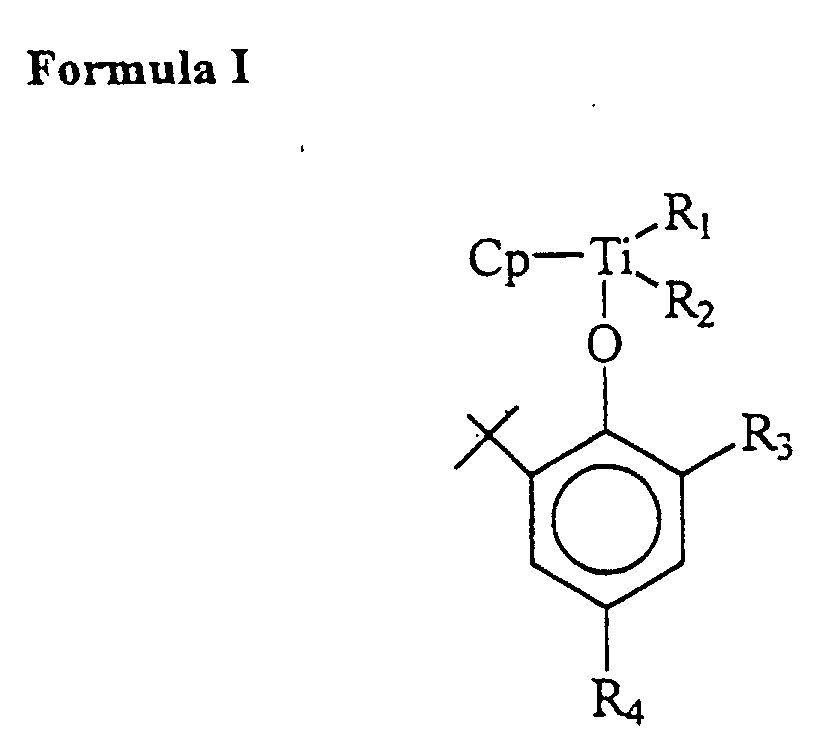
R1 and R2 are the same or different and are selected from halogen atom;
R3 and R4 are the same or different and are selected from hydrogen atoms, alkyl or alkoxy group containing 1 to 12 carbon atoms, aryl or aryloxy groups containing 6 to 20 carbon atoms and cycloalkyl groups containing 6 to 20 carbon atoms. - The process of claim 1, wherein said conjugated diene monomer includes isoprene or butadiene.
- The process of claim 1, wherein said vinyl aromatic monomer includes styrene or alphamethyl styrene.
- The process of claim 1, wherein said conjugated diene monomer and vinyl aromatic monomer are mixed in the weight ratio of 1:9 to 9:1.
- The process of claim 1, wherein said organo alkali metal initiator includes an organo lithium compound.
- The process of claim 5, wherein said organo lithium compound includes n-butyl lithium or sec-butyl lithium.
- The process of claim 1, wherein said terminating agent is employed from one or more compounds selected from the group consisting of amines, alcohols, esters, ketones and halogenated compounds.
- The process of claim 1 or 7, wherein said terminating agent is selected from the following group: benzyl chloride, benzyl bromide, benzyl iodide, methyl chloride, methyl bromide, methyl iodide, ethyl chloride, ethyl bromide, ethyl iodide, butyl chloride, butyl bromide, butyl iodide, acetone, methyl isobutyl ketone, diphenyl ketone, methanol, ethanol, isopropyl alcohol, butanol, phenol, cresol, 2,6-di-t-butyl 4-methyl phenol, ethylacetate, butylacetate, trimethylsilyl fluoride, trimethylsilyl chloride, trimethylsilyl bromide, trimethylsilyl iodide, triethylsilyl fluoride, triethylsilyl chloride, triethylsilyl bromide, triethylsilyl iodide, tributylsilyl fluoride, tributylsilyl chloride, tributylsilyl bromide, tributylsilyl iodide, triphenylsilyl fluoride, triphenylsilyl chloride, triphenylsilyl bromide and triphenylsilyl iodide.
- The process of claim 1, wherein said lithium hydride compound comparing to monocyclopentadienyl titanium compound is excessively used in the molar ratio of 2 to 30.
- The process of claim 1 or 9, where said lithium hydride is prepared in solution of an organo lithium compound and hydrogen gas.
- The process of claim 1, wherein said monocyclopentadienyl titanium compound is selected from the following group for a single use or in the mixed form:monocyclopentadienyl(2-t-butyl phenoxy)titanium difluoride,monocyclopentadienyl(2-t-butyl phenoxy)titanium dichloride,monocyclopentadienyl(2-t-butyl phenoxy)titanium dibromide,monocyclopentadienyl(2-t-butyl phenoxy)titanium diiodide,monocyclopentadienyl(2,6-di-t-butyl 4-methyl phenoxy)titanium difluoride,monocyclopentadienyl(2,6-di-t-butyl 4-methyl phenoxy)titanium dichloride,monocyclopentadienyl(2,6-di-t-butyl 4-methyl phenoxy)titanium dibromide,monocyclopentadienyl(2,6-di-t-butyl 4-methyl phenoxy)titanium diiodide,monocyclopentadienyl(2,6-di-t-butyl 4-methoxy phenoxy)titanium difluoride,monocyclopentadienyl(2,6-di-t-butyl 4-methoxy phenoxy)titanium dichloride,monocyclopentadienyl(2,6-di-t-butyl 4-methoxy phenoxy)titanium dibromide,monocyclopentadienyl(2,6-di-t-butyl 4-methoxy phenoxy)titanium diiodide,monocyclopentadienyl(2,6-di-t-butyl phenoxy)titanium difluoride,monocyclopentadienyl(2,6-di-t-butyl phenoxy)titanium dichloride,monocyclopentadienyl(2,6-di-t-butyl phenoxy)titanium dibromide,monocyclopentadienyl(2,6-di-t-butyl phenoxy)titanium diiodide,monocyclopentadienyl(2,4,6-tri-t-butyl phenoxy)titanium difluoride,monocyclopentadienyl(2,4,6-tri-t-butyl phenoxy)titanium dichloride,monocyclopentadienyl(2,4,6-tri-t-butyl phenoxy)titanium dibromide andmonocyclopentadienyl(2,4,6-tri-t-butyl phenoxy)titanium diiodide.
- The process of claim 1, wherein said hydrogenation is performed under the following reaction conditions: temperature from 0 to 150°C, pressure from 1 to 100kgf/cm2, amount of catalyst from 0.01 to 20mM/100g polymer and time froml5 to 1440 minutes.
- The process of claim 1 or 12, wherein said hydrogenation is performed under the following reaction conditions: temperature(50 to 140°C), pressure(5 to 20kgf/cm2), amount of catalyst(0.05 to 2mM/100g polymer) and time(30 to 360 minutes).
- The process of claim 1, wherein said polymer has a number-average molecular weight of between 500 to 1,000,000.
- The process of claim 1, wherein said hydrogenation is performed in such a manner that the unsaturated double bonds are hydrogenated having more than 95% conjugated diene units and less than 5% vinyl aromatic units.
- The process of claim 1, wherein the concentration of said polymer is in the range of 1 to 50wt% in a solvent.
Applications Claiming Priority (3)
| Application Number | Priority Date | Filing Date | Title |
|---|---|---|---|
| KR1019980031575A KR100267080B1 (en) | 1998-08-03 | 1998-08-03 | Method for hydrogenation of conjugated diene polymer |
| KR9831575 | 1998-08-03 | ||
| PCT/KR1998/000440 WO2000008069A1 (en) | 1998-08-03 | 1998-12-18 | Process for hydrogenating a conjugated diene polymer |
Publications (2)
| Publication Number | Publication Date |
|---|---|
| EP1124863A1 EP1124863A1 (en) | 2001-08-22 |
| EP1124863B1 true EP1124863B1 (en) | 2004-07-21 |
Family
ID=36283974
Family Applications (1)
| Application Number | Title | Priority Date | Filing Date |
|---|---|---|---|
| EP98967170A Expired - Lifetime EP1124863B1 (en) | 1998-08-03 | 1998-12-18 | Process for hydrogenating a conjugated diene polymer |
Country Status (12)
| Country | Link |
|---|---|
| US (1) | US6951906B1 (en) |
| EP (1) | EP1124863B1 (en) |
| JP (1) | JP3403174B2 (en) |
| KR (1) | KR100267080B1 (en) |
| CN (1) | CN1158311C (en) |
| AT (1) | ATE271566T1 (en) |
| AU (1) | AU742867B2 (en) |
| BR (1) | BR9815980A (en) |
| CA (1) | CA2339226C (en) |
| DE (1) | DE69825184T2 (en) |
| ES (1) | ES2226207T3 (en) |
| WO (1) | WO2000008069A1 (en) |
Families Citing this family (14)
| Publication number | Priority date | Publication date | Assignee | Title |
|---|---|---|---|---|
| ATE320453T1 (en) * | 2000-08-25 | 2006-04-15 | Kraton Polymers Res Bv | METHOD FOR PRODUCING SELECTIVELY HYDROGENATED BLOCK COPOLYMERS FROM VINYL AROMATIC HYDROCARBONS AND CONJUGATED SERIES |
| KR100411861B1 (en) | 2000-11-28 | 2003-12-18 | 금호석유화학 주식회사 | Process for the removal of metal catalysts from the selectively hydrogenated polymers by using organotitanium compound |
| KR100910255B1 (en) | 2007-10-08 | 2009-07-31 | 금호석유화학 주식회사 | Process for preparing hydrogenated conjugated diene polymer |
| US20090131597A1 (en) * | 2007-11-21 | 2009-05-21 | Young Hoon Ko | Process for the preparation of a hydrogenated conjugated diene-based polymer |
| KR101151606B1 (en) * | 2007-12-31 | 2012-06-08 | 에스케이이노베이션 주식회사 | Transition metal complexes, catalysts composition containing the same, and process for preparing ethylene homopolymers or copolymers of ethylene and a-olefins using the same |
| EP2842973B1 (en) | 2012-04-26 | 2016-12-28 | Asahi Kasei Kabushiki Kaisha | Method for producing polymer |
| EP2918614B1 (en) | 2012-11-06 | 2018-02-21 | Asahi Kasei Kabushiki Kaisha | Method for producing polymer |
| CN104995214A (en) * | 2013-02-14 | 2015-10-21 | Jsr株式会社 | Method for producing hydrogenated conjugated diene polymer |
| CN105143334B (en) | 2013-04-30 | 2017-08-25 | 旭化成株式会社 | Composition containing titanium oxide, polymer composition and shaped body |
| TWI586693B (en) | 2013-07-23 | 2017-06-11 | 財團法人工業技術研究院 | Method for selectively hydrogenating copolymer |
| CN107200795B (en) * | 2016-03-16 | 2019-04-19 | 中国石油化工股份有限公司 | A kind of method of hydrotreating of the polymer containing polar group |
| WO2018119168A1 (en) * | 2016-12-21 | 2018-06-28 | Bridgestone Corporation | High strength hydrogenated polymers, and rubber compositions incorporating same |
| WO2021102202A2 (en) * | 2019-11-19 | 2021-05-27 | Bridgestone Corporation | Hydrogenated polymers and rubber compositions incorporating the same |
| CN115703848A (en) * | 2021-08-04 | 2023-02-17 | 中国石油化工股份有限公司 | Hydrogenated nitrile rubber and preparation method thereof |
Family Cites Families (6)
| Publication number | Priority date | Publication date | Assignee | Title |
|---|---|---|---|---|
| US5242986A (en) * | 1992-08-10 | 1993-09-07 | Shell Oil Company | Selective partial hydrogenation of conjugated diolefin polymers |
| KR100201228B1 (en) * | 1995-10-17 | 1999-06-15 | 박찬구 | Process for hydrogenating living polymers |
| MX9701870A (en) * | 1996-03-15 | 1998-04-30 | Shell Int Research | Process for conjugated diene polymers hydrogenation, and catalyst compositions suitable to be used therein. |
| US5814709A (en) * | 1996-04-12 | 1998-09-29 | Shell Oil Company | Process for hydrogenation on conjugataed diene polymers and catalyst composition suitable for use therein |
| JPH1053614A (en) * | 1996-05-29 | 1998-02-24 | Shell Internatl Res Maatschappij Bv | Process for hydrogenating conjugated diene polymers and catalyst compositions suitable for use in this process |
| KR100195581B1 (en) * | 1996-12-28 | 1999-06-15 | 박찬구 | Process for hydrogenating olefinic double bond in living polymers |
-
1998
- 1998-08-03 KR KR1019980031575A patent/KR100267080B1/en not_active Expired - Fee Related
- 1998-12-18 AT AT98967170T patent/ATE271566T1/en not_active IP Right Cessation
- 1998-12-18 ES ES98967170T patent/ES2226207T3/en not_active Expired - Lifetime
- 1998-12-18 CA CA002339226A patent/CA2339226C/en not_active Expired - Fee Related
- 1998-12-18 US US09/555,161 patent/US6951906B1/en not_active Expired - Fee Related
- 1998-12-18 BR BR9815980-1A patent/BR9815980A/en active Search and Examination
- 1998-12-18 WO PCT/KR1998/000440 patent/WO2000008069A1/en not_active Ceased
- 1998-12-18 DE DE69825184T patent/DE69825184T2/en not_active Expired - Lifetime
- 1998-12-18 EP EP98967170A patent/EP1124863B1/en not_active Expired - Lifetime
- 1998-12-18 AU AU15842/00A patent/AU742867B2/en not_active Ceased
- 1998-12-18 JP JP2000563700A patent/JP3403174B2/en not_active Expired - Lifetime
- 1998-12-18 CN CNB988142295A patent/CN1158311C/en not_active Expired - Fee Related
Also Published As
| Publication number | Publication date |
|---|---|
| DE69825184D1 (en) | 2004-08-26 |
| EP1124863A1 (en) | 2001-08-22 |
| CN1314919A (en) | 2001-09-26 |
| KR20000012973A (en) | 2000-03-06 |
| AU1584200A (en) | 2000-02-28 |
| ATE271566T1 (en) | 2004-08-15 |
| CA2339226C (en) | 2006-05-02 |
| AU742867B2 (en) | 2002-01-17 |
| DE69825184T2 (en) | 2005-08-04 |
| KR100267080B1 (en) | 2000-10-02 |
| WO2000008069A1 (en) | 2000-02-17 |
| CN1158311C (en) | 2004-07-21 |
| ES2226207T3 (en) | 2005-03-16 |
| BR9815980A (en) | 2001-10-09 |
| US6951906B1 (en) | 2005-10-04 |
| JP2002522574A (en) | 2002-07-23 |
| JP3403174B2 (en) | 2003-05-06 |
| CA2339226A1 (en) | 2000-02-17 |
Similar Documents
| Publication | Publication Date | Title |
|---|---|---|
| KR100348761B1 (en) | Method for the selective hydrogenation of the conjugated diene containing polymer | |
| US6020439A (en) | Method of hydrogenation of living polymer | |
| EP0584860B1 (en) | Selective partial hydrogenation of conjugated diene polymers | |
| AU742867B2 (en) | Process for hydrogenating a conjugated diene polymer | |
| RU2123012C1 (en) | Method of producing selectively hydrogenated conjugated diolefin polymers | |
| US6881797B2 (en) | Process for hydrogenation of conjugated diene polymer | |
| US5910566A (en) | Living polymer hydrogenation catalyst and process for hydrogenating polymers with the catalyst | |
| KR100515452B1 (en) | Process for manufacturing selective hydrogenated conjugated-diene polymer using lithium hydride made from high injection nozzle-type reactor | |
| US6040390A (en) | Process for hydrogenating conjugated diene polymers | |
| JP5474274B2 (en) | Selective hydrogenation of unsaturated (co) polymers | |
| KR100295601B1 (en) | Process for selective hydrogenation of conjugated diene polymer | |
| KR100356533B1 (en) | Method for the selective hydrogenation of the conjugated diene polymer | |
| KR100295599B1 (en) | Hydrogenation of conjugated diene polymer | |
| KR100332465B1 (en) | Process for the hydrogenation of unsaturated polymer | |
| KR100332464B1 (en) | The selective hydrogenation catalyst for conjugated diene polymers and hydrogenation process using the same | |
| KR100221358B1 (en) | Preparation of New Catalyst for Selective Hydrogenation of Double Bond of Olefin Living Polymer and Hydrogenation Method Using The Same | |
| KR100287961B1 (en) | Hydrogenation method of polymer containing conjugated diene | |
| KR100264514B1 (en) | Process for hydrogenation of conjugated diene polymer | |
| MXPA01001237A (en) | Process for hydrogenating a conjugated diene polymer |
Legal Events
| Date | Code | Title | Description |
|---|---|---|---|
| PUAI | Public reference made under article 153(3) epc to a published international application that has entered the european phase |
Free format text: ORIGINAL CODE: 0009012 |
|
| 17P | Request for examination filed |
Effective date: 20010305 |
|
| AK | Designated contracting states |
Kind code of ref document: A1 Designated state(s): AT BE CH CY DE DK ES FI FR GB GR IE IT LI LU MC NL PT SE |
|
| GRAP | Despatch of communication of intention to grant a patent |
Free format text: ORIGINAL CODE: EPIDOSNIGR1 |
|
| GRAS | Grant fee paid |
Free format text: ORIGINAL CODE: EPIDOSNIGR3 |
|
| GRAA | (expected) grant |
Free format text: ORIGINAL CODE: 0009210 |
|
| AK | Designated contracting states |
Kind code of ref document: B1 Designated state(s): AT BE CH CY DE DK ES FI FR GB GR IE IT LI LU MC NL PT SE |
|
| PG25 | Lapsed in a contracting state [announced via postgrant information from national office to epo] |
Ref country code: NL Free format text: LAPSE BECAUSE OF FAILURE TO SUBMIT A TRANSLATION OF THE DESCRIPTION OR TO PAY THE FEE WITHIN THE PRESCRIBED TIME-LIMIT Effective date: 20040721 Ref country code: LI Free format text: LAPSE BECAUSE OF FAILURE TO SUBMIT A TRANSLATION OF THE DESCRIPTION OR TO PAY THE FEE WITHIN THE PRESCRIBED TIME-LIMIT Effective date: 20040721 Ref country code: FI Free format text: LAPSE BECAUSE OF FAILURE TO SUBMIT A TRANSLATION OF THE DESCRIPTION OR TO PAY THE FEE WITHIN THE PRESCRIBED TIME-LIMIT Effective date: 20040721 Ref country code: CY Free format text: LAPSE BECAUSE OF FAILURE TO SUBMIT A TRANSLATION OF THE DESCRIPTION OR TO PAY THE FEE WITHIN THE PRESCRIBED TIME-LIMIT Effective date: 20040721 Ref country code: CH Free format text: LAPSE BECAUSE OF FAILURE TO SUBMIT A TRANSLATION OF THE DESCRIPTION OR TO PAY THE FEE WITHIN THE PRESCRIBED TIME-LIMIT Effective date: 20040721 Ref country code: BE Free format text: LAPSE BECAUSE OF FAILURE TO SUBMIT A TRANSLATION OF THE DESCRIPTION OR TO PAY THE FEE WITHIN THE PRESCRIBED TIME-LIMIT Effective date: 20040721 Ref country code: AT Free format text: LAPSE BECAUSE OF FAILURE TO SUBMIT A TRANSLATION OF THE DESCRIPTION OR TO PAY THE FEE WITHIN THE PRESCRIBED TIME-LIMIT Effective date: 20040721 |
|
| REG | Reference to a national code |
Ref country code: GB Ref legal event code: FG4D |
|
| REG | Reference to a national code |
Ref country code: CH Ref legal event code: EP |
|
| REG | Reference to a national code |
Ref country code: IE Ref legal event code: FG4D |
|
| REF | Corresponds to: |
Ref document number: 69825184 Country of ref document: DE Date of ref document: 20040826 Kind code of ref document: P |
|
| PG25 | Lapsed in a contracting state [announced via postgrant information from national office to epo] |
Ref country code: SE Free format text: LAPSE BECAUSE OF FAILURE TO SUBMIT A TRANSLATION OF THE DESCRIPTION OR TO PAY THE FEE WITHIN THE PRESCRIBED TIME-LIMIT Effective date: 20041021 Ref country code: GR Free format text: LAPSE BECAUSE OF FAILURE TO SUBMIT A TRANSLATION OF THE DESCRIPTION OR TO PAY THE FEE WITHIN THE PRESCRIBED TIME-LIMIT Effective date: 20041021 Ref country code: DK Free format text: LAPSE BECAUSE OF FAILURE TO SUBMIT A TRANSLATION OF THE DESCRIPTION OR TO PAY THE FEE WITHIN THE PRESCRIBED TIME-LIMIT Effective date: 20041021 |
|
| PG25 | Lapsed in a contracting state [announced via postgrant information from national office to epo] |
Ref country code: LU Free format text: LAPSE BECAUSE OF NON-PAYMENT OF DUE FEES Effective date: 20041218 |
|
| PG25 | Lapsed in a contracting state [announced via postgrant information from national office to epo] |
Ref country code: IE Free format text: LAPSE BECAUSE OF NON-PAYMENT OF DUE FEES Effective date: 20041220 |
|
| PG25 | Lapsed in a contracting state [announced via postgrant information from national office to epo] |
Ref country code: MC Free format text: LAPSE BECAUSE OF NON-PAYMENT OF DUE FEES Effective date: 20041231 |
|
| NLV1 | Nl: lapsed or annulled due to failure to fulfill the requirements of art. 29p and 29m of the patents act | ||
| REG | Reference to a national code |
Ref country code: CH Ref legal event code: PL |
|
| REG | Reference to a national code |
Ref country code: ES Ref legal event code: FG2A Ref document number: 2226207 Country of ref document: ES Kind code of ref document: T3 |
|
| ET | Fr: translation filed | ||
| PLBE | No opposition filed within time limit |
Free format text: ORIGINAL CODE: 0009261 |
|
| STAA | Information on the status of an ep patent application or granted ep patent |
Free format text: STATUS: NO OPPOSITION FILED WITHIN TIME LIMIT |
|
| 26N | No opposition filed |
Effective date: 20050422 |
|
| REG | Reference to a national code |
Ref country code: IE Ref legal event code: MM4A |
|
| PG25 | Lapsed in a contracting state [announced via postgrant information from national office to epo] |
Ref country code: PT Free format text: LAPSE BECAUSE OF NON-PAYMENT OF DUE FEES Effective date: 20041221 |
|
| PGFP | Annual fee paid to national office [announced via postgrant information from national office to epo] |
Ref country code: IT Payment date: 20121220 Year of fee payment: 15 |
|
| PGFP | Annual fee paid to national office [announced via postgrant information from national office to epo] |
Ref country code: ES Payment date: 20130125 Year of fee payment: 15 Ref country code: FR Payment date: 20130121 Year of fee payment: 15 Ref country code: GB Payment date: 20130102 Year of fee payment: 15 Ref country code: DE Payment date: 20130228 Year of fee payment: 15 |
|
| REG | Reference to a national code |
Ref country code: DE Ref legal event code: R119 Ref document number: 69825184 Country of ref document: DE |
|
| GBPC | Gb: european patent ceased through non-payment of renewal fee |
Effective date: 20131218 |
|
| REG | Reference to a national code |
Ref country code: FR Ref legal event code: ST Effective date: 20140829 |
|
| REG | Reference to a national code |
Ref country code: DE Ref legal event code: R119 Ref document number: 69825184 Country of ref document: DE Effective date: 20140701 |
|
| PG25 | Lapsed in a contracting state [announced via postgrant information from national office to epo] |
Ref country code: DE Free format text: LAPSE BECAUSE OF NON-PAYMENT OF DUE FEES Effective date: 20140701 |
|
| PG25 | Lapsed in a contracting state [announced via postgrant information from national office to epo] |
Ref country code: GB Free format text: LAPSE BECAUSE OF NON-PAYMENT OF DUE FEES Effective date: 20131218 Ref country code: FR Free format text: LAPSE BECAUSE OF NON-PAYMENT OF DUE FEES Effective date: 20131231 |
|
| REG | Reference to a national code |
Ref country code: ES Ref legal event code: FD2A Effective date: 20150330 |
|
| PG25 | Lapsed in a contracting state [announced via postgrant information from national office to epo] |
Ref country code: ES Free format text: LAPSE BECAUSE OF NON-PAYMENT OF DUE FEES Effective date: 20131219 |
|
| PG25 | Lapsed in a contracting state [announced via postgrant information from national office to epo] |
Ref country code: IT Free format text: LAPSE BECAUSE OF NON-PAYMENT OF DUE FEES Effective date: 20131231 |
|
| PG25 | Lapsed in a contracting state [announced via postgrant information from national office to epo] |
Ref country code: IT Free format text: LAPSE BECAUSE OF NON-PAYMENT OF DUE FEES Effective date: 20131218 |