EP1124833B1 - Diphosphines - Google Patents
Diphosphines Download PDFInfo
- Publication number
- EP1124833B1 EP1124833B1 EP99954113A EP99954113A EP1124833B1 EP 1124833 B1 EP1124833 B1 EP 1124833B1 EP 99954113 A EP99954113 A EP 99954113A EP 99954113 A EP99954113 A EP 99954113A EP 1124833 B1 EP1124833 B1 EP 1124833B1
- Authority
- EP
- European Patent Office
- Prior art keywords
- phosphorus
- diphosphine
- process according
- phosphine
- catalyst
- Prior art date
- Legal status (The legal status is an assumption and is not a legal conclusion. Google has not performed a legal analysis and makes no representation as to the accuracy of the status listed.)
- Expired - Lifetime
Links
- VURFVHCLMJOLKN-UHFFFAOYSA-N diphosphane Chemical compound PP VURFVHCLMJOLKN-UHFFFAOYSA-N 0.000 claims abstract description 32
- 229910052698 phosphorus Inorganic materials 0.000 claims abstract description 22
- 239000011574 phosphorus Substances 0.000 claims abstract description 16
- OAICVXFJPJFONN-UHFFFAOYSA-N Phosphorus Chemical group [P] OAICVXFJPJFONN-UHFFFAOYSA-N 0.000 claims abstract description 12
- 125000003118 aryl group Chemical group 0.000 claims abstract description 11
- 125000004437 phosphorous atom Chemical group 0.000 claims abstract description 11
- 125000001424 substituent group Chemical group 0.000 claims abstract description 11
- IJGRMHOSHXDMSA-UHFFFAOYSA-N Atomic nitrogen Chemical compound N#N IJGRMHOSHXDMSA-UHFFFAOYSA-N 0.000 claims abstract description 10
- 125000001931 aliphatic group Chemical group 0.000 claims abstract description 9
- OKTJSMMVPCPJKN-UHFFFAOYSA-N Carbon Chemical compound [C] OKTJSMMVPCPJKN-UHFFFAOYSA-N 0.000 claims abstract description 6
- 125000004432 carbon atom Chemical group C* 0.000 claims abstract description 6
- 125000001072 heteroaryl group Chemical group 0.000 claims abstract description 6
- 229910052757 nitrogen Inorganic materials 0.000 claims abstract description 6
- 229910052760 oxygen Inorganic materials 0.000 claims abstract description 6
- NINIDFKCEFEMDL-UHFFFAOYSA-N Sulfur Chemical compound [S] NINIDFKCEFEMDL-UHFFFAOYSA-N 0.000 claims abstract description 5
- QVGXLLKOCUKJST-UHFFFAOYSA-N atomic oxygen Chemical compound [O] QVGXLLKOCUKJST-UHFFFAOYSA-N 0.000 claims abstract description 5
- 239000001301 oxygen Substances 0.000 claims abstract description 5
- 229910052799 carbon Inorganic materials 0.000 claims abstract description 4
- 229920006395 saturated elastomer Polymers 0.000 claims abstract description 4
- 239000005864 Sulphur Substances 0.000 claims abstract description 3
- XYFCBTPGUUZFHI-UHFFFAOYSA-N Phosphine Chemical compound P XYFCBTPGUUZFHI-UHFFFAOYSA-N 0.000 claims description 36
- 239000003054 catalyst Substances 0.000 claims description 19
- 238000000034 method Methods 0.000 claims description 19
- 229910000073 phosphorus hydride Inorganic materials 0.000 claims description 18
- 238000006243 chemical reaction Methods 0.000 claims description 15
- 239000000376 reactant Substances 0.000 claims description 13
- UORVGPXVDQYIDP-UHFFFAOYSA-N trihydridoboron Substances B UORVGPXVDQYIDP-UHFFFAOYSA-N 0.000 claims description 12
- 150000002009 diols Chemical class 0.000 claims description 11
- QAOWNCQODCNURD-UHFFFAOYSA-L Sulfate Chemical compound [O-]S([O-])(=O)=O QAOWNCQODCNURD-UHFFFAOYSA-L 0.000 claims description 9
- 150000001875 compounds Chemical class 0.000 claims description 9
- 239000001257 hydrogen Substances 0.000 claims description 9
- 229910052739 hydrogen Inorganic materials 0.000 claims description 9
- 150000001336 alkenes Chemical class 0.000 claims description 8
- 125000002887 hydroxy group Chemical group [H]O* 0.000 claims description 8
- 229910000085 borane Inorganic materials 0.000 claims description 7
- 230000000269 nucleophilic effect Effects 0.000 claims description 7
- -1 tetrafluoroborate Chemical compound 0.000 claims description 6
- UFHFLCQGNIYNRP-UHFFFAOYSA-N Hydrogen Chemical compound [H][H] UFHFLCQGNIYNRP-UHFFFAOYSA-N 0.000 claims description 5
- 125000003545 alkoxy group Chemical group 0.000 claims description 5
- 150000002148 esters Chemical class 0.000 claims description 5
- 229910052751 metal Inorganic materials 0.000 claims description 5
- 239000002184 metal Substances 0.000 claims description 5
- 125000001997 phenyl group Chemical group [H]C1=C([H])C([H])=C(*)C([H])=C1[H] 0.000 claims description 5
- 229910052703 rhodium Inorganic materials 0.000 claims description 5
- 239000010948 rhodium Substances 0.000 claims description 5
- MHOVAHRLVXNVSD-UHFFFAOYSA-N rhodium atom Chemical compound [Rh] MHOVAHRLVXNVSD-UHFFFAOYSA-N 0.000 claims description 5
- KAKZBPTYRLMSJV-UHFFFAOYSA-N Butadiene Chemical compound C=CC=C KAKZBPTYRLMSJV-UHFFFAOYSA-N 0.000 claims description 4
- KDLHZDBZIXYQEI-UHFFFAOYSA-N Palladium Chemical compound [Pd] KDLHZDBZIXYQEI-UHFFFAOYSA-N 0.000 claims description 4
- 125000000217 alkyl group Chemical group 0.000 claims description 4
- 230000003197 catalytic effect Effects 0.000 claims description 4
- 150000002431 hydrogen Chemical class 0.000 claims description 4
- BASFCYQUMIYNBI-UHFFFAOYSA-N platinum Chemical compound [Pt] BASFCYQUMIYNBI-UHFFFAOYSA-N 0.000 claims description 4
- 229910021653 sulphate ion Inorganic materials 0.000 claims description 4
- FBPFZTCFMRRESA-KVTDHHQDSA-N D-Mannitol Chemical compound OC[C@@H](O)[C@@H](O)[C@H](O)[C@H](O)CO FBPFZTCFMRRESA-KVTDHHQDSA-N 0.000 claims description 3
- UORVGPXVDQYIDP-BJUDXGSMSA-N borane Chemical group [10BH3] UORVGPXVDQYIDP-BJUDXGSMSA-N 0.000 claims description 3
- 125000002091 cationic group Chemical group 0.000 claims description 3
- 239000000203 mixture Substances 0.000 claims description 3
- 150000003017 phosphorus Chemical class 0.000 claims description 3
- BDHFUVZGWQCTTF-UHFFFAOYSA-M sulfonate Chemical compound [O-]S(=O)=O BDHFUVZGWQCTTF-UHFFFAOYSA-M 0.000 claims description 3
- 125000000229 (C1-C4)alkoxy group Chemical group 0.000 claims description 2
- VGGSQFUCUMXWEO-UHFFFAOYSA-N Ethene Chemical group C=C VGGSQFUCUMXWEO-UHFFFAOYSA-N 0.000 claims description 2
- 229930195725 Mannitol Natural products 0.000 claims description 2
- 229910019142 PO4 Inorganic materials 0.000 claims description 2
- KJTLSVCANCCWHF-UHFFFAOYSA-N Ruthenium Chemical compound [Ru] KJTLSVCANCCWHF-UHFFFAOYSA-N 0.000 claims description 2
- AYECZRVHKOLPIP-UHFFFAOYSA-N [P]C1CC1 Chemical compound [P]C1CC1 AYECZRVHKOLPIP-UHFFFAOYSA-N 0.000 claims description 2
- ZADPBFCGQRWHPN-UHFFFAOYSA-N boronic acid Chemical compound OBO ZADPBFCGQRWHPN-UHFFFAOYSA-N 0.000 claims description 2
- 150000004820 halides Chemical class 0.000 claims description 2
- 229910052736 halogen Inorganic materials 0.000 claims description 2
- 150000002367 halogens Chemical class 0.000 claims description 2
- 229910052741 iridium Inorganic materials 0.000 claims description 2
- GKOZUEZYRPOHIO-UHFFFAOYSA-N iridium atom Chemical compound [Ir] GKOZUEZYRPOHIO-UHFFFAOYSA-N 0.000 claims description 2
- 239000000594 mannitol Substances 0.000 claims description 2
- 235000010355 mannitol Nutrition 0.000 claims description 2
- SYSQUGFVNFXIIT-UHFFFAOYSA-N n-[4-(1,3-benzoxazol-2-yl)phenyl]-4-nitrobenzenesulfonamide Chemical class C1=CC([N+](=O)[O-])=CC=C1S(=O)(=O)NC1=CC=C(C=2OC3=CC=CC=C3N=2)C=C1 SYSQUGFVNFXIIT-UHFFFAOYSA-N 0.000 claims description 2
- 230000007935 neutral effect Effects 0.000 claims description 2
- 229910052763 palladium Inorganic materials 0.000 claims description 2
- NBIIXXVUZAFLBC-UHFFFAOYSA-K phosphate Chemical compound [O-]P([O-])([O-])=O NBIIXXVUZAFLBC-UHFFFAOYSA-K 0.000 claims description 2
- 239000010452 phosphate Substances 0.000 claims description 2
- 229910052697 platinum Inorganic materials 0.000 claims description 2
- 229910052707 ruthenium Inorganic materials 0.000 claims description 2
- 239000011951 cationic catalyst Substances 0.000 claims 1
- 238000004519 manufacturing process Methods 0.000 claims 1
- 239000003446 ligand Substances 0.000 description 10
- XKRFYHLGVUSROY-UHFFFAOYSA-N Argon Chemical compound [Ar] XKRFYHLGVUSROY-UHFFFAOYSA-N 0.000 description 8
- RTZKZFJDLAIYFH-UHFFFAOYSA-N Diethyl ether Chemical compound CCOCC RTZKZFJDLAIYFH-UHFFFAOYSA-N 0.000 description 7
- OKKJLVBELUTLKV-UHFFFAOYSA-N methanol Substances OC OKKJLVBELUTLKV-UHFFFAOYSA-N 0.000 description 7
- YMWUJEATGCHHMB-UHFFFAOYSA-N Dichloromethane Chemical compound ClCCl YMWUJEATGCHHMB-UHFFFAOYSA-N 0.000 description 6
- VYPSYNLAJGMNEJ-UHFFFAOYSA-N Silicium dioxide Chemical compound O=[Si]=O VYPSYNLAJGMNEJ-UHFFFAOYSA-N 0.000 description 5
- 125000000956 methoxy group Chemical group [H]C([H])([H])O* 0.000 description 5
- 229910052786 argon Inorganic materials 0.000 description 4
- 238000009876 asymmetric hydrogenation reaction Methods 0.000 description 4
- BWJRMVLPCQPWGR-UHFFFAOYSA-N boron;phosphane Chemical compound [B].P BWJRMVLPCQPWGR-UHFFFAOYSA-N 0.000 description 4
- 238000005984 hydrogenation reaction Methods 0.000 description 4
- LVHBHZANLOWSRM-UHFFFAOYSA-N itaconic acid Chemical class OC(=O)CC(=C)C(O)=O LVHBHZANLOWSRM-UHFFFAOYSA-N 0.000 description 4
- GWLJTAJEHRYMCA-UHFFFAOYSA-N phospholane Chemical compound C1CCPC1 GWLJTAJEHRYMCA-UHFFFAOYSA-N 0.000 description 4
- DREPONDJUKIQLX-UHFFFAOYSA-N 1-[ethenyl(ethoxy)phosphoryl]oxyethane Chemical compound CCOP(=O)(C=C)OCC DREPONDJUKIQLX-UHFFFAOYSA-N 0.000 description 3
- MZRVEZGGRBJDDB-UHFFFAOYSA-N N-Butyllithium Chemical compound [Li]CCCC MZRVEZGGRBJDDB-UHFFFAOYSA-N 0.000 description 3
- AJVCXQGGWXZVNC-UHFFFAOYSA-N P(OCC(PC1=CC=CC=C1)CC=1C(=CC=CC1)OC)(OCCP(CC)CC)=O Chemical compound P(OCC(PC1=CC=CC=C1)CC=1C(=CC=CC1)OC)(OCCP(CC)CC)=O AJVCXQGGWXZVNC-UHFFFAOYSA-N 0.000 description 3
- 239000002253 acid Substances 0.000 description 3
- 230000015572 biosynthetic process Effects 0.000 description 3
- 125000004122 cyclic group Chemical group 0.000 description 3
- 238000002360 preparation method Methods 0.000 description 3
- 239000000758 substrate Substances 0.000 description 3
- 238000003786 synthesis reaction Methods 0.000 description 3
- QKZWXPLBVCKXNQ-UHFFFAOYSA-N (2-methoxyphenyl)-[2-[(2-methoxyphenyl)-phenylphosphanyl]ethyl]-phenylphosphane Chemical compound COC1=CC=CC=C1P(C=1C=CC=CC=1)CCP(C=1C(=CC=CC=1)OC)C1=CC=CC=C1 QKZWXPLBVCKXNQ-UHFFFAOYSA-N 0.000 description 2
- LCGLNKUTAGEVQW-UHFFFAOYSA-N Dimethyl ether Chemical compound COC LCGLNKUTAGEVQW-UHFFFAOYSA-N 0.000 description 2
- OTMSDBZUPAUEDD-UHFFFAOYSA-N Ethane Chemical compound CC OTMSDBZUPAUEDD-UHFFFAOYSA-N 0.000 description 2
- XEKOWRVHYACXOJ-UHFFFAOYSA-N Ethyl acetate Chemical compound CCOC(C)=O XEKOWRVHYACXOJ-UHFFFAOYSA-N 0.000 description 2
- OFBQJSOFQDEBGM-UHFFFAOYSA-N Pentane Chemical compound CCCCC OFBQJSOFQDEBGM-UHFFFAOYSA-N 0.000 description 2
- 150000007513 acids Chemical class 0.000 description 2
- 229910000086 alane Inorganic materials 0.000 description 2
- AZDRQVAHHNSJOQ-UHFFFAOYSA-N alumane Chemical compound [AlH3] AZDRQVAHHNSJOQ-UHFFFAOYSA-N 0.000 description 2
- 238000006555 catalytic reaction Methods 0.000 description 2
- 239000012535 impurity Substances 0.000 description 2
- 125000002496 methyl group Chemical group [H]C([H])([H])* 0.000 description 2
- 239000000377 silicon dioxide Substances 0.000 description 2
- 239000002904 solvent Substances 0.000 description 2
- 229910052717 sulfur Inorganic materials 0.000 description 2
- 239000011593 sulfur Substances 0.000 description 2
- RRKODOZNUZCUBN-CCAGOZQPSA-N (1z,3z)-cycloocta-1,3-diene Chemical compound C1CC\C=C/C=C\C1 RRKODOZNUZCUBN-CCAGOZQPSA-N 0.000 description 1
- LYXHWHHENVLYCN-QMDOQEJBSA-N (1z,5z)-cycloocta-1,5-diene;rhodium;tetrafluoroborate Chemical compound [Rh].F[B-](F)(F)F.C\1C\C=C/CC\C=C/1.C\1C\C=C/CC\C=C/1 LYXHWHHENVLYCN-QMDOQEJBSA-N 0.000 description 1
- HCAJAVWKBZKSHA-UHFFFAOYSA-N (2-methoxyphenyl)methyl-phenylphosphane Chemical compound COC1=CC=CC=C1CPC1=CC=CC=C1 HCAJAVWKBZKSHA-UHFFFAOYSA-N 0.000 description 1
- CIBPZSUXFRTYEC-UHFFFAOYSA-N 2-(3,4-dimethoxy-2,5-dimethylphospholan-1-yl)ethyl-(2-methoxyphenyl)-phenylphosphane Chemical compound CC1C(OC)C(OC)C(C)P1CCP(C=1C(=CC=CC=1)OC)C1=CC=CC=C1 CIBPZSUXFRTYEC-UHFFFAOYSA-N 0.000 description 1
- 125000004204 2-methoxyphenyl group Chemical group [H]C1=C([H])C(*)=C(OC([H])([H])[H])C([H])=C1[H] 0.000 description 1
- VEXZGXHMUGYJMC-UHFFFAOYSA-M Chloride anion Chemical compound [Cl-] VEXZGXHMUGYJMC-UHFFFAOYSA-M 0.000 description 1
- KRHYYFGTRYWZRS-UHFFFAOYSA-M Fluoride anion Chemical compound [F-] KRHYYFGTRYWZRS-UHFFFAOYSA-M 0.000 description 1
- 229910004039 HBF4 Inorganic materials 0.000 description 1
- 238000003820 Medium-pressure liquid chromatography Methods 0.000 description 1
- 238000006845 Michael addition reaction Methods 0.000 description 1
- 238000006579 Tsuji-Trost allylation reaction Methods 0.000 description 1
- 238000007259 addition reaction Methods 0.000 description 1
- 238000005576 amination reaction Methods 0.000 description 1
- 230000003190 augmentative effect Effects 0.000 description 1
- JXLHNMVSKXFWAO-UHFFFAOYSA-N azane;7-fluoro-2,1,3-benzoxadiazole-4-sulfonic acid Chemical compound N.OS(=O)(=O)C1=CC=C(F)C2=NON=C12 JXLHNMVSKXFWAO-UHFFFAOYSA-N 0.000 description 1
- FFDLFWMUMGTWIB-UHFFFAOYSA-N boron;phosphane Chemical compound [B].P.P FFDLFWMUMGTWIB-UHFFFAOYSA-N 0.000 description 1
- 238000009903 catalytic hydrogenation reaction Methods 0.000 description 1
- 238000004587 chromatography analysis Methods 0.000 description 1
- 238000003776 cleavage reaction Methods 0.000 description 1
- 238000004440 column chromatography Methods 0.000 description 1
- 238000006880 cross-coupling reaction Methods 0.000 description 1
- 229910021419 crystalline silicon Inorganic materials 0.000 description 1
- 238000002425 crystallisation Methods 0.000 description 1
- 238000006352 cycloaddition reaction Methods 0.000 description 1
- 238000005888 cyclopropanation reaction Methods 0.000 description 1
- 238000010502 deborylation reaction Methods 0.000 description 1
- 230000005595 deprotonation Effects 0.000 description 1
- 238000010537 deprotonation reaction Methods 0.000 description 1
- 150000004985 diamines Chemical class 0.000 description 1
- LXCYSACZTOKNNS-UHFFFAOYSA-N diethoxy(oxo)phosphanium Chemical compound CCO[P+](=O)OCC LXCYSACZTOKNNS-UHFFFAOYSA-N 0.000 description 1
- 238000006073 displacement reaction Methods 0.000 description 1
- DLLJVQNYBYOKGS-UHFFFAOYSA-N ethoxyethane;pentane Chemical compound CCCCC.CCOCC DLLJVQNYBYOKGS-UHFFFAOYSA-N 0.000 description 1
- 235000019439 ethyl acetate Nutrition 0.000 description 1
- VGLKHVQPWGFXEG-NCJHBDPTSA-K europium(3+);(1z)-2,2,3,3,4,4,4-heptafluoro-1-(4,7,7-trimethyl-3-oxo-2-bicyclo[2.2.1]heptanylidene)butan-1-olate Chemical compound [Eu+3].C1CC2(C)C(=O)\C(=C(/[O-])C(F)(F)C(F)(F)C(F)(F)F)C1C2(C)C.C1CC2(C)C(=O)\C(=C(/[O-])C(F)(F)C(F)(F)C(F)(F)F)C1C2(C)C.C1CC2(C)C(=O)\C(=C(/[O-])C(F)(F)C(F)(F)C(F)(F)F)C1C2(C)C VGLKHVQPWGFXEG-NCJHBDPTSA-K 0.000 description 1
- 238000001704 evaporation Methods 0.000 description 1
- 230000008020 evaporation Effects 0.000 description 1
- 238000001914 filtration Methods 0.000 description 1
- 239000005350 fused silica glass Substances 0.000 description 1
- 238000004817 gas chromatography Methods 0.000 description 1
- 238000006197 hydroboration reaction Methods 0.000 description 1
- 230000007062 hydrolysis Effects 0.000 description 1
- 238000006460 hydrolysis reaction Methods 0.000 description 1
- 238000006459 hydrosilylation reaction Methods 0.000 description 1
- 238000007689 inspection Methods 0.000 description 1
- 125000000654 isopropylidene group Chemical group C(C)(C)=* 0.000 description 1
- 150000005217 methyl ethers Chemical class 0.000 description 1
- 239000012038 nucleophile Substances 0.000 description 1
- JRZJOMJEPLMPRA-UHFFFAOYSA-N olefin Natural products CCCCCCCC=C JRZJOMJEPLMPRA-UHFFFAOYSA-N 0.000 description 1
- 238000006772 olefination reaction Methods 0.000 description 1
- 125000002524 organometallic group Chemical group 0.000 description 1
- 150000004850 phospholanes Chemical class 0.000 description 1
- 239000002243 precursor Substances 0.000 description 1
- 125000006239 protecting group Chemical group 0.000 description 1
- 238000013341 scale-up Methods 0.000 description 1
- 230000007017 scission Effects 0.000 description 1
- 239000003579 shift reagent Substances 0.000 description 1
- 238000005055 short column chromatography Methods 0.000 description 1
- 239000007787 solid Substances 0.000 description 1
- 150000003568 thioethers Chemical class 0.000 description 1
- 238000009901 transfer hydrogenation reaction Methods 0.000 description 1
Classifications
-
- B—PERFORMING OPERATIONS; TRANSPORTING
- B01—PHYSICAL OR CHEMICAL PROCESSES OR APPARATUS IN GENERAL
- B01J—CHEMICAL OR PHYSICAL PROCESSES, e.g. CATALYSIS OR COLLOID CHEMISTRY; THEIR RELEVANT APPARATUS
- B01J31/00—Catalysts comprising hydrides, coordination complexes or organic compounds
- B01J31/16—Catalysts comprising hydrides, coordination complexes or organic compounds containing coordination complexes
- B01J31/24—Phosphines, i.e. phosphorus bonded to only carbon atoms, or to both carbon and hydrogen atoms, including e.g. sp2-hybridised phosphorus compounds such as phosphabenzene, phosphole or anionic phospholide ligands
- B01J31/2404—Cyclic ligands, including e.g. non-condensed polycyclic ligands, the phosphine-P atom being a ring member or a substituent on the ring
- B01J31/2419—Cyclic ligands, including e.g. non-condensed polycyclic ligands, the phosphine-P atom being a ring member or a substituent on the ring comprising P as ring member
- B01J31/2428—Cyclic ligands, including e.g. non-condensed polycyclic ligands, the phosphine-P atom being a ring member or a substituent on the ring comprising P as ring member with more than one complexing phosphine-P atom
- B01J31/2433—Cyclic ligands, including e.g. non-condensed polycyclic ligands, the phosphine-P atom being a ring member or a substituent on the ring comprising P as ring member with more than one complexing phosphine-P atom comprising aliphatic or saturated rings
-
- B—PERFORMING OPERATIONS; TRANSPORTING
- B01—PHYSICAL OR CHEMICAL PROCESSES OR APPARATUS IN GENERAL
- B01J—CHEMICAL OR PHYSICAL PROCESSES, e.g. CATALYSIS OR COLLOID CHEMISTRY; THEIR RELEVANT APPARATUS
- B01J31/00—Catalysts comprising hydrides, coordination complexes or organic compounds
- B01J31/16—Catalysts comprising hydrides, coordination complexes or organic compounds containing coordination complexes
- B01J31/18—Catalysts comprising hydrides, coordination complexes or organic compounds containing coordination complexes containing nitrogen, phosphorus, arsenic or antimony as complexing atoms, e.g. in pyridine ligands, or in resonance therewith, e.g. in isocyanide ligands C=N-R or as complexed central atoms
- B01J31/1845—Catalysts comprising hydrides, coordination complexes or organic compounds containing coordination complexes containing nitrogen, phosphorus, arsenic or antimony as complexing atoms, e.g. in pyridine ligands, or in resonance therewith, e.g. in isocyanide ligands C=N-R or as complexed central atoms the ligands containing phosphorus
-
- B—PERFORMING OPERATIONS; TRANSPORTING
- B01—PHYSICAL OR CHEMICAL PROCESSES OR APPARATUS IN GENERAL
- B01J—CHEMICAL OR PHYSICAL PROCESSES, e.g. CATALYSIS OR COLLOID CHEMISTRY; THEIR RELEVANT APPARATUS
- B01J31/00—Catalysts comprising hydrides, coordination complexes or organic compounds
- B01J31/16—Catalysts comprising hydrides, coordination complexes or organic compounds containing coordination complexes
- B01J31/24—Phosphines, i.e. phosphorus bonded to only carbon atoms, or to both carbon and hydrogen atoms, including e.g. sp2-hybridised phosphorus compounds such as phosphabenzene, phosphole or anionic phospholide ligands
-
- B—PERFORMING OPERATIONS; TRANSPORTING
- B01—PHYSICAL OR CHEMICAL PROCESSES OR APPARATUS IN GENERAL
- B01J—CHEMICAL OR PHYSICAL PROCESSES, e.g. CATALYSIS OR COLLOID CHEMISTRY; THEIR RELEVANT APPARATUS
- B01J31/00—Catalysts comprising hydrides, coordination complexes or organic compounds
- B01J31/16—Catalysts comprising hydrides, coordination complexes or organic compounds containing coordination complexes
- B01J31/24—Phosphines, i.e. phosphorus bonded to only carbon atoms, or to both carbon and hydrogen atoms, including e.g. sp2-hybridised phosphorus compounds such as phosphabenzene, phosphole or anionic phospholide ligands
- B01J31/2404—Cyclic ligands, including e.g. non-condensed polycyclic ligands, the phosphine-P atom being a ring member or a substituent on the ring
- B01J31/2409—Cyclic ligands, including e.g. non-condensed polycyclic ligands, the phosphine-P atom being a ring member or a substituent on the ring with more than one complexing phosphine-P atom
-
- C—CHEMISTRY; METALLURGY
- C07—ORGANIC CHEMISTRY
- C07B—GENERAL METHODS OF ORGANIC CHEMISTRY; APPARATUS THEREFOR
- C07B53/00—Asymmetric syntheses
-
- C—CHEMISTRY; METALLURGY
- C07—ORGANIC CHEMISTRY
- C07F—ACYCLIC, CARBOCYCLIC OR HETEROCYCLIC COMPOUNDS CONTAINING ELEMENTS OTHER THAN CARBON, HYDROGEN, HALOGEN, OXYGEN, NITROGEN, SULFUR, SELENIUM OR TELLURIUM
- C07F9/00—Compounds containing elements of Groups 5 or 15 of the Periodic Table
- C07F9/02—Phosphorus compounds
- C07F9/28—Phosphorus compounds with one or more P—C bonds
- C07F9/50—Organo-phosphines
- C07F9/5027—Polyphosphines
-
- C—CHEMISTRY; METALLURGY
- C07—ORGANIC CHEMISTRY
- C07F—ACYCLIC, CARBOCYCLIC OR HETEROCYCLIC COMPOUNDS CONTAINING ELEMENTS OTHER THAN CARBON, HYDROGEN, HALOGEN, OXYGEN, NITROGEN, SULFUR, SELENIUM OR TELLURIUM
- C07F9/00—Compounds containing elements of Groups 5 or 15 of the Periodic Table
- C07F9/02—Phosphorus compounds
- C07F9/547—Heterocyclic compounds, e.g. containing phosphorus as a ring hetero atom
- C07F9/6564—Heterocyclic compounds, e.g. containing phosphorus as a ring hetero atom having phosphorus atoms, with or without nitrogen, oxygen, sulfur, selenium or tellurium atoms, as ring hetero atoms
- C07F9/6568—Heterocyclic compounds, e.g. containing phosphorus as a ring hetero atom having phosphorus atoms, with or without nitrogen, oxygen, sulfur, selenium or tellurium atoms, as ring hetero atoms having phosphorus atoms as the only ring hetero atoms
- C07F9/65683—Heterocyclic compounds, e.g. containing phosphorus as a ring hetero atom having phosphorus atoms, with or without nitrogen, oxygen, sulfur, selenium or tellurium atoms, as ring hetero atoms having phosphorus atoms as the only ring hetero atoms the ring phosphorus atom being part of a phosphine
-
- B—PERFORMING OPERATIONS; TRANSPORTING
- B01—PHYSICAL OR CHEMICAL PROCESSES OR APPARATUS IN GENERAL
- B01J—CHEMICAL OR PHYSICAL PROCESSES, e.g. CATALYSIS OR COLLOID CHEMISTRY; THEIR RELEVANT APPARATUS
- B01J2231/00—Catalytic reactions performed with catalysts classified in B01J31/00
- B01J2231/60—Reduction reactions, e.g. hydrogenation
- B01J2231/64—Reductions in general of organic substrates, e.g. hydride reductions or hydrogenations
- B01J2231/641—Hydrogenation of organic substrates, i.e. H2 or H-transfer hydrogenations, e.g. Fischer-Tropsch processes
- B01J2231/645—Hydrogenation of organic substrates, i.e. H2 or H-transfer hydrogenations, e.g. Fischer-Tropsch processes of C=C or C-C triple bonds
-
- B—PERFORMING OPERATIONS; TRANSPORTING
- B01—PHYSICAL OR CHEMICAL PROCESSES OR APPARATUS IN GENERAL
- B01J—CHEMICAL OR PHYSICAL PROCESSES, e.g. CATALYSIS OR COLLOID CHEMISTRY; THEIR RELEVANT APPARATUS
- B01J2531/00—Additional information regarding catalytic systems classified in B01J31/00
- B01J2531/80—Complexes comprising metals of Group VIII as the central metal
- B01J2531/82—Metals of the platinum group
- B01J2531/821—Ruthenium
-
- B—PERFORMING OPERATIONS; TRANSPORTING
- B01—PHYSICAL OR CHEMICAL PROCESSES OR APPARATUS IN GENERAL
- B01J—CHEMICAL OR PHYSICAL PROCESSES, e.g. CATALYSIS OR COLLOID CHEMISTRY; THEIR RELEVANT APPARATUS
- B01J2531/00—Additional information regarding catalytic systems classified in B01J31/00
- B01J2531/80—Complexes comprising metals of Group VIII as the central metal
- B01J2531/82—Metals of the platinum group
- B01J2531/822—Rhodium
-
- B—PERFORMING OPERATIONS; TRANSPORTING
- B01—PHYSICAL OR CHEMICAL PROCESSES OR APPARATUS IN GENERAL
- B01J—CHEMICAL OR PHYSICAL PROCESSES, e.g. CATALYSIS OR COLLOID CHEMISTRY; THEIR RELEVANT APPARATUS
- B01J2531/00—Additional information regarding catalytic systems classified in B01J31/00
- B01J2531/80—Complexes comprising metals of Group VIII as the central metal
- B01J2531/82—Metals of the platinum group
- B01J2531/824—Palladium
-
- B—PERFORMING OPERATIONS; TRANSPORTING
- B01—PHYSICAL OR CHEMICAL PROCESSES OR APPARATUS IN GENERAL
- B01J—CHEMICAL OR PHYSICAL PROCESSES, e.g. CATALYSIS OR COLLOID CHEMISTRY; THEIR RELEVANT APPARATUS
- B01J2531/00—Additional information regarding catalytic systems classified in B01J31/00
- B01J2531/80—Complexes comprising metals of Group VIII as the central metal
- B01J2531/82—Metals of the platinum group
- B01J2531/827—Iridium
-
- B—PERFORMING OPERATIONS; TRANSPORTING
- B01—PHYSICAL OR CHEMICAL PROCESSES OR APPARATUS IN GENERAL
- B01J—CHEMICAL OR PHYSICAL PROCESSES, e.g. CATALYSIS OR COLLOID CHEMISTRY; THEIR RELEVANT APPARATUS
- B01J2531/00—Additional information regarding catalytic systems classified in B01J31/00
- B01J2531/80—Complexes comprising metals of Group VIII as the central metal
- B01J2531/82—Metals of the platinum group
- B01J2531/828—Platinum
Definitions
- the present invention relates to diphosphines, a process for their preparation, metal catalysts derived from them and the use of such catalysts.
- the present invention provides a non-symmetrical diphosphine of the formula R 1 R 2 P-(Z)-PR 3 R 4 wherein Z represents a chain of 2 to 4 carbon atoms which may be substituted, which chain may be saturated or unsaturated, eg. ethylenically unsaturated, R 1 , R 2 , R 3 and R 4 , which may be the same or different, are aliphatic, aromatic or heteroaromatic groups attached to the phosphorus by carbon, nitrogen, oxygen or sulphur such that each phosphorus atom and its substituents independently form a single enantiomer. It will be appreciated that, in general, there is a single stereochemical configuration around each phosphorus atom. Thus one or both phosphorus atoms may form a chiral centre. Suitable substituents of Z are hydrogen or aliphatic, aromatic or heteroaromatic groups.
- diphosphines are 1,2- ethanes ie. the carbon chain is -(CH 2 ) 2 -.
- R 1 , R 2 , R 3 and R 4 will be connected to the phosphorus atoms by carbon atoms.
- R 1 and R 2 and/or R 3 and R 4 are linked together to form the substituted or unsubstituted 3,4,5,6 or 7 membered phosphorus heterocycle and preferably a phospholane ie. a five membered ring.
- This ring desirably has the formula wherein R 5 and R 6 , which may be the same or different, are hydrogen, hydroxy or C 1 to C 4 alkoxy and R 9 and R 10 , which may be the same or different, are hydrogen or C 1 to C 4 alkyl.
- R 1 , R 2 , R 3 and/or R 4 are substituted or unsubstituted phenyl, the substituents preferably being hydroxy or C 1 to C 4 alkoxy groups.
- the alkyl and alkoxy groups are typically methyl and methoxy, respectively.
- diphosphines are non-symmetrical R 1 , R 2 , R 3 and R 4 may all be the same provided that the stereo orientation of R 1 and R 2 on the one hand, is different from that of R 3 and R 4 .
- the values of R 1 , R 2 , R 3 and R 4 must be such that each phosphorus atom and its substituents independently form a single enantiomer.
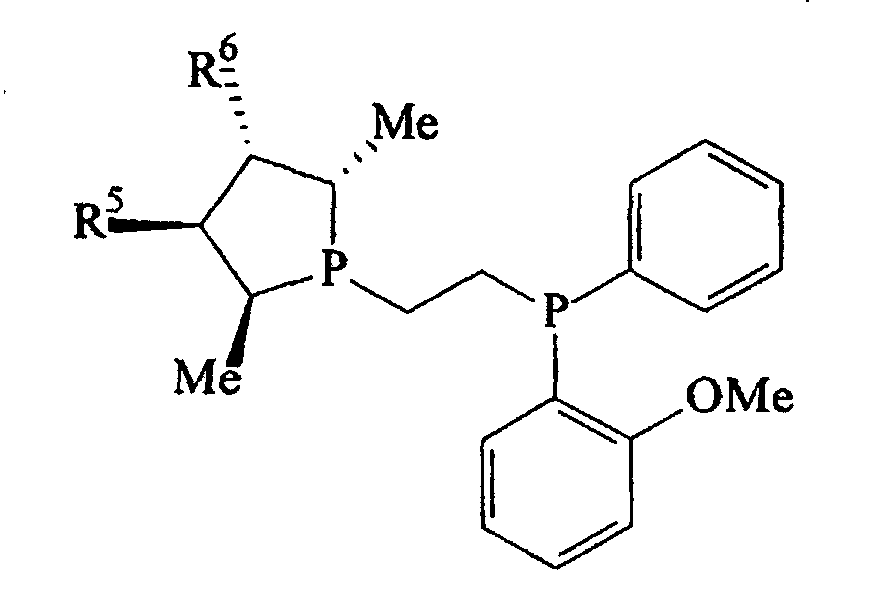
- Preferred diphosphines of the present invention have the formula wherein R 5 and R 6 , which may be the same or different, are hydrogen, hydroxy or C 1 to C 4 alkoxy.
- diphosphines can be obtained in optically pure form rather than as a mixture of isomers.
- Catalysts can be obtained from the diphosphine with a, generally low valent, metal such as rhodium, iridium, ruthenium, palladium or platinum.
- the ligand can be reacted in known manner to generate the catalyst.
- a rhodium catalyst can be obtained by reaction of the ligand with (COD) 2 RhBF 4 .
- COD is meant cyclooctadiene.
- the preparation of the catalysts from the ligand can be obtained in known manner as one of skill in the art will appreciate.
- the catalysts of the present invention are generally neutral or cationic complexes.
- Typical counterions which can be present if they are cationic include halide, for example fluoride or chloride, tetrafluoroborate, hexafluorophosphonate, hexafluoroantimonate, or sulphonate of formula R 7 SO 3 where R 7 is an aliphatic or aromatic group, or boronate of the formula (R 8 ) 4 B wherein the R 8 groups which may be the same or different are aromatic groups.
- the aromatic groups are typically phenyl groups which are optionally substituted. When R 7 is aliphatic it is typically an alkyl group, for example of 1 to 4 carbon atoms such as methyl.
- the non-symmetrical diphosphines of the present invention are generally prepared by a Michael-type addition reaction of a nucleophilic phosphorus-containing reactant with an unsaturated, preferably an ethylenically unsaturated, phosphorus-containing reactant or a cyclopropyl phosphorus-containing reactant.
- the nucleophilic phosphorus-containing reactant may be any compound of the formula R 11 R 12 PH wherein R 11 and R 12 , which may be the same or different, are aliphatic, aromatic or heteroaromatic groups attached to the phosphorus bycarbon, nitrogen, oxygen or sulfur.
- the nucleophilic phosphorus-containing reactant may also be an organometallic derivative of the formula R 11 R 12 PM which may be ionic or covalent, and in which R 11 and R 12 are as defined above and M is a suitable metal.
- the nucleophilic phosphorus-containing reactant is an enantiomerically pure phosphine and most preferably it is an enantiomerically pure phosphine borane such as ortho-anisylphenylphosphine borane.
- a phosphorus atom with electron-withdrawing substituents, attached to a double bond results in the alkene being responsive to nucleophiles.
- the unsaturated phosphorus-containing reactants suitable for use in the present invention may be oxidised phosphorus-bonded alkenes, for example diethyl vinylphosphonate, which may later be reduced to provide a primary phosphine.
- the alkene is preferably ethene or 1,3-butadiene.
- diphosphines of the present invention are typically prepared via a diphosphine intermediate comprising a primary phosphine and tertiary phosphine.
- the primary phosphine may be elaborated by reaction with a doubly electrophilic carbon moiety which can provide a source of chirality giving an enantiomerically pure product. It may be converted into a phosphorus heterocycle by reaction with a diol activated by conversion of the hydroxyl groups into leaving groups.
- the diol may be activated by, for example, conversion into a halogen derivative, sulphate, sulfonate or phosphate.
- Diols suitable for use in the present invention include C 2 to C 6 diols.
- the diols may be unsaturated or saturated and they may optionally be substituted by oxygen, nitrogen, sulfur, aliphatic, aromatic or heteroaromatic groups.
- the process of the present invention it is advantageous to convert one or both of the phosphorus atoms into, for example, oxide or sulfide derivatives, preferably borane derivatives, which may later be converted back into the desired phosphine or diphosphine.
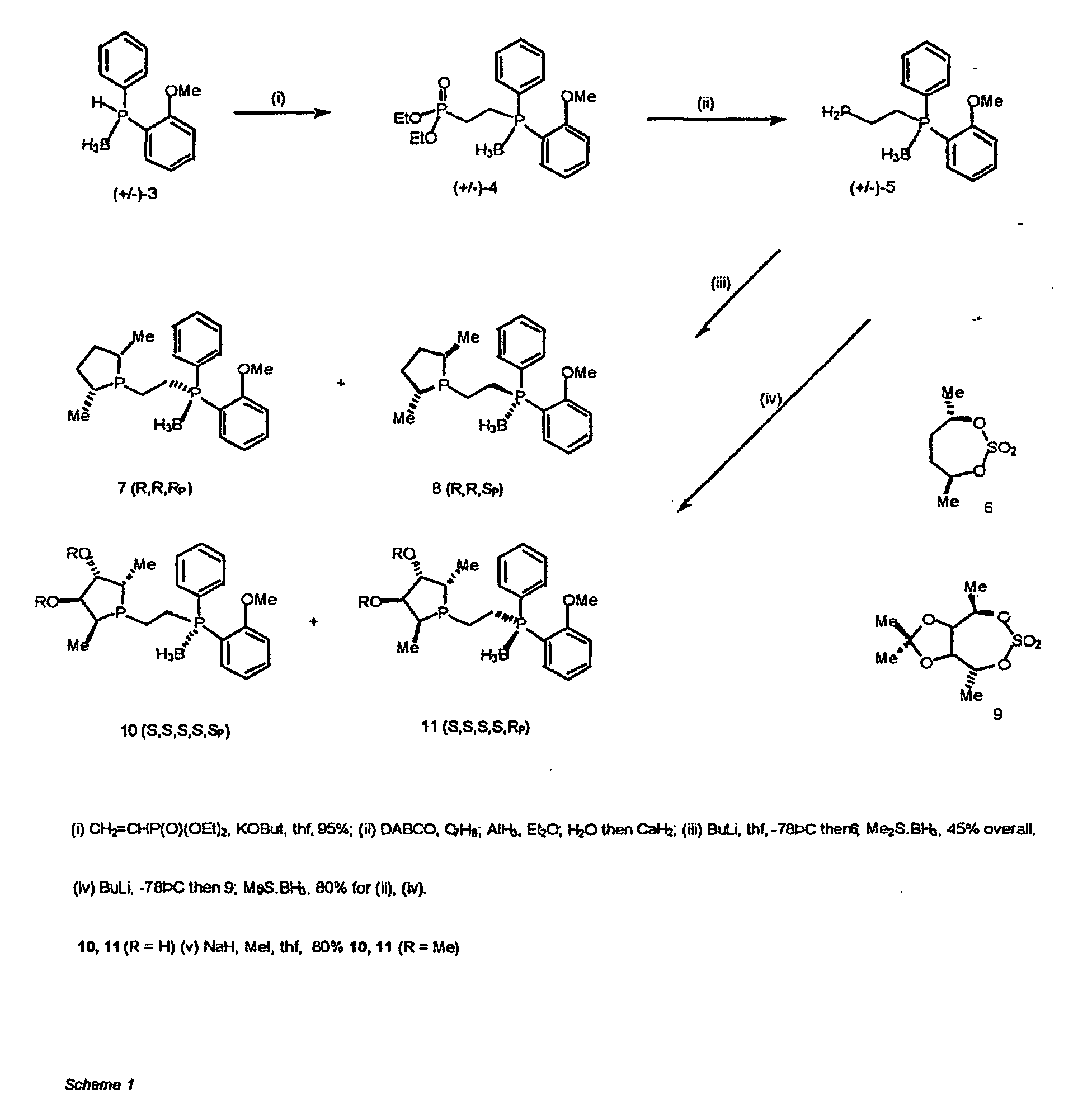
- diphosphines An example of preparation of diphosphines according to the present invention is shown in Scheme 1.
- the diphosphines produced combine the phosphorus moieties of DIPAMP ( R , R -1,2,-bis[(2-methoxyphenyl)phenylphosphino] ethane) 1 and BPE (1,2-bis[2,5-dialkyl phospholano]ethane) 2 are combined.
- the present invention also provides a process for the asymmetric conversion of a compound, wherein the catalyst is a catalyst according to the invention.
- the catalysts of the present invention may be used in the asymmetric catalytic conversion of a variety of compounds wherein a new C-B, C-Si, C-O, C-H, C-N or C-C bond is formed through the influence of the catalyst with control of the configuration at carbon.
- Such reactions include, for example, catalytic hydroboration, hydrosilylation, transfer hydrogenation, amination, cross-coupling, Heck olefination reactions, cyclopropanation, aziridination, allylic alkylation and cycloadditions.
- the catalysts are used in asymmetric hydrogenation.
- Preferred substrates for asymmetric hydrogenation include unsaturated esters such as esters of dehydroamino acids or methylenesuccinic acids. It has been found that using the catalysts of the present invention, a high enantiomer excess can be obtained from unsaturated esters under mild conditions. It is believed that a single site in the ligand directs reaction by H-bonding to the reactant and improves the enantioselectivity.
- the cyclic sulfate precursor was prepared from the known mannitol-derived diol. (M Sanière, Y le Merrer, H El Hafa, J-C Depezay, F Rocchiccioli, J. Labelled Cpd . Radiopharm ., 1991, 29 . 305.) Each compound may be obtained on ca 5g scales as a crystalline solid.
- the cyclic sulphate 9 is preferably subjected to short-column chromatography, to remove traces of an impurity suspected to be the monofunctionalised sulphate (itself isolated and characterised by nmr). Nonetheless, it can be purified by crystallisation from ether- pentane. No acid-induced cleavage of the isopropylidene protecting group appears to take place.
- Racemic 2-anisyl-phenylphosphinoethyl diethylphosphinoethyl phosphonate 4 and 2 -diarylphosphinoethyl diethylphosphonate were obtained as their borane complexes on a 10g scale in five minutes at room temperature. Alane reduction of this product gave the primary phosphine 5 .
Landscapes
- Chemical & Material Sciences (AREA)
- Organic Chemistry (AREA)
- Inorganic Chemistry (AREA)
- Engineering & Computer Science (AREA)
- Materials Engineering (AREA)
- Chemical Kinetics & Catalysis (AREA)
- Health & Medical Sciences (AREA)
- Life Sciences & Earth Sciences (AREA)
- Biochemistry (AREA)
- General Health & Medical Sciences (AREA)
- Molecular Biology (AREA)
- Organic Low-Molecular-Weight Compounds And Preparation Thereof (AREA)
- Low-Molecular Organic Synthesis Reactions Using Catalysts (AREA)
- Macromolecular Compounds Obtained By Forming Nitrogen-Containing Linkages In General (AREA)
- Catalysts (AREA)
Abstract
Description
- The present invention relates to diphosphines, a process for their preparation, metal catalysts derived from them and the use of such catalysts.
- There has been much interest in the asymmetric hydrogenation of alkenes in recent years using, in particular, rhodium catalysts derived from P-chiral diphosphines. There is a need to improve such processes so as to enhance the enantioselectivity.
- It is commonly believed that C2 symmetric diphosphines along with diols and diamines are endowed with superior properties as ligands in catalysis and this is, of course, augmented by their ease of synthesis. WO 98/02445 for example describes certain C2 symmetric diphosphines and their use for asymmetric reactions, especially as chiral ligands for catalytic asymmetric hydrogenation. M J Burk, J. Am. Chem. Soc., 113, 8518, 1991, describes certain C2 symmetric bis(phospholanes) and their use in enantioselective hydrogenation reactions. According to the present invention, we have surprisingly found that excellent results can be obtained by a novel class of unsymmetrical diphosphines.
- Accordingly the present invention provides a non-symmetrical diphosphine of the formula
- Preferably the diphosphines are 1,2- ethanes ie. the carbon chain is -(CH2)2-. Other typical Z groups include those having the chain structure -C-C=C-C and -C-C=C-.
- Generally, the substituents R1, R2, R3 and R4 will be connected to the phosphorus atoms by carbon atoms. In a preferred embodiment, R1 and R2 and/or R3 and R4 are linked together to form the substituted or unsubstituted 3,4,5,6 or 7 membered phosphorus heterocycle and preferably a phospholane ie. a five membered ring. This ring desirably has the formulawherein R5 and R6, which may be the same or different, are hydrogen, hydroxy or C1 to C4 alkoxy and R9 and R10, which may be the same or different, are hydrogen or C1 to C4 alkyl.

- It is also preferred that R1, R2, R3 and/or R4 are substituted or unsubstituted phenyl, the substituents preferably being hydroxy or C1 to C4 alkoxy groups.
- The alkyl and alkoxy groups are typically methyl and methoxy, respectively.
- It will be appreciated that although the diphosphines are non-symmetrical R1, R2, R3 and R4 may all be the same provided that the stereo orientation of R1 and R2 on the one hand, is different from that of R3 and R4. The values of R1, R2, R3 and R4 must be such that each phosphorus atom and its substituents independently form a single enantiomer.
- Preferred diphosphines of the present invention have the formulawherein R5 and R6, which may be the same or different, are hydrogen, hydroxy or C1 to C4 alkoxy.
- In accordance with another aspect of the present invention these diphosphines can be obtained in optically pure form rather than as a mixture of isomers.
- It is usually convenient if at least one of the phosphorus atoms is ligated to a borane. This enhances the storage stability of the phosphine. It will be appreciated that it is a simple matter to de-boronate when it is desired to generate the ligand. Catalysts can be obtained from the diphosphine with a, generally low valent, metal such as rhodium, iridium, ruthenium, palladium or platinum. The ligand can be reacted in known manner to generate the catalyst. For example a rhodium catalyst can be obtained by reaction of the ligand with (COD)2RhBF4. By "COD", as used herein, is meant cyclooctadiene. The preparation of the catalysts from the ligand can be obtained in known manner as one of skill in the art will appreciate.
- The catalysts of the present invention are generally neutral or cationic complexes. Typical counterions which can be present if they are cationic include halide, for example fluoride or chloride, tetrafluoroborate, hexafluorophosphonate, hexafluoroantimonate, or sulphonate of formula R7SO3 where R7 is an aliphatic or aromatic group, or boronate of the formula (R8)4B wherein the R8 groups which may be the same or different are aromatic groups. The aromatic groups are typically phenyl groups which are optionally substituted. When R7 is aliphatic it is typically an alkyl group, for example of 1 to 4 carbon atoms such as methyl.
- The non-symmetrical diphosphines of the present invention are generally prepared by a Michael-type addition reaction of a nucleophilic phosphorus-containing reactant with an unsaturated, preferably an ethylenically unsaturated, phosphorus-containing reactant or a cyclopropyl phosphorus-containing reactant.
- The nucleophilic phosphorus-containing reactant may be any compound of the formula
- Preferably the nucleophilic phosphorus-containing reactant is an enantiomerically pure phosphine and most preferably it is an enantiomerically pure phosphine borane such as ortho-anisylphenylphosphine borane.
- A phosphorus atom with electron-withdrawing substituents, attached to a double bond results in the alkene being responsive to nucleophiles. The unsaturated phosphorus-containing reactants suitable for use in the present invention may be oxidised phosphorus-bonded alkenes, for example diethyl vinylphosphonate, which may later be reduced to provide a primary phosphine. The alkene is preferably ethene or 1,3-butadiene.
- The diphosphines of the present invention are typically prepared via a diphosphine intermediate comprising a primary phosphine and tertiary phosphine.
- The primary phosphine may be elaborated by reaction with a doubly electrophilic carbon moiety which can provide a source of chirality giving an enantiomerically pure product. It may be converted into a phosphorus heterocycle by reaction with a diol activated by conversion of the hydroxyl groups into leaving groups. The diol may be activated by, for example, conversion into a halogen derivative, sulphate, sulfonate or phosphate. Diols suitable for use in the present invention include C2 to C6 diols. The diols may be unsaturated or saturated and they may optionally be substituted by oxygen, nitrogen, sulfur, aliphatic, aromatic or heteroaromatic groups.
- It will be appreciated that other substituents may be attached to the primary phosphine in an analogous manner.
- In the process of the present invention it is advantageous to convert one or both of the phosphorus atoms into, for example, oxide or sulfide derivatives, preferably borane derivatives, which may later be converted back into the desired phosphine or diphosphine.
- An example of preparation of diphosphines according to the present invention is shown in Scheme 1. In Scheme 1 the diphosphines produced combine the phosphorus moieties of DIPAMP (R, R-1,2,-bis[(2-methoxyphenyl)phenylphosphino] ethane) 1 and BPE (1,2-bis[2,5-dialkyl phospholano]ethane) 2 are combined.

- The synthesis shown in Scheme 1 is based on the conjugate addition of the racemic phosphineborane 3 to diethyl vinylphosphonate. Alane reduction of the product 4 gives the primary phosphineborane 5. Following deboronation, stepwise double nucleophilic displacement on the cyclic sulfate 6 via BuLi deprotonation gives the diphosphines 7 and 8 as a diastereomeric mixture. These compounds may be separated by MPLC (EtOAc/pentane). The analogous compounds 10-OH and 11-OH may be prepared from the mannitol derivative 9 as with a corresponding methyl ethers 10-OMe and 11-OMe.
- The present invention also provides a process for the asymmetric conversion of a compound, wherein the catalyst is a catalyst according to the invention. For example, the catalysts of the present invention may be used in the asymmetric catalytic conversion of a variety of compounds wherein a new C-B, C-Si, C-O, C-H, C-N or C-C bond is formed through the influence of the catalyst with control of the configuration at carbon. Such reactions include, for example, catalytic hydroboration, hydrosilylation, transfer hydrogenation, amination, cross-coupling, Heck olefination reactions, cyclopropanation, aziridination, allylic alkylation and cycloadditions. Preferably the catalysts are used in asymmetric hydrogenation. Preferred substrates for asymmetric hydrogenation include unsaturated esters such as esters of dehydroamino acids or methylenesuccinic acids. It has been found that using the catalysts of the present invention, a high enantiomer excess can be obtained from unsaturated esters under mild conditions. It is believed that a single site in the ligand directs reaction by H-bonding to the reactant and improves the enantioselectivity.
- The Examples which follow further illustrate the present invention.
- The cyclic sulfate precursor was prepared from the known mannitol-derived diol. (M Sanière, Y le Merrer, H El Hafa, J-C Depezay, F Rocchiccioli, J. Labelled Cpd. Radiopharm., 1991, 29. 305.) Each compound may be obtained on ca 5g scales as a crystalline solid. The cyclic sulphate 9 is preferably subjected to short-column chromatography, to remove traces of an impurity suspected to be the monofunctionalised sulphate (itself isolated and characterised by nmr). Nonetheless, it can be purified by crystallisation from ether- pentane. No acid-induced cleavage of the isopropylidene protecting group appears to take place.
- Racemic o-anisylphenylphosphine and its corresponding borane complex were prepared without difficulty by the method of Imamoto. (T Imamoto, T Oshiki, T Onozawa, T Katsumoto and K Sato, J. Am Chem. Soc., 112, 5244, 1990.) No scale- up problems were encountered and the reaction was adapted to give 40g of product without difficulty. Both PhArPH and PhArPH(BH3) (Ar= phenyl, o-anisyl) smoothly underwent KOtBu- catalysed Michael addition to diethyl vinylphosphonate. Racemic 2-anisyl-phenylphosphinoethyl diethylphosphinoethyl phosphonate 4 and 2-diarylphosphinoethyl diethylphosphonate were obtained as their borane complexes on a 10g scale in five minutes at room temperature. Alane reduction of this product gave the primary phosphine 5.
- The cyclisation to diphosphines 10-OH and 11-OH was carried out by a two-stage sequence with butyl lithium in THF. Direct hydrolysis of the crude phosphine (TMSC1-MeOH) gave the diastereomeric diols which, running much more slowly on silica in pure ether than the impurities, were easily separated by column chromatography. The faster- running diastereomer (11-OH rf= 0.25) can easily be obtained in enantiomeric excesses better than 99%.
- 2 ml of degassed dichloromethane was added to (0.105 mmol) of diphosphine borane under argon. 1.05 mmol of HBF4 was added then the solution was stirred at 20-25 °C during 14 hours. Then 41 mg (0.1 mmol) of [Rh(COD)2]BF4 was added. After being stirred for 10 minutes, the solvent was removed in vacuo and the yellow-orange residue was triturated three times with 5 ml of diethyl ether. The ether was removed via cannula filtration or syringe and the orange residue dried in vacuo. These complexes were stored in Schlenk tubes under argon. For the catalytic hydrogenation reactions the complexes were prepared just before use. 1 ml of a solution of Rhodium complex (2 mmol|1) in methanol was transferred under argon via cannula or syringe to a Schlenk tube under argon or hydrogen containing 0.2 mmol of olefin. The solution was placed under hydrogen and stirred at 20-50 °C during 2-5 hours. After evaporation of the solvent, the product was purified by chromatography on silica (methanol/dichloromethane). Enantiomeric excesses determined by NMR using Eu(hfc)3 as chiral shift reagent or by gas chromatography using a column Chrompack WCOT Fused Silica, CP-Chirasil-DEX CB, 25 meters, inlet pressure 55 kPa (8 psi). "chrompack" and "CP-Chirasil-DEX CB" are trade marks.
- The hydrogenation of dehydroamino acids of different structures is shown in Table 1. From this it will be seen that the configuration of the phosphine and of the phospholane can be "matched" or "mismatched" according to their relative configurations. For the matched cases 11-OH and 11-OMe, enantiomer excesses of up to 92% can be obtained. It will also be seen that the extent to which the two centres influence the course of catalysis may differ greatly depending on the substrate.

- The results of hydrogenation of itaconate esters and half-esters are shown in Table 2. The mismatched diastereomers of ligand 10 gave poor e.e.s and are not included. For the 1-substuted monoester 15, the hydroxy-ligand 11-OH gives a superior e.e. to its methyl ether. The reverse is true for the 4-substituted monoester 16, where the methyl ether 11-OMe provides the product of higher enantioselectivity.
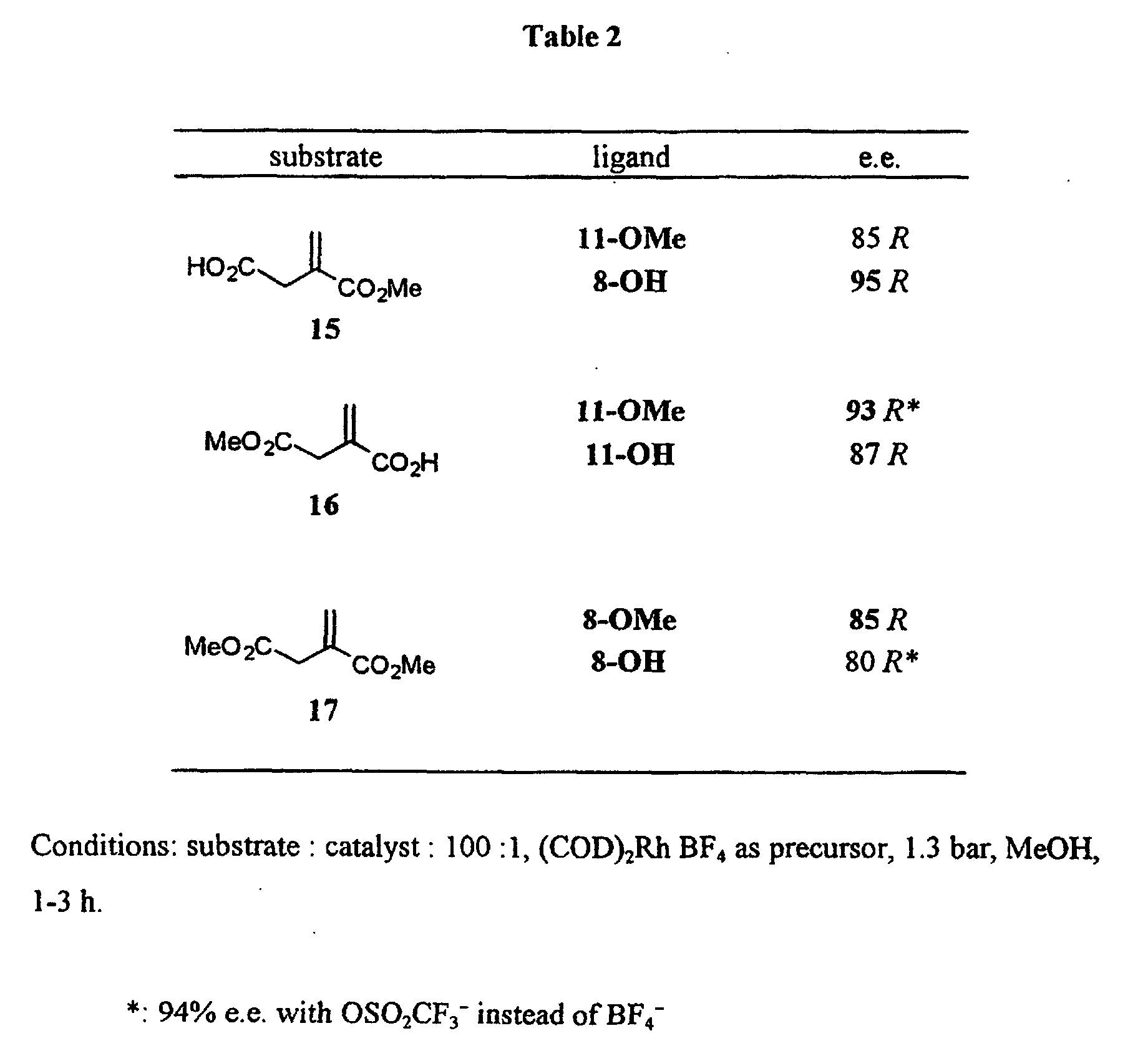
- These preliminary results indicate that, contrary to expectation, the enantioselectivity may be sensitive to a remote substituent in the phospholane ring. Inspection of molecular models suggests that the MeO- or HO- groups are axial in the 5-membered ring of the phospholane, and in the vicinity of substituents on the coordinated alkene. Hence cooperative association between ligand and substrate may exist through hydrogen-bonding.
Claims (26)
- A non-symmetrical diphosphine of the formula
R1, R2, R3 and R4, which may be the same or different, are aliphatic, aromatic or heteroaromatic groups attached to the phosphorus by carbon, nitrogen, oxygen or sulphur such that each phosphorus atom and its substituents independently form a single enantiomer. - A diphosphine according to claim 1, wherein Z represents a chain of 2 carbon atoms.
- A diphosphine according to claims 1 or 2, wherein R1 and R2 and/or R3 and R4 are linked to form a substituted or unsubstituted 3, 4, 5, 6 or 7 membered phosphorus heterocycle.
- A diphosphine according to claim 3 wherein R1 and R2 and/or R3 or R4 are linked to form a ring of the formula:wherein R3 and R6, which may be the same or different, are hydrogen, hydroxy or C1 to C4 alkoxy and R9 and R10, which may be the same or different, are hydrogen or C1 to C4 alkyl.

- A diphosphine according to any one of claims 1 to 4 wherein R1, R2, R3 and/or R4 are substituted or unsubstituted phenyl.
- A diphosphine according to claim 5 wherein the phenyl group is substituted by one or more hydroxy or C1 to C4 alkoxy groups.
- A diphosphine according to claim 1 of the formulawherein R5 and R6, which may be the same or different, are hydrogen, hydroxy or C1 to C4 alkoxy,

in the form of an optically pure isomer or a mixture of isomers. - A diphosphine according to any one of the preceding claims wherein at least one of the phosphorus atoms is substituted by borane.
- A catalyst comprising a diphosphine as claimed in any one of the preceding claims and a metal.
- A catalyst according to claim 9, wherein the metal is rhodium, iridium, ruthenium, palladium or platinum.
- A catalyst according to claim 9 or 10, wherein the catalyst is neutral or cationic.
- A cationic catalyst according to claim 11, wherein the counterion is halide, tetrafluoroborate, hexafluorophosphate, hexafluoroantimonate, sulfonate of the formula R7SO3, wherein R7 is an aliphatic or aromatic group, or boronate of the formula (R8)4B, wherein the groups R8, which may be the same or different, are aromatic groups.
- A process for preparing a diphosphine as defined in any one of claims 1 to 8, which process comprises reacting a nucleophilic phosphorus-containing reactant with an unsaturated phosphorus containing reactant or a cyclopropyl phosphorus containing reactant.
- A process according to claim 13, wherein the nucleophilic phosphorus-containing reactant is an enantiomerically pure phosphine.
- A process according to claim 14, wherein the phosphine is ligated to a borane.
- A process according to claim 15, wherein the enantiomerically pure phosphine is ortho-anisylphenylphosphine ligated to borane.
- A process according to any one of claims 13 to 16, wherein the unsaturated phosphorus containing reactant is an oxidised phosphorus-bonded alkene.
- A process according to claim 17, wherein the alkene is ethene or 1,3-butadiene.
- A process according to any one of claims 13 to 18, wherein a diphosphine intermediate comprising a primary phosphine and a tertiary phosphine is produced.
- A process according to claim 19, wherein the primary phosphine is converted into a phosphorus heterocycle.
- A process according to claim 20, wherein the phosphorus heterocycle is formed by reaction of the primary phosphine with an enantiomerically pure diol activated by conversion of the hydroxyl groups into leaving groups.
- A process according to claim 21, wherein the diol is activated by conversion into a halogen derivative, sulphate, sulfonate or phosphate.
- A process according to claim 21 or 22, wherein the diol is mannitol.
- A process for the asymmetric catalytic conversion of a compound, wherein the catalyst is one claimed in any one of claims 9 to 12.
- A process according to claim 24, wherein the compound is asymmetrically hydrogenated.
- A process according to claim 24 or 25, wherein the compound is an unsaturated ester.
Applications Claiming Priority (3)
| Application Number | Priority Date | Filing Date | Title |
|---|---|---|---|
| GBGB9823716.7A GB9823716D0 (en) | 1998-10-29 | 1998-10-29 | Diphosphines |
| GB9823716 | 1998-10-29 | ||
| PCT/GB1999/003599 WO2000026220A1 (en) | 1998-10-29 | 1999-10-29 | Diphosphines |
Publications (2)
| Publication Number | Publication Date |
|---|---|
| EP1124833A1 EP1124833A1 (en) | 2001-08-22 |
| EP1124833B1 true EP1124833B1 (en) | 2003-01-08 |
Family
ID=10841529
Family Applications (1)
| Application Number | Title | Priority Date | Filing Date |
|---|---|---|---|
| EP99954113A Expired - Lifetime EP1124833B1 (en) | 1998-10-29 | 1999-10-29 | Diphosphines |
Country Status (11)
| Country | Link |
|---|---|
| US (2) | US6706926B1 (en) |
| EP (1) | EP1124833B1 (en) |
| JP (1) | JP2002529374A (en) |
| AT (1) | ATE230755T1 (en) |
| AU (1) | AU773813B2 (en) |
| CA (1) | CA2348595A1 (en) |
| DE (1) | DE69904855T2 (en) |
| DK (1) | DK1124833T3 (en) |
| ES (1) | ES2190265T3 (en) |
| GB (1) | GB9823716D0 (en) |
| WO (1) | WO2000026220A1 (en) |
Families Citing this family (12)
| Publication number | Priority date | Publication date | Assignee | Title |
|---|---|---|---|---|
| GB9823716D0 (en) * | 1998-10-29 | 1998-12-23 | Isis Innovation | Diphosphines |
| US7012162B2 (en) | 2000-06-26 | 2006-03-14 | Basf Aktiengesellschaft | Phosphacyclohexanes and the use thereof in the hydroformylation of olefins |
| JP3537749B2 (en) | 2000-08-25 | 2004-06-14 | 独立行政法人 科学技術振興機構 | Optically active phosphorus compound |
| MXPA02001147A (en) | 2001-03-19 | 2004-04-21 | Warner Lambert Co | Synthesis of non-c2-symmetric bisphosphine ligands as catalysts for asymmetric hydrogenation. |
| US8828902B2 (en) | 2001-07-12 | 2014-09-09 | Reaxa Limited | Microencapsulated catalyst methods of preparation and method of use thereof |
| JP4226847B2 (en) | 2001-07-24 | 2009-02-18 | 高砂香料工業株式会社 | A method for producing optically active amides from α, β-unsaturated amide derivatives in the presence of a transition metal complex containing a phosphine-phosphorane compound and a transition metal. |
| JP4005801B2 (en) | 2001-12-10 | 2007-11-14 | 高砂香料工業株式会社 | Novel phosphine ligand |
| JP4005800B2 (en) | 2001-12-10 | 2007-11-14 | 高砂香料工業株式会社 | Novel asymmetric phosphine ligand |
| EP1622918B1 (en) | 2003-05-09 | 2010-03-24 | Solvias AG | Phospholane salts and their use in enantioselective hydrogenation |
| EP1765763A2 (en) * | 2004-07-07 | 2007-03-28 | Basf Aktiengesellschaft | Method for the production of optically active alkyl succinic acid monoalkyl esters |
| US7932239B2 (en) | 2005-04-28 | 2011-04-26 | Wisconsin Alumni Research Foundation | Methods of and compositions for reducing neuronal cell death |
| JP6477128B2 (en) * | 2015-03-26 | 2019-03-06 | 三菱ケミカル株式会社 | Catalyst composition |
Family Cites Families (11)
| Publication number | Priority date | Publication date | Assignee | Title |
|---|---|---|---|---|
| US4008281A (en) | 1973-12-03 | 1977-02-15 | Monsanto Company | Asymmetric catalysis |
| NL7609339A (en) | 1975-08-25 | 1977-03-01 | Monsanto Co | METHOD FOR CATALYTIC ASYMMETRIC HYDROGENATION. |
| NL7609340A (en) | 1975-08-25 | 1977-03-01 | Monsanto Co | PROCEDURE FOR ASYMMETRIC HYDROGENATION. |
| NL7609342A (en) | 1975-08-25 | 1977-03-01 | Monsanto Co | PROCEDURE FOR ASYMMETRIC HYDROGENATION. |
| GB2101601B (en) * | 1981-05-28 | 1985-10-02 | Johnson Matthey Plc | Bisphosphine synthesis |
| US5008457A (en) | 1990-05-17 | 1991-04-16 | E. I. Du Pont De Nemours And Company | Chiral phospholane transition metal catalysts |
| ZA976251B (en) * | 1996-07-15 | 1998-07-15 | Chiroscience Ltd | Ligands for asymmetric catalysis |
| DE69800968T2 (en) * | 1997-04-07 | 2002-03-28 | Dsm N.V., Heerlen | CATALYST SYSTEM FOR CARBONILATION |
| DE19725796A1 (en) * | 1997-06-18 | 1998-12-24 | Basf Ag | Production of optically active phospholanes, their metal complexes and use in asymmetric synthesis |
| US6545183B1 (en) | 1997-11-07 | 2003-04-08 | Chirotech Technology Limited | Process for preparing cyclic phosphines |
| GB9823716D0 (en) * | 1998-10-29 | 1998-12-23 | Isis Innovation | Diphosphines |
-
1998
- 1998-10-29 GB GBGB9823716.7A patent/GB9823716D0/en not_active Ceased
-
1999
- 1999-10-29 JP JP2000579608A patent/JP2002529374A/en not_active Withdrawn
- 1999-10-29 WO PCT/GB1999/003599 patent/WO2000026220A1/en not_active Ceased
- 1999-10-29 AT AT99954113T patent/ATE230755T1/en not_active IP Right Cessation
- 1999-10-29 US US09/830,268 patent/US6706926B1/en not_active Expired - Fee Related
- 1999-10-29 EP EP99954113A patent/EP1124833B1/en not_active Expired - Lifetime
- 1999-10-29 AU AU10553/00A patent/AU773813B2/en not_active Ceased
- 1999-10-29 DE DE69904855T patent/DE69904855T2/en not_active Expired - Fee Related
- 1999-10-29 CA CA002348595A patent/CA2348595A1/en not_active Abandoned
- 1999-10-29 ES ES99954113T patent/ES2190265T3/en not_active Expired - Lifetime
- 1999-10-29 DK DK99954113T patent/DK1124833T3/en active
-
2003
- 2003-12-17 US US10/738,749 patent/US20040133042A1/en not_active Abandoned
Also Published As
| Publication number | Publication date |
|---|---|
| US20040133042A1 (en) | 2004-07-08 |
| AU773813B2 (en) | 2004-06-10 |
| ES2190265T3 (en) | 2003-07-16 |
| AU1055300A (en) | 2000-05-22 |
| CA2348595A1 (en) | 2000-05-11 |
| ATE230755T1 (en) | 2003-01-15 |
| DE69904855D1 (en) | 2003-02-13 |
| DE69904855T2 (en) | 2003-04-30 |
| EP1124833A1 (en) | 2001-08-22 |
| GB9823716D0 (en) | 1998-12-23 |
| US6706926B1 (en) | 2004-03-16 |
| WO2000026220A1 (en) | 2000-05-11 |
| JP2002529374A (en) | 2002-09-10 |
| DK1124833T3 (en) | 2003-02-24 |
Similar Documents
| Publication | Publication Date | Title |
|---|---|---|
| JP4244212B2 (en) | C, P chiral phosphine bidentate ligand | |
| EP0592552B1 (en) | Chiral phospholanes via chiral 1,4-diol cyclic sulfates | |
| EP0918781B1 (en) | Asymmetric synthesis catalyzed by transition metal complexes with cyclic chiral phosphine ligands | |
| Burgess et al. | Stereochemically matched (and mismatched) bisphosphine ligands: DIOP-DIPAMP hybrids | |
| EP0667350B1 (en) | Water-soluble phosphine-derivatives | |
| US20120190806A1 (en) | Phosphine Borane Compounds Comprising Imidazol Groups And Method For Producing Phosphine Borane Compounds Comprising Imidazol Groups | |
| AU773813B2 (en) | Diphosphines | |
| CA2715225A1 (en) | Imidazole group-containing phosphorus compounds | |
| EP1276745B1 (en) | Ruthenium-diphosphine complexes and their use as catalysts | |
| US6337406B1 (en) | Asymmetric catalysis based on chiral phospholanes and hydroxyl phospholanes | |
| JPS60243093A (en) | Rhodium-diphosphine complex and manufacture | |
| CA2559242A1 (en) | Cycloolefin phosphine ligands and their use in catalysis | |
| MXPA04002943A (en) | Novel disphospines, their complexes with transition metals and their use in asymmetric synthesis. | |
| WO2000011008A1 (en) | Asymmetric catalysis based on chiral phospholanes | |
| TWI517899B (en) | Biaryl diphosphine ligands, intermediates of the same and their use in asymmetric catalysis | |
| US6727377B2 (en) | Asymmetric catalysis based on chiral phospholanes and hydroxyl phospholanes | |
| EP1355912B1 (en) | Ligands and their use | |
| US7411096B2 (en) | Process for producing optically active phosphorus heterocyclic dimer | |
| US5929273A (en) | Process for preparing diphospines ligands and catalysts containing the same | |
| US6043398A (en) | Chemical processes using aryl diphosphine containing catalysts | |
| EP2094624A1 (en) | Assymmetric hydrogeneration of prochiral compounds |
Legal Events
| Date | Code | Title | Description |
|---|---|---|---|
| PUAI | Public reference made under article 153(3) epc to a published international application that has entered the european phase |
Free format text: ORIGINAL CODE: 0009012 |
|
| 17P | Request for examination filed |
Effective date: 20010426 |
|
| AK | Designated contracting states |
Kind code of ref document: A1 Designated state(s): AT BE CH CY DE DK ES FI FR GB GR IE IT LI LU MC NL PT SE |
|
| AX | Request for extension of the european patent |
Free format text: AL;LT;LV;MK;RO;SI |
|
| 17Q | First examination report despatched |
Effective date: 20010927 |
|
| GRAG | Despatch of communication of intention to grant |
Free format text: ORIGINAL CODE: EPIDOS AGRA |
|
| GRAG | Despatch of communication of intention to grant |
Free format text: ORIGINAL CODE: EPIDOS AGRA |
|
| GRAH | Despatch of communication of intention to grant a patent |
Free format text: ORIGINAL CODE: EPIDOS IGRA |
|
| GRAH | Despatch of communication of intention to grant a patent |
Free format text: ORIGINAL CODE: EPIDOS IGRA |
|
| GRAA | (expected) grant |
Free format text: ORIGINAL CODE: 0009210 |
|
| AK | Designated contracting states |
Kind code of ref document: B1 Designated state(s): AT BE CH CY DE DK ES FI FR GB GR IE IT LI LU MC NL PT SE |
|
| REF | Corresponds to: |
Ref document number: 230755 Country of ref document: AT Date of ref document: 20030115 Kind code of ref document: T |
|
| REG | Reference to a national code |
Ref country code: GB Ref legal event code: FG4D |
|
| REG | Reference to a national code |
Ref country code: CH Ref legal event code: EP |
|
| REG | Reference to a national code |
Ref country code: IE Ref legal event code: FG4D |
|
| REF | Corresponds to: |
Ref document number: 69904855 Country of ref document: DE Date of ref document: 20030213 Kind code of ref document: P |
|
| REG | Reference to a national code |
Ref country code: DK Ref legal event code: T3 |
|
| REG | Reference to a national code |
Ref country code: CH Ref legal event code: NV Representative=s name: PATENTANWAELTE SCHAAD, BALASS, MENZL & PARTNER AG |
|
| REG | Reference to a national code |
Ref country code: GR Ref legal event code: EP Ref document number: 20030401090 Country of ref document: GR |
|
| LTIE | Lt: invalidation of european patent or patent extension |
Effective date: 20030108 |
|
| REG | Reference to a national code |
Ref country code: ES Ref legal event code: FG2A Ref document number: 2190265 Country of ref document: ES Kind code of ref document: T3 |
|
| ET | Fr: translation filed | ||
| PG25 | Lapsed in a contracting state [announced via postgrant information from national office to epo] |
Ref country code: LU Free format text: LAPSE BECAUSE OF NON-PAYMENT OF DUE FEES Effective date: 20031029 Ref country code: CY Free format text: LAPSE BECAUSE OF FAILURE TO SUBMIT A TRANSLATION OF THE DESCRIPTION OR TO PAY THE FEE WITHIN THE PRESCRIBED TIME-LIMIT Effective date: 20031029 |
|
| PG25 | Lapsed in a contracting state [announced via postgrant information from national office to epo] |
Ref country code: MC Free format text: LAPSE BECAUSE OF NON-PAYMENT OF DUE FEES Effective date: 20031031 |
|
| PLBE | No opposition filed within time limit |
Free format text: ORIGINAL CODE: 0009261 |
|
| STAA | Information on the status of an ep patent application or granted ep patent |
Free format text: STATUS: NO OPPOSITION FILED WITHIN TIME LIMIT |
|
| 26N | No opposition filed |
Effective date: 20031009 |
|
| PGFP | Annual fee paid to national office [announced via postgrant information from national office to epo] |
Ref country code: ES Payment date: 20051014 Year of fee payment: 7 |
|
| PGFP | Annual fee paid to national office [announced via postgrant information from national office to epo] |
Ref country code: GB Payment date: 20051017 Year of fee payment: 7 |
|
| PGFP | Annual fee paid to national office [announced via postgrant information from national office to epo] |
Ref country code: NL Payment date: 20051018 Year of fee payment: 7 |
|
| PGFP | Annual fee paid to national office [announced via postgrant information from national office to epo] |
Ref country code: FR Payment date: 20051019 Year of fee payment: 7 |
|
| PGFP | Annual fee paid to national office [announced via postgrant information from national office to epo] |
Ref country code: IE Payment date: 20051020 Year of fee payment: 7 |
|
| PGFP | Annual fee paid to national office [announced via postgrant information from national office to epo] |
Ref country code: FI Payment date: 20051021 Year of fee payment: 7 |
|
| PGFP | Annual fee paid to national office [announced via postgrant information from national office to epo] |
Ref country code: SE Payment date: 20051024 Year of fee payment: 7 Ref country code: GR Payment date: 20051024 Year of fee payment: 7 Ref country code: CH Payment date: 20051024 Year of fee payment: 7 Ref country code: BE Payment date: 20051024 Year of fee payment: 7 Ref country code: AT Payment date: 20051024 Year of fee payment: 7 |
|
| PGFP | Annual fee paid to national office [announced via postgrant information from national office to epo] |
Ref country code: DK Payment date: 20051026 Year of fee payment: 7 |
|
| PGFP | Annual fee paid to national office [announced via postgrant information from national office to epo] |
Ref country code: PT Payment date: 20051028 Year of fee payment: 7 |
|
| PGFP | Annual fee paid to national office [announced via postgrant information from national office to epo] |
Ref country code: DE Payment date: 20051222 Year of fee payment: 7 |
|
| PG25 | Lapsed in a contracting state [announced via postgrant information from national office to epo] |
Ref country code: FI Free format text: LAPSE BECAUSE OF NON-PAYMENT OF DUE FEES Effective date: 20061029 Ref country code: AT Free format text: LAPSE BECAUSE OF NON-PAYMENT OF DUE FEES Effective date: 20061029 |
|
| PG25 | Lapsed in a contracting state [announced via postgrant information from national office to epo] |
Ref country code: SE Free format text: LAPSE BECAUSE OF NON-PAYMENT OF DUE FEES Effective date: 20061030 Ref country code: IE Free format text: LAPSE BECAUSE OF NON-PAYMENT OF DUE FEES Effective date: 20061030 |
|
| PG25 | Lapsed in a contracting state [announced via postgrant information from national office to epo] |
Ref country code: LI Free format text: LAPSE BECAUSE OF NON-PAYMENT OF DUE FEES Effective date: 20061031 Ref country code: DK Free format text: LAPSE BECAUSE OF NON-PAYMENT OF DUE FEES Effective date: 20061031 Ref country code: CH Free format text: LAPSE BECAUSE OF NON-PAYMENT OF DUE FEES Effective date: 20061031 |
|
| PGFP | Annual fee paid to national office [announced via postgrant information from national office to epo] |
Ref country code: IT Payment date: 20061031 Year of fee payment: 8 |
|
| PG25 | Lapsed in a contracting state [announced via postgrant information from national office to epo] |
Ref country code: PT Free format text: LAPSE BECAUSE OF NON-PAYMENT OF DUE FEES Effective date: 20070430 |
|
| PG25 | Lapsed in a contracting state [announced via postgrant information from national office to epo] |
Ref country code: NL Free format text: LAPSE BECAUSE OF NON-PAYMENT OF DUE FEES Effective date: 20070501 Ref country code: DE Free format text: LAPSE BECAUSE OF NON-PAYMENT OF DUE FEES Effective date: 20070501 |
|
| REG | Reference to a national code |
Ref country code: PT Ref legal event code: MM4A Free format text: LAPSE DUE TO NON-PAYMENT OF FEES Effective date: 20070430 |
|
| REG | Reference to a national code |
Ref country code: CH Ref legal event code: PL |
|
| EUG | Se: european patent has lapsed | ||
| GBPC | Gb: european patent ceased through non-payment of renewal fee |
Effective date: 20061029 |
|
| NLV4 | Nl: lapsed or anulled due to non-payment of the annual fee |
Effective date: 20070501 |
|
| REG | Reference to a national code |
Ref country code: IE Ref legal event code: MM4A |
|
| REG | Reference to a national code |
Ref country code: FR Ref legal event code: ST Effective date: 20070629 |
|
| PG25 | Lapsed in a contracting state [announced via postgrant information from national office to epo] |
Ref country code: GB Free format text: LAPSE BECAUSE OF NON-PAYMENT OF DUE FEES Effective date: 20061029 |
|
| BERE | Be: lapsed |
Owner name: *ISIS INNOVATION LTD Effective date: 20061031 |
|
| REG | Reference to a national code |
Ref country code: ES Ref legal event code: FD2A Effective date: 20061030 |
|
| PG25 | Lapsed in a contracting state [announced via postgrant information from national office to epo] |
Ref country code: FR Free format text: LAPSE BECAUSE OF NON-PAYMENT OF DUE FEES Effective date: 20061031 Ref country code: ES Free format text: LAPSE BECAUSE OF NON-PAYMENT OF DUE FEES Effective date: 20061030 |
|
| PG25 | Lapsed in a contracting state [announced via postgrant information from national office to epo] |
Ref country code: GR Free format text: LAPSE BECAUSE OF NON-PAYMENT OF DUE FEES Effective date: 20070503 |
|
| PG25 | Lapsed in a contracting state [announced via postgrant information from national office to epo] |
Ref country code: IT Free format text: LAPSE BECAUSE OF NON-PAYMENT OF DUE FEES Effective date: 20071029 Ref country code: BE Free format text: LAPSE BECAUSE OF FAILURE TO SUBMIT A TRANSLATION OF THE DESCRIPTION OR TO PAY THE FEE WITHIN THE PRESCRIBED TIME-LIMIT Effective date: 20061031 |