EP1124693B1 - Silica dispersion, coating composition and recording medium - Google Patents
Silica dispersion, coating composition and recording medium Download PDFInfo
- Publication number
- EP1124693B1 EP1124693B1 EP99950080A EP99950080A EP1124693B1 EP 1124693 B1 EP1124693 B1 EP 1124693B1 EP 99950080 A EP99950080 A EP 99950080A EP 99950080 A EP99950080 A EP 99950080A EP 1124693 B1 EP1124693 B1 EP 1124693B1
- Authority
- EP
- European Patent Office
- Prior art keywords
- dispersion
- recording medium
- silica
- aluminum
- particles
- Prior art date
- Legal status (The legal status is an assumption and is not a legal conclusion. Google has not performed a legal analysis and makes no representation as to the accuracy of the status listed.)
- Expired - Lifetime
Links
- VYPSYNLAJGMNEJ-UHFFFAOYSA-N Silicium dioxide Chemical compound O=[Si]=O VYPSYNLAJGMNEJ-UHFFFAOYSA-N 0.000 title claims description 361
- 239000008199 coating composition Substances 0.000 title claims description 35
- 239000006185 dispersion Substances 0.000 claims description 163
- 239000000377 silicon dioxide Substances 0.000 claims description 139
- 125000002091 cationic group Chemical group 0.000 claims description 124
- 239000011248 coating agent Substances 0.000 claims description 96
- 238000000576 coating method Methods 0.000 claims description 96
- -1 aluminum compound Chemical class 0.000 claims description 76
- 229910052782 aluminium Inorganic materials 0.000 claims description 74
- 238000000034 method Methods 0.000 claims description 59
- 239000002245 particle Substances 0.000 claims description 52
- XLYOFNOQVPJJNP-UHFFFAOYSA-N water Substances O XLYOFNOQVPJJNP-UHFFFAOYSA-N 0.000 claims description 40
- 239000000758 substrate Substances 0.000 claims description 38
- 239000000725 suspension Substances 0.000 claims description 37
- 239000000203 mixture Substances 0.000 claims description 34
- 238000002360 preparation method Methods 0.000 claims description 27
- 229910021485 fumed silica Inorganic materials 0.000 claims description 26
- XAGFODPZIPBFFR-UHFFFAOYSA-N aluminium Chemical compound [Al] XAGFODPZIPBFFR-UHFFFAOYSA-N 0.000 claims description 24
- 239000011230 binding agent Substances 0.000 claims description 19
- 238000001035 drying Methods 0.000 claims description 16
- LVYZJEPLMYTTGH-UHFFFAOYSA-H dialuminum chloride pentahydroxide dihydrate Chemical group [Cl-].[Al+3].[OH-].[OH-].[Al+3].[OH-].[OH-].[OH-].O.O LVYZJEPLMYTTGH-UHFFFAOYSA-H 0.000 claims description 15
- VSCWAEJMTAWNJL-UHFFFAOYSA-K aluminium trichloride Chemical class Cl[Al](Cl)Cl VSCWAEJMTAWNJL-UHFFFAOYSA-K 0.000 claims description 10
- JLDSOYXADOWAKB-UHFFFAOYSA-N aluminium nitrate Chemical class [Al+3].[O-][N+]([O-])=O.[O-][N+]([O-])=O.[O-][N+]([O-])=O JLDSOYXADOWAKB-UHFFFAOYSA-N 0.000 claims description 9
- 239000007900 aqueous suspension Substances 0.000 claims description 6
- 238000003490 calendering Methods 0.000 claims description 6
- QSHDDOUJBYECFT-UHFFFAOYSA-N mercury Chemical compound [Hg] QSHDDOUJBYECFT-UHFFFAOYSA-N 0.000 claims description 6
- 229910052753 mercury Inorganic materials 0.000 claims description 6
- 229920000642 polymer Polymers 0.000 claims description 6
- 239000001913 cellulose Substances 0.000 claims description 4
- 229920002678 cellulose Polymers 0.000 claims description 4
- 229920000139 polyethylene terephthalate Polymers 0.000 claims description 3
- 239000005020 polyethylene terephthalate Substances 0.000 claims 2
- 239000002609 medium Substances 0.000 description 76
- 239000007788 liquid Substances 0.000 description 25
- 239000008367 deionised water Substances 0.000 description 18
- 229910021641 deionized water Inorganic materials 0.000 description 18
- 239000000976 ink Substances 0.000 description 18
- 239000000975 dye Substances 0.000 description 17
- 239000007787 solid Substances 0.000 description 17
- 238000010521 absorption reaction Methods 0.000 description 16
- AZDRQVAHHNSJOQ-UHFFFAOYSA-N alumane Chemical class [AlH3] AZDRQVAHHNSJOQ-UHFFFAOYSA-N 0.000 description 16
- 230000003287 optical effect Effects 0.000 description 16
- 239000000049 pigment Substances 0.000 description 16
- 239000008119 colloidal silica Substances 0.000 description 15
- 239000011164 primary particle Substances 0.000 description 11
- 239000000243 solution Substances 0.000 description 11
- 238000012360 testing method Methods 0.000 description 10
- 229920002451 polyvinyl alcohol Polymers 0.000 description 9
- 229920005989 resin Polymers 0.000 description 9
- 239000011347 resin Substances 0.000 description 9
- 239000004372 Polyvinyl alcohol Substances 0.000 description 8
- 239000010410 layer Substances 0.000 description 8
- RMAQACBXLXPBSY-UHFFFAOYSA-N silicic acid Chemical compound O[Si](O)(O)O RMAQACBXLXPBSY-UHFFFAOYSA-N 0.000 description 8
- QGZKDVFQNNGYKY-UHFFFAOYSA-N Ammonia Chemical compound N QGZKDVFQNNGYKY-UHFFFAOYSA-N 0.000 description 6
- 150000003839 salts Chemical class 0.000 description 6
- 238000013019 agitation Methods 0.000 description 5
- PNEYBMLMFCGWSK-UHFFFAOYSA-N aluminium oxide Inorganic materials [O-2].[O-2].[O-2].[Al+3].[Al+3] PNEYBMLMFCGWSK-UHFFFAOYSA-N 0.000 description 5
- 125000000129 anionic group Chemical group 0.000 description 5
- VEXZGXHMUGYJMC-UHFFFAOYSA-N Hydrochloric acid Chemical compound Cl VEXZGXHMUGYJMC-UHFFFAOYSA-N 0.000 description 4
- 239000004411 aluminium Substances 0.000 description 4
- 238000013459 approach Methods 0.000 description 4
- VTYYLEPIZMXCLO-UHFFFAOYSA-L calcium carbonate Substances [Ca+2].[O-]C([O-])=O VTYYLEPIZMXCLO-UHFFFAOYSA-L 0.000 description 4
- 239000003795 chemical substances by application Substances 0.000 description 4
- 230000000052 comparative effect Effects 0.000 description 4
- 229920001577 copolymer Polymers 0.000 description 4
- 239000003792 electrolyte Substances 0.000 description 4
- 230000003100 immobilizing effect Effects 0.000 description 4
- 238000004519 manufacturing process Methods 0.000 description 4
- 229910052751 metal Inorganic materials 0.000 description 4
- 239000002184 metal Substances 0.000 description 4
- 239000004094 surface-active agent Substances 0.000 description 4
- BVKZGUZCCUSVTD-UHFFFAOYSA-M Bicarbonate Chemical compound OC([O-])=O BVKZGUZCCUSVTD-UHFFFAOYSA-M 0.000 description 3
- OKKJLVBELUTLKV-UHFFFAOYSA-N Methanol Chemical compound OC OKKJLVBELUTLKV-UHFFFAOYSA-N 0.000 description 3
- HEMHJVSKTPXQMS-UHFFFAOYSA-M Sodium hydroxide Chemical compound [OH-].[Na+] HEMHJVSKTPXQMS-UHFFFAOYSA-M 0.000 description 3
- 229920001807 Urea-formaldehyde Polymers 0.000 description 3
- 239000002253 acid Substances 0.000 description 3
- NIXOWILDQLNWCW-UHFFFAOYSA-N acrylic acid group Chemical group C(C=C)(=O)O NIXOWILDQLNWCW-UHFFFAOYSA-N 0.000 description 3
- 229910021529 ammonia Inorganic materials 0.000 description 3
- 239000007864 aqueous solution Substances 0.000 description 3
- 239000002585 base Substances 0.000 description 3
- KRKNYBCHXYNGOX-UHFFFAOYSA-N citric acid Chemical compound OC(=O)CC(O)(C(O)=O)CC(O)=O KRKNYBCHXYNGOX-UHFFFAOYSA-N 0.000 description 3
- 239000000470 constituent Substances 0.000 description 3
- 230000007423 decrease Effects 0.000 description 3
- 239000012153 distilled water Substances 0.000 description 3
- 125000000524 functional group Chemical group 0.000 description 3
- 239000000463 material Substances 0.000 description 3
- 150000002739 metals Chemical class 0.000 description 3
- 238000002156 mixing Methods 0.000 description 3
- 229920001225 polyester resin Polymers 0.000 description 3
- 239000004645 polyester resin Substances 0.000 description 3
- 239000002952 polymeric resin Substances 0.000 description 3
- 238000007639 printing Methods 0.000 description 3
- 230000000717 retained effect Effects 0.000 description 3
- 239000000126 substance Substances 0.000 description 3
- 229920003002 synthetic resin Polymers 0.000 description 3
- 239000011800 void material Substances 0.000 description 3
- NWUYHJFMYQTDRP-UHFFFAOYSA-N 1,2-bis(ethenyl)benzene;1-ethenyl-2-ethylbenzene;styrene Chemical compound C=CC1=CC=CC=C1.CCC1=CC=CC=C1C=C.C=CC1=CC=CC=C1C=C NWUYHJFMYQTDRP-UHFFFAOYSA-N 0.000 description 2
- CSCPPACGZOOCGX-UHFFFAOYSA-N Acetone Chemical compound CC(C)=O CSCPPACGZOOCGX-UHFFFAOYSA-N 0.000 description 2
- 239000005995 Aluminium silicate Substances 0.000 description 2
- 229920002134 Carboxymethyl cellulose Polymers 0.000 description 2
- LFQSCWFLJHTTHZ-UHFFFAOYSA-N Ethanol Chemical compound CCO LFQSCWFLJHTTHZ-UHFFFAOYSA-N 0.000 description 2
- 239000004640 Melamine resin Substances 0.000 description 2
- 229920000877 Melamine resin Polymers 0.000 description 2
- MHABMANUFPZXEB-UHFFFAOYSA-N O-demethyl-aloesaponarin I Natural products O=C1C2=CC=CC(O)=C2C(=O)C2=C1C=C(O)C(C(O)=O)=C2C MHABMANUFPZXEB-UHFFFAOYSA-N 0.000 description 2
- NBIIXXVUZAFLBC-UHFFFAOYSA-N Phosphoric acid Chemical compound OP(O)(O)=O NBIIXXVUZAFLBC-UHFFFAOYSA-N 0.000 description 2
- 239000004698 Polyethylene Substances 0.000 description 2
- CDBYLPFSWZWCQE-UHFFFAOYSA-L Sodium Carbonate Chemical compound [Na+].[Na+].[O-]C([O-])=O CDBYLPFSWZWCQE-UHFFFAOYSA-L 0.000 description 2
- QAOWNCQODCNURD-UHFFFAOYSA-N Sulfuric acid Chemical compound OS(O)(=O)=O QAOWNCQODCNURD-UHFFFAOYSA-N 0.000 description 2
- GWEVSGVZZGPLCZ-UHFFFAOYSA-N Titan oxide Chemical compound O=[Ti]=O GWEVSGVZZGPLCZ-UHFFFAOYSA-N 0.000 description 2
- XLOMVQKBTHCTTD-UHFFFAOYSA-N Zinc monoxide Chemical compound [Zn]=O XLOMVQKBTHCTTD-UHFFFAOYSA-N 0.000 description 2
- 239000000654 additive Substances 0.000 description 2
- 150000001298 alcohols Chemical class 0.000 description 2
- 235000012211 aluminium silicate Nutrition 0.000 description 2
- TZCXTZWJZNENPQ-UHFFFAOYSA-L barium sulfate Chemical compound [Ba+2].[O-]S([O-])(=O)=O TZCXTZWJZNENPQ-UHFFFAOYSA-L 0.000 description 2
- 235000010216 calcium carbonate Nutrition 0.000 description 2
- OSGAYBCDTDRGGQ-UHFFFAOYSA-L calcium sulfate Chemical compound [Ca+2].[O-]S([O-])(=O)=O OSGAYBCDTDRGGQ-UHFFFAOYSA-L 0.000 description 2
- 229920006317 cationic polymer Polymers 0.000 description 2
- 238000004040 coloring Methods 0.000 description 2
- 230000003247 decreasing effect Effects 0.000 description 2
- 230000009881 electrostatic interaction Effects 0.000 description 2
- 150000002170 ethers Chemical class 0.000 description 2
- 239000012530 fluid Substances 0.000 description 2
- 238000009472 formulation Methods 0.000 description 2
- 239000000499 gel Substances 0.000 description 2
- 230000006872 improvement Effects 0.000 description 2
- 239000003112 inhibitor Substances 0.000 description 2
- NLYAJNPCOHFWQQ-UHFFFAOYSA-N kaolin Chemical compound O.O.O=[Al]O[Si](=O)O[Si](=O)O[Al]=O NLYAJNPCOHFWQQ-UHFFFAOYSA-N 0.000 description 2
- 229910044991 metal oxide Inorganic materials 0.000 description 2
- 150000004706 metal oxides Chemical class 0.000 description 2
- 230000000704 physical effect Effects 0.000 description 2
- 229920000233 poly(alkylene oxides) Polymers 0.000 description 2
- 229920000371 poly(diallyldimethylammonium chloride) polymer Polymers 0.000 description 2
- 229920005668 polycarbonate resin Polymers 0.000 description 2
- 239000004431 polycarbonate resin Substances 0.000 description 2
- 229920000573 polyethylene Polymers 0.000 description 2
- 230000001698 pyrogenic effect Effects 0.000 description 2
- 239000002904 solvent Substances 0.000 description 2
- 239000003381 stabilizer Substances 0.000 description 2
- 238000005728 strengthening Methods 0.000 description 2
- 229920002554 vinyl polymer Polymers 0.000 description 2
- KANAPVJGZDNSCZ-UHFFFAOYSA-N 1,2-benzothiazole 1-oxide Chemical class C1=CC=C2S(=O)N=CC2=C1 KANAPVJGZDNSCZ-UHFFFAOYSA-N 0.000 description 1
- JLHMJWHSBYZWJJ-UHFFFAOYSA-N 1,2-thiazole 1-oxide Chemical class O=S1C=CC=N1 JLHMJWHSBYZWJJ-UHFFFAOYSA-N 0.000 description 1
- KBPLFHHGFOOTCA-UHFFFAOYSA-N 1-Octanol Chemical compound CCCCCCCCO KBPLFHHGFOOTCA-UHFFFAOYSA-N 0.000 description 1
- SMZOUWXMTYCWNB-UHFFFAOYSA-N 2-(2-methoxy-5-methylphenyl)ethanamine Chemical compound COC1=CC=C(C)C=C1CCN SMZOUWXMTYCWNB-UHFFFAOYSA-N 0.000 description 1
- 229920000178 Acrylic resin Polymers 0.000 description 1
- 239000004925 Acrylic resin Substances 0.000 description 1
- 108010076119 Caseins Proteins 0.000 description 1
- 229920000298 Cellophane Polymers 0.000 description 1
- 229920002160 Celluloid Polymers 0.000 description 1
- 239000004593 Epoxy Chemical class 0.000 description 1
- 108010010803 Gelatin Proteins 0.000 description 1
- 239000004354 Hydroxyethyl cellulose Substances 0.000 description 1
- 229920000663 Hydroxyethyl cellulose Polymers 0.000 description 1
- 239000005909 Kieselgur Substances 0.000 description 1
- 241000146356 Komma Species 0.000 description 1
- CERQOIWHTDAKMF-UHFFFAOYSA-N Methacrylic acid Chemical compound CC(=C)C(O)=O CERQOIWHTDAKMF-UHFFFAOYSA-N 0.000 description 1
- 229910002651 NO3 Inorganic materials 0.000 description 1
- 229910018828 PO3H2 Inorganic materials 0.000 description 1
- 229920002565 Polyethylene Glycol 400 Polymers 0.000 description 1
- 239000002202 Polyethylene glycol Substances 0.000 description 1
- 239000004743 Polypropylene Substances 0.000 description 1
- 239000004793 Polystyrene Substances 0.000 description 1
- 229910006069 SO3H Inorganic materials 0.000 description 1
- 108010073771 Soybean Proteins Proteins 0.000 description 1
- 229920002472 Starch Polymers 0.000 description 1
- 229920002433 Vinyl chloride-vinyl acetate copolymer Polymers 0.000 description 1
- 229910021536 Zeolite Inorganic materials 0.000 description 1
- FMRLDPWIRHBCCC-UHFFFAOYSA-L Zinc carbonate Chemical compound [Zn+2].[O-]C([O-])=O FMRLDPWIRHBCCC-UHFFFAOYSA-L 0.000 description 1
- 239000005083 Zinc sulfide Substances 0.000 description 1
- 239000006096 absorbing agent Substances 0.000 description 1
- DHKHKXVYLBGOIT-UHFFFAOYSA-N acetaldehyde Diethyl Acetal Natural products CCOC(C)OCC DHKHKXVYLBGOIT-UHFFFAOYSA-N 0.000 description 1
- 150000001241 acetals Chemical class 0.000 description 1
- 230000002378 acidificating effect Effects 0.000 description 1
- 238000007754 air knife coating Methods 0.000 description 1
- 150000008044 alkali metal hydroxides Chemical class 0.000 description 1
- 229920000180 alkyd Polymers 0.000 description 1
- 125000000217 alkyl group Chemical group 0.000 description 1
- 125000005233 alkylalcohol group Chemical group 0.000 description 1
- 150000001399 aluminium compounds Chemical class 0.000 description 1
- WNROFYMDJYEPJX-UHFFFAOYSA-K aluminium hydroxide Chemical compound [OH-].[OH-].[OH-].[Al+3] WNROFYMDJYEPJX-UHFFFAOYSA-K 0.000 description 1
- 229910000147 aluminium phosphate Inorganic materials 0.000 description 1
- VXAUWWUXCIMFIM-UHFFFAOYSA-M aluminum;oxygen(2-);hydroxide Chemical compound [OH-].[O-2].[Al+3] VXAUWWUXCIMFIM-UHFFFAOYSA-M 0.000 description 1
- 150000001408 amides Chemical class 0.000 description 1
- 239000003957 anion exchange resin Substances 0.000 description 1
- 239000003945 anionic surfactant Substances 0.000 description 1
- 239000003429 antifungal agent Substances 0.000 description 1
- 229940121375 antifungal agent Drugs 0.000 description 1
- 239000003963 antioxidant agent Substances 0.000 description 1
- 239000002216 antistatic agent Substances 0.000 description 1
- 239000012736 aqueous medium Substances 0.000 description 1
- 150000001541 aziridines Chemical class 0.000 description 1
- 125000003354 benzotriazolyl group Chemical class N1N=NC2=C1C=CC=C2* 0.000 description 1
- 230000015572 biosynthetic process Effects 0.000 description 1
- QHIWVLPBUQWDMQ-UHFFFAOYSA-N butyl prop-2-enoate;methyl 2-methylprop-2-enoate;prop-2-enoic acid Chemical compound OC(=O)C=C.COC(=O)C(C)=C.CCCCOC(=O)C=C QHIWVLPBUQWDMQ-UHFFFAOYSA-N 0.000 description 1
- 229910000019 calcium carbonate Inorganic materials 0.000 description 1
- 239000000378 calcium silicate Substances 0.000 description 1
- 229910052918 calcium silicate Inorganic materials 0.000 description 1
- 235000011132 calcium sulphate Nutrition 0.000 description 1
- OYACROKNLOSFPA-UHFFFAOYSA-N calcium;dioxido(oxo)silane Chemical compound [Ca+2].[O-][Si]([O-])=O OYACROKNLOSFPA-UHFFFAOYSA-N 0.000 description 1
- 125000003178 carboxy group Chemical group [H]OC(*)=O 0.000 description 1
- 239000001768 carboxy methyl cellulose Substances 0.000 description 1
- 235000010948 carboxy methyl cellulose Nutrition 0.000 description 1
- 239000008112 carboxymethyl-cellulose Substances 0.000 description 1
- 239000000969 carrier Substances 0.000 description 1
- 239000005018 casein Substances 0.000 description 1
- BECPQYXYKAMYBN-UHFFFAOYSA-N casein, tech. Chemical compound NCCCCC(C(O)=O)N=C(O)C(CC(O)=O)N=C(O)C(CCC(O)=N)N=C(O)C(CC(C)C)N=C(O)C(CCC(O)=O)N=C(O)C(CC(O)=O)N=C(O)C(CCC(O)=O)N=C(O)C(C(C)O)N=C(O)C(CCC(O)=N)N=C(O)C(CCC(O)=N)N=C(O)C(CCC(O)=N)N=C(O)C(CCC(O)=O)N=C(O)C(CCC(O)=O)N=C(O)C(COP(O)(O)=O)N=C(O)C(CCC(O)=N)N=C(O)C(N)CC1=CC=CC=C1 BECPQYXYKAMYBN-UHFFFAOYSA-N 0.000 description 1
- 235000021240 caseins Nutrition 0.000 description 1
- 239000003729 cation exchange resin Substances 0.000 description 1
- 239000003093 cationic surfactant Substances 0.000 description 1
- 230000008859 change Effects 0.000 description 1
- 239000003153 chemical reaction reagent Substances 0.000 description 1
- 239000011247 coating layer Substances 0.000 description 1
- 239000003086 colorant Substances 0.000 description 1
- 150000001875 compounds Chemical class 0.000 description 1
- 230000001010 compromised effect Effects 0.000 description 1
- 230000001143 conditioned effect Effects 0.000 description 1
- 238000005336 cracking Methods 0.000 description 1
- 238000007766 curtain coating Methods 0.000 description 1
- 238000000502 dialysis Methods 0.000 description 1
- 238000007607 die coating method Methods 0.000 description 1
- HNPSIPDUKPIQMN-UHFFFAOYSA-N dioxosilane;oxo(oxoalumanyloxy)alumane Chemical compound O=[Si]=O.O=[Al]O[Al]=O HNPSIPDUKPIQMN-UHFFFAOYSA-N 0.000 description 1
- 239000002270 dispersing agent Substances 0.000 description 1
- AFOSIXZFDONLBT-UHFFFAOYSA-N divinyl sulfone Chemical class C=CS(=O)(=O)C=C AFOSIXZFDONLBT-UHFFFAOYSA-N 0.000 description 1
- 150000002148 esters Chemical class 0.000 description 1
- 239000005038 ethylene vinyl acetate Substances 0.000 description 1
- 239000000945 filler Substances 0.000 description 1
- 239000006260 foam Substances 0.000 description 1
- 239000004088 foaming agent Substances 0.000 description 1
- 239000007789 gas Substances 0.000 description 1
- 239000008273 gelatin Substances 0.000 description 1
- 229920000159 gelatin Polymers 0.000 description 1
- 235000019322 gelatine Nutrition 0.000 description 1
- 235000011852 gelatine desserts Nutrition 0.000 description 1
- 239000011521 glass Substances 0.000 description 1
- 230000005484 gravity Effects 0.000 description 1
- 238000007756 gravure coating Methods 0.000 description 1
- 150000002366 halogen compounds Chemical class 0.000 description 1
- XLYOFNOQVPJJNP-ZSJDYOACSA-N heavy water Substances [2H]O[2H] XLYOFNOQVPJJNP-ZSJDYOACSA-N 0.000 description 1
- 150000004677 hydrates Chemical class 0.000 description 1
- 235000019447 hydroxyethyl cellulose Nutrition 0.000 description 1
- 238000007654 immersion Methods 0.000 description 1
- 238000007603 infrared drying Methods 0.000 description 1
- 238000007641 inkjet printing Methods 0.000 description 1
- 229910052500 inorganic mineral Inorganic materials 0.000 description 1
- 239000003456 ion exchange resin Substances 0.000 description 1
- 229920003303 ion-exchange polymer Polymers 0.000 description 1
- 239000012948 isocyanate Substances 0.000 description 1
- 150000002576 ketones Chemical class 0.000 description 1
- 230000000670 limiting effect Effects 0.000 description 1
- ZLNQQNXFFQJAID-UHFFFAOYSA-L magnesium carbonate Chemical compound [Mg+2].[O-]C([O-])=O ZLNQQNXFFQJAID-UHFFFAOYSA-L 0.000 description 1
- 239000001095 magnesium carbonate Substances 0.000 description 1
- 229910000021 magnesium carbonate Inorganic materials 0.000 description 1
- 235000014380 magnesium carbonate Nutrition 0.000 description 1
- VTHJTEIRLNZDEV-UHFFFAOYSA-L magnesium dihydroxide Chemical compound [OH-].[OH-].[Mg+2] VTHJTEIRLNZDEV-UHFFFAOYSA-L 0.000 description 1
- 239000000347 magnesium hydroxide Substances 0.000 description 1
- 229910001862 magnesium hydroxide Inorganic materials 0.000 description 1
- HCWCAKKEBCNQJP-UHFFFAOYSA-N magnesium orthosilicate Chemical compound [Mg+2].[Mg+2].[O-][Si]([O-])([O-])[O-] HCWCAKKEBCNQJP-UHFFFAOYSA-N 0.000 description 1
- 239000000391 magnesium silicate Substances 0.000 description 1
- 229910052919 magnesium silicate Inorganic materials 0.000 description 1
- 235000019792 magnesium silicate Nutrition 0.000 description 1
- FPYJFEHAWHCUMM-UHFFFAOYSA-N maleic anhydride Chemical compound O=C1OC(=O)C=C1 FPYJFEHAWHCUMM-UHFFFAOYSA-N 0.000 description 1
- 238000005259 measurement Methods 0.000 description 1
- 125000005395 methacrylic acid group Chemical group 0.000 description 1
- 239000011707 mineral Substances 0.000 description 1
- 235000010755 mineral Nutrition 0.000 description 1
- 125000000896 monocarboxylic acid group Chemical group 0.000 description 1
- 239000000178 monomer Substances 0.000 description 1
- 239000002736 nonionic surfactant Substances 0.000 description 1
- 239000003960 organic solvent Substances 0.000 description 1
- 239000001254 oxidized starch Substances 0.000 description 1
- 235000013808 oxidized starch Nutrition 0.000 description 1
- TWNQGVIAIRXVLR-UHFFFAOYSA-N oxo(oxoalumanyloxy)alumane Chemical compound O=[Al]O[Al]=O TWNQGVIAIRXVLR-UHFFFAOYSA-N 0.000 description 1
- 150000002989 phenols Chemical class 0.000 description 1
- 229920003023 plastic Polymers 0.000 description 1
- 239000004033 plastic Substances 0.000 description 1
- 239000002985 plastic film Substances 0.000 description 1
- 229920001200 poly(ethylene-vinyl acetate) Polymers 0.000 description 1
- 229920003229 poly(methyl methacrylate) Polymers 0.000 description 1
- 229920002037 poly(vinyl butyral) polymer Polymers 0.000 description 1
- 229920000058 polyacrylate Polymers 0.000 description 1
- 229920006122 polyamide resin Polymers 0.000 description 1
- 229920001223 polyethylene glycol Polymers 0.000 description 1
- 239000004848 polyfunctional curative Substances 0.000 description 1
- 229920001721 polyimide Polymers 0.000 description 1
- 239000009719 polyimide resin Substances 0.000 description 1
- 239000004926 polymethyl methacrylate Substances 0.000 description 1
- ODGAOXROABLFNM-UHFFFAOYSA-N polynoxylin Chemical compound O=C.NC(N)=O ODGAOXROABLFNM-UHFFFAOYSA-N 0.000 description 1
- 229920000098 polyolefin Polymers 0.000 description 1
- 229920005672 polyolefin resin Polymers 0.000 description 1
- 229920001155 polypropylene Polymers 0.000 description 1
- 229920001296 polysiloxane Polymers 0.000 description 1
- 229920002223 polystyrene Polymers 0.000 description 1
- 229920005749 polyurethane resin Polymers 0.000 description 1
- 239000011118 polyvinyl acetate Substances 0.000 description 1
- 229920002689 polyvinyl acetate Polymers 0.000 description 1
- 229920000915 polyvinyl chloride Polymers 0.000 description 1
- 239000004800 polyvinyl chloride Substances 0.000 description 1
- 229920000036 polyvinylpyrrolidone Polymers 0.000 description 1
- 239000001267 polyvinylpyrrolidone Substances 0.000 description 1
- 235000013855 polyvinylpyrrolidone Nutrition 0.000 description 1
- 239000011148 porous material Substances 0.000 description 1
- 239000003755 preservative agent Substances 0.000 description 1
- 230000008569 process Effects 0.000 description 1
- 230000004044 response Effects 0.000 description 1
- 238000004513 sizing Methods 0.000 description 1
- 229910000029 sodium carbonate Inorganic materials 0.000 description 1
- KFZUDNZQQCWGKF-UHFFFAOYSA-M sodium;4-methylbenzenesulfinate Chemical compound [Na+].CC1=CC=C(S([O-])=O)C=C1 KFZUDNZQQCWGKF-UHFFFAOYSA-M 0.000 description 1
- UOULCEYHQNCFFH-UHFFFAOYSA-M sodium;hydroxymethanesulfonate Chemical compound [Na+].OCS([O-])(=O)=O UOULCEYHQNCFFH-UHFFFAOYSA-M 0.000 description 1
- 235000019710 soybean protein Nutrition 0.000 description 1
- 238000010561 standard procedure Methods 0.000 description 1
- 239000008107 starch Substances 0.000 description 1
- 235000019698 starch Nutrition 0.000 description 1
- 238000003756 stirring Methods 0.000 description 1
- 229920003048 styrene butadiene rubber Polymers 0.000 description 1
- 125000000020 sulfo group Chemical group O=S(=O)([*])O[H] 0.000 description 1
- 239000002344 surface layer Substances 0.000 description 1
- 239000000057 synthetic resin Substances 0.000 description 1
- 239000000454 talc Substances 0.000 description 1
- 229910052623 talc Inorganic materials 0.000 description 1
- 235000012222 talc Nutrition 0.000 description 1
- 229920001187 thermosetting polymer Polymers 0.000 description 1
- 230000008719 thickening Effects 0.000 description 1
- 239000002562 thickening agent Substances 0.000 description 1
- 239000004408 titanium dioxide Substances 0.000 description 1
- 238000004448 titration Methods 0.000 description 1
- ILJSQTXMGCGYMG-UHFFFAOYSA-N triacetic acid Chemical compound CC(=O)CC(=O)CC(O)=O ILJSQTXMGCGYMG-UHFFFAOYSA-N 0.000 description 1
- 229920006337 unsaturated polyester resin Polymers 0.000 description 1
- 238000004383 yellowing Methods 0.000 description 1
- 239000010457 zeolite Substances 0.000 description 1
- 239000011667 zinc carbonate Substances 0.000 description 1
- 235000004416 zinc carbonate Nutrition 0.000 description 1
- 229910000010 zinc carbonate Inorganic materials 0.000 description 1
- 239000011787 zinc oxide Substances 0.000 description 1
- 229910052984 zinc sulfide Inorganic materials 0.000 description 1
- DRDVZXDWVBGGMH-UHFFFAOYSA-N zinc;sulfide Chemical compound [S-2].[Zn+2] DRDVZXDWVBGGMH-UHFFFAOYSA-N 0.000 description 1
- 150000003754 zirconium Chemical class 0.000 description 1
Images
Classifications
-
- B—PERFORMING OPERATIONS; TRANSPORTING
- B41—PRINTING; LINING MACHINES; TYPEWRITERS; STAMPS
- B41M—PRINTING, DUPLICATING, MARKING, OR COPYING PROCESSES; COLOUR PRINTING
- B41M5/00—Duplicating or marking methods; Sheet materials for use therein
- B41M5/50—Recording sheets characterised by the coating used to improve ink, dye or pigment receptivity, e.g. for ink-jet or thermal dye transfer recording
- B41M5/52—Macromolecular coatings
- B41M5/5218—Macromolecular coatings characterised by inorganic additives, e.g. pigments, clays
-
- C—CHEMISTRY; METALLURGY
- C01—INORGANIC CHEMISTRY
- C01B—NON-METALLIC ELEMENTS; COMPOUNDS THEREOF; METALLOIDS OR COMPOUNDS THEREOF NOT COVERED BY SUBCLASS C01C
- C01B13/00—Oxygen; Ozone; Oxides or hydroxides in general
- C01B13/14—Methods for preparing oxides or hydroxides in general
- C01B13/145—After-treatment of oxides or hydroxides, e.g. pulverising, drying, decreasing the acidity
-
- C—CHEMISTRY; METALLURGY
- C01—INORGANIC CHEMISTRY
- C01B—NON-METALLIC ELEMENTS; COMPOUNDS THEREOF; METALLOIDS OR COMPOUNDS THEREOF NOT COVERED BY SUBCLASS C01C
- C01B33/00—Silicon; Compounds thereof
- C01B33/113—Silicon oxides; Hydrates thereof
- C01B33/12—Silica; Hydrates thereof, e.g. lepidoic silicic acid
- C01B33/14—Colloidal silica, e.g. dispersions, gels, sols
- C01B33/146—After-treatment of sols
- C01B33/149—Coating
-
- B—PERFORMING OPERATIONS; TRANSPORTING
- B41—PRINTING; LINING MACHINES; TYPEWRITERS; STAMPS
- B41M—PRINTING, DUPLICATING, MARKING, OR COPYING PROCESSES; COLOUR PRINTING
- B41M5/00—Duplicating or marking methods; Sheet materials for use therein
- B41M5/50—Recording sheets characterised by the coating used to improve ink, dye or pigment receptivity, e.g. for ink-jet or thermal dye transfer recording
- B41M5/502—Recording sheets characterised by the coating used to improve ink, dye or pigment receptivity, e.g. for ink-jet or thermal dye transfer recording characterised by structural details, e.g. multilayer materials
- B41M5/508—Supports
-
- C—CHEMISTRY; METALLURGY
- C01—INORGANIC CHEMISTRY
- C01P—INDEXING SCHEME RELATING TO STRUCTURAL AND PHYSICAL ASPECTS OF SOLID INORGANIC COMPOUNDS
- C01P2004/00—Particle morphology
- C01P2004/60—Particles characterised by their size
- C01P2004/62—Submicrometer sized, i.e. from 0.1-1 micrometer
-
- C—CHEMISTRY; METALLURGY
- C01—INORGANIC CHEMISTRY
- C01P—INDEXING SCHEME RELATING TO STRUCTURAL AND PHYSICAL ASPECTS OF SOLID INORGANIC COMPOUNDS
- C01P2006/00—Physical properties of inorganic compounds
- C01P2006/12—Surface area
-
- C—CHEMISTRY; METALLURGY
- C01—INORGANIC CHEMISTRY
- C01P—INDEXING SCHEME RELATING TO STRUCTURAL AND PHYSICAL ASPECTS OF SOLID INORGANIC COMPOUNDS
- C01P2006/00—Physical properties of inorganic compounds
- C01P2006/60—Optical properties, e.g. expressed in CIELAB-values
-
- Y—GENERAL TAGGING OF NEW TECHNOLOGICAL DEVELOPMENTS; GENERAL TAGGING OF CROSS-SECTIONAL TECHNOLOGIES SPANNING OVER SEVERAL SECTIONS OF THE IPC; TECHNICAL SUBJECTS COVERED BY FORMER USPC CROSS-REFERENCE ART COLLECTIONS [XRACs] AND DIGESTS
- Y10—TECHNICAL SUBJECTS COVERED BY FORMER USPC
- Y10T—TECHNICAL SUBJECTS COVERED BY FORMER US CLASSIFICATION
- Y10T428/00—Stock material or miscellaneous articles
- Y10T428/25—Web or sheet containing structurally defined element or component and including a second component containing structurally defined particles
- Y10T428/259—Silicic material
-
- Y—GENERAL TAGGING OF NEW TECHNOLOGICAL DEVELOPMENTS; GENERAL TAGGING OF CROSS-SECTIONAL TECHNOLOGIES SPANNING OVER SEVERAL SECTIONS OF THE IPC; TECHNICAL SUBJECTS COVERED BY FORMER USPC CROSS-REFERENCE ART COLLECTIONS [XRACs] AND DIGESTS
- Y10—TECHNICAL SUBJECTS COVERED BY FORMER USPC
- Y10T—TECHNICAL SUBJECTS COVERED BY FORMER US CLASSIFICATION
- Y10T428/00—Stock material or miscellaneous articles
- Y10T428/26—Web or sheet containing structurally defined element or component, the element or component having a specified physical dimension
-
- Y—GENERAL TAGGING OF NEW TECHNOLOGICAL DEVELOPMENTS; GENERAL TAGGING OF CROSS-SECTIONAL TECHNOLOGIES SPANNING OVER SEVERAL SECTIONS OF THE IPC; TECHNICAL SUBJECTS COVERED BY FORMER USPC CROSS-REFERENCE ART COLLECTIONS [XRACs] AND DIGESTS
- Y10—TECHNICAL SUBJECTS COVERED BY FORMER USPC
- Y10T—TECHNICAL SUBJECTS COVERED BY FORMER US CLASSIFICATION
- Y10T428/00—Stock material or miscellaneous articles
- Y10T428/31504—Composite [nonstructural laminate]
- Y10T428/31652—Of asbestos
- Y10T428/31667—Next to addition polymer from unsaturated monomers, or aldehyde or ketone condensation product
Definitions
- the present invention relates to a recording medium, a cationic silica dispersion and coating composition useful in the preparation thereof, and methods of preparing them.
- a surface coating is sometimes applied to a recording medium in order to improve its printing properties.
- a glossy coating can impart a superior feel and a photograph-like quality to a printed image;
- a highly absorptive coating can reduce the smearing and rub off of an image;
- a coating that immobilizes (i.e., adsorbs) ink dyes at the outer surface of the coating enhances the waterfastness and color density of a printed image.
- Gloss and dye immobilization can sometimes be achieved by incorporating different types of polymeric resins into a coating.
- a polyolefin resin, polyester resin, polyamide resin, and/or polycarbonate resin can be used to produce glossiness
- a cationic polymer resin can be used to promote the surface immobilization of an anionic dye.
- inks applied to resin-coated recording media dry relatively slowly, and often have an undesirable tendency to smear and rub off. While some pigments such as certain treated kaolin clays or treated calcium carbonates can immobilize dyes, the overall absorptivity and rate of absorption are sometimes compromised with such pigments.
- EP 655,346 discloses an ink jet recording sheet having an ink-receiving layer which comprises non-spherical cationic colloidal silica.
- the non-spherical cationic colloidal silica is a colloidal silica which has been cation-modified by coating the surface of the particles with a hydrated metal oxide.
- the colloidal silica particles used in the coating have a diameter of 300 nm or less.
- EP 586,846 discloses an ink jet recording sheet having an ink-receiving layer which contains a cation-modified non-spherical colloidal silica.
- the non-spherical colloidal silica is cation-modified by coating the surface of the particles with a hydrous metal oxide.
- the colloidal silica particles used in the coating have a diameter of several ⁇ m to about 500 ⁇ m.
- Japanese Patent 60-219084 discloses a recording medium having an ink-receiving layer comprising cationic colloidal silica.
- the colloidal silica is made totally cationic using a basic aluminum compound.
- EP 764,546 discloses an ink jet recording medium comprising a base and an ink-receiving layer which contains a pigment.
- the pigment comprises an aluminum-modified colloidal silica.
- Japanese Patent 02-172812 discloses a stable cationic colloidal silica comprising colloidal silica which has been reacted with an aqueous solution of basic aluminum chloride.
- the basic aluminum chloride is one having the formula Al 2 (OH) X Cl 5-X , wherein X is 4.5-5.5.
- EP 442 268 discloses a method for producing a stable aqueous silica sol by successively treating an aqueous silica sol of colloidal silica particles with an aqueous solution of a basic aluminum or basic zirconium salt.
- the resulting sol comprises flat silica particles having diameters between 100 and 1000 nm.
- U.S. Patent No. 4,451,388 discloses a method for producing a stable alumina-coated silica sol. The method involves treating a colloidal silica sol with a concentrated solution of a trivalent acid aluminum salt.
- U.S. Patent No. 3,719,607 discloses a method for producing a stable, positively charged, alumina-coated silica sol by treating a silica sol with a basic aluminum chloride.
- the silica sols used in the disclosed process are sols of colloidal silica particles.
- the present invention provides such a recording medium, method, dispersion, and coating composition.
- the recording medium of the present invention comprises a substrate having a glossy coating thereon, wherein the glossy coating comprises cationic silica.
- the cationic silica comprises pyrogenic silica particles having a mean diameter of less than 1 ⁇ m that have been contacted with at least one aluminum compound selected from the group consisting of aluminium halides and aluminium nitrate.
- the cationic silica can be characterized by its colloidal stability, i.e., by the fact that a dispersion thereof in deionized water at a concentration of about 20% by weight and a pH of about 3-4 exhibits a viscosity of less than about 1500 mPa.s at relatively low shear rate, e.g., as measured in a Brookfield Model RVT digital viscometer, using spindle no.
- the dispersion of the present invention typically has a zeta potential of at least about 50% of the maximum zeta potential in the absence of a substantial excess of aluminum.
- the coating of the inventive recording medium has an excellent rate of liquid absorption, a relatively high liquid absorption capacity, and an excellent dye-immobilizing, glossy surface. Images applied to the glossy coating of the inventive recording medium are waterfast, have a high color density, and dry relatively quickly.
- the method of preparing the recording medium of the present invention comprises:
- the present invention also provides an aqueous dispersion of cationic silica, wherein:
- the present invention further provides a method of preparing the aforementioned aqueous dispersion of cationic silica.
- the method of the present invention comprises:
- the present invention further provides a coating composition comprising a suitable binder and the aqueous cationic silica dispersion of the present invention.
- the inventive method of preparing an aqueous dispersion of cationic silica overcomes at least some of the limitations of previous methods in a number of ways. For example, it is not necessary to rigorously remove electrolytes from the dispersion. Also, dispersion stabilizers such as divalent metals, ammonia, and bicarbonate are not needed.
- the present invention provides a recording medium, a method for the preparation of a recording medium, and a dispersion of cationic silica and coating composition useful in the preparation of a recording medium.
- the present invention provides a recording medium comprising a substrate having a glossy coating thereon, wherein the coating comprises cationic silica.
- the cationic silica comprises pyrogenic silica particles having a mean diameter of less than 1 ⁇ m than have been contacted with an aluminum compound (i.e., one or more aluminum compounds) selected from the group consisting of aluminium halides and aluminium nitrate, alone or in a composition with other components.
- the inventive recording medium comprises a substrate, which can be either transparent or opaque, and which can be made of any suitable material.
- suitable materials include, but are not limited to, films or sheets of polyester resins (e.g., poly(ethylene terephthalate)), diacetate resins, triacetate resins, acrylic resins, polycarbonate resins, polyvinyl chloride resins, polyimide resins, cellophane and celluloid, glass sheets, metal sheets, plastic sheets, paper (e.g., cellulose paper, synthetic paper), coated paper (e.g., resin-coated paper), pigment-containing opaque films; and foamed films.
- polyester resins e.g., poly(ethylene terephthalate)
- diacetate resins e.g., poly(ethylene terephthalate)
- triacetate resins acrylic resins
- polycarbonate resins e.g., polyvinyl chloride resins
- polyimide resins e.g., cellophane and celluloid
- the substrate used in the recording medium of the present invention has a glossy coating thereon, which can be of any suitable thickness.
- the coating is preferably from about 1 ⁇ m to about 50 ⁇ m in thickness, more preferably from about 5 ⁇ m to about 40 ⁇ m in thickness, and most preferably from about 10 ⁇ m to about 30 ⁇ m in thickness.
- the recording medium of the present invention provides excellent gloss and also has good ink absorption, dye immobilization, high rate of liquid absorption, excellent waterfastness, and overall liquid absorption capacity.
- the recording medium of the present invention provides excellent image quality, particularly when used in ink jet printing applications.
- the inventive recording medium comprises a substrate having more than one layer of coating, which can be the same or different.
- at least one of the coating layers comprises cationic silica with properties as described herein.
- the recording medium of the present invention can comprise a substrate coated with one or more ink-receptive layers (e.g., comprising anionic silica) and/or one or more resinous layers (e.g., a glossy, laminated surface layer).
- ink-receptive layers e.g., comprising anionic silica
- resinous layers e.g., a glossy, laminated surface layer.
- Particles of pyrogenic silica are aggregates of smaller, primary particles. Although the primary particles are not porous, the aggregates contain a significant void volume, and are capable of rapid liquid absorption. These void-containing aggregates enable a coating to retain a significant capacity for liquid absorption even when. the aggregate particles are densely packed, which minimizes the inter-particle void volume of the coating.
- the capacity for liquid absorption of the glossy coating of the recording medium of the present invention can be measured by any suitable method.
- the capacity for liquid absorption can be measured by contacting a massed test sample of the inventive recording medium with a 1:1 solution of polyethylene glycol (e.g., PEG 400) and water for 10 seconds at a temperature of about 25 °C. The excess solution is then removed from the surface of the sample with a blotting paper, the test sample is re-weighed, and the mass of the solution absorbed and held by the glossy coating is calculated and expressed in terms of g/m 2 .
- polyethylene glycol e.g., PEG 400
- the capacity for liquid absorption of the coating can be measured as a function of porosity.
- Porosity can be measured by any suitable method, for example, by using a Parker Print Surf (PPS) tester or by measuring the total intrusion volume of a liquid (e.g., mercury) into the glossy coating applied to a non-porous substrate (e.g., polyethylene).
- PPS Parker Print Surf
- the total intrusion volume of a liquid for a particular coating can be a function of variables that influence the structure of the coating, for example, binder type, pigment-to-binder ratio, pigment particle size, calendering, and the like.
- the glossy coating of the recording medium of the present invention when the substrate is a non-porous substrate, preferably has a total mercury intrusion volume of at least about 0.3 ml/g. More preferably, the glossy coating has a total mercury intrusion volume of at least about 0.5 ml/g, still more preferably at least about 0.8 ml/g, and most preferably about 1 ml/g or greater.
- the rate of liquid absorption can be measured by any suitable method, for example, by applying a droplet of a liquid (e.g., distilled water) to the coating surface and measuring the change in the angle of the droplet with respect to the surface (contact angle) over time.
- a liquid e.g., distilled water
- the contact angle of distilled water when applied to the glossy coating of the recording medium of the present invention, decreases by at least about 5° over the first five minutes. More preferably, the contact angle decreases by at least about 7° over the first five minutes. Most preferably, the contact angle of distilled water, when applied to the glossy coating of the recording medium of the present invention, decreases by at least about 10° over the first five minutes.
- the size of the silica particles of which the cationic silica is comprised impacts the glossiness of the coating.
- the glossiness of the recording medium of the present invention can be measured in terms of the 75° specular gloss, e.g., according to JIS P 8142, or an equivalent U.S. standard, using a gloss photometer, for example, a VGS-1001, manufactured by Nihon Denshoku Kogyosha, a Hunter 75° Gloss Meter, a Technidyne Glossmeter (e.g., Model T480A), or the like. It is preferred that the recording medium of the present invention has a 75° specular gloss of at least about 15%. More preferably, the recording medium of the present invention has a glossiness of at least about 25%, even more preferably at least about 35%, still more preferably at least about 45%. In some instances, the glossiness is least about 55%, and even at least about 65%.
- the mean diameter of the silica particles is less than 1 ⁇ m. More preferably, the mean silica particle diameter is less than about 500 nm, and most preferably the mean diameter of the silica particles is less than 400 nm.
- At least about 80% (e.g., at least about 90%) or substantially all of the silica particles have diameters smaller than the mean diameter values set forth above.
- at least about 80% (e.g., at least about 90%) or substantially all of the particles have diameters of less than 1 ⁇ m, more highly preferred that at least about 80% (e.g., at least about 90%) or substantially all of the particles have diameters of less than 500 nm, and most highly preferred that at least about 80% (e.g., at least about 90%) or substantially all of the particles have diameters of less than 400 nm.
- the mean diameter of the silica particles is at least 100 nm (e.g., particles having a mean diameter of from 100 nm to less than 1 ⁇ m, more preferably from 100 nm to about 500 nm, and most preferably from 100 nm to less than 400 nm, especially from about 150 nm to about 250 nm).
- At least about 80% (e.g., at least about 90%) or substantially all of the silica particles have diameters of at least 100 nm (e.g., substantially all of the particles have diameters of from 100 nm to less than 1 ⁇ m, more preferably from at least 100 nm to less than 500 nm, and most preferably from at least 100 nm to about 400 nm, especially from about 150 nm to about 250 nm).
- the cationic silica can comprise silica particles having any suitable range of individual particle diameters, such as a relatively broad range or a relatively narrow range.
- the cationic silica can comprise a mixture of pyrogenic and colloidal silica particles that have been contacted with one or more aluminum compounds.
- the particles also can be monodispersed. By monodispersed is meant that the individual particles have diameters that are substantially identical. For example, substantially all monodispersed 55 nm particles have diameters in the range of from about 50 nm to about 60 nm.
- the silica particles used in the present invention comprise aggregates of fused (i.e., aggregated) primary particles, as in pyrogenic silica
- the diameter values set forth above refer to the diameters of the aggregates.
- the primary particles that make up these silica aggregates in certain embodiments of the present invention, such as when a glossy coating having a relatively high rate of and capacity for liquid absorption is desired, it is preferred that the primary particles have a mean diameter of less than about 100 nm (e.g., from about 1 nm to about 100 nm).
- the primary particles have a mean diameter of less than about 50 nm (e.g., from about 1 nm to about 50 nm), even more preferably less than about 30 nm (e.g., from about 1 nm to about 30 nm), and most preferably less than about 20 nm (e.g., from about 5 nm to about 15 nm). In certain of these embodiments it is preferred that at least about 80% (e.g., at least about 90%) or substantially all of the primary particles have diameters smaller than the mean diameter values set forth above.
- At least about 80% (e.g., at least about 90%) or substantially all of the primary particles have diameters of less than about 100 nm (e.g., from about 1 nm to about 100 nm), more preferred that at least about 80% (e.g., at least about 90%) or substantially all of the primary particles have diameters of less than about 50 nm (e.g., from about 1 nm to about 50 nm), even more preferred that at least about 80% (e.g., at least about 90%) or substantially all of the primary particles have diameters of less than about 30 nm (e.g., from about 1 nm to about 30 nm), and most preferred that at least about 80% (e.g., at least about 90%) or substantially all of the primary particles have diameters of less than about 20 nm (e.g., from about 5 nm to about 15 nm).
- the cationic silica used in the glossy coating of the recording medium of the present invention enhances the ability of the coating to immobilize (i.e., adsorb) and display dye molecules at the surface of the coating.
- Aluminum chlorides are especially preferred aluminium compound. Highly preferred are aluminum chlorides and aluminum nitrates of the formula Al(OH) 2 X to Al 3 (OH) 8 X, where X is Cl or NO 3 , and most preferably, the silica particles are contacted with an aluminum chlorohydrate (Al 2 (OH) 5 Cl, more specifically Al 2 (OH) 5 Cl ⁇ 2H 2 O).
- the aluminum compound can be a solid, liquid, or gas.
- the aluminum compound can be combined with one or more other substances, such as a solvent therefor, to form an aluminum composition.
- the contact between the silica particles and the aluminum compound can be achieved in any suitable manner.
- the contact can comprise mixing a silica suspension with a solid aluminum compound, as when a suspension of silica in a suitable liquid (e.g., water) is contacted with one or more aluminum compounds.
- a suitable liquid e.g., water
- aluminum chlorohydrate can be added to an aqueous silica suspension as a dry solid.
- a suitable solvent therefor e.g., water
- a solution of aluminum chlorohydrate in water can be added to an aqueous suspension of silica particles.
- the glossy coating of the recording medium of the present invention can comprise a single variety of cationic silica or cationic silica having a range of properties (e.g., particle sizes, surface areas, net charge, etc.).
- the coating can comprise cationic silica comprising silica particles, wherein the particles have a variety of sizes and/or are derived from disparate sources (e.g., pyrogenic, colloidal, precipitated, etc.), and have been independently or jointly contacted with any number of different aluminum compounds using any suitable methods.
- the coating can comprise a single variety of this cationic silica or any suitable combination of the contacted particles.
- contacting a silica particle with an aluminum compound as described herein causes a suitable aluminum compound to become associated with or bind to the surface of the silica particle, possibly covalently or through an electrostatic interaction, to form a cationic coating thereon (i.e., cationic silica).
- a cationic coating thereon i.e., cationic silica.
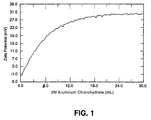
- Evidence of this cationic coating is provided by measuring the zeta potential of a dispersion of the cationic silica (e.g., as illustrated in Fig. 1). For example, a deionized water dispersion of the cationic silica at a concentration of about 20% by weight and a pH of about 3-4 can be measured.
- the dispersion when such a dispersion comprises the cationic silica of which the glossy coating of the recording medium of the present invention is comprised, the dispersion is characterized by the fact that it has a zeta potential that changes by less than about 25% when the aluminum content of the dispersion is increased by about 50% by weight via the addition thereto of an aluminum compound(s) that is substantially identical to the aluminum compound(s) with which the silica particles have been contacted.
- the zeta potential of such a dispersion changes by less than about 15% when the aluminum content of the dispersion is increased by about 50% by weight as described herein, even more preferably the zeta potential of such a dispersion changes by less than about 10% when the aluminum content of the dispersion is increased by about 50% by weight as described herein, and most preferably the zeta potential of such a dispersion changes by less than about 5% when the aluminum content of the dispersion is increased by about 50% by weight via the addition thereto of an aluminum compound(s) that is substantially identical to the aluminum compound(s) with which the silica particles have been contacted.
- the dispersion of the cationic silica of the present invention having a cationic silica content of about 20% by weight in deionized water and a pH of about 4 is characterized by its zeta potential relative to the maximum obtainable zeta potential without the presence of a substantial excess (preferably, without any excess) of aluminum as described herein.
- the zeta potential of the aqueous dispersion is at least about 50% of the maximum zeta potential without the presence of a substantial excess of aluminum.
- the zeta potential of the aqueous dispersion is at least about 60% of the maximum zeta potential without the presence of a substantial excess of aluminum, and more typically the zeta potential is at least about 70% of the maximum zeta potential without the presence of a substantial excess of aluminum.
- the aqueous dispersion of cationic silica exhibits a zeta potential of at least about 80% of the maximum zeta potential without the presence of substantial excess of aluminum.
- the dispersion exhibits a zeta potential of at least about 90% of the maximum zeta potential without the presence of a substantial excess of aluminum and, even more preferably, a zeta potential of at least about 95% of the maximum zeta potential without the presence of a substantial excess of aluminum.
- the zeta potential of the dispersion is at least about 98% (e.g., about 100%) of the maximum zeta potential without the presence of a substantial excess of aluminum.
- An aqueous dispersion of the cationic silica of which the glossy coating of the recording medium of the present invention is comprised having properties as set forth above is also characterized by the fact that it is relatively colloidally stable (i.e., slow to gel).
- the stability of the aqueous dispersion of the present invention can be determined by measuring the viscosity of the dispersion after it is suitably prepared and then allowed to stand undisturbed (i.e., without stirring or any other agitation) for a certain length of time.
- the viscosity can be measured, for example, using a Brookfield viscometer (manufactured by Brookfield Engineering Laboratories, Inc., Stoughton, Massachusetts) and a suitable spindle therefor.
- low shear rate viscosity can be measured using a Brookfield LVT viscometer (spindle no. 2, 60 rev/min, two minute spin at 25 °C), a Brookfield Model RV viscometer at 100 rev/min, spindle #4, after 30 seconds, or a Brookfield Model RVT digital viscometer, spindle #5 at 100 rev/min.
- High shear viscosity (sometimes referred to as "apparent viscosity”) can be measured with a HERCULES® High-Shear Viscometer using a suitable spindle (e.g., FF Bob measuring geometry, at 4400 rev/min).
- the viscosity may be measured pursuant to ASTM D 2196 (06.01) entitled "Rheological Properties of Non-Newtonian Materials by Rotational (Brookfield) Viscometer.”
- the viscosity (at low shear rate) of such a dispersion increases by less than about 50% when the dispersion is allowed to stand at a temperature of about 25 °C for 60 days, 90 days, 120 days, 180 days, and/or 270 days immediately following the preparation thereof. More preferably, the viscosity changes by less than about 30% when the dispersion is allowed to stand at a temperature of about 25 °C for 60 days, 90 days, 120 days, 180 days, and/or 270 days following the preparation thereof. Most preferably, the viscosity changes by less than about 20% when the dispersion is allowed to stand at a temperature of about 25 °C for 60 days, 90 days, 120 days, 180 days, and/or 270 days immediately following the preparation thereof.
- the viscosity of an aqueous dispersion of the cationic silica of the present invention having a cationic silica content of about 20% by weight and a pH of about 3-4 preferably is less than about 1500 mPa.s at relatively low shear rate after the dispersion is allowed to stand at a temperature of 25 °C for 60 days, 90 days, 120 days, 180 days, and/or 270 days immediately following the preparation thereof. It is preferred that the viscosity of the aqueous dispersion is less than about 500 mPa.s after the dispersion is allowed to stand at a temperature of 25 °C for 60 days, 90 days, 120 days, 180 days, and/or 270 days immediately following the preparation thereof.
- the viscosity is less than about 200 mPa.s after the dispersion is allowed to stand at a temperature of 25 °C for 60 days, 90 days, 120 days, 180 days, and/or 270 days immediately following the preparation thereof, and most preferably, the viscosity is less than about 150 mPa.s after it is allowed to stand at a temperature of 25 °C for 60 days, 90 days, 120 days, 180 days, and/or 270 days immediately following the preparation thereof.
- Organic dyes such as those used in ink-jet inks, often contain ionizable functional groups (e.g., SO 3 H, COOH, PO 3 H 2 , etc.), which increase the water solubility of the dyes.
- the dyes become negatively charged when these functional groups ionize in water (to SO 3 - , COO - , PO 3 2- ), and therefore experience strong electrostatic attraction to the cationic silica in the glossy coating of the recording medium of the present invention. Therefore, even though the ink can be rapidly absorbed into the coating via the pores of the cationic silica, the anionic dye molecules can be separated from the ink, and immobilized at the coating surface.
- the coating of the recording medium of the present invention has excellent dye immobilizing ability, which promotes desirable qualities, for example, superior image quality.
- Dye adhesion to the surface of a recording medium can be quantified by measuring the optical density and waterfastness of a test sample of the recording medium to which an aqueous ink-jet ink comprising an anionic dye has been applied.
- a test sample having an ink coverage of about 12 g/m 2 over an area of about 90 cm 2 can be cut in half and tested in the following manner.
- One minute after applying the ink one of the halves is soaked in deionized water for one minute and then repeatedly dipped in and out of the water to remove all dissolved ink from the sample.
- a densitometer e.g., a MacBeth 512 densitometer
- the optical density of the recording medium is the average image intensity of the half of the test sample that was not soaked in water.
- the waterfastness can be reported as: wherein ave. I.I. is the average image intensity of each half of the test sample (i.e., the half that was soaked in water and the half that was not soaked in water). Waterfastness values that are less than one, when calculated in this fashion, generally indicate loss of ink from the coating.
- waterfastness can be evaluated in terms of retained optical density.
- a test print can be evaluated by immersing a sample in deionized water for 5 minutes with light agitation, drying the sample, and comparing the color density of the dry soaked sample with that of an unsoaked sample (as indicated above) by measuring color density with a suitable densitomer (e.g., X-Rite® 938 Spectrodensitometer). Waterfastness can then be expressed in terms of the percentage of optical density retained by the soaked sample relative to the unsoaked sample.
- a suitable densitomer e.g., X-Rite® 938 Spectrodensitometer
- the recording medium of the present invention exhibits excellent waterfastness.
- the recording medium of the present invention typically retains at least about 50% of the optical density after immersion in deionized water for 5 minutes with light agitation.
- the recording medium of the present invention retains at least about 60% of the optical density of the printed image, more preferably at least about 70% of the optical density, still more preferably at least about 80% of the optical density, and most preferably at least about 90% of the optical density is retained (e.g., about 95% or even 100% of the optical density).
- the recording medium of the present invention retains 100% of the optical density of a printed image after being immersed in deionized water for 5 minutes with light agitation.
- the optical density of an image that has been applied to the glossy coating of the recording medium of the present invention is at least about 1.0. It is more preferred that the optical density is at least about 1.1, even more preferably at least about 1.2, still more preferably at least about 1.3, yet more preferably at least about 1.4, and most preferably at least about 1.5. It is preferred that the waterfastness of the glossy coating of the recording medium of the present invention, when measured as set forth above, is at least about 0.7. It is more preferred that the waterfastness is at least about 0.8, even more preferably at least about 0.9, still more preferably at least about 0.95, yet more preferably at least about 0.98, and most preferably at least about 0.99.
- the glossy coating of the inventive recording medium comprises one or more pigments in addition to cationic silica, such as calcium carbonate, clays, aluminum silicates, urea-formaldehyde fillers, and the like.
- cationic silica such as calcium carbonate, clays, aluminum silicates, urea-formaldehyde fillers, and the like.
- Suitable pigments include silica (e.g., colloidal or pyrogenic silica), alumina (e.g., alumina sols, colloidal alumina, cationic aluminum oxide or hydrates thereof, pseudoboehmite, etc.), magnesium silicate, magnesium carbonate, kaolin, talc, calcium sulfate, barium sulfate, titanium dioxide, zinc oxide, zinc sulfide, zinc carbonate, satin white, diatomaceous earth, calcium silicate, aluminum hydroxide, lithopone, zeolite, hydrated halloycite, magnesium hydroxide, polyolefins (e.g., polystyrene, polyethylene, polypropylene, etc.), plastics (e.g., acrylic), urea resin, and melamine resin.
- silica e.g., colloidal or pyrogenic silica
- alumina e.g., alumina sols, colloidal alumina, cationic aluminum oxide or
- the glossy coating of the recording medium of the present invention preferably comprises one or more binders, which serve to bind the cationic silica to the substrate. If one or more binders are used, the relative ratio of the total amount of pigment (e.g., cationic silica) to the total amount of binder(s) is preferably from about 1:1 to about 10:1 by weight, more preferably from about 1.5:1 to about 8:1 by weight, even more preferably from about 2:1 to about 6:1 by weight, and most preferably from about 2:1 to about 4:1 by weight (e.g., about 3:1 or 4:1 by weight).
- the relative ratio of the total amount of pigment e.g., cationic silica
- the total amount of binder(s) is preferably from about 1:1 to about 10:1 by weight, more preferably from about 1.5:1 to about 8:1 by weight, even more preferably from about 2:1 to about 6:1 by weight, and most preferably from about 2:1 to about 4:1 by weight (e.g., about 3:1 or 4:1 by weight).
- Preferred binders include, but are not limited to, polyvinyl alcohol, polyvinyl acetate, polyvinyl acetal, polyvinyl pyrrolidone, oxidized starch, etherified starch, cellulose derivatives (e.g., carboxymethyl cellulose, hydroxyethyl cellulose, etc.), casein, gelatin, soybean protein, silyl-modified polyvinyl alcohol, conjugated diene copolymer latexes (e.g., maleic anhydride resin, styrene-butadiene copolymer, methyl methacrylate-butadiene copolymers, etc.), acrylic polymer latexes (e.g., polymers and copolymers of acrylic esters and methacrylic esters, polymers and copolymers of acrylic acid and methacrylic acid, etc.), vinyl polymer latexes (e.g., ethylene-vinyl acetate copolymer), functional group-modified polymer
- the glossy coating of the recording medium of the present invention also can comprise one or more other additives, such as surfactants (e.g., cationic surfactants, anionic surfactants such as long-chain alkylbenzene sulfonate salts and long-chain, preferably branched chain, alkylsulfosuccinate esters, nonionic surfactants such as polyalkylene oxide ethers of long-chain, preferably branched-chain alkyl group-containing phenols and polyalkylene oxide ethers of long-chain alkyl alcohols, and fluorinated surfactants), hardeners (e.g., active halogen compounds, vinylsulfone compounds, aziridine compounds, epoxy compounds, acryloyl compounds isocyanate compounds, etc.), pigment dispersants, thickeners (e.g., carboxymethyl cellulose (CMC)), flowability improvers, antifoamers (e.g., octyl alcohol, silicone-based antifoa
- the present invention also provides a method of preparing a recording medium, wherein the recording medium comprises a substrate having a glossy coating thereon, wherein the glossy coating comprises cationic silica.
- the inventive method comprises:
- a deionized water dispersion of the cationic silica used in the method of the present invention at a concentration of about 20% by weight and a pH of about 3-4 can be characterized by its zeta potential and viscosity.
- the typical and preferred ranges for the zeta potential and viscosity of such a dispersion are discussed herein.
- this aqueous dispersion has (i) a zeta potential of at least about 50% of the maximum zeta potential without the presence of a substantial excess of aluminum, and (ii) a viscosity of less than 1500 mPa.s after the dispersion is allowed to stand at a temperature of 25 °C for 60 days, 90 days, 120 days, 180 days, and/or 270 days immediately following the preparation thereof.
- the substrate, cationic silica, coating constituents (e.g., binders, surfactants, resins, etc.) and coating properties (e.g., thickness, gloss, absorptiveness, dye immobilization, etc.) of a recording medium prepared in accordance with the present inventive method desirably are as described herein with respect to the recording medium of the present invention.
- the coating formulation (i.e., the coating composition) used in the present inventive method comprises a suitable carrier and cationic silica, with properties as described herein, and preferably comprises any other constituents of which the glossy coating is to be comprised (e.g., binders, surfactants, resins, etc., as described herein). It is preferred that the coating formulation comprises cationic silica in the form of an aqueous dispersion as described herein.
- the carrier can be any suitable fluid or combination of fluids in which the cationic silica and any other coating constituents can be mixed and applied to a substrate.
- Preferred carriers have a relatively high vapor pressure to accelerate the drying of the coating formulation after application, and preferred examples include, but are not limited to, organic solvents (e.g., alcohols) and water, with water being most preferred.
- the relative amounts of carrier and solids (e.g., cationic silica) in the coating formulation affects a number of properties of the formulation (e.g., viscosity, ease of application, drying rate, etc.) and the resulting dry coating (e.g., absorption capacity, degree of cracking, etc.).
- properties of the formulation e.g., viscosity, ease of application, drying rate, etc.
- the resulting dry coating e.g., absorption capacity, degree of cracking, etc.
- the solids content of the coating formulation is increased.
- the solids content of the coating formulation is at least about 10% by weight, more preferably at least about 20% by weight, and most preferably the solids content is at least about 30% by weight.
- the apparent viscosity of a coating formulation can be measured in a high shear HERCULES® High-Shear Viscometer (rheometer) at 4400 rev/min (FF Bob measuring geometry) at a temperature of about 25 °C.
- the apparent viscosity of the coating formulation used in the method of the present invention is less than about 150 mPa.s, more preferably less than about 100 mPa.s and most preferably less than about 75 mPa.s (e.g., about 50-70 mPa.s).
- the coating formulation can be applied to the substrate using any suitable method or combination of methods to provide the coated substrate. Suitable methods include, but are not limited to, roll coating, blade coating, air knife coating, rod coating (e.g., using a Meyer rod or the like), bar coating, cast coating, gate roll coating, wire bar coating, short-dowel coating, slide hopper coating, curtain coating, flexographic coating, gravure coating, Karla coating, size press coating in the manner of on- or off-machine, and die coating, with rapid, inexpensive methods such as rod coating and blade coating being preferred.
- the coating formulation can be dried using any suitable method or combination of methods to provide the recording medium.
- suitable drying methods include, but are not limited to, air or convection drying (e.g., linear tunnel drying, arch drying, air-loop drying, sine curve air float drying, etc.), contact or conduction drying, and radiant-energy drying (e.g., infrared drying and microwave drying).
- a coating formulation comprising cationic pyrogenic silica is used in the inventive method of preparing a recording medium.
- the cationic silica is preferably dispersed in an aqueous medium. Accordingly, the present invention provides an aqueous dispersion of cationic silica and a method for its preparation.
- aqueous dispersion of the present invention comprises cationic silica and water, wherein:
- the aqueous dispersion of the present invention comprises cationic silica comprising pyrogenic silica particles that have been contacted with one or more aluminum compounds, wherein the aluminum compound and contacting methods are as described herein.
- the inventive aqueous dispersion comprises cationic silica comprising pyrogenic silica particles that have been contacted with the aluminum compound(s) as described above.
- the inventive dispersion is advantageous for many reasons. For example, the physical properties of the cationic silica (e.g., particle size, surface area, net charge, etc.) can be optimized over a wide range to suit specific applications (e.g., coating formulations). Also, the inventive dispersion is stable, is easily handled, and if desired, can be transported from the site of preparation for use elsewhere. The stability characteristics of the present inventive aqueous dispersion are as described above in conjunction with the recording medium and its preparation.
- the term "dispersion” means any suspension of solid particles (e.g., cationic silica) in a liquid medium (e.g., water), wherein the particles remain suspended in the medium (i.e., are colloidally stable in that the particles do not settle to the bottom of a container) for at least about 24 hours when the suspension is allowed to stand at a temperature of about 25 °C following the preparation thereof.
- a dispersion can comprise particles of any size
- the term "sol” e.g., colloidal sol as utilized herein means a dispersion comprising particles having diameters of less than about 100 nm.
- the cationic silica of which the aqueous dispersion of the present invention is comprised is as described herein with respect to the recording medium of the present invention, with the following exception.
- the aqueous dispersion of the present invention comprises cationic silica comprising silica particles having a mean diameter of from 100 nm to 1 ⁇ m.
- the cationic silica in the aqueous dispersion of the present invention is not derived exclusively from a silica sol (i.e., the cationic silica does not consist essentially of a silica sol that has been contacted with one or more aluminum compounds, as described herein).
- a dispersion comprising cationic silica derived from a silica sol also can comprise cationic silica derived from silica particles having diameters of from 100 nm to 1 ⁇ m, in a suitable ratio such that the mean diameter of the totality of the silica particles of which the cationic silica in the inventive dispersion is comprised is at least 100 nm (i.e., the mean diameter is from 100 nm to 1 ⁇ m).
- the aqueous dispersion of the present invention comprises cationic silica comprising silica particles having a mean diameter of from 100 nm to 500 nm that have been contacted with an aluminum compound(s) as described herein. It is more preferred that the cationic silica comprises silica particles having a mean diameter of from 100 nm to 400 nm, and most preferred that the cationic silica comprises silica particles having a mean diameter of from 100 nm to about 300 nm (e.g., from about 150 nm to about 250 nm).
- the inventive aqueous dispersion comprises cationic silica comprising silica particles that have been contacted with an aluminum compound, wherein at least about 80% (e.g., at least about 90%) or substantially all of the particles have diameters of from 100 nm to less than 1 ⁇ m (e.g., from 100 nm to less than 500 nm, from 100 nm to about 400 nm, or from about 150 nm to about 250 nm).
- a dispersion comprises particles suspended in a liquid medium.
- the inventive aqueous dispersion comprises water, more preferably deionized water.
- the aqueous dispersion of the present invention also can comprise any number of suitable water-miscible liquids, such as one or more water-miscible alcohols (e.g., methanol, ethanol, etc.) or ketones (e.g., acetone) in addition to water.
- the aqueous dispersion of the present invention is most stable (i.e., most resistant to thickening and/or gelling) at a pH of from 2 to 6.
- the pH of the dispersion is 3-5, more preferably about 3-4 or 3.5-4.5.
- the pH of the dispersion can be adjusted using any suitable method, such as via the addition of an acid (e.g., mineral acid, acidic cation exchange resin, etc.) or a base (e.g., an alkali metal hydroxide, basic anion exchange resin, etc.).
- the aqueous dispersion of the present invention comprises cationic silica in an amount of from 5% to 50% by weight (e.g., from about 10% to about 30% by weight).
- Embodiments of the present invention that are particularly useful in such applications include aqueous dispersions having a cationic silica content of at least about 10% by weight (i.e., from about 10% to about 50% by weight), more preferably at least about 20% by weight (i.e., from about 20% to about 50% by weight), and most preferably at least about 30% by weight (i.e., from about 30% to about 50% by weight).
- the aqueous dispersion preferably comprises less than about 35% by weight of cationic silica (e.g., from 5% to about 35% by weight), more preferably less than about 25% by weight (e.g., from about 5% to about 25% by weight), and most preferably less than about 15% by weight (e.g., from 5% to about 15% by weight).
- cationic silica e.g., from 5% to about 35% by weight
- the net charge on the silica particles of which the inventive aqueous dispersion is comprised can be qualitatively determined by measuring the zeta potential of the dispersion (e.g., using a Matec MBS 8000 or a Brookhaven Zeta Plus instrument).
- a negative zeta potential is indicative of a net negative charge on the silica particles, while a positive zeta potential indicates a net positive charge.
- the magnitude of the zeta potential is proportional to the magnitude of the charge.
- contacting a silica particle e.g., pyrogenic silica
- one or more aluminum compounds as set forth above causes one or more suitable aluminum compounds to become associated with or bind to the surface of the silica particle, possibly covalently or through an electrostatic interaction, to form a cationic coating thereon (i.e., cationic silica).
- a cationic coating thereon
- the zeta potential increases and eventually approaches a maximum value.
- the net charge on the cationic silica comprising the inventive aqueous dispersion is at or near the maximum positive charge that can be obtained by coating the particles with one or more aluminum compounds, as set forth herein. More preferably, the coating or contact is achieved without a substantial excess (most preferably, without any excess) of the aluminum compound(s).
- Such a state of the cationic silica with respect to the aluminum compound(s) can be determined in any suitable manner, e.g., by reference to the zeta potential of the inventive aqueous dispersion. It is preferred that the zeta potential of the aqueous dispersion of the present invention at a particular pH is near the maximum zeta potential that can be obtained by means of contacting the silica particles with one or more aluminum compounds, as set forth above.
- the aqueous dispersion of the present invention does not comprise a large excess of the aluminum compound(s) with which the silica suspension has been contacted.
- silica particles are contacted with one or more aluminum compounds as described herein to form a mixture, the zeta potential of the mixture increases rapidly at first, but then more slowly, such that additional contact with the aluminum compound(s) does not result in a significant increase in either cationic charge or zeta potential, but rather results in an increased concentration of aluminum salts in the dispersion.
- the aqueous dispersion of the present invention comprises cationic silica particles (as described herein) in an amount sufficient to maximize the positive charge thereon, without causing an undesirable increase in the salt concentration of the dispersion.
- zeta potential characteristics of the aqueous dispersion of the present invention are as described herein in conjunction with the recording medium and its preparation.
- the salt content of an aqueous dispersion can be qualitatively determined be measuring the electrical conductivity of the dispersion.
- the aqueous dispersion of the present invention can have any suitable salt content and electrical conductivity (as described herein), it is often desirable to minimize the salt content of a dispersion in order to improve the stability thereof. In certain embodiments of the present invention it is thus preferred that the inventive aqueous dispersion has an electrical conductivity of less than about 20,000 ⁇ siemens ( ⁇ S).
- the electrical conductivity is less than about 15,000 ⁇ S, even more preferably less than about 10,000 ⁇ S, still more preferably less than about 7,000 ⁇ S, and most preferably the electrical conductivity of the inventive aqueous dispersion in these embodiments is less than about 5,000 ⁇ S.
- the present invention provides a method of preparing an aqueous dispersion of cationic silica, which method comprises:
- the inventive method of preparing an aqueous dispersion of cationic silica overcomes the limitations of previous methods in a number of ways. For example, it is not necessary to rigorously remove electrolytes (i.e., salts) from the dispersion. Also, dispersion stabilizers such as divalent metals, ammonia, and bicarbonate are not needed.
- the various aspects of the inventive method and the aqueous dispersion produced thereby e.g., pH, zeta potential, stability, cationic silica content, electrical conductivity, etc.
- the components thereof e.g., cationic silica, silica particles, aluminum compound(s), liquid media, etc.
- the diameters of the silica particles of which the cationic silica is comprised are as described herein with respect to the recording medium of the present invention (i.e., having a mean diameter of less than 1 ⁇ m).
- the aqueous suspension can be prepared in any suitable manner, and comprises a liquid medium and silica particles having properties as described herein.
- dry silica particles e.g., pyrogenic silica particles
- a suitable liquid medium e.g., deionized water
- the method of the present invention is particularly advantageous in that the suspension is substantially salt-free, thus obviating any need to remove electrolytes therefrom, for example, via dialysis or contact with an ion-exchange resin.
- the suspension can have any suitable pH. In certain embodiments of the present inventive method, however, such as when it is desirable to keep the pH of the suspension and the resulting dispersion within a relatively narrow range (e.g., within about 2 pH units), it is preferred that the suspension has a pH of less than about 6.
- the pH of the suspension in these embodiments is more preferably less than about 5 (e.g., about 3-5), and most preferably about 3-4 or 3.5-4.5.
- the pH of the suspension can be adjusted using any suitable method, as described herein with respect to the aqueous dispersion of the present invention.
- the suspension can have any suitable silica content.
- the suspension can have approximately the same silica content as the aqueous dispersion prepared therefrom.
- the suspension can have a higher silica content, and the resulting dispersion can be diluted (e.g., with deionized water) to provide a final dispersion having a cationic silica content of from 5% to 50% by weight.
- the suspension also preferably has a silica content of from about 5% to about 50% by weight, such as from about 10% to about 30% by weight.
- any suitable method can be used to contact the silica suspension (and thereby the silica particles) with the aluminum compound, as described herein.
- Two features of the inventive method are that the contact between the aluminum compound(s) and the silica particles can be readily optimized, and the results of the contact (i.e., formation of a positively charged aluminum coating on the silica particles) readily monitored, e.g., by measuring the zeta potential of the mixture during the contacting.
- the zeta potential of the mixture increases from negative (i.e., the silica particles have an anionic surface) to positive (i.e., the silica particles acquire a cationic surface) during the contacting, and eventually plateaus when the particles have achieved a maximum net positive charge.
- the contacting e.g., the addition of the aluminum compound(s) to the silica suspension, is discontinued when, or very soon after, the zeta potential initially plateaus to produce the aqueous cationic silica dispersion of the present invention.
- a zeta potential curve can be plotted for the mixture that is formed as a silica suspension is contacted with one or more aluminum compounds, and the data from the curve then can be used to prepare future dispersions.
- the zeta potential of the mixture that is formed as an aqueous solution of aluminum chlorohydrate (e.g, 2 M) is added to an aqueous suspension of pyrogenic silica in deionized water (e.g., 10% by weight) can be measured and plotted well past the initial plateau to provide a zeta potential curve for that system.
- An aqueous dispersion comprising cationic silica can then be prepared from a silica suspension and one or more aluminum compounds, preferably in dry form (i.e., the aluminum compound preferably is not in the form of a solution), that are similar or substantially identical to those used to create the curve by contacting the suspension and aluminum compound(s) in amounts corresponding to those which produced the initial plateau in the zeta potential curve.
- one or more aluminum compounds preferably in dry form (i.e., the aluminum compound preferably is not in the form of a solution), that are similar or substantially identical to those used to create the curve by contacting the suspension and aluminum compound(s) in amounts corresponding to those which produced the initial plateau in the zeta potential curve.
- aqueous dispersions prepared according to the method of the present invention need not be stabilized with additives such as divalent metals, ammonia, or bicarbonate.
- inventive recording medium aqueous dispersion, coating composition, and methods for the preparation thereof can be further understood by reference to the following examples. These examples illustrate the present invention and, of course, should not be construed as in any way limiting its scope.
- This example illustrates the generation of a zeta potential curve useful in the preparation of dispersion of the present invention.
- a 10% by weight silica suspension having a pH of about 3 (220 ml) was added to the mixing vessel of a Matec® Zeta Potential Analyzer. While mixing, a titration was performed by incrementally adding a 2M solution of Al 2 (OH) 5 Cl (aluminum chlorohydrate, ACH) in deionized water, and the zeta potential was monitored during the ACH addition. The resulting zeta potential curve is illustrated in Fig. 1.
- the suspension had a zeta potential of about -2 mV.
- the zeta potential increased to about 9 mV; during the addition of the next three ml, the zeta potential increased to about 17 mV; during the addition of the next three ml, the zeta potential increased to about 23 mV; during the addition of the next three ml, the zeta potential increased to about 25 mV; during the addition of the next three ml, the zeta potential increased to about 27 mV; during the addition of the next three ml (18 ml total), the zeta potential increased to about 28 mV (at a pH of about 3.6), and at this time the addition was discontinued, as the zeta potential had begun to plateau, thus providing the aqueous dispersion of the present invention.
- the viscosity of this dispersion was found to be substantially unchanged after standing at a temperature of about 25 °C for 100 days.
- the zeta potential of a dispersion prepared in the same manner increased to about 30 mV (i.e., increased by about 7%) upon addition of 9 more ml of ACH (to a total of 27 ml) thereto while the dispersion was rapidly mixed in a high shear mixer.
- the zeta potential of another dispersion prepared in the same manner as set forth above decreased to about 23 mV (i.e., decreased by about 18%) when an additional 10 kg of pyrogenic silica was added thereto while the dispersion was rapidly mixed in a high shear mixer.
- This example shows that the suspended silica particles, which are initially negatively charged, become positively charged as aluminum chlorohydrate is added, and that the magnitude of the positive charge increases very rapidly at first (i.e., during the addition of the first 10 ml or so of ACH), then more slowly (i.e., during the addition of the next 5 ml or so of ACH), and then very slowly (i.e., above 15 ml or so) as the zeta potential plateaus. If the addition is terminated soon after the zeta potential plateaus, the zeta potential increases modestly upon addition of more ACH.
- This example illustrates the preparation of an aqueous cationic silica dispersion of the present invention using the zeta potential curve generated in Example 1.
- CAB-O-SIL® HS-5 (Cabot Corporation)
- surface area 300 ⁇ 25 m 2 /g
- average aggregate diameter 170-250 nm.
- Al 2 (OH) 5 Cl aluminum chlorohydrate, ACH
- the zeta potential initially rapidly increases and then plateaus with the addition of an increasing amount of ACH to the suspension.
- the suspension was rapidly mixed in the high shear mixer for about one hour, after which to the rapidly mixed suspension in the high shear mixer was added about 1.8 kg aluminum chlorohydrate solid to achieve a substantially maximum cationic charge on the silica without a significant excess of aluminum chlorohydrate, based on the zeta potential curve of Figure 1 generated in Example 2.
- the suspension was further rapidly mixed for about 0.5 hour to form an aqueous dispersion of the present invention having about 20% by weight solids based on the total silica and aluminum chlorohydrate.
- This example illustrates the preparation of a coating composition of the present invention.
- An aqueous dispersion of cationic silica was prepared in accordance with Example 3.
- the dispersion had a solids content of about 20% by weight cationic silica solids (based on the combined weight of silica and aluminum chlorohydrate).
- the dispersion had a specific gravity in the range of 1.05-1.35 g/cm 3 (at 25 °C) and a pH in the range of 3.0-4.0.
- Sufficient polyvinyl alcohol binder solution (PVOH) was added to obtain a pigment to binder ratio of 4:1 by weight (cationic silica to PVOH) and a total solids content (including cationic silica and binder) of 21.34%.
- This example illustrates the preparation of a recording medium of the present invention.
- An uncoated paper substrate base was coated with the coating composition of Example 4 using a Meyer rod (hand drawdown).
- the Meyer rod was selected to produce a final coating weight of 8 g/m 2 .
- the coated samples were allowed to air dry until they were dry to the touch.
- the dry samples were then cut into 5" (12.7 cm) diameter circles using a punch press.
- the samples were dried in a CEM Labwave Oven 9000 microwave moisture analyzer.
- the coat weights of the samples were then determined by taking the difference between the weights of the dry coated and uncoated samples.
- the samples were then conditioned in a humidity-controlled room before performing optical and physical property measurements.
- Samples were calendered on one side with 3 nips at 1.25 kg/linear cm (7 pli (pounds per linear inch)) and 60 °C.
- the optical, surface and printing properties were measured for the calendered samples, and the results were compared to the uncalendered samples.
- the uncoated paper substrate had the following properties: basis weight: 77.5 g/m 2 ; pH: 6.6; ash: 8.31%; caliper 3.62/1000" (91.9 ⁇ m); brightness: 82.7%; gloss: 6.4%; smoothness: 3.93 ⁇ m; Hercules® sizing test: 109 sec; and PPS porosity: 2.77 ml/min.
- the recording media obtained by coating the substrate in accordance with this example had excellent gloss, brightness, and porosity. The coating had an excellent appearance and superior feel, and did not crack or exhibit brittleness. Moreover, the recording media produced an excellent printed image.
- Brightness was measured using a Technidyne® Brightness Meter Tappi Procedure T 452 OM-92. Gloss was measured using a Hunter 75° degree gloss meter according to TAPPI standard procedure T 480OM-92. The surface smoothness and porosity of the sheets were measured using a Parker Print Surf (PPS) tester (TAPPI T555 PM-94). The rate of liquid absorption of the papers was measured using a First 10 Angstrom Dynamic Contact Angle measuring device.
- PPS Parker Print Surf
- the samples were printed on Epson Stylus® Pro Photorealistic and Hewlett Packard® 820C ink jet printers using a test pattern created with ADOBE® software. The print gloss and print density of the samples was then measured. Print gloss was measured using a Gardener 60 degree Micro-Gloss meter. Print density was measured using a BYK Gardner® densitometer. The properties of the image as printed using the Epson® Stylus Pro Photorealistic and the Hewlett Packard® 820C are shown in Tables 2A and 2B, respectively.
- This example illustrates the compatibility of a cationic silica coating composition of the present invention in the presence of a mordant, as compared to the mordant compatibility of a comparative composition comprising untreated silica.
- a mordant is a cationic polymer used in coating compositions to improve dye immobilization properties and waterfastness of ink-jet recording media. It is highly desirable for the pigment particles of a coating composition to exhibit good mordant compatibility so that there will be an improvement in the final coating and an ultimate improvement in coater runnability.
- a cationic silica coating composition of the present invention was prepared in accordance with Example 4, except that the total solids content was 20% by weight and the pigment to binder ratio was 5:1 ("cationic silica composition").
- a comparative coating composition (20% solids content by weight and a pigment to binder ratio of 5:1) also was prepared using the procedure of Example 4, except that the silica particles of the initial dispersion were not treated ("untreated silica composition”).
- the cationic silica composition of the present invention used in this example was prepared from the cationic silica dispersion prepared in accordance with Example 3.
- the binder used in both cationic and untreated silica compositions was Airvol® 203 PVOH (available from Air Products and Chemicals, Inc., Allentown, Pennsylvania).
- Viscosity was measured for the cationic and untreated silica compositions in the absence of mordant and in the presence of different concentrations of mordant. Compatibility studies were carried out using two different mordants.
- the mordants used in this example were medium molecular weight poly(diallylmethylammonium chloride) (Poly DAMAC (Medium MW)), and high molecular weight poly(diallylmethylammonium chloride) Poly DAMAC (High MW)), both of which are available from Aldrich Chemical Company, Milwaukee, Wisconsin.
- Percent mordant represents the percent of mordant by weight relative to the combined weight of silica, PVOH binder, and water.
- Sample %Poly DMAC (Medium MW) Viscosity (mPa.s) Untreated Silica Composition (comparative) 0 0.5 1.0 79.2 1492 (Gelled) Cationic Silica Composition (invention) 0 0.5 1.0 1.5 110 276 596 986
- Sample %Poly DMAC (High MW) Viscosity (mPa ⁇ s) Untreated Silica Composition (comparative) 0 0.5 1.0 79.2 1664 (Gelled) Cationic Silica Composition (invention) 0 0.5 1.0 1.5 110 324 636 1086
- the cationic silica composition of the present invention has superior mordant compatibility as compared to the mordant compatibility of an analogous untreated silica composition.
- the untreated silica composition gelled, whereas the cationic silica composition of the present invention had viscosities of 596 and 636 mPa.s for medium and high molecular weight mordants, respectively.
Landscapes
- Chemical & Material Sciences (AREA)
- Organic Chemistry (AREA)
- Inorganic Chemistry (AREA)
- Dispersion Chemistry (AREA)
- Ink Jet Recording Methods And Recording Media Thereof (AREA)
- Paints Or Removers (AREA)
- Ink Jet (AREA)
- Laminated Bodies (AREA)
- Application Of Or Painting With Fluid Materials (AREA)
Description
and the aqueous dispersion preferably is characterized by:

| Medium | Brightness (%) | 75° Specular Gloss (%) | PPS Smoothness (µm) | Porosity (ml/min.) |
| Uncoated Substrate | 82.7 | 6.4 | 3.93 | 2.77 |
| Coated Substrate (8 g/m2) | 84.6 | 13.2 | 3.29 | 263 |
| Calendered (8 g/m2) | 83.3 | 45.4 | 1.71 | 65.5 |


| Sample | %Poly DMAC (Medium MW) | Viscosity (mPa.s) |
| Untreated Silica Composition (comparative) | 0 0.5 1.0 | 79.2 1492 (Gelled) |
| Cationic Silica Composition (invention) | 0 0.5 1.0 1.5 | 110 276 596 986 |
| Sample | %Poly DMAC (High MW) | Viscosity (mPa·s) |
| Untreated Silica Composition (comparative) | 0 0.5 1.0 | 79.2 1664 (Gelled) |
| Cationic Silica Composition (invention) | 0 0.5 1.0 1.5 | 110 324 636 1086 |
Claims (33)
- A recording medium comprising a substrate having a glossy coating thereon, wherein said glossy coating comprises cationic silica particles having a mean diameter of less than 1 µm, and wherein said particles comprise pyrogenic silica that has been contacted with at least one aluminum compound selected from the group consisting of aluminum halides and aluminum nitrates.
- The recording medium of claim 1, wherein the mean diameter of said particles is less than 400 nm.
- The recording medium of claim 1 or 2, wherein the mean diameter of said particles is at least 100 nm.
- The recording medium of any of claims 1-3, wherein substantially all of said particles have diameters of less than 1 µm.
- The recording medium of any of claims 1-4, wherein substantially all of said particles have diameters of less than 500 nm.
- The recording medium of any of claims 1-5, wherein substantially all of said particles have diameters of at least 100 nm.
- The recording medium of any of claims 1-6, wherein said substrate comprises a polymer or cellulose paper.
- The recording medium of claim 7, wherein said substrate comprises poly(ethylene terephthalate).
- The recording medium of any of claims 1-8, wherein said aluminum halide is selected from the group consisting of aluminum chlorides.
- The recording medium of any of claims 1-9, wherein said aluminum halide is aluminum chlorohydrate.
- The recording medium of any of claims 1-10, wherein said glossy coating has a total mercury intrusion volume of at least 0.3 ml/g.
- The recording medium of any of claims 1-11, wherein said recording medium, when calendered, has a 75° specular gloss of at least 15%.
- A dispersion comprising cationic silica and water, wherein:(a) said cationic silica comprises pyrogenic silica particles that have been contacted with at least one aluminum compound,(b) the mean diameter of said pyrogenic silica particles is from 100 nm to 1 µm,(c) the pH of said dispersion is from 2 to 6,(d) the content of said cationic silica in said dispersion is from 5-50% by weight,(e) said dispersion exhibits a viscosity of less than 1500 mPa.s after said dispersion is allowed to stand at a temperature of 25 °C for 60 days immediately following the preparation thereof, and(f) the zeta potential of said dispersion is at least 50% of the maximum zeta potential without the presence of a substantial excess of aluminum.
- The dispersion of claim 13, wherein the pH of said dispersion is from 3-5.
- The dispersion of claim 13 or 14, wherein the mean diameter of said particles is from 100-400 nm.
- The dispersion of any of claims 13-15, wherein substantially all of said particles have diameters of from 100 nm to 1 µm.
- The dispersion of any of claims 13-16, wherein substantially all of said particles have diameters of from 100-500 nm.
- The dispersion of any of claims 13-17, wherein the content of said silica in said dispersion is from 10-30% by weight.
- The dispersion of any of claims 13-18, wherein said aluminum compound is selected from the group consisting of aluminum halides and aluminum nitrates.
- The dispersion of any of claims 13-19, wherein said aluminum compound is selected from the group consisting of aluminum chlorides.
- The dispersion of any of claims 13-20, wherein said aluminum compound is aluminum chlorohydrate.
- The dispersion of any of claims 13-21, wherein said dispersion has a viscosity of less than 500 mPa.s after said dispersion is allowed to stand at a temperature of 25 °C for 60 days immediately following the preparation thereof.
- The dispersion of any of claims 13-22, wherein said dispersion exhibits a zeta potential of at least 60% of the maximum zeta potential without the presence of a substantial excess of aluminum.
- The dispersion of claim 23, wherein said dispersion exhibits a zeta potential of at least 80% of the maximum zeta potential without the presence of a substantial excess of aluminum.
- The dispersion of claim 24, wherein said dispersion exhibits a zeta potential of at least 90% of the maximum zeta potential without the presence of a substantial excess of aluminum.
- A method of preparing the dispersion of any of claims 13-25, said method comprising:(a) providing an aqueous suspension of pyrogenic silica particles, wherein the mean diameter of the particles is from 100nm to 1 µm, and(b) contacting said silica particles in said suspension with at least one aluminum compound, wherein the zeta potential of said mixture increases rapidly during the initial contacting, but increases slowly during subsequent contacting, and the contacting is continued until the zeta potential of the mixture increases slowly, at which time the contacting is discontinued to produce said aqueous dispersion of cationic silica.
- A coating composition comprising a binder and the dispersion of any of claims 13-25.
- A method of preparing a recording medium, said method comprising:(a) providing a substrate,(b) coating said substrate with the coating composition of claim 27 to produce a coated substrate, and(c) drying said coated substrate to produce said recording medium.
- The method of claim 28, wherein said substrate comprises a polymer or cellulose paper.
- The method of claim 28, wherein said substrate comprises poly(ethylene terephthalate).
- The method of claim 28, wherein the coating on said recording medium has a total mercury intrusion volume of at least 0.3 ml/g.
- The method of claim 28, wherein said recording medium has a 75° specular gloss of at least 15%.
- A recording medium obtainable according to the method of any of claims 28-32.
Applications Claiming Priority (3)
| Application Number | Priority Date | Filing Date | Title |
|---|---|---|---|
| US10295998P | 1998-10-02 | 1998-10-02 | |
| US102959P | 1998-10-02 | ||
| PCT/US1999/022832 WO2000020221A1 (en) | 1998-10-02 | 1999-10-01 | Silica dispersion, coating composition and recording medium |
Publications (2)
| Publication Number | Publication Date |
|---|---|
| EP1124693A1 EP1124693A1 (en) | 2001-08-22 |
| EP1124693B1 true EP1124693B1 (en) | 2004-12-08 |
Family
ID=22292617
Family Applications (1)
| Application Number | Title | Priority Date | Filing Date |
|---|---|---|---|
| EP99950080A Expired - Lifetime EP1124693B1 (en) | 1998-10-02 | 1999-10-01 | Silica dispersion, coating composition and recording medium |
Country Status (6)
| Country | Link |
|---|---|
| US (1) | US6420039B1 (en) |
| EP (1) | EP1124693B1 (en) |
| JP (1) | JP4704564B2 (en) |
| AU (1) | AU6281399A (en) |
| DE (1) | DE69922532T2 (en) |
| WO (1) | WO2000020221A1 (en) |
Families Citing this family (54)
| Publication number | Priority date | Publication date | Assignee | Title |
|---|---|---|---|---|
| US6773771B1 (en) * | 1999-04-27 | 2004-08-10 | Mitsubishi Paper Mills Limited | Ink-jet recording sheet |
| ATE503057T1 (en) * | 1999-08-19 | 2011-04-15 | Jujo Paper Co Ltd | OFFSET PRINTING PAPER |
| US6887559B1 (en) * | 1999-10-01 | 2005-05-03 | Cabot Corporation | Recording medium |
| EP1099731B1 (en) * | 1999-11-12 | 2006-04-05 | Canon Kabushiki Kaisha | Image forming process, ink set, image by ink-jet recording, recorded article, surface-treated article and surface treating process |
| AU2001236492A1 (en) * | 2000-01-19 | 2001-07-31 | Kimberly-Clark Worldwide, Inc. | Waterfast ink receptive coatings for ink jet printing, methods of coating substrates utilizing said coatings, and materials coated with said coatings |
| DE10153565A1 (en) * | 2001-10-30 | 2003-05-22 | Ctp Papierhilfsmittel Gmbh & C | Process for the production of papers which are particularly suitable for the ink jet printing process, and coating slip for surface treatment of such papers |
| TW200307022A (en) | 2002-03-19 | 2003-12-01 | W R Grance & Co Conn | Coating composition comprising colloidal silica and glossy ink jet recording sheets prepared therefrom |
| TWI349024B (en) | 2002-03-19 | 2011-09-21 | Grace W R & Co | Coating composition comprising colloidal silica and glossy ink jet recording sheets prepared therefrom |
| US6902780B2 (en) * | 2002-03-19 | 2005-06-07 | W. R. Grace & Co.-Conn | Coating composition comprising colloidal silica and glossy ink jet recording sheets prepared therefrom |
| ATE273799T1 (en) * | 2002-03-22 | 2004-09-15 | Degussa | DISPERSION, PAINT AND RECORDING MEDIUM |
| US6896942B2 (en) | 2002-04-17 | 2005-05-24 | W. R. Grace & Co. -Conn. | Coating composition comprising colloidal silica and glossy ink jet recording sheets prepared therefrom |
| US7374787B2 (en) | 2002-08-22 | 2008-05-20 | Dequssa Ag | Stabilized, aqueous silicon dioxide dispersion |
| DE10238463A1 (en) * | 2002-08-22 | 2004-03-04 | Degussa Ag | Stabilized, aqueous silicon dioxide dispersion |
| US7906187B2 (en) | 2003-04-03 | 2011-03-15 | Hewlett-Packard Development Company, L.P. | Ink jet recording sheet with photoparity |
| US20040209015A1 (en) * | 2003-04-15 | 2004-10-21 | Palitha Wickramanayake | Additives for use in print media to reduce bronzing |
| US20050008794A1 (en) * | 2003-07-10 | 2005-01-13 | Arkwright, Inc. | Ink-jet recording media having a microporous coating comprising cationic fumed silica and cationic polyurethane and methods for producing the same |
| US20050014851A1 (en) * | 2003-07-18 | 2005-01-20 | Eastman Kodak Company | Colloidal core-shell assemblies and methods of preparation |
| JP3908718B2 (en) * | 2003-11-06 | 2007-04-25 | 富士フイルム株式会社 | Coating liquid for ink receiving layer of ink jet recording medium, ink jet recording medium, and method for producing ink jet recording medium |
| DE10360464A1 (en) * | 2003-12-22 | 2005-07-14 | Wacker-Chemie Gmbh | Dispersion containing at least 2 types of particles |
| US7435450B2 (en) | 2004-01-30 | 2008-10-14 | Hewlett-Packard Development Company, L.P. | Surface modification of silica in an aqueous environment |
| RU2393114C2 (en) | 2004-06-15 | 2010-06-27 | В.Р. Грейс Энд Ко.-Конн. | Grinding silicon dioxide using chemical methods |
| EP1655348A1 (en) * | 2004-10-13 | 2006-05-10 | ILFORD Imaging Switzerland GmbH | Recording sheet for ink jet printing |
| EP1808225B1 (en) | 2004-10-18 | 2014-04-16 | Seiko Epson Corporation | Encapsulation product, process for producing the same, and ink composition |
| US7641961B2 (en) * | 2004-10-20 | 2010-01-05 | Hewlett-Packard Development Company, L.P. | Ink solvent assisted heat sealable media |
| US7799393B2 (en) * | 2004-10-20 | 2010-09-21 | Hewlett-Packard Development Company, L.P. | Ink-jet media coatings including expoxy-functionalized inorganic particulates and amine-functionalized inorganic particulates |
| US8084107B2 (en) * | 2004-10-20 | 2011-12-27 | Hewlett-Packard Development Company, L.P. | Ink-jet media with multiple porous media coating layers |
| JP2006123298A (en) | 2004-10-28 | 2006-05-18 | Konica Minolta Photo Imaging Inc | Inkjet recording paper and its manufacturing method |
| WO2006046463A1 (en) * | 2004-10-28 | 2006-05-04 | Konica Minolta Photo Imaging, Inc. | Cationic fine particle dispersions and ink-jet recording papaers |
| US20060099408A1 (en) * | 2004-11-08 | 2006-05-11 | Akzo Nobel N.V. | Pigment composition |
| KR100887002B1 (en) * | 2004-11-08 | 2009-03-04 | 악조 노벨 엔.브이. | A process for the production of coated paper |
| US20060112855A1 (en) * | 2004-11-08 | 2006-06-01 | Akzo Nobel N.V. | Pigment composition |
| US20060100338A1 (en) * | 2004-11-08 | 2006-05-11 | Akzo Nobel N.V. | Pigment composition |
| DE102005012409A1 (en) | 2005-03-17 | 2006-09-21 | Wacker Chemie Ag | Aqueous dispersions of partially hydrophobic silicic acids |
| EP1726448B1 (en) | 2005-05-25 | 2008-12-31 | ILFORD Imaging Switzerland GmbH | Recording sheet for ink jet printing |
| ATE451246T1 (en) | 2006-02-21 | 2009-12-15 | Ilford Imaging Ch Gmbh | RECORDING MATERIAL FOR INKJET PRINTING |
| EP1986865A4 (en) * | 2006-02-24 | 2009-08-05 | Arkwright Inc | Fast drying ink jet recording medium having an anionic surface layer and a cationic under layer |
| CA2643858A1 (en) * | 2006-02-28 | 2007-09-07 | Evonik Degussa Corporation | Colored paper and substrates coated for enhanced printing performance |
| DE102006017700A1 (en) * | 2006-04-15 | 2007-10-25 | Degussa Gmbh | Silicon-titanium mixed oxide containing dispersion for the production of titanium-containing zeolites |
| DE102007012578A1 (en) * | 2006-09-01 | 2008-03-06 | Bühler PARTEC GmbH | Cationically stabilized aqueous silica dispersion, process for their preparation and their use |
| US8202502B2 (en) * | 2006-09-15 | 2012-06-19 | Cabot Corporation | Method of preparing hydrophobic silica |
| US20080075869A1 (en) * | 2006-09-26 | 2008-03-27 | Degussa Corporation | Multi-functional paper for enhanced printing performance |
| US8087450B2 (en) | 2007-01-29 | 2012-01-03 | Evonik Degussa Corporation | Fumed metal oxides for investment casting |
| CA2706138A1 (en) * | 2007-11-19 | 2009-05-28 | Grace Gmbh & Co. Kg | Submicron anti-corrosive particles |
| EP2112204A1 (en) | 2008-03-01 | 2009-10-28 | ILFORD Imaging Switzerland GmbH | Recording sheet for ink jet printing |
| CN101579672A (en) * | 2008-05-16 | 2009-11-18 | 3M创新有限公司 | Silica coating for enhanced hydrophilicity/transmittance |
| DE102008041466A1 (en) | 2008-08-22 | 2010-02-25 | Wacker Chemie Ag | Aqueous dispersions of hydrophobic silicic acids |
| EP2164302A1 (en) | 2008-09-12 | 2010-03-17 | Ilford Imaging Switzerland Gmbh | Optical element and method for its production |
| DE102010001135A1 (en) | 2010-01-22 | 2011-07-28 | Evonik Degussa GmbH, 45128 | Stable aqueous dispersions of precipitated silica |
| EP2583820A1 (en) * | 2011-10-18 | 2013-04-24 | ILFORD Imaging Switzerland GmbH | Biodegradable recording sheets for ink jet printing |
| EP2626447A1 (en) * | 2012-02-07 | 2013-08-14 | ILFORD Imaging Switzerland GmbH | Nanoporous layers for optical applications |
| WO2015072331A1 (en) * | 2013-11-15 | 2015-05-21 | 株式会社ユポ・コーポレーション | Thermoplastic resin film, label-attached hollow molded container, adhesive film, label, and film for printing use |
| WO2018090121A1 (en) * | 2016-11-15 | 2018-05-24 | Knowlton Barry R | Coatings for increasing colour vibrancy and methods of applying same |
| EP3323864A1 (en) * | 2016-11-22 | 2018-05-23 | BASF Coatings GmbH | Optical coating having a low refractive index |
| WO2021247624A2 (en) * | 2020-06-03 | 2021-12-09 | Corning Incorporated | Glass articles coated with silica-based parting agent and methods of ceramming the same |
Family Cites Families (32)
| Publication number | Priority date | Publication date | Assignee | Title |
|---|---|---|---|---|
| US3007878A (en) | 1956-11-01 | 1961-11-07 | Du Pont | Aquasols of positively-charged coated silica particles and their production |
| US3252917A (en) | 1962-08-27 | 1966-05-24 | Nalco Chemical Co | Method of producing alumina-coated silica in sol form |
| US3620978A (en) | 1968-07-18 | 1971-11-16 | Du Pont | Process for preparing stable positively charged alumina-coated silica sols |
| DE1940412A1 (en) | 1969-08-08 | 1971-04-29 | Degussa | Process for the production of finely divided silica modified by metal oxide |
| US3719607A (en) | 1971-01-29 | 1973-03-06 | Du Pont | Stable positively charged alumina coated silica sols and their preparation by postneutralization |
| US3864142A (en) | 1971-04-26 | 1975-02-04 | Nalco Chemical Co | Metal oxide sols |
| US3956171A (en) | 1973-07-30 | 1976-05-11 | E. I. Du Pont De Nemours And Company | Process for preparing stable positively charged alumina coated silica sols and product thereof |
| JPS5736692A (en) | 1980-08-14 | 1982-02-27 | Fuji Photo Film Co Ltd | Sheet for ink jet recording |
| US4451388A (en) * | 1981-11-02 | 1984-05-29 | Nalco Chemical Company | Preparation of aluminum oxide coated silica sols using ultrafiltration |
| US4563298A (en) | 1983-06-30 | 1986-01-07 | Nalco Chemical Company | Metal oxide/silica sols |
| US4612138A (en) | 1983-08-04 | 1986-09-16 | Nalco Chemical Company | Stable acidic and alkaline metal oxide sols |
| JPS60219084A (en) * | 1984-04-16 | 1985-11-01 | Mitsubishi Paper Mills Ltd | Ink jet recording medium |
| US4554181A (en) | 1984-05-07 | 1985-11-19 | The Mead Corporation | Ink jet recording sheet having a bicomponent cationic recording surface |
| US4595578A (en) * | 1985-03-22 | 1986-06-17 | Scm Corporation | Stabilized silica gel and process for making same |
| US5013603A (en) | 1986-06-13 | 1991-05-07 | Mizusawa Industrial Chemicals, Ltd. | Ink jet recording paper with amorphous silica filler |
| JP2677646B2 (en) * | 1988-12-26 | 1997-11-17 | 旭電化工業株式会社 | Method for producing colloidal silica |
| US5116535A (en) | 1989-03-21 | 1992-05-26 | Cabot Corporation | Aqueous colloidal dispersion of fumed silica without a stabilizer |
| US5213873A (en) | 1989-10-20 | 1993-05-25 | Oji Paper Co., Ltd. | Aqueous ink-jet recording sheet |
| SE500367C2 (en) | 1989-11-09 | 1994-06-13 | Eka Nobel Ab | Silica soles and process for making paper |
| US5196177A (en) | 1990-01-17 | 1993-03-23 | Nissan Chemical Industries, Ltd. | Production of stable aqueous silica sol |
| SE469893B (en) * | 1991-09-20 | 1993-10-04 | Eka Nobel Ab | Methods of treating a surface of carbonate-based material, silica sol for treating the material, ways of making the silica sol and material treated with the silica sol |
| ATE172695T1 (en) * | 1992-06-19 | 1998-11-15 | Uetikon Chemie Ag | METHOD FOR PRODUCING POWDERS AND SUSPENSIONS OF AMORPHIC SILICON DIOXIDE MICROBLADES |
| SE501214C2 (en) | 1992-08-31 | 1994-12-12 | Eka Nobel Ab | Silica sol and process for making paper using the sun |
| JP3198164B2 (en) * | 1992-09-09 | 2001-08-13 | 三菱製紙株式会社 | Inkjet recording sheet |
| DE69413179T2 (en) | 1993-05-13 | 1999-03-11 | Mitsubishi Paper Mills Limited, Tokio/Tokyo | INKJET RECORDING SHEET |
| JP3359217B2 (en) | 1995-02-13 | 2002-12-24 | キヤノン株式会社 | INK JET PRINTING APPARATUS AND INK JET PRINTING METHOD |
| DE19535072C3 (en) | 1995-09-21 | 2002-01-24 | Schoeller Felix Jun Foto | Recording material for the ink-jet printing process |
| JP3470520B2 (en) * | 1995-10-25 | 2003-11-25 | 東レ株式会社 | Colored fiber structure and method for producing the same |
| US5695820A (en) | 1996-06-20 | 1997-12-09 | Hewlett-Packard Company | Method for alleviating marangoni flow-induced print defects in ink-jet printing |
| US6238784B1 (en) * | 1996-06-20 | 2001-05-29 | Konica Corporation | Ink-jet recording sheet |
| US5660622A (en) | 1996-08-08 | 1997-08-26 | Nikoloff; Koyu P. | Coating for ink jet recording sheets |
| US5985424A (en) * | 1998-02-09 | 1999-11-16 | Westvaco Corporation | Coated paper for inkjet printing |
-
1999
- 1999-10-01 US US09/411,164 patent/US6420039B1/en not_active Expired - Lifetime
- 1999-10-01 EP EP99950080A patent/EP1124693B1/en not_active Expired - Lifetime
- 1999-10-01 JP JP2000573558A patent/JP4704564B2/en not_active Expired - Lifetime
- 1999-10-01 WO PCT/US1999/022832 patent/WO2000020221A1/en not_active Ceased
- 1999-10-01 DE DE69922532T patent/DE69922532T2/en not_active Expired - Lifetime
- 1999-10-01 AU AU62813/99A patent/AU6281399A/en not_active Abandoned
Also Published As
| Publication number | Publication date |
|---|---|
| DE69922532D1 (en) | 2005-01-13 |
| DE69922532T2 (en) | 2005-11-03 |
| JP2002526564A (en) | 2002-08-20 |
| US6420039B1 (en) | 2002-07-16 |
| AU6281399A (en) | 2000-04-26 |
| EP1124693A1 (en) | 2001-08-22 |
| WO2000020221A1 (en) | 2000-04-13 |
| JP4704564B2 (en) | 2011-06-15 |
Similar Documents
| Publication | Publication Date | Title |
|---|---|---|
| US6420039B1 (en) | Recording medium | |
| US6365264B2 (en) | Recording medium | |
| US6861115B2 (en) | Ink jet recording medium comprising amine-treated silica | |
| US6129785A (en) | Low pH coating composition for ink jet recording medium and method | |
| US6565950B1 (en) | Recording medium, image forming method utilizing the same, method for producing the same, alumina dispersion and method for producing the same | |
| WO2008022835A1 (en) | Dispersion of aluminium oxide, coating composition and ink-absorbing medium | |
| US6887559B1 (en) | Recording medium | |
| EP0976571A1 (en) | Porous inkjet recording elements | |
| US6861112B2 (en) | Dispersion, coating composition, and recording medium containing silica mixture | |
| EP2096208B1 (en) | Recording medium | |
| US20040126572A1 (en) | Zirconium-containing metal oxide dispersions for recording media with improved ozone resistance | |
| US20050178070A1 (en) | Method of preparing agglomerated composite materials | |
| JPH047189A (en) | inkjet recording medium | |
| PT1487642E (en) | Coating composition comprising colloidal silica and glossy ink jet recording sheets prepared therefrom | |
| JP2003507214A (en) | Inkjet receiving sheet and method for producing the sheet | |
| JP2002166640A (en) | Ink jet recording sheet | |
| CN102336083A (en) | Recording medium |
Legal Events
| Date | Code | Title | Description |
|---|---|---|---|
| PUAI | Public reference made under article 153(3) epc to a published international application that has entered the european phase |
Free format text: ORIGINAL CODE: 0009012 |
|
| 17P | Request for examination filed |
Effective date: 20010426 |
|
| AK | Designated contracting states |
Kind code of ref document: A1 Designated state(s): AT BE CH CY DE DK ES FI FR GB GR IE IT LI LU MC NL PT SE |
|
| AX | Request for extension of the european patent |
Free format text: AL;LT;LV;MK;RO;SI |
|
| 17Q | First examination report despatched |
Effective date: 20011218 |
|
| GRAP | Despatch of communication of intention to grant a patent |
Free format text: ORIGINAL CODE: EPIDOSNIGR1 |
|
| RBV | Designated contracting states (corrected) |
Designated state(s): BE CH DE FR GB IT LI |
|
| GRAS | Grant fee paid |
Free format text: ORIGINAL CODE: EPIDOSNIGR3 |
|
| GRAP | Despatch of communication of intention to grant a patent |
Free format text: ORIGINAL CODE: EPIDOSNIGR1 |
|
| GRAA | (expected) grant |
Free format text: ORIGINAL CODE: 0009210 |
|
| AK | Designated contracting states |
Kind code of ref document: B1 Designated state(s): BE CH DE FR GB IT LI |
|
| REG | Reference to a national code |
Ref country code: GB Ref legal event code: FG4D |
|
| REG | Reference to a national code |
Ref country code: CH Ref legal event code: EP |
|
| REG | Reference to a national code |
Ref country code: IE Ref legal event code: FG4D |
|
| REF | Corresponds to: |
Ref document number: 69922532 Country of ref document: DE Date of ref document: 20050113 Kind code of ref document: P |
|
| REG | Reference to a national code |
Ref country code: CH Ref legal event code: NV Representative=s name: KIRKER & CIE SA |
|
| PLBE | No opposition filed within time limit |
Free format text: ORIGINAL CODE: 0009261 |
|
| STAA | Information on the status of an ep patent application or granted ep patent |
Free format text: STATUS: NO OPPOSITION FILED WITHIN TIME LIMIT |
|
| 26N | No opposition filed |
Effective date: 20050909 |
|
| ET | Fr: translation filed | ||
| PGFP | Annual fee paid to national office [announced via postgrant information from national office to epo] |
Ref country code: IT Payment date: 20091015 Year of fee payment: 11 |
|
| PGFP | Annual fee paid to national office [announced via postgrant information from national office to epo] |
Ref country code: BE Payment date: 20091118 Year of fee payment: 11 |
|
| BERE | Be: lapsed |
Owner name: *CABOT CORP. Effective date: 20101031 |
|
| PG25 | Lapsed in a contracting state [announced via postgrant information from national office to epo] |
Ref country code: BE Free format text: LAPSE BECAUSE OF NON-PAYMENT OF DUE FEES Effective date: 20101031 |
|
| PG25 | Lapsed in a contracting state [announced via postgrant information from national office to epo] |
Ref country code: IT Free format text: LAPSE BECAUSE OF NON-PAYMENT OF DUE FEES Effective date: 20101001 |
|
| REG | Reference to a national code |
Ref country code: DE Ref legal event code: R082 Ref document number: 69922532 Country of ref document: DE Representative=s name: MEHLER ACHLER PATENTANWAELTE PARTNERSCHAFT MBB, DE Ref country code: DE Ref legal event code: R082 Ref document number: 69922532 Country of ref document: DE Representative=s name: MEHLER ACHLER PATENTANWAELTE, DE |
|
| REG | Reference to a national code |
Ref country code: FR Ref legal event code: PLFP Year of fee payment: 18 |
|
| REG | Reference to a national code |
Ref country code: FR Ref legal event code: PLFP Year of fee payment: 19 |
|
| REG | Reference to a national code |
Ref country code: FR Ref legal event code: PLFP Year of fee payment: 20 |
|
| PGFP | Annual fee paid to national office [announced via postgrant information from national office to epo] |
Ref country code: FR Payment date: 20180920 Year of fee payment: 20 |
|
| PGFP | Annual fee paid to national office [announced via postgrant information from national office to epo] |
Ref country code: GB Payment date: 20180926 Year of fee payment: 20 |
|
| PGFP | Annual fee paid to national office [announced via postgrant information from national office to epo] |
Ref country code: DE Payment date: 20180917 Year of fee payment: 20 |
|
| PGFP | Annual fee paid to national office [announced via postgrant information from national office to epo] |
Ref country code: CH Payment date: 20181030 Year of fee payment: 20 |
|
| REG | Reference to a national code |
Ref country code: DE Ref legal event code: R071 Ref document number: 69922532 Country of ref document: DE |
|
| REG | Reference to a national code |
Ref country code: CH Ref legal event code: PL |
|
| REG | Reference to a national code |
Ref country code: GB Ref legal event code: PE20 Expiry date: 20190930 |
|
| PG25 | Lapsed in a contracting state [announced via postgrant information from national office to epo] |
Ref country code: GB Free format text: LAPSE BECAUSE OF EXPIRATION OF PROTECTION Effective date: 20190930 |