EP1124373A1 - Appareil et procédé d'affichage de messages sur un écran de télévision - Google Patents
Appareil et procédé d'affichage de messages sur un écran de télévision Download PDFInfo
- Publication number
- EP1124373A1 EP1124373A1 EP01400204A EP01400204A EP1124373A1 EP 1124373 A1 EP1124373 A1 EP 1124373A1 EP 01400204 A EP01400204 A EP 01400204A EP 01400204 A EP01400204 A EP 01400204A EP 1124373 A1 EP1124373 A1 EP 1124373A1
- Authority
- EP
- European Patent Office
- Prior art keywords
- messages
- internet
- text
- display
- television
- Prior art date
- Legal status (The legal status is an assumption and is not a legal conclusion. Google has not performed a legal analysis and makes no representation as to the accuracy of the status listed.)
- Ceased
Links
Images

Classifications
-
- H—ELECTRICITY
- H04—ELECTRIC COMMUNICATION TECHNIQUE
- H04N—PICTORIAL COMMUNICATION, e.g. TELEVISION
- H04N5/00—Details of television systems
- H04N5/44—Receiver circuitry for the reception of television signals according to analogue transmission standards
- H04N5/445—Receiver circuitry for the reception of television signals according to analogue transmission standards for displaying additional information
-
- H—ELECTRICITY
- H04—ELECTRIC COMMUNICATION TECHNIQUE
- H04N—PICTORIAL COMMUNICATION, e.g. TELEVISION
- H04N21/00—Selective content distribution, e.g. interactive television or video on demand [VOD]
- H04N21/40—Client devices specifically adapted for the reception of or interaction with content, e.g. set-top-box [STB]; Operations thereof
- H04N21/43—Processing of content or additional data, e.g. demultiplexing additional data from a digital video stream; Elementary client operations, e.g. monitoring of home network or synchronising decoder's clock; Client middleware
- H04N21/431—Generation of visual interfaces for content selection or interaction; Content or additional data rendering
- H04N21/4312—Generation of visual interfaces for content selection or interaction; Content or additional data rendering involving specific graphical features, e.g. screen layout, special fonts or colors, blinking icons, highlights or animations
-
- H—ELECTRICITY
- H04—ELECTRIC COMMUNICATION TECHNIQUE
- H04N—PICTORIAL COMMUNICATION, e.g. TELEVISION
- H04N21/00—Selective content distribution, e.g. interactive television or video on demand [VOD]
- H04N21/40—Client devices specifically adapted for the reception of or interaction with content, e.g. set-top-box [STB]; Operations thereof
- H04N21/45—Management operations performed by the client for facilitating the reception of or the interaction with the content or administrating data related to the end-user or to the client device itself, e.g. learning user preferences for recommending movies, resolving scheduling conflicts
- H04N21/462—Content or additional data management e.g. creating a master electronic programme guide from data received from the Internet and a Head-end or controlling the complexity of a video stream by scaling the resolution or bit-rate based on the client capabilities
- H04N21/4622—Retrieving content or additional data from different sources, e.g. from a broadcast channel and the Internet
-
- H—ELECTRICITY
- H04—ELECTRIC COMMUNICATION TECHNIQUE
- H04N—PICTORIAL COMMUNICATION, e.g. TELEVISION
- H04N21/00—Selective content distribution, e.g. interactive television or video on demand [VOD]
- H04N21/40—Client devices specifically adapted for the reception of or interaction with content, e.g. set-top-box [STB]; Operations thereof
- H04N21/47—End-user applications
- H04N21/478—Supplemental services, e.g. displaying phone caller identification, shopping application
-
- H—ELECTRICITY
- H04—ELECTRIC COMMUNICATION TECHNIQUE
- H04N—PICTORIAL COMMUNICATION, e.g. TELEVISION
- H04N21/00—Selective content distribution, e.g. interactive television or video on demand [VOD]
- H04N21/40—Client devices specifically adapted for the reception of or interaction with content, e.g. set-top-box [STB]; Operations thereof
- H04N21/41—Structure of client; Structure of client peripherals
- H04N21/4104—Peripherals receiving signals from specially adapted client devices
- H04N21/4117—Peripherals receiving signals from specially adapted client devices for generating hard copies of the content, e.g. printer, electronic paper
Definitions
- the subject of the present invention is an apparatus for receiving signals. capable of receiving and displaying messages, received via the Internet network, simultaneously with television images.
- the invention also relates to a method of displaying on a television screen messages received from the Internet.
- television signals is meant the set of signals which can be broadcast by a TV operator.
- the apparatus according to the invention can thus be just as well integrated in a decoder, in a television set, in a VCR or other device capable of receiving television signals.
- the field of the invention is that of television, whether analog or digital.
- the invention is part of a synergy between two distinct areas which are television and Internet communications. She has aim of offering a visual support which authorizes the reading of received messages via the Internet on a television screen while maintaining a format enough video to avoid disturbing a viewer.
- the encryption of Internet written messages is carried out in a non-invasive manner for the viewer.
- HE simultaneous display techniques
- HE for example exist televisions capable of realizing an inlay image. From a flow of information relating to television, these televisions superimpose two images corresponding to different television programs. A viewer can thus simultaneously view two television programs, programs being broadcast by separate television operators. Now, some high-end TVs are even capable display more than two television programs simultaneously.
- the image superposition methods used mean that a part not negligible of the initial image, on which came another image, is obscured.
- these techniques only display images from television operators and in no way combine case of television signals with signals from an Internet network.
- OSD On Screen Display in English literature
- OSD are elements of images of digital origin which are previously programmed before their display. They can be used by operators television stations which can thus simultaneously send a program logo that allows viewers to instantly identify the channel that they watch.
- OSDs are also used to provide a set of features to viewers in the form of menus displayed on the screen. But again, this technique does not offer simultaneous display of signals from television operators and signals from the Internet.
- a user from a computer connected to the Internet or a local network to its company can be notified by an audible or visual signal of the arrival of a message intended for him.
- he wants to access this message he must open a new application which most often obscures the previous application he was working on. There too, signals television and signals from the Internet do not coexist.
- the invention implements means for displaying Internet messages on a television in combination with video signals. Furthermore, the invention proposes means for determining a graphic window on the screen of television so that this graphic window, intended to display the messages received via the Internet, is not too intrusive for the television picture. The space occupied by the graphics window is compatible with viewing the video image.
- the graphic window thus defined can therefore be the entire width of the television screen, and have a height of the order of twenty pixels.
- selected messages are displayed from scrolling way.
- the height of the text line may vary with the dimensions of the television screen.
- the reception apparatus according to the invention also offers a set of features that help make easy to execute different operations to consult messages, everything by maintaining this consultation and the various operations that are assigned to it associated not annoying for the viewer.
- FIG. 1 shows an apparatus 100 according to the invention.
- the device 100 includes a reception module 101 for television signals which receives via an antenna 102 a stream of television program information.
- the reception module 101 could also be connected to a network of cable television or satellite reception system.
- the module reception 101 can for example be a decoder.
- the reception 101 is connected to a control unit 103 of the reception 101.
- the control circuit 103 indicates to the reception module 101 what television program should he extract from the information flow he receives by antenna 102. In the case of analog reception traditional, it is the tuning of an oscillator of the reception module 101 on the carrier frequency which carries the program information television to be checked out.
- a first sensor 104 in this example infrared, receives signals from a remote control 105.
- a cell infrared of the first sensor 104 delivers a signal which allows the user to control the control unit 103.
- a message processing module 106 of the device 100 allows manage all operations relating to reception and display messages obtained via the Internet.
- the processing module messages 106 further includes an Internet interface 107, comprising in particular a modem, and a second sensor 108 which is preferably similar to the first sensor 104.
- the two sensors 104 and 108 can receive signals from the same remote control. In a variant of the invention the two sensors 104 and 108 can be combined.
- a microprocessor 109 is connected by means of a bidirectional bus of communication 110 to the Internet interface 107, to a program memory 111, to a data memory 112, to a memory of embedded elements, or OSD memory 113, and to a printing interface 121.
- the set of these elements belong to the processing module 106.
- the signals exchanged on the communication bus can be control signals, address signals, or data signals.
- a stacking module 114 of the apparatus 100 receives, at a first input, signals carried on the bidirectional bus from communication 110.
- the overlay module 114 receives at a second input the television signals from the reception module 101.
- the set elements which have just been introduced may belong to the same receiving device, for example a television. However, any other distribution of these elements in various devices can be envisaged.
- the message processing module 106 can be contained in a decoder, the other elements described possibly belonging to a television, a VCR or other decoder.
- the Internet interface 107 is connected to the Internet network 115 by means of a bidirectional link 116.
- a clock 117 connected to the microprocessor 109 allows the sequencing of all the operations carried out by the microprocessor.
- reserved messages are downloaded using a 140 download of program memory 111.
- reserved message we designate all messages intended for potential users of device 100.
- a message thus memorized contains several information such as the name of the sender, the name of the recipient, the date and time of issue, the subject of the message, the content of the message and possibly an attached file attached to this message.
- These attached files can be for example images, tables, plans ....
- a read function 141 from the program memory 111 is then activated.
- the read function 141 searches the data memory 112 if messages are reserved for the originator. If so, the texts of reserved messages, which may include all of the user-readable data are stored successively and gradually, in the memory of OSD 113.
- a function for defining the graphic area 142 is then activated. This function brings up a graphic window 119 on the video image of the television screen 118. According to the invention, the function for defining the graphics area limits the window one line graphic. This means that the user of the device 100 can view the texts of their messages line after line.
- the height of the graphic window 119 thus defined is a few pixels, in general a twenties but if the television screen 118 has a very large size, we can easily imagine that the width of the graphic area can increase proportionally.
- the device 100 When a user of the device 100 wishes to view his messages, first the name of the sender is displayed in the window graphic. If it wishes to read the message from this transmitter, it triggers at by means of the remote control 105 a function 143 for displaying the text.
- the text display function 143 ensures data transfers from the OSD memory 113 to the overlay module 114 which combines the television signals to the graphic window 119 which will contain the texts of the messages.
- a scroll function 144 of the program memory 111 can then be implemented so that the text of the message read scrolls in the graphic area 119. This scrolling function 144 can execute automatically as soon as the user has issued the will to view the text of the message, but the device according to the invention can propose to trigger this scroll function following an instruction from the user.
- the user also has access to an adjustment function 145 of the scrolling speed which allows it to accelerate, slow down, stop the scroll the message and even go back. Progressive display selected messages is thus controlled by return actions and speed control. All read and display operations requires regular and frequent refresh of the memory of OSD 113. Indeed, in this memory, only the elements that will be urgently displayed are memorized.
- OSD 113 the memory of OSD 113. Indeed, in this memory, only the elements that will be urgently displayed are memorized.
- the user has the option to keep the message in the data memory 112 thanks to a memory function 146. The process of displaying, scrolling and message storage is then resumed for each unread message.
- a message contains an attached file of the image type or table, which is by definition not visible in the graphic window 119 of the television screen 118 and which is not considered to be text
- the user of the device 100 has the possibility of triggering a function 147 of program memory 111.
- the function 147 triggers automatic printing of file contents attached to a printer 120 connected to an interface output 121 whose input is connected to the communication bus 110.
- Printer 120 and print interface 121 provide means for printing stored messages or items associated with these messages.
- the microprocessor 109 can implement a connection function automatic 148 of the program memory 111 which establishes the automatic download of messages reserved for users of the device 100.
- the automatic connection function 148 can in particular be automatically trigger at regular time intervals, by example every hour, thanks to the clock 117. In another mode of realization, the automatic connection function can be triggered at each power-up of the device 100.
- the Internet interface 107 and the auto connect function 148 are ways to establish automatically connect to the Internet and store in the message data memory.
- Automatic connection function 148 can be implemented in several ways: either it downloads messages reserved in their entirety, ie with any attached files; is it only downloads the text of the messages, without any attached files, in order to limit the connection time.
- the any attached files may be downloaded by the recipient of the messages when the latter will consult them.
- the function of automatic download 148 saves the user time the device according to the invention: in fact, when it wishes to consult its messages, these are already stored in the data memory, and there does not therefore have to wait for the various operations of download connection are made.
- an indicator light 122 When the television screen 118 is in standby, an indicator light 122 may come on to indicate that reserved messages have been downloaded while watching TV. The indicator light can be then lit continuously, or flashing to indicate the number of memorized messages, or even adopt a specific flashing recipient of the message.
- a function warning 149 can be used to display on the television picture, preferably in the graphic window 119, an indicator light 123 fulfilling the same functions as that just described.
- witnesseses 122 and 123, and the warning function 143 constitute means for warning of the presence of new messages stored in the data memory 112.
- the set of operations that the user can perform must be executable, for the sake of comfort, by means of the remote control.
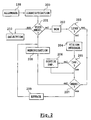
- FIG. 2 is a flowchart for recalling the steps essentials of the method according to the invention that the user can implement artwork.
- Step 199 consists in switching on the television.
- Stage 200 user identification follows. So only the messages that are reserved will be accessible to the user.
- a decision step 201 the user of the device according to the invention is offered the possibility of reading his messages. If he answers in the affirmative, a first name of sender is proposed in a step 202.
- a decision step 203 the user can express his wish to read the content of the message or not corresponding to the name proposed to it. If he responds again with if so, the message is viewed in step 204 in the window graph 119.
- the user can in particular use the scroll function 144 and the adjustment function 145.
- the graphics window 119 can then be split into two zones, a first zone permanently displaying the name of the sender of the message, and a second area offering the text of the message itself.
- a decision step 205 offers the user the possibility of printing any attached files or text from the message itself. If he wishes this impression, it is carried out in a step 206.
- a decision step 207 proposes to the user to memorize the message he has just read.
- decision step 203 when the user does not wish to read his message, he goes directly to decision step 207 which nevertheless allows him to memorize the message unread.
- the message is stored in a step 208 in the data memory 112. If the user does not wish to memorize the message, the latter is deleted in a step 209.
- decision step 201 offers him to view the following message. Yes the user answers in the affirmative, the whole process is resumed at from the step of viewing a sender name 202.
- decision step 201 if the user does not wish to read another message, or if he has not not wanted to read his first message, he is offered a step to selection 210.
- the user has in particular the possibility of adjusting a number of parameters of the device according to the invention. For example, it can set a scrolling speed for messages, it can also decide the time interval between two automatic connections on the Internet, it can set the indicator lights indicating the presence of messages, ...
- the selection step 210 can also make it possible to return to a initial programming of parameters.
- This initial programming of parameters corresponds, in a preferred application of the invention, to a configuration where the consultation of messages is most automatic possible, the user having a minimum of operations to perform by means of the remote control.
Landscapes
- Engineering & Computer Science (AREA)
- Multimedia (AREA)
- Signal Processing (AREA)
- Databases & Information Systems (AREA)
- User Interface Of Digital Computer (AREA)
- Controls And Circuits For Display Device (AREA)
- Information Transfer Between Computers (AREA)
Abstract
Description
- un module de réception desdits signaux,
- une unité de commande du module de réception,
- des moyens d'affichage pour afficher des images vidéo
correspondant aux signaux télévisuels reçus
caractérisé en ce qu'il comporte - une interface pour se connecter au réseau Internet,
- une mémoire d'éléments à incruster sur l'image vidéo pour mémoriser notamment des textes de messages à afficher, reçus via le réseau Internet;
- un module de superposition pour superposer à l'image vidéo une fenêtre graphique destinée à afficher les textes des messages mémorisés.
- une mémoire de programmes et une mémoire de données pour recevoir, depuis le réseau Internet, et mémoriser des messages sous forme de données numériques, la mémoire de programmes comprenant une fonction de définition de la zone graphique pour limiter la fenêtre graphique à une ligne de texte
- un microprocesseur connecté au moyen d'un bus bidirectionnel de communication à l'interface de connexion au réseau Internet, aux différentes mémoires et au module de superposition, pour gérer le fonctionnement des différents éléments auxquels il est connecté.
- établir, au moyen notamment d'une interface de communication, une
connexion avec le réseau Internet ;
caractérisé en ce qu'il comporte les étapes supplémentaires consistant à :
- mémoriser dans une mémoire de données des messages reçus depuis le réseau Internet;
- sélectionner des messages mémorisés ;
- afficher successivement et progressivement chaque message sélectionné dans une fenêtre graphique, limitée en hauteur à une ligne de texte, d'une image de télévision.
- Figure 1 : une structure interne simplifiée de l'appareil selon l'invention ;
- Figure 2 : un organigramme illustrant un exemple des différentes étapes que peut suivre un utilisateur de l'appareil selon l'invention pour consulter ses messages.
Claims (9)
- Appareil de réception (100) de signaux télévisuels comportantcaractérisé en ce qu'il comporteun module de réception (101) desdits signaux,une unité de commande (103) du module de réception(101),des moyens d'affichage (118) pour afficher des images vidéo correspondant aux signaux télévisuels reçusune interface (107) pour se connecter au réseau Internet (115),une mémoire d'éléments à incruster (113) sur l'image vidéo pour mémoriser notamment des textes de messages à afficher, reçus via le réseau Internet;un module de superposition (114) pour superposer à l'image vidéo une fenêtre graphique (119) destinée à afficher les textes des messages mémorisés.une mémoire de programmes (111) et une mémoire de données (112) pour recevoir, depuis le réseau Internet (115), et mémoriser des messages sous forme de données numériques, la mémoire de programmes comprenant une fonction de définition de la zone graphique (142) pour limiter la fenêtre graphique (119) à une ligne de texteun microprocesseur (109) connecté au moyen d'un bus bidirectionnel de communication (110) à l'interface (107) de connexion au réseau Internet (115), aux différentes mémoires (111, 112, 113) et au module de superposition (114), pour gérer le fonctionnement des différents éléments auxquels il est connecté.
- Appareil de réception (100) selon la revendication 1 caractérisé en ce que la mémoire de programmes (111) comprend une fonction de défilement (144) pour faire défiler, dans la fenêtre graphique (119) limitée à une ligne de texte, le texte d'un message mémorisé dans la mémoire d'éléments à incruster (113).
- Appareil de réception (100) selon l'une des revendications 1 ou 2, caractérisé en ce qu'il comprend des moyens (122, 149) pour avertir de la présence de nouveaux messages mémorisés dans la mémoire de données (112).
- Appareil de réception (100) selon l'une des revendications 1 à 3, caractérisé en ce qu'il comprend des moyens (120, 121) pour imprimer des messages mémorisés ou des éléments associés à ces messages.
- Appareil de réception (100) selon l'une des revendications 1 à 4, caractérisé en ce qu'il comprend des moyens (107, 148) pour automatiquement établir une connexion au réseau Internet (115) et mémoriser dans la mémoire de données (112) des messages.
- procédé d'affichage sur un écran de télévision (118) de messages reçus depuis un réseau Internet (115) comportant les étapes consistant à :caractérisé en ce qu'il comporte les étapes supplémentaires consistant à :établir, au moyen notamment d'une interface de communication (107), une connexion avec un réseau Internet (115);mémoriser dans une mémoire de données (112) des messages réservés reçus depuis le réseau internent (115);sélectionner des messages mémorisés ;afficher successivement et progressivement chaque message sélectionné dans une fenêtre graphique (118), limitée en hauteur à une ligne de texte, d'une image de télévision.
- Procédé d'affichage selon la revendication 6 caractérisé en ce que l'affichage successif et progressif des messages sélectionnés est réalisé dans la fenêtre graphique (118) limitée en hauteur à une ligne de texte, chaque message sélectionné étant affiché de façon défilante.
- Procédé d'affichage selon la revendication 7, caractérisé en ce qu'il comprend l'étape supplémentaire consistant à contrôler par des actions de retour et de contrôle de vitesse l'affichage progressif des messages sélectionnés.
- Procédé d'affichage selon l'une des revendications 6 à 8 caractérisé en ce qu'il comprend l'étape supplémentaire consistant à établir automatiquement une connexion Internet et mémoriser ainsi des messages à des intervalles de temps réguliers.
Applications Claiming Priority (2)
| Application Number | Priority Date | Filing Date | Title |
|---|---|---|---|
| FR0001581 | 2000-02-09 | ||
| FR0001581A FR2804820B1 (fr) | 2000-02-09 | 2000-02-09 | Appareil et procede d'affichage de messages sur un ecran de television |
Publications (1)
| Publication Number | Publication Date |
|---|---|
| EP1124373A1 true EP1124373A1 (fr) | 2001-08-16 |
Family
ID=8846789
Family Applications (1)
| Application Number | Title | Priority Date | Filing Date |
|---|---|---|---|
| EP01400204A Ceased EP1124373A1 (fr) | 2000-02-09 | 2001-01-25 | Appareil et procédé d'affichage de messages sur un écran de télévision |
Country Status (2)
| Country | Link |
|---|---|
| EP (1) | EP1124373A1 (fr) |
| FR (1) | FR2804820B1 (fr) |
Cited By (1)
| Publication number | Priority date | Publication date | Assignee | Title |
|---|---|---|---|---|
| WO2004015990A1 (fr) * | 2002-08-12 | 2004-02-19 | Koninklijke Philips Electronics N.V. | Procede de traitement de deux signaux audio d'entree |
Citations (3)
| Publication number | Priority date | Publication date | Assignee | Title |
|---|---|---|---|---|
| US5561708A (en) * | 1991-10-03 | 1996-10-01 | Viscorp | Method and apparatus for interactive television through use of menu windows |
| US5931905A (en) * | 1996-02-29 | 1999-08-03 | Kabushiki Kaisha Toshiba | TV mail system |
| WO1999052036A1 (fr) * | 1998-04-08 | 1999-10-14 | Open Tv, Inc. | Systeme et technique pour reponse immediate par courrier electronique |
-
2000
- 2000-02-09 FR FR0001581A patent/FR2804820B1/fr not_active Expired - Lifetime
-
2001
- 2001-01-25 EP EP01400204A patent/EP1124373A1/fr not_active Ceased
Patent Citations (3)
| Publication number | Priority date | Publication date | Assignee | Title |
|---|---|---|---|---|
| US5561708A (en) * | 1991-10-03 | 1996-10-01 | Viscorp | Method and apparatus for interactive television through use of menu windows |
| US5931905A (en) * | 1996-02-29 | 1999-08-03 | Kabushiki Kaisha Toshiba | TV mail system |
| WO1999052036A1 (fr) * | 1998-04-08 | 1999-10-14 | Open Tv, Inc. | Systeme et technique pour reponse immediate par courrier electronique |
Cited By (1)
| Publication number | Priority date | Publication date | Assignee | Title |
|---|---|---|---|---|
| WO2004015990A1 (fr) * | 2002-08-12 | 2004-02-19 | Koninklijke Philips Electronics N.V. | Procede de traitement de deux signaux audio d'entree |
Also Published As
| Publication number | Publication date |
|---|---|
| FR2804820A1 (fr) | 2001-08-10 |
| FR2804820B1 (fr) | 2002-05-24 |
Similar Documents
| Publication | Publication Date | Title |
|---|---|---|
| EP2149256B1 (fr) | Generation d'une mosaique tv personnalisable | |
| US20020161634A1 (en) | Electronic document with an automatically updated portion | |
| KR100791236B1 (ko) | 수신국 상에서 애플리케이션 자동 실행 방법 및 수신국 | |
| FR2752130A1 (fr) | Procede de selection de programmes, notamment de programmes de television et dispositif et interface graphique mettant en oeuvre ce procede | |
| FR2902568A1 (fr) | Procede d'affichage d'une image mosaique au sein d'un recepteur pour la selection de programmes audiovisuels, recepteurs et serveurs associes | |
| FR2767005A1 (fr) | Procede et systeme de videodiffusion pour fournir et afficher des donnees auxiliaires avec des signaux video et audio diffuses | |
| FR2710807A1 (fr) | Procédé d'affichage et de traitement des données de vidéotexte ou de téléphone et dispositif. | |
| EP1946484B1 (fr) | Reception de contenus audiovisuels a destination de plusieurs appareils | |
| EP1258140B1 (fr) | Procede de visualisation d'emissions audiovisuelles diffusees et dispositif de visualisation associe | |
| FR2834602A1 (fr) | Procede et dispositif pour fournir des informations de guide de programmes de diffusion | |
| FR2804820A1 (fr) | Appareil et procede d'affichage de messages sur un ecran de television | |
| WO2005099266A1 (fr) | Procede et dispositif de traitement automatique d'informations spontanees | |
| EP1152609B1 (fr) | Dispositif d'enregistrement de signaux vidéo télécommandé par un réseau de télécommunication | |
| FR2797134A1 (fr) | Procede de gestion d'un affichage sur un ecran d'un televiseur, utilisation de ce procede, et televiseur fonctionnant selon ce procede | |
| EP2752796A1 (fr) | Procédé de génération d'un menu de présentation de programmes audiovisuels payés par plusieurs utilisateurs, dispositif et programme d'ordinateur pour la mise en oeuvre du procédé | |
| FR2818484A1 (fr) | Procede de mesure d'audience d'applications interactives telediffusees ou embarquees sur un decodeur de recepteur de television | |
| FR2818074A1 (fr) | Procede de constitution d'une liste de programmes de services de television | |
| EP1225761B1 (fr) | Procédé de commande d'un appareil comportant plusieurs sources vidéo | |
| EP0949762A1 (fr) | Système audiovisuel constitué de plusieurs apparareils dont certains sont constitués de plusieurs modules fonctionnels | |
| WO2000021285A1 (fr) | Procede et dispositif de gestion de donnees de service dans un systeme de television | |
| FR2812160A1 (fr) | Decodeur avec fonction de creation d'images mosaiques de services de television | |
| EP1231784B1 (fr) | Procédé de production d'une séquence audio ou vidéo et dispositif associé | |
| FR2760165A1 (fr) | Procede pour presenter sur un ecran d'affichage d'un televiseur une image composite combinant une image de television et un contenu informatif de donnees internet | |
| FR2809914A1 (fr) | Decodeur de television avec assistance | |
| EP1124371A1 (fr) | Appareil et procédé de transmission d'une image vidéo |
Legal Events
| Date | Code | Title | Description |
|---|---|---|---|
| PUAI | Public reference made under article 153(3) epc to a published international application that has entered the european phase |
Free format text: ORIGINAL CODE: 0009012 |
|
| AK | Designated contracting states |
Kind code of ref document: A1 Designated state(s): DK FI FR GR IE |
|
| AX | Request for extension of the european patent |
Free format text: AL;LT;LV;MK;RO;SI |
|
| RIN1 | Information on inventor provided before grant (corrected) |
Inventor name: MEULLE, PHILIPPE |
|
| RAP1 | Party data changed (applicant data changed or rights of an application transferred) |
Owner name: SAGEM S.A. |
|
| AKX | Designation fees paid |
Free format text: DK FI FR GR IE |
|
| RBV | Designated contracting states (corrected) |
Designated state(s): DE ES FR GB IT |
|
| REG | Reference to a national code |
Ref country code: DE Ref legal event code: 8566 |
|
| 17P | Request for examination filed |
Effective date: 20010601 |
|
| RAP1 | Party data changed (applicant data changed or rights of an application transferred) |
Owner name: SAGEM COMMUNICATION |
|
| RAP1 | Party data changed (applicant data changed or rights of an application transferred) |
Owner name: SAGEM COMMUNICATIONS |
|
| 17Q | First examination report despatched |
Effective date: 20080717 |
|
| RAP1 | Party data changed (applicant data changed or rights of an application transferred) |
Owner name: SAGEM COMMUNICATIONS SAS |
|
| RAP1 | Party data changed (applicant data changed or rights of an application transferred) |
Owner name: SAGEM COMMUNICATIONS |
|
| RAP1 | Party data changed (applicant data changed or rights of an application transferred) |
Owner name: SAGEM COMMUNICATIONS SAS |
|
| STAA | Information on the status of an ep patent application or granted ep patent |
Free format text: STATUS: THE APPLICATION HAS BEEN REFUSED |
|
| 18R | Application refused |
Effective date: 20091204 |