EP1124349A2 - Public key distribution using an approximate linear function - Google Patents
Public key distribution using an approximate linear function Download PDFInfo
- Publication number
- EP1124349A2 EP1124349A2 EP01103082A EP01103082A EP1124349A2 EP 1124349 A2 EP1124349 A2 EP 1124349A2 EP 01103082 A EP01103082 A EP 01103082A EP 01103082 A EP01103082 A EP 01103082A EP 1124349 A2 EP1124349 A2 EP 1124349A2
- Authority
- EP
- European Patent Office
- Prior art keywords
- entity
- comparator
- value
- public key
- key information
- Prior art date
- Legal status (The legal status is an assumption and is not a legal conclusion. Google has not performed a legal analysis and makes no representation as to the accuracy of the status listed.)
- Granted
Links
Images


Classifications
-
- H—ELECTRICITY
- H04—ELECTRIC COMMUNICATION TECHNIQUE
- H04L—TRANSMISSION OF DIGITAL INFORMATION, e.g. TELEGRAPHIC COMMUNICATION
- H04L9/00—Cryptographic mechanisms or cryptographic arrangements for secret or secure communications; Network security protocols
- H04L9/08—Key distribution or management, e.g. generation, sharing or updating, of cryptographic keys or passwords
- H04L9/0816—Key establishment, i.e. cryptographic processes or cryptographic protocols whereby a shared secret becomes available to two or more parties, for subsequent use
- H04L9/0838—Key agreement, i.e. key establishment technique in which a shared key is derived by parties as a function of information contributed by, or associated with, each of these
- H04L9/0841—Key agreement, i.e. key establishment technique in which a shared key is derived by parties as a function of information contributed by, or associated with, each of these involving Diffie-Hellman or related key agreement protocols
Definitions
- the present invention relates generally to cryptographic methods and systems to be used in digital data processing and, in particular, is directed to methods and systems for public key distribution.
- Public-key cryptographic algorithms employ an encryption key that is different from the decryption key. Since the algorithms are designed so that it is computationally infeasible to determine the decryption key from the encryption key, the encryption key can be made "public.”
- anyone may use a public encryption key to encrypt a message, but only a recipient with the corresponding "private" key may decrypt the message.
- Public-key cryptographic systems solve the key distribution problem, however, most are computationally intensive and therefore slow to operate on conventional computer systems.
- the present invention provides a computer-readable medium containing instructions for instructing a computer to perform the methods as defined in claim 1 or 2.
- Methods, systems, and articles of manufacture consistent with the present invention provide means for two entities to agree on common cryptographic key information over an insecure communications channel.
- the second entity is associated with a public/private key pair based on a public key algorithm.
- a first entity determines a first value, x, and determines a weighted sum based on the first value and a first part of a public key corresponding to the second entity.
- the first entity transmits the weighted sum to the second entity and determines a first comparator based on the first value and a second part of a public key corresponding to the second entity.
- the second entity determines a second comparator representing an approximate version of the first comparator.
- the first and second entities can agree on cryptographic key information.
- the first entity determines a first comparator based on a first approximately linear function, the first value, and a second part of a public key corresponding to the second entity
- the second entity determines a second comparator based on the second value and a second approximately linear function related to the first approximately linear function.
- Fig. 1 is a block diagram of a public key cryptosystem that transmits a computationally secure cryptogram over an insecure communication channel;
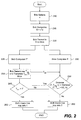
- Fig. 2 illustrates the steps of one exemplary method consistent with the present invention for agreeing upon a common cryptographic key
- Fig. 3 illustrates one exemplary system for public key distribution between two users consistent with the present invention.
- a public-key algorithm is any algorithm which uses two different "keys," one for encryption and another for decryption. Because one key cannot be easily determined from the other, the public key may be handed out freely, distributed over insecure channels, and posted publicly without compromising the security of an encryption system based on the public-key algorithm.
- the parties When two parties want to communicate using a public key cryptosystem over an insecure communication channel, the parties must have compatible cryptographic devices.
- One party must possess an enciphering device that performs a transformation based on a public key algorithm and an encryption key, E, and the other party must possess a deciphering device that performs the inverse transformation based on the same public key algorithm and the decryption key, D, that corresponds to the encryption key.
- Fig. 1 is a block diagram illustrating a general public key cryptosystem.
- a public key cryptosystem if User1 wants to send an encrypted message to User2, User1 first obtains an encryption key from User2, which is also referred to generally as User2's "public" key. Before any communications may take place User2 must generate a public/private key pair using a known public key cryptosystem. Keys may be generated by, for example, key generator 124 with input from key source 126. Key source 126 may be, for example, a true random generator.
- User1 may obtain encryption key, E, that is, User2's public key, from User2 directly over an insecure communications channel 130 by, for example, User2 sending to User1 in an email or User1 downloading the public key from a web page.
- User1 encrypts plaintext message, P, using enciphering device 105 to obtain ciphertext, C.
- Enciphering device 105 encrypts P using a known public key algorithm.
- User1 then sends C to User2 over communications interface 131 and an insecure channel 130 such as, for example, by email over the Internet.
- User2 receives the ciphertext message, C, over a communications interface 128.
- User2 can decrypt C using deciphering device 122 and decryption key, D.
- an eavesdropper 150 will find it computationally infeasible to independently determine the underlying plaintext of ciphertext, C, even if eavesdropper 150 also collects encryption key, E.
- the present invention is a new and fast public key distribution algorithm that uses only a modest number of weighted multi-precision integer additions (with small integer weights).
- Two entities may use the present invention to agree on cryptographic key information.
- One user transmits information based on a public key to another user over an insecure communications medium.
- both parties may agree on the same cryptographic key information without compromising the security of the cryptosystem.
- AL approximate linear
- AL any one of a family of functions AL(*, w) such that AL(i+j, w) ⁇ AL(i, w) + AL(j, w), where w parameterizes the family by selecting a specific linear function, AL(*, w).
- AL has the following property that: AL(i+j, w) ⁇ AL(i, w) + AL(j, w) mod k, the mathematical symbol " ⁇ " denoting that the result on the left hand side is "approximately equivalent” to the result on the right hand side.
- AL approximate linear
- the function floor (arg) is defined to be the greatest integer less than or equal to arg and therefore converts a real value to an integer value.
- the floor function will be used to explicitly indicate when real values should be converted to integers (possibly with loss of information caused by elimination of the fractional part).
- the numerator of the argument that is, (w * i mod m ) / m ) will result in a real number between 0 and 1 (inclusive of 0 and exclusive of 1).
- a real number between 0 and k (inclusive of 0 and exclusive of k) results.
- the floor function converts this result to an integer greater than or equal to 0 and less than k.
- w, m, and k are assumed to be integers.
- k and m are powers of 2, that is, log 2 m and log 2 k are both integers. Restricting k and m to be powers of 2 improves the efficiency of calculations, but is not required.
- the class of functions P(i, w) satisfies the property: AL(i+j, w) ⁇ AL(i, w) + AL(j, w) mod k.
- L(i, w) (( w * i mod m ) / m ) * k
- L(i, w) maps integers onto reals by performing almost the same calculation as P(i, w) but leaving out the "floor" operation.
- the private key comprises, w, a real or integer value known only to Alice.
- Private key, w may be, for example, a randomly chosen vector of 0s and 1s of any length.
- the private key may optionally also comprise m, or m may be a fixed system parameter.
- the a component of the public key may be chosen randomly or generated pseudo-randomly from a small key by, for example, using a block cipher to generate the pseudo random values of a.
- b can be easily recomputed from w and a, if a is generated pseudo randomly from a small key, the total amount of information that must be stored for the private key is quite small.
- the public key may also optionally comprise k, or k may be a fixed system parameter. While k can, in principal, be any value, there is reason to believe that the choice of k may affect the security of the system.
- w and the elements of a are randomly chosen 200-bit quantities, that k is the integer 2 8 (or 256), and that m is 2 200 .
- the b i are 8-bit quantities.
- m can be used as part of the private key, however, in the present example, m is a public and fixed system parameter to simplify the calculations.
- the secret key in this example is w alone.
- Alice After Alice determines the public/private key pair, she shares the public key with a second user called Bob in this example.
- Bob may obtain the public key using any method commonly associated with public key distribution such as, for example, Alice may email the public key to Bob or Alice may post the public key in a location that Bob can access.
- Bob knows a and b (from the public key) and the system parameters m, k and n (which are, in this example, fixed system parameters). Since she created the public/private key pair, Alice knows a and b (the public key), the system parameters m, k, and n and, in addition, knows w (the private key).
- Fig. 2 illustrates the steps of one exemplary method for agreeing upon a common cryptographic key.
- the elements of vector x may be selected, for example, from the range [0,1] or the range [0,1,2,3], wherein the vector x is a vector of integers.
- integers chosen from the first range for example, may be represented using one bit and integers chosen from the second range may be represented using two bits.
- Bob then transmits S to Alice (step 220).
- an eavesdropper on the insecure line may intercept S.
- Bob may be computing T' by using system parameter, k, and the variable, x, known only to Bob, and adding elements of b (step 225).
- T' floor (x*(b+0.5)mod k) Since b is a vector, the expression ( b + 0.5 ) represents the vector (b 1 + 0.5, b 2 + 0.5, b 3 + 0.5, ... b n + 0.5).
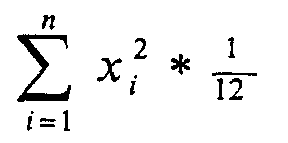
- Each err i may be treated as a random variable over the interval [-0.5 .. 0.5] which has mean 0 and variance 1/12 ( 1/12 is the integral of x 2 over [-0.5 .. 0.5]).
- the constant 0.5 is a consequence of the fact that, in this embodiment, P(i, w) is defined using the floor function rather than the nearest integer.
- T P(S,w) ⁇ L(S,w)
- S x*a
- the error term (x * err) has mean 0 and variance, equal to:
- steps 235 through 260 One exemplary means of error correction is illustrated in steps 235 through 260.
- Bob should not simply transmit T' to Alice because, doing so gives away information to any eavesdropper.
- Bob may instead transmit both T' and the value farthest away from T' mod k which, assuming k is divisibly by 2, is (T'+ k/2) mod k.
- Alice could then determine if T is closer to T' or (T'+ k/2) mod k. If T is closer to T', for example, then Alice and Bob can both agree on a common bit provided that T'-T (the error introduced by the approximation) isn't too large. For example, if T is closer to T', both Alice and Bob may select the bit, "0," and, if otherwise, select the bit "1".
- Bob transmitted T' If Bob transmitted T' (step 245), then Bob uses a first key information set such as, for example, "0" (step 260). Otherwise, Bob uses a second key set information such as, for example, bit "1" (step 250).
- Alice receives T min and can compare it to T.
- Alice compares T to T min by computing the distance (T, T min , k) where distance (i,j,k) denotes the distance between i and j modulo k or, in other words, the minimum of (i-j) mod k and (j-i) mod k (step 240). If, for example, the distance (T, T min , k) is less than distance (T, T min + k/2, k), then Alice uses the first key information set (step 260). If the distance (T, T min , k) is not less than the distance (T, T min + k/2, k), Alice uses the second key information set (step 250). In this fashion, Alice and Bob may agree upon the same key information.
- Alice and Bob have agreed on a single bit of key information.
- Systems and methods consistent with the present invention may also be used to agree on multiple bits of information at a time. Computing multiple bits in each operation may be one means of reducing the number of calculations performed and thereby increasing computation efficiency.
- Alice and Bob may agree, or the system parameters may be set, to select 2 bits of key information with each iteration.
- T min the minimum distance between T' and four choices: T min , (T min + k/4) mod k, (T min + 2k/4) mod k, and (T min + 3k/4) mod k.
- Tmin will then be one drawn uniformly from the distribution [0,... k/4]. If Bob sends T min in step 235, then Bob uses 0 as the key information, which translates to "00" or two bits of key information. If, on the other hand, Bob transmits (T' + k/4) mod k as T min , Bob then uses 1, or "01" as the two bits of key information. In this manner, more bits may be sent with each iteration. Transmitting a very large number of bits, however, may increase the rate of errors.
- Other methods of reducing the total number of additions when many sums over the same vector a are to be computed are also possible, such as computing multiple temporary vectors, then looking for common elements in the vectors.
- One means for reducing both the computational and communications overhead is to use more than one value for w and more than one vector b with the same vector a.
- systems consistent with the present invention may resemble the public key cryptosystem depicted in Fig. 1.
- Bob may be User 1, for example, and Alice may be User 2.
- Systems, such as the one depicted in Fig. 1, may be used to generate and distribute information over insecure channel 130 that eventually would allow Bob and Alice to agree upon common key information.
- the elements surrounded by dashed lines in Fig. 1 may be personal computers 110 and 120. Each of computers 110 and 120 may be equivalent, for example, to computer 312 in Fig. 3.
- Fig. 3 illustrates a system suitable for public key distribution in a manner consistent with the present invention.
- Computer 312 comprises a processor 322, storage device 320, read only memory (ROM) 318, and main memory 316.
- the steps of methods consistent with the present invention may be, for example, executed by processor 322 or, optionally, a hardware device such as encryption/decryption device 326.
- Main memory 316 is a random access memory (RAM) or a dynamic storage device that stores instructions executed by processor 322.
- Main memory 316 may also store information used in executing instructions or data, such as cryptographic keys.
- ROM 318 is used for storing static information and instructions used by processor 322.
- Storage device 320 such as a magnetic or optical disk, also stores instructions and data used in the operation of computer system 312.
- Computer 312 may also comprise a display 330 and cursor control 314, as well as user interface devices such as a mouse 330, trackball (not shown), or pen 310.
- Display 330 may be a CRT or other type of display device.
- Cursor control 314 controls cursor movement by the user interface devices on display 330.
- Computer 312 may be connected to local area network (LAN) 334 for communicating with other devices connected to LAN 334.
- LAN may be connected to a computer 340, a printer 336, and a mass storage 338.
- Computer 340 may be used by, for example, another user wishing to agree upon key information with Alice or Bob.
- LAN 334 may also be connected to a gateway 342 for connecting to another network 344.
- Network 344 may be connected to a computer 346, a printer 348, and a database 350.
- computer 312 may communicate information to other computers across an insecure network in order to agree upon common key information in a manner consistent with the present invention.
- Alice may communicate using computer 312, while Bob may be located across LAN 334 and Network 344 at computer 346.
- the apparatus and methods described herein may be implemented by computer 312 using hardware, software, or a combination of hardware and software.
- the apparatus and methods described herein may be implemented as a program in any one or more of main memory 316, ROM 318, or storage device 320.
- processor 322 executes programs which compute the intermediate values that Bob sends to Alice.
- main memory 316 Such programs may be read into main memory 316 from another computer-readable medium, such as storage device 320. Execution of sequences of instructions contained in main memory 316 causes processor 322 to perform the process steps consistent with the present invention described herein. Execution of sequences of instructions contained in main memory 316 also causes processor to implement apparatus elements that perform the process steps. Hard-wired circuitry may be used in place of or in combination with software instructions to implement the invention. Thus, embodiments of the invention are not limited to any specific combination of hardware circuitry and software.
- Non-volatile memory media includes, for example, optical or magnetic disks, such as storage device 320.
- Volatile memory media includes RAM, such as main memory 316.
- Transmission media includes coaxial cables, copper wire and fiber optics, including the wires that comprise bus 326. Transmission media can also take the form of acoustic or light waves, such as those generated during radiowave and infrared data communications.
- Computer-readable media include, for example, a floppy disk, a flexible disk, hard disk, magnetic tape, or any other magnetic storage medium, a CD-ROM, any other optical medium, punchcards, papertape, any other physical medium with patterns of holes, a RAM, a PROM, an EPROM, a FLASH-EPROM, any other memory chip or cartridge, a carrier wave as described hereinafter, or any other medium from which a computer can read and use.
- Various forms of computer readable media may be involved in carrying one or more sequences of instructions to processor 322 for execution.
- the instructions may initially be carried on a magnetic disk or a remote computer.
- the remote computer can load the instructions into its dynamic memory and send the instructions over a telephone line using a modem.
- a modem local to computer system 312 can receive the data on the telephone line and use an infrared transmitter to convert the data to an infrared signal.
- An infrared detector coupled to appropriate circuitry can receive the data carried in the infrared signal and place the data on bus 326.
- Bus 326 carries the data to main memory 316, from which processor 322 retrieves and executes the instructions.
- the instructions received by main memory 316 may optionally be stored on storage device 320 either before or after execution by processor 322.
- Computer system 312 also includes a communication interface 324 coupled to bus 326.
- Communication interface 324 provides two way communications to other systems.
- communication interface 324 may be an integrated services digital network (ISDN) card or a modem to provide a data communication connection to a corresponding type of telephone line.
- ISDN integrated services digital network
- Communication may also be, for example, a local area network (LAN) card to provide communication to a LAN.
- LAN local area network
- Communication interface 324 may also be a wireless card for implementing wireless communication between computer system 312 and wireless systems. In any such implementation, communication interface 324 sends and receives electrical, electromagnetic or optical signals that carry data streams representing various types of information.
- the link between communication interface 324 and external devices and systems typically provides data communication through one or more networks or other devices.
- the link may provide a connection to a local network (not shown) to a host computer or to data equipment operated by an Internet Service Provider (ISP).
- ISP Internet Service Provider
- An ISP provides data communication services through the world wide packet data communications network now commonly referred to as the "Internet.”
- Internet Internet
- Local networks and the Internet both use electrical, electromagnetic or optical signals that carry digital data streams.
- the signals through the various networks and the signals between the networks and communication interface 324, which carry the digital data to and from computer system 312, are exemplary forms of carrier waves transporting the information.
- Computer system 312 can send messages and receive data, including program code, through the network(s) via the link between communication interface 324 and the external systems and devices.
- a server might transmit a requested code for an application program through the Internet, an ISP, a local network, and communication interface 324.
- Program code received over the network may be executed by processor 322 as it is received, and/or stored in memory, such as in storage device 320, for later execution. In this manner, computer system 312 may obtain application code in the form of a carrier wave.
Landscapes
- Engineering & Computer Science (AREA)
- Computer Security & Cryptography (AREA)
- Computer Networks & Wireless Communication (AREA)
- Signal Processing (AREA)
- Storage Device Security (AREA)
- Mobile Radio Communication Systems (AREA)
Abstract
Description

b = P(a,w), mod k. The a component of the public key may be chosen randomly or generated pseudo-randomly from a small key by, for example, using a block cipher to generate the pseudo random values of a. As b can be easily recomputed from w and a, if a is generated pseudo randomly from a small key, the total amount of information that must be stored for the private key is quite small.
(step 230).
common key information. In one embodiment, the elements surrounded by dashed lines in Fig. 1 may be personal computers 110 and 120. Each of computers 110 and 120 may be equivalent, for example, to computer 312 in Fig. 3.
Claims (10)
- A method of agreeing on common cryptographic key information between a first and second entity over an insecure communications channel, wherein the second entity is associated with a public/private key pair based on a public key algorithm, the method comprising the steps of:the first entity determining a first value, x;the first entity determining a weighted sum based on the first value and a first part of a public key corresponding to the second entity;the first entity transmitting the weighted sum to the second entity;the first entity determining a first comparator based on the first value and a second part of the public key corresponding to the second entity;the second entity determining a second comparator representing an approximate version of the first comparator; andthe first and second entities agreeing on cryptographic key information based on the first and second comparators.
- A method of agreeing on common cryptographic key information between a first and a second entity over an insecure communications channel, wherein the second entity is associated with a public/private key pair based on a public key algorithm, the method comprising the steps of:the first entity selecting a first value;the first entity determining a second value based on the first value and a first part of a public key corresponding to the second entity;the first entity transmitting the second value to the second entity over the insecure communications channel;the first entity determining a first comparator based on a first approximately linear function, the first value, and a second part of a public key corresponding to the second entity;the first entity transmitting a third value to the second entity, the third value based on the first comparator;the second entity determining a second comparator based on the second value and a second approximately linear function related to the first approximately linear function; andthe first and second entities agreeing on cryptographic key information based on the third value and the second comparator.
- The method of claim 1 or 2, wherein the step of the first and second entities agreeing on cryptographic key information based on the first and second comparators comprises:the first entity transmitting to the second entity a minimum of the first comparator and a second number mathematically related to the first comparator;the first entity using a first key information set if the minimum equals the first comparator, and using a second key information set if the minimum equals the second number;the second entity determining if the second comparator is closer to the minimum or a third number mathematically related to the second comparator; andthe second entity using a first key information set if the second comparator is closer to the minimum, and using a second key information set if the second comparator is closer to the third number.
- The method of claim 1 or 2, wherein a second number mathematically related to the first comparator is a number farthest away from the first comparator modulo k and a third number mathematically related to the second comparator is a number farthest away from the second comparator modulo k.
- A public key distribution system for agreeing on common cryptographic key information between a first and a second entity over an insecure communications channel, wherein the second entity is associated with a public/private key pair based on a public key algorithm, the system comprising:the first entity comprising:means for determining a first value, x,means for determining a weighted sum based on the first value and a first part of a public key corresponding to the second entity,means for transmitting the weighted sum to the second entity,means for determining a first comparator based on the first value and a second part of a public key corresponding to the second entity,means for selecting a key information set based on the first comparator; andthe second entity comprising:means for determining a second comparator representing an approximate version of the first comparator, andmeans for selecting the key information set based on the second comparator and the second value.
- A public key distribution system for agreeing on common cryptographic information between a first and a second entity over an insecure communications channel, wherein the second entity is associated with a public/private key pair based on a public key algorithm, the system comprising:the first entity comprising:means for determining a first value, x,means for determining a second value based on the first value and a first part of a public key corresponding to the second entity,means for transmitting the second value to the second entity,means for determining a first comparator based on the first value and a second part of a public key corresponding to the second entity,means for selecting a key information set based on the first comparator; andthe second entity comprising:means for determining a second comparator representing an approximate versions of the first comparator; andmeans for selecting the key information set based on the second comparator.
- The system of claim 5 or 6, wherein the means for selecting a key information set based on the first comparator comprises:means for transmitting to the second entity a minimum of the first comparator and a second number mathematically related to the first comparator; andmeans for using a first key information set, if the minimum equals the first comparator and using a second key information set, if the minimum equals the second number.
- The system of claim 5 or 6, wherein the means for selecting the key information set based on the second comparator comprises:means for determining if the second comparator is closer to the minimum or a third number mathematically related to the second comparator; andmeans for using a first key information set if the second comparator is closer to the minimum, and using a second key information set if the second comparator is closer to the third number.
- The system of claim 7, wherein a second number mathematically related to the first comparator is a number farthest away from the first comparator modulo k.
- The system of claim 8, wherein a third number mathematically related to the second comparator is a number farthest away from the second comparator modulo k.
Applications Claiming Priority (2)
| Application Number | Priority Date | Filing Date | Title |
|---|---|---|---|
| US09/501,181 US6839839B1 (en) | 2000-02-10 | 2000-02-10 | Public key distribution using an approximate linear function |
| US501181 | 2000-02-10 |
Publications (3)
| Publication Number | Publication Date |
|---|---|
| EP1124349A2 true EP1124349A2 (en) | 2001-08-16 |
| EP1124349A3 EP1124349A3 (en) | 2002-10-02 |
| EP1124349B1 EP1124349B1 (en) | 2004-09-08 |
Family
ID=23992445
Family Applications (1)
| Application Number | Title | Priority Date | Filing Date |
|---|---|---|---|
| EP01103082A Expired - Lifetime EP1124349B1 (en) | 2000-02-10 | 2001-02-09 | Public key distribution using an approximate linear function |
Country Status (3)
| Country | Link |
|---|---|
| US (1) | US6839839B1 (en) |
| EP (1) | EP1124349B1 (en) |
| DE (1) | DE60105328T2 (en) |
Families Citing this family (5)
| Publication number | Priority date | Publication date | Assignee | Title |
|---|---|---|---|---|
| GB2368755A (en) * | 2000-11-01 | 2002-05-08 | Content Technologies Ltd | Distributing public keys using 2D barcodes |
| JP2003229847A (en) * | 2001-11-28 | 2003-08-15 | Yun-Factory:Kk | Key exchange device, method, program, and recording medium recording the program |
| US20030154408A1 (en) * | 2002-02-13 | 2003-08-14 | Yanong Zhu | Method and apparatus for secured unified public communication network based on IP and common channel signaling |
| US20040068651A1 (en) * | 2002-05-21 | 2004-04-08 | Pender Michael J. | Optical device for identifying friends and foes using real-time optical encryption and method for producing the same |
| JP4548223B2 (en) * | 2005-05-27 | 2010-09-22 | 日本電気株式会社 | Pseudorandom function calculation device and method, and number-of-times anonymous authentication system and method |
Family Cites Families (5)
| Publication number | Priority date | Publication date | Assignee | Title |
|---|---|---|---|---|
| US4218582A (en) | 1977-10-06 | 1980-08-19 | The Board Of Trustees Of The Leland Stanford Junior University | Public key cryptographic apparatus and method |
| US5273921A (en) | 1991-12-27 | 1993-12-28 | Purdue Research Foundation | Methods for fabricating a dual-gated semiconductor-on-insulator field effect transistor |
| US5297206A (en) | 1992-03-19 | 1994-03-22 | Orton Glenn A | Cryptographic method for communication and electronic signatures |
| JP2572003B2 (en) | 1992-03-30 | 1997-01-16 | 三星電子株式会社 | Method of manufacturing thin film transistor having three-dimensional multi-channel structure |
| US5602047A (en) | 1996-06-13 | 1997-02-11 | Industrial Technology Research Institute | Process for polysilicon thin film transistors using backside irradiation and plasma doping |
-
2000
- 2000-02-10 US US09/501,181 patent/US6839839B1/en not_active Expired - Lifetime
-
2001
- 2001-02-09 DE DE60105328T patent/DE60105328T2/en not_active Expired - Lifetime
- 2001-02-09 EP EP01103082A patent/EP1124349B1/en not_active Expired - Lifetime
Also Published As
| Publication number | Publication date |
|---|---|
| EP1124349B1 (en) | 2004-09-08 |
| US6839839B1 (en) | 2005-01-04 |
| EP1124349A3 (en) | 2002-10-02 |
| DE60105328T2 (en) | 2005-02-10 |
| DE60105328D1 (en) | 2004-10-14 |
Similar Documents
| Publication | Publication Date | Title |
|---|---|---|
| CN114586313B (en) | System and method for signing information | |
| US20240356730A1 (en) | Computer-implemented system and method for highly secure, high speed encryption and transmission of data | |
| US6490352B1 (en) | Cryptographic elliptic curve apparatus and method | |
| CN110011995B (en) | Encryption and decryption method and device in multicast communication | |
| Hassan et al. | An efficient outsourced privacy preserving machine learning scheme with public verifiability | |
| US20050271203A1 (en) | Encryption apparatus, decryption apparatus, key generation apparatus, program, and method | |
| US12587364B2 (en) | Method of data transmission, and electronic device | |
| US11528127B2 (en) | Computer-implemented system and method for highly secure, high speed encryption and transmission of data | |
| Sengupta et al. | Message mapping and reverse mapping in elliptic curve cryptosystem | |
| EP3490189B1 (en) | Communication terminals, server devices, and programs | |
| US7783045B2 (en) | Secure approach to send data from one system to another | |
| Rawal et al. | Challenges and opportunities on the horizon of post-quantum cryptography | |
| KR102141115B1 (en) | Quantum signature method and quantum secret sharing method using quantum trapdoor one-way function | |
| Sarkar et al. | An Overview of the Discrete Logarithm Problem in Cryptography | |
| Oladipupo et al. | Improved authenticated elliptic curve cryptography scheme for resource starve applications | |
| US6839839B1 (en) | Public key distribution using an approximate linear function | |
| Jain et al. | Secure communication using RSA algorithm for network environment | |
| Singh et al. | Loki: A lightweight LWE method with rogue bits for quantum security in IoT devices | |
| KR20030047148A (en) | Method of messenger security based on client/server using RSA | |
| Dhiman et al. | A survey analyzing encryption schemes for IoT security measures: S. Dhiman et al. | |
| CN112131596B (en) | Encryption and decryption method, equipment and storage medium | |
| Lizama-Perez | Non-invertible key exchange protocol | |
| Bajpai et al. | Key agreement using symmetric group | |
| EP4546706A1 (en) | A node for a quantum communication network, a quantum communication network and a method of producing a signed message | |
| Vasco et al. | Group Key Establishment in the Post-quantum Setting: Constructions and Research Avenues |
Legal Events
| Date | Code | Title | Description |
|---|---|---|---|
| PUAI | Public reference made under article 153(3) epc to a published international application that has entered the european phase |
Free format text: ORIGINAL CODE: 0009012 |
|
| AK | Designated contracting states |
Kind code of ref document: A2 Designated state(s): AT BE CH CY DE DK ES FI FR GB GR IE IT LI LU MC NL PT SE TR |
|
| AX | Request for extension of the european patent |
Free format text: AL;LT;LV;MK;RO;SI |
|
| PUAL | Search report despatched |
Free format text: ORIGINAL CODE: 0009013 |
|
| AK | Designated contracting states |
Kind code of ref document: A3 Designated state(s): AT BE CH CY DE DK ES FI FR GB GR IE IT LI LU MC NL PT SE TR |
|
| AX | Request for extension of the european patent |
Free format text: AL;LT;LV;MK;RO;SI |
|
| 17P | Request for examination filed |
Effective date: 20030402 |
|
| 17Q | First examination report despatched |
Effective date: 20030512 |
|
| AKX | Designation fees paid |
Designated state(s): DE FR GB |
|
| GRAP | Despatch of communication of intention to grant a patent |
Free format text: ORIGINAL CODE: EPIDOSNIGR1 |
|
| GRAS | Grant fee paid |
Free format text: ORIGINAL CODE: EPIDOSNIGR3 |
|
| GRAA | (expected) grant |
Free format text: ORIGINAL CODE: 0009210 |
|
| RAP1 | Party data changed (applicant data changed or rights of an application transferred) |
Owner name: XEROX CORPORATION |
|
| AK | Designated contracting states |
Kind code of ref document: B1 Designated state(s): DE FR GB |
|
| REG | Reference to a national code |
Ref country code: GB Ref legal event code: FG4D |
|
| REG | Reference to a national code |
Ref country code: IE Ref legal event code: FG4D |
|
| REF | Corresponds to: |
Ref document number: 60105328 Country of ref document: DE Date of ref document: 20041014 Kind code of ref document: P |
|
| ET | Fr: translation filed | ||
| PLBE | No opposition filed within time limit |
Free format text: ORIGINAL CODE: 0009261 |
|
| STAA | Information on the status of an ep patent application or granted ep patent |
Free format text: STATUS: NO OPPOSITION FILED WITHIN TIME LIMIT |
|
| 26N | No opposition filed |
Effective date: 20050609 |
|
| REG | Reference to a national code |
Ref country code: FR Ref legal event code: PLFP Year of fee payment: 16 |
|
| REG | Reference to a national code |
Ref country code: FR Ref legal event code: PLFP Year of fee payment: 17 |
|
| REG | Reference to a national code |
Ref country code: FR Ref legal event code: PLFP Year of fee payment: 18 |
|
| PGFP | Annual fee paid to national office [announced via postgrant information from national office to epo] |
Ref country code: GB Payment date: 20200123 Year of fee payment: 20 Ref country code: DE Payment date: 20200121 Year of fee payment: 20 |
|
| PGFP | Annual fee paid to national office [announced via postgrant information from national office to epo] |
Ref country code: FR Payment date: 20200122 Year of fee payment: 20 |
|
| REG | Reference to a national code |
Ref country code: DE Ref legal event code: R071 Ref document number: 60105328 Country of ref document: DE |
|
| REG | Reference to a national code |
Ref country code: GB Ref legal event code: PE20 Expiry date: 20210208 |
|
| PG25 | Lapsed in a contracting state [announced via postgrant information from national office to epo] |
Ref country code: GB Free format text: LAPSE BECAUSE OF EXPIRATION OF PROTECTION Effective date: 20210208 |