EP1124340A1 - A method for setting a transmission quality target value for power control in a mobile radiocommunication system - Google Patents
A method for setting a transmission quality target value for power control in a mobile radiocommunication system Download PDFInfo
- Publication number
- EP1124340A1 EP1124340A1 EP00400357A EP00400357A EP1124340A1 EP 1124340 A1 EP1124340 A1 EP 1124340A1 EP 00400357 A EP00400357 A EP 00400357A EP 00400357 A EP00400357 A EP 00400357A EP 1124340 A1 EP1124340 A1 EP 1124340A1
- Authority
- EP
- European Patent Office
- Prior art keywords
- frame
- compressed
- frames
- transmission
- value
- Prior art date
- Legal status (The legal status is an assumption and is not a legal conclusion. Google has not performed a legal analysis and makes no representation as to the accuracy of the status listed.)
- Granted
Links
Images

Classifications
-
- H—ELECTRICITY
- H04—ELECTRIC COMMUNICATION TECHNIQUE
- H04W—WIRELESS COMMUNICATION NETWORKS
- H04W52/00—Power management, e.g. Transmission Power Control [TPC] or power classes
- H04W52/04—Transmission power control [TPC]
- H04W52/18—TPC being performed according to specific parameters
- H04W52/26—TPC being performed according to specific parameters using transmission rate or quality of service QoS [Quality of Service]
-
- H—ELECTRICITY
- H04—ELECTRIC COMMUNICATION TECHNIQUE
- H04W—WIRELESS COMMUNICATION NETWORKS
- H04W52/00—Power management, e.g. Transmission Power Control [TPC] or power classes
- H04W52/04—Transmission power control [TPC]
- H04W52/18—TPC being performed according to specific parameters
- H04W52/26—TPC being performed according to specific parameters using transmission rate or quality of service QoS [Quality of Service]
- H04W52/265—TPC being performed according to specific parameters using transmission rate or quality of service QoS [Quality of Service] taking into account the quality of service QoS
-
- H—ELECTRICITY
- H04—ELECTRIC COMMUNICATION TECHNIQUE
- H04W—WIRELESS COMMUNICATION NETWORKS
- H04W52/00—Power management, e.g. Transmission Power Control [TPC] or power classes
- H04W52/04—Transmission power control [TPC]
- H04W52/18—TPC being performed according to specific parameters
- H04W52/24—TPC being performed according to specific parameters using SIR [Signal to Interference Ratio] or other wireless path parameters
-
- H—ELECTRICITY
- H04—ELECTRIC COMMUNICATION TECHNIQUE
- H04W—WIRELESS COMMUNICATION NETWORKS
- H04W52/00—Power management, e.g. Transmission Power Control [TPC] or power classes
- H04W52/04—Transmission power control [TPC]
- H04W52/18—TPC being performed according to specific parameters
- H04W52/26—TPC being performed according to specific parameters using transmission rate or quality of service QoS [Quality of Service]
- H04W52/267—TPC being performed according to specific parameters using transmission rate or quality of service QoS [Quality of Service] taking into account the information rate
-
- H—ELECTRICITY
- H04—ELECTRIC COMMUNICATION TECHNIQUE
- H04W—WIRELESS COMMUNICATION NETWORKS
- H04W52/00—Power management, e.g. Transmission Power Control [TPC] or power classes
- H04W52/04—Transmission power control [TPC]
- H04W52/30—Transmission power control [TPC] using constraints in the total amount of available transmission power
- H04W52/36—Transmission power control [TPC] using constraints in the total amount of available transmission power with a discrete range or set of values, e.g. step size, ramping or offsets
-
- H—ELECTRICITY
- H04—ELECTRIC COMMUNICATION TECHNIQUE
- H04W—WIRELESS COMMUNICATION NETWORKS
- H04W52/00—Power management, e.g. Transmission Power Control [TPC] or power classes
- H04W52/04—Transmission power control [TPC]
- H04W52/06—TPC algorithms
- H04W52/12—Outer and inner loops
-
- H—ELECTRICITY
- H04—ELECTRIC COMMUNICATION TECHNIQUE
- H04W—WIRELESS COMMUNICATION NETWORKS
- H04W52/00—Power management, e.g. Transmission Power Control [TPC] or power classes
- H04W52/04—Transmission power control [TPC]
- H04W52/38—TPC being performed in particular situations
- H04W52/44—TPC being performed in particular situations in connection with interruption of transmission
Definitions
- the present invention is generally concerned with mobile radiocommunication systems.
- the present invention is more particularly concerned with power control techniques used in such systems to improve performances (in terms of quality of service, of capacity,...etc.).
- the present invention is in particular applicable to mobile radiocommunication systems of CDMA (Code Division Multiple Access) type.
- the present invention is applicable to UMTS (Universal Mobile Telecommunication System).
- the CDMA is a multiple access technique which makes it possible for several users to be simultaneously active, using different spreading codes.
- the quality of the link from a BTS to a MS depends on the ratio of the received signal power and the interference power at the MS (SIR: signal-to-interference ratio).
- SIR signal-to-interference ratio
- some algorithms are usually used in order to keep the SIR of each MS as close as possible to the target SIR at the receiver, like the inner loop power control algorithm.
- the principle of the inner loop power control algorithm is that the MS periodically estimates the SIR of the received signal from the BTS, and compares this SIR to the target SIR (SIR target ). If this estimated SIR is lower than the target SIR, the MS sends a command to the BTS for the BTS to increase its transmit power. Otherwise, the MS sends a command to the BTS for the BTS to decrease its transmit power.
- the target SIR is chosen by the MS (or BTS) in function of the required quality of service.
- Another and usually slower power control algorithm namely outer loop power control algorithm, enables to choose the best value of the target SIR.
- the principle of this algorithm is to regularly evaluate the quality of the transmission (BER, BLER, %) and to compare this quality with the required quality of service (for example BER of 10 -3 for speech service, BLER of 0.1 for packet service, ). If this quality is below the required quality of service, the target SIR is increased. Otherwise, the target SIR is decreased.
- This algorithm is usually slow, since the quality needs to be averaged over several frames in order to have a reliable estimate. Of course many variants of this basic algorithm exist.
- the target SIR may change significantly during the transmission. For example, this is the case when the spreading factor of the physical data channel changes. Indeed, the lowest the spreading factor of this channel, the largest the required transmit power. The spreading factor can change frequently in variable rate services such as packet service. Indeed, if the spreading factor changes, the target SIR will vary much (in the ratio of the spreading factor variation). It is also the case if the MS requires to change of service, since each service has a different target SIR.
- Another example is the compressed mode.
- the mobile In an inter-frequency hard handover, the mobile needs to make measurements on a frequency different from the frequency used for the downlink transmission. Thus, the base station needs to stop its transmission towards the concerned mobile, in order to allow this mobile to make measurements on this other frequency.
- this In the UMTS standard, this is known as downlink compressed mode (i.e. the downlink transmission is temporarily stopped).
- Uplink compressed mode is also possible to make measurements on frequencies that are close to the uplink frequency.
- the periods where transmission is stopped are usually called transmission gaps, and the frames including transmission gaps are usually called compressed frames.
- the transmission rate has to be correspondingly increased. Therefore, during compressed mode, since the inner loop power control is regularly stopped, and since the transmission rate is correspondingly increased, the target SIR needs to be larger to reach the same quality of service than during non-compressed, or normal, mode.
- the target SIR will not change immediately and the transmission quality will be degraded during several frames. In extreme cases, this could cause the lost of the call.
- the target SIR needs to be changed only at certain fixed time to enable the mobile to perform measurements and then the target SIR needs to be changed back to the previous value.
- the outer-loop power control algorithm will not be able to track such quick variations of SIR.
- the target SIR increase due to the increased instantaneous bit rate and the target SIR increase due to degraded performances in compressed frames may be separated.
- ⁇ SIR 10log(R CF /R) + ⁇ SIR
- R is the instantaneous net bit rate before and after the compressed frame
- R CF is the instantaneous net bit rate during the compressed frame.
- ⁇ SIR Since the bit rate variation will be known by the UE, only the additional target SIR increase ⁇ SIR due to degraded performances during compressed frames may be signaled.
- the signaling overhead can be low if this variation is signaled with other compressed mode parameters (including transmission gap length (or period where transmission is stopped, periodicity, ). For example, 2 bits could enable to signal the following values of ⁇ SIR :
- ⁇ SIR could be directly signaled, but a larger number of bits would be required.
- the UE will have to increase the target SIR by ⁇ SIR just before the compressed frames (or just after the transmission gap of the compressed frames) and decrease it back by the same value just after the compressed frames.
- This target SIR variation is done additionally to the usual downlink outer-loop algorithm that will have to take it into account.
- the UE may increase simultaneously its transmit power by the same amount before the compressed frame and decrease it just after the compressed frames in order for the downlink received SIR to be as quickly as possible close to this new target SIR.
- the performances in recovery frames can also be degraded because of the power control interruption during the transmission gap. Therefore, it would be also desirable to increase the target SIR in recovery frames and to signal this target SIR increase to the UE.
- the same value ( ⁇ SIR ) as for compressed frames could be used in order to decrease the required signaling.
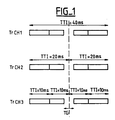
- Compressed mode by puncturing has some particularities, which can be recalled by reference to the UMTS system for example.
- UMTS One feature of UMTS is the possibility to transport multiple services on a same connection, i.e. multiple transport channels on a same physical channel.
- Transport Channels or TrCHs are separately processed according to a channel coding scheme (including error detecting, error correcting, rate matching, and interleaving) before being time-multiplexed to form a Coded Composite Transport Channel or CCTrCH to be mapped onto one or more physical channels.
- Processing according to this channel coding scheme is on a TTI (Transmission Time Interval) basis.
- rate matching includes the two techniques of puncturing and repeating; besides, an inter-frame interleaving is performed on the TTI length, or interleaving depth.
- each TTI is segmented into frames, and, after that, time-multiplexing and mapping on the physical channlel(s) are performed on a frame basis.
- Puncturing in compressed mode which is included in rate matching, and which can be provided in addition to puncturing or repetition in normal mode, can either be performed on a frame basis or on a TTI basis.
- TTI can be equal to 10, 20, 40, or 80ms.
- the case of four consecutive frames sent on a physical channel is illustrated by way of example, and the case of a transmission gap TG overlapping two consecutive frames (in the circumstances the second and the third one of the four illustrated frames) is also illustrated by way of example.
- TGL Fi is the gap length in slots (either from one gap, or a sum of several gaps) within those F i frames
- This method therefore requires additional signaling compared to the above-recalled one (hereafter also referred to as first method) according to the above-mentioned prior patent application.
- the values DeltaSIRi are signaled for each value of "i", i.e. for all possible values of TTl for the TrCHs multiplexed into the CCTrCH, therefore up to four values (the four possible values for TTl).
- this second method does not make an efficient use of available radio resources, or needlessly contributes to a traffic increase in the network. Besides this second method increases the complexity, compared to the first one.
- What would also be desirable is a method which would not involve a further increase in the amount of signalling and the complexity compared to the first method, while still providing an efficient compensation, in special cases of occurrence of compressed frames, such as when a transmission gap overlaps two consecutive frames.
- An object of the present invention is a method for setting a transmission quality target value for power control in a mobile radiocommunication system, a method wherein:
- a plurality of transport channels are time-multiplexed in each frame of a physical channel whose transmit power is controlled by said power control, the number of frames of said plurality of frames is likely to be different for each of said transport channels, and said second component is only applied for said compressed frame and/or for said at least one recovery frame, whatever said number of frames.
- said first component is applied for each frame of said plurality of frames.
- said first component is only applied for said compressed frame and said at least one recovery frame.
- said second component has different values for said compressed frame and said at least one recovery frame, respectively a compressed-frame value and a recovery-frame value.
- different transmission gaps may have different transmission gap lengths , and said compressed-frame value and/or recovery frame value may be different for said different transmission gap lengths.
- a plurality of transport channels are time-multiplexed in each frame of a physical channel whose transmit power is controlled by said power control, and said offset is determined to enable each of said transport channels to reach its required quality of service.
- Another object of the present invention is a method for setting a transmission quality target value for power control in a mobile radiocommunication system, a method wherein:
- a plurality of transport channels are time-multiplexed in each frame of a physical channel whose transmit power is controlled by said power control, the number of frames of said plurality of frames is likely to be different for each of said transport channels, and said second component is only applied for said compressed frame and/or for said at least one recovery frame, whatever said number of frames.
- said first type of compressed mode is a compressed mode by puncturing.
- said second type of compressed mode is a compressed mode by reduction of spreading factor, in a mobile radiocommunication system of CDMA type.
- said first component is applied for each frame of said plurality of frames.
- said first component is only applied for said compressed frame and said at least one recovery frame.
- said first component applies for said compressed frame.
- said second component has different values for said compressed frame and said at least one recovery frame, respectively a compressed-frame value and a recovery-frame value.
- different transmission gaps may have different transmission gap lengths, and said compressed-frame value and/or recovery frame value may be different for said different transmission gap lengths.
- a plurality of transport channels are time-multiplexed in each frame of a physical channel whose power is controlled by said power control, and said offset is determined to enable each of said transport channels to reach its required quality of service.
- Another object of the present invention is a method for setting a transmission quality target value for power control in a mobile radiocommunication system, a method wherein:
- the value of said second component for said second frame is the recovery-frame value.
- the value of said second component for said second frame is the compressed-frame value
- the value of said second component for a frame following said second frame is the recovery-frame value
- the value of said second component for said second frame is a combination of the recovery-frame value and the compressed-frame value.
- said combination is the sum of the recovery-frame value and the compressed-frame value.
- said transmission quality is represented by a signal-to-interference ratio.
- said mobile radiocommunication system is of CDMA type.
- said power control is performed in the uplink transmission direction of said mobile radiocommunication system.
- said power control is performed in the downlink transmission direction of said mobile radiocommunication system.
- Another object of the present invention is a mobile radiocommunication system including at least a transmitting entity and a receiving entity involved in said power control, wherein means are provided in a first one of said entities, for applying an offset to a transmission quality target value according to any of said methods.
- means are provided in said first entity for determining and /or updating said offset.
- means are provided in a second one of said entities for signalling to said first entity previous values necessary for determining and/or updating said offset.
- means are provided in a second one of said entities for signalling said offset to said first entity.
- means are provided in a second one of said entities for signalling to said first entity the occurrence of said compressed mode.
- means are provided in a second one of said entities for signalling said offset to said first entity together with the signalling of the occurrence of said compressed mode.
- means are provided in a second one of said entities for signalling said offset to said first entity together with the signalling of compressed mode parameters.
- said signalling is performed for each compressed frame.
- said signalling is performed once for all, for all compressed frames of a thus defined period.
- said signaling includes signaling said second component only.
- said signalling of said second component includes signalling said compressed-frame value and/or said recovery-frame value.
- means are provided in any one of said two entities for recording said offset.
- one of said two entities is a mobile radiocommunication network entity.
- one of said two entities is a mobile station.
- Another object of the present invention is a mobile radiocommunication network entity comprising means for applying an offset to a transmission quality target value according to any of said methods, in uplink.
- Another object of the present invention is a mobile station comprising means for applying an offset to a transmission quality target value according to any of said methods, in downlink.
- Another object of this invention is a mobile radiocommunication network entity comprising, for enabling a mobile station to apply an offset according to any of said methods, in downlink:
- said mobile radiocommunication network entity comprises:
- said mobile radiocommunication network entity comprises :
- said signalling is performed together with the signalling of compressed mode parameters.
- said signalling is performed for each compressed frame.
- said signalling is performed once for all, for all compressed frames of a thus defined period.
- said signalling includes signalling said second component only.
- said signalling of said second component includes signalling said compressed-frame value and/or said recovery-frame value.
- the target SIR In compressed mode by reducing the spreading factor, the target SIR needs to be different from the target SIR in normal mode for mainly two reasons:
- the target SIR needs to be increased mainly for compressed and recovery frames as proposed in the above-mentioned first method.
- the target SIR would need to be changed, to compensate for the transmission rate increase provided by a compressed frame, not only during the compressed frame but also in all frames that belong to the TTl containing the transmission gap for each transport channel.
- the target SIR needs to be changed, to compensate for the degradation due to a transmission gap, only during the compressed frame and/or at least one recovery frame following the compressed frame.
- the target SIR increase for the CCTrCh has to be determined accordingly.
- the target SIR increase due to the transmission rate increase in compressed mode by puncturing may be the maximum of the target SIR increase needed for each transport channel of the CCTrCh (obviously, other choices could be done).
- this component of the target SIR increase does not need to be signaled to the UE.
- the other component of this target SIR increase, intended to compensate for the transmission gaps can be determined according to various ways as described below, and may be signaled to the UE.
- it does not need to be signaled for each TTli (or each TrCHi), thereby enabling to reduce the amount of signaling, as already indicated.
- the present invention proposes for example the following algorithm:
- ⁇ SIR max ( ⁇ SIR1_compression, ..., ⁇ SIRn_compression) + ⁇ SIR_coding
- n is the number of TTl lengths for all TrChs of the CCTrCh
- F i is the length in number of frames of the i-th TTl
- ⁇ SIR_coding fulfills:
- ⁇ SIR max ( ⁇ SIR1_compression, ..., ⁇ SIRn_compression) + ⁇ SIR_coding
- n is the number of TTI lengths for all TrChs of the CCTrCh
- F i is the length in number of frames of the i-th TTI
- ⁇ SIR_coding fulfills:
- the invention also proposes, in either of these two algorithms, and also by way of example:
- max ( ⁇ SIR1_compression, ... , ⁇ SIRn_compression) corresponds to said first component of the target SIR offset ⁇ SIRframe (it being noted that, as defined in the last algorithm, it applies to both types of compressed mode, by puncturing or by reducing the spreading factor), and ⁇ SIR_coding corresponds to said second component of this target SIR offset.
- the second component ⁇ SIR_coding of the target SIR offset has different values for the compressed and the recovery frames, respectively a compressed-frame value DeltaSIR, and a recovery-frame value DeltaSIRafter.
- this solution (for the case where the transmission gap overlaps two consecutive frames) also applies to the above-mentioned first method.
- the invention uses the idea of compressed and recovery frames to simplify the signalling and the architecture of the equipments, while still providing an efficient compensation for the compressed mode, in various types of compressed mode and/or various cases of occurrence of compressed frames.
- the UE in downlink for example, the UE will have to increase the target SIR by this offset, and then decrease it back by the same value when this increase no longer applies.
- This target SIR variation is done additionally to the usual downlink outer-loop algorithm that will have to take it into account.
- the UE may increase simultaneously its transmit power, and then decrease it back by the same value when it no longer applies, in order for the downlink received SIR to be as quickly as possible close to the new target SIR.
- the component (or second component) of the target SIR offset which needs to be signaled to the UE may have predetermined values, which may be determined in any way.
- these values may be seen as system parameters and be determined accordingly by the operator of the system. They may also be prealably determined, in particular by simulation. In either case, they may be updated during operation. They may also be determined during operation based on previously obtained values , for example by averaging. In any case the obtention mode of said predetermined values should take into account all factors that are likely to influence said component of said offset, or combinations of such factors.
- they may be determined and/or updated in any of said two entities, based on statistics on previously obtained values, available either locally in this entity, or signalled to this entity by the other one of said entities.
- the occurrence of the compressed mode may either be known locally by the entity in charge of applying the corresponding offset , or signalled to this latter entity by the other one of said entities.
- Figure 2 is a diagram intended to illustrate an example of means which may be used in a mobile radiocommunication network entity, noted 40, and in a mobile station noted 41, to perform a method according to the present invention, for uplink power control.
- a mobile radiocommunication network entity 40 such as in particular BTS for "Base Transceiver Station” (or Node B in UMTS) and /or BSC for “Base Station Controller” (or RNC for "Radio Network Controller” in UMTS), may for example comprise, for performing said method in said uplink transmission direction (and further to other classical means not mentioned here):
- Mobile radiocommunication network entity 40 may also for example comprise, for performing said method in said uplink transmission direction (and further to other classical means not mentioned here):
- the offsets to be applied according to the above-disclosed algorithms may for example have predetermined values, which may for example be determined according to any of the above mentioned possibilities.
- mobile radiocommunication network entity 40 for example may comprise :
- a mobile station 41 (or User Equipment UE in UMTS) may for example comprise, for performing said method in said uplink transmission direction (and further to other classical means not mentioned here):
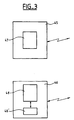
- Figure 3 is a diagram intended to illustrate an example of means which may be used in a mobile radiocommunication network entity, noted 45, and in a mobile station, noted 46, to perform a method according to the present invention, for downlink power control.
- a mobile station 46 may for example comprise, for performing said method in said downlink transmission direction (and further to other classical means not mentioned here):
- Mobile station 46 may also for example comprise, for performing said method in said downlink transmission direction (and further to other classical means not mentioned here):
- Such offsets may for example have predetermined values, which may for example be determined according to any of the above mentioned possibilities.
- mobile station 46 may comprise:
- mobile radiocommunication network entity 45 such as in particular BTS for "Base Transceiver Station” (or Node B in UMTS) and /or BSC for "Base Station Controller” (or RNC for "Radio Network Controller” in UMTS), may for example comprise, for performing said method in said downlink transmission direction (and further to other classical means not mentioned here):
- Mobile radiocommunication network entity 45 may also for example comprise:
- mobile radiocommunication network entity 45 may comprise :
- said signalling may be performed for each compressed frame.
- said signalling may be performed once for all, for all compressed frames of a thus defined period, still in order to reduce the required signalling.
Landscapes
- Engineering & Computer Science (AREA)
- Computer Networks & Wireless Communication (AREA)
- Signal Processing (AREA)
- Quality & Reliability (AREA)
- Mobile Radio Communication Systems (AREA)
- Transmitters (AREA)
Abstract
Description
- 00: 0 dB
- 01: 0.5 dB
- 10: 1 dB
- 11: 2 dB
- reducing the spreading factor in the compressed frame, enabling to increase the instantaneous bit rate and thus to stop the transmission during a few slots (it can be added that if the spreading factor is already equal to the minimum spreading factor, then instead of reducing the spreading factor, two channelization codes, and two scrambling codes, are used, instead of one in normal mode, but this comes to the same as reducing the spreading factor, for the problem of outer-loop power control which is considered in the present application),
- using puncturing (i.e. several bits obtained after channel coding are not transmitted, so that the same amount of information bits can be sent over a shorter period, knowing that the channel coding will still enable to decode all information bits).
- an offset is applied in an anticipated way to said transmission quality target value to compensate for the effects of a compressed mode whereby transmission is interrupted during transmission gaps in compressed frames, and the transmission rate is correspondingly increased to compensate for said transmission gaps,
- said offset includes a first component intended to compensate for the effects of said transmission rate increase, and a second component intended to compensate for the effects of said transmission gaps,
- said transmission rate increase applies not only for a compressed frame, but for a plurality of frames including a compressed frame, and said second component is not applied for all frames of said plurality of frames, but only for said compressed frame and/or for at least one frame, or recovery frame, following said compressed frame.
- an offset is applied in an anticipated way to said transmission quality target value to compensate for the effects of a compressed mode whereby transmission is interrupted during transmission gaps in compressed frames, and the transmission rate is correspondingly increased to compensate for said transmission gaps,
- said offset includes a first component intended to compensate for the effects of said transmission rate increase, and a second component intended to compensate for the effects of said transmission gaps,
- said transmission rate increase, either applies not only for a compressed frame, but for a plurality of frames including a compressed frame, or only applies for a compressed frame, depending on whether a first or a second type of compressed mode is used, and said second component is applied for said compressed frame and/or for at least one frame, or recovery frame, following said compressed frame, in either of said first or second type of compressed mode.
- an offset is applied in an anticipated way to said transmission quality target value to compensate for the effects of a compressed mode whereby transmission is interrupted during transmission gaps in compressed frames, and the transmission rate is correspondingly increased to compensate for said transmission gaps,
- said offset includes a first component intended to compensate for the effects of said transmission rate increase, and a second component intended to compensate for the effects of said transmission gaps,
- said second component is applied for a compressed frame and for at least one frame, or recovery frame, following said compressed frame,
- in the case where said second component has different values for said compressed frame and for said at least one recovery frame, respectively a compressed-frame value and a recovery-frame value, and in the case where two consecutive frames, respectively a first frame and a second frame, are compressed frames, the value of said second component for said second frame is determined based on said recovery-frame value and/or said compressed-frame value.
- means for signalling said offset to said mobile station.
- means for signalling to said mobile station the occurrence of said compressed mode.
- means for signalling said offset to said mobile station, together with the signalling of the occurrence of said compressed mode.
- figure 1 is a diagram intended to illustrate some particularities of the compressed mode by puncturing, for example in the case of the UMTS standard,
- figure 2 is a diagram intended to illustrate an example of means which may be used in a mobile station and in a mobile radiocommunication network entity to perform a method according to the present invention, for uplink power control,
- figure 3 is a diagram intended to illustrate an example of means which may be used in a mobile radiocommunication network entity and in a mobile station, to perform a method according to the present invention, for downlink power control.
- For the compressed frame, the net bit rate is increased and thus the target SIR is increased in the same proportion. Since only (N-TGL) slots (where TGL is the transmission gap length) are used in the compressed frame compared to N slots in other frames, the target SIR increase in dB is equal to 10 log (N/(N-TGL)) for the compressed frame.This increase can be computed in the MS and thus does not need to be signaled.
- Since the inner-loop power control is stopped during the transmission gap, the performance is decreased during several slots after the transmission gap. This effect mainly occurs during the compressed frame and during one frame (called recovery frame) following the compressed frame. It is negligible for other frames.
- On the compressed frame when the compressed mode is performed by reducing the spreading factor of the physical channel.
- On the whole TTI containing the transmission gap for each transport channel of the considered CCTrCh when compressed mode is performed by puncturing. Indeed in the UMTS standard, puncturing is performed on a TTI per TTI basis and for each transport channel of the CCTrCh.
- For each transport channel of the CCTrCh: in frames that belong to the TTI where there is a transmission gap, the net bit rate is increased and thus the target SIR is increased in the same proportion. Let F be the number of frames in the TTI. Since only (N*F-TGL) slots are used in the TTI where there is a transmission gap compared to N*F slots in other TTIs, the target SIR increase in dB is equal to 10 log (F*N/(F*N-TGL)) for all frames of the TTI (and not only the compressed frame).This increase can be computed in the MS and thus does not need to be signaled.
- Since the inner-loop power control is stopped during the transmission gap, the performance is decreased during several slots after the transmission gap. This effect however mainly occurs during the compressed frame and during one frame (called recovery frame) following the compressed frame, and not for all frames of the TTl, as recognized and advantageously used by the present invention in order to reduce the amount of required signaling. Indeed, if the component of the target SIR offset which is intended to compensate for the effects of the transmission gap is only applied for the compressed frame and for the recovery frame, this component does not need to be different for each of the TrCHi which are multiplexed into the CCTrCH. Besides, these frames are sufficient to compensate for the effects of power control interruption during a transmission gap, and they are also sufficient to compensate for the effects of coding degradation due to a transmission gap for each TrCHi, because this degradation mainly affects the shortest TTls. This component can only, at least if necessary, be different for each type of frame (i.e. compressed or recovery) for which it is applied, but this, nevertheless, still requires less signaling than in the above-mentioned second method.
- ▵SIR_coding= DeltaSIR for compressed frames
- ▵SIR_coding= DeltaSIRafter for recovery frames
- ▵SIR_coding= 0 otherwise
and ▵SIRi_compression is defined by : - ΔSIRi_compression= 10 log (N*Fi /(N*Fi - TGLi)) if there is a transmission gap within the current TTl of length Fi frames, where TGLi is the gap length in number of slots (either from one gap or a sum of gaps) in the current TTl of length Fi frames, and N is the number of slots per frame (N= 15 in the UMTS standard)
- ΔSIRi_compression= 0 otherwise.
- ΔSIR_coding= DeltaSIR for compressed frames
- ΔSIR_coding= DeltaSIRafter for recovery frames
- ΔSIR_coding= 0 otherwise
and ΔSIRi_compression is defined by :- If the frames are compressed by puncturing:
- ΔSIRi_compression= 10 log (N*Fi/ (N*Fi - TGL,)) if there is a transmission gap within the current TTI of length Fi frames, where TGLi is the gap length in number of slots (either from one gap or a sum of gaps) in the current TTI of length Fi frames
- ΔSIRi_compression= 0 otherwise
- If the frames are compressed by reducing the spreading factor:
- ΔSIRi_compression= 10log(RCF/R) for each compressed frame, where R is the instantaneous net bit rate before and after the compressed frame and RCF is the instantaneous net bit rate during the compressed frame.
- ΔSIRi_compression= 0 otherwise.
- In the particular case where the transmission gap overlaps two frames (case also referred to as "double-frame method" in UMTS), the second compressed frame (with the second part of the transmission gap) is considered as the recovery frame (▵SIR_coding = DeltaSIRafter). Thus, in this case, the first frame following the two consecutive compressed frames is not considered as a recovery frame (▵SIR_coding=0).
- Since several compressed mode patterns may be used simultaneously (i.e. one or more frames compressed by reducing the spreading factor may occur in a TTI already including one or more frames compressed by puncturing), it may happen that several target SIR offsets from different compressed mode patterns apply to the same frame. In this case, all offsets are added and the total target SIR offset is applied to the frame.
- In the particular case where the transmission gap overlaps two frames, the second compressed frame (with the second part of the transmission gap) could alternatively be considered as a compressed frame (▵SIR_coding = DeltaSIR) and the first frame following these two consecutive compressed frames could be considered as a recovery frame (▵SIR_coding = DeltaSIRafter). In yet another alternative, the second compressed frame could be considered as a compressed and recovery frame (▵SIR_coding = DeltaSIR+DeltaSIRafter, or any other combination). Or more generally, and in order to reduce the amount of signalling and the complexity, the component ▵SIR_coding would be determined based on the values DeltaSIR and DeltaSIRafter, without signalling any further value(s).
- Besides, in general, the compressed-frame value and the recovery-frame value may, or not, be different. Only for illustration and without any limitative character, if a transmission gap does not overlap two consecutive frames, the recovery-frame value could rather be chosen inferior to the compressed-frame value, and if a transmission gap overlaps two consecutive frames, the recovery-frame value could rather be chosen superior to the compressed-frame value (though in this last case it could also depend on various parameters such as the transmission gap length and the position of the transmission gap).
- Besides, the transmission gap length may be different for different transmission gaps ; in such a case said compressed-frame value and/or recovery frame value may be different for said different transmission gap lengths.
- It can be seen from the last disclosed algorithm that it presents very few differences for the two types of compressed mode (by puncturing and by reducing the spreading factor). These differences could still be reduced by providing that for frames other than compressed and recovery frames, we could always set ΔSIR_compression = 0. This would make the scheme a little simpler and is a good approximation. Indeed for the UMTS standard, TGL<8 and F=4 or 8 for these frames (since they are not a compressed or recovery frame). Thus, 10 log (F*N/(F*N-TGL ) is about 0.54 dB.
- With these algorithms, as with the above-mentioned first method, ΔSIR_coding is signaled for the compressed and recovery frames. It could also be signaled only for compressed frames, taking a predefined value for the recovery frames (0, the same value as in the compressed frames, ...) as in the above-mentioned first method. It could also be signaled only for recovery frame(s), taking a predefined value for the compressed frames (0, the same value as in the recovery frames, ...)
- For compressed and recovery frames, ▵SIRframe could be directly signaled to the MS by the BTS (i.e. the two components of this offset, and not only the second one, could be signaled).
- The function "max (ΔSIR1_compression, ..., ΔSIRn_compression)" could be replaced by another function such as for example "mean (ΔSIRl_compression, ..., ΔSIRn_compression)", where "mean" stands for any type of averaging function (artithmetic, geometric, harmonic, ...), or 0.
- More generally, instead of distinguishing the two methods for compressed mode : compressed mode by puncturing, compressed mode by reducing the spreading factor, the proposed algorithm can rather distinguish two situations:
- the net bit rate is increased on a frame basis and only in the compressed frame (in particular compressed mode by reducing the spreading factor),
- the net bit rate is increased for each transport channel and on a TTl basis (in particular compressed mode by puncturing), or more generally it is increased not only for a compressed frame but for a plurality of frames including the compressed frame.
- The signaled value ▵SIR_coding, or second component of said offset, could have a negative value, which could for example enable to compensate for a too large value of the first component of said offset, in particular in the case where said first component is obtained according to the function max (ΔSIR1_compression, ... , ΔSIRn_compression).
- means 42 for implementing for example one of the two above disclosed algorithms, depending on which type(s) of compressed mode are used.
- means, also noted 42 for, upon the occurrence of the compressed mode, controlling the inner-loop power control algorithm, in an anticipated way.
- means 42' for recording said offsets.
- means 43 for signalling to a mobile radiocommunication network entity the occurrence of the compressed mode.
- means 48 for implementing for example one of the two above disclosed algorithms, depending on which type(s) of compressed mode are used.
- means, also noted 48 for, upon the occurrence of the compressed mode, controlling the inner-loop power control algorithm, in an anticipated way.
- means 48' for recording said offsets.
- signalling means 47 for signalling said offsets, or advantageously only
said second component of said offsets, to
mobile station 46.
- signalling means , also noted 47, for signalling to a mobile station the occurrence of the compressed mode.
- signalling means (also noted 47) for signalling said offset (or
advantageously only said second component of said offset) to
mobile station 46, together with the signalling of the occurrence of the compressed mode.
Claims (49)
- A method for setting a transmission quality target value for power control in a mobile radiocommunication system, a method wherein:an offset is applied in an anticipated way to said transmission quality target value to compensate for the effects of a compressed mode whereby transmission is interrupted during transmission gaps in compressed frames, and the transmission rate is correspondingly increased to compensate for said transmission gaps,said offset includes a first component intended to compensate for the effects of said transmission rate increase, and a second component intended to compensate for the effects of said transmission gaps,said transmission rate increase applies not only for a compressed frame, but for a plurality of frames including a compressed frame, and said second component is not applied for all frames of said plurality of frames, but only for said compressed frame and/or for at least one frame, or recovery frame, following said compressed frame.
- A method according to claim 1, wherein a plurality of transport channels are time-multiplexed in each frame of a physical channel whose transmit power is controlled by said power control, the number of frames of said plurality of frames is likely to be different for each of said transport channels, and said second component is only applied for said compressed frame and/or for said at least one recovery frame, whatever said number of frames.
- A method according to any of claims 1 and 2, wherein said first component is applied for each frame of said plurality of frames.
- A method according to any of claims 1 and 2, wherein said first component is only applied for said compressed frame and said at least one recovery frame.
- A method according to any of claims 1 to 4, wherein said second component has different values for said compressed frame and said at least one recovery frame, respectively a compressed-frame value and a recovery-frame value.
- A method according to claim 5 , wherein different transmission gaps may have different transmission gap lengths, and said compressed-frame value and/or recovery frame value may be different for said different transmission gap lengths.
- A method according to any of claims 1 to 6, wherein a plurality of transport channels are time-multiplexed in each frame of a physical channel whose transmit power is controlled by said power control, and said offset is determined to enable each of said transport channels to reach its required quality of service.
- A method for setting a transmission quality target value for power control in a mobile radiocommunication system, a method wherein:an offset is applied in an anticipated way to said transmission quality target value to compensate for the effects of a compressed mode whereby transmission is interrupted during transmission gaps in compressed frames, and the transmission rate is correspondingly increased to compensate for said transmission gaps,said offset includes a first component intended to compensate for the effects of said transmission rate increase, and a second component intended to compensate for the effects of said transmission gaps,said transmission rate increase, either applies not only for a compressed frame, but for a plurality of frames including a compressed frame, or only applies for a compressed frame, depending on whether a first or a second type of compressed mode is used, and said second component is applied for said compressed frame and/or for at least one frame, or recovery frame, following said compressed frame, in either of said first or second type of compressed mode.
- A method according to claim 8, wherein a plurality of transport channels are time-multiplexed in each frame of a physical channel whose transmit power is controlled by said power control, the number of frames of said plurality of frames is likely to be different for each of said transport channels, and said second component is only applied for said compressed frame and/or for said at least one recovery frame, whatever said number of frames.
- A method according to any of claims 8 and 9, wherein said first type of compressed mode is a compressed mode by puncturing.
- A method according to any of claims 8 to 10, wherein said second type of compressed mode is a compressed mode by reduction of spreading factor, in a mobile radiocommunication system of CDMA type.
- A method according to any of claims 8 to 11, wherein, in said first type of compressed mode, said first component is applied for each frame of said plurality of frames.
- A method according to any of claims 8 to 11, wherein, in said first type of compressed mode, said first component is only applied for said compressed frame and said at least one recovery frame.
- A method according to any of claims 8 to 13, wherein, in said second type of compressed mode said first component is applied for said compressed frame.
- A method according to any of claims 8 to 14, wherein said second component has different values for said compressed frame and said at least one recovery frame, respectively a compressed-frame value and a recovery-frame value.
- A method according to claim 15, wherein different transmission gaps may have different transmission gap lengths , and said compressed-frame value and/or recovery frame value are different for said different transmission gap lengths.
- A method according to any of claims 8 to 16, wherein a plurality of transport channels are time-multiplexed in each frame of a physical channel whose power is controlled by said power control, and said offset is determined to enable each of said transport channels to reach its required quality of service.
- A method for setting a transmission quality target value for power control in a mobile radiocommunication system, a method wherein:an offset is applied in an anticipated way to said transmission quality target value to compensate for the effects of a compressed mode whereby transmission is interrupted during transmission gaps in compressed frames, and the transmission rate is correspondingly increased to compensate for said transmission gaps,said offset includes a first component intended to compensate for the effects of said transmission rate increase, and a second component intended to compensate for the effects of said transmission gaps,said second component is applied for a compressed frame and for at least one frame, or recovery frame, following said compressed frame,in the case where said second component has different values for said compressed frame and for said at least one recovery frame, respectively a compressed-frame value and a recovery-frame value, and in the case where two consecutive frames, respectively a first frame and a second frame, are compressed frames, the value of said second component for said second frame is determined based on said recovery-frame value and/or said compressed-frame value.
- A method according to claim 18, wherein the value of said second component for said second frame is the recovery-frame value.
- A method according to claim 18, wherein the value of said second component for said second frame is the compressed-frame value, and the value of said second component for a frame following said second frame is the recovery-frame value.
- A method according to claim 18, wherein the value of said second component for said second frame is a combination of the recovery-frame value and the compressed-frame value.
- A method according to claim 21, wherein said combination is the sum of the recovery-frame value and the compressed-frame value.
- A method according to any of claims 1 to 22, wherein said transmission quality is represented by a signal-to-interference ratio.
- A method according to any of claims 1 to 23, wherein said mobile radiocommunication system is of CDMA type.
- A method according to any of claims 1 to 24, wherein said power control is performed in the uplink transmission direction of said mobile radiocommunication system.
- A method according to any of claims 1 to 25, wherein said power control is performed in the downlink transmission direction of said mobile radiocommunication system.
- A mobile radiocommunication system including at least a transmitting entity and a receiving entity involved in said power control, wherein means are provided in a first one of said entities, for applying an offset to a transmission quality target value according to any of claims 1 to 26.
- A mobile radiocommunication system according to claim 27, wherein means are provided in said first entity for determining and /or updating said offset.
- A mobile radiocommunication system according to claim 28, wherein means are provided in a second one of said entities for signalling to said first entity previous values necessary for determining and/or updating said offset.
- A mobile radiocommunication system according to claim 27, wherein means are provided in a second one of said entities for signalling said offset to said first entity.
- A mobile radiocommunication system according to any of claims 27 to 30, wherein means are provided in a second one of said entities for signalling to said first entity the occurrence of said compressed mode.
- A mobile radiocommunication system according to any of claims 30 to 31, wherein means are provided in a second one of said entities for signalling said offset to said first entity together with the signalling of the occurrence of said compressed mode.
- A mobile radiocommunication system according to any of claims 30 to 32, wherein said signalling is performed for each compressed frame.
- A mobile radiocommunication system according to any of claims 30 to 32, wherein, in the case where compressed frames occur periodically, said signalling is performed once for all, for all compressed frames of a thus defined period.
- A mobile radiocommunication system according to any of claims 30 to 34, wherein said signaling includes signaling said second component only.
- A mobile radiocommunication system according to claim 35, wherein said signaling of said second component includes signalling said compressed-frame value and/or said recovery-frame value.
- A mobile radiocommunication system according to any of claims 27 to 36, wherein means are provided in any one of said two entities for recording said offset.
- A mobile radiocommunication system according to any of claims 27 to 37, wherein one of said two entities is a mobile radiocommunication network entity.
- A mobile radiocommunication system according to any of claims 27 to 37, wherein one of said two entities is a mobile station.
- A mobile radiocommunication network entity comprising means for applying an offset to a transmission quality target value according to any of claims 1 to 26, in uplink.
- A mobile station comprising means for applying an offset to a transmission quality target value according to any of claims 1 to 26, in downlink.
- A mobile radiocommunication network entity comprising, for enabling a mobile station to apply an offset to a transmission quality target value according to any of claims 1 to 26, in downlink:means for signalling said offset to said mobile station.
- A mobile radiocommunication network entity according to claim 42, comprising:means for signalling to said mobile station the occurrence of said compressed mode.
- A mobile radiocommunication network entity according to claim 42, comprising:means for signalling said offset to said mobile station, together with the signalling of the occurrence of said compressed mode.
- A mobile radiocommunication network entity according to any of claims 42 to 44, wherein said signalling is performed together with the signalling of compressed mode parameters.
- A mobile radiocommunication network entity according to any of claims 42 to 45, wherein said signalling is performed for each compressed frame.
- A mobile radiocommunication network entity according to any of claims 42 to 45, wherein, in the case where compressed frames occur periodically, said signalling is performed once for all, for all compressed frames of a thus defined period.
- A mobile radiocommunication network entity according to any of claims 42 to 47, wherein said signalling includes signalling said second component only.
- A mobile radiocommunication network entity according to claim 48, wherein said signaling of said second component includes signalling said compressed-frame value and/or said recovery-frame value.
Priority Applications (16)
| Application Number | Priority Date | Filing Date | Title |
|---|---|---|---|
| AT03014206T ATE406000T1 (en) | 2000-02-08 | 2000-02-08 | METHOD FOR SETTING A TRANSMISSION QUALITY SET VALUE FOR TRANSMIT POWER CONTROL IN A MOBILE RADIO TRANSMISSION SYSTEM |
| EP03014206A EP1349295B1 (en) | 2000-02-08 | 2000-02-08 | A method for setting a transmission quality target value for power control in a mobile radiocommunication system |
| ES00400357T ES2211465T3 (en) | 2000-02-08 | 2000-02-08 | A METHOD FOR ADJUSTING A DESIRED VALUE OF TRANSMISSION QUALITY FOR POWER CONTROL IN A MOBILE RADIOCOMMUNICATION SYSTEM. |
| DE60006930T DE60006930T2 (en) | 2000-02-08 | 2000-02-08 | Method for setting a transmission quality setpoint for transmission power control in a mobile radio transmission system |
| EP00400357A EP1124340B1 (en) | 2000-02-08 | 2000-02-08 | A method for setting a transmission quality target value for power control in a mobile radiocommunication system |
| AT00400357T ATE255789T1 (en) | 2000-02-08 | 2000-02-08 | METHOD FOR SETTING A TRANSMISSION QUALITY SET VALUE FOR TRANSMIT POWER CONTROL IN A MOBILE RADIO TRANSMISSION SYSTEM |
| US09/599,519 US6564067B1 (en) | 2000-02-08 | 2000-06-23 | Method for setting a transmission quality target value for power control in a mobile radiocommunication system |
| CN01800136XA CN1363148B (en) | 2000-02-08 | 2001-01-29 | Method for setting a transmission quality target value for power control in a mobile radio communication system |
| CN2011100695384A CN102098771B (en) | 2000-02-08 | 2001-01-29 | A method and a device for setting a transmission quality target value for power control in a mobile radio communication system |
| PCT/EP2001/001150 WO2001059954A1 (en) | 2000-02-08 | 2001-01-29 | A method for setting a transmission quality target value for power control in a mobile radiocommunication system |
| KR1020017012756A KR100688418B1 (en) | 2000-02-08 | 2001-01-29 | Method of setting transmission quality target value for power control in wireless mobile communication system |
| AU40580/01A AU782679B2 (en) | 2000-02-08 | 2001-01-29 | A method for setting a transmission quality target value for power control in a mobile radiocommunication system |
| JP2001559164A JP3961832B2 (en) | 2000-02-08 | 2001-01-29 | Method for setting transmission quality target value for power control in mobile radio communication system |
| US11/128,404 USRE41070E1 (en) | 2000-02-08 | 2005-05-13 | Method for setting a transmission quality target value for power control in a mobile radiocommunication system |
| JP2007011245A JP4644213B2 (en) | 2000-02-08 | 2007-01-22 | Method for setting transmission quality target value for power control in mobile radio communication system |
| JP2007011244A JP4639201B2 (en) | 2000-02-08 | 2007-01-22 | Method for setting transmission quality target value for power control in mobile radio communication system |
Applications Claiming Priority (1)
| Application Number | Priority Date | Filing Date | Title |
|---|---|---|---|
| EP00400357A EP1124340B1 (en) | 2000-02-08 | 2000-02-08 | A method for setting a transmission quality target value for power control in a mobile radiocommunication system |
Related Child Applications (2)
| Application Number | Title | Priority Date | Filing Date |
|---|---|---|---|
| EP03014206A Division EP1349295B1 (en) | 2000-02-08 | 2000-02-08 | A method for setting a transmission quality target value for power control in a mobile radiocommunication system |
| EP03014206.1 Division-Into | 2003-06-25 |
Publications (2)
| Publication Number | Publication Date |
|---|---|
| EP1124340A1 true EP1124340A1 (en) | 2001-08-16 |
| EP1124340B1 EP1124340B1 (en) | 2003-12-03 |
Family
ID=8173549
Family Applications (2)
| Application Number | Title | Priority Date | Filing Date |
|---|---|---|---|
| EP03014206A Expired - Lifetime EP1349295B1 (en) | 2000-02-08 | 2000-02-08 | A method for setting a transmission quality target value for power control in a mobile radiocommunication system |
| EP00400357A Expired - Lifetime EP1124340B1 (en) | 2000-02-08 | 2000-02-08 | A method for setting a transmission quality target value for power control in a mobile radiocommunication system |
Family Applications Before (1)
| Application Number | Title | Priority Date | Filing Date |
|---|---|---|---|
| EP03014206A Expired - Lifetime EP1349295B1 (en) | 2000-02-08 | 2000-02-08 | A method for setting a transmission quality target value for power control in a mobile radiocommunication system |
Country Status (10)
| Country | Link |
|---|---|
| US (2) | US6564067B1 (en) |
| EP (2) | EP1349295B1 (en) |
| JP (3) | JP3961832B2 (en) |
| KR (1) | KR100688418B1 (en) |
| CN (2) | CN102098771B (en) |
| AT (1) | ATE255789T1 (en) |
| AU (1) | AU782679B2 (en) |
| DE (1) | DE60006930T2 (en) |
| ES (1) | ES2211465T3 (en) |
| WO (1) | WO2001059954A1 (en) |
Cited By (10)
| Publication number | Priority date | Publication date | Assignee | Title |
|---|---|---|---|---|
| WO2003017527A2 (en) | 2001-08-20 | 2003-02-27 | Qualcomm Incorporated | Power control for a channel with multiple formats in a communication system |
| WO2003041309A1 (en) * | 2001-11-02 | 2003-05-15 | Qualcomm, Incorporated | Slew rate limited signal strength prediction |
| EP1476965A4 (en) * | 2002-02-20 | 2005-07-13 | Interdigital Tech Corp | Code allocation based on cross code correlation |
| WO2005067168A1 (en) * | 2003-12-30 | 2005-07-21 | Qualcomm Incorporated | Power control for multiple transport channels in a wireless communication system |
| EP1845633A1 (en) * | 2006-04-12 | 2007-10-17 | Telefonaktiebolaget LM Ericsson (publ) | Controlling a power level in a wireless communications system with different scrambling codes |
| WO2007115704A1 (en) * | 2006-04-12 | 2007-10-18 | Telefonaktiebolaget L M Ericsson (Publ) | Controlling a power level in a wireless communications system with different scrambling codes |
| EP2169869A3 (en) * | 2008-09-25 | 2010-04-28 | Research in Motion Limited | A method and apparatus for configuring compressed mode |
| WO2010059094A1 (en) * | 2008-11-21 | 2010-05-27 | Telefonaktiebolaget L M Ericsson (Publ) | Format based power control |
| WO2011102666A3 (en) * | 2010-02-19 | 2012-01-12 | 엘지전자 주식회사 | Terminal device for controlling uplink transmission power and method therefor |
| CN107409362A (en) * | 2015-02-25 | 2017-11-28 | 三星电子株式会社 | Method and apparatus for controlling the transmit power of terminal in GSM |
Families Citing this family (47)
| Publication number | Priority date | Publication date | Assignee | Title |
|---|---|---|---|---|
| ATE255789T1 (en) * | 2000-02-08 | 2003-12-15 | Cit Alcatel | METHOD FOR SETTING A TRANSMISSION QUALITY SET VALUE FOR TRANSMIT POWER CONTROL IN A MOBILE RADIO TRANSMISSION SYSTEM |
| CN1426633A (en) * | 2000-04-21 | 2003-06-25 | 三星电子株式会社 | Flexible data rate matching apparatus and method in data communication system |
| FR2810177B1 (en) * | 2000-06-13 | 2005-05-06 | Cit Alcatel | METHOD FOR CONTROLLING TRANSMISSION POWER IN A MOBILE RADIOCOMMUNICATION SYSTEM |
| DE10036930B4 (en) * | 2000-07-28 | 2005-07-21 | Siemens Ag | Method for transmitting power adjustment in a radio system |
| FR2813005B1 (en) * | 2000-08-11 | 2003-01-31 | Cit Alcatel | METHOD FOR EVALUATING THE QUALITY OF A RADIO LINK IN A MOBILE RADIO COMMUNICATION SYSTEM |
| US6748234B1 (en) * | 2000-11-21 | 2004-06-08 | Qualcomm Incorporated | Method and apparatus for power control in a wireless communication system |
| DE60034582T2 (en) * | 2000-12-14 | 2008-01-31 | Lucent Technologies Inc. | Method for controlling the quality of service of a CDMA-based system |
| KR100464375B1 (en) * | 2001-02-21 | 2005-01-13 | 삼성전자주식회사 | Method for controlling base station transmission time in a CDMA communication system for uplink synchronous transmission |
| JP2003087865A (en) * | 2001-09-13 | 2003-03-20 | Nec Corp | Mobile communication system, its information sharing method and its program |
| US6845088B2 (en) * | 2001-10-19 | 2005-01-18 | Interdigital Technology Corporation | System and method for fast dynamic link adaptation |
| KR100493079B1 (en) * | 2001-11-02 | 2005-06-02 | 삼성전자주식회사 | Apparatus for reporting quality of downlink channel in wide band-code division multiple access communication system using high speed data packet access scheme and method thereof |
| US6898418B2 (en) * | 2001-11-02 | 2005-05-24 | Texas Instruments Incorporated | Method of and apparatus for implementing adaptive downstream modulation in a fixed wireless communication system |
| EP1311076B1 (en) * | 2001-11-12 | 2007-03-07 | Lucent Technologies Inc. | Control of the transmission power of a CMDA based system |
| AU2002358319B2 (en) * | 2001-11-16 | 2005-12-22 | Lg Electronics Inc. | Method for transmitting power control information for HS-SCCH in mobile communication system |
| KR100811043B1 (en) | 2001-11-16 | 2008-03-06 | 엘지전자 주식회사 | Transmission Power Control Method for Shared Channel (SCH) and HI in Mobile Communication System |
| US7580390B2 (en) * | 2001-11-26 | 2009-08-25 | Qualcomm Incorporated | Reducing handover frequency error |
| SE524688C2 (en) * | 2001-12-06 | 2004-09-14 | Ericsson Telefon Ab L M | Method and devices for allocating channel to a mobile station in a radio communication system |
| US6717931B2 (en) * | 2002-01-02 | 2004-04-06 | Nokia Corporation | Adaptive spreading factor based on power control |
| WO2003077579A1 (en) * | 2002-03-12 | 2003-09-18 | Ascom Ag | Radio resource allocation in a radio communication network |
| ATE371303T1 (en) * | 2002-08-30 | 2007-09-15 | Nokia Corp | TRANSMIT POWER CONTROL DURING REPEAT TRANSMISSION |
| KR100929072B1 (en) * | 2002-09-06 | 2009-11-30 | 삼성전자주식회사 | Apparatus and method for transmitting and receiving channel quality identification information in code division multiple access communication system applying high speed forward packet access method |
| US7133689B2 (en) * | 2002-09-12 | 2006-11-07 | Interdigital Technology Corporation | Method and system for adjusting downlink outer loop power to control target SIR |
| US6907010B2 (en) * | 2002-10-11 | 2005-06-14 | Interdigital Technology Corporation | Dynamic radio link adaptation for interference in cellular systems |
| US7092720B2 (en) * | 2003-03-27 | 2006-08-15 | Interdigital Technology Corp. | Method for characterizing base station capabilities in a wireless communication system and for avoiding base station overload |
| JP4197266B2 (en) * | 2003-04-10 | 2008-12-17 | 株式会社エヌ・ティ・ティ・ドコモ | Radio control apparatus and handover control method |
| US8306562B2 (en) * | 2003-05-29 | 2012-11-06 | Texas Instruments Incorporated | Signal-to-interference ratio target control for multi-data-rate communication systems |
| CN100584069C (en) * | 2003-09-30 | 2010-01-20 | 艾利森电话股份有限公司 | System and method for reporting measurement results in a communication system |
| US7647063B2 (en) * | 2003-10-17 | 2010-01-12 | Telefonaktiebolaget L M Ericsson (Publ) | Method and system for outer loop power control |
| US7197327B2 (en) * | 2004-03-10 | 2007-03-27 | Interdigital Technology Corporation | Adjustment of target signal-to-interference in outer loop power control for wireless communication systems |
| WO2006006895A1 (en) * | 2004-07-08 | 2006-01-19 | Telefonaktiebolaget Lm Ericsson (Publ) | Method and arrangement in a radio communication system |
| CN100365955C (en) * | 2004-07-20 | 2008-01-30 | 华为技术有限公司 | Method for activating compressed mode and determining parameters for the position of transmission gaps in a radio frame |
| CN1734968B (en) * | 2004-08-10 | 2012-01-04 | 北京三星通信技术研究有限公司 | Out-ring power control method for upline enhancement special channel |
| JP4709221B2 (en) * | 2004-09-24 | 2011-06-22 | クゥアルコム・インコーポレイテッド | Method and system for power control in a communication system |
| US7657277B2 (en) | 2004-09-24 | 2010-02-02 | Qualcomm Incorporated | Method and system for power control in a communication system |
| JP4538357B2 (en) * | 2005-03-29 | 2010-09-08 | 株式会社エヌ・ティ・ティ・ドコモ | Transmission rate control method, mobile station, radio base station, and radio network controller |
| EP1897245A4 (en) * | 2005-06-20 | 2013-01-16 | Texas Instruments Inc | Slow uplink power control |
| JP2007195076A (en) * | 2006-01-20 | 2007-08-02 | Nec Corp | Radio communication system, and transmission power control method and device thereof |
| US7853282B2 (en) * | 2006-09-14 | 2010-12-14 | Qualcomm Incorporated | Power allocation in a wireless communication system |
| US7826863B2 (en) * | 2006-09-14 | 2010-11-02 | Qualcomm Incorporated | Power allocation in a wireless communication system |
| TWI519088B (en) | 2007-08-13 | 2016-01-21 | 內數位科技公司 | Method and device for reducing radio resource overhead of intermittent traffic |
| US8411646B2 (en) * | 2007-11-20 | 2013-04-02 | Qualcomm Incorporated | Opportunistic uplink scheduling |
| US8160007B2 (en) * | 2007-11-20 | 2012-04-17 | Qualcomm Incorporated | Opportunistic uplink scheduling |
| US8160602B2 (en) | 2007-11-20 | 2012-04-17 | Qualcomm Incorporated | Opportunistic uplink scheduling |
| US8547857B2 (en) * | 2007-11-20 | 2013-10-01 | Qualcomm Incorporated | Opportunistic uplink scheduling |
| CN101789842A (en) * | 2009-01-23 | 2010-07-28 | 富士通株式会社 | Relay equipment and wireless communication method for relay equipment |
| JP5771452B2 (en) * | 2011-06-17 | 2015-09-02 | 株式会社日立国際電気 | Wireless device |
| CN105612792A (en) * | 2014-03-18 | 2016-05-25 | 华为技术有限公司 | Power control method and device |
Citations (2)
| Publication number | Priority date | Publication date | Assignee | Title |
|---|---|---|---|---|
| WO1999049609A1 (en) * | 1998-03-26 | 1999-09-30 | Mitsubishi Denki Kabushiki Kaisha | Spread spectrum communication device and spread spectrum communication method |
| EP0949830A2 (en) * | 1998-04-07 | 1999-10-13 | Nec Corporation | Power control method and system using idle time in mobile communication system |
Family Cites Families (29)
| Publication number | Priority date | Publication date | Assignee | Title |
|---|---|---|---|---|
| US3925782A (en) * | 1975-02-28 | 1975-12-09 | Us Army | Adaptive RF power output control for net radios |
| US5357513A (en) * | 1990-12-06 | 1994-10-18 | Hughes Aircraft Company | Transmission power level adjustment in radio telephony |
| US6088590A (en) * | 1993-11-01 | 2000-07-11 | Omnipoint Corporation | Method and system for mobile controlled handoff and link maintenance in spread spectrum communication |
| US5604730A (en) * | 1994-07-25 | 1997-02-18 | Qualcomm Incorporated | Remote transmitter power control in a contention based multiple access system |
| GB2292289B (en) * | 1994-08-11 | 1998-06-17 | Roke Manor Research | Power control apparatus for use in mobile radio stations |
| US6137840A (en) * | 1995-03-31 | 2000-10-24 | Qualcomm Incorporated | Method and apparatus for performing fast power control in a mobile communication system |
| US5896368A (en) * | 1995-05-01 | 1999-04-20 | Telefonaktiebolaget Lm Ericsson | Multi-code compressed mode DS-CDMA systems and methods |
| US5915216A (en) * | 1995-06-02 | 1999-06-22 | Dsc Communications Corporation | Apparatus and method of transmitting and receiving information in a wireless telecommunications system |
| JP2773721B2 (en) * | 1995-12-28 | 1998-07-09 | 日本電気株式会社 | Transmission power control method |
| US5751763A (en) * | 1996-03-15 | 1998-05-12 | Motorola, Inc. | Method and apparatus for power control in a communication system |
| US6067446A (en) * | 1996-07-11 | 2000-05-23 | Telefonaktiebolaget Lm Ericsson | Power presetting in a radio communication system |
| FI106666B (en) * | 1997-01-24 | 2001-03-15 | Nokia Networks Oy | Power control procedure for discontinuous transmissions |
| US6173162B1 (en) * | 1997-06-16 | 2001-01-09 | Telefonaktiebolaget Lm Ericsson (Publ) | Multiple code channel power control in a radio communication system |
| JP2914444B2 (en) * | 1997-07-22 | 1999-06-28 | 日本電気株式会社 | CDMA transceiver |
| JP3043729B2 (en) * | 1997-12-04 | 2000-05-22 | 三星電子株式会社 | Handoff apparatus and method for mobile communication system |
| US6070074A (en) * | 1998-04-24 | 2000-05-30 | Trw Inc. | Method for enhancing the performance of a regenerative satellite communications system |
| JP3286247B2 (en) * | 1998-05-08 | 2002-05-27 | 松下電器産業株式会社 | Wireless communication system |
| FI981546A7 (en) * | 1998-07-03 | 2000-01-04 | Nokia Corp | Data transmission method and mobile phone system |
| KR100285310B1 (en) * | 1998-07-29 | 2001-04-02 | 윤종용 | Method for controlling forward power control parameter using erasure indicator bit in cdma communication system |
| US6445686B1 (en) * | 1998-09-03 | 2002-09-03 | Lucent Technologies Inc. | Method and apparatus for improving the quality of speech signals transmitted over wireless communication facilities |
| DE69935715T2 (en) * | 1999-01-16 | 2007-12-27 | Koninklijke Philips Electronics N.V. | RADIO COMMUNICATION SYSTEM |
| US6445917B1 (en) * | 1999-05-19 | 2002-09-03 | Telefonaktiebolaget Lm Ericsson (Publ) | Mobile station measurements with event-based reporting |
| EP1578028B1 (en) * | 1999-07-13 | 2009-03-25 | Alcatel Lucent | A method for improving performances of a mobile radiocommunication system using a power control algorithm |
| US6496706B1 (en) * | 1999-07-23 | 2002-12-17 | Qualcomm Incorporated | Method and system for transmit gating in a wireless communication system |
| ATE293310T1 (en) * | 1999-08-23 | 2005-04-15 | Cit Alcatel | METHOD FOR INCREASE THE PERFORMANCE OF A MOBILE RADIO COMMUNICATIONS SYSTEM USING A POWER CONTROL ALGORITHM |
| JP4387001B2 (en) * | 1999-08-27 | 2009-12-16 | 三菱電機株式会社 | Mobile station and communication method |
| US6411817B1 (en) * | 2000-01-21 | 2002-06-25 | Lucent Technologies Inc. | Method and system for dynamic downlink power control in a time-division, multiplex wireless system |
| ATE255789T1 (en) * | 2000-02-08 | 2003-12-15 | Cit Alcatel | METHOD FOR SETTING A TRANSMISSION QUALITY SET VALUE FOR TRANSMIT POWER CONTROL IN A MOBILE RADIO TRANSMISSION SYSTEM |
| US6823193B1 (en) * | 2000-02-28 | 2004-11-23 | Telefonaktiebolaget Lm Ericsson (Publ) | Downlink transmit power synchronization during diversity communication with a mobile station |
-
2000
- 2000-02-08 AT AT00400357T patent/ATE255789T1/en not_active IP Right Cessation
- 2000-02-08 ES ES00400357T patent/ES2211465T3/en not_active Expired - Lifetime
- 2000-02-08 EP EP03014206A patent/EP1349295B1/en not_active Expired - Lifetime
- 2000-02-08 DE DE60006930T patent/DE60006930T2/en not_active Expired - Lifetime
- 2000-02-08 EP EP00400357A patent/EP1124340B1/en not_active Expired - Lifetime
- 2000-06-23 US US09/599,519 patent/US6564067B1/en not_active Ceased
-
2001
- 2001-01-29 WO PCT/EP2001/001150 patent/WO2001059954A1/en not_active Ceased
- 2001-01-29 CN CN2011100695384A patent/CN102098771B/en not_active Expired - Lifetime
- 2001-01-29 JP JP2001559164A patent/JP3961832B2/en not_active Expired - Lifetime
- 2001-01-29 AU AU40580/01A patent/AU782679B2/en not_active Expired
- 2001-01-29 CN CN01800136XA patent/CN1363148B/en not_active Expired - Lifetime
- 2001-01-29 KR KR1020017012756A patent/KR100688418B1/en not_active Expired - Lifetime
-
2005
- 2005-05-13 US US11/128,404 patent/USRE41070E1/en not_active Expired - Lifetime
-
2007
- 2007-01-22 JP JP2007011244A patent/JP4639201B2/en not_active Expired - Lifetime
- 2007-01-22 JP JP2007011245A patent/JP4644213B2/en not_active Expired - Lifetime
Patent Citations (3)
| Publication number | Priority date | Publication date | Assignee | Title |
|---|---|---|---|---|
| WO1999049609A1 (en) * | 1998-03-26 | 1999-09-30 | Mitsubishi Denki Kabushiki Kaisha | Spread spectrum communication device and spread spectrum communication method |
| EP0984581A1 (en) * | 1998-03-26 | 2000-03-08 | Mitsubishi Denki Kabushiki Kaisha | Spread spectrum communication device and spread spectrum communication method |
| EP0949830A2 (en) * | 1998-04-07 | 1999-10-13 | Nec Corporation | Power control method and system using idle time in mobile communication system |
Cited By (29)
| Publication number | Priority date | Publication date | Assignee | Title |
|---|---|---|---|---|
| CN100508420C (en) * | 2001-08-20 | 2009-07-01 | 高通股份有限公司 | Method and apparatus for power control of channels with multiple formats in a communication system |
| WO2003017527A3 (en) * | 2001-08-20 | 2003-11-06 | Qualcomm Inc | Power control for a channel with multiple formats in a communication system |
| US8023988B2 (en) | 2001-08-20 | 2011-09-20 | Qualcomm Incorporated | Power control for a channel with multiple formats in a communication system |
| KR100942651B1 (en) * | 2001-08-20 | 2010-02-17 | 콸콤 인코포레이티드 | Power control for a channel with multiple formats in a communication system |
| WO2003017527A2 (en) | 2001-08-20 | 2003-02-27 | Qualcomm Incorporated | Power control for a channel with multiple formats in a communication system |
| US7376438B2 (en) | 2001-08-20 | 2008-05-20 | Qualcomm Incorporated | Power control for a channel with multiple formats in a communication system |
| WO2003041309A1 (en) * | 2001-11-02 | 2003-05-15 | Qualcomm, Incorporated | Slew rate limited signal strength prediction |
| US8275324B2 (en) | 2001-11-02 | 2012-09-25 | Qualcomm Incorporated | Method and apparatus for predicting received signal strength in a communication system |
| EP1476965A4 (en) * | 2002-02-20 | 2005-07-13 | Interdigital Tech Corp | Code allocation based on cross code correlation |
| KR100798185B1 (en) * | 2003-12-30 | 2008-01-24 | 콸콤 인코포레이티드 | Power Control for Multiple Transmission Channels in Wireless Communication Systems |
| US7664519B2 (en) | 2003-12-30 | 2010-02-16 | Qualcomm Incorporated | Power control for multiple transport channels in a wireless communication system |
| WO2005067168A1 (en) * | 2003-12-30 | 2005-07-21 | Qualcomm Incorporated | Power control for multiple transport channels in a wireless communication system |
| US8149763B2 (en) | 2006-04-12 | 2012-04-03 | Telefonaktiebolaget L M Ericsson (Publ) | Controlling a power level in a wireless communications system with different scrambling codes |
| WO2007115704A1 (en) * | 2006-04-12 | 2007-10-18 | Telefonaktiebolaget L M Ericsson (Publ) | Controlling a power level in a wireless communications system with different scrambling codes |
| CN101421940B (en) * | 2006-04-12 | 2012-11-14 | 艾利森电话股份有限公司 | Controlling a power level in a wireless communications system with different scrambling codes |
| EP1845633A1 (en) * | 2006-04-12 | 2007-10-17 | Telefonaktiebolaget LM Ericsson (publ) | Controlling a power level in a wireless communications system with different scrambling codes |
| US9124404B2 (en) | 2008-09-25 | 2015-09-01 | Blackberry Limited | Method and apparatus for configuring compressed mode |
| EP2169869A3 (en) * | 2008-09-25 | 2010-04-28 | Research in Motion Limited | A method and apparatus for configuring compressed mode |
| US8170599B2 (en) | 2008-11-21 | 2012-05-01 | Telefonaktiebolaget Lm Ericsson (Publ) | Format based power control |
| CN102224753A (en) * | 2008-11-21 | 2011-10-19 | 艾利森电话股份有限公司 | Format based power control |
| WO2010059094A1 (en) * | 2008-11-21 | 2010-05-27 | Telefonaktiebolaget L M Ericsson (Publ) | Format based power control |
| WO2011102666A3 (en) * | 2010-02-19 | 2012-01-12 | 엘지전자 주식회사 | Terminal device for controlling uplink transmission power and method therefor |
| US9037183B2 (en) | 2010-02-19 | 2015-05-19 | Lg Electronics Inc. | Controlling uplink transmission power using offset value based on antenna number or diversity scheme |
| US9750029B2 (en) | 2010-02-19 | 2017-08-29 | Lg Electronics Inc. | Controlling uplink transmission power using offset value based on antenna number or diversity scheme |
| US10264584B2 (en) | 2010-02-19 | 2019-04-16 | Lg Electronics Inc. | Controlling uplink transmission power using offset value based on antenna number or diversity scheme |
| CN107409362A (en) * | 2015-02-25 | 2017-11-28 | 三星电子株式会社 | Method and apparatus for controlling the transmit power of terminal in GSM |
| EP3264835A4 (en) * | 2015-02-25 | 2018-01-03 | Samsung Electronics Co., Ltd. | Method and apparatus for controlling transmission power of terminal in mobile communication system |
| US10200958B2 (en) | 2015-02-25 | 2019-02-05 | Samsung Electronics Co., Ltd. | Method and apparatus for controlling transmission power of terminal in mobile communication system |
| CN107409362B (en) * | 2015-02-25 | 2020-11-03 | 三星电子株式会社 | Method and apparatus for controlling transmission power of terminal in mobile communication system |
Also Published As
| Publication number | Publication date |
|---|---|
| AU4058001A (en) | 2001-08-20 |
| ATE255789T1 (en) | 2003-12-15 |
| AU782679B2 (en) | 2005-08-18 |
| JP4644213B2 (en) | 2011-03-02 |
| JP2007116746A (en) | 2007-05-10 |
| WO2001059954A1 (en) | 2001-08-16 |
| EP1349295B1 (en) | 2008-08-20 |
| DE60006930T2 (en) | 2004-10-28 |
| JP3961832B2 (en) | 2007-08-22 |
| CN1363148B (en) | 2013-01-30 |
| CN102098771B (en) | 2013-07-24 |
| USRE41070E1 (en) | 2010-01-05 |
| JP2007116747A (en) | 2007-05-10 |
| EP1349295A2 (en) | 2003-10-01 |
| KR20010113777A (en) | 2001-12-28 |
| KR100688418B1 (en) | 2007-03-09 |
| ES2211465T3 (en) | 2004-07-16 |
| JP4639201B2 (en) | 2011-02-23 |
| CN102098771A (en) | 2011-06-15 |
| JP2003523129A (en) | 2003-07-29 |
| US6564067B1 (en) | 2003-05-13 |
| CN1363148A (en) | 2002-08-07 |
| EP1124340B1 (en) | 2003-12-03 |
| EP1349295A3 (en) | 2005-02-09 |
| DE60006930D1 (en) | 2004-01-15 |
Similar Documents
| Publication | Publication Date | Title |
|---|---|---|
| EP1124340B1 (en) | A method for setting a transmission quality target value for power control in a mobile radiocommunication system | |
| EP1069704B1 (en) | Method for improving mobile radiocommunication system performances using a power control algorithm | |
| JP5189180B2 (en) | Method for controlling transmission power in mobile radio communication system | |
| KR100723560B1 (en) | Transmission Power Control Method in Mobile Wireless Communication System | |
| AU2523000A (en) | A method for improving performances of a mobile radio communication system using a power control algorithm | |
| EP1143634A1 (en) | A method for setting compressed mode parameters and for setting a transmission quality target value for power control in a mobile radiocommunication system |
Legal Events
| Date | Code | Title | Description |
|---|---|---|---|
| PUAI | Public reference made under article 153(3) epc to a published international application that has entered the european phase |
Free format text: ORIGINAL CODE: 0009012 |
|
| 17P | Request for examination filed |
Effective date: 20000302 |
|
| AK | Designated contracting states |
Kind code of ref document: A1 Designated state(s): AT BE CH CY DE DK ES FI FR GB GR IE IT LI LU MC NL PT SE |
|
| AX | Request for extension of the european patent |
Free format text: AL;LT;LV;MK;RO;SI |
|
| 17Q | First examination report despatched |
Effective date: 20020111 |
|
| AKX | Designation fees paid |
Free format text: AT BE CH CY DE DK ES FI FR GB GR IE IT LI LU MC NL PT SE |
|
| GRAH | Despatch of communication of intention to grant a patent |
Free format text: ORIGINAL CODE: EPIDOS IGRA |
|
| GRAS | Grant fee paid |
Free format text: ORIGINAL CODE: EPIDOSNIGR3 |
|
| GRAA | (expected) grant |
Free format text: ORIGINAL CODE: 0009210 |
|
| AK | Designated contracting states |
Kind code of ref document: B1 Designated state(s): AT BE CH CY DE DK ES FI FR GB GR IE IT LI LU MC NL PT SE |
|
| PG25 | Lapsed in a contracting state [announced via postgrant information from national office to epo] |
Ref country code: FI Free format text: LAPSE BECAUSE OF FAILURE TO SUBMIT A TRANSLATION OF THE DESCRIPTION OR TO PAY THE FEE WITHIN THE PRESCRIBED TIME-LIMIT Effective date: 20031203 Ref country code: LI Free format text: LAPSE BECAUSE OF FAILURE TO SUBMIT A TRANSLATION OF THE DESCRIPTION OR TO PAY THE FEE WITHIN THE PRESCRIBED TIME-LIMIT Effective date: 20031203 Ref country code: NL Free format text: LAPSE BECAUSE OF FAILURE TO SUBMIT A TRANSLATION OF THE DESCRIPTION OR TO PAY THE FEE WITHIN THE PRESCRIBED TIME-LIMIT Effective date: 20031203 Ref country code: CH Free format text: LAPSE BECAUSE OF FAILURE TO SUBMIT A TRANSLATION OF THE DESCRIPTION OR TO PAY THE FEE WITHIN THE PRESCRIBED TIME-LIMIT Effective date: 20031203 Ref country code: CY Free format text: LAPSE BECAUSE OF FAILURE TO SUBMIT A TRANSLATION OF THE DESCRIPTION OR TO PAY THE FEE WITHIN THE PRESCRIBED TIME-LIMIT Effective date: 20031203 Ref country code: BE Free format text: LAPSE BECAUSE OF FAILURE TO SUBMIT A TRANSLATION OF THE DESCRIPTION OR TO PAY THE FEE WITHIN THE PRESCRIBED TIME-LIMIT Effective date: 20031203 Ref country code: AT Free format text: LAPSE BECAUSE OF FAILURE TO SUBMIT A TRANSLATION OF THE DESCRIPTION OR TO PAY THE FEE WITHIN THE PRESCRIBED TIME-LIMIT Effective date: 20031203 |
|
| REG | Reference to a national code |
Ref country code: GB Ref legal event code: FG4D |
|
| REG | Reference to a national code |
Ref country code: CH Ref legal event code: EP |
|
| REG | Reference to a national code |
Ref country code: IE Ref legal event code: FG4D |
|
| REF | Corresponds to: |
Ref document number: 60006930 Country of ref document: DE Date of ref document: 20040115 Kind code of ref document: P |
|
| PG25 | Lapsed in a contracting state [announced via postgrant information from national office to epo] |
Ref country code: LU Free format text: LAPSE BECAUSE OF NON-PAYMENT OF DUE FEES Effective date: 20040208 |
|
| PG25 | Lapsed in a contracting state [announced via postgrant information from national office to epo] |
Ref country code: IE Free format text: LAPSE BECAUSE OF NON-PAYMENT OF DUE FEES Effective date: 20040209 |
|
| PG25 | Lapsed in a contracting state [announced via postgrant information from national office to epo] |
Ref country code: MC Free format text: LAPSE BECAUSE OF NON-PAYMENT OF DUE FEES Effective date: 20040228 |
|
| PG25 | Lapsed in a contracting state [announced via postgrant information from national office to epo] |
Ref country code: SE Free format text: LAPSE BECAUSE OF FAILURE TO SUBMIT A TRANSLATION OF THE DESCRIPTION OR TO PAY THE FEE WITHIN THE PRESCRIBED TIME-LIMIT Effective date: 20040303 Ref country code: GR Free format text: LAPSE BECAUSE OF FAILURE TO SUBMIT A TRANSLATION OF THE DESCRIPTION OR TO PAY THE FEE WITHIN THE PRESCRIBED TIME-LIMIT Effective date: 20040303 Ref country code: DK Free format text: LAPSE BECAUSE OF FAILURE TO SUBMIT A TRANSLATION OF THE DESCRIPTION OR TO PAY THE FEE WITHIN THE PRESCRIBED TIME-LIMIT Effective date: 20040303 |
|
| NLV1 | Nl: lapsed or annulled due to failure to fulfill the requirements of art. 29p and 29m of the patents act | ||
| REG | Reference to a national code |
Ref country code: CH Ref legal event code: PL |
|
| REG | Reference to a national code |
Ref country code: ES Ref legal event code: FG2A Ref document number: 2211465 Country of ref document: ES Kind code of ref document: T3 |
|
| ET | Fr: translation filed | ||
| PLBE | No opposition filed within time limit |
Free format text: ORIGINAL CODE: 0009261 |
|
| STAA | Information on the status of an ep patent application or granted ep patent |
Free format text: STATUS: NO OPPOSITION FILED WITHIN TIME LIMIT |
|
| REG | Reference to a national code |
Ref country code: IE Ref legal event code: MM4A |
|
| 26N | No opposition filed |
Effective date: 20040906 |
|
| REG | Reference to a national code |
Ref country code: FR Ref legal event code: CD |
|
| PG25 | Lapsed in a contracting state [announced via postgrant information from national office to epo] |
Ref country code: PT Free format text: LAPSE BECAUSE OF NON-PAYMENT OF DUE FEES Effective date: 20040503 |
|
| REG | Reference to a national code |
Ref country code: GB Ref legal event code: 732E Free format text: REGISTERED BETWEEN 20131114 AND 20131120 |
|
| REG | Reference to a national code |
Ref country code: FR Ref legal event code: GC Effective date: 20140717 |
|
| REG | Reference to a national code |
Ref country code: FR Ref legal event code: RG Effective date: 20141016 |
|
| REG | Reference to a national code |
Ref country code: FR Ref legal event code: PLFP Year of fee payment: 16 |
|
| REG | Reference to a national code |
Ref country code: FR Ref legal event code: PLFP Year of fee payment: 17 |
|
| REG | Reference to a national code |
Ref country code: FR Ref legal event code: PLFP Year of fee payment: 18 |
|
| REG | Reference to a national code |
Ref country code: FR Ref legal event code: PLFP Year of fee payment: 19 |
|
| PGFP | Annual fee paid to national office [announced via postgrant information from national office to epo] |
Ref country code: GB Payment date: 20190206 Year of fee payment: 20 Ref country code: ES Payment date: 20190301 Year of fee payment: 20 Ref country code: DE Payment date: 20190129 Year of fee payment: 20 Ref country code: FR Payment date: 20190111 Year of fee payment: 20 Ref country code: IT Payment date: 20190221 Year of fee payment: 20 |
|
| REG | Reference to a national code |
Ref country code: DE Ref legal event code: R082 Ref document number: 60006930 Country of ref document: DE Representative=s name: LOUIS, POEHLAU, LOHRENTZ, DE Ref country code: DE Ref legal event code: R081 Ref document number: 60006930 Country of ref document: DE Owner name: NOKIA TECHNOLOGIES OY, FI Free format text: FORMER OWNER: ALCATEL LUCENT, PARIS, FR |
|
| REG | Reference to a national code |
Ref country code: DE Ref legal event code: R071 Ref document number: 60006930 Country of ref document: DE |
|
| REG | Reference to a national code |
Ref country code: GB Ref legal event code: PE20 Expiry date: 20200207 |
|
| REG | Reference to a national code |
Ref country code: GB Ref legal event code: 732E Free format text: REGISTERED BETWEEN 20200402 AND 20200408 |
|
| PG25 | Lapsed in a contracting state [announced via postgrant information from national office to epo] |
Ref country code: GB Free format text: LAPSE BECAUSE OF EXPIRATION OF PROTECTION Effective date: 20200207 |
|
| REG | Reference to a national code |
Ref country code: ES Ref legal event code: FD2A Effective date: 20201110 |
|
| PG25 | Lapsed in a contracting state [announced via postgrant information from national office to epo] |
Ref country code: ES Free format text: LAPSE BECAUSE OF EXPIRATION OF PROTECTION Effective date: 20200209 |