EP1123151B1 - Process for absorbing nitrogen oxides from gas mixtures containing said oxides - Google Patents
Process for absorbing nitrogen oxides from gas mixtures containing said oxides Download PDFInfo
- Publication number
- EP1123151B1 EP1123151B1 EP99950757A EP99950757A EP1123151B1 EP 1123151 B1 EP1123151 B1 EP 1123151B1 EP 99950757 A EP99950757 A EP 99950757A EP 99950757 A EP99950757 A EP 99950757A EP 1123151 B1 EP1123151 B1 EP 1123151B1
- Authority
- EP
- European Patent Office
- Prior art keywords
- process according
- cacuo
- absorption
- oxides
- absorbent
- Prior art date
- Legal status (The legal status is an assumption and is not a legal conclusion. Google has not performed a legal analysis and makes no representation as to the accuracy of the status listed.)
- Expired - Lifetime
Links
- MWUXSHHQAYIFBG-UHFFFAOYSA-N nitrogen oxide Inorganic materials O=[N] MWUXSHHQAYIFBG-UHFFFAOYSA-N 0.000 title claims abstract description 72
- 238000000034 method Methods 0.000 title claims abstract description 36
- 230000008569 process Effects 0.000 title claims abstract description 36
- 239000000203 mixture Substances 0.000 title claims abstract description 29
- 239000007789 gas Substances 0.000 title claims abstract description 24
- 150000001875 compounds Chemical class 0.000 claims abstract description 44
- 239000002250 absorbent Substances 0.000 claims abstract description 34
- 230000002745 absorbent Effects 0.000 claims abstract description 34
- 238000006467 substitution reaction Methods 0.000 claims abstract description 13
- QPLDLSVMHZLSFG-UHFFFAOYSA-N Copper oxide Chemical class [Cu]=O QPLDLSVMHZLSFG-UHFFFAOYSA-N 0.000 claims abstract description 5
- 239000010949 copper Substances 0.000 claims description 46
- 238000010521 absorption reaction Methods 0.000 claims description 42
- XLYOFNOQVPJJNP-UHFFFAOYSA-N water Chemical compound O XLYOFNOQVPJJNP-UHFFFAOYSA-N 0.000 claims description 18
- QVGXLLKOCUKJST-UHFFFAOYSA-N atomic oxygen Chemical compound [O] QVGXLLKOCUKJST-UHFFFAOYSA-N 0.000 claims description 7
- 239000001301 oxygen Substances 0.000 claims description 7
- 229910052760 oxygen Inorganic materials 0.000 claims description 7
- 229910052791 calcium Inorganic materials 0.000 claims description 5
- 229910052712 strontium Inorganic materials 0.000 claims description 5
- 229910052746 lanthanum Inorganic materials 0.000 claims description 3
- 229910052749 magnesium Inorganic materials 0.000 claims description 3
- RYGMFSIKBFXOCR-UHFFFAOYSA-N Copper Chemical compound [Cu] RYGMFSIKBFXOCR-UHFFFAOYSA-N 0.000 claims description 2
- 229910052802 copper Inorganic materials 0.000 claims description 2
- 229910052708 sodium Inorganic materials 0.000 claims description 2
- 229910052723 transition metal Inorganic materials 0.000 claims description 2
- 150000003624 transition metals Chemical class 0.000 claims description 2
- 239000000463 material Substances 0.000 description 30
- 238000002474 experimental method Methods 0.000 description 28
- 239000011575 calcium Substances 0.000 description 16
- 230000000295 complement effect Effects 0.000 description 9
- 230000015572 biosynthetic process Effects 0.000 description 8
- 230000000694 effects Effects 0.000 description 7
- CURLTUGMZLYLDI-UHFFFAOYSA-N Carbon dioxide Chemical compound O=C=O CURLTUGMZLYLDI-UHFFFAOYSA-N 0.000 description 5
- 238000004458 analytical method Methods 0.000 description 5
- 238000003795 desorption Methods 0.000 description 5
- 238000010438 heat treatment Methods 0.000 description 5
- 229910002092 carbon dioxide Inorganic materials 0.000 description 4
- 238000006243 chemical reaction Methods 0.000 description 4
- NHNBFGGVMKEFGY-UHFFFAOYSA-N nitrate group Chemical group [N+](=O)([O-])[O-] NHNBFGGVMKEFGY-UHFFFAOYSA-N 0.000 description 4
- 150000002823 nitrates Chemical class 0.000 description 4
- 230000009257 reactivity Effects 0.000 description 4
- UGFAIRIUMAVXCW-UHFFFAOYSA-N Carbon monoxide Chemical compound [O+]#[C-] UGFAIRIUMAVXCW-UHFFFAOYSA-N 0.000 description 3
- 238000004566 IR spectroscopy Methods 0.000 description 3
- 229910002651 NO3 Inorganic materials 0.000 description 3
- 229910052788 barium Inorganic materials 0.000 description 3
- DSAJWYNOEDNPEQ-UHFFFAOYSA-N barium atom Chemical compound [Ba] DSAJWYNOEDNPEQ-UHFFFAOYSA-N 0.000 description 3
- 230000008901 benefit Effects 0.000 description 3
- 239000003546 flue gas Substances 0.000 description 3
- NUJOXMJBOLGQSY-UHFFFAOYSA-N manganese dioxide Inorganic materials O=[Mn]=O NUJOXMJBOLGQSY-UHFFFAOYSA-N 0.000 description 3
- 238000005259 measurement Methods 0.000 description 3
- 230000008929 regeneration Effects 0.000 description 3
- 238000011069 regeneration method Methods 0.000 description 3
- 238000003786 synthesis reaction Methods 0.000 description 3
- 229910002480 Cu-O Inorganic materials 0.000 description 2
- 230000006399 behavior Effects 0.000 description 2
- ZCCIPPOKBCJFDN-UHFFFAOYSA-N calcium nitrate Chemical compound [Ca+2].[O-][N+]([O-])=O.[O-][N+]([O-])=O ZCCIPPOKBCJFDN-UHFFFAOYSA-N 0.000 description 2
- 229910052799 carbon Inorganic materials 0.000 description 2
- 238000002485 combustion reaction Methods 0.000 description 2
- 238000001816 cooling Methods 0.000 description 2
- 238000010586 diagram Methods 0.000 description 2
- 238000004519 manufacturing process Methods 0.000 description 2
- 229910052751 metal Inorganic materials 0.000 description 2
- 239000002184 metal Substances 0.000 description 2
- 150000002739 metals Chemical class 0.000 description 2
- 150000002826 nitrites Chemical class 0.000 description 2
- 239000010453 quartz Substances 0.000 description 2
- VYPSYNLAJGMNEJ-UHFFFAOYSA-N silicon dioxide Inorganic materials O=[Si]=O VYPSYNLAJGMNEJ-UHFFFAOYSA-N 0.000 description 2
- IOVCWXUNBOPUCH-UHFFFAOYSA-M Nitrite anion Chemical compound [O-]N=O IOVCWXUNBOPUCH-UHFFFAOYSA-M 0.000 description 1
- 230000009471 action Effects 0.000 description 1
- 230000006978 adaptation Effects 0.000 description 1
- 229910052784 alkaline earth metal Inorganic materials 0.000 description 1
- 150000001342 alkaline earth metals Chemical class 0.000 description 1
- 244000309464 bull Species 0.000 description 1
- 239000001569 carbon dioxide Substances 0.000 description 1
- 239000003054 catalyst Substances 0.000 description 1
- 239000004568 cement Substances 0.000 description 1
- 229910010293 ceramic material Inorganic materials 0.000 description 1
- 239000000470 constituent Substances 0.000 description 1
- 230000036571 hydration Effects 0.000 description 1
- 238000006703 hydration reaction Methods 0.000 description 1
- 238000010348 incorporation Methods 0.000 description 1
- 239000011261 inert gas Substances 0.000 description 1
- 150000002500 ions Chemical class 0.000 description 1
- 230000002427 irreversible effect Effects 0.000 description 1
- 229910052747 lanthanoid Inorganic materials 0.000 description 1
- 150000002602 lanthanoids Chemical class 0.000 description 1
- VUZPPFZMUPKLLV-UHFFFAOYSA-N methane;hydrate Chemical compound C.O VUZPPFZMUPKLLV-UHFFFAOYSA-N 0.000 description 1
- 238000012986 modification Methods 0.000 description 1
- 230000004048 modification Effects 0.000 description 1
- 238000002161 passivation Methods 0.000 description 1
- RAFRTSDUWORDLA-UHFFFAOYSA-N phenyl 3-chloropropanoate Chemical compound ClCCC(=O)OC1=CC=CC=C1 RAFRTSDUWORDLA-UHFFFAOYSA-N 0.000 description 1
- 239000000843 powder Substances 0.000 description 1
- 230000001737 promoting effect Effects 0.000 description 1
- 230000001105 regulatory effect Effects 0.000 description 1
- 230000002441 reversible effect Effects 0.000 description 1
- 239000004065 semiconductor Substances 0.000 description 1
- 239000007787 solid Substances 0.000 description 1
- 238000001228 spectrum Methods 0.000 description 1
- HOWFTCIROIVKLW-UHFFFAOYSA-L strontium;dinitrite Chemical compound [Sr+2].[O-]N=O.[O-]N=O HOWFTCIROIVKLW-UHFFFAOYSA-L 0.000 description 1
- 238000012360 testing method Methods 0.000 description 1
Images






Classifications
-
- B—PERFORMING OPERATIONS; TRANSPORTING
- B01—PHYSICAL OR CHEMICAL PROCESSES OR APPARATUS IN GENERAL
- B01D—SEPARATION
- B01D53/00—Separation of gases or vapours; Recovering vapours of volatile solvents from gases; Chemical or biological purification of waste gases, e.g. engine exhaust gases, smoke, fumes, flue gases, aerosols
- B01D53/34—Chemical or biological purification of waste gases
- B01D53/46—Removing components of defined structure
- B01D53/54—Nitrogen compounds
- B01D53/56—Nitrogen oxides
- B01D53/565—Nitrogen oxides by treating the gases with solids
-
- B—PERFORMING OPERATIONS; TRANSPORTING
- B01—PHYSICAL OR CHEMICAL PROCESSES OR APPARATUS IN GENERAL
- B01J—CHEMICAL OR PHYSICAL PROCESSES, e.g. CATALYSIS OR COLLOID CHEMISTRY; THEIR RELEVANT APPARATUS
- B01J20/00—Solid sorbent compositions or filter aid compositions; Sorbents for chromatography; Processes for preparing, regenerating or reactivating thereof
- B01J20/02—Solid sorbent compositions or filter aid compositions; Sorbents for chromatography; Processes for preparing, regenerating or reactivating thereof comprising inorganic material
- B01J20/06—Solid sorbent compositions or filter aid compositions; Sorbents for chromatography; Processes for preparing, regenerating or reactivating thereof comprising inorganic material comprising oxides or hydroxides of metals not provided for in group B01J20/04
Definitions
- the present invention relates to a process for absorbing nitrogen oxides from gas mixtures containing said oxides.
- the process according to the present invention is particularly, but not exclusively, useful for removing nitrogen oxides contained in gases produced by combustion processes such as, for example, the gas emissions of thermoelectric power stations, kilns and furnaces for producing cement and ceramic materials, motor vehicle exhausts, and domestic heating system exhausts. These gases are also produced by various specific industrial processes, such as the production of semiconducting materials.
- WO97/28884 describes the NO and NO 2 absorption activity of compounds having the formula Ba 2 Cu 3 O 6 ⁇ d , where d has a value between 0 and 1, for example (Ba 2-x A x )Cu 3 O 6 ⁇ d ; the same document describes the absorption of nitrogen oxides by (Ba 2-x A x )Cu 3 O 6 ⁇ d where A is an alkaline or alkaline-earth metal or a lanthanide, for example a compound having the formula e (Ba 2-x Sr x )Cu 3 O 6 ⁇ d .
- Ba 2 Cu 3 O 6 ⁇ d compounds absorb nitrogen oxides reversibly and, if synthesized appropriately, are resistant to the action of CO 2 and H 2 O; however, the regeneration temperature is no less than 650°C and the optimum absorption temperature is close to 300°C. These values can constitute a considerable technological complication in using said materials. Furthermore, the high relative density of the compound, caused by the presence of a relatively heavy ion such as Ba, reduces the effectiveness of the absorbent, which can be expressed as the mass of NO x absorbed to saturation per gram of absorbent.
- the aim of the present invention is to eliminate the above-mentioned drawbacks in various known processes for absorbing nitrogen oxides from gas mixtures which comprise said oxides by devising a process which allows to absorb nitrogen oxides at lower temperatures with equal efficiency.
- An object of the present invention is to provide a nitrogen oxide absorption process in which the regeneration temperature of the absorbent is lower, accordingly ensuring an important technological advantage.
- Another object of the present invention is to provide a process for absorbing nitrogen oxides at ambient temperature, albeit with reduced kinetics.
- Another object of the present invention is to provide a process for absorbing nitrogen oxides which uses absorbent materials which are resistant to carbonatation if exposed to atmospheres similar to those of flue gas ducts (10% CO 2 , 10% H 2 O).
- the process according to the present invention comprises the step of placing a gas mixture containing nitrogen oxides in contact with absorbent compounds comprising or constituted by mixed copper oxides chosen among CaCuO 2 , Sr 14 Cu 24 O 41 , derivatives thereof obtained by isovalent and/or heterovalent substitutions, and mixtures thereof.
- the CaCuO 2 and Sr 14 Cu 24 O 41 derivatives are derived by isovalent and/or heterovalent substitutions both on the sites occupied by the metals of the second group (for example Sr or Mg on Ca in CaCuO 2 and Ca, La, Na on Sr in Sr 14 Cu 24 O 41 ) and on the sites occupied by copper (for example fourth-period transition metals such as Ni).
- ⁇ W numeric values of ⁇ W are given only a semiquantitative meaning, since the extent of the absorption in isothermal conditions is regulated by the kinetics of the system, which also depends on the state of the surface of the materials.
- the behavior of ⁇ W with respect to the temperature instead points out the actual temperature intervals in which the processes that lead to nitrogen oxide absorption are active.
- Figure 1 relates to the absorption of NO from a mixture of NO plus N 2 inert gas.
- the diagram therefore shows only NO absorption.
- the Sr and Sr, Ca materials absorb in the interval between 150 and 400°C and in particular between 200 and 400°C.
- the Ca materials absorb between 200 and 300°C.
- Figure 2 relates to absorption from a mixture of NO, O 2 and N 2 . It is noted that the amount of oxygen present in the mixture is significant with respect to the typical conditions of flue gas ducts.
- part of the NO is oxidated to NO 2 .
- the unconverted NO and the NO 2 are absorbed on the absorbent compounds according to the invention, and comparison with Figure 1 shows that the absorption of the latter gas occurs over a temperature range up to 500°C for Sr materials and up to 400°C for Ca materials.
- the Ca material is active at 25°C even in the absence of water vapor.
- Figure 3 relates to absorption from a mixture of NO, O 2 and water vapor.
- the amount of oxygen and water vapor is significant with respect to the typical conditions of flue gas ducts.
- Figure 4 relates to similar experiments conducted by using derivative compounds having a structure of the Sr 14 Cu 24 O 41 type as absorbent compounds.
- Figure 5 relates to similar experiments conducted with absorbent compounds having a structure of the CaCuO 2 type.
- the above cited gas mixtures 1), 2) and 3) were fed to a reactor containing 1 to 2 g of absorbents while the temperature of the absorbents was varied according to a linear temperature gradient of about 3°C/min.
- the concentration of the gases in the stream leaving the reactor was measured by spectrographic analysis.
- Figures 6 to 11 present the results of some of the experiments.
- Figures 6 to 8 relate to experiments conducted with Sr 14 Cu 24 O 41
- Figures 9 to 11 relate to experiments conducted with CaCuO 2 .
- Figures 6, 7 and 9, 10 also plot the bypass concentrations of NO and NO 2 determined from experiments conducted in the same conditions as shown above for steps a) and b) but in the absence of absorbent material, that is to say, while the reactor was empty.
- FIGS 6 to 11 show the temperature ranges during which NO and NO 2 absorption occurs, respectively.
- both compounds absorb both NO and NO 2 formed by reaction of the NO with the oxygen contained in the gas mixture.
- the absorption and desorption temperatures for the two gases are clearly differentiated, as shown by the data in the table. 1.0% NO. N 2 complement CaCuO 2 abs. NO 0 - 160°C 180 - 380°C abs. NO 2 n/A des. NO 250 - 320°C 350 - 440°C des. NO 2 330-560°C Sr 14 Cu 24 O 41 abs. NO 150 - 360°C abs. NO 2 n/A des. NO 380-450°C des. NO 2 500-600°C 0.8% NO, 5% O 2 , N 2 complement CaCuO 2 abs.
- Figure 12 shows that reactivity with respect to hydration and carbonatation reactions is entirely negligible up to 350°, while at higher temperatures it becomes similar to the reactivity with respect to nitrogen oxides.
- the selectivity of the absorbent compounds according to the invention with respect to NO and NO 2 is to be considered as being total.
- the CaCuO 2 compound has NO and NO 2 absorption capacity at ambient temperature.
- CaCuO 2 and Sr 14 Cu 24 O 41 are capable of absorbing large amounts of NO 2 , particularly when the process is performed in the presence of water vapor.
- the cost of the compounds used as absorbents in the present invention is significantly lower than that of barium-based compounds.
Landscapes
- Chemical & Material Sciences (AREA)
- Engineering & Computer Science (AREA)
- Chemical Kinetics & Catalysis (AREA)
- Analytical Chemistry (AREA)
- General Chemical & Material Sciences (AREA)
- Environmental & Geological Engineering (AREA)
- Health & Medical Sciences (AREA)
- Oil, Petroleum & Natural Gas (AREA)
- Biomedical Technology (AREA)
- Inorganic Chemistry (AREA)
- Organic Chemistry (AREA)
- Solid-Sorbent Or Filter-Aiding Compositions (AREA)
- Treating Waste Gases (AREA)
- Catalysts (AREA)
Abstract
Description
- The present invention relates to a process for absorbing nitrogen oxides from gas mixtures containing said oxides. The process according to the present invention is particularly, but not exclusively, useful for removing nitrogen oxides contained in gases produced by combustion processes such as, for example, the gas emissions of thermoelectric power stations, kilns and furnaces for producing cement and ceramic materials, motor vehicle exhausts, and domestic heating system exhausts. These gases are also produced by various specific industrial processes, such as the production of semiconducting materials.
- Absorption of nitrogen oxides by Ba-Cu-O mixed oxides has been described in the literature (Masato Machida et al., "NO Removal by Absorption into BaO-CuO Binary Oxides", J Chem Soc Chem Commun, 1990, p. 1165; M. Machida et al., "Catalytically Accelerated Solid Gas Reaction Between NO and Ba-Cu-O for Efficient NO Removal", Proceedings of the 10th International Congress on Catalysts, 9-24 July, 1992, Budapest, Hungary).
- In particular, the activity of reversible absorption of NO of two phases of mixed oxide, BaCuO2.1 and BaCuO2.5, has been noted.
- The main drawback in using BaCuOx compounds where x = 2.1 and x = 2.5 is the reactivity of these compounds in the presence of CO2 and H2O, which are unavoidable components of combustion exhaust gases; this reactivity leads to the rapid and irreversible passivation of the nitrogen oxide absorption activity.
- Absorption of NOx by materials based on BaCuO2, such as for example MnO2BaCuO2, is also known (EP 540280 and EP 580389).
- The addition of MnO2, reported as a solution to the above described drawback, has proved itself ineffective, contrary to what has been claimed, as demonstrated by our experiments.
- Moreover, WO97/28884 describes the NO and NO2 absorption activity of compounds having the formula Ba2Cu3O6±d, where d has a value between 0 and 1, for example (Ba2-xAx)Cu3O6±d; the same document describes the absorption of nitrogen oxides by (Ba2-xAx)Cu3O6±d where A is an alkaline or alkaline-earth metal or a lanthanide, for example a compound having the formula e (Ba2-xSrx)Cu3O6±d.
- Ba2Cu3O6±d compounds absorb nitrogen oxides reversibly and, if synthesized appropriately, are resistant to the action of CO2 and H2O; however, the regeneration temperature is no less than 650°C and the optimum absorption temperature is close to 300°C. These values can constitute a considerable technological complication in using said materials. Furthermore, the high relative density of the compound, caused by the presence of a relatively heavy ion such as Ba, reduces the effectiveness of the absorbent, which can be expressed as the mass of NOx absorbed to saturation per gram of absorbent.
- The aim of the present invention is to eliminate the above-mentioned drawbacks in various known processes for absorbing nitrogen oxides from gas mixtures which comprise said oxides by devising a process which allows to absorb nitrogen oxides at lower temperatures with equal efficiency.
- An object of the present invention is to provide a nitrogen oxide absorption process in which the regeneration temperature of the absorbent is lower, accordingly ensuring an important technological advantage.
- Another object of the present invention is to provide a process for absorbing nitrogen oxides at ambient temperature, albeit with reduced kinetics.
- Another object of the present invention is to provide a process for absorbing nitrogen oxides which uses absorbent materials which are resistant to carbonatation if exposed to atmospheres similar to those of flue gas ducts (10% CO2, 10% H2O).
- This aim, these objects and others are achieved by the process according to the present invention, which comprises the step of placing a gas mixture containing nitrogen oxides in contact with absorbent compounds comprising or constituted by mixed copper oxides chosen among CaCuO2, Sr14Cu24O41, derivatives thereof obtained by isovalent and/or heterovalent substitutions, and mixtures thereof. Advantageously, the CaCuO2 and Sr14Cu24O41 derivatives are derived by isovalent and/or heterovalent substitutions both on the sites occupied by the metals of the second group (for example Sr or Mg on Ca in CaCuO2 and Ca, La, Na on Sr in Sr14Cu24O41) and on the sites occupied by copper (for example fourth-period transition metals such as Ni).
- Selective NO and NO2 absorption properties have been found unexpectedly in CaCuO2 and Sr14Cu24O41 compounds and in compounds derived therefrom by isovalent and heterovalent substitutions on the sites occupied by metals of the second group.
- Both compounds and their derivatives obtained by substitution are known in the literature (for CaCuO2, Roth et al., J Am Ceram Soc, Vol. 72, p. 1545 (1989), JCPDS card no. 46-0054; for Sr14Cu24O41, McCarron et al., Mat Res Bull, Vol. 23, p. 1355 (1988), JCPDS card no. 43-0025); in particular, for the Sr14Cu24O41 compound there is a considerable body of literature associated with its unusual magnetic properties.
- Hereinafter, when referring to the CaCuO2 and Sr14Cu24O41 compounds, such reference is to be understood as a reference to compounds which produce powder diffraction spectra corresponding to JCPDS card no. 46-0054 for CaCuO2 and, JCPDS card no. 43-0025 for Sr14Cu24O41 respectively.
- However, no reference to the absorption properties of these materials or to their use in any application thereof has been noted.
- The following examples are provided by way of illustration, merely to allow fuller understanding of the present invention. Such examples are not intended to limit the embodiment of the invention in any way.
- In order to characterize the nitrogen oxide absorption properties of compounds of the CaCuO2 and Sr14Cu24O41 types, two different series of experiments were conducted using material synthesized by means of processes described in the literature by Roth et al. and McCarron et al.:
- A. Experiments in isothermal conditions with variable time, in order to characterize the absorption kinetics at different temperatures.
- B. Experiments with a temperature ramp, in order to characterize the efficiency and reversibility of the absorption and desorption processes.
-
- All the experiments were repeated using the following gas mixtures:
- 1) 1% NO, N2 complement;
- 2) 0.8% NO, 5% O2, N2 complement;
- 3) 0.5% NO, 5% O2, 3 % H2O, N2 complement.
-
- It is noted that in the presence of oxygen, part of the NO is oxidated to NO2 until equilibrium for the set composition is reached.
- Experiments in isothermal conditions were conducted by using a fixed bed of about 0.3 g of absorbent material contained in suitable quartz holders and placed at the center of a quartz tubular reactor in which the gas mixture flowed (80-150 ml/min). The reactor was placed in the hot section of a furnace with electronic temperature control.
- Mixtures of gases having the above specified compositions 1), 2) and 3) were fed for a certain time into the reactor, which was kept at a preset constant temperature. Percentage weight increases caused by absorption of nitrogen oxides by the absorbent compound loaded into the reactor were measured.
- The fact that the weight increase was actually due to incorporation of NO and NO2 was verified by subjecting the absorbent compound to solid-state IR spectroscopy after the contact with the gas mixture. Solid-state IR spectroscopy always showed the presence of nitrite and nitrate groups in the materials unloaded from the reactor.
- The experiment was repeated at various temperatures, by using the following materials:
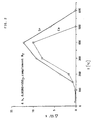
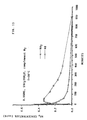
- The relative weight increase (ΔW%) as a function of temperature, for four hours of exposure of the absorbent compound to the specified gas mixtures, is shown in Figures 1, 2 and 3 respectively.
- The numeric values of ΔW are given only a semiquantitative meaning, since the extent of the absorption in isothermal conditions is regulated by the kinetics of the system, which also depends on the state of the surface of the materials. The behavior of ΔW with respect to the temperature instead points out the actual temperature intervals in which the processes that lead to nitrogen oxide absorption are active.
- Figure 1 relates to the absorption of NO from a mixture of NO plus N2 inert gas. The diagram therefore shows only NO absorption. Experiments have shown that the Sr and Sr, Ca materials absorb in the interval between 150 and 400°C and in particular between 200 and 400°C. The Ca materials absorb between 200 and 300°C.
- Measurements made at 25°C with a mixture of NO plus N2 (inert) in the presence of water vapor showed that the Ca materials absorb in these conditions even at less than 100°C and in particular even at temperatures as low as 25°C.
- IR analysis of the absorbent materials unloaded from the reactor at the end of each experiment showed the formation of nitrate salts in proportion to the values of ΔW. The formation of nitrate salts was also observed, indicating the presence of excess oxygen in the absorbent materials.
- The samples that correspond to the measurements made at 25°C in the presence of water vapor furthermore show modest amounts of hydrated phases.
- Figure 2 relates to absorption from a mixture of NO, O2 and N2. It is noted that the amount of oxygen present in the mixture is significant with respect to the typical conditions of flue gas ducts.
- In this case, part of the NO is oxidated to NO2. The unconverted NO and the NO2 are absorbed on the absorbent compounds according to the invention, and comparison with Figure 1 shows that the absorption of the latter gas occurs over a temperature range up to 500°C for Sr materials and up to 400°C for Ca materials.
- Furthermore, although this is not very evident, the Ca material is active at 25°C even in the absence of water vapor.
- IR analyses of the absorbent materials unloaded from the reactor at the end of each experiment showed the formation of nitrite salts and nitrate salts in proportion to the values of ΔW.
- Figure 3 relates to absorption from a mixture of NO, O2 and water vapor. The amount of oxygen and water vapor is significant with respect to the typical conditions of flue gas ducts.
- It is noted that the behaviors are comparable to those of Figure 2, but the effect of water vapor in promoting NO and NO2 absorption at low temperature becomes evident.
- IR analyses of the absorbents unloaded from the reactor at the end of each experiment showed the formation of nitrate salts and nitrite salts in proportion to the values of ΔW and the formation of small amounts of hydrated phases.
- Figure 4 relates to similar experiments conducted by using derivative compounds having a structure of the Sr14Cu24O41 type as absorbent compounds.
- The nominal compositions of the materials used were as follows:
- Figure 5 relates to similar experiments conducted with absorbent compounds having a structure of the CaCuO2 type.
- The nominal compositions of the materials used were as follows:
- Analysis of the diagrams presented in Figures 4 and 5 shows that the substitutions performed in the CaCuO2 and Sr14Cu24O41 base materials produce materials having an absorption activity which is, in some cases, favorably comparable with that of the pure CaCuO2 and Sr14Cu24O41 materials.
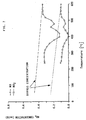
- In order to characterize the efficiency and reversibility of the nitrogen oxide absorption and desorption processes, the above cited gas mixtures 1), 2) and 3) were fed to a reactor containing 1 to 2 g of absorbents while the temperature of the absorbents was varied according to a linear temperature gradient of about 3°C/min.
- The concentration of the gases in the stream leaving the reactor was measured by spectrographic analysis.
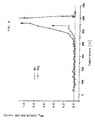
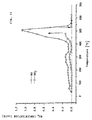
- Figures 6 to 11 present the results of some of the experiments. Figures 6 to 8 relate to experiments conducted with Sr14Cu24O41, while Figures 9 to 11 relate to experiments conducted with CaCuO2.
- The same load (1.5 g) of absorbent material was subjected in succession to the following operations:
- a) Heating with a constant temperature gradient (+200°C/hour) from 20°C to approximately 600°C in the reactor, fed continuously with a mixture of 0.5% NO plus 5% O2 plus 10% H2O plus N2 complement, by weight, at a flow-rate of 150 ml/min. The results are shown in Figures 6 and 9.
- b) Cooling from 600 to 20°C with a constant temperature gradient (-150°C/hour), maintaining the same gas mixture supply conditions. The results are shown in Figures 7 and 10.
- c) Heating from 20 to 650°C (+200°C/hour), in the reactor fed continuously with a mixture of 5% O2 plus 10% H2O plus N2 complement, that is to say, without NO, at a flow-rate of 150 ml/min. The results are shown in Figures 8 and 11.
-
- Figures 6, 7 and 9, 10 also plot the bypass concentrations of NO and NO2 determined from experiments conducted in the same conditions as shown above for steps a) and b) but in the absence of absorbent material, that is to say, while the reactor was empty.
- Figures 6 to 11 show the temperature ranges during which NO and NO2 absorption occurs, respectively.
- The results of the experiments related to the temperature ranges in which nitrogen oxide absorption occurs are given in Table 1.
- It is also noted that both compounds absorb both NO and NO2 formed by reaction of the NO with the oxygen contained in the gas mixture. The absorption and desorption temperatures for the two gases (NO and NO2) are clearly differentiated, as shown by the data in the table.
1.0% NO. N2 complement CaCuO2 abs. NO 0 - 160°C 180 - 380°C abs. NO2 n/A des. NO 250 - 320°C 350 - 440°C des. NO2 330-560°C Sr14Cu24O41 abs. NO 150 - 360°C abs. NO2 n/A des. NO 380-450°C des. NO2 500-600°C 0.8% NO, 5% O2, N2 complement CaCuO2 abs. NO 180 - 440°C abs. NO2 180-440°C des. NO 270 - 350°C 390 - 510°C des. NO2 390-510°C Sr14Cu24O41 abs. NO 180 - 490°C abs. NO2 150-450°C des. NO 420 - 550°C des. NO2 500-600°C 0.5 % NO. 5% O2, 3% H2O, N2 complement CaCuO2 abs. NO 0 - 160°C 320 - 420°C abs. NO2 160-420°C des. NO 420 - 490°C des. NO2 420-520°C Sr14Cu24O41 abs. NO 100 - 460°C abs. NO2 100-480°C des. NO 450 - 550°C des. NO2 500-600°C - It is also noted that the CaCuO2 compound, in the presence of water, shows NO absorption activity even at very low temperatures, particularly at 25°C.
- The results of the experiments shown in Figures 7 and 10 confirm that the absorbent material was regenerated following heating to 600°C, above the desorption temperature.
- The results of the experiments presented in Figures 8 and 11 show that the NO and NO2 gases absorbed during cooling with a constant temperature gradient (falling ramp) are desorbed by heating in the absence of an NO supply.
- Experiments were also conducted in order to evaluate the saturation limit of the absorption process; selectivity tests were also performed in order to verify resistance to possible operating conditions.
- Measurements performed by IR spectroscopy proved that the products of the absorption of NO and NO2 by the compounds according to the invention are respectively calcium nitrite and nitrate (for CaCuO2) and strontium nitrite and nitrate (for Sr14Cu24O41). Accordingly, the following reactions can be assumed to occur:
- From these it can be deduced that the increase in weight to saturation due to NOx absorption (i.e., ignoring the variation due to the oxygen, which can partly originate from a non-stoichiometric excess in the compounds) is respectively:
1) 44%; 2) 68%; 3) 25%; 4) 38% - In order to determine the selectivity of the process of nitrogen oxide absorption by the compounds according to the invention, experiments were conducted in conditions similar to those of the experiments for which the results are given in Figures 1 to 3, except that a different gas mixture, containing carbon dioxide and water, was used.
- The increase in weight of the absorbent compound as a function of the temperature, as a consequence of 4 hours of exposure to the described atmosphere, is shown in Figure 12.
- Figure 12 shows that reactivity with respect to hydration and carbonatation reactions is entirely negligible up to 350°, while at higher temperatures it becomes similar to the reactivity with respect to nitrogen oxides.
- Accordingly, up to 350°C the selectivity of the absorbent compounds according to the invention with respect to NO and NO2 is to be considered as being total.
- Furthermore, it has been found surprisingly that the CaCuO2 compound has NO and NO2 absorption capacity at ambient temperature.
- The results of experiments conducted with a closed reactor containing CaCuO2 absorbent material in an atmosphere of 1% NO, 5% O2, 3% H2O and N2 complement are shown in Figure 13.
- Experiments conducted with the CaCuO2 and Sr14Cu24O41 compounds and with their isovalent- and heterovalent-substitution derivatives in comparison with experiments conducted with barium-based compounds have pointed out important aspects which make CaCuO2 and Sr14Cu24O41 compounds and their derivatives advantageous.
- Their maximum activity, regarding both absorption and desorption of NO and NO2, is in fact shifted toward low temperatures, allowing, for an equal level of efficiency, once the synthesis and forming processes have been optimized, to use these materials at lower temperatures. This also entails the advantage of working in safe conditions with respect to the various processes characterized by oxide materials.
- The lower regeneration temperatures are an important technological advantage and so is the absence of delicate problems in terms of coexistence of phases which occur in the synthesis of barium-based compounds.
- The possibility to absorb NO at ambient temperature, albeit with reduced (slower) kinetics), is an important opportunity for practical application, since this property is not known so far for any other material.
- Furthermore, CaCuO2 and Sr14Cu24O41 are capable of absorbing large amounts of NO2, particularly when the process is performed in the presence of water vapor.
- In addition, due to the abundance of their constituents and to their easier synthesis, the cost of the compounds used as absorbents in the present invention is significantly lower than that of barium-based compounds.
- As will be evident to experts in the field, various modifications, adaptations and variations of the above specific description can be introduced without moving away from the teachings of the present invention.
Claims (17)
- A process for absorbing nitrogen oxides, comprising the step of contacting gas mixtures containing nitrogen oxides with absorbent compounds constituted by mixed copper oxides chosen among CaCuO2, Sr14Cu24O41, derivatives thereof obtained by substitution on the sites occupied by copper, preferably with fourth-period transition metals, more preferably with Ni , derivatives of CaCuO2 obtained by substitution on the sites occupied by Ca, preferably with Mg or Sr, derivatives of Sr14, Cu24 O41 obtained by substitution on the sites occupied by Sr, preferably with Ca, La or Na, and mixtures thereof.
- The process according to claim 1, wherein absorption occurs in the presence of oxygen.
- The process according to claim 1 or claim 2, wherein absorption occurs in the presence of water vapor.
- The process according to any one of the preceding claims, wherein said absorbent compound is CaCuO2.
- The process according to claim 4, wherein absorption occurs at a temperature ranging between 0 and 420°C.
- The process according to claim 5, wherein absorption occurs at a temperature between 0-160 and 290-420°C.
- The process according to claim 4, wherein absorption occurs at ambient temperature.
- The process according to one of claims 1 to 3, wherein said absorbent compound is Sr14Cu24O41.
- The process according to claim 8, wherein absorption occurs at a temperature ranging between 100 and 490°C, preferably 340-400°C for NO, 280-460°C for NO2.
- The process according to claims 1-3, wherein said absorbent compound is a derivative of Sr14Cu24O41 obtained by substitution on the sites occupied by Sr, preferably with Ca, La or Na.
- The process according to claim 10, wherein up to 50% of the Sr atoms are substituted with Ca.
- The process according to claim 10, wherein the absorbent compound is selected from the group consisting of:
- The process according to claims 1-3, wherein said absorbent compound is a derivative of CaCuO2 obtained by substitution on the sites occupied by Ca, preferably with Mg or Sr.
- The process according to claim 13, wherein the absorbent compound is selected from the group consisting of:
- The process according to one of claims 1 to 3, wherein said absorbent compound is a derivative of CaCuO2 or Sr14Cu24O41 obtained by isovalent and/or heterovalent substitution on the sites occupied by Cu.
- The process according to claim 15, wherein said derivative is selected from the group consisting of Sr14Cu21Ni3O41 and CaCu0.85Ni0.15O2.
- The process according to one of claims 10 to 16, wherein absorption occurs at a temperature ranging between 0 and 500°C.
Applications Claiming Priority (3)
| Application Number | Priority Date | Filing Date | Title |
|---|---|---|---|
| IT1998BO000593A IT1304405B1 (en) | 1998-10-21 | 1998-10-21 | PROCESS FOR ABSORPTION OF NITROGEN OXIDES FROM GASEOUS MIXTURES CONTAINING THE SAME. |
| ITBO980593 | 1998-10-21 | ||
| PCT/EP1999/007898 WO2000023175A1 (en) | 1998-10-21 | 1999-10-19 | Process for absorbing nitrogen oxides from gas mixtures containing said oxides |
Publications (2)
| Publication Number | Publication Date |
|---|---|
| EP1123151A1 EP1123151A1 (en) | 2001-08-16 |
| EP1123151B1 true EP1123151B1 (en) | 2004-01-14 |
Family
ID=11343463
Family Applications (1)
| Application Number | Title | Priority Date | Filing Date |
|---|---|---|---|
| EP99950757A Expired - Lifetime EP1123151B1 (en) | 1998-10-21 | 1999-10-19 | Process for absorbing nitrogen oxides from gas mixtures containing said oxides |
Country Status (11)
| Country | Link |
|---|---|
| US (1) | US6514320B1 (en) |
| EP (1) | EP1123151B1 (en) |
| AT (1) | ATE257740T1 (en) |
| AU (1) | AU6341099A (en) |
| CA (1) | CA2347733A1 (en) |
| DE (1) | DE69914214T2 (en) |
| DK (1) | DK1123151T3 (en) |
| ES (1) | ES2212640T3 (en) |
| IT (1) | IT1304405B1 (en) |
| PT (1) | PT1123151E (en) |
| WO (1) | WO2000023175A1 (en) |
Families Citing this family (3)
| Publication number | Priority date | Publication date | Assignee | Title |
|---|---|---|---|---|
| US20040022787A1 (en) | 2000-07-03 | 2004-02-05 | Robert Cohen | Methods for treating an autoimmune disease using a soluble CTLA4 molecule and a DMARD or NSAID |
| ITMI20042455A1 (en) * | 2004-12-22 | 2005-03-22 | Sued Chemie Mt Srl | PROCEDURE FOR THE REMOVAL OF NITROGEN OXIDES WITH ABSORBENT MATERIAL OF OXIDES OF SAME |
| JP2006294960A (en) * | 2005-04-13 | 2006-10-26 | Sumitomo Chemical Co Ltd | Thermoelectric conversion material |
Family Cites Families (6)
| Publication number | Priority date | Publication date | Assignee | Title |
|---|---|---|---|---|
| IT1246784B (en) * | 1991-04-16 | 1994-11-26 | Getters Spa | PROCEDURE FOR ABSORBING RESIDUAL GASES THROUGH AN UNEVAPORATED BARIUM GETTER ALLOY. |
| US5874057A (en) | 1995-07-12 | 1999-02-23 | Engelhard Corporation | Lean NOx catalyst/trap method |
| WO1997011779A1 (en) * | 1995-09-26 | 1997-04-03 | Kabushiki Kaisha Kobe Seiko Sho | Poisonous gas removing agent |
| IT1285562B1 (en) | 1996-02-12 | 1998-06-18 | Univ Bologna | COMPOUNDS WITH GAS FIXING ACTIVITIES |
| CN1210475A (en) * | 1996-02-12 | 1999-03-10 | 国家研究院 | Catalysts for full oxidation of volatile organic compounds |
| IT1293266B1 (en) * | 1997-07-23 | 1999-02-16 | Consiglio Nazionale Ricerche | PROCEDURE FOR SELECTIVE ABSORPTION OF NITROGEN OXIDES. |
-
1998
- 1998-10-21 IT IT1998BO000593A patent/IT1304405B1/en active
-
1999
- 1999-10-19 CA CA002347733A patent/CA2347733A1/en not_active Abandoned
- 1999-10-19 AU AU63410/99A patent/AU6341099A/en not_active Abandoned
- 1999-10-19 EP EP99950757A patent/EP1123151B1/en not_active Expired - Lifetime
- 1999-10-19 DK DK99950757T patent/DK1123151T3/en active
- 1999-10-19 US US09/830,003 patent/US6514320B1/en not_active Expired - Fee Related
- 1999-10-19 AT AT99950757T patent/ATE257740T1/en not_active IP Right Cessation
- 1999-10-19 DE DE69914214T patent/DE69914214T2/en not_active Expired - Fee Related
- 1999-10-19 ES ES99950757T patent/ES2212640T3/en not_active Expired - Lifetime
- 1999-10-19 PT PT99950757T patent/PT1123151E/en unknown
- 1999-10-19 WO PCT/EP1999/007898 patent/WO2000023175A1/en not_active Ceased
Also Published As
| Publication number | Publication date |
|---|---|
| IT1304405B1 (en) | 2001-03-19 |
| US6514320B1 (en) | 2003-02-04 |
| ATE257740T1 (en) | 2004-01-15 |
| ITBO980593A1 (en) | 2000-04-21 |
| DK1123151T3 (en) | 2004-02-16 |
| ITBO980593A0 (en) | 1998-10-21 |
| CA2347733A1 (en) | 2000-04-27 |
| WO2000023175A1 (en) | 2000-04-27 |
| DE69914214T2 (en) | 2004-12-02 |
| EP1123151A1 (en) | 2001-08-16 |
| ES2212640T3 (en) | 2004-07-16 |
| AU6341099A (en) | 2000-05-08 |
| PT1123151E (en) | 2004-05-31 |
| DE69914214D1 (en) | 2004-02-19 |
Similar Documents
| Publication | Publication Date | Title |
|---|---|---|
| Sarrión et al. | Role of calcium looping conditions on the performance of natural and synthetic Ca-based materials for energy storage | |
| Li et al. | A Study on the Properties and Mechanisms for NO x Storage Over Pt/BaAl2O4-Al2O3 Catalyst | |
| US6022489A (en) | Reagent for decomposing fluorocarbons | |
| JP2009543685A (en) | Process for producing metal-doped zeolite and its use in catalytic conversion of nitrogen oxides | |
| Marek et al. | High selectivity epoxidation of ethylene in chemical looping setup | |
| Mihalyi et al. | Study of the reductive solid-state ion exchange of indium into an NH4-beta zeolite | |
| Zazhigalov et al. | Mechanochemistry as activation method of the VPO catalysts for n-butane partial oxidation | |
| Dai et al. | Hole-Doped La1. 85Sr0. 15CuO4–δXσ (X= F, Cl) and Electron-Doped Nd1. 85Ce0. 15CuO4–δXσ Halo-Oxide Catalysts for the Selective Oxidation of Ethane to Ethene | |
| JP2656061B2 (en) | Purification method of oxidizing gas emission containing nitrogen oxides | |
| González et al. | Synthesis of high surface area perovskite catalysts by non-conventional routes | |
| US6514320B1 (en) | Process for absorbing nitrogen oxides from gas mixtures containing said oxides | |
| Li et al. | The catalytic performance of Ba-Ce-Cu catalysts for N2O decomposition | |
| WO2007004684A1 (en) | Oxygen excess type metal oxide, and method and apparatus making use of the metal oxide and ceramic for oxygen storage or oxygen selective membrane | |
| Nomura et al. | Oxidative coupling of methane on perovskite oxides,(Ba, Ca)(Co, Fe) O3-δ | |
| US20030044330A1 (en) | Solid material and process for adsorption and desorption of nitrogen oxides in exhaust gases of internal combustion engines | |
| US20010012501A1 (en) | Perfluoro compounds decomposition method and decomposition apparatus therefor | |
| US6638492B1 (en) | Method for the catalytic oxidation of volatile organic compounds | |
| EP1011843B1 (en) | Method and compound for the selective adsorption of nitrogen oxides | |
| CZ294657B6 (en) | Coated catalyst containing metal oxides and catalytic decomposition process of ammonia and hydrogen cyanide in coke-oven gas | |
| JP7235261B2 (en) | Oxygen-excess metal oxide, method for producing and regenerating the same, and oxygen concentrator and oxygen adsorption/desorption device | |
| Machida et al. | Sorption-desorption properties of nitric oxide over La 2–x Sr 1+ x Cu 2 O 6–δ (0≤ x≤ 2) | |
| Mihályi et al. | Study on the reactivity of In2O3 in mixtures with ammonium-zeolites | |
| Nakayama et al. | Carbon oxidation characteristics of yttrium manganate catalyst prepared via urea decomposition | |
| Wang et al. | NH3 desorption and decomposition behavior on microporous hollandite-type hydrous manganese oxide | |
| Mori et al. | Influence of oxygen ion conduction on nitric oxide decomposition |
Legal Events
| Date | Code | Title | Description |
|---|---|---|---|
| PUAI | Public reference made under article 153(3) epc to a published international application that has entered the european phase |
Free format text: ORIGINAL CODE: 0009012 |
|
| 17P | Request for examination filed |
Effective date: 20010516 |
|
| AK | Designated contracting states |
Kind code of ref document: A1 Designated state(s): AT BE CH CY DE DK ES FI FR GB GR IE IT LI LU MC NL PT SE |
|
| 17Q | First examination report despatched |
Effective date: 20011128 |
|
| GRAH | Despatch of communication of intention to grant a patent |
Free format text: ORIGINAL CODE: EPIDOS IGRA |
|
| GRAH | Despatch of communication of intention to grant a patent |
Free format text: ORIGINAL CODE: EPIDOS IGRA |
|
| GRAA | (expected) grant |
Free format text: ORIGINAL CODE: 0009210 |
|
| AK | Designated contracting states |
Kind code of ref document: B1 Designated state(s): AT BE CH CY DE DK ES FI FR GB GR IE IT LI LU MC NL PT SE |
|
| PG25 | Lapsed in a contracting state [announced via postgrant information from national office to epo] |
Ref country code: CY Free format text: LAPSE BECAUSE OF FAILURE TO SUBMIT A TRANSLATION OF THE DESCRIPTION OR TO PAY THE FEE WITHIN THE PRESCRIBED TIME-LIMIT Effective date: 20040114 |
|
| REG | Reference to a national code |
Ref country code: GB Ref legal event code: FG4D |
|
| REG | Reference to a national code |
Ref country code: CH Ref legal event code: EP |
|
| REG | Reference to a national code |
Ref country code: IE Ref legal event code: FG4D |
|
| REG | Reference to a national code |
Ref country code: CH Ref legal event code: NV Representative=s name: BUECHEL, KAMINSKI & PARTNER PATENTANWAELTE ESTABLI |
|
| REG | Reference to a national code |
Ref country code: DK Ref legal event code: T3 |
|
| REF | Corresponds to: |
Ref document number: 69914214 Country of ref document: DE Date of ref document: 20040219 Kind code of ref document: P |
|
| REG | Reference to a national code |
Ref country code: GR Ref legal event code: EP Ref document number: 20040400596 Country of ref document: GR |
|
| REG | Reference to a national code |
Ref country code: SE Ref legal event code: TRGR |
|
| REG | Reference to a national code |
Ref country code: PT Ref legal event code: SC4A Free format text: AVAILABILITY OF NATIONAL TRANSLATION Effective date: 20040319 |
|
| REG | Reference to a national code |
Ref country code: ES Ref legal event code: FG2A Ref document number: 2212640 Country of ref document: ES Kind code of ref document: T3 |
|
| ET | Fr: translation filed | ||
| PG25 | Lapsed in a contracting state [announced via postgrant information from national office to epo] |
Ref country code: MC Free format text: LAPSE BECAUSE OF NON-PAYMENT OF DUE FEES Effective date: 20041031 |
|
| PLBE | No opposition filed within time limit |
Free format text: ORIGINAL CODE: 0009261 |
|
| STAA | Information on the status of an ep patent application or granted ep patent |
Free format text: STATUS: NO OPPOSITION FILED WITHIN TIME LIMIT |
|
| 26N | No opposition filed |
Effective date: 20041015 |
|
| PGFP | Annual fee paid to national office [announced via postgrant information from national office to epo] |
Ref country code: IE Payment date: 20061003 Year of fee payment: 8 Ref country code: CH Payment date: 20061003 Year of fee payment: 8 |
|
| PGFP | Annual fee paid to national office [announced via postgrant information from national office to epo] |
Ref country code: GR Payment date: 20061006 Year of fee payment: 8 |
|
| PGFP | Annual fee paid to national office [announced via postgrant information from national office to epo] |
Ref country code: PT Payment date: 20061009 Year of fee payment: 8 Ref country code: BE Payment date: 20061009 Year of fee payment: 8 |
|
| PGFP | Annual fee paid to national office [announced via postgrant information from national office to epo] |
Ref country code: LU Payment date: 20061011 Year of fee payment: 8 Ref country code: ES Payment date: 20061011 Year of fee payment: 8 Ref country code: AT Payment date: 20061011 Year of fee payment: 8 |
|
| PGFP | Annual fee paid to national office [announced via postgrant information from national office to epo] |
Ref country code: FI Payment date: 20061017 Year of fee payment: 8 |
|
| PGFP | Annual fee paid to national office [announced via postgrant information from national office to epo] |
Ref country code: SE Payment date: 20061018 Year of fee payment: 8 |
|
| PGFP | Annual fee paid to national office [announced via postgrant information from national office to epo] |
Ref country code: GB Payment date: 20061020 Year of fee payment: 8 |
|
| PGFP | Annual fee paid to national office [announced via postgrant information from national office to epo] |
Ref country code: NL Payment date: 20061031 Year of fee payment: 8 Ref country code: IT Payment date: 20061031 Year of fee payment: 8 |
|
| PGFP | Annual fee paid to national office [announced via postgrant information from national office to epo] |
Ref country code: DE Payment date: 20061229 Year of fee payment: 8 |
|
| PGFP | Annual fee paid to national office [announced via postgrant information from national office to epo] |
Ref country code: DK Payment date: 20070122 Year of fee payment: 8 |
|
| BERE | Be: lapsed |
Owner name: *UNIVERSITA' DEGLI STUDI DI PARMA Effective date: 20071031 Owner name: *CONSIGLIO NAZIONALE DELLE RICERCHE Effective date: 20071031 |
|
| REG | Reference to a national code |
Ref country code: PT Ref legal event code: MM4A Free format text: LAPSE DUE TO NON-PAYMENT OF FEES Effective date: 20080421 |
|
| REG | Reference to a national code |
Ref country code: DK Ref legal event code: EBP |
|
| EUG | Se: european patent has lapsed | ||
| GBPC | Gb: european patent ceased through non-payment of renewal fee |
Effective date: 20071019 |
|
| REG | Reference to a national code |
Ref country code: CH Ref legal event code: PL |
|
| NLV4 | Nl: lapsed or anulled due to non-payment of the annual fee |
Effective date: 20080501 |
|
| PG25 | Lapsed in a contracting state [announced via postgrant information from national office to epo] |
Ref country code: LI Free format text: LAPSE BECAUSE OF NON-PAYMENT OF DUE FEES Effective date: 20071031 Ref country code: FI Free format text: LAPSE BECAUSE OF NON-PAYMENT OF DUE FEES Effective date: 20071019 Ref country code: DE Free format text: LAPSE BECAUSE OF NON-PAYMENT OF DUE FEES Effective date: 20080501 Ref country code: CH Free format text: LAPSE BECAUSE OF NON-PAYMENT OF DUE FEES Effective date: 20071031 |
|
| PG25 | Lapsed in a contracting state [announced via postgrant information from national office to epo] |
Ref country code: AT Free format text: LAPSE BECAUSE OF NON-PAYMENT OF DUE FEES Effective date: 20071019 |
|
| PG25 | Lapsed in a contracting state [announced via postgrant information from national office to epo] |
Ref country code: BE Free format text: LAPSE BECAUSE OF NON-PAYMENT OF DUE FEES Effective date: 20071031 Ref country code: PT Free format text: LAPSE BECAUSE OF NON-PAYMENT OF DUE FEES Effective date: 20080421 |
|
| REG | Reference to a national code |
Ref country code: FR Ref legal event code: ST Effective date: 20080630 |
|
| PG25 | Lapsed in a contracting state [announced via postgrant information from national office to epo] |
Ref country code: SE Free format text: LAPSE BECAUSE OF NON-PAYMENT OF DUE FEES Effective date: 20071020 Ref country code: NL Free format text: LAPSE BECAUSE OF NON-PAYMENT OF DUE FEES Effective date: 20080501 Ref country code: IE Free format text: LAPSE BECAUSE OF NON-PAYMENT OF DUE FEES Effective date: 20071019 Ref country code: DK Free format text: LAPSE BECAUSE OF NON-PAYMENT OF DUE FEES Effective date: 20071031 |
|
| PGFP | Annual fee paid to national office [announced via postgrant information from national office to epo] |
Ref country code: FR Payment date: 20061011 Year of fee payment: 8 |
|
| PG25 | Lapsed in a contracting state [announced via postgrant information from national office to epo] |
Ref country code: GB Free format text: LAPSE BECAUSE OF NON-PAYMENT OF DUE FEES Effective date: 20071019 |
|
| REG | Reference to a national code |
Ref country code: ES Ref legal event code: FD2A Effective date: 20071020 |
|
| PG25 | Lapsed in a contracting state [announced via postgrant information from national office to epo] |
Ref country code: FR Free format text: LAPSE BECAUSE OF NON-PAYMENT OF DUE FEES Effective date: 20071031 Ref country code: ES Free format text: LAPSE BECAUSE OF NON-PAYMENT OF DUE FEES Effective date: 20071020 |
|
| PG25 | Lapsed in a contracting state [announced via postgrant information from national office to epo] |
Ref country code: GR Free format text: LAPSE BECAUSE OF NON-PAYMENT OF DUE FEES Effective date: 20080505 |
|
| PG25 | Lapsed in a contracting state [announced via postgrant information from national office to epo] |
Ref country code: LU Free format text: LAPSE BECAUSE OF NON-PAYMENT OF DUE FEES Effective date: 20071019 Ref country code: IT Free format text: LAPSE BECAUSE OF NON-PAYMENT OF DUE FEES Effective date: 20071019 |