EP1123087B1 - Oral pulsed dose drug delivery system - Google Patents
Oral pulsed dose drug delivery system Download PDFInfo
- Publication number
- EP1123087B1 EP1123087B1 EP99970594A EP99970594A EP1123087B1 EP 1123087 B1 EP1123087 B1 EP 1123087B1 EP 99970594 A EP99970594 A EP 99970594A EP 99970594 A EP99970594 A EP 99970594A EP 1123087 B1 EP1123087 B1 EP 1123087B1
- Authority
- EP
- European Patent Office
- Prior art keywords
- release
- drug
- coating
- enteric
- pellets
- Prior art date
- Legal status (The legal status is an assumption and is not a legal conclusion. Google has not performed a legal analysis and makes no representation as to the accuracy of the status listed.)
- Expired - Lifetime
Links
- 238000012377 drug delivery Methods 0.000 title abstract description 12
- KWTSXDURSIMDCE-QMMMGPOBSA-N (S)-amphetamine Chemical class C[C@H](N)CC1=CC=CC=C1 KWTSXDURSIMDCE-QMMMGPOBSA-N 0.000 claims abstract description 58
- 238000000576 coating method Methods 0.000 claims abstract description 57
- 239000011248 coating agent Substances 0.000 claims abstract description 52
- 239000012729 immediate-release (IR) formulation Substances 0.000 claims abstract description 36
- 230000003111 delayed effect Effects 0.000 claims abstract description 30
- 239000000203 mixture Substances 0.000 claims description 26
- 239000008194 pharmaceutical composition Substances 0.000 claims description 10
- 230000036765 blood level Effects 0.000 claims description 4
- 208000006096 Attention Deficit Disorder with Hyperactivity Diseases 0.000 claims description 3
- 208000036864 Attention deficit/hyperactivity disease Diseases 0.000 claims description 3
- 230000000977 initiatory effect Effects 0.000 claims description 2
- 239000011241 protective layer Substances 0.000 abstract description 15
- 238000000034 method Methods 0.000 abstract description 13
- 239000002775 capsule Substances 0.000 abstract description 11
- 239000002552 dosage form Substances 0.000 abstract description 7
- 239000011324 bead Substances 0.000 abstract description 6
- 239000003814 drug Substances 0.000 description 80
- 229940079593 drug Drugs 0.000 description 78
- 239000008188 pellet Substances 0.000 description 55
- 239000010410 layer Substances 0.000 description 46
- 239000002702 enteric coating Substances 0.000 description 31
- 238000009505 enteric coating Methods 0.000 description 31
- 239000011162 core material Substances 0.000 description 29
- 229920000642 polymer Polymers 0.000 description 27
- 239000006185 dispersion Substances 0.000 description 18
- XLYOFNOQVPJJNP-UHFFFAOYSA-N water Substances O XLYOFNOQVPJJNP-UHFFFAOYSA-N 0.000 description 14
- ZZSNKZQZMQGXPY-UHFFFAOYSA-N Ethyl cellulose Chemical compound CCOCC1OC(OC)C(OCC)C(OCC)C1OC1C(O)C(O)C(OC)C(CO)O1 ZZSNKZQZMQGXPY-UHFFFAOYSA-N 0.000 description 11
- 239000012530 fluid Substances 0.000 description 11
- 229920003134 Eudragit® polymer Polymers 0.000 description 10
- 238000009472 formulation Methods 0.000 description 10
- 239000000463 material Substances 0.000 description 10
- 210000001035 gastrointestinal tract Anatomy 0.000 description 8
- 229920003088 hydroxypropyl methyl cellulose Polymers 0.000 description 8
- 235000010979 hydroxypropyl methyl cellulose Nutrition 0.000 description 8
- HQKMJHAJHXVSDF-UHFFFAOYSA-L magnesium stearate Chemical compound [Mg+2].CCCCCCCCCCCCCCCCCC([O-])=O.CCCCCCCCCCCCCCCCCC([O-])=O HQKMJHAJHXVSDF-UHFFFAOYSA-L 0.000 description 8
- 210000002381 plasma Anatomy 0.000 description 8
- 239000001866 hydroxypropyl methyl cellulose Substances 0.000 description 7
- UFVKGYZPFZQRLF-UHFFFAOYSA-N hydroxypropyl methyl cellulose Chemical compound OC1C(O)C(OC)OC(CO)C1OC1C(O)C(O)C(OC2C(C(O)C(OC3C(C(O)C(O)C(CO)O3)O)C(CO)O2)O)C(CO)O1 UFVKGYZPFZQRLF-UHFFFAOYSA-N 0.000 description 7
- 239000011230 binding agent Substances 0.000 description 6
- 239000011247 coating layer Substances 0.000 description 6
- 230000002496 gastric effect Effects 0.000 description 6
- 239000002245 particle Substances 0.000 description 6
- 229920001223 polyethylene glycol Polymers 0.000 description 6
- 239000001267 polyvinylpyrrolidone Substances 0.000 description 6
- 229920000036 polyvinylpyrrolidone Polymers 0.000 description 6
- 235000013855 polyvinylpyrrolidone Nutrition 0.000 description 6
- 239000000126 substance Substances 0.000 description 6
- 238000013268 sustained release Methods 0.000 description 6
- 239000012730 sustained-release form Substances 0.000 description 6
- 229920003138 Eudragit® L 30 D-55 Polymers 0.000 description 5
- DOOTYTYQINUNNV-UHFFFAOYSA-N Triethyl citrate Chemical compound CCOC(=O)CC(O)(C(=O)OCC)CC(=O)OCC DOOTYTYQINUNNV-UHFFFAOYSA-N 0.000 description 5
- 239000004615 ingredient Substances 0.000 description 5
- 239000000314 lubricant Substances 0.000 description 5
- 238000002156 mixing Methods 0.000 description 5
- 239000011253 protective coating Substances 0.000 description 5
- 230000002829 reductive effect Effects 0.000 description 5
- 239000000454 talc Substances 0.000 description 5
- 229910052623 talc Inorganic materials 0.000 description 5
- 239000001069 triethyl citrate Substances 0.000 description 5
- VMYFZRTXGLUXMZ-UHFFFAOYSA-N triethyl citrate Natural products CCOC(=O)C(O)(C(=O)OCC)C(=O)OCC VMYFZRTXGLUXMZ-UHFFFAOYSA-N 0.000 description 5
- 235000013769 triethyl citrate Nutrition 0.000 description 5
- 229920000168 Microcrystalline cellulose Polymers 0.000 description 4
- VYPSYNLAJGMNEJ-UHFFFAOYSA-N Silicium dioxide Chemical compound O=[Si]=O VYPSYNLAJGMNEJ-UHFFFAOYSA-N 0.000 description 4
- 238000010521 absorption reaction Methods 0.000 description 4
- 239000000654 additive Substances 0.000 description 4
- 229940025084 amphetamine Drugs 0.000 description 4
- CJZGTCYPCWQAJB-UHFFFAOYSA-L calcium stearate Chemical compound [Ca+2].CCCCCCCCCCCCCCCCCC([O-])=O.CCCCCCCCCCCCCCCCCC([O-])=O CJZGTCYPCWQAJB-UHFFFAOYSA-L 0.000 description 4
- 239000008116 calcium stearate Substances 0.000 description 4
- 235000013539 calcium stearate Nutrition 0.000 description 4
- OSGAYBCDTDRGGQ-UHFFFAOYSA-L calcium sulfate Chemical compound [Ca+2].[O-]S([O-])(=O)=O OSGAYBCDTDRGGQ-UHFFFAOYSA-L 0.000 description 4
- 239000000945 filler Substances 0.000 description 4
- 210000000936 intestine Anatomy 0.000 description 4
- 235000019359 magnesium stearate Nutrition 0.000 description 4
- 229940016286 microcrystalline cellulose Drugs 0.000 description 4
- 235000019813 microcrystalline cellulose Nutrition 0.000 description 4
- 239000008108 microcrystalline cellulose Substances 0.000 description 4
- 238000012545 processing Methods 0.000 description 4
- 230000000541 pulsatile effect Effects 0.000 description 4
- 238000005507 spraying Methods 0.000 description 4
- ZFXYFBGIUFBOJW-UHFFFAOYSA-N theophylline Chemical compound O=C1N(C)C(=O)N(C)C2=C1NC=N2 ZFXYFBGIUFBOJW-UHFFFAOYSA-N 0.000 description 4
- 206010053155 Epigastric discomfort Diseases 0.000 description 3
- 239000004354 Hydroxyethyl cellulose Substances 0.000 description 3
- 229920000663 Hydroxyethyl cellulose Polymers 0.000 description 3
- 229920002153 Hydroxypropyl cellulose Polymers 0.000 description 3
- -1 METOLOSE® 60SH Chemical compound 0.000 description 3
- 229920003091 Methocel™ Polymers 0.000 description 3
- 239000002202 Polyethylene glycol Substances 0.000 description 3
- DNIAPMSPPWPWGF-UHFFFAOYSA-N Propylene glycol Chemical compound CC(O)CO DNIAPMSPPWPWGF-UHFFFAOYSA-N 0.000 description 3
- 239000002253 acid Substances 0.000 description 3
- 230000004888 barrier function Effects 0.000 description 3
- 239000000872 buffer Substances 0.000 description 3
- 229920002301 cellulose acetate Polymers 0.000 description 3
- 239000003795 chemical substances by application Substances 0.000 description 3
- KRKNYBCHXYNGOX-UHFFFAOYSA-N citric acid Chemical compound OC(=O)CC(O)(C(O)=O)CC(O)=O KRKNYBCHXYNGOX-UHFFFAOYSA-N 0.000 description 3
- 239000002131 composite material Substances 0.000 description 3
- 150000001875 compounds Chemical class 0.000 description 3
- 238000013270 controlled release Methods 0.000 description 3
- 239000007884 disintegrant Substances 0.000 description 3
- 238000004090 dissolution Methods 0.000 description 3
- 230000000694 effects Effects 0.000 description 3
- 239000012055 enteric layer Substances 0.000 description 3
- 238000010579 first pass effect Methods 0.000 description 3
- 238000005243 fluidization Methods 0.000 description 3
- 238000004128 high performance liquid chromatography Methods 0.000 description 3
- 235000019447 hydroxyethyl cellulose Nutrition 0.000 description 3
- 239000001863 hydroxypropyl cellulose Substances 0.000 description 3
- 235000010977 hydroxypropyl cellulose Nutrition 0.000 description 3
- 238000004519 manufacturing process Methods 0.000 description 3
- 239000003960 organic solvent Substances 0.000 description 3
- 239000006174 pH buffer Substances 0.000 description 3
- 239000000546 pharmaceutical excipient Substances 0.000 description 3
- 238000002360 preparation method Methods 0.000 description 3
- 230000008569 process Effects 0.000 description 3
- 210000002784 stomach Anatomy 0.000 description 3
- 230000002459 sustained effect Effects 0.000 description 3
- 230000001225 therapeutic effect Effects 0.000 description 3
- VBICKXHEKHSIBG-UHFFFAOYSA-N 1-monostearoylglycerol Chemical compound CCCCCCCCCCCCCCCCCC(=O)OCC(O)CO VBICKXHEKHSIBG-UHFFFAOYSA-N 0.000 description 2
- VOXZDWNPVJITMN-ZBRFXRBCSA-N 17β-estradiol Chemical compound OC1=CC=C2[C@H]3CC[C@](C)([C@H](CC4)O)[C@@H]4[C@@H]3CCC2=C1 VOXZDWNPVJITMN-ZBRFXRBCSA-N 0.000 description 2
- GUBGYTABKSRVRQ-XLOQQCSPSA-N Alpha-Lactose Chemical compound O[C@@H]1[C@@H](O)[C@@H](O)[C@@H](CO)O[C@H]1O[C@@H]1[C@@H](CO)O[C@H](O)[C@H](O)[C@H]1O GUBGYTABKSRVRQ-XLOQQCSPSA-N 0.000 description 2
- VTYYLEPIZMXCLO-UHFFFAOYSA-L Calcium carbonate Chemical compound [Ca+2].[O-]C([O-])=O VTYYLEPIZMXCLO-UHFFFAOYSA-L 0.000 description 2
- 229920000623 Cellulose acetate phthalate Polymers 0.000 description 2
- 229920002785 Croscarmellose sodium Polymers 0.000 description 2
- FBPFZTCFMRRESA-FSIIMWSLSA-N D-Glucitol Natural products OC[C@H](O)[C@H](O)[C@@H](O)[C@H](O)CO FBPFZTCFMRRESA-FSIIMWSLSA-N 0.000 description 2
- FBPFZTCFMRRESA-JGWLITMVSA-N D-glucitol Chemical compound OC[C@H](O)[C@@H](O)[C@H](O)[C@H](O)CO FBPFZTCFMRRESA-JGWLITMVSA-N 0.000 description 2
- 239000001856 Ethyl cellulose Substances 0.000 description 2
- 229920003163 Eudragit® NE 30 D Polymers 0.000 description 2
- VZCYOOQTPOCHFL-OWOJBTEDSA-N Fumaric acid Chemical compound OC(=O)\C=C\C(O)=O VZCYOOQTPOCHFL-OWOJBTEDSA-N 0.000 description 2
- 208000022559 Inflammatory bowel disease Diseases 0.000 description 2
- ROHFNLRQFUQHCH-YFKPBYRVSA-N L-leucine Chemical compound CC(C)C[C@H](N)C(O)=O ROHFNLRQFUQHCH-YFKPBYRVSA-N 0.000 description 2
- GUBGYTABKSRVRQ-QKKXKWKRSA-N Lactose Natural products OC[C@H]1O[C@@H](O[C@H]2[C@H](O)[C@@H](O)C(O)O[C@@H]2CO)[C@H](O)[C@@H](O)[C@H]1O GUBGYTABKSRVRQ-QKKXKWKRSA-N 0.000 description 2
- ROHFNLRQFUQHCH-UHFFFAOYSA-N Leucine Natural products CC(C)CC(N)C(O)=O ROHFNLRQFUQHCH-UHFFFAOYSA-N 0.000 description 2
- 229920000881 Modified starch Polymers 0.000 description 2
- FAPWRFPIFSIZLT-UHFFFAOYSA-M Sodium chloride Chemical compound [Na+].[Cl-] FAPWRFPIFSIZLT-UHFFFAOYSA-M 0.000 description 2
- 229920002472 Starch Polymers 0.000 description 2
- CZMRCDWAGMRECN-UGDNZRGBSA-N Sucrose Chemical compound O[C@H]1[C@H](O)[C@@H](CO)O[C@@]1(CO)O[C@@H]1[C@H](O)[C@@H](O)[C@H](O)[C@@H](CO)O1 CZMRCDWAGMRECN-UGDNZRGBSA-N 0.000 description 2
- 229930006000 Sucrose Natural products 0.000 description 2
- GWEVSGVZZGPLCZ-UHFFFAOYSA-N Titan oxide Chemical compound O=[Ti]=O GWEVSGVZZGPLCZ-UHFFFAOYSA-N 0.000 description 2
- 230000002902 bimodal effect Effects 0.000 description 2
- 235000010980 cellulose Nutrition 0.000 description 2
- 229920002678 cellulose Polymers 0.000 description 2
- 239000001913 cellulose Substances 0.000 description 2
- 229940081734 cellulose acetate phthalate Drugs 0.000 description 2
- 230000027288 circadian rhythm Effects 0.000 description 2
- 210000001072 colon Anatomy 0.000 description 2
- 229920001577 copolymer Polymers 0.000 description 2
- 230000007423 decrease Effects 0.000 description 2
- 239000003405 delayed action preparation Substances 0.000 description 2
- 230000001419 dependent effect Effects 0.000 description 2
- 208000037265 diseases, disorders, signs and symptoms Diseases 0.000 description 2
- 230000007613 environmental effect Effects 0.000 description 2
- 150000002148 esters Chemical class 0.000 description 2
- 235000019325 ethyl cellulose Nutrition 0.000 description 2
- 229920001249 ethyl cellulose Polymers 0.000 description 2
- 230000037406 food intake Effects 0.000 description 2
- 238000012395 formulation development Methods 0.000 description 2
- 239000007903 gelatin capsule Substances 0.000 description 2
- 150000004676 glycans Chemical class 0.000 description 2
- 239000008187 granular material Substances 0.000 description 2
- 239000000017 hydrogel Substances 0.000 description 2
- 229920003132 hydroxypropyl methylcellulose phthalate Polymers 0.000 description 2
- 229940031704 hydroxypropyl methylcellulose phthalate Drugs 0.000 description 2
- 239000008101 lactose Substances 0.000 description 2
- VZCYOOQTPOCHFL-UPHRSURJSA-N maleic acid Chemical compound OC(=O)\C=C/C(O)=O VZCYOOQTPOCHFL-UPHRSURJSA-N 0.000 description 2
- 239000011159 matrix material Substances 0.000 description 2
- 230000007935 neutral effect Effects 0.000 description 2
- 230000035515 penetration Effects 0.000 description 2
- 230000036470 plasma concentration Effects 0.000 description 2
- 229940068917 polyethylene glycols Drugs 0.000 description 2
- 239000000244 polyoxyethylene sorbitan monooleate Substances 0.000 description 2
- 235000010482 polyoxyethylene sorbitan monooleate Nutrition 0.000 description 2
- 229920001282 polysaccharide Polymers 0.000 description 2
- 239000005017 polysaccharide Substances 0.000 description 2
- 229920000053 polysorbate 80 Polymers 0.000 description 2
- 229940100467 polyvinyl acetate phthalate Drugs 0.000 description 2
- 210000000813 small intestine Anatomy 0.000 description 2
- CDBYLPFSWZWCQE-UHFFFAOYSA-L sodium carbonate Substances [Na+].[Na+].[O-]C([O-])=O CDBYLPFSWZWCQE-UHFFFAOYSA-L 0.000 description 2
- 235000002639 sodium chloride Nutrition 0.000 description 2
- 229920003109 sodium starch glycolate Polymers 0.000 description 2
- 239000008109 sodium starch glycolate Substances 0.000 description 2
- 229940079832 sodium starch glycolate Drugs 0.000 description 2
- 239000008279 sol Substances 0.000 description 2
- 239000000600 sorbitol Substances 0.000 description 2
- 235000010356 sorbitol Nutrition 0.000 description 2
- 235000019698 starch Nutrition 0.000 description 2
- 239000005720 sucrose Substances 0.000 description 2
- 239000004094 surface-active agent Substances 0.000 description 2
- 239000000725 suspension Substances 0.000 description 2
- 230000009747 swallowing Effects 0.000 description 2
- 229960000278 theophylline Drugs 0.000 description 2
- VZCYOOQTPOCHFL-UHFFFAOYSA-N trans-butenedioic acid Natural products OC(=O)C=CC(O)=O VZCYOOQTPOCHFL-UHFFFAOYSA-N 0.000 description 2
- URAYPUMNDPQOKB-UHFFFAOYSA-N triacetin Chemical compound CC(=O)OCC(OC(C)=O)COC(C)=O URAYPUMNDPQOKB-UHFFFAOYSA-N 0.000 description 2
- BJEPYKJPYRNKOW-REOHCLBHSA-N (S)-malic acid Chemical compound OC(=O)[C@@H](O)CC(O)=O BJEPYKJPYRNKOW-REOHCLBHSA-N 0.000 description 1
- ZORQXIQZAOLNGE-UHFFFAOYSA-N 1,1-difluorocyclohexane Chemical compound FC1(F)CCCCC1 ZORQXIQZAOLNGE-UHFFFAOYSA-N 0.000 description 1
- OKMWKBLSFKFYGZ-UHFFFAOYSA-N 1-behenoylglycerol Chemical compound CCCCCCCCCCCCCCCCCCCCCC(=O)OCC(O)CO OKMWKBLSFKFYGZ-UHFFFAOYSA-N 0.000 description 1
- KWTSXDURSIMDCE-UHFFFAOYSA-N 1-phenylpropan-2-amine Chemical compound CC(N)CC1=CC=CC=C1 KWTSXDURSIMDCE-UHFFFAOYSA-N 0.000 description 1
- QZCLKYGREBVARF-UHFFFAOYSA-N Acetyl tributyl citrate Chemical compound CCCCOC(=O)CC(C(=O)OCCCC)(OC(C)=O)CC(=O)OCCCC QZCLKYGREBVARF-UHFFFAOYSA-N 0.000 description 1
- 206010002383 Angina Pectoris Diseases 0.000 description 1
- BSYNRYMUTXBXSQ-UHFFFAOYSA-N Aspirin Chemical compound CC(=O)OC1=CC=CC=C1C(O)=O BSYNRYMUTXBXSQ-UHFFFAOYSA-N 0.000 description 1
- 229920008347 Cellulose acetate propionate Polymers 0.000 description 1
- 229920002261 Corn starch Polymers 0.000 description 1
- FBPFZTCFMRRESA-KVTDHHQDSA-N D-Mannitol Chemical compound OC[C@@H](O)[C@@H](O)[C@H](O)[C@H](O)CO FBPFZTCFMRRESA-KVTDHHQDSA-N 0.000 description 1
- 229920002307 Dextran Polymers 0.000 description 1
- FEWJPZIEWOKRBE-JCYAYHJZSA-N Dextrotartaric acid Chemical compound OC(=O)[C@H](O)[C@@H](O)C(O)=O FEWJPZIEWOKRBE-JCYAYHJZSA-N 0.000 description 1
- PYGXAGIECVVIOZ-UHFFFAOYSA-N Dibutyl decanedioate Chemical compound CCCCOC(=O)CCCCCCCCC(=O)OCCCC PYGXAGIECVVIOZ-UHFFFAOYSA-N 0.000 description 1
- 102000004190 Enzymes Human genes 0.000 description 1
- 108090000790 Enzymes Proteins 0.000 description 1
- 229920003135 Eudragit® L 100-55 Polymers 0.000 description 1
- 229920003157 Eudragit® RL 30 D Polymers 0.000 description 1
- 229920003141 Eudragit® S 100 Polymers 0.000 description 1
- HEFNNWSXXWATRW-UHFFFAOYSA-N Ibuprofen Chemical compound CC(C)CC1=CC=C(C(C)C(O)=O)C=C1 HEFNNWSXXWATRW-UHFFFAOYSA-N 0.000 description 1
- 206010061218 Inflammation Diseases 0.000 description 1
- 229930195725 Mannitol Natural products 0.000 description 1
- CERQOIWHTDAKMF-UHFFFAOYSA-N Methacrylic acid Chemical compound CC(=C)C(O)=O CERQOIWHTDAKMF-UHFFFAOYSA-N 0.000 description 1
- DUGOZIWVEXMGBE-UHFFFAOYSA-N Methylphenidate Chemical compound C=1C=CC=CC=1C(C(=O)OC)C1CCCCN1 DUGOZIWVEXMGBE-UHFFFAOYSA-N 0.000 description 1
- WHNWPMSKXPGLAX-UHFFFAOYSA-N N-Vinyl-2-pyrrolidone Chemical compound C=CN1CCCC1=O WHNWPMSKXPGLAX-UHFFFAOYSA-N 0.000 description 1
- SNIOPGDIGTZGOP-UHFFFAOYSA-N Nitroglycerin Chemical compound [O-][N+](=O)OCC(O[N+]([O-])=O)CO[N+]([O-])=O SNIOPGDIGTZGOP-UHFFFAOYSA-N 0.000 description 1
- 239000000006 Nitroglycerin Substances 0.000 description 1
- 229920003072 Plasdone™ povidone Polymers 0.000 description 1
- 229920003110 Primojel Polymers 0.000 description 1
- OFOBLEOULBTSOW-UHFFFAOYSA-N Propanedioic acid Natural products OC(=O)CC(O)=O OFOBLEOULBTSOW-UHFFFAOYSA-N 0.000 description 1
- SKZKKFZAGNVIMN-UHFFFAOYSA-N Salicilamide Chemical compound NC(=O)C1=CC=CC=C1O SKZKKFZAGNVIMN-UHFFFAOYSA-N 0.000 description 1
- DBMJMQXJHONAFJ-UHFFFAOYSA-M Sodium laurylsulphate Chemical compound [Na+].CCCCCCCCCCCCOS([O-])(=O)=O DBMJMQXJHONAFJ-UHFFFAOYSA-M 0.000 description 1
- 235000021355 Stearic acid Nutrition 0.000 description 1
- KDYFGRWQOYBRFD-UHFFFAOYSA-N Succinic acid Natural products OC(=O)CCC(O)=O KDYFGRWQOYBRFD-UHFFFAOYSA-N 0.000 description 1
- FEWJPZIEWOKRBE-UHFFFAOYSA-N Tartaric acid Natural products [H+].[H+].[O-]C(=O)C(O)C(O)C([O-])=O FEWJPZIEWOKRBE-UHFFFAOYSA-N 0.000 description 1
- TVXBFESIOXBWNM-UHFFFAOYSA-N Xylitol Natural products OCCC(O)C(O)C(O)CCO TVXBFESIOXBWNM-UHFFFAOYSA-N 0.000 description 1
- 229920002494 Zein Polymers 0.000 description 1
- TYVWBCMQECJNSK-UHFFFAOYSA-N [2-methyl-3-(2-methylprop-2-enoyloxy)butan-2-yl]azanium;chloride Chemical compound [Cl-].CC([NH3+])(C)C(C)OC(=O)C(C)=C TYVWBCMQECJNSK-UHFFFAOYSA-N 0.000 description 1
- 229960001138 acetylsalicylic acid Drugs 0.000 description 1
- 230000002378 acidificating effect Effects 0.000 description 1
- 150000007513 acids Chemical class 0.000 description 1
- 230000000996 additive effect Effects 0.000 description 1
- GJSLOMWRLALDCT-UHFFFAOYSA-N adinazolam Chemical compound C12=CC(Cl)=CC=C2N2C(CN(C)C)=NN=C2CN=C1C1=CC=CC=C1 GJSLOMWRLALDCT-UHFFFAOYSA-N 0.000 description 1
- 229960003148 adinazolam Drugs 0.000 description 1
- 230000002411 adverse Effects 0.000 description 1
- 238000005054 agglomeration Methods 0.000 description 1
- 230000002776 aggregation Effects 0.000 description 1
- BJEPYKJPYRNKOW-UHFFFAOYSA-N alpha-hydroxysuccinic acid Natural products OC(=O)C(O)CC(O)=O BJEPYKJPYRNKOW-UHFFFAOYSA-N 0.000 description 1
- 229940069428 antacid Drugs 0.000 description 1
- 239000003159 antacid agent Substances 0.000 description 1
- 239000003963 antioxidant agent Substances 0.000 description 1
- 208000006673 asthma Diseases 0.000 description 1
- 208000015802 attention deficit-hyperactivity disease Diseases 0.000 description 1
- 235000013871 bee wax Nutrition 0.000 description 1
- 239000012166 beeswax Substances 0.000 description 1
- 230000009286 beneficial effect Effects 0.000 description 1
- 239000002876 beta blocker Substances 0.000 description 1
- 229940097320 beta blocking agent Drugs 0.000 description 1
- 239000003833 bile salt Substances 0.000 description 1
- 229940093761 bile salts Drugs 0.000 description 1
- 210000004369 blood Anatomy 0.000 description 1
- 239000008280 blood Substances 0.000 description 1
- KDYFGRWQOYBRFD-NUQCWPJISA-N butanedioic acid Chemical compound O[14C](=O)CC[14C](O)=O KDYFGRWQOYBRFD-NUQCWPJISA-N 0.000 description 1
- 229910000019 calcium carbonate Inorganic materials 0.000 description 1
- 235000010216 calcium carbonate Nutrition 0.000 description 1
- XAAHAAMILDNBPS-UHFFFAOYSA-L calcium hydrogenphosphate dihydrate Chemical compound O.O.[Ca+2].OP([O-])([O-])=O XAAHAAMILDNBPS-UHFFFAOYSA-L 0.000 description 1
- 239000001506 calcium phosphate Substances 0.000 description 1
- 229910000389 calcium phosphate Inorganic materials 0.000 description 1
- 235000011010 calcium phosphates Nutrition 0.000 description 1
- 235000011132 calcium sulphate Nutrition 0.000 description 1
- 239000007963 capsule composition Substances 0.000 description 1
- FAKRSMQSSFJEIM-RQJHMYQMSA-N captopril Chemical compound SC[C@@H](C)C(=O)N1CCC[C@H]1C(O)=O FAKRSMQSSFJEIM-RQJHMYQMSA-N 0.000 description 1
- 229960000830 captopril Drugs 0.000 description 1
- 235000013869 carnauba wax Nutrition 0.000 description 1
- 239000004203 carnauba wax Substances 0.000 description 1
- 229920006217 cellulose acetate butyrate Polymers 0.000 description 1
- 235000015165 citric acid Nutrition 0.000 description 1
- 239000008119 colloidal silica Substances 0.000 description 1
- 239000003086 colorant Substances 0.000 description 1
- 238000009500 colour coating Methods 0.000 description 1
- 238000007906 compression Methods 0.000 description 1
- 230000006835 compression Effects 0.000 description 1
- 238000013267 controlled drug release Methods 0.000 description 1
- 239000007771 core particle Substances 0.000 description 1
- 239000008120 corn starch Substances 0.000 description 1
- 230000002596 correlated effect Effects 0.000 description 1
- 230000000875 corresponding effect Effects 0.000 description 1
- 239000001767 crosslinked sodium carboxy methyl cellulose Substances 0.000 description 1
- 235000010947 crosslinked sodium carboxy methyl cellulose Nutrition 0.000 description 1
- 239000013078 crystal Substances 0.000 description 1
- 230000006378 damage Effects 0.000 description 1
- 230000001934 delay Effects 0.000 description 1
- 229940031954 dibutyl sebacate Drugs 0.000 description 1
- 235000014113 dietary fatty acids Nutrition 0.000 description 1
- 238000007599 discharging Methods 0.000 description 1
- 201000010099 disease Diseases 0.000 description 1
- 208000035475 disorder Diseases 0.000 description 1
- 239000012738 dissolution medium Substances 0.000 description 1
- 239000013583 drug formulation Substances 0.000 description 1
- 238000005516 engineering process Methods 0.000 description 1
- 230000003628 erosive effect Effects 0.000 description 1
- 229960005309 estradiol Drugs 0.000 description 1
- 238000004880 explosion Methods 0.000 description 1
- 239000000194 fatty acid Substances 0.000 description 1
- 229930195729 fatty acid Natural products 0.000 description 1
- 150000004665 fatty acids Chemical class 0.000 description 1
- 210000003608 fece Anatomy 0.000 description 1
- 230000009246 food effect Effects 0.000 description 1
- 235000021471 food effect Nutrition 0.000 description 1
- 235000012631 food intake Nutrition 0.000 description 1
- 239000001530 fumaric acid Substances 0.000 description 1
- 235000011087 fumaric acid Nutrition 0.000 description 1
- 125000000524 functional group Chemical group 0.000 description 1
- 210000004051 gastric juice Anatomy 0.000 description 1
- 229940049654 glyceryl behenate Drugs 0.000 description 1
- 125000003976 glyceryl group Chemical group [H]C([*])([H])C(O[H])([H])C(O[H])([H])[H] 0.000 description 1
- 229940075507 glyceryl monostearate Drugs 0.000 description 1
- 239000001087 glyceryl triacetate Substances 0.000 description 1
- 235000013773 glyceryl triacetate Nutrition 0.000 description 1
- 229960003711 glyceryl trinitrate Drugs 0.000 description 1
- 238000009478 high shear granulation Methods 0.000 description 1
- 239000008172 hydrogenated vegetable oil Substances 0.000 description 1
- 229920001477 hydrophilic polymer Polymers 0.000 description 1
- 230000002209 hydrophobic effect Effects 0.000 description 1
- 229960001680 ibuprofen Drugs 0.000 description 1
- 238000001727 in vivo Methods 0.000 description 1
- 238000010348 incorporation Methods 0.000 description 1
- 230000004054 inflammatory process Effects 0.000 description 1
- 230000004941 influx Effects 0.000 description 1
- 239000000832 lactitol Substances 0.000 description 1
- 235000010448 lactitol Nutrition 0.000 description 1
- VQHSOMBJVWLPSR-JVCRWLNRSA-N lactitol Chemical compound OC[C@H](O)[C@@H](O)[C@@H]([C@H](O)CO)O[C@@H]1O[C@H](CO)[C@H](O)[C@H](O)[C@H]1O VQHSOMBJVWLPSR-JVCRWLNRSA-N 0.000 description 1
- 229960003451 lactitol Drugs 0.000 description 1
- 210000002429 large intestine Anatomy 0.000 description 1
- 239000004816 latex Substances 0.000 description 1
- 229920000126 latex Polymers 0.000 description 1
- HCWCAKKEBCNQJP-UHFFFAOYSA-N magnesium orthosilicate Chemical compound [Mg+2].[Mg+2].[O-][Si]([O-])([O-])[O-] HCWCAKKEBCNQJP-UHFFFAOYSA-N 0.000 description 1
- 239000000391 magnesium silicate Substances 0.000 description 1
- 235000019792 magnesium silicate Nutrition 0.000 description 1
- 229910052919 magnesium silicate Inorganic materials 0.000 description 1
- 230000014759 maintenance of location Effects 0.000 description 1
- 239000011976 maleic acid Substances 0.000 description 1
- 239000001630 malic acid Substances 0.000 description 1
- 235000011090 malic acid Nutrition 0.000 description 1
- 239000000594 mannitol Substances 0.000 description 1
- 235000010355 mannitol Nutrition 0.000 description 1
- 230000007246 mechanism Effects 0.000 description 1
- 239000012528 membrane Substances 0.000 description 1
- HEBKCHPVOIAQTA-UHFFFAOYSA-N meso ribitol Natural products OCC(O)C(O)C(O)CO HEBKCHPVOIAQTA-UHFFFAOYSA-N 0.000 description 1
- 125000005397 methacrylic acid ester group Chemical group 0.000 description 1
- 229920000609 methyl cellulose Polymers 0.000 description 1
- 239000001923 methylcellulose Substances 0.000 description 1
- 235000010981 methylcellulose Nutrition 0.000 description 1
- 229960001344 methylphenidate Drugs 0.000 description 1
- 238000003801 milling Methods 0.000 description 1
- 239000001788 mono and diglycerides of fatty acids Substances 0.000 description 1
- QIQXTHQIDYTFRH-UHFFFAOYSA-N octadecanoic acid Chemical compound CCCCCCCCCCCCCCCCCC(O)=O QIQXTHQIDYTFRH-UHFFFAOYSA-N 0.000 description 1
- OQCDKBAXFALNLD-UHFFFAOYSA-N octadecanoic acid Natural products CCCCCCCC(C)CCCCCCCCC(O)=O OQCDKBAXFALNLD-UHFFFAOYSA-N 0.000 description 1
- 238000013386 optimize process Methods 0.000 description 1
- 230000003204 osmotic effect Effects 0.000 description 1
- 239000008177 pharmaceutical agent Substances 0.000 description 1
- 230000000079 pharmacotherapeutic effect Effects 0.000 description 1
- 230000035790 physiological processes and functions Effects 0.000 description 1
- 239000004014 plasticizer Substances 0.000 description 1
- 229920001983 poloxamer Polymers 0.000 description 1
- 229920000058 polyacrylate Polymers 0.000 description 1
- 239000001253 polyvinylpolypyrrolidone Substances 0.000 description 1
- 229920000523 polyvinylpolypyrrolidone Polymers 0.000 description 1
- 235000013809 polyvinylpolypyrrolidone Nutrition 0.000 description 1
- 239000000843 powder Substances 0.000 description 1
- 230000002028 premature Effects 0.000 description 1
- 230000002035 prolonged effect Effects 0.000 description 1
- 229960004063 propylene glycol Drugs 0.000 description 1
- 230000001681 protective effect Effects 0.000 description 1
- 230000000979 retarding effect Effects 0.000 description 1
- 229960000581 salicylamide Drugs 0.000 description 1
- 150000003839 salts Chemical class 0.000 description 1
- 238000000926 separation method Methods 0.000 description 1
- 239000000741 silica gel Substances 0.000 description 1
- 229910002027 silica gel Inorganic materials 0.000 description 1
- 239000000377 silicon dioxide Substances 0.000 description 1
- 235000012239 silicon dioxide Nutrition 0.000 description 1
- 229910000029 sodium carbonate Inorganic materials 0.000 description 1
- 239000011780 sodium chloride Substances 0.000 description 1
- 235000019333 sodium laurylsulphate Nutrition 0.000 description 1
- LHDNLMFZLXUSKX-UHFFFAOYSA-M sodium;hydrogen carbonate;pentanedioic acid Chemical compound [Na+].OC([O-])=O.OC(=O)CCCC(O)=O LHDNLMFZLXUSKX-UHFFFAOYSA-M 0.000 description 1
- 239000002904 solvent Substances 0.000 description 1
- 239000001593 sorbitan monooleate Substances 0.000 description 1
- 235000011069 sorbitan monooleate Nutrition 0.000 description 1
- 229940035049 sorbitan monooleate Drugs 0.000 description 1
- 238000005563 spheronization Methods 0.000 description 1
- 239000003381 stabilizer Substances 0.000 description 1
- 239000008107 starch Substances 0.000 description 1
- 229940032147 starch Drugs 0.000 description 1
- 239000008117 stearic acid Substances 0.000 description 1
- 238000003860 storage Methods 0.000 description 1
- 230000008961 swelling Effects 0.000 description 1
- 230000002522 swelling effect Effects 0.000 description 1
- 208000024891 symptom Diseases 0.000 description 1
- 239000007916 tablet composition Substances 0.000 description 1
- 239000011975 tartaric acid Substances 0.000 description 1
- 235000002906 tartaric acid Nutrition 0.000 description 1
- 238000012360 testing method Methods 0.000 description 1
- 229940124597 therapeutic agent Drugs 0.000 description 1
- 230000036962 time dependent Effects 0.000 description 1
- 239000004408 titanium dioxide Substances 0.000 description 1
- 235000010215 titanium dioxide Nutrition 0.000 description 1
- 229960002622 triacetin Drugs 0.000 description 1
- QORWJWZARLRLPR-UHFFFAOYSA-H tricalcium bis(phosphate) Chemical compound [Ca+2].[Ca+2].[Ca+2].[O-]P([O-])([O-])=O.[O-]P([O-])([O-])=O QORWJWZARLRLPR-UHFFFAOYSA-H 0.000 description 1
- WEAPVABOECTMGR-UHFFFAOYSA-N triethyl 2-acetyloxypropane-1,2,3-tricarboxylate Chemical compound CCOC(=O)CC(C(=O)OCC)(OC(C)=O)CC(=O)OCC WEAPVABOECTMGR-UHFFFAOYSA-N 0.000 description 1
- 125000005591 trimellitate group Chemical group 0.000 description 1
- 210000002438 upper gastrointestinal tract Anatomy 0.000 description 1
- 239000001993 wax Substances 0.000 description 1
- 230000004584 weight gain Effects 0.000 description 1
- 235000019786 weight gain Nutrition 0.000 description 1
- 238000009736 wetting Methods 0.000 description 1
- 239000000811 xylitol Substances 0.000 description 1
- 235000010447 xylitol Nutrition 0.000 description 1
- HEBKCHPVOIAQTA-SCDXWVJYSA-N xylitol Chemical compound OC[C@H](O)[C@@H](O)[C@H](O)CO HEBKCHPVOIAQTA-SCDXWVJYSA-N 0.000 description 1
- 229960002675 xylitol Drugs 0.000 description 1
- 239000005019 zein Substances 0.000 description 1
- 229940093612 zein Drugs 0.000 description 1
Images






Classifications
-
- A—HUMAN NECESSITIES
- A61—MEDICAL OR VETERINARY SCIENCE; HYGIENE
- A61K—PREPARATIONS FOR MEDICAL, DENTAL OR TOILETRY PURPOSES
- A61K9/00—Medicinal preparations characterised by special physical form
- A61K9/48—Preparations in capsules, e.g. of gelatin, of chocolate
- A61K9/50—Microcapsules having a gas, liquid or semi-solid filling; Solid microparticles or pellets surrounded by a distinct coating layer, e.g. coated microspheres, coated drug crystals
- A61K9/5005—Wall or coating material
- A61K9/5021—Organic macromolecular compounds
- A61K9/5026—Organic macromolecular compounds obtained by reactions only involving carbon-to-carbon unsaturated bonds, e.g. polyvinyl pyrrolidone, poly(meth)acrylates
-
- A—HUMAN NECESSITIES
- A61—MEDICAL OR VETERINARY SCIENCE; HYGIENE
- A61K—PREPARATIONS FOR MEDICAL, DENTAL OR TOILETRY PURPOSES
- A61K31/00—Medicinal preparations containing organic active ingredients
- A61K31/13—Amines
- A61K31/135—Amines having aromatic rings, e.g. ketamine, nortriptyline
- A61K31/137—Arylalkylamines, e.g. amphetamine, epinephrine, salbutamol, ephedrine or methadone
-
- A—HUMAN NECESSITIES
- A61—MEDICAL OR VETERINARY SCIENCE; HYGIENE
- A61K—PREPARATIONS FOR MEDICAL, DENTAL OR TOILETRY PURPOSES
- A61K9/00—Medicinal preparations characterised by special physical form
- A61K9/48—Preparations in capsules, e.g. of gelatin, of chocolate
- A61K9/50—Microcapsules having a gas, liquid or semi-solid filling; Solid microparticles or pellets surrounded by a distinct coating layer, e.g. coated microspheres, coated drug crystals
- A61K9/5005—Wall or coating material
- A61K9/5021—Organic macromolecular compounds
- A61K9/5036—Polysaccharides, e.g. gums, alginate; Cyclodextrin
- A61K9/5042—Cellulose; Cellulose derivatives, e.g. phthalate or acetate succinate esters of hydroxypropyl methylcellulose
- A61K9/5047—Cellulose ethers containing no ester groups, e.g. hydroxypropyl methylcellulose
-
- A—HUMAN NECESSITIES
- A61—MEDICAL OR VETERINARY SCIENCE; HYGIENE
- A61K—PREPARATIONS FOR MEDICAL, DENTAL OR TOILETRY PURPOSES
- A61K9/00—Medicinal preparations characterised by special physical form
- A61K9/48—Preparations in capsules, e.g. of gelatin, of chocolate
- A61K9/50—Microcapsules having a gas, liquid or semi-solid filling; Solid microparticles or pellets surrounded by a distinct coating layer, e.g. coated microspheres, coated drug crystals
- A61K9/5073—Microcapsules having a gas, liquid or semi-solid filling; Solid microparticles or pellets surrounded by a distinct coating layer, e.g. coated microspheres, coated drug crystals having two or more different coatings optionally including drug-containing subcoatings
- A61K9/5078—Microcapsules having a gas, liquid or semi-solid filling; Solid microparticles or pellets surrounded by a distinct coating layer, e.g. coated microspheres, coated drug crystals having two or more different coatings optionally including drug-containing subcoatings with drug-free core
-
- A—HUMAN NECESSITIES
- A61—MEDICAL OR VETERINARY SCIENCE; HYGIENE
- A61P—SPECIFIC THERAPEUTIC ACTIVITY OF CHEMICAL COMPOUNDS OR MEDICINAL PREPARATIONS
- A61P25/00—Drugs for disorders of the nervous system
-
- A—HUMAN NECESSITIES
- A61—MEDICAL OR VETERINARY SCIENCE; HYGIENE
- A61P—SPECIFIC THERAPEUTIC ACTIVITY OF CHEMICAL COMPOUNDS OR MEDICINAL PREPARATIONS
- A61P25/00—Drugs for disorders of the nervous system
- A61P25/28—Drugs for disorders of the nervous system for treating neurodegenerative disorders of the central nervous system, e.g. nootropic agents, cognition enhancers, drugs for treating Alzheimer's disease or other forms of dementia
Definitions
- This invention pertains to a multiple unit dosage form delivery system comprising one or more amphetamine salts for administering the amphetamine salts to a recipient.
- sustained release delivery is not suitable and is affected by the following factors:
- HUMAN PSYCHOPHARMACOLOGY vol.12, 527-546,1997 discloses once a day methylphenidate formulation for the treatment of ADHD.
- EP-A-0 640 337 discloses a range of controlled release and sustained release formulations for a number of different drugs.
- Pulsed dose delivery systems prepared as either single unit or multiple unit formulations, and which are capable of releasing the drug after a predetermined time, have been studied to address the aforementioned problematic areas for sustained release preparations. These same factors are also problematic in pulsed dose formulation development. For example, gastrointestinal transit times vary not only from patient to patient but also within patients as a result of food intake, stress, and illness; thus a single-unit pulsed-release system may give higher variability compared to a multiple unit system. Additionally, drug layering or core making for multiple unit systems is a time-consuming and hard-to-optimize process. Particularly challenging for formulation scientists has been overcoming two conflicting hurdles for pulsatile formulation development, i . e ., lag time and rapid release.
- enteric materials e.g., cellulose acetate phthalate, hydroxypropyl methylcellulose phthalate, polyvinyl acetate phthalate, and the EUDRAGIT® acrylic polymers
- enteric materials which are soluble at higher pH values, are frequently used for colon-specific delivery systems. Due to their pH-dependent attributes and the uncertainty of gastric retention time, in - vivo performance as well as inter- and intra-subject variability are major issues for using enteric coated systems as a time-controlled release of drugs.
- a retarding swellable hydrophilic coating has been used for oral delayed release systems (4,5). It was demonstrated that lag time was linearly correlated with coating weight gain and drug release was pH independent.
- Hydroxypropyl methylcellulose barriers with erodible and/or gellable characteristics formed using press coating technology for tablet dosage forms have been described to achieve time-programmed release of drugs (6).
- bimodal release is characterized by a rapid initial release, followed by a period of constant release, and finalized by a second rapid drug release.
- Tablets or capsules coated with a hydrophobic wax-surfactant layer made from an aqueous dispersion of carnauba wax, beeswax, polyoxyethylene sorbitan monooleate, and hydroxypropyl methylcellulose have been used for rapid drug release after a predetermined lag time. For example,. However, even though a two-hour lag time was achieved for the model drug theophylline at a higher coating level (60%), three hours were required for a complete release of theophylline after the lag time. (8)
- a sustained-release drug delivery system is described in U.S. Patent No. 4,871,549 .
- this system When this system is placed into dissolution medium or the gastrointestinal tract, water influx and the volume expansion of the swelling agent cause the explosion of the water permeable membrane. The drug thus releases after a predetermined time period.
- the OROS® push-pull system (Alza Company) has been developed for pulsatile delivery of water-soluble and water-insoluble drugs (9, 10), e.g. the OROS-CT® system and is based on the swelling properties of an osmotic core compartment which provides a pH-independent, time-controlled drug release.
- the PULSINCAP® dosage form releases its drug content at either a predetermined time or at a specific site (e.g., colon) in the gastrointestinal tract (11).
- the drug formulation is contained within a water-insoluble capsule body and is sealed with a hydrogel plug.
- the capsule cap dissolves in the gastric juice and the hydrogel plug swells.
- the swollen plug is ejected from the PULSINCAP® dosage form and the encapsulated drug is released.
- a pulsatile capsule system containing captopril with release after a nominal 5-hr period was found to perform reproducibly in dissolution and gamma scintigraphy studies. However, in the majority of subjects, no measurable amounts of the drug were observed in the blood, possibly due to instability of the drug in the distal intestine. (12)
- ADDERAL® comprises a mixture of four amphetamine salts which, in combination, is indicated for treatment of Attention Deficit Hyperactivity Disorder in children from 3-10 years of age.
- One disadvantage of current treatment is that a tablet form is commonly used which many young children have difficulty in swallowing.
- Another disadvantage of current treatment is that two separate doses are administered, one in the morning and one approximately 4-6 hours later, commonly away from home under other than parental supervision. This current form of treatment, therefore, requires a second treatment which is time-consuming, inconvenient and may be problematic for those children having difficulties in swallowing tablet formulations.
- the present invention provides an oral multiple unit pulsed dose delivery system for amphetamine salts and mixtures thereof.
- Figure 1 illustrates the desired target plasma level profile of the pharmaceutical active contained within the delivery system.
- composition for delivery of at least one amphetamine salt comprising:
- the immediate release and enteric release portions of the composition are present on the same core.
- immediate release and enteric release components are present on different cores.
- composition may include a combination of the hereinabove referred to cores (one or more cores that include both components on the same core and one or more cores that include only one of the two components on the core).
- the present invention provides a composition in which there is immediate release of drug and enteric release of drug wherein the enteric release is a pulsed release and wherein the drug includes one or more amphetamine salts and mixtures thereof.
- the immediate release component releases the pharmaceutical agent in a pulsed dose upon oral administration of the delivery system.
- the enteric release coating layer retards or delays the release of the pharmaceutical active or drug for a specified time period ("lag time") until a predetermined time, at which time the release of the drug is rapid and complete, i.e., the entire dose is released within about 30-60 minutes under predetermined environmental conditions, i.e. a particular location within the gastrointestinal tract.
- the delay or lag time will take into consideration factors such as transit times, food effects, inflammatory bowel disease, use of antacids or other medicaments which alter the pH of the GI tract.
- the lag time period is only time-dependent, i.e., pH independent.
- the lag time is preferably within 4 to 6 hours after oral administration of the delivery system.
- Typical enteric coating levels did not meet the above requirements for the desired dosage profile of amphetamine salts. Using the typical amount of enteric coating (10-20 ⁇ ) resulted in undesired premature leakage of the drug from the delivery system into the upper gastrointestinal tract and thus no drug delivery at the desired location in the gastrointestinal tract after the appropriate lag time. Thus this coating did not meet the requirements for the drug release profile to provide full beneficial therapeutic activity at the desired time.
- the pulsed enteric release of the amphetamine salts is accomplished by employing a certain minimum thickness of the enteric coating.
- the pulsed dose delivery comprises a composition which comprises one or more pharmaceutically active amphetamine salts; an enteric coating over the one or more pharmaceutically active amphetamine salts, wherein the thickness of the enteric coating layer is at least 25 ⁇ ; a further layer of one or more pharmaceutically active amphetamine salts over the enteric coating layer; and an immediate release layer coating.
- the thicker enteric coating surprisingly provides the required delayed immediate release of the pharmaceutically active amphetamine salt at the desired time in the desired area of the gastrointestinal tract.
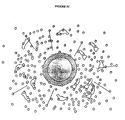
- Figure 2 illustrates a model of this delivery system.
- the one or more pharmaceutically active amphetamine salts can be provided within or as a part of a core seed around which the enteric coating is applied.
- a core seed can be coated with one or more layers of one or more pharmaceutically active amphetamine salts.
- a delayed immediate release drug delivery can also be accomplished by coating the drug first with a protective layer prior to applying the enteric coating.
- the pulsed enteric release is accomplished by employing a protective layer between the drug and the enteric coating.
- the enteric coating may be of an increased thickness or may be of lower thickness.
- the object of the invention is met by providing a composition comprising one or more pharmaceutically active amphetamine salts; a protective layer coating over the one or more pharmaceutically active amphetamine salt layer(s), and an enteric coating layer over the protective coating layer; a further pharmaceutically active amphetamine salt layer and an immediate release layer coating.
- the thickness of the enteric coating is at least 25 ⁇
- the protective layer comprises an immediate release coating.
- the one or more pharmaceutically active amphetamine salts can be provided within or as a part of a core seed, during the core seed manufacturing process, around which the protective coating is applied.
- a core seed can be coated with one or more layers of one or more pharmaceutically active amphetamine salts.
- the pulsed enteric release is accomplished by employing a protective layer over the enteric coating.
- a pulsed dose release drug delivery system comprising one or more pharmaceutically active amphetamine salts; an enteric coating layer over the pharmaceutically active amphetamine salt layer(s); and a protective layer over the enteric coating; a second pharmaceutically active amphetamine salt layer; and an immediate release layer coating.
- the protective layer is comprised of one or more components, which includes an immediate release layer and a modifying layer.
- the modifying layer is preferably comprised of a semi water-permeable polymer. Applicants have surprisingly found that a semi-permeable polymer coating used in combination with an immediate release layer coating provided a delayed pulsed release drug delivery profile when layered over the enteric coating.
- the protective layer comprises a semi-permeable polymer and an immediate release coating layer.
- the modifying layer comprises a first layer of a semi-permeable polymer which is adjacent to the enteric coating layer and a second coating layer over the semi-permeable polymer coating layer comprising an immediate release polymer coating layer.
- a semi-permeable polymer which may comprise a low water-permeable pH-insensitive polymer, is layered onto the outer surface of the enteric layer, in order to obtain prolonged delayed release time.
- This semi-permeable polymer coating controls the erosion of the pH-sensitive enteric polymer in an alkaline pH environment in which a pH-sensitive polymer will dissolve rapidly.
- Another pH-sensitive layer may be applied onto the surface of a low water-permeability layer to further delay the release time.
- the composition in addition to a protective layer, comprises an acid which is incorporated into the pharmaceutical active layer or coated onto the surface of the active layer to reduce the pH value of the environment around the enteric polymer layer.
- the acid layer may also be applied on the outer layer of the pH-sensitive enteric polymer layer, followed by a layer of low water-permeability polymer. The release of the active thus may be delayed and the dissolution rate may be increased in an alkaline environment.
- the protective coating may be used both over the drug and over the enteric coating.
- the one or more pharmaceutically active amphetamine salts can be provided within or as a part of a core seed, during the core seed manufacturing process, around which the enteric coating is applied.
- a core seed can be coated with one or more layers of one or more pharmaceutically active amphetamine salts.
- the drug delivery system of the present invention as described herein preferably comprises one or a number of beads or beadlets in a dosage form, either capsule, tablet, sachet or other method of orally administering the beads.
- the present invention comprises a core or starting seed, either prepared or commercially available product.
- the cores or starting seeds can be sugar spheres; spheres made from microcrystalline cellulose and any suitable drug crystals.
- the materials that can be employed in making drug-containing pellets are any of those commonly used in pharmaceutics and should be selected on the basis of compatibility with the active drug and the physicochemical properties of the pellets.
- the additives except active drugs are chosen below as examples:
- Binders such as cellulose derivatives such as methylcellulose, hydroxyethyl cellulose, hydroxypropyl cellulose, hydroxypropyl methylcellulose, polyvinylpyrrolidone, polyvinylpyrrolidone/vinyl acetate copolymer and the like.
- Disintegration agents such as corn starch, pregelatinized starch, cross-linked carboxymethylcellulose (AC-DI-SOL®), sodium starch glycolate (EXLOTAB®), cross-linked polyvinylpyrrolidone (PLASDONE XL®), and any disintegration agents used in tablet preparations.
- Filling agents such as lactose, calcium carbonate, calcium phosphate, calcium sulfate, microcrystalline cellulose, dextran, starches, sucrose, xylitol, lactitol, mannitol, sorbitol, sodium chloride, polyethylene glycol, and the like.
- Surfactants such as sodium lauryl sulfate, sorbitan monooleate, polyoxyethylene sorbitan monooleate, bile salts, glyceryl monostearate, PLURONIC® line (BASF), and the like.
- Solubilizers such as citric acid, succinic acid, fumaric acid, malic acid, tartaric acid, maleic acid, glutaric acid sodium bicarbonate and sodium carbonate and the like.
- Stabilizers such as any antioxidation agents, buffers, acids, and the like, can also be utilized.
- Methods of manufacturing the core include
- the core particles have a diameter in the range of about 50-1500 ⁇ m; preferably 100-800 ⁇ m.
- These particles can then be coated in a fluidized bed apparatus with an alternating sequence of coating layers.
- the core may be coated directly with a layer or layers of at least one pharmaceutically active amphetamine salts and/or the pharmaceutically active amphetamine salt may be incorporated into the core material.
- Pharmaceutical active amphetamine compounds contemplated to be within the scope of the present invention include amphetamine base and salts thereof,
- a protective layer may be added on top of the pharmaceutical active containing layer and also may be provided between active layers.
- a separation or protective layer may be added onto the surface of the active-loaded core, and then the enteric layer is coated thereupon.
- Another active layer may also be added to the enteric layer to deliver an initial dose.
- a protective coating layer may be applied immediately outside the core, either a drug-containing core or a drug-layered core, by conventional coating techniques such as pan coating or fluid bed coating using solutions of polymers in water or suitable organic solvents or by using aqueous polymer dispersions.
- Suitable materials for the protective layer include cellulose derivatives such as hydroxyethyl cellulose, hydroxypropyl cellulose, hydroxypropyl methylcellulose, polyvinylpyrrolidone, polyvinylpyrrolidone/vinyl acetate copolymer, ethyl cellulose aqueous dispersions (AQUACOAT®, SURELEASE®), EUDRAGIT® RL 30D, OPADRY® and the like.
- the suggested coating levels are from 1 to 6%, preferably 2-4 % (w/w).
- the enteric coating layer is applied onto the cores with or without seal coating by conventional coating techniques, such as pan coating or fluid bed coating using solutions of polymers in water or suitable organic solvents or by using aqueous polymer dispersions. All commercially available pH-sensitive polymers are included.
- the pharmaceutical active is not released in the acidic stomach environment of approximately below pH 4.5, but not limited to this value. The pharmaceutical active should become available when the pH-sensitive layer dissolves at the greater pH; after a certain delayed time; or after the unit passes through the stomach.
- the preferred delay time is in the range of two to six hours.
- Enteric polymers include cellulose acetate phthalate, Cellulose acetate trimellitate, hydroxypropyl methylcellulose phthalate, polyvinyl acetate phthalate, carboxymethylethylcellulose, co-polymerized methacrylic acid/methacrylic acid methyl esters such as, for instance, materials known under the trade name EUDRAGIT® L12.5, L100, or EUDRAGIT® S12.5, S100 or similar compounds used to obtain enteric coatings.
- Aqueous colloidal polymer dispersions or re-dispersions can be also applied, e.g.
- the enteric polymers used in this invention can be modified by mixing with other known coating products that are not pH sensitive.
- coating products include the neutral methacrylic acid esters with a small portion of trimethylammonioethyl methacrylate chloride, sold currently under the trade names EUDRAGIT® RS and EUDRAGIT® RL; a neutral ester dispersion without any functional groups, sold under the trade names EUDRAGIT® NE30D; and other pH independent coating products.
- the modifying component of the protective layer used over the enteric coating can include a water penetration barrier layer (semipermeable polymer) which can be successively coated after the enteric coating to reduce the water penetration rate through the enteric coating layer and thus increase the lag time of the drug release.
- a water penetration barrier layer semipermeable polymer
- Sustained-release coatings commonly known to one skilled in the art can be used for this purpose by conventional coating techniques such as pan coating or fluid bed coating using solutions of polymers in water or suitable organic solvents or by using aqueous polymer dispersions.
- the following materials can be used , but not limited to: Cellulose acetate, Cellulose acetate butyrate, Cellulose acetate propionate, Ethyl cellulose, Fatty acids and their esters, Waxes, zein, and aqueous polymer dispersions such as EUDRAGIT® RS and RL 30D, EUDRAGIT® NE 30D, AQUACOAT®, SURELEASE®, cellulose acetate latex.
- hydrophilic polymers such as Hydroxyethyl cellulose, Hydroxypropyl cellulose (KLUCEL®, Hercules Corp.), Hydroxypropyl methylcellulose (METHOCEL®, Dow Chemical Corp.), Polyvinylpyrrolidone can also be used.
- An overcoating layer can further optionally be applied to the composition of the present invention.
- OPADRY®, OPADRY II® (Colorcon) and corresponding color and colorless grades from Colorcon can be used to protect the pellets from being tacky and provide colors to the product.
- the suggested levels of protective or color coating are from 1 to 6%, preferably 2-3 % (w/w).
- ingredients can be incorporated into the overcoating formula, for example to provide a quicker immediate release, such as plasticizers: acetyltriethyl citrate, triethyl citrate, acetyltributyl citrate, dibutylsebacate, triacetin, polyethylene glycols, propylene glycol and the others; lubricants: talc, colloidal silica dioxide, magnesium stearate, calcium stearate, titanium dioxide, magnesium silicate, and the like.
- composition preferably in beadlet form, can be incorporated into hard gelatin capsules, either with additional excipients, or alone.
- Typical excipients to be added to a capsule formulation include, but are not limited to: fillers such as microcrystalline cellulose, soy polysaccharides, calcium phosphate dihydrate, calcium sulfate, lactose, sucrose, sorbitol, or any other inert filler.
- fillers such as microcrystalline cellulose, soy polysaccharides, calcium phosphate dihydrate, calcium sulfate, lactose, sucrose, sorbitol, or any other inert filler.
- there can be flow aids such as fumed silicon dioxide, silica gel, magnesium stearate, calcium stearate or any other material imparting flow to powders.
- a lubricant can further be added if necessary by using polyethylene glycol, leucine, glyceryl behenate, magnesium stearate or calcium stearate.
- the composition may also be incorporated into a tablet, in particular by incorporation into a tablet matrix, which rapidly disperses the particles after ingestion.
- a filler/binder In order to incorporate these particles into such a tablet, a filler/binder must be added to a table that can accept the particles, but will not allow their destruction during the tableting process.
- Materials that are suitable for this purpose include, but are not limited to, microcrystalline cellulose (AVICEL®), soy polysaccharide (EMCOSOY®), pre-gelatinized starches (STARCH® 1500, NATIONAL® 1551), and polyethylene glycols (CARBOWAX®).
- the materials should be present in the range of 5-75% (w/w), with a preferred range of 25-50% (w/w).
- disintegrants are added in order to disperse the beads once the tablet is ingested.
- Suitable disintegrants include, but are not limited to: cross-linked sodium carboxymethyl cellulose (AC-DI-SOL®), sodium starch glycolate (EXPLOTAB®, PRIMOJEL®), and cross-linked polyvinylpolypyrrolidone (Plasone-XL). These materials should be present in the rate of 3-15% (w/w), with a preferred range of 5-10% (w/w).
- Lubricants are also added to assure proper tableting, and these can include, but are not limited to: magnesium stearate, calcium stearate, stearic acid, polyethylene glycol, leucine, glyceryl behanate, and hydrogenated vegetable oil. These lubricants should be present in amounts from 0.1-10% (w/w), with a preferred range of 0.3-3.0% (w/w).
- Tablets are formed, for example, as follows.
- the particles are introduced into a blender along with AVICEL®, disintegrants and lubricant, mixed for a set number of minutes to provide a homogeneous blend which is then put in the hopper of a tablet press with which tablets are compressed.
- the compression force used is adequate to form a tablet; however, not sufficient to fracture the beads or coatings.
- the multiple dosage form of the present invention can deliver rapid and complete dosages of pharmaceutically active amphetamine salts to achieve the desired levels of the drug in a recipient over the course of about 8 hours with a single oral administration.
- the levels of drug in blood plasma of the pharmaceutically active amphetamine salts will reach a peak fairly rapidly after about 2 hours, and after about 4 hours a second pulse dose is released, wherein a second fairly rapid additive increase of plasma drug levels occurs which slowly decreases over the course of the next 12 hours.
- Nonpareil seeds (30/35 mesh, Paulaur Corp., NJ), 6.8 kg were put into a FLM-15 fluid bed processor with a 9" Wurster column and fluidized at 60 °C.
- the suspension of mixed amphetamine salts (MAS) with 1% HPMC E5 Premium (Dow Chemical) as a binder was sprayed onto the seed under suitable conditions. Almost no agglomeration and no fines were observed with a yield of at least 98%.
- the drug-loaded cores were used to test enteric coatings and sustained release coatings.
- Table 1 Ingredients Amount (%) Nonpareil seed 88.00 mixed amphetamine salts 11.40 METHOCEL® E5 Premium 0.60 Water * *removed during processing
- the drug release profile of the drug-loaded pellets of this example is shown in Figure 3 .
- the following formulation was used to coat the mixed amphetamine salts loaded (MASL) pellets from Example 1 with the EUDRAGIT® L 30D-55 (Rohm Pharma, Germany) coating dispersion.
- 2 kg of MASL pellets were loaded into a fluid bed processor with a reduced Wurster column equipped with a precision coater (MP 2/3, Niro Inc.).
- the coating dispersion was prepared by dispersing Triethyl citrate, Talc and EUDRAGIT® L 30D-55 into water and mixing for at least 30 minutes. Under suitable fluidization conditions, the coating dispersion was sprayed onto the fluidized MASL pellets. The spraying was continued until the targeted coating level was achieved (20 ⁇ ).
- the coated pellets were dried at 30-35 °C for 5 minutes before stopping the process.
- the enteric coated PPA pellets were tested at different pH buffers by a USP paddle method.
- the drug content was analyzed using HPLC.
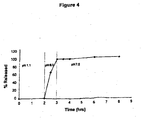
- the results showed that the enteric coating delayed the drug release from the coated pellets until after exposure to pH 6 or higher (see Table 2 below).
- Table 2 Ingredients Amount (%) MASL pellets 40.00 EUDRAGIT® L 30D-55 24.88 Triethyl citrate 2.52 Talc 2.60 Water * *removed during processing
- the drug release profile of the coated pellets of this example is shown in Figure 4 .
- the following formulation was used to coat the MASL pellets from Example 1 with the EUDRAGIT® 4110D (Rohm Pharma, Germany) coating dispersion.
- MASL pellets (2 kg) were loaded in a fluid bed processor with a reduced Wurster column (GPGC-15, Glatt).
- the coating dispersion was prepared by dispersing Triethyl citrate, Talc and EUDRAGIT® 4110D into water and mixing for at least 30 minutes. Under suitable fluidization conditions, the coating dispersion was sprayed onto the fluidized MASL pellets. The spraying was continued until the targeted coating level was achieved.
- the coated pellets were dried at 30-35 °C for 5 minutes before stopping the process.
- the enteric coated MASL pellets were tested using a USP paddle method at different pH buffers.
- the drug content was analyzed using HPLC.
- the enteric coating delayed the drug release for several hours from the coated pellets until the pH value reached 6.8 or higher, as shown below in Table 3. (Reference # AR98I25-3)
- Table 3 Ingredients Amount (%) MASL pellets 70.00 Eudragit® 4110D 26.24 Triethyl citrate 0.76 Talc 3.00 Water * *removed during processing
- the drug release profile of coated pellets of this example is shown in Figure 5 .
- the following formulation was selected to coat the enteric coated MASL pellets.
- Coated MASL pellets from Example 2 or coated MASL pellets from Example 3 (2 kg of either) were loaded into a fluid bed processor with a reduced Wurster column (GPGC-15, Glatt).
- the coating dispersion was prepared by mixing SURELEASE® (Colorcon) and water for at least 15 minutes prior to spraying. Under suitable fluidization conditions, the coating dispersion was sprayed onto the fluidized pellets. The spraying was continued until the targeted coating level was achieved.
- the coated pellets were coated with a thin layer of OPADRY® white (Colorcon) (2%) to prevent the tackiness of the coated pellets during storage.
- the coated pellets were then dried at 35-40 °C for 10 minutes before discharging from the bed.
- the drug dissolution from both coated pellets was performed using a USP paddle method at different pH buffers.
- the drug content was analyzed using HPLC.
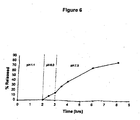
- the 8% SURELEASE® coating slightly sustained the drug release from EUDRAGIT® L 30D-55 coated pellets at pH 7.5 buffer, while the SURELEASE® coating delayed the drug release up to 2 hours after the buffer switched from pH 1 to pH 7.5.
- Table 4 Ingredients Amount, (%) Enteric coated MASL pellets 90.00 SURELEASE® 8.00 OPADRY® white 2.00 Water * *removed during processing
- the drug release profile of the coated pellets from this example is shown in Figure 6 .
- a pulsatile delivery system according to the invention can be achieved by combining the immediate release pellets (Example 1) with delayed release pellets (Example 2 or Example 3).
- the immediate-release pellets equivalent to half the dose and the delayed-release pellets equivalent to half the dose are filled into a hard gelatin capsule to produce the oral pulsed dose delivery system.
- the delayed-release portion releases the amphetamine salts rapidly and completely, after a specified lag time.
- the capsule products containing immediate-release pellets and delayed-release pellets (Example 1 plus Example 2 and Example 1 plus Example 3) were tested in a crossover human study.
- Figures 7 and 8 show the typical profiles of plasma amphetamine concentration after administration of a composite capsule containing the immediate-release pellets and delayed-release pellets from Examples 1 and 2 (10mg dose each pellet type) and a capsule containing the pellets from immediate-release pellets and delayed-release pellets from Examples 1 and 3 (10mg dose each pellet type), respectively.
- the general plasma profiles are similar to the desired target plasma level profile shown in Figure 1 .
Landscapes
- Health & Medical Sciences (AREA)
- Engineering & Computer Science (AREA)
- Bioinformatics & Cheminformatics (AREA)
- Pharmacology & Pharmacy (AREA)
- Veterinary Medicine (AREA)
- Public Health (AREA)
- General Health & Medical Sciences (AREA)
- Chemical & Material Sciences (AREA)
- Animal Behavior & Ethology (AREA)
- Life Sciences & Earth Sciences (AREA)
- Medicinal Chemistry (AREA)
- Epidemiology (AREA)
- Neurosurgery (AREA)
- Neurology (AREA)
- Biomedical Technology (AREA)
- Organic Chemistry (AREA)
- Nuclear Medicine, Radiotherapy & Molecular Imaging (AREA)
- General Chemical & Material Sciences (AREA)
- Chemical Kinetics & Catalysis (AREA)
- Emergency Medicine (AREA)
- Psychiatry (AREA)
- Hospice & Palliative Care (AREA)
- Acyclic And Carbocyclic Compounds In Medicinal Compositions (AREA)
- Medicinal Preparation (AREA)
Abstract
Description
- This invention pertains to a multiple unit dosage form delivery system comprising one or more amphetamine salts for administering the amphetamine salts to a recipient.
- Traditionally, drug delivery systems have focused on constant/sustained drug output with the objective of minimizing peaks and valleys of drug concentrations in the body to optimize drug efficacy and to reduce adverse effects. A reduced dosing frequency and improved patient compliance can also be expected for the controlled/sustained release drug delivery systems, compared to immediate release preparations. However, for certain drugs, sustained release delivery is not suitable and is affected by the following factors:
- First pass metabolism: Some drugs, such as β blockers, β-estradiol, and salicylamide, undergo extensive first pass metabolism and require fast drug input to saturate metabolizing enzymes in order to minimize pre-systemic metabolism. Thus, a constant/sustained oral method of delivery would result in reduced oral bioavailability.
- Biological tolerance: Continuous release drug plasma profiles are often accompanied by a decline in the pharmacotherapeutic effect of the drug, e.g., biological tolerance of transdermal nitroglycerin.
- Chronopharmacology and circadian rhythms: Circadian rhythms in certain physiological functions are well established. It has been recognized that many symptoms and onset of disease occur during specific time periods of the 24 hour day, e.g., asthma and angina pectoris attacks are most frequently in the morning hours (1,2).
- Local therapeutic need: For the treatment of local disorders such as inflammatory bowel disease, the delivery of compounds to the site of inflammation with no loss due to absorption in the small intestine is highly desirable to achieve the therapeutic effect and to minimize side effects.
- Gastric irritation or drug instability in gastric fluid: For compounds with gastric irritation or chemical instability in gastric fluid, the use of a sustained release preparation may exacerbate gastric irritation and chemical instability in gastric fluid.
- Drug absorption differences in various gastrointestinal segments: In general, drug absorption is moderately slow in the stomach, rapid in the small intestine, and sharply declining in the large intestine. Compensation for changing absorption characteristics in the gastrointestinal tract may be important for some drugs. For example, it is rational for a delivery system to pump out the drug much faster when the system reaches the distal segment of the intestine, to avoid the entombment of the drug in the feces.
- HUMAN PSYCHOPHARMACOLOGY vol.12, 527-546,1997 discloses once a day methylphenidate formulation for the treatment of ADHD.
EP-A-0 640 337 discloses a range of controlled release and sustained release formulations for a number of different drugs. - Pulsed dose delivery systems, prepared as either single unit or multiple unit formulations, and which are capable of releasing the drug after a predetermined time, have been studied to address the aforementioned problematic areas for sustained release preparations. These same factors are also problematic in pulsed dose formulation development. For example, gastrointestinal transit times vary not only from patient to patient but also within patients as a result of food intake, stress, and illness; thus a single-unit pulsed-release system may give higher variability compared to a multiple unit system. Additionally, drug layering or core making for multiple unit systems is a time-consuming and hard-to-optimize process. Particularly challenging for formulation scientists has been overcoming two conflicting hurdles for pulsatile formulation development, i.e., lag time and rapid release.
- Various enteric materials, e.g., cellulose acetate phthalate, hydroxypropyl methylcellulose phthalate, polyvinyl acetate phthalate, and the EUDRAGIT® acrylic polymers, have been used as gastroresistant, enterosoluble coatings for single drug pulse release in the intestine (3). The enteric materials, which are soluble at higher pH values, are frequently used for colon-specific delivery systems. Due to their pH-dependent attributes and the uncertainty of gastric retention time, in-vivo performance as well as inter- and intra-subject variability are major issues for using enteric coated systems as a time-controlled release of drugs.
- A retarding swellable hydrophilic coating has been used for oral delayed release systems (4,5). It was demonstrated that lag time was linearly correlated with coating weight gain and drug release was pH independent.
- Hydroxypropyl methylcellulose barriers with erodible and/or gellable characteristics formed using press coating technology for tablet dosage forms have been described to achieve time-programmed release of drugs (6). Barrier formulation variables, such as grade of hydroxypropyl methylcellulose, water-soluble and water-insoluble excipients, significantly altered the lag time and the release rate from the center cores.
- Special grades of hydroxypropyl methylcellulose, e.g., METOLOSE® 60SH, 90SH (Shin-Etsu Ltd., Japan), and METHOCEL® F4M (Dow Chemical Company, USA), as a hydrophilic matrix material have been used to achieve bimodal drug release for several drugs, i.e., aspirin, ibuprofen, and adinazolam (7). Bimodal release is characterized by a rapid initial release, followed by a period of constant release, and finalized by a second rapid drug release.
- Tablets or capsules coated with a hydrophobic wax-surfactant layer, made from an aqueous dispersion of carnauba wax, beeswax, polyoxyethylene sorbitan monooleate, and hydroxypropyl methylcellulose have been used for rapid drug release after a predetermined lag time. For example,. However, even though a two-hour lag time was achieved for the model drug theophylline at a higher coating level (60%), three hours were required for a complete release of theophylline after the lag time. (8)
- A sustained-release drug delivery system is described in
U.S. Patent No. 4,871,549 . When this system is placed into dissolution medium or the gastrointestinal tract, water influx and the volume expansion of the swelling agent cause the explosion of the water permeable membrane. The drug thus releases after a predetermined time period. - The OROS® push-pull system (Alza Company) has been developed for pulsatile delivery of water-soluble and water-insoluble drugs (9, 10), e.g. the OROS-CT® system and is based on the swelling properties of an osmotic core compartment which provides a pH-independent, time-controlled drug release.
- The PULSINCAP® dosage form releases its drug content at either a predetermined time or at a specific site (e.g., colon) in the gastrointestinal tract (11). The drug formulation is contained within a water-insoluble capsule body and is sealed with a hydrogel plug. Upon oral administration, the capsule cap dissolves in the gastric juice and the hydrogel plug swells. At a controlled and predetermined time point, the swollen plug is ejected from the PULSINCAP® dosage form and the encapsulated drug is released. A pulsatile capsule system containing captopril with release after a nominal 5-hr period was found to perform reproducibly in dissolution and gamma scintigraphy studies. However, in the majority of subjects, no measurable amounts of the drug were observed in the blood, possibly due to instability of the drug in the distal intestine. (12)
- ADDERAL® comprises a mixture of four amphetamine salts which, in combination, is indicated for treatment of Attention Deficit Hyperactivity Disorder in children from 3-10 years of age. One disadvantage of current treatment is that a tablet form is commonly used which many young children have difficulty in swallowing. Another disadvantage of current treatment is that two separate doses are administered, one in the morning and one approximately 4-6 hours later, commonly away from home under other than parental supervision. This current form of treatment, therefore, requires a second treatment which is time-consuming, inconvenient and may be problematic for those children having difficulties in swallowing tablet formulations.
- Accordingly, in view of a need for successfully administering a multiple unit pulsed dose of amphetamine salts and mixtures thereof, the present invention provides an oral multiple unit pulsed dose delivery system for amphetamine salts and mixtures thereof.
Figure 1 illustrates the desired target plasma level profile of the pharmaceutical active contained within the delivery system. - In accordance with the present invention, there is provided a pharmaceutical composition for delivery of at least one amphetamine salt, comprising:
- (a) at least one pharmaceutically active amphetamine salt or base covered with an immediate release coating; and
- (b) at least one pharmaceutically active amphetamine salt or base covered with an enteric release coating, said component (a) providing for an immediate release of amphetamine salt or base to provide a first blood level of amphetamine salt or base and component (b) providing a delayed pulsed-release of amphetamine salt that increases the blood level of amphetamine salt or base to a second level that is greater than the first level provided by component (a); wherein the delayed pulsed-release is from 4 to 6 hours after administration of the pharmaceutical composition, and wherein the delayed pulsed-release, releases the amphetamine salt or base in about 30 to 60 minutes after initiation of the release.
- In one embodiment, the immediate release and enteric release portions of the composition are present on the same core.
- In another embodiment, the immediate release and enteric release components are present on different cores.
- It is also contemplated that the composition may include a combination of the hereinabove referred to cores (one or more cores that include both components on the same core and one or more cores that include only one of the two components on the core).
- The present invention provides a composition in which there is immediate release of drug and enteric release of drug wherein the enteric release is a pulsed release and wherein the drug includes one or more amphetamine salts and mixtures thereof.
- The immediate release component releases the pharmaceutical agent in a pulsed dose upon oral administration of the delivery system.
- The enteric release coating layer retards or delays the release of the pharmaceutical active or drug for a specified time period ("lag time") until a predetermined time, at which time the release of the drug is rapid and complete, i.e., the entire dose is released within about 30-60 minutes under predetermined environmental conditions, i.e. a particular location within the gastrointestinal tract.
- The delay or lag time will take into consideration factors such as transit times, food effects, inflammatory bowel disease, use of antacids or other medicaments which alter the pH of the GI tract.
- In a preferred embodiment, the lag time period is only time-dependent, i.e., pH independent. The lag time is preferably within 4 to 6 hours after oral administration of the delivery system.
- In attempting to provide for enteric release of an amphetamine salt, applicants found that use of an enteric release coating as generally practiced in the art did not provide effective enteric release.
- Typical enteric coating levels did not meet the above requirements for the desired dosage profile of amphetamine salts. Using the typical amount of enteric coating (10-20µ) resulted in undesired premature leakage of the drug from the delivery system into the upper gastrointestinal tract and thus no drug delivery at the desired location in the gastrointestinal tract after the appropriate lag time. Thus this coating did not meet the requirements for the drug release profile to provide full beneficial therapeutic activity at the desired time.
- Surprisingly, applicants found that using a thicker application of enteric coating on the formulation allowed for the second pulsed dose to be released only and completely at the appropriate time in the desired predetermined area of the gastrointestinal tract, i.e., in the intestine.
- This was surprising because an increase in thickness of about 5-10µ of enteric coatings above a minimum thickness of about 10-20µ typically does not have a significant effect on release of drug from within such coatings. Enteric coatings typically are pH dependent and will only dissolve/disperse when exposed to the appropriate environment. Typically, application of a thicker coating (greater than 20µ) will only marginally increase the time for complete release at the appropriate environmental condition i.e., for a brief period of time (20 minutes). Using the typical coating, applicants could not achieve the desired result - rather, the coating leaked before the predetermined time in an inappropriate environment resulting in significant loss of the therapeutic agent.
- Accordingly, in one aspect, the pulsed enteric release of the amphetamine salts is accomplished by employing a certain minimum thickness of the enteric coating.
- In one embodiment of the invention, the pulsed dose delivery comprises a composition which comprises one or more pharmaceutically active amphetamine salts; an enteric coating over the one or more pharmaceutically active amphetamine salts, wherein the thickness of the enteric coating layer is at least 25µ; a further layer of one or more pharmaceutically active amphetamine salts over the enteric coating layer; and an immediate release layer coating. The thicker enteric coating surprisingly provides the required delayed immediate release of the pharmaceutically active amphetamine salt at the desired time in the desired area of the gastrointestinal tract.
Figure 2 illustrates a model of this delivery system. - In this aspect, the one or more pharmaceutically active amphetamine salts can be provided within or as a part of a core seed around which the enteric coating is applied. Alternatively, a core seed can be coated with one or more layers of one or more pharmaceutically active amphetamine salts.
- It has further been discovered that a delayed immediate release drug delivery can also be accomplished by coating the drug first with a protective layer prior to applying the enteric coating.
- Thus, in another embodiment, the pulsed enteric release is accomplished by employing a protective layer between the drug and the enteric coating. When using a protective coating, the enteric coating may be of an increased thickness or may be of lower thickness.
- Thus, in another aspect, the object of the invention is met by providing a composition comprising one or more pharmaceutically active amphetamine salts; a protective layer coating over the one or more pharmaceutically active amphetamine salt layer(s), and an enteric coating layer over the protective coating layer; a further pharmaceutically active amphetamine salt layer and an immediate release layer coating. In a preferred embodiment of this aspect, the thickness of the enteric coating is at least 25µ, and the protective layer comprises an immediate release coating.
- With respect to this embodiment of the invention, the one or more pharmaceutically active amphetamine salts can be provided within or as a part of a core seed, during the core seed manufacturing process, around which the protective coating is applied. Alternatively, a core seed can be coated with one or more layers of one or more pharmaceutically active amphetamine salts.
- In another embodiment, the pulsed enteric release is accomplished by employing a protective layer over the enteric coating.
- Accordingly, in this embodiment of the present invention, there is provided a pulsed dose release drug delivery system comprising one or more pharmaceutically active amphetamine salts; an enteric coating layer over the pharmaceutically active amphetamine salt layer(s); and a protective layer over the enteric coating; a second pharmaceutically active amphetamine salt layer; and an immediate release layer coating.
- In one aspect of this embodiment, the protective layer is comprised of one or more components, which includes an immediate release layer and a modifying layer. The modifying layer is preferably comprised of a semi water-permeable polymer. Applicants have surprisingly found that a semi-permeable polymer coating used in combination with an immediate release layer coating provided a delayed pulsed release drug delivery profile when layered over the enteric coating.
- Thus, in this embodiment, the protective layer comprises a semi-permeable polymer and an immediate release coating layer. In a preferred embodiment, the modifying layer comprises a first layer of a semi-permeable polymer which is adjacent to the enteric coating layer and a second coating layer over the semi-permeable polymer coating layer comprising an immediate release polymer coating layer.
- In one aspect of this embodiment, a semi-permeable polymer, which may comprise a low water-permeable pH-insensitive polymer, is layered onto the outer surface of the enteric layer, in order to obtain prolonged delayed release time. This semi-permeable polymer coating controls the erosion of the pH-sensitive enteric polymer in an alkaline pH environment in which a pH-sensitive polymer will dissolve rapidly. Another pH-sensitive layer may be applied onto the surface of a low water-permeability layer to further delay the release time.
- In a still further aspect of the invention, in addition to a protective layer, the composition comprises an acid which is incorporated into the pharmaceutical active layer or coated onto the surface of the active layer to reduce the pH value of the environment around the enteric polymer layer. The acid layer may also be applied on the outer layer of the pH-sensitive enteric polymer layer, followed by a layer of low water-permeability polymer. The release of the active thus may be delayed and the dissolution rate may be increased in an alkaline environment.
- In a further embodiment, the protective coating may be used both over the drug and over the enteric coating.
- With respect to this embodiment of the invention, the one or more pharmaceutically active amphetamine salts can be provided within or as a part of a core seed, during the core seed manufacturing process, around which the enteric coating is applied. Alternatively, a core seed can be coated with one or more layers of one or more pharmaceutically active amphetamine salts.
- The drug delivery system of the present invention as described herein preferably comprises one or a number of beads or beadlets in a dosage form, either capsule, tablet, sachet or other method of orally administering the beads.
-
-
Figure 1 illustrates a multiple pulse drug delivery system target plasma profile of the drug delivery system of the present invention. The profile reflects an immediate-release component followed by a delayed-release component -
Figure 2 schematically illustrates the delayed-release system of the present invention. -
Figure 2a graphically illustrates a pulsed dose delivery system. -
Figures 2b and c graphically illustrate the drug release mechanism from the proposed delivery system. -
Figure 3 is a plot of the percent drug released versus time from the drug-loaded pellets described in Example 1 which exemplifies the immediate release component of the present invention. -
Figure 4 is a plot of the percent drug released versus time from the coated pellets described in Example 2 which exemplifies the immediate release component and the delayed release components of the present invention. -
Figure 5 is a plot of the percent drug released versus time from the coated pellets of Example 3 which exemplifies the immediate release component and the delayed release components of the present invention. -
Figure 6 illustrates the drug release profile of coated pellets described in Example 4 which exemplifies the immediate release component and the delayed release components of the present invention. -
Figure 7 is a plot of a profile of plasma amphetamine concentration after administration of a composite capsule containing the immediate release pellets and delayed release pellets from Examples 1 and 2, respectively. -
Figure 8 is a plot of a profile of plasma amphetamine concentration after administration of a composite capsule containing the immediate release pellets and delayed release pellets from Examples 1 and 3, respectively. - The present invention comprises a core or starting seed, either prepared or commercially available product. The cores or starting seeds can be sugar spheres; spheres made from microcrystalline cellulose and any suitable drug crystals.
- The materials that can be employed in making drug-containing pellets are any of those commonly used in pharmaceutics and should be selected on the basis of compatibility with the active drug and the physicochemical properties of the pellets. The additives except active drugs are chosen below as examples:
- Binders such as cellulose derivatives such as methylcellulose, hydroxyethyl cellulose, hydroxypropyl cellulose, hydroxypropyl methylcellulose, polyvinylpyrrolidone, polyvinylpyrrolidone/vinyl acetate copolymer and the like.
- Disintegration agents such as corn starch, pregelatinized starch, cross-linked carboxymethylcellulose (AC-DI-SOL®), sodium starch glycolate (EXLOTAB®), cross-linked polyvinylpyrrolidone (PLASDONE XL®), and any disintegration agents used in tablet preparations.
- Filling agents such as lactose, calcium carbonate, calcium phosphate, calcium sulfate, microcrystalline cellulose, dextran, starches, sucrose, xylitol, lactitol, mannitol, sorbitol, sodium chloride, polyethylene glycol, and the like.
- Surfactants such as sodium lauryl sulfate, sorbitan monooleate, polyoxyethylene sorbitan monooleate, bile salts, glyceryl monostearate, PLURONIC® line (BASF), and the like.
- Solubilizers such as citric acid, succinic acid, fumaric acid, malic acid, tartaric acid, maleic acid, glutaric acid sodium bicarbonate and sodium carbonate and the like.
- Stabilizers such as any antioxidation agents, buffers, acids, and the like, can also be utilized.
- Methods of manufacturing the core include
- a. Extrusion-Spheronization - Drug(s) and other additives are granulated by addition of a binder solution. The wet mass is passed through an extruder equipped with a certain size screen. The extrudates are spheronized in a marumerizer. The resulting pellets are dried and sieved for further applications.
- b. High-Shear Granulation - Drug(s) and other additives are dry-mixed and then the mixture is wetted by addition of a binder solution in a high shear-granulator/mixer. The granules are kneaded after wetting by the combined actions of mixing and milling. The resulting granules or pellets are dried and sieved for further applications.
- c. Solution or Suspension Layering - A drug solution or dispersion with or without a binder is sprayed onto starting seeds with a certain particle size in a fluid bed processor or other suitable equipment. The drug thus is coated on the surface of the starting seeds. The drug-loaded pellets are dried for further applications.
- For purposes of the present invention, the core particles have a diameter in the range of about 50-1500 µm; preferably 100-800 µm.
- These particles can then be coated in a fluidized bed apparatus with an alternating sequence of coating layers.
- The core may be coated directly with a layer or layers of at least one pharmaceutically active amphetamine salts and/or the pharmaceutically active amphetamine salt may be incorporated into the core material. Pharmaceutical active amphetamine compounds contemplated to be within the scope of the present invention include amphetamine base and salts thereof,
- A protective layer may be added on top of the pharmaceutical active containing layer and also may be provided between active layers. A separation or protective layer may be added onto the surface of the active-loaded core, and then the enteric layer is coated thereupon. Another active layer may also be added to the enteric layer to deliver an initial dose.
- A protective coating layer may be applied immediately outside the core, either a drug-containing core or a drug-layered core, by conventional coating techniques such as pan coating or fluid bed coating using solutions of polymers in water or suitable organic solvents or by using aqueous polymer dispersions. Suitable materials for the protective layer include cellulose derivatives such as hydroxyethyl cellulose, hydroxypropyl cellulose, hydroxypropyl methylcellulose, polyvinylpyrrolidone, polyvinylpyrrolidone/vinyl acetate copolymer, ethyl cellulose aqueous dispersions (AQUACOAT®, SURELEASE®), EUDRAGIT® RL 30D, OPADRY® and the like. The suggested coating levels are from 1 to 6%, preferably 2-4 % (w/w).
- The enteric coating layer is applied onto the cores with or without seal coating by conventional coating techniques, such as pan coating or fluid bed coating using solutions of polymers in water or suitable organic solvents or by using aqueous polymer dispersions. All commercially available pH-sensitive polymers are included. The pharmaceutical active is not released in the acidic stomach environment of approximately below pH 4.5, but not limited to this value. The pharmaceutical active should become available when the pH-sensitive layer dissolves at the greater pH; after a certain delayed time; or after the unit passes through the stomach. The preferred delay time is in the range of two to six hours.
- Enteric polymers include cellulose acetate phthalate, Cellulose acetate trimellitate, hydroxypropyl methylcellulose phthalate, polyvinyl acetate phthalate, carboxymethylethylcellulose, co-polymerized methacrylic acid/methacrylic acid methyl esters such as, for instance, materials known under the trade name EUDRAGIT® L12.5, L100, or EUDRAGIT® S12.5, S100 or similar compounds used to obtain enteric coatings. Aqueous colloidal polymer dispersions or re-dispersions can be also applied, e.g. EUDRAGIT® L 30D-55, EUDRAGIT® L100-55, EUDRAGIT® S100, EUDRAGIT® preparation 4110D (Rohm Pharma); AQUATERIC®, AQUACOAT® CPD 30 (FMC); KOLLICOAT MAE® 30D and 30DP (BASF); EASTACRYL® 30D (Eastman Chemical).
- The enteric polymers used in this invention can be modified by mixing with other known coating products that are not pH sensitive. Examples of such coating products include the neutral methacrylic acid esters with a small portion of trimethylammonioethyl methacrylate chloride, sold currently under the trade names EUDRAGIT® RS and EUDRAGIT® RL; a neutral ester dispersion without any functional groups, sold under the trade names EUDRAGIT® NE30D; and other pH independent coating products.
- The modifying component of the protective layer used over the enteric coating can include a water penetration barrier layer (semipermeable polymer) which can be successively coated after the enteric coating to reduce the water penetration rate through the enteric coating layer and thus increase the lag time of the drug release. Sustained-release coatings commonly known to one skilled in the art can be used for this purpose by conventional coating techniques such as pan coating or fluid bed coating using solutions of polymers in water or suitable organic solvents or by using aqueous polymer dispersions. For example, the following materials can be used , but not limited to: Cellulose acetate, Cellulose acetate butyrate, Cellulose acetate propionate, Ethyl cellulose, Fatty acids and their esters, Waxes, zein, and aqueous polymer dispersions such as EUDRAGIT® RS and RL 30D, EUDRAGIT® NE 30D, AQUACOAT®, SURELEASE®, cellulose acetate latex. The combination of above polymers and hydrophilic polymers such as Hydroxyethyl cellulose, Hydroxypropyl cellulose (KLUCEL®, Hercules Corp.), Hydroxypropyl methylcellulose (METHOCEL®, Dow Chemical Corp.), Polyvinylpyrrolidone can also be used.
- An overcoating layer can further optionally be applied to the composition of the present invention. OPADRY®, OPADRY II® (Colorcon) and corresponding color and colorless grades from Colorcon can be used to protect the pellets from being tacky and provide colors to the product. The suggested levels of protective or color coating are from 1 to 6%, preferably 2-3 % (w/w).
- Many ingredients can be incorporated into the overcoating formula, for example to provide a quicker immediate release, such as plasticizers: acetyltriethyl citrate, triethyl citrate, acetyltributyl citrate, dibutylsebacate, triacetin, polyethylene glycols, propylene glycol and the others; lubricants: talc, colloidal silica dioxide, magnesium stearate, calcium stearate, titanium dioxide, magnesium silicate, and the like.
- The composition, preferably in beadlet form, can be incorporated into hard gelatin capsules, either with additional excipients, or alone. Typical excipients to be added to a capsule formulation include, but are not limited to: fillers such as microcrystalline cellulose, soy polysaccharides, calcium phosphate dihydrate, calcium sulfate, lactose, sucrose, sorbitol, or any other inert filler. In addition, there can be flow aids such as fumed silicon dioxide, silica gel, magnesium stearate, calcium stearate or any other material imparting flow to powders. A lubricant can further be added if necessary by using polyethylene glycol, leucine, glyceryl behenate, magnesium stearate or calcium stearate.
- The composition may also be incorporated into a tablet, in particular by incorporation into a tablet matrix, which rapidly disperses the particles after ingestion. In order to incorporate these particles into such a tablet, a filler/binder must be added to a table that can accept the particles, but will not allow their destruction during the tableting process. Materials that are suitable for this purpose include, but are not limited to, microcrystalline cellulose (AVICEL®), soy polysaccharide (EMCOSOY®), pre-gelatinized starches (STARCH® 1500, NATIONAL® 1551), and polyethylene glycols (CARBOWAX®). The materials should be present in the range of 5-75% (w/w), with a preferred range of 25-50% (w/w).
- In addition, disintegrants are added in order to disperse the beads once the tablet is ingested. Suitable disintegrants include, but are not limited to: cross-linked sodium carboxymethyl cellulose (AC-DI-SOL®), sodium starch glycolate (EXPLOTAB®, PRIMOJEL®), and cross-linked polyvinylpolypyrrolidone (Plasone-XL). These materials should be present in the rate of 3-15% (w/w), with a preferred range of 5-10% (w/w).
- Lubricants are also added to assure proper tableting, and these can include, but are not limited to: magnesium stearate, calcium stearate, stearic acid, polyethylene glycol, leucine, glyceryl behanate, and hydrogenated vegetable oil. These lubricants should be present in amounts from 0.1-10% (w/w), with a preferred range of 0.3-3.0% (w/w).
- Tablets are formed, for example, as follows. The particles are introduced into a blender along with AVICEL®, disintegrants and lubricant, mixed for a set number of minutes to provide a homogeneous blend which is then put in the hopper of a tablet press with which tablets are compressed. The compression force used is adequate to form a tablet; however, not sufficient to fracture the beads or coatings.
- It will be appreciated that the multiple dosage form of the present invention can deliver rapid and complete dosages of pharmaceutically active amphetamine salts to achieve the desired levels of the drug in a recipient over the course of about 8 hours with a single oral administration.
- In so doing, the levels of drug in blood plasma of the pharmaceutically active amphetamine salts will reach a peak fairly rapidly after about 2 hours, and after about 4 hours a second pulse dose is released, wherein a second fairly rapid additive increase of plasma drug levels occurs which slowly decreases over the course of the next 12 hours.
- The following examples are presented to illustrate and do not limit the invention.
- The following formulation was used to layer the drug onto sugar spheres. Nonpareil seeds (30/35 mesh, Paulaur Corp., NJ), 6.8 kg were put into a FLM-15 fluid bed processor with a 9" Wurster column and fluidized at 60 °C. The suspension of mixed amphetamine salts (MAS) with 1% HPMC E5 Premium (Dow Chemical) as a binder was sprayed onto the seed under suitable conditions. Almost no agglomeration and no fines were observed with a yield of at least 98%. The drug-loaded cores were used to test enteric coatings and sustained release coatings.
Table 1 Ingredients Amount (%) Nonpareil seed 88.00 mixed amphetamine salts 11.40 METHOCEL® E5 Premium 0.60 Water * *removed during processing - The drug release profile of the drug-loaded pellets of this example is shown in
Figure 3 . - The following formulation was used to coat the mixed amphetamine salts loaded (MASL) pellets from Example 1 with the EUDRAGIT® L 30D-55 (Rohm Pharma, Germany) coating dispersion. 2 kg of MASL pellets were loaded into a fluid bed processor with a reduced Wurster column equipped with a precision coater (
MP 2/3, Niro Inc.). The coating dispersion was prepared by dispersing Triethyl citrate, Talc and EUDRAGIT® L 30D-55 into water and mixing for at least 30 minutes. Under suitable fluidization conditions, the coating dispersion was sprayed onto the fluidized MASL pellets. The spraying was continued until the targeted coating level was achieved (20µ). The coated pellets were dried at 30-35 °C for 5 minutes before stopping the process. The enteric coated PPA pellets were tested at different pH buffers by a USP paddle method. The drug content was analyzed using HPLC. The results showed that the enteric coating delayed the drug release from the coated pellets until after exposure topH 6 or higher (see Table 2 below). (Reference # AR98I25-4)Table 2 Ingredients Amount (%) MASL pellets 40.00 EUDRAGIT® L 30D-55 24.88 Triethyl citrate 2.52 Talc 2.60 Water * *removed during processing - The drug release profile of the coated pellets of this example is shown in
Figure 4 . - The following formulation was used to coat the MASL pellets from Example 1 with the EUDRAGIT® 4110D (Rohm Pharma, Germany) coating dispersion. MASL pellets (2 kg) were loaded in a fluid bed processor with a reduced Wurster column (GPGC-15, Glatt). The coating dispersion was prepared by dispersing Triethyl citrate, Talc and EUDRAGIT® 4110D into water and mixing for at least 30 minutes. Under suitable fluidization conditions, the coating dispersion was sprayed onto the fluidized MASL pellets. The spraying was continued until the targeted coating level was achieved. The coated pellets were dried at 30-35 °C for 5 minutes before stopping the process. The enteric coated MASL pellets were tested using a USP paddle method at different pH buffers. The drug content was analyzed using HPLC. The enteric coating delayed the drug release for several hours from the coated pellets until the pH value reached 6.8 or higher, as shown below in Table 3. (Reference # AR98I25-3)
Table 3 Ingredients Amount (%) MASL pellets 70.00 Eudragit® 4110D 26.24 Triethyl citrate 0.76 Talc 3.00 Water * *removed during processing - The drug release profile of coated pellets of this example is shown in
Figure 5 . - The following formulation was selected to coat the enteric coated MASL pellets. Coated MASL pellets from Example 2 or coated MASL pellets from Example 3 (2 kg of either) were loaded into a fluid bed processor with a reduced Wurster column (GPGC-15, Glatt). The coating dispersion was prepared by mixing SURELEASE® (Colorcon) and water for at least 15 minutes prior to spraying. Under suitable fluidization conditions, the coating dispersion was sprayed onto the fluidized pellets. The spraying was continued until the targeted coating level was achieved. The coated pellets were coated with a thin layer of OPADRY® white (Colorcon) (2%) to prevent the tackiness of the coated pellets during storage. The coated pellets were then dried at 35-40 °C for 10 minutes before discharging from the bed. The drug dissolution from both coated pellets was performed using a USP paddle method at different pH buffers. The drug content was analyzed using HPLC. The 8% SURELEASE® coating slightly sustained the drug release from EUDRAGIT® L 30D-55 coated pellets at pH 7.5 buffer, while the SURELEASE® coating delayed the drug release up to 2 hours after the buffer switched from
pH 1 to pH 7.5. (Reference ## AR98I25-1)Table 4 Ingredients Amount, (%) Enteric coated MASL pellets 90.00 SURELEASE® 8.00 OPADRY® white 2.00 Water * *removed during processing - The drug release profile of the coated pellets from this example is shown in
Figure 6 . - A pulsatile delivery system according to the invention can be achieved by combining the immediate release pellets (Example 1) with delayed release pellets (Example 2 or Example 3). The immediate-release pellets equivalent to half the dose and the delayed-release pellets equivalent to half the dose are filled into a hard gelatin capsule to produce the oral pulsed dose delivery system. The delayed-release portion releases the amphetamine salts rapidly and completely, after a specified lag time. The capsule products containing immediate-release pellets and delayed-release pellets (Example 1 plus Example 2 and Example 1 plus Example 3) were tested in a crossover human study.
Figures 7 and8 show the typical profiles of plasma amphetamine concentration after administration of a composite capsule containing the immediate-release pellets and delayed-release pellets from Examples 1 and 2 (10mg dose each pellet type) and a capsule containing the pellets from immediate-release pellets and delayed-release pellets from Examples 1 and 3 (10mg dose each pellet type), respectively. The general plasma profiles are similar to the desired target plasma level profile shown inFigure 1 . -
- 1. B.Lemmer, "Circadian Rhythms and Drug Delivery", J. Controlled Release, 16, 63-74 (1991)
- 2. B. Lemmer, "Why are so many Biological Systems Periodic?" in Pulsatile Drug Delivery: Current Applications and Future Trends, R Gurny, HE Junginger and NA Peppas, eds. (Wissenschaftliche Verlagsgesellschaft mbH Stuttgart, Germany 1993) pp.11-24.
- 3. X. Xu and PI Lee, "Programmable Drug Delivery from an Erodible Association Polymer System", Pharm. Res. 10(8), 1144-1152 (1993)
- 4. A. Gazzaniga, ME Sangalli, and F Giodano, "Oral Chonotropic Drug Delivery Systems: Achievement of Time and/or Site Specificity", Eur J. Pharm. Biopharm., 40(4), 246-250 (1994)
- 5. A Gazzaniga, C Busetti, L Moro, ME Sangalli and F Giordano, "Time Dependent Oral Delivery Systems for Colon Targeting", S.T.P. Pharma Sciences 5(1), 83-88 (1996)
- 6. U Conte, L Maggi, ML Torre, P Giunchedi and A Lamanna, "Press-coated Tablets for Time programmed Release of Drugs", Biomaterials, 14(13), 1017-1023 (1993)
- 7. AC Shah International Patent Application
WO87/00044 - 8. PS Walia, P Jo Mayer Stout and R Turton, "Preliminary Evaluation of an Aqueous Wax Emulsion for Controlled Release Coating", Pharm Dev Tech, 3(1), 103-113 (1998)
- 9. F Theeuwes, "OROS® Osmotic System Development", Drug Dev Ind Pharm 9(7), 1331-1357(1983)
- 10. F Theeuwes, "Triggered, Pulsed and Programmed Drug Delivery" in Novel Drug Delivery and its Therapeutic Application, LF Prescott and WS Nimmos, eds. (Wiley, New York, 1989) pp. 323-340
- 11. M McNeil, A Rashid and H Stevens, " International Patent App
WO90/09168 - 12. IR Wilding, SS Davis, M Bakhshaee, HNE Stevens, RA Sparrow and J Brennan, "Gastrointestinal Transit and Systemic Absorption of Captopril from a Pulsed Release Formulation", Pharm Res 9(5), 654-657 (1992)
Claims (7)
- A pharmaceutical composition for delivery of at least one amphetamine salt, comprising:(a) at least one pharmaceutically active amphetamine salt or base covered with an immediate release coating; and(b) at least one pharmaceutically active amphetamine salt or base covered with an enteric release coating, said component (a) providing for an immediate release of amphetamine salt or base to provide a first blood level of amphetamine salt or base and component (b) providing a delayed pulsed-release of amphetamine salt or base that increases the blood level of amphetamine salt or base to a second level that is greater than the first level provided by component (a); wherein the delayed pulsed-release is from 4 to 6 hours after administration of the pharmaceutical composition, and wherein the delayed pulsed-release, releases the amphetamine salt or base in about 30 to 60 minutes after initiation of the release.
- The pharmaceutical composition of claim 1 wherein the enteric release coaling has a minimum thickness of 25 µ.
- The pharmaceutical composition of claim 1 wherein the one or more pharmaceutically active amphetamine salts or bases are coated onto a core.
- The pharmaceutical composition of claim 1 wherein the one or more pharmaceutically active amphetamine salts or bases are incorporated into a core.
- The pharmaceutical composition of claim 1, wherein the immediate release and enteric release portions of the composition are present on a single core.
- The pharmaceutical composition of claim 1, wherein the immediate release and enteric release components are present on different cores.
- A pharmaceutical composition as claimed in any of claims 1 to 6 for use in the treatment of ADHD.
Priority Applications (1)
| Application Number | Priority Date | Filing Date | Title |
|---|---|---|---|
| EP08157737A EP1977736A1 (en) | 1998-10-21 | 1999-10-20 | Oral pulsed dose drug delivery system |
Applications Claiming Priority (3)
| Application Number | Priority Date | Filing Date | Title |
|---|---|---|---|
| US09/176,542 US6322819B1 (en) | 1998-10-21 | 1998-10-21 | Oral pulsed dose drug delivery system |
| US176542 | 1998-10-21 | ||
| PCT/US1999/024554 WO2000023055A1 (en) | 1998-10-21 | 1999-10-20 | Oral pulsed dose drug delivery system |
Related Child Applications (1)
| Application Number | Title | Priority Date | Filing Date |
|---|---|---|---|
| EP08157737A Division EP1977736A1 (en) | 1998-10-21 | 1999-10-20 | Oral pulsed dose drug delivery system |
Publications (3)
| Publication Number | Publication Date |
|---|---|
| EP1123087A1 EP1123087A1 (en) | 2001-08-16 |
| EP1123087A4 EP1123087A4 (en) | 2004-02-11 |
| EP1123087B1 true EP1123087B1 (en) | 2009-04-01 |
Family
ID=22644775
Family Applications (2)
| Application Number | Title | Priority Date | Filing Date |
|---|---|---|---|
| EP99970594A Expired - Lifetime EP1123087B1 (en) | 1998-10-21 | 1999-10-20 | Oral pulsed dose drug delivery system |
| EP08157737A Withdrawn EP1977736A1 (en) | 1998-10-21 | 1999-10-20 | Oral pulsed dose drug delivery system |
Family Applications After (1)
| Application Number | Title | Priority Date | Filing Date |
|---|---|---|---|
| EP08157737A Withdrawn EP1977736A1 (en) | 1998-10-21 | 1999-10-20 | Oral pulsed dose drug delivery system |
Country Status (10)
| Country | Link |
|---|---|
| US (7) | US6322819B1 (en) |
| EP (2) | EP1123087B1 (en) |
| JP (2) | JP2002527468A (en) |
| AT (1) | ATE427101T1 (en) |
| AU (1) | AU1214500A (en) |
| CA (1) | CA2348090C (en) |
| DE (1) | DE69940673D1 (en) |
| ES (1) | ES2323910T3 (en) |
| HK (1) | HK1038701A1 (en) |
| WO (1) | WO2000023055A1 (en) |
Families Citing this family (222)
| Publication number | Priority date | Publication date | Assignee | Title |
|---|---|---|---|---|
| US6322819B1 (en) * | 1998-10-21 | 2001-11-27 | Shire Laboratories, Inc. | Oral pulsed dose drug delivery system |
| US20060240105A1 (en) * | 1998-11-02 | 2006-10-26 | Elan Corporation, Plc | Multiparticulate modified release composition |
| US20090149479A1 (en) * | 1998-11-02 | 2009-06-11 | Elan Pharma International Limited | Dosing regimen |
| DE19855421C2 (en) * | 1998-11-02 | 2001-09-20 | Alcove Surfaces Gmbh | Implant |
| CA2348871C (en) * | 1998-11-02 | 2009-04-14 | John G. Devane | Multiparticulate modified release composition |
| US20030170181A1 (en) * | 1999-04-06 | 2003-09-11 | Midha Kamal K. | Method for preventing abuse of methylphenidate |
| MXPA02002193A (en) * | 1999-08-31 | 2002-09-30 | Gr Nenthal Gmbh | Delayedaction form of administration containing tramadol saccharinate. |
| US10179130B2 (en) | 1999-10-29 | 2019-01-15 | Purdue Pharma L.P. | Controlled release hydrocodone formulations |
| ATE526950T1 (en) | 1999-10-29 | 2011-10-15 | Euro Celtique Sa | CONTROLLED RELEASE HYDROCODONE FORMULATIONS |
| WO2001037815A1 (en) * | 1999-11-22 | 2001-05-31 | Alza Corporation | Osmotic dosage form comprising first and second |
| ES2258072T3 (en) * | 2000-01-19 | 2006-08-16 | Mannkind Corporation | PREPARATION OF RELEASE IN VARIOUS STAGES FOR THE ADMINISTRATION OF MEDICINES. |
| US6544555B2 (en) | 2000-02-24 | 2003-04-08 | Advancis Pharmaceutical Corp. | Antibiotic product, use and formulation thereof |
| US6565882B2 (en) | 2000-02-24 | 2003-05-20 | Advancis Pharmaceutical Corp | Antibiotic composition with inhibitor |
| US7674480B2 (en) * | 2000-06-23 | 2010-03-09 | Teva Pharmaceutical Industries Ltd. | Rapidly expanding composition for gastric retention and controlled release of therapeutic agents, and dosage forms including the composition |
| US6500457B1 (en) * | 2000-08-14 | 2002-12-31 | Peirce Management, Llc | Oral pharmaceutical dosage forms for pulsatile delivery of an antiarrhythmic agent |
| US6541014B2 (en) | 2000-10-13 | 2003-04-01 | Advancis Pharmaceutical Corp. | Antiviral product, use and formulation thereof |
| US20020068078A1 (en) | 2000-10-13 | 2002-06-06 | Rudnic Edward M. | Antifungal product, use and formulation thereof |
| EP2283829A1 (en) | 2000-10-30 | 2011-02-16 | Euro-Celtique S.A. | Controlled release hydrocodone formulations |
| EA008224B1 (en) | 2001-03-13 | 2007-04-27 | Пенвест Фармасьютикалз Ко. | Chronotherapeutic dosage forms |
| AU2002256092C1 (en) * | 2001-04-05 | 2009-10-15 | Collagenex Pharmaceuticals, Inc. | Controlled delivery of tetracycline compounds and tetracycline derivatives |
| US20020187192A1 (en) * | 2001-04-30 | 2002-12-12 | Yatindra Joshi | Pharmaceutical composition which reduces or eliminates drug abuse potential |
| AR034813A1 (en) * | 2001-07-20 | 2004-03-17 | Novartis Ag | PHARMACEUTICAL COMPOSITIONS AND USE OF THE SAME |
| US6837696B2 (en) * | 2001-09-28 | 2005-01-04 | Mcneil-Ppc, Inc. | Apparatus for manufacturing dosage forms |
| US7122143B2 (en) | 2001-09-28 | 2006-10-17 | Mcneil-Ppc, Inc. | Methods for manufacturing dosage forms |
| US20030228368A1 (en) * | 2001-09-28 | 2003-12-11 | David Wynn | Edible solid composition and dosage form |
| US7838026B2 (en) | 2001-09-28 | 2010-11-23 | Mcneil-Ppc, Inc. | Burst-release polymer composition and dosage forms comprising the same |
| CA2447984A1 (en) | 2001-09-28 | 2003-04-03 | Mcneil-Ppc, Inc. | Dosage forms having an inner core and outer shell with different shapes |
| US20040253312A1 (en) * | 2001-09-28 | 2004-12-16 | Sowden Harry S. | Immediate release dosage form comprising shell having openings therein |
| US20040146559A1 (en) * | 2002-09-28 | 2004-07-29 | Sowden Harry S. | Dosage forms having an inner core and outer shell with different shapes |
| US7776314B2 (en) | 2002-06-17 | 2010-08-17 | Grunenthal Gmbh | Abuse-proofed dosage system |
| MY142204A (en) | 2002-07-25 | 2010-10-29 | Pharmacia Corp | Pramipexole once-daily dosage form |
| US6913768B2 (en) * | 2002-09-24 | 2005-07-05 | Shire Laboratories, Inc. | Sustained release delivery of amphetamine salts |
| US20040062778A1 (en) * | 2002-09-26 | 2004-04-01 | Adi Shefer | Surface dissolution and/or bulk erosion controlled release compositions and devices |
| US7807197B2 (en) | 2002-09-28 | 2010-10-05 | Mcneil-Ppc, Inc. | Composite dosage forms having an inlaid portion |
| US20040131662A1 (en) | 2003-11-12 | 2004-07-08 | Davidson Robert S. | Method and apparatus for minimizing heat, moisture, and shear damage to medicants and other compositions during incorporation of same with edible films |
| US8999372B2 (en) * | 2002-11-14 | 2015-04-07 | Cure Pharmaceutical Corporation | Methods for modulating dissolution, bioavailability, bioequivalence and drug delivery profile of thin film drug delivery systems, controlled-release thin film dosage formats, and methods for their manufacture and use |
| US20040191302A1 (en) * | 2003-03-28 | 2004-09-30 | Davidson Robert S. | Method and apparatus for minimizing heat, moisture, and shear damage to medicants and other compositions during incorporation of same with edible films |
| US7988993B2 (en) * | 2002-12-09 | 2011-08-02 | Andrx Pharmaceuticals, Inc. | Oral controlled release dosage form |
| ATE482695T1 (en) | 2002-12-13 | 2010-10-15 | Durect Corp | ORAL DOSAGE FORM WITH HIGH VISCOSITY LIQUID CARRIER SYSTEMS |
| US20040224020A1 (en) * | 2002-12-18 | 2004-11-11 | Schoenhard Grant L. | Oral dosage forms with therapeutically active agents in controlled release cores and immediate release gelatin capsule coats |
| US20040208931A1 (en) * | 2002-12-30 | 2004-10-21 | Friend David R | Fast dissolving films for oral administration of drugs |
| WO2004071501A1 (en) * | 2003-02-10 | 2004-08-26 | Shire Biochem Inc. | Enantiomeric amphetamine compositions for the treatment of adhd |
| US20040186180A1 (en) | 2003-03-21 | 2004-09-23 | Gelotte Cathy K. | Non-steroidal anti-inflammatory drug dosing regimen |
| CA2894736C (en) | 2003-04-07 | 2019-07-16 | Supernus Pharmaceuticals, Inc. | Once daily formulations of tetracyclines |
| EP2112920B1 (en) | 2003-06-26 | 2018-07-25 | Intellipharmaceutics Corp. | Proton pump-inhibitor-containing capsules which comprise subunits differently structured for a delayed release of the active ingredient |
| EP1648418A4 (en) | 2003-07-21 | 2011-11-16 | Middlebrook Pharmaceuticals Inc | Antibiotic product, use and formulation thereof |
| EP1648415A4 (en) | 2003-07-21 | 2011-11-16 | Middlebrook Pharmaceuticals Inc | Antibiotic product, use and formulation thereof |
| CA2533292C (en) | 2003-07-21 | 2013-12-31 | Advancis Pharmaceutical Corporation | Antibiotic product, use and formulation thereof |
| DE10336400A1 (en) | 2003-08-06 | 2005-03-24 | Grünenthal GmbH | Anti-abuse dosage form |
| DE10361596A1 (en) | 2003-12-24 | 2005-09-29 | Grünenthal GmbH | Process for producing an anti-abuse dosage form |
| DE102005005446A1 (en) | 2005-02-04 | 2006-08-10 | Grünenthal GmbH | Break-resistant dosage forms with sustained release |
| WO2005016311A1 (en) | 2003-08-11 | 2005-02-24 | Advancis Pharmaceutical Corporation | Robust pellet |
| CA2535398C (en) | 2003-08-12 | 2013-11-12 | Advancis Pharmaceuticals Corporation | Antibiotic product, use and formulation thereof |
| EP1658034A4 (en) | 2003-08-29 | 2011-06-22 | Middlebrook Pharmaceuticals Inc | Antibiotic product, use and formulation thereof |
| WO2005027877A1 (en) | 2003-09-15 | 2005-03-31 | Advancis Pharmaceutical Corporation | Antibiotic product, use and formulation thereof |
| EA200600598A1 (en) | 2003-09-19 | 2006-08-25 | Пенвест Фармасьютикалз Ко. | DOSAGE FORMS OF SLOW-DROP |
| US10226428B2 (en) | 2003-09-19 | 2019-03-12 | Sun Pharma Advanced Research Company Ltd. | Oral drug delivery system |
| US10213387B2 (en) | 2003-09-19 | 2019-02-26 | Sun Pharma Advanced Research Company Ltd. | Oral drug delivery system |
| EP1663175B1 (en) * | 2003-09-19 | 2012-03-28 | Sun Pharma Advanced Research Company Limited | Oral drug delivery system |
| US20050069590A1 (en) * | 2003-09-30 | 2005-03-31 | Buehler Gail K. | Stable suspensions for medicinal dosages |
| US20050074514A1 (en) * | 2003-10-02 | 2005-04-07 | Anderson Oliver B. | Zero cycle molding systems, methods and apparatuses for manufacturing dosage forms |
| DK2210605T3 (en) * | 2003-11-04 | 2017-05-22 | Tcd Royalty Sub Llc | Daily single dose doses of trospium. |
| WO2005044238A1 (en) * | 2003-11-07 | 2005-05-19 | Ranbaxy Laboratories Limited | Modified release solid dosage form of amphetamine salts |
| DE10353186A1 (en) * | 2003-11-13 | 2005-06-16 | Röhm GmbH & Co. KG | Multilayer dosage form containing a modulatory substance in relation to the release of active ingredient |
| US7879354B2 (en) | 2004-01-13 | 2011-02-01 | Mcneil-Ppc, Inc. | Rapidly disintegrating gelatinous coated tablets |
| US8067029B2 (en) * | 2004-01-13 | 2011-11-29 | Mcneil-Ppc, Inc. | Rapidly disintegrating gelatinous coated tablets |
| JP2005239696A (en) * | 2004-01-30 | 2005-09-08 | Daiichi Suntory Pharma Co Ltd | Pharmaceutical hard capsules containing inorganic substances |
| US20050196447A1 (en) * | 2004-03-05 | 2005-09-08 | Huang Hai Y. | Polymeric compositions and dosage forms comprising the same |
| US20050196448A1 (en) * | 2004-03-05 | 2005-09-08 | Hai Yong Huang | Polymeric compositions and dosage forms comprising the same |
| US20050196442A1 (en) * | 2004-03-05 | 2005-09-08 | Huang Hai Y. | Polymeric compositions and dosage forms comprising the same |
| US20050196446A1 (en) * | 2004-03-05 | 2005-09-08 | Huang Hai Y. | Polymeric compositions and dosage forms comprising the same |
| US7712288B2 (en) | 2004-05-28 | 2010-05-11 | Narayanan Ramasubramanian | Unified ingestion package and process for patient compliance with prescribed medication regimen |
| TWI415635B (en) | 2004-05-28 | 2013-11-21 | 必治妥施貴寶公司 | Coated tablet formulation and method |
| US20050265955A1 (en) * | 2004-05-28 | 2005-12-01 | Mallinckrodt Inc. | Sustained release preparations |
| DE102004032049A1 (en) | 2004-07-01 | 2006-01-19 | Grünenthal GmbH | Anti-abuse, oral dosage form |
| US8394409B2 (en) | 2004-07-01 | 2013-03-12 | Intellipharmaceutics Corp. | Controlled extended drug release technology |
| US8715727B2 (en) | 2004-07-02 | 2014-05-06 | Shionogi Inc. | Tablet for pulsed delivery |
| NZ553587A (en) | 2004-08-13 | 2010-12-24 | Boehringer Ingelheim Int | Extended release tablet formulation containing pramipexole or a pharmacutically acceptable salt thereof |
| EA201001086A1 (en) * | 2004-08-13 | 2011-10-31 | Бёрингер Ингельхайм Интернациональ Гмбх | THE COMPOSITION OF PELLETS OF THE PROLONGED SURVENT, CONTAINING PRAMIPEXOL OR ITS PHARMACEUTICALLY ACCEPTABLE SALT, THE WAY OF ITS MANUFACTURE AND ITS APPLICATION |
| US10624858B2 (en) | 2004-08-23 | 2020-04-21 | Intellipharmaceutics Corp | Controlled release composition using transition coating, and method of preparing same |
| US9149472B2 (en) * | 2004-08-31 | 2015-10-06 | Jack William Schultz | Controlled release compositions for treatment of cognitive, emotional and mental ailments and disorders |
| US7350479B2 (en) * | 2004-09-10 | 2008-04-01 | United States Of America As Represented By The Secretary Of The Army | System and method for controlling growth of aquatic plants utilizing bio-eroding means implanted in triploid grass carp |
| US20080020041A1 (en) * | 2004-10-19 | 2008-01-24 | Ayres James W | Enteric Coated Compositions that Release Active Ingredient(s) in Gastric Fluid and Intestinal Fluid |
| US8383159B2 (en) * | 2004-10-27 | 2013-02-26 | Mcneil-Ppc, Inc. | Dosage forms having a microreliefed surface and methods and apparatus for their production |
| US20060088586A1 (en) * | 2004-10-27 | 2006-04-27 | Bunick Frank J | Dosage forms having a microreliefed surface and methods and apparatus for their production |
| US20070281022A1 (en) * | 2004-10-27 | 2007-12-06 | Bunick Frank J | Dosage forms having a microreliefed surface and methods and apparatus for their production |
| US20060088587A1 (en) * | 2004-10-27 | 2006-04-27 | Bunick Frank J | Dosage forms having a microreliefed surface and methods and apparatus for their production |
| US20070190133A1 (en) * | 2004-10-27 | 2007-08-16 | Bunick Frank J | Dosage forms having a microreliefed surface and methods and apparatus for their production |
| US20060088593A1 (en) * | 2004-10-27 | 2006-04-27 | Bunick Frank J | Dosage forms having a microreliefed surface and methods and apparatus for their production |
| US20060087051A1 (en) * | 2004-10-27 | 2006-04-27 | Bunick Frank J | Dosage forms having a microreliefed surface and methods and apparatus for their production |
| US20060121112A1 (en) * | 2004-12-08 | 2006-06-08 | Elan Corporation, Plc | Topiramate pharmaceutical composition |
| GB0427455D0 (en) * | 2004-12-15 | 2005-01-19 | Jagotec Ag | Dosage forms |
| US8481565B2 (en) | 2004-12-27 | 2013-07-09 | Eisai R&D Management Co., Ltd. | Method for stabilizing anti-dementia drug |
| DE102005005449A1 (en) | 2005-02-04 | 2006-08-10 | Grünenthal GmbH | Process for producing an anti-abuse dosage form |
| ITBO20050123A1 (en) * | 2005-03-07 | 2005-06-06 | Alfa Wassermann Spa | GASTRORESISTIC PHARMACEUTICAL FORMULATIONS CONTAINING RIFAXIMINA |
| US20060204575A1 (en) * | 2005-03-11 | 2006-09-14 | Hengsheng Feng | Amphetamine formulations |
| CN101111230B (en) * | 2005-03-29 | 2010-05-19 | 赢创罗姆有限责任公司 | Multiparticulate pharmaceutical form comprising pellets with modified release of active ingredient |
| CA2601339A1 (en) * | 2005-03-29 | 2006-10-05 | Roehm Gmbh | Multiparticulate pharmaceutical form comprising pellets with a matrix which influences the delivery of a modulatory substance |
| JP2008535837A (en) * | 2005-04-06 | 2008-09-04 | マリンクロッド・インコーポレイテッド | Matrix-based pulsed release formulations |
| JP2008535922A (en) * | 2005-04-12 | 2008-09-04 | エラン・ファルマ・インターナショナル・リミテッド | Controlled release composition comprising cephalosporin for treating bacterial infections |
| US8673352B2 (en) | 2005-04-15 | 2014-03-18 | Mcneil-Ppc, Inc. | Modified release dosage form |
| JP5597343B2 (en) * | 2005-04-28 | 2014-10-01 | エーザイ・アール・アンド・ディー・マネジメント株式会社 | Composition containing anti-dementia drug |
| US20070077300A1 (en) * | 2005-09-30 | 2007-04-05 | Wynn David W | Oral compositions containing a salivation inducing agent |
| US8357394B2 (en) | 2005-12-08 | 2013-01-22 | Shionogi Inc. | Compositions and methods for improved efficacy of penicillin-type antibiotics |
| US8778924B2 (en) | 2006-12-04 | 2014-07-15 | Shionogi Inc. | Modified release amoxicillin products |
| US10064828B1 (en) * | 2005-12-23 | 2018-09-04 | Intellipharmaceutics Corp. | Pulsed extended-pulsed and extended-pulsed pulsed drug delivery systems |
| CA2635594A1 (en) * | 2005-12-30 | 2007-07-12 | Advancis Pharmaceutical Corporation | Gastric release pulse system for drug delivery |
| TW200808380A (en) * | 2006-02-21 | 2008-02-16 | Shinetsu Chemical Co | Enteric-coated preparation for site-specific delivery of drug to site within the small intestine |
| ATE536867T1 (en) | 2006-03-16 | 2011-12-15 | Tris Pharma Inc | MODIFIED RELEASE FORMULATIONS WITH DRUG ION EXCHANGE RESIN COMPLEXES |
| WO2007112581A1 (en) | 2006-04-03 | 2007-10-11 | Isa Odidi | Controlled release delivery device comprising an organosol coat |
| HUE040311T2 (en) | 2006-04-04 | 2019-02-28 | Kg Acquisition Llc | Oral dosage forms including an antiplatelet agent and an acid inhibitor |
| US8518926B2 (en) | 2006-04-10 | 2013-08-27 | Knopp Neurosciences, Inc. | Compositions and methods of using (R)-pramipexole |
| US20070238942A1 (en) * | 2006-04-10 | 2007-10-11 | Esophamet Corp. | Apparatus and method for detecting gastroesophageal reflux disease (gerd) |
| US20070259930A1 (en) * | 2006-04-10 | 2007-11-08 | Knopp Neurosciences, Inc. | Compositions and methods of using r(+) pramipexole |
| US8299052B2 (en) | 2006-05-05 | 2012-10-30 | Shionogi Inc. | Pharmaceutical compositions and methods for improved bacterial eradication |
| AU2006343596A1 (en) | 2006-05-12 | 2007-11-22 | Shire Llc | Controlled dose drug delivery system |
| US8846100B2 (en) | 2006-05-12 | 2014-09-30 | Shire Llc | Controlled dose drug delivery system |
| US10960077B2 (en) | 2006-05-12 | 2021-03-30 | Intellipharmaceutics Corp. | Abuse and alcohol resistant drug composition |
| KR20090021169A (en) | 2006-05-16 | 2009-02-27 | 크놉 뉴로사이언시스 인코포레이티드 | Compositions comprising R (+) and S (-) pramipexole and methods of use thereof |
| EP2465500A1 (en) | 2006-05-16 | 2012-06-20 | Knopp Neurosciences, Inc. | Therapeutically effective amounts of R(+) and S(-) pramipexole for use in the treatment of parkinson's disease |
| PE20080907A1 (en) * | 2006-08-31 | 2008-08-22 | Novartis Ag | EXTENDED RELEASE GASTRO-RETENTIVE ORAL DRUG DELIVERY SYSTEM FOR VALSARTAN |
| ITMI20061692A1 (en) | 2006-09-05 | 2008-03-06 | Alfa Wassermann Spa | USE OF POLYOLS TO OBTAIN STYLE POLYMORPHIC FORMS OF RIFAXIMINA |
| CN101563074B (en) * | 2006-10-20 | 2012-11-07 | 麦克内尔-Ppc股份有限公司 | Acetaminophen/Ibuprofen Combo |
| US8524695B2 (en) | 2006-12-14 | 2013-09-03 | Knopp Neurosciences, Inc. | Modified release formulations of (6R)-4,5,6,7-tetrahydro-N6-propyl-2,6-benzothiazole-diamine and methods of using the same |
| CA2678806C (en) * | 2007-02-21 | 2017-05-16 | Connected Health Systems, Llc | Treating adhd and other diseases involving inflammation |
| CN101715443A (en) | 2007-03-14 | 2010-05-26 | 诺普神经科学股份有限公司 | Synthesis of Chirally Purified Substituted Benzothiazole Diamines |
| US20080268047A1 (en) * | 2007-04-24 | 2008-10-30 | Xavier University Of Louisiana | Controlled Release Multiple Layer Coatings |
| US20080317678A1 (en) * | 2007-06-22 | 2008-12-25 | Szymczak Christopher E | Laser Marked Dosage Forms |
| US20080317677A1 (en) * | 2007-06-22 | 2008-12-25 | Szymczak Christopher E | Laser Marked Dosage Forms |
| US8478862B2 (en) * | 2007-07-13 | 2013-07-02 | Front Porch, Inc. | Method and apparatus for internet traffic monitoring by third parties using monitoring implements |
| US7953851B2 (en) * | 2007-07-13 | 2011-05-31 | Front Porch, Inc. | Method and apparatus for asymmetric internet traffic monitoring by third parties using monitoring implements |
| EP2044932A1 (en) * | 2007-10-04 | 2009-04-08 | Laboratorios del Dr. Esteve S.A. | Mechanical protective layer for solid dosage forms |
| EP2044929A1 (en) * | 2007-10-04 | 2009-04-08 | Laboratorios del Dr. Esteve S.A. | Oral fast distintegrating tablets |
| KR101560176B1 (en) * | 2007-10-31 | 2015-10-14 | 맥네일-피피씨, 인코포레이티드 | Orally disintegrated dosage form |
| WO2009075782A1 (en) | 2007-12-06 | 2009-06-18 | Durect Corporation | Methods useful for the treatment of pain, arthritic conditions, or inflammation associated with a chronic condition |
| US8357395B2 (en) * | 2007-12-21 | 2013-01-22 | Mcneil-Ppc, Inc. | Manufacture of tablet |
| CN102026628A (en) * | 2008-02-15 | 2011-04-20 | 太阳医药高级研发有限公司 | Oral controlled-release tablet with reduced disintegration |
| US8771730B2 (en) | 2008-04-18 | 2014-07-08 | Intec Pharma Ltd. | Carbidopa/Levodopa gastroretentive drug delivery |
| EP2309999A1 (en) * | 2008-06-26 | 2011-04-20 | McNeil-PPC, Inc. | Coated particles containing pharmaceutically active agents |
| US9009838B2 (en) * | 2008-07-24 | 2015-04-14 | Front Porch, Inc. | Method and apparatus for effecting an internet user's privacy directive |
| US20110190356A1 (en) | 2008-08-19 | 2011-08-04 | Knopp Neurosciences Inc. | Compositions and Methods of Using (R)- Pramipexole |
| US20100260844A1 (en) | 2008-11-03 | 2010-10-14 | Scicinski Jan J | Oral pharmaceutical dosage forms |
| WO2010061696A1 (en) | 2008-11-25 | 2010-06-03 | 日産自動車株式会社 | Conductive member and solid state polymer fuel cell using same |
| PL2378883T3 (en) * | 2008-12-04 | 2016-06-30 | Intec Pharma Ltd | Zaleplon gastroretentive drug delivery system |
| CN102802418A (en) * | 2009-06-19 | 2012-11-28 | 诺普神经科学股份有限公司 | Compositions and methods for treating amyotrophic lateral sclerosis |
| RU2015138422A (en) | 2009-07-22 | 2018-12-25 | Грюненталь Гмбх | STABLE DURING OXIDATION, STRONG-BREAKED DOSAGE FORM |
| CN102573805A (en) | 2009-07-22 | 2012-07-11 | 格吕伦塔尔有限公司 | Hot-melt extruded controlled release dosage form |
| US8343533B2 (en) | 2009-09-24 | 2013-01-01 | Mcneil-Ppc, Inc. | Manufacture of lozenge product with radiofrequency |
| US8858210B2 (en) | 2009-09-24 | 2014-10-14 | Mcneil-Ppc, Inc. | Manufacture of variable density dosage forms utilizing radiofrequency energy |
| US8313768B2 (en) | 2009-09-24 | 2012-11-20 | Mcneil-Ppc, Inc. | Manufacture of tablet having immediate release region and sustained release region |
| GB201002612D0 (en) * | 2010-02-16 | 2010-03-31 | Jagotec Ag | Improvements in or relating to organic compounds |
| MX377251B (en) | 2010-03-24 | 2025-03-07 | Jazz Pharmaceuticals Inc Star | CONTROLLED-RELEASE DOSAGE FORMS FOR HIGH-DOSE, WATER-SOLUBLE, HYGROSCOPIC DRUG SUBSTANCES. |
| US9511037B2 (en) * | 2010-04-23 | 2016-12-06 | Genco Sciences Llc | Compositions for reduction of side effects |
| PL2560624T3 (en) * | 2010-04-23 | 2019-01-31 | Kempharm, Inc. | Therapeutic formulation for reduced drug side effects |
| US9248119B2 (en) * | 2010-06-16 | 2016-02-02 | Takeda Pharmaceuticals U.S.A., Inc. | Modified release dosage forms of xanthine oxidoreductase inhibitor or xanthine oxidase inhibitors |
| NZ607392A (en) | 2010-09-02 | 2015-03-27 | Gruenenthal Chemie | Tamper resistant dosage form comprising inorganic salt |
| US8927010B2 (en) | 2011-03-23 | 2015-01-06 | Ironshore Pharmaceuticals & Development, Inc. | Compositions for treatment of attention deficit hyperactivity disorder |
| US8916588B2 (en) | 2011-03-23 | 2014-12-23 | Ironshore Pharmaceuticals & Development, Inc. | Methods for treatment of attention deficit hyperactivity disorder |
| US9283214B2 (en) | 2011-03-23 | 2016-03-15 | Ironshore Pharmaceuticals & Development, Inc. | Compositions for treatment of attention deficit hyperactivity disorder |
| US10905652B2 (en) | 2011-03-23 | 2021-02-02 | Ironshore Pharmaceuticals & Development, Inc. | Compositions for treatment of attention deficit hyperactivity disorder |
| US10292937B2 (en) | 2011-03-23 | 2019-05-21 | Ironshore Pharmaceuticals & Development, Inc. | Methods of treatment of attention deficit hyperactivity disorder |
| US11241391B2 (en) | 2011-03-23 | 2022-02-08 | Ironshore Pharmaceuticals & Development, Inc. | Compositions for treatment of attention deficit hyperactivity disorder |
| US9119809B2 (en) | 2011-03-23 | 2015-09-01 | Ironshore Pharmaceuticals & Development, Inc. | Compositions for treatment of attention deficit hyperactivity disorder |
| US9603809B2 (en) | 2011-03-23 | 2017-03-28 | Ironshore Pharmaceuticals & Development, Inc. | Methods of treatment of attention deficit hyperactivity disorder |
| BR112013024401B1 (en) * | 2011-03-23 | 2022-01-11 | Ironshore Pharmaceuticals & Development, Inc | SOLID ORAL PHARMACEUTICAL COMPOSITION COMPRISING AN ACTIVE INGREDIENT STIMULATING THE CENTRAL NERVOUS SYSTEM AND THE THERAPEUTIC USE THEREOF |
| US9498447B2 (en) | 2011-03-23 | 2016-11-22 | Ironshore Pharmaceuticals & Development, Inc. | Compositions for treatment of attention deficit hyperactivity disorder |
| WO2013003622A1 (en) | 2011-06-28 | 2013-01-03 | Neos Therapeutics, Lp | Dosage forms for oral administration and methods of treatment using the same |
| PE20141638A1 (en) | 2011-07-29 | 2014-11-22 | Gruenenthal Chemie | HANDLE PROOF TABLET PROVIDING IMMEDIATE DRUG RELEASE |
| RS56527B1 (en) | 2011-07-29 | 2018-02-28 | Gruenenthal Gmbh | Tamper-resistant tablet providing immediate drug release |
| CA2758556A1 (en) * | 2011-11-17 | 2013-05-17 | Pharmascience Inc. | Pharmaceutical composition of amphetamine mixed salts |
| WO2013096816A1 (en) | 2011-12-22 | 2013-06-27 | Biogen Idec Ma Inc. | Improved synthesis of amine substituted 4,5,6,7-tetrahydrobenzothiazole compounds |
| DK2838512T3 (en) | 2012-04-18 | 2018-11-19 | Gruenenthal Gmbh | MANIPULATED AND DOSAGE DUMPED PHARMACEUTICAL DOSAGE FORM |
| US9233491B2 (en) | 2012-05-01 | 2016-01-12 | Johnson & Johnson Consumer Inc. | Machine for production of solid dosage forms |
| US9445971B2 (en) | 2012-05-01 | 2016-09-20 | Johnson & Johnson Consumer Inc. | Method of manufacturing solid dosage form |
| US9511028B2 (en) | 2012-05-01 | 2016-12-06 | Johnson & Johnson Consumer Inc. | Orally disintegrating tablet |
| US10064945B2 (en) | 2012-05-11 | 2018-09-04 | Gruenenthal Gmbh | Thermoformed, tamper-resistant pharmaceutical dosage form containing zinc |
| AU2013302657B2 (en) | 2012-08-15 | 2018-08-09 | Tris Pharma, Inc. | Methylphenidate extended release chewable tablet |
| US9662313B2 (en) | 2013-02-28 | 2017-05-30 | Knopp Biosciences Llc | Compositions and methods for treating amyotrophic lateral sclerosis in responders |
| US8652527B1 (en) | 2013-03-13 | 2014-02-18 | Upsher-Smith Laboratories, Inc | Extended-release topiramate capsules |
| CA2905131A1 (en) | 2013-03-15 | 2014-09-18 | Durect Corporation | Compositions with a rheological modifier to reduce dissolution variability |
| US9101545B2 (en) | 2013-03-15 | 2015-08-11 | Upsher-Smith Laboratories, Inc. | Extended-release topiramate capsules |
| JP6445537B2 (en) | 2013-05-29 | 2018-12-26 | グリュネンタール・ゲゼルシャフト・ミト・ベシュレンクテル・ハフツング | Tamper-resistant dosage forms containing one or more particles |
| US9468630B2 (en) | 2013-07-12 | 2016-10-18 | Knopp Biosciences Llc | Compositions and methods for treating conditions related to increased eosinophils |
| US10624862B2 (en) | 2013-07-12 | 2020-04-21 | Grünenthal GmbH | Tamper-resistant dosage form containing ethylene-vinyl acetate polymer |
| ES3043076T3 (en) | 2013-07-12 | 2025-11-24 | Areteia Therapeutics Inc | Treating elevated levels of eosinophils and/or basophils |
| ES2871556T3 (en) | 2013-08-13 | 2021-10-29 | Knopp Biosciences Llc | Compositions and methods for the treatment of chronic urticaria |
| WO2015023786A1 (en) | 2013-08-13 | 2015-02-19 | Knopp Biosciences Llc | Compositions and methods for treating plasma cell disorders and b-cell prolymphocytic disorders |
| AU2014356581C1 (en) | 2013-11-26 | 2020-05-28 | Grunenthal Gmbh | Preparation of a powdery pharmaceutical composition by means of cryo-milling |
| US9789066B2 (en) | 2014-01-10 | 2017-10-17 | Johnson & Johnson Consumer Inc. | Process for making tablet using radiofrequency and lossy coated particles |
| MX2016014738A (en) | 2014-05-12 | 2017-03-06 | Gruenenthal Gmbh | Tamper resistant immediate release capsule formulation comprising tapentadol. |
| MX2016015417A (en) | 2014-05-26 | 2017-02-22 | Gruenenthal Gmbh | Multiparticles safeguarded against ethanolic dose-dumping. |
| CA2936741C (en) | 2014-10-31 | 2018-11-06 | Purdue Pharma | Methods and compositions particularly for treatment of attention deficit disorder |
| US10398662B1 (en) | 2015-02-18 | 2019-09-03 | Jazz Pharma Ireland Limited | GHB formulation and method for its manufacture |
| JP2018506590A (en) * | 2015-02-27 | 2018-03-08 | シンギュレイト・セラピューティクス・リミテッド・ライアビリティ・カンパニーCingulate Therapeutics LLC | Tripulse-release activator formulation |
| JP2018517676A (en) | 2015-04-24 | 2018-07-05 | グリュネンタール・ゲゼルシャフト・ミト・ベシュレンクテル・ハフツング | Anti-modification formulation with immediate release and resistance to solvent extraction |
| US10142086B2 (en) | 2015-06-11 | 2018-11-27 | At&T Intellectual Property I, L.P. | Repeater and methods for use therewith |
| US11590228B1 (en) | 2015-09-08 | 2023-02-28 | Tris Pharma, Inc | Extended release amphetamine compositions |
| AU2016319203A1 (en) | 2015-09-10 | 2018-02-22 | Grünenthal GmbH | Protecting oral overdose with abuse deterrent immediate release formulations |
| US20170296476A1 (en) * | 2016-04-15 | 2017-10-19 | Grünenthal GmbH | Modified release abuse deterrent dosage forms |
| US12274794B2 (en) | 2016-07-06 | 2025-04-15 | Orient Pharma Co., Ltd. | Oral dosage form with drug composition, barrier layer and drug layer |
| US11504347B1 (en) | 2016-07-22 | 2022-11-22 | Flamel Ireland Limited | Modified release gamma-hydroxybutyrate formulations having improved pharmacokinetics |
| US11602513B1 (en) | 2016-07-22 | 2023-03-14 | Flamel Ireland Limited | Modified release gamma-hydroxybutyrate formulations having improved pharmacokinetics |
| US12478604B1 (en) | 2016-07-22 | 2025-11-25 | Flamel Ireland Limited | Modified release gamma-hydroxybutyrate formulations having improved pharmacokinetics |
| UY37341A (en) | 2016-07-22 | 2017-11-30 | Flamel Ireland Ltd | FORMULATIONS OF GAMMA-MODIFIED RELEASE HYDROXIBUTIRATE WITH IMPROVED PHARMACOCINETICS |
| US11986451B1 (en) | 2016-07-22 | 2024-05-21 | Flamel Ireland Limited | Modified release gamma-hydroxybutyrate formulations having improved pharmacokinetics |
| US12186296B1 (en) | 2016-07-22 | 2025-01-07 | Flamel Ireland Limited | Modified release gamma-hydroxybutyrate formulations having improved pharmacokinetics |
| US11602512B1 (en) | 2016-07-22 | 2023-03-14 | Flamel Ireland Limited | Modified release gamma-hydroxybutyrate formulations having improved pharmacokinetics |
| EP3372225A1 (en) * | 2017-03-09 | 2018-09-12 | Develco Pharma Schweiz AG | Novel dosage form |
| US20180263936A1 (en) | 2017-03-17 | 2018-09-20 | Jazz Pharmaceuticals Ireland Limited | Gamma-hydroxybutyrate compositions and their use for the treatment of disorders |
| US10493026B2 (en) | 2017-03-20 | 2019-12-03 | Johnson & Johnson Consumer Inc. | Process for making tablet using radiofrequency and lossy coated particles |
| EP3638211B1 (en) * | 2017-06-14 | 2023-11-29 | SpecGx LLC | Delayed sustained release pharmaceutical compositions |
| US12458592B1 (en) | 2017-09-24 | 2025-11-04 | Tris Pharma, Inc. | Extended release amphetamine tablets |
| US11590081B1 (en) | 2017-09-24 | 2023-02-28 | Tris Pharma, Inc | Extended release amphetamine tablets |
| EP3694494A1 (en) | 2017-10-13 | 2020-08-19 | Grünenthal GmbH | Modified release abuse deterrent dosage forms |
| BR112021006027A2 (en) | 2018-11-19 | 2021-06-29 | Jazz Pharmaceuticals Ireland Limited | alcohol resistant drug formulations |
| US10722473B2 (en) * | 2018-11-19 | 2020-07-28 | Purdue Pharma L.P. | Methods and compositions particularly for treatment of attention deficit disorder |
| US11400065B2 (en) | 2019-03-01 | 2022-08-02 | Flamel Ireland Limited | Gamma-hydroxybutyrate compositions having improved pharmacokinetics in the fed state |
| TW202139986A (en) | 2020-02-21 | 2021-11-01 | 愛爾蘭商爵士製藥愛爾蘭有限責任公司 | Methods of treating idiopathic hypersomnia |
| WO2022076824A1 (en) | 2020-10-08 | 2022-04-14 | Jazz Pharmaceuticals Ireland Limited | Sodium oxybate to treat idiopathic hypersomnia |
| US11583510B1 (en) | 2022-02-07 | 2023-02-21 | Flamel Ireland Limited | Methods of administering gamma hydroxybutyrate formulations after a high-fat meal |
| US11779557B1 (en) | 2022-02-07 | 2023-10-10 | Flamel Ireland Limited | Modified release gamma-hydroxybutyrate formulations having improved pharmacokinetics |
| JP2026513019A (en) | 2023-02-03 | 2026-04-22 | トリス・フアルマ・インコーポレーテツド | Low sodium oxidate composition for once-night use |
Family Cites Families (82)
| Publication number | Priority date | Publication date | Assignee | Title |
|---|---|---|---|---|
| US2099402A (en) | 1934-01-17 | 1937-11-16 | Pratt Food Company | Pill or tablet |
| US2738303A (en) | 1952-07-18 | 1956-03-13 | Smith Kline French Lab | Sympathomimetic preparation |
| US2881113A (en) * | 1957-01-29 | 1959-04-07 | Ortho Pharma Corp | Therapeutically active compositions containing amphetamines |
| US2993836A (en) * | 1958-02-20 | 1961-07-25 | Dow Chemical Co | Sustained release tablets |
| US3048526A (en) | 1958-08-04 | 1962-08-07 | Wander Company | Medicinal tablet |
| US3066075A (en) * | 1960-07-25 | 1962-11-27 | G W Carnrick Co | Compositions comprising amphetamine and carboxymethyl cellulose in chemically combined form |
| NL297631A (en) * | 1963-06-03 | |||
| US3365365A (en) | 1965-08-09 | 1968-01-23 | Hoffmann La Roche | Repeat action pharmaceutical compositions in the form of discrete beadlets |
| DE2322883A1 (en) | 1973-05-07 | 1974-11-28 | Roehm Gmbh | WATER-SOLUBLE POLYMERIZES |
| US4049791A (en) | 1974-06-21 | 1977-09-20 | Delco Chemical Company, Inc. | Prolonged acting appetite suppressant and anti-obesity compositions containing amphetamine adipate, dextroamphetamine adipate, amphetamine sulfate and dextroamphetamine sulfate as the active agents |
| FR2470599A1 (en) | 1979-12-07 | 1981-06-12 | Panoz Donald | IMPROVEMENTS IN PROCESSES FOR THE PREPARATION OF GALENIC SHAPES WITH DELAYED ACTION AND PROGRAMMED RELEASE AND GALENIC FORMS OF MEDICAMENTS THUS OBTAINED |
| ZA825384B (en) | 1981-07-31 | 1983-05-25 | Tillott J B Ltd | Orally administrable pharmaceutical compositions |
| JPS5982311A (en) | 1982-11-04 | 1984-05-12 | Shionogi & Co Ltd | Sustained release preparation of cephalexin |
| US4765989A (en) | 1983-05-11 | 1988-08-23 | Alza Corporation | Osmotic device for administering certain drugs |
| US4917899A (en) | 1983-12-22 | 1990-04-17 | Elan Corporation Plc | Controlled absorption diltiazem formulation |
| US4894240A (en) | 1983-12-22 | 1990-01-16 | Elan Corporation Plc | Controlled absorption diltiazem formulation for once-daily administration |
| US5002776A (en) | 1983-12-22 | 1991-03-26 | Elan Corporation, Plc | Controlled absorption diltiazem formulations |
| US5364620A (en) | 1983-12-22 | 1994-11-15 | Elan Corporation, Plc | Controlled absorption diltiazem formulation for once daily administration |
| IE56999B1 (en) | 1983-12-22 | 1992-03-11 | Elan Corp Plc | Pharmaceutical formulation |
| US4728512A (en) | 1985-05-06 | 1988-03-01 | American Home Products Corporation | Formulations providing three distinct releases |
| WO1987000044A1 (en) | 1985-07-02 | 1987-01-15 | The Upjohn Company | Therapeutic formulations with bimodal release characteristics |
| GB8518301D0 (en) | 1985-07-19 | 1985-08-29 | Fujisawa Pharmaceutical Co | Hydrodynamically explosive systems |
| JPS62103012A (en) * | 1985-10-23 | 1987-05-13 | Eisai Co Ltd | Multi-layered granule |
| DE3684446D1 (en) | 1985-12-28 | 1992-04-23 | Sumitomo Pharma | MEDICINAL PRODUCTS WITH DELAYED RELEASED RELEASE. |
| US4794001A (en) | 1986-03-04 | 1988-12-27 | American Home Products Corporation | Formulations providing three distinct releases |
| US4723958A (en) | 1986-05-23 | 1988-02-09 | Merck & Co., Inc. | Pulsatile drug delivery system |
| DE3712095A1 (en) | 1987-04-10 | 1988-10-20 | Lentia Gmbh | BINDER-FREE GRANULES WITH DELAYED DELIVERY OF ACTIVE SUBSTANCES |
| DE3827214A1 (en) | 1988-08-11 | 1990-02-15 | Roehm Gmbh | RETARDED MEDICAMENT AND METHOD FOR THE PRODUCTION THEREOF |
| US5202128A (en) | 1989-01-06 | 1993-04-13 | F. H. Faulding & Co. Limited | Sustained release pharmaceutical composition |
| US5275819A (en) | 1989-02-06 | 1994-01-04 | Amer Particle Technologies Inc. | Drug loaded pollen grains with an outer coating for pulsed delivery |
| DE69001831T2 (en) | 1989-02-16 | 1993-09-16 | British Tech Group | ACTIVE SUBSTANCE DELIVERY DEVICE. |
| JPH05502465A (en) * | 1989-08-28 | 1993-04-28 | ファーマスーティカル デリバリー システムズ | Biodegradable polymers useful for controlled release of therapeutic agents |
| JPH03148215A (en) | 1989-11-01 | 1991-06-25 | Nippon Shinyaku Co Ltd | Laminated formulation |
| JPH0674206B2 (en) | 1989-12-28 | 1994-09-21 | 田辺製薬株式会社 | Controlled release formulation and process for producing |
| US5229131A (en) | 1990-02-05 | 1993-07-20 | University Of Michigan | Pulsatile drug delivery system |
| JP2558396B2 (en) | 1990-06-28 | 1996-11-27 | 田辺製薬株式会社 | Controlled release formulation |
| US5232705A (en) * | 1990-08-31 | 1993-08-03 | Alza Corporation | Dosage form for time-varying patterns of drug delivery |
| US5156850A (en) * | 1990-08-31 | 1992-10-20 | Alza Corporation | Dosage form for time-varying patterns of drug delivery |
| US5422121A (en) | 1990-11-14 | 1995-06-06 | Rohm Gmbh | Oral dosage unit form |
| JPH04230625A (en) | 1990-12-27 | 1992-08-19 | Standard Chem & Pharmaceut Corp Ltd | Method for production of finely dispersed tablet composition consisting of microcapsule containing sprayed and dried sodium dichlofenac and having enteric coating |
| JP3307929B2 (en) * | 1991-01-30 | 2002-07-29 | アルザ・コーポレーション | Osmotic devices for delayed administration of drugs |
| US5226902A (en) | 1991-07-30 | 1993-07-13 | University Of Utah | Pulsatile drug delivery device using stimuli sensitive hydrogel |
| US5407686A (en) * | 1991-11-27 | 1995-04-18 | Sidmak Laboratories, Inc. | Sustained release composition for oral administration of active ingredient |
| EP0553777B1 (en) * | 1992-01-29 | 2002-04-24 | Takeda Chemical Industries, Ltd. | Fast dissolving tablet and its production |
| US5328697A (en) * | 1992-02-10 | 1994-07-12 | Mallinckrodt Veterinary, Inc. | Compositions and processes for the sustained release of drugs |
| US5308348A (en) * | 1992-02-18 | 1994-05-03 | Alza Corporation | Delivery devices with pulsatile effect |
| US5260068A (en) | 1992-05-04 | 1993-11-09 | Anda Sr Pharmaceuticals Inc. | Multiparticulate pulsatile drug delivery system |
| US5322697A (en) * | 1992-05-28 | 1994-06-21 | Meyer James H | Composition and method for inducing satiety |
| ES2173096T3 (en) * | 1992-08-05 | 2002-10-16 | Faulding F H & Co Ltd | PHARMACEUTICAL COMPOSITION PELETIZED. |
| US5260069A (en) | 1992-11-27 | 1993-11-09 | Anda Sr Pharmaceuticals Inc. | Pulsatile particles drug delivery system |
| JP2916978B2 (en) | 1993-08-25 | 1999-07-05 | エスエス製薬株式会社 | Controlled release initiation type formulation |
| US6103262A (en) | 1994-01-27 | 2000-08-15 | G. D. Searle & Company | Modified-release metronidazole compositions and methods for making and using same |
| US5395626A (en) * | 1994-03-23 | 1995-03-07 | Ortho Pharmaceutical Corporation | Multilayered controlled release pharmaceutical dosage form |
| US5411745A (en) | 1994-05-25 | 1995-05-02 | Euro-Celtique, S.A. | Powder-layered morphine sulfate formulations |
| US5582855A (en) | 1994-07-01 | 1996-12-10 | Fuisz Technologies Ltd. | Flash flow formed solloid delivery systems |
| FR2723536A1 (en) | 1994-08-11 | 1996-02-16 | Seth Pawan | COMPOSITION FOR SELECTIVE RELEASE OF AN ACTIVE INGREDIENT |
| US5733575A (en) | 1994-10-07 | 1998-03-31 | Bpsi Holdings, Inc. | Enteric film coating compositions, method of coating therewith, and coated forms |
| US5731314A (en) * | 1995-01-06 | 1998-03-24 | Bencherif; Merouane | Pharamceutical compositions for prevention and treatment of tourette's syndrome |
| GB9514451D0 (en) | 1995-07-14 | 1995-09-13 | Chiroscience Ltd | Sustained-release formulation |
| CA2228625C (en) * | 1995-08-16 | 2003-11-18 | Osi Specialties, Inc. | Stable silane compositions on silica carrier |
| US5922736A (en) * | 1995-12-04 | 1999-07-13 | Celegene Corporation | Chronic, bolus administration of D-threo methylphenidate |
| US5837284A (en) * | 1995-12-04 | 1998-11-17 | Mehta; Atul M. | Delivery of multiple doses of medications |
| US5908850A (en) * | 1995-12-04 | 1999-06-01 | Celgene Corporation | Method of treating attention deficit disorders with d-threo methylphenidate |
| JPH09267035A (en) | 1996-01-30 | 1997-10-14 | Kanegafuchi Chem Ind Co Ltd | Manufacturing method of nuclear particles |
| US5773031A (en) * | 1996-02-27 | 1998-06-30 | L. Perrigo Company | Acetaminophen sustained-release formulation |
| JP3929522B2 (en) | 1996-03-14 | 2007-06-13 | 塩野義製薬株式会社 | Sustained release formulation of poorly water-soluble drugs |
| JP4224866B2 (en) | 1996-07-18 | 2009-02-18 | 大正製薬株式会社 | Base with controlled dissolution time |
| US5846568A (en) * | 1996-09-19 | 1998-12-08 | Xyrofin Oy | Directly compressible lactitol and method |
| HRP970493A2 (en) * | 1996-09-23 | 1998-08-31 | Wienman E. Phlips | Oral delayed immediate release medical formulation and method for preparing the same |
| ES2262174T3 (en) | 1996-09-30 | 2006-11-16 | Alza Corporation | DOSAGE FORM AND DRUG ADMINISTRATION PROCEDURE. |
| US5891474A (en) | 1997-01-29 | 1999-04-06 | Poli Industria Chimica, S.P.A. | Time-specific controlled release dosage formulations and method of preparing same |
| US5840329A (en) | 1997-05-15 | 1998-11-24 | Bioadvances Llc | Pulsatile drug delivery system |
| US5885616A (en) * | 1997-08-18 | 1999-03-23 | Impax Pharmaceuticals, Inc. | Sustained release drug delivery system suitable for oral administration |
| US6350470B1 (en) | 1998-04-29 | 2002-02-26 | Cima Labs Inc. | Effervescent drug delivery system for oral administration |
| US5945123A (en) * | 1998-04-02 | 1999-08-31 | K-V Pharmaceutical Company | Maximizing effectiveness of substances used to improve health and well being |
| US6322819B1 (en) | 1998-10-21 | 2001-11-27 | Shire Laboratories, Inc. | Oral pulsed dose drug delivery system |
| CA2348871C (en) * | 1998-11-02 | 2009-04-14 | John G. Devane | Multiparticulate modified release composition |
| US6673367B1 (en) * | 1998-12-17 | 2004-01-06 | Euro-Celtique, S.A. | Controlled/modified release oral methylphenidate formulations |
| JP2002541092A (en) * | 1999-04-06 | 2002-12-03 | ファーマクエスト・リミテッド | Pharmaceutical dosage forms for pulsatile delivery of methylphenidate |
| DE60036874T2 (en) * | 1999-09-02 | 2008-06-26 | Nostrum Pharmaceuticals Inc. | PELLET FORMULATION WITH CONTROLLED RELEASE |
| US6749867B2 (en) | 2000-11-29 | 2004-06-15 | Joseph R. Robinson | Delivery system for omeprazole and its salts |
| US6913768B2 (en) * | 2002-09-24 | 2005-07-05 | Shire Laboratories, Inc. | Sustained release delivery of amphetamine salts |
-
1998
- 1998-10-21 US US09/176,542 patent/US6322819B1/en not_active Ceased
- 1998-10-21 US US09/176,542 patent/US20010055613A1/en active Granted
-
1999
- 1999-10-20 US US11/091,010 patent/USRE41148E1/en not_active Expired - Lifetime
- 1999-10-20 AU AU12145/00A patent/AU1214500A/en not_active Abandoned
- 1999-10-20 US US09/807,462 patent/US6605300B1/en not_active Ceased
- 1999-10-20 HK HK02100312.9A patent/HK1038701A1/en unknown
- 1999-10-20 ES ES99970594T patent/ES2323910T3/en not_active Expired - Lifetime
- 1999-10-20 DE DE69940673T patent/DE69940673D1/en not_active Expired - Lifetime
- 1999-10-20 CA CA002348090A patent/CA2348090C/en not_active Expired - Lifetime
- 1999-10-20 AT AT99970594T patent/ATE427101T1/en not_active IP Right Cessation
- 1999-10-20 EP EP99970594A patent/EP1123087B1/en not_active Expired - Lifetime
- 1999-10-20 EP EP08157737A patent/EP1977736A1/en not_active Withdrawn
- 1999-10-20 WO PCT/US1999/024554 patent/WO2000023055A1/en not_active Ceased
- 1999-10-20 JP JP2000576830A patent/JP2002527468A/en active Pending
-
2002
- 2002-06-14 US US10/172,705 patent/US20030124188A1/en not_active Abandoned
-
2004
- 2004-01-16 US US10/758,417 patent/US20040219213A1/en not_active Abandoned
-
2005
- 2005-03-24 US US11/091,011 patent/USRE42096E1/en not_active Expired - Lifetime
-
2008
- 2008-06-18 JP JP2008159637A patent/JP2008303223A/en not_active Withdrawn
Non-Patent Citations (3)
| Title |
|---|
| CHAUMEIL J.C. ET AL: "Cellulose acetophthalate...", ANNALES PHARMACEUTIQUES FRANÇAISES, vol. 31, no. 5, 1973, pages 375 - 384 * |
| KENNERLY S.P. ET AL: ""Pharmacology of Methylphenidate..."", HUMAN PSYCHOPHARMACOLOGY, vol. 12, 1997, pages 527 - 546 * |
| NEVILLE G.A. ET AL: "Disintegration characteristics...", DRUG DEVELOPMENT AND INDUSTRIAL PHARMACY, vol. 18, no. 19, 1992, pages 2067 - 2079 * |
Also Published As
| Publication number | Publication date |
|---|---|
| US20010055613A1 (en) | 2001-12-27 |
| WO2000023055A1 (en) | 2000-04-27 |
| HK1038701A1 (en) | 2002-03-28 |
| US20030124188A1 (en) | 2003-07-03 |
| JP2008303223A (en) | 2008-12-18 |
| ATE427101T1 (en) | 2009-04-15 |
| DE69940673D1 (en) | 2009-05-14 |
| US6322819B1 (en) | 2001-11-27 |
| WO2000023055A9 (en) | 2000-08-31 |
| CA2348090C (en) | 2004-04-13 |
| US6605300B1 (en) | 2003-08-12 |
| EP1123087A1 (en) | 2001-08-16 |
| ES2323910T3 (en) | 2009-07-27 |
| AU1214500A (en) | 2000-05-08 |
| EP1977736A1 (en) | 2008-10-08 |
| US20040219213A1 (en) | 2004-11-04 |
| EP1123087A4 (en) | 2004-02-11 |
| JP2002527468A (en) | 2002-08-27 |
| CA2348090A1 (en) | 2000-04-27 |
| USRE41148E1 (en) | 2010-02-23 |
| USRE42096E1 (en) | 2011-02-01 |
Similar Documents
| Publication | Publication Date | Title |
|---|---|---|
| US6322819B1 (en) | Oral pulsed dose drug delivery system | |
| US9173857B2 (en) | Controlled dose drug delivery system | |
| CA2884901C (en) | Timed, pulsatile release systems | |
| CA2625481C (en) | Pharmaceutical dosage forms having immediate release and/or controlled release properties | |
| CN101410094B (en) | Drug delivery system comprising a weakly basic selective serotonin 5-HT3 blocker and an organic acid | |
| CA2651890C (en) | Controlled dose drug delivery system | |
| US20100080846A1 (en) | Dipyridamole and acetylsalicylic acid formulations and process for preparing same | |
| AU2006236052B2 (en) | Oral pulsed dose drug delivery system | |
| AU2004200325B2 (en) | Oral Pulsed Dose Drug Delivery System | |
| AU2013273835A1 (en) | Timed, pulsatile release systems | |
| HK1108116B (en) | Timed, pulsatile release systems |
Legal Events
| Date | Code | Title | Description |
|---|---|---|---|
| PUAI | Public reference made under article 153(3) epc to a published international application that has entered the european phase |
Free format text: ORIGINAL CODE: 0009012 |
|
| 17P | Request for examination filed |
Effective date: 20010420 |
|
| AK | Designated contracting states |
Kind code of ref document: A1 Designated state(s): AT BE CH CY DE DK ES FI FR GB GR IE IT LI LU MC NL PT SE |
|
| A4 | Supplementary search report drawn up and despatched |
Effective date: 20040102 |
|
| RIC1 | Information provided on ipc code assigned before grant |
Ipc: 7A 61K 9/62 B Ipc: 7A 61K 9/58 B Ipc: 7A 61K 9/24 B Ipc: 7A 61K 9/50 B Ipc: 7A 61K 9/16 A |
|
| 17Q | First examination report despatched |
Effective date: 20050302 |
|
| 17Q | First examination report despatched |
Effective date: 20050302 |
|
| RAP1 | Party data changed (applicant data changed or rights of an application transferred) |
Owner name: SHIRE LLC |
|
| RIC1 | Information provided on ipc code assigned before grant |
Ipc: A61P 25/28 20060101ALI20080609BHEP Ipc: A61K 31/137 20060101ALI20080609BHEP Ipc: A61K 9/62 20060101ALI20080609BHEP Ipc: A61K 9/58 20060101ALI20080609BHEP Ipc: A61K 9/24 20060101ALI20080609BHEP Ipc: A61K 9/50 20060101ALI20080609BHEP Ipc: A61K 9/16 20060101AFI20080609BHEP |
|
| GRAP | Despatch of communication of intention to grant a patent |
Free format text: ORIGINAL CODE: EPIDOSNIGR1 |
|
| GRAS | Grant fee paid |
Free format text: ORIGINAL CODE: EPIDOSNIGR3 |
|
| GRAA | (expected) grant |
Free format text: ORIGINAL CODE: 0009210 |
|
| AK | Designated contracting states |
Kind code of ref document: B1 Designated state(s): AT BE CH CY DE DK ES FI FR GB GR IE IT LI LU MC NL PT SE |
|
| REG | Reference to a national code |
Ref country code: GB Ref legal event code: FG4D |
|
| REG | Reference to a national code |
Ref country code: CH Ref legal event code: EP |
|
| REG | Reference to a national code |
Ref country code: IE Ref legal event code: FG4D |
|
| REF | Corresponds to: |
Ref document number: 69940673 Country of ref document: DE Date of ref document: 20090514 Kind code of ref document: P |
|
| REG | Reference to a national code |
Ref country code: ES Ref legal event code: FG2A Ref document number: 2323910 Country of ref document: ES Kind code of ref document: T3 |
|
| NLV1 | Nl: lapsed or annulled due to failure to fulfill the requirements of art. 29p and 29m of the patents act | ||
| PG25 | Lapsed in a contracting state [announced via postgrant information from national office to epo] |
Ref country code: PT Free format text: LAPSE BECAUSE OF FAILURE TO SUBMIT A TRANSLATION OF THE DESCRIPTION OR TO PAY THE FEE WITHIN THE PRESCRIBED TIME-LIMIT Effective date: 20090902 Ref country code: FI Free format text: LAPSE BECAUSE OF FAILURE TO SUBMIT A TRANSLATION OF THE DESCRIPTION OR TO PAY THE FEE WITHIN THE PRESCRIBED TIME-LIMIT Effective date: 20090401 Ref country code: AT Free format text: LAPSE BECAUSE OF FAILURE TO SUBMIT A TRANSLATION OF THE DESCRIPTION OR TO PAY THE FEE WITHIN THE PRESCRIBED TIME-LIMIT Effective date: 20090401 |
|
| PG25 | Lapsed in a contracting state [announced via postgrant information from national office to epo] |
Ref country code: SE Free format text: LAPSE BECAUSE OF FAILURE TO SUBMIT A TRANSLATION OF THE DESCRIPTION OR TO PAY THE FEE WITHIN THE PRESCRIBED TIME-LIMIT Effective date: 20090701 Ref country code: NL Free format text: LAPSE BECAUSE OF FAILURE TO SUBMIT A TRANSLATION OF THE DESCRIPTION OR TO PAY THE FEE WITHIN THE PRESCRIBED TIME-LIMIT Effective date: 20090401 |
|
| PG25 | Lapsed in a contracting state [announced via postgrant information from national office to epo] |
Ref country code: DK Free format text: LAPSE BECAUSE OF FAILURE TO SUBMIT A TRANSLATION OF THE DESCRIPTION OR TO PAY THE FEE WITHIN THE PRESCRIBED TIME-LIMIT Effective date: 20090401 |
|
| PGFP | Annual fee paid to national office [announced via postgrant information from national office to epo] |
Ref country code: MC Payment date: 20091001 Year of fee payment: 11 Ref country code: LU Payment date: 20091102 Year of fee payment: 11 Ref country code: IE Payment date: 20091026 Year of fee payment: 11 Ref country code: CH Payment date: 20091026 Year of fee payment: 11 |
|
| PLBE | No opposition filed within time limit |
Free format text: ORIGINAL CODE: 0009261 |
|
| STAA | Information on the status of an ep patent application or granted ep patent |
Free format text: STATUS: NO OPPOSITION FILED WITHIN TIME LIMIT |
|
| PG25 | Lapsed in a contracting state [announced via postgrant information from national office to epo] |
Ref country code: BE Free format text: LAPSE BECAUSE OF FAILURE TO SUBMIT A TRANSLATION OF THE DESCRIPTION OR TO PAY THE FEE WITHIN THE PRESCRIBED TIME-LIMIT Effective date: 20090401 |
|
| 26N | No opposition filed |
Effective date: 20100105 |
|
| PG25 | Lapsed in a contracting state [announced via postgrant information from national office to epo] |
Ref country code: GR Free format text: LAPSE BECAUSE OF FAILURE TO SUBMIT A TRANSLATION OF THE DESCRIPTION OR TO PAY THE FEE WITHIN THE PRESCRIBED TIME-LIMIT Effective date: 20090702 |
|
| PG25 | Lapsed in a contracting state [announced via postgrant information from national office to epo] |
Ref country code: MC Free format text: LAPSE BECAUSE OF NON-PAYMENT OF DUE FEES Effective date: 20101031 |
|
| REG | Reference to a national code |
Ref country code: CH Ref legal event code: PL |
|
| REG | Reference to a national code |
Ref country code: HK Ref legal event code: WD Ref document number: 1038701 Country of ref document: HK |
|
| PG25 | Lapsed in a contracting state [announced via postgrant information from national office to epo] |
Ref country code: LI Free format text: LAPSE BECAUSE OF NON-PAYMENT OF DUE FEES Effective date: 20101031 Ref country code: CH Free format text: LAPSE BECAUSE OF NON-PAYMENT OF DUE FEES Effective date: 20101031 |
|
| REG | Reference to a national code |
Ref country code: IE Ref legal event code: MM4A |
|
| PG25 | Lapsed in a contracting state [announced via postgrant information from national office to epo] |
Ref country code: CY Free format text: LAPSE BECAUSE OF FAILURE TO SUBMIT A TRANSLATION OF THE DESCRIPTION OR TO PAY THE FEE WITHIN THE PRESCRIBED TIME-LIMIT Effective date: 20090401 |
|
| PG25 | Lapsed in a contracting state [announced via postgrant information from national office to epo] |
Ref country code: IE Free format text: LAPSE BECAUSE OF NON-PAYMENT OF DUE FEES Effective date: 20101020 |
|
| PG25 | Lapsed in a contracting state [announced via postgrant information from national office to epo] |
Ref country code: LU Free format text: LAPSE BECAUSE OF NON-PAYMENT OF DUE FEES Effective date: 20101020 |
|
| REG | Reference to a national code |
Ref country code: FR Ref legal event code: PLFP Year of fee payment: 17 |
|
| REG | Reference to a national code |
Ref country code: FR Ref legal event code: PLFP Year of fee payment: 18 |
|
| REG | Reference to a national code |
Ref country code: FR Ref legal event code: PLFP Year of fee payment: 19 |
|
| REG | Reference to a national code |
Ref country code: FR Ref legal event code: PLFP Year of fee payment: 20 |
|
| PGFP | Annual fee paid to national office [announced via postgrant information from national office to epo] |
Ref country code: FR Payment date: 20180920 Year of fee payment: 20 Ref country code: IT Payment date: 20180919 Year of fee payment: 20 |
|
| PGFP | Annual fee paid to national office [announced via postgrant information from national office to epo] |
Ref country code: GB Payment date: 20180925 Year of fee payment: 20 |
|
| PGFP | Annual fee paid to national office [announced via postgrant information from national office to epo] |
Ref country code: DE Payment date: 20180819 Year of fee payment: 20 |
|
| PGFP | Annual fee paid to national office [announced via postgrant information from national office to epo] |
Ref country code: ES Payment date: 20181105 Year of fee payment: 20 |
|
| REG | Reference to a national code |
Ref country code: DE Ref legal event code: R071 Ref document number: 69940673 Country of ref document: DE |
|
| REG | Reference to a national code |
Ref country code: GB Ref legal event code: PE20 Expiry date: 20191019 |
|
| PG25 | Lapsed in a contracting state [announced via postgrant information from national office to epo] |
Ref country code: GB Free format text: LAPSE BECAUSE OF EXPIRATION OF PROTECTION Effective date: 20191019 |
|
| REG | Reference to a national code |
Ref country code: ES Ref legal event code: FD2A Effective date: 20200724 |
|
| PG25 | Lapsed in a contracting state [announced via postgrant information from national office to epo] |
Ref country code: ES Free format text: LAPSE BECAUSE OF EXPIRATION OF PROTECTION Effective date: 20191021 |