EP1122611A2 - Method of reducing surface defects of a patterned resist layer - Google Patents
Method of reducing surface defects of a patterned resist layer Download PDFInfo
- Publication number
- EP1122611A2 EP1122611A2 EP01300869A EP01300869A EP1122611A2 EP 1122611 A2 EP1122611 A2 EP 1122611A2 EP 01300869 A EP01300869 A EP 01300869A EP 01300869 A EP01300869 A EP 01300869A EP 1122611 A2 EP1122611 A2 EP 1122611A2
- Authority
- EP
- European Patent Office
- Prior art keywords
- acid
- photoresist layer
- acidic solution
- aqueous acidic
- sulfonic acid
- Prior art date
- Legal status (The legal status is an assumption and is not a legal conclusion. Google has not performed a legal analysis and makes no representation as to the accuracy of the status listed.)
- Granted
Links
- 238000000034 method Methods 0.000 title claims abstract description 43
- 230000007547 defect Effects 0.000 title abstract description 25
- 229920002120 photoresistant polymer Polymers 0.000 claims abstract description 98
- 239000000203 mixture Substances 0.000 claims abstract description 45
- 239000002253 acid Substances 0.000 claims abstract description 32
- 238000011282 treatment Methods 0.000 claims abstract description 29
- 238000003199 nucleic acid amplification method Methods 0.000 claims abstract description 24
- USIUVYZYUHIAEV-UHFFFAOYSA-N diphenyl ether Chemical compound C=1C=CC=CC=1OC1=CC=CC=C1 USIUVYZYUHIAEV-UHFFFAOYSA-N 0.000 claims abstract description 19
- 239000000758 substrate Substances 0.000 claims abstract description 17
- 239000003929 acidic solution Substances 0.000 claims abstract description 16
- LSNNMFCWUKXFEE-UHFFFAOYSA-M Bisulfite Chemical compound OS([O-])=O LSNNMFCWUKXFEE-UHFFFAOYSA-M 0.000 claims abstract description 12
- 238000011161 development Methods 0.000 claims abstract description 11
- 125000003118 aryl group Chemical group 0.000 claims abstract description 6
- SNRUBQQJIBEYMU-UHFFFAOYSA-N Dodecane Natural products CCCCCCCCCCCC SNRUBQQJIBEYMU-UHFFFAOYSA-N 0.000 claims abstract description 3
- 125000003438 dodecyl group Chemical group [H]C([H])([H])C([H])([H])C([H])([H])C([H])([H])C([H])([H])C([H])([H])C([H])([H])C([H])([H])C([H])([H])C([H])([H])C([H])([H])C([H])([H])* 0.000 claims abstract description 3
- 239000000243 solution Substances 0.000 claims description 34
- 150000001875 compounds Chemical class 0.000 claims description 23
- 125000000217 alkyl group Chemical group 0.000 claims description 7
- 125000004432 carbon atom Chemical group C* 0.000 claims description 7
- UHOVQNZJYSORNB-UHFFFAOYSA-N Benzene Chemical compound C1=CC=CC=C1 UHOVQNZJYSORNB-UHFFFAOYSA-N 0.000 claims description 6
- WPPOGHDFAVQKLN-UHFFFAOYSA-N N-Octyl-2-pyrrolidone Chemical group CCCCCCCCN1CCCC1=O WPPOGHDFAVQKLN-UHFFFAOYSA-N 0.000 claims description 4
- 125000004435 hydrogen atom Chemical group [H]* 0.000 claims description 4
- 239000004094 surface-active agent Substances 0.000 claims description 4
- 150000007524 organic acids Chemical class 0.000 claims description 3
- 125000001624 naphthyl group Chemical group 0.000 claims description 2
- 125000000542 sulfonic acid group Chemical group 0.000 claims description 2
- 239000010410 layer Substances 0.000 description 64
- -1 ester compound Chemical class 0.000 description 33
- 238000010306 acid treatment Methods 0.000 description 23
- 239000007864 aqueous solution Substances 0.000 description 20
- 238000000059 patterning Methods 0.000 description 16
- 239000004065 semiconductor Substances 0.000 description 13
- 230000002378 acidificating effect Effects 0.000 description 12
- 239000004615 ingredient Substances 0.000 description 11
- 238000004519 manufacturing process Methods 0.000 description 11
- XLLXMBCBJGATSP-UHFFFAOYSA-N 2-phenylethenol Chemical group OC=CC1=CC=CC=C1 XLLXMBCBJGATSP-UHFFFAOYSA-N 0.000 description 9
- 239000003795 chemical substances by application Substances 0.000 description 8
- 230000018109 developmental process Effects 0.000 description 8
- 125000002887 hydroxy group Chemical group [H]O* 0.000 description 8
- 229920005989 resin Polymers 0.000 description 7
- 239000011347 resin Substances 0.000 description 7
- 229920001577 copolymer Polymers 0.000 description 6
- 230000005855 radiation Effects 0.000 description 6
- 206010034972 Photosensitivity reaction Diseases 0.000 description 5
- 230000036211 photosensitivity Effects 0.000 description 5
- 230000003247 decreasing effect Effects 0.000 description 4
- 238000005516 engineering process Methods 0.000 description 4
- 238000009472 formulation Methods 0.000 description 4
- 125000000999 tert-butyl group Chemical group [H]C([H])([H])C(*)(C([H])([H])[H])C([H])([H])[H] 0.000 description 4
- 125000005931 tert-butyloxycarbonyl group Chemical group [H]C([H])([H])C(OC(*)=O)(C([H])([H])[H])C([H])([H])[H] 0.000 description 4
- 125000001412 tetrahydropyranyl group Chemical group 0.000 description 4
- WGTYBPLFGIVFAS-UHFFFAOYSA-M tetramethylammonium hydroxide Chemical compound [OH-].C[N+](C)(C)C WGTYBPLFGIVFAS-UHFFFAOYSA-M 0.000 description 4
- ZWEHNKRNPOVVGH-UHFFFAOYSA-N 2-Butanone Chemical compound CCC(C)=O ZWEHNKRNPOVVGH-UHFFFAOYSA-N 0.000 description 3
- CSCPPACGZOOCGX-UHFFFAOYSA-N Acetone Chemical compound CC(C)=O CSCPPACGZOOCGX-UHFFFAOYSA-N 0.000 description 3
- YXHKONLOYHBTNS-UHFFFAOYSA-N Diazomethane Chemical class C=[N+]=[N-] YXHKONLOYHBTNS-UHFFFAOYSA-N 0.000 description 3
- XEKOWRVHYACXOJ-UHFFFAOYSA-N Ethyl acetate Chemical compound CCOC(C)=O XEKOWRVHYACXOJ-UHFFFAOYSA-N 0.000 description 3
- LYCAIKOWRPUZTN-UHFFFAOYSA-N Ethylene glycol Chemical compound OCCO LYCAIKOWRPUZTN-UHFFFAOYSA-N 0.000 description 3
- 229920003171 Poly (ethylene oxide) Polymers 0.000 description 3
- DNIAPMSPPWPWGF-UHFFFAOYSA-N Propylene glycol Chemical compound CC(O)CO DNIAPMSPPWPWGF-UHFFFAOYSA-N 0.000 description 3
- ZMANZCXQSJIPKH-UHFFFAOYSA-N Triethylamine Chemical compound CCN(CC)CC ZMANZCXQSJIPKH-UHFFFAOYSA-N 0.000 description 3
- 239000011260 aqueous acid Substances 0.000 description 3
- 150000004292 cyclic ethers Chemical group 0.000 description 3
- MTHSVFCYNBDYFN-UHFFFAOYSA-N diethylene glycol Chemical compound OCCOCCO MTHSVFCYNBDYFN-UHFFFAOYSA-N 0.000 description 3
- 239000000463 material Substances 0.000 description 3
- 239000003960 organic solvent Substances 0.000 description 3
- 150000003839 salts Chemical class 0.000 description 3
- 150000003460 sulfonic acids Chemical class 0.000 description 3
- ITMCEJHCFYSIIV-UHFFFAOYSA-N triflic acid Chemical compound OS(=O)(=O)C(F)(F)F ITMCEJHCFYSIIV-UHFFFAOYSA-N 0.000 description 3
- XLYOFNOQVPJJNP-UHFFFAOYSA-N water Substances O XLYOFNOQVPJJNP-UHFFFAOYSA-N 0.000 description 3
- HZAXFHJVJLSVMW-UHFFFAOYSA-N 2-Aminoethan-1-ol Chemical compound NCCO HZAXFHJVJLSVMW-UHFFFAOYSA-N 0.000 description 2
- FFWSICBKRCICMR-UHFFFAOYSA-N 5-methyl-2-hexanone Chemical compound CC(C)CCC(C)=O FFWSICBKRCICMR-UHFFFAOYSA-N 0.000 description 2
- AEMRFAOFKBGASW-UHFFFAOYSA-N Glycolic acid Chemical compound OCC(O)=O AEMRFAOFKBGASW-UHFFFAOYSA-N 0.000 description 2
- XUIMIQQOPSSXEZ-UHFFFAOYSA-N Silicon Chemical compound [Si] XUIMIQQOPSSXEZ-UHFFFAOYSA-N 0.000 description 2
- GLGXSTXZLFQYKJ-UHFFFAOYSA-N [cyclohexylsulfonyl(diazo)methyl]sulfonylcyclohexane Chemical compound C1CCCCC1S(=O)(=O)C(=[N+]=[N-])S(=O)(=O)C1CCCCC1 GLGXSTXZLFQYKJ-UHFFFAOYSA-N 0.000 description 2
- 125000001931 aliphatic group Chemical group 0.000 description 2
- 125000004183 alkoxy alkyl group Chemical group 0.000 description 2
- 125000003178 carboxy group Chemical group [H]OC(*)=O 0.000 description 2
- 150000001735 carboxylic acids Chemical class 0.000 description 2
- 238000006243 chemical reaction Methods 0.000 description 2
- 239000000470 constituent Substances 0.000 description 2
- JHIVVAPYMSGYDF-UHFFFAOYSA-N cyclohexanone Chemical compound O=C1CCCCC1 JHIVVAPYMSGYDF-UHFFFAOYSA-N 0.000 description 2
- 238000013461 design Methods 0.000 description 2
- 238000007598 dipping method Methods 0.000 description 2
- 238000010494 dissociation reaction Methods 0.000 description 2
- 230000000694 effects Effects 0.000 description 2
- 125000005448 ethoxyethyl group Chemical group [H]C([H])([H])C([H])([H])OC([H])([H])C([H])([H])* 0.000 description 2
- LZCLXQDLBQLTDK-UHFFFAOYSA-N ethyl 2-hydroxypropanoate Chemical compound CCOC(=O)C(C)O LZCLXQDLBQLTDK-UHFFFAOYSA-N 0.000 description 2
- 238000002474 experimental method Methods 0.000 description 2
- CATSNJVOTSVZJV-UHFFFAOYSA-N heptan-2-one Chemical compound CCCCCC(C)=O CATSNJVOTSVZJV-UHFFFAOYSA-N 0.000 description 2
- 229910052751 metal Inorganic materials 0.000 description 2
- 239000002184 metal Substances 0.000 description 2
- WSFSSNUMVMOOMR-NJFSPNSNSA-N methanone Chemical compound O=[14CH2] WSFSSNUMVMOOMR-NJFSPNSNSA-N 0.000 description 2
- 238000012986 modification Methods 0.000 description 2
- 230000004048 modification Effects 0.000 description 2
- 229920003986 novolac Polymers 0.000 description 2
- 125000003367 polycyclic group Chemical group 0.000 description 2
- YGSDEFSMJLZEOE-UHFFFAOYSA-N salicylic acid Chemical compound OC(=O)C1=CC=CC=C1O YGSDEFSMJLZEOE-UHFFFAOYSA-N 0.000 description 2
- 229910052710 silicon Inorganic materials 0.000 description 2
- 239000010703 silicon Substances 0.000 description 2
- 238000005507 spraying Methods 0.000 description 2
- 125000001424 substituent group Chemical group 0.000 description 2
- BDHFUVZGWQCTTF-UHFFFAOYSA-M sulfonate Chemical compound [O-]S(=O)=O BDHFUVZGWQCTTF-UHFFFAOYSA-M 0.000 description 2
- 150000003871 sulfonates Chemical class 0.000 description 2
- AATKCDPVYREEEG-UHFFFAOYSA-N (2-methyl-1-adamantyl) 2-methylprop-2-enoate Chemical compound C1C(C2)CC3CC1C(C)C2(OC(=O)C(C)=C)C3 AATKCDPVYREEEG-UHFFFAOYSA-N 0.000 description 1
- WHOZNOZYMBRCBL-OUKQBFOZSA-N (2E)-2-Tetradecenal Chemical compound CCCCCCCCCCC\C=C\C=O WHOZNOZYMBRCBL-OUKQBFOZSA-N 0.000 description 1
- WBUSZOLVSDXDOC-UHFFFAOYSA-M (4-methoxyphenyl)-diphenylsulfanium;trifluoromethanesulfonate Chemical compound [O-]S(=O)(=O)C(F)(F)F.C1=CC(OC)=CC=C1[S+](C=1C=CC=CC=1)C1=CC=CC=C1 WBUSZOLVSDXDOC-UHFFFAOYSA-M 0.000 description 1
- RLAWXWSZTKMPQQ-UHFFFAOYSA-M (4-tert-butylphenyl)-diphenylsulfanium;trifluoromethanesulfonate Chemical compound [O-]S(=O)(=O)C(F)(F)F.C1=CC(C(C)(C)C)=CC=C1[S+](C=1C=CC=CC=1)C1=CC=CC=C1 RLAWXWSZTKMPQQ-UHFFFAOYSA-M 0.000 description 1
- VLLPVDKADBYKLM-UHFFFAOYSA-M 1,1,2,2,3,3,4,4,4-nonafluorobutane-1-sulfonate;triphenylsulfanium Chemical compound [O-]S(=O)(=O)C(F)(F)C(F)(F)C(F)(F)C(F)(F)F.C1=CC=CC=C1[S+](C=1C=CC=CC=1)C1=CC=CC=C1 VLLPVDKADBYKLM-UHFFFAOYSA-M 0.000 description 1
- RYHBNJHYFVUHQT-UHFFFAOYSA-N 1,4-Dioxane Chemical compound C1COCCO1 RYHBNJHYFVUHQT-UHFFFAOYSA-N 0.000 description 1
- OESYNCIYSBWEQV-UHFFFAOYSA-N 1-[diazo-(2,4-dimethylphenyl)sulfonylmethyl]sulfonyl-2,4-dimethylbenzene Chemical compound CC1=CC(C)=CC=C1S(=O)(=O)C(=[N+]=[N-])S(=O)(=O)C1=CC=C(C)C=C1C OESYNCIYSBWEQV-UHFFFAOYSA-N 0.000 description 1
- GYQQFWWMZYBCIB-UHFFFAOYSA-N 1-[diazo-(4-methylphenyl)sulfonylmethyl]sulfonyl-4-methylbenzene Chemical compound C1=CC(C)=CC=C1S(=O)(=O)C(=[N+]=[N-])S(=O)(=O)C1=CC=C(C)C=C1 GYQQFWWMZYBCIB-UHFFFAOYSA-N 0.000 description 1
- LQXCRTMNFBGGST-UHFFFAOYSA-N 1-iodo-4-methoxybenzene trifluoromethanesulfonic acid Chemical compound OS(=O)(=O)C(F)(F)F.COC1=CC=C(I)C=C1 LQXCRTMNFBGGST-UHFFFAOYSA-N 0.000 description 1
- LNETULKMXZVUST-UHFFFAOYSA-N 1-naphthoic acid Chemical class C1=CC=C2C(C(=O)O)=CC=CC2=C1 LNETULKMXZVUST-UHFFFAOYSA-N 0.000 description 1
- KJCVRFUGPWSIIH-UHFFFAOYSA-N 1-naphthol Chemical compound C1=CC=C2C(O)=CC=CC2=C1 KJCVRFUGPWSIIH-UHFFFAOYSA-N 0.000 description 1
- XXXFZKQPYACQLD-UHFFFAOYSA-N 2-(2-hydroxyethoxy)ethyl acetate Chemical compound CC(=O)OCCOCCO XXXFZKQPYACQLD-UHFFFAOYSA-N 0.000 description 1
- SAFWZKVQMVOANB-UHFFFAOYSA-N 2-[tert-butylsulfonyl(diazo)methyl]sulfonyl-2-methylpropane Chemical compound CC(C)(C)S(=O)(=O)C(=[N+]=[N-])S(=O)(=O)C(C)(C)C SAFWZKVQMVOANB-UHFFFAOYSA-N 0.000 description 1
- WHNIMRYJAUUVQJ-UHFFFAOYSA-N 2-hydroxy-1,2-diphenylethanone;4-methylbenzenesulfonic acid Chemical class CC1=CC=C(S(O)(=O)=O)C=C1.C=1C=CC=CC=1C(O)C(=O)C1=CC=CC=C1 WHNIMRYJAUUVQJ-UHFFFAOYSA-N 0.000 description 1
- HXDLWJWIAHWIKI-UHFFFAOYSA-N 2-hydroxyethyl acetate Chemical compound CC(=O)OCCO HXDLWJWIAHWIKI-UHFFFAOYSA-N 0.000 description 1
- PPPFYBPQAPISCT-UHFFFAOYSA-N 2-hydroxypropyl acetate Chemical compound CC(O)COC(C)=O PPPFYBPQAPISCT-UHFFFAOYSA-N 0.000 description 1
- RIOSJKSGNLGONI-UHFFFAOYSA-N 2-phenylbenzenesulfonic acid Chemical compound OS(=O)(=O)C1=CC=CC=C1C1=CC=CC=C1 RIOSJKSGNLGONI-UHFFFAOYSA-N 0.000 description 1
- USWINTIHFQKJTR-UHFFFAOYSA-N 3-hydroxynaphthalene-2,7-disulfonic acid Chemical compound C1=C(S(O)(=O)=O)C=C2C=C(S(O)(=O)=O)C(O)=CC2=C1 USWINTIHFQKJTR-UHFFFAOYSA-N 0.000 description 1
- JXBUOZMYKQDZFY-UHFFFAOYSA-N 4-hydroxybenzene-1,3-disulfonic acid Chemical compound OC1=CC=C(S(O)(=O)=O)C=C1S(O)(=O)=O JXBUOZMYKQDZFY-UHFFFAOYSA-N 0.000 description 1
- DOBIZWYVJFIYOV-UHFFFAOYSA-N 7-hydroxynaphthalene-1,3-disulfonic acid Chemical compound C1=C(S(O)(=O)=O)C=C(S(O)(=O)=O)C2=CC(O)=CC=C21 DOBIZWYVJFIYOV-UHFFFAOYSA-N 0.000 description 1
- LPEKGGXMPWTOCB-UHFFFAOYSA-N 8beta-(2,3-epoxy-2-methylbutyryloxy)-14-acetoxytithifolin Natural products COC(=O)C(C)O LPEKGGXMPWTOCB-UHFFFAOYSA-N 0.000 description 1
- 229930185605 Bisphenol Natural products 0.000 description 1
- DKPFZGUDAPQIHT-UHFFFAOYSA-N Butyl acetate Natural products CCCCOC(C)=O DKPFZGUDAPQIHT-UHFFFAOYSA-N 0.000 description 1
- XXRCUYVCPSWGCC-UHFFFAOYSA-N Ethyl pyruvate Chemical compound CCOC(=O)C(C)=O XXRCUYVCPSWGCC-UHFFFAOYSA-N 0.000 description 1
- 229920000877 Melamine resin Polymers 0.000 description 1
- CERQOIWHTDAKMF-UHFFFAOYSA-M Methacrylate Chemical compound CC(=C)C([O-])=O CERQOIWHTDAKMF-UHFFFAOYSA-M 0.000 description 1
- 229930192627 Naphthoquinone Natural products 0.000 description 1
- OAICVXFJPJFONN-UHFFFAOYSA-N Phosphorus Chemical compound [P] OAICVXFJPJFONN-UHFFFAOYSA-N 0.000 description 1
- XBDQKXXYIPTUBI-UHFFFAOYSA-M Propionate Chemical compound CCC([O-])=O XBDQKXXYIPTUBI-UHFFFAOYSA-M 0.000 description 1
- 229910052581 Si3N4 Inorganic materials 0.000 description 1
- ULUAUXLGCMPNKK-UHFFFAOYSA-N Sulfobutanedioic acid Chemical class OC(=O)CC(C(O)=O)S(O)(=O)=O ULUAUXLGCMPNKK-UHFFFAOYSA-N 0.000 description 1
- NRTOMJZYCJJWKI-UHFFFAOYSA-N Titanium nitride Chemical compound [Ti]#N NRTOMJZYCJJWKI-UHFFFAOYSA-N 0.000 description 1
- KXKVLQRXCPHEJC-UHFFFAOYSA-N acetic acid trimethyl ester Natural products COC(C)=O KXKVLQRXCPHEJC-UHFFFAOYSA-N 0.000 description 1
- XRLHGXGMYJNYCR-UHFFFAOYSA-N acetic acid;2-(2-hydroxypropoxy)propan-1-ol Chemical compound CC(O)=O.CC(O)COC(C)CO XRLHGXGMYJNYCR-UHFFFAOYSA-N 0.000 description 1
- YXEGKKOWBPNNEY-UHFFFAOYSA-N acetic acid;naphthalene Chemical class CC(O)=O.C1=CC=CC2=CC=CC=C21 YXEGKKOWBPNNEY-UHFFFAOYSA-N 0.000 description 1
- 150000007513 acids Chemical class 0.000 description 1
- 125000005396 acrylic acid ester group Chemical group 0.000 description 1
- 239000000654 additive Substances 0.000 description 1
- 239000003513 alkali Substances 0.000 description 1
- 150000004996 alkyl benzenes Chemical class 0.000 description 1
- 239000000908 ammonium hydroxide Substances 0.000 description 1
- 150000001450 anions Chemical class 0.000 description 1
- 239000002585 base Substances 0.000 description 1
- MIAUJDCQDVWHEV-UHFFFAOYSA-N benzene-1,2-disulfonic acid Chemical class OS(=O)(=O)C1=CC=CC=C1S(O)(=O)=O MIAUJDCQDVWHEV-UHFFFAOYSA-N 0.000 description 1
- RBUBFLVZIXNHTE-UHFFFAOYSA-N benzene-1,3,5-trisulfonic acid Chemical compound OS(=O)(=O)C1=CC(S(O)(=O)=O)=CC(S(O)(=O)=O)=C1 RBUBFLVZIXNHTE-UHFFFAOYSA-N 0.000 description 1
- WPYMKLBDIGXBTP-UHFFFAOYSA-N benzoic acid Chemical compound OC(=O)C1=CC=CC=C1 WPYMKLBDIGXBTP-UHFFFAOYSA-N 0.000 description 1
- DJBAOXYQCAKLPH-UHFFFAOYSA-M bis(4-tert-butylphenyl)iodanium;1,1,2,2,3,3,4,4,4-nonafluorobutane-1-sulfonate Chemical compound [O-]S(=O)(=O)C(F)(F)C(F)(F)C(F)(F)C(F)(F)F.C1=CC(C(C)(C)C)=CC=C1[I+]C1=CC=C(C(C)(C)C)C=C1 DJBAOXYQCAKLPH-UHFFFAOYSA-M 0.000 description 1
- VGZKCAUAQHHGDK-UHFFFAOYSA-M bis(4-tert-butylphenyl)iodanium;trifluoromethanesulfonate Chemical compound [O-]S(=O)(=O)C(F)(F)F.C1=CC(C(C)(C)C)=CC=C1[I+]C1=CC=C(C(C)(C)C)C=C1 VGZKCAUAQHHGDK-UHFFFAOYSA-M 0.000 description 1
- IISBACLAFKSPIT-UHFFFAOYSA-N bisphenol A Chemical compound C=1C=C(O)C=CC=1C(C)(C)C1=CC=C(O)C=C1 IISBACLAFKSPIT-UHFFFAOYSA-N 0.000 description 1
- 125000000484 butyl group Chemical group [H]C([*])([H])C([H])([H])C([H])([H])C([H])([H])[H] 0.000 description 1
- 150000001732 carboxylic acid derivatives Chemical class 0.000 description 1
- 230000015556 catabolic process Effects 0.000 description 1
- 150000001768 cations Chemical class 0.000 description 1
- 229910010293 ceramic material Inorganic materials 0.000 description 1
- OEYIOHPDSNJKLS-UHFFFAOYSA-N choline Chemical compound C[N+](C)(C)CCO OEYIOHPDSNJKLS-UHFFFAOYSA-N 0.000 description 1
- 229960001231 choline Drugs 0.000 description 1
- 239000011248 coating agent Substances 0.000 description 1
- 238000000576 coating method Methods 0.000 description 1
- 230000000052 comparative effect Effects 0.000 description 1
- 238000011109 contamination Methods 0.000 description 1
- 125000004093 cyano group Chemical group *C#N 0.000 description 1
- 238000006731 degradation reaction Methods 0.000 description 1
- 238000000151 deposition Methods 0.000 description 1
- 230000008021 deposition Effects 0.000 description 1
- ZBCBWPMODOFKDW-UHFFFAOYSA-N diethanolamine Chemical compound OCCNCCO ZBCBWPMODOFKDW-UHFFFAOYSA-N 0.000 description 1
- SBQIJPBUMNWUKN-UHFFFAOYSA-M diphenyliodanium;trifluoromethanesulfonate Chemical compound [O-]S(=O)(=O)C(F)(F)F.C=1C=CC=CC=1[I+]C1=CC=CC=C1 SBQIJPBUMNWUKN-UHFFFAOYSA-M 0.000 description 1
- SZXQTJUDPRGNJN-UHFFFAOYSA-N dipropylene glycol Chemical compound OCCCOCCCO SZXQTJUDPRGNJN-UHFFFAOYSA-N 0.000 description 1
- 229940113120 dipropylene glycol Drugs 0.000 description 1
- 230000005593 dissociations Effects 0.000 description 1
- ODQWQRRAPPTVAG-GZTJUZNOSA-N doxepin Chemical compound C1OC2=CC=CC=C2C(=C/CCN(C)C)/C2=CC=CC=C21 ODQWQRRAPPTVAG-GZTJUZNOSA-N 0.000 description 1
- 239000000428 dust Substances 0.000 description 1
- 238000010894 electron beam technology Methods 0.000 description 1
- 230000008030 elimination Effects 0.000 description 1
- 238000003379 elimination reaction Methods 0.000 description 1
- 150000002148 esters Chemical class 0.000 description 1
- RTZKZFJDLAIYFH-UHFFFAOYSA-N ether Substances CCOCC RTZKZFJDLAIYFH-UHFFFAOYSA-N 0.000 description 1
- UHKJHMOIRYZSTH-UHFFFAOYSA-N ethyl 2-ethoxypropanoate Chemical compound CCOC(C)C(=O)OCC UHKJHMOIRYZSTH-UHFFFAOYSA-N 0.000 description 1
- 125000001495 ethyl group Chemical group [H]C([H])([H])C([H])([H])* 0.000 description 1
- 229940116333 ethyl lactate Drugs 0.000 description 1
- 229940117360 ethyl pyruvate Drugs 0.000 description 1
- 229940093476 ethylene glycol Drugs 0.000 description 1
- 238000001914 filtration Methods 0.000 description 1
- FCQJEPASRCXVCB-UHFFFAOYSA-N flavianic acid Chemical compound C1=C(S(O)(=O)=O)C=C2C(O)=C([N+]([O-])=O)C=C([N+]([O-])=O)C2=C1 FCQJEPASRCXVCB-UHFFFAOYSA-N 0.000 description 1
- 125000001188 haloalkyl group Chemical group 0.000 description 1
- 229910052736 halogen Inorganic materials 0.000 description 1
- 150000002367 halogens Chemical class 0.000 description 1
- 238000010438 heat treatment Methods 0.000 description 1
- FUZZWVXGSFPDMH-UHFFFAOYSA-N hexanoic acid Chemical compound CCCCCC(O)=O FUZZWVXGSFPDMH-UHFFFAOYSA-N 0.000 description 1
- 229920001519 homopolymer Polymers 0.000 description 1
- 238000007689 inspection Methods 0.000 description 1
- 239000011810 insulating material Substances 0.000 description 1
- 230000010354 integration Effects 0.000 description 1
- 125000000959 isobutyl group Chemical group [H]C([H])([H])C([H])(C([H])([H])[H])C([H])([H])* 0.000 description 1
- QQVIHTHCMHWDBS-UHFFFAOYSA-L isophthalate(2-) Chemical compound [O-]C(=O)C1=CC=CC(C([O-])=O)=C1 QQVIHTHCMHWDBS-UHFFFAOYSA-L 0.000 description 1
- 125000001449 isopropyl group Chemical group [H]C([H])([H])C([H])(*)C([H])([H])[H] 0.000 description 1
- 150000004715 keto acids Chemical class 0.000 description 1
- 150000002576 ketones Chemical class 0.000 description 1
- JDSHMPZPIAZGSV-UHFFFAOYSA-N melamine Chemical compound NC1=NC(N)=NC(N)=N1 JDSHMPZPIAZGSV-UHFFFAOYSA-N 0.000 description 1
- 239000012528 membrane Substances 0.000 description 1
- BDJSOPWXYLFTNW-UHFFFAOYSA-N methyl 3-methoxypropanoate Chemical compound COCCC(=O)OC BDJSOPWXYLFTNW-UHFFFAOYSA-N 0.000 description 1
- 125000002496 methyl group Chemical group [H]C([H])([H])* 0.000 description 1
- 229940057867 methyl lactate Drugs 0.000 description 1
- CWKLZLBVOJRSOM-UHFFFAOYSA-N methyl pyruvate Chemical compound COC(=O)C(C)=O CWKLZLBVOJRSOM-UHFFFAOYSA-N 0.000 description 1
- 150000007522 mineralic acids Chemical class 0.000 description 1
- REOJLIXKJWXUGB-UHFFFAOYSA-N mofebutazone Chemical group O=C1C(CCCC)C(=O)NN1C1=CC=CC=C1 REOJLIXKJWXUGB-UHFFFAOYSA-N 0.000 description 1
- HRRDCWDFRIJIQZ-UHFFFAOYSA-N naphthalene-1,8-dicarboxylic acid Chemical compound C1=CC(C(O)=O)=C2C(C(=O)O)=CC=CC2=C1 HRRDCWDFRIJIQZ-UHFFFAOYSA-N 0.000 description 1
- PSZYNBSKGUBXEH-UHFFFAOYSA-M naphthalene-1-sulfonate Chemical compound C1=CC=C2C(S(=O)(=O)[O-])=CC=CC2=C1 PSZYNBSKGUBXEH-UHFFFAOYSA-M 0.000 description 1
- PSZYNBSKGUBXEH-UHFFFAOYSA-N naphthalene-1-sulfonic acid Chemical compound C1=CC=C2C(S(=O)(=O)O)=CC=CC2=C1 PSZYNBSKGUBXEH-UHFFFAOYSA-N 0.000 description 1
- 150000002791 naphthoquinones Chemical class 0.000 description 1
- 125000006502 nitrobenzyl group Chemical group 0.000 description 1
- 235000005985 organic acids Nutrition 0.000 description 1
- FJKROLUGYXJWQN-UHFFFAOYSA-N papa-hydroxy-benzoic acid Natural products OC(=O)C1=CC=C(O)C=C1 FJKROLUGYXJWQN-UHFFFAOYSA-N 0.000 description 1
- 239000002245 particle Substances 0.000 description 1
- ISWSIDIOOBJBQZ-UHFFFAOYSA-N phenol group Chemical group C1(=CC=CC=C1)O ISWSIDIOOBJBQZ-UHFFFAOYSA-N 0.000 description 1
- 150000002989 phenols Chemical class 0.000 description 1
- 229940044654 phenolsulfonic acid Drugs 0.000 description 1
- 239000011574 phosphorus Substances 0.000 description 1
- 229910052698 phosphorus Inorganic materials 0.000 description 1
- 229910021420 polycrystalline silicon Inorganic materials 0.000 description 1
- 239000011148 porous material Substances 0.000 description 1
- 238000012545 processing Methods 0.000 description 1
- 229960004063 propylene glycol Drugs 0.000 description 1
- 235000013772 propylene glycol Nutrition 0.000 description 1
- LLHKCFNBLRBOGN-UHFFFAOYSA-N propylene glycol methyl ether acetate Chemical compound COCC(C)OC(C)=O LLHKCFNBLRBOGN-UHFFFAOYSA-N 0.000 description 1
- 125000001453 quaternary ammonium group Chemical group 0.000 description 1
- 230000007261 regionalization Effects 0.000 description 1
- 229960004889 salicylic acid Drugs 0.000 description 1
- 238000012216 screening Methods 0.000 description 1
- HQVNEWCFYHHQES-UHFFFAOYSA-N silicon nitride Chemical compound N12[Si]34N5[Si]62N3[Si]51N64 HQVNEWCFYHHQES-UHFFFAOYSA-N 0.000 description 1
- 150000003384 small molecules Chemical class 0.000 description 1
- 229910052708 sodium Inorganic materials 0.000 description 1
- 239000011734 sodium Substances 0.000 description 1
- 238000004528 spin coating Methods 0.000 description 1
- 238000003860 storage Methods 0.000 description 1
- 150000005846 sugar alcohols Polymers 0.000 description 1
- 150000003459 sulfonic acid esters Chemical class 0.000 description 1
- QAOWNCQODCNURD-UHFFFAOYSA-N sulfuric acid group Chemical class S(O)(O)(=O)=O QAOWNCQODCNURD-UHFFFAOYSA-N 0.000 description 1
- 239000002344 surface layer Substances 0.000 description 1
- 238000004381 surface treatment Methods 0.000 description 1
- 238000012360 testing method Methods 0.000 description 1
- 125000003718 tetrahydrofuranyl group Chemical group 0.000 description 1
- 150000003918 triazines Chemical class 0.000 description 1
- 238000009834 vaporization Methods 0.000 description 1
- 230000008016 vaporization Effects 0.000 description 1
- 239000004711 α-olefin Substances 0.000 description 1
Classifications
-
- G—PHYSICS
- G03—PHOTOGRAPHY; CINEMATOGRAPHY; ANALOGOUS TECHNIQUES USING WAVES OTHER THAN OPTICAL WAVES; ELECTROGRAPHY; HOLOGRAPHY
- G03F—PHOTOMECHANICAL PRODUCTION OF TEXTURED OR PATTERNED SURFACES, e.g. FOR PRINTING, FOR PROCESSING OF SEMICONDUCTOR DEVICES; MATERIALS THEREFOR; ORIGINALS THEREFOR; APPARATUS SPECIALLY ADAPTED THEREFOR
- G03F7/00—Photomechanical, e.g. photolithographic, production of textured or patterned surfaces, e.g. printing surfaces; Materials therefor, e.g. comprising photoresists; Apparatus specially adapted therefor
- G03F7/26—Processing photosensitive materials; Apparatus therefor
-
- G—PHYSICS
- G03—PHOTOGRAPHY; CINEMATOGRAPHY; ANALOGOUS TECHNIQUES USING WAVES OTHER THAN OPTICAL WAVES; ELECTROGRAPHY; HOLOGRAPHY
- G03F—PHOTOMECHANICAL PRODUCTION OF TEXTURED OR PATTERNED SURFACES, e.g. FOR PRINTING, FOR PROCESSING OF SEMICONDUCTOR DEVICES; MATERIALS THEREFOR; ORIGINALS THEREFOR; APPARATUS SPECIALLY ADAPTED THEREFOR
- G03F7/00—Photomechanical, e.g. photolithographic, production of textured or patterned surfaces, e.g. printing surfaces; Materials therefor, e.g. comprising photoresists; Apparatus specially adapted therefor
- G03F7/26—Processing photosensitive materials; Apparatus therefor
- G03F7/38—Treatment before imagewise removal, e.g. prebaking
Definitions
- the present invention relates to a method of treatment of a photoresist layer formed on a substrate surface by using a positive-working chemical-amplification photoresist composition for reducing the surface defects in the patterned resist layer which can be detected by using a special inspection instrument.
- the light for the patterning light exposure of the photoresist layer has a short wavelength in order to accomplish a high pattern resolution of the patterned resist layer.
- the g-line light of 436 nm wavelength used in the early development stage of photolithographic technology as the patterning exposure light was replaced with the i-line light of 365 nm wavelength which in turn has been replaced with KrF excimer laser beams of 248 nm wavelength constituting the major source of patterning exposure light in modern photolithographic technology.
- ArF excimer laser beams of 193 nm wavelength are now expected to be the patterning exposure light of the coming generation and active development work is now under way for the photolithographic processes utilizing not only KrF excimer laser beams but also ArF excimer laser beams and photoresist materials suitable for use in processes utilizing these excimer laser beams.
- the photoresist composition used as the major medium in the early stage was the positive-working photoresist composition comprising a novolak resin as the resinous ingredient and a naphthoquinone diazidosulfonate ester compound as the photosensitive ingredient.
- Photoresist compositions of this type could hardly comply with the technological requirements in photolithographic patterning work using KrF excimer laser beams or other light sources of even shorter wavelengths.
- chemical-amplification photoresist compositions heretofore developed include high photosensitivity to the patterning exposure light, high pattern resolution and heat resistance of the patterned resist layer, focusing depth latitude, orthogonality of the cross sectional profile of the patterned resist layer and holding stability, i.e. stability against degradation of the cross sectional profile of a patterned resist layer due to e.g.
- the photoresist composition to substrates having surface layers of different nature such as insulating materials, e.g., silicon nitride, semiconductor materials, e.g., polycrystalline silicon, and ceramic materials, e.g., titanium nitride.
- insulating materials e.g., silicon nitride
- semiconductor materials e.g., polycrystalline silicon
- ceramic materials e.g., titanium nitride.
- the cross sectional profile of the patterned resist layer is affected by the nature of the substrate surface on which the resist layer is formed.
- the above mentioned surface defects of a patterned resist layer include a disordered resist pattern such as infidelity of the resist pattern to the photomask pattern, deposition of scums or dust particles and short-circuiting between resist pattern lines, and they are detectable by examining the patterned resist layer vertically from above with a special surface-defect detector (for example, Model KLA, manufactured by KLA Co.).
- a special surface-defect detector for example, Model KLA, manufactured by KLA Co.
- the yield of semiconductor devices is greatly decreased when the number of the above-mentioned surface defects is large and the semiconductor device cannot exhibit excellent performance even when the conventional requirements for the photoresist composition are satisfied.
- one of the important technological problems to be solved urgently in the process of manufacturing semiconductor devices is how to reduce the surface defects. Unless the problems of surface defects are solved, great difficulties will be encountered in the mass production of semiconductor devices.
- the inventors were previously able to succeed in reducing to some extent the occurrence of such surface defects of patterned photoresist layers by modifying the formulation of the positive-working photoresist solutions. It is, however, very desirable in photolithographic patterning technology if the problems of surface defects could be solved effectively without such a modification of the formulation of positive-working photoresist solutions.
- the present invention accordingly has an object to provide a simple and convenient method for the surface treatment of a photoresist layer on the surface of a substrate formed using a positive-working chemical-amplification photoresist composition in order to efficiently and reliably reduce the surface defects of the patterned resist layer without any modification of the formulation of the photoresist composition and the photolithographic processing conditions using the photoresist composition.
- the method of the present invention for reducing the surface defects in a patterned resist layer comprises, in the photolithographic patterning process of a positive-working chemical-amplification photoresist layer on a substrate surface comprising the steps of forming a photoresist layer on the substrate surface, patternwise exposing the photoresist layer to actinic rays through a pattern-bearing photomask, subjecting the thus patternwise exposed photoresist layer to a post-exposure baking treatment and developing the photoresist layer after the post-exposure baking treatment with an aqueous alkaline developer solution, subjecting the photoresist layer after the post-exposure baking treatment to an acid treatment by bringing the photoresist layer into contact with an aqueous solution of an acid.
- the above mentioned acid treatment of the photoresist layer is conducted by dipping the substrate bearing the photoresist layer in an aqueous acid solution or spray-coating or flow-coating of the photoresist layer with an aqueous acid solution.
- the photoresist layer is kept in contact with the aqueous acid solution preferably for a length of time in the range from 1 to 90 seconds.
- the scope of the inventive method for reducing surface defects of a patterned resist layer formed on a substrate surface consists in the additional step of an acid treatment of the photoresist layer after the post-exposure baking treatment but before the development treatment. Except for this additional step, the other steps of the photolithographic patterning procedure are just the same as in the conventional procedure utilizing a positive-working chemical-amplification photoresist composition.
- the substrate material on which the photoresist layer is formed is typically a semiconductor silicon wafer.
- the photoresist composition to which the inventive method is applicable is a positive-working chemical-amplification photoresist composition comprising, as the essential ingredients, (A) a resinous compound substituted by acid-dissociable solubility-reducing groups for the hydroxyl groups of the resin and (B) a radiation-sensitive acid-generating agent.
- the method of the present invention is applicable also to a three-component positive-working chemical-amplification photoresist composition
- a three-component positive-working chemical-amplification photoresist composition comprising an alkali-soluble resinous ingredient such as a novolak or a polyhydroxystyrene resin, a low molecular-weight phenolic compound such as a bisphenol or trisphenol substituted for the hydroxyl groups by tert -butyloxycarbonylmethyl groups as the acid-dissociable solubility-reducing groups, which can be dissociated by reacting with an acid to form free carboxyl groups resulting in an increase in the alkali-solubility of the compound, and a radiation-sensitive acid-generating agent.
- an alkali-soluble resinous ingredient such as a novolak or a polyhydroxystyrene resin
- a low molecular-weight phenolic compound such as a bisphenol or trisphenol substituted for the hydroxyl groups by tert -
- the component (A) above mentioned is a compound having phenolic hydroxyl groups or carboxyl groups, of which the hydroxyl groups are substituted by acid-dissociable substituent groups capable of reducing the solubility of the resinous compound in an aqueous alkaline developer solution and capable of being dissociated by reacting with the acid generated in the patternwise exposure to actinic rays to increase the alkali-solubility of the compound.
- the component (A) is usually a polymeric resinous compound but can also be a low molecular-weight compound, according to need.
- the resinous compound as the component (A) is a homopolymer or copolymer such as a polyhydroxystyrene of which at least a part of the hydrogen atoms of the hydroxyl groups are substituted by acid-dissociable solubility-reducing groups exemplified by tert -butoxycarbonyl groups, tert-butyl groups, alkoxyalkyl groups such as ethoxyethyl and methoxypropyl groups and cyclic ether groups such as tetrahydropyranyl and tetrahydro-furanyl groups.
- a particularly preferable resinous compound as the component (A) is a polyhydroxystyrene resin of which a part of the hydrogen atoms of the hydroxyl groups are substituted by substituent groups selected from tert -butoxycarbonyl, tert -butyl, alkoxyalkyl and cyclic ether groups.
- polyhydroxystyrene-based resinous compound examples include polyhydroxystyrenes of which 5 to 60% of the hydroxyl-hydrogen atoms are substituted by tert -butoxycarbonyl groups, polyhydroxystyrenes of which 5 to 60% of the hydroxyl-hydrogen atoms are substituted by tetrahydropyranyl groups, polyhydroxystyrenes of which 5 to 60% of the hydroxyl-hydrogen atoms are substituted by 1-ethoxyethyl groups, copolymers consisting of 10 to 49% by moles of hydroxystyrene units of which the hydroxyl-hydrogen atoms are substituted by tert -butoxycarbonyl groups, 10 to 49% by moles of hydroxystyrene units of which the hydroxyl-hydrogen atoms are substituted by 1-ethoxyethyl groups and 2 to 80% by moles of unsubstituted hydroxystyrene units, copolymers consisting
- resinous compounds as the component (A) in the photoresist composition include those copolymers comprising the monomeric units of an acrylic acid ester of a polycyclic aliphatic hydrocarbon group and the monomeric units of an acrylate ester as the constituents of the main chain structure, such as copolymers of ⁇ -butyrolacton-3-yl methacrylate and 2-methyladamantyl methacrylate, and resins having polycyclic aliphatic hydrocarbon groups containing acid-dissociable solubility-reducing groups such as the groups derived from tert-butyl ester of norbornene-5-carboxylic acid as the constituents of the main chain structure.
- the weight-average molecular weight of the resinous ingredient as the component (A) is in the range from 2,000 to 50,000 or, more preferably, from 5,000 to 15,000 assuming that the photoresist composition is of the two-component type although the applicability of the inventive method includes photoresist compositions of the three-component type as has been mentioned before.
- the component (B) as the other essential ingredient of the positive-working chemical-amplification photoresist composition used in combination with the component (A) is a radiation-sensitive acid-generating agent which releases an acid when irradiated with actinic rays.
- Various compounds known as acid-generating agents in the chemical-amplification photoresist compositions of the prior art can be used here without particular limitations, including diazomethane compounds, nitrobenzyl compounds, sulfonate ester compounds, onium salt compounds, benzoin tosylate compounds, halogen-containing triazine compounds, and cyano group-containing oximesulfonate compounds, and particularly preferable among these are diazo-methane compounds and onium salt compounds having a halogenoalkylsulfonic acid as the anion, of which the halogenoalkyl group has 1 to 15 carbon atoms.
- diazomethane compounds suitable for use here include bis(p-toluenesulfonyl) diazomethane, bis(1,1-dimethylethylsulfonyl) diazomethane, bis(cyclohexylsulfonyl) diazomethane and bis (2,4-dimethyl-phenylsulfonyl) diazomethane.
- onium salt compounds include diphenyliodonium trifluoromethane sulfonate, (4-methoxyphenyl)iodonium trifluoromethane sulfonate, bis(4-tert-butylphenyl)iodonium nonafluorobutane sulfonate, (4-methoxyphenyl)-diphenylsulfonium trifluoromethane sulfonate, (4- tert -butylphenyl)diphenylsulfonium trifluoromethane sulfonate and triphenylsulfonium nonafluorobutane sulfonate.
- these radiation-sensitive acid-generating agents can be used either singly or as a combination of two kinds or more.
- the amount of the acid-generating agent as the component (B) in the photoresist composition is in the range from 0.5 to 30 parts by weight or, preferably, from 1 to 10 parts by weight per 100 parts by weight of the component (A).
- the photoresist composition can hardly be obtained in the form of a uniform solution due to the limited solubility of the compound which causes a decrease in the storage stability of the photoresist solution, if it is ever obtained.
- the positive-working chemical-amplification photoresist composition to which the inventive method is applied is admixed with various known additives such as carboxylic acids, phosphorus-containing oxoacids and amine compounds each in a limited amount. It is of course convenient that the photoresist composition is used in the form of a uniform solution prepared by dissolving the above-described essential and optional ingredients in an organic solvent.
- organic solvents usable here include ketones such as acetone, methyl ethyl ketone, cyclohexanone, methyl isoamyl ketone and 2-heptanone, polyhydric alcohols and derivatives thereof such as ethyleneglycol, ethyleneglycol monoacetate, diethyleneglycol, diethyleneglycol monoacetate, propyleneglycol, propyleneglycol monoacetate, dipropyleneglycol and dipropyleneglycol monoacetate as well as monomethyl, monoethyl, monopropyl, monobutyl and monophenyl ethers thereof, cyclic ethers such as dioxane and esters such as methyl lactate, ethyl lactate, methyl acetate, ethyl acetate, butyl acetate, methyl pyruvate, ethyl pyruvate, methyl methoxypropionate and ethyl ethoxypropionate.
- a photoresist layer formed on the surface of a substrate by using the photoresist solution is patternwise exposed to actinic rays such as KrF excimer laser beams through a pattern-bearing photomask followed by a post-exposure baking treatment (PEB).
- actinic rays such as KrF excimer laser beams
- PEB post-exposure baking treatment
- the photoresist layer after the post-exposure baking treatment is subjected to an acid treatment so as to greatly reduce the surface defects in the patterned resist layer formed by a development treatment.
- the defects can be reduced as a consequence of removal of the alkali-insoluble matter on the surface after elimination of the acid-dissociable solubility-reducing groups in the component (A) found on the surface of the resist layer by the acid treatment to follow the post-exposure baking treatment since it is assumed that the alkali-insoluble matter in the photoresist composition is precipitated in the course of the water rinse after the alkali development treatment so as to be deposited on the surface of the patterned resist layer after the development treatment forming the defects.
- the acidity of the acid solution should be strong enough to cause dissociation of the acid-dissociable solubility-reducing groups in the component (A) of the photoresist composition.
- the acid treatment of the photoresist layer after the post-exposure baking treatment is continued for a sufficient length of time to cause acid-dissociation of the acid-dissociable solubility-reducing groups of the compound having hydroxyl groups substituted for the hydroxyl-hydrogen atoms by acid-dissociable solubility-reducing groups found on the surface of the photoresist layer.
- the acidic aqueous solution used in the inventive acid treatment should have a pH value not exceeding 3.5 or, preferably, in the range from 1.0 to 3.5.
- the concentration of the acid in the acidic aqueous solution for the acid treatment is in the range from 0.01 to 50 mass % or, preferably, from 0.1 to 10 mass %.
- the acid to prepare the above mentioned acidic aqueous solution can be selected from inorganic acids such as hydrochloric and sulfuric acids and organic acids such as trifluoromethane sulfonic acid.
- the acid is an organic acid having surface activity, including fluorinated alkyl sulfonic acids such as perfluoroalkyl-butyl sulfonic acids, perfluoroalkyloctyl sulfonic acids and perfluoroalkyldecyl sulfonic acids and salts thereof with a quaternary ammonium hydroxide, e.g., tetramethyl-ammonium hydroxide and choline, or an alkanolamine, e.g., ethanolamine and diethanolamine.
- fluorinated alkyl sulfonic acids such as perfluoroalkyl-butyl sulfonic acids, perfluoroalkyloctyl sulfonic acids and perfluoroalkyldec
- non-volatile perfluoroalkyl sulfonic acids are preferred as being adaptable to the manufacturing lines of semiconductor devices and alkanolamine salts of a perfluoroalkyl sulfonic acid are preferable in respect of easy controllability of the pH value of the aqueous solution.
- the inventors In conducting a screening test for selecting an acid capable of giving the most remarkable result of the acid treatment, the inventors have come to an unexpected discovery that the method of the present invention can be accomplished successfully when the acidic aqueous solution for the acid treatment contains an aromatic sulfonic acid or carboxylic acid or, in particular, an aromatic sulfonic acid having two benzene nuclei or an naphthalene ring structure, or a sulfonic acid ester having a free acid group as derived from a metal salt of a sulfonate or sulfate ester by removing the metal cations.
- aromatic sulfonic and carboxylic acids examples include naphthalene carboxylic acids, naphthalene acetic acids, 1-naphthol-4-carboxylic acid, 1,8-naphthalene dicarboxylic acid, benzene disulfonic acids, 1,3,5-benzene trisulfonic acid, phenol sulfonic acid, phenol-2,4-disulfonic acid, cathecol-3,5-disulfonic acid, 2-nitrophenol-4-sulfonic acid, biphenyl sulfonic acid, naphthalene sulfonic acid, naphthol sulfonic acid, 2-naphthol-6,8-disulfonic acid, 2-naphthol-3,6-disulfonic acid, 4,5-dihydroxy-2,7-naphthalene sulfonic acid, and 2,4-dinitro-1-naphthol-7-sulfonic acid.
- sulfonate acids include alkyl benzene sulfonates having an alkyl group of at least 5 carbon atoms, alkyl naphthalene sulfonates having one or two isopropyl, butyl or isobutyl groups, polycondensates of a naphthalene sulfonate and formaldehyde, polycondensates of a melamine sulfonate and formaldehyde, disalts of an alkyl sulfosuccinate, dialkyl sulfosuccinates, disalts of a polyoxyethylene alkyl sulfosuccinate, alkyl sulfoacetates, ⁇ -olefin sulfonates, N-acyl-N-methyl-2-aminoethanesulfonates and 5-sodium sulfodimethyl isophthalate.
- sulfate ester acids include higher alcohol sulfate esters, secondary higher alcohol sulfate esters, polyoxyethylene alkylether sulfates, secondary higher alcohol ethoxy sulfates and polyoxyethylene alkylphenol ether sulfates.
- a more preferable aromatic acid is a diphenyl ether-based sulfonic acid represented by the general formula in which R 1 , R 2 , R 3 and R 4 are, each independently from the others, a hydrogen atom or an alkyl group having 5 to 20 carbon atoms with the proviso that at least one of the R 1 , R 2 , R 3 and R 4 is an alkyl group having 5 to 20 carbon atoms, and the subscripts p and q are, each independently of the other, 0, 1 or 2 with the proviso that p+q is not 0.
- diphenyl ether-based sulfonic acids most preferable in respect of the possibility of decreasing the time for the acid treatment to 10 seconds or shorter are monoalkyl diphenyl ether disulfonic acids represented by the general formula in which R 5 is an alkyl group having 5 to 20 carbon atoms.
- the acid compound forming the acidic aqueous solution has low vaporizability at room temperature so as not to be lost by vaporization during the acid treatment.
- such low vaporizability of the acid compound can be obtained when the acid compound has a molecular weight of at least 200 or in the range from 200 to 1,000.
- the acidic aqueous solution of the above mentioned acid compound is admixed with a known surface active agent having no sulfonic acid group with an object to improve the wettability of the photoresist layer with the aqueous solution and to minimize the volume of the solution ejected from a dispenser nozzle.
- a known surface active agent having no sulfonic acid group is an example of a surface active agent suitable for the purpose.
- the length of time for the acid treatment according to the invention must be long enough to dissociate completely the solubility-reducing groups of the resinous compound having the acid-dissociable solubility-reducing groups on the surface of the photoresist layer, the length of time should be as short as possible in consideration of production throughput in the mass production of semiconductor devices.
- the acid treatment is conducted for 1 to 90 seconds or, preferably, for 1 to 60 seconds. It is noted that the acid treatment of the photoresist layer after the post-exposure baking treatment has an effect of decreasing the contact angle of the aqueous alkaline developer solution to the surface of the photoresist layer.
- the acid treatment according to the inventive method is a process in which the surface of the photoresist layer is brought into contact with the aqueous acidic solution by spraying the solution at the surface, by dipping the photoresist layer on the substrate in the solution or by application of the solution to the surface of the photoresist layer.
- the aqueous acidic solution is applied to the surface of the photoresist layer, for example, by spin coating under ejection of the acid solution from a dispenser nozzle because no special additional apparatus is necessitated thereby.
- the method of the present invention is applicable to the photoresist layers of positive-working chemical-amplification photoresist compositions of any types specifically formulated for patterning light exposure using KrF excimer laser beams, ArF excimer laser beams, F 2 excimer laser beams, X-rays and electron beams without particular limitations.
- the acid treatment of the photoresist layer after the post-exposure baking treatment gives a very desirable result of greatly reducing the surface defects of the photoresist layer after development.
- the fineness of patterning of a photoresist layer is required to be 0.15 ⁇ m or even finer.
- Such a requirement for an increase in the fineness of patterning can be complied with only with a resinous ingredient having hydroxyl groups substituted by acid-dissociable solubility-reducing groups as a base component in the positive-working chemical-amplification photoresist composition in an increased proportion of the hydroxyl-substituting solubility-reducing groups.
- the proportion of the hydroxyl-substituting solubility-reducing groups is increased, however, the surface defects in the patterned photoresist layer increase as a trend so that the increase in the proportion is naturally limited so as not to cause a difficulty in obtaining a patterned resist layer of high pattern resolution.
- this problem of increased surface defects can be solved even with a formulation of the photoresist composition comprising a resinous ingredient of which the proportion of the hydroxyl-substituting solubility-reducing groups is increased so that a positive-working chemical-amplification photoresist composition capable of giving a far better resolution of the patterned resist layer can be obtained.
- a positive-working chemical-amplification photoresist solution was prepared by dissolving, in 500 parts by weight of propyleneglycol monomethyl ether acetate, 30 parts by weight of a first polyhydroxystyrene resin having a weight-average molecular weight of 10,000, of which 40% of the hydroxyl-hydrogen atoms were substituted by tetrahydropyranyl groups, 70 parts by weight of a second polyhydroxystyrene resin having a weight-average molecular weight of 10,000, of which 40% of the hydroxyl-hydrogen atoms were substituted by ethoxyethyl groups, 5 parts by weight of bis(cyclohexylsulfonyl) diazomethane, 1 part by weight of bis(4- tert -butylphenyl) iodonium trifluoro-methane sulfonate, 0.1 part by weight of triethylamine and 0.5 part by weight of salicylic acid followed by filtration of the solution through
- solution 1 was prepared by dissolving 2 g of a perfluoroalkyloctyl sulfonic acid having a molecular weight of 500 in 100 g of water and which had a pH of 1.7
- solution 2 was prepared by admixing solution 1 with 0.051 g of N-octyl-2-pyrrolidone (Surfadone LP100, a product by ISP Japan Co.) and which had a pH of 2.0.
- a 6-inch semiconductor silicon wafer was spin-coated with the above prepared photoresist solution followed by heating at 90 °C for 90 seconds to give a dried photoresist layer having a film thickness of 0.7 ⁇ m.
- the photoresist layer was patternwise exposed to KrF excimer laser beams through a pattern-bearing photomask on a minifying projection light-exposure machine (Model FPA-3000EX3, manufactured by Canon Co.) followed by a post-exposure baking treatment at 90 °C for 90 seconds.
- the whole surface of the photoresist layer after the post-exposure baking treatment was coated on a spinner for 30 seconds with one of the above-prepared acidic aqueous solutions 1 and 2 at room temperature ejected out of a dispenser nozzle. Thereafter, the photoresist layer was subjected to a development treatment with a 2.38 mass % aqueous solution of tetramethylammonium hydroxide as a developer solution at 23 °C for 60 seconds followed by rinsing with water for 60 seconds.
- each of the thus obtained line-and-space patterned resist layers for the acidic aqueous solutions 1 and 2 was examined for cross sectional profile on a scanning electron microscopic photograph to find good orthogonality. Further, the line-and-space patterned resist layers were examined for 1:1 critical pattern resolution, photosensitivity, which was the minimum exposure dose which gave a line-and-space pattern of 0.25 ⁇ m line width, and the number of surface defects to give the results that the critical resolution was 0.20 ⁇ m, the photosensitivity was 35 mJ/cm 2 and the number of surface defects was 1-5 for each of the acidic solutions 1 and 2. Counting of the surface defects in the resist layer was undertaken with a surface defect tester (Model KLA, manufactured by KLA Co.).
- solution 3 having a pH of 2.0 was a 0.5 mass % aqueous solution of a dodecyl(diphenyl ether) disulfonic acid having a molecular weight of 498 and expressed by the formula solution 4 having a pH of 1.82 was a 0.5 mass % aqueous solution of trifluoromethane sulfonic acid having a molecular weight of 150
- solution 5 having a pH of 1.67 was a 1.0 mass % aqueous solution of trifluoromethane sulfonic acid
- solution 6 having a pH of 1.9 was a 5.0 mass % aqueous solution of glycolic acid having a molecular weight of 76.
- An acid treatment of a photoresist layer after the post-exposure baking treatment was undertaken in substantially the same manner as in Example 1 by using one of the above prepared acidic aqueous solutions 3 to 6 except that the length of time for the acid treatment was 10 seconds instead of 30 seconds.
Landscapes
- Physics & Mathematics (AREA)
- General Physics & Mathematics (AREA)
- Materials For Photolithography (AREA)
- Photosensitive Polymer And Photoresist Processing (AREA)
- Exposure Of Semiconductors, Excluding Electron Or Ion Beam Exposure (AREA)
Abstract
Description
- The present invention relates to a method of treatment of a photoresist layer formed on a substrate surface by using a positive-working chemical-amplification photoresist composition for reducing the surface defects in the patterned resist layer which can be detected by using a special inspection instrument.
- Along with the trend in recent years in the field of semiconductor devices toward a higher and higher degree of integration, mass production of LSIs of a design rule 0.18 µm has already been industrialized and mass production of LSIs of the design rule 0.15 µm will shortly be on the start line.
- When the process of photolithographic patterning of a photoresist layer on a substrate surface is undertaken in the manufacture of semiconductor devices, it is essential that the light for the patterning light exposure of the photoresist layer has a short wavelength in order to accomplish a high pattern resolution of the patterned resist layer. In this regard, the g-line light of 436 nm wavelength used in the early development stage of photolithographic technology as the patterning exposure light was replaced with the i-line light of 365 nm wavelength which in turn has been replaced with KrF excimer laser beams of 248 nm wavelength constituting the major source of patterning exposure light in modern photolithographic technology. Furthermore, ArF excimer laser beams of 193 nm wavelength are now expected to be the patterning exposure light of the coming generation and active development work is now under way for the photolithographic processes utilizing not only KrF excimer laser beams but also ArF excimer laser beams and photoresist materials suitable for use in processes utilizing these excimer laser beams.
- As is well known, the photoresist composition used as the major medium in the early stage was the positive-working photoresist composition comprising a novolak resin as the resinous ingredient and a naphthoquinone diazidosulfonate ester compound as the photosensitive ingredient. Photoresist compositions of this type, however, could hardly comply with the technological requirements in photolithographic patterning work using KrF excimer laser beams or other light sources of even shorter wavelengths. This problem of the above mentioned photoresist compositions can be overcome by the use of so-called chemical-amplification photoresist compositions including positive-working chemical-amplification ones, in which the alkali-solubility of the resinous ingredient in the light-exposed areas is increased by reaction with the acid generated from a radiation-sensitive acid-generating agent, and the negative-working chemical-amplification ones, in which the alkali-solubility of the resinous ingredient in the light-exposed areas is decreased by reaction with the acid generated from a radiation-sensitive acid-generating agent.
- The requirements to be satisfied by chemical-amplification photoresist compositions heretofore developed include high photosensitivity to the patterning exposure light, high pattern resolution and heat resistance of the patterned resist layer, focusing depth latitude, orthogonality of the cross sectional profile of the patterned resist layer and holding stability, i.e. stability against degradation of the cross sectional profile of a patterned resist layer due to e.g. contamination with an amine compound whilst standing between patternwise light exposure and post-exposure baking treatment of the resist layer as well as substrate dependency which means adaptability of the photoresist composition to substrates having surface layers of different nature such as insulating materials, e.g., silicon nitride, semiconductor materials, e.g., polycrystalline silicon, and ceramic materials, e.g., titanium nitride. Specifically, the cross sectional profile of the patterned resist layer is affected by the nature of the substrate surface on which the resist layer is formed.
- In addition to the above mentioned various requirements, a recent technological issue relating to the performance of a chemical-amplification photoresist composition is the problem of surface defects which must be overcome in order to accomplish a high-quality patterned resist layer.
- The above mentioned surface defects of a patterned resist layer include a disordered resist pattern such as infidelity of the resist pattern to the photomask pattern, deposition of scums or dust particles and short-circuiting between resist pattern lines, and they are detectable by examining the patterned resist layer vertically from above with a special surface-defect detector (for example, Model KLA, manufactured by KLA Co.).
- The yield of semiconductor devices is greatly decreased when the number of the above-mentioned surface defects is large and the semiconductor device cannot exhibit excellent performance even when the conventional requirements for the photoresist composition are satisfied. Thus, one of the important technological problems to be solved urgently in the process of manufacturing semiconductor devices is how to reduce the surface defects. Unless the problems of surface defects are solved, great difficulties will be encountered in the mass production of semiconductor devices.
- The inventors were previously able to succeed in reducing to some extent the occurrence of such surface defects of patterned photoresist layers by modifying the formulation of the positive-working photoresist solutions. It is, however, very desirable in photolithographic patterning technology if the problems of surface defects could be solved effectively without such a modification of the formulation of positive-working photoresist solutions.
- The present invention accordingly has an object to provide a simple and convenient method for the surface treatment of a photoresist layer on the surface of a substrate formed using a positive-working chemical-amplification photoresist composition in order to efficiently and reliably reduce the surface defects of the patterned resist layer without any modification of the formulation of the photoresist composition and the photolithographic processing conditions using the photoresist composition.
- Thus, the method of the present invention for reducing the surface defects in a patterned resist layer comprises, in the photolithographic patterning process of a positive-working chemical-amplification photoresist layer on a substrate surface comprising the steps of forming a photoresist layer on the substrate surface, patternwise exposing the photoresist layer to actinic rays through a pattern-bearing photomask, subjecting the thus patternwise exposed photoresist layer to a post-exposure baking treatment and developing the photoresist layer after the post-exposure baking treatment with an aqueous alkaline developer solution, subjecting the photoresist layer after the post-exposure baking treatment to an acid treatment by bringing the photoresist layer into contact with an aqueous solution of an acid.
- The above mentioned acid treatment of the photoresist layer is conducted by dipping the substrate bearing the photoresist layer in an aqueous acid solution or spray-coating or flow-coating of the photoresist layer with an aqueous acid solution. In this acid treatment, the photoresist layer is kept in contact with the aqueous acid solution preferably for a length of time in the range from 1 to 90 seconds.
- As is described above, the scope of the inventive method for reducing surface defects of a patterned resist layer formed on a substrate surface consists in the additional step of an acid treatment of the photoresist layer after the post-exposure baking treatment but before the development treatment. Except for this additional step, the other steps of the photolithographic patterning procedure are just the same as in the conventional procedure utilizing a positive-working chemical-amplification photoresist composition.
- The substrate material on which the photoresist layer is formed is typically a semiconductor silicon wafer. The photoresist composition to which the inventive method is applicable is a positive-working chemical-amplification photoresist composition comprising, as the essential ingredients, (A) a resinous compound substituted by acid-dissociable solubility-reducing groups for the hydroxyl groups of the resin and (B) a radiation-sensitive acid-generating agent. Besides the above mentioned two-component photoresist compositions, the method of the present invention is applicable also to a three-component positive-working chemical-amplification photoresist composition comprising an alkali-soluble resinous ingredient such as a novolak or a polyhydroxystyrene resin, a low molecular-weight phenolic compound such as a bisphenol or trisphenol substituted for the hydroxyl groups by tert-butyloxycarbonylmethyl groups as the acid-dissociable solubility-reducing groups, which can be dissociated by reacting with an acid to form free carboxyl groups resulting in an increase in the alkali-solubility of the compound, and a radiation-sensitive acid-generating agent.
- The component (A) above mentioned is a compound having phenolic hydroxyl groups or carboxyl groups, of which the hydroxyl groups are substituted by acid-dissociable substituent groups capable of reducing the solubility of the resinous compound in an aqueous alkaline developer solution and capable of being dissociated by reacting with the acid generated in the patternwise exposure to actinic rays to increase the alkali-solubility of the compound. The component (A) is usually a polymeric resinous compound but can also be a low molecular-weight compound, according to need.
- The resinous compound as the component (A) is a homopolymer or copolymer such as a polyhydroxystyrene of which at least a part of the hydrogen atoms of the hydroxyl groups are substituted by acid-dissociable solubility-reducing groups exemplified by tert-butoxycarbonyl groups, tert-butyl groups, alkoxyalkyl groups such as ethoxyethyl and methoxypropyl groups and cyclic ether groups such as tetrahydropyranyl and tetrahydro-furanyl groups.
- A particularly preferable resinous compound as the component (A) is a polyhydroxystyrene resin of which a part of the hydrogen atoms of the hydroxyl groups are substituted by substituent groups selected from tert-butoxycarbonyl, tert-butyl, alkoxyalkyl and cyclic ether groups. Particular examples of such a polyhydroxystyrene-based resinous compound include polyhydroxystyrenes of which 5 to 60% of the hydroxyl-hydrogen atoms are substituted by tert-butoxycarbonyl groups, polyhydroxystyrenes of which 5 to 60% of the hydroxyl-hydrogen atoms are substituted by tetrahydropyranyl groups, polyhydroxystyrenes of which 5 to 60% of the hydroxyl-hydrogen atoms are substituted by 1-ethoxyethyl groups, copolymers consisting of 10 to 49% by moles of hydroxystyrene units of which the hydroxyl-hydrogen atoms are substituted by tert-butoxycarbonyl groups, 10 to 49% by moles of hydroxystyrene units of which the hydroxyl-hydrogen atoms are substituted by 1-ethoxyethyl groups and 2 to 80% by moles of unsubstituted hydroxystyrene units, copolymers consisting of 10 to 49% by moles of hydroxystyrene units of which the hydroxyl-hydrogen atoms are substituted by tert-butyl groups, 10 to 49% by moles of hydroxystyrene units of which the hydroxyl-hydrogen atoms are substituted by 1-ethoxyethyl groups and 2 to 80% by moles of unsubstituted hydroxystyrene units, copolymers consisting of 10 to 49% by moles of hydroxystyrene units of which the hydroxyl-hydrogen atoms are substituted by tetrahydropyranyl groups, 10 to 49% by moles of hydroxystyrene units of which the hydroxyl-hydrogen atoms are substituted by 1-ethoxyethyl groups and 2 to 80% by moles of unsubstituted hydroxystyrene units.
- When the photoresist composition is to be used in the photolithographic patterning work with ArF excimer laser beams as the patternwise exposure light source, particularly preferable resinous compounds as the component (A) in the photoresist composition include those copolymers comprising the monomeric units of an acrylic acid ester of a polycyclic aliphatic hydrocarbon group and the monomeric units of an acrylate ester as the constituents of the main chain structure, such as copolymers of γ-butyrolacton-3-yl methacrylate and 2-methyladamantyl methacrylate, and resins having polycyclic aliphatic hydrocarbon groups containing acid-dissociable solubility-reducing groups such as the groups derived from tert-butyl ester of norbornene-5-carboxylic acid as the constituents of the main chain structure.
- These resinous compounds can be used either singly or as a combination of two kinds or more according to need. It is preferable that the weight-average molecular weight of the resinous ingredient as the component (A) is in the range from 2,000 to 50,000 or, more preferably, from 5,000 to 15,000 assuming that the photoresist composition is of the two-component type although the applicability of the inventive method includes photoresist compositions of the three-component type as has been mentioned before.
- The component (B) as the other essential ingredient of the positive-working chemical-amplification photoresist composition used in combination with the component (A) is a radiation-sensitive acid-generating agent which releases an acid when irradiated with actinic rays. Various compounds known as acid-generating agents in the chemical-amplification photoresist compositions of the prior art can be used here without particular limitations, including diazomethane compounds, nitrobenzyl compounds, sulfonate ester compounds, onium salt compounds, benzoin tosylate compounds, halogen-containing triazine compounds, and cyano group-containing oximesulfonate compounds, and particularly preferable among these are diazo-methane compounds and onium salt compounds having a halogenoalkylsulfonic acid as the anion, of which the halogenoalkyl group has 1 to 15 carbon atoms.
- Particular examples of the diazomethane compounds suitable for use here include bis(p-toluenesulfonyl) diazomethane, bis(1,1-dimethylethylsulfonyl) diazomethane, bis(cyclohexylsulfonyl) diazomethane and bis (2,4-dimethyl-phenylsulfonyl) diazomethane. Particular examples of the above mentioned onium salt compounds include diphenyliodonium trifluoromethane sulfonate, (4-methoxyphenyl)iodonium trifluoromethane sulfonate, bis(4-tert-butylphenyl)iodonium nonafluorobutane sulfonate, (4-methoxyphenyl)-diphenylsulfonium trifluoromethane sulfonate, (4-tert-butylphenyl)diphenylsulfonium trifluoromethane sulfonate and triphenylsulfonium nonafluorobutane sulfonate.
- In the chemical-amplification photoresist composition to which the method of the present invention is applied, these radiation-sensitive acid-generating agents can be used either singly or as a combination of two kinds or more. The amount of the acid-generating agent as the component (B) in the photoresist composition is in the range from 0.5 to 30 parts by weight or, preferably, from 1 to 10 parts by weight per 100 parts by weight of the component (A). When the amount of the component (B) is too small, complete pattern formation can hardly be accomplished while, when the amount is too large, the photoresist composition can hardly be obtained in the form of a uniform solution due to the limited solubility of the compound which causes a decrease in the storage stability of the photoresist solution, if it is ever obtained.
- It is optional that the positive-working chemical-amplification photoresist composition to which the inventive method is applied is admixed with various known additives such as carboxylic acids, phosphorus-containing oxoacids and amine compounds each in a limited amount. It is of course convenient that the photoresist composition is used in the form of a uniform solution prepared by dissolving the above-described essential and optional ingredients in an organic solvent. Examples of organic solvents usable here include ketones such as acetone, methyl ethyl ketone, cyclohexanone, methyl isoamyl ketone and 2-heptanone, polyhydric alcohols and derivatives thereof such as ethyleneglycol, ethyleneglycol monoacetate, diethyleneglycol, diethyleneglycol monoacetate, propyleneglycol, propyleneglycol monoacetate, dipropyleneglycol and dipropyleneglycol monoacetate as well as monomethyl, monoethyl, monopropyl, monobutyl and monophenyl ethers thereof, cyclic ethers such as dioxane and esters such as methyl lactate, ethyl lactate, methyl acetate, ethyl acetate, butyl acetate, methyl pyruvate, ethyl pyruvate, methyl methoxypropionate and ethyl ethoxypropionate. These organic solvents can be used either singly or as a mixture of two or more.
- In applying the inventive method to a photoresist layer of a positive-working chemical-amplification photo-resist composition, a photoresist layer formed on the surface of a substrate by using the photoresist solution is patternwise exposed to actinic rays such as KrF excimer laser beams through a pattern-bearing photomask followed by a post-exposure baking treatment (PEB). These treatments can be conducted in substantially the same manner as in photolithographic patterning work using a conventional positive-working chemical-amplification photoresist composition.
- In the inventive method, the photoresist layer after the post-exposure baking treatment is subjected to an acid treatment so as to greatly reduce the surface defects in the patterned resist layer formed by a development treatment.
- Specifically, it is the inventors' conclusion that the defects can be reduced as a consequence of removal of the alkali-insoluble matter on the surface after elimination of the acid-dissociable solubility-reducing groups in the component (A) found on the surface of the resist layer by the acid treatment to follow the post-exposure baking treatment since it is assumed that the alkali-insoluble matter in the photoresist composition is precipitated in the course of the water rinse after the alkali development treatment so as to be deposited on the surface of the patterned resist layer after the development treatment forming the defects.
- It is therefore a requirement for the acid solution used in the above mentioned acid treatment that the acidity of the acid solution should be strong enough to cause dissociation of the acid-dissociable solubility-reducing groups in the component (A) of the photoresist composition. In other words, the acid treatment of the photoresist layer after the post-exposure baking treatment is continued for a sufficient length of time to cause acid-dissociation of the acid-dissociable solubility-reducing groups of the compound having hydroxyl groups substituted for the hydroxyl-hydrogen atoms by acid-dissociable solubility-reducing groups found on the surface of the photoresist layer.
- Taking into account the acid-dissociability of the acid-dissociable solubility-reducing groups of the resinous compound in conventional positive-working chemical-amplification photoresist compositions, the acidic aqueous solution used in the inventive acid treatment should have a pH value not exceeding 3.5 or, preferably, in the range from 1.0 to 3.5. The concentration of the acid in the acidic aqueous solution for the acid treatment is in the range from 0.01 to 50 mass % or, preferably, from 0.1 to 10 mass %.
- The acid to prepare the above mentioned acidic aqueous solution can be selected from inorganic acids such as hydrochloric and sulfuric acids and organic acids such as trifluoromethane sulfonic acid. In particular, it is sometimes advantageous that the acid is an organic acid having surface activity, including fluorinated alkyl sulfonic acids such as perfluoroalkyl-butyl sulfonic acids, perfluoroalkyloctyl sulfonic acids and perfluoroalkyldecyl sulfonic acids and salts thereof with a quaternary ammonium hydroxide, e.g., tetramethyl-ammonium hydroxide and choline, or an alkanolamine, e.g., ethanolamine and diethanolamine. Among these acid compounds, non-volatile perfluoroalkyl sulfonic acids are preferred as being adaptable to the manufacturing lines of semiconductor devices and alkanolamine salts of a perfluoroalkyl sulfonic acid are preferable in respect of easy controllability of the pH value of the aqueous solution.
- In conducting a screening test for selecting an acid capable of giving the most remarkable result of the acid treatment, the inventors have come to an unexpected discovery that the method of the present invention can be accomplished successfully when the acidic aqueous solution for the acid treatment contains an aromatic sulfonic acid or carboxylic acid or, in particular, an aromatic sulfonic acid having two benzene nuclei or an naphthalene ring structure, or a sulfonic acid ester having a free acid group as derived from a metal salt of a sulfonate or sulfate ester by removing the metal cations.
- Examples of suitable aromatic sulfonic and carboxylic acids include naphthalene carboxylic acids, naphthalene acetic acids, 1-naphthol-4-carboxylic acid, 1,8-naphthalene dicarboxylic acid, benzene disulfonic acids, 1,3,5-benzene trisulfonic acid, phenol sulfonic acid, phenol-2,4-disulfonic acid, cathecol-3,5-disulfonic acid, 2-nitrophenol-4-sulfonic acid, biphenyl sulfonic acid, naphthalene sulfonic acid, naphthol sulfonic acid, 2-naphthol-6,8-disulfonic acid, 2-naphthol-3,6-disulfonic acid, 4,5-dihydroxy-2,7-naphthalene sulfonic acid, and 2,4-dinitro-1-naphthol-7-sulfonic acid.
- Examples of the above mentioned sulfonate acids include alkyl benzene sulfonates having an alkyl group of at least 5 carbon atoms, alkyl naphthalene sulfonates having one or two isopropyl, butyl or isobutyl groups, polycondensates of a naphthalene sulfonate and formaldehyde, polycondensates of a melamine sulfonate and formaldehyde, disalts of an alkyl sulfosuccinate, dialkyl sulfosuccinates, disalts of a polyoxyethylene alkyl sulfosuccinate, alkyl sulfoacetates, α-olefin sulfonates, N-acyl-N-methyl-2-aminoethanesulfonates and 5-sodium sulfodimethyl isophthalate.
- Examples of the above mentioned sulfate ester acids include higher alcohol sulfate esters, secondary higher alcohol sulfate esters, polyoxyethylene alkylether sulfates, secondary higher alcohol ethoxy sulfates and polyoxyethylene alkylphenol ether sulfates.
- A more preferable aromatic acid is a diphenyl ether-based sulfonic acid represented by the general formulain which R1, R2, R3 and R4 are, each independently from the others, a hydrogen atom or an alkyl group having 5 to 20 carbon atoms with the proviso that at least one of the R1, R2, R3 and R4 is an alkyl group having 5 to 20 carbon atoms, and the subscripts p and q are, each independently of the other, 0, 1 or 2 with the proviso that p+q is not 0. Among the above defined diphenyl ether-based sulfonic acids, most preferable in respect of the possibility of decreasing the time for the acid treatment to 10 seconds or shorter are monoalkyl diphenyl ether disulfonic acids represented by the general formula
 in which R5 is an alkyl group having 5 to 20 carbon atoms.
- It is important that the acid compound forming the acidic aqueous solution has low vaporizability at room temperature so as not to be lost by vaporization during the acid treatment. For example, such low vaporizability of the acid compound can be obtained when the acid compound has a molecular weight of at least 200 or in the range from 200 to 1,000.
- It is optional that the acidic aqueous solution of the above mentioned acid compound is admixed with a known surface active agent having no sulfonic acid group with an object to improve the wettability of the photoresist layer with the aqueous solution and to minimize the volume of the solution ejected from a dispenser nozzle. N-Octyl-2-pyrrolidone is an example of a surface active agent suitable for the purpose.
- Although, as is mentioned above, the length of time for the acid treatment according to the invention must be long enough to dissociate completely the solubility-reducing groups of the resinous compound having the acid-dissociable solubility-reducing groups on the surface of the photoresist layer, the length of time should be as short as possible in consideration of production throughput in the mass production of semiconductor devices. From the practical standpoint, the acid treatment is conducted for 1 to 90 seconds or, preferably, for 1 to 60 seconds. It is noted that the acid treatment of the photoresist layer after the post-exposure baking treatment has an effect of decreasing the contact angle of the aqueous alkaline developer solution to the surface of the photoresist layer.
- The acid treatment according to the inventive method is a process in which the surface of the photoresist layer is brought into contact with the aqueous acidic solution by spraying the solution at the surface, by dipping the photoresist layer on the substrate in the solution or by application of the solution to the surface of the photoresist layer. In consideration of the requirement for high production throughput, it is preferable in the process of manufacturing semiconductor devices that the aqueous acidic solution is applied to the surface of the photoresist layer, for example, by spin coating under ejection of the acid solution from a dispenser nozzle because no special additional apparatus is necessitated thereby.
- The method of the present invention is applicable to the photoresist layers of positive-working chemical-amplification photoresist compositions of any types specifically formulated for patterning light exposure using KrF excimer laser beams, ArF excimer laser beams, F2 excimer laser beams, X-rays and electron beams without particular limitations.
- According to the method of the present invention, the acid treatment of the photoresist layer after the post-exposure baking treatment gives a very desirable result of greatly reducing the surface defects of the photoresist layer after development. As a consequence of the trend in the manufacturing technology of semiconductor devices toward finer and finer patterning, the fineness of patterning of a photoresist layer is required to be 0.15 µm or even finer.
- Such a requirement for an increase in the fineness of patterning can be complied with only with a resinous ingredient having hydroxyl groups substituted by acid-dissociable solubility-reducing groups as a base component in the positive-working chemical-amplification photoresist composition in an increased proportion of the hydroxyl-substituting solubility-reducing groups. As the proportion of the hydroxyl-substituting solubility-reducing groups is increased, however, the surface defects in the patterned photoresist layer increase as a trend so that the increase in the proportion is naturally limited so as not to cause a difficulty in obtaining a patterned resist layer of high pattern resolution. By undertaking the method of the present invention, this problem of increased surface defects can be solved even with a formulation of the photoresist composition comprising a resinous ingredient of which the proportion of the hydroxyl-substituting solubility-reducing groups is increased so that a positive-working chemical-amplification photoresist composition capable of giving a far better resolution of the patterned resist layer can be obtained.
- In the following, the method of the present invention is described in more detail by way of Examples and Comparative Examples which, however, do not limit the scope of the invention in any way.
- A positive-working chemical-amplification photoresist solution was prepared by dissolving, in 500 parts by weight of propyleneglycol monomethyl ether acetate, 30 parts by weight of a first polyhydroxystyrene resin having a weight-average molecular weight of 10,000, of which 40% of the hydroxyl-hydrogen atoms were substituted by tetrahydropyranyl groups, 70 parts by weight of a second polyhydroxystyrene resin having a weight-average molecular weight of 10,000, of which 40% of the hydroxyl-hydrogen atoms were substituted by ethoxyethyl groups, 5 parts by weight of bis(cyclohexylsulfonyl) diazomethane, 1 part by weight of bis(4-tert-butylphenyl) iodonium trifluoro-methane sulfonate, 0.1 part by weight of triethylamine and 0.5 part by weight of salicylic acid followed by filtration of the solution through a membrane filter of 0.2 µm pore diameter.
- Separately, two acidic aqueous solutions 1 and 2 were prepared of which solution 1 was prepared by dissolving 2 g of a perfluoroalkyloctyl sulfonic acid having a molecular weight of 500 in 100 g of water and which had a pH of 1.7 and solution 2 was prepared by admixing solution 1 with 0.051 g of N-octyl-2-pyrrolidone (Surfadone LP100, a product by ISP Japan Co.) and which had a pH of 2.0.
- A 6-inch semiconductor silicon wafer was spin-coated with the above prepared photoresist solution followed by heating at 90 °C for 90 seconds to give a dried photoresist layer having a film thickness of 0.7 µm. The photoresist layer was patternwise exposed to KrF excimer laser beams through a pattern-bearing photomask on a minifying projection light-exposure machine (Model FPA-3000EX3, manufactured by Canon Co.) followed by a post-exposure baking treatment at 90 °C for 90 seconds.
- The whole surface of the photoresist layer after the post-exposure baking treatment was coated on a spinner for 30 seconds with one of the above-prepared acidic aqueous solutions 1 and 2 at room temperature ejected out of a dispenser nozzle. Thereafter, the photoresist layer was subjected to a development treatment with a 2.38 mass % aqueous solution of tetramethylammonium hydroxide as a developer solution at 23 °C for 60 seconds followed by rinsing with water for 60 seconds.
- Each of the thus obtained line-and-space patterned resist layers for the acidic aqueous solutions 1 and 2 was examined for cross sectional profile on a scanning electron microscopic photograph to find good orthogonality. Further, the line-and-space patterned resist layers were examined for 1:1 critical pattern resolution, photosensitivity, which was the minimum exposure dose which gave a line-and-space pattern of 0.25 µm line width, and the number of surface defects to give the results that the critical resolution was 0.20 µm, the photosensitivity was 35 mJ/cm2 and the number of surface defects was 1-5 for each of the acidic solutions 1 and 2. Counting of the surface defects in the resist layer was undertaken with a surface defect tester (Model KLA, manufactured by KLA Co.).
- For comparison, a control experiment was undertaken in the same manner as above except for the omission of the acid treatment with the acidic aqueous solution. The results were that the critical resolution and the photosensitivity were as good as in the cases with the acid treatment while the number of the surface defects was as many as 10,000.
- Four acidic aqueous solutions 3 to 6 were prepared, of which solution 3 having a pH of 2.0 was a 0.5 mass % aqueous solution of a dodecyl(diphenyl ether) disulfonic acid having a molecular weight of 498 and expressed by the formulasolution 4 having a pH of 1.82 was a 0.5 mass % aqueous solution of trifluoromethane sulfonic acid having a molecular weight of 150, solution 5 having a pH of 1.67 was a 1.0 mass % aqueous solution of trifluoromethane sulfonic acid and solution 6 having a pH of 1.9 was a 5.0 mass % aqueous solution of glycolic acid having a molecular weight of 76.

- An acid treatment of a photoresist layer after the post-exposure baking treatment was undertaken in substantially the same manner as in Example 1 by using one of the above prepared acidic aqueous solutions 3 to 6 except that the length of time for the acid treatment was 10 seconds instead of 30 seconds.
- The results obtained in these four experiments were that the cross sectional profile of the patterned resist layer, critical resolution and photosensitivity were each as good as in Example 1 while the number of the surface defects was 0-5 with solution 3 and 10,000 with each of the solutions 4 to 6.
Claims (13)
- A method for the preparation of a patterned photoresist layer on a substrate surface comprising the steps of (a) forming a layer of a positive-working chemical-amplification photoresist composition on the substrate surface, (b) patternwise exposing the photoresist layer to actinic rays, (c) subjecting the patternwise light-exposed photoresist layer to a post-exposure baking treatment and (d) subjecting the photoresist layer after the post-exposure baking treatment to a development treatment with an aqueous alkaline developer solution, the method additionally comprising bringing the photoresist layer after the post-exposure baking treatment in step (c), prior to the development treatment in step (d), into contact with an aqueous acidic solution containing an acid.
- The method as claimed in claim 1 in which the aqueous acidic solution has a pH of 3.5 or lower.
- The method as claimed in claim 1 or claim 2 in which the concentration of the acid in the aqueous acidic solution is in the range from 0.01 to 50 mass %.
- The method as claimed in any preceding claim in which the acid contained in the aqueous acidic solution is an aromatic sulfonic acid.
- The method as claimed in claim 4 in which the aromatic sulfonic acid contained in the aqueous acidic solution is a compound having two benzene nuclei or a naphthalene ring structure in a molecule.
- The method as claimed in claim 5 in which the aromatic sulfonic acid contained in the aqueous acidic solution is a diphenyl ether sulfonic acid represented by the general formulain which each of R1, R2, R3 and R4 is, independently from the others, a hydrogen atom or an alkyl group having 5 to 20 carbon atoms with the proviso that at least one of R1, R2, R3 and R4 is an alkyl group having 5 to 20 carbon atoms and each of the subscripts p and q is, independently from the other, 0, 1 or 2 with the proviso that p+q is a positive integer.
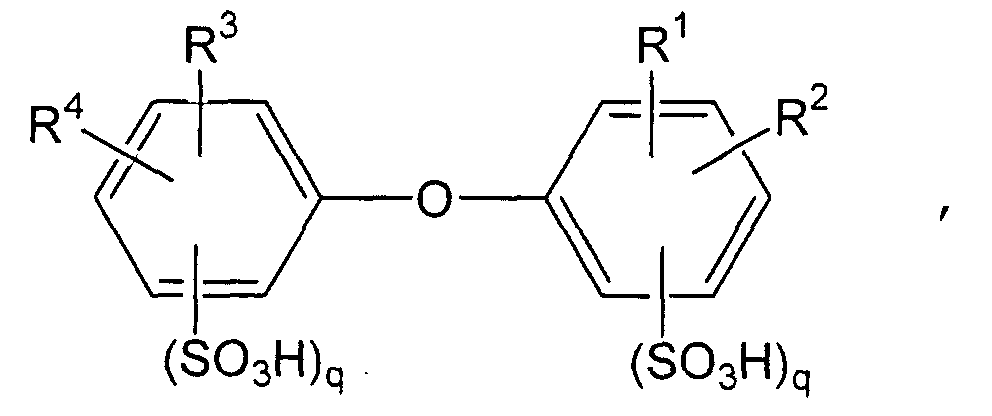
- The method as claimed in claim 6 in which the diphenyl ether sulfonic acid is a dodecyl(diphenyl ether) disulfonic acid.
- The method as claimed in any preceding claim in which the photoresist layer is brought into contact with the aqueous acidic solution by ejecting the solution at the photoresist layer.
- The method as claimed in any preceding claim in which the photoresist layer is kept in contact with the aqueous acidic solution for a length of time in the range from 1 to 90 seconds at room temperature.
- The method as claimed in any preceding claim in which the aqueous acidic solution contains a surface active agent.
- The method as claimed in claim 10 in which the surface active agent is N-octyl-2-pyrrolidone.
- The method as claimed in any preceding claim in which the acid contained in the aqueous acidic solution has a molecular weight of at least 200.
- The method as claimed in claim 1 in which the acid contained in the aqueous acidic solution is an organic acid having fluorinated alkyl sulfonic acid group(s).
Applications Claiming Priority (2)
| Application Number | Priority Date | Filing Date | Title |
|---|---|---|---|
| JP2000028328 | 2000-02-04 | ||
| JP2000028328A JP2001215734A (en) | 2000-02-04 | 2000-02-04 | Method for reducing surface defects of resist pattern and treatment liquid for reducing surface defects used therein |
Publications (3)
| Publication Number | Publication Date |
|---|---|
| EP1122611A2 true EP1122611A2 (en) | 2001-08-08 |
| EP1122611A3 EP1122611A3 (en) | 2003-01-22 |
| EP1122611B1 EP1122611B1 (en) | 2011-11-02 |
Family
ID=18553754
Family Applications (1)
| Application Number | Title | Priority Date | Filing Date |
|---|---|---|---|
| EP01300869A Expired - Lifetime EP1122611B1 (en) | 2000-02-04 | 2001-01-31 | Method of reducing surface defects of a patterned resist layer and use of aqueous acidic solution in said method |
Country Status (6)
| Country | Link |
|---|---|
| US (2) | US6605417B2 (en) |
| EP (1) | EP1122611B1 (en) |
| JP (1) | JP2001215734A (en) |
| KR (1) | KR100389800B1 (en) |
| AT (1) | ATE532107T1 (en) |
| TW (2) | TWI240147B (en) |
Cited By (2)
| Publication number | Priority date | Publication date | Assignee | Title |
|---|---|---|---|---|
| DE102004025203A1 (en) * | 2004-05-22 | 2005-12-15 | Infineon Technologies Ag | Photolithographic photomask production involves coating the photolacquer with an acid at a stage between the solvent removal and the final development step |
| US20250002819A1 (en) * | 2023-06-29 | 2025-01-02 | Jelmar Llc | Alkyl Sulfonic Acid Compositions Useful in Descaling Applications |
Families Citing this family (23)
| Publication number | Priority date | Publication date | Assignee | Title |
|---|---|---|---|---|
| JP3320402B2 (en) * | 2000-06-26 | 2002-09-03 | クラリアント ジャパン 株式会社 | Development defect prevention process and materials |
| JP4564186B2 (en) * | 2001-02-16 | 2010-10-20 | 株式会社東芝 | Pattern formation method |
| JP3901997B2 (en) * | 2001-11-27 | 2007-04-04 | 富士通株式会社 | Resist material, resist pattern and manufacturing method thereof, and semiconductor device and manufacturing method thereof |
| US6955485B2 (en) | 2002-03-01 | 2005-10-18 | Tokyo Electron Limited | Developing method and developing unit |
| US6900003B2 (en) * | 2002-04-12 | 2005-05-31 | Shipley Company, L.L.C. | Photoresist processing aid and method |
| JP3914468B2 (en) | 2002-06-21 | 2007-05-16 | Azエレクトロニックマテリアルズ株式会社 | Development defect prevention process and composition used therefor |
| JP4253486B2 (en) * | 2002-09-25 | 2009-04-15 | 富士フイルム株式会社 | Positive or negative resist composition, acid generator and pattern forming method |
| JP2005159295A (en) * | 2003-09-18 | 2005-06-16 | Nec Kagoshima Ltd | Substrate processing apparatus and processing method |
| JP4808385B2 (en) * | 2003-11-27 | 2011-11-02 | 東京応化工業株式会社 | Method for producing nanomaterials |
| WO2006025292A1 (en) * | 2004-09-01 | 2006-03-09 | Tokyo Ohka Kogyo Co., Ltd. | Developing solution composition for lithography and method for resist pattern formation |
| KR100674932B1 (en) * | 2005-01-03 | 2007-01-26 | 삼성전자주식회사 | Method for Forming Fine Pattern of Semiconductor Device Using Chemically Amplified Photoresist Composition Containing Pa and Ta ' |
| KR100620437B1 (en) * | 2005-01-17 | 2006-09-11 | 삼성전자주식회사 | Photosensitive polymer, photoresist composition comprising the same and photoresist pattern forming method using the same |
| JP5192277B2 (en) * | 2008-04-14 | 2013-05-08 | シャープ株式会社 | Method for manufacturing solid-state imaging device |
| JP5018690B2 (en) * | 2008-08-13 | 2012-09-05 | 東京エレクトロン株式会社 | Coating and developing method and coating and developing apparatus. |
| JP5222111B2 (en) * | 2008-11-26 | 2013-06-26 | 東京応化工業株式会社 | Resist surface modification liquid and resist pattern forming method using the same |
| JP5835123B2 (en) * | 2012-06-21 | 2015-12-24 | Jsr株式会社 | Self-assembling composition for pattern formation and pattern forming method |
| JP6328931B2 (en) * | 2012-12-31 | 2018-05-23 | ローム アンド ハース エレクトロニック マテリアルズ エルエルシーRohm and Haas Electronic Materials LLC | Photoresist pattern trimming method |
| US9104107B1 (en) | 2013-04-03 | 2015-08-11 | Western Digital (Fremont), Llc | DUV photoresist process |
| KR102346806B1 (en) * | 2013-12-30 | 2022-01-04 | 롬 앤드 하스 일렉트로닉 머트어리얼즈 엘엘씨 | Photoresist pattern trimming compositions and methods |
| TWI617611B (en) * | 2014-12-31 | 2018-03-11 | 羅門哈斯電子材料有限公司 | Photoresist pattern trimming compositions and methods |
| TWI628159B (en) * | 2015-10-31 | 2018-07-01 | 羅門哈斯電子材料有限公司 | Thermal acid generator and photoresist pattern trimming composition and method |
| KR102795102B1 (en) | 2021-07-01 | 2025-04-11 | 삼성에스디아이 주식회사 | Resist topcoat composition, and method of forming patterns using the composition |
| KR102795110B1 (en) | 2021-07-01 | 2025-04-10 | 삼성에스디아이 주식회사 | Resist topcoat composition, and method of forming patterns using the composition |
Citations (1)
| Publication number | Priority date | Publication date | Assignee | Title |
|---|---|---|---|---|
| US5429910A (en) | 1992-12-17 | 1995-07-04 | Mitsubishi Denki Kabushiki Kaisha | Method of forming a critical resist pattern |
Family Cites Families (13)
| Publication number | Priority date | Publication date | Assignee | Title |
|---|---|---|---|---|
| US2854477A (en) * | 1956-11-20 | 1958-09-30 | Dow Chemical Co | Method of making alkyl diphenyl ether sulfonates |
| US3207725A (en) * | 1962-07-31 | 1965-09-21 | Dow Chemical Co | Dyeable polyolefin compositions containing diphenyl ether sulfonates |
| US3394175A (en) * | 1967-03-23 | 1968-07-23 | Allied Chem | 4, 4'-bis (heptafluoroisopropyl)-diphenyl ether-2, 2'-disulfonic acid and alkali metal salts thereof |
| US4568718A (en) * | 1984-06-26 | 1986-02-04 | Dow Corning Corporation | Polydiorganosiloxane latex |
| DE3734189A1 (en) * | 1987-10-09 | 1989-04-27 | Hoechst Ag | METHOD FOR SEPARATING AND RECOVERING NAPHTHALINSULPHONIC ACIDS FROM AQUEOUS SOLUTIONS |
| DE3829709A1 (en) * | 1988-09-01 | 1990-03-15 | Basf Ag | METHOD FOR SEPARATING CYCLOHEXANOL FROM AQUEOUS SOLUTIONS CONTAINING SUCH AND AROMATIC SULPHONIC ACIDS |
| DE69130222D1 (en) * | 1990-06-29 | 1998-10-22 | Whitemoss Inc | ADJUSTABLE ROTOR FOR A RADIAL PISTON FLUID MACHINE |
| JP3281053B2 (en) * | 1991-12-09 | 2002-05-13 | 株式会社東芝 | Pattern formation method |
| JP2658859B2 (en) | 1993-12-20 | 1997-09-30 | 日本電気株式会社 | Method of forming resist pattern |
| JPH09251210A (en) | 1996-03-15 | 1997-09-22 | Toshiba Corp | Method of forming resist pattern |
| JPH1055993A (en) * | 1996-08-09 | 1998-02-24 | Hitachi Ltd | Cleaning solution for manufacturing semiconductor device and method for manufacturing semiconductor device using the same |
| JP3077648B2 (en) | 1997-11-06 | 2000-08-14 | 日本電気株式会社 | Pattern formation method for chemically amplified resist |
| JP4003286B2 (en) | 1998-04-02 | 2007-11-07 | 住友化学株式会社 | Method for forming resist pattern |
-
2000
- 2000-02-04 JP JP2000028328A patent/JP2001215734A/en active Pending
-
2001
- 2001-01-30 US US09/771,563 patent/US6605417B2/en not_active Expired - Lifetime
- 2001-01-31 AT AT01300869T patent/ATE532107T1/en active
- 2001-01-31 EP EP01300869A patent/EP1122611B1/en not_active Expired - Lifetime
- 2001-02-02 TW TW092106966A patent/TWI240147B/en not_active IP Right Cessation
- 2001-02-02 TW TW090102256A patent/TW594380B/en not_active IP Right Cessation
- 2001-02-03 KR KR10-2001-0005278A patent/KR100389800B1/en not_active Expired - Fee Related
-
2003
- 2003-01-31 US US10/354,973 patent/US7094924B2/en not_active Expired - Lifetime
Patent Citations (1)
| Publication number | Priority date | Publication date | Assignee | Title |
|---|---|---|---|---|
| US5429910A (en) | 1992-12-17 | 1995-07-04 | Mitsubishi Denki Kabushiki Kaisha | Method of forming a critical resist pattern |
Cited By (3)
| Publication number | Priority date | Publication date | Assignee | Title |
|---|---|---|---|---|
| DE102004025203A1 (en) * | 2004-05-22 | 2005-12-15 | Infineon Technologies Ag | Photolithographic photomask production involves coating the photolacquer with an acid at a stage between the solvent removal and the final development step |
| DE102004025203B4 (en) * | 2004-05-22 | 2009-10-08 | Qimonda Ag | Photoresist processing method |
| US20250002819A1 (en) * | 2023-06-29 | 2025-01-02 | Jelmar Llc | Alkyl Sulfonic Acid Compositions Useful in Descaling Applications |
Also Published As
| Publication number | Publication date |
|---|---|
| TW594380B (en) | 2004-06-21 |
| ATE532107T1 (en) | 2011-11-15 |
| TWI240147B (en) | 2005-09-21 |
| US20030138736A1 (en) | 2003-07-24 |
| KR20010089151A (en) | 2001-09-29 |
| KR100389800B1 (en) | 2003-07-02 |
| TW200305058A (en) | 2003-10-16 |
| EP1122611B1 (en) | 2011-11-02 |
| JP2001215734A (en) | 2001-08-10 |
| US7094924B2 (en) | 2006-08-22 |
| EP1122611A3 (en) | 2003-01-22 |
| US6605417B2 (en) | 2003-08-12 |
| US20010014431A1 (en) | 2001-08-16 |
Similar Documents
| Publication | Publication Date | Title |
|---|---|---|
| EP1122611B1 (en) | Method of reducing surface defects of a patterned resist layer and use of aqueous acidic solution in said method | |
| EP0749046B1 (en) | Positive-working photoresist composition | |
| JP4629944B2 (en) | Photoresist composition for deep ultraviolet | |
| US6787290B2 (en) | Positive-working photoresist composition and resist patterning method using same | |
| CN1325995C (en) | Negative deep ultraviolet photoresist | |
| US20090311625A1 (en) | Method for forming photoresist pattern and photoresist laminate | |
| US6749989B2 (en) | Positive-working photoresist composition | |
| WO2003040826A1 (en) | Photoresist composition for deep uv radiation containing an additive | |
| US20050037291A1 (en) | Method for forming fine resist pattern | |
| JP2013174883A (en) | Compositions and processes for photolithography | |
| JP7690111B2 (en) | Chemically amplified positive photoresist composition for improving pattern profile and resolution | |
| US6890697B2 (en) | Positive-working chemical-amplification photoresist composition | |
| US20020106580A1 (en) | Method for forming a hole-patterned photoresist layer | |
| JPH103169A (en) | Photosensitive composition | |
| US6255041B1 (en) | Method for formation of patterned resist layer | |
| US6818148B1 (en) | Resist composition and patterning method | |
| US20020058202A1 (en) | Positive-working photoresist composition and photosensitive material using same | |
| JP2002323774A (en) | Chemically amplified resist pattern defect reducing treatment agent and resist pattern forming method using the same | |
| US6548229B2 (en) | Positive-working chemical-amplification photoresist composition and method for forming a resist pattern using the same | |
| JP3803313B2 (en) | Resist material and resist pattern forming method |
Legal Events
| Date | Code | Title | Description |
|---|---|---|---|
| PUAI | Public reference made under article 153(3) epc to a published international application that has entered the european phase |
Free format text: ORIGINAL CODE: 0009012 |
|
| AK | Designated contracting states |
Kind code of ref document: A2 Designated state(s): AT BE CH CY DE DK ES FI FR GB GR IE IT LI LU MC NL PT SE TR |
|
| AX | Request for extension of the european patent |
Free format text: AL;LT;LV;MK;RO;SI |
|
| PUAL | Search report despatched |
Free format text: ORIGINAL CODE: 0009013 |
|
| AK | Designated contracting states |
Kind code of ref document: A3 Designated state(s): AT BE CH CY DE DK ES FI FR GB GR IE IT LI LU MC NL PT SE TR |
|
| AX | Request for extension of the european patent |
Free format text: AL;LT;LV;MK;RO;SI |
|
| 17P | Request for examination filed |
Effective date: 20030508 |
|
| AKX | Designation fees paid |
Designated state(s): AT BE CH CY DE DK ES FI FR GB GR IE IT LI LU MC NL PT SE TR |
|
| 17Q | First examination report despatched |
Effective date: 20090428 |
|
| GRAP | Despatch of communication of intention to grant a patent |
Free format text: ORIGINAL CODE: EPIDOSNIGR1 |
|
| RTI1 | Title (correction) |
Free format text: METHOD OF REDUCING SURFACE DEFECTS OF A PATTERNED RESIST LAYER AND USE OF AQUEOUS ACIDIC SOLUTION IN SAID METHOD |
|
| GRAS | Grant fee paid |
Free format text: ORIGINAL CODE: EPIDOSNIGR3 |
|
| RIN1 | Information on inventor provided before grant (corrected) |
Inventor name: NITTA, KAZUYUKI Inventor name: MATSUMI, TATSUYA Inventor name: NAKAO, TAKU Inventor name: MAEMORI, SATOSHI |
|
| GRAA | (expected) grant |
Free format text: ORIGINAL CODE: 0009210 |
|
| AK | Designated contracting states |
Kind code of ref document: B1 Designated state(s): AT BE CH CY DE DK ES FI FR GB GR IE IT LI LU MC NL PT SE TR |
|
| REG | Reference to a national code |
Ref country code: GB Ref legal event code: FG4D |
|
| REG | Reference to a national code |
Ref country code: CH Ref legal event code: EP |
|
| REG | Reference to a national code |
Ref country code: IE Ref legal event code: FG4D |
|
| REG | Reference to a national code |
Ref country code: DE Ref legal event code: R096 Ref document number: 60145594 Country of ref document: DE Effective date: 20120112 |
|
| REG | Reference to a national code |
Ref country code: NL Ref legal event code: T3 |
|
| PG25 | Lapsed in a contracting state [announced via postgrant information from national office to epo] |
Ref country code: SE Free format text: LAPSE BECAUSE OF FAILURE TO SUBMIT A TRANSLATION OF THE DESCRIPTION OR TO PAY THE FEE WITHIN THE PRESCRIBED TIME-LIMIT Effective date: 20111102 Ref country code: BE Free format text: LAPSE BECAUSE OF FAILURE TO SUBMIT A TRANSLATION OF THE DESCRIPTION OR TO PAY THE FEE WITHIN THE PRESCRIBED TIME-LIMIT Effective date: 20111102 Ref country code: PT Free format text: LAPSE BECAUSE OF FAILURE TO SUBMIT A TRANSLATION OF THE DESCRIPTION OR TO PAY THE FEE WITHIN THE PRESCRIBED TIME-LIMIT Effective date: 20120302 Ref country code: GR Free format text: LAPSE BECAUSE OF FAILURE TO SUBMIT A TRANSLATION OF THE DESCRIPTION OR TO PAY THE FEE WITHIN THE PRESCRIBED TIME-LIMIT Effective date: 20120203 |
|
| PG25 | Lapsed in a contracting state [announced via postgrant information from national office to epo] |
Ref country code: CY Free format text: LAPSE BECAUSE OF FAILURE TO SUBMIT A TRANSLATION OF THE DESCRIPTION OR TO PAY THE FEE WITHIN THE PRESCRIBED TIME-LIMIT Effective date: 20111102 |
|
| PG25 | Lapsed in a contracting state [announced via postgrant information from national office to epo] |
Ref country code: DK Free format text: LAPSE BECAUSE OF FAILURE TO SUBMIT A TRANSLATION OF THE DESCRIPTION OR TO PAY THE FEE WITHIN THE PRESCRIBED TIME-LIMIT Effective date: 20111102 |
|
| PG25 | Lapsed in a contracting state [announced via postgrant information from national office to epo] |
Ref country code: MC Free format text: LAPSE BECAUSE OF NON-PAYMENT OF DUE FEES Effective date: 20120131 Ref country code: IT Free format text: LAPSE BECAUSE OF FAILURE TO SUBMIT A TRANSLATION OF THE DESCRIPTION OR TO PAY THE FEE WITHIN THE PRESCRIBED TIME-LIMIT Effective date: 20111102 |
|
| REG | Reference to a national code |
Ref country code: CH Ref legal event code: PL |
|
| PLBE | No opposition filed within time limit |
Free format text: ORIGINAL CODE: 0009261 |
|
| STAA | Information on the status of an ep patent application or granted ep patent |
Free format text: STATUS: NO OPPOSITION FILED WITHIN TIME LIMIT |
|
| REG | Reference to a national code |
Ref country code: AT Ref legal event code: MK05 Ref document number: 532107 Country of ref document: AT Kind code of ref document: T Effective date: 20111102 |
|
| 26N | No opposition filed |
Effective date: 20120803 |
|
| GBPC | Gb: european patent ceased through non-payment of renewal fee |
Effective date: 20120202 |
|
| REG | Reference to a national code |
Ref country code: IE Ref legal event code: MM4A |
|
| PG25 | Lapsed in a contracting state [announced via postgrant information from national office to epo] |
Ref country code: LI Free format text: LAPSE BECAUSE OF NON-PAYMENT OF DUE FEES Effective date: 20120131 Ref country code: DE Free format text: LAPSE BECAUSE OF NON-PAYMENT OF DUE FEES Effective date: 20120801 Ref country code: CH Free format text: LAPSE BECAUSE OF NON-PAYMENT OF DUE FEES Effective date: 20120131 |
|
| REG | Reference to a national code |
Ref country code: DE Ref legal event code: R119 Ref document number: 60145594 Country of ref document: DE Effective date: 20120801 |
|
| PG25 | Lapsed in a contracting state [announced via postgrant information from national office to epo] |
Ref country code: AT Free format text: LAPSE BECAUSE OF FAILURE TO SUBMIT A TRANSLATION OF THE DESCRIPTION OR TO PAY THE FEE WITHIN THE PRESCRIBED TIME-LIMIT Effective date: 20111102 Ref country code: IE Free format text: LAPSE BECAUSE OF NON-PAYMENT OF DUE FEES Effective date: 20120131 Ref country code: GB Free format text: LAPSE BECAUSE OF NON-PAYMENT OF DUE FEES Effective date: 20120202 |
|
| PG25 | Lapsed in a contracting state [announced via postgrant information from national office to epo] |
Ref country code: ES Free format text: LAPSE BECAUSE OF FAILURE TO SUBMIT A TRANSLATION OF THE DESCRIPTION OR TO PAY THE FEE WITHIN THE PRESCRIBED TIME-LIMIT Effective date: 20120213 |
|
| PG25 | Lapsed in a contracting state [announced via postgrant information from national office to epo] |
Ref country code: FI Free format text: LAPSE BECAUSE OF FAILURE TO SUBMIT A TRANSLATION OF THE DESCRIPTION OR TO PAY THE FEE WITHIN THE PRESCRIBED TIME-LIMIT Effective date: 20111102 |
|
| PG25 | Lapsed in a contracting state [announced via postgrant information from national office to epo] |
Ref country code: TR Free format text: LAPSE BECAUSE OF FAILURE TO SUBMIT A TRANSLATION OF THE DESCRIPTION OR TO PAY THE FEE WITHIN THE PRESCRIBED TIME-LIMIT Effective date: 20111102 |
|
| PG25 | Lapsed in a contracting state [announced via postgrant information from national office to epo] |
Ref country code: LU Free format text: LAPSE BECAUSE OF NON-PAYMENT OF DUE FEES Effective date: 20120131 |
|
| REG | Reference to a national code |
Ref country code: FR Ref legal event code: PLFP Year of fee payment: 16 |
|
| REG | Reference to a national code |
Ref country code: FR Ref legal event code: PLFP Year of fee payment: 17 |
|
| REG | Reference to a national code |
Ref country code: FR Ref legal event code: PLFP Year of fee payment: 18 |
|
| PGFP | Annual fee paid to national office [announced via postgrant information from national office to epo] |
Ref country code: NL Payment date: 20171213 Year of fee payment: 18 Ref country code: FR Payment date: 20171211 Year of fee payment: 18 |
|
| REG | Reference to a national code |
Ref country code: NL Ref legal event code: MM Effective date: 20190201 |
|
| PG25 | Lapsed in a contracting state [announced via postgrant information from national office to epo] |
Ref country code: FR Free format text: LAPSE BECAUSE OF NON-PAYMENT OF DUE FEES Effective date: 20190131 Ref country code: NL Free format text: LAPSE BECAUSE OF NON-PAYMENT OF DUE FEES Effective date: 20190201 |