FIELD OF THE INVENTION
The present invention relates to a support for rolled
light-sensitive photographic materials which can be used for
120 or 135 photographic films, which are widely employed as
silver halide photographic films for general purpose cameras.
BACKGROUND OF THE INVENTION
Generally, cited as representative examples of silver
halide light-sensitive photographic materials (photographic
film) are sheet films such as X-ray film, film for graphic
arts, cut film, and roll film. Listed as representative roll
film are color film and black-and-white film having a width
of 35 mm or less, which are placed in velvet lined cartridges
which are loaded in general purpose cameras and employed for
general picture taking. In addition, 120 film, having a
greater width, may be listed.
Heretofore, cellulose triacetate film (TAC) has been
used as the primary support for roll film. TAC film as the
photographic support features excellent properties such as no
optical anisotropy, high transparency, and residual curl
diminishing properties, after photographic processing. Said
TAC film is obtained by dissolving cellulose triacetate in
organic solvents such as methylene chloride or the like, and
casting the resultant solution onto a metal belt and the
like, and subsequently drying the resultant film. Said
organic solvents, especially chlorine based solvents such as
methylene chloride and the like, which are used to dissolve
cellulose triacetate, may cause environmental problems.
On the other hand, known as materials which make it
possible to form film without employing solvents are
polyesters such as polyethylene terephthalate (PET),
polyethylene-2,6-naphthalate (PEN), and the like. Generally,
a PET film is obtained by melt extruding PET and subsequently
biaxially stretching the resultant film. Such PET film has
been conventionally employed as a support for X-ray film as
well as lithographic film. However, when said PET film is
employed as a support for 120 and 135 films, namely is
employed in a rolled set, roll set curl tends to occur. As a
result, problems occur such as, for example, conveyance
problems in the camera, generation of abrasion during the
photographic processing as well as the printing process after
said photographic processing, which is carried out to form
images on a photographic paper, jamming during conveyance,
and the like.
As a method to improve recovery properties from said
roll set curl, Japanese Patent Publication Open to Public
Inspection No. 1-244446 describes a copolymerized PET film
provided with hydrophilicity, which is obtained by utilizing
an aromatic dicarboxylic acid having a metal sulfonate group
as a copolymerization component. Japanese Patent Publication
Open to Public Inspection No. 4-93937 describes a technique
which maintains recovery properties from roll set curl, as
well as enhances the mechanical strength in which polyesters
having different moisture contents are laminated.
Further, as techniques to enhance the adhesion between
layers of the laminated film, produced by laminating
copolyesters, Japanese Patent Publication Open to Public
Inspection No. 6-23929 describes a technique in which
copolymerization components in the layer which is employed
for lamination are noted, Japanese Patent Publication Open to
Public Inspection No. 6-289534 describes a technique in which
differences in the amount of copolymerization components
between laminated layers are noted, and Japanese Patent
Publication Open to Public Inspection No. 6-161035 describes
a technique in which in one layer, polyester employed in the
other layer(s) is blended. Such techniques are preferable
since they improve recovery properties from roll set curl, as
well as improving mechanical strength and adhesion between
layers of a laminated film.
Specifically, the technique described in said Japanese
Patent Publication Open to Public Inspection No. 6-161035 is
advantageous with the reduction of cost, because general
purpose homopolyesters can be employed.
However, said technique is developed while primarily
investigating a thin base having a layer thickness of about
80 µm. By contrast, the thickness of the TAC film employed
in 120 and 135 films is about 120 µm. Though a decrease in
film thickness is useful for decreasing the size of cameras
and the like, the film thickness is preferably about 120 µm
so that no focusing problem occurs when employed, instead of
the commonly used TAC film.
It has been discovered that when the technique
described in said patent is simply applied to an
approximately 120 µm thick layer, the roll set curl tends to
increase; recovery properties from the roll set curl is
somewhat degraded compared to an 80 µm thick layer;
conveyance in processors is degraded, and adhesion between
layers is insufficient.
SUMMARY OF THE PRESENT INVENTION
In the foregoing, the present invention is
accomplished. An object of the present invention is to
provide a support for rolled light-sensitive photographic
materials such as 120 and 135 films, which may be produced
without using solvents, and to provide a production method
thereof.
Namely, by adjusting film thickness from 105 to 130 µm,
provided are rolled light-sensitive photographic materials
which can be employed in cameras designed for commonly used
120 and 135 film, without resulting in focusing problems;
results in almost no problem of roll set curl tendency even
at a film thickness of 105 to 130 µm; exhibit excellent
recovery properties from roll set curl as well as excellent
adhesion between layers; and can be used in processors and
the like without resulting in any problem.
The aforementioned object of the present invention is
achieved employing the embodiments described below.
DETAILED DESCRIPTION OF THE INVENTION
The present invention will now be detailed.
A polyester support (hereinafter referred to simply as
a support) is the laminated polyester support comprised of at
least three layers of polyester film (hereinafter referred to
as at least three layers).
When a polyester film is formed by laminating at least
three layers, a laminated polyester film support has a
configuration such that both outer layers are comprised of
copolyester, and at least one interlayer (a mixture layer) is
comprised of a mixture in which the copolyester, which is
preferably employed in any one of said outer layers, and
homopolyester.
By employing at least one mixture layer in the layer
configuration of polyester film, it is possible to improve
adhesion between laminated layers, while, by employing a
homopolyester, it is possible to reduce cost compared to the
case in which at least two types of copolyesters are procured
and laminated. Herein, "the outer layer" of the support
formed by laminating at least three layers means the
outermost layer among layers formed by lamination as a
support, and one outermost layer exists on both sides of the
support. Both outer layers refer to said layers.
Incidentally, a so-called sublayer, which is separately
applied to a support, is not included. Both outer layers may
be comprised of different copolyesters, but from the
viewpoint of cost and adhesion between layers, both layers
are preferably comprised of the same copolyester. Further,
the interlayers, as described herein, refer to the layers
between said outer layers, and at least one layer among them
is a mixture layer comprised of the copolyester substantially
same with the copolyester used in the outer layer and said
homopolyester. It is more preferable that the copolyester
used in at least one of the outer latex is used in the
mixture layer. The configuration of said interlayers is not
particularly limited, but from the viewpoint of adhesion
between layers, as well as cost, configurations such as, for
example, a single layer comprised of a mixture layer or a
mixture layer/homopolyester layer/mixture layer are
preferable.
The total layer thickness of the support of the present
invention is 105 to 130 µm, and preferably 115 to 125 µm.
Said thickness overcomes the focusing problem in cameras as
well as the loading problem into film cartridges.
The thickness of the interlayer of the support, which
is formed by laminating at least three layers, is between 45
and 85 µm. When the thickness is less than 45 µm, roll set
curl tends to result, while when the thickness exceeds 85 µm,
recovery properties from roll set curl are degraded. The
layer comprised of copolyester tends to result in roll set
curl, but the resultant roll set curl is cancelled through
water absorption during photographic processing.
Accordingly, when the thickness of the outer copolymerized
ester layer increases, the recovery properties are improved.
However, water is only sufficiently absorbed into a
relatively shallow region from the surface during
photographic processing. Therefore, when the thickness
further increases, the roll set curl tends to further
increase and contribution to improvement of recovery
properties diminishes. Thinner polyester has resulted in no
pronounced problem. However, it is estimated that when the
thickness increases, roll set curl tends to result due to
effects of this phenomenon and the recovery properties from
the roll set curl is occasionally degraded. The depth of the
portion which sufficiently absorbs water during photographic
processing is estimated to be about 30 µm. However, since
said depth depends on various factors, it is difficult to
generalize it.
Further, it is estimated that an increase in tendency
of roll set curl in accordance with an increase in the
thickness may be due to an increase in stress generated by
winding the film onto a roll compared to that of a thinner
film. It is also estimated that the phenomena described
above affect the fact that an increase in thickness tends to
increase the tendency of the roll set curl, and to degrade
the recovery properties. At any rate, by adjusting the total
thickness of interlayer(s) from 45 to 85 µm as described in
the present invention, it is possible to maintain the
tendency of roll set curl as well as a decrease in the roll
set curl so that no problem occurs, even when employing a
support having a thickness of 105 to 130 µm.
Further, the ratio of copolyester in the mixture layer
is between 10 and 40 percent by weight. Namely, the ratio of
the copolymerized component is between 10 and 40 percent by
weight. When cutting and perforation are carried out in a
relatively thick support, generated stress becomes greater
than that of a relatively thin support. Due to that, when
said ratio is less than 10 percent by weight, adhesion
between layers becomes insufficient, and occasionally results
in delamination between laminated layers. Further, when said
ratio exceeds 40 percent by weight, roll set curl tends to
result, even though the interlayer thickness is maintained in
the aforementioned region, and further tends to result in
conveyance problems in processing machines and the like.
Incidentally, delamination between layers during cutting and
perforation is affected by the types and conditions of
apparatuses, as well as the cutting methods. For example,
clearance between the upper edge and the lower edge is
preferably small. Further, the operating edge is preferably
arranged to have some angle rather than being horizontal with
respect to a film, and the angle of the edge end is
preferably set to be less than 90 degrees. Furthermore, as
described in Japanese Patent Publication Open to Public
Inspection No. 7-84338 and others, it is useful to provide
physical lack or damage along the edge portion of a film for
improvement of cutting properties.
Further, the support of the present invention
preferably has an asymmetrical lamination structure regarding
both surfaces from the center point, which equally divides
the thickness. Such a lamination structure results in
effects to minimize the tendency of roll set curl as well as
to minimize adverse effects due to roll set curl. When a
polyester film is comprised of three layers, it is possible
to allow the structure to be asymmetrical by varying at least
one of the copolymerization components, the copolymerization
ratio, or the thickness of both outer layers between both
outer layers. From the viewpoint of cost as well as
production facilities, it is easiest to vary the layer
thickness while employing the same copolyester resin.
Further, at the time, it is preferable that in three- or more
layer lamination, the side comprising the less amount of the
copolymerization component, or when the same copolyesters are
used, the side having a less thickness, is positioned as the
inside surface, when producing photographic roll film.
Polyesters employed in the present invention will now
be described.
The polyesters employed in the present invention are
preferable those which are comprised of one aromatic dibasic
acid and one glycol as the composition components. Said
dibasic acids include terephthalic acid, isophthalic acid,
2,6-naphthalenedicaroxylic acid, and the like, while glycols
include ethylene glycol, propylene glycol, butanediol,
neopentyl glycol, 1,4-cyclohexanedimethanol, diethylene
glycol, p-xylylene glycol, and the like. Of these, the
polyethylene terephthalate comprised of terephthalic acid and
ethylene glycol, as the composition components are preferred.
The copolyester preferably employed in the present
invention is one in which at least one aromatic dicarboxylic
acid, having a metal sulfonate group, and at least one of
polyalkylene glycol and/or polyalkylene oxydicarboxylic acid
are employed as copolymerization components, while aromatic
dibasic acid and glycol are employed as major composition
components. Listed as said dibasic acids and said glycols
are those described above. Of these, copolymerized
polyethylene phthalate, in which terephthalic acid and
ethylene glycol are employed, as the major composition
components.
Employed as aromatic dicarboxylic acids, having a metal
sulfonate group, are preferably 5-sodiumsulfoisophthalic
acid, 2-sodiumsulfoisophthalic acid, 4-sodiumisophthalic
acid, 4-sodiumsulfo-2,6-naphthalene dicarboxylic acid, or
ester forming derivatives thereof, as well as compounds in
which said sodium is replaced with any of other metals (for
example, potassium, lithium, and the like). The
copolymerization ratio of the aromatic dicarboxylic acid
component having a metal sulfonate group is preferably
between 4 and 10 mole percent with respect to the entire
ester bonding units to obtain sufficient recovery properties
from roll set curl, as well as the tendency of roll set curl
which causes almost no problem.
To be preferably between 4 and 10 mole percent with
respect to the entire ester bonding units, and to be more
preferably between 4.5 and 8 mole percent.
Employed as polyalkylene glycols are preferably
polyethylene glycol, polytetramethylene glycol, and the like.
Of these, polyethylene glycol is more preferred. The
molecular weight is not particularly limited. However, it is
preferably between 300 and 20,000, is more preferably between
600 and 10,000, and is most preferably between 1,000 and
5,000. Further, employed as polyalkylene oxydicarboxylic
acids may be polyethylene oxydicarboxylic acid,
polytetramethylene oxydicarboxylic acid, and the like. Of
these, polyethylene oxydicarboxylic acid is preferred. The
molecular weight is not particularly limited, however, it is
preferably between 300 and 20,000, is more preferably between
600 and 10,000, and is most preferably between 1,000 and
5,000. The copolymerization ratio of polyalkylene glycol
and/or polyalkylene oxydicarboxylic acid is preferably
between 2 and 8 percent by weight to obtain sufficient
recovery properties from roll set curl, as well as the
tendency of roll set curl which causes almost no problem.
To be preferably between 2 and 8 percent by weight, and
to be more preferably between 4 and 7 percent by weight with
respect to the copolyester reaction product.
"The primary component of the outer layer is
copolyester", as described in the present invention, means
that at least 90 percent by weight of the outer layer is
comprised of copolyester. In the present invention, at least
95 percent by weight of the outer layer is comprised of said
copolyester.
The copolyester employed in the present invention may
be copolymerized with other components in a range amount
which does not adversely affect the effects of the present
invention.
"Copolyester is substantially the same", as described
in the present invention means that each of the copolyester
is comprised of the same copolymerization component and the
difference in the content of said copolymerization component
is within 5 percent. The difference in the content of said
copolymerization component is obtained employing the formula
described below:
(A - B)/A × 100 = difference in the content of the
copolymerization component between copolyesters
wherein "A" as well as "B" is the content of the
copolymerization component under the condition of A ≧ B.
Further, when two copolyesters comprise different
copolymerization components in the range which does not
affect the resultant performance, it is possible to regard
both to be substantially the same".
Dibasic acids or derivatives thereof, which may be
employed other than those described above, include
terephthalic acid, isophthalic acid, and phthalic acid, and
lower alkyl esters (derivatives such as anhydrides, lower
alkyl esters, and the like, capable of forming esters) of
sodiumisophthalic acid sulfonate (sodiumsulfoisophthalic
acid); aromatic dicaroboxylic acids such as 2,7-naphthalenedicarboxylic
acid, 1,5-naphthalenedicaroxylic
acid, diphenylcaroboxylic acid, diphenyl ether dicarboxylic
acid, and the like and lower alkyl esters (derivatives such
as anhydrides, lower alkyl esters, and the like, capable of
forming esters) thereof; alicyclic dicarboxylic acids such as
cyclopropanedicarboxylic acid, cyclobutanedicarboxylic acid,
hexahydroterephthalic acid, and the like and derivatives
(derivatives such as anhydrides, lower alkyl esters, and the
like, capable of forming esters) thereof; aliphatic
dicarboxylic acids such as adipic acid, succinic acid, oxalic
acid, azelaic acid, sebacic acid, dimeric acid, and the like
and derivatives (derivatives such as anhydrides, lower alkyl
esters, and the like, capable of forming esters) thereof.
These may be employed in an amount of not more than 10 mole
percent, with respect to the total dibasic acid.
Listed as dihydric alcohols which may be employed in
the present invention, other than those described above, may
be trimethylene glycol, triethylene glycol, tetramethylene
glycol, hexamethylene glycol, bisphenol A, p,p'-dihydroxyphenylsulfone,
1,4-bis(β-hydroxyethoxyphenyl)propane,
p-phenylenebis(dimethylolcyclohexane),
and the like. These
dihydric alcohols may be employed in an amount of not more
than 10 mole percent.
The aforementioned polyesters may be either those in
which the terminal hydroxyl group and/or the terminal
carboxyl group is inactivated employing unifunctional
compounds such as, for example, benzoic acid, benzoylbenzoic
acid, benzyloxybenzoic acid, methoxypolyalkylene glycol, and
the like, or those which are modified with a very small
amount of trifunctional or tetrafunctional ester forming
compounds such as, for example, glycerin and pentaerythritol
in the range in which linear copolymers are substantially
obtained.
Antioxidants are preferably incorporated into
polyesters employed in the present invention. Specifically,
incorporation of said antioxidants is markedly effective when
said polyesters are comprised of compounds having a
polyoxyalkylene group. Types of antioxidants, which are
incorporated, are not particularly limited, and various types
of antioxidants may be employed. Listed as those are, for
example, hindered phenol based compounds, phosphite based
compounds, and thioether based compounds. Of these, from the
point of transparency, antioxidants comprised of hindered
phenol based compounds are preferred.
The content of antioxidants is commonly between 0.01
and 2 percent by weight with respect to the polyester, and is
preferably between 0.1 and 0.5 percent by weight. When the
content of said antioxidants decreases, a phenomenon of so-called
fog formation, in which the density of the unexposed
area of a photographic material increase tends to result,
while when the content increases, the haze of a film base
increases, occasionally degrading transparency.
Incidentally, these antioxidants may be employed individually
or in combination.
For the purpose of minimizing the light piping
phenomenon, dyes are preferably incorporated into the
polyester employed in the present invention. The types of
dyes, which are provided to achieve said purpose, are not
particularly limited, but said dyes should exhibit excellent
heat resistance from the viewpoint of production. Listed as
desired dyes are anthraquinone based and perylene based dyes.
Further, as for tints, the polyester is subjected to gray
dying as seen in common photographic materials. Listed as
such dyes are the Macrolex series manufactured by Bayer Co.,
the Sumiplast series manufactured by Sumitomo Kagaku Co.
Ltd., the Diaresin series manufactured by Mitsubishi Kagaku
Co., Ltd., and the like. These dyes may be employed
individually or in combination of two or more types so as to
obtain the desired tints. At that time, in order to minimize
said light piping phenomenon as well as to obtain excellent
photographic prints, dyes are preferably employed so that the
spectral transmittance in the wavelength range of 400 to 700
nm is between 60 and 85 percent, and further, the difference
between the maximum spectral transmittance and the minimum
spectral transmittance in the wavelength range of 600 to 700
nm is within 10 percent.
Methods for adding colorants are not particularly
limited. The required amount of colorants may be added
during any stage from polyester polymerization to melt
extrusion, while coloration may also be carried out.
Further, preferably employed is a method in which so-called
master pellets having high concentration of colorants are
previously prepared, and melt extrusion is carried out
through suitable dilution because the concentration is
readily controlled. Said method is useful when, in order to
incorporate recovered polyester, fine concentration
adjustment is required. The concentration of dyes in said
master pellets is preferably between 100 and 10,000 ppm.
Further, when the concentration of dyes in polyester is
constant, the amount of dyes in a thick support is greater
than in a thin support, and the transmittance of the thick
support is degraded. When an increase in the amount of dyes
is problematic, it is possible to adjust the concentration of
dyes of the layer to a lower value other than in the layer
adjacent to the surface layer on the emulsion-coated side.
If desired, it is possible to allow the polyester film
of the present invention to be made more slippery. Methods
to achieve the slippery polyester film are not particularly
limited. Commonly employed methods include an external
particle addition method in which inert inorganic particles
are added to polyester, an internal particle depositing
method in which catalysts which are added during synthesis of
polyester are deposited, or a method in which surface active
agents and the like are applied onto the film surface.
Of these, the internal particle depositing method, in
which deposit particles can be controlled to a relatively
fine point, is preferred so that it allows the polyester to
be made slippery without degrading the transparency. Various
types of catalysts known in the art may be employed, and
specifically Ca as well as Mn is preferably employed so that
high transparency is obtained. These catalysts may be
employed individually or in combination of two types.
Further, since polyester films, which may be employed
in the present invention, are comprised of a multilayer
structure, said functions, such as the minimization of
oxidation, the minimization of light piping, and allowing
films to be made more slippery may be applied to all layers,
and various types of additives other than those described
above may also be added to all layers. However, at least the
surface layer is preferably subjected to addition of said
additives. It is also possible to improve the transparency
of said film by decreasing the addition amount, or by
decreasing it to zero in other layers.
Polymerization of the copolyester employed in the
present invention may be carried out employing any of the
several common methods known in the art. Namely, after
dicarboxylic acid components and glycol components undergo
transesterification, copolyester is obtained by allowing the
resultant products to undergo polycondensation at high
temperature and reduced pressure. After the
transesterification, aromatic dicarboxylic acids having a
metal sulfonate group and polyethylene glycol which are
copolymerization components are added, and polycondensation
is carried out.
The intrinsic viscosity of the polyester resins
employed in the present invention is preferably between 0.35
and 0.70. When the intrinsic viscosity is less than the
lower limit, desired brittleness may not be obtained, while
when the intrinsic viscosity exceeds the upper limit,
mechanical strength likely to become excessive.
Employed as methods for laminating polyester may be
those known in the art. Those methods include a co-extrusion
method employing a plurality of extruders and a feed block
system of dies or a multimanifold system of dies, an
extrusion lamination method in which other resins, which
constitute a laminated layer body, are melt extruded from an
extruder onto a single layer film, or laminated films which
constitute a laminated body and are cool solidified on a
cooled drum, a dry lamination method in which a single layer
film or laminated films which constitute a laminated layer
body are laminated via, if desired, anchor agents or
adhesives, and the like. Of these, preferred is the co-extrusion
method which requires fewer processes and results
in excellent adhesion between adjacent layers.
At that time, the melt viscosity of each layer is
preferably between 100 and 500 Pas, because consistent
flatness may be obtained. Further, difference in the melt
viscosity between respective layers in the die is commonly
not more than 50 percent, and is preferably not more than 30
percent. If said difference exceeds 50 percent, it may be
difficult to obtain the desired flatness as well as the
sufficient adhesion between layers, which is required for
photographic supports. Incidentally, it is difficult to
measure the melt viscosity in the die of each layer.
Therefore, the melt viscosity of each layer is individually
measured employing the method described in JIS K7199-1001,
and the like. Temperature, shearing rate, and the like are
appropriately determined depending on the conditions of said
dice. The temperature is commonly between 260 and 330 °C.
The melt viscosity varies depending on such measurement
conditions. In any case, however, it is important that
viscosity difference in the conditions assuming said die is
not more than 50 percent. The viscosity difference between
layers refers to the value in percent expressed by (a - b)/a,
wherein "a" and "b" (a > b) each represent the viscosity of
each layer. The melt viscosity of each layer varies
depending on the ratio of copolymerization components, the
ratio of recovered polyester, and the like, or alternatively
it is also possible to intentionally vary them. Further, it
is possible to adjust the value to the desired ones by
suitably varying a degree of polymerization of employed
resins.
Employed as methods to obtain unstretched sheets as
well as methods to uniaxially stretch a polyester film in the
longitudinal direction, may be conventional ones known in the
art. For example, polyester employed as the raw material is
molded into pellets, which are subjected to vacuum drying
while employing forced hot air or heating. Drying
temperature is preferably high, being in the range at which
oxidation decomposition due to heat does not occur, commonly
between 100 and 200 °C, and is preferably between 140 and 180
°C. Vacuum drying is preferably employed because it is
possible to minimize oxidation by decreasing oxygen as well
as moisture. Drying is carried out so as to obtain a
moisture content of not more than 100 ppm, and preferably not
more than 30 ppm. Thereafter, polyester is melt extruded,
being extruded from a T-die into a sheet, which is brought
into close contact with a cooling drum, employing an
electrostatic application method and the like, and then
cooled and solidified to obtain an unstretched sheet.
Subsequently, a method is employed in which the
obtained unstretched sheet is heated in the range of the
glass transition temperature (Tg) of the polyester to Tg plus
100 °C, employing heating devices such as a plurality of
rollers and/or infrared heaters, and the like, and the heated
sheet is subjected to single or multiple stage longitudinal
stretching. The stretching factor is in the range of 2.5 to
6, which should allow the sheet to be stretched laterally.
Stretching temperatures are preferably set utilizing the
highest Tg among those of polyesters employed in each layer
as the standard.
In the present invention, it is preferable that the
polyester film, which is obtained by uniaxially stretching it
in the longitudinal direction, as described above, is
laterally stretched in the temperature range of Tg to Tm
(melting point) minus 20 °C, in the stretching regions which
are divided into at least two regions, while increasing the
temperature, and the stretched film is then thermally fixed.
Further, the ratio of the longitudinal stretching factor to
the lateral stretching factor is optionally adjusted so as to
obtain desired characteristics, while measuring the physical
parameters of the biaxially stretched film. The divided
region of the stretching temperature is comprised of at least
two stages and preferably three stages. More stages may be
employed, but problems occur in which facilities must become
larger, and the like. Temperature in each region is set so
that it is raised higher successively, and the difference in
the temperature is preferably set in the range of 1 to 50 °C.
Incidentally, non-contact stretching such as
simultaneous biaxial stretching, and the like, may be
preferably employed because problems such as abrasion and the
like barely occur.
Subsequently, thermal fixing is carried out. However,
prior to the thermal fixing, the biaxially stretched film is
maintained in the temperature range between no higher than
the final lateral stretching temperature and no lower than Tg
minus 40 °C, for 0.01 to 5 minutes.
The film, which has been biaxially stretched in the
longitudinal direction as well as in the lateral direction,
is preferably subjected to thermal fixing in the temperature
range of the higher temperature than the final lateral
stretching temperature, to Tm minus 20 °C in a region which
is divided into at least two regions, while increasing the
temperature. The thermal fixing time is commonly between 0.5
and 300 seconds.
The thermally fixed film is commonly cooled to Tg or
less. The clipped portions at both edges of the film are
then cut off and the resultant film is wound up. During said
processes, the film is preferably subjected to relaxation
treatment in an amount of 0.1 to 10 percent in the lateral
direction, in the temperature range of no higher than the
final thermal fixing temperature to no less than Tg. Further
the film is preferably cooled gradually from the final
thermal fixing temperature to Tg at a cooling rate of no
higher than 100 °C per second. Cooling methods as well as
methods to carry out the relaxation treatment are not
particularly limited, and typical methods known in the art
may be employed. However, from the point of improving the
dimensional stability of the film, these treatments are
preferably carried out so that in a plurality of temperature
regions, specifically cooling is successively carried out.
Incidentally, the cooling rate is the value which is
calculated from (T1 - Tg)/t, wherein T1 is the final thermal
fixing temperature, and t is the time which is required to
cool the film from T1 to Tg. The optimal thermal fixing
conditions, cooling, and relaxation treatment conditions vary
depending on polyesters which constitute the film.
Therefore, physical properties of the obtained biaxially
stretched film are measured and said conditions are suitably
determined so that desired characteristics are obtained.
Further, during the production of said film, prior to
and/or after stretching, applied may be functional layers
such as an antistatic layer, a slippage enhancing layer, an
adhesive layer, a barrier layer, and the like. At that time,
if desired, also carried out may be various surface
treatments such as a corona discharge treatment, chemical
treatments, and the like. Further, for the purpose of
enhancing strength, carried out may be various kinds of
stretching such as multistage longitudinal stretching,
repeated longitudinal stretching, repeated longitudinal
lateral stretching, lateral.longitudinal stretching, and the
like, which are known in the art.
Since the polyester film, obtained as described above,
exhibits minimum thickness fluctuation, excellent flatness,
and minimum quality fluctuation, maximum effects of the
present invention can be exhibited.
The recovered polyester of the present invention will
now be described. The recovered polyesters, as described in
the present invention, refer to those which are obtained by
recovering film waste which is generated as cut edge waste
during the casting process of photographic polyester
supports, commercially unviable rolls, and the like, and
subsequently shredding them, or those which are obtained by
recovering wastes of photographic materials which are
prepared employing polyester supports and films which are no
longer needed by owners, peeling layers from the supports,
and subsequently shredding the resultant supports.
Specifically, the preferable recovered polyester is that
which is obtained by recovering laminated polyester film
comprised of at least two layers in which at least one layer
is comprised of copolyester and at least another layer is
comprised of polyester in which polyester other than said
copolyester was blended.
According to the investigation performed by the
inventors of the present invention, it has been clarified
that by incorporating the recovered polyester, obtained as
described above, into a mixture layer comprised of at least
copolyester and another polyester, the tendency of roll set
curl is minimized compared to the case in which no recovered
polyester is incorporated. Its mechanism is not well
understood. Said recovered waste is, for example, shredded,
blended with copolyester chips and other polyester chips, and
melted. It is assumed that since the recovered waste is one
which has once been subjected to stretching treatment, fine
crystal nuclei remain in the resultant melt and due to the
presence of such crystal nuclei, the resultant layer tends to
be more readily crystallized than that comprising no waste
obtained as described above, so that the tendency of roll set
curl is minimized.
The content ratio of the recovered polyester is between
3 and 40 percent by weight. When the ratio is less than 3
percent by weight, no effect to decrease the roll set curl is
obtained. When the ratio exceeds 40 percent by weight,
problems with strength, transparency, and the like, result.
Physical properties of the support of the present
invention will now be described. In order to minimize
conveyance problems in cameras as well as in processors and
generation of abrasion marks due to conveyance problems, the
polyester support employed in the present invention
preferably exhibits the physical properties described below.
The magnitude of roll set curl after a thermal
treatment is generally not more than 135 m-1, and is
preferably not more than 130 m-1. When a support exhibits a
magnitude of curl larger than the value described above,
conveyance problems in cameras and photographic processors,
as well as abrasion problems due to poor conveyance tend to
occur.
The magnitude of curl in warm water is generally not
more than 50 m-1, and is preferably 45 m-1. When the
magnitude of curl in warm water is greater than said value,
problems may occur during processing employing a hunger type
automatic processor.
The degree of recovered curl after warm water treatment
is generally 40 m-1. If said curl is below this value,
processed films will results in no problem during the
printing operation onto photographic paper.
The magnitude of curl in the width direction is
generally between 3 and 20 m-1. When said magnitude of curl
is not more than the lower limit or no less than the upper
limit, curl in the width direction after coating of a
hydrophilic colloid layer increases, and problems may result
in the formation of abrasion during conveyance in cameras,
and the like.
Young's modulus is generally between 350 and 480
kg/mm2. Further, loop stiffness is generally between 10 and
30 g by weight. Beyond these ranges, problems may occur
during automatic loading of a film into a camera and during
automatic winding, as well as conveyance problems during
photographic processing and printing operation onto
photographic papers.
Young's modulus immediately after immersion in water is
generally no less than 250 kg/mm2. When said Young's modulus
is less than said value, problems may result in which a film
is broken during photographic processing.
The thermal shrinkage percent in the longitudinal
direction is generally between 0.5 and 3.0 percent. When it
exceeds 3.0 percent, coating problems may occur during
coating of an adhesive layer and an electrically conductive
layer, and further flatness may be degraded.
Generally, it has been difficult to realize all these
physical properties employing films for the support comprised
of polyester. However, it is possible to realize all these
physical properties employing the laminated polyester film of
the present invention and to simultaneously solve the
aforementioned problems.
Incidentally, values described above are measured
employing the methods described below. Further, the
thickness of a hydrophilic colloid layer applied onto the
support of the present invention is optimally 25 µm or less.
When the thickness exceeds said value, the preferred ranges
of said physical parameters may vary.
·Magnitude of roll set curl after thermal treatment
A support is cut into 35 mm (lateral direction during
production) × 120 mm (longitudinal direction during
production) strips and is set aside over one day at
conditions of a temperature of 23 °C and a relative humidity
of 55 percent. Thereafter, it is wound on a 10.8 mm diameter
core. At that time, when the support results in curl in the
width direction, the concave surface of said support is wound
facing up. Thereafter, thermal treatment is carried out for
4 hours at conditions of 55 °C and 20 percent relative
humidity. After the thermal treatment, the wound support is
allowed to cool for 30 minutes at conditions of 23 °C and 50
percent relative humidity. Thereafter, the cooled support is
released from the core. After an elapse of one minute, the
magnitude of roll set curl of the support is measured.
Magnitude of curl is expressed by 1/r, wherein r represents
the radius in mm of curvature of the curled support.
·Magnitude of curl in warm water
A support is cut into 35 mm (lateral direction during
production) × 2 mm (longitudinal direction during production)
strips and is immersed in 30 °C warm water for 30 minutes.
Then the magnitude of curl in the width direction under water
is measured. When the side, onto which an emulsion layer is
applied, is concave, the measured value is designated as a
positive value.
·Degree of recovered curl after warm water treatment
A support is subjected to thermal treatment in the same
manner as for the magnitude of roll set curl after thermal
treatment. After the thermal treatment, the support is
released from the core and a load of 70 g is applied to the
end of the support which is immersed in 38 °C water for 10
minutes. Thereafter, 55 °C drying is carried out for 3
minutes employing a warm air dryer, while the load is being
applied. The load is then removed and the support is stored
laterally for one day at conditions of 23 °C and 55 percent
relative humidity. Thereafter, the magnitude of curl at the
central area of the film is measured.
·Magnitude of curl across the width
A support is cut into a 35 mm (lateral direction during
production) × 2 mm (longitudinal direction during production)
strips and is set aside for one day at conditions of 23 °C
and 55 percent relative humidity. Thereafter, the magnitude
of curl across the width is measured. When the side, onto
which an emulsion layer is applied, is concave, the measured
value is designated as a positive value.
·Young's modulus and Young's modulus immediately after
immersion in water
A support is set aside in a room conditioned at 23 °C
and 55 percent relative humidity for at least 4 hours, and is
then cut into samples having a width of 10 mm and a length of
150 mm. The obtained sample is subjected to a tension test
at a tension rate of 100 m/minute at a chuck width of 100 mm.
Young's modulus is calculated from the tangent at the rising
portion of the obtained load-elongation curve. On the other
hand, Young's modulus immediately after immersion in water is
measured in the same manner immediately after immersing the
support in 25 °C water for 30 minutes.
·Loop stiffness
A support is cut into 35 × 180 mm strips and a loop is
formed employing a 100 mm long portion near the center of the
film strip, and the load which is required to push the
resulting loop into 10 mm from the outside is measured. Said
measurement is carried out employing a "Loop Stiffness
Tester" (manufactured by Toyo Seiki Seisakusho, Ltd.).
·Thermal shrinkage percent
A support is cut into a 150 × 180 mm sample and is
rehumidified at conditions of 23 °C and 55 percent relative
humidity for one day. Thereafter, ruled lines having an
interval of 100 mm in the longitudinal direction, as well as
in the lateral direction, are drawn. The resultant sample is
subjected to thermal treatment at 130 °C for 30 minutes and
is further rehumidified at conditions of 23 °C and 55 percent
relative humidity for one day. Thereafter, the distance
between said ruled lines is again measured. The difference
in distances between the ruled lines before and after the
thermal treatment is noted and the difference is converted to
percent with respect to the distance before the thermal
treatment. The shrinking direction and expanding direction
with respect to the distance before the thermal treatment is
designated as + and -, respectively.
Further, impurities such as oligomers, aldehydes,
diethylene glycol (DEG), which are incorporated into the
support of the present invention, are preferably negligible,
because they tend to adversely affect photographic
performance such as fogging and the like. For example, the
content of oligomers is commonly not more than 3 percent, and
is preferably not more than 1 percent. The content of DEG is
commonly not more than 5 mole percent, and is preferably not
more than 1 mole percent. The content of aldehydes is
commonly not more than 100 ppm, and is preferably not more
than 30 ppm.
The support of the present invention is employed to
constitute a silver halide light-sensitive photographic
material by having at least one silver halide emulsion layer
on at least one side. Said silver halide emulsion layer may
be directly applied onto the support or may be applied via
another layer such as, for example, a hydrophilic colloid
layer comprising no silver halide emulsion.
At the time, in order to enhance adhesion, if desired,
photographic supports may be subjected to various types of
surface treatments such as a corona discharge treatment, a
glow discharge treatment, an ultraviolet ray treatment, a
flame treatment, an atmospheric pressure in-gas plasma
treatment, a chemical composition treatment, and the like.
Further, besides a silver halide emulsion layer and a
sublayer, it is possible to provide an electrically
conductive layer, a back coat layer, a slipping layer, a
transparent magnetic layer, a protective layer, and the like.
Specifically, the electrically conductive layer and the
slipping layer are preferably employed to minimize static
marks and abrasion marks, respectively. Employed as
electrically conductive agents may be, for example, bridge
type copolymer particles having a quaternary ammonium group
at the side chain described in Japanese Patent Publication
No. 60-51693, Japanese Patent Publication Open to Public
Inspection Nos. 61-223736 and 62-9346; cation antistatic
agents such as ionen polymer bridge type or having an ionen
polymer at the side chain described in Japanese Patent
Publication Open to Public Inspection No. 7-28194; those
comprised of alumina sol as the main component described in
Japanese Patent Publication No. 35-6616; fine particles of
metal oxides such as ZnO, SnO2, TiO2, Al2O3, In2O3, SiO2, MgO,
BaO, MoO3, ZiO2, and the like, described in Japanese Patent
Publication Open to Public Inspection No. 57-104931; metal
oxides such as V2O5 and the like; and the like. Employed as
slipping agents may be, for example, those described in
Japanese Patent Publication Open to Public Inspection No.
2000-19682.
Employed as silver halides, which constitute the silver
halide emulsion layer employed in the present invention, may
be those having an optional composition, which include, for
example, silver chloride, silver chlorobromide, silver
chlorobromoiodide, pure silver bromide, and pure silver
iodide.
Silver halide emulsions may be prepared employing
methods described, for example, in "1. Emulsion preparation
and types" in Research Disclosure (hereinafter referred to as
RD) No. 17643, pages 22 to 23, (December 1979), and RD No.
18716, page 648; P. Glakides, "Chimie et Physique
Photographique, Paul Montel, 1967; G.F. Dauffin,
"Photographic Emulsion Chemistry", Focal Press, 1966; V.L.
Zelikman et al., "Making and Coating Photographic Emulsion",
Focal Press, 1964; and others.
Preferred as emulsions are monodispersed emulsions
described in U.S. Pat. Nos. 3,574,628 and 3,665,394, British
Patent No. 1,413,748, and others.
Silver halide emulsions may undergo physical ripening,
chemical ripening and spectral sensitization. Additives,
which are employed in such processes, are described in RD No.
17643, RD No. 18716, and RD No. 308119 (hereinafter referred
to as RD 17643, RD 18716, and RD 308119, respectively).
Pages, on which each additive is described, are shown below.
| (Item) | (RD 308119) | (RD 17643) | (RD 18716) |
| Chemical sensitizer | page 996 III-A | page 23 | page 648 |
| Spectral sensitizer | page 996 IV- | pages 23 to 24 | pages 648 |
| | A, B, C, D | | to 649 |
| Supersensitizer | page 996 IV- | pages 23 to 24 | pages 648 |
| | A to E, J Item | | to 649 |
| Antifoggant | page 998 VI | pages 23 to 25 | page 649 |
| Stabilizer | page 998 VI | pages 24 to 25 | page 649 |
When the light-sensitive photographic material of the
present invention is a light-sensitive color photographic
material, usable photographic additives are described in the
aforementioned RDs.
| (Item) | (RD 308119) | (RD 17643) | (RD 18716) |
| Antistain agent | page 1002 Item VII-I | page 25 | page 650 |
| Image dye | page 1001 | page 25 |
| stabilizer | Item VII-J |
| Brightening agent | page 998 V | page 24 |
| Ultraviolet absorber | page 1003 VIII-C | pages 25 to 26 | Item XIII-C VIII-C |
| Light absorbing agent | page 1003 VIII | pages 25 to 26 |
| Light scattering agent | page 1003 VIII |
| Filter dye | page 1003 VIII | pages 25 to 26 |
| Binder | page 1003 IX | page 26 | page 651 |
| Antistatic agent | page 1006 XIII | page 27 | page 650 |
| Hardener | page 1004 X | page 26 | page 651 |
| Plasticizer | page 1006 XII | page 27 | page 650 |
| Lubricant | page 1006 XII | page 27 | page 650 |
| Surfactant·coating aid | page 1005 XI | pages 26 to 27 | page 650 |
| Matting agent | page 1007 XVI |
| Developing agent | page 1011 Item |
| (incorporated in light-sensitive materials) | XX-B |
Further, when the light-sensitive photographic
materials of the present invention is light-sensitive color
photographic materials, various types of couplers can be
employed, and specific examples of those are described in RD
17643 as well as in RD 308119 described below. Pages related
to those are described below.
| (Item) | (RD 308119) | (RD 17643) |
| Yellow coupler | page 1001 Item VII-D | page 25 Item VII-C to G |
| Magenta coupler | page 1001 Item VII-D | page 25 Item VII-C to G |
| Cyan coupler | page 1001 Item VII-D | page 25 item VII-C to G |
| Colored coupler | page 1002 Item VII-G | page 25 Item VII-G |
| DIR coupler | page 1001 Item VII-F | page 25 Item VII-F |
| BAR coupler | page 1002 Item VII-F |
| Other useful residual group | page 1001 Item VII-F |
| Split-off coupler |
| Alkali-soluble coupler | page1001 Item VII-E |
Further, these additives are incorporated into a light-sensitive
photographic layer, employing the dispersion method
described in RD 308119 page 1007 Item XIV, and the like. In
light-sensitive color photographic materials, it is possible
to provide auxiliary layers such as a filter layer, an
interlayer, and the like, which are described in said RD
308119 Item VII-K. When a light-sensitive color photographic
material is constituted, various layer configuration such as
a conventional layer order, an unconventional layer order, a
unit configuration, and the like may be utilized.
The silver halide light-sensitive photographic material
of the present invention may be developed by developing
agents known in the art, which are described, for example, in
T.H. James, "The Theory of the Photographic Process", Forth
Edition, pages 291 to 334 and Journal of the American
Chemical Society Vol. 73, No. 3, page 100 (1951). Further,
color light-sensitive photographic materials may be subjected
to photographic processing employing conventional methods
described in RD 17643 pages 28 to 29, RD 18716 page 615, and
RD 308119 XIX.
EXAMPLES
The present invention is further specifically described
with reference to examples. The term "parts" in the
following description is "parts by weight", unless otherwise
specified.
Example 1
(Preparation of Biaxially Stretched Laminated Polyester
Support)
Added to 100 parts by weight of dimethyl terephthalate
and 64 parts by weight of ethylene glycol was 0.1 part by
weight of hydrated calcium acetate, and the resultant mixture
underwent transesterification, employing a conventional
method. Added to the obtained products were 29 parts by
weight (equivalent to 5.2 mole percent/total acid component)
of a 5-sodiumsulfo-di(β-hydroxyethyl)isophthalic acid
ethylene glycol solution (having a concentration of 35
percent by weight), 9.8 parts by weight (equivalent to 7.8
percent by weight/polymer) of polyethylene glycol (having an
number average molecular weight of 3,000), 0.05 part by
weight of antimony trioxide, and 0.13 part by weight of
trimethyl phosphate. The resultant mixture was gradually
heated under the reduction of pressure, and underwent
polymerization at 280 °C and 0.5 mmHg, whereby copolyester
was obtained. The resultant polyester was mix kneaded with a
dye manufactured by Bayer Co. in the following mixing ratio,
and master pellets having a dye concentration of 2,000 ppm
were prepared. Subsequently, said copolyester and the
resultant mater pellets were blended in a ratio of 9 to 1,
and Polyester A was obtained.
On the other hand, master pellets were prepared in the
same manner as above, employing commercially available
polyethylene terephthalate (PET, having an intrinsic
viscosity of 0.65), and polyethylene terephthalate and the
resultant master pellets were blended in a ratio of 9 to 1.
The resultant polyester and the obtained polyester were
blended employing a Tumbler blender so that the ratio of
copolyester/PET was 25/75 in terms of the weight ratio,
whereby Polyester B was obtained.
Obtained Polyester A as well as Polyester B was
subjected to vacuum drying at 150 °C for 8 hours, and
subsequently was melt extruded at 280 °C, employing three
extruders. The extruded polyesters were brought into contact
with each other within a T die so as to form a laminated film
structure; were brought into close contact with the surface
of a cooling drum, while being subjected to electrostatic
application; and were cool solidified to prepare the
unstretched laminated sheet comprised of three layers. At
that time, each extruder was regulated so that Polyester A
was placed as both outer layers and Polyester B was placed as
an interlayer, and the ratio of each layer thickness was 1 :
2 : 1. The resultant unstretched sheet was stretched 3.5
times in the longitudinal direction at 90 °C, employing a
roll type longitudinal stretching device.
The obtained uniaxially stretched film was stretched at
100 °C in the total lateral stretching ratio of 50 percent in
a first stretching zone, and further was stretched at 120 °C
in a second stretching zone so as to obtain the total lateral
stretching by a factor of 3.6, while employing a tenter type
lateral stretching device. Subsequently, the resultant film
was thermally treated at 100 °C for 2 seconds, was further
thermally fixed at 170 °C for 5 seconds in a first thermal
fixing zone, and subsequently was thermally fixed at 210 °C
for 15 seconds in a second thermal fixing zone. Thereafter,
while carrying out 5 percent relaxation treatment in the
lateral direction, the resultant film was gradually cooled to
room temperature over 30 seconds, whereby a biaxially
stretched laminated polyester support having a thickness of
120 µm (each layer having a thickness of 30, 60, and 30 µm)
was obtained.
(Preparation of Rolled Silver Halide Light-sensitive
Photographic Materials)
The obtained laminated polyester support was subjected
to in-gas discharge plasma treatment of 50 W·minute/m2 at a
pressure of 760 Torr, while introducing a gas mixture
comprised of argon/hydrogen/nitrogen in a ratio of 96/2/2 (in
percent of partial pressure) in line with Japanese Patent
Publication Open to Public Inspection Nos. 11-5857, 2000-63547
and 2000-72903.
Subsequently, sublayer lower layer coating composition
u-1 was applied onto one surface so as to obtain a dried
layer thickness of 0.1 µm. The antistatic layer coating
composition as-2 described below was applied onto the other
surface so as to obtain a dried layer thickness of 0.3 µm,
and subsequently dried. Then the protective layer lower
layer coating composition b-1 described below was applied
onto as-2 so as to obtain a dried layer thickness of 0.8 µm,
and subsequently dried. Thereafter, the slipping layer
coating composition o-1 described below was applied onto b-1
so as to obtain a dried layer thickness of 0.02 µm, and
subsequently dried. Then, the resultant film was thermally
treated at 120 °C for 2 minutes and was wound.
Subsequently, the layer configuration, which was the
same as silver halide emulsion layer configuration of a
commercially available color negative film "Konica Color JX-400",
manufactured by Konica Corp., was applied onto u-1, and
thus a silver halide light-sensitive photographic material
was obtained.
The obtained silver halide light-sensitive photographic
material was cut into the dimensions specified by JIS K 7519-1982
"135 Film·Cartridge", and placed into a cartridge. Thus
a rolled silver halide light-sensitive photographic material
was obtained. The resultant material was designated as
Sample 1.
| <Sublayer Lower Layer Coating Composition u-1> |
| Gelatin | 10 g |
| Compound (UL-1) | 0.2 g |
| Crosslinking agent (UL-2) | 0.2 g |
| Silica particles (having an average particle diameter of 3 µm) | 0.1 g |
| Water to make | 1 liter |
| <Antistatic layer Coating Composition as-2> |
| Gelatin | 10 g |
| Fine antimony doped tin oxide fine particles SN100D (having a solid portion of 30 percent, manufactured by Ishihara Sangyo) | 150 g |
| Compound (UL-1) | 0.4 g |
| Crosslinking agent (UL-2) | 7.5 g |
| Water to make | 1 liter |
| <Protective Layer Lower Layer Coating Composition b-1> |
| Cellulose diacetate (having a degree of acetylation of 55 percent, and weight average molecular weight of 180,000) | 100 weight parts |
| Tolylene diisocyanate | 17.0 weight parts |
| Crosslinking PMMA particles (MX-150, Soken Kagaku) | 0.2 weight part |
| Acetone | 1130 weight parts |
| Cyclohexane | 280 weight parts |
The magnitude of roll set curl as well as the magnitude
of recovered curl after warm water treatment of the obtained
Sample 1 was measured employing the aforementioned methods,
and was evaluated based on the criteria described below.
Further, adhesion properties between layers of the support as
well as processing aptitude of rolled silver halide light-sensitive
photographic materials were evaluated employing the
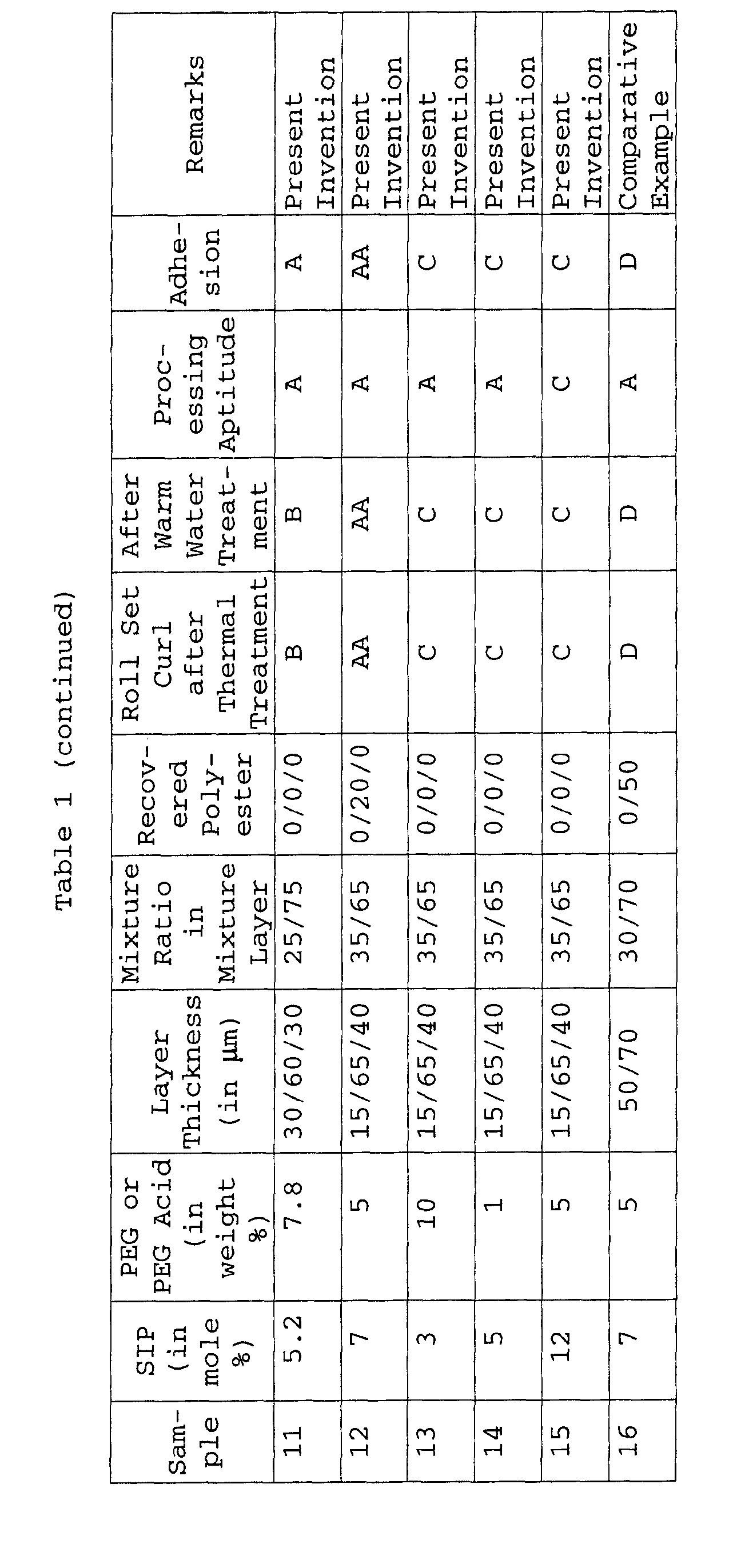
methods described below. Table 1 shows the results.
·Magnitude of roll set curl
| AA |
120 > magnitude of curl |
| A |
120 ≦ magnitude of curl ≦ 125 |
| B |
125 < magnitude of curl ≦ 130 |
| C |
130 < magnitude of curl ≦ 135 |
| D |
135 < magnitude of curl ≦ 140 |
| E |
140 < magnitude of curl |
For practical use, C or less magnitude of curl is
preferred.
·Degree of Recovered Curl after Warm Water Treatment
| AA |
25 > magnitude of curl |
| A |
25 ≦ magnitude of curl ≦ 30 |
| B |
30 < magnitude of curl ≦ 35 |
| C |
35 < magnitude of curl ≦ 40 |
| D |
40 < magnitude of curl ≦ 50 |
| E |
50 < magnitude of curl |
For practical use, C or less magnitude of curl is
preferred.
·Adhesion Properties
A support having a sample size of 35 mm x 1.2 m was
perforated at an ambience of 23 °C and 25 percent relative
humidity, employing a perforator (manufacture by Mitsutoyo
Seisakusho, Ltd.) in accordance with JIS K 7519-1982. The
perforated cross-section was observed employing an optical
microscope and the state of delamination between polyester
layers was evaluated based on the criteria described below.
For practical use, C or better grade is preferred.
| A | no delamination between polyester layers was observed |
| B | no delamination was observed, but fins were occasionally observed in the cross section |
| C | no delamination was visually observed, but was observed employing a microscope |
| D | delamination was visually observed. |
By employing the obtained photographic film,
photographic processing as well as printing operation was
carried out (NPS-808 manufactured by Konica Corp. was
employed), and generation of jamming (clogging) as well as
formation of abrasion marks of the film was observed. For
practical use, C or better grade is preferred.
| A | neither jamming nor abrasion resulted |
| B | no jamming resulted, but less than three very weak linear abrasion marks which did not affect prints resulted |
| C | no jamming resulted, but 3 to 10 very weak linear abrasion marks resulted |
| D | no jamming resulted, but readily noticeable abrasion marks resulted |
| E | jamming resulted. |
Sample 2 was prepared in the same manner as Sample 1,
except that the thickness of each layer was varied to 20
µm/80 µm/20 µm. Table 1 shows the results.
Sample 3 and 4 (Comparative Examples)
Sample 3 and 4 were prepared in the same manner as
Sample 1, except that each layer in Sample 3 was varied to 40
µm/40 µm/40 µm and in Sample 4 was varied to 15 µm/90 µm/15
µm. Table 1 shows the results. The interlayer thickness of
these samples is out of the range of the present invention.
Sample 5
Sample 5 was prepared in the same manner as Sample 1,
except that copolyester was prepared so that the
concentration of 5-sodiumsulfo-di(β-hydroxyethyl)isophthalic
acid was 7 mole percent with respect to the entire ester
bonding units and the concentration of polyethylene glycol
was 5 percent by weight with respect to the reaction
products; the weight ratio of copolyester/PET in the
interlayer was 35/65, and each layer thickness was varied to
15 µm/65 µm/40 µm. Table 1 shows the results.
Sample 6
Sample 6 was prepared so as to have a 5-layer
configuration of copolyester 15 µm/mixture layer 10 µm/homo
PET 45 µm/mixture layer 10 µm/copolyester 40 µm
(copolymerization components and ratio of the copolyester and
the mixing ratio in the mixture layer were the same as
Example 3). Table 1 shows the results.
Sample 7
Sample 7 was prepared in the same manner as Sample 5,
except that the weight ratio of copolyester/PET in the
interlayer was varied to 10/90. Table 1 shows the results.
Sample 8 (Comparative Example)
Sample 8 was prepared in the same manner as Sample 5,
except that the weight ratio of copolyester/PET in the
interlayer was varied to 45/55. Table 1 shows the results.
In Sample 8, the mixing ratio of the mixture layer was out of
the range of the present invention.
Sample 9
A preliminary sample was prepared in the same manner as
Sample 5, except that recovered polyester, which was obtained
by shredding the support of Sample 5, was added to the
interlayer in an amount of 20 percent by weight. Then Sample
9 was prepared in the same manner as Sample 5, except that
recovered polyester, which was obtained by shredding the
support of said preliminary sample, was added to the
interlayer in an amount of 20 percent by weight. Table 1
shows the results.
Sample 10
Sample 10 was prepared in such a manner that
copolyester was prepared so that the concentration of 5-sodiumsulfo-di(β-hydroxyethyl)isophthalic
acid was 8 mole
percent with respect to the entire ester bonding units and
the concentration of polyethylene glycol was 4 percent by
weight with respect to the reaction products; the weight
ratio of copolyester/PET in the interlayer was 20/80; each
layer thickness was 10 µm/60 µm/40 µm; and recovered
polyester obtained by shredding the support of Sample 5 was
added to each of both outer layers in an amount of 5 percent
by weight, and to the interlayer in an amount of 15 percent
by weight. Table 1 shows the results.
Samples 11 and 12
Samples 11 and 12 were prepared in the same manner as
Sample 10, except that polyethylene glycol as the
copolymerization component was replaced with polyethylene
oxycarboxylic acid (having a number average molecular weight
of 4,000). Table 1 shows the results.
Sample 13, 14, and 15
Samples 13, 14, and 15 were prepared in the same manner
as Sample 5, except that the copolymerization ratio (SIP and
PEG) was varied to values described in Table 1. Table 1
shows the results.
- SIP:
- 5-sodium-di(β-hydroxyethyl)isophthalic acid
- PEG:
- polyethylene glycol
- PEG Acid:
- polyethylene oxycarboxylic acid
As can clearly be seen from Table 1, the rolled light-sensitive
photographic materials (rolled silver halide light-sensitive
photographic materials in examples) of the present
invention resulted in almost no problems with the magnitude
of roll set curl after the thermal treatment and the
magnitude of recovered curl after the warm water treatment,
as well as with the practical processing aptitude and the
adhesion between layers.
By contrast, Sample 3 was on a problematic level with
the magnitude of curl after the thermal treatment, and Sample
4 resulted in some degradation of the magnitude of the
recovered curl and was on a problematic level with the
processing aptitude.
Further, Sample 7 was on an excellent level with a
magnitude of curl after the thermal treatment as well as with
the magnitude of recovered curl after the warm water
treatment, and was in the no problematic lower limit of the
adhesion between layers.
Further, Sample 8 resulted no problem with the adhesion
between layers, but resulted in some degradation of the
magnitude of recovered curl after the warm water treatment
and was on a problematic level with the processing aptitude.
Furthermore, Sample 9 resulted in the less magnitude of
roll set curl as well as the less magnitude of recovered curl
after the warm water treatment than Sample 5, and resulted in
the excellent processing aptitude as well as the excellent
adhesion between layers.
Samples 11 and 12 showed the same results as the case
in which polyethylene glycol was used.
Samples 13, 14, and 15 were in no problematic lower
limit of a magnitude of roll set curl after the thermal
treatment, a degree of recovered curl after the warm water
treatment, and the processing aptitude, and was on a no
problematic level with the adhesion between layers.
(Measurement of Melt Viscosity)
The melt viscosity of polyesters A and B of Sample 9
was measured under conditions of a temperature of 280 °C and
a shear rate of 500 sec-1, employing a method in accordance
with JIS K 7209-1991. The melt viscosity of polyester A was
210 Pas, while that of polyester B was 190 Pas. The melt
viscosity of the copolyester was 230 Pas, while that of the
mixture layer was 180 Pas. It is possible to cast these
samples without any problem and the resultant performance
causes no problem as described above.
(Other Physical Property Values of Supports)
Each physical property value of supports, which is
measured employing methods described above, will be shown.
·Sample 9
Magnitude of curl in warm water: 42
Magnitude of curl across the width: 13
Young's modulus: 380 kg/mm2
Young's modulus after immersion in water: 310 kg/mm2
Loop Stiffness: 18 g by weight
Thermal shrinking coefficient: 2.3 percent
It is found that values shown above are within the
desired range of those of physical properties of the present
invention and as described above, the performance results in
no problem.
According to the present invention, it is possible to
produce a support for rolled light-sensitive photographic
materials such as 120 type and 135 type without using
solvents. In addition, by adjusting the thickness of said
support from 105 to 130 µm, it is possible to employ rolled
light-sensitive photographic materials, employing said
support, in cameras designed for commonly used 135 and 120
films without resulting in focusing problems. Further even
in the range of the thickness of said support between 105 and
130 µm, the tendency of roll set curl is on a level which
results in no problem. The recovery properties from roll set
curl as well as the adhesion between layer are excellent so
that it is possible to use rolled light-sensitive
photographic materials, employing said support, in processors
and the like without resulting in any problem.