EP1121939A2 - Treatment of osteoporosis with EP2/EP4 receptor selective agonists - Google Patents
Treatment of osteoporosis with EP2/EP4 receptor selective agonists Download PDFInfo
- Publication number
- EP1121939A2 EP1121939A2 EP01300999A EP01300999A EP1121939A2 EP 1121939 A2 EP1121939 A2 EP 1121939A2 EP 01300999 A EP01300999 A EP 01300999A EP 01300999 A EP01300999 A EP 01300999A EP 1121939 A2 EP1121939 A2 EP 1121939A2
- Authority
- EP
- European Patent Office
- Prior art keywords
- alkylene
- independently
- optionally
- alkyl
- substituted
- Prior art date
- Legal status (The legal status is an assumption and is not a legal conclusion. Google has not performed a legal analysis and makes no representation as to the accuracy of the status listed.)
- Withdrawn
Links
Classifications
-
- A—HUMAN NECESSITIES
- A61—MEDICAL OR VETERINARY SCIENCE; HYGIENE
- A61K—PREPARATIONS FOR MEDICAL, DENTAL OR TOILETRY PURPOSES
- A61K45/00—Medicinal preparations containing active ingredients not provided for in groups A61K31/00 - A61K41/00
- A61K45/06—Mixtures of active ingredients without chemical characterisation, e.g. antiphlogistics and cardiaca
-
- A—HUMAN NECESSITIES
- A61—MEDICAL OR VETERINARY SCIENCE; HYGIENE
- A61K—PREPARATIONS FOR MEDICAL, DENTAL OR TOILETRY PURPOSES
- A61K31/00—Medicinal preparations containing organic active ingredients
- A61K31/33—Heterocyclic compounds
- A61K31/395—Heterocyclic compounds having nitrogen as a ring hetero atom, e.g. guanethidine or rifamycins
- A61K31/40—Heterocyclic compounds having nitrogen as a ring hetero atom, e.g. guanethidine or rifamycins having five-membered rings with one nitrogen as the only ring hetero atom, e.g. sulpiride, succinimide, tolmetin, buflomedil
- A61K31/4015—Heterocyclic compounds having nitrogen as a ring hetero atom, e.g. guanethidine or rifamycins having five-membered rings with one nitrogen as the only ring hetero atom, e.g. sulpiride, succinimide, tolmetin, buflomedil having oxo groups directly attached to the heterocyclic ring, e.g. piracetam, ethosuximide
-
- A—HUMAN NECESSITIES
- A61—MEDICAL OR VETERINARY SCIENCE; HYGIENE
- A61K—PREPARATIONS FOR MEDICAL, DENTAL OR TOILETRY PURPOSES
- A61K31/00—Medicinal preparations containing organic active ingredients
- A61K31/33—Heterocyclic compounds
- A61K31/395—Heterocyclic compounds having nitrogen as a ring hetero atom, e.g. guanethidine or rifamycins
- A61K31/41—Heterocyclic compounds having nitrogen as a ring hetero atom, e.g. guanethidine or rifamycins having five-membered rings with two or more ring hetero atoms, at least one of which being nitrogen, e.g. tetrazole
-
- A—HUMAN NECESSITIES
- A61—MEDICAL OR VETERINARY SCIENCE; HYGIENE
- A61P—SPECIFIC THERAPEUTIC ACTIVITY OF CHEMICAL COMPOUNDS OR MEDICINAL PREPARATIONS
- A61P19/00—Drugs for skeletal disorders
- A61P19/08—Drugs for skeletal disorders for bone diseases, e.g. rachitism, Paget's disease
-
- A—HUMAN NECESSITIES
- A61—MEDICAL OR VETERINARY SCIENCE; HYGIENE
- A61P—SPECIFIC THERAPEUTIC ACTIVITY OF CHEMICAL COMPOUNDS OR MEDICINAL PREPARATIONS
- A61P19/00—Drugs for skeletal disorders
- A61P19/08—Drugs for skeletal disorders for bone diseases, e.g. rachitism, Paget's disease
- A61P19/10—Drugs for skeletal disorders for bone diseases, e.g. rachitism, Paget's disease for osteoporosis
-
- A—HUMAN NECESSITIES
- A61—MEDICAL OR VETERINARY SCIENCE; HYGIENE
- A61P—SPECIFIC THERAPEUTIC ACTIVITY OF CHEMICAL COMPOUNDS OR MEDICINAL PREPARATIONS
- A61P43/00—Drugs for specific purposes, not provided for in groups A61P1/00-A61P41/00
Definitions
- Osteoporosis is a systemic skeletal disease, characterized by low bone mass and deterioration of bone tissue, with a consequent increase in bone fragility and susceptibility to fracture.
- the condition affects more than 25 million people and causes more than 1.3 million fractures each year, including 500,000 spine, 250,000 hip and 240,000 wrist fractures annually.
- Hip fractures are the most serious consequence of osteoporosis, with 5-20% of patients dying within one year, and over 50% of survivors being incapacitated.
- the first is the use of anti-resorptive compounds to reduce the resorption of bone tissue.
- Estrogen is an example of an anti-resorptive agent. It is known that estrogen reduces fractures. In addition, Black, et al. in EP 0605193A1 report that estrogen, particularly when taken orally, lowers plasma levels of LDL and raises those of the beneficial high density lipoproteins (HDL's). However, estrogen failed to restore bone back to young adult levels in the established osteoporotic skeleton. Furthermore, long-term estrogen therapy has been implicated in a variety of disorders including an increase in the risk of uterine cancer, endometrial cancer and possibly breast cancer, causing many women to avoid this treatment. The significant undesirable effects associated with estrogen therapy support the need to develop alternative therapies for osteoporosis that have the desirable effect on serum LDL but do not cause undesirable effects.
- a second type of pharmaceutical therapy for the treatment of osteoporosis is the use of anabolic agents to promote bone formation and increase bone mass. This class of agents is expected to restore bone to the established osteoporotic skeleton.
- U.S. pat. no. 4,112,236 discloses certain interphenylene 8-aza-9-dioxothia-11,12-secoprostaglandins for the treatment of patients with renal impairment.
- Certain prostagladin agonists are disclosed in GB 1478281, GB1479156 and U.S. pat. nos. 4,175,203; 4,055,596; 4,175,203; 3,987,091 and 3,991,106 as being useful as, for example, renal vasodilators.
- U.S. pat. no. 4,033,996 discloses certain 8-aza-9-oxo(and dioxo)-thia-11,12-secoprostaglandins which are useful as renal vasodilators, for the prevention of thrombus formation, to induce growth hormone release, and as regulators of the immune response.
- U.S. pat. no. 4,761,430 discloses certain arylbenzenesulfonamide compounds as lipid-lowering agents.
- U.S. pat. no. 4,443,477 discloses certain sulphonamidophenylcarboxylic acids as lipid lowering agents.
- U.S. pat. no. 4,386,031 discloses certain N-benzoyl- ⁇ -anilinoalkanecarboxylic acids as antiallergic agents, thrombotic aggregation inhibitors, antiinflammatory agents and lipid-lowering agents.
- Estrogens have been shown (Bolander et al., 38th Annual Meeting Orthopedic Research Society, 1992) to improve the quality of the healing of appendicular fractures. Therefore, estrogen replacement therapy might appear to be a method for the treatment of fracture repair.
- patient compliance with estrogen therapy is relatively poor due to its side effects, including the resumption of menses, mastodynia, an increased risk of uterine cancer, an increased perceived risk of breast cancer, and the concomitant use of progestins.
- men are likely to object to the use of estrogen treatment. The need exists for a therapy which would be beneficial to patients who have suffered debilitating bone fractures and which would increase patient compliance.
- osteoporosis therapies there are a variety of osteoporosis therapies, there is a continuing need and a continuing search in this field of art for alternative osteoporosis therapies.
- bone fracture healing therapies there is a need for bone fracture healing therapies.
- therapy which can promote bone re-growth into skeletal areas where defects exist such as defects caused or produced by, for example, tumors in bone.
- therapy which can promote bone re-growth into skeletal areas where bone grafts are indicated.
- This invention is directed to pharmaceutical compositions comprising an EP 2 receptor selective agonist, a prodrug thereof or a pharmaceutically acceptable salt of said EP 2 receptor selective agonist or of said prodrug, and an EP 4 receptor selective agonist, a prodrug thereof or a pharmaceutically acceptable salt of said EP 4 receptor selective agonist or of said prodrug. It is preferred that such pharmaceutical compositions additionally comprise a pharmaceutically acceptable vehicle, carrier or diluent.
- This invention is also directed to methods of treating a condition which presents with low bone mass in a mammal comprising administering to said mammal a pharmaceutical composition as described above.
- the composition is administered systemically.
- the composition is administered locally.
- Conditions which present with low bone mass include, but are not limited to, osteoporosis, osteoporotic fractures, bone defects, childhood idiopathic bone loss, alveolar bone loss, mandibular bone loss, bone fracture, osteotomy, bone loss associated with periodontitis and prosthetic ingrowth.
- This invention is also directed to methods of treating a condition which presents with low bone mass in a mammal comprising administering to said mammal a an EP 4 receptor selective agonist, a prodrug thereof or a pharmaceutically acceptable salt of said EP4 receptor selective agonist or of said prodrug, and an EP 2 receptor selective agonist, a prodrug thereof or a pharmaceutically acceptable salt of said EP 2 receptor selective agonist, or of said prodrug.
- This invention is also especially directed to methods wherein the the EP 4 receptor selective agonist, prodrug thereof or pharmaceutically acceptable salt of said EP4 receptor selective agonist or of said prodrug, and the EP 2 receptor selective agonist, prodrug thereof or pharmaceutically acceptable salt of said EP 2 receptor selective agonist or of said prodrug, are administered together.
- kits comprising:
- Said treatment is achieved by administering to said vertebrate, e.g., a mammal, suffering from "secondary osteoporosis," a "secondary osteoporosis” effective treating amount of a pharmaceutical composition comprising an EP 2 /EP 4 receptor selective agonist, a prodrug thereof or a pharmaceutically acceptable salt of said EP 2 /EP 4 receptor selective agonist or said prodrug or by administering to said vertebrate, e.g., mammal, a "secondary osteoporosis” treating effective amount of an EP 4 receptor selective agonist, a prodrug thereof or a pharmaceutically acceptable salt of said EP 4 receptor selective agonist or of said prodrug and an EP 2 receptor selective agonist, a prodrug thereof or a pharmaceutically acceptable salt of said EP 2 receptor selective agonist or of said prodrug.
- a pharmaceutical composition comprising an EP 2 /EP 4 receptor selective agonist, a prodrug thereof or a pharmaceutically acceptable salt of said EP 2 /EP 4 receptor selective agonist or said
- Yet another aspect of this invention is directed to methods for strengthening a bone graft, inducing vertebral synostosis, enhancing long bone extension, enhancing bone healing following facial reconstruction, maxillary reconstruction or mandibular reconstruction in a vertebrate, e.g., a mammal (including a human being), comprising administering to said vertebrate, e.g., a mammal which has undergone facial reconstruction, maxillary reconstruction or mandibular reconstruction, a bone enhancing amount of a pharmaceutical composition comprising an EP 2 /EP 4 receptor selective agonist, a prodrug thereof or a pharmaceutically acceptable salt of said EP 2 /EP 4 receptor selective agonist or said prodrug or by administering to said vertebrate, e.g., mammal, an EP 4 receptor selective agonist, a prodrug thereof or a pharmaceutically acceptable salt of said EP 4 receptor selective agonist or of said prodrug, and an EP 2 receptor selective agonist, a prodrug thereof or a pharmaceutically acceptable salt
- a preferred dosage is about 0.001 to 100 mg/kg/day of a Formula I compound, a prodrug thereof or a pharmaceutically acceptable salt of said compound or said prodrug.
- An especially preferred dosage is about 0.01 to 10 mg/kg/day of a Formula I compound, a prodrug thereof or a pharmaceutically acceptable salt of said compound or said prodrug.
- condition(s) which presents with low bone mass refers to a condition where the level of bone mass is below the age specific normal as defined in standards by the World Health Organization "Assessment of Fracture Risk and its Application to Screening for Postmenopausal Osteoporosis (1994). Report of a World Health Organization Study Group, World Health Organization Technical Series 843". Included in “condition(s) which presents with low bone mass” are primary and secondary osteoporosis. Secondary osteoporosis includes glucocorticoid-induced osteoporosis, hyperthyroidism-induced osteoporosis, immobilization-induced osteoporosis, heparin-induced osteoporosis and immunosuppressive-induced osteoporosis.
- condition(s) which presents with low bone mass also includes long term complications of osteoporosis such as curvature of the spine, loss of height and prosthetic surgery.
- the compounds and compositions of this invention may also be used in conjunction with orthopedic devices such as spinal fusion cages, spinal fusion hardware, internal and external bone fixation devices, screws and pins.
- bone mass actually refers to bone mass per unit area which is sometimes (although not strictly correctly) referred to as bone mineral density.
- treating includes preventative (e.g., prophylactic), palliative and curative treatment.
- pharmaceutically acceptable it is meant the carrier, vehicle, diluent, excipients, and/or salt must be compatible with the other ingredients of the formulation, and not deleterious to the recipient thereof.
- nontoxic cationic salts such as (but not limited to) sodium, potassium, calcium, magnesium, ammonium or protonated benzathine (N,N'-dibenzylethylenediamine), choline, ethanolamine, diethanolamine, ethylenediamine, meglamine (N-methyl-glucamine), benethamine (N-benzylphenethylamine), piperazine and tromethamine (2-amino-2-hydroxymethyl-1,3-propanediol).
- nontoxic cationic salts such as (but not limited to) sodium, potassium, calcium, magnesium, ammonium or protonated benzathine (N,N'-dibenzylethylenediamine), choline, ethanolamine, diethanolamine, ethylenediamine, meglamine (N-methyl-glucamine), benethamine (N-benzylphenethylamine), piperazine and tromethamine (2-amino-2-hydroxymethyl-1,3-propaned
- compositions, methods and kits of this invention result in bone formation resulting in decreased fracture rates.
- This invention makes a significant contribution to the art by providing compositions, methods and kits that increase bone formation resulting in prevention, retardation, and/or regression of osteoporosis and related bone disorders.
- a preferred subgroup of Formula IV compounds comprises those compounds selected from:
- the compounds of Formula I, the prodrugs thereof, and the pharmaceutically acceptable salts of the compounds and the prodrugs may be prepared according to the synthetic methodologies described in International Patent Application Publication No. WO 98/28264.
- the compounds of Formula II, the prodrugs thereof, and the pharmaceutically acceptable salts of the compounds and the prodrugs may be prepared according to the synthetic methodologies described in International Application Patent Publication No. WO 99/19300.
- EP 2 receptor selective agonists which may be used in the compositions, methods and kits of this invention include compounds of the formula and wherein the R is defined, and the compounds are prepared, as disclosed in U.S. Patent No. 5,698,598, which is incorporated herein by reference.
- EP 4 receptor selective agonist may be used as the EP 4 receptor selective agonist of this invention.
- Preferred EP 4 receptor selective agonists include compounds of Formula V: prodrugs thereof and pharmaceutically acceptable salts of said compounds or said prodrugs, wherein:
- anabolic bone agents in stimulating bone formation and increasing bone mass can be tested in intact male or female rats, sex hormone deficient male (orchidectomy) or female (ovariectomy) rats.
- Male or female rats at different ages can be used in the study.
- the rats are either intact or castrated (ovariectomized or orchidectomized), and subcutaneously injected or gavaged with prostaglandin agonists at different doses (such as 1, 3, or 10 mg/kg/day) for 30 days.
- prostaglandin agonists such as 1, 3, or 10 mg/kg/day
- treatment is started at the next day after surgery (for the purpose of preventing bone loss) or at the time bone loss has already occured (for the purpose of restoring bone mass).
- Cancellous bone histomorphometry A Bioquant OS/2 histomorphometry system (R&M Biometrics, Inc., Arlington, TN) is used for the static and dynamic histomorphometric measurements of the secondary spongiosa of the proximal tibial metaphyses between 1.2 and 3.6 mm distal to the growth plate-epiphyseal junction. The first 1.2 mm of the tibial metaphyseal region needs to be omitted in order to restrict measurements to the secondary spongiosa. The 4 ⁇ m sections are used to determine indices related to bone volume, bone structure, and bone resorption, while the 10 ⁇ m sections are used to determine indices related to bone formation and bone turnover.
- TBT Trabecular bone thickness
- TBS Trabecular bone separation
- Osteoclast number OCN, BS: total number of osteoclast within total metaphyseal area.
- Osteoclast perimeter OCP, mm: length of trabecular perimeter covered by osteoclast.
- Osteoclast number/mm OCN / BS.
- Percent osteoclast perimeter %OCP, %): OCP /BS x 100.
- Cortical bone histomorphometry A Bioquant OS/2 histomorphometry system (R&M Biometrics, Inc., Arlington, TN) is used for the static and dynamic histomorphometric measurements of tibial shaft cortical bone.
- Total tissue area, marrow cavity area, periosteal perimeter, endocortical perimeter, single labeled perimeter, double labeled perimeter, and interlabeled width on both periosteal and endocortical surface are measured, and cortical bone area (total tissue area - marrow cavity area), percent cortical bone area (cortical area / total tissue area x 100), percent marrow area (marrow cavity area / total tissue area x 100), periosteal and endocortical percent labeled perimeter [(single labeled perimeter/2+double labeled perimeter) / total perimeter x 100], mineral apposition rate (interlabeled width/intervals), and bone formation rate [mineral apposition rate x [(s
- Transfectants demonstrating high levels of specific [ 3 H]PGE 2 binding are further characterized by Scatchard analysis to determine Bmax and Kds for PGE 2 .
- Constituitive expression of both receptors in parental 293-S cells is negligible.
- Cells are maintained in RPMI supplemented with fetal bovine serum (10% final) and G418 (700 ug/ml final).
- cAMP concentrations are determined using a commercially available cAMP radioimmunoassay kit RIA (NEK-033, DuPont/NEN Research Products, 549 Albany St., Boston, MA 02118) after diluting cleared lysates 1:10 in cAMP RIA assay buffer (included in kit). Typically, one treats cells with 6-8 concentrations of the compound to be tested in 1 log increments. EC50 calculations are performed on a calculator using linear regression analysis on the linear portion of the dose response curves.
- Transfected cells expressing prostaglandin E 2 type 1 receptors are harvested and suspended to 2 million cells per ml in Buffer A [50 mM Tris-HCI (pH 7.4), 10 mM MgCl 2 , 1 mM EDTA, 1 mM Pefabloc peptide, (Boehringer Mannheim Corp., Indianapolis, IN), 10 uM Phosporamidon peptide, (Sigma, St. Louis, MO), 1 uM pepstatin A peptide, (Sigma, St.
- the cells are lysed by sonification with a Branson Sonifier (Model #250, Branson Ultrasonics Corporation, Danbury, CT) in 2 fifteen second bursts. Unlysed cells and debris are removed by centrifugation at 100 x g for 10 min. Membranes are then harvested by centrifugation at 45,000 x g for 30 minutes. Pelleted membranes are resuspended to 3-10 mg protein per ml, protein concentration being determined of the method of Bradford [Bradford, M., Anal. Biochem., 72, 248 (1976)]. Resuspended membranes are then stored frozen at -80 °C until use.
- 293S cells (Mayo, Dept. of Biochemistry, Northwestern Univ.) are transfected with the cloned receptor in pcDNA3 by electroporation. Stable cell lines expressing the receptor are established following selection of transfected cells with G418.
- Sirius red stained sections are used to demonstrate the characterisitics of the callus structure and to differentiate between woven bone and lamellar bone at the fracture site. The following measurements are performed: (1) fracture gap - measured as the shortest distance between the cortical bone ends in the fracture, (2) callus length and callus diameter, (3) total bone volume area of callus, (4) bony tissue per tissue area inside the callus area, (5) fibrous tissue in the callus, and (6) cartilage area in the callus.
- the rats are sacrificed under ketamine anesthesia.
- the following endpoints are determined:
- an amount of a composition or combination of an EP 2 receptor selective agonist and EP 4 receptor selecgive agonist of this invention is used that is sufficient to augment bone mass to a level which is above the bone fracture threshold (as detailed in the World Health Organization Study previously cited herein).
- compositions of a similar type are also employed as fillers in soft and hard-filled gelatin capsules; preferred materials in this connection also include lactose or milk sugar as well as high molecular weight polyethylene glycols.
- preferred materials in this connection also include lactose or milk sugar as well as high molecular weight polyethylene glycols.
- the compositions of this invention can be combined with various sweetening agents, flavoring agents, coloring agents, emulsifying agents and/or suspending agents, as well as such diluents as water, ethanol, propylene glycol, glycerin and various like combinations thereof.
- Prostaglandin E2 restores bone mass by stimulating both bone formation and bone resorption but in favor of bone formation in ovariectomized (OVX) rat skeleton.
- the purpose of this study was to determine the skeletal effects of combination of 7-(2-(3,5--dichloro-phenoxy)-ethyl)-methanesulfonyl-amino)-heptanoic acid, an EP 2 prostaglandin receptor selective agonist (IC50 for EP 2 receptor binding equals 17 nM), and 7-(2-(3-hydroxy-4-phenyl-butyl)-5-oxo-pyrrolidin-1-yl)-heptanoic acid, an EP 4 prostaglandin receptor selective agonist (IC50 for EP 4 receptor binding equals 36 nM) in osteopenic, OVX rats.
- OVX rats were treated (subcutaneous injection) with either vehicle or combination of 7-(2-(3,5--dichloro-phenoxy)-ethyl)-methanesulfonyl-amino)-heptanoic acid (10 mg/kg/day, s.c. injection) and 7-(2-(3-hydroxy-4-phenyl-butyl)-5-oxo-pyrrolidin-1-yl)-heptanoic acid (10 mg/kg/day, s.c. injection) for 4 weeks.
Landscapes
- Health & Medical Sciences (AREA)
- Animal Behavior & Ethology (AREA)
- Chemical & Material Sciences (AREA)
- Veterinary Medicine (AREA)
- Medicinal Chemistry (AREA)
- Public Health (AREA)
- General Health & Medical Sciences (AREA)
- Pharmacology & Pharmacy (AREA)
- Life Sciences & Earth Sciences (AREA)
- Epidemiology (AREA)
- Physical Education & Sports Medicine (AREA)
- General Chemical & Material Sciences (AREA)
- Organic Chemistry (AREA)
- Nuclear Medicine, Radiotherapy & Molecular Imaging (AREA)
- Engineering & Computer Science (AREA)
- Orthopedic Medicine & Surgery (AREA)
- Chemical Kinetics & Catalysis (AREA)
- Rheumatology (AREA)
- Bioinformatics & Cheminformatics (AREA)
- Pharmaceuticals Containing Other Organic And Inorganic Compounds (AREA)
- Medicines That Contain Protein Lipid Enzymes And Other Medicines (AREA)
- Acyclic And Carbocyclic Compounds In Medicinal Compositions (AREA)
Abstract
Description

-(C2-C6)alkylene-W-(C1-C3)alkylene-,
-(C3-C8)alkylene-, said -(C3-C8)alkylene- optionally substituted with up to four substituents independently selected from fluoro or (C1-C4)alkyl,
-X-(C1-C5)alkylene-,
-(C1-C5)alkylene-X-,
-(C1-C3)alkylene-X-(C1-C3)alkylene-,
-(C2-C4)alkylene-W-X-(C0-C3)alkylene-,
-(C0-C4)alkylene-X-W-(C1-C3)alkylene-,
-(C2-C5)alkylene-W-X-W-(C1-C3)alkylene-, wherein the two occurrences of W are independent of each other,
-(C1-C4)alkylene-ethenylene-(C1-C4)alkylene-,
-(C1-C4)alkylene-ethenylene-(C0-C2)alkylene-X-(C0-C5)alkylene-,
-(C1-C4)alkylene-ethenylene-(C0-C2)alkylene-X-W-(C1-C3)alkylene-,
-(C1-C4)alkylene-ethynylene-(C1-C4)alkylene-, or
-(C1-C4)alkylene-ethynylene-X-(C0-C3)alkylene-;
W is oxy, thio, sulfino, sulfonyl, aminosulfonyl-, -mono-N-(C,-C4)alkyleneaminosulfonyl-, sulfonylamino, N-(C1-C4)alkylenesulfonylamino, carboxamido, N-(C1-C4)alkylenecarboxamido, carboxamidooxy, N-(C1-C4)alkylenecarboxamidooxy, carbamoyl, -mono-N-(C1-C4)alkylenecarbamoyl, carbamoyloxy, or -mono-N-(C1-C4)alkylenecarbamoyloxy, wherein said W alkyl groups are optionally substituted on carbon with one to three fluorines;

-(C2-C6)alkylene-W-(C1-C3)alkylene-, said alkylenes each optionally substituted with up to four substituents independently selected from fluoro or (C1-C4)alkyl,
-(C4-C8)alkylene-, said alkylene optionally substituted with up to four substituents independently selected from fluoro or (C1-C4)alkyl,
-X-(C1-C5)alkylene-, said alkylene optionally substituted with up to four substituents independently selected from fluoro or (C1-C4)alkyl,
-(C1-C5)alkylene-X-, said alkylene optionally substituted with up to four substituents independently selected from fluoro or (C1-C4)alkyl,
-(C1-C3)alkylene-X-(C1-C3)alkylene-, said alkylenes each optionally substituted with up to four substituents independently selected from fluoro or (C1-C4)alkyl,
-(C2-C4)alkylene-W-X-(C0-C3)alkylene-, said alkylenes each optionally substituted with up to four substituents each independently selected from fluoro or (C1-C4)alkyl,
-(C0-C4)alkylene-X-W-(C1-C3)alkylene-, said alkylenes each optionally substituted with up to four substituents each independently selected from fluoro or (C1-C4)alkyl,
-(C2-C5)alkylene-W-X-W-(C1-C3)alkylene-, wherein the two occurrences of W are independent of each other, said alkylenes each optionally substituted with up to four substituents each independently selected from fluoro or (C1-C4)alkyl,
-(C1-C4)alkylene-ethenylene-(C1-C4)alkylene-, said alkylenes and said ethenylene each optionally substituted with up to four substituents each independently selected from fluoro or (C1-C4)alkyl,
-(C1-C4)alkylene-ethenylene-(C0-C2)alkylene-X-(C0-C5)alkylene-, said alkylenes and said ethenylene each optionally substituted with up to four substituents each independently selected from fluoro or (C1-C4)alkyl,
-(C1-C4)alkylene-ethenylene-(C0-C2)alkylene-X-W-(C1-C3)alkylene-, said alkylenes and said ethenylene each optionally substituted with up to four substituents each independently selected from fluoro or (C1-C4)alkyl,
-(C1-C4)alkylene-ethynylene-(C1-C4)alkylene-, said alkylenes and said ethynylene each optionally substituted with up to four substituents each independently selected from fluoro or (C1-C4)alkyl, or
-(C1-C4)alkylene-ethynylene-X-(C0-C3)alkylene-, said alkylenes and said ethynylene each optionally substituted with up to four substituents each independently selected from fluoro or (C1-C4)alkyl;
Z is carboxyl, (C1-C6)alkoxycarbonyl, tetrazolyl, 1,2,4-oxadiazolyl, 5-oxo-1,2,4-oxadiazolyl, 5-oxo-1,2,4-thiadiazolyl, (C1-C4)alkylsulfonylcarbamoyl or phenylsulfonylcarbamoyl;
K is a bond, (C1-C9)alkylene, thio(C1-C4)alkylene, (C1-C4)alkylenethio(C1-C4)alkylene, (C1-C4)alkyleneoxy(C1-C4)alkylene or oxy(C1-C4)alkylene, said (C1-C9)alkylene optionally mono-unsaturated and wherein, when K is not a bond, K is optionally mono-, di- or tri-substituted independently with chloro, fluoro, hydroxy or methyl;
M is -Ar3, -Ar4-V1-Ar5, -Ar4-S-Ar5, -Ar4-SO-Ar5, -Ar4-SO2-Ar5 or -Ar4-O-Ar5;






Claims (8)
- The use of an EP2 receptor selective agonist, prodrug or pharmaceutically acceptable salt thereof in the preparation of a medicament in combination with an EP4 receptor selective agonist, prodrug or a pharmaceutically acceptable salt thereof, for the treatment of a condition which presents with low bone mass in mammals.
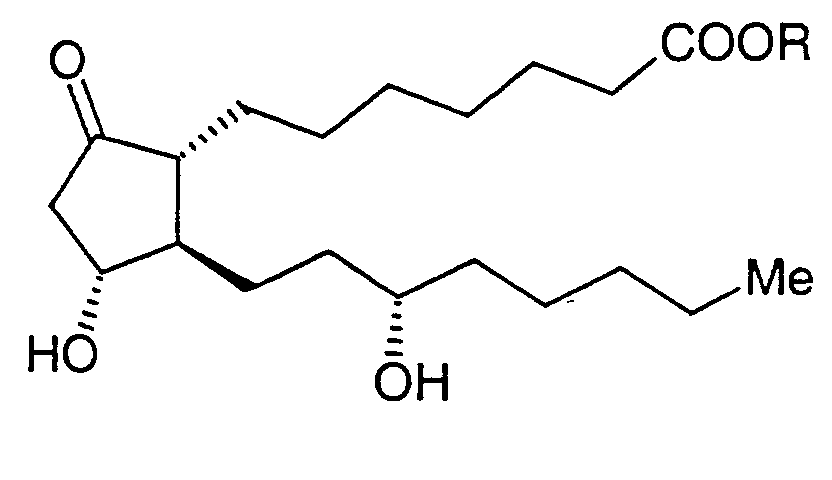
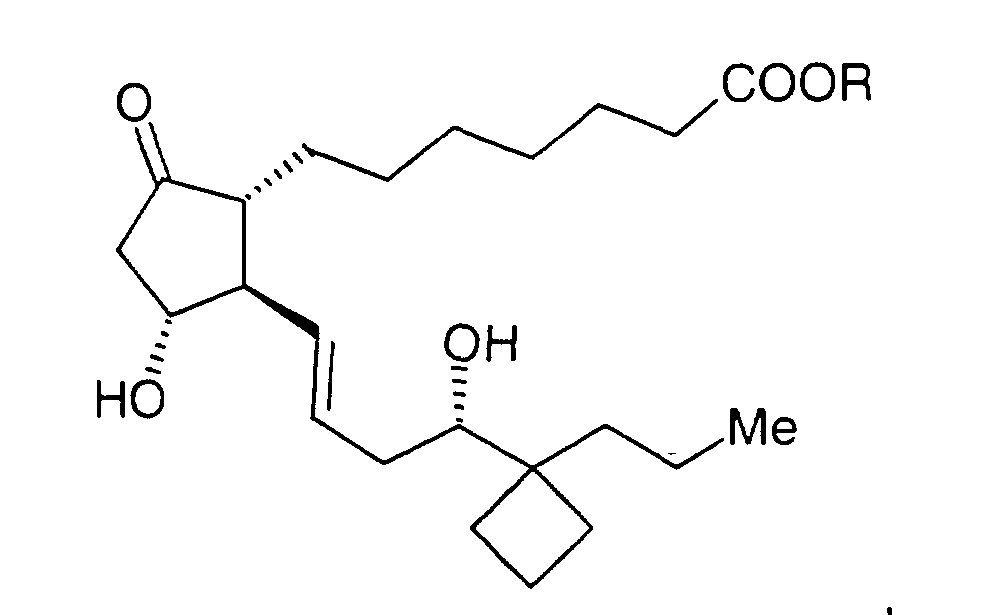
- The use as claimed in claims 1 wherein said EP2 receptor selective agonist is selected from:prodrugs thereof, and the pharmaceutically acceptable salts of the compounds and the prodrugs, wherein:
 B is N;A is (C1-C6)alkylsulfonyl, (C3-C7)cycloalkylsulfonyl, (C3-C7)cycloalkyl(C1-C6)alkylsulfonyl, said A moieties optionally mono-, di- or tri- substituted on carbon independently with hydroxy, (C1-C4)alkyl or halo;Q is
-(C2-C6)alkylene-W-(C1-C3)alkylene-,
-(C3-C8)alkylene-, said -(C3-C8)alkylene- optionally substituted with up to four substituents independently selected from fluoro or (C1-C4)alkyl,
-X-(C1-C5)alkylene-,
-(C1-C5)alkylene-X-,
-(C1-C3)alkylene-X-(C1-C3)alkylene-,
-(C2-C4)alkylene-W-X-(C0-C3)alkylene-,
-(C0-C4)alkylene-X-W-(C1-C3)alkylene-,
-(C2-C5)alkylene-W-X-W-(C1-C3)alkylene-, wherein the two occurrences of W are independent of each other,
-(C1-C4)alkylene-ethenylene-(C1-C4)alkylene-,
-(C1-C4)alkylene-ethenylene-(C0-C2)alkylene-X-(C0-C5)alkylene-,
-(C1-C4)alkylene-ethenylene-(C0-C2)alkylene-X-W-(C1-C3)alkylene-,
-(C1-C4)alkylene-ethynylene-(C1-C4)alkylene-, or
-C1-C4)alkylene-ethynylene-X-(C0-C3)alkylene-;W is oxy, thio, sulfino, sulfonyl, aminosufonyl-, -mono-N-(C1-C4)alkyleneaminosulfonyl-, sulfonylamino, N-(C1-C4)alkylenesulfonylamino, carboxamido, N-(C1-C4)alkylenecarboxamido, carboxamidooxy, N-(C1-C4)alkylenecarboxamidooxy, carbamoyl, -mono-N-(C1-C4)alkylenecarbamoyl, carbamoyloxy, or -mono-N-(C1-C4)alkylenecarbamoyloxy, wherein said W alkyl groups are optionally substituted on carbon with one to three fluorines;X is a five- or six-membered aromatic ring optionally having one or two heteroatoms selected independently from oxygen, nitrogen, and sulfur; said ring optionally mono-, or di-substituted independently with halo, (C1-C3)alkyl, trifluoromethyl, trifluoromethyloxy, difluoromethyloxy, hydroxyl, (C1-C4)alkoxy, or carbamoyl;Z is carboxyl, (C1-C6)alkoxycarbonyl, tetrazolyl, 1,2,4-oxadiazolyl, 5-oxo-1,2,4-oxadiazolyl, (C1-C4)alkylsulfonylcarbamoyl or phenylsulfonylcarbamoyl;K is a bond, (C1-C8)alkylene, thio(C1-C4)alkylene or oxy(C1-C4)alkylene, said (C1-C8)alkylene optionally mono-unsaturated and wherein K is optionally mono-, di- or tri-substituted independently with fluoro, methyl or chloro;M is -Ar, -Ar1-V-Ar2, -Ar1-S-Ar2 or -Ar1-O-Ar2 wherein Ar, Ar1 and Ar2 are each independently a partially saturated, fully saturated or fully unsaturated five- to eight-membered ring optionally having one to four heteroatoms selected independently from oxygen, sulfur and nitrogen, or, a bicyclic ring consisting of two fused partially saturated, fully saturated or fully unsaturated five- or six-membered rings, taken independently, optionally having one to four heteroatoms selected independently from nitrogen, sulfur and oxygen;said Ar, Ar1 and Ar2 moieties optionally substituted, on one ring if the moiety is monocyclic, or one or both rings if the moiety is bicyclic, on carbon with up to three substituents independently selected from R1, R2 and R3 wherein R1, R2 and R3 are hydroxy, nitro, halo, (C1-C6)alkoxy, (C1-C4)alkoxy(C1-C4)alkyl, (C1-C4)alkoxycarbonyl, (C1-C7)alkyl, (C3-C7)cycloalkyl, (C3-C7)cycloalkyl(C1-C4)alkyl, (C3-C7)cycloalkyl(C1-C4)alkanoyl, formyl, (C1-C8)alkanoyl, (C1-C6)alkanoyl(C1-C6)alkyl, (C1-C4)alkanoylamino, (C1-C4)alkoxycarbonylamino, sulfonamido, (C1-C4)alkylsulfonamido, amino, mono-N- or di-N,N-(C1-C4)alkylamino, carbamoyl, mono-N- or di-N,N-(C1-C4)alkylcarbamoyl, cyano, thiol, (C1-C6)alkylthio, (C1-C6)alkylsulfinyl, (C1-C4)alkylsulfonyl or mono-N- or di-N,N-(C1-C4)alkylaminosulfinyl;R1, R2 and R3 are optionally mono-, di- or tri-substituted on carbon independently with halo or hydroxy; andV is a bond or (C1-C3)alkylene optionally mono- or di-substituted independently with hydroxy or fluoro;and said EP4 receptor selective agonist is selected from compounds of Formula V:(ii) compounds of Formula IIprodrugs thereof, and the pharmaceutically acceptable salts of the compounds and the prodrugs, wherein: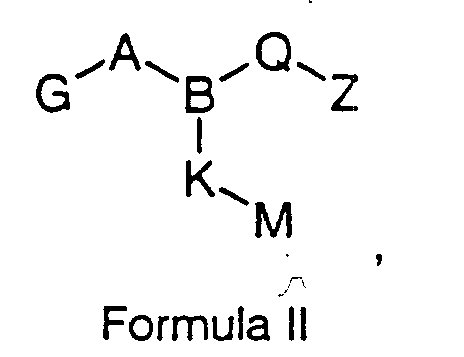 A is SO2 or CO;G is Ar, Ar1-V-Ar2, Ar-(C1-C6)alkylene, Ar-CONH-(C1-C6)alkylene, R1R2-amino, oxy(C1-C6)alkylene, amino substituted with Ar, or amino substituted with Ar(C1-C4)alkylene and R11, wherein R11 is H or (C1-C8)alkyl, R1 and R2 may be taken separately and are independently selected from H and (C1-C8)alkyl, or R1 and R2 are taken together with the nitrogen atom of the amino group to form a five- or six-membered azacycloalkyl, said azacycloalkyl optionally containing an oxygen atom and optionally mono-, di- or tri-substituted independently with up to two oxo, hydroxy, (C1-C4)alkyl, fluoro or chloro;B is N or CH;Q is
-(C2-C6)alkylene-W-(C1-C3)alkylene-, said alkylenes each optionally substituted with up to four substituents independently selected from fluoro or (C1-C4)alkyl,
-(C4-C8)alkylene-, said alkylene optionally substituted with up to four substituents independently selected from fluoro or (C1-C4)alkyl,
-X-(C1-C5)alkylene-, said alkylene optionally substituted with up to four substituents independently selected from fluoro or (C1-C4)alkyl,
-(C1-C5)alkylene-X-, said alkylene optionally substituted with up to four substituents independently selected from fluoro or (C1-C4)alkyl,
-(C1-C3)alkylene-X-(C1-C3)alkylene-, said alkylenes each optionally substituted with up to four substituents independently selected from fluoro or (C1-C4)alkyl,
-(C2-C4)alkylene-W-X-(C0-C3)alkylene-, said alkylenes each optionally substituted with up to four substituents each independently selected from fluoro or (C1-C4)alkyl,
-(C0-C4)alkylene-X-W-(C1-C3)alkylene-, said alkylenes each optionally substituted with up to four substituents each independently selected from fluoro or (C1-C4)alkyl,
-(C2-C5)alkylene-W-X-W-(C1-C3)alkylene-, wherein the two occurrences of W are independent of each other, said alkylenes each optionally substituted with up to four substituents each independently selected from fluoro or (C1-C4)alkyl,
-(C1-C4)alkylene-ethenylene-(C1-C4)alkylene-, said alkylenes and said ethenylene each optionally substituted with up to four substituents each independently selected from fluoro or (C1-C4)alkyl,
-(C1-C4)alkylene-ethenylene-(C0-C2)alkylene-X-(C0-C5)alkylene-, said alkylenes and said ethenylene each optionally substituted with up to four substituents each independently selected from fluoro or (C1-C4)alkyl,
-(C1-C4)alkylene-ethenylene-(C0-C2)alkylene-X-W-(C1-C3)alkylene-, said alkylenes and said ethenylene each optionally substituted with up to four substituents each independently selected from fluoro or (C1-C4)alkyl,
-(C1-C4)alkylene-ethynylene-(C1-C4)alkylene-, said alkylenes and said ethynylene each optionally substituted with up to four substituents each independently selected from fluoro or (C1-C4)alkyl, or
-(C1-C4)alkylene-ethynylene-X-(C0-C3)alkylene-, said alkylenes and said ethynylene each optionally substituted with up to four substituents each independently selected from fluoro or (C1-C4)alkyl;Z is carboxyl, (C1-C6)alkoxycarbonyl, tetrazolyl, 1,2,4-oxadiazolyl, 5-oxo-1,2,4-oxadiazolyl, 5-oxo-1,2,4-thiadiazolyl, (C1-C4)alkylsulfonylcarbamoyl or phenylsulfonylcarbamoyl;K is a bond, (C1-C9)alkylene, thio(C1-C4)alkylene, (C1-C4)alkylenethio(C1-C4)alkylene, (C1-C4)alkyleneoxy(C1-C4)alkylene or oxy(C1-C4)alkylene, said (C1-C9)alkylene optionally mono-unsaturated and wherein, when K is not a bond, K is optionally mono-, di- or tri-substituted independently with chloro, fluoro, hydroxy or methyl;M is -Ar3, -Ar4-V1-Ar5, -Ar4-S-Ar5, -Ar4-SO-Ar5, -Ar4-SO2-Ar5 or -Ar4-O-Ar5;Ar is a partially saturated or fully unsaturated five- to eight-membered ring optionally having one to four heteroatoms selected independently from oxygen, sulfur and nitrogen, or a bicyclic ring consisting of two fused independently partially saturated, fully saturated or fully unsaturated five- or six-membered rings, taken independently, optionally having one to four heteroatoms selected independently from nitrogen, sulfur and oxygen, or a tricyclic ring consisting of three fused independently partially saturated, fully saturated or fully unsaturated five- or six-membered rings, taken independently, optionally having one to four heteroatoms selected independently from nitrogen, sulfur and oxygen, said partially or fully saturated ring, bicyclic ring or tricyclic ring optionally having one or two oxo groups substituted on carbon or one or two oxo groups substituted on sulfur; or Ar is a fully saturated five-to seven-membered ring having one or two heteroatoms selected independently from oxygen, sulfur and nitrogen;Ar1 and Ar2 are each independently a partially saturated, fully saturated or fully unsaturated five- to eight-membered ring optionally having one to four heteroatoms selected independently from oxygen, sulfur and nitrogen, or a bicyclic ring consisting of two fused independently partially saturated, fully saturated or fully unsaturated five-or six-membered rings, taken independently, optionally having one to four heteroatoms selected independently from nitrogen, sulfur and oxygen, or a tricyclic ring consisting of three fused independently partially saturated, fully saturated or fully unsaturated five- or six-membered rings, optionally having one to four heteroatoms selected independently from nitrogen, sulfur and oxygen, said partially or fully saturated ring, bicyclic ring or tricyclic ring optionally having one or two oxo groups substituted on carbon or one or two oxo groups substituted on sulfur;said Ar, Ar1 and Ar2 moieties are optionally substituted on carbon or nitrogen, on one ring if the moiety is monocyclic, on one or both rings if the moiety is bicyclic, or on one, two or three rings if the moiety is tricyclic, with up to three substituents per moiety independently selected from R3, R4 and R5 wherein R3, R4 and R5 are independently hydroxy, nitro, halo, carboxy, (C1-C7)alkoxy, (C1-C4)alkoxy(C1-C4)alkyl, (C1-C4)alkoxycarbonyl, (C1-C7)alkyl, (C2-C7)alkenyl, (C2-C7)alkynyl, (C3-C7)cycloalkyl, (C3-C7)cycloalkyl(C1-C4)alkyl, (C3-C7)cycloalkyl(C1-C4)alkanoyl, formyl, (C1-C8)alkanoyl, (C1-C6)alkanoyl(C1-C6)alkyl, (C1-C4)alkanoylamino, (C1-C4)alkoxycarbonylamino, hydroxysulfonyl, aminocarbonylamino or mono-N-, di-N,N-, di-N,N'- or tri-N,N,N'-(C1-C4)alkyl substituted aminocarbonylamino, sulfonamido, (C1-C4)alkylsulfonamido, amino, mono-N- or di-N,N-(C1-C4)alkylamino, carbamoyl, mono-N- or di-N,N-(C1-C4)alkylcarbamoyl, cyano, thiol, (C1-C6)alkylthio, (C1-C6)alkylsulfinyl, (C1-C4)alkylsulfonyl or mono-N- or di-N,N-(C1-C4)alkylaminosulfinyl;Ar3, Ar4 and Ar5 are each independently a partially saturated, fully saturated or fully unsaturated five- to eight-membered ring optionally having one to four heteroatoms selected independently from oxygen, sulfur and nitrogen, or a bicyclic ring consisting of two fused independently partially saturated, fully saturated or fully unsaturated five- or six-membered rings, taken independently, optionally having one to four heteroatoms selected independently from nitrogen, sulfur and oxygen, or a tricyclic ring consisting of three fused independently partially saturated, fully saturated or fully unsaturated five- or six-membered rings, optionally having one to four heteroatoms selected independently from nitrogen, sulfur and oxygen, said partially or fully saturated ring, bicyclic ring or tricyclic ring optionally having one or two oxo groups substituted on carbon or one or two oxo groups substituted on sulfur; said Ar3, Ar4 and Ar5 moieties are optionally substituted on carbon or nitrogen, on one ring if the moiety is monocyclic, on one or both rings if the moiety is bicyclic, or on one, two or three rings if the moiety is tricyclic, with up to three substituents per moiety independently selected from R31, R41 and R51 wherein R31, R41 and R51 are independently hydroxy, nitro, halo, carboxy, (C1-C7)alkoxy, (C1-C4)alkoxy(C1-C4)alkyl, (C1-C4)alkoxycarbonyl, (C1-C7)alkyl, (C2-C7)alkenyl, (C2-C7)alkynyl, (C3-C7)cycloalkyl, (C3-C7)cycloalkyl(C1-C4)alkyl, (C3-C7)cycloalkyl(C1-C4)alkanoyl, formyl, (C1-C8)alkanoyl, (C1-C6)alkanoyl(C1-C6)alkyl, (C1-C4)alkanoylamino, (C1-C4)aikoxycarbonyiamino, hydroxysulfonyl, aminocarbonylamino or mono-N-, di-N,N-, di-N,N'-or tri-N,N,N'-(C1-C4)alkyl substituted aminocarbonylamino, sulfonamido, (C1-C4)alkylsulfonamido, amino, mono-N- or di-N,N-(C1-C4)alkylamino, carbamoyl, mono-N- or di-N,N-(C1-C4)alkylcarbamoyl, cyano, thiol, (C1-C6)alkylthio, (C1-C6)alkylsulfinyl, (C1-C4)alkylsulfonyl or mono-N- or di-N,N-(C1-C4)alkylaminosulfinyl;W is oxy, thio, sulfino, sulfonyl, aminosulfonyl-, -mono-N-(C1-C4)alkyleneaminosulfonyl-, sulfonylamino, N-(C1-C4)alkylenesulfonylamino, carboxamido, N-(C1-C4)alkylenecarboxamido, carboxamidooxy, N-(C1-C4)alkylenecarboxamidooxy, carbamoyl, -mono-N-(C1-C4)alkylenecarbamoyl, carbamoyloxy, or -mono-N-(C1-C4)alkylenecarbamoyloxy, wherein said W alkyl groups are optionally substituted on carbon with one to three fluorines;X is a five- or six-membered aromatic ring optionally having one or two heteroatoms selected independently from oxygen, nitrogen, and sulfur; said ring optionally mono-, di- or tri-substituted independently with halo, (C1-C3)alkyl, trifluoromethyl, trifluoromethoxy, difluoromethoxy, hydroxyl, (C1-C4)alkoxy, or carbamoyl;R1, R2, R3, R4 R5, R11, R31, R41 and R51, when containing an alkyl, alkylene, alkenylene or alkynylene moiety, are optionally mono-, di- or tri-substituted on carbon independently with halo or hydroxy; andV and V1 are each independently a bond, thio(C1-C4)alkylene, (C1-C4)alkylenethio, (C1-C4)alkyleneoxy, oxy(C1-C4)alkylene or (C1-C3)alkylene optionally mono- or di-substituted independently with hydroxy or fluoro;(iii) compounds of Formula IIIprodrugs thereof, and the pharmaceutically acceptable salts of the compounds and the prodrugs, wherein: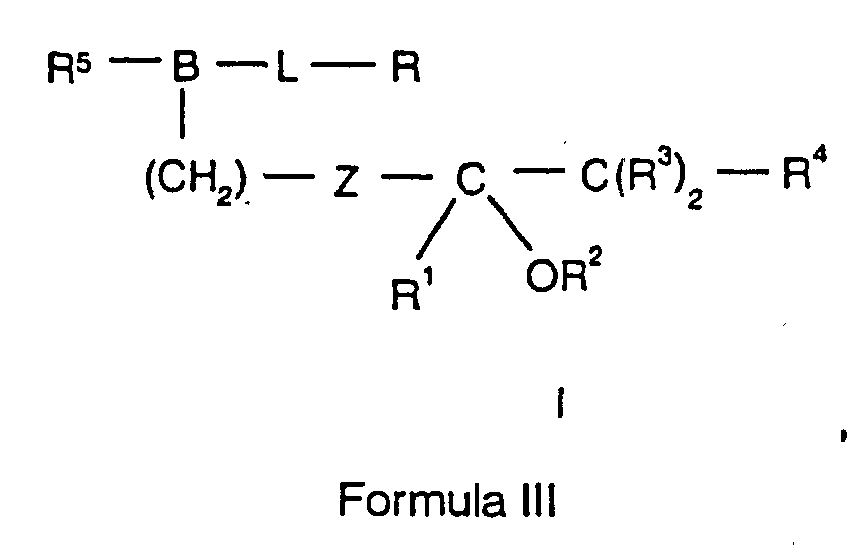 B is N or C(Q1), where Q1 is H or (C1-C3)alkyl;L is n-propylenyl-X- or CH2-metaphenylene-CH2, wherein X is furanyl, thienyl, thiazolyl or tetrahydrofuranyl, said CH2-metaphenylene-CH2 or X being optionally mono-, di- or tri-substituted on aromatic carbon independently with one to three chloro, fluoro, methoxy, difluoromethoxy, trifluoromethoxy, trifluoromethyl or methyl;R is carboxyl, (C1-C6)alkoxycarbonyl, tetrazolyl, 5-oxo-1,2,4-thiadiazolyl; 5-oxo-1,2,4-oxadiazolyl, (C1-C4)alkylsulfonylcarbamoyl or phenylsulfonylcarbamoyl;R1 is H, methyl, ethyl or propyl;R2 is H or (C2 - C5) alkanoyl;R3 is independently H, fluoro or methyl;R4 is H, (C1 - C7) alkyl, or R4 and R1 are taken together to form a 5-9 membered carbocyclic ring, said alkyl being optionally monounsaturated and optionally mono-, di- or tri-substituted independently with one to three fluoro, chloro, methoxy, difluoromethoxy, trifluoromethoxy, trifluoromethyl or methyl;R5 is (C1-C6)alkylsulfonyl, (C3-C7)cycloalkylsulfonyl, (C3-C7)cycloalkyl(C1-C6)alkylsulfonyl, (C1-C6)alkylcarbonyl, (C3-C7)cycloalkylcarbonyl, (C3-C7)cycloalkyl(C1-C6)alkylcarbonyl, G-sulfonyl or G-carbonyl, said (C1-C6)alkylsulfonyl, (C3-C7)cycloalkylsulfonyl, (C3-C7)cycloalkyl(C1-C6)alkylsulfonyl, (C1-C6)alkylcarbonyl, (C3-C7)cycloalkylcarbonyl, (C3-C7)cycloalkyl(C1-C6)alkylcarbonyl optionally mono-, di- or tri- substituted on carbon independently with hydroxy, fluoro, chloro, methoxy, difluoromethoxy, trifluoromethoxy, trifluoromethyl or methyl;Z is methylene, ethylene, propylene or ethenylene;G is Ar, Ar1-V-Ar2, Ar-(C1-C6)alkylene, Ar-CONH-(C1-C6)alkylene, R12R13-amino, oxy(C1-C6)alkylene, amino substituted with Ar, or amino substituted with Ar(C1-C4)alkylene and R11, wherein R11 is H or (C1-C8)alkyl, R12 and R13 may be taken separately and are independently selected from H and (C1-C8)alkyl, or R12 and R13 are taken together with the nitrogen atom to which they are attached to form a five- or six-membered azacycloalkyl, said azacycloalkyl optionally containing an oxygen atom and optionally substituted with up to two oxo, hydroxy, (C1-C4)alkyl, fluoro or chloro;Ar is a partially saturated or fully unsaturated five- to eight-membered ring optionally having one to four heteroatoms selected independently from oxygen, sulfur and nitrogen, or a bicyclic ring consisting of two fused independently partially saturated, fully saturated or fully unsaturated five- or six-membered rings, taken independently, optionally having one to four heteroatoms selected independently from nitrogen, sulfur and oxygen, or a tricyclic ring consisting of three fused independently partially saturated, fully saturated or fully unsaturated five- or six-membered rings, optionally having one to four heteroatoms selected independently from nitrogen, sulfur and oxygen, said partially or fully saturated ring, bicyclic ring or tricyclic ring optionally having one or two oxo groups substituted on carbon or one or two oxo groups substituted on sulfur; or Ar is a fully saturated five to seven-membered ring having one or two heteroatoms selected independently from oxygen, sulfur and nitrogen;Ar1 and Ar2 are each independently a partially saturated, fully saturated or fully unsaturated five- to eight-membered ring optionally having one to four heteroatoms selected independently from oxygen, sulfur and nitrogen, or a bicyclic ring consisting of two fused independently partially saturated, fully saturated or fully unsaturated five-or six-membered rings, taken independently, optionally having one to four heteroatoms selected independently from nitrogen, sulfur and oxygen, or a tricyclic ring consisting of three fused independently partially saturated, fully saturated or fully unsaturated five- or six-membered rings, taken independently, optionally having one to four heteroatoms selected independently from nitrogen, sulfur and oxygen, said partially or fully saturated ring, bicyclic ring or tricyclic ring optionally having one or two oxo groups substituted on carbon or one or two oxo groups substituted on sulfur;said Ar, Ar1 and Ar2 moieties are optionally substituted on carbon or nitrogen, on one ring if the moiety is monocyclic, on one or both rings if the moiety is bicyclic, or on one, two or three rings if the moiety is tricyclic, with up to three substituents per moiety, independently selected from R14, R15 and R16 wherein R14, R15 and R16 are independently hydroxy, nitro, halo, carboxy, (C1-C7)alkoxy, (C1-C4)alkoxy(C1-C4)alkyl, (C1-C4)alkoxycarbonyl, (C1-C7)alkyl, (C2-C7)alkenyl, (C2-C7)alkynyl, (C3-C7)cycloalkyl, (C3-C7)cycloalkyl(C1-C4)alkyl, (C3-C7)cycloalkyl(C1-C4)alkanoyl, formyl, (C1-C8)alkanoyl, (C1-C6)alkanoyl(C1-C6)alkyl, (C1-C4)alkanoylamino, (C1-C4)alkoxycarbonylamino, hydroxysulfonyl, aminocarbonylamino or mono-N-, di-N,N-, di-N,N'- or tri-N,N,N'-(C1-C4)alkyl substituted aminocarbonylamino, sulfonamido, (C1-C4)alkylsulfonamido, amino, mono-N- or di-N,N-(C1-C4)alkylamino, carbamoyl, mono-N- or di-N,N-(C1-C4)alkylcarbamoyl, cyano, thiol, (C1-C6)alkylthio, (C1-C6)alkylsulfinyl, (C1-C4)alkylsulfonyl or mono-N- or di-N,N-(C1-C4)alkylaminosulfinyl; andV is a bond, thio(C1-C4)alkylene, (C1-C4)alkylenethio, (C1-C4)alkyleneoxy, oxy(C1-C4)alkylene or (C1-C3)alkylene optionally mono- or di-substituted, when V is not a bond, independently with hydroxy or fluoro; and(iv) compounds of Formula IVprodrugs thereof, and the pharmaceutically acceptable salts of the compounds and the prodrugs wherein:
 A is hydrogen or hydroxy;B is propylene, propenylene or propynylene;Q is propylene, -CH2OCH2-, thiazolyl, pyridyl, phenyl or thienyl;Z is carboxyl, (C1-C6)alkoxycarbonyl, tetrazolyl, 1,2,4-oxadiazolyl or 5-oxo-1,2,4-oxadiazolyl;K is ethylene or ethenylene;L is a bond or -CO-;M is -Ar, -Ar1-V-Ar2, -Ar1-S-Ar2 or -Ar1-O-Ar2 whereinAr and Ar1 are either(1) each independently a fully unsaturated five- to eight-membered ring optionally having one to four heteroatoms selected independently from oxygen, sulfur and nitrogen, or a bicyclic ring consisting of two fused partially saturated, fully saturated or fully unsaturated five- and/or six-membered rings, taken independently, optionally having one to four heteroatoms selected independently from nitrogen, sulfur and oxygen, or a tricyclic ring consisting of three fused partially saturated, fully saturated or fully unsaturated five- and/or six-membered rings, taken independently, optionally having one to four heteroatoms selected independently from nitrogen, sulfur and oxygen, any of said partially saturated or fully saturated rings optionally having one or more oxo groups substituted on carbon, or(2) each independently a fully saturated five to eight membered ring;Ar2 is a partially saturated, fully saturated or fully unsaturated five- to eight-membered ring optionally having one to four heteroatoms selected independently from oxygen, sulfur and nitrogen, or a bicyclic ring consisting of two fused partially saturated, fully saturated or fully unsaturated five- and/or six-membered rings, taken independently, optionally having one to four heteroatoms selected independently from nitrogen, sulfur and oxygen, or a tricyclic ring consisting of three fused partially saturated, fully saturated or fully unsaturated five- and/or six-membered rings, taken independently, optionally having one to four heteroatoms selected independently from nitrogen, sulfur and oxygen, any of said partially saturated or fully saturated rings optionally having one or more oxo groups substituted on carbon;said Ar and Ar1 moieties, when a fully unsaturated five- to eight-membered ring, a bicyclic ring or a tricyclic ring, and said Ar2 moieties are each independently optionally substituted on carbon, on one ring if the moiety is monocyclic, on one or both rings if the moiety is bicyclic, or on one, two or three rings if the moiety is tricyclic, with up to three substituents selected from R1, R2 and R3 wherein R1, R2 and R3 are independently hydroxy, nitro, halo, (C1-C7)alkoxy, (C1-C4)alkoxy(C1-C4)alkyl, (C1-C4)alkoxycarbonyl, (C1-C7)alkyl, (C2-C7)alkenyl, (C2-C7)alkynyl, (C3-C7)cycloalkyl, (C3-C7)cycloalkyl(C1-C4)alkyl, (C3-C7)cycloalkyl(C1-C4)alkanoyl, formyl, (C1-C8)alkanoyl, (C1-C6)alkanoyl(C1-C6)alkyl, aminocarbonylamino or mono-N-, di-N,N-, di-N,N'- or tri-N,N,N'-(C1-C4)alkyl substituted aminocarbonylamino, (C1-C4)alkanoylamino, (C1-C4)alkoxycarbonylamino, sulfonamido, hydroxysulfonyl, (C1-C4)alkylsulfonamido, amino, mono-N- o,r di-N,N-(C1-C4)alkylamino, carbamoyl, mono-N- or di-N,N-(C1-C4)alkylcarbamoyl, cyano, thiol, (C1-C6)alkylthio, (C1-C6)alkylsulfinyl, (C1-C4)alkylsulfonyl or mono-N- or di-N,N-(C1-C4)alkylaminosulfinyl;R1, R2 and R3, when containing an alkyl, alkenyl, alkylene or alkenylene moiety, are optionally straight or branched and are optionally mono-, di- or tri-substituted on carbon independently with halo or hydroxy; andV is a bond, -CO- or (C1-C3)alkylene optionally mono- or di-substituted independently with hydroxy or fluoro;prodrugs thereof and pharmaceutically acceptable salts of said compounds or said prodrugs, wherein:
 Q is COOR3, CONHR4 or tetrazol-5-yl;A is a single or cis double bond;B is a single or trans double bond;U is
 R2 is α-thienyl, phenyl, phenoxy, monosubstituted phenyl and monosubstituted phenoxy, said substituents being chloro, fluoro, phenyl, methoxy, trifluoromethyl or (C1-C3)alkyl;R3 is hydrogen, (C1-C5)alkyl, phenyl or p-biphenyl;R4 is COR5 or SO2R5; andR5 is phenyl or C1-C5)alkyl.
 - The use as claimed in claims 1 to 2 wherein the condition is osteoporosis.
- A pharmaceutical composition comprising an EP2 receptor selective agonist as claimed in claims 1 and 2, an EP4 receptor selective agonist as claimed in claims 1 and 2, and a pharmaceutically acceptable vehicle, carrier or diluent.
- The use of an EP2/EP4 receptor selective agonist, prodrug or pharmaceutically acceptable salt thereof in the preparation of a medicament for the treatment of a condition which presents with low bone mass in a mammal.
- The use as claimed in claim 5 where the EP2/EP4 receptor selective agonist is selected from compounds of the Formula VI:wherein A is ethylene or cis-vinylene; M is
 R is hydrogen or methyl; and Ar is phenyl, wherein said phenyl is optionally monosubstituted with fluoro, chloro, bromo, trifuoromethyl, methyl, methoxy or phenyl.
- The use as claimed in claims 5 to 6 where the condition is osteoporosis.
- The kit comprising(a) a first dosage unit form comprising an EP2 receptor selective agonist as claimed in claims 1 to 2 and a pharmaceutically acceptable vehicle, carrier or diluent.(b) a second dosage unit form comprising an EP4 receptor selective agonist as claimed in claims 1 to 2 and a pharmaceutically acceptable vehicle, carrier or diluent.(c) a container where said dosage unit forms may be administered separately or together.
Applications Claiming Priority (2)
| Application Number | Priority Date | Filing Date | Title |
|---|---|---|---|
| US18063500P | 2000-02-07 | 2000-02-07 | |
| US180635P | 2000-02-07 |
Publications (2)
| Publication Number | Publication Date |
|---|---|
| EP1121939A2 true EP1121939A2 (en) | 2001-08-08 |
| EP1121939A3 EP1121939A3 (en) | 2003-09-10 |
Family
ID=22661171
Family Applications (1)
| Application Number | Title | Priority Date | Filing Date |
|---|---|---|---|
| EP01300999A Withdrawn EP1121939A3 (en) | 2000-02-07 | 2001-02-05 | Treatment of osteoporosis with EP2/EP4 receptor selective agonists |
Country Status (5)
| Country | Link |
|---|---|
| US (1) | US20010056060A1 (en) |
| EP (1) | EP1121939A3 (en) |
| JP (1) | JP2001220357A (en) |
| BR (1) | BR0100381A (en) |
| CA (1) | CA2334257C (en) |
Cited By (16)
| Publication number | Priority date | Publication date | Assignee | Title |
|---|---|---|---|---|
| WO2002042268A3 (en) * | 2000-11-27 | 2002-07-25 | Pfizer Prod Inc | Ep4 receptor selective agonists in the treatment of osteoporosis |
| WO2003009872A1 (en) * | 2001-07-23 | 2003-02-06 | Ono Pharmaceutical Co., Ltd. | Remedies for diseases with bone mass loss having ep4 agonist as the active ingredient |
| WO2003035064A1 (en) * | 2001-10-23 | 2003-05-01 | Applied Research Systems Ars Holding N.V. | Pyrazolidinone compounds as ligands of the prostaglandin ep2 and/or ep4 receptors |
| WO2003045371A1 (en) * | 2001-11-30 | 2003-06-05 | Pfizer Products Inc. | Pharmaceutical compositions and methods for administering ep2 receptor selective agonists |
| WO2004032965A1 (en) * | 2002-10-10 | 2004-04-22 | Ono Pharmaceutical Co., Ltd. | Endogenous repair factor production promoters |
| US6734206B1 (en) | 2003-06-02 | 2004-05-11 | Allergan, Inc. | 3-oxa-8-azaprostaglandin analogs as agents for lowering intraocular pressure |
| US6734201B1 (en) | 2003-06-02 | 2004-05-11 | Allergan, Inc. | 8-Azaprostaglandin carbonate and thiocarbonate analogs as therapeutic agents |
| US6906097B2 (en) | 2002-05-14 | 2005-06-14 | Allergan, Inc. | 8-azaprostaglandin analogs as agents for lowering intraocular pressure |
| US7256211B1 (en) | 2003-01-21 | 2007-08-14 | Ono Pharmaceutical Co., Ltd. | 8-azaprostaglandin derivatives and medical use thereof |
| US7402605B2 (en) | 2002-03-05 | 2008-07-22 | Ono Pharmaceutical Co., Ltd. | 8-azaprostaglandin derivative compounds and drugs containing the compounds as the active ingredient |
| WO2014069401A1 (en) | 2012-10-29 | 2014-05-08 | 株式会社カルディオ | Pulmonary disease-specific therapeutic agent |
| US9180116B2 (en) | 2012-07-19 | 2015-11-10 | Cayman Chemical Company, Inc. | Difluorolactam compounds as EP4 receptor-selective agonists for use in the treatment of EP4-mediated diseases and conditions |
| US9676712B2 (en) | 2013-03-15 | 2017-06-13 | Cayman Chemical Company, Inc. | Lactam compounds as EP4 receptor-selective agonists for use in the treatment of EP4-mediated diseases and conditions |
| US9688627B2 (en) | 2013-03-15 | 2017-06-27 | Cayman Chemical Company, Inc. | Lactam compounds as EP4 receptor-selective agonists for use in the treatment of EP4-mediated diseases and conditions |
| US9968716B2 (en) | 2013-10-15 | 2018-05-15 | Ono Pharmaceutical Co., Ltd. | Drug-eluting stent graft |
| US10729810B2 (en) | 2013-07-19 | 2020-08-04 | Cayman Chemical Company, Inc | Methods, systems, and compositions for promoting bone growth |
Families Citing this family (5)
| Publication number | Priority date | Publication date | Assignee | Title |
|---|---|---|---|---|
| CA2513652A1 (en) * | 2003-03-03 | 2004-09-16 | Applied Research Systems Ars Holding N.V. | G-lactam derivatives as prostaglandin agonists |
| WO2005012232A2 (en) * | 2003-07-18 | 2005-02-10 | Applied Research Systems Ars Holding N.V. | Hydrazide derivatives as prostaglandin receptors modulators |
| EP1661580B1 (en) * | 2003-07-25 | 2014-01-08 | Ono Pharmaceutical Co., Ltd. | Remedy for cartilage-related diseases |
| KR20160042039A (en) | 2013-08-09 | 2016-04-18 | 알데릭스, 인코포레이티드 | Compounds and methods for inhibiting phosphate transport |
| WO2020237096A1 (en) | 2019-05-21 | 2020-11-26 | Ardelyx, Inc. | Combination for lowering serum phosphate in a patient |
Family Cites Families (6)
| Publication number | Priority date | Publication date | Assignee | Title |
|---|---|---|---|---|
| US3932389A (en) * | 1974-12-11 | 1976-01-13 | Pfizer Inc. | 2-Descarboxy-2-(tetrazol-5-yl)-11-desoxy-15-substituted-.omega.-pentanorprostaglandins |
| WO1998027976A1 (en) * | 1996-12-20 | 1998-07-02 | Pfizer Inc. | Prevention and treatment of skeletal disorder with ep2 receptor subtype selective prostaglandin e2 agonists |
| US6531485B2 (en) * | 1997-06-23 | 2003-03-11 | Pfizer Inc. | Prostaglandin agonists |
| US6124314A (en) * | 1997-10-10 | 2000-09-26 | Pfizer Inc. | Osteoporosis compounds |
| UA67754C2 (en) * | 1997-10-10 | 2004-07-15 | Пфайзер, Інк. | Prostaglandin agonists and use thereof for the treatment of bone disorders |
| PL356662A1 (en) * | 1999-12-22 | 2004-06-28 | Pfizer Products Inc. | Ep4 receptor selective agonists in the treatment of osteoporosis |
-
2001
- 2001-02-02 US US09/776,430 patent/US20010056060A1/en not_active Abandoned
- 2001-02-05 CA CA002334257A patent/CA2334257C/en not_active Expired - Fee Related
- 2001-02-05 EP EP01300999A patent/EP1121939A3/en not_active Withdrawn
- 2001-02-07 BR BR0100381-0A patent/BR0100381A/en not_active IP Right Cessation
- 2001-02-07 JP JP2001030760A patent/JP2001220357A/en active Pending
Cited By (39)
| Publication number | Priority date | Publication date | Assignee | Title |
|---|---|---|---|---|
| US7192979B2 (en) | 2000-11-27 | 2007-03-20 | Pfizer Inc. | EP4 receptor selective agonist in the treatment of osteoporosis |
| US6552067B2 (en) | 2000-11-27 | 2003-04-22 | Pfizer Inc. | EP4 receptor selective agonists in the treatment of osteoporosis |
| WO2002042268A3 (en) * | 2000-11-27 | 2002-07-25 | Pfizer Prod Inc | Ep4 receptor selective agonists in the treatment of osteoporosis |
| US6747054B2 (en) | 2000-11-27 | 2004-06-08 | Pfizer Inc. | EP4 receptor selective agonists in the treatment of osteoporosis |
| WO2003009872A1 (en) * | 2001-07-23 | 2003-02-06 | Ono Pharmaceutical Co., Ltd. | Remedies for diseases with bone mass loss having ep4 agonist as the active ingredient |
| US8207223B2 (en) | 2001-07-23 | 2012-06-26 | Ono Pharmaceutical Co., Ltd. | Pharmaceutical composition for treatment of diseases associated with decrease in bone mass comprising EP4 agonist as active ingredient |
| EP2255829A3 (en) * | 2001-07-23 | 2012-03-28 | Ono Pharmaceutical Co., Ltd. | Pharmaceutical composition for treatment of diseases associated with decrease in bone mass comprising EP4 agonist as active ingredient |
| US7608637B2 (en) | 2001-07-23 | 2009-10-27 | Ono Pharmaceutical Co., Ltd. | Pharmaceutical composition for treatment of diseases associated with decrease in bone mass comprising EP4 agonist as the active ingredient |
| WO2003035064A1 (en) * | 2001-10-23 | 2003-05-01 | Applied Research Systems Ars Holding N.V. | Pyrazolidinone compounds as ligands of the prostaglandin ep2 and/or ep4 receptors |
| US7410991B2 (en) | 2001-10-23 | 2008-08-12 | Laboratoires Serono S.A. | Pyrazolidinone compounds as ligands of the prostaglandin EP2 and/or EP4 receptors |
| US7863312B2 (en) | 2001-10-23 | 2011-01-04 | Merck Serono Sa | Pyrazolidinone compounds as ligands of the prostaglandin EP2 and/or EP4 receptors |
| WO2003045371A1 (en) * | 2001-11-30 | 2003-06-05 | Pfizer Products Inc. | Pharmaceutical compositions and methods for administering ep2 receptor selective agonists |
| US7683094B2 (en) | 2002-03-05 | 2010-03-23 | Ono Pharmaceutical Co., Ltd. | 8-azaprostaglandin derivative compound and agent comprising the compound as active ingredient |
| US8026273B2 (en) | 2002-03-05 | 2011-09-27 | Ono Pharmaceutical Co., Ltd. | 8-azaprostaglandin derivative compound and agent comprising the compound as active ingredient |
| US7402605B2 (en) | 2002-03-05 | 2008-07-22 | Ono Pharmaceutical Co., Ltd. | 8-azaprostaglandin derivative compounds and drugs containing the compounds as the active ingredient |
| US6906097B2 (en) | 2002-05-14 | 2005-06-14 | Allergan, Inc. | 8-azaprostaglandin analogs as agents for lowering intraocular pressure |
| US8642630B2 (en) | 2002-10-10 | 2014-02-04 | Ono Pharmaceutical Co., Ltd. | Endogeneous repair factor production accelerators |
| EP2465537A1 (en) | 2002-10-10 | 2012-06-20 | ONO Pharmaceutical Co., Ltd. | Microspheres comprising ONO-1301 |
| WO2004032965A1 (en) * | 2002-10-10 | 2004-04-22 | Ono Pharmaceutical Co., Ltd. | Endogenous repair factor production promoters |
| US8436026B2 (en) | 2002-10-10 | 2013-05-07 | Ono Pharmaceutical Co., Ltd. | Endogeneous repair factor production promoters |
| US7547715B2 (en) | 2002-10-10 | 2009-06-16 | Ono Pharmaceutical Co., Ltd. | Endogenous repair factor production accelerator |
| US7256211B1 (en) | 2003-01-21 | 2007-08-14 | Ono Pharmaceutical Co., Ltd. | 8-azaprostaglandin derivatives and medical use thereof |
| EP1586564B1 (en) * | 2003-01-21 | 2012-11-28 | Ono Pharmaceutical Co., Ltd. | 8-azaprostaglandin derivatives and medicinal uses thereof |
| US6734201B1 (en) | 2003-06-02 | 2004-05-11 | Allergan, Inc. | 8-Azaprostaglandin carbonate and thiocarbonate analogs as therapeutic agents |
| US6734206B1 (en) | 2003-06-02 | 2004-05-11 | Allergan, Inc. | 3-oxa-8-azaprostaglandin analogs as agents for lowering intraocular pressure |
| US6812240B1 (en) | 2003-06-02 | 2004-11-02 | Allergan, Inc. | 8-azaprostaglandin carbonate and thiocarbonate analogs as therapeutic agents |
| WO2004108670A1 (en) | 2003-06-02 | 2004-12-16 | Allergan, Inc. | 3-oxa-8-azaprostaglandin analogs as agents for lowering intraocular pressure |
| US7005442B2 (en) | 2003-06-02 | 2006-02-28 | Allergan, Inc. | 8-azaprostaglandin carbonate and thiocarbonate analogs as therapeutic agents |
| US9440919B2 (en) | 2012-07-19 | 2016-09-13 | Cayman Chemical Company, Inc. | Difluorolactam compositions for EP4-mediated osteo related diseases and conditions |
| US9180116B2 (en) | 2012-07-19 | 2015-11-10 | Cayman Chemical Company, Inc. | Difluorolactam compounds as EP4 receptor-selective agonists for use in the treatment of EP4-mediated diseases and conditions |
| US9487478B2 (en) | 2012-07-19 | 2016-11-08 | Cayman Chemical Company, Inc. | Difluorolactam compounds as EP4 receptor-selective agonists for use in the treatment of EP4-mediated diseases and conditions |
| US9701630B2 (en) | 2012-07-19 | 2017-07-11 | Cayman Chemical Company, Inc. | Difluorolactam compositions for EP4-mediated osteo related diseases and conditions |
| US11066361B2 (en) | 2012-07-19 | 2021-07-20 | Cayman Chemical Company, Inc. | Difluorolactam compounds as EP4 receptor-selective agonists for use in the treatment of EP4-mediated diseases and conditions |
| US11884624B2 (en) | 2012-07-19 | 2024-01-30 | Cayman Chemical Company, Inc. | Difluorolactam compounds as EP4 receptor-selective agonists for use in the treatment of EP4-mediated diseases and conditions |
| WO2014069401A1 (en) | 2012-10-29 | 2014-05-08 | 株式会社カルディオ | Pulmonary disease-specific therapeutic agent |
| US9676712B2 (en) | 2013-03-15 | 2017-06-13 | Cayman Chemical Company, Inc. | Lactam compounds as EP4 receptor-selective agonists for use in the treatment of EP4-mediated diseases and conditions |
| US9688627B2 (en) | 2013-03-15 | 2017-06-27 | Cayman Chemical Company, Inc. | Lactam compounds as EP4 receptor-selective agonists for use in the treatment of EP4-mediated diseases and conditions |
| US10729810B2 (en) | 2013-07-19 | 2020-08-04 | Cayman Chemical Company, Inc | Methods, systems, and compositions for promoting bone growth |
| US9968716B2 (en) | 2013-10-15 | 2018-05-15 | Ono Pharmaceutical Co., Ltd. | Drug-eluting stent graft |
Also Published As
| Publication number | Publication date |
|---|---|
| CA2334257C (en) | 2004-08-17 |
| US20010056060A1 (en) | 2001-12-27 |
| CA2334257A1 (en) | 2001-08-07 |
| EP1121939A3 (en) | 2003-09-10 |
| JP2001220357A (en) | 2001-08-14 |
| BR0100381A (en) | 2001-10-30 |
Similar Documents
| Publication | Publication Date | Title |
|---|---|---|
| CA2334257C (en) | Treatment of osteoporosis with ep2/ep4 receptor selective agonists | |
| EP1110949B1 (en) | EP4 receptor selective agonists in the treatment of osteoporosis | |
| CA2262269C (en) | Treatment of skeletal disorders | |
| EP0951282B1 (en) | Prevention and treatment of skeletal disorder with ep2 receptor subtype selective prostaglandin e2 agonists | |
| US20030166631A1 (en) | Pharmaceutical compositions and methods for administering EP2 receptor selective agonists | |
| US6132774A (en) | Therapeutic combinations comprising a selective estrogen receptor modulator and parathyroid hormone | |
| EP0966968B1 (en) | Therapeutic combinations comprising a selective estrogen receptor modulator and prostaglandin E2 | |
| WO1999065486A1 (en) | Therapeutic combinations of (selective) estrogen receptor modulators (serm) and growth hormone secretagogues (ghs) for treating musculoskeletal frailty | |
| MXPA01001387A (en) | Treatment of osteoporosis with ep2/ep4 receptor selective agonists |
Legal Events
| Date | Code | Title | Description |
|---|---|---|---|
| PUAI | Public reference made under article 153(3) epc to a published international application that has entered the european phase |
Free format text: ORIGINAL CODE: 0009012 |
|
| 17P | Request for examination filed |
Effective date: 20010205 |
|
| AK | Designated contracting states |
Kind code of ref document: A2 Designated state(s): AT BE CH CY DE DK ES FI FR GB GR IE IT LI LU MC NL PT SE TR |
|
| AX | Request for extension of the european patent |
Free format text: AL;LT;LV;MK;RO;SI |
|
| PUAL | Search report despatched |
Free format text: ORIGINAL CODE: 0009013 |
|
| AK | Designated contracting states |
Kind code of ref document: A3 Designated state(s): AT BE CH CY DE DK ES FI FR GB GR IE IT LI LU MC NL PT SE TR |
|
| AX | Request for extension of the european patent |
Extension state: AL LT LV MK RO SI |
|
| RIC1 | Information provided on ipc code assigned before grant |
Ipc: 7A 61P 19/10 B Ipc: 7A 61P 19/08 B Ipc: 7A 61K 45/06 B Ipc: 7A 61K 31/41 B Ipc: 7A 61K 31/4015 B Ipc: 7A 61K 31/195 A |
|
| 17Q | First examination report despatched |
Effective date: 20040112 |
|
| AKX | Designation fees paid |
Designated state(s): AT BE CH CY DE DK ES FI FR GB GR IE IT LI LU MC NL PT SE TR |
|
| STAA | Information on the status of an ep patent application or granted ep patent |
Free format text: STATUS: THE APPLICATION IS DEEMED TO BE WITHDRAWN |
|
| 18D | Application deemed to be withdrawn |
Effective date: 20060228 |