EP1120649A2 - Air content determination - Google Patents
Air content determination Download PDFInfo
- Publication number
- EP1120649A2 EP1120649A2 EP01300776A EP01300776A EP1120649A2 EP 1120649 A2 EP1120649 A2 EP 1120649A2 EP 01300776 A EP01300776 A EP 01300776A EP 01300776 A EP01300776 A EP 01300776A EP 1120649 A2 EP1120649 A2 EP 1120649A2
- Authority
- EP
- European Patent Office
- Prior art keywords
- ozone
- equilibrium
- nitrogen
- nitrogen dioxide
- sensor
- Prior art date
- Legal status (The legal status is an assumption and is not a legal conclusion. Google has not performed a legal analysis and makes no representation as to the accuracy of the status listed.)
- Withdrawn
Links
Images



Classifications
-
- G—PHYSICS
- G01—MEASURING; TESTING
- G01N—INVESTIGATING OR ANALYSING MATERIALS BY DETERMINING THEIR CHEMICAL OR PHYSICAL PROPERTIES
- G01N33/00—Investigating or analysing materials by specific methods not covered by groups G01N1/00 - G01N31/00
- G01N33/0004—Gaseous mixtures, e.g. polluted air
- G01N33/0009—General constructional details of gas analysers, e.g. portable test equipment
- G01N33/0027—General constructional details of gas analysers, e.g. portable test equipment concerning the detector
- G01N33/0036—General constructional details of gas analysers, e.g. portable test equipment concerning the detector specially adapted to detect a particular component
- G01N33/0039—O3
-
- G—PHYSICS
- G01—MEASURING; TESTING
- G01N—INVESTIGATING OR ANALYSING MATERIALS BY DETERMINING THEIR CHEMICAL OR PHYSICAL PROPERTIES
- G01N27/00—Investigating or analysing materials by the use of electric, electrochemical, or magnetic means
- G01N27/02—Investigating or analysing materials by the use of electric, electrochemical, or magnetic means by investigating impedance
- G01N27/04—Investigating or analysing materials by the use of electric, electrochemical, or magnetic means by investigating impedance by investigating resistance
- G01N27/12—Investigating or analysing materials by the use of electric, electrochemical, or magnetic means by investigating impedance by investigating resistance of a solid body in dependence upon absorption of a fluid; of a solid body in dependence upon reaction with a fluid, for detecting components in the fluid
- G01N27/122—Circuits particularly adapted therefor, e.g. linearising circuits
- G01N27/123—Circuits particularly adapted therefor, e.g. linearising circuits for controlling the temperature
-
- G—PHYSICS
- G01—MEASURING; TESTING
- G01N—INVESTIGATING OR ANALYSING MATERIALS BY DETERMINING THEIR CHEMICAL OR PHYSICAL PROPERTIES
- G01N33/00—Investigating or analysing materials by specific methods not covered by groups G01N1/00 - G01N31/00
- G01N33/0004—Gaseous mixtures, e.g. polluted air
- G01N33/0009—General constructional details of gas analysers, e.g. portable test equipment
- G01N33/0027—General constructional details of gas analysers, e.g. portable test equipment concerning the detector
- G01N33/0036—General constructional details of gas analysers, e.g. portable test equipment concerning the detector specially adapted to detect a particular component
- G01N33/0037—NOx
-
- Y—GENERAL TAGGING OF NEW TECHNOLOGICAL DEVELOPMENTS; GENERAL TAGGING OF CROSS-SECTIONAL TECHNOLOGIES SPANNING OVER SEVERAL SECTIONS OF THE IPC; TECHNICAL SUBJECTS COVERED BY FORMER USPC CROSS-REFERENCE ART COLLECTIONS [XRACs] AND DIGESTS
- Y02—TECHNOLOGIES OR APPLICATIONS FOR MITIGATION OR ADAPTATION AGAINST CLIMATE CHANGE
- Y02A—TECHNOLOGIES FOR ADAPTATION TO CLIMATE CHANGE
- Y02A50/00—TECHNOLOGIES FOR ADAPTATION TO CLIMATE CHANGE in human health protection, e.g. against extreme weather
- Y02A50/20—Air quality improvement or preservation, e.g. vehicle emission control or emission reduction by using catalytic converters
-
- Y—GENERAL TAGGING OF NEW TECHNOLOGICAL DEVELOPMENTS; GENERAL TAGGING OF CROSS-SECTIONAL TECHNOLOGIES SPANNING OVER SEVERAL SECTIONS OF THE IPC; TECHNICAL SUBJECTS COVERED BY FORMER USPC CROSS-REFERENCE ART COLLECTIONS [XRACs] AND DIGESTS
- Y10—TECHNICAL SUBJECTS COVERED BY FORMER USPC
- Y10T—TECHNICAL SUBJECTS COVERED BY FORMER US CLASSIFICATION
- Y10T436/00—Chemistry: analytical and immunological testing
- Y10T436/11—Automated chemical analysis
-
- Y—GENERAL TAGGING OF NEW TECHNOLOGICAL DEVELOPMENTS; GENERAL TAGGING OF CROSS-SECTIONAL TECHNOLOGIES SPANNING OVER SEVERAL SECTIONS OF THE IPC; TECHNICAL SUBJECTS COVERED BY FORMER USPC CROSS-REFERENCE ART COLLECTIONS [XRACs] AND DIGESTS
- Y10—TECHNICAL SUBJECTS COVERED BY FORMER USPC
- Y10T—TECHNICAL SUBJECTS COVERED BY FORMER US CLASSIFICATION
- Y10T436/00—Chemistry: analytical and immunological testing
- Y10T436/11—Automated chemical analysis
- Y10T436/117497—Automated chemical analysis with a continuously flowing sample or carrier stream
-
- Y—GENERAL TAGGING OF NEW TECHNOLOGICAL DEVELOPMENTS; GENERAL TAGGING OF CROSS-SECTIONAL TECHNOLOGIES SPANNING OVER SEVERAL SECTIONS OF THE IPC; TECHNICAL SUBJECTS COVERED BY FORMER USPC CROSS-REFERENCE ART COLLECTIONS [XRACs] AND DIGESTS
- Y10—TECHNICAL SUBJECTS COVERED BY FORMER USPC
- Y10T—TECHNICAL SUBJECTS COVERED BY FORMER US CLASSIFICATION
- Y10T436/00—Chemistry: analytical and immunological testing
- Y10T436/17—Nitrogen containing
- Y10T436/177692—Oxides of nitrogen
-
- Y—GENERAL TAGGING OF NEW TECHNOLOGICAL DEVELOPMENTS; GENERAL TAGGING OF CROSS-SECTIONAL TECHNOLOGIES SPANNING OVER SEVERAL SECTIONS OF THE IPC; TECHNICAL SUBJECTS COVERED BY FORMER USPC CROSS-REFERENCE ART COLLECTIONS [XRACs] AND DIGESTS
- Y10—TECHNICAL SUBJECTS COVERED BY FORMER USPC
- Y10T—TECHNICAL SUBJECTS COVERED BY FORMER US CLASSIFICATION
- Y10T436/00—Chemistry: analytical and immunological testing
- Y10T436/17—Nitrogen containing
- Y10T436/177692—Oxides of nitrogen
- Y10T436/178459—Only nitrogen dioxide
-
- Y—GENERAL TAGGING OF NEW TECHNOLOGICAL DEVELOPMENTS; GENERAL TAGGING OF CROSS-SECTIONAL TECHNOLOGIES SPANNING OVER SEVERAL SECTIONS OF THE IPC; TECHNICAL SUBJECTS COVERED BY FORMER USPC CROSS-REFERENCE ART COLLECTIONS [XRACs] AND DIGESTS
- Y10—TECHNICAL SUBJECTS COVERED BY FORMER USPC
- Y10T—TECHNICAL SUBJECTS COVERED BY FORMER US CLASSIFICATION
- Y10T436/00—Chemistry: analytical and immunological testing
- Y10T436/17—Nitrogen containing
- Y10T436/177692—Oxides of nitrogen
- Y10T436/179228—Both nitrogen oxide and dioxide
-
- Y—GENERAL TAGGING OF NEW TECHNOLOGICAL DEVELOPMENTS; GENERAL TAGGING OF CROSS-SECTIONAL TECHNOLOGIES SPANNING OVER SEVERAL SECTIONS OF THE IPC; TECHNICAL SUBJECTS COVERED BY FORMER USPC CROSS-REFERENCE ART COLLECTIONS [XRACs] AND DIGESTS
- Y10—TECHNICAL SUBJECTS COVERED BY FORMER USPC
- Y10T—TECHNICAL SUBJECTS COVERED BY FORMER US CLASSIFICATION
- Y10T436/00—Chemistry: analytical and immunological testing
- Y10T436/20—Oxygen containing
- Y10T436/206664—Ozone or peroxide
-
- Y—GENERAL TAGGING OF NEW TECHNOLOGICAL DEVELOPMENTS; GENERAL TAGGING OF CROSS-SECTIONAL TECHNOLOGIES SPANNING OVER SEVERAL SECTIONS OF THE IPC; TECHNICAL SUBJECTS COVERED BY FORMER USPC CROSS-REFERENCE ART COLLECTIONS [XRACs] AND DIGESTS
- Y10—TECHNICAL SUBJECTS COVERED BY FORMER USPC
- Y10T—TECHNICAL SUBJECTS COVERED BY FORMER US CLASSIFICATION
- Y10T436/00—Chemistry: analytical and immunological testing
- Y10T436/25—Chemistry: analytical and immunological testing including sample preparation
- Y10T436/25875—Gaseous sample or with change of physical state
Definitions
- This invention relates to devices and methods for the detection of atmospheric components. Atmospheric components of particular interest are nitrogen dioxide, nitrogen monoxide and ozone.
- Ozone, nitrogen dioxide and nitrogen monoxide are gases of particular relevance and it is desirable to monitor concentrations of these gases in air.
- Particular applications include roadside monitoring and atmosphere content monitoring.
- Ultraviolet light pushes the equilibrium to the right, forming nitrogen monoxide and ozone. This process involves irradiating a gas sample with ultraviolet light and then determining the final ozone concentration.
- the resulting system is complex and the authors found it essential to pass incoming gas through scrubbers to remove ozone and to oxidise nitrogen monoxide to nitrogen dioxide before beginning irradiation.
- This system further proposed that, once nitrogen dioxide had been determined, the concentration of nitrogen monoxide could subsequently be calculated after a separate reading of ozone produced by ultraviolet irradiation of a separate gas sample, scrubbed as before, with the addition of a further scrubber to remove ozone.
- a first aim of the present invention is to provide a cheaper, simpler and more reliable gas monitoring device, capable of accurate determination of nitrogen dioxide, nitrogen monoxide and/or ozone in air.
- One use for a cheaper, simple and more reliable gas monitoring device would be for measuring atmospheric composition at high altitudes. Typically, this is carried out by attaching sensors to a helium filled weather balloon and to launch the balloon into the atmosphere. The sensor then transmits data, usually via a radio link, as the balloon passes up through the atmosphere.
- the fact that the sensor is attached to a balloon places severe restrictions in terms of weight and cost on the sensor design.
- the cost aspect can be particularly critical, because generally such sensors have to be treated as disposable, given that they may be difficult to locate once they fall back to the ground. All of this can make it extremely difficult to produce a sensor which provides appropriately accurate readings that are continuous throughout the ascent of the balloon and which is capable of resisting the effects of high altitude and low temperature, where contaminants such as rain ice can affect sensor output.
- a second aim of the present invention is to provide a device that is suitably reliable, cheap and light to benefit high altitude gas monitoring.
- an instrument for assaying the concentration of one or more of nitrogen dioxide, nitrogen monoxide and/or ozone in an air sample comprising an equilibrium altering means for changing the equilibrium between nitrogen monoxide and nitrogen dioxide in the presence of ozone and oxygen, and a first gas sensor for quantifying the concentration of a first gas, being one of nitrogen dioxide, nitrogen monoxide or ozone; the instrument being adapted to measure the concentration of the first gas whilst the equilibrium between nitrogen monoxide and nitrogen dioxide in the presence of ozone and oxygen is altered and thereby to calculate the concentration of nitrogen dioxide, nitrogen monoxide and/or ozone in the air sample.
- the equilibrium altering means comprises an ultraviolet light source.
- the ultraviolet light source is switched on and off periodically.
- the equilibrium altering means may comprise a means for adding one or more of nitrogen monoxide, nitrogen dioxide or ozone.
- the equilibrium altering means may comprises a means for removing one or more of nitrogen monoxide, nitrogen dioxide, ozone or oxygen.
- the instrument is adapted to measure the concentration of the first gas at a plurality of time points and thereby monitor the rate at which the balance between nitrogen dioxide and nitrogen monoxide changes in response to the effects of the equilibrium altering means.
- the first gas sensor is an ozone sensor.
- the instrument may be adapted to allow for the effects of temperature and/or pressure on the equilibrium between nitrogen dioxide and nitrogen monoxide.
- a method of calculating the concentration of nitrogen dioxide, nitrogen monoxide and/or ozone in air comprising the steps of:
- the equilibrium altering means is an ultraviolet light source.
- the method includes the step of switching the ultraviolet source on and off periodically.
- the equilibrium altering means may comprise a means for adding one or more of nitrogen monoxide, nitrogen dioxide or ozone.
- the equilibrium altering means may comprise a means for removing one or more of nitrogen monoxide, nitrogen dioxide, ozone or oxygen.
- the concentration of the first gas at a plurality of time points may be used to calculate the rate at which the balance between nitrogen dioxide and nitrogen monoxide changes in response to the effects of the equilibrium altering means.
- the readings may be of ozone concentration.
- the method may further include the step of allowing for the effects of temperature and/or pressure on the equilibrium between nitrogen dioxide and nitrogen monoxide.
- a computer program comprising program instructions which, when loaded onto a computer, constitute a processing means for calculating the concentration of nitrogen monoxide, nitrogen dioxide and/or ozone in an air sample by the method of the second embodiment.
- a computer program according to the third aspect embodied on a record medium.
- sensing apparatus for detecting components in atmospheric air as the sensor is drawn up through the atmosphere, the sensor comprising:
- the means for diverting air comprises a gas conducting member shaped to provide a pressure differential across the shielding means and cause air to move through the shielding means.
- the gas conducting member may be shaped to provide a low pressure region at an entry to the shielding means and thereby draw air through the shielding means into the gas conducting member.
- the gas conducting member may comprise a flow restricting member for diverting air that flows through the gas conducting member in use into the shielding means.
- the sensing apparatus may have an aperture to allow water or ice to flow out of the gas conducting member.
- sensing apparatus comprising:
- the sensor apparatus may further comprise a means for measuring the temperature of the sensor.
- FIG. 1 shows an example analytical system according to the present invention.
- the analytical system shown generally as 1 comprises an air inlet 2 which allows an air sample to enter irradiation chamber 3 .
- the irradiation chamber 3 comprises an ultraviolet source 4 and may be encased by an ultraviolet reflective surface 13 such as a metal foil.
- Air passes from the chamber outlet 5 to an external outlet 7 via an ozone sensor 10 .
- a pump (not shown) or airflow control means as discussed below may be provided to draw air through the external outlet 7 and through the sensor as a whole.
- ultraviolet light from the ultraviolet source 4 irradiates the air sample, driving the below reaction towards the formation of ozone and nitrogen monoxide:
- ozone sensor 10 By positioning an ozone sensor 10 downstream from the ultraviolet source 4 , readings can be taken of ozone levels after the equilibrium has been affected by irradiation (or other means discussed below).
- a processing means 20 such as a computer, microprocessor or other device having storage and processing capacity is provided to analyse the measurements and compute gas concentrations in the input gas sample.
- the invention further extends to the software used by said processing means 20 to control the switching on and off of the ultraviolet light source, record gas concentration readings from the sensor 10 and carry out gas concentration calculations.
- Said software may be provided on a digital storage means such as a magnetic or optical disk or solid state storage device such as EEPROM.
- the basis of the present invention is that readings of ozone concentration are taken not simply after the ratio of nitrogen monoxide to nitrogen dioxide has been modified by the influence of ultraviolet light or other factors and a steady state has been reached, but also either (a) during the process of this ratio being altered or (b) after or during the application of two different means for altering the ratio. The resulting readings are then used to calculate the concentrations of nitrogen monoxide, nitrogen dioxide and ozone in the gas sample.
- [O 3 ] is the instantaneous concentration of ozone
- [NO 2 ] is the instantaneous concentration of nitrogen dioxide
- [NO] is the instantaneous concentration of nitrogen monoxide.
- J 1 is rate coefficient for photolysis of NO 2 , in units of per second.
- k 2 is the rate constant for the reverse reaction.
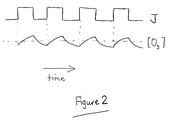
- light is pulsed as shown in Figure 2 which illustrates the periodic alteration of J with time and the resulting ozone concentration.
- Figure 2 illustrates the periodic alteration of J with time and the resulting ozone concentration.
- the precise pulse shape of ozone concentration will depend on the gas flow rate, length of the ultraviolet irradiation zone, spectrum and intensity of ultraviolet source, gap between the end of irradiation zone and sensor and other calculable parameters.
- d[O 3 ]/dt under instrument irradiation can be used to give the concentration of nitrogen dioxide in the air sample.
- the concentration of ozone after full relaxation in the dark gives the difference between sample ozone and nitrogen monoxide concentrations.
- the characteristic relaxation time in the dark of an unphotolysed air sample gives the nitrogen monoxide concentration.
- the characteristic relaxation time of a photolysed air sample gives the sum of the concentrations of nitrogen monoxide and nitrogen dioxide.
- the time resolved measurement of ozone therefore allows rates and relaxation time to be determined and so the concentrations of nitrogen monoxide, nitrogen dioxide and ozone can be determined.
- Temperature has an effect on the value of J 1 .
- the corresponding chemical step has a small activation energy thus temperature effects are small. If temperature effects need to be corrected this can be done using a simple measurement of temperature from a temperature measuring means (not shown). Pressure will have a still smaller effect and will preferably not be taken into account; however, it could be readily corrected for if required using readings from a pressure gauge (not shown). Pressure has a linear effect on the measured concentration for some types of ozone sensor as the partial pressure of ozone changes linearly with pressure but the concentration of ozone does not. This can readily be allowed for by well known software methods.
- Low frequency phase sensitive detection might allow determination of relaxation time and the information can be processed to give improved sensitivity.
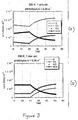
- Figure 3a shows the response to 20 seconds in the dark and 30 seconds of photolysis starting with initial gas concentrations of 30 ppb NO 2 , 10 ppb NO and 50 ppb O 3 .
- Figure 3b shows the equivalent situation starting with 30 ppb NO 2 , 10 ppb NO and 0.5 ppb O 3 .
- Figures 3c and 3d show the equivalent ozone and nitrogen dioxide concentrations with time for starting concentrations 30 ppb NO 2 , 0.5 ppb NO, 0.5 ppb O 3 (3(c)) and 300 ppb NO 2 , 0.5 ppb NO, 0.5 ppb O 3 (3(d)).
- Figures 4(a) and 4(b) shows the ozone, nitrogen monoxide and nitrogen dioxide traces with time in response to repeating patterns of 40 seconds in the dark and 40 seconds of photolysis.
- the starting concentrations are 90 ppb NO 2 , 30 ppb NO and 50 ppb O 3 .
- the starting concentrations are 10 ppb NO 2 , 30 ppb NO and 50 ppb O 3 .
- the starting concentrations are 30 ppb NO 2 , 10 ppb NO and 50 ppb O 3 .
- Figure 4(d) shows the corresponding situation for a periodicity of 20 seconds in the dark then 20 seconds photolysis.
- Ozone levels can be monitored throughout the reaction to give a time course or, alternatively, the ultraviolet light source can be pulsed for different durations and individual readings taken after each duration pulse then used to form the equivalent time course.
- This system can therefore readily establish the concentrations of nitrogen monoxide, nitrogen dioxide and ozone concentrations without needing to pre-treat the sample or wait for a steady state to be reached.
- Oxygen is essentially constant and in excess.
- Prior art methodology measures only a steady state ozone concentration after prolonged irradiation and requires two gases to be scrubbed to make the calculation possible. However, by making three or more independent measurements in different conditions, all three gases can be established without having to scrub the input gas sample.
- suitable ultraviolet sources 4 would be a fluorescent xenon tube, mercury lamp, deuterium lamp, sunlight (perhaps focused through a lens into a reflective cavity), frequency doubled laser or future ultraviolet light source. Indeed, a violet / ultraviolet light emitting diode / diode laser would be ideal if practical devices of this type become available.
- An ultraviolet light photosensor may be provided to quantify ultraviolet light produced.
- ozone sensor Several different types of ozone sensor would suitable.
- the amperometric type using an aqueous electrolyte and operating at room temperature can be obtained from EN-SCI Inc of Boulder, Colorado, USA and City Technology Ltd of Portsmouth, UK.
- Solid state semiconductor sensors with a resistance which changes when exposed to ozone could be used. These operate around 500°C and examples include the LGL52 Ozone sensor from Capteur Ltd of Didcot, UK. Stain tubes which change colour when exposed to ozone may be used. These indicate ozone concentration through the depth to which a colour change occurs but are not particularly accurate.
- Such devices can be obtained from Drägerwerk GmbH in Lubeck, Germany.
- Other possible ozone sensors include In 2 O 3 coated surface acoustic wave devices and phthalocyanines.
- Non-aqueous electrolyte amperometric ozone sensors are available from Sensoric GmbH in Bonn, Germany.
- nitrogen dioxide or monoxide might be measured instead by means of a suitable sensor.
- a suitable sensor for example, amperometric nitrogen monoxide and nitrogen dioxide sensors which operate at room temperature are sold by City Technology of Portsmouth, UK.
- the equilibrium between nitrogen monoxide and nitrogen dioxide may be altered by other equilibrium altering means. Therefore, instead of or combined with an ultraviolet light source, there may be provided any other means for affecting the equilibrium between nitrogen dioxide and nitrogen monoxide.
- nitrogen dioxide, nitrogen monoxide or ozone could be added by a gas source or removed by a scrubber. Nitrogen dioxide, nitrogen monoxide or ozone could undergo a chemical reaction, including for example conversion of nitrogen dioxide to nitrogen monoxide using a heated coil, e.g. of platinum/rhodium.
- Temperature and pressure can also affect the equilibrium and these can be varied to give different treatments of the gas sample and therefore measurements of equilibrium with different values of J and k 1 .
- the different position of the equilibrium and/or different characteristic relaxation time under different conditions provides further independent measurements which can be used to calculate all three gas concentrations.
- sensors such as an ozone sensor (not shown) besides the inlet 2 may allow further accuracy, although this is not required in the present invention.
- a sensing apparatus 101 is configured to be attached to a weather balloon (not shown) so that, in use, it can be drawn up through the atmosphere by the weather balloon.
- the arrow in the diagram indicates the direction of air flow through the sensing apparatus 101 when in use.
- the sensing apparatus 101 has a gas conducting member 102 which has a shape such that its diameter in its central portion is less than that at either of its ends. Such a configuration generates, in use, a region of low pressure in the central narrow region of the gas conducting member 102 by the well-known Venturi effect. It will be recognised by one skilled in the art that many configurations of gas conducting member 102 would provide said region of low pressure, although an elongate pipe is preferred, particularly broadly cylindrical hourglass-shaped pipe.
- the central region there is positioned a sensor element 103 and a shield member 104 which protects the sensor element 103 from damage due to hailstones, heavy rain, etc during use.
- the shield 104 is arranged such that it connects to the central region of the gas conducting member 102.
- the low pressure region generated in the gas conducting member 102 draws air into the shield 104 and over the sensor element 103 using, for example, King's Law.
- the sensor element 103 is an ozone detector but it is also possible to detect other atmospheric matter.
- the shield member 104 maybe connected directly to the external outlet 7 of the sensor shown in Figure 1 but this sensing apparatus 100 may be used with any type of sensor element 103 for detection of different gases.
- FIG. 7 shows an example of a gas conducting member which provides such a high pressure region. Components corresponding to those in figure 5 are numbered identically.
- a constricting member is provided at what is, in use, the lower end of gas conducting member 102 .
- the constriction has a narrow opening 108 and tapered base to allow particles such as rain and ice to fall out of the cylindrical member 102 , but is narrow enough to direct air through the shield 104 and over sensor 103 .
- Other configurations of gas conducting member to provide low or high pressure regions will now be apparent to one skilled in the art.
- Figure 8 shows a detail of a sensor element 103 in a shield 104 .
- the air flow over the sensor element 103 may be generated by a device shown in figures 5 to 7 or by more conventional positioning of the sensor element within a known sensor manifold. It does, however, have particular benefits in the configuration shown in figures 5 to 7.
- Some sensor elements particularly tungsten oxide detectors for ozone have to be maintained at a high temperature relative to the surrounding air.
- a tungsten oxide sensor will typically be maintained between 500 - 600 °C in air which is between 200 and 300 °K.
- These sensors are mounted on hot wires and the power supplied to the sensors is altered using standard feedback techniques to maintain sensor element temperature.
- the sensor element 103 is supported by electrical connecting wire 106 which connects to a sensor driving and monitoring device 107 .
- the wires provide electrical energy to a heating element 108 on the sensor 103 or adjacent to the sensor element 103 itself, causing the sensor element 103 to be heated as is standard. Airflow over the sensor element 103 when the sensor 101 is in use cools the sensor element 103 and the actual temperature of the sensor element 103 can be determined by a temperature sensor 109 .
- this invention recognises that the amount of power required to maintain the temperature of the sensor can be used to calculate the rate of cooling of the sensor due to passing air and therefore the speed of said passing air.
- This air flow data is useful not just to improve the accuracy of readings from the sensor element 103 but also for determining other operating parameters.
Landscapes
- Chemical & Material Sciences (AREA)
- Life Sciences & Earth Sciences (AREA)
- Health & Medical Sciences (AREA)
- Engineering & Computer Science (AREA)
- Analytical Chemistry (AREA)
- General Physics & Mathematics (AREA)
- Pathology (AREA)
- Physics & Mathematics (AREA)
- Immunology (AREA)
- Biochemistry (AREA)
- General Health & Medical Sciences (AREA)
- Combustion & Propulsion (AREA)
- Food Science & Technology (AREA)
- Medicinal Chemistry (AREA)
- Chemical Kinetics & Catalysis (AREA)
- Electrochemistry (AREA)
- Investigating Or Analysing Materials By Optical Means (AREA)
- Investigating Or Analysing Materials By The Use Of Chemical Reactions (AREA)
- Investigating Or Analyzing Non-Biological Materials By The Use Of Chemical Means (AREA)
Abstract
Description


NO2 + hν → NO + O
O + O2 → O3
O3 + NO → NO2 + O2
Figures 3c and 3d show the equivalent ozone and nitrogen dioxide concentrations with time for starting concentrations 30 ppb NO2, 0.5 ppb NO, 0.5 ppb O3 (3(c)) and 300 ppb NO2, 0.5 ppb NO, 0.5 ppb O3(3(d)).
Claims (25)
- An instrument for assaying the concentration of one or more of nitrogen dioxide, nitrogen monoxide and/or ozone in an air sample; the instrument comprising an equilibrium altering means for changing the equilibrium between nitrogen monoxide and nitrogen dioxide in the presence of ozone and oxygen, and a first gas sensor for quantifying the concentration of a first gas, being one of nitrogen dioxide, nitrogen monoxide or ozone; the instrument being adapted to measure the concentration of the first gas whilst the equilibrium between nitrogen monoxide and nitrogen dioxide in the presence of ozone and oxygen is altered and thereby to calculate the concentration of nitrogen dioxide, nitrogen monoxide and/or ozone in the air sample.
- An instrument as claimed in Claim 1 wherein the equilibrium altering means comprises an ultraviolet light source.
- An instrument as claimed in Claim 2 wherein the ultraviolet light source is switched on and off periodically.
- An instrument as claimed in any preceding Claim wherein the equilibrium altering means comprises a means for adding one or more of nitrogen monoxide, nitrogen dioxide or ozone.
- An instrument as claimed in any of Claims 1 to 3 wherein the equilibrium altering means comprises a means for removing one or more of nitrogen monoxide, nitrogen dioxide, ozone or oxygen.
- An instrument as claimed in any preceding Claim adapted to measure the concentration of the first gas at a plurality of time points and thereby monitor the rate at which the balance between nitrogen dioxide and nitrogen monoxide changes in response to the effects of the equilibrium altering means.
- An instrument as claimed in any preceding Claim wherein the first gas sensor is an ozone sensor.
- An instrument as claimed in any preceding Claim adapted to allow for the effects of temperature and/or pressure on the equilibrium between nitrogen dioxide and nitrogen monoxide.
- A method of calculating the concentration of nitrogen dioxide, nitrogen monoxide and/or ozone in air, the method comprising the steps of:activating an equilibrium altering means for changing the equilibrium between nitrogen monoxide and nitrogen dioxide in the presence of ozone and oxygen in an air sample;taking three or more readings of the concentration of a first gas, being one of nitrogen dioxide, nitrogen monoxide or ozone including at least one reading taken before the changes caused by the equilibrium altering means reach a steady state; andthereby calculating the concentration of nitrogen dioxide, nitrogen monoxide and/or ozone in the air sample.
- A method as claimed in Claim 9 wherein the equilibrium altering means comprises an ultraviolet light source.
- A method as claimed in Claim 9 or Claim 10 comprising the step switching the ultraviolet source on and off periodically.
- A method as claimed in any of Claims 9 to 11 wherein the equilibrium altering means comprises a means for adding one or more of nitrogen monoxide, nitrogen dioxide or ozone.
- A method as claimed in any of Claims 9 to 11 wherein the equilibrium altering means comprises a means for removing one or more of nitrogen monoxide, nitrogen dioxide, ozone or oxygen.
- A method as claimed in of Claims 9 to 13, wherein the concentration of the first gas at a plurality of time points is used to calculate the rate at which the balance between nitrogen dioxide and nitrogen monoxide changes in response to the effects of the equilibrium altering means.
- A method as claimed in any of Claims 9 to 14 wherein the readings are of ozone concentration.
- A method as claimed in any of Claims 9 to 15 further including the step of allowing for the effects of temperature and/or pressure on the equilibrium between nitrogen dioxide and nitrogen monoxide.
- A computer program comprising program instructions which, when loaded onto a computer, constitute a processing means for calculating the concentration of nitrogen monoxide, nitrogen dioxide and/or ozone in an air sample by the method of any of claims 9 to 16.
- A computer program according to claim 17 embodied on a record medium.
- Sensing apparatus for detecting components in atmospheric air as the sensor is drawn up through the atmosphere, the sensor comprising:a sensor element;shielding means for shielding the sensor element from direct contact with air flow as the sensor is drawn through the atmosphere; andmeans for diverting air through the shielding means and over the sensor element as the sensor passes through the atmosphere.
- Sensing apparatus as claimed in Claim 19 wherein the means for diverting air comprises a gas conducting member shaped to provide a pressure differential across the shielding means and cause air to move through the shielding means.
- Sensing apparatus as claimed in Claim 20 wherein the gas conducting member is shaped to provide a low pressure region at an entry to the shielding means and thereby draw air through the shielding means into the gas conducting member.
- Sensing apparatus as claimed in Claim 20 wherein the gas conducting member comprises a flow restricting member for diverting air that flows through the gas conducting member in use into the shielding means.
- Sensing apparatus as claimed in Claim 22 having an aperture to allow water or ice to flow out of the gas conducting member.
- Sensing apparatus comprising:a sensor element;means for regulating the temperature of the sensor element by providing heat energy to the sensor element; andmeans for calculating the air flow across the sensor element from the amount of heat energy supplied to the sensor element.
- Sensor apparatus according to claim 24 further comprising a means for measuring the temperature of the sensor.
Applications Claiming Priority (2)
| Application Number | Priority Date | Filing Date | Title |
|---|---|---|---|
| GB0002081 | 2000-01-28 | ||
| GBGB0002081.8A GB0002081D0 (en) | 2000-01-28 | 2000-01-28 | Atmospheric content detection |
Publications (2)
| Publication Number | Publication Date |
|---|---|
| EP1120649A2 true EP1120649A2 (en) | 2001-08-01 |
| EP1120649A3 EP1120649A3 (en) | 2005-11-02 |
Family
ID=9884597
Family Applications (1)
| Application Number | Title | Priority Date | Filing Date |
|---|---|---|---|
| EP01300776A Withdrawn EP1120649A3 (en) | 2000-01-28 | 2001-01-29 | Air content determination |
Country Status (3)
| Country | Link |
|---|---|
| US (2) | US20010042843A1 (en) |
| EP (1) | EP1120649A3 (en) |
| GB (1) | GB0002081D0 (en) |
Cited By (3)
| Publication number | Priority date | Publication date | Assignee | Title |
|---|---|---|---|---|
| CN102297882A (en) * | 2011-05-18 | 2011-12-28 | 海南大学 | Temperature compensation circuit for semiconductor ozone sensor and compensation method thereof |
| CN110998313A (en) * | 2017-08-10 | 2020-04-10 | 西门子股份公司 | Gas analyzers to measure nitrogen oxides and at least one other constituent in exhaust gas |
| CN113092538A (en) * | 2019-12-23 | 2021-07-09 | 瑞萨电子美国有限公司 | System and method for avoiding the effects of ozone on gas sensors |
Families Citing this family (26)
| Publication number | Priority date | Publication date | Assignee | Title |
|---|---|---|---|---|
| US20050016871A1 (en) * | 2001-10-01 | 2005-01-27 | Compton Richard Guy | Determining gas concentration |
| US7238328B2 (en) * | 2002-12-06 | 2007-07-03 | Sonoma Technology, Inc. | Solid-state light source photolytic nitrogen dioxide converter |
| ES2308898B1 (en) * | 2006-07-11 | 2009-10-23 | Universidad De Almeria | DYNAMIC AIR SAMPLING DEVICE. |
| US7811520B2 (en) * | 2008-02-29 | 2010-10-12 | The Boeing Company | Integrated parafoil threat agent sensor system and methods |
| CN102144160B (en) * | 2008-09-03 | 2014-10-29 | 特斯托股份公司 | Method for capturing measurement values and displaying measurement values |
| US20110027899A1 (en) * | 2009-02-10 | 2011-02-03 | Hargrove James M | Hazardous chemicals detector & methods of use thereof |
| US8846407B2 (en) | 2009-02-10 | 2014-09-30 | James M. Hargrove | Chemical explosive detector |
| CN103477216A (en) | 2011-04-13 | 2013-12-25 | 3M创新有限公司 | Vapor sensor including sensor element with integral heating |
| US9429537B2 (en) | 2011-04-13 | 2016-08-30 | 3M Innovative Properties Company | Method of detecting volatile organic compounds |
| CN103492872B (en) | 2011-04-13 | 2016-04-06 | 3M创新有限公司 | Methods of Using Absorptive Sensor Elements |
| US8932871B2 (en) * | 2011-08-02 | 2015-01-13 | GM Global Technology Operations LLC | Ozone conversion sensors for an automobile |
| US8897955B2 (en) | 2011-10-19 | 2014-11-25 | GM Global Technology Operations LLC | Ozone converting catalyst fault identification systems and methods |
| JP6038950B2 (en) | 2011-12-13 | 2016-12-07 | スリーエム イノベイティブ プロパティズ カンパニー | Method for identification and quantitative measurement of unknown organic compounds in gaseous media |
| CN103398877A (en) * | 2013-07-24 | 2013-11-20 | 环境保护部华南环境科学研究所 | Atmosphere nitrogen-phosphorus dry and wet deposition and sampling system with wireless communication function and atmosphere nitrogen-phosphorus dry and wet deposition and sampling method |
| US20150276655A1 (en) * | 2014-03-26 | 2015-10-01 | Aeroqual Ltd. | Interference Free Gas Measurement |
| WO2015199870A1 (en) * | 2014-06-26 | 2015-12-30 | The United States Of America, Represented By The Secretary Of Commerce | A measurement of total reactive nitrogen, noy, together with no2, no, and o3 via cavity ring-down spectroscopy |
| WO2018155260A1 (en) * | 2017-02-23 | 2018-08-30 | 株式会社Ihi | Oh radical detection probe, oh radical measurement device, and oh radical measurement method |
| US11346772B2 (en) | 2018-01-16 | 2022-05-31 | Ows Agri Limited | Gas concentration measurement apparatus and techniques |
| WO2019147215A1 (en) | 2018-01-23 | 2019-08-01 | Ows Agri Limited | System and method for ozone concentration measurement in liquids having a negative scaling index |
| WO2019147220A1 (en) | 2018-01-23 | 2019-08-01 | Ows Agri Limited | System and method for ozone concentration measurement in ice |
| WO2019147234A1 (en) * | 2018-01-24 | 2019-08-01 | Ows Agri Limited | System and method for ozone concentration in liquids having a positive scaling factor |
| WO2019151976A1 (en) | 2018-01-30 | 2019-08-08 | Ows Agri Limited | Systems and methods for bulk sterilization using ozone |
| US11712052B2 (en) | 2018-02-09 | 2023-08-01 | Ows Agri Limited | Systems and methods for continuous flow sterilization |
| CN111855602B (en) * | 2020-07-29 | 2023-04-25 | 北京大学 | System for measuring ozone generation rate in field environment |
| CN113376324B (en) * | 2021-06-09 | 2022-06-28 | 安徽大学 | Space atmosphere ozone short-term and temporary early warning system |
| US12517047B2 (en) | 2024-01-18 | 2026-01-06 | Alti Llc | Transport and detection of explosive samples |
Family Cites Families (11)
| Publication number | Priority date | Publication date | Assignee | Title |
|---|---|---|---|---|
| US3840342A (en) * | 1971-07-02 | 1974-10-08 | Beckman Instruments Inc | Nitrogen dioxide conversion |
| US3870468A (en) * | 1972-06-16 | 1975-03-11 | Beckman Instruments Inc | Nitrogen dioxide analysis |
| US3977831A (en) * | 1974-12-30 | 1976-08-31 | Nasa | Method for detecting pollutants |
| US4240798A (en) * | 1979-07-05 | 1980-12-23 | Aga Aktiebolag | Method and apparatus for reducing ozone |
| US4240799A (en) * | 1979-08-03 | 1980-12-23 | Energy For Independence, Inc. | Sensing the presence of ozone |
| US4335073A (en) * | 1981-05-04 | 1982-06-15 | Beckman Instruments, Inc. | NOx Conversion efficiency detector |
| US5356818A (en) * | 1988-08-30 | 1994-10-18 | Commonwealth Scientific And Industrial Research Organisation | Smog monitor |
| JP2673851B2 (en) * | 1992-05-14 | 1997-11-05 | 動力炉・核燃料開発事業団 | NOX concentration measuring method and measuring apparatus |
| US6051436A (en) * | 1994-08-03 | 2000-04-18 | Lockheed Idaho Technologies Company | Method for the detection of nitro-containing compositions using ultraviolet photolysis |
| US5540898A (en) * | 1995-05-26 | 1996-07-30 | Vasogen Inc. | Ozone generator with in-line ozone sensor |
| US6346419B1 (en) * | 2000-06-26 | 2002-02-12 | The United States Of America As Represented By The Department Of Commerce | Photolysis system for fast-response NO2 measurements and method therefor |
-
2000
- 2000-01-28 GB GBGB0002081.8A patent/GB0002081D0/en not_active Ceased
-
2001
- 2001-01-29 EP EP01300776A patent/EP1120649A3/en not_active Withdrawn
- 2001-01-29 US US09/774,157 patent/US20010042843A1/en not_active Abandoned
-
2004
- 2004-07-13 US US10/889,824 patent/US7323343B2/en not_active Expired - Fee Related
Cited By (4)
| Publication number | Priority date | Publication date | Assignee | Title |
|---|---|---|---|---|
| CN102297882A (en) * | 2011-05-18 | 2011-12-28 | 海南大学 | Temperature compensation circuit for semiconductor ozone sensor and compensation method thereof |
| CN110998313A (en) * | 2017-08-10 | 2020-04-10 | 西门子股份公司 | Gas analyzers to measure nitrogen oxides and at least one other constituent in exhaust gas |
| CN110998313B (en) * | 2017-08-10 | 2022-02-25 | 西门子股份公司 | Gas analyzer for measuring nitrogen oxides and at least one other component in exhaust gas |
| CN113092538A (en) * | 2019-12-23 | 2021-07-09 | 瑞萨电子美国有限公司 | System and method for avoiding the effects of ozone on gas sensors |
Also Published As
| Publication number | Publication date |
|---|---|
| US20040241868A1 (en) | 2004-12-02 |
| US7323343B2 (en) | 2008-01-29 |
| US20010042843A1 (en) | 2001-11-22 |
| EP1120649A3 (en) | 2005-11-02 |
| GB0002081D0 (en) | 2000-03-22 |
Similar Documents
| Publication | Publication Date | Title |
|---|---|---|
| US7323343B2 (en) | Nitrogen monoxide, nitrogen dioxide and ozone determination in air | |
| US6338266B1 (en) | Method of identifying a gas and associated apparatus | |
| US7229593B1 (en) | Portable vapor diffusion coefficient meter | |
| US4895017A (en) | Apparatus and method for early detection and identification of dilute chemical vapors | |
| US6165347A (en) | Method of identifying a gas | |
| JP2011149954A (en) | Apparatus and method for measuring concentration level of impurity in input gas stream, and apparatus and method for measuring concentration level of oxygen in input gas stream | |
| US7151260B2 (en) | Analyzer for measuring multiple gases | |
| US20040137637A1 (en) | Breath gas analyzer for diagnosing diabetes and method of use thereof | |
| US6484563B1 (en) | Method at detection of presence of hydrogen gas and measurement of content of hydrogen gas | |
| Swinney et al. | Ultrasmall volume refractive index detection using microinterferometry | |
| US20100014094A1 (en) | Distributed gas detection | |
| Zelinger et al. | Laser photoacoustic spectrometry and its application for simulation of air pollution in a wind tunnel | |
| CN120195123A (en) | Multi-component gas detection device and method based on metasurface quasi-continuum bound state | |
| US6825471B1 (en) | Gas detector and method of operating a gas detector | |
| Potyrailo et al. | A dual-parameter optical sensor fabricated by gradient axial doping of an optical fibre | |
| Hossein-Babaei et al. | Gas diagnosis based on selective diffusion retardation in an air filled capillary | |
| EP1710563B1 (en) | Method of measuring the concentration of nitrogen oxide and nitrogen oxide analyzer | |
| JP4158314B2 (en) | Isotope gas measuring device | |
| US7888658B2 (en) | Zirconium dioxide luminescence oxygen sensor | |
| JP3283658B2 (en) | Method for measuring converter conversion efficiency in a chemiluminescent nitrogen oxide meter | |
| Ashraf et al. | Evaluation of a CO 2 sensitive thermopile with an integrated multilayered infrared absorber by using a long path length NDIR platform | |
| RU2763514C1 (en) | Pipeline corrosion monitoring device | |
| CN222671685U (en) | Water quality monitoring sensor and water quality monitoring equipment | |
| Hirschfeld | Remote and in-situ analysis | |
| JP4115160B2 (en) | Switchable measurement method |
Legal Events
| Date | Code | Title | Description |
|---|---|---|---|
| PUAI | Public reference made under article 153(3) epc to a published international application that has entered the european phase |
Free format text: ORIGINAL CODE: 0009012 |
|
| AK | Designated contracting states |
Kind code of ref document: A2 Designated state(s): AT BE CH CY DE DK ES FI FR GB GR IE IT LI LU MC NL PT SE TR |
|
| AX | Request for extension of the european patent |
Free format text: AL;LT;LV;MK;RO;SI |
|
| PUAL | Search report despatched |
Free format text: ORIGINAL CODE: 0009013 |
|
| AK | Designated contracting states |
Kind code of ref document: A3 Designated state(s): AT BE CH CY DE DK ES FI FR GB GR IE IT LI LU MC NL PT SE TR |
|
| AX | Request for extension of the european patent |
Extension state: AL LT LV MK RO SI |
|
| AKX | Designation fees paid | ||
| REG | Reference to a national code |
Ref country code: DE Ref legal event code: 8566 |
|
| 17P | Request for examination filed |
Effective date: 20060710 |
|
| RBV | Designated contracting states (corrected) |
Designated state(s): DE GB |
|
| RAP1 | Party data changed (applicant data changed or rights of an application transferred) |
Owner name: CAMBRIDGE ENTERPRISE LIMITED |
|
| 17Q | First examination report despatched |
Effective date: 20071029 |
|
| STAA | Information on the status of an ep patent application or granted ep patent |
Free format text: STATUS: THE APPLICATION IS DEEMED TO BE WITHDRAWN |
|
| 18D | Application deemed to be withdrawn |
Effective date: 20090603 |