EP1120224A1 - Blow molded product and production method therefor - Google Patents
Blow molded product and production method therefor Download PDFInfo
- Publication number
- EP1120224A1 EP1120224A1 EP00937190A EP00937190A EP1120224A1 EP 1120224 A1 EP1120224 A1 EP 1120224A1 EP 00937190 A EP00937190 A EP 00937190A EP 00937190 A EP00937190 A EP 00937190A EP 1120224 A1 EP1120224 A1 EP 1120224A1
- Authority
- EP
- European Patent Office
- Prior art keywords
- parison
- mold
- blow
- temperature
- crystalline resin
- Prior art date
- Legal status (The legal status is an assumption and is not a legal conclusion. Google has not performed a legal analysis and makes no representation as to the accuracy of the status listed.)
- Granted
Links
Classifications
-
- B—PERFORMING OPERATIONS; TRANSPORTING
- B29—WORKING OF PLASTICS; WORKING OF SUBSTANCES IN A PLASTIC STATE IN GENERAL
- B29C—SHAPING OR JOINING OF PLASTICS; SHAPING OF MATERIAL IN A PLASTIC STATE, NOT OTHERWISE PROVIDED FOR; AFTER-TREATMENT OF THE SHAPED PRODUCTS, e.g. REPAIRING
- B29C51/00—Shaping by thermoforming, i.e. shaping sheets or sheet like preforms after heating, e.g. shaping sheets in matched moulds or by deep-drawing; Apparatus therefor
- B29C51/10—Forming by pressure difference, e.g. vacuum
-
- B—PERFORMING OPERATIONS; TRANSPORTING
- B29—WORKING OF PLASTICS; WORKING OF SUBSTANCES IN A PLASTIC STATE IN GENERAL
- B29C—SHAPING OR JOINING OF PLASTICS; SHAPING OF MATERIAL IN A PLASTIC STATE, NOT OTHERWISE PROVIDED FOR; AFTER-TREATMENT OF THE SHAPED PRODUCTS, e.g. REPAIRING
- B29C49/00—Blow-moulding, i.e. blowing a preform or parison to a desired shape within a mould; Apparatus therefor
- B29C49/02—Combined blow-moulding and manufacture of the preform or the parison
- B29C49/04—Extrusion blow-moulding
-
- B—PERFORMING OPERATIONS; TRANSPORTING
- B29—WORKING OF PLASTICS; WORKING OF SUBSTANCES IN A PLASTIC STATE IN GENERAL
- B29C—SHAPING OR JOINING OF PLASTICS; SHAPING OF MATERIAL IN A PLASTIC STATE, NOT OTHERWISE PROVIDED FOR; AFTER-TREATMENT OF THE SHAPED PRODUCTS, e.g. REPAIRING
- B29C49/00—Blow-moulding, i.e. blowing a preform or parison to a desired shape within a mould; Apparatus therefor
- B29C49/42—Component parts, details or accessories; Auxiliary operations
- B29C49/64—Heating or cooling preforms, parisons or blown articles
- B29C49/6472—Heating or cooling preforms, parisons or blown articles in several stages
-
- B—PERFORMING OPERATIONS; TRANSPORTING
- B29—WORKING OF PLASTICS; WORKING OF SUBSTANCES IN A PLASTIC STATE IN GENERAL
- B29C—SHAPING OR JOINING OF PLASTICS; SHAPING OF MATERIAL IN A PLASTIC STATE, NOT OTHERWISE PROVIDED FOR; AFTER-TREATMENT OF THE SHAPED PRODUCTS, e.g. REPAIRING
- B29C49/00—Blow-moulding, i.e. blowing a preform or parison to a desired shape within a mould; Apparatus therefor
- B29C49/42—Component parts, details or accessories; Auxiliary operations
- B29C49/78—Measuring, controlling or regulating
- B29C49/786—Temperature
- B29C2049/7864—Temperature of the mould
- B29C2049/78645—Temperature of the mould characterised by temperature values or ranges
-
- B—PERFORMING OPERATIONS; TRANSPORTING
- B29—WORKING OF PLASTICS; WORKING OF SUBSTANCES IN A PLASTIC STATE IN GENERAL
- B29C—SHAPING OR JOINING OF PLASTICS; SHAPING OF MATERIAL IN A PLASTIC STATE, NOT OTHERWISE PROVIDED FOR; AFTER-TREATMENT OF THE SHAPED PRODUCTS, e.g. REPAIRING
- B29C2791/00—Shaping characteristics in general
- B29C2791/004—Shaping under special conditions
-
- B—PERFORMING OPERATIONS; TRANSPORTING
- B29—WORKING OF PLASTICS; WORKING OF SUBSTANCES IN A PLASTIC STATE IN GENERAL
- B29C—SHAPING OR JOINING OF PLASTICS; SHAPING OF MATERIAL IN A PLASTIC STATE, NOT OTHERWISE PROVIDED FOR; AFTER-TREATMENT OF THE SHAPED PRODUCTS, e.g. REPAIRING
- B29C2791/00—Shaping characteristics in general
- B29C2791/004—Shaping under special conditions
- B29C2791/006—Using vacuum
-
- B—PERFORMING OPERATIONS; TRANSPORTING
- B29—WORKING OF PLASTICS; WORKING OF SUBSTANCES IN A PLASTIC STATE IN GENERAL
- B29C—SHAPING OR JOINING OF PLASTICS; SHAPING OF MATERIAL IN A PLASTIC STATE, NOT OTHERWISE PROVIDED FOR; AFTER-TREATMENT OF THE SHAPED PRODUCTS, e.g. REPAIRING
- B29C2791/00—Shaping characteristics in general
- B29C2791/004—Shaping under special conditions
- B29C2791/007—Using fluid under pressure
-
- B—PERFORMING OPERATIONS; TRANSPORTING
- B29—WORKING OF PLASTICS; WORKING OF SUBSTANCES IN A PLASTIC STATE IN GENERAL
- B29C—SHAPING OR JOINING OF PLASTICS; SHAPING OF MATERIAL IN A PLASTIC STATE, NOT OTHERWISE PROVIDED FOR; AFTER-TREATMENT OF THE SHAPED PRODUCTS, e.g. REPAIRING
- B29C49/00—Blow-moulding, i.e. blowing a preform or parison to a desired shape within a mould; Apparatus therefor
- B29C49/42—Component parts, details or accessories; Auxiliary operations
- B29C49/64—Heating or cooling preforms, parisons or blown articles
- B29C49/6604—Thermal conditioning of the blown article
- B29C49/6605—Heating the article, e.g. for hot fill
-
- B—PERFORMING OPERATIONS; TRANSPORTING
- B29—WORKING OF PLASTICS; WORKING OF SUBSTANCES IN A PLASTIC STATE IN GENERAL
- B29C—SHAPING OR JOINING OF PLASTICS; SHAPING OF MATERIAL IN A PLASTIC STATE, NOT OTHERWISE PROVIDED FOR; AFTER-TREATMENT OF THE SHAPED PRODUCTS, e.g. REPAIRING
- B29C49/00—Blow-moulding, i.e. blowing a preform or parison to a desired shape within a mould; Apparatus therefor
- B29C49/42—Component parts, details or accessories; Auxiliary operations
- B29C49/64—Heating or cooling preforms, parisons or blown articles
- B29C49/6604—Thermal conditioning of the blown article
- B29C49/6605—Heating the article, e.g. for hot fill
- B29C49/66055—Heating the article, e.g. for hot fill using special pressurizing during the heating, e.g. in order to control the shrinking
-
- B—PERFORMING OPERATIONS; TRANSPORTING
- B29—WORKING OF PLASTICS; WORKING OF SUBSTANCES IN A PLASTIC STATE IN GENERAL
- B29K—INDEXING SCHEME ASSOCIATED WITH SUBCLASSES B29B, B29C OR B29D, RELATING TO MOULDING MATERIALS OR TO MATERIALS FOR MOULDS, REINFORCEMENTS, FILLERS OR PREFORMED PARTS, e.g. INSERTS
- B29K2079/00—Use of polymers having nitrogen, with or without oxygen or carbon only, in the main chain, not provided for in groups B29K2061/00 - B29K2077/00, as moulding material
- B29K2079/08—PI, i.e. polyimides or derivatives thereof
-
- B—PERFORMING OPERATIONS; TRANSPORTING
- B29—WORKING OF PLASTICS; WORKING OF SUBSTANCES IN A PLASTIC STATE IN GENERAL
- B29K—INDEXING SCHEME ASSOCIATED WITH SUBCLASSES B29B, B29C OR B29D, RELATING TO MOULDING MATERIALS OR TO MATERIALS FOR MOULDS, REINFORCEMENTS, FILLERS OR PREFORMED PARTS, e.g. INSERTS
- B29K2995/00—Properties of moulding materials, reinforcements, fillers, preformed parts or moulds
- B29K2995/0037—Other properties
- B29K2995/0041—Crystalline
-
- B—PERFORMING OPERATIONS; TRANSPORTING
- B29—WORKING OF PLASTICS; WORKING OF SUBSTANCES IN A PLASTIC STATE IN GENERAL
- B29K—INDEXING SCHEME ASSOCIATED WITH SUBCLASSES B29B, B29C OR B29D, RELATING TO MOULDING MATERIALS OR TO MATERIALS FOR MOULDS, REINFORCEMENTS, FILLERS OR PREFORMED PARTS, e.g. INSERTS
- B29K2995/00—Properties of moulding materials, reinforcements, fillers, preformed parts or moulds
- B29K2995/0037—Other properties
- B29K2995/007—Hardness
-
- B—PERFORMING OPERATIONS; TRANSPORTING
- B29—WORKING OF PLASTICS; WORKING OF SUBSTANCES IN A PLASTIC STATE IN GENERAL
- B29L—INDEXING SCHEME ASSOCIATED WITH SUBCLASS B29C, RELATING TO PARTICULAR ARTICLES
- B29L2031/00—Other particular articles
- B29L2031/30—Vehicles, e.g. ships or aircraft, or body parts thereof
-
- B—PERFORMING OPERATIONS; TRANSPORTING
- B29—WORKING OF PLASTICS; WORKING OF SUBSTANCES IN A PLASTIC STATE IN GENERAL
- B29L—INDEXING SCHEME ASSOCIATED WITH SUBCLASS B29C, RELATING TO PARTICULAR ARTICLES
- B29L2031/00—Other particular articles
- B29L2031/747—Lightning equipment
Definitions
- the present invention relates to blow moldings of crystalline resin and to a method for producing them. More precisely, the invention relates to scratch-resistant blow moldings of crystalline resin having good surface gloss and high surface hardness, and relates to an efficient method for producing them.
- blow moldings of crystalline thermoplastic resin are much more lightweight than injection moldings thereof, and have good mechanical strength, they have many applications in various industrial fields.
- blow moldings of polyolefin-type crystalline resin such as those of crystalline polypropylene are recyclable and since the load of their wastes to the environment is low, they cover a broad range of practical applications.
- they are much used for automobile parts such as spoilers and other aerodynamic parts, side moldings, bumpers, instrument panels; and for housing facilities such as bath units, toilets, walls, ceilings, etc.
- the appearance of these articles is much influenced by the surface characteristics of blow moldings for them.
- blow-molding techniques for obtaining blow moldings having good surface gloss and good appearance even though not post-treated for overcoating them have been developed.
- a method for producing blow moldings having good surface gloss comprises preparing a resin parison of such that its surface has a large number of fine recesses having a depth of from 2 to 100 microns, in the space of a mirror-finished blow mold heated up to a temperature not lower than the crystallization temperature of the resin, then blow-molding the parison therein, and thereafter cooling the mold to a temperature lower than the crystallization temperature of the resin.
- the method is still problematic in that it requires specific control in the step of parison formation and requires a prolonged molding cycle for producing large-size moldings, and therefore the productivity of the moldings is low.
- Another method is proposed in Japanese Patent Laid-Open No. 77231/1992, which comprises preparing a crystalline resin parison in the space of a blow mold, clamping the mold, and injecting a pressure fluid into the parison so that the parison is blown and cooled while being tightly pressed against the inner wall of the mold, and is thereby formed into a blow-molded article.
- the blow mold used is so controlled that its temperature may fall between a temperature around which the crystallization rate of the crystalline resin is the highest and the melting point of the resin while the coolant fluid is injected into the resin parison prepared therein, and the coolant is circulated under pressure in the parison.
- the die line and the weld line in the surface of the blow moldings produced could be reduced in some degree probably to a negligible level.
- the method is still problematic in that the transferability of the mold cavity design onto the moldings produced and also the surface gloss of the moldings are not on a satisfactory level.
- Still another method is proposed in Japanese Patent Laid-Open No. 138324/1998, which comprises preparing an extruded parison of polypropylene in a blow mold, clamping the mold with the parison therein being pre-blown, and finally blowing the parison in the mold.
- the mold is temporarily heated at a temperature not lower than 140°C after it has been clamped and before it is opened to take the blow-molded article out of it.
- the method is superior to the case where the mold temperature is kept lower than 140°C all the time for blow molding, as the blow moldings produced have improved surface gloss.
- the method is still problematic in that the surface hardness of the blow moldings produced is not so high and the blow moldings are often scratched.
- the present invention is to provide scratch-resistant blow moldings of crystalline resin having good surface gloss and high surface hardness, and to provide a method for producing them.
- the present inventors have assiduously studied and investigated the molding conditions for blow moldings of crystalline resin, and, as a result, have found that, when the temperature control of the inner surface of the blow mold used is suitably combined with the retention time of the parison in the mold within a specific temperature range, then the blow molding from the parison has good characteristics intrinsic to crystalline resin. On the basis of this finding, we have completed the present invention.
- the blow molding of the invention is so constituted that at least its outermost layer is of crystalline resin, that its surface gloss is at least 80 % measured at an incident angle of 60° according to JIS K7105, and that its surface scratch resistance in terms of the pencil hardness measured in a pencil scratch test according to JIS K5400 is at least on the level of HB.
- the crystalline resin for the blow molding of the invention may be crystalline thermoplastic resin, and its preferred examples are homopolymers of ⁇ -olefins such as ethylene, propylene and butene-1, copolymers of such ⁇ -olefins, polyamide resins, polyester resins, etc. Of those crystalline resins, especially preferred are polypropylene-type polymers such as homopolypropylene and propylene-block copolymers comprising a homopolypropylene component and an ethylenepropylene copolymer component.
- the polypropylene-type polymers for use in the invention have a melt index, measured at a temperature of 230°C under a load of 2.16 kg according to ASTM D1238, of from 0.01 to 10 g/10 min, more preferably from 0.05 to 3 g/10 min.
- the blow molding of the invention may have a single-layered structure or a multi-layered structure that comprises a base layer and a surface layer.
- the base layer may have a single-layered structure or a multi-layered, two-layered or three-layered structure of thermoplastic resin having good impact resistance, such as propylene-block copolymers, high-density polyethylene, low-density polyethylene, polyamides, etc.; and the surface layer thereof is preferably a homopolypropylene layer having a melt index of from 0.01 to 40 g/10 min.
- the base layer may contain an inorganic filler to improve the rigidity, mechanical strength and heat resistance of the blow molding.
- the amount of the inorganic filler that may be in the base layer may be the same as that in ordinary resin moldings, and the inorganic filler content of the layer is preferably at most 50 % by weight.
- the inorganic filler includes, for example, mica, talc, calcium carbonate, kaolin, barium sulfate, various types of metal powders, glass beads, glass fibers, etc.
- the wall thickness of the blow molding of the invention can vary, depending on the external dimension thereof and on the necessary characteristics thereof such as mechanical strength and heat resistance. In general, it is desirable that the wall thickness of the blow molding having a single-layered structure falls between 1 and 5 mm or so. In the blow molding having a multi-layered structure, it is desirable that the wall thickness of the base layer falls between 1 and 5 mm or so and that the wall thickness of the surface layer falls between 100 ⁇ m and 1 mm or so.
- the material to form the outermost layer of the blow molding of the invention may contain a colorant such as pigment or dye.
- a colorant such as pigment or dye.
- the colorant is so added to the starting resin that its amount falls between 0.01 and 10 parts by weight, more preferably between 0.5 and 5 parts by weight, relative to 100 parts by weight of the resin.
- any ordinary additives such as stabilizer, antistatic agent, weatherproofing agent, flame retardant, dispersant and nucleating agent may be added to the starting resin, depending on the applications and the necessary characteristics of the blow moldings to be produced.
- the method for producing blow moldings of the invention comprises preparing a crystalline resin melt parison in the space of a blow mold, clamping the mold, and introducing a pressure fluid into the parison to blow and tightly press the parison against the inner wall of the mold, thereby solidifying the parison along the wall, and the method is characterized in that the temperature of the inner wall of the mold is so controlled that it falls between a temperature lower by 20°C than the crystallization temperature (hereinafter referred to as Tc) of the crystalline resin and a temperature below the temperature lower by 5°C than the melting point (hereinafter referred to as Tm) of the crystalline resin, while the parison is prepared in the mold, and that, after the mold has been clamped to pinch the parison therein, a pressure fluid is introduced into the thus-pinched parison, then the mold with the parison therein is so heated that the temperature of its inner wall falls between a temperature lower by 10°C than the melting point of the crystalline resin and a temperature
- One preferred embodiment of the method for producing blow moldings of the invention that comprises preparing a crystalline resin melt parison in the space of a blow mold, clamping the mold, and introducing a pressure fluid into the parison to blow and tightly press the parison against the inner wall of the mold, thereby solidifying the parison along the wall is such that the temperature of the inner wall of the mold is so controlled that it is lower by from 5 to 10°C than the crystallization temperature of the crystalline resin, while the parison is prepared in the mold, and that, after the mold has been clamped to pinch the parison therein, a pressure fluid is introduced into the thus-pinched parison, then the mold with the parison therein is so heated that the temperature of its inner wall falls between a temperature lower by 10°C than the melting point of the crystalline resin and a temperature below the melting point of the crystalline resin, the parison is kept in the mold at the controlled temperature falling between a temperature lower by 10°C than the melting point of the crystalline resin and a
- the crystallization temperature and the melting point of the crystalline resin to form the melt parison are the crystallization temperature and the melting point of the crystalline resin to form the outermost layer of the melt parison.
- the starting resin for the blow moldings of the invention may contain colorant and other various additives.
- the crystallization temperature and the melting point of resin referred to in the production method of the invention may be those of crystalline resin containing colorant and various additives.
- the method of the invention for producing blow moldings is described more concretely.
- crystalline resin such as that mentioned above is melt-extruded to form a tubular melt parison, and the parison is hung in the space of an opened blow mold with its bottom end being pinched. Then, the parison is pre-blown in some degree.
- the blow mold is clamped, and the thus pre-blown parison is finally blown in the clamped mold.
- the temperature of the inner wall of the mold is so controlled that it falls between (Tc - 20)°C and (Tm - 5)°C but lower than (Tm - 5)°C, preferably between (Tc - 10) and (Tc - 5)°C while the parison is prepared in the mold, or that is, just before the parison is brought into contact with the inner wall of the mold.
- the reason for the temperature control on the inner wall of the mold is because, if the parison is brought into contact with the inner wall of the mold while the temperature of the inner wall of the mold is still lower than (Tc - 20)°C, the blow-molded article from the parison will lose surface uniformity, and its surface will be too much roughened.
- the appearance of the blow-molded article will be poor. If, however, the parison is brought into contact with the inner wall of the mold while the temperature of the inner wall of the mold is kept higher than (Tm - 5)°C, the surface hardness of the resulting blow-molded article could not be increased.
- the mold with the parison therein is clamped, and the parison is thus pinched in the mold, and then a pressure fluid is introduced into the parison.
- the mold with the parison therein is so heated that the temperature of its inner wall falls between (Tm - 10)°C and (below Tm), preferably between (Tm - 10)°c and (Tm - 5)°C, and the parison is kept in the mold at the controlled temperature falling between (Tm - 10)°C and (below Tm), preferably between (Tm - 10)°C and (Tm - 5)°C, for a satisfactory period of time enough for the thus blow-molded article of the parison to have a surface hardness of not lower than the level of HB in terms of the pencil hardness measured in a pencil scratch test.
- the mold is cooled to a temperature at which the blow-molded article produced therein can be taken out of it, then the mold is opened, and the article is taken out of it.
- the temperature control in this step is because, if the temperature of the inner wall of the mold is higher than a temperature below Tm after the parison has been pinched in the mold, the surface hardness of the resulting blow-molded article from the parison will be low; and if the temperature is lower than (Tm - 10)°C, the surface hardness of the blow-molded article from the parison will be also low.
- the period of time for which the parison in the mold is kept at the controlled temperature falling between (Tm - 10)°C and (below Tm) must be enough for the thus blow-molded article of the parison to have a surface hardness of not lower than the level of HB, preferably not lower than the level of F in terms of the pencil hardness measured in a pencil scratch test.
- the necessary period of time will vary in some degree, depending on the type of the crystalline resin used, the profile of the blow-molded article to be finally obtained , and the temperature of the inner wall of the mold used, but may be generally at least 10 seconds, preferably at least 20 seconds, more preferably at least 1 minutes, even more preferably 3 minutes or so. Even though the retention time is longer than 3 minutes, the surface hardness of the blow-molded article could not increase any more, and such a long retention time is rather disadvantageous as prolonging the time of molding cycle.
- the blow mold may be heated by circulating a heating medium, such as oil, steam or pressure water inside it or may be electrically heated in any mode of internal heating or external heating.
- a heating medium such as oil, steam or pressure water inside it or may be electrically heated in any mode of internal heating or external heating.
- the crystalline resin parison While being kept in contact with the inner wall of the mold, the crystalline resin parison receives the design of the inner wall that forms the cavity of the mold. With the inner wall design of the mold having been thus transferred onto its surface, the blown parison is cooled and solidified to be a blow-molded article.
- the mold with the blown parison therein may be cooled; or a pressure coolant fluid may be introduced into the cavity of the blown parison in the mold to thereby directly cool the blown parison.
- the pressure coolant fluid is one having a lowered temperature not higher than room temperature.
- Preferred for the pressure coolant fluid is compressed air having a temperature is not higher than -20°C, more preferably not higher than -30°C, and having a pressure that falls between 2 and 10 kg/cm 2 G or so.
- a discharge tube for pressure fluid is inserted into the parison at the same time when the inlet tube for pressure fluid for expanding the parison is inserted thereinto, and the stopper of the discharge tube is opened just after the start of cooling the blown parison so that the pressure fluid having been contacted with the high-temperature blown parison and having been thus heated is discharged out of the parison through the discharge tube.
- the cooling rate is controlled by controlling the flow rate of the pressure fluid being discharged out of the blown parison through the discharge tube so that the pressure in the cavity of the blown parison is kept constant all the time while the parison is cooled.
- the blow molding machine to be used for producing the blow moldings in the manner as herein may be any ordinary one.
- the cavity surface of the blow mold to be used herein is polished to a degree of at least #800, more preferably at least #1000.
- the blow mold has vent holes. More preferably, the vent holes are provided through the part of the mold around which some gas will remain between the parison and the mold, for example, through the part of the mold concaved to a great extent to form a deep hollow in the mold cavity. In that part of the mold, the blown parison will often fail to accurately receive the mold design (mold design transfer failure), and it is desirable to provide vent holes through the part of mold.
- the aperture of each vent hole may fall between 0.2 and 0.5 mm or so in diameter, but is preferably at most 100 ⁇ m, more preferably at most 80 ⁇ m for obtaining blow moldings of better appearance.
- the hole pitch (hole-to-hole distance) may be at most 100 mm, but preferably at most 50 mm, more preferably at most 30 mm.
- crystalline resin is blow-molded in a mold while the temperature of the mold is specifically controlled to fall within a specific range.
- the blown parison is kept at a temperature falling within a specific range for a predetermined period of time.
- the blow-molded article thus produced has good surface characteristics of good surface gloss and good scratch resistance. Specifically its surface gloss is at least 80 % measured at an incident angle of 60° according to JIS K7105, and its surface scratch resistance in terms of the pencil hardness measured in a pencil scratch test according to JIS K5400 is at least on the level of HB.
- a nucleating agent sodium 2,2-methylenebis(4,6-di-t-butylphenyl)phosphate (Asahi Denka's NA11) was added to a starting resin, homopolypropylene having an melt index (at 230°C under a load of 2.16 kg) of 0.6 g/10 min (Idemitsu Petrochemical's, Idemitsu Polypro E-105GM) to prepare a resin composition in which the concentration of the nucleating agent was 1000 ppm.
- the starting resin (homopolypropylene resin composition) was fed into an extruder, and melted and kneaded therein. At a resin temperature of 230°C, this was formed into a melt parison.
- the melt parison was hung in the center of a blow mold, and pinched at its bottom end, and the parison was pre-blown in that condition.
- the pre-blown parison was pinched in the blow mold, then the mold was clamped, and compressed air having a pressure of 6 kg/cm 2 G was led into the parison, whereby the parison was thus blown.
- the temperature of the blow mold was controlled as follows: After the parison was prepared in the blow mold but before it was contacted with the inner wall of the mold, the temperature of the inner wall of the mold was controlled at 120°C; then, after the parison was pinched in the mold, the temperature was elevated up to 160°C; and thereafter the elevated temperature of 160°C was kept as such for 3 minutes, for which the blown parison was conditioned at the temperature; then the mold was cooled to 80°C, and opened, and the blow-molded article was taken out of the mold.
- the temperature, 120°C of the inner surface of the mold in which the parison was prepared is lower by 5°C than the crystallization temperature of the starting resin (homopolypropylene resin composition); and the temperature, 160°C of the inner surface of the mold in which the parison was pinched is lower by 5°C than the melting point of the starting resin.
- the cavity surface of the blow mold used herein was mirror-finished to have a degree of surface smoothness of 0.2 s; and the mold was provided with vent holes of 100 ⁇ m in diameter at a hole pitch of 10 mm.
- the surface gloss of the blow-molded article was measured according to JIS K7105, for which was used a surface gloss meter (Nippon Denshoku Kogyo's UGS Sensor). Briefly, 6 test pieces of 50 mm ⁇ 50 mm in size of the article were measured at 5 sites each, and the data were averaged. Regarding the condition for the measurement, the incident angle between the light-receiving surface of the test piece and the direction of the light thereto from a light source was 60°, and the light was reflected on the surface of the test piece in the direction just opposite to the incident ray direction. In that condition, the 60-degree mirror surface gloss of each test piece was measured.
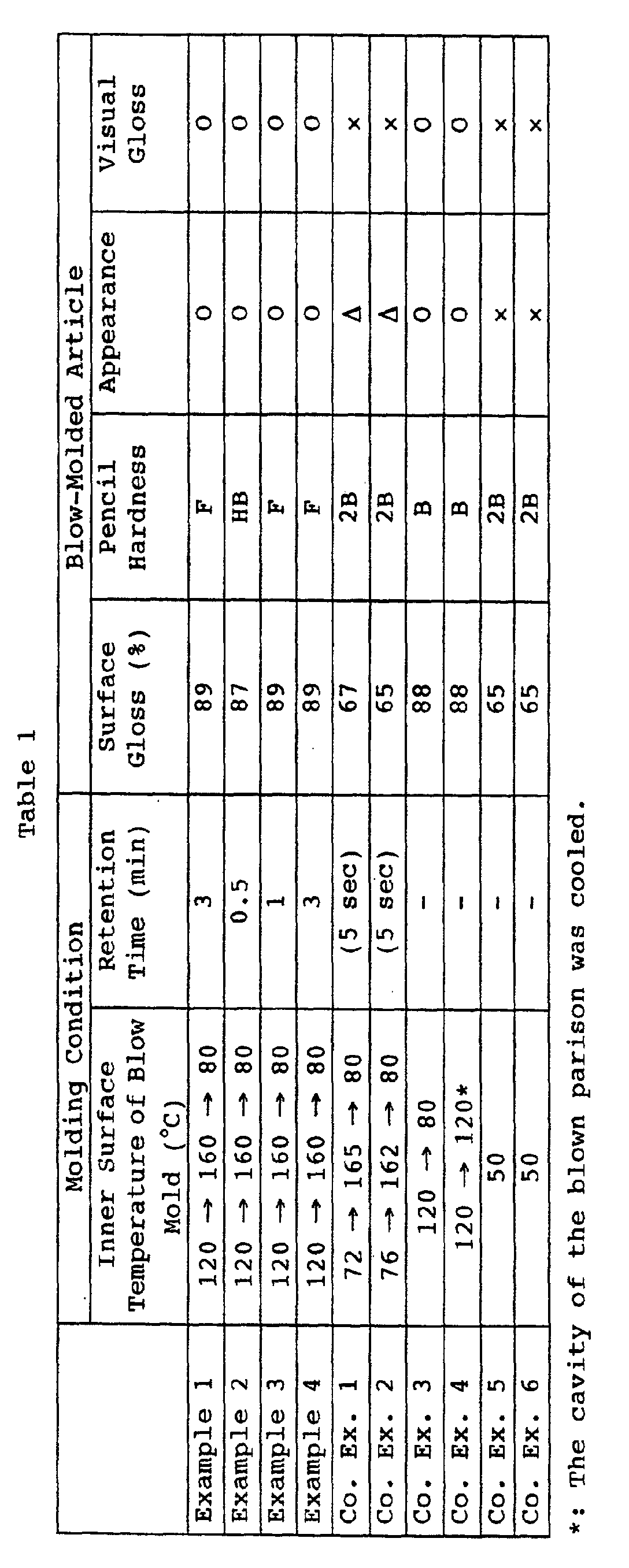
- the surface scratch resistance of the blow-molded article was measured in a pencil test according to JIS K5400, for which was used a pencil scratch tester for coating films (from Yasuda Seiki Seisakusho). In the test, used were laboratory pencils approved by the Coating Film Test Association of Japan. Briefly, 6 test pieces of 70 mm ⁇ 70 mm ⁇ 4.5 mm in size were tested to measure their pencil hardness. The minimum value of the data (this is the concentration code of the softest pencil of all tested) indicates the surface scratch resistance of the blow-molded article produced herein. The test results are given in Table 1.
- the same homopolypropylene resin composition as in Example 1 was used as the starting resin for the outer layer of a two-layered structure.
- a propylene-block copolymer composition was prepared by melting and kneading 75 % by weight of a propylene block copolymer (Idemitsu Petrochemical's Idemitsu Polypro E-185G) composed of a polypropylene component and a polyethylene component and having a melt index (at 230°C under a load of 2.16 kg) of 0.1 g/10 min; 5 % by weight of high-density polyethylene (Idemitsu Petrochemical's Idemitsu Polyethylene 750LB) having a melt index (at 190°C under a load of 2.16 kg) of 0.03 g/10 min; and 20 % by weight of an inorganic filler, talc (having a mean particle size of 1.5 ⁇ m and a mean aspect ratio of 15).
- talc having a mean particle size of 1.5 ⁇ m and
- the two-layered melt parison was blown and molded in the same manner as in Example 1 into a blow-molded article.
- the blown parison was kept heated at the controlled temperature of 160°C for 0.5 minutes.
- the thus blow-molded article had a two-layered structure.
- the two-layered wall in the center part of this article was comprised of the base layer having a thickness of 4 mm and a surface layer having a thickness of 500 ⁇ m.
- the blow-molded article was tested in the same manner as in Example 1 for its surface gloss, surface scratch resistance, appearance and visual gloss. The test results are given in Table 1.
- a two-layered blow-molded article was produced in the same manner as in Example 2, for which, however, the temperature of the blow mold was so controlled that the blown parison in the mold was kept heated at the controlled temperature of 160°C for 1 minute.
- the blow-molded article was tested in the same manner as in Example 1 for its surface gloss, surface scratch resistance, appearance and visual gloss. The test results are given in Table 1.
- a two-layered blow-molded article was produced in the same manner as in Example 2, for which, however, the temperature of the blow mold was so controlled that the blown parison in the mold was kept heated at the controlled temperature of 160°C for 3 minutes.
- the blow-molded article was tested in the same manner as in Example 1 for its surface gloss, surface scratch resistance, appearance and visual gloss. The test results are given in Table 1.
- a two-layered blow-molded article was produced in the same manner as in Example 2.
- the temperature control of the blow mold was as follows: The parison having been prepared in the mold was kept at 72°C before it was contacted with the inner wall of the mold; then, the parison was pinched in the mold, and thereafter heated up to 165°C; and the thus-heated parison was kept heated still at 165°C for 5 seconds.
- the blow-molded article was tested in the same manner as in Example 1 for its surface gloss, surface scratch resistance, appearance and visual gloss. The test results are given in Table 1.
- a two-layered blow-molded article was produced in the same manner as in Example 2.
- the temperature control of the blow mold was as follows: The parison having been prepared in the mold was kept at 76°C before it was contacted with the inner wall of the mold; then, the parison was pinched in the mold, and thereafter heated up to 162°C; and the thus-heated parison was kept heated still at 162°C for 5 seconds.
- the blow-molded article was tested in the same manner as in Example 1 for its surface gloss, surface scratch resistance, appearance and visual gloss. The test results are given in Table 1.
- a two-layered blow-molded article was produced in the same manner as in Example 2.
- the temperature control of the blow mold was as follows: The parison having been prepared in the mold was kept at 120°C before it was contacted with the inner wall of the mold; then, the parison was pinched in the mold, and thereafter cooled to 80°C; and the blow-molded article was taken out of the mold.
- the blow-molded article was tested in the same manner as in Example 1 for its surface gloss, surface scratch resistance, appearance and visual gloss. The test results are given in Table 1.
- a two-layered blow-molded article was produced in the same manner as in Example 2.
- the temperature control of the blow mold was as follows: The parison having been prepared in the mold was kept at 120°C before it was contacted with the inner wall of the mold; then, the parison was pinched in the mold still at 120°C; and dry air at -35°C was introduced into the cavity of the blown parison so as to rapidly cool the parison, while the heated air was discharged out of the parison.
- the blow-molded article was tested in the same manner as in Example 1 for its surface gloss, surface scratch resistance, appearance and visual gloss. The test results are given in Table 1.
- a single-layered blow-molded article was produced in the same manner as in Example 1.
- the temperature control of the blow mold was as follows: The parison having been prepared in the mold was kept at 50°C before it was contacted with the inner wall of the mold; and the parison was then blown into a blow-molded article still at the controlled temperature of 50°C.
- the blow-molded article was tested in the same manner as in Example 1 for its surface gloss, surface scratch resistance, appearance and visual gloss. The test results are given in Table 1.
- a two-layered blow-molded article was produced in the same manner as in Example 2.
- the temperature control of the blow mold was as follows: The parison having been prepared in the mold was kept at 50°C before it was contacted with the inner wall of the mold; and the parison was then blown into a blow-molded article still at the controlled temperature of 50°C.
- the blow-molded article was tested in the same manner as in Example 1 for its surface gloss, surface scratch resistance, appearance and visual gloss. The test results are given in Table 1.
- blow moldings of the invention are widely used in various fields of automobile parts and housing facilities that are required to have such properties.
- Such blow moldings having the characteristics as above are efficiently produced according to the method of the invention which requires a simple operation only for specifically controlling the temperature profile of the inner surface of the blow mold used therein.
Landscapes
- Engineering & Computer Science (AREA)
- Mechanical Engineering (AREA)
- Physics & Mathematics (AREA)
- Thermal Sciences (AREA)
- Manufacturing & Machinery (AREA)
- Blow-Moulding Or Thermoforming Of Plastics Or The Like (AREA)
- Moulds For Moulding Plastics Or The Like (AREA)
Abstract
Description
Claims (10)
- A blow molding of crystalline resin, of which the surface gloss is at least 80 % measured at an incident angle of 60° according to JIS K7105, and of which the surface scratch resistance in terms of the pencil hardness measured in a pencil scratch test according to JIS K5400 is at least on the level of HB.
- The blow molding as claimed in claim 1, which has a multi-layered structure of at least two layers, and of which the outermost layer is a crystalline resin layer.
- A method for producing blow moldings, which comprises preparing a crystalline resin melt parison in the space of a blow mold, clamping the mold, and introducing a pressure fluid into the parison to blow and tightly press the parison against the inner wall of the mold, thereby solidifying the parison along the wall; the method being characterized in that the temperature of the inner wall of the mold is so controlled that it falls between a temperature lower by 20°C than the crystallization temperature of the crystalline resin and a temperature below the temperature lower by 5°C than the melting point of the crystalline resin, while the parison is prepared in the mold, and that, after the mold has been clamped to pinch the parison therein, a pressure fluid is introduced into the thus-pinched parison, then the mold with the parison therein is so heated that the temperature of its inner wall falls between a temperature lower by 10°C than the melting point of the crystalline resin and a temperature below the melting point of the crystalline resin, the parison is kept in the mold at the controlled temperature falling between a temperature lower by 10°C than the melting point of the crystalline resin and a temperature below the melting point of the crystalline resin for a satisfactory period of time enough for the thus blow-molded article of the parison to have a surface hardness of not lower than the level of HB in terms of the pencil hardness measured in a pencil scratch test, and finally the mold is cooled and the blow-molded article is released from the mold.
- A method for producing blow moldings, which comprises preparing a crystalline resin melt parison in the space of a blow mold, clamping the mold, and introducing a pressure fluid into the parison to blow and tightly press the parison against the inner wall of the mold, thereby solidifying the parison along the wall; the method being characterized in that the temperature of the inner wall of the mold is so controlled that it is lower by from 5 to 10°C than the crystallization temperature of the crystalline resin, while the parison is prepared in the mold, and that, after the mold has been clamped to pinch the parison therein, a pressure fluid is introduced into the thus-pinched parison, then the mold with the parison therein is so heated that the temperature of its inner wall falls between a temperature lower by 10°C than the melting point of the crystalline resin and a temperature below the melting point of the crystalline resin, the parison is kept in the mold at the controlled temperature falling between a temperature lower by 10°C than the melting point of the crystalline resin and a temperature below the melting point of the crystalline resin for a satisfactory period of time enough for the thus blow-molded article of the parison to have a surface hardness of riot lower than the level of HB in terms of the pencil hardness measured in a pencil scratch test, and finally the mold is cooled and the blow-molded article is released from the mold.
- The method for producing blow moldings as claimed in claim 3 or 4, in which the mold is clamped to pinch the parison therein, a pressure fluid is introduced into the thus-pinched parison, then the mold with the parison therein is so heated that the temperature of its inner wall is lower by from 5 to 10°C than the melting point of the crystalline resin that forms the parison, and the parison is kept in the mold at the controlled temperature lower by from 5 to 10°C than the melting point of the crystalline resin for a satisfactory period of time enough for the thus blow-molded article to have a surface hardness of not lower than the level of HB in terms of the pencil hardness measured in a pencil scratch test.
- A method for producing multi-layered blow moldings of at least two layers with an outermost layer of crystalline resin, which comprises preparing a melt parison in the space of a blow mold, clamping the mold, and introducing a pressure fluid into the parison to blow and tightly press the parison against the inner wall of the mold, thereby solidifying the parison along the wall; the method being characterized in that the temperature of the inner wall of the mold is so controlled that it falls between a temperature lower by 20°C than the crystallization temperature of the crystalline resin and a temperature below the temperature lower by 5°C than the melting point of the crystalline resin, while the parison is prepared in the mold, and that, after the mold has been clamped to pinch the parison therein, a pressure fluid is introduced into the thus-pinched parison, then the mold with the parison therein is so heated that the temperature of its inner wall falls between a temperature lower by 10°C than the melting point of the crystalline resin and a temperature below the melting point of the crystalline resin, the parison is kept in the mold at the controlled temperature falling between a temperature lower by 10°C than the melting point of the crystalline resin and a temperature below the melting point of the crystalline resin for a satisfactory period of time enough for the thus blow-molded article of the parison to have a surface hardness of not lower than the level of HB in terms of the pencil hardness measured in a pencil scratch test, and finally the mold is cooled and the blow-molded article is released from the mold.
- A method for producing multi-layered blow moldings of at least two layers with an outermost layer of crystalline resin, which comprises preparing a melt parison in the space of a blow mold, clamping the mold, and introducing a pressure fluid into the parison to blow and tightly press the parison against the inner wall of the mold, thereby solidifying the parison along the wall; the method being characterized in that the temperature of the inner wall of the mold is so controlled that it is lower by from 5 to 10°C than the crystallization temperature of the crystalline resin, while the parison is prepared in the mold, and that, after the mold has been clamped to pinch the parison therein, a pressure fluid is introduced into the thus-pinched parison, then the mold with the parison therein is so heated that the temperature of its inner wall falls between a temperature lower by 10°C than the melting point of the crystalline resin and a temperature below the melting point of the crystalline resin, the parison is kept in the mold at the controlled temperature falling between a temperature lower by 10°C than the melting point of the crystalline resin and a temperature below the melting point of the crystalline resin for a satisfactory period of time enough for the thus blow-molded article of the parison to have a surface hardness of not lower than the level of HB in terms of the pencil hardness measured in a pencil scratch test, and finally the mold is cooled and the blow-molded article is released from the mold.
- The method for producing blow moldings as claimed in claim 6 or 7, in which the mold is clamped to pinch the parison therein, a pressure fluid is introduced into the thus-pinched parison, then the mold with the parison therein is so heated that the temperature of its inner wall is lower by from 5 to 10°C than the melting point of the crystalline resin that forms the outermost layer of the parison, and the parison is kept in the mold at the controlled temperature lower by from 5 to 10°C than the melting point of the crystalline resin for a satisfactory period of time enough for the thus blow-molded article to have a surface hardness of not lower than the level of HB in terms of the pencil hardness measured in a pencil scratch test.
- The method for producing blow moldings as claimed in any of claims 3 to 8, wherein the period of time enough for the blow-molded article to have a surface hardness of not lower than the level of HB in terms of the pencil hardness measured in a pencil scratch test is at least 10 seconds.
- The method for producing blow moldings as claimed in claim 9, wherein the period of time enough for the blow-molded article to have a surface hardness of not lower than the level of HB in terms of the pencil hardness measured in a pencil scratch test is at least 20 seconds.
Applications Claiming Priority (3)
| Application Number | Priority Date | Filing Date | Title |
|---|---|---|---|
| JP16621199 | 1999-06-14 | ||
| JP16621199 | 1999-06-14 | ||
| PCT/JP2000/003725 WO2000076747A1 (en) | 1999-06-14 | 2000-06-08 | Blow molded product and production method therefor |
Publications (3)
| Publication Number | Publication Date |
|---|---|
| EP1120224A1 true EP1120224A1 (en) | 2001-08-01 |
| EP1120224A4 EP1120224A4 (en) | 2003-05-28 |
| EP1120224B1 EP1120224B1 (en) | 2005-01-05 |
Family
ID=15827171
Family Applications (1)
| Application Number | Title | Priority Date | Filing Date |
|---|---|---|---|
| EP00937190A Expired - Lifetime EP1120224B1 (en) | 1999-06-14 | 2000-06-08 | Method for producing blow moldings |
Country Status (7)
| Country | Link |
|---|---|
| EP (1) | EP1120224B1 (en) |
| KR (1) | KR20010072447A (en) |
| CN (1) | CN1205016C (en) |
| AT (1) | ATE286454T1 (en) |
| DE (1) | DE60017239T2 (en) |
| TW (1) | TW486420B (en) |
| WO (1) | WO2000076747A1 (en) |
Cited By (1)
| Publication number | Priority date | Publication date | Assignee | Title |
|---|---|---|---|---|
| US7510391B2 (en) * | 2003-10-02 | 2009-03-31 | Plastipak Packaging, Inc. | Apparatus for extrusion blow molding a container |
Families Citing this family (1)
| Publication number | Priority date | Publication date | Assignee | Title |
|---|---|---|---|---|
| JP5969442B2 (en) * | 2013-09-02 | 2016-08-17 | 八千代工業株式会社 | Manufacturing apparatus and manufacturing method for hollow molded article |
Family Cites Families (7)
| Publication number | Priority date | Publication date | Assignee | Title |
|---|---|---|---|---|
| US4517151A (en) * | 1981-12-04 | 1985-05-14 | Mitsui Petrochemical Industries, Ltd. | Method for molding hollow blow-molded articles |
| JPS58140225A (en) * | 1982-02-17 | 1983-08-19 | Mitsubishi Plastics Ind Ltd | Molding of plastic bottle |
| JPS60112419A (en) * | 1983-11-24 | 1985-06-18 | Mitsubishi Plastics Ind Ltd | Formation of heat resisting bottle |
| CA2122385A1 (en) * | 1993-05-07 | 1994-11-08 | Lewis E. Ferguson | Improved thermoplastic resin molding process |
| JP3347187B2 (en) * | 1993-07-27 | 2002-11-20 | ポリプラスチックス株式会社 | Molded product made of high hardness transparent polyester |
| JPH1016042A (en) * | 1996-06-28 | 1998-01-20 | Japan Synthetic Rubber Co Ltd | Blow molded product and molding method |
| JP3800716B2 (en) * | 1997-04-08 | 2006-07-26 | Jsr株式会社 | Blow molding method |
-
2000
- 2000-06-08 AT AT00937190T patent/ATE286454T1/en not_active IP Right Cessation
- 2000-06-08 WO PCT/JP2000/003725 patent/WO2000076747A1/en not_active Ceased
- 2000-06-08 EP EP00937190A patent/EP1120224B1/en not_active Expired - Lifetime
- 2000-06-08 KR KR1020017001854A patent/KR20010072447A/en not_active Ceased
- 2000-06-08 CN CNB008011079A patent/CN1205016C/en not_active Expired - Fee Related
- 2000-06-08 DE DE60017239T patent/DE60017239T2/en not_active Expired - Fee Related
- 2000-06-12 TW TW089111450A patent/TW486420B/en not_active IP Right Cessation
Cited By (1)
| Publication number | Priority date | Publication date | Assignee | Title |
|---|---|---|---|---|
| US7510391B2 (en) * | 2003-10-02 | 2009-03-31 | Plastipak Packaging, Inc. | Apparatus for extrusion blow molding a container |
Also Published As
| Publication number | Publication date |
|---|---|
| EP1120224B1 (en) | 2005-01-05 |
| DE60017239T2 (en) | 2005-12-08 |
| TW486420B (en) | 2002-05-11 |
| DE60017239D1 (en) | 2005-02-10 |
| WO2000076747A1 (en) | 2000-12-21 |
| ATE286454T1 (en) | 2005-01-15 |
| CN1313810A (en) | 2001-09-19 |
| KR20010072447A (en) | 2001-07-31 |
| CN1205016C (en) | 2005-06-08 |
| EP1120224A4 (en) | 2003-05-28 |
Similar Documents
| Publication | Publication Date | Title |
|---|---|---|
| US9633580B2 (en) | Label for in-mold molding, in-mold molded article and method for molding same | |
| KR100457610B1 (en) | Method and apparatus for producing a blow molded article | |
| US3819773A (en) | Method for preparing reclaimable coated polyester films | |
| EP1142689B1 (en) | Molding method for blow molded product | |
| JPWO1997045246A1 (en) | Manufacturing method and manufacturing device for hollow molded products | |
| US5712003A (en) | Blow-molded articles for automobile exterior parts and the process therefor | |
| US6773656B2 (en) | Blow molded product and production method therefor | |
| CN100475484C (en) | Molding method and resin molded article | |
| US8021727B2 (en) | In-mold molding label and molded product using the same | |
| JP2000313747A (en) | Method for producing brilliant-containing polypropylene resin molded article | |
| EP1120224B1 (en) | Method for producing blow moldings | |
| JP7501574B2 (en) | Oriented Polyester Film | |
| JP2001341173A (en) | Method for manufacturing exterior parts for car | |
| JP2002067078A (en) | Manufacturing method of decorative molded products | |
| JPH1110718A (en) | Manufacture of hollow molded body | |
| US11028243B2 (en) | Oriented polyester film | |
| JPWO2000076747A1 (en) | Hollow molded product and manufacturing method thereof | |
| JP3463854B2 (en) | Injection blow molding | |
| JPH10235719A (en) | Blow molding method and blow molded product obtained by the molding method | |
| JPH10138324A (en) | Blow molded product for automotive exterior and blow molding method | |
| JP7440743B2 (en) | foam molded body | |
| JP2026036370A (en) | Vacuum forming sheet and method for manufacturing vacuum formed member | |
| JP2001062902A (en) | Blow molded item and blow molding method for the same | |
| JPS59184627A (en) | Manufacture of bottle made of multilayer orientation polypropylene | |
| JP2002326274A (en) | Method for producing crystalline thermoplastic resin molded article and molded article |
Legal Events
| Date | Code | Title | Description |
|---|---|---|---|
| PUAI | Public reference made under article 153(3) epc to a published international application that has entered the european phase |
Free format text: ORIGINAL CODE: 0009012 |
|
| AK | Designated contracting states |
Kind code of ref document: A1 Designated state(s): AT BE CH CY DE DK ES FI FR GB GR IE IT LI LU MC NL PT SE |
|
| AX | Request for extension of the european patent |
Free format text: AL;LT;LV;MK;RO;SI |
|
| 17P | Request for examination filed |
Effective date: 20010530 |
|
| A4 | Supplementary search report drawn up and despatched |
Effective date: 20030416 |
|
| 17Q | First examination report despatched |
Effective date: 20030710 |
|
| GRAP | Despatch of communication of intention to grant a patent |
Free format text: ORIGINAL CODE: EPIDOSNIGR1 |
|
| RTI1 | Title (correction) |
Free format text: METHOD FOR PRODUCING BLOW MOLDINGS |
|
| RIN1 | Information on inventor provided before grant (corrected) |
Inventor name: SUGAWARA, MINORU Inventor name: KANNARI, TADAHIRO |
|
| GRAS | Grant fee paid |
Free format text: ORIGINAL CODE: EPIDOSNIGR3 |
|
| GRAA | (expected) grant |
Free format text: ORIGINAL CODE: 0009210 |
|
| RAP1 | Party data changed (applicant data changed or rights of an application transferred) |
Owner name: IDEMITSU KOSAN CO., LTD. |
|
| AK | Designated contracting states |
Kind code of ref document: B1 Designated state(s): AT BE CH CY DE DK ES FI FR GB GR IE IT LI LU MC NL PT SE |
|
| PG25 | Lapsed in a contracting state [announced via postgrant information from national office to epo] |
Ref country code: NL Free format text: LAPSE BECAUSE OF FAILURE TO SUBMIT A TRANSLATION OF THE DESCRIPTION OR TO PAY THE FEE WITHIN THE PRESCRIBED TIME-LIMIT Effective date: 20050105 Ref country code: LI Free format text: LAPSE BECAUSE OF FAILURE TO SUBMIT A TRANSLATION OF THE DESCRIPTION OR TO PAY THE FEE WITHIN THE PRESCRIBED TIME-LIMIT Effective date: 20050105 Ref country code: IT Free format text: LAPSE BECAUSE OF FAILURE TO SUBMIT A TRANSLATION OF THE DESCRIPTION OR TO PAY THE FEE WITHIN THE PRESCRIBED TIME-LIMIT;WARNING: LAPSES OF ITALIAN PATENTS WITH EFFECTIVE DATE BEFORE 2007 MAY HAVE OCCURRED AT ANY TIME BEFORE 2007. THE CORRECT EFFECTIVE DATE MAY BE DIFFERENT FROM THE ONE RECORDED. Effective date: 20050105 Ref country code: FI Free format text: LAPSE BECAUSE OF FAILURE TO SUBMIT A TRANSLATION OF THE DESCRIPTION OR TO PAY THE FEE WITHIN THE PRESCRIBED TIME-LIMIT Effective date: 20050105 Ref country code: CH Free format text: LAPSE BECAUSE OF FAILURE TO SUBMIT A TRANSLATION OF THE DESCRIPTION OR TO PAY THE FEE WITHIN THE PRESCRIBED TIME-LIMIT Effective date: 20050105 Ref country code: BE Free format text: LAPSE BECAUSE OF FAILURE TO SUBMIT A TRANSLATION OF THE DESCRIPTION OR TO PAY THE FEE WITHIN THE PRESCRIBED TIME-LIMIT Effective date: 20050105 Ref country code: AT Free format text: LAPSE BECAUSE OF FAILURE TO SUBMIT A TRANSLATION OF THE DESCRIPTION OR TO PAY THE FEE WITHIN THE PRESCRIBED TIME-LIMIT Effective date: 20050105 |
|
| REG | Reference to a national code |
Ref country code: GB Ref legal event code: FG4D |
|
| REG | Reference to a national code |
Ref country code: CH Ref legal event code: EP |
|
| REG | Reference to a national code |
Ref country code: IE Ref legal event code: FG4D |
|
| REF | Corresponds to: |
Ref document number: 60017239 Country of ref document: DE Date of ref document: 20050210 Kind code of ref document: P |
|
| PG25 | Lapsed in a contracting state [announced via postgrant information from national office to epo] |
Ref country code: SE Free format text: LAPSE BECAUSE OF FAILURE TO SUBMIT A TRANSLATION OF THE DESCRIPTION OR TO PAY THE FEE WITHIN THE PRESCRIBED TIME-LIMIT Effective date: 20050405 Ref country code: GR Free format text: LAPSE BECAUSE OF FAILURE TO SUBMIT A TRANSLATION OF THE DESCRIPTION OR TO PAY THE FEE WITHIN THE PRESCRIBED TIME-LIMIT Effective date: 20050405 Ref country code: DK Free format text: LAPSE BECAUSE OF FAILURE TO SUBMIT A TRANSLATION OF THE DESCRIPTION OR TO PAY THE FEE WITHIN THE PRESCRIBED TIME-LIMIT Effective date: 20050405 |
|
| PG25 | Lapsed in a contracting state [announced via postgrant information from national office to epo] |
Ref country code: ES Free format text: LAPSE BECAUSE OF FAILURE TO SUBMIT A TRANSLATION OF THE DESCRIPTION OR TO PAY THE FEE WITHIN THE PRESCRIBED TIME-LIMIT Effective date: 20050416 |
|
| PG25 | Lapsed in a contracting state [announced via postgrant information from national office to epo] |
Ref country code: LU Free format text: LAPSE BECAUSE OF NON-PAYMENT OF DUE FEES Effective date: 20050608 Ref country code: IE Free format text: LAPSE BECAUSE OF NON-PAYMENT OF DUE FEES Effective date: 20050608 Ref country code: CY Free format text: LAPSE BECAUSE OF FAILURE TO SUBMIT A TRANSLATION OF THE DESCRIPTION OR TO PAY THE FEE WITHIN THE PRESCRIBED TIME-LIMIT Effective date: 20050608 |
|
| PGFP | Annual fee paid to national office [announced via postgrant information from national office to epo] |
Ref country code: GB Payment date: 20050610 Year of fee payment: 6 |
|
| PGFP | Annual fee paid to national office [announced via postgrant information from national office to epo] |
Ref country code: FR Payment date: 20050615 Year of fee payment: 6 |
|
| PG25 | Lapsed in a contracting state [announced via postgrant information from national office to epo] |
Ref country code: MC Free format text: LAPSE BECAUSE OF NON-PAYMENT OF DUE FEES Effective date: 20050630 |
|
| NLV1 | Nl: lapsed or annulled due to failure to fulfill the requirements of art. 29p and 29m of the patents act | ||
| REG | Reference to a national code |
Ref country code: CH Ref legal event code: PL |
|
| PLBE | No opposition filed within time limit |
Free format text: ORIGINAL CODE: 0009261 |
|
| STAA | Information on the status of an ep patent application or granted ep patent |
Free format text: STATUS: NO OPPOSITION FILED WITHIN TIME LIMIT |
|
| ET | Fr: translation filed | ||
| 26N | No opposition filed |
Effective date: 20051006 |
|
| REG | Reference to a national code |
Ref country code: GB Ref legal event code: FG4D |
|
| REG | Reference to a national code |
Ref country code: IE Ref legal event code: MM4A |
|
| PG25 | Lapsed in a contracting state [announced via postgrant information from national office to epo] |
Ref country code: GB Free format text: LAPSE BECAUSE OF NON-PAYMENT OF DUE FEES Effective date: 20060608 |
|
| PGFP | Annual fee paid to national office [announced via postgrant information from national office to epo] |
Ref country code: DE Payment date: 20060816 Year of fee payment: 7 |
|
| GBPC | Gb: european patent ceased through non-payment of renewal fee |
Effective date: 20060608 |
|
| REG | Reference to a national code |
Ref country code: FR Ref legal event code: ST Effective date: 20070228 |
|
| PG25 | Lapsed in a contracting state [announced via postgrant information from national office to epo] |
Ref country code: PT Free format text: LAPSE BECAUSE OF NON-PAYMENT OF DUE FEES Effective date: 20050605 |
|
| PG25 | Lapsed in a contracting state [announced via postgrant information from national office to epo] |
Ref country code: FR Free format text: LAPSE BECAUSE OF NON-PAYMENT OF DUE FEES Effective date: 20060630 Ref country code: DE Free format text: LAPSE BECAUSE OF NON-PAYMENT OF DUE FEES Effective date: 20080101 |