EP1119593B1 - Antifreeze compositions comprising carboxylic acid and cyclohexenoic acid corrosion inhibitors - Google Patents
Antifreeze compositions comprising carboxylic acid and cyclohexenoic acid corrosion inhibitors Download PDFInfo
- Publication number
- EP1119593B1 EP1119593B1 EP99941156A EP99941156A EP1119593B1 EP 1119593 B1 EP1119593 B1 EP 1119593B1 EP 99941156 A EP99941156 A EP 99941156A EP 99941156 A EP99941156 A EP 99941156A EP 1119593 B1 EP1119593 B1 EP 1119593B1
- Authority
- EP
- European Patent Office
- Prior art keywords
- mixture
- weight
- acid
- group
- salt
- Prior art date
- Legal status (The legal status is an assumption and is not a legal conclusion. Google has not performed a legal analysis and makes no representation as to the accuracy of the status listed.)
- Expired - Lifetime
Links
- 239000000203 mixture Substances 0.000 title claims description 189
- 238000005260 corrosion Methods 0.000 title claims description 79
- 230000007797 corrosion Effects 0.000 title claims description 78
- 230000002528 anti-freeze Effects 0.000 title claims description 75
- NMEZJSDUZQOPFE-UHFFFAOYSA-N Cyclohex-1-enecarboxylic acid Chemical compound OC(=O)C1=CCCCC1 NMEZJSDUZQOPFE-UHFFFAOYSA-N 0.000 title claims description 54
- 239000003112 inhibitor Substances 0.000 title claims description 24
- 150000001735 carboxylic acids Chemical class 0.000 title description 2
- 150000003839 salts Chemical class 0.000 claims description 65
- XAGFODPZIPBFFR-UHFFFAOYSA-N aluminium Chemical compound [Al] XAGFODPZIPBFFR-UHFFFAOYSA-N 0.000 claims description 58
- 229910052782 aluminium Inorganic materials 0.000 claims description 57
- 150000001732 carboxylic acid derivatives Chemical class 0.000 claims description 52
- 239000012141 concentrate Substances 0.000 claims description 44
- 125000000896 monocarboxylic acid group Chemical group 0.000 claims description 41
- 150000002334 glycols Chemical class 0.000 claims description 38
- 125000000008 (C1-C10) alkyl group Chemical group 0.000 claims description 35
- LFQSCWFLJHTTHZ-UHFFFAOYSA-N Ethanol Chemical compound CCO LFQSCWFLJHTTHZ-UHFFFAOYSA-N 0.000 claims description 27
- 239000007788 liquid Substances 0.000 claims description 23
- 238000007710 freezing Methods 0.000 claims description 21
- 230000008014 freezing Effects 0.000 claims description 21
- 230000000994 depressogenic effect Effects 0.000 claims description 20
- -1 molybdates Chemical class 0.000 claims description 10
- 229910052784 alkaline earth metal Inorganic materials 0.000 claims description 7
- OBETXYAYXDNJHR-SSDOTTSWSA-M (2r)-2-ethylhexanoate Chemical compound CCCC[C@@H](CC)C([O-])=O OBETXYAYXDNJHR-SSDOTTSWSA-M 0.000 claims description 6
- YPIFGDQKSSMYHQ-UHFFFAOYSA-N 7,7-dimethyloctanoic acid Chemical compound CC(C)(C)CCCCCC(O)=O YPIFGDQKSSMYHQ-UHFFFAOYSA-N 0.000 claims description 6
- OBETXYAYXDNJHR-UHFFFAOYSA-N alpha-ethylcaproic acid Natural products CCCCC(CC)C(O)=O OBETXYAYXDNJHR-UHFFFAOYSA-N 0.000 claims description 6
- 230000002401 inhibitory effect Effects 0.000 claims description 6
- 238000000034 method Methods 0.000 claims description 6
- 150000002762 monocarboxylic acid derivatives Chemical class 0.000 claims description 6
- CXMXRPHRNRROMY-UHFFFAOYSA-N sebacic acid Chemical compound OC(=O)CCCCCCCCC(O)=O CXMXRPHRNRROMY-UHFFFAOYSA-N 0.000 claims description 6
- 239000002253 acid Substances 0.000 claims description 5
- QGZKDVFQNNGYKY-UHFFFAOYSA-O Ammonium Chemical compound [NH4+] QGZKDVFQNNGYKY-UHFFFAOYSA-O 0.000 claims description 4
- 150000001342 alkaline earth metals Chemical class 0.000 claims description 4
- WPYMKLBDIGXBTP-UHFFFAOYSA-N benzoic acid Chemical compound OC(=O)C1=CC=CC=C1 WPYMKLBDIGXBTP-UHFFFAOYSA-N 0.000 claims description 4
- 150000002823 nitrates Chemical class 0.000 claims description 4
- 150000004760 silicates Chemical class 0.000 claims description 4
- 150000003852 triazoles Chemical class 0.000 claims description 4
- VBHRLSQLJDHSCO-UHFFFAOYSA-N 5,5-dimethylhexanoic acid Chemical compound CC(C)(C)CCCC(O)=O VBHRLSQLJDHSCO-UHFFFAOYSA-N 0.000 claims description 3
- 229910019142 PO4 Inorganic materials 0.000 claims description 3
- 239000003513 alkali Substances 0.000 claims description 3
- 150000001642 boronic acid derivatives Chemical class 0.000 claims description 3
- 150000002826 nitrites Chemical class 0.000 claims description 3
- 235000021317 phosphate Nutrition 0.000 claims description 3
- 150000003557 thiazoles Chemical class 0.000 claims description 3
- ZDFKSZDMHJHQHS-UHFFFAOYSA-N 2-tert-butylbenzoic acid Chemical compound CC(C)(C)C1=CC=CC=C1C(O)=O ZDFKSZDMHJHQHS-UHFFFAOYSA-N 0.000 claims description 2
- 239000005711 Benzoic acid Substances 0.000 claims description 2
- 150000008044 alkali metal hydroxides Chemical class 0.000 claims description 2
- 235000010233 benzoic acid Nutrition 0.000 claims description 2
- 150000003013 phosphoric acid derivatives Chemical class 0.000 claims 1
- 238000012360 testing method Methods 0.000 description 31
- XLYOFNOQVPJJNP-UHFFFAOYSA-N water Substances O XLYOFNOQVPJJNP-UHFFFAOYSA-N 0.000 description 25
- 239000002826 coolant Substances 0.000 description 15
- 229910052751 metal Inorganic materials 0.000 description 15
- 239000002184 metal Substances 0.000 description 15
- 230000004580 weight loss Effects 0.000 description 12
- PEDCQBHIVMGVHV-UHFFFAOYSA-N Glycerine Chemical compound OCC(O)CO PEDCQBHIVMGVHV-UHFFFAOYSA-N 0.000 description 9
- 238000001816 cooling Methods 0.000 description 9
- 0 *C(*1)C=CC(*)C1C(O)=O Chemical compound *C(*1)C=CC(*)C1C(O)=O 0.000 description 8
- 238000009472 formulation Methods 0.000 description 8
- 238000007655 standard test method Methods 0.000 description 7
- LYCAIKOWRPUZTN-UHFFFAOYSA-N Ethylene glycol Chemical compound OCCO LYCAIKOWRPUZTN-UHFFFAOYSA-N 0.000 description 6
- DNIAPMSPPWPWGF-UHFFFAOYSA-N Propylene glycol Chemical compound CC(O)CO DNIAPMSPPWPWGF-UHFFFAOYSA-N 0.000 description 6
- MTHSVFCYNBDYFN-UHFFFAOYSA-N diethylene glycol Chemical compound OCCOCCO MTHSVFCYNBDYFN-UHFFFAOYSA-N 0.000 description 6
- 238000002485 combustion reaction Methods 0.000 description 5
- 238000010998 test method Methods 0.000 description 5
- 238000012546 transfer Methods 0.000 description 5
- 230000003247 decreasing effect Effects 0.000 description 4
- 238000010438 heat treatment Methods 0.000 description 4
- 230000005764 inhibitory process Effects 0.000 description 4
- YXIWHUQXZSMYRE-UHFFFAOYSA-N 1,3-benzothiazole-2-thiol Chemical compound C1=CC=C2SC(S)=NC2=C1 YXIWHUQXZSMYRE-UHFFFAOYSA-N 0.000 description 3
- OKKJLVBELUTLKV-UHFFFAOYSA-N Methanol Chemical compound OC OKKJLVBELUTLKV-UHFFFAOYSA-N 0.000 description 3
- 239000000654 additive Substances 0.000 description 3
- 229910052783 alkali metal Inorganic materials 0.000 description 3
- 230000015572 biosynthetic process Effects 0.000 description 3
- 238000005266 casting Methods 0.000 description 3
- 239000008367 deionised water Substances 0.000 description 3
- 229910021641 deionized water Inorganic materials 0.000 description 3
- 150000002739 metals Chemical class 0.000 description 3
- 125000002467 phosphate group Chemical class [H]OP(=O)(O[H])O[*] 0.000 description 3
- 239000011734 sodium Substances 0.000 description 3
- 229910000679 solder Inorganic materials 0.000 description 3
- BVKZGUZCCUSVTD-UHFFFAOYSA-M Bicarbonate Chemical compound OC([O-])=O BVKZGUZCCUSVTD-UHFFFAOYSA-M 0.000 description 2
- 229910001369 Brass Inorganic materials 0.000 description 2
- LCGLNKUTAGEVQW-UHFFFAOYSA-N Dimethyl ether Chemical compound COC LCGLNKUTAGEVQW-UHFFFAOYSA-N 0.000 description 2
- IOVCWXUNBOPUCH-UHFFFAOYSA-M Nitrite anion Chemical compound [O-]N=O IOVCWXUNBOPUCH-UHFFFAOYSA-M 0.000 description 2
- 241000219492 Quercus Species 0.000 description 2
- 235000016976 Quercus macrolepis Nutrition 0.000 description 2
- FZWLAAWBMGSTSO-UHFFFAOYSA-N Thiazole Chemical compound C1=CSC=N1 FZWLAAWBMGSTSO-UHFFFAOYSA-N 0.000 description 2
- 150000007513 acids Chemical class 0.000 description 2
- 229910045601 alloy Inorganic materials 0.000 description 2
- 239000000956 alloy Substances 0.000 description 2
- 239000010951 brass Substances 0.000 description 2
- SZXQTJUDPRGNJN-UHFFFAOYSA-N dipropylene glycol Chemical compound OCCCOCCCO SZXQTJUDPRGNJN-UHFFFAOYSA-N 0.000 description 2
- TVIDDXQYHWJXFK-UHFFFAOYSA-N dodecanedioic acid Chemical compound OC(=O)CCCCCCCCCCC(O)=O TVIDDXQYHWJXFK-UHFFFAOYSA-N 0.000 description 2
- 239000006260 foam Substances 0.000 description 2
- 238000007689 inspection Methods 0.000 description 2
- 239000000463 material Substances 0.000 description 2
- 150000002763 monocarboxylic acids Chemical class 0.000 description 2
- 150000007524 organic acids Chemical class 0.000 description 2
- 239000011253 protective coating Substances 0.000 description 2
- 230000002829 reductive effect Effects 0.000 description 2
- 239000000243 solution Substances 0.000 description 2
- 239000000126 substance Substances 0.000 description 2
- PUPZLCDOIYMWBV-UHFFFAOYSA-N (+/-)-1,3-Butanediol Chemical compound CC(O)CCO PUPZLCDOIYMWBV-UHFFFAOYSA-N 0.000 description 1
- XNWFRZJHXBZDAG-UHFFFAOYSA-N 2-METHOXYETHANOL Chemical compound COCCO XNWFRZJHXBZDAG-UHFFFAOYSA-N 0.000 description 1
- CMGDVUCDZOBDNL-UHFFFAOYSA-N 4-methyl-2h-benzotriazole Chemical compound CC1=CC=CC2=NNN=C12 CMGDVUCDZOBDNL-UHFFFAOYSA-N 0.000 description 1
- CQPFMGBJSMSXLP-ZAGWXBKKSA-M Acid orange 7 Chemical compound OC1=C(C2=CC=CC=C2C=C1)/N=N/C1=CC=C(C=C1)S(=O)(=O)[O-].[Na+] CQPFMGBJSMSXLP-ZAGWXBKKSA-M 0.000 description 1
- 229910000838 Al alloy Inorganic materials 0.000 description 1
- 229910001018 Cast iron Inorganic materials 0.000 description 1
- RTZKZFJDLAIYFH-UHFFFAOYSA-N Diethyl ether Chemical compound CCOCC RTZKZFJDLAIYFH-UHFFFAOYSA-N 0.000 description 1
- DGAQECJNVWCQMB-PUAWFVPOSA-M Ilexoside XXIX Chemical compound C[C@@H]1CC[C@@]2(CC[C@@]3(C(=CC[C@H]4[C@]3(CC[C@@H]5[C@@]4(CC[C@@H](C5(C)C)OS(=O)(=O)[O-])C)C)[C@@H]2[C@]1(C)O)C)C(=O)O[C@H]6[C@@H]([C@H]([C@@H]([C@H](O6)CO)O)O)O.[Na+] DGAQECJNVWCQMB-PUAWFVPOSA-M 0.000 description 1
- 206010021580 Inadequate lubrication Diseases 0.000 description 1
- CQPFMGBJSMSXLP-UHFFFAOYSA-M acid orange 7 Chemical compound [Na+].OC1=CC=C2C=CC=CC2=C1N=NC1=CC=C(S([O-])(=O)=O)C=C1 CQPFMGBJSMSXLP-UHFFFAOYSA-M 0.000 description 1
- 230000032683 aging Effects 0.000 description 1
- 150000001298 alcohols Chemical class 0.000 description 1
- 150000001340 alkali metals Chemical class 0.000 description 1
- 125000003545 alkoxy group Chemical group 0.000 description 1
- 125000000217 alkyl group Chemical group 0.000 description 1
- 150000003863 ammonium salts Chemical class 0.000 description 1
- 239000012736 aqueous medium Substances 0.000 description 1
- 150000001558 benzoic acid derivatives Chemical class 0.000 description 1
- QRUDEWIWKLJBPS-UHFFFAOYSA-N benzotriazole Chemical compound C1=CC=C2N[N][N]C2=C1 QRUDEWIWKLJBPS-UHFFFAOYSA-N 0.000 description 1
- 239000012964 benzotriazole Substances 0.000 description 1
- 238000009835 boiling Methods 0.000 description 1
- 125000004432 carbon atom Chemical group C* 0.000 description 1
- 239000003795 chemical substances by application Substances 0.000 description 1
- 238000013329 compounding Methods 0.000 description 1
- 150000001875 compounds Chemical class 0.000 description 1
- 238000013461 design Methods 0.000 description 1
- 238000011161 development Methods 0.000 description 1
- 230000018109 developmental process Effects 0.000 description 1
- NJDNXYGOVLYJHP-UHFFFAOYSA-L disodium;2-(3-oxido-6-oxoxanthen-9-yl)benzoate Chemical compound [Na+].[Na+].[O-]C(=O)C1=CC=CC=C1C1=C2C=CC(=O)C=C2OC2=CC([O-])=CC=C21 NJDNXYGOVLYJHP-UHFFFAOYSA-L 0.000 description 1
- NRZDMKVYRRMFRR-UHFFFAOYSA-L disodium;4-[3-(diethylamino)-6-diethylazaniumylidenexanthen-9-yl]benzene-1,3-dicarboxylate;chloride Chemical compound [Na+].[Na+].[Cl-].C=12C=CC(=[N+](CC)CC)C=C2OC2=CC(N(CC)CC)=CC=C2C=1C1=CC=C(C([O-])=O)C=C1C([O-])=O NRZDMKVYRRMFRR-UHFFFAOYSA-L 0.000 description 1
- 239000006185 dispersion Substances 0.000 description 1
- 239000000975 dye Substances 0.000 description 1
- 238000005516 engineering process Methods 0.000 description 1
- 230000001747 exhibiting effect Effects 0.000 description 1
- 239000012530 fluid Substances 0.000 description 1
- 229920000578 graft copolymer Polymers 0.000 description 1
- KQSBZNJFKWOQQK-UHFFFAOYSA-N hystazarin Natural products O=C1C2=CC=CC=C2C(=O)C2=C1C=C(O)C(O)=C2 KQSBZNJFKWOQQK-UHFFFAOYSA-N 0.000 description 1
- JEIPFZHSYJVQDO-UHFFFAOYSA-N iron(III) oxide Inorganic materials O=[Fe]O[Fe]=O JEIPFZHSYJVQDO-UHFFFAOYSA-N 0.000 description 1
- 239000003562 lightweight material Substances 0.000 description 1
- 230000000670 limiting effect Effects 0.000 description 1
- 230000007774 longterm Effects 0.000 description 1
- 230000000873 masking effect Effects 0.000 description 1
- 239000002609 medium Substances 0.000 description 1
- 238000005555 metalworking Methods 0.000 description 1
- 239000006174 pH buffer Substances 0.000 description 1
- 230000035515 penetration Effects 0.000 description 1
- 239000002304 perfume Substances 0.000 description 1
- 159000000001 potassium salts Chemical class 0.000 description 1
- 238000002360 preparation method Methods 0.000 description 1
- 230000002035 prolonged effect Effects 0.000 description 1
- BDERNNFJNOPAEC-UHFFFAOYSA-N propan-1-ol Chemical compound CCCO BDERNNFJNOPAEC-UHFFFAOYSA-N 0.000 description 1
- 230000001681 protective effect Effects 0.000 description 1
- 238000005086 pumping Methods 0.000 description 1
- PYWVYCXTNDRMGF-UHFFFAOYSA-N rhodamine B Chemical compound [Cl-].C=12C=CC(=[N+](CC)CC)C=C2OC2=CC(N(CC)CC)=CC=C2C=1C1=CC=CC=C1C(O)=O PYWVYCXTNDRMGF-UHFFFAOYSA-N 0.000 description 1
- 239000002455 scale inhibitor Substances 0.000 description 1
- 230000009919 sequestration Effects 0.000 description 1
- 229910052708 sodium Inorganic materials 0.000 description 1
- 238000010561 standard procedure Methods 0.000 description 1
- 125000001424 substituent group Chemical group 0.000 description 1
- 230000000153 supplemental effect Effects 0.000 description 1
- 239000004094 surface-active agent Substances 0.000 description 1
- 239000012085 test solution Substances 0.000 description 1
- 230000008646 thermal stress Effects 0.000 description 1
- ZIBGPFATKBEMQZ-UHFFFAOYSA-N triethylene glycol Chemical compound OCCOCCOCCO ZIBGPFATKBEMQZ-UHFFFAOYSA-N 0.000 description 1
- 238000011179 visual inspection Methods 0.000 description 1
Classifications
-
- C—CHEMISTRY; METALLURGY
- C23—COATING METALLIC MATERIAL; COATING MATERIAL WITH METALLIC MATERIAL; CHEMICAL SURFACE TREATMENT; DIFFUSION TREATMENT OF METALLIC MATERIAL; COATING BY VACUUM EVAPORATION, BY SPUTTERING, BY ION IMPLANTATION OR BY CHEMICAL VAPOUR DEPOSITION, IN GENERAL; INHIBITING CORROSION OF METALLIC MATERIAL OR INCRUSTATION IN GENERAL
- C23F—NON-MECHANICAL REMOVAL OF METALLIC MATERIAL FROM SURFACE; INHIBITING CORROSION OF METALLIC MATERIAL OR INCRUSTATION IN GENERAL; MULTI-STEP PROCESSES FOR SURFACE TREATMENT OF METALLIC MATERIAL INVOLVING AT LEAST ONE PROCESS PROVIDED FOR IN CLASS C23 AND AT LEAST ONE PROCESS COVERED BY SUBCLASS C21D OR C22F OR CLASS C25
- C23F11/00—Inhibiting corrosion of metallic material by applying inhibitors to the surface in danger of corrosion or adding them to the corrosive agent
- C23F11/08—Inhibiting corrosion of metallic material by applying inhibitors to the surface in danger of corrosion or adding them to the corrosive agent in other liquids
- C23F11/10—Inhibiting corrosion of metallic material by applying inhibitors to the surface in danger of corrosion or adding them to the corrosive agent in other liquids using organic inhibitors
- C23F11/12—Oxygen-containing compounds
- C23F11/124—Carboxylic acids
-
- C—CHEMISTRY; METALLURGY
- C09—DYES; PAINTS; POLISHES; NATURAL RESINS; ADHESIVES; COMPOSITIONS NOT OTHERWISE PROVIDED FOR; APPLICATIONS OF MATERIALS NOT OTHERWISE PROVIDED FOR
- C09K—MATERIALS FOR MISCELLANEOUS APPLICATIONS, NOT PROVIDED FOR ELSEWHERE
- C09K5/00—Heat-transfer, heat-exchange or heat-storage materials, e.g. refrigerants; Materials for the production of heat or cold by chemical reactions other than by combustion
- C09K5/20—Antifreeze additives therefor, e.g. for radiator liquids
-
- C—CHEMISTRY; METALLURGY
- C23—COATING METALLIC MATERIAL; COATING MATERIAL WITH METALLIC MATERIAL; CHEMICAL SURFACE TREATMENT; DIFFUSION TREATMENT OF METALLIC MATERIAL; COATING BY VACUUM EVAPORATION, BY SPUTTERING, BY ION IMPLANTATION OR BY CHEMICAL VAPOUR DEPOSITION, IN GENERAL; INHIBITING CORROSION OF METALLIC MATERIAL OR INCRUSTATION IN GENERAL
- C23F—NON-MECHANICAL REMOVAL OF METALLIC MATERIAL FROM SURFACE; INHIBITING CORROSION OF METALLIC MATERIAL OR INCRUSTATION IN GENERAL; MULTI-STEP PROCESSES FOR SURFACE TREATMENT OF METALLIC MATERIAL INVOLVING AT LEAST ONE PROCESS PROVIDED FOR IN CLASS C23 AND AT LEAST ONE PROCESS COVERED BY SUBCLASS C21D OR C22F OR CLASS C25
- C23F11/00—Inhibiting corrosion of metallic material by applying inhibitors to the surface in danger of corrosion or adding them to the corrosive agent
- C23F11/08—Inhibiting corrosion of metallic material by applying inhibitors to the surface in danger of corrosion or adding them to the corrosive agent in other liquids
- C23F11/10—Inhibiting corrosion of metallic material by applying inhibitors to the surface in danger of corrosion or adding them to the corrosive agent in other liquids using organic inhibitors
-
- C—CHEMISTRY; METALLURGY
- C09—DYES; PAINTS; POLISHES; NATURAL RESINS; ADHESIVES; COMPOSITIONS NOT OTHERWISE PROVIDED FOR; APPLICATIONS OF MATERIALS NOT OTHERWISE PROVIDED FOR
- C09K—MATERIALS FOR MISCELLANEOUS APPLICATIONS, NOT PROVIDED FOR ELSEWHERE
- C09K15/00—Anti-oxidant compositions; Compositions inhibiting chemical change
- C09K15/04—Anti-oxidant compositions; Compositions inhibiting chemical change containing organic compounds
- C09K15/06—Anti-oxidant compositions; Compositions inhibiting chemical change containing organic compounds containing oxygen
Definitions
- the present invention relates generally to organic acid corrosion inhibitors for antifreeze compositions. More particularly, the present invention relates to mixtures comprising a carboxylic acid, or salt, isomer or mixture thereof, and a cyclohexenoic acid, or salt, isomer or mixture thereof, for use in antifreeze compositions as corrosion inhibitors to provide prolonged corrosion protection to the aluminum metal surfaces in cooling and/or heating systems, such as those found in internal combustion engines.
- Corrosion has long been a problem when certain metals or alloys are used in applications in which they come into contact with an aqueous medium.
- alcohol-based heat transfer fluids i.e., antifreezes
- aluminum surfaces are susceptible to several types of corrosion including general corrosion, pitting and crevice corrosion as well as cavitation-erosion corrosion. These types of corrosion, however, typically occur under different conditions and thus, affect different types of aluminum surfaces.
- general corrosion usually occurs on aluminum surfaces which are readily susceptible to corrosion because they are poorly inhibited or because they are subject to "heat-rejecting" conditions (e.g., cylinder heads) or "heat-accepting” conditions (e.g., radiators and heater cores).
- CE-type corrosion Cavitation-erosion corrosion
- CE-type corrosion like pitting/crevice corrosion, attacks the protective oxide film which can result from implosion of bubbles on the aluminum surfaces. See SAE SP-811 at p. 136.
- CE-type corrosion can be accelerated by the formation of foam in the cooling system. Foam results from air bubbles which are entrapped and agitated in the cooling system. See, e.g., Nalco, "Cooling System Liner/Water Pump Pitting," Technifax TF-159 (1988).
- aluminum water pumps which are used to circulate antifreeze coolants throughout a vehicle's cooling and/or heating systems, are particularly susceptible to CE-type corrosion.
- corrosion inhibitors have been used to protect the metal surfaces used in heat transfer systems.
- triazoles, thiazoles, borates, silicates, phosphates, benzoates, nitrates, nitrites and molybdates have been used in antifreeze formulations See, e.g., United States patent No. 4,873,011, see also, SAE SP-811 at pp. 135-138, 145-46.
- corrosion inhibitors have several problems, including expense, and inadequate long-term protection. See United States patent No. 4,946,616, col. I, lines 31-45; United States patent No. 4,588,513, col. 1, lines 55-64; SAE SP-811, pp. 137-38.
- organic acid based (or extended life) corrosion inhibitors such as mono- and/or di-carboxylic acids.
- carboxylic acid corrosion inhibitors have been described. See, e.g., United States patent Nos. 4,382,008, 4,448,702 and 4,946,616; see also United States patent No. 5,741,436.
- carboxylic acid corrosion inhibitors while effective at protecting against general and pitting/crevice types of aluminum corrosion, are generally ineffective as CE-type corrosion inhibitors. See, e.g., D. E. Turcotte, "Engine Coolant Technology, Performance and Life for Light Duty Application,” Fourth Symposium on Engine Coolants (1997).
- many of the known aluminum corrosion inhibitors while effective at protecting against one or more types of aluminum corrosion, are generally not known to be effective at inhibiting all types of aluminum corrosion.
- silicates and phosphate salts known to be effective at inhibiting general corrosion and CE-type corrosion are not known to inhibit pitting/crevice corrosion.
- nitrates which are known to be effective pitting/crevice corrosion inhibitors, are not known to inhibit general or CE-type corrosion.
- Certain carboxylic acid based compositions comprising polymerizable-acid graft polymers useful as cavitation-erosion corrosion inhibitors are also disclosed in co-pending United States patent application Serial No. 08/999,098, filed December 29, 1997.
- cyclohexenoic acids are known and used primarily in the preparation of water-soluble surfactants. See, e.g., United States patent Nos. 3,931,029 and 4,476,055. Other cyclohexenoic acids have been used as corrosion inhibitors in metal working applications and as corrosion inhibitors in antifreeze compositions for inhibiting the corrosion of metals other than aluminum (e.g., solder alloys). See, e.g., United States patent No. 3,931,029. However, such corrosion inhibitors were not known to be effective as aluminum corrosion inhibitors and in particular, CE-type corrosion inhibitors.
- the present invention provides antifreeze concentrates comprising:
- the present invention further provides an antifreeze concentrate composition comprising:
- an antifreeze concentrate composition comprising:
- Another object of the present invention is to provide an antifreeze concentrate composition comprising:
- Another object of the present invention is to provide an antifreeze concentrate composition comprising:
- the present invention further provides an antifreeze concentrate composition comprising:
- inventive concentrates have been found to be surprisingly effective exhibiting reduced corrosion of aluminum surfaces, especially CE-type corrosion.
- present invention also provides antifreeze formulations comprising the inventive concentrates and methods of inhibiting such corrosion using the inventive concentrates.
- the present invention provides antifreeze compositions which demonstrate surprisingly increased inhibition of aluminum surfaces and in particular, increased inhibition of CE-type corrosion of aluminum surfaces.
- Antifreeze compositions refer to antifreeze concentrates and antifreeze formulations which comprise a concentrate diluted with water.
- inventive antifreeze concentrates comprise:
- the present invention further provides an antifreeze concentrate composition comprising:
- an antifreeze concentrate composition comprising:
- Another object of the present invention is to provide an antifreeze concentrate composition comprising:
- Another object of the present invention is to provide an antifreeze concentrate composition comprising:
- the present invention further provides an antifreeze concentrate composition comprising:
- Suitable liquid alcohols which function as freezing point depressants include any alcohol or other heat transfer medium and preferably is at least one alcohol, selected from the group consisting of methanol, ethanol, propanol, ethylene glycol, diethylene glycol, triethylene glycol, propylene glycol, dipropylene glycol, butylene glycol, glycerol, the monoethylether of glycerol, the dimethylether of glycerol, alkoxy alkanols (such as methoxyethanol) and mixtures thereof
- the preferred alcohol is selected from the group consisting of ethylene glycol, diethylene glycol, propylene glycol, dipropylene glycol and mixtures thereof
- the liquid alcohol component is added in the amount of from 90% to 99.89% by weight of the concentrate.
- the carboxylic acid used in the antifreeze composition herein described may be selected from the group consisting of C 4 -C 12 mono- or di-carboxylic acids such as 2-ethyl hexanoic acid, neooctanoic acid, neodecanoic acid, benzoic acid, t-butylbenzoic acid, dodecanedioic acid and sebacic acid, or salts (e.g., alkali and alkaline earth metal, ammonium or amine salts), isomers or mixtures thereof.
- C 4 -C 12 mono- or di-carboxylic acids such as 2-ethyl hexanoic acid, neooctanoic acid, neodecanoic acid, benzoic acid, t-butylbenzoic acid, dodecanedioic acid and sebacic acid, or salts (e.g., alkali and alkaline earth metal, ammonium or
- More preferred carboxylic acids include C 8 mono-carboxylic acids (e.g., 2-ethyl hexanoic acid) as well as mixtures having a major amount of a C 8 mono-carboxylic acid component (e.g., neo-octanoic acid and/or 2-ethyl hexanoic acid, more preferably 2-ethyl hexanoic acid) and neodecanoic acid, or salts (e.g., alkali and alkaline earth metal, ammonium or amine salts) or isomers thereof
- the preferred mixture comprises the C 8 mono-carboxylic acid component and neodecanoic acid in the weight ratio of about 3:1 See United States patent No. 5,741,436.
- the carboxylic acid component is added in an amount of from 0.1% to 5%, and more preferably from 2% to 4% by weight.
- the cyclohexenoic acid component has the structure: wherein each of R 1 , R 2 and R 3 is, independently, selected from the group consisting of H, OH, COOH, C 1 -C 10 alkyl groups, glycol esters, or combinations thereof with the proviso that R 1 , R 2 and R 3 are not concurrently H.
- substituents comprise a C 1 -C 10 alkyl group
- more preferred alkyl groups have up to six carbon atoms because such groups are believed to result in cyclohexenoic acids having improved miscibility in the antifreeze composition.
- R 1 is preferably H or COOH (with COOH more preferred)
- R 3 preferably comprises a C 1 -C 10 alkyl group
- R 2 preferably has the structure: (CH 2 )x-(COO)-[(CH 2 )y-O]z-H wherein:
- z is 0-2, more preferably z is 1 or 2, and even more preferably z is 2.
- useful cyclohexenoic acids include:
- the cyclohexenoic acid component is added in an amount of from 0.01% to 2.0% by weight of the concentrate.
- the only expected constraint is the miscibility of the cyclohexenoic acid (or its salt) component in the concentrate.
- the cyclohexenoic acid component is added in an amount of from 0.01% to 1.0%, more preferably from 0.1% to 1.0%, and even more preferably from 0.1% to 0.3% by weight of the concentrate.
- cyclohexenoic acids used in this invention may be obtained from Westvaco Corporation.
- the acid components of the antifreeze compositions of this invention may alternatively be in the form of an alkali metal salt, ammonium salt or amine salt.
- Preferred salts are the alkali metal salts, and most preferred are sodium or potassium salts of the acids.
- the antifreeze compositions may also include one or more additional corrosion inhibitors, such as triazoles, thiazoles, phosphates, borates, silicates, molybdates, nitrates, nitrites or the alkali metal, alkaline earth metal, ammonium or amine salts thereof
- the antifreeze compositions of this invention further comprise nitrite.
- the antifreeze compositions of this invention further comprise a triazole or thiazole, more preferably, an aromatic triazole or thiazole such as benzotriazole (“BZT”), mercaptobenzothiazole (“MBT”) or tolyltriazole (“TTZ”) and most preferably, TTZ.
- additional corrosion inhibitors may be added in concentrations of up to 5.5% (by weight of the antifreeze composition).
- the antifreeze composition may also comprise a sufficient amount of an alkali metal hydroxide to adjust the pH to between 6.0 to 11.0, preferably to 6.5 to 9.0.
- Other additives may also be used depending on the application. Suitable additives include dyes (e.g., "Alizarine Green,” “Uranine Yellow” or “Green AGS-liquid” from Abbey Color Inc., “Orange II (Acid Orange 7)” or “Intracid Rhodamine WT (Acid Red 388)” from Crompton & Knowles Corp.), odor masking aids, perfumes, bitterants, antifoams, rust inhibitors, pH buffers, scale inhibitors, and/or sequestration and dispersion agents (e.g., "Dequest” from Monsanto Chemical Company, “Bayhibit” from Miles Inc., “Rejext-it” from PMC Specialties Group, "Nalco” or “NalPREP” from Nalco Chemical Company).
- dyes e.g., "
- the antifreeze concentrates of the present invention can be used to prepare antifreeze formulations.
- the concentrate is diluted with water.
- the antifreeze formulation comprises from 10% to 90% by weight water, and more preferably from 25% to 75% by weight water.
- the amounts of the components of the antifreeze compositions may vary when minor adjustments are made to the other components of the compositions.
- the present invention also provides methods for inhibiting corrosion of the aluminum components in internal combustion engines. Such methods comprise the step of contacting the aluminum components to be protected with the antifreeze compositions described above.
- compositions tested were subjected to standard industry corrosion tests.
- compositions tested the following representative cyclohexenoic acid compounds were used:
- ASTM D2809 is the standard test method for CE-type corrosion of aluminum pumps using antifreeze coolants. Before testing, each of the test solutions was diluted in accordance with ASTM D2809. These compositions were prepared in accordance with note #4 set forth in ASTM D2809.
- control compositions (Examples 1, 2 and 6) all failed ASTM D2809.
- nitrite a known CE-type cast iron corrosion inhibitor
- the combination of a cyclohexenoic acid and a carboxylic acid significantly improved performance in all compositions (Examples 3-5 and 7) and resulted in an antifreeze composition that consistently passed ASTM D2809).
- the Ford Water Pump test is a standard water pump test similar to that specified by ASTM D2809. Like ASTM D2809, the Ford test requires a visual inspection of the aluminum pump and casting/cover (but not the impeller) and rated on a scale of 1 to 10 according to the recommendations set forth in ASTM D2809.
- the Ford test evaluates the effectiveness of an antifreeze composition as a CE-type corrosion inhibitor using a specified Ford water pump (unlike ASTM D2809 which requires a specified General Motors water pump). Also, the Ford test requires an inspection at 100, 300 and 1000 hours and a reporting of the ratings at each interval (unlike ASTM D2809 which only requires a 100 hour inspection with a minimum rating of 8).
- the compositions tested and the results are set forth in Table 2 below.
- control compositions did not complete the 1000 hour test.
- perforation of the water pump occurred at 494 and 831 hours, respectively.
- the use of a combination of a carboxylic acid component and a cyclohexenoic acid component allowed the composition to complete the 1000 hour test and significantly improved performance in both compositions (Examples 12 and 14).
- ASTM D1384 is a standard test method for general corrosion of a variety of metals typically found in the cooling and/or heating systems of internal combustion engines.
- each of the solutions was diluted with "corrosive water” (deionized water containing 100 ppm each of deionized water containing 100 ppm each of SO 4 2- , HCO 3 - and Cl - , all added as Na salts) to make a formulation with 33.3% (by volume) concentrate.
- corrosive water deionized water containing 100 ppm each of deionized water containing 100 ppm each of SO 4 2- , HCO 3 - and Cl - , all added as Na salts
- a negative weight loss signifies a weight increase due to the formation of a protective coating on the metal surfaces.
- the reproducibility error associated with this test is about +/- 5 mg for aluminum.
- an aluminum weight loss of 30.0 mg is the maximum allowed to pass ASTM D1384.
- a cyclohexenoic acid component and a carboxylic acid component demonstrated an improved (decreased) aluminum weight loss as compared to the corresponding control composition comprising a carboxylic acid without a cyclohexenoic acid.
- a mono-carboxylic acid e.g., 2-ethyl hexanoic acid in Examples 18-24
- This result occurred using different amounts and different examples of the cyclohexenoic acid component.
- Examples 29 and 30 were also evaluated under ASTM D1384 after being subjected to an accelerated aging test (Examples 29a and 30a, respectively).
- metal shavings were immersed for 336 hours in the antifreeze composition and maintained at 100°C (each test is conducted in triplicate). The resulting compositions were then subjected to the test procedures set forth in ASTM D1384.
- Example 30a the combination of a carboxylic acid component and a cyclohexenoic acid component (Example 30a) provided excellent aluminum protection. While the addition of a cyclohexenoic acid to a carboxylic acid (Example 30a) demonstrated the same corrosion rate (-2.0) as the control composition (Example 29a), the control composition already provided excellent aluminum protection and as such, no conclusions can be made regarding improved results in a spent composition. However, the significant improvement in corrosion rate (i.e., decreased rate) by the addition of a cyclohexenoic acid to a carboxylic acid based antifreeze composition was demonstrated above.
- ASTM D2570 is a standard test method for aluminum corrosion under simulated service conditions using a brass radiator. In this test, an aluminum radiator was also used. The results should only be compared between Examples using the same type of radiator.
- each of the solutions was diluted with "corrosive water” (deionized water containing 100 ppm each of SO 4 2- , HCO 3 - and Cl - , all added as Na salts) to make a composition with 44% (by volume) concentrate.
- corrosive water deionized water containing 100 ppm each of SO 4 2- , HCO 3 - and Cl - , all added as Na salts
- the antifreeze compositions from Examples 29-30 were prepared and evaluated under the conditions set forth by ASTM D4340 (now Examples 52-53 respectively). See Annual Book of ASTM Standards, Section 15, Volume 15.05 (1996), incorporated herein by reference.
- ASTM D4340 is a standard test method for general corrosion of heat-rejecting aluminum found in the cooling and/or heating systems of internal combustion engines (e.g., aluminum cylinder heads). According to ASTM D3306, the maximum allowed corrosion rate resulting from a tested sample is 1.0 mg/cm 2 /week. Because of fluctuations that may occur between runs with this test, the antifreeze composition to be evaluated should be run with a control composition at or about the same time.
Landscapes
- Chemical & Material Sciences (AREA)
- Engineering & Computer Science (AREA)
- Materials Engineering (AREA)
- Organic Chemistry (AREA)
- Mechanical Engineering (AREA)
- Metallurgy (AREA)
- Physics & Mathematics (AREA)
- Chemical Kinetics & Catalysis (AREA)
- Combustion & Propulsion (AREA)
- Thermal Sciences (AREA)
- Preventing Corrosion Or Incrustation Of Metals (AREA)
Description
- The present invention relates generally to organic acid corrosion inhibitors for antifreeze compositions. More particularly, the present invention relates to mixtures comprising a carboxylic acid, or salt, isomer or mixture thereof, and a cyclohexenoic acid, or salt, isomer or mixture thereof, for use in antifreeze compositions as corrosion inhibitors to provide prolonged corrosion protection to the aluminum metal surfaces in cooling and/or heating systems, such as those found in internal combustion engines.
- Corrosion has long been a problem when certain metals or alloys are used in applications in which they come into contact with an aqueous medium. For example, in heat-transfer systems, such as those found in internal combustion engines, alcohol-based heat transfer fluids (i.e., antifreezes) can be very corrosive to the metal surfaces of the heat-transfer systems. Compounding this problem is the fact that the corrosion is accelerated under normal engine operating conditions (i.e., high temperatures and pressures).
- Aluminum surfaces, are particularly susceptible to corrosion. See Darden et al., "Monobasic/Diacid Combination as Corrosion Inhibitors in Antifreeze Formulations," Worldwide Trends in Engine Coolants, Cooling System Materials and Testing, SAE Int'l SP-811, Paper #900804, pp. 135-51 (1990) ("SAE SP-811").
- Indeed, aluminum surfaces are susceptible to several types of corrosion including general corrosion, pitting and crevice corrosion as well as cavitation-erosion corrosion. These types of corrosion, however, typically occur under different conditions and thus, affect different types of aluminum surfaces. For example, general corrosion usually occurs on aluminum surfaces which are readily susceptible to corrosion because they are poorly inhibited or because they are subject to "heat-rejecting" conditions (e.g., cylinder heads) or "heat-accepting" conditions (e.g., radiators and heater cores).
- Pitting/crevice corrosion usually occurs on the thin aluminum sheets used in radiators or heater cores. Such corrosion generally results from localized penetration of the oxide film which would otherwise cover and protect the aluminum surfaces. See SAE SP-811.
- Cavitation-erosion corrosion ("CE-type" corrosion), like pitting/crevice corrosion, attacks the protective oxide film which can result from implosion of bubbles on the aluminum surfaces. See SAE SP-811 at p. 136. CE-type corrosion can be accelerated by the formation of foam in the cooling system. Foam results from air bubbles which are entrapped and agitated in the cooling system. See, e.g., Nalco, "Cooling System Liner/Water Pump Pitting," Technifax TF-159 (1988). Thus, aluminum water pumps, which are used to circulate antifreeze coolants throughout a vehicle's cooling and/or heating systems, are particularly susceptible to CE-type corrosion. This is so because bubbles are readily formed on the trailing sides of the water pump impeller blades due to locally reduced pressure and consequent boiling caused by the high rotation rate. When these bubbles collapse in higher pressure areas in the water pump, they can erode the metal in these areas. This process can eventually destroy the impeller causing loss of pumping performance and/or can perforate the pump body leading to loss of engine coolant. See, e.g., Oakes, "Observation on Aluminum Water Pump Cavitation Tests," Second Symposium on Engine Coolants, ASTM STP 887, pp. 231-48 (1986).
- The corrosion of aluminum surfaces has become a significant concern in the automotive industry because of the increasing use of such lightweight materials. See, e.g., Ward's Auto World, p. 22 (Sept., 1996); Ward's 1996 Automotive Yearbook, p. 27 (58th ed. 1996). For example, heat exchangers in cars and light duty trucks are now being constructed using aluminum components including the water pumps. See Hudgens et al., "Test Methods for the Development of Supplemental Additives for Heavy-Duty Diesel Engine Coolants," Engine Coolant Testing: Second Volume, ASTM STP 887, Beal, Ed., ASTM, Philadelphia, 1986, pp. 189-215; Oakes "Observations on Aluminum Water Pump Cavitation Tests," Engine Coolant Testing Second Volume, ASTM STP 887, Beal, Ed., ASTM, Philadelphia, 1986, pp. 231-248; Beynon et al., "Cooling System Corrosion in Relation to Design and Materials," Engine Coolant Testing: State of the Art, ASTM STP 705, Ailor, Ed., ASTM, Philadelphia, 1980, pp. 310-326. In particular, CE-type corrosion has become a significant concern because, aside from mechanical seal failures caused by high thermal stresses and inadequate lubrication, CE-type corrosion is one of the leading causes of water pump failures. See, e.g., Beynon, supra at pp. 310-326 (1980).
- In general, corrosion inhibitors have been used to protect the metal surfaces used in heat transfer systems. For example, triazoles, thiazoles, borates, silicates, phosphates, benzoates, nitrates, nitrites and molybdates have been used in antifreeze formulations See, e.g., United States patent No. 4,873,011, see also, SAE SP-811 at pp. 135-138, 145-46. However, such corrosion inhibitors have several problems, including expense, and inadequate long-term protection. See United States patent No. 4,946,616, col. I, lines 31-45; United States patent No. 4,588,513, col. 1, lines 55-64; SAE SP-811, pp. 137-38. Accordingly, automobile manufacturers have begun using, and several now require, organic acid based (or extended life) corrosion inhibitors such as mono- and/or di-carboxylic acids. A number of carboxylic acid corrosion inhibitors have been described. See, e.g., United States patent Nos. 4,382,008, 4,448,702 and 4,946,616; see also United States patent No. 5,741,436.
- However, carboxylic acid corrosion inhibitors, while effective at protecting against general and pitting/crevice types of aluminum corrosion, are generally ineffective as CE-type corrosion inhibitors. See, e.g., D. E. Turcotte, "Engine Coolant Technology, Performance and Life for Light Duty Application," Fourth Symposium on Engine Coolants (1997). Indeed, many of the known aluminum corrosion inhibitors, while effective at protecting against one or more types of aluminum corrosion, are generally not known to be effective at inhibiting all types of aluminum corrosion. For example, silicates and phosphate salts known to be effective at inhibiting general corrosion and CE-type corrosion, are not known to inhibit pitting/crevice corrosion. Also, nitrates which are known to be effective pitting/crevice corrosion inhibitors, are not known to inhibit general or CE-type corrosion. Certain carboxylic acid based compositions comprising polymerizable-acid graft polymers useful as cavitation-erosion corrosion inhibitors are also disclosed in co-pending United States patent application Serial No. 08/999,098, filed December 29, 1997.
- Certain cyclohexenoic acids are known and used primarily in the preparation of water-soluble surfactants. See, e.g., United States patent Nos. 3,931,029 and 4,476,055. Other cyclohexenoic acids have been used as corrosion inhibitors in metal working applications and as corrosion inhibitors in antifreeze compositions for inhibiting the corrosion of metals other than aluminum (e.g., solder alloys). See, e.g., United States patent No. 3,931,029. However, such corrosion inhibitors were not known to be effective as aluminum corrosion inhibitors and in particular, CE-type corrosion inhibitors.
- Thus, there remains a need for a composition which provides improved CE-type corrosion inhibition of aluminum surfaces and which provides acceptable overall corrosion inhibition of aluminum surfaces.
- The present invention provides antifreeze concentrates comprising:
- (a) from 90% to 99.89% by weight of a liquid alcohol which functions as a freezing point depressant, or mixture thereof;
- (b) from 0.1% to 5% by weight of a carboxylic acid, or salt, isomer or mixture thereof, wherein the carboxylic acid is selected from the group consisting of C4-C12 mono-carboxylic and di-carboxylic acids, and salts, isomers and mixtures thereof; and
- (c) from 0.01% to 2% by weight of a
cyclohexenoic acid, or salt, isomer, or mixture thereof,
having the following formula:
 wherein R1 is selected from the group
consisting of OH, COOH, C1-C10 alkyl groups, glycol
esters, and combinations thereof;
wherein R1 is selected from the group
consisting of OH, COOH, C1-C10 alkyl groups, glycol
esters, and combinations thereof; -
- The present invention further provides an antifreeze concentrate composition comprising:
- (a) from 90% to 99.89% by weight of a liquid alcohol which functions as a freezing point depressant, or mixture thereof;
- (b) from 0.1% to 5% by weight of a carboxylic acid, or salt, isomer or mixture thereof, wherein the carboxylic acid is selected from the group consisting of C4-C12 mono-carboxylic and di-carboxylic acids, and salts, isomers and mixtures thereof; and
- (c) from 0.01% to 2% by weight of a
cyclohexenoic acid, or salt, isomer, or mixture thereof,
having the following formula:
 wherein R2 is selected from the group
consisting of OH, COOH, C1-C10 alkyl groups, glycol
esters, and combinations thereof;
wherein R2 is selected from the group
consisting of OH, COOH, C1-C10 alkyl groups, glycol
esters, and combinations thereof; -
- It is an object of the present invention to provide an antifreeze concentrate composition comprising:
- (a) from 90% to 99.89% by weight of a liquid alcohol which functions as a freezing point depressant, or mixture thereof;
- (b) from 0.1% to 5% by weight of a carboxylic acid, or salt, isomer or mixture thereof, wherein the carboxylic acid is selected from the group consisting of C4-C12 mono-carboxylic and di-carboxylic acids, and salts, isomers and mixtures thereof; and
- (c) from 0.01% to 2% by weight of a
cyclohexenoic acid, or salt, isomer, or mixture thereof,
having the following formula:
 wherein R3 is selected from the group
consisting of OR, COOH, C1-C10 alkyl groups, glycol
esters, and combinations thereof;
wherein R3 is selected from the group
consisting of OR, COOH, C1-C10 alkyl groups, glycol
esters, and combinations thereof; -
- Another object of the present invention is to provide an antifreeze concentrate composition comprising:
- (a) from 90% to 99.89% by weight of a liquid alcohol which functions as a freezing point depressant, or mixture thereof;
- (b) from 0.1% to 5% by weight of a carboxylic acid, or salt, isomer or mixture thereof; and
- (c) from 0.01% to 2% by weight of a
cyclohexenoic acid, or salt, isomer, or mixture thereof,
having the following formula:
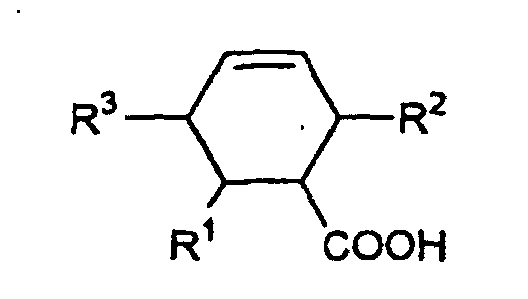 wherein R1 is selected from the group
consisting of OH, COOH, C1-C10 alkyl groups, glycol
esters, and combinations thereof;
wherein R1 is selected from the group
consisting of OH, COOH, C1-C10 alkyl groups, glycol
esters, and combinations thereof; -
- Another object of the present invention is to provide an antifreeze concentrate composition comprising:
- (a) from 90% to 99.89% by weight of a liquid alcohol which functions as a freezing point depressant, or mixture thereof;
- (b) from 0.1% to 5% by weight of a carboxylic acid, or salt, isomer or mixture thereof; and
- (c) from 0.01% to 2% by weight of a
cyclohexenoic acid, or salt, isomer, or mixture thereof,
having the following formula:
 wherein R1 is H;
 -
- The present invention further provides an antifreeze concentrate composition comprising:
- (a) from 90% to 99.89% by weight of a liquid alcohol which functions as a freezing point depressant, or mixture thereof;
- (b) from 0.1% to 5% by weight of a carboxylic acid, or salt, isomer or mixture thereof; and
- (c) from 0.01% to 2% by weight of a
cyclohexenoic acid, or salt, isomer, or mixture thereof,
having the following formula:
 wherein R1 is H;
 -
- The inventive concentrates have been found to be surprisingly effective exhibiting reduced corrosion of aluminum surfaces, especially CE-type corrosion. The present invention also provides antifreeze formulations comprising the inventive concentrates and methods of inhibiting such corrosion using the inventive concentrates.
- In order that this invention may be more fully understood, the following detailed description is set forth.
- The present invention provides antifreeze compositions which demonstrate surprisingly increased inhibition of aluminum surfaces and in particular, increased inhibition of CE-type corrosion of aluminum surfaces.
Antifreeze compositions refer to antifreeze concentrates and antifreeze formulations which comprise a concentrate diluted with water. - The inventive antifreeze concentrates comprise:
- (a) from 90% to 99.89% by weight of a liquid alcohol which functions as a freezing point depressant, or mixture thereof;
- (b) from 0.1% to 5% by weight of a carboxylic acid, or salt, isomer or mixture thereof, wherein the carboxylic acid is selected from the group consisting of C4-C12 mono-carboxylic and di-carboxylic acids, and salts, isomers and mixtures thereof; and
- (c) from 0.01% to 2% by weight of a
cyclohexenoic acid, or salt, isomer, or mixture thereof,
having the following formula:
 wherein R1 is selected from the group
consisting of OH, COOH, C1-C10 alkyl groups, glycol
esters, and combinations thereof;
wherein R1 is selected from the group
consisting of OH, COOH, C1-C10 alkyl groups, glycol
esters, and combinations thereof; -
- The present invention further provides an antifreeze concentrate composition comprising:
- (a) from 90% to 99.89% by weight of a liquid alcohol which functions as a freezing point depressant, or mixture thereof;
- (b) from 0.1% to 5% by weight of a carboxylic acid, or salt, isomer or mixture thereof, wherein the carboxylic acid is selected from the group consisting of C4-C12 mono-carboxylic and di-carboxylic acids, and salts, isomers and mixtures thereof; and
- (c) from 0.01% to 2% by weight of a
cyclohexenoic acid, or salt, isomer, or mixture thereof,
having the following formula:
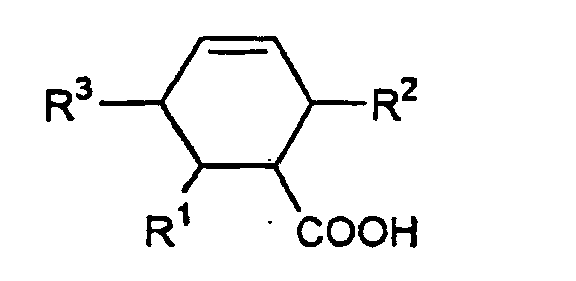 wherein R2 is selected from the group
consisting of OH, COOH, C1-C10 alkyl groups, glycol
esters, and combinations thereof;
wherein R2 is selected from the group
consisting of OH, COOH, C1-C10 alkyl groups, glycol
esters, and combinations thereof; -
- It is an object of the present invention to provide an antifreeze concentrate composition comprising:
- (a) from 90% to 99.89% by weight of a liquid alcohol which functions as a freezing point depressant, or mixture thereof;
- (b) from 0.1% to 5% by weight of a carboxylic acid, or salt, isomer or mixture thereof, wherein the carboxylic acid is selected from the group consisting of C4-C12 mono-carboxylic and di-carboxylic acids, and salts, isomers and mixtures thereof; and
- (c) from 0.01% to 2% by weight of a
cyclohexenoic acid, or salt, isomer, or mixture thereof,
having the following formula:
 wherein R3 is selected from the group
consisting of OH, COOH, C1-C10 alkyl groups, glycol
esters, and combinations thereof;
wherein R3 is selected from the group
consisting of OH, COOH, C1-C10 alkyl groups, glycol
esters, and combinations thereof; -
- Another object of the present invention is to provide an antifreeze concentrate composition comprising:
- (a) from 90% to 99.89% by weight of a liquid alcohol which functions as a freezing point depressant, or mixture thereof;
- (b) from 0.1% to 5% by weight of a carboxylic acid, or salt, isomer or mixture thereof; and
- (c) from 0.01% to 2% by weight of a
cyclohexenoic acid, or salt, isomer, or mixture thereof,
having the following formula:
 wherein R1 is selected from the group
consisting of OH, COOH, C1-C10 alkyl groups, glycol
esters, and combinations thereof;
wherein R1 is selected from the group
consisting of OH, COOH, C1-C10 alkyl groups, glycol
esters, and combinations thereof; -
- Another object of the present invention is to provide an antifreeze concentrate composition comprising:
- (a) from 90% to 99.89% by weight of a liquid alcohol which functions as a freezing point depressant, or mixture thereof;
- (b) from 0.1% to 5% by weight of a carboxylic acid, or salt, isomer or mixture thereof; and
- (c) from 0.01% to 2% by weight of a
cyclohexenoic acid, or salt, isomer, or mixture thereof,
having the following formula:
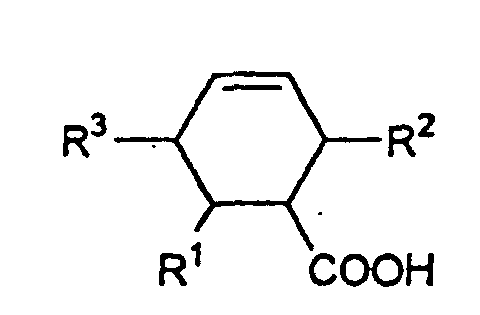 wherein R1 is H;
 -
- The present invention further provides an antifreeze concentrate composition comprising:
- (a) from 90% to 99.89% by weight of a liquid alcohol which functions as a freezing point depressant, or mixture thereof;
- (b) from 0.1% to 5% by weight of a carboxylic acid, or salt, isomer or mixture thereof; and
- (c) from 0.01% to 2% by weight of a
cyclohexenoic acid, or salt, isomer, or mixture thereof,
having the following formula:
 wherein R1 is H;
 -
- Suitable liquid alcohols which function as freezing point depressants include any alcohol or other heat transfer medium and preferably is at least one alcohol, selected from the group consisting of methanol, ethanol, propanol, ethylene glycol, diethylene glycol, triethylene glycol, propylene glycol, dipropylene glycol, butylene glycol, glycerol, the monoethylether of glycerol, the dimethylether of glycerol, alkoxy alkanols (such as methoxyethanol) and mixtures thereof The preferred alcohol is selected from the group consisting of ethylene glycol, diethylene glycol, propylene glycol, dipropylene glycol and mixtures thereof
- The liquid alcohol component is added in the amount of from 90% to 99.89% by weight of the concentrate.
- The carboxylic acid used in the antifreeze composition herein described may be selected from the group consisting of C4-C12 mono- or di-carboxylic acids such as 2-ethyl hexanoic acid, neooctanoic acid, neodecanoic acid, benzoic acid, t-butylbenzoic acid, dodecanedioic acid and sebacic acid, or salts (e.g., alkali and alkaline earth metal, ammonium or amine salts), isomers or mixtures thereof. More preferred carboxylic acids include C8 mono-carboxylic acids (e.g., 2-ethyl hexanoic acid) as well as mixtures having a major amount of a C8 mono-carboxylic acid component (e.g., neo-octanoic acid and/or 2-ethyl hexanoic acid, more preferably 2-ethyl hexanoic acid) and neodecanoic acid, or salts (e.g., alkali and alkaline earth metal, ammonium or amine salts) or isomers thereof Where the mixture of a C8 mono-carboxylic acid component and neodecanoic acid is used, the preferred mixture comprises the C8 mono-carboxylic acid component and neodecanoic acid in the weight ratio of about 3:1 See United States patent No. 5,741,436.
- The carboxylic acid component is added in an amount of from 0.1% to 5%, and more preferably from 2% to 4% by weight.
- The cyclohexenoic acid component has the structure:wherein each of R1, R2 and R3 is, independently, selected from the group consisting of H, OH, COOH, C1-C10 alkyl groups, glycol esters, or combinations thereof with the proviso that R1, R2 and R3 are not concurrently H. Where the substituents comprise a C1-C10 alkyl group, more preferred alkyl groups have up to six carbon atoms because such groups are believed to result in cyclohexenoic acids having improved miscibility in the antifreeze composition.

- For the cyclohexenoic acid component, R1 is preferably H or COOH (with COOH more preferred), R3 preferably comprises a C1-C10 alkyl group, and R2 preferably has the structure:
- x is from 0 to 10;
- y is from 1 to 5; and
- z is from 0 to 5
-
- Preferably, z is 0-2, more preferably z is 1 or 2, and even more preferably z is 2. Examples of useful cyclohexenoic acids include:

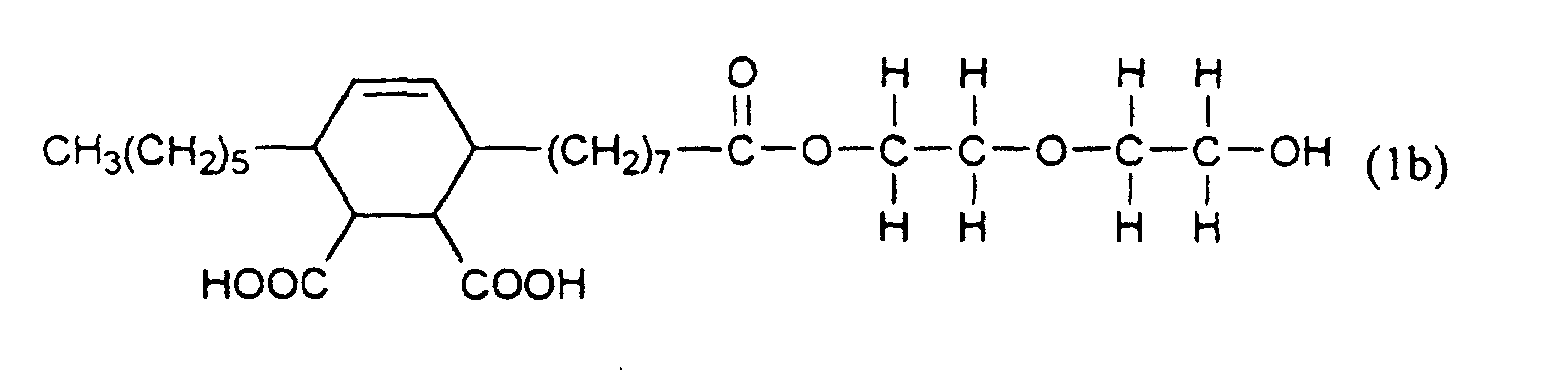

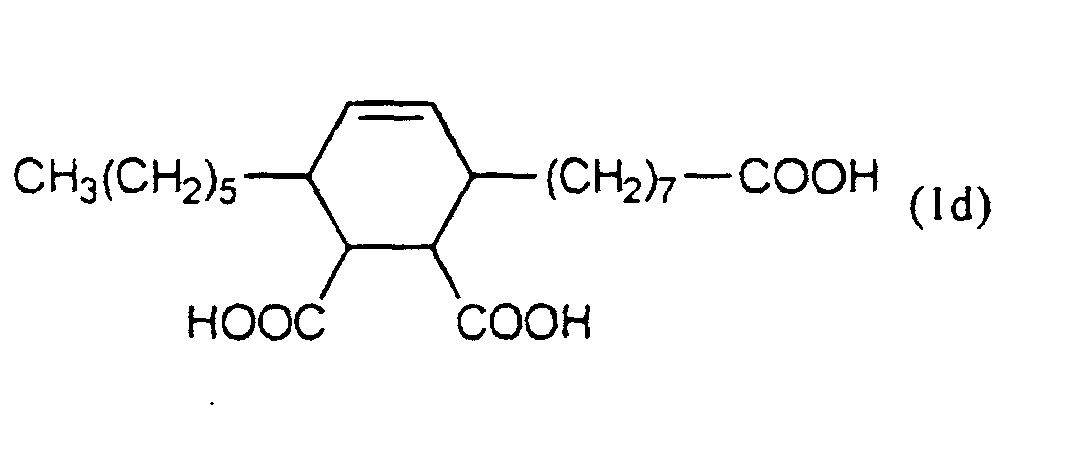
- The cyclohexenoic acid component is added in an amount of from 0.01% to 2.0% by weight of the concentrate. The only expected constraint is the miscibility of the cyclohexenoic acid (or its salt) component in the concentrate. Preferably, the cyclohexenoic acid component is added in an amount of from 0.01% to 1.0%, more preferably from 0.1% to 1.0%, and even more preferably from 0.1% to 0.3% by weight of the concentrate.
- The cyclohexenoic acids used in this invention, including those specifically described above, may be obtained from Westvaco Corporation.
- The acid components of the antifreeze compositions of this invention may alternatively be in the form of an alkali metal salt, ammonium salt or amine salt. Preferred salts are the alkali metal salts, and most preferred are sodium or potassium salts of the acids.
- The antifreeze compositions may also include one or more additional corrosion inhibitors, such as triazoles, thiazoles, phosphates, borates, silicates, molybdates, nitrates, nitrites or the alkali metal, alkaline earth metal, ammonium or amine salts thereof In some applications, for example heavy duty engine applications, the antifreeze compositions of this invention further comprise nitrite. Preferably, the antifreeze compositions of this invention further comprise a triazole or thiazole, more preferably, an aromatic triazole or thiazole such as benzotriazole ("BZT"), mercaptobenzothiazole ("MBT") or tolyltriazole ("TTZ") and most preferably, TTZ. Such additional corrosion inhibitors may be added in concentrations of up to 5.5% (by weight of the antifreeze composition).
- The antifreeze composition may also comprise a sufficient amount of an alkali metal hydroxide to adjust the pH to between 6.0 to 11.0, preferably to 6.5 to 9.0. Other additives may also be used depending on the application. Suitable additives include dyes (e.g., "Alizarine Green," "Uranine Yellow" or "Green AGS-liquid" from Abbey Color Inc., "Orange II (Acid Orange 7)" or "Intracid Rhodamine WT (Acid Red 388)" from Crompton & Knowles Corp.), odor masking aids, perfumes, bitterants, antifoams, rust inhibitors, pH buffers, scale inhibitors, and/or sequestration and dispersion agents (e.g., "Dequest" from Monsanto Chemical Company, "Bayhibit" from Miles Inc., "Rejext-it" from PMC Specialties Group, "Nalco" or "NalPREP" from Nalco Chemical Company).
- The antifreeze concentrates of the present invention can be used to prepare antifreeze formulations. To form such an antifreeze formulation, the concentrate is diluted with water. Preferably, the antifreeze formulation comprises from 10% to 90% by weight water, and more preferably from 25% to 75% by weight water.
- It will be appreciated by one of skill in the art that the amounts of the components of the antifreeze compositions may vary when minor adjustments are made to the other components of the compositions.
- The present invention also provides methods for inhibiting corrosion of the aluminum components in internal combustion engines. Such methods comprise the step of contacting the aluminum components to be protected with the antifreeze compositions described above.
- In order that this invention may be better understood, the following examples are set forth. These examples are for the purpose of illustration only and are not to be construed as limiting the scope of the invention in any way.
- To evaluate the effectiveness of the above-described antifreeze compositions to inhibit corrosion of aluminum, a number of compositions were subjected to standard industry corrosion tests. In the compositions tested, the following representative cyclohexenoic acid compounds were used:


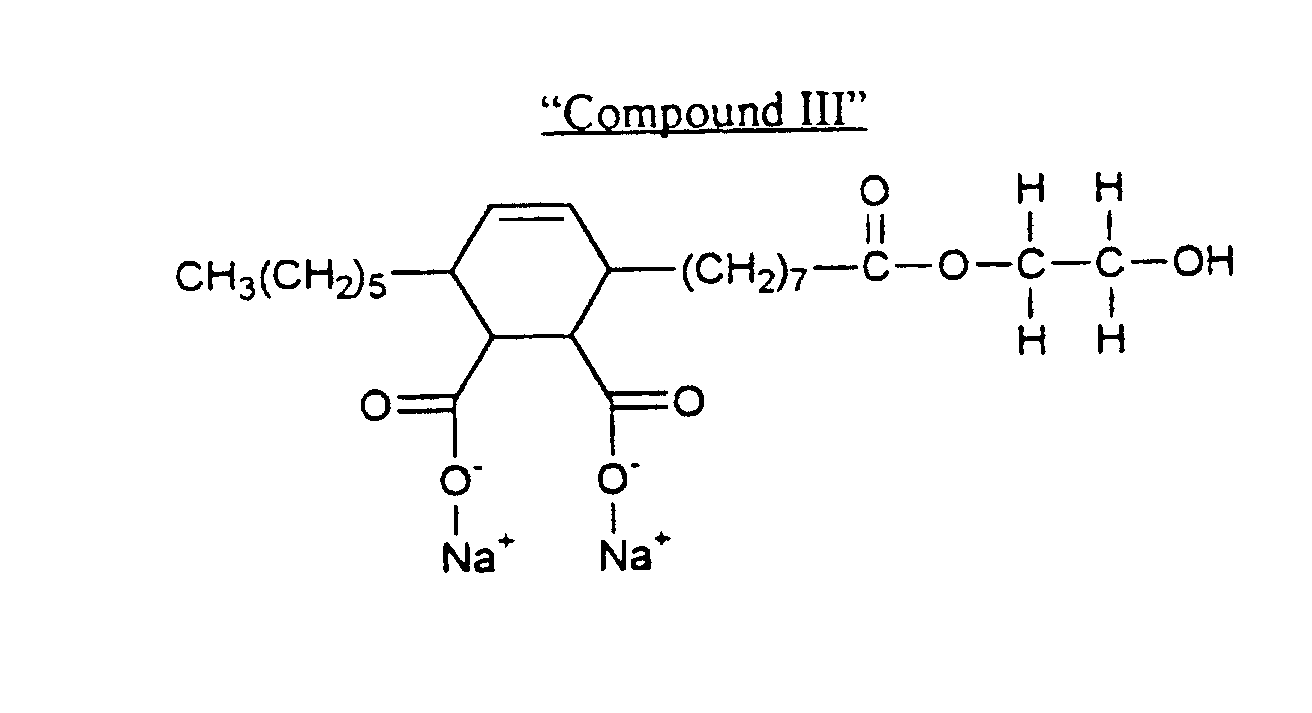
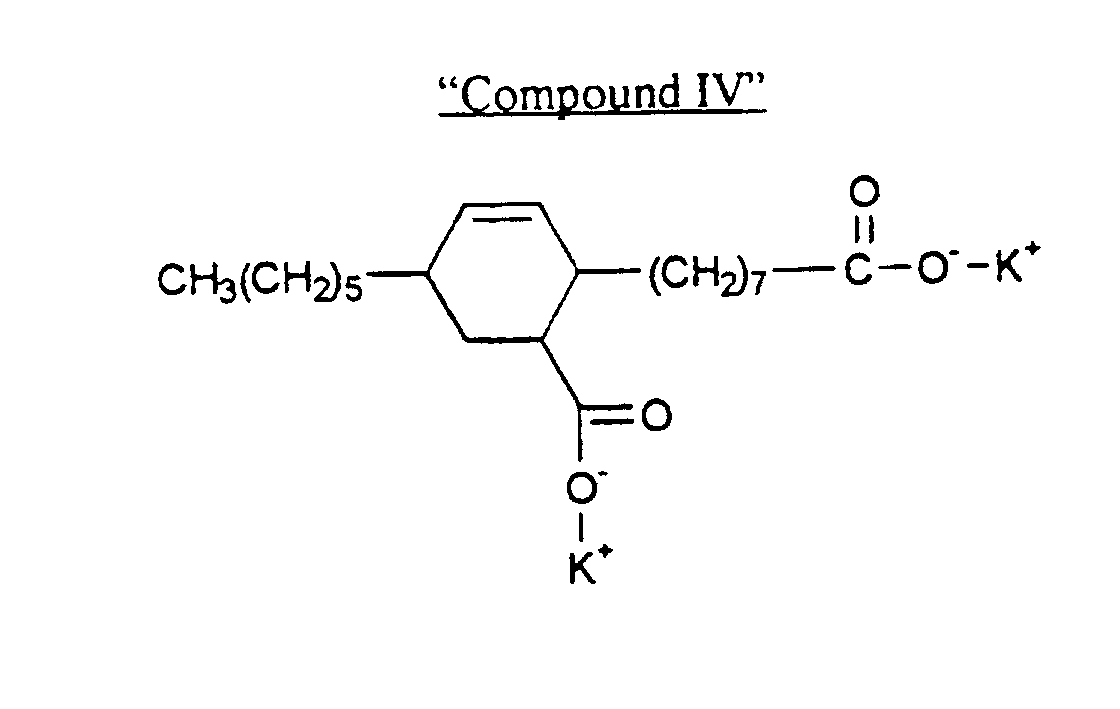
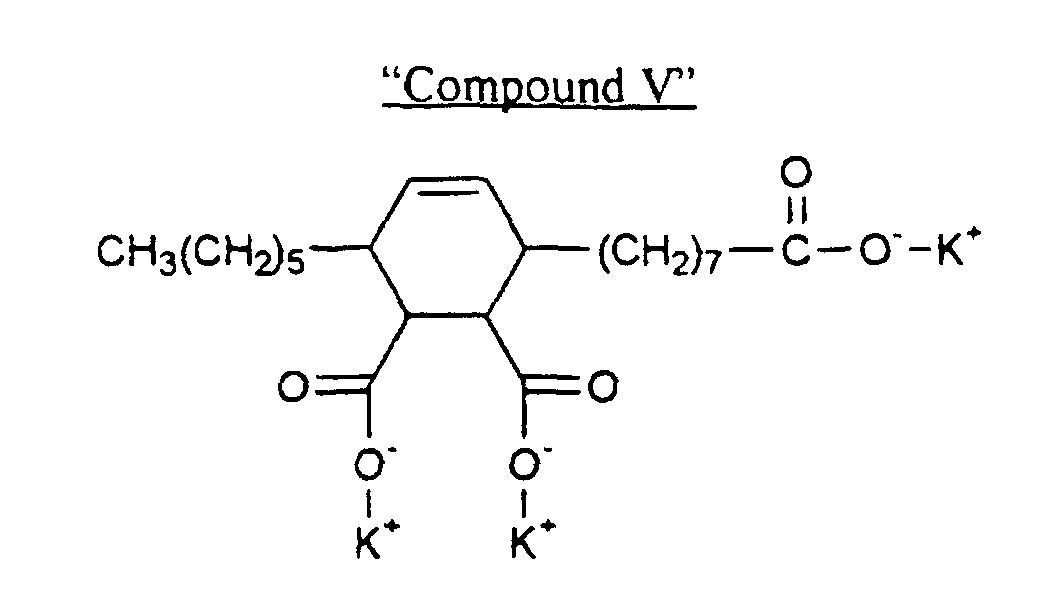
- Ten different antifreeze compositions were prepared and evaluated under the conditions set forth by ASTM D2809. See Annual Book of ASTM Standards, Section 15, Volume 15.05 (1996), incorporated herein by reference. ASTM D2809 is the standard test method for CE-type corrosion of aluminum pumps using antifreeze coolants. Before testing, each of the test solutions was diluted in accordance with ASTM D2809. These compositions were prepared in accordance with note #4 set forth in ASTM D2809.
- After preparing the compositions and subjecting them to the test procedures set forth in ASTM D2809, the aluminum pump, casting/cover and impeller were visually inspected and rated on a scale of 1 to 10 according to the recommendations set forth in ASTM D2809. Under ASTM D3306, a rating of 8 (for each of the pump, casting/cover and impeller) is the minimum required to pass ASTM D2809, with 10 being perfect. The compositions and results are set forth in Tables 1a and 1b.

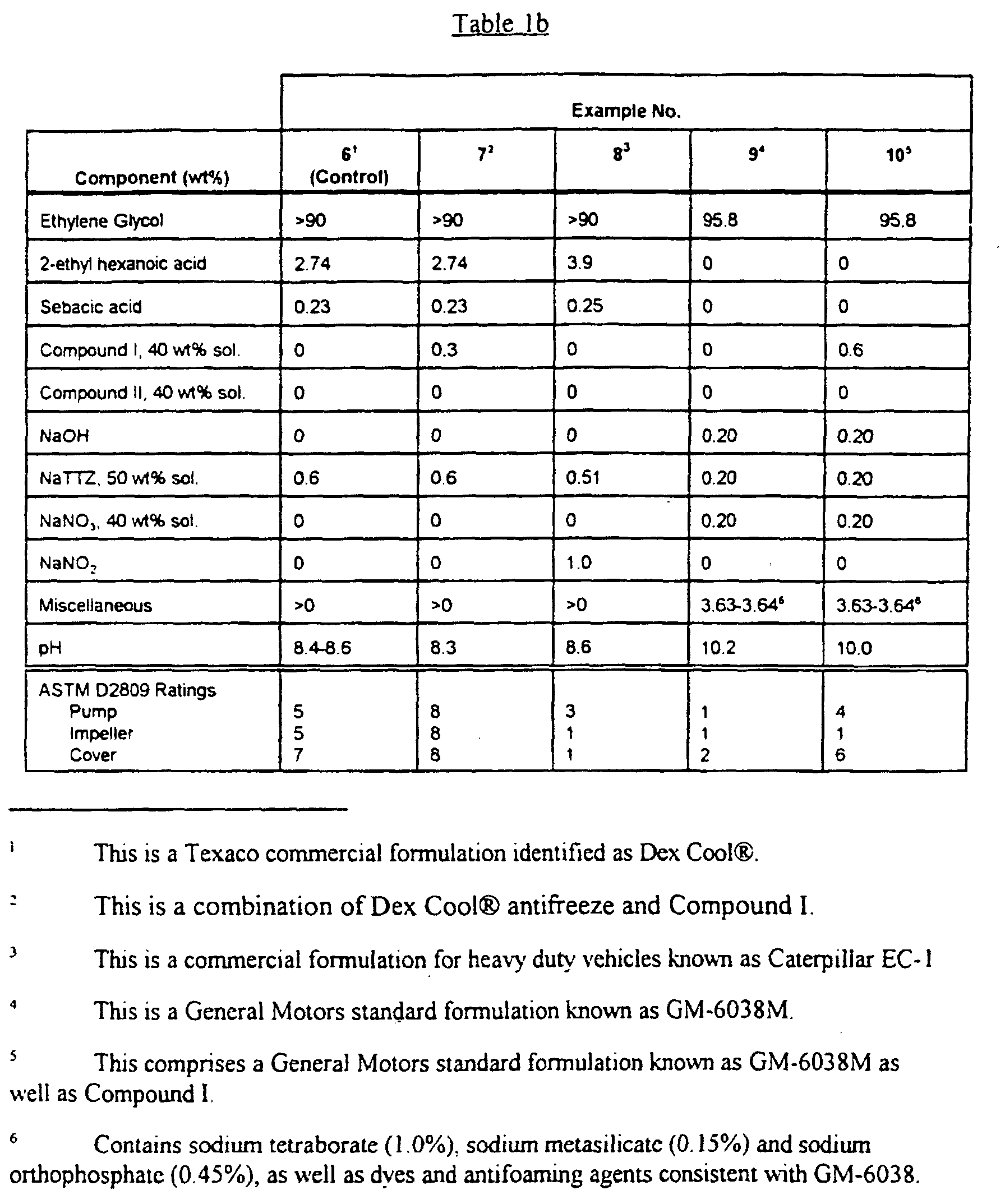
- As shown in Tables 1a and 1b, the control compositions (Examples 1, 2 and 6) all failed ASTM D2809. Also, the composition (Example 8) further comprising nitrite, a known CE-type cast iron corrosion inhibitor, also failed ASTM D2809. However, the combination of a cyclohexenoic acid and a carboxylic acid significantly improved performance in all compositions (Examples 3-5 and 7) and resulted in an antifreeze composition that consistently passed ASTM D2809).
- Four different antifreeze compositions were prepared and evaluated under the conditions set forth by Ford Motor Company Specification No. WSS-M97B44-D (at Table 2) ("the Ford Water Pump test"). The Ford Water Pump test is a standard water pump test similar to that specified by ASTM D2809. Like ASTM D2809, the Ford test requires a visual inspection of the aluminum pump and casting/cover (but not the impeller) and rated on a scale of 1 to 10 according to the recommendations set forth in ASTM D2809.
- The Ford test, however, evaluates the effectiveness of an antifreeze composition as a CE-type corrosion inhibitor using a specified Ford water pump (unlike ASTM D2809 which requires a specified General Motors water pump). Also, the Ford test requires an inspection at 100, 300 and 1000 hours and a reporting of the ratings at each interval (unlike ASTM D2809 which only requires a 100 hour inspection with a minimum rating of 8). The compositions tested and the results are set forth in Table 2 below.

- As shown in Table 2, the control compositions (Examples 11 and 13) did not complete the 1000 hour test. In each of the control compositions, perforation of the water pump occurred at 494 and 831 hours, respectively. However, the use of a combination of a carboxylic acid component and a cyclohexenoic acid component allowed the composition to complete the 1000 hour test and significantly improved performance in both compositions (Examples 12 and 14).
- Twenty-two different antifreeze compositions were prepared and evaluated under the conditions set forth by ASTM D1384. See Annual Book of ASTM Standards, Section 15, Volume 15.05 (1996), incorporated herein by reference. ASTM D1384 is a standard test method for general corrosion of a variety of metals typically found in the cooling and/or heating systems of internal combustion engines.
- Before testing, each of the solutions was diluted with "corrosive water" (deionized water containing 100 ppm each of deionized water containing 100 ppm each of SO4 2-, HCO3 - and Cl-, all added as Na salts) to make a formulation with 33.3% (by volume) concentrate. These compositions were prepared in accordance with the "Treatment of Mixtures" prescribed by ASTM D1176.
- After preparing the compositions and subjecting them to the test procedures set forth in ASTM D1384 (the metal specimens were immersed for 336 hours in the antifreeze composition and maintained at a temperature of 88°C), the weight change of the metal specimens were measured (average of triplicate specimens). In addition to the metal specimens required by ASTM D1384, a modine solder specimen was also tested.
- A negative weight loss signifies a weight increase due to the formation of a protective coating on the metal surfaces. The reproducibility error associated with this test is about +/- 5 mg for aluminum. Under ASTM D3306, an aluminum weight loss of 30.0 mg is the maximum allowed to pass ASTM D1384.
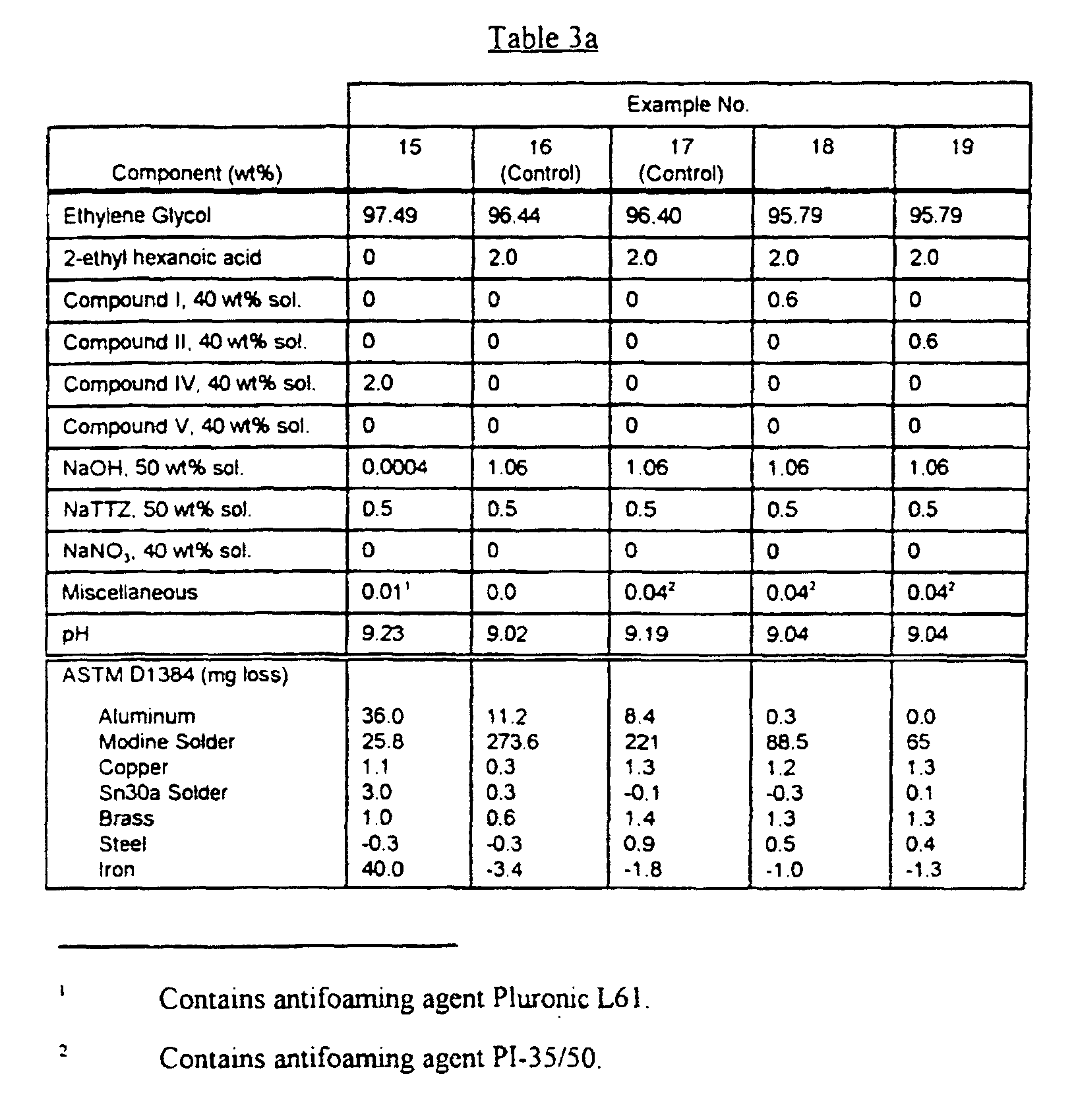
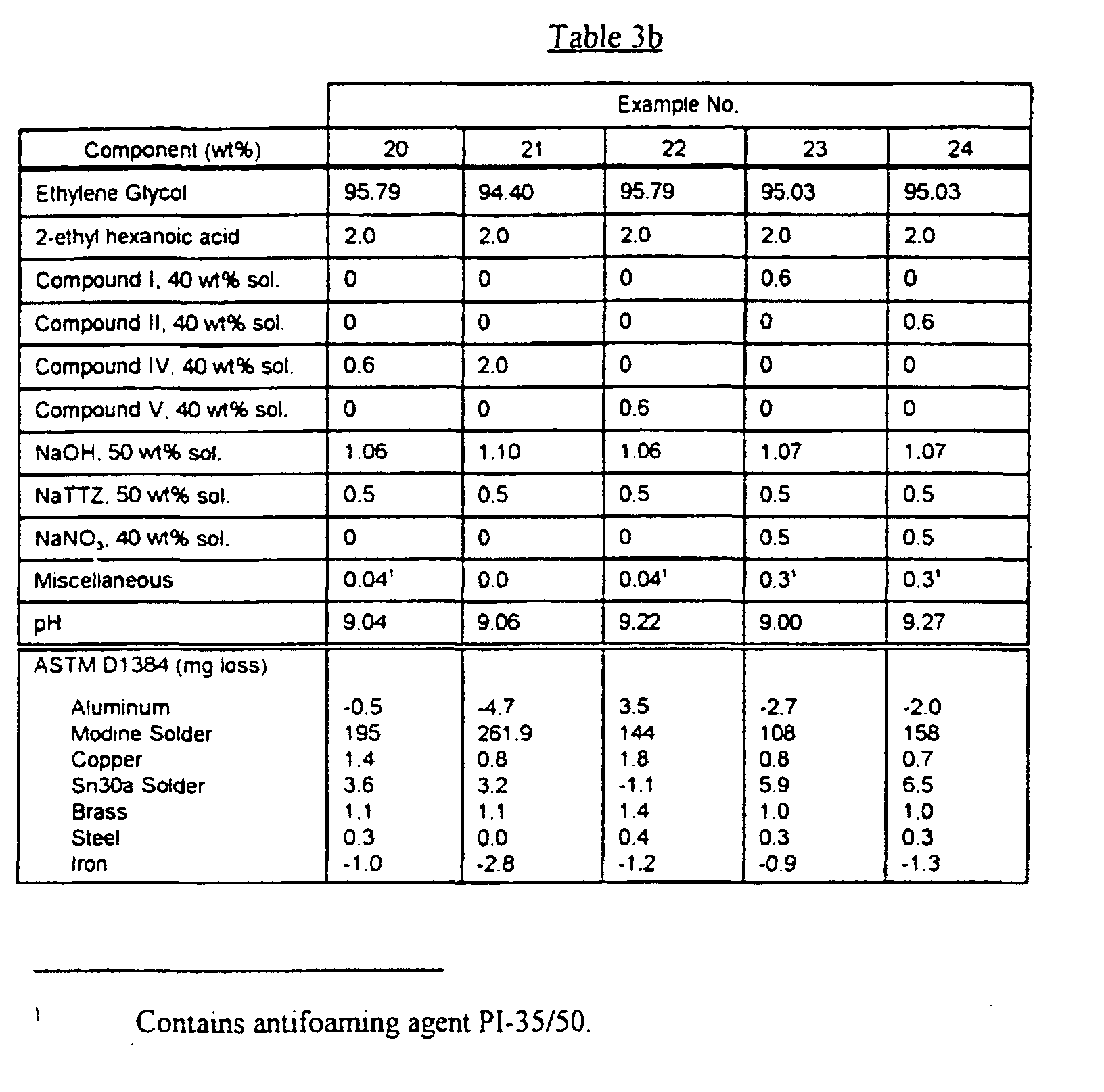
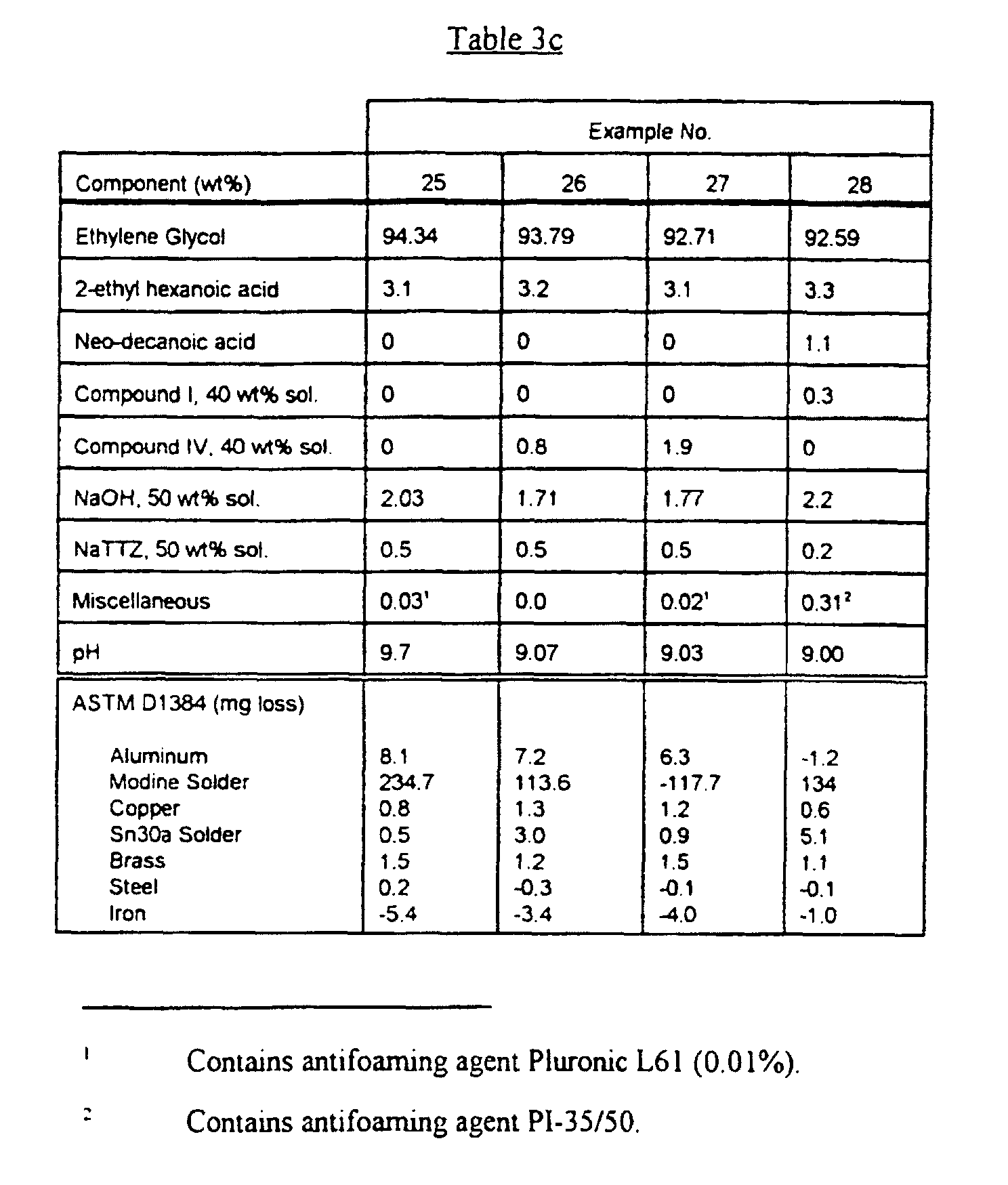
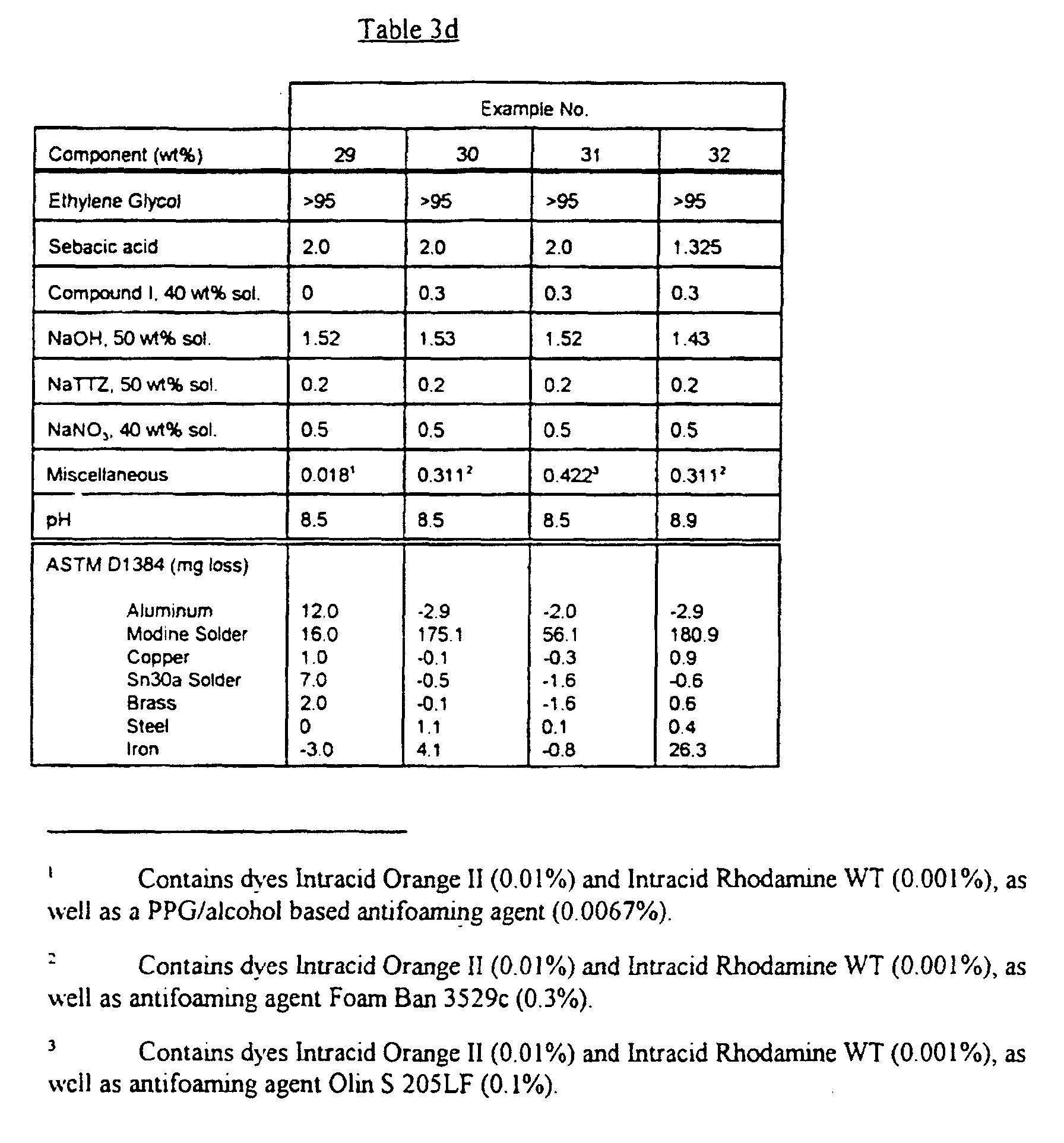
- As Tables 3a-3d show, the only composition that did not pass ASTM D1384 (i.e., exhibited an aluminum weight loss > 30 mg) is that which comprises a cyclohexenoic acid without a carboxylic acid (Example 15).
- The combination of a cyclohexenoic acid component and a carboxylic acid component demonstrated an improved (decreased) aluminum weight loss as compared to the corresponding control composition comprising a carboxylic acid without a cyclohexenoic acid. For example, the addition of Compounds I, II, IV or V to a mono-carboxylic acid (e.g., 2-ethyl hexanoic acid in Examples 18-24) significantly improved aluminum weight loss as compared to the control compositions (Examples 16 and 17). This result occurred using different amounts and different examples of the cyclohexenoic acid component.
- Significant improvement was also achieved using relatively high amounts of a combination of a cyclohexenoic acid and a mixture of mono-carboxylic acids (e.g., Example 28). Further, at least numerically improved aluminum weight loss was achieved at even relatively high amounts of mono-carboxylic acid (e.g., Example 25 vs. 26-27).
- Similarly, the addition of even a relatively small amount of a cyclohexenoic acid to different amounts of a di-carboxylic acid (e.g., sebacic acid) significantly improved aluminum weight loss (Example 29 vs. 30-32).
- Examples 29 and 30 were also evaluated under ASTM D1384 after being subjected to an accelerated aging test (Examples 29a and 30a, respectively). In this test, metal shavings were immersed for 336 hours in the antifreeze composition and maintained at 100°C (each test is conducted in triplicate). The resulting compositions were then subjected to the test procedures set forth in ASTM D1384.
- As Table 3e below shows, the combination of a carboxylic acid component and a cyclohexenoic acid component (Example 30a) provided excellent aluminum protection. While the addition of a cyclohexenoic acid to a carboxylic acid (Example 30a) demonstrated the same corrosion rate (-2.0) as the control composition (Example 29a), the control composition already provided excellent aluminum protection and as such, no conclusions can be made regarding improved results in a spent composition. However, the significant improvement in corrosion rate (i.e., decreased rate) by the addition of a cyclohexenoic acid to a carboxylic acid based antifreeze composition was demonstrated above.

- Nineteen different antifreeze compositions were prepared and evaluated under the conditions set forth by ASTM D2570. See Annual Book of ASTM Standards, Section 15, Volume 15.05 (1996), incorporated herein by reference. ASTM D2570 is a standard test method for aluminum corrosion under simulated service conditions using a brass radiator. In this test, an aluminum radiator was also used. The results should only be compared between Examples using the same type of radiator.
- Before testing, each of the solutions was diluted with "corrosive water" (deionized water containing 100 ppm each of SO4 2-, HCO3 - and Cl-, all added as Na salts) to make a composition with 44% (by volume) concentrate. These compositions were prepared in accordance with the "Treatment of Mixtures" prescribed by ASTM D1176.
- After preparing the compositions and subjecting them to the test procedures set forth in ASTM D2570 (the metal specimens were immersed for 1064 hours in the antifreeze composition and maintained at a temperature of 88°C), the weight change of the metal specimens were measured (average of triplicate specimens). In addition to the metal specimens required by ASTM D2570, a modine solder specimen was also tested in certain compositions. A negative weight loss signifies a weight increase due to the formation of a protective coating on the metal surfaces. The error associated with this test is about +/- 5 mg for aluminum. Under ASTM D3306, an aluminum weight loss of 60.0 mg is the maximum allowed to pass ASTM D2570.

- As shown in Table 4a, the addition of a cyclohexenoic acid component (Examples 37-38) to a carboxylic acid component (Example 33) significantly improved (decreased) aluminum weight loss in the ASTM D2570 test using a brass radiator. Such a combination also provided superior aluminum protection as compared to compositions comprising a carboxylic acid component (e.g., mono-carboxylic, di-carboxylic and mixtures thereof) without the cyclohexenoic acid component (Examples 34-36).
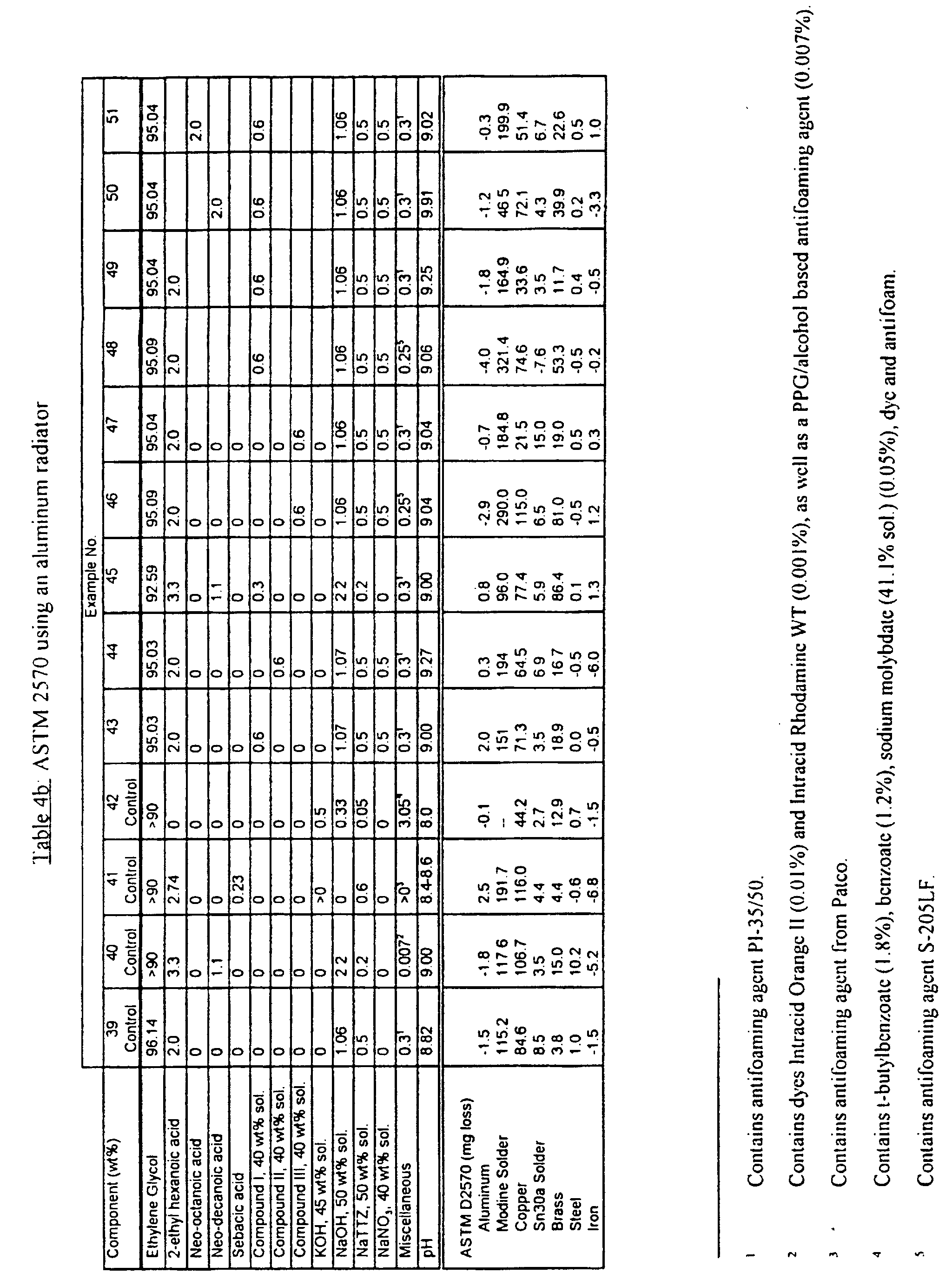
- As shown in Table 4b, in the ASTM D2570 test using an aluminum radiator the combination of a cyclohexenoic acid component and a carboxylic acid component provided excellent aluminum protection (Examples 43-51). While the addition of a cyclohexenoic acid component to a carboxylic acid component demonstrated about the same level of aluminum weight loss as the control compositions (Examples 39-42), the control compositions already provided excellent aluminum protection and as such, no conclusions can be made regarding improved results in an aluminum radiator. However, the significant improvement in aluminum weight loss (i.e., decreased loss) by the addition of a cyclohexenoic acid to a carboxylic acid based antifreeze composition was demonstrated above under ASTM D2570 conditions.
- The antifreeze compositions from Examples 29-30 were prepared and evaluated under the conditions set forth by ASTM D4340 (now Examples 52-53 respectively). See Annual Book of ASTM Standards, Section 15, Volume 15.05 (1996), incorporated herein by reference. ASTM D4340 is a standard test method for general corrosion of heat-rejecting aluminum found in the cooling and/or heating systems of internal combustion engines (e.g., aluminum cylinder heads). According to ASTM D3306, the maximum allowed corrosion rate resulting from a tested sample is 1.0 mg/cm2/week. Because of fluctuations that may occur between runs with this test, the antifreeze composition to be evaluated should be run with a control composition at or about the same time.
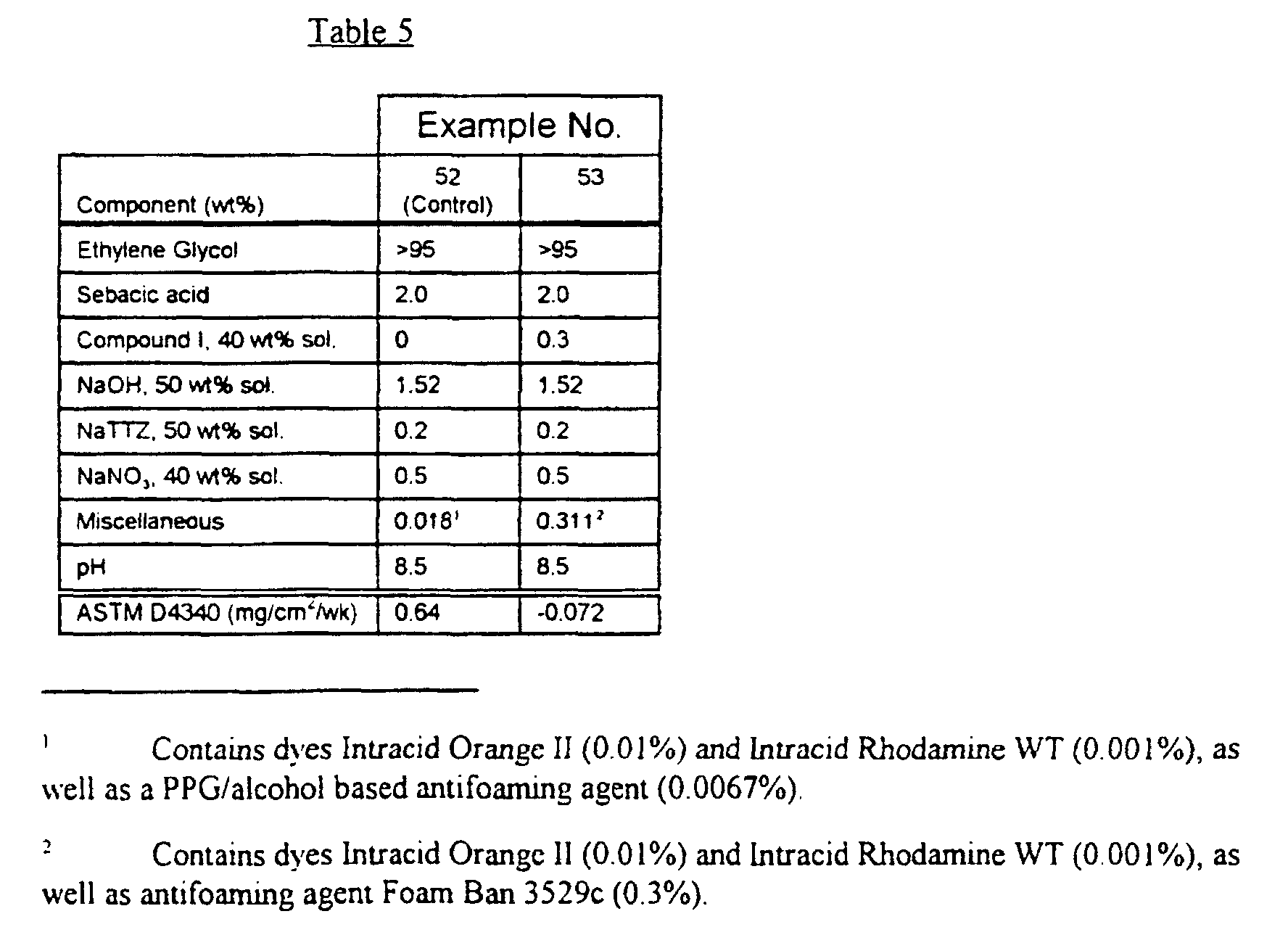
- As shown in Table 5 above, the addition of a cyclohexenoic acid (Example 53) to the control composition (Example 52) resulted in a significantly lower corrosion rate of about 0 mg/cm2/wk. This illustrates that the combination of acids of this invention provides not only improved corrosion protection to the aluminum components in water pumps, but also to aluminum cylinder heads.
each of R2 and R3 is, independently, selected from the group consisting of H, OH, COOH, C1-C10 alkyl groups, glycol esters, and combinations thereof.
each of R1 and R3 is, independently, selected from the group consisting of H, OH, COOH, C1-C10 alkyl groups, glycol esters, and combinations thereof.
each of R1 and R2 is, independently, selected from the group consisting of H, OH, COOH, C1-C10 alkyl groups, glycol esters, and combinations thereof.
each of R2 and R3 is, independently, selected from the group consisting of H, OH, COOH, C1-C10 alkyl groups, glycol esters, and combinations thereof.
R2 is selected from the group consisting of H, OH, COOH, C1-C10 alkyl groups, glycol esters, and combinations thereof;
R3 is selected from the group consisting of OH, COOH, glycol esters, and combinations thereof.
R2 is selected from the group consisting of OH, COOH, glycol esters, and combinations thereof
R3 is selected from the group consisting of H, OH, COOH, C1-C10 alkyl groups, glycol esters, and combinations thereof.
each of R2 and R3 is, independently, selected from the group consisting of H, OH, COOH, C1-C10 alkyl groups, glycol esters, and combinations thereof.
each of R1 and R3 is, independently, selected from the group consisting of H, OH, COOH, C1-C10 alkyl groups, glycol esters, and combinations thereof.
each of R1 and R2 is, independently, selected from the group consisting of H, OH, COOH, C1-C10 alkyl groups, glycol esters, and combinations thereof.
each of R2 and R3 is, independently, selected from the group consisting of H, OH, COOH, C1-C10 alkyl groups, glycol esters, and combinations thereof.
R2 is selected from the group consisting of H, OH, COOH, C1-C10 alkyl groups, glycol esters, and combinations thereof;
R3 is selected from the group consisting of OH, COOH, glycol esters, and combinations thereof.
R2 is selected from the group consisting of OH, COOH, glycol esters, and combinations thereof
R3 is selected from the group consisting of H, OH, COOH, C1-C10 alkyl groups, glycol esters, and combinations thereof.
Claims (20)
- An antifreeze concentrate composition comprising:wherein R1 is selected from the group consisting of OH, COOH, C1-C10 alkyl groups, glycol esters, and combinations thereof;(a) from 90% to 99.89% by weight of a liquid alcohol which functions as a freezing point depressant, or mixture thereof;(b) from 0.1% to 5% by weight of a carboxylic acid, or salt, isomer or mixture thereof, wherein the carboxylic acid is selected from the group consisting of C4-C12 mono-carboxylic and di-carboxylic acids, and salts, isomers and mixtures thereof; and(c) from 0.01% to 2% by weight of a cyclohexenoic acid, or salt, isomer, or mixture thereof, having the following formula:

each of R2 and R3 is, independently, selected from the group consisting of H, OH, COOH, C1-C10 alkyl groups, glycol esters, and combinations thereof. - An antifreeze concentrate composition comprising:wherein R2 is selected from the group consisting of OH, COOH, C1-C10 alkyl groups, glycol esters, and combinations thereof;(a) from 90% to 99.89% by weight of a liquid alcohol which functions as a freezing point depressant, or mixture thereof;(b) from 0.1% to 5% by weight of a carboxylic acid, or salt, isomer or mixture thereof, wherein the carboxylic acid is selected from the group consisting of C4-C12 mono-carboxylic and di-carboxylic acids, and salts, isomers and mixtures thereof; and(c) from 0.01% to 2% by weight of a cyclohexenoic acid, or salt, isomer, or mixture thereof, having the following formula:

each of R1 and R3 is, independently, selected from the group consisting of H, OH, COOH, C1-C10 alkyl groups, glycol esters, and combinations thereof. - An antifreeze concentrate composition comprising:wherein R3 is selected from the group consisting of OH, COOH, C1-C10 alkyl groups, glycol esters, and combinations thereof;(a) from 90% to 99.89% by weight of a liquid alcohol which functions as a freezing point depressant, or mixture thereof;(b) from 0.1% to 5% by weight of a carboxylic acid, or salt, isomer or mixture thereof, wherein the carboxylic acid is selected from the group consisting of C4-C12 mono-carboxylic and di-carboxylic acids, and salts, isomers and mixtures thereof; and(c) from 0.01% to 2% by weight of a cyclohexenoic acid, or salt, isomer, or mixture thereof, having the following formula:

each of R1 and R2 is, independently, selected from the group consisting of H, OH, COOH, C1-C10 alkyl groups, glycol esters, and combinations thereof. - An antifreeze concentrate composition comprising:wherein R1 is selected from the group consisting of OH, COOH, C1-C10 alkyl groups, glycol esters, and combinations thereof;(a) from 90% to 99.89% by weight of a liquid alcohol which functions as a freezing point depressant, or mixture thereof;(b) from 0.1% to 5% by weight of a carboxylic acid, or salt, isomer or mixture thereof; and(c) from 0.01% to 2% by weight of a cyclohexenoic acid, or salt, isomer, or mixture thereof, having the following formula:

each of R2 and R3 is, independently, selected from the group consisting of H, OH, COOH, C1-C10 alkyl groups, glycol esters, and combinations thereof. - An antifreeze concentrate composition comprising:wherein R1 is H;(a) from 90% to 99.89% by weight of a liquid alcohol which functions as a freezing point depressant, or mixture thereof;(b) from 0.1% to 5% by weight of a carboxylic acid, or salt, isomer or mixture thereof; and(c) from 0.01% to 2% by weight of a cyclohexenoic acid, or salt, isomer, or mixture thereof, having the following formula:

R2 is selected from the group consisting of H, OH, COOH, C1-C10 alkyl groups, glycol esters, and combinations thereof;
R3 is selected from the group consisting of OH, COOH, glycol esters, and combinations thereof. - An antifreeze concentrate composition comprising:wherein R1 is H;(a) from 90% to 99.89% by weight of a liquid alcohol which functions as a freezing point depressant, or mixture thereof;(b) from 0.1% to 5% by weight of a carboxylic acid, or salt, isomer or mixture thereof; and(c) from 0.01% to 2% by weight of a cyclohexenoic acid, or salt, isomer, or mixture thereof, having the following formula:

R2 is selected from the group consisting of OH, COOH, glycol esters, and combinations thereof;
R3 is selected from the group consisting of H, OH, COOH, C1-C10 alkyl groups, glycol esters, and combinations thereof. - The antifreeze concentrate composition according to any one of claims 1-4, wherein R1 is COOH.
- The antifreeze concentrate composition according to any one of claims 1-4, 6 or 7, wherein R3 is a C1-C10 alkyl group.
- The antifreeze concentrate composition according to claim 8, wherein R2 has the structure (CH2)x-(COO)-[(CH2)y-O)z-H, or salt or isomer thereof;
where x is from 0 to 10;
y is from 1 to 5; and
z is from 0 to 5. - An antifreeze concentrate composition comprising:(a) from 90% to 99.89% by weight of a liquid alcohol which functions as a freezing point depressant, or mixture thereof;(b) from 0.1% to 5% by weight of a carboxylic acid, or salt, isomer or mixture thereof; and(c) from 0.01% to 2% by weight of a cyclohexenoic acid selected from the group consisting of:
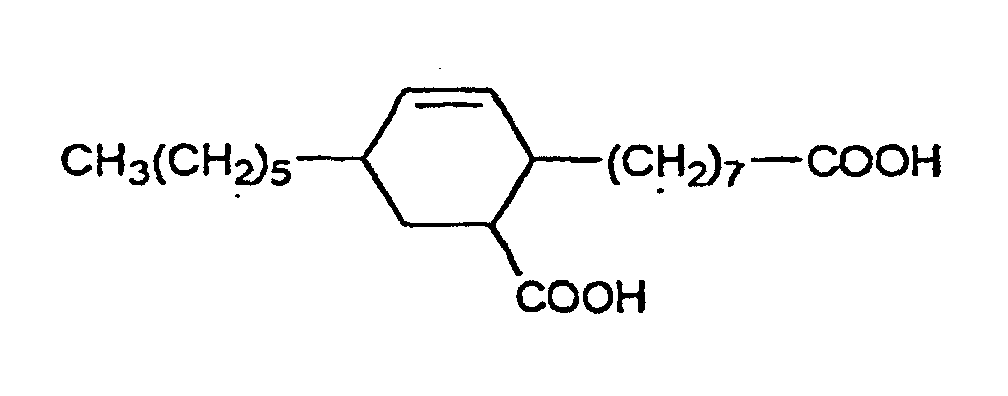

 and salts, isomers and mixtures thereof.
- The antifreeze concentrate composition according to claim 10, wherein said cyclohexenoic acid isand salts and isomers thereof.

- The antifreeze concentrate composition according to claim 10, wherein said cyclohexenoic acid isand salts and isomers thereof.

- The antifreeze concentrate composition according to claim 10, wherein said cyclohexenoic acid isand salts and isomers thereof.

- The antifreeze concentrate composition according to.claim 10, wherein said cyclohexenoic acid isand salts and isomers thereof.
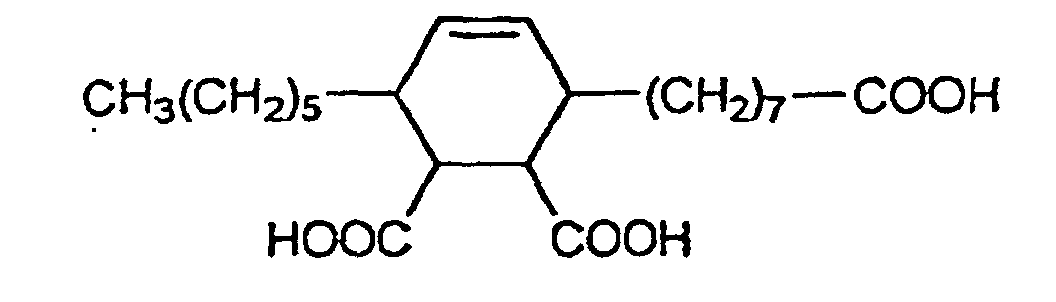
- The antifreeze concentrate composition according to any one of claims 1-6 or 10, wherein the carboxylic acid is selected from the group consisting of 2-ethyl hexanoic acid, neooctanoic acid, neodecanoic acid, benzoic acid, t-butylbenzoic acid, dodecandioic acid, sebacic acid, and salts, isomers and mixtures thereof.
- The antifreeze concentrate composition according to any one of claims 1-6 or 10, wherein the carboxylic acid comprises a major amount of a C8 mono-carboxylic acid component, or salt, isomer or mixture thereof, and neodecanoic acid, or salt, isomer or mixture thereof.
- The antifreeze concentrate composition according to any one of claims 1-6 or 10, wherein the antifreeze composition further comprises one or more additional corrosion inhibitors selected from the group consisting of di-carboxylic acids, triazoles, thiazoles, phosphates, borates, silicates, molybdates, nitrates, nitrites and the alkali or alkaline earth metal, ammonium and amine salts thereof.
- The antifreeze concentrate composition according to any one of claims 1-6 or 10, wherein the antifreeze composition further comprises an alkali metal hydroxide in an amount sufficient to adjust the pH of the composition to from 6.0 to 11.0.
- A method for inhibiting the corrosion of aluminum surfaces comprising the step of contacting said surfaces with an antifreeze concentrate composition comprising:wherein each of R1, R2 and R3 is, independently, selected from the group consisting of H, OH, COOH, C1-C10 alkyl groups, glycol esters, or combinations thereof.(a) from 90% to 99.89% by weight of a liquid alcohol which functions as a freezing point depressant, or mixture thereof;(b) from 0.1% to 5% by weight of a carboxylic acid, or salt, isomer or mixture thereof;. and(c) from 0.01% to 2% by weight of a cyclohexenoic acid, or salt, isomer, or mixture thereof, having the following formula:
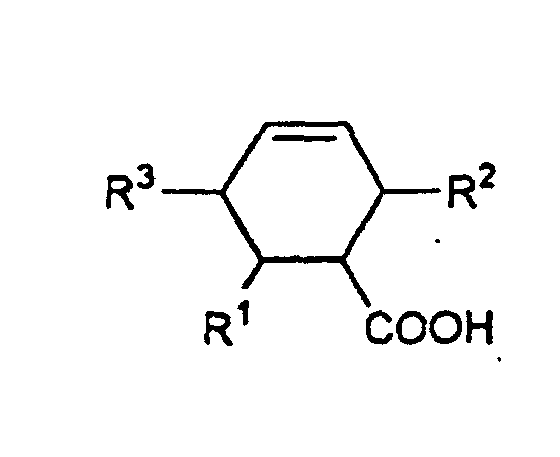
- The method according to claim 19, wherein said corrosion is cavitation-erosion corrosion.
Applications Claiming Priority (3)
| Application Number | Priority Date | Filing Date | Title |
|---|---|---|---|
| US136027 | 1998-08-19 | ||
| US09/136,027 US6391257B1 (en) | 1998-08-19 | 1998-08-19 | Antifreeze compositions comprising carboxylic acid and cyclohexenoic acid |
| PCT/US1999/018532 WO2000011102A1 (en) | 1998-08-19 | 1999-08-13 | Antifreeze compositions comprising carboxylic acid and cyclohexenoic acid corrosion inhibitors |
Publications (2)
| Publication Number | Publication Date |
|---|---|
| EP1119593A1 EP1119593A1 (en) | 2001-08-01 |
| EP1119593B1 true EP1119593B1 (en) | 2004-12-01 |
Family
ID=22470914
Family Applications (1)
| Application Number | Title | Priority Date | Filing Date |
|---|---|---|---|
| EP99941156A Expired - Lifetime EP1119593B1 (en) | 1998-08-19 | 1999-08-13 | Antifreeze compositions comprising carboxylic acid and cyclohexenoic acid corrosion inhibitors |
Country Status (7)
| Country | Link |
|---|---|
| US (1) | US6391257B1 (en) |
| EP (1) | EP1119593B1 (en) |
| JP (1) | JP4438920B2 (en) |
| KR (1) | KR100630848B1 (en) |
| AU (1) | AU744418B2 (en) |
| DE (1) | DE69922399T2 (en) |
| WO (1) | WO2000011102A1 (en) |
Families Citing this family (27)
| Publication number | Priority date | Publication date | Assignee | Title |
|---|---|---|---|---|
| WO2004042856A1 (en) * | 2002-11-05 | 2004-05-21 | Shishiai-Kabushikigaisha | Fuel cell coolant |
| DE10313280A1 (en) * | 2003-03-25 | 2004-10-07 | Basf Ag | Antifreeze concentrates and coolant compositions based on polyglycols and amides for the protection of magnesium and its alloys |
| WO2005006476A1 (en) * | 2003-07-11 | 2005-01-20 | Shishiai-Kabushikigaisha | Cooling fluid composition for fuel battery |
| EP1683895B1 (en) * | 2003-10-01 | 2018-08-08 | Shishiai-Kabushikigaisha | Liquid coolant composition |
| JPWO2005037950A1 (en) * | 2003-10-16 | 2006-12-28 | シーシーアイ株式会社 | Coolant composition |
| US20050154030A1 (en) * | 2003-12-12 | 2005-07-14 | Microban Products Company | Antimicrobial composition |
| WO2005063918A1 (en) * | 2003-12-25 | 2005-07-14 | Shishiai-Kabushikigaisha | Heat carrier composition |
| WO2005091413A1 (en) * | 2004-03-24 | 2005-09-29 | Shishiai-Kabushikigaisha | Cooling fluid composition for fuel cell |
| JP2005325300A (en) * | 2004-05-17 | 2005-11-24 | Toyota Motor Corp | Coolant composition |
| EP1829949B1 (en) | 2004-11-26 | 2012-07-25 | Shishiai-Kabushikigaisha | Heat carrier composition |
| US7435359B2 (en) * | 2004-12-21 | 2008-10-14 | Hercules Chemical Company Incorporated | Corrosion inhibiting heat transfer materials |
| KR101300541B1 (en) * | 2005-06-24 | 2013-09-02 | 프레스톤 프로닥츠 코포레이션 | Method for inhibiting corrosion in brazed metal surfaces and coolants and additives for use therein |
| WO2007021961A1 (en) * | 2005-08-12 | 2007-02-22 | Honeywell International Inc. | Method for stabilizing an engine coolant concentrate and preventing hard water salt formation upon dilution |
| US20080001118A1 (en) * | 2006-06-29 | 2008-01-03 | Alverson Frederick C | Additive combinations, antifreeze concentrates, coolant compositions, and method for using same to provide corrosion and oxidation inhibition at high temperatures |
| FR2904829B1 (en) * | 2006-08-08 | 2012-10-05 | Total France | CARBOXYLIC ACID COMPOSITIONS FOR TEMPORARY PROTECTION OF METALLIC SURFACES AND DRY FILMS OBTAINED THEREFROM |
| EP3786569A1 (en) | 2008-03-03 | 2021-03-03 | Prestone Products Corporation | Heat transfer system comprising brazed aluminum, method, heat transfer fluid, and additive package |
| US8771542B2 (en) * | 2008-07-11 | 2014-07-08 | Prestone Products Corporation | Heat transfer fluid, additive package, system and method |
| EP2312019B1 (en) | 2009-10-01 | 2013-02-27 | Rhein Chemie Rheinau GmbH | Use of anticorrosion additives to protect aluminum and /or aluminum alloys in a finishing process |
| US9023235B2 (en) | 2012-09-07 | 2015-05-05 | Prestone Products Corporation | Heat transfer fluid additive composition |
| US8613866B1 (en) | 2012-09-07 | 2013-12-24 | Prestone Products Corporation | Heat transfer fluids and corrosion inhibitor formulations for use thereof |
| US9567507B2 (en) | 2012-09-07 | 2017-02-14 | Prestone Products Corporation | Heat transfer fluids and corrosion inhibitor formulations for use thereof |
| US9994755B2 (en) | 2012-09-07 | 2018-06-12 | Prestone Products Corporation | Heat transfer fluids and corrosion inhibitor formulations for use thereof |
| US8617416B1 (en) | 2012-09-07 | 2013-12-31 | Prestone Products Corporation | Heat transfer fluids and corrosion inhibitor formulations for use thereof |
| JP6742902B2 (en) | 2013-03-15 | 2020-08-19 | ジェンザイム・コーポレーション | High-density cell banking methods |
| ES2890454T3 (en) | 2014-09-18 | 2022-01-19 | Genzyme Corp | Ultra-high-density cell banking methods |
| JP6798795B2 (en) * | 2016-04-28 | 2020-12-09 | トヨタ自動車株式会社 | A method for suppressing the malodor of the coolant and a composition for suppressing the malodor of the coolant. |
| CN105820801A (en) * | 2016-05-19 | 2016-08-03 | 山东普希环保科技有限公司 | Environment-friendly and economical propylene glycol freezing prevention and boiling prevention fluid |
Family Cites Families (20)
| Publication number | Priority date | Publication date | Assignee | Title |
|---|---|---|---|---|
| US3753968A (en) | 1971-07-01 | 1973-08-21 | Westvaco Corp | Selective reaction of fatty acids and their separation |
| US3981682A (en) | 1973-03-15 | 1976-09-21 | Westvaco Corporation | Corrosion inhibiting compositions and process for inhibiting corrosion of metals |
| US3931029A (en) | 1974-10-15 | 1976-01-06 | Basf Wyandotte Corporation | Corrosion inhibited antifreeze compositions and process for inhibiting the corrosion of solder alloys |
| US4081462A (en) | 1975-10-14 | 1978-03-28 | Westvaco Corporation | C22 -Cycloaliphatic tricarboxylic fatty acid soaps |
| US4077894A (en) | 1976-12-27 | 1978-03-07 | Basf Wyandotte Corporation | Glycol antifreeze mixtures |
| GB2075483A (en) | 1980-03-12 | 1981-11-18 | Ici Ltd | Corrosion inhibitors and compositions containing them |
| AT378786B (en) | 1981-10-12 | 1985-09-25 | Lang Chem Tech Prod | FREEZER PROTECTION AND ICE SOLVENT |
| US4514335A (en) | 1982-07-06 | 1985-04-30 | Westvaco Corporation | C21 -Dicarboxylic acid isethionates as primary anionic surfactants |
| US4476055A (en) | 1982-07-06 | 1984-10-09 | Westvaco Corporation | C21-Dicarboxylic acid isethionates as primary anionic surfactants |
| US4571309A (en) | 1983-07-20 | 1986-02-18 | Westvaco Corporation | C22 -Cycloaliphatic tricarboxylic acid derived isethionate esters and method of preparation |
| US4614600A (en) | 1984-10-31 | 1986-09-30 | Westvaco Corporation | Corrosion inhibitors |
| US4588513A (en) | 1984-11-19 | 1986-05-13 | Texaco, Inc. | Non-borate, non-phosphate antifreeze formulations containing dibasic acid salts as corrosion inhibitors |
| KR910003915B1 (en) | 1988-01-27 | 1991-06-15 | 한국과학기술원 | Anti-freezing liquid |
| US5008039A (en) | 1988-03-15 | 1991-04-16 | Westvaco Corporation | Low foaming rust inhibiting composition |
| US4927669A (en) | 1988-07-15 | 1990-05-22 | Westvaco Corporation | Oil field corrosion inhibition |
| US4946616A (en) | 1988-11-14 | 1990-08-07 | The Dow Chemical Company | Heat transfer fluids containing dicarboxylic acid mixtures as corrosion inhibitors |
| US5174913A (en) | 1991-09-20 | 1992-12-29 | Westvaco Corporation | Polybasic acid esters as oil field corrosion inhibitors |
| US5242621A (en) | 1992-06-03 | 1993-09-07 | Texaco Chemical Co. | Combinations of alkanoic hydrocarbyl dicarboxylic and carbocyclic alkanoic acids or salts useful as heat transfer fluid corrosion inhibitors |
| US5292480A (en) | 1992-06-11 | 1994-03-08 | Westvaco Corporation | Acid-anhydride esters as oil field corrosion inhibitors |
| US5741436A (en) | 1995-12-05 | 1998-04-21 | Prestone Products Corp. | Antifreeze concentrates and compositions comprising neodecanoic acid corrosion inhibitors |
-
1998
- 1998-08-19 US US09/136,027 patent/US6391257B1/en not_active Expired - Lifetime
-
1999
- 1999-08-13 AU AU54865/99A patent/AU744418B2/en not_active Ceased
- 1999-08-13 EP EP99941156A patent/EP1119593B1/en not_active Expired - Lifetime
- 1999-08-13 DE DE69922399T patent/DE69922399T2/en not_active Expired - Lifetime
- 1999-08-13 WO PCT/US1999/018532 patent/WO2000011102A1/en not_active Ceased
- 1999-08-13 JP JP2000566361A patent/JP4438920B2/en not_active Expired - Fee Related
- 1999-08-13 KR KR1020017002068A patent/KR100630848B1/en not_active Expired - Fee Related
Also Published As
| Publication number | Publication date |
|---|---|
| US6391257B1 (en) | 2002-05-21 |
| AU5486599A (en) | 2000-03-14 |
| JP4438920B2 (en) | 2010-03-24 |
| WO2000011102A1 (en) | 2000-03-02 |
| KR100630848B1 (en) | 2006-10-09 |
| DE69922399T2 (en) | 2005-12-22 |
| AU744418B2 (en) | 2002-02-21 |
| KR20010079656A (en) | 2001-08-22 |
| DE69922399D1 (en) | 2005-01-05 |
| EP1119593A1 (en) | 2001-08-01 |
| JP2002523619A (en) | 2002-07-30 |
Similar Documents
| Publication | Publication Date | Title |
|---|---|---|
| US6391257B1 (en) | Antifreeze compositions comprising carboxylic acid and cyclohexenoic acid | |
| EP0865474B1 (en) | Neoacid corrosion inhibitors | |
| US6143243A (en) | Method of inhibiting cavitation-erosion corrosion of aluminum surfaces using carboxylic acid based compositions comprising polymerizable-acid graft polymers | |
| RU2227175C2 (en) | Corrosion inhibitors together with synergism effect inhibitors for protection of light metals in liquid heat-transfer agents and cooling liquids of engines | |
| RU2249634C2 (en) | Corrosion-inhibiting compositions for liquid heat carriers | |
| GB2138837A (en) | Corrosion inhibiting functional fluid | |
| NZ502530A (en) | Mono-carboxylic acids (saturated or unsaturated, aliphatic or aromatic) used in preparations of corrosion inhibitor for flux-treated metal surfaces | |
| US6126852A (en) | Monocarboxylic acid based antifreeze composition | |
| CA2762976C (en) | Hot test fluid containing vapor phase inhibition | |
| US6235217B1 (en) | Monocarboxylic acid based antifreeze composition | |
| CZ20014588A3 (en) | Corrosion-inhibiting composition for heat-carrying liquids | |
| WO1989009806A1 (en) | Inhibited alkylene glycol coolant and cooling process | |
| JP3651939B2 (en) | Antifreeze composition | |
| CA2309887C (en) | Neoacid corrosion inhibitors | |
| CA2238174C (en) | Neoacid corrosion inhibitors | |
| HK1016210B (en) | Neoacid corrosion inhibitors | |
| MXPA00004372A (en) | Silicate free antifreeze composition |
Legal Events
| Date | Code | Title | Description |
|---|---|---|---|
| PUAI | Public reference made under article 153(3) epc to a published international application that has entered the european phase |
Free format text: ORIGINAL CODE: 0009012 |
|
| 17P | Request for examination filed |
Effective date: 20010228 |
|
| AK | Designated contracting states |
Kind code of ref document: A1 Designated state(s): AT BE CH CY DE DK ES FI FR GB GR IE IT LI LU MC NL PT SE |
|
| AX | Request for extension of the european patent |
Free format text: AL;LT;LV;MK;RO;SI |
|
| 17Q | First examination report despatched |
Effective date: 20030228 |
|
| GRAP | Despatch of communication of intention to grant a patent |
Free format text: ORIGINAL CODE: EPIDOSNIGR1 |
|
| RBV | Designated contracting states (corrected) |
Designated state(s): DE FR GB IT |
|
| GRAS | Grant fee paid |
Free format text: ORIGINAL CODE: EPIDOSNIGR3 |
|
| GRAA | (expected) grant |
Free format text: ORIGINAL CODE: 0009210 |
|
| AK | Designated contracting states |
Kind code of ref document: B1 Designated state(s): DE FR GB IT |
|
| REG | Reference to a national code |
Ref country code: GB Ref legal event code: FG4D |
|
| REG | Reference to a national code |
Ref country code: IE Ref legal event code: FG4D |
|
| REF | Corresponds to: |
Ref document number: 69922399 Country of ref document: DE Date of ref document: 20050105 Kind code of ref document: P |
|
| PLBE | No opposition filed within time limit |
Free format text: ORIGINAL CODE: 0009261 |
|
| STAA | Information on the status of an ep patent application or granted ep patent |
Free format text: STATUS: NO OPPOSITION FILED WITHIN TIME LIMIT |
|
| 26N | No opposition filed |
Effective date: 20050902 |
|
| ET | Fr: translation filed | ||
| REG | Reference to a national code |
Ref country code: FR Ref legal event code: PLFP Year of fee payment: 17 |
|
| REG | Reference to a national code |
Ref country code: FR Ref legal event code: PLFP Year of fee payment: 18 |
|
| REG | Reference to a national code |
Ref country code: FR Ref legal event code: PLFP Year of fee payment: 19 |
|
| PGFP | Annual fee paid to national office [announced via postgrant information from national office to epo] |
Ref country code: IT Payment date: 20170823 Year of fee payment: 19 Ref country code: GB Payment date: 20170829 Year of fee payment: 19 Ref country code: DE Payment date: 20170829 Year of fee payment: 19 Ref country code: FR Payment date: 20170825 Year of fee payment: 19 |
|
| REG | Reference to a national code |
Ref country code: DE Ref legal event code: R119 Ref document number: 69922399 Country of ref document: DE |
|
| GBPC | Gb: european patent ceased through non-payment of renewal fee |
Effective date: 20180813 |
|
| PG25 | Lapsed in a contracting state [announced via postgrant information from national office to epo] |
Ref country code: DE Free format text: LAPSE BECAUSE OF NON-PAYMENT OF DUE FEES Effective date: 20190301 Ref country code: IT Free format text: LAPSE BECAUSE OF NON-PAYMENT OF DUE FEES Effective date: 20180813 |
|
| PG25 | Lapsed in a contracting state [announced via postgrant information from national office to epo] |
Ref country code: FR Free format text: LAPSE BECAUSE OF NON-PAYMENT OF DUE FEES Effective date: 20180831 |
|
| PG25 | Lapsed in a contracting state [announced via postgrant information from national office to epo] |
Ref country code: GB Free format text: LAPSE BECAUSE OF NON-PAYMENT OF DUE FEES Effective date: 20180813 |