EP1118754A2 - A gas driven mechanical oscillator and method - Google Patents
A gas driven mechanical oscillator and method Download PDFInfo
- Publication number
- EP1118754A2 EP1118754A2 EP01108704A EP01108704A EP1118754A2 EP 1118754 A2 EP1118754 A2 EP 1118754A2 EP 01108704 A EP01108704 A EP 01108704A EP 01108704 A EP01108704 A EP 01108704A EP 1118754 A2 EP1118754 A2 EP 1118754A2
- Authority
- EP
- European Patent Office
- Prior art keywords
- piston
- compressor
- valves
- air
- cylinder
- Prior art date
- Legal status (The legal status is an assumption and is not a legal conclusion. Google has not performed a legal analysis and makes no representation as to the accuracy of the status listed.)
- Withdrawn
Links
Images



Classifications
-
- F—MECHANICAL ENGINEERING; LIGHTING; HEATING; WEAPONS; BLASTING
- F01—MACHINES OR ENGINES IN GENERAL; ENGINE PLANTS IN GENERAL; STEAM ENGINES
- F01B—MACHINES OR ENGINES, IN GENERAL OR OF POSITIVE-DISPLACEMENT TYPE, e.g. STEAM ENGINES
- F01B11/00—Reciprocating-piston machines or engines without rotary main shaft, e.g. of free-piston type
- F01B11/04—Engines combined with reciprocatory driven devices, e.g. hammers
-
- F—MECHANICAL ENGINEERING; LIGHTING; HEATING; WEAPONS; BLASTING
- F01—MACHINES OR ENGINES IN GENERAL; ENGINE PLANTS IN GENERAL; STEAM ENGINES
- F01B—MACHINES OR ENGINES, IN GENERAL OR OF POSITIVE-DISPLACEMENT TYPE, e.g. STEAM ENGINES
- F01B11/00—Reciprocating-piston machines or engines without rotary main shaft, e.g. of free-piston type
- F01B11/001—Reciprocating-piston machines or engines without rotary main shaft, e.g. of free-piston type in which the movement in the two directions is obtained by one double acting piston motor
-
- F—MECHANICAL ENGINEERING; LIGHTING; HEATING; WEAPONS; BLASTING
- F01—MACHINES OR ENGINES IN GENERAL; ENGINE PLANTS IN GENERAL; STEAM ENGINES
- F01B—MACHINES OR ENGINES, IN GENERAL OR OF POSITIVE-DISPLACEMENT TYPE, e.g. STEAM ENGINES
- F01B23/00—Adaptations of machines or engines for special use; Combinations of engines with devices driven thereby
- F01B23/08—Adaptations for driving, or combinations with, pumps
-
- F—MECHANICAL ENGINEERING; LIGHTING; HEATING; WEAPONS; BLASTING
- F01—MACHINES OR ENGINES IN GENERAL; ENGINE PLANTS IN GENERAL; STEAM ENGINES
- F01B—MACHINES OR ENGINES, IN GENERAL OR OF POSITIVE-DISPLACEMENT TYPE, e.g. STEAM ENGINES
- F01B25/00—Regulating, controlling or safety means
- F01B25/02—Regulating or controlling by varying working-fluid admission or exhaust, e.g. by varying pressure or quantity
- F01B25/14—Regulating or controlling by varying working-fluid admission or exhaust, e.g. by varying pressure or quantity peculiar to particular kinds of machines or engines
-
- F—MECHANICAL ENGINEERING; LIGHTING; HEATING; WEAPONS; BLASTING
- F01—MACHINES OR ENGINES IN GENERAL; ENGINE PLANTS IN GENERAL; STEAM ENGINES
- F01L—CYCLICALLY OPERATING VALVES FOR MACHINES OR ENGINES
- F01L21/00—Use of working pistons or pistons-rods as fluid-distributing valves or as valve-supporting elements, e.g. in free-piston machines
- F01L21/02—Piston or piston-rod used as valve members
-
- F—MECHANICAL ENGINEERING; LIGHTING; HEATING; WEAPONS; BLASTING
- F02—COMBUSTION ENGINES; HOT-GAS OR COMBUSTION-PRODUCT ENGINE PLANTS
- F02B—INTERNAL-COMBUSTION PISTON ENGINES; COMBUSTION ENGINES IN GENERAL
- F02B71/00—Free-piston engines; Engines without rotary main shaft
- F02B71/04—Adaptations of such engines for special use; Combinations of such engines with apparatus driven thereby
-
- F—MECHANICAL ENGINEERING; LIGHTING; HEATING; WEAPONS; BLASTING
- F02—COMBUSTION ENGINES; HOT-GAS OR COMBUSTION-PRODUCT ENGINE PLANTS
- F02B—INTERNAL-COMBUSTION PISTON ENGINES; COMBUSTION ENGINES IN GENERAL
- F02B75/00—Other engines
- F02B75/04—Engines with variable distances between pistons at top dead-centre positions and cylinder heads
-
- F—MECHANICAL ENGINEERING; LIGHTING; HEATING; WEAPONS; BLASTING
- F04—POSITIVE - DISPLACEMENT MACHINES FOR LIQUIDS; PUMPS FOR LIQUIDS OR ELASTIC FLUIDS
- F04B—POSITIVE-DISPLACEMENT MACHINES FOR LIQUIDS; PUMPS
- F04B9/00—Piston machines or pumps characterised by the driving or driven means to or from their working members
- F04B9/08—Piston machines or pumps characterised by the driving or driven means to or from their working members the means being fluid
- F04B9/12—Piston machines or pumps characterised by the driving or driven means to or from their working members the means being fluid the fluid being elastic, e.g. steam or air
- F04B9/123—Piston machines or pumps characterised by the driving or driven means to or from their working members the means being fluid the fluid being elastic, e.g. steam or air having only one pumping chamber
- F04B9/125—Piston machines or pumps characterised by the driving or driven means to or from their working members the means being fluid the fluid being elastic, e.g. steam or air having only one pumping chamber reciprocating movement of the pumping member being obtained by a double-acting elastic-fluid motor
-
- F—MECHANICAL ENGINEERING; LIGHTING; HEATING; WEAPONS; BLASTING
- F25—REFRIGERATION OR COOLING; COMBINED HEATING AND REFRIGERATION SYSTEMS; HEAT PUMP SYSTEMS; MANUFACTURE OR STORAGE OF ICE; LIQUEFACTION SOLIDIFICATION OF GASES
- F25B—REFRIGERATION MACHINES, PLANTS OR SYSTEMS; COMBINED HEATING AND REFRIGERATION SYSTEMS; HEAT PUMP SYSTEMS
- F25B49/00—Arrangement or mounting of control or safety devices
- F25B49/02—Arrangement or mounting of control or safety devices for compression type machines, plants or systems
- F25B49/022—Compressor control arrangements
-
- F—MECHANICAL ENGINEERING; LIGHTING; HEATING; WEAPONS; BLASTING
- F25—REFRIGERATION OR COOLING; COMBINED HEATING AND REFRIGERATION SYSTEMS; HEAT PUMP SYSTEMS; MANUFACTURE OR STORAGE OF ICE; LIQUEFACTION SOLIDIFICATION OF GASES
- F25B—REFRIGERATION MACHINES, PLANTS OR SYSTEMS; COMBINED HEATING AND REFRIGERATION SYSTEMS; HEAT PUMP SYSTEMS
- F25B9/00—Compression machines, plants or systems, in which the refrigerant is air or other gas of low boiling point
- F25B9/06—Compression machines, plants or systems, in which the refrigerant is air or other gas of low boiling point using expanders
-
- F—MECHANICAL ENGINEERING; LIGHTING; HEATING; WEAPONS; BLASTING
- F02—COMBUSTION ENGINES; HOT-GAS OR COMBUSTION-PRODUCT ENGINE PLANTS
- F02B—INTERNAL-COMBUSTION PISTON ENGINES; COMBUSTION ENGINES IN GENERAL
- F02B63/00—Adaptations of engines for driving pumps, hand-held tools or electric generators; Portable combinations of engines with engine-driven devices
- F02B63/04—Adaptations of engines for driving pumps, hand-held tools or electric generators; Portable combinations of engines with engine-driven devices for electric generators
- F02B63/041—Linear electric generators
-
- F—MECHANICAL ENGINEERING; LIGHTING; HEATING; WEAPONS; BLASTING
- F25—REFRIGERATION OR COOLING; COMBINED HEATING AND REFRIGERATION SYSTEMS; HEAT PUMP SYSTEMS; MANUFACTURE OR STORAGE OF ICE; LIQUEFACTION SOLIDIFICATION OF GASES
- F25B—REFRIGERATION MACHINES, PLANTS OR SYSTEMS; COMBINED HEATING AND REFRIGERATION SYSTEMS; HEAT PUMP SYSTEMS
- F25B2400/00—Component parts or details not otherwise provided for in this subclass
- F25B2400/14—Power generation using energy from the expansion of the refrigerant
- F25B2400/141—Power generation using energy from the expansion of the refrigerant the extracted power is not recycled back in the refrigerant circuit
Definitions
- THIS INVENTION relates to a gas driven mechanical oscillator and method for converting the energy of an expanding gas into mechanical work using the oscillator and in particular, but not limited to, a gas driven dynamic linear oscillator using an oscillating mass to accelerate a heavier load against an air cushion.
- the present invention has been devised to offer a useful alternative to present gas driven mechanical oscillators of this general kind by utilising physical principals in a different way to the customarily accepted techniques and methods for converting the energy of an expanding gas into mechanical work.
- the present invention resides in a gas driven mechanical oscillator comprising a casing, a plurality of expansion chambers within the casing, an oscillating member including moveable walls of said chambers, the oscillating member being adapted to oscillate in response to complementary expansion of gas within and exhaustion of gas from the chambers, characterised in that a compressible load is driven by said oscillating member.
- the invention typically includes using the said oscillating member to directly or indirectly drive a compressor to compress gas.
- the invention typically includes using the said oscillating member to directly or indirectly generate electricity.
- the invention typically includes using the said oscillating member in a plant to liquefy air.
- said oscillating member is used to directly or indirectly drive a combined compressor and electricty generator.
- a gas driven mechanical oscillator comprising a casing, a plurality of expansion chambers within the casing, an oscillating member including moveable walls of said chambers, the oscillating member being adapted to oscillate in response to complementary expansion of gas within and exhaustion of gas from the chambers and there being provided control means operable to vary the amplitude of said oscillating member from an initial low amplitude to a higher amplitude in response to increases in said compressible load.
- control means comprises variable inertia means for increasing the inertia of said oscillating member during oscillation thereof.
- control means preferably includes valve means to control the sequencing of said pulses delivered to the chambers in order to increase the amplitude.
- the expansion chambers are respective opposed chambers of a double acting pneumatic cylinder assembly having a cylinder and piston within the cylinder, the oscillating member including said piston and being provided with the compressible load mounted externally of said cylinder assembly, said piston and said load being mounted for movement together and preferably on a common elongate piston rod, said piston rod having spaced transverse slots and axially shiftable and positionable valve means moveable along said piston rod, said valve means having passage means communicating with a source of compressed gas and at the same time with said chambers, said slots being alternately aligned with the respective spaced passages in said valve means to supply pulses of gas to the expansion chambers of the double acting pneumatic cylinder assembly to cause the oscillating member to oscillate.
- the a gas driven mechanical oscillator comprises an AC power supply comprising a double acting pneumatic cylinder assembly including a cylinder and a piston assembly comprising a piston and piston rod attached thereto mounted for reciprocation with the cylinder, a source of compressed air, valve means alternately delivering compressed air from the source of compressed air either side of the piston to cause the piston to reciprocate within the cylinder, the piston rod being coupled to the piston and protruding from the cylinder, an AC power generator driven by reciprocation of the piston against the compressible load.
- AC power supply comprising a double acting pneumatic cylinder assembly including a cylinder and a piston assembly comprising a piston and piston rod attached thereto mounted for reciprocation with the cylinder, a source of compressed air, valve means alternately delivering compressed air from the source of compressed air either side of the piston to cause the piston to reciprocate within the cylinder, the piston rod being coupled to the piston and protruding from the cylinder, an AC power generator driven by reciprocation of the piston against the compressible load.
- the gas driven mechanical oscillator comprises a compressor comprising a double acting pneumatic cylinder assembly including a cylinder and a piston assembly comprising a piston and piston rod attached thereto mounted for reciprocation within the cylinder, a source of compressed air, valve means alternately delivering compressed air from the source of compressed air either side of the piston to cause the piston to reciprocate within the cylinder, the piston rod being coupled to the piston and protruding from the cylinder, and an air compressor driven by reciprocation of the piston.
- a compressor comprising a double acting pneumatic cylinder assembly including a cylinder and a piston assembly comprising a piston and piston rod attached thereto mounted for reciprocation within the cylinder, a source of compressed air, valve means alternately delivering compressed air from the source of compressed air either side of the piston to cause the piston to reciprocate within the cylinder, the piston rod being coupled to the piston and protruding from the cylinder, and an air compressor driven by reciprocation of the piston.
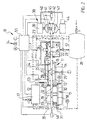
- FIG. 1 there is illustrated a gas driven oscillator 10 made according to the teachings of the present invention.
- FIG 2 there is illustrated in schematic section the gas driven oscillator 10 of Figure 1.
- the oscillator illustrated in Figure 1 is a completely mechanical system whereas the oscillator illustrated in Figure 2 also shows the option of full electronic control.
- the main mechanical operating parts of the two Figures is the same in each case.
- the gas driven oscillator 10 employs as its main part an engine 11 having a casing 12 and a pair of expansion chambers 13 and 14 on either side of a floating piston 15 adapted to reciprocate within the cylinder 12.
- the piston is mounted on a piston rod 16 extending through the cylinder 12 and into a compressor 17, the compressor 17 having a cylinder 18 and a piston 19 mounted on the piston rod 16 to move in concert with the piston 15.
- An air storage tank 20 holds compressed air typically at a pressure between 100psi to 300psi.
- the compressed air in tank 20 can be generated using a compressor located upstream.
- the upstream compressor can be driven by any suitable means including electric motor, internal combustion engine, windmill or the like.
- a valve 21 downstream of the tank 20 controls delivery of the compressed air from the tank 20 to the engine 11 via a pair of valves 22 and 23 with the valves 22 and 23 being mounted on an adjustment screw and slidably disposed on the piston rod 16.
- the spacing between the valves 22 and 23 can be adjusted in order to vary the amplitude ofthe piston 15 within the cylinder 12.
- the valves can be moved in opposite directions and an equal amount.
- the piston rod 16 includes spaced slots 24 and 25 which alternately align with passages inside the respective valves 22 and 23 to deliver a pulse of compressed air from the tank 20 to the respective chambers of the cylinder 12 at each movement of alignment.
- the piston 15 oscillates according to an amplitude set by the spacing between the valves 22 and 23.
- the valves 22 and 23 are mounted on the adjuster screw 26 so they can be moved together or apart as desired.
- the cylinder 12 includes two intakes 27 and 28 and an exhaust outlet 29. As the pulse of compressed air enters an expansion chamber and moves the piston the gas expands and cools and then the cool expanded gas leaves through the exhaust outlet at 29 and flows through to respective intakes of the compressor 17.
- the compressor 17 has intakes 30 and 31 from the engine 11 but also has intakes 32 and 33 drawing air from the atmosphere through non-return valves.
- the non-return valves are also employed at the other inlets so that there is positive displacement of air through outlets 35 and 36 during each stroke in order to compress air in the storage tank 37.
- a variable inertia means 38 is employed and this comprises a mercury storage tank 39, a valve 40 and a mercury delivery chute 41 communicating with a tank 42.
- the tank 42 is rigidly secured to the piston rod 16 and adapted to oscillate therewith.
- a second valve 43 is employed to discharge mercury from the tank 42 into a pump 43 which then returns the mercury to the storage tank 39. It will be appreciated that by adding mercury to the tank 42 the inertia of the oscillating portion ofthe system including the piston rods 16 and pistons 15 and 19 can be increased in order to overcome the gradual increase in pressure within the tank 37.
- the system will continue to operate in order to generate higher pressures whereupon gas can be bled from tank 37 or the intake valves to the compressor 17 can be closed. This provides a constant pressure air cushion for the piston 19 and the oscillator reciprocates at a constant amplitude and frequency.
- valves 22 and 23 are close together for low amplitude operation.
- Valve 21 is then opened. Once valve 21 is open a pulse of compressed air will enter the appropriate chamber of the engine 11 and the system will commence to oscillate as long as the valves 22 and 23 are close enough together.
- pistons 15 and 19 are increased by adding mercury. This is achieved by opening valve 40 to gradually deliver mercury into the system to increase its inertia and thereby overcome the pressure that would otherwise stop the system.
- An alternative to this is to bleed gas from the tank 37 or stop gas flowing into the compressor 17.
- valves 22 and 23 can be moved apart or close together utilising rotation of the adjustment nut 26.
- a stepping motor 44 is used for this purpose in the Figure 2 embodiment.
- the hoses connecting the valves to the engine 11 and to the tank 20 are preferably flexible metallic hoses.
- FIG. 3 there is illustrated a second embodiment of the present invention and where appropriate like numerals have been used to illustrate like features.
- the main change is in the nature of the load.
- the load is the compressor 17 whereas in Figure 3 the load is in the form of a generator 48 employing an armature 49.
- the armature 49 is also a piston and the load can be configured as a generator and a compressor.
- the armature 49 is of known configuration moving in the field of respective DC exciter coils 50 and 51 with an AC output coil at 52 therebetween in order to generate AC power. In a typical example 240 volts at fifty cycles per second is generated.
- the present invention can be utilised as an AC power supply for use as a frequency stable power supply for a computer system.
- the present invention can be controlled electrically or mechanically.
- the option of utilising solenoid valves at 53 and 54 is shown and these valves can be timed to operate in equivalent fashion to the slide valves 22 and 23.
- a computerised controller 55 can be used for this purpose.
- the controller 55 has inputs from sensors and outputs used to change operating conditions.
- the sensors include pressure sensors sensing the pressure in tanks 20 and 37, a piston rod frequency and amplitude sensor 56 as well as valve controllers to switch the various valves on and off according to a predetermined control sequence.
- the control sequence can vary according to the application.
- Electronic control according to a typical control sequence for a 240 volt AC power supply is illustrated in Figure 4.
- the engine is started by firstly using the air actuators to position the piston rod 16 in a start position whereupon the valve 21 is electrically actuated with the solenoid valves 53 and 54 timed or in the case of the valves 22 and 23, the timing is such that a small amplitude of oscillation is initiated. All inputs from the sensors are read and if the amplitude and frequency have reached the desired amplitude and frequency for 50 hertz operation then the system will continue to loop whilst reading inputs. Whenever the system varies from the desired amplitude or frequency then the valve timing or other adjustments will be made.
- Compressed air delivered to the tank 20 can be provided by an electric motor driven compressor driven directly from the mains power supply so that the present invention illustrated in Figure 3 is used a power supply conditioner for a computer.
- FIG. 5 there is illustrated another application of the present invention to a air liquification plant.
- a compressor driven by a oscillator according to the present invention is used to deliver relatively hot compressed air to a heat exchanger 57 where the air flows through a copper coil 58 and then the relatively cool air flows to an inner tube of a co-axial tube heat exchanger 59 then to an expansion valve 60.
- the return air flows in a countercurrent air-to-air heat exchange relation so that as the system is pumped the air recycled along tube 61 through return line 62 and then back through the system gradually cools until the air liquefies at the expansion valve 60.
- the liquid air is then stored inside the storage tank 63.
- the present invention has been illustrated in a number of specific application but can be employed in general application to any oscillating system where it is desirable to utilise expansion of air within expansion chambers to cause oscillation of an oscillating member to perform work.
- the engine 11 can be an internal combustion engine with each expansion chamber having a fuel injector so that at the same time as the pulse of air is injected under pressure into the expansion chamber a pulse of fuel is also injected and shortly thereafter a spark plug would be fired.
- the invention can operate as a diesel engine and again utilising the injection of compressed air for that purpose. In each case the engine operating in this form eliminates the need for an induction stroke typical of a two stroke engine.
Landscapes
- Engineering & Computer Science (AREA)
- Mechanical Engineering (AREA)
- General Engineering & Computer Science (AREA)
- Chemical & Material Sciences (AREA)
- Combustion & Propulsion (AREA)
- Physics & Mathematics (AREA)
- Thermal Sciences (AREA)
- Reciprocating Pumps (AREA)
- Compressors, Vaccum Pumps And Other Relevant Systems (AREA)
- Wind Motors (AREA)
- Compressor (AREA)
Abstract
Description
Claims (7)
- A gas driven mechanical oscillator comprising a casing, a plurality of expansion chambers within the casing, an oscillating member including moveable walls of said chambers, the oscillating member being adapted to oscillate in response to complementary expansion of gas within and exhaustion of gas from the chambers, characterised in that a compressible load is driven by said oscillating member.
- An oscillator according to claim 1 having control means in order to increase amplitude.
- An oscillator according to claim 1 wherein the expansion chambers are respective opposed chambers of a double acting pneumatic cylinder assembly having a cylinder and piston within the cylinder, the piston comprising said oscillating member, said compressible load being mounted externally of said cylinder assembly, said piston and said load being mounted for movement together and being controlled by an elongate piston rod, said piston rod having spaced transverse slots and axially shiftable and positionable valve means moveable along said piston rod, said valve means having passage means communicating with a source of compressed gas and at the same time with said chambers, said slots being alternately aligned with the respective spaced passages in said valve means to supply pulses of gas to the expansion chambers of the double acting pneumatic cylinder assembly to cause the oscillating member to oscillate.
- An oscillator according to claim 1 comprising an AC power supply, the compressible load having an AC power generator driven by reciprocation of the oscillating member.
- An oscillator according to claim 1 comprising a compressor, the said compressible load comprising an air compressor driven by reciprocation of the oscillating member.
- An oscillator according to claim 1 driving a compressor in combination as an air liquification plant, the plant including a heat exchanger receiving air from the compressor, the air flowing through said heat exchanger in a countercurrent air-to-air heat exchange relation and recycling said air continuously through said compressor and heat exchanger in order to liquefy the air.
- An oscillator according to claim 1 including a combined compressor and electricity generator driven by said oscillating member.
Applications Claiming Priority (3)
| Application Number | Priority Date | Filing Date | Title |
|---|---|---|---|
| AUPM597094 | 1994-05-31 | ||
| AUPM5970A AUPM597094A0 (en) | 1994-05-31 | 1994-05-31 | Dynamic linear mass accelerator |
| EP95919933A EP0711378A4 (en) | 1994-05-31 | 1995-05-29 | A gas driven mechanical oscillator and method |
Related Parent Applications (1)
| Application Number | Title | Priority Date | Filing Date |
|---|---|---|---|
| EP95919933A Division EP0711378A4 (en) | 1994-05-31 | 1995-05-29 | A gas driven mechanical oscillator and method |
Publications (2)
| Publication Number | Publication Date |
|---|---|
| EP1118754A2 true EP1118754A2 (en) | 2001-07-25 |
| EP1118754A3 EP1118754A3 (en) | 2001-08-08 |
Family
ID=3780545
Family Applications (2)
| Application Number | Title | Priority Date | Filing Date |
|---|---|---|---|
| EP01108704A Withdrawn EP1118754A3 (en) | 1994-05-31 | 1995-05-29 | A gas driven mechanical oscillator and method |
| EP95919933A Withdrawn EP0711378A4 (en) | 1994-05-31 | 1995-05-29 | A gas driven mechanical oscillator and method |
Family Applications After (1)
| Application Number | Title | Priority Date | Filing Date |
|---|---|---|---|
| EP95919933A Withdrawn EP0711378A4 (en) | 1994-05-31 | 1995-05-29 | A gas driven mechanical oscillator and method |
Country Status (12)
| Country | Link |
|---|---|
| US (4) | US5765374A (en) |
| EP (2) | EP1118754A3 (en) |
| JP (1) | JPH09501218A (en) |
| KR (1) | KR960704137A (en) |
| CN (2) | CN1077201C (en) |
| AU (1) | AUPM597094A0 (en) |
| BR (1) | BR9505493A (en) |
| CA (1) | CA2168337A1 (en) |
| NO (1) | NO960397L (en) |
| NZ (1) | NZ285990A (en) |
| WO (1) | WO1995033125A1 (en) |
| ZA (1) | ZA954408B (en) |
Cited By (1)
| Publication number | Priority date | Publication date | Assignee | Title |
|---|---|---|---|---|
| WO2010129943A1 (en) * | 2009-05-08 | 2010-11-11 | Idex Aodd, Inc. | Air operated diaphragm pump with electric generator |
Families Citing this family (14)
| Publication number | Priority date | Publication date | Assignee | Title |
|---|---|---|---|---|
| AUPM597094A0 (en) * | 1994-05-31 | 1994-06-23 | Hansen, A.M. | Dynamic linear mass accelerator |
| FR2758159B1 (en) * | 1997-01-03 | 1999-07-02 | Hasan Sigergok | TURBINE ENGINE WITH OTHER VEHICLE UNITS WITH THERMAL AND MECHANICAL REGENERATION AND RECOVERY SYSTEM |
| US5775273A (en) * | 1997-07-01 | 1998-07-07 | Sunpower, Inc. | Free piston internal combustion engine |
| KR20010053446A (en) * | 1998-07-09 | 2001-06-25 | 하산 시게르고크 | Gas turbine engine coupled with an electric generator with regenerating system for thermal and mechanical recuperation eliminating polluting constituents |
| CN100394156C (en) * | 2005-05-23 | 2008-06-11 | 苏州试验仪器总厂 | Three-axis six-degree-of-freedom aerodynamic vibration, transport bumps, tilt and swing test bench |
| US20070151234A1 (en) * | 2005-12-30 | 2007-07-05 | Lampkin Charles B Iii | Electricity produced by sustained air pressure |
| US20070286746A1 (en) * | 2006-06-08 | 2007-12-13 | Thrasher William B | Ventless gas-driven pumping system |
| KR100866345B1 (en) * | 2008-04-07 | 2008-10-31 | 하원식 | Compressed Air Driven Planar Engine |
| JP2014171363A (en) * | 2013-03-05 | 2014-09-18 | Tamachi Kogyo Kk | Direct-acting power generation device |
| RU2544118C1 (en) * | 2014-02-11 | 2015-03-10 | Анатолий Александрович Рыбаков | Method to drive compressor pistons by energy of gases from outer combustion chamber of double-cylinder free piston power module with opposite piston movement |
| CN104929769B (en) * | 2015-07-14 | 2017-05-31 | 梁廷容 | Crankless engine with cylinder contraposition device |
| US11440366B1 (en) * | 2018-10-03 | 2022-09-13 | ClearMotion, Inc. | Frequency dependent pressure and/or flow fluctuation mitigation in hydraulic systems |
| CN110242526B (en) * | 2019-05-06 | 2021-02-19 | 中国科学院理化技术研究所 | Gas spring discharger and thermoacoustic heat engine system |
| EP3966436B1 (en) | 2019-05-07 | 2025-01-01 | Sarus Sas | Thermodynamic cycle process performing transfer between mechanical and heat energies |
Family Cites Families (13)
| Publication number | Priority date | Publication date | Assignee | Title |
|---|---|---|---|---|
| US711525A (en) * | 1902-02-26 | 1902-10-21 | Samuel M Gardenhire | Apparatus for liquefying air. |
| US3185040A (en) * | 1963-04-15 | 1965-05-25 | American Brake Shoe Co | Hydraulic reciprocating system |
| FR1460780A (en) * | 1965-10-14 | 1966-01-07 | Generateurs Jarret Soc D | Improvements to free-piston engines |
| DE1935253B2 (en) * | 1969-07-11 | 1972-07-13 | Maschinenfabrik Koppern & Co KG, 4320 Hattingen | HYDRAULICALLY OPERATED VIBRATION DRIVE |
| US4016941A (en) * | 1973-03-08 | 1977-04-12 | Sanders William H | Hand-size fluid-powered tool reciprocator |
| US3970409A (en) * | 1975-03-26 | 1976-07-20 | Lawrence Peska Associates, Inc. | Wind power and flywheel apparatus |
| FR2389800B1 (en) * | 1977-05-05 | 1981-06-19 | Jarret Jacques | |
| US4488853A (en) * | 1980-08-28 | 1984-12-18 | New Process Industries, Inc. | Fluid pressure ratio transformer system |
| WO1987002423A1 (en) * | 1985-10-10 | 1987-04-23 | Anton Braun | Cyclic speed control apparatus in variable stroke machines |
| US4412423A (en) * | 1982-06-16 | 1983-11-01 | The United States Of America As Represented By The Secretary Of The Army | Split-cycle cooler with improved pneumatically-driven cooling head |
| US5070769A (en) * | 1987-09-09 | 1991-12-10 | Max Fehr | Pneumatic linear vibrator |
| NO170236C (en) * | 1989-04-06 | 1992-09-23 | Speeder As | LINEAERMOTOR |
| AUPM597094A0 (en) * | 1994-05-31 | 1994-06-23 | Hansen, A.M. | Dynamic linear mass accelerator |
-
1994
- 1994-05-31 AU AUPM5970A patent/AUPM597094A0/en not_active Abandoned
-
1995
- 1995-05-29 EP EP01108704A patent/EP1118754A3/en not_active Withdrawn
- 1995-05-29 CA CA002168337A patent/CA2168337A1/en not_active Abandoned
- 1995-05-29 JP JP8500078A patent/JPH09501218A/en not_active Ceased
- 1995-05-29 BR BR9505493A patent/BR9505493A/en not_active IP Right Cessation
- 1995-05-29 CN CN95190621A patent/CN1077201C/en not_active Expired - Fee Related
- 1995-05-29 US US08/596,114 patent/US5765374A/en not_active Expired - Fee Related
- 1995-05-29 EP EP95919933A patent/EP0711378A4/en not_active Withdrawn
- 1995-05-29 WO PCT/AU1995/000317 patent/WO1995033125A1/en not_active Ceased
- 1995-05-30 ZA ZA954408A patent/ZA954408B/en unknown
-
1996
- 1996-01-30 NO NO960397A patent/NO960397L/en not_active Application Discontinuation
- 1996-01-31 KR KR1019960700583A patent/KR960704137A/en not_active Ceased
- 1996-03-11 NZ NZ285990A patent/NZ285990A/en unknown
-
1998
- 1998-03-24 US US09/047,188 patent/US5865040A/en not_active Expired - Fee Related
-
1999
- 1999-02-01 US US09/240,625 patent/US6067796A/en not_active Expired - Fee Related
-
2000
- 2000-05-25 US US09/577,590 patent/US6247332B1/en not_active Expired - Fee Related
-
2001
- 2001-03-29 CN CN01111994A patent/CN1313454A/en active Pending
Cited By (2)
| Publication number | Priority date | Publication date | Assignee | Title |
|---|---|---|---|---|
| WO2010129943A1 (en) * | 2009-05-08 | 2010-11-11 | Idex Aodd, Inc. | Air operated diaphragm pump with electric generator |
| US8425208B2 (en) | 2009-05-08 | 2013-04-23 | Warren Rupp, Inc. | Air operated diaphragm pump with electric generator |
Also Published As
| Publication number | Publication date |
|---|---|
| WO1995033125A1 (en) | 1995-12-07 |
| CN1313454A (en) | 2001-09-19 |
| US5865040A (en) | 1999-02-02 |
| US5765374A (en) | 1998-06-16 |
| NO960397L (en) | 1996-03-29 |
| US6067796A (en) | 2000-05-30 |
| EP0711378A4 (en) | 1996-11-20 |
| BR9505493A (en) | 1996-08-20 |
| CA2168337A1 (en) | 1995-12-07 |
| EP1118754A3 (en) | 2001-08-08 |
| JPH09501218A (en) | 1997-02-04 |
| CN1130413A (en) | 1996-09-04 |
| CN1077201C (en) | 2002-01-02 |
| EP0711378A1 (en) | 1996-05-15 |
| NO960397D0 (en) | 1996-01-30 |
| KR960704137A (en) | 1996-08-31 |
| US6247332B1 (en) | 2001-06-19 |
| ZA954408B (en) | 1996-01-24 |
| AUPM597094A0 (en) | 1994-06-23 |
| NZ285990A (en) | 1998-01-26 |
Similar Documents
| Publication | Publication Date | Title |
|---|---|---|
| US6247332B1 (en) | Gas driven mechanical oscillator and method | |
| US4333424A (en) | Internal combustion engine | |
| US9046055B2 (en) | Heat engine | |
| EP2572075B1 (en) | Free-piston internal combustion engine | |
| US20050274334A1 (en) | Energy storing engine | |
| EA014489B1 (en) | Ambient temperature thermal energy and constant pressure cryogenic engine | |
| JPS6214707B2 (en) | ||
| GB2518482A (en) | Positive displacement apparatus for compressing and/or expanding a gas | |
| US4149370A (en) | Self starting internal combustion engine with means for changing the expansion ratio | |
| US4347701A (en) | Power system for land vehicles | |
| US2334688A (en) | Internal combustion engine and starting means therefor | |
| US5144917A (en) | Free-piston engine | |
| US3956894A (en) | Air-steam-vapor expansion engine | |
| US2661592A (en) | Hydraulic drive internal-combustion engine | |
| AU705580B2 (en) | A gas driven mechanical oscillator and method | |
| US5551233A (en) | Thermal cycle for operation of a combustion engine | |
| RU2044164C1 (en) | Vibration-rotor engine-compressor | |
| CN105020017A (en) | Internal combustion electromagnetic air engine | |
| US3361338A (en) | Combustion driven pump | |
| US3848415A (en) | Resonant gas-expansion engine with hydraulic energy conversion | |
| US4183219A (en) | Self starting hot gas engine with means for changing the expansion ratio | |
| RU99831U1 (en) | AUTONOMOUS GAS PUMPING UNIT | |
| US5388557A (en) | Combustion engine having a substantially constant temperature and pressure | |
| US1212917A (en) | Method of increasing the efficiency of internal-combustion motors. | |
| WO2023073501A1 (en) | Energy conversion system including moving magnets |
Legal Events
| Date | Code | Title | Description |
|---|---|---|---|
| PUAI | Public reference made under article 153(3) epc to a published international application that has entered the european phase |
Free format text: ORIGINAL CODE: 0009012 |
|
| PUAL | Search report despatched |
Free format text: ORIGINAL CODE: 0009013 |
|
| 17P | Request for examination filed |
Effective date: 20010502 |
|
| AC | Divisional application: reference to earlier application |
Ref document number: 711378 Country of ref document: EP |
|
| AK | Designated contracting states |
Kind code of ref document: A2 Designated state(s): AT BE CH DE DK ES FR GB GR IE IT LI NL PT SE |
|
| AK | Designated contracting states |
Kind code of ref document: A3 Designated state(s): AT BE CH DE DK ES FR GB GR IE IT LI NL PT SE |
|
| AKX | Designation fees paid |
Free format text: AT BE CH DE DK ES FR GB GR IE IT LI NL PT SE |
|
| 17Q | First examination report despatched |
Effective date: 20021015 |
|
| STAA | Information on the status of an ep patent application or granted ep patent |
Free format text: STATUS: THE APPLICATION IS DEEMED TO BE WITHDRAWN |
|
| 18D | Application deemed to be withdrawn |
Effective date: 20030425 |