EP1118623A1 - Process for producing chitin derivative - Google Patents

Process for producing chitin derivative Download PDF

Info

Publication number
EP1118623A1
EP1118623A1 EP00917293A EP00917293A EP1118623A1 EP 1118623 A1 EP1118623 A1 EP 1118623A1 EP 00917293 A EP00917293 A EP 00917293A EP 00917293 A EP00917293 A EP 00917293A EP 1118623 A1 EP1118623 A1 EP 1118623A1
Authority
EP
European Patent Office
Prior art keywords
chitin
derivative
compound
agent
chitin derivative
Prior art date
Legal status (The legal status is an assumption and is not a legal conclusion. Google has not performed a legal analysis and makes no representation as to the accuracy of the status listed.)
Withdrawn
Application number
EP00917293A
Other languages
German (de)
French (fr)
Other versions
EP1118623A4 (en
Inventor
Yoshio Okamoto
Current Assignee (The listed assignees may be inaccurate. Google has not performed a legal analysis and makes no representation or warranty as to the accuracy of the list.)
Daicel Corp
Original Assignee
Daicel Chemical Industries Ltd
Priority date (The priority date is an assumption and is not a legal conclusion. Google has not performed a legal analysis and makes no representation as to the accuracy of the date listed.)
Filing date
Publication date
Application filed by Daicel Chemical Industries Ltd filed Critical Daicel Chemical Industries Ltd
Publication of EP1118623A1 publication Critical patent/EP1118623A1/en
Publication of EP1118623A4 publication Critical patent/EP1118623A4/en
Withdrawn legal-status Critical Current

Links

Classifications

    • BPERFORMING OPERATIONS; TRANSPORTING
    • B01PHYSICAL OR CHEMICAL PROCESSES OR APPARATUS IN GENERAL
    • B01JCHEMICAL OR PHYSICAL PROCESSES, e.g. CATALYSIS OR COLLOID CHEMISTRY; THEIR RELEVANT APPARATUS
    • B01J20/00Solid sorbent compositions or filter aid compositions; Sorbents for chromatography; Processes for preparing, regenerating or reactivating thereof
    • B01J20/281Sorbents specially adapted for preparative, analytical or investigative chromatography
    • B01J20/282Porous sorbents
    • B01J20/285Porous sorbents based on polymers
    • BPERFORMING OPERATIONS; TRANSPORTING
    • B01PHYSICAL OR CHEMICAL PROCESSES OR APPARATUS IN GENERAL
    • B01DSEPARATION
    • B01D15/00Separating processes involving the treatment of liquids with solid sorbents; Apparatus therefor
    • B01D15/08Selective adsorption, e.g. chromatography
    • B01D15/26Selective adsorption, e.g. chromatography characterised by the separation mechanism
    • B01D15/38Selective adsorption, e.g. chromatography characterised by the separation mechanism involving specific interaction not covered by one or more of groups B01D15/265 and B01D15/30 - B01D15/36, e.g. affinity, ligand exchange or chiral chromatography
    • B01D15/3833Chiral chromatography
    • BPERFORMING OPERATIONS; TRANSPORTING
    • B01PHYSICAL OR CHEMICAL PROCESSES OR APPARATUS IN GENERAL
    • B01JCHEMICAL OR PHYSICAL PROCESSES, e.g. CATALYSIS OR COLLOID CHEMISTRY; THEIR RELEVANT APPARATUS
    • B01J20/00Solid sorbent compositions or filter aid compositions; Sorbents for chromatography; Processes for preparing, regenerating or reactivating thereof
    • B01J20/22Solid sorbent compositions or filter aid compositions; Sorbents for chromatography; Processes for preparing, regenerating or reactivating thereof comprising organic material
    • B01J20/24Naturally occurring macromolecular compounds, e.g. humic acids or their derivatives
    • BPERFORMING OPERATIONS; TRANSPORTING
    • B01PHYSICAL OR CHEMICAL PROCESSES OR APPARATUS IN GENERAL
    • B01JCHEMICAL OR PHYSICAL PROCESSES, e.g. CATALYSIS OR COLLOID CHEMISTRY; THEIR RELEVANT APPARATUS
    • B01J20/00Solid sorbent compositions or filter aid compositions; Sorbents for chromatography; Processes for preparing, regenerating or reactivating thereof
    • B01J20/22Solid sorbent compositions or filter aid compositions; Sorbents for chromatography; Processes for preparing, regenerating or reactivating thereof comprising organic material
    • B01J20/26Synthetic macromolecular compounds
    • B01J20/262Synthetic macromolecular compounds obtained otherwise than by reactions only involving carbon to carbon unsaturated bonds, e.g. obtained by polycondensation
    • BPERFORMING OPERATIONS; TRANSPORTING
    • B01PHYSICAL OR CHEMICAL PROCESSES OR APPARATUS IN GENERAL
    • B01JCHEMICAL OR PHYSICAL PROCESSES, e.g. CATALYSIS OR COLLOID CHEMISTRY; THEIR RELEVANT APPARATUS
    • B01J20/00Solid sorbent compositions or filter aid compositions; Sorbents for chromatography; Processes for preparing, regenerating or reactivating thereof
    • B01J20/22Solid sorbent compositions or filter aid compositions; Sorbents for chromatography; Processes for preparing, regenerating or reactivating thereof comprising organic material
    • B01J20/26Synthetic macromolecular compounds
    • B01J20/265Synthetic macromolecular compounds modified or post-treated polymers
    • BPERFORMING OPERATIONS; TRANSPORTING
    • B01PHYSICAL OR CHEMICAL PROCESSES OR APPARATUS IN GENERAL
    • B01JCHEMICAL OR PHYSICAL PROCESSES, e.g. CATALYSIS OR COLLOID CHEMISTRY; THEIR RELEVANT APPARATUS
    • B01J20/00Solid sorbent compositions or filter aid compositions; Sorbents for chromatography; Processes for preparing, regenerating or reactivating thereof
    • B01J20/281Sorbents specially adapted for preparative, analytical or investigative chromatography
    • B01J20/286Phases chemically bonded to a substrate, e.g. to silica or to polymers
    • BPERFORMING OPERATIONS; TRANSPORTING
    • B01PHYSICAL OR CHEMICAL PROCESSES OR APPARATUS IN GENERAL
    • B01JCHEMICAL OR PHYSICAL PROCESSES, e.g. CATALYSIS OR COLLOID CHEMISTRY; THEIR RELEVANT APPARATUS
    • B01J20/00Solid sorbent compositions or filter aid compositions; Sorbents for chromatography; Processes for preparing, regenerating or reactivating thereof
    • B01J20/281Sorbents specially adapted for preparative, analytical or investigative chromatography
    • B01J20/29Chiral phases
    • BPERFORMING OPERATIONS; TRANSPORTING
    • B01PHYSICAL OR CHEMICAL PROCESSES OR APPARATUS IN GENERAL
    • B01JCHEMICAL OR PHYSICAL PROCESSES, e.g. CATALYSIS OR COLLOID CHEMISTRY; THEIR RELEVANT APPARATUS
    • B01J20/00Solid sorbent compositions or filter aid compositions; Sorbents for chromatography; Processes for preparing, regenerating or reactivating thereof
    • B01J20/30Processes for preparing, regenerating, or reactivating
    • B01J20/32Impregnating or coating ; Solid sorbent compositions obtained from processes involving impregnating or coating
    • B01J20/3231Impregnating or coating ; Solid sorbent compositions obtained from processes involving impregnating or coating characterised by the coating or impregnating layer
    • B01J20/3242Layers with a functional group, e.g. an affinity material, a ligand, a reactant or a complexing group
    • B01J20/3268Macromolecular compounds
    • B01J20/3272Polymers obtained by reactions otherwise than involving only carbon to carbon unsaturated bonds
    • BPERFORMING OPERATIONS; TRANSPORTING
    • B01PHYSICAL OR CHEMICAL PROCESSES OR APPARATUS IN GENERAL
    • B01JCHEMICAL OR PHYSICAL PROCESSES, e.g. CATALYSIS OR COLLOID CHEMISTRY; THEIR RELEVANT APPARATUS
    • B01J20/00Solid sorbent compositions or filter aid compositions; Sorbents for chromatography; Processes for preparing, regenerating or reactivating thereof
    • B01J20/30Processes for preparing, regenerating, or reactivating
    • B01J20/32Impregnating or coating ; Solid sorbent compositions obtained from processes involving impregnating or coating
    • B01J20/3231Impregnating or coating ; Solid sorbent compositions obtained from processes involving impregnating or coating characterised by the coating or impregnating layer
    • B01J20/3242Layers with a functional group, e.g. an affinity material, a ligand, a reactant or a complexing group
    • B01J20/3268Macromolecular compounds
    • B01J20/328Polymers on the carrier being further modified
    • CCHEMISTRY; METALLURGY
    • C07ORGANIC CHEMISTRY
    • C07BGENERAL METHODS OF ORGANIC CHEMISTRY; APPARATUS THEREFOR
    • C07B57/00Separation of optically-active compounds
    • CCHEMISTRY; METALLURGY
    • C08ORGANIC MACROMOLECULAR COMPOUNDS; THEIR PREPARATION OR CHEMICAL WORKING-UP; COMPOSITIONS BASED THEREON
    • C08BPOLYSACCHARIDES; DERIVATIVES THEREOF
    • C08B37/00Preparation of polysaccharides not provided for in groups C08B1/00 - C08B35/00; Derivatives thereof
    • C08B37/0006Homoglycans, i.e. polysaccharides having a main chain consisting of one single sugar, e.g. colominic acid
    • C08B37/0024Homoglycans, i.e. polysaccharides having a main chain consisting of one single sugar, e.g. colominic acid beta-D-Glucans; (beta-1,3)-D-Glucans, e.g. paramylon, coriolan, sclerotan, pachyman, callose, scleroglucan, schizophyllan, laminaran, lentinan or curdlan; (beta-1,6)-D-Glucans, e.g. pustulan; (beta-1,4)-D-Glucans; (beta-1,3)(beta-1,4)-D-Glucans, e.g. lichenan; Derivatives thereof
    • C08B37/00272-Acetamido-2-deoxy-beta-glucans; Derivatives thereof
    • C08B37/003Chitin, i.e. 2-acetamido-2-deoxy-(beta-1,4)-D-glucan or N-acetyl-beta-1,4-D-glucosamine; Chitosan, i.e. deacetylated product of chitin or (beta-1,4)-D-glucosamine; Derivatives thereof

Definitions

  • the present inventors arrived at the present invention as a result of their eager study for solving the problem described above.
  • the chitin derivative of the present invention contains ester linkage, urethane linkage, ether linkage or the like in a part of hydroxyl groups.
  • the chitin derivative contains 0.1 or more ester linkage or urethane linkage per glucose unit.
  • the reaction is carried out in a solution of 0.1 to 20 g lithium chloride dissolved in 100 ml N,N-dimethylacetamide.
  • the number-average degree of polymerization of the chitin used in the present invention preferably ranges from 5 or more, more preferably 10 or more to 1000 or less for easy handling although there is no particular upper limit.
  • the number of acetyl groups reacting with an amino group at the 6-position per glucose unit is preferably in the range of 0.1 to 1.0, more preferably 0.8 to 1.0.
  • a chitin derivative is prepared by reacting chitin with a compound having functional groups being reactive with a hydroxyl group(s) of the chitin in a solvent mixture of N,N-dimethylacetamide and lithium chloride.
  • the compound having functional groups being reactive with a hydroxyl group(s) of the chitin may be any compound selected from an isocyanic acid derivative, a carboxylic acid, an ester, an acid halide, an acid amide compound, a halogen compound, an aldehyde, an alcohol, a compound having other eliminating groups, and aliphatic, alicyclic, aromatic or heteroaromatic compounds thereof.
  • a solvent mixture of N,N-dimethylacetamide and lithium chloride for the derivatization is preferably a solution prepared by dissolving 0.1 to 20 g lithium chloride in 100 ml N,N-dimethylacetamide, particularly preferably a solution prepared by dissolving 5 to 8 g lithium chloride in 100 ml N,N-dimethylacetamide.
  • the mixture is preferably subjected to pretreatment by heating and stirring at 50 to 150 °C, preferably at 80 to 100 °C for 1 hour or more, more preferably for 10 hours or more prior to the reaction with the derivatization reagent, in order to prepare the chitin derivative of the present invention in the solvent mixture of N,N-dimethylacetamide and lithium chloride.
  • the optical isomer-separating agent of the present invention makes use of the chitin derivative obtained as mentioned above as a chiral discrimination agent, and the desired optical isomer-separating agent can be prepared either by a method of supporting the chitin derivative on a carrier as described below or by a method of grinding or granulating the chitin derivative itself.
  • the term "supporting” means that the chitin derivative is immobilized on the carrier, and the "supporting" method may be any means through physical adsorption between the chitin derivative and the carrier, chemical bonding thereof to the carrier, chemical bonding among the chitin derivatives, chemical bonding thereof to a third component, irradiation of the chitin derivative, radical reaction thereof, and the like.
  • the carrier is preferably surface-treated to eliminate the influence of remaining silanol, but there is no problem even if the carrier is not surface-treated.
  • the amount of the chitin derivative supported on the carrier is 1 to 100 parts by weight, particularly preferably 5 to 60 parts by weight, relative to 100 parts by weight of the carrier.
  • the method of grinding or granulating the chitin derivative may be any conventional method known in the art.
  • the resulting ground or granulated chitin derivative is used as such or desirably classified to have a uniform particle size.
  • the method of separating optical isomers by means of the optical isomer-separating agent of the present invention involves chromatography such as gas chromatography, liquid chromatography and thin layer chromatography among which liquid chromatography is preferably used.
  • Capacity factor: k' [(retention time of separated compound)-(dead time)]/(dead time)
  • Separation factor: ⁇ (capacity factor of more strongly absorbed compound)/(capacity factor of more weakly absorbed compound)
  • Example 3 Preparation of a chiral stationary phase comprising chitin diphenylcarbamate (3) as a chiral discrimination agent
  • Example 4 Preparation of a chiral stationary phase comprising chitin bis(3,5-dichlorophenylcarbamate) (4) as a chiral discrimination agent
  • Example 5 Preparation of a chiral stationary phase comprising chitin bis(4-methylbenzoate) (5) as a chiral discrimination agent
  • a chiral stationary phase supporting chitin bis(3,5-dimethylphenyl carbamate) (using chitin produced by SIGMA) described in Chirality, 8 , 131-135 (1996) and a chiral stationary phase (Comparative Product 2) supporting chitin bis(3,5-dimethylphenyl carbamate) (using chitin produced by CETEDRA) were also evaluated for their chiral discrimination power in the same manner.

Landscapes

  • Chemical & Material Sciences (AREA)
  • Organic Chemistry (AREA)
  • Analytical Chemistry (AREA)
  • Chemical Kinetics & Catalysis (AREA)
  • Health & Medical Sciences (AREA)
  • Life Sciences & Earth Sciences (AREA)
  • Engineering & Computer Science (AREA)
  • Molecular Biology (AREA)
  • General Health & Medical Sciences (AREA)
  • Biochemistry (AREA)
  • Materials Engineering (AREA)
  • Medicinal Chemistry (AREA)
  • Polymers & Plastics (AREA)
  • Organic Low-Molecular-Weight Compounds And Preparation Thereof (AREA)
  • Polysaccharides And Polysaccharide Derivatives (AREA)
  • Compositions Of Macromolecular Compounds (AREA)

Abstract

The present invention provides a process for preparing a chitin derivative having a high chiral discrimination power and an optical isomer-separating agent comprising the chitin derivative as a chiral discrimination agent. That is, the present invention provides a process for preparing a chitin derivative, which comprises preparing a derivative of chitin in a solvent mixture of N,N-dimethylacetamide and lithium chloride, and an optical isomer-separating agent comprising a chitin derivative as a chiral discrimination agent prepared by the process.

Description

Technical Field
The present invention relates to a process for preparing a chitin derivative and an agent for separating optical isomers which comprises a chitin derivative as a chiral discrimination agent prepared by the process.
The agent for separating optical isomers according to the present invention is used for optical resolution of a wide variety of chiral compounds including medicaments, foods, agricultural chemicals, perfumes etc.
Prior Art
Many organic compounds occur as optical isomers which are completely identical in physical or chemical properties, for example in physical properties such as boiling point, melting point and solubility, but are different in biological activity. This is because most of the proteins and sugars constituting living things are made of either optical isomer, and thus there occurs a difference in the way of action on the other optical isomer to bring about a difference in biological activity. In the field of pharmaceutical preparations in particular, there are often cases where there is a significant difference in efficacy and toxicity among optical isomers. Hence, the Ministry of Health and Welfare states, in the Guideline for Production of Pharmaceutical Preparations (1985), "When the chemical in question is a racemate, it is desired that each of the isomers be examined for absorption, distribution, metabolism, and excretion movement".
As described above optical isomers are completely identical in physical or chemical properties, for example in physical properties such as boiling point, melting point and solubility so that they cannot be analyzed when a usual separation means is used. Therefore, the techniques for analyzing a wide variety of optical isomers easily and accurately have been extensively studied. As an analytical means meeting these requirements, optical resolution by high performance liquid chromatography (HPLC), particularly optical resolution by a chiral column in HPLC, has been proposed. The chiral column referred to herein makes use of a chiral discrimination agent itself or a chiral stationary phase having a chiral discrimination agent supported on a suitable carrier. The chiral discrimination agent developed so far includes e.g. optically active triphenylmethyl polymethacrylate (JP-A 57-150432), cellulose or amylose derivatives (Y. Okamoto, M. Kawashima and K. Hatada, J. Am. Chem. Soc., vol. 106, No. 18, 5357-5359 (1984)), ovomucoid (JP-B 63-307829) etc. Among many of these chiral stationary phases in HPLC, optical resolution columns having cellulose or amylose derivatives supported on silica gel are known to have a high chiral discrimination power to a very wide variety of compounds.
In recent years, preparative separation by optically active liquid chromatography in the industrial scale, which comprises a combination of a chiral stationary phase in HPLC and a simulated moving beds process, is examined (Pharm Tech Japan, Vol. 12, No. 1 (1996), pp. 43-52), and there is demand for a chiral stationary phase having higher separation factor α for better separation of a desired compound in order to achieve not only complete separation but also the improvement of productivity in preparative separation.
Meanwhile, an investigation has been extensively undertaken to find polysaccharides having a higher chiral discrimination power with higher α values, other than polysaccharides such as cellulose and amylose.
Because chitin and chitosan, that is, abundant resources in crustaceans are inexpensive polysaccharides available in large amounts, they are attractive materials expected for use in development of the preparative, chiral discrimination agent described above. However, it was reported in an article by S. Matlin et al. (Chirality, 8, 131-135 (1996)) that carbamate derivative of chitin are poor in the chiral discrimination power, and thus their derivatives have been regarded as polysaccharides not having such a high chiral discrimination power as cellulose and amylose have. In this report, Matlin et al. have prepared a separating agent for optical isomer by subjecting 2 kinds of chitin as the starting material purchased from Sigma Ltd. and CETEDRE Ltd. to derivatization reaction in pyridine that is a solvent used ordinarily for preparing carbamate derivatives of cellulose or amylose, followed by supporting the resulting compound on silica gel. The detailed conditions in this derivatization are that chitin is heated under stirring for 24 hours in pyridine, then 3.5 equivalents of phenyl isocyanate or 3,5-dimethylphenyl isocyanate is added thereto, and the mixture is further reacted for 72 hours.
Accordingly, the object of the present invention is to provide a process for preparing a chitin derivative having a high chiral discrimination power and an optical isomer-separating agent comprising the chitin derivative as a chiral discrimination agent.
Disclosure of Invention
The present inventors arrived at the present invention as a result of their eager study for solving the problem described above.
That is, the present invention provides a process for preparing a chitin derivative, which comprises preparing a derivative of chitin in a solvent mixture of N,N-dimethylacetamide and lithium chloride, and an optical isomer-separating agent comprising a chitin derivative as a chiral discrimination agent prepared by the process.
The chitin derivative of the present invention contains ester linkage, urethane linkage, ether linkage or the like in a part of hydroxyl groups. Preferably, the chitin derivative contains 0.1 or more ester linkage or urethane linkage per glucose unit.
The chitin derivative can be prepared by reacting chitin with a compound having functional groups being reactive with a hydroxyl group(s) of the chitin. The compound having functional groups being reactive with a hydroxyl group(s) of the chitin is e.g. an isocyanic acid derivative, a carboxylic acid, an ester compound, an acid halide, an acid amide compound, a halogen compound, an aldehyde, an alcohol, a compound having other eliminating groups, or an aliphatic, alicyclic, aromatic or heteroaromatic compound thereof.
Preferably, the reaction is carried out in a solution of 0.1 to 20 g lithium chloride dissolved in 100 ml N,N-dimethylacetamide.
Further, the present invention provides a method of separating optical isomers wherein the chitin derivative prepared by the process described above is used as a chiral discrimination agent, and use of the chitin derivative prepared by the process described above as a chiral discrimination agent for separation of optical isomers.
Detailed Description of the Invention
Hereinafter, the mode for carrying out the present invention is described in more detail.
The number-average degree of polymerization of the chitin used in the present invention preferably ranges from 5 or more, more preferably 10 or more to 1000 or less for easy handling although there is no particular upper limit. The number of acetyl groups reacting with an amino group at the 6-position per glucose unit is preferably in the range of 0.1 to 1.0, more preferably 0.8 to 1.0.
In the present invention, the chitin derivative is a compound obtained by allowing a compound having functional groups being reactive with a hydroxyl group(s) of the chitin described above to be bound via ester linkages, urethane linkages, ether linkages and the like to a part of hydroxyl groups of the chitin, and this compound is preferably a carbamate derivative or an ester derivative. A particularly preferable chitin derivative used in the present invention is an ester derivative or a carbamate derivative of chitin having 0.1 or more ester linkage or urethane linkage per glucose unit.
In the process of the present invention, a chitin derivative is prepared by reacting chitin with a compound having functional groups being reactive with a hydroxyl group(s) of the chitin in a solvent mixture of N,N-dimethylacetamide and lithium chloride. The compound having functional groups being reactive with a hydroxyl group(s) of the chitin may be any compound selected from an isocyanic acid derivative, a carboxylic acid, an ester, an acid halide, an acid amide compound, a halogen compound, an aldehyde, an alcohol, a compound having other eliminating groups, and aliphatic, alicyclic, aromatic or heteroaromatic compounds thereof.
In the present invention, a solvent mixture of N,N-dimethylacetamide and lithium chloride for the derivatization is preferably a solution prepared by dissolving 0.1 to 20 g lithium chloride in 100 ml N,N-dimethylacetamide, particularly preferably a solution prepared by dissolving 5 to 8 g lithium chloride in 100 ml N,N-dimethylacetamide.
After the solvent mixture of N,N-dimethylacetamide and lithium chloride as described above is added to chitin, the mixture is preferably subjected to pretreatment by heating and stirring at 50 to 150 °C, preferably at 80 to 100 °C for 1 hour or more, more preferably for 10 hours or more prior to the reaction with the derivatization reagent, in order to prepare the chitin derivative of the present invention in the solvent mixture of N,N-dimethylacetamide and lithium chloride.
The optical isomer-separating agent of the present invention makes use of the chitin derivative obtained as mentioned above as a chiral discrimination agent, and the desired optical isomer-separating agent can be prepared either by a method of supporting the chitin derivative on a carrier as described below or by a method of grinding or granulating the chitin derivative itself. The term "supporting" means that the chitin derivative is immobilized on the carrier, and the "supporting" method may be any means through physical adsorption between the chitin derivative and the carrier, chemical bonding thereof to the carrier, chemical bonding among the chitin derivatives, chemical bonding thereof to a third component, irradiation of the chitin derivative, radical reaction thereof, and the like.
The carrier used in the present invention includes porous organic carriers or porous inorganic carriers among which porous inorganic carriers are preferably used. Preferable examples of the porous organic carriers include polymeric materials made of polystyrene, polyacrylamide, polyacrylate etc., and preferable examples of the porous inorganic carriers include silica, alumina, magnesia, glass, kaolin, titanium oxide, silicate, hydroxyapatite etc. A particularly preferable carrier is silica gel, and the particle diameter of silica gel is 0.1 µm to 10 nm, preferably 1 µm to 300 µm, and the average pore diameter is 10 Å to 100 µm, preferably 50 Å to 50000 Å. The carrier is preferably surface-treated to eliminate the influence of remaining silanol, but there is no problem even if the carrier is not surface-treated. The amount of the chitin derivative supported on the carrier is 1 to 100 parts by weight, particularly preferably 5 to 60 parts by weight, relative to 100 parts by weight of the carrier.
The method of grinding or granulating the chitin derivative may be any conventional method known in the art. The resulting ground or granulated chitin derivative is used as such or desirably classified to have a uniform particle size.
Generally, the method of separating optical isomers by means of the optical isomer-separating agent of the present invention involves chromatography such as gas chromatography, liquid chromatography and thin layer chromatography among which liquid chromatography is preferably used.
In the process for preparing chitin derivatives from a chitin in the solvent mixture of N,N-dimethylacetamide and lithium chloride according to the present invention, there can be obtained the chitin derivative having a high chiral discrimination power, which is useful as a chiral discrimination agent for an optical isomer-separating agent.
Examples
The present invention is described in more detail with reference to Examples, but the present invention is not limited to these Examples. The capacity factor (k') and separation factor (α) in the following Examples are defined respectively in the following equations: Capacity factor: k'=[(retention time of separated compound)-(dead time)]/(dead time) Separation factor: α= (capacity factor of more strongly absorbed compound)/(capacity factor of more weakly absorbed compound)
The elution time of tri-tert-butylbenzene was regarded as the dead time in these equations.
Synthetic Example 1 Synthesis of chitin bis (3,5-dimethylphenylcarbamate) (1) from crab-derived chitin as the starting material
8.0 g of vacuum dried lithium chloride was dissolved in 100 ml N,N-dimethylacetamide (DMAc) to prepare a DMAc/LiCl solution.
In a nitrogen atmosphere, 24 ml of the above DMAc/LiCl solution was added to 0.6 g chitin (derived from crab shells, SIGMA), and the mixture was stirred for 21 hours in an oil bath at 80 °C. 3,5-Dimethylphenyl isocyanate (1.73 g, 11.8 mmol, 2.0 equivalents) and pyridine (0.93 g, 11.8 mmol) were added thereto, and the mixture was further reacted for 5 hours in the oil bath at 80 C. The reaction solution was cooled to room temperature, then added dropwise to 240 ml of methanol to precipitate chitin bis(3,5-dimethylphenylcarbamate) (1). This product was collected by filtration through glass filter, then washed well with methanol, and vacuum dried at 60 °C for 5 hours, whereby chitin bis(3,5-dimethylphenylcarbamate) (1) (0.78 g, 53.1 %) was obtained.
The results of the elementary analysis of the resulting chitin derivative are shown in Table 1.
Synthetic Example 2 Synthesis of chitin bis(3,5-dimethylphenylcarbamate) (2) from lobster-derived chitin as the starting material
In a nitrogen atmosphere, 40 ml of the DMAc/LiCl solution prepared in Synthetic Example 1 above was added to 1.0 g chitin (derived from lobster shells, SIGMA), and the mixture was stirred for 21 hours in an oil bath at 80 °C. 2.90 g (19.7 mmol, 2.0 equivalents) of 3,5-dimethylphenyl isocyanate and 1.56 g (19.7 mmol) of pyridine were added thereto, and the mixture was further reacted for 8 hours in the oil bath at 80 °C. The reaction solution was cooled to room temperature, then added dropwise to 400 ml of methanol to precipitate chitin bis(3,5-dimethylphenylcarbamate) (2). This product was collected by filtration through a glass filter, then washed well with methanol, and vacuum dried at 60 °C for 5 hours, whereby chitin bis(3,5-dimethylphenylcarbamate) (2) (2.15 g, 87.8 %) was obtained.
The results of the elementary analysis of the resulting chitin derivative are shown in Table 1.
Results of the elementary analysis of chitin bis(3,5-dimethylphenylcarbamate)
C (%) H (%) N (%)
Calculated value 62.76 6.28 8.45
Analytical value Synthetic Example 1 60.41 6.44 8.00 (1) derived from crab
Synthetic Example 2 62.68 6.48 8.51 (2) derived from lobster
Synthetic Example 3 Synthesis of chitin diphenylcarbamate (3) from lobster-derived chitin as the starting material
In a nitrogen atmosphere, 40 ml of the DMAc/LiCl solution prepared in Synthetic Example 1 was added to 1.0 g chitin (derived from lobster shells, SIGMA), and the mixture was stirred for 21 hours in an oil bath at 80 °C. Phenylisocyanate (2.34 g, 19.7 mmol, 2.0 equivalents) and pyridine (1.56 g, 19.7 mmol) were added thereto, and the mixture was further reacted for 8 hours in the oil bath at 80 °C. The reaction solution was cooled to room temperature, then added dropwise to 400 ml of methanol to precipitate chitin diphenylcarbamate (3). This product was collected by filtration through a glass filter, then washed well with methanol, and vacuum dried at 60 °C for 5 hours, whereby chitin diphenylcarbamate (3) (1.47 g, 63.1 %) was obtained.
The results of the elementary analysis of the resulting chitin derivative are shown in Table 2.
Results of the elementary analysis of chitin diphenyl carbamate (3)
C (%) H (%) N (%)
Calculated value 59.86 5.25 9.52
Analytical value 59.87 5.49 9.53
Synthetic Example 4 Synthesis of chitin bis (3,5-dichlorophenylcarbamate) (4) from lobster-derived chitin as the starting material
In a nitrogen atmosphere, 40 ml of the DMAc/LiCl solution prepared in the above Synthetic Example 1 was added to 1.0 g chitin (derived from lobster shells, SIGMA), and the mixture was stirred for 21 hours in an oil bath at 80°C. 3.70 g (19.7 mmol, 2.0 equivalents) of 3,5-dichlorophenyl isocyanate and 1.56 g (19.7 mmol) of pyridine were added thereto, and the mixture was further reacted for 8 hours in the oil bath at 80°C. The reaction solution was cooled to room temperature, then added dropwise to 400 ml of methanol to precipitate chitin bis(3,5-dichlorophenylcarbamate) (4). This product was collected by filtration with a glass filter, then washed well with methanol, and vacuum dried at 60°C for 5 hours, whereby chitin bis(3,5-dichlorophenylcarbamate) (4) (2.37 g, 89.4 %) was obtained.
Synthetic Example 5 Synthesis of chitin bis(4-methylbenzoate) (5) from lobster-derived chitin as the starting material
In a nitrogen atmosphere, 40 ml of the DMAc/LiCI solution prepared in Synthetic Example 1 was added to 1.0 g chitin (derived from lobster shells, SIGMA), and the mixture was stirred for 21 hours in an oil bath at 80 °C. 4-Methyl benzoyl chloride (2.98 g, 19.7 mmol, 2.0 equivalents) and pyridine (1.56 g, 19.7 mmol) were added thereto, and the mixture was further reacted for 8 hours in the oil bath at 80 °C. The reaction solution was cooled to room temperature, then added dropwise to 400 ml of methanol to precipitate chitin bis(4-methylbenzoate) (5). This product was collected by filtration through a glass filter, then washed well with methanol, and vacuum dried at 60 °C for 5 hours, whereby chitin bis(4-methylbenzoate) (5) (1.80 g, 83.3 %) was obtained. Example 1: Preparation of a chiral stationary phase having chitin bis(3,5-dimethylphenylcarbamate) (1) as a chiral discrimination agent
1.0 g of the chitin derivative obtained in Synthetic Example 1 was dissolved in 10 ml mixed solvent (5/1) of dimethyl sulfoxide (DMSO) and tetrahydrofuran (THF), and then supported on 4 g of silica gel treated with aminopropyl silane (with a particle diameter of 7 µm and a pore diameter of 1000 Å, produced by Daiso) . The solvent was removed, whereby a chiral stationary phase (referred to hereinafter as CSP-1) supporting chitin bis(3,5-dimethylphenylcarbamate) (1) was prepared.
Example 2: Preparation of a chiral stationary phase comprising chitin bis(3,5-dimethylphenylcarbamate) (2) as a chiral discrimination agent
1.0 g of the chitin derivative obtained in Synthetic Example 2 was dissolved in 10 ml mixed solvent (5/1) of DMSO and THF and then supported on 4 g of silica gel treated with aminopropyl silane (with a particle diameter of 7 µm and a pore diameter of 1000 Å, produced by Daiso), and the solvent was removed, whereby a chiral stationary phase (referred to hereinafter as CSP-2) supporting chitin bis(3,5-dimethylphenylcarbamate) (2) was prepared.
Example 3: Preparation of a chiral stationary phase comprising chitin diphenylcarbamate (3) as a chiral discrimination agent
1.0 g of the chitin derivative obtained in Synthetic Example 3 was dissolved in 10 ml THF and then supported on 4 g of silica gel treated with aminopropyl silane (with a particle diameter of 7 µm and a pore diameter of 1000 Å, produced by Daiso), and the solvent was removed, whereby a chiral stationary phase (referred to hereinafter as CSP-3) supporting chitin diphenylcarbamate (3) was prepared.
Example 4: Preparation of a chiral stationary phase comprising chitin bis(3,5-dichlorophenylcarbamate) (4) as a chiral discrimination agent
1.0 g of the chitin derivative obtained in Synthetic Example 4 was dissolved in 10 ml THF and then supported on 4 g of silica gel treated with aminopropyl silane (with a particle diameter of 7 µm and a pore diameter of 1000 Å, produced by Daiso), and the solvent was removed, whereby a chiral stationary phase (referred to hereinafter as CSP-4) supporting chitin bis(3,5-dichlorophenylcarbamate) (4) was prepared.
Example 5: Preparation of a chiral stationary phase comprising chitin bis(4-methylbenzoate) (5) as a chiral discrimination agent
1.0 g of the chitin derivative obtained in Synthetic Example 5 was dissolved in 10 ml mixed solvent (7/3) of trifluoroacetic acid and THF, and then supported on 4 g of silica gel treated with aminopropyl silane (with a particle diameter of 7 µm and a pore diameter of 1000 Å, produced by Daiso). The solvent was removed, whereby a chiral stationary phase (referred to hereinafter as CSP-5) supporting chitin bis(4-methylbenzoate) (5) was prepared.
Application Example 1
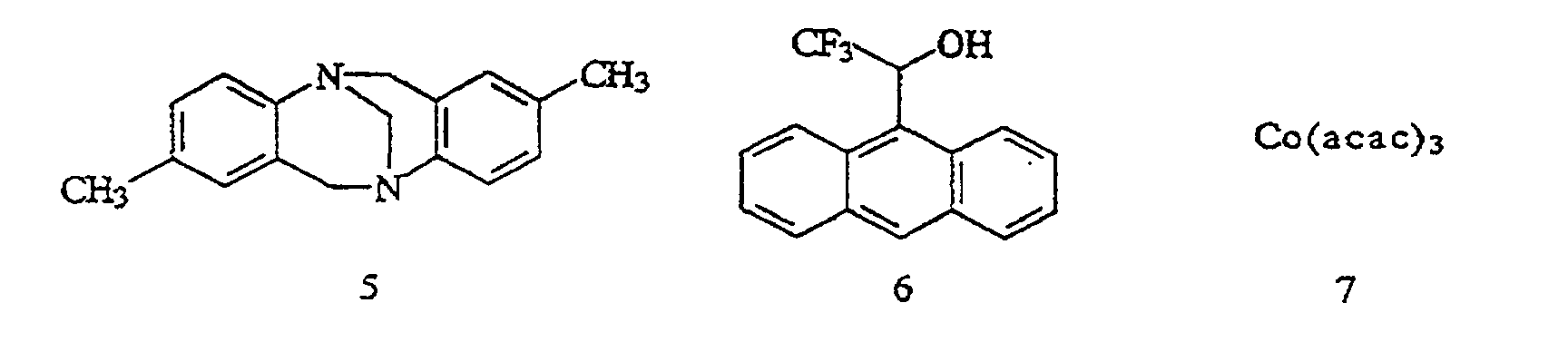
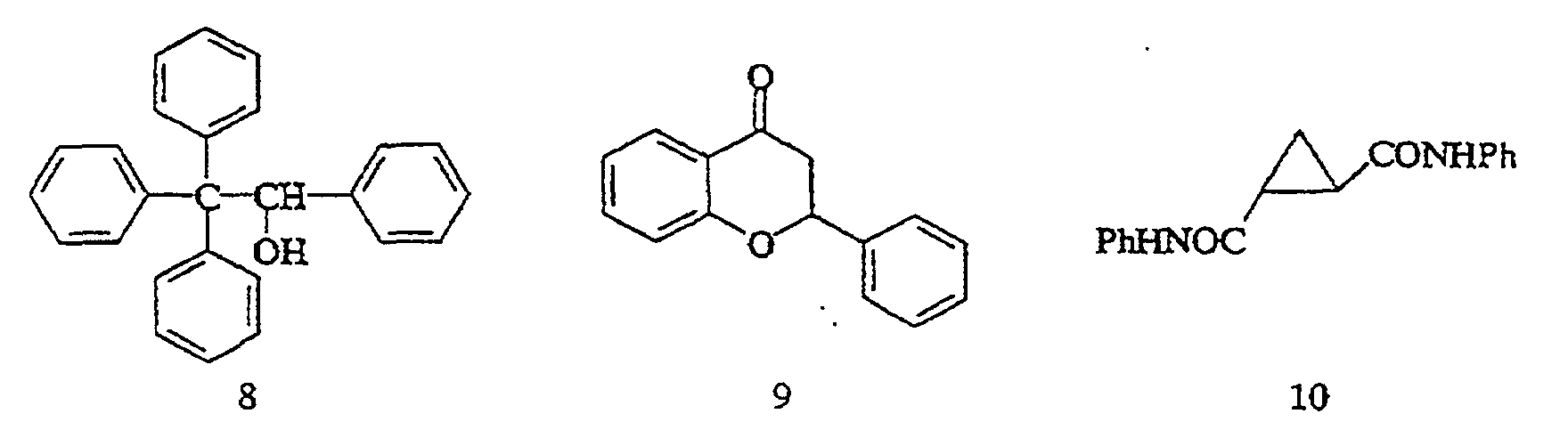
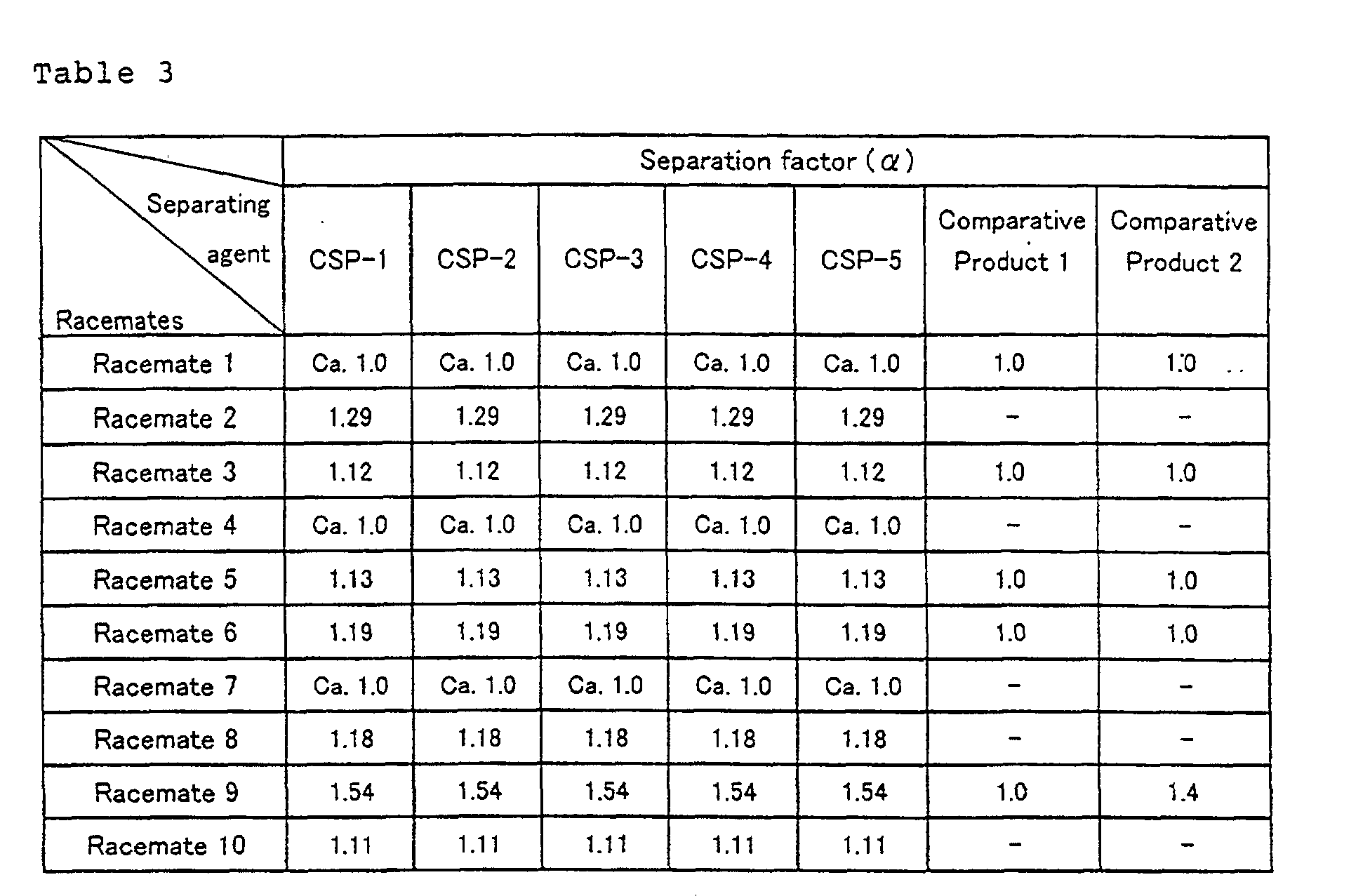
Each of the chiral stationary phases prepared in Examples 1 to 5, 3.2 g, was packed into a 0.46cm × L25cm stainless steel column under pressure by a slurry packing method, to prepare a column for separating optical isomers. This column was evaluated for its chiral discrimination power to Racemates 1 to 10 shown in the formulae below in liquid chromatography (mobile phase, n-hexane/2-propanol=90/10 (v/v) ; flow rate, 0.5 ml/min.).
Further, a chiral stationary phase (Comparative Product 1) supporting chitin bis(3,5-dimethylphenyl carbamate) (using chitin produced by SIGMA) described in Chirality, 8, 131-135 (1996) and a chiral stationary phase (Comparative Product 2) supporting chitin bis(3,5-dimethylphenyl carbamate) (using chitin produced by CETEDRA) were also evaluated for their chiral discrimination power in the same manner.
The results are shown in Table 3.
Figure 00160001
Figure 00160002
Figure 00160003
wherein, Ph represents phenyl group and acac represents acetylacetonato group.
Figure 00170001
Application Example 2
The respective chiral stationary phases prepared in Examples 1 to 4 were used to prepare optical isomer-separating columns in the same manner as in Application Example 1. These columns were used to evaluate their chiral discrimination power to basic and acidic pharmaceutical samples (Racemates 11 to 20) represented by the following formulae in liquid chromatography. The results are shown in Table 4.
Figure 00180001
Figure 00180002
Figure 00180003
wherein, Ph represents phenyl group.
Conditions of liquid chromatography
Mobile phase;
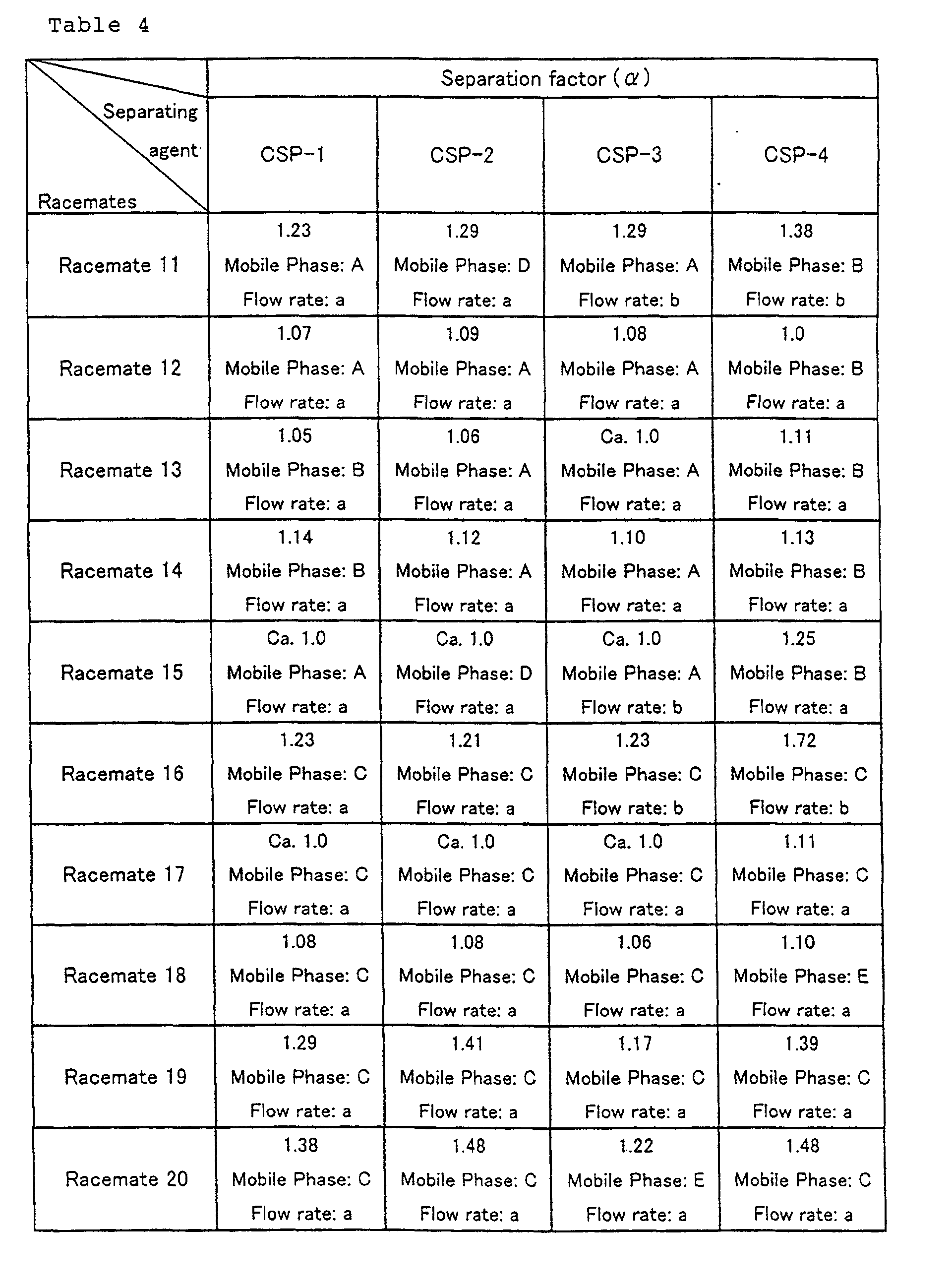
  • A: n-hexane/2-propanol/diethylamine=95/5/0.1 (v/v/v)
  • B: n-hexane/2-propanol/diethylamine=97/3/0.1 (v/v/v)
  • C: n-hexane/2-propanol/trifluoroacetic acid=95/5/1 (v/v/v)
  • D: n-hexane/2-propanol/diethylamine=80/20/0.5 (v/v/v)
  • E: n-hexane/2-propanol/trifluoroacetic acid=90/10/1 (v/v/v) Flow rate;
  • a: 0.5 ml/min
  • b: 1.0 ml/min
  • Figure 00190001

    Claims (10)

    1. A process for preparing a chitin derivative, which comprises the step of preparing a derivative of chitin in a solvent mixture of N,N-dimethylacetamide and lithium chloride.
    2. The process as claimed in Claim 1, wherein the chitin derivative is a carbamate derivative or an ester derivative.
    3. An agent for separating optical isomers, which comprises a chitin derivative preparing by the process as claimed in Claim 1 as a chiral discrimination agent.
    4. The process as claimed in Claim 1, wherein the chitin derivative contains ester linkage, urethane linkage or ether linkage in a part of hydroxyl groups.
    5. The process as claimed in Claim 1, wherein the chitin derivative contains 0.1 or more ester linkage or urethane linkage per glucose unit.
    6. The process as claimed in Claim 1, which comprises reacting chitin with a compound having functional groups being reactive with a hydroxyl group(s) of chitin.
    7. The process as claimed in Claim 6, wherein the compound having functional groups being reactive with a hydroxyl group(s) of chitin is an isocyanic acid derivative, a carboxylic acid, an ester compound, an acid halide, an acid amide compound, a halogen compound, an aldehyde, an alcohol, a compound having other eliminating groups, or aliphatic, alicyclic, aromatic or heteroaromatic compounds thereof.
    8. The process as claimed in Claim 1, wherein the reaction is carried out in a solution of 0.1 to 20 g lithium chloride dissolved in 100 ml of N,N-dimethylacetamide.
    9. A method of separating optical isomers, wherein the chitin derivative prepared by the process as claimed in Claim 1 is used as a chiral discrimination agent.
    10. Use of the chitin derivative prepared by the process as claimed in Claim 1 as a chiral discrimination agent for separation of optical isomers.
    EP00917293A 1999-04-16 2000-04-12 PROCESS FOR PRODUCING CHIENE DERIVATIVE Withdrawn EP1118623A4 (en)

    Applications Claiming Priority (3)

    Application Number Priority Date Filing Date Title
    JP11108796A JP2000297103A (en) 1999-04-16 1999-04-16 Method for producing chitin derivative
    JP10879699 1999-04-16
    PCT/JP2000/002380 WO2000063255A1 (en) 1999-04-16 2000-04-12 Process for producing chitin derivative

    Publications (2)

    Publication Number Publication Date
    EP1118623A1 true EP1118623A1 (en) 2001-07-25
    EP1118623A4 EP1118623A4 (en) 2006-08-02

    Family

    ID=14493712

    Family Applications (1)

    Application Number Title Priority Date Filing Date
    EP00917293A Withdrawn EP1118623A4 (en) 1999-04-16 2000-04-12 PROCESS FOR PRODUCING CHIENE DERIVATIVE

    Country Status (5)

    Country Link
    EP (1) EP1118623A4 (en)
    JP (1) JP2000297103A (en)
    KR (1) KR100692967B1 (en)
    CN (1) CN1300296A (en)
    WO (1) WO2000063255A1 (en)

    Cited By (2)

    * Cited by examiner, † Cited by third party
    Publication number Priority date Publication date Assignee Title
    WO2005097833A1 (en) * 2004-04-05 2005-10-20 University Of Florida Research Foundation, Inc. Functionalized organic oligomers using homogeneous modification method for molecular binding
    US7709644B2 (en) 2002-06-17 2010-05-04 Lanxess Deutschland Gmbh Process for the enantiomeric enrichment of cis-8-benzyl-7,9-dioxo-2,8-diazabicyclo[4.3.0]nonane

    Families Citing this family (3)

    * Cited by examiner, † Cited by third party
    Publication number Priority date Publication date Assignee Title
    JP4750265B2 (en) * 2000-11-02 2011-08-17 ダイセル化学工業株式会社 Chitin derivatives containing fluorine in the substituent
    US8859757B2 (en) * 2010-06-18 2014-10-14 Daicel Corporation Separating agent for optical isomers
    CN104311700B (en) * 2014-10-29 2017-07-11 武汉工程大学 Shitosan two (aromatic radical carbamate) (acid amides) and preparation method thereof

    Family Cites Families (9)

    * Cited by examiner, † Cited by third party
    Publication number Priority date Publication date Assignee Title
    US4059457A (en) * 1976-02-19 1977-11-22 The University Of Delaware Chitin solution
    US4278790A (en) * 1978-07-31 1981-07-14 Hopkins Agricultural Chemical Co. Novel cellulose solutions
    JPS60226831A (en) * 1984-04-02 1985-11-12 Daicel Chem Ind Ltd Separating agent
    US4861872A (en) * 1986-03-20 1989-08-29 Daicel Chemical Industries, Ltd. Alkyl-phenylcarbamate derivative of polysaccharide
    JPH0813844B2 (en) * 1986-03-20 1996-02-14 ダイセル化学工業株式会社 Alkyl-substituted phenylcarbamate derivatives of polysaccharides
    DE3855279D1 (en) * 1987-12-11 1996-06-13 Akzo Nv Modified cellulose for biocompatible dialysis membranes
    JP2664973B2 (en) * 1989-01-09 1997-10-22 ダイセル化学工業株式会社 Optical splitting method
    JPH02305801A (en) * 1989-05-18 1990-12-19 Soken Kagaku Kk Production of diethylaminoethylchitin
    JP2648516B2 (en) * 1989-07-27 1997-09-03 ダイセル化学工業株式会社 Separation of stereoisomers

    Cited By (3)

    * Cited by examiner, † Cited by third party
    Publication number Priority date Publication date Assignee Title
    US7709644B2 (en) 2002-06-17 2010-05-04 Lanxess Deutschland Gmbh Process for the enantiomeric enrichment of cis-8-benzyl-7,9-dioxo-2,8-diazabicyclo[4.3.0]nonane
    WO2005097833A1 (en) * 2004-04-05 2005-10-20 University Of Florida Research Foundation, Inc. Functionalized organic oligomers using homogeneous modification method for molecular binding
    US7884088B2 (en) 2004-04-05 2011-02-08 University Of Florida Research Foundation, Inc. Functionalized organic oligomers using homogeneous modification method for molecular binding

    Also Published As

    Publication number Publication date
    CN1300296A (en) 2001-06-20
    KR20010043729A (en) 2001-05-25
    WO2000063255A1 (en) 2000-10-26
    JP2000297103A (en) 2000-10-24
    EP1118623A4 (en) 2006-08-02
    KR100692967B1 (en) 2007-03-12

    Similar Documents

    Publication Publication Date Title
    EP0459530B1 (en) Alkyl-substituted phenylcarbamate derivative of polysaccharide
    US20070215549A1 (en) Separating agent for enantiomeric isomers
    US20090008329A1 (en) Separating agent for enantiomeric isomers
    EP1118623A1 (en) Process for producing chitin derivative
    EP1721664A1 (en) Separating agent for optical isomer
    US6736967B2 (en) Separating agent for enantiomeric isomers
    JP2001163806A (en) Optical isomer separating agent
    JP4750265B2 (en) Chitin derivatives containing fluorine in the substituent
    JP4340264B2 (en) Separating agent for optical isomers
    US7090775B2 (en) Separation agent for separating optical isomer and method for preparation thereof
    JP4293792B2 (en) Separation agent comprising a polysaccharide derivative having a polycyclic structure
    KR100848300B1 (en) Separators for Optical Isomers
    EP1637542A1 (en) Separatory agent for optical isomer
    JPWO2002088049A1 (en) Separating agent for optical isomers

    Legal Events

    Date Code Title Description
    PUAI Public reference made under article 153(3) epc to a published international application that has entered the european phase

    Free format text: ORIGINAL CODE: 0009012

    17P Request for examination filed

    Effective date: 20010215

    AK Designated contracting states

    Kind code of ref document: A1

    Designated state(s): AT BE CH CY DE DK ES FI FR GB GR IE IT LI LU MC NL PT SE

    RBV Designated contracting states (corrected)

    Designated state(s): CH DE FR GB IT LI

    RIC1 Information provided on ipc code assigned before grant

    Ipc: B01J 20/24 20060101ALI20060622BHEP

    Ipc: C08B 37/08 20060101AFI20001031BHEP

    A4 Supplementary search report drawn up and despatched

    Effective date: 20060704

    RAP1 Party data changed (applicant data changed or rights of an application transferred)

    Owner name: DAICEL CHEMICAL INDUSTRIES, LTD.

    17Q First examination report despatched

    Effective date: 20100504

    STAA Information on the status of an ep patent application or granted ep patent

    Free format text: STATUS: THE APPLICATION IS DEEMED TO BE WITHDRAWN

    18D Application deemed to be withdrawn

    Effective date: 20100915