EP1118547A2 - Stackable container - Google Patents
Stackable container Download PDFInfo
- Publication number
- EP1118547A2 EP1118547A2 EP00204334A EP00204334A EP1118547A2 EP 1118547 A2 EP1118547 A2 EP 1118547A2 EP 00204334 A EP00204334 A EP 00204334A EP 00204334 A EP00204334 A EP 00204334A EP 1118547 A2 EP1118547 A2 EP 1118547A2
- Authority
- EP
- European Patent Office
- Prior art keywords
- container
- recess
- closed base
- stacked
- closure
- Prior art date
- Legal status (The legal status is an assumption and is not a legal conclusion. Google has not performed a legal analysis and makes no representation as to the accuracy of the status listed.)
- Withdrawn
Links
- 238000000034 method Methods 0.000 claims description 4
- 230000001154 acute effect Effects 0.000 claims description 3
- 239000011324 bead Substances 0.000 claims description 3
- 239000000463 material Substances 0.000 description 5
- 238000004806 packaging method and process Methods 0.000 description 4
- 238000001746 injection moulding Methods 0.000 description 2
- 239000002184 metal Substances 0.000 description 2
- 239000004033 plastic Substances 0.000 description 2
- 229920003023 plastic Polymers 0.000 description 2
- 239000004743 Polypropylene Substances 0.000 description 1
- 239000004793 Polystyrene Substances 0.000 description 1
- 229920001903 high density polyethylene Polymers 0.000 description 1
- 239000004700 high-density polyethylene Substances 0.000 description 1
- 238000003384 imaging method Methods 0.000 description 1
- -1 polypropylene Polymers 0.000 description 1
- 229920001155 polypropylene Polymers 0.000 description 1
- 229920002223 polystyrene Polymers 0.000 description 1
- 239000011347 resin Substances 0.000 description 1
- 229920005989 resin Polymers 0.000 description 1
- 239000012815 thermoplastic material Substances 0.000 description 1
Images


Classifications
-
- B—PERFORMING OPERATIONS; TRANSPORTING
- B65—CONVEYING; PACKING; STORING; HANDLING THIN OR FILAMENTARY MATERIAL
- B65D—CONTAINERS FOR STORAGE OR TRANSPORT OF ARTICLES OR MATERIALS, e.g. BAGS, BARRELS, BOTTLES, BOXES, CANS, CARTONS, CRATES, DRUMS, JARS, TANKS, HOPPERS, FORWARDING CONTAINERS; ACCESSORIES, CLOSURES, OR FITTINGS THEREFOR; PACKAGING ELEMENTS; PACKAGES
- B65D21/00—Nestable, stackable or joinable containers; Containers of variable capacity
- B65D21/02—Containers specially shaped, or provided with fittings or attachments, to facilitate nesting, stacking, or joining together
- B65D21/0209—Containers specially shaped, or provided with fittings or attachments, to facilitate nesting, stacking, or joining together stackable or joined together one-upon-the-other in the upright or upside-down position
- B65D21/0217—Containers with a closure presenting stacking elements
- B65D21/0219—Containers with a closure presenting stacking elements the closure presenting projecting peripheral elements receiving or surrounding the bottom or peripheral elements projecting from the bottom of a superimposed container
Definitions
- the invention relates generally to the field of packaging, and in particular to packaging for long rolls of photosensitive web material. More specifically, the invention relates to a container with a nesting feature allowing the stacking of multiple containers.
- photosensitive web material e.g., photographic film used for surveillance, social/portrait, and commercial imaging
- containers ensuring light tightness during shipment from the manufacturer to the film processor.
- the width of the photosensitive web used for such applications is typically 35mm, 46mm, 70mm or 105mm.
- Rolls of photographic film are generally wound onto cores with or without light protecting flanges.
- Light-tight containers suitable for storing and shipping photosensitive film have a film compartment and a closure adapted to fit rather snugly about the film compartment. Most often, the containers are fabricated of metal or plastic materials.
- the photographer After using the film, the photographer generally stores it in the light-tight container and then sends the film to a photoprocessing lab where it is developed.
- technicians at the photoprocessing lab will carry several stacked containers containing exposed film into a dark room to open the containers and prepare the film for processing.
- existing containers for storing and transporting rolls of photographic film are stackable, the containers do not have nesting features.
- technicians to accidentally drop containers onto the floor as the stack is unstable. Such accidents are known to result in damaged film reels, possible damage to the exposed film, and unnecessary exposure to liability to the photoprocessing lab.
- Yet another object of the invention is to provide a method of facilitating the stacking of one container about another in a stacked container array.
- Still another object of the invention is to provide a single size closure for use with multiple size containers in the stacked array.
- a closure of either of the containers in the stacked array has a recess for receiving a portion of the sidewalls of another container in the stacked array.
- a stacked container array comprises a first container and at least a second container.
- the first container and second container each has an interior compartment comprising a closed base, upright standing side walls surrounding the closed base, and an opening formed by the side walls opposite the closed base for accessing the interior compartment.
- a closure for closing the opening includes a recess having an upwardly extending outer wall structure at least partially surrounding the recess.
- the recess has a diameter for receiving a portion of the upstanding side walls of the container.
- the outer wall structure or stacking rib eliminates translation movement of the container seated on the recess.
- a method of forming a stacked container array comprises the steps of providing the containers described above each being fitted with a closure as described. Portions of the side walls extending beyond the closed base of either of the first and second containers are then seated onto the recess of the closure of the other of the first and second containers thereby forming a stacked array.
- the present invention has the following advantages: the containers comprising the stacked array are easier to stack; the containers have limited translation movement in the stacked array; the container base and closure can be easily adapted to various sizes and configurations.
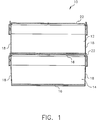
- a stacked container array 10 of the invention is illustrated.
- Such a stacked container array 10 may contain, for instance, rolls of photosensitive web material (e.g., film) which require storage and shipment in light-tight containers.
- the inventors have developed a design for multiple-sized light-tight containers that can be nested and, therefore, solve the problem with existing containers for film product.
- the invention includes a variable taper (as described below) on the stacked containers 12, 14 to facilitate nesting, as described fully below.
- stacked container array 10 includes a first container 12 and at least a second container 14 for stacking with the first container 12. It should be apparent that any number of containers 12, 14 of the invention can be safely stackec in the container array 10.
- first container 12 and at least second container 14 each includes a closed base 16 and upright standing side walls 18 surrounding closed base 16 forming a container body.
- closed base 16 is generally planar for more stable stacking although it need not be.
- An opening 20 opposite the closed base 16 provides access to an interior compartment for storing articles therein such as a roll of photographic film.
- first and second containers 12, 14 are generally circular although other geometric shapes may be used, such as any generally polygonal shape.
- closure 22 is provided for closing the opening 20.
- a plurality of cooperating threads 27 arranged both in the interior (not shown) of the closure 22 and about the circumference of the first and second containers 12, 14 provide means for fastening the closure 22 to a respective container 12, 14.
- closure 22 has a generally circular shape and is configured to conform to the shape of either of the first and second containers 12, 14.
- closure 22 includes a recess 24 and an upwardly extending outer wall (or stacking rib) 26 at leas partially surrounding the recess 24.
- recess 24 has a generally planar surface and an interior dimension for receiving a portion 18p of the upstanding side walls 18 surrounding the closed base 16 of the other of the first container and second container, shown clearly in Fig. 4.
- the upright standing side walls 18 of closure 22 form a slight acute angle to the closed base 16 although the sidewalls 18 may very well be oriented at a right angle to the closed base 16.
- the advantage of the acute angle orientation or variable taper is that it enables the containers 12, 14 to be easily manufactured by such means as injection molding or similar processes. Further, the variable taper with each size container tends to facilitate nesting, so that the diameter of the closed base 16 is similar but independent of depth. The stacked container array 10 of the invention is thereby formed.
- recess 24 is formed by a bead of molten resin during the injection molding process protruding from the closure 22 at least partially forming the upwardly extending outer wall 26 or stacking rib.
- This stacking rib limits translational movement of the portion 18p extending from the upstanding side walls 18 seated on the recess 24.
- the outer wall 26 or stacking rib extends continuously around the circumference of recess 24 (shown in Fig. 3).
- outer wall 26 may include minimally two wall stacking rib portions (not shown) that are arranged along the circumference of the recess 24 to limit translation movement of the closed base 16 seated thereon.
- first and second containers 12, 14 and closure 22 are made of a rigid thermoplastic material, such as high-density polyethylene.
- a rigid thermoplastic material such as high-density polyethylene.
- other materials may be used with equal results including polystyrene and polypropylene.
Landscapes
- Engineering & Computer Science (AREA)
- Mechanical Engineering (AREA)
- Stackable Containers (AREA)
- Packaging Of Machine Parts And Wound Products (AREA)
- Packages (AREA)
Abstract
Description
- The invention relates generally to the field of packaging, and in particular to packaging for long rolls of photosensitive web material. More specifically, the invention relates to a container with a nesting feature allowing the stacking of multiple containers.
- Typically, long rolls of photosensitive web material, e.g., photographic film used for surveillance, social/portrait, and commercial imaging, are commonly packaged in containers ensuring light tightness during shipment from the manufacturer to the film processor. The width of the photosensitive web used for such applications is typically 35mm, 46mm, 70mm or 105mm. Rolls of photographic film are generally wound onto cores with or without light protecting flanges. Light-tight containers suitable for storing and shipping photosensitive film have a film compartment and a closure adapted to fit rather snugly about the film compartment. Most often, the containers are fabricated of metal or plastic materials.
- After using the film, the photographer generally stores it in the light-tight container and then sends the film to a photoprocessing lab where it is developed. As a general practice, technicians at the photoprocessing lab will carry several stacked containers containing exposed film into a dark room to open the containers and prepare the film for processing. While existing containers for storing and transporting rolls of photographic film are stackable, the containers do not have nesting features. Hence, it is not uncommon for technicians to accidentally drop containers onto the floor, as the stack is unstable. Such accidents are known to result in damaged film reels, possible damage to the exposed film, and unnecessary exposure to liability to the photoprocessing lab.
- It should be appreciated that due to the different widths of film, film containers must be available to accommodate the several different sizes. It would, therefore, be advantageous for the manufacturer to be able to utilize a single common container closure with different sizes of container bottoms. Such an advantage is identified in U.S. Patent No. 5,740,914, by Herzog, titled, "Closure For Stacking Containers Of Different Sizes, April 21, 1998. However, unlike the containers described in U.S. Patent No. 5,740,914, the plastic or metal containers used for photographic film require an angle on the external wall of the container bottom typically identified as draft angle for ejection from the forming device. Thus, as the depth of the container bottom changes to accommodate the different widths of film, the bottom diameter of the container bottom would become smaller if each size of container bottom had the same draft angle.
- It should be appreciated, therefore, that existing packaging containers for photosensitive film product have numerous shortcomings. For instance, as multiple containers are stacked, they become unstable, and different size container closures are required for different widths of film.
- Therefore, a need persists for stackable packaging containers for photosensitive film product that incorporates nesting features to stabilize the stacked array of multiple containers and is cost effective to produce.
- It is, therefore, an object of the invention to provide a stackable container array that permits stacking of two or more containers.
- It is another object of the invention to provide a stackable container array that secures the containers in a stacked array.
- Yet another object of the invention is to provide a method of facilitating the stacking of one container about another in a stacked container array.
- Still another object of the invention is to provide a single size closure for use with multiple size containers in the stacked array.
- It is, therefore, a feature of the stacked container array that a closure of either of the containers in the stacked array has a recess for receiving a portion of the sidewalls of another container in the stacked array.
- The present invention is directed to overcoming one or more of the problems set forth above. Briefly summarized, according to one aspect of the present invention, a stacked container array comprises a first container and at least a second container. The first container and second container each has an interior compartment comprising a closed base, upright standing side walls surrounding the closed base, and an opening formed by the side walls opposite the closed base for accessing the interior compartment. A closure for closing the opening includes a recess having an upwardly extending outer wall structure at least partially surrounding the recess. The recess has a diameter for receiving a portion of the upstanding side walls of the container. The outer wall structure or stacking rib eliminates translation movement of the container seated on the recess.
- In another aspect of the invention, a method of forming a stacked container array comprises the steps of providing the containers described above each being fitted with a closure as described. Portions of the side walls extending beyond the closed base of either of the first and second containers are then seated onto the recess of the closure of the other of the first and second containers thereby forming a stacked array.
- The present invention has the following advantages: the containers comprising the stacked array are easier to stack; the containers have limited translation movement in the stacked array; the container base and closure can be easily adapted to various sizes and configurations.
- The above and other objects, features, and advantages of the present invention will become more apparent when taken in conjunction with the following description and drawings wherein identical reference numerals have been used, where possible, to designate identical features that are common to the figures, and wherein:
- Fig. 1 is a cross section view of a stacked container array;
- Figs. 2a and 2b are front and rear perspective views, respectively, of either of the container bodies in the stacked array;
- Fig. 3 is a perspective view of a closure for the container in Figures 2a and 2b; and
- Fig. 4 is a partial enlarged section of the view shown in Fig 1.
-
- Turning now to the drawings, and in particular to Fig. 1, the
stacked container array 10 of the invention is illustrated. Such a stackedcontainer array 10 may contain, for instance, rolls of photosensitive web material (e.g., film) which require storage and shipment in light-tight containers. The inventors have developed a design for multiple-sized light-tight containers that can be nested and, therefore, solve the problem with existing containers for film product. The invention includes a variable taper (as described below) on thestacked containers - Referring to Figs. 1, 2a and 2b, broadly defined, stacked
container array 10 includes afirst container 12 and at least asecond container 14 for stacking with thefirst container 12. It should be apparent that any number ofcontainers container array 10. According to Figs. 2a and 2b, more particularly,first container 12 and at leastsecond container 14 each includes a closedbase 16 and upright standingside walls 18 surrounding closedbase 16 forming a container body. Preferably, closedbase 16 is generally planar for more stable stacking although it need not be. An opening 20 opposite the closedbase 16 provides access to an interior compartment for storing articles therein such as a roll of photographic film. Preferably first andsecond containers - Referring to Fig. 3, a generally
circular closure 22 is provided for closing theopening 20. A plurality of cooperatingthreads 27 arranged both in the interior (not shown) of theclosure 22 and about the circumference of the first andsecond containers closure 22 to arespective container closure 22 has a generally circular shape and is configured to conform to the shape of either of the first andsecond containers closure 22 includes arecess 24 and an upwardly extending outer wall (or stacking rib) 26 at leas partially surrounding therecess 24. In the preferred embodiment,recess 24 has a generally planar surface and an interior dimension for receiving aportion 18p of theupstanding side walls 18 surrounding the closedbase 16 of the other of the first container and second container, shown clearly in Fig. 4. - Moreover, in the preferred embodiment, the upright standing
side walls 18 ofclosure 22 form a slight acute angle to the closedbase 16 although thesidewalls 18 may very well be oriented at a right angle to the closedbase 16. The advantage of the acute angle orientation or variable taper is that it enables thecontainers base 16 is similar but independent of depth. The stackedcontainer array 10 of the invention is thereby formed. - In the preferred embodiment,
recess 24 is formed by a bead of molten resin during the injection molding process protruding from theclosure 22 at least partially forming the upwardly extendingouter wall 26 or stacking rib. This stacking rib limits translational movement of theportion 18p extending from theupstanding side walls 18 seated on therecess 24. Preferably, theouter wall 26 or stacking rib extends continuously around the circumference of recess 24 (shown in Fig. 3). Alternatively,outer wall 26 may include minimally two wall stacking rib portions (not shown) that are arranged along the circumference of therecess 24 to limit translation movement of the closedbase 16 seated thereon. - Preferably first and
second containers closure 22 are made of a rigid thermoplastic material, such as high-density polyethylene. Those skilled in the art will appreciate that other materials may be used with equal results including polystyrene and polypropylene.
Claims (7)
- A stacked container array, comprising:
a first container and at least a second container for stacking with said first container, said first container and said at least second container each including a closed base, upright standing side walls surrounding said closed base, an opening formed by said upright standing side walls opposite said closed base and a closure for closing said opening; wherein said closure of either of said first container and said at least a second container includes a recess having an upwardly extending outer wall at least partially surrounding said recess, said recess having an interior dimension for receiving a portion of the upright standing side walls extending at least partially from said closed base thereby forming a stacked container array. - The stacked container array recited in claim 1 wherein said recess in either of said first and second closures is formed by a bead protruding from said closure, said bead at least partially forming a boundary wall for limiting translation movement of said closed base seated in said recess.
- The stacked container array recited in claim 1 wherein said recess is generally planar and said closed base is generally flat.
- The stacked container array recited in claim 1 wherein said upwardly extending outer wall fully surrounds said recess.
- The stacked container array recited in claim 1 wherein said upright standing side walls surrounding said closed base is oriented at a slight acute angle to said base.
- The stacked container array recited in claim 1 wherein said first and at least second containers and respective closures each has a plurality of cooperating threads for securing a respective closure to a respective container.
- A method of stacking containers in a stacked array, comprising the steps of:providing at least a first and second container each including a closed base, upright standing side walls surrounding said closed base, an opening formed by said upright standing side walls opposite said closed base and a closure fitted about said upright standing sidewalls for closing said opening; wherein said closure of either of said first container and said at least a second container includes a recess having an upwardly extending outer wall at least partially surrounding said recess, said recess having an interior dimension for receiving said closed base and a portion of said upright standing side walls surrounding said closed base of the other of said first container and said at least second container; and,stacking the portion of said upright standing sidewalls surrounding said closed base of either of said first and second containers on said recess of said closure of the other of said first and second containers thereby forming a stacked array.
Applications Claiming Priority (2)
| Application Number | Priority Date | Filing Date | Title |
|---|---|---|---|
| US46520799A | 1999-12-15 | 1999-12-15 | |
| US465207 | 1999-12-15 |
Publications (2)
| Publication Number | Publication Date |
|---|---|
| EP1118547A2 true EP1118547A2 (en) | 2001-07-25 |
| EP1118547A3 EP1118547A3 (en) | 2002-11-06 |
Family
ID=23846878
Family Applications (1)
| Application Number | Title | Priority Date | Filing Date |
|---|---|---|---|
| EP00204334A Withdrawn EP1118547A3 (en) | 1999-12-15 | 2000-12-05 | Stackable container |
Country Status (2)
| Country | Link |
|---|---|
| EP (1) | EP1118547A3 (en) |
| JP (1) | JP2001180677A (en) |
Cited By (1)
| Publication number | Priority date | Publication date | Assignee | Title |
|---|---|---|---|---|
| US8979014B2 (en) | 2008-12-19 | 2015-03-17 | Airbus Operations Gmbh | Multilayer board for acoustic insulation |
Citations (1)
| Publication number | Priority date | Publication date | Assignee | Title |
|---|---|---|---|---|
| US5740914A (en) | 1996-07-22 | 1998-04-21 | Anchor Hocking Packaging Co. | Closure for stacking containers of different sizes |
Family Cites Families (5)
| Publication number | Priority date | Publication date | Assignee | Title |
|---|---|---|---|---|
| US2695115A (en) * | 1953-04-02 | 1954-11-23 | Columbus Plastic Products Inc | Food container |
| DE946273C (en) * | 1954-01-31 | 1956-07-26 | Zeiler Packungen A G | Stackable container |
| AU569057B2 (en) * | 1983-05-02 | 1988-01-21 | Becton Dickinson & Company | Petri dish |
| US4961512A (en) * | 1989-01-30 | 1990-10-09 | Holdt J W Von | Childproof closure for large containers |
| JPH07237633A (en) * | 1994-02-23 | 1995-09-12 | Takashi Kondo | Plastic case |
-
2000
- 2000-11-15 JP JP2000347673A patent/JP2001180677A/en active Pending
- 2000-12-05 EP EP00204334A patent/EP1118547A3/en not_active Withdrawn
Patent Citations (1)
| Publication number | Priority date | Publication date | Assignee | Title |
|---|---|---|---|---|
| US5740914A (en) | 1996-07-22 | 1998-04-21 | Anchor Hocking Packaging Co. | Closure for stacking containers of different sizes |
Cited By (1)
| Publication number | Priority date | Publication date | Assignee | Title |
|---|---|---|---|---|
| US8979014B2 (en) | 2008-12-19 | 2015-03-17 | Airbus Operations Gmbh | Multilayer board for acoustic insulation |
Also Published As
| Publication number | Publication date |
|---|---|
| EP1118547A3 (en) | 2002-11-06 |
| JP2001180677A (en) | 2001-07-03 |
Similar Documents
| Publication | Publication Date | Title |
|---|---|---|
| US5738209A (en) | Cable storage container | |
| US4580680A (en) | Shipping pallet and container formed therefrom | |
| US5967322A (en) | Container assembly with tamper evident seal | |
| US4095694A (en) | Container for photographs | |
| JPH08500005U (en) | Light-shielding container | |
| JP3122274B2 (en) | Patrone storage container | |
| EP0408385B1 (en) | Film box | |
| JP2588960B2 (en) | Container adapter | |
| EP0681425A1 (en) | Packaging container for flat flexible circuits | |
| EP1097874A1 (en) | Light-tight packaging container | |
| US4457429A (en) | Package for recording media | |
| KR20240014459A (en) | Packaging for plates | |
| EP1112941A2 (en) | Stacked container array and method of forming same | |
| US5454468A (en) | Wafer container | |
| EP0572337A1 (en) | Flexible photographic film package | |
| US3670875A (en) | Tape reel container | |
| EP1151925A2 (en) | Stackable container and method of forming same | |
| JP2001180677A (en) | Container overlapping array and method for forming the array | |
| EP1113315A1 (en) | Light-tight container and method for storing and transporting a roll of light sensitive web | |
| EP1097875A1 (en) | Light-tight packaging container | |
| JP3472685B2 (en) | Semiconductor wafer storage container | |
| JP3272414B2 (en) | Take-up reel for bottom material of electronic component carrier | |
| EP1097876A1 (en) | Method of forming a light-tight packaging container | |
| US20260001707A1 (en) | Systems and assemblies for storing and transporting product rolls | |
| JPH09246369A (en) | Semiconductor wafer container |
Legal Events
| Date | Code | Title | Description |
|---|---|---|---|
| PUAI | Public reference made under article 153(3) epc to a published international application that has entered the european phase |
Free format text: ORIGINAL CODE: 0009012 |
|
| AK | Designated contracting states |
Kind code of ref document: A2 Designated state(s): AT BE CH CY DE DK ES FI FR GB GR IE IT LI LU MC NL PT SE TR |
|
| AX | Request for extension of the european patent |
Free format text: AL;LT;LV;MK;RO;SI |
|
| PUAL | Search report despatched |
Free format text: ORIGINAL CODE: 0009013 |
|
| AK | Designated contracting states |
Kind code of ref document: A3 Designated state(s): AT BE CH CY DE DK ES FI FR GB GR IE IT LI LU MC NL PT SE TR |
|
| AX | Request for extension of the european patent |
Free format text: AL;LT;LV;MK;RO;SI |
|
| AKX | Designation fees paid | ||
| REG | Reference to a national code |
Ref country code: DE Ref legal event code: 8566 |
|
| STAA | Information on the status of an ep patent application or granted ep patent |
Free format text: STATUS: THE APPLICATION IS DEEMED TO BE WITHDRAWN |
|
| 18D | Application deemed to be withdrawn |
Effective date: 20030701 |